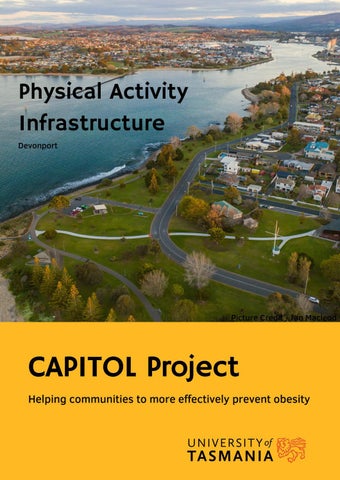
Physical Activity Infrastructure Devonport
Picture Credit - Ian Macleod
CAPITOL Project Helping communities to more effectively prevent obesity
Importance of physical activity Engaging in regular physical activity or exercise can improve your health and protect you from heart disease, type 2 diabetes, some cancers, and helps maintain a healthy weight.
How much activity should I do? Physical activity recommendations for adults (18 to 64 years) include being active most days of the week, ideally every day. As a guide, include 2.5 to 5 hours of moderate-intensity activity (per week) such as brisk walking or swimming. If activities of more vigorous intensity are possible, such as jogging or cycling, this may equate to 1.25 to 2.5 hours per week. For many people, a combination of moderate and vigorous intensity activities may be possible. Including muscle-strengthening activities on two days a week is also important. The good news is that you can start at a level you can manage. For example, if you are inactive, starting with a comfortable 10-minute walk each day can be increased over time. Remember, doing something is better than doing nothing and starting slowly and building up gradually over time is sensible. https://www.health.gov.au/health-topics/physical-activity-and-exercise
Free-to-access facilities in Devonport Free-to-access means that you can access the facilities without incurring a fee and without having to make a booking or reservation arrangements.
Devonport has many free-to-access facilities. You can access these at any time that suits you. The facilities in your local neighbourhood reduce the financial burden of participation in physical activity and provide you with more opportunities to lead a healthy lifestyle.
Mapping free-toaccess facilities Using mapping software and exploring Devonport neighbourhoods, we identified all free-to-access facilities in the area. We then assessed the quality of all facilities and identified potential challenges associated with the infrastructure.
We assessed the quality of the physical activity infrastructure using the validated Physical Activity Resource Assessment (PARA) instrument. In accordance with objective standards of quality prescribed in the PARA instrument, each infrastructure item (for example, recreational track) was coded for quality using a three-category scale: 3 = GOOD; 2 = MEDIOCRE; and 1 = POOR. In addition, each piece of infrastructure was rated on overall incivilities (that is, elements that would decrease satisfaction associated with use of the piece of infrastructure). Incivilities were rated as 3 = HIGH; 2 = MEDIUM; or 1 = LOW.
What are the free-to-access facilities in Devonport and where are they located? Recreational tracks These include purpose built trails and tracks for running, walking and cycling: Don Bushland Reserve Fitness Walk Don Bushland Reserve Fitness Loop Don River Estuary Walk Coles Beach Foreshore Reserve Walk Mersey Bluff Cultural Discovery Walk Mersey Bluff Beach and Headland Walk Bluff Road Park and Foreshore Walk Western Breakwater Walk Victoria Parade Ramble Mussel Rock Harbour Walk
Natural amenities These include beaches, parks and grass covered areas set aside for physical activity: Eugene Street Playing Field St George's Park Coles Beach Mersey River Beach Bluff Beach Back Beach East Devonport Beach Shipwreck Beach Pardoe Beach
Check out this map of the free-to-access infrastructure available to you in Devonport to see where you can find these facilities.
Red dotted lines indicate where the purpose built trails and tracks for running, walking and cycling are. Beaches, parks and grass covered areas set aside for physical activity are in Green. We have also indicated other physical activity facilities (gyms, dance studios etc.) within Devonport in 'purple stars'. However, they are not free-to-access.
How do free-to-access facilities in Devonport rate? The quality of facilities available is excellent. See below an overall quality score and scores for tracks and natural amenity. The higher the score (maximum of 3), the better the quality.
For incivilities (or elements that decrease satisfaction), the higher the score (closer to 3) the poorer the outcome. In each case, overall incivility, and incivility for tracks and natural amenity were low (between 1 and 1.5).
In summary
Devonport has plenty of free-to-access facilities across multiple suburbs. The overall quality of facilities is excellent! Even where incivilities (such as graffiti) may be present, the facilities are in excellent condition and readily usable. The majority of facilities are accessible at any time of the day. Given their high quality and accessibility, Devonport residents should be encouraged to make better use of these free-to-access facilities.
CAPITOL Helping communities to more effectively prevent obesity
The main aim of the CAPITOL (Critical Age Periods Impacting the Trajectory of Obesogenic Lifestyles) project is to prevent overweight and obesity through community capacity building in NW Tasmania. The successful implementation of the CAPITOL project will assist in the promotion of healthy lifestyles and reduce avoidable presentations to hospitals. https://www.utas.edu.au/health/community-programs/capitol
Professor Andrew Hills andrew.hills@utas.edu.au
Professor Roger Hughes roger.hughes@utas.edu.au
Mr Rob Soward robert.soward@utas.edu.au
Acknowledgements We thank Doctors Emily Flies and Dave Kendal for their assistance in infrastructure mapping; Doctors Kira Patterson, Kiran Ahuja, Michelle Kilpatrick and Sisitha Jayasinghe for their assistance in content creation.