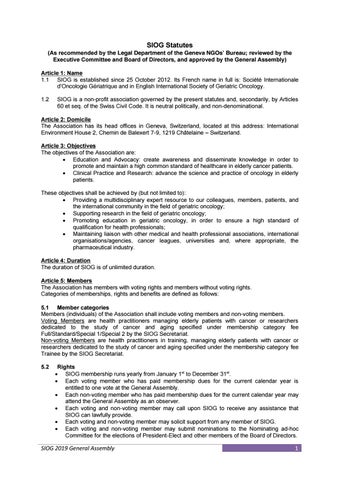
SIOG Statutes (As recommended by the Legal Department of the Geneva NGOs’ Bureau; reviewed by the Executive Committee and Board of Directors, and approved by the General Assembly) Article 1: Name 1.1 SIOG is established since 25 October 2012. Its French name in full is: Société Internationale d’Oncologie Gériatrique and in English International Society of Geriatric Oncology. 1.2
SIOG is a non-profit association governed by the present statutes and, secondarily, by Articles 60 et seq. of the Swiss Civil Code. It is neutral politically, and non-denominational.
Article 2: Domicile The Association has its head offices in Geneva, Switzerland, located at this address: International Environment House 2, Chemin de Balexert 7-9, 1219 Châtelaine – Switzerland. Article 3: Objectives The objectives of the Association are: Education and Advocacy: create awareness and disseminate knowledge in order to promote and maintain a high common standard of healthcare in elderly cancer patients. Clinical Practice and Research: advance the science and practice of oncology in elderly patients. These objectives shall be achieved by (but not limited to): Providing a multidisciplinary expert resource to our colleagues, members, patients, and the international community in the field of geriatric oncology; Supporting research in the field of geriatric oncology; Promoting education in geriatric oncology, in order to ensure a high standard of qualification for health professionals; Maintaining liaison with other medical and health professional associations, international organisations/agencies, cancer leagues, universities and, where appropriate, the pharmaceutical industry. Article 4: Duration The duration of SIOG is of unlimited duration. Article 5: Members The Association has members with voting rights and members without voting rights. Categories of memberships, rights and benefits are defined as follows: 5.1 Member categories Members (individuals) of the Association shall include voting members and non-voting members. Voting Members are health practitioners managing elderly patients with cancer or researchers dedicated to the study of cancer and aging specified under membership category fee Full/Standard/Special 1/Special 2 by the SIOG Secretariat. Non-voting Members are health practitioners in training, managing elderly patients with cancer or researchers dedicated to the study of cancer and aging specified under the membership category fee Trainee by the SIOG Secretariat. 5.2
Rights SIOG membership runs yearly from January 1st to December 31st. Each voting member who has paid membership dues for the current calendar year is entitled to one vote at the General Assembly. Each non-voting member who has paid membership dues for the current calendar year may attend the General Assembly as an observer. Each voting and non-voting member may call upon SIOG to receive any assistance that SIOG can lawfully provide. Each voting and non-voting member may solicit support from any member of SIOG. Each voting and non-voting member may submit nominations to the Nominating ad-hoc Committee for the elections of President-Elect and other members of the Board of Directors.
SIOG 2019 General Assembly
1
Each voting and non-voting member may submit nominations to the Fellowship & Awards Committee for the different SIOG awards (Paul Calabresi Award and National Representatives Award). Each voting member may vote for the President-Elect and other members of the Board of Directors (Treasurer, Chairperson of any other permanent committees, and interest groups as well as Member at large).
5.3
Obligations Each voting and non-voting member shall promote SIOG in their own capacity and support SIOG objectives as per Article 3. Each voting and non-voting member shall work in pursuit of geriatric oncology best practices. Each voting and non-voting member shall share with SIOG information of interest to the geriatric oncology community. Each voting and non-voting member is obliged to make timely payments of their annual membership dues.
5.4
Termination Each voting and non-voting member may resign their membership at any time. In that case, a written notice has to be sent by the resigning member to the SIOG Secretariat. Upon receipt of such a notice, the membership status shall be terminated immediately. Annual membership dues for the year in which the resignation occurs shall be payable in full. In all cases the membership fee for the current year remains due. Members who have resigned or who are excluded have no rights to any part of the Association’s resources. Only the resources of the Association may be used to meet commitments. Members have no individual responsibility. Membership status is automatically terminated following non-payment of annual dues at March 31st. Should payment be received after this date, membership will be reactivated.
Article 6: Structure The functional bodies of the Association shall be: The General Assembly The Board of Directors The Executive Committee Auditor Article 7: General Assembly 7.1 The General Assembly is the Association's supreme authority. It is composed of all the members. 7.2
The General Assembly shall be attended by Voting members (Membership category fees: Full/Standard/Special1/Special2) Non-voting members (Membership category fee: Trainee) as observers only The Chief Executive Officer & SIOG staff as observers only Other observers by special invitation of the President/Chief Executive Officer
7.3
The General Assembly is chaired by the President of SIOG. In case of absence, the PresidentElect shall take the chair.
7.4
A meeting of the General Assembly shall be convened every year – preferably at the SIOG Annual Conference or electronically, in the manner provided hereafter. The General Assembly may also hold an extraordinary session whenever necessary, at the request of the Board of Directors or at least of one-fifth of SIOG members.
7.5
A meeting of the General Assembly shall be convened by a written notice, by mail, e-mail or any electronic means thirty (30) days prior to the date of the meeting. A provisional agenda
SIOG 2019 General Assembly
2
shall be attached to the notice. The General Assembly shall be considered valid regardless of the number of members present. 7.6
At a meeting of the General Assembly, voting (Membership category fees: Full/Standard/Special1/Special2) members have the right to: Elect the President-Elect and members of the Board of Directors (Treasurer, Chairperson of any other permanent committees, and interest groups as well as Member at large); Decide on any modification of statutes; Note the contents of the reports and financial statements for the year and vote on their adoption; Approve the annual budget; Decide on the dissolution of the Association; Note SIOG activity reports and plans; Discharge the Board of Directors and the Chief Executive Officer of their responsibilities for the reporting period; Votes are legally binding only on matters announced in the notice mentioned in 7.5. Matters brought to the General Assembly's attention without prior notice can be voted on an informative basis only.
7.7
Decisions shall be adopted by a simple majority/quorum vote (50% +1) of voting (Membership category fees: Full/Standard/Special1/Special2) members present. Votes are by a show of hands/colour coded cards. If requested by at least five members, they take place by secret ballot. In a secret vote, a blank or spoiled ballot paper shall not be taken into consideration to determine the majority.
Article 8: Board of Directors 8.1 The Board of Directors shall govern SIOG in accordance with its objectives. The Board of Directors is empowered to act generally in the name of SIOG to provide leadership and strategic direction for all SIOG activities. It can act by mail or electronic means of communication. The working language of the Board of Directors is English. 8.2
The Board of Directors is empowered to: Appoint or dismiss the Chief Executive Officer and the chairs of other Permanent and adhoc committees; Appoint or dismiss members of the four (4) other Permanent and other ad-hoc committees as per article 10 and 11; Appoint independent auditors, review and approve the annual audited financial statements; Review the annual SIOG budget subject as to its fiscal feasibility; Review and approve the annual operating plan; Appoint and invite any other bodies as may be required and define their terms of reference; Monitor the activities of the Chief Executive Officer; Receive the recommendation of the Fellowship & Awards Committee for the selection of the Paul Calabresi Award and National Representative of the Year Award recipients; Delegate the authority to the President and/or Chief Executive Officer to enter into contracts.
8.3
The Board of Directors shall be composed of the following members: The President, who assumes the role of Chair of the Board of Directors; The President-Elect, who shall serve for two years preceding his or her term as President; The Treasurer; The Chairpersons of the Other Permanent Committees; The Chairpersons of the Interest Groups; A Board Member at large; The Chief Executive Officer as an ex-officio member.
8.4
All these Officers except the ex-officio members are elected by a simple majority/quorum vote (50% +1) of the General Assembly, based on proposal of the Nominating ad-hoc Committee.
SIOG 2019 General Assembly
3
8.5
The President and the President-elect shall hold office for 2 years. The Treasurer, the Chairpersons of the Permanent Committees and interest groups as well as the Board Member at large should hold office for a minimum of 2 years; they can be re-elected once for a further term. The maximum duration of Board membership other than for the ex-officio members is six (6) consecutive years. After observance of a two (2) year resting period, those who have already served the Board of Directors for six years are again eligible for nomination and election.
8.6
The Board of Directors shall be authorised to temporarily suspend the Board membership of a Board of Directors member before the end of their term if they are considered to have conflicting links to an entity whose aims are contrary or in competition to SIOG’s objectives. This suspension is to be confirmed by a vote during the next General Assembly.
8.7
The Board of Directors shall meet at least four times (4) a year.
8.8
The Board of Directors may meet and vote in person or by teleconference, email or other electronic means.
8.9
Further meetings of the Board of Directors may be called by the President or by five (5) members of the Board, in each case with submission of a provisional agenda.
8.10 In order for a meeting of the Board of Directors to be validly held, five (5) voting members participating as per Article 8.9 shall constitute a quorum. 8.11 Each member of the Board of Directors shall have one (1) vote. 8.12 Decisions shall be adopted by a simple majority/quorum vote (50% +1). The President shall have both a deliberative and a casting vote to resolve a tie if necessary. 8.13 If any matter requiring action arises between meetings of the Board of Directors, the Executive Committee, together with the Chief Executive Officer, shall be authorised on their own to make any decision they consider necessary or appropriate without prior consultation of the aforesaid Board of Directors. Such decisions require the subsequent ratification by the Board of Directors. Article 9: Executive Committee The Executive Committee, nucleus of the Board of Directors, shall facilitate the work of the Association and to expedite application of decisions of the Board of Directors and the General Assembly. It can act in person, by mail, teleconference or electronic means of communication. This committee shall be composed of: The President; The President-Elect; The Treasurer; The Chief Executive Officer as an ex-officio member. The Executive Committee shall meet, in person or using telecommunications, at least six (6) times a year. Article 10: Other Permanent Committees There are four (4) other Permanent Committees; each one presided by one Chairperson with a maximum of up to 6-8 members. The Chairperson is proposed by the Nominating ad-hoc Committee and elected by the General Assembly. The members are proposed by the chair and appointed by the Board of Directors. The duration of membership in permanent committees is 2 years and renewable once. These permanent committees can act in person, by mail, teleconference or electronic means of communication. This is not applicable to the Other Permanent ad-hoc Committees – Ref. article 11. Functions and responsibilities of each Committee are as follows: 10.1 Membership & National Representatives Committee
SIOG 2019 General Assembly
4
It shall be responsible for the coordination of the National Representatives nominations, activities, roles & responsibilities including recruitment of SIOG members, retention and special offers. 10.1.1 National Representatives National Representatives are appointed by the Membership & National Representatives Committee. They act as intermediaries between members of their country (when applicable) and the Association. They shall fulfil their roles & responsibilities expressed in the corresponding terms of references/policies. 10.2 Science & Education Committee It shall be responsible to contribute the advancement of science in Geriatric Oncology. It is also responsible for granting SIOG label/auspices to national or international educational events. Additionally it shall be responsible for the educational activities of the Association, such as Continuous Medical Education, SIOG Courses, etc. 10.3 Publication Committee It shall oversee all publications of the Association and electronic (web) publications. It coordinates and supervises the aims, targets, and scope of the various scientific and educational publications; and liaises with the Journal of Geriatric Oncology (JGO). 10.4 Fellowship & Awards Committee It shall be responsible for the screening and shortlisting of the nominations for SIOG Fellowships and for the SIOG Awards (Paul Calabresi Award and National Representative of the Year Award). It submits the shortlisted nominations for recommendation to the Board of Directors. Article 11: Other Permanent ad-hoc Committees The President and the Chief Executive Officer shall organise additional ad-hoc Committees in relation with the needs and operations of the Association. 11.1 Corporate Relations ad-hoc Committee It shall be responsible for all corporate & industry relations of the Association (including fundraising) and in particular linked to the SIOG annual conference and other educational events. It shall also ensure that corporate activities at SIOG conferences and the investment of industry in other SIOG ventures are in the best interests of the Association. The committee will review and approve potential, new or alternative revenue generating opportunities with a view of protecting the financial well-being and integrity of the Association. It will also be the platform wherein matters concerning industry such as changes in industry regulations, future collaborations and long terms initiatives involving industry should be discussed. The Board of Directors appoints the chairperson. Members of this committee may include SIOG past Presidents as liaison with industry partners. Membership to this Committee is open-ended and may be terminated at any time. Members of this ad-hoc committee (which may include SIOG past Presidents) are not official Board members, but can attend Board meetings as non-voting members upon invitation of the SIOG President and SIOG CEO. 11.2 Nominating ad-hoc Committee It shall be responsible for the selection and presentation to the General Assembly of the candidates for the elections of President-Elect and other members of the Board of Directors (Treasurer, Chairperson of any other permanent committees, and interest groups as well as Member at large). Its members are invited every two years by the SIOG Secretariat and composed of a representative from the SIOG Nursing and Allied Health Interest Group, the young SIOG Interest Group and five (5) SIOG members each from North America, Asia/Asia Pacific, Europe, Eastern Mediterranean and Latin America. Article 12: Interest groups SIOG currently has two interest groups. The core responsibility of the interest groups are to develop and promote, in accordance with the SIOG policies and strategy determined by the Board of Directors, excellence in geriatric oncology through education, clinical practice, communication and advocacy as well as research. 12.1 Nursing and Allied Health Interest Group
SIOG 2019 General Assembly
5
The Nursing and Allied Health (NAH) interest group comprises of nurses and other allied health professionals, also members of SIOG, who are working in the field of geriatric oncology. It oversees the nursing and allied health-related activities included in all SIOG scientific, educational and advocacy related projects. Its members including the vice-chair are elected within and by the interest group. 12.2 Young SIOG Interest Group Young SIOG comprises of young (maximum 40 years of age) clinicians and researchers, also members of SIOG, who are working in the field of geriatric oncology. It oversees the young researchers in geriatric oncology related activities included in all SIOG scientific, educational and advocacy related projects. Its members including the vice-chair are elected within and by the interest group. Article 13: The President 13.1 The President shall only serve for a two (2) year term. 13.2 The President shall periodically review existing policies and instigate new ones as necessary. 13.3 The President shall have the power to create, manage or terminate any ad-hoc committees necessary for the fulfilment of SIOG objectives. 13.4 The President shall have the power to authorise any person to represent SIOG with the joint signature of the President or the Chief Executive Officer. 13.5 In between General Assemblies, the President shall be authorised to fill any vacancies occurring in the Board of Directors and in any bodies appointed by him or her or by the Board of Directors. Article 14: The President-Elect 14.1 The President-Elect is elected by the General Assembly for a two (2) year term. 14.2 At the end of the term, the President-Elect becomes the President. 14.3 The objective of the two (2) year term as President-Elect is to prepare to take over the Presidency. Article 15: The Secretariat & the Chief Executive Officer 15.1 The Association may set-up an office and may employ staff to administer the affairs of the Association. 15.2 The Association secretariat shall: Invite SIOG members to join as members of the Nominating ad-hoc Committee for the elections of the General Assembly; Convene the General Assembly and prepare the provisional agenda with the President. 15.3 The Chief Executive Officer shall be the chief staff officer of SIOG. 15.4 The Chief Executive Officer is appointed by the Board of Directors. 15.5 The Chief Executive Officer shall report to the Board of Directors and be subject to the authority of the Board of Directors. 15.6 The Chief Executive Officer, subject to the authority of the Board of Directors and established policies, is responsible for: Leading and delivering the SIOG strategic objectives; Working with the Board of Directors to define strategic plans; Managing SIOG offices, staff, finances, resources and strategic partnerships in the most effective way; Developing the SIOG supporter base including approving all new members;
SIOG 2019 General Assembly
6
Representing SIOG externally when necessary.
15.7 The Chief Executive Officer shall attend all meetings of the General Assembly and the Board of Directors with the right to take part in deliberations but without the right to vote. 15.8 The Chief Executive Officer shall be a non-voting ex-officio member of all SIOG governing bodies and is appointed by the Board of Directors. Article 16: The Treasurer 16.1 The Treasurer shall serve a two-year term and may not be re-appointed to more than two (2) successive two (2) year terms. 16.2 The Treasurer shall: Be responsible for the financial governance of SIOG, in accordance with the directives issued to him or her by the Board of Directors; Submit annually to the Board of Directors the SIOG financial statements Article 17: Journal of Geriatric Oncology (JGO) The Journal of Geriatric Oncology (JGO) is the official journal of the International Society of Geriatric Oncology (SIOG). It is owned and published by Elsevier. The Editor-in-Chief shall be selected (and may be replaced) by the Publisher in consultation with the Executive Committee of the Association. The appointment and termination shall be with the agreement of the Association, but if no such agreement can be reached then the appointment and termination shall ultimately be the responsibility of the Publisher. The Editor-in-Chief will be responsible for and will have control over the scientific content of the Journal, taking into account the Aims & Scope of the Association, the Publisher’s editorial policies as updated from time to time (including without limitation those on ethics in publishing) and the editorial policy of the Journal (together “the policies”). The Publisher will appoint the Editor-in-Chief under a separate contract. Article 18: Financial Resources 18.1 The financial resources of SIOG shall include (but are not limited to): Annual membership dues and voluntary contributions; Grants and donations; Income from SIOG events, programmes, fundraising; Any other resources authorised by the law. 18.2 The financial resources of SIOG shall be used in conformity with the Association’s aims. 18.3 No grant will be received from any funders linked with tobacco industry and weapons. Article 19: Power to Contract 19.1 The powers to enter into contracts on behalf of SIOG are vested in the President and in the Chief Executive Officer. Any such contractual commitments require their joint signatures, except for what is provided for in Article 17.2. 19.2 The Chief Executive Officer, staff members and other persons delegated by the Board of Directors can sign bank orders, credit card orders and other administrative/financial instruments for running current affairs with a single signature up to an amount determined by the Board of Directors. Article 20: Liability SIOG members, members of the Board of Directors, members of any SIOG appointed bodies, the Chief Executive Officer and SIOG staff should incur no personal liability in respect of any actions by SIOG except in the case of personal gross negligence or failure within their duties. Article 21: Indemnification 21.1 Officers of the Association, including the Chair and members of the Corporate Relations ad-hoc Committee act voluntarily and can only be compensated for their effective and travel costs (economy class). Eventual fees cannot exceed that paid for official commissions.
SIOG 2019 General Assembly
7
21.2 The Chief Executive Officer of SIOG is a paid member of staff. 21.3 SIOG does not pay sitting allowances or make other indirect payments to individuals for attending meetings on matters of national interest. Article 22: Amendments 22.1 Proposed amendments to the Statutes of the Association may originate with the Executive Committee or the Board of Directors. 22.2 Statutes amendments proposals must be submitted in writing to the Executive Committee two (2) months prior to the General Assembly. Additionally, they must be circulated among the members at least thirty (30) days prior to the General Assembly. A simple majority/quorum vote (50% +1) at the meeting will apply. 22.3 Amendments properly proposed to the Executive Committee will be presented at the following General Assembly, accompanied by the recommendation of the Board of Directors. 22.4 Such proposals must be included as an item on the agenda and should be available to the members. 22.5 Decisions concerning the amendment of the Statutes must be approved a simple majority/quorum vote (50% +1) of the members present at the General Assembly. Article 23: Dissolution 23.1 The Association shall be dissolved if a resolution to this effect is supported by a simple majority/quorum vote (50% +1) of the members present at the General Assembly. 23.2 Proposals of such resolutions must be submitted in writing to the President not later than four (4) months prior to the General Assembly meeting. 23.3 In the case of dissolution, the meeting of the General Assembly shall appoint two liquidators to be in charge to liquidate the SIOG assets. 23.4 In the case of the Association being dissolved, the assets should be allotted to a non-profit organisation pursuing goals of public interest similar to those of the organisation benefiting from tax exemption. The goods cannot be returned to the founders or members, nor be used to their own profit. Article 24: Governing law and disputes These statutes shall be governed and construed in accordance with Swiss law. The exclusive place of jurisdiction for all disputes arising in connection with or based on these statutes shall be in Geneva, Switzerland. This amended version of the Constitution was approved by the SIOG 2019 General Assembly at its meeting on November 15, 2019 in Geneva, Switzerland and will take effect as of that date.
Dr Hans Wildiers SIOG President (2018-2020)
SIOG 2019 General Assembly
8