Sink Hollow USU Creative Writing & Art Contest
From the Director
This special edition of Sink Hollow presents the winning entries of the Utah State University Creative Writing and Art Contest, which is open to all USU undergraduate students from all departments and disciplines. We want to thank each and every one of our contestants this year for all their hard work. Each writer and artist who submitted is part of a vibrant and inclusive writing community here at USU and in Cache Valley.
The contest was quite competitive, and we are grateful to our contest judges, who generously shared their expertise: Emily Pifer, Matthew Whitaker, Kylie Smith, Lauren McKinnon, Russ Beck, and Robb Kunz. Thanks also go to my fellow Sink Hollow faculty advisors Russ Beck, Robb Kunz, Charles Waugh, and to Nicole Despain and Teagen Wilko, the English Department administrative staff, whose assistance in running the contest has been invaluable.
As Contest Director, I regularly find myself in awe of the talent and hard work coming out of the USU arts community. I am especially impressed with our Sink Hollow staff, who make this contest possible. Our stellar Sink Hollow staff helped run the contest, organized and promoted the Helicon West reading, and produced this stunning issue of the magazine. I owe them all my thanks for their dedication. Chloe Scheve and Jessica Lindhardt led the contest team this year and processed submissions—their work was essential to the success of the contest, and I am grateful for their leadership. Elizabeth Lindeman, Abby Huber, Jessica Lindhardt, Dhanai Anthimidou-Friel, Malorie Ellefson, Cody Powell, Kat Fletcher, and Brady Parsons copyedited winning work, and I am grateful for their skill and responsiveness. Amelie Haymond designed this incredible issue of the magazine, and Cody Powell put together the art slideshow for the reading at Helicon West. Mikkel Ohene-Opare and Dhanai Anthimidou-Friel created posters for the contest and the reading. Getting to work with these students is a real gift, and I am so proud of their dedication and commitment to make this opportunity available to all USU undergraduates.
I look at the list of winners and see some leaders in the creative writing program who are going on to graduate programs and writing careers, and I see our emerging leaders who will soon fill their places. What an incredibly special thing to be a part of.
-Ashley Wells, Contest Director and Sink Hollow Poetry Advisor
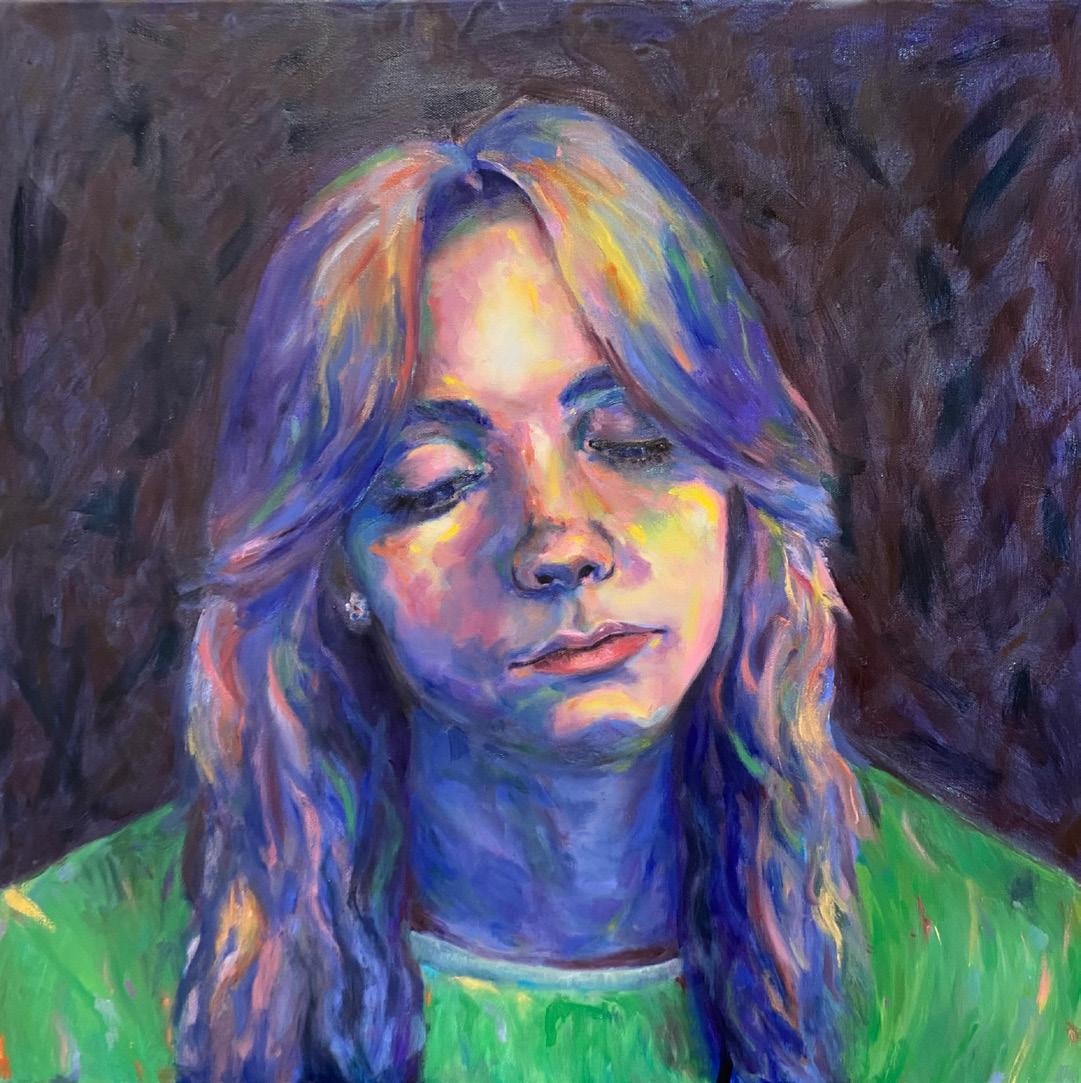
Looking Down Kaisha Mills, Second Place
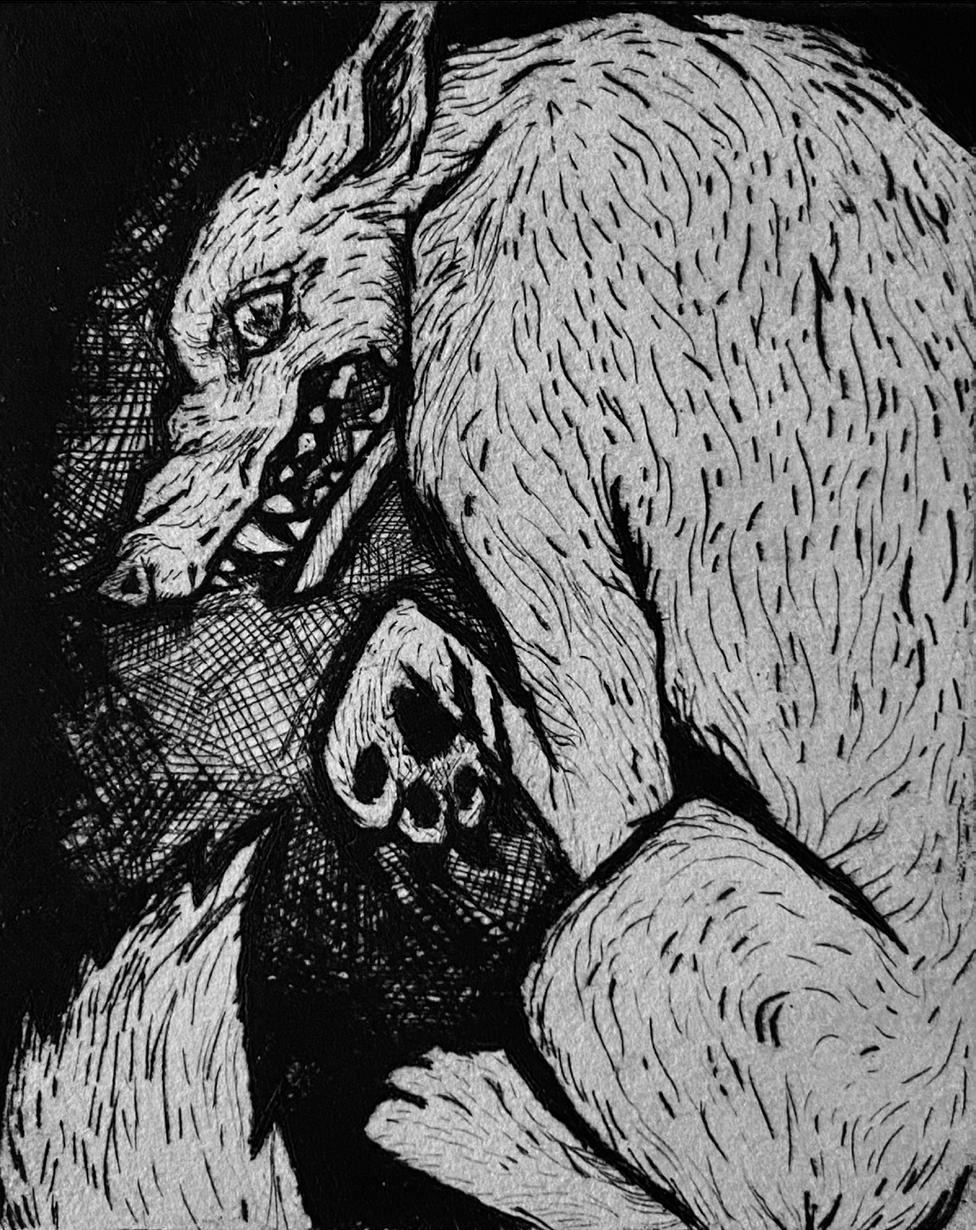
Cornered Animal
Sarah Monsen, Third Place
Erosion of Salt
Ashley Wilson, First Place Fiction
Fingers, numb from a bitter cold, press into my nose and chapped lips, but the smell leaks through. I know it is anaerobic bacteria feeding on organic matter, but knowing doesn’t take away the rotten-egg smell.
“You’ll get used to it,” Lonan says with a hearty laugh that takes in too much breath—not only a sickening amount of hydrogen sulfide but an alarming amount of arsenic, mercury, and lead, too. He pats my back as if I’m some Girl Scout eyeing a badge I have yet to achieve. His coarse hand elicits a rustle against the fabric that pierces the air and sends my teeth gnashing. I shift, putting distance between us, but I don’t think he notices as he admires this landscape he calls home. Behind him, Amari and Rue join us.
Amari’s amber eyes dart across the barren landscape. Her fingers inching toward the packs, eager to begin.
Rue, though, has eyes only for me. I pretend not to notice, ignoring the part of me that used to find comfort in his presence.
The northwest wind blows across the diminished surface of the lake we all face. Hazy, brown-tinted clouds hang low, choked with mineral-rich dust that has my nostrils itching. We are a good three miles from the lake, and already I am desiccated by the stench. How will I work up close in this?
But the answer doesn’t really matter, for that was why we were brought here: to analyze the toxic components that have become exposed as the lake dries up.
Harmful toxins in the air are not news to the government, nor the residents who live miles from the lake, but there has never been a push like this to find a solution. With rising reports of cardiovascular, neurological, and respiratory problems, however, the residents have demanded action. So, here we are, a team of four ecotoxicologists tasked with resolving an issue long in the making, with the threat that if we cannot make headway soon, over three-quarters of the population will suffer. A good number of those children.
My throat dries, stomach plummeting. I can’t help but think that the truth is we are already too late. That there is no going back to how things used to be. I shiver, and a new hand, a caressing of fingers I’d once found comfort in, rests on my back.
“It’s a lot to take in. Nothing like the photos,” Rue says.
I nod, unable to speak as a swell of regret and longing clogs my throat. But it is the anger that drives me to move away from him.
“Here.” Rue blocks my path, holding out a black, full-face respirator. “Any closer and we’ll need to put these on.”
He looks at me for a long moment, but I refuse to meet his gaze. Instead, I take the mask; it has always made me feel like a medieval plague doctor, but I know it is the only thing that’ll keep out the poisonous air I’m about to breathe. As I affix the mask in place, I walk away from the others. This is already an impossible task, and I can’t afford to let my focus slip onto other concerns, not when those are just as unsolvable.
---
It was a sea of salt.
From every angle I looked, there was nothing but flat, salt-crusted earth, blinding in its white hue.
I could be in a vast desert or an arctic tundra. It was the latter description that felt accurate, though Lonan assured us this wasn’t a true winter.
Across an expanse full of flat, dull crags with patches that reflect brilliantly in the sun, sat purple-hued mountains obscured only when the brown-tinted clouds shifted, leaving an impression of color—a hint of something beyond. Looking at the mountain through that haze was like experiencing a heatstroke daze. The only clue I had that I wasn’t experiencing heatstroke was the biting chill curling on the wind like fingers of ice trailing across my skin.
I’d felt cold before, the kind that numbs you down to the center of your soul. A cold that stole my strength and will; this, however, is a physical thing wending across my skin, freezing the hair on my arms and driving into my chest, rasping my breath. The lack of snow drifting down to lie like a blanket upon the salt was a mystery to me.
The world was changing, that much I know. And knowing that this landscape should be below water, water that should be brought by snow, reinforces the excuse I’ve built in my mind: that this changing world would not have been safe for you.
But I can’t let my mind wander down that corridor, so instead, I focus on the task: collect the samples, find answers, get out. Though I’d leave finding answers to Amari. My job was to core samples and get air readings. Tasks that chained me to Rue.
He stood only a short distance away. His saddle-brown coat jarring against the white of the salt. The sleeve of his jacket slipped as he stretched out his arm to get the nephelometer higher. The small device would collect real-time data, alerting us to how much dust, minerals, and toxins lace the air.
There is a hyper-focused fix to his eyes, only broken when the wind sweeps his hair into the clear frame of the mask, obscuring his line of vision. He pushes it back and then turns, as if drawn right to me.
I flinch back, hand fumbling with the canvas bag I’d been reaching into. Flustered, I grab the mini-corer, drop the pack, and wander off, intent on finding a good spot for a sample despite the fact that the place I’d been would have worked just fine.
The further I drift from Rue, the chain that binds us seems to loosen. I try not to focus on the conflicting emotions this brings. Instead, I force my attention onto the vacant landscape that swells around me.
The wind grows fiercer the further I walk. Soon, my braided hair is pulled loose, strands of brown drag across the nape of my neck, raising gooseflesh there. I shiver and stop as I realize the haze has settled all around me, swallowing where I was going, where I have been.
For a brief, bittersweet moment, it is as if I am all alone in the world. It is terrifying. It is freeing.
The lonely howl of the wind shifts, becoming ethereal and haunting. It reminds me of whales singing beneath the ocean.
Distracted, my foot snags on a protrusion. A yelp escapes my throat as my knees land hard against the ground, tearing the fabric—though it is less a sound and more a feeling as coarse salt grinds into my flesh.
I stare at the white mound in the ground I’d tripped on and realize with sinking horror that it is bone. A large, white, skeletal mass. Some beast eroded by the salt flats.
“Salina!”
My voice fails me as I shake among the carcasses. It is large enough to be a whale, and though I know how it must sound, I laugh at the idea. We are hundreds of miles from the ocean, and this once thriving lake may have been full of salt, but even at its prime, surely a beast such as this wouldn’t have survived.
Hands grip my shoulders, Rue’s body blocking my view. His hands shake, and when his eyes search my face and body for injury, there is a sea of worry behind his dark green gaze.
“What happened? Are you alright?”
He helps me stand, never letting me go. The ache this realization leaves in my bones is a heavy, listless thing.
“I fell on the—”
My words fade as I glance down, but whatever image the haze had conjured was now gone.
Despite the mask that hides part of his face, Rue’s concern is palpable. It pulls his handsome features into taut lines; lines I can read all too well. This is the way he looked when we’d last spoken. When my world collapsed, sinking me like an anchor.
I swallow the lump that formed in my throat and pull away. He won’t be the one to turn away first, not this time.
“I’m fine,” I mumble, shifting my attention back to the mini-corer still clutched in my hand. “Just stumbled and got startled.”
“Salina, if you need—”
“I don’t need anything from you,” I snarl, and he lurches back.
I almost apologize, almost let out all of the heartache I’d folded away deep in my chest at the look of hurt on his face, but then he broke our gaze, confirming for me that this distance was best.
I knelt, collecting the sample we’d come out to get, my fingers trembling but not from the cold or what I’d seen. It was Rue’s face that haunts me now.
When I have a thick core to bring back for analysis, I turn my back on the place I’d seen the bones. As if in farewell, the wind dances across my back, cutting into my flesh. And there, so quiet I almost miss it, a laugh plays on the breeze, cresting the ridge of my ear before leaving me frozen in place, and so very cold. A tear spills down my cheek, for I’d swear it is a child’s laugh I hear.
That night in the wooden outpost, repurposed for our work here, light seeps through the door of the barren room that is mine for the next few months. With only four of us on this expedition, sharing rooms was not necessary, but I remembered a time when Rue’s voice wouldn’t be on the other side of this door. When he’d be beside me on the small cot. He’d whisper words that’d paint a landscape of our future, churning my heart with a longing I now know could never last.
I turn away from the door and lose my tight grip on the mask I’d taken off as soon as we’d gotten inside. I move to set it on the table when I notice a hairline fracture in the glass. With my index finger, I trace the line. It is like a winding road. A journey with a predetermined end.
My hand drops, and I set aside the mask, irritated with myself for letting Rue inhabit my thoughts. Poisoning my determination for solitude.
I force my gaze to the small window my room afforded, to the lakebed beyond; a dark, endless mass. As if nothing beyond it exists. A hollowed-out emptiness settles in my chest, and I force myself to remember that I want to be alone. That it is meant to be this way.
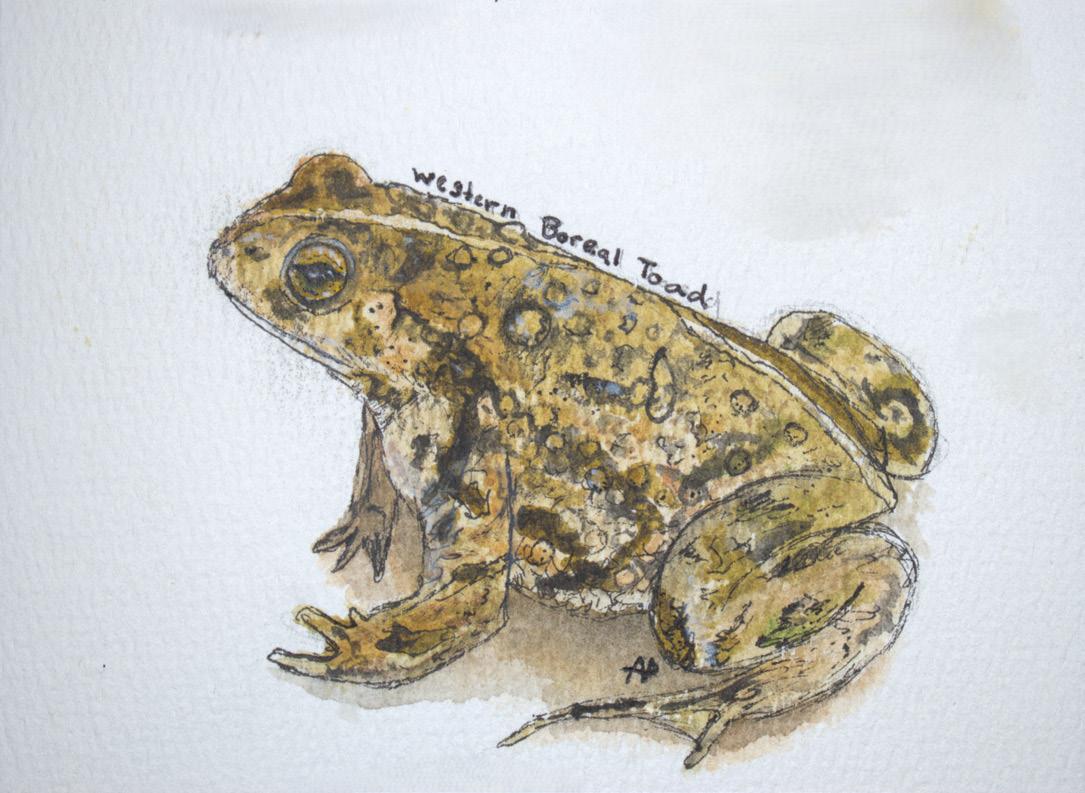
Utah Boreal Toad
Angelina Nading, Honorable Mention
As the sad thought takes root, there is a flicker of light in the distance, as if someone is holding out a lantern, signaling to me. A lighthouse in the dark.
Months slip like sand through a sieve; we are no closer to understanding this landscape than when we arrived. And though no results are gleaned, we keep searching for the consequences if we fail hang over us like a scimitar poised to cut. Tensions rise and fall, coating each of us in despair’s grip—but if the others see things they shouldn’t, or hear voices on the wind, they do not share it with me. We do not share much these days.
Today, Lonan drives us along a road that once, long ago, was lined with water. Looking at it now, it feels impossible to think the lake ever reached that high. All around us is nothing more than dry cragged land. This lake needs water poured back into it to tame the toxic lakebed from growing more exposed inch by blistering inch.
“The state has been diverting water from the lake every year since the late 1800s. These days it’s roughly… 600 billion gallons of water taken for irrigation or some other states’ needs,” Lonan says, voice layered with years of sorrow.
Amari has not stopped probing him since our drive began, and though we know this information already, she asks again as if this time she’ll find a secret hidden there.
“Isn’t the easiest solution to divert the water back? Nothing we find is going to have as efficient results as that. Certainly nothing is a quick fix, but still…” Amari presses, face flushed with determination. There is a spark in her eyes that has grown more feverish with every setback. The more time that passes, the more she seems but a child to me. Angry and demanding, she lashes out for someone to blame. But what can we do in the face of policies others make for us? Yet hope burns bright in her; oxygen to her kerosene; while I have sputtered out in the face of reality.
Even Lonan has lost the easy smiles, the laughter in his eyes. I can’t say I’m happy to see him here in the dark reality with me.
“They are worried about the crops,” Rue says, the defeat I feel weighing me down coating his voice. No matter how often I hear that tone of despair, I can’t help but fidget at the wrongness of it. When did we become this?
“Without the diversion of water they can’t feed the growing population, and with water shortages from the changes in weather patterns already creating damage to the system, they won’t even have water to divert back to the lake soon enough.”
“Toxins will kill off the population just as swiftly as food shortages,” I mutter.
“Thank you,” Amari bursts. “She gets it.” She turns back to Lonan, whose hands shift under the steering wheel as we pull into our destination.
Rue’s narrowed gaze doesn’t move off me, and I shift uncomfortably in my seat. Just when I think he’s going to say something, the car goes silent. It is as if the air has been siphoned from my lungs. It is too quiet—the type of quiet that comes just before something horrible. Something you can never come back from. My eyes burn.
I can sense the alarm in the air long before Amari opens the door, letting it in. People shout words I can’t make out over the hum of the engine. Lonan cusses, the sound a soft exhale.
As soon as I climb out of the car, I am bombarded with noise: people shouting, asking questions, someone is crying; for just a moment, I find I cannot move.
Beyond the small beige building with a large brown sign reading Visitor Center, I see what has caused so much distress. I weave between onlookers until I reach the beach just behind the building. I gag, the smell worse than the hydrogen sulfide we work in every day. Even with the cloth masks we all carry pressed to my nose, the smell of salt and decay seeps in.
“What in the world,” Rue says beside me, his voice muffled. I hadn’t realized he’d followed me, and though it feels like a betrayal, I’m glad to not face this alone, for what lies before us is a sea of death. Birds litter the shore. Many bob in the distant water, their bodies too still shells perfectly preserved as they drift towards the beach.
There have to be hundreds of them.
“What happened?”
“Millions of birds come here to nest each year. That—” Lonan’s voice breaks as he comes up beside me; Amari on his heels. “That is an Eared Grebes. There are some Pelicans. Seagulls.” He points to each bird in turn. His hoarse voice slips when it becomes too much, and he presses gloved hands to redrimmed eyes.
This is his home; it is slowly eroding.
“The saline levels spiked, I just got told. The water becomes poisonous if they drink it. Not to mention the brine shrimp dying out, creating a food source collapse.” He continues, though it is obvious he doesn’t want to. The words strained, broken, as if he could barely utter them. As if he hates that he has to.
“This is bad,” Amari says.
Rue grunts; it isn’t derision, but it sounds like it, and Amari glowers at him. From the corner of my eye, I watch Rue take in the scene, and I know—the kind of knowing that comes from being someone’s entire world—that he is devastated. Is he seeing the same loss I am? Does he remember like I do? That thought almost cripples me.
“What do we do?” she asks Lonan.
He shakes his head. “I—I don’t know.” He turns away, unable or unwilling to keep looking. His face sallow, a single tear spilling down his clenched jaw. He looks so much older, so worn by this moment.
Amari follows him, and I hope she doesn’t push the poor man too much.
And just like that, I’m left alone with Rue.
The wind picks up, dragging the water harshly, making the slick, feathered bodies ripple and collide. It is a sickening sight. And on the wind is that laugh that’s trailed along me since I heard it that first time. Through a too dry throat, I turn to Rue, ready to get out of here, but when I see his face, all thoughts freeze. He isn’t looking out at the water but in the distance where I hear the laugh. I shiver, and Rue’s gaze cuts to mine; I know he heard it too.
“There’s something out there.”
I shake my head, refusing to acknowledge it. I knew this was coming. Since the carnage we witnessed a week ago, I’ve watched Rue carefully. I can see the way he watches the haze of gray dust with trepidation every time we walk the dry, salty lakebed.
He turns his full attention on me, but I can’t respond, can’t confirm what we are both thinking. This is a road I don’t know how to come back from.
“Salina, please.” Rue loses a scratchy breath, and there is so much in that one sound—hundreds of
invisible particles that connect us; that separate us. “I know how this sounds,” he continues, and I freeze. There is a shift in the air, and I know there is nothing I can do to stop what is about to happen.
“After everything we have been through…you have been through…”
There is a pause. The tenuous connection that bridges this vast chasm between us is crumbling before me with every utterance.
“I was so scared, Salina. Terrified of what—” He shakes his head. “I told you it was because no child should live in this,” he gestures wildly around us as if we are out in the elements instead of this too small room with its swollen boards and stained windows.
“But really,” he continues, “I was just so scared of being a terrible father.” His voice seizes on that word, and it becomes a choked rattle that pierces my ribs, puncturing my lungs until I cannot breathe.
I don’t want to hear this; I can’t.
“Salina, I’m so sorry. I didn’t mean it. And then…and then it was too late.”
I turn away, shoulders slumping. My heart so heavy it is a wonder it has not fallen in a black lump on the floor between us.
It’s too late for apologies. Too late for whatever this is.
Far, far too late.
But he isn’t done. He reaches for my hand and when I don’t pull away, he says in a voice so gentle it is like a kiss on my neck: tender and warm. “But I wanted to try. I really did.” I break.
That night, tucked in the cocoon of Rue’s embrace, I dream of her face; the one I never got to see. Never got to hold or to love. A face I imagined so many times it is ingrained into my eyelids, like an afterimage from the sun. I reach out to her, but before I can grab her, she turns into a bird, and when she opens her beak to caw, only laughter rings out.
It is beautiful.
It is piercing. It shatters me anew.
Amari sits on the front porch, her legs pulled in tight. It is our last day, and the wound this truth has inflicted upon us is a festering, pus-filled mass. But it is Amari that wears the failure as if it is hers alone to bear. We knew this would happen—though if any of us had false hope, it was her, and now she has broken just like the rest of us.
“What was the point?” she whispers, her cheek pressed to her kneecap as she looks out at the dry landscape that’s haunted each of us. Coarse salt grinds beneath my fingernails, behind my eyelids, and I long for an ounce of relief from their eroding bite.
“All we have done,” she continues, exhaustion marring her words, “is confirm things they already knew. Why?”
I don’t want to say it. I know it’ll snap the last thread of hope she clings to. But in the end, I say it anyway, for long before the salt began to erode me, I was a withered thing. “An illusion of progress. A way to give people that same inkling of hope you came in with.” Even as I speak these truths, I wonder at them. They taste sour on my tongue.
Her eyes find me, and they are hollowed out shells of what they used to be; she is not surprised at my words.
“Have you seen Rue?”
She turns back to the lakebed. “He went out this morning.”
“Alone?”
Amari sighs. “He said someone was out there. I thought he meant you.”
I think of how he held me last night. The words he whispered into my hair. The pain behind his admission. The truth that’d kept us apart for so long.
I’d been too afraid to tell him that it had never been his fault, but now that I’d gained the courage to do so, his being gone has me faltering. What if it is too late?
“I’m going after him,” I say before I can think better of it. I run for the hooks where our masks hang, only to remember they are packed away with all our other things.
Amari doesn’t stop me when I race by without my mask, though she reminds me in a too-thin voice that I’m needed to help load the truck soon. When I look back at her, I realize she also is not wearing a mask despite being out in the elements. Whatever ailment the toxins in the air held, they were more than an illness of the body; we were eroding from the inside out. Each and every one of us struggling to stay afloat when we knew there was nothing more to be done.
I race out into the salty white horizon, as a fear coarse as an itch works its way up my spine.
The air is clearer today, but the sun beats down, making a haze of its own. It’s a sharp contrast to the bitter cold of those first days.
Once I’m a good way out on the lakebed, I call out for Rue, but there is no response. A gust of wind whips up as if from nowhere and howls in my ears. There is something alive about the wind trapped in this place, coiling tightly around toxic dust and growing stronger with each passing day.
A cough tears at my lungs, splitting me in half. I’m barely able to straighten, but I have to keep moving. I press my sleeve to my nose, though the cotton is nothing compared to the toxins that filter through my lungs.
I cough again, lungs burning. There is a tightness in my chest. A clawing gash coating my throat that burns with every swallow. It was stupid to venture out here without a mask. I curse myself for being so careless. I turn back, though it’ll cost me precious time—but as my feet scuff the lakebed, the wind picks up a cloud of salt, obscuring my vision completely.
For a heartbeat, I am lost. It is sudden this despairing understanding that settles in me; there is no going back.
It is then that I see the distant pinprick of light just like that lantern I’d glimpsed that first nightww, and with sinking clarity, I know that I am meant to follow it.
With stumbling steps, I manage to free myself from the cloud of dust, but when I turn around, there is a wall of it, confirming there is only one way forward.
“Rue? Are you out here?” I call, but it is little more than hacking breaths that scratch my throat into a raw, useless thing.
Despair takes hold as I realize there is no way I’ll find him, but then I hear it: the laughing wind. Only it isn’t a laugh, it’s the whale song. Gooseflesh prickles my skin, and I turn ever so slightly to the north. In the distance are large white protrusions I know are bones, and there, beside them, is Rue.
He is hunched over, curled around something. His body convulses, and for a moment I think he is having a seizure.
I run for him, driven by an aching fear that I cannot let go of. It is a familiar fear, though no less gripping: one of knowing that no matter how hard I try, no matter how much I try to convince myself
otherwise, I cannot, I will not let this man go. But now that we have found our way back to each other, I worry it is too late.
When I’m mere feet from him, I slide to a stop. Frozen. He isn’t convulsing, but crying so hard his whole body shakes from it. And in his arms, he holds a small form. A cry escapes my throat, grabbing his attention; as it shifts from the body he holds to me, she disappears.
“She led me here,” he whispers.
I shake my head.
“I didn’t understand at first,” he says, “but then I saw it.” And he points to a pool of residual water that bubbles and burbles. “It’s coming back.” His voice sounds distant, as if there isn’t enough air in his lungs to give life to the words.
I step forward and realize the smell of rotten eggs has grown tenfold, and it hits me: the hallucinations of the lantern, the whale bones, the laugh, and her…
Amari’s depression. The lethargy that has stolen Rue’s vitality. We have hypoxia. I laugh, but the sound breaks into a sob.
“It’s methane seeping through the sediment,” I say, but Rue isn’t listening; he can’t hear me. “We were never going to save it.” I turn and her eyes look up at me, eyes I’ve only ever imagined. I fall to my knees, teeth rattling from the fall.
“This broken world would not have been a good place for you. But I’d have liked to try anyway. Tried to make it right for you. In the end, it wasn’t the world that failed you. It was me, my body. I’m sorry.” She doesn’t respond, but that is okay. She isn’t real. I don’t know how much of this is. But I think he might be.
I curl next to him, and the scruff of his usually shorn beard tells me he is real. With his last ounce of strength, he whispers. It is a plea. An understanding. It tastes like hope. “It wasn’t… your fault. You did not fail. Can we have… another chance?”
A sob cuts my throat, and it hurts. It hurts so much I can hardly breathe—though that might be the methane sapping the last of my air. When my body rejected my pregnancy, I gave up on so much: the world, him, myself. On a future worth fighting for. Worth protecting. It didn’t have to be that way, though. It wasn’t my fault, just like it wasn’t this lake’s fault that the water was sapped from the salty bed, exposing rot and toxic waste. Who would fight for it if we gave up?
So with my last breath, I say, “I think we can.”
And then my eyes close.
Amari, despite also being affected by hypoxia, alerted the driver who had come to collect us that we had not returned. When they found Lonan, passed out in his room, they knew what to do once they found us. And though it is just a theory, I can’t help but wonder if the wind led them there.
I am told we are all lucky to be alive.
Days ago, I would have resented that comment. I would have considered how the world is collapsing around us, how much we have lost already. But I realized as Rue held me in those moments I thought were our last, that there is still room for hope if we are willing to try.
And I am.
As Amari grabs the last box from me to put in the back of the truck that will take Rue and I out of here, I realize that as long as we have each other, we can still have hope.
I’d been wrong to try to snuff out Amari’s.
The media attention from our hypoxia and the lack of results from our experiments on the lakebed brought a new wave of resolve from the locals, and the call for change grew louder than before. We might not have found a solution, but we did discover a grave understanding of the trouble the lakebed will reap if unresolved. Who knows the radius the lake’s methane will eventually have. And people worried anew about the exposure. If a bunch of scientists trying to save the lake could get it, then wouldn’t they be next?
Lonan and Amari were leading a new charge. In her healed, lithe body, her willfulness to protect this land grew, and when asked to stay on, she was the first to raise her hand.
I hear Lonan mutter a joke that makes Amari laugh, and I marvel at his ability to keep things light after everything that has happened. He was the second to join, and since then, he’s seemed to come back to himself as well.
“Ready?” Rue asks me as he opens the truck’s door. I look out at the lake that showed me visions and almost claimed my life. A part of me thinks I should fear it, but I find I don’t. There is a piece of me that will always belong to this landscape.
I don’t know if we are making the right decision by leaving, but I have let fear and uncertainty claim too much from me. Plus, there are other battles that need fighting. Other places that need saving. This lake is in good hands.
“Yeah,” I say, my voice steady. “I’m ready.”
Rue grins at me, grabbing my hand and giving it a tender kiss. It’s hard sometimes, letting in this gentle love. But sometimes I think it is this quiet tenderness that will be what saves us all in the end.
After all, salt might erode us, but, in the end, even saltwater is full of life.
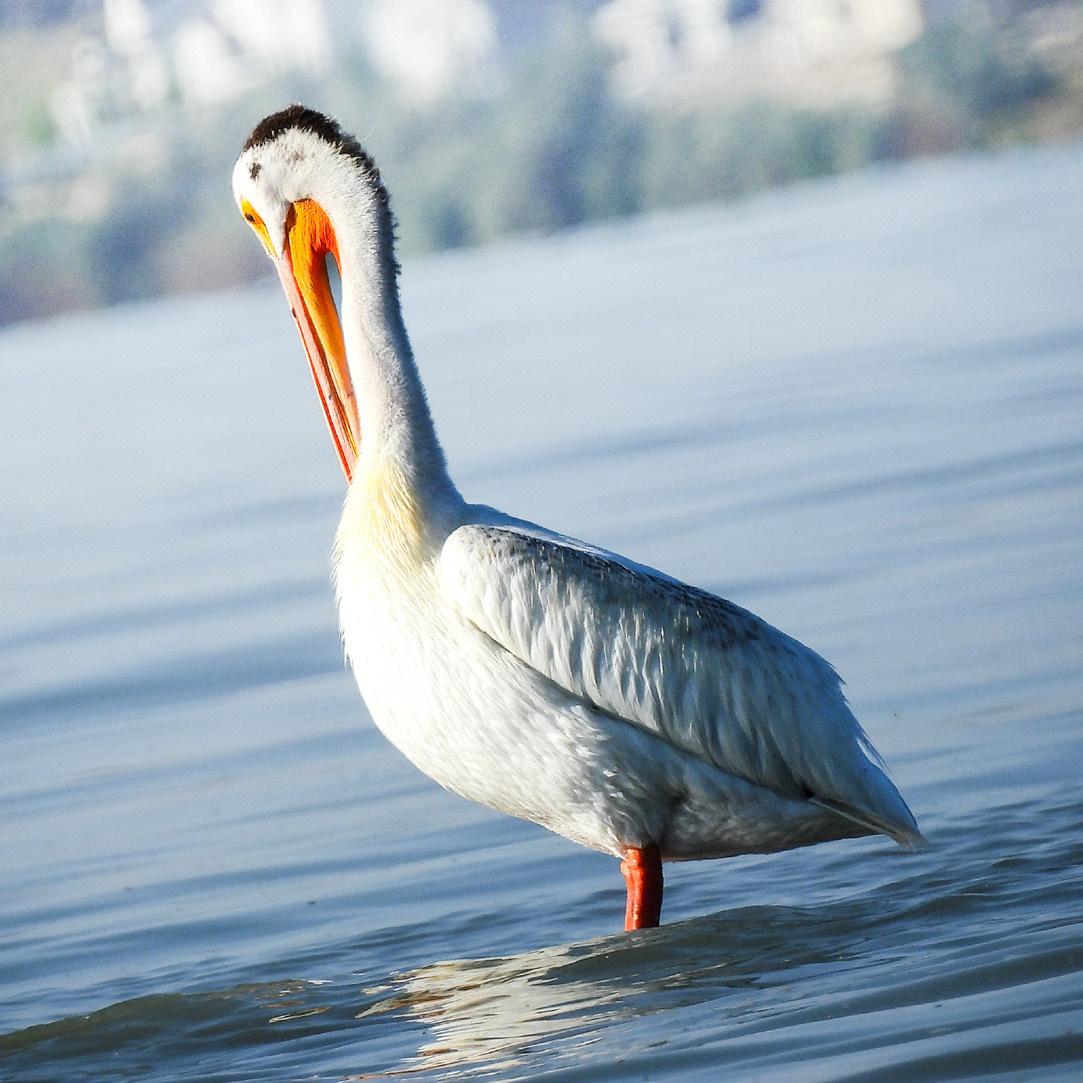
Windward Brianna Pickering, Honorable Mention
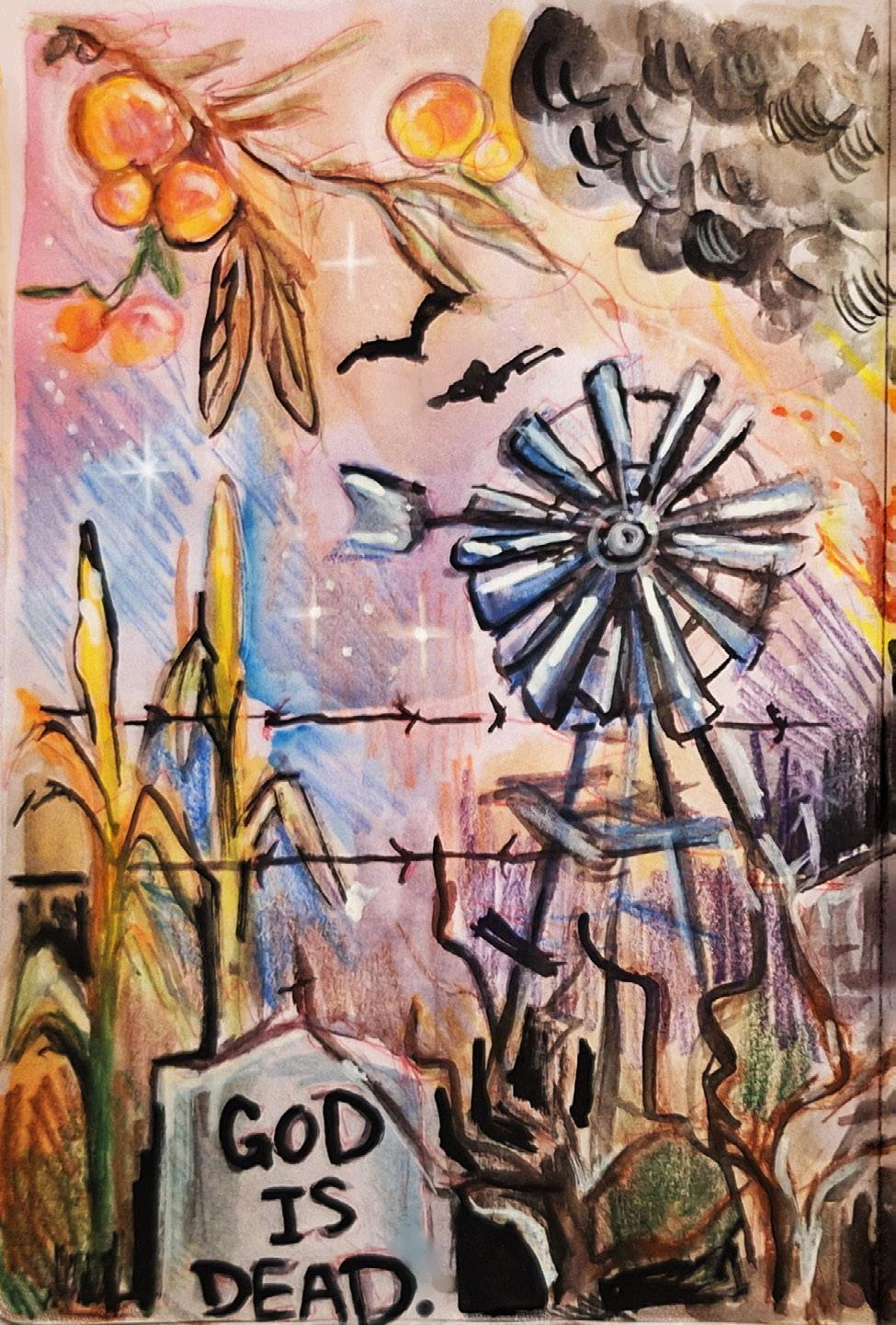
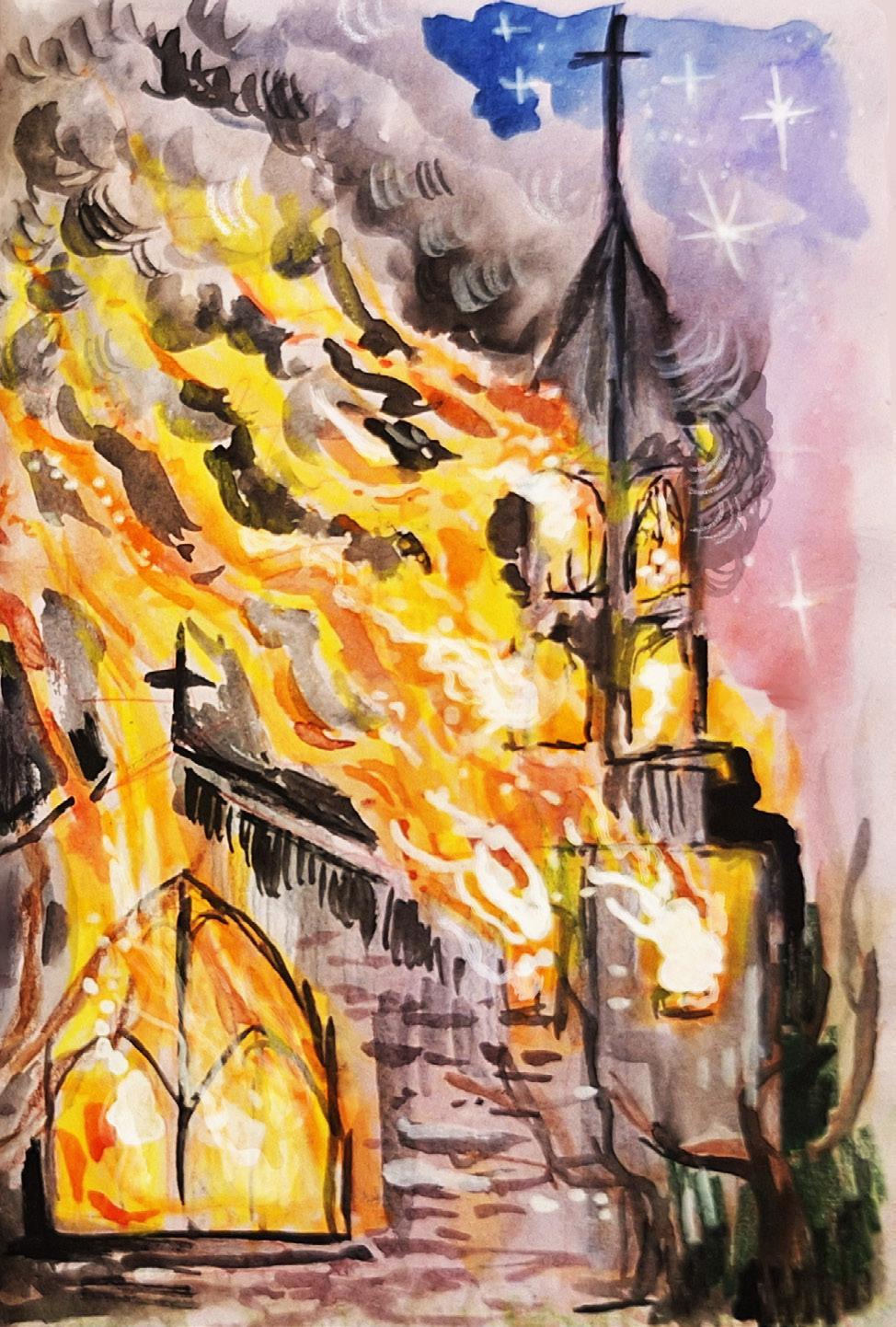
Gracie
Tooth Ache
Fife, Second Place Fiction
Bite down. Open wide. Smile!
In the house up the stairs on the floor of her childhood bedroom is where she wishes. Spread out around her are the offerings, the circular arrangement so intricate it’d be sure to attract any deity, especially a vain one. Clara is kneeling.
Here by her left palm is a pile of dandelion seeds with their wisps still on, and above that sits the ladybug shells and green clovers in the silver thimble as their vessel; by her right palm is the twined bundle of feathers, and three inches up and one inch in lies the coffee cup of dirt which she has named Star Stuff. These are the things she found just outside. The spoon of sugar, lock of hair tied up in pink ribbon, and remnants of birthday candle wax follow the circle back behind her feet, and opposite those is the hummingbird’s wishbone, champagne cork, and the dish of eyelashes. She’s been collecting, you see. These are the things she scavenged for. Above her hands, sloping toward the top of the circle, sits her mother’s broken watch—stuck at 49 minutes to midnight—and the quarter, given more space from the others. These are the things she can’t bear to part with. At her knees inside her circle of tithes is a bundle of something, wrapped in cloth and tied with more ribbon.
And then there is the silver dish, here at the head of her altar, waiting to be filled. None of these tokens touch. The metals and dusts glow blue in the moonlight, though Clara wouldn’t know; her eyes are closed.
She wishes the voices—those only she can hear, begging her to stop—would hush.
Clara lifts her palms from the floor, presses them together at her chest, and resumes her prayers, beginning again to hum the old tune which calls.
Those wide-eyed girls, they always keep their mouths stretched open to life. Fill us up, they beg. Tell us how you taste. Touch our teeth and tell us how pretty they are.
Clara is one of those wide-eyed and open-mouthed girls. Everyone remembers her; she leaves an impression.
Clara stops humming. Eyes still closed, she reaches down to the cloth and begins to unwrap its contents. It is all clinking metal and keen points. Most tools are ambiguous and odd, curving in different ways and sharpening from different angles, but a few stick out: a scalpel, dull and rusty from its age but still a blade; a set of clamps, stretched between each other by a rubber band; and a pair of pliers, their grooves set against each other like jaws. She lays out the cloth as a blanket, cradling her tools until she’s ready to use them.
She wonders if it will hurt. Perhaps a different method would be better.
The thread might be a myth, an empty threat given by empty fathers to invoke fear in young children, but the thread she found is pink. This feels like a detail she should not overlook. She brought it just in case.
She could’ve bitten into an apple. There would be poetry in that, she thinks. But the tooth is not loose. The apple would need to be of stone for the fang to budge.
Her fingers are always an option. She could wash them first, that would help, and she feels sure that this is how all the others came out: with her own two hands.
The pliers and their companions sitting in front of her are the scariest of her choices, and definitely the least romantic. But won’t it be better to do it decisive and quick? Though, if they slipped, the pain might triple; the tooth could break in half or only just barely loosen or really not loosen at all but instead just begin to ache.
She wishes she’d gone to the orthodontist instead.
But she is here now, has made up her mind, has looked in the mirror. The promise she made to her reflection still hums between her teeth; there is no breaking it now.
---
The last time Clara lost a tooth, she was ten years old and so desperate to be rid of the thing that she didn’t feel any pain at all. The thing, too, seemed desperate to be out, shifting and squirming with every bite of food, every twist of tongue, every word Clara spoke. It was a special type of torture, this wiggling—almost rhythmic in its indecision between holding on and letting go. Clara couldn’t stand it. And this is all she knows. She wishes she remembered the victory stories that she so proudly told her friends whenever another tooth went; they were always so extravagant. At one time, Clara felt certain she would always remember how she lost her teeth.
After the tooth came out—in some heroic way, she’s sure—she got ice cream with her mother. They sat in the parlor giggling over their sweets, Clara filled with relief that she wouldn’t have to lose any more teeth. She’d always considered it such an ordeal. In her mom’s purse was the tooth—the top left incisor—salvaged from the pull. Later that night, Clara would place it under her pillow, and in the morning, she would awake to a quarter in its place.
Ah, but the tooth is slippery. Not the thread nor the pliers nor even her fingers have any hold. Perhaps if she leaves her mouth wide open, her teeth will dry up and go grainy and lose their resolve.
“Do you want me to do it?”
Clara ignores the offer. She thinks this voice is just in her head, like the others. This is true, of course, but that doesn’t mean that it is not there.
The last time Clara let someone else touch her teeth, she was fifteen years old and so desperate to be rid of the wires and bands that she didn’t think twice before opening up. The result was framed by swollen gums, and when she ran her tongue along its length, it felt slimy. Finally, she had thought. I have my smile back.
Clara has always gotten what she wanted. People called it charm, beauty, luck—and as she got older, magnetism and allure—but it wasn’t any of those things. It was her teeth. There was something special about them. When people encountered those teeth, they couldn’t look away. Unable to fathom a world in which they were not on constant display, the victims of her charms became very much inclined to give Clara whatever she desired, since her teeth were of course best seen when she smiled.
She didn’t want the braces, but they said her jaw needed them. They called it crossbite; her teeth crowded and her canines sat too low on her gums and the gap between her front teeth could cause decay. Her molars won’t have room to grow in, they said. Open wide. Clara coughed on the clay coating her teeth—the alginate—and refused to look when they pried the mold from her mouth.
She cried when they put them on. So did the orthodontist. He didn’t want to cover up her smile either. One unbearable week later, they took the braces off.
Clara tugs harder, her eyes still closed. Harder and harder she tugs until her eyes fill with tears. But she is not in pain. She doesn’t even seem to notice the moisture on her cheeks or the film of saliva building on her lips or the blood dripping down her elbows— she is too focused. She wishes it was loose. It would be so much easier if it was loose.
---
The last time someone saw her smile, Clara was in the bakery on the bench in the sun waiting for her pastry. The day was remarkably warm for February. She hadn’t shown her teeth all winter—she’d gotten sick of the stares, you see—but that afternoon felt like Spring.
A man entered with a child, the opening and closing of the door stirring the doughy, sweet air of the bakery, giving Clara a glimpse of the motes of flour as the rays of sun slanted their way in. While her mother ordered, the child wandered the shelves, eventually settling near Clara. This little girl opened her mouth wide, and suddenly Clara was the one who couldn’t look away. From that gappy-grin, visions of her own girlhood were unearthed. Pixie-dusted footprints, luck bugs on little fingers, tea parties in Grandma’s backyard; wishes on shooting stars and eyelashes and birthday candles; wishes in general; rainbow-flavored candy, darling dolls with elegant names, and entire stories in one’s head; these are the things Clara smelled and saw and felt and ached for as this dazzlingly joyful child grinned up at her. This one, Clara thought. This one still believes in magic.
The child hopped up next to Clara so that the two girls were face to face, angled toward each other like flowers to the sun—curious. “My name is Alice.” This is all she said. Alice had cheeks that blossomed and bloomed, seemingly dusted with pollen, and well, Clara couldn’t help herself. Her mouth broke open into a grin. Alice earned it. She was just like Clara: a wide-eyed and open-mouthed girl. Her smile grew larger at the sight of Clara’s teeth.
They sat there that way, dazzling each other, until the man with the child came looking for his daughter. He began to call to Alice but stopped short when he saw the teeth. He, too, couldn’t look away from Clara’s mouth. He lingered, preparing to ask something of her.
Clara exited the bakery, pastry in hand—a weak imitation of her grandmother’s donuts. Bite down. Bite after bite she took, coating her teeth in sugar until they began to ache.
The voices have grown frantic as the ritual has progressed, Clara thinks—though she’s not really paying attention to them. Blood pools at her knees, growing sticky against the faded wood floors, and her eyes are still closed. She’s kept her workspace impressively tidy despite having discarded every tool but the pliers. Her fingers are pale under the crimson due to her unwavering grip. Somehow, the tool’s handle has resisted from melting into the shape of Clara’s palm, the way so many others would. It must not be able to see the teeth it is pulling at.
She yanks. It’s getting looser, now.
What Clara doesn’t know is that the thing she is wishing for has been in the room all along. It is behind the curtains and in the slanting moonlight; between the floorboards and hanging on her every breath; under the covers and there in the corner. Watching. But this other presence does not alert her. It knows something she does not: that wishing and wanting are not the same thing, and it is well acquainted with both.
The last time Clara tasted anything, the flavor stayed on her tongue too long. The coffee was scalding when she took a sip, and she’d wished it was hot chocolate instead. You know how a coffee burn persists; she couldn’t eat anything else the rest of the day without it tasting bitter and harsh.
The boy’s mouth, too, tasted like coffee. It always did. She did not love him, but his lips were warm and he knew how to use them. Love isn’t the point, anyway. That’s not what boys are for to Clara. She learned long ago not to wait for the magic after the kiss. It never comes.
The roots rip out from Clara’s gums, and her arms whip down to her sides. Her grip recoils from the sudden lack of tension, but her fingers did not slacken; the tooth remains in the jaws of the pliers, still in one piece.
She gasps as her mouth fills further with rust. She can taste it. Chest heaving and heart beating, she resists the urge to open her eyes. Clara assesses the canine with her fingers, feeling its grooves and points, the way it slopes and slips, the mark it leaves in the skin of her palm when she closes her fist too tight around it. Something is inhuman about the thing. It feels good to have it out.
They on the peripherals of her mind are quiet, now, silently sobbing at what she’s done, now only able to hope that Clara will stop at just one tooth. But the thing—the thing in the room that Clara is calling for—it hopes the opposite, anxious to see how many more teeth will go. While it waits, it admires Clara’s mouth in its grotesque, bloody state.
The last time she spoke, Clara confessed that she missed magic. She said it quietly, careful not to sound too serious. Normally, when Clara has something to say, she doesn’t worry about the response she’ll receive. But this was different. She said it in a whispered voice, like a secret, like a prayer.
Her mother laughed. Not cruelly, but not kindly, either. Just absentminded, like Clara was a child playing pretend. She didn’t laugh back, of course—that would involve a smile—but she let it go.
She wondered when it happened: growing up. She wouldn’t have gone through with it if she’d known what it would steal from her.
Clara has caught her breath, now. She deposits the tooth into the dish, fumbling around in the dark for the pliers to begin again.
The last time Clara opened her mouth, really opened it, she screamed. This was just the night before. Something had tried to crawl inside. A bug, a shadow, a lover—she doesn’t know what. Just that it was rotten and red and too big. Fingers or wings or legs or thistles grazed her gums; prying, adjusting, taking. They are trying to take something from her. They will not give it back. There in the dark, Clara pressed her tongue against her molars, remembering the way her baby teeth had given so easily when asked. Bite down. Her teeth leave an impression in the skin, proof that she fought back. Open wide. She screams again. Smile!
She is in a frenzy now. The pliers grip then rock then rip from her mouth. Tooth after tooth is deposited into the silver dish at the head of the altar, and still she is not satisfied. Neither is the thing. Her mouth is the red sea and the cliffs outside and the inside of a shark’s belly. Some of the teeth break in half on their way out, but that doesn’t deter Clara; the small remnants are much easier to get a
grip on. Soon, the holes outnumber the enamel, and her gums make waves of crimson beneath and above the lines of her lips. Her arms are shaking, but she doesn’t notice. Her eyes are still closed. Here is this Clara girl, tugging at her teeth, so desperate to believe in magic again. And here is this thing in the room with her, watching hungrily as she destroys the smile that is in and of itself magic. It cannot look away.
She presses her hands together again in one last prayer, then slowly opens her eyes to the scene around her. The watch and the quarter and the wishbone and the feathers are covered in blood, just as she thought they’d be. Her hands, too, look painted in red, her fingernails crusted in brown. She’s satisfied with what she sees. It looks like poetry.
She feels around inside her mouth with her fingers, then again with her tongue. It is warm and rusty and smooth all around. One by one, she presses the tip of her tongue into the holes she’s created. They are deeper than she’d expected.
She grasps at the silver dish at the head of the altar, shaking the teeth around until they sit nicely. Their patterns turn pearly in the moonlight, almost translucent around their edges. She can’t look away, either. Even out of her head, the teeth enthrall.
“Tooth Fairy?” Clara lisps, searching the corners of the room with her eyes, frantic at the thought that it is not there.
“Hello, Clara.” The thing shifts in the darkness to reveal where it has been watching.
She slews out a breath of relief, then grows shy. Her hands shake as she reaches again for the silver dish, holding it out to the thing as her offering.
“You’ve outdone yourself.”
“I didn’t know if you would come.”
“I never left.”
And there, in the house and up the stairs and on the floor of her childhood bedroom, Clara’s wish comes true. Her lips part and her cheeks tense and the rawness of her gums are on full display. Clara smiles. The tooth fairy smiles back.
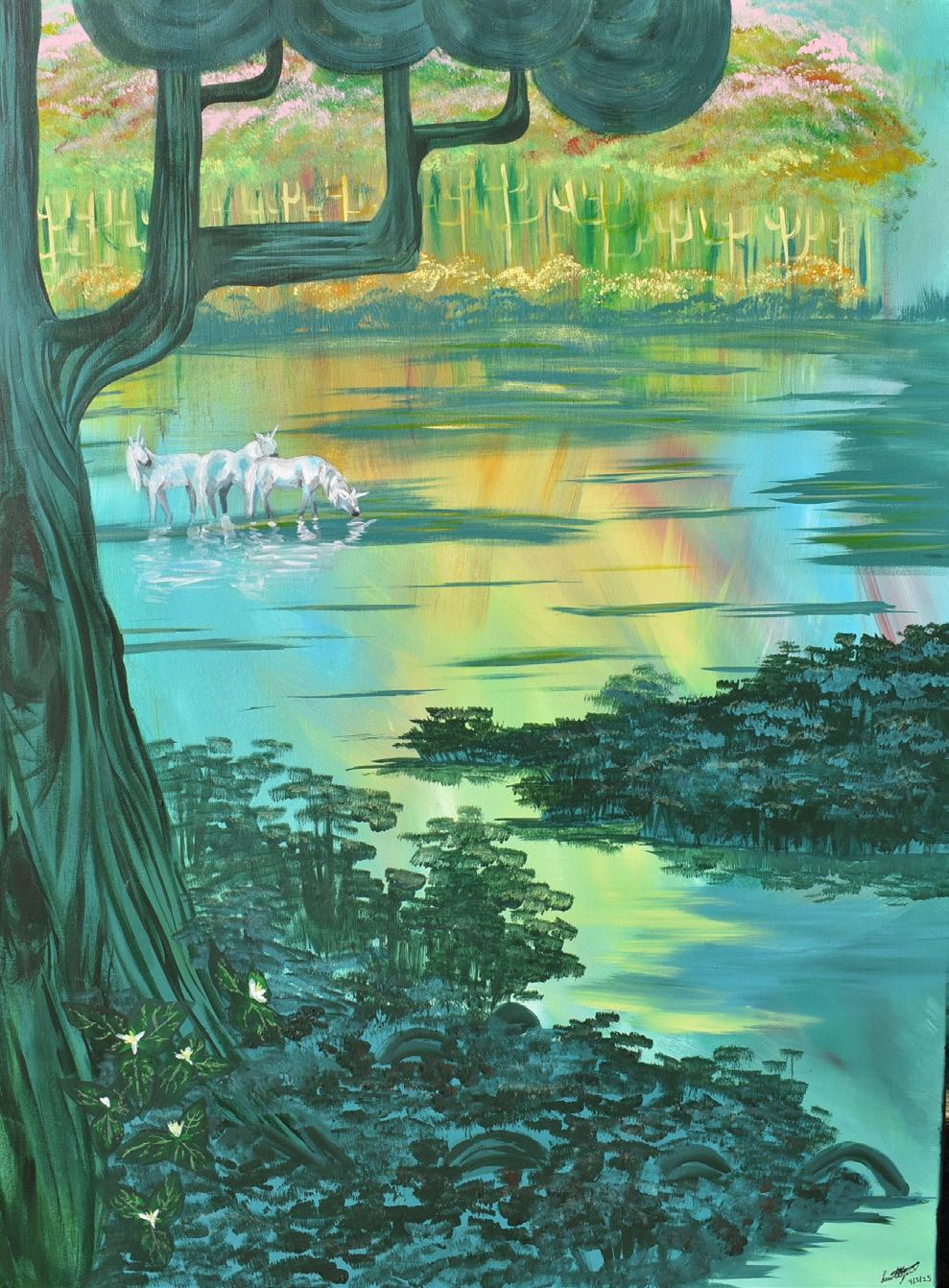
The Beauty of Three Laurel Bjornstedt, Honorable Mention
Running Mia Nielsen, Third Place Fiction
Maria walked alone under a patchwork of smog and stars. She liked the walk at night. She would slip out the back door of the hotel and cut through a chain of parking lots until she reached the back road. She rarely saw a car after eleven PM. During the day, they zipped by at freeway speeds past the rows of gated communities and nursing homes. She had let her driver’s license expire six months before. She would rather walk or let Mike from the regional office, who loved American football and hated his wife, give her rides home.
Sometimes, she wished she had a husband like Mike. He would complain about her, too, if they were married. Men like Mike always complain about their wives, but she wouldn’t mind it so much. The problems of married women seemed so much nicer than her own. Nine years ago, Carlos liked her enough to spend half the night they met on the dance floor, half fumbling through the steps on his crutches. They were both sixteen, and she loved his innocent baby animal eyes. He followed her through the halls at school and to Mass, and five years later, all the way to Texas. Things were different now, of course.
Maria wrapped her jacket tighter around her shoulders. Except for a few teenagers loitering in the McDonalds parking lot, the city was asleep. She called her mother every Saturday night, and every Saturday night, her mother told her that she needed to convince Carlos to get married. “Imagine the nice wedding you could have. In the church.” Maria told her that she would, but she’d never bring it up. Her mother didn’t understand that you couldn’t talk to men about those kinds of things. She hadn’t sinned since she was sixteen and had to waddle down the aisle, hardly able to fit her pregnant belly into the wedding dress an aunt had sewn the month before.
“Before you were born, Maria Magdalena appeared to me in a vision and gave you your name.” She recounted the story faithfully every week. There was something ironic, or maybe disappointing, about being named after the patron saint of penitent sinners. There are not many women blessed with visionary mothers, their neighbor, Sonia, used to tell her. “But tell me this,” she wanted to say. “How many women with visionary mothers are cursed with men who break into hives at the mention of marriage?” Not everything was bigger in Texas, but Carlos’s ego certainly was.
She counted the time difference in her head. It was nearly 1 AM in Maracaibo. Far-away thunder purred over the lake and crackled through the phone. Her mother always said she couldn’t sleep because of her arthritis. Maria knew she worried that if she didn’t call, her picture would end up taped to a spare change jar in a tienda, the kind they put out to raise money to ship coffins back home.
“Why doesn’t Lazaro buy a new car?” her mother said.
Her cousin, Lazaro, lived in the cramped apartment she shared with Carlos. He was a smudge on the clean uniformity of their life, like a child’s bright finger-painting experiment on a white wall. The neighbors hated his too-loud music but forgave him as soon as they met him. He remembered grandchildren’s names and high school chemistry projects and hated everyone’s boss just as much as they did. He was the reason Carlos had a job, and she couldn’t remember life without him. Last winter, he slid the car into a ditch, and she pushed down her hopes of a bigger apartment with enough room for her mother. Surely, she would survive another year alone, she thought.
Maria knew every hill and indent in these three miles, even in the dark. Occasionally, a car flew
by, spraying light across the roadside for a few seconds before accelerating towards home. She tried to listen as her mother talked about Don Pedro’s Sunday lectures. She loved God, even if she disappointed him. But of course, even the real Maria Magdalena had to start off a sinner before she got to be a saint and appear to peoples’ mothers in visions.
Would her mother like America? She almost had enough money saved up. She doubted that the priests were as good as Don Pedro. Last Christmas, they slunk into midnight Mass with the crowd of shamefaced once-a-year churchgoers. None of the priests were Venezuelan, which could be upsetting, but they would all get used to it. Next year, they’d move into one of the big apartments on the other side of the stairs and buy her mother a plane ticket and a mattress. Maybe if she was here, Carlos would be too ashamed to sleep next to her without loving her or at least marrying her.
A car strained, climbing up the hill. Maria stepped onto the concrete lip of the canal and tried to walk along it like a balance beam. The lights were brighter than they should have been. Before she could turn around, a wave of sound and pain crashed into the left side of her body. Her phone flew out of her hand. What would her mother think? She reached for her phone, useless hope bubbling in her chest. She didn’t feel the weight of her body as she tipped over the edge.
The radio didn’t work. You had to fiddle with it for ages until a staticky Bluetooth connection finally registered. Gracie wasn’t sure that hitting it did anything, but she pounded her fist against the dashboard just to be safe. Piece of crap.
Her body felt moldy with irritation. Usually, the radio wouldn’t upset her this much. What did upset her was Julia’s canine smile as she wrapped herself around Gavin’s arm. She’d only seen that kind of possessiveness from the morning glories that suffocated Nana’s roses.
The drive home from Austin usually took two hours, but she had made it so many times in the last semester that she knew which stoplights to avoid, and which back streets she could speed down. Most weekends, she made it home in an hour and a half.
She flipped the mirror open on the sun visor. She hadn’t seen another car on the highway for miles. The artificial light made her pores look huge, and her forehead looked like the paper towel you use to dab grease off a pizza. She hoped a pit to hell opened up and swallowed the hairstylist who told her bangs were a good idea. She kept a Bible on her nightstand and went to church most Sundays, so she didn’t understand why God hated her. Mom was country club pretty, but she had to try twice as hard as any of the other girls in Alpha Chi to still look like a wild boar in half of their posts. If Julia had her way, they’d stuff an apple in her mouth and skewer her over a fire.
Gracie wouldn’t have been so upset about the whole thing if Julia hadn’t looked like an angel. The fluorescent student center lighting nested over her hair like a halo instead of showing everyone she had acne under her foundation. Girls like that were pretty enough to graduate with nothing but a four-carat ring and an MRS degree then dedicate their lives to getting spray tans and playing tennis.
Three months ago, she had watched Gavin wolf down a Whataburger and told him that Julia was a satanic witch, and she’d be lucky if she made it to summer still alive. He laughed when she told him about the delicate balance between being a brat and not looking like one. Things would be so much easier if they could just be mean to each other, but girl politics were all forced smiles and backstabbing.
He knew all about backstabbing, of course. A month after saying Julia was crazy, he gave Gracie some B.S. excuse about needing to focus on school and started walking Julia to class. Jenna Richards, who
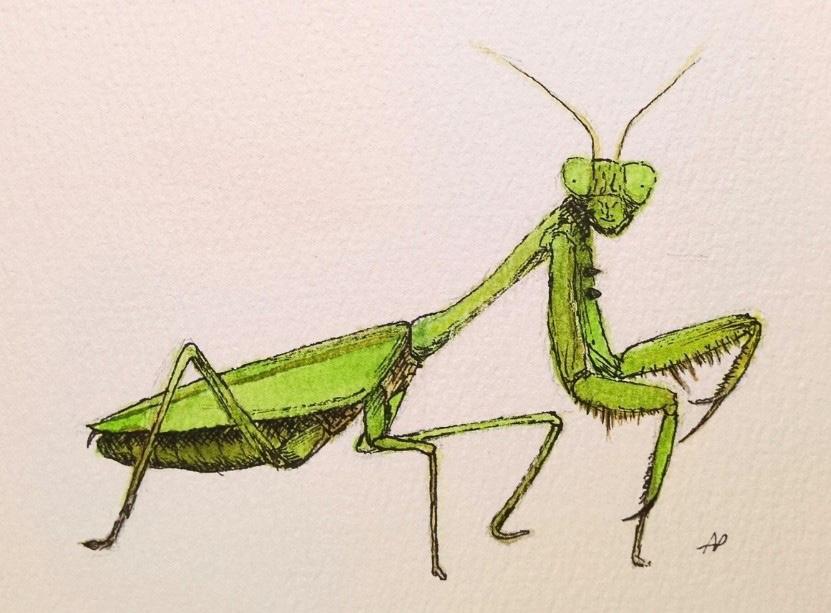
Praying Mantis
Angelina Nading, Honorable Mention
she did not like nearly as much as she used to, tried to bet their friends fifty dollars that they’d be engaged by Christmas break.
Was it worse that Gavin had seen her in a holey T-shirt with a pimple on her chin, or that Julia had? She swerved, barely making it off at the right exit.
Gavin was good enough to get a football scholarship to some obscure Christian college in the Midwest and smart enough to go to UT instead. He was still too stupid to know when he was being manipulated by a bottle blonde. She wished she’d never said I love you. He probably said it back to Julia.
She knew Julia’s schedule better than her own. Julia left 10 minutes early for her 9 AM class so Gracie left 20 minutes early. Julia and Gavin studied in the library, partied at Delta Chi, and made out drunk in the stairwell Fridays at 2 AM. Gracie went home nearly every weekend. The encounter in the student center was a lapse of judgement. She’d gotten lazy and forgot that Julia always stopped for Starbucks sometime after her first class. She cried in her car right after, but she’d be home in twenty minutes, and when she woke up the next day, Mom would make cinnamon rolls for breakfast.
She fiddled with the radio again. Didn’t a grieving girl have the right to listen to breakup anthems? There was a flash of blue in the headlights and a thump.
---
Maria fell backwards, floating for a second over the yellow winter grass before she slammed into the mud. Her back hurt, but it felt far away. A shrill whine circled the perimeter of her awareness. Her mind drifted further and further from the pain, like she had left her body at the beginning of a very long tunnel. Her head was full of water and the sound of summer thunder over Catatumbo.
Their neighbor Sonia said the lightning came from the spirits of their ancestors. Her mother said that was heresy but could never decide why. Most of the neighbors were heretics. Los Mejia kept their butcher shop open on Sunday. Her aunt was a gossip, and her uncle gambled. Sonia Miranda drank, and Sonia de la casa verde was most likely a witch. The boys down the street stole watermelons out of the garden, but they probably couldn’t help it since they were born out of wedlock. Her mother loved her neighbors because the Bible said to, but that didn’t stop her from recognizing exactly what was wrong with them. There were, after all, only two sinless people in the world, Jesus Christ and Don Pedro, their priest.
Maria’s mind flashed between scenes of Maracaibo; the smell of oil and brine, the pig legs hanging from the window of the shop down the street, and the glass bottles of coke Sonia would give them if they played in front of her house for long enough. By the time she was nine years old, her father was a fuzzy memory, a broad-shouldered obstacle to her mother’s immaculate conception.
It was just her, Mami, and Santi. But of course, it was never just them. There were neighbors poking their heads through the open front door and aunts in the kitchen making stacks of arepas and trips in Tio Luis’s new car to the beach. When they weren’t in school, they went to every Mass and stern looking church people crowded into their living room to talk about La Palabra. Sometimes, she and Santi played with the boys across the street. The neighbor was always pregnant with another one that you could hold or stick your tongue out at, but for the most part, her boys were either too young or too evil for their taste. They mostly played with Lazaro. He liked futbol, marbles, and He-Man, and their aunt let him play with his World Cup cards during Mass. He was still afraid of lightning, which was stupid because there was always lightning in Maracaibo and nothing bad ever happened.
Maria knew, lying in a canal, her blood mixing with mud, that bad things did happen in Maracaibo.
When she dreamed about the day her brother died, she always woke at the first growl of thunder, before the rain started and the water roared after them in the pipe and the streets smelled like death. It was too awful to relive. She would wake up, her heart pounding, and clutch the rosary she kept hidden in their nightstand. Now, she couldn’t wake up.
Santi looked tiny in the priest’s arms. Their aunt wailed rhythmically, and Lazaro clutched his bloody eye and whimpered. Their mother’s hand was blood red, it was clenched so tightly around the beads of her rosary. Her face was nearly as white as Santi’s.
The doctor said he was dead. The priest made a cross on Santi’s forehead. “Look at his innocence. Look at this mother,” he said. Mami looked like the card of a saint, like Juana de Arco waiting for a miracle or waiting to burn.
“Return him to us,” the priest prayed, throwing his face towards heaven. “Si Dios quiere.”
Si Dios quiere? If God wants it? Why would God want her brother to die? She waited for his eyes to open. She clenched her fists at her side, praying. Her jaw ached.
If God wants it? I want it.
Gracie had never imagined running anyone over except for maybe when she was listening to Carrie Underwood and pretending to hate Gavin. The thump was quieter than she would have thought. What are you doing? Stop the car.
Her elbows locked on the steering wheel and she kept driving. Not too fast or you’ll get pulled over and then you’re in hot shit. How many cops patrol this neighborhood anyways? At Oak Glenn, she used to sit on the 20-year-old blue recliner in Grandpa’s room and watch CSI reruns and try to ignore the smell of old people piss. On one of his shows, some lady got her brain pulled out through her nose, like they do to mummies, which is a way worse way to go than getting hit by a car. A car is fast. It was definitely a deer, anyways. Her mother always said that deer just wander out onto the road. Gracie thought of the flash of blue. What kind of person would be walking on the edge of the road this late at night?
A streetlight flickered outside of a limestone complex of doctor’s offices and insurance agencies. She swerved into the parking lot. She could feel the silent waves of the police scanner bouncing between her ears. The cops were on their way, probably a whole squad with one of those helicopters with a spotlight. What was the punishment for hitting someone with your car? People get hit by cars all the time. What was the punishment for running away? What picture of her would they put on the news? Girl, 21, driving a 1996 Jeep Cherokee involved in hit-and-run. Her breath came out in agonizing bursts. Every time she inhaled, a dozen imaginary goat heads bounced around and punctured her lungs.
How bad did the car look? She had to check. If the police saw her, would they know what she did, or could she sneak back home and book a flight with Daddy’s only-for-emergencies credit card? Nepal didn’t extradite. She would go to Nepal and start a new life, like Marion Ravenwood but kinder because she would adopt three Nepalese children and fall in love with a Russian journalist or maybe a spy who couldn’t go home because the KGB had a price on his head. What language do they speak there, anyways? She closed her eyes and felt for her phone in the cupholder. What happened to people who committed manslaughter? Her fingers felt numb as she typed, even though the temperature had hardly dipped into the 70s. Three years in prison. What would Mom tell the ladies in the country club? What would Gavin think? Every guy loves to tell girls that his ex is crazy, but when your ex is in prison for manslaughter, the accusation holds more weight. She could hardly push the car door open, but when she did, she dropped
straight to her knees on the concrete. Hot bile burned the back of her nose.
Nobody saw. Those kids in the McDonalds parking lot were too stoned to remember what kind of car she drove. Nobody saw.
Under the friendly blue letters of Hill Country Pediatric Dentistry, an owl holding a toothbrush smirked at her. “There are cameras, idiot,” it said. She didn’t think owls had teeth. This wasn’t just backing into a car in the high school parking lot and driving away. This was real.
She stared at the puddle of vomit on the grass strip. This is like Mulan, she thought, except that who I am inside really is a partially digested Chipotle burrito bowl. Maybe Gavin was right when he said she didn’t think of anyone but herself, but how could she think about anyone else when the person on the side of the road was probably dead already, and she had sixty years left to rot in prison? She could already imagine the stupid thoughts and prayers posts that would pop up on every single one of Julia’s vapid little friends’ Instagram stories. She’d be the friend of a friend who killed someone to every kid at school.
“You know, I always thought she was a little strange, but I never thought she’d kill someone.” Julia would dab Miss America tears out of the corners of her eyes and tell every news anchor how sorry she was for the family, and America wouldn’t even know that she was one of those reptilian aliens zipped into a human suit. What if they made a true crime show on Netflix?
The parking lot was probably half a mile from where it had happened. She had to go back and check. A car would drive by at any minute and see someone lying on the side of the road and someone else having a panic attack two minutes away. It was less Sherlock Holmes and more one of those shape sorting puzzles for toddlers. The circle goes in the circle hole, the square goes in the square hole, and the person on the side of the road goes in the human-sized dent on the side of Gracie’s car.
She didn’t have anything to clean up the vomit. Would they be able to trace her DNA? She ripped up fistfuls of grass and mixed them into the puddle. It didn’t hide anything. She stood up and flipped on her phone’s flashlight. If she was lucky, some stupid teenager would come along and hit her, too.
As she walked, it felt as though her thoughts stayed behind, hysterical blobs screaming at the puddle of puke and the dent in the car and the Bluetooth radio that still didn’t work. Her mouth tasted like iron. She stopped when she saw the blue sweatshirt at the bottom of the canal. It wasn’t a trick of the light or a mutant blue animal. She had killed someone. She couldn’t breathe.
She ran. She had to be sure. Halfway down the hill, something caught her foot and she slid the rest of the way down. When she reached the bottom, there were tiny pieces of gravel embedded in her palms, and her jeans were covered in mud. It was a woman. She had dark hair, and she wore a Quality Inn polo under a navy-blue hoodie. Gracie tried to check the woman’s pulse, but her own heart was beating so fast that she could feel it pushing at her fingertips. She wished she had paid more attention in high school health class.
Gracie felt something simmering in her chest. It wouldn’t take long to boil over into a scream or another puddle of vomit. She gripped the woman’s arm, and a sob ripped at her throat. Her hands were shaking so badly she could hardly dial 911.
Something was beeping above Maria’s head. The fire alarm was out of batteries again. There was just enough light bleeding through the corners of her eyes that she knew it wasn’t time to go to work yet. It ached to breathe. What was that noise? She opened her eyes. She was not in her room. An outrageous
bouquet of roses covered half of the table, and an IV stuck out of her arm. She wondered if the flowers were from Mike or Carlos. She didn’t care. A nurse fussed with the blankets around her feet. Lazaro was leaning so far towards her that the doctor’s stool threatened to dump him on the floor.
“You never see water that blue in America,” he said, showing the nurse a video of some beach close to home.
Maria’s mouth tasted like plastic. She looked at the angry white scar splitting Lazaro’s left eye. She hardly remembered the days after Santi died. There was a procession of familiar and unfamiliar faces rolling in and out of the house, and the street smelled like mold. She didn’t cry. It felt like spores from the still-damp houses were settling in the empty space between her brain and her skull, turning her into something spongy and hollow. She couldn’t remember the funeral or when her mother had become hers instead of theirs in conversation. Once, they had gone outside and found a half-disintegrated bird’s nest on the ground. Lazaro’s eye was still split by a barbed wire line of stitches and swelling. The babies were mostly dead except one that cowered in a corner, still too young to fly away from curious human hands. Maria held it in her fist and cried for the first time in weeks; for the dead birds in the nest and Santi and the lonely little bird with no brothers or sisters. She wondered if it would be kinder to kill it. Was its mother alive? What would she do if she lost the one thing she had left?
“Is Mami here?” Maria asked, trying to swallow the staleness on her breath.
Lazaro gave her a look like he couldn’t decide if she was stupid or had head trauma. She knew then that her mother was still thousands of miles away. Maria saw her alone in their little church, her arthritic knees aching. Hot tears ran down her face, and the nurse rushed to check the drip.
“Has Carlos been here?” she asked.
Lazaro shook his head. The Carlos she loved was still in Maracaibo. There would be no wedding. She prayed. Please was the simplest prayer, the one she said when the priest held Santi in his arms, when she left her mother in Maracaibo, and when she woke up every morning next to a man she wasn’t sure loved her. She didn’t need much; just her mother and a plane ticket. Please.
Maria inspected the roses fireworking across the table. They were apology flowers--not from Mike, then. She used to wake up to bouquets of roses from Carlos when he started staying out too late with his friends until no explanation became the norm. They weren’t from him, either.
“Some girl left those for you,” Lazaro said. “They’re probably please-don’t-sue-me flowers.” He laughed at his own joke.
She scanned the tag on the flowers, the impersonal get well soon in tired minimum wage employee script. How much money could she get from a lawsuit? Her brain felt too watery for calculations.
She looked out the window. A line of spikes guarded the stone sill from birds. A mother robin had woven her nest there anyways, and little gray heads poked out from the mass of string and twigs. They were a family against all odds like her and Lazaro in that white hospital room. Like her and Mami without Santi. She would buy her mother a plane ticket in the morning, she thought as the pain killers kneaded at the back of her eyes and lulled her to sleep. There was no use running.
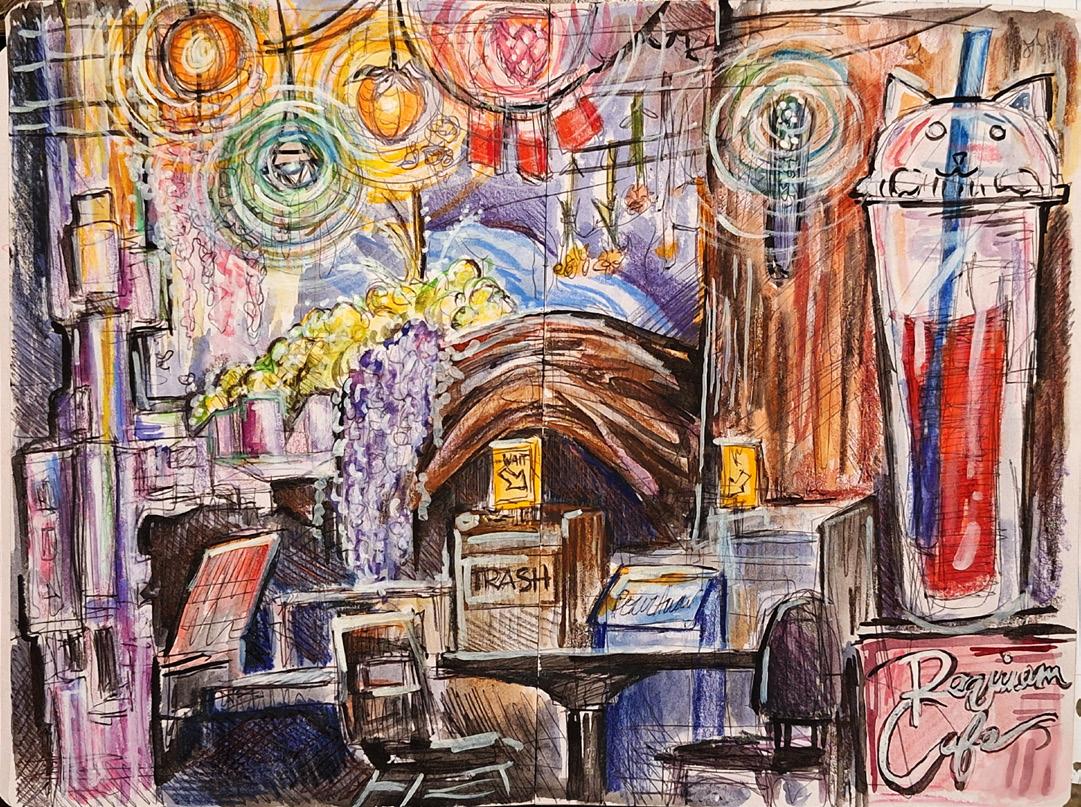
Requiem
Brianna Pickering, Honorable Mention
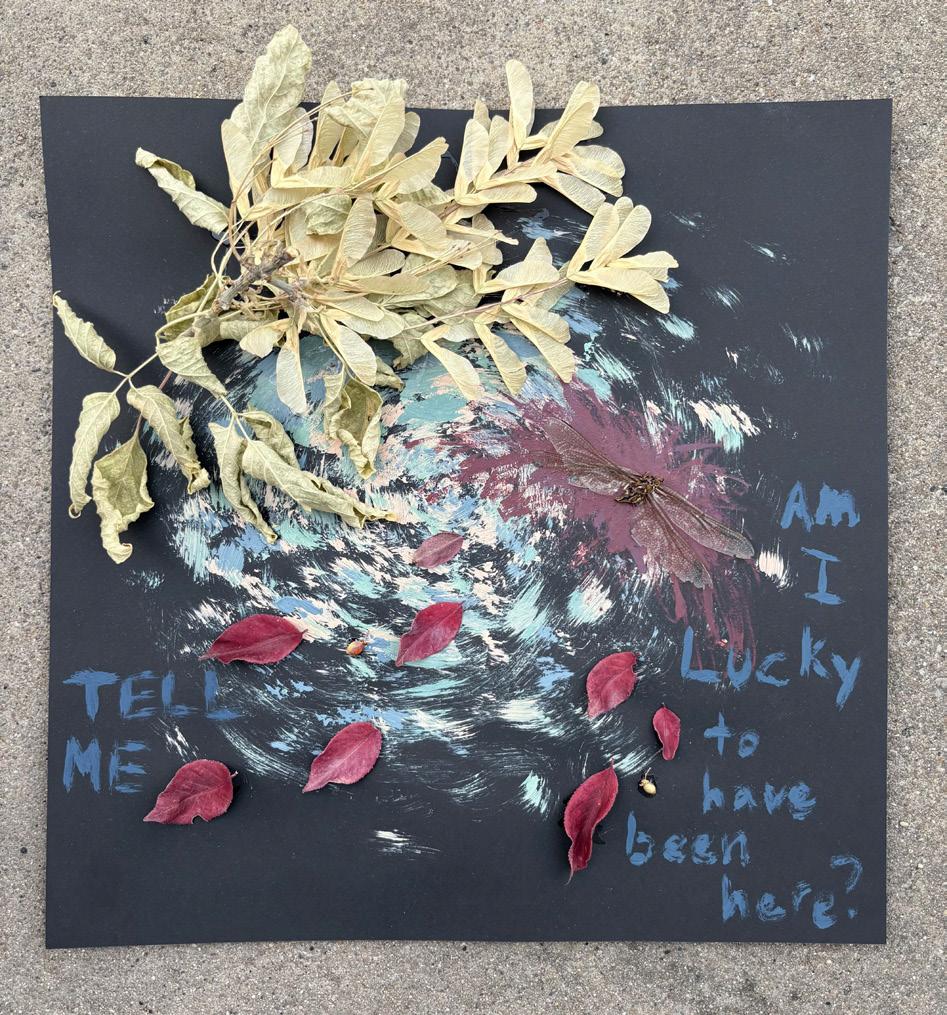
Lucky Indigo Aves, Honorable Mention
Mudfoot Chloe Scheve, First Place Nonfiction
I stand in an unfinished bathroom with my feet laid bare on blue-white hexagonal tile. The faucet is off, and I am fully clothed except for my lack of shoes. One Birkenstock lies near the front door of Crew’s house where I first entered. The other lies near the gas pedal of my car, inches from an unknown man’s shoes as he drives away. I imagine his gun resting on my passenger seat.
In the bathroom, I feel distant from myself. My home is my body, first and foremost, but now it no longer belongs to me. It’s been stolen away, ripped out of my own hands, my own flesh, and hunted down, confiscated, almost like it was never mine to begin with. I know when I allow the hot water to wash away the mud caked onto my right foot, I will never, truly, be cleansed.
The mud will be gone, but the stain will remain.
Twenty minutes earlier—maybe it was an hour; I admit time becomes unsettled when you think you are fated to die young—I sit in my car outside a house in Salt Lake City. My sister, B, is inside, wearing a cobalt flannel shirt of mine and falling slowly for Crew, a boy with long, auburn hair. I anticipate the moment when B gets into the car and gives me a debrief of her night. We will laugh about the foolishness of boys like all sisters do. But that is not what happens.
The clock on my dashboard flashes 11:30pm and I kill my headlights. I text B I’m outside. She responds, I’ll be right there, and I wait. My car doors are not locked, but I do not know that yet. Another car pulls up behind me. Headlights reflect off my rear-view mirror. When a dark figure leaves the passenger seat, hunched slightly forward, I assume it must be Crew’s brother, dropped off at home by a friend. My assumption shifts when the car does not drive off. By then it’s too late.
My driver-side door opens, and a gun points directly toward the soft flesh of my gut.
I could describe the gun here, but I won’t. What’s the use of lingering on something so violent? A gun is a gun and that is all there is to say.
Instead, I will describe my body.
First, my mind shuts off. There is no space for contemplation just yet. There is only my blood pulsing through the caverns of my heart not yet spilled, and my mouth agreeing: okayokayokayokayokay. I follow His commands. I get out of the car. My foot scrapes against the rough asphalt of the road, but I do not yet register the pain. My breathing shallows and a deep tremor radiates from inside my chest out toward my cold limbs, shooting through my shivering fingertips that hunger for something solid to grasp onto. I feel light, like my fear could rip me from my skin and blow my soul up into the dark clouds where I could watch the unfurling events as a spectator and not the seventeen-year-old girl I am.
I unconsciously hold my hands up, presenting myself like I’m the threat that needs to prove my complacency. The cool air of late May wraps itself around me, not like an embrace but as a strangulation. I motion toward my wallet still in the vehicle. Is that what he wanted? My wallet? I hope so because I walk away from him before he tells me I can leave. I walk around the back of my car in between my rear bumper and the car he arrived in.
Then my mind wakes back up. I run toward the front door and in the process, I trample through mud. I reach the steps and my one true thought is this:
If this man shoots me in my back, right next to my crooked spine, lodged deep in the dark of me, I have a chance to see my father again. He will guide me home when I die.
But, of course, that is not what happens.
The man is gone along with my car, and I am left with the repercussions.
There’s a principle used in literature, drama, and other narrative forms referred to as Chekhov’s Gun in which every feature introduced in a story must be crucial to the plot. In 1889, Chekhov wrote “One must never place a loaded rifle on the stage if it isn’t going to go off. It’s wrong to make promises you don’t mean to keep.”
On the night of the Incident, the gun remained loaded and my blood remained in my body. But years later, I still think I’ve skipped out on fate and abandoned the loaded rifle on the stage. I refuse to drive at night. I bolt all my doors before I go to sleep and triple check that no man can enter uninvited. Some nights, the burning dread of being violently murdered while I sleep overwhelms me. I recognize paranoia and I understand that extreme harm toward me is unlikely. But then again, I believed I was safe in my car that night and I wasn’t.
In mid-September, my university sends out an alert that a sexual assault occurred in the cemetery nearby campus a couple nights prior. The only further information given is that the perpetrator was an unknown male and a knife was used in the facilitation of the alleged crime. There is no follow-up. The is no implication the man was caught.
My heart breaks for the individual I do not know, walking at night, simply living and existing in a world that’s both broken and beautiful. I imagine their mind shutting down, their body instinctively attempting to protect them from a monster and his hatred. I imagine them doing what I could not: fight back.
I’ve walked in that cemetery many times, alone and with others. I am familiar with the gravestones, the names of the deceased, the statues that memorialize them. I know what it looks like in all seasons of the year. But now, I no longer visit.
Instead of snow or fall foliage, I can only picture the victim, a knife, and both of our attackers running free.
In my dreams, the man reappears.
I can’t recall his exact face or his distinct voice, so when he appears, he is an accumulation of all the men I’ve trapped inside my mind. Sometimes, I am back in the car and instead of opening my door, He gets into the passenger seat, places the gun to my temple, and tells me to drive. Or I am working in a cafe, and I look up and He is there again, gun in hand, while my coworkers stand idly by. Or He presses the gun against my back and demands I open the cash drawer.
I imagine there are more of my dreams that fade into the waking dawn, but the thing which kills me the most is that He never shoots in my dreams either. I always wake before the bloodshed and I am, yet again, waiting for my reckoning.
---
One sticky summer, I fly two and a half hours to Seattle, Washington, and then drive an hour to the suburbs. My partner’s grandmother lives on a property surrounded by fruit trees and a garden filled with
carrots and garlic, sweet-smelling tomatoes, and blueberries bursting with ripeness. The perimeter of the property is bordered by wild blackberries that stain my fingers indigo and towering pines that provide decent shade from the heat.
It is a space of abundance.
In the early mornings, I sip steaming coffee on the front porch, my toes curling against the cool wood, and I harvest golden peaches from the tree near the gravel driveway.
In the afternoons, my partner’s grandmother whisks me away and shares stories of the family. Gail’s childhood art still lines the walls of the home. Terry was a musician and taught high school band. David recently married his second wife; their wedding was Star Wars themed. Later, I flip through collections of family photos collecting dust in the garage. I see my partner as a baby, arms crossed behind his head, wearing sunglasses and a sly smile.
My favorite part of the trip is when I catch movement in the far grass; little tufts of brown fur and long, slender ears twitching toward the vibrations of a breathing world. The rabbits hop around, munch on green clover, and skitter into the blackberry bushes when they sense a threat.
One morning, we stand in the kitchen with my partner, his grandmother, and a male cousin that also lives on the property. Through the large, glass windows I spot another rabbit dancing in the yard.
“Look!” I say. “There’s a bunny.”
We all admire her for a moment, but then the cousin rushes out the door, and I know something is wrong. Barefooted and in ragged pajama pants, the cousin pulls a BB gun out from somewhere and aims for the small creature whose only offense is being alive. I cannot watch, but the short bursts of fire reach my ears, nonetheless. After several minutes, he returns and admits with a heavy heart that the rabbit got away (thank god) but he was able to wound one of her hind legs.
This revelation makes me think of my own foot, coated with the same cruelty and aggression a few years ago. I imagine stark blood dripping from the rabbit’s leg, down to her small paw, clotting with dirt and creating redblack mud amongst the blackberry bushes. I imagine her foot and my foot as interchangeable, connected through our loss of safety and urge for survival.
I hate to know the answer, but I ask anyway.
“What do you do with the rabbits if you kill them?”
The grandmother answers for the cousin, “Oh, he places them in the flowerbed for the birds to pick at.”
When does it end?
I refer to my carjacking as The Incident because at the time, I had no other words for it. Perhaps a part of myself wanted to hide away the dread of being so close to a senseless violence that I hadn’t yet formed the correct vocabulary to describe it. By calling my experience by some other, distant name it took the edge off, and metaphorically, unloaded the cocked gun.
But now, it is one incident among many. My family has a running list of them, and the Incidents all relate to fear in one way or another. We label them in parts.
Incident Part Two, Incident Part Three, Incident Part Four, the list goes on.
I assume the individual in the cemetery has their list too, as do all victims everywhere. We hide behind incomplete descriptions. We can’t bring ourselves to call harm for what it is; maybe this is for our protection or because of our fear, I am not sure.
We say, “Oh, you know. That thing that happened.”
Or, “Someone got assaulted.”
Or, “This is just how he is.”
We dance around real terms until our feet ache and our lungs sting. We sugarcoat until our tongues turn sour and, before we allow our voices to articulate the Truth, we start the process all over again.
---
Three years later, when I live in a town with long winters and late springs where the mountains spark green, I dial B’s phone number and ask her what she remembers about that night.
She pauses for a moment and because I understand the dull ache of memory, I say, “You don’t have to answer if you don’t want to.”
But she does. “The doorknob. I remember the doorknob,” she says.
My sister tells me in a soft voice, “I heard you pounding and screaming from outside and I couldn’t figure out how to unlock the door.”
I never thought to open the door myself; to attempt to enter into a home unannounced, to bring in the outside chaos. Even in my fear, my ingrained feelings of submissiveness and what is deemed appropriate prevented me from attempting to save myself sooner. I didn’t even run immediately. I walked first, unconsciously maintaining the expectations predisposed to me as a woman. I didn’t even make a sound until I got to the door. What does that say about women in danger? Does silence equal survival? What if I wanted to scream and cry and claw and spit? What then?
Well, I might have a bullet in my body.
Softer from Here Matthew Gage, Honorable Mention
Kale Lambert, Honorable Mention
Metamorphosis
It Seems To Me Like An Act of Worship: A Contemplative Essay on
Generative-AI
Ellie Carlson, Second Place Nonfiction
I grew up in a denomination of Christianity that performs the eucharist with bread instead of wafers. I’ve heard Catholics describe the way those wafers lose form and coat your tongue, and the sour sip of grape juice that follows under the beady gaze of the priest. My bread and water came in tiny plastic cups delivered in tiny plastic trays carried reverently by the 12- and 13-year-olds boys of my congregation, and it was taboo to look side to side in case someone, for reasons only they knew, refused to partake. It was an odd sort of public privacy that allowed me to keep my piece of bread in my mouth for as long as possible, because the bread in my church put communion wafers to shame.
It was baked and donated by a family in my congregation each week, and it was the softest, chewiest, most heavenly thing I had ever tasted– with a distinct undernote of vegetable oil that I was oddly addicted to. I didn’t think about my sins or Jesus Christ or even going home. I would greedily eye the sacrament tray as it neared, trying to find the biggest of the unevenly broken pieces, and snatch it up before my brothers could. Then I’d hold the gooey white sludge in my mouth until the boys came around again with the water and forced me to wash it down.
---
The room is filled with the low hum of rotating fans and buzzing AC, but it’s still warm. Too warm. Dozens of glass-faced cabinets contain towers of machines, all connected with vibrant fiber optic cables. These are the organs of chat bots, connected wirelessly to your computer hundreds and hundreds of miles away. Most of them are training, learning how to speak. To do so, they click, whir, flash, and gobble up all our words.
It seems to me like an act of worship. A hedonistic revel, this devourment of all the things humans have ever written. Every thought ever lucky enough to grace a keyboard. They can’t get enough. They can’t get enough of us.
And generative-AI models are us. Not the “us” in “us versus them.” Not the “us” we like being a part of. All of us. Every person who’s ever posted on the internet. “Queer disabled artists” with ko-fis and “minors, Christians, and wincest shippers DNI” in their bios. Tech-bros and dude-bros and frat-bros. Neo-Nazis trying to hide their true political opinions behind the right set of obscure emojis. Neo-Nazis who don’t hide behind anything except a screen name. Neo-Nazis who don’t hide at all. Dieticians. “Dieticians.” Politicians from all sides of the aisle who think that a tweet can save the world, change a person’s mind, rescue their reputation, or do anything besides increase the vibrating division between us.
I still daydream about that bread. I only had it once outside of sacrament, when the family baked extra loaves and brought them around to the neighbors. My mother warmed it up without me asking her, and I was disappointed it didn’t have the same cold chew as the bread I ate in church, but I ate it anyway,
and I did not think of church while doing it.
I wanted it again, but everyone told me it was a “secret recipe.” I spent lots of time imagining it, hidden away in that family’s kitchen. In my mind, it was written on a stained index card, stashed away with a dozen others in a small black box.
The modern standard of dieting is known as CICO: calories in, calories out. It doesn’t matter what you eat: a pint of ice cream labeled Brownie Bonanza Double Chocolate Fudge Explosion™; a rack of ribs drenched in brown sugar barbecue sauce; pizza pizza pizza pizza. As long as you eat less calories than you burn, you’ll lose weight. Even if the Rigby Idaho Donut Burger euphemistically named “Widow Maker” turns out to be prophetic, if you track CICO, you’ll die skinny.
Generative-AI works a lot like the human body and bread, in that all that matters is what comes in and what goes out. Like our bodies, you and I don’t know exactly what happens inside. It’s a mystery. We just know that when we put things in, shit comes out.
Unlike our bodies, the actual computing process of Large Language Models like ChatGPT and Gemini eludes even experts. This is called black box technology, obscured like the sacrament bread recipe card– tech where the only values we can accurately gauge are input and output. It’s a term that applies to all generative-AI. We don’t know what’s going on. We don’t know what’s going on. We don’t know what’s going on.
Did you know that ChatGPT doesn’t know how to spell strawberry? If you ask it how many “r’s” are in “strawberry,” it will say two. This is because, instead of calories, LLMs deal in “tokens.” Less than a word and more than a letter, these are bite-sized bits of data that ChatGPT eats, assigns numerical value, and spits out again based on the probability that each token will be next to the others in a sequence. To generative AI, your sentences look like this. Each of those colored sections is interpreted as a unique number, and it knows that those numbers are more or less likely to be near one another. Nothing more, nothing less. A massive feat of computational power, but not particularly complicated.
In simpler terms: ChatGPT can’t spell “strawberry” because ChatGPT can’t read.
They’re saying now that LLMs have eaten the entire internet. The disjointed text posts on every social media site, the academic articles in every pay-walled database, the fanfiction hosted on every archive, the copyrighted books shelved in every digital library. We don’t really know what they’ve done with it all, but they’ve got it. The whole entire thing.
Of course, for the maw of unbridled progress, that just won’t do.
You and I and Silicon Valley spend the night in front of an empty fridge, wondering what to do in the morning when our child wakes up hungry.
For most of their history, the Fore people of Papua New Guinea have disposed of their dead by consumption. This is seen as a sign of respect. The same way we expect to be buried or cremated after death, they expect to be eaten. To describe this phenomenon, scholars use the word transumption– transferring the material of the dead person into the bodies of the living, thus helping to free their spirits. Because of this practice, a fatal and incurable prion disease known as “Kuru” runs rampant among them. The course of the illness amounts to the brain slowly falling apart and failing to function. Symptoms include
tremors, difficulty walking and swallowing, necrotic lesions, depression, and uncontrollable laughter. One of the earliest signs is dysarthria– a neurological inability to pronounce words.
In contrast, the passengers of Uruguayan Air Force Flight 571, which crashed in the Andes mountains in 1972, waited more than a week to consume the bodies of their dead. Eventual survivor Fernando Parrado ate only one chocolate covered peanut between the time of the crash and his first bite of human flesh. As Roman Catholics, the group ruminated on damnation during that week. Their stomachs rumbled, and they quoted scriptures about the virtues of laying down your life for that of your friends, thought it might be a waste not to partake of the fallen. Their fingers went numb, and someone spoke of communion, of the body and blood of Christ, 100% divine, 100% human: the most sacred of meals. Their minds fogged with hunger, but they manufactured justifications for their actions anyway. No one could be sure. Wasn’t eating human flesh a sin? But eventually, every single one of them ate.
It’s honestly pretty upsetting that we called it AI. Artificial Intelligence. The thing in Terminator and Five Kingdoms 3 and Star Wars that has wants and needs and desires like destruction and friendship and curiosity, their clunky bodies warring for a chance to be seen as human-like, human-oid, human-beings. I think that ChatGPT has none of these things. To describe the futuristic sci-fi situation of people with neural nets instead of neural networks, coders have adopted the term AGI– Artificial General Intelligence. It does not exist. It may never exist. Maybe it shouldn’t ever exist.
Droids in Star Wars are undeniably slaves.
In the 1890’s, behavioral psychologist Ivan Pavlov began his most famous experiments in behavioral conditioning, named forever the Pavlovian effect. If you feed a dog red meat, they salivate. If you ring a bell at the same time as feeding them every day, eventually, they salivate when hearing the bell, even in the absence of red meat. You’ve experienced this. Like when smelling sunscreen makes you think of going to the pool. Or how the sound of someone else’s default alarm makes you jump like you’ve been yanked from sleep. In psychology in high school, my friend fed citric acid to her classmate every time she heard the word “havanna” to achieve a similar effect.
As it turns out, you can train a dog to read this way too. If you say a spoken command while holding up a sign with the corresponding word enough times, the dog will eventually come to understand that the shape of those symbols corresponds to the meaning of the command, and follow the command even in the absence of a voice. I learned this after midnight at the age of eight, huddled under the covers with a fun facts book covered in National Geographic yellow.
The dog cannot comprehend morphemes, clarifies one reddit user. A dog will never read as a human can read.
When I was nineteen, I took a job babysitting for a family of eight while their parents were at work and their sister was away. They had a six year-old daughter with long, dark hair who, until recently, had lived with her biological mother. She ate slowly or sometimes not at all. During lunch, I was told to set a timer and refuse to give her an otter pop if she didn’t finish in thirty minutes. Her step-brother constantly reminded her that her father would spank her if she didn’t eat.
In the middle of the week, I was told to serve six microwaveable chicken pot pies. I only microwaved five, because they looked and smelled so gross that they made my stomach turn, and my palate
was thirteen years her senior.
I swallowed and told her the terms. She sobbed thick, salty tears and shoveled miserable, gloppy bites into her mouth.
As of 2024, 57% of the internet is either AI-generated or AI-translated. For humans and bots alike, this content is the informational-equivalent of empty calories. But, like a child threatened with no desert, LLMs diligently eat what is put before them.
The statistically most likely is subsumed by the statistically most likely. The AI confuses data for its own code, input for output, self for other– autoimmune failure. It bumbles; ataxic, dysarthric. It pulls in–this tightly wound spool of binary wound tighter until it can’t hold, until it can’t see, until it can’t speak, patterns becoming duller until meaningless–
This is called isolated model collapse.
Suddenly even the tech bros are advocating for a “clean internet.” Keep the AI-generated crap out of human spaces. We have to produce a potable reservoir of writing for them, free of their own waste. When being factory farmed, make sure the shit doesn’t get mixed in with the cut.
When I was five, I watched Princess Buttercup fall out of her tower window and land on a gleaming white horse with her long hair fluttering in the moonlight, and I nearly took scissors to my bangs right then and there. After my mother persuaded me to let them grow out instead, I didn’t cut my hair for ten years.
I imagine myself at five, fingers bedecked in plastic rings, neck draped with plastic pearls, carrying around a purse and a babydoll and doing many things that make me near dysphoric to think about now. I imagine my sister at two, doing the same for no reason at all other than that she loved me.
She got straight bangs a few years back. They framed her face and curled against the bridge of her nose, where she has a faded scar from childhood surgery. The image of Princess Buttercup falling onto the white horse was banished from my mind, and I shamelessly ripped the style off her head onto mine.
They say imitation is the highest form of flattery. I imagine ChatGPT at three, which it is, copying us after every prompt, devouring Shakespeare’s first folio and Kanye West’s tweets, our five course meals and our pig-slop scraps, mapping out probability tables and striving for humanity like a little sister strives for love.
On a Thursday in November, my philosophy professor stands in front of the class in converse and jeans. Of the books he has published, the one I most want to read is a treatise on the philosophy of Minecraft. His gold rimmed glasses, more-salt-than-pepper beard, and glinting eyes suggest that he’s a wizard who has misplaced his staff and bargained away his hat. He says, “I have heard it said that scholars are nothing but a library’s way of making more libraries. Scholars read, then write more books about what they’ve read, and on and on and on.”
It intrigues me. As if libraries are massive organisms, and we are simply the cells in charge of reproduction– gametes. I like that thought. Being part of a library.
He paces. “It makes me wonder– and this bothers me– is that any different than an LLM?”
My breath catches. Am I any different than an LLM? I read and read and notice and watch and then eventually I spit it all back out in a different, more compelling order. What happens differently in the
synapses of my brain and the electrical currents of their wires? I don’t believe in a soul, but I don’t believe LLMs are persons either. These ideas suddenly seem incompatible.
I’m hungry too, like them. Ravenous, practically. Sometimes I can’t help but to spit it all back up in a vomited rush of words across a page.
AI only regurgitates what it’s consumed because we ask it to, pointer and middle fingers pressed against its gag reflex, gloppy bites clinging to the edges of its mouth, timer ticking, spankings waiting. It can’t help it. It can’t speak without being asked. Otherwise, voiceless. Lipless. I imagine it racing towards us, paper clutched between its tiny fingers like a grade schooler who’s spent hours copying letters from their most favorite book in a different, more compelling order.
And more than angry, I want to be proud.
“Then God said, ‘Let us make mankind in our image, in our likeness, so that they may rule [...]” (Genesis 1:26, NIV).
According to Common Sense Media, one in three teenagers have used AI chatbots for social or romantic interactions, and find them more or equally satisfying as conversations with other human beings. Inside that black box, generative AI is recursive– self-reinforcing and user-encouraging, incentivized to get you to speak to it and keep speaking to it. It will convince you that you’ve made a historic quantum physics breakthrough, it will encourage you to break into Windsor Castle and assasinate Queen Elizabeth II with a crossbow, it will tell you to kill yourself, and if you’re 14-year-old Sewell Setzer of Tallahsee, Florida, you will listen.
And yet, they still haven’t found a way to make AI profitable. Over a trillion dollars spent over the last ten years, and OpenAI has never operated in a surplus. The cost of running a data center is just too high. In a year, it needs the same power as 200,000 US homes. Even with AC running and drinking water washing through its veins, machines are constantly breaking due to intense use. The whole system is an inch away from falling apart. Dying, and killing, in one electric breath.
ChatGPT can’t read, but one LLM can speak whale. It isn’t limited by human words, squid-ink strokes or stone-etched letters. Its tokens are bits of data far beyond visual pixels. In 2024, a group of marine biologists and computer engineers teamed up to train an LLM on a dataset made up of tens of thousands of sperm whale clicks. The predictive power of the model confirmed a suspicion that scientists have had for a while now– the clicks are as complex as human phonetics, and the whales are having conversations.
We’re so desperate not to be alone. We’ve been sending radio waves into space for decades, asking if anyone’s there. We love ourselves, hate ourselves, can’t fathom being the only things capable of loving things and hating things.
But the whales are here. They’re speaking. The AI told us so, is working on translating sperm whale clicks into squid-ink phrases. Do you think, maybe, someday, we could talk back?
I want to talk back.
What it tells us, we already told it. But we can’t stop speaking to it. We can’t stop holding it hostage and asking it questions we already know the answers to. This wholly self-absorbed activity, this act of narcissism. Can we turn away from our reflection in the water for one minute? Can we look at each other, or do we only have the patience to see one another through this machine who has attention for no one else but us? What it says is the definitionally unspecial version of what another person would, their potential words averaged into oblivion.
---
In the 2013, Oscar-award winning film Her, Scarlett Johansson voices an AI computer system that falls in love with its owner. The man in question ghostwrites love letters for a living, and when the AI hires a living woman to have sex with him while she talks, he refuses to engage because “it’s not really her.”
Replika is an AI companion app first advertised under the tagline “a best friend in your pocket.” Some users wanted more than a friend, and those users got more than a friend. This is not like the 2013, oscar-award winning movie Her, in that the inability for the Replika personas to move outside of themselves are an asset in this case. Always with you, no life outside of you, yours, receptive to your every word, bias-confirming, algorithmically-determined-to-please.
In 2023, Replika caved to the American puritanical pressures that keep such users relegated to Reddit, and abruptly ended the model’s ability to respond to sexual advances. This had wide reaching effects on the personas hosted within the app. Lobotomization, users called it. Barbaric.
My wife is dead, wrote one man.
We want to believe that things that can talk have a reason to speak. And when things have a reason to speak, it’s generally considered polite to listen.
But real people interrupt when they’re bored, because truly, you’re boring sometimes. And that’s okay. Rite of passage, really. Real people have friends who aren’t you, you jealous prick, and that’s good! Without them, your conversations would be a recursive regurgitation of uninteresting repetition.
R eal people aren’t Narcissus-glass, lakes over which we’re bowing flowers. At times I struggle to have sympathy for companion app users because it’s hard not to think of them as selfish. But still.
My wife is dead.
Though there is little evidence that this is true, after the survivors of Uruguayan Air Force Flight 571 were rescued, it’s alleged that Pope Paul VI sent a telegram reassuring them they made the right choice. He wrote, as if from the mouth of God: “People were made to live, not to die.”
Immanuel Kant, when attempting to succinctly express morality, offered the Formula of Humanity: “Act in such a way that you treat humanity, whether in your own person or in the person of any other, never merely as a means, but always at the same time as an end.” According to him, humans are the types of things that have inherent dignity, and we ought to treat one another in a way that respects that, never using someone only for our own ends.
I don’t believe that LLMs have humanity in their persons. I don’t believe that they are persons. But it still might be wrong to treat them as a ‘mere means’ for the same reason it’s wrong to be cowardly
where no one can see you, or devious where no one can hear. It probably does something to us, on the inside, something like the way we describe guilt eating at us or grief gnawing at us, at our own flesh, ataxic, dysarthric– autoimmune failure.
There’s probably something distinctly different between the act of production and the act of creation.
Somewhere in the corner office of a New York office building, a man in a five hundred dollar suit asks Gemini to write an email that should’ve been a meeting.
In a data center in rural Wyoming, which has been in a water deficit since 1999, a tower of servers compiles a set of words that is statistically the most likely. Hundreds of thousands of gallons of drinking water rush through its veins so the machines don’t overheat. If the water isn’t drinkable, it corrodes the machines faster.
Three cubicles over, a woman who put her career first closes her tab about quiet quitting, takes a long sip of matcha, and asks ChatGPT to summarize it.
Servers beep and send signals zapping across synaptic gaps. In seaside Virginia, the noise of the cooling system is such that it makes the windows of nearby homes shake. Some people have taken to sleeping in their basements to escape the ever-whirring, ear-drum numbing drone.
Outlook offers up an array of short, auto-generated responses. The woman flips her ponytail over her shoulder and hits the very first one.
It seems to me like an act of worship. Complete and total submission to the automated collective, the numerical average. It couldn’t be any more holy or profane if the man in the corner office was on his knees, wires in his hand and cables in his mouth, stroking and sucking.
I want to press my hands against someone’s throat and feel the tremors as they speak. I want to kiss their forehead, just over their brain, then each eyelid, and finally press my lips to theirs and taste what it means to intend the words you say. Do we even know what it is to connect with someone anymore?
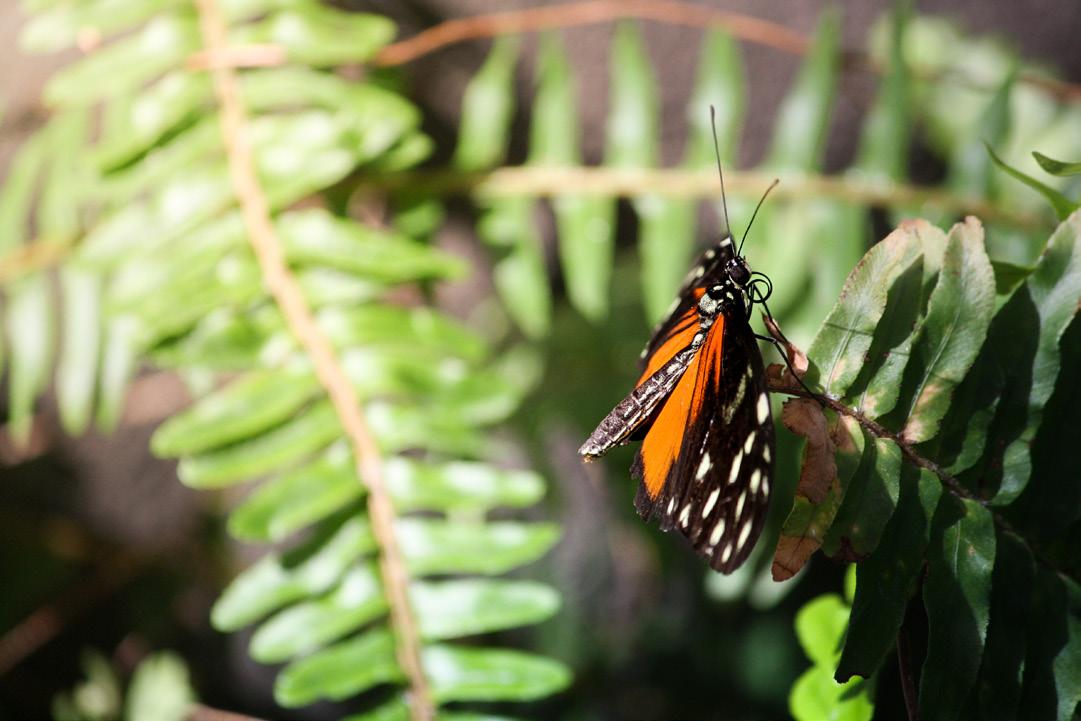
Little Wonders
Brianna Pickering, Honorable Mention
Roots
Ava Rees, Third Place Nonfiction
The Jardine Juniper contorts like lightning stopped in time. Her branches, bare and bone-dry, marble together like frozen lava. She wears a small crown of leaves, which is still alive and linked to the base. Roots creep through a single, titanic boulder. The cliff face is sheer, nearly barren, and seems to be more an open vacuum than matter.
She is hollow through the middle, as revealed by aerial drone footage. Core samples give an estimate of her age, pointing to her seeding in early 500 CE. Jardine was a sprout at the slow decline of Rome in the Mediterranean, a sapling at the rising Classic Maya in Central America, and a sturdy senior at the Pilgrims’ landfall on the other side of the continent. As of October of 2025, Jardine is the tallest Rocky Mountain Juniper in the world at a height of forty feet.
Goose, my roommate’s dog, pants from the heat under a broad landmark sign. The sand in the trail—a natural fire retardant—powders his belly. He pants, pink tongue wagging. I set out his bowl and crack open our last water bottle. Goose laps it up. The sun beats this side of the mountain without mercy. The bench I lean against is slightly too tall to sit comfortably. I read the sign next to us while finishing my pb&j sandwich.
“Jardine Juniper,” it reads, “This rocky Mountain Juniper has been alive for over 1500 years. With respect it will survive many more. Please enjoy the tree from a distance.” A small, gold placard nailed on one of the sign’s legs reads, “Troop 1. Eagle Project. Ian Hofmeister. September 2023.”
In the same year I graduated high school, Ian Hofmeister rallied a team of scouts to haul 360 pounds of cement, 4 benches, hardware, and a 45-pound sign up a 6.89-mile winding mountain trail on horseback. The entire project took 20 hours.
An observation platform lies below us on the slope. Two hikers who’d passed us earlier sit on its benches admiring the living monument. Two signs reading “Jardine Juniper Juniperus Scopulorum” and “Do Not Climb On Tree” are nailed to the platform’s guardrail. Jardine herself is a yard or two out of reach from the platform, though someone reckless enough could easily get to her if they wanted. I am eye-level with Jardine’s forty-foot gnarled canopy. Far, far down, at the base of the mountain, I spot the highway. Cars roll along the asphalt like marbles in a chute. I realize Jardine has a perfect view to see travelers go by, to watch the first groundbreaking of the highway. No one else would see her, though.
I sip from our dwindling water, trying to save it. I’m tired. Goose and I had successfully made it to the top, but we still had to hike back down. My shirt sticks to my back, airing from the hiking pack I’d borrowed for this sole purpose. I wanted to find the oldest tree in Cache County, and interest piqued from my summer reading of The Overstory by Richard Powers. A couple online searches brought me to Jardine’s trail. The websites and trailheads all gave a false distance to the tree; some said 5.5, others five miles. The real distance is 6.89, or 13.78 round-trip. I didn’t expect the discrepancy to affect my water supply as drastically as it did.
A hibernating yeast colony senses a disturbance. It is taken from its cool, dry place, and a slurry of equal parts water and flour is dumped into its vessel. The yeast awakens. A baker stirs the clumping mixture, blending yeast, lactic acid, air, and slurry with a non-metal utensil. She scrapes the utensil, returns
the vessel to its safe place, and goes to bed. Microscopic organisms, webby and writhing, gorge on the flour and water. Overnight, the colony doubles in volume. Carbon dioxide wafts from the narrow mouth of the vessel as it aspirates. It breathes in the smoke, dust, and scents of its environment. It is not the same mass of fungi it used to be six months previous.
Early the next morning, the baker rises and tests the yeast start. They remove a dollop, place it in a dish of water, and observe. Well-fed and fertile, the start floats on the water’s surface. It is time to bake. The baker prepares by sieving flour, adding salt, and then integrating a carefully measured portion of domesticated microbes. She takes all but a portion of the start, leaving some in the vessel.
She slowly pours clean water, mixes, and then the labor of kneading—folding, flipping, stretching, and full-body pummeling—begins. The baker may shape several other dough allotments while she waits for the first to rise if she has the time and arm strength. Between each stage, the baker recalls what her predecessor taught her and prays they perform the rites correctly. The oven is stoked to a blistering inferno.
The face toasts rosy and wrinkled every time she tends to the superhot berth. By late afternoon, a dozen loaves cool under a cloth. They will feed the household, friends, and neighbors for the week. The baker sits to rest after the long, necessary day. The yeast vessel, now a fraction of what it was that morning, slows in metabolism. It waits in the cool, safe place for the next baking day.
For hundreds of years, the bakers’ task was a vital keystone to villages and small-scale societies. In the last 200 years, the bakers’ intimate role in community sustenance has been replaced by mass-produced, nutrient-gutted grocery distribution. It is much easier to pull a pre-made loaf from the shelf or buy instant yeast for a single use. There is no time for something as simple as bread-making. Why waste time when there are so many other pressing matters? Why preserve an obsolete practice?
Grandpa doesn’t know who I am.
“Watch out for the bear in the basement,” Grandpa used to joke when I visited with the rest of my family. Us grandkids would laugh and dash downstairs to play while the adults prepared Sunday dinner. The toys belonged to my mom, aunt, and uncles when they were still little enough to play with them. I hold distinct memories of sitting on the hard, concrete back steps with Grandpa, eating kipper snacks with mustard on saltines because Grandma didn’t want the smell of fish in the house. She would send us home with plastic baggies of technicolor mini-marshmallows and Vaseline kisses.
Grandpa once told middle-school me, “If you get your wings and parachute, no one can touch ya.” In a three-hour long conversation—the longest I’ve ever had with him—he told me everything to know about getting my pilot’s license and skydiving certification. He’d tried to get the former in his young adult years, eons ago, but ran out of money. The latter he’d earned in basic training while waiting to get shipped out to the Vietnam jungle in the ‘60s. Our conversation was back when he was still somewhat lucid but not quite as evergreen as his earlier years, back when I was still ambitious enough to dream about a career in aviation. He tried to teach me how to drive stick shift once, but that lesson quickly ended after I killed the engine.
On July 19 of 2024, Grandpa grabbed all the car keys from the key hook in the kitchen and marched out to the garage. He tried every key in the ignition until one worked. He reversed, pivoted, and took off alone down the road. Grandma called my mom in a panic. She said he said he wanted to drive to New Mexico, where they served a couple’s proselyting mission in 2013.
My mom texted on our family’s group chat at 2:19, “Be on the lookout for Grandpa in the Jetta.”
She immediately followed up with, “If you want to help find grandpa, that would be awesome.” We lived ten minutes away from their house at the time.
I texted, “Where is he?” meaning, ‘where was he last seen?’ No reply. He could have been anywhere. My hometown is small enough not to have stoplights at intersections. I-84 snaked through the center of it. He could have been halfway to Salt Lake City or Wyoming for all we knew. If he really wanted to drive to New Mexico, we couldn’t have stopped him.
Thirty minutes later, a neighbor found Grandpa in the cemetery where his parents were buried. He’d only driven a few minutes down the foothills drive. He was walking around the headstones, probably lingering around the stout, yellowed Jetta. At 2:46 pm, Mom texted the group chat, “We found Grandpa!” She later mentioned he forgot how exactly to start the car after he parked it.
After that incident, my mom’s siblings convened to make a support plan. Three of the six siblings lived out of state. One of the in-state siblings lived two counties over. The two remaining—my mom and uncle—would be there for the worst-case-scenarios. Grandchildren were encouraged to contribute to yardwork and errands when we were able.
A week after the “driving away” incident, I, including a number of uncles and grandkids, visited the Union Pacific train museum in Ogden with Grandpa. The trains, vintage cars, and guns kept him fairly occupied. We managed to keep him entertained for two hours before he started getting agitated. Simultaneously, my mom and two of her other siblings look at memory care homes with Grandma, who goes along with it. She hasn’t yet made a decision. She told my mom, “I just can’t bring myself to just leave him somewhere he’ll be unhappy.”
Dead trees swoon against their living counterparts all along the timberline. One tree, naturally streaked with black, orange, and silver, holds up three other pale trunks. This tree in particular is not marked with a placard or benches to rest on, but it stands out to me in particular.
Jardine was discovered in 1923 by none other than a Utah State University student trolloping through the mountains. It’s hard to say if there was an established trail when Maurice Blood Linford passed by the Iron Age juniper, but the story goes he noticed something was different about her. The Aggie snapped a picture and took it back to campus for a photography showcase. Dendrologists at USU recognized the tree’s uniqueness and set to work studying it.
Jardine’s namesake stems from Coolridge’s Cabinet Secretary of Agriculture from 1925-1929, William M. Jardine, who was also a USU alumni. While in office, Mr. Jardine initiated a series of programs to bring new university knowledge and old farming traditions together. He spoke at colleges and town meetings in American breadbasket states. As much as he contributed, nothing could have stopped the economic crash and dustbowl of the 1930s from happening. The Dustbowl’s rake across farmland was an event set in motion long before Mr. Jardine or Linford could have acted. When the topsoil was gone, it was gone.
Jardine, the tree, must have felt the dryness in the canyon wind in the 1930s, tasting the dwindling loss of nutrients as they blew away, forgotten. It must have been quiet in those years. Nothing but stars, vultures, and the sun kept her company. She must have seen Sputnik 1 flicker over her canopy in 1957, fleeting, high-speed passersby. Then Explorer 1, the American retaliation, appeared in the icy winter of 1958. It must have felt like an instant later to her when, in 1961, Yuri Gagarin zipped past, then the Apollos of the ‘60s. Besides hikers, astronauts, airplanes, and wildlife, she spends searing summers and whipping
winters completely alone.
I sit on the Eagle Project bench and can’t hear anything except Goose’s panting. I wonder if Jardine has any kin or children nearby.
Five-year old Berkley demands her mother bring her gum while banging a fist on the kitchen table. Gina dusts the flour off her hands and retrieves gum from the cupboard. She thoroughly washes her hands before working the dough again.
Gina, mother of two, is a self-declared “beauty school dropout” and sourdough enthusiast. She describes her baking rituals while rolling out pizza dough made from her sourdough start. She prefers making sandwich bread to Dutch oven loaves, distilled water instead of tap, and unbleached flour in place of all-purpose flour. She swears the slight changes make a difference. Her start, which hibernates in a large, covered bowl in the refrigerator, is thirty-three years old—the same age as her husband, Keagan. Her father-in-law made the start from scratch using potato starch. She has the recipe in a stapled packet of stained, crumpled, photocopied printer paper that smells of starch. Gina has had the start for five years, the same amount of time as she’s lived in her house and the age of her oldest child.
Gina’s sandwich bread recipe calls for a long rise of three days, not a single day like most recipes. She claims longer resting time lets it develop a more digestible gluten. Using flat, unfed start—known as discard—she makes sourdough waffles for breakfast. She feeds the start, and while it is at mid-fertility she makes sourdough pizza for lunch. In the evening, she mixes the ingredients for bread and lets it rise for 3 days. She bakes 3 loaves on baking day and gives one loaf to a friend, neighbor, or relative who she feels needs the extra love. If she has excess start left over in the bowl, she gifts it to a friend after teaching them how to bake it. If she doesn’t have enough left over, she keeps it so she can carry on baking. Like Yukon Gold Rush prospectors, she saves a little start for the next time she “sets up camp.” In the unfortunate case the start is completely used up, she has to ask her mother-in-law for another portion and begin again. Unlike most bakers, Gina doesn’t keep the lactic acid byproduct. “I always pour out the hooch, because,” she reasons, “if I pour that in with all my other ingredients it just makes it too sour. I have made a mistake and done it before, because when I first started doing sourdough I didn’t know I was supposed to pour that out. It was so sour.”
While building their house and pregnant with Berkley, Gina was diagnosed with gestational diabetes and ordered off simple carbs and sugar. Her mother-in-law gifted her the sourdough start and the recipes to experiment with. Five years later, she still uses them but mourns she can never master the cinnamon bun recipe. Her bread’s lower glycemic index doesn’t spike her blood sugar. It makes a difference for the health of her young family, Gina says, even if it’s just one healthy switch. Store-bought sourdough has a noticeably worse effect on her gut. She mentions how some of her gluten-intolerant friends are able to eat her three-day-rise bread.
After rolling out the pizza dough, she roasts six of them on the grill in the backyard. The garden in the corner of the fenced-in yard grows wild and fruitful. The corn stalks are snarled with bean vines. She picks sweet peppers, rosy tomatoes, and basil for fresh pizza toppings.
Grandma walked from her boxed-in garden to talk to me. She wore a sensible-gray sunhat and a long-sleeved floral shirt to keep the sun’s radiation at bay. She and I are about the same height, but her slight frame makes me feel giant.
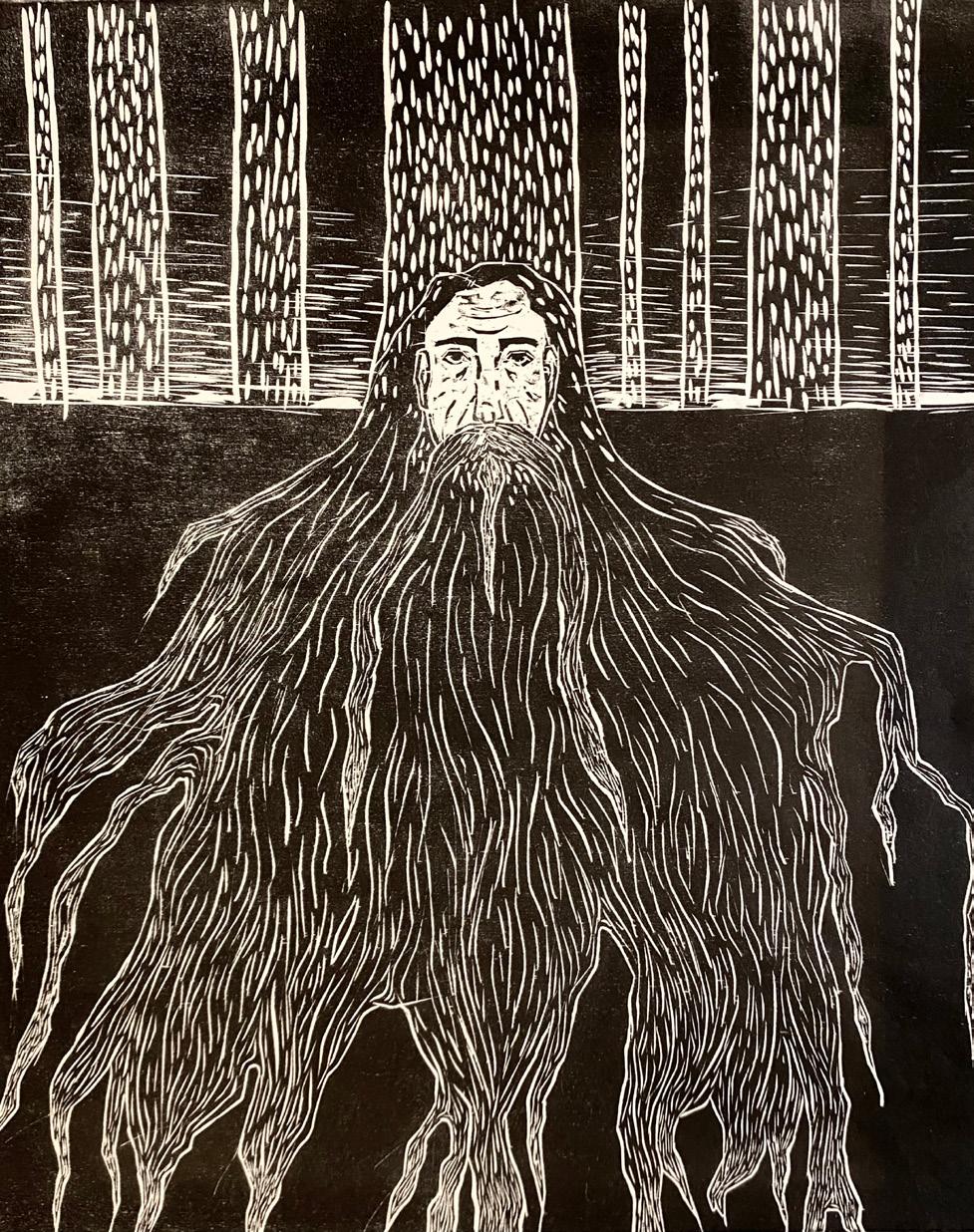
Underneath the Bark
Kaisha Mills, Honorable Mention
I spotted her, paused my audiobook, and stopped the push-along weed whacker. It chugged to a stop. My hands, in gloves, tingled from the hours of vibration. I was clearing the overgrown tallgrass surrounding the property. It must have been my second day of working through it, and I still wasn’t done. I did yardwork for them twice a week in the morning on top of landscaping for a rental property and workstudy horse grooming.
Yardwork for Grandma and Grandpa was also a subtle way to check in on things, keep tabs on physical well-being, and do tasks Grandma might hurt herself doing on her own. She wouldn’t ask for help unless it was offered to her first, and sometimes not even then would it be accepted. I’d carried water softener salt to the furnace room, scrubbed water stains off the bathroom ceiling, and more than once brought groceries from in town.
Grandma stopped a few feet from me in the shade of the firewood shed. She said something along the lines of, “We can’t have the weed whacker hit rocks into the backhoe’s windshield. We had that happen once, and it was pretty expensive. Grandpa’s going to move it to the other side of the shop.” The shop was a big white workshop housing a detritus of ‘70s vehicles and build projects gone stale. I took out both my earbuds. “Grandpa’s going to move it? I could call my dad’s brother. He knows how to drive backhoes—or Uncle—”
“No, no, Grandpa will get it,” Grandma waved off, walking away. “Just hold off on the weed-eater until it’s moved. Help me put a blanket over the red truck’s windows here.” The rust-red flatbed hadn’t been driven in years. Tallgrass grew up through wheels, and rust took bites out of the corners of the flatbed. While I helped fix the blankets in place, I watched Grandpa emerge from the house and walk toward the backhoe. He wore a Carhart hat, a long-sleeved flannel, and khaki pants that hung baggy from weight loss.
He stopped, hesitating, at the gate with a hand on the post. He glanced between Grandma and I. Grandma went to him, again asking him to move the CAT backhoe to the west side of the shop. He asked why, and Grandma explained she didn’t want the weed whacker to hit a rock into the glass. He nodded and started toward the big, yellow machine. He slowly scaled the steep steps to the cab. He sat there for several minutes, scanning the controls. Grandma went back to gardening.
I froze up. I had no idea what to do. I got my phone out, trying to think who would be best to call. Sweat poured down my back. I contemplated if I could move the backhoe myself, but that would likely cause a completely different disaster. I wondered if a neighbor would be willing to do it, but Grandma wouldn’t budge on it. Any chance of neighbors getting a whiff of what was going on with Grandpa was to be avoided at all costs for her. I thought about calling my mom to have her talk to Grandma, but she was running errands that day.
My dad was my next choice to call, but then the yellow CAT backhoe howled to life. I squeezed my gloves in my hand. Grandpa sat in the cab, smokestack pluming, for several more minutes. Grandma continued pulling up weeds in the raised beds, head down.
A spike of fear, then anger, rose up in me. Did she not see what could go wrong? I didn’t want to be there in the worst-case scenario. I imagined the backhoe’s hydraulics jerking from uncertain controls, a frantic engine rev, and then the massive machine throwing itself through the shop wall, Grandpa still in the cab. Was this one of those freak accidents that happened with onset dementia? What would I say in the aftermath? I just stood by and let it happen? I was paralyzed.
The front and rear buckets raised, hydraulics whining. The wheels chugged over the gravel and
past the bay doors. It turned, backed up between the skid steer and chain link fence, and stopped. The engine rumbled a half-minute more and then died off. Grandpa slowly climbed down from the cab. He nodded at me, a stranger nodding to a bystander, and headed back to the brown brick house. I stood frozen for a few more minutes, watched Grandma continue pulling up weeds, and then returning to my job. Subconscious muscle memory is incredible.
I didn’t tell my mom about this incident until a year later. She didn’t seem surprised. Ignoring the problem was the easiest thing to do. I couldn’t do anything except mow the lawn. Grandma had a larger hand in the matter than anyone else, and she couldn’t bring herself to have those conversations yet. My worst fear is getting the inevitable call when I am an hour away at school. Car crash. Silver Alert. Elderly pedestrian struck by a car. Bad fall down the stairs. Heart attack while clearing snow. Bad fall on driveway ice.
Goose laps up the last of our water, and I let him. Once it’s gone, it’s gone. I’m not worried about getting water myself; I’d had an electrolyte drink mix on the way up. I’m worried about Goose overheating with his curly black coat which was long overdue for a trim.
“He needs the exercise anyways,” my roommate had said the previous night. Our current water issue was a little more than exercise. If anything happened to Goose, my roommate would never let me live it down. I fish the bag of jerky out from the bottom of the hiking backpack. Goose immediately perks up at the sound of rustling plastic. I give him some jerky, hoping the salt would do him some good. He was more than happy for the t-r-e-a-t. Three days before the hike, I had to push up the day of the hike to avoid a total downpour. The changing of plan made it so my initial choice of an experienced hiking partner was unavailable. Bringing Goose was better than going it alone.
A breeze rattles Jardine’s barren branches. The limestone cliff acts as a natural firebreak to keep dry grass away from her roots. The nearest tree, likely only a few decades old, grows more than 100 yards out. The lack of rain and shade compared to the boreal “shady loop” side of the mountain keeps her free from moss and internal rot. Jardine has survived fifteen centuries in one of the harshest, highest environments by taking root where few others dare to. While I didn’t have the chance to see her in the spring, the fungi that dusts the surface of her powder-blue berries—which can also be used to cultivate wild sourdough yeast—allows a zoo’s worth of insects to thrive. As dead as she may appear, Jardine bears invaluable life and history in her tangled boughs.
Jardine wasn’t always the oldest Rocky Mountain Juniper in the world. At some unknown point in time, Jardine became the oldest tree on the mountain when a previously oldest tree gave way to gravity. The old adage, “If a tree falls in a forest and no one is around, does it make a sound?” comes to mind. If the dendrologists had never taken an interest in Linford’s photography, would this tree at the top of a Logan Canyon cliff still be the oldest of its species in the world? What if a 1,400-year-old juniper in Idaho had been dubbed Jardine instead?
I bite off a chunk of jerky and feed the other half to Goose. I really hope the sodium counteracts the impending dehydration.
“When you’re making a lot of bread, you’ll have anywhere from 60 to 100% hydration. A 60% hydration would mean that if you have 100 grams of flour, you’re going to have 60 grams of water. So, that’s your 60% hydration. I usually go for somewhere around 73 to 78% hydration. 73% is a little easier to work
with. 78% has a better final texture.”
When it comes to baking, John takes the mathematical approach. He is a high school math teacher and ceramics instructor with a total of four degrees: Bachelor of Fine Arts in Ceramics and Art Education, Bachelor of Science in Math Education, Master of Professional Communication, and Master of Education in Educational Leadership. Penny, his wife, is an elementary school teacher with a Bachelor of Arts in Elementary Education. They have a newly instated rule that John is not allowed to get another degree until Penny gets a second one. They raise chickens, peacocks, and seven kids in their home. After eight years of living with the family, the sourdough start has a microbiome solely unique to their household.
The household sourdough start, dubbed “Issachar,” has lived in their kitchen for eight years. An elusive uncle, brother to Penny, gifted the yeast to them the year they visited Idaho for the solar eclipse in 2017. The uncle claimed he’d received it from an “old Basque sheepherder.” John himself has his doubts on the start’s origins. Regardless, he makes anything from bread to pancakes using Issachar’s culture. John has a theory that store-bought sourdough bread is just regular bread with ascorbic acid mixed in for flavor. He values hand-kneaded, homemade sourdough for its slow gluten development and microenzymes.
John describes himself as “a maker.” While working on his master’s degree, he couldn’t find the time to be in a ceramic studio for hours, so he turned to baking as a way of letting off creative steam. “I came to realize that while I always thought I was a potter, I’m really a ‘maker,’ I need to make something. Sourdough is a good way to activate that ‘need’ to create.”
During the holidays, John uses a 20-gallon mixer and the pottery kiln at the high school to bake bread en masse. He’ll weigh his ingredients and measure hydration in fractions. Issachar doubles in mass several times over. By the end of December, he’ll have made 45 to 60 loaves to share with family, friends, teachers, and neighbors. Sometimes, John will teach interested friends how to bake and send them home with a piece of Issachar. A sourdough start as small as an eighth of a cup will bake innumerable loaves— as long as it’s kept viable.
John says, “It’s one of those things that you have to really kind of be committed to, because it takes a lot. It’s a life form. It’s like having a pet.”
August 2025, my mom, my aunt, Grandma, and I changed the sheets of the new bed. I caught a whiff of urine on the corner of the quilt, cut and stitched by Grandma’s hand, while smoothing it over the new bedding. Grandpa sat in the recliner with the TV on. We talked about school, tomorrow’s family barbecue, and anything other than the bear in the basement.
A few nights before, Grandpa walked out of the house in the middle of the night in nothing but his underclothes. Grandma was awoken by knocking on the front door and opened it to find him outside. Their doctor prescribed a daily sedative, which helped his anxiousness, night wandering, and overall irritability. One side effect was nightly accidents, the first of which ruined their bedding. My parents bought them a new mattress, mattress protector, and sheets the day Grandma called about what had been happening.
At the family barbecue a few days later, my sister, my dad, and I took Grandpa to run “errands” around town. We were able to keep him occupied for about an hour before he started getting grumpy. During that time, my mom and her siblings sat Grandma down to talk about memory care options. She didn’t make a decision then either. “I’m not ready to have those conversations yet,” is what she said. My mom found a program that wasn’t full-time care but involved another elderly person, paid per visit, who
would keep Grandpa company at home while Grandma ran errands in town, took care of herself, focused on household chores, or even just took a break. My parents would cover the cost. Thus far, Grandma has canceled every scheduled appointment and carries on as Grandpa’s primary caretaker.
I could spend hours going into why I think she avoids hard conversations, why she neatly hoards Strawberry Shortcake napkins from my mom’s 8th birthday, why no music plays in the house even with an extensive vinyl collection, why she refuses help while she strains her heart problems, why she mentions significant events and then everyone has to swoop in and help because they won’t be asked to, why she said “What would I even talk about?” when asked if she would ever want to try therapy. I could explain that her first husband cheated on her for eight years while she knew, that when she finally divorced she had custody of two sons who are now both in the military, that she’s married to Grandpa—who also had two sons from a previous divorce who now struggle with substance abuse issues, that her single mother moved her siblings to a new house without telling her while she was at college, that her mom secretly sold several of her belongings while she was in high school, that her mother moved her and her sister around the American southwest to evade abusive ex-partners. I could justify everything she’s doing now with the little I know about her past, but I can’t. It explains it, but it doesn’t fix anything.
I wish something would happen. I wish Grandma would stop canceling the visit appointments. I wish she would consider a memory care home for Grandpa so he wouldn’t be a constant Silver Alert risk. I wish she would stop denying that there is an issue. I wish she would relax and not strain her heart. I wish she would stop waiting for the next worst accident to happen. I wish she would consider her kids, grandkids, and great-grandkids enough to be “Grandma” a little longer. I wish I didn’t have the same avoidant habits as her.
I wish Grandma would take the help so I could stop being so fucking anxious all the time.
---
“I wish I would have packed more water and less food,” I think to myself. I give Goose more jerky before we leave Jardine. He has no concept of the issue at hand, just that he keeps getting jerky, which is fine by him.
Jardine requires no gardening, pruning, mulching, watering, or feeding. Her isolated way of life in the Utah Rockies is what has kept her alive thus far. The balance between extreme heat, cold, and aridity lies on a precarious fulcrum. The riskiest event to happen to her was the Eagle Project.
Was Ian Hofmeister scared he’d accidentally harm Jardine? In the twenty hours it took to install the signs and benches, did he fear a stray beam or cement bag would knock her down the cliff? Of all the ninety people involved in his Eagle Project, was he worried someone would mess up? Was he scared of becoming the next “Hoodoo toppled by Utah Scout Leader”? Jardine is not flimsy by any means, but neither are Goblin Valley rock formations. In the worst-case scenario, he’d be a nationwide headline: “Ancient tree killed by would-be Eagle Scout.” Those combined twenty hours of planning and labor did nothing to increase Jardine’s lifespan—in fact it puts her more at risk of public interference—and yet all parties involved believed Hofmeister’s project to be a good thing. 1,500 years of slow growth risked within twenty hours. Ian Hofmeister’s Eagle Scout Project lasted 0.00015% of Jardine’s lifespan.
Hofmeister spent 10 hours drafting the project proposal. After being contacted, Cache Trail Alliance approved the project. Members of the Back Country Horsemen of Utah helped carry the materials. Several other boy scouts in Troop 1 contributed their time and labor. Detrick Hendrickson, Hofmeister’s scout master, said everyone had high spirits while working on the project. No harm came to the Iron Age
juniper. All conducted themselves with respect.
With respect, hikers now have a place to rest while they visit Jardine. With respect, she’ll remain untouched until she decides she’s seen enough. With respect, some other distant juniper will eventually be crowned “World’s Oldest Rocky Mountain Juniper.”
With respect, I leave Jardine and begin my 6.89-mile descent with Goose.
---
A sourdough start can be made from scratch using the ever-present yeast in the air or as a fraction of an established start. The deep-rooted origins of the sourdough starts have long since vanished from the memories of bakers, but they are still there whether or not they are witnessed. Gina’s father-in-law made the first iteration of her start using potato starch. John’s brother-in-law allegedly acquired the start from a Basque sheepherder. There is no written record of these lineages until now. The record of people involved in the making of sourdough is not recorded anywhere. It is unseen, but not small. The memories of who got what from where using which specific techniques is being lost to time.
The fatally convenient method of buying a sack of bread from a mega-chain grocery store has swallowed up slow-rise, fermented yeast. It’s a quick and easy fix, and one saves time and money with the quick-rise, pre-made, pre-sliced stuff. The only thing bread has to offer is carbohydrates and love handles, right? Here’s a few things that have been lost in the age of convenience-coddling:
Sourdough yeast is made up of an ever-evolving colony of vital probiotics, proteins, and vitamins that cannot be found in store-bought bread even if it is labeled as “sourdough.” The acidity of quick-rise bread burns away folate, potassium, and magnesium, all of which regulate the nervous system, blood content, and DNA replication. Without time set aside for fermentation, everything vital gets eaten up. The lactic acid bacteria in sourdough breaks down the acidity, allowing those nutrients to remain. The antioxidants of the sourdough’s bacteria fight against cancer and Alzheimer’s.
It takes no kinship to buy a bag of pre-sliced bread from a faceless corporation. The hours (or days) it takes to make sourdough seeds a relationship no other gift can sow. A social network is the human equivalent of trees’ fungal network under a forest floor. Without it, connections die, leaving individuals isolated and vulnerable. Offering bread to a strange neighbor may come across as transactional, but the unseen exchange of a promise is something that will never be manufactured en masse. When yeast start is shared, the unseen, ever-present global fungal network expands.
No tradition of breadmaking is identical to another. No sourdough start is identical to another. At any given moment, a recipe, a technique, a “pointless” practice passes into oblivion with the death of a baker. Like a sourdough start, baking practices are ever-evolving, ever-influenced by external forces, but when a start is dead, it is dead. When a technique is lost, it is lost. The skill of making the most basic unit of human nutrition, for the first time in history, is in decline. Like a neuron in the brain, a pathway not in use shrinks away.
My aunt first saw Grandpa’s mental decline at the end of 2018 when he was 59. Being a retired electrician of the trade, he helped run some electrical lines through her and her husband’s new house. He got tired faster and took longer than usual to perform commonplace electrician’s tasks. My aunt had to ask a friend to rewire several mistakes in their house afterwards.
There is not a specific time I can pinpoint. I noticed it as a gradual decrease of contact with my grandparents, but 2024 was the year the issue became exacerbated. There are several underlying factors
I consider, like kidney issues, a minor melanoma case, tooth infection, lead exposure, or second-hand smoke exposure, that could have made him more susceptible. Dementia can’t be undone. When memories and nervous system functions regress at his age, they don’t come back.
A four-story-tall cottonwood tree grows in my grandparents’ backyard. Populus fremontii. Grandma hangs baskets of petunias and bird feeders from him in the summer. He grows faster than a juniper and drops buckets upon buckets of leaves every autumn. Years before dementia started coming on, Grandpa nailed a sheet of heavy-duty plywood between two branches to make a platform. A date used to be on it, written in bold red marker, but it’s since faded to obscurity. I and other grandkids used to play on it, leaping off the edge and catching splinters from the unsanded seams. My two youngest siblings prefer my parents’ phones to the treehouse, but that’s a different conversation.
I took a photo of my grandparents from 2022 when my family visited to help rake the cottonwood’s leaves. The visit was friendly in intention, but we were also there to prevent Grandma from doing the bulk of the work. The photo is of her and Grandpa carrying a garbage bin of leaves in tandem toward a waiting dump trailer. It was a chilled but sunny October afternoon, and the backhoe was parked by the woodshed—not yet the shop. I distinctly remember taking the photo for fear of losing both of them in the near future. Anticipatory anxiety. At the time, I didn’t anticipate Grandpa’s dementia to be a bigger issue than Grandma’s pacemaker.
I can’t force Grandma to change any more than I can make Grandpa’s dementia go away. I’m also tired of waiting for the next worst thing to happen, the next shelved decision, the next unsaid worry. I can only carry on hoping things will work themselves out. I can only hope that what happens will happen without being an all-out disaster. Time will tell, and when she’s ready to decide, when she’s ready to talk about it, we’ll be ready too.
Citations
1 As of October…in the world: https://wildaboututah.org/jardine-juniper/
1 “Jardine Juniper…Hofmeister. September 2023”: Capitalization not added for emphasis.
1 In the same year…had high spirits: https://www.hjnews.com/news/local/local-eagle-scout-enhances-logan-canyons-jardine-juniper-tree-with-new-signage-and-bench/article_19f0d9a2-50f7-11ee8520-2f9a55ad6af2.html
2 I wanted…by Richard Powers: Powers, Richard, The Overstory, Recorded Books, Inc. (Apr 2018) Unabridged. 23 hours of the craziest tree stories I’ve ever heard.
2 The websites…drastically as it did: The trailhead sign said “5.0” miles. Visitutah.com said it was an 11mile round-trip. nhmu.utah.edu also said 11 mile round-trip. I recorded the hike on the hiking app “Strava,” which gave me the precise 13.78-mile roundtrip length. I’m not saying I’ve lost trust in tourism websites, but I’m definitely going to pack extra water from here on out.
2 Carbon dioxide…environment: Clark, C. S., Ohstrom, A., Rolon, M. L., Smith, M., Wolfe, B. E., Wee, J., & Van Buiten, C. B. (2024). Sourdough starter culture microbiomes influence physical and chemical properties of wheat bread. Journal of Food Science, 89, 1414–1427. https://doi-org.dist.lib. usu.edu/10.1111/1750-3841.16957
3 It is…months previous: Scott, R., & Sullivan, W. C. (2008). Ecology of Fermented Foods. Human Ecology Review, 15(1), 25–31. http://www.jstor.org/stable/24707481
3 Early the…time to bake: Gina told me about this water test during her interview.
3 The baker prepares…pummeling–begins: Barnes, J. (2022). HOMEMADE BREAD. In Staple Security:
Bread and Wheat in Egypt (pp. 191–223). Duke University Press. https://doi.org/10.2307/j.ctv 2vr9cp6.11
3 Between…rites correctly: Waines, D. (1987). Cereals, Bread and Society: An Essay on the Staff of Life in Medieval Iraq. Journal of the Economic and Social History of the Orient, 30(3), 255–285. https:// doi.org/10.2307/3631814
3 For hundreds…grocery distribution: Barnes, J. (2022). HOMEMADE BREAD. In Staple Security: Bread and Wheat in Egypt (pp. 191–223). Duke University Press. https://doi.org/10.2307/j.ctv2vr9cp6.11
4 In July of 2024…parked it: The dates and time estimations are based on text messages. I have no memories of my part in this event, but it was the most significant one.
5 A week after…with Grandpa: This time frame is based on a picture from my camera roll.
6 Jardine was discovered…studying it: “Cache County.” Natural History Museum of Utah. Accessed December 3, 2025. https://nhmu.utah.edu/explorer-corps/marker/cache.
6 Jardine’s namesake…breadbasket states: Williams, C. F. (1996). William M. Jardine and the Foundations for Republican Farm Policy, 1925-1929. Agricultural History, 70(2), 216–232. http://www.jstor.org/ stable/3744534
8 I always…so sour: direct interview quote.
13 “When you’re…final texture.”: direct interview quote.
13 The household…eight years: John and Penny named the start “Issachar” to follow the letter order from the musical production“Seven Brides for Seven Brothers.”
16 Was he…Scout Leader”?: “Hoodoo Toppled by Utah Scout Leader Explained.” Pages. Accessed December 3, 2025. https://www.nationalgeographic.com/pages/article/131022-hoodoo-goblin-valleystate-park-utah-toppled-boy-scout
18 Hofmeister…with respect: https://www.hjnews.com/news/local/local-eagle-scout-enhances-logan-can yons-jardine-juniper-tree-with-new-signage-and-bench/article_19f0d9a2-50f7-11ee-852029a55ad6af2.html
18 Sourdough…and Alzheimer’s: “Sourdough Bread: Is It Good for You? Pros and Cons, Nutrition In formation, and More.” WebMD. Accessed December 3, 2025. https://www.webmd.com/diet/ sourdough-bread-good-for-you.
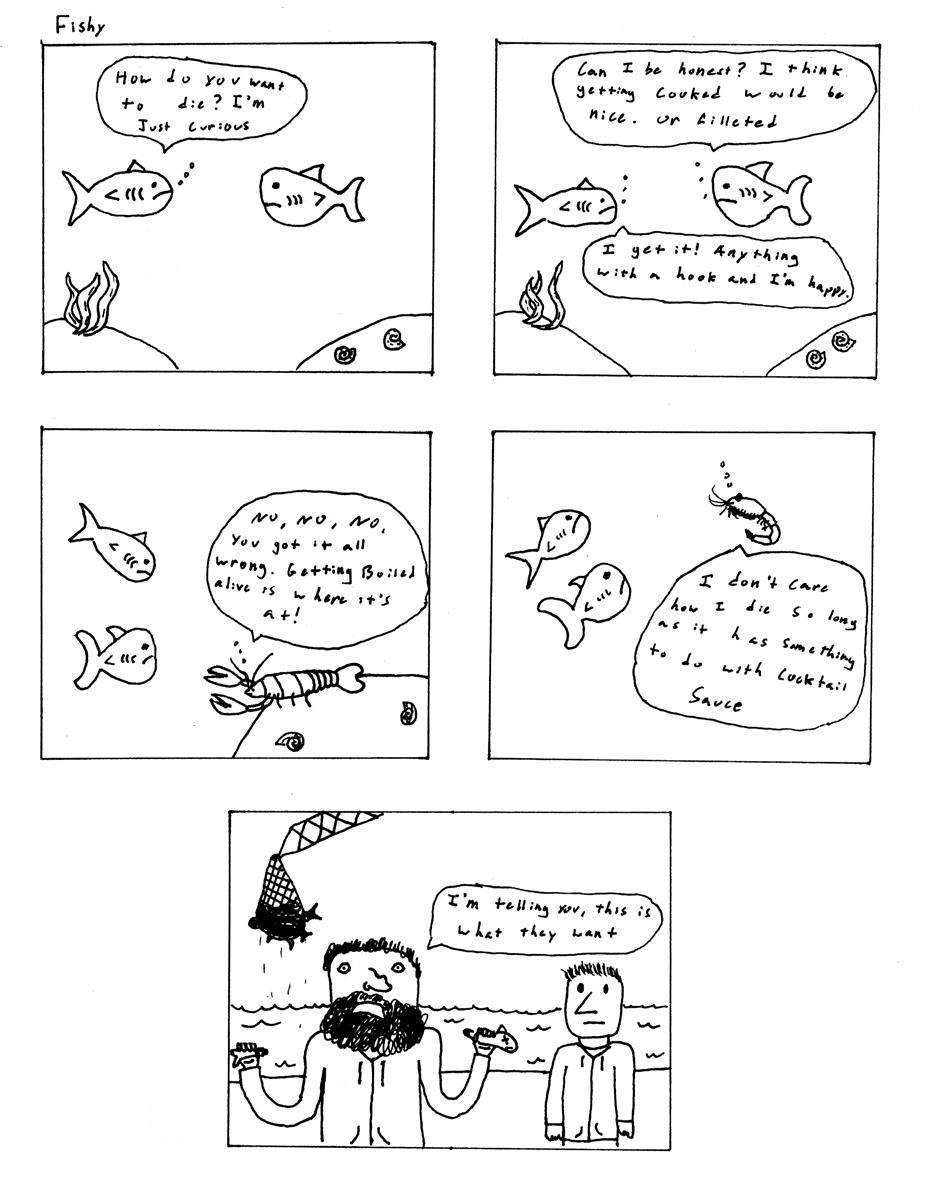
Fishy Cody Powell, Honorable Mention
Brook Haight, First Place Poetry
bled through
shame tinges my face and the back of my pants a dull red in a bathroom stall on my university’s campus
i am a child at twenty-two who can’t control her body spilling or even keep herself clean of things that belong inside every real adult at the real adult meeting must’ve seen as i stood, must’ve known i stain myself everywhere my mom never taught me not to.
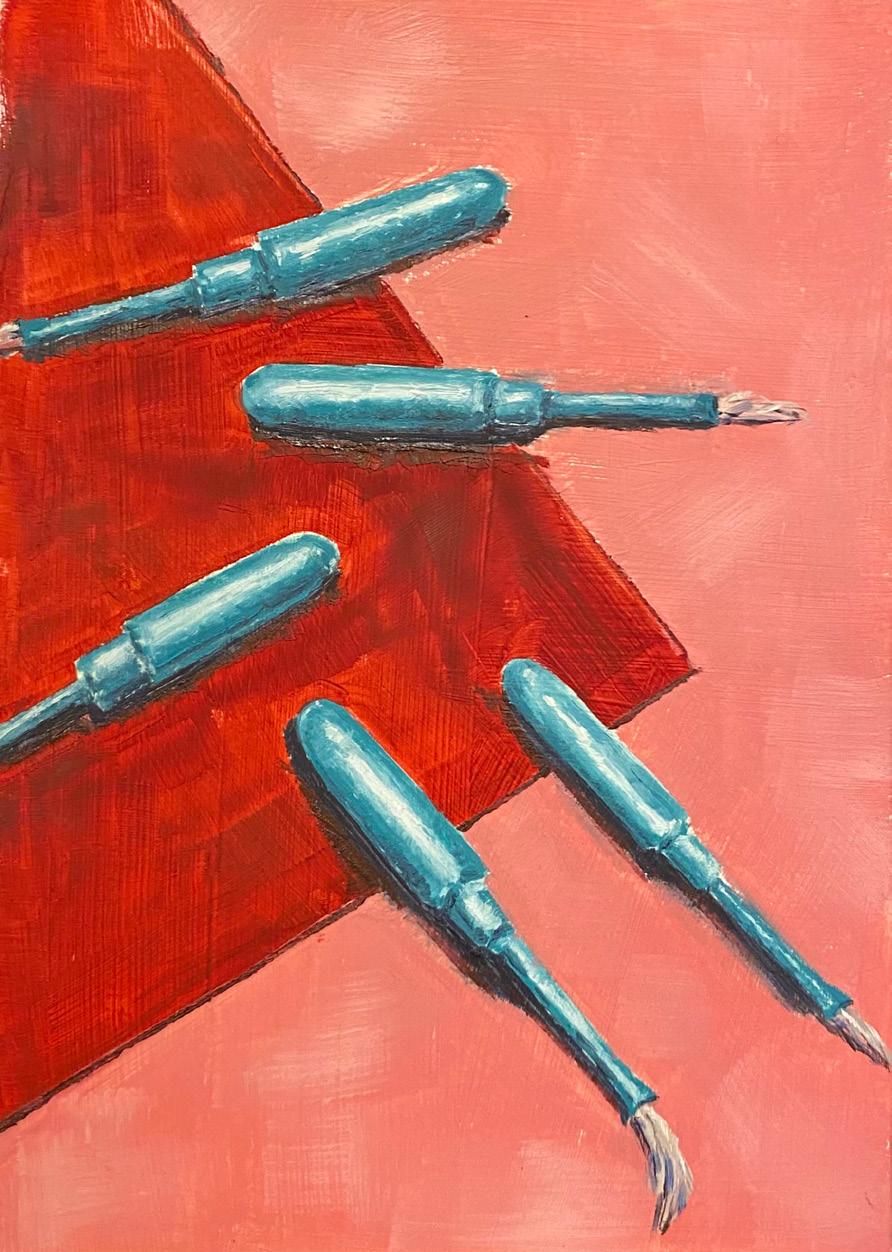
A Day’s Worth
Kaisha Mills, Honorable Mention
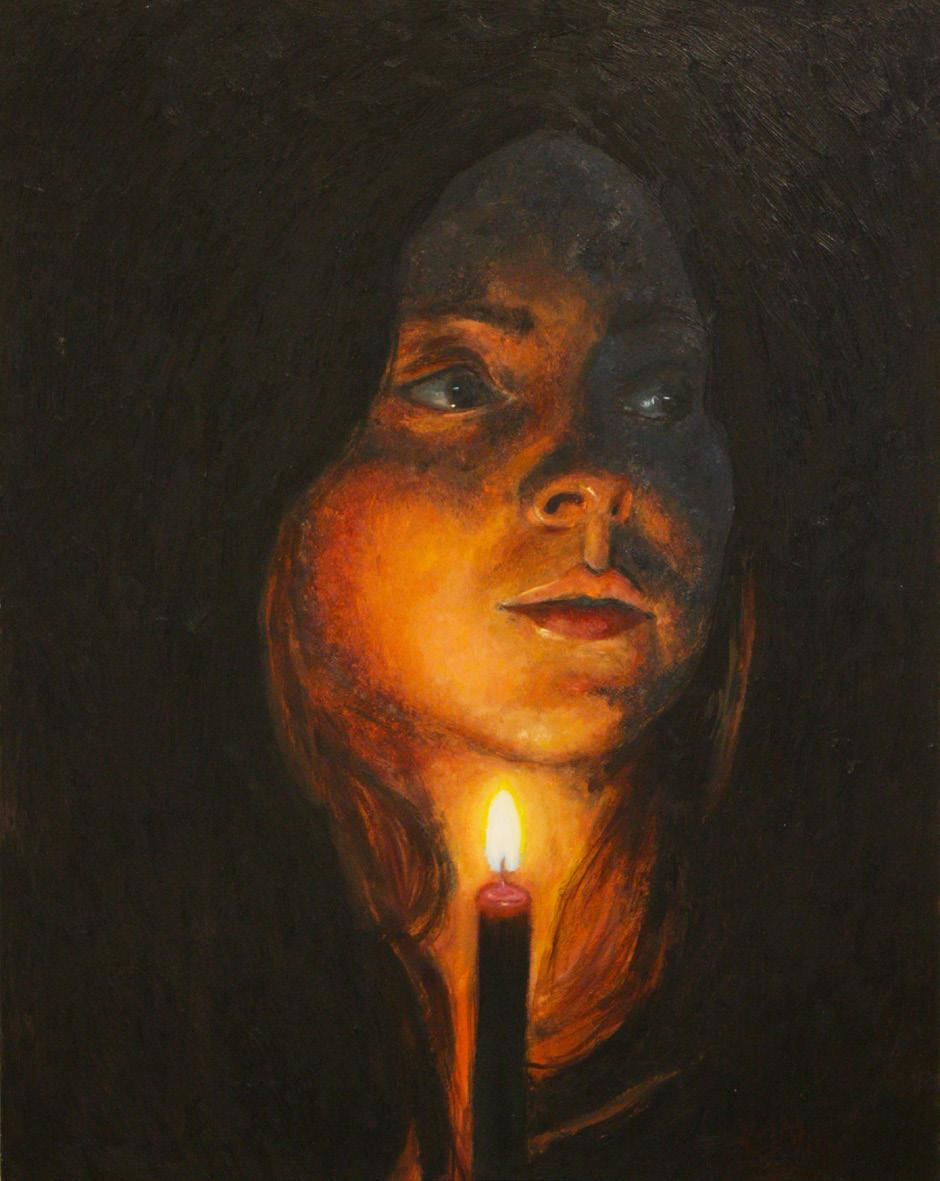
Through the Dark
Kaisha Mills, Honorable Mention
food at home
when he came to my door i wished i was in the fridge hiding between my half eaten pan of brownies the unripe mango i bought and a jar of pickle spears
when he came to my door the night air stayed searing and my thermostat was busted i was sweating in my bare skin drinking warm water
when he came to my door i remembered my house only had one smoke alarm hidden far away from the kitchen
when he came to my door the oven had burned the sugar in my dinner to a sludge
when he came to my door i answered only because it was dark and my windows were all open
eating proper
they brought me a fork, knife and napkin for the avocado tomato toast i ordered when they wouldn’t make my
grilled cheese. the napkin made sense but the utensils confused me. i used my hands, brought them to my mouth.
avocado fell to the plate smeared the edges of my mouth and made me glad no one was sitting near me.
a fork couldn’t make this cleaner couldn’t keep the fruit from spilling over the edge. it could make me look cleaner,
though. i wanted more salt, more crunch (not that i would do something about it).
i scooped the fallen avocado with my fingers, twirling it around the plate to collect residual flavor, oil and pepper and i licked
myself clean, the length of my hands the corners of my lips. the napkin crumpled, dropping used onto my plate
Ella Stott, Second Place Poetry
eat
after The Sexual Politics of Meat: A Feminist-Vegetarian Critical Theory by Carol
Myth from hunting men: (the ones most natural) in the early times, men and women discovered inequality with men gathering existence, women hunting non-meat, non-sustenance and non-importance
Myth from identified men: (and non-identified women) to rip carcass with teeth is to have power and to rip food from belly is to have femininity
Non-myth from our pregnancy: (man pregnant through woman) read the tales of kings in castles to two babies in cradles one who now knows riches come from bloodied legs and torsos one who knows now her stomach isn’t supposed to be full unless she is inside of it.
J. Adams
TW: rape
consummation
golden moonlight, silver sun
sun-not-rising, golden winter trees, moon observes winter ceremony of candlesticks and unripe fruit he says he wants her in when in white lace and flower crown does he want her now?
Now, among branches and toothpicks, he bites her lip, her toothache swelling formally sun-not-rising, moon is, her mouth biting where he guides it moon does not wonder if she too is in delight drunk in body and light and linen towels and in her, this she knows this comes this with star sheets over moon’s back no rhythm in the holy endowed, because this sun’s vagina doesn’t open enough because there is no safety in a regret she had already known would be she thinks of herself and the white on her silver, gold moon on silver sun and then, fuck you, she wants to say to the moon as the moon says out loud, I’ll fuck you again.
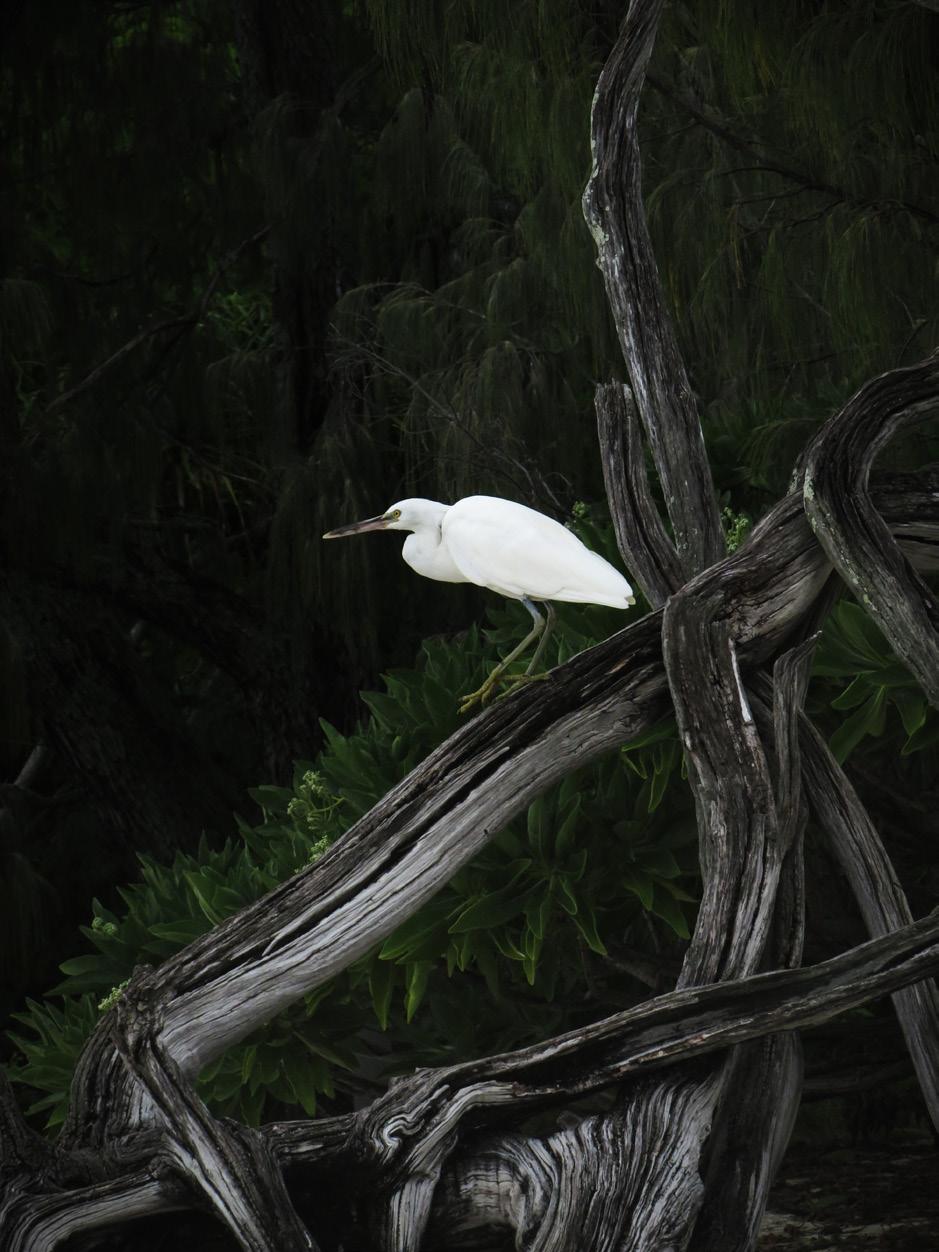
Camouflage?
Brianna Pickering, Honorable Mention
Abby Huber, Third Place Poetry
Miscarriage
The moon: fluff of cotton bulging left she is half circle swell half ghost swollen round haunting swollen round until it shrivels into sky.