OCTOBER 2026 • ISSUE 1
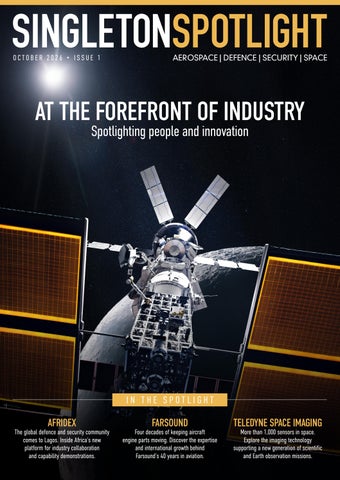
AT THE FOREFRONT OF INDUSTRY Spotlighting people and innovation
IN THE SPOTLIGHT
AFRIDEX
The global defence and security community comes to Lagos. Inside Africa’s new platform for industry collaboration and capability demonstrations.
FARSOUND
Four decades of keeping aircraft engine parts moving. Discover the expertise and international growth behind Farsound’s 40 years in aviation.
TELEDYNE SPACE IMAGING
More than 1,000 sensors in space. Explore the imaging technology supporting a new generation of scientific and Earth observation missions.
About SingletonSpotlight
Editor’s welcome Welcome to the first issue of Singleton Spotlight, shining a light on exceptional companies and the people and teams behind their achievements across aerospace, defence, security and space worldwide. Behind every company advancing its field are people whose expertise, ideas and commitment make progress possible. Engineers, scientists, manufacturing specialists, operational teams and business leaders turn ambitious ideas into achievements. Their stories are at the heart of Spotlight, exploring the capabilities and collaboration that distinguish these businesses and their contribution to the wider industry. This first issue brings together different perspectives on innovation, growth and specialist expertise. Teledyne Space Imaging’s milestone of more than 1,000 imaging sensors in space reflects decades of technical development and mission experience, while Ubotica explores how artificial intelligence in orbit can support maritime security. Both connect advanced technology with a clear purpose.
Singleton Spotlight is a quarterly magazine covering aerospace, defence, security and space, published in digital and print formats for an international readership. Through features, interviews and industry perspectives, it explores exceptional companies, their innovations and the teams behind their achievements. An accompanying podcast series offers further conversations with industry leaders and specialists, sharing their experiences, insights and ambitions for the future.
Our manufacturing features examine the capabilities supporting complex international programmes. Nasmyth discusses growth in precision engineering, ÉireComposites explores opportunities across aerospace and space, and SASMOS Group shares its work in aerospace interconnection. Their stories reveal the expertise within international supply chains and the teams supporting their success. Farsound and Lincad each celebrate 40 years in business, exploring how specialist companies build lasting relationships while developing their capabilities. These milestones recognise generations of colleagues and their contribution to the businesses’ achievements. We are proud to be an Official Media Partner for AFRIDEX 2026, the Africa International Defence Exhibition in Lagos, Nigeria. Hosted by DICON under the patronage of the Federal Republic of Nigeria, AFRIDEX brings together government representatives, military leaders and international industry. Its exhibition, live showcases and strategic forum span land, maritime, air, space and cyber, providing a platform for African and international companies to demonstrate capabilities and explore partnerships. Our feature examines its ambitions for industrial collaboration and capability development across the continent. Elsewhere, Calian considers defence readiness, Heliair looks towards the future of rotary aviation, and Aerobility explores making flight more accessible. Together, these features reflect the breadth of our industries and the contributions of their companies and teams. What interests me most is how these achievements happen: the decisions, working relationships and accumulated knowledge behind them. Through future issues and our accompanying podcast series, we will continue those conversations with the people who know their businesses best. Thank you to our contributors for sharing their time and expertise, and to our editorial and creative team for bringing this first issue together. I hope you enjoy discovering the companies and people in these pages.
Abby Singleton Editor
Abby Singleton brings 20 years of experience across aerospace, defence, security and space, working with companies and industry leaders internationally. Her expertise spans strategic communications, media relations and industry engagement, with a focus on making complex technical subjects clear and relevant to different audiences. Through her work with engineering specialists, senior executives and technical teams, she has developed a broad understanding of these sectors and the businesses operating within them. She brings this knowledge to Singleton Spotlight, exploring the achievements, ideas and people behind the companies featured.
2 • WELCOME
Contact the editorial team Editor: Abby Singleton Editorial and podcast enquiries: spotlight@singletonpr.com We welcome suggestions for future features, interviews and podcast conversations. If your company or team has an achievement, innovation or industry perspective to share, we would like to hear from you.
CONTENTS IN THE SPOTLIGHT
4 Nasmyth builds for growth as global demand for precision engineering accelerates 12 Heliair looks to the future with the Robinson R88
6 Farsound celebrates 40 years supplying aircraft parts to global aviation
14 Calian expands its role in defence readiness across the UK, NATO and the high no 16 ÉireComposites expands its reach across aerospace and space 18 SASMOS Group: Powering the future of global aerospace interconnection
8 AFRIDEX 2026: Bringing the global defence and security industry to Lagos
20 Ubotica: Orbital AI brings a new perspective to maritime security 22 Aerobility: Making the Future of Flight Sustainable and Accessible
10 Teledyne Space Imaging: More than 1,000 sensors in space and a new generation of missions
24 Powering defence for 40 years Lincad looks to the next generation 26 Events 2027 CONTENTS • 3
Nasmyth builds for growth as global demand for precision engineering accelerates Global aerospace, defence and space markets are placing new demands on the precision engineering supply chain. Aircraft manufacturers are working through substantial order backlogs, defence programmes are increasing production requirements, and the space sector continues to create opportunities for specialist manufacturers. At the same time, customers are looking for greater resilience across their supply chains, supported by technical expertise, manufacturing capacity and the ability to deliver consistently over the long term. Against this backdrop, Nasmyth is developing its business to meet a changing industrial landscape. With decades of engineering experience behind it, the company is combining its established UK expertise with international manufacturing, strategic acquisitions and investment in skills to create a broader platform for the future. Precision engineering sits behind some of the most demanding technologies in the world. Aero engines, aircraft systems, defence platforms, satellites and spacecraft all depend on components manufactured to exacting standards, often for environments where quality, consistency and reliability are critical. As programmes become more sophisticated and supply chains increasingly global, manufacturers must be able to offer more than production capacity alone. John Rooney, CEO of Nasmyth, said: “Across aerospace, defence and the rapidly developing space sector, we are seeing increasing demand for sophisticated precision engineering and advanced manufacturing. 4 • NASMYTH
Nasmyth’s growth strategy is about ensuring we are ready to meet that demand. Through investment in our people and skills, facilities and technology, alongside strategic acquisitions and the development of our international footprint, we are building a business with greater scale and capability. “Our ambition is to build on Nasmyth’s long established engineering heritage and create a stronger, more internationally positioned business, ready to support the future requirements of our customers and the industries they serve.”
Engineering breadth built on experience Nasmyth’s capabilities extend well beyond precision machining, encompassing complex machining, fabrication and precision welding, electro mechanical systems, assemblies and testing, design and engineering, specialist metal treatments and supply chain management. This breadth allows the business to support requirements ranging from individual high
precision components to complex assemblies and integrated manufacturing solutions. That technical capability is underpinned by a long engineering history. Nasmyth Group was established in 2003, bringing together specialist businesses with histories stretching back much further, including Bulwell Precision Engineers, incorporated in 1956. A significant new chapter began with Nasmyth’s acquisition by Sigma Advanced Systems UK Ltd in late 2025, bringing the business together with Sigma’s wider operations, resources and international ambitions.
Developing an international manufacturing footprint One of the most important elements of this development is the expansion of Nasmyth’s international manufacturing presence. Working alongside parent company Sigma Advanced Systems, the business has established a purpose built facility in Sri City, India for the production of high precision, safety critical components and assemblies.
“ We are seeing increasing demand for sophisticated precision engineering and advanced manufacturing.” The site is designed to strengthen the Group’s ability to support major manufacturers and Tier 1 organisations as production requirements increase and supply chains become more international. Bringing together specialist UK engineering and processing expertise with manufacturing in India creates additional flexibility and resilience, while providing a platform to pursue new programmes and opportunities in global markets. Nasmyth’s manufacturing base has also been broadened through Sigma Advanced Systems’ acquisition of Bromford Precision Solutions. Founded in 1988 and based in Leicestershire, Bromford specialises in complex aero engine rings, compressor casings, ducts, brackets and lock plates. Its expertise complements the capabilities already available across the organisation and strengthens the Group’s position within the aero engine supply chain, providing greater scope to undertake larger and more technically demanding packages.
Investing in engineering talent
Ready for what comes next
Facilities and technology are only part of the picture. The availability of skilled engineers remains one of the most important considerations for advanced manufacturing, particularly as industries compete for specialist technical talent and experienced engineers approach retirement.
Taken together, Nasmyth’s recent developments point to a business undergoing a significant transformation. Its longstanding UK engineering base is now complemented by international manufacturing, additional specialist expertise and a growing pipeline of talent.
Through the Nasmyth Academy, young people are given opportunities to gain practical experience, develop technical knowledge and establish careers in advanced manufacturing. Building that pipeline helps preserve valuable engineering knowledge while developing the skills that will be needed as technologies, processes and customer requirements continue to evolve.
The objective is not simply greater scale. It is to create the technical depth, flexibility and resilience needed to undertake increasingly complex work and support customers over the long term. As aerospace, defence and space programmes continue to evolve, Nasmyth is building on its engineering heritage to position the business for the opportunities ahead.
nasmyth.com
NASMYTH • 5
Farsound celebrates 40 years supplying aircraft parts to global aviation Farsound is celebrating its 40th anniversary, marking four decades of supplying aircraft engine parts and delivering specialist supply chain solutions to the aerospace industry. Since its founding in 1986, Farsound has grown from a specialist aerospace components business into an international supply chain partner, helping airlines, engine manufacturers and maintenance, repair and overhaul organisations access the components they need to keep aircraft operating safely and efficiently. Today, Farsound has built a strong reputation within the aviation aftermarket for reliability, technical expertise and responsive service. The company works across the aviation ecosystem, delivering solutions designed to keep essential aircraft engine parts moving efficiently through increasingly complex supply chains. Reflecting on the milestone, Lee Kelsey, Chief Commercial Officer at Farsound, said the anniversary is an opportunity to recognise the people and relationships that have shaped the company’s journey.
“Reaching our 40 year anniversary is an important moment for everyone at Farsound. Our progress has been made possible by the trust of our customers, the strength of our supplier relationships and the dedication of our teams around the world. The aviation industry is built on collaboration, and we are proud to work alongside so many organisations across the sector. Those relationships remain central to our business and will continue to be fundamental as we look towards the future.”
Supporting the aviation aftermarket Farsound specialises in aerospace supply chain solutions and the distribution of aircraft engine parts, serving customers throughout the MRO sector. By maintaining a comprehensive inventory of brand new components across multiple engine platforms, the company enables customers to access critical parts quickly and efficiently. This helps maintain operational continuity, minimise aircraft downtime and meet demanding maintenance schedules. Alongside parts distribution, Farsound provides services designed to simplify complex logistics requirements. These include bespoke kitting solutions, responsive parts supply and inventory management support. 6 • FARSOUND
Working closely with customers, Farsound helps streamline procurement and logistics while delivering the reliability and flexibility required in a fast moving aerospace environment.
The investment is part of a wider strategy to position people, inventory and expertise closer to customers and respond effectively to the changing requirements of the aviation aftermarket.
A growing global presence
Partnerships that drive success
From its origins in the United Kingdom, Farsound has steadily expanded into key aviation markets around the world.
Farsound’s development has been shaped not only by investment and expansion, but by the relationships it has established throughout the aerospace industry.
Today, the company has operations across Europe, North America and Asia, combining regional expertise with the capabilities of its wider international network. As aviation supply chains have become more interconnected, Farsound has continued to invest in infrastructure, logistics capabilities and local expertise to strengthen parts availability and service. A significant recent milestone has been the opening of the company’s facility in San Antonio, Texas. The site includes 20,000 square feet of warehouse space and 8,000 square feet of office space, increasing Farsound’s capabilities across the Americas.
Long standing connections with customers, suppliers and industry partners have played an important role in the company’s evolution and remain central to its approach today. Equally important are Farsound’s people. The expertise, dedication and collaboration of teams across the business have helped deliver the high levels of service customers have come to rely on. Together, this combination of industry relationships, specialist knowledge and a customer focused approach has helped establish Farsound as a trusted name within the aviation supply chain.
40 YEARS OF BREATHING LIFE INTO SUPPLY CHAINS
Looking ahead The anniversary provides an opportunity to celebrate Farsound’s history, but the company remains firmly focused on what comes next. Aviation continues to evolve as travel demand grows, aircraft and engine technology advances and supply chains become more complex. Customers are also seeking greater resilience, responsiveness and visibility across their operations.
Meeting these changing requirements will demand expertise, flexibility and continued investment in new capabilities. Farsound is already preparing for the next stage of its international growth, including plans to further expand its presence in Europe. More details will be announced next year as the company continues to strengthen its operations across the region. With an established international network, extensive inventory capabilities and continued investment in its operations, Farsound is well positioned for its next chapter.
After four decades of growth and change, Farsound remains at the beating heart of aerospace, connecting customers with the aircraft engine parts, expertise and supply chain solutions they need. As the company celebrates this milestone, Farsound does so with gratitude to the customers, suppliers, partners and colleagues who have been part of its journey, while looking forward to the opportunities that will shape the years ahead.
farsound.com
“ Reaching our 40 year anniversary is an important moment for everyone at Farsound.” FARSOUND • 7
AFRIDEX 2026 Bringing the global defence and security industry to Lagos This autumn, the inaugural Africa International Defence Exhibition (AFRIDEX) will bring the global defence and security community to Lagos, creating a major new platform combining industry engagement, capability displays and live demonstrations across air, land, maritime, space and cyber domains. Taking place from 26–29 October 2026 at Eko Atlantic, AFRIDEX will welcome military delegations, government representatives and industry leaders for four days of engagement and collaboration. Held under the patronage of the Federal Republic of Nigeria and hosted by the Defence Industries Corporation of Nigeria (DICON), the exhibition will showcase the country’s manufacturers, technology companies, SMEs, engineers and innovators alongside international participants. For Nigerian industry, this represents a chance to engage with potential partners and customers without travelling overseas. For visiting organisations, it offers direct access to expertise and innovation within one of Africa’s most significant economies.
Bringing the international market to Nigeria Building relationships with global organisations and accessing new markets has traditionally required Nigerian companies to attend major exhibitions overseas. AFRIDEX changes that dynamic by bringing decision-makers to Lagos. Companies working across defence manufacturing, aerospace, maritime security, satellite technology, cybersecurity, communications and emerging technologies will be able to present their expertise directly to visiting delegations and industry representatives. For overseas participants, the exhibition provides insight into local industrial capability and the potential for investment, knowledge exchange and collaboration. 8 • AFRIDEX
Defence and manufacturing at its heart Defence will sit at the heart of AFRIDEX, bringing together businesses involved in manufacturing, equipment, communications, autonomous systems and technologies supporting modern military capability. Strengthening indigenous manufacturing is an important part of developing national resilience and supporting the long-term requirements of the country’s armed forces. AFRIDEX will give manufacturers a platform to demonstrate what they can deliver while establishing relationships across the wider defence sector. It will also provide a forum for discussions around future technologies, industrial cooperation and the changing requirements of armed forces across Africa.
“ AFRIDEX will put Nigeria at the heart of international defence and security engagement.” Capability in action AFRIDEX will extend beyond the traditional exhibition hall, with outdoor static displays and live demonstration areas enabling exhibitors to showcase systems and technologies in a more operational environment. The outdoor area is expected to feature land, air and maritime assets including armoured vehicles, UAVs, aircraft, maritime platforms, robotics, autonomous technologies and advanced sensor systems. dicated live demonstration programme will allow visitors to see selected technologies in action, including vehicle mobility, VTOL drone systems, robotics, communications, surveillance and maritime security capabilities. The venue’s waterfront location will also support demonstrations of maritime surveillance systems, small craft, unmanned surface vessels and coastal security technologies. Together, the static displays and live programme will give military, government and industry stakeholders an opportunity to see and discuss capability beyond the traditional exhibition stand.
Aerospace, maritime and emerging technologies Aerospace and aviation will form an important part of AFRIDEX, reflecting the increasingly connected nature of modern defence and security operations.
Aircraft, aviation systems, communications and surveillance technologies will feature, while Nigeria’s position on the Gulf of Guinea brings an important maritime dimension to the event. Protecting shipping, ports, offshore assets, critical infrastructure and territorial waters requires cooperation between governments, security organisations and industry. AFRIDEX will provide a setting to explore the technologies and relationships that can support these strategically important environments. Space and cyber technologies will also play an important role. Satellite communications, Earth observation, intelligence, surveillance, cybersecurity, autonomous systems and connected technologies increasingly support how governments and armed forces operate, communicate and respond to threats. Bringing these sectors together reflects the increasingly multi-domain nature of defence and security, while creating scope for businesses that may traditionally have operated in separate markets to identify shared requirements and areas for collaboration.
Putting Nigerian capability on an international stage
major organisations and potential industry partners can be particularly valuable. Faceto-face engagement can open doors to supply chains, collaborative projects and markets that may otherwise be difficult to access. The benefits extend beyond individual exhibitors. An international gathering of this scale provides a chance to demonstrate the depth of Nigeria’s wider industrial ecosystem, from established manufacturers to engineers, technology developers and ambitious younger companies. Major General Ibrahim Babatunde Alaya, Director General of the Defence Industries Corporation of Nigeria (DICON), said:
“AFRIDEX will put Nigeria at the heart of international defence and security engagement, showcasing our capabilities across defence, aerospace, maritime, space, cyber and security while creating new opportunities for Nigerian industry to connect with partners from around the world.” With the inaugural exhibition approaching, attention is turning to Lagos and the connections AFRIDEX could help create.
One of AFRIDEX’s most significant objectives is to showcase the breadth of expertise developing within Nigeria on home soil.
By bringing international decision-makers together with Nigerian industry on home soil, AFRIDEX aims to showcase national capability, strengthen commercial relationships and support the future development of defence and security across Africa and beyond.
For SMEs and emerging businesses, direct access to government representatives, delegations,
afridex.com AFRIDEX • 9
Teledyne Space Imaging More than 1,000 sensors in space and a new generation of missions From exploring the origins of the Universe to monitoring severe weather on Earth, Teledyne’s imaging technologies support some of the world’s most ambitious space missions. Recent milestones demonstrate both the scale of that heritage and the advanced technology being developed for the future. More than 1,000 Teledyne scientific imaging sensors are now in space, marking a significant milestone for a company whose detector technologies have supported space exploration and Earth observation for more than four decades. The milestone was reached with the launch of NASA’s Nancy Grace Roman Space Telescope in August 2026, adding another flagship astrophysics mission to a heritage that includes the Hubble and James Webb Space Telescopes. Roman will investigate some of the biggest questions in modern astronomy, from dark energy
10 • TELEDYNE
and the evolution of the Universe to planets beyond our Solar System. At the centre of that science is advanced imaging technology. Teledyne supplied H4RG-10 infrared detector arrays for Roman’s Wide Field Instrument, creating the largest infrared focal plane ever flown in space. Eighteen detectors combine to form a mosaic containing more than 300 million pixels. Teledyne also supplied CCD311-20 detectors for Roman’s Coronagraph Instrument, an advanced
imaging system designed to suppress light from stars so much fainter planetary systems can be observed. The technology could help pave the way for future missions capable of directly imaging Earth like planets around nearby stars.
“Reaching more than 1,000 scientific, space qualified imaging sensors in orbit is a proud achievement for everyone at Teledyne,” says Megan Tremer, President of Teledyne Space Imaging. “It reflects our long standing commitment to advancing imaging technology and supporting the world’s most ambitious space missions.”
From the Universe to our own planet Another recent milestone demonstrates the breadth of Teledyne Space Imaging’s capabilities much closer to home. The Meteosat Third Generation Imager 2 satellite launched carrying a Teledyne Space Imaging CIS111 detector within its Flexible Combined Imager. Operated by EUMETSAT, the Meteosat Third Generation system represents a major advance in geostationary weather observation. It will provide more detailed and frequent information to help meteorological services monitor severe weather, improve forecasting and contribute to long term climate monitoring. The CIS111 was specifically engineered for continuous Earth observation from geostationary orbit. The five channel, programmable, radiation hardened sensor incorporates a large pixel architecture, with pixels measuring up to 100 by 100 microns. It also uses a specialist coating developed by Teledyne Space Imaging to minimise internal reflections and optimise imaging performance. The contrast between Roman and Meteosat illustrates the extraordinary breadth of modern space imaging. One mission is designed to look deep into the Universe and help answer fundamental questions about its evolution. The other continuously observes our own planet, providing information that can help scientists and forecasters better understand developing weather systems.
Team members at Teledyne who worked on the H4RG-10 imaging sensor
Bringing space capabilities together
Looking to the next generation
These missions also form part of a much wider Teledyne presence in the global space sector. Teledyne Space brings together expertise from multiple Teledyne businesses across imaging and sensing, microwave devices, optoelectronics and photonics, radiation tolerant semiconductors, advanced electronics and manufacturing. The collective approach gives customers access to complementary technologies and specialist expertise across a wider part of the space mission. Teledyne companies have worked with leading international space agencies including NASA, ESA, JAXA and KASA, while supporting scientific, institutional, governmental and commercial programmes around the world. Teledyne Space Imaging’s mission heritage extends from Hubble, James Webb and Roman to Euclid, ESA’s Sentinel Earth observation missions and major meteorological programmes.
Both depend on imaging technology capable of delivering exceptional performance in an environment where reliability is fundamental. Team members at Teledyne who worked on the CCD311-20 imaging sensor
That experience is becoming increasingly important as the global space sector evolves. Scientific missions are becoming more ambitious. Earth observation is producing greater quantities of increasingly detailed data. Commercial space is changing the pace of development and production, while governments are placing greater emphasis on resilient space capabilities. Across these markets, future spacecraft will be expected to deliver greater performance while meeting demanding requirements around size, mass, power, radiation tolerance and reliability. For Teledyne Space Imaging, passing 1,000 scientific imaging sensors in space represents an important milestone, but also a foundation for what comes next. From observing distant galaxies and searching for new worlds to monitoring Earth’s atmosphere, the next generation of missions will require technologies capable of seeing further, detecting more and continuing to perform reliably for years in some of the most demanding environments imaginable.
Find out more at teledynespaceimaging.com CCD311-20 detector
Image credit: Teledyne Space Imaging
“ Teledyne Space Imaging’s mission heritage extends from Hubble, James Webb and Roman to Euclid, ESA’s Sentinel Earth observation missions and major meteorological programmes.” TELEDYNE • 11
Heli Air looks to the future with With over 40 years of experience and a nationwide presence, Heli Air has become the name in the UK helicopter industry for Robinson helicopters. As the UK’s main dealer for the forthcoming ten-seat Robinson R88, the company is now preparing for this important new addition to the Robinson family. From its headquarters at Wellesbourne Airfield in Warwickshire, Heli Air has grown to become the UK’s largest light helicopter company, working with owners, pilots and operators across the country. The business operates from two strategic locations and employs more than 80 experienced people across helicopter sales, flight training, maintenance, overhauls and management. This breadth of expertise enables Heli Air to assist customers throughout the helicopter ownership journey, from learning to fly and selecting an aircraft through to its ongoing operation and maintenance. Across its activities, the company flies more than 12,000 hours each year. Robinson helicopters are central to Heli Air’s expertise. The company is the UK’s leading Robinson maintenance provider, giving its team extensive knowledge of the manufacturer’s aircraft range throughout their operational lives. The forthcoming R88 will add a very different aircraft to that established relationship
Introducing the R88 The all-new Robinson R88 represents a significant expansion of the manufacturer’s portfolio. Designed for two pilots and up to eight passengers, it will be Robinson’s largest helicopter to date and is intended for applications ranging from passenger transport and tourism to utility operations, emergency medical services, public safety and aerial firefighting. As the UK’s Main Dealer for the R88, Heli Air is providing prospective customers with information about the aircraft as the programme progresses and the opportunity to register their interest for future deliveries. Central to the design is a highly configurable
cabin with a flat floor, allowing for forward facing and club seating arrangements alongside specialist configurations for air medical and public safety missions. Large sliding doors on both sides will provide access for passengers, equipment and cargo. A fold down rear door is designed to simplify the loading of larger items and accommodate a HEMS stretcher, while air conditioning is planned as standard.
Built for the mission A range of OEM supplied equipment is planned to enable the R88 to be adapted for different requirements. Options include a 3,000 lb HEC rated cargo hook, utility basket, wire strike protection and pop out floats. The helicopter will be available with standard skids or optional high skids, providing additional ground clearance and compatibility with a firefighting water tank. LED exterior lighting will include pulsed landing and taxi lights, tail rotor lighting, scene lighting and entry lights, providing additional functionality across a variety of environments.
Power and technology The R88 will be powered by the 950 shp class Safran Arriel 2W turboshaft engine. It is also set to come standard with Safran’s Serenity support package, providing five years or 2,000 flight hours of support, whichever comes first. The package includes coverage for Level 3 and 4 unscheduled maintenance, priority access to replacement engines, troubleshooting and assistance, as well as digital services including Health Monitoring and Logbook Connect.
The flight deck will feature a Garmin avionics suite incorporating G500H TXi displays and GTN touchscreen navigators. The G500H TXi will also incorporate a crew alerting system providing aircraft system information. A four-axis Garmin autopilot will be standard, with functions including level mode, hover assist and limit cueing, together with low and high speed and low altitude protection. Together, these systems reflect the breadth of missions envisaged for the new helicopter and the demands that can accompany them.
Looking to the future The R88 takes Robinson into a larger category of helicopter, creating new possibilities for organisations requiring greater capacity, flexibility and specialist mission capability. For Heli Air, the aircraft is a natural fit within its business that combines sales expertise with training, engineering and helicopter management. This broad base of knowledge will be particularly valuable as customers begin considering how the R88 could fit their future requirements. While the aircraft remains under development and specifications are subject to change, the programme signals an ambitious new direction for Robinson and Heli Air. For Heli Air, it provides an opportunity to build on its established Robinson expertise with the other models in the brand. The R22 Beta II, the R44 range including the Cadet, the Raven I, the Raven II & Clipper II and the all-new R66 NxG all play an important role in bringing the manufacturer’s next generation of helicopter capability to the UK.
heliair.com
The all-new Robinson R88 represents a significant expansion of the manufacturer’s portfolio. 12 • HELIAIR
the Robinson R88
HELIAIR • 13
Calian expands its role in defence readiness across the UK, NATO and the high north A major new British Army training agreement highlights Calian’s growing international defence role, building on decades of experience supporting military organisations through training, simulation, cyber, resilient communications and space enabled capabilities. Across NATO, defence priorities are evolving. Increased investment in collective defence is placing greater emphasis on how military forces prepare, communicate and operate together across national boundaries. For Calian, these priorities align with decades of experience supporting the Canadian Armed Forces, British Army, NATO and defence organisations internationally. Headquartered in Ottawa, Canada, with more than 6,000 people worldwide, Calian’s Defence and Space business brings together collective training and simulation, defence technologies, systems engineering, cybersecurity, resilient communications and space enabled capabilities.
15 years supporting British Army training In August 2026, Calian UK secured a 15-year agreement with Raytheon UK, the consortium lead for Omnia Training, to support the British Army’s Collective Training Service programme, ACTS. Beginning in October 2026, the agreement provides approximately CAD$296 million (£159 million) in contracted base revenue over 15 years and builds on Calian’s existing work under Project NUMIDIAN.
14 • CALIAN
Under NUMIDIAN, Calian has delivered specialist collective training services designed to expose British Army personnel to contemporary threats and prepare them for complex operational environments. ACTS takes this relationship forward, supporting the modernisation of training through advanced digital, synthetic and integrated capabilities.
Supporting NATO and allied forces Calian’s work with the British Army forms part of a wider history of supporting NATO and defence organisations internationally.
“Military readiness begins long before a mission starts; it begins with training that prepares troops to operate with confidence in complex, high pressure environments,” says Roch Pelletier, Regional Vice President Calian Defence.
Modern multinational operations require personnel, commanders and technologies from different nations to work effectively together. Training and simulation play an important role in preparing forces for this environment, while secure communications and access to reliable information are increasingly central to military effectiveness.
“We’re proud to continue supporting the British Army through ACTS alongside Raytheon UK and our Omnia Training partners.”
Calian supports these requirements through expertise spanning training, simulation, systems engineering, cyber, communications and space.
Collective training creates realistic environments in which soldiers and commanders can develop decision making and coordination while preparing to work effectively with other forces.
This breadth of experience is particularly relevant as military operations become increasingly connected across land, sea, air, cyber and space domains.
Defence in the Arctic The Arctic demonstrates the importance of this integrated approach. Canada, the UK and other NATO Allies are increasing their focus on the region, where extreme conditions, vast distances and limited terrestrial infrastructure create distinctive operational challenges.
“Arctic security is becoming an increasingly important priority for Canada and its NATO Allies, and the challenges of operating in the Arctic demand a truly integrated approach,” says Pelletier. “This is an environment where resilient communications, space enabled capabilities, situational awareness, cyber resilience and operational readiness all need to work together.” As a Canadian headquartered company, Calian combines defence experience with satellite communications, cybersecurity and space technologies that can support organisations operating in remote and demanding environments.
Expanding communications capabilities
A growing international defence role
Calian is also strengthening its communications portfolio.
The ACTS agreement marks an important development for Calian in the UK, extending its relationship with the British Army for another 15 years.
In June 2026, the company announced a definitive agreement to acquire Galaxy Broadband Communications, a Canadian specialist in satellite communications and remote connectivity. Galaxy brings more than three decades of experience supporting government, defence, critical infrastructure and remote customers. Its capabilities include low Earth orbit satellite deployment, private wireless and multi orbit connectivity, with experience across Northern Canada and the Arctic. The proposed acquisition complements Calian’s existing communications and defence technology capabilities, extending its ability to support customers in locations where conventional infrastructure may be limited or unavailable.
It also reflects the company’s wider international defence role. From collective training in the UK to operations in the Arctic, Calian is applying experience developed across defence and technology to some of the most demanding environments facing military organisations today. With established defence relationships in Canada and the UK and decades of experience working with NATO, Calian is positioned to continue supporting military organisations as they prepare for increasingly complex and connected operations.
calian.com
“ Military readiness begins long before a mission starts.”
CALIAN • 15
ÉireComposites expands its reach
From aircraft structures and interiors to satellite hardware, ÉireComposites is taking more than 25 years of advanced composites expertise into new areas of aviation and space. Based in Galway, Ireland, the company is entering the commercial aircraft interiors market while increasing its contribution to major European space programmes. Together, these developments demonstrate how specialist manufacturing capabilities developed in Ireland are finding applications across two demanding global industries. Established in 1998, ÉireComposites designs, manufactures and tests advanced composite structures. Its team of more than 70 people works across aviation, space and other advanced engineering markets, combining materials expertise with manufacturing and testing capabilities.
One of its most recent developments concerns commercial aviation, where ÉireComposites has secured its first production contract in the aircraft seating market. As part of the programme, the company has manufactured an initial batch of composite interior partitions for a customer in the premium aircraft seating sector. Aircraft interiors present particular challenges for composite manufacturers. Reducing weight remains an important consideration, but passenger facing components must also meet demanding requirements for strength, consistency and surface finish. This creates opportunities for manufacturers able to combine the performance advantages of composite materials with the quality expected within premium cabins.
To support the programme and adhere to strict aesthetic quality standards, ÉireComposites designed and manufactured tooling, performed process development and implemented strict quality procedures.
“Winning our first production contract in aircraft seating is a significant milestone for ÉireComposites,” says CEO Tomás Flanagan. “It shows strong confidence in our technical capability, quality standards and ability to meet the high requirements of premium cabin products. We see this as the start of an important new growth area for the business.” While aircraft interiors represent a new market, ÉireComposites has been developing its presence in space for almost two decades. The company has participated in research and development projects led by the European Space Agency since 2008. That experience is increasingly translating into hardware for international space missions.
“ Winning our first production contract in aircraft seating is a significant milestone for ÉireComposites” 16 • ÉIRECOMPOSITES
across aerospace and space
ÉireComposites has manufactured three precision carbon fibre stray light baffles for Altius, ESA’s Earth observation satellite designed to monitor ozone and other trace gases in the atmosphere. The baffles will form part of the satellite’s high-performance optical instrument and are designed to prevent unwanted light from interfering with its measurements. Their manufacture requires the precision and finishing necessary for a space based optical system where measurement accuracy is critical. When Altius launches, the baffles are expected to become the first external satellite components and the largest functioning space hardware manufactured in Ireland to be launched into space. Scheduled for launch in 2028 from Europe’s Spaceport in Kourou, French Guiana, Altius will use a high-resolution spectral imager to build vertical profiles of ozone and other atmospheric gases. The resulting observations will support atmospheric research and longterm climate monitoring.
“The Altius satellite marks a major milestone for Irish participation in space exploration,” says Flanagan. “It demonstrates how Irish advanced manufacturing can play a meaningful role in supporting complex international space missions and future space innovation.”
For ÉireComposites, the programme adds another demanding application for its composite manufacturing capabilities and further demonstrates the progression from research and development into hardware for major international missions.
ÉireComposites’ involvement in major space programmes is also extending beyond Earth observation.
There is a striking contrast between the markets now being addressed from Galway. Some of the company’s newest components will be used inside premium aircraft cabins, while others will operate in space, supporting instruments designed to study Earth’s atmosphere and the wider universe.
The company is contributing structural carbon fibre manufacturing expertise to LISA, the Laser Interferometer Space Antenna, ESA’s future gravitational wave observatory being developed in collaboration with NASA. LISA will comprise three spacecraft operating in a triangular formation approximately 2.5 million kilometres apart. Using highly precise laser measurements, the mission will detect gravitational waves generated by extreme cosmic events, including the mergers of massive black holes, opening new possibilities for studying the universe.
What connects them is the requirement for lightweight materials, manufacturing precision and consistently high performance. More than 25 years after ÉireComposites was established, those capabilities are taking the Irish manufacturer into new areas of aviation while strengthening its role in international space programmes and Ireland’s growing presence within the global space industry.
eirecomposites.com
ÉIRECOMPOSITES • 17
SASMOS Group Powering the future of global aerospace interconnection In an era defined by rapid technological leapfrogging, electrification, and high-speed data architecture, the global aerospace and defence sector calls for a new era of connectivity. Today’s airframes have outgrown simple wiring; they now demand robust, lightweight, and intelligent nerve systems that sustain high-power propulsion, ultra-fast optical data streams, and fail-safe electronic controls. Leading this evolution is the SASMOS Group, establishing a formidable global presence that bridges cutting-edge engineering design, precision manufacturing, and strategic international reach.
Global Competency Centres: Scale, Innovation, and International Reach At the core of the SASMOS Group’s advantage is a seamlessly integrated global operational philosophy. By combining deep manufacturing capabilities and engineering scale in India with strategic local entities - such as Westwire Harnessing in the United Kingdom - the Group delivers an agile, customer-centric framework. As SASMOS continues its strategic expansion across key international markets, its network of Competency Centres serves as a single-source partner, offering design, development, qualification, manufacturing, and field installation services across four key technical pillars:
18 • SASMOS
• B uild-To-Spec (BTS) EWIS: Turn-key Design Organization Approval (DOA) capabilities, highspeed data cables, propulsion wiring systems, terminal block systems, carbon nanotube cabling, and full compliance with CS25 (EASA) and FAA certification standards. • E lectronics Integrated Systems: Control systems, Power Processing Cabinets, Display & Sensing Systems, Automatic Test Equipment (ATEs), and Power Distribution Units (PDUs) for airborne and naval platforms. • F iber Optics: Ruggedized optical junction boxes, tactical communication networks, In-Flight Entertainment (IFE) links, and field repair services for harsh defence environments. • P hotonics & Future-Ready Tech: Radio-overFiber (RoF) links (0.1-3.3 GHz), 8-Channel DWDM Optical Transmitters, LVDS-over-Fiber, and precision landing assistance systems.
Pioneering the Turn-Key “Build-to-Spec” Advantage Moving far beyond traditional “Build-to-Print” manufacturing, the SASMOS Group is actively transforming how global aerospace OEMs approach system architecture. Through coengineered models and turn-key integration, the Group manages complex 3D Multi-Routing Architectures (MRA), Interface Control Documents (ICD), schematics, and obsolescence management. A prime illustration of this capability is the collaboration on the reconfiguration of regional transport platforms, where turn-key EWIS design and power distribution architecture are engineered to support cleaner, more efficient regional air travel.
Enabling Sustainable Flight: eVTOL, UAM & Advanced Air Mobility As the aviation industry accelerates towards zero-emission transport, the SASMOS Group has positioned itself as a critical technology enabler for sustainable air mobility worldwide. Partnering with global pioneers alongside visionary innovators like The ePlane Company for the e200X eVTOL, SASMOS designs specialized High-Voltage (HV) terminal blocks, circuit breaker panels, and propulsion wiring systems built to withstand the rigorous demands of electric vertical take-off and landing vehicles.
Defending Critical Domains: Land, Sea, Radar & Space Beyond commercial aviation, the Group’s high-reliability solutions form the backbone of advanced defence and strategic programs internationally. From providing Power Processing Cabinets (IADS) for stealth frigates to delivering ruggedized weapon system networks, air defence fire control radar wiring, and high-frequency RF photonics links, SASMOS delivers unyielding performance under extreme environmental stress. Backed by stringent credentials such as Cyber Essentials Plus, global quality certifications, and secure defence compliance, the Group continues to earn the trust of prime defence integrators across major global markets.
As aerospace parameters evolve toward lighter weights, higher data speeds, and sustainable power, the SASMOS Group stands ready. With world-class competency centres, growing international footprints, robust certifications, and a proven legacy across military, civil, and next-gen platforms, SASMOS continues to power the ambitions of global aviation leaders - today and into the future.
sasmos.com
SASMOS • 19
Orbital AI brings a new perspective to maritime security Europe’s navies face demands to monitor activity, protect offshore infrastructure and maintain awareness across vast stretches of ocean. Ships, aircraft and crews are finite. Every deployment to shadow a vessel reduces the capacity available for other duties, making the decision about where to act important.
Credit: Contains modified Copernicus Sentinel Data 2025
Undersea communications cables, offshore energy assets, pipelines and strategic shipping routes present security challenges. Monitoring them requires more than a broad picture of vessel movements. Commanders need to understand which activity warrants investigation and how it relates to the assets they are protecting. Irish space technology company Ubotica Technologies is addressing this challenge through Live Maritime Intelligence. Live Maritime Intelligence (LMI) closes the loop from predicting risk to directing action. Predictive models identify where risk is developing, automatically task the most suitable commercial satellites, and rapidly turn imagery into intelligence through onboard or cloud AI. Fused with maritime Automatic Identification System (AIS) and other data, these insights generate targeted alerts and help direct operational assets to where they are needed most.
Starting with risk Much of maritime surveillance begins by collecting data and searching for signs of trouble. Ubotica starts by predicting where to look, then gathering evidence to establish what is there. Their platform builds a risk model across a nation’s exclusive economic zone, identifying areas that may warrant attention now and in the hours ahead. The model combines infrastructure locations with vessel information, sanctions lists and unusual behaviour.
20 • UBOTICA
A tanker going dark near a cable, a rendezvous between ships or a vessel loitering around an offshore installation can prompt closer examination. These indicators provide a basis for investigation; they do not, by themselves, establish hostile intent. The system then selects and tasks commercial Earth Observation satellites to examine the activity. Radar enables monitoring through darkness and cloud. Optical imagery provides detail when conditions allow, while radio frequency sensing helps locate maritime activity over wide areas.
Analysing information in orbit Earth Observation traditionally involves capturing imagery and transmitting it to the ground for processing. Ubotica’s Orbital AI moves this analysis on board the satellite, closer to where the data is collected. Where the technology is installed, vessel detections can reach operators before the full imagery arrives. Those detections are then combined with Automatic Identification System reports and intelligence from disparate sources to build an assessment. A vessel visible in satellite imagery without a corresponding maritime Automatic Identification System (AIS) report becomes a potentially dark contact. Further observations can help establish its movements, while each new finding updates the risk model and informs subsequent satellite tasking.
A single detection can narrow a search covering hundreds or thousands of square kilometres to a targeted area. For a commander, this offers a clearer basis for deciding whether to deploy a ship or aircraft. The company says Live Maritime Intelligence is already in operational use with European government customers, addressing concerns including shadow fleets, sanctions evasion and potential sabotage.
Experience beyond the ground Ubotica reports that its Orbital AI has completed hundreds of thousands of AI inferences in orbit, with more than 30 Earth observation models deployed on board satellites across multiple missions. It also reports a 100 per cent mission success rate. Working with NASA’s Jet Propulsion Laboratory and the European Space Agency, the company says its achievements include the first spacecraft to autonomously identify a target ahead and reorient itself to capture it. That experience gives Ireland an opportunity to contribute a capability of real value to Europe. Its relevance extends beyond the development of space hardware to the application of technology already flown in orbit against security needs.
“Ubotica has spent years pioneering Orbital AI, and we have applied that knowledge to one of the hardest security challenges on Earth”
Investment for the next phase On 23 June 2026, Ubotica announced an $11 million funding round led by Act Venture Capital and Greencode Ventures, with participation from existing investors including Atlantic Bridge and Enterprise Ireland. The investment will accelerate the rollout of Live Maritime Intelligence.
“Ubotica has spent years pioneering Orbital AI, and we have applied that knowledge to one of the hardest security challenges on Earth: protecting vast maritime zones and critical offshore infrastructure,” said Fintan Buckley, CEO of Ubotica Technologies. “Live Maritime Intelligence predicts where risk is emerging, tasks the right satellites and sensors, and delivers decision-grade intelligence in minutes, giving security teams the speed and efficiency they need to act. This investment allows us to bring LMI to market at scale.” For Europe’s defence and space sectors, the opportunity is to sustain maritime awareness without relying on continuous physical deployment. Satellite sensing can maintain the watch, helping navies reserve their ships and aircraft for situations that require a presence at sea.
ubotica.com
UBOTICA • 21
Making the Future of Flight Sustainable and Accessible For more than three decades, Aerobility has been opening up aviation to people who might otherwise have believed taking the controls of an aircraft was beyond their reach. Founded in 1993, the UK charity enables disabled people to experience and participate in aviation, from a first flight through to structured training and, for some, achieving a Private Pilot Licence. Using adapted aircraft, specialist access equipment and instructors experienced in disability flying, Aerobility supports people with a wide range of disabilities. Its activities extend beyond the cockpit to ground school, scholarships, educational programmes and simulator experiences. Today, the charity works with nearly 1,000 disabled people each year, using aviation to build confidence, develop skills and challenge perceptions. Now it is taking that philosophy into another important area of aviation’s future: sustainability.
A new chapter in electric flight At its headquarters at Blackbushe Airport in Surrey, Aerobility introduced a fully electric Pipistrel Velis Electro at the beginning of 2026. Registered G-OFTR, the two-seat aircraft initially joined the charity through a 12-month sponsorship from aviation sustainability specialist 4AIR. Following the impact of the programme, 4AIR has extended its sponsorship until the end of 2027. The partnership brings together two increasingly important priorities for aviation: reducing environmental impact and widening participation. The Velis Electro is the world’s first type certified electric powered aircraft and was developed primarily for pilot training. Its electric powertrain produces no direct emissions during flight and offers significantly quieter operation than a conventional light aircraft. While current battery capacity, range
22 • AEROBILITY
and payload mean electric aircraft are not yet suitable for every application, light aviation and training provide an environment in which the technology can already be put to practical use. For Aerobility, the aircraft represents more than a change in propulsion. It allows disabled flyers to participate directly in an emerging area of aerospace technology and has been described as a global first for an electric aircraft dedicated to disability flight training. The aircraft is supplied and leased through NEBOAir, with Blackbushe Airport also supporting the project. Aerobility and 4AIR are working together on public engagement, industry demonstrations and educational activities, connecting the subjects of sustainability and inclusion as aviation evolves. Mike Miller-Smith MBE, Chief Executive of Aerobility and a disabled pilot himself, has spent much of his career working to make aviation more accessible. He said: “Aerobility has always been about showing what is possible and giving disabled people the opportunity to experience aviation for themselves. Electric flight represents an exciting new chapter for our industry, and it is important that accessibility is part of that journey.
With the support of 4AIR and our wider partners, we can give our flyers the opportunity to experience this technology first hand while helping to demonstrate what a more sustainable and inclusive future for aviation could look like.”
Extending its reach across the UK Although Blackbushe remains at the heart of Aerobility’s activities, its work now extends across the UK. The charity also operates from Tatenhill Airfield in Staffordshire and, through partnerships with local aviation organisations, offers flying opportunities from Lydd Airport in Kent and Cornwall Airport Newquay. Developing this regional network allows Aerobility to reach people beyond its established base in the South East. By working with flying schools, airports and aviation organisations, it is creating a model through which disability flying can be made available to communities in different parts of the country. The electric aircraft project adds another dimension to that work. As aerospace
manufacturers invest in new propulsion technologies and the infrastructure required to support them, accessibility can be considered alongside sustainability, efficiency and performance. Incorporating it into the development of aviation’s next generation could help ensure technological progress also broadens participation. Aerobility’s flyers are already experiencing that change first hand. Rather than simply reading about electric aviation or seeing new aircraft demonstrated, they can climb aboard, take the controls and experience the technology in operation. It is a natural progression for an organisation that has spent more than 30 years challenging assumptions about who can fly. As aviation enters a period of significant technological change, Aerobility is demonstrating that the
future of flight is not solely about new aircraft, propulsion systems and lower emissions. It is also about ensuring that more people have the opportunity to participate. Partnerships remain central to delivering that ambition. Through sponsorship, employee fundraising, project partnerships and longer term corporate support, businesses from aviation and other industries can help Aerobility extend its programmes and introduce more disabled people to flight. As electric aviation moves from development into practical operation, Aerobility is providing an early example of how two important industry priorities can develop together: creating a more sustainable future for flight while making that future accessible to more people.
aerobility.com
AEROBILITY • 23
Powering defence for 40 years Lincad looks to the next generation Lincad has built a strong reputation for developing mission critical power technology for defence. As the UK based, family owned and run business celebrates its 40th anniversary, it is drawing on a strong British engineering heritage while continuing to develop advanced power solutions for the evolving requirements of defence customers worldwide. Founded in 1986, Lincad is a specialist UK designer and manufacturer of custom batteries, chargers and associated technology, supporting defence organisations in the UK and around the world. Remaining family owned and run after four decades is an important part of the Lincad story. The company has grown into an established supplier to the UK Ministry of Defence, Tier 1 UK defence primes and international military customers. As one of the UK’s sovereign battery technology companies, Lincad retains specialist design, engineering and manufacturing capabilities in the UK. This is increasingly relevant as defence organisations focus on security of supply, resilient supply chains and maintaining critical industrial capabilities.
24 • LINCAD
Power for demanding operations The operational landscape for military defence systems has changed dramatically. The rapid growth of electronic warfare, uncrewed systems, advanced sensors, communications and other power intensive technologies is increasing demand for batteries that can deliver greater energy and performance within constrained size and weight requirements. For defence organisations, battery technology is becoming an increasingly important element of overall system capability. Lincad develops ruggedised batteries and charging technology for applications across land, sea and air. Its products support man worn, manned and unmanned platforms, ranging from small bespoke designs to large custom solutions for complex military equipment.
Lincad’s versatile battery products power communications, surveillance, navigation and targeting equipment, supporting applications from electronic countermeasures and artillery location and pointing systems to drones, UAVs and the electrification of specialist defence platforms across demanding operational environments.
we have established ourselves as a trusted supplier to leading defence organisations.”
Engineering the right solution
Customers are seeking greater electrical performance from both batteries and chargers. This is placing increasing emphasis on the technologies behind the platforms and systems themselves.
Lincad’s experienced engineering team works across a wide range of battery technologies, enabling the company to identify the most appropriate cell chemistry and configuration for each application. New and emerging cell chemistries are continually evaluated, providing access to the latest developments in battery technology. Strong relationships with global cell manufacturers also help Lincad maintain robust supply chains. For every battery solution, Lincad can develop an accompanying charger, providing an integrated approach to power and charging. Projects progress from initial concept through design, development and testing to final production.
Four decades of British engineering Peter Slade, Joint Managing Director of Lincad, said:
“Reaching this 40 year milestone is a proud moment for everyone at Lincad. Over the years,
The anniversary comes at an important point for defence technology. As military systems become more connected, electronic and autonomous, power requirements are evolving alongside them.
Investing in the future Lincad is strengthening the capabilities that will support the next phase of its growth, with continued investment in facilities, people and engineering expertise. Janet Rowe, Joint Managing Director of Lincad, said:
“As battery technology continues to advance, we see significant opportunities ahead. We remain committed to investing in future innovation to support our business both in the UK and internationally.” Current development priorities include higher energy and power density, reduced weight, and charging systems that offer greater speed and flexibility. These areas are becoming increasingly important as defence customers adopt more portable, autonomous and electrically powered equipment.
Looking ahead, the company is focused on turning its accumulated knowledge into practical solutions for emerging defence applications, while continuing to build the skills and technologies needed for long term customer support.
Looking to the next 40 years The systems requiring power have changed dramatically since Lincad was founded in 1986. From the growing number of electronic systems carried by individual personnel to sophisticated uncrewed platforms, dependable power has become an integral part of modern military capability. As Lincad enters its fifth decade, the company combines the experience of a long-established UK family business with specialist expertise developed through decades of supporting defence customers worldwide. The technology will continue to evolve, but the fundamental requirement remains clear: delivering dependable power for mission critical systems when it matters most. Powering innovation, delivering the future.
lincad.co.uk
“ Reaching this 40 year milestone is a proud moment for everyone at Lincad. LINCAD • 25
EVENTS 2027 EVENT
26 • EVENTS
START DATE
END DATE
LOCATION
SECTOR
25 Jan
29 Jan
Abu Dhabi, UAE
Defence • Naval
25 Jan
12 Feb
Bengaluru, India
Aerospace • Defence
01 Mar
03 Mar
Nuremberg, Germany
Defence • Security
09 Mar
12 Mar
Hannover, Germany
Defence
06 Apr
08 Apr
Glasgow, UK
Naval • Undersea
06 Apr
08 Apr
Hamburg, Germany
Aerospace
13 Apr
16 Apr
Brazil
Defence • Security
13 Apr
15 Apr
Orlando, USA
Aerospace • MRO
27 Apr
29 Apr
Birmingham, UK
Security
28 Apr
30 Apr
Chiba, Japan
Defence
03 May
06 May
Tampa, USA
Defence • Special Operations
05 May
07 May
Singapore
Naval • Defence
18 May
20 May
Athens, Greece
Defence
25 May
27 May
Farnborough, UK
Naval • Defence
EVENT
START DATE
END DATE
LOCATION
SECTOR
01 Jun
03 Jun
Amsterdam, Netherlands
Space
02 Jun
03 Jun
Ottawa, Canada
Defence / Security
14 Jun
20 Jun
Paris, France
Aerospace • Defence • Space
16 Jul
18 Jul
Fairford, UK
Military Aerospace
07 Sep
10 Sep
London, UK
Defence • Security
23 Sep
25 Sep
Taipei, Taiwan
Aerospace • Defence
27 Sep
01 Oct
Poznań, Poland
Space
19 Oct
21 Oct
Las Vegas, USA
Business Aviation
19 Oct
24 Oct
Seoul, South Korea
Aerospace • Defence
02 Nov
04 Nov
Sydney, Australia
Naval • Defence
08 Nov
11 Nov
Muang Thong Thani, Thailand
Defence • Security
15 Nov
19 Nov
Dubai, UAE
Aerospace • Defence • Space
16 Nov
19 Nov
Paris, France
Security
06 Dec
09 Dec
Cairo, Egypt
Defence
EVENTS • 27
STRATEGIC COMMUNICATIONS FOR AEROSPACE, DEFENCE, SPACE & SECURITY For over 19 years, Singleton PR has delivered strategic communications for organisations across the global aerospace, defence, space and security sectors. We combine deep sector expertise with strategic counsel, international media relations, executive positioning and digital communications to build reputations, strengthen influence and position our clients in the markets that matter.
Deep sector expertise. Global reach. Strategic impact. singletonpr.com