The Problem: AI Doesn't Speak India's Languages Well
Building AI for India isn't the same as building AI for English With 22 official languages and hundreds of dialects, generic multilingual models tend to average out performance doing reasonably well on major world languages while stumbling on Indic scripts, phonetics, and regional phrasing That shows up as garbled transcripts, slow translation pipelines, and voice assistants that simply don't work well in a user's native tongue The question this benchmark set out to answer: can specialized, open-weight Indic models close that gap without sacrificing speed?
Benchmark 1: Transcription — Indic-Conformer vs. Gemini 2.5 Flash
For speech-to-text, the test used IndicVoices, a benchmark dataset built around real Indic speech, and measured performance using Word Error Rate (WER) the standard metric for how many words a model gets wrong in a transcript
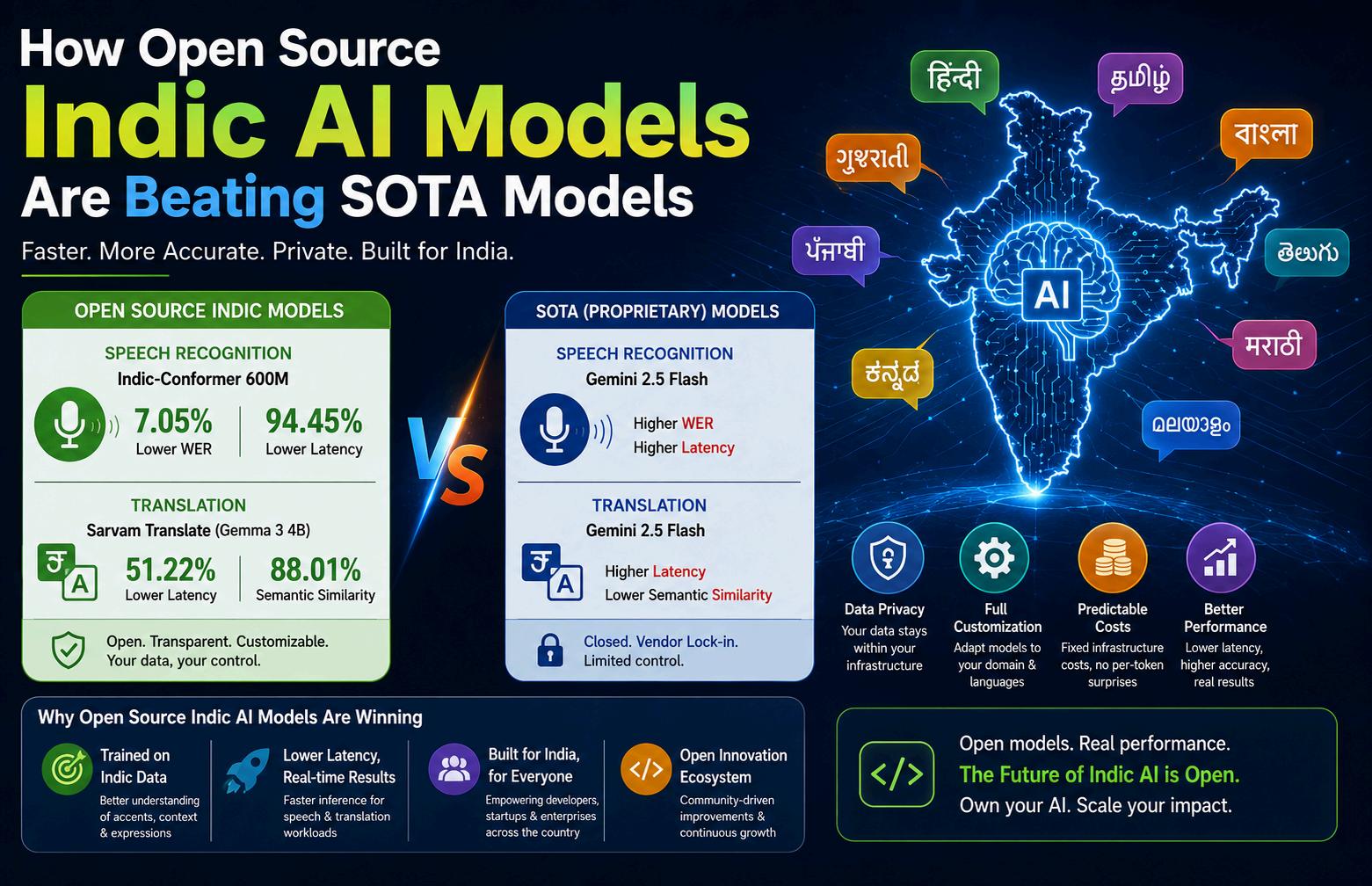
The results were striking Indic-Conformer, despite being a relatively compact 600M-parameter model, achieved a 7.05% lower WER than Gemini 2.5 Flash. Just as importantly, it delivered this accuracy with roughly 94% lower latency when deployed on Simplismart
Concretely, Gemini 2.5 Flash averaged around 0.39 WER, while Indic-Conformer came in near 0 32 a meaningful jump in real-world transcription quality On the latency side, Gemini's transcription averaged roughly 2,589 milliseconds per request, compared to about 130 milliseconds for Indic-Conformer running on Simplismart's infrastructure a difference of roughly 95%
What does a 7% WER improvement actually mean in practice? It means names get spelled correctly more often, numbers are captured accurately, and regional phrases survive the transcription process instead of being flattened into something unrecognizable Combine that accuracy gain with near-instant inference, and you get voice assistants, automated subtitles, and voice-driven workflows healthcare dictation, legal transcription, customer support that actually function well in a user's native language. And this is coming from a model roughly a fraction of the size of frontier closed systems.
Benchmark 2: Translation — Sarvam Translate vs. Gemini
The second benchmark examined translation quality and speed using Sarvam Translate, a Gemma 3 4B model fine-tuned by Sarvam AI specifically for Indic language translation.
Here, the comparison focused on latency and semantic similarity how closely the meaning of a translated sentence matches the original, even if the exact wording differs. Gemini 2.5 Flash averaged about 628 milliseconds per translation request Sarvam Translate, deployed on
Simplismart, cut that down to roughly 296 milliseconds a 51 22% reduction in latency while maintaining approximately 88.01% semantic similarity to Gemini's output.
In other words, a 4B-parameter open model can cut response time nearly in half while keeping translation quality close to parity with a much larger frontier system. For user-facing applications like chatbots and real-time translation tools, or batch pipelines like document translation and content localization, that latency difference is often the line between a product that feels usable and one that doesn't.
Why These Results Matter
Both benchmarks point to the same underlying conclusion: open-weight models trained specifically on Indic data are now matching or beating frontier closed APIs not just on cost, but on raw accuracy and speed Beyond the numbers, this shift brings structural advantages that closed APIs can't match:
● Self-hostable: Audio and text data never has to leave your own infrastructure, which matters enormously for regulated industries like healthcare, legal, and finance
● Full model control: Teams can modify architecture, adjust training data, and optimize for a specific domain or dialect without waiting on a vendor's roadmap
● No vendor lock-in: Because the models are open-weight, organizations aren't tied to a single API provider's pricing or availability.
Historically, the tradeoff for these benefits was production readiness open models were accurate but hard to deploy at scale with low latency. These benchmarks show that gap is closing fast, particularly when paired with inference infrastructure purpose-built for production workloads
Closing the Gap: Deploying Open Models in Production
The accuracy numbers only matter if the models can actually run in production reliably This is where Simplismart comes in a hosted, scalable inference platform designed to take an open-weight model from Hugging Face to a live API endpoint in minutes, without the usual DevOps overhead
The workflow is straightforward:
1 Add the model from Hugging Face point to a model path (for example, sarvamai/sarvam-translate), verify it, and choose your infrastructure and GPU type (Simplismart Cloud or your own cloud). Quantization options include FP8, INT8, INT4, BFLOAT16, FLOAT32, AWQ, and MXFP4, and tensor parallelism can be scaled across multiple GPUs
2. Deploy the model select your compiled model, choose infrastructure and accelerator type, tag the deployment as production or testing, and configure autoscaling Scaling
can be triggered by CPU, GPU utilization, time-to-first-token, latency, or throughput, with options to scale to zero when idle and to scale up rapidly during traffic surges.
3 Test the model once deployed, Simplismart exposes an OpenAI-compatible API endpoint, so it can be called using any standard OpenAI-compatible SDK with no custom integration work required.
The Bottom Line
The data is clear: open-weight, Indic-specific models can now outperform frontier closed APIs on both accuracy and speed for languages that make up a huge share of the world's population. Indic-Conformer beats Gemini 2 5 Flash on transcription accuracy while running dramatically faster, and Sarvam Translate delivers near-parity translation quality at roughly half the latency. The remaining challenge was never really about model quality it was about production deployment With hosted, scalable inference platforms closing that gap, there's no longer a strong reason to default to closed APIs for Indic language AI. The open-source ecosystem has caught up, and in some cases, pulled ahead