GLM 5.2: Architecture, Benchmark Performance, and What It Takes to Deploy at Scale
Open-weight large language models continue to evolve rapidly, but GLM 5 2 has emerged as one of the most notable releases in this category Developed as the successor to GLM 5 1, the model combines frontier-level performance with a permissive MIT license and an exceptionally large 1 million token context window These capabilities make GLM 5 2 attractive for teams exploring advanced AI deployment without being locked into proprietary ecosystems.

This article explores the architecture behind GLM 5.2, its benchmark performance, deployment requirements, and how organizations can operationalize models of this scale efficiently.
GLM 5 2 is an open-weight large language model designed to support demanding reasoning, coding, and long-context workloads. Unlike conventional dense models, GLM 5.2 uses a Mixture of Experts (MoE) architecture
This distinction is important because MoE models activate only a portion of their total parameters for each token during inference As a result, they can achieve strong capability while maintaining more efficient compute utilization than activating the entire parameter set continuously.
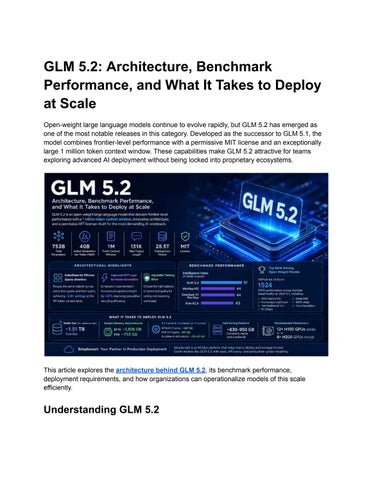
Some of the reported specifications of GLM 5 2 include:
● Approximately 753 billion total parameters
● Around 40 billion active parameters per token through MoE routing
● Native context window of 1 million tokens
● Maximum output length of up to 131,072 tokens
● Training dataset containing approximately 28 5 trillion tokens
● MIT licensing with permissive usage terms
These characteristics position GLM 5 2 as a model built not only for experimentation but also for large-scale enterprise use cases.
Architectural Improvements in GLM 5.2
Beyond scale, GLM 5 2 introduces architectural enhancements intended to improve long-context efficiency and real-world inference performance.
IndexShare for Efficient Sparse Attention
One of the major innovations highlighted in the release is IndexShare
IndexShare reuses the same indexer across every four sparse attention layers This design reduces the computational overhead associated with long-context processing
According to reported figures, this approach can reduce per-token floating point operations significantly and delivers approximately 2 9× savings at the 1 million token context level
For organizations running large inference workloads, this optimization directly affects cost efficiency and latency
Improved MTP Layer for Faster Generation
GLM 5 2 also introduces enhancements to the MTP layer for speculative decoding
The updated implementation reportedly increases acceptance length by approximately 20 percent.
In practical terms, speculative decoding improvements can accelerate generation speeds depending on the serving infrastructure and inference stack being used.
Adjustable Thinking Effort for Coding Workloads
Another practical capability is support for multiple thinking effort levels.
This enables teams to balance speed and quality depending on the application scenario
Examples include:
● Interactive development environments where lower latency is preferred
● Large-scale batch code transformation where deeper reasoning may be prioritized
This flexibility gives teams greater control over inference economics
Benchmark Performance of GLM 5.2
Benchmark results are one of the reasons GLM 5.2 has gained attention.
While benchmark interpretation always requires caution because output length and evaluation methodology can influence outcomes, third-party analysis suggests strong performance relative to competing open-weight systems
One important observation from independent evaluation is that GLM 5.2 generates relatively large output volumes during tasks
Artificial Analysis reported approximately 43,000 output tokens per task on average
This extended reasoning behavior may improve performance on complex evaluations but also increases inference costs
Intelligence Index Performance
GLM 5 2 reportedly reached the top position among open-weight models on the Artificial Analysis Intelligence Index.
Reported scores include:
● GLM 5.2: 51
● MiniMax M3: 44
● DeepSeek V4 Pro Max: 44
● Kimi K2.6: 43
This places GLM 5 2 ahead of several competing open-weight alternatives