GLM-5.2: Architecture, Benchmarks & Deployment
Open-weight language models are moving rapidly toward frontier-level performance, giving organizations more options for building and operating advanced AI systems. Among the latest models attracting attention is GLM-5.2 from Z.ai. The model combines a large Mixture-of-Experts architecture, a native 1-million-token context window, strong coding and agentic capabilities, and a permissive MIT license. For teams evaluating GLM-5.2: Architecture, Benchmarks & Deployment, the model’s benchmark performance is only part of the story. Its enormous parameter count, long-context memory requirements, multi-GPU infrastructure, inference optimization, and output-token behavior all influence whether it can be deployed economically in production.
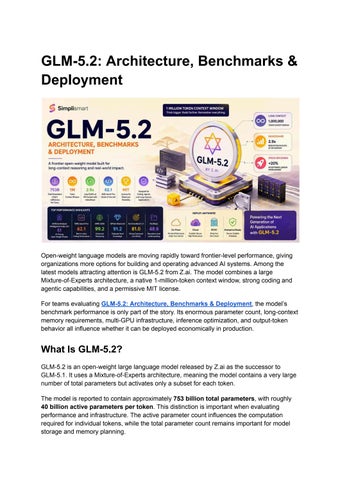
What Is GLM-5.2? GLM-5.2 is an open-weight large language model released by Z.ai as the successor to GLM-5.1. It uses a Mixture-of-Experts architecture, meaning the model contains a very large number of total parameters but activates only a subset for each token. The model is reported to contain approximately 753 billion total parameters, with roughly 40 billion active parameters per token. This distinction is important when evaluating performance and infrastructure. The active parameter count influences the computation required for individual tokens, while the total parameter count remains important for model storage and memory planning.
GLM-5.2 also supports a native 1-million-token context window, compared with the 200K context of GLM-5.1. It supports output lengths of up to 131,072 tokens per response and was pretrained on approximately 28.5 trillion tokens. The model is released under the MIT license, giving organizations significant flexibility for commercial and private deployments. These characteristics make GLM-5.2 particularly relevant to applications that need long-running reasoning, large-scale code analysis, autonomous workflows, and complex tool interactions.
Why the Mixture-of-Experts Architecture Matters A model with 753 billion parameters might initially appear prohibitively expensive to serve. However, GLM-5.2 does not activate all 753 billion parameters for every token. The MoE architecture routes individual tokens through selected experts. With approximately 40 billion active parameters per token, the model can provide access to a much larger overall parameter capacity while limiting the computation performed during each step. This makes the model more efficient than a dense model with the same total parameter count would be. However, it does not eliminate the memory challenge. The complete model still needs to be stored across the serving infrastructure, which means GPU memory and interconnect requirements remain substantial. This distinction is critical when planning deployment. A team cannot determine the required hardware simply by looking at the 40B active parameter figure. The total model size, precision, KV cache, concurrency, and runtime overhead must all be considered.
The 1-Million-Token Context Window The 1-million-token context window is one of GLM-5.2’s most significant features. It allows applications to provide substantially more information to the model within a single request or workflow. For software engineering, this could mean giving an AI coding agent access to much larger portions of a repository. Instead of repeatedly retrieving and summarizing individual files, an agent can maintain more project context while reasoning about dependencies, implementation details, tests, documentation, and previous changes. Long-context capability can also benefit research assistants, enterprise knowledge systems, technical documentation, large-document analysis, and autonomous agents. An agent operating over multiple steps can retain more information without constantly compressing its working context. However, the benefit comes with a major infrastructure tradeoff. The KV cache grows as the context becomes longer. This means supporting a 1-million-token context requires considerably more memory than serving conventional short-context requests.
Long-context capability therefore needs to be evaluated together with GPU memory, concurrency, and workload patterns.
Architectural Improvements for Long-Context Inference GLM-5.2 introduces architectural changes designed to make long-context inference more practical. One of the major changes is IndexShare. The approach reuses the same indexer across every four sparse attention layers, reducing the computational work required during inference. Z.ai reports approximately 2.9× lower per-token FLOPs at a 1-million-token context using this technique. The model also includes an improved Multi-Token Prediction (MTP) layer for speculative decoding. According to the model's release information, the improvement increases acceptance length by approximately 20%. Higher acceptance can translate into faster generation, although the actual benefit depends on the serving stack and workload. GLM-5.2 also provides different thinking-effort levels for coding tasks. This gives developers another way to balance reasoning depth against latency. An interactive coding assistant may prefer lower reasoning effort for faster responses, while batch code refactoring or complex software engineering tasks may benefit from more extensive reasoning.
GLM-5.2 Benchmark Performance GLM-5.2 has attracted significant attention because of its performance on independent evaluations. Artificial Analysis places GLM-5.2 at #1 among open-weight models on its Intelligence Index v4.1, with a score of 51. For comparison, MiniMax-M3 scores 44, DeepSeek V4 Pro Max scores 44, and Kimi K2.6 scores 43 on the same index. The model also achieves a reported GDPval-AA v2 score of 1524, which Artificial Analysis describes as competitive with the proprietary GPT-5.5 reference point at 1514. The model has also shown significant improvements over GLM-5.1 across eight reported benchmarks, including evaluations such as SWE-bench Pro, Humanity’s Last Exam, and TerminalBench v2.1. These results highlight its ability to handle software engineering, reasoning, and agentic workloads. However, benchmark results need to be interpreted carefully. Large reasoning models can achieve higher scores partly by spending more tokens on difficult problems. Artificial Analysis reports that GLM-5.2 uses approximately 43,000 output tokens per task on average in its evaluation. This can contribute to strong long-horizon performance, but it also has direct implications for inference cost and latency. For production teams, benchmark quality should therefore be considered alongside token consumption and serving economics.
Model Memory Requirements One of the biggest challenges when deploying GLM-5.2 is its model footprint. The Hugging Face distribution contains 282 safetensors files totaling approximately 1.51 TB. At BF16 precision, the 753B parameters translate to roughly 1,506 GB of model weight memory. Moving to FP8 reduces the theoretical weight footprint to approximately 753 GB. This reduction is significant, but model weights are only one component of the total serving footprint. A production deployment also needs memory for the KV cache, activations, CUDA and runtime overhead, temporary buffers, and other inference components. These requirements become especially important when the model is serving long-context requests. This is why deploying GLM-5.2 is fundamentally different from deploying a smaller model on a single GPU. The infrastructure must be designed around the complete workload rather than simply making the model weights fit.
KV-Cache Requirements at 1 Million Tokens The KV cache becomes one of the most important considerations when using GLM-5.2 at its maximum context length. Simplismart's analysis estimates that a full 1-million-token context can require approximately 160 GB of additional VRAM for a BF16 KV cache. With FP8 KV cache, the requirement falls to approximately 80 GB. Activations and CUDA/runtime overhead can add another estimated 30–60 GB. This creates a substantial memory footprint even after quantizing the model weights. For an FP8 configuration with FP8 KV cache, the estimated long-context serving footprint can reach approximately 830–950 GB. The analysis estimates that this corresponds to a minimum of roughly 12 H100 80 GB GPUs or 8 H200 141 GB GPUs when appropriate headroom is included. These numbers demonstrate why context length and concurrency need to be considered together. Supporting one million tokens for a single request is very different from supporting multiple simultaneous million-token requests.
Multi-GPU and Multi-Node Deployment GLM-5.2 requires a distributed infrastructure strategy for serious production workloads. Tensor parallelism and pipeline parallelism can distribute the model across multiple GPUs and nodes, but the effectiveness of these approaches depends heavily on the hardware and serving framework.
GPU-to-GPU communication becomes increasingly important as the number of devices increases. If the interconnect is too slow, communication overhead can reduce the benefits of additional GPUs. High-bandwidth networking and appropriate GPU topology are therefore important parts of the deployment design. The infrastructure needs to move model data and intermediate results between devices quickly enough to prevent communication from becoming the primary bottleneck. This is also why simply calculating the total amount of GPU memory is not enough. Two systems with the same total VRAM can produce very different inference performance depending on their GPU configuration and interconnect.
Quantization and Precision Quantization is one of the most important tools for making GLM-5.2 more practical to serve. Moving from BF16 to FP8 approximately halves the model weight footprint. It can also improve memory efficiency and potentially increase inference throughput on compatible hardware. However, quantization should not be treated as a free optimization. Different workloads can react differently to reduced precision, particularly when the application depends heavily on reasoning, tool use, coding accuracy, or long-context retrieval. Teams should benchmark quantized configurations against representative workloads and compare output quality with latency, throughput, and memory usage. The objective is to find a precision configuration that provides the best overall balance rather than simply selecting the configuration with the smallest memory footprint.
Serving Stack Optimization The inference engine can have a significant impact on GLM-5.2 performance. Efficient attention implementations, optimized GPU kernels, speculative decoding support, continuous batching, KV-cache management, and request scheduling can all influence throughput and latency. At this scale, scheduler behavior becomes particularly important. A serving system needs to decide how requests are batched and scheduled while managing memory efficiently. Long-context requests can consume a large portion of available KV-cache capacity, potentially affecting other users. This makes workload-aware scheduling an important part of production optimization.
Benchmarking GLM-5.2 Before Production
A production benchmark should reproduce the expected application workload rather than relying solely on public benchmark scores. Teams should evaluate how GLM-5.2 behaves under different input lengths, output lengths, concurrency levels, and reasoning settings. Performance metrics should include time to first token, tokens per output token, total throughput, latency, GPU utilization, and memory consumption. Simplismart's performance benchmarking tools support load testing deployments using configurable virtual users, benchmark duration, input-token sizes, maximum output tokens, and metrics such as throughput, TTFT, and TPOT. The platform also supports parameter sweeps to compare deployments under different combinations of input size and concurrency. Quality should be measured alongside performance. Simplismart's quality benchmarking capabilities allow teams to evaluate model responses against datasets and assess factors such as accuracy and relevance. This is important because a faster deployment is not necessarily better if quantization or aggressive optimization causes unacceptable quality degradation.
Production Use Cases GLM-5.2 is most compelling for applications where its reasoning capability and long context can provide measurable value. Software engineering is one of the clearest use cases. An AI coding agent can potentially maintain more repository context, reason through dependencies, execute tools, make changes, and validate results across an extended workflow. Enterprise research is another promising application. Organizations working with large technical documents, internal knowledge bases, reports, and research material can use long context to reduce the need for aggressive information compression. GLM-5.2 can also be considered for autonomous agents, complex tool-calling systems, enterprise copilots, and other workflows where the model needs to reason across multiple steps. For simpler applications, however, a smaller model may be more economical. If an application only requires short responses and straightforward reasoning, the infrastructure cost of a 753B-parameter MoE model may not be justified.
Deploying GLM-5.2 With Simplismart Running GLM-5.2 independently involves substantial infrastructure work. Teams must manage GPU provisioning, distributed serving, model optimization, quantization, scaling, monitoring, networking, and ongoing performance tuning.
Simplismart provides infrastructure and deployment capabilities intended to reduce this operational burden. Its platform supports dedicated deployments as well as BYOC configurations, allowing organizations to deploy models on Simplismart infrastructure or their own cloud clusters. For dedicated endpoints, teams can select accelerators based on model size and SLA requirements and configure scaling metrics for the deployment. BYOC deployments allow organizations to use their own cloud infrastructure while retaining deployment and monitoring capabilities through the platform. The platform also provides deployment monitoring for throughput, latency, success rates, GPU usage, and other resource metrics. This helps teams understand how the model behaves after it moves beyond the initial deployment stage. For large models such as GLM-5.2, this operational layer can be valuable because infrastructure optimization does not stop once the model is successfully loaded onto GPUs.
The Economics of GLM-5.2 The biggest mistake when evaluating a large model is focusing only on the cost of the GPUs. Infrastructure cost is influenced by how many GPUs are required, how efficiently they are utilized, how many requests they can serve simultaneously, how long each request takes, and how many tokens the model generates. GLM-5.2's strong reasoning performance can come with significant output-token consumption. If an application routinely generates tens of thousands of tokens per task, the cost per completed workflow can become much higher than a simple tokens-per-second benchmark suggests. This makes workload-specific cost modeling essential. Teams should calculate cost per successful task rather than only cost per GPU hour or cost per million generated tokens. If GLM-5.2 completes a complex task with fewer retries or less human intervention, its higher inference cost may still be justified.
From Benchmark to Production The path from evaluating GLM-5.2 to deploying it successfully involves several stages. First, teams need to establish whether the model provides sufficient quality for their target use case. Next, they need to determine the appropriate precision and serving configuration. After that, infrastructure should be tested under realistic context lengths and concurrency. Only then can organizations make an informed decision about the required GPU fleet and deployment architecture.
This process is particularly important for GLM-5.2 because its maximum context capability can dramatically change memory requirements. A configuration designed around short-context workloads may not be suitable for long-context production traffic. Production readiness therefore requires testing the model, serving stack, and infrastructure as one system.
Final Takeaway GLM-5.2 is a significant open-weight release because it combines frontier-tier performance with a permissive license and an unusually large context window. Its approximately 753B parameters, 40B active parameters per token, 1-million-token context, IndexShare architecture, improved MTP capabilities, and strong benchmark results make it an attractive candidate for advanced AI applications. But the model's capabilities come with substantial infrastructure requirements. The 1.51 TB native model footprint, long-context KV-cache growth, multi-GPU communication, quantization decisions, and potentially high output-token consumption all need to be considered before production deployment. The central lesson from GLM-5.2: Architecture, Benchmarks & Deployment is that model quality and infrastructure efficiency cannot be evaluated separately. Benchmark scores demonstrate capability, but real production testing reveals the actual relationship between quality, latency, throughput, memory, scalability, and cost. For organizations building advanced coding agents, enterprise copilots, research systems, and autonomous AI workflows, GLM-5.2 is a compelling model to evaluate. With an appropriately designed inference stack and the right deployment infrastructure, teams can take advantage of its capabilities without allowing the operational complexity of a 753B-parameter model to become the limiting factor.