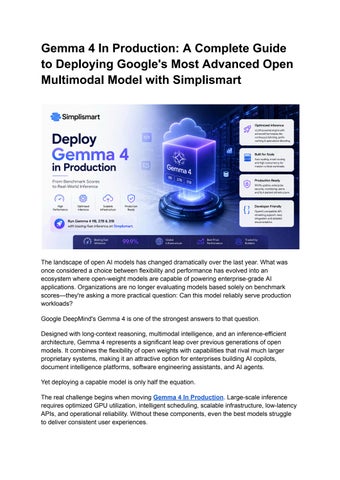
Gemma 4 In Production: A Complete Guide to Deploying Google's Most Advanced Open Multimodal Model with Simplismart
The landscape of open AI models has changed dramatically over the last year. What was once considered a choice between flexibility and performance has evolved into an ecosystem where open-weight models are capable of powering enterprise-grade AI applications. Organizations are no longer evaluating models based solely on benchmark scores—they're asking a more practical question: Can this model reliably serve production workloads? Google DeepMind's Gemma 4 is one of the strongest answers to that question. Designed with long-context reasoning, multimodal intelligence, and an inference-efficient architecture, Gemma 4 represents a significant leap over previous generations of open models. It combines the flexibility of open weights with capabilities that rival much larger proprietary systems, making it an attractive option for enterprises building AI copilots, document intelligence platforms, software engineering assistants, and AI agents. Yet deploying a capable model is only half the equation. The real challenge begins when moving Gemma 4 In Production. Large-scale inference requires optimized GPU utilization, intelligent scheduling, scalable infrastructure, low-latency APIs, and operational reliability. Without these components, even the best models struggle to deliver consistent user experiences.