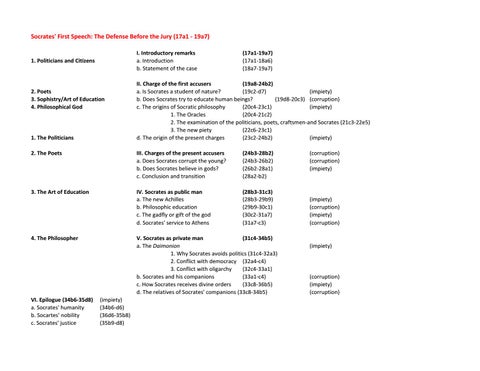
Socrates' First Speech: The Defense Before the Jury (17a1 - 19a7) I. Introductory remarks a. Introduction b. Statement of the case
1. Politicians and Citizens
2. Poets 3. Sophistry/Art of Education 4. Philosophical God
1. The Politicians
(17a1-19a7) (17a1-18a6) (18a7-19a7)
II. Charge of the first accusers (19a8-24b2) a. Is Socrates a student of nature? (19c2-d7) (impiety) b. Does Socrates try to educate human beings? (19d8-20c3) (corruption) c. The origins of Socratic philosophy (20c4-23c1) (impiety) 1. The Oracles (20c4-21c2) 2. The examination of the politicians, poets, craftsmen-and Socrates (21c3-22e5) 3. The new piety (22c6-23c1) d. The origin of the present charges (23c2-24b2) (impiety)
2. The Poets
III. Charges of the present accusers a. Does Socrates corrupt the young? b. Does Socrates believe in gods? c. Conclusion and transition
(24b3-28b2) (24b3-26b2) (26b2-28a1) (28a2-b2)
3. The Art of Education
IV. Socrates as public man a. The new Achilles b. Philosophic education c. The gadfly or gift of the god d. Socrates' service to Athens
(28b3-31c3) (28b3-29b9) (29b9-30c1) (30c2-31a7) (31a7-c3)
4. The Philosopher
VI. Epilogue (34b6-35d8) a. Socrates' humanity b. Socartes' nobility c. Socrates' justice
V. Socrates as private man (31c4-34b5) a. The Daimonion 1. Why Socrates avoids politics (31c4-32a3) 2. Conflict with democracy (32a4-c4) 3. Conflict with oligarchy (32c4-33a1) b. Socrates and his companions (33a1-c4) c. How Socrates receives divine orders (33c8-36b5) d. The relatives of Socrates' companions (33c8-34b5) (impiety) (34b6-d6) (36d6-35b8) (35b9-d8)
(corruption) (corruption) (impiety)
(impiety) (corruption) (impiety) (corruption)
(impiety)
(corruption) (impiety) (corruption)
Socrates' Second Speech: The Counterproposal (35e1-38b9) I. Discussion of the Vote (35e1-36b2) II. Counterproposal: Maintenance in the Prytaneum (36b3-37a1) III. Rejected alternatives (37a2-e2) a. Imprisonment (37b8-c2) b. Fine (37c2-4) c. Exile (37c4-e2) IV. The Socratic Life (37e3-38a8) V. Relieved counterproposal: A fine (38a8-b9) Socrates' Third Speech: Parting Words to the Jury (35c1-42a5) I. Speech to those who voted to condemn him to death: Revenge (38c1-39d9) II. Speech to those who voted for the fine: Myth (39e1-42a5) a. The silence of the daimonion shows that his death is good (40c1-41c7) b. Considerations to support this conclusion (40c4-41c7) III. Concluding remarks (41c8-42a5) [from: Plato's Apology of Socrates, Thomas G. West, Cornell, 1979, pp. 234-235]