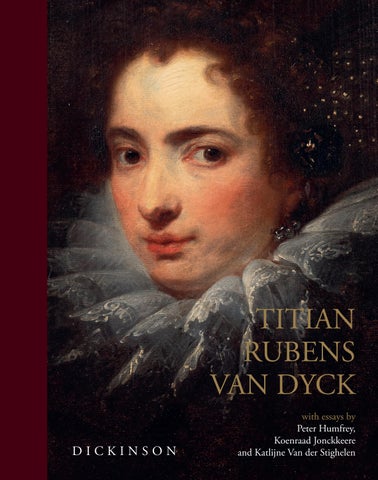
TITIAN RUBENS VAN DYCK DICKINSON
with essays by Peter Humfrey, Koenraad Jonckkeere and Katlijne Van der Stighelen
TITIAN, RUBENS, VAN DYCK with essays by Peter Humfrey, Koenraad Jonckheere and Katlijne Van der Stighelen
DICKINSON
TITIAN, RUBENS, VAN DYCK
58 Jermyn Street St James’s London SW1Y 6LX
London 25.11.26 – 18.12.26 New York 29.1.27 – 6.2.27
london@simondickinson.com www.simondickinson.com +44 (0) 20 7493 0340
Editor and Designer Harry Gooch Catalogue Molly Taylor and William Bayliss Special Thanks Christopher Brown, Nils Büttner, Keith Christiansen, Sir Timothy Clifford, Justin Davies, Nicholas Eastaugh, Simon Egan, David Jaffé, Paul Joannides, Peter Humfrey, Ian Kennedy, Friso Lammertse, Sir Nicholas Penny, Nora de Poorter, Bert Schepers, Griet Steyaert, Ian Tyers, Ben Van Beneden, Katlijne Van der Stighelen, Nico Van Hout, Alejandro Vergara, Hans Vlieghe, Bert Watteeuw
CONTENTS Foreword................................................................................................................1 Simon and Milo Dickinson Titian, Rubens, Van Dyck and the Woman in White..........................................2 Peter Humfrey Rubens’ and Van Dyck’s Head Studies: A Construction of Complexion...........................................................................................................12 Koenraad Jonckheere Unbridled Genius: The Creative Visions of Peter Paul Rubens and Anthony Van Dyck.......................................................................................20 Katlijne Van der Stighelen In Search of Titian: Van Dyck in Italy and Beyond.........................................34 Molly Taylor Titian, Rubens, Van Dyck: The Painter as Gentleman.....................................40 William Bayliss Catalogue...............................................................................................................53
6
FOREWORD
Simon and Milo Dickinson In 1628 Peter Paul Rubens arrived in Madrid on a diplomatic mission connected with negotiations for peace between Spain and England. He was at the height of an extraordinary career, yet during his months at the Spanish court he devoted considerable attention to the paintings of Titian in Philip IV’s collection, studying them closely and making copies of some of them. For Rubens, copying was not an exercise in imitation, but a means of understanding another painter: his compositions, his colour, his handling of paint and the way in which an image had been conceived. Anthony van Dyck was equally captivated by Titian. During his years in Italy, he repeatedly sought out the Venetian master’s works, recording them in his sketchbook and making notes on compositions, colour and even the textures of materials. Titian remained a presence throughout Van Dyck’s career, not as a model to be followed slavishly, but as an artist whose ideas could be absorbed, reconsidered and transformed. This relationship between artists separated by generations is at the heart of the present exhibition. Titian was not simply a painter whom Rubens and Van Dyck admired. His paintings became material through which they thought: works to study, copy, adapt and ultimately transform into an art unmistakably their own. For both painters, looking closely at the art of the past was part of finding a way forward. At Dickinson, we have been fortunate over many decades to live and work closely with paintings by all three artists. Our involvement with these works has often extended over many years: researching their histories, encouraging new scholarship, undertaking conservation and technical investigation, and bringing paintings back into public and scholarly view. Some of the most rewarding moments in our work have come when a picture reveals something previously unknown, or when bringing works together allows each to be understood differently. It is particularly encouraging to see a new generation of collectors and connoisseurs looking closely at Titian, Rubens and Van Dyck. These are artists who have been studied for centuries, yet their paintings remain capable of surprising us. The works assembled here offer many such opportunities for comparison. Finished paintings are shown alongside head studies and preparatory works; portraits alongside religious subjects; intimate observations alongside more fully realised compositions. We are enormously grateful to Peter Humfrey, Koenraad Jonckheere and Katlijne Van der Stighelen, whose essays bring their scholarship and individual perspectives to the questions explored by this exhibition. We also owe a particular debt to the collectors who have generously allowed works in their care to be studied and exhibited here. We hope that this exhibition encourages the same activity that connected Titian, Rubens and Van Dyck themselves: looking closely at great paintings, comparing them, and allowing one work of art to illuminate another. London, 2026
1
TITIAN, RUBENS, VAN DYCK AND THE WOMAN IN WHITE
Peter Humfrey Both Rubens and his erstwhile assistant Van Dyck venerated Titian as the very prince of painters. They became intimately acquainted with every aspect of his work during the years they spent in Italy at the beginning of their careers (1600 – 1608, and 1621 – 1627 respectively): in Venice, Rome and Genoa; and also, in the case of Rubens, in Mantua and Madrid. They were deeply responsive to the warmth and richness of Titian’s palette, and to the expressive freedom of his brushwork. They imitated the compositional patterns he had devised for every kind of subject and genre, from altarpieces and other religious works to mythologies and allegories, and to portraits. Titian’s sitters had included men, women and children, often of the highest social rank and distinction, and he variously presented them individually, in pairs or in groups; in three-quarter or full length; and standing, seated, or on horseback, with every type of appropriate accessory. All these provided a permanent source of inspiration to both Rubens and Van Dyck in their own highly successful careers as portrait painters. They made drawn or painted copies after Titian, both of single figures and of whole compositions. They included such copies, as well as originals, in their own art collections. They also sought to emulate Titian’s brilliant career as the preferred painter of princes, and like their great predecessor, both were rewarded with knighthoods from their royal patrons. Sometimes the relationship between prototypes by Titian, and also between echoes of them by the two Flemings, could be quite complex, as may be illustrated by just one celebrated mythology. Titian painted his joyous and festive Bacchanal of the Andrians, now in the Prado (fig. 1) for Alfonso I d’Este, Duke of Ferrara, probably in 1518-19. By the first decade of the 17th Century the painting had been taken from Ferrara to Rome, but Rubens did not apparently see it on either of his two visits to the papal capital. During his two visits to the Spanish court, in 1603 and 1628-29, he did have the opportunity to make a close and productive study of many of Titian’s other mythologies; but the Andrians did not enter the royal collection until 1639. On his own visit to Rome in 1622, Van Dyck certainly did see and study the painting closely, and he recorded its composition in his Italian Sketchbook (fig. 2). The experience is clearly directly reflected in his own poetic masterpiece Amarillis and Martillo (fig. 3), painted soon after his return from Italy to the Netherlands in 1627. Representing a quite different subject, drawn from modern rather than ancient literature, this is by no means a copy; but the inspiration of the Andrians is perfectly evident not only in the borrowing of individual poses and motifs, but above all in the rhythmical fluency of the design, and in the effects of colour, air, and dappled light and shade. About a decade later, Rubens produced his own version of the Andrians (fig. 4): loosely conforming to Titian’s composition, but introducing a number of minor differences, and executing it in his own late style, with a lighter palette, pearly flesh tones, and a much greater degree of atmospheric softness. Since, however, Rubens had never seen Titian’s original, this version must have been based on a copy; and it has been plausibly suggested this was a now lost and otherwise unrecorded painted copy by Van Dyck, which the younger artist had made in Rome and brought back with him to Antwerp.1 It is clear from the above example that versions by Rubens and Van Dyck of paintings by Titian could alternatively take the form of free paraphrases (sometimes drawing from more than one work), close variants, or more-or-less exact copies. While all three types represent respectful hommages to the master, in the last case such copies can also provide valuable evidence about now lost originals. Another particularly illuminating instance – also relevant 1
2
See J. Wood, ‘Copies and Adaptations from Renaissance and Later Masters: Titian and North Italian Art’, in Corpus Rubenianum Ludwig Burchard, XXVI (2), Turnhout, 2010, I, pp. 150-59.
Fig. 1: Titian, Bacchanal of the Andrians c. 1518-19 oil on canvas Museo Nacional del Prado, Madrid
Fig. 2: Sir Anthony van Dyck (after Titian) Bacchanal of the Andrians Italian Sketchbook, f. 56r British Museum, London
3
Fig. 3: Sir Anthony van Dyck, Amaryllis and Mirtillo 1631-32 oil on canvas Graf von Schönborn’sche Kunstsammlungen, Pommersfelden
for the wider interpretation of Titian’s images of beautiful women, and for how they were viewed in the following century – is the work that will be discussed in detail here, and referred to as the Woman in White. The surviving autograph example is the ravishing painting sent by Titian to Alfonso II d’Este – grandson of the above-mentioned Alfonso I – in October 1561, now in Dresden (fig. 5).2 This depicts the figure in three-quarter-length, looking directly out at the spectator. She is wearing a highly fashionable dress of dazzling white satin, and is adorned with pearl earrings, a pearl necklace, jewelled bracelets and a jewelled girdle; and she holds an embroidered fan in the form of a flag in her right hand, and holds up her skirt with her left, as if to ease her forward movement. The painting has traditionally been interpreted as a portrait of the artist’s daughter, and has often been known by the title Portrait of Lavinia as Bride. But as will be seen below, the existence of copies of now lost earlier versions by both Rubens (fig. 6) and Van Dyck (fig. 8) together suggest that this title is mistaken, and that the composition should be seen instead as an image of an anonymous ideal beauty. The earliest of the three versions of the Woman in White was sent by Titian to the principal patron of his later career, king Philip II of Spain, in 1559. In a letter of 22 September, the painter told the king that he was sending ‘a portrait of her who is absolute mistress of my soul, dressed in yellow; and although, it is true, she is only painted, this is the dearest and most precious thing I could send you’.3 The painting was then recorded in an inventory of the royal palace of the Alcázar in Madrid in 1636, where the figure is described as ‘a Venetian woman’, with the additional information that the white dress was bordered with gold, and that a green leaf was placed between her breasts. Subsequently, however, the
4
2 3
S. Koja and A. Henning (eds.), Titian: Lady in White, Dresden, 2018. C. Hope, Titian. Sources and Documents, London, 2022, p. 1339.
Fig. 4: Sir Peter Paul Rubens (after Titian), Bacchanal of the Andrians c. 1630-35 oil on canvas Nationalmuseum, Stockholm
painting disappeared from the royal inventories, and it was almost certainly lost in the catastrophic fire that destroyed the Alcázar in 1734. There is every reason to believe that the version by Rubens in Vienna is a faithful copy of the lost original painted for Philip II.4 True, he has made the figure more dominant in relation to the picture field, lending her relationship with the spectator an even greater directness and intimacy. But he includes the various decorative details mentioned in the 1636 inventory but absent from Titian’s version in Dresden, notably the embroidered gold borders at the shoulders and cuffs, and across the bodice, as well as the leaf in her décolletage. The pictorial handling clearly indicates that Rubens made his copy, together with that of many other Titians in the royal collection, during his second visit to the Spanish court, in 1628-29, and not on his earlier visit of 1603. He must then have taken it home with him to Antwerp in 1630, when it became part of his own collection, and where it is recorded in his posthumous inventory of 1640. It remains possible, nevertheless, that Rubens had already seen and admired Titian’s Woman in White on the visit of 1603, and had perhaps even sketched it. Evidence for this supposition is provided by many of his female portraits throughout his career, but perhaps most obviously in the spectacular Marchesa Brigida Spinola Doria (fig. 7), painted in Genoa in 1606. Like the anonymous woman, the marchesa is presented in a standing pose and in three-quarter view, meeting the gaze of the spectator frankly and directly; she holds a fan in her right hand, and a fold of her skirt in her left; and most significantly, she likewise wears a gown with a high silver sheen, decorated with gold and jewels. In this connection, 4
J. Wood, ‘Copies and Adaptations from Renaissance and Later Masters: Titian and North Italian Art’, in Corpus Rubenianum Ludwig Burchard, XXVI (2), Turnhout, 2010, I, pp. 265-70.
5
Fig. 5: Titian, Woman in White c. 1561 oil on canvas Staatliche Kunstsammlungen, Dresden
6
Fig. 6: Sir Peter Paul Rubens (after Titian) Woman in White 1628-30 oil on canvas Kunsthistorisches Museum, Vienna
Fig. 7: Sir Peter Paul Rubens, Marchesa Brigida Spinola Doria 1606 oil on canvas National Gallery of Art, Washington D.C.
however, it should also be pointed out that on his two visits to Genoa (on his way back from Spain in 1603, as well as in 1606) he would have had the opportunity of studying a second original version of the Woman in White, which belonged to none other than Agostino Doria, father-in-law of the marchesa, and another of Titian’s leading patrons in the years around 1560. Agostino Doria, who rose to become Doge of Genoa in 1601, was an immensely wealthy international banker and agent for the Spanish monarchy. In this role he acted as a leading intermediary for securing the payment to Titian of the various fees and pensions owed to him by the crown.5 As was later attested by the latter’s younger relative and namesake, Tizianello, the two enjoyed cordial personal relations, and Titian painted a number of works for him, apparently as diplomatic gifts, including a recently rediscovered Christ at the Column (currently with Trinity Fine Art, London).6 Another such work was the second original version of the Woman in White, which is likely to be identical with ‘un bellissimo ritratto’ (a very beautiful portrait) that Titian mentions in a letter to Agostino, probably written shortly before August 1561.7 Although this mention is very laconic, the very fact 5 6 7
S. Gullino, ‘Fra arte e finanzia: Agostino Doria mediatore fra Tiziano Vecellio e la corona spagnola’, in Studi Tizianeschi, Pieve di Cadore, XI, 2021, pp. 104-11. Breve Compendio della Vita del Famoso Titiano Vecellio..., Venice, 1622, B3r; quoted by C. Hope, Titian. Sources and Documents, London, 2022, p. 2521. The original letter is lost, but it is recorded in a paraphrase of 1762 by the antiquarian G.G. Liruti. See C. Hope, Titian. Sources and Documents, London, 2022, pp. 1399-1400.
7
that no sitter is named implies it refers to the image of a beautiful woman; and just such an image is likely to correspond to a ‘ritratto di una donna vestita di bianco di Titiano’ (portrait of a woman dressed in white by Titian) recorded in the inventory of Agostino’s son Giovan Carlo in 1621.8 Like the version copied by Rubens, the painting is unfortunately lost; but it is at least recorded in a pen-and-ink drawing of it in Van Dyck’s Italian Sketchbook, made when the artist was in Genoa between 1621 and 1627 (fig. 8).9 Van Dyck’s drawing is annotated with the words ‘titian’, ‘rosa’ and ‘bianco’. In keeping with its function as an aide-mémoire, the execution is quite sketchy; but it includes two details – the embroidery on the bodice, and the leaf at the décolletage – that correspond to Philip II’s version, but not to the Dresden version. On the other hand, other details differ from both. The fan is placed further from the body; the necklace appears to carry a pendant; the embroidery does not extend to the shoulders and cuffs; and the inscription ‘rosa’ implies that the white dress was trimmed with pink as well as gold. In other words, when painting the second version, probably very soon after, or even contemporaneously with the original for Philip, Titian – as was his custom when producing different versions of his own works -- introduced some minor variations. No less than Rubens, Van Dyck was clearly fascinated by the lovely young woman depicted in the painting, and in his case, too, it provided an immediate and continuing source of inspiration for his many female portraits. A magnificent example is that of a member of another Genoese aristocratic family, Giovanna Battista Cattaneo, now in the Frick Collection (fig. 9). Like Titian’s Woman in White, the sitter is seen in three-quarter length and in three-quarter view, looking outwards with large eyes and a half-smile. Although in this case she holds not a fan but a golden chain in her right hand, the placing of her arms is similar; and once again she is dressed in a shining white gown, embroidered with gold. The Dresden Woman in White, the only one of the three versions to survive, is the simplest in terms of its decorative detail, and this reduction suggests that it was the last of the three – or at least, the last to be completed. Destined for Alfonso II, it was ready, or nearly so, by August 1561 and was dispatched in October. Titian’s accompanying letter is lost, but according to the paraphrase by Francesco Scannelli, curator of the Este collection in the mid-17th Century, the painter described the sitter in much the same terms as the version he had recently sent to king Philip (‘the greatest object of my love…the dearest thing I could send you’).10 The fact that Alfonso’s version was sent only two years after that for Philip, and in the very same year as that for Agostino Doria, strongly implies that all three begun were begun at the same time, and that when devising the version destined for the king, he started on two variants for which he was confident of finding appropriate recipients. It is not easy to interpret Titian’s own effusive descriptions of his subject. Although he always enjoyed robust good health, and he still had another fifteen years to live, it is probably unlikely that the young Woman in White represents a portrait of the old man’s mistress. Hence the supposition that his phrase ‘mistress of my soul’ referred to his daughter Lavinia, and that the white dress is her bridal costume. But Lavinia was born in 1525, and was married in 1555; and there is no evidence that the version for Philip (by which time she would have been aged 34) was preceded by an even earlier one. Furthermore, it has been convincingly argued that the dress is not that of a bride.11 It has been suggested that a more plausible candidate for a real portrait of a loved one would be 8 9 10 11
8
See V. Farina in P. Boccardo (ed.) L’Età di Rubens: Dimore, committenti e collezionisti genovesi, Milan, 2004, p. 194 no. 458. The connection was made by P. Boccardo, ‘Ritratti di collezionisti e committenti’, in S. Barnes et al. (eds.),Van Dyck e Genova, Milan, 1997, p. 42. C. Hope, Titian. Sources and Documents, London, 2022, pp. 1398, 1409-10. See the essays by J. Charlotte von Bloh, C. Nagel and S. Kleidt in S. Koja and A. Henning (eds.), Titian: Lady in White, Dresden, 2018, pp. 24-49.
Fig. 8: Sir Anthony van Dyck (after Titian), Woman in White Italian Sketchbook, f. 104 (detail) British Museum, London
Fig. 9: Sir Anthony van Dyck, Marchesa Giovanna Battista Cattaneo c. 1622-27 oil on canvas The Frick Collection, New York
9
Titian’s younger, illegitimate daughter Emilia.12 But all three versions were sent to princely patrons not on commission, but as diplomatic gifts, with no reference to any particular sitter; and it is clear that neither the compiler of the Alcázar inventory of 1636 (for whom the subject was simply as ‘a Venetian woman’) nor Rubens (for whom it was a ‘pourtrait d’une Espousée’) identified the sitter either as Titian’s mistress or as one of his daughters. From all this it may be concluded that in all three versions the Woman in White, although presumably based on a live model, was intended to be an ideal dream lover: an anonymous ‘bella’, of a type in which the artist had specialised throughout his long career.13 More often he had depicted such beauties in a state of undress, sometimes with timeless, unspecific draperies. In the Woman in White the eroticism is more restrained, and the figure is shown in respectable contemporary dress – but this approach has a major precedent in La Bella itself (Galleria Palatina, Palazzo Pitti, Florence), the work that Titian’s patron Francesco Maria della Rovere, Duke of Urbino, famously described by him in May 1536 simply as ‘the woman who has the blue dress’.14 It was perhaps the very status of the Woman in White as a glamorous and vivid, but ambivalent quasi-portrait that made it such an inspiring model for both Rubens and Van Dyck in their many real portraits of aristocratic ladies, in Genoa, Flanders and England.
12 13
10
14
C. Hope, ‘Tizians Familie und die Zerstreuung seines Nachlasses’, in S. Ferino-Pagden (ed.), Der Späte Tizian und die Sinnlichkeit der Malerei, Vienna, 2007, pp. 27-39 pp. 30-31. As argued by A. Henning, ‘A vision of absolute beauty: Titian’s Lady in White in Dresden’, in S. Koja and A. Henning (eds.), Titian: Lady in White, Dresden, 2018, pp. 8-23. This discussion supersedes my entry on the painting in P. Humfrey, Titian: The Complete Paintings, Ghent, 2007, p. 246. C. Hope, Titian. Sources and Documents, London, 2022, p. 459.
11
RUBENS’ AND VAN DYCK’S HEAD STUDIES: THE CONSTRUCTION OF COMPLEXION
Koenraad Jonckheere On the frieze of his newly built studio on the Wapper in Antwerp, Peter Paul Rubens painted a series of scenes from ancient Art History in (presumably) grisaille trompe-l’oeil bas-reliefs. Some of these paintings were copies of famous paintings from the past that are no longer known. For example, there was a painting by Timanthes of Agamemnon’s grief, and another by Apelles of Alexander the Great as Zeus. Others showed popular stories about famous Greek painters. One of these was Zeuxis and the women of Croton. Rubens painted the scene on the frieze in his courtyard, almost straight above the entrance to his workshop.1 According to Cicero, who first recounted the story, the citizens of Croton – one of the richest and most prosperous colonies of ancient Greece on the Italian east coast – hired the famous painter Zeuxis to decorate their temple of Juno with some exceptional works of art.2 Zeuxis wanted to paint a portrait of Helen that would show what he conceived to be ideal beauty. In preparation for his portrait, he asked the people of Croton to show him their loveliest young women. They selected the sisters of their most successful athletes, who were all exceptionally beautiful. Zeuxis however wasn’t convinced. He didn’t choose one model; instead, he took the most attractive features of five young women and rendered them into one blended counterfeit of Helen. Zeuxis, in sum, realised that there is no such thing as ideal beauty in nature. Nature gives different qualities to different people, and each person has certain strengths and imperfections. Only an artist can bring all these qualities together to create something more perfect. For almost thirty years, Rubens, his esteemed visitors and his students must all have looked up time and again to Zeuxis and the women of Croton before entering the workshop. For almost thirty years they must have wondered what the famous artist was trying to do when making his selection. Studying ordinary women to create an ideal based on their bodily features? How was one supposed to do that, in practice? By drawing? By painting? How does one lay such a puzzle? Whatever Rubens, his friends, and his assistants thought or said on these occasions is lost in time and cannot be retrieved. However, the way Rubens dealt with this challenge is very present still. He and his collaborators left us a good number of sketches on paper and wood in which they searched for such knowledge on the quintessence of men and women. Taking oils as their medium they examined faces to gain knowledge of human nature, creating jigsaw puzzle pieces ready for use in any composition, just as Zeuxis did.3 Although these tronies (an old Dutch word for face) are usually regarded as made directly from life (‘naer het leven’, in early modern Dutch), Rubens used these faces as templates on which to build (figs. 1-2).4 Rather than purely objective recordings of facial features, his head studies are the constructions of temperaments and characters far more than they are pure renderings of human faces. Zeuxis’ constructive approach to painting, in other words, was never far off. 1 2 3
12
4
E. McGrath, ‘The Painted Decoration of Rubens’ House’, in Journal of the Warburg and Courtauld Institutes XLI, Chicago, 1978, pp. 245-77; N. De Poorter and F. Baudouin, ‘Rubens’ House’, in Corpus Rubenianum Ludwig Burchard XXII (2), Turnhout, 2022, no. 14. Cicero, De Inventione, Book II, chapter I. N. Van Hout, ‘Study Heads’, in B. Schepers and B, Vanoppen (eds.), Corpus Rubenianum Ludwig Burchard XX (2), I–II, Turnhout, London, 2020. T. Balfe, J. Woodall and C. Zittel (eds.), Ad vivum?, Leiden, 2019.
Fig. 1: Sir Peter Paul Rubens, Head Study of a Bearded Man c. 1612 oil on panel The Princely Collections, Liechtenstein
Fig. 2: Sir Peter Paul Rubens, Two Satyrs 1617-19 oil on panel Alte Pinakothek, Munich
13
Fig. 3: Jacob Jordaens, Studies for the head of Abraham Grapheus c. 1620-21 oil on paper Museum of Fine Arts, Ghent
In Rubens’ day, as in Zeuxis’, a method existed to study the human face. It was called the ‘art’ (conste) of physiognomy, was related to medicine, and was taken very seriously.5 Indeed, physiognomy was developed in antiquity, revived in the later Middle Ages, and grew into a highly popular discipline around 1600. It claimed to be able to reveal the relationship between body and soul. In plenty of long treatises, published in Dutch, German, Italian, Latin, French, and English in the 16th and early 17th Centuries, extensive analyses on how bodily features exhibited the nature of the soul were laid out, all structured around two pillars. The first pillar was matter, or the nature of the flesh. The second was form; that is, the geometrical shapes and the mathematical ratios of the body. The notion of form is the best-known and most studied aspect in artists’ use of physiognomy today, especially in the case of Rubens: the shape of the nose, the size of the forehead, the thickness of the lips or the depth of the eyes. All were believed to help reveal a person’s individual character. Since Rubens studied such formal characteristics extensively in his notebook, comparing, for instance, Roman emperors’ faces with animal features, the formal aspects of physiognomy in the oeuvre of Rubens received plenty of attention in the scholarly literature.6 However, physiognomy was equally concerned with the nature of the flesh, ‘matter’ in 5
6
14
L. Devriese (ed.), The Body as the Mirror of the Soul: Physiognomy from Antiquity to the Renaissance, Leuven, 2021. For Rubens and physiognomy, see: M.W. Kwakkelstein, ‘Study Heads and Anatomical Studies: Anatomical Studies’, in N. Büttner and B. Vanoppen (eds.), Corpus Rubenianum Ludwig Burchard XX (1), Turnhout, 2021. D. Jaffé and A. Bradley, ‘Rubens’s ‘Pocketbook’: An Introduction to the Creative Process’, in D. Jaffé et al. (eds.), Rubens: A Master in the Making, London, 2005, pp. 21-28.
Fig. 4: Sir Peter Paul Rubens, Portrait of Seneca c. 1613-16 oil on panel Plantin-Moretus Museum, Antwerp
ontological terms. After all, like medicine, physiognomy was based on the premise that the human body was governed by four fundamental forces which had to remain in constant balance with one another. These forces took the form of the so-called humours, a theory that originated with the ancient physicians Hippocrates and Galen and dominated medical thought throughout the Middle Ages and the early modern period. According to the theory of the humours, every person possessed four bodily fluids: blood, yellow bile, black bile and phlegm. These were directly linked to the four elements of which the cosmos was composed (water, fire, earth, air). The balance between the four humours varied from person to person and changed under the influence of age, diet, climate, the seasons, illness and so on. When one humour gained the upper hand, that balance was disrupted and the person became ill – physically and/or mentally. Moreover, and more importantly, it was believed that the balance of the humours determined not only physical health, but also a person’s appearance, temperament and even his or her soul. This combination of physical and mental characteristics was referred to as the ‘complexion’, or an individual’s natural disposition. Physiognomists assumed that a person’s inner state was reflected in external characteristics such as their bodily form and, even more importantly, the appearance of their matter: skin colours, eye colour, or even hair growth. A rosy complexion, for example, could be interpreted as a sign of a blood-rich constitution, whilst a pale or dark complexion, by contrast, indicated a different balance of the humours. The flesh was thus interpreted as a canvas upon which a person’s soul and character were engraved, not as a stable given, but as a continuous balancing act of the humours. As mentioned, it is well known that Rubens studied physiognomy intensely and used it as 15
Fig. 5: Willem Key, Portrait of a Man (Self-Portrait?) 1545 oil on panel Gemäldegalerie, Berlin
an analytical tool.7 However, what is often ignored when it comes to art historical analyses of the impact of physiognomic treatises on early modern art is the fact that it was just as much an inductive method. The physician Hermanus Follinus, for instance, a contemporary of Rubens, added a whole list with descriptions of characters and temperaments to his physiognomic treatise, defining what specific human characters ought to look like.8 In the introductions to physiognomic treatises, painters are regularly addressed as the beneficiaries of this inductive method, as it was considered to be particularly helpful to give portrait and history painting a soul or character so to speak.9 It allowed as it were for a sophisticated implementation of Zeuxis’ approach to art, taking it beyond the mere shape of the body and implementing matter as part of the equation. This multi-spectral approach to physiognomy (matter-form; inductive-deductive; …) is, in my view, essential to understanding Rubens’ and his collaborators’ many head studies. All of them happily transformed their models into representations of temperaments and characters; ideas even. Expanding on readily available templates – take the famous case of Abraham Grapheus, whose face was sketched in oils by plenty of Antwerp painters over three decades (fig. 3) – they studied the very nature of man through his physical appearance, using faces as mirrors of souls indeed, but without mirroring the exact facial 7
8 9
16
N. Van Hout, ‘Study Heads’ in B. Schepers and B. Vanoppen (eds.), Corpus Rubenianum Ludwig Burchard XX (2), Turnhout, 2020; T. Esposito, Peter Paul Rubens and the Distribution of Secret Knowledge in Antwerp and Italy, PhD diss., Ghent University, 2018; T. Esposito, ‘Black Ethiopians and the Origin of ‘Materia Prima’ in Rubens’ Images of Creation’, in Oud Holland 133, no. 1, Leiden, 2020, pp. 10–32. H.I. Follinus, Physiognomia, ofte Menschen-Kenner, Haarlem, 1613. e.g. J. De Indagine, Chyromantia ende dit boec leert van drie naturlike consten als phisiognomia, astrologia naturalis, chiromantia, Antwerp, 1554.
Fig. 6: Sir Peter Paul Rubens (after Willem Key), Portrait of a Man (Self-Portrait?) c. 1615/18 oil on panel Alte Pinakothek, Munich
features.10 When Rubens, for example, worked from ancient models, such as the busts of Emperor Galba or his beloved philosopher Seneca, he never merely reproduced the marble busts he knew (fig. 4).11 He used the familiar marbles as templates, altering, emphasising or adding specific formal features and constructing the ‘verve’ of their skin (in Dutch the word “verwe”, i.e. colour, paint, was used to describe the flesh). The same constructive method occurs when he copied portraits of his immediate predecessors (figs. 5-6), such as Willem Key.12 Rather than strictly copying the facial features of the prototypes, he typically emulated the formal and material aspects of the originals, thereby creating, as it were, more subtle and complex complexions. Not only did he alter the skin tones by adding a reddish hue, but he also slightly adjusted shapes. Moreover, when applying head studies in history paintings, Rubens typically altered their specific physiognomic qualities on every occasion to fit their purposes. A particularly nice example is the head study of a young boy, showing features of the young Anthony van Dyck, which, it had previously been argued, were reused in the The Judgement of Solomon and the Warrior with two pages among others (figs. 7-8 & cat. 4). The complexions of the skin and the hair are altered to fit the circumstances, the length of the nose somewhat reduced. 10 11 12
C. Joubert, A. Merle du Bourg and N. Van Hout, Abraham Grapheus : model van Jacob Jordaens, Ghent, 2012. K. Jonckheere, ‘Portraits after Existing Prototypes’, in Corpus Rubenianum Ludwig Burchard XIX (4), London, 2016. K. Lohse Belkin, ‘Copies and Adaptations from Renaissance and later artists’, in Corpus Rubenianum Ludwig Burchard XXVI (2), Turnhout, 2009.
17
Looking at Rubens’ head studies as plain records of captivating human faces is somewhat naïve. To Rubens, painting was a quest for character and soul and he found that in forms and matter. After all, as Rubens surely recollected whenever he looked up to the women of Croton, Zeuxis, too, aimed to find reality beyond nature.
18
Fig. 7: Sir Peter Paul Rubens, The Judgement of Solomon c. 1611-14 oil on canvas Museo Nacional del Prado, Madrid
Fig. 8: Sir Peter Paul Rubens, Warrior with Two Pages 1615 oil on panel Detroit Institute of Arts, Detroit, M.I.
19
UNBRIDLED GENIUS: THE CREATIVE VISIONS OF PETER PAUL RUBENS AND ANTHONY VAN DYCK
Katlijne Van der Stighelen Rubens’ Study of the young Anthony van Dyck c. 1616–17 The Head Study - Form and Function: When looking at a painting, one question inevitably arises: how did this particular work come into being? What prompted its creation, and how did the artist’s initial idea take shape? In early modern European painting, answers may be found in two principal forms of preparatory material. The first comprises drawings on paper, executed in charcoal, ink, chalk, or the trois-crayons technique. The second consists of monochrome or polychrome oil sketches, including head studies, made on a range of supports, from paper and canvas to panel and copper. In 17th century Flemish painting, head studies played a vital role in the creative process, offering insight into the development of an artist’s idea and the transformation of initial observations into finished compositions. These ‘fragments of life’ could subsequently be incorporated into paintings, serving as models for principal figures and incidental characters alike. Artists repeatedly returned to direct observation, drawing inspiration from close observation of reality, exploring the expressive and evocative qualities of the human face, gesture, body language, form, and volume. In a head study, a master’s unmediated response to a sitter could be preserved in a fleeting moment of observation, retaining an immediacy that might be attenuated in a finished painting. Such works often transcend their practical function in the studio: their freshness and painterly assurance make them compelling works of art in their own right, offering a rare glimpse into an artist’s personal apprehension of reality. With a sprezzatura reminiscent of Titian, Peter Paul Rubens and Anthony van Dyck combined technical virtuosity with an appearance of effortless spontaneity in their painted head studies. These works reveal not only the practical role of such studies within studio practice, but also the artists’ evident pleasure in demonstrating their command of paint through the swift, sensitive rendering of individual physiognomies. By capturing the distinctive features and expressions of their sitters, Rubens and Van Dyck transformed preparatory studies into eloquent demonstrations of artistic mastery. Although head studies share certain characteristics with ‘tronies’, the two categories should not be conflated. ‘Tronies’ – sometimes loosely called ‘mugs’ in English – generally represent no identifiable individual. Instead, they explore a particular type, physiognomy, or striking character, with the model’s identity remaining secondary to the expressive qualities of the face. Head studies, by contrast, were primarily made in the course of artistic production rather than with the explicit intention of creating portraits, although they could nevertheless depict recognisable individuals. A particularly telling example is Abraham Grapheus, who served the Antwerp Guild of St Luke for several decades. His distinctive features and abundant grey hair made him an instantly recognisable figure, familiar to generations of guild members. His striking appearance proved especially inspiring to Jacob Jordaens, who produced at least ten studies of his expressive head. Anthony van Dyck, too, made a study of Grapheus, subsequently incorporating his features on several occasions into his history paintings.
20
Rubens and Van Dyck must have produced hundreds of head studies, both as drawings and as painted sketches. Their prevalence in 17th century Antwerp is reflected in contemporary inventories, which record numerous examples in private interiors, especially
Fig. 1: Sir Peter Paul Rubens, Head Study of a Young Man with his head raised c. 1616-17 oil on panel Musée du Louvre, Paris
in the homes of collectors, affluent citizens, and art dealers. Such evidence attests to the esteem in which these apparently informal works were held and to Antwerp’s appetite for artistic originality and innovation. Though not necessarily conceived for the market as independent works of art, head studies soon attracted discerning collectors, who valued their distinctive character and exceptional painterly qualities. This exhibition brings together two particularly compelling examples of the Flemish painted head study: one by Peter Paul Rubens, the other by his pupil Anthony van Dyck. Both are works of extraordinary quality, yet they are linked by an intriguing and still enigmatic connection – one that invites closer scrutiny and raises questions about the relationship between the two artists and their creative practices. Rubens looking down on a young man’s curls: Rubens’ Study of the young Anthony van Dyck (cat. 4) preserves traces of an irregularly shaped cut-out along one edge. A corresponding cut-out, in reverse, appears on a panel depicting the Head Study of a Young Man with His Head Raised, now in the Musée du Louvre, Paris (fig. 1). More significantly, the saw cut aligns precisely with the contour separating the two heads. This compelling technical evidence strongly suggests that the panels depict the same young man and originally belonged to a single painted composition. The original panel appears to have been sawn in two, separating the heads and allowing each to survive as an independent work. The circumstances of this intervention remain uncertain. Financial considerations may have played a part: dividing the panel would have made it possible to retain or sell two separate studies rather than one. Practical concerns about the panel’s preservation may also have influenced the decision (fig. 2).
21
Fig. 2: Sir Peter Paul Rubens, Head Studies of a Young Man (reconstructed) c. 1616-17 oil on panel cat. 4 (left) and Musée du Louvre, Paris (right)
Little is known about the provenance of the head study discussed here, but the history of its counterpart is informative. The Louvre panel was acquired by Louis La Caze (1798 – 1869), one of the leading art collectors of the 19th Century, who bequeathed his collection of 17th century masterpieces to the museum. In the handwritten inventory of his collection, compiled around 1865, Rubens’ Head Study of a Young Man with his head raised was identified as Saint John. La Caze praised it enthusiastically: ‘Tête de saint Jean très belle, une des plus vaillament traîtées que je connaisse’ – a very beautiful head of Saint John, and ‘one of the most boldly executed’ works he knew. His admiration for Rubens’ fluid, vigorous handling of paint is equally justified by the Study of the young Anthony van Dyck where spontaneous brushwork and a remarkable command of expression are no less compelling. The head’s raw, penetrating intensity is immediately striking. It exemplifies Rubens’ ability to capture the quivering vitality of human features. The face is modelled with extraordinary delicacy, its contours established by a few carefully placed brushstrokes. In places, translucent touches of paint allow the brown imprimatura to show through, defining the lower face and the emerging line of the neck. Most arresting, however, is the young man’s pensive gaze, which lends his expression a deeply introspective quality. His eyes seem to look in different directions, an unusual effect even in Rubens’ work and one that feels strikingly modern. Their wide-open intensity appears to detach him from his surroundings. Without the hand grasping the wooden rod – apparently added to the oil sketch at a later date – the encounter between sitter and viewer would be more direct still. Every feature contributes to the sitter’s distinctive presence. His eyes, nose, full and sharply defined lips, and the emerging contours of his chin, with its characteristic dimple, would have made him readily recognisable. Above all, however, his abundant, curling reddish hair 22
Fig. 3: Sir Anthony van Dyck, Self-Portrait c. 1614-15 oil on panel Academy of Fine Arts, Vienna
Fig. 4: Sir Anthony van Dyck, Self-Portrait c. 1616-17 oil on panel Rubenshuis, Antwerp
23
defines his appearance. Rubens seems to have positioned himself close to the model, viewing him from a slightly elevated angle. This proximity allowed him to observe the curls in their range of reddish and golden-brown tones. The physical closeness between painter and sitter may also suggest familiarity. The image has an intimate, almost confidential atmosphere, reinforced by the young man’s absorbed, inward-looking expression. Rubens looking down on a Young Anthony’s curls: These distinctive features, together with the intimacy of the encounter, invite the question of whether the sitter might be the young Anthony van Dyck, around the time he entered Rubens’ workshop, c. 1616–17. Comparisons with Van Dyck’s early self-portraits lend some support to this hypothesis. Particularly revealing is the self-portrait in the Gemäldegalerie and Kupferstichkabinett of the Academy of Fine Arts in Vienna, dated c. 1614–15 (fig. 3). The high forehead, softly rounded chin, and delicate jawline are characteristic of Van Dyck as a young man. His long, straight nose, with its high, uninterrupted bridge and slightly rounded tip, also appears in the Vienna self-portrait. The self-portrait in the Rubenshuis, strongly influenced by Rubens’ style and dated c. 1616–17, offers a further point of comparison (fig. 4). Technical examination of that painting has shown that Van Dyck initially painted his face as rounder, before adjusting it to appear slimmer in the final version. Such aesthetic corrections were by no means unique to him. Moreover, in his self-portraits, Van Dyck generally presents himself in three-quarter profile, facing either right or left, with the nose remaining within the contour of the cheek. A three-dimensional reconstruction based on the Rubenshuis self-portrait offers a more comprehensive impression of his appearance; viewed from different angles, it bears a persuasive resemblance to the young man in Rubens’ study. The Louvre head, which appears to represent the same sitter, contributes little to the identification, since the face is difficult to recognise at such a pronounced upward angle (see fig. 1). Although any proposed identification must remain hypothetical, the striking convergence of several details makes the resemblance particularly compelling and lends the hypothesis considerable weight. As depicted by Rubens, the young man’s physiognomy falls plausibly between the more youthful face in the Vienna self-portrait and the narrower, more elongated, and more idealised features of Van Dyck’s later self-portraits. As he matured, he seems to have exercised greater agency in fashioning his public persona, cultivating the social ease, polished manners, and worldly sophistication expected of a man of his standing. Comparable heads in Rubens’ history paintings have been cited as grounds for dating the Study of the young Anthony van Dyck no later than c. 1613–14. One proposed parallel is the onlooker between Solomon and the executioner in The Judgement of Solomon, now in the Museo Nacional del Prado (fig. 5). Yet this figure is clearly a boy, and his head tilts considerably further upwards. Differences in age and pose weaken the comparison. Rather than requiring an earlier date, the evidence leaves open the possibility that the study was made around 1616–17, when Rubens may have encountered the young Van Dyck. His distinctive copper-coloured curls would have made him a memorable model. If the identification is correct, the study records a moment of close observation in which Rubens captured not only his pupil’s physical features but also, perhaps, the promise of an artist some twenty years his junior. The intensity of the image may thus reflect the master’s fascination with a talent only beginning to emerge. Van Dyck was still too young to have reached the age required for full membership of the Antwerp Guild of Saint Luke – he was approximately seventeen or eighteen. Nevertheless, in 1617 he and Rubens collaborated on the cycle of the Fifteen Mysteries of the Rosary for St Paul’s Church in Antwerp, each contributing a painting. Van Dyck’s The Carrying of the 24
Fig. 5: Sir Peter Paul Rubens, The Judgement of Solomon c. 1611-14 oil on canvas Museo Nacional del Prado, Madrid
Cross (fig. 6) hung just one panel away from Rubens’ The Flagellation of Christ. Their proximity offers a striking illustration of the younger painter’s emergence within Rubens’ artistic orbit. Although the precise nature of their relationship at this early stage is difficult to reconstruct, Van Dyck’s contribution shows that he was already entrusted with an ambitious commission alongside his master. It is tempting to regard this moment as an early sign that Rubens recognised in his pupil a talent that might eventually rival his own. Van Dyck’s Head of a boy with clasped hands, a study for ‘Suffer Little Children to Come Unto Me’ c. 1618–20 Reimagining the Art of Portraiture: From the beginning of his career, Anthony van Dyck attracted admiration not only from Rubens but also from Antwerp’s artistic community and patrons farther afield. With Rubens’ support and mediation, he began receiving important commissions as early as 1617. In 1618, Rubens offered Sir Dudley Carleton, the English ambassador to The Hague, a painting of Achilles among the Daughters of Lycomedes (now Museo Nacional del Prado, Madrid), describing it as ‘fatto del meglior mio discepolo’ (‘made by my best pupil’) and noting that he had retouched it himself. Van Dyck also attracted wealthy Antwerp citizens eager to have their likenesses recorded by this promising young master. His output included three-quarter- and full-length portraits of individuals and couples, portraits of parents with a child, and at least two life-size family portraits. One of these family portraits, now in the collection of the Gaudium Magnum Foundation in Lisbon and dated c. 1620, may depict the painter Cornelis de Vos, his wife Susanna Cock, and their two children. The other, now in The State Hermitage Museum
25
Fig. 6: Sir Anthony van Dyck, The Carrying of the Cross c. 1617-18 oil on panel St Paul’s Church, Antwerp
in St Petersburg and also dated to around 1620 (fig. 7), shows a young couple with their daughter seated on her mother’s lap and holding a doll. The family was once, incorrectly, identified as that of Jan Wildens. In their compositional structure, both works recall earlier family portraits by Rubens: the portrait of the Brussels goldsmith Robert Staes, his wife Anna Runtvleesch, and their son Albert (Staatliche Kunsthalle, Karlsruhe, c. 1610–11), and Jan Brueghel the Elder and his family (Courtauld Institute of Art, London, c. 1613–14; fig. 8). One striking feature of all four family portraits by Rubens and Van Dyck is the absence of explicit religious attributes. Although children appear in each composition, none makes a direct reference to Christian belief or devotional practice. The sole exception is Brueghel’s eldest daughter, Elisabeth, who wears a coral necklace with a cross on her chest, an expression of personal faith. This contrast is noteworthy in early 17th century Antwerp, where religious imagery remained central to artistic production and visual culture. Van Dyck’s painting (cat. 7) illustrates Mark 10:14: ‘Suffer the little children to come unto me, and forbid them not: for of such is the kingdom of God’ (fig. 9). Generally dated c. 1618–20, the oil painting measures 131.4 × 198.2 cm. Nora De Poorter has called it ‘among the most beautiful historicising portraits of the 17th Century’, praising its verisimilitude, simple composition, and exceptional pictorial quality. Unlike the contemporary family portraits discussed above, this is a portrait historié, integrating identifiable contemporary sitters into a biblical narrative. At first glance, it may appear to be a conventional history painting; closer inspection reveals a more intricate relationship between sacred narrative and portraiture, as the sitters assume the roles of biblical protagonists and associate themselves with the event. The composition is organised around two distinct but interrelated zones: the sacred and 26
Fig. 7: Sir Anthony van Dyck, Portrait of a Family c. 1620 oil on canvas The State Hermitage Museum, St Petersburg
Fig. 8: Sir Peter Paul Rubens, Jan Brueghel the Elder and his family c. 1613-14 oil on panel Courtauld Institute of Art, London
27
Fig. 9: Sir Anthony van Dyck, Suffer Little Children to Come Unto Me c. 1618-20 oil on canvas National Gallery of Canada, Ottawa
the human. On the left, Christ sits in profile with three apostles. His crimson-clad arm extends towards the opposite side of the canvas, visually linking the two realms. With the thumb of his right hand, he blesses a boy kneeling before him with clasped hands and lowered gaze. On the right, the parents present three other children to Christ. Whereas other depictions of this episode often show several mothers bringing their children to Jesus, Van Dyck concentrates on a single family. The couple and their four children occupy almost half the composition; their carefully differentiated features identify them as individual sitters rather than anonymous participants in a sacred scene. The group was once mistakenly identified as Rubens, his wife Isabella Brant, and their children, but the family’s identity remains unknown. The children’s spontaneous gestures, as they reach towards and touch one another, convey intimacy and emotional attachment. Their parents gather them in a broad, protective embrace while directing their attention towards Christ. The father, the pater familias, places his right hand over his heart, reinforcing the impression of paternal affection and emotional engagement. Through these gestures and glances, Van Dyck interweaves the intimacy of family life with the spiritual meaning of the biblical episode. The sitters’ familial bonds thus resonate with the Christian message of faith, blessing, and the importance of children in the Kingdom of God.
28
Faith, Family, and Childhood: In the late 16th and early 17th Centuries, the biblical theme of ‘Suffer the Little Children to Come unto Me’ was popular in both the Southern and Northern Netherlands. Van Dyck, however, offered a distinctive interpretation by turning the encounter into a visual evocation of the Catholic sacrament of Confirmation, administered to the eldest child. Confirmation is one of the seven sacraments of the Catholic Church and, together with Baptism and the Eucharist, one of the three sacraments of Christian initiation. The remaining four are Confession, Anointing of the Sick, Holy Orders, and Matrimony. In the
Fig. 10: Jan de Bray, Suffer Little Children to Come Unto Me 1663 oil on panel Frans Hals Museum, Haarlem
early modern period, Confirmation was generally conferred when children had reached an age at which they could begin to understand its significance, often from about seven years onward. The sacrament was understood to strengthen and deepen the grace received at Baptism. During the Counter-Reformation, the Church placed renewed emphasis on teaching the faithful Catholic doctrine and sacramental practice, particularly in response to Protestant challenges to traditional religious imagery and the sacraments. Against this background, Van Dyck’s interpretation is especially inventive: he incorporates Confirmation into a biblical narrative and presents Christ himself as the minister of the sacrament. Ordinarily, Confirmation was administered by a bishop acting in Christ’s name; here, Christ blesses the boy directly, lending the ceremony exceptional theological immediacy. The sacramental act is therefore more than an implication of the family’s presence before Christ. It becomes the interpretative key through which the biblical episode acquires contemporary religious significance. To situate the scene convincingly in the time of Christ, Van Dyck avoids overtly anachronistic details and dresses the figures in timeless robes. Their clothing bears little resemblance to the fashionable attire of wealthy citizens in the early 17th Century. Contemporary references are largely confined to accessories and personal adornment: the mother’s cap with embroidered borders, her necklace and earrings, the string of coral beads worn diagonally across the boy’s chest, and the baby’s rattle. These small details coexist with restrained drapery, lending the composition an overall sobriety. The young confirmand, in particular, is dressed with striking simplicity; even his shirt collar is almost entirely concealed beneath his blue smock. This restraint may direct attention towards the sacrament’s spiritual significance rather than the social standing or worldly appearance of the child and his family. A later parallel is Jan de Bray’s 1663 portrait of the family of Emerentia Van der Laen and
29
Fig. 11: Philips Galle, Confirmation (in Septem novae legis sacramenta) 1576 engraving KBR, Royal Library of Belgium, Brussels
Pieter Braems with their children, both painter and patrons were Catholic, which likewise combines a biblical scene with a contemporary family portrait. In contrast to Van Dyck’s painting, however, the child receiving Confirmation wears elaborately fashionable contemporary clothing (fig. 10). The comparison demonstrates how differently artists could negotiate the relationship between sacred history, contemporary religious practice, and family identity. Around 1620, the Jesuits in Antwerp emphasised the family as the cornerstone of society, an ideal also reflected in the evolving iconography of the Holy Family. Rubens helped establish a new visual archetype by portraying Mary, Saint Joseph, and the Christ Child in intimate domestic settings, without halos and with the infant in a rattan cradle. This emphasis on the rhythms of ordinary family life reflected a changing conception of the household. The emerging ideal of the nuclear family differed from the ‘extended kinship’ groups represented in many 16th century portraits, which brought together grandparents, aunts, uncles, cousins, and other relatives. The renewed emphasis on the smaller family unit encouraged portraits centred on parents and children and strengthened the place of children within the household, where they were increasingly celebrated as their parents’ ‘pride and joy’. These developments also helped foster the growing popularity of child portraiture.
30
The biblical episode of ‘Suffer the Little Children to Come unto Me’ was particularly well suited to this changing social and religious climate, given the central place it assigns to children and the spiritual significance of their relationship with Christ. By combining the subject with a family portrait, Van Dyck and his patrons made a choice that was both artistically inventive and ideologically resonant. The family appears not merely as a social unit but as a community bound by shared religious convictions. The painting affirms the
Fig. 12: Copy after Sir Anthony van Dyck, Head of a Boy with clasepd hands first half of 17th Century oil on panel Musée du Louvre, Paris
parents’ Catholic faith, underscores the spiritual importance of Confirmation, and celebrates the cohesion of the nuclear family. Thus, the biblical narrative becomes a means of bringing familial affection, religious commitment and contemporary ideals of domestic life into meaningful alignment. Van Dyck had explored this biblical subject well before painting the portrait historié, as a drawing dated c. 1617–18 in the Musée des Beaux-Arts in Angers demonstrates (pen and brown ink with wash on paper, 177 × 195 mm). Although the composition is reversed, all the principal elements of the Ottawa painting are already present. Reversing the drawing makes the prominence of the young child more apparent: his mother brings him forward, and Christ blesses him. This emphasis suggests that the child occupied a central place in Van Dyck’s conception from an early stage. The painter may have shown this drawing, or a related preparatory study, to prospective patrons as an indication of how he intended to interpret the biblical narrative. He may also have known earlier representations of a comparable subject. One possible precedent appears in Septem novae legis sacramenta, published in Antwerp in 1576 with engravings by Philips Galle (fig. 11). There, a bishop blesses the child receiving Confirmation, who wears contemporary dress, thereby establishing a precedent for incorporating non-sacred elements into a religious setting. Sense and Sensibility: The study’s treatment of the boy’s features is particularly delicate, with subtle gradations of tone and soft, almost translucent modelling of the flesh. His face appears slightly narrower than in the finished painting. Against the dark background, he is separated from the familial context that anchors him in the larger composition. His sister’s protective embrace is absent, leaving him alone with his thoughts and prayers. This isolation intensifies the
31
Fig. 13: Sir Anthony van Dyck, Head Study of a Young Woman c. 1618-20 oil on paper, laid down on wood The Metropolitan Museum of Art, New York
image’s psychological force: the boy seems withdrawn from the world, absorbed in a private moment of devotion. The composition is carefully balanced by the relationship between the head and the clasped hands. The expressive power of the hands lies in the delicate contact between the fingertips, with only the little fingers extending beyond their otherwise compact silhouette. Van Dyck’s treatment of the white chemise collar is equally assured. In a handful of brushstrokes, he captures the natural fall of the fabric around the neck, defining its contours with remarkable economy and precision. Nothing is superfluous; each stroke contributes to the figure’s physical presence and expressive coherence. Van Dyck’s observation of the child conveys a particular tenderness. The study preserves more than a likeness: it captures a moment of childhood vulnerability, suggesting solitude and a longing for comfort. The boy seems suspended between innocence and spiritual awareness, his inward gaze lending the image an intimacy that transcends its preparatory function. In this sense, the study becomes a poignant evocation of childhood, preserving a fleeting expression from a world long vanished.
32
The exceptional quality of this head study becomes still more apparent when it is compared with a second version in the Musée du Louvre (fig. 12). Differences in execution and expressive sensitivity strongly argue against attributing that version to Van Dyck himself. In both technique and sensibility, the Head of a boy with clasped hands, a study for ‘Suffer Little Children to Come Unto Me’ also recalls the Head Study of a Young Woman in the Metropolitan Museum of Art, New York, likewise dated c. 1618–20 (fig. 13). Both studies demonstrate Van Dyck’s ability to create a compelling psychological presence through his brilliant brushwork and subtle use of tone.
Rubens and Van Dyck approached the painted head study from distinct yet complementary perspectives. Rubens was a consummate observer of nature, absorbing the visible world and translating it into paint with extraordinary immediacy. His command of outward appearance became a means of conveying the vitality beneath it. Van Dyck, by contrast, seems to have proceeded from the inner life of his subject, allowing psychological insight to guide his rendering of physical form. Despite the nearly twenty years that separated them, both artists developed distinctive forms of pictorial intelligence that set them apart within the Baroque tradition. Rooted in the Italian artistic tradition, their painted head studies nevertheless anticipate developments in the expressive and formal possibilities of painting that would shape artistic practice in subsequent centuries. They demonstrate how a seemingly spontaneous study can transcend its preparatory function and become an autonomous work of remarkable psychological force and superior esthetic.
Selected Bibliography: S. Barnes, et al., Van Dyck. A Complete Catalogue of the Paintings, New Haven and London, 2004. A. Vergara and F. Lammertse, The Young Anthony van Dyck, exh. cat., Museo Nacional del Prado, Madrid, 2012. C. Joubert, A. Merle du Bourg and N. Van Hout, Jacob Jordaens et son modèle Abraham Grapheus, exh. cat., Musée des Beaux-Arts de Caen, Caen, 2012. J.M. Nauhaus (ed.), Young and Famous. Anthony van Dyck’s Earliest Self-Portrait and Other Works from the Paintings Gallery and Graphic Collection of the Academy of Fine Arts Vienna, Vienna, 2019. For a full technical analysis of the two Head studies, see N. Van Hout, ‘Study Heads’, Corpus Rubenianum Ludwig Burchard XX (2), Turnhout, 2020, I, pp. 119-21, nos. 34a-34b; II (illus. figs. 107-08 and 110). B. Ducos, Antoon Van Dyck. Catalogue raisonné des tableaux du musée du Louvre, Paris, 2023, accessed Sunday 18 October 2026 (https://livres.louvre.fr/vandyck/), cat. 2. N. Van Hout, K. Bulckens, et al. (eds.), Turning Heads: Rubens, Rembrandt and Vermeer, exh. cat., Royal Museum of Fine Arts Antwerp and National Gallery of Ireland, Dublin, 2023-2024. A. Orlando and K. Van der Stighelen (eds.), Van Dyck. The European, exh. cat., Palazzo Ducale Genova, Genoa, 2026.
33
IN SEARCH OF TITIAN: VAN DYCK IN ITALY AND BEYOND
Molly Taylor Introduction: Alongside his master Peter Paul Rubens, Titian was the artist whose work most profoundly shaped the style of Anthony van Dyck, who, in his relatively short life, painted some of the most spectacular portraits of all time. Like many artists before him, Van Dyck undertook a journey to Italy where he sought out the most celebrated works by the old masters, but of these none exerted such a powerful impact as those by the great cinquecento Venetian painter Titian. Thanks to the visual records preserved in Van Dyck’s sketchbook, as well as the records of his own art collection, we can begin to understand the importance of Titian’s art to both Van Dyck and to Rubens, as artists and collectors. To Italy with a sketchbook: ‘Van Dyck had come to Rome not for the chance to study but intending to work, and to make evident his own talent, his admirable and delightful facility for painting.’ (Giovanni Pietro Bellori, Le vite, 1672) Anthony van Dyck left Antwerp in October 1621, aged 22, and reached Genoa in November. By that date he was already an accomplished painter, having achieved early success and joined Antwerp’s Guild of St. Luke. The artist referred to by his master Rubens as ‘the best of my pupils’ (28 April 1618 in a letter to Sir Dudley Carleton) had already travelled to London in 1620 at the urging of George Villiers, then Marquess of Buckingham, and he arrived in Italy in search of intellectual and artistic inspiration. Van Dyck spent the following six years based primarily in Genoa, travelling to Rome in February of 1622 and then on to Venice via Florence and Bologna. He visited Mantua and Turin, probably in the company of the Countess of Arundel, in whose collection he had been struck by the mastery of Titian during his first visit to the English capital. In the summer of 1624, Van Dyck spent a prolonged period in Palermo, where he was quarantined during a plague outbreak, after which he returned once again to Genoa, remaining there until his departure in the summer of 1627. Our understanding of Van Dyck’s time in Italy, and his dedicated study of the work of Titian and other earlier masters, relies heavily on the information contained in the sketchbook he carried with him. Quarto-sized, and originally bound in white vellum, it contains 124 leaves, possibly with some missing and almost certainly with some of the sketches strengthened or gone over by a later hand. It dates from the earlier part of Van Dyck’s time in Italy, so the sketches were done mainly in Venice and Rome, and they include copies and studies after or inspired by a number of old masters: Titian, Giorgione, Veronese, Raphael, Leonardo and Guercino among them; Van Dyck sought out Venetian paintings in particular in both private collections and in churches. The sketchbook, now in the British Museum, has – unsurprisingly – been the subject of considerable scholarly study over the years, with authors linking the various sketches to their sources and interpreting the ways in which Van Dyck’s Italian journey and visual experiences shaped his technique. Thanks to the previous research of Nora de Poorter and the authors of the 2004 catalogue raisonné, Jeremy Wood and David Jaffé in particular, we have a far better understanding of Van Dyck’s thought process during this critical moment in his early development.1 1
34
See in particular J. Wood, ‘Van Dyck’s ‘Cabinet de Titien’: The Contents and Dispersal of his Collection’, in The Burlington Magazine, London, Oct. 1990, vol. CXXXII, pp. 680-95, and D. Jaffé, ‘New thoughts on Van Dyck’s Italian Sketchbook’, in The Burlington Magazine, London, Oct.
Fig. 1: Sir Anthony van Dyck (after Titian), Venus blindfolding Cupid Italian Sketchbook, f. 116r British Museum, London
Fig. 2: Sir Anthony van Dyck, Sir Robert Shirley, Persian envoy in Rome Italian Sketchbook, f. 63r British Museum, London
35
Sketching after Titian: In practical terms, there are facts we can learn from Van Dyck’s Italian sketchbook that are confirmed rather than theoretical or speculative. We know that, of the sketches in the book, fifty-nine are after works by Titian, as noted by Van Dyck’s inscriptions of the artist’s name, compared to sketches after the next two most popular artists – Veronese and Raphael – with ten examples each. According to Jaffé’s calculations, nearly one sixth of the sketches are after prints, many of these prints after Titian’s work. The level of detail and line in these drawings in particular led Jaffé to wonder whether Van Dyck was seeking to hone his own printmaking skills. He was, however, seemingly less interested in making sketches after old master drawings (with only two examples, one of them by Titian, identified in the sketchbook) and even less interested in drawing after the antique, with the ‘Seated Philosopher’ inscribed ‘Diogenes’ (f. 33 r) the only such example. The sketchbook’s organisation into categories, with subjects such as costumes, portraits or the Holy Family grouped thematically rather than chronologically, appears to confirm Jaffé’s suggestion that the sketchbook was a practical tool for study and working out compositional questions rather than a visual diary of what Van Dyck saw. The artist’s annotations are in keeping with this characterisation, with inscriptions often noting colours, materials and textures as well as the artist responsible for the original work and the location in which it was seen – although the relevant artist is not named on every page. Occasionally, there are comments on observed quality, such as ‘quel admirabile petto’ on Titian’s Borghese Venus blindfolding Cupid (fig. 1). If we accept this definition of the sketchbook as a tool, it is interesting to note the ways in which Van Dyck used Titian’s work – what details did or did not interest him, and the ways in which he apparently copied faithfully or changed his models to suit his needs. Nora de Poorter opines that the ‘sketchbook drawings from Titian’s portraits emphasise facial expressions, poses and gestures that imply movement’, and he often captures just a motif, detail, gesture or individual face rather than an entire composition.2 Van Dyck seemingly drew in confident outlines, although the ink strengthening added by one or more later owners of the sketchbook can obfuscate his original intentions. There is a clear and evident interest in the materials and textures of costumes and fabrics, something that informed Van Dyck’s later, English period portraits, with their luxurious folds and textures – look, for instance, at his sketch of Sir Robert Shirley, Persian envoy in Rome (fig. 2). Poses, too, reappear in Van Dyck’s own later portraiture, with Jaffé citing by way of example a sketch of a lost Titian Portrait of a man with a red beard leaning on a column whose pose inspired that of the Abbé Scaglia in Van Dyck’s monumental portrait of 1634 (III.126). And many of the figures he chooses to copy are foreshortened, as he seeks to add dynamism to his earlier compositions, which, Jaffé observes, tend to be more planar. Finally, Jaffé reminds us that it’s critical to understand that not all of Van Dyck’s sketches inspired by Titian are formal copies, per se – some are inventions or adaptations, Jaffé noting ‘[Van Dyck] consistently redrafts the composition to increase its narrative focus and emotional effect’, and he minimises or deletes diagonals that he feels break up the groupings (like swords and sceptres).3 Further to this, we cannot even always assume that Van Dyck was copying, or drawing from, Titian’s originals, as some of the paintings linked to the sketches are known to have been elsewhere – in Spain, for instance – by the time Van Dyck reached Italy. It was natural for popular old master paintings such as those 2 3
36
2001, vol. CXLIII, no. 1183, pp. 614-24. N. de Poorter, ‘Van Dyck in Italy’, in Van Dyck: A complete catalogue of the paintings, New Haven and London, 2004, p. 147. D. Jaffé, ‘New thoughts on Van Dyck’s Italian Sketchbook’, in The Burlington Magazine, London, Oct. 2001, vol. CXLIII, no. 1183, p. 624
Fig. 3: Titian and Workshop, The Vendramin Family, venerating a Relic of the True Cross c. 1540-45 oil on canvas The National Gallery, London
by Titian to be copied multiple times, and some of these copies might have been the ones seen by Van Dyck. This makes it harder still to establish which inventions were Van Dyck’s, and which Van Dyck could have copied faithfully from an intermediary artist’s adaptation or invention. Frustratingly, despite the clear importance of Titian as an inspiration to Van Dyck, we have relatively few written statements about Titian in Van Dyck’s own words. At the end of the Italian sketchbook is a list that begins ‘In Roma le cose de titian’, which goes on to note the various places Van Dyck visited, and saw artworks by Titian, in Italy. The list seemingly begins in Rome with destinations such as the Palazzo Borghese and Palazzo Farnese, but continues with mention of other locations, including Ancona, Parma, Milan and Venice. In some instances, Van Dyck notes specific artworks or types of artworks, both religious and secular – ‘una madonna’ or ‘5 ritratti’. The list of names in the ‘Cose’ may represent private collectors he was advised to visit. Apart from this list, one other frequently-cited comment by Van Dyck is taken from the manuscript commonplace-book of the Oxford scholar Dr. Thomas Marshall, in which he records Van Dyck admiring ‘Titian, Giorgione, Pordenone, Palma Vecchio and many others who left us such extremely fine works’ (Oxford, Bodleian Libraries, ms.Marshall 80). Engaging with Titian as artist and collector: As Peter Humfrey notes in his essay Titian, Rubens, Van Dyck and the ‘Woman in White’ (p. 2), both Van Dyck and Rubens held Titian in highest esteem and sought to incorporate into their own work the lessons they took from his impressive oeuvre. Their experiences with Titian’s paintings were not identical, however. Rubens first encountered Titian’s work in Venice in May 1600 at the start of his eight-year journey to Italy and beyond, going on to experience the spectacular Spanish royal collection of Titian’s work at court in Madrid during his 1603 diplomatic mission. When he returned to Antwerp in 1608 – suddenly, and 37
Fig. 4: Sir Anthony van Dyck, The Pembroke Family c. 1635 oil on canvas The Earl of Pembroke, Wilton House, Wiltshire
after hearing the news of his mother’s severe illness – he did not bring back any original paintings by Titian, but rather sketches and ideas, which he then continued to engage with in his studio. It would have been these that first introduced Van Dyck to the work of Titian, filtered through Rubens’ eyes and interpretations. Van Dyck, in turn, first saw paintings by Titian in 1620 at the home of the Earl of Arundel, during his brief stay in the English capital after the Marquess of Buckingham invited him to London to work for King James I. He then returned to London in 1632 to work for James’s successor Charles I; there, he was knighted and asked by the monarch to restore Titian’s Galba, one of the Eleven Caesars recently purchased as part of the celebrated Gonzaga collection in Mantua, and paint a copy of the Vitellius (the original version of which was recorded as ‘utterlie spoyled by quicksilver’ with the colours ‘washed qijt away’ in the notebook of Charles I’s Royal Physician and Chemist Sir Theodore de Mayerne). For his copy, Van Dyck was paid £20, the same fee he charged for a half-length portrait). Wood notes that it is interesting that Charles asked Van Dyck to complete this job rather than Rubens, his master, who had been recently in London in 1629-30 and also received a knighthood from the king during his stay. Like Van Dyck, the King was a particular admirer of Titian, and the exceptional examples of his work in the Royal Collection provided Van Dyck with rich resources for inspiration. As collectors, Rubens seemingly came to acquire his Titians much later in his career, beginning to buy examples during his Madrid visit in 1628-29, while Van Dyck is believed to have bought a number of works by Titian during his Italian sojourn in 1621-27, although he continued to collect and sought to acquire throughout his life. In 1631, when Queen Henrietta Maria’s mother the exiled Queen of France (and patron of Rubens) Marie de Médicis arrived in Antwerp, her secretary Puget de la Serre commented on the ‘Cabinet de Titien’ which she had viewed at Van Dyck’s residence, with his remarks suggesting that the works by Titian were hung together in a room adjacent to the artist’s studio in order to be available for use as inspiration. 38
Overall, Wood notes, Van Dyck’s art collection was substantially smaller than that of Rubens, and less diverse, but both artists copied artworks – particularly those by Titian – that they could not acquire in the original, either because they were not for sale or because they were outbid by another collector. According to his 1640 posthumous collection inventory, although Rubens copied some mythologies, most of his copies of Titian’s paintings were portraits. Van Dyck, on the other hand, copied a number of the religious paintings but far fewer portraits – perhaps, suggests Wood, because he already owned many of the originals. (In total Van Dyck owned thirteen male portraits and just two female ones, although that ratio is considered comparable to Titian’s output; for Van Dyck’s own spectacular portraits of women, he studied examples by other Venetian artists found in English collections as well as works by Titian himself.) The 1644 posthumous inventory of Van Dyck’s collection, now in the Austrian National Archives in Vienna, notes nineteen paintings by Titian and four copies after Titian by Van Dyck himself, but only one of the originals was a religious work, a version of the Ecce Homo. Thus twenty-three of the thirty-seven total works in the inventory are by or after Titian. Wood stresses that the impetus to copy – for both artists – was not merely to learn and improve, but also to create an ideal picture gallery, with the copies serving as substitution for unavailable original works. Conclusion: Of all the paintings in Van Dyck’s collection, The Vendramin Family (fig. 3) was probably the largest and most important. It was a spectacular acquisition, by an artist who considered himself Titian’s natural heir, of a work he had undoubtedly first seen in Venice in the family’s palazzo and evidently recalled when painting his own largest group portrait, The Pembroke Family (1635; fig. 4). We can well imagine Van Dyck in his ‘cabinet’ studying all aspects of Titian’s technique – from the most fleeting sketch captured in his own notebook, to this, one of the largest examples of the great Venetian’s work – to hone his own exceptional abilities.
39
TITIAN, RUBENS, VAN DYCK: THE PAINTER AS GENTLEMAN
William Bayliss The British 18th century painter and Royal Academician Thomas Phillips described how his erstwhile President, Sir Joshua Reynolds, strove to paint with the ‘grandeur, simplicity, and fullness of Titian, and the grace and nature of Van Dyck’.1 Van Dyck’s ‘grace and nature’ is abundantly clear in his portraits of royal and noble sitters throughout Europe. In England particularly, Van Dyck developed a mode of portraiture characterised by the ease and geniality with which his sitters wore their power. Van Dyck’s portrait Charles I at the Hunt (fig. 1) depicts the monarch as a country gentleman, largely shorn of chivalric orders, insignia and royal jewels, imbued with a ‘totally natural look of instinctive authority’ by his kingly bearing alone.2 In another work from this period, the Portrait of Lord George Stuart, Seigneur d’Aubigny (c. 1638; National Portrait Gallery, London), Van Dyck struck a more lyrical, Arcadian note, the sitter’s poetic wistfulness an effortless signal of his affability and good breeding. This convention of Van Dyck’s, of showing the gentle face of naturally ordained power, provided the template for three centuries of royal and aristocratic self-styling, his invention descending through Lely, Kneller, Reynolds and Gainsborough, and into the 20th Century with Sargent. Whilst Van Dyck could just as well do martial and bombastic, this mode was not his invention. His role in codifying painted gentility is, however, beyond doubt. The question of how Van Dyck became a gentleman painter – in anything but the amateur sense – remains, as does its expression in his work. This exhibition, predicated on the same incontestable association that led Thomas Phillips to mention Titian and Van Dyck in the same sentence, charts a direct lineage from the Venetian to the painter from Antwerp, via his master, Sir Peter Paul Rubens. As we will see, Van Dyck’s inheritance from Titian and Rubens would prove to be a multi-faceted one. In 1513, early in Titian’s career, the artist described himself in a petition to the Council of Ten of Venice, as being ‘desirous of fame rather than profit’.3 He went on to explain his ‘wish to serve the Doge and Signori, rather than his Highness the Pope and other Signori’.4 The artist, still in his early twenties, was evidently precocious, not only artistically, but as a networking self-promoter too. The generation of artists that preceded him – Donatello, Leonardo, and his Venetian master, Bellini – had transcended the status of mere craftsmen, stepping beyond the relative anonymity of the artisanal Italian schools that predominated before the quattrocento. Titian, whose own family occupied elevated positions in his native Veneto, was clearly emboldened both by his birth and by his artistic forebears to assert himself and play his rarefied connections off against one another. Titian’s self-confidence brought rewards. The futility of attempting to list all the eminent figures subjected to Titian’s brush was felt by Vasari who remarked: ‘But what a waste of time is this? There has been scarce a single lord of great name, or Prince, or great lady who has not been portrayed by Tiziano, a painter of 1 2 3
40
4
Thomas Phillips, referenced in E.G. Johnson (ed.), Sir Joshua Reynolds’s Discourses on Art, Chicago, 1891, p. 162, note 1. M. Levey, Painting at Court, London, 1971, pp. 128-29. Petition from Titian, read on 31 May 1513, quoted in J.A.Y. Crowe & C.B. Cavalcaselle, Titian, his life and times, London, 1877, pp. 153-54. Ibid.
Fig. 1: Sir Anthony van Dyck, Charles I at the Hunt c. 1635 oil on canvas Musée du Louvre, Paris
Fig. 2: Titian, Equestrian Portrait of Charles V 1548 oil on canvas Museo Nacional del Prado, Madrid
41
Fig. 3: Titian, Self-Portrait c. 1550-55 oil on canvas Gemäldegalerie, Berlin
truly extraordinary excellence in this field of art.’5 Aside from Italian nobility, clergy and even Popes, Titian received commissions from the greatest royal courts beyond the Alps, notably those of Francis I of France, Philip II of Spain and Charles V, the Holy Roman Emperor, who ennobled Titian as a Count Palatine and Knight of the Golden Spur. This patronage produced great work, the most magnificent perhaps being Titian’s portrait of Charles V on horseback (fig. 2), which undoubtedly served as a model for Van Dyck’s Equestrian Portrait of Charles I (1638) in The National Gallery, London. Whilst he had been engaged and decorated by foreign courts, Titian’s presence was never enforced or formalised. Indeed, his independent status as a foreign artist ensured that he was able to avoid the more prosaic duties required of other courtiers.6 Phillips’ assessment of Titian’s work as being imbued with ‘grandeur, simplicity, and fullness’ is borne out by his self-portrait from the 1550s (fig. 3). The artist paints himself in a dark interior, clothed in rich – but not ostentatious – garments. There are no signs of his profession; Titian prefers here to be a philosopher wrestling with thought, not a craftsman plying his trade. His aristocratic portraits follow the same pattern; they have grandeur in their psychological power and a simplicity in their directness (fig. 4). Titian’s membership among the cultural and aristocratic elite, reflected in his self-portrait, 5 6
42
G. Vasari, trans. Gaston du C. de Vere, Lives of the Painters, Sculptors and Architects, London, 1996, vol. II, p. 793. T. Puttfarken, Titian & Tragic Painting: Aristotle’s Poetics and the Rise of the Modern Artist, New Haven and London, 2005, p. 40.
Fig. 4: Titian, Portrait of a man with a gloved hand c. 1550 oil on canvas cat. 1
was crystallised by the final years of his life: ‘In his house at Venice have been all the Princes, men of letters and persons of distinction who have gone to that city or lived there in his time, because, in addition to his excellence in art, he has shown great gentleness, beautiful breeding, and most courteous ways and manners.’7 Sir Peter Paul Rubens’ acute awareness of Titian’s pre-eminence as a model to which to aspire is nowhere clearer than in his homage to Titian’s Portrait of a man with a gloved hand (cat. 1): his early Self-portrait with Mantuan friends (fig. 5). Since this portrait’s rediscovery, it has been posited by both Peter Humfrey and Paul Joannides that it served as the inspiration for Rubens’ work, a picture that emulates Titian’s venetian colouring, handling, and pose.8 The difference this time is that the swaggering figure looking over his shoulder at the viewer is the artist himself, not a nameless noble. Furthermore, he is situated amongst a group of friends, at the heart of a philosophical and artistic coterie. Rubens’ self-assuredness in elevated company – as seen here in his mid-to-late twenties – comes as no surprise, especially when his birth is considered. Rubens was the son of Jan (1530-1587), a prominent lawyer in Antwerp who had served Anna of Saxony until he was imprisoned upon the discovery of their affair in 1571. Jan no doubt advised the young Peter Paul about the dangers of falling foul of royal and noble patrons. Rubens first ventured to Italy from his native Antwerp in 1600 and, having met in Venice, 7 8
G. Vasari, trans. Gaston du C. de Vere, Lives of the Painters, Sculptors and Architects, London, 1996, vol. II p. 797. Humfrey and Joannides, via private correspondence, both 2016.
43
Fig. 5: Sir Peter Paul Rubens, Self-Portrait with Mantuan friends c. 1602 oil on canvas Wallraf-Richartz-Museum, Cologne
was hired by Duke Vincenzo I Gonzaga of Mantua. The duke supported Rubens’ artistic education and, clearly trusting him, employed him as an emissary to the court of Philip III of Spain. Rubens certainly encountered Titian’s Poesies (painted for Philip II) on this 1603 diplomatic mission and, although Rubens had known the Venetian’s engraved works in Antwerp, this early exposure in Italy and Spain to Titian and his Ovidian pictures set Rubens on his way to being an erudite painter of classical mythology, known across Europe.9 Rubens worked at more courts and went on more diplomatic missions than it is possible to list here. That said, the decade between 1620-30 was marked by a frantic combination of artistic and diplomatic activity, the painter moving between the courts of France, Spain, England, the Spanish Netherlands and the Dutch republic. All too often, art and diplomacy went hand in hand, with paintings commissioned to force the allegorical aspects of the political reality (fig. 6). Whilst his work as a courtier was of immeasurably more historical significance than Titian’s, its official nature and the thankless errands that entailed, meant that he was not quite the unencumbered gentleman courtier that Titian was. The same was true of his artistic practice. Rubens was, by this stage, not just a painter, but the proprietor of a highly productive and lucrative studio in Antwerp. The official capacities which caused him to attend courts and the commercial structure of his art production meant he was often regarded as a social inferior.10 On one occasion he received a stinging written rebuke from Philippe-Charles d’Arenberg, Duke of Aerscshot (first cousin of the sitter in cat. 10), for the perceived impropriety of his privileged position as a friend and advisor to Archduchess Isabella of Austria:
44
9 10
See M. Jaffé, Rubens and Italy, Oxford, 1977, pp. 33-34. S. Schama, Rembrandt’s Eyes, London, 1999, p. 402.
Fig. 6: Sir Peter Paul Rubens, Minerva protects Pax from Mars (Peace and War) c. 1629-30 oil on canvas The National Gallery, London
‘It is of very little importance to me how you proceed [with Isabella], and what account you render of your actions. All I can tell you is that I shall be greatly obliged if you will learn henceforth how persons of your station should write to mine.’11 If Rubens was slighted by some rulers, he was rewarded by others. Knighted, like his protégé Van Dyck, by Charles I and ennobled by Philip IV of Spain, he may have worked for the great primates of Europe, but he was no lackey. Indeed, the role he played on the international stage was, for an artist, as remarkable as it was unprecedented. However, the fact remains that, in his art at least, his royal and noble patrons frequently appear at a level of remove from the artist. Whether it be through impenetrably sumptuous costume, imposing glares or the introduction of the metaphysical (fig. 7), the diplomatic expediency and rarefied allegory that suffuses his courtly paintings often cast their author as a mercenary image maker in a 17th century ‘Great Game’, rather than truly belonging to the milieu he painted. This venerating and mythologising reached an apex when Rubens was commissioned by Charles I in 1629 to paint the ceiling of Banqueting House, then part of Whitehall Palace in London. The scheme is an allegorical depiction of James’s reign, the central canvas depicting the apotheosis of the monarch, the divinely appointed king deified, surrounded by clouds and cherubim. This commission stands in stark contrast with Van Dyck’s Louvre portrait (fig. 1), painted only a few years later. Whilst Rubens painted James I in the metaphysical realm, Van Dyck depicted his son strolling ‘so negligently that he seems at first glance nature’s gentleman 11
M. Rooses & C. Ruelens (eds.), Corréspondence de Rubens et documents épistolaires concernant sa vie et ses oeuvres, Antwerp, 1887-1909, vol. VI, p. 35, quoted in ibid.
45
Fig. 7: Sir Peter Paul Rubens, The Meeting of Marie de’ Medici and Henry IV at Lyons 1621-25 oil on canvas Musée du Louvre, Paris
rather than England’s king.’12 The monarch doesn’t sit on a throne or, for that matter, a cloud; he walks on the same English earth as his attendants and, crucially, the artist. Van Dyck was born in 1599. By the time of his death, aged forty-two, he had just outlived Rubens and was the leading court painter in Europe. That he attained such heights in such a short life is in no small part down to the recognition of his talents at such an early age; Van Dyck was an virtuosic child prodigy. The son of an Antwerp silk merchant, Van Dyck was born into a respectable family, but one that occupied a position distinctly below that of the quasi-aristocratic Rubens.13 He was apprenticed to the painter Hendrick van Balen at the age of ten and, by 1617, he was Rubens’ primary assistant. It was through Rubens’ connections with the English court, and James I’s favourite, George Villiers, 1st Duke of Buckingham, that the young artist first travelled to London in 1620. Here he encountered for the first time the work of Titian in the collection of the Earl of Arundel.14 Almost immediately, Van Dyck was admitted into the company of James I who paid the young artist £100 for a ‘speciall service’ and gave him leave to travel to Italy. Anna Orlando has recently argued that this was for the development of his artistic education, rather than for the hard-nosed diplomacy of his put-upon former master.15 12 13 14 15
46
M. Levey, Painting at Court, London, 1971, p. 128. K. Van der Stighelen and J. Bastiaensen, ‘Antwerp is the City in which Van Dyck was Born’, in A. Orlando and K. Van der Stighelen (eds.), Van Dyck the European, exh. cat., Genoa, 2026, p. 39. C. Brown, Van Dyck 1599 – 1641, London, 1999, p. 19. A. Orlando, ‘Van Dyck in Italy. A New Chronology’, in A. Orlando and K. Van der Stighelen (eds.), Van Dyck the European, pp. 76-77.
Fig. 8: Sir Anthony van Dyck, Charles I with M. de St Antoine 1633 oil on canvas Royal Collection, Windsor Castle
In any case, like his artistic talents, Van Dyck’s social standing was rising meteorically. Whilst his master Rubens was a great gentleman-scholar, diplomat and courtier, Van Dyck sought to cultivate the easy, un-attached appearance and manners of an aristocrat. No doubt consciously aware of Vasari’s description of Titian’s ‘beautiful breeding, and most courteous ways and manners’, Van Dyck’s behaviour was described by Giovanni Bellori – the 17th century Vasari – as being like: ‘that of a nobleman rather than an ordinary person, and he shone in rich garments. Since he was accustomed in the circle of Rubens to noblemen, and being naturally of elevated mind, and anxious to make himself distinguished, he therefore wore, as well as silks, a hat with feathers and brooches, gold chains across his chest, and was accompanied by servants.’16 Van Dyck settled in Italy, where he worked for six years from 1621. His time was primarily spent in Genoa, where he painted much of the city’s aristocracy (cats. 8 & 9). Van Dyck did not play the official diplomatic roles of his master. His journeys around Europe, and the Italian peninsula particularly, were related to the commissioning and purchasing of art for his royal and noble patrons. Instead of being a professional courtier, Van Dyck belonged to a ‘shadowy but vital group of agents who glided in and out of the courts of Europe in the 1620s.’17 16 17
G. Bellori, quoted in M. Levey, Painting at Court, pp. 124-25. D. Howarth, ‘The Patronage and Collecting of Aletheia, Countess of Arundel, 1606-1654’, in
47
Fig. 9: Sir Anthony van Dyck, Portrait of James Stewart (1612 – 1635), Duke of Richmond, as Paris of Troy c. 1637-38 oil on canvas Private Collection, courtesy of Dickinson
When Van Dyck returned to England in 1632, the official role he took on as ‘principale Paynter in Ordinarie to their Majesties [Charles I and his queen, Henrietta Maria]’ was expressly artistic. Whilst he was famously by no means unsusceptible to authoritarian tendencies, Charles I, unlike his father, had his ‘divine right’ painted in a rather subtler register than the Banqueting House ceiling. As the Louvre portrait demonstrates, Charles, as ‘a scholar, a man of taste and a gentleman’, was anxious to show the innate, ‘natural’ qualities of his kingship along with the martial; the other side of the same coin.18 Even his more militaristic portraits, such as the much-copied portrait at Windsor Castle (fig. 8), emphasise the king’s gentility. In this picture he calmly masters a powerful mount, whilst a smile plays on his lips. His attendant carries his helmet, a marked contrast to the fixed gaze worn on Charles V’s helmeted head in Titian’s aforementioned Prado portrait. In collaboration with Van Dyck, Charles I was developing a new mode of elite portraiture. Although the events of the 1640s cast this in a deeply ironic light, Charles’ right to rule was painted here as being indisputable in its natural agreeableness and not, like in the Holy Roman Emperor’s portrait, in need of enforcement at the spear’s point. The ease with which Van Dyck ‘glided’ between the Spanish Netherlands and the courts of Italy and England is mirrored by his chameleonic ability to tactfully adapt his painting to local artistic conventions. Karen Hearn has recently pointed out that Van Dyck ran with
48
18
Journal of the History of Collections, vol. X, no. 2, 1998, p. 130, quoted in A. Orlando, ‘Van Dyck in Italy. A New Chronology’, in A. Orlando and K. Van der Stighelen (eds.), Van Dyck the European, Genoa, 2026, p. 77. E.G. Johnson (ed.), Sir Joshua Reynolds’s Discourses on Art, Chicago, 1891, p. 20.
Fig. 10: Sir Anthony van Dyck, Self-Portrait with a Sunflower c. 1632-33 oil on canvas The Duke of Westminster, Eaton Hall, Cheshire
the English practice, seen in Gheeraerts especially, of depicting sitters in the landscape.19 The easy, Arcadian idiom of the Lord George Stuart, Seigneur d’Aubigny portrait reached its apogee in Van Dyck’s depiction of his older brother, James, Duke of Richmond (fig. 9). His dress radically déchevele and standing in an arboreal landscape, it has been argued that Stuart is painted in the guise of Paris of Troy, holding the golden apple. The sitter’s ‘natural’ gentility is shown not through force but indicated through his classical erudition. In his English career, Van Dyck pioneered the use of more general, classicising costume for his sitters.20 This can be seen in the portraits of James Stuart and Lady Elizabeth Howard Percy, Countess of Northumberland (cat. 11) where Van Dyck, eschewing particular fashions of the age, sought to capture the sitter’s innate social standing as conferred upon them by their learning and breeding. Although Bellori noted all of the frippery of Van Dyck’s noble bearing when he was in Italy, the artist, who had been knighted in 1632, chose to paint himself like Charles I and James Stuart, as ‘nature’s gentleman’. In his Self-Portrait with a Sunflower (fig. 10) Van Dyck, like his predecessors Titian and Rubens, shows himself as a gentleman, not an artisan. His clothing is rich, but plain and he clasps a gold chain, probably a gift from the king. Whilst the king’s favour is alluded to, Van Dyck’s effortless, naturally ordained gentility is the central message. By painting a sunflower ‘shining’ on him, beneath an open sky, Van Dyck 19 20
K. Hearn, ‘Anthony van Dyck in London’, in A. Orlando and K. Van der Stighelen (eds.), Van Dyck the European, p. 109. E.E.S. Gordenker, Anthony van Dyck and the Representation of Dress in Seventeenth Century Portraiture, Turnhout, 2001, pp. 46-48, in ibid., p. 111.
49
is smiled upon by nature itself. Van Dyck, through the lessons he learned from his master Rubens, and by following the ideal of Titian, became the model for genteel, learned painters for the next two and a half centuries. Forty years after his death and with his legacy firmly cemented across Europe, the French art historian André Félibien said of Van Dyck that: ‘One may say that, apart from Titian, we have seen no painter go farther than he, in this genre of painting. His manner is noble, natural and easy.’21
21
50
A. Félibien, Entretiens sur les vies et les ouvrages des plus excellens peintres anciens et modernes. Quatrième partie, 1685, Geneva 1972, p. 139, quoted in G. Faroult, ‘Van Dyck and France under the Ancien Régime 1641–1793’, in Tate Papers no. 18, 2012, https://www.tate.org.uk/research/tate-papers/18/van-dy ck-and-france-under-the-ancien-regime-1641-1793, accessed 11 October 2026.
51
CATALOGUE
his head slightly to look at the viewer, on a scrap of octagonal canvas before clutching a glove to his chest with his right setting it into a larger canvas so that he hand while his left (gloved) hand rests on could extend and complete the portrait. a parapet. He leans backward slightly, in Titian frequently reused canvases for the what Prof. Paul Joannides, who studied the sake of economy, and the practice of first Portrait of a man with a gloved hand portrait first-hand, identifies as an appeal, painting the head and then setting it into c. 1550 of sorts, to the observer, as though he is a larger support was, as Prof. Joannides pledging his fidelity or has observed, not uncommon in Venetian oil on canvas companionship. The dark cloak gathered painting of the period. It is not known 94 x 73 cm. (37 x 28 ¾ in.) around him simultaneously stabilises the in other portraits by Titian but does figure and enhances the emotional find precedent in The Risen Christ (Uffizi Provenance: intensity of the portrait. Subtle but Gallery, Florence) of circa 1511. Joannides (Possibly) Sir Anthony Van Dyck effective details such as the varied hues of also noted that his Portrait of a young man (1599 – 1641), London (recorded in his posthumous inventory as a ‘Man Holding blue in the purple doublet emphasise the in Frankfurt, which is on panel rather than intensity of his gaze. canvas, may have been painted with a view a Book’ by Titian). to insertion into a larger composition. A Duke of Saxe-Coburg and Gotha, The motif of the hand holding a glove is Although Enrico Maria dal Pozzolo, (presumably) Charles Edward reasonably common in Titian’s writing in 2011, believes that we cannot (1884 – 1954). portraiture and runs through Titian’s work rule out the possibility of another hand Seligman, Rey & Co, New York, by 1939 from the mid-1510s onward. According responsible for the costume – he suggests (as Titian). to Prof. Joannides, the closest precedent that of the late Mannerist/early Baroque Private Collection, Venice. for this portrait is the famous portrait of painter Pietro della Vecchia – Anon. Sale; Semenzato, Venice, an unidentified musician in the Galleria this theory is not endorsed by either Prof. 31 Oct. 1998, lot 118 (as Titian). Spada of circa 1513. Also comparable is Joannides or Prof. Humfrey. Private Collection, Italy, acquired from the so-called Halifax portrait, on loan to the above sale. the National Gallery, London, likewise an As a friendship portrait, it may be Private Collection, acquired from the earlier work of around the same date. compared to the famed Portrait of above in 2013. Pietro Aretino in the Pitti Palace, with Prof. Joannides suggests a date of circa which it is broadly contemporaneous. This elegant and sensitive portrait, which 1545-55 for this work, and Prof. Peter In both paintings, the modelling of has only recently resurfaced after Humfrey, who likewise studied it in the the costume is brilliantly evoked with a disappearing from scholarly view combination of broad slashed strokes following its last public exhibition in 1939- original, agrees with a date of circa 1550. Keith Christianson also endorses the and exquisitely refined highlights. It can 40, was most probably painted by Titian attribution to Titian and supports the also be compared to the Portrait of a Man as a friendship portrait. It was formerly in approximate dating proposed by his (circa 1561) in the Baltimore Museum of the collection of the Dukes of colleagues. Prof. Joannides cites as a Art. We do not know the identity of the Saxe-Coburg Gotha, whose family was comparison the large-scale Portrait of sitter, but Prof. Joannides has suggested the antecedent of the British House of Windsor, and there is a strong possibility Doge Andrea Gritti in the National Gallery, that it he may be a poet or author friend of Titian’s, as the artist largely stopped that it is the portrait by Titian recorded in Washington, painted following Titian’s Van Dyck’s posthumous inventory. Having return from Rome (and the doge’s death) painting potentates and doges after the in which the hand is constructed in a mid-1550s. He holds a book – a prop that been largely obscured by a campaign of similar fashion. Regarding the bold slash also appears with frequency in Titian’s overpainting as late as 2013, the portrait portraiture, such as his Portrait of a Man was more recently cleaned and restored to of the sleeve, Prof. Joannides notes the left sleeve of St. John in the St. John on holding a book in Boston (circa 1640), and its original format, with a head and Patmos of circa 1549, now also in Prof. Joannides hypothesises that it may shoulders portrait bust painted ad vivum Washington, and he compares the be one he wrote himself. inserted into a larger canvas. This technique lends an unmistakable vibrancy ‘inventive arrangement of folds’ in the Pentimenti and restoration: and liveliness to the sitter’s countenance, sitter’s cloak to the Antoine Granvelle of 1548 in the Nelson-Atkins Museum, Prof. Joannides notes that, when he first one that clearly captivated both Rubens Kansas City. saw a photograph of this painting in 2013, and Van Dyck and served as inspiration the sitter was accompanied on the left by a for some of their own finest self-portraits. That our painting was born of friendship fall of curtain, a detail he notes is common in Titian’s portrait production of The Portrait of a man with a gloved hand: between the artist and sitter rather than In Titian’s portrait, a young, bearded man a formal commission is evidenced by the the 1540s and 1550s, seen for instance in with dark hair and piercing blue eyes turns fact that Titian painted the head ad vivum the full-length Portrait of Madruzzo (Assis 1. TIZIANO VECELLIO, called TITIAN (c. 1488 – 1576)
54
55
Chateaubriand, São Paulo), the dating of which is either 1542 or 1552, and the half-length Doge Francesco Venier (Museo Thyssen, Madrid) of circa 1554.
Titian was frequently in Mantua from the mid 1520s onwards, and soon after 1530 he began carrying out regular commissions for the Duke, Federico II While the upper part of the curtain in our Gonzaga. Titian’s magnificent Portrait of portrait is largely intact, the bottom third Federico II is preserved in the Museo del has suffered from paint loss, leading to a Prado, and the duke is said to have held somewhat crude campaign of Titian in considerable personal affection. restoration undertaken around the third quarter of the 20th Century which Given Rubens’ reliance on our portrait as extended the curtain. In a subsequent his inspiration for the Self-Portrait with restoration after the 2013 sale, the curtain Mantuan Friends, it seems quite possible was painted out altogether, resulting in the that Titian’s Portrait of a Man with a gloved needless obscuration of a full third of the hand was in Mantua during Rubens’ canvas. In fact, Titian repeatedly used the sojourn there in the early years of the 17th motif of a curtain pulled back, for Century, when he was in the employ of example in the Portrait of Alessandro Farnese Duke Vincenzo Gonzaga. of circa 1545 (Museo Capodimonte, Naples), in the contemporaneous Girl with Note on the provenance: a Platter of Fruit in the Gemädegalerie, This painting boasts a distinguished Berlin, and in his various versions of the provenance since at least the 17th Century. Danaë. Peter Humfrey has suggested that it may be the hitherto unidentified ‘Man Holding Prof. Joannides notes also that the sitter’s a Book’ by Titian recorded in Van Dyck’s right sleeve originally extended a little posthumous inventory, a theory bolstered further up his wrist; and the outline of by the fact that Van Dyck was clearly the sitter’s cloak was changed on the right intimately familiar with the composition. side and originally extended further out It was subsequently in the collection of to the right. He proposes that two rather the Dukes of Saxe-Coburg and Gotha, broad horizontals running from the cloak the antecedent of the British Royal House to the right edge of the canvas may be of Windsor, and most likely belonged to the remains of a parapet, and that Titian Charles Edward, the last ruling duke of perhaps considered including a view out Saxe-Coburg and Gotha and a grandson onto a landscape at right, but abandoned of Queen Victoria and her husband Prince that idea. He notes that we see something Albert. similar on the left side of the Portrait of Antonio Palma which is dated 1561. Prof. The portrait then resurfaced in 1939 in the Joannides believes this to be a finished New York gallery of Arnold Seligmann, portrait but notes that some areas are Rey & Co, and was exhibited at the executed much more loosely than others, 1939-40 World’s Fair as a work by Titian. particularly the left hand and cuff. It then disappeared into a Venetian private collection for a number of years, an event Scope of influence: that, as Prof. Joannides observes, would The gesture of the sitter’s hand on heart, have led to its exclusion from much of the employed here for the first and perhaps later 20th century literature. the only time in Titian’s oeuvre, was to prove extraordinarily influential to subsequent generations of artists as a symbol of friendship and fidelity. As Humfrey and Joannides have both noted, this portrait was the inspiration for Rubens’ Self-Portrait with Mantuan friends (fig. 1) and, later, for Van Dyck’s SelfPortrait with Endymion Porter (fig. 2). 56
57
Fig. 1: Sir Peter Paul Rubens, Self-Portrait with Mantuan friends c. 1602 oil on canvas Wallraf-Richartz-Museum, Cologne
Fig. 2: Sir Anthony van Dyck, Self-Portrait with Endymion Porter c. 1635 oil on canvas Museo Nacional del Prado, Madrid
Literature: H. Wethey, The Paintings of Titian, London, 1971, vol II: The Portraits, p. 168, no. X-57 (as ‘Venetian School’). E.M. Dal Pozzolo, ‘Il fantasma di Giorgione: Stregonerie pittoriche di Pietro della Vecchia nella Venezia falsofila del ‘600’, in Festina Lente: Indagini d’arte e cultura, Treviso, 2011, pp. 109-11 (illus.)
58
Exhibited: New York, NY, World Art Fair, 30 April – 31 Oct. 1939, no. 21 (as Titian). San Francisco, CA, Palace of the Legion of Honor, 1939-40, no. Y21 (as Titian).
59
mid-1550s, observing that the painting self-portrait, meanwhile, is now dated by has the same pictorial ‘feel’ as Titian’s the museum to around 1562 and is Portrait of Guidobaldo II della Rovere, Duke plausibly identifiable with the portrait of Urbino, and his Son Francesco Maria II, a Vasari saw in Titian’s studio in 1566. work of around 1555, which Kennedy Within this contested chronology, a range Self-portrait of the Artist co-published following its restoration and of proposed datings for our portrait is to technical investigation. The latter portrait be expected. oil on canvas is especially pertinent as a point of 44.4 x 33.5 cm. (17 ½ x 13 ¼ in.) comparison for Titian’s portrait practice in Self-portraiture assumed an increasingly these years: its political attributes refer to important role in Titian’s construction Provenance: Guidobaldo’s appointment as Prefect of and circulation of his own image. Vasari Private Collection, France. Rome in 1555, while technical examination records that Titian had painted a likeness Anon. Sale; Sotheby’s, New York, of himself in order to leave his children a 1 Feb. 2024, lot 410 (prior to cleaning, as has revealed the extent to which the composition evolved during painting. memory of him; other self-portraits were ‘attributed to Titian’). Differing from his colleagues, Peter disseminated among some of the most Private Collection, UK. Humfrey, who has also examined the important figures of the period. Paolo present portrait twice, firstly in December Giovio acquired one in 1549, another was This intensely moving self-portrait 2024 and then again in October 2026, sent to Charles V in 1550, and Philip II presents Titian in either late middle or dates it slightly earlier, to circa 1546/47, received a self-portrait in 1552, advancing age, emerging from a dark a dating he also applies to the Berlin subsequently destroyed in the fire at El background in a black cap and robe, self-portrait. Pardo. The existence of several brightened only by the white linen of his self-images and the production of variants collar and the long, silver-grey beard. The during Titian’s own lifetime are therefore restricted format removes the hands, gold The present portrait is closely related to the famous Berlin one but is not a integral to the history of the subject chain and other attributes found in the mechanical repetition of it. Titian appears rather than simply the result of later celebrated self-portrait in Berlin (fig. 1), more gaunt; the flesh is paler and more copying. concentrating the viewer’s attention entirely upon the painter’s face. The effect tautly drawn over the structure of the is strikingly immediate: the broad forehead face; the moustache is longer and less full; In Titian’s three known autograph the beard is thinner and more silvered; self-portraits, the artist’s features are and aquiline nose are modelled with and the expression has lost something recognisably consistent, but it is considerable economy, while the beard of the physical robustness of the Berlin interesting to note how he presents dissolves into loose, broken strokes and image. Particularly conspicuous are the himself in the longer format (Berlin) the collar is caught in a few rapid passages of white. The significance of its eyes, which here are blue-grey rather than picture and in the Britto print: he appears rediscovery is considerable, as it is one of green-brown. The slight reddening around not as an artisan but as a courtier, in a just three extant autograph self-portraits the eyes and their more fatigued, oblique fur-lined robe with gold chains conveying gaze further distinguish the image from a various honours hanging prominently by Titian – along with the half-length in straightforward copy of the Berlin around his neck. As Humfrey points out, the Gemäldegalerie and the later, profile by the 1540s he had achieved an elevated self-portrait in the Prado (fig. 2) – and the prototype. social status, favoured by the Dukes of only one in private ownership. The chronology of Titian’s self-portraits Ferrara, Mantua and Urbino, the Emperor has long been debated. The Berlin Charles V and other Habsburg nobles, and The painting’s history remains hazy, painting has variously been connected with the Farnese popes. thanks to the proliferation of contemporary and later copies of Titian’s the self-portrait acquired by Paolo Giovio in 1549 and with Giovanni The Berlin picture itself – known to have self-portraits, and the vagueness of Britto’s woodcut of 1550. Miguel Falomir been in Titian’s possession at his death historical records. Everett Fahy was the first to propose this as an original work by has proposed that it may represent a ricordo in 1576 – seems to have remained in the of the portrait supplied to Giovio, perhaps Casa Barbarigo, probably from 1581, Titian, writing privately in 2009, prior to the painting’s cleaning following dating the conception of the type to circa when Titian’s son Pomponio sold the family house and its contents to its emergence from a private collection in 1546/47; the Gemäldegalerie’s present France. Sir Nicholas Penny dates it to circa catalogue, by contrast, argues on stylistic Cristoforo Barbarigo. Its partly unfinished grounds for execution in the early 1560s. state has encouraged the suggestion that it 1555-60, placing it chronologically X-radiography of the Berlin canvas has remained in the studio as a ricordo, between the Berlin self-portrait and the revealed a prolonged process of revision, providing a model from which further later composition in the Prado. Ian including alterations to Titian’s headgear versions could be produced. Certainly, the Kennedy has independently proposed a and facial features. The Prado composition generated numerous closely comparable date in the 2. TIZIANO VECELLIO, called TITIAN (c. 1488 – 1576)
60
61
Prado, Madrid); the Pietro Aretino (1545; still more economical, its folds Palazzo Pitti, Florence) and the figure of suggested by a handful of dragged and Andrea Vendramin in the celebrated loaded strokes. This alternation between family portrait (circa 1542/47; National concentrated description in the face and Gallery, London). By the mid- or even increasingly summary handling elsewhere early 1550s, Humfrey argues, Titian’s is characteristic of Titian’s portraiture treatment of hair had softened during the middle and later decades of his considerably. He acknowledges the career. The present painting thus occupies discrepancy in eye colour between the a potentially significant position within the portraits, but proposes that – in the complicated history of Titian’s absence of any documented information self-portraiture. Its small scale and about Titian’s true eye colour – the artist remarkable concentration give it an It is precisely against this substantial copy may have adapted their tone in the Berlin intimacy quite distinct from the more tradition that the individual character of picture in order to complement the palette declarative surviving images of the the present painting needs to be of the work rather than standing out. artist. It stands as one of the most considered. Rather than simply reducing poignant meditations on mortality and the Berlin image, it modifies Titian’s The physical construction of the support artistic identity produced by the ageing physiognomy and the psychological tenor is particularly striking. Despite its Titian, a private testament painted not for of the portrait. The blue eyes, altered modest dimensions, the support consists princes or popes, but for those who loved beard and moustache, more attenuated of two pieces of relatively fine, him. face and different treatment of the plain-weave canvas joined vertically. At collar amount to a reconsideration of the only 44.4 x 33.5 cm, there was plainly no sitter rather than the literal practical necessity to construct the transcription encountered in many later support in this way: a copyist producing a versions. The viewpoint is lower than that reduced repetition of an existing portrait taken for the Berlin painting, and the head would ordinarily have had every reason to less tilted, but there is greater emphasis on select a single piece of canvas. The the structure of the skull. In this respect, apparently expedient use of two smaller Penny’s proposed position for the picture pieces is more readily understood within between Titian’s established self-images the pragmatic working practices of an is intriguing: if his dating is correct, the artist’s studio, particularly in the case of portrait represents not merely another a small and perhaps essentially private reproduction of a fixed likeness, but image. Titian’s use of composite canvas rather a further meditation upon an image supports is well documented elsewhere that Titian repeatedly revisited as he aged. in his oeuvre. Among many examples are But Humfrey, who suggests that the the Vienna Ecce Homo of 1543, the Pietà present, bust-length self-portrait likely intended for his own tomb (Accademia, served a complementary purpose in the Venice), the Madrid Danaë of circa 1551studio as a template for assistants, argues 53, and the Flaying of Marsyas that the Berlin work is likely earlier than (Archbishop’s Palace, Kroměříž) of circa some scholars believe, and that its 1570-76. In each case the seam is unfinished state has been misinterpreted exploited creatively, with forms and as the extremely free technique of Titian’s brushstrokes flowing uninterrupted across late works. Instead, he dates both the the join. The paint has been applied Berlin and the present portrait to around relatively thinly, without notable impasto. 1546/47, between Titian’s return from a visit to the papal court in Rome and his In its cleaned state, the handling is first visit to the imperial court in especially compelling in the transition Augsburg, when he was still in robust, late between sharply-observed form and middle-age. He cites, by way of deliberate abbreviation. The architecture comparison, the portrait of Pope Paul of the brow, nose and cheekbone is firmly III, painted in Bologna in 1543 (Museo di established, but the beard is constructed Capodimonte, Naples), noting in from superimposed wisps of grey and particular the pronounced cheekbones; white that increasingly dissolve into the the Daniele Barbaro (1544/45; Museo del surrounding darkness. The white collar is repetitions and adaptations. A small head-and-shoulders copy now in the Galleria Borghese, measuring only 28 x 25 cm., was already recorded in the Borghese collection in 1693; the Uffizi possesses further versions, including a reduced portrait acquired for Cosimo III in 1677. The production of numerous copies of the prototype by Titian’s many assistants would have helped to spread his fame and legacy.
62
63
Fig. 1: Titian, Self-Portrait c. 1550-55 oil on canvas Gemäldegalerie, Berlin
64
Fig. 2: Titian, Self-Portrait c. 1562 oil on canvas Museo Nacional del Prado, Madrid
65
3. SIR PETER PAUL RUBENS (1577 – 1640)
Portrait of a lady, probably Eleanor Gonzaga, born Eleanor de’ Medici (1567 – 1611) c. 1607-08
66
acquired from the above. Ernst Dreyfuss-Wurmser (1908 – 1979), Sankt Gallen, (presumably) acquired from the above, by 1964; and by descent to Private Collection. Anon. Sale; Neumeister Kunstauktionen, Munich, 23 June 2021, lot 334 (as ‘Peter Paul Rubens and assistant, ‘Portrait of a Lady’). Private Collection, Germany, acquired from the above sale.
Caravaggio. Vincenzo also entrusted Rubens with a diplomatic mission to Spain in 1603, where he admired the magnificent Titians in the Spanish Royal Collection. By 1604, Rubens had returned to Italy, and he spent the following four years between Mantua, Genoa and Rome.
It was towards the end of his Italian sojourn – abruptly cut short in October oil on canvas 1608 when he was called back to Antwerp 62.2 x 53 cm. (24 ½ x 20 ¾ in.) due to the imminent death of his mother Long recognised by leading scholars as a – that Rubens likely painted this portrait, Provenance: thought to depict Eleanor de’ Medici, wife work by Rubens, this portrait has Gonzaga Collection, Mantua, of Vincenzo. It reflects the lessons learned (presumably) commissioned by Vincenzo recently acquired a distinguished early by Rubens from the Italian masters, while history through Nils Büttner’s I Gonzaga (1562 – 1612), Duke of still retaining elements of the Flemish identification of it with a painting from Mantua, the husband of the sitter. Charles I (1600 – 1649), Royal Collection, the Gonzaga collection owned by Charles style. The bust-length figure, turned slightly to the left, gazes directly at the I. Probably depicting Eleanor de’ acquired from the above in 1627-28. viewer. Her lips and cheeks are Medici, Duchess of Mantua and wife of Seized by the Parliamentarians, blushing pink, while her hair is arranged in Rubens’ principal Italian patron, inventoried 16 Feb. 1649 [old dating] or an elaborate, curled updo, its 1650 [new dating, with the year beginning Vincenzo I Gonzaga, it combines the reddish-brown colour reflecting the Italian dignity of court portraiture with the 1 Jan. instead of 25 March]. George Greene ‘and others in a Dividend’, luminous colour and immediacy Rubens beauty ideals celebrated by Titian and other northern masters. Her upper arms admired in Titian’s work. Büttner’s acquired from the above in the and embellished sleeves can be seen, the research places it among the treasures Commonwealth Sale, 23 Oct. 1651, sleeves themselves slitted according to acquired by Charles I from Mantua in together with other works. 1627–28 and subsequently dispersed in the contemporary fashion and revealing a pale (Possibly) Lucien Bonaparte (1775 – violet material underneath. Gold Commonwealth Sale of 1651. Its recent 1840). adornments with black centre stones pin inclusion in Peter Paul Rubens: Becoming (Possibly) John Lewis Rutley (d. 1839). Famous in Stuttgart (2021–22) and Rubens the material together, while other gems are (Possibly) His Sale; Edward Foster, London, 11 July 1815, unsold (as ‘Rubens’ a Genova in Genoa (2022–23) has brought scattered in her hair. The artist’s palette, and in particular the rosy tonality of the renewed attention to this compelling wife’). face, reflect Rubens’ manner in Italy, after example of Rubens’ Italian portraiture. (Possibly) His Sale; Edward Foster, his exposure to the colorito of the London, 13 Feb. 1817, unsold (as ‘Rubens’ Venetians. It seems clear that he painted Rubens in Italy: wife). the portrait, or at least the preliminary Peter Paul Rubens, the most important (Possibly) John Lewis Rutley; and by artist in Baroque Flanders, saw his manner elements, from life study: the slight descent to his son asymmetry of the mouth lends fundamentally transformed by the eight Thomas R. Rutley, and his son Col. J.L. individuality to an otherwise composed, years he spent absorbing the lessons of Rutley, who traded as Messrs. Rutley. Italian Renaissance and Baroque painting. courtly presentation. (Probably) William Harvey of Barnsley (1811 – 1867), acquired c. 1845-66; and by Rubens travelled to Italy in 1600, stopping first in Venice to admire the masterpieces Technical examination has revealed an inheritance to his brother (Probably) Henry Harvey, J.P., Esq. (1814 of Titian, Tintoretto and Veronese, with earlier arrangement of the sitter’s costume beneath its present appearance, offering – 1879); thence by descent to his nephew their painterly qualities, there, he met (Probably) William Harvey of Leeds (1848 Vincenzo I Gonzaga, who was impressed valuable insight into the portrait’s by the Antwerp artist’s talent and quickly development. The X-radiograph – 1928). engaged his services. Rubens went on to (fig. 1) shows a larger, more elaborate ruff, Anon. Sale; Knight, Frank & Rutley, comparable to that in Rubens’ Portrait paint a series of portraits of members London, 9 Jan. 1948, unnumbered (as of the Gonzaga family as well as copying of Marchesa Brigida Spinola Doria (fig. 2). ‘Elizabethan school’; £700). This was subsequently modified to the Renaissance paintings belonging to the Fritz Rothmann (1893 – 1983), acquired Duke, who in turn funded Rubens’ 1601 more restrained collar visible today; black from the above sale. Martin B. Asscher, (1904 – 1983) acquired trip to Rome via Florence, a journey that ribbons were introduced over the earrings, and a fine, translucent black veil was added introduced him to the work of from the above (£1000). around the shoulders. These changes Piet de Boer (1894 – 1974), Amsterdam, Michelangelo, Raphael, Leonardo and
67
were investigated by Dr Jilleen Nadolny rests principally on the proposed auction in 2021, the painting was and Dr Nicholas Eastaugh of Art Access connection with the portrait described examined first-hand by Hans Vlieghe and Research, London, in their report of 1 as ‘The Dutchess of Mantua’ in the Katlijne Van der Stighelen. Vlieghe September 2012. The technical findings Commonwealth inventory, together with reaffirmed Rubens’ authorship of the cited in the 2021 auction catalogue record comparisons with her securely identified original portrait, distinguishing the no intervening varnish or accumulated dirt likenesses. These offer points of alterations to the costume as the work of between the paint layers, a resemblance in the tone and arrangement another hand. Bert Schepers also circumstance consistent with an early of the hair and the structure of the eyes confirmed that the painting was intended alteration, although the precise interval and nose, although differences in the for inclusion in the addenda to the Corpus between the two campaigns remains proportions of the face prevent a Rubenianum Ludwig Burchard, which is uncertain. The reason for the changes conclusive identification. If this portrait scheduled for 2027. remains open, but they may reflect a does depict Eleanor de’ Medici, she would particular occasion or a change in the have been around 40 or 41 at the time it Nils Büttner has subsequently reaffirmed sitter’s circumstances. Van der Doort’s was painted, which it entirely the attribution and identified the description of a woman in a ‘black plausible – particularly if we allow for a painting with a portrait recorded in habbitt and Scarf ’ suggests that the veil degree of flattery, as would be expected Charles I’s collection and subsequently was already present by the time his for the wife of Rubens’ most important allocated to George Greene and others in inventory was compiled around 1637-40. patron. Eleanor’s daughter Eleanor the Commonwealth Sale of 1651. Gonzaga, later Holy Roman Empress, who Eleanor de’ Medici: was born in 1598, would have been too Royal Provenance: The sitter is believed to be Eleanor young to be the sitter in this portrait. She The Gonzaga collection at Mantua was de’Medici, who was born in Florence, the does appear as a child in a portrait among the most celebrated princely eldest daughter of Francesco I de’ attributed to Rubens, painted around collections in Europe, enriched over Medici and Joanna of Austria. On 29 April 1600/01, which shows the same successive generations through 1584, Eleanor married, as his second wife, reddish-brown curls. commissions and acquisitions. In 1627-28, Vincenzo I Gonzaga, thereby becoming Charles I acquired a substantial part of it Duchess of Mantua when he succeeded The rediscovery of a double-sided sheet through negotiations involving the as Duke in 1587 (fig. 3). The couple had by Rubens, featuring a drawing of three Flemish merchant Daniel Nijs and the six children, the youngest of which, also classical figures on one side and a letter in king’s musician and artistic agent called Eleanor (1598 – 1655), looked a Italian, addressed to the painter Cristoforo Nicholas Lanier. The purchase brought an great deal like her mother, with whom she Roncalli, on the other, lends support to the exceptional group of Italian paintings and is sometimes confused. In October 1600, theory that this portrait depicts Eleanor; in ancient sculptures into the English Royal Eleanor attended the wedding of her sister it, Rubens enquires about the commission Collection. Nils Büttner has identified the Marie to Henry IV of France, and she from Eleanor de’ Medici for an present portrait with a painting recorded was made godmother to the future Louis unspecified artwork (King Baudouin in Abraham Van der Doort’s inventory of XIII. It was at Marie’s proxy wedding in Foundation). Charles I’s collection, compiled around Florence that the future Queen of France 1637-40. Annotated ‘a Mantua peece’, the was believed to have been introduced Scholarship: entry describes a picture hanging ‘Above to her brother-in-law’s favourite painter, The portrait’s attribution to Rubens was my Lord of Monmouths doore’: ‘a whom she would later charge with one of endorsed by Ludwig Burchard in a letter woemans picture, in a black habbitt and the most important commissions of his dated 19 March 1948, in which he praised Scarf. Said to be done by Rubins when he career: Peter Paul Rubens. ‘the extraordinary qualities of the painting, was in Italie’. The reference to the sitter’s of its brilliant colours, its bold and delicate black costume and scarf is particularly Eleanor served as regent of Mantua four brushwork and its vivid spiritual relevant to the appearance of the times: in 1595, 1597 and 1601, while expression’. Burchard placed the work present painting. Büttner also associates Vincenzo was active in the Austrian between Rubens’ arrival in Mantua in 1600 the portrait with the picture described as campaign in Hungary, and then again in and his departure for Spain in 1603. Sub- ‘The Dutchess of Mantua’ in the 1602, when he travelled to Flanders in sequent scholars have favoured a date to- Commonwealth inventory of 1649–50, search of medical treatment. After first wards the end of his Italian period: Justus with supplementary annotations falling ill towards the beginning of 1611, Müller Hofstede proposed 1607-08, while identifying the artist as Rubens and Eleanor seemingly recovered over the Michael Jaffé dated the portrait to 1606- recording its allocation to George Greene summer, before finally succumbing on 9 07 in his complete catalogue of Rubens’ and others in a dividend on 23 October September 1611 at the age of just 44. She paintings. 1651. Such dividends were groups of is interred in the Basilica of Sant’ Andrea. creditors receiving goods in settlement of The identification as Eleonor de’ Medici In connection with its appearance at debts owed by the Crown. On the same 68
69
date, Greene’s dividend also acquired Cristofano Allori’s Judith with the Head of Holofernes, now in the Royal Collection.
Fig. 1: X-radiograph of the present painting
70
Literature: A. Van der Doort, Catalogue of works in the collection of Charles I, MS Ashmole, O Millar, ‘The Inventories and Valuations Staatsgalerie Stuttgart, 2021, p. 322, Bodleian Library, Oxford University, of the King’s Goods,’ The Walpole Society no. 50. 1637-40, f. 76, no. 75. Journal, vol. XLIII, 1972, p. 265, under N. Büttner & A. Orlando, Rubens a Genova, The Inventories and Valuations of the King’s ‘Severall. Pictures [of St. James’s, appraised exh. cat., Palazzo Ducale, Genoa, 2022, Goods, drawn up circa 1649-51, The 16 February 1649/50], L.R. MS., f. 164v., pp. 122-25, 385, no. 41 (illus. in colour National Archives, Kew, L.R. MS., f. 164v., no. 155, ‘The Dutchess of Mantua, at. p. 122, and p. 123 figs. 1-2). no. 155, ‘The Dutchess of Mantua, at. [The copies add: by Rubens. Sold to G. This work is recorded in the Rubenianum [The copies add: by Rubens. Sold to G. Greene a/o [and others] 23 Oct. 1651 (SP under no. 1485. Greene a/o [and others in a Dividend] 23 [State Papers])’, valued at 2 li. Oct. 1651 (SP)’, valued at 2 li. J. Müller Hofstede, ‘Bildnisse aus Rubens Exhibited: O. Millar, ‘Abraham Van der Doort’s Italienjahren’, in Jahrbuch der Staatlichen (Presumably) Leeds, General Infirmary, catalogue of the collections of Charles I’, Kunstsammlungen in Baden-Württemberg, National Exhibition of Works of Art, 1868 The Walpole Society Journal, vol. XXXVII, Baden-Württemberg, vol. II, 1965, pp. (according to a label, verso; presumably London, 1960, p. 55, f. 76, no. 75 ‘[in 137-39, 154, note 163 (illus. figs. 86-87). no. 647, called a ‘Portrait of Helena margin: A Mantua Peece] Itam Above my M. Jaffé, Rubens, Catalogo completo, Milan, Forman’, lent by Henry Harvey Esq.) Lord of Monmouths doore […] a 1989, p. 157, no. 52 (illus.; as Rubens, Stuttgart, Staatsgalerie, woemans picture, in a black habbitt and ‘Ritratto di una nobildonna’, dated Peter Paul Rubens: Becoming Famous, 22 Oct. Scarf. Said to be done by Rubins when he 1606/07). 2021 – 20 Feb. 2022, no. 50. was in Italie. In a wodden frame [Length] N. Büttner & S.K. Diefenthaler, eds., Genoa, Palazzo Ducale, Rubens a Genova, 6 2 f.[eet] 5 [inch]’ Peter Paul Rubens: Becoming Famous, exh. cat., Oct. 2022 – 22 Jan. 2023, no. 41.
Fig. 2: Sir Peter Paul Rubens, Marchesa Brigida Spinola Doria 1606 oil on canvas National Gallery of Art, Washington D.C.
Fig. 3: Frans Pourbus the Younger, Vincenzo I Gonzaga, 4th Duke of Mantua 1602 oil on canvas Private Collection
71
4. SIR PETER PAUL RUBENS (1577 – 1640)
between the young man seen here and early self-portraits seemingly demonstrate that the model for both head studies is none other than Van Dyck himself. This would make it one of the earliest known portraits of Rubens’ most talented pupil.
crowd studies.
Subsequent scholarship: After its acquisition by the prestigious Davidson collection in 2007, the panel Study of the young Anthony van Dyck was subjected to further scholarship and c. 1616-17 expertise. Following its examination by Initial scholarship: Christopher Brown, on the basis of oil on oak panel, marouflaged, When the present study initially resurfaced photographs, Brown dated it later than made up at the right in 2007, David Jaffé raised the possibility Jaffé, to circa 1620 (email dated 21 May 43 x 34.9 cm. (16 ⅞ x 13 ¾ in.) of it being a hitherto unrecorded head 2012). In November 2013, Ben van study by Rubens, comparing it to the Beneden, Bert Watteeuw, Simon Egan, Provenance: artist’s Christ and the Adulteress (Musées Griet Steyaert and Nico van Hout all Private Collection, U.K, and by descent. Royaux des Beaux-Arts, Brussels), which recognised Rubens’ authorship when they Peter Ward, Gloucestershire. examined the panel at the Rubenianum in Simon C. Dickinson Ltd, London, 2007. is dated to circa 1614; he was looking specifically at the young boys in the Antwerp. The red highlight in the model’s Emanuel Davidson (1931 – 2024), UK, acquired from the above on 15 May 2007. background, clinging to a column peering temple is a characteristic Rubensian touch, into the crowd. Jaffé also compared the and can be found in other studies, while His Sale, ‘The Manny Davidson present head to Rubens’ Head of a Young the ruddy lighting of the young man’s Collection: A life in treasures and Warrior, formerly in the Henle collection lower left cheek and right temple suggests benevolence’; Sotheby’s, London, before it was sold at Sotheby’s (London, 3 that the model was looking down at a fire 5 Nov. 2025, lot 54 (as Rubens). December 1997, lot 40). The latter or lamp. Critically, Van Hout connected Private Collection, acquired from the example was believed by Joseph Held our study with the other half of the above sale. to have been made several years before original, double-head sketch now in the Introduction: Rubens used it for a painting now in the Louvre (fig. 1; inv. no. M.I. 970; The This bravura and fluidly painted head Kunsthistorisches Museum, St. Ambrosius findings of the Rubenianum scholars were study by Rubens, which was of Milan barring Emperor Theodosius from relayed in a letter, dated 17 October 2014). rediscovered in 2007 and conclusively entering the Cathedral in the Wake of the reinstated in Rubens’ oeuvre by Massacre at Thessaloniki of circa 1616-17. It has only relatively recently been widely scholars at the Rubenianum seven years Using these examples to establish a recognised that, in the period of immense later, now faces a fascinating new chapter timeline, Jaffé proposed a dating of productivity that followed Rubens’ return in its history, with evidence suggesting around 1611-15, noting further that the to Antwerp from Italy circa 1609, he often that it depicts Rubens’ most talented study was a fragment, made up at right painted two head studies side by side on a assistant: Anthony van Dyck. With its after being cut from a larger panel or rectangular panel, most of which were cut reappearance on the market following the composition. in two at some stage. This was likely done, sale of the Manny Davidson collection in scholars believe, in preparation for the sale 2025, this head sketch brings numerous Rubens’ interest in head studies, that took place shortly after the artist’s additions to scholarship, including curator particularly angled downwards, has been death in 1640, perhaps in Nico van Hout’s 2020 publication under well-known to scholars. A similarly-angled collaboration with his associate Jan the Corpus Rubenianum umbrella, which example, Head of an Elderly Woman, Boeckhorst. Because the heads were often focuses on Rubens’ anatomical and head Looking Down (Alte Pinakothek, Munich) painted close together on the panel, the studies. Van Hout’s reuniting of our head is dated later, to circa 1630-32. Meanwhile, saw lines are usually irregular, and the study with the other fragment of the the artist’s Two studies of the head of a young heads often have upper torsos, arms and original two-head panel, now in the man (Sold Christie’s, New York, 1 May hands added – in the case of our work, Louvre collection, calls into question 2019, lot 104), dated to around 1615-17, a hand holding a staff – possibly by prior datings suggested by David Jaffé and and his Head of a Negro (The Hyde Boeckhorst, to make them more saleable. Christopher Brown. And while Van Hout Collection, Glen Falls, New York), which Drawn and painted copies of Rubens’ himself proposes a date of circa 1614, the is dated circa 1620, also record figures head studies done before the panels were paintings used as a terminus ante quem for glancing downwards. By depicting his divided reveal their original form, and it is this suggestion are far from conclusive. models absorbed or engaged in their worth noting that head studies by some of Indeed, the date of circa 1617 given to the activities, rather than posed in a contrived Rubens’ pupils, considered of lesser value, Louvre fragment by curators at that fashion, Rubens was able to produce often remained undivided, on panels museum – around the time Van Dyck spontaneous, lifelike sketches that later featuring two heads. This same joined Rubens’ studio – considered proved useful in the arranging of phenomenon occurs with Van Dyck alongside the striking visual similarities complex, multi-figure compositions and head studies from around the same date 72
Main Image
73
or slightly later, painted, like those by Rubens, in pairs, but on paper (and sometimes canvas) glued to panels, and subsequently cut apart for sale. As with those of Rubens, scholars have only started piecing long-separated Van Dyck head studies together in the last decade or so. Moreover, since only a few of Rubens’ surviving divided head studies have been successfully identified as partners, the connection between the ex-Davidson sketch and the Louvre example is both rare and fascinating.
is the nose: long and straight, with a high, evident physical likeness to known unbroken bridge and a slightly rounded, portraits, this leaves room to challenge fleshy tip. This is remarkably consistent the uncertain early dating and propose a across the known portraits of Van Dyck. slightly later date of circa 1616-17, when The mouth is also comparable, with full, Van Dyck was approximately seventeen well-defined lips, a pronounced Cupid’s and recently admitted to Rubens’ studio as bow to the upper lip and a notably full an apprentice and assistant. The lower lip. There is a short distance physiognomy would then seem to fit quite between the bottom lip and the beginning naturally between the softer, more of the chin with a depression immediately youthful face seen in the Vienna beneath the lip. The softly rounded chin self-portrait and the more defined features and relatively delicate jawline seem of the Hermitage self-portrait of circa particularly characteristic of Van Dyck as a 1622–23. young man. A key piece of evidence for the originally Expert opinions are cautiously aligned in conjoined form of this and other panels This raises an interesting question about identifying the model for this study as the is provided by the pages of a sketchbook the dating of the study. Van Hout young Anthony van Dyck. In his essay for in pen and brown ink, attributed to Van tentatively dated both our panel and the this catalogue, Koenraad Jonckheere, who Dyck, in the Devonshire Collection at Louvre fragment to around 1614 on the supports the identification of the head Chatsworth. The original sheets were basis of their apparent use in a number of as the young Anthony van Dyck, probably themselves divided long ago, subsequent compositions (op. cit., theorises that Rubens’ heads in his but Compilation C, which contains eleven pp. 120–21), including: imaginary portraits and figural groups heads, shows in the lower right corner the tended to be compilations of different Davidson and Louvre head studies in their • The Judgement of Solomon, c. 1613-14, individuals, in keeping with the described approximate original position. Directly Museo del Prado (the present head) working practices of Zeuxis. He notes above them in the sketchbook sheet is a • Warrior accompanied by two pages, c. 1615that, as Rubens used everything he knew, copy of a sketch of the same model seen 17, private collection (the present head) his star apprentice – Van Dyck – would in profile to the right. The original oil • The “Great” Last Judgement, c. 1617, Alte have been an obvious and available choice. model for that sketch is now lost, but it is Pinakothek, Munich (the Louvre head) According to Jonckheere, Rubens then known in a copy attributed to Pieter van • St Dominic and St Francis of Assisi Protecting altered details of the facial features as Mol in the Ringling Museum in Sarasota, the World from the Wrath of Christ, c. 1618- needed, while working on other Florida (inv. no. SN725). 20, Lyon (the Louvre head) compositions, citing in particular the • Descent of the Holy Spirit, c. 1619, Alte Judgement of Solomon and the Warrior with Recent scholarship – a portrait of Van Pinakothek (the Louvre head) two pages. In these, Jonckheere observes, Dyck? • Assumption of the Virgin, c. 1622-26, the complexions, colour of the hair, and For the first time, scholars are Heilig-Kreuz-Kirche, Augsburg (the elements such as the length of the nose suggesting that this study depicts not an Louvre head) are altered from the original model. anonymous model, but rather the young • Assumption of the Virgin, c. 1637, Anthony van Dyck, around the age of Liechtenstein (the Louvre head) Ben van Beneden agrees that ‘if we accept seventeen or eighteen, at a time when he the consensus on the dating of Van was working in Rubens’ studio creating his The first two pictures appear to be the Dyck’s earliest self-portraits in the early independent masterpieces. The same principal reason for dating our panel as Academy of Fine Arts in Vienna and the model features in both the present and the early as circa 1614, and Van Hout has Rubens House – a chronology that Louvre studies, although this is not linked the figure with the elder page in the coincides with the beginning of his immediately apparent, as the positions – two versions of A Warrior accompanied by collaboration with Rubens and his entrée and the lighting – differ between the two. Two Pages in a private collection, New York into the studio – then it is indeed But when the likeness is compared with and in the Detroit Institute of Arts (fig. tempting to assume that Rubens used that found in accepted portraits of Van 2), and with an onlooker standing between his young protégé as a model for this oil Dyck, painted by himself and by Rubens, Solomon and the Executioner in Rubens’ sketch. After all, the physiognomic between about 1613 and 1628, there are The Judgement of Solomon in the Prado. similarities between the self-portraits and undeniable similarities. The long, oval These comparisons are not conclusive, the figure in the sketch are difficult to face and high forehead recur consistently, however, and the figures may not be based ignore.’ as do the rather deep-set, light-coloured on our study – nor, indeed, on the same eyes and thick, wispy, reddish-blond hair. study as one another. If those two Praising the ‘spontaneous brushwork and Perhaps the most compelling comparison comparisons are not secure, and given the a remarkable command of expression’, 74
75
Katlijne Van der Stighelen observes that, in his painted head studies, ‘Rubens was a consummate observer of nature, absorbing the visible world and translating it into paint with extraordinary immediacy’ (p. 32). The connection with the Louvre panel, she writes, is clear, and comparisons with the features in Van Dyck’s early self-portraits seemingly endorses the compelling hypothesis that this is indeed Van Dyck, painted around 1616-17 shortly after he entered Rubens’ studio.
Fig. 1: Sir Peter Paul Rubens, Head Studies of a Young Man (reconstructed) c. 1616-17 oil on panel cat. 4 (left) and Musée du Louvre, Paris (right)
76
Literature N. van Hout, Corpus Rubenianum Ludwig Burchard, part XX (2), Study Heads and Anatomical Studies, London and Turnhout, 2020, vol. I, pp. 119-21, no. 34a and under no. 34b; vol. II (illus. fig. 107).
Fig. 2: Sir Peter Paul Rubens, A Warrior with Two Pages 1615 oil on panel Detroit Institute of Arts, Detroit, M.I.
77
5. SIR ANTHONY VAN DYCK (1599 – 1641)
subjects, his working methods and stylistic The version in the Museo Nacional del idiom. We cannot rule out the possibility Prado (fig. 2) is a huge, almost life-size that the very young Van Dyck contributed painting that has been alternately to paintings such as Christ à la paille of circa attributed to Peter Paul Rubens and Van 1617-18 and Rubens’ monumental Coup de Dyck in the past. More recent The Lamentation lance (Christ Crucified between the Two Thieves) publications, however, attribute it to Van c. 1618 of circa 1617-20. Dyck, an opinion with which I fully agree (see A. Vergara & F. Lammertse, eds., The oil on panel The origin of this Lamentation sketch must Young Van Dyck, exh.cat., Museo del Prado, 26.5 x 21.5 cm. (10 ½ x 8 ½ in.) be situated in this context and Madrid, 2012, pp. 246-49). This, however, Provenance: cannot be understood without making does not preclude it from being one of Leegenhoek (possibly M.O. Leegenhoek), reference to Rubens’ prototypes of the the most ‘Rubenesque’ of the young Van by 1951, and sold before Oct. 1951 suffering Christ that left his studio Dyck’s compositions. Unlike the (according to a note by Ludwig Burchard). before 1618. Around 1618-20, Anthony Lamentation in Vienna, there are four Anon. Sale; Hôtel Drouot, Paris, 10 June van Dyck painted two other Lamentations, central figures instead of five, the angel 1954, lot 2 (as ‘Anton van Dyck’, sold both compositions very similar to this having been omitted. 275,000 ffr). small sketch. In both cases the paintings Anon. Sale; Hôtel Drouot (Maître Ader), have a vertical composition in which the Because the Vienna and Madrid versions Paris, 21 March 1956, lot 35 (as ‘Anton body of the dead Christ, lying are so similar in composition and van Dyck’, sold 310,000 ffr). diagonally across the canvas, is the focus narrative, it is difficult to determine Private Collection, France. of the painting. Because the sketch seems whether our oil sketch was a preliminary Anon. Sale; Ader, Paris, 21 Nov. 2023, lot. to date from around the same time, it is study for either of them or for both. In 183 (as ‘Antwerp School, c. 1620, circle of imperative to compare this small panel to my view it makes more sense to analyse Peter Paul Rubens’), where acquired. the contemporary versions. the oil sketch as Van Dyck’s attempt to explore the iconography and vary the This sketch of the Lamentation dates from The first of these Lamentations is preserved mise-en-scène of the Lamentation at the Van Dyck’s first Antwerp period and must in the Kunsthistorisches Museum in beginning of his career. be situated around 1618. It is a very Vienna (fig. 1). Its rather small dimensions fluently executed small sketch that may led to the conclusion that it is more likely When comparing the Vienna and Madrid have been a finger exercise for a to be a modello than a finished painting. pictures, it is clear that all the compositional scheme he was exploring or The size of the canvas suggests that it protagonists – leaving the angel aside – are a preliminary study for an altarpiece. was made for private devotion. The main highly comparable in pose and gesture. figures in the scene are the same as those The Virgin is sitting on a tombstone while After his return from Italy in 1608, Peter in the oil sketch, but a weeping angel has Christ is lying on her lap and the setting Paul Rubens was the first baroque artist in been added to the right of Christ. of the dramatic story is a rocky landscape Antwerp to develop a dramatic pictorial Apparently, Van Dyck was experimenting shrouded in darkness. Moreover, all the language to raise compassion and empathy with the inclusion of an angel holding a Instruments of the Passion – the nails, in the viewer, one in which the body of nail, an anecdotal motif from which he the crown of thorns and the ‘King of the the dead Christ was the central motif. The temporarily distanced himself. It is Jews’ title in the foreground – are iconography of the Lamentation and missing from the Madrid painting, consistent throughout. However, the scale related themes such as the Crucifixion and discussed below, but will reappear in and the palettes differ from each other. the Deposition of Christ offered a unique representations of the Lamentation from While the Lamentation in the opportunity to inspire devotion, in his ‘Second Antwerp Period’, during which Kunsthistorisches Museum has some keeping with the aspirations of the he painted some monumental greenish and red zones, the version in Counter-Reformation. Both of Rubens’ altarpieces of the same subject. The Madrid has a colder look and feel winged altarpieces in the Cathedral of palette of the Vienna version is because of the dominance of the grey and Our Lady in Antwerp – the Raising of the dominated by red and the bluish green of blue. Moreover, in the Madrid picture the Cross (c. 1610, central panel) and the Mary’s cloak. The Virgin looks up to shroud on which Christ is lying is more Descent of the Cross (c. 1611-14, central heaven, supporting Christ’s head with prominent because of the sharper folds panel) – display this innovative her right hand. Mary Magdalene holds and the shimmering white tones as it iconography that he would continue and kisses his left hand, while Saint John cascades to Christ’s and Mary Magdalen’s to employ. Van Dyck’s employment in watches the scene from behind and the feet. Rubens’ workshop gave him the angel seems to be leaning on Christ’s left opportunity to collaborate with his master leg. That Van Dyck was not pleased with the and familiarise himself with a range of initial rendering of the body of Christ in 78
79
the Madrid painting has been revealed by infrared reflectography and x-rays. Based on this material-technical evidence it became clear that, while working on the painting, the artist modified the bow of the body by lengthening the legs. In the first instance, Christ’s right foot was in a foreshortened position and the heel of the left foot did not rest on the right foot, as is now the case in both the Vienna and Madrid Lamentations.
face and right arm, Mary Magdalene’s face, and St John’s profile. Although white dots are common, there are red touches and stripes everywhere. They are concentrated on Christ’s face and the side of His body as signs of flowing blood. Even His right leg and arm show oozing Christ’s head and torso, his theatrical blood, which seems to flow all over the hanging right arm, and the way in which deep red ground. The chromatic intensity Mary Magdalene holds his left arm while of the foreground adds to the drama of kissing his hand are very similar across the scene. Van Dyck must have all three Lamentations. The most drastic executed this sketch rapidly, as he was Our small sketch illustrates Van Dyck’s discrepancy between the sketch and the looking for alternatives to the more working process during the search for a Vienna and Madrid paintings, however, traditional depiction of the Lamentation. balanced and original composition. He concerns the positioning of Christ’s legs. The fact that no finished painting with varied the composition by choosing three It is clear that Van Dyck struggled with exactly the same composition has or four figures, but the three versions have the positioning of Christ’s left foot in the survived doesn’t prove that it never the same basic composition. Christ lies on Madrid version, and, in our sketch, he existed, but it seems more plausible that a tombstone in the foreground, has chosen a different option and parted this small sketch was indeed a finger surrounded by the Virgin Mary, Mary Christ’s legs, foreshortening the right foot exercise, testifying to Van Dyck’s search Magdalene and St John, who add depth to and turning the left outwards. This for a personal variation on a traditional the compact scene. The positioning of the positioning of the legs emphasises the iconography by which he could distinguish three saints in our sketch is very similar to lifelessness of the body. This early himself from Rubens. that in the Vienna and Madrid experiment is reflected much later, in his Lamentations, although the postures of the Lamentation of 1629 where again Christ’s Katlijne Van der Stighelen figures are quite different. Mary has not legs are spread and his left foot turned turned her body away from Christ slightly outwards. looking over her shoulder, but is seen more from the front, her left arm and Compared with the compositions of the hand outstretched in despair. Van Dyck two finished Lamentations, the style of the used a comparable pose for Mary in the sketch seems to indicate an earlier date. Christ on the Cross in St Michael’s Church in The brushwork is surprisingly sketchy Ghent. and suggestive, and the background is less developed. There is no clear ground In the Vienna and Madrid paintings, beneath their feet and no cliffs behind Mary’s left arm is hidden under the them, although the Instruments of the shroud. In all three paintings, Mary Passion and the straw, a reference to the supports Christ’s head with her right Eucharist, have been indicated. The hand. The motif of the bending Mary depiction of the linen shroud in which Magdalene is also present in all three Christ is wrapped is of exceptional quality. paintings, although in the sketch the saint The wide folds are translucent and show is not shown in full profile, but seems to the same white-grey complexion as the have turned her body towards the viewer. body. While the brownish background is Moreover, she doesn’t touch her breast partly transparent and the Virgin and the with her right hand, but uses it to support female figure in the background are thinly her other hand as she kisses Christ’s hand. painted, the other three St. John’s position is also different, as in protagonists are outlined in more the sketch he is not represented with his substantial impastoed layers. The small head turned three-quarters to the right figures are modelled with confident, and his hands hidden under his draped precise strokes of the brush, which are cloak, but in full profile facing the Virgin, applied in parallel or crossing each other. with one hand supporting Christ’s The most characteristic feature is the use shoulder. His sharp ‘profile perdu’ comes of varied colours throughout the sketch. close to the profile of Mary in the They act as highlights and give volume to contemporary Christ Carrying the Cross in the smallest parts of the bodies: Christ’s 80
St. Paul’s Church in Antwerp. To the right of Mary, an additional, vague figure appears. Her head is covered, and she folds her hands in agony. She is most probably Maria Salome, half-sister of the Virgin Mary.
81
Fig. 1: Sir Anthony van Dyck, Lamentation c. 1623 oil on canvas Kunsthistorisches Museum, Vienna
Literature: Cent tableaux d’art religieux, exh. cat., Galerie Charpentier, Paris, 1953, no. 92 (illus.; as ‘Anton Van Dyck, a first idea of the altar painting Van Dyck painted in 1627 or 1628, for the Beguinage of Antwerp’).
82
Exhibited: Paris, Galerie Charpentier, Cent tableaux d’art religieux, 1953, no. 92.
Fig. 2: Sir Anthony van Dyck, Lamentation 1618-20 oil on canvas Museo Nacional del Prado, Madrid
83
6. SIR ANTHONY VAN DYCK (1599 – 1641)
and the torsion of the musculature in the saint’s neck, which is more fully explored than that in the Böhler version. Finally, This composition of Jude was conceived he alludes to the exquisitely painted white to form part of a series of bust-length collar of the saint’s undershirt, painted by The Apostle Jude Thaddeus pictures of the Apostles. The only Van Dyck with a single bravura c. 1618-20 complete set with each picture of the brushstroke, an entirely characteristic twelve saints currently accounted for is the expression of painterly self-confidence. oil on panel now split-up Böhler series, named after 64.5 x 49.3 cm (25 ⅜ x 19 ⅜ in.) the Munich art dealer James Böhler who Our picture (dated circa 1618-20 here) – on the reverse the remains of a seal, owned the series before selling its and the series to which it belonged – have, scratched away until recently, escaped the attention of on the reverse brands and stamps: Hands constituent parts to different collectors th scholars. Its reacceptance into Van Dyck’s and Castle [Guild mark of Antwerp]; GA early in the 20 Century. This Böhler series is probably the latest of the three oeuvre was initiated by its sale at (joined) [Monogram stamp of the panel best-known series of Apostles, with the auction, in 2015, from the collection of maker Guilliam Aertssen, identifiable as Kunsthistorisches Museum giving a date the eminent German art historian 1612-25]. of 1618-21 for their Jude (fig. 1). Elisabeth Rohde, who died two years Provenance: earlier in 2013. Research undertaken at (Possibly) one of the 12 Apostles Nora De Poorter also identifies the artist’s the point of this sale, and in subsequent Hendrik Uylenburgh, a Dutch agent for use of this head for the back-right Apostle years, has shed light on the picture’s earlier King Sigismund III, received permission in his contemporaneous, and now history whilst technical study has given a to transport to Poland in 1620. destroyed, The Miracle of the Loaves and full picture of the physical qualities of the Carl Ludwig von Tiedemann (known as Fishes, of which only a fragment of a painting and its panel support. ‘Brandis’; 1814 – 1866), Schloss Woyanów second version survives.1 near Gdańsk (as part of complete Long before our picture was sold in Apostles series); There are another two well-documented Germany, it was first concretely recorded thence by descent to his son series of Apostles, both incomplete; the as being in the possession of Carl Ludwig Reinhard Nathanael von Tiedemann Dresden series (five pictures, all held in the von Tiedemann (known as ‘Brandis’), who (known as ‘Brandis’; 1853 – 1922), Schloss Gemäldegalerie Alter Meister der lived at Schloss Woyanów, near Gdańsk Woyanów (together with two further Staatlichen Kunstsammlungen, Dresden) in modern-day Poland. In his essay in the Apostle heads); thence to his wife and the Althorp series (five pictures, now 3rd Issue of the Jordaens Van Dyck Journal Adelheid von Tiedemann-Brandis (born dispersed). Both appear to have been (2022), Justin Davies outlines how our Freiin Fritschko von Fürstenmühl; 1892 – painted slightly before the Böhler series. picture was once one of a complete set 1957), Gdańsk and Caputh near Potsdam, Neither the Dresden nor the ex-Althorp of twelve apostles which were apparently Kurt Rohde (1882 – 1950), Berlin, series contains a Jude picture today. split between Carl Ludwig’s heirs. Our purchased from the above in 1927; by picture and two other Apostles, along with whom deposited with The second widely published and a 16th century portrait of King Elisabeth Berbig, Dresden, 1938-43; autograph Jude (fig. 2) is, as has been Sigismund II, belonged in 1927 to thence by descent to Rohde’s daughter argued by Christopher Brown and Horst Adelheid von Tiedemann-Brandis, the Elisabeth Rohde (1915 – 2013), Berlin. Vey, of slightly later date than the Böhler widow of Carl-Ludwig’s son, Reinhard. Her Sale, ‘The Rohde-Hinze Collection’; version. Its palette is fuller and its The Jude painting was sold by Adelheid Villa Grisebach, Berlin, 3 July 2015, modelling is more modulated. In short, it (and her representative Alfred Pretzell) on lot 3030. is more Rubensian. This picture belonged 7 October 1927 to the Berlin art dealer Private Collection, Switzerland, acquired to the Dukes of Devonshire and is now Kurt Rohde. As a condition of the sale, from the above sale. at the Museum Boijmans Van Beuningen, Wilhelm von Bode, director of the Kaiser Rotterdam. Friedrich Museum, Berlin, drew up an This powerful image of St Jude appraisal of our picture, confirming its Thaddeus, one of Christ’s twelve Apostles, When our picture resurfaced in the 2015 attribution to Van Dyck: was painted circa 1618-20 when Van Dyck Berlin Rohde-Hinze sale, its attribution to was on the cusp of adulthood, at the very Van Dyck was supported by Hans Vlieghe, ‘The half-length portrait of an apostle start of his career. Painted with the élan Nora de Poorter and Christopher Brown. with angle ruler in his right hand, painted typical of early Van Dyck, and with an The latter noted in his catalogue entry that on wood and measuring 64.5 x 50 cm, is expression full of pathos on his inclined our Jude is probably a contemporary of one of the pictures from the various series head, St Jude clutches his usual attribute the Rotterdam (ex-Chatsworth) version, of apostles that the very young A. van of a carpenter’s square, symbolic of his citing its three-dimensional modelling Dyck painted at the age of about 16–17 84
foundational role in the building of the Christian church.
85
years in Antwerp through his relationship with Rubens. A number of these pictures (e.g., in Dresden, Althorp, etc.) were created with the assistance of young Antwerp painters he befriended: I consider the picture in front of me to be a work by Van Dyck entirely by himself, which is particularly effective and sympathetic, and is well preserved.’2
a larger consignment of pictures. Davies’ St Thaddeus, or arcanely as St Jude ‘the view is that the Schloss Woyanów set and Zealot’, is clearly distinguished from Judas the series moved to Poland by Iscariot, the Apostle who betrayed Christ. Uylenburgh are very likely one and the In some versions of his legend, he has same. Friso Lammertse has separately even been identified as the brother of noted that the Apostles in Dresden (of Christ himself. He is sometimes depicted which there were once at least seven) may with a club, or with the Pentecostal flame be the remnants of King Sigismund’s above his head. In the Roman Catholic series. These seven Apostles were first Church, he is venerated as the patron saint listed in an inventory of 1722-28 of the of lost causes. Kurt Rohde paid 3,000 marks for Jude and collection of Augustus II, Elector of 800 marks for one of the other Apostles, Saxony and King of Poland. One of This version of Jude is a highly valuable described by him as being ‘of substantially these, no. 225, was listed as ‘Jude’. It is rediscovery. It sheds light on – and lower quality’.3 The Jude remained in possible that, during the several periods prompts questions about – the Rohde’s collection until it was of personal rule of Poland by Electors of composition and production by Van Dyck inherited by his daughter Elisabeth. Saxony from the late 17th to mid-18th of these early career Apostles series and Centuries, our Jude made its way to the political and commercial currents that The existence of the rest of the set is Schloss Woyanów from Warsaw or from carried them about Europe. That aside, it alluded to by a relation of Adelheid’s, Dresden. is a painting of great facility and an image Frida von Tiedemann-Brandis, who imbued with deep pathos. owned a John and Philip. She reported in a This Saxon-Polish link can be further separate correspondence to Bode that she teased out by the presence, in Adelheid was attempting to locate photographs of von Tiedemann’s collection (1927), of a the other ten. Portrait of King Sigismund II (1520 – 1572), which may well share a 17th and 18th In his 2022 essay, Davies presents the century provenance with our Jude. It is also possibility that, given Rohde’s assessment worth noting that St Jude Thaddeus is one that the second Apostle he purchased was of the most highly venerated Apostles of inferior quality, and that in Polish culture, where his second name photographs of two more saints, one Paul, often appears as the Polish Tadeuz. the other unidentified, in the Rohde-Hinze files, look to be similarly weak, the Von Finally, the physical evidence needs to Tiedemann series was of uneven quality. be considered. Our Jude is executed on He does caution, however, that such a what is today one of the best preserved, judgement is hard to make, given that, of uncradled panels used by Van Dyck for the full set, only our Jude can be identified an Apostle’s head. Our panel, made of today. The possibility that our fully two Baltic oak planks, bears the marks of autograph Jude was rubbing shoulders with the St Luke Guild in the form of a castle lesser works in Schloss Woyanów, in a set brand and another of a pair of hands. produced by Van Dyck and his studio, Remarkably, there is another mark, the does bear considering. The fact that no monogram GA, that of the panel maker other works have been positively linked to Guilliam Aertssen. Even rarer is the red the Von Tiedemann series perhaps crayon Aertssen mark, the first Van Dyck suggests that those works which have panel encountered by the Jordaens Van resurfaced on the market, as some surely Dyck Panel Paintings Project (JDVPPP) to 1. N. De Poorter, ‘Van Dyck in Antwerp and London’, in Barnes, et al., Van Dyck: The Complete must, have not been deemed worthy of sport one. Paintings, New Haven and London, 2004, p. 72, close scholarly research. The implication, under I. 56. therefore, is that ours is likely one of, if The panel was dendrochronologically 2. Translation from original German provided by not the finest of, the set. tested by the JDVPPP in 2019. Their Beelingwa, Brussels, quoted in J. Davies, ‘Evidence report found that the youngest of the two of a previously unknown set of Van Dyck’s Apostles in Schloss Woyanów, Danzig in the early The question as to how our picture arrived panels was felled after 1614, a date that th 20 Century and an examination of one of the at Schloss Woyanów remains. In 1620 accords with a painting executed at the panels’, in Jordaens Van Dyck Journal 3, Brussels, Hendrick Uylenburgh, King Sigismund end of that decade. April 2022, III of Poland’s Dutch agent, transported a Amsterdam & Brussels, p. 21. set of twelve Apostles to Poland amongst St Jude Thaddeus, also known as St Judas, 3. Ibid. 86
87
Fig. 1: Sir Anthony van Dyck, The Apostle Jude Thaddeus c. 1616-21 oil on panel Kunsthistorisches Museum, Vienna
88
Literature: Central Archive of the Staatlichen Museen zu Berlin – SPK: Correspondence between Frida von Tiedemann-Brandis, née Huyssen and Wilhelm von Bode, 1926 – 1928; in: SMB-ZA, IV. NL Bode 5483 . Correspondence between Director Pretzell and the Kaiser-Friedrich Museum, April 1927; in: SMB-ZA, I. GG 19, J.-Nr. 403/1927, Bl. 66. Recorded in the JVDPPP online database: http://jordaensvandyck.org/panel/ jude-judas-thaddeus-4/ J. Davies, ‘Evidence of a previously unknown set of Van Dyck’s Apostles in Schloss Woyanów, Danzig in the early 20th Century and an examination of one of the panels’, in Jordaens Van Dyck Journal 3, Amsterdam & Brussels, April 2022, pp. 18-29.
Fig. 2: Sir Anthony van Dyck, The Apostle Jude Thaddeus, c. 1618-20 oil on panel Museum Boijmans Van Beuningen, Rotterdam
89
7. SIR ANTHONY VAN DYCK (1599 – 1641)
the simplicity of the composition and its superb pictorial quality’. That work was widely admired in the 18th Century, and occupied a place of honour in Blenheim Head of a boy with clasped hands, a study Palace, seat of the Dukes of for ‘Suffer Little Children to Come Unto Marlborough, where it hung from 1718 to 1886.
Me’
c. 1618-20 oil on paper, laid down on canvas 44 x 30.5 cm. (17 ⅜ x 12 in.) Provenance: James Douglas, 4th Duke of Hamilton (1645 – 1712), when Earl of Arran, London, first recorded in his inventory of 12 Aug. 1695; thence by descent in the family to William Alexander Louis Stephen, 12th Duke of Hamilton (1845 – 1895), Hamilton Palace, Scotland. His sale; Christie’s, London, 8 July 1882, lot 1033 (£478.5S). Édouard Warneck (1834 – 1926), Paris, acquired from the above sale. His Posthumous Sale; Galerie Georges Petit, Paris, 27 May 1926, lot 37. Leo Blumenreich (1884 – 1932), Berlin, acquired from the above sale. Fritz Hess (1886 – 1976), Berlin-Dahlem, (presumably) acquired from the above. His Sale; Cassirer-Fischer, Lucerne, 1 Sept. 1931, lot 13 (10,500 Swiss francs to Haas). Anon. Sale; Phillips, London, 20 April 1993, lot 47 (as ‘studio of Van Dyck’). Deborah Gage, London, 1996. Henry & June Weldon, New York, NY. Their Sale; Sotheby’s, New York, 22 April 2015, lot 33. Private Collection, England, acquired from the above sale. Private Collection, acquired from the above in 2017. This tender depiction of a young boy is a study for Anthony van Dyck’s Suffer Little Children to Come Unto Me, now in the National Gallery of Canada, Ottawa (fig. 1). As noted by Nora de Poorter in the 2004 artist’s catalogue raisonné, the Ottawa canvas ‘ranks among the most beautiful historicising paintings of the 17th Century because of its verisimilitude, 90
subject of our study, as Rubens’ eldest son Albert (b. June 1614). While several scholars have rejected this identification – the unidentified fourth child in the lower right corner contributing a key counterargument – the weight of circumstantial evidence remains compelling. It is perhaps also telling that Seated amidst the apostles, Christ when the Ottawa canvas was sold from admonishes them for having prevented Blenheim Palace in 1886, it was thought to the children from being brought to him to be by Rubens himself. be blessed, saying ‘Suffer the little children to come unto me, and forbid them not: Further studies for the Ottawa painting for such is the kingdom of God’ (Mark have been identified in recent years: a 10:14). He blesses a boy with clasped sketch for the father sold at Sotheby’s hands and eyes devoutly cast down, the New York in 2014, and one for the apostle subject of our study, while another three to the left of Christ was sold at Sotheby’s children are presented to Him by their New York in 2010 (fig. 2). Van Dyck parents. frequently composed oil sketches on paper in preparation for compositions involving The liveliness and naturalness of the large groupings of figures; our sketch, individual figures, as well as their however, is a rare survival of a portrait distinctively rendered features, support the study, and as such it is distinct from a assumption that this is a portrait generic character study, such as that made historié of a family. The choice of narrative for the apostle. episode for the portrayal of a family is particularly appropriate: no other biblical Van Dyck typically executed his head theme assigns such a significant role to studies in oil on paper, which he favoured children. Katlijne Van der Stighelen points for its textured surface and quick drying, to this as well, noting that the young boy’s absorbent qualities, making it an ideal prominence in the final composition support for quickly-sketched life studies. ‘suggests that the child occupied a central It is clear that the characterisation of the place in Van Dyck’s conception from an sitter was of primary importance, and thus early stage’ (p. 31). According to Ludwig the paint is more concentrated and heavily Burchard, the reason for commissioning worked-up in the head, while the collar, this group portrait might have been the hands and background are only cursorily eldest son’s first communion, although indicated. Van der Stighelen directs our this is difficult to prove. Whatever the attention to the very deliberate balance in reason, Van Dyck emphasised family importance between the head, with its solidarity, and gave expression to the piety delicate features, and the clasped hands, of the parents who reverently bring to the tips of the fingers gently touching. Christ those whom they cherish most. Where Rubens, she writes, translated the observable world into paint, Van Dyck Several scholars, notably Klara Garas, seemingly began from the inner Ellis Waterhouse, and Alan McNairn, psychology of his subject, allowing that to have endorsed the theory that the family dictate external form. depicted is that of Van Dyck’s master, Sir Peter Paul Rubens.1 The husband and wife A workshop version of this sketch, at right resemble Rubens and his first wife showing the boy without hands, is in the Isabella Brant, and the blond infant also Museé du Louvre, Paris (inv. no. 1961-83). resembles Rubens’ drawings of his son That study was also offered in the 1926 Nikolaas (b. March 1618) at around the Warneck sale and its inclusion alongside same age. The little girl may perhaps be the present sketch led in the past to the identified as Clara-Serena (b. March 1611), assumption that the Louvre picture was and the boy with clasped hands, also the also an autograph work. The quality,
91
however, is inferior to that of the present study and therefore it is now generally regarded as a copy. Note on the provenance: This painting was first recorded in London on 12 August 1695, as part of the collection of James Hamilton, then Earl of Arran and later 4th Duke of Hamilton: ‘A head of a boy with two hands by Van Dyck.’2 It remained in the Hamilton family for years, first in London and then at their palaces in Scotland, where it was documented in 1704 at Kinneil House in Bo’ness and 1759 at Hamilton Palace near Hamilton.3 On 8 July 1882, it was sold by the 12th Duke, William Alexander Louis Stephen, as part of the dispersal of his collection at Christie’s in London. It was acquired by the Paris-based dealer Fig. 1: Sir Anthony van Dyck, Suffer Little Children to Come Unto Me c. 1618-20 Édouard Warneck, remaining in his oil on canvas possession until his collection was sold at National Gallery of Canada, Ottawa the Galerie Georges Petit in Paris in 1927.4
92
1. A. McNaim, The Young Van Dayck/Le jeune Van Dyck, Ottawa, 1980. 2. A list of the Rt. Hon. The Earl of Arrans Pictures at London, 12 August 1695, no. 15. Hamilton inventories (Oxford, Bodleian Library, Beckford manuscripts). 3. Oxford, Bodleian Library, Beckford manuscripts, ms. 12, no. 273, and ms. 13, no. 72, respectively. 4. F. Lugt, Collection Warneck, Paris, 1926, p. 52, no. 37.
93
Fig. 2: Sir Anthony van Dyck, Two Studies of a Bearded Man c. 1617-21 oil on canvas Private Collection
94
Literature: ‘A list of the right honorable the Earle of Arans pictures at London’, in Hamilton Inventories, Beckford MSS, Bodleian Library, Oxford, inventory of 12 Aug. 1695, inv. no. 15 (‘a Boyes Head with two Hands by Vandyke’). Hamilton Inventories, Beckford MSS, Bodleian Library, Oxford, vol. 12, inventory of 13 Oct. 1704 at Kinneil Castle, Scotland, inv. no. 273. Hamilton Inventories, Beckford MSS, Bodleian Library, Oxford, vol. 13, inventory of 7 June 1759 at Hamilton Palace, Scotland, inv. no. 72. W. Bode, Rembrandt und seine Zeitgenossen, Leipzig, 1906, p. 264. R. Oldenbourg, ‘Studien zu van Dyck’, in Münchner Jahrbuch der bildenden Kunst, Munich, vol. IX, 1914-15, p. 232. W. Bode, Die Meister der Höllandischen und Vlämischen Malerschulen, Leipzig, 1919, pp. 347-48. H. Rosebaum, ‘Über Früh-Portraits von van Dyck’, in Der Cicerone, Leipzig, vol. XX, 1928, p. 365. L. Burchard, ‘Christ Blessing the Children by Anthony van Dyck’, in The Burlington Magazine, London, vol. LXXII, 1938, pp. 29-30 (illus. fig. B). K. Garas, ‘Ein unbekanntes Porträt der Familie Rubens auf einem Gemälde van Dycks’, in Acta historiae artium academiae
scientiarum hungaricae, Budapest, vol. LXIII, C. Brown & H. Vlieghe, Anthony van Dyck 1955, p. 199, no. 10. 1599 – 1641, New York, 1999, p. 108, H. Vey, Die Zeichnungen Anton van Dycks, under no. 8, note 1 (illus. fig. 1). Brussels, 1962, p. 102. S.J. Barnes, N. De Poorter, O. Millar & H. E. Waterhouse, Anthony van Dyck: Suffer Vey, Van Dyck, A Complete Catalogue of the Little Children to Come unto Me, Masterpieces Paintings, New Haven, 2004, p. 31, no. I.15. in the National Gallery of Canada, vol. II, J.J. Pérez Preciado, in A. Vergara & Ottawa, 1978, p. 16, no. 9. F. Lammertse, eds., The Young van Dyck, I. Compin, ‘La donation Hélène et Victor exh. cat., Museo del Prado, Madrid, 2012, Lyon’, in La Revue du Louvre, Paris, vol. pp. 194-95, no. 37 and p. 199, XXIII, 5/6, 1978, p. 384. under no. 38 (illus. p. 195). J. Rupert Martin & G. Feigenbaum, Ottawa, National Gallery of Canada, Van Dyck as a Religious Artist, exh. cat., Masterpiece in Focus: Rubens, Van Dyck, Princeton University Art Museum, 1979, Jordaens, 3 May 2013 – 5 Jan. 2014, no. 3 p. 92. (under ‘Let the Children come to Me’), A. McNairn, The Young van Dyck, fig. 18. exh. cat., National Gallery of Canada, C. Etheridge & S. Gritt, ‘Rubens, Van Ottawa, 1980, p. 155. Dyck, and Jordaens: Paintings in the M. Laskin & M. Pantazzi, Catalogue of the collection of the National Gallery of National Gallery of Canada, Ottawa: Canada’, in National Gallery of Canada European and American Paintings, Sculpture Review, May 2016, Ottawa, vol. VII and Decorative Arts, 1300 – 1800, vol. I, (illus. fig. 18). Ottawa, 1987, p. 100. E. Larsen, The Paintings of Anthony van Exhibited: Dyck, Freren, 1988, vol. II, p. 108, no. 255. New Orleans, LA, Art Museum, In the Eye S.J. Barnes, Van Dyck a Genova, Grande of the Beholder: Northern Baroque Paintings Pittura e Collezionismo, exh. cat., Palazzo from the collection of Henry H. Weldon, 1997, Ducale, Genoa, 1997, pp. 74-75 (illus.) no. 17; this exhibition later travelled to N.T. Minty, ed., In the Eye of the Beholder: Baltimore, MD, The Walters Art Gallery, Northern Baroque Paintings from the collection 1999, no. 16. of Henry H. Weldon, exh. cat., New Orleans Madrid, Museo Nacional del Prado, The Museum of Art, New Orleans, LA, 1997, Young van Dyck, 20 Nov. 2012 – 3 March pp. 42-44, no. 17 (illus. p. 43). 2013, no. 37.
95
8. SIR ANTHONY VAN DYCK (1599 – 1641)
Portrait of a Lady, traditionally identified as Marchesa Ottavia Balbi c. 1626-27
with inscription upper left Ruben...; and with an inventory number n. 12. oil on paper laid down on panel 33 x 27 cm. (13 x 10 2/3 in.) Provenance: Acquired by Augustus John Hervey, 3rd Earl of Bristol (1724 – 1779), who visited Genoa in 1752, or his brother Frederick Augustus Hervey, 4th Earl of Bristol (1730 – 1803); and by descent to Lord Frederick William Hervey, 1st Marquess of Bristol (1769 – 1859), Ickworth House, Bury St Edmonds, Suffolk, by 1819 (as ‘Rubens Wife by Rubens’); thence by descent to Frederick William John Augustus Hervey, 7th Marquess of Bristol (1954 – 1999). His Sale, ‘The East Wing: Ickworth, Suffolk’; Sotheby’s, London, 11-12 June 1996, lot 484 (as ‘Attr. Van Dyck’). Private Collection, Madrid, acquired from the above sale; and by descent to his son. This exceptionally well-preserved oil sketch, one of only two known from Van Dyck’s Genoese period (1621–27), exemplifies the artist’s mastery in capturing the essence of his sitter with remarkable spontaneity and psychological depth. Executed alla prima on paper, this sketch reveals Van Dyck’s innovative technique during his Italian years, during which he employed rapid, fluid brushstrokes to create preparatory studies ad vivum.
96
These sketches, characterised by their loose, vibrant handling of paint, allowed Van Dyck to distil the sitter’s personality with an immediacy unmatched in his finished works. Here, the sitter’s penetrating gaze and subtly expressive mouth are rendered with deft touches of ochre, pink, and white, creating a dynamic interplay of light and shadow that animates her countenance. The
assured imprimatura and loosely treated allow us to define the work as dramatic, background, adorned with pearls and a where the interplay of light and shadow, a sketched ornament, reflect Genoese il chiaroscuro, highlights the individualised fashion and Van Dyck’s virtuosic economy features of the sitter’s countenance. He of means. Van Dyck’s oil sketches attest then finished with characteristic highlights to a working method which evolved from in lead white mixed with walnut or linseed 1621 in Genoa, when he often used a oil. paper support, to 1628 in Antwerp. This technique persisted in England through This new importance placed on preparatory oil studies sketched directly chiaroscuro sees him gradually moving away on the original canvas, unfortunately now from the style of his master, Rubens, as lost to view, having been overpainted with does the evolution of his modelling the completed portraits by Van Dyck and technique, building up volumes from dark his assistants in the workshop. to light in a reverse of Rubens’ manner. Also typical of Van Dyck’s A close study of this portrait, both under Genoese works is the way in which he natural light and with infrared scans, can differentiates the tonality of the two sides allow us to trace the various stages of the of the face, with the left side, more in artist’s working process. Thanks to a shadow, appearing more opaque, and the thorough understanding of the properties right side more brightly lit and of his materials, both pigments and translucent. The ruff is painted in a binders, he was able to reconcile a transparent and heavily diluted white, traditional, layered technique with the which becomes more intense in the lace lively handling required to capture a on the right side, where the light is lifelike pose in a single session. Paper was strongest. It is also left unfinished at the a support Van Dyck had previously used bottom, the calligraphic brushstrokes in Rubens’ studio, but he employed it for dissolving into a blur. This is again portrait studies for the first time in Genoa, something we see in the Genoa portraits presumably due to its ease of portability while those from his earlier, Antwerp and absorbent nature, which facilitated period feature more brilliant, lead-white speed. impasto in the manner of Rubens himself. From around 1625 onwards, Van Dyck First, Van Dyck laid out the main lines spontaneous brushwork and wet-in-wet with a dry medium, subsequently alla prima handling can be compared with reinforcing these with his brush; these those of Frans Hals and even, in his first lines can be seen in the eyelids and self-portraits, Simon Vouet. The overall brows, the profile of the left cheek, the effect is one of spontaneity and tip of the nose and some of the curls of immediacy, giving the portraits a hair. He then laid in the chestnut-brown breathtaking lifelike quality. background in a summary manner, and the grey imprimatura on which he began Van Dyck’s contribution to the historical modelling the face. He skilfully and boldly development of portraiture cannot be defined the lower lids with a pinkish line overstated, and he laid the foundations for and a hint of white; the irises, one the great English 18th century perhaps more defined than the other, portrait tradition as well as anticipating each showing a spot of white in an almost the elegance of 19th century masters identical and meridian position that fixes such as John Singer Sargent. It derives, in the sitter’s gaze, giving the eyes that typical turn, from the naturalism and sprezzatura moist character of Van Dyck’s work. The of Titian’s late portraiture through the ochre shadows that define the eyebrows, Bolognese liveliness and spontaneity of nose, chin, the corners of the lips, and a the Carracci, both of which also inspired tremendously expressive mouth, with a Diego Velázquez, Van Dyck’s slightly sensual gesture, in fine contrast contemporary, who first visited Italy in to the striking pink of the cheeks and the 1623. stream of luminosity on the forehead,
97
The identification of the sitter has been members of this branch of the family as the Marchesa Brigida Spinola Doria. extensively debated by scholars. Barnes whose identification of the depicted sitter catalogued the portrait as an unknown is not well documented and depends today The portrait under discussion here is of a lady from the Genoese period, an only on tradition or the palace from which slightly older girl, with a more identification recently upheld by Anna they hail, as is the case with the portrait of fully formed and angular face, but with Orlando. In the upper left side, there is a the Marchesa Balbi in the National Gallery the same features, notably the chocolate faint old inscription in brush in a in Washington, D.C (fig. 1). brown eyes and pert red lips. Likely lighter colour, identified by painted circa 1626–27, the present picture Orlando as ‘Rubens..’, which was Michael Jaffé was the first to suggest that – if it does depict Ottavia – shows her read in 1996 as ‘Balbi’ by the the present modelletto was a portrait of as a girl of 17 or 18, possibly at the time restorer Clare Wilkins in London, who Gio Agostino Balbi’s daughter Ottavia of her elevation as Marchesa in 1627. As then communicated it to Susan Barnes. Balbi, who was known as Marchesa Balbi, noted above, Jaffé secondarily proposed This evidence was used to support Jaffé’s likely due to her marriage to Bartolomeo, this work as a preparatory study to the earlier proposal that the sitter was a whose father, Gerolamo Balbi, held the bust-length portrait previously in member of the Balbi family. Whether that title of Marchese di Piovera. Her status as Denver (cat. 9), a suggestion that was inscription was made in Italy or later in Marchesa is noted to have been formalised questioned by Barnes (‘the relationship England is unknown. Van Dyck had an around 1627, following Gerolamo’s death, between this fresh, well-preserved extremely close relationship with the Balbi which elevated her position in Genoese painting [the present picture] and [the family. They were very well established society. Van Dyck likely knew Ottavia ex-Denver painting] is uncertain’ (Barnes, th in Antwerp at the end of the 16 and from childhood in Antwerp, which, if the 2004, p. 233). However, since this publibeginning of the 17th Centuries, where identification is correct, would explain cation, the painting formerly in Denver they opened branches of their textile and why this work has a rare intimacy. has been cleaned and its identification banking businesses, to the point that at as a portrait of Ottavia Balbi has been least three of its members were Consuls Jaffé’s identification of the sitter as proposed by several scholars. Since its of Genoa in Antwerp: Bartolomeo Balbi, Ottavia Balbi was published in 1996 in the restoration, the attribution of the DenGerolamo Balbi and Gio Agostino. All first volume of the catalogue of drawings ver portrait to Van Dyck has now been of them raised their children in Antwerp, of the Devonshire Collection, where it is widely accepted and it seems likely that with Gio Agostino being the one who linked it to the portrait of the Marchesa the present work was an ad vivum prepararemained longest, founding the convent Balbi at the National Gallery of Art. Jaffé tory sketch done for that painting by Van of the minorities of Saint Francis of Paul subsequently rejected this Dyck. Van Dyck typically used paper as in 1615. He had an illegitimate Flemish hypothesis (Boccardo & Magnani 1987), a support for such studies while in Italy, child, Ottavia, who, by the terms of his and the portrait was linked to another later transferring the testament, was obliged to marry a member depicting an anonymous sitter formerly in subject’s face to canvas in larger format. of the family to gain her inheritance. Gio the Denver Art Museum. The excellent state of conservation allows Agostino certainly met the youthful Van us to appreciate traces of the original Dyck who, already in the 1620s, had an The portrait in Washington is a full-length black pencil drawing. It must rank as one independent workshop, as attested to by portrait of a girl identified as the of the most skilled and penetrating oil Van Dyck’s portrait, currently unlocated, ‘Marquesa Balbi’ in Balbi family sketches of his illustrious career. executed just before Balbi’s death in 1621 inventories, and was painted by Van Dyck and Van Dyck’s departure for Italy. around 1623; it would therefore show Ottavia when she was about 14 years old, There is documentary evidence of nine as reflected in her rounded and portraits by Van Dyck related to the Balbi somewhat childlike features, which Van family, and it is believed that he must Dyck dignifies with a majestic and rather have painted many others that are not disproportionate green velvet dress registered as such in the inventories of studded with gold brocades, showing her their palaces. Some of these inventories with an artificial and forced air of were likely destroyed or falsified to avoid superiority emphasised by the low consequences for the family following the perspective of the composition and the participation of the Marquis, Bartolomeo way she looks down from a height. This Balbi, and his brother Gio Paolo in the portrait is an icon of Genoese painting. conspiracy against the Republic in 1649 The grand, elegant style owes much to that and their subsequent arrest. This would of Rubens, who had travelled to Genoa in explain the existence of numerous the first decades of the 17th Century and portraits by Van Dyck of executed several imposing portraits, such 98
99
Fig. 1: Sir Anthony van Dyck, Marchesa Balbi c. 1623 oil on canvas National Gallery of Art, Washington
100
Literature: P. Séguier, Catalogue of Pictures of the Earl of Bristol at the Warehouse of Messrs France & Banting, 1819, unpublished mss., Hervey Archives, Bury St Edmunds, no. 76 (as by ‘Rubens’). E. Farrer, Pictures at Ickworth House, 1913, unpublished mss., Hervey Archives, Bury St Edmunds, no. 207. Inventory of the most Honourable 4th Marquess of Bristol deceased, 1952, unpublished mss., Hervey Archives, Bury St Edmunds, p. 47. M. Jaffé, ‘Van Dyck portraits in the De Young Museum and Elsewhere’, Art Quarterly, London, vol. XXVIII, 1965 p. 44, no. 41 (illus. fig. 11). S.J. Barnes, Van Dyck in Italy, Ph.D diss., New York University, New York, NY, 1986, no. C18. S.J. Barnes, P. Boccardo, C. di Fabio,
L. Tagliaferro, Van Dyck Genova. Grande Pittura e Collezionismo, exh. cat., Palazzo Ducale, Genoa, 1997, pp. 232-33, no. 37. O. Millar, ‘Van Dyck. Genoa’, The Burlington Magazine, London, vol. CXXXIX, no. 1132, 1997, p. 502. J.D. Stewart, ‘Van Dyck at Genoa’, Apollo, vol. CXLVI, no. 425, 1997, p. 53. M. Jaffé, The Devonshire Collection of Northern European Drawings, vol. 1: Van Dyck, Turin/London/Venice, 2002, p. 71, note 1. S.J. Barnes, N. de Poorter, O. Millar, H. Vey, Van Dyck: A Complete Catalogue of Paintings, New Haven, CT, 2004, p. 233, no. II.112 (as by Van Dyck ; text by Susan Barnes). M. Díaz Padrón, Van Dyck en España, Madrid, 2012, vol II, pp. 664-66, no. 103. C. Herrero Starkie, Tribute to the ‘Modeletto’
of the Marchesa Ottavia Balbi by van Dyck, Institute of Old Masters Research, 2024, pp. 2, 40. A. Orlando & K. Van der Stighelen, Van Dyck, the European: His Journey from Antwerp to Genoa and London, Genoa, 2026, pp. 206-08, no. 20. Exhibited: Genoa, Palazzo Ducale, Van Dyck Genova. Grande Pittura e Collezionismo, 22 March – 13 July 1997, no. 37. Genoa, Palazzo Ducale, Van Dyck, the European: His Journey from Antwerp to Genoa and London, 20 March – 19 July 2026, no. 20.
101
9. SIR ANTHONY VAN DYCK (1599 – 1641)
some point been subjected to a campaign of excessive restoration. This saw the sitter’s original black gown, with its full sleeves and row of gold buttons, Portrait of a Genoese lady, traditionally overpainted in a heavy-handed fashion, identified as the Marchesa Ottavia Balbi, and the spray of pearls in her hair embellished with a clumsy black feather in a black dress ornament. As a result of both this and the c. 1626-27 painting’s dirty varnish, it was demoted while in the collection of the oil on canvas Denver Museum of Art and subsequently 66 x 53.5 cm. (26 x 21 in.) deaccessioned through Christie’s as merely an attributed work. Scholars including Provenance: Susan Barnes and her co-authors of the Alexander Maconochie-Wellwood (1777 – catalogue raisonné noted in 2004 that it 1861), 2nd Lord Meadowbank, was ‘difficult to determine Van Dyck’s Meadowbank House, West Lothian. role’ based on the overpainted John Jackson, R.A. (1778 – 1831), condition. Now cleaned and fully restored, purchased from the above. the portrait has once more been accepted Agnew’s, London. as a fully autograph work by scholars Julius Böhler, Munich. including Barnes. It has been suggested Count Alessandro Contini-Bonacossi that an oil sketch on paper (cat. 8), (1878 – 1955), Florence, acquired from seemingly depicting the same sitter, the above in 1924. presumably the Marchesa Ottavia Balbi, Reinhardt, New York, by 1927. was a preparatory study made ad vivum Senator (1867 – 1941) and Mrs. (1877 – for this bust-length portrait on canvas. It 1970) John Simon Guggenheim, New is therefore a remarkable opportunity to York, by 1931. study the two side-by-side, as they would The Denver Art Museum, CO, a gift from have stood in Van Dyck’s studio, in this the above in 1962. exhibition. Their deaccession sale; Christie’s New York, 27 Jan. 2010, lot 325 (as ‘attributed to Van Dyck’). Philip Mould & Company, London, 2010, acquired from the above sale. Private Collection, USA. Philip Mould & Company, London, 2025. Private Collection, UK. Although this portrait – a rare example from Van Dyck’s Genoese period – was known to have passed through historic collections, including those of Lord Meadowbank, the portraitist John Jackson, and the great Italian dealer-collector Alessandro Contini-Bonacossi (much of whose collection was bequeathed to the Uffizi), its high quality and autograph status have only relatively recently been appreciated. As is often the case with Van Dyck’s Italian period paintings, which are generally thinly executed on a coarse-weave canvas over a single layer of ground preparation, this portrait had at 102
103
Literature: A. Graves, A century of loan exhibitions, 1813 – 1912, Bath, 1913-15, vol. II, p. 1524, under 1910, no. 125 (as ‘Van Dyck’). G. Glück, Van Dyck, des Meisters Gemälde, Klassiker der Kunst, Stuttgart, 1931, p. 159 (as ‘Van Dyck’). W. Valentiner, ed., Masterpieces of Art: Catalogue of European Paintings and Sculpture from 1300 – 1800, exh. cat., World’s Fair, New York, 1939, no. 102 (as ‘Van Dyck’). M. Jaffé, ‘Van Dyck Portraits in the De Young Museum and Elsewhere’, Art Quarterly, London, vol. XXVIII, no. 1, 1965, pp. 44, 54, under note 32 (illus. fig. 12, as ‘Van Dyck’ and ‘whereabouts unknown’). ‘Chronique des arts’, supplement to Gazette des beaux-arts, Paris, vol. LXXVII, no. 1225, Feb. 1971, p. 70, no. 329 (as ‘Van Dyck’). S.J. Barnes, Van Dyck in Italy, PhD diss., New York University, New York, NY, 1986, p. 290, no. 58 (illus. fig. 204, as ‘Van Dyck’). E. Larsen, L’Opera completa di Van Dyck, Milan, 1980, vol. I, cited under no. 350 (as ‘a copy after Van Dyck’). E. Larsen, The Paintings of Anthony van Dyck, Freren, 1988, no. A67 (as ‘another artist wrongly attributed to Van Dyck’). S.J. Barnes, et al., Van Dyck a Genova: Grande pittura e collezionismo, exh. cat., Genoa, 1997, p. 232, cited under no. 37 (as ‘dubiously autograph of Van Dyck’). S. Barnes, N. De Poorter, O. Millar & H. Vey, Van Dyck – A Complete Catalogue of the Paintings, New Haven & London, 2004, p. 233, no. II.iii (as ‘difficult to determine Van Dyck’s role’).
104
Exhibited: London, Burlington House, Royal Academy Winter Exhibition, Jan. – March 1910, no. 125 (as ‘Sir Anthony Vandyck’). New York, World’s Fair, Masterpieces of Art: Catalogue of European Paintings and Sculpture from 1300 – 1800, 30 April – 31 Oct. 1939, no. 102, as ‘Van Dyck’ (catalogue by W. Valentiner).
105
10. SIR ANTHONY VAN DYCK (1599 – 1641)
Study for the Equestrian Portrait of Albert de Ligne, Prince of Arenberg and Barbançon c. 1629-32
without question the same picture release from prison in 1642. That the described by Theophile Thoré in 1859 and Holkham picture may record the sitter’s mentioned as lost in the 2004 Van Dyck 1642 appearance probably accounts for catalogue raisonné, since the faded label the lack of facial hair in our sketch, which on the reverse attests to its provenance was made ten years earlier. in the De Craecker collection. While Van Dyck’s head studies in oil appear on the The portrait has had a long-lasting impact market with some regularity, fewer than on other artists. It has been proposed, by twenty oil sketches for complete Díaz Padrón, that it inspired Velázquez’s compositions are known. The famous Equestrian Portrait of the Count-Duke re-emergence of this panel finally of Olivares in the Prado. Furthermore, the provides the prime version of Van Dyck’s painting was engraved by Pieter de Baillu most-copied oil sketch. After its in the 17th Century, and by Richard disappearance for more than 150 years, Earlom in 1783. Thomas Gainsborough this is a hugely important addition to this also painted a spirited copy of it in the small corpus of works. 1760s.
bearing a faded handwritten label, likely late 19th century, verso: Portrait d’Albert, prince-comte d’Arenberg, duc et prince de Barbançon, comte d’Aigremont, chevalier de la Toison d’Or, &c, mort à Madrid, en 1674. Grisaille originale provenant de la collection de M. de Craecker à Bruxelles. Le grand tableau se trouvait en 1831 dans la collection de M. Van Dyck’s equestrian portraits are among The overall painting technique of our Thomas William Coke à Holkham (en his most celebrated paintings and mark a panel is very similar to that of several angleterre), et l’étude pour ce magnifique portrait high point in his oeuvre. They exerted a other known brunaille sketches by Van se trouve dans la gallerie du Duc d’Arenberg profound influence on artists throughout Dyck, the closest comparisons being à Bruxelles. […] le catalogue de cette dernière Europe for the rest of the 17th Century, found in his preparatory sketches for the collection […] Burger, Bruxelles, 1869 chez F. yet only nine such works are known. The Magistrates of Brussels (Musée des BeauxClaassen, librairie Polyglotte, rue de la Madeleine. three most famous depict King Charles Arts de Paris) and the Equestrian Portrait of garanti original. I, whilst most of the others depict minor Duke Epernon (fig. 2). First, the panel was with a torn fragment of a newspaper southern European nobility. The Holkham prepared with a thin ground that left some clipping, verso: INCENDIE […] portrait is the only such picture of a of the wood grain still visible. Most of the ENBERG […] .xelles, 23 janvier Flemish sitter to survive. sketch was then rapidly drawn in aqueous oil on panel brown paint. Despite the evident speed of 35 x 26 cm. (13 ¾ x 10 ¼ in.) Albert de Ligne (1600 – 1674) had a execution, great precision is shown in the
successful military career from a young depiction of certain details, such as the age, fighting in several campaigns of the sitter’s eyes and hair, and the tail and lower Thirty Years’ War. By the age of rear legs of the horse. White highlights twenty-seven he was awarded the Order were added to explore the play of light of the Golden Fleece, which he is seen over various surfaces, most masterfully on wearing in Van Dyck’s portrait. A few the horse’s hindquarters, where the sheen years later his fortunes turned; the and musculature are beautifully captured. Governor of the Spanish Netherlands, Also of note are the amorphous scumbles Francisco de Moncada (who also sat to of white pigment in the background, in Van Dyck), suspected de Ligne of front of the horse, behind the rider’s right conspiring to expel the Spanish, resulting arm, and in the upper right – a feature in his imprisonment Antwerp Citadel in found in several of Van Dyck’s oil 1634 for eight years without any charges sketches. being brought. Van Dyck must have begun the portrait after de Ligne received the Close examination with the naked eye chain of the Golden Fleece in 1628 and reveals that, beneath the brunaille painting, before Van Dyck left for London in April a few lines of underdrawing were sketched 1632. Unevenness in the execution of the onto the prepared panel in graphite. full-sized portrait – parts of the body of Most notably, the original contour of the This painting on panel has been the horse and rider appear to be by the horse’s head is faintly visible, about 3 mm. recognised as the preparatory oil sketch studio, while the background staffage is by to the left and 5 mm. up from the paintfor Anthony Van Dyck’s Equestrian Portrait another hand entirely – has led to the ed head. Infrared reflectography (IRR) of Albert de Ligne, Prince of Arenberg and suggestion that the picture was left makes the underdrawing clearer (fig. 3). Barbançon (Holkham Hall, Norfolk; fig. 1) unfinished in 1632, and may not have been Once he picked up the brush, Van Dyck since at least the early 19th Century. It is completed until after Albert de Ligne’s began to follow the drawn outline of the Provenance: (Probably) Anon. Sale; Ghent, 14 June 1784, lot 99 (‘Anthonie Van Dyck, Un Cavalier à Cheval, en grisaille, panel, haut 13 pounces, large 9 pouces’). Pierre-Joseph de Marneffe (1760 – 1830), Brussels. His Sale; Brussels, 16 May 1809, lot 24 (‘Anthonie Van Dyck, Le portrait d’un ancien duc d’Arenberg à cheval, panel, 35 x 25 cm.’). M. Van Parys (or van Parijs), Brussels, acquired from the above sale. M. de Craecker, Brussels. His Sale; Le Roy, Brussels, 12-14 April 1866, lot 24. Private Collection, France. Private Collection, USA, acquired in 2014.
106
107
horse’s head, beginning at the ear, before abandoning the contour and starting over slightly to the right. This has resulted in a pentiment that appears to give the horse a third ear. Another possible pentiment appears at the rider’s right elbow. Although there is no IRR evidence of underdrawing here, the painted bottom edge of his arm and elbow was once higher, before being extended below to make the armoured arm thicker, leaving the original line in the middle of his arm. This apparent change is not present in the other copies.
de Ligne. The attribution to Van Dyck was also supported in the 1960s by Michael Jaffé, Oliver Millar and Julius Held, before being brought into question by Egbert Haverkamp-Begemann. Another copy was sold at Kende, Vienna, on 9 June 1936, lot 75 as an autograph Van Dyck. It is almost indistinguishable from the painting in the Metropolitan and, despite being executed on paper, it may be by the same hand.
Both paintings show the rider with his right arm extended, the forearm hidden, rather than bent as it is in the original sketch. They also omit the ground. The Further technical study has yielded results; brushwork is thicker and more rote, and dendrochronological analysis carried out the volume of forms is unconvincing. by Dr. Peter Klein indicates that the painting is on a panel of Baltic oak with A third copy was sold at Sotheby’s 200 growth rings, including 8 sapwood Amsterdam on 6 November 2001, lot 216 rings, the latest of which dates from 1602. as ‘follower of Anthony Van Dyck’, and This suggests an earliest possible creation a fourth appeared at Chiswick Auctions, date of 1605, with a more probable in August 2020, as ‘circle of Anthony Van creation date of after 1611. Dyck’. Finally, a fifth is owned by the National Trust, UK. It is catalogued as There is an autograph pen and ink study ‘after Van Dyck’ and it is the coarsest of for the finished portrait in The British all the known versions, altogether lacking Museum. Aside from this, five copies of in detail and subtlety. These last three our painting are known, making it Van copies share with the original sketch the Dyck’s most imitated oil sketch. All are existence of a foreground under the horse similar in size to one another and smaller and the positioning of the rider’s right than the original, measuring approximately arm. In each, the short baton he holds has 25 x 21 cm. None show the fine been misunderstood by the copyist as a brushwork that highlights the play of light long spear. over the horse’s hindquarters, nor do they have scumbled white pigment in the The existence of so many copies background. The present sketch is the suggests that Van Dyck kept our sketch only one to clearly capture the rider’s in his studio, to be used as a copying physiognomy, using no more than a dozen exercise for his pupils. It is easy to see brushstrokes; in the other versions the why: without the aid of colour, and with rider’s features are much more general. great economy, Van Dyck successfully Furthermore, some of them appear to depicted form, physiognomy, motion and misunderstand Van Dyck’s positioning of light. Viewed alongside the efforts of his the rider’s right forearm and others students, one gains an even greater mistake the baton of command for a appreciation for what an achievement this lance. was. The first copy is in the Metropolitan Museum of Art, where it is catalogued as ‘attributed to Van Dyck’. Walter Liedtke defended its attribution to Van Dyck while, curiously, dismissing it as a study for Arenberg portrait due to its perceived lack of facial similarities between the rider in the sketch and Albert 108
109
Fig. 1: Sir Anthony van Dyck, Equestrian Portrait of Albert de Ligne, Prince of Arenberg and Barbançon commissioned c. 1629-32 oil on canvas Earl of Leicester, Holkham Hall, Norfolk
110
Literature: T. Thoré, Galerie d’Arenberg à Bruxelles: Avec le Catalogue complet de la Collection par W. Burger, Paris and Brussels, 1859, p. 165 (‘La grisaille originale, vive et légère, se trouve dans la collection de M. de Craecker, à Bruxelles’). J. Nève, ‘Quelques Portraits de la Galerie D’Arenberg’, Annales de L’Academie Royale d’Archeologie de Belgique, Antwerp, 1897, 4th series, vol. X, p. 268 (‘Un amateur bruxellois, M. de Craecker, dont la collection a été dispersée en 1866, possédait une esquisse en camaïeu du portrait équestre (H. 0,34. L. 0,26 B.)’). S. Barnes, et. al., Van Dyck. A Complete Catalogue of the Paintings, New Haven and London, 2004, p. 301, under no. III.66 (‘The oil sketches formerly in the Johan Goll van Franckenstein collection, Amsterdam … and in the De Craecker collection, Brussels (panel, 34 x 26 cm, grisaille; sale, Brussels, 12-14 April 1866, 24; Nève 1897, p. 268), are lost’).
Fig. 2: Sir Anthony van Dyck, Equestrian Portrait of Duke Epernon c. 1635 oil on panel Earl of Pembroke, Wilton House, Wiltshire
Fig. 3: Infrared Reflectogram of the present painting (detail)
111
11. SIR ANTHONY VAN DYCK (1599 – 1641)
Anon. Sale; Van Ham, Cologne, 17 Nov. 2022, lot 636 (erroneously catalogued as ‘workshop of Van Dyck’, prior to the provenance disambiguation, cleaning and x-ray). Private Collection, England, acquired from the above sale.
leaving Elizabeth as Dowager Countess for more than 30 years.
Van Dyck’s portrait of Elizabeth Howard bears a resemblance to that of his mistress Portrait of Lady Elizabeth Howard Margaret Lemon, preserved in the Royal Percy, Countess of Northumberland Collection. The portrait of Elizabeth is (c. 1623 – 1705) arguably more refined in the handling, 1638-40 This exquisitely sensitive and alluring and more beautiful, but the gaze, the turn portrait of Lady Elizabeth Howard Percy, of the head, and the rich colour scheme oil on canvas Countess of Northumberland, is a achieve a comparable sense of 108 x 84.5 cm (42 ½ x 32 ¼ in.) masterpiece of Van Dyck’s English connection and appeal. This portrait period. Wearing a gown of shimmering dates from the end of Van Dyck’s life and Provenance: gold and rust-red silk, and adorned with career, during which time he frequently Edward Flyde, 1st Earl of Clarendon (1608 twisted ropes of pearls, she tilts her head depicted his female sitters in imaginary, – 1674), and by descent to his son to one side, gazing at the artist – and the timeless drapery rather than contemporary Henry, 2nd Earl of Clarendon (1635 – viewer – with flirtatious directness. Its fashion. Also evident is the undeniable 1709), recorded at Cornbury, Oxfordshire, recent rediscovery and cleaning, and the influence of Titian, seen in portraits such c. 1683-88 (as ‘Mrs. Howard’); and by discovery of historic exhibition labels on as the one believed to depict his daughter descent to the stretcher, prove conclusively that this Lavinia Vecellio (fig. 2). Henry Hyde, 4th Earl of Clarendon (1672 is the version whose provenance can be – 1753), in that part of the Clarendon traced back to the 17th Century, and its The work exists in various versions and collection which was inherited by his prime status has been confirmed by Prof. copies, among them the copies at Blickling daughter Christopher Brown. Hall, that formerly in the Craven Catherine, Duchess of Queensberry and Collection, one at Highclere Castle Dover (1701 – 1777); and by inheritance Elizabeth Howard, daughter of the 2nd (enlarged and adapted to represent the to Earl of Suffolk, was lady-in-waiting to wife of the 5th Earl of Pembroke) and one William Douglas, 4th Duke of Queen Henrietta Maria. In 1642 she in a private collection in Brussels known Queensberry (1724 – 1810); thence by th married Algernon Percy, 10 Earl of as Lady Digby. Prior to the rediscovery settlement executed by the 3rd Duke to Northumberland, as his second wife, of this version, another version, which Archibald James Edward Douglas, 1st Lord joining her blood line to one of the emerged onto the art market in July 1987, Douglas (1748 – 1827), Bothwell Castle, greatest dynasties in English history. The was considered the prime version. That Lanarkshire; and by descent to his eldest Percy family estates date back to the 11th portrait, also in a private collection, was daughter and co-heiress Century, and survive to this day at Syon erroneously given the historic provenance Jane Douglas (1779 – 1859), who House, Petworth and Alnwick Castle. In that correctly belongs to our version in married Henry Scott, 2nd Lord Montagu 1654, ‘My Lady Howard’ was proposed the 2004 catalogue raisonné as well as in of Boughton (1778 – 1845); and by by the Princess of Orange for the role of subsequent publications. However, this inheritance to their daughter Governess to the young Prince of version, which reappeared at auction in Lucy Elizabeth Scott Montagu (1805 – Orange. 2022, retains on the stretcher bars the 1877), who married Cospatrick Alexander original label of the 1886-87 Van Dyck Douglas-Home, 11th Earl of Home (1799 Percy was one of Van Dyck’s most Exhibition at the Grosvenor Gallery, – 1881); and by descent to important patrons, and a pivotal figure recording the lender as the Earl of Home Charles Cospatrick, Archibald in the English Civil War (fig. 1). As Lord and thus proving conclusively that it can Douglas-Home, 13th Earl of Home (1873 High Admiral and a leading claim the historic provenance in that – 1951). Parliamentarian, he balanced political collection. His Sale, ‘Historical Portraits the pragmatism with a commitment to property of the Rt. Hon, The Earl of constitutional monarchy. He led the Lords Recent cleaning and x-ray examination Home’; Christie’s, London, 20 June 1919, in opposing the execution of Charles I have substantiated the status of our lot 105 (‘Portrait of Mrs. Mary Howard, in 1649, and withdrew from public life portrait as the prime version, revealing a Exhibited at the Grosvenor Gallery’). following the King’s execution, refusing work of exceptional quality with P. & D. Colnaghi and Company, London, requests from Oliver Cromwell to sit in considerable pentimenti, notably in the acquired from the above sale. the upper house of his parliaments. He white sleeve of the sitter’s proper left arm, Chancellor Friedrich Karl Henkel (1848 – was succeeded by the son Elizabeth bore which was originally positioned 1930), Haus Henkel, Regsdorf. him, Josceline (1644 – 1670), who became several inches higher. Apparently Van Private Collection, France. the 11th Earl of Northumberland in 1668, Dyck subsequently amended the 112
113
composition to emphasise the rich and full swathe of shimmering golden-red drapery, which was repositioned to cover the upper part of the white sleeve. Following firsthand inspection on two occasions, Prof. Christopher Brown observed ‘It is a fine portrait by Van Dyck, evidently superior to the version of the composition included in Van Dyck: A Complete Catalogue of Paintings (2004) as no. IV, 138. It is the painting formerly in the Horne collection and the provenance given in that volume to IV. 138 is, in fact, the provenance of [this] painting. It was painted around 1638; the face is especially animated and the painting of the hands and the drapery are very sensitive.’ (Letter dated 17 June 2025). Van Dyck’s portrait of Elizabeth Howard Percy, Countess of Northumberland, is a masterpiece of Baroque portraiture. The appealing gaze of the sitter, the bravura brushwork and the painterly drapery so particular to Van Dyck’s greatest productions are all exemplified in this portrait. It represents the culmination of all that he had learnt from his master Rubens, and subsequently from Titian, whose examples he sought to transcend.
Fig. 1: Circle of Sir Anthony van Dyck, Algernon Percy, 10th Earl of Northumberland, c. 1638 oil on canvas Private Collection
Literature: Earls of Clarendon inv. (BL 19,027), 168555 (‘14 Mrs Howard’). Musgrave’s Lists 1991, Amesbury 1769. J. Smith, Supplement…, London, 1842, no. 85 Lady T. Lewis, Lives of the friends and contemporaries of Lord Chancellor Clarendon: Illustrative of portraits in his Gallery, London, 1852, vol. III, p. 255. L. Cust, Anthony van Dyck, an historical study of his life and works, London, 1900, p. 276, no. 102 (as ‘Mary Howard, from the collection of the Barl of Home, Bathwell Castle’). R. Gibson, Catalogue of Portraits in the Collection of the Earl of Clarendon, London, 1977, p. 143.
114
Exhibited: London, Grosvenor Gallery, Exhibition of the works of Sir Anthony van Dyck, Jan. 1836 – March 1887, no. 48 (as ‘Mrs Mary Howard’, lent by the Earl of Home).
Fig. 2: Titian, Portrait of Lavinia Vecellio c. 1545 oil on canvas Museo di Capodimonte, Naples
115
12. SIR ANTHONY VAN DYCK (1599 – 1641)
This beautifully preserved full-length portrait of Princess Mary, eldest daughter of King Charles I of England, and future mother of King William III of England, Portrait of Princess Mary, Princess Royal is a masterpiece of childhood portraiture and of Van Dyck’s English period. It was and Princess of Orange one of the last commissions executed by 1641 Van Dyck in the summer of 1641 just months before the artist’s death and the oil on canvas outbreak of the English Civil War. 158.8 x 109.2 cm. (62 ½ x 43 in.)
116
Periodically in Van Dyck’s oeuvre the master would create two wholly autograph versions, particularly if, as here, the sitter was royal and the patron was important. Amalia van Solms and her husband, the Stadtholder Prince Frederick of Orange, were supremely important patrons, whose portraits Van Dyck had executed some ten years earlier. Moreover Van Dyck evidently worked up the two versions of Princess Mary side by side simultaneously, Painted as the companion portrait to that as was his custom, hence the pentimenti in Provenance: both versions in the proper right hand of Commissioned by the Princess of Orange, of her brother the Prince of Wales, the portrait of the Princess Royal shows the the Princess. Accordingly, issues of Amalia van Solms, the sitter’s young sitter wearing a fine orange silk primacy are moot, and although the mother-in-law, in 1641, and recorded by dress edged with lace tied with blue penumbra around the head in the the Countess of Roxburghe on 13 ribbons of a very similar type to that worn Budapest version indicates that it may August of that year (see note on the at her marriage, and she displays her have been laid in ad vivum, it is undeniable provenance below). wedding ring and a diamond and pearl that the princess in our version is more (Possibly) The Artist’s deceased Estate, by beautiful and sympathetic. The brilliance inheritance to his widow Mary (d. 1644), brooch given to her by her husband the day after their wedding. of the palette, with its complementary who remarried Sir Richard Price. After colours of deep orange and emerald Price died intestate, the pictures in his possession ended up in the hands of the This is one of two autograph versions of green, outshines the paler scheme of the the likeness of the Princess, painted in the Budapest version. dealer Richard Andrews. summer of 1641. The present painting (Possibly) Sir John Wittewronge, was commissioned by Mary’s At the time of the Sotheby’s sale in 2018, recovered from the above in 1650 on mother-in-law the Princess of Orange, the status of the present portrait was behalf of his mother Lady Anne Amalia van Solms – hence the orange underestimated due to the thick yellowed Middleton, Rothamsted Manor, dress with blue bows, the colours of the varnish and surface grime – it had Hertfordshire. House of Orange Nassau, which are apparently remained uncleaned for over a Sir Horatio Townshend, 1st Viscount unique to this version. The rich orange century – which obscured its quality and Townshend (1630 – 1687), Raynham Hall, dress is magnificently set off by the supressed both the tonal contrast and Norfolk; thence by descent in the family sumptuous emerald green curtain. The bravura handling, leading to an to other autograph version, depicting Mary assumption that the costume had been laid nd George Townshend, 2 Marquess Townshend (1753 – 1811), Raynham Hall, in the same pose but wearing a pink dress in by an assistant. Based on first-hand with white bows against a bottle green inspection of the painting, Professor Norfolk; thence by descent to curtain (Museum of Fine Arts, Budapest), Christopher Brown notes that ‘since John Stuart Townshend, 6th Marquess cleaning the Princess Mary has emerged Townshend (1866 – 1921), Raynham Hall, was painted for her mother Queen Henrietta Maria. as a work of great quality and subtlety Norfolk. of handling’. Brown concludes: ‘this is a His Sale; Christie’s, London, 7 March Both portraits are referred to in a letter portrait of very high quality by Van Dyck 1904, lot 192. written by the Countess of Roxburgh, himself. Her features are rendered in Van Thomas Agnew & Sons, London, Lady of the Bedchamber to Queen Dyck’s very late style which is also seen in acquired from the above sale. Henrietta Maria and Preceptress to the Wedding Portrait of Mary and Robert (1850 – 1929) and Evelyn Benson the royal children. Writing to Jan de Willem at the Rijksmuseum’ – a painting (1856 – 1943), acquired from the above; Brederode, Ambassador Extraordinary also commissioned by Willem’s parents. and by gift to their daughter; thence by from the States General, on 13 August inheritance to their son-in-law, Sir 1641, she explained that the delay in The dynastic marriage of Charles I’s eldest Hereward Wake, Bt. (d. 1963), sending the portraits had been caused by daughter Mary to Willem II, Prince of Courteenhall; and by descent to his son. His Sale; Sotheby’s, London, 5 Dec. 2018, Van Dyck’s ill health, but that Van Dyck Orange was aimed at strengthening the alliance between England and the lot 30 (pendant to the preceding lot – Van ‘promised the Queen [Henrietta Maria] Netherlands. The ceremony was held on Dyck’s portrait of her brother Charles II that he would have yours ready in eight 2 May 1641, when Mary was nine and when Prince of Wales, erroneously as with days, and that he wished to present it to her himself with another he was doing for Willem was fourteen years old. Mary costume ‘probably entrusted to assistants’ 1 Madame the Princess of Orange’. remained in England for a year after the prior to its cleaning).
117
marriage, eventually following her drapery, and the commanding and possession of the pictures and begun to husband to Holland in 1641, accompanied unforgettable presence of the sitter, so sell them abroad. (As Price had died by her mother and a train of four hundred particular to Van Dyck’s greatest intestate, both Andrews and Wittewronge courtiers. productions, are all exemplified in this were no doubt motivated by a desire to portrait. It represents the culmination avoid the pictures falling into the hands of In March 1647, Willem II succeeded his of all that he had learnt from his master the ‘Committee for Seizing and father as Stadtholder of the Dutch Rubens, and subsequently from Titian, Sequestering the Estates of Delinquents Republic and Mary became Princess of whose examples he sought to transcend. and Papists in the City of London’. Orange. Her new position at court, Van Dyck revolutionised the art of Lawsuits against the Price family seeking however, caused conflict with her portraiture, and his legacy has echoed recovery of the money originally owed mother-in-law. The ill health which down generations of artists, from by them continued as late as 1704.) Some th Frederik Hendrik had suffered between Gainsborough and Lawrence in the 18 pictures, including Titian’s Vendramin th 1640 and his death in 1647 had meant that and 19 Centuries, to Sargent and Freud family now in the National Gallery, and his Amalia had effectively ruled as Regent and in the 20th. Perseus and Andromeda in the Wallace Stadtholder during this time, and Mary’s Collection, were sold to the Earl of appearance at court seems to have Note on the provenance: Northumberland in 1646. represented something of a challenge. In the chaos of the unfolding Civil War which followed hard on the heels of Van Among those that remained, the court In November 1650, following his failed Dyck’s untimely death, this portrait of depositions list the two pictures of the attempt to capture Amsterdam from his Mary and its pendant almost certainly ‘Prince Charles and the Princess Mary’, political opponents, Willem II died of never left the country. It is likely although which were valued as ‘worth £80 and smallpox. Eight days later, Mary gave not certain that they are the portraits of upwards’, a price indicative of autograph birth to a son, the future William III Mary and her brother Charles recorded status. According to Gibson (1997), a of England. Mary’s position in Holland in Van Dyck’s posthumous inventory: portrait of Prince Charles remained in became increasingly precarious during her portraits of ‘Prince Charles’ and ‘Princes the collection at the Wittewronge family widowhood. She was obliged to share the [sic] Mary’ were among the pictures in seat at Rothamsted in Hertfordshire until guardianship of her infant son and the Van Dyck’s possession at his death, where early in the last century, but this too is Regency of Holland with Amalia and her they were valued at £5 and £4 respectively, now untraced. Wittewronge finally won uncle-in-law Frederick William, Elector of alongside a double portrait of the ‘Prince his claim in 1650, and most, if not all, of Brandenburg. Amalia was reported to be and Princes (sic) of Orange’, valued at the paintings – still numbering portraits ‘hateful of all things English’ and Mary’s £8.2 The reason that they had not been of ‘Prince Charles’ and ‘Princesse Mary’ continuous support of the Royalist cause delivered to their patron before Van among them – must have passed into his in England provoked considerable Dyck’s death remains a mystery. family’s collection at Rothamsted Manor hostility at court. Indeed, after the in Hertfordshire. As Brown and Ramsay Anglo-Dutch War (1652-54) was In 1642, Van Dyck’s widow, Mary, rightly remark, ‘…the portraits of Prince concluded by a peace treaty, all enemies remarried a Welsh Baronet, Sir Richard Charles and the Princess Mary… could of Parliamentarian England were banned Price. Van Dyck’s estate, which was refer to any one of many recorded and from the Netherlands, thus forbidding divided between England the Netherlands, extant portraits’. Mary to welcome her brothers on Dutch was large and extremely complicated, and soil. it seems likely that Sir Richard Price had The portraits are next recorded in the married Lady Van Dyck in order to clear collection of Sir Horatio Townshend, After the Restoration of Charles II to the his own debts. The remaining paintings 1st Viscount Townshend (1630 – 1687), English throne in 1660, Mary’s position in from the studio that were bequeathed to Raynham Hall, Norfolk, where they are the Netherlands changed dramatically for Lady Van Dyck and her daughter, all listed in an inventory as by Daniel Mytens. the better. She returned to her homeland supposedly originals by Van Dyck and How the two portraits came to Raynham in September of Charles’s coronation year, including the portraits of Prince Charles is uncertain; however, in light of the where, after a short illness, she died at and his sister, were soon the subject of exceptionally strong links between Charles Whitehall on 24 December. protracted litigation brought after Lady II and Sir Horatio Townshend (1630 – Van Dyck’s death in 1644 by Sir John 1687) of Raynham, they almost certainly This portrait of the young Princess of Wittewronge, who sought to recover them entered that family’s collection during his Orange is a masterpiece of childhood on behalf of his mother Lady Anne lifetime. Sir Horatio was one of the select portraiture by one of the greatest Middleton. Wittewronge’s suit group of noblemen chosen to travel to practitioners of the genre. The soulful successfully retrieved the paintings from Breda in the Netherlands and bring back and subtle rendering of the sitter’s face, the hands of a dealer in Blackfriars called Charles for his coronation and the the bravura brushwork of the shimmering Richard Andrews, who had taken Restoration of the Monarchy in 1660. 118
119
This was an enormous honour and he was elevated to the peerage as Baron Townshend the following year. Under his aegis Raynham was immediately remodelled and enlarged between 1661 and 1666. In September 1671, King Charles himself and his brother James, Duke of York, visited the house. Note on the attribution: A further version, formerly in the Craven collection and in the Royal Collection only since 1961, follows the Budapest picture in every respect, including the pink dress, and is now considered by scholars to be a studio repetition. When Sir Oliver Millar published the present painting in 1963, he considered it ‘a better version’ than the then-recently acquired Royal Collection version, but inexplicably substituted the studio version in the Royal Collection as ‘perhaps’ the version mentioned by the Countess of Roxburghe, in the 2004 catalogue. A further copy, also of lesser quality, is in the UK Government Art Collection.
1. See O. Millar in S.J. Barnes et al (eds.), Van Dyck. A Complete Catalogue of the Paintings, New Haven and London, 2004, p. 556). 2. See C. Brown & N. Ramsay, ‘Van Dyck’s collection: some new documents’, in The Burlington Magazine, vol. 132, London, Oct. 1990, p. 707, Appendices II and III.
120
Fig. 1: Sir Anthony van Dyck, Portrait of Princess Mary, Princess Royal and Princess of Orange 1641 oil on canvas Museum of Fine Arts, Budapest
Literature: (Probably) Van Dyck’s posthumous Royal Collection). inventory, 1641. (Probably) C. Brown & N. Ramsay, ‘Van A Catalog [sic] of pictures at Raynham Hall, Dyck’s Collection: Some new documents’, Ms. 177[?], Lewis Walpole Library, Yale in The Burlington Magazine, no. 1051, vol. University, Mss file 28; Inventory of 132, Oct. 1990, pp. 706-07. Pictures belonging to the Marquis of S.J. Barnes, N. de Poorter, O. Millar & H. Townshend and Leicester at Raynham Vey, Van Dyck. A complete catalogue of the Hall, 1810: ‘A Pair of Whole Length paintings, New Haven and London, 2004, Portrait of Chas. II and his Sister’ (as by p. 558, under no. IV.164 (as ‘a copy, almost Mytens). certainly painted in the studio’, based on The Collection of Pictures at Raynham Hall, old, pre-cleaning images). compiled with historical notes by James Durham, privately printed 1926, pp. 6, 26 Exhibited: (as by Mytens). London, Royal Academy of Arts, O. Millar, The Tudor Stuart and early Georgian Exhibition of Works by the Old Masters and Pictures in the Collection of Her Majesty the Deceased Masters of the British School, Winter Queen, London, 1963, p. 106, under no. Exhibition, 1910, no. 124 (lent by R.H. 170 (as ‘a better version’ than that in the Benson Esq.)
Fig. 2: Sir Anthony van Dyck, Portrait of Prince Charles II 1641 oil on canvas Klesch Collection
Fig. 3: Sir Anthony van Dyck, Willem II Prince of Orange and Princess Mary 1641 oil on canvas Rijksmuseum, Amsterdam
121
Photographic Credits Musée du Louvre, Paris RMN-Grand Palais/Tony Quer rec/Dist. Foto SCALA, Florence (pp. 21, 22, 31 and 76) Public Domain Alonso de Mendoza/Wikimedia Commons (p. 3) AndreCostaWMSE/Wikimedia Commons (p. 5) Austriacus/Wikimedia Commons (p. 6) Archive.org/Getty Research Institute (pp. 3, 9 and 35) Botaurus/Wikimedia Commons (p. 27) Botaurus/Wikimedia Commons (p. 27) BotMultichill/Wikimedia Commons (pp. 19 and 76) Brandmeister/Wikimedia Commons (pp. 7 and 71) Breskit/Wikimedia Commons (p. 15) Cybershot800i/Wikimedia Commons (p. 17) Danhssmel12/Wikimedia Commons (pp. 18 and 25) Dcoetzee/Wikimedia Commons (p. 37) Dcoetzee/Wikimedia Commons (p. 41) Dcoetzee/Wikimedia Commons (pp. 42 and 64) Dcoetzee/Wikimedia Commons (p. 47) Dcoetzee/Wikimedia Commons (p. 100) Ekenaes/Wikimedia Commons (p. 120) Fae/Wikimedia Commons (p. 121) Froutroupou/Wikimedia Commons (p. 71) Ghirlandajo/Wikimedia Commons (p. 64) Gothika/Wikimedia Commons (p. 82) JanArkesteijn/Wikimedia Commons (p. 114) Jane023/Wikimedia Commons (p. 4) Jane023/Wikimedia Commons (p. 13) Jane023/Wikimedia Commons (p. 29) Jane023/Wikimedia Commons (p. 88) JarektUpload/Wikimedia Commons (p. 13) Kaho/Wikimedia Commons (p. 38)
Kaho/Wikimedia Commons (p. 110) Maltaper/Wikimedia Commons (p. 16) Maltaper/Wikimedia Commons (p. 94) Maltaper/Wikimedia Commons (p. 120) Mattes/Wikimedia Commons (p. 45) Mattis/Wikimedia Commons (p. 46) Multichill/Wikimedia Commons (p. 88) Nevercovered/Wikimedia Commons (p. 9) Odecalchi/Wikimedia Commons (p. 23) Odecalchi/Wikimedia Commons (pp. 44 and 58) Odecalchi/Wikimedia Commons (p. 49) Ouisnn/Wikimedia Commons (p. 82) PaulHermans/Wikimedia Commons (p. 23) Pharos/Wikimedia Commons (p. 32) Pretski/Wikimedia Commons (p. 26) Sam.Donvil/Wikimedia Commons (p. 14) Shakko/Wikimedia Commons (p. 6) Sentinel/Wikimedia Commons (p. 114) Shonagon/Wikimedia Commons (p. 41) Strogoff/Wikimedia Commons (p. 58) Wmpearl/Wikimedia Commons (pp. 28 and 92) Wilton House, Wiltshire By Permission of the Earl of Pembroke and Trustees of Wilton House Trust (pp. 110 and 38)
Titian was, at the point of his death in 1576, the last surviving giant of the Italian Renaissance. Beyond perfecting the art of portraiture, religious and historical painting, Titian provided a model for how a great courtier and artist should live. Titian’s inheritance was nowhere more fruitfully received than by the two pre-eminent Flemish painters of the following century: Rubens and Van Dyck. This exhibition, which includes recently rediscovered works, charts the lives and careers of the three painters and explores how their ideas were exchanged not just through paint, but also on the cultural and courtly currents of 16th and 17th century Europe.