Schedule 5
Practical competency units
Appendix 3
Category specific units — Helicopter (multirotor class) category
Unit 25
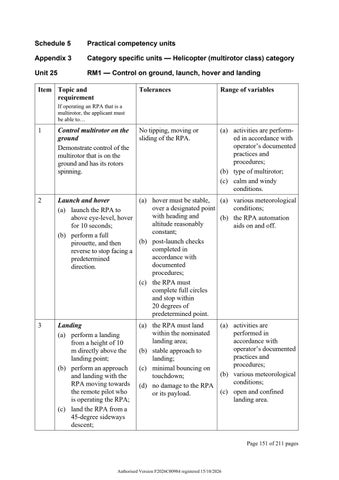
RM1 — Control on ground, launch, hover and landing
Item Topic and requirement
Tolerances
Range of variables
No tipping, moving or sliding of the RPA.
(a) activities are performed in accordance with operator’s documented practices and procedures; (b) type of multirotor; (c) calm and windy conditions.
If operating an RPA that is a multirotor, the applicant must be able to…
1
Control multirotor on the ground Demonstrate control of the multirotor that is on the ground and has its rotors spinning.
2
Launch and hover (a) hover must be stable, (a) various meteorological over a designated point conditions; (a) launch the RPA to with heading and above eye-level, hover (b) the RPA automation altitude reasonably aids on and off. for 10 seconds; constant; (b) perform a full (b) post-launch checks pirouette, and then completed in reverse to stop facing a accordance with predetermined documented direction. procedures; (c) the RPA must complete full circles and stop within 20 degrees of predetermined point.
3
Landing (a) perform a landing from a height of 10 m directly above the landing point; (b) perform an approach and landing with the RPA moving towards the remote pilot who is operating the RPA; (c) land the RPA from a 45-degree sideways descent;
(a) the RPA must land (a) activities are within the nominated performed in landing area; accordance with operator’s documented (b) stable approach to practices and landing; procedures; (c) minimal bouncing on (b) various meteorological touchdown; conditions; (d) no damage to the RPA (c) open and confined or its payload. landing area.
Page 151 of 211 pages
Authorised Version F2026C00984 registered 15/10/2026
Item Topic and requirement
Tolerances
Range of variables
If operating an RPA that is a multirotor, the applicant must be able to…
(d) demonstrate a baulked landing procedure to a nominated hold point; (e) within visual line of sight, perform a horizontal rectangular circuit of a reasonable width, and at a reasonable distance, sufficient to show competency in carrying out such a manoeuvre; the manoeuvre itself must include a 45degree climb and descent on the takeoff and final legs of the circuit, and end with a landing; (f) perform a landing in a cross- or tail-wind conditions.
Page 152 of 211 pages
Authorised Version F2026C00984 registered 15/10/2026
Schedule 5
Practical competency units
Appendix 3
Category specific units — Helicopter (multirotor class) category (contd.)
Unit 26
RM2 — Normal operations
Item Topic and requirement
Tolerances
Range of variables
If operating an RPA that is a multirotor, the applicant must be able to…
1
Control multirotor during (a) normal operation (a) perform straight and (b) level forwards operation to a 20 m distant marker, hold (c) for 10 seconds and return “tail” first; (b) perform a vertical rectangle, at least 5 m (d) high and 20 m wide, (e) with clockwise and counter clockwise 360-degree pirouettes (f) at each alternate corner; (c) perform a vertical circle, as if inspecting the span of a bridge, turning 180 degrees at the top; (d) perform a figure 8 at a constant altitude with a crossover point in front of the remote pilot and even-sized loops with the nose pointing in the direction of travel; (e) demonstrate flight to the left and right and towards and away from the remote pilot in different orientations.
reasonably straight line (a) out and back; stable hover (heading (b) and height) with (c) minimal drift; vertical circle must (d) have an even radius (e) and be completed at an even speed; (f) constant radius turns; the RPA must come to a complete stop, before changing direction; vertical flight manoeuvres with minimal drift.
various meteorological conditions; size of vertical circle; size of vertical rectangle; size of flat 8; inwards or outwards facing flat 8; with and without the RPA automation aids (for example, without “headless mode”).
Page 153 of 211 pages
Authorised Version F2026C00984 registered 15/10/2026
Schedule 5
Practical competency units
Appendix 3
Category specific units — Helicopter (multirotor class) category (contd.)
Unit 27
RM3 — Advanced manoeuvres
Item Topic and requirement
Tolerances
Range of variables
If operating an RPA that is a multirotor, the applicant must be able to…
1
Control multirotor in (a) advanced manoeuvres (a) perform a straight and (b) level forwards (c) operation to a 100 m distant marker, hover, turn 180 degrees, and (d) fly back nose-in; (b) perform a nose-in turn about the nose; (c) perform a nose-out turn (e) about the “tail”; (d) reorient the RPA from a simulated loss of orientation; (e) perform an 8-point pirouette pausing at each point without GPS hold; (f) perform a 360-degree level turn without GPS hold.
reasonably straight line (a) out and back; consistent height; (b) reorientation of the RPA to be achieved in a timely manner; the RPA must remain at least 100 m away from remote pilot, unless otherwise stated; for the turn about the nose manoeuvre, the nose of the RPA must point generally to the centre of the circle.
various meteorological conditions; with and without RPA automation aids.
Page 154 of 211 pages
Authorised Version F2026C00984 registered 15/10/2026
Schedule 5
Practical competency units
Appendix 3
Category specific units — Helicopter (multirotor class) category (contd.)
Unit 28
RM4 — Operation in abnormal situations and emergencies
Item Topic and requirement
Tolerances
Range of variables
If operating an RPA that is a multirotor, the applicant must be able to…
1
Return to home and (a) the remote pilot carries (a) various meteorological parachute deployment out the correct conditions; procedure, including (a) demonstrate the (b) various flight modes; ensuring that the return “return-to-home” (c) various events leading path can be flown fail-safe function if to the need for the safely; such a function is fitted safety actions. (b) parachute deployment to the RPA; procedure timely and (b) demonstrate or safe. simulate a parachute deployment recovery system if such a system is fitted to the RPA.
2
Manage abnormal (a) no damage to the RPA; Various meteorological situations (b) the RPA handled with conditions. dexterity; (a) demonstrate operating the RPA to avoid a (c) the RPA lands in the vortex ring state; nominated area. (b) identify conditions likely to lead to a vortex ring state; (c) simulate a recovery from a vortex ring state to a safe landing.
3
Control link corruption Demonstrate the loss of command and control link procedures in accordance with the RPA operator’s documented practices and procedures.
Timely application of procedures.
Activities are performed in accordance with operator’s documented practices and procedures.
Page 155 of 211 pages
Authorised Version F2026C00984 registered 15/10/2026
Item Topic and requirement
Tolerances
Range of variables
(a) no damage to the RPA; (b) manoeuvres completed with a suitable safety margin.
Activities are performed in accordance with operator’s documented practices and procedures.
If operating an RPA that is a multirotor, the applicant must be able to…
4
Safe forced landing and collision avoidance Simulate emergency manoeuvres: (a) to avoid a collision with another aircraft; (b) to avoid other risks to the safe operation of the RPA (including bird attack); (c) to land the RPA safely in a confined landing area.
Page 156 of 211 pages
Authorised Version F2026C00984 registered 15/10/2026