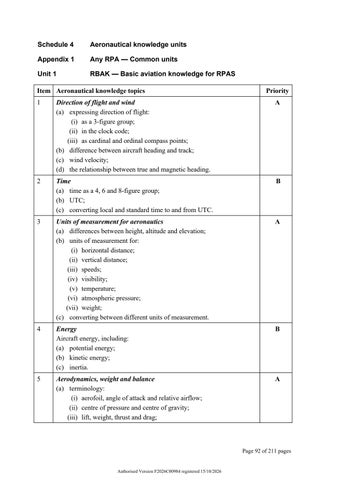
Schedule 4
Aeronautical knowledge units
Appendix 1
Any RPA — Common units
Unit 1
RBAK — Basic aviation knowledge for RPAS
Item Aeronautical knowledge topics
Priority
1
Direction of flight and wind (a) expressing direction of flight: (i) as a 3-figure group; (ii) in the clock code; (iii) as cardinal and ordinal compass points; (b) difference between aircraft heading and track; (c) wind velocity; (d) the relationship between true and magnetic heading.
A
2
Time (a) time as a 4, 6 and 8-figure group; (b) UTC; (c) converting local and standard time to and from UTC.
B
3
Units of measurement for aeronautics (a) differences between height, altitude and elevation; (b) units of measurement for: (i) horizontal distance; (ii) vertical distance; (iii) speeds; (iv) visibility; (v) temperature; (vi) atmospheric pressure; (vii) weight; (c) converting between different units of measurement.
A
4
Energy Aircraft energy, including: (a) potential energy; (b) kinetic energy; (c) inertia.
B
5
Aerodynamics, weight and balance (a) terminology: (i) aerofoil, angle of attack and relative airflow; (ii) centre of pressure and centre of gravity; (iii) lift, weight, thrust and drag;
A
Page 92 of 211 pages
Authorised Version F2026C00984 registered 15/10/2026
Item Aeronautical knowledge topics (b) “Bernoulli’s principal”, “Coandra effect” and “Newton’s third law”; (c) basic weight and balance principles; (i) empty weight; (ii) operating weight; (iii) maximum gross weight; (iv) arm, moment, datum, station and index unit; (v) centre of gravity limits; (vi) loading limits.
Priority
Lift and drag (a) changes to lift and drag resulting from: (i) airspeed changes; (ii) angle of attack changes; (b) types of drag, including: (i) parasite (zero lift), form, interference and skin friction; (ii) induced (lift dependent).
B
6
C
7
Propellers and rotors (a) terminology; (b) blade angle, helix angle or pitch; (c) propeller/rotor thrust and torque; (d) propeller/rotor principles.
B
8
Principles of operation — flight control (a) longitudinal, lateral and vertical axes; (b) pitch, roll and yaw; (c) skid and slip; (d) effect of changes in power on vertical and horizontal speed; (e) relationship between control inputs and aircraft movements; (f) angle of climb and rate of climb; (g) trim controls.
A
9
Principles of operation — remote pilot station Features of a remote pilot station: (a) transmitter; (b) command and control link; (c) flight controls; (d) other controls; (e) antennas/aerials; (f) software, including firmware and updates; (g) telemetry; (h) non-payload communications; (i) power supply.
C
Page 93 of 211 pages
Authorised Version F2026C00984 registered 15/10/2026
Schedule 4
Aeronautical knowledge units
Appendix 1
Any RPA — Common units (contd.)
Unit 2
RACP — Airspace, charts and aeronautical publications for RPAS
Item Aeronautical knowledge topics
Priority
1
Airspace (a) classification of airspace; (b) airspace depiction on aeronautical charts, including: (i) flight information area; (ii) Class G airspace; (iii) controlled aerodromes; (iv) control area; (v) control zone; (vi) VFR route and lane of entry; (vii) prohibited areas; (viii) restricted areas; (ix) danger areas; (x) common traffic advisory frequencies and associated airspace; (xi) radio frequency boundaries; (c) airspace in relation to the circumstances in which an aeronautical radio qualification is required: (i) Air Traffic Control (ATC); (ii) in the vicinity of non-controlled aerodromes.
A
2
Obtaining information or approval (a) permissions for RPA operations in restricted areas; (b) aeronautical information publications, including: (i) AIP; (ii) ERSA; (iii) NOTAM.
A
3
NOTAMs (a) obtaining NOTAMs for operational areas; (b) decoding NOTAMs.
A
NOTAM publication (c) Submitting a NOTAM for publication.
C
Page 94 of 211 pages
Authorised Version F2026C00984 registered 15/10/2026
Item Aeronautical knowledge topics
Priority
4
Form of the earth, aeronautical charts and maps (a) features on an aeronautical chart (other than airspace); (b) cardinal and ordinal points of the compass; (c) latitude and longitude; (d) depiction of height and elevation on charts; (e) distance on the earth and in charts; (f) magnetic variation; (g) relationship between magnetic heading and magnetic bearing.
A
5
Electronic flight bag (a) electronic maps and charts; (b) CASA verified drone safety app.
C
Page 95 of 211 pages
Authorised Version F2026C00984 registered 15/10/2026
Schedule 4
Aeronautical knowledge units
Appendix 1
Any RPA — Common units (contd.)
Unit 3
RBMO — Basic meteorology for RPA operations
Item Aeronautical knowledge topics
Priority
1
Weather phenomena (a) causes and effects of the following weather phenomena in relation to RPA operations: (i) thunderstorms; (ii) low cloud; (iii) poor visibility (fog, mist, dust, haze); (iv) turbulence; (v) extreme heat and cold; (vi) strong winds and windshear; (vii) rain and humidity; (viii) convection; (ix) precipitation static; (b) the meaning of symbols used on weather maps.
B
2
Weather observations Indications of the presence of: (a) turbulence, thermals or dust devils; and (b) wind gradient and wind shear.
B
3
Aeronautical forecasts (a) obtaining aeronautical forecasts for the area of operations; (b) decoding an aeronautical forecast; (c) using public weather forecasts and reports.
B
Page 96 of 211 pages
Authorised Version F2026C00984 registered 15/10/2026
Schedule 4
Aeronautical knowledge units
Appendix 1
Any RPA — Common units (contd.)
Unit 4
REES — Electrical and electronic systems for RPAS
Item Aeronautical knowledge topics
Priority
1
Electrical terms (a) volts; (b) amps; (c) watts; (d) ohms; (e) hertz.
B
2
Function of electrical components (a) electrical components of an RPA: (i) electronic speed controller; (ii) battery eliminator circuit; (iii) receiver and remote receivers; (iv) telemetry module; (v) flight batteries; (vi) receiver battery; (vii) circuit breakers and fuses; (viii) servomechanisms; (ix) aerials/antennas; (x) GPS receivers; (xi) altimeters (radio, radar, laser, acoustic); (xii) collision avoidance sensors; (b) equipment redundancy; (c) malfunctions and system back-ups; (d) consequences of a malfunction; (e) remedial actions in the event of failure.
A
3
Electric motors (a) current draw through the motor in relation to rotor or propeller diameter or pitch; (b) current draw through the motor in relation to rotor or propeller loads; (c) determination of appropriate “Kv”.
A
4
Batteries (a) types of batteries: (i) nickel metal hydride batteries; (ii) lithium polymer batteries; (iii) alkaline batteries; (iv) nickel cadmium batteries;
A
Page 97 of 211 pages
Authorised Version F2026C00984 registered 15/10/2026
Item Aeronautical knowledge topics (v) fuel cells; (b) battery specifications and abbreviations (types, voltage; amperage etc); (c) characteristics of batteries used as an energy source for the RPA: (i) cell count; (ii) nominal voltage; (iii) battery configuration: (A) parallel; (B) series; (iv) battery capacity; (v) maximum current draw; (vi) discharge rate; (vii) main power plug; (viii) balance plug; (d) batteries classified as dangerous goods for air transportation.
Priority
5
Charging/discharging batteries (a) charging procedures for batteries; (b) discharging procedures for batteries; (c) cell balancing in multi-cell batteries; (d) state of charge of a battery with reference to capacity and voltage.
A
6
Battery limitations (a) “continuous C-rating” and “maximum burst C-rating”; (b) trade-off between battery size and flight endurance of an electrically-powered RPA; (c) battery serviceability; (d) battery checkers.
B
7
Electromagnetic radiation (a) radio waves; (b) characteristics of radio waves, wave propagation, transmission including: (i) the radio frequency band ranges (MF, HF, VHF, UHF); (ii) effective range of transmissions; (iii) factors affecting the propagation of radio waves, including: (A) terrain; (B) ionosphere; (C) sun spot activity; (D) interference from electrical equipment; (E) thunderstorms; (c) radio characteristics, optimisation and shielding: (i) digital and analogue signals;
A
Page 98 of 211 pages
Authorised Version F2026C00984 registered 15/10/2026
Item Aeronautical knowledge topics (ii) command and control link range testing; (iii) radio frequencies for RPA operations.
Priority
8
Global Positioning System (GPS) (a) components of a GPS; (b) how GPS works, including accuracy of different systems; (c) factors that affect the performance of GPS, including the following: (i) number of satellites available; (ii) path interference; (iii) type of software; (iv) signal availability; (v) indications of faulty GPS equipment.
A
9
Electromagnetic signal reliability and hazards (a) electromagnetic interference (EMI); (b) powerlines; (c) LTE and Wi-Fi.
B
Page 99 of 211 pages
Authorised Version F2026C00984 registered 15/10/2026
Schedule 4
Aeronautical knowledge units
Appendix 1
Any RPA — Common units (contd.)
Unit 5
RHPF — Human performance for RPAS
Item Aeronautical knowledge topics
Priority
1
General (a) airmanship (including, “aviate”, “navigate”, “communicate”); (b) differences between the sensory information available to a person operating an RPA compared to the pilot of manned aircraft; (c) situational awareness during RPA operations; (d) information processing and decision making in relation to the following factors: (i) personality traits; (ii) pride, peer pressure or employer pressure; (iii) desire to get the task done; (iv) anxiety, overconfidence, boredom or complacency; (v) long- or short-term memory; (vi) memory limitations; (vii) aide-memoires and rules of thumb; (viii) workload and overload; (ix) skill, experience and recency; (e) methods of enhancing decision-making skills; (f) temporal factors relating to system latency.
C
2
Basic health Medical and psychological factors that may affect pilot performance in relation to operating RPA: (a) upper respiratory tract infections, including colds, hay fever, congestion of air passages and sinuses; (b) a headache, including a migraine; (c) an injury; (d) ageing; (e) dehydration and heat stroke; (f) fatigue; (g) alcohol use and smoking; (h) drug use, including prescription and over-the-counter medications; (i) emotions, including anger, anxiety, depression and fear.
C
Page 100 of 211 pages
Authorised Version F2026C00984 registered 15/10/2026
Item Aeronautical knowledge topics
Priority
3
Vision, spatial disorientation, illusions (a) anatomy of the eye and its functioning during the day and at night; (b) limitations of the eye: (i) the ability to discern objects/aircraft at a distance and height; (ii) empty field myopia; (iii) glare; (iv) colour discrimination; (v) myopia, hyperopia, astigmatism, presbyopia and parallax; (c) enhancing vision within the definition of VLOS: (i) prescription spectacles; (ii) suitable sunglasses; (d) disorientation during RPA operations; (e) visual illusions: (i) typical illusions, including relative motion; (ii) conditions under which visual illusions may occur; (iii) how to overcome sensory illusions.
B
4
Stress in relation to operating RPA (a) the effects of short- and long-term stress on the performance and health of a person operating an RPA; (b) symptoms of stress in an excessively hot, cold, windy, vibrating or noisy environment; (c) causes and effects of domestic or work-related stress; (d) principles of stress management, including: (i) cognitive or behavioural techniques for managing stress; (ii) relaxation; (iii) time management.
C
5
Threat and error management (a) principles of threat and error management in relation to operating RPA; (b) processes to identify and manage threats and errors during RPA operations; (c) the use of checklists and standard operating procedures to prevent errors; (d) crew resource management; (e) risk perception when remote from the location of RPA operation; (f) strategic versus tactical risk management.
B
6
Coordinating crew (a) verbal and non-verbal communication, including the following factors: (i) barriers to communication;
C
Page 101 of 211 pages
Authorised Version F2026C00984 registered 15/10/2026
Item Aeronautical knowledge topics (ii) listening skills; (iii) assertion skills; (b) aspects of individuals that may affect the safe operation of the RPA: (i) personality; (ii) judgement; (iii) leadership style.
Priority
Page 102 of 211 pages
Authorised Version F2026C00984 registered 15/10/2026
Schedule 4
Aeronautical knowledge units
Appendix 1
Any RPA — Common units (contd.)
Unit 6
RKOP
RPAS knowledge — operations and procedures
Item Aeronautical knowledge topics
Priority
1
General operations (a) general considerations relating to: (i) starting and ground running of motors/engines; (ii) bystanders; (iii) crew briefing; (b) responsibilities of the remote pilot: (i) under Part 101 of CASR; (ii) in relation to the operator’s documented practices and procedures; (iii) keeping operational, remote pilot and technical logs in accordance with MOS sections 10.05 to 10.06; (c) considerations: (i) after an operation has ended; (ii) in relation to aircraft noise and wildlife.
A
2
Risk assessment and management (a) the strategic risk assessment process relevant to RPAS operations, including: (i) hazard identification; (ii) risk identification; (iii) risk mitigation measures; (b) elements of a job safety assessment for the operation of an RPA; (c) completing a job safety assessment for the operation of an RPA.
A
3
Airworthiness — general (a) determine RPAS serviceability for a specific operation; (b) use of the RPA technical log; (c) responsibilities of the holder of a remote pilot licence in relation to the continuing airworthiness of the RPA, including: (i) conducting inspections of the RPA; (ii) reporting defects or unserviceability in relation to the RPAS.
A
4
Role equipment or sensors Safety and performance implications of various payloads, including cameras and other sensors.
B
Page 103 of 211 pages
Authorised Version F2026C00984 registered 15/10/2026
Item Aeronautical knowledge topics
Priority
5
Accident and incident reporting (a) definitions of accident and incidents; (b) requirements for accident and incident reporting (however described) mentioned in the Transport Safety Investigation Regulations 2003 and the Transport and Safety Investigation (Voluntary and Confidential Reporting Scheme) Regulation 2012.
A
6
Abnormal operations Considerations in the event of the following: (a) if the engine or motors of an RPA fails in the following circumstances: (i) immediately after launch; (ii) on approach to landing; (iii) when operating within controlled airspace under ATC control; (iv) in a built-up area; (v) in the vicinity of bystanders; (b) a control link failure; (c) a remote pilot station failure; (d) if a fire takes hold on the RPA during flight or on the ground; (e) if the RPA is attacked by a bird.
A
7
Fail-safe procedures and emergency actions Fail-safe systems and emergency actions, including: (a) the “return to home” system; (b) regain link holding pattern; (c) the RPA flies to a predetermined holding point; (d) emergency parachute deployment; (e) immediate landing; (f) flight termination; (g) carbon fibre containment in the event of a crash.
A
8
Operation of RPA near aerodrome (a) considerations in relation to operating an RPA near an aerodrome: (i) the location at an aerodrome of each runway threshold, each runway threshold centrepoint, and the movement areas; (ii) the structure of the approach and departure paths for aerodromes and helicopter landing sites (HLS); (b) the prohibitions in Part 101 of CASR relating to operating an RPA at or near aerodromes and HLS; (c) the process to obtain a permission, approval or exemption (however described) under CASR in relation to operating an RPA at or in the approach and departure paths of a particular aerodrome; (d) determining the runway or runways in use at an aerodrome; (e) traffic patterns at aerodromes;
A
Page 104 of 211 pages
Authorised Version F2026C00984 registered 15/10/2026
Item Aeronautical knowledge topics (f) limitations on the operation of an RPA near an aerodrome if the aerodrome has more than 1 runway; (g) limitations imposed by the Part 101 MOS with respect to operations in controlled and non-controlled airspace.
Priority
9
Operations of RPA above 400 ft AGL Considerations relating to operations of an RPA above 400 ft AGL: (a) airspace classification; (b) aeronautical radio use and qualifications; (c) identifying the location of non-controlled aerodromes; (d) use of RPA observers; (e) the process to obtain a permission, approval or exemption (however described) under CASR in relation to operating an RPA above 400 ft AGL.
A
10
Tethered operations Operational considerations for when the RPA is tethered to the ground.
B
Page 105 of 211 pages
Authorised Version F2026C00984 registered 15/10/2026
Schedule 4
Aeronautical knowledge units
Appendix 1
Any RPA — Common units (contd.)
Unit 7
RORA — Operational rules and air law for RPAS
Item
Aeronautical knowledge topics
Priority
1
Aviation legislation and information (a) documents that contain aviation legislation, aeronautical information and general operating rules that apply to the operation of RPA; (b) obtaining the documents and ensuring that the information is up to date; (c) guidance materials and information sources relating to RPAS operations.
A
2
Remote pilot licence (a) conditions that apply to a remote pilot licence under Part 101 of CASR; (b) conditions that may apply to a remote pilot licence under other legislation; (c) conditions that apply to a certified RPA operator under Part 101 of CASR.
B
Page 106 of 211 pages
Authorised Version F2026C00984 registered 15/10/2026
Schedule 4
Aeronautical knowledge units
Appendix 1A
Any RPA operated under an automated flight management system
Unit 8
RAFM — Automated flight management systems knowledge
Item Aeronautical knowledge topics 1
Priority
General (a) use of automated flight management systems for RPA; (b) limitations of an automated flight management system; (c) identifying faults with automated flight management system; (d) automated flight management system in abnormal and emergency situations (for example, loss of control, loss of thrust); (e) precautions when programming an automated flight management system; (f) degraded automated flight management systems (for example, no GPS, IMU failure).
A
Page 107 of 211 pages
Authorised Version F2026C00984 registered 15/10/2026