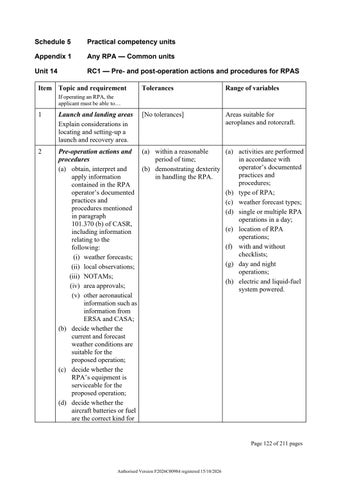
Schedule 5
Practical competency units
Appendix 1
Any RPA — Common units
Unit 14
RC1 — Pre- and post-operation actions and procedures for RPAS
Item Topic and requirement
Tolerances
Range of variables
[No tolerances]
Areas suitable for aeroplanes and rotorcraft.
If operating an RPA, the applicant must be able to…
1
Launch and landing areas Explain considerations in locating and setting-up a launch and recovery area.
2
Pre-operation actions and (a) within a reasonable procedures period of time; (a) obtain, interpret and (b) demonstrating dexterity apply information in handling the RPA. contained in the RPA operator’s documented practices and procedures mentioned in paragraph 101.370 (b) of CASR, including information relating to the following: (i) weather forecasts; (ii) local observations; (iii) NOTAMs; (iv) area approvals; (v) other aeronautical information such as information from ERSA and CASA; (b) decide whether the current and forecast weather conditions are suitable for the proposed operation; (c) decide whether the RPA’s equipment is serviceable for the proposed operation; (d) decide whether the aircraft batteries or fuel are the correct kind for
(a) activities are performed in accordance with operator’s documented practices and procedures; (b) type of RPA; (c) weather forecast types; (d) single or multiple RPA operations in a day; (e) location of RPA operations; (f) with and without checklists; (g) day and night operations; (h) electric and liquid-fuel system powered.
Page 122 of 211 pages
Authorised Version F2026C00984 registered 15/10/2026
Item Topic and requirement
Tolerances
Range of variables
If operating an RPA, the applicant must be able to…
the RPA and are serviceable. 3
Perform pre-flight inspection (a) assemble and prepare the RPA for operation; (b) conduct a postassembly inspection of the RPA; (c) ensure locking and securing devices, covers and bungs for the RPA are removed; (d) complete a pre-operation inspection as set out in the RPA operator’s documented practices and procedures; (e) start the RPA’s engine or motor in accordance with the RPA operator’s documented practices and procedures for the operation of the RPA.
(a) within a reasonable (a) activities are performed period of time; in accordance with operator’s documented (b) demonstrating dexterity practices and in handling the RPA; procedures; (c) no locking or securing (b) type of RPA. devices, bungs or covers left in place.
4
Weight and balance (a) ensure aircraft is loaded within limits; (b) ensure that centre of gravity is within limits.
Aircraft loaded within manufacturer/operator limits.
5
Post-operation actions and procedures (a) shut down aircraft in accordance with the operations manual; (b) conduct post-operation inspection and secure the aircraft (if applicable); (c) complete all required post-operation
(a) within a reasonable (a) activities are performed period of time; in accordance with operator’s documented (b) demonstrating practices and familiarity with the procedures; RPA and the RPA operator’s documented (b) type of RPA; practices and (c) dry and wet weather. procedures; (c) demonstrating dexterity in handling the RPA;
Loading and limits relevant to aircraft type.
Page 123 of 211 pages
Authorised Version F2026C00984 registered 15/10/2026
Item Topic and requirement
Tolerances
Range of variables
If operating an RPA, the applicant must be able to…
administration (d) all locking or securing documentation; devices, bungs or covers are in place. (d) disassemble aircraft for transport.
Page 124 of 211 pages
Authorised Version F2026C00984 registered 15/10/2026
Schedule 5
Practical competency units
Appendix 1
Any RPA — Common units (contd.)
Unit 15
RC2 — Energy reserves management for RPAS
Item Topic and requirement
Tolerances
Range of variables
If operating an RPA, the applicant must be able to…
1
Plan energy requirements (a) demonstrating familiarity with the (a) work out the duration RPA and the RPA of the flight taking into operator’s documented account operational practices and environment and procedures; relevant abnormal or emergency conditions, (b) the calculated RPA operation endurance for contingencies; the flight is within +/(b) where applicable, 10% or within the calculate or identify reserve limits of the the endurance for the energy source. RPA with designated reserve.
(a) activities are performed in accordance with operator’s documented practices and procedures; (b) length and type of operation; (c) type of energy source for the RPA; (d) various wind and temperature conditions; (e) variation in operating weight and aircraft configuration.
2
Manage battery system or systems (a) if the energy source for the RPA is a battery or battery systems: (i) prior to launch, verify the time available for the flight given the current battery charge; (ii) ensure the batteries are secured to the RPA for the operation; (iii) ensure the battery connectors are connected properly and secure for the operation;
(a) (b) (c) (d)
(a) within a reasonable period of time; (b) demonstrating familiarity with the RPA; (c) demonstrating dexterity in handling the RPA and the batteries; (d) the RPA is not operated below the minimum voltage, as stated in the operator’s documented practices and procedures; (e) not operating above maximum current draw for the RPA systems, as stated in the operator’s documented practices and procedures.
old and new batteries; battery connector types; types of battery; with and without telemetry.
Page 125 of 211 pages
Authorised Version F2026C00984 registered 15/10/2026
Item Topic and requirement
Tolerances
Range of variables
If operating an RPA, the applicant must be able to…
(iv) monitor energy usage during the operation; (v) maintain a battery log for the operation; (vi) perform battery changes correctly; (b) if the energy source of the remote pilot station for the RPA is a battery or battery systems — manage the remote pilot station power supply to ensure sufficient energy to complete an operation with a suitable reserve. 3
Recharge battery or batteries (a) inspect the battery to ensure it is safe to be recharged; (b) ensure the battery charger is setup correctly for the type of battery; (c) correctly connect and disconnect a battery to the battery charger; (d) perform battery quality and quantity checks after charging; (e) calculate the time it would take to use and recharge a battery for a particular operation; (f) if a battery is unsafe for an operation — recognise that the
(a) within a reasonable (a) types of battery; period of time; (b) types of chargers; (b) demonstrating (c) battery management is familiarity with the performed in RPA; accordance with operator’s documented (c) demonstrating care in handling the batteries; practices and procedures. (d) battery is charged to the desired level; (e) does not exceed the charging limitations for the batteries.
Page 126 of 211 pages
Authorised Version F2026C00984 registered 15/10/2026
Item Topic and requirement
Tolerances
Range of variables
If operating an RPA, the applicant must be able to…
battery is unsafe for the operation; (g) check that the battery has sufficient charge for storage. 4
Manage fuel system (very (a) within a reasonable (a) small and small RPA) period of time; (b) (a) if the RPA is a very (b) demonstrating (c) small or small RPA and familiarity with the the energy source for RPA; the RPA is liquid fuel: (c) demonstrating dexterity (i) calculate fuel in handling the RPA (d) required for the and the batteries: flight; (i) for (i), in column 2, (ii) identify the fuel calculation is (e) quantity of fuel on within 10% (but not board the RPA below); (f) before the (ii) for (ii) in column 2, operation; quantity is within +/- 10% accuracy; (iii) ensure the fuel cap or caps are closed (iii) for (b) in column 2, and locked before calculated reserve flight; is within of 10% (iv) operate the RPA’s actual reserve at fuel pumps and end of flight. engine controls correctly during the operation; (v) monitor fuel use during the operation; (b) ensure the RPA lands at the end of the operation and is recovered with at least the correct amount of reserve fuel; (c) defuel the aircraft if required for storage or transport.
type of RPA; kind of liquid fuel; method used to calculate the fuel needed for an operation; method used to calculate the fuel burn rate; method used to check fuel quantity on board; method used to check fuel quality.
Page 127 of 211 pages
Authorised Version F2026C00984 registered 15/10/2026
Item Topic and requirement
Tolerances
Range of variables
(a) within a reasonable period of time; (b) demonstrating familiarity with the RPA; (c) demonstrating dexterity in handling the RPA and the fuel; (d) safe handling of fuel and equipment.
(a) refuelling procedures according to operator’s documented procedures; (b) types of liquid fuels; (c) factors which affect fuel-oil mix ratios.
If operating an RPA, the applicant must be able to…
5
Refuel RPA (very small and small RPA) If the RPA is a very small or small and liquid fuel is the source of the energy for the RPA — before the operation: (a) identify the correct kind of fuel to be used; (b) if the fuel of the RPA must be mixed — mix the fuel correctly; (c) correctly fuel or refuel the RPA; (d) perform a fuel quality check; (e) ensure the RPA’s fuel cap is closed and secured after the RPA has been fuelled.
Page 128 of 211 pages
Authorised Version F2026C00984 registered 15/10/2026
Schedule 5
Practical competency units
Appendix 1
Any RPA — Common units (contd.)
Unit 16
RC3 — Manage crew, payload and bystanders for RPAS operations
Item
Topic and requirement
Tolerances
Range of variables
If operating an RPA, the applicant must be able to…
1
Manage bystanders Clear and effective (a) ensure that bystanders communication. remain a safe distance away from the operation; (b) ensure bystanders are aware of, and avoid interference with, the operation and the systems controls used in the operation such as the remote pilot station; (c) manage bystander safety in the event of abnormal or emergency situation arising as a result of the operation; (d) demonstrate effective oral communication to bystanders in a clear, effective manner.
(a) co-operative bystanders; (b) non-cooperative bystanders.
2
Manage people involved in Clear, effective the operation communication. (a) establish and maintain clear communication with crew members, with a particular view to ensuring the safe operation of the RPA; (b) carry-out effective and safe handovers of remote pilot responsibilities before, during and after an RPA operation.
(a) communication face-to-face; (b) communication over a radio; (c) operations with and without visual observers (spotters).
Page 129 of 211 pages
Authorised Version F2026C00984 registered 15/10/2026
Item
Topic and requirement
Tolerances
Range of variables
If operating an RPA, the applicant must be able to…
3
Manage payloads and dangerous goods (a) manage loading, unloading and security of payload during an operation of the RPA; (b) identify dangerous goods and apply operator procedures to ensure safety of the operation.
(a) within a reasonable (a) period of time; (b) demonstrating (b) familiarity with the RPA; (c) (c) demonstrating dexterity in handling the RPA.
different kinds of payload; internal and external payloads; activities are performed in accordance with operator’s documented practices and procedures.
Page 130 of 211 pages
Authorised Version F2026C00984 registered 15/10/2026
Schedule 5
Practical competency units
Appendix 1
Any RPA — Common units (contd.)
Unit 17
RC4 — Navigation and operation of RPAS
Item
Topic and requirement
Tolerances
Range of variables
If operating an RPA, the applicant must be able to…
1
Operational “rules” [No tolerances] (a) operate the RPA in compliance with the requirements relating to operating the RPA mentioned in Part 101 of CASR and this MOS; (b) identify the location and relevant parts of the RPA operator’s documented practices and procedures mentioned in paragraph 101.370 (b) of CASR relating to the operation of the RPA.
Activities are performed in accordance with the operator’s documented practices and procedures.
2
Operational basics [No tolerances] (a) describe different traffic patterns of manned aircraft at aerodromes; (b) describe suitable vertical and horizontal separation distances between the RPA and other aircraft; (c) respond and take preventative actions to maintain the safety of the operation during simulated interactions with manned aircraft near aerodromes; (d) explain when an incident or accident report must be
(a) traffic patterns at aerodromes; (b) controlled and non-controlled aerodromes; (c) flight separation considerations; (d) types of incident; (e) manual and automated flight.
Page 131 of 211 pages
Authorised Version F2026C00984 registered 15/10/2026
Item
Topic and requirement
Tolerances
Range of variables
If operating an RPA, the applicant must be able to…
submitted in relation to an operation of the RPA. 3
Orientation [No tolerances] (a) interpret a given map or chart in relation to a proposed operation of the RPA and work out its implications for the operation; (b) in relation to any kind of aerodrome (including HLS) — point out the approach and departure paths and movement areas; (c) explain the significance of track and ground speed in relation to an operation of the RPA; (d) state the relevance of height, altitude and elevation in relation to different circumstances in which the RPA is operated.
4
Use of aeronautical charts On a visual navigation chart — identify, without reference to the chart legend: (a) major features, including roads, rivers, lakes; (b) obstacles, spot heights, including elevation or height above terrain;
(a) type of map projection; (b) various map scales; (c) digital or paper map; (d) different aerodromes and HLS; (e) at, near and away from aerodromes and HLS.
Quickly identifies major Paper and digital maps and features, obstacles, heights charts. and prescribed airspace boundaries.
Page 132 of 211 pages
Authorised Version F2026C00984 registered 15/10/2026
Item
Topic and requirement
Tolerances
Range of variables
[No tolerances]
[No variables]
If operating an RPA, the applicant must be able to…
(c) CTA, CTR, PRDs and aerodrome information; (d) secondary controlled aerodromes; (e) identify airspace boundaries and symbols; (f) interpret other symbols with reference to the chart legend. 5
Use of ERSA Use an ERSA to extract: (a) information for a particular aerodrome or airspace; (b) information and data about PRD areas.
6
Operations preparation (a) all necessary (a) operational documents identified; documentation; (a) identify the operational (b) understanding of (b) complexity of NOTAMs is accurate; NOTAM; documentation required for a planned (c) makes informed (c) area approval; operation; decisions about (d) type of weather whether to carry out (b) read and interpret a forecast. NOTAM, using the operation. NOTAM decode information; (c) obtain and comply with ATC clearances; (d) be aware of “fly neighbourly” areas and environmental protection; (e) read and interpret a local weather forecast and determine whether it would be suitable to operate the RPA for the operation given the forecast; (f) read and interpret an aeronautical weather Page 133 of 211 pages
Authorised Version F2026C00984 registered 15/10/2026
Item
Topic and requirement
Tolerances
Range of variables
If operating an RPA, the applicant must be able to…
forecast and determine whether it would be suitable to operate the RPA for the operation given the forecast.
Page 134 of 211 pages
Authorised Version F2026C00984 registered 15/10/2026
Schedule 5
Practical competency units
Appendix 1
Any RPA — Common units (contd.)
Unit 18
RNT — Non-technical skills for operation of RPAS
Item Topic and requirement
Tolerances
Range of variables
If operating an RPA, the applicant must be able to…
1
Maintain effective lookout [No tolerances] Maintain obstacle and traffic separation using a systematic visual scan technique at a rate determined by location, visibility and terrain.
(a) various weather conditions; (b) surrounding terrain and obstacles.
2
Maintain situational awareness (a) collect information to ensure the continued safe operation of the RPA; (b) non-weather hazards to operations (for example, thermal plumes, powerlines, animals).
3
Assess situations and Makes decisions in a timely Various operational make decisions manner. scenarios. (a) identify problems that may affect the safe operation of the RPA; (b) analyse the problems; (c) identify solutions to the problems; (d) assess the solutions and risks of the solutions; (e) decide on a course of action; (f) if appropriate — communicate the proposed course of action; (g) if appropriate — allocate tasks relating to the proposed course of action;
Makes decisions in a timely Location of the RPA manner. operation (for example, urban, suburban, park, beach).
Page 135 of 211 pages
Authorised Version F2026C00984 registered 15/10/2026
Item Topic and requirement
Tolerances
Range of variables
If operating an RPA, the applicant must be able to…
(h) take actions to achieve optimum outcomes for the operation; (i) monitor progress of the course of action; (j) adjust the course of action to achieve the optimum outcomes for the operation. 4
Set priorities and manage [No tolerances] tasks (a) organise workload and priorities to ensure safe operation of the RPA; (b) anticipate events and tasks that may occur during the operation; (c) plan events and tasks for the operation so that the events and task occur sequentially; (d) use technology to reduce workload and improve cognitive and manipulative activities during the operation.
[No variables]
5
Maintain effective communications and interpersonal relationships (a) establish and maintain effective and efficient communications and interpersonal relationships with all stakeholders to ensure the optimum outcome of the operation; (b) define and explain objectives to stakeholders; (c) recognise hazardous attitudes and mindsets;
[No variables]
[No tolerances]
Page 136 of 211 pages
Authorised Version F2026C00984 registered 15/10/2026
Item Topic and requirement
Tolerances
Range of variables
If operating an RPA, the applicant must be able to…
(d) demonstrate a level of assertiveness that ensures the optimum completion of the operation. 6
Recognise and manage threats (a) identify environmental or operational threats likely to affect the safety of the operation; (b) identify if competing priorities and demands may represent a threat to the safety of the operation; (c) develop and implement countermeasures to manage threats; (d) during the operation, monitor and assess the progress of the operation to ensure a safe outcome and modify actions accordingly; (e) identify and manage fatigue.
Quickly identifies threats (a) types of threat; and makes and implements (b) types of fire and suitable countermeasures in material hazards; a timely way. (c) various risk mitigations to minimise threat.
7
Recognise and manage errors (a) apply the RPA operator’s documented practices and procedures mentioned in regulation 101.370 of CASR; (b) prevent aircraft handling, procedural or communication errors; (c) during the operation, identify errors in the operation of the RPA before the safety of
Minimises the Type of errors. consequences of an error in a timely manner.
Page 137 of 211 pages
Authorised Version F2026C00984 registered 15/10/2026
Item Topic and requirement
Tolerances
Range of variables
[No tolerances]
(a) large and small spaces; (b) different fire hazards; (c) populated and unpopulated spaces.
If operating an RPA, the applicant must be able to…
the operation is affected; (d) during the operation, monitor the following to identify potential or actual errors: (i) in the RPA systems using a systematic scan technique; (ii) caused by the environment in which the RPA is operating; (iii) by the other individuals who have been assigned duty. 8
Considerations for indoor and underground operations Show awareness of risks associated with indoor and underground operations.
Page 138 of 211 pages
Authorised Version F2026C00984 registered 15/10/2026
Schedule 5
Practical competency units
Appendix 1
Any RPA — Common units (contd.)
Unit 19
RAF — Automated flight management systems for RPAS
Item Topic and requirement
Tolerances
Range of variables
If operating an RPA under an automated flight management system, the applicant must be able to…
1
Pre-operation preparation [No tolerances] (a) check the automated flight management system software is current and up to date; (b) load a flight plan for the automated operation of the RPA.
(a) various meteorological conditions; (b) size of operation area; (c) type of RPA.
2
Automated operation control (a) demonstrate an automated launch and initial climb of the RPA; (b) modify the preprogrammed flight path while the RPA is in flight; (c) demonstrate an automated approach and landing/recovery of an RPA.
3
Emergency procedures (a) error-free and timely (a) various reprogramming; meteorological (a) interrupt an automated conditions; operation of the RPA (b) the RPA is handled with dexterity and and redirect the RPA (b) simulate operations actions performed or in urban, suburban to a safe point; simulated in a timely and unpopulated (b) demonstrate a baulked areas; way; landing procedure; (c) for the baulked (c) type of RPA. (c) demonstrate the landing, the aircraft procedure to terminate does not descend the automated below a nominated operation of the RPA. height and maintains a nominated track; (d) safe termination procedure.
(a) initial climb is made (a) various after post-launch meteorological checks are complete; conditions; (b) modifications made in (b) size of operation a reasonable amount area; of time; (c) type of RPA. (c) the RPA lands within designated/predicted area/limits.
Page 139 of 211 pages
Authorised Version F2026C00984 registered 15/10/2026