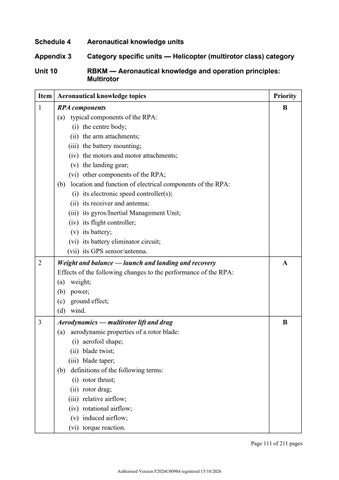
Schedule 4
Aeronautical knowledge units
Appendix 3
Category specific units — Helicopter (multirotor class) category
Unit 10
RBKM — Aeronautical knowledge and operation principles: Multirotor
Item Aeronautical knowledge topics
Priority
1
RPA components (a) typical components of the RPA: (i) the centre body; (ii) the arm attachments; (iii) the battery mounting; (iv) the motors and motor attachments; (v) the landing gear; (vi) other components of the RPA; (b) location and function of electrical components of the RPA: (i) its electronic speed controller(s); (ii) its receiver and antenna; (iii) its gyros/Inertial Management Unit; (iv) its flight controller; (v) its battery; (vi) its battery eliminator circuit; (vii) its GPS sensor/antenna.
B
2
Weight and balance — launch and landing and recovery Effects of the following changes to the performance of the RPA: (a) weight; (b) power; (c) ground effect; (d) wind.
A
3
Aerodynamics — multirotor lift and drag (a) aerodynamic properties of a rotor blade: (i) aerofoil shape; (ii) blade twist; (iii) blade taper; (b) definitions of the following terms: (i) rotor thrust; (ii) rotor drag; (iii) relative airflow; (iv) rotational airflow; (v) induced airflow; (vi) torque reaction.
B
Page 111 of 211 pages
Authorised Version F2026C00984 registered 15/10/2026
Item Aeronautical knowledge topics
Priority
4
Aerodynamics — hovering and forward flight (a) definitions of the terms: (i) ground effect; (ii) recirculation; (b) translational lift; (c) drag in forward flight.
A
5
Principles of operation — flight controls (a) primary flight controls and how they affect the movement of a multirotor about its longitudinal, lateral and normal vertical axes, including: (i) hover; (ii) yaw control; (iii) forward operation; (iv) ascent and descent; (v) lateral horizontal operation; (b) stabilisation; (c) GPS hold.
A
6
Aerodynamics — abnormal operations (a) direction of rotation of a rotor and the implications of incorrect installation; (b) effects on the operation of the RPA if a motor of the RPA fails.
A
7
Launch (a) pre-launch checks; (b) post-launch checks.
B
8
Climbing Effect on climb rate and angle from changes in the following: (a) weight; (b) power; (c) airspeed; (d) a headwind or tailwind or windshear; (e) bank angle; (f) temperature; (g) altitude.
A
9
Turning (a) banked turns; (b) rotations or flat turns; (c) limitations on steep turns.
B
Page 112 of 211 pages
Authorised Version F2026C00984 registered 15/10/2026
Item Aeronautical knowledge topics 10
Descending, landing and recovery (a) avoiding vortex ring state when operating the RPA; (b) recovery actions to escape vortex ring state; (c) advantages of landing/recovery into the wind; (d) pre-landing checks.
Priority A
Page 113 of 211 pages
Authorised Version F2026C00984 registered 15/10/2026