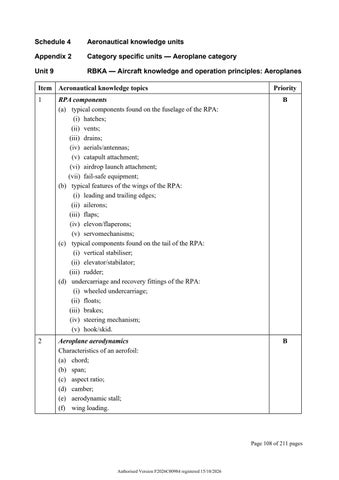
Schedule 4
Aeronautical knowledge units
Appendix 2
Category specific units — Aeroplane category
Unit 9
RBKA — Aircraft knowledge and operation principles: Aeroplanes
Item Aeronautical knowledge topics
Priority
1
RPA components (a) typical components found on the fuselage of the RPA: (i) hatches; (ii) vents; (iii) drains; (iv) aerials/antennas; (v) catapult attachment; (vi) airdrop launch attachment; (vii) fail-safe equipment; (b) typical features of the wings of the RPA: (i) leading and trailing edges; (ii) ailerons; (iii) flaps; (iv) elevon/flaperons; (v) servomechanisms; (c) typical components found on the tail of the RPA: (i) vertical stabiliser; (ii) elevator/stabilator; (iii) rudder; (d) undercarriage and recovery fittings of the RPA: (i) wheeled undercarriage; (ii) floats; (iii) brakes; (iv) steering mechanism; (v) hook/skid.
B
2
Aeroplane aerodynamics Characteristics of an aerofoil: (a) chord; (b) span; (c) aspect ratio; (d) camber; (e) aerodynamic stall; (f) wing loading.
B
Page 108 of 211 pages
Authorised Version F2026C00984 registered 15/10/2026
Item Aeronautical knowledge topics
Priority
3
Launch (a) effects of cross-wind on high- and low-wing aeroplanes during launch and control technique; (b) effects of cross-wind on tail-wheel equipped aeroplanes and control techniques; (c) advantages of launching into wind.
A
4
Climbing Effect on climb rate and angle resulting from changes in the following: (a) weight; (b) power; (c) airspeed (changed from recommended); (d) flap deflection; (e) headwind/tailwind component, windshear; (f) bank angle; (g) altitude and density altitude.
A
5
Straight and level Relationship between attitude, angle of attack and airspeed in level flight.
A
6
Turning (a) concept of balanced turns; (b) effect of increasing or decreasing bank angle on: (i) stall airspeed, including the rate of increase of stall speed with increasing bank; (ii) the aircraft’s structure (load factor); (c) precautions during steep turns: (i) shortly after launch; and (ii) during a glide, particularly on approach to land; (d) visual illusions during level turns at low level when turning downwind or into wind.
A
7
Stalling, spinning and spiral drives (a) the characteristics of a stall; (b) visual signs from the ground when the RPA is approaching a stall; (c) stall recovery: (i) the effect of using ailerons when approaching, and during, the stall; and (ii) why the RPA may stall at different speeds; (d) effects of the following on the stall airspeed: (i) power; (ii) flap; (iii) manoeuvres; (iv) weight;
A
Page 109 of 211 pages
Authorised Version F2026C00984 registered 15/10/2026
Item Aeronautical knowledge topics (v) airframe frost and ice; (vi) air density; (e) manoeuvres during which the RPA may stall at an angle which appears to be different to the true stalling angle; (f) differences between a spin and a spiral dive; (g) spiral dive recovery.
Priority
8
Descent (a) angle of descent and attitude relating to: (i) power; (ii) flap; (iii) aircraft nose position; (b) effect of headwind/tailwind; (c) rate and angle of descent.
A
9
Landing/recovery (a) achieving a smooth landing; (b) effects of a cross-wind on high- and low-wing aeroplanes during landing/recovery; (c) advantages of landing into the wind; (d) differences between a flapless approach and an approach with flap in terms of: (i) approach path angle; and (ii) threshold and touchdown speeds; and (iii) landing distance required; (e) deep stall landings; (f) use of a recovery net.
A
Page 110 of 211 pages
Authorised Version F2026C00984 registered 15/10/2026