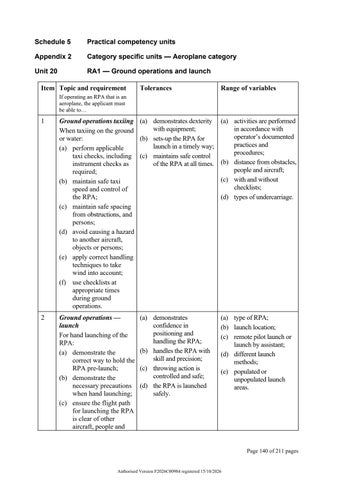
Schedule 5
Practical competency units
Appendix 2
Category specific units — Aeroplane category
Unit 20
RA1 — Ground operations and launch
Item Topic and requirement
Tolerances
Range of variables
If operating an RPA that is an aeroplane, the applicant must be able to…
1
Ground operations taxiing (a) demonstrates dexterity with equipment; When taxiing on the ground or water: (b) sets-up the RPA for launch in a timely way; (a) perform applicable taxi checks, including (c) maintains safe control instrument checks as of the RPA at all times. required; (b) maintain safe taxi speed and control of the RPA; (c) maintain safe spacing from obstructions, and persons; (d) avoid causing a hazard to another aircraft, objects or persons; (e) apply correct handling techniques to take wind into account; (f) use checklists at appropriate times during ground operations.
(a) activities are performed in accordance with operator’s documented practices and procedures; (b) distance from obstacles, people and aircraft; (c) with and without checklists; (d) types of undercarriage.
2
Ground operations — launch For hand launching of the RPA: (a) demonstrate the correct way to hold the RPA pre-launch; (b) demonstrate the necessary precautions when hand launching; (c) ensure the flight path for launching the RPA is clear of other aircraft, people and
(a) type of RPA; (b) launch location; (c) remote pilot launch or launch by assistant; (d) different launch methods; (e) populated or unpopulated launch areas.
(a) demonstrates confidence in positioning and handling the RPA; (b) handles the RPA with skill and precision; (c) throwing action is controlled and safe; (d) the RPA is launched safely.
Page 140 of 211 pages
Authorised Version F2026C00984 registered 15/10/2026
Item Topic and requirement
Tolerances
Range of variables
If operating an RPA that is an aeroplane, the applicant must be able to…
other hazards before launch; (d) work out a plan of action, in advance, to ensure the safest outcome in the event of abnormal operation. 3
Launch actions Initial climb is without If performing the launch of major deviations in heading or attitude. an RPA: (a) demonstrate correct launch technique; (b) perform the postlaunch checks mentioned in the RPA checklist set out in operator’s operations manual; (c) demonstrate smooth application of power and a controlled initial climb.
(a) type of RPA; (b) launch location; (c) remote pilot launch and launch by assistant; (d) different launch methods; (e) populated and unpopulated launch areas.
Page 141 of 211 pages
Authorised Version F2026C00984 registered 15/10/2026
Schedule 5
Practical competency units
Appendix 2
Category specific units — Aeroplane category (contd.)
Unit 21
RA2 — Normal operations
Item
Topic and requirement
Tolerances
Range of variables
If operating an RPA that is an aeroplane, the applicant must be able to…
1
Straight and level (a) operate the RPA in straight and level flight at the desired altitude; (b) identify and avoid terrain and traffic when operating the RPA.
(a) the RPA to maintain a constant height and heading; (b) the RPA is operated within its performance limitations.
(a) various meteorological conditions.
2
Climb (a) operate the RPA at a constant angle of climb; (b) operate the RPA at a constant rate of climb.
The RPA maintains: (a) an even rate of climb; (b) a constant airspeed; (c) a consistent climb angle.
(a) various meteorological conditions.
3
Trim If required, trim the RPA to maintain the desired flight path for the flight.
Trims the RPA to maintain a constant heading and height for approximately 10 seconds.
(a) various meteorological conditions.
4
Turns (a) operate the RPA to perform turns that are properly co-ordinated; (b) operate the RPA to perform turns that are conducted within a nominated area; (c) operate the RPA so that level turns are at a constant altitude.
(a) the RPA remains within the nominated area; (b) turns are conducted at a constant altitude and radius; (c) the RPA sink/skid is minimised during the turns; (d) completes turn within 15 degrees of stated final heading.
(a) various meteorological conditions.
Page 142 of 211 pages
Authorised Version F2026C00984 registered 15/10/2026
Item
Topic and requirement
Tolerances
Range of variables
The RPA maintains: (a) an even rate of descent; (b) a constant airspeed; (c) a consistent descent angle; (d) consistent aircraft attitude.
(a) various meteorological conditions.
If operating an RPA that is an aeroplane, the applicant must be able to…
5
Descent (a) descend the RPA at a constant angle of descent; (b) descend the RPA at a constant rate of descent; (c) use lift/drag devices appropriately during the descent of the RPA.
Page 143 of 211 pages
Authorised Version F2026C00984 registered 15/10/2026
Schedule 5
Practical competency units
Appendix 2
Category specific units — Aeroplane category (contd.)
Unit 22
RA3 — Land/recover RPA
Item Topic and requirement
Tolerances
Range of variables
(a) stable and controlled approach to land; (b) lands within the nominated area; (c) minimal deviations after landing; (d) keeps the RPA within approach area during a cross-wind landing; (e) landing speeds within 10% of recommended speed.
(a) meteorological conditions; (b) landing surface type; (c) undercarriage type; (d) aeroplane landing configuration; (e) different recovery methods.
If operating an RPA that is an aeroplane, the applicant must be able to…
1
Recover RPA (a) perform a rectangular circuit, of an appropriate length and width, in which the pilot demonstrates positive control, followed by a straight-line approach to a nominated point and landing; (b) allow sufficient space to align the RPA for a stabilised approach to the place at which the RPA will land or be recovered; (c) maintain a constant landing position aim point for the RPA; (d) if applicable, achieve a smooth, positivelycontrolled transition from final approach to touchdown, including the following: (i) minimise ballooning during flare; (ii) touchdown at a controlled rate of descent, in the specified touchdown zone; (iii) maintain positive directional control and cross-wind correction after landing, where applicable; (e) perform cross-wind landings.
Page 144 of 211 pages
Authorised Version F2026C00984 registered 15/10/2026
Item Topic and requirement
Tolerances
Range of variables
If operating an RPA that is an aeroplane, the applicant must be able to…
2
Conduct a missed approach (a) maintains the RPA within nominated area; (a) recognise the conditions when a missed approach (b) shows dexterity in configuring the RPA for should be executed; go-around; (b) make the decision to execute a missed (c) the RPA does not approach in a timely descend below way; nominated height. (c) carry out a missed approach and reposition for landing by doing the following: (i) select power, attitude and configuration to safely control the RPA; (ii) manoeuvre the RPA clear of the ground and conduct after launch procedures; (iii) make allowance for wind velocity during go-around.
(a) activities are performed in accordance with operator’s documented practices and procedures; (b) various meteorological conditions.
Page 145 of 211 pages
Authorised Version F2026C00984 registered 15/10/2026
Schedule 5
Practical competency units
Appendix 2
Category specific units — Aeroplane category (contd.)
Unit 23
RA4 — Advanced manoeuvres
Item Topic and requirement
Tolerances
Range of variables
If operating an RPA that is an aeroplane, the applicant must be able to…
1
Enter and recover from (a) stall (if applicable to the (b) RPA) (a) perform premanoeuvre checks for (c) stalling the RPA; (b) recognise stall signs and symptoms; (d) (c) control the RPA by applying the required (e) power and pitch, roll and yaw inputs as appropriate in a smooth, coordinated manner to recover from the following manoeuvres: (i) incipient stall; (ii) stall with full power applied; (iii) stall without power; (iv) stall when climbing, when descending, during an approach to land configuration and when turning; (d) perform stall recovery with the RPA as follows: (i) positively reduce angle of attack; (ii) use power available and available height to maximise the aircraft energy state;
minimal height loss; (a) activities are performed in performs recovery accordance with procedures in a timely operator’s documented manner; practices and control movements are procedures; made in a positive and (b) the RPA at high and precise manner; low heights. desired flight path is quickly re-established; the RPA performance limits are not exceeded during the stall recovery.
Page 146 of 211 pages
Authorised Version F2026C00984 registered 15/10/2026
Item Topic and requirement
Tolerances
Range of variables
(a) activities are performed in accordance with operator’s documented practices and procedures; (b) size of flight area; (c) various meteorological conditions.
If operating an RPA that is an aeroplane, the applicant must be able to…
(iii) minimise height loss for simulated low altitude condition; (iv) re-establish desired flight path, and controlled and balanced operation of the RPA. 2
Figure of 8 Operate the RPA to demonstrate a figure of 8, without loss of height and with the crossover point in front of the operator.
(a) turns are smooth and controlled; (b) turn radius is consistent; (c) height is maintained and sink is minimised during the turns; (d) the crossover point is within 5 m either side of the remote pilot; (e) the figure of 8 loops are of similar size and radius.
3
Sideslip RPA (simulated, or if permitted for the RPA by its manufacturer) (a) perform a straight, forward sideslip by: (i) inducing slip to achieve increased rate of descent while maintaining track and airspeed; and (ii) adjusting the rate of descent by coordinating the angle of bank and applied rudder; (b) recover the RPA from a sideslip and return it to controlled and balanced flight.
(a) sideslip is done in a (a) controlled manner; (b) smooth control inputs, the RPA remains stable during the manoeuvre; (c) the RPA is transitioned (b) from a sideslip to controlled and (c) balanced flight without delay and with confidence; (d) flight profile is maintained within the RPA performance limits.
activities are performed in accordance with operator’s documented practices and procedures; various slip characteristics; the RPA at high and low heights.
Page 147 of 211 pages
Authorised Version F2026C00984 registered 15/10/2026
Item Topic and requirement
Tolerances
Range of variables
If operating an RPA that is an aeroplane, the applicant must be able to…
4
Control at a distance (a) within visual line of sight, demonstrate accurate control and navigation at a reasonable distance sufficient to show competency in such control and navigation; (b) within visual line of sight, perform a horizontal rectangular circuit of a reasonable width, and at a reasonable distance, sufficient to show competency in carrying out such a manoeuvre; (c) demonstrate reorientation of the RPA after it has been reoriented by the instructor without the student watching.
(a) the RPA maintains a (a) constant height; (b) the RPA turns are smooth; (c) heading corrections are minimised; (b) (d) remote pilot shows coordination when (c) flying the RPA towards him/herself; (e) the RPA is reoriented successfully in a timely way.
activities are performed in accordance with operator’s documented practices and procedures; various sizes of the RPA; the RPA at high and low heights.
Page 148 of 211 pages
Authorised Version F2026C00984 registered 15/10/2026
Schedule 5
Practical competency units
Appendix 2
Category specific units — Aeroplane category (contd.)
Unit 24
RA5 — Abnormal and emergency operations
Item Topic and requirement
Tolerances
Range of variables
(a) activities are performed in accordance with operator’s documented practices and procedures; (b) location of operation; (c) loss of thrust at different stages of flight; (d) various meteorological conditions.
If operating an RPA that is an aeroplane, the applicant must be able to…
1
Manage loss of thrust — launch (a) correctly identify loss of thrust after the RPA has been launched; (b) apply the highest priority to taking action to control the RPA; (c) maintain control of the RPA; (d) perform initial actions from memory consistent with the operator’s documented practices; (e) manoeuvre the RPA to achieve the safest possible outcome; (f) confidently state the actions being performed.
(a) identifies the problem in a timely way; (b) the RPA is configured correctly and in a timely manner for a forced landing; (c) best glide speed maintained; (d) the RPA remains within the nominated area; (e) safe landing achieved, or guaranteed before resuming normal powered flight.
2
Recover from unusual aircraft attitudes (a) identify unusual attitude of the RPA during flight — for example, whether it is nose-high or excessively banked; (b) recover the RPA from unusual attitudes and return to controlled and balanced operation.
(a) recovers in a timely (a) location of operation; manner; (b) various meteorological conditions; (b) uses efficient; control inputs; (c) various combinations of nose attitude and (c) minimal loss of height; bank angle. (d) airspeeds are consistent with published aircraft performance information.
Page 149 of 211 pages
Authorised Version F2026C00984 registered 15/10/2026
Item Topic and requirement
Tolerances
Range of variables
If operating an RPA that is an aeroplane, the applicant must be able to…
3
Loss of control link Operate the RPA to demonstrate the loss of link procedures.
(a) identifies the problem in a timely way; (b) timely application of procedures.
(a) activities are performed in accordance with operator’s documented practices and procedures; (b) various options for loss of command link.
4
Other emergency situations Perform simulated emergency manoeuvres with the RPA to avoid a collision with another aircraft.
The RPA is manoeuvred correctly, confidently and without delay.
(a) by day and night; (b) various collision angles; (c) operations near and away from remote pilot.
Page 150 of 211 pages
Authorised Version F2026C00984 registered 15/10/2026