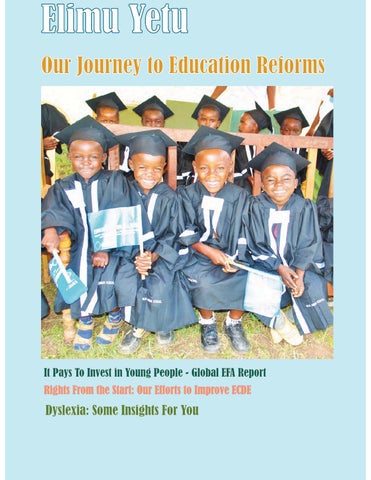
Elimu Yetu Our Journey to Education Reforms
It Pays To Invest in Young People - Global EFA Report Rights From the Start: Our Efforts to Improve ECDE
Dyslexia: Some Insights For You
Who are we? EYC is the national coalition established in 1999 a national platform for civil society organizations, professional groupings, education and research institutions and other non state actors in Kenya’s education sector to lobby for the implementation of EFA goals as articulated in the Jomtien Declaration and Dakar Framework of Action. Currently brings together over 100 CSOs actively involved in efforts to domesticate the Jomtien Declarations and other related global conventions for the attainment of quality basic education for all in Kenya. Membership is bound to increase the coalition receives and process new applications. applications. Mission: To infuence, facilitate and promote best practices that will ensure provision of quality education for all in Kenya. Vision EYC is guided by a vision of a literate Kenyan society that values and practices democratic ideals which promotes cohesion in diversity for sustainable development. Overeaching Goal: To facilitate the provision of quality education for all people (children, the youth and adults) in Kenya through enabling member CSOs to effectively implement its campaigns. Campaign Agenda: To influence policy shift towards a sustainable education system that is appropriate to the aspirations of the people of Kenya. -To build a strong movement with very clear direction and targets around EFA goals. - To champion the cause of education from a rights-based perspective so as to ensure it is accessible to all citizens, with particular regard to vulnerable and excluded groups. - To advocate and lobby the government, donors and other key stakeholders to achieve effiency and effectiveness of the education in Kenya.
“Campaigning for Quality Education for all in Kenya”
- To campaign for gender parity in all education programmes, and in particular ensure that girls and women have equal opportunities to participate in education.
Our Core Values In working to achieve her mission, vision and objectives, EYC is guided by a commitment to the following core values. i. Participation and inclusion of all. ii. Honesty, integrity and good governance. iii. Non-discrimination. iv. Competence, meritocracy and professionalism. v. Equity, fairness and justice for all. vi. Promotion of a culture of collaboration and networking. Organisational structure General Assembly (GA): Meets once every year (with provision for Special meetings) and brings together all EYC members to make policy and programme decisions. The Assembly is the overall decision making organ of EYC. Board of Trustees: This is the legal custodian of EYC; from where the Coalition draws its mandate. The Board works very close with Ex-COM to offer advisory support where needed. Executive Committee (Ex-Com): has supervisory and executive authority over all the affairs and activities of the coalition and meets once every month. Secretariat: headed by the National Campaign Co-ordinator who coordinates all the activities of EYC and is in charge of the day to day running of the coalition. Secretariat: Co-ordinates all activities EYC including those of Ex-Com, outposts and thematic networks.
Key Contents Global EFA Report p.4 - 5 Our Education Reforms Journey p. 6 - 14 Rights From the Start: Tetea Chekechea p. 15 - 16 Dyslexia Awareness p.19 - 22 Digitizing Academic Content: The Elimu TV Channel p. 23 Opinion: Good Governance and Education Reforms p. 8 Opinion: The Dying Reading Culture p.24 Children Rights - They Have a Right to Play p. 17
Welcome to EYC Elizaphan Wainaina joined us in July as Finance & Admin Officer. He holds BBM (Finance). Karibu!
Make Varsity Education Affordable to All p.25
Snapped... Opinion: A Dying reading culture
EYC National Coordinator Janet Muthoni Ouko, flanked by Campaigns Manager Joseph Wasikhongo (right) and legal scholar Dr. Eusebio Wanyama in a press conference regarding the September teachers strike
A word from the National Coordinator CAN you imagine a child having to report to school every school day for eight years and that child cannot read? It will take government, parents, communities, teachers, and partners, working together to enable our children to read. Reading is a basic skill that the child uses to learn other subjects and survival skills; The issue of language policy is something about which the government needs to provide urgent policy guidance. Research shows that children read and comprehend better if they learn in the language they speak at home from their first day in school. However, this is not always easy to implement. A few pertinent Issues on language: • Protecting and sustaining our beautiful languages and our identity/culture as recognized by the Constitution; • How do we achieve this while working to unite Kenyans as one nation and to avoid the repeat of 2008 ethnic-related post election conflict? • What do you do with parents and teachers preference for English at the expense of other languages;
not to mention the examinations is in English; all argue that if the language is not examinable and the examination itself is in other than the mother tongue, it is a waste of time to learn in the latter; • Consider too that our teachers are not trained to teach mother tongue and there are few or no written school level materials for some languages; teacher training colleges are national in terms of intake, so what vernacular do you teach in a given college? All 42? At what cost? • One would have to reorganize the teacher training model: Is GOK thinking about this? I have not seen it in any of the reform documents. This is a challenge not only for government but for all stakeholders, including private book publishers. The school book development and selection policy would need to change.
-
Muthoni-Ouko
Educating girls yields more benefits to the society FINDINGS from various sources including Worldbank and UNICEF indicate that investing in girls and women generates more benefits to the society. Educated Girls generate income for their family and countries: A World Bank study reveals that every 1 percent increase in the proportion of women with secondary education boosted a country's annual per capita income growth rate by about 0.3 percentage points. Educating girls and women improves democracy and women's political participation : Educated women are less likely to be vulnerable to domestic violence, traditions like female genital mutilation and discrimination at home, work place or in the society.
Educating girls and women saves children's lives: Educated women are less likely to die in pregnancy or childbirth and more likely to send their children to school. If mothers have a primary school education, the mortality rate for their children under 5 is halved Educating adolescents and young people is critical for development: Secondary and higher education, especially for girls, provides high returns for poverty reduction, economic growth and reproductive health. Enabling young couples to choose when to marry and have children leads to smaller families, slower population growth, increased productivity and rising incomes.
IN THIS issue, we take a critical look at education reforms in Kenya. Elimu Yetu has been active in championing for the reforms and we are glad that progress is being made. Parliament passed the KNEC and TSC bills . Other bills touching on education are at advanced stages. We are also focusing on EFA Goal One - Expansion of early childhood care and education by highlighting the launch of the Rights From the Start project . You will also find information on dyslexia useful especially Jane Akinyi’s story of how she remained determined to achieve her dreams despite being dyslectic. The story serves as a good lesson to us: that we can make it in life regardless of our various limitations.
Contributors Janet Muthoni, Joseph Wasikhongo, Catherine Asego, Fayel Akinyi, Phylis Munyi, Phillip Odete, Jane Muruiki, Raphael Obonyo , Dr.. Pamela Kola Editing, design & photography: Silvano Ateka Share your story It is always great to hear from you. Please, feel free to contribute your stories and photos. Let us know what is happening around you. Email us: info@elimuyetu.net For more information about us, visit our website www.elimuyetu.net
You can join us too... Here are the benefits of being an EYC member: 1. If your interest and passion is Education, then you will feel fulfilled because Elimu Yetu coalition is The National platform for Civil Societies that works towards the achievement of Education for All (EFA) goals in Kenya. 2. You will be a member of a County Education Network (CEN) whereby together with others you will be in a position to attain widespread reach in the community in terms of extending the objectives of your organization 3. Your credibility status as an organization will be boosted by virtue of being a member of EYC. As you know this is important when it comes to resource mobilization 4. You will be part of a network whereby you will have the opportunity of sharing and exchanging information 5. As a member of a county Education network you may be part of a group that can benefit from technical support from Elimu Yetu or Partner(s) and occasionally benefit from capacity building initiatives of EYC.
6. You will attend an annual national Conference on Education whereby you and likeminded individuals and organizations will have the opportunity to deliberate on Education Issues at the National level. 7. You will be part of the General assembly (GA) of Eli mu Yetu which is the top most Decision making organ of the organization. In fact all your subscription and membership fees go to organizing the annual GA. 8. As a member you will be given an opportunity to nominate a Chairman and a committee member of the Executive committee of Elimu Yetu during Election periods (comes after three years). You might even choose to vie for an elective position within the Coalition. 9. As a member of a CEN You might be involved in a number of activities including resource mobilization 10. You will receive the latest Policy Documents in the Education Sector
EFA Updates: invest more in the youth for increased returns Financial aspects of education It is important to ensure that the youth are empowered with necessary skills in order to achieve their goals – that is the key message from this year’s Education for All Global Monitoring Report Youth and Skills: Putting Education to Work that was launched recently at by UNESCO. “More needs to be done to reach young people at risk of leaving school early by making education more relevant to the world of work, such as through apprenticeships.” Pauline Rose, Director of the Education for All Global Monitoring Report, in a press release. The report estimates that about 200 million youth graduate from learning institutions without adequate skills to make them contribute effectively to society.
The report emphasizes possible yields from investing in education and training for young people. It indicates that such investments are smart moves for countries seeking to boost their economic growth - that every US$1 spent on a person’s education, yields US$10-15 in economic growth over that person’s working lifetime. The report also calls on donors to sustain support to the education sector in order to ensure that young people adequately prepared for the labour market. According to the report, total aid decreased by 3% in 2011.
A further 71 million are not attending school hence missing out on future employment opportunities. The report indicates that this does not only jeopardize economic growth and social cohesion, but also leads to growing frustration among youth. Slow Progress . The report further indicates that there is a slow progress towards
Students celebrate KCSE results:millions of young people graduate from learning institutions without adequate skills to make them contribute effectively to society.
achieving most of the EFA goals. Most countries will – like adult literacy, universal primary education, which, according to the report; will miss the 2015 target. EFA Goals 1. Expand early childhood care and education 2. Provide free and compulsory primary education for all 3. Promote learning and life skills for young people and adults 4. Increase adult literacy by 50% from 2000-15 5. Achieve gender parity by 2005, gender equality by 2015 6. Improve the quality of education
However, the issue is more complex than just putting money on the table. Ensuring that the money is spent efficiently, and making education a priority for aid agencies, is just as important. The report continues that the issue of education, skills and youth is not only having an impact on Millennium Development Goal (MDG) 2 – universal education, but is also closely connected to the other MDGs. MDG1 (to end poverty and hunger), for example, includes the target of full and productive employment and decent work for all.
Summary of Recommendations Moreover, upper secondary curricula should provide a balance between vocational and technical skills, including information technology (IT), and transferable skills, such as confidence and communication skills, which translate easily to the work place, the report states. Furthermore, the report claims that any post2015 development goal for skills development should be more precisely defined and measurable than some of the current goals. For example, there is no consensus on exactly what constitutes progress in EFA Goal 3 (equitable access to appropriate learning and life skills programmes). The report argues that agreeing on a coherent set of indicators that are comparable across countries is necessary in order to measure progress. The report, a mix of evidence-based research, analysis and recommendations, outlines ten important steps to support skills development for young people:
Report Highlights Goal 1 Early childhood care and education is improving but from a low base in some regions. - Child mortality rate fell from 88 per 1000 live births - in 1990 to 60 in 2010, although this rates are insufficient to meet the target of 29 by 2015 Many children do not receive pre-primary education. In low income countries, only 15% accessed early childhood education Goal 2 - On the current trends, the target of universal primary education will be missed. With the 2015 deadline drawing closer, only twenty nine countries have a net enrollment ratio of less than 85%. - Dropout remains high in low income countries Goal 3 • Millions of young people face life without foundational skills that are essential to earn a living • Despite a global increase in enrollment, low income countries are experiencing low enrollment rates at 52%.
1) Provide second-chance education for those with low or no foundation skills; 2) Tackle the barriers that limit access to lower secondary education; 3) Make upper secondary ed ucation more accessible to the disadvantaged and improve its relevance to work; 4) Give poor urban youth access to skills training for better jobs; 5) Aim policies and programmes at youth in deprived rural areas; 6) Link skills training with social protection for the poorest youth; 7) Make the training needs of disadvantaged young women a high priority; 8) Harness the potential of technology to enhance opportunities for young people; 9) Improve planning by strengthening data collection and coordination of skills programmes; 10) Mobilize additional funding from diverse sources to meet the training needs of disadvantaged youth. The EFA Global Monitoring Report is developed annually by an independent team and published by the United Nations Educational, Scientific and Cultural Organization UNESCO. - Many drop-out adolescents live in third world countries Goal 4 - Most countries will miss this goal by a big margin. - Globally, adult literacy rates have increased over the two decades, from 76% in 1985 – 1994 to 84% in 2005 – 2010 - The world is not in a position to eradicate illiteracy by 2015 or anytime soon – youth illiteracy stood at 90% in 2005 – 2010. Goal 5 Convergence in enrollment between boys and girls has been one of the most successful of the EFA goals. - International learning assessment indicates that girls perform better than boys in reading at both primary and secondary school level, with boys having an advantage in mathematics. Goal 6 - Millions of school going children do not learn the basics (out of 650 million children of primary school age, over 250 million do not reach grade 4. - A significant proportion of teachers remain untrained
EDUCATION REFORMS: OUR LONG JOURNEY TO SUCCESS By Joseph Wasikhongo The journey of Education Reforms in Kenya cannot be described without mentioning the Launch of Vision 2030 and the Promulgation of the Constitution of Kenya (2010). Vision 2030 is Kenya’s Blue Print for Development covering the period 2008-2030 and was Launched by His Excellency the President of Kenya Mwai Kibaki on the 10th of June 2008 while the Promulgation of the Constitution of Kenya (2010) marked a new dawn for Kenya providing opportunities for structural and systemic changes in the Country. Two Education Sector Task forces formed in the aftermath of these two great events aligned their work to them. In January 2011, The then Minister for Education Professor Sam Ongeri established a Task Force led by Professor Douglas Odhiambo to review and align the Education and Training Sector to the Constitution(2010).
EYC has also been engaging with County Education Networks to update them on Education reforms as well as to get additional input on the same. The organization has also been part of many consultative processes and meetings with regards to Education Reforms including Ministerial and Donor consultative meetings. Our quest for education reforms received a major boost in August 2012 when the Cabinet under the Chairmanship of the His Excellency the President passed 8 Bills and a policy framework for education and training. So far out of 10 pieces of Legislation, two Bills have already gone through the parliamentary process and received subsequent assents from His Excellency the President hence becoming Law. We have Two Acts of Parliament namely the TSC ACT, 2012 and the KNEC ACT, 2012.
Janet Muthoni-Ouko makes a presentation at a workshop on education, training and research for reforms for MPs that was partly sponsored by EYC in July 2012
The Taskforce was launched on the 2nd February 2011 and presented its Report in the month of February 2012. In the Month of September 2011, The Minister for Higher Education, Science and Technology established a taskforce to align the Higher Education Science and Technology Subsector with the Constitution. This task force which was led by Professor David Some was launched on 28th of September 2011 and presented its Report in March 2012.
A National Delegates Validation conference was organized in the month of March between the 26th and 29th to discuss education reforms and mapping a Way forward. The conference delegated analyzed the Report as presented by the Professor Douglas Odhiambo led Taskforce that has been critical to the development of key Bills and an Educational Framework aimed at reforming the Education Sector.
Participants pose for a group photo during the Naivasha workshop
By the time Parliament adjourned in October 2012, The following Bills were at various stages in Parliament • Basic Education Bill 2012, awaiting third reading in Parliament • TIVET Bill, 2012, awaiting second reading in Parliament • University Bill 2012, awaiting second reading in Parliament • Science, Technology and Innovation Bill, 2012, awaiting second reading in Parliament. The Kenya Institute of Curriculum Development Bill (KICD) 2012 has been gazetted and is available at the Government Printers at Cost. The sentiment on the pace of Education reforms has been mixed. Whilst some stakeholders are satisfied with the pace at which the reforms has been happening others are of the opinion that the pace has been quite fast hence denying them the opportunity to input in some of the pieces of legislation. It is encouraging that the Parliamentary Committee on Education gave an opportunity for stakeholders on Thursday 1st November 2012 to present their views or grievances on it in preparation for continued debate once Parliament resumes. Stakeholders in the sector were also disturbed when an industrial strike by teachers hit the sector in the month of September. This slowed down the pace of Education Reforms since energies of key stakeholders were expended in the direction of trying to bring the strike to an end.
The recess of parliament and the next general elections could prove to be a major impediment to the progress and gains so far made in the sector. Parliament recess before approval of the draft bills will slow or lead to the postponement of the enactment of reforms in the sector, until the next administration. As EYC, we encourage all stakeholders to support reforms within the Education sector as a framework for upholding the Right of a child to Education as well as a foundation to develop skills and competencies that Kenya Vision 2030 requires for its realization. EYC equally hopes that the reforms in the sector will stimulate active citizen participation in the sector including demanding for integrity and accountability. Throughout the process, in the spirit of a key constitutional principle of participation, efforts have been made to ensure CSO participation in the Bill development process. For instance, in the month of June 2012, Elimu Yetu Coalition organized a National conference whose theme was Education Reforms. Delegates drawn from CSOs across the Kenyan Counties, Lawyers, Journalists , Academicians, Ministry officials from both Basic and Higher Education came together to thoroughly interrogate the Bills and provide input. The Result was a conference communiqué that provided suggestions for amendments to the existing Bills. - Joseph Wasikhongo is EYCs Campaigns Manager
EDUCATION REFORMS: Good Governance is Key to Progress in Education Sector By Philip Odete Good governance respects the right of the child to education. It also guarantees a globally competitive quality education. No matter how many times we review and reform the education sector, our efforts will remain futile without due attention to good governance. Conversely, bad governance impedes sustainable development and access to education services. It also cripples efforts around poverty alleviation and equalization of opportunity.
Audit reports have to be authorized by the head of schools audit at Ministry headquarters. In addition, authorized audit reports are sent to institutions to be discussed by respective governance bodies. As a result, the reports get back to the institutions a little too late for any meaningful corrective measures to be taken by respective management teams.
Different reports as well as distinguished scholars have argued that good governance brings with it incredible range of benefits. These benefits include prudent management of resources both material and human, equality, transparency and accountability where deliver of benefits and opportunities is concern and inclusivity in decision making and delivery of services that fulfill the right to education. With the promulgation of the Constitution on the 27th August 2010, it became clear that education is not just a necessity but also a basic human right. It has even been further argued that education is not only a right but also justice for the child. The constitutional guarantee therefore ensures that education remains a national responsibility. However, the management and distribution of resources to the sector is should considered as a key issue to be focused on - considering that the sector is among the heavily funded sectors in the country. For sustainable development and improved access to education, resources must be managed prudently. But when they fail to meet their intended objective, they cripple education service delivery and compromise efforts towards attaining national and international development goals. The taskforce report on education (March 2012), raises concerns over the way institutional finances are audited. The report states that account are audited by school auditors based at the district, provincial and national levels.
The new constitution ensures that education remains a national responsibility. Photo: sourced from the Internet
What makes the situation less satisfactory is the fact that most institutions (particularly primary and secondary schools) lack bursars/accounts clerks. Other institutions have employed finance staff with questionable qualifications, making it difficult to raise questions in cases or events of misappropriation of funds. Bad governance in this context is therefore synonymous with under performance, poor financial management and misappropriation, high staff turnover and infrastructural deficits among many other challenges. To secure good governance in the education sector, we should therefore involve all stakeholders at all levels. Governance is not simply a question of structures, it is also about policy and processes that move towards the energies of their people. - Philip Odete works with Transparency International Kenya under the Education Governance Project
EDUCATION REFORMS Timeline July 5th-6th 2012: Naivasha Parliamentarian retreat, Education Reform Capacity building for selected Parliamentarians 14th August 2012: Parliament passing the TSC Bill 16th August 2012: The cabinet approves key Education Bills and Policy Framework for Education and Training 28th August 2012: His Excellency the president assents TSC Act hence becoming law 9th October 2012: Parliament Passes the KNEC Bill Parliamentary Select Committee on Education Chairman David Koech chats with some of the participants during a workshop on TSC and Education Bills in Limuru
10th October 2012: Forwarding of the Learners with Disabilities Bill, 2011 to the AG for consideration and fast tracking to Parliament for possible enactment
June 10, 2008: Launch of Vision 2030, Kenya’s blue print for development covering 2008-2030 by his Excellency the President of the Republic of Kenya. 12th October 2012: President Assents the KNEC Act August 27th 2010: The promulgation of the Constitution of Kenya(2010) which marked a new dawn for Kenya January 2011(est), launch (2nd February 2011): Minister of Education establishes a Task Force Establishment to review and align the Education and training sector to the Constitution(2010) and Vision 2030 led by Professor Douglas Odhiambo. Established on 14th and launched on 28th September 2011: Minister for Higher Education, science and technology establishes a Task force to align the Higher Education Science and technology subsector with the Constitution. Task Force led by Professor David Some. March 26th-29th 2012: Education Task Force National Delegates Validation Conference to discuss education reforms, critical analysis of the report(Professor Douglas Odhiambo) and mapping a way forward. May 2012: Cabinet approval of the TSC Bill 13th -115th June 2012: National CSO Conference organized by Elimu Yetu Coalition the theme of which was Education Reform
Higher Education Minister Prof Margaret Kamar and Parliamentary Committee on Education Chairman David Koech during the MPs Workshop on Education Reforms in Naivasha.
9
National Stakeholders Conference on Education Reforms
1 2
KNUT Chairman Okuta makes a point
4 3 A participant - Mathews Khalumi makes a contribution
5
The Conference which was sponsored by EYC brought together stakeholders to deliberate on key reforms in the education sector in the country. It was held at Kenyatta Conference Center (KICC) from March 27th - 29th, 2012. In this photo, Education Minister Mutula Kilonzo, Higher education minister Prof. Margaret Kamar, Former education PS Prof James Ole Kiyiapi and Gwasi MP John Mbadi pose for a photo with students during the event. Other Photos: Janet Muthoni-Ouko with a delegate (1), KNUT oďŹƒcials (4), civil society representatives (2,3 & 5)
Stakeholders Workshop on Education Reforms
Our Reforms Journey in Pictures
1
2
3
4 6
5
7
The Conference which hich was sponsored by EYC brought togetherr sta stakeholders deliberta ake keho hold ho lder ld erss to d er del elib el iber ib er-er David Koech ate on key reforms in the education sector the e ed e duc2: ati at tio iHon ion on se ctor ct tor iin n th he (right) with KUPPET Chairman Mr. country. It was held a att K Kenyatta Conference enyatta Okwemba Milemba. Center (KICC) from March arrch 27th - 29th, 2012. In Manager Mr Joseph Wasikhongo & 3 :EYC’s Campaigns this photo, Education Minister Minister Mutula Kilonzo, some of the participants (1 , 5 &7 ) Higher Education Minister Min nister Prof. Margaret Hon Koech Kamar, Former Education atio on PS4.Prof. Jamesposes Ole for a photo with the participants 6: Hon Koech addressing participants Kiyiapi and Gwasi MP pose for a P John John Mbadi photo with students during urring the the event.
Education Assist. Minister Prof Ayiecho Olweny Former Education PS Prof James Ole Kiyiapi
Mr. Dalmas Otieno, TI-Kenya
Higher Education Assistant Minister Prof Kilemi Mwiria
Mr. Akello Misori , Secretary General (KUPPET)
Mr. Boaz Waruku (ANCEFA) with EYC National Coordinator Janet Muthoni-Ouko
Susan Bukoshe Ombunya, Director, Balm Kenya Foundation displaying her of membership to EYC.
Mr. Andiwo Obondoh (chairman, EYC board Of Trustees)
Mr Daniel Wesonga addresses participants after being elected EYC chairperson
EYC’s Ms Magdalene Kerubo assists a participant during the conference
The conference which took place from 13th 15th June at The Kenya Institute of Education headquarters in Nairobi was organized by and attracted over 200 participants. It focused on taking stock of education reforms in the new dispensation and setting standards of reforms implementation within the proposed new structures as we count down to 2015 EFA targets. During the Annual General Assembly that was held at the same venue on 16th June, Mr. Daniel Wesonga was elected as the new chairperson for the EXCOM. Other new organizations represented in the EXCOM include Transparency International, World Vision, Kenya Alliance for the Advancement of Children rights (KAACR)and Balm of
Our Reforms Journey in Pictures
The 4th CSOs Conference 2012
A participant making a contribution during the plenary session
A member of the media team covering the event
The Naivasha Retreat: MPs and Stakeholders Pledge to Support Education Reforms
THE OVER 40 MPs and other stakeholders agreed to support education reforms by ensuring that the bills and policy papers are passed by parliament and cabinet.
The MPs and stakeholders convened at the Great Rift Valley Lodge in Naivasha from 5th to 6th July 2012 to provide their input on Education and Training Policy Framework, Science and Technology and Innovation framework, the Basic Education Bill, Kenya National Examinations Council Bill, Kenya Institute Curriculum Development Bill, Universities Bill, Kenya QualiďŹ cations Framework Bill, Science, Technology and Innovation Bill.
Prof. Kamar shares a word with Hon. Mutula Kilonzo as Prof. George Godia, PS; Ministry of Education (center) looks on
Some of the MPs who attended the event include:
Ho Dr. Otieno Kajwang
Hon. Martin Ogindo
Hon. Hussein Sasura
Hon. John Mututho
Hon Dhadho Ghodana
Gwasi MP John Mbadi
Dr. Wilber Ottichillo
Hon John Kizito
On David Noggin
‘TETEA CHEKECHEA’ – RIGHTS FROM THE START PROJECT By Catherie Asego ‘Tetea chekechea’. This was the slogan that took centre stage during the recently launched ‘Rights from the start’ project which is a partnership between UNICEF and EYC. Despite being goal number one among the Dakar Frame work for action board ECDE remains one of the most neglected goals. The colourful launch was held at the Panafric hotel, Nairobi and was presided over by the Director of Quality Assurance and Standards in the Ministry of Education, Mr. Mohamed Mwinyipembe. The event was graced by civil society organisations working in the ECDE sector and technical officers of political parties in Kenya. Samwel Gitonga, a young ECDE learner from Humble Hearts school in Nairobi’s emphasized on the need for Early Childhood Education to be taken seriously. The goal of the project is to champion for increased investment in Early Childhood Development and Education for improved access to quality education. The project objective is to work on increasing awareness on the importance of ECDE among the political class for favourable policy and decision making. The project targets the poor Kenyan children who have no access to quality ECDE. T
Samwel Gitonga, a pre-school learner from Humble Hearts school reciting a poem on the importance of Early Childhood Development Education.
Through the project, Elimu Yetu Coalition shall be
engaging the executive officers and technical officers of political parties’ with an aim of increasing awareness on ECDE so that ECDE can be part of the political party manifestos.
Natetea Chekechea . Na wewe je?
In addition to this, we hope to take advantage of this electioneering period to have one on one meetings with political aspirants to lobby for their buy in into the ECDE messages and use ECDE advocacy messages as a rallying tool amongst the electorate. Top on the ECDE agenda is championing for increased budgetary allocation towards ECDE. In FY 2012/2013, the total budgetary allocation to education sector was 233.1 Billion of which 1.6 billion was allocated to ECDE sub sector.
Ms Irene Mbivya, a technical officer from KANU making remarks at the launch
Secondly, Elimu Yetu Coalition seeks to strengthen partnerships with other stakeholders to implement all laws touching on ECDE. Also, we seek to ensure children from poor households have access to quality ECDE.
Rights From the Start... The launch of the ‘Rights from the start project’ marked the beginning of a long journey whose finish line shall ensure that our nation has the ability to foster health and well being of the next generation- given today’s children will become tomorrows’ citizens, workers and parents. - Catherine Asego is the Campaigns Officer, EYC Catherine Asego g ((right) g ) with Joseph p Wasikhongo g at the event
Advancing the Rights From the Start Agenda
Balm Kenya Foundation’s initiative
By Silvano Ateka/EYC Clad in graduation regalia, young graduants wait impatiently to receive ‘power to read and write’. It is a graduation ceremony in the remote Emuhando ‘A’ village in Kakamega County where over fifty children graduated from a Balm Kenya Foundation sponsored nursery school.
Mr Bwana also hailed Balm’s efforts to improve the quality of ECDE in the area: “Let the Balm of Kenya Foundation nursery be the center of excellence in this region.” He said. The organization relies on support from EYC and wellwishers to provide free quality education to needy children in the area.
Mr. Bwana with one of the graduants
The event which took place on 19th November 2012 was graced by the County’s Education Director Mr. Arita Bwana who urged the comm unity to invest in education, especially at foundational level.
Right To Play By Dr. Pamela Kola
The UN Convention on the Rights of the Child (UNCRC), the most widely and rapidly ratified international treaty in the history of the world is a standard against which a nations treatment of the children can be measured. It was officially approved in !989 and all countries (194 ) except two have signed. Kenya signed in 1990. The child’s right to play, leisure and recreation is set out in article 31 of UNCRC which states:-
State Parties recognize the right of the child to rest and leisure, to engage in play and recreational activities appropriate to the age of Dr. Kola the child and to participate freely in cultural life and the art. The convention has led to great improvements in policies, programs and services contributing to children’s protection and promoting greater respect for their rights. However, in spite of the wide spread recognition of the Convention, extensive research demonstrating the importance of play in human development reveals that the right to play is not receiving the attention it deserves. Of the article 31, emphasis has not been placed on the right to play as it is one of the least understood, least recognized rights and consequently one of the world most consistently ignoredtoday.
children playing
To save this situation, there is a campaign throughout the world based on reports submitted by State Parties to the UN Committee on the Right of the Child, based on research and consultations of the status of play in countries which had signed and ratified the Convention. In Kenya this campaign is being spearheaded by Centre for Research, Communication and Gender in Early Childhood Education(CRECHE). The launch of the campaign was in 2010; officiated by the then Permanent Secretary for the Ministry of Gender, Children and Social Development, Dr. James Nyikal. Some of the most widespread and generalized barriers to the child’s right to play here in Kenya can be summarized as:
- Pressure of work at home and school - Lack of play space and equipment - Unsafe environment - Child laborLack of awareness - Poor planned urban settlement - Displacement - Discrimination CRECHE is working with a number of organizations and development partners to create awareness of the right of child to play which should be better understood if integrated into the general movement toward children rights, international treaties, goals and protocols, national policies, acts and the new constitution. A country with so many barriers to play is hardly a “Nation Fit for Children.” The government has signed a number of conventions, protocols and has formulated a number of policies which should help remove some of the barriers. Children should not be made to wait until all the circumstances improve before they can reclaim their childhood and enjoy their right to play. The right to play belongs to them. “Let Children Be Children.”
Dr.Pamela Kola is the Executive Director, Centre for Research, Communication and Gender in Early Childhood Education CRECHE). She is also the Vice President-International Play Association (IPA) and Africa Region Representative.
Adult Education Forum for NFE/ACE The role of ACE in the education system was emphasized. It is a lobbying tool that will catalyze discussions and advocacy on the need for increased support to the ACE and NFE at policy review, implementation and funding levels.The keynote address was delivered by the head of the Directorate of Adult and Continuing Education at MoE Mr. I.N. Kinara. The General Secretary of Bible Translation and Literacy (BTL), Mr. P. Munguti underscored his organization’s role in the development of Orthography of many languages of Kenya. The Forum was the brain child of the Technical Working Group on ACE (TWGACE) –a think tank on NFE/ACE composed of the key CSOs in the sector, KIE and the University of Nairobi under the chairmanship of the Director for ACE. Mr. Matheka
By Joseph Matheka A forum for CSOs working in the field of Non Formal Education (NFE) / Adult and Continuing Education (ACE) took place on 24th May 2012 at the Kenya Education Management Institute. A total of 38 organizations were represented bringing together 62 participants. The objective of the meeting was to take stock of the status of NFE/ACE in Kenya and share the best practices. The forum provided a unique opportunity for various actors in the ACE and NFE sector to interact and make concrete recommendations. The outcome of the meeting provided the necessary roadmap for the various stakeholders in the improvement of ACE. Stakeholders were drawn from CSO, universities and SAGAS in the education sector. Various presentations were made to facilitate the deliberations by the participants. Key among them were representatives from; BTL, DACE, KIE and a representative from the Association for Development of Education in Africa- ADEA. EYC was represented by the then Chair, Joseph Matheka, the Director of PALM (Partners in Literacy Ministries) .
What does Vision 2030 beckon into our minds? By Silvano Ateka
Flagship projects like Tatu City and Thika Super highway or technological labs like the ihub? Are children involved in the planning of the Vision’s projects? The Workshop “Children and Vision 2030” that was organized by Children's Legal Action Network (CLAN) at the NairobiSafari Club last week sought to clarify how the Vision affects children. It was established that there is limited consultations and participation of children in national and county development agenda. That experts do not seek views of children on issues affecting their communities and also in the development and implementation of vision 2030. A detailed way forward and proposals for Kenya Vision 2030 process for the children sector in the long term was therefore suggested and some ideas explored. Workshop participants also suggested that interested CSOs should link with Ministry of Planning and Vision to discuss and explore opportunities for resource sharing to support the Vision’s plan process especially at County level.
As a river follows its course: Jane Akinyi s Story By Fayel Akinyi
When Jane Akinyi was diagnosed with dyslexia at age 5, neighbors regarded her as ‘crazy’. It was predicted that she would end up in a bedlam. Now at 25, she has defied the odds to become a professional hairdresser and beauty therapist. She is also enlightening her community about her condition. Through performing arts, she is able to create awareness about dyslexia – thanks to Kenya Association of the Intellectually Handicapped (KAIH) whose aim is to empower persons with intellectual disabilities. Journey to Success As she talks about her plans to start her own beauty Out of the Closet While Jane plans to open her beauty shop soon in the city, the doors of opportunity are being shut for many children across the country. Out of ignorance, many parents are hiding them in the closet for being ‘mentally retarded.’ The community is also ignorantly looking down upon them as a crazy bunch. As Jane’s story reveals, dyslectics human being like all of, endowed with special gifts that should not be measured with an academic yardstick alone. shop, her smile radiates confidence. It also depicts her journey to her success as long and arduous. Like many dyslectics, Jane has endured many challenges. She spent many years in school – her report card indicating that she was not living up to her potential. She was forced to endure the insults at her. Yes – her inability to keep pace with other pupils at schools earned her a barrage of insults. She was called ‘stupid’, crazy, mentally retarded and so on. “Life in the special school was not good for me. I had to ask my mother why I was taking long in school while my younger siblings kept moving ahead.” She says. It was a lesson well learnt. Jane was not gifted academically. Her dream was not to scale academic mountains up to the summit! She did not yearn to become a doctor or a lawyer. Though ‘stupid’ as she was commonly regarded, she still possessed a potential excel in life.
Jananene Akikinynnyi’yii’’ As a River Follows its Course However, as a river follows its course, Jane was determined to accomplish her dream. She was beautiful. She wanted to become a ‘beauty specialist’. Having undergone painful moments as a result of her condition, she also wanted to educate people about it through performance arts. Out of the Closet As Jane plans to open her beauty shop soon in the city, the doors of opportunity are being shut for many children across the country. Out of ignorance, many parents are hiding them in the closet for being ‘mentally retarded.’ The community is also ignorantly looking down upon them as a crazy bunch. As Jane’s story reveals, dyslectics human being like all of, endowed with special gifts that should not be measured with an academic yardstick alone.
About KAIH Doing what she loves best: Jane and her colleagues perfoming a play during CSOs EFA conference at KIE The Kenya Association of the Intellectually Handicapped (KAIH) KAIH is a nonprofit organization aimed at empowering persons with intellectual disabilities (PWIDs) and their families, we want to restore the hope that the families and the PWIDs have lost and show them that with support they are capable of a lot. KAIH wants to promote the human rights of PWIDs and their families within the society through education, advocacy, and empowerment and information exchange. We work in 6 counties namely; Nairobi, Migori, Siaya, Kiambu, Mombasa and Nyeri.
We are a family based organization working towards promoting the full inclusion of PWIDs and their families in the society. We have various programs, under our education project we advocate for the full inclusion of PWIDs in the mainstream schools. To learn more about us, you can pay us a visit at Mtindwa Apartments in Umoja, off Moi Drive or visit our website: www.kaihid.org for details.
Did you know that…. Dyslexic people are highly creative, intuitive, and excel at three-dimensional problem solving and hands-on learning? That dyslectic people can excel in academics – they can read and write efficiently? PHOTO: KAIH National Coordinator Ms Fatma Wangare , (left, backrow) with some of the dyslectic persons that her organization is assisting.
Dyslexia - Creating Awareness
So what is dyslexia?
By Phylis Munyi Dyslexia is learning difficulty that is a neurological, often genetic, disorder which interferes with processing language. Children with dyslexia have problems with decoding words, blending letters, reading fluently, reading orally, and comprehending what they have read. It is the most common cause of reading, writing and spelling difficulties, affecting 10-15 percent of school going kids.
Martin
October is the Dyslexia awareness month world wide. Dyslexia Organization, Kenya marked the day by having a Kids Fun Day Event on October 27th, 2012 at the Upper Hill Springs Playground. Among the many children who participated to mark the day was the 15 year old Martin from Rare Gem Talent School in Kitengela. Martin like many other children from Rare Gem Talent School is dyslexic. Ordinarily Martin would be in class 8 or form 1. However, his condition has forced him to repeat classes, what earned him ‘nicknames’ such as ‘slow learner, stupid, daft and so on. The insults made him to detest school. Even his parents were about to give up on him. They had done everything within their ability to give their good education but all seemed to be in vain.
Dyslexia is not a disease and shows no physical signs. Without timely intervention, the affected individuals are at high risk of abuse and misunderstanding from peers, public and even their own family, like Martin. Commonly labeled as ‘slow learners’, dyslexic children are stigmatized at school and out of school. They are made to repeat classes and eventually drop out of school. However, through awareness and early intervention, these children attain the learning levels and succeed academically to become successful people in the society e.g. Richard Branson, Whoopi Goldberg, Tom Cruise, Winston Churchill, Will Smith, Orlando Bloom and many others. How do you recognize Dyslexia - Slow, laboured, inaccurate reading - Skipping non visual words when reading e.g. the, and, there - Phonetic spelling i.e. spelling words the way they sound e.g. nek for neck, naïf for knife, hed for head etc - Reversal of letters b for d e.g. dady for baby, doy for boy and u for n, w for m etc
Martin’s mother was surprised a program on TV seemed to describe her son’s condition. The program’s guest was talking about dyslexia – detailing what individuals like Martin were going through.
- Continuously misspells high frequency sight words (non-phonetic) but very common words e.g. they, where, when –wen,
It was a ‘stitch in time’ for her; she later contacted the guest and sought help for her son. Despite being dyslectic, he is now leading a normal life; thanks to the Dyslexia Kenya organization that is now supporting him.
- Substitutes similar looking words even when talking, even if it changes the meaning of the sentence e.g. sunrise for surprise house for horse while for white etc.
What is dyslexia org. Kenya doing? Dyslexia Organisation, Kenya is a registered organization founded by parents and teachers of children with Dyslexia. The main objective is to create awareness on this condition that causes many children suffer neglect and stigma. We hope to demystify Dyslexia and help people with dyslexia find a place in society. We network with other Dyslexia International Organisation in order to get advanced research findings about dyslexia and other learning disabilities.
Some Famous Dyslectics Albert Einstein was a German theoretical physicist, author, and is one of the most influential scientists and intellectuals of all time. He has published over 300 scientific and over 150 non-scientific works and has received several honorary doctrate degrees from numerous American and European colleges. His name “Einstein” has in modern day, become synonymous with the word “genius”.
Ludwig van Beethoven was a German pianist and composer and is one of the most influential composers of all time. He continued to compose, perform, and conduct even after becoming completely deaf.
Richard Branson is one of the most well known entrepreneurs of his time. As the founder of the Virgin Group, he has had his hand in the music industry, transportation, and telecommunications. He has also set a goal to break as many world records as possible. For more information visit: http://www.thepowerofdyslexia.com/fa mous-dyslexics/
We work with the Ministry of Education and hope to find a solution to the examining method to address this category of learners. What dyslexia is not! - It is not a visual problem - It is not a lack of intelligence - It is not developmental lag -Is not uncommon 10-15% of population is dyslexic - Is not responsive to standard reading instructions. Dyslexia need not inhibit anyone from achieving his/her full potential.
Some Quotes From Famous Dyslectics "He told me that his teachers reported that . . . he was mentally slow, unsociable, and adrift forever in his foolish dreams." — Hans Albert Einstein, on his father, Albert Einstein (His name is practically synonymous with "genius", widely regarded as the greatest scientist of the 20th century, recipient of a Nobel Prize for Physics, known especially for his "Theory of Relativity." "I never read in school. I got really bad grades--D's and F's and C's in some classes, and A's and B's in other classes. In the second week of the 11th grade, I just quit. When I was in school, it was really difficult. Almost everything I learned, I had to learn by listening. My report cards always said that I was not living up to my potential." —Cher (Famous actress, entertainer, singer)
"My teachers say I'm addled...my father thought I was stupid, and I almost decided I must be a dunce." — Thomas Edison (One of, if not the most prolific inventor of all time, holding a record 1093 patents; founder of Science journal.
22
Using Technology to Beat The 2015 EFA Deadline: Elimu TV platform By Jane Muriuki Access to secondary education has been very low in slum areas due to lack of public secondary schools and cost related aspects. To address the problem, the Network for Non-Formal Education Institutions (NNFEI) has introduced the use of video conferencing to share content especially among the schools in slum areas. With funding from Commonwealth of Leaning (COL), NNFEI has been training teachers to work on the new learning platform. The organization has also developed content for secondary schools in subjects that include: Mathematics, English, History, Geography, CRE, Business Studies, Biology, Chemistry Physics and Kiswahili. The content is accessible via the web portal - www.nnfeischools.co.ke
The organization has also been licensed by the Communication Commission of Kenya to air digital content. Last month, the organization launched the Elimu 24/7 TV Channel and Web Portal. The station will broadcast on a 24 hours program enabling working youth to study in the night. This program will also enable young mothers who dropped out of school to study at home and enroll for KCSE at their own time. Key Issues Raised During the Launch • Need to embrace Open Education Recourse (OER) because it reduces cost on content Development and it promotes sharing of public investment from a global perspective. • Governments should invest on provision of hardware and software that will enable use of technology in
This being the first platform to offer Basic Education on a TV,mobile and web Learning the Launch of Elimu 24-7 TV Channel and web portal will mark a millstone towards enabling education for all by 2015. N-NFEI has also launched a major campaign of providing TV screens and decoders to A section of the Kibera Slum: the new E-learning platform targets slum areas schools and churches in the slums. She is inviting cooperates to donate the schools. These include computers labs, captops for equipments for the program. tablets with educational content for teachers and students and Internet in all schools(Public, Private and The Use of Technology and Open Education Non Formal Schools) Recourse will reduce the cost of Providing Education for all. African Governments should • As Kenya enters to digital world in communication the work together through Commonwealth of ministry of education should provide schools with TV Learning (COL) to develop education content Screens and Decoders. that can be easily adapted for individual countries Open Schools Programs. • The Government to support ICT and use of OERs Training of all teachers to enable them effectively use technolThe platform was launched at Kenyatta Internaogy in teaching. tional Conference Center (KICC) by the Assistant Minister for Education in the presence of COL • Teachers training colleges to include ICT in the training representatives, UNESCO, Hon FT Nyammu , curriculum. The teachers colleges should also include Hon Mutava Musyemi, N-NFEI Board of DirecOER as an appropriate way of teacher’s reference for tors among other stakeholders. teaching materials and teaching Aids.
23
Opinion : The Dying Reading Culture By Silvano Ateka
History’s notable military hero Alexander the Great had another outstanding characteristic – he was an avid reader. Homer’s Iliad was his favorite. He kept it as a ‘portable treasure of all military virtue and knowledge.’ In his career as a military man, he also read other books especially plays of Euripides, Sophocles, and Aeschylus.
Students read only when it was assigned as a task. No one seems to be interested in imbibing knowledge for intellectual nourishment. Imagine reading a whole semester’s work within a few hours to exam time. Or researching and preparing a PowerPoint presentation that is a few minutes past due date. For those who fail to beat deadlines, there are many excuses. Often, it is about the computer - how it crashed just seconds before the student could ‘click on the ‘print’ icon and accomplish the task.
Students in a library: reading culture among young people is dissipating Today, such passion for reading especially among young people is dissipating. The culture of ‘cut and paste’ is swiftly replacing the studious reading process. Blame it on ‘cut and paste’ trend - young scholars are not active in public debates. Some are able to write – yet do not expose lies peddled by politicians in their votehunting missions. Only a few read passionately. To the majority, classics like Julius Ceaser and King Lear are ‘boring’. Some of them have even forgotten basic facts about their own country’ If these examples are anything to go by, then we have a good reason to pity our generation a far as advancement of scholarship is concerned. Universities are turning into places where young people only obtain good grades and nothing beneath or beyond them. Libraries are lonely place except during exam time.
Gone are the days when university students articulated key concepts in their academic province with clarity and competence. Passion and persistence. Heated debates on ideologies such as capitalism and Marxism are dead. Those days seem to have gone with the falling of the Berlin wall – as one writer posited. The young scholar is no longer the epitome of intellectual rigor. With much focus on good grades, the scholar has perfected the art of shortcuts just to color the transcript. It is seldom in his genuine interest to feed his spirit with the bread of books or quench his thirst at the wells of thought. Indeed, we are a Facebook, Google and Wikipedia generation. A ‘cut and paste generation’. Shall we really have anything substantial to show when ‘posterity will vainly ask for proof of our intellectual merit?’
Make Varsity Education Affordable To All BY RAPHAEL OBONYO Adapted from The Star, (Thursday, November 15, Although the government has made significant strides in creating infrastructure that is envisaged in vision 2030, the same cannot be said of education. Government must show its commitment by not only reforming college education system but also making it affordable to help young people acquire vital skills that are needed. Higher education is the key to most competitive jobs particularly those outlined under the vision 2030, but the government is not paying satisfactory attention to college education. A report released recently by Youth Agenda reveal that lack of access to quality education particularly at college level has been a major impediment to the growth in employment.
Although Kenya’s university have been innovative by creating infrastructure to train more students through parallel degrees programmes, the cost is prohibitive for majority of Kenyans especially those who are not working. As Kenya seeks to deal with its many challenges, higher education must be considered a priority and put at the same level as employment, food security, health and national security. There is need to expand and increase the number of universities and ensure that they are equitably localized throughout the country. The existing public university can only accommodate only 3% of the university aged population. Government must allocate more resources to higher education. The current budgetary allocation to higher education does not rhyme with what is provided to primary and secondary education creating a huge transition gap.
The study, a youth fact sheet of vision 2030,found that a significant number of young people across the country cannot afford the high tuition fees charged by universities and colleges.
Regrettably, Higher Education Loans Board (HELB) has over the years lacked capacity to cater for needy students who do not secure university education and have specialized skills that can be harnessed through tertiary colleges.
This situation is lamentable considering the existing disconnect between the ambitious projects of vision 2030 and the grim reality on the ground. Take for instance Lamu port, the biggest vision 2030 project.
It is high time HELB made fundamental changes and employ creative ways of raising revenue since the current government allocation is seriously constrained to promote sustainable development.
Maritime experts estimate that in the next 5 years, the industry will create 400,000 jobs and it is only a handful colleges offering courses related to the sector. The situation is even worse at the university level where it is only Jomo Kenyatta University of Agriculture and Technology (JKUAT) that is offering courses related to shipping. The country is wasting a huge number of potential candidates. In 2011, for instance, more than 60,000 eligible students were unable to attend university due to space limitations and the government inability to cover the cost.
Also the country must encourage private sector, Non-governmental organizations (NGOs) and Foundations to provide scholarships to needy students and support education programs. For example, companies like Equity Bank already have scholarship models that target secondary school students. Such programs need to be encouraged, replicated and extended to reach more people. The crucial role of higher education in the formulation of sound policies and national development cannot be overemphasized. As such, Kenya must enhance its efforts to expand access to higher education. Raphael Obonyo is the external advisor, UN-Habitat's youth advisory board
A participant in a community dialogue meeting in Kwale
A participant in a community dialogue meeting in Kwale
A participant in a community
IiDASA’s melany Tembo talks to participants in a community dialogue forum in Kinango, Kwale County
A participant in a community dialogue meeting in Kisii
KUPPET’s Akello Misori (center) with other stakeholders in a breakfast meeting organized
Our County Education Networks County
Contact Person
Point Organiza on
1
Nyamira County
Naomi Ondieki
Nyamira County Peoples Forum
nnyaechero@yahoo.com
2
West Pkot County
Debora Ka na
Yangat
debbiekaras@yahoo.com
3
Taita-Taveta
Agos no K. Nguruwi
COPDEC
anguruwi@yahoo.com
4
Mombasa County
Maimuna Nundu
Ujamaa Centre
nundumaimuna@yahoo.com
5
Kericho County
Joseph Kirui
KFYWP
youthwomenprogramme@yahoo.com
6
Machakos County
Jacob Ngumi
YPD
youngprofessionalsngo@yahoo.com
7
Kakamega County
Mathias Khalumi
CEEDA
ceeda2003@yahoo.com
8
Vihiga County
Angule Gabriel
IEARN
Angule2001@yahoo.com
9
Embu County
Richard Mugo
ALEED
alleedorg@yahoo.com
10
Bomet County
Cheruiyot Baliach
Natures Wisdom
ntrws@yahoo.co.uk
11
Kiambu County
Ann Wanjiru Kiara
PEEP
peepkenya@yahoo.com
12
Elgeyo Market
Kipkoech Cherambei
Chembai Farmers Block 4
kcherambei@gmail.com
13
Makueni County
Peter Ng’ola Owi
Wote Youth Dvpt Projects
pngola@yahoo.com
14
Nyeri County
Tim Kariuki
Nyeri Educa on Empowerment Project
nyerieduca on@gmail.com
15
Trans-Nzoia County
Jane Mbagaya
Save Africa
wakwoojane@yahoo.com saveafrica5gates@yahoo.com
16
Kitui County
Brigi e Kitenge
Interagency Rural Development Programme
irdp2@yahoo.com
17
Isiolo
Joseph Kalapata
Forum for Pastorist Development
ekalapata@yahoo.com
County
18
Kisumu
Chris Owalla
CIAG
Ciag-kenya@hotmail.com
Oloo Janak
Migori CLAN
williamjanak@yahoo.com
Stephen Murianka
Dopotoe-maa
gsmurianka@gmail.com
Onesmus Mmasi
MURUDEF
ommasi@yahoo.com
Anisa Menza
MEDA-
Info_meda@yahoo.com
Jeremiah Ombane
Carewell Society
jereombane@yahoo.com
Janet Muthoni
EYC
muthoniouko@elimuyetu.net
County 19
Migori County
20
Kajiado County
21
Bungoma County
22
Kili county
23
Kisii County
24
Nairobi County
25
Tana River
Frankheart Ddaiddo
TRCCCA
frankheartddaiddo@yahoo.com
26
Nakuru County
Jonathan Kimunge
Cerenet (Central Ri Educa on Network)
cerenet2010@gmail.com scepkenya@gmail.com
27
Kwale County
Daniel Mangale
ABC Project
dmangale@gmail.com
Acronyms AAK: Action Aid International ALEED: Alliance for Education and Empowerment in Development AMWIK: Association of Media Women in Kenya ANCEFA: African network Campaign on Education ANPPCAN: African Network for the Prevention and Protection Against Child Abuse and Neglect ASAL: Arid and Semi-Arid lands CDF: Constituency Development Fund Cerenet: Central Rift Education Network CIAG: Community Initiative Action groupKenya CLAN: Children Legal Action Network Coalition for the Promotion and Development of the Child (COPDEC) COMEDAF: Conference of Ministers of Education of the African Union
CSO: Civil Society Organization CIAG: Community Initiative Action Group-Kenya DFID: Department of International Development EFA: Education For ALL EYC: Elimu Yetu Coalition EXCOM: Executive Committee FPE: Free Primary Education GCN: Girl Child Network IDASA: Institute of Democracy in South Africa. JCDP: Joint community Development Project KALA: Kenya Adult Learners Association KFYW: Kenya Foundation For Youth and Women Program MEDA: Malindi Education and Development Association MURUDEF: Muma Rural-urban Development Foundation PEEP: Pride Empowerment Economic Program UBSEC: Urban Slum Basic Education Campaign
Puzzle answers
Each letter in this puzzle is represented by a number 1-26.Can you crack the code and solve the crossword? Every letter of the alphabet is used at least once. Three letters are already in place to get you started.
Elimu Yetu is an official publication of Elimu Yetu Coalition. Please, contact us to find out how you can be part of our Education Campaign family. Elimu Yetu Coalition 2nd Floor, Hillside Apartments Ragati Road, Off Haille Sellassie Avenue P O Box 24621-00100 Nairobi Tel: 0202446669 / 0715242644 Email: info@elimuyetu.net / elimuyetu@gmail.com www.elimuyetu.net