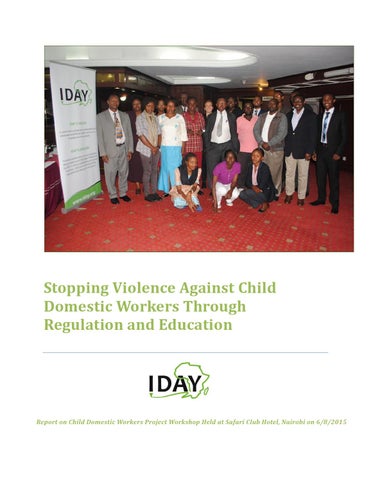
Stopping Violence Against Child Domestic Workers Through Regulation and Education
Report on Child Domestic Workers Project Workshop Held at Safari Club Hotel, Nairobi on 6/8/2015
1|Page
Contents ...................................................................................................................................................................... 1 1.1 Introduction – Project Coordinator Joseph Matheka ..................................................................... 4 2.0 Lead Consultant Dr. Pacificah Okemwa – Presentations on the Baseline Survey .......................... 5 2.1 Study Objectives.............................................................................................................................. 5 2.2 Methodology and Target Population .............................................................................................. 5 Figure 1: Site of Study ........................................................................................................................... 6 2.3 Sampling and Data Collection ......................................................................................................... 6 2.4 Study Design and Sampling Methods ............................................................................................. 6 2.5 Ethical Considerations..................................................................................................................... 6 2.6 Research Findings and Discussions ................................................................................................. 7 3.0 Lead Consultant Sylvia Randazzo Presentations on legal and policy assessment framework for child domestic workers in Kenya ........................................................................................................ 11 3.1 State of Child labor........................................................................................................................ 11 3.2 Way Forward ................................................................................................................................. 13 4.0 Group Discussions ......................................................................................................................... 14 6: List of Participants (annexe) ........................................................................................................... 20
2|Page
1.0 Synonyms
1. FKE: Federation of Kenya Employers 2. IDAY: International Day of the African Child 3. ILO: International Labor Organization 4. KUDHEIHA: Kenya Union of Domestic and Hotel, Educational Institutions, Hospital and Allied Workers 5. PALM: Partners in Literacy Ministries 6. MoL: Ministry of Labor
3|Page
1.1 Introduction – Project Coordinator Joseph Matheka Mr. Joseph Matheka (pictured), Child Domestic Workers Project Coordinator (Kenya) outlined project objectives and provided a summary of the baseline survey undertaken by PALM in partnership with IDAY through funding from European Union. He noted that Stopping Violence against Child Domestic Workers through Regulation and Education project is also being implemented in other five African countries - Rwanda, Burundi, Uganda and the Democratic Republic of Congo with similar objectives and outputs. As part of the project activities in Kenya, a survey was undertaken not only to establish the number of child and adult domestic workers in the country, challenges they face –and how to address them but also assess existing legal and policy interventions and whether they fully cover domestic workers. The survey that was undertaken in 15 counties - Isiolo, Meru, Taita Taveta, Kilifi, Kirinyaga, Kakamega, Kisii, Homa Bay, Busia, Machakos, Kiambu, Baringo, Nairobi, Uasin Gishu also focused on adult domestic workers – taking into consideration differences in locations such as rural and urban areas. Mr. Matheka noted that while children are protected from exploitation in employment by various laws and policies, the survey established a thriving industry of child domestic workers whose rights are being violated. He also emphasized that while there were cases of increasing physical violence in other countries where the study was also undertaken; focus on the Kenyan study was entirely on the array of children rights violation as opposed to exposure to physical violence. He cited the plight of a girl who was encountered at a rehabilitation center and who had started her life off as domestic worker aged 9 but never handled her pay since it was directly channeled to her relatives. Her experience, he noted; served as a wakeup call to create awareness on existing laws like compulsory free primary education and the revised employment act that prohibits employment of children. He further revealed that IDAY in partnership with other stakeholders including Oxfam, KUDHEIHA, FKE and Ministry of Labor are galvanizing efforts to push the government in ratifying ILO Convention C189 on decent work.
4|Page
2.0 Lead Consultant Dr. Pacificah Okemwa – Presentation on the Baseline Survey Dr. Pacificah Okemwa (pictured) from Kenyatta University presented the baseline survey findings in detail –starting with a comprehensive background outlining the status of the child domestic workers in the country. She noted that there are 1.8 million domestic workers in Kenya out of which over one million are house helps. She also observed that many child workers in urban areas in the country come from the most impoverished zones: North Eastern, Nyanza, Eastern, and Coast as well as from the Western Kenya; and that most child domestic workers do not attend school and those who do, miss school frequently or are inactive in class. 2.1 Study Objectives Dr. Okemwa further outlined project objectives - to establish the numbers of domestic workers in selected regions in Kenya; to establish demographic characteristics of domestic workers in country (age, sex, socio-economic profile, education levels); to identify educational and training needs of domestic workers including the number of those willing to remain in domestic work; to establish employers’ needs and expectations regarding domestic workers; and to identify challenges faced by employers and domestic workers themselves. 2.2 Methodology and Target Population She further outlined the study methodology – noting that participants who took part from the 15 counties were selected based on their socio-economic activities. The study which targeted domestic workers, their employers and other key stakeholders in the labor industry attracted a population of 2500 persons who were divided among different counties and clusters of the study population. She also clarified that the 15 counties where the study was carried out were selected after an assessment of geographical and socio-economic activities carried out in the country.
5|Page
Figure 1: Site of Study
2.3 Sampling and Data Collection She highlighted that sampling methods involved four stages namely – the selection of counties, establishing number of enumeration areas (this was necessary in providing an equal proportion of the population); selecting rural and urban divisions for the survey; and selecting households. 2.4 Study Design and Sampling Methods She noted that domestic workers and employers were interviewed in the households while some employers and key informants were interviewed at their work place. She also outlined various tools used in the study which include questionnaires for domestic workers and employers; owners of employment bureaus and training institutions for domestic workers; key informant interview guides for County and Sub-County government officers, domestic workers’ training centre managers; focus group discussion guide for children who had worked as domestic workers but live in children remand homes due to being accused of criminal offences; and guided questionnaire that was used to gather data from respondents.
6|Page
2.5 Ethical Considerations Dr. Okemwa observed that individuals were explained to the purpose of the baseline survey; adding that approval and consent was sought from individuals and entities including:
National Council of Science Technology and Innovation (NACOSTI) for the national permits
County Commissioners in respective counties where the study was done
Parents and guardians where information was sought from children
Authorities in charge of remand institutions
Ethics Review Committee at Kenyatta University (for the review of the proposal and data collection tools)
7|Page
2.6 Research Findings and Discussions Adult Domestic Workers
Socio-demographic characteristics
Training interests Remuneration Challenges
8|Page
The survey established that there are many domestic workers spread throughout the country mostly in urban centers, 49 % falling between ages 18-25 52 % of the adult domestic workers had attained primary and missed the opportunity to attain higher levels due to financial difficulties Majority of the workers (59% )were female 77% of the workers were willing to further their education, while some wished to continue with formal education others opted for training. Most of domestic workers indicated that they would like to go for professional training - 59% were willing to train in domestic work as a profession Contrary to popular belief, a large number of domestic workers, women and men appreciate their work Most of domestic workers indicated that they would like to go for professional training and among this group 59% were willing to train in domestic work as a profession Computer literacy (36%) and cooking (25%) were the most mentioned fields of interest among adult domestic workers Most domestic workers still earn less than the stipulated minimum wage – over 60% earn a salary ranging from Ksh 2000 – Ksh 6000. Most of the workers (81%) earn their pay on monthly basis; making the profession a lucrative enterprise in waiting Poor pay was cited by majority of the respondents (24%) as a key challenge. Too much work, mistreatment by employers, delayed payment and poor working conditions, being held in low esteem by the employer, long working hours, lack of time were also cited as other setbacks that the workers have to endure
Child domestic workers
Education
Challenges
Employers of domestic workers
Challenges cited include long working hours (31.6%) poor working conditions (28.9%), mistreatment (17.1%) and low wages (5.9%)
525 employers were included in the study representing 10% of the study population Urban centres(towns, cities) were the key sites with large populations of employers The mean age was 40 years, a third (36%) were in the age range of 30-39 years while the lowest percentage (16%) was in the age range of 19-29 years Two-thirds (67%) were women, most (81%) were married and almost all (99%) were Kenyans More than half (59%) had 4-6 people living in the households. This implies that domestic services are required mainly by women who are having young families. 93.8% work outside the home, hence, value the service of their domestic
9|Page
78.6% had attended school 51% dropped out after the primary cycle (class 8) The main reason for dropping out was poverty- variously explained as: - lack of fees/ support (46.9%) and being orphaned (17%) Other reasons cited for not attending school include lack of fees/ support (25%) and being orphaned at an early age (25%) Majority of the children (84%) were willing to go back to school if given the chance
Acquisition of skills
There were fewer child domestic workers in the regions that were studied – thanks to free primary education and subsidized secondary education Efforts by the labour office and children’s departments yielding fruits in eradicating child labour Most of the child domestic workers (85%) were between ages 14-17 years 187 (10% of the study population) children were included in the study. Majority were in Kiambu and Meru counties. This situation is due to poverty in Kiambu especially among squatter populations that work in the coffee growing belt. Meru on the other hand, is a khat (miraa) growing area where access to easy money has been the main attraction for children
94% were willing to give some time off to their domestic workers to acquire skills
Remuneration
How to improve domestic industry
About half (54%) of the respondents claimed that they had raised the salary in the last year
75% indicated they would financial support and time off for acquisition of additional skills by their domestic workers
Majority of the responded (57%) felt that the best way to improve the domestic work industry was through formal training of the domestic workers
Training and certification would form a basis for demand for better wages by domestic workers There is a need to target areas with many children in domestic work for intervention. Among others, these include, Kiambu and Meru The study recommends special attention to this vulnerable population and suggests education programmes tailored to meet their needs Possibilities of turning domestic work into an enterprise of choice should consider ways of instilling professional work ethics in the workers Moral/ethical issues should be captured in a module in the domestic work training curricula
Recommendations
10 | P a g e
Employers were asked to rate the skills that they would most like to be acquired by their domestic workers and the response was: childcare (52 %), first aid (52%) reading and writing (40%) cleanliness (32%) and cookery (23.1%) Almost all (99.6%) reported that they pay their domestic workers and majority (65%) indicated the monthly salary was Ksh 2500-5000
Conclusion
Questions regarding compliance with existing regulations on domestic work arise
11 | P a g e
Adult domestic workers need training as a viable way of regulating the industry Child domestic workers expressed willingness to go back to school/ training Employers face many challenges but are willing to invest finances and time as this will contribute to improving their performance
How would time off/ leave be managed in a growing economy where even the employer has to put in longer hours to survive? What are some of the human rights issues noted? Over and above legal provisions, how best can these be addressed?
3.0 Lead Consultant Sylvia Randazzo Presentations on legal and policy assessment framework for child domestic workers in Kenya Sylvia Randazzo (pictured below) a consultant from CEFA provided insights into legal and policy framework for child domestic workers – outlining various laws and policies in existence aimed at protecting child domestic workers in Kenya. She provided the project overview in her introduction, defined key concepts and snapshots on the state of child labor locally and globally.
3.1 State of Child labor She quoted sources indicating that there are 168 million child laborers aged 5 to 17 around the world out of whom 85 million are involved in hazardous forms of child labor – noting that Sub Saharan Africa accounts for majority of child labor prevalence with 60 million children engaged in domestic work. She further observed that about 1 million children aged 5-17 are involved in child labor in the country (ILO s 2012-2013). She further observed that in 2012, 17.2 million of children aged 5-17 were involved in domestic work, majority being 65%. Her presentations focused on three aspects: legal framework that provided an overview and assessment of legal instruments developed at international and national level in the framework of child labor and child domestic work; policy framework that highlighted policy instruments and tools developed and 12 | P a g e
implemented in Kenya in the child labor and child domestic work framework; and existing gaps and ways forward that not only identified areas for improvement. She noted that the country was not devoid of laws seeking to protect children from being exploited in domestic work – many laws and policies exist with an aim of seeking to protect children from being exploited in domestic work.
Table 1: Existing laws and policies that prohibit child labor and exploitation Laws
Year
Children Act
2001
The Constitution of Kenya
2010
Sexual offences act
2006
Employment Act
2007
Occupational Safety and Health Act
2007
Labour Institutions Act
2007
Work Injury Benefits Act
2007
Labour Relations Act
2007
Counter-Trafficking in persons Act
2010
Basic Education Act
2013
Draft amendment of the Employment Act
2015
13 | P a g e
Policy
Year
Free Primary Education Policy
2003
Free Secondary Education Policy
2008
National Action Plan (NAP) on elimination of child labour
2004 – 2015
Policy on Alternative Provision of Basic Education and Training (APBET)
2009
Kenya National Social Protection Policy
2011
National Child Labour Policy
2012 (submitted but not yet approved)
List of hazardous and light works by children – project of the MoL and ILO
2012 (not yet approved)
Vision 2030: Second Medium Term Plan
2012–2017
Kenya Decent Work Country Programme
2013 – 2016
Ministry of Labour, Social Security and Services strategic plan
2013 – 2017
National Plan of Action Against Sexual Exploitation of Children in Kenya
2013–2017
3.2 Way Forward National child labor policy adoption
List of hazardous and light works by children (project of the MoL and ILO) adoption
Ensuring that law enforcement agencies are provided with sufficient resources to address National plans to fight child labor
The establishment of an Ombudsman for children, child rights clubs in schools and children sector directory
Improving access to education
14 | P a g e
Improving the offer of vocational trainings for child domestic workers
Improving the offer and allocating more resources in rehabilitation and reintegration programs
Improving social programs aimed at supporting low-income families
Raising awareness among the communities (families, teachers and schools)
Assessing the impact of existing programs aimed at reducing child labor
Establishing and reinforcing efforts and programs to assist child labor victims
Establishing and consolidating a monitoring system from the child protection services
4.0 Group Discussions
Participants engaged in group discussions that sought the way forward, guided by the questions:
How can we align the different legal and policy frameworks dealing with child domestic workers?
What sort of curriculum/training program do you think would best serve the specific needs of child domestic workers?
How can we effectively raise the awareness of the plight of child domestic workers?
15 | P a g e
Group / Question
Group Leader Ahmad Maali, FAWE
How can we align the different legal and policy frameworks dealing with Child Domestic Workers?
What sort of curriculum/training program do you think would best serve the specific needs of Child Domestic Workers?
Winnie Rabera, Kenyatta University
Findings Through sensitization on children rights Utilizing school curriculum including like drama Ensure enactment of laws touching on children rights Government to enhance advocacy systems and activities By enhancing literacy/ improvement of community literacy levels Full implementation of free primary education
16 | P a g e
Curriculum to include courses on first aid, fire safety, childcare, home appliances, etiquette skills, housekeeping and laundry, basic security, negotiation skills, reading, writing and arithmetic, life skills, basic human rights, entrepreneurship There following principles should be adhering to during training: flexibility, accessibility and the interest of the workers. Focus should also be put on the interest of worker and employer.
Evans Mosoti, Save the Children International
How can we effectively raise the awareness of the plight of child domestic workers?
17 | P a g e
Through implementation of existing laws that prohibits exploitation of children through domestic work Consolidating efforts as civil society working for the interest of the children in championing for their rights Policy advocacy –lobbying for the ratification of international conventions touching on the welfare of the children
5.0 The Workshop in Pictures
Participants follow proceedings during the workshop
Participants during a group discussion session
Adult domestic workers share their views with consultant Sylvia Randazzo Some of the adult domestic workers who shared their experiences 18 | P a g e
Leah Ongachi (domestic worker)
Hassan Charo (domestic worker)
19 | P a g e
Teresa Wabuko (right) from KUDHEIHA talking to the domestic workers
Ruth Kakame (domestic worker)
6: Annexe (list of participants)
20 | P a g e
Organized with Funding From
21 | P a g e