THE EMERALD OF SIGMA PI | VOLUME CX, NUMBER 1 | FALL 2026
ALSO IN THIS ISSUE Opportunity Knocks: Internships for Undergraduates Theta-Psi Chapter: Delivering Historic Impact Where Are They Now: A Fraternal Trailblazer Remembering Mark Brnovich (Arizona State '85)
News
In This Issue
FEATURES
01 News from Sigma Pi 02 From the Grand Sage 03 Calendar of Events 03 Interfraternal News 12 Conferences & Programming 20 Undergraduate Reflection 22 The Foundations 26 Focus 28 Member Success 30 Reports 34 Growth 36 Partners 38 Adytum on High 40 Sigma Pi Pride 41 Photo Finish
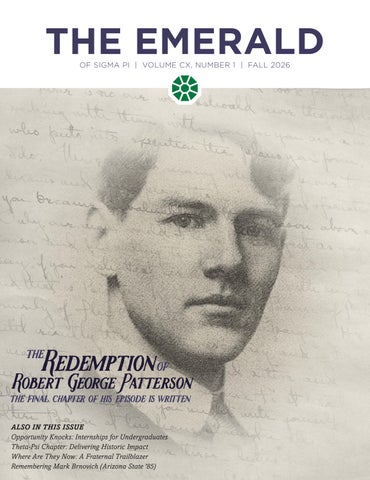
Cover Photo 04 The Redemption of Robert George Patterson The Final Chapter of His Episode Is Written
A young Robert George Patterson, as pictured in the August 30, 1908, issue of the Columbus Evening Dispatch
12 Convocation In Orlando
26 Focus: TIES THAT BOND
Recapping the 58th Biennial Convocation
The Nicholas Family’s Enduring Sigma Pi Connection
EDITOR/CREATIVE DIRECTOR ABOUT THE EMERALD
Vol. CX, No. 1 - Fall 2026
Chris Carter (Middle Tennessee '08) ASSISTANT EDITORS
(ISSN 1074-5289, USPS 011-013)
Summer Clarkson Phil Aiello (Wisconsin-Oshkosh '12)
The Emerald has been published since 1911 by:
BUSINESS MANAGER
Sigma Pi Fraternity 479 Sam Ridley Pkwy Suite 105, PMB 334 Smyrna, TN 37167 and additional mailing offices.
CONTRIBUTORS
EDITORIAL DEADLINES
Fall - June 1 Spring - December 1
Jen Wyatt
Alex Beaven (Pennington & Co.) Jacob Camilleri (SVSU '14) Brian Devot (CSLB ’95) Christian Miele (Towson '00) Jake Reed (Arkansas '19) Rachel Stringer (Pennington & Co.) Justin "JT" Todoroff (CSLB '01) Gavin C. Whitham (Ursinus ‘25)
ABOUT SIGMA PI
Sigma Pi Fraternity was founded at Vincennes University, Vincennes, Ind. on February 26, 1897. The Executive Office is located in the greater Nashville, Tennessee area. Sigma Pi has chartered more than 230 chapters in North America and has initiated over 120,000 members since 1897. FRATERNITY FOUNDERS
Rolin Rosco James (1879-1953) William Raper Kennedy (1877-1944) James Thompson Kingsbury (1877-1950) George Martin Patterson (1877-1960)
Copyright © 2026 Sigma Pi Fraternity. Sigma Pi and the crest are trademarks of Sigma Pi Fraternity. All rights reserved.
UPDATE YOUR INFORMATION
To update your contact information, please visit:
sigmapi.org/updateinfo or send an email to: records@sigmapi.org Contact Information
Website: sigmapi.org Phone: 615.921.2300 News: emerald@sigmapi.org Socials: @sigmapi.org Networking: sigmapi.org/linkedin
Fall 2026
|
sigmapi.org
News
N E W S
F R O M
S I G M A
P I
Q&A WITH THE EXECUTIVE DIRECTOR GETTING TO KNOW Justin "JT" Todoroff (Cal State Long Beach '01) by The Emerald Staff
O
n May 1, 2026, the Grand Council appointed Justin "JT" Todoroff (Cal State Long Beach '01) as Sigma Pi Fraternity's 11th executive director. We sat down with JT to learn more about his background, his Sigma Pi experience, and what he hopes to build with undergraduates and alumni. For readers, tell us a little about yourself and what brought you to this role. I was born and raised in Northern California and attended Long Beach State, where I studied criminal justice and political science, and earned a master’s degree in administration. I joined Sigma Pi at Beta-Omicron after a brother befriended me during lunch my second week on campus. Professionally, I spent 15 years at C.H. Robinson, followed by Uber Freight and Kenco Logistics. I also served Sigma Pi as province archon, parliamentarian, and for six years on the Grand Council. Becoming executive director felt like a natural next chapter. What drew you to Sigma Pi, and why did you say yes to becoming executive director? It started with one brother making friends with me. Over the next two decades, Sigma Pi gave me relationships, opportunities, and a sense of purpose. Watching the Fraternity mature made me excited to help members Find Their Purpose. THE EMERALD
What has stood out to you most since stepping into the role? The engagement. Undergraduates have offered thoughtful feedback, and alumni consistently ask, “Where can I help?” With more than 100,000 living alumni, we have an incredible pool of experience and talent. I want the best ideas to win, not just the ideas from the top. What are you listening for and learning during these first few months? We are taking notes on everything. Some progress may feel slow in 2026, but that is intentional. We want to build the Strategic Plan thoughtfully rather than operate with a “ready, fire, aim” mentality. We are also pursuing quick wins in undergraduate recognition, expansion strategy, and long-term real estate planning while listening to alumni who have felt unheard. What is one thing readers probably would not find in your professional bio? When I told my mom I was joining a fraternity, she was horrified by the stereotypes. When I told her I had been named executive director, she was thrilled. She had watched what Sigma Pi meant to me and became one of its biggest champions. It came full circle. What are you most looking forward to in the year ahead?
Building bridges. Our Strategic Plan is scheduled for release on Founders' Day 2027, our 130th anniversary. Undergraduates can expect greater transparency, resources, and Executive Office engagement. Alumni will have opportunities to help shape our future. What message would you like to share directly with Sigma Pi members? We are focusing on the windshield instead of the rearview mirror. We are stronger when we row in the same direction. We will be intentional about putting the right people in the right roles and giving undergraduates a lifelong sense of purpose and belonging. The future of Sigma Pi is bright. How can brothers get involved? Reach out. Undergraduates and alumni can email me at executivedirector@sigmapi.org. If you have time, talent, or ideas, I want to hear from you as we build the next Strategic Plan and Find Our Purpose together. 1
From the Grand Sage
Grand Council for the 2026-2028 Biennium GRAND SAGE
Brian Devot (Cal State Long Beach ’95)
G R A N D
C O U N C I L
FROM THE GRAND SAGE A MESSAGE FROM Brian Devot (Cal State Long Beach ’95)
GRAND SECOND COUNSELOR
Peter Georgantopoulos (UC Irvine ’95) GRAND THIRD COUNSELOR
Bradley Poronsky (Texas ’01) GRAND FOURTH COUNSELOR
GFoC Jeff Cline (NC State '85) GRAND FIRST COUNSELOR
Todd Griffin (East Carolina ’90) GRAND HERALD
GRAND SAGE Brian M. Devot
Brad Reichard (UCLA ’88)
(Cal State Long Beach ’95)
GS@sigmapi.org
PAST GRAND SAGE
Christian Miele (Towson ’00)
Brothers of Sigma Pi,
Did You Know?
I am grateful for the privilege of serving as your 50th Grand Sage. I also want to recognize my predecessors, Christian Miele and Kent Varney, whose distinguished and selfless leadership left our fraternity in better condition than when they picked up the gavel. Their counsel and support have been invaluable whenever I have sought their guidance.
The Owl Talk Podcast is BACK for Season 5! The Podcast covers a wide range of topics, including the history of the Fraternity, interviews with notable alumni, and getting a true sense of what “brotherhood” really means from the eyes of Sigma Pi members.
This summer, attendees of the 58th Biennial Convocation made our signature event memorable and launched the biennium with tremendous momentum.
Visit sigmapi.org/owltalk or scan the QR Code to listen to the podcast.
Through all major social media channels, members can connect with each other, share updates from their chapters, and stay informed about the latest news, events, and resources. Find us on all platforms with @sigmapi, or visit sigmapi.org/linkedin to join the LinkedIn members group. 2
The executive team presented encouraging statistics that reflect the Fraternity’s strength and steady progress. Our fraternity is undergoing a renaissance, and I am confident its brightest days lie ahead. I have attended every Convocation since 1996, and the undergraduate leaders I met this year stood out as truly exceptional. We must keep recruiting men who embody our values while strengthening a brand that represents Sigma Pi at its best. The value of being a Sigma Pi man is greater than ever in 2026. Technology offers extraordinary convenience, but its greatest benefit may be our ability to form genuine connections and lasting relationships. Let us use that opportunity with purpose. If every undergraduate member improves by only 0.1% each day, those individual gains can build powerful momentum across the fraternity. To our graduating seniors: membership in Sigma Pi extends far beyond college— it is a lifelong commitment. We hope you will remain engaged and continue making a difference. Reaching our full potential also depends on alumni who generously share their time, talent, and treasure. I invite you to support Sigma Pi as we move our fraternity forward together. May God continue to bless Sigma Pi Fraternity, the United States of America, and every one of our brothers. Fraternally,
Fall 2026
|
sigmapi.org
Calendar of Events
C A L E N D A R
O F
E V E N T S
IMPORTANT DATES
Interfraternal News
Sigma Pi Fraternity recently partnered with Hazing Prevention Network, a national organization focused on preventing hazing through education, research, and advocacy. Kansas City Alumni Event in October 2025
OCTOBER 2026
APRIL 2027
| 1st
Billed: Chapter Fall Semi-Annual Dues ($300)
| 14th
20 Years of Southern Indiana (Theta-Psi)
| 31st
Deadline: Chapter Fall SemiAnnual Dues
| 17th
45 Years of Drury (Epsilon-Rho)
| 21st
20 Years of Middle Tennessee (Theta-Omega)
NOVEMBER 2026 | 4th
Preparing for Elections Webinar
| 23rd
| 18th
65 Years of East Stroudsburg (Beta-Psi)
50 Years of Elon (Epsilon-Theta)
| 25th
| 18th
20 Years of Penn Tech (Theta-Phi)
30 Years of SVSU (Theta-Beta)
| 19th
10 Years of Stockton (Iota-Upsilon)
JanUary 2027 | 6-7th
Mid-Year Leadership Conference
| 29-31st Engage Chicago
FEBRUARY 2027 | 19-21st Engage Los Angeles | 26th
Founders' Day
| 26th
130 Years of Vincennes (Alpha)
MARCH 2027
MAY 2027 | 1st
Sigma Pi Memorial Day
| 4th
65 Years of Detroit-Mercy (Gamma-Alpha)
| 13th
65 Years of Central Missouri (Gamma-Gamma)
| 18th
110 Years of Cornell (Mu)
| 20th
105 Years of Wisconsin (Tau)
JUNE 2027 | 1st
115 Years of Ohio Northern (Zeta)
| 8th
115 Years of Purdue (Eta)
| 1st
Billed: Chapter Spring SemiAnnual Dues ($300)
| 5-7th
Engage Philadelphia
| 19th
50 Years of Illinois State (Epsilon-Eta)
KEY
| 31st
Deadline: Chapter Spring Semi-Annual Dues
| Educational Programming
THE EMERALD
The partnership strengthens the Fraternity's ongoing commitment to creating safer chapter environments and providing members with practical tools to recognize, prevent, and respond to hazing. Through Hazing Prevention Network’s resources, educational programming, and national expertise, Sigma Pi will further support chapters in building a culture centered on brotherhood, accountability, and member well-being. Hazing Prevention Network works with colleges, universities, fraternities, sororities, athletic programs, and other student organizations across the country. Its efforts include prevention education, awareness campaigns, research, and resources designed to help organizations address hazing before harm occurs. For Sigma Pi, the partnership represents another step in reinforcing expectations for a positive membership experience and supporting chapters as they develop leaders, strengthen brotherhood, and uphold the Fraternity’s values. Learn more about the organization at hazingpreventionnetwork.org.
| 25-27th Tony Siress Leadership Summit
| Sigma Pi Holiday
| Milestone Anniversary | Deadline
3
Feature
Editor's Note: At the author’s request, this article follows Chicago Manual of Style conventions to facilitate future republication. These conventions differ in some instances from The Emerald's standard AP style. Standard identifying information for members mentioned in this article: PGS William D. Akers (Ohio Northern 1912)
HGS Harold Jacobsen (Kenyon 1921)
PGS Joseph V. Palazzolo (Monmouth ’00)
Dr. Harold E. Gibson (Vincennes ’72)
HGS Byron R. Lewis (Vincennes 1902)
PGFoC Robert G. Paterson (Sigma-Pi 2026)
Braden W. Harman (Ohio Northern ’24)
PGS Christian J. Miele (Towson ’00)
Curtis G. Shake (Vincennes 1903)
Fr. Michael A. Hobson (Worcester Poly ’81)
PGS Louis L. Moore (Pennsylvania 1909)
Alexander E. Wilson Jr. (Emory 1927)
Photo: William Jennings Bryan poses with members of Gamma Chapter on September 24, 1908, during a campaign stop in Columbus, Ohio. Patterson stands fifth from the left. 4
Fall 2026
|
sigmapi.org
Feature
Redemptionof
the
Robe rt George Patte rson
the final chapter of his episode is written by PGS Christian J. Miele (Towson '00), contributing writer
Author’s Note: The following article assumes familiarity with the Patterson Episode. It is therefore recommended that those who have yet to encounter that story, or who need a refresher, read it online at sigmapi.org, or in any edition of the pledge manual published in 1975 or later, before continuing.
I
n September 1960, nearly fifty years after his expulsion from Sigma Pi Fraternity, Robert George Patterson was supposed to stand at a podium in Williamsburg, Virginia, and address the Grand Chapter at its Twenty-Fifth Biennial Convocation. He never got that chance.
and then–Grand Second Counselor Joseph V. Palazzolo, PGS, revealed the rest of the story to the Grand Chapter at the Fifty-Eighth Biennial Convocation in Orlando, Florida, and placed before it a question more than six decades in the making.
It’s part of the story that’s seldom been told.
It was in October 1940 when Judge Curtis G. Shake—flipping through the latest edition of Who’s Who in America—spotted his former fraternity brother’s name, compelling him to write. “Many times during the intervening years I have hoped that our paths might cross and that we could have a long talk together,” he confessed to Patterson. Behind those words, however, lay something more than idle reminiscence. The true story of how Sigma Pi assumed its
Indeed, the traditional account of the Patterson Episode has only ever traced Patterson’s life up to the point of his ouster from the Fraternity. What became of the man solely responsible for giving Sigma Pi its name, and what very nearly happened in Williamsburg, had all but faded from the Fraternity’s living memory. That is, until this past June, when then–Grand Sage Christian J. Miele THE EMERALD
A Second Chance, Almost
name had, by then, been buried for some thirty years, and Shake firmly believed it needed to be preserved while the men who knew it were still alive to tell it. He shared as much with his old acquaintance. There was, of course, a certain irony in Shake’s appeal. Decades before that 1940 letter, the Fraternity’s leaders, Shake among them, had succeeded in quietly and wholly erasing Patterson and his apocryphal origin story from Sigma Pi’s history— clearing the way for the organization to stand on honest ground and restore its credibility with the fraternity world. As part of the broader effort to erase him, it had fallen to Shake to “explain” the organization’s nowlegendary name change in the 1923 5
Feature
Sigma Pi Book, the Fraternity’s first official history, which he managed to do in two carefully crafted sentences: “The circumstances which led to the selection of the name of Sigma Pi and the discarding of that of Tau Phi Delta were most unusual and are probably unprecedented in the annals of fraternity affairs. They are, however, entirely too complicated and lengthy for discussion in this volume.” Shake’s deft sidestep did its job, officially settling the matter and allowing the Fraternity to move on. Shake would not. Seventeen years later, in his 1940 letter, he quoted those very same lines back to Patterson. His missive continued. “I thought at the time these words were written that the whole story could not then be told without injury to the feelings of persons who were friends of mine,” he admitted to Patterson. “So far as I am advised, the statement quoted above is the only reference to the subject that has ever appeared in any of the literature of the fraternity.” Later in the letter, he added, “I think it would be a fine thing to clear up the whole matter in a way calculated to reflect credit upon all concerned.” What Shake proposed was this: that the two of them, together, “write the story of the establishment of Sigma Pi in an unimpassioned way”—a story that “need not be published immediately or at all, but it should be deposited in the archives of the fraternity, where it will be available in future years.” To leave the matter open, Shake cautioned, was to risk having the late William Raimond Baird’s account resurface and serve “as a text for reopening the subject which he presented so unfairly.” It took Patterson all of six days to write 6
Curtis G. Shake, presiding judge of Nuremberg Military Tribunal VI
back—he was “delighted” to accept the judge’s suggestion. Patterson, it turned out, had not moved on either. According to Shake, he made a habit of going to the New York Public Library to read The Emerald, the magazine that took its very name from the jewel Patterson had chosen to adorn the center of the Fraternity’s badge—“a publication that never so much as mentioned his name.” In that same eager reply, Patterson revealed that between 1909 and 1914 he had written a “long manuscript of about nine hundred pages, entitled ‘Concerning Sigma Pi.’” Vivid and richly detailed, defiant and self-vindicating—unmistakably, this was his side of the story. Patterson’s apologia had been no secret, however. In the summer of 1915, the Fraternity’s leaders learned of its existence through his entry— almost certainly self-submitted—in Leading Greeks, a newly published “encyclopedia” of “every living Greek letter man and woman who has done important work for his or her society.” That he appeared in such a publication at all, more than four
years after his expulsion, was one thing; the presumed nature of the “book” he was “now preparing”— whose title was disclosed in his entry—was another matter entirely, signaling that Patterson had no intention of letting the matter rest. The book’s publication, it was feared, might unearth the skeletons they had so painstakingly worked to hide. Fortunately for them, it would never be released. Patterson went on to tell Shake that he had made three copies of the manuscript, giving one to Louis L. Moore and another to William D. Akers (both grand officers of the Fraternity), and keeping the third for himself, only to misplace it in a move. He could no longer say whether the Moore or Akers copy had survived. At least one of the two still does, and has long been preserved in the Fraternity’s archives, though which one it is remains uncertain. Shake, in his own reply to Patterson, said that he had read one of the two cover to cover several years earlier, but admitted he could not recall where he had obtained it or what he had done with it. Fall 2026
|
sigmapi.org
Feature
in Leading Greeks—hardly the marks of a man in hiding. But whether Shake’s reasoning was right no longer mattered. By now, something deeper had taken hold: the hope that so old a wound might yet heal.
Patterson badge (1907–10), left, alongside the badge worn since 1910
Shake and Patterson’s correspondence ran on and off for nearly twenty years, and was often marked by prolonged periods of silence between letters. In all that time, the joint account they had agreed to write never came to fruition. By early 1947, Shake undertook to write the story himself and shared as much with Patterson, promising to send him a manuscript once finished; Patterson replied promptly, expressing his eagerness to read it. It was not until August 1959, after their longest period of silence, that Patterson wrote again, prompting Shake at last to complete his manuscript, which he sent to Patterson that December for his feedback. In the letter that accompanied it, Shake reiterated to his old friend, in more definite terms, what he had suggested nearly two decades earlier: that the story ought to be told by the two of them, rather than left to others—less informed, and less careful—to piece together on their own. As the judge later recalled, Patterson “found no fault” with the manuscript he’d sent him. After all, Shake’s narrative reads exactly as intended: an “unimpassioned” history. Read between the lines, though, and one cannot help but sense a quieter story THE EMERALD
beneath the one Shake set out to tell, one that says as much about its author as it does about Patterson. By the time he wrote it, Shake, it seems, had come to believe that Patterson had paid too dear a price for a young man’s mistake, and had spent the better part of his life haunted by it. The words Patterson had committed to paper years earlier, which Shake had almost certainly read in the pages of “Concerning Sigma Pi,” said as much. Of his expulsion, Patterson had written: “The misery I endured for weeks after all this, the sleepless nights I spent tossing on my pillow, the heartaches and mental anguish I suffered will be known only to myself. It was torture.” Even the smallest details of Patterson’s life had, by now, seemed to validate what Shake was already convinced of. For instance, around 1910, in the wake of the controversy, Patterson had dropped a letter from his surname, becoming Robert George Paterson, which Shake took as an attempt by Patterson “to conceal his identity in the event the story of his part in the development of the fraternity should again find its way into print.” The facts complicate that reading: The shortened name shows up, openly, both in “Concerning Sigma Pi” and
In the summer of 1960, Shake—in New York City chairing a federal labor board President Eisenhower had appointed him to—called on Patterson and asked him to dinner. The two talked well into the night, their conversation ranging “from Patterson’s youthful admiration of William Jennings Bryan, [to] his plan to attend Illinois College and become a member of Sigma Pi Society, to his part in converting the Tau Phi Delta Society of Vincennes University into Alpha Chapter of the Sigma Pi Fraternity of the United States.” It was during that same conversation that Shake shared news of his own: that September, the Twenty-Fifth Biennial Convocation would be held at Williamsburg, Virginia—the ground Patterson once claimed as Sigma Pi’s birthplace—where Shake had been asked to give the keynote on the Fraternity’s early history. He offered to divide his time and afford Patterson “a full opportunity to tell the story of his part in the development of the Fraternity”—a prospect Shake had already floated several months earlier, when he told Patterson that if the two of them could finish their joint account to their satisfaction, he believed he could bring about Patterson’s reinstatement and secure an invitation for him to appear as an “honored guest and speaker” at the Fraternity’s “next national convention.” Moved to tears, Patterson asked if Shake truly believed the Fraternity would allow it. Shake told him he had “no doubt,” adding that it 7
Feature
was his own personal opinion that Patterson’s “complete disclosure of his motives and purposes, including his frank admission of the mistakes of judgment he had made, would probably result in his being restored to full membership in the Fraternity.” In a voice Shake would later describe as quivering, Patterson answered: “God willing, I’ll see you in Williamsburg, and, in the meantime, I’ll be preparing what will be the most important address of my life.” The podium was his. Williamsburg, however, was still weeks away. Shortly before the convocation, Shake received a letter from Patterson explaining he had suffered a “severe street accident,” and could not make the trip. He was, by then, a man of advanced age, and had said as much a year earlier, when he had confided to Shake that “the sands in the upper bulb of the hour glass seem to be running low.”
leaders of “old Alpha Chapter, how the name of Sigma Pi was selected, and the exploits of one Robert George Patterson”—holding the room for an hour or more before the meeting was formally called to order. When it finally was, the Executive Council almost immediately returned to Shake’s remarks and voted unanimously “that Executive Director Harold Jacobsen visit Vincennes at the earliest possible opportunity for the purpose of conferring with Byron R. Lewis and Curtis G. Shake, and recording facts and episodes relating to the early history and traditions of the Fraternity.” Whether Jacobsen ever made that trip is not known. Regardless, several weeks later, Shake sent his manuscript to Past Grand Sage Alexander E. Wilson, Jr., who had been in attendance at that meeting, seeking Wilson’s “candid advice” on what should be done with it. Wilson
God willing, I ’ll see you in Williamsburg, and, in the meantime, I ’ll be preparing what will be the most important address of my life. When the Grand Chapter convened at Williamsburg that September, Shake delivered the keynote alone. It was likely a much different address than the one he would have given had Patterson stood beside him. In fact, it made no mention of Patterson at all.
called Shake’s account “a missing link in the recorded history of the Fraternity” and had a copy made for Jacobsen, telling him that deciding how to use it would require “much thought” by the Executive Council. It went no further.
But Shake would break his long silence before leaving town. Prior to the start of the first meeting of the new Executive Council (renamed the Grand Council in 1964), convened after the convocation’s closing banquet, he spoke to the assembled
An April 1966 letter from Shake explains why: The Grand Council had “felt that it would not be wise to publish the facts during [Patterson’s] lifetime.” What Shake didn’t know when he wrote those words was that Patterson had already died.
8
It wasn’t until June 1967 that Shake finally learned the truth. He had written directly to the New York City hotel where Patterson had been living, perhaps after letters to him there went unanswered, and it was the hotel’s manager who broke the news. Only after making further inquiry did Shake learn the details: Patterson had died on October 20, 1965, at a New York City veterans’ hospital. He was seventy-nine. Alas, the reconciliation between Patterson and the fraternity that he named, which Shake had all but arranged, could now never come to pass. Although his death foreclosed that possibility, it also lifted the silence Patterson himself had once requested. By one account, he had asked Shake that the story “not be released for publication during his lifetime,” and Shake had given him his word, keeping that promise faithfully. When, or why, Patterson asked this of him remains unknown. It is hard to square this account with a man who had once planned to make this very story the subject of the most important address of his life. Seven years after Patterson’s death, all would at last be publicly revealed on August 23, 1972, at the Thirty-First Biennial Convocation in French Lick, Indiana. That evening, Dr. Harold E. Gibson rose at the 75th Anniversary Banquet to deliver an address titled “The Patterson Episode: The Strange Story of the Naming of Sigma Pi Fraternity,” with Shake himself introducing the speaker. Gibson, a member of the Sigma Pi Literary Society of Illinois College who was later made an honorary member of the Fraternity’s Alpha Chapter, spoke not only of the untold history that Shake had spent decades trying to Fall 2026
|
sigmapi.org
Feature
preserve, but also of what became of Patterson after his expulsion, and of his later reconnection with Shake, material Gibson also set down that same year in his own history of the Illinois College society. Still, the full arc of the story did not take hold. When the pledge manual first included the Patterson Episode three years later, its account ended, inexplicably, with Patterson’s ouster, and not a word more. Why the rest of the story never made its way into the pledge manual may forever remain a mystery. Perhaps it was felt that the narrative should end where Patterson’s official connection to the Fraternity did. Or perhaps it is due to the fact that his reinstatement never materialized. Whatever the actual reason, the result was the same—the second half of the story would, for decades, live on only in relative obscurity: in Shake’s unpublished manuscript, a scarce transcript of Gibson’s 1972 Convocation address and his Sigma Pi Literary Society history book, and a single article in a Midwestern popular history magazine, reprinted in the summer 1990 issue of The Emerald, which revealed some, but not all, of the rest of the story. But it would eventually reclaim the place it had always deserved—and this time, for good.
The Final Chapter Christian Miele and Joseph Palazzolo have been friends since their days as undergraduate leaders in the Fraternity, and each, quite independently, had become fascinated by the Patterson Episode. For Miele, author of the forthcoming first volume of The History of Sigma Pi Fraternity, that fascination only THE EMERALD
Grand Sage Christian J. Miele (speaking from the floor) and Grand Second Counselor Joseph V. Palazzolo, PGS (standing at the podium), deliver their presentation, “The Lost History of Sigma Pi and the Legacy of Our Letters,” at the 2026 Convocation in Orlando, Florida.
deepened when his research into the episode revealed a story more complicated, and more human, than the one he had read in his pledge manual. For Palazzolo, it led him, on November 11, 2018, to Illinois College, and more precisely, to the second floor of Beecher Hall, home to the Sigma Pi Literary Society since 1859. There, in the same meeting room where Bryan, and later Patterson himself, once stood, he became the first sitting grand sage to visit the society, during which time he delivered a presentation to its members on the strange, tangled connection between the two organizations bearing the same name. Miele, who was elected grand sage in 2024, began preparing a presentation of his own for the upcoming 2026 Convocation in Orlando, one that would not only reveal some of the Fraternity’s lost early history that he and other researchers had recently uncovered, but also the fuller arc of the Patterson Episode. He asked Palazzolo to join him as a co-presenter, given his own long familiarity with the Patterson material. Months before the two
men ever stepped foot in Orlando, they had already arrived at a shared conviction: that this occasion, of all occasions, was the moment to finish what Judge Shake had started. On the afternoon of June 19, 2026, Miele and Palazzolo delivered their presentation, “The Lost History of Sigma Pi and the Legacy of Our Letters,” which brought forth two Grand Chapter resolutions, the first of which is covered elsewhere in this issue. The second was introduced only after they had presented their historical findings on the Patterson Episode to the body. Few in the room had any idea, until that afternoon, how close Patterson had once come to being welcomed back before fate intervened. What Miele and Palazzolo now proposed was simple, if extraordinary: that the Grand Chapter posthumously reinstate Robert George Patterson to full membership in Sigma Pi Fraternity, more than a full century after it erased him. Miele, the resolution’s author, read it aloud to the Grand Chapter; Braden W. Harman, Zeta Chapter’s sage and delegate, then moved its adoption, 9
Feature
with Palazzolo seconding the motion. A mature and searching discussion followed, one equal to the magnitude of the moment. Fair points were made on both sides, with speakers grappling openly with Patterson’s character flaws and misdeeds, weighing them against the sense of justice Shake had long sought, and a more complete portrait of Patterson’s life and his lasting contributions to the Fraternity—one the body had only just come to know. The debate reached its most memorable turn when Michael A. Hobson, delegate for the Eta-Eta Alumni Association—a Gamma-Iota Chapter alumnus, Founders’ Award recipient, and Catholic priest—rose and walked, Roman collar and all, to the microphone reserved for those in opposition to motions on the floor, prompting a ripple of surprise through the meeting room. For a moment, it seemed those present might witness the unthinkable: a man of God rising to argue against an act of forgiveness. But Father Mike had not come to argue against the resolution as written. He had come only to say that it did not go nearly far enough—that Robert George Patterson deserved to be considered nothing less than a founder of the Fraternity outright. The room fell completely silent—the full gravity of Father Mike’s comment settling over the assembly. Yet he stopped short of offering an amendment to the motion. When the debate drew to a close, the grand sage called the question, and the resolution was adopted overwhelmingly by the body, with only a single dissenting vote. Robert George Patterson had become a brother of Sigma Pi once more. The resolution assigned his affiliation 10
Zeta Chapter Sage and Delegate Braden W. Harman (left) and Eta-Eta Alumni Association Delegate Michael A. Hobson speak on the question of Patterson’s posthumous reinstatement.
to the Sigma-Pi Chapter, fittingly bearing the name Patterson himself had given the Fraternity at large. This non-operating chapter, or holding chapter, was established by the Grand Council in 2022 as “the chapter designation for alumni initiates that are not connected to any particular chapter.” The designation was not, of course, a perfect technical fit— Patterson had never been formally initiated at all, in any chapter, at any point in his life—but in spirit, it was the only home that made sense: a chapter for those who belong to the Fraternity without belonging to any one part of it. In a way, the resolution that placed him there was itself the closest thing to an initiation he would ever be given: the act, at last, of his being received into the brotherhood. It was only that afternoon that those in attendance learned just how much more of Patterson’s handiwork— beyond the organization’s name, already attributed to him—had been woven into the fabric of the Fraternity. As Miele explained, though Patterson had been cast out and his fabricated history discarded, many of the symbols he had created for Sigma Pi would endure. This included its colors, lavender and white, and flower, the lavender orchid, neither of which was ever bound up with
the false origin story he invented. And so, perhaps, the question of whether to retain them never arose at all. Patterson’s badge, the Golden Greek Cross, would also survive, save for the crown upon its upper arm, a device tied to his fictitious 1752 royal charter. In fact, aside from the crown’s removal and the emblems added to its four arms—changes made when the badge was officially revised in 1910—the symbol worn over the heart of Sigma Pi men today remains, in every respect, the one originally conceived by Patterson. And his influence reached further still: The two-vote provision for collegiate chapters that he wrote into his “national” constitution has stood as a hallmark of the Fraternity’s governance ever since, ensuring the ascendancy of the undergraduate voice at convocations of the Grand Chapter to this day. Palazzolo likened the traditional telling of the Patterson Episode to a drama with a settled cast of characters, with Patterson, he said, playing the part of the antagonist, “perhaps deservedly so.” “But,” he added, “there is a great deal more that can be said about his life beyond the mistakes of his youth.” Patterson went on to serve his country in the United States Army during the First World War, and became an Fall 2026
|
sigmapi.org
Feature
None of it happened the way Shake envisioned it, in a hotel ballroom in Williamsburg, perhaps followed by hearty toasts and a warm conversation between two old friends. The ballroom was in Orlando, not Williamsburg. The year was 2026, not 1960. But it happened. Dr. Harold E. Gibson delivers his address, “The Patterson Episode: The Strange Story of the Naming of Sigma Pi Fraternity,” at the 1972 Convocation in French Lick, Indiana.
accomplished public speaker, editor, and author. He wrote the novels Gas Buggy and Land of the Pilgrims’ Pride, and became active in civic and veteran circles, sitting on New York City’s Mayor’s Committee for the Reception of Distinguished Guests and twice serving as county commander of the American Legion of New York County. He was, at one point, even considered a possible candidate for Congress from New York’s Nineteenth District. In every meaningful sense, Patterson became a living embodiment of the opening words of the Fraternity’s open motto: “Progress, man’s distinctive mark alone.” His redemption came neither easily nor quickly. It took Shake decades to lay the groundwork, and he would not live to see it. Gibson delivered the fuller truth to a banquet hall in French Lick in 1972 and could not have known how quickly it would slip back into obscurity. Generations of Sigma Pi brothers inherited a pledge-manual account that stopped at the story’s halfway point. The other half survived in places either hard to reach or easy to overlook—until two Sigma Pi brothers who had each, separately, become captivated and consumed by the same unfinished story decided to finish it together. THE EMERALD
Hours after the historic vote, some two dozen alumni members were at dinner in one of the hotel’s restaurants when one of them rose and offered a toast to Brother Patterson. Later, a smaller circle of brothers found themselves huddled in a hotel room, turning over the complexities of a single man’s life, well into the night. And it was impossible not to feel that this was how the story was always meant to end. No matter where one lands on the question of what Robert George Patterson deserved, his legacy is beyond dispute and beyond debate: There is no Sigma Pi Fraternity, and there never could have been, without him.
SOURCES Letters + Paterson, Robert G., to Curtis G. Shake. October 15, 1940. Sigma Pi Fraternity Archives (hereafter Fraternity Archives). + Paterson, Robert G., to Curtis G. Shake. August 19, 1959. Fraternity Archives. + Shake, Curtis G., to Dominic J. Cavello. April 11, 1966. Fraternity Archives. + Shake, Curtis G., to Robert G. Paterson. October 9, 1940. Fraternity Archives. + Shake, Curtis G., to Robert G. Paterson. October 18, 1940. Fraternity Archives. + Shake, Curtis G., to Robert G. Paterson. December 1, 1959. Fraternity Archives. + Wilson, Alexander E., Jr., to Curtis G. Shake. October 25, 1960. Fraternity Archives. + Wilson, Alexander E., Jr., to Harold Jacobsen. October 27, 1960. Fraternity Archives. Published Works + Gibson, Harold E. History of Sigma Pi Society of Illinois College. Sigma Pi Society, 1972. + Gibson, Harold E. “The Patterson Episode: The Strange Story of the Naming of Sigma Pi Fraternity.” Address transcript in The Patterson Episode: The Strange Way Sigma Pi Fraternity Got Its Name. Sigma Pi Fraternity, 1972. + Levere, William C., ed. Leading Greeks: An Encyclopedia of the Workers in the American College Fraternities and Sororities. 1915. Manuscripts & Interviews + Palazzolo, Joseph V. Interview by Christian J. Miele, August 21, 2026. + Paterson, Robert G. “Concerning Sigma Pi.” Unpublished manuscript, Fraternity Archives, 1914. + Shake, Curtis G. “The Robert George Patterson Episode.” Unpublished manuscript, Fraternity Archives, n.d.
Robert George Paterson pictured later in life
Grand Council Minutes + Sigma Pi Fraternity. Grand Council Minutes. September 10–11, 1960. Fraternity Archives. + Sigma Pi Fraternity. Grand Council Minutes. May 20, 2022. Fraternity Archives. 11
Conferences & Programming
12
FALL 2026 | sigmapi.org
Conferences & Programming
CONVOCATION IN ORLANDO 58th Biennial Event united more than 250 attendees for a weekend of brotherhood, governance, education, recognition, and historic moments by Chris Carter (Middle Tennessee '08), Editor/Creative Director
T
he 58th Biennial Convocation of the Grand Chapter of Sigma Pi Fraternity brought over 250 attendees to Orlando, Florida, for a weekend focused on brotherhood, history, governance, leadership, and recognition. Held at the Rosen Centre Hotel from June 18-21, 2026, Convocation gave brothers from across the Land of Sigma Pi the opportunity to reconnect, conduct the business of the Grand Chapter, and celebrate the chapters, alumni clubs, volunteers, and members who continue to move the Fraternity forward. The formal business of the Grand Chapter opened Friday, June 19, with the traditional processional, The Opening Ceremony of the Grand Chapter, and the singing of the Canadian and American national anthems by Past Grand Sage John H. Williams Jr. (Widener ’69). Grand Sage Christian J. Miele (Towson ’00) welcomed attendees by noting the importance of Convocation as a place to learn, lead, connect, and shape the future of Sigma Pi. He then introduced the Grand Council, Grand Chapter Parliamentarian, and Executive Office staff. The first business session included the reception of eight Past Grand Sages, an administrative briefing, the Grand Chapter roll call, the adoption of the official agenda and standing rules, and reports from the Credentials, Codifications, and THE EMERALD
Elections committees. The session also included the blessing and presentation of Chapter Advisor medallions to newly appointed advisors, followed by recognition of Sigma Pi alumni volunteers serving as Province Archons, Chapter Advisors, alumni club officers, committee members, housing corporation board members, and chapter advisory board members. During his State of the Fraternity address, GS Miele emphasized the Fraternity’s commitment to lifelong membership and values-based education. He highlighted the first comprehensive Ritual survey of Sigma Pi chapters, the publication of the first major revision of The Manual of Ceremonies in 13 years, and a renewed focus on placing Ritual at the center of the member experience. He also shared key signs of momentum, including strong new member retention, rising average chapter size, improved academic performance, reduced risk management concerns, and significant service and philanthropic impact across the Fraternity. Friday afternoon featured a captivating educational presentation titled “The Lost History of Sigma Pi and the Legacy of Our Letters.” Led by GS Miele and GSC Joe Palazzolo, PGS (Monmouth ’00), the presentation laid before the Grand Chapter two historic resolutions inspired by significant findings
regarding the Fraternity's history. First, the Grand Chapter unanimously adopted a resolution officially recognizing five Vincennes University cadets—William S. Case, Flemin W. Cox, Oscar B. Kinsey, John T. Thompson, and John W. Wiggs— as members of Sigma Pi. Their documented membership in Tau Phi Delta during the Fraternity's founding year—only recently discovered— established their rightful place on the rolls of both the Fraternity and its Alpha Chapter. The Grand Chapter also formally reinstated the late Robert George Paterson, whose role in giving the Fraternity its name, shaping its symbols and identity, and charting its national course had long been overshadowed by his expulsion from Sigma Pi in 1910. Sixty-six years after unforeseen circumstances derailed plans for his reinstatement at the 1960 Convocation, the resolution posthumously restored Paterson to full membership. The Grand Chapter also adopted several amendments to the Fraternity's Constitution and Bylaws, including proposals to improve grammar and style, harmonize terminology, and clarify constitutional amendment notice and voting requirements. Additional approved bylaw changes addressed semiannual dues administration, roster submission dates, postelection organization procedures, ex officio board participation, and the 13
Conferences & Programming
jurisdiction of the Judicial Review Committee. The Grand Chapter also approved revisions to Bylaw 4, intended to simplify and clarify disciplinary and judicial processes. A proposal to change Grand Council terms from two years to four years and create staggered elections was defeated following discussion. The final legislative item, a proposal concerning Past Grand Officer voting privileges, passed by a roll call vote of 60-56. The approved amendment requires Past Grand Officers to personally meet a minimum level of charitable support for the Sigma Pi Educational Foundation or Sigma Pi University during each biennium in order to vote at Convocation. Friday evening, initiated members gathered for the exemplification of The Golden Quest, continuing one of Convocation’s important fraternal traditions and bringing members together in a setting centered on Ritual and brotherhood. Saturday morning opened with province breakout sessions led by Grand First Counselor Peter Georgantopoulos (UC Irvine ’95) and Executive Director Justin “JT” Todoroff (Cal State Long Beach ’01). Thea Zunick, Ed.D., returned to Convocation to deliver the mental health keynote, “Lead with Heart, Not Hustle: From Burnout to Brotherhood.” Her message challenged members to think about leadership, connection, and personal well-being as part of the broader fraternity experience. The Grand Chapter then elected the 2026-2028 Grand Council. Brian Devot (Cal State Long Beach
14
’95) was elected by acclamation as the 50th Grand Sage of Sigma Pi Fraternity. Delegates then elected five directors at large through the single transferable vote method. Following the election, the Grand Council organized itself for the ensuing biennium. For a listing of the members of the 2026-2028 Grand Council, see GS Devot's letter on page 2. The final business session featured leadership speaker Brian Pruett, founder of Live Elevated, who delivered “Unlocking the Leader Within.” His message focused on purpose, discipline, identity, and the habits needed to lead with intention. Additionally, Executive Director Todoroff and CEO Todd Miller (UT-Martin '83) led a presentation focused on the Fraternity’s future, including the Find Your Purpose campaign and the development of the 2027-2032 Strategic Plan. The session concluded with The Installation of Grand Officers Ceremony and The Closing Ceremony of the Grand Chapter. Recognition remained central throughout the weekend. The Awards Luncheon on Friday honored Grand Council Award recipients and celebrated the chapters that demonstrated superior operations, campus leadership, scholarship, service, and brotherhood. At the Grand Chapter Banquet on Saturday evening, Sigma Pi recognized individual award winners, alumni leaders, and the top chapters in each tier. The Fraternity presented Founders’ Awards — the highest recognition
bestowed upon a member — to Brian J. Townsend (MSSU ’90) and David C. Coburn (Columbus ’77). Coburn was unable to attend, but Townsend gave a tremendous speech during the Banquet, leading to a standing ovation. The Grand Sage’s Award winners represented the highest-performing chapters in each tier. Alpha-Delta Chapter at Auburn University won the Rolin Rosco James Tier, earning the award in Tier 1 for the first time since 1976. Alpha-Sigma Chapter at the University of Arkansas won the William Raper Kennedy Tier. EtaUpsilon Chapter at the University of California, Irvine won the James Thompson Kingsbury Tier. Zeta-Eta Chapter at Santa Clara University won the George Martin Patterson Tier, continuing a long tradition of excellence within the Chapter. As the Grand Chapter Banquet concluded, now-PGS Miele passed the gavel to GS Devot, marking the formal transition to the next biennium of Sigma Pi leadership. The evening closed with one of Convocation’s most cherished traditions, as brothers formed a circle around the room, joined arms, and sang “The Fireside Song.” The 58th Biennial Convocation balanced reflection with action. It honored the Fraternity’s past, addressed the business of the present, and set a course for the future through leadership, legislative work, education, and brotherhood. Attendees left Orlando with a deeper understanding of Sigma Pi history, as well as a renewed commitment to the Ritual and Creed, and a charge to return home ready to lead.
Fall 2026
|
sigmapi.org
Conferences & Programming
Top: Members from winning chapters pose with their Grand Chapter Awards. Middle, from left: Justice Curtis Shake Province Archon Award recipient Todd Griffin (East Carolina ’90). Members of Alpha-Delta Chapter at Auburn display their Grand Chapter Award. Brian Townsend (MSSU ’90), second from left, displays his Founders’ Award. Bottom, from left: Lyle Smith Chapter Advisor Award recipient Bryant Plasencia (CSUDH ’13). Members of Epsilon-Eta Chapter at Illinois State display their Grand Chapter Award. Members of Rho Chapter at NC State display the chapter’s 100-year proclamation and Grand Chapter Award. THE EMERALD
15
Conferences & Programming
A W A R D S
R E C O G N I T I O N
2024-26 Biennial Awards Honoring excellence, leadership, and impact across our Fraternity
INDIVIDUAL AWARDS Founders’ Award
Clegg Scholarship (Byron R. Lewis) Award
Grand Chapter Award
Brian Townsend (MSSU '90) David Coburn (Columbus '77)
William & Mary (Alpha-Eta)
Vincennes (Alpha) Auburn (Alpha-Delta) William & Mary (Alpha-Eta) Missouri S&T (Alpha-Iota) NJIT (Alpha-Mu) Wake Forest (Alpha-Nu) UC Santa Barbara (Alpha-Omicron) Georgia (Alpha-Phi) Missouri State (Alpha-Rho) Arkansas (Alpha-Sigma) Indiana (Beta) Eastern Illinois (Beta-Gamma) Arizona State (Beta-Kappa) SIU-Carbondale (Beta-Nu) Cal State Long Beach (Beta-Omicron) Virginia (Beta-Pi) East Stroudsburg (Beta-Psi) Valparaiso (Beta-Tau) Central Michigan (Delta-Alpha) Monmouth (Delta-Beta) Wisconsin-Platteville (Delta-Iota) Morehead State (Delta-Rho) Kentucky (Epsilon-Beta) Illinois State (Epsilon-Eta) Eastern Kentucky (Epsilon-Lambda) Fullerton, CA (Epsilon-Nu) Drury (Epsilon-Rho) Elon (Epsilon-Theta) FDU-Metropolitan (Epsilon-Xi) Purdue (Eta) Cal Poly (Eta-Delta) Bridgewater State (Eta-Eta) CSUDH (Eta-Iota) East Carolina (Eta-Kappa) Colorado State (Eta-Sigma) Fitchburg State (Eta-Tau) UC Irvine (Eta-Upsilon)
Louis Foley Newsletter Award (Undergrad)
Young Alumni Volunteer Award
CSUDH (Sigma Pi “HI-Times”)
Devin Barros (Monmouth '20) Slater Goodman (Cornell '16)
Louis Foley Newsletter Award (Alumni)
Young Professional Achievement Award Christopher Hussein (Arkansas '11)
Michael P. Carey Award Jack Schmall (Illinois State '23) Michael Gallagher (UCLA '22)
Harold Jacobsen Award Jeremy Tanius (UC Irvine '23) Brandon Garlitos (Arizona State '23)
Cletus A. Broecker Award (Philanthropy) Salvatore Martucci (St. John’s '24)
Lyle Smith Chapter Advisor Award Bryant Plasencia (CSUDH '13)
Justice Curtis Shake Province Archon Award Yougnand Paul (St. John’s '15) Todd Griffin (East Carolina '90)
Guy “Red” Mackey Award John Dooley (Monmouth '23) Tommy Rudowicz (UCLA '24)
Outstanding Campus Employee Award Richard Barreto (UCLA) Jeremy Paul (Grand Valley State) Parice Bowser (Arkansas)
16
GROUP AWARDS
UCLA (The Pioneer)
William J. Cutbirth Jr. Award (Philanthropy) Santa Clara, CA (Zeta-Eta) Southern Indiana (Theta-Psi)
William J. Cutbirth Jr. Award (Comm. Serv.) Norfolk, VA (Theta-Eta)
Most Outstanding Alumni Club UCLA (Upsilon Alumni Association)
Most Improved Chapter Award 2025: Central Michigan (Delta-Alpha) 2026: UCLA (Upsilon)
Merino/Tash 100 Man Chapter Recognition Auburn (Alpha-Delta) Wake Forest (Alpha-Nu) Georgia (Alpha-Phi) Arkansas (Alpha-Sigma) Indiana (Beta) Arizona State (Beta-Kappa) Mississippi (Beta-Mu) Illinois State (Epsilon-Eta) Fullerton, CA (Epsilon-Nu) Cal Poly (Eta-Delta) State College, PA (Theta) Alabama (Theta-Omicron) Iowa (Xi) Boulder, CO (Zeta-Delta) Santa Clara, CA (Zeta-Eta)
Fall 2026
|
sigmapi.org
Conferences & Programming
Grand Sage's Award - Tier 1 - Auburn (Alpha-Delta)
Grand Sage's Award - Tier 2 - Arkansas (Alpha-Sigma)
Grand Sage's Award - Tier 3 - UC Irvine (Eta-Upsilon)
Grand Sage's Award - Tier 4 - Santa Clara, CA (Zeta-Eta)
Detroit-Mercy (Gamma-Alpha) Rutgers (Gamma-Eta) Worcester Polytechnic (Gamma-Iota) Murray State (Gamma-Upsilon) Delaware (Iota-Beta) Coastal Carolina (Iota-Chi) San Antonio, TX (Iota-Delta) Montclair State (Iota-Iota) Orlando, FL (Iota-Kappa) FDU-Florham (Iota-Phi) Keene State (Iota-Rho) South Florida (Iota-Sigma) St. John’s (Iota-Tau) Stockton (Iota-Upsilon) Minnesota (Iota-Zeta) Oregon State (Omega) Raleigh, NC (Rho) Wisconsin (Tau) State College, PA (Theta) SVSU (Theta-Beta) IUP (Theta-Epsilon) THE EMERALD
Norfolk, VA (Theta-Eta) Radford, VA (Theta-Lambda) Houston (Theta-Nu) Middle Tennessee (Theta-Omega) Alabama (Theta-Omicron) Penn College (Theta-Phi) Southern Indiana (Theta-Psi) Grand Valley State (Theta-Rho) Ursinus (Theta-Sigma) William Paterson (Theta-Tau) Ferris State (Theta-Theta) UCLA (Upsilon) Iowa (Xi) Ohio Northern (Zeta) West Chester (Zeta-Alpha) Rowan (Zeta-Chi) Boulder, CO (Zeta-Delta) Michigan Tech (Zeta-Epsilon) Santa Clara, CA (Zeta-Eta) Michigan State (Zeta-Mu) Oakland (Zeta-Pi)
Grand Council Award Tier 1 - Auburn (Alpha-Delta) Tier 1 - Alabama (Theta-Omicron) Tier 1 - Iowa (Xi) Tier 2 - Arkansas (Alpha-Sigma) Tier 2 - Missouri S&T (Alpha-Iota) Tier 2 - Illinois State (Epsilon-Eta) Tier 3 - UC Irvine (Eta-Upsilon) Tier 3 - Monmouth (Delta-Beta) Tier 3 - St. John's (Iota-Tau) Tier 3 - Coastal Carolina (Iota-Chi) Tier 4 - Santa Clara, CA (Zeta-Eta) Tier 4 - Southern Indiana (Theta-Psi) Tier 4 - Penn College (Theta-Phi)
Grand Sage’s Award Tier 1 - Auburn (Alpha-Delta) Tier 2 - Arkansas (Alpha-Sigma) Tier 3 - UC Irvine (Eta-Upsilon) Tier 4 - Santa Clara, CA (Zeta-Eta)
17
Conferences & Programming
LIVES OF LEADERSHIP AND SERVICE
Townsend and Coburn Recognized with Fraternity’s Prestigious Founders’ Award by The Emerald Staff
S
igma Pi is proud to recognize Brian J. Townsend (MSSU ’90) and David C. Coburn (Columbus ’77) as recipients of the Founders’ Award. The Founders’ Award is the highest and most prestigious honor Sigma Pi Fraternity bestows upon an individual brother. Since 1962, the Fraternity has recognized outstanding alumni through the award, honoring exceptional contributions or service in business, a profession, education, humanitarianism, Sigma Pi, or the broader fraternity industry.
Townsend
BRIAN J. TOWNSEND MSSU ’90 For more than three decades, Brian Townsend has dedicated his career to public safety, leadership development, and service to others. From local law 18
enforcement to senior leadership within the Drug Enforcement Administration, Townsend’s career reflects a consistent focus on protecting communities and preparing others to lead. Townsend began his law enforcement career with the Joplin Police Department in Missouri, where he served for five years before joining the DEA in 1999. Over the next 23 years, he served in assignments of increasing responsibility, including Special Agent, Group Supervisor, Unit Chief at the DEA Training Academy in Quantico, Virginia, and Resident Agent in Charge of the DEA Springfield Office. As Resident Agent in Charge, Townsend led the DEA’s operations across 25 counties in southwest Missouri. He managed personnel, enforcement operations, agency resources, and relationships with local, state, and federal law enforcement partners. His career included directing and supporting hundreds of multi-agency operations while working to dismantle trafficking organizations and address threats to public safety. Townsend also made a lasting contribution to leadership development within the DEA. While serving as Unit Chief at the DEA Training Academy, he built and directed the agency’s first dedicated leadership and professional development training unit. He managed more than 20
leadership and in-service programs and helped develop training serving a federal workforce of more than 10,000 personnel. His commitment to service continued after retiring from federal law enforcement. Townsend now serves as Law Enforcement Training Coordinator for the Mid-States Organized Crime Information Center, where he supports law enforcement agencies across nine states. He also founded Eagle 6 Training, through which he provides leadership training, speaking, and organizational consulting. In 2023, Townsend founded Only 2mg, Inc., a nonprofit focused on addressing the illicit fentanyl crisis through education, training, public awareness, and policy advocacy. His work brings decades of law enforcement experience directly to communities, professionals, policymakers, and families seeking a greater understanding of fentanyl and emerging drug threats. Townsend’s service also extends to Sigma Pi. A founding brother of Eta-Mu Chapter at Missouri Southern State University, he served as Herald and chaired several chapter committees. He has remained engaged with the Fraternity as an alumnus and currently serves as Chapter Advisor for Alpha-Rho Chapter at Missouri State University, where his son is also a brother. Throughout each stage of his career, Townsend has placed an emphasis on Fall 2026
|
sigmapi.org
Conferences & Programming
leadership, mentorship, and service. His work has strengthened law enforcement organizations, developed future leaders, and brought greater awareness to one of the country’s most serious public safety challenges.
Coburn
DAVID C. COBURN Columbus ’77
Major General David C. Coburn has built a lifetime of service around leadership, education, and commitment to the United States. Across a 37-year career in the U.S. Army, Coburn advanced from an infantry officer to one of the Army’s senior financial management leaders, serving in assignments across the United States and overseas. Coburn graduated from Columbus State University with a bachelor’s degree in accounting and was commissioned as a second lieutenant in the Infantry in 1982. He later earned a Master of Business Administration from Syracuse University and a master’s degree in Resourcing National Strategy from the Industrial THE EMERALD
College of the Armed Forces. His early Army assignments placed him in a range of combat arms leadership roles. Coburn served as a rifle platoon leader, weapons platoon leader, heavy mortar platoon leader, Ranger instructor, Infantry Officer Basic Course platoon trainer, and company commander. Those experiences established a foundation of operational leadership that would follow him throughout his military career. Coburn later transitioned into a series of financial management and resource leadership assignments. His responsibilities included positions with the U.S. Army Special Operations Command, Office of the Chief of Staff of the Army, Army Recruiting Command, Army Budget Office, Joint Forces Command, and U.S. Army Central Command. His overseas service included assignments in Italy and Iraq, including service as Comptroller for the 173rd Airborne Infantry Brigade in Kirkuk and as J8 for Multi-National Security Transition Command-Iraq in Baghdad. He concluded his 37-year Army career as Commanding General of the United States Army Financial Management Command. His military service earned numerous decorations and distinctions, including the Distinguished Service Medal, Legion of Merit, Bronze Star Medal, Defense Meritorious Service Medal, Meritorious Service Medal, Expert Infantryman Badge, Master Parachutist Badge, Pathfinder Badge, and Ranger Tab. Coburn’s dedication to developing others continued beyond his military retirement. He went on to serve at Georgia Military College’s Columbus
Campus, extending his leadership experience into education and helping young men and women prepare for their academic, professional, and military careers. His Founders’ Award nomination emphasized the mentorship, leadership, friendship, and guidance he provided to soldiers throughout his career. From leading soldiers to overseeing complex financial operations and mentoring future generations, Coburn has represented the ideals of service and leadership throughout his professional life. His career stands among the highest levels of military achievement represented within the Fraternity's alumni ranks. Through different paths, Townsend and Coburn have each devoted decades to serving others. Townsend’s work in law enforcement, leadership education, and fentanyl awareness has strengthened communities and organizations across the country. Coburn’s military career, educational service, and mentorship have influenced generations of soldiers and future leaders. Sigma Pi proudly recognizes Brian J. Townsend and David C. Coburn with the Founders’ Award and celebrates their lifetime commitment to leadership, service, and the values of the Fraternity.
The Founders’ Award has recognized generations of members whose leadership, service and commitment have made a lasting impact on Sigma Pi. To view a complete list of past recipients and learn more about the individuals who have received this distinction, visit our website at sigmapi.org/awardhistory. 19
Undergraduate Reflection
U N D E R G R A D U A T E
R E F L E C T I O N
Perfect Misfits United
An Undergraduate's Reflection on the 58th Biennial Convocation by Gavin C. Whitham (Ursinus ‘25), contributing writer
C
onvocation, a place where war-torn Ukrainians, cornfed Iowans, Malaysian business owners and Texas cowboys, united by nothing but the Golden Quest and letters on their chests, join together like a band of perfect misfits to experience the selfactualization of brotherhood. For many of us, this is the first time we have immersed ourselves in this broader connection. Watching influential Sigma Pis, such as Founders’ Award winners and Grand Council members, is a special experience because of the leadership qualities they demonstrate. These leaders put collaboration and commitment on display and prove that although the ways in which we differ are infinite, our devotion to fraternity makes this joint experience possible. One of the many meaningful experiences I had was with Dr. Kevin Carey (Illinois Wesleyan ’09), an expert in the realm of etiquette. The fraternity experience offers many opportunities for young men to gain an advantage in professional settings. Convocation is no exception. My lesson in etiquette with Dr. Carey put into perspective just how fortunate I am to have brothers mentor me in critical things that can be deciding factors in the ever-competitive job market.
Grand Sage Brian Devot (Cal State
I especially think of my relationships
Long Beach ’95) and Past Grand
with the delegates from Theta-Eta
Sage Kent Varney (Kentucky ’97)
Chapter. Brothers Peyton Banuski
having the relationship they do
(Norfolk, VA '23) and Nathan
because of Sigma Pi was inspiring
Hallberg (Norfolk, VA '24)
to me. Their story about the Lexus
welcomed me immediately, and
voice commands during the banquet,
we spent nearly all of our free
although comical, absolutely moved
time together. Never have I had a
me and gave me an appreciation for
friendship of 72 hours feel like a
the type of bonds Sigma Pi can create
three-year brotherhood. Peyton and
among people who may otherwise
I discussed how much importance
never have met. It motivates me
each of us will place on our respective
to maintain relationships with
chapters attending future national
Within the Grand Council, collaborators and lifelong friends
brothers whom I have met because
events after experiencing the impact
of this 58th Biennial Convocation.
that our first national event had on us.
20
Fall 2026
|
sigmapi.org
Undergraduate Reflection
about involving themselves to better our fraternity. These men understand the best way to do so is by networking and connecting with delegates from other chapters. This, in effect, solves the second problem of openness to connection. I benefited greatly from my opportunity to network at Convocation. They say your father is the only man who wants to see you do better than he did, but after meeting many alumni advisors, I understand that they want to see the young men they advise go on to do incredible things that not even the alumnus himself has achieved. Every single member of the Grand Council, past Whitham (right) with Sigma Pi brothers at Convocation
Past Grand Sage John Williams (Widener ’85) has been one of my best friends since 2025 and often reflects with me about his time as Grand Sage, characterizing his 92 visits to undergraduate chapters as the most fulfilling experience of his Grand Sagehood. He often spoke of how impressive our diversity is, having seen the Bible Belt, surf towns, Southern gentlemen and brothers in our nation’s biggest cities. He appreciates that all these men allowed themselves to be shaped by Sigma Pi. During this 58th Biennial Convocation, I experienced an abbreviated version of this same appreciation, which I will continue to foster. I found myself surrounded by brothers from places that are totally unfamiliar to me. I spent my days exchanging interpersonal and intercultural intricacies with these men. I feel I was truly able to get a sense of the character of my brothers at the University of Oregon, THE EMERALD
the University of Houston and the University of Iowa, along with many of their chapters’ pressing matters. Convocation allows brothers to take advantage of the network built into Sigma Pi. When networking, often the hardest parts are finding common ground and, ultimately, determining how receptive the other person is to becoming a contact, whether as a peer, mentor or mentee. From a purely economic standpoint, Convocation aids in, or in many cases solves, these problems.
and current, told me that if ever I need anything, I could find their limbs ready. These are some of the most well-respected and successful brothers, yet they offered mentorship immediately to their younger brother. These are commendable actions, and my network is infinitely stronger for it. You may not truly know how many people you can have supporting you until you extend that handshake. For this purpose, Convocation is invaluable. I close out this summary of my experience in the same way we
The more obvious of the solutions comes to the problem of common ground. Of course, we are all brothers initiated by the same ritual and sworn to the same creed. We all have our Sigma Pi experience to talk about as an icebreaker.
closed our Convocation: with the
The less obvious is that nearly all undergraduates and alumni you meet at a Convocation are there voluntarily. These are the men most passionate
of since I was initiated as a Sigma
Fireside Song. Every brother in the entire room joined arms, people of all ages, races, creeds and colors singing to their beloved fraternity. This was the most powerful image I have had the pleasure to be a part Pi, and I will take this tradition with me and make sure it is implemented frequently in Theta-Sigma Chapter. 21
The Foundations
F O U N D A T I O N
U P D A T E S
LETTER FROM THE CHAIRMAN Brothers,
BOARD OF TrusteEs CHAIRMAN
Mike Long (Oakland ’03) VICE CHAIRMAN/INVESTMENTS
Nik Chillar (UC Irvine ’95) TREASURER
Daniel Daugherty (Morehead State ’88) SECRETARY
Shane Ray (East Carolina ’90) TRUSTEE
Patrick Reimer (Morehead State ’94) TRUSTEE
Kevin Carey (Bloomington, IL '09)
It was great catching up with many of you at Convocation in Orlando. For those unable to attend, this past biennium has filled the Sigma Pi Educational Foundation with gratitude, optimism, and a renewed commitment to serve as the Fraternity’s official foundation. SPEF exists because of the relationship between Brothers who seek opportunity and our alumni and friends who choose to invest in a brighter future. While beneficiaries and donors experience SPEF from different perspectives, they are united by a common purpose: creating positive change beyond any single individual, family, or generation.
CHAIRMAN Mike Long (Oakland ’03)
To our beneficiaries: Please know that you are at the heart of everything we do. Your aspirations, grit, and achievements inspire our mission. I hope you remain engaged with the Fraternity and the Foundation, now and long after graduation. Share your experiences and become ambassadors for the impact achieved through the Foundation. We are proud of the assistance provided, but we also measure success by enriched lives and strengthened communities. To our donors: Thank you for your trust, generosity, and belief in SPEF’s mission. Your contributions help us meet the needs of today’s undergraduate students and build a sustainable future. Through careful stewardship, the Foundation’s impact will endure for decades. Regardless of size, every gift becomes part of a legacy supporting future generations. I encourage us all to view charitable giving not simply as a transaction, but as a practice. Enduring traditions begin when generosity is shared among family, friends, and communities. When parents involve children in giving decisions, friends support a common cause, and beneficiaries give back to opportunities they once received, philanthropy becomes a multigenerational, relationship-building endeavor. As we look to the next biennium, I invite you to remain engaged. Participate in events, share our mission, volunteer your talents, and invest in the people and programs that make our work possible. Together, we can build resources that endure, opportunities that multiply, and a legacy of generosity that grows from one generation to the next. Thank you for being an essential part of the Sigma Pi Educational Foundation’s story. Your partnership, support, and engagement make our mission possible, and I look forward to the impact we will continue to create together. Please visit sigmapi.org/donate to find the giving strategy that works best for you. With sincere gratitude,
22
Fall 2026
|
sigmapi.org
The Foundations
T H E
F O U N D A T I O N
2026-27 Campaigns
Ways to Give
by Jacob Camilleri (SVSU '14), Sr. Director of Fundraising
T
he Foundations will continue building opportunities for members and chapters throughout 2026-27 with three signature fundraising campaigns: the 10 Stars Campaign, Founders’ Month of Giving, and the Sigma Pi Bracket Challenge. Each campaign offers alumni, undergraduates, families, and friends a different way to support the educational and leadership experiences that strengthen Sigma Pi.
10 Stars Campaign Returning in October, the 10 Stars Campaign encourages supporters to give $10 or more and invite 10 others to join them. The campaign will again highlight Chapter Educational Funds, which support scholarships, educational programming, and leadership opportunities at the chapter level. Donors are able to support the CEF of any active chapter, helping direct resources toward the undergraduate experience. Supporters will also have the opportunity to create personal or team fundraising pages, select the fund they want to support, and encourage others to participate throughout the month.
Founders’ Month of Giving Each February, Founders’ Month of Giving celebrates the Fraternity’s history while investing in its future. THE EMERALD
Through the IMPACT Annual Giving Program and Educational Development Fund, gifts support educational programming, leadership development, and personal growth opportunities for undergraduate members across the Fraternity. In 2024-25 alone, 5,830 members were directly impacted through educational and leadership programming. Founders’ Month of Giving helps sustain and expand those opportunities for future generations of Sigma Pi men.
Sigma Pi Bracket Challenge The Sigma Pi Bracket Challenge returns during March Madness, bringing friendly competition to chapter fundraising. Chapters compete head-to-head throughout the NCAA tournament, earning points based on the number of qualifying gifts made in support of their Chapter Educational Fund. Chapters advance through the bracket, and top finishers earn additional funding for their CEF. The campaign gives members, alumni, parents, and friends another opportunity to rally around their chapter while supporting educational opportunities at the local level. Together, these three campaigns provide multiple ways to make an impact throughout the year and help ensure Sigma Pi members and chapters have the resources to grow, lead, and succeed.
Online (Desktop or Mobile) Giving back to Sigma Pi Fraternity with your debit or credit card online at give. sigmapi.org or scan the QR Code above. This is a quick and secure way to make your contribution today! Now, you can even make a contribution through Venmo or Paypal - just visit our donation form, fill out your information, then select the button at the bottom on how you'd like to make your gift.
Mail You can mail a check or credit card gift to the SPEF at the address below: Sigma Pi Educational Foundation 479 Sam Ridley Pkwy Suite 105, PMB 334 Smyrna, TN 37167
Corporate Matching Numerous companies match an employee’s personal donation to a nonprofit, tax-exempt organization. Ask your employer for details. By utilizing the donation forms referenced above, you can use utilize our partners at Double the Donation to see if your employer provides matching gifts.
Phone To make a donation over the phone, or for more assistance, please give us a call at 615-921-2300.
ESTATE PLANS Sigma Pi invites you to use FreeWill, a free, online tool that guides you through the process of creating your will in just 20 minutes. It’s always free and can be used with an attorney to finalize your estate plans. This information is available on our website at give.sigmapi.org or by scanning the QR Code above.
23
The Foundations
Building for the Next Generation Eta-Upsilon Alumni Develop Chapter Educational Fund by Alex Beaven (Pennington & Company), contributing writer
A
lumni support is the backbone of any great Fraternity operation. Through Sigma Pi, young men see the importance of lifelong commitment through brothers who came before them and built a network of mutual support. Chuck Pankenier (UC Irvine ’95) and Taylor Lapsys (UC Irvine ’04) have helped transform alumni involvement at Eta-Upsilon by growing a Chapter Educational Fund to support brothers for generations to come.
The Fraternity Impact
The original plan for the Chapter Educational Fund was developed in 2020, and by the end of 2025, more than $50,000 in support had been provided for Eta-Upsilon students. This ongoing progress is a product of alumni devotion to the fund’s growth, and the next step is a promising sustainability plan tied to a $100,000 fundraising goal.
“Sigma Pi provided an environment of leadership and character development that learning in a traditional method, classroom, mentorship, etc., does not afford,” Pankenier said. “My growth as a person, the confidence that only comes with real-life experiences, and the positive influence of my Fraternity brothers instilled in me
24
Looking back on his undergraduate years, Pankenier credits Sigma Pi with providing opportunities for personal growth, leadership development, and meaningful connections that continued long after graduation. The experience left a lasting impression on him and ultimately helped shape his commitment to supporting future generations of Eta-Upsilon brothers through the Chapter Educational Fund.
a desire to think bigger, aim higher, and strive to achieve more in life.”
Supporting Future Leaders Lapsys’ service as Eta-Upsilon Chapter director led to him forming the Chapter Educational Fund in 2020. He noticed a need for infrastructure to collect and manage funds for undergraduate scholarships, and a structured alumni effort began with the EtaUpsilon alumni advisory board. “We use our CEF to reward the efforts of our undergraduates and promote the ideals of our alumni and Sigma Pi,” Lapsys said. The CEF’s goal is to generate funds to support emerging and proven Sigma Pi undergraduate leaders by helping them attend national leadership workshops, Convocation, and other development opportunities. Fall 2026
|
sigmapi.org
The Foundations
The Chapter Educational Fund garnered interest from alumni after a few early donors contributed to building a strong foundation for the initiative. Pankenier mentioned one anonymous investor who generously kickstarted fundraising efforts, leading the way for numerous Sigma Pi brothers to make large individual contributions or recurring monthly donations. “You MUST have a few donors who will anchor the fund in the earliest years,” Lapsys added. “Their continuous, ideally significant contributions, create progress and inspire others to participate. We are forever grateful for those early and gracious few.”
Creating a Sustainable Legacy Eta-Upsilon Chapter’s founding fathers and first member classes have been the fund’s strongest supporters since its inception. Lapsys noted how smooth the process has been to create and grow the Chapter Educational Fund with help from devoted alumni, especially with the infrastructure of the Sigma Pi Educational Foundation. Pankenier particularly highlighted the generosity of founding father and Grand Second Counselor Peter Georgantopoulos (’95). He also appreciates the fraternal investment made by founding father and Board of Trustees Vice Chairman/ Investments Nik Chillar (’95). “It was incredible to see the $50,000 mark reached in such a short period of time,” Pankenier said. Looking beyond 2025, the Chapter Educational Fund’s new goal of $100,000 sets an ambitious but attainable milestone THE EMERALD
for alumni leadership to strive for. As Lapsys put it, “It’s great, but it is just the beginning.”
Investing in the Future Throughout the history of EtaUpsilon Chapter, nearly $20,000 in scholarships have been awarded to more than 35 deserving Sigma Pi brothers. Many of the gifts have been thanks to the Chapter Educational Fund, which plans to fund a minimum of $4,000 in annual scholarships upon reaching the $100,000 fund milestone. Reaching the fund’s new goals will depend on alumni leadership staying diligent in their outreach efforts. This includes enrolling new graduates in small monthly recurring donations so they stay connected and understand the value of investing in the next generation of Sigma Pi men as young alumni. “Be patient, realistic, and consistent in our approach,” Lapsys said. “Men like to compete and accomplish goals; we hope the support of this initiative will bring our alumni together and give them something to collectively work toward and celebrate.” Lapsys sees the next phase of fundraising as perhaps the most critical step of the Chapter Educational Fund to build a selfsustaining scholarship program. He hopes that the fund will perpetually benefit Sigma Pi undergraduates and serve as a launch point for even bigger shared goals.
Staying Committed to Growth Pankenier noted how ongoing fundraising communications will revolve around the positive impact and strong potential of the fund. Social media, word of mouth,
and alumni publications all play essential roles in their messaging about leadership opportunities the fund provides to undergraduates. “The leadership experiences, networking opportunities, and exposure to the broader mission of Sigma Pi in developing motivated and productive members of society makes the effort behind the CEF very much worthwhile.” He encourages fellow Sigma Pi alumni to learn more about the CEF, ask questions about its impact, and consider the lasting influence they can have with a donation to support the next generation of Eta-Upsilon brothers. The next phase of the fund is a crucial part of its natural progression to become a cornerstone of the Eta-Upsilon experience. “Fraternity membership does not end after college,” Lapsys said. “Giving back is the richest reward and the best way to stay connected across classes and years. Young men need us, and it is our responsibility to be there for them. We encourage every chapter to build a fund and alumni to donate, as it is a key pillar for your and our collective strength and success.” As the Chapter Educational Fund continues its path toward $100,000 and beyond, its success will depend on the same alumni commitment that helped establish it. Every contribution helps provide leadership experiences, scholarships, and learning opportunities that can shape a Sigma Pi brother’s future. To learn more about the CEF or discuss ways to support its growth, contact Pankenier at pankenier@gmail.com and Lapsys at taylorlapsys@gmail.com. 25
Focus
Focus In our FOCUS series, we highlight stories where brotherhood translates into real-world action. This article follows Nick Nicholas (Pittsburgh ’54) and his son, Eugene Nicholas (UC Boulder ’84), pictured, whose Sigma Pi experiences reflect a legacy of brotherhood carried across generations. From lifelong friendships and early leadership opportunities to decades of giving back, the Nicholas family shows how Fraternity bonds can shape values, relationships, and a commitment to future brothers. Focus captures these moments. Stories where one decision, one skill, or one connection changes direction, where Sigma Pi drives brothers to find their purpose. Eugene, left, and Nick at Eugene’s initiation in 1984 26
FALL 2026 | sigmapi.org
Focus
TIES THAT BIND
The Nicholas Family’s Enduring Sigma Pi Connection by Rachel Stringer (Pennington & Company), contributing writer
F
or the Nicholas family, Sigma Pi represents a bond rooted in lifelong friendships carried across generations and extending well beyond college years. That connection began with Nick Nicholas (Pittsburgh ’54), a member of Chi Chapter. Throughout his life, Sigma Pi remained central to his identity, something his son, Eugene (UC Boulder ’84), witnessed from an early age. “My dad talked often about his Fraternity life,” Eugene said. “He kept in touch with many of the brothers from his chapter and took my mother to visit Vincennes after they were married.” Nick’s Fraternity experience did not end after graduation; the relationships he built endured for decades, shaping how his family understood brotherhood and commitment.
Following in His Footsteps Eugene’s path into Sigma Pi came years later at the University of Colorado Boulder, where the ZetaDelta Chapter was just beginning. At first, he had no intention of joining — until a conversation with his father changed his perspective. “The Chapter was formed by several of my dorm friends during the spring of my junior year,” Eugene said. “They tried to convince me to be a charter member, but I was not interested. When I told my dad over summer break, he encouraged me to consider it.” That support proved pivotal. Eugene pledged that fall, THE EMERALD
and his father traveled to Colorado to be part of the experience.
Lasting Impressions Although Eugene’s on-campus time in Sigma Pi was brief, it still offered meaningful opportunities for growth and leadership. “It was only for one semester, so I didn’t have much time,” he said. “However, as pledge class president, I stepped into one of my first leadership opportunities.” Eugene was still able to gain valuable experience and a deeper appreciation for the role Sigma Pi had played in his father’s life.
A Commitment to Giving One of the lasting lessons Eugene took from his father was the importance of giving back. Nick consistently supported the Sigma Pi Educational Fund, viewing it as an investment in future generations. “I helped my parents with their finances for the past 25 years,” Eugene said. “Each year, it was always important for my dad to send a donation to support the Educational Fund.” That steady commitment reflected values that continued even after Nick’s passing in 2020 at the age of 85. On January 11, 2026, Eugene mailed a donation on behalf of his mother, Helen, in memory of his father — an intentional continuation of Nick’s lifelong support. “When my father passed, we started a list of
organizations my mother wanted to support. She wanted to make sure to continue his support of Sigma Pi.” Nick and Helen were married for 62 years, and their shared commitment to philanthropy guides the family’s approach to giving back: supporting the Educational Fund remains a meaningful way to honor Nick’s legacy.
Rooted in Family Today, Eugene carries that legacy forward in his own life. He and his wife, Cindy, have been married for 39 years and have spent the past 37 in Cincinnati, raising three sons — Gus, Zach, and Tyler — and now welcome a new generation. “We have one grandchild, and we are expecting another in April 2026,” Eugene shared. He retired in 2024 as the Parish Administrator for the Greek Orthodox Church in Cincinnati and is enjoying all the freedom that comes with retirement. “Every day is a holiday.”
An Enduring Impact From Nick’s lifelong friendships and consistent generosity to Eugene’s own experience and continued support, the Nicholas family story reflects the lasting influence of Sigma Pi. Through shared experiences, intentional giving, and a commitment to honoring the past, their legacy shows how Fraternity bonds can shape not only individual lives but also entire families for generations to come. 27
Member Success
M E M B E R
S U C C E S S
Game Changers Beach State’s College of Business and athletics, Mora said the role will allow him to deepen his engagement with the university and help support strong student outcomes.
Bringing AI Education to ESU
1 1. From Newsroom to Novelist Ken Jaworowski (Shippensburg ’89), senior editor at The New York Times, has expanded his career in journalism into fiction with a growing series of thrillers inspired by rural Pennsylvania. After earning a finance degree, Jaworowski began his career as a finance reporter at Bloomberg News before joining The New York Times, where he has worked with stories involving national leaders, artists, business executives, and other prominent figures. His debut novel, Small Town Sins, was published by Henry Holt and Co. in 2023 and drew inspiration from memories of his college years at Shippensburg. The book earned a nomination for the Edgar Award for Best First Novel and was optioned by Sony TV. Jaworowski followed with What About the Bodies in 2025, with its paperback edition released in September 2026. His third novel, The Beautiful Burn, is scheduled for release in March 2027. 28
All three books are set in the fictional town of Locksburg, Pennsylvania, allowing Jaworowski to continue building a story world rooted in the small-town setting that helped shape his college experience and early interest in writing.
Giving Back to The Beach Ed Mora (Cal State Long Beach ’90) has joined the Long Beach State Foundation Board of Directors, where he will serve a three-year term supporting the university’s students, programs, and philanthropic priorities. Mora is a senior wealth management executive with more than 30 years of financial services experience across major banks, consulting firms, and wealth management organizations. He currently serves as Senior Vice President of Private Wealth Management at U.S. Bank and was recognized by the Orange County Business Journal as one of the region’s 500 most influential business leaders from 2023 through 2025. A longtime supporter of Long
Josh Troy (East Stroudsburg ’17), founder of Hanku AI Solutions, partnered with East Stroudsburg University over the summer to offer an Introduction to AI course. Designed for participants with no prior experience, the course focused on helping professionals and business leaders better understand artificial intelligence and its practical applications across industries. Through Hanku AI Solutions, Troy is working to make AI education and implementation more accessible for organizations and individuals looking to build their skills in the technology.
2 2. Stepping Into the CFO Role Mustafa Al Abudib (Oregon ’07) has been appointed Chief Financial Officer of LEORON Institute, joining the organization’s expanded leadership team in Saudi Arabia. The appointment supports LEORON’s continued growth and its alignment with Saudi Arabia’s Vision 2030 human capital priorities. Fall 2026
|
sigmapi.org
Member Success
Al Abudib previously served as Finance Director at the Digital Cooperation Organization and held senior finance leadership roles with Beiersdorf across the Middle East and Africa. His career also includes positions with Danone, Johnson & Johnson, and Unilever, building extensive experience in financial strategy, planning, governance, and regional finance leadership.
3. Leading the Great Lakes Province Rob Pankau (Oakland ’02) has been appointed Great Lakes Province Archon for Sigma Pi Fraternity, supporting chapters across Michigan, Iowa, Wisconsin, and Minnesota. A Past Grand Herald, Pankau has also served as an Educational Foundation Trustee, Chapter Director for ZetaPi Chapter, Michigan Province Archon, and Educational Leadership Consultant. Professionally, he is a Senior Solutions Engineer at Okta and brings more than 17 years of experience in enterprise technology and identity security. In his new role, Pankau will work with chapter leaders and volunteers to strengthen operations, communication, and the undergraduate member experience.
4. Guiding Founders’ Valley Ryan Post (Valparaiso ’09) has been appointed Founders’ Valley Province Archon for Sigma Pi Fraternity, supporting chapters throughout Indiana and Illinois. A Past Grand Herald, Post has also served as Beta-Tau Chapter Advisor, Secretary of the chapter’s
3
4
House Corporation, and chair of the Constitution and Bylaws Committee. Professionally, he serves as a Lead Engineer for Whirlpool Corporation’s Refrigeration division, where he leads engineers across three countries and supports major product development initiatives. In his new role, Post will provide guidance to chapters and volunteers throughout one of the Fraternity’s historic regions.
5. Returning to Province Leadership Jason Walker (Georgia ’92) has been appointed Appalachian Province Archon for Sigma Pi Fraternity, supporting 16 chapters across the region. A Re-Founding Father of Alpha-Phi Chapter, Walker has previously served as Chapter Advisor, South Atlantic Province Archon, and Executive Director of Sigma Pi Fraternity. Professionally, he serves as Associate Director of Project Management for Alpha Omicron Pi and brings extensive experience in operations, property management, and project management. Walker returns to volunteer leadership with a focus on supporting undergraduate
5 chapters and helping shape the future of the Province Archon role.
Beginning a Career in Law Enforcement Nicholas Galamb (Monmouth ’24) was recently sworn in as a police officer with the Marlboro Township Police Department in New Jersey. Galamb begins his law enforcement career with a focus on public service and community safety. His appointment marks an important professional milestone as he begins serving the Marlboro Township community.
Named Nashville “Lawyer of the Year” Brad Craig (Middle Tennessee ’08) was named the 2027 “Lawyer of the Year” for Litigation – Insurance in Nashville by Best Lawyers. The annual recognition is based on peer review and is awarded to one attorney in each practice area and metropolitan region who receives the strongest feedback from fellow attorneys. Craig’s selection places him among the top-rated legal professionals in his field and reflects his standing within Nashville’s legal community.
Do you know a Sigma Pi alumnus who is making waves in their career, community, or industry? We want to feature them in The Emerald! Whether they’re breaking new ground in business, excelling in leadership, driving innovation, or giving back in meaningful ways, Game Changers highlights brothers who embody the spirit of Sigma Pi. Submit your nominations by emailing emerald@sigmapi.org with the nominee’s name, chapter, and a brief description of their achievements.
THE EMERALD
29
Reports
B Y
T H E
| A State - Location of the chapter | B Balance - Ø indicates a zero balance; $ indicates that money is owed to the Grand Chapter
N U M B E R S
Chapter and Colony Statistics Data reported as of September 10, 2026
| C Roster Size - Total number of undergraduate members within the chapter | D Three-Year Roster Average - Roster size average over the last three years
| E Living Alumni - Total living members | F Chapter Report Card Score - Standards assessment for the 2025-26 academic year
| G National Event - Chapter member(s) attended a national event in 2025-26 | H Donors - Number of members who donated to the Educational Foundation year-to-date
Chapter Educational/Housing Funds |I
|J
Local Advisory Committee (LAC) - Indicates that a LAC has been established for this fund Minimum Balance Achieved - Indicates if the minimum balance of the CEF has been met
NOTES AND INFORMATION Local Advisory Committee (LAC): A chapter-appointed group of at least three alumni who guide how CEF funds are requested and used. All disbursement requests must come from the LAC and be approved by the Foundation. Chapters without an LAC can email SPEF@sigmapi.org to learn how to establish one. Minimum Balance: Indicates whether the chapter’s CEF has reached the $10,000 vesting level required before funds can be used for scholarships or eligible projects.
A
B
C
D
E
F
G
H
ΘO
Alabama Theta-Omicron
AL
$
142
103
614
85%
Yes
2
AΔ
Auburn Alpha-Delta
AL
$
161
118
1855
81%
Yes
5
ΘΓ
West Alabama Theta-Gamma
AL
$
8
8
249
66%
Yes
BK
Arizona State Beta-Kappa
AZ
$
163
100
792
76%
Yes
2
AΣ
Arkansas Alpha-Sigma
AR
$
184
119
758
90%
Yes
2
EK
Southern Arkansas Epsilon-Kappa
AR
$
12
22
502
49%
Yes
2
HΔ
Cal Poly Eta-Delta
CA
Ø
78
103
497
80%
Yes
BO
Cal State Long Beach Beta-Omicron
CA
$
52
63
1674
75%
Yes
5
HI
CSUDH Eta-Iota
CA
Ø
7
7
384
85%
Yes
4
EN
Fullerton, CA Epsilon-Nu
CA
Ø
123
94
1135
80%
Yes
5
HA
Sacramento State Eta-Alpha
CA
Ø
6
5
382
5%
ZH
Santa Clara, CA Zeta-Eta
CA
Ø
83
100
993
HY
UC Irvine Eta-Upsilon
CA
Ø
57
82
AO
UC Santa Barbara Alpha-Omicron
CA
$
43
Y
UCLA Upsilon
CA
Ø
HΣ
Colorado State Eta-Sigma
CO
ZΔ
CU Boulder Zeta-Delta
IB IK
30
I
J
√
√
√
√ √
√
Yes
√
√
85%
Yes
√
√
656
85%
Yes
√
√
40
683
85%
Yes
√
√
25
34
1446
85%
Yes
6
√
√
$
69
68
403
76%
No
2
CO
$
105
103
902
76%
Yes
Delaware Iota-Beta
DE
$
46
53
349
75%
Yes
Orlando, FL Iota-Kappa
FL
$
25
21
446
70%
Yes
28
2
Fall 2026
|
sigmapi.org
Alpha-Delta Chapter at Auburn with GS Brian Devot (Cal State Long Beach ’95)
A
B
C
D
E
F
G
H
I
J
√
√
√
IΣ
South Florida Iota-Sigma
FL
$
25
42
162
85%
Yes
AΦ
Georgia Alpha-Phi
GA
$
104
85
1109
85%
Yes
3
BΓ
Eastern Illinois Beta-Gamma
IL
$
26
17
1865
70%
Yes
3
EH
Illinois State Epsilon-Eta
IL
Ø
130
95
706
85%
Yes
BN
SIU-Carbondale Beta-Nu
IL
$
38
30
1022
75%
Yes
B
Indiana Beta
IN
$
147
77
2026
75%
Yes
1
H
Purdue Eta
IN
Ø
37
52
1019
85%
Yes
2
ΘΨ
Southern Indiana Theta-Psi
IN
Ø
28
23
178
71%
Yes
BT
Valparaiso Beta-Tau
IN
$
9
12
645
76%
Yes
14
√
A
Vincennes Alpha
IN
$
18
9
974
90%
Yes
10
√
Ξ
Iowa Xi
IA
$
117
164
1013
85%
Yes
2
EΛ
Eastern Kentucky Epsilon-Lambda
KY
Ø
28
25
623
71%
Yes
EB
Kentucky Epsilon-Beta
KY
Ø
60
59
1130
85%
Yes
6
ΔP
Morehead State Delta-Rho
KY
Ø
23
12
563
80%
Yes
ΓY
Murray State Gamma-Upsilon
KY
Ø
46
30
724
81%
Yes
THE EMERALD
√
√
4
√
√
9
√
√
31
Reports
A
B
C
D
E
F
G
H
HT
Fitchburg State Eta-Tau
MA
$
3
11
316
80%
Yes
ΓI
Worcester Polytechnic Gamma-Iota
MA
Ø
57
58
909
85%
Yes
ΔA
Central Michigan Delta-Alpha
MI
Ø
61
64
1021
90%
Yes
ΓA
Detroit-Mercy Gamma-Alpha
MI
$
11
14
582
70%
Yes
1
ΘΘ
Ferris State Theta-Theta
MI
Ø
35
23
257
73%
Yes
2
ΘP
Grand Valley State Theta-Rho
MI
Ø
40
68
471
90%
Yes
2
ZM
Michigan State Zeta-Mu
MI
$
76
90
723
85%
Yes
ZE
Michigan Tech Zeta-Epsilon
MI
Ø
9
19
422
80%
Yes
ZΠ
Oakland Zeta-Pi
MI
Ø
16
20
391
80%
Yes
12
ΘB
SVSU Theta-Beta
MI
Ø
18
24
290
85%
Yes
25
IZ
Minnesota Iota-Zeta
MN
Ø
15
26
253
75%
Yes
10
BM
Mississippi Beta-Mu
MS
$
234
209
811
50%
No
2
ΓΓ
Central Missouri Gamma-Gamma
MO
$
14
18
793
34%
Yes
1
EP
Drury Epsilon-Rho
MO
$
24
15
515
80%
Yes
ΓΣ
Missouri Gamma-Sigma
MO
Ø
20
7
676
N/A
Yes
AI
Missouri S&T Alpha-Iota
MO
$
79
62
966
85%
Yes
AP
Missouri State Alpha-Rho
MO
$
36
42
1333
71%
Yes
IP
Keene State Iota-Rho
NH
$
24
20
115
85%
Yes
IΦ
FDU-Florham Iota-Phi
NJ
$
11
38
72
71%
Yes
EΞ
FDU-Metropolitan Epsilon-Xi
NJ
Ø
4
6
268
90%
Yes
ΔB
Monmouth Delta-Beta
NJ
Ø
42
45
499
90%
Yes
II
Montclair State Iota-Iota
NJ
$
13
49
205
70%
Yes
AM
NJIT Alpha-Mu
NJ
Ø
19
21
896
90%
Yes
ZX
Rowan Zeta-Chi
NJ
$
29
22
584
80%
Yes
ΓH
Rutgers Gamma-Eta
NJ
$
26
19
717
70%
Yes
IY
Stockton Iota-Upsilon
NJ
$
17
11
164
80%
Yes
ΘT
William Paterson Theta-Tau
NJ
$
5
11
173
70%
Yes
M
Cornell Mu
NY
$
81
68
1410
60%
Yes
32
I
J
√
√
√
√
√
√
√
11
√
√
2
√
√
4
√
3
√
Fall 2026
√
|
sigmapi.org
A
B
C
D
E
F
G
H
I
3
√
√
J
IT
St. John's Iota-Tau
NY
$
29
40
212
85%
Yes
HK
East Carolina Eta-Kappa
NC
$
27
41
389
71%
Yes
EΘ
Elon Epsilon-Theta
NC
$
58
61
733
85%
Yes
P
NC State Rho
NC
Ø
38
42
935
75%
Yes
2
AN
Wake Forest Alpha-Nu
NC
$
58
71
1336
85%
Yes
2
Z
Ohio Northern Zeta
OH
$
31
29
974
90%
Yes
2
√
√
IE
Oregon Iota-Epsilon
OR
$
8
14
155
N/A
Yes
Ω
Oregon State Omega
OR
Ø
21
28
810
85%
Yes
6
√
√
BΨ
East Stroudsburg Beta-Psi
PA
$
28
26
814
75%
Yes
ΘE
IUP Theta-Epsilon
PA
$
13
23
235
80%
Yes
ΘΦ
Penn College Theta-Phi
PA
Ø
24
22
167
90%
Yes
2
ΓΔ
Slippery Rock Gamma-Delta
PA
Ø
17
4
450
0%
Yes
4
√
√
Θ
State College, PA Theta
PA
Ø
107
115
1408
71%
Yes
ΘΣ
Ursinus Theta-Sigma
PA
$
10
10
189
85%
Yes
ZA
West Chester Zeta-Alpha
PA
$
78
57
522
80%
Yes
AY
Rhode Island Alpha-Upsilon
RI
Ø
55
28
928
5%
Yes
IX
Coastal Carolina Iota-Chi
SC
$
101
15
35
85%
Yes
ΘΩ
Middle Tennessee Theta-Omega
TN
$
53
51
308
90%
Yes
4
ΘN
Houston Theta-Nu
TX
Ø
19
22
201
85%
Yes
2
IΔ
San Antonio, TX Iota-Delta
TX
Ø
10
23
228
85%
Yes
2
EΠ
Christopher Newport Epsilon-Pi
VA
Ø
15
5
312
0%
Yes
ΘH
Norfolk, VA Theta-Eta
VA
$
29
46
329
71%
Yes
ΘΛ
Radford, VA Theta-Lambda
VA
Ø
14
22
295
68%
Yes
BΠ
Virginia Beta-Pi
VA
$
24
35
1022
81%
Yes
2
AH
William & Mary Alpha-Eta
VA
Ø
56
62
907
85%
Yes
4
T
Wisconsin Tau
WI
Ø
22
25
247
85%
Yes
ΓM
Wisconsin-Oshkosh Gamma-Mu
WI
$
7
16
595
53%
Yes
ΔI
Wisconsin-Platteville Delta-Iota
WI
Ø
30
23
607
71%
Yes
THE EMERALD
√
√
√
√
√
6
√
√
2
√
√
√
√
√
33
Growth
E X P A N S I O N
U P D A T E S
ROAD WARRIORS by Brett Jackson (Coastal Carolina '22), Assistant Director of Strategic Growth
S
igma Pi Fraternity enters the semester with strong momentum across its colonies and expansion projects. Several groups are approaching major milestones, others are strengthening their foundations, and two new expansion projects are introducing the Fraternity to new groups of men. From recruitment growth and alumni investment to chartering preparations and new campuses, here is the latest from across the expansion efforts of Sigma Pi.
Christopher Newport (Epsilon-Pi) The Epsilon-Pi Colony at Christopher Newport University continues to make strides toward chartering. This fall, the men welcomed seven new members despite being on a deferred recruitment campus. With spring recruitment approaching, Epsilon-Pi is on track to reach its chartering goals within the next year. The men also continue to build their presence through intramurals, relationships with other student organizations, and connections with Sigma Pi alumni. With another recruitment opportunity ahead, Epsilon-Pi is positioned to continue progressing toward chartering.
Slippery Rock (Gamma-Delta) Gamma-Delta at Slippery Rock University welcomed seven new members this fall, continuing to build its presence on a campus with deferred recruitment. Gamma-Delta alumni also recently 34
purchased a chapter house for the colony. The investment gives the men a home where they can build brotherhood, host recruitment events, and strengthen their longterm presence at Slippery Rock.
The colony is also preparing for another recruitment class this fall, giving Alpha-Upsilon an opportunity to enter chartering with additional momentum.
With growing membership, dedicated alumni support, and a chapter house of their own, Gamma-Delta enters the semester with strong momentum.
From recruitment growth to leadership and operational development, Alpha-Upsilon has made significant progress toward its return as a chapter of Sigma Pi.
Missouri (Gamma-Sigma)
Sacramento State (Eta-Alpha)
Gamma-Sigma at the University of Missouri continues to build through fall recruitment. The colony currently has 20 members, with eight additional men actively going through the recruitment process.
Eta-Alpha at Sacramento State continues to focus on the fundamentals needed to build a strong and lasting Sigma Pi presence. The men are strengthening brotherhood, developing leadership, building relationships across campus, and creating new opportunities for recruitment and engagement.
The chapter house also plays an important role in the Sigma Pi experience at Mizzou, with 14 members currently living there. The house provides a home base for recruitment, brotherhood, and day-to-day operations. With recruitment still underway, Gamma-Sigma has room to continue expanding its presence at Missouri.
With support from Sigma Pi staff, local alumni, and university partners, Eta-Alpha continues working toward long-term growth at Sacramento State.
Oregon (Iota-Epsilon)
Chartering is on the horizon at the University of Rhode Island.
Iota-Epsilon enters the new semester with renewed energy as the men look to take the next step in their development at the University of Oregon.
Alpha-Upsilon currently has 55 members and is preparing to submit its petition to charter as a full chapter of Sigma Pi. The colony is tentatively targeting November for chartering, marking an important milestone for the men and those who have supported their development.
Since colonizing in November 2025, the men have worked to establish their identity through service, brotherhood, fundraising, and relationships throughout the Greek community. Their partnership with Ronald McDonald House has provided opportunities to give back,
Rhode Island (Alpha-Upsilon)
Fall 2026
|
sigmapi.org
Growth
Gamma-Sigma Colony at Missouri
while collaborations with other Greek organizations have introduced Sigma Pi to more of the Oregon community.
Florida International (New Expansion)
The focus now turns to recruitment, brotherhood, and organizational development. The colony is working with alumni, neighboring chapters, and Sigma Pi staff to strengthen its foundation and continue growing.
The project at FIU is focused on building relationships, connecting with prospective members, and identifying the men who will establish a new Sigma Pi presence in South Florida.
Clemson (Eta-Psi)
The project is on track to meet and potentially exceed its goals as the group moves closer to colonization. As with Clemson, the focus is on building a lasting brotherhood and identifying future leaders who will establish the foundation for Sigma Pi at FIU.
This semester, Sigma Pi returned to Clemson University with the goal of reestablishing the EtaPsi Chapter and building a new generation of Sigma Pi leaders. The Growth team is connecting with prospective members, building relationships across campus, and introducing Clemson students to the Sigma Pi experience. The project is on track to meet and potentially exceed its goals as the group moves toward colonization. The focus extends beyond membership numbers, with the team identifying men who want to build a lasting organization and become the foundation of the next generation of Eta-Psi. The return to Clemson represents an important opportunity for the Fraternity as recruitment, leadership development, alumni engagement, and brotherhood come together. THE EMERALD
The Fraternity is also expanding to Florida International University.
A New Chapter for Sigma Pi Expansion This semester also marks a significant milestone for the Growth team. With the addition of three staff members, the team has expanded its ability to support colonies and pursue new opportunities for Sigma Pi. The added capacity has allowed the Fraternity to conduct two full expansion projects simultaneously, something the Growth team has not been positioned to do in recent years. Clemson and FIU are the first two projects benefiting from that expanded capacity. Additional staff allows the team to build
stronger relationships, spend more time with prospective members, provide greater support to colonies, and create stronger foundations for future chapters. From colonies preparing to charter and alumni investing in chapter houses to groups taking renewed steps forward and two new expansion projects taking shape, there is significant activity across the expansion efforts of Sigma Pi this semester.
CALL FOR VOLUNTEERS Sigma Pi is looking for dedicated alumni to support our expansion initiatives. We're looking to fill the following roles: Colony Advisor + FIU Colony - Miami, FL + Eta-Psi Colony - Clemson, SC Alumni Advisory Board Members + Iota-Epsilon Colony - Eugene, OR + FIU Colony - Miami, FL + Eta-Psi Colony - Clemson, SC Mentors (Big Brothers) + Iota-Epsilon Colony - Eugene, OR + FIU Colony - Miami, FL + Eta-Psi Colony - Clemson, SC For more information, please contact Chief Growth Officer Alexander Pettigrew (IUP ‘15) at apettigrew@sigmapi.org. 35
Partners
P A R T N E R S H I P S
Wear It. Gift It. Rep It.
A curated guide to Sigma Pi apparel, accessories, and gifts from the Fraternity’s three official merchandise destinations
W
hether you’re shopping for yourself, finding a gift for a brother, or looking for a new way to show your Sigma Pi pride, there are more options than ever. This guide highlights apparel, accessories, and giftable finds available through our three key merchandise portals: Shop Sigma Pi, the Fraternity’s official store; the Amazon Storefront, offering licensed merchandise with familiar convenience; and the Sigma Pi Store, a vendor hub connecting members with approved merchandise partners. Each destination offers something a little different, and together they make it easier to find Sigma Pi gear for every style, occasion, and budget.
SHOP SIGMA PI
EMBROIDERED CREWNECK A Classic with a Twist A go-to crewneck gets an elevated upgrade with custom embroidery and a timeless collegiate feel.
SHOP SIGMA PI
LAYERS FOR EVERY CHAPTER Perfect for any brother From classic crewnecks to cozy everyday layers, our sweatshirt collection has something for everyone. SHOP SIGMA PI
PATTERNED GOLF POLO + FLAG ROPE HAT SHOP SIGMA PI
JOHNNIE-O EMBROIDERED 1/4 ZIP The Everyday Favorite A top-selling classic, this embroidered Johnnie-O 1/4 zip brings together comfort, quality, and effortless style. 36
Made for the Good Times A polished pairing with a little personality. Our patterned golf polo and embroidered flag rope hat bring a classic, collegiate-inspired look to the course, tailgate, or weekend plans. Fall 2026
|
sigmapi.org
Partners
SIGMA PI STORE SIGMA PI STORE
COLLARS & CO. QUARTER ZIP The Most Comfortable Pullover You Will Ever Wear
SIGMA PI STORE
LULULEMON EVOLUTION SHORT SLEEVE POLO Basically, a Hole-in-One Perfectly tailored short-sleeve polo embroidered with Sigma Pi letters. Basically, a hole-in-one. Powered by anti-stink technology, this polo keeps you cool and comfortable on the course or wherever your day takes you.
The Cloud Cotton Quarter Zip Pullover is the most comfortable pullover you'll ever wear. Made from a Heathered Cotton Blend with just the right amount of stretch, this versatile piece is the perfect choice when it's time to add a layer, whether you're dressing up or down.
SIGMA PI FLAG
Showcase Your Brotherhood with Pride Showcase your brotherhood with pride. This durable polyester flag features precision digital printing for a vibrant, lasting look. Perfect for the chapter house, dorm rooms, or game day.
SIGMA PI STORE
20 OZ. INSULATED TUMBLER Hot or Cold For Hours Sigma Pi Splash Proof Cup, Plastic Lid with Slider, Stainless Steel Tumbler Keeps Drinks Cold or Hot For Hours!
A M A ZO N STO R E F R O N T
A M A ZO N STO R E F R O N T
An Easy, Everyday Look
A Classic Fraternity Style
A fresh take on Sigma Pi style, this purple tee brings an easy, everyday look to fraternity apparel.
Show your Sigma Pi pride with this Pullover Hoodie, a classic fraternity style available now on Amazon.
GREY SIGMA PI PULLOVER HOODIE
PURPLE BLOCK T-SHIRT
SHOP NOW! A M A ZO N STO R E F R O N T
PURPLE RETRO SCRIPT CASE Sigma Pi Style for Your Everyday Essentials Bring Sigma Pi style to your everyday essentials with this purple script phone case, available for any iPhone model. THE EMERALD
Whether you’re refreshing your everyday gear, shopping for a brother, or looking for something new to show your Sigma Pi pride, there’s plenty more to discover. Be sure to check out our official stores and merchandise partners for even more apparel, accessories, gifts, and fraternity favorites. 37
Adytum on High
"Our Ancient Sage firmly believed in the persistence of the soul beyond the grave, and although we mourn our brother's passing from this world, we take comfort in sharing this belief that life is not ended, but changed, and that he now enjoys the reward for a life welllived and guided by the ideals of our Fraternity." From the Fraternity's Manual of Ceremonies
James Mesko ('67) Frederick Monsell ('66)
Bruce Maston ('62) Kenneth Steadman ('56) Peter Turner ('56)
Arkansas State (Alpha-Pi)
Eastern Illinois (Beta-Gamma)
Thomas Shannon ('57) John Howell ('68)
Thomas Rice ('72)
Akron (Gamma-Nu)
Franklin & Marshall (Nu) Richard Marcello MD ('68) Philip Berkheimer ('61)
Arkansas Tech (Iota-Lambda) Brian Thomas Jr. ('09)
Auburn (Alpha-Delta)
Illinois (Phi)
George Atkins ('77)
Bill Turner ('52)
Bridgewater State (Eta-Eta)
Indiana (Beta)
Matthew Schaub ('00) Andrew Butz ('03)
Nicholas Dewitt Jr. ('68)
Cal State Long Beach (Beta-Omicron) Central Missouri (Gamma-Gamma)
Charles Wells ('72) Darrell Heatherly ('71) Dirk Flick ('71)
Charles Marske ('65)
Loyola Marymount (Epsilon-Sigma)
Indiana State (Gamma-Pi)
Darin Vierra ('89)
Cornell (Mu) Peter Hellmold ('67) Richard Pew PhD ('52) Anthony Hickey ('68)
San Diego State (Alpha-Omega)
Ted Gillespie ('69)
Phillip Wilson ('66)
Missouri State (Alpha-Rho)
Santa Clara, CA (Zeta-Eta)
William Tillotson ('51)
David LeKander ('85)
NJIT (Alpha-Mu)
Southern Poly (Epsilon-Alpha)
Richard Cordasco Jr. ('76)
John Barden ('75)
Ohio Northern (Zeta)
UC Berkeley (Iota)
Harry Benetis ('54)
Robert Stettler ('53)
Oregon State (Omega)
UMSL (Delta-Zeta)
Richard Baxter ('61)
Clifford Wilke ('77)
Parsons (Gamma-Zeta)
Valparaiso (Beta-Tau)
Robert Strayer ('68)
John Hess ('74)
Penn College (Theta-Phi)
Vincennes (Alpha)
Justin Souliere ('15) Russell Bauman ('60)
Scott Shireman ('84) Robert McCabe ('65) Barry Wornhoff ('84)
Rutgers (Gamma-Eta)
Wisconsin-Platteville (Delta-Iota)
Purdue (Eta)
Christopher Wood ('88)
David Clifford ('66)
Maryland (Alpha-Chi)
Jay Ploessl ('81)
Sacramento State (Eta-Alpha)
Richard Dodson ('69) Mark Von Wald ('68) S I G M A
Michigan (Alpha-Beta)
Kristopher Payaslian ('97)
P I
P O R T A L
UPDATING YOUR INFORMATION How to update your personal contact information 1. Go to portal.sigmapi.org 2. Click on "Continue with FSID" and log in (or sign up if it's your first time) 3. Once logged in, hover over your name in the top right and select "My Profile" 4. Update the necessary fields on your profile page by clicking the pencil icon beside the field 5. Click "Save"
How to report a deceased member 1. Go to our website at sigmapi.org/updateinfo 2. Click on "Report Deceased Members" 3. Fill out the simple form and submit
38
Fall 2026
|
sigmapi.org
Brot herhood
LIKE NO OTHER. Scan the QR code to order online or visit: hjgreek.com/sigmapi Chains sold separately
G B F
A C
H
D
I E J
A Plain Chased Badge B Plain Badge C Cown Pearl Badge D Plain Chapter Guard E President Dangle F Verticle Lavalier G Fob Crest Charm H Tie Bar I Barrel Onyx Badge Replica Ring J Signet Ring
hjgreek.com/sigmapi • 800.542.3728
Official Jeweler of SIGMA PI
Beta-Mu Chapter at Mississippi
Theta-Omega Chapter at Middle Tennessee
Epsilon-Nu Chapter in Fullerton, CA
Upsilon Chapter members with GH Brad Reichard (UCLA ’88), PGS Christian Miele (Towson ’00), and PGS Larry Rovira (Fullerton, CA ’80)
40
Eta-Delta Chapter at Cal Poly
Fall 2026
|
sigmapi.org
Photo Finish Delta-Beta brothers DJ Dellavalle (Monmouth ’25), left, and Anthony Puccio (Monmouth ’25), study abroad in Italy, taking their education beyond the classroom and representing Sigma Pi internationally.
Sigma Pi Fraternity 479 Sam Ridley Pkwy Suite 105, PMB 334 Smyrna, TN 37167
ELECTRONIC SERVICE REQUESTED
EVERY SIGMA PI MEMBER IS ON A JOURNEY TO FIND HIS PURPOSE. YOUR SUPPORT HELPS MAKE THAT JOURNEY POSSIBLE THROUGH SCHOLARSHIPS, CHAPTER EDUCATION, LEADERSHIP DEVELOPMENT, IMPACT, AND MORE. HELP THE NEXT GENERATION FIND THEIRS. VISIT GIVE.SIGMAPI.ORG TO LEARN HOW YOU CAN GIVE BACK
As a recognized 501(c)(3) nonprofit organization under the United States Internal Revenue Code, gifts to the Educational Foundation are tax-deductible to the fullest extent permitted by law.
Photo courtesy of Alpha-Eta Chapter at William & Mary