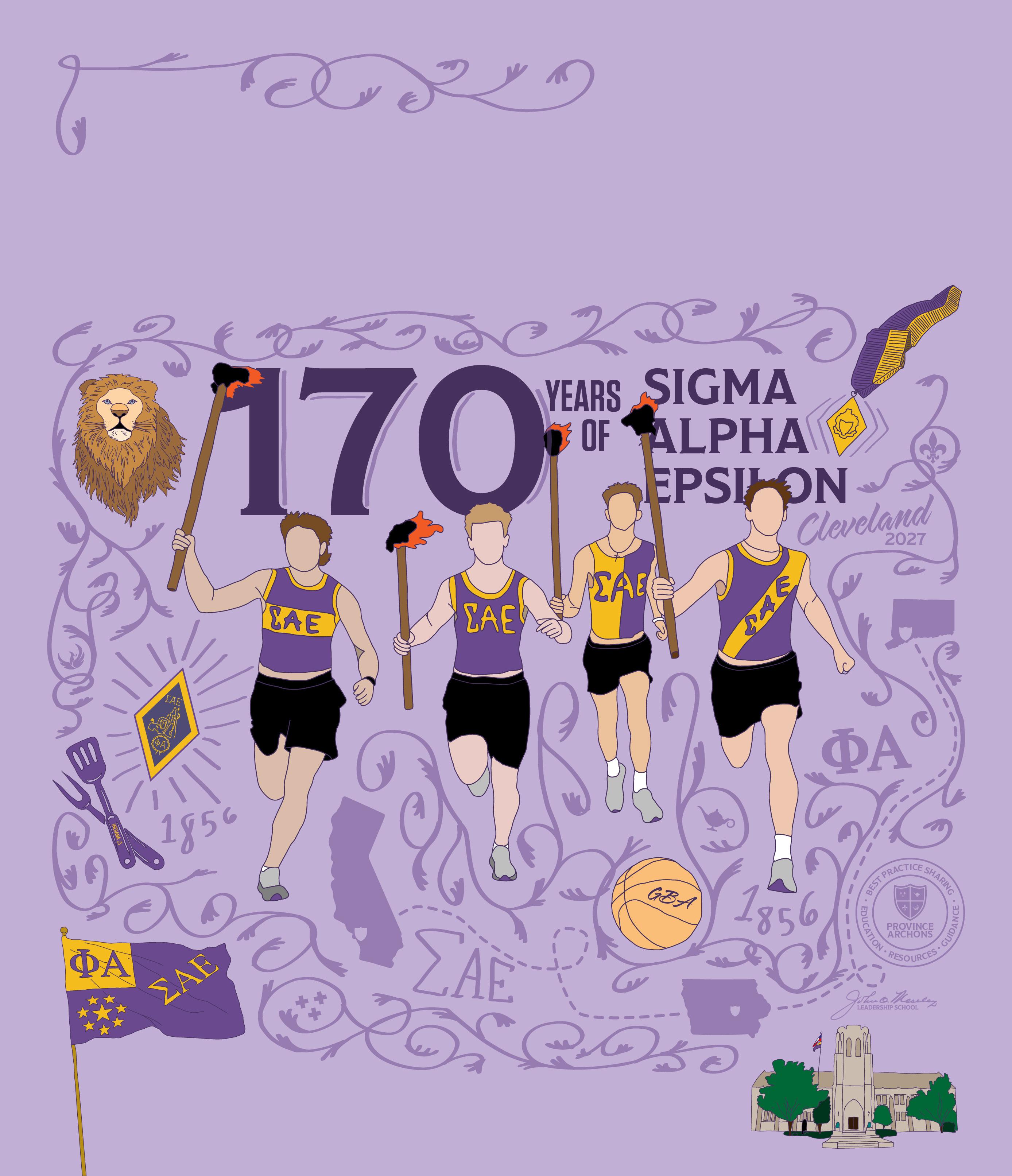
THE OFFICIAL PUBLICATION OF SIGMA ALPHA EPSILON
87TH JOHN O. MOSELEY LEADERSHIP SCHOOL BUILDING TOMORROW’S LEADERS SAE TAKES THE GBA COURT

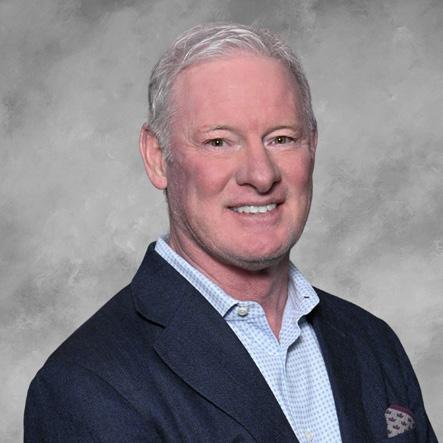
The Fraternity Service Center has entered Fiscal Year 2026 with strong momentum and a renewed focus on advancing Sigma Alpha Epsilon’s long-term success.
Progress across our five core business objectives reflects the commitment of our undergraduate members, alumni volunteers, and professional staff who work together every day to strengthen the mission and values of our Fraternity.
Growth
Our chapters continue to attract and develop exceptional young men. Recruitment of new members has increased year over year, demonstrating both the vitality of our chapters and the enduring value of the fraternity experience.
Education
Leadership development remains central to our mission. Participation in Leadership School has increased dramatically— from approximately 50% of chapters attending two years ago to 87% participation in January 2026. The increased participation represents hundreds of members actively investing in leadership training and personal development that will shape their lives far beyond the undergraduate experience.
Our culture of responsibility continues to deliver measurable results. Following a 34% reduction in incidents last year, incidents have declined an additional 35% year over year. Even more significant, insurance premiums are now lower than they were five years ago despite a 40% increase in undergraduate membership—clear evidence that our commitment to accountability and risk awareness is producing lasting change.
The strength of our fraternity lies in the lifelong connection between generations of brothers. Today, every chapter benefits from at least one advisor, and only 24 operate with a single advisor. Alumni engagement continues to expand as more brothers step forward to mentor, guide, and support the next generation of leaders.
Strong stewardship of the Fraternity’s resources remains a priority. Accounts receivable are being managed more effectively and on a timely basis, operating revenue is exceeding expectations, and write-offs have declined significantly compared to historical levels. These improvements position the organization for sustained financial stability.
During the first year of the current leadership term, significant focus was placed on strengthening the Fraternity’s operational foundation. Key priorities included refining organizational structure, investing in team development, strengthening risk mitigation practices, and enhancing the Fraternity’s reputation through improved digital visibility and search engine optimization.
As we moved into FY26, the focus expanded toward deeper alignment with the people and programs that drive the Fraternity forward. This includes stronger collaboration with:
• Province Archon volunteers, who provide essential regional leadership and support to chapters.
• The New Member Education Program Trial, ensuring our newest members begin their journey grounded in the values and traditions of Sigma Alpha Epsilon.
• Inner Circle initiatives, which foster mentorship and advanced leadership development among highly engaged members and alumni. With only thirty participants, representing roughly 0.002% of our undergraduates, this program is intentionally designed for the most committed and highest-performing leaders in the Fraternity.
• Communications, Culture, and Awards programs, which celebrate excellence and strengthen our shared identity across the organization. A new senior leader has recently joined the communications team to help guide the Fraternity’s messaging and visibility into the future. We have also updated the website at SAE.net, making it far more responsive, user friendly, and inclusive of our volunteers.
• Team Development initiatives, ensuring both staff and volunteers are equipped to serve the Fraternity at the highest level.
The most meaningful lessons in leadership are rarely learned in a classroom. They are forged through responsibility, challenge, and the bonds of brotherhood. Sigma Alpha Epsilon provides its members with opportunities to develop the essential life skills that define successful men—leadership under pressure, integrity in action, and loyalty to those who stand beside them.
The progress we are seeing at the start of FY26 reflects more than positive metrics. It reflects a fraternity that is becoming stronger, safer, and more connected across generations.
Together, our members, volunteers, and staff are building a future defined by responsible growth, lifelong brotherhood, and leadership development that will continue shaping men for generations to come.
The momentum is real—and the work continues.
Steve Mitchell (Indiana ‘83) Eminent Supreme Recorder & Chief Executive Officer

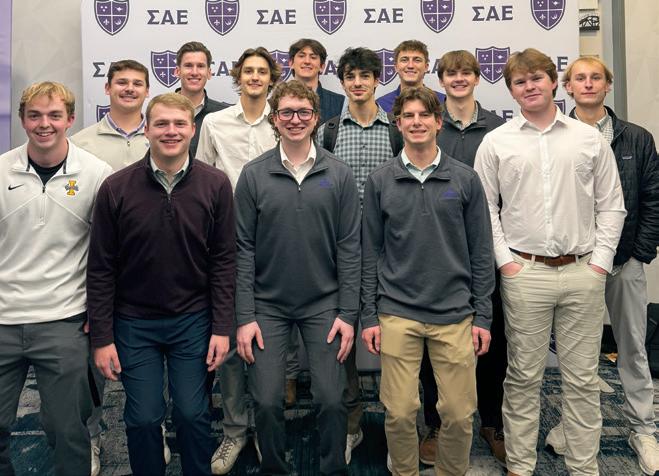
CREDITS
Editors:
Steve Mitchell (Indiana ‘83)
Holly Drzyzga
David Pascarella (Indiana State ‘17)
Design:
Saylor Schwab (Drake ‘22)
Contributors:
Hannah Blenden
Dr. Steadman Boston (Winthrop ’17)
Jennifer Byrd-Alvarado
Debashis Chowdhury (Minnesota ’98)
Pete Engle (Millikin ‘00)
Juan Faria (Salem State ‘17)
Meghan Hanley
Ben Johnson II (UC Irvine ‘87)
Thomas J. Kilian, Jr. (Indiana State ‘99)
Matt Kroeger
Alison Lai
Jen Lehman
Dr. Anthony V. Mack (North Florida ’11)
Justin Maidenberg (Cal State Northridge ‘15)
Kayla McCloud
Jacob Showalter (Case Western Reserve ‘98)
Greg Somers (Michigan State ‘98)
Contact
www.sae.net
www.sae.net/the-record-online/
Facebook @saefraternity
X @sae1856
Instagram @sigmaalphaepsilon
LinkedIn Sigma Alpha Epsilon Fraternity
TikTok @sae.1856

Brothers, let’s take a moment and go back…
Back to the front porch of your chapter house on a warm fall afternoon. Back to the noise of the living room during a big game, brothers packed shoulder to shoulder. Back to walking to class together, grabbing coffee, laughing about nothing and everything. Back to the late nights, the hard conversations, the tough times when a brother showed up just to make sure you were alright.
Think about recruitment. The anticipation. The excitement. The moment you met your new best friend. Think about the pride of wearing your letters. The feeling of walking into a room and knowing you belonged.
It left me with a simple but important question. How do we hold onto that feeling? How do we take that energy, that clarity, that sense of purpose, and carry it forward?
You are not someone who was an SAE. You are an SAE.
That distinction matters more than we might realize. It shapes how we see our role, how we stay connected, and how we continue to live out the values we first committed to. Membership was never meant to be a chapter that closes after graduation. It is meant to be embraced as a lifelong commitment, one that evolves, deepens, and continues to create impact.
This is what it means to be part of ONESAE. A shared experience that stretches far beyond a single campus, a single chapter, or a few short years.
This was a special time in your life. A formative time. A time that helped shape the man you are today. But it was never meant to be confined to a memory. That energy, that connection, that feeling of belonging, that feeling of brotherhood, it never should have left you. The brotherhood is still here. Stronger than ever. Growing. Evolving. And it needs you.
I was reminded of all of this recently at Inner Circle. As I write this, I have just spent the weekend with an incredible group of collegians. These young men are standing on the edge of graduation, preparing to step into the next chapter of their lives. They are aware of what lies ahead, yet they are not intimidated by it.
Together, we talked about failure, not as something to avoid, but as something to embrace. We talked about staying connected to the people who helped shape them. We talked about giving back, not someday, but now.
Even with graduation just weeks away, they were not speaking as if their SAE experience was coming to an end. They spoke as if it was just beginning. They were exchanging phone numbers, figuring out who might be moving to the same cities, and already thinking about how they can stay involved. They talked about giving back to SAE as a whole, serving as Province Archons, advisors, and engaged alumni.

While those four years as a collegian can feel sacred, they were never meant to be the peak of your experience. Some of the most meaningful opportunities as an SAE come after college.
That is when we carry what we learned into our careers, our families, and our communities. That is when we begin to fully understand what it means to be a True Gentleman. And that is when our role within the Fraternity becomes even more crucial.
We are not separate groups of undergraduates and alumni. We are one organization, connected by shared values and a shared responsibility to move forward together.
Your chapter will always matter. The memories, friendships, and lessons you built there are foundational. But the Fraternity is bigger than any one place. It is a unified, enduring network of men who lift each other up and create something greater than themselves.
The continued success of our Fraternity is made possible by the dedication of our alumni volunteers and donors. This past year has been one of strong growth, driven by brothers who give their time, energy, and resources to move SAE forward. Their willingness to stay engaged, in ways both big and small, is what keeps our brotherhood thriving.

Engagement does not look the same for everyone. Not everyone has the same amount of time. Not everyone lives near a chapter. Not everyone is in the same season of life. And that is okay.
But every member can do something. Maybe it is an hour a year. Maybe it is a phone call. Maybe it is showing up once to share your story or your career path with a group of young men who are trying to figure out their own.
What matters is not the scale of the effort. What matters is the intention behind it.
Can you sign up to mentor a young brother who just moved to your city?
Can you attend a local Third Thursday event or a nearby chapter meeting?
Can you participate in next year’s TG Day of Service?
These small actions add up. They create continuity. They strengthen the bond between generations. And remind our undergraduate members that they are part of something bigger, and something lasting.
We often talk about time, talent, and treasure. These are practical ways to stay connected and make an impact.
Your time might be spent mentoring as an advisor or volunteering at a philanthropy event. Your talent could be sharing professional expertise as a career mentor or speaking on a panel. Your treasure helps ensure that the Fraternity continues to operate with excellence. A simple act, such as a minimal annual donation, can go a long way in giving our Fraternity the resources to grow, serve, and support brothers everywhere.
This is not about obligation. It is about ownership. When you see yourself as an active member, not a former one, you focus on ways to contribute rather than the things that hold you back.
If we want the Fraternity to grow, it can’t rest solely on our undergraduates. Growth is a shared effort.
It starts with recruiting the right men. Not just the guys who fit in for four years, but those who see SAE as a lifelong experience. Men who choose to step up, lead, and embrace their membership as a lasting commitment.
Alumni play a huge role in making that happen. You’ve lived the experience. You know its value. You recognize what it looks like when someone truly embodies our values.
Growth doesn’t always look the way we expect. Referring a new brother isn’t just about recommending a friend’s son. Is there someone in your life who embodies what it means to be an SAE? Sometimes it’s about spotting someone who never had the chance to join in college, but already lives the values that guide us.
Brotherhood isn’t limited to a single path that starts at the age of 18. There are countless ways our brotherhood can be shared and experienced.
There is real power in being visible. When alumni show up in their communities, serving, leading, and giving back while proudly wearing their letters, it changes how people see us. It shows the world what SAE truly stands for.
Now imagine the impact if hundreds, even thousands, of alumni joined in a single day of service. Visiting classrooms. Reading to students. Supporting local projects. Not because they have to, but because it reflects who they are.
These efforts matter. They prove that our values aren’t just words; they’re lived, they’re tangible, and they make a difference. They remind us that we are ONE SAE. Across generations and across the country, we are connected, united in purpose, and stronger together.
The Fraternity does not need every member to do everything. But it does need every member to do something. Stay connected. Stay engaged.
If you have stepped away, this is your invitation to step back in. In whatever way fits your life. Reach out to a brother. Attend an event. Jump onto SAE.net and click that Donate link.
At the heart of it, we are ONESAE. Not separated by age, location, or level of involvement, but united by shared experiences, shared values, and shared responsibility.
The letters you wore daily as an undergraduate still belong to you. The values you committed to still matter. The opportunity to make an impact is still in front of you.
Say it out loud, “I am an SAE.” Let that energy guide you. Let it remind you that your place in our brotherhood remains in the present, your influence is real, and your next step, no matter how small, is the one that keeps the legacy alive.
Ben Johnson II (UC Irvine ‘87) Eminent Supreme Archon
The Fraternity Service Center welcomed Caheri Aguilar Arriagada as Associate Director of Technology, and Holly Drzyzga as Senior Director of Communications. Layne Smith (Winthrop ‘19) has accepted a new role as Director of Risk Management, Madison Simmons as Associate Director of Risk Management, and Kayla McCloud as Associate Chief of Staff.
The SAE Foundation welcomed Jeff Rovner (Arizona State ‘85) as Vice President of Development, Barbara Barabas as Director of Annual Giving & Alumni Engagement, and Meghan Hanley as Coordinator of Annual Giving & Alumni Engagement.
SAE Financial & Housing/Greek Housing Management welcomed Clayton Converse (Mississippi State ‘19) as an Asset Manager.
To view the entire SAE staff, visit sae.net/about/leadership/
We celebrated 170 years of Sigma Alpha Epsilon on Founders’ Day, Monday, March 9, 2026. The week was filled with events and service that brought chapters, alumni, and friends together to honor the vision of our Founding Fathers.
Across the country, brothers marked the occasion in meaningful ways, from dinners and gatherings reconnecting alumni and active members to ceremonies honoring our founders’ legacy. At least 39 events were held, including at founders’ gravesites, demonstrating a strong commitment to remembering those who established SAE.
As part of this year’s celebration, we relaunched the True Gentleman Day of Service, a nationwide initiative encouraging chapters and alumni groups to give back to their communities. Thousands of SAEs participated in service efforts ranging from highway cleanups to supporting local nonprofits and registering new donors for the National Marrow Donor Program.
The SAE Foundation continued to build on Founders’ Day traditions by encouraging alumni to join the 1856 Society; donors received a commemorative pin inspired by the Mansion House: the birthplace of our Fraternity. As of March 31, 2026, more than $100,000 has been raised in honor of Founders’ Day, a significant increase from just over $40,000 last year.
Whether through a dinner, a service project, or a small reunion, this Founders’ Day was a time to reflect on why we joined, celebrate the values we share, and look ahead to the continued strength of our brotherhood.
For the 2026–2027 fiscal and academic year, DeVotie Ritual Institute will be held in January 2027 in conjunction with Leadership School. This adjustment is primarily due to scheduled renovations at the Levere Memorial Temple during the summer of 2026, which limit our ability to host the program at its usual time.
We evaluated a fall offering; however, past experience has shown that attendance is significantly lower during that term, making it a less effective option. January provides a more practical alternative, as classes are not in session and many brothers are already planning to travel for Leadership School. Aligning the two programs also allows the Fraternity to be more costconscious by operating under a single hotel contract.
We recognize that this is a departure from the traditional schedule, but this adjustment is needed to accommodate the LMT renovations.
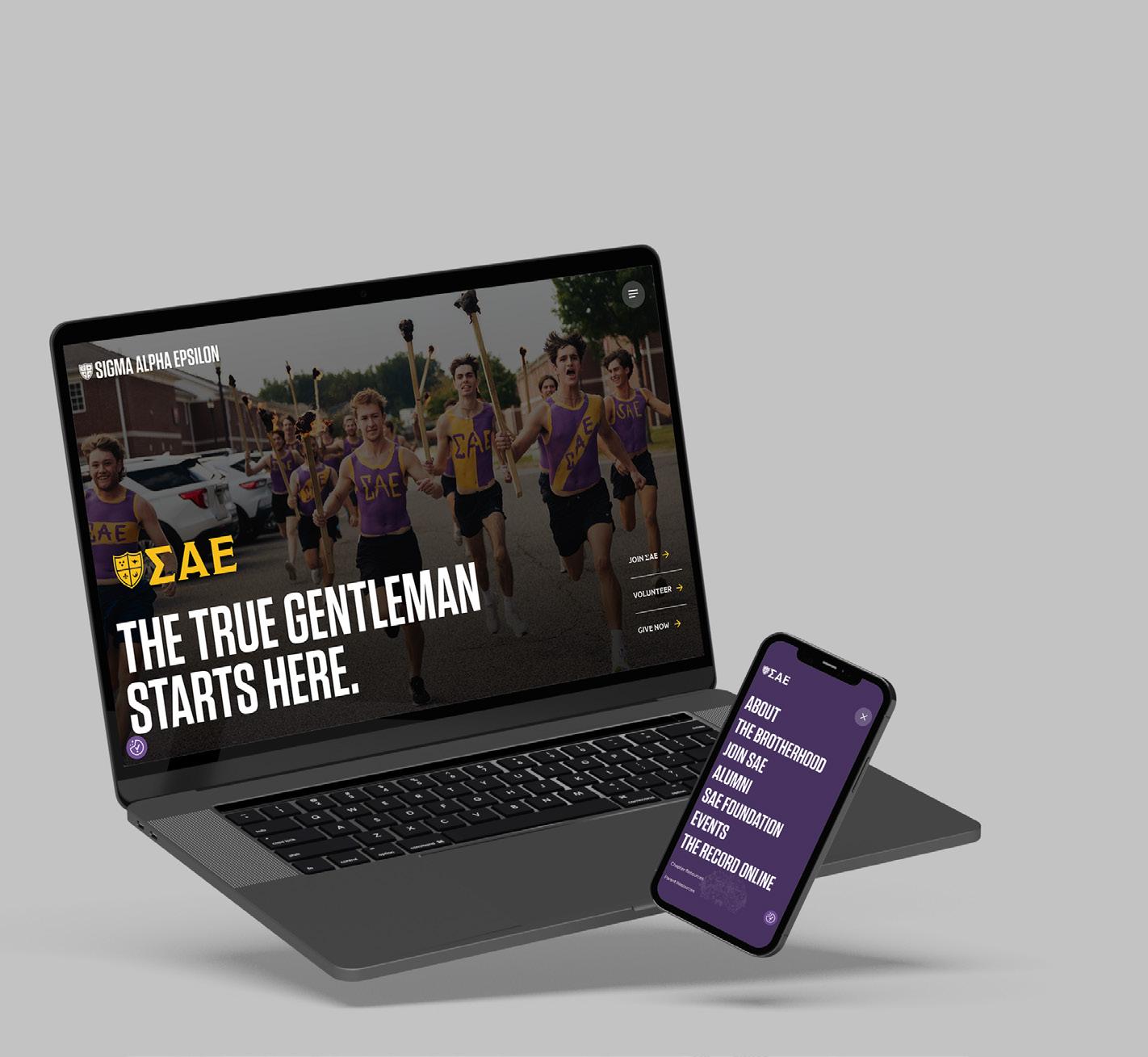
A streamlined experience with an elevated visual presence that looks and feels like the caliber of man SAE develops: bold, confident, intentional and purposeful.
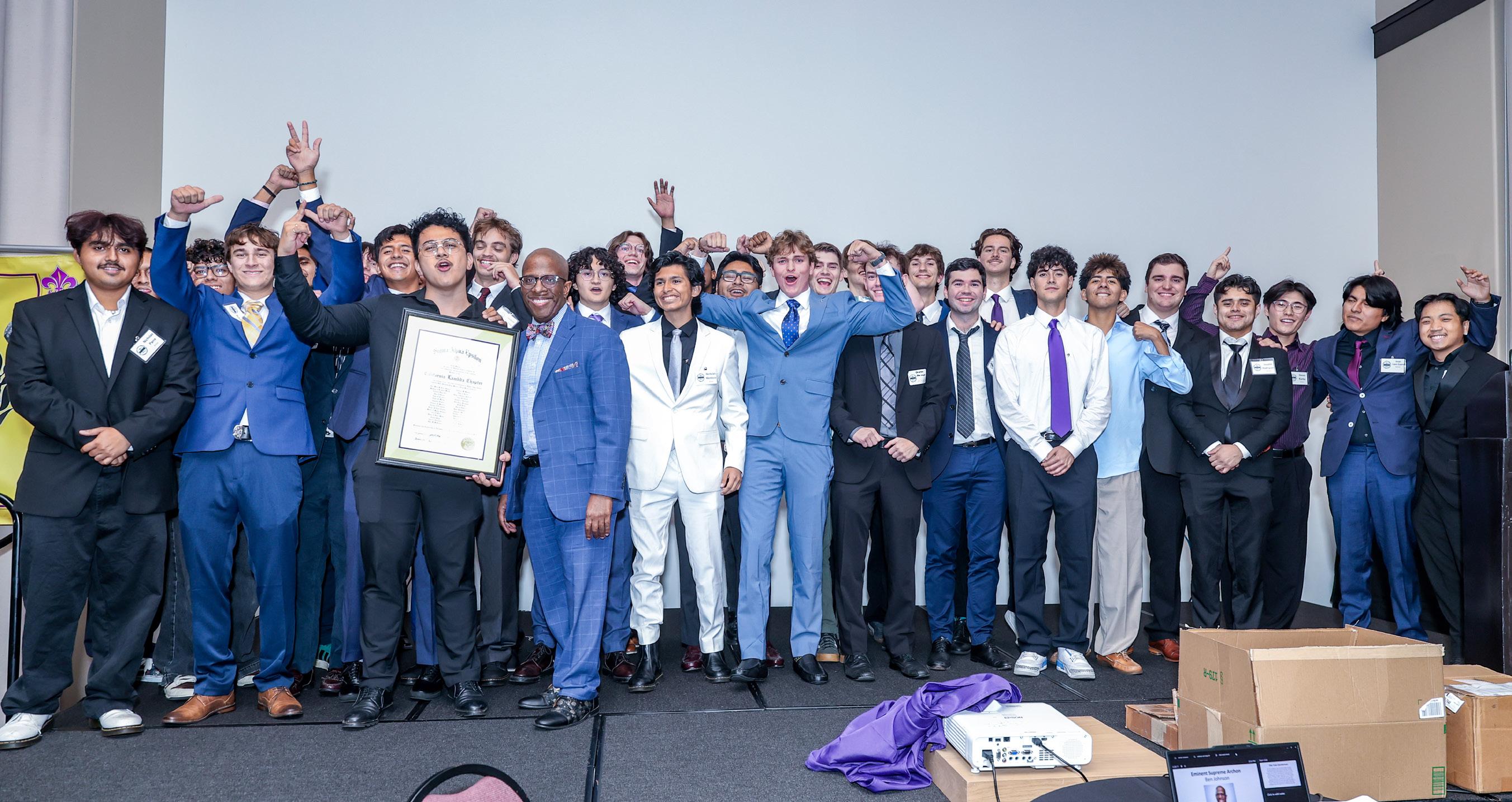

LOCATION: LONG BEACH, CA
CHAPTER SIZE: 33
INSTALLATION: NOVEMBER 8, 2025
ABOUT THE CAMPUS
California State University, Long Beach (CSULB), also known in athletics as Long Beach State University (LBSU), is a public research university in Long Beach, California, United States. The 322-acre campus is the second largest in the California State University system (CSU).
Dan Milan Delos Santos
Matthew Boehmer Worth
Nicholas Ryan Lai
Ryan Geraci
Tyler Pacheco
Logan Marley
Augustin Destree
Nicholas Mendoza
Thomas Trommald
Sergio Lopez-Espana
Mallen Mueller-Dombois
Nick Parra
Quinn Raper Mateo
Tanish Fogat
Andrew Hernandez
Hyde McFerson
Jackson Mignola
Luke Harris
Diego Lorino Gutierrez
Adam Astrup
Joustin Rodriguez
Leif Trejo Hernandez
Ki Hung
Roy Vidal
Ryan Ushewokunze
Eduardo Mariscal
Tristan Gonzalez
Seth Schwartz
Truman Arteche
Luis Ramos
Ethan Bray
Evan Rocha
After nine years away from campus, California Lambda has made a celebrated return to The Beach, backed by decades of history and a deeply invested alumni network who refused to let the chapter’s tradition fade. Working closely with national staff and an exceptionally active alumni board, the founding members helped reintroduce SAE to CSULB as a chapter focused on academics, safety, and genuine brotherhood. From that small but committed start, the chapter has grown into a thriving brotherhood of twentynine members, each dedicated to living out the True Gentleman and rebuilding a respected presence on campus. Momentum only accelerated with the long-awaited return of the historic chapter house at 1211 Newport Avenue—now fully renovated and once again serving as the heart of California Lambda. In recent semesters, the chapter has earned recognition for its academic discipline, philanthropic impact, and growing leadership presence on campus. Supported by an exceptional alumni advisory board— including hands-on guidance, financial stewardship, and multi-generational mentorship—this is only the beginning. As the chapter prepares for its 70th anniversary this November, the brothers are committed to writing the next great era of their history—one defined by integrity, leadership, and a legacy that will influence generations of True Gentlemen to come.
BY HANNAH BLENDEN
With four hundred and twenty-nine collegian members from one hundred and seventy-five chapters and emerging chapters descending on the Windy City in January, the 87th John O. Moseley Leadership School was off to a rocking start. Focused on building the leadership skills needed to succeed in all facets of life, Leadership School brought together hundreds of current and future chapter leaders from across the Realm.
John O. Moseley was the driving force behind the first National Leadership School, held in Evanston in the summer of 1935. Moseley believed the Fraternity could expand its reach by instilling education and leadership skills in its members and by creating something no other fraternity had yet attempted. Although Leadership School looks very different today, we owe Moseley for the strong foundation upon which this incredible Fraternity experience was built. Still going strong more than 90 years later, Leadership School remains rooted in Brother Moseley’s foresight in recognizing the value of bringing brothers from different chapters together to build stronger leaders.
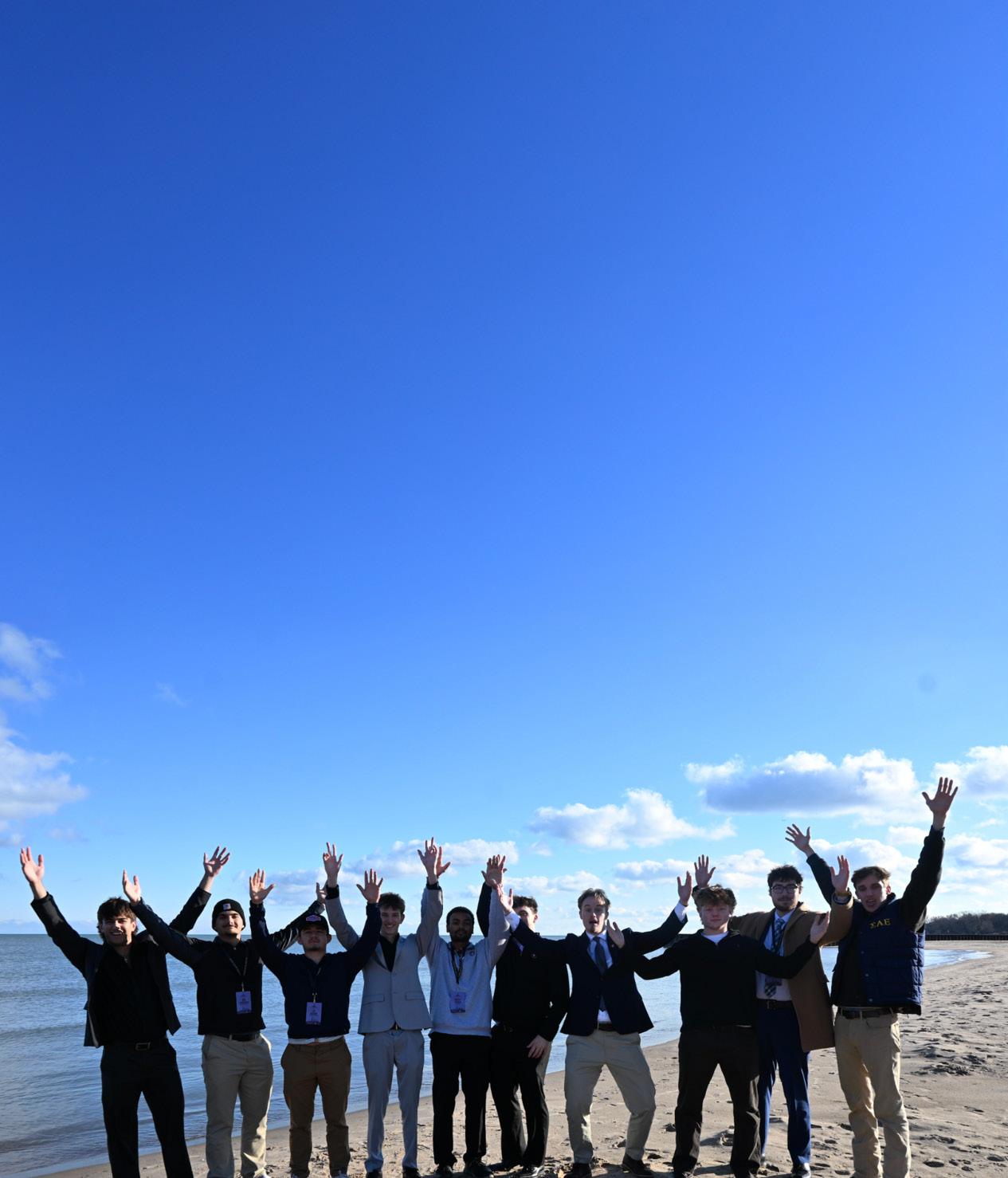
This year’s John O. Moseley Leadership School featured keynote speakers, engaged alumni volunteers, and dedicated Fraternity staff leading both small-group activities and general sessions.
Small “chapter” groups served as a home base for 15–20 collegians and two co-facilitators. These groups focused on team building, group development, and in-depth problem-solving throughout the weekend. General sessions addressed critical topics such as hazing prevention, career readiness, and public relations.
Leadership School kicked off with a high-energy opening session that immediately set the tone for the weekend. Brothers who had traveled from every corner of the country were reminded that they are part of something bigger than their individual chapters. The message was clear: Leadership is not a title; it is a responsibility.
Chapter groups met for the first time following the opening session, diving into team-building exercises rooted in Tuckman’s Five Stages of Team Development. The five stages—Forming, Storming, Norming, Performing, and Adjourning—describe the journey teams take from initial assembly to project completion. This model can help leaders guide teams through conflict, establish cohesion, and maximize productivity. What began as polite introductions quickly evolved into meaningful conversations about chapter culture, personal growth, and the challenges facing today’s collegiate members. By the end of the evening, groups that started as strangers were already functioning as cohesive teams.
As Samuel Haley (Middle Tennessee, Tennessee Beta) shared, “It was one of my favorite experiences I’ve had so far, and I hope to come to much more.”
Day Two challenged attendees to engage with some of the most critical issues facing fraternities today.
During the risk management session, attendees completed the Fraternity’s new Social Event Management Guide, walking step by step through how to properly plan and execute a safe social event. Rather than discussing policies in theory, brothers actively practiced applying them.
The results were significant. By the end of the weekend, there was a 173% increase in participants who agreed with the statement: “I have completed Sigma Alpha Epsilon’s Social Event Management Guide.”
More importantly, participants left confident in their ability to protect their brothers and their chapters.
One of the most powerful moments of the weekend came during the hazing
prevention session featuring Lianne Kowiak, who shared the heartbreaking story of losing her son to a fraternity hazing ritual. The room fell silent as she spoke, reminding every attendee that leadership decisions carry real consequences.
Her story was not just emotional; it was transformational. Brothers were challenged to reflect on the type of culture they are building and the legacy they want to leave behind.
“I FEEL MUCH MORE CONNECTED WITH SAE AS A WHOLE; IT WAS REALLY PRODUCTIVE TO GET OUT OF MY CHAPTER AND SEE MORE PERSPECTIVES.” THOMAS SCHMIDT (KUTZTOWN)
Through a personality assessment, attendees explored their communication styles, leadership strengths, and areas for growth. Conversations about conflict resolution and trust prompted meaningful reflection.
There was a 31% increase in participants agreeing with the statement: “I have the ability to look introspectively and address my own shortcomings.”
As Cole Brewer (Texas Tech, Texas Alpha) reflected, “[It] helped put a lot of leadership qualities into perspective.”
The recruitment session focused on building intentional plans and executing them with excellence. Service and philanthropy programming highlighted the Fraternity’s partnership with the NMDP and celebrated the impact chapters across the Realm are making.
Public relations training, led by The Lafayette Group, equipped attendees with tools to engage local media and share the positive impact their chapters have in the community.
“The variety of speakers and their different approaches was extremely beneficial,” shared Hayden Roberts (Puget Sound, Washington Gamma). “I was also easily consistently engaged and actively learning new things during the sessions, which is not something I often feel, even in school. I feel far more prepared in solving problems and identifying new solutions than I did prior to leadership school.”
“I FEEL FAR MORE PREPARED IN SOLVING PROBLEMS AND IDENTIFYING NEW SOLUTIONS THAN I DID PRIOR TO
Day Three featured a keynote address from a member of SEAL Team Six, who shared powerful lessons from his time serving on one of the nation’s most elite special operations teams. Drawing parallels between military teamwork and fraternity leadership, he emphasized trust, accountability, and commitment to a shared mission.
Participants saw a 32% increase in agreement with the statement: “I can identify the steps it takes to build a highperforming team,” and a 32% increase in understanding the relationship between trust and performance within a team setting.
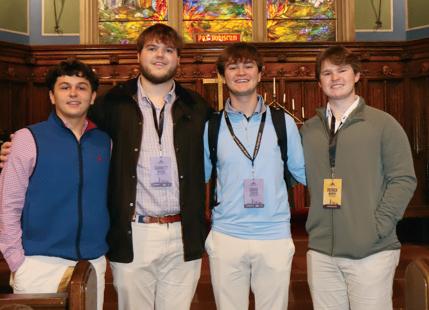
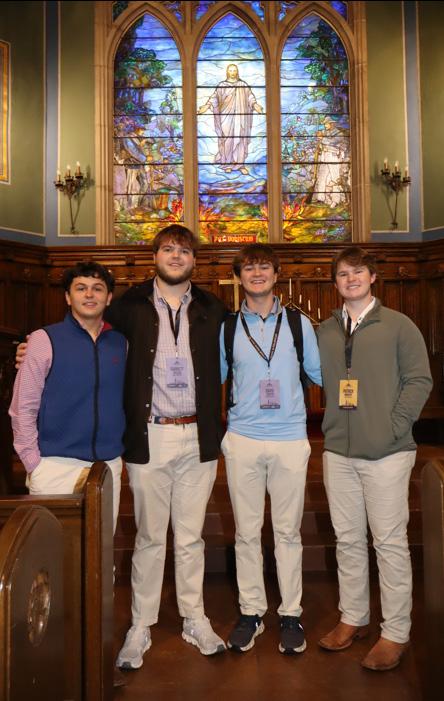
That afternoon, the brothers visited the Levere Memorial Temple, exploring the grounds and the historic Tower Room. The
experience connected attendees to the Fraternity’s deep history and traditions, reinforcing that they are stewards of something larger than themselves. The evening concluded with a shared meal of Chicago-style pizza from Lou Malnati’s, where laughter and conversation filled the room, a reminder that brotherhood remains at the heart of Leadership School.
Career-readiness programming aligned with the eight core career readiness competencies essential for workplace success, as outlined by the National Association of Colleges and Employers (NACE): Career & Self-Development, Communication, Critical Thinking, Equity & Inclusion, Leadership, Professionalism, Teamwork, and Technology. This session helped participants explore how fraternity involvement directly develops the skills employers seek.
The impact was clear: a 473% increase in attendees who could identify at least three NACE Career Readiness Standards.
“I didn’t really know what I’d learn at leadership school, and I didn’t know if I would be able to apply it because I don’t have a significant role in my chapter,” said Augustus Schlegel (East Carolina, North Carolina Sigma). “But I learned a lot in the workshops; I learned a lot about myself and how I can better myself and grow as a leader.”
This session also highlighted the SAE Mentor Program and the SAE Job Board, connecting collegiate members with alumni networks that extend far beyond graduation.
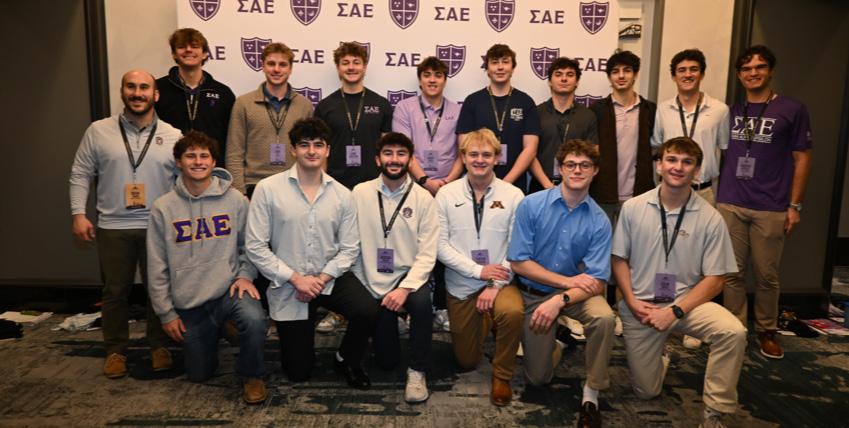
At the end of the weekend, the brothers applied what they learned in a comprehensive case study. Small groups were presented with real-life scenarios faced by chapters and tasked with designing actionable solutions.
“We discussed real issues that occur in each of our fraternities, and it really helped to broaden our knowledge of problem-solving,” said Gaige Franklin (Southern Mississippi, Mississippi Sigma).
Ren Mackey (Southern California, California Gamma) echoed that sentiment: “[The sessions] allowed me to apply and compare my problems within my chapter to situations learned about in my groups and figure out alternate solutions that I had not yet thought of.”
Leadership School did more than inspire; it produced measurable growth.
A pre-test conducted on day one and a post-test completed on the last day allowed the Fraternity to track direct learning outcomes. Every post-test result showed at least 90% of respondents indicating they “greatly agree” or “moderately agree” with each statement. Additionally, 83% of all results showed that 98% or more of respondents selected the top agreement levels.
Notable growth included:
• 481% increase in identifying Tuckman’s Five Stages of Team Development
• 173% increase in completing the Social Event Planning Guide
• 473% increase in identifying NACE Career Readiness Standards
• 47% increase in identifying key components of Health and Safety policies
• 20% increase in comfort with public speaking
These numbers represent brothers returning home better equipped to lead.
The weekend concluded with a final chapter meeting, challenging attendees to write SMART goals (Specific, Measurable, Achievable, Relevant, and Time-bound) for the upcoming semester. Alumnus Stan Strom (Arizona State ‘82) and Ambassador Keeton Kauffman (Arizona State, Arizona Beta) closed the final general session with words of encouragement, urging brothers to carry the momentum home.
“As a freshman, I found myself in the minority of brothers, but I still felt a sense of belonging,” said Jack Brindl (Wichita State, Kansas Gamma). “Everything I learned I feel can easily be applied to my chapter, and I’m excited to expand my network moving forward. Leadership school is going to be recommended to new members for years to come.”
“LEADERSHIP SCHOOL IS GOING TO BE RECOMMENDED TO NEW MEMBERS FOR YEARS TO COME.”
Daniel Gentile (Indiana University, Indiana Gamma) added, “Good to talk to other chapters to see how they deal with conflict and relate to issues we face.”
Matthew Etheredge (West Florida, Florida Sigma) summarized the collective sentiment: “I learned many things that I will be bringing back to my chapter to further expand/grow it.”
“There was something new to learn about [in each session],” said Laine Richard (Texas A&M).
“Just learning new things and how to adapt and develop yourself and your chapter to be as successful as possible is great knowledge to have, and [I had some] great, interesting learning moments,” shared Chris Rogers (Arkansas, Arkansas Alpha-Upsilon).
And perhaps most simply put: “Great experience making my passion for the fraternity stronger.” — Sam Woreline (Toledo, Ohio Nu)
For 87 years, Leadership School has continued the vision set forth by Brother John O. Moseley: to create stronger leaders by bringing brothers together in pursuit of growth. This year’s program demonstrated that the mission is alive and thriving.
As 429 collegians returned to their 175 campuses, they did not leave Chicago the same men who arrived. They left as more capable teammates, more thoughtful leaders, and more connected brothers, ready to shape the future of Sigma Alpha Epsilon.

Recognizing a lifetime of service and loyalty to the Fraternity, the Distinguished Service Award is the highest individual award a member of Sigma Alpha Epsilon may receive. Their actions exhibit their understanding of the Fraternity’s teachings, adherence to Fraternity Laws, attention to the promotion of its welfare, and exemplary conduct that guards well its honor and high standing.
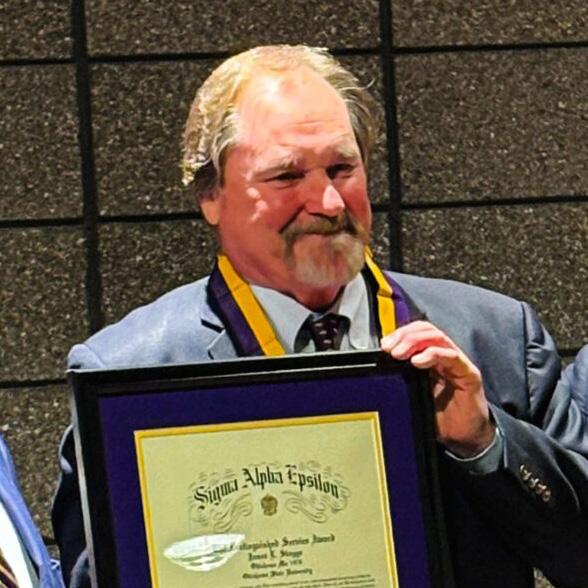
RECOGNIZED WITH THE 169TH DISTINGUISHED SERVICE AWARD
After serving his chapter as Eminent Deputy Archon and Recruitment Chairman, Brother Skaggs gave back to “the thing that gave you everything and made you who you are today,” a testament to how much he believes in the ideals of our fraternal experience. For the better part of three decades, he dutifully held leadership positions for both his chapter’s Alumni Association and House Corporation, guiding it to become one of the exemplary models across the country. Brother Skaggs’ professional expertise led him to establish an innovative health and safety program at Oklahoma Mu, which eventually became the model for the entire Greek-letter community at Oklahoma State. Brother Skaggs became a Province Archon and a Leadership School faculty member, also serving on a variety of committees: notably those related to expansion, diversity, risk management, philanthropy, and Ritual. Using his decades of experience with local and regional groups, Brother Skaggs joined the SAE
Financial and Housing Board of Directors to help chapters across the Realm with their housing needs. He resigned only because he was elected to the Supreme Council, where he now leads our organization as Eminent Supreme Deputy Archon. Recognizing decades of steadfast and consistent leadership, the Supreme Council of Sigma Alpha Epsilon awarded Brother Skaggs the 169th Distinguished Service Award at the Phoenix Area Alumni Association Founders’ Day celebration in Phoenix, Arizona, on March 5, 2026.

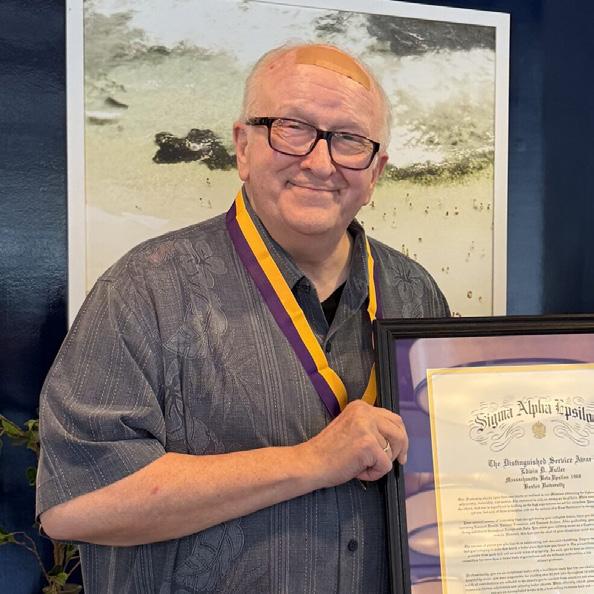
After serving his chapter as Eminent Herald, Eminent Treasurer, and Eminent Archon, Brother Fuller served in the United States Army and toured throughout Europe and Asia, ending his military career as a Captain and earning several service medals. Throughout his illustrious hospitality career, Brother Fuller was responsible for creating over 80,000 jobs throughout 70 different countries. His decades’ worth of contributions are reflected in the awards he has received from countries and places around the world, including numerous lifetime achievement and industry leader awards. While now officially retired, Brother Fuller has his own consulting firm and is an accomplished writer with a best-selling business book and a fiction series. Brother Fuller has been on advisory boards and leadership committees for more than a dozen trade organizations and six different universities, a few of which he also served as an adjunct professor. Brother Fuller dedicated himself to the SAE Foundation Board of Trustees for over a decade, proudly serving as its Chairman from 2013 to 2021. Under his guidance, the SAE Foundation awarded scholarships and provided financial support to the Fraternity’s educational programs benefiting countless generations and chapters. He also laid the groundwork for the Foundation’s successes today. Many of the long-term strategies, operational policies, and management practices can trace their roots directly to Brother Fuller. In recognition of nearly fifty-eight years of steadfast dedication and faithful service to Sigma Alpha Epsilon, Brother Fuller was formally presented with the award on March 14, 2026, during a small gathering in Orange County at the Montage Resort.
We are honored to announce the addition of four new portraits to the Levere Memorial Temple, the first such installation in several years. For the coming year, these portraits will be displayed in the Office of the Eminent Supreme Recorder (ESR).
These portraits recognize the distinguished service and enduring contributions of the following alumni. We proudly celebrate their leadership, dedication, and lasting impact on our organization.

• M. Todd Buchanan (Southern Mississippi ‘90), former Eminent Supreme Archon and Distinguished Service Award recipient
• Richard L. Lies (Northwestern ‘67), former Eminent Supreme Recorder and Distinguished Service Award recipient
• Michael S. Rodgers (William & Mary ‘92), former Eminent Supreme Archon and Distinguished Service Award recipient
• The “Mount Rushmore of Finance and Housing,” featuring Charles P. Boyd (Mississippi State ‘65), Mike Rodgers, Greg Somers (Michigan State ‘98), John Kelley (Central Florida ‘77) and Lance DeNardin (DePauw ‘86).

Recognition of achievement and dedication to the Fraternity is important. Members and chapters who distinguish themselves, whether through service to the Fraternity or excellence in their professions, bring honor not only to themselves, but also to Sigma Alpha Epsilon. The Fraternity recognizes the value of acknowledging exceptional service, and presenting an award is one of the most meaningful ways to show appreciation for the brothers who strengthen our organization. Submitting a nomination ensures their contributions are recognized and reminds them that their leadership, service, and commitment truly matter to the brotherhood.
Sigma Alpha Epsilon offers several awards to recognize members and supporters who exemplify dedication, leadership, and service to the Fraternity and their professions.
Order of DeVotie
Awarded to brothers who demonstrate outstanding proficiency in the Fraternity’s Ritual.
Order of Violet
Presented to a spouse or significant other who has shown commitment to the Fraternity and its mission through support, involvement, and volunteer service.
SAE Foundation Impact Award
Recognizes alumni who have made a meaningful difference by mentoring another brother.
The following awards recognize sustained service to Sigma Alpha Epsilon and must be received in the order listed below as members continue their commitment to the Fraternity.
1. Order of the Phoenix — 1 to 4 years of service (collegiate members only)
2. Order of the Lion — 3 to 5 years of service
3. Order of Minerva — 5 to 8 years of service
4. Shield of Brotherhood — 8 to 12 years of service
5. Merit Key — 12 to 15 years of service
6. Distinguished Service Award — 16+ years of service
William McKinley Outstanding Achievement Award
Presented to a brother who has made significant contributions within his professional field, bringing positive recognition to Sigma Alpha Epsilon. This award does not require direct volunteer service to the Fraternity.
Submitting an award nomination is a simple process designed to ensure each recipient meets the Fraternity’s recognition standards. Nominations are submitted through an online form where the nominee’s qualifications and supporting details are reviewed to confirm eligibility for the award being requested. Once approved, the award order is sent to our printing partner so the recognition piece can be prepared in time for presentation.
To allow adequate time for review and production, award nominations should be submitted no later than 21 days prior to the event where the award will be presented. For questions about eligibility, timelines, or the submission process, Kayla McCloud ( kmccloud@sae.net ) is available to assist with all award-related inquiries.
There’s no better time to nominate a brother who has gone above and beyond. Submitting an award is more than a formality; it’s a chance to honor those who exemplify the ideals of True Gentlemen of Sigma Alpha Epsilon.
Learn about the Fraternity awards and nominate individuals on sae.net

The following awards recognize sustained service to Sigma Alpha Epsilon and must be received in the order listed below as members continue their commitment to the Fraternity.


ORDER OF
1 to 4 years of service (collegiate members only)
ORDER OF THE LION
3 to 5 years of service
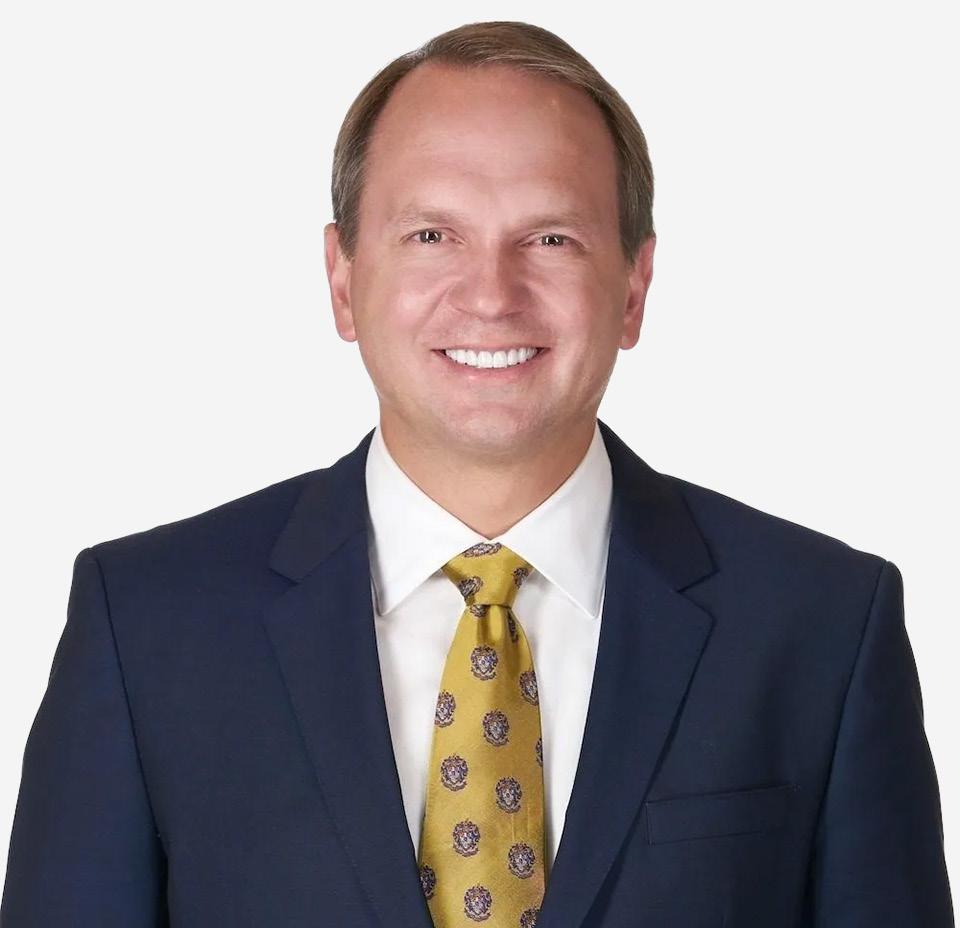
Recognition isn’t just about honoring long years of service; it’s also about celebrating the meaningful ways brothers shape the lives of those around them. One shining example is Todd Buchanan, who was recently presented with the SAE Foundation Impact Award
ORDER OF MINERVA
5 to 8 years of service

SHIELD OF BROTHERHOOD
8 to 12 years of service
MERIT KEY
12 to 15 years of service
DISTINGUISHED SERVICE AWARD
16+ years of service
Todd Buchanan (Southern Mississippi ‘90), recently honored with the SAE Foundation Impact Award, exemplifies what it means to be “Mr. SAE.” From his early days at the University of Southern Mississippi, where he served as Eminent Archon and Student Body President, to leadership roles as Eminent Supreme Archon and Province Archon, Todd has dedicated a lifetime to Sigma Alpha Epsilon. In 2011, he received the Distinguished Service Award for his enduring service.
Beyond SAE, Todd’s professional accomplishments are equally remarkable. He served six years as an Army Officer and 24 years in the life and retirement industry, earning Manager of the Year nine times. In April 2026, Todd was appointed President and CEO of Crump Life Insurance Services, an AmeriLife company, and Hanleigh Management (collectively, “Crump”). He continues to serve as President of AmeriLife Wealth. Prior to joining AmeriLife, Todd served as CEO of World Financial Group.
Todd’s influence extends through mentorship, guiding countless brothers and professionals with insight, perspective, and encouragement. As ESR Steve Mitchell reflects, Todd’s guidance has been transformative, offering both technical knowledge and strategic understanding to help leaders navigate complex challenges. Even in moments of personal hardship, Todd’s commitment to SAE and its brothers remains unwavering, inspiring all who have had the privilege to learn from him.
In addition to his mentorship, Todd continues to support the Fraternity’s growth, including assisting with the capital campaign and serving as a beacon of leadership for the next generation of brothers.
Recognition of achievement and dedication to the Fraternity is important. Members and chapters that have distinguished themselves on various levels of the Fraternity or within their professions bring honor not only to themselves but also to Sigma Alpha Epsilon. The Fraternity realizes the value in acknowledging exceptional service and that the presentation of an award of recognition is also a primary way to show our appreciation.
Please Note: To be nominated for and subsequently receive an alumni recognition award, the honoree must have previously been recognized with the award that precedes it in the recognition chain. For example, to be eligible for the Shield of Brotherhood, an alumnus must first have received the Order of Minerva award. If you have any questions regarding which awards an alumnus has received or need clarification on our Alumni Recognition Awards process, please contact Kayla McCloud at kmccloud@sae.net This does not apply to the William McKinley Outstanding Achievement Award.
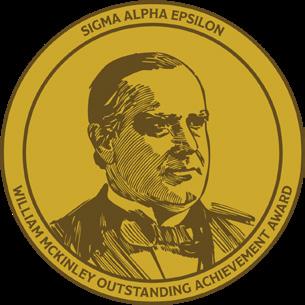
The William McKinley Outstanding Achievement Award embodies commitment, perseverance, leadership, and service to others. These virtues were exemplified by Brother William McKinley (Mount Union 1869), the 25th President of the United States. Like McKinley, whose leadership and service to our nation left a lasting legacy, recipients’ achievements reflect the highest ideals of Sigma Alpha Epsilon and serve as an inspiration to all its members. Recipients receive a printed certificate and medallion.
Les H. Ireland (Towson ‘86)
Lance A. DeNardin (DePauw ‘86)
Dr. F. Joseph Halcomb III (Kentucky ‘74)
Steven D. Mitchell (Indiana ‘83)
Donald J. Ormond (Idaho ‘76)
Kevin M. Nagle (Cal State Long Beach ‘76)
The Shield of Brotherhood recognizes a brother who consistently excels in voluntary commitment and service for the Fraternity.
Travis J. Magoulias (Millikin ‘96)
Rodney C. Randle (West Florida ‘79)
Randall W. Schocke (Western Kentucky ‘78)
Gaurav D. Datta (Cal State Long Beach ‘99)
Thomas Anthony M. Laura (Cal State Long Beach ‘84)
Samuel L. Breuklander (Cal State Long Beach ‘65)
Daniel P. Gooch (Cal State Long Beach ‘72)
Nabil N. Kahale (Cal State Long Beach ‘01)
William F. Ridgeway, Jr. (Cal State Long Beach ‘64)
Stephen H. Watson (Allegheny ‘85)
Tod O. Dickeson (Idaho ‘92)
Stephen D. Cary (Iowa ‘92)
Robert H. Hall (Iowa ‘66)
Robert H. Banks, Jr. (Southern Mississippi ‘72)
M. Ronald Doleac (Southern Mississippi ‘70)
The second highest award an individual alumnus can receive, the Merit Key recognizes an alumnus who has demonstrated significant service and loyalty to the Fraternity on combined levels for an extended period of time.
Deran C. Abernathy (Texas-Dallas ‘04)
Scott D. Thomas (Idaho ‘94)
Robert E. Serrano (Idaho ‘63)
Kenneth L. Inman, Jr. (Southern Mississippi ‘68)
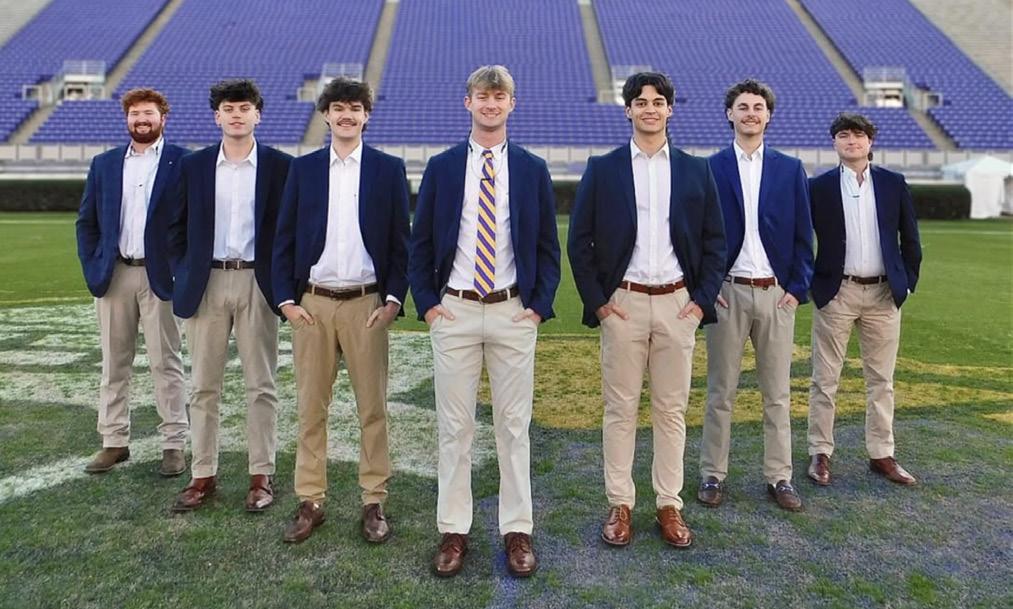
Congratulations to the newly elected Executive Board of East Carolina (North Carolina Sigma).
Fill out the Good News Reporting form to let us know!

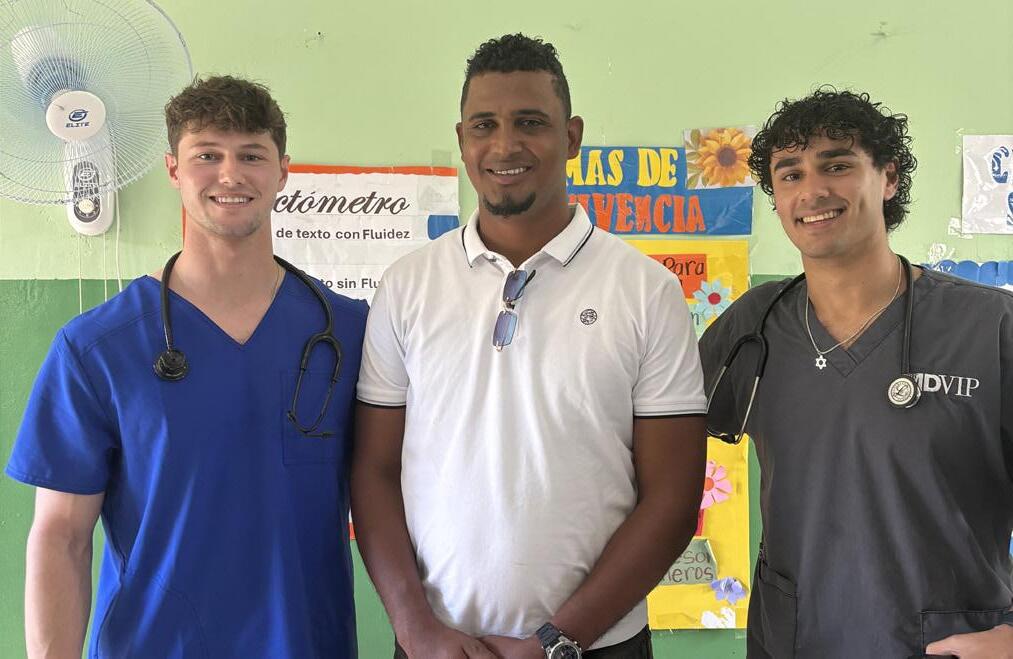
Connecticut (Connecticut Beta) brothers Vinny Naccarato and Jackson Frankel represented their chapter on a medical service trip to the Dominican Republic through UConn Bridge to Guanin. These model brothers spent 10 days providing essential healthcare access at the Guanin Center. Their work included supporting local clinics, triaging patients, shadowing physicians, and helping deliver medicine to communities that do not regularly have access to medical care.



As a preferred partner of Sigma Alpha Epsilon, Upper Crust is proud to support chapters with food service built for Greek life.
We value the opportunity to serve SAE chapters in a way that strengthens the member experience, supports chapter operations, and reflects the standards of the organization. With years of experience serving fraternities across the country, we understand the day-to-day needs of chapter life and the importance of having a partner you can rely on.
If your chapter is evaluating food service, we’d love to start the conversation. uppercrustfoodservice.com/fraternities/sigma-alpha-epsilon/
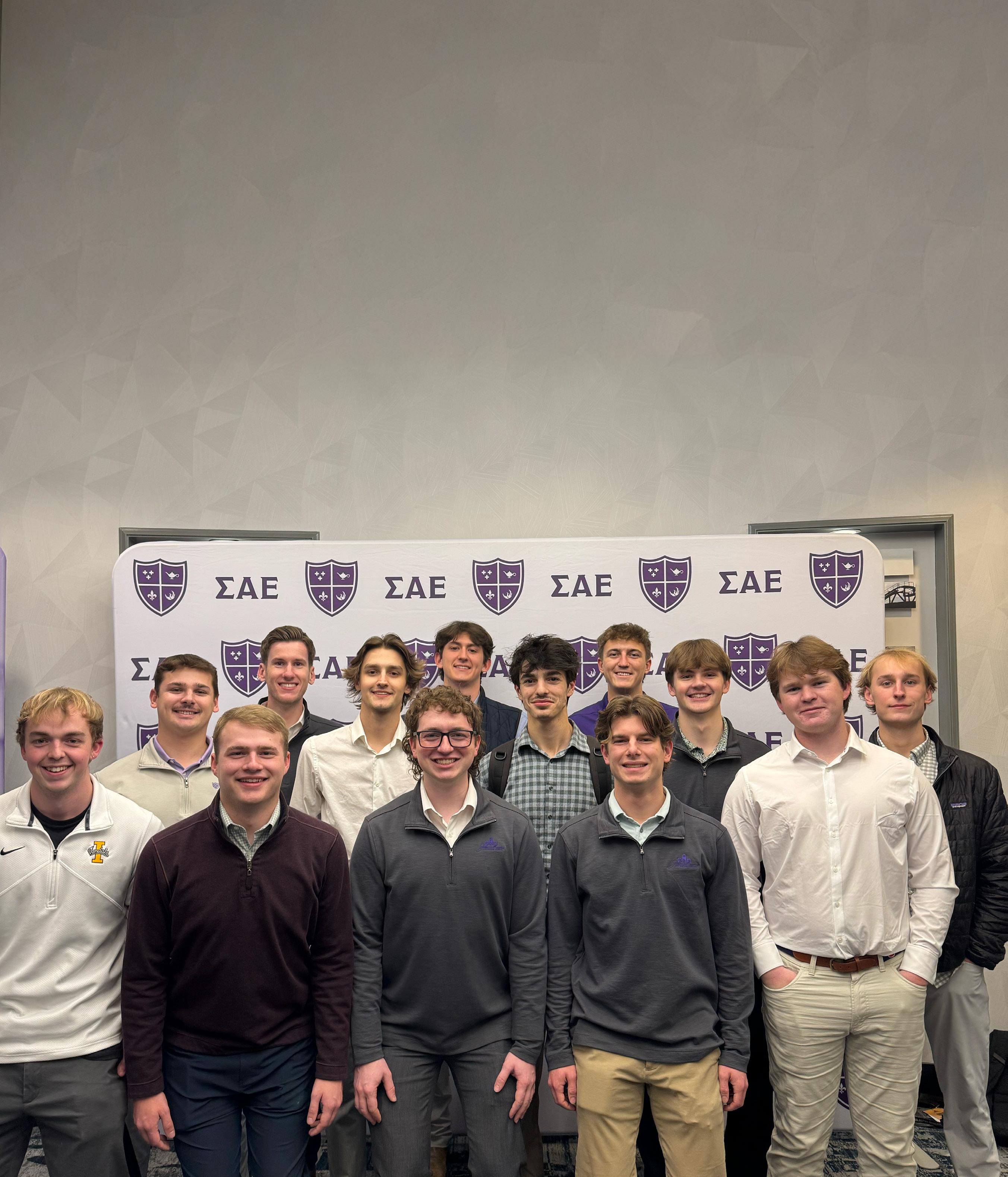
BY DR. STEADMAN BOSTON (WINTHROP
Sigma Alpha Epsilon has always believed that the most important lessons a man learns are not found in a textbook. Leadership under pressure. Integrity in action. Brotherhood through adversity. These are the qualities that shape men into leaders, and they are at the heart of the Fraternity’s revitalized National Ambassador Program.
For the 2025–2026 academic year, the program was reimagined and significantly enhanced to create one of the most elite leadership opportunities available to collegiate members. More than just a volunteer role, the National Ambassador Program functions as a hands-on internship within the Fraternity, offering participants real-world experience, direct mentorship, and the chance to help shape the future of Sigma Alpha Epsilon. This year, only 17 exceptional brothers from chapters across the Realm were selected to serve as National Ambassadors.
The National Ambassador Program represents the pinnacle of leadership development for SAE collegians. Selected Ambassadors work closely with the Fraternity Service Center across several departments, including Education, Communications, Risk Management, Alumni Engagement, and Chapter Services, gaining valuable insight into the operations and strategic priorities of the Fraternity.
Drew Taylor (Michigan State University, Michigan Gamma) reflects, “Serving as an Ambassador for Sigma Alpha Epsilon has been one of the most impactful experiences of my college career. The program closely resembles an internship because we take on real responsibility representing the Fraternity, engaging with prospective members, and serving as leaders within our chapter and community. It’s a hands-on role that requires professionalism, initiative, and strong communication skills.”
Through monthly meetings with Fraternity Service Center staff, Ambassadors receive a rare behind-the-scenes perspective into how a national organization operates. They learn how initiatives are developed, how challenges are addressed across the Realm, and how leadership decisions impact thousands of brothers nationwide. More importantly, Ambassadors are not just observers; they are active contributors, shaping the Fraternity’s direction through feedback, collaboration, and leadership.
The National Ambassador Program mirrors the structure and expectations of a professional internship. Ambassadors gain practical experience in areas such as:
• Leadership and organizational strategy
• Professional communication and collaboration
• Event facilitation and program management
• Marketing and outreach
• Strategic feedback and problem-solving
Matty Wackerfuss (University of Tennessee, Tennessee Kappa) emphasizes this professional growth: “The National Ambassador program operates much like a structured internship, as I’ve been trusted with communicating efficiently with my Chapter Services Team and meeting certain deadlines. I also have the ability to represent my chapter on a national level for the public and alumni to see. It has sharpened my leadership skills and expanded my professional network.”
Ambassadors also participate in hands-on leadership opportunities, including contributing to Fraternity media initiatives, leading both small-group and large-session programming at the John O. Moseley Leadership School, traveling to chapters to deliver educational training, collaborating with alumni to strengthen engagement, and assisting Fraternity leaders in developing strategic plans. These experiences equip them with skills that translate directly into career success, making the program highly valuable beyond college.
“MY SERVICE AS AN AMBASSADOR IN THE RISK DEPARTMENT WAS MORE THAN A ROLE; IT WAS A TRANSFORMATIONAL JOURNEY.”
Tanner Pavicich (Indiana University, Indiana Gamma) shares, “My service as an Ambassador in the Risk Department was more than a role; it was a transformational journey. From facilitating impactful conversations on change with a historic chapter to leading large-scale sessions at Leadership School, I embraced every opportunity to lead. I sharpened my expertise in risk management, financial liability, litigation, and legal interpretation, skills that will serve me for a lifetime. Most importantly, I traveled, built lifelong brotherhood, and grew into a stronger, more refined Leader, committed to leaving every space and every chapter better than I found them.”
One of the most rewarding aspects of the program is the opportunity for Ambassadors to play a direct role in delivering SAE’s premier educational experiences.
Each Ambassador attends and serves as a peer facilitator at programs such as:
• John O. Moseley Leadership School
• DeVotie Ritual Institute
Ambassadors assist with event logistics, facilitate curriculum discussions, support program operations, and help ensure hundreds of brothers receive a transformational leadership experience.
Drew Taylor (Michigan Gamma) reflects on these moments: “One of the biggest highlights of the year was attending Leadership School, where we had the opportunity to co-facilitate small groups and lead meaningful discussions. Being trusted to guide conversations, encourage participation, and help members reflect on leadership and personal development felt incredibly rewarding. It pushed me to step outside my comfort zone, think on my feet, and grow as a facilitator.”
Matty Wackerfuss (Tennessee Kappa) adds, “I have had many great moments with the other Ambassadors, with the best being our work in carrying out Leadership School 2026. It was rewarding once it was over, seeing a 4-day event perfectly coordinated by the Ambassadors and national staff.”
Ambassadors gain access to something equally valuable: relationships with influential SAE alumni and national leaders. Through coaching, mentorship, and direct engagement with alumni across industries, Ambassadors build connections that extend far beyond their collegiate experience. These relationships often lead to professional guidance, career opportunities, and lifelong friendships rooted in SAE’s bonds.
National Ambassadors also serve as connectors across the Realm. Through social media, chapter engagement, and personal networks, they help promote initiatives and encourage participation in SAE’s educational programs. In doing so, Ambassadors become trusted voices among their collegian brothers, leaders who help strengthen the Fraternity’s culture and elevate the experience for brothers nationwide.
For alumni, the National Ambassador Program represents a powerful investment in the future of Sigma Alpha Epsilon. By mentoring and empowering outstanding collegians, the Fraternity is actively cultivating the next generation of leaders who will guide SAE forward for decades to come.
For collegians, it represents an opportunity unlike any other: a chance to grow as a leader, gain real-world professional experience, and contribute meaningfully to the brotherhood that has shaped them. Drew Taylor sums it up: “I would strongly encourage others to apply because the Ambassador program not only strengthens our chapter but also helps you grow personally and professionally. It’s an opportunity to represent something bigger than yourself, build lasting friendships, and gain real-world leadership experience that prepares you for future internships and career opportunities.”
“IT’S AN OPPORTUNITY TO REPRESENT SOMETHING BIGGER THAN YOURSELF, BUILD LASTING FRIENDSHIPS, AND GAIN REAL-WORLD LEADERSHIP EXPERIENCE THAT PREPARES YOU FOR FUTURE INTERNSHIPS AND CAREER OPPORTUNITIES.”
The National Ambassador Program seeks collegiate members who demonstrate strong character, leadership potential, and a commitment to the ideals of The True Gentleman. Brothers selected will join an elite group dedicated to strengthening the Fraternity while developing the personal and professional skills that define successful leaders.
Gentlemen are not made in the classroom. They are shaped by real challenges, meaningful relationships, and the responsibility to lead when it matters most. That belief has long set Sigma Alpha Epsilon apart. We remain a leading fraternity because we challenge our members to pursue a standard of excellence that compels them to be their best and do their best, every day. That commitment is exactly what the National Ambassador Program represents. At its core, the program is designed to prepare collegian Gentlemen for the future through a true leadership internship experience; one that develops the confidence, professionalism, and character required to lead in today’s world. Through real responsibilities, collaboration with Fraternity Service Center staff and alumni, and opportunities to shape the Fraternity’s direction, Ambassadors gain authentic, lifelong skills that extend far beyond their collegiate years.
As several Ambassadors have shared, the National Ambassador Program stands as one of the most impactful experiences a collegian can have in Sigma Alpha Epsilon. In a time when young men are seeking meaningful guidance and opportunities for growth, the program provides the mentorship, leadership training, and real-world experience needed to become men capable of making a lasting impact in their professions, communities, and across the globe. As Christian McCaffrey (California Alpha ’18) once said, “It’s a constant progression, and as long as you’re constantly striving to be better, you’re headed in the right direction.” The National Ambassador Program instills that very mindset in the next generation of SAE leaders, encouraging them to embrace the journey of always learning, always leading, and always striving to be better.
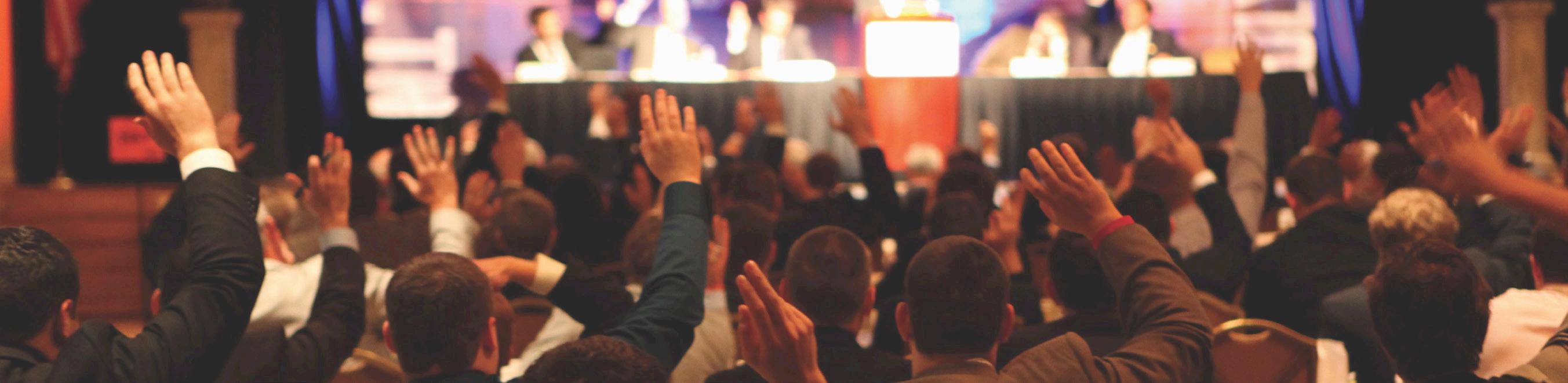
In 1858 — just two years after the founding of Sigma Alpha Epsilon in Tuscaloosa — representatives of the young Fraternity gathered in Murfreesboro, Tennessee, for what would become one of our most enduring traditions: Convention.
It was the first time delegates from multiple chapters assembled to conduct the business of the Fraternity. That gathering established a precedent that continues today: Sigma Alpha Epsilon would govern itself through representation.
Convention is held every other year — in odd-numbered years — and rotates among host cities across the country, reflecting the national scope of our Brotherhood.
While the location changes, the purpose does not.
Historically, the Chicago-land area has hosted more Conventions than any other region — due in part to its central location and its long-standing connection to Fraternity leadership and administration. But Convention has never been confined to a single city. From its earliest days, it has traveled — just as the Fraternity itself has expanded.
When the Realm gathers in Cleveland, Ohio, in 2027, delegates will once again take part in a tradition that has guided Sigma Alpha Epsilon for more than 165 years.
Convention is the supreme governing body of Sigma Alpha Epsilon Fraternity.
Delegates include:
• Undergraduate representatives elected by their chapters
• Chapter Alumni Association Representatives
• Area Alumni Association Representatives
• Province Archons and Province officers
• Members of the Supreme Council
• Past Eminent Supreme Archons
• Representatives of the Foundation and Financial & Housing organizations
At Convention:
• Officers are elected
• Amendments to the Fraternity Laws are proposed and debated
• Strategic priorities are shaped
• Reports are delivered on the health and direction of the Fraternity
• The collective will of the Realm is expressed through structured vote
This is not symbolic. It is constitutional.
Every policy that affects chapters.
Every structural adjustment to Provinces.
Every financial framework.
Every amendment to the Laws.
All ultimately flows through Convention.
Yet many members — both undergraduate and alumnus alike — have never seen Convention in action and may not fully understand how its decisions shape their experience.
Over the coming issues of The Record, we will explore:
• How delegates are selected and empowered
• How proposed changes to the Fraternity Laws are submitted, reviewed, and voted upon
• The role of Provinces and Alumni Associations in the process
• Why participation in governance is one of the most meaningful expressions of lifelong Brotherhood in Sigma Alpha Epsilon
For more than 165 years, Convention has brought the Realm together to guide the future of Sigma Alpha Epsilon — ensuring that the Brotherhood’s direction is shaped by the voices of its members.

IN CLEVELAND, OHIO
June 24-27, 2027
Thirty years after losing a brother, alumni return to honor his memory and strengthen the bonds that carry SAE forward.
In the summer of 1993, a group of Sigma Alpha Epsilon brothers traveled to Leadership School, preparing to enter their senior year at DePauw University. Among them was chapter president Eric Stisser (DePauw ’94). Like many fraternity leaders heading into their final year, their focus was on growth and the future.
Then the phone call came.
“Unfortunately, one of our brothers, Doug White, and his family were in a car accident in Australia, and Doug had passed away,” Stisser recalled. “We got the call while we were at SAE Leadership School.”
The loss shook the chapter. Doug White was a friend, a personality, and a presence that filled the house. The Indiana Delta chapter gathered for a service on campus and shortly after chartered a coach bus to Chicago for his funeral. The experience forged something deeper within the brotherhood.
“When we got back to campus, we wanted to do something meaningful in his memory,” Stisser said. Doug had been known for something simple, but unforgettable. He loved cooking. Late at night after the bars closed, he would sneak into the kitchen and feed whoever was still awake.
“Doug loved to cook,” Stisser said. “He would break into the kitchen and make burgers or hash browns. But he also loved to work the grill. He was always grilling steaks.”
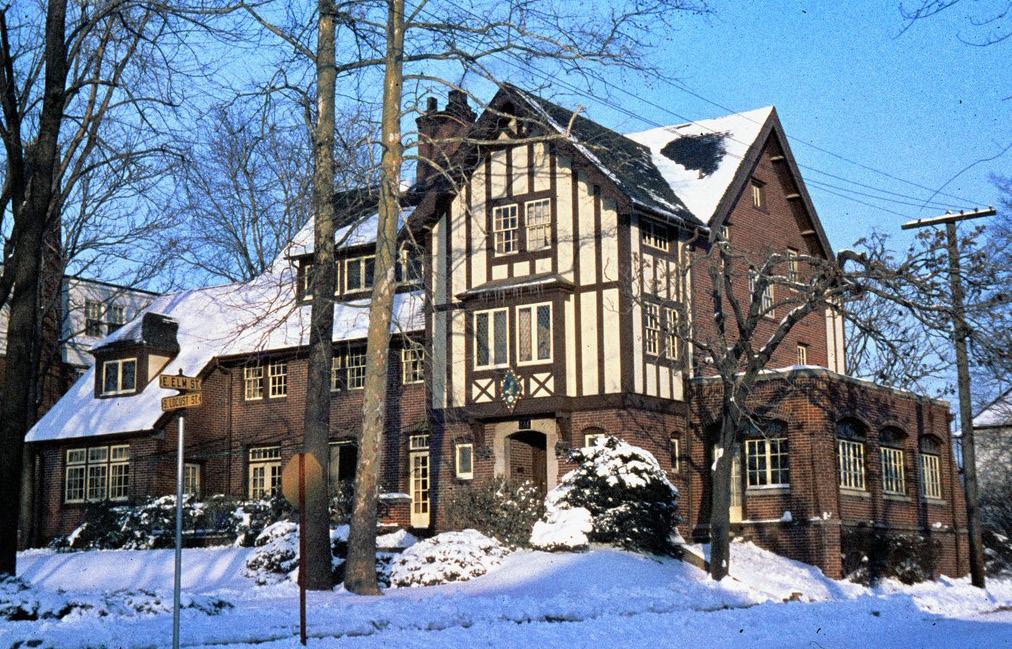
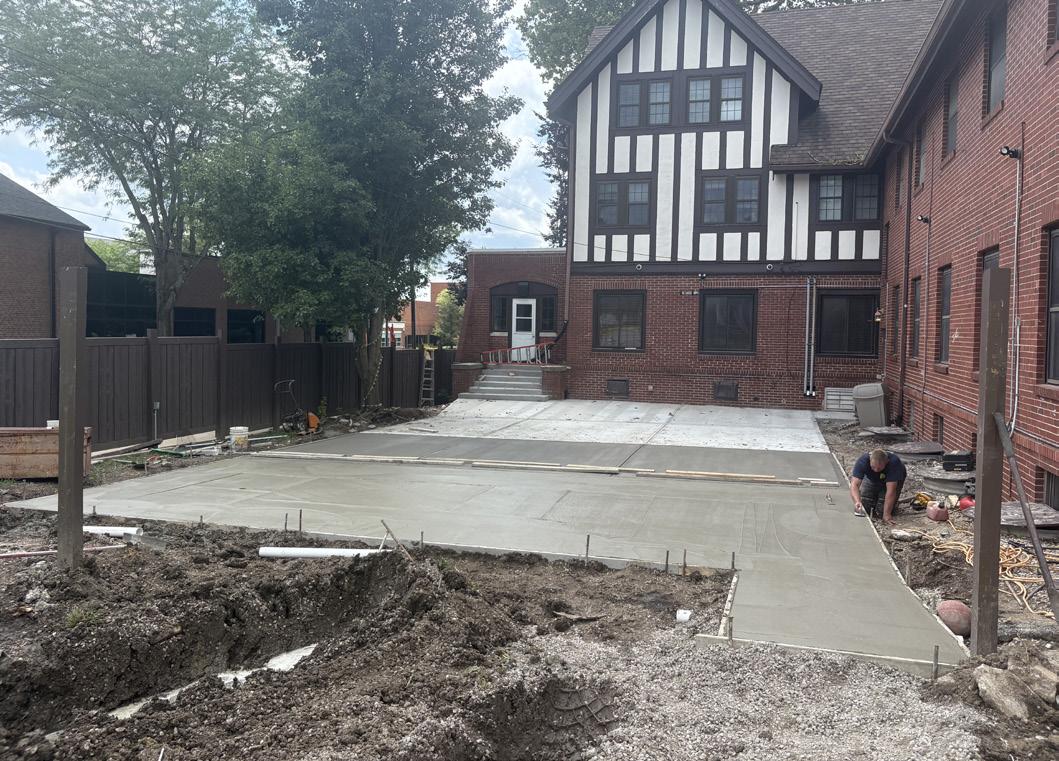
That fall, the chapter took inspired action. They raised money from parents and alumni and built a patio behind the house, installing a grill dedicated to Doug White. It became the Doug White Memorial Patio, a place where generations of brothers could gather, grill, laugh, and bond.
In the summer of 2024, alumni from the class of 1994 returned to campus for their 30th reunion and noticed the patio had seen better days.
“It was run down,” Stisser said. “The grill was not working. The plaque had fallen off and was leaning against the wall. And we were just like, ‘This is really depressing. This is not right.’”
The group knew they had to act. Working with the chapter’s alumni leaders and SAE Financial & Housing, they began discussing a renovation. Lance DeNardin (DePauw ’86), President of the SAE Financial & Housing Board of Directors and Indiana Delta alumnus, helped organize the project and coordinate logistics.
“We really needed to redo the entire back patio,” DeNardin said. “But we did not have the money to do it yet. If the alumni could come up with half the money, F&H would match the other half.”
The estimated cost was roughly $40,000. Alumni responded immediately. “I handled the fundraising and rallied the troops,” Stisser said. “We worked with SAE F&H and got a link because all the money had to go through the 501(c)(3).”
Within three weeks, they had exceeded the $20,000 goal, raising $25,000 from about 50 alumni. Three decades later, the memory of one brother and the bonds of the chapter were stronger than ever.
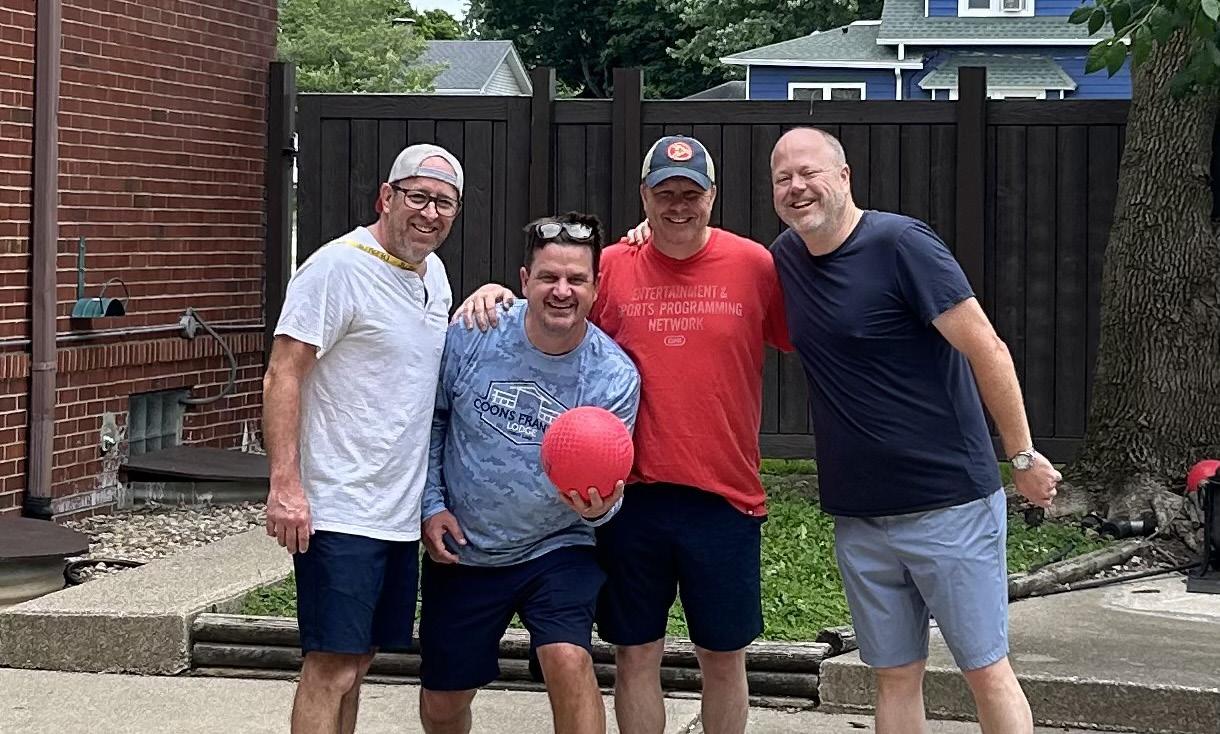
When the patio was complete, the alumni organized a rededication weekend and invited Doug White’s family. His parents were unable to travel, but his brother and sister drove from Chicago to attend.
Around 20 alumni returned to campus, many bringing old-school photo albums. “For two hours we just told really funny stories about Doug and the stupid stuff we had done in college,” Stisser said.
Doug’s siblings listened, laughed, and soaked in stories they had never heard. “They sent a ton of videos and pictures to their parents. They were just so moved that 30 years later all these guys got together in honor of their son.”
THE PATIO STOOD NOT JUST AS A MEMORIAL, BUT AS PROOF THAT BROTHERHOOD ENDURES ACROSS DECADES.
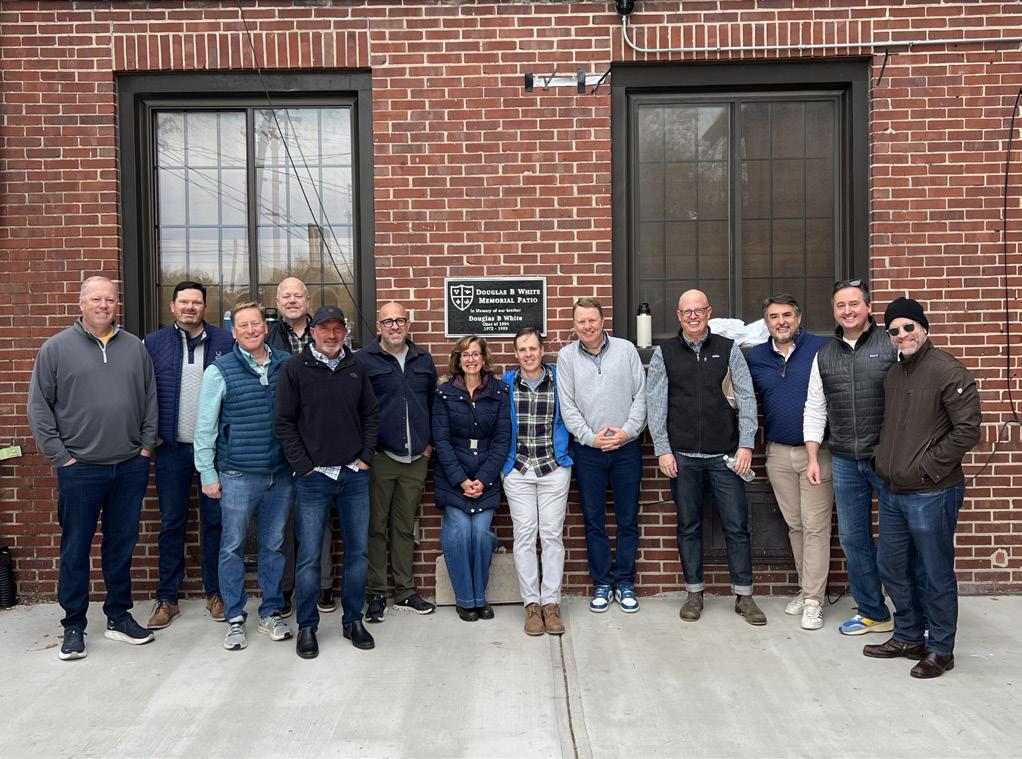
During the rededication weekend, alumni did not just reconnect with each other. They spent time with the chapter’s active members. That Friday night, they hosted a discussion with the undergraduates.
“There were probably 40 or 50 active members there,” Stisser said. “Their cell phones were not allowed in the room. They were fully engaged and asked great questions.”
The conversation covered careers, life lessons, and the importance of relationships. “We talked a lot about how when we grew up there were no cell phones, so everything was face-toface communication,” Stisser shared. “We talked about connecting with people, shaking hands, following up, writing a thank-you letter, things like that.”
But the most powerful message came from Doug White’s story. “You are brothers for life,” Stisser shared. “You will be with each other forever. Always lean in, give back, and be supportive.”
“YOU ARE BROTHERS FOR LIFE. YOU WILL BE WITH EACH OTHER FOREVER. ALWAYS LEAN IN, GIVE BACK, AND BE SUPPORTIVE.”
The patio project reflects a larger effort within the Indiana Delta chapter to keep alumni engaged. One program, Text Dads, pairs new members with alumni who check in monthly. “This takes five to ten minutes a month,” DeNardin said, “but it gives the kids someone to talk to about internships, careers, or anything they are dealing with.” Over the past five years, in excess of 60 alumni have participated, building meaningful mentorship relationships.
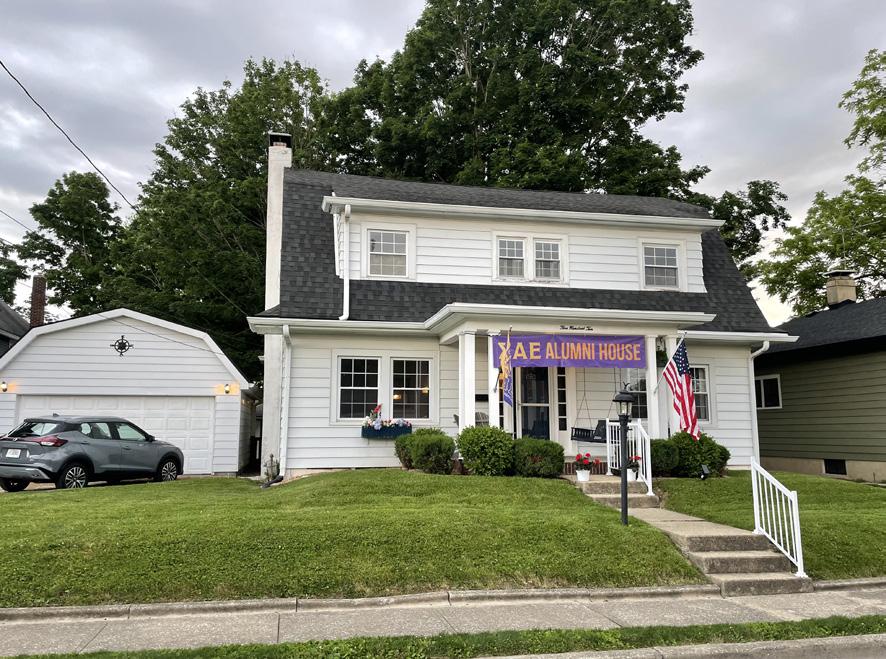
The chapter also offers the Guardian House, an alumni-owned home just a block from the chapter house. “We allow alumni and parents to stay there when they come back to visit. It’s a place to
gather, reconnect, and share memories,” DeNardin explained. Visitors often leave personal mementos, creating a living archive that keeps the chapter’s history alive.
Twice each semester, alumni return for speaker panels, sharing career and life experiences with undergraduates. Attendance is consistently high, and speakers represent a wide range of industries and generations, including leaders from Starbucks International, TOMS Shoes, and T-Mobile, just to name a few.
The goal is simple: show undergraduates the lifelong value of SAE connections.
The patio project was not just about improving a physical space. It was a tangible example of the chapter’s lifelong impact on its members and the connections they share.
“You do not know it right now,” Stisser told the undergraduates during the rededication weekend, “but you are living some of the best years of your life.”
“YOU DO NOT KNOW IT RIGHT NOW, BUT YOU ARE LIVING SOME OF THE BEST YEARS OF YOUR LIFE.”
One day, these students will return to campus, older and with careers and families, but still tied together by brotherhood and shared memories. And when they gather on that patio, they’ll see Doug White’s name. They may never have met him, but they will understand the legacy he left behind.
A brotherhood that honors yesterday while building tomorrow is a brotherhood that lasts forever.
BROTHERS WHO DONATED TO THE PORCH PROJECT:
Allen Ashley (DePauw ’92)
William Beanblossom (DePauw ’95)
Timothy Brieger (DePauw ’95)
Kris Carlson (DePauw ’93)
Matthew Cavalier (DePauw ’95)
John Cramer (DePauw ’95)
Stephen Crilly (DePauw’94)
Robert Croll Jr (DePauw ’94)
Lance DeNardin (DePauw ’86)
Matthew Gibson (DePauw ’93)
Matthew Gries (DePauw ’95)
JJ Hirschle (DePauw ‘95)
David Hopper (DePauw ’93)
Blake Johnson (DePauw ’92)
James Kellock III (DePauw ’93)
Daniel Kiley (DePauw ’94)
Kurt Klebe (DePauw ’91)
Aaron Marx (DePauw ’94)
Marc Ohler (DePauw ’94)
Viraj Patel (Stockton ’19)
Christopher Pfeifle (DePauw ’93)
Andy Raterman (DePauw ’94)
Thomas Renwald (DePauw ’94)
Patrick Roberts (DePauw ’95)
Eric Stisser (DePauw ’94)
Donald Sullivan (DePauw ’94)
Matt Tucker (DePauw ’92)
Keith Veneziano (DePauw ’94)
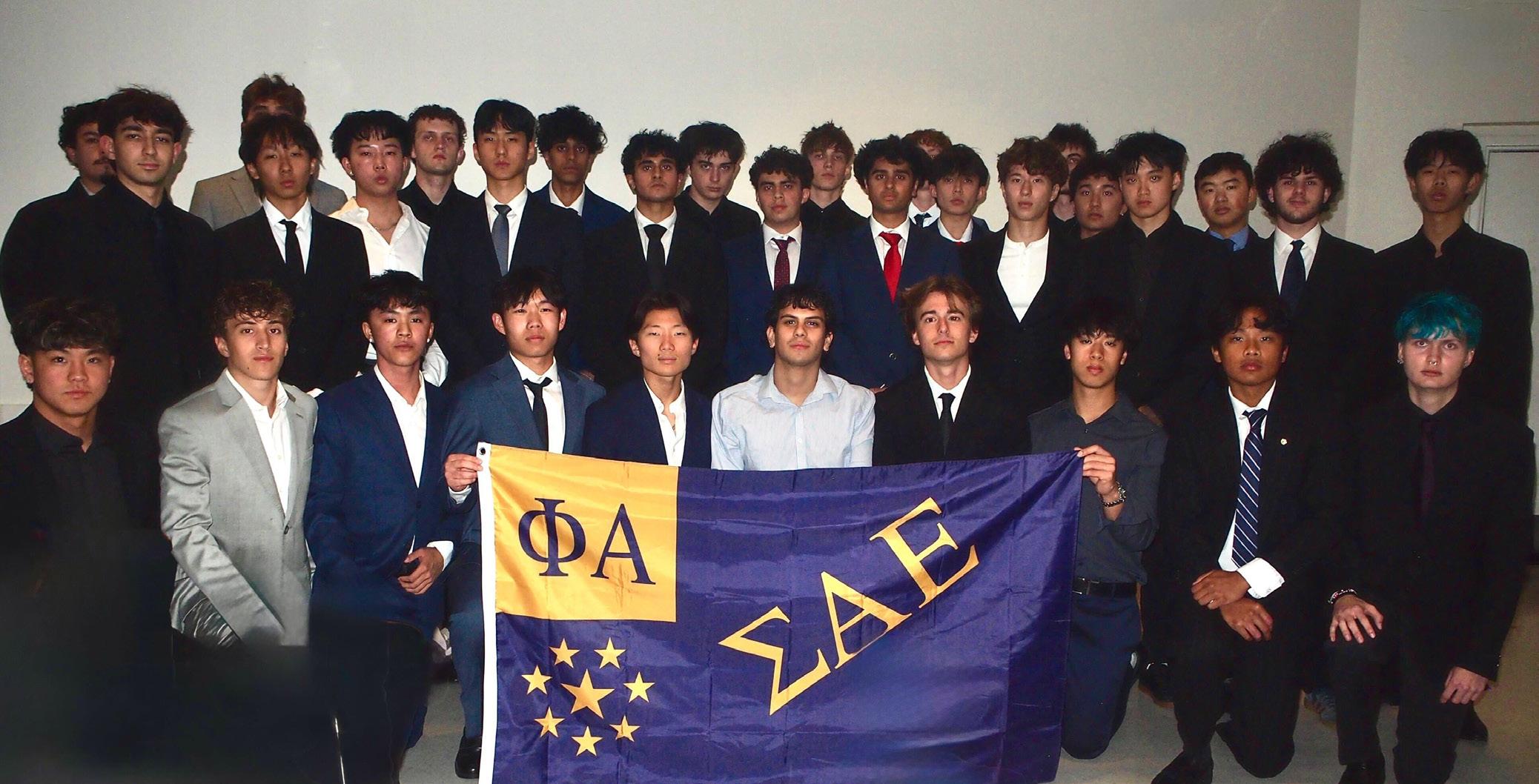
The California Chi Emerging Chapter has begun their journey towards earning their charter.
This program o ers simple, a ordable insurance coverage that protects members (and their parents) from surprise property damage bills during the school year. Members only pay $25 per month, billed upfront each semester.

Learn more about the protection o ered and read real stories about covered incidents!
BY KAYLA MCCLOUD
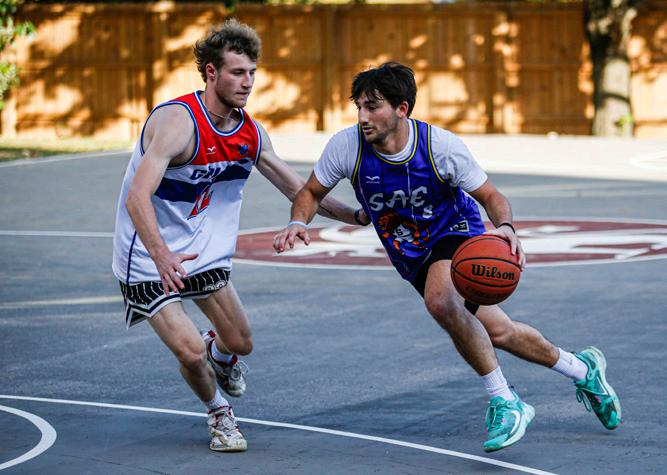
The Greek Basketball Association (GBA) is the nation’s first and fastest-growing intercollegiate basketball league created exclusively for students involved in Greek Life. Founded in 2022 by entrepreneur Michael Bales at Indiana University, the GBA has quickly expanded to campuses across the country, engaging thousands of fraternity members in competitive play.
The league gives fraternity chapters the opportunity to represent their house through organized seasons featuring custom jerseys, official nationwide rankings, player statistics, and competitive tournaments. This structure has helped cultivate a culture of rivalry and school spirit within Greek communities. Each season culminates in a high-energy national tournament, where the top teams from across the country compete for the GBA National Championship.
The league’s rapid growth has drawn national attention. In 2024, entrepreneur and investor Mark Cuban partnered with Bales to help elevate the GBA’s grassroots sports movement and support its continued expansion. By late 2025, the league included more than 500 fraternity houses across over 50 campuses nationwide. Looking ahead, the GBA has announced that its National Tournament will move to Las Vegas, where the event will expand to include 256 men’s and women’s fraternity and sorority teams, further growing the league’s national reach.
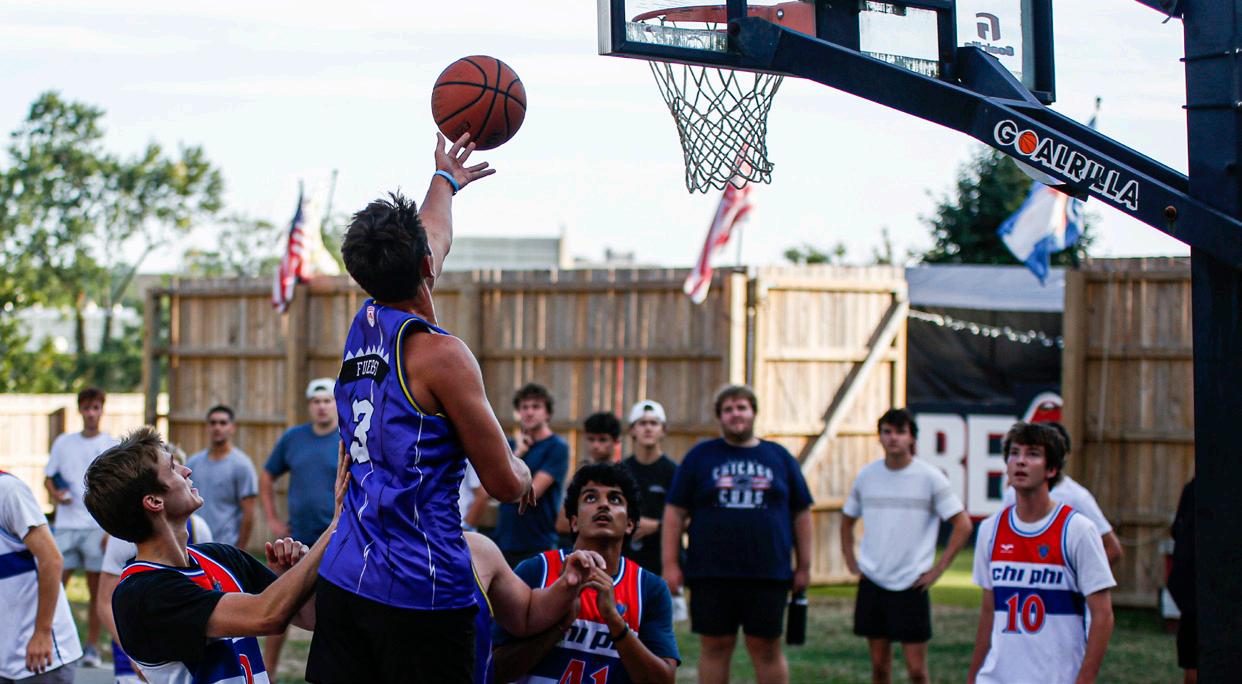
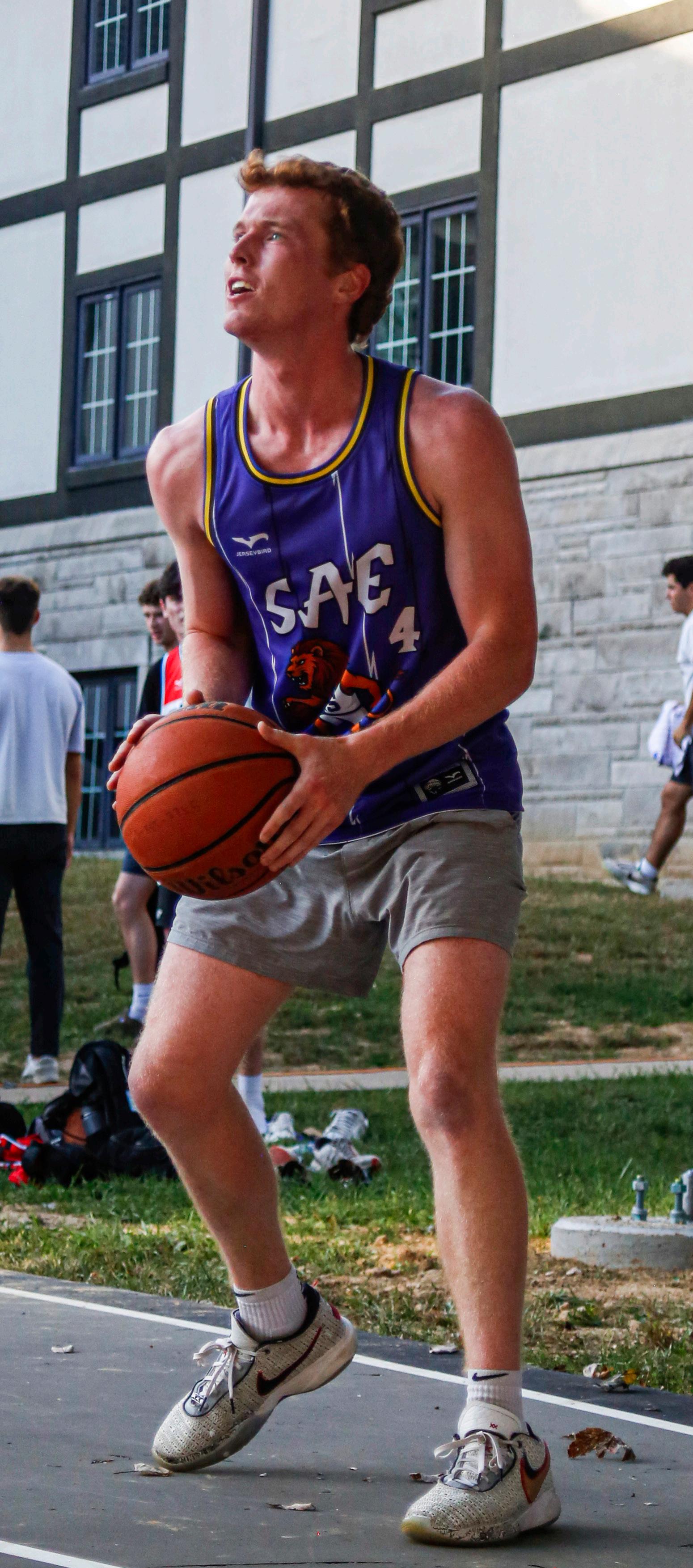


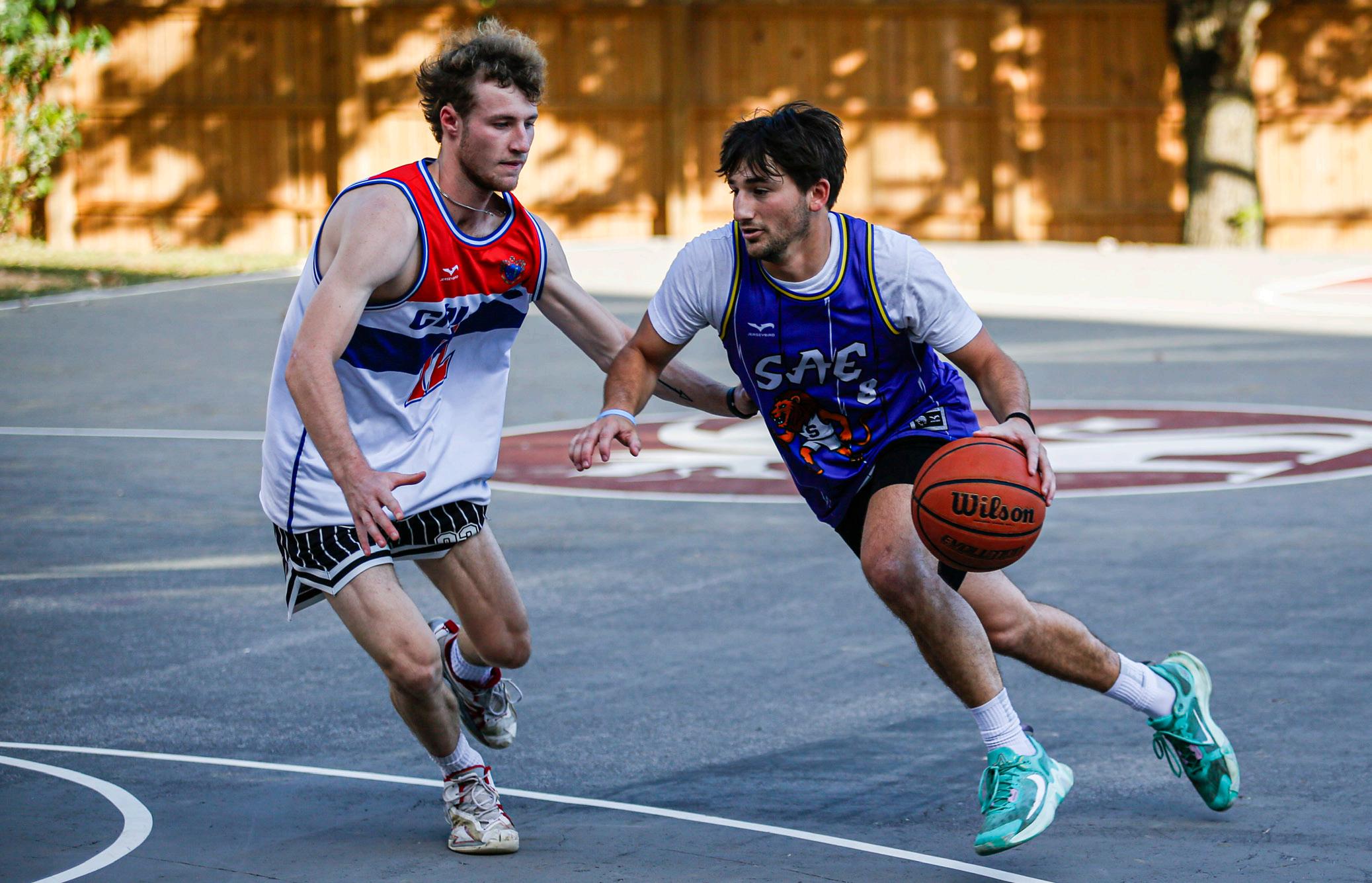
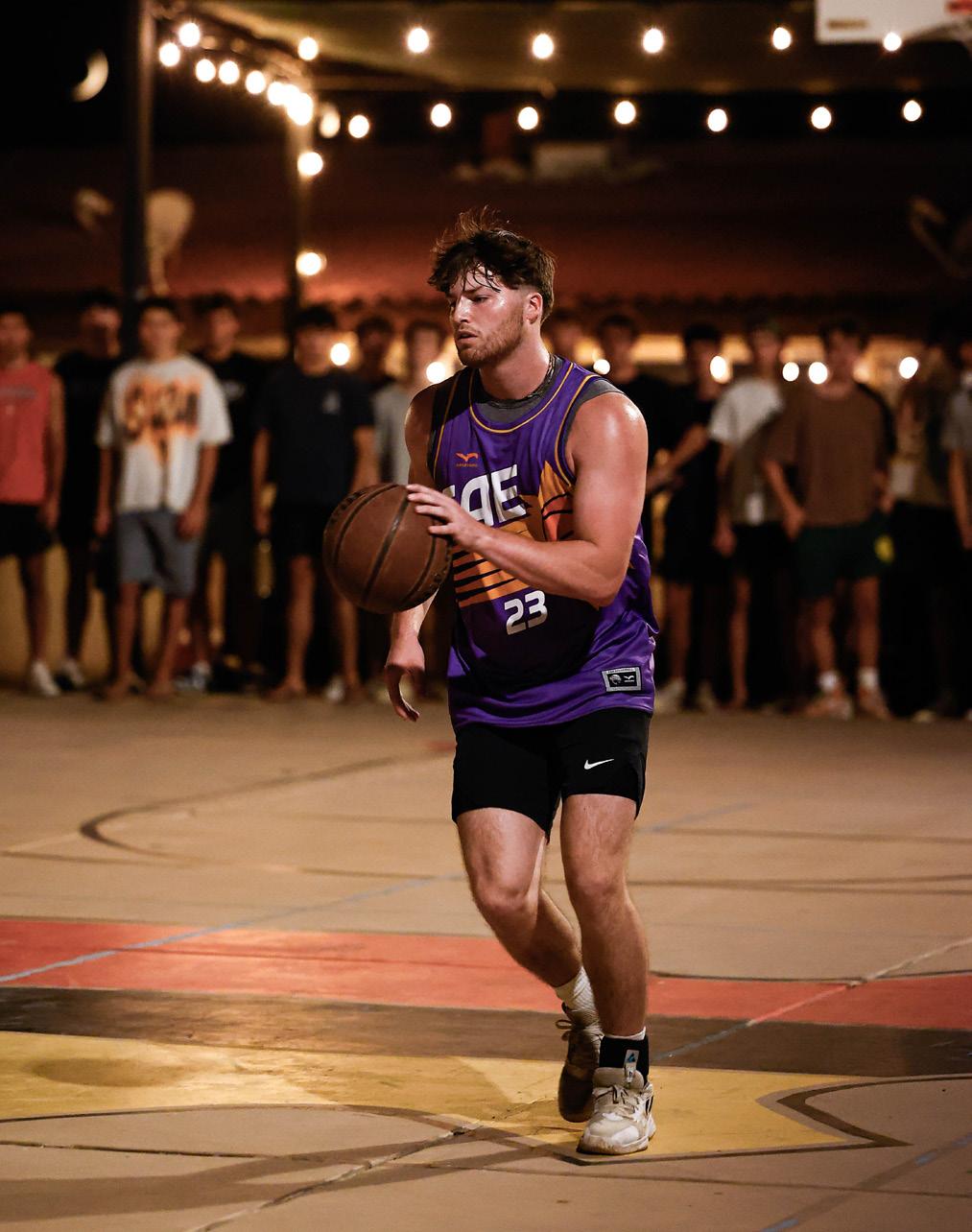
Sigma Alpha Epsilon chapters have embraced the competition. During the 2025–26 season, 19 SAE chapters participated in leagues across the country, with several advancing deep into postseason play. Michigan State was the only SAE chapter to win its league championship, earning an automatic bid to the National Tournament, while multiple other chapters battled their way to their respective league Final Four.
Two chapters, SAE at Indiana University and SAE at Michigan State University, ultimately earned spots in the national tournament. Indiana’s team advanced to the Elite Eight, finishing the season among the final eight teams competing for the 2025 GBA National Championship.
With the GBA moving its National Tournament to Las Vegas and expanding to 256 men’s and women’s teams, the league’s next chapter promises even bigger rivalries and more opportunities for SAE chapters to showcase their pride. The 2025–26 season proved that SAE is a force to be reckoned with, and the best is yet to come.
SAE Chapters that Participated:
• Tennessee (Tennessee Kappa)
• Michigan State (Michigan Gamma)
• Indiana (Indiana Gamma)
• Mississippi State (Mississippi Theta)
BY
The art of leadership has been studied since the 1840s, beginning with Thomas Carlyle’s Great Man Theorya theory that suggested leaders are born with innate qualities that make them natural leaders. Case studies for this theory included historical figures like Alexander the Great, Napoleon Bonaparte, and George Washington, just to name a few. Since then, the art and science of leadership has grown to include varying combinations of behavioral, charismatic, and transactional qualities. One of the most popular styles of leadership today is servant leadership. Although often reduced to a cliché, the servant leader is arguably one of the most impactful leaders because of their “leading by example” nature. The servant leader is distinguished by their focus on the heart work of leadership. The following will explore the heart work of the servant leader and provide application for leadership practitioners.
Keywords: altruism, follower receptivity, heart work, hygiene factor, motivator factor, servant leadership, transactional leadership
How can one be simultaneously a servant and a leader ? Manning and Curtis (2019) define servant leadership as beginning with the call to serve, then the aspiration to lead. Here — the call to serve first — is where the greatness of servant leadership resides. A true servant leader is selfless and always considers others before themselves. Greenleaf (1970, as cited in Northouse, 2019) offers the most widely used definition of servant leadership. He defines it as “beginning with the natural feeling that one wants to serve, to serve first . Then conscious choice brings one to aspire to lead” (p. 228). However, there must be a distinction between true servant leaders and servant leaders in name only. To this, Greenleaf offers the following test: “Do those served grow as persons; do they, while being served, become healthier, wiser, freer, more autonomous, more likely themselves to become servants” (Greenleaf, as cited in Northouse, 2019, p. 228)? In other words, the evidence of servant leadership is followers who are better off than they were and who have the added desire to serve others.
According to Northouse (2019), there are three antecedent, or existing, conditions that have an impact on the effectiveness of servant leadership: context and culture, leader attributes, and follower receptivity. Context and culture as antecedent conditions suggest that “servant leadership does not occur in a vacuum but occurs within a given organizational context and particular culture” (p. 233). For example, health care and nonprofit organizations tend to be more caring than competitive, for-profit organizations. This implies that servant leadership is
more likely to thrive in health care and nonprofit organizations than in competitive, for-profit organizations. Likewise, servant leadership is more likely to thrive in organizations with a low power distance (less hierarchical) than in organizations with a high power distance (more hierarchical).
Leader attributes as an antecedent condition suggest that the behaviors and qualities of the leader have an impact on the servant leadership process (p. 234). Simply put, if one says that they are a servant leader without demonstrating the attributes and behaviors of a servant leader, then servant leadership does not exist. Leaders must demonstrate listening, empathy, healing, awareness, persuasion, conceptualization, foresight, stewardship, a commitment to the growth of people, and the ability to build community to be qualified as a servant leader (pp. 229-230). Finally, follower receptivity as an antecedent condition suggests that followers must have an appetite for servant leadership. Not all followers want a servant leader. Some believe that servant leaders are micromanagers or are not interested in their leader helping, developing, or guiding them. However, studies have shown that when servant leaders are matched with followers who desire servant leadership, it has a positive impact on performance and organizational citizenship behavior. On the other hand, when there is a lack of follower receptivity to servant leadership, it tends to negatively impact performance and organizational citizenship behaviors (p. 234). In summary, context and culture, leader attributes, and follower receptivity work in tandem to ensure an effective servant leadership process.
Although the art and science of leadership can be hard work, the heart work of servant leadership makes it most rewarding. The heart work of servant leadership refers to the altruistic, or caring, nature of the leader. Altruism is the highest form of concern for the interests and welfare of others above the concern for self (Northouse, 2019). According to Northouse, “altruism is pivotal to exhibiting servant leadership” (p. 340). Altruistic behaviors include mentoring, empowering, team building, and modeling organizational citizenship behaviors. This is the heart work of servant leadership.
The heart is one of the most vital organs in the human body. While one can live without certain organs, like the gallbladder, tonsils, or a kidney, the heart is essential to life. The primary functions of the heart are pumping blood, delivering oxygen and nutrients, maintaining blood pressure, and removing waste. First, the heart acts as a pump, circulating blood throughout the body via blood vessels. This action by the heart ensures that the entire body has the life-dependent fluid it needs to survive. Likewise, the heart work of servant leadership is ensuring that the organization or team has what is essential for it to function. Second, blood carries oxygen and essential nutrients to cells and tissues. This makes certain that the body not only has what it needs to survive, but also what it needs to thrive. Without appropriate oxygen levels and nutrients, cells and tissues become damaged, and bodily functions are compromised. Similarly, the heart work of servant leadership provides what is necessary for followers to excel. This includes both hygiene (external) and motivator (internal) factors that impact satisfaction and performance.
Next, the heart regulates blood pressure by adjusting the amount of blood pumped out. If blood pressure is too high, it can silently begin damaging one’s heart, organs, and bodily functions. Conversely, if blood pressure is too low, then the lack of oxygen to the body can impair the function of its organs. By the same token, the heart work of servant leadership requires the leader to work to maintain optimal team pressure. This is when team members are most energized, focused, and performing at their highest levels. On the other hand, low and high team pressures are the silent killers of a team’s performance. Low team pressure causes members to become complacent, bored, and lack urgency. High team pressure produces stress, anxiety, conflict, and burnout. Finally, the blood removes waste products, like carbon dioxide, from the body. Carbon dioxide is poison to the body, just as chronic negativity, selfishness, procrastination, disengagement, and absenteeism are all poison to organizations and teams. Therefore, the heart work of servant leadership is to safeguard organizations and teams from these poisonous behaviors and remove team members who demonstrate them.
Servant leadership is not transactional, or an equal exchange between the leader and follower. Transactional leaders lead from a posture of what is in it for them. However, the heart work of servant leadership calls for leaders to make selfless deposits into their followers without any expectation of receiving a personal return on investment. This captures the altruistic nature of a true servant leader.
Jennings and Stahl-Wert (2016) describe the servant leader as “doing what everyone’s writing about” (p. 21). Their claim is that since servant leadership involves more serving by the leader than management from the leader, they should be called the serving leader. There are three practical points for one to consider in their pursuit of becoming a true servant leader: access, communication, and support (Manning & Curtis, 2019).
1. Access. Servant leaders are accessible and available for their followers. Not just physically present, but also engaging with them and the work of the team. This can be done by the leader reinforcing an “open door policy” or being intentional about working among followers. Although information technologies, e-mail, and social media may be more convenient ways of interacting, they cannot replace the impact of the human moment at work (p. 147).
2. Communication. Servant leaders listen effectively. They hear what is said and not said. Whether through formally structured meetings or impromptu team huddles, “such meetings provide valuable opportunities to share information, lay out the work, anticipate problems, and gather momentum” (p. 147). Effective communication by the leader is essential because it enables them to clearly convey vision, build trust, inspire action, and fosters team collaboration.
3. Support. Servant leaders provide guidance. Targeted feedback is an integral ingredient to improving performance. “Successful leaders know that praise without support is an empty gesture” (p. 147). Simply saying, “Good work,” does not offer feedback for growth. On the other hand, saying, “In your presentation, your explanation of the main idea was very clear and easy to follow — great job simplifying a complex topic” or “Your presentation slides had a lot of text, which made it hard to stay focused. Try using more visuals or bullet points next time to keep your audience engaged,” are examples of targeted feedback. Ultimately, the servant leader must engage in sufficient discussions about performance and offer tangible support to their followers to improve their effectiveness and productivity.
decision-making process, which can lead to delayed group or organizational productivity.
Second, a consideration for servant leaders is the risk of burnout. By definition, the servant leader’s passion resides in serving others. Therefore, the altruistic nature of the servant leader causes them to prioritize the interests and well-being of others, even at the expense of their interests and well-being. This can lead to burnout if left unattended. Manning and Curtis (2019) posit that the result of burnout for a group or organization is losing “its best people at a critical point” (p. 409), which can be crippling and cause delayed productivity. They also suggest that for an individual, burnout can lead to “physical, psychological, and spiritual fatigue” (p. 409).
A final consideration of servant leadership is role confusion. According to Northouse (2019), “being a servant leader implies following, and following is viewed as the opposite of leading” (p. 242). Not only can the paradox of servant leadership make it difficult for observers to identify who the leader is, but participants may take liberties that they would not take under other leadership styles because of the servant leader’s empathetic nature. This can cause internal conflict that reduces group or organizational productivity.

As with any leadership style, there are limitations to the effectiveness of servant leadership, as well as considerations for its practitioners. First, slower decision-making is attributed to servant leadership. This is, in part, because of the servant leader’s collaborative nature. Instead of unilaterally making decisions, the servant leader may consult with a wide range of stakeholders, including their team members, other leaders, and those who will be impacted by their decision. Although collaborative decision-making is a powerful approach to decision-making, critics suggest that it slows down the
The cornerstone of servant leadership is the desire to serve. While being characterized as a servant leader has become popular, the process of being one does not occur by happenstance. Appropriate context and culture, leadership attributes, and follower receptivity must exist simultaneously in order for servant leadership to thrive. Servant leadership is hard work; however, the heart work of servant leadership makes it uniquely rewarding. The altruistic nature of the servant leader is more concerned with the interests and welfare of their followers above their own. This results in a positively transformed follower who has the desire to perpetuate the act of serving others. Finally, servant leadership requires action, and is why the leader is often called the serving leader. Such actions include being accessible, an effective communicator, and providing guidance. Servant leadership is not about gaining followers, but uplifting lives. A true servant leader understands that in serving, one leads; and in leading, one serves.
Jennings, K. R., & Stahl-Wert, J. (2016). The serving leader: Five powerful actions to transform your team, business, and community. (2nd ed). Berrett-Koehler Publishers. Manning, G., & Curtis, K. (2019). The art of leadership. (6th ed). McGraw-Hill Education.
Northouse, P. G. (2019). Leadership: Theory and practice (8th ed.). Sage Publishing.
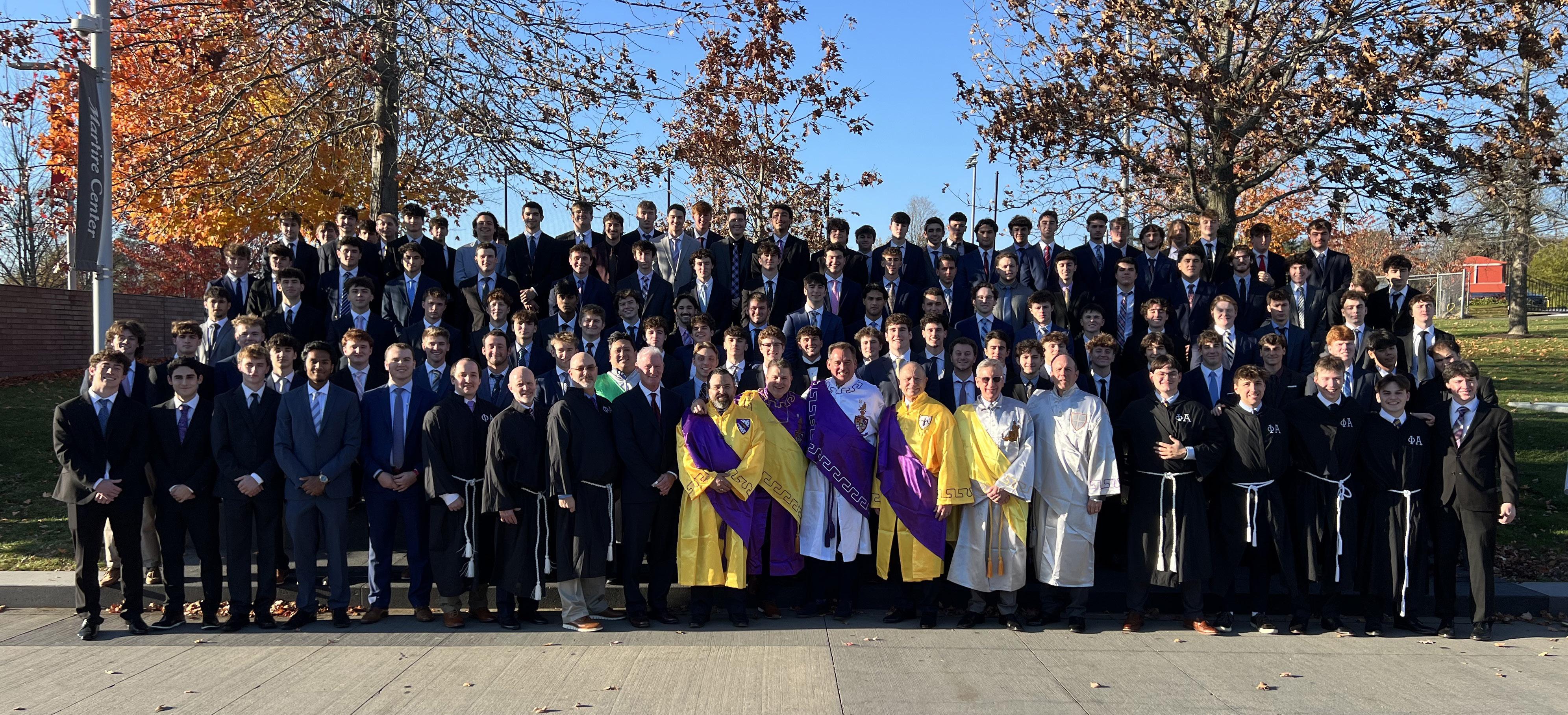
LOCATION: FAIRFIELD, CT
CHAPTER SIZE: 113
INSTALLATION: NOVEMBER 8, 2025
Sacred Heart University (SHU) is a private Catholic university in Fairfield, Connecticut, United States. It was founded in 1963 by Walter W. Curtis, Bishop of the Diocese of Bridgeport, Connecticut. Sacred Heart was the first Catholic university in the United States to be staffed by the laity. Sacred Heart is the second-largest Catholic university in New England, behind Boston College. It offers more than 80 degree programs to over 8,500 students at the bachelor’s, master’s and doctoral levels.
Jake D. Maggiacomo
Owen R.L. Delisle
Ryan C Jaipaul
Luke P Kourkoulakos
Ryan G Mastropaolo
Trent X Wright
Brennen M Vinesett
Jack M Winans
Aaron P Sullivan
Benjamin Bajzath Jr
Andrew Radu
Chuck L Truicko
Brennan J Robins
Jimmy M Barnacle
Mason G Marino
Declan M Toland
Charlie D DiCarlo
Blake Ducharme
Lukas E Kashuba
Connor E Loth
Jason T Mauro
Andrew K McMillen
Stephen A Neri
Alex M Rosario
Patrick M Simpson
Douglas M Suter
Christopher J Swift
Christopher Vitiello
Caden Wasdyke
Jack W Wojnarowski
Foti Amigdalos
Brandon Koenig
Darren Koenig
Jayden J Rosario
Liam B Vasilescu
Vincent M Mancini
Luke Rusbarsky
Andrew P Sheridan
Brady R Sweeney
Thomas J Martinuk
Jacob Carlson
Connor Faye
Ryan E Foley
Patrick W Hefner
Drew Keenan
Alex Turlik
Luke C Blasi
Joseph J Capitano
Cole S Geib
Braden M Golden
Michael J LaRoche
Declan R Ratner
Gabe S Santarcangelo
Connor P Acierno
Andrew J Adams
Matthew F Badia
Andrew J Enfield
Ben Hepler
Joey F Letizia
Dylan B Peterson
Andrew P Poulos
Ethan R Quinn
Colin M Servinsky
Steven Theodoropoulos
Dimitri C Thomopoulos
Derek D Beloff-Davis
Brendan J Capshaw
Josh Carpenter
Justin Clunie
Jack C Cote
Richard J Kavey
Sean M Kelly
Brian J McGovern
Nicholas A Scerbak
Aldo E.E. Vittozzi
Trey R Barbieri
Chase B Baron
Maxwell T Cummins
Sandeep I Fernando
Thomas C Ferraira
Aidan M Frese
JA Ingravallo
Sean W Irving
Evan J Kaufman
Jeremy R Lanza
Dylan J McDonnell
Peter D McHugh
Matthew D Puccio
Max Kyle
Kennedy T Bleau
Carmine V DeCrescenzo
Patrick A Guiliano
Sean P Reilly
Maximilian K Tyrrell
Josh J Voorhees
Alex R Albarran
Connor S Anderson
Caleb A Barbera
Chris M Barlotta
Nick Corso
Todd R Cronin
Charles L D’Alessandro
Paul W Esposito
Michael Felice
Joseph V Finamore
Samuel E Graham
Nicholas J Hans
Alexander J Keilitz
Bo Loesch
Ryan A Ober
Joseph N Pronesti III
Lucas A Rapaglia
Chris T Shernov
The Connecticut Sigma-Eta Chapter of Sigma Alpha Epsilon represents one of the rarest forms of fraternity expansion, a true founding chapter built entirely from the ground up. The official expansion began in Fall 2024, where more than fifty students gathered for elections, the first brotherhood event, and ultimately, initiation, a defining moment that transformed strangers into brothers united under The True Gentleman. From that foundation, the chapter rapidly developed bylaws, governance, and traditions rooted in accountability, respect, and purpose. Through structured recruitment, service, and leadership, Connecticut Sigma-Eta grew to over 110 active members within three semesters, meeting all national chartering requirements while maintaining deliberate, values-driven growth. The Connecticut Sigma-Eta Chapter has proudly earned its charter and now stands ready to uphold it with integrity, purpose, and lasting impact for generations to come.
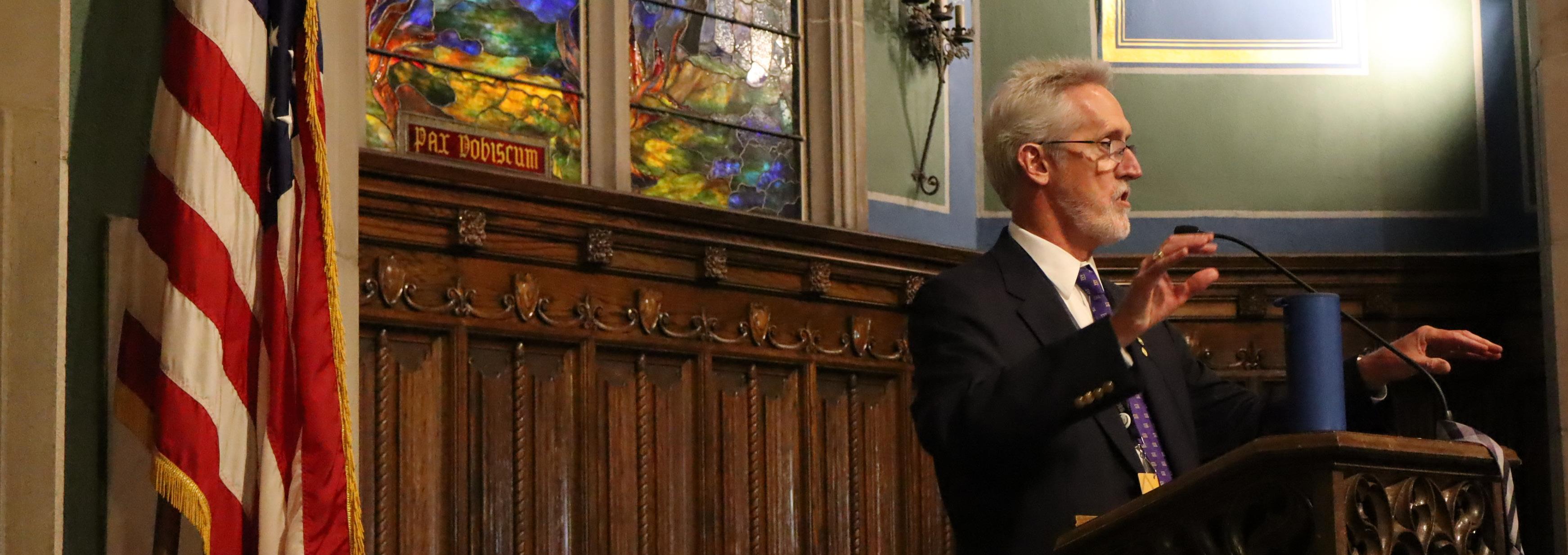
For many Sigma Alpha Epsilon alumni, the question isn’t whether they care about the Fraternity—it’s how to give back while balancing career, family, and life.
For many brothers across the Realm, the answer is chapter advising.
With nearly 14,000 undergraduates—an achievement not seen in over a decade—the opportunity to make a lasting impact has never been greater.
Serving as a Chapter Advisor is one of the most meaningful ways an alum can give back. Advisors provide mentorship and guidance while empowering collegiate members to make their own decisions and grow. With a modest time commitment, advisors can impact dozens of young men.
Few volunteer roles offer the opportunity to influence lives, strengthen the Fraternity, and leave a lasting legacy.
For Brother Nick Trelka (Ohio Epsilon ‘05), advising is the natural continuation of what Sigma Alpha Epsilon began during his undergraduate years. He reflects that SAE provided something deeper than friendships—it gave him something he didn’t even know he needed at the time: a tribe.
“Growing the chapter through adversity alongside my closest friends shaped us into better men,” Nick reflects. “Not just better students.”
“Watching alumni from the 1970s and 1980s still give their time and energy to chapters showed me that SAE is a different kind of organization,” he explains. “It’s built for life.”
One moment in particular left a lasting impression. During his sophomore year, alumnus Dave Lance invited a small group of collegians to dinner. There was no lecture—just fellowship and conversation.
“THAT SIMPLE ACT DEMONSTRATED WHAT MENTORSHIP CAN LOOK LIKE WHEN IT’S ROOTED IN GENUINE CARE RATHER THAN OBLIGATION.”
Today, Nick carries that lesson forward as an advisor and housing corporation leader, helping young men understand stewardship and their place in something far greater than themselves.
For Brother John Werner (Tennessee Kappa ‘86), advising is rooted in the Ritual.
Without it, he believes a fraternity risks becoming “a bunch of guys that hang out together.” When lived, it calls men toward something greater.
“It transforms men into something far greater,” John says. “It calls them toward the fullness of manhood and binds them together through the shared pursuit of the True Gentleman.”
Shortly after transferring chapters as a collegian, John was asked whether he knew the Ritual. Within days, he was reciting it from memory while being observed by his advisor and national leaders. Later that evening, his advisor asked how he was settling in.
John’s response was simple: “This is my chapter.”
That sense of belonging never faded. Over decades of service, John has helped guide generations of brothers.
“Institutional memory provides the foundation and mortar that hold a chapter together,” he explains. “It preserves what has worked, teaches from what has not, and binds generations together.”
And when alumni hesitate to step forward, he offers a simple challenge: “If not you, who? If not now, when?”
Brother Sam Waite’s (Florida Sigma ‘80) experience at Florida Sigma demonstrates the impact strong advising can have.
When the chapter faced challenges, Sam stepped forward alongside a team of committed advisors and housing corporation members.
Drawing on his professional leadership experience, he quickly realized advising required a different approach.
“These are young men,” Sam explains. “This is their first foray into the world without parents. You set expectations, support them, and hold them accountable.”
“THIS IS THEIR FIRST FORAY INTO THE WORLD WITHOUT PARENTS. YOU SET EXPECTATIONS, SUPPORT THEM, AND HOLD THEM ACCOUNTABLE.”
“You assess talent, give responsibilities, and let them grow,” he says. “They must have real successes. When they fail, help them understand and improve.”
Today, Florida Sigma is financially stable, operationally strong, and growing again. For Sam, the most rewarding part has been watching young men develop.
“I take great pleasure in seeing young people develop,” he says. “I love seeing them grow into their skills and leadership.”
Advising is a manageable commitment. Most advisors attend monthly meetings, stay in regular contact with officers, and provide guidance when needed.
“Balance doesn’t happen accidentally,” Nick explains. “You plan together, share leadership responsibilities, and set boundaries.”
Family often becomes part of the experience as well.
“My wife loves the fraternity and has gotten to know the boys,” Sam says. “She sees they are good young men who need leadership.”
Advisors serve as trusted mentors who guide chapter officers, attend meetings, and uphold fraternity standards. They work alongside province leaders and advisory boards while helping young men grow and prepare for life beyond graduation.
Nick Trelka summarizes the role simply:
“FIRST, HELP COLLEGIANS HAVE THE BEST POSSIBLE UNDERGRADUATE EXPERIENCE. SECOND, HELP THEM UNDERSTAND THAT SAE DOESN’T END AT GRADUATION—IT CONTINUES THROUGH MENTORSHIP, SERVICE, AND LIFELONG FRIENDSHIP.”
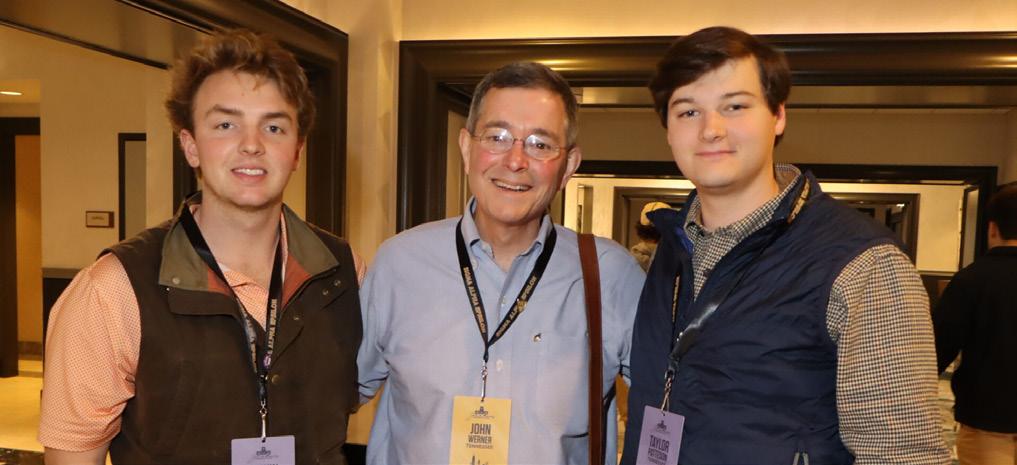
You do not need decades of experience.
You do not need to be retired.
You do not need to have every answer.
You simply need the willingness to show up and mentor.
Because somewhere in your journey, another brother made time for you. Now it is your turn.
“If not you, who? If not now, when?”
The next generation of True Gentlemen is waiting.
Interested in answering the call? Email the Alumni Engagement Department at alumniengagement@sae.net
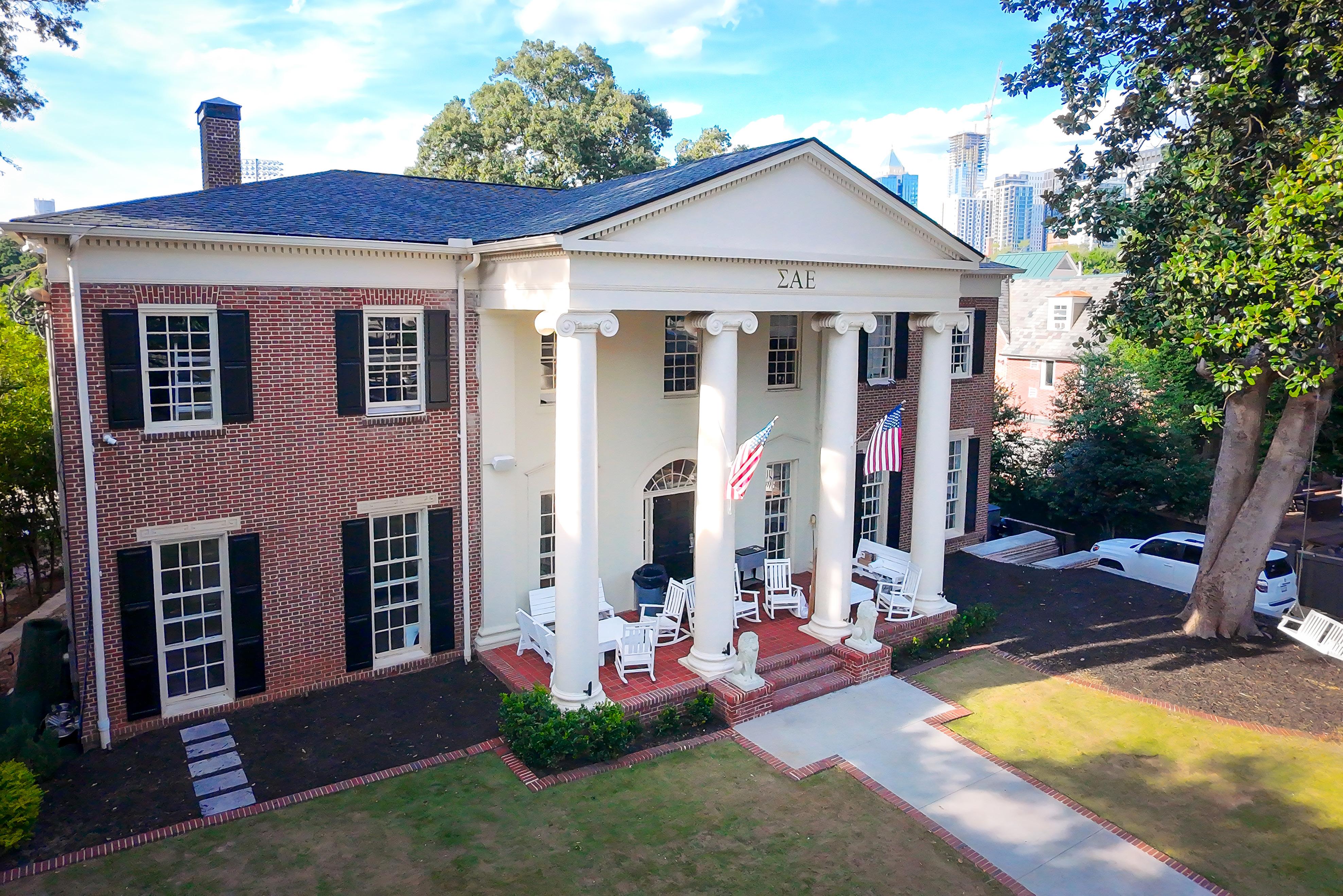
By engaging SAE Financial & Housing, the SAE Foundation, and Greek Housing Management, Georgia Phi alumni built the financial structure and operational stability needed for lasting renewal.
A chapter house is never just a place to sleep. It is where standards are formed, where culture is reinforced daily, where memories are made, and where legacy is lived.
At Georgia Phi, that belief is guiding a thoughtful, alumni-led revival. Built in 1940 and home to 32 Georgia Tech undergraduates, their chapter house is now in the midst of a long-term renovation designed to preserve what makes it special while raising the bar for the men who live there. They are doing it without taking on debt, without closing the house, and without handing over ownership.
The key is a strong partnership with SAE Financial & Housing, Greek Housing Management, and the SAE Foundation. These are resources many alumni do not realize are available, or assume require giving up control.
At the center of this revival story is Alex Mattle (Georgia Tech ‘17). Mattle lived in the house every semester of his undergraduate career, including summers, while balancing Army ROTC and co-op rotations. He served as House Manager and later as Eminent Archon in 2016. Today, he is the House Corporation President.
The strategy for Georgia Phi was not a dramatic rebuild or an overnight transformation. It was something more sustainable. Alumni learned how to deploy the right plan with the right partners, keeping the next generation in mind.
SAE Financial & Housing Senior Director of Finance, Juan Faria (Salem State ’17), and Georgia Phi House Corporation
President, Alex Mattle (Georgia Tech ‘17) connect at the 169th Anniversary Convention.
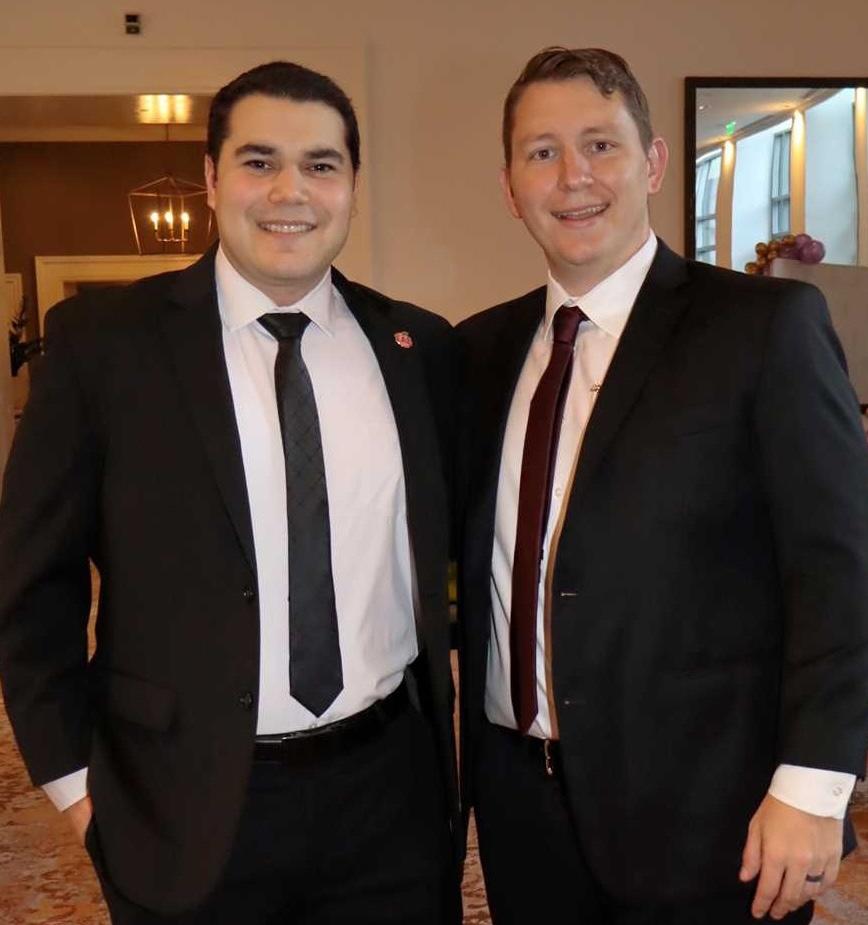
“Fraternity housing is never just about buildings,” says Mattle. “It’s the daily environment where brotherhood and living standards are formed. If we want strong chapters, we need strong housing.”
A chapter house is the most visible expression of a chapter and its alumni legacy. Mattle has seen firsthand how much the physical environment impacts culture.
“The environments a House Corporation provides shape the chapter culture,” Mattle adds. “Undergraduates will rise or fall to the level of their living environment. If you give them a palace, they will act nobly.”
For Georgia Phi, that meant the house could not simply keep surviving. It required intentional improvements and thoughtfully executed renovations.
Around 2020, Georgia Phi’s House Corporation experienced a generational transition. Longtime alumni who had faithfully carried the responsibility were ready to pass it to a younger group in their 30s, which included Mattle.
“Georgia Phi didn’t lack alumni who cared; it needed a coordinated plan and alumni willing to enact that plan,” shares Mattle.
Some processes that had worked years ago were no longer sustainable. There were compliance questions, structural considerations, and operational gaps. That was when the Georgia Phi House Corporation reached out to SAE Financial & Housing and Greek Housing Management.
“They gave us resources like Fraternal Law and pointed us in the direction of what we needed to do from a Housing Corporation side to actually structure this correctly,” explains Mattle.
Together, they worked through nonprofit classifications, best practices, and governance updates. What could have felt overwhelming became manageable with professional guidance.
“That partnership and staff allow alumni volunteers to focus on the vision for the property and work on mentoring undergraduates while benefiting from experienced housing professionals and practices.”
From 2019 to 2023, Georgia Phi alumni raised $1.2 million in commitments for the chapter house. Raising the money was only part of the equation. Collecting it properly and deploying it wisely required structure, and this is where SAE Financial & Housing and the Foundation played key roles.
The team helped Georgia Phi establish a Chapter Allocation Fund (CAF), creating a streamlined path for alumni to donate directly toward housing improvements. Mattle says, “We wouldn’t have been able to properly collect or deploy these funds without this partnership.”
At the same time, Georgia Phi turned to the SAE Foundation for further support. The chapter rolled its small, standalone education-focused foundation into a Chapter Education Fund (CEF). This donation stream funds Leadership School and other educational programming. With the Foundation’s support, the administrative burden shifted away from local volunteers.
“We have a CAF and a CEF,” Mattle explains. “If alumni want to donate to the property renovation, they go through the CAF. If they want to better the chapter itself and send guys to Leadership School, they donate to the CEF.”
When alumni begin discussing renovations, concerns often follow. Do we have to close the house? Take on massive debt? Tear it down?
After receiving informed guidance from SAE Financial & Housing, Georgia Phi chose a different path. “We approached the house as a generational asset, not a series of repairs,” says Mattle.
Instead of shutting down operations, they adopted a phased renovation plan. Each summer, a section of the house is upgraded. The chapter remains in residence, continuing to recruit. Rent continues to flow. The property stays debt-free.
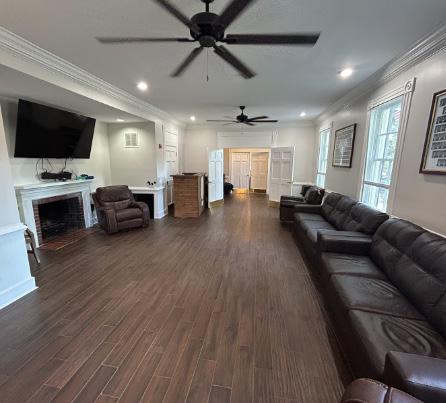
The first major interior phase, completed in summer 2024, renovated the front facade, the front two study rooms, and the foyer. This summer, bathrooms are being updated. The strategy alternates between educational spaces and other areas of the house, allowing the House Corporation to deploy funds responsibly over time. “Alumni across decades rallied around a shared vision for restoring the house,” says Mattle.
Greek Housing Management provided contractor recommendations, durable material specifications, and on-site consultation. They offered best practices drawn from fraternity properties nationwide, including recommendations for tile flooring designed to withstand heavy wear.
“It will save us a ton of money,” Mattle says. “We don’t have to put a floor in and then replace the entire floor again two years later.” The renovations are expected to wrap up by 2030.
As fundraising and renovation efforts accelerated, Greek Housing Management became more involved, offering modular services tailored to the Georgia Phi chapter’s needs.
“You don’t have to give up ownership,” Mattle emphasizes. “That’s a big fear alumni have. They don’t just take over your property. They can just help you with billing. Or bookkeeping. Or compliance. Or property management. They offer a wide array of services that can meet your chapter’s needs.”
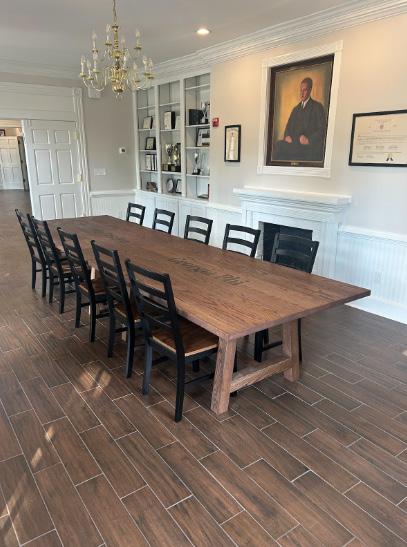
For Georgia Phi, the chapter transitioned to professional billing and collections through Greek Housing Management, which significantly improved collection operations. The Housing Corporation also outsourced bookkeeping and IRS compliance filings.
“For the same price we were paying a CPA firm just to file our 990, we’re getting full bookkeeping and compliance,” Mattle says. “Alumni like me don’t have to go into QuickBooks. We don’t have to worry about compliance deadlines. We just pay them to handle it.”
Renovations at the Georgia Phi chapter house included new flooring and an updated study area.
That professional infrastructure frees alumni volunteers to focus on what matters most: mentoring undergraduates and stewarding culture.
“You get the joy from talking to a guy whose AC went out and you got it fixed,” Mattle says. “You’re at a tailgate, and he comes up to thank you or chat, talking about his classes and what he wants to do after college. That’s the rewarding part. Outsourcing the mundane stuff lets you focus on that.”
Georgia Phi’s revival is part of a broader trend. Across the Southeast, SAE housing is experiencing renewed investment.
“There has been powerful momentum building in recent years at other southern chapters like Ole Miss, Tennessee, Mississippi State, and Auburn,” Mattle says. “By investing in their properties, these chapters are re-establishing themselves as dominant campus institutions, ensuring that their renewed houses serve as cornerstones for a new era of brotherhood.”
Mattle believes improved housing directly correlates with stronger chapters. “You can tell how healthy a chapter is just by walking past the house,” he says. “There’s real momentum across Southern SAE housing right now. And I want that momentum to continue state by state.”
He views housing as central to SAE’s broader future. “I think a huge part of SAE being the leading fraternity again is revisiting and improving our housing across the realm.”
For alumni unsure where to begin, Mattle offers practical advice.
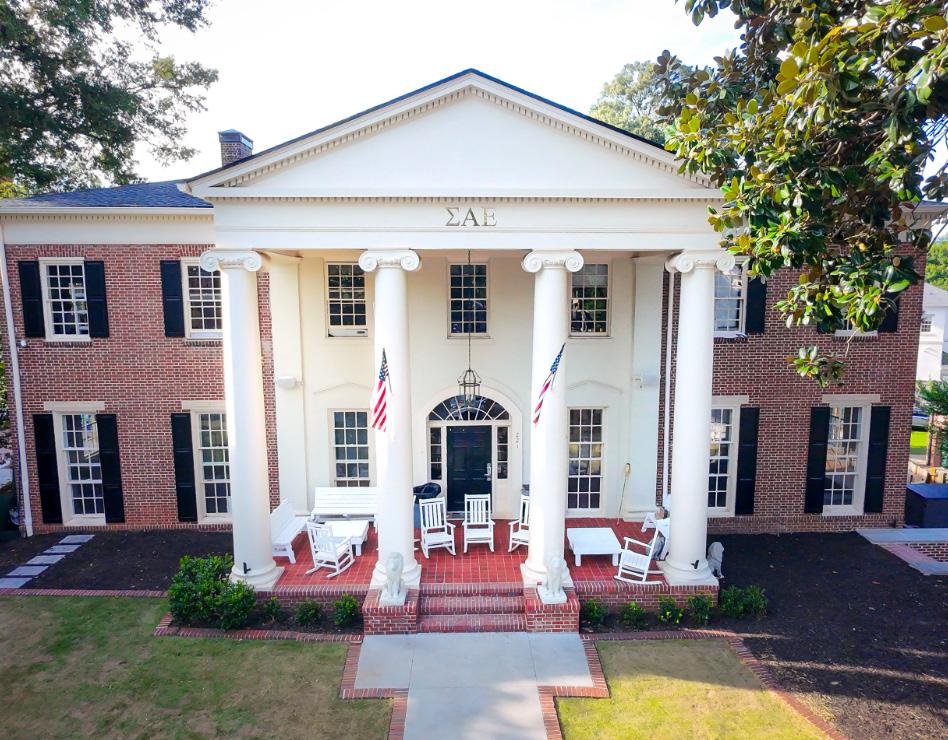
“Go find something you don’t like,” he says. “Maybe it’s the banners on the front of the house. Maybe it’s the social media. Maybe the alumni association doesn’t send enough emails. Whatever it is, tell a brother and complain about it.”
“YOU DON’T HAVE TO COMMIT FOR 40 YEARS. YOU MIGHT JUST HELP FOR TWO OR THREE. YOU MIGHT JUST FIX ONE INITIATIVE. THAT’S GREAT.”
Then, he adds, “Offer to help fix it. You don’t have to commit for 40 years. You might just help for two or three. You might just fix one initiative. That’s great.”
For housing-specific needs, he encourages alumni to reach out to SAE Financial & Housing or Greek Housing Management.
“Just get plugged in,” he says. “They can give you a list of resources and provide direction. You don’t have to hand over your property. You can just use the services you need or make sense for your chapter right now.”
This modular support model, which includes billing, collections, bookkeeping, compliance, property management, and consulting, allows alumni to retain ownership while benefiting from professional infrastructure.
For Mattle, the motivation comes down to something simple. “The hallmark of an impactful brother is the desire to leave the chapter better than he found it.”
Georgia Phi is doing exactly that, steadily and intentionally, with the right partners in place.
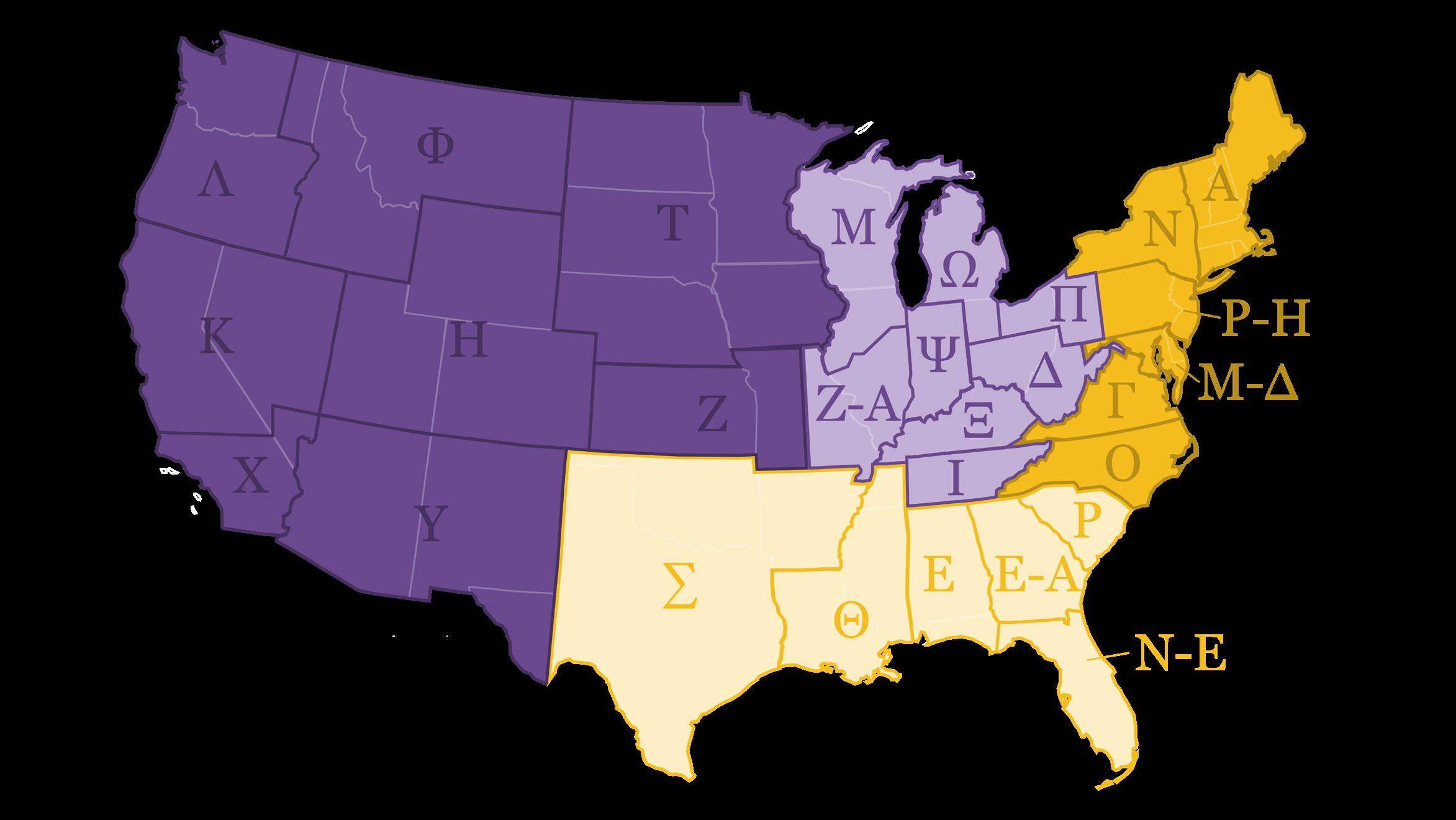
connecting undergraduate chapters, alumni volunteers, and the national Fraternity. Under Fraternity Law, each province is led by a Province Archon, the chief volunteer officer responsible for sharing best practices and providing education, resources, and guidance to the chapters and volunteers within his province. Province Archons are charged with coordinating province activities, presiding over province meetings and conventions, and serving as the primary liaison between the Fraternity and the chapters in their region. While the role carries defined responsibilities under Fraternity Law, at its core the Province Archon serves as a steward of the Fraternity’s mission, working to ensure that each chapter has the support and guidance needed to succeed.
Effective Province Archons understand that leadership within the province is built through consistent engagement with chapters and volunteers. Best practices include maintaining regular communication with chapter officers and advisors, organizing province meetings that bring together undergraduate and alumni leaders, and ensuring that province officers visit each chapter during the academic year. Province Leadership Schools and Province Conventions also provide important opportunities to strengthen the bonds of the province while reinforcing the standards and values of the Fraternity. Through these touchpoints, Province Archons help cultivate strong chapters that uphold the Four R’s of a healthy chapter—Recruitment, Ritual, Retention, and Receivables.

Stewardship and accountability are also central to the role. Fraternity Law places responsibility on province leadership to maintain sound financial oversight, provide regular reporting, and ensure that the work of the province is conducted in alignment with the Fraternity’s laws and policies. The most effective Province Archons recognize that their work extends beyond administration. By supporting volunteers, encouraging alumni engagement, and fostering collaboration among chapters, they strengthen the entire Fraternity. Through dedicated service and thoughtful leadership, Province Archons help ensure that Sigma Alpha Epsilon continues to thrive across the realm for generations of brothers to come.

COUNCIL OF PROVINCE ARCHONS DEPUTY CHAIRMAN
Based in Jacksonville, Florida, Chris is an alumnus of the University of North Florida (Florida Nu), where he earned a Bachelor of Arts in Political Science with minors in Religious Studies and Psychology. He also holds a Master of Arts in Management and Leadership from Liberty University. Professionally, Chris works for Bank of America (Merrill Lynch) as a Vice President and Risk Control Governance Specialist.
A longtime volunteer and past Province Archon (2015–2021), Chris was inspired to serve by his desire to give back to the organization that shaped him and to ensure today’s members have the tools to thrive. He is driven by a passion to support chapters and provide them with the resources needed for success. Over the years, Chris has served the Fraternity in numerous leadership roles, including Florida Nu Chapter Advisor, CoPA liaison to the SAE Financial & Housing Corporation, and Chairman of the Membership Review Appeals Committee. His service has been recognized with several honors, including the Merit Key, Province Archon of the Year, the Order of the Lion, and the Order of the Minerva.
One of his most treasured memories is his 2005 initiation into Sigma Alpha Epsilon, when his father, James Sherwood Slott (Florida ’66), and his uncle, Arnold Slott (Florida ’64), presented him with his badge and welcomed him into the Fraternity.
Outside of fraternity life, Chris enjoys time with his wife Erin and their children, Liam and Reagan, and lives by the quote:
“From this day to the ending of the world,
But we in it shall be remembered.
We few, we happy few, we band of brothers; For he to-day that sheds his blood with me
Shall be my brother.”
— William Shakespeare, Henry V, Act IV, Scene III
Editor’s note: Brother Slott is featured in this issue to correct an error from the previous issue.
PROVINCE EPSILON-ALPHA ARCHON
Steve serves as Province Archon and resides in Cartersville, Georgia. A 1989 initiate of the Ohio Tau Chapter at Miami University, Butler recently retired after a distinguished career as a high school educator and football coach, where he taught Advanced Placement Microeconomics and AP U.S. Government & Politics.
His retirement has allowed him to devote more time to Sigma Alpha Epsilon, an organization that has remained an important part of his life since his undergraduate years. Among his most meaningful SAE experiences was serving as Member Educator at Ohio Tau. Butler recalls that the class he helped guide later became chapter leaders during the period when Ohio Tau earned the prestigious Zeal Award.
In addition to his role as Province Archon, Butler continues to serve the Fraternity as Chapter Advisor to Ohio Tau, Chairman of the Sulgrave Manor Preservation Foundation, and Vice President of the Atlanta Alumni Association. An avid golfer, Butler believes that “doing many small things in great ways is more rewarding than searching for that one great thing to do.”
Robert F. Reynolds III (Maryland-College Park ‘78) is a retired International Captain from Delta Air Lines, whose lifelong passion for flight carried him from aircraft carriers to international runways. As a Navy F-14 fighter pilot and graduate of the Navy’s elite United States Navy Fighter Weapons School (TOPGUN), he operated at the highest level of tactical aviation. His service in the United States Navy forged the leadership, discipline, and calm decision-making that defined his career.
Robert’s foundation in teamwork and character began at the University of Maryland, where he was a proud member of the Maryland Beta chapter from 1974–1978. He joined SAE by invitation from a fellow new member he played baseball with—an early testament to the lifelong friendships that followed. While living at the fraternity house, he worked as a busboy and was elected Athletic Chairman. One of his favorite memories was when the chapter earned the prestigious John O. Moseley Award in 1975, reflecting the strength and unity of the brotherhood.
As a sophomore, Robert received critical financial assistance through an SAE scholarship thanks to the guidance of past Chapter Advisor Jim Sakers (Maryland-College Park ‘69). Without that support, he would not have been able to continue his education. Today, the SAE Foundation’s March to the Madness holds special meaning for him—appealing to his
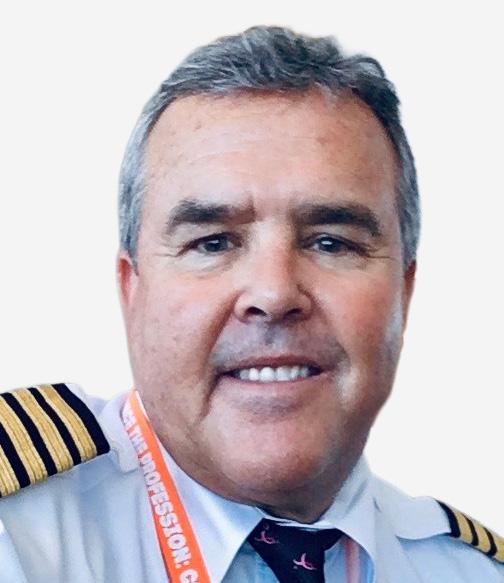
competitive spirit and giving him the opportunity to give back to the fraternity that helped make his education possible. Now in a position to assist others, he is proud to support young men facing similar challenges. In 2025, Robert was a key contributor to Maryland Beta in the March to the Madness. With his support, along with his fellow brothers, Maryland Beta ultimately won the Championship!
Calm decision-making and maintaining self-control during true emergencies became hallmarks of his aviation career— qualities that reflect the principles of the True Gentleman creed he embraced in SAE. Those values ultimately guided him to achieve his lifelong goal of becoming a Delta Captain, commanding international Boeing 777 flights with professionalism and steady leadership until his retirement.
Robert is happily married to his wife, Cydne, and they have shared 44 wonderful years together. They are proud parents of three sons and grandparents to seven grandchildren, with number eight due in April. In retirement, he treasures spending time with his family aboard his 47-foot fishing boat, TopGun —a fitting tribute to both his naval aviation roots and the life he built through discipline, gratitude, and dedication.
From TOPGUN graduate to retired international airline captain, devoted husband, father, grandfather, and SAE brother, Robert’s story is one of leadership, perseverance, and giving back.
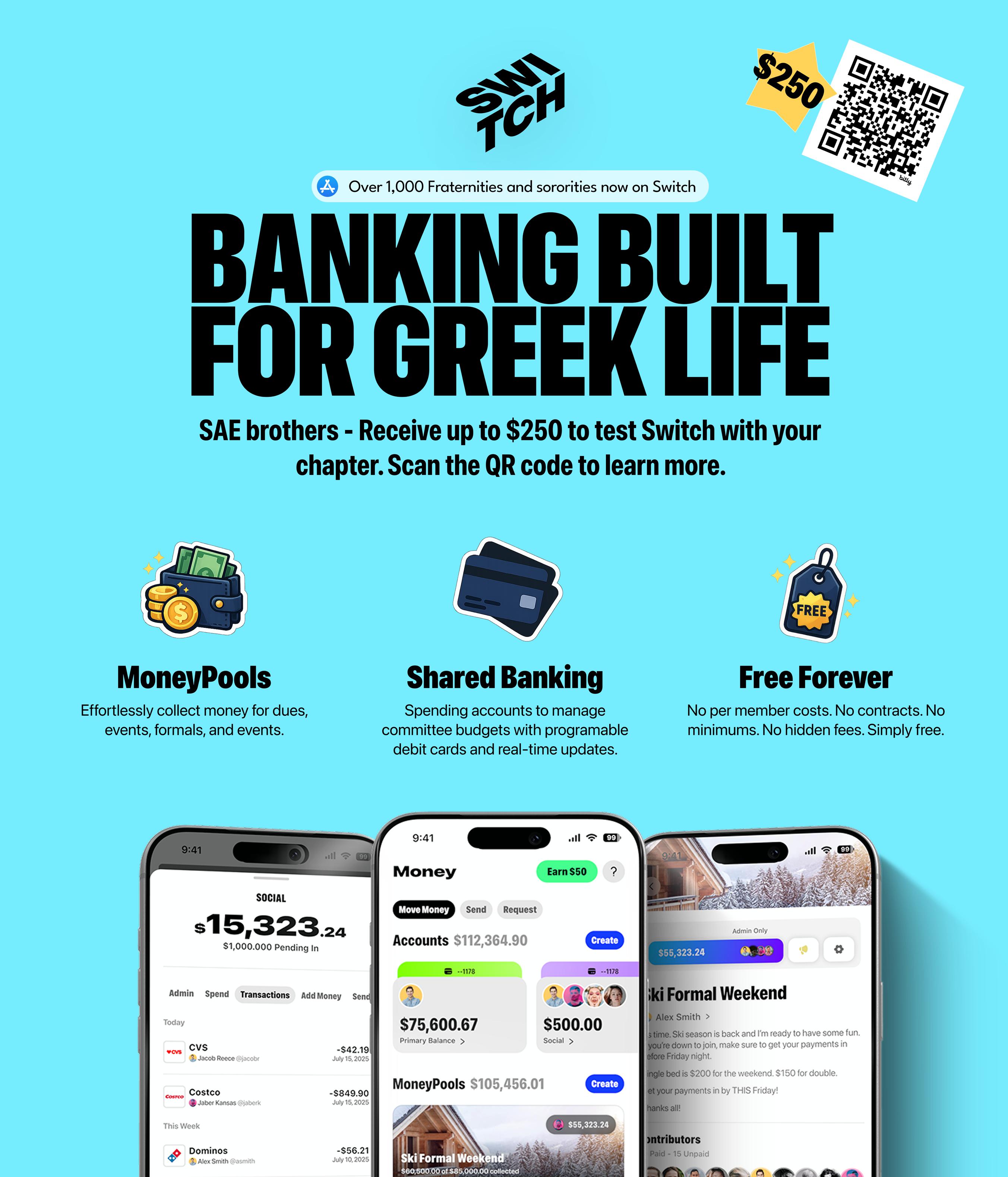
BY MATT KROEGER
When SAE and NMDP entered into a new partnership back in July of 2021, an announcement was made at SAE’s 165th Anniversary Convention in Des Moines, Iowa. Many SAE members in attendance were not all that familiar with the nonprofit organization, then named Be The Match. Fraternity members and guests learned more about cell therapy, the need to spread awareness for volunteer blood stem cell donors to help patients—like SAE’s Franch Ginocchio (Northwestern ‘66), former Eminent Supreme Recorder —have a second chance at life. At the 165th Convention, approximately 50 SAE brothers took the step of swabbing and joining the NMDP Registry. SAE leaders and NMDP staff at the time saw the potential that lay ahead when chapters all across the realm would join NMDP’s lifesaving movement helps spread awareness on their respective campuses and communities.
What has transpired since then has been nothing short of incredible, and it continues to display SAE’s core values of service and leadership in a very impactful way.
Four and a half years later, the impressive results of this partnership continue to flourish and grow each day. Currently, SAE chapters and members have helped add more than 33,000 registrations to the registry. This has come through the efforts of 150+ active SAE chapters across the realm. Each of these new registry members presents hope for a patient and family in need.
Equally impressive is the number of peripheral blood stem cell (PBSC) donors who joined the NMDP Registry at SAE events. To date, 137 donors from 60 SAE chapters have contributed. In almost every week of the year, at least one person who registered at an SAE event becomes a donor. On SAE’s 170th Founders’ Day this year, three members donated in a single day! Since members remain on the registry until their 61st birthday, and SAE chapters continue to host events on their respective campuses, the number of donors will continue to rise in the months and years ahead. At this pace, it is very likely that we will hit or exceed 170 donors during SAE’s 170th year.
Among these 137 donors who have given patients a second chance at life—and the gift of more time with family and friends— there are 24 who are known to be SAE members. As donor and patient information is strictly confidential, there could be others, too.

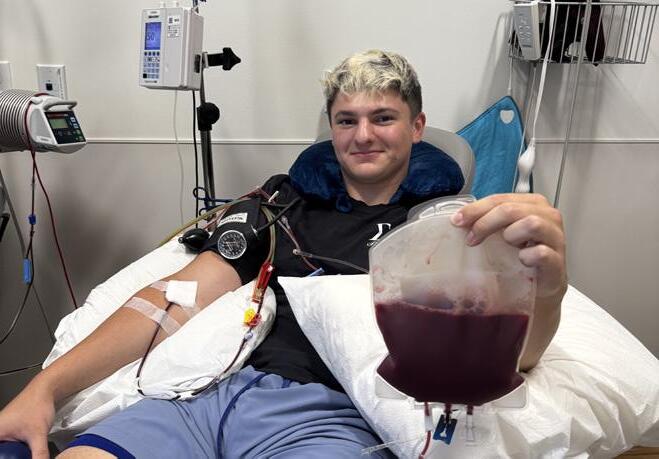
‘26)
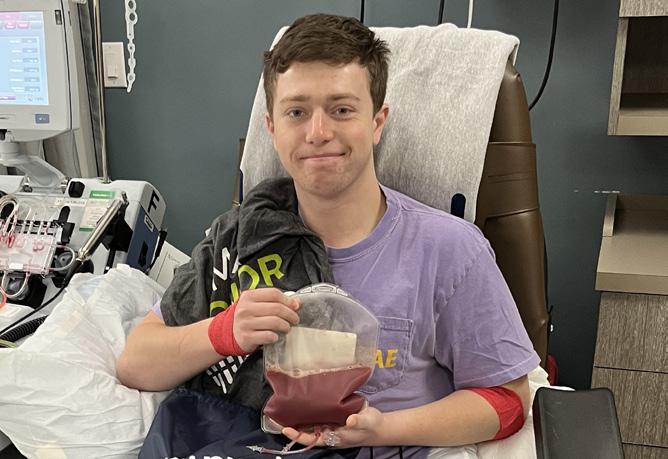
Cael Sutton (South Dakota ‘24), who joined the registry at the 165th Convention in July 2021 and met the patient who received his health blood stem cells on stage at the 169th Convention in Atlanta in June 2025.

To join the registry, an individual must be 18-35 years old and meet the health requirements. If you are not already on the registry, you can join by visiting my.nmdp.org/SAE , texting SAE to 61474, or scanning this QR code.
To get your SAE chapter involved in NMDP’s life-saving mission, reach out to Matt Kroeger, Senior Manager of Programs & Partnerships at NMDP at 763406-3229, or email at mkroeger@nmdp. org or college-partners@nmdp.org
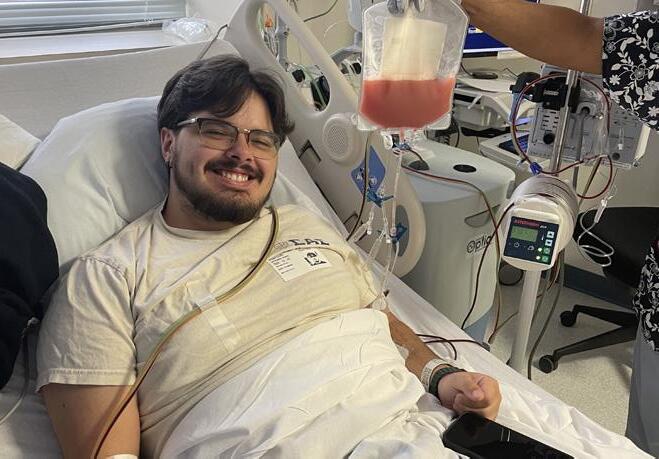
Jacob Egnor (Toledo ‘26), who joined a large NMDP employee meeting to share his experience with more than 100 NMDP staff members.
SERVING CHILDREN. STRENGTHENING COMMUNITIES.
Children’s Miracle Network (CMN) is the largest network of children’s hospitals in the United States and Canada. Through partnerships with leading pediatric healthcare providers, CMN Hospitals works to help children live healthier, happier lives.
Funds raised support 170 children’s hospitals across the U.S. and Canada, helping meet each hospital’s most urgent needs, from life-saving treatments and equipment to innovative research and compassionate patient care.
What makes this partnership especially meaningful is its local impact . Every dollar raised by Sigma Alpha Epsilon chapters stays in the community where it was given, directly benefiting the nearest CMN and the families it serves.
Children’s Miracle Network Hospitals has partnered with Sigma Alpha Epsilon since 2001, creating a lasting legacy of service and impact in communities across North America.
43 Chapters
Actively fundraising in 2025
33 Hospitals
Supported by SAE chapters nationwide
$2.7+ Million
Raised since the partnership began
$811,584
Raised in the past five years alone
2021 — $102,578
2022 — $156,719
2023 — $143,135
2024 — $155,963
2025 — $253,187
For more than 40 years, Children’s Miracle Network Hospitals has been a symbol of hope for children and families in need of care. Through partnerships with organizations like Sigma Alpha Epsilon, critical funds are raised to support lifesaving treatments, research, and patient services at local hospitals.
For over 25 years, SAE chapters have played a meaningful role in that mission, turning local fundraising efforts into real, life-changing impact for children in their own communities.
CHAPTER SPOTLIGHTS
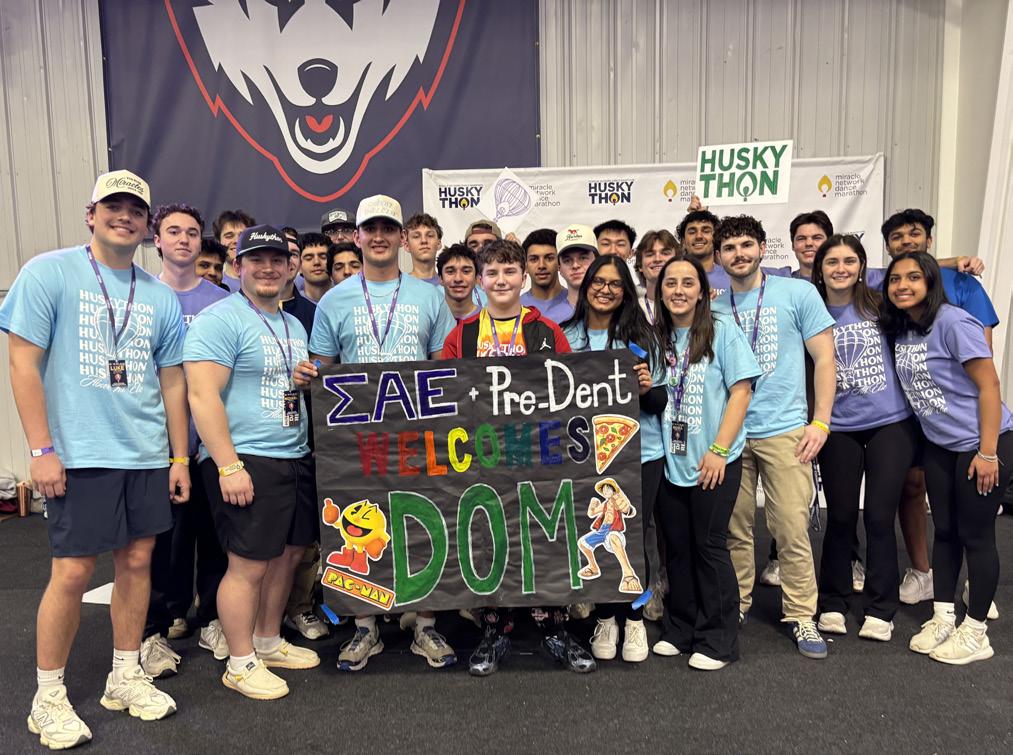
Connecticut Beta – University of Connecticut Has raised $20,000+ annually for the past three years through HuskyTHON Dance Marathon, demonstrating the power of sustained campus engagement.
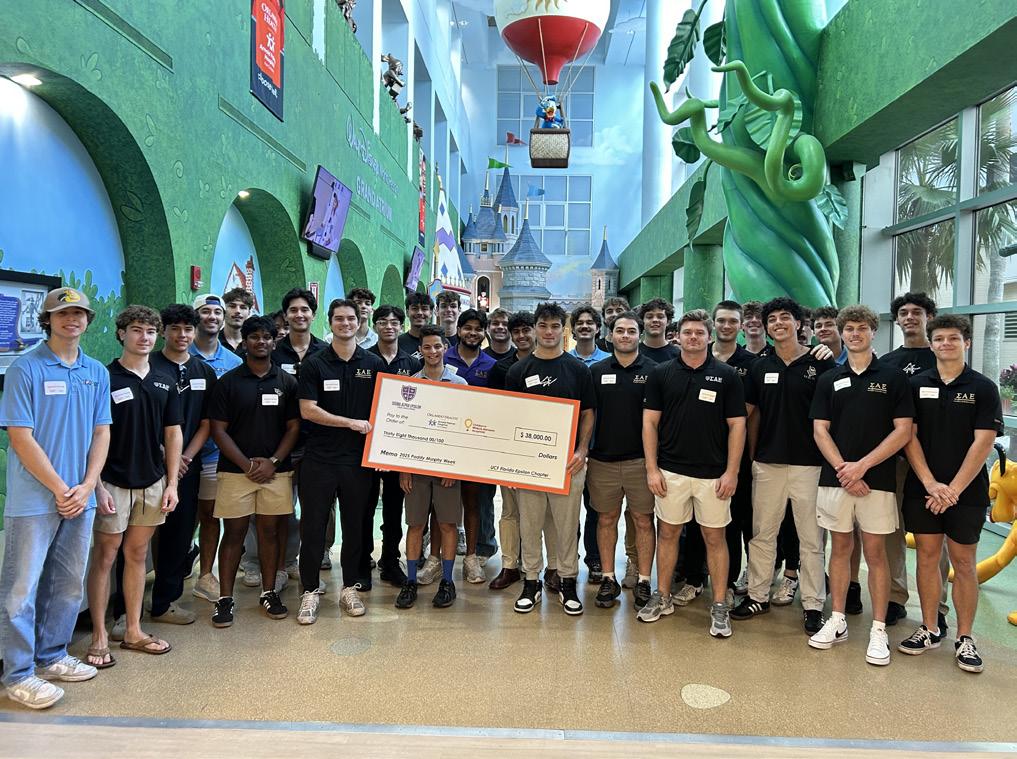
Florida Epsilon – University of Central Florida Launched their first Paddy Murphy’s Haunted House, raising $38,000 for Orlando Health Arnold Palmer Hospital for Children through a full week of campus and community events.
BECAUSE EVERY CHILD DESERVES A BED
Sleep in Heavenly Peace is dedicated to ensuring that no kid sleeps on the floor in our town. Across the United States, thousands of children go without a proper bed, often sleeping on couches, blankets, or even the floor. A lack of quality sleep can affect a child’s health, happiness, and ability to succeed.
Through volunteer efforts across the country, SHP chapters build, assemble, and deliver bunk beds to children and families in need, providing not only a place to sleep but also comfort, dignity, and stability.
Through service projects and build days, Sigma Alpha Epsilon chapters help ensure that children in their communities have a safe and comfortable place to sleep. By serving families locally, brothers create a lasting impact that strengthens not just individual lives but the entire community.
20+ Chapters
SAE chapters are actively partnering with SHP
600+ Kids Served
Beds built and delivered by SAE brothers Hands-On Impact
Service projects that directly support local families
Local Focus
All beds stay within the community where they are built
CHAPTER SPOTLIGHTS
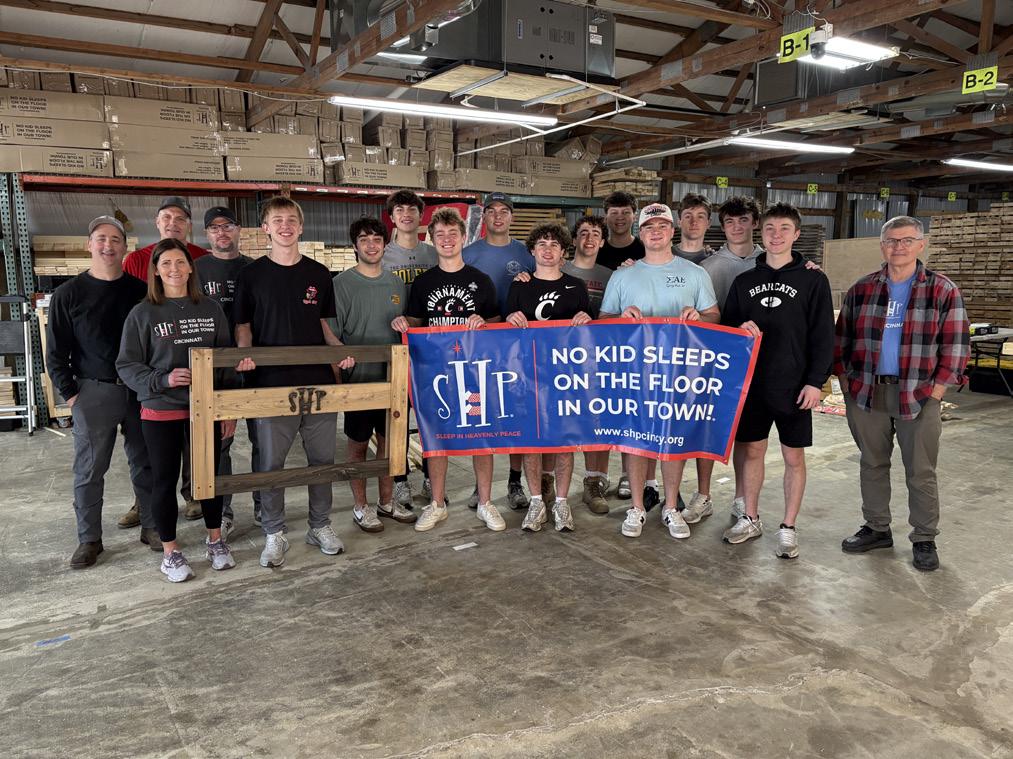
Ohio Epsilon – University of Cincinnati
The brothers participated in a build day, building and assembling beds for children and families in need in the Cincinnati area.
As a brotherhood rooted in service, Sigma Alpha Epsilon brings this mission to life through hands-on involvement. Build days and service projects give members the opportunity to directly impact children in their communities, turning philanthropy into meaningful action.
This partnership creates lasting change not only for the families served but also for the brothers themselves, reinforcing the value of service, connection, and community impact.
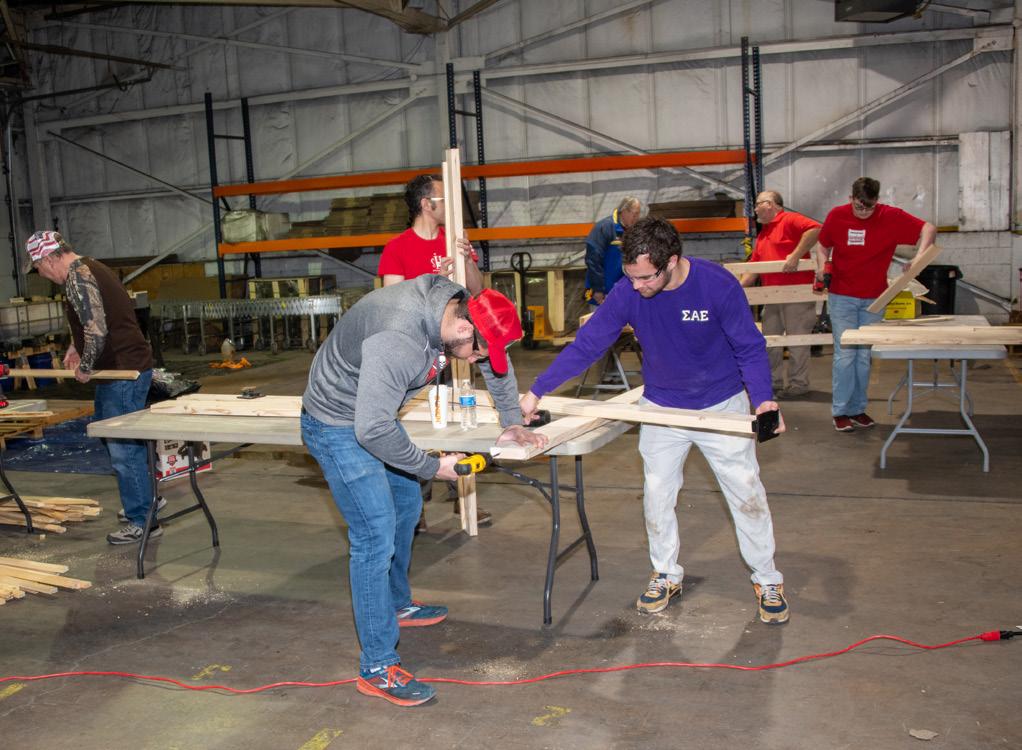
Pennsylvania Zeta – Bucknell University
The brothers participated in a build day with the PA-Loch Haven SHP chapter, building and assembling beds for children and families in need.
3 out of 4
Suicides are men
1 in 9
U.S. men will be diagnosed with prostate cancer
#1 Cancer in Young Men
Testicular cancer is the most common cancer in young men
Movember Foundation is dedicated to improving men’s health by focusing on three critical issues: mental health and suicide prevention, prostate cancer, and testicular cancer. Through research funding, education, and global awareness campaigns, Movember is working to change how men think about their health and encourage them to take action.
Funds raised by participants, known as Mo Bros and Mo Sisters, support innovative research, effective treatments, and accessible resources designed to help men live longer, healthier lives.
As a men’s organization, Sigma Alpha Epsilon recognizes the importance of addressing the health challenges facing men today. Through Movember initiatives and awareness efforts, brothers help promote open conversations about mental and physical health, supporting one another and strengthening communities on campus and beyond.
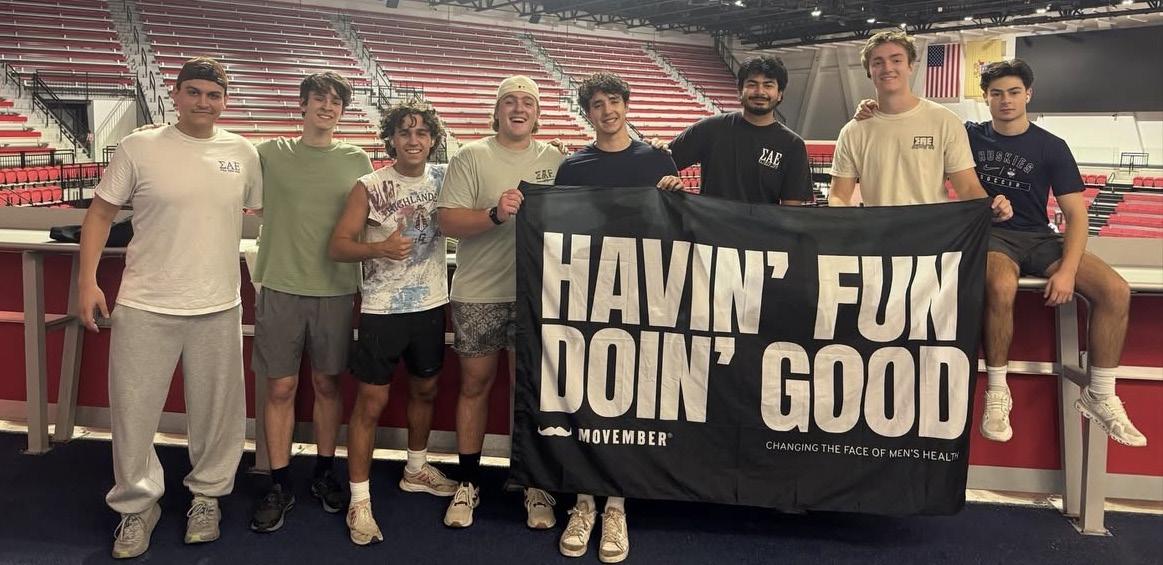
New Jersey Iota-Tau – New Jersey Institute of Technology
In November 2025, the brothers of our NJIT chapter completed a “Move for mental health 60 for 60”, running 60 miles in the NJIT Wellness and Event Center in recognition of the 60 men lost to suicide globally, every hour, and supporting Movember by raising awareness for men’s mental health, suicide prevention, and cancer research.
How disciplined investing and fiduciary responsibility allow the Sigma Alpha Epsilon Foundation to fund scholarships today while protecting opportunity for generations to come.
Every scholarship awarded by the SAE Foundation represents more than financial assistance. It represents the generosity of alumni, the promise of a student’s future, and the long tradition of stewardship that has sustained the fraternity’s educational mission for generations.
Behind each of those scholarships lies a responsibility that extends far beyond the present moment. The Foundation’s endowment must not only support today’s students, but also preserve opportunity for those who will follow them. Balancing these two priorities—meeting current needs while protecting future resources—is one of the central responsibilities of the Foundation’s Investment Commission.
In many ways, this work mirrors the challenge faced by universities and educational foundations everywhere: how to steward financial resources in a way that serves both current beneficiaries and those yet to come.
For the Foundation, the responsibility carries particular meaning. The funds entrusted to the Foundation represent decades of generosity from alumni who believe deeply in the educational and leadership mission of the fraternity. Honoring that trust requires thoughtful governance, disciplined investment management, and a long-term perspective.
“THE TRUE RETURN ON THE SAE FOUNDATION’S ENDOWMENT IS NOT MEASURED ONLY IN PERCENTAGES
OR RANKINGS. IT IS MEASURED IN THE OPPORTUNITIES CREATED FOR STUDENTS AND IN THE GENERATIONS OF LEADERS WHO BENEFIT FROM THE STEWARDSHIP OF THOSE WHO CAME BEFORE THEM.”
The Investment Commission’s role is grounded in fiduciary responsibility. Simply put, fiduciaries are entrusted to act prudently and in the best interests of those they serve.
For the Foundation, that means managing its assets with care, discipline, and integrity so that scholarships and educational programs can be sustained not just today, but for generations of SAE members to come.
Endowment stewardship inevitably involves balancing competing considerations. Investment markets fluctuate. Economic conditions change. At the same time, the Foundation maintains an ongoing commitment to provide scholarships and support academic initiatives every year.
The task of the Investment Commission is not to chase shortterm market movements or react to every economic headline. Rather, it is to ensure that the Foundation’s investment program remains aligned with its mission and capable of supporting that mission across decades.
One of the guiding principles of endowment management is intergenerational equity.
The concept is straightforward: the resources of an endowment should be managed so that future beneficiaries receive the same level of support as current beneficiaries. In practical terms, that means today’s scholarship recipients should not benefit at the expense of tomorrow’s students.
For the SAE Foundation, this principle is central to our mission. The scholarships awarded today are made possible by gifts from alumni who believed their contributions would support students for many years to come. Our responsibility is to ensure that expectation continues to be fulfilled.
Achieving intergenerational equity requires careful attention to both investment returns and spending policies. The Foundation must distribute funds each year to support scholarships while preserving—and ideally growing—the underlying endowment so it can continue supporting future students.
“ENDOWMENT STEWARDSHIP IS NOT ABOUT MAXIMIZING RETURNS IN ANY SINGLE YEAR. IT IS ABOUT PROTECTING THE FOUNDATION’S ABILITY TO SUPPORT SCHOLARSHIPS ACROSS DECADES.”
STRONG RESULTS THROUGH DISCIPLINED INVESTING
A long-term investment strategy has produced strong results for the SAE Foundation’s endowment.
Over multiple time horizons, the portfolio has delivered competitive returns relative to peer institutions with similar objectives. The endowment generated 13.8 percent over one year, 14.4 percent annualized over three years, and 7.6 percent annualized over five years. Over longer horizons, the portfolio produced 10.6 percent annualized over seven years and 9.1 percent annualized over ten years
Equally important, these results compare favorably with peer endowments and foundations. Within the Educational Endowment and Foundation investment universe, the SAE Foundation ranked in the top 21 percent over three and five years, the top 12 percent over seven years, and the top 10 percent over ten years.
For an organization focused on long-term stewardship, consistency across extended time horizons matters more than
any single year’s return. Strong performance over time increases the Foundation’s ability to fund scholarships while preserving the purchasing power of the endowment.
In practical terms, disciplined investment management expands educational opportunities for SAE members.
Stewardship matters.
The Foundation’s assets represent the generosity and trust of donors who believe in the educational mission of Sigma Alpha Epsilon.
Long-term thinking is essential.
Endowment investment decisions must be guided by decades— not quarters—to sustain scholarships across generations.
Intergenerational equity is fundamental.
The Foundation seeks to ensure that tomorrow’s students benefit from its resources just as much as today’s students.
Investment discipline strengthens the mission.
Strong long-term investment results expand the Foundation’s ability to fund scholarships and educational programs.
Governance protects donor intent.
Clear policies, oversight, and fiduciary responsibility ensure that the Foundation’s resources are managed prudently.
Every scholarship funded by the SAE Foundation represents an investment in a young man’s education, leadership development, and future contributions to society. The endowment allows donor generosity to extend far beyond a single gift, creating opportunities year after year.
Behind each of those opportunities is a chain of stewardship connecting donors, volunteers, trustees, and investment professionals. The role of the Investment Commission is to ensure that this chain remains strong—that the resources entrusted to the Foundation are managed responsibly and positioned to support generations of SAE members yet to come.
Markets will rise and fall, economic conditions will change, and investment cycles will continue to evolve. But the Foundation’s responsibility remains constant: to steward its resources wisely in service of its mission.
In the spirit of SAE’s founding ideals—guided by the wisdom of Minerva and the enduring commitment to scholarship, leadership, and service—we strive to ensure that the opportunities available to students today will remain available to generations of SAE members still to come.
I’ve recently returned home from a robust, zeal-filled Founders’ Day trip, reinvigorated by the conversations had and the connections formed. This year, the SAE Foundation supported more than 30 celebrations— either in person with staff or trustees attending events or by sending boxes filled with SAE-branded giveaways and materials promoting our Founders’ Day pin. The limited-edition pin, commemorating 170 years, features the Mansion House, where our founders first gathered to build something rooted in friendship, scholarship, leadership, and service. Those values remain the foundation of our legacy.
Twenty-two brothers supported our Founders’ Day pin promotion at the highest level, honoring our founding year by contributing $1,856 or more. At this donor level, we send Founders’ Day pins to every active member in their chapters. That is hundreds of collegians. Our hope is that their generosity inspires each of these young men to one day pay it forward to SAE with their own time, talent, or treasure—a true force multiplier of stewardship.
In this issue of The Record, we feature two alumni spotlights, Dr. Cliff E. Jones (Arkansas ‘96) and Robert F. Reynolds III (MarylandCollege Park ‘78). We update the Realm on the vital role that fraternities play in the collegiate experience and how the SAE Foundation is supporting our young men during this critical time. Additionally, we provide an update on the initiatives currently underway at the Levere Memorial Temple in Evanston, Illinois.
I am proud to share that the SAE Foundation continues to uphold its commitments to fiscal responsibility and strong annual performance. Our endowment has surpassed $26 million, supported by an Investment Commission focused on long-term growth and stability. Our Annual Loyalty Fund exceeded $1 million, and is on track to reach our goal of $1.435 million by the end of our fiscal year, June 30. The Annual Loyalty Fund is essential to the SAE Foundation’s mission and ability to provide resources that our great Fraternity needs to thrive. It supports our educational grant to the Fraternity, funding initiatives such as the John O. Moseley Leadership School, risk management programming, and other programs designed to enhance the development of our young men. The Annual Loyalty Fund also provides operational support to award scholarships to our collegiate members and ensures the ongoing preservation of the Levere Memorial Temple. Lastly, as you may recall from our last issue, I shared we launched a feasibility study to explore and expand our efforts to support the Realm. I’m excited to share that the feasibility results came back favorable, and the SAE Foundation is in the early stages of designing and coordinating its next campaign.
Our work isn’t possible without the generosity of our brotherhood. This is not about obligation - it’s about our collective stewardship. Our Founders built something extraordinary; now it is our turn to carry it forward.
Phi Alpha,
Thomas J. Kilian, Jr. (Indiana State ‘99) President & Chief Executive Officer Sigma Alpha Epsilon Foundation

For Dr. Cliff E. Jones (Arkansas ‘96), the impact of Sigma Alpha Epsilon extended far beyond his undergraduate years. What began through family and community connections to the Arkansas Alpha-Upsilon chapter at the University of Arkansas grew into a lifelong appreciation for brotherhood, leadership, and the power of alumni support.
“I had family and community connections to the SAE chapter at Arkansas,” Cliff recalled. “The experience provided great friendships and leadership opportunities.” Those early experiences helped shape his view of leadership and service— values that would later guide his career in higher education and economic development.
During his academic journey, Cliff received the Warren P. Poslusny Award in 2000 through the SAE Foundation. At the time, he was pursuing his doctoral degree in educational administration at the University of Texas at Austin. The scholarship helped ease the financial burden of tuition and allowed him to focus fully on his studies.
However, for Cliff, the scholarship represented more than financial assistance—it was a powerful example of alumni generosity and the lasting impact of giving back. Over the years, he remained in touch with the award’s namesake, Brother Warren Poslusny (Kettering ’69), maintaining a connection that reinforced the fraternity’s lifelong bonds.
“I stayed in touch with Brother Poslusny through the years. He was always supportive and encouraging,” Cliff explained. “I kept him updated on my professional endeavors, and he would respond from his residence in Hawaii.”
Today, Cliff sees the scholarship as a way alumni involvement can strengthen the fraternity experience for future generations.
“The scholarship is just one of many ways that alumni support makes a difference,” he said. “Contributions to the SAE Foundation, volunteering, advising—the opportunities to serve are unlimited.”
Cliff’s career has been defined by leadership in education and community development. He has served in numerous roles including professor, department chair, dean, and vice president at institutions across Louisiana, Texas, and Arkansas. Now, as Deputy Director of the Delta Center for Economic Development at Arkansas State University, he focuses on leadership development and collaborative problem-solving with students, businesses, and community organizations.
“I enjoy learning, leading, and teaching,” Cliff said. “Many workplace challenges are similar, and it’s rewarding to help teams work together to solve them.”
Throughout his professional journey, the values he learned through SAE have remained a steady guide. In particular, the fraternity’s founding principle continues to shape his approach to leadership.
“The True Gentleman provides a valuable guide for all SAEs,” Cliff said.
Cliff has evaluated success not just by professional achievements but by the relationships and values that sustain a meaningful life.
“Success can certainly be measured in many ways,” he reflected, “but faith, family, and friends are fundamental. I am thankful for each one.”
For Cliff, the scholarship he received decades ago represents more than support for a student—it exemplifies the enduring commitment of the SAE brotherhood to invest in future leaders.
RECEIVED BETWEEN JULY 1 AND DECEMBER 31, 2025, AND ALL
The Sigma Alpha Epsilon Foundation recognizes individuals who show their support by making a financial gift to the Fraternity. With support from our generous donors, SAE provides educational and leadership opportunities to undergraduate members and academic scholarships to students across the Realm. This list is organized alphabetically by collegiate institution.
For more information about the SAE Foundation and a complete list of donors, visit: sae.net/sae-foundation
Donors with these icons are members of the Founders’ Circle, a cumulative giving society to acknowledge donors who have made significant contributions throughout their lives. The Foundation is honored to recognize our time-honored donors through the following Founders’ Circle levels:
Silver: $5,000-$9,999
Gold: $10,000-$24,999
Pearl: $25,000-$49,999
Amethyst: $50,000-$74,999
Onyx: $75,000-$99,999
Ruby: $100,000-$149,999
Aquamarine: $150,000-$249,999
Emerald: $250,000-$499,999
Sapphire: $500,000-$999,999
Diamond: $1,000,000+
Donors with these icons are members of the Archon Circle, which recognizes individuals who give $500 or more to the Annual Loyalty Fund each fiscal year. The SAE Foundation is honored to recognize these donors through the following Archon Circle levels:
Chronicler: $500-$999
Herald: $1,000-$2,499
Warden: $2,500-$4,999
Archon: $5,000-$9,999
Minerva: $10,000-$24,999
Phi Alpha: $25,000+
Donors with this icon are members of the Phoenix Circle, a giving society for recurring donors.
Donors with this icon are members of the Phi Alpha Club, an exclusive giving society for undergraduate members.
Donors with this icon are members of the Heritage Society, a giving society to acknowledge donors who have included the SAE Foundation in their estate plans.
Donors with this icon contributed to the SAE Foundation between July 1 and December 31, 2025, and have since joined Chapter Eternal. We are forever grateful for their support and dedication to Sigma Alpha Epsilon.
Donors with this icon made their first charitable contribution to the SAE Foundation between July 1 and December 31, 2025. We welcome them to the distinguished community of SAE Foundation Donors.
Each giving society comes with special recognition and perks! For more information, please visit sae.net/sae-foundation.
CASH
PHOENIX CIRCLE FOR MONTHLY DONORS
HONORARY & MEMORIAL GIFTS
For more information please visit sae.net/sae-foundation
Michigan Alpha
James A. Blickle 1966
Ted P. Durdel 1978
Dale D. Goodrich 1969
Dr. Jonathan David Hamer 1998
Jerry L. Lapham 1966
Carson Meister
Gary M. Nelles 1967
David P. Papenhagen 1962
Daniel Joseph Pozdol 1994
Robert J. Radder 1968
Stephen H. Swigart 1970
Daniel T. van Blaricom 1969
Dr. Michael W. Walls 1964
Ohio Phi
John Wyatt 2016
Alabama Mu
Bestor Wynne Coleman III 1958
William D. Coleman 1965
John N. Dowdle 1965
John Wayne Goff 1972
Samuel Barton Hunt 1990
Frank E. Litchfield III 1974
Hugh Barr Miller IV 1985
C. Richard Moore, Jr. 1973
Jackson W. Moore 1970
Dr. Luther David Stacy, Jr. 1961
K. W. Wilson, Jr. 1968
New York Pi
Joseph Nicholas Lapine 1994
Pennsylvania Sigma-Mu
Jeremy Daniel Marcavage 2002
Casey Mazur
Keith Richard Murray, Jr 1996
Peter Nichols Jr.
Pennsylvania Omega
W. Christopher Andrews 1989
Robert W. Baum 1958
Thomas M. Heiles 1976
Scott W. Phillips 1974
MG David J. Rist 1961
Hayes C. Stover 1962
Isaac Tripp IV 1974
Stephen Harwood Watson 1985
Michigan Delta-Tau
Timothy Craig McCloskey 1984
Arizona Alpha
James R. Allmand III 1971
Berkeley Gene Beach 1956
Connor Burdette
Calvin John Burns 2012
Christian Paul Burns 2015
Paul R. Burns 1976
Bradley Mark Cohen 1985
Stanley L. Cook 1954
George P. Davies 1962
Alan D. Dineff 1974
Dwayne E. Dobson 1960
John A. Hagenah 1976
Philip W. Hagenah 1969
Lynn E. Hornbrook 1958
Thomas C. LaMantia 1987
Michael R. Lanagan 1967
James Raymond Mahon 1972
Dr. Lawrence E. Mast 1964
Walter J. Maykulsky 1973
Alan L. McCall 1961
Matthias P. Meehan, Jr. 1963
E. Payne Palmer III 1963
Paul W. Rihs 1971
Mario R. Salvatierra 1973
Charles A. Touche 1974
Arizona Beta
Ray J. Artigue 1976
Reg Bacon 1976
Robert B. Bulla 1962
Ronald W. Crone 1969
Curtis R. Frasier 1977
Sam Freedman 1962
Charles Roland Grimes 1978
Todd R. Hamilton 1995
Brian Jay Hayer 1986
Chris Knut Gamble Henrichsen 1985
Charles G. Lawrence 1962
James Forrest Marsh 1980
James A. Nesmith 1967
Jeffrey Michael Rovner 1985
Gary Carl Schachter 1982
James R. W. Stitt 1966
Stan Curtis Strom 1982
R. Bart Wear 1982
Douglas S. Welling 1976
Arkansas Alpha-Upsilon
Paul A Abdella 1964
A. Sid Bray, Jr. 1973
Charles C. Burrow III 1967
Percy D. Burton III 1966
David Lynn Carroum, Jr. 1994
Ralph M. Cloar, Jr. 1959
Gene Cogbill 1969
Stephen W. Creekmore III 1972
Martin C. Davis 1970
John F. Farrell 1970
Lawrence Fikes 1965
Stephen Doyle Gates 1985
Richard D. Gillham 1950
David M. Hampton 1973
Thomas L. Jameson, Jr. 1976
Dr. Cliff Erwin Jones 1996
Wallace Lancing Lee 1992
H. Dean Mann 1965
Lambert L. Marshall 1974
Larry R. McClendon 1974
Randall E. Northern 1970
Mark Steven Nunn 1974
John L. Ostner 1959
Ben F. Reagor III 1968
Jan McPherson Williams 1992
Arkansas Beta
Joe D. Drompp 1972
Joel Y. Ledbetter, Jr. 1964
Edward O. Moody 1971
Jerry V. Sparks 1971
Raymond A. Weber 1970
Alabama Alpha-Mu
James M. Adams, Jr. 1968
Taylor Stephen Agricola 2005
David Wiley Alford 1986
Michael Paul Baggett 1981
Brett William Bussman 1988
William Russell Buster IV 2000
Lewis Carter
Clifford Wayne Cleveland II 1993
Brent Thompson Cook 1991
Conrad E. Cook IV 1959
John F. Cooke, Jr. 1967
Robert Clifford Cowen, Jr. 1987
Carroll Brian Daniel 1997
George T. Dickson 1977
Reid Bentley Dove 1994
Patrick Fain Dye, Jr. 1984
James Allen Easterling 1986
James Colston Elder, Jr. 1988
Steuart Adair Evans 1988
Alvin P. Ford, Jr. 1966
Robert Nathan Freeman 1989
Bill Grainger 1972
Edward C. Graves 1932
John Erby Hall III 1995
John Callaway Halliburton 1993
Gregory Michael Herman 1988
Jeffrey Michael Hicks 1995
James Mason Johnston 1997
David C. King 1974
Kenneth R. Lee 1974
Jared Bryant Lisenby 1996
Gary C. Martin 1957
Howard Weaver Meadows 1995
Payne Ransom Meadows 1995
Juan Carlos Ortega 1994
Hugh Vories Overmyer 1995
Larry Merrell Parker 1985
Gordon Flournoy Pease 1991
Daniel E. Ponder, Jr. 1976
Robert Emmett Poundstone IV 1996
Samuel Trent Prim 1998
Henry Palmer Proctor, Jr. 1989
Charles Wilson Regan, Jr. 1989
James Glen Sanders III 1987
Charles Michael Schilleci 1994
George Bryant Shamblin 1990
Chancey James Shepherd 1997
Craig Max Shoemaker 1984
Bobby Harris Shoulders, Jr. 1981
Joseph B. Skinner 1978
Craig Carlisle Snellgrove 1979
Glenn Spann Spivey 1992
Todd Pershing Thornell 1990
Stevenson T. Walker 1968
William S. Weeks 1972
David M. Williams 1976
Robert B. Witt 1973
Milton Marvin Woodruff, Jr. 1982
Indiana Zeta
Thomas W. Armor 1971
Alan C. Buck 1969
Gregory Alan Cullison 1991
Stephen L. Jones 1969
Anthony James Kerins 2000
Thomas Robert Land 1978
David Gerhard Mertens 1982
Joseph Eugene Shoaf 1982
Richard E. Tobias 1971
Jack Edward Welter 1986
Texas Theta
Charles Franklin Crane 1980
Gary Keaton 2024
Jay William Propes 1990
Jeffrey Glenn Wigington 1992
Wisconsin Phi
Dr. Joseph C. Di Raimondo 1961
Benjamin F. Flegel 1988
Frank J. Johnson 1960
Allan Kieckhafer 1945
Robert M. Mailey 1973
William C. Putnam, Jr. 1965
West Virginia Beta
John R. Alexander 1975
William H. Rutter 1976
John C. Warrick 1972
New York Omega
Dr. Gary Martin Kolinsky 1986
David I. Levine 1987
Fess Ryan Wofse 1991
Alabama Iota
Charles C. Collier 1969
William A.B. Dowell 1978
Thomas P. Dudley 1971
Edward L. Hardin, Jr. 1962
Horace S. Hunt III 1966
Atley Langley Kitchings 1982
F. Duffield Meyercord 1968
William Kelly Nicrosi II 1990
William F. Orr 1973
John E. Robinson 1971
Joseph Earl Smith 1989
Massachusetts Beta-Upsilon
James Alexiou 1954
Arma E. Andon 1941
Alexander James Bastani 1986
Stephen John Condakes 1980
Frank S. Forbes II 1951
Edwin D. Fuller 1968
Robert B. MacKay 1968
J. C. McKnight 1994
Robert W. Paglierani 1966
Robert H. Watts 1968
Ohio Kappa
Duane A. Ankney 1970
Douglas L. Barhorst 1970
Judson Willard Divincenzo 1982
John T. Horney 1972
Dr. Milton G. Levy 1961
Alan Martin 1978
Alan R. McBane 1960
A. James Meerpohl 1972
Lynn K. Millikin 1969
David R. Norwine 1968
Michael Notaroberta 2018
Emil J. Ragones 1968
Gary L. Reed 1970
John Charles Scherer 1979
Neil E. Seufert 1965
Robert L. Stein 1976
Craig Steven Storts 1982
George Traikos 1978
Illinois Epsilon
Aaron Arden
David Willard Berkow 1979
Alexander J. Bibbs 1983
Daniel F. Dahlke 1976
Daniel Bennett Gallant 1985
Randy George Gallick 1980
David A. Hardenbrook 1972
Robert J. Kelderhouse 1978
Raymond J. Lawing 1971
Benjamin David Lewis 1995
Eric Bradley Ratts 1985
Elijah Reyes
Dr. Stephen L. Rider 1976
Jack Harrison Semerjian 2025
David S. Van Hove 1977
Pennsylvania Zeta
Donald Arch Booth 1959
John Edward Haggerty 1993
James Gambrill Hendrickson 1971
LTC Mark William Jones 1987
Kenneth James Kauffman 1978
George Klauder 1955
Bruce Maxwell Lee 1991
Shane Malinowski 2025
David Anthony Moschella 1984
Joseph Russell Scarpa 1987
David Bruce Smith 1978
Ronal William Smith 1961
Jeffrey Lechleiter Wade 1984
Gerald Bruce Weidman 1954
California Tau
Vincent Albert Barletta 1984
John Joseph Maier 1985
Glenn Martin Ritter 1986
James Brian Yates 1985
California Alpha-Beta
George Aldada
George Michael Danciu 1964
Matthew William Jones 1997
Trent Jurado
Darren Matthew Winkley 1995
California Pi
Tom Aden Chadwell 1986
Mark Steven Ersek 1985
Richard Charles Goodwin 1975
William Ramey Hall 1995
Dr. Robert Perry Husband 1979
Hadley B. McGaughey, Jr. 1973
Peter William Mitchell 1990
Richard F. O’Leary 1970
Abraham Ruiz
Dirk Martin Van Os 1994
California Lambda
David J. Ables 1976
Kenneth M. Ammann 1965
Donald A. Black 1961
Dr. William J. Brand, Jr. 1965
Richard Henry Cosand 1978
Christopher Scott Dalton 1992
Michael Thomas Dalton, Jr. 1989
Dale J Fairbanks 1957
Casey H. Fierce 1994
Gary E. Flynn 1959
Daniel P. Gooch 1972
Alan Lee Goodrich 1979
Joel A. Hackett 1969
Curtis D. Hamilton 1965
William Leroy Harris 1982
Warren F. Hillman 1967
Nabil Kahale 2001
Myles I. Karpman 1971
Michael Lance Long 1980
William L. Mauerhan, Sr. 1961
David W. McAnern 1958
Bertrand J. McCarty, Jr. 1975
Thomas E. Miller 1970
Robert T. Montenegro 1965
Kevin M. Nagle 1976
Michael S. Newton 1957
Michael Karl Pazdernik 1981
Ronald P. Schwandt 1958
Dr. Ronald G. Sherwin 1965
Donald R. Smith 1968
David K. Sontag 1966
Richard Joseph Verdugo 1977
Luis Wenk-Wolff 2002
Richard L. Wennekamp 1965
William Gary Westling 1983
George A. Yackey, Sr. 1963
California Mu
David F. Brubaker 1966
John F. Dekema 1969
Albert Isaias Faz
Carlos Armando Garcia, Jr. 2004
Eugene Hernandez 1979
Stewart Hsieh 1974
Neil Thomas Lasala 1984
William A. Lewis 1981
Aaron Elliott Popel 1980
Ninion S. Riley 1971
Richard Schwien 1968
J. Morgan Shuster 1967
Gary N. Tolley 1975
Joseph C. Volpe 1972
Ben B. Wa 2007
Howard H. Wood III 1966
California Nu
David M. Bennett 1976
Rob Arie Jacobsen 1991
Justin David Maidenberg 2015
California Alpha-Gamma
Tyrell Anthony Fiduccia 2004
Danny Mendoza
Pennsylvania Phi
Jeffrey Joseph Ball 1979
William R. Benthall II 1969
Marvin L. Cadwell 1965
Joseph L. Caporossi 1969
Dr. Andrew J. Eggenberger 1961
Robert Alan Gebbia 1969
Russell E. Gregg 1960
Robert M. Hrovath 1974
Alan H. Koblin 1974
John W. Kwiecinski 1977
Lukas Manomaitis 1993
Angus H. McArn 1958
James C. Moran 1967
Thomas J. Mueller 1959
Robert E. Murray III 1968
Mark C. Puliafico 1973
Gerald J. Sekerak 1977
Thomas Edgar Shirley 1980
Donald Van Ollefen 1977
Bruce Raymond Whiting 1971
CASE WESTERN
Ohio Rho
Benjamin Isaac Altose 2007
Howard E. Baybrook, Jr. 1966
Peter McKale Burk 1979
James E. Caminis 2000
Gregory Paul Catrambone 1970
Rolf Christian Dietrichson 1984
Richard C. Dietz 1968
Kenneth James Farrell 1986
David L. Fentress 1968
Eugene R. Gasser 1948
Paul D. Hicks 1966
Daniel J. Hirsch 1962
William F. Jones, Jr. 1961
Paul Robert Kimmel 1969
Robert E. Lewis 1962
John P. Linhart 1969
Dr. Stanley McMillen 1968
Ray A. Nemura 1972
Dr. Louis J. Petrovic 1962
Oliver L. Poppenberg, Sr. 1959
Aaron Spencer Reames 1996
Charles E. Sax 1954
Thomas Olvia Sharp 1970
Jacob Christian Showalter 1998
Dr. Daniel Joseph Wasser 1984
Jonathan Allen Wehrli 1984
Florida Epsilon
Mark W. Glickman 1975
John D. Kelley 1977
Michael Shands McKeithen 1988
Darin Patton 1995
Christopher Edward Varisco 1995
Michigan Delta-Omega
CPT Zachary Ryan Bock 2006
Shane Finfrock
Dr. Spencer Alan Long 2008
Adam Martin Walters 2016
Oklahoma Sigma
Jacob Marshall Harris 2020
Kentucky Kappa
Richard C. Berg 1968
John C. Brothers, Jr. 1989
Troy Matthew Edelen 1989
Casey Klein 2018
Matthew Lynn Sinex 1997
Nathan L. Tracy 1964
Dr. Martin Dale Wiglesworth 1984
California Alpha-Delta
Shane Gregory Hunter 2006
Brandon Vearle Pankey 1999
South Carolina Upsilon
Craig Eney 2017
Richard Keith Sauls 1990
Tennessee Rho
Jeffery Daniel Hall 2007
Ian Spencer Strelsin 2004
Ohio Epsilon
Joseph Porter Adams, Jr. 1979
David L. Altemeier 1972
Dennis Ward Anderson 1971
Thomas Andrew Barefield 2015
John F. Barrett 1971
Alton B. Barton, Jr. 1970
Dr. Dennis D. Baum 1972
Barry Jay Bebart 1986
Dr. William F. Bentz 1962
Dr. Neal R. Berte 1962
Russell William Best 2009
Steven Mark Bilski 2006
Dr. John C. Bools 1975
Chris T. Carper 1993
Robert Earl Carroll 1981
Allan D. Cors 1959
L. Barry Cors 1954
Ronald I. Cosler 1964
David V. Crockett 1971
Dr. Paul K. Danner, Jr. 1958
Todd C. DeGarmo 1980
Herbert William Desch 1961
Donald J. Diebold 1983
August B. Doppes 1970
Douglas E. Earhart 1977
Kenneth R. Elder 1964
J. Scott Farrell 1991
Simon Fieler
Richard T. Findlay 1969
Gary E. Fisher 1959
Chris Robert Gardner 2001
David Roger Gardner 2006
Dean R. Gaudin 1956
Charles Paul Giametta 1991
Christopher Gregory Goins 2006
Dr. Luis L. Gonzalez, Jr. 1978
Stephen M. Goodson 1977
Karl Joseph Grafe 1982
James Joseph Gusweiler 1981
John Frederick Guy 2000
John D. Hagner 1968
Mark D. Hanauer 1975
Warren S. Hensel, Jr. 1964
Ryan Higgins 2015
Henry S. Hilberg, Jr. 1973
Richard M. Hopple 1970
Mark Alan Horner 1979
Thomas Joseph Howison 1977
Kenneth Edward Huber 1987
Thomas Edward Huber 1980
Jay W Hummel 2002
John A. Johnston 1976
Daniel S. Jones 1961
M ichael J. Jump 1977
Dr. Bill J. Karas 1970
Barry L. Keidel 1976
James C. Kennedy 1973
Dr. Dean J. Kereiakes 1974
Thomas J. Kereiakes 1976
Richard M. Kimbler 1970
James F. Koenig 1973
Gregory Michael Kuntz 1983
Brent Tyler Kuwatch 1992
John Christopher Lame 1979
John C. Lame, Jr. 2013
Dave Milton Lance, Jr. 1981
David M. Lance 1956
Doug Albert Lance 1989
Ned C. Lautenbach 1966
Carl H. Lindner III 1975
Keith Edward Lindner 1981
S. Craig Lindner 1977
Robert M. Miller III 1978
R. Bradley Motz 1983
Edward J. Neyra 1973
George W. Nyktas 1971
Robert Hugh O’Connor 1981
Joseph Ottaviani 1966
Gregg Edward Pancero II 2009
Edward G. Paul 1972
John M. Perin 1973
Dr. Dale T. Peters 1958
Aaron Charles Pontsler 2014
Richard L. Pratt 1977
Stewart V. Proctor 1976
C. Winfield Scott 1983
William J. Seitz III 1975
Dr. Reed Albert Shank III 1973
Todd Eric Siegel 2009
Michael Simpson 1963
Mark E. Sims 1977
Matthew Jon Smith 1980
Christopher Aaron Speelman 2004
Mike Steur 1978
Kevin Patrick Sullivan 2006
James W. Sunderland 1952
Christopher John Tallman 2002
J. Robert Taylor 1964
Gordon R. Tod 1964
Nicholas Alan Trelka 2005
Mark E. Tullis 1973
Dr. Thomas E. Wagner 1960
Dr. Barry W. Webb 1970
Ben Fredrick Wells 1980
Dr. Brad Robert Wenstrup 1980
Mark Lawrence Willey 1993
Gage Bryant Woolley 2015
South Carolina Nu
Eric B. Anderson 1977
Shawn Patrick Dekold 1988
Dr. Philip C. Gainey 1973
Michael Jones Maxwell 1967
Jesse William Myers, Jr. 1971
Dr. Harry Guilford Rushton, Jr. 1974
Colorado Chi
Alex Alburger
Luke Balint
Riley Cereda
W. Dennis Cheroutes 1963
Ben Cote
Peter W. Dillon 1958
Alan Dugan
Cash Elmquist
William Kevin Fisher 1983
Andrew Hammond
Dr. Robert S. Heim 1952
Reed Holder
David B. Klimoski 1968
Edwin F. Kuny 1953
Phillip E. Lantz 1960
Charles W. Larson 1965
Jay Leder
CDR Leland G. Lewis 1964
Hudson Mehren
Michael Miles
Cole Miller
Gabe Montoya
Tripp Netter
Jack Page
Owen Parker
Jack Preston
Alex Rushing
Douglas Warren Schantz 1986
Charlie Schwanewede
Dr. Peter F. Steinhauer 1958
Brook Strachan
Rico Trujillo
William Fredrick Turner 2016
Colin Vaughan
Casey Watkins
Boyce W. Wiltrout 1963
Colorado Lambda
Stephen P. Antony 1971
James H. Butler III 1950
Stephen D. Chesebro’ 1963
Charles C. Hanebuth, Jr. 1967
James Randall Heath 2003
Hon. David Herbert Holstein 1979
Steven A. Lambert 1975
Clifford E. Nichols 1966
James R. Perry 1975
Colorado Delta
Michael Joseph Barbaria 1996
Scott William Bixby 1983
Alex Bennett Campbell 1980
Tom G. Cox 1960
Dennis John Devaney 1994
George A. Dubois III 1992
John E. Hawkinson 1960
Thomas A. Holstrom 1975
Clarke Houston III 1966
Tom M. Hudspeth III 1964
B. Kim Lilly 1959
Dr. Kurt Friedrich Papenfus 1980
Armand L. Smith 1963
Alexander Heuer Snowden 1994
Timothy N. Thoelecke 1962
Dr. Charles D. Vail 1958
Colorado Phi
Aaron Barker 2018
Keison Morales
Connecticut Beta
Richard C. Barrett 1964
David I. Barton 1960
Raymond P. Kogut 1960
Emmett J. Murtha 1960
Stephen Michael Ozyck 1990
John S. Purtill, Jr. 1964
Benjamin Ackley Rowe IV 1990
Richard P. Rowland 1956
Daniel E. Zucchi 1963
New York Alpha
Herman A. Block II 1958
Dr. Brian Randolph Elliott 1991
Gian Dillman Fabbri 1996
Richard R. Gerken 1967
Augustus Y. Noojin III 1969
Benjamin Roberts 2010
Ronald M. Skalko 1973
Dr. Charles H. Spencer 1968
R. Brent Vallat 1987
Nebraska Iota
Thomas A. Bower 1970
Ted Robert Grennan 1978
Terry J. Grennan 1970
Terrance M. Ramirez 1986
Richard Witmer
New Hampshire Alpha
Evan Bret Azriliant 1987
Mark S. Carlie 1976
John Spaulding Foote 1978
Kenneth Farnsw Holmes 1981
Jeremy Laurence Katz 1995
Dr. Harris B. McKee 1961
North Carolina Theta
MG William Francis Grimsley 1980
J. Daniel Hanks, Jr. 1965
Herbert F. Kincey 1959
Ray D. Munford, Jr. 1976
Dr. John L. Ward 1955
Delaware Alpha
Gregory Carbone 1996
Ohio Mu
Jeffrey C. Angell 1976
Ronald C. Barr 1966
James P. Dellner 1974
Richard McCulloch Jones 1956
Colorado Zeta
Charlton H. Chatfield 1969
Stephen D. Cummings 1966
Brian Lee Kitts 1983
Christopher Marshall 1963
Don R. Prizler 1963
David L. Rosier 1959
Welcome W. Wilson, Jr. 1973
Indiana Delta
Allen Porter Ashley 1992
William A. Baum 1971
Zack F. Bettis, Jr. 1971
Dr. Jeffrey John Bowe 1985
Lance Attilio DeNardin 1986
Frederick Charles Fritz 1981
Ezekiel Hernandez 2025
Charles Alan Miller 1987
James Michael Mullin 1983
Charles John Nelson 1985
Francisco Guillermo Paz 1985
John Allen Perry 1985
Christopher L. Ropa 1983
Brent Ray Thompson 1989
Byron Lee Wilson II 1985
Pennsylvania Sigma-Phi
John D. Allemang, Jr. 1973
Douglas McCall Bell 1977
Bruce Mitchell Cross 1981
Charles Fox 1962
Dr. David R. Short 1972
Scott William Woehr 1982
Iowa Delta
James P. Avgeris 1965
Donald H. Baird 1968
Todd Bolen 1962
Sherwood M. Boudeman 1962
Hon. Greg Dean Brandt 1984
Dean E. Brooks 1971
Ned Alan Burmeister 1981
John D. Challas 1961
Craig W. Christopherson 1966
Larry H. Crist 1954
Warren L. DeVries 1950
Stephen R. Fitzsimonds 1986
Bruce A. Foster 1978
Kent Jay Foster 1983
Marc P. Franson 1977
Lee Frary 1964
Charles Louis Friedman 1987
Thomas Henry Funk 1980
Jeremy James Glenn 1994
John W. Green 1972
Eric William Haussmann 1983
Kenneth K. Kauffman 1960
David A. Kimball 1977
William M. Kinzer 1969
Robert L. Knudson 1969
Robert G. Lady 1962
Grant Thomas Lander 2002
Tom J. Logan 1973
Gary M. Macek 1965
Duane Thomas Magee 1992
Michael A. Mason 1968
Gary L. Medd 1968
David B. Meier 1972
Ronald Leigh Mountsier 1979
Roger P. Penrod 1978
Robert Michael Perrye 1985
Thomas R. Peterson 1968
Dr. Todd Austin Sandrock 1981
Saylor Timothy Schwab 2022
Richard E. Scott 1950
Kendall B. Smith 1972
Allan C. Sorensen 1961
James A. Street 1976
Dr. Stephen Thomas Tranter 1979
James C. Van Slyke, Jr. 1961
Kenneth J. Vegors 1971
Dr. Dale Douglas Whiting 1952
Calvin P. Wise 1960
Larry F. Witte 1966
Pennsylvania Epsilon
Peter V. Cochran 1972
Mark Howard Felder 1980
Stephen William Harrer 1991
Clarence G. Hoop 1971
Elliott Steven Hurwitz 1987
Curtis G. Kramer, Jr. 1975
Joseph Anthony Mandato, Jr. 1981
Dennis L. Neider 1970
North Carolina Nu
Kenneth D. Mindell 1974
LT Frank Morris Ridley IV 1984
Christopher Suiter Scott 1980
John A. Wanklyn 1964
Douglas Richard Whitaker 1980
North Carolina Sigma
William Scott Talbert 2004
Tennessee Alpha
Randolph B. Cardoza 1967
David Bruce Costner 1975
Clifford Walter Deery 2022
Herman L. Dixon, Jr. 1972
James C. Ebersole 1968
Carroll L. Gentry 1965
LTC Daniel H. Gordon 1964
Charles C. Guy 1968
Ronald T. Moore 2018
Armando F. Morrell 1971
Illinois Delta-Lambda
Thomas Oliver Long 2016
Kentucky Delta
Jonathan T Grossmann 2003
LTC Michael A. Hughes 1973
Michael Michael Nolan 1995
David N. Rodgers 1975
Richard E. Schaffer 1965
Joshua Dale Smith 2002
Ron E. Volmering 1978
Dr. Robert Glenn Wood, Jr. 1982
New Mexico Alpha
Prentice Alvin Baca 1967
William G. Hicks 1971
John Mauk Hilliard 1967
Dr. Fred D. Phelps 1964
LTC David R. Pia 1965
Ken Tracey 1970
Cody Brandon Vardeman 1998
Nate Thomas Williams 1993
Florida Rho
James Patrick Baldwin 1971
Wesley Ryan Cousino 2005
William Patrick Gehlen 2005
Arizona Delta
Andrew Berg
Christian Robert Moore Gibbs 2016
Tanner Jeffrey Grevesen 2020
Matthew Irsfeld 2026
Matthew Andrew Martinez 2021
Tyler Morris 2018
Nathan Carl Pyles 2008
Massachusetts Epsilon
Edward Roy Larsen 2012
Georgia Epsilon
Derst K. Austin 1968
Mark W. Bates 1973
Robert C. Bottoms 1964
Gary J. Boynton 1976
W. Lawrence Brown 1968
Dr. William M. Callahan 1976
William E. Elmore, Jr. 1971
William J. Etherton 1969
Dr. Robert C. Ferguson 1968
R. Carter Freeman, Jr. 1960
Dr. M. Felton Hagood 1963
Alexander L. Hinson 1964
William Edward Jay 1981
Arthur Joseph Kretchman 1980
Dr. Peter A. McCranie 1956
Robert E. Morris 1969
Claude F. Perry, Sr. 1959
Dr. Samuel D. Rauch 1961
Dr. Robinson W. Schilling, Jr. 1962
Wallace F. Tillman 1965
CAPT James Joseph Ware 1978
Indiana Epsilon
Landon Anslinger
Beau Baldwin
Jeffrey R. Baugus 1993
Thomas Edward Blackburn II 1991
Eric Loren DeVries 1996
James A. Domina 1968
James Thomas Espinoza 2001
Norman C. Fischer, Jr. 1976
Josh David Goode 2001
Joseph Douglas Haas, Jr. 1992
Paul W. Jones 1971
Ryker Kotmel
George Andrew Miller 1996
Dale E. Oberbeck 1959
Nicholas Charles Procter 1985
Earl E. Purdue 1962
Frank J. Schultheis 1963
Richard L. Shipley 1979
Larry Bruce Whiteside 1978
Michigan Zeta
Robert P. Boboltz 1972
Paul Joseph Dixon III 1989
Jason Christopher Keith 1993
Bruce L. Traverse 1968
J. Michael Walkowski 1974
Florida Upsilon
Ricardo Alvarez 1973
Wayne C. Bailey 1972
Thomas Richard Barber, Jr. 1961
Thomas L. Fleming 1967
Dr. Albert R. Frederick, Jr. 1957
Dr. Lamar Hatcher, Jr. 1961
Donald G. Hess 1970
Carter Braxton McCain 1986
Dr. Charles T. Montgomery 1956
David H. Morrish 1955
Angel Oliva III 1990
William H. Prather, Jr. 1962
Louis Francis Ray III 1988
Arnold H. Slott 1964
Robert Carl Sorgini 1978
Dr. Richard B. Streeter 1962
Jeffrey James Weibel 1986
Florida Gamma
Joseph Capitano 1960
William A. Chope 1971
Jonas Thomas Concklin 1955
William F. Cooper 1957
Philip D. Diuguid 1958
Robert J. Fauls, Jr. 1970
Kenneth I. Hallenborg 1961
Justin Connor Kelleher 2024
Terry L. Krick 1976
Canyon Lowes
Walter W. Manley II 1969
Gil Mitchell 1962
Chris Anthony Rodgers 1990
Robert R. Sharp 1961
Florida Beta
Dr. Carmelo L. Battaglia 1968
Joseph S. Brannen 1971
Dr. William A. Bryan 1960
Timothy Jay Daly 1987
Charles W. Doolittle, Jr. 1974
Michael M. Fields 1969
Davy Haddon Foster II 1967
Claude H. Grizzard 1960
Baylis M. Gruber 1970
Gregg Padgett Guilford 1982
Walter Scott Hopson 1990
Pfilip Gardnyr Hunt, Jr. 1984
Pfilip G. Hunt, Sr. 1959
David A. Jones 1974
James J. Kelley 1967
Edward F. King II 1973
Fred Joe Pyland 1975
Howard D. Rogers 1970
James H. Sims, Jr. 1963
Horace Smith, Jr. 1964
Howard Scott Treadway 1961
James W. Warren III 1965
Richard A. Weidner 1966
Ruben A. Whitehead 1961
Kansas Delta
John Michael Kimberlin 2001
Richard Brian Shanahan 2003
Indiana Alpha
Jon Stacy Almeras 1992
Dr. Leonard L. Bissonnette 1962
Chad Everett Bobb 1997
Gary W. Cooper 1974
James Victor Due 1982
Kenneth O. Dunn 1951
Gregg W. Happe 1973
Dr. John F. Howard 1897
Robert M. Martin 1963
Christopher David Nobbe 1997
Ronald E. Shook 1963
Stephen A. Smith 1969
Dr. Arthur H. Turner 1957
California Iota
Paul James Catuna 1987
Gregory James Coleman 1981
John S. Corkins 1977
Eugene V. Dupreau III 1970
William A. Gisvold 1967
Bruce M. Harr 1965
Warren Jacobsen 1958
Kenneth R. Johnson 1983
Robert P. Krum 1964
Mathias F. Matoian 1964
Keith G. Miller 1963
Gerald M. Palladino 1966
Brian Joseph Panish 1980
Jerry Harrison Parks, Jr. 1981
Melvin F. Pereira 1964
Dennis C. Speer 1972
Maryland Delta
Jason Paul Andrick 1997
Thomas William Carey, Jr. 1995
Henry Noah Haddaway 2021
Kevin Patrick Reilly 2012
Jacob Warner
South Carolina Phi
Eric Eugene Davis 1986
Christopher John Wilson 1991
Washington City Rho
Chad John Antonini III 2000
Dr. Terence L. Babcock 1967
Yale R. Brown 1976
Edmund P. Crump 1960
Dennis Gene Gallino 1969
William A. Griffel 1966
Dr. R. Gerald Heinze 1965
Byron Kline 1965
Leon Stuart Mapes, Jr. 1970
CDR Richard David Nelson 1989
Louis L. Rochez 1966
Washington City Eta-Sigma
John Dusza
GEORGIA
Georgia Beta
John G. Alston 1965
Charles C. Benedict 1963
Leonard H. Blount 1976
Blair Knox Cleveland 1992
Henry L. Crisp 1961
A. Thomas Dudley 1968
Rob Arthur Ellis, Jr. 1980
John Carl Gurley, Sr. 1986
James C. Hansberger 1967
William W. Holland 1967
Stiles A. Kellett, Jr. 1966
Hugh M. McCutcheon 1975
Ruebush J. Mitchell III 1975
James S. Moore 1976
William S. Morris III 1956
Ronald H. Rentz 1968
Hon. Williamson S. Stuckey, Jr. 1956
Henry W. Swift, Jr. 1964
Wright Brown Waddell 1984
Presley Daniel Yates III 1972
GEORGIA SOUTHERN
Georgia Alpha
Donald Thomas McDaniel, Jr. 2001
Russell Roland Parker 1996
GEORGIA SOUTHERN-ARMSTRONG
Georgia Rho
Noah Bracco Muszall 2018
Dustin Edward Stewart 2017
GEORGIA TECH
Georgia Phi
James J. Baldwin III 1963
Richard T. Battle II 1968
Richard Howerton Battle 1997
Kenneth W. Best 1967
Thomas C. Broome 1966
Grady Newsom Bunn 2011
David Charles Burns 1980
Marc Anthony Corsini 1980
Thomas Frederick Davenport III 1984
Thomas E. Dupree, Jr. 1974
J. Henry Fair, Jr. 1952
Hal Wilson Field, Jr. 1951
Samuel Robert Formby 2009
Samuel O. Franklin III 1965
Logan Tom Gay, Jr. 1966
Jay K. Githens 1962
Stuart Ellis Gould 1991
MG Lee V. Greer 1957
Albert J. Hackl 1946
William S. Harris 1959
Paul J. Hart 1974
Mack A. Higdon, Jr. 1966
Howard Hoffman 1980
Ivan A. Hoge 1955
W. Deck Hull, Jr. 1954
James R. Jolly, Jr. 1964
Scott H. Keller 1977
James A. King 1973
John Olmsted King 1978
Robert W. Magill 1973
John R. Markley 1956
John Alexander Mattle 2017
Marvin George Mitchell 1967
Lawton M. Nease III 1965
Edmund Fay Pearce, Jr. 1960
John D. Pelton 1962
Joseph J. Perry III 1961
Daren Bruce Pietsch 1991
Daniel B. Rather 1957
William L. Simons, Jr. 1957
Russell C. Steele 1966
Terry L. Strong 1964
Thomas P. Swift 1967
Kenneth G. Taylor, Jr. 1975
Howard T. Tellepsen, Jr. 1966
Edward F. Vickers 1963
Charles C. White, Jr. 1957
Pennsylvania Delta
Keith B. Adams 1977
Robert William Bilheimer 1978
Dr. George A. Deitrick III 1968
Charles F. Johnson II 1962
James C. Vanderwaal 1977
Wyatt Hamilton Yasinski 2016
Virginia Upsilon
William Braddock Bourne IV 1996
Irving H. Pritchett III 1973
Connecticut Lambda
Patrick James Fayne 2016
Russell F. Levere 1966
Massachusetts Gamma H. Perry Driggs, Jr. 1958
Walter P. Hinchman 1959
William Gentry Lee 1966
William A. Thayer 1958
G. N. Tsandoulas 1961
Texas Epsilon
Robert Wynn Buschardt 1981
David M. Doll 1988
James R. Hill 1960
Kenneth E. Kurtz II 1957
Steven R. McClellan 1977
Michael Lawrence Pede 1989
John David Pieratt 1970
Joseph T. Ruland 1970
Alan R. Senac 1971
Tyler Davidson Todd 2015
John J. Toomey, Jr. 1973
Kyle A. Vick III 1970
Tim Dean White 1971
CPT James Arthur Worm 1984
Idaho Alpha
John B. Adams 1976
Richard W. Allen 1972
Daniel L. Alsaker 1972
Rodney B. Bulcher 1973
Tod Orvil Dickeson 1992
Steven E. Duncanson 1976
Bill D. Fife 1974
Robert L. Franklin III 1977
Gary L. Garnand 1970
Robert L. Grover 1977
Christopher E. Gruenfeld 1982
Michael T. Hunter 1972
Jerry L. Jackson 1974
William R. Joa 1963
Ronald S. Jones 1977
Dennis D. Jory 1966
William John Kearns II 1981
William H. Keller 1976
Steven R. Larson 1975
Carl L. Leth 1965
Ralph J. Longfellow 1960
Scott William Madison 1987
Warren L. Martin 1957
LTC Melvin M. Marvel 1960
William V. McCann, Jr. 1966
Joseph D. McCollum, Jr. 1967
W. Lee McCollum 1971
Daniel K. McFarland 1967
James W. Mottern 1970
Donald L. Mottinger 1965
Bryan Scott Norby 1979
Dr. W. Christian Oakley 1973
Alfred Craig Olson 1973
Donald J. Ormond 1976
James R. Pilcher 1970
David A. Poe 1970
Leonard Nicholas Purdy, Jr. 1962
William W. Schmidt 1966
Martin J. Schnell 1972
Joseph P. Shirts 1977
James Arthur Steele, Jr. 1992
James A. Steele, Sr. 1956
Thomas J. Stevenson 1975
Bruce W. Stratton 1971
David A. Thomas 1973
Kenrick E. Thomas 1970
Illinois Beta
Russell A. Andres, Jr. 1968
Jack B. Beaumont 1975
Philip Clifford Berndt 1985
Thomas Michael Donlan 1979
Dr. Dale A. Drake 1973
David Eugene Eckmann 1985
Hon. Charles Marion Feeney III 1985
Douglas Adam Gerrard 1984
Keith Allan Gray 2002
Thomas A. Gust 1975
Thomas A. Jepsen 1976
Jon Francis Kabance 1997
Raymond John Keeler 1979
Kim Lou Larson 1981
James Kellner Levis 1983
Kenneth D. Love 1962
Philip L. Mattison, Jr. 1957
Robert C. McAdam, Jr. 1977
W. Scott McAdam 1979
Dr. Edward H. McCall 1960
Manish Miglani 1997
Dr. Russell W. Nelson 1974
Philip H. Nye 1932
Scott Michael Perez 1989
Derek John Perkins 1996
Marc Joseph Poskin 1987
Jeffrey J. Price 1978
Kenneth J. Rosinski 1972
John Shimkus 1982
Michael R. Thomas 1965
Dr. Mark S. Ulbrich 1977
David Michael Venkus 1984
Gregg S. Werner 1977
Charles Robert Westphal 1981
Illinois Tau-Alpha
David Aaron Kelm 1991
Alamdar Musavi 2000
Indiana Gamma
Dr. Thomas Henry Alt, Sr. 1958
Dan Edward Aron 1983
Hon. John Gatch Baker 1968
Ronald Byron Balsbaugh 1962
David Wayne Barrick 1979
Kelley Thomas Beach 1984
William Dean Bennison 1966
Jody Verne Blackburn 1985
Thomas Edward Bolyard 1963
Henry Trapp Boughner 1991
Robert Eugene Bryan 1963
Brent Curtis Burke 1976
Stephen M. Burt 1987
Chad Allen Carlsson 1997
Patrick Michael Cassidy 1985
Douglas L. Cassman 1972
Ryan Hodge Cassman 1997
Bradley Scott Cooper 1984
Dr. David J. Cousino 1964
Lawrence P. Deputy 1968
Richard Andrew Deputy 1964
Robert John Deputy 1960
Thomas Michael Deputy 1963
Ronak Sunil Desai 2010
Richard Lewis Dunn 1964
Stephen Rood Fleming 1974
William White Fobes II 1961
Earl Frederick Forst 1966
Dr. Robert Lee Forste, Jr. 1968
Dr. David C. George 1967
David Welker Gray 1972
Gerald John Hardy 1976
John Christopher Hart, Jr. 1973
Dr. J. Michael Hartigan 1959
Thomas Clyde Hays 1973
Richard Edward Hennessey 1973
George Lionel Henry 1968
Jeffrey Clyde Hoffman 1973
Richard Eugene Hults 1977
Stan C. Hurt 1961
CPT Joseph Crist Innes 1964
David Bart Keller 1980
Jeffrey Lee Kittle 1993
Robert J Kleymeyer 1969
David Al Lawson 1972
Michael Dixon Lee 1984
Richard Patrick Leonard 1961
Harry Lee Lukens, Jr. 1972
Marc Adolfo Malnati 1977
Jon Paul McGlocklin 1965
Michael Walter Mezey 1979
Richard Allen Mitchell 1989
Steven D Mitchell 1983
Dr. Donald Wayne Montgomery 1956
P. Thomas Moore 1968
David Brown Pearson 1964
Scott Edward Pointner 1990
James Anthony Pupillo 1980
Francis B. Quinn, Jr. 1976
Allan E. Ramsay 1970
David L. Ramsay 1965
George W. Rauch III 1968
Brian Dale Redman 1979
Thomas D. Rush 1962
Robert K. Ryan, Jr. 1965
John Gordon Sawrey 1973
Andrew Edgar Sellers 1980
Stephen Howard Simon 1988
Richard Ralph Singleton 1969
Hugh K. Sinnock 1967
Blair Hartley Snead 1967
James Ramsay Stewart III 1964
Christopher Ryan Summers 2001
Sheldon Kay Turner 1952
Thomas A. Van Arsdale 1965
Dennis Edward Walsh 1972
W. Michael Wells 1972
Michael Richard Werner 1998
Douglas E. Wiik 1968
James R. Williams 1968
Robert T. Williamson 1968
Indiana Sigma
Drew Billings 2014
James A. Coleman 1973
Michael Douglas Fouts 1996
Scott Jordan Francis 1980
Daniel J. Fulford 1975
George M. Gregorash 1976
Don Curt Hagerman 1975
Christopher Wayne Hancock 1996
Dr. Mark A. Haring 1972
MAJ Michael Edward Hassel 1979
James L. Heflin 1974
Thomas Joseph Kilian, Jr. 1999
David A. Llewellyn 1974
Frank Louis Miklozek III 1998
LTC Mike T. Mokrycki 1977
Dino Dee Moler 1984
Raymond L. Motz 1970
Matthew Charles Parker 1999
David Pascarella III 2017
Anthony Jason Pyatt 1997
Chris R. Read 1975
Thomas A. Ross 1973
Lawrence Wayne Schott 1985
Kent E. Schwarz 1972
LTC Milo Lewis Shank 1990
Paul S. Siebenmorgen 1971
Joe D. Smith 1971
Theodore J. Stansbury 1971
Joseph Allen Taylor 1998
John Schultheis Webb 1991
Iowa Beta
Lawrence C. Halpin 1962
Dr. Carl L. Highgenboten 1961
William P. Hise 1959
David L. Hunt 1966
Frank M. James 1961
Howard Kennedy IV 1962
Stephen R. Langlas 1969
Robert J. McCauley, Jr. 1963
Dr. Donald J. Peterson 1957
Peter G. Pohlmann, Sr. 1969
John Robert Ressler, Jr. 1999
Edward Wayne W. Schwertley 1985
Donald Peter Souhrada 1993
Iowa Gamma
Ronald E. Anderson 1976
Dr. Richard P. Baxter, Sr. 1960
David D. Bishop 1962
Jay Douglas Buchanan 1981
Jeffrey Neil Bump 1984
Craig E. Callies 1953
Steve Wayne Churchill 1985
James L. Claus 1972
Charles R. Colwell 1962
James A. Cunningham 1968
Richard Devereaux, Jr. 1961
Gary L. Erskine 1968
Stanley R. Ethington 1978
Michael J. Frischmeyer 1975
Larry Robert Gradisher 1982
James P. Howalt 1962
Neil Dunning Hutcheson 1984
Dale A. Johnson 1960
Richard C. Johnson 1965
Robert F. Kazimour 1957
Faron Dan Kelley 1988
Scott Alan Koppelman 1991
John K. Lawson 1962
Marshall G. Linn III 1970
Charles W. Maurer, Jr. 1972
David E. McFarland 1961
Lance M. McGilliard 1975
Stanley E. Munger 1970
William F. Munson 1974
James A. Nelson 1969
John S. Nesheim 1975
Edward J. Palmer 1954
Jon M. Radabaugh 1961
Mark Allen Rupprecht 1987
John D. Rustwick 1971
Tony Jay Trease 1985
Garey Weaver 2025
Jeffrey Blane Weeden 1979
C. Arthur Wittmack 1969
Indiana Iota-Pi
Litha Sonwabile Msikinya 2011
Mitchell Everett Tate 2022
Kansas Alpha
Bradley David Berkley 1992
David Alan Curry, Jr. 2003
Peter A. Edlund 1966
H. Lee Hales 1969
Ed W. Hokanson, Jr. 1964
Zachary Dalton Holland 1996
Thomas M. McFarland 1972
Edward F. Reilly, Jr. 1960
Allyn W. Risley 1972
Dr. Craig A. Smith 1956
Dr. Phillip H. Stratemeier 1968
Joseph H. Vaughan, Jr 1971
Kansas Beta
Pelham E. Adams 1955
T. Mark Anwander 1972
Lawrence P. Becker 1966
Robert K. Beymer 1978
Jarold W. Boettcher 1963
William H. Braddock 1957
James R. Breneman 1964
Steven R. Brewer 1978
Larry A. Bush 1973
David F. Chelesnik 1961
Larry D. Coffman 1965
Roger W. Coulter 1961
Terry J. Crofoot 1969
Dixon R. Doll 1964
Daniel E. Fankhauser 1967
Dr. Joseph P. Galichia 1964
Randy Joseph Gassman 1983
James R. Grier III 1959
Todd Christopher Hansen 1993
John R. Hatfield II 1977
Vernon W. Imes 1953
John P. Jung 1957
Paul Joseph Lacy 1981
Steve M. Lacy 1976
Thomas E. Mistler 1963
John W. Morgan 1975
John Charles Moser 1982
GEN Richard B. Myers 1964
Jerry D. Prather 1966
Carl F. Schwab III 1969
William K. Shaw 1975
Mikel L. Stout 1958
Don Kent Tomlinson 1971
Joe A. Tony Wilcox 1958
Edwin H. Wingate 1954
Ohio Lambda
Donald W. Booth, Jr. 1963
Kenneth Arthur Bugosh 1979
Gerald A. Damerow 1964
Mark Okey Decker, Sr. 1971
Thomas James Heinz 1980
Richard A. Krieger 1963
Donald Scott Miller 1971
Joseph H. Reed 1960
Richard A. Ritter 1988
Robert Evan Ross 1970
Edmond V. Russ, Jr. 1966
William J. Vogt, Jr. 1962
Dick M. Warburton, Jr. 1957
Donald P. Winter 1957
COL Kent E. Wolcott 1966
Kevin P. Wyndham 1988
Edward John Yaskowitz 1979
Kentucky Epsilon
Joe Edward Anderson 1981
Blaine Kennedy Ayers 2001
Dr. James L. Boerner 1977
Jerry R. Bowen 1968
Jack C. Bradley 1961
Jerome G. Bressler 1970
William L. Bryan 1967
Lon W. Deckard 1969
Timothy R. Futrell 1970
Donald W. Giffen, Jr. 1974
Dr. F. Joseph Halcomb III 1974
Phillip T. Johnson 1972
Casey John Krawiec 1985
Jeffrey Lee Lamb 1982
Robert S. Lipman 1974
John W. Marcum 1972
Michael B. Mountjoy 1972
Jeff David Neal 1993
Warren Alexander O’Neill 2016
Thomas A. Pardue, Jr. 1952
Ronald D. Parham 1962
James A. Richardson 1970
Robert L. Salyer 1971
David Allen Scinta 1981
Peter J. Spengler 1959
John M. Walton, Jr. 1972
Jerrold D. White 1961
Michigan Epsilon - Section A
Jones Roger Barton 2016
William George Bechtel II 1984
Gregory P. Buschmann 1977
Robert J. Campbell 1973
Richard A. Cole, Sr. 1967
Brian P. Collins 1975
Donald A. Heimburger 1970
Jerry L. Hotujac 1971
William T. Morgan 1975
David A. Newman 1975
Christopher Bernard Trombetta 1993
David Anthony Van Raaphorst 2003
LA VERNE
California Upsilon
Edwin Earl Gibson 1990
Rodlee Jay Wright 1988
LAFAYETTE
Pennsylvania Gamma
James Francis Cosgrove, Jr. 1986
David Hammer 1992
Brian David Mansfield 1991
Eric Paul Reumann 1988
Joseph Z. Sherk II 1967
Michael Stanhope Sherrill 1988
LEWIS &
Oregon Delta
Christopher E. Jay 1972
David Keith Strong 1980
Dr. David A. Stumpf 1966
New York Beta
Thomas J. Clark 1973
Maxwell Albert Cohen 2022
John P. Giles 1974
LOUISIANA STATE
Louisiana Epsilon
John C. Bowden 1955
John C. Hamilton 1958
John A. Hollinshead 1971
Robert G. Jones 1960
Donald J. Lococo 1967
Charles B. Maginnis 1970
Dr. Louis Jennings Owens 1959
Dr. Joe A. Simon 1960
Stephen M. Stewart 1967
Larry A. Storthz 1971
Hunter C. Thom 1972
Heinke E. Trapp 1985
Edward W. Veillon 1962
James S. Whittle 1963
LOUISIANA TECH
Louisiana Rho
Riley Hagan III 1986
Ashley Brigham Patten 1994
Nikolaus Zumwalt Schwabe 1996
Louisiana Alpha
Brandt J. Dufrene 1966
Jerry L. Ritchie 1969
R. Lewis Ropp 1980
Charles H. Trent 1969
LOUISVILLE
Kentucky Sigma
Adam Robert Hanzalik 2008
Illinois Alpha-Omega
Jeffrey John Kinzler 1983
David John Kupiec 1986
Jordan John McCreery 2008
Ross Anthony Pometta 2007
Daniel Collin Stanczak 2003
Dr. Alfredo Barrios Tiu 1986
Maine Alpha
John H. Burnham 1960
Edward L. Davis 1958
Richard J. Goff 1950
William Corry Johnson, Jr. 1980
Norwood Mansur, Jr. 1966
Pennsylvania Beta-Phi
James David Blew 2017
Alexander F Norman 2013
MARSHALL
West Virginia Alpha
Jackson Alexander Boyle 2021
Ralph W. Burton, Jr. 1971
Robert Jackson Dilley 1973
Charles N. Ferrell 1963
Vernon P. Ferrell 1957
Gabriel Finch
Steven R. Headley 1968
David L. Mitchell 1957
Terry Lee Nelson 1978
James A. Shaffer 1957
David E. Taylor 1973
Mason Thornton
Maryland Beta
Harold M. Brierley 1965
MAJ Raymond Mark Davids 1977
Dr. Paul E. Farrell, Jr. 1976
Chris P Gaylor 1972
Brian Stuart Jolles 1982
James W. Kenney 1963
Gregory Eugene Lomax 1976
Hunter R. Mann III 1968
Robert M. Parks 1968
Robert F. Reynolds III 1978
John Edward Roberts 1963
Michael E. Scott 1976
William Scott Sims 1987
John K. Stitt 1960
Colin Sullivan
Slaton L. White 1973
Massachusetts Kappa
John Dalton Couig III 1984
Charles B. Paulin 1972
Tennessee Sigma
Kenneth J. Carmack 1963
James F. Elmore, Jr. 1968
John Michael Farris 1980
Frank L. Flautt, Jr. 1963
Andrew B. Gibson, Jr. 1974
David E. Harrison 1977
Henry Mark Hill 1978
Carey Thomas Mulwee 1973
Donald G. Rhoads 1955
E. Taylor Richardson 1962
Jack P. Rochelle 1965
Andrew K. Tatum, Jr. 1962
Georgia Psi
Joel H. Bickerstaff 1974
Calvin A. Campbell 1968
James M. Cayce 1967
Thomas S. Duncan 1977
John Frierson Howard 1974
S. Reed Jackson 1971
Dr. Galen B. Jones 1973
James A. Linn 1972
Bruce D. McAllister 1973
Robert Mitchell Mulvany 2024
Robert Allen Scherer 1983
Charles W. Willits 1966
Florida Alpha
Gabriel Aichholzer 2020
Michael Z. Brenan 1959
Arthur B. Choate 1970
CPT Jerome L. Cleveland 1953
Thomas M. Cook 1965
J. Neal Delettre 1965
Thomas F. Gannon 1963
Tipton D. Jennings IV 1954
Robert L. Jerson 1965
Vance Harper Jones 1961
Leroy A. King, Jr. 1962
William G. Logan 1969
CPT Carey E. L. McIntyre 2006
Todd Paul Misemer 1991
Richard R. Pieper 1959
Shawn Michael Potter 2007
Steven Karl Priepke 2003
Dr. Paul F. Principino 1971
Martin C. Ross 1976
John W. Shields 1957
William L. Sutton, Sr. 1961
Ohio Tau
Ben L. Allen 1960
David M. Auck 1965
John R. Balconi 1967
Jerry B. Barnes 1959
Steven Clay Butler 1989
Dr. Gregor K. Emmert, Sr. 1956
Bruce L. Folkerth, Sr. 1961
Marc Steven Gendell 1985
Mark A. Goodman 1968
Walter L. Gross III 1975
Michael S. Guy 1959
George W. Harrington 1963
Louis Joseph Hendricks IV 1979
Douglas Charles Hodge 1991
Robert J. Kamerschen 1957
Andrew Kereiakes 2010
Nick Dean Kereiakes 2012
Kevin Wayne King 1978
Michael William Lintner 1978
Patrick J. McCafferty 1977
Randall B. McGruther 1972
Gene R. McHam 1957
Bruce Edward Murphy 1978
Tom Cambell Nasby 1980
Daniel J. Pierce 1968
Lawrence H. Pomeroy III 1976
Glen T. Roberts 1978
David T. Roy 1961
John R. Ruhl 1959
Steven T. Scharrer 1970
Jerome Bernard Schildmeyer 1985
Richard L. Schroeder 1958
Gregory W. Smith 1968
CPT Kelsey S. Stewart 1960
Barry L. Talley 1967
Richard Allen Termuhlen II 1980
Richard H. Thompson 1956
Nelson J. Vogel 1968
John W. Weaner 1956
Michigan Iota-Beta
Michael Joseph Acho 1989
Dr. Christian L. Brix 1954
Matt Keenum 2009
Malcolm E. Martin 1957
Edward James Nykiel 1981
Barry R. Patron 1955
Robert B. Ravenscroft 1962
Kenneth M. Reichle, Jr. 1964
Victor Roland Stoeffler 1956
Andres Villareal 1987
Geoff Voss 1982
Jack Zachary 1959
Michigan Gamma
Dr. Lance E. Adams 1969
Kenneth R. Baldwin, Jr. 1966
Dennis M. Becklin 1963
Richard L. Black 1967
William Anthony Borre 1986
Dennis Joseph Brodeur 1989
Dr. Frederick Joseph Brodeur 1988
William C. Cesaroni 1968
Hon. Robert H. Cleland 1969
Richard Thomas Cummings 1990
Dr. J Michael Finley 1982
Robert C. Gasser 1957
E. Mark Gregory III 1964
Mark A. Harris 1978
Stephen Lee Hickman 1964
Stephen R. Howard 1971
Gordon C. Johnson 1960
Frederick J. Kleisner 1966
COL Dale H. Koch 1960
Christopher Edward Lane 1995
Donald W. Langeloh 1959
Freeman R. Lehman 1950
Robert A. Leich 1961
Charlie Duaine Maines 1967
Mark Andrew McManus, Jr. 1990
Richard J. Metzler 1963
Christopher James Mundy 1996
George S. Nugent 1956
Raymond J. Persia 1957
John C. Prost 1958
Adam M Robbins 1999
David John Runyon 2001
Benjamin Allen Schock 1999
Frank William Schwarz III 1990
David William Senatore 1991
Dr. David L. Shaw 1969
Robert O. Sherwood 1966
Gregory Percival Somers 1998
Stephen Joseph Szilagyi 1985
Philip R. Thornton 1954
Robert Dean Walters, Jr. 1986
Auric Dane Zygala 1998
Tennessee Beta
Richard L. Baker 1974
Thomas Justin Dement II 1990
Emery James Gaines 1969
Michael Leverett Guess 1994
Thomas Hailey 1996
Nathan Caleb Jones 2021
Neil V. Lambert 1982
Michael Wayne Lillie 1985
Daryl A. Massengill 1976
Hon. Bobby W. Sands 1972
Timothy Michael Strobl 1980
Dr. James Richard Walker 1981
William Lewis Webb 1981
Howard William Wedekind 1970
Illinois Delta
Robert E. Anderson 1954
Randy S. Blackburn 1974
James M. Butts 1951
Dr. Edward E. Cave III 1968
Donald L. Eberhardt 1958
Peter James Engle 2000
Thomas W. Ewing 1957
Dean W. Jacobsen 1951
Coleman Warner Klimek 2023
Jefferson Davis Lilly II 1998
John E. McCoy 1959
Kent Russell Olson 1982
Donnell J. Schwarz 1961
Allen L. Short 1961
Father Nicholas William Smith 1983
Ronald R. Smith 1962
Nicholas Daniel Walters 2003
Matt David Walzer 2005
Mississippi Delta
Timothy Patrick Anger 1995
Anthony Charbonnet
Rev. Robert William Lowry 1993
Baron Danzey Matthews 2003
Ty Michael Williams 2018
Minnesota Alpha
James S. Archer 1957
Duane E. Blanchard 1962
Robert R. Borkhuis 1964
George B. Chesley 1963
Debashis Chowdhury 1998
Merrill K. Cragun, Jr. 1953
Kenneth Devine 2015
Richard A. Devine 1976
Hon. Thomas W. Devine 1974
James Chester Durda 1979
Thomas Anthony Durda 1980
James L. Ekstrom 1960
John S. Gleason 1964
Howard Evan Grodnick 1984
Gary R. Hamilton 1974
William E. Hill 1966
Hoyt Madson Hsiao 1987
John A. Kohler 1951
Ross Levin 1982
Dr. Richard L. Lindstrom 1969
Kirk A. Mackenzie 1961
Shlok Mehta
Robert Glenn Neale 1984
Charles E. Nightengale 1963
Don R. O’Hare 1944
Michael C. Olson 1978
Donald S. Peterson 1961
Stephen Oliver Plunkett 1985
Michael Lee Ponto 1983
Noel P. Rahn 1961
Walter G. Roberts 1956
George B. Serrill 1967
Jeffrey F. Shaw 1969
Cyril E. Sheehy 1941
Masa Shimizu
Scott Allen Sundet 1978
H. R. Swanson 1956
Paul A. Taylor 1961
Richard P. Taylor, Jr. 1965
Michael W. Tenney 1966
R. Randall Vosbeck 1954
Allen W. Wehr 1963
Kevin Lowell Weist 1979
This list reflects donations received between July 1 and December 31, 2025, and all living Founders’ Circle and Heritage Society Donors.
Minnesota Beta
John J. Guerber 1969
John M. Ryan 1970
John A. Shepard 1969
Mississippi Gamma
Meredith B. Allen 1974
Alley Stephens Ballard III 1990
Austin Fowlkes Barbour 1998
Gov. Haley R. Barbour 1969
David Brantley Blackburn 2000
Thomas Bradbury Courts 1995
Dr. James P. DeRossitt III 1969
Thomas S. Ford, Sr. 1966
William Love Glass 1984
Lyttleton Tazwell Harris IV 1962
Brian Eric Holladay 1997
Michael Emory Johnson 1996
Dr. Robert Evans Jones 1978
Clyde D. Kelso III 1968
Joseph F. Lauderdale 1971
James M. McCormick 1962
John Middelthon
Eddie M. Morgan, Jr. 1973
James Ewing Parks 1979
Frank M. Patty, Jr. 1959
Holmes S. Pettey 1973
Minor M. Powell III 1963
Donald F. Smith 1968
David G. Tatum 1978
Charles V. Williams 1966
James A. Woods 1970
Randolph Simpson Word 1991
Mississippi Theta
H. Mark Adams 1977
Stewart F. Alford III 1971
Bobby L. Baker, Jr. 1961
Harris H. Barnes III 1968
Johnson Noel Barrett II 1979
Henry A. Beattie III 1977
Hugh Beckham, Jr. 1988
Davis M. Billingsley 1974
Dr. E. Russell Black, Jr. 1967
Joseph P. Bowen, Sr. 1986
Charles P. Boyd 1965
D. Hines Brannan, Jr. 1970
Bobby C. Brannon 1966
Stewart H. Bridgforth, Jr. 1965
Bruce Jones Brumfield 1983
Frank Swayze Brumfield 1988
Harris Clayton Brumfield 1986
William V. Byars, Jr. 1969
Eugene S. Clarke IV 1978
Howard R. Davis, Jr. 1976
John M. Dean, Jr 1966
John Charles Dowdle 1996
Stephen Lefoldt Farr 1984
William H. Gillon III 1961
Buddy V. Guynes 1963
John W. Hartlein 1973
John Thomas Harvey 1986
James H. Hayes, Jr. 1972
Edward G. Herring 1968
Thomas G. Hixon, Sr. 1965
Gene Holcomb 1965
Bryan Irby Johnston 2000
Ricky Leake Johnston 1997
James Lawrence Jones 1971
Charlie Edward Knighton 1991
Lawrence C. Long 1977
Duke Higdon Morgan, Jr. 1988
Bertram Spivey Mortimer 1982
Thomas Brant Nusz 1982
Farley Ralph Owens III 1987
Ben Wills Pentecost 1979
Henry Cox Pilkinton IV 1984
George D. Pillow, Jr. 1969
James B. Randall III 1974
James Cooke Robertson, Jr. 1983
Thomas Bing Seitz 1963
Jerry D. Solomon 1973
Gerald W. Thames 1970
James Porter Thomson 1979
William Edward Thurmond, Jr. 1963
John Kevin Watson 1978
Robert C. Weston, Jr. 1974
COL Hugh H. Wilson, Jr. 1964
Missouri Alpha N. Scott Angevine 1950
Kenneth E. Bates 1967
Stephen C. Buschman 1973
Robert A. Cameron 1951
Jon W. Carlson 1963
Alex Cluney
James H. Cotter 1958
Dr. Robert C. Dickeson 1962
John A. Dillingham 1961
Edward R. Downe, Jr. 1952
David Eric Frimel 1987
Charles A. Gilbert 1978
Maurice Leslie Griffin 1960
Peter Himstedt
Joseph W. Hoffmann 1958
Ronald P. Key 1963
Michael R. Lawler 1954
Thomas W. Rash, Jr. 1971
Robert Scott Richart 1985
Benjamin William Smith 1989
Harry B. Stauffer, Jr. 1959
Massachusetts Iota-Tau
Dr. Louis H. Bangert 1958
Geoffrey R. Brazer 1969
Lawrence Butkus 1985
Laird Quincy Cagan 1980
Mark David Copman 1981
John J. Golden, Jr. 1965
Dr. Richard A. Hartman 1974
John James Hradnansky 1985
William C. Michels 1970
William B. Morton 1964
Dr. G. Theodore Nygreen 1967
Henry H. Perritt, Jr. 1966
William D. Putt 1959
Richard G. Rorschach 1950
Rafael A. Torrens, Jr. 1963
MONMOUTH
Illinois Alpha
Richard W. Adams 1964
Robert C. Hudson III 1974
Earl K. Paasch 1966
Montana Beta
Brent Douglas Beckley 2003
Donald C. Cowles III 1966
Harold B. Gilkey 1962
LTC Lyle M. Glascock 1962
COL Kenneth R. Lawrence 1963
Paul D. Miller 1963
Kenneth C. Mlekush 1960
James R Mountain 1981
Arne R. Mysse 1965
John L. Olson 1962
Robert R. Romek 1959
COL Thomas P. Ross 1962
LTC Dennis L. Stevens 1964
John David Streich 1983
David K. Voight 1963
Thomas Bradley Wenz 1998
Frank E. White 1966
James A. Willits 1964
Montana Alpha
Charles E. Bentz 1958
Edward L. Hanson 1954
Patrick Robert S. Wart Hayes 1997
Peder Cliff Hildre 1964
Santino McDonnell
James L. Nies 1994
Christian Erik Raaum 1976
Dr. Richard F. Schroeckenstein 1969
Herbert Ray Thackeray 1979
Jay Robert Wilson 1965
Kentucky Gamma
COL Roy James Downey 1984
Jeff Lee Flannery 2003
William Hunt
Stephen Keith Mayes 1987
Lincoln Morris
Lukas Parido 2023
Jeff Lee Smithson 1979
John D. Study 1974
Jaxon Whaley
Ohio Sigma
Nathan Bernstein
Evan Fisher
Harold E. Mains 1959
Brook Benton Miller 1987
Lee A. Miller 1962
John Herman Nussbaumer II 2002
Ronald P. Phillips 1971
Bryan Davis Robey 2022
Jeffrey W Smith 1998
Steven Smith
Riley John-Patrick Sullivan 2022
James Charles Varner 1996
Nebraska Lambda-Pi
Robert G. Bartizal 1954
Michael Scott Berguin 1984
David Christopher Bradford 1992
Terrence S. Broekemeier 1969
Frederick S. Brown 1968
Don E. Bush 1971
Jamie Darrell Bush 1999
David Mark Butler 1987
Keith N. Bystrom 1972
Jack D. Campbell 1950
Eric K. Chapman 1977
William L. Duckworth 1966
Dr. Bryan K. Ericson 1962
Jeffrey P. Eves 1969
Stewart Allen Gaebler 1984
Grant Donald Gier 1984
Greg Paul Gillis 1982
Keith J. Gredys 1977
George L. Green 1966
Kenneth M. Green 1971
Steven Uhing Grossoehme 1984
Robert J. Harberg 1978
Scott James Henderson 1999
John L. Hoppe, Jr. 1970
Tom Smith Howes 1989
Scott Anthony Hunke 1994
Thomas Craig Huston 1982
William David Jackman 1986
Eric Michael Johnson 1985
Mark Brigham Johnson 2004
Clark David Landers 1983
Galen L. Larson 1980
John E. Martin 1969
David S. McBride 1974
George W. McEachen 1964
John C. Miles 1975
Spencer John Miller 1993
Robert B. Northrup 1970
Louis Franklin Olberding 1994
Richard Robert Otten 1983
William Joseph Peartree 1985
Philip L. Perry 1972
Paige Spackman Rickert 1989
Aloysius P. Rieman 1975
Matthew David Roberts 1993
John Kurt Schonberg 1987
Bruce R. Shalberg 1966
Jeffrey Donald Sharp 1981
Scott Eric Smith 1990
Dr. Kurt W. Sonderegger 1971
F. Michael Sophir 1985
James Raymond Tanking 1982
Chad J. Vyhlidal 1994
Milan N. Wall 1967
Thomas Roger Westman 1982
Robert L. Wilburn 1966
Brian Scott Wilcox 1992
David W. Williams 1977
John Conner Williams 1983
William Jennings Wilson 1990
Nevada Beta
Chris Esparza 2023
Edward Alan Horwitz 1991
Alexander Michael Mavros 1998
James Donald McDaniel, Jr 1994
Robert John Sweeney 1987
Nevada Alpha
Darrin S. Bush 1970
Robert J. Corkern 1967
Dean R. Heidrich 1974
Brian Anthony Holt 2005
Jakob Horwitz 2020
Ralph C. Madsen 1963
Dr. Robert Eugene Mays, Jr. 1981
Michael W. Morrissey 1970
Dan B. Porter 1963
Thomas C. Richardson 1971
Amb. Sig Rogich 1966
LTC Rodney K. Stuart 1964
Calvin P. Wilson 1963
NEW HAMPSHIRE
New Hampshire Beta
Jeffrey Thomas Growney 1982
COL H. Thacher Linke 1967
Timothy Andrew Myles 1991
Edward Joseph Spuler III 1993
CPT Robert H. Walther 1965
NEW JERSEY
New Jersey Tau-Gamma
Brian Garsh 2015
NEW MEXICO
New Mexico Tau
Victor Arvia Bright III 1999
Brent DePonte 1987
James G. Ellis 1968
David M.B. Griego 1983
Dr. Walter James Henderson III 1967
Steven A. Kmatz 1998
David W. Matthews 1954
Ben Parker 2012
William Malani Putz, Jr. 2013
Stephen A. Schneider 1968
NEW
New Mexico Phi
Wynne C. Bierck 1972
William Michael Bullock 2001
William T. Gann 1972
Kevin T Hirayama 2003
Jerry L. Jackson 1971
Norman E. Murray 1973
Steven L. Nelson 1976
Michael E. Packard 1964
Robert E. Paxson 1970
George J. Sucher III 1967
Douglas L. Turnage 1969
Alexander Lamar Wright 1993
Louisiana Chi
James Paul Irwin 2005
Alistair Ifan Kamal Moussa 2014
New Mexico Sigma 1SG Daryl Neil 1975
Alabama Nu
Phillip S. Prince 2001
North Carolina Alpha
Stephen F. Angel 1977
B. F. Beasley, Jr. 1959
Joseph Wesley Clark 1980
John Wilson Hopkins 1974
Carter Hamilton Hunt 1990
Newell Barnard Murphy III 1969
James M. Sevier 1960
Charles E. Stallings 1977
North Carolina Xi
William J. Armfield IV 1956
John S. Hill 1960
Lansing B. Lee III 1969
Allen Benners Morgan, Jr. 1965
James M. Tatum, Jr. 1968
Jennings Jid Thompson IV 1955
North Dakota Alpha
John A. Berg 1967
James Westcott Blakeway 1983
Rex Ronald Carlson 1983
T. Michael Clarke 1969
Mike W. Crosby 1968
Robert Jay Daggett 1985
Dr. Douglas Duane Darling 1984
David E. DeMers 1965
Brent Alexander Everson 1998
Dr. Lloyd K. Everson, Jr. 1965
Nicholas Craig Finnesgard 2006
William A. Harris 1964
Daniel G. Hinnenkamp 1972
David J. Hinrichs 1972
Curtis E. Hogfoss 1960
Peter James Hoistad 1982
Harvey H. Huber 1964
Rodney H. Huber 1973
Mark Burton Hutton 1984
Scott Michael Johnson 1985
Thomas E. Kenville 1963
Craig P. Kipp 1977
C. Duane Kraft 1956
Jeff Michael Leidholm 1983
Steve Thomas Leidholm 1986
CAPT Donald Eugene Lyle 1980
Timothy James Lyle 1981
Dr. John H. Muus 1962
Michael J. Powers 1968
Michael Joseph Pung 1985
Percy E. Scherbenske 1974
Gary Wayne Selberg 1983
Gordon U. Smith 1969
Robin Ray Thompson 1986
James F. Weigum 1959
COL Miles C. Wiley III 1975
Paul G. Zimmer 1958
North Dakota Beta
Paul Jon Barstad 1981
William Mark Bateman 1985
Douglas J. Burgum 1978
Robert E. Challey 1967
Robert J. DuBord 1968
Bradley Golz 1992
Ross Arthur Haugeberg 1989
James B. Jenkins 1965
Neil S. Jordheim 1970
John Michael Levin 1995
Robert C. Mann 1961
David S. Maring 1971
Russell D. Maring 1963
John B. Mark 1968
James K. McKinnon 1962
James R. Olson 1963
Keith A. Peltier 1975
Dr. Curtis W. Stofferahn 1975
Herbert J. Thiele 1971
Mark T. Tritschler 1972
Michael Myron Wahowske 1979
Keith A. Wanttaja 1973
John Harvey Westerberg 2000
LTC Darryl L. Willison 1959
Daniel Lester Zimmerman 1979
Florida Nu
Dr. Anthony V. Mack 2011
Christopher Ashley Slott 2008
Georgia Delta
Steven Michael Kronenberg 2006
Terrell Alan Moore, Jr. 2012
Texas Kappa
Russel Stuart Krengel 1990
Jeffrey Kenneth Mawby 1990
Michael Ray Tarbet 1988
Arizona Gamma
Matthew John Fuller 1988
Scott K. Helfinstine 1978
Thomas Ordway McCarthy 1982
Robert Allen Sederstrom 1983
Colorado Alpha
Chad Edwin Barmettler 2001
Brad Alan Milley 1999
Keith R. Molholm 1973
Michael Gene Nittler 1990
Michael Thomas Trotter 1989
Karl E. Wondrak 1973
Illinois Gamma
Thomas Wayne Alles 1969
Dennis Lee Barsema 1977
Michael James Corelli 2001
Thomas Matthew Lally 1984
Thomas W. Neubert 1974
Thomas G. Prepelica 1970
Kenneth L. Rasmussen 1967
Ryan Schmidt
richard Francis slonski 2008
Kyle Stojak
Thomas M. Sullivan 1972
Matthew Anthony Jude White 2005
Iowa Chi
Robert Leonard Beach 1951
Jeff Charles Breeding 1994
M. Eastman Chance 1965
Darin Edward Ferguson 1995
Craig Keith Goos 1992
James Daniel Grace 1984
Richard D. James 1969
Dr. Robert Allen Lee 1984
Shannon Max Lee 1996
John R. Martin 1970
Mark A. Mazzie 1995
Duane Thomas Miller 1979
Dan J. Rush 1991
Matthew Tyler Timmerman 2007
Todd Allen Ulrich 1986
Gregory Alan Warren 1999
Matthew Paul Weinstein 1994
Illinois Psi-Omega
Frederic C. Bower 1965
Dr. Walter W. Doren 1957
John J. Gillin III 1958
Frank Clark Ginocchio 1966
Robert Griesedieck 2007
John Weber Hayden 1979
Paul B. Hiemenz, Jr. 1975
David G. Koehler 1962
Luke Alexander Lattyak 2025
Richard Lorenz Lies 1967
NORTHWESTERN (CONTINUED)
Derek Jeffery Linkous 2008
Stanley N. Logan 1977
Philip H. Nye, Jr. 1958
William A. Osborn 1969
Terry L. Overbey 1971
Charles W. Riedel 1952
Allen McCanne Sanford 1948
Charles F. Sansone 1962
C. Scott Thiss 1969
Steven C. Voorhees 1976
Thomas H. Ziemke 1964
Michigan Sigma-Sigma
Oneil Franso 2007
Francis Xavier O’Brien III 2016
Charlie Nicolas Rewold 2017
OCCIDENTAL
California Epsilon
Matthew James Axeen 1993
Bryan L. Holmes 1978
Dr. Isamu Kawabori 1962
George David Lessley 1955
Timothy C. Moore 1963
Stefan Pastor 2011
James J. Sullos, Jr. 1960
Georgia Eta
Ralph Eugene Beard 1985
C. Harvey Buek, Jr. 1972
David Nathan Cooper 1971
Clyde A. Tallent 1972
Ohio Gamma
Bruce L. Aiello 1964
Eugene E. Chapman 1957
Glenn William Frohring 1986
David K. Holmquist 1958
John Joseph Lahey 1981
Theodore Joseph Lesiak 1986
Lloyd W. Miller, Jr. 1976
James H. Richards 1965
BG James S. Savarda 1968
Richard T. Stultz 1968
OHIO STATE
Ohio Theta
Edwin S. Brock, Jr. 1965
William R. Engelland, Jr. 1972
Jeffrey P. Forster 1963
William Doug Kerns 1966
John D. Lee 1965
Lawrence E. Long 1959
Thomas E. Long 1962
John B. Lyon 1955
J. Steven Massie 1971
COL Roger E. McClure 1955
Dr. Brian Scott Myers 1987
Charles H. Newcomer 1967
Merrill D. Phelan 1970
LTC George S. Place 1969
James T. Ramer 1968
Robert M. Scott 1951
Thomas A. Seitz 1963
Jonathan David Spayde 1993
Michael B. Weingard 1971
Frank Dudley Williams 1960
Myers Leslie Yeomans 1987
OHIO WESLEYAN
Ohio Delta
Michael Allan Bishop 1981
Dr. Gregory G. Boren 1964
Gary Eugene Corbin 1979
Frederick B. Lemay 1962
George L. Romine, Jr. 1967
Oklahoma Kappa
Basil Raymond Bigbie 1971
William C. Chapman 1957
Harold H. Clifford III 1969
John J. Coates, Jr. 1961
Jack Edwin Counts, Jr. 1968
Cory Damon Cross 2000
Edward B. Edwards 1978
David Parker Folks 1979
Eric Alexander Fritz 1998
William C. Maddux 1976
Michael N. McGowan 1957
Glen McLaughlin 1956
A. Jackson Mills, Jr. 1960
David McKenzie Moffett 1974
Frank X. Olney, Jr. 1967
Ross Porter 1960
Kenneth R. Ross 1973
James Leroy Self 1965
Robert L. Simpson III 1961
David H. Street 1965
Gary Scott Thompson 1980
Bruce W. Wilkinson 1966
Michael E. Woody 1976
Oklahoma Tau
Steven Alan Graham 1974
Oklahoma Mu
Robert R. Austin 1976
Darrell T. Bains 1955
David Harry Batchelder 1971
John Douglas Bax 1990
Chanc Bruner
Christopher Guy Busby 1987
Joseph E. Cantrell 1955
Edward Scott Chapman 1997
Fred A. Chapman, Jr. 1950
Ian Bruce Chapman 1989
Robert W. Clark 1975
Carson Samuel Clift 2025
Richard W. Cooper 1976
C. Jack Corgan 1967
Rodney Bentley Coulter 1989
Kevin Douglas Creager 1992
COL Kent E. Ervin 1972
William D. Farr 1969
William Patrick Farrell III 1978
Dr. Todd Foster Farris 1987
Dr. David William Foerster 2018
Burke Frese
Charles A. Gall 1972
Robert P. Gephardt 1975
Dr. Gilbert C. Gibson 1956
Mark Alan Gish 1977
Frank R. Goley 1955
Tim Charles Haley 1982
Dr. Ferdinand R. Hassler 1952
William Duane Hogan 1985
Dr. Lance Aaron Hoose 1994
Clifton Young Hughes IV 1994
Michael Pascoe Jewell 2016
Richard P. Johnson 1969
Van A. Jones 1976
Frank S. Kimmel III 1992
Steven H. League 1974
Robert D. McGrew 1984
William P. Moran 1969
Tyler Kyle Mullman 2002
John F. Niblack 1960
Patrick Kenneth Nickles 1991
Dr. John Garfield Polkinghorne 1980
Todd McCord Porter 1987
Frank C. Robson 1953
Alan Campbell Routh 1969
Harry D. Saunders 1967
Fredrick L. Simmons 1975
James L. Skaggs 1978
Dr. Mark Perry Snell 1973
Billy B. Starr 1974
John Curtis Stobbe 1991
Jerry Don Sutterfield 1979
David R. Towe 1977
Gene Van Dyke 1950
Robert D. Vaughn 1975
William K. Veazey, Sr. 1950
Richard A. Wagner II 1969
Myron Herrick Watkins 1985
Scott W. Weirich 1976
John M. Yeaman 1962
Kent C. Yoesting 1974
Oregon Beta
Melville W. Campbell 1959
Andrew Doll
Macy Mark Lawrence 1982
W. Charles Long 1964
Dean Kelly Morell 1979
Michael J. Reilly 1987
John W. Ragan 1982
Robert K. Spicker 1967
David Anthony Steil 1979
Charles J. Temple 1974
John R. Todd 1965
Oregon Alpha
Danford Scott Afong 1981
Dr. Franklin A. Alvey 1960
Mark T. Atwood 1975
Carl Martin Casale 1983
John Caples Clark 1990
Michael L. Cutting 1965
Ronald E. Emmerson 1966
Rich Hergie A. Hergenrather 1971
Jack T. Hogan 1958
John J. Holbrook 1972
William Arnold Hughes 1969
Ronald T. Iwasaki 1967
Christopher Langton 1973
Daniel M. Lucich 1978
Timothy Charles Metcalf 1982
Alexander J. Paul 1970
Ronald L. Perkins 1962
James Ray Powell 1969
Charles B. Rosenquist 1978
Ron L. Thiesen 1961
John Eric Thompson 1976
Dick F. Thompson 1973
Fredrick M. Walker 1975
Gary R. Wilken 1968
Myles G. Winterrowd 1974
Jon Rodney Wissler 1979
New York Zeta
John Christopher Sebalos 2005
California Rho
Gary Lee Rasmussen 1979
Pennsylvania Psi-Eta
Tanner Alexander Zimmerman 2019
Pennsylvania Alpha-Zeta
Charles S. Adams 1967
Robert L. Busey, Jr. 1964
Richard L. Campbell 1964
Thomas Elliott Chaffee 1981
Peter H. Craig 1966
Carmen Joseph Finestra 1969
Thomas Preston Gingrich 1981
James B. Hart 1974
Harry Edward Hill III 1970
H. Richard Ishler, Jr. 1963
Eric R. Lindner 1975
Joseph Benjamin Richey 2009
Robert W. Scannell 1980
Jeffrey John Semmer 1982
Kerry Lee Small 1984
CAPT Charles F. Stender 1962
Donald E. Walmsley 1959
Dr. W Bruce Walsh 1959
Mark Joseph Wasikonis 1982
Pennsylvania Theta
Brett Harris Barth 1993
Leslie G. Callahan III 1972
Stephen Walker Ellis 1988
Anthony Robert Ignaczak 1986
Jeffrey Martin Karp 1988
Jack D. Neal, Jr. 1962
Gilbert E. Paradies 1958
Richard C. Pisano 1956
B. Franklin Reinauer III 1965
Steven Reed Saltzman 1985
James C. Warner 1959
Pennsylvania Chi-Omicron
Gregory A. Baker 1972
David W. Dawson 1977
David John Down 1985
Kenneth C. Frederick 1967
Jeffrey J. Leech 1968
Harry C. Luebbe, Jr. 1947
Anthony G. Massoud 1963
Stephen H. Olchek 1968
Dr. Val Peline 1952
John Andrew Thompson 1997
New Jersey Alpha
Mason Daniel King 1998
Washington Gamma
Dr. Timothy Campbell Beals 1986
Robert William Bolton 1982
Richard Miles Brooks 1982
Charles R. Brown 1956
Jonathan Andrew Cohen 1979
Alan H. Cottle 1974
Fredric T. Langton 1961
Dr. Bruce Scott Logan 1970
Daniel M. Martin 1967
George E. Matelich 1978
Allen B. Petrich, Jr. 1965
Gerald F. Reilly 1966
Walter Stackler 2025
Wayne Marlo Stebner 1965
Larry James Wetterhus 1954
Lloyd G. Whiton III 1968
Indiana Beta
Joseph P. Beimford, Jr. 1972
David A. Bigler 1958
David Anthony Boss 1985
John Stanley Castell 1956
Michael Christopher Conner 1991
Lloyd C. Cooper 1959
John C. Coulson 1961
John B. Fillion 1971
James C. Fisher 1969
Lawrence A. Framburg 1953
Robert M. Freeman 1977
Maurice Dale Galey, Jr. 1985
Roger B. Gatewood 1968
Ford Michael Ginter 1984
Michael Anthony Graziani 1996
Craig Alan Heiss 1994
Robert W. Holzwarth 1950
Robert R. Johnson 1969
John P. Kester 1960
Patrick Lynn Lehman 1995
Dr. Donald S. Meck 1971
Robert E. Petersen 1965
Thomas Bailey Poole 1983
Thomas S. Pruitt 1992
Terry K. Ryker 1969
William D. Schmicker 1965
Randal Alan Sergesketter 1980
Steven E. Short 1968
Barry R. Smith 1977
E. Brian Smith 1960
Dr. Michael E. Stillabower 1966
Homer Bailey Terry, Jr. 1958
William N. Vinovich 1962
John F. Wahl 1968
Thomas D. Wilson, Jr. 1967
Virginia Alpha
Joseph Ilk 2024
Harry Edward Kenney 1981
Philip Earl Lohr 1970
Donald Stephen Parsons 1975
Robert Hall Stanton 1970
New York Epsilon
James J. Beattie 1976
Leonard E. Bower 1969
Charles F. Cassidy 1980
Robert Clagett 1974
David J. Colten 1972
Rainer P. Ellis 1966
J. Allen Heller 1965
Peter Alvin Hutchins 1979
Paul F. Kondrath 1963
Ronald W. Lapointe 1966
Charles H. Learoyd 1967
David Stith Lowe 1990
Carl E. Meyer 1969
James P. Owens 1970
Christos G. Pantos 1967
Michael Quan 1970
David Victor Raphael 1999
Don Joseph Vanderhoef 1993
Salvatore J. Vitale, Jr 1960
Kenneth R. Watson 1968
Michael Kevin Weiner 1989
Eric Christopher Wenberg 1988
Robert A. Whitby 1968
Dr. Jonathan Keay Witter 1982
Jeffrey Corbett Young 1995
Rhode Island Alpha
Robert J. Federico 1960
Harry Peter Hoopis 1969
Bruce Francis Lowthers, Jr. 1988
Tennessee Zeta
Bruce G. Allbright III 1974
Thomas C. Bailey 1973
Terry Lee Bitner 1969
Rev. Frank G. Broyles, Jr. 1974
William M. Callicott 1955
Hamill B. Carey 1951
Andrew Eugen Gaston 1970
Robert A. Jetmundsen 1977
John H. Keesee 1973
Alfred K. Nippert, Jr. 1973
Virginia Tau
Ryan Bertram 1999
Ted Brently Clark 1997
Daniel A. Doherty III 1969
Gregory George Efthimiou 1999
Dr. Charles M. Elliott 1966
Frank S. Foley 1968
Jeffrey Parrish Hamm 1989
Patrick Lewis Kemp 2008
Terry H. Kingery 1978
J. Ken Morgan, Jr. 1971
Ralph E. Peachee 1953
Charles C. Wright 1971
Clifford Lyndon Yee 1997
Wisconsin Beta
William H. Lake, Jr. 1973
New York Tau-Gamma
Andy Michael Bohne 2006
Missouri Delta
Christopher J. Campo 1985
Terrence P. Dunn 1971
New Jersey Rho
Jared Hynes 2025
SACRAMENTO STATE
California Xi
James Alan Bonilla 1979
Dr. Karl D. Pape 1968
William R. Pickering 1973
Ronald James Vance 1978
Florida Alpha-Mu
Collin Richard Good 2012
Massachusetts Tau-Gamma
Brett Burton Bishop 2020
Juan Ignacio Faria 2017
Maryland Sigma
Dr. Kenneth A. Film 1981
James Lawrence Finneran 1985
Michael Leon Fitzgerald 1986
Daniel H. Gladding 1978
Joey Guillermo Leus 1992
Dwight William Marshall, Jr. 1988
Dean Roger Prager 1987
J Michael Scarborough 1976
Carlton Allen Shatzer 1986
Robert Douglas Wilson 1994
Clifford Winston Woodward III 1992
Tim Raymond Wright 1989
SAN DIEGO STATE
California Theta
Dr. Patrick L. Abbott 1963
Ronald Arthur Bartleet 1985
Christopher J. Barton 1987
Gregory Todd Benninger 1984
Joseph E. Berg III 1967
Jeffrey H. Byroads 1978
Tom P. Gable, Jr. 1967
Hon. David M. Gill 1956
William Robert Hamlin, Jr. 1984
Jeffrey M. Langford 1971
Jordan Ashton Lolli 2006
Christopher Aaron McCoy 2002
John A. Ramsey 1965
Ronald D. Roberts 1965
Glenn D. Southard 1974
William D. Urbach 1971
SAN FRANCISCO
California Sigma
William Calvin Godward 1977
Jeff Hersh 1992
Michael Francis O’Connell 1995
SAN JOSÉ STATE
California Zeta
Donald R. Beall 1960
Robert J. Faleska 1959
Leland P. James 1963
Brooks T. Mancini, Sr. 1964
A. Bernard McCarthy 1956
Charles M. Pettis 1950
David V. Schweitzer 1957
John Sid Thompson 1959
SANTA CLARA
California Phi
John Frank Amato 1988
SEWANEE
Tennessee Omega
Dr. Joseph B. Delozier III 1977
Frederick R. Freyer, Jr. 1961
William Fuller, Jr. 1969
David C. Humphreys 1979
Edward Waddell Laney IV 1982
Daniel W. Randle 1971
Dr. Jerry Allison Snow 1961
Iowa Sigma
Clair C. Acker 1960
Gabriel Bruns
Stan R. Campbell 1974
Kerry P.J. Doran 1964
Krishyon Grabovskis 2025
Bruce F. Hann 1960
John W. Iles 1969
Brett Allen Martin 2003
David Anthony Metz 1982
Paul B. Nelson 1961
Scott Michael Sams 1994
Dr. Scott Allan Slechta 1980
Roger W. Spahr 1962
Mike Landon Underwood 1993
Dr. John P. Viner 1971
David William Whalen 1985
California Alpha-Alpha
Damon Bret Hirschensohn 1998
Travis Bartholomew Powers 1992
David Siembieda 1993
Shay Michael Stewart 1996
Alabama Chi
Joseph Daniel Barlar, Jr. 1975
Dale Rene Busby 1984
Robert D. Jenkins III 1973
Gerry Smith 1972
Alan Glenn Stabler 1980
South Carolina Delta
Michael King Bell 1975
Elwyn Tomlinson Bridges 1983
Stephen A. Burnett 1973
Ted Brannon Camp 1982
James Everette Dyer 1975
Robert Oakley Elrod 1985
James Edgar Nash III 2024
H. Montague Osteen, Jr. 1963
Dr. Hudnall Weaver Paschal 1981
COL Rabun N. Patrick, Jr. 1961
J. Michael Petty, Jr. 1975
James H. Rainero 1972
W. Marshall Simons 1982
Henry S. Sullivan II 1963
Neill M. Timmons 1976
Daniel Amick Grady Walden 1980
Kenneth M. Wofford 1980
Byron Charles Yahnis 1983
Larry B. Younginer 1969
South Dakota Sigma
Jamie Beisch 1999
William G. Ellwein 1963
Robert R. Gehler 1958
Dr. Ryan Lowell Geraets 1999
Donald Charles Griffin 1989
Dr. Lance Michael Hauser 2003
Jeffrey John Hay 2004
Francis Gregory Homan 1985
Josh Houska 2011
Arlin L. Houtkooper 1964
Harvey C. Jewett IV 1970
Collin Kinney
Doyle L. Knudson 1974
Bryan Randall Kouri 1990
James F. Leach 1961
Gregori Lebedev 1966
William Scott Lenker 1990
Robert W. Martin 1957
David G. Monkelien 1977
Steven John Porter 1962
Tom J. Reaves 1977
Jerry R. Roland 1958
Charles Dale Ross 1986
Paul Kurt Schiller 1968
Jonah Schwab
Kenneth L. Shabino 1972
Steven D. Sikorski 1964
Scott Casey Sletten 1987
Dr. Vance Michael Thompson 1982
Matthew Scott Thornton 1997
Joel Robert Trammell 1979
Dan L. Vehle 1977
Michael W. Vehle 1972
South Dakota Theta
Lonny D. Borr 1973
Chad Leonard Christopherson 1991
Derek Dakota Demers 2024
Michael L Evink 1990
Daniel Michael Kainz 1994
Dr. Michael Vernon Relf 1988
Yahir Vado
Florida Delta
Dr. Brad Bjornstad 1974
Dr. Robert Cliff Fore 1969
Richard W. Lane 1968
Eddie Edwin Litton II 1987
Jeffrey Craft Marple 1987
Stewart Andrew Marshall III 1970
CPT Kenneth Robert Picha 1996
Raymond Neil Seaford 1989
David S. Searles, Jr. 1968
Joel Henry Sousa 1982
MG Luis Raul Visot 1978
California Gamma
Mark W. Bollman 1973
Dan Clark 1968
Mark Philip Esbensen 1979
Glenn A. Haldan 1966
Alan Johnson 1995
Guy Keven Johnson 1981
John R. Lindsey 1968
Warren H. Lortie 1967
Stephen B. Love III 1969
Laureston H. McLellan 1961
Greg Lee Rawlings 1981
Dr. Thomas J. Rhoads 1970
Alan James Robertson 1981
William Michael Vangelos 1983
SOUTHERN METHODIST
Texas Delta
Leonard H. Armistead III 1973
Herbert Arnold III 1960
David Eric Ash 2000
David A. Beach 1967
James Curtis Boyd 1977
Gary T. Crum 1969
Robert Gotovac, Jr. 1986
Hudson Klindworth
George M. Luhn, Jr. 1955
Dr. Gilbert Rice Meadows 1970
Arthur H. Middleton 1968
John T. Simms III 1960
Joseph C. Sumner 1954
Richard C. Ware II 1968
Welcome Wade Wilson III 2020
Mississippi Sigma
Randal P. Alford 1972
Benjamin Barham 2017
M. Todd Buchanan 1990
Jacob Canonici
Hon. M. Ronald Doleac 1970
Dr. Charles Leonard Donlin, Jr. 1989
Caleb Enmon
James Thomas Garrett III 1979
Dr. Jerry C. Griffin 1967
Ty Grissom
Mack Marcellus Harper, Jr. 1979
Clayton E. Johnson 1973
William C. Leslie 1965
John South Lewis 1970
Donald R. MacDonald 1968
John S. Pardee 1969
Michael W. Parker 1968
Jonathan Michael Richard 1990
New York Rho
Christopher C. Abbott 1980
John E. Houx 1956
Kenneth L. Shilkret 1961
STANFORD
California Alpha
Harry C. Andrews 1964
Charles G. Cale 1964
John Robert Connelly, Jr. 1978
Dr. Laurence A. Darrow 1973
Robert Anthony Dickinson 1986
Robert J. Finger 1970
Dr. Thomas P. Haverty 1976
Robert V. Heldman 1958
Robert M. Ireland 1965
Douglas R. McDonald 1971
D. Douglas Muirhead 1970
William Souveroff, Jr. 1956
Alan B. Steiner 1963
Robert Badcon Thompson 1970
Philip L. Waters 1955
Massachusetts Sigma
Samuel Preston Blouin 2017
New York Delta
Theo Chalker
Jeffry John Comanici 1988
James Henry Davis III 1987
Joseph Della Salla
Richard M. Gray 1962
Steve J. Herson 1968
Harold G. Karn, Jr. 1963
Legrand F. Kirk, Jr. 1960
Dr. Daniel Michael Maxwell 1986
Blake McClintic
Scott Howard Read 1990
CPT Douglas H. Wassmer 1965
John Zagara 1991
Tennessee Kappa
James Franklin Agee 2024
Christopher William Bird, Sr. 1984
Alton E. Blakley, Jr. 1980
Robert M. Chambers 1969
Henry E. Christenberry 1968
Kimbrough L. Dunlap III 1985
William P. Gillespie 1960
Thomas V. Glass 1962
Shelby Morris Hadden 1961
Tillman J. Keller III 1963
Michael D. Kiss 1974
Turner O. Lashlee 1959
Dr. J. Fletcher Lee 1956
Kenneth Emerson Montgomery II 1971
Brett Douglas Patterson 1990
William Douglas Singer 1973
David Lloyd Surber 1990
John Jacob Werner II 1986
John R. Willis III 1965
Robert E. Withers 1964
Otto T. Wright 1968
Morgan M. Zook 1950
Tennessee Delta
Dr. John A. Howington 1985
LTC Richard G. Smith 1963
Michael Wayne Swift 1979
Tennessee Tau
W. Keith Hurt 1981
Dale R. Johnson 1975
James Thomas Legins 1990
Ronnie Neill 1974
Ross H. Sinclair 1972
Anthony Gordon White 1992
William Lee Winstead 1998
Texas Tau
James Edward Chisolm 1981
Mark Theodore Kelly 1983
Joel Alfred Prellop 1994
Laine Richard
Gary Anthony Roberts, Jr. 1993
Texas Beta
C. Jay Barlow 1967
Kenneth M. Hardin 1963
Rev. Rayford B. High, Jr. 1963
John Knight Kritser, Sr. 1972
Dr. James B. Montgomery 1973
Edwin Dale Shaver 1979
Richard B. Vance 1968
Texas Sigma
Brett Wayne Berry 2010
Stan Joseph Boyle 1998
Jackson Edward Daniel 2017
Robert Bryan Rendon 1994
Bailey Watson 2019
Zachary Sterling Watson 2020
Texas Alpha
Javier Arellano, Jr. 2005
Stephen T. Buschardt 1972
J. David Cason 1974
W. Brant Chandler 1979
David Paul Corley 1970
Will A. Courtney, Sr. 1958
James Kirk Cunningham 1975
James P. Edwards 1976
Theodore M. Fergeson 1961
Giles M. Forbess 1961
Ryan Jeffrey Hood 2008
Kamden Deane Kanaly 2006
Dr. Robert G. Kinney 1960
David W. Ledyard 1972
John F. Lown 1972
Gary Layne Marshall 1971
Johnnie D. Odum 1970
George Prochaska, Jr. 1968
Dean Raimond Quinn 1982
Wade Rogers Quinn 1984
Willard B. Robbins III 1979
James S. Rudy 1959
Edwin E. Sargent 1968
Barry G. Smith 1966
James Edwin Sowell 1970
J. Michael Stinson 1965
Mark Robert Turner 1983
John M. Tye III 1967
James H. Waller 1980
Bill R. Wienke 1960
David G. Wight 1964
Richard O. Williams 1960
Clark S. Willingham 1967
Daniel N. Wood 1971
Texas Rho
Michael A. Barnett 1975
Louis A. Beecherl III 1979
Barry Beeson 1967
Thomas L. Carter 1950
Oscar Holcombe Crosswell 1963
William C. Duvall 1970
James F. Erwin 1973
Lloyd Robin French III 1973
Robert H. Graham 1968
Robert T. Halpin, Jr. 1973
William Moran Hickey, Jr. 1981
Graham Hill 1971
Barksdale Hortenstine 2022
David Allen Lane 1970
Jody D. Lane 2022
Andrew J. Lewis III 1977
A. Patrick McEvoy, Jr. 1971
Robert Ellis Meadows 1970
Kenneth B. Meyer 1973
Gregory N. Moore 1971
Laurence W. Nixon 1971
Donald L. Poarch 1974
R. Alan Shivers, Jr. 1968
Scott H. Shuford 1975
Craig Stripling 1968
Edwin W. Torian, Jr. 1963
John L. Wagner 1973
W. Timothy Weaver 1975
Texas Chi
James Xavier Balandran 2010
Michael Peter Parmerlee 2006
Texas Zeta
Lloyd Joseph Blondin 2011
Brant Lee Cain 2013
Billy Martin 2025
Joey Retes
Ohio Nu
Brian Carlin Biggs 2009
Hayes Bingham
David N. Brown 1963
Brent L. Cousino 1978
Frank Joseph Dobnikar 2003
Damian Drake 2026
Mark D. Everhart 1975
Charles S. Freed 1956
Jon Charles Freed 1983
Stephen L. Gepford 1964
Jon Donald Gochenour 1992
Gerald L. Guernsey 1959
Stephen M. Hawley 1969
Tristan Hill 2009
Charles E. Hodge 1964
Kris Eugene Khoenle 1991
Robert D. Kraft 1963
Ben Lacher
Kent R. Matthews 1963
Bryan Michael Minges 2001
Richard Paul Nagy 1970
William Casimir Nowicki 1988
Charles E. Packard 1967
Michael K. Pietras 1979
James H. Reed 1963
Anthony J. Salm 1990
Mark Alan Stutler 1979
Dirk F. Swart 1977
Michael Ray Tasker 1995
Dr. H. Murray Todd 1963
Austin Veneman
Jerrold A. Vincent 1967
Keith Alvin Walker 1990
Dr. Robert A. Welch 1973
David Charles Whitaker 1970
Gerald O. Zedlitz 1961
Maryland Alpha
David Henry Affeldt 1987
Kevin Sean Barlas 1983
Randy Lee Dixon 1986
George Lory Good, Jr. 1985
Les H. Ireland 1986
Michael Joseph King 1993
Jeffrey Brent Lamkin 1991
Joseph Samuel Little 1987
Jonathan B. Long 1989
Bruce Daniel Macmillan 1982
Daniel Suissa 1984
Alabama Epsilon
Ronald Vance Beck II 1989
James Lewis Martin 1982
Joseph Edward Parish, Jr. 1987
James Ronald Pinckard 1981
Louisiana Tau-Upsilon
Dr. N. Erick Albert 1967
John Ernest William Baay II 1984
Emile J. Bayle 1953
Charles S. Bratton 1963
Dr. Robert E. Dilworth 1966
Joseph L. Fitzgibbons 1976
Miguel M. Flechas III 1959
Rev. W. Gedge Gayle, Jr. 1960
Bruce Andrew Harrison 1984
Dr. Robert D. Johnson 1969
Louis A. J. Kapicak 1966
Dr. Ronald B. Mitchell 1947
Lester G. Nash 1958
Charles Theodore Orihel 1978
Dr. Ralph B. Pfeiffer 1966
Robert A. Seale, Jr. 1964
Foster Walker III 1966
Dr. George Hawkins Ward 1979
Carl E. Warden, Jr. 1961
California Beta
Gregory D. Beltran 1978
Dr. Ronald N. Clazie 1960
Thomas J. Fitzgerald, Jr. 1960
John V. Hook 1944
Harold Brian Hoppe 1980
Brooks Thomas Mancini, Jr. 1983
Vincent Frank Mendicino III 1989
Massimo Alessandro Navarretta 2018
Mark Logan Nittler 1978
David Cooke Thomas 1982
California Kappa
Dr. John K. Frazier 1971
Christopher Kit Kersch 1968
Paul Lazard Lion III 1979
Mark David Spannagel 2002
UC IRVINE
California Psi
Jason John Hamilton 2007
Ben Johnson II 1987
California Chi Cheyenne Yari 2013
California Eta
Brian John Bosse 1992
Bradley James Bowen 1982
Paul F. Brinkman, Jr. 1969
Dr. Brian Joseph Candell 1984
M. Blair Hull 1961
Jay W. Jeffcoat 1967
Kevin Sorensen McClatchy 1985
Michael J. McKenzie 1978
CPCU George A. Porter 1960
COL Lawrence H. Reichner 1959
Lawrence M. Schwab 1975
David Carl Skvarna 1990
Hoben Thomas 1957
CDR Edward M. Williams 1958
James W. Woodworth 1962
California Delta
Dr. Robert G. Allison 1971
James Lynch Bechter 1982
Ralph G. Biggs 1958
Robert B. Carusi 1962
David Bruce Dollinger 1986
Jack Gershon 1955
Robert A. Gershon 1960
Lee David Groza 1989
Brian D. Holmes 1983
Rev. William C. Houghton 1955
Brian L. Hughes 1974
Roy H. Jones 1959
James E. Kauffman 1970
David H. Olson 1955
Robert J. Salvaria 1967
Harry Richard Sherburne, Jr. 1980
David W. Warner 1958
John Rendall Webber III 1978
Garrett R. Wittkopp 1968
California Omicron
Kevin Stanley Dombek 1994
Roger John Gallego 1991
Ernest John Mortensen 1962
Jeffrey Travis Roberts 1992
California Omega
LTC Richard Cao 1995
John Paret Latimer, Jr. 1990
Maryland Omicron-Pi
Brian Anthony Baum 1994
Christopher Bleu Kaehny 2008
Jamshid Jim Lotfi 1989
Bryan Kelly McMahon 1994
William George Voelp 1989
Tennessee Eta
Vernon Stanley Ekrut 1968
Stephen M. Eldridge 1997
James D. Gass 1957
Michael J. Montgomery 1970
William J. Rogers 1955
Robert J. Wood 1892
Utah Phi
Paul R. Barber 1968
Theodore A. Domino 1973
Timothy F. Razzari 1968
Lawrence L. Robertson 1960
Roger G. Segal 1968
Gerould Knapp Young 1982
Utah Upsilon
Peter Currey Rolfing 1982
Christopher Seibert 1975
Michael Paul Snyder 1981
Dr. Floyd L. Tarbet 1955
Texas Gamma
Andrew Thomas Barbe 1992
Thomas Charles Behan 1970
Dr. Gervis F. Galbraith, Jr. 1962
Dr. Richard L. Moore II 1966
Brainerd S. Parrish 1964
Charles F. Tupper, Jr. 1964
Georgia Sigma
Dr. C. Scott Edenfield 1979
Robert Andrew Greenway 1980
Jason Grant Hampton 2004
Neil H. Hightower, Jr. 1988
Bruce Darby Hornbuckle 1978
William Maurice Queen 1978
Alan Edward Ridge 2000
C. Byrd Simmons, Jr. 1977
Tennessee Nu
Paul Henry Anderson, Jr. 1970
Seawell J. Brandau 1958
William H. Ferguson 1970
George K. Gill 1961
Jason C. Gordon 1993
Ryan P. Littleton 2003
James M. Matthews 1970
Dr. Thomas Edwin Moody 1969
Dr. William F. Orr 1929
H. Ross Perot, Jr. 1981
W. Clinton Rasberry, Jr. 1963
Randolph W. Robinson 1968
Frank Stephen Snipes 1960
Jack William Straton, Jr. 1980
Bharath A Subramanian 2003
Dr. John Movius Warren, Jr. 1972
William W. Whorley, Jr. 1963
Vermont Beta
Thomas E. Gates 1949
Edmund M. Healy 1964
Terence D. MacAig 1960
Harry S. Nesbitt 1973
Peter C. Van Alstine 1966
Virginia Omicron
Charles Samuel Russell Carr 2007
Victor Maceo Dandridge III 1986
John MacAlister MacKethan 1989
Dr. Thomas Legge Schildwachter 1971
John Nicholas Suhr, Jr. 1988
Ernest Cecil Vaughan, Jr. 1969
Daniel L. Williams, Jr. 1959
Virginia Chi
Tyler Stephen Thompson 2013
Virginia Zeta
Patrick Frank McPherson 1981
Virgil Glenn Nelson 1982
Dr. Frank Downing Straus 1976
Washington Alpha
Jack Westley Dearth II 2014
Dr. Joseph H. Delaney 1970
Rick Keating 1968
James W. Kenyon 1959
Thomas Scott Laplant 1979
Trevor Dean Larowe 2004
R. Kirk Putnam 1975
George A. Swendiman 1967
Missouri Beta
Robert J. Baker 1971
F. Gilbert Bickel III 1966
Raymond L. Chung 1989
Samuel J. Hardy III 1957
Donald L. Howard 1949
Rodney D. Jarboe 1977
Joseph Reed Kass 1981
LTC Kent W. Lattig 1961
F. William Marshall, Jr. 1964
Walter C. May 1954
John Patrick Morris 1986
Timothy Patrick Riordan 1986
Dr. Jeffrey Scot Rumbyrt 1985
Davinder Singh Sekhon 1996
Washington Beta
Robert F. Abramson, Jr. 1969
Michael B. Bauer 1969
Patrick A. Berschauer 1976
Devere Jerry Burtenshaw 1956
Kent A. Christensen 1958
Jeff James Christianson 2003
D. Gray Clark 1960
Stephen H. Clark 1984
LTC Robert W. Finley, Jr. 1952
James K. Hayner 1972
Barry Lee Roach 1971
Peter T. Smith 1972
James C. Wright 1974
WEBER STATE
Utah Sigma
Dr. Frank Louis Salimeno 1965
Florida Sigma
Bradley J. Bean 1975
Robert Thomas Bellanova 1979
Richard Freeman 1970
Brian D. Haugen 1988
Kenneth E. Jernigan 1969
Ludwig Z. Johs 1970
Robin Glenn La Belle 1979
Bryan D. Ley 2002
Jackson Noel Lowery 2020
Michael Patrick Lynch 1990
Rodney Clay Randle 1979
Alexander Saelzler
Samuel Henderson Waite 1980
Michael Donell Young 1980
North Carolina Omega
Brittan Michael Davis 2007
Kevin Neill Gath 2014
Cullen R. Kerigan 2022
George Adam Lippy 2021
Kentucky Beta
Dr. Ted M. Cudnick 1967
Jason Scott Embry 1994
Frederick H. Goins 1971
Dr. Gabriel Alfonso Hernandez 1981
Rev. William Leroy Johnson III 1981
Robbie L. Kempf 1969
Ronnie Lee Miller 1966
Charles George Newton, Jr. 1988
John Casey Perkins, Jr. 1981
William Dallas Rector 1980
Dr. Richard C. Rink 1974
Randall Wayne Schocke 1978
Stephen W. Sirls 1970
Conner Terrell
Thomas Stephen Ulmer 1977
Michigan Delta
Jack B. Anderson 1966
Dallas W. Carrier 1963
James Taylor Curry 1983
Joshua Paul Downey 2007
R. David Eick 1972
William S. Fiscus III 1986
Roger L. Gansauer 1968
Derrick David Hakim 1991
Stephen M. Johnson 1974
Robert Michael Kelly 1971
Bruce F. Larson 1971
COL Daniel J. Lynch 1969
Ralph Miesel 1971
Tobias Jay Roberts 1994
Donald F. Werschem 1964
Timothy Reagan Wilhelm 1995
Thomas G. Wischer 1967
Larry W. Wittkop 1963
Missouri Gamma
James Powers Alder 1972
John T. Baumstark 1967
Robert E. Boen, Jr. 1967
Cody Robert Bush 1997
Travis Dow Ewing 2009
CPT Timothy Allan Fanter 1989
Brent Harold Gasper 1997
John C. Giorza 1972
George Wallace Mahn III 1992
Richard E. Marshall 1962
Dr. Jerry N. Middleton 1959
Kent C. Mueller 1962
James Frederick Muench 1986
Dr. James E. Musgrave 1961
Ralph Michaels Slocum 1986
Dr. Gus S. Wetzel II 1963
Kansas Gamma
Ronald L. Barnum 1968
Dr. Sam N Cohlmia 1989
Ronald Raymond Coleman 1988
James Frederic Cox 1973
Gary Alan Farha 1979
Robert D. Fulks 1968
Bryon C. Hamilton 1972
Larry L. Kennedy 1969
Ryan Travis Martin 2001
Roger L. McClure 1967
Timothy A. Mitchell 1973
James J. Roop 1970
Ritchie Sidener 1969
Gary Benjamin Strout 1999
John J. Turner 1969
Edward J. Vega 1971
Oregon Gamma
Nicholas C. Birtcil 2009
George E. Chandler 1961
Kevin Michael Dean 2006
COL Gerald M. May 1961
David MacLure Milloy 1979
Dr. Kenneth H. Schrecengost 1959
Terry N. Shuchat 1962
Matthew Thain Spencer 1999
Greg Topping 1963
Virginia Kappa
Sean Craig Bilby 1993
Edward J. T. Cook 1986
T.J. Holland 1987
David Arthur Marshall 1994
Scott Oppenheim 2002
South Carolina Sigma
Ryan McKenzie Arioli 2017
Dr. Steadman Boston 2017
Kyle Steven Conrad 2020
Casey Lane Green 2024
Dr. Hampton Hopkins 1989
Layne Brodie Smith 2019
Charles Vance Stricklin, Jr. 1991
Jeff Todd Woodall 1986
Wisconsin Alpha
Scott Noel Christensen 1977
Steven Richard Clavette 1980
Austin John Evans 2005
Robert A. Hergert 1959
Robert Joseph Hume 1980
Stuart A. Johnson 1966
Ronald D. Kruchten 1958
Dr. Peter A. McCoy 1967
James Peter McDermott 1984
Mac A. McKichan, Jr. 1960
Flemming H. Smitsdorff 1967
Carl William Strohmaier, Jr. 1979
Donald M. Vold 1956
Brad Rockwood Whitney 1979
South Carolina Gamma
Gary N. Babcock 1972
Robert A. Barber, Jr. 1971
Dr. Robert Partridge Bethea, Sr. 1965
John Culler, Sr. 1966
Evans P. Holland 1957
Dr. Boyce M. Lawton III 2021
Clay Randolph Mahaffey, Jr. 1959
Mitchell H. Smith, Jr. 1958
Massachusetts Delta
John Chris Belfonti 1994
Michel R. Benoit 1974
Andrew Bentivenga
Michael Bloom 1977
Rafael Jacob Caballero 2025
Jeffrey Alan Coy 1991
Arly Canda Dungca 2008
John G. Dyckman 1966
Louis A. Ferraresi, Jr. 1972
CDR Edward L. Galavotti 1958
George C. Harvey 1970
Jeffery Hudson 1975
Daniel Hurley 1980
Darwin W. Kovacs, Jr. 1973
John A. McManus, Jr. 1959
James P. Murphy 1971
Joshua Paul Onffroy 1993
Donald K. Peterson 1971
Paul J. Sartori 1971
Richard Edward Schneider 1979
Kenneth G. Schurzky 1967
Robert C. Sykes 1973
Scott W. Tougas 1987
LTC James V Works 1988
Jonathan P. Worthley 1967
Wyoming Alpha
Keven K. Aggers 1973
Adam Robert Boyd 2013
Daniel Wayne Cable 1984
Thomas M. Clikeman 1968
Richard Thomas Cook 1981
Paul A. Dona 1975
Paul Monroe Duncan 1981
Robert J. Edwards 1976
Dr. Frederick M. Emerich 1968
A. Rodgers Everett 1970
Denny P. Goode 1966
Owen Grace
Richard Daniel Hammer 1981
Glenn J. Hertzler 1976
Lindsay D. Hooper 1974
Archie J. Jurich 1943
Joseph Braly Kelly 1980
Douglas Jon Kenik 2007
James R. Larson 1967
Phillip D. Laue 1971
Thomas B. Lee 1974
Curtis E. Meier, Jr. 1975
Frank Mendicino II 1961
Richard G. Montgomery 1952
CDR Douglas Stuart Nordmeyer 1978
Jack D. Nunn 1967
Daniel J. Perdue 1975
Bernard Thomas Phelan 2005
Donald P. Prehoda, Jr. 1967
James H. Richardson 1971
W. Richard Scarlett III 1964
Charles Warrie Shopp 1981
Frank L. Shriver 1971
Alexander John Smeaton 2009
Steve R. Stelter 1972
Alan R. Stephenson 1968
Richard R. Tempest 1972
Richard C. Titus 1963
Vasil Vasileff 1960
Gregory Gerard Vaughn 2007
Nicholas Gerard Vaughn 2012
Connecticut Omega
Jonathan Wilson Meeks 1995
Ohio Alpha
Anthony J. Bernard 2004
Michael B. Ciesielski 1972
Brandon Michael Droney 2019
Thomas P. Feret 1976
Melvin D. Hockensmith 1967
Donald Edward Lewis, Jr. 1983
Scott Charles Lincoln 1984
Mark William McDonough 1998
Matthew Joseph McDonough 1993
Francesco McElrath
John A. Mills III 1967
Edward A. Moore 1964
Carson Nagy
James S. Omodio 1969
Albert Pasquale Pompeo 1987
John Shaw
Chad Richard Torres 2019
Caheri Aguilar Arriagada
Lisa Albritton
L. L. Allison
Samantha Alvarado
Claudette Andrew
Kathy Angele
Eric Argo
Kristin Bailitz
Claire Barkett
Elizabeth Barrett
Patricia Barron
Anne Beal
Douglas & La Verne Benham
Arlene R Berkowitz
Laura Bianchi
Marianne Bianco
Angela Biernath
Linda Bilski
Melissa Bittman
Stephen Blake
Jimena Blandon
Hannah Cotton Blenden
Christine Blinco
Lisa Bonnell
Melissa Bracken
Keith Brand
James Breheney
Marsha Brown
Ellen Brunner
Julie Burgum
Pamela Burke
Elizabeth Burt
Samantha Bynum
Kimberly Byrd
Jennifer Byrd-Alvarado
Tommy Cagnassola
Annie Campbell
Vivian & H. Scott Caven
Bonnie Cegielski
Christopher Charbonnet
Shira Kim Cohen
Donna Connors
Shelia Constantino
Lee Cornell
Vance Crawford
Margaret J. Cummings
Michelle Daniels
Jennifer Dannemiller
Cynthia Dapra
Laurie Lynn Davis
J. Cole Dawson III
Carol DeMario
Holly Denatale
Makenzie Denver
Dyanne Diemer
Sarah DiLuzio
Christen Dittmer
Leslie Dods
Jennifer Douglas
Tad Dugan
Nancy W. Dutro
David Eppler
Jennifer Farrell
Cecilia Faz
Keri Ferguson
Paul Foster
Angie Fox
Matthew Frank
Valerie Freeman
Robin French
Gwyn Fuxa
Nancy Gadol
Anthony Gambino
Mary B. Garver
Nancy Generelly
Kathryn Gilbert
Jane Goldberg
Geri Goldstein
Jeff Goldstein
John Gray
Mary E Green
Sammantha Green
Tara Hackley
Meghan Haggerty
Nicole Hallman
Kelly Hamilton
Kiran Haq
Ben Harrell
Eleanor L. Hayes
Sally Hayward
Jeffrey Hersh
Stephanie Horton
Virginia Hotaling
Dan Howat
Alicia Hughes
Ethelmae C Humphreys
Julie Hunt
Trudy Jarrard
Richard L. Johnson, Jr.
Kristin Jones
Heather Kercher
Julia Kern
Nikki Kerns
Mary Ann Kilb
Tom Kilian
Melissa King
Fredrik Klaveness
Robert Kort
Beth Kriech
Gloria Kuehn
Ann Kvach
Alison Lai
Jen Lehman
Dr. Laurie Love
Agnes Lyden
Turner Malatos
David Marcantonio
Crystal Martin
Jennifer Martin
Paul Martin
Dina Mateo
Amy Mathias
Karen McAuliffe
Martha McClellan
Kayla McCloud
Michael McCusker
Melia McDonald
Erin McFadden
Julie Meadows
Megan Meier
Alida Messinger
Lori Meyer
Chunta Mims
Micah Morano
Michael Morgan
Amy Murphy
Vidya Nandipati
Janet Nash
Brian Natwick
Brittney Nelson
Jennifer D. Nicholson
DeDe Nigh
Mary Bausch Nippert
Barbara Nistler
A. Scott Noble
Amy Noll
Rebecca Ogle
Edwin C O’Neal
Geoffrey Osowski
Michelle Ouellette
Sandra Padilla
Vernon Piper
Christy Poe
Eddie Powell
Jane Purdie
Elizabeth Roadman
Rebecca H. Rosdick
Laura Rubin
Maryam Rudden
Nancy Russell
Marc Samit
Renee Scamuffa
Curtis T. Schultz
Laura Serota
Madison Simmons
Miranda Simmons
Daly Simon
Michael Simon
Barbara E Slankard
Angie Smith
Douglas C. Smith
Abbie Stevens
Kathryn Strickland
Laura Tarnacki
Barbara Taylor
Antonella Lucia Ungaro
Maura Unger
Ruth Utti
Linda Wagner
Mark Walta
Brenda Watson
Harriet Weirich
Donald Wheeless
Gwen White
Marcin Wicinski
Paden Wigness
Sonya Williams
Anne Wilson
Rand Wolf
Jonathan Yalmokas
Patricia Yorke
Brooke Young
Jessica Young
ADRIAN
Michigan Alpha
Matthew Daniels by Michelle Daniels
Alabama Mu
Hank Morano by Micah Morano
Arkansas Alpha-Upsilon
Myles Nigh by DeDe Nigh
Alabama Alpha-Mu
Jack Parker by Russell Roland Parker
Sullivan Blake by Stephen Blake
BALL STATE
Indiana Zeta
Charlie Parker by Matthew Charles Parker
Massachusetts Beta-Alpha Quinlan Connors by Donna Connors
Ohio Kappa
Kyle Byrd by Kimberly Byrd
Illinois Epsilon
Jack Harrison Semerjian 2025 by Juan Ignacio Faria
Pennsylvania Zeta
David Anthony Moschella 1984 by Jeffrey Lechleiter Wade
Matthew Stempel by Anne Beal
CAL STATE FULLERTON
California Pi
Alessandro Gonzalez by Daly Simon
California Sigma-Lambda
John Hayes by Melissa Bittman
Nolan Foster by Paul Foster
Ohio Epsilon
Bruce T. Hopple 1975 by Richard M. Hopple
George W. Nyktas 1971 by Richard M. Hopple
Hank Unger by Maura Unger
Kyle Dannemiller by Jennifer Dannemiller
Nicholas Alan Trelka 2005 by Richard M. Hopple
Richard McKibbin Hopple, Jr. 2007 by Richard M. Hopple
Russell William Best 2009 by Richard M. Hopple
COLORADO
Colorado Chi
Alan Dugan by Tad Dugan
Alex Rushing by Pamela Burke
Carter Cegielski by Bonnie Cegielski
Landon Watson by Brenda Watson
Tharald Klaveness by Fredrik Klaveness
COLORADO SCHOOL OF MINES
Colorado Lambda
Jacob Horton by Stephanie Horton
New York Alpha
Ethan Frank by Matthew Frank Iwo Wicinski by Marcin Wicinski
CREIGHTON
Nebraska Iota
Jayden Fuxa by Gwyn Fuxa
Josh Holper by Linda Bilski
Delaware Alpha
Blake Young by Brooke Young
Declan Murphy by Amy Murphy
Indiana Delta
Bennett Smith by Angie Smith
Bryce Kriech by Beth Kriech
Iowa Delta
Luke Barron by Patricia Barron
Illinois Delta-Lambda
Thomas Oliver Long 2016 by Juan Ignacio Faria
Indiana Epsilon
Blane Wheeless by Donald Wheeless
Florida Upsilon
Baden Goldstein by Geri Goldstein
Matt Dapra by Cynthia Dapra
Indiana Alpha
Trenton Dittmer by Christen Dittmer
South Carolina Phi
Bryan Ouellette by Michelle Ouellette
Georgia Alpha
Coy Argo by Eric Argo
GETTYSBURG
Pennsylvania Delta
Danny Breheney by James Breheney
Patrick Mcauliffe by Karen McAuliffe
Indiana Gamma
Alex Rubin by Laura Rubin
August Wolf by Rand Wolf
Brady Bailitz by Kristin Bailitz
Brooks Walta by Mark Walta
Tim Haggerty by Meghan Haggerty
Maryland Phi
Joseph David Gowen 2013 by Turner Malatos
Kansas Alpha
Nathan Osowski by Geoffrey Osowski
STATE
Kansas Beta
Andrew Meyer by Lori Meyer
Tucker Poe by Christy Poe
Kentucky Epsilon
Joe McFadden by Erin McFadden
Nick Anselmi by Angela Biernath
LONG ISLAND
New York Beta
Max Cornell by Lee Cornell
LOUISVILLE
Kentucky Sigma
Tyler Willams by Sonya Williams
Michigan Gamma
Adnan Khambaty by Kiran Haq
Isaac Nelson by Brittney Nelson
Joseph Tarnacki by Laura Tarnacki
Luke Marcantonio by David Marcantonio
Patrick Bonnell by Lisa Bonnell
MILLSAPS
Mississippi Delta
Anthony Charbonnet by Christopher Charbonnet
MISSISSIPPI
Mississippi Gamma
Emerson Harrell by Ben Harrell
James Ferguson by Keri Ferguson
Owen Simmons by Miranda Simmons
MISSISSIPPI STATE
Mississippi Theta
Will Eifling 2018 by Juan Ignacio Faria
William Farrell by Jennifer Farrell
Missouri Alpha
Tyler Dods by Leslie Dods
MONTANA
Montana Beta
Jameson Greene by Sammantha Green
MOREHEAD STATE
Kentucky Gamma
Jay Hughes by Alicia Hughes
William Hunt by Julie Hunt
MOUNT UNION
Ohio Sigma
Gabriel Ivan Mernik by Riley John-Patrick Sullivan
Connecticut Nu-Eta
Connor McCusker by Michael McCusker
NEW MEXICO
New Mexico Tau
Adin Serota by Laura Serota
NORTH CAROLINA STATE
North Carolina Alpha
Mark D. Ogburn 1977 by Joseph Wesley Clark
NORTH CAROLINA-CHAPEL HILL
North Carolina Xi
Ian Bracken by Melissa Bracken
OHIO
Ohio Gamma
Matthew Noll by Amy Noll
PENN STATE-UNIVERSITY PARK
Pennsylvania Alpha-Zeta
Jack Yalmokas by Jonathan Yalmokas
Nicholas Scamuffa by Renee Scamuffa
Pennsylvania Theta
Vance Crawford by Vance Crawford
PITTSBURGH
Pennsylvania Chi-Omicron
Jake Shaulis by Jennifer Douglas
SACRED HEART
Connecticut Sigma-Eta
Lukas Kashuba by Dyanne Diemer
SAINT LEO
Florida Alpha-Mu
Oxford Howat by Dan Howat
SALEM STATE
Massachusetts Tau-Gamma
Brett Burton Bishop 2014 by Juan Ignacio Faria
Juan Ignacio Faria 2017 by Alison Lai
SEWANEE
Tennessee Omega
Connor Natwick by Brian Natwick
SOUTH FLORIDA
Florida Delta
Patrick Lyden by Agnes Lyden
Sam King by Melissa King
SOUTHERN CALIFORNIA
California Gamma
Nikhil Nandipati by Vidya Nandipati
SOUTHERN METHODIST
Texas Delta
Alexander Weil by Kathy Angele
Jake Kercher by Heather Kercher
Matthew Samit by Marc Samit
TEXAS STATE
Texas Sigma
John Fredrick Anthony Hanson 2015 by Brett Wayne Berry
TEXAS TECH
Texas Alpha
Colton Albritton by Lisa Albritton
James S. Rudy 1959 by Alistair Ifan Kamal Moussa
Will Martin by Crystal Martin
TEXAS-AUSTIN
Texas Rho
Walker H. Bateman IV 1976 by Robert T. Halpin, Jr.
Vermont Beta
GEN Richard M. Hooker, Jr. 1958 by Donald K. Peterson
Virginia Omicron
Clay Goldberg by Jane Goldberg
North Carolina Chi
Grey DeNatale by Holly Denatale
Kansas Gamma
Dorian Padilla by Sandra Padilla
Spenser Nash by Janet Nash
Virginia Kappa
Alexander DiLuzio by Sarah DiLuzio
South Carolina Gamma
Sam Hamilton by Kelly Hamilton
Massachusetts Delta
Gavin Andrew by Claudette Andrew
Ohio Alpha
Angelo Constantino by Shelia Constantino
FRIENDS OF SAE
Claire Barkett by Juan Ignacio Faria
Cole Asa Powers by Travis Bartholomew Powers
Greg Woods by Samantha Alvarado
Jessica Young by Juan Ignacio Faria
Melia McDonald by Juan Ignacio Faria
Rebecca Ogle by Robert Kort
Tim Coe by Lawrence Butkus
Tommy Cagnassola by Juan Ignacio Faria
Arizona Alpha
Gary L. Cropper 1959 by Dwayne E. Dobson
South Carolina Upsilon
Grant Mayo Eney 2015 by Craig Eney
Ohio Epsilon
J. Lawrence Willey 1962 by Mark Lawrence Willey
New Hampshire Alpha
Andrew J. Scarlett 1911 by Jeremy Laurence Katz
Iowa Delta
David L. Arendt 1978 by Jeffrey John Kinzler by Kent Jay Foster by Marc P. Franson
Indiana Epsilon
Robert M. Dodge 1963 by Jane Purdie
Ronald B. Greenfield 1960 by Jane Purdie
Thomas A. Stein 1972 by Jane Purdie
FRANKLIN
Indiana Alpha
Dr. Thomas Paul Cummings 1960 by Margaret J. Cummings
GEORGIA TECH
Georgia Phi
Nolan James Ivie 2010 by Samuel Robert Formby
ILLINOIS
Illinois Beta
Jason Edward Michael O’Grady 1997 by Jon Francis Kabance
Indiana Gamma
Dr. Bradford Joseph Bomba 1957 by Dr. Thomas Henry Alt, Sr.
Oliver Michael Colvin 1958 by Dr. Thomas Henry Alt, Sr.
Roy William Kern 1960 by Dr. Thomas Henry Alt, Sr.
IOWA STATE
Iowa Gamma
Dr. Thomas Gordon Goodale 1962 by Brian Lee Kitts
KANSAS
Kansas Alpha
Dr. Dean W. Baesel 1972 by Joseph H. Vaughan, Jr.
KANSAS STATE
Kansas Beta
James E. Vader 1959 by Joseph H. Vaughan, Jr.
MARYLAND-COLLEGE PARK
Maryland Beta
James G. Sakers 1969 by Gregory Eugene Lomax
MIAMI (OH)
Ohio Tau
Dennis M. Roarty 1967 by Gregory W. Smith
MISSISSIPPI
Mississippi Gamma
Cyrus L. Phyfer 1978 by H. Mark Adams
Frank D. Barber III 1981 by David G. Tatum
Jeffry Crawford Adams 1978 by David G. Tatum
MISSISSIPPI STATE
Mississippi Theta
James Carson Patton, Jr. 1975 by H. Mark Adams
Solon Alexander Scott III 1984 by Hugh Beckham, Jr.
MISSOURI-COLUMBIA
Missouri Alpha
Stephen E. Platt 1977 by Joseph H. Vaughan, Jr.
MONTANA STATE
Montana Alpha
Dylan Honnoll 2024 by Marianne Bianco
MOUNT UNION
Ohio Sigma
Nick Edward Kuchar 2022 by Riley John-Patrick Sullivan
NEBRASKA
Nebraska Lambda-Pi
Ted M. Sonderegger 1976 by Dr. Kurt W. Sonderegger
NORTH DAKOTA STATE
North Dakota Beta
Roy P. Wasche 1974 by Julie Burgum
NORTHERN COLORADO
Colorado Alpha
Dennis J. Lairamore 1991 by Michael Gene Nittler
NORTHWESTERN
Illinois Psi-Omega
Thomas Z. Hayward, Jr. 1962 by Charles John Nelson by Sally Hayward
OHIO STATE
Ohio Theta
Gail H. Middy 1972 by Michael B. Weingard
John S. Misitigh 1970 by J. Steven Massie
OKLAHOMA
Oklahoma Kappa
Charles P. Clark 1962 by John J. Coates, Jr.
Verne E. Griffith, Jr. 1962 by Julie Meadows
OREGON
Oregon Beta
Jerry E. Utti 1965 by Ruth Utti
PITTSBURGH
Pennsylvania Chi-Omicron
Lawrence A. Demase 1970 by Kenneth C. Frederick
SOUTH CAROLINA
South Carolina Delta
Brian Patrick Schick 1985 by Robert Oakley Elrod
SOUTH DAKOTA
South Dakota Sigma
Gregory K. Blow 1967 by Steven D. Sikorski
STANFORD
California Alpha
George Robert Hamrdla 1960 by Fredric T. Langton
Texas Rho
William C. Shuford, Jr. 1976 by Robert T. Halpin, Jr.


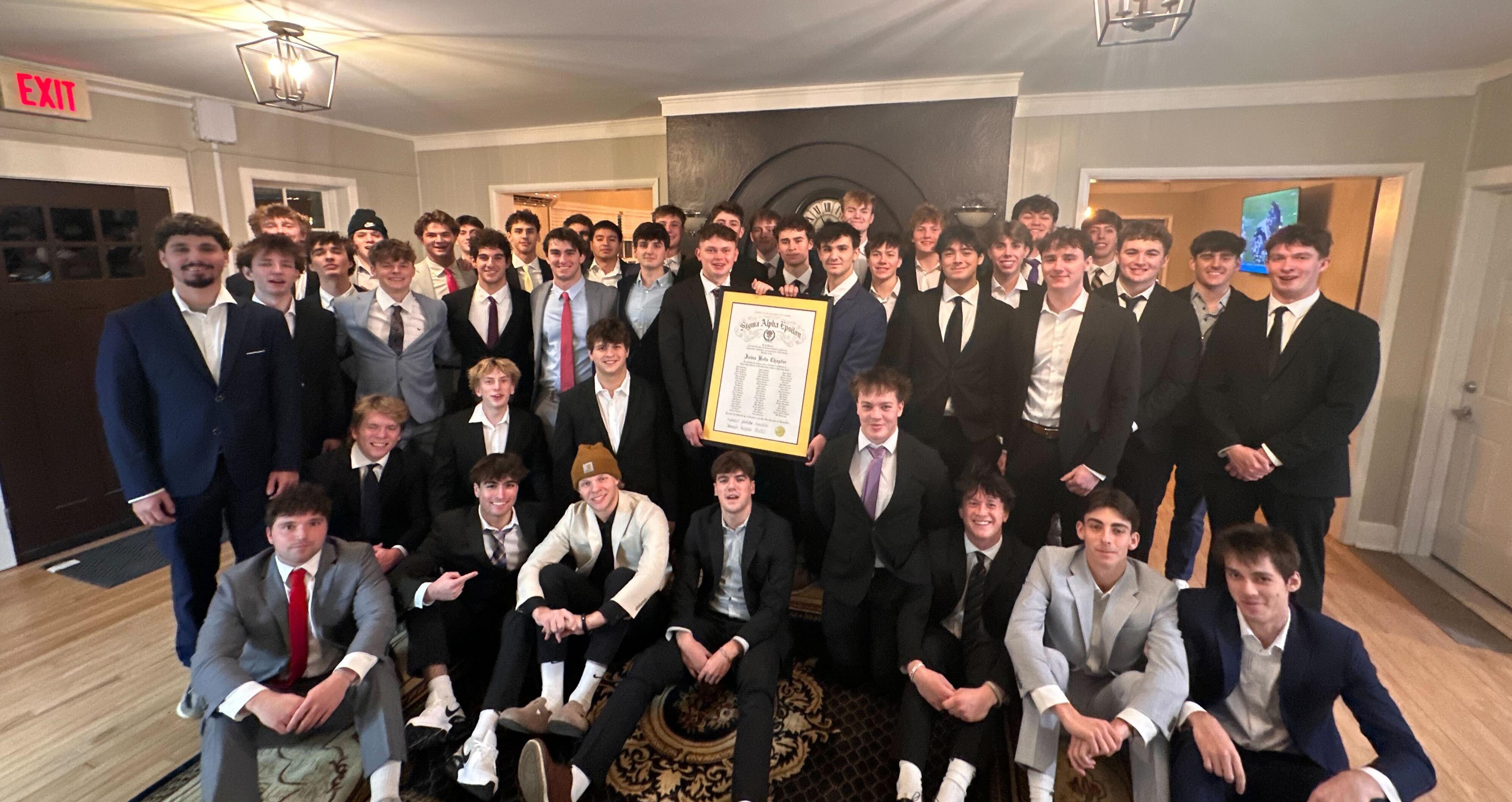

CHAPTER: IOWA BETA
LOCATION: IOWA CITY, IA
CHAPTER SIZE: 59
INSTALLATION: NOVEMBER 15, 2025
The University of Iowa, located in Iowa City, Iowa, is a leading public research institution and the oldest university in the state, founded in 1847. It is also the largest, with 12 colleges offering more than 200 fields of study and seven professional degrees. The University of Iowa has a long history of firsts: it was the first public university in the nation to admit men and women on an equal basis, to establish a department of religious studies, and to open a coeducational medical school. Today, over 32,000 students are involved in nearly 500 student organizations.
Max R. Beckman
Kevin A. Jimenez
Ryan M. Klauer
Colin C. Cadematori
Blake A. Smith
Collin Ferracuti
Jacob Adam
Ben Peterson
TJ Peckosh
Evan Chandler
Chaz Mancero
Soren G. Charlier
Peter Mondus
Parker Low
Matt Kaczor
Luke Bajerski
Carter Deines
Anthony Graham
Ben Rozell
Brandon Sorokin
Charlie Hulting
Colin Vanacora
Connor Grafath
Daniel Reinhardt
Donovan Mortensen
Emmy Zamudio
Ethan Hernandez
Ethan Jelic
Hayden Decook
Henry Klauer
Jacob German
Noah Hyndiuk
Roman Reinhardt
Ryan Pratt
Ryan Wirsing
Will Schlueter
Braeden Swanson
Brett Burrs
Brock Wagner
Carson Frederick
Dylan Owens
Atticus Finch
Francisco Arnold
George O’Reilly
Jack Grier
Jack Majerowski
Jackson Anderson
Jacob Sulda
Jeremiah Schaefer
John Stevens
Kyle Hedges
Luke Meyer
Marcus Guiwargis
Matthew Blomquist
Noah Bank
Petros Bolos
Reardon Flahive
Spencer Vanden Huevel
Will Kavanaugh
The Iowa Beta Chapter of Sigma Alpha Epsilon at the University of Iowa has undergone an extraordinary resurgence, one defined by grit, leadership, and a shared belief in what brotherhood can build. After years of dedicated work from alumni, advisors, and a small but determined core of undergraduates, Iowa Beta was officially rechartered on November 15th, 2025. What began with just 11 committed men grew into a movement. Through recruitment, strong values, and a renewed focus on service and unity, the brotherhood rapidly expanded, reaching an impressive 59 members at the time of rechartering. These efforts have already earned Iowa Beta significant recognition, a testament to the hard work and passion that define this chapter’s revival. They are now focused on pursuing awards such as the University of Iowa Chapter of the Year and the prestigious Zeal Award. After setting a strong foundation in place, the brothers of Iowa Beta look ahead with pride and ambition, committed to growing their legacy, strengthening their bonds, and ensuring that the excellence of Iowa Beta continues for generations to come.
TWO
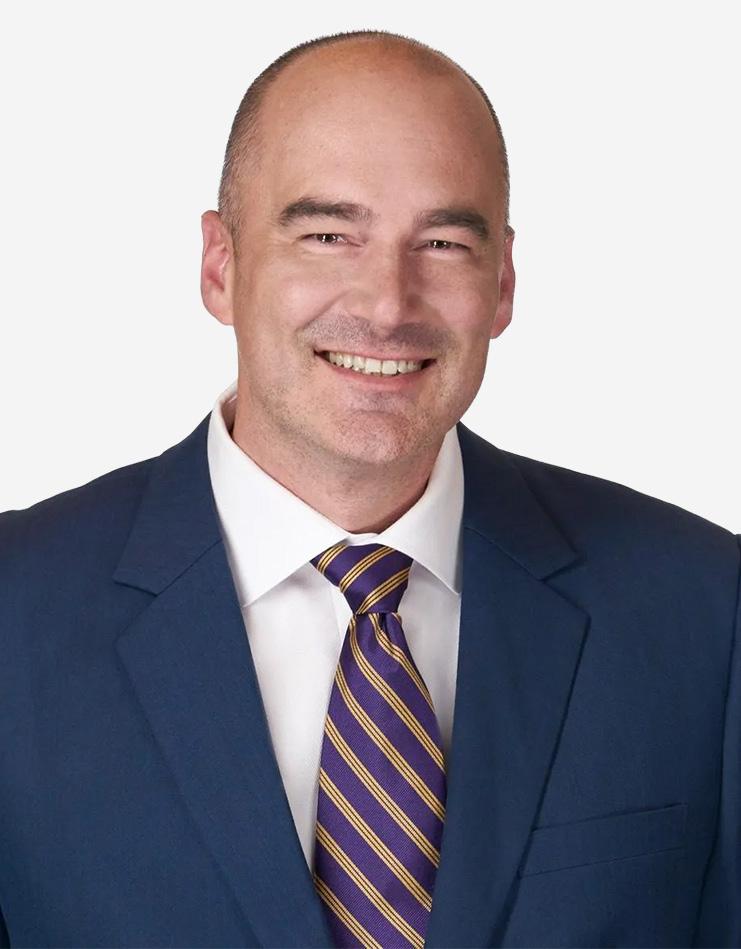
Since 2003, SAE’s national housing efforts have reshaped how chapters protect, manage, and grow their most important physical assets. What began as a response to losing historic properties has evolved into a strategic network supporting ownership, operations, technology, and long-term sustainability across the country.
In this conversation, Greg Somers (Michigan State ‘98) reflects on the early days, the lessons learned along the way, and what lies ahead for fraternity housing.
1. YOU HELPED LAUNCH SAE’S NATIONAL HOUSING ARM MORE THAN 20 YEARS AGO. WHAT INSPIRED THAT VISION, AND HOW DID IT BEGIN?
I was in law school at Michigan State and lived in the chapter house while helping with a major renovation. I joined the House Corporation and already knew Chris Mundy (Michigan State ‘96), who was working in Evanston at the time as the Editor of the Record.
Fast forward, I was practicing law in California. Chris called and said the Convention had just voted to create an entity whose goal was to preserve, protect, and grow fraternity properties for the benefit of Sigma Alpha Epsilon. He asked if I’d be interested.
I got hired in August 2003. At the time it was called SAE Services, Inc., and John Kelley (Central Florida ‘77) was president of the board. John had the original vision. In the 1990s and early 2000s, we had lost historic houses at Vermont, Harvard, and Utah. If you lose a historic property, you may never get back on that campus. We still don’t have housing at those campuses, and it’s very difficult to operate without a chapter house.
It was a group effort to lift our housing arm off the ground. Mike Rogers (William & Mary ‘92) developed the legal structure and Charlie Boyd (Mississippi State ‘65) built the operational framework. Without their leadership, SAE Financial & Housing would not be what it is today.
2. WHAT WERE THOSE EARLY YEARS LIKE IN TERMS OF GROWTH?
We started slowly. SAE Services had a small endowment called the Fraternity Endowment Fund, created in the 1920’s to support house corporations with chapter house loans. That small endowment that was transferred was the seed money for

SAE Services. The first property we took ownership of was at the University of Illinois in 2004. The chapter had closed and the house was up for sale. SAE Services stepped in, purchased it, renovated it, and rented it to another fraternity until our chapter returned. Then came Washington State in 2005, New Hampshire and Michigan State in 2006. The strategy was simple. Own and manage properties, so we didn’t lose them.
In 2012, we built our first chapter house from the ground up at Indiana State. In 2013, we built a new chapter house at Indiana University in Bloomington, partnering with alumni. That house is over 24,000 square feet.

Even Michigan State expanded significantly. When I lived in the house as an undergraduate member, it was around 12,000 square feet with a capacity of 36 live-in members. The renovated facility holds 55 members today and is over 22,000 square feet.
We kept growing, but we also realized we were financially exposed. If a chapter in one of our owned facilities were to shut down and we had no renters, it could jeopardize our ability to save other chapter houses. So we needed to diversify to spread the risk across the portfolio.
4. HOW DID TECHNOLOGY CHANGE EVERYTHING?
Technology was the game changer. None of our technology systems talked to each other. We had one program for maintenance, QuickBooks for accounting, and DocuSign for leases. It was inefficient and required massive staff time.
When we partnered with our current system, Revela, we custom built a technology platform where everything integrated. That changed our ability to scale. Suddenly we could manage other people’s properties, not just our own.
We tested it at Mississippi State. There were kinks, but we worked through them. Now the technology allows us to do daily inspections, access leases instantly, communicate with parents, and handle billing and collections efficiently. Without it, we would need twice the staffing.
5. BEYOND TECHNOLOGY, WHAT OTHER MAJOR SHIFTS HAVE YOU SEEN IN FRATERNITY HOUSING?
When we were in school, we managed everything ourselves. We cleaned. We worked
with the cook. Today’s students want more services. They want catered food. They don’t want to bus tables or clean the house every day.
The shift to third-party food service providers like Upper Crust has been significant. It frees us from managing payroll and staffing. If a cook doesn’t show up, there’s backup. That stability didn’t exist years ago.
We also placed live-in House Directors in our properties, often the first fraternity on those campuses to do so in decades. We need adult supervision and professional oversight. That has made a huge difference.
We also bring in professional cleaning services at our properties. We have found that when the house is cleaned each day, the members tend to treat the property in a more respectful way.
6. WHAT ARE THE EARLY WARNING SIGNS THAT A CHAPTER HOUSE MAY BE STRUGGLING?
The first is low recruitment numbers. Fewer recruits mean lower occupancy. Lower occupancy means lower revenue. You have to make sure you have enough members to fill the beds.
The second is an uptick in damages. That often signals behavioral problems within the chapter.
Those two indicators tell you a lot about the health of a property.
7. WHEN A HOUSE CORPORATION ASKS YOUR TEAM FOR HELP, WHAT DOES THAT PARTNERSHIP LOOK LIKE?
We start by asking what they need. Is it billing and collections? Leasing? Property management? Many house corporations want to retain ownership, but don’t want to manage day-to-day operations.
If they have a low collection rate, we can step in and improve billing and collections. If they struggle to fill the house, we help ensure everyone signs leases and subleases through our technology platform for online leasing. If they don’t want latenight maintenance calls, we provide asset managers and systems to ensure alumni have the tools to be successful.
Every partnership is a little different, but the approach is the same. We meet house corporations where they are and immediately begin strengthening operations.
8. WHAT ROLE DO ALUMNI PLAY IN LONGTERM HOUSING SUCCESS?
to balance those expectations while keeping the property financially sustainable.
If a chapter is feeling financial pressure, it may be worth evaluating whether parlor fees for out-of-house members could help support the house.
Every year you are starting over. Even if an Eminent Archon stays
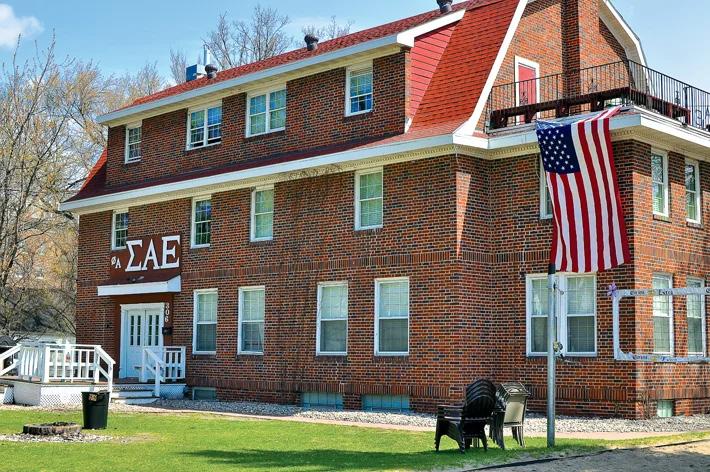
10. HOW DO YOU DEFINE SUCCESS FOR THE NEXT FIVE TO TEN YEARS?

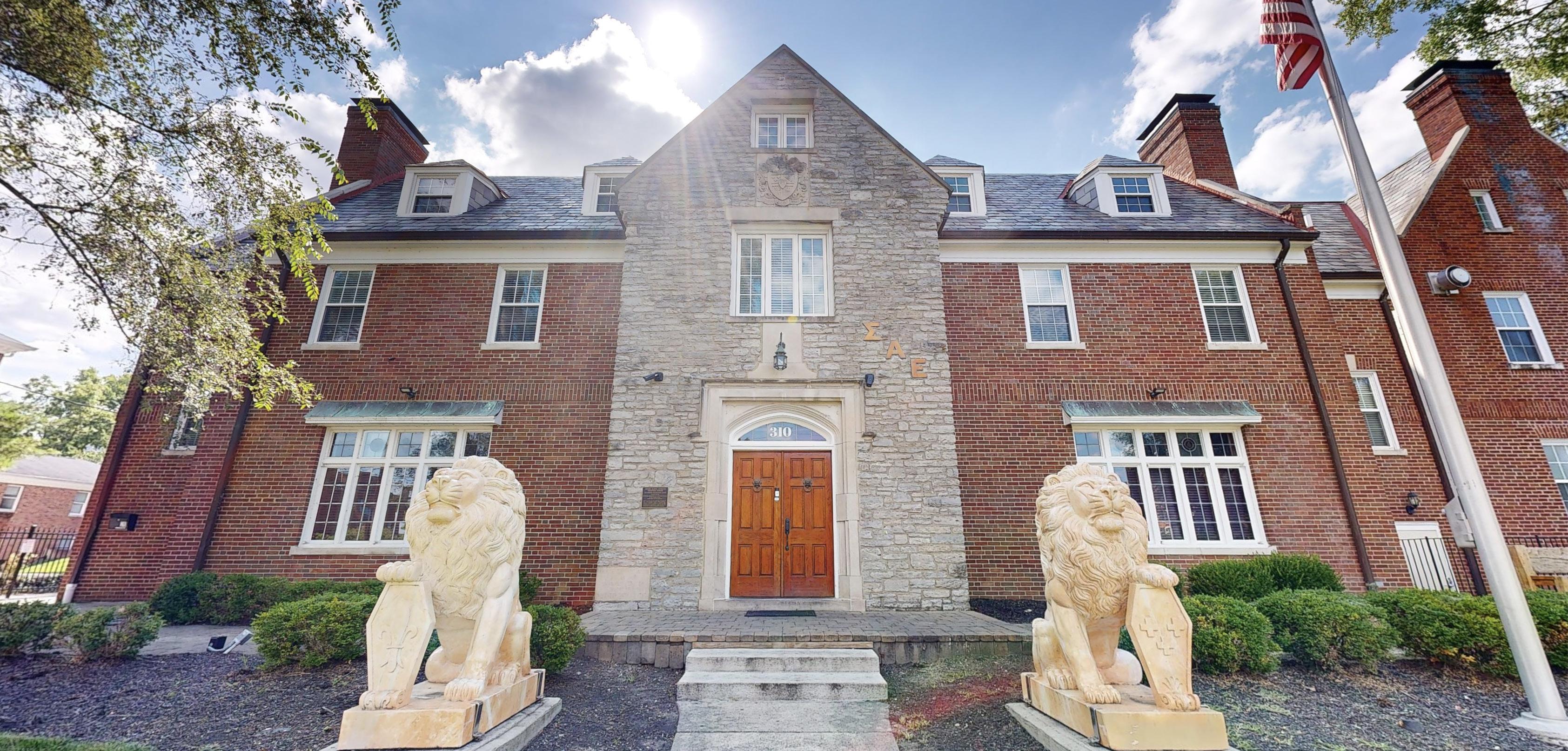
Success means having properties filled at capacity. That tells me chapters are recruiting well and providing a good experience. You cannot replicate brotherhood in an apartment complex. Living with 40 or 50 brothers is a unique social experience. You learn to live with different personalities. You eat together. You build bonds. You only have a finite window in college to do that. You can go back to school at any age, but you can’t recreate living in a fraternity house with your brothers.
If we create that environment successfully, alumni will look back on it as one of their fondest memories. And hopefully they’ll give back, either with their time as volunteers or their treasure in donations. When houses provide safe, positive environments that create lasting memories and engaged alumni, that’s the ultimate success.

Connect with

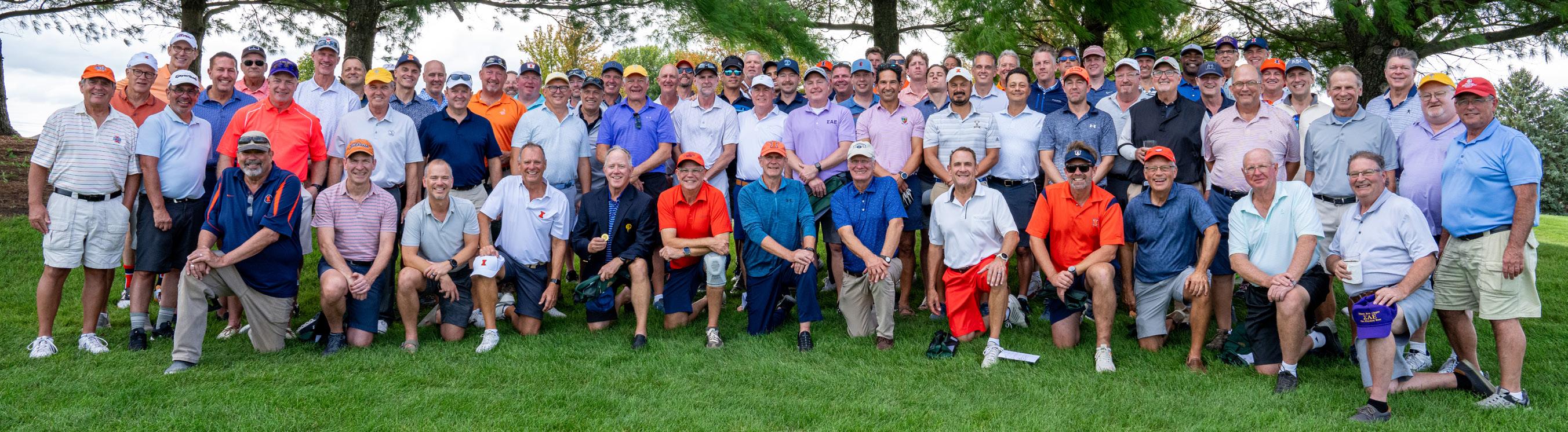
ALUMNI ASSOCIATIONS ARE ONE OF THE MOST IMPORTANT WAYS BROTHERS REMAIN CONNECTED TO SIGMA ALPHA EPSILON AFTER GRADUATION. WHILE COLLEGIAN MEMBERSHIP MAY LAST ONLY A FEW YEARS, THE FRATERNITY IS DESIGNED TO LAST A LIFETIME. ALUMNI ASSOCIATIONS PROVIDE THE STRUCTURE THAT ALLOWS BROTHERS TO STAY ENGAGED, SUPPORT COLLEGIATE CHAPTERS, AND MAINTAIN THE BONDS OF BROTHERHOOD LONG AFTER LEAVING CAMPUS.
An alumni association is a formally chartered group of alumni recognized by the Fraternity. These associations bring together brothers who want to remain active in SAE through fellowship, mentorship, and service to the Fraternity. Alumni associations are chartered by the Supreme Council and exist in two primary forms:
• Area Alumni Associations: These associations unite brothers who live in the same city or geographic area. Their membership consists of alumni from various chapters who share a common location and want to stay connected with fellow SAEs in their region.
• Chapter Collegiate Alumni Associations: These associations support a specific collegiate chapter. Members may include alumni who were initiated in that chapter, as well as other brothers who simply want to support and mentor the undergraduate members of that chapter.
So, what are some best practices alumni associations can implement to ensure they are not only staying connected, but truly making a meaningful impact on their brothers, their chapters, and the future of the Fraternity?
1
KNOW THE REQUIREMENTS AND PURPOSE OF ALUMNI ASSOCIATIONS PER FRATERNITY LAW.
• To establish an alumni association, at least ten eligible alumni members must petition the Fraternity for a charter. Once approved, the association operates as an official extension of the Fraternity’s alumni network.
• Each association elects its own leadership, typically including a president and additional officers as needed. These leaders organize activities, coordinate alumni engagement, and ensure the association fulfills its purpose of strengthening brotherhood and supporting the Fraternity.
• Like any organized entity within SAE, alumni associations maintain accountability to the Fraternity. Each year, they report their officers, active members and activities to the Fraternity Service Center and comply with any required financial reporting standards. Associations also contribute modest annual dues that support the broader mission of the Fraternity.
• Associations may adopt their own bylaws to guide operations, provided those bylaws remain consistent with
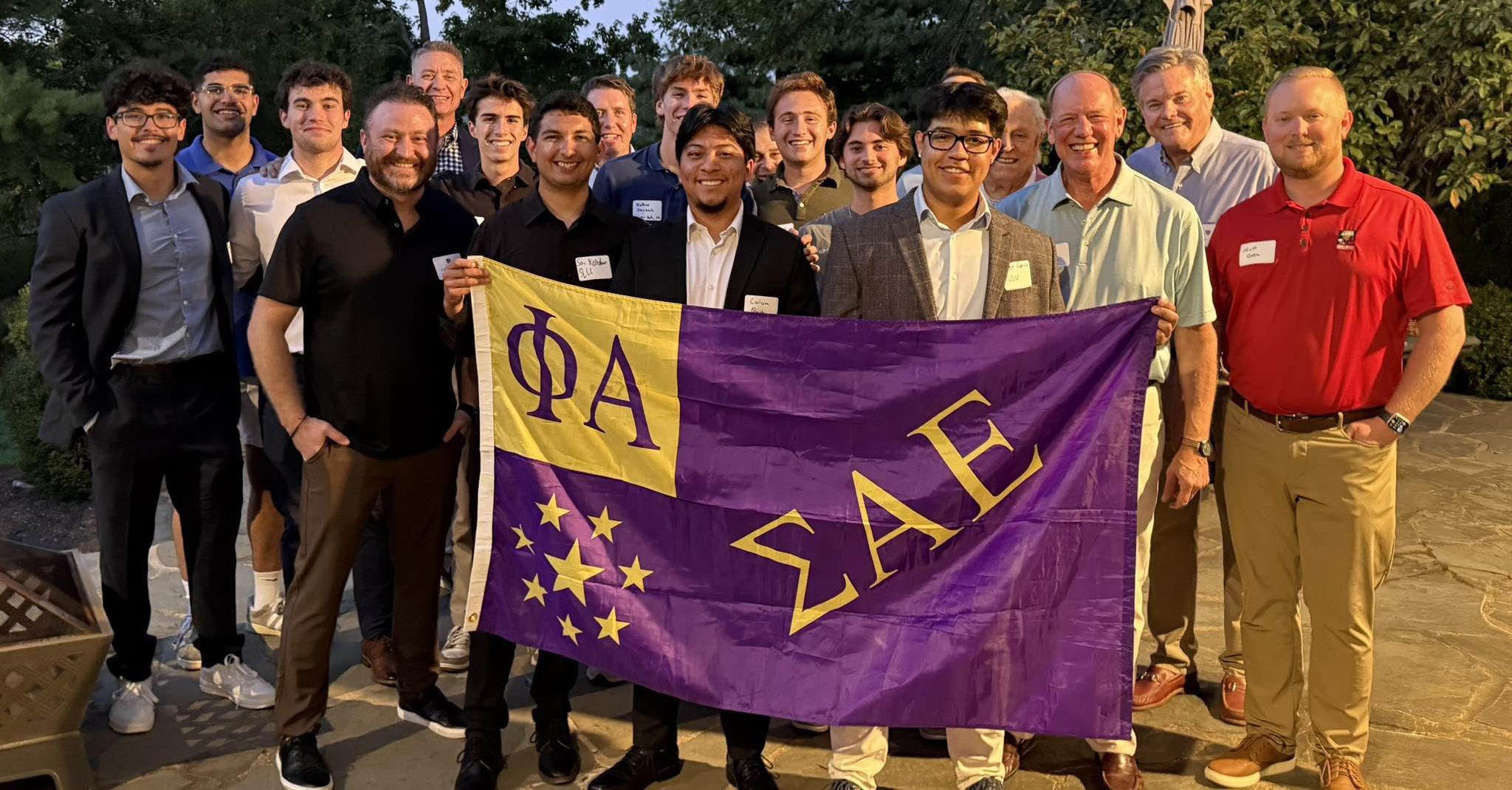
the Fraternity’s governing laws and the directives of the Fraternity Convention.
• Beyond the formal structure, alumni associations serve a deeper purpose. They create opportunities for brothers to remain involved in meaningful ways, whether through mentoring undergraduate members, supporting recruitment and philanthropy efforts, hosting networking events, or simply gathering in fellowship.
• They also help maintain the institutional memory of chapters and the Fraternity itself. Alumni who stay engaged bring experience, wisdom, and continuity, strengthening collegiate chapters and preserving the traditions of Sigma Alpha Epsilon.
• Perhaps most importantly, alumni associations remind brothers that SAE was never meant to end at graduation. They ensure that the ideals of the True Gentleman continue to guide and connect brothers throughout their lives. Through alumni associations, the Fraternity’s promise of lifelong brotherhood becomes not just a sentiment, but a reality.
2
One of the most valuable contributions an alumni association can make is helping ensure chapters always have strong advisory support.
Associations should intentionally identify and cultivate alumni who are willing to mentor collegiate members and serve as future chapter advisors. This can include:
• Encouraging alumni to attend chapter events and meet collegian officers
• Identifying brothers with leadership or professional experience who could mentor collegian brothers
• Creating a clear pathway for alumni to transition into advisory roles
A healthy pipeline of advisors ensures continuity, preserves institutional knowledge, and provides chapters with the mentorship they need to succeed.
3
Consistency is critical to maintaining momentum. Alumni associations should establish and publish meeting dates well in advance to encourage participation and accountability. Industry best practice recommends:
• Holding at least four official board meetings per year
• Aligning meetings with alumni gatherings or chapter events when possible
Setting dates early helps members plan ahead and reinforces the association’s commitment to active engagement.
4
The healthiest alumni associations create multiple opportunities for brothers to stay informed and connected.
Effective communication helps celebrate member accomplishments, share fraternity updates, promote events, and encourage continued support for local chapters and the General Fraternity.
Best practices include:
• Sending a monthly email newsletter to members
• Highlighting alumni achievements, career updates, and personal milestones
• Sharing upcoming events and opportunities to support local chapters
• Encouraging members to submit content and updates themselves
You don’t need to generate all the content alone. Often, the most engaging communications come from alumni sharing their own stories and experiences.
5
Events create the energy and connection that sustain an alumni association.
Associations should aim to host at least four alumni-led events per year, separate from chapter or national fraternity programming. These events may include two social events and/ or two philanthropy or service events. For example:
• Alumni happy hours or networking events
• Family-friendly gatherings
• Holiday socials
• Golf outings or summer barbecues
• Professional development or mentorship events
• Trash pickups
• Donating items to Children’s Miracles
• Partnering with local charities
These gatherings strengthen brotherhood and make it easier for alumni to stay involved.
6
Alumni associations are most impactful when they maintain regular contact with the collegiate chapters.
At a minimum, alumni leaders should communicate with the chapter president or leadership once each quarter. This helps ensure alumni remain aware of key chapter activities such as:
• Recruitment events
• Member education
• Initiations
• Philanthropy projects
• Chapter celebrations or milestones
Inviting alumni to participate in these events strengthens intergenerational connections and reinforces the lifelong nature of SAE membership.
7
Maintaining accurate contact information ensures communication reaches the entire alumni network.
Associations should review their membership lists at least twice per year to confirm that:
• Contact information is accurate
• Leadership roles are updated
• Key alumni contacts are correctly listed in official directories Clean data leads to stronger engagement and more effective outreach.
8
The most successful alumni associations operate on a predictable yearly calendar that balances fellowship, mentorship, and fraternity business.
A sample annual rhythm might include:
• August – Host best practice workshop for collegian chapters
• September – Alumni Association kickoff meeting
• October – Launch alumni mentorship programs
• Fall – Attend chapter Initiation ceremonies
• December – Holiday alumni social event
• February – Community service event or philanthropy
• March – Founders Day Events
• April – End-of-academic-year alumni meeting and chapter update
• Summer – Social event such as a BBQ or golf tournament and attend the convention if it is a convention year
This consistent cadence helps alumni remain engaged throughout the year while supporting the chapter’s key milestones.
Strong alumni associations do more than simply stay connected; they create opportunities for brothers to remain engaged, support collegiate chapters, and strengthen the lifelong bonds of Sigma Alpha Epsilon. The most successful associations operate with intentional structure, consistent communication, and meaningful opportunities for alumni involvement. At their best, alumni associations serve as the bridge between generations of brothers. They provide mentorship to collegians, maintain lifelong friendships among alumni, and ensure the Fraternity’s values continue to guide members long after graduation.
When alumni associations operate with intentional leadership, clear communication, and consistent programming, they become powerful engines for lifelong brotherhood and the continued success of Sigma Alpha Epsilon.
TO REPORT A BROTHER’S PASSING, CONTACT US AT 847-475-1856 OR EMAIL CONTACT@SAE.NET.
TO CELEBRATE THE LIFE OF A BROTHER WHO HAS ENTERED CHAPTER ETERNAL WITH A MEMORIAL GIFT TO THE SIGMA ALPHA EPSILON FOUNDATION, VISIT WWW.SAE.NET/DONATE AND COMPLETE THE TRIBUTE INFORMATION.
THESE NAMES WERE SUBMITTED TO THE FRATERNITY SERVICE CENTER FROM 7/1/2025 - 12/31/2025 KEY Military
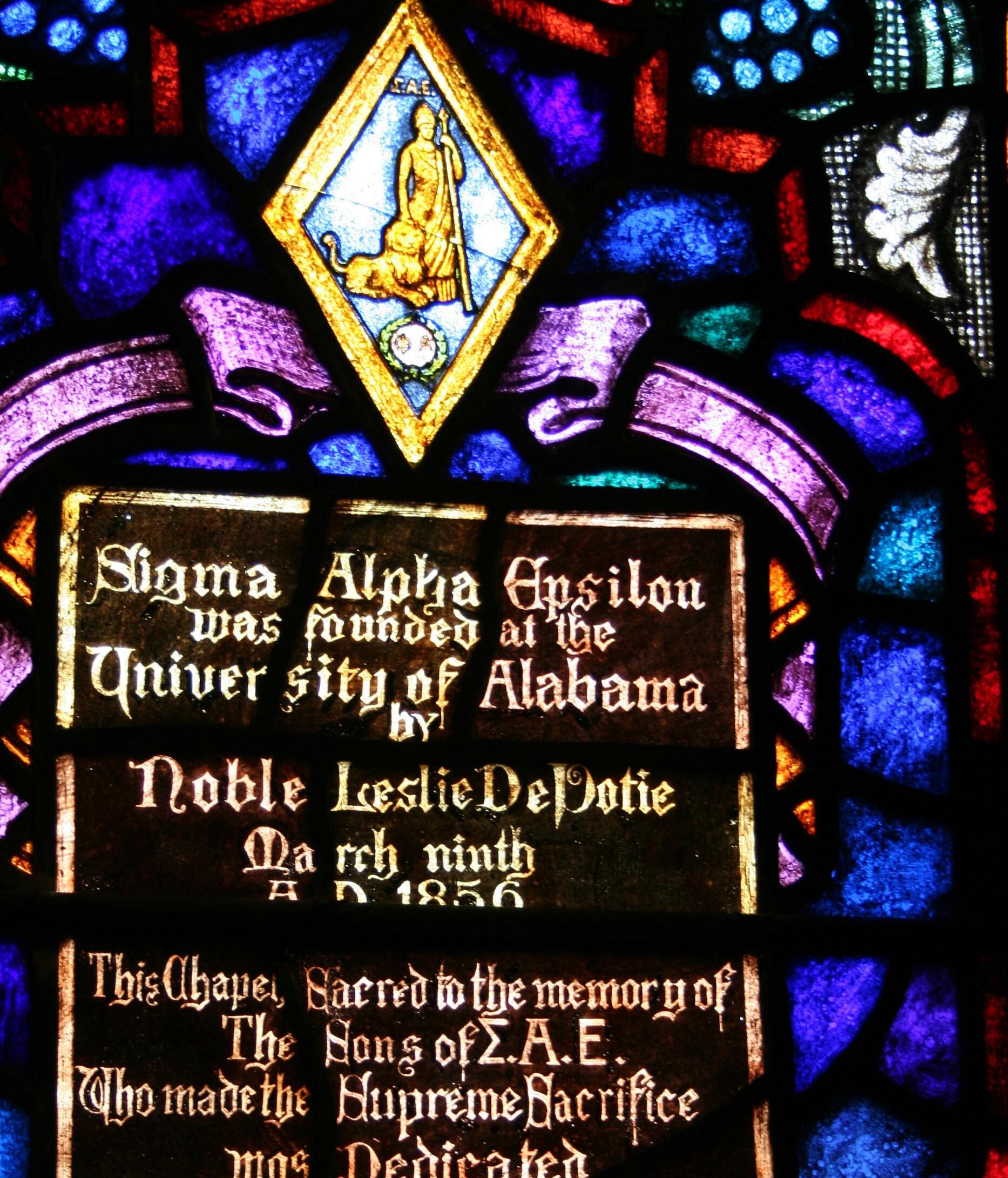

A native of Polk County, Florida, Major Cody A. Khork was a dedicated military professional who devoted his life to serving his country and leading Soldiers. He was killed in a drone attack on March 1, 2026, while serving as the Force Protection Deputy with the 103rd Sustainment Command (Expeditionary) Forward in Kuwait.
Major Khork’s distinguished career was marked by numerous leadership roles and deployments. Prior to his final assignment, he commanded the Headquarters and Headquarters Detachment, 317th Military Police Battalion Forward at Camp Kosciuszko in Poznan, Poland. Under his leadership, the detachment earned the prestigious Major General Bandholtz Award, recognizing it as the best Military Police Detachment in the United States Army Reserve.
His service record included deployments to Saudi Arabia and Guantanamo Bay, Cuba, in addition to his deployments to Kuwait and Poland. He also completed a rotational assignment at Camp Humphreys, Korea.
Major Khork’s commitment to excellence was recognized with numerous military awards and decorations, including the Meritorious Service Medal, Army Commendation Medal, and the Joint Services Achievement Medal. He was a proud member of the Military Police Regimental Association and was awarded the Bronze Order of the Marechaussee.
His military journey began when he enlisted in the Florida National Guard as a Field Artillery Soldier. After graduating from Florida Southern University and completing the ROTC program, he was commissioned as a Military Police Officer in the United States Army Reserve. At the time of his death, he was pursuing a master’s degree from Webster University.
Major Khork’s legacy is one of selfless service and a deep commitment to the development of his fellow Soldiers. He is remembered by his brothers and sisters in arms as a dedicated and selfless professional.
Ohio Phi
Bryan Joseph Kavalecz ‘97
Alabama Mu
Charles H. Allen ‘72
Clifford L. Branch ‘66
John B. Noble, Jr. ‘55
ARIZONA
Arizona Alpha
Terence P. Black ‘67
Peter H. Erenfeld ‘64
James Raymond Mahon ‘72
Vernon L. Nicholas ‘61
James D. O’Neil ‘67
Robert John Solfisburg ‘79
BG Terrence P. Woods ‘66
ARIZONA STATE
Arizona Beta
LTC Walter B. Reading ‘73
Arkansas Alpha-Upsilon
Steven Clement Bader ‘85
Carroll R. Bates ‘66
Joe F. Clifton ‘72
Sandy S. McMath ‘63
John M. Meadors ‘61
Curtis Shipley ‘55
James R. Van Dover ‘59
Bryan A. Ward ‘77
Alabama Alpha-Mu
Otto K. Sauerbrey ‘58

BALL STATE
Indiana Zeta
Brian David Hernandez ‘95
BIRMINGHAM-SOUTHERN
Alabama Iota
John Douglas Turnipseed, Jr. ‘08
BOWLING GREEN STATE
Ohio Kappa
Eugene A. Popielec ‘56
Peter A. Stein ‘71
BUCKNELL
Pennsylvania Zeta
Walter Thomas Karn ‘63
Donald Bruce MacClary ‘54
Martin Douglas Reed ‘61
CAL STATE LONG BEACH
California Lambda
Thomas N. Hermstad ‘61
CAL STATE LOS ANGELES
California Mu
Joshua Anthony Nolasco ‘17
CARNEGIE MELLON
Pennsylvania Phi
Ronald W. Fahle ‘57
Dr. John P. Fry, Jr. ‘61
Erkki I. Rainesalo ‘54
John Parshall Sweeney ‘84
CASE WESTERN RESERVE
Ohio Rho
David L. O’Brien ‘72
Michigan Delta-Omega
Jason Eric Little ‘11
CINCINNATI
Ohio Epsilon
William E. Roe ‘61
COLORADO
Colorado Chi
Joseph C. Reed, Jr. ‘63
COLORADO STATE
Colorado Delta
Robert B. Erickson ‘60
Jan E. Ramaker ‘68
David Earl Thulin ‘60
CORNELL
New York Alpha
Rev. Dr. Roy A. Hassel ‘57
James O. Marshall ‘55
R. Neilan Teague, Jr. ‘66
New Hampshire Alpha
William L. Pierce ‘54
Jeremy J. Sawyer ‘55
North Carolina Theta
Arthur B. Simms IV ‘77
Alexander K. Wyatt, Jr. ‘65
DENISON
Ohio Mu
Edgar S. Boon ‘53
Norman S. Dellner ‘50
Daniel John Lewis ‘69
David Leslie Peters ‘69
Donald E. Sharp ‘52
DEPAUW
Indiana Delta
Allan D. Fink ‘64
DRAKE
Iowa Delta
James L. Bennett ‘42
DUKE
North Carolina Nu
Jeffrey Charles Conklin ‘81
David J. Fischer ‘55
Robert L. Padgette ‘68
EMORY
Georgia Epsilon
Dr. John L. Coker, Jr. ‘49
EVANSVILLE
Indiana Epsilon
Robert M. Dodge ‘63
Ronald B. Greenfield ‘60
Thomas A. Stein ‘72
Florida Upsilon
Wilmer H. Mitchell ‘55
Emory N. Schopke ‘62
FLORIDA SOUTHERN
Florida Gamma
Richard E. Nolte ‘79
Jeffrey Harold Rhea ‘91
Florida Beta
Michael A. Decarlo, Jr. ‘76
Steven Holland ‘17
Indiana Alpha
Harold G. Schafstall ‘65
FRESNO STATE
California Iota
Livio L. Mazzei ‘55
Keith G. Miller ‘63
South Carolina Phi
Sidney J. Maddox ‘57
Dr. Roy E. Nickles, Jr. ‘59
Don W. Sentell ‘62
Georgia Beta
Tracy Lewis Coleman ‘94
Frederick D. Grist, Jr. ‘63
Clifton E. Hughes, Jr. ‘62
Harrison Jones II ‘64
Michael E. McCullough ‘71
James M. Roberts, Jr. ‘59
John W. Rooker ‘60
Pennsylvania Delta
Robert Harris ‘53
Virginia Upsilon
Alexander L. Franklin II ‘75
Massachusetts Gamma
Gary W. Beck ‘68
Texas Epsilon
Thomas Edward Jakubowski ‘87
Idaho Alpha
Gordon Gordon Eccles ‘60
Jack W. Grant ‘59
Grover E. Poppleton ‘68
CDR William P. Wilund ‘69
Indiana Gamma
Fredrick A. Carpenter ‘45
Robert M. Dunbar ‘64
Riley Thoren
David Wayne Wolf ‘91
Iowa Beta
Harry J. Jennings ‘45
Iowa Gamma
Dr. James E. Brock ‘67
Donald W. McGuiness ‘57
Kansas Alpha
Paul E. Burke, Jr. ‘56
Dr. Craig A. Smith ‘56
KANSAS STATE
Kansas Beta
Charles H. Butler ‘60
Ian Michael Drake ‘79
Clarence A. Livingston, Jr. ‘72
David R. Scott
James E. Vader ‘59
KENT STATE
Ohio Lambda
Dale K. James ‘59
Kentucky Epsilon
Michael J. Hastings ‘75
Olaf M. Haugen, Jr. ‘59
William J. Howell ‘63
Paul J. Martin ‘71
Charles Victor Meyer ‘56
Dr. Wendell S. Norman ‘56
LOUISIANA STATE
Louisiana Epsilon
William Preston Cahill, Jr. ‘89
Clayton Walker ‘12
West Virginia Alpha
Robert Jackson Dilley ‘73
Dr. David L. Peters ‘60
Maryland Beta
Evan Livingston Freiert ‘13
Robert L. Mitchell ‘58
LTC Harry Sinclair, Jr. ‘69
Theodore J. Smith ‘50
MASSACHUSETTS
Massachusetts Kappa
Earle R. Steeves, Jr. ‘43
MERCER
Georgia Psi
Robert Damon Walker ‘00
MIAMI (FL)
Florida Alpha
G. Holmes Braddock ‘49
Steven Austin Visnaw ‘91
MICHIGAN STATE
Michigan Gamma
Robert A. Sanders ‘59
John P. Sheridan ‘69

Tennessee Beta
Richard L. Baker ‘74
MILLIKIN
Illinois Delta
Robert A. Coe, Jr. ‘57
MINNESOTA
Minnesota Alpha
Wesley D. Bares ‘59
Richard F. Stanford ‘62
MISSISSIPPI
Mississippi Gamma
John K. Byrd ‘77
Chad D. Clark ‘75
Jonathan Burrow Peters ‘88
Cyrus L. Phyfer ‘78
William K. Shaw II ‘71
Stephen L. Thomas ‘70
MISSISSIPPI STATE
Mississippi Theta
Thomas L. Hatchett ‘56
Larry W. Osteen ‘54
Thomas Y. Page ‘75
Missouri Alpha
Robert D. Bates ‘63
John C. Foust ‘75
Ronald W. Ruppel ‘64
Robert B. Shaffer II ‘68
MIT
Massachusetts Iota-Tau
Dr. Peter G. Anderson ‘62
John C. Butler ‘65
William B. Maley, Sr. ‘46
MONMOUTH
Indiana Alpha
Dr. Thomas Paul Cummings ‘60
MONTANA
Montana Beta
Wyley P. Good ‘63
MONTANA STATE
Montana Alpha
Charles L. Martin ‘62
Leo Charles Willett ‘64
MOUNT UNION
Ohio Sigma
John H. Armitage ‘68
NEBRASKA
Nebraska Lambda-Pi
Curt A. Brown ‘81
Robert C. Weaver ‘65
NEVADA-LAS VEGAS
Nevada Beta
Edwin Prosper Layton IV ‘00
NEVADA-RENO
Nevada Alpha
James C. Baker ‘66
Richard G. Bennett ‘66
Lawrence F. Phillips ‘67
NEW MEXICO STATE
New Mexico Phi
Paul J. Dougherty ‘61
Robert E. Jacobi, Sr. ‘58
Andrew H. MacTavish ‘57
David C. Winans ‘66
NORTH CAROLINA STATE
North Carolina Alpha
Roger B. Evans ‘64
CPT William A. Graham III ‘58
Frank S. Smith III ‘63
NORTH CAROLINA-CHAPEL HILL
North Carolina Xi
Lewis G. Reid, Jr. ‘69
NORTH CAROLINA-WILMINGTON
North Carolina Delta
Walter John Lang ‘83
NORTH DAKOTA
North Dakota Alpha
Dr. Peter Fredrick Graham ‘79
Dean P. Hornbacher ‘67
James A. Murray ‘53
NORTH DAKOTA STATE
North Dakota Beta
Roy P. Wasche ‘74
NORTHERN ILLINOIS
Illinois Gamma
Michael R. Woolsey ‘71
NORTHERN IOWA
Iowa Chi
Larry E. McKibben ‘69
NORTHWESTERN
Illinois Psi-Omega
Thomas Z. Hayward, Jr. ‘62
OHIO
Ohio Gamma
Gordon E. Moxley ‘69
John Charles Sumner ‘78
OHIO WESLEYAN
Ohio Delta
Clifford C. Aikens, Jr. ‘58
Wilbur H. Rich, Jr. ‘55
Douglas R. Sandbo ‘57
Douglas L. Schmidt ‘59
Mark J. Wells ‘48
Oklahoma Kappa
John M. Bingman ‘44
Dr. Barry Booth Boughan ‘70
Charles P. Clark ‘62
Robert W. Dense, Jr. ‘59
Donald J. Grantham ‘43
Henry W. Harris, Jr. ‘60
Ross William Howard ‘80
Jay Dean Spann ‘78
William R. Witcher ‘52
OKLAHOMA STATE
Oklahoma Mu
Charles R. Albert ‘67
Jack L. Bedingfield ‘58
LTC Thomas L. Hennigh ‘66
Oregon Beta
Steven B. Davis ‘68
Edwin G. Robinson III ‘62
Pennsylvania Alpha-Zeta
Kent M. Clouser ‘54
George D. Kepler, Jr. ‘63
Harry B. McCarty ‘50
PENNSYLVANIA
Pennsylvania Theta
James A. Nolan ‘60
PUGET SOUND
Washington Gamma
William C. Durkee ‘54
Robert L. West ‘60
Indiana Beta
Lester O. Schenck ‘56
RENSSELAER
New York Epsilon
David Charles Edgecomb ‘93
RHODES
Tennessee Zeta
Robert L. Echols ‘62
Uhland O. Redd III ‘59
RICHMOND
Virginia Tau
Herbert Lee Mitchell III ‘69
SAN DIEGO STATE
California Theta
Jackson W. Goodall, Jr. ‘60
Robert Barneso Sloan ‘78
SEWANEE
Tennessee Omega
George E. Lewis II ‘63
SIMPSON
Iowa Sigma
Sean Ryan Keller ‘97
Lloyd W. Parker ‘60
J. Thomas Schmidt ‘67
SOUTH CAROLINA
South Carolina Delta
Daniel Joseph Farnsworth ‘66
Edward Jacob Hertwig III ‘66
Brian Patrick Schick ‘85
SOUTH DAKOTA
South Dakota Sigma
Gregory K. Blow ‘67
Paul Doran ‘50
Richard Ralph Pier ‘79
SOUTH DAKOTA STATE
South Dakota Theta
Gary N. Crosby ‘73
SOUTH FLORIDA
Florida Delta
David A. Brown III ‘76
Thomas B. Hury ‘71
SOUTHERN CALIFORNIA
California Gamma
Robert J. Jones ‘59
Gregory A. Walden ‘79
Mark L. Whitfield ‘75
SOUTHERN METHODIST
Texas Delta
Frank M. Bumstead ‘64
Noah Richard Davis ‘50
James Steele Dollahite, Jr. ‘70
Robert L. Gray ‘71
Dan E. Martens ‘67
SOUTHERN MISSISSIPPI
Mississippi Sigma
Chad Joseph Badeaux ‘96
Tommy L. McCormick ‘74
Stephen Edward Terschluse ‘82
ST. LAWRENCE
New York Rho
Peter Croft ‘61
STANFORD
California Alpha
Gary A. Childress ‘57
Kirk Kirk Ingebretsen ‘77
Mark Clifford Walker ‘96
Tennessee Kappa
Philip M. Bachman, Jr. ‘59
Henry F. Bertelkamp, Jr. ‘53
Eugene E. Burr ‘56
Frank Moss Goddard ‘81
Donald C. Grob, Jr. ‘66
George L. Sterchi ‘60
Charles P. Tombras, Jr. ‘63
TEXAS A&M
Texas Tau
Kyle Thomas Clark ‘95
TEXAS CHRISTIAN
Texas Beta
James Douglas Maxwell ‘80
WEBER STATE
Utah Sigma
Donald E. Jardine ‘76
TEXAS TECH
Texas Alpha
Fred S. Alexander III ‘67
James S. Rudy ‘59
James C. Strawn ‘65
TEXAS-AUSTIN
Texas Rho
William R. Granberry ‘65
J. Bryan Grubbs, Jr. ‘60
Earl Halbert Maxon ‘70
Bryan C. Miller III ‘71
M. Bookman Peters ‘55
James H. Puff ‘60
TOLEDO
Ohio Nu
Phillip F. Fehr ‘58
David Franklin Waltz ‘69
TROY
Alabama Epsilon
Stephen Russell Culp ‘96
UC BERKELEY
California Beta
James R. Kidder ‘57
UCLA
California Delta
Robert B. Carusi ‘62
UMBC
Maryland Omicron-Pi
Ricky James Haskell ‘90
UNION
Tennessee Eta
Bill R. Martin ‘63
UTAH STATE
Utah Upsilon
Douglas F. Anderson ‘56
VALDOSTA
Georgia Sigma
Joe Walker Lasseter, Jr. ‘86
VANDERBILT
Tennessee Nu
William B. Dunavant, Jr. ‘54
John P. Martiniere, Jr. ‘68
VIRGINIA
Virginia Omicron
William V. Krebs ‘68
WASHINGTON (WA)
Washington Alpha
Robert W. Campbell ‘56
Gary R. Keehner ‘62
WASHINGTON & LEE
Virginia Sigma
Ernest Williams III ‘64
WASHINGTON STATE
Washington Beta
Robert B. Crum ‘56
COL Vincent C. Trapp ‘56
WESTERN KENTUCKY
Kentucky Beta
Michael P. McDaniel ‘70
WESTERN MICHIGAN
Michigan Delta
Richard E. Thoma ‘66
WESTMINSTER
Missouri Gamma
James W. Hafer ‘63
Dr. Allen C. Keenan ‘60
WICHITA STATE
Kansas Gamma
Jeffrey Neal Ham ‘96
Randal C. Ward ‘76
WILLAMETTE
Oregon Gamma
Robert F. Penater ‘61
WILLIAM & MARY
Virginia Kappa
Raymond A. Mason ‘59
WISCONSIN
Wisconsin Alpha
James L. Cummings ‘58
WORCESTER
Massachusetts Delta
Robert J. Baccaro ‘75
WYOMING
Wyoming Alpha
Ronald J. Gardner ‘60
YALE
Connecticut Omega
Michael Joseph Falencki ‘00

FOR MANY SIGMA ALPHA EPSILON ALUMNI, THE FRATERNITY WAS ONCE ONE OF THE MOST MEANINGFUL PARTS OF THEIR LIVES. THE FRIENDSHIPS, LESSONS, AND EXPERIENCES HELPED SHAPE WHO THEY ARE TODAY.
YET OVER TIME, CAREERS, FAMILY, AND LIFE’S RESPONSIBILITIES CAN CREATE DISTANCE. WHAT WAS ONCE A DAILY PART OF LIFE BECOMES AN OCCASIONAL MEMORY.
Founded in 1856, SAE has grown into a lifelong brotherhood of more than 350,000 initiated members. Built on leadership, personal growth, and connection, the Fraternity was never intended to end at graduation.
Yet many brothers drift away—not by intention, but by circumstance. Reconnecting isn’t just about giving back. It’s about rediscovering the value of brotherhood, networking, and continued personal growth.
Chances are, you know one of these brothers. You may be one yourself.
Your connection to SAE begins with your chapter—where friendships were formed, leadership was developed, and lifelong lessons were learned. That connection does not have to end at graduation.
Reengaging offers meaningful ways to stay connected and grow:
• Reconnect with your brothers: Rekindle old friendships and build new ones.
• Give back through mentorship: Support the next generation of True Gentlemen.
• Stay informed and involved: Engage with chapter events and alumni gatherings.
• Continue your personal growth: Leadership, service, and affinity groups offer ongoing development.
• Celebrate the wins: Stay connected to the achievements and impact of fellow brothers and chapters.
Connecting with us on social media is a great way to keep up to date with Fraternity news, events, and stories.
There are many ways to reengage with SAE—whether you have an hour a month or are ready to take on a larger role:
• Alumni Affinity Groups: Connect through shared interests like outdoor recreation, golf, professions, or history.
• Career Mentorship: Guide collegians or fellow alumni in professional development.
• Educational Programs: Support leadership and valuesbased learning as a facilitator.
• Chapter Advisors: Mentor officers and support chapter success.
• House Corporations: Help oversee chapter housing and operations.
• Province Leadership: Serve in regional roles supporting chapters and alumni engagement.
Whether your involvement is large or small, there is no wrong way to stay connected.
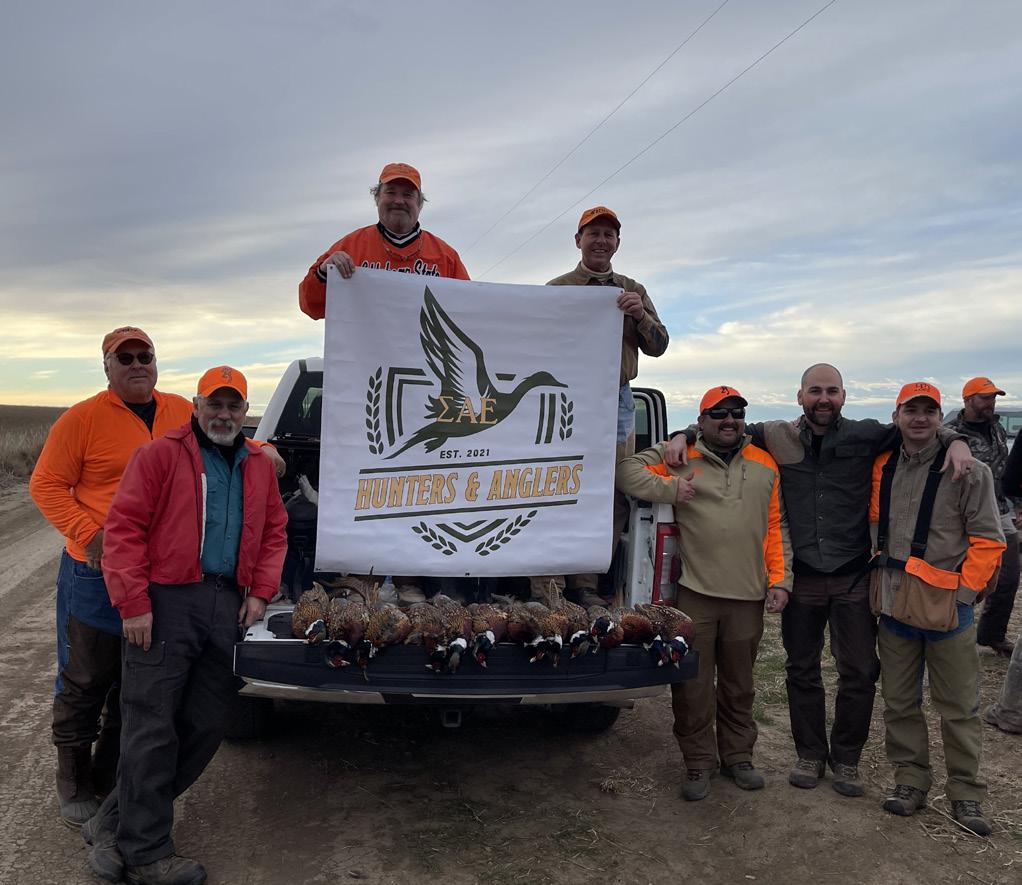
Many alumni are “lost” simply because contact information is outdated. Often, you are the link to reconnecting a brother to his chapter and lifelong fraternity.
Sometimes, it starts with something simple—a message, an introduction, or an invitation. Small actions can rebuild meaningful connections.
Today, SAE continues to strengthen pathways for alumni engagement through advisory roles, alumni associations, and affinity groups—making it easier than ever to reconnect.
Engagement is not an obligation—it is an opportunity.
Whether you mentor, attend an event, or simply reconnect with a brother, SAE offers meaningful ways to stay engaged, grow personally, and enjoy lifelong fellowship.
SAE was never meant to be left behind after graduation. It is a lifetime journey.
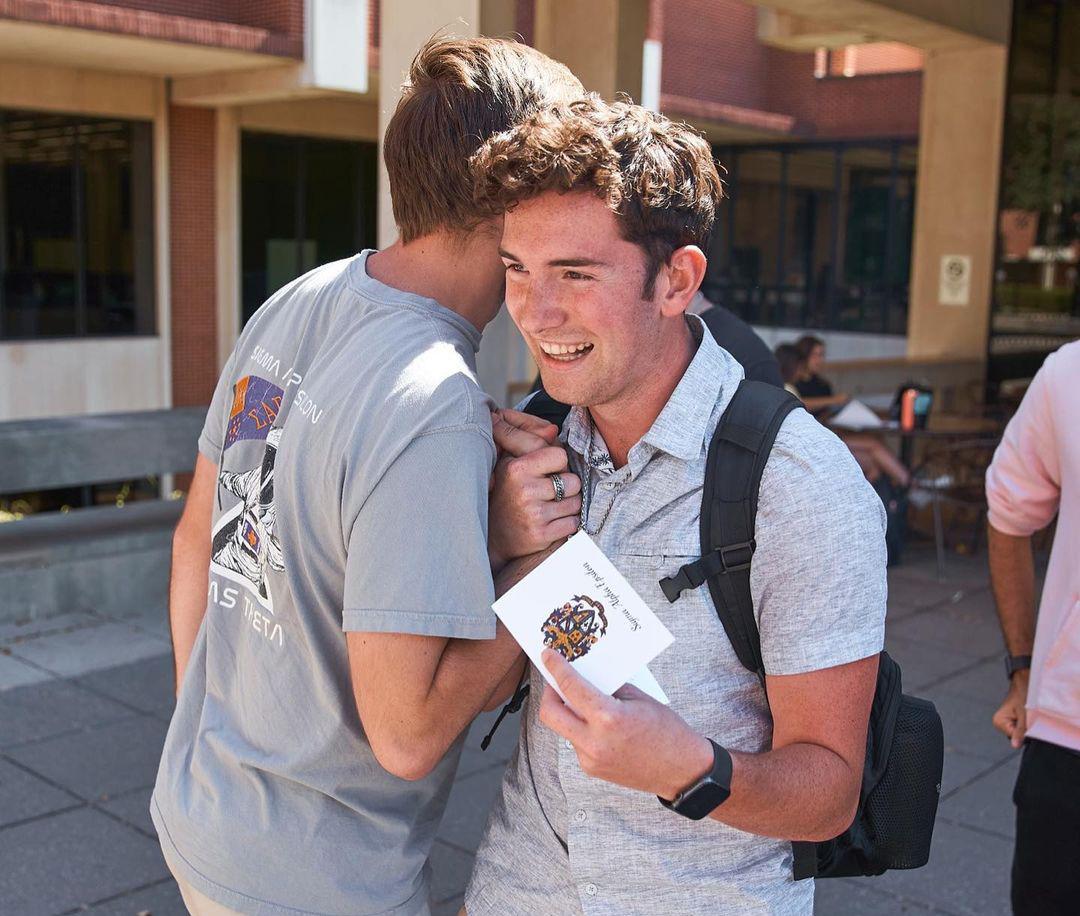
Somewhere along the way, SAE helped shape your story. Now is your opportunity to reconnect with it—and with the brothers who shared itwith you.
SAE is for life.
Reconnect. Reengage. Rediscover your brotherhood.
Ready to reconnect? Contact the Alumni Engagement Department at alumniengagement@sae.net .
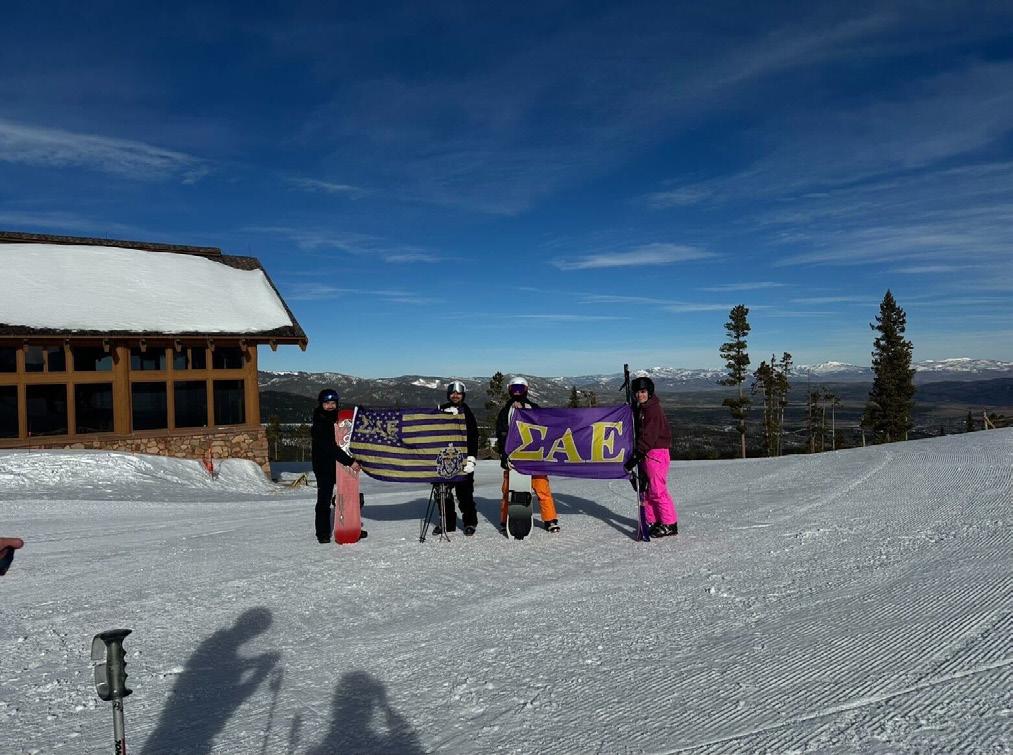
Brothers from the Bradley (Illinois Epsilon) chapter spent their spring break skiing and snowboarding in Winter Park, Colorado.
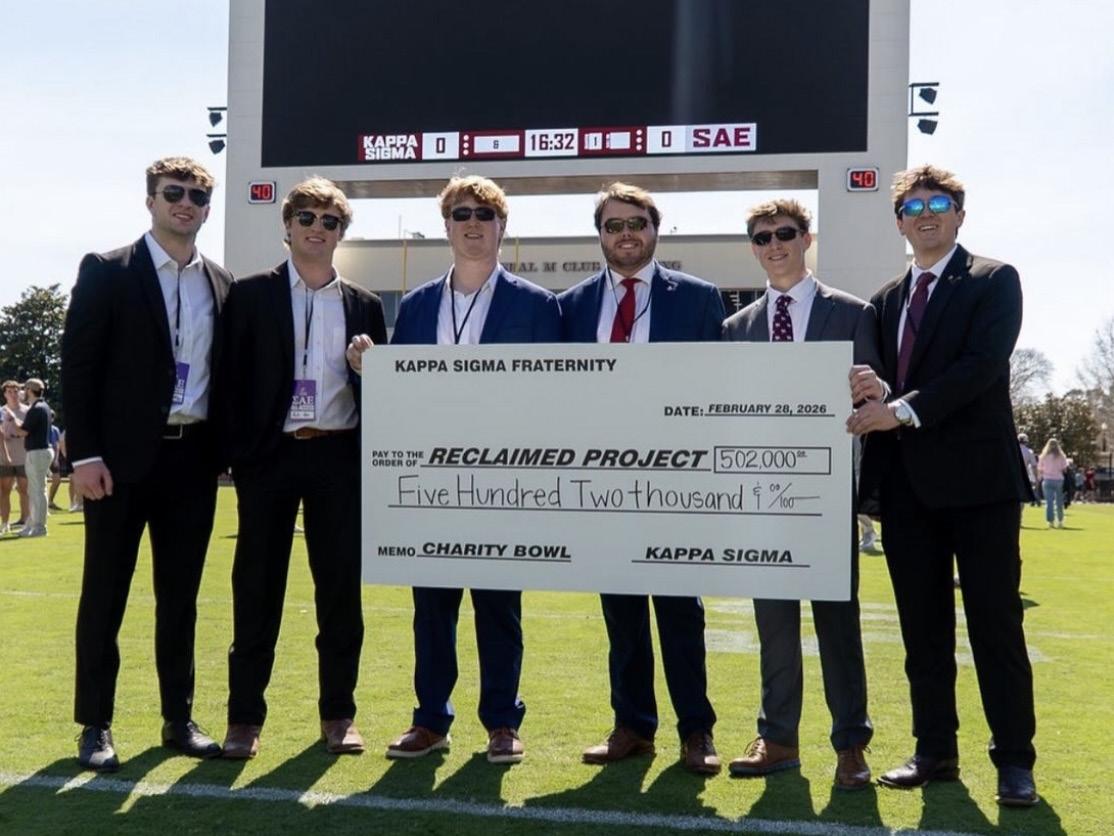
The Mississippi State (Mississippi Theta) brothers participated in the 27th annual Charity Bowl, which raised a combined $502,000 between all participants for the Reclaimed Project.

For a time, this was known as “The Archives Room”.
As the 100th Anniversary of the Levere Memorial Temple approaches in 2030, the SAE Foundation is looking ahead to ensure the Temple is fit for the next centennial. This includes the necessary restoration and preservation of our beloved Fraternity’s history and archives.
The SAE Foundation continues to work with two architectural firms to develop a restoration plan and timeline. In anticipation of an extensive renovation to the Levere Memorial Temple, the Foundation has also implemented measures to safeguard the Fraternity’s archives, ensuring the preservation and security of these historically significant materials.
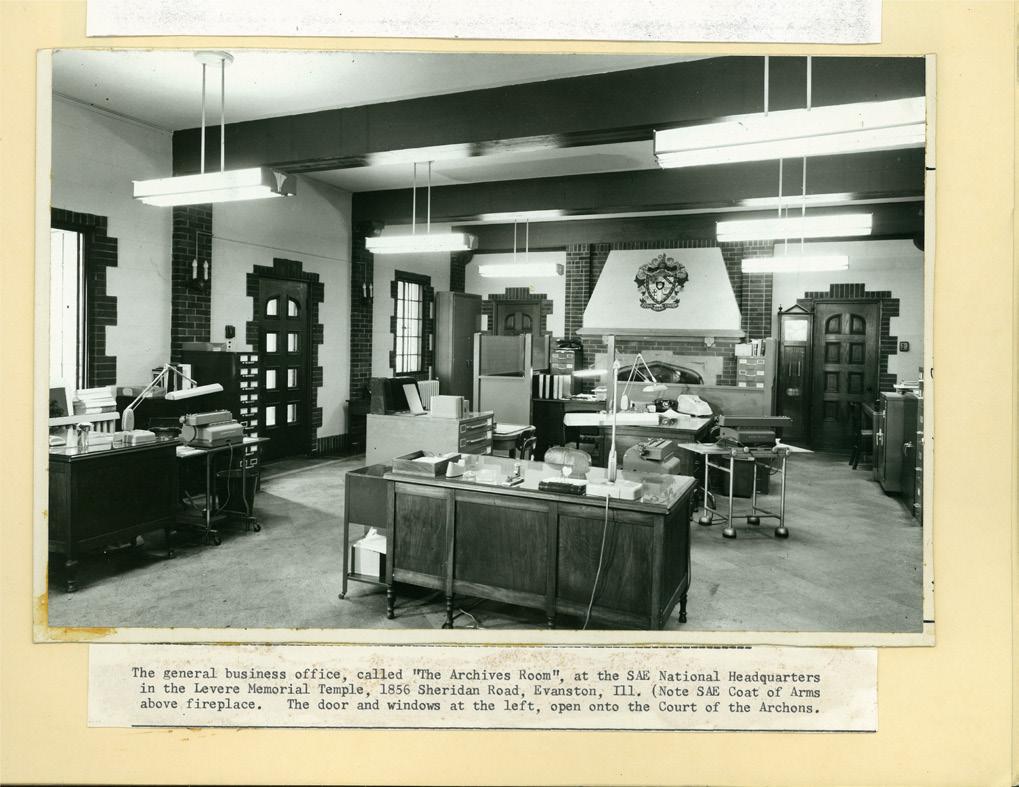
At the annual Tri-Board Meeting in Fall 2025, the SAE Foundation presented a plan to address the long-term preservation of the archives, including our historical documents, artifacts, paintings, and more. After the presentation, it was unanimously decided to move forward with a partnership with HistoryIT, a professional organization that specializes in digital and physical archival services for historical institutions and organizations. This engagement builds upon a prior collaboration, during which
HistoryIT successfully digitized select portions of SAE’s archival materials. Composed of professional archivists, historians, and digital specialists, HistoryIT focuses on ensuring that historically significant collections are cataloged, preserved, and made accessible for future generations. Their expertise is invaluable in assessing, protecting, and managing extensive historical collections like ours.
HistoryIT’s team assessed both the archive collection itself and the current conditions of protection, which were unfortunately determined to be poor and inadequate for long-term preservation. Based on their professional recommendation, and in the best interest of the materials, the decision was made to temporarily relocate the majority of the archives to HistoryIT’s secure, climate-controlled facility. This relocation was successfully carried out by a specialized “white glove” service, ensuring the historical materials were professionally packaged for their safe travel.
The immediate goal of this collaboration is for HistoryIT to perform a comprehensive process of cataloging the entire collection, creating a detailed inventory, and generating a thorough condition report of our historical materials. HistoryIT’s professional staff of archivists and historians are uniquely equipped to accomplish this vital work, establishing the foundation for future digitization and access.
While the archives are temporarily held at HistoryIT’s facility, they remain the property of Sigma Alpha Epsilon, and they continue to be SAE’s official archives and will return to the Levere Memorial Temple.
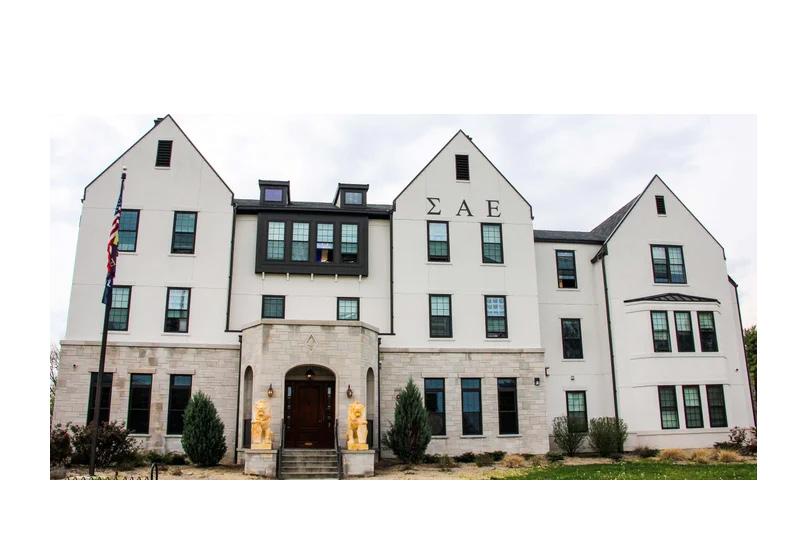
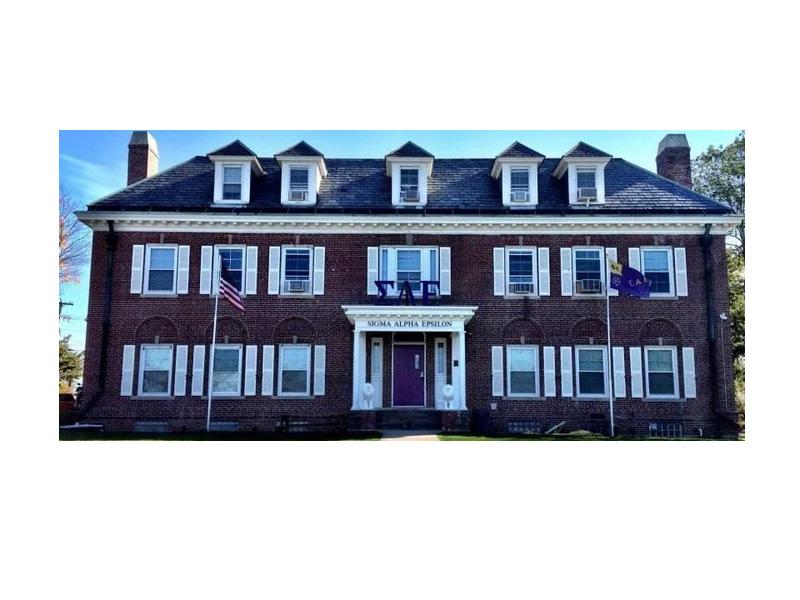
We do the heavy lifting for you, so your house operates seamlessly.
Smarter Budgets
Tech-Enabled Conveniences
Transparent Pricing Reliable Roster Accuracy Fast Member Onboarding Greek House Shield Program
A lot goes into running a chapter house smoothly and e ciently.
For over 20 years, we’ve provided safe, strong, and sustainable chapter houses.
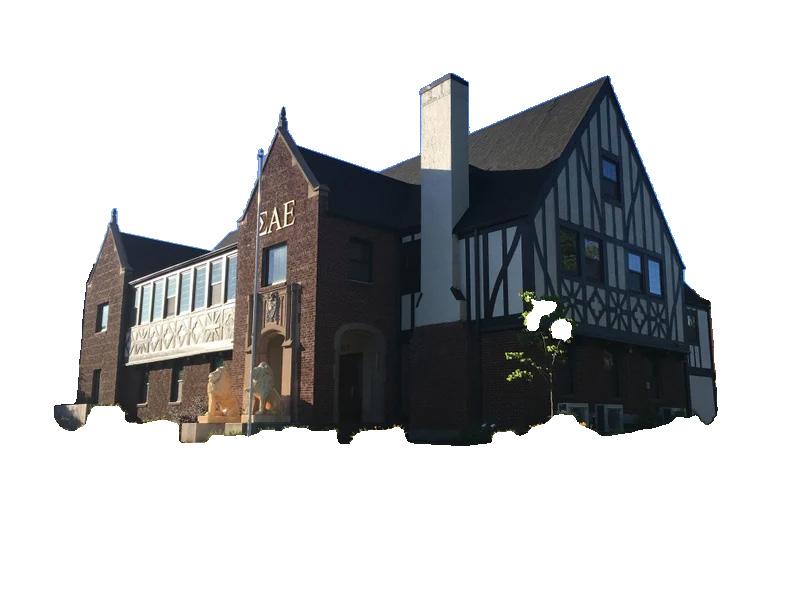
As industry-leading property managers and owners, we help house corporations with: Accounting & Finance, Leasing & Membership, Operations, Maintenance, Human Resources, Legal Needs, Construction & Capital Improvements
Learn more at

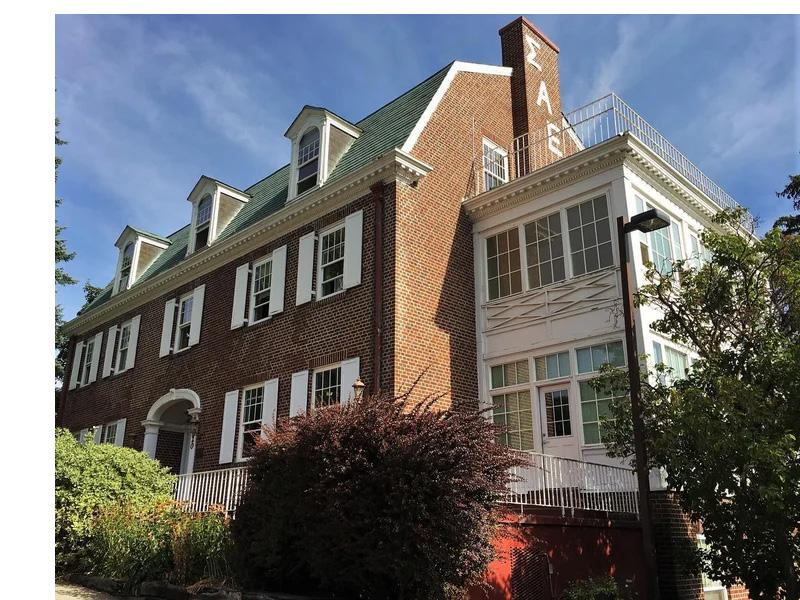
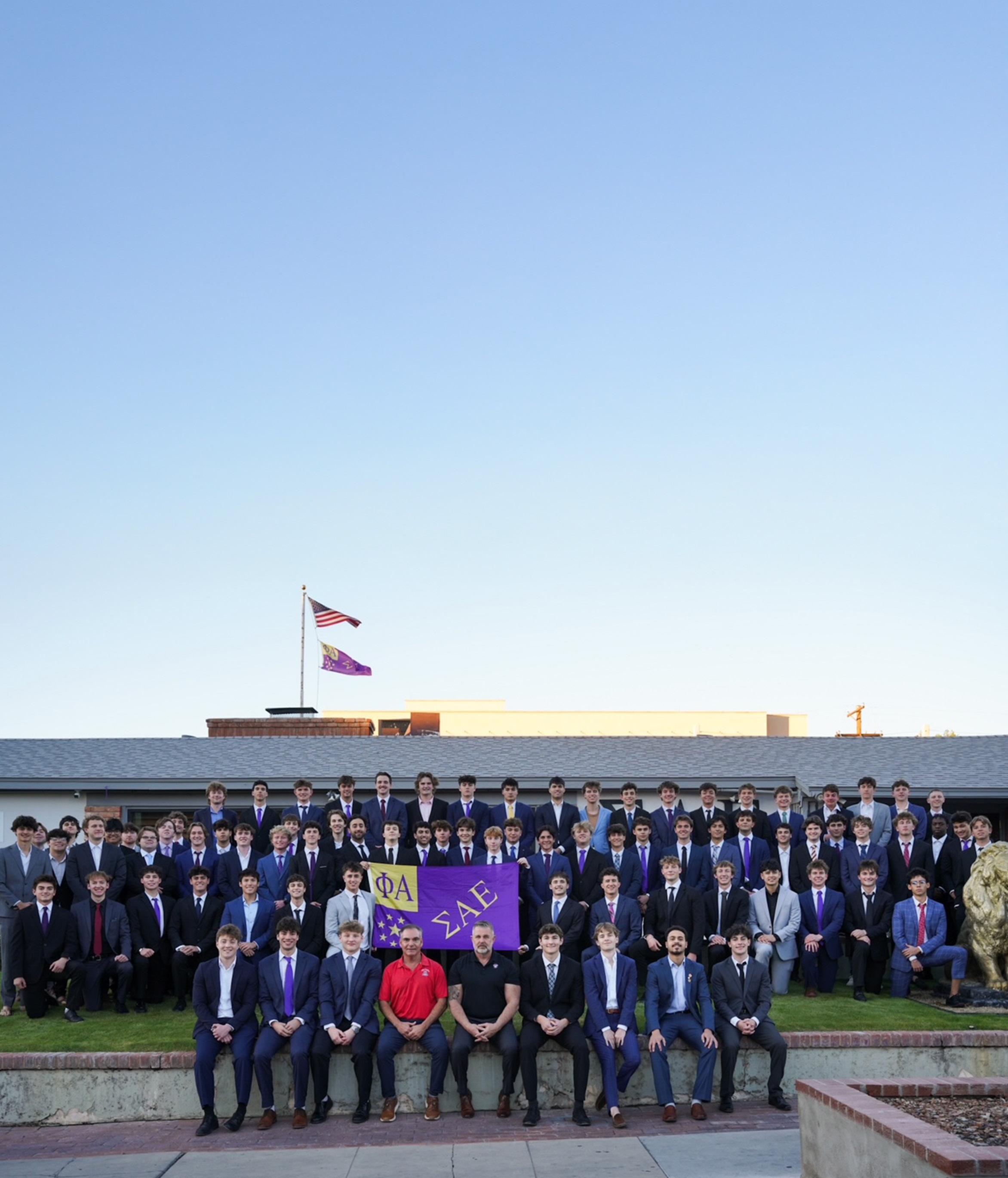
BY KAYLA MCCLOUD
The Arizona Alpha Chapter of Sigma Alpha Epsilon has a history spanning more than a century at the University of Arizona in Tucson. First chartered on March 2, 1917, the chapter stands among the fraternity’s oldest, shaped by generations of men who laid its foundation, stewarded its house, and carried its values forward. Since its original charter, nearly 3,000 men have been initiated.
Arizona Alpha’s return to campus is not the result of a single moment, but of decades of alumni choosing to stay connected, step forward, and serve when it mattered most. Much like the fraternity’s Mystical Phoenix, symbolizing that an ending can also mark a beginning, Arizona Alpha has risen once more, resilient and focused on developing the next generation of True Gentlemen. That renewal became official on February 7, 2024, when the chapter was rechartered, marking not only a return to campus but a reaffirmation of its purpose. Today, approximately 140 active members carry that legacy forward.
Even during years without an active charter, Arizona Alpha never ceased to exist. The chapter’s alumni retained ownership control and management of the land, the house, and all improvements to the property. Located in the heart of the University of Arizona campus, the house remained a physical anchor to the chapter’s past and its future.
Charles Hall (Arizona ’64) represents one brother amongst many of that continuity. A lifelong member deeply connected to SAE, Hall’s ties to the fraternity run through generations; his late father and brother are also members of SAE. Since the 1960s, he has remained actively involved through the chapter’s House Corporation and Arizona Alpha Alumni Association efforts, particularly alongside a strong and active group of Phoenix-area alumni and dedicated brothers in Tucson and elsewhere.
His involvement reflects what is possible when alumni view their role not as past-tense membership, but as ongoing responsibility.
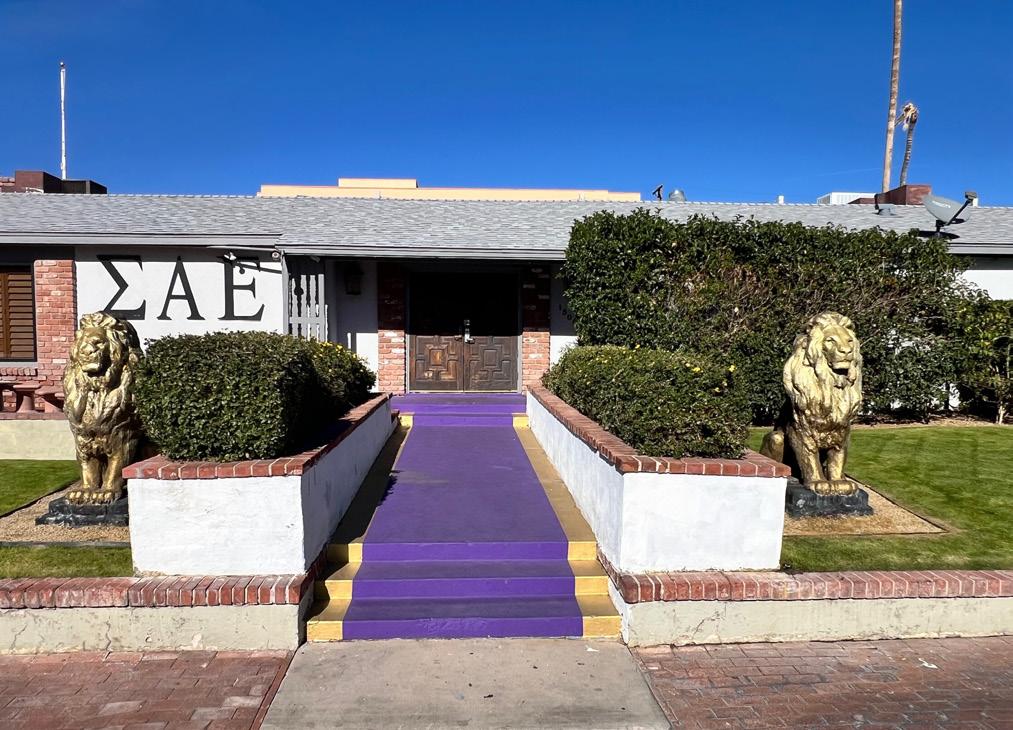
For decades, Arizona Alpha was shaped by the steady leadership of G. Walton Roberson, who was initiated into Sigma Alpha Epsilon in the early 1950s and served as chapter advisor for more than 20 years. His influence helped guide generations of members through periods of growth, transition, and responsibility.
While Roberson and his wife are no longer able to travel as frequently as they once did, their connection to Arizona Alpha has never faded. They continue to follow the chapter closely, receiving regular updates and celebrating its progress from afar.
The chapter’s history includes Darren Porter (Arizona ‘24), whose path to becoming the chapter’s House Director began far from Tucson.
Originally from the United Kingdom, Porter moved to the United States 20 years ago and became House Director in January 2016.
When the chapter’s charter was removed in 2018, the chapter’s House Corporation brothers faced an uncertain future. Rather than sit empty, Arizona Alpha deliberately kept the house open and active by renting it to another fraternity, while maintaining Arizona Alpha control and oversight. Porter stayed on as House Director, guiding that chapter through its own period of growth and accountability.
A new generation of members arrived ready to uphold SAE’s values, embrace accountability, and rebuild Arizona Alpha with purpose and willingness to lead, rebuild, take responsibility, and shape the chapter’s future. That momentum is guided by the fraternity’s creed, the True Gentleman, which serves as the foundation for rebuilding Arizona Alpha with intention and integrity.
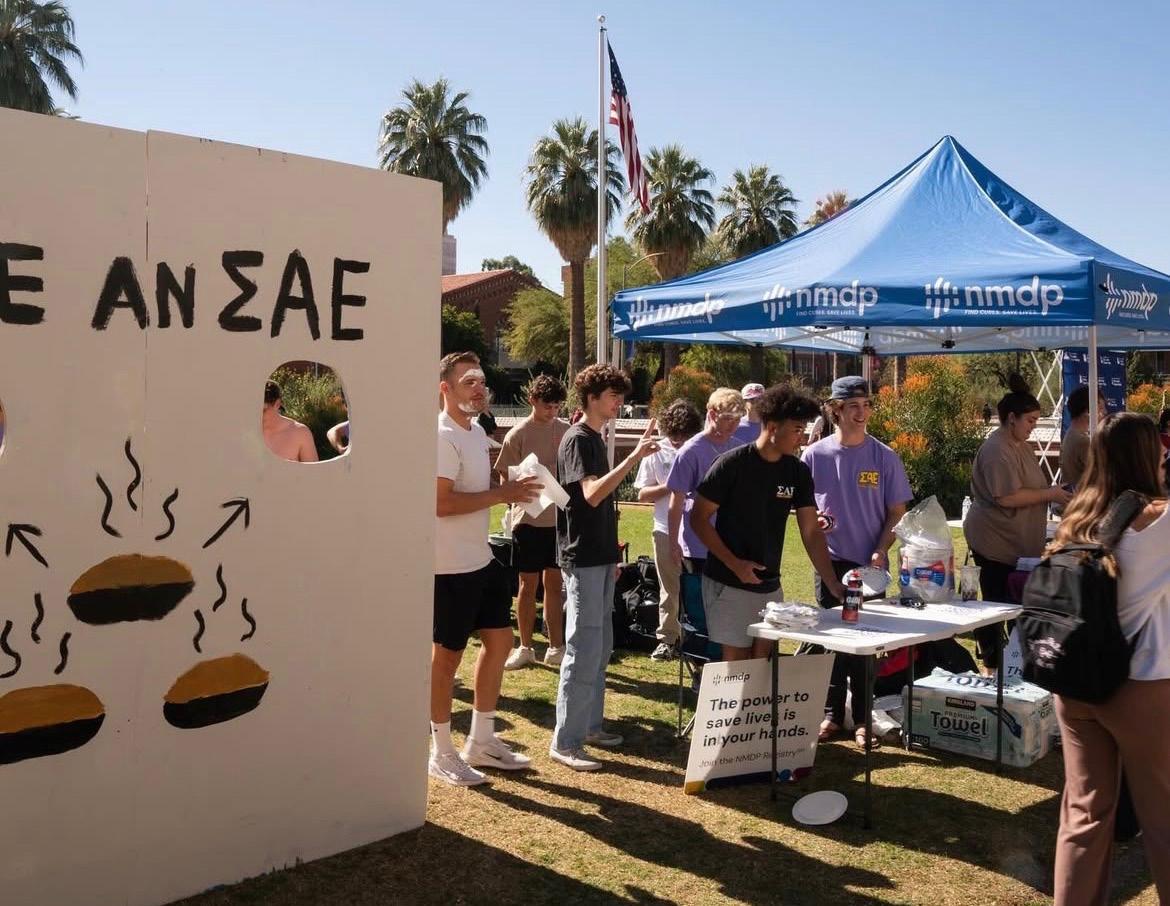
Alumni engagement deepened, with key leadership from local alumni brothers such as Gary Urman (Arizona ‘84), Greg Vinikoor (Arizona ‘86), Bryan Hartman (Arizona ‘86), Mike Sarabia (Arizona ‘87), and Tom LaMantia (Arizona ‘87) helping to advance the rechartering process. What distinguished the effort was not speed, but intention.
On February 3, 2024, just days before the chapter’s official recharter, Porter himself was initiated into Sigma Alpha Epsilon, an honor and recognition well-deserved.
Today, Arizona Alpha is not simply active; it is thriving.
The chapter has distinguished itself through strong academic performance, campus involvement, athletics, and community service. Members organized food donations to support families
impacted by SNAP benefit disruptions and led record-breaking participation in the NMDP Challenge. Through campus swabbing events, registry sign-ups, fundraising, and volunteering, the chapter continues to help advance NMDP’s mission of connecting blood stem cell donors with patients in need of life-saving transplants, positioning the chapter to finish first across the realm.
University administrators, the Interfraternity Council, and the Dean of Students have spoken openly in support of Arizona Alpha, pointing to the chapter as an example of what fraternity life should be. The chapter’s leadership, culture, and stewardship of its house have earned renewed trust and respect across campus.
As the House Director, Brother Porter and the House Corporation brothers remind the chapter’s active members during this period of rebuilding: “You won the lottery,” they tell them. “You were selected, and you chose to accept something that can change your life for a positive and wonderful future, if you do it right.”
“YOU
YOUR LIFE FOR A POSITIVE AND WONDERFUL FUTURE, IF YOU DO IT RIGHT.”
A CALL TO LEAD FORWARD
Arizona Alpha’s rebirth is a reminder that fraternities are not sustained by charters alone, but by people who choose to stay involved long after graduation. Alumni leadership, guidance, and presence remain among the most powerful influences on a chapter’s culture, accountability, and success.
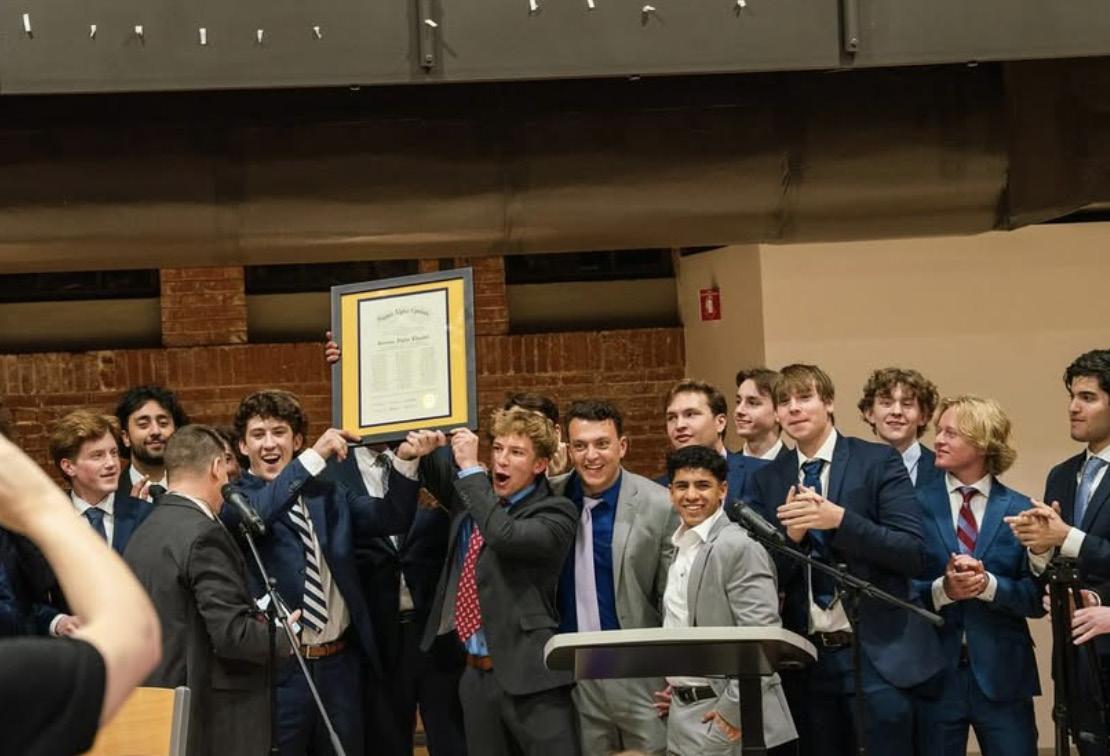
For every chapter navigating change, growth, or renewal, there is an opportunity for alumni to serve with purpose. Through mentorship, property stewardship, advising, or simply staying connected, the impact of that involvement is lasting.
Arizona Alpha stands today because alumni answered that call. Its future, and the future of SAE chapters across the country, depends on others choosing to do the same.
As Arizona Alpha moves into this new chapter, the impact of alumni engagement has never been clearer. The chapter’s rebirth proves that alumni influence can set a standard for what fraternity life can be. This is an invitation for any and all alumni across the realm to reconnect, offer guidance, and witness firsthand the difference their experience and perspective can make.
Alumni interested in supporting the chapter or learning more about ways to get involved are encouraged to contact Darren Porter at 1509housedirector@ gmail.com or (520) 665-1065.
Arizona Alpha is back, and its future will be defined by those who choose to help lead it forward.
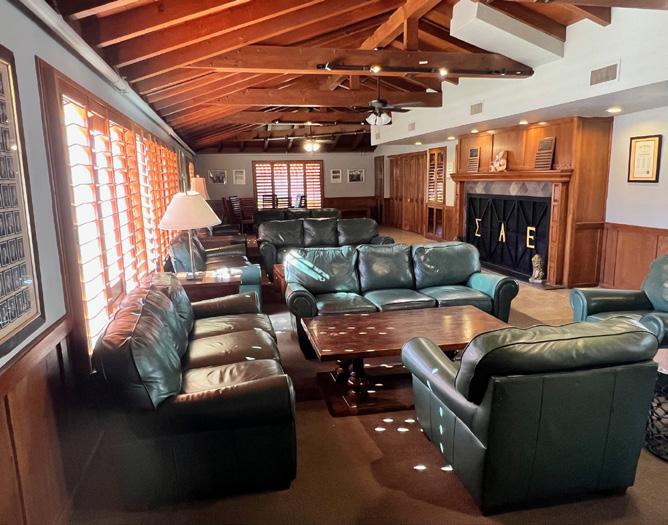
As Arizona Alpha returned to campus, renovating the chapter house became a key part of its renewed commitment to excellence. Because alumni have long maintained ownership of the property, they have invested in meaningful updates that have created a clean, modern, and well-maintained living environment.
More than just a place to live, the house sets the tone for the chapter’s culture, encouraging SAE zeal, responsibility, and respect. Today, the Arizona Alpha house stands as a visible symbol of a chapter moving forward with purpose and higher standards.
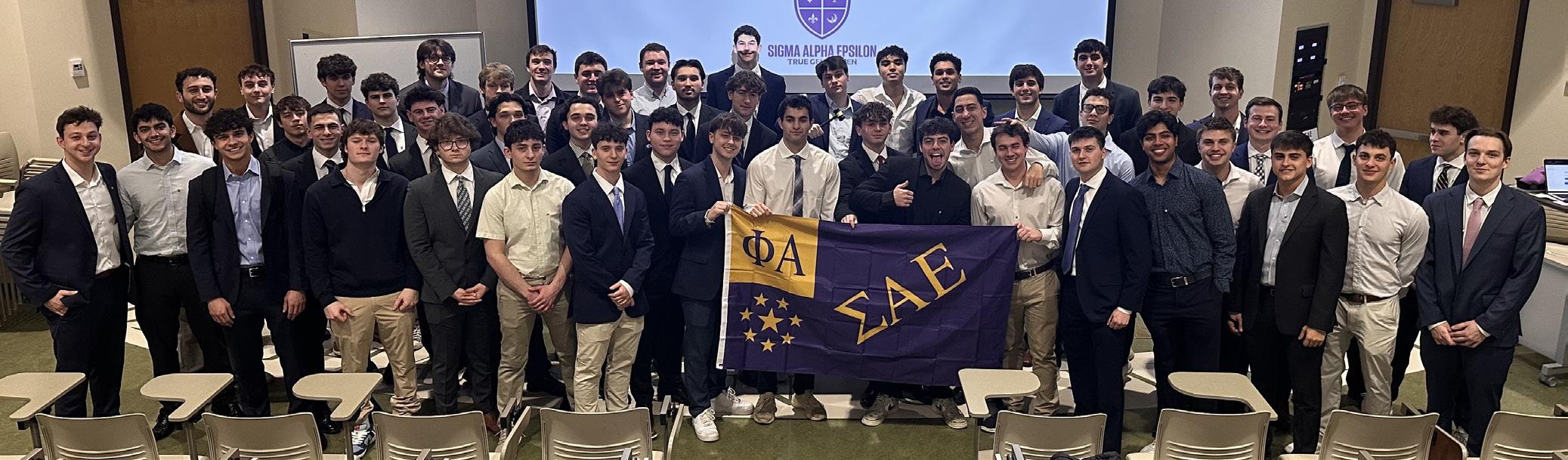
The New York Omega Emerging Chapter has begun their journey towards earning their charter.
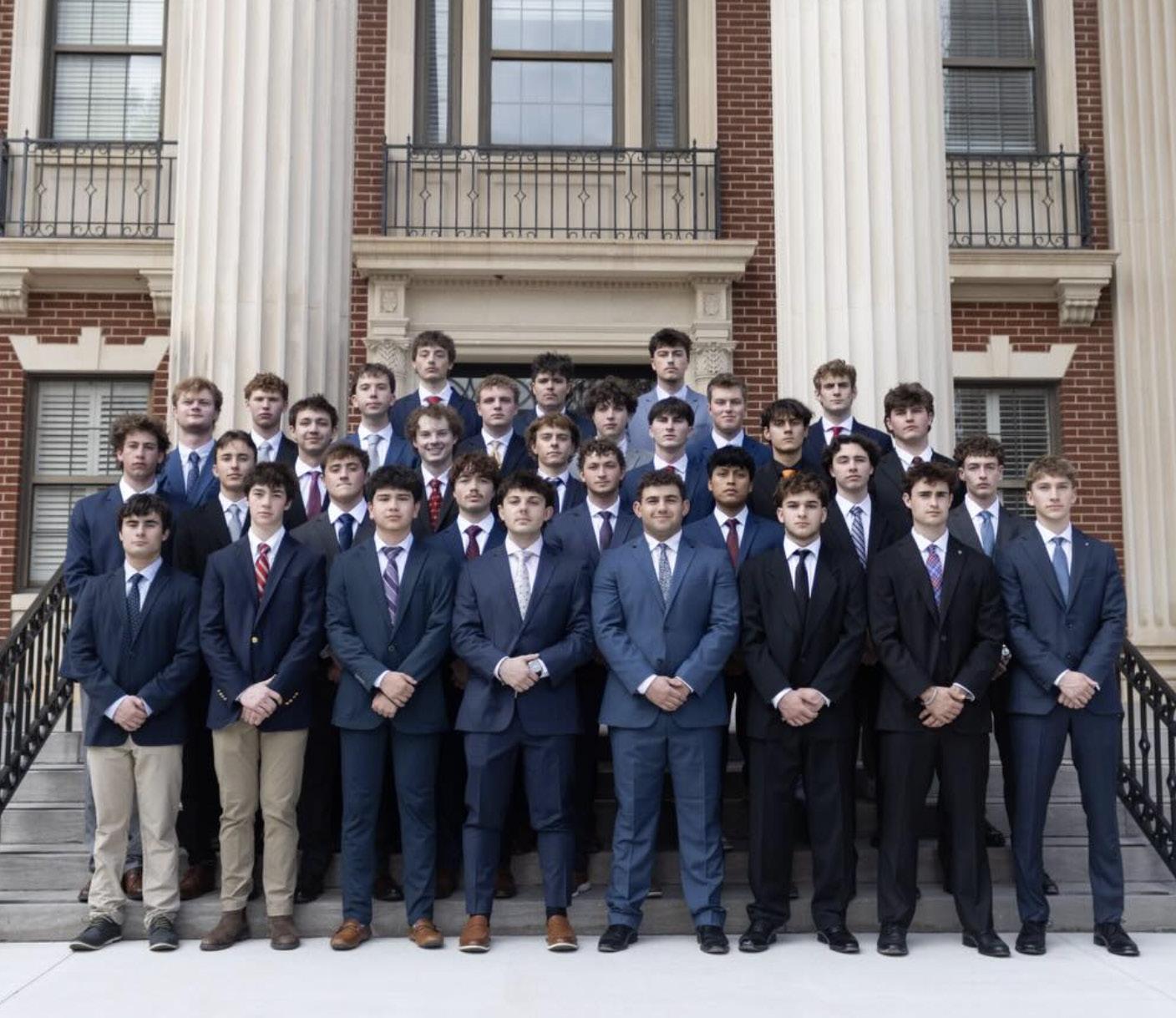
Welcome to the Texas Theta chapter of Sigma Alpha Epsilon. We look forward to the leadership, character, and dedication each of you bring.
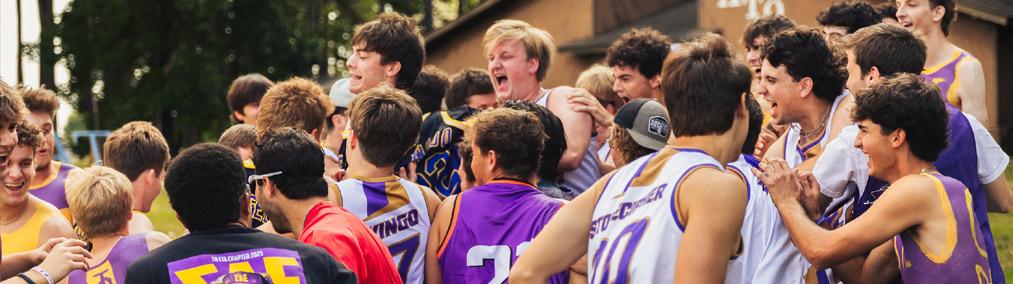
Do you know a young man who should join SAE? Fill out the Recruitment Recommendation Form to let us know! sae.net/join-sae/refer-a-brother/

Max Gilbert came to the University of Tennessee as a football kicker where the pressure to perform left little room for anything else. Despite the demands of the program, he sought a deeper sense of belonging off the field and found it through Sigma Alpha Epsilon. As he now prepares to continue his football career with the Arkansas Razorbacks, Gilbert carries with him the lessons and brotherhood that shaped his time in college and will guide him into this next chapter.

For nearly 170 years, Sigma Alpha Epsilon has stood for brotherhood, leadership, and the lifelong pursuit of becoming a True Gentleman. As campuses, students, and technology continue to evolve, the way that mission is lived and taught must evolve with them.
Today’s students arrive shaped by digital culture and heightened social isolation. Educational models must meet them where they are, while calling them toward something greater.
SAE’s new member onboarding program initiative begins an intentional exploration of what resonates most with this generation of students. It is not change for the sake of change, but a move toward a more engaging start to the member journey. The program is currently in a discovery pilot phase, allowing it to evolve as feedback is gathered and applied.
Guided by SAE’s virtues, the program is intentional and studentcentered while remaining flexible by design. It is built to adapt to what is most effective in this era, aiming not just to inform, but to create a meaningful and transformational new-member experience.
Today’s students are navigating a very different world than that of a decade ago. Research consistently points to rising social isolation, shortened attention spans shaped by digital platforms, and a deep desire for authentic, in-person connection. Recruitment and education must respond to that reality without compromising the timeless standards that define SAE.
Over the past year, SAE has closely evaluated the outcomes of its new-member education model, which has been in place for the past decade. Leaders reviewed measurable indicators: retention trends, alumni engagement patterns, initiation consistency, and member feedback from across its chapters. The conclusion was clear. While efforts were well-intended, educational depth had diminished. Retention challenges grew. Loyalty to national ideals weakened.
Equally important was the direct and ongoing feedback from active members. Following the 169th Anniversary Convention in June 2025, Chief Executive Officer and Eminent Supreme Recorder Steve Mitchell (Indiana ‘83) assembled a task force to listen carefully to students, campus partners, volunteers, and staff.
Director of Program Innovation Dustin Stewart (Georgia Southern-Armstrong ‘17) explains, “This isn’t a knee-jerk reaction to a made-up need that the headquarters office just decided. This is a result of ongoing conversations with campus partners and students.”
One theme consistently emerged: the onboarding experience needed to be more meaningful, more interactive, and more aligned with today’s students. Before designing the new program, SAE leadership conducted two surveys to gather input from both undergraduates and alumni.
Among undergraduate respondents, nearly two-thirds said they thought a member education period of 21 to 28 days would be most impactful. A broader survey that included about two-thirds alumni and one-third undergraduates showed similar results. About 85 percent of respondents said a program lasting at least two weeks would be most beneficial, with roughly half identifying 28 days as the optimal length.
Respondents were invited to share core topics they felt should be covered, including SAE history, values and traditions, health and safety requirements, and the True Gentleman Creed. Overall, the feedback from both surveys pointed toward the desire for an experience that would give new members more time and depth to understand what it means to wear the SAE letters.
Stewart continues, “It’s a very intentionally designed project, how we’re working through each phase, how the content is created, how we’re collecting feedback to ensure we’re building something SAE can be proud of, the fraternal world can respect, and members will genuinely enjoy.”
The new program was piloted this spring with four chapters, combining two in-person instructional sessions each week with the current online onboarding courses. Looking ahead, plans are underway to introduce short, focused online modules capped at 15–20 minutes. This approach is designed with today’s students in mind, recognizing they are balancing demanding schedules and multiple commitments.
“We know our core audience and what they’re asking of us, and that is where our focus remains,” Stewart says.
Each session centers on one of SAE’s virtues, presented in the order of the ritual. Members begin by reciting the Creed and reviewing a primer on the virtue. They then explore a portion of SAE’s history directly connected to that principle, followed by interactive activities that apply those values to modern campus life.
Stewart explains, “We want to be dynamic and engaging, but we also want to make sure we’re hitting that core knowledge every
SAE should understand, not just dates and facts, but how, as a human and as a True Gentleman, you begin to see yourself living that model.”
History remains central to SAE’s identity. What has changed is how that history is delivered.
Part of the design approach involved leveraging alumni talent and knowledge. Each contributor possesses a strong background in SAE History or instructional design. Broadening the contributor pool enriches the telling of SAE’s 170-year story through the lens of its virtues. Dr. Scott Slechta (Simpson ’80), Richard Shipley (Evansville ‘79), John Werner (TennesseeKnoxville ‘86), and Kevin Gath (Western Carolina ’14) collaborated to ensure both strong instructional design and historical integrity. The writing is simplified enough for today’s students to digest, yet rich enough to preserve depth.
Technology further enhances this experience. A virtual walkthrough of the Levere Memorial Temple allows members nationwide to experience SAE’s spiritual home, complete with the official tour script for context and meaning.
“MEMBERS NEED TO UNDERSTAND THE HISTORY OF SAE, WHERE WE COME FROM AND WHERE WE’RE GOING,” STEWART SHARES. “THEY NEED TO UNDERSTAND OUR VIRTUES THROUGH OUR RITUAL AND SEE THEIR PRACTICAL APPLICATION.”
Students also receive a TG Journal, which includes space for notes and guided reflection prompts. “Not everybody likes to talk. Some prefer writing,” Stewart explains. “It’s about diversifying the learning experience.”
Each lesson concludes with an all-inclusive brotherhood activity connected to the theme. Songs are incorporated, reinforcing tradition and shared community.
“MORE THAN FRAT:” REDEFINING BROTHERHOOD THROUGH PURPOSEFUL ACTIVITIES
One interactive component of the program, “More Than Frat,” intentionally challenges stereotypes. SAE is more than letters, more than parties, more than surface-level affiliation. It is about values, responsibility, and lifelong character development.
The program reinforces health and safety education and reframes risk management as intentional relationship-building rooted in accountability.
“We know new members want to get together,” Stewart says. “In male organizations, they often prefer doing something together rather than just sitting and talking. Let’s give them the tools they need while also helping them make smart choices.” The aim is to cultivate structured, meaningful connections through brotherhood experiences that build trust and camaraderie in a safe, supportive environment.
Stewart will use feedback from the four chapters that piloted the program this spring to refine the program for a broader fall 2026 pilot and soft launch in spring 2027.
Early indicators are encouraging. Some initiated members began attending sessions out of curiosity and interest. Engagement grew organically. “Members really enjoy being in person and interacting with each other,” says Stewart. “They’re also big fans of the content and want more e-learning to dive deeper into these topics.”
New members also requested content that hit closer to home. The design team is creating a “build-a-lesson” template so that local chapters can include their own history. They’re also focusing on multimedia that features real SAEs to make the program more relatable. “We want to give members a way to connect what they’re learning with the brothers around them,” Stewart explains.
Campus staff have appreciated the thoughtful design and intentional approach to the curriculum. Stewart adds, “We’re actively exploring ways to build feedback loops with campus partners and using ed tech to enhance the learning experience.”
Stewart is also tracking effectiveness using a 4-point scale: “Good” (3.75 and above), “Sufficient” (3.25-3.74), and “Priority Review” (below 3.25). He is measuring how easy lessons were to run, how well the materials and activities worked, and whether members stayed engaged. Early results show strong scores for facilitator preparation, session timing, and participant interaction. These insights will guide future pilots and ensure the program continues to strengthen over time.
“We’re at a place where we’re unafraid to try ideas that have merit,” Stewart says. “And we’re equally unafraid to say, ‘That didn’t work. Let’s adjust.’”
Strong programming requires strong facilitation, and this initiative will be introduced in phases rather than all at once. The focus is
on helping chapters, new member educators, advisors, and campus partners feel fully prepared and supported at each step.
Mitchell underscores the importance of a careful rollout. “We’re not just going to say, ‘Go.’ We’ll roll this out thoughtfully, ensure everyone is trained, and communicate with administrators. Everyone needs to be aligned in order for this to be successful.”
Accessibility was a top priority. New member educators are equipped with slide decks, quizzes, answer keys, attendance forms, feedback checklists, and a comprehensive Leader’s Guide. Stewart notes, “We aim to provide the tools and direction chapters need to successfully educate their members. Chapters shouldn’t need to create their own learning experiences, especially for something as critical as new member onboarding.”
The program will continue to evolve based on input, adding new layers over time, including gamification elements to enhance engagement. For now, the focus is on establishing a strong and sustainable course framework.
Success will be measured through both immediate and longterm outcomes.
“The moment I start hearing members talk about their onboarding experience and the knowledge they gained, that’s when I’ll know it’s working,” Stewart says.
Short-term indicators include engagement, participation, and positive feedback. Long-term goals focus on stronger retention, healthier chapter cultures, and increased alumni involvement.
At the heart of it all remains the True Gentleman ideal.
“At the end of the day, we share a collective responsibility to help raise these members to become the True Gentlemen we say they will be,” Stewart reflects. “New member onboarding isn’t a cureall. You earn your membership and your True Gentleman badge every single day.”
Ultimately, this initiative is about bringing the fraternity back to its center. Stewart adds, “We’re simply aiming to recenter our shared SAE story: where we came from, where we are today, and where we want to be in the future.”
The arrival of this program lays a strong foundation for future generations of True Gentlemen, guiding them to honor the past, shape the present, and lead the future.
Across the United States, young men— especially those of college age—are facing a profound and growing crisis. Rates of loneliness, mental-health struggles, substance abuse, and academic disengagement have surged in recent years, creating a ripple effect.
This trend has not gone unnoticed. As NPR reported, “Over the past two years, statistics about men’s mental health, educational advancement, and financial well-being have made headlines. And, in turn, sparked an industry of organizations, pundits, and others ringing the alarm.” The concern is measurable and widespread.
THE LONELINESS EPIDEMIC AMONG YOUNG MEN
The American Institute for Men and Boys notes that since 2023, experts have described loneliness and social isolation in the United States as an epidemic. College campuses—places traditionally associated with friendship, belonging, and personal growth—are not immune.
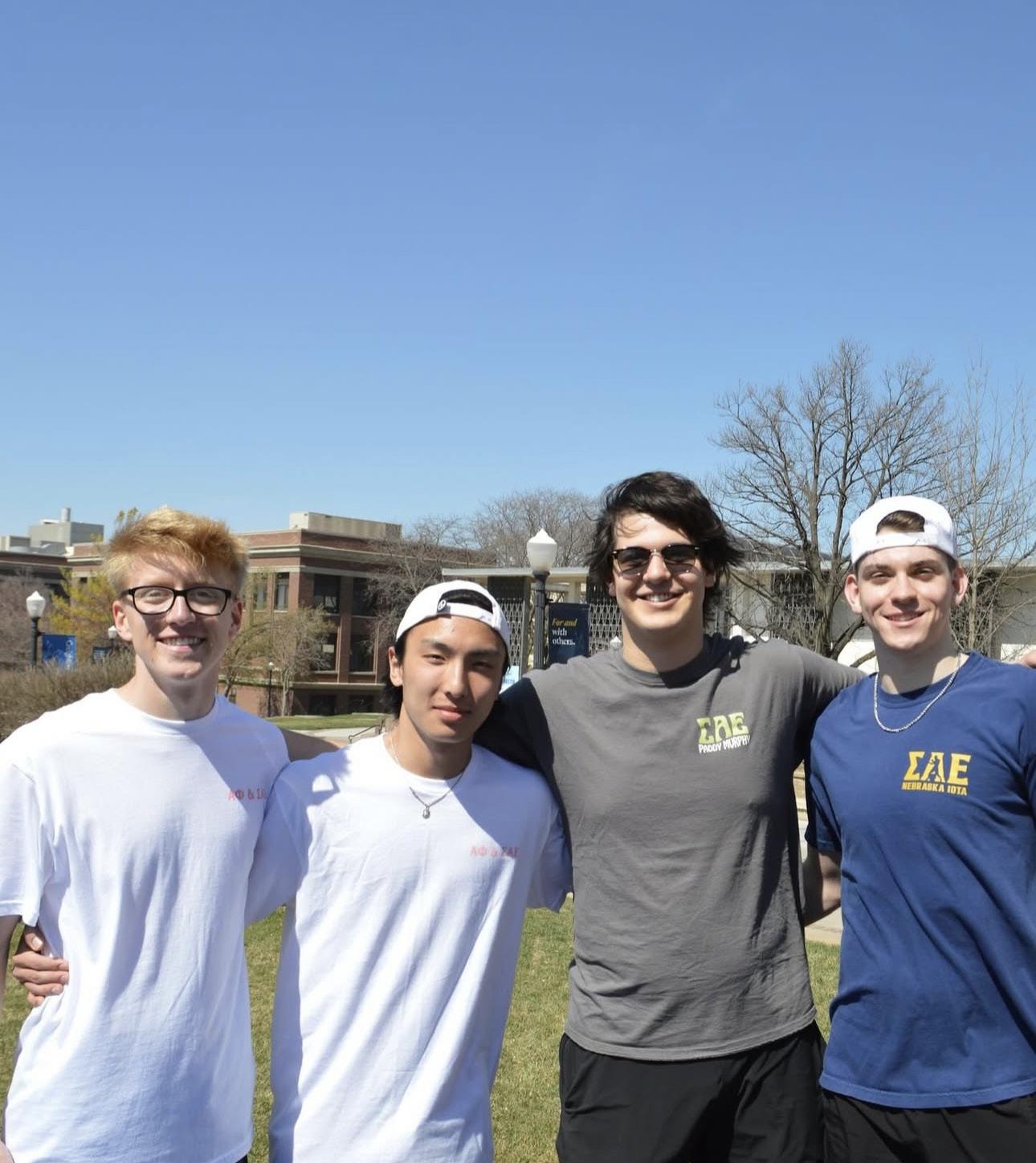
Research from Trellis Strategies, a nonprofit focused on student success, finds that more than half of college students report feeling lonely.
HIGHER EDUCATION IS FEELING
The consequences of this crisis are visible in college enrollment and completion trends. “The gender gap has flipped: women now earn almost two college degrees for every one earned by men,” says Scott Galloway, author of Notes on Being a Man. “Falling behind academically often snowballs into challenges with employment, relationships, and self-worth,” areas where young men are already struggling.
Recognizing the urgency, leaders across healthcare, policy, industry, and higher education are working to better understand the crisis and identify solutions. In November 2025, The Lafayette Company hosted the Symposium on Young American Men, where experts gathered to examine the issue from multiple angles. One of the panels, “The Campus Challenge: How Higher Education Can Better Serve Male Students,” was moderated by SAE’s own Dr. Anthony Mack (North Florida ‘11).
More recently, in February 2026, the North American Interfraternity Conference (NIC) partnered with the Association of Fraternal Leadership & Values (AFLV) to host a Brotherhood Summit focused on mental health and wellness among college men.
Amid the troubling statistics, one encouraging trend stands out: young men who are part of single-sex organizations, including fraternities, consistently report stronger mental health, deeper friendships, and greater life satisfaction than their non-affiliated peers.
Key findings include:
• Better mental health: 53% of fraternity men report positive mental health, compared to 41% of non-affiliated men.
• Greater life satisfaction: 61% of fraternity members say their lives are going as they envisioned, versus 37% of non-affiliated men.
• More mentorship: 71% of fraternity men have a male mentor, compared to 42% of other young men.
• Stronger friendships: 64% of fraternity members have three or more close friends—nearly double the rate of non-affiliated men.
• Healthier tech habits: Fraternity men spend less time online and more time in face-to-face social activities.
• A trusted support network: Fraternity men are twice as likely to seek help from a fellow brother as they are from anyone else.
• Space for real conversations: Fraternities provide environments where young men feel comfortable discussing relationships, family challenges, and mental-health struggles.
These outcomes are not accidental. They reflect the power of structured community, shared values, and deeper, in-person connections—the building blocks of brotherhood found in fraternities.
At a time when so many young men are searching for connection and direction, the role of brotherhood has never been more important. The SAE Foundation is committed to supporting our collegiate members at this critical juncture through transformative educational programming. In 2026, the SAE Foundation reinforced their commitment by increasing their educational grant to the Fraternity by 33%. This expanded support for the John O. Moseley Leadership School and enhanced risk management education. The result is a more impactful fraternity experience—one that equips young men with the leadership skills, mentorship, and connection to succeed in college and in life.
THE ROLE OF BROTHERHOOD HAS NEVER BEEN MORE IMPORTANT.
FRATERNITY MEN HAVE BETTER MENTAL HEALTH, GREATER LIFE SATISFACTION, MORE MENTORSHIP, AND STRONGER FRIENDSHIPS.
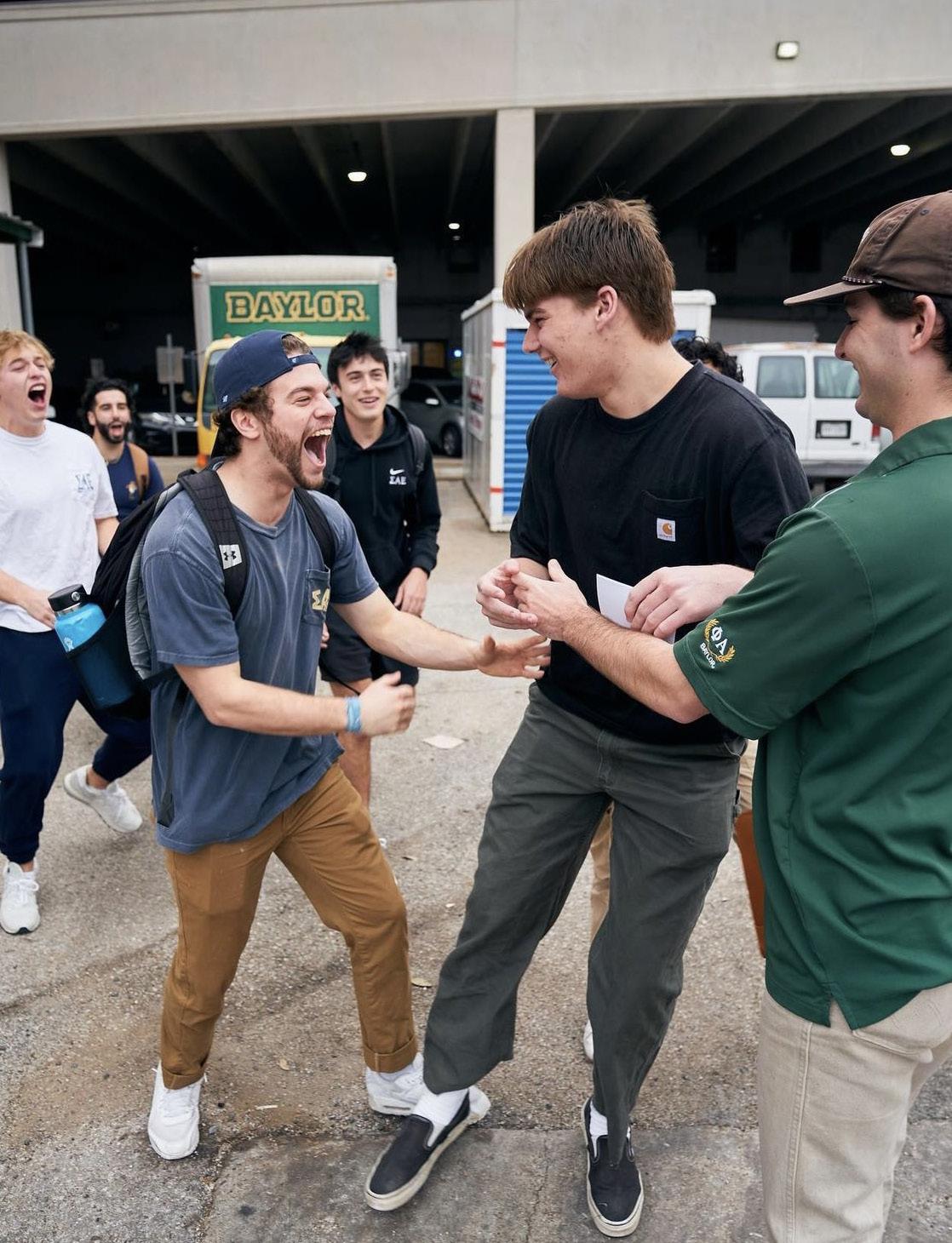
The crisis facing young men is real, but it is not insurmountable. With intentional support, strong communities, and programming, we can help young men build resilience, find belonging, and thrive academically and personally. Fraternities—when grounded in values, accountability, and genuine brotherhood—are uniquely positioned to be part of the solution.
How can you help? Your gift to the SAE Foundation’s Annual Loyalty Fund helps provide leadership development, risk management training, and other educational initiatives to support our collegiate members. Invest in our future True Gentlemen: sae.net/donate
To learn more about the research cited in this article, visit: nicfraternity.org/research