March 11, 2026
SIFF, Festa Italiana, and Greg Olson Productions Present
MARTIN SCORSESE
MAESTRO OF CINEMA
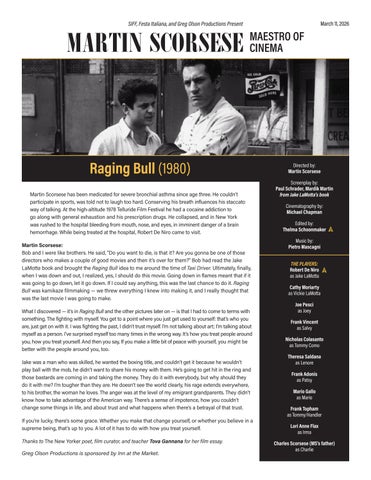
Raging Bull (1980) Martin Scorsese has been medicated for severe bronchial asthma since age three. He couldn’t participate in sports, was told not to laugh too hard. Conserving his breath influences his staccato way of talking. At the high-altitude 1978 Telluride Film Festival he had a cocaine addiction to go along with general exhaustion and his prescription drugs. He collapsed, and in New York was rushed to the hospital bleeding from mouth, nose, and eyes, in imminent danger of a brain hemorrhage. While being treated at the hospital, Robert De Niro came to visit. Martin Scorsese: Bob and I were like brothers. He said, "Do you want to die, is that it? Are you gonna be one of those directors who makes a couple of good movies and then it’s over for them?" Bob had read the Jake LaMotta book and brought the Raging Bull idea to me around the time of Taxi Driver. Ultimately, finally, when I was down and out, I realized, yes, I should do this movie. Going down in flames meant that if it was going to go down, let it go down. If I could say anything, this was the last chance to do it. Raging Bull was kamikaze filmmaking — we threw everything I knew into making it, and I really thought that was the last movie I was going to make. What I discovered — it’s in Raging Bull and the other pictures later on — is that I had to come to terms with something. The fighting with myself. You get to a point where you just get used to yourself: that’s who you are, just get on with it. I was fighting the past, I didn’t trust myself. I’m not talking about art; I’m talking about myself as a person. I’ve surprised myself too many times in the wrong way. It’s how you treat people around you, how you treat yourself. And then you say, If you make a little bit of peace with yourself, you might be better with the people around you, too. Jake was a man who was skilled, he wanted the boxing title, and couldn’t get it because he wouldn’t play ball with the mob, he didn’t want to share his money with them. He’s going to get hit in the ring and those bastards are coming in and taking the money. They do it with everybody, but why should they do it with me? I’m tougher than they are. He doesn’t see the world clearly, his rage extends everywhere, to his brother, the woman he loves. The anger was at the level of my emigrant grandparents. They didn’t know how to take advantage of the American way. There’s a sense of impotence, how you couldn’t change some things in life, and about trust and what happens when there’s a betrayal of that trust. If you’re lucky, there’s some grace. Whether you make that change yourself, or whether you believe in a supreme being, that’s up to you. A lot of it has to do with how you treat yourself. Thanks to The New Yorker poet, film curator, and teacher Tova Gannana for her film essay. Greg Olson Productions is sponsored by Inn at the Market.
Directed by: Martin Scorsese Screenplay by: Paul Schrader, Mardik Martin from Jake LaMotta’s book Cinematography by: Michael Chapman Edited by: Thelma Schoonmaker Music by: Pietro Mascagni THE PLAYERS: Robert De Niro as Jake LaMotta Cathy Moriarty as Vickie LaMotta Joe Pesci as Joey Frank Vincent as Salvy Nicholas Colasanto as Tommy Como Theresa Saldana as Lenore Frank Adonis as Patsy Mario Gallo as Mario Frank Topham as Tommy/Handler Lori Anne Flax as Irma Charles Scorsese (MS’s father) as Charlie
RAGING BULL (1980) FILM NOTES BY TOVA GANNANA After one of his fights, Jake LaMotta (Robert De Niro) cries in the arms of his handler. He has lost in the ring. He sobs; he questions himself, his cheetah pattern robe draped around him like a second skin. His skin is battered; his face throughout Raging Bull (1980) is bruised or bandaged. Outside of the ring, Jake fights with his brother Joey (Joe Pesci), his current wife Vickie (Kathy Moriarty), and his ex-wife Irma (Lori Anne Flax). Early on, Jake tells Joey, “Put my robe on right.” Joey is Jake’s manager and confidant. Jake doesn’t like it when Joey swears, or when Vickie looks at or talks with other men. Joey tells Jake when he first sees her that Vickie is a girl you don’t forget. To be a boxer is to be believed in: by those who are betting on you, those who’ve trained you and loved you, to not be on a team, but alone facing an opponent... almost like fighting yourself. In the ring, remembering is everything: what you’ve learned from what you’ve been taught, what you’re fighting for, what’s your motivation, because at some point your memory will be gone, and from then on it’s all instinct. Raging Bull shows us Jake’s power in the ring: He drums, he pummels, he dances around. He’s a performer. He’s everything you’d buy a ticket to go see, yet in his private life, he’s weak. Jake’s marriages are narrow, his apartment hallway is narrow, the hallway to the ring is narrow. He spars with his first wife from his seat at their dining room table. He eats cooked carrots as he talks while Irma fries his steak. They’re tense and they’re used to it. Raging Bull was shot in black and white like day and night, like a separation of the sacred and the profane, like this life and who knows what’s it going to be like in the afterlife? There’s structure in the black and white: there’s the boxing ring, the community pool, the nightclub; the streets are what happens in between. The film opens in 1964 with Jake pudgy in a too-tight tuxedo. No longer a boxer, he’s in a dressing room, rehearsing his stand-up routine: “I recall every fall, every hook, every jab.” Some of his jokes will land, so he hopes. More though, it’s that he needs an audience. Vickie puts her legs into the pool water, Jake puts his fists in ice water. He’s still married to Irma, but he takes Vickie to play mini golf in the suburbs, where it’s all birdsong and wind in the trees. Jake takes her to the apartment he bought for his father. “Fighting. How else?” is how he got the money. Jake and Vickie move from room to room. “That’s the dining room table. That’s the bird. Now it’s a dead bird,” he narrates. Vickie stops in front of a picture of Joey and Jake in suits posing wearing boxing gloves. In Raging Bull, the parents are nowhere. A series of color home movies show Jake and Vickie’s courtship and marriage, children, a first house, them dancing by the pool, tossing one another into the blue chlorinated water, Vickie trying on a new hat, a white suit. Then Joey getting married, a rooftop reception, memories being made, the personal history that binds them together,
to a shared culture, a brighter version of the way things are meant to be, Jake manning the backyard barbeque, Vickie dressing him in an apron. We see images, but no audio. Fade to black and white: the bickering returns between Joey and Jake in the kitchen. For Jake, jealousy creeps in: the doubt, the desire for control, and anger. The same audience members who sit ringside sit in booths at the Copacabana, where the smoke is like the steam of the sauna. “Shut up or I’m gonna smack you in the face.” Jake talks to Vickie the way he talks to his brother. “You ever take anybody else?” Jake asks Vickie, more an accusation than a question. Vickie sits in a booth with Salvy (Frank Vincent) and some other men, Joey smashes a glass at their table. Jake in the sauna runs in place; he needs to drop four pounds. Vickie is twenty and wants to have fun. At the community pool, the sun is like a spotlight on Vickie. Her beauty is like Jake’s ability: it’s her currency in the neighborhood. It’s as if they’re riding on a wave made of concrete: In the beginning it’s freshly poured and wet, so they’ll mark their wave with signatures and handprints. Jake is a great boxer, but he’s someone who can’t recover; he can’t shake whatever it is that’s made him so distrusting. He’s always worrying about his weight. His insecurity may be his reason for being in the ring. Early on, he stands in a doorway out of the rain, watching the street to see if Vickie is seeing someone else. He just wants proof, to catch her once. He needs to know, always, if he is enough.