October 7, 2026
SIFF, Alliance Française, and Greg Olson Productions present
Nouvelles Femmes
Modern Women of the '60s French New Wave
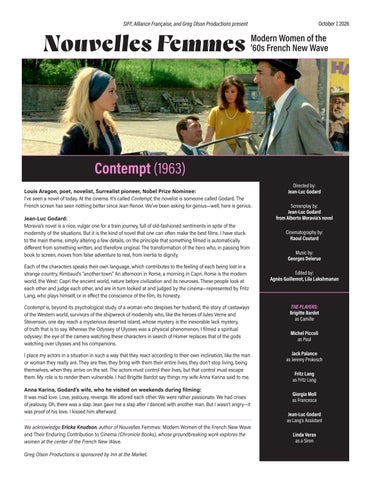
Contempt (1963) Louis Aragon, poet, novelist, Surrealist pioneer, Nobel Prize Nominee: I’ve seen a novel of today. At the cinema. It’s called Contempt, the novelist is someone called Godard. The French screen has seen nothing better since Jean Renoir. We’ve been asking for genius—well, here is genius. Jean-Luc Godard: Moravia’s novel is a nice, vulgar one for a train journey, full of old-fashioned sentiments in spite of the modernity of the situations. But it is the kind of novel that one can often make the best films. I have stuck to the main theme, simply altering a few details, on the principle that something filmed is automatically different from something written, and therefore original. The transformation of the hero who, in passing from book to screen, moves from false adventure to real, from inertia to dignity. Each of the characters speaks their own language, which contributes to the feeling of each being lost in a strange country, Rimbaud’s “another town.” An afternoon in Rome, a morning in Capri. Rome is the modern world, the West: Capri the ancient world, nature before civilization and its neuroses. These people look at each other and judge each other, and are in turn looked at and judged by the cinema—represented by Fritz Lang, who plays himself, or in effect the conscience of the film, its honesty.
Directed by: Jean-Luc Godard Screenplay by: Jean-Luc Godard from Alberto Moravia’s novel Cinematography by: Raoul Coutard Music by: Georges Delerue Edited by: Agnès Guillemot, Lila Lakshmanan
Contempt is, beyond its psychological study of a woman who despises her husband, the story of castaways of the Western world, survivors of the shipwreck of modernity who, like the heroes of Jules Verne and Stevenson, one day reach a mysterious deserted island, whose mystery is the inexorable lack mystery, of truth that is to say. Whereas the Odyssey of Ulysses was a physical phenomenon, I filmed a spiritual odyssey: the eye of the camera watching these characters in search of Homer replaces that of the gods watching over Ulysses and his companions.
THE PLAYERS: Brigitte Bardot as Camille
I place my actors in a situation in such a way that they react according to their own inclination, like the man or woman they really are. They are free, they bring with them their entire lives, they don’t stop living, being themselves, when they arrive on the set. The actors must control their lives, but that control must escape them. My role is to render them vulnerable. I had Brigitte Bardot say things my wife Anna Karina said to me.
Jack Palance as Jeremy Prokosch
Anna Karina, Godard’s wife, who he visited on weekends during filming: It was mad love. Love, jealousy, revenge. We adored each other. We were rather passionate. We had crises of jealousy. Oh, there was a slap. Jean gave me a slap after I danced with another man. But I wasn’t angry—it was proof of his love. I kissed him afterward. We acknowledge Ericka Knudson, author of Nouvelles Femmes: Modern Women of the French New Wave and Their Enduring Contribution to Cinema (Chronicle Books), whose groundbreaking work explores the women at the center of the French New Wave. Greg Olson Productions is sponsored by Inn at the Market.
Michel Piccoli as Paul
Fritz Lang as Fritz Lang Giorgia Moll as Francesca Jean-Luc Godard as Lang’s Assistant Linda Veras as a Siren
CONTEMPT IS THE STORY OF THAT WORLD... BY JOHN TRAFTON This is my favorite Godard film. From beginning to end, Contempt endlessly fascinates me. Emotionally, it is tragic. It makes me sad, and Georges Delerue’s score—one of the most achingly beautiful scores ever written for a film—makes that sadness feel personal. The film centers around the production of an adaptation of Homer’s The Odyssey, and all the major figures involved have their own vision of what the film should be and what Homer should mean. That makes Contempt a film about filmmaking, certainly, but also about interpretation: of art, of marriage, and of other people. A few weeks ago, I mentioned that filmmaker and critic Mark Cousins refers to Godard as “cinema’s greatest terrorist.” Let’s return to that idea, because what Godard is doing in Contempt foreshadows what would make him such a force to be reckoned with in films like La Chinoise and Week-End. A lot of Godard fans dismiss Contempt as not quite the film the auteur really wanted, characterizing it as the kind of filmmaking he would spend much of his later career attacking. But that just makes me like it even more. For instance, the film was shot in CinemaScope—not something we necessarily associate with Godard, although neither was 3D when he made Goodbye to Language in 2014. Given the resources of prestige European filmmaking, Godard does not surrender to them. He turns them against themselves. Whose contempt does the title refer to? Godard’s? Sure. His contempt for producers and film financiers is easily recognizable onscreen. Jack Palance’s American producer, Jeremy Prokosch, has contempt for the art-film aspirations of Fritz Lang, playing himself. Lang, meanwhile, represents an older European cinema and an older history: this is the filmmaker who fled Germany after the Nazis came to power, now finding himself answering to an American producer who tosses film cans around when he doesn’t like what he sees. Hovering over all of this is playwright Bertolt Brecht. His concept of the “alienation effect”—in which a work deliberately exposes the mechanisms of its own construction rather than allowing us to disappear comfortably inside an illusion—is everywhere in Contempt. Godard gives us cinema while continually reminding us that we are watching cinema. In doing so, he anticipates not only his own increasingly radical work but filmmakers across New Hollywood, New German Cinema, the Japanese New Wave, punk cinema, and the American independent cinema of the 1980s and 1990s. Contempt, then, becomes more than the film’s subject: it becomes Godard’s method, a way of turning cinema against the very machinery that produces it. And then there is Brigitte Bardot. As Camille, Bardot is the film’s emotional core, introduced to us, seemingly, as an object of desire. In the famous opening bedroom scene, she asks Paul (Michel Piccoli) what he thinks
of her body, moving piece by piece through it as Godard’s camera looks on. On the surface, this seems like the ultimate male-gaze sequence: one of the most famous sex symbols in the world, naked in CinemaScope. But Godard is setting a trap. The sequence was added after the film’s producers demanded more nudity from Bardot. Godard responds by giving them exactly what they asked for... and then making the producers’ demand itself visible. Bardot’s body becomes almost an inventory. Do you like my feet? My knees? My thighs? My breasts? The very process by which cinema fragments and commodifies a woman’s body becomes the subject of the scene. That matters because Camille will spend the rest of Contempt discovering that the same process exists outside the movie camera. Paul wants to be an artist, but he also wants the money Prokosch offers him to rewrite Lang’s Odyssey. Worse, he seems willing to allow Prokosch access to Camille, encouraging her to ride alone with him and failing—or refusing—to understand what that gesture means to her. Something changes, Camille looks at her husband differently, and suddenly the title becomes devastatingly intimate. Her contempt is not irrational, nor is it simply the mysterious emotional volatility of a beautiful woman. She has seen something in Paul that she cannot unsee. The man who tells her that he loves her has nevertheless participated in a world in which she can be looked at, appraised, exchanged, and offered up. Thus, Paul spends much of the film trying to understand the precise moment when Camille stopped loving him, but perhaps that obsession is itself his failure. He keeps searching for an explanation while refusing to see what she has already seen. This is where Bardot becomes much more than a vehicle for Godard’s ideas about alienation. Her performance grows colder and more distant as the film progresses, but that distance is expressive. Camille withdraws from the systems attempting to define her: husband, producer, filmmaker, and, ultimately, audience. Even the extraordinary apartment scenes turn domestic space into an emotional CinemaScope battlefield. Paul and Camille occupy the same home but increasingly seem to inhabit separate worlds. Walls, doorways, furniture, and that enormously wide frame divide them long before their marriage has formally ended. That is why Contempt remains so moving to me. For all its intellectual games, classical mythology, Brechtian alienation, jokes about producers, and arguments about what cinema should be, its tragedy is painfully simple: a man loves a woman, and then, one day, she looks at him differently. The tragedy is that he never completely understands why.