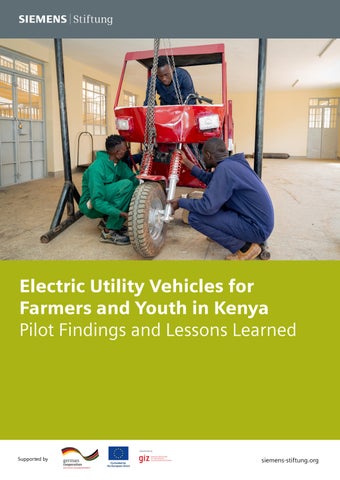
Electric Utility Vehicles for Farmers and Youth in Kenya Pilot Findings and Lessons Learned
Supported by
siemens-stiftung.org
Imprint
Published by Siemens Stiftung Kaiserstraße 16 80801 Munich Germany Tel.: +49 (0) 89 / 54 04 87-0 info@siemens-stiftung.org www.siemens-stiftung.org Deutsche Gesellschaft für Internationale Zusammenarbeit (GIZ) GmbH Mahiga Mairu Avenue Nairobi, Kenya www.giz.de
Responsible for Content Dr. Nina Smidt and Robert Balthasar Editorial team Tumaini Innovation Center: Samwel Kimani, Sally Praise Siemens Stiftung: Sebastian Gruss, Winnie Njogo, Kibet Shadrack
Layout Niko Creative 90 JGO James Gichuru Road, Nairobi, Kenya www.nikocreative.co.ke Photo Credits ©Siemens Stiftung
About Us
The non-profit, internationally operative Siemens Stiftung is committed to sustainable social development. Together with individuals and communities, it creates opportunities to actively shape social and ecological transformation. It focuses on three key areas of action: Essential Services, Digitality, and Climate. By collectively addressing challenges in these fields, the foundation harnesses them as opportunities for innovation and positive change. Through projects in Education, Social Entrepreneurship, and Culture, it facilitates access and participation, strengthens futureoriented competencies, and enables interdisciplinary and collaborative learning. Siemens Stiftung connects local actions with global perspectives to support resilience, social cohesion, and regenerative practices. www.siemens-stiftung.org The Tumaini Innovation Center seeks to engage vulnerable youth in a revolutionary new educational model that break downs educational barriers faced by street youth and other vulnerable youth in a changing society, leverage their inherent resourcefulness, resilience and independence, and equip them with the knowledge and skills they need to not only get off the streets but to have successful and productive careers in their community. The Deutsche Gesellschaft für Internationale Zusammenarbeit (GIZ) is a service provider in the field of international cooperation for sustainable development and international education work. We are dedicated to shaping a future worth living around the world. We have over 50 years of experience in a wide variety of areas, including economic development and employment promotion, energy and the environment, and peace and security. We work with businesses, civil society actors and research institutions, fostering successful interaction between development policy and other policy fields and areas of activity. Our main commissioning party is the German Federal Ministry for Economic Cooperation and Development (BMZ).
Table of Contents 1. Executive Summary 2. Project Context and Approach 2.1. Project Rationale 2.2 Project Objectives 2.3 Project Approach 2.4 Project Location and Participants 3. Target Users, Market Needs and Design Requirements 3.1 Target Users and Their Needs 3.2 Transport Needs and Current Constraints 3.3 Market Requirements and User Preferences 3.4 Design Requirements Emerging from the Market 3.5 What the Market Evidence Established 4. Vehicle Design, Development and Testing 4.1 From User Requirements to Vehicle Design 4.2 Technical Configuration 4.3 Local Fabrication and Assembly 4.4 Prototype Testing and Technical Performance 4.5 Design Iterations and Technical Learning Prototype 1: Initial Configuration Prototype 2: Structural and Serviceability Improvements Prototype 3: Drivetrain, Braking and Differential Refinement 4.6 Prototype Costs and Cost Drivers 4.7 Technical Learning from the Development Process 4.8 Transition to Pilot Deployment 5. Business Model Testing and Pilot Implementation 5.1 Developing the Business Model 5.2 Testing the Daily Leasing Model 5.3 Pilot Operations and Operator Experience 5.4 Revenue, Costs and Operator Earnings 5.5 Vehicle Utilisation, Downtime and Maintenance 5.6 Charging and Energy Use 5.7 Customer Response and Market Acceptance 5.8 What the Pilot Revealed About Commercial Viability 5.9 Lessons for the Business Model 6. Early Impact and Pilot Results 6.1 Evidence Base and Scope
6.2 Economic and Livelihood Outcomes 6.3 Customer Experience and Service Performance 6.4 Operational and Technical Performance 6.5 Environmental and Energy Benefits 6.6 What the Pilot Evidence Shows So Far 6.7 Strengthening the Evidence Base 7. Key Learnings from the Project 7.1 Bringing User Needs into Practice 7.2 What Worked Well in the Development and Pilot 7.3 Technical and Operational Challenges 7.4 Lessons from the Business Model 7.5 Lessons on Market Acceptance and Customer Demand 7.6 What Needs to Be in Place for Scale 7.6.1. Infrastructure and Component Availability 7.6.2. Financing, Regulation and Insurance Will Shape Adoption 8. Priorities for the Next Phase 8.1 Strengthen the Vehicle Through Continued User-Led Development 8.2 Develop Financing Models That Support Ownership and Affordability 8.3 Build the Charging, Battery and Maintenance Infrastructure 8.4 Strengthen Local Fabrication and the Spare-Parts Supply Chain 8.5 Expand Skills Development and Youth Enterprise Opportunities 8.6 Strengthen Fleet Management and Evidence-Based Decision-Making 8.7 Address Licensing, Insurance and Policy Requirements 8.8 Scale the Fleet in Stages, Linked to Evidence 8.9 A Coordinated Approach to the Next Phase 9. Conclusion
1.
Executive Summary
1 Executive Summary Rural and peri-urban communities in Kenya face persistent challenges in moving agricultural produce, goods and people. Farmers and small businesses often rely on petrolpowered motorcycles and tuk-tuks that can be costly to operate, have limited carrying capacity and are not always suited to difficult rural roads. For young people working in informal transport and logistics, these constraints also limit the potential to build more productive transport enterprises. The Tumaini 3-Wheeled Electric Utility Vehicle (EUV) project was developed to test whether a locally fabricated electric utility vehicle could provide a more appropriate transport option while creating opportunities for youth enterprise and local technical capacity. The project was implemented in Ainabkoi Sub-County, Uasin Gishu County, through four linked phases: needs assessment, co-design and vehicle development, commercial pilot testing, and impact assessment. The initial market assessment reached 216 respondents, supported by 11 key informant interviews and three focus group discussions. The findings established that users were looking for more than an electric alternative. They needed a vehicle that could carry meaningful loads, operate reliably on rural roads, remain affordable to use and be accessible through financing arrangements suited to irregular incomes. These requirements were then taken into a participatory co-design process involving 21 participants.
1. Executive Summary
7
The development process translated those requirements into a locally fabricated vehicle and three successive prototype iterations. The prototypes addressed practical issues including chassis strength, weight distribution, stability, suspension, braking and drivetrain performance, while incorporating an enclosed cabin, multipurpose cargo configuration and detachable battery system. The experience demonstrated that local fabrication can support adaptation, repair and skills development, but also exposed a critical constraint for future production: reliable access to standardised components, spare parts and technical expertise. The five vehicle pilot then moved the project from product development into real commercial use. Customer feedback was encouraging in several important areas. 89% of respondents rated reliability positively, 83% rated safety highly and 83% rated timeliness as good or excellent. At the same time, the pilot exposed clear performance gaps. 44% identified speed as the main area requiring improvement, while some customers wanted greater cargo capacity, including a capacity of at least 1 tonne. 61% indicated that they would continue using the service, although 28% expressed hesitation, primarily because of speed and cost. In some locations, demand exceeded the available fleet, but demand was not consistent across all operating days and locations. The commercial results provide a more mixed picture. Operators generated average daily gross revenue of approximately KES 3,650. After the daily lease and
1. Executive Summary
reported charging and operating costs, approximately KES 2,525 was retained by the operator. This indicates meaningful operator-level earning potential when demand and utilisation are sufficient, but it does not represent guaranteed income or enterprise-level profit. At the enterprise level, the current leasing arrangement did not cover the wider operating costs of the fleet, resulting in an estimated monthly operating loss of KES 3,300 under the pilot's current assumptions. The key commercial lesson is therefore not simply that the vehicles can generate income, but that utilisation, pricing and operating costs must be balanced carefully for the model to work for both operators and the organisation providing the vehicles. The pilot also generated important technical and operational learning. Speed, downtime, punctures, wheel vibration and other mechanical issues affected performance, while battery range varied according to battery configuration and operating conditions. An imported motor failure also demonstrated the practical importance of component availability
8
and local repair capacity. These experiences reinforced that vehicle reliability is not determined by individual components alone. Load, speed, battery capacity, range, weight, durability, serviceability and cost need to be considered as an integrated system. The project also established an early foundation for youth participation in electric mobility. 10 youth operators were trained in safe vehicle operation, battery management and basic maintenance. At the infrastructure level, 87.3% of farmers and 93.3% of youth operators expressed a preference for solar charging, signalling strong demand for renewable-energy charging infrastructure. This should be understood as a future infrastructure opportunity rather than an existing feature of the pilot vehicles. Taken together, the pilot has moved the Tumaini EUV from a community-identified concept into real-world development and commercial testing. It provides encouraging evidence of technical feasibility, customer acceptance, local fabrication capability and operator earning potential, but it has not yet established a consistently profitable fleet business or a fully mature model for scale. The central learning is that the vehicle itself is only one part of the solution. Commercial performance will also depend on charging and battery infrastructure, maintenance and spare-parts availability, appropriate financing, fleet utilisation, licensing and insurance. The next phase should therefore focus on validation before expansion. The proposed move from five vehicles to 10–30 vehicles should be used to test whether improvements in vehicle performance, financing, charging, maintenance and fleet management produce more consistent utilisation and stronger enterprise economics. Longer-term expansion towards 100 or more vehicles should follow only once these conditions have been demonstrated at a larger scale. The objective is not simply to deploy more vehicles, but to establish a model that is technically reliable, affordable to users, capable of supporting viable operator incomes and commercially sustainable for the enterprise.
1. Executive Summary
9
2.
Project Context and Approach
2.1 Project Rationale
Agriculture is a major source of livelihoods in rural Kenya, but the ability of farmers and small businesses to generate income is closely linked to the availability, affordability and reliability of transport. Moving agricultural produce, inputs and other goods can be difficult where existing transport options have limited carrying capacity, high operating costs or poor suitability for rural roads. These constraints can increase the cost of getting goods to market and reduce the value that producers are able to capture from their activities. Young people working in informal transport and logistics face related challenges. Petrol-powered vehicles require ongoing expenditure on fuel and maintenance, while operators depend on sufficient trips and loads to generate income. These pressures make vehicle reliability, operating costs and utilisation important determinants of whether transport services can support viable livelihoods.
challenges. It sought to develop a multipurpose electric utility vehicle suited to rural and peri-urban conditions, with local fabrication and maintenance as part of the intended model. The focus was not simply on introducing an electric alternative to existing vehicles. The project therefore examined more than the potential of an electric alternative to conventional vehicles. It also tested whether the vehicle could meet users’ practical requirements, be produced and maintained locally, and be accessed through commercial and financing arrangements suited to the needs of farmers and youth operators.
The Tumaini 3-Wheeled Electric Utility Vehicle (EUV) project was developed in response to these transport and livelihood
2. Project Context and Approach
11
2.2 Project Objectives The project had two linked primary objectives: 1. Development of an electricpowered, multipurpose and affordable 3-wheeled agricultural and transport utility vehicle capable of supporting the movement of agricultural produce, goods and people in rural and peri-urban settings. 2. Development of a viable business model for accessing and using the vehicles, including rental, lease-to-own and instalment-based financing options that could respond to the financial realities of farmers and youth operators. A further objective was to strengthen the local technical capacity required to support the vehicles beyond their initial development. This included local fabrication, maintenance and operator training, creating a foundation for continued use and potential future production of electric utility vehicles within the local transport ecosystem. These objectives extended beyond producing a functioning vehicle. They also required the project to generate evidence on whether the vehicle met users’ needs, performed reliably, could be maintained locally and could be used under commercially viable arrangements.
2.Project Context and Approach
12
2.3 Project Approach The project followed a four-phase approach, with findings from each phase informing the next. This structure was deliberate: rather than developing the vehicle first and testing it only after completion, the project progressively moved from understanding the market to translating those findings into a vehicle, testing its use in practice and assessing the outcomes that emerged.
Phase 1: Needs Assessment and Market Research The first phase established the transport needs and operating realities of potential users. Data was collected through 216 surveys, 11 key informant interviews and three focus group discussions, covering farmers, youth operators and other relevant transport stakeholders. The assessment considered existing transport practices, affordability, cargo requirements, vehicle performance, charging needs and preferred financing arrangements. The purpose of this phase was to ensure that subsequent vehicle development was grounded in actual use requirements rather than assumptions about what an electric utility vehicle should provide.
Phase 2: Co-Design, Prototyping and Testing The second phase translated the findings from the needs assessment into practical vehicle requirements. A participatory co-design process involving 21 participants was used to identify priority features and design considerations, which were then incorporated into successive prototypes. The vehicle was developed through local fabrication and repeated testing rather than as a single, fixed design. Testing and refinement focused on key systems including the chassis, weight distribution, suspension, braking and drivetrain. This allowed the development process to respond to issues that became apparent only when the vehicle was physically built and operated.
2.Project Context and Approach
13
Phase 3: Pilot Business Model Testing Once the vehicle had reached a level of readiness for field use, five vehicles were deployed under a daily leasing arrangement of KES 800 per vehicle per day. The daily lease was selected as a controlled, relatively low-commitment way of testing commercial use while the vehicles were still undergoing technical refinement. It enabled the project to observe utilisation, operating costs, maintenance requirements, customer demand and operator earnings under real operating conditions before moving to longer-term ownership arrangements. Although the needs assessment indicated interest in instalment, lease-to-own and cooperative approaches, the daily lease provided a practical mechanism for generating initial operational and commercial evidence. The choice of model therefore served as a pilot mechanism for learning, rather than a final determination of the most appropriate long-term financing model.
Phase 4: Impact Assessment The fourth phase assessed the early economic, social, environmental and technical outcomes emerging from the pilot. Fleet managers collected daily operational information covering income, mileage, battery performance and maintenance, supported by weekly reviews with operators. Customer feedback was also collected on areas including cost, reliability, timeliness, safety and service improvements. The impact assessment was designed as an ongoing process rather than a one-time measurement exercise. Longer-term tracking is intended to provide stronger evidence on income, environmental performance, vehicle durability and maintenance costs as the vehicles accumulate more operating experience. The phased approach also created feedback loops between user experience, vehicle development and commercial operations, allowing learning from actual use to inform decisions about the vehicle and its operating model.
2.Project Context and Approach
14
2.4 Project Approach The project was implemented in Ainabkoi Sub-County, Uasin Gishu County, with activities concentrated in Kapsoya, Illula and Kipkorgot. The project engaged several stakeholder groups, each contributing a different perspective to the development and testing process: Farmers, particularly small-scale farmers involved in mixed and crop farming, who represented an important user group for the movement of agricultural produce and goods.
Transport service providers and other local stakeholders, whose practical experience informed requirements for vehicle operation and maintenance.
Youth operators, primarily engaged in informal transport and logistics, who represented potential vehicle operators and entrepreneurs within the emerging electric mobility market.
Government and institutional stakeholders, whose engagement was relevant to the regulatory environment and potential future adoption of electric utility vehicles.
Engaging these groups helped the project consider the vehicle’s suitability for its intended users and operating environment, alongside the practical requirements for operating and maintaining it and developing a viable transport service.
2.Project Context and Approach
15
3.
User Needs and Design Requirements
3.1 Target Users and Their Needs The needs assessment focused primarily on two groups with different but complementary roles in the potential EUV market: farmers who needed to move agricultural produce and goods, and young people already engaged in transport and logistics who could potentially operate the vehicles as an income generating business. Farmers were predominantly small-scale producers engaged in mixed farming and crop farming. Their access to mechanisation was already constrained by cost and availability, with existing equipment including tractors, water pumps and threshing machines. Transport presented an additional constraint, particularly where poor roads, high fuel costs and unreliable vehicles affected the movement of produce and inputs. Youth operators represented a different entry point into the market. Most were already engaged in informal transport and logistics, giving them direct experience of the operating realities that would determine whether an EUV could function as a viable commercial vehicle. Their perspective was therefore important not only in identifying vehicle requirements, but also in understanding durability, operating costs, load requirements and the relationship between vehicle performance and income generation. The assessment consequently considered both sides of the transport service. Farmers and small businesses needed an affordable and dependable means of moving goods, while operators needed a vehicle that could withstand regular use and generate sufficient income to cover its costs.
3. User Needs and Design Requirements
17
3.2 Transport Needs and Current Constraints Transport emerged as a significant constraint across the user groups. Existing options included tractors, boda bodas and fuel powered tuk tuks, but none consistently addressed the combination of carrying capacity, operating cost and rural road suitability required for the intended use cases. For farmers, the gap was particularly evident when larger quantities of produce or inputs needed to be moved. Smaller transport options could require multiple trips, while fuel powered vehicles created continuing operating costs. Users also raised concerns about overloading and the ability of existing vehicles to cope with rural road conditions. The opportunity identified through the assessment was therefore not simply for another transport option, but for a vehicle that could provide greater utility without becoming unaffordable to operate.
Purchase prices above approximately
KES 350,000
were considered difficult for many potential users to absorb.
The second constraint was the cost of ownership. Purchase prices above approximately KES 350,000 were considered difficult for many potential users to absorb. This shifted the question from simply asking whether users wanted an electric vehicle to asking how they could realistically gain access to one. Rental, instalment payments and other flexible financing mechanisms therefore became part of the market requirement from the outset. The EUV consequently needed to combine practical utility, reliability and affordability, rather than relying on electrification alone to make it a suitable alternative.
3. User Needs and Design Requirements
18
3.3 Market Requirements and User Preferences The survey provided more specific evidence on the performance characteristics that users considered important.
Range Range expectations also varied by user group. 56.4% of farmers preferred a range of at least 50 km, while youth operators expressed higher daily range expectations of approximately 100 to 200 km per day. These differences are important because range was not viewed simply as a technical battery specification. For farmers, sufficient range was needed to complete routine transport activities without frequent charging interruptions. For commercial operators, range was directly connected to the number of trips that could be completed during a working day and therefore to potential earnings. The implication was that battery requirements could not be considered independently of vehicle weight, load, terrain, charging access and daily operating patterns.
Charging and Solar Charging emerged as both a vehicle requirement and an infrastructure issue. A strong majority of respondents expressed a preference for solar charging, with 87.3% of farmers and 93.3% of youth operators indicating this preference. This finding points to demand for charging arrangements that could reduce dependence on conventional electricity and potentially lower operating costs as electric mobility expands. It also highlights that charging infrastructure will become increasingly important if vehicle utilisation increases. Importantly, this was a user preference rather than a feature delivered by the pilot vehicles. The EUVs deployed during the pilot were not solar charged. The finding should therefore be understood as an indication of the infrastructure and energy model users would prefer to see developed around future deployment, rather than as an outcome already achieved by the project.
3. User Needs and Design Requirements
19
Financing and Access Affordability was not limited to the purchase price. Users also indicated a strong preference for mechanisms that would spread the cost of accessing a vehicle over time. 40% of farmers and 43.8% of youth operators preferred instalment payments, while leasing was also considered attractive. This preference is particularly significant for youth operators because vehicle payments would need to be supported by income generated through daily transport activities. It suggests that adoption is likely to depend not only on the eventual price of the vehicle, but also on whether payment structures align with users' income patterns and ability to generate revenue from the vehicle. The findings therefore pointed towards a range of possible access models, including hire purchase, rent to own, instalment financing and cooperative ownership, rather than assuming that outright purchase would be the appropriate route for most users.
3.4 Design Requirements Emerging from the Market The market findings were used to establish practical requirements for the co-design and prototyping process. These requirements were not treated as isolated specifications. They had to work together within a vehicle that would be used on rural roads, carry commercial loads and be operated regularly.
Strength, Stability and Durability
Safety and Driver Protection
The combination of heavier loads and uneven terrain placed particular emphasis on structural strength, stability and suspension. The preferred configuration placed the driver at the front with the cargo area at the rear, providing a familiar and practical arrangement for goods transport while supporting vehicle balance.
Safety was another important requirement, particularly because the vehicle would be used for daily commercial transport under varying road conditions. The design requirements therefore extended beyond basic vehicle operation to include an enclosed driver cabin, protected electrical components and features intended to provide greater protection than more exposed transport options.
3. User Needs and Design Requirements
20
Drivetrain and Mechanical Performance
Familiarity and Market Acceptance
The expected loads and terrain also influenced the approach to the drivetrain. The requirements pointed towards mechanical systems capable of handling utility applications, including consideration of a car grade gearbox and propeller shaft rather than relying solely on motorcycle chain based systems.
The assessment also highlighted the importance of familiarity. The tuk tuk format was already recognised by users, providing a familiar reference point for both operators and customers. Retaining elements of a known transport configuration while introducing electric technology was therefore considered useful for market acceptance.
Multipurpose Use Users wanted a vehicle that could support more than one type of transport activity. The design therefore incorporated a multipurpose cargo configuration that could accommodate agricultural produce, goods and other loads.
The design challenge was consequently not to create a completely unfamiliar vehicle, but to adapt a recognised transport format to the new requirements of electric mobility, greater utility and local operating conditions.
The project initially considered broader agricultural mechanisation applications, but subsequent testing indicated that transport was the more immediate and practical use case. The vehicle's multipurpose configuration was therefore retained primarily to support different transport requirements rather than to pursue multiple technically demanding applications at once.
3. User Needs and Design Requirements
21
3.5 What the Market Evidence Established
The needs assessment gave the project a clearer definition of what the EUV needed to achieve. The vehicle needed to carry meaningful loads, withstand rural operating conditions, provide sufficient range for its intended uses, remain affordable to operate and be accessible through financing arrangements suited to the income realities of potential users. Several of these requirements extended beyond the vehicle itself. Charging infrastructure would influence the practicality of electric mobility, while financing arrangements would affect whether potential users could access the vehicle. Battery performance also needed to be considered alongside load, terrain and daily operating patterns. The market evidence therefore did not establish a single specification. It identified a set of interdependent conditions that the vehicle and its surrounding operating model would need to address. These requirements provided the basis for the subsequent co-design, prototyping and testing process. Rather than treating the vehicle as a fixed product, the project entered the development phase with defined user and operating requirements against which the emerging design could be assessed.
3. User Needs and Design Requirements
22
4.
Vehicle Design, Development and Testing
4.1 From User Requirements to Vehicle Design
The requirements identified through the needs assessment were translated into a physical vehicle through engineering design, local fabrication, testing and successive modifications. The development process focused on creating a vehicle that could operate under the rural and peri urban conditions identified during the assessment while remaining practical to maintain and adapt locally. This required consideration of the vehicle as an integrated system, including its structural strength, weight distribution, suspension, braking, drivetrain, electrical system, driver protection and cargo configuration.
4. Vehicle Design, Development and Testing
The project initially produced two prototypes based on the co-design process. Practical testing then exposed issues that could not be fully assessed during the design stage, requiring the vehicle to be refined through three development iterations. Each iteration responded to technical issues identified through testing, moving the vehicle progressively from an initial configuration towards a form suitable for extended field use. This iterative process was important because several aspects of vehicle performance depended on how individual components interacted once assembled. Weight distribution, structural strength, suspension, braking and drivetrain performance could not be assessed adequately in isolation. The development process therefore combined engineering design with repeated physical testing and modification.
24
4.2 Technical Configuration The Tumaini 3 Wheeled Electric Utility Vehicle combined an electric drivetrain with a locally fabricated chassis and body.
The core electrical system comprised a
72V, 100Ah
lithium iron phosphate (LiFePO₄) battery pack, providing approximately
7,200 Wh (7.2 kWh)
The battery was a repurposed second application battery with an integrated Battery Management System (BMS) for battery safety and monitoring.
The vehicle used a 3 kW permanent magnet synchronous motor (PMSM) mounted to the differential.
4. Vehicle Design, Development and Testing
A 72V EM150 motor controller provided programmable motor control and regenerative braking. A 72V to 12V, 10A DC to DC converter supplied power to the vehicle's low voltage electrical systems. The electrical and driver interface included LED headlights, tail and brake lights, indicators and a dashboard battery percentage display, allowing the operator to monitor the remaining battery charge. The mechanical system incorporated leaf spring suspension with shock absorbers and a hydraulic braking system. Both systems were subject to refinement during the development process as the vehicle was tested under different operating conditions. The chassis was constructed from reinforced mild steel square hollow section and fabricated locally. The vehicle included an enclosed cabin, protected electrical systems and a rear cargo area, providing the basic structure for both passenger protection and goods transport.
25
4.3 Local Fabrication and Assembly Fabrication and assembly were undertaken locally, allowing modifications to be made as technical issues emerged during development. The process included preparation and inspection of steel materials, cutting and labelling, chassis fabrication, tack welding and reinforcement, followed by installation of the steering, suspension and braking systems. The electrical system was then integrated before construction of the body structure, including the cargo bed, cabin and rear door. Local fabrication provided a practical advantage during the iterative development process. Changes to the chassis, reinforcement, suspension and other structural elements could be made directly in response to testing without depending on an external manufacturer. This allowed the development team to respond more quickly to problems identified during testing and helped build local technical knowledge around the vehicle. The use of locally available materials and components also supported local repair and modification. This became increasingly important as the project encountered components that were difficult to repair or replace. The experience showed that local fabrication can support adaptability and skills development, but it does not automatically result in a low-cost vehicle. Fabrication labour, assembly and component costs remained significant contributors to production costs.
4. Vehicle Design, Development and Testing
26
4.4 Prototype Testing and Technical Performance Testing was undertaken across mechanical, electrical, road and durability dimensions. The purpose was not only to determine whether the vehicle could operate, but to identify weaknesses that needed to be addressed before extended field deployment. Mechanical Performance
Electrical Performance
Mechanical testing found the chassis to be stable and the steering responsive. However, testing identified the need to improve weight distribution. The chassis was subsequently redesigned to improve balance and handling. This adjustment was important because vehicle stability depended not only on the basic three-wheel configuration but also on how the weight of the chassis, battery, drivetrain and cargo was distributed.
Electrical testing showed stable voltage and smooth torque delivery. The vehicle operated quietly and demonstrated reliable acceleration during testing. The electrical configuration also incorporated the Battery Management System and battery monitoring through the dashboard display, providing the operator with information on available battery charge.
Road Performance Road testing assessed the vehicle on both paved and rough terrain. The vehicle demonstrated effective braking and low vibration and was able to operate across the tested road conditions. The road testing was particularly relevant because the vehicle was intended for environments where road quality varies considerably. The results provided an initial indication that the vehicle's chassis, suspension and braking configuration could support operation beyond controlled workshop conditions.
4. Vehicle Design, Development and Testing
Durability and Maintenance Durability testing and early operation highlighted a different but equally important consideration: whether components could be repaired or replaced within the local operating environment. Where locally available components were used, maintenance and replacement were more straightforward. Conversely, components that were difficult to source or repair had the potential to increase downtime and operating costs. The project therefore increasingly treated serviceability and access to spare parts as part of vehicle performance, rather than as issues to be addressed after the vehicle had been designed.
27
4.5 Design Iterations and Technical Learning The vehicle underwent three main development iterations, with each stage incorporating changes arising from problems identified during the preceding stage.
Prototype 1: Initial Configuration The first prototype provided the initial test of the vehicle concept. Testing identified issues relating to driver positioning, chassis stability and weight distribution. These findings led to changes in the vehicle configuration and informed the subsequent prototype. The experience demonstrated the importance of testing the complete vehicle under realistic conditions. Some issues that appeared manageable when individual components were considered separately became more apparent once the vehicle was assembled and subjected to actual loads and operating conditions.
Prototype 2: Structural and Serviceability Improvements The second prototype incorporated a stronger chassis and improved suspension. Attention was also given to the serviceability of components, recognising that the vehicle would need to be maintained in the local operating environment. The changes improved the vehicle's ability to handle rough terrain and strengthened the structural platform for further testing. The development process at this stage was increasingly concerned with durability and maintainability rather than simply establishing whether the vehicle could operate.
4. Vehicle Design, Development and Testing
28
Prototype 3: Drivetrain, Braking and Differential Refinement The third prototype addressed several specific problems identified through continued testing. An imported motor failed and could not be readily repaired, resulting in its replacement with locally sourced motor units. The braking system was upgraded using components with more accessible spare parts, while the differential was adjusted to address locking issues. Further refinements were made to welding techniques, chassis reinforcement and suspension assembly to improve durability and safety. These changes improved stability, braking, acceleration and reliability. The motor failure was particularly instructive because it demonstrated that technical suitability at the point of installation is only one part of component selection. For a vehicle intended for regular commercial use, the availability of local technical expertise and replacement parts can determine how quickly a vehicle returns to service after a component failure. The three iterations therefore represented a progression from establishing the basic vehicle configuration, to resolving specific operational weaknesses and improving the vehicle's readiness for extended use.
4.6 Prototype Costs and Cost Drivers The development process also generated initial information on the cost of producing the vehicle. Prototype production costs varied according to configuration and level of refinement, ranging from approximately KES 370,000 to KES 500,000 per vehicle.
4. Vehicle Design, Development and Testing
29
Battery
Motor
Controller
KES 110,000
KES 37,000
KES 17,000
Chassis
Frame fabrication
Wheels
KES 7,200
KES 61,600
KES 14,000
Suspension
Electronics
Labour
KES 32,800
KES 42,860
KES 72,500
Assembly
Testing
Miscellaneous
KES 38,720
KES 10,500
KES 52,800
The battery was the largest individual cost at KES 110,000, followed by labour at KES 72,500 and frame fabrication at KES 61,600. This shows that the cost of an electric utility vehicle is not driven by the electric drivetrain alone. Fabrication, labour, assembly and supporting components represent substantial parts of the build cost. These figures should be treated as development stage costs rather than a final production price. The vehicles were being built while the design was still undergoing modification, and some costs were associated directly with prototyping and testing
4. Vehicle Design, Development and Testing
30
The cost range nevertheless points to an important consideration for subsequent production. If the vehicle is to become accessible to its intended users, production will need to become more standardised and efficient, with attention to repeatable fabrication processes, component sourcing and production volumes.
4.7 Technical Learning from the Development Process The development process generated several practical lessons that shaped the transition into field deployment.
First, vehicle balance and structural configuration require testing at full vehicle level. The need to adjust weight distribution demonstrated that the interaction between the battery, drivetrain, chassis and cargo cannot be fully resolved through design specifications alone. Second, component selection needs to account for the local repair environment. The failure of the imported motor showed the operational consequences of using components that local technicians could not readily repair. Replacing it with locally sourced units improved the practicality of maintenance. Third, reliability and serviceability are closely connected. Changes to the braking system, differential, chassis, welding and suspension were not simply technical improvements. They addressed potential sources of downtime and helped make the vehicle more suitable for repeated operation. Finally, technical performance and production cost have to be considered together. Improving robustness and functionality can require additional fabrication, components and labour, creating a continuing need to balance performance with the cost at which the vehicle can ultimately be produced.
4. Vehicle Design, Development and Testing
31
4.8 Transition to Pilot Deployment
Following the three development iterations, the project moved from individual prototype development to deployment of five vehicles for extended field testing. The additional vehicles provided an opportunity to test the refined configuration across actual operating conditions rather than relying only on workshop and prototype testing. This transition was important because commercial operation would expose the vehicles to a wider combination of loads, road conditions, trip patterns, customer requirements and maintenance pressures than could be replicated during controlled testing.
4. Vehicle Design, Development and Testing
32
5.
Business Model Testing and Pilot Implementation
5.1 Developing the Business Model Once the vehicles had reached a level of readiness for field use, the project began testing how they could operate as a commercial transport service. Several approaches were considered for enabling users to access the vehicles, including daily leasing, lease to own, instalment financing and cooperative ownership. For the pilot, the project selected a daily leasing arrangement of KES 800 per vehicle per day. This provided a relatively low commitment for operators while allowing the project to observe the vehicles under actual commercial conditions. It also created an opportunity to collect evidence on utilisation, operating costs, maintenance requirements, customer demand and operator earnings before committing to longer term ownership arrangements. Daily leasing was therefore a pilot mechanism rather than a final business model. It allowed the project to test the commercial proposition while the technology was still being refined and to identify the conditions that would need to be addressed in a longer-term financing or ownership arrangement.
5.2 Testing the Daily Leasing Model The pilot deployed five electric utility vehicles for commercial use. Youth operators were trained before deployment and were responsible for operating the vehicles and providing transport services to customers. Operators maintained daily logbooks capturing trips, revenues, operating costs, downtime and customer feedback, while fleet management meetings were used to review performance and identify issues requiring attention. This approach provided a more consistent evidence base than relying on occasional user feedback. It allowed the project to examine the relationship between vehicle availability, customer demand, utilisation, operating costs and earnings during actual commercial use.
5. Business Model Testing and Pilot Implementation
The pilot was designed to test several practical questions: • • • • • •
What level of revenue could operators generate? What operating costs were associated with daily use? How frequently could the vehicles be utilised? What technical problems affected vehicle availability? How did customers perceive the service? Under what conditions could the model generate sufficient value for both operators and the enterprise?
34
5.3 Pilot Operations and Operator Experience
The vehicles were used for farm produce transport, market deliveries and other goods transport. Operators generally completed between 1 and 6 trips per day, serving approximately 1 to 3 customers per day, depending on demand and operating conditions. Revenue varied substantially across operating days. On lower demand days, gross revenue was approximately KES 300 to KES 1,500, while stronger operating days generated considerably higher
returns. Across the pilot period, the average reported daily gross revenue was approximately KES 3,650. The variation in revenue is important because it demonstrates that the vehicle itself does not guarantee a particular level of income. Operator earnings depend on whether there is sufficient customer demand and enough productive trips to keep the vehicle in use. Operators also identified practical limitations during commercial use. Speed and cargo capacity were among the areas where further improvement was requested, while punctures, wheel vibration and other mechanical issues contributed to periods of downtime. These issues affected not only vehicle performance but also the number of opportunities available to generate revenue.
5. Business Model Testing and Pilot Implementation
35
5.4 Revenue, Costs and Operator Earnings The financial results provide an important indication of the EUV's potential as an income generating asset. The average daily gross revenue was approximately KES 3,650. From this, operators incurred average daily deductions of approximately KES 1,125, consisting of the KES 800 daily lease fee and approximately KES 325 in charging and other reported operating costs. This left approximately KES 2,525 per day retained by the operator after these recorded costs. Average amount (KES) Gross revenue 3,650 Daily lease fee 800 Charging and other operating 325 costs Total deductions 1,125 Amount retained by operator 2,525 Daily operating measure
The KES 2,525 figure should be interpreted carefully. It represents the amount retained by the operator after the recorded lease and operating costs. It is not necessarily the operator's final take home income, and it should not be treated as enterprise level profit.
The income potential also depended strongly on demand. On low demand days, gross revenue could fall to approximately KES 300 to KES 1,500, leaving substantially less after the lease and operating costs. Utilisation was therefore a critical determinant of whether the model was attractive to operators.
The enterprise level economics presented a different picture. Under the current KES 800 daily leasing arrangement, using an average of 24 rental days per month across five vehicles, the model produced an estimated monthly operating loss of approximately KES 3,300.
The pilot therefore revealed an important distinction: the vehicle could generate meaningful earnings for an operator under conditions of sufficient demand, while the enterprise providing the vehicles was not yet covering its wider operating costs. These are separate measures of commercial performance and need to remain separate when assessing the future business model.
5. Business Model Testing and Pilot Implementation
36
5.5 Vehicle Utilisation, Downtime and Maintenance Vehicle utilisation varied according to both customer demand and technical availability. Operators reported between 1 and 6 trips per day, with the number of trips depending on the customers available and the nature of the transport work. The vehicles therefore did not operate at a consistent utilisation level throughout the pilot. Technical downtime also affected availability. Punctures, wheel vibration and other mechanical issues required attention during operations. While these problems provided useful information about the maintenance requirements of vehicles in commercial use, they also had a direct commercial consequence because a vehicle that is unavailable cannot generate revenue. Access to spare parts and repair capacity was consequently an important part of fleet performance. Where a problem could be resolved quickly, its effect on operations was limited. Delays in sourcing components, by contrast, reduced the number of days a vehicle was available for productive use. Maintenance therefore needs to be treated as part of the commercial model rather than as a separate technical function. As the fleet grows, preventive maintenance, spare parts availability and clear repair procedures will be important to maintaining vehicle utilisation.
5.6 Charging and Energy Use During the pilot, operators generally relied on a single charge rather than routinely changing batteries during the day. Battery swapping was therefore not a major feature of day-to-day operations. This provides an initial indication of the energy requirements of the vehicles under the operating patterns observed during the pilot. However, the infrastructure requirements for a small fleet operating on a single daily charge
5. Business Model Testing and Pilot Implementation
will differ from those of a larger fleet with higher utilisation or multiple shifts. Further deployment will therefore be needed to establish the charging capacity required as trip volumes increase. The strong preference for solar charging identified during the needs assessment also has implications for future infrastructure planning. However, solar charging was not implemented on the pilot vehicles. It remains a user preference and potential infrastructure option rather than a feature of the current pilot
37
5.7 Customer Response and Market Acceptance Customer feedback indicated that the vehicles were being used for a range of goods transport activities and that their value was closely linked to the practical service they provided. Customers valued the ability to transport larger quantities of goods than would be possible with a boda boda, while affordability was viewed positively in some use cases At the same time, speed was a recurring concern. Both operators and customers identified improved speed as an area that could strengthen the vehicle's competitiveness, particularly for time sensitive transport. The emerging market response therefore suggests that electrification alone is not the basis on which customers assess the service. They judge the vehicle according to the combination of cost, reliability, speed, carrying capacity and availability.
Demand had exceeded available supply by
28% 17%
requested a carrying capacity of at least 1 tonne
There was also evidence of unmet demand in some locations, with 28% of respondents reporting that demand had exceeded available supply. At the same time, 17% requested a carrying capacity of at least 1 tonne, primarily to reduce the need for multiple trips.
61%
would continue using the service
28%
expressed hesitation, with speed and cost among the main concerns
The potential for continued use was encouraging but not universal. 61% of respondents indicated that they would continue using the service, while 28% expressed hesitation, with speed and cost among the main concerns.
These findings indicate that there is a market for the service, but continued adoption will depend on whether the project can address the factors that directly affect the customer's time and cost.
5. Business Model Testing and Pilot Implementation
38
5.8 What the Pilot Revealed About Commercial Viability The pilot data was used to examine how changes in pricing, utilisation and fleet size could affect enterprise level performance. The scenarios below are projections based on stated assumptions and should not be interpreted as observed pilot results.
800
Monthly Rental Fleet Monthly Revenue Contribution (KES/ Days Size (KES/ Vehicle) Vehicle) 20 4 16,000 340
(19,640)
Expected
1,000
26
5
26,000
10,340
30,700
Optimistic
1,500
28
5
42,000
26,340
110,700
Current
800
24
5
19,200
3,540
(3,300)
Scenario
Daily Rent (KES)
Conservative
The current pilot position, based on KES 800 per day and 24 rental days across five vehicles, produced an estimated monthly operating loss of KES 3,300. Under the projected expected scenario, increasing the daily rate to KES 1,000 and achieving 26 rental days per month would result in an estimated operating profit of KES 30,700. The optimistic scenario, based on KES 1,500 per day and 28 rental days, would produce an estimated operating profit of KES 110,700. The scenario analysis indicates that enterprise economics are sensitive to pricing and utilisation. Under the assumptions used, the current daily rate was insufficient to make the fleet business profitable, while higher rental rates and greater utilisation could improve financial performance. These projections do not, however, establish that the higher rates are affordable to customers or that the assumed utilisation levels can be sustained.
5. Business Model Testing and Pilot Implementation
Monthly operating profit (KES/fleet)
The report also estimates a potential payback period of approximately 48 months under the targeted operating model, based on a daily rate of KES 1,000 and 26 operating days per month. This remains a projection and will need to be tested against actual performance over a longer operating period.
39
5.9 Lessons for the Business Model
The pilot provides several practical considerations for refining the commercial model. • Operator income and enterprise profitability need to be assessed separately. The ability of an operator to retain income from a vehicle does not necessarily mean that the organisation providing the vehicle is covering its full costs. Both perspectives are necessary when assessing the sustainability of the model. • Utilisation is central to the economics. Daily lease obligations continue even when customer demand is low, meaning that insufficient utilisation can quickly reduce operator earnings and weaken enterprise performance. • The daily lease model has demonstrated its usefulness as a testing mechanism, but its suitability as a long term access model remains open. The Operators entered the pilot with a relatively low initial financial commitment, while longer term arrangements such as lease to own, instalment financing and cooperative ownership remain relevant for eventual expansion. • Technical reliability is a commercial issue. Downtime reduces the number of trips and operating days from which revenue can be generated. Spare parts, maintenance capacity and repair procedures therefore need to be considered alongside pricing and financing when developing the business model. The pilot has consequently provided a practical basis for refining the commercial model, but it has not yet established a final model for sustainable fleet operations. Further testing is needed across pricing, utilisation, financing, maintenance and fleet management before larger scale deployment.
5. Business Model Testing and Pilot Implementation
40
6.
Early Impact and Pilot Results
6.1 Evidence Base and Scope The impact assessment examined economic, social, environmental and technical outcomes while the five vehicle pilot was still operational. Daily operating records, weekly fleet reviews and feedback from operators and customers were used to assess vehicle utilisation, revenues, operating costs, downtime, customer experience and technical performance. The assessment distinguishes between outcomes for individual operators and performance at enterprise level. An EUV may provide an operator with an opportunity to earn income while the business operating the fleet remains financially constrained. This distinction is important when interpreting the early results. The findings presented in this section are therefore early impact evidence rather than a final assessment of sustained outcomes. Longer-term monitoring is needed to determine whether the observed patterns continue as vehicles accumulate more operating experience and as demand, utilisation and fleet size change.
6. Early Impact and Pilot Results
42
6.2 Economic and Livelihood Outcomes Operators retained an average of approximately
KES 2,525
per day after the
KES 800
daily lease and approximately
KES 325
charging and other operating costs
The pilot demonstrated that the EUVs can generate income for youth operators when sufficient demand is available. Operators retained an average of approximately KES 2,525 per day after the KES 800 daily lease and approximately KES 325 in reported charging and other operating costs. This provides evidence of operatorlevel earning potential, but it should not be interpreted as a guaranteed daily income or as enterprise-level profit.
On low-demand days, gross revenue fell to approximately
KES 300 to KES 1,500
with reported net income ranging from
KES 0 to KES 1,200 The variation between operating days is important. On low-demand days, gross revenue fell to approximately KES 300 to KES 1,500, with reported net income ranging from KES 0 to KES 1,200. The livelihood opportunity therefore depends on whether operators can consistently secure customers and complete enough productive trips to cover the daily lease and operating costs. Access to the vehicle alone does not guarantee a stable income outcome.
The pilot also created an initial pathway for 10 youth to participate in electric mobility and transport enterprise. The operators received training in safe driving, battery management and basic maintenance, giving them practical experience with both the technology and the operation of a commercial transport service. For customers, the economic benefit was most apparent where the EUV offered a more affordable way of moving goods. Some farmers and vendors considered the service cheaper than boda boda transport, although this was not consistent across all cargo types. The evidence therefore points to potential savings for particular transport uses rather than a universal reduction in transport costs. The pilot does not yet provide sufficient evidence to claim sustained improvements in household income or livelihoods. Establishing this would require longer-term tracking of operator earnings and changes in income across different demand conditions.
6. Early Impact and Pilot Results
43
6.3 Customer Experience and Service Performance Customer feedback provides one of the clearest early indications of the value users saw in the service. 89% of customers rated reliability positively, 83% rated safety highly, and 83% rated timeliness as good or excellent. Cost perceptions were also positive among 78% of respondents. These results indicate that the vehicle was able to deliver a service that customers generally considered dependable, safe and reasonably accessible.
89% 83% of customers rated reliability positively
rated safety highly
83% 78% rated timeliness as good or excellent
6. Early Impact and Pilot Results
Cost perceptions were also positive
The results also identify where the service was falling short. Speed was the most frequently identified area for improvement, cited by 44% of respondents, while 17% specifically requested a carrying capacity of at least one tonne. These concerns are commercially significant because they affect the types of journeys for which customers will choose the EUV and the amount of cargo that can be moved per trip. The intention to continue using the service provides a further indication of market acceptance. 61% of surveyed customers said they would continue using the EUV service, while 28% were hesitant, with speed and cost among the main reasons. At the same time, 28% of respondents reported situations in which demand exceeded available supply in some locations. This combination suggests that the challenge was not simply a lack of demand. Demand existed, but the ability of the service to capture and retain that demand depended on vehicle performance, pricing and availability. The customer evidence therefore points to a service with a credible market proposition, but one that still needs to improve its ability to meet expectations around speed, capacity and affordability.
44
6.4 Operational and Technical Performance The pilot provided evidence that the vehicles could be used repeatedly for commercial transport rather than only under controlled workshop conditions. Operators completed between one and six trips per day and generally served one to three customers. However, utilisation varied considerably according to the availability of customers and the operational condition of the vehicles. Technical performance remained an important influence on this utilisation. The pilot experienced punctures, wheel vibration and other mechanical faults that contributed to downtime. An imported motor also failed and was replaced with locally sourced alternatives, while braking and differential systems were modified during development. These experiences reinforced the importance of designing for repairability and access to replacement components, rather than assessing vehicle performance only on initial functionality. Battery performance also varied according to configuration and operating conditions. Most vehicles were charged once during the operating period and battery swaps were uncommon. As utilisation increases, however, charging arrangements, battery management and range will become more important determinants of vehicle availability. Further operating data is needed to establish how consistently the current battery configuration can support different routes, loads and working patterns. The technical findings therefore do not point to a vehicle that has failed in operation. Rather, they show that the core system is functioning while several aspects of the design and operating environment require further refinement before larger deployment.
6. Early Impact and Pilot Results
45
6.5 Environmental and Energy Benefits The EUV provides a direct environmental advantage through the absence of tailpipe emissions and reduced dependence on petrol for the journeys it replaces. The pilot also indicated potential reductions in fuel expenditure compared with conventional petrol-powered transport.
The energy system supporting the vehicles is equally important. The needs assessment found strong interest in solar charging, with 87.3% of farmers and 93.3% of youth operators expressing a preference for solar charging.
Farmers
Youth
87.3%
93.3%
This creates a strong case for exploring renewable-energy charging as the project develops, particularly if charging infrastructure is expanded alongside the fleet. This finding must, however, be distinguished from an impact already delivered. The pilot vehicles were not solar-charged. The solar figures represent user preference and an opportunity for future infrastructure development, rather than evidence of renewableenergy use by the current fleet. The use of repurposed secondapplication batteries also created an opportunity to extend the useful life of battery assets. At the same time, longerterm battery performance, management and reliability will need to be monitored before the environmental and economic benefits of this approach can be assessed more fully.
6.6 What the Pilot Evidence Shows So Far The pilot provides four important signals. First, there is evidence of market acceptance. Customers generally responded positively to the reliability, safety and timeliness of the service, and a majority indicated that they would continue using it. The presence of unmet demand in some locations further suggests that the service can attract customers where it meets a relevant transport need.
6. Early Impact and Pilot Results
46
Second, the vehicle can create an earning opportunity for operators, but the opportunity is utilisation-dependent. The average amount retained by operators is encouraging, but the much lower returns recorded on low-demand days show why demand generation and route selection are as important to livelihood outcomes as access to the vehicle itself. Third, technical and commercial performance cannot be separated. Speed, cargo capacity, reliability, downtime and vehicle availability influence not only customer satisfaction but also the number of productive trips an operator can complete. Technical improvements are therefore directly linked to the ability of the business model to generate revenue. Fourth, the environmental proposition has potential but requires supporting infrastructure and stronger measurement. Electric operation reduces direct petrol dependence, while interest in solar charging creates an opportunity to strengthen the energy model. The current evidence is not yet sufficient to quantify longer-term fuel displacement or environmental impact. These findings should be interpreted alongside the financial results from the pilot. The operator experience demonstrated earning potential, but the enterprise was not yet consistently profitable under the current leasing arrangement. The evidence therefore supports continued development and testing rather than a conclusion that the commercial model has already been validated at scale.
6.7 Strengthening the Evidence Base The next stage of impact assessment should focus on determining whether the early results are sustained over time and under a wider range of operating conditions. This requires longitudinal tracking of operator incomes, rather than relying on average daily earnings alone. Monitoring should capture differences between high and low demand periods and assess whether operators can maintain productive utilisation over several months. Customer surveys should also be repeated after six months to assess whether initial perceptions of reliability, cost, speed and willingness to continue using the service are maintained. This will help distinguish initial interest from sustained adoption. Technical monitoring should continue alongside the impact assessment, with particular attention to vehicle reliability, component durability, battery performance, maintenance requirements and the frequency and causes of downtime.
6. Early Impact and Pilot Results
Environmental monitoring should strengthen the evidence on fuel displacement and energy use, while assessment of licensing, insurance and other regulatory requirements will show how the wider operating environment affects deployment. The purpose of this extended evidence base is not simply to demonstrate more positive results. It is to establish which aspects of the vehicle and operating model are working consistently, which constraints remain, and what needs to change before the fleet expands beyond the current pilot scale.
47
7.
Key Learnings from the Pilot
7.1 Designing Around Real User Requirements
The project demonstrated the value of taking user requirements into the engineering process rather than treating the needs assessment as a separate research exercise. Farmers and youth operators identified affordability, load capacity, range, safety, durability, charging and financing as important requirements. These requirements were interconnected, and the development process showed that improving one aspect could affect several others. For example, increasing carrying capacity or battery size can improve utility and range, but can also increase vehicle weight, energy consumption and production cost. Similarly, a vehicle designed for heavier loads needs sufficient chassis strength, suspension and drivetrain performance to operate reliably on rural roads. The practical lesson is that the vehicle needs to be developed as an integrated system rather than optimising individual specifications in isolation. The co-design process helped translate user priorities into tangible design decisions, including the reinforced chassis, enclosed cabin, detachable battery and multipurpose cargo configuration. However, incorporating a preference into the design did not necessarily mean that the requirement had been fully met in practice. The pilot identified continuing limitations in areas such as speed, cargo capacity and technical reliability.
7. Key Learnings from the Pilot
The co-design process helped translate user priorities into tangible design decisions, including the reinforced chassis, enclosed cabin, detachable battery and multipurpose cargo configuration. However, incorporating a preference into the design did not necessarily mean that the requirement had been fully met in practice. The pilot identified continuing limitations in areas such as speed, cargo capacity and technical reliability. The project also demonstrated that not every user preference can be incorporated directly. Technical feasibility, component availability, safety and affordability influence which requirements can be delivered in practice. Future development should therefore retain strong user involvement while applying a clear process for prioritising requirements according to technical feasibility, safety, cost and commercial value. This would help the project respond to users’ needs while avoiding features that are impractical or would make the vehicle unnecessarily expensive.
49
7.2 Designing for Reliability and Serviceability Vehicle reliability depends not only on component performance, but also on the ability to maintain and repair the vehicle. The failure of an imported motor that could not readily be repaired, and its replacement with locally sourced motor units, demonstrated the operational risks of relying on components that are difficult to support locally. Modifications to the braking system, differential, chassis and suspension similarly highlighted the importance of serviceability in keeping the vehicle operational. The experience also highlighted the importance of standardisation. Individual vehicles can be adapted through troubleshooting and component substitution, but this approach becomes harder to manage as the fleet grows. Consistent specifications for motors, controllers, mechanical components and other critical parts will be necessary to maintain predictable quality, simplify maintenance and control costs.
7.3 Lessons from the Business Model The experience revealed that operator earning potential and enterprise profitability are distinct measures of commercial viability. Operators could retain income when demand was sufficient, but earnings varied considerably on low-demand days. Meanwhile, the revenue generated under the current daily leasing arrangement was insufficient to cover the enterprise's wider operating costs. The business model must therefore work for both the operators providing transport services and the enterprise responsible for making the vehicles available. Vehicle utilisation is central to this balance. Daily lease obligations continue even when demand is low, while higher utilisation can improve revenue only if vehicles remain available and customers can be served consistently. Increasing lease rates or expanding the fleet may improve enterprise performance, but neither is sufficient on its own. Higher prices could affect affordability and demand, while additional vehicles could increase idle capacity if demand is not established in the locations and transport applications being targeted. The daily leasing arrangement provided a practical
7. Key Learnings from the Pilot
way to introduce the vehicles and test commercial use without requiring operators to purchase them outright. However, it has not established a financially sustainable fleet model or demonstrated that daily leasing is the most appropriate long-term access arrangement. Lease-to-own, instalment financing and cooperative models warrant further testing, particularly given the irregular and seasonal income patterns of some intended users. SACCOs, farmer groups and other collective arrangements may also offer ways to distribute financing risk. These alternatives must be assessed against both user affordability and the costs of operating the fleet. A financing model that makes the vehicles accessible but creates unaffordable repayments may not support sustained adoption. Equally, arrangements that enable operators to earn income but do not allow the enterprise or financing
50
provider to recover its costs may not be commercially viable. Further testing should therefore examine pricing, utilisation, financing, maintenance and fleet management as interconnected parts of the business model. The objective is to establish the conditions under which operators can earn income, customers can access affordable transport services and the enterprise can cover its operating costs. Wider deployment should be guided by evidence that these conditions can be achieved in practice.
7.4 Building a Competitive Customer Proposition Customer responses indicate that the EUV needs to be assessed as a transport service rather than simply as an electric vehicle. Reliability, safety and timeliness were important strengths, while speed, cargo capacity and cost remained areas of concern. This suggests that electrification alone does not create a compelling value proposition. The vehicle must perform competitively for the specific transport tasks it is intended to serve. Demand also proved to be uneven. Some locations experienced demand that exceeded available supply, while low-demand days occurred elsewhere. These findings are
7. Key Learnings from the Pilot
not contradictory. They indicate that demand is shaped by location, customer type, service requirements and operating conditions rather than being uniformly available across the market. This has an important implication for expansion. Adding vehicles without understanding where demand is concentrated could increase idle capacity rather than improve commercial performance. Future deployment should therefore be linked to identified routes, customer segments and use cases where the vehicle's combination of load capacity, operating cost and reliability provides a clear advantage. Building a competitive customer proposition will require continued attention to the service delivered, not only to the vehicle itself. Improvements in speed and cargo capacity, alongside reliable operations and affordable pricing, should be assessed against customer needs and the transport tasks that offer the strongest potential for sustained use. Further deployment should test whether these improvements translate into more consistent demand and utilisation across different operating contexts.
51
7.5 Building the Ecosystem for Scale Wider deployment will depend on more than increasing the number of vehicles. The experience to date indicates that vehicle reliability, access to components, charging and maintenance arrangements, financing, and the regulatory environment are interdependent. If these conditions are not addressed alongside fleet expansion, technical problems and operating costs could constrain vehicle availability, affordability and commercial performance Reliable access to charging, replacement components and maintenance support will be important as the fleet grows. Local fabrication and repair provide a basis for adapting the vehicles to operating conditions, but scaling production and use will require more consistent component specifications, dependable spare-parts supply and technicians able to diagnose and resolve faults. Without these arrangements, vehicle downtime and delays in obtaining replacement parts could undermine service reliability and utilisation. . Financing and regulation are similarly part of the system. Licensing procedures, suitable insurance and financing arrangements can determine whether an otherwise functional vehicle can become a practical commercial asset. These requirements become increasingly important as the project moves from a controlled pilot towards wider deployment. Scaling the model will therefore require coordinated progress across technical support, charging and component supply, financing and regulatory readiness. These conditions should be assessed as part of commercial validation, so that decisions about further expansion are based on evidence that the vehicles can be operated reliably, accessed affordably and supported within the local operating environment.
7. Key Learnings from the Pilot
52
8.
Recommendations
8.1 Vehicle Performance and Refinement The vehicle should continue to be refined through structured engagement with farmers, youth operators and other users. The pilot demonstrated the value of involving end users in identifying requirements and testing whether the resulting vehicle meets those requirements in practice. This process should continue as the vehicle moves from prototype development towards a more standardised production model. Future design iterations should focus particularly on the issues identified during the pilot: speed, cargo capacity, battery range, braking, wheel and suspension performance, durability and general serviceability. Improvements should be assessed against the realities of the target market rather than pursued in isolation. Increasing load capacity or battery size, for example, may improve performance but can also increase vehicle weight, energy consumption and production cost. The objective should therefore be to achieve an appropriate balance between performance, durability and affordability. User feedback should remain part of this process, supported by a clear prioritisation framework. Proposed changes should be assessed against technical feasibility, safety, cost, customer demand and commercial value. This will allow the project to retain the benefits of community led development while avoiding features that are impractical or would make the vehicle unnecessarily expensive. Regular feedback mechanisms should also be maintained during deployment. Surveys, focus groups, operator meetings and structured customer feedback can identify recurring issues and assess whether changes to the vehicle are improving user experience and commercial performance. The aim should be to move progressively from individually adapted prototypes towards a more consistent vehicle configuration that can be reproduced reliably while still allowing appropriate adaptations for different use cases.
8. Recommendations
54
8.2 Financing Models and Affordability
The daily leasing model was useful for introducing the vehicles and testing their operation, but the pilot demonstrated that it should not be treated as the only or necessarily the preferred long term financing mechanism. Farmers and youth operators expressed interest in lease to own, instalment financing and cooperative models. The next phase should therefore test these alternatives alongside continued operational learning. Financing structures should reflect the income patterns of intended users, including the irregular and seasonal nature of agricultural and transport related earnings. Lease to own arrangements could provide a pathway from vehicle access to eventual ownership while reducing the upfront financial barrier associated with purchasing a vehicle outright. Weekly or monthly instalments may also be more manageable for some users than a fixed daily payment where income is not generated consistently every day.
operated as shared commercial assets. The financing models should be tested against the actual economics of the vehicle. A structure that improves access but creates unaffordable repayment obligations will not support sustained adoption. Equally, a financing model that works for individual operators but does not allow the vehicle owner or financing institution to recover its costs will not be commercially viable. The next phase should therefore generate evidence on repayment performance, operator income, utilisation, maintenance costs, ownership progression and customer affordability across different financing arrangements.
Cooperatives, SACCOs and farmer groups should be assessed as potential financing and ownership partners. Collective arrangements may reduce financial risk for individual users, create stronger repayment structures and enable groups to acquire vehicles that can be allocated among members or
8. Recommendations
55
8.3 Charging, Battery and Maintenance Infrastructure Charging infrastructure should be developed alongside fleet expansion rather than after additional vehicles have been deployed. Operators requested charging stations closer to their areas of work, and the next phase should assess where decentralised charging points would provide the greatest operational value and how their costs could be incorporated into the wider business model. Location decisions should consider routes served, operating hours, expected utilisation and electricity availability. The strong preference for solar charging should also inform infrastructure planning. The needs assessment found that 87.3% of farmers and 93.3% of youth operators preferred solar charging. The current vehicles are not solar charged, so the next step is to assess the technical and economic feasibility of integrating renewable energy into future charging infrastructure rather than presenting solar charging as an existing vehicle capability. Battery swapping should also be investigated for higher utilisation operations. The pilot identified an indicative affordable battery swap cost of KES 300 to KES 500. A swapping model could reduce charging downtime and allow operators to continue serving customers when a battery reaches the end of its usable charge during the working day. Before adoption, however, the project should test the costs of batteries, swapping infrastructure, battery management, staffing and logistics to determine whether the model is commercially viable. Maintenance support requires equal 8. Recommendations
attention. The pilot experienced punctures, wheel vibration and other mechanical issues that contributed to downtime. As the fleet expands, a more organised maintenance system will be required to prevent individual technical problems from becoming prolonged periods of vehicle unavailability. The next phase should establish clearer maintenance procedures, identify common failure points, maintain appropriate spare parts inventories and strengthen access to technicians capable of diagnosing and repairing the vehicles. Charging and maintenance arrangements should be assessed together with fleet utilisation and operating costs. The objective is to establish support systems that keep vehicles available for productive use without adding costs that undermine affordability or commercial viability. Their capacity and cost should be tested as the fleet grows, with further investment guided by evidence from actual operating conditions. The next phase should establish clearer maintenance procedures, identify common failure points, maintain appropriate spare-parts inventories and strengthen access to technicians capable of diagnosing and repairing the vehicles.
56
8.4 Local Fabrication and Component Supply Local fabrication provides a basis for producing and maintaining the vehicles within Kenya. However, expanding production will require more consistent fabrication processes and component specifications to ensure that vehicles can be reproduced reliably, quality can be maintained and production costs can be estimated more accurately.
for local sourcing, standardisation or assessment of suitable alternatives. Establishing dependable suppliers and clearer specifications would help reduce uncertainty in both vehicle assembly and ongoing maintenance.
Component availability and consistency are important to both production and maintenance. The pilot demonstrated the value of using locally available alternatives, but also highlighted challenges in sourcing motors, controllers and specialised fittings with consistent specifications and quality. These challenges can complicate repairs, increase uncertainty around component performance and make it more difficult to reproduce the same vehicle configuration across the fleet.
Greater local production and a growing fleet could also create opportunities for technical services beyond vehicle assembly. Mechanics, fabricators, electricians, battery technicians and other service providers may be needed to support maintenance and keep vehicles operational. Developing these capabilities could strengthen local technical capacity, improve vehicle availability and create employment opportunities as demand for these services grows.
A more reliable supply chain is therefore needed for critical components and spare parts. Maintenance records should be used to identify components that fail frequently or are difficult to source. These components can then be prioritised
8.5 Skills Development Skills development is important to the reliable operation of electric utility vehicles and to the ability of young people to earn income from transport services. Youth participation should extend beyond vehicle operation to include relevant technical and enterprise roles within the wider electric-mobility ecosystem. The initial training covered safe driving, customer service, basic vehicle operation and maintenance. These skills remain important as vehicle deployment grows. Additional technical training can strengthen the capacity to identify faults, undertake routine maintenance and reduce avoidable downtime. Enterprise skills, including financial management and business planning, can help operators understand costs, manage revenue and assess the commercial performance of their activities. The multipurpose design also creates opportunities to explore commercial applications beyond conventional passenger transport. Potential uses include goods transport, mobile shops, vending, agricultural service delivery and campaign or outreach vehicles. These applications should be assessed against actual customer demand, operating requirements and their potential to generate sufficient utilisation and income. Diversifying uses may help operators reach different customer groups, but the commercial value of each application
8. Recommendations
57
needs to be established through testing. Skills development and enterprise opportunities are therefore closely linked to vehicle reliability, utilisation and the potential for sustained operator income. Their value lies not simply in the number of people trained or applications identified, but in whether the capabilities developed support effective operations and viable economic activity.
8.6 Fleet Management and Performance Monitoring The structured monitoring system established during the pilot should become a permanent part of the operating model. Daily logbooks and regular fleet manager reviews provided information on trips, revenue, operating costs, downtime and customer feedback. This
information should continue to be collected as the fleet expands, but the monitoring system should also become more systematic in how the data are analysed and used. Key indicators should include:
• vehicle utilisation and rental days;
• number of trips and customers served;
• gross operator revenue;
• lease payments and operating costs;
• amount retained by operators;
• enterprise level operating costs and margins;
• maintenance frequency and cost;
• downtime and causes of downtime;
• charging frequency and charging costs;
• customer satisfaction and repeat use;
• battery performance and range under different operating conditions;
• performance differences between different financing or operating models
8. Recommendations
• demand that cannot be served because of limited vehicle availability; and
58
Maintaining this dataset will allow the project to distinguish isolated experiences from consistent patterns and determine whether improvements in the vehicle or business model are translating into better utilisation, lower costs and stronger financial performance. Monitoring should therefore be treated as a management tool rather than simply a reporting requirement, with regular review informing decisions on pricing, maintenance, vehicle specifications, charging infrastructure, financing and fleet expansion.
8.7 Licensing, Insurance and Policy Requirements Regulatory requirements need to be addressed before the vehicles move into substantially larger scale commercial deployment. Operators identified licensing and insurance as areas of uncertainty, making clear guidance on licensing, registration, insurance and operation within existing transport frameworks important for wider adoption. Engagement with the National Transport and Safety Authority (NTSA) and relevant county authorities should be strengthened to clarify the pathway for registering and operating the vehicles. This should include understanding how the vehicles are classified and what requirements apply to their different intended uses. Insurance providers should also be engaged to assess the availability and affordability of appropriate cover for small scale electric utility vehicle operators. Insurance products need to reflect the actual risks and operating conditions of these vehicles while remaining affordable for the target market. At policy level, engagement with county and national government can help position electric utility vehicles within broader rural transport, youth employment, agricultural logistics and green mobility strategies. Where appropriate, the project should explore policy measures that could reduce barriers to adoption, including incentives relating to electric mobility, financing or charging infrastructure. Such measures should respond to demonstrated barriers and complement rather than substitute for a viable underlying business model.
8. Recommendations
59
8.8 Phased Fleet Expansion and Validation Fleet expansion should be progressive rather than based solely on a target number of vehicles. The project has proposed increasing the fleet from the current five vehicles to approximately 10–30 vehicles in the short term, with the potential to reach 100 or more vehicles over the longer term. This provides a useful direction for growth, but each stage should be linked to evidence from the preceding stage. Short term: 10–30 vehicles The immediate priority should be to expand the fleet sufficiently to test the model across a broader range of operators, routes, customers and operating conditions. This stage should focus on: • •
• • • • • • •
refining the vehicle based on pilot findings; testing lease to own and other financing arrangements; expanding charging access; strengthening maintenance and spare parts systems; continuing operator training; improving fleet management and data collection; testing different commercial applications; addressing licensing and insurance requirements; and generating stronger evidence on utilisation and enterprise level economics.
The purpose of this stage should be validation at a larger but still manageable scale. It should establish whether the operational and commercial findings from the five vehicle pilot hold when more vehicles are deployed.
8. Recommendations
Medium term: Consolidation and business model development Once the expanded fleet has generated sufficient evidence, the focus should shift towards strengthening the most viable financing and operating models. This should include broader implementation of lease-to-own and cooperative models where the evidence supports them, development of stronger spareparts supply chains, expansion of operator and technician training, and further investment in charging and battery infrastructure. The business model should also be assessed across different customer segments and use cases to determine where the vehicles achieve the strongest utilisation and commercial returns.
Long term: 100 vehicles A fleet of 100 or more vehicles should be considered only once the core elements of the model have demonstrated sufficient reliability and commercial viability. At this stage, the focus can shift towards larger scale production, broader charging networks, stronger local supply chains, expanded financing partnerships and integration of the vehicles into county and national transport strategies. Solar powered charging networks could also be considered where the technical and economic evidence supports their deployment. The long term objective should not be fleet size alone. The aim should be to establish a repeatable model in which the vehicle can be produced and maintained locally, operators can earn viable incomes, customers receive a reliable and affordable service, financing partners can recover their investment, and the supporting infrastructure and regulatory environment enable continued operation.
60
9.
Conclusion
9 Conclusion The pilot demonstrated that a locally fabricated electric utility vehicle can address transport needs in rural and peri-urban settings while creating income-generating opportunities for youth operators. Customer responses were positive on reliability, safety and timeliness, and operators generated average gross daily revenue of approximately KES 3,650, retaining around KES 2,525 after the reported daily lease and operating costs. However, variations in demand and utilisation, alongside concerns about speed, cargo capacity and cost, indicate that the vehicle requires further refinement to meet users’ needs consistently and affordably.
Customer responses were positive on reliability, safety and timeliness, and operators generated average gross daily revenue of approximately KES 3,650, retaining around KES 2,525 after the reported daily lease and operating costs.
The findings also show that technical reliability, local serviceability and commercial performance are closely linked. Mechanical faults, downtime and inconsistent access to components affect vehicle availability and earnings. Local fabrication enabled modifications and repairs, but greater component standardisation, dependable spare-parts supply and stronger maintenance capacity will be important as deployment grows. Similarly, the daily leasing arrangement demonstrated operator earning potential but did not cover the fleet enterprise’s wider operating costs under the pilot assumptions. A commercially viable model will need to balance operator earnings and customer affordability with utilisation and the costs of operating and maintaining the fleet. The pilot has not yet established sustained livelihood improvements, long-term customer retention, quantified environmental benefits or the economics of larger-scale production. These outcomes require longer-term monitoring and testing.
9. Conclusion
62
under a wider range of operating conditions. Solar charging, alternative financing arrangements and other measures that could support adoption also require further assessment; they should not be treated as proven solutions on the basis of the current pilot. The project has established a credible basis for continued development, but not yet a fully validated commercial model. Further progress will depend on improving the vehicle and the systems that support its use, while testing whether demand, utilisation and enterprise economics remain viable at a larger scale. Expansion from five vehicles to approximately 10–30 should serve as a further stage of validation, with longer-term growth considered only when technical reliability and commercial viability have been demonstrated. The objective is to establish a model that can provide reliable, affordable transport, support viable operator incomes and cover the costs of the enterprise.
9. Conclusion
63
Siemens Stiftung Kaiserstrasse 16 80801 Munich Germany siemens-stiftung.org
64