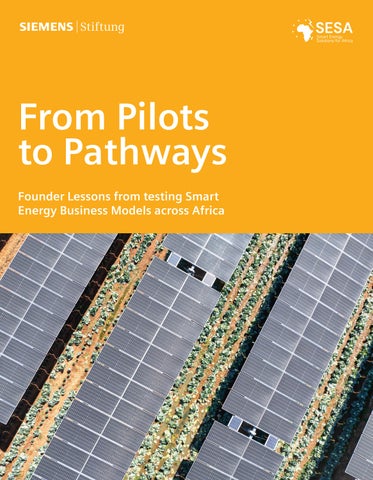
From Pilots to Pathways Founder Lessons from testing Smart Energy Business Models across Africa
02
Introduction
Imprint Published by Siemens Stiftung Kaiserstraße 16 80801 Munich Germany Tel.: +49 (0) 89 / 54 04 87-0 info@siemens-stiftung.org www.siemens-stiftung.org Responsible for content Dr. Nina Smidt and Robert Balthasar Editorial team Elisabeth Biber, Siemens Stiftung Jagori Dhar, Siemens Stiftung Layout Anna Landskron, Surface Gesellschaft für Gestaltung Photo Credits © Krisartist94/stock.adobe.com | © Lucian Coman/shutterstock.com | © Powerstove | © Riccardo Niels Mayer/stock.adobe.com | © SDI Productions/istock | © Siemens Stiftung / WeTu, Fotograf: Antony Ochieng | © Smart Energy Enterprise SEE
02
Across Africa, energy enterprises are developing solutions to problems that are well understood: unreliable energy access, high fuel costs, post-harvest losses, limited access to irrigation, and dependence on polluting cooking fuels. In many cases, the technology itself is not the main uncertainty. The more difficult question begins once a solution moves beyond a pilot and into everyday use: will customers adopt it, keep using it and keep paying for it, and can the enterprise sustain the model as it grows? These were some of the questions that emerged during the Smart Energy Solutions for Africa (SESA) project. Over four years, social enterprises and inno vation partners tested and refined smart energy solutions across agriculture, cold storage, clean cooking, and e-mobility. Funded under the European Union’s Horizon 2020 program and implemented between 2021 and 2025, SESA brought together more than 29 partners across Ghana, Kenya, Malawi, Morocco, Namibia, Nigeria, Rwanda, South Africa, and Tanzania.
Within the project, solutions were not only deployed but continuously adapted through implementation and user feedback. Demonstration and replication activities across different countries created opportunities to observe how technologies and business models performed under varying market conditions. What became visible over time was the gap between a model that works in principle and one that works under real operating conditions. Rather than offering a fixed blueprint for scale, the publication looks at what can be learned from that process of testing and adjustment. It brings together recurring lessons from across the SESA cases and then grounds them in the experiences of enterprises in Malawi, Nigeria, and Kenya. The focus is on what changed once initial assumptions were tested in practice, and the decisions enterprises made in response. Taken together, the cases suggest that scaling energy solutions depends not only on innovation itself, but also on whether technologies, financing struc tures, operations, and customer reali ties can come together in a model that remains viable as it grows.
03
Founders’ myths, tested in practice
MYTH FACT
Across the SESA pilots, many of the initial assumptions reflected approaches that are widely shared across the energy access sector. In several cases, these assumptions also appeared reasonable during early implemen tation. However, as enterprises moved beyond pilots and into expanding operations, a more complex operational reality began to emerge.
05
Myth #1
Lower prices guarantee adoption
Myth At first glance, affordability appears straightforward: reduce the price, incentivize, and adoption will follow. Reality check Affordability is rarely just about the total price; it is often a question of timing, liquidity, and financial risk. Customers may assess affordability based on when payments are due, whether they have sufficient cash available, and how much uncertainty the purchase introduces. It also matters whether the product represents an entirely new expense or replaces an existing cost, as this can significantly change the perceived financial barrier to adoption.
What matters is a clear understanding of how customers generate income, how predictable that income is, and what they can realistically commit at different points in time. 06
07
Myth #2
Technical performance alone is enough
Myth If the technology works, adoption and repayment will follow. Reality check Technical performance alone does not guarantee adoption or repayment. Product design extends beyond the technology itself to the wider system needed to make the solution viable under realworld conditions. Across several SESA cases, enterprises saw stronger uptake when technologies were bundled with services such as maintenance, awareness and sensitization, logistics, financing, or market access.
What matters is not only whether the technology works, but whether it works reliably in the customer’s reality. 08
09
Myth #3
If it works in one market, it will scale to others
Myth Once a model worked in one location, the assumption was that it could be easily replicated elsewhere. Reality check Models that performed well in one location often required substantial adaptation else where. In practice, replication was rarely a straightforward roll-out process, as differences in income patterns, infrastructure, risk perception, and existing alternatives shaped how customers engaged with the solution.
What matters is adapting a model to local conditions and the system around the customer instead of assuming there is such a thing as a universally proven model. 10
11 11
Myth #4
Donors will carry us until scale
Myth In early stages, external funding often feels like a bridge to sustainability. The assumption is that once the model proves itself, investments for scaling and financial sustainability will naturally follow. Reality check Grant funding played an important role in early testing and validation, but it did not remove the operational pressures associated with scaling. Across several SESA cases, enterprises required longer timeframes, multiple model adjustments, and significantly more working capital than initially expected, while revenues developed only gradually through extended repayment cycles.
What matters is not only proving that a model works in pilot conditions, but whether it can remain financially and operationally stable once grant support declines. 12
13 13
When models meet reality PAYGO works when value turns into income PAYGO models (or such variations comprising of installment-type payments or lease-based payments) are often seen as a practical way of reducing upfront barriers to energy access by allowing customers to pay gradually over time. For many enterprises, this creates the expectation that affordability challenges can largely be addressed through financing structures alone. This became particularly visible in productiveuse cases such as solar irrigation, where customers could more easily associate repayments with increased yields, additional harvest cycles, or improved incomes. In other cases, especially where solutions were linked more closely to household consumption or behavioral routines, repayment proved more difficult to sustain consistently. For enterprises operating PAYGO models, this created an important operational reality. Affordability was not only determined by total cost, but also by whether customers experienced visible and reliable value quickly enough to support ongoing repay ments. 14
Across the SESA cases, however, the performance of PAYGO models depended less on the financing mechanism itself and more on how directly the tech nology contributed to sustained income generation under real operating conditions.
15
In practice, trust often developed less through formal marketing and more through visible user experiences and peer-to-peer ex change. In these contexts, visible user success often proved more persu asive than technical information or promotional cam paigns alone.
Trust often spread through visible user experience
Diversified revenue streams are often essential in seasonal markets
Lack of awareness was not necessarily the main barrier to adoption. In several markets, customers already understood the general benefits associated with technologies such as irrigation systems, cold storage, or clean cooking solutions. What remained uncertain was whether these solutions would function reliably under local conditions and continue delivering value over time.
Several enterprises participating in SESA operated PAYGO or lease-to-own models in which assets were financed upfront while revenues were recovered gradually over extended repayment periods. As deployment expanded, this created increasing pressure on working capital and liquidity management.
Demonstration activities, cooperative pilots, and direct observation of neighboring users played an important role in reducing uncertainty and encouraging adoption. This became particularly visible where early adopters achieved clearly observable results. Farmer-to-farmer recommendations in Malawi and the visibility of successful e-bike riders in Kenya contributed significantly to broader interest in the technologies.
This dynamic became even more visible in sectors shaped by seasonal income patterns, such as agriculture and feedstockbased production. Customers’ repayment capacities fluctuated throughout the year, while enterprises themselves continued carrying operational, servicing, and financing costs during lower-income periods. In response, several enterprises began diversifying their activities by introducing complementary products or services and targeting additional customer segments.
Customer impact and company sustainability develop at different speeds Across several SESA pilots, customers often experienced value relatively early after adopting a solution. Increased agricultural yields, reduced fuel expenditures, or lower post-harvest losses could become visible within comparatively short timeframes and created clear incentives for continued use. For enterprises themselves, however, financial sustainability often developed much more slowly. This created an important distinction between customer-level and company-level breakeven points.
16
17
Substitution technologies scale differently from behavior-changing technologies Across several SESA pilots, enterprises assumed that once customers understood the benefits of a solution, adoption would gradually follow. In practice, however, existing routines and coping mechanisms often proved more stable than initially expected. This became particularly visible in technologies requiring significant changes to daily behavior or established practices. In the cases of clean cooking, for example, many households understand the long-term benefits associated with cleaner energy solutions, including lower health risks. At the same time, however, adoption often remained low, especially where new technologies required additional effort, operational adjustments, or unfamiliar routines. By contrast, in Kenya’s e-mobility case, electric motorcycles largely integrated into existing transport and business patterns. Riders continued operating within familiar mobility networks while benefiting from lower operational costs and reduced fuel expenses. This highlighted an important distinction between introducing new technology and introducing new behavior. Technologies that aligned more closely with existing user practices often scaled more easily, while solutions requiring substantial behavioral adjustments typically required longer adaptation periods, and more intensive customer engagement over time.
18
Knowing customer matters Across the SESA cases, solutions worked better when enterprises understood customer cash flow, ownership preferences, daily routines, and risk perceptions, and designed around those realities rather than assump tions. Even where ex-ante user needs assessments were conducted, customer segments, usage patterns, and preferences often changed once solutions moved into real operations. This suggests that customer discovery should be treated as an ongoing process rather than a one-off ex-ante assessment: real-world use often reveals constraints and preferences that are difficult to anticipate before deployment.
The uptake improved when enterprises understood not just who the customer was, but how they earned, paid, moved, stored, cooked, or traded in practice.
In Malawi, the up-front payment and product design did not fit farmer cash flow or risk concerns. In Nigeria, adoption improved only after the financing model matched ownership preferences and flexible saving habits. In Kenya, a real storage need existed, but trader behavior and cash-flow logic meant free trials did not convert into sustained use. In Morocco, low demand in the capital led to fleet relocation to tier-two cities where demand was stronger. Across these cases, adaptation was therefore not limited to the technology itself; enterprises had to adjust pricing, financing, delivery models, and target markets as they learned how customers actually behaved. 19
Malawi
Solar Irrigation at Scale Smart Energy Enterprise: What worked & what failed
The context and real problem In northern Malawi, smallholder rice farmers depend heavily on rain-fed agriculture in a climate that is increasingly unreliable. Only about 19 percent of potential rice-growing land in Karonga district is irrigated, largely because existing irrigation technologies are either too expensive to buy upfront or too costly to operate. Diesel and petrol pumps carry high seasonal fuel costs, while most solar pumps on the market are designed for estates and cost far beyond what smallholders can afford. For most farmers, the real problem is not awareness of irrigation benefits but the fact that they are excluded by high upfront prices and lack of financing options. The initial solution and why it failed Smart Energy Enterprise (SEE) entered this market with a lease-to-own model that allowed farmers to acquire solar irrigation systems by paying in instalments rather than upfront. Under this Pay-As-You-Grow approach, farmers only became full owners of the system after completing all repayments. However, early implementation revealed two major weaknesses. First, even a 30 percent upfront commitment fee proved too high for smallholder farmers when prolonged dry spells across Malawi reduced farmer incomes. Second, the original pump design did not address critical concerns around safety, portability, and flood risk. Farmers worried about theft of panels and pumps, damage during rainy seasons, and the lack of on-site protection for both equipment and crops.
IMPACT METRICS (FARMER LEVEL) Yield increase: From 3.0 tons/ha → 6.2 tons/ha
Solution No. 1: Redesigning affordability around real cash flow SEE responded by lowering the upfront commitment fee from 30 percent to 20 percent after validating that most smallholders could not reliably mobilize the higher amount under climate-stressed conditions. This single adjustment significantly increased uptake and was formally tested and validated during the SESA project period. To further protect repayment performance, SEE allowed flexible repayment options in cash or in farm produce and integrated digital loan and pump management systems. If a farmer failed to pay for an instalment, the system could remotely shut down the pump until payment was made, dramatically reducing default risk. As a result, SEE achieved a 96 percent loan recovery rate during the project period, with no full defaults recorded. Solution No. 2: Adjusting the product to what customers actually needed Farmers were deeply concerned about theft, vandalism, livestock damage, and flooding during the rainy season. SEE responded by designing a new bundle product: The Kanyumba Solar Pump Irrigation System. This system integrated the pump and solar panels into a movable pump house that could be relocated upland during floods. It also provided on-site accommodation for farmers, allowing them to guard both the equipment and their crops against theft and livestock. This design innovation directly addressed the top concerns raised by 65 percent of farmers surveyed and significantly increased demand for the product. Smart Energy Enterprise smartenergy.mw
More information ↙
Annual production per 6 ha: From 18,000 kg → 37,200 kg Income per hectare at farmer level: From MWK 2,400,000 → MWK 5,000,000 Additional annual profit (after pump payments): MWK 8,340,000 per farmer group
20
21
Nigeria
Clean Cooking at Scale Powerstove Energy: What worked & what failed
The context and real problem Nigeria has one of the largest clean cooking gaps in the world. Most households still rely on firewood, charcoal, or LPG, despite rising fuel prices, health risks, and supply instability. Biogas biodigesters offer a technically strong alternative: They convert household and animal waste into clean cooking gas while also producing organic fertilizer. The initial solution and why it failed Powerstove launched a Pay-As-You-Go (PAYGO) model for biodigesters in rural Nigeria. Households paid a small setup fee and then paid per kilogram of biogas consumed, while Powerstove retained ownership of the system. The goal was to eliminate upfront costs and recover the asset price over about two years. In practice, this model failed almost completely. Fewer than 50 PAYGO units were adopted within five months, while more than 1,600 units were sold through alternative financing models over the same period. Two structural weaknesses caused this failure: 1 Price perception worked against PAYGO. The cost of biogas was approximately 1,200 per kilogram (about €0.70, including cookstove leasing costs), while LPG cost approximately ₦900 per kilogram (about €0.57). Households focused on the visible short-term cost and rejected a system that appeared more expensive than their existing fuel. 2 Cultural resistance to non-ownership proved decisive. Households strongly preferred owning physical assets and not owning the biodigester reduced social prestige and created insecurity at household level.
Solution No. 1: Redesigning affordability around ownership Powerstove pivoted to a Save-to-Own (S2O) model. Instead of paying per use, customers made flexible micro-payments toward eventual ownership of the biodigester. There was no fixed payment amount or frequency. Households could save daily, weekly, or monthly depending on cash availability. This single change transformed adoption. Under S2O, Powerstove sold more than 1,100 biodigesters, representing about 71 percent of total sales throughout the SESA project period. Solution No. 2: Expanding access through customer segmentation Powerstove abandoned the idea of a single universal financing model and segmented its market. Rural low-income households were served through S2O via women-led NGOs and cooperatives. Urban middle-income households were targeted with direct sales and S2O. Commercial users were served through B2B sales of larger biodigesters. Solution No. 3: Adjusting the product to what customers actually needed Customer feedback revealed that the original biodigester design was not fit for daily reality. The 3 m³ system was too large, too heavy, and required too much feedstock. It took up too much space in crowded compounds and was difficult to transport and install. Powerstove redesigned the product based directly on this feedback. The new system reduced weight by 33 percent, cut the installation footprint by 40 percent, and lowered daily feedstock requirements to under 2 kg.
Powerstove Energy powerstove.africa
22
More information ↙
23
Kenya
Solar Cooling at Scale WeHub! Limited: What worked & what failed
The context and real problem At rural markets in western Kenya, traders operate under conditions where time directly determines value. Produce is transported over long distances and stored in open stalls with minimal protection, giving it a shelf life of only a few days. Once quality declines, prices drop sharply or goods are discarded, resulting in frequent and significant income loss. The need for better storage was widely recognized. Traders understood that extending shelf life could improve profits. However, their trading model is built around fast turnover, daily cash flow, and low tolerance for risk. In practice, income today is often prioritized over potentially higher income tomorrow. The initial solution and why it failed A solar-powered cold room was introduced using a pay-per-use model, allowing traders to store produce without upfront investment. During a free trial phase, uptake was high, reinforcing the assumption that demand existed. However, once pricing was introduced, utilization dropped sharply and remained far below capacity. This revealed a critical mismatch. The model assumed that traders would store produce, wait for better prices, and increase profits. Most traders continued to sell immediately, even at lower prices. Holding produce introduced uncertainty around price fluctuations, spoilage risk, and delayed income, which outweighed the potential financial gains.
Solution No. 1: Testing real demand beyond free pilots The transition from free to paid usage became a critical learning phase. It clarified that adoption must be measured under real pricing conditions, not during subsidized trials. Solution No. 2: Adapting pricing to trader realities A flat fee was replaced with tiered pricing based on product type and margins. This improved accessibility for small-scale traders, particularly those selling low-value goods, but also reinforced the tradeoff between affordability and financial sustainability. Solution No. 3: Building trust Ongoing interaction with traders through demonstrations, feedback sessions, and daily presence helped build trust over time. How ever, it also became clear that trust depended not only on presence but on consistent and transparent communication. Solution No. 4: Expanding beyond a single customer segment To address low and uneven utilization, the model expanded beyond small traders to include wholesales and businesses, who were better positioned to store produce and manage delayed sales.
As these challenges became visible, the focus shifted from deploying infrastructure to adapting the model to actual behavior: WeHub! Limited wetu.co.ke
24
More information ↙
25
Conclusion
Across the SESA cases, the transition from pilot to scale was rarely a question of whether a solution had value. In most cases, the value was visible early: farmers increased yields, households recognized the benefits of cleaner cooking, traders understood the potential of cold storage, and riders could see the savings of electric mobility. What proved more difficult was turning that value into regular use, reliable repayment, and a business model that could carry the cost of growth. This is where many pilots changed character. What first appeared to be an energy solution became, in practice, a financing model, a servicing system, a trust-building process, and in some cases a behaviorchange effort. Enterprises were not only selling technology. They were managing customer liquidity, seasonal income, asset risk, maintenance needs, and the time lag between customer benefit and company break-even point.
26
The cases also show that scale can create pressure before it creates stability. In PAYGO and lease-to-own models, every additional customer can mean more capital tied up in the field, more service obligations, and longer exposure to repayment risk. Growth therefore does not automatically solve the business model; it often tests it more severely. For founders and operators, one of the clearest lessons is that early adoption should not be mistaken for proof of scale. Free trials, technical performance, or strong customer interest may show that a problem is real, but they do not yet show whether customers will keep paying, whether routines will change, or whether the enterprise can sustain the model over time. Moving from pilots to pathways therefore requires a different kind of discipline. It means designing not only for uptake, but for endurance: payment structures that match cash flow, products that fit daily realities, trust mechanisms that reduce perceived risk, and operating systems that can carry the business long after the pilot phase has ended.
About
The non-profit, internationally operative Siemens Stiftung is committed to sustainable social development. Together with individuals and communities, it creates opportunities to actively shape social and ecological transformation. It focuses on threekey areas of action: Essential Services, Digitality, and Climate. By collectively addressing challenges in these fields, the foundation harnesses them as opportunities for innovation and positive change. Through projects in Education, Social Entrepreneurship, and Culture, it facilitates access and participation, strengthens futureoriented competencies, and enables interdisciplinary and collaborative learning. Siemens Stiftung connects local actions with global perspectives to support resilience, social cohesion, and regenerative practices. www.siemens-stiftung.org
Smart Energy Solutions for Africa (SESA) was a four-year collaborative project between the European Union and nine African countries (Ghana, Kenya, Malawi, Morocco, Namibia, Nigeria, Rwanda, South Africa and Tanzania) funded under the Horizon 2020 programme with a budget of over 10 million euros. The project provided tested replicable energy access technologies and business models that generated local opportunities for economic development and social cohesion in Africa. Running from October 2021 until September 2025, SESA was the result from a strong partnership between leading European and African universities, research centres, industry actors, local governments, knowledge and implementation organisations and networks. The implementation was strengthened by multiple peer-to-peer exchanges, policy dialogues, regional and international events, among others. sesa-euafrica.eu
This project has received funding from the European Union’s Horizon 2020 research and innovation programme under grant agreement No. 101037141. This material reflects only the views of the Consortium, and the EC cannot be held responsible for any use that may be made of the information in it.
Siemens Stiftung Kaiserstraße 16 80801 Munich Germany Tel.: +49 (0) 89 / 54 04 87-0 info@siemens-stiftung.org www.siemens-stiftung.org