MAGAZINE FALL 2025 / WINTER 2026
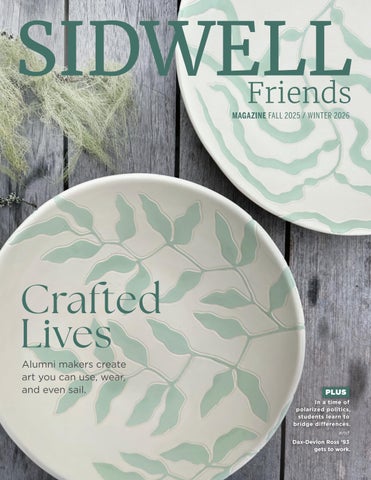
Crafted Lives Alumni makers create art you can use, wear, and even sail.
PLUS In a time of polarized politics, students learn to bridge differences. and Dax-Devlon Ross ’93 gets to work.
A Historic Transformation for Generations to Come
SIDWELL
FRIENDS MAGAZINE EDITORIAL
Editor-in-Chief Sacha Zimmerman P ’29 Creative Director Meghan Leavitt Contributing Writers Zeeshan Aleem ’04 Loren Ito Hardenbergh P ’29 Jonathan E. Kaplan P ’31 Victoria Tilney McDonough Michael Schuler Digital Producers Amber Lucia Chabus Anthony La Fleur P ’30 Sarah Randall
ONE S IDWELL F RIENDS, WHER E TOGETHER WE SHIN E. We launched Together We Shine in 2015 to enhance our mission for generations to come and we saw a groundswell of support from our community for this bold vision.
Alumni Editors Ava Delasanta Kourtney Ginn Clayton Willis Contributing Photographers David Dowling Wyatt McConagha ’27 Cameron Whitman LEADERSHIP
Now, we are called to complete our vision in this culminating phase. As members of the community, you understand the value of education and the role that Sidwell Friends plays as a Quaker school in the nation’s capital. Together, ours is a vision of a sustainable, accessible, and extraordinary place of learning for generations of students to come: one Sidwell, where together we shine.
Head of School Bryan K. Garman
Join us in making this vision a reality.
Sidwell Friends Magazine 3825 Wisconsin Avenue NW Washington, DC 20016 202-537-8444
L E A R N M O R E AT SHINE.SIDWELL.EDU
NON-DISCRIMINATION AND TITLE IX Nondiscrimination Statement: Sidwell Friends School prohibits discrimination and harassment against any member of the School community on the basis of race, color, religion, sexual orientation, gender identity or expression, national origin, age, disability, sex, personal appearance, genetic information, economic background, political affiliation, marital status, amnesty, or status as a covered veteran in accordance with applicable federal, state, and local laws. Director of Equity, Justice, and Community Natalie Randolph ’98 has been designated to handle inquiries regarding discrimination and Title IX concerns, policies, and procedures. Her contact information is: Office Mail: 3825 Wisconsin Avenue NW, Washington DC 20016 Email: randolphn@sidwell.edu | Phone: (202) 537-8182 For assistance related to Title IX or other civil rights laws, please contact the U.S. Department of Education’s Office for Civil Rights (OCR) at OCR@ed.gov or 800-421-3481; TDD 800-877-8339.
Chief Communications Officer Bill Burger CONNECT WITH SIDWELL FRIENDS
@sidwellfriends
sidwell.edu/magazine magazine@sidwell.edu
ON THE COVER Perrin Doniger ’01 creates natureinspired work out of her Birdstone Ceramics studio in Bar Harbor, Maine.
Contents Fall 2025 / Winter 2026 Volume 97 Number 1
DEPARTMENTS 4
FROM THE EDITOR
5
ON CAMPUS
A very good dog matriculates at the Upper School, authors Ann Brashares ’85 and Ben Brashares ’92 introduce students to their new novels, Homecoming brings the community to campus, fall plays land in magical settings, teachers are trained in AI, oral traditions bring Indigenous stories to life, and much more.
5
26
THE ARCHIVIST
“We the People: Student Government in the Upper School” 30
FRESH INK
Alex Daniels ’87, Jessica Green ’94, David Hansen ’71, Cal Hoffman ’76, Tanu Kumar ’08, Peter Luykx ’55, Bonnie Yochelson ’70
26
50
LIVING THEIR VALUES
Dax-Devlon Ross ’93 is committed to equity and social justice—through books, journalism, nonprofits, corporate structures, a podcast, a newsletter, and consulting, among other parts of his day. 53
CLASS NOTES
75
WORDS WITH FRIENDS
“Vote for Me!” 76
40
LAST LOOK
“More Light” FEATURES 32
LIFTING THEIR VOICES
In a politically divided nation, students at Sidwell Friends aspire to speak up, listen, and bridge differences. It is a work in progress. 40
HEARTS AND CRAFTS
With persistence, talent, and a creative spirit, these Sidwell Friends alumni have become top-tier makers in the artistic-meets-utilitarian world of crafts.
32 FALL 2025 / WINTER 2026 | SIDWELL FRIENDS MAGAZINE
3
ON CAMPUS
From the Editor SACHA ZIMMERMAN P ’29
S
idwell Friends doesn’t guarantee intellectual “safe spaces”—that is, classes promising triggerfree, inoffensive content. Learning, after all, is inherently boundary-pushing. Instead, the School has been a proponent of “brave spaces,” where students can assert themselves boldly, make mistakes, and even fail. But brave space is also where things get tricky. It is where those bold assertions are criticized, mistakes are challenged, and failure is turned into a lesson for all. Yet it is exactly in this space where ideas are tested and honed, where different perspectives create interesting friendships, and where learning flourishes. Sidwell Friends nurtures this space, promotes civil arguments and exchanges, and creates paths across even the widest ideological chasms. This is vital work in a world where the politicization of speech on college campuses over the last decade has become a flashpoint for activists across the ideological spectrum, often leading to political silencing and “cancel culture.” So to what extent, if any, is this reticence occurring at Sidwell Friends? It turns out, it depends on who you ask (see “Finding Their Voices,” page 32). While many adults worry that minority political opinions are being silenced on campus, most students agree it’s more complicated than silence. Students are all too aware of the effect their opinions can have on everyone from their peers to their teachers. As a result, students find curated arenas, like the Student Political Union and the Debate Team, to be more effective outlets for politics than off-thecuff discussions where misunderstandings can lead to offense.
4
Sidwell’s Bridging the Gap program, meanwhile, offers students, faculty, and parents across the community the tools to have difficult conversations across ideological differences—not to change opinions but to acknowledge them. The School’s initiative uses techniques that are very similar to those employed by Dax-Devlon Ross ’93 (see “Living Their Values,” page 50); in fact, Sidwell Friends has worked with Ross on many occasions. Through his consultancies—as well as his podcasts, books, and leadership ventures— Ross designs strategies to help corporations, educators, and employees talk across difference. Fellow alum Zeeshan Aleem ’04 explores Ross’s committment to equity and social justice in workplaces and education spaces at a moment when living one’s values can seem far too rare. Though self-expression is of course not limited to the sociopolitical realm, uniting the political with the artistic is exactly what Sidwell Friends 2025 Rubenstein Guest Artist Kota Ezawa does (see “Artist Kota Ezawa Captures the Moment,” page 18 and “More Light,” page 76). Drawing on both pop culture and history, Ezawa asks viewers to relive shared experiences of significant societal moments. It is storytelling through imagery. Finally, expression takes a pragmatic but still whimsical turn in “Hearts and Crafts,” a feature about alumni artisans who create exceptional work—often with a practical dimension (page 40). These gifted makers demonstrate the value of useful objects— bowls, teapots, knitwear, and even boats— with a premium on aesthetics. Whether through artistic endeavors, writing, leading, or speaking, Sidwell Friends does not lack for expressive forms. So while opinions can be tricky, they certainly are not scarce.
SIDWELL FRIENDS MAGAZINE | FALL 2025 / WINTER 2026
ON CAMPUS
Cameron Whitman
ON CAMPUS
FALL 2025 / WINTER 2026 | SIDWELL FRIENDS MAGAZINE
5
Cameron Whitman
ON CAMPUS
Shine On Students learn to make citizen a verb to convey their values. BY BRYAN GARMAN
T
his autumn, the School announced the final
That is why Penn cared so deeply about education, why he
phase of our historic Together We Shine
advocated for “liberal” learning that spared “no cost.” He
campaign, which has resulted in a historic
understood, as our alum Baratunde Thurston ’95 has put
demonstration of philanthropy in support of our
it, that we must recast the word citizen “as a verb,” we must
mission. In addition to providing endowment for financial
engage in a ceaseless effort, “to participate, To invest in
aid and faculty salaries, the campaign will reunify the
relationships, to understand power, to value the collective.”
academic divisions on one campus.
6
In recent weeks, I have witnessed our students citizening at
We need to come back to the District so that community, what our Upper Schoolers call the core of Sidwell Friends, is strengthened. We need to consolidate to improve our longrange financial models. We need to hold up what William Penn, the founder of Quaker education on this continent, confidently asserted when he framed his governing structures for Pennsylvania. A sustainable and just government, he insisted, must be “free to the people under it where the laws rule, and the people are a party to those laws.” “More than this,” he observed, “is tyranny, oligarchy, or confusion.”
their best.
Even as he outlined the structure for his Holy Experiment founded on religious pluralism, Penn knew his colony’s success depended on the character of its citizenry. “There is hardly one frame of government in the world so ill designed by its first founders, that, in good hands, would not do well enough,” he opined. At the end of the day, he insisted, governments “are made and moved by” their
I have seen students citizen when, after learning that the
citizens. And so too are they ruined.
little friend.
SIDWELL FRIENDS MAGAZINE | FALL 2025 / WINTER 2026
I have seen students citizen when I asked presenters at the LGBTQ assembly why they were excited to participate in this annual celebration. A little girl who just lost her front teeth proudly exclaimed, “It’s the first time I get to read in front of the whole school.” Her confidence and sense of achievement were inspiring. A little boy told me he was proud to be in the assembly because he had two moms. The pride and affirmation he felt was palpable.
Quaker Bayard Rustin introduced Martin Luther King Jr. to Gandhi’s theories of nonviolence, a 4th grader enthusiastically connected the two, exclaiming that the U.S. civil rights leader “shook the world in a gentle way,” that he “used words” rather than weapons to make change. “When his speech went off, he changed the world,” said our
ON CAMPUS
I’ve seen students citizen in Middle School Meeting for Business, where they engaged in focused and civil discourse. They weighed the qualities their peers might bring to the position of grade-level clerk. One by one, the students stood before the whole division, speaking to the strengths of the nominees, recognizing that all were qualified. So they sought collectively, patiently, rationally, courageously, and yes, kindly to assess their peers for the position. They favored nominees who listened deeply, demonstrated a strong work ethic, and possessed open minds and hearts. I’ve seen students citizen at Upper School Meeting for Worship, where they struggle to make sense of the violence and rancor they see around them. They bravely articulate
“ We have sought to build a community, not on the basis of division and mistrust, but rather on the foundation of love and the collaborative search for truth.”
their truths about war and peace and politics, listening respectfully, demonstrating grace and striving to be gracious toward those who might not share their perspective. Together and with humility, they explored the query that the 4th grade is considering this year: How can we demonstrate responsibility by seeking leadership, integrity, and truth? As these examples indicate, a Sidwell Friends education is different. We are tethered to timeless values that, if our democracy is to weather the moment, must do more than simply endure. The faith in and practice of these values—peace-making, justice, integrity, and respect among them—must thrive. And so, in accordance with Penn’s pluralistic vision for democracy and education, we have since 1883 sought to inspire students with big hearts, open minds, and capacious spirits. We have sought to build a community, not on the basis of division and mistrust, but rather on the foundation of love and the collaborative search for truth. We are fortunate to have you as friends and partners in this work. Because, as we know, together we do in fact shine. That might sound trite. But it isn’t. It’s not a slogan. It’s truth. It’s a way of life that we must protect, deepen, and advance. Thank you for believing in it. Thank you for believing in us. into the School that we all seek, that we so desperately need, in this perilous time.
Cameron Whitman
Thank you for helping us grow ever more fully
FALL 2025 / WINTER 2026 | SIDWELL FRIENDS MAGAZINE
7
ON CAMPUS
Sidwell Friends Opens Its Arms to a New School Year
Photos by Cameron Whitman
There was a wonderful sense of coming back together as the Sidwell Friends community kicked off the 2025/26 academic year with the annual all-community Back-to-School Picnic. The team at Meriweather Godsey prepared a feast of barbeque sliders, mac-andcheese, baked beans, coleslaw, and Italian ice. Little kids enjoyed an inflatable slide, bubble wands, and an impromptu hopscotch match on a path of flagstones. Older students tried their hand at trivia, estimating games, and cornhole. And all ages cheered on the girls’ JV field hockey team. The Sidwell Friends Spirit Exchange saw families trading in outgrown uniforms for new-to-them options, and many in the community donated gently used books to Martha’s Table. “Each year is filled with hope and possibility,” Head of School Bryan Garman told faculty and staff at a Meeting for Worship to start the school year. That spirit was certainly on display at the picnic as children pressed temporary tattoos to their skin, signed the Quaker graffiti wall, and posed for pictures with Sidwell’s own Star Fox.
8
SIDWELL FRIENDS MAGAZINE | FALL 2025 / WINTER 2026
ON CAMPUS
Ann Brashares ’85 and Ben Brashares ’92 credit their careers and their imaginations as writers to what they call their “weird” upbringing. Invited to speak at a Middle School assembly in September, they recounted how, following their parents’ divorce, they split their time between households that allowed them an unusual amount of freedom. Take the pets they kept. Among others, they had a toothy piranha, a corn snake that lived in the sofa, and a tarantula named Frederica who roamed the house freely. They also had a gerbil, who, as it turns out, is the catalyst for their Westfallen trilogy, an action-packed, middle-grade, alternate-history thriller that asks what it would be like to wake up in present-day America if Germany had won World War II. At the Middle School assembly, the siblings talked about how they became writers and then co-writers. Ann, best known for her book The Sisterhood of the Traveling Pants, started her career in publishing, before she decided to stop editing other people’s books and write her own. “I’ve always loved stories; they are how our brains work after all,” she said. She recalled one Sidwell Friends teacher who brought history alive through her great storytelling and the many artifacts in her classroom, which included a mummified foot. When asked for advice about becoming a writer, she said: “Be ambitious with your imagination! There is huge joy in sharing nonexistent, imagined worlds.”
Anthony La Fleur
An Odd Childhood Launches Vivid Fiction
Ann Brashares ’85 and Ben Brashares ’92
Ben said he always struggled in school, especially as a reader. “I was a real ’80s kid, growing up more on TV and movies than books,” he said. “I loved Star Wars, Raiders of the Lost Ark, Michael Jackson, and Prince. It wasn’t until college that I discovered my love of reading.” After working as an editor at Rolling Stone and a few other publications, Ben started writing his children’s books. “My son and I share a love for bugs,” he said. “That inspired The Great Whipplethorp Bug Collection.” Later, when Ann and Ben both had boys in middle school, they started talking about collaborating on a book together. “We started brainstorming themes and ideas we might like in our book—friendship, time travel, aliens, Nazis…” said Ann. And from that first brainstorm, the trilogy was born.
Anthony La Fleur
Anthony La Fleur
On Your Mark. Get Set. Go! Star Fox, along with other school mascots from around the DMV, took part in SOME’s (So Others Might Eat) Turkey Trot Mascot Race at Gonzaga College High School. The race was designed to spotlight the school communities that rally around SOME’s mission to support neighbors experiencing poverty, hunger, and homelessness. Insiders close to Star Fox remarked that “sweat now, shine later” embodied their preparation for the race—where everyone was a winner.
FALL 2025 / WINTER 2026 | SIDWELL FRIENDS MAGAZINE
9
ON CAMPUS
Who’s That Dog on Campus?
Merideth, who does most of the training, focuses on exposing Belle to as many different settings as possible: stores, libraries, movie theaters, malls, restaurants, the metro, airplanes, cars, buses—and the classrooms, corridors, and campus spaces of Sidwell Friends. “Belle has so many student and teacher friends—countless people have told me how much better they feel after seeing her in class, patting her following a difficult exam, or passing her in the hallways,” says Merideth. “She especially loves coming to chorus with me, and she enjoys Meeting for Worship though it took her a little while to adjust to a room full of silent people.”
“I have 5th and 6th periods with Isabel and Belle, and my mood always improves when I see Belle sleeping peacefully on the floor,” says Dylan Verma ’26. “She will occasionally grunt or snore, and the entire class will start laughing and get distracted for a couple of minutes.” As part of her service hours and puppy training, Merideth has given presentations to several classes to talk about why Belle is on campus, the hard work the dog is doing, and why training dogs to be service animals is important and meaningful. Recently, she talked to the 5th graders in Middle School science teacher Aaron Marine’s class. “Having Isabel and Belle in the classroom was an opportunity for the kids to see life science in action,” says Marine. At home—vest retired for the day—Belle is just a regular dog who loves to play with toys, take walks, and frolic with her dog friends in the neighborhood. Once Belle has finished her puppy training with Merideth and her family, she will head to the Guide Dog Foundation for more training with the goal of being matched to an individual who is blind or visually impaired. Merideth notes that only about 50 percent of dogs make it through the formal training. Nevertheless, she says, “there are so many other ave-
Cameron Whitman
When yearold yellow lab Belle is at school wearing her “Service Dog in Training” vest, she is at work. Sidwell Friends is just one of the many places her trainer, Isabel Merideth ’27, brings her in an effort to socialize her. Merideth’s family volunteers to raise puppies for the Guide Dog Foundation, which ultimately tries to pair the pups with a person who is blind or visually impaired. Belle is the Merideths’ fourth puppy. They raise each dog from the age of 2 months until they are 14 to 16 months old, at which point the pups go to the next stage of training at the Guide Dog Foundation in Long Island, New York.
Merideth and Belle at right
nues these dogs can take in service when matched with individuals who have a diagnosed physical, sensory, psychiatric, intellectual, or other mental disability.” Merideth’s last dog, Bennie, for example, is now training to be a service dog for a child with autism through BluePath Service Dogs. The hardest part of being a volunteer puppy trainer? “Saying goodbye,” says Merideth. “But knowing she will be helping someone who really needs her does make sending her off into the world a bit easier.”
10
SIDWELL FRIENDS MAGAZINE | FALL 2025 / WINTER 2026
Kelley Lynch
Kelley Lynch
Veggie Tales! For more than 30 years, the Lower School community has come together weekly to bring in fresh vegetables and chop them for Martha’s Table. This partnership has grown and evolved with the needs of the organization, and today, the School is proud to provide over half of the organization’s weekly fresh produce.
ON CAMPUS
VisAbility
Rob Stone
Valenti. “Many artists who have disabilities possess the skills needed to create a good masterpiece, but society doesn’t see it that way. Often, accomplishments in the art world by people who are neurodiverse are overlooked and don’t receive the same recognition that people who are not neurodiverse receive.” Each artist’s remarkable work explores perspective, connection, and resilience through diverse media.
Photos by Cameron Whitman
The Parents Association’s Disability Awareness Committee and Arts Committee co-hosted a special Arts and Disability Awareness Afternoon and Holiday Market this winter. “A Celebration of Creativity and Connection” featured artists Justin Valenti, Aya Kuzbari, Faith Mcluckie, Rob Stone, and Daniel KatzHernandez as well as the Interplay Orchestra and VisAbility Art Lab. All artists participated in a discussion of their pieces and lives as artists and activists before selling their wares. “The role that my art plays in challenging stereotypes around disability is that it allows people to see that people with disabilities can create advanced digital art and paintings despite their challenges,” said
TOP: Faith Mcluckie BOTTOM: Exploring the Holiday Market
During an overnight stay at the Global Village in Sharpsburg, Maryland, some 6th graders had mattresses, access to iPads, and more than enough food to successfully cook their group’s dinner. Others slept on the cold ground in lean-tos with no walls and struggled to barter for the necessary ingredients to make their family’s meal. Whatever place they found themselves in, they learned, in real time, that life on planet Earth is not equal. At this annual 6th grade trip, students are randomly selected to be part of a “family” representing a place or socioeconomic status. This year, examples included Appalachia, Kenya, Tibet, Thailand, Guatemala, a refugee camp, or upper-, middle-, and lower-class communities in Mozambique. Each group was assigned different levels of resources, except for the refugee camp, which started with none. Students delved into the causes and effects of hunger and poverty, focusing on issues such as health, clean water, nutrition, economic disparity, and lack of education. In this role-playing program, students worked together through direct, collaborative action to gather ingredients and cook their meals. It was sometimes easier
Becky Farnum
Global Village Reflects Society Across Economies
Middle Schoolers at Global Village
said than done. “There are definitely moments of frustration, particularly when groups struggle with fire-building—a necessary skill for cooking their meals,” 6th grade teacher Becky Farnum said in describing the event. “But through efficient teamwork, communal cooking, and resource management, the students start to show perseverance, hone difficult skills, and think big picture. The experience is very Sidwell—all about collaboration, caring, and learning about being a global citizen.” FALL 2025 / WINTER 2026 | SIDWELL FRIENDS MAGAZINE
11
Courtesy Perkins Eastman
ON CAMPUS
Sidwell Friends Launches Final Phase of Campaign Sidwell Friends School launched the culminating phase of Together We Shine this fall with a new, overall goal of $220 million. The School already has raised more than $189 million—86 percent—of its goal thanks to the commitment of early leadership contributors, including an anonymous alum who pledged a $10 million matching gift to accelerate the fundraising efforts. The campaign supports financial aid, the endowment, faculty salaries and professional development, and the reunification of the School’s two campuses in Washington. The final fundraising phase will conclude in June 2027.
The School has educated its youngest students, in preK through 4th grade, on its campus in Bethesda, Maryland, since 1963. The Sidwell Friends community has been working toward a return to one campus for nearly a decade. Bringing Sidwell Friends together again will create opportunities for students and teachers from all divisions, strengthening programs and community. On a practical level, operating one campus will be more environmentally sustainable and cost-effective, saving approximately $1.3 million each year. Unification will also ease the lives of many families with students on both campuses.
“It is a groundswell of support that has made the dream of reunification come true,” Head of School Bryan Garman says. “Nearly 30,000 individual gifts have been made to this campaign.” The campaign’s final phase will make possible the renovation of the Earl J. Harrison Jr. building—the current Upper School—into an extraordinary and engaging new Lower School. Contingent upon additional funds raised, the School plans to break ground on the project in the summer of 2026 and open the new building in September 2028. 12
SIDWELL FRIENDS MAGAZINE | FALL 2025 / WINTER 2026
The first step in that transformation is already underway. A new Upper School has been under construction since June 2024 on contiguous property purchased in 2017. It will open in September 2026.
To learn more about the culminating phase of the Together We Shine campaign, contact Tara Arras, assistant head of school for advancement, at arrast@sidwell.edu, or visit the campaign website at shine.sidwell.edu.
LEARN MORE
Homecoming 2025 Brings Community Together Above all else, Homecoming was a chance for old and new friends to come together to celebrate the School and its community. Alumni hugged and joked about the passage of time; students of all ages played and laughed, raced about, and rolled down the hill by the lower field; and families, faculty, and friends shared stories and experiences, enjoying the day as it unfurled under blue skies and warm temperatures. “It’s like we were just here as kids talking up our clubs, playing sports, and laughing our heads off about something,” reminisced one alum with a classmate. “I love that Sidwell is still our Sidwell even after so many years.” The Saturday festivities kicked off with “A Look at Sidwell Friends Today,” where Head of School Bryan Garman welcomed alumni, current and prospective families, faculty, and friends. The program began with a music and dance performance by Lower School students. Next up, a conversation with 4th grade faculty members and Middle School students who reflected on their 4th grade capstone projects—which exemplify the Lower School
student experience— as learners, leaders, and changemakers. Later, Middle School students described their adventures during Minimester, a beloved tradition at Sidwell Friends that launched 40 years ago.
Photos by Cameron Whitman
ON CAMPUS
Because Homecoming takes place during admissions season, it has become something of a School showcase for families who would like to learn more. In all, more than 375 prospective families registered for the event and, during the day, joined the School community in cheering on several of Sidwell Friends’ athletic teams, most notably the football team, which squeaked out a 20–19 win over St. Stephen’s & St. Agnes. Throughout the day, music, food, and fun filled the campus. The Upper School jazz band serenaded the crowd while student clubs raised money by offering games, snacks, souvenirs—and in the case of the Sidwell Crew Team, rousing competitions on rowing machines. The youngest kids played in the Fun Zone while alumni of all ages gathered in the Fan Zone to say hello to old friends and meet new ones. FALL 2025 / WINTER 2026 | SIDWELL FRIENDS MAGAZINE
13
ON CAMPUS
Questions come easily to young students, especially when faced with something as astonishing as China’s 2,200-year-old terracotta warriors. Where did the Chinese get all the terracotta from, and how did they make the color purple back then? Why did the emperor order the creation of so many warriors, and not just a hundred, but 7,000? Does each warrior represent someone who died? How long did it normally take to build one terracotta warrior? These were just some of the questions 5th and 6th grade Chinese students posed to two experts who visited Sidwell Friends this fall to discuss the history of the sculptures and the painstaking restoration work that took place following their discovery 50 years ago.
Anthony La Fleur
Professor Yingyong Dong, a museum educator from the Emperor Qin Shi Huang Mausoleum Museum near Xi’an, China, and Elizabeth Eder P ’17, a research associate at the National Museum
Anthony La Fleur
The Wonder of China’s Terracotta Warriors
Yuan Angel teaches Middle Schoolers in her Chinese class.
of American History and the former program director of preK–12 strategic education initiatives at the Smithsonian Institution, led students in a discussion of the purpose of the sculptures, which depict the armies of Qin Shi Huang, the first emperor of China. They explained that the army is a form of funerary art buried with the emperor in 210–209 BCE with the purpose of protecting him in his afterlife. Each warrior is unique. Students also learned about the Mausoleum Site Museum’s “Terracotta Warriors Museum Hospital,” a specialized conservation facility where fragile, painted warriors are carefully restored using high-tech tools, including X-ray detection, ultrasonic scanning, and 3D imaging. Experts use delicate tools such as bamboo slips, scalpels, and brushes to clean and repair the ancient figures to ensure they are preserved for generations to come. “It was a rewarding experience that connected classroom learning with real-world expertise,” says Yuan Angel, who teaches 5th/6th grade Chinese at Sidwell Friends. “It deepened students’ understanding of Chinese history and culture while inspiring curiosity, global awareness, and appreciation for world heritage.”
Middle Schoolers re-create terracotta soldiers. 14
SIDWELL FRIENDS MAGAZINE | FALL 2025 / WINTER 2026
The program also mixed history and science. The students learned that when the statues were discovered by local farmers digging a well in 1974 near the city of Xi’an and exposed to oxygen, they all turned the color of sand. Originally, they had been painted in many colors made from plants, except the color purple, which was made from an artificial chemical reaction. “The kids were fascinated by this and later asked their science teachers how they might recreate that reaction to make purple,” says Angel. Two weeks after the presentation, students were able to work on their own mini-restoration kits, bringing history to life through hands-on learning. The kits, which were donated by the Chinese museum, included glue, cotton swabs, a face mask, an apron with “Master Restorer” emblazoned in Chinese, and a small broken terracotta warrior. Sidwell Friends has collaborated with the museum since 2022. As part of the partnership, students in Chinese classes have had the opportunity to participate in virtual field trips to the Qin Shi Huang Mausoleum Museum via Zoom and conducted virtual interviews with museum experts.
ON CAMPUS
How Do Ya Like Them Apples? Every fall, the Great 9th Grade Pie Bake gets underway just before Thanksgiving. This year, dozens of members of the Class of 2029 showed up to bake and deliver pies to So Others Might Eat, Martha’s Table, Rosemount Center, and Bethesda Cares. From 10 a.m. to 3 p.m., this year’s Pie Team, Kelly Cummins and Holly Ramsawh, and last year’s Pie Lead, Cathleen Trail P ’28, ’25, ’22, were in the Upper School dining hall all day. They were joined by two kitchen staff plus Sidwell Friends Director of Dining Services Alex Levin, who came to learn (it was his first pie bake!) and to help. Levin did lots of slicing and peeling, and he taught the young volunteers how to mix the crumble. Pro tip: it takes strong hands to combine the butter with sugar, spices, and flour. Levin congratulated the group on a very well-organized event—an event that included Sidwell Friends School aprons (now available in the Fox Den!).
82 228
VOLUNTEERS
TOTAL PIES MADE
130 98 APPLE
PUMPKIN
6.5
PANS OF APPLE CRISP MADE
for faculty appreciation
90 90 300 CANS OF PUMPKIN
POUNDS OF APPLES
24
POUNDS OF BUTTER
228
60 36
CANS OF EVAPORATED MILK
POUNDS OF BROWN SUGAR
POUNDS OF GRANULATED SUGAR
40 180 POUNDS OF FLOUR
EGGS
teaspoons of spices
358
CINNAMON
138 GINGER
114
CLOVES
28
NUTMEG
FROZEN PIE SHELLS FALL 2025 / WINTER 2026 | SIDWELL FRIENDS MAGAZINE
15
Photos by David Dowling
ON CAMPUS
16
SIDWELL FRIENDS MAGAZINE | FALL 2025 / WINTER 2026
ON CAMPUS
Fall Plays Bring Magic to Campus
Photos by David Dowling
This year’s fall plays showcased two inventive, fictional settings, Wonderland and and a town called Almost, to explore very real feelings. First the Middle Schoolers fell into a rabbit hole of adventures in Alice in Wonderland to discover curiosity and resilience. Then in Almost, Maine, the Upper School students brought to life stories of love, loss, and connection in a remote, mystical town.
FALL 2025 / WINTER 2026 | SIDWELL FRIENDS MAGAZINE
17
ON CAMPUS
Ezawa explains his “moving paintings.”
Artist Kota Ezawa Captures the Moment
Take for example, the moment when the verdict from the infamous O.J. Simpson murder trial was read or when Senator Kamala Harris asked Supreme Court Justice nominee Brett Kavanaugh about government power and men’s bodies. Those moments were just that—moments—but in Ezawa’s graphically simplified animations, they come to life anew and resonate more deeply. Whether through video animations, paper cutouts, sculptures, watercolors, or light boxes—“modern-day stained-glass windows,” he calls them—Ezawa’s re-makes offer a meditation rather than commentary on his chosen subject matter.
“
We can skip food for a day, but we need aesthetics to be fully human. Art is in the open; it infiltrates our lives every day.”
18
SIDWELL FRIENDS MAGAZINE | FALL 2025 / WINTER 2026
Photos by Cameron Whitman
Some moments pass by too quickly to truly absorb the nuances of their significance and the manifold reactions to them. Drawing from media, art history, and pop culture, German-Japanese American artist Kota Ezawa, the Sidwell Friends School 2025 Daryl Reich Rubenstein P ’77, ’81, ’84 Guest Artist, has made a career of investigating the power of images by distilling memories of historical moments into their basic forms (see also “More Light,” on page 76).
Ezawa has described himself as a contemporary history painter of sorts—a maker of “moving paintings rather than videos with a beginning and an end”—and emphasizes his belief that making intuitive choices and experimenting with new ways to visually describe events, feelings, and language ultimately leads to unexpected places. He encouraged Sidwell Friends students to entertain all ideas, because one never knows which will bring forth something “cool or surprising.” “We all need food and water, but I believe we need art more,” he said. “We can skip food for a day, but we need aesthetics to be fully human. Art is in the open; it infiltrates our lives every day.”
ON CAMPUS
What’s 3,954 miles when you can bring family into the classroom? Students in a 7th grade Sidwell Friends Spanish class saw a real-time glimpse of life in Spain thanks to Assistant Director of Admissions Christian Baker, who connected family members living there to the classroom via Zoom. Baker’s birth mother, Noelia, his aunt, Rosa, and his cousins, Carmen and Raquel, told the students about the geography and population of Marbella, a city on southern Spain’s Costa del Sol, part of the Andalucía region, as well as its festivals, sports, famous people, traditional food, and places of interest, including La Concha, the iconic 1,203-meterhigh mountain that overlooks the city, where Baker and his family hike and picnic each summer when he visits. “My 7th graders were excited to have Christian join our class and meet his Spanish family,” says Nan Pickens, 7th/8th grade Spanish teacher and Middle School Language Department chair. “This was a unique opportunity to interact—entirely in Spanish—with residents of beautiful Marbella. We study Spain all year, and we plan to have at least one more visit
Anthony LaFleur
Creating a Virtual Culture Exchange
Baker brings his family into the classroom.
with Christian and his family to discuss the history and cultural influences of Andalucía.” Baker, who grew up in Boston with his adoptive parents, met his birth family when he was 16. Now Baker spends each summer in Marbella. “I am incredibly lucky!” he says. “I truly believe that you can never have too many people who love you. I have many homes, including the one in beautiful Marbella.”
The Racquet Sports Professionals Association (RSPA) awarded the 2025 Laurie Martin High School Coach of the Year Award to Logan West ’01, head coach of the Sidwell Friends boys’ and girls’ varsity tennis teams. West received the award at the association’s annual conference in September in Kona, Hawaii. “This distinguished honor recognizes those who have gone above and beyond in leadership, achievement, and impact in high school tennis coaching,” the RSPA said of the award, which is named for the late Laurie Martin, a legendary tennis coach at Xavier College Prep in Phoenix, Arizona. The group added that West’s “commitment to excellence and athlete development has made a lasting impression on the Sidwell Friends community and
the broader high school tennis landscape.” Last year, West’s boys’ and girls’ tennis teams both won District of Columbia State Athletic Association (DCSAA) championships after capturing their respective Mid-Atlantic Athletic Conference and Independent School League team titles. In all, since becoming head coach at Sidwell Friends in 2016, West’s teams have won 10 DCSAA championships and 11 conference titles. “I‘m honored and extremely grateful to receive this recognition from the RSPA,” says West. “I owe this award to the outstanding support of our coaching staff— Shelby Jones, John Dillon, and Eric Singletary ’93—the athletic department led by Michael Square,
Courtesy RSPA
Logan West Named National Coach of the Year
West shows off his honor in Hawaii.
our supportive administration, and, most importantly, the dedication of the student athletes we serve each day. It is a privilege to have the opportunity to help our student athletes develop confidence, resilience, and the poise to perform under pressure on and off the tennis court.”
FALL 2025 / WINTER 2026 | SIDWELL FRIENDS MAGAZINE
19
ON CAMPUS
AI Training for Teachers The grant-funded “Co-Lab” fosters experimentation and real-classroom lessons.
Sidwell Friends School has received a $35,000 grant from the Edward E. Ford Foundation to launch “Co-Lab,” a professional development initiative focused on exploring how artificial intelligence (AI) can support teaching and learning. The project, led by Middle School Academic Coordinator Nate Green, has already brought together 755 teachers from more than 400 independent schools—and the number continues to grow. Its goal: to empower educators by sharing AI use cases and developing best practices.
Joining Green in administering the Co-Lab are Maureen Russo Rodriguez, who teaches English and Spanish at St. Mark’s School in Southborough, Massachusetts, and Kelly Enright, the director of technology at Vail Mountain School in Vail, Colorado. The monthly sessions take place in the evenings. For each session, a new designer and a facilitator share a topic for exploration, and the teachers who participate commit to two to three hours of homework examining how AI can be used to improve how students learn. Co-Lab teachers experiment with prompts as homework to see how AI responds—ranging from feedback strategies to lesson design and metacognition (how students think through problems and come up with their answers and solutions to problems). For example, knowing that middle school students can get
Anthony La Fleur
Green emphasizes that the program isn’t about mandating AI use in classrooms—it’s about creating informed practitioners who can make thoughtful decisions about when and how to deploy these tools. It’s the exploration and conversation around AI that is often missing in education circles. What makes the Co-Lab distinctive is its recognition that teachers not only need a voice in shaping AI policies and practices but also need the time and space to explore AI without the pressure of immediate
implementation. “We started Co-Lab because we need more conversation about the intersection of AI and pedagogy,” Green says. “The way to fix this for teachers is to explore AI and develop AI literacy and to talk about how it should and should not impact our pedagogy.”
20
SIDWELL FRIENDS MAGAZINE | FALL 2025 / WINTER 2026
Anthony La Fleur
BY JONATHAN E. KAPLAN
Green leads the Co-Lab initiative.
restless during an hourlong lesson, one session of Co-Lab explored how to use ChatGPT, Claude, or Gemini to incorporate movement into the classroom. A summary of a longer prompt would read: “You are an expert teacher who understands the value in adding movement and manipulatives to the classroom. Suggest three ideas for movement-based activities and three ideas for printable, cut-out manipulatives for my [GRADE] class. They are studying [TOPIC] and seem to be having trouble understanding [CONCEPT].” Another exercise involved using AI to help provide “clear, actionable, and constructive feedback on the students’ work.” The homework and subsequent discussion are designed to build a conversation with students and help them learn from their work rather than have an AI platform just provide an answer. In the classroom, Sidwell Friends 7th and 8th grade history teacher Stephen Armandt uses AI to help students immerse themselves in the French Revolution. After prompting an AI platform to generate “20 plausible accusations made against French citizens in 1794,” his students wrote journal entries imagining life during the Reign of Terror. “Students could dive that much deeper into the
ON CAMPUS
At the end of every month, the teachers taking part in Co-Lab sessions meet in small groups of four over Zoom to discuss their findings and then, in larger groups of eight to 12 to discuss the bigger questions about how and why their findings will impact teaching and learning. The quality of prompts is central to the Co-Lab’s approach. “The prompts are part of the genius,” says Eve Eaton, who leads academic support at the Lower School. “But sometimes they fail—and that’s useful, too.” When AI stumbles, it highlights the value of human judgment. A prompt that doesn’t work for teachers in the Lower School might work for teachers at the Middle and Upper Schools, Eaton notes. AI also helps teachers tackle differentiation—the challenge of meeting varied learning speeds. One student might breeze through a 40-minute lesson in five minutes while another student might need extra time. Prompts like “How can I differentiate this lesson plan?” can generate useful adjustments at the margins and help teachers create material to update and refresh a lesson plan. After a decade of witnessing the sometimes insidious effects of social media on the lives of students, Sidwell Friends is paying particular attention to the impact AI has had in the classroom since the first version of ChatGPT was released in late 2023—and what impact it will have in the future. Green is taking the lead in thinking through how schools can avoid the same mistakes they made with social media. “The rapid development of AI tools is one of the biggest opportunities and challenges that faces education today, not to mention society as a whole,” says Bryan Garman, Sidwell Friends’ head of school. “I applaud these efforts to dive deeply into the ethical and pedagogical questions facing all of us as educators.” Green believes the best answers to the complicated questions AI presents will emerge from the kind of hands-on learning facilitated by the Co-Lab. “At the end of the day,” he says, “our job with Co-Lab is to figure out and gain enough AI literacy to make the right moves to enhance and improve student skills.”
Anthony LaFleur
French Revolution,” says Armandt. What’s more, the use of AI in this case has allowed Armandt to design a better lesson plan, one that not only teaches history but also media literacy. After all, rumors and misinformation during the French Revolution led to violence, which has lessons for today’s political environment, too.
The Fountain Pen Goes Global For the first five years of its existence, The Fountain Pen, the literary magazine run by the Upper School’s Creative Writing Club, focused entirely on publishing the works of Sidwell Friends students. But last year, the editors decided to define “community” in the broadest way possible: by opening their call for submissions to high schoolers from around the world. In creating an international creative writing magazine, the club embraced the belief that people can be shaped by the stories they read, hear, remember, and share—no matter where those stories originate. And that the more stories, poems, and plays shared by people with different backgrounds and experiences, the more the world expands and deepens. “Through writing, we can express our humanity fully,” says Nora Giuffrida ’27, one of the magazine’s four editors along with Junnah Sheikh ’27, Ishani Agrawal ’28, and Angie Spadafora ’28. “And by reading the writing of others, we are given the opportunity to learn from others, develop empathy, and experience awe.” To date, in addition to submissions by Sidwell students, the magazine has received and published several national and international submissions, including one from Istanbul and another from Doha. The magazine is available online and accepts all forms of creative writing, including poetry, fiction, creative nonfiction, creative essays (non-academic), plays, and screenplays. “We’ve published lots of interesting works,” says Giuffrida, “including an anime story explored through classical philosophy, which was pretty amusing, and an epic poem about a mythical version of Sidwell, including the ‘Evil Lair of Upton.’ ” Use this QR code to check out The Fountain Pen:
FALL 2025 / WINTER 2026 | SIDWELL FRIENDS MAGAZINE
21
ON CAMPUS
Anthony La Fleur
Anthony La Fleur
Turkey Trot Lower Schoolers gobbled up the spirit of the season with a race to gratitude just in time for Thanksgiving.
The stories and illustrations told of powwows, dancing dresses adorned with beads and cones, drums, braids, sweetgrass baskets, and the tradition of oral storytelling. For Indigenous peoples, community is a pillar of identity—whether coming together for ceremony, mourning, gratitude, celebration, harvest, support, or storytelling. In that spirit, Upper School English teacher Samantha Goodwin and 1st grade teacher Jane Legg hatched a plan to bring their students together, interdivisionally, to read and celebrate stories by and about Indigenous peoples in honor of Native American Heritage Month. Although their curricula are clearly different, some of the themes their students have been learning overlapped. Goodwin, who teaches a senior North American Indigenous literature class, and Legg, who teaches a unit on Native American history, originally connected several years ago at a daylong conference about reparations for Indigenous peoples. “Even though the kids in our classes are more than a decade apart in age, the power of 22
Anthony LaFleur
Celebrating Indigenous Stories
Seniors and 1st graders celebrate Native American Heritage Month by reading books by Indigenous authors together.
storytelling is for every age,” says Legg. “Especially in the traditions of Indigenous peoples, stories serve to connect individuals and communities to their place and time as well as to each other.” The seniors met up with the 1st graders on the Lower School campus in Bethesda and were greeted by a bevy of grinning, excited young faces. Connecting through picture books, the older and younger students paired off to spend time reading together and discussing their books. They identified common themes in the texts and talked about storytelling
SIDWELL FRIENDS MAGAZINE | FALL 2025 / WINTER 2026
as a powerful way to build community and take ownership over the narratives that impact us. “It was incredibly meaningful for my 1st graders to see that learning about Indigenous peoples is important and valuable to older students, too,” says Legg. “I think for my seniors,” says Goodwin, “returning to picture books gave them a way to reflect differently on the novels they have been reading, especially after seeing those stories interpreted through the younger, more innocent eyes of the 1st graders.”
ON CAMPUS
TICK, TOCK
A day in the life of ALEX LEVIN, the director of dining services at Sidwell Friends for Meriwether Godsey. 4:45 a.m.
10:15 a.m.
Wake up.
Get to Sidwell Friends. “Half of the team are already here, which I am always blown away by.”
Double-check every lunch ingredient sign for proper labeling; make sure there are options—including dessert options—for students and staff with allergies. “We make special plates for about 15 kids with extreme or unusual allergies.”
6:30 a.m.
10:45 a.m.–1:00 P.m.
5:45 a.m.
Opening staff meeting with Head Chef André to explore the “menu priorities of the day” along with announcements, reminders, and cleaning projects. “Running a restaurant kitchen is a three-ring circus with one main attraction— this is four to five times that scale.”
6:45 a.m. Cater big and small morning events throughout the School, such as faculty meetings, parent coffees, and PA convenings. “We have to make sure everything is baked, decorated, brewed, poured, and organized.”
8:00 a.m.
Oversee the logistics of lunch. “It’s a rollercoaster of business.” First, half the Middle School eats. Then, the entire Upper School arrives—“all at the exact same time!” Finally, the other half of Middle School eats. “Everyone on staff is responsible for a certain section, and they take pride in their section.” Goals: Always refresh items, don’t keep people waiting, avoid bottlenecks.
1:00 P.m. Communal meal for kitchen staff. “We all find 20 minutes to eat and enjoy the experience, too. And I get to catch up with the team.”
1:20 P.m. Clean and prepare for the next day. “Everything is pristine, prepped, and set up for success.”
2:15 P.m. Prepare for special events. “We don’t say no to anything—a casual happy hour, a cocktail reception at a private home, a formal seated dinner for 150, or appetizers or desserts only.”
3:00 P.m. Wrap for the day—unless there’s a special event. “The team here should go home happy. By the time they check out, they’ve hopefully had a solid day and a good experience.”
9:00 P.m. In bed with no alarm clock. “I don’t need to sleep as long as most.”
Review the previous day, check employee timecards, adjust schedules, go over invoices.
Focus on nighttime catering and special projects, like house-made desserts. “My goal is to have the best catering program in Washington.”
10:00 a.m. Put out the snack program for Upper Schoolers. This may include freshly baked brioche, banana chocolate muffins, or coffee cakes. “It’s like being a restaurant pastry chef— but for 1,100 people at once.”
YUM! Under Levin, the School has seen a rise in specialty desserts like crème brûlée, dark chocolate fudge brownies, and pot de crème.
FALL 2025 / WINTER 2026 | SIDWELL FRIENDS MAGAZINE
Anthony La Fleur
9:30 a.m.
23
ON CAMPUS
FALL
SPORTS WRAP Quaker student athletes were in good form this fall, capturing one DCSAA team championship and another conference title, while improving their showing in multiple sports.
G I R L S ’ S OC C ER The girls’ soccer team defeated Georgetown Day School 3-2 to win the 2025 DC State Athletic Association (DCSAA) Championship, the program’s third overall and first since 2021. Sidwell Friends entered the tournament as the No. 3 seed and began its playoff run by defeating Washington International 7-0 in the quarterfinal round. In the semifinals, the Quakers bested St. John’s College High School 3-0, avenging last year’s State Championship loss. In the championship matchup against Georgetown Day, Maggie Kendall ’28 took a pass from Zuri Johnson ’26 in the 65th minute and punched it in to take the 3-2 lead with what became the winning goal. For her outstanding play, Johnson was named the DCSAA tournament’s Most Valuable Player. With a 13-4-1
24
overall record, the Quakers claimed the regular season Independent School League (ISL) conference championship, the team’s eighth overall and first since 2021.
C R O S S - C OUN T R Y In the DCSAA Championships, two medalists, Emilia Lopez Murphy ’29 and Alana Templeman ’26, led the girls’ team to a fifth-place overall finish. The squad is well-positioned for next year, with all seven varsity runners returning. The boys’ team rallied late in the DCSAA competition, led by Rafae Niazi ’28, to earn a fifthplace finish, just 24 points behind Mid-Atlantic Athletic Conference (MAC) Champion Georgetown Day. With six of seven varsity runners returning, the boys are also gearing up for a strong season next year.
SIDWELL FRIENDS MAGAZINE | FALL 2025 / WINTER 2026
G I R L S ’ T ENN I S As is becoming its habit, the girls’ team finished atop the ISL conference with another stellar season-long effort. With a 12-1 overall record, the Quakers, led by All-ISL standouts Sara Abouzeid ’27, Natalie McIntosh ’27, Roxi Hodor ’27, and Zoe Shrank ’26, finished up the fall season by capturing its sixth consecutive ISL Tournament Championship. The Quaker squad will compete for its fourth consecutive DCSAA championship in the spring.
G OL F Relying on senior leadership from Jackman Grossman ’26, Jude Kelly ’26, Claire Kinnier ’26, and Sophie Ochiai ’26, the golf team had another strong year. The team finished second in the MAC tournament, trailing the recordsetting Potomac squad. Grossman and Kelly earned All-MAC status, along with Sachin Kundra ’27.
ON CAMPUS
Photos by Wyatt McConagha ’27
Kinnier capped off the season by winning the inaugural MAC Girls’ Invitational Tournament. Ochiai will look to defend her title in the spring as the DCSAA girls’ champion.
B O Y S ’ S OC C ER A six-game winning streak helped push the boys’ soccer team to a 12-8-1 record and a big bounce back from last year. The young team made great strides and advanced to the semifinals of the MAC tournament. The Quakers qualified for the DCSAA tournament, but came up short against St. John’s College High School in the first round.
F I EL D HOC K E Y The program delivered its strongest season in recent years, climbing in the ISL standings and advancing to the second round of the conference tournament. Led by All-ISL honorees Nylah James ’27, Brennan Kneller ’27, and Caroline Mohamadi ’26, the team finished with a record of 11-5-1.
F OO T B A L L Sidwell Friends fielded a young team this season. Playing an independent schedule for the second year, the team finished with a 3-6 record. Though unquestionably a rebuilding year, the season had its highlight with a 20-19 last-minute win in the Homecoming game against former MAC rival St. Stephen’s & St. Agnes before a large and enthusiastic crowd.
V OL L E Y B A L L The girls’ volleyball team showed signs of real progress this season with Gracianna Kabwe ’26, Paige Margie ’26, and Eliane Soukou ’26 receiving honors as DCSAA AllStars based on their season-long performances. Marli Dubroy ’27 earned All-ISL in recognition of her impact in the league. Together, their achievements highlighted an impressive year of hard work and standout play for Sidwell Friends.
You can find more sports news at sidwell.edu/athletics and on X and Instagram by following @SFSQuakers. FALL 2025 / WINTER 2026 | SIDWELL FRIENDS MAGAZINE
25
THE ARCHIVIST
We the People: Student Government in the Upper School
BY LOREN ITO HARDENBERGH P ’29 Photos Courtesy Sidwell Friends Archives
W
hen interest in forming a student government did arise in 1913, the students proposed that rather than serving as representatives of the student body, they take on the role of disciplinarians over their peers: a junior-senior committee that “would have the authority of a teacher” to impose order during study hall. “Why not give yourself the honor of inaugurating such an important movement?” wrote one student in the Quarterly. In 1916, a more formal student government coalesced around the interests of the student body. They proposed a set of resolutions to Thomas Sidwell, beginning with “Resolved: That all examinations be announced at least two days in advance.” The headmaster was not willing to make such a blanket policy. Over the next couple of decades, the movement did not gain much traction. In a response to a questionnaire mailed to Thomas Sidwell in 1932 about student government, his associate principal responded: “Our School is committed to the policy of self government rather than student government. … It is our effort in Friends School to place as much responsibility as possible on the individual students in
One student leader suggested that offenders be forced to sit and stare at the wall or else “write a composition on ‘their crime against society.’ ” 26
SIDWELL FRIENDS MAGAZINE | FALL 2025 / WINTER 2026
1
Ackad
In the School’s earliest years, the student body was small enough that a representative student government wasn’t seen as a necessity.
the way of guiding and directing their own conduct. We contemplate no change which would give to a group like a Student Council any disciplinary authority over their fellow students.” However, after Thomas Sidwell’s death in 1936, the door began to open. In 1940, the School hosted the first Friends Schools Student Government Conference. Student representatives and faculty advisors from 10 different Quaker schools gathered to discuss the role, composition, and activities of student governments. A dean from American University gave a keynote address on “Democracy in School Life” focused on “tolerance of the views of others and cooperative action as fundamentals of democracy”—a topic that must have held particular resonance with World War II underway. In fact, some of the activities mentioned by Friends school student councils involved raising money to support the work of the American Friends Service Committee aiding refugees displaced by the war. “The thing that impressed us most,” remarked one participant, “was the atmosphere of sincere, earnest friendliness that dominated the conference.”
B
y 1947, the School had created its own Sidwell Friends Student Council—with a list of accomplishments that included: “Juke box procured and records collected for use. Coke machine for student use. Ice cream sold during morning recess.” More significantly, they drafted and ratified a Student Council constitution. One line notably appeared only in that first year, disappearing immediately after: “The administration of discipline at Friends School is carried out by both the faculty and the Student Council.” The role of student government
THE ARCHIVIST
3
2
in enforcing school regulations continued to be a point of tension over the next two decades. In the 1950s, the Student Council created the “Monitor Committee” to oversee study hall. But students were not terribly effective at supervising fellow students in their own grade. Student Council meeting minutes from the early 1960s point out that juniors seemed reluctant to discipline other juniors. But when the job was given to seniors, they gave out 10 Saturday study halls. For some Student Council representatives, though, these Saturday study halls were insufficiently punitive. “At present,” recorded the minutetaker, “students eagerly anticipate these ‘penalties’ as a time to get weekend homework done, to socialize with fellow students, to meet for Saturday afternoon activities. Obviously if this type of attitude prevails, Saturday mornings are not much of a punishment.” One student leader suggested that offenders be forced to sit and stare at the wall or else “write a composition on ‘their crime against society.’ ” While many were in favor, another student astutely observed, “by making offenders sit in absolute quiet doing nothing, we were
equating the penalty with a Quaker meeting.” The 1950s also saw the formation of the Club Congress; each club was required to submit a charter for approval to the Student Council. The council then distributed funds to the clubs and managed their budgets. Minutes from meetings suggest that the council fielded a range of requests, agreeing to grant $350 to the Drama Club for fixing up the stage, $10 for seven chess sets for the Chess Club, $18 to buy a class ring for the foreign exchange student, and $70 for “damages done to Bernard’s car while he was helping out at the Sadie Hawkins Dance.” The Student Council took on headier topics, too, in an attempt to make students’ concerns heard. In 1955, following the board of trustees’ decision to continue its policy of not admitting Black students, the council opened up forums for discussion and held multiple meetings with the head of school. “The student body,” observed one student journalist, “seems to be far away from the Board of Trustees.” The following year, Sidwell Friends admitted its first Black student.
4
1. Student Council, circa 1920. 2. Achievements of the 1947 Student Council included procuring a juke box, records, and a Coke machine. 3. Student council gathers in 1948. 4. Student council poses in 1948.
I
n the late 1960s and early 1970s, a new issue came to dominate the Student Council agenda: the dress code. The council endeavored to develop a proposal both the administration and the student body could accept. Its two major goals included eliminating the mandate that boys wear jackets and allowing girls to wear pants year-round. Both proposals ultimately prevailed. In an effort to increase its influence, the Student Council transformed into the Student Senate in 1971. The Senate comprised five students, four faculty members, and the Upper School principal. How such a structure would actually empower students is unclear, and by the mid1970s, a bit of apathy had seeped in, leaving the Student Senate with
FALL 2025 / WINTER 2026 | SIDWELL FRIENDS MAGAZINE
27
THE ARCHIVIST
5
an unusual problem: They couldn’t give money away. Clubs were still required to draw up a budget and apply for funds, but less than half of the funds were distributed. (They did turn down funding requests from time to time, such as $100 for the “Candy Club.”) In an editorial to Horizon, one representative lamented: “In these times of post-Watergate nausea, many people in school, and in the country, have lost faith in government. … Democracy and the Senate will work only if we put something into it.” A lack of new energy and waning interest in student government seemed to dominate the 1980s. One year, purchasing an “industrial-sized toaster” in the dining room was listed as a signature achievement. Another year, a passionate discussion surrounded the location of a soda vending machine. The diminished role of student government in those years was a frequent topic of conversation. In one 1995 memo following a frustrating Student Senate meeting, the Upper School principal summed up the topics discussed: “• The thankless nation of the senate’s work. •T he difficulty of finding the time to be an effective senate member. • The senate’s lack of interaction with classes. • The lethargy of the student body. •T he need for the senate to do tangible things to make the student body aware of its presence.”
I
n the fall of 2009, the Upper School administration stepped in to help and formed a Student Government Review Committee. Students, teachers, and administrators worked together to bring out, according to one faculty member, “both greater student participation and a more empowered voice for students.” They
28
SIDWELL FRIENDS MAGAZINE | FALL 2025 / WINTER 2026
6
7
“ In these times of postWatergate nausea, many people in school, and in the country, have lost faith in government.” researched structures and responsibilities at other schools, interviewed students and teachers, and finally drafted a charter that was presented to the student body for approval. One major change increased council membership to 16 students, which was more representative of the student body. Elections were held, and continue to be held, using approval voting—a process whereby students may vote for any candidate they feel will perform the job well. The newly empowered “StuGov,” as student government has come to be known, found ways to play a role in school policy. As student cell phone use rose, StuGov helped negotiate a solution that addressed concerns about distracted students in the classrooms and hallways while not banning the devices outright: Students could only use cell phones outside of academic buildings. One student government initiative became a headline in The Washington Post in 2016. StuGov argued that, since the existing dress code prohibited students from wearing clothing with images or messages that conflicted with the School’s values, wearing the Washington NFL football team’s logo should be banned as well. The administration accepted the student government’s proposal, creating a storm of
THE ARCHIVIST
8
media attention. Four years later, the team changed its name and retired the logo. The StuGov of recent years has left a legacy of building community among the student body. During the 2013/14 school year, they created an Upper School–wide event called Quaker Games, which adds an element of fun to the long stretch between winter and spring breaks. Each student is assigned a “target” whom they must eliminate by surreptitiously placing a sticker on the back of their hand. StuGov also developed the annual English class dodgeball tournament. As English is the only subject all high school students are required to take every semester, every student participates. Working together on something other than a close-reading of a poem has fast become a Sidwell tradition. Next year, the Upper School moves to a new home on the DC campus, and the issues StuGov takes on will continue to evolve. One change is beginning already: The Middle School this year has created its own form of student government, which means that future 9th graders will arrive with experience and expectations that they can continue to make their voices heard.
9
5. In the mid-20th century, the Student Council served as study hall monitors. 6. Planning student dances has been a role of student government. 7. and 8. Clubs applied to the Student Council for funds to support supplies, such as backgammon and chess sets. 9. The Student Council initiated the Student Work Program, in which students perform tasks throughout the School. The council also revised the dress code in the early 1970s.
10
10. Student Council in 1971. 11. The Student Council held meetings in the Goodwin Library that were open to all students to ensure that students had a forum for voicing their concerns (1971).
11
12. In the 1980s, the Student Senate combated occasional waves of student apathy. (1986)
12
FALL 2025 / WINTER 2026 | SIDWELL FRIENDS MAGAZINE
29
FRESH INK Winter Books
Four nonfiction titles cover photography, queerness, punk music, literature, climate change, and generational wealth. While two pieces of fiction explore mental health, youth, and an update of a classic fairy tale. Too Good to Get Married: The Life and Photographs of Miss Alice Austen Bonnie Yochelson ’70 Fordham University Press, 2025 As a teenager, Alice Austen (1866–1952) “devoted herself to photography, recording what she called ‘the larky life’ of tennis matches, yacht races, and lavish parties. When she was 25 and expected to marry, Austen used her camera to satirize gender norms by posing with her friends in their undergarments and in men’s clothes, ‘smoking’
cigarettes, and feigning drunkenness. ... Austen embraced the rebellious spirit of the ‘New Woman,’ a moniker given to those who defied expectations by pursuing athletics, higher education, or careers. She had romantic affairs with women, and at 31, she met Gertrude Tate, who became her life partner. … Too Good to Get Married fills the need for a fresh and deeply researched look at this skillful and witty photographer.”
Swiz: The Unapologetic and Mischievous Autobiography of a Washington, D.C., Hardcore Punk Band Alex Daniels ’87, et al. Akashic Books, 2025 “Swiz was a DC–based hardcore punk band that existed from April of 1987 through August of 1990, cutting their teeth and carving their place in the scene that birthed trailblazers and contemporaries like Minor Threat, Bad Brains, Dag Nasty, Fugazi, Ian MacKaye, Dave Grohl, and Henry Rollins. ... Swiz’s faster, darker, and more aggressive take on the DC sound ran counter to the melodic, experimental, and poppy direction the scene had been leaning toward in the years before Nirvana broke the underground. In the 35 years since their demise, Swiz’s popularity and infamy have only grown.” The book coincides with the 2025 release of Swiz’s remastered catalog by Dischord Records.
The Witness as Educator: Reading W.G. Sebald, Aimé Césaire, and Walt Whitman David Hansen ’71 State University of New York Press, 2025 “In The Witness as Educator, David T. Hansen examines the idea of bearing witness. … He engages the work of three exemplary witnesses: W.G. Sebald, Aimé Césaire, and Walt Whitman. Sebald powerfully confronts the human costs of the violence of the 19th and 20th centuries. Césaire evokes a creative Black consciousness in the face of European colonialism and attests to this outlook’s joyous and painful development. Whitman’s witness to American life, alongside his poignant testimony about caring for wounded soldiers during the American Civil War, speaks to a hope deeper than hope for the prospects of democracy. Hansen shows how these witnesses did not ‘choose’ to write about their respective themes. They had to.”
Existential Politics: Why Global Climate Institutions Are Failing and How to Fix Them Jessica Green ’94 Princeton University Press, 2025 “Governments have spent three decades crafting international rules to manage the climate crisis yet have made little progress on decarbonization. In Existential Politics, Jessica Green explains why this is unsurprising: governments have misdiagnosed
the political problem of climate change, focusing relentlessly on measuring, reporting, and trading emissions. This technical approach of ‘managing tons’ ignores the ways that climate change and climate policy will revalue assets, creating winners and losers. Policies such as net zero, carbon pricing, and offsets all cater to the losers— owners of fossil assets. … Green proposes using international tax, finance, and trade institutions to create new green asset owners and constrain fossil asset owners, reducing their clout.”
Building Social Mobility: How Subsidized Homeownership Creates Wealth, Dignity, and Voice in India Tanu Kumar ’08 Cambridge University Press, 2025 “Which policies can help households improve their economic, social, and political status? Building Social Mobility is an in-depth exploration of how policies to subsidize homeownership in low- and middle-income countries shape beneficiaries’ decision-making in nearly every facet of their lives. Tanu Kumar develops a multidimensional and crossdisciplinary theory that argues that these initiatives affect how citizens invest in the future, climb out of poverty, develop agency in their social relationships, and exert power in local politics. … Building Social Mobility goes beyond assessing the effects of an important policy to provide deep insights about how upwardly mobile citizens make decisions.”
Easy to Slip: A Novel Cal Hoffman ’76 Rare Bird Books, 2025 “Winter, 1976, Columbia University. Hearing voices and seeing hateful writing on walls, early admission [student] Sam Kovner walks the New York streets [for a] sleepless thirty-six hours. Through the radiant specificity of memory, he reckons with a harddriving father, a caring, sometimes careless mother, a generous, self-involved uncle who’s just become a movie star, and starstruck grandparents. Sam fears the undertow of feelings: He’s not quite spent the night with someone he’s fallen for. Home for high-school graduation, a prom night affair reminds Sam of how he once knew love, freeing him to face his encroaching psychosis. … With irrepressible humor and pathos, Easy to Slip recalls an era when youth mattered and people healed from psychiatric illness.”
Jenny and Hop Peter Luykx ’55 Streamwood Press, 2025 “Jenny and Hop are two toads living happily at the pond’s edge with their numerous family of tadpoles. However, after consulting her magic mirrors, the jealous Great Toad Witch Queen changes Jenny by casting a spell on her, apparently separating her from Hop forever. What can Hop do to get Jenny back? A re-telling of The Frog Prince, this is a story of jealousy, transformation, mail delivered by dragonfly, and an unexpected kiss.”
LIFTING THEIR VOICES
LI F TI NG TH E IR
Voices In a politically divided nation, students at Sidwell Friends aspire to speak up, listen, and bridge differences. It is a work in progress. BY SAC H A ZIMME R MA N PHOTOS BY CAMERON WHITMAN
A
t a time when partisan retribution, cancel-culture, and even a turn toward violence stoke the fires of American political life, often turning healthy debate into relentless confrontation, it should come as no surprise that many young people are tuning out or withdrawing from political engagement. For an institution at the heart of the nation’s capital with a legacy of student political and social activism, this reticence is, to some, striking. And it has led to an effort to help students reengage and, in the process, create more productive frameworks for embracing the need for challenging conversations. In the eyes of Director of Equity, Justice, and Community Natalie Randolph ’98, today’s students are experiencing a perfect storm of social media, political polarization, and a culture of criticism. Social media platforms practically
32
SIDWELL FRIENDS MAGAZINE | FALL 2025 / WINTER 2026
LIFTING THEIR VOICES
FALL 2025 / WINTER 2026 | SIDWELL FRIENDS MAGAZINE
33
LIFTING THEIR VOICES
ensure that students’ words—and their missteps— last forever, whether they post something online themselves or were filmed by someone else. This gives permanence to even the most off-handed comments. Add to that a national zeitgeist in which one’s political views seemingly define not just what party they align with, but whether or not they are even a good person. Finally, a culture of criticism and attack has become pervasive. Americans not only feel free to give unsolicited feedback; they feel entitled to. Suddenly, putting yourself out there can seem like a massive risk. “People are unable to negotiate the fact that one person’s opinion about one topic does not mean they are speaking for all people,” Randolph says. Worse, with TikTok videos that last for mere seconds and tweets that limit word counts, it is quite literally impossible to express an opinion with any sense of nuance.
The value of conversation is understanding each other’s different points of view and recognizing they don’t just lie on two opposite ends of the spectrum.” CO CO CA MPBELL ’ 2 6
“We are not immune from challenges our whole society is struggling with around division and discourse,” says Upper School Principal Robert Gross, who notes that over his 14 years at Sidwell Friends he has observed fewer and fewer students speaking up at Meetings for Worship. “We used to have more voices at Meeting for Worship. Something is shifting and it’s not good.” Interdivisional School Counselor Dr. Richard L. Griffith adds that being a student at Sidwell Friends is another complicating factor: What does it mean to make a mistake at a school with so many talented people with big ambitions? “We see it in classrooms, we see it on the athletic field,” says Griffith. Trying to avoid mistakes and to polish off rough edges in a quest to build a free-of-flaws résumé is the wrong goal, he maintains. “Students are afraid to take a risk, and part of that is what it means to be here.”
CO CO CA MP B E L L ’26
34
SIDWELL FRIENDS MAGAZINE | FALL 2025 / WINTER 2026
In an effort to combat these trends, in 2023 Sidwell Friends launched its Bridging the Gap initiative to promote meaningful conversations across ideologies and to create paths across even the widest political chasms. Originally created for higher education, Sidwell Friends adapted Interfaith America’s curriculum for the Upper School. Led by Eboo Patel, the author of We Need to Build: Field Notes for Diverse Democracy, Interfaith America builds on the nation’s founding promise by creating “institutional cultures where people respect, relate, and cooperate across difference.” It’s just one way Sidwell Friends is attempting to create a culture of acceptance.
LIFTING THEIR VOICES
Rather than cultivating diversity as an end in itself, Bridging the Gap recognizes the diversity that already exists at Sidwell Friends and aims to improve bonds across those groups. It does this primarily through storytelling, which means asking students to talk—a lot. That can be more difficult than it sounds.
R
andolph and Griffith have found some success with Bridging the Gap’s focus on relating personal narratives in small groups. Students get the opportunity in such settings to practice storytelling in ways that bolster confidence and invite discussion and understanding without fear of rejection or getting canceled. They start with exercises on anodyne topics, like whether or not a hotdog is a sandwich, and build up to higher-stakes issues. Recently Randolph and Griffith modelled a real argument they had about chivalry (patronizing or culturally relevant?) to demonstrate how they came to have a meaningful understanding between them even if neither changed their mind. Scaling up this work, which by its nature requires a lot of time, is
OSEWE O G A DA ’ 2 6
difficult. But Randolph and Griffith have started by implementing a storytelling portion of Bridging the Gap to all 9th graders for the first time this year. Upper School students I spoke with seem less sure than the adults around them that political debate has been stunted. Many noted the various, popular student clubs that promote dialogue on hot topics: the Debate Team, the Student Political Union, the Friends Committee on National Legislation (FCNL), and the Sidwell Law Review, just to name a few. Granted, students joining those clubs are more likely than others to appreciate a good debate. And, as Randolph and Griffith are quick to point out, there are definitely groups on campus who still feel silenced. What’s more, unlike most of those clubs, the goal of Bridging the Gap is not to change minds. It is to engender respect and understanding for opposing opinions.
E YOB S ISAY ’2 6
One early, organic effort at political connection came in 2022, when a student-led endeavor dissolved Sidwell’s Student Democrat and Student Republican clubs. Now, all Upper Schoolers are united under the Student Political Union, which brings together different perspectives by design and allows for more ideological subtlety than a two-party structure provides.
FALL 2025 / WINTER 2026 | SIDWELL FRIENDS MAGAZINE
35
LIFTING THEIR VOICES
“A lot of people were not attending [Democratic and Republican] meetings because their views fell more in the middle,” says Coco Campbell ’26, one of the current Student Political Union heads, along with Eyob Sisay ’26 and Osewe Ogada ’26. “That definitely mirrors what’s going on in the world right now. People aren’t showing up to vote because they don’t align with the two parties or because they’re so polarized. And the value of conversation is understanding each other’s different points of view and recognizing they don’t just lie on two opposite ends of the spectrum.” What’s more, Campbell says, the Student Political Union is now more aligned with Quaker values. “Having space for all points of view allows for there to be ’that of God in everyone.’ ”
truth. You have to back up your arguments with evidence. That’s why opportunities like debate are great—they train students in the ways of effective argumentation.”
For Sisay, open dialogue is at the heart of all his extracurricular interests, which in addition to the Political Union, include Debate, FCNL, and the Law Review, which he founded. “All my organizations work to advance free speech,” he says. “But any good conversation must be based on facts and
M
The Student Political Union itself encourages civil discussion by using its own brand of the Socratic Method; that is, by beginning its meetings with a set of difficult, open-ended questions. “We start with a lineup of questions to give people an opportunity to really express how they feel,” says Sisay. But then the group probes those feelings with more questions. “If you’re going to say something, you should be able to back it up,” he says. “I wouldn’t want anyone to feel like they couldn’t say what they felt, but it doesn’t mean you won’t be pushed on it. I think that’s healthy. That’s good for our school.” embers of the Friends Committee on National Legislation use a persuasive form of storytelling to sharpen their arguments—in this case to make a real-world impact. All the members of this group initially felt strongly that speech at Sidwell Friends is flourishing. In fact, thanks to FCNL, they said they were more comfortable speaking up. Every semester, students work with the Friends Committee on National Legislation to hone arguments on existing legislation that align with Quaker values. They then meet with national lawmakers to convince them to vote their way on the bill. Students learn that “lobbying” doesn’t always have a pejorative connotation or corporate backing, but that it is instead often an act of advocacy. The process also demystifies government systems and reminds students that lawmakers work for the public. This past semester, the students lobbied for social safety-net programs for immigrants. Sophie Cao ’26, one of the heads of the FCNL, says that storytelling—as opposed to raw data—can expand the field of potential allies to a cause by forging meaningful connections and creating striking imagery that’s more impactful than statistics.
SOP H IE CAO ’26
36
SIDWELL FRIENDS MAGAZINE | FALL 2025 / WINTER 2026
Emmett Bailen ’28 says the students’ opinions carried weight because of their youth. “Lawmakers enjoyed having young people come talk to them
LIFTING THEIR VOICES
about these things,” he says. “Oftentimes a lot of people will talk about issues, but not that many people will actually reach out to the senators and express themselves. So, it adds fuel to the fire and the politicians will actually care more about your issue.” Nick Barac ’28 agrees, saying the students’ youth and engagement are like a secret weapon for impact: “We’re future voters.” And they will be for a long time. Not only were these kids willing to share their opinions in public; they were excited to. For Tyler McCarty ’29, sharing a personal story also seemed cathartic. Before enrolling at Sidwell Friends, he attended an elementary school with a child whose mother was caught in an ICE raid at an apartment complex just a short walk from McCarty’s home. “I have lots of friends there, I play soccer with a lot of the kids that live in this apartment complex,” he says. “Now this young kid doesn’t have anyone to provide for him anymore, and the school and community are struggling to be able to put families back on their feet after what’s happened.” Instead of numbers (like how many people were deported last month), McCarty gave context to argue for a social safety net: a child came home to an empty apartment, his friends were fearful, the community was confused. Legislators “will hone in on what you’re saying when it’s more memorable,” McCarty says, “rather than droning on about the same facts that are told over and over again.” Barac says this personal touch is central to moving the needle politically. “How do we broaden our cause and how do we move it toward people who are, say, in the center about the whole topic of immigration?” By offering real-world stories such as McCarty’s, there’s room for an opponent to agree that, even if a mother were here illegally, separating her from her young child is maybe not the best solution. Now people on different sides of an issue have a slice of common ground—however narrow— to work on together. Of course, it goes both ways. The immigration opponent can also make a personal appeal— but for a different result. “There’s nuance in everything,” says Ogada. “I don’t believe that I have nothing in common with someone just
EMMET BA LLEN ’ 2 8
because they are super different from me politically. There are still threads there that we can connect on—about politics, even about the country, about what’s good.” Will Gustafson ’28 agrees: “I believe it’s important for students to be exposed to different perspectives and beliefs regarding politics and current events.” Randolph thinks that exposure to varied perspectives is vital, too. While using storytelling to change minds may be a valid lobbying strategy, Randolph notes that it is important to simply accept other points of view, as well. That acceptance is what really connects people across ideologies; it’s why Bridging the Gap creates an arena where expressing views is as simple as sharing lived experiences. “If you hear a personal story, it short circuits the brain from your amygdala, which would normally take over and start arguing,” says Randolph. “Instead, you’re following a story about a person, and because we are social creatures, you’re connecting to the person. That’s why storytelling is so powerful. It becomes undeniable.”
FALL 2025 / WINTER 2026 | SIDWELL FRIENDS MAGAZINE
37
LIFTING THEIR VOICES
now where guilt and shame are very silencing,” says Griffith. “So, then you have kids who, socially, are quiet exiles. I worry about students who appear to be on the fringes. It can go unnoticed.” “I don’t think anybody in this country really knows how to exist once you achieve diversity,” says Randolph. “I don’t think we’ve figured out what real inclusion looks like yet.” She says that “diversity” must expand beyond its historic definition of multiculturalism; it needs to more intentionally include, for example, those who may hold different political views than the majority.
N ICK B A RAC ’2 8
A
nd still, even the cohort of politically engaged students acknowledges that students holding views that may not align with the majority, or who out of shyness or anxiety do not feel confident speaking up, or who worry what their teacher might think, or who are simply unsure of their beliefs may find the whole idea of political debate and engagement uncomfortable. This is exactly what Randolph and Griffith worry about. “We have this culture in the United States right
There seems to be an awareness that in this hyperpolarized nation, a “wrong” opinion is treated like a moral failing. Which leads to another reason students said they might hold their tongues. What a lot of adults would label as silence, the students give another appellation: etiquette. It isn’t that they are scared they will offend someone; it’s that they know they will and understandably don’t want to. Indeed, rather than fearing for their own ostracism, their silence is an attempt not to contribute to someone else’s. “Underlying why we may not talk about politics is often respect,” says Cao. “You don’t want to disagree with people because you’re respecting them and listening to them.” And because the students appreciate nuance and difference, a lot of their “silence” may just be a sign that they are wrestling with tough issues and considering alternate voices. “Having an opinion is always hard and being able to articulate it is difficult,” says Sisay. “To some degree, it is always going to be a challenge for teens or students to speak up, because we don’t have dozens of fully formed opinions at this age yet.”
O T Y L E R MCCA R TY ’ 2 9
38
SIDWELL FRIENDS MAGAZINE | FALL 2025 / WINTER 2026
ne concept everyone agrees on is that one-to-one interactions yielded the most meaningful and interesting exchanges. “I’ve had serious conversations with people who maybe at the beginning were a bit upset,” says Ogada. “But when we’ve actually talked, instead of just retreating, we were actually able to have a fruitful conversation.” A political iconoclast himself, Ogada says he notices that every time he
LIFTING THEIR VOICES
has a conversation with someone with a differing view, it leads to respect and the ability to see the world as much more than a “monolith.” Far from being a monolith, the world at large and Sidwell Friends in particular is dizzyingly varied. “This is probably one of the most diverse spaces I’ve ever witnessed,” says Griffith. “That’s fun and amazing—and also really hard.” Or, as Randolph puts it: “We can’t have perfect cultural competency in every culture—no one can. But we can have civil discourse. We can start building conversations across difference.” Gross notes that the seminar format of classes encourages debate, sharing ideas, and students learning from one another—all hallmarks of a Sidwell Friends education. “Sometimes difficult conversations are easier to have in a classroom, where there’s a lot of implicit trust—among students and with the teacher,” he says. “There’s a text to discuss and react to. But outside the classroom—no teacher, no text—things are more
We can’t have perfect cultural competency in every culture— no one can. But we can have civil discourse. We can start building conversations across difference.” NATA LI E RA NDO LPH ’ 98
amorphous.” He also says work to connect across ideology goes beyond the students; there have been Bridging the Gap trainings for parents and faculty as well. “Explicitly trying to get people to talk across difference is not bad or something that should be avoided,” says Gross. “There are tools and skills you can use to have those conversations civilly and thoughtfully in a space of curiosity and sharing.” It’s an incredibly difficult time to be a student. Artificial intelligence is having a massive effect on education (see “AI Training for Teachers,” page 20). Social media has completely upended society’s notions of privacy and socialization. The collegeadmissions process is more stress-inducing than ever. Higher education tuition costs are out of sight and return on investment is continually under question. The political climate is at a zenith (or nadir) of stratification. And all of today’s Upper School kids spent two years on lockdown.
W I L L G U STA FS ON ’28
So, yes, connection across difference really matters. It matters more now than ever lest we all retreat into our own personally curated digital worlds. Luckily, whether they are speaking or sharing more or less, the students at Sidwell Friends certainly do not lack for opinions. But if students do seem quiet, they just might be thinking about a lot more than the adults realize—including thinking a lot more before they speak. Which isn’t the same as being silenced.
FALL 2025 / WINTER 2026 | SIDWELL FRIENDS MAGAZINE
39
HEARTS AND CRAFTS
40
SIDWELL FRIENDS MAGAZINE | FALL 2025 / WINTER 2026
HEARTS AND CRAFTS
Hearts and Crafts With persistence, talent, and a creative spirit, these Sidwell Friends alumni have become toptier makers in the artistic-meetsutilitarian world of crafts. BY SALA LEVIN In the wilds of coastal Maine, feathery ferns transform into usable dinnerware. In Asheville, North Carolina, playful teapots evoke the wonder of childhood. Out west, a Southern Californian textile artisan turns to the Golden Age of Hollywood for knitwear inspiration. On Lake Champlain, a boatmaker dives deep—literally—to see how the past can shape his nautical present. As part of the rich tapestry of what Sidwell Friends alumni do in the world, some have become master crafters, gifted in the special skill of turning everyday objects into works of art. Here are how a few of them found their love of crafting—and how they stuck with it.
FALL 2025 / WINTER 2026 | SIDWELL FRIENDS MAGAZINE
41
HEARTS AND CRAFTS
A Natural Potter— Eventually Every day on her walks home from another frenzied day at work in Washington, DC, Perrin Doniger ’01 would look in the windows of the Hinckley Pottery studio and see people up to their elbows in wet clay, shaping their creations in a serene enclave sheltered from the noise of urban life. “I’d think, ‘Oh, those people look like they’re having such a great time,’ ” says Doniger. “But you had to sign up for 10 classes, and that was quite a commitment.” Eventually, Doniger conquered her fear of commitment and enrolled in the course—where she soon discovered the reason for the 10-class minimum. “The first five of them suck,” she says. “It’s so hard, and you never want to do it again, and on your sixth, something clicks, and it’s magical, and all you want to do is pottery from there on out.” Today, Doniger is the artist behind Birdstone Ceramics, a pursuit she runs out of her garage and a community kiln in her new home of Trenton, Maine. The botanical mugs, platters, and vases she makes are inspired by her natural surroundings—the way seaweed splays out on beach rocks, the leaves of the ginkgo trees near her house, or the native ferns that cover the forest floors.
42
SIDWELL FRIENDS MAGAZINE | FALL 2025 / WINTER 2026
“...something clicks, and it’s magical, and all you want to do is pottery from there on out.”
HEARTS AND CRAFTS
Doniger gravitated toward art early in life. Her mother is an oil painter, and at Sidwell Friends, she took art classes with longtime teacher and artist Percy Martin. When she started taking classes on Friday evenings at Hinckley Pottery, Doniger found that the experience was something like “a ceremony between work and the weekend, where you literally couldn’t touch your phone for an hour because your whole body was completely covered in clay and mud,” she says. “I fell in love with it.” Four years ago, Doniger and her partner moved to Maine, his home state, where she is vice president of communications and marketing for the nonprofit conservation organization Friends of Acadia. She has tapped into the thriving arts community full of makers who, like Doniger, incorporate the state’s natural beauty into their work.
“Every hike or dog walk shows up in my work,” says Doniger. Many of Doniger’s pieces feature botanical designs in a striking cobalt color on a white background. “It’s a color I’ve always really liked, and a lot of really old, classic pottery has that blue and white look,” she says. Plus, “it turns out that’s the color that sells the best.” Doniger shapes her work either on a pottery wheel or by hand; then, she paints the leaf pattern while the clay is still damp and carves around the edges of the leaves to create some texture before the piece is placed in the oven, where the final result becomes a matter of chance. “What I find most challenging, though it’s rewarding in its own way, is being okay with a high rate of failure,” says Doniger. “Pieces blow up in the kiln; handles snap off; cracks show up after you put hours into a piece. It’s all part of the process. I’m still working on loving that part—but slowly getting better at letting go.”
FALL 2025 / WINTER 2026 | SIDWELL FRIENDS MAGAZINE
43
HEARTS AND CRAFTS
Knitwear As Seen on the Silver Screen A knitter and knitwear designer who borders on what some might call obsessive, Kathleen LawtonTrask ’92 weaves together threads from her life that don’t immediately seem to connect: a love of classic Hollywood, Quaker values, an academic interest in domestic labor, and textiles.
During her time in graduate school at Oxford University, Lawton-Trask kept knitting while researching and writing her doctoral thesis, which
Lawton-Trask’s first introduction to the knitting world came at Sidwell Friends. Two classmates who were avid knitters brought Lawton-Trask into the fold; one day, while out shopping for yarn, she ran into math teacher Jackie Callery, who told LawtonTrask what to buy and insisted she come to office hours so Callery could teach her the finer points of the craft. “The following week, she taught me how to cast on, how to knit,” says Lawton-Trask. “It was this huge gift she gave me of her time and of this craft that I’ve loved ever since.”
also delved into domestic pursuits: Her work examined 18th-century women’s mock-heroic poetry—poems that “both elevated the tasks of domestic labor and mocked the necessity of tasks” like baking, sewing, or laundry, says Lawton-Trask, who’s now chair of the English department at an independent school in Los Angeles. In Oxford, Lawton-Trask also indulged in her love of classic Hollywood films. She learned that stars like Bette Davis, Audrey Hepburn, and Katharine Hepburn often knit on set in between takes. Soon, Lawton-Trask “became really interested in the depiction of knitting in film,” she says. That interest turned into a two-volume series of
KATHLEEN LAWTON-TRASK
SILVER SCREEN KNITS Volume TWO
books, Silver Screen Knits, which features essays about the role of knitting in various films and knitwear patterns inspired by clothes seen in movies like Bonnie and Clyde, Rear Window, and Singin’ in the Rain. “My favorite is probably Vertigo,” says Lawton-Trask. “The lace pattern created there is so lovely.”
44
SIDWELL FRIENDS MAGAZINE | FALL 2025 / WINTER 2026
HEARTS AND CRAFTS
Today, though she lives in Southern California, not a very knitwear-conducive climate, Lawton-Trask continues her work. “Big, bright shawls” created from traditional patterns are among her favorite items to knit, though she doesn’t typically wear them herself, as she considers them a bit on-thenose for her lifestyle. “They make me look like a middleaged English teacher, which is what I am.” Making clothes by hand is an antidote to “our modern, pre-packaged, Amazon lives,” says Lawton-Trask. “Craft is often thought of as being lesser [than fine art] because it creates something more quotidian that we can use, but mindfully creating something by hand imbues it with a lot of meaning and specialness that we don’t necessarily see in our daily lives.”
“I find that knitting is one of those mindful activities that can be done, almost like a Meeting for Worship,”
The act brings her back to the Quaker values she learned at Sidwell Friends. “I find that knitting is one of those mindful activities that can be done, almost like a Meeting for Worship,” Lawton-Trask says. “If I’m sitting with a group of women and we’re knitting, there’s a lot of silence that can exist in that space. It enables a kind of Quaker quiet and contemplation.”
FALL 2025 / WINTER 2026 | SIDWELL FRIENDS MAGAZINE
45
HEARTS AND CRAFTS
46
SIDWELL FRIENDS MAGAZINE | FALL 2025 / WINTER 2026
HEARTS AND CRAFTS
Navigating the Rocky Waters of Boatmaking Steve Page ’65 just may have had his course set early in life. His maternal grandfather sailed away from his native Norway at age 14 on a square rigger and retired as a merchant marine captain on oil tankers. And Page’s paternal great-grandfather, Carroll S. Page, was a governor of Vermont and later a U.S. senator from the state. So it stands to reason that today, Page is a boatmaker and repairer in Williston, Vermont, just east of Lake Champlain. A Vermonter since the early ’80s, Page now works mostly on small wooden boats after a career that has included re-creating a 19th-century canal schooner and restoring decades-old sloops and sea skiffs. “With only a few exceptions, working on boats of all sizes, materials, and shapes gives me great pleasure,” Page says. “Equally important, I find it so rewarding to meet and deal with a broad range of customers, many of whom remain personal friends.” Page’s parents started sailing when he was about 8 years old, and Page started both operating the sailboats and drawing them in his free time. After earning a master’s degree in community planning at the University of Vermont, Page worked for a time in the field before deciding that his heart lay in boating. He attended the two-week Wooden Boat School in Brooklin, Maine, and launched his new career from there. Restoration and re-creation of historic boats has been a highlight of Page’s work. Starting in 2002, he and three other boatmakers worked for two years to build the Lois McClure, a replica of an 88-foot canal schooner, based on the remnants of two shipwrecks in Lake Champlain—which Page got to see for himself on a scuba diving expedition. The new boat, made from white oak, white pine, and white spruce, sailed until 2023, offering passengers a glimpse of the history of Vermont boating.
Though Page still works on his boats by hand, he gladly incorporates AI to automate some of the more arduous parts of the job. “I’d rather spend more time trying to figure out ways of [cutting out] labor-intensive processes and improving the quality and durability of the boat,” he says. “What the advent of computers has done is dissolve the need for planing long pieces of wood to fit perfectly, because now they can be cut out on a computercontrolled router.” Building out of woods like mahogany, western red cedar, white oak, and spruce, Page enjoys the variety of boats that customers ask him to create or repair, but he does draw the line somewhere. “Miami Vice boats I wouldn’t touch with a 10-foot pole,” he says. “I don’t endorse any exorbitant use of fossil fuels to make a huge amount of noise and bother other people.”
FALL 2025 / WINTER 2026 | SIDWELL FRIENDS MAGAZINE
47
HEARTS AND CRAFTS
Marrying “Function and NonFunction” in Porcelain Porcelain artist Laura Peery ’70 comes from a lineage of artsy folks. Her grandmother opened a dress shop in New Orleans after World War II, where Peery and her sisters would spend childhood afternoons up in the attic, watching the seamstresses let out waists or shorten sleeves. Peery would play with the fabric scraps, taking in lessons about colors, patterns, and textiles. Peery’s mother pursued her own career in the artistic realm through her work as an interior designer, but Peery herself didn’t really get in touch with her creative side until her senior year of college at Ohio Wesleyan University, when she finally got into a widely coveted ceramics class.
There, she discovered that clay was her calling, thrilled by the smooth, sticky medium that could be molded from a formless blob into infinite possibilities. “I thought, ‘Wow, you could do almost anything,’ ” Peery says. “That’s when I decided that’s what I wanted to do for the rest of my life.” Right away, Peery went for the whimsical. One of her first projects in college was attempting to re-create a flashlight out of clay. But when it came time to mimic the protective glass cover, Peery was at a loss. “I couldn’t figure out how to finish it, so I put giant teeth in there,” Peery says. The piece made it to an exhibition at the student union and got covered in the school paper, “but sadly the title of the article was ‘Dreary Dais at the Union,’ and the whole thing was about how horrible it was,” says Peery. “I thought, ‘They just don’t know anything.’ ”
48
SIDWELL FRIENDS MAGAZINE | FALL 2025 / WINTER 2026
HEARTS AND CRAFTS
After college, Peery moved back in with her parents in Maryland and continued to take ceramics classes, eventually earning an M.F.A at George Washington University. Soon after, she was invited to take part in an exhibition that would shape her professional trajectory: a teapot show. “I’d never made a teapot before, but I thought it was very challenging, and there were so many options,” Peery says. “The fact that they weren’t totally functional made them more expressive. They’re almost more like little characters.” Teapots became a signature for Peery, along with shoes. She often finds inspiration for her fanciful creations in children’s books and movies. “I was very interested in Mrs. Potts in Beauty and the Beast,” she says. “Sometimes I’d be inspired by a scene or feeling that would come from a book, like a ship on a river or a sea. I’d just think, ‘Maybe I could make a teapot that looked like it was on an ocean.’ ” Peery’s work has received national attention. A pair of ceramic shoes she made early in her career is in the permanent collection of the Smithsonian American Art Museum, though she plays down the honor. “It feels really good, but I don’t think it’s ever seen the light of day,” she jokes. For Peery, who now lives in Asheville, North Carolina, the joy of making art from teapots, shoes, mugs, and vases is in the “play between function and non-function,” she says. “Can you use them? Yes, sort of, but they’re not going to be the most functional. I like that idea.”
“The fact that they weren’t totally functional made them more expressive. They’re almost more like little characters.” FALL 2025 / WINTER 2026 | SIDWELL FRIENDS MAGAZINE
49
LIVING THEIR
Write to Change Dax-Devlon Ross ’93 is committed to equity and social justice—through books, journalism, nonprofits, corporate structures, a podcast, a newsletter, and consulting, among other parts of his day. BY ZEESHAN ALEEM ‘04
A
t Sidwell Friends, you hear a lot about letting your life speak: embodying Quaker values and breathing life into principles through service. Dax-Devlon Ross ’93 lets his life speak in multiple languages. Quite a lot of them, in fact. In just one week in late October, Ross, in his capacity as the founder of a boutique social-impact consultancy, led a human rights organization’s executive team through a challenging internal conversation about strategic planning. He also oversaw the rollout of the first two episodes of a new iHeart true-crime podcast, which he hosts and co-produces, called Crying Wolf. He worked on planning a men’s retreat on a beach in South Carolina to explore the meaning of masculinity and what it means to show up. He published a Substack newsletter discussing the political undercurrents of a recent NBA sports-betting scandal. And he woke up two hours before his kids did in the mornings so he could push the ball forward on a speculative fiction book project about the Cold War and actor, singer, athlete, and activist Paul Robeson. “I’m omnivorous, and to some extent I either blame or credit Sidwell with that,” Ross says. Ross has always had widely varied interests, and he says he’s always “struggled with institutions.” So he has spent his life tuning into and exploring a combination of what
50
moves him the most and what he has a natural aptitude for—and declining to pick one thing. “What has become my career has been somewhat trial and error, and somewhat having to go where there were openings for me,” he says. Those openings have spanned education, journalism, literature, various positions in the nonprofit sector, and strategic consulting. The connective tissue, Ross says, is “trying to uncover and to help tell better, clearer truths about the world. And so much of that, to me, is connected to my identity, my race, my experience.” He says Sidwell Friends helped set him on that path, with its emphasis on “being useful in this broad, long fight for social justice, civil justice, and human rights in our society.”
After graduating from Sidwell Friends, Ross studied English and philosophy at Rutgers University, where he became more politically conscious and developed a deeper interest in ideas and storytelling—and how they could be used to change the world. “If I had had my druthers coming out of college, I’d have gone directly to get a PhD in literature,” he says. “But my mom was like, ‘Nah, that’s not practical enough. You need to get a law degree.’ ” Ross attended law school at George Washington University. But it was during a summer abroad in South Africa during law school that he
SIDWELL FRIENDS MAGAZINE | FALL 2025 / WINTER 2026
Ross melds social change with writing and podcasting.
tapped into something special. He studied at the University of the Western Cape, met with South African Supreme Court justices, and dove into the hip-hop scene, where he connected with local DJs and rappers—an experience he wrote about in the (now-defunct) Blu magazine. “It was really transformative,” Ross says, adding that, in writing, he had found an answer to the old question: What would you do even if no one paid you? Ross was bent on cultivating his storytelling instincts alongside his law school coursework and set up an intense regimen for himself. For every hour he studied the law, he matched it with a corresponding hour to study novels. “I just knew that you don’t get there unless you really, really want it,” he says. After finishing law school, Ross took the bar exam. But he didn’t take a job in law. Instead, he moved to New York City without a job or much money. “I literally don’t remember if I had a bank account,” he says. “I might’ve had a few hundred dollars.” He took an internship at a nonprofit publishing house, which gave him $15 a day, and all the books he could take home. He read manuscripts and met writers and editors. “I wasn’t
LIVING THEIR VALUES
going to come home until I figured out who I needed to be and what I wanted to do in the world,” Ross says. Ross spent his first stage of life in New York split between teaching and using his spare time to write. He joined the New York City Teaching Fellows program, through which he was able to enter a master’s degree program in education, and became a publicschool teacher; he taught middle school and high school students in Brooklyn and Manhattan for several years. While working as a teacher, he sold his first book to a publisher, Beat of a Different Drum: The Untold Stories of African Americans Forging Their Own Paths in Work and Life, for which he interviewed Black Americans who had taken unorthodox and unexpected paths in their careers. Ross then pivoted to the nonprofit world, working at organizations focused on college access for students. “That got me interested in organizational culture: how organizations operate and work and think,” he says. And he continued publishing books and journalism. He and a friend even set up a publishing house called Outside the Box Publishing, for which he wrote multiple books, including his first novel, The Best of Intentions, about a young man’s self-discovery in the absurd world of urban politics. He was also awarded a fellowship with the Nation Institute, which supported his journalistic investigations into wrongful convictions and the death penalty in the criminal justice system. Eventually, working at youth-centered nonprofits evolved into building and leading them. He launched the New Jersey and New York City chapters of After-School All-Stars, a youthdevelopment organization that serves low-income communities across the country, and eventually became the northeast regional executive director, managing hundreds of staff and a budget of $7 million. Taking
“
I wasn’t going to come home until I figured out who I needed to be and what I wanted to do in the world.” on leadership roles was intentional for Ross, because he realized he was developing an analysis of how organizations work, but he needed leadership experience to give it heft. “People are not going to listen to you just because you have a critique,” he says. “You need to actually have been in the seat. You need to actually have had to go and raise millions of dollars. You had to actually run a board and lead an organization. You have to manage staff. So I set a course.” In 2019, Ross moved back to Washington, DC, and founded Third Settlement consultancy with a couple of partners and started his own independent consultancy as well— both focused on designing disruptive strategies to generate equity in workplaces and education spaces. The pandemic was a major turning point. More opportunities emerged, and all his experience began to come together. “People started to see my value and things that I had done,” Ross says. “All the experiences started to culminate into something that people could discern as a kind of gravitas.” He has since worked with NFL teams, media companies, nonprofits, and NGOs—all with the goal of helping them close the gap between the values they express publicly and their actual practices. “Change is us talking about hard things, some of which might have to do with aspects of identity,” he says, “but some of which might have to do with power, or accountability, or transparency.”
During the pandemic, Ross also wrote Letters to My White Male Friends, published by St. Martin’s Press, a book that combined memoir and a call to action, in which he offered guidance to white men hoping to commit to racial justice. While Ross has had success with his consulting work, he also has learned to be careful about who he works with. “I don’t want them to use me, and I don’t want to be cover for them,” he says. He has to suss out how serious a client is to committing to changing from within and following through. And a shift in the political environment after the 2024 election has only added to that vigilance. “I’ve seen people who now feel like they can just take their hands off the wheel and go back to doing whatever they were doing before,” he says. Ross says his appetite for intellectual endeavors and service were enhanced by his experience at Sidwell Friends. “My interest in the contemplative life was nurtured in ways I wasn’t really conscious of when I was at Sidwell,” he says. “Through Quaker practice you learn to allow thoughts to emerge without needing to judge them. You get in the practice of being meta cognitive. The ability to sit and write stems from being able to be alone.” Ross now lives with his wife and two kids in Northwest DC, and is planning to drop by some Sidwell Friends basketball games this season. And he is continuing to do social-change work alongside writing and podcasting. “I recognize that it’s okay to have more than one talent,” he says. “I’m not satisfied just writing, and I’m not satisfied just doing change work. I need both of these to live.”
Know someone who is living their values? Email suggestions to magazine@sidwell.edu.
FALL 2025 / WINTER 2026 | SIDWELL FRIENDS MAGAZINE
51
with Boston Chicago New York City Washington,DC Los Angeles Denver San Francisco ««« LEARN MOR E & REGISTE R
The Sidwell Friends Fund enables us to create meaningful experiences, from engaging extracurricular activities to transformative educational opportunities. Your participation is important, and every gift makes a difference.
52
SIDWELL FRIENDS MAGAZINE | FALL 2025 / WINTER 2026
Jouisn!
CLASS NOTES
The 1962 Student Council poses in the Quonset Hut library.
CLASS NOTES At a moment when social media often overwhelms, proselytizes, or vanishes before your eyes, Class Notes humbly offers respite. Here, you have a lasting, curated, and quirky window into the lives of your fellow alumni. Whether you knew them then, follow them now, or never met, you are all Friends.
FALL 2025 / WINTER 2026 | SIDWELL FRIENDS MAGAZINE
53
CLASS NOTES
KEEP IN TOUCH!
Go to sidwell.edu/classnotes and let us know what you’ve been up to.
1952 Want to be a class representative? Contact alumni@sidwell.edu.
mar, on a musical tour; in the UK, to attend summer school at Cambridge; and in Ketchum, Idaho, to do some (gentle) hiking. But the latter was a
1953
Fletch Waller
FLETCH WALLER: “The fall rains have arrived. This morning’s temperature touched below 40: Seattle’s superb fall and summer are over. Ann and I spent six weeks of that beautiful summer away—in Dresden, Leipzig, and Wei-
breakthrough, for I had been unable to mountain hike after contracting pneumonia in Spain two years ago, but we did three and a half miles with 7,800-foot ascents and no trouble. Sure, I am slower than I used to be (and slower than Ann) but there it is. Two projects keep me busy: having my bas relief, The Cellist, cast in bronze editions, and completing a commission to write a history and profile of the Seattle Chamber Music Society, a remarkable and vibrant organization despite its stuffy name (see photo at right). Life is full; life is busy; and despite aches and tippiness, all good.”
The Cellist, Carrara marble, height 17 inches, by Fletch Waller ’52
GLORIA GIRTON ggat58b@orange.fr
SPOTLIGHT
“A Good in Itself ”
Courtesy Bryan Garman
A funny thing happened on the way to the Yale Club. When I arrived, I found David “Sandy” Pearson ’52, benefactor of the Pearson Athletic Center, looking at this portrait of Hannah Holburn Gray ’46, the first woman to be president of Yale University (see photo on right). She served in an interim role. She later became the long-serving president of the University of Chicago, where she was one of the first women to hold the presidency or chancellorship of a major research university. She, like Sandy, is a Sidwell Friends graduate. And so is Eric Singletary ’93. He and I were visiting Sandy to thank him for his generous support of the School. Sandy did not know that Gray was, as he says, a “Friends grad.” In fact, she wrote very favorably of Sidwell Friends in her memoir, An Academic Life:
Head of School Bryan Garman, Sandy Pearson ’52, and Eric Singletary ’93 stand in front of the portrait of Hannah Holburn Gray ’46 at the Yale Club in New York City.
“ The Sidwell Friends School was highly international in outlook and composition, with students from everywhere: children of diplomats, of men posted to Washington from a myriad of countries for military and war-related assignments, and of people recruited to serve in the wartime agencies. Children of Supreme Court justices and of members of Congress and the cabinet added to the mix of transient and long-term Washingtonians. The Quaker tradition of the school was scarcely reflected in the religious affiliations of the students, but the Quaker ethos had a significant influence. It stressed tolerance and thoughtfulness and a certain kind of simplicity and calm, and it held out a high standard of intellectual achievement as something commendable and good in itself as well as for the social good.” —Head of School Bryan Garman
54
SIDWELL FRIENDS MAGAZINE | FALL 2025/WINTER 2026
1952–1960
RICHARD NICKLAS rnicklas@mfa.gwu.edu
1955 NANCY ABOLIN HARDIN nancyhardin@gmail.com ROB BRESLER: “I was deeply saddened to learn of the passing of my dear friend and classmate, Mick Robbins. When Mick joined our class in the 11th grade, I was immediately drawn to him. He greeted everyone as a friend, and so it was with us for over 70 years. After only being in Washington for a short time, he introduced me and others to interesting places and restaurants that I, then a lifetime Washingtonian, knew little about. Time and conversation with him were filled with good stories and gales of laughter. He gained extensive knowledge of the world, working as a highly regarded industrial engineer on both sides of the Atlantic. After not seeing him for some time, Mick introduced me and my family to the wonderful places in Brussels where he had been working, just as he had done in Washington when we were boys. My wife, Lin, was struck by his kindness; my father saw great promise in him; and I cherished his friendship and will miss him greatly.” LOCHI LOCHENA GUNARATNA: “In collaboration with the University of Colombo I have set up a formal course of lectures for a new course of studies in urban planning for postgraduation students, which will begin next month and keep me busy for the next year or so.” PETER LUYKX: “These days I go to book clubs, writers-association meetings, and a local Cuban restaurant. But mostly I just sit in my loft, working on a sequel to my 2022 The Patchwork Human. Strangely, I’ve found time to get two children’s fairy tales out and on Amazon, and a third one is on the way.” (See “Fresh Ink,” on page 30.)
1956 Want to be a class representative? Contact alumni@sidwell.edu. MARY ELLEN SPECTOR DRUYAN: “I’m continuing to be a very active member of The Theatre of Western Springs (TWS), which is now in its 97th season. I’m currently chair of the Long-Range Planning Committee and a member of the committee planning the events to celebrate the theater’s 100th anniversary. I’ve also been cast as Mme. Pernell in Moliere’s Tartuffe, which will be produced at TWS in February. I hope any Sidwell Friends alums in Chicagoland will come see the show. I’m also in a playwrights’ group and Dramatists Guild. If any Sidwellites have contacts in theaters (anywhere), I have a couple of scripts I’d love to submit to them for consideration of production.”
1958 PEGGY PABST BATTIN battin@utah.edu ROBERT MYERS dr.rbmyers@gmail.com In East Africa, old colonial officers would use a pre-telephone phrase, ‘I’ll knock you up,’ to indicate they’d phone you. Thatcher Morse in Gainesville, Florida, and Bob Myers in Auckland, New Zealand are knocking each other up once a week for free on Whatsapp to reminisce about their past at Friends and in DC. It’s a hoot. One memory is of the $10 ($108 today) long-distance phone call hitchhikers Bob and Steve Stovall made from San Francisco to Thatcher in Chester, Nova Scotia, in August 1961 to arrange to visit after they’d hitchhiked back across the United States. Thank God for cheap telephone apps. PEGGY PABST BATTIN received the prestigious American Society for Bioethics and Humanities’ Lifetime Achievement Award, in Portland, Oregon, in October. Peggy is honored and says it comes from a lot of education and 50 years of sitting at a typewriter clacking away.
Jackson Duke
1954
Joan Friedman Seymour ’58 with her children, Elizabeth Duke, Richard Kennedy, and Alexandra Gittines
JOAN FRIEDMAN SEYMOUR: “Last May, my three children joined me for a tour of DC locales that featured in my early life. Of course, we visited the Sidwell Friends campus. I had prearranged to meet with Lori Hardenbergh P ’29, the school archivist, who really facilitated our visit. She tracked down a marvelous selection of materials: photos, articles (I’d forgotten I had written), and related records from the seven years I spent at Friends. After we reviewed all the documents, Lori led us on a short tour around the campus. I was particularly happy to see the basement room in Zartman House where Miss Rosebrook held her Latin classes. Along with a visit to my childhood house on Western Avenue, it was a very special trip down memory lane.” (See photo above.)
1959 CLARK GRIFFITH ccgpa@ccgpa.com
1960 JODY HUTCHINSON-GRAFF mjodyh@yahoo.com JEAN WHITE COLE: “Greetings from Lexington, Massachusetts. We moved here in 1971 and have enjoyed the town. I volunteered thousands of hours for the PTAs, school newsletters and publications, and fundraising. Arts parents, including me, started an arts (music, art, and drama) support tax-exempt
FALL 2025/WINTER 2026 | SIDWELL FRIENDS MAGAZINE
55
CLASS NOTES charity. I also was an elected Town Meeting member for 31 years. Now, when someone suggests I volunteer for something, I recoil. Nevertheless, three generations of Coles attended the No Kings protest on October 18 on the Lexington green. How historic can you get!? ‘Let it begin here’ and all. I am very proud of Friends when I see in the news an alum is doing an outstanding job, but then again, I am proud of all the folks I knew from Friends. I figure I should write and say so once every 60 years or so… .”
1962
PETER AND MEME LUND ENEMARK write: “Our oldest grandson, Luca Enemark, is a freshman at Sequoia High School in Redwood City, California. Luca is on the JV football team and is over six feet tall—taller than his grandfather—and much taller than his grandmother. The Sequoia team is known as The Ravens, and their colors are purple and white. We support the team by wearing purple Baltimore Ravens tee-shirts to Luca’s games.” (See photo below.) It’s worth noting that Peter himself was once a JV football player! So, grandfather and grandson are alike. The apple falls close to the tree.
forts by the present administration to silence dissenting voices also echo past episodes of threats and intimidation. A related thread was the danger of the government mandating orthodoxy, for example, by its adding the phrase “under God” to the Pledge. Yet another thread involved the distinction between rule based on the consent of the governed and dedicated to principles of birthright liberty and equality, which was unheard of prior to America’s founding, and the long history of rule by the primal urges of fear, greed, and violence throughout the world. This distinction became clearer as we shared ideas for meaningful ways to
STEVE WOOLPERT, poli-sci professor,
CHETT BREED chettbreed@gmail.com JUDY MCGREGOR CALDWELL reports: “Yesterday I happened across my South American scrapbook—what an undertaking task for Mrs. Dater and us. Even in the 6th grade Sidwell Friends was preparing us so well for higher educational demands. This year I treated myself to an Alaskan cruise. I was not prepared for its vast beauty nor its wilds: a raft down an eagle preserve, an early morning visit to the Dawes glacier, rain forest walks, and of course whale watching. I did my usual three weeks painting on Mohegan Island, Maine. It, too, left me with a sense of nature’s power and the need to do all we can to preserve it. I’m back now in my studio getting ready for next summer’s show in Philadelphia and the rest of my time working on voter registration and No Kings demonstrations.” (See photo below.)
invited the Class of 1962 to engage in an asynchronous conversation about “What Makes Us American?” As food for thought, he offered familiar passages from the Declaration of Independence and the Gettysburg Address, the Preamble to the Constitution, and the Pledge of Allegiance. Chett Breed, Peter Enemark, Joan Davidson, Jeff Rogers, Connie Kandel Chamberlin, Jeff Fletcher, and Art Hill responded with candor and conviction to the invitation. Steve reports:
respond to the dangers now facing our republic. Beneath the surface was an affection for America’s aspirational goals, evidenced so poignantly by the feelings of dismay and disillusionment over our present predicament.” CHETT BREED was at the family cabin in California, installing new fire-proof siding and taking care of the usual small projects, this summer. His wife, Suanna, joined him at 6,800 feet for two months, and together they also spent time with friends at sea level in Half Moon Bay, and attended the San Francisco Opera opening of La Boheme. “Vive Mme. Porte!”
“There were several threads to the fabric of our discussion. One was our freedom to criticize the government, both past and present, for its failure to live up to the ideals of equal liberty and justice. In the tradition of Fredrick Douglas, Susan B. Anthony, and Harriet Beecher Stowe, there were several cris de coeur lamenting America’s shameful history of violence and suppression toward those within its own borders. Ef-
1963 Want to be a class representative? Contact alumni@sidwell.edu.
Courtesy Dave Ogilvy
Courtesy Meme Enemark
Courtesy Chett Breed
LEFT: Judy McGregor Caldwell ’62 received a formal invitation to a Landon school dance in 1960. CENTER: Peter and Meme Enemark ’62 with grandson, Luca RIGHT: Steve Griffith ’63 and Dave Ogilvy ’63 in La Jolla, California 56
SIDWELL FRIENDS MAGAZINE | FALL 2025/WINTER 2026
1960–1964 JOHN BRODEY: “Well, it finally happened: I turned 80 this past October. It is just a number, but it happens to follow a whole lot of other numbers. It was also the sweetest of them all. I’m not much on celebrations but my wife, Cristie, had other ideas. We welcomed a great group of 50 friends, neighbors, and family to join us for great wine, great food, and, of course, character assassinations. But the speeches turned out to be sentimental, sweet, and overwhelming. It dawned on me that I was basically attending my own memorial service. I’m very pleased it worked out in my favor. The laughter and tears brought it to life, and it was the best three hours in memory. As I always say: The older you get, the less tragic your death becomes. Here’s to all my octogenarian classmates. May you all enjoy this time of our lives.” GARTH DOCHERTY: “We moved from a small riverfront town in Iowa to a bigger riverfront town 30 miles farther north. Hope Al Gore was right. We spend the winters in Hilton Head, South Carolina. Those who follow me on Facebook saw the January post about the two inches of snow we had down there. It was gone in two days but felt like home. Does any of the class live in DC?” ROSAURA EICHENBERG: “Cheers from Brazil! I turned 80 last June, and I felt kind of stunned at all those years that have gone by. I could not help thinking that I have learned so little and that there is so much more to learn. The news from Brazil is not cheerful. The dictatorship is still on, there is no rule of law, we don’t have a free press, censorship is everywhere, and all those that dare speak their minds are persecuted. This is the consequence of the war in the world at large. Mankind is once again threatened by totalitarianism, just like in World War II. The totalitarian agents want to destroy the West, and their plan for Latin America is to turn it into a narco-state. Now there is a ray of hope. Americans are fighting back, because they don’t want to be destroyed. And they are helping Latin Americans to get rid of oppression. We all know that it is up to us Latin
Americans to fight for our countries, but it is great to have a little help from our friend. My message today is to tell you how grateful Brazilians are for your help in our fight for freedom.” ELLEN ROCKWELL GALLAND and GEORGE GALLAND: “We are age-adjusted okay here in Evanston, Illinois. Ellen hung up her architecture practice about five years ago. George still practices law part-time, enough to feel useful, but he doesn’t take on matters that might outlive him. We both feel obliged to keep trying to understand what’s happening to our country, a near-impossible task. I occasionally write op-ed pieces for The Chicago Tribune, and Ellen writes feature pieces on architectural and other subjects for a local Evanston weekly. You can read what we write by googling us if you have nothing better to do, which I’m pretty sure you do. To the limited extent we thought about it when we were high school students, I think we imagined our old age would be a sort of tranquil harbor and that the country would oblige us by calming down as we aged. That hasn’t happened, to say the least. But otherwise, life is treating us well enough to keep us cheerful. Some people who’ve had good luck in life conclude they did something to deserve it, but we both think such a thought is rubbish. Luck is just that: luck. One of Charles Schulz’s best Peanuts cartoons has Schroeder playing something ferociously complicated on his toy piano while Lucy sits as usual at the front of it looking away from him with her habitual discontented expression. At the end he says, ‘There! I played the whole thing without missing a single note!’ Lucy thinks about that for a minute and snarls, ‘Luck.’ ” MARGO LEE HOFELDT: “It seems as if I just sent in notes for the summer issue, and here it is fall already. Summer flew by. We went to Connecticut for six weeks, including about a week in Boston and New Hampshire as always. But, let me backtrack! Albert’s son, who lives outside Boston, flies to Miami and drives us up and back. He enjoys it; it’s great bonding time, and we have fun. The only thing is that last year he
said he wouldn’t drive us unless we got a new car. We love our 2003 Lexus, but he said driving it felt like “a boat swaying in the water.” So, the occasional times that Albert took me to the mall to shop, instead of waiting for me in the food court, he found himself in the Tesla showroom. What can I say except that Albert loves the new car and is enamored with ‘auto pilot’! I think it’s great too, but truthfully, I’m not sure that it’s the car for people our age. It’s all about the screen! But we’re back in Miami, where it’s the usual Garden Club, Orchid Society, granddaughter, and fun in the sun!” JOHN LUYKZ: “Attended terrific Homecoming weekend (October 21). We ‘football alumni’ were honored at halftime during the Quakers’ victory over St. Stephen’s and St. Agnes (20–19). Also featured was the tennis court dedication by classmate Robert Goldman honoring the achievements of his late brother Ronnie Goldman ’62 as Sidwell’s greatest tennis champion. Enjoyed catching up with Richard Mills ’60 as we reveled in our days of high school sports glory! By now we should be in the middle of another basketball championship season for both boys and girls. I enjoyed greeting our Sidwell Friends Head of School Bryan Garman, boys’ basketball coach Eric Singletary ’93, and meeting 2024 Mid-Atlantic High School Coach of the Year Logan West ’01.” PETER RICE JR.: “I will be transitioning to a new email address over the next few months. To reach out to Echo Hill Camp, please contact my daughter, Katie Moulsdale, katie@echohillcamp.com. You can also contact the Echo Hill Camp office, annelieke@echohillcamp.com. If you are trying to reach me personally, please use ricepeter369@gmail.com.”
1964 LOUISE BERRY STRAIT lbstrait@gmail.com LOUISE BERRY STRAIT: “To honor the memory of Susan Morse, whom we lost in October 2025, I’m offering
FALL 2025/WINTER 2026 | SIDWELL FRIENDS MAGAZINE
57
CLASS NOTES some poetry she wrote and sent to a fellow classmate a few days before her passing.” Getting to Silence We sit encircled, warmed by friends; We chat a bit in greeting, coming to Silence gently. As we begin to settle, our eyes lift to trees and sky, awed by the enormity of this day.
The Quiet flows inward. Silence thickens and warms. A sound, a voice, a moment brings us back to our safe circle. Then eyes lift upward once again, Repeating the gentle path to Silence. “Susan was an enlivening presence in our monthly class Zoom calls throughout the pandemic and including on our September 2025 call; she will additionally be remembered as clerk of the Monterrey Peninsula Friends Meeting and as a longtime advocate for migrants and other marginalized people.”
1965 KEN LESURE ken.lesure@gmail.com KEN LESURE: “A year after my diagnosis of esophageal cancer, I’m happy to report that I’m in remission and can expect a full recovery. I continue to host our monthly class meetings on Zoom. It has been most gratifying to see and hear from so many of my surviving classmates on a regular basis. Everyone is scattered around the world, so Zoom has been great! I’m also proud to announce that in September my daughter, Elizabeth LeSure Epstein, received her Ph.D. in educational psychology from the City University of New York. In February 2011, she substituted for a Sidwell Friends Upper School English teacher on paternity leave and earned
58
1966
Courtesy Tony Farrell
A drow caws, leading a deeper Silence—A Pause, then distant reply. Our sight drops down from sky and trees to flowers, plants, and friends— and then within. First thoughts drift to flashes of the day, but slowly fade.
high praise for taking over four English classes. She is director of strategic learning at Berkeley-Carroll School in Brooklyn, New York, and she’s an adjunct professor at Brooklyn College. As if that weren’t enough, she and her husband are raising two teenage sons; the older one, a B-C student (and faculty brat like I was at Friends), is beginning to look at colleges. His first visits will be to three family legacy schools, namely Brandeis, Dartmouth, and Wesleyan.”
CHRIS DEMATATIS cdematatis@aol.com Tony Farrell ’67 at Mt. Falcon Estate Bar
1967 STEVE BATZELL swb.abacus@gmail.com STEVE BATZELL writes that after 25 challenging and rewarding years of building a wealth management business, he sold his practice on July 1 and is gaining ground on semi-retirement. He looks forward to more time for gardening, reading, pickleball, painting, and family events especially with four and soon to be five grandchildren. He regularly communicates with Carol Graeber, Marion (Jansons) Schutt, and George Khoury ’70, Phil Khoury’s younger brother. TONY FARRELL and his wife, Kathy, enjoyed their first trip to Ireland. After a week in Dublin, Tony scooted off to play golf with seven buddies all over the Emerald Isle. See picture below of Tony enjoying an Irish club ambiance. (See photo above.) LOUISE THORSON is savoring retirement in coastal Rhode Island. “My husband and I have both found fulfilling ways to spend our time, mostly volunteering for various organizations and working around our house and yard and community.” Louise recently found a stirring nostalgia essay in The Wall Street Journal by James Glassman ’65 (Peter Glassman’s older brother).”
SIDWELL FRIENDS MAGAZINE | FALL 2025/WINTER 2026
1968 ROLLIE FRYE rolliefrye@gmail.com
1969 Want to be a class representative? Contact alumni@sidwell.edu. MARI HILDENBRAND THOMPSON: “Very sad to let Sidwell Friends folks know that my sister, Carolyn Hildenbrand Regan ’54, passed away at the age of 88 on July 12 this year after battling Alzheimer’s for the last several years. Carolyn was my fishing buddy: in Cabo, where we caught blue shark and pompano jack, and in Costa Rica, where we caught rainbow bass, dorado (aka mahi mahi), yellow fin tuna, and tarpon. Carolyn was funny, a lover of life, family, flora, and fauna. She was a force to reckon with; we all loved her deeply and she is sorely missed by family and friends. This is a picture of Carolyn a few years ago— better days (see photo on next page). Later, in mid-July, Michael and I made a trip to Portugal to check it out for a possible move there. We mainly stayed in the Porto area and absolutely loved the people, weather, scen-
1964–1970
1970 MARGARET WEAVER STEEL mwsteel22@icloud.com ANNE BATZELL: “I sadly missed the Reunion, but enjoyed hearing about it. I was returning from a glorious tour in the Cotswolds, focusing on art, architecture and gardens. Our small group was largely organized by Susie and Didi Reed ’74. My sister, Jane Batzell ’74, was also on the tour and
Courtesy Ann Farner Miller
Life in retirement is pretty much as it has been for several years. Michael’s still volunteering with the Red Cross mostly in Bend doing blood drives, transporting blood, and teaching classes, but he also deploys nationally on disasters—recently to the flooding in Milwaukee and before that to the tornado disaster in Alabama and Mississippi. I’m primarily a home body these days with my red heeler Australian cattle dog, Bindi, and we two just flew to the little home in Florida with Michael still out in Oregon for the time being with his German Shepherd service dog, Leo. Hi to Sidwell friends with blessings for good health and happiness during these turbulent times, and peace to all.”
Courtesy Mari Thompson
ery, fresh seafood, tawny port, and the lack of partisan, nasty politics running rampant here in the United States. We liked Portugal so much, we put in applications for D7 visas at the VSF Application Center in San Francisco in September. It’s a long, arduous process with much paperwork and multiple requirements for obtaining a passive-income visa, but now it’s done and we’re waiting to hear if we’ll be approved, which is supposed to take roughly four months. Our thought is to rent for a year ‘just to be sure’ before buying a home there. However, we will be putting our Oregon home on the market, but are going to keep the little Saint Cloud, Florida, home since son Jeremy, daughter-in-law Kristina, and granddaughter London are just up the road in Orlando.
LEFT: Carolyn Hildenbrand Regan ’54 RIGHT: Ann Farner Miller ’70, Debbie Hunt Willis ’70, David Miller, Doria Caeser, Bob McCabe ’70, Henry Willis ’70
looped me in. I enjoyed meeting another former Sidwell alum on our tour, Peter Haldeman ’75. Peter Batzell’s son, Rudi Batzell, an American history professor, has just had his book published. The title is Organizing Workers in the Shadow of Slavery.”
the same restaurant before our party at Alan’s lovely home a couple of years ago. And we did it again last week. So, given our ages, we now consider it a long-standing tradition. The McCabes, Willises, and Millers are looking forward to the next gathering of our class.”
ELLEN EVERT HOPMAN: “I am happy to report that I am recovering well from knee replacement surgery, which seems to be very common among our age cohort. And, as usual, I have a new book, another children’s book called Magical Tales to Celebrate the Wheel of the Year. Besides that, I am still living in an oak forest in western Massachusetts and already dreaming in the next volume.”
RICHARD MURRAY: “I started a new position in September. I’m the senior medical advisor to EveryCure.org, a nonprofit located at Penn and in Cambridge working to repurpose old medicines for new uses, particularly where there are unmet needs.”
JENNIE CARPER MEADE: “Mr. Smith’s book, which is marvelous, is available on Kindle at a reduced price. (Amazon cycles many of its Kindle books through a reduced-price program, then prices return to normal.) He signed my copy when I brought it to the Reunion dinner he attended at Mike’s some years ago.” ANN FARNER MILLER: “Here is a photo from our 55th Reunion. (See photo above.) This group is kind of unusual. Four of us are classmates. The two additional spouses have ‘long and strong’ ties to the Sidwell Friends Class of 1970. We also had lunch together at
MARGARET WEAVER STEEL: “Griff and I had an Italian adventure in October. We started with a few days in Rome, then a week in Tuscany, and then a weeklong bike trip in the Puglia area. We biked along small, winding roads in the midst of hundreds of olive trees bordered by ancient stone walls. Disappointed that Richard Murray and his wife, Pat, were not surprise members of our group as they were on the bike trip last year in Holland and Belgium.” CHRIS TUFTY: “We are loving Long Beach! Free outdoor concerts, yoga in the parks, bike trails along the beach, bars and restaurants in walking dis-
KEEP IN TOUCH!
Go to sidwell.edu/classnotes and let us know what you’ve been up to. Don’t see your class year? Contact alumni@sidwell.edu to become a class representative.
FALL 2025/WINTER 2026 | SIDWELL FRIENDS MAGAZINE
59
CLASS NOTES tance from home! And LA is only 40 minutes away if we need to go! We recently hosted a rock-and-roll band for a fundraiser for Act Blue! We’re hoping for a fruitful turnaround this next election cycle and are remembering the times the National Guard was called out in DC during the 1960s! Cheers and hope to see all next Reunion!” BONNIE YOCHELSON: “My book, Too Good to Get Married, The Life and Photographs of Miss Alice Austen, was published in June by Fordham University Press (see “Fresh Ink,” on page 30). Austen was from a wealthy Staten Island family who grew up during the Gilded Age. An amateur photographer, she left an intimate record of her life and times. The story of her life and how her photographs, which she took for family and friends, is quite a story. Her home, the Alice Austen House—a charming Victorian cottage with panoramic views of New York harbor—is a museum and an LGBTQ historic site.”
1971 MARY REYNER mary.reyner@gmail.com BRIAN STEINBACH brian.steinbach@verizon.net DAVID BRADLEY: “Our granddaughter, the first Bradley girl born into the family in 66 years, arrived on September 28. She is the daughter of our middle son, Carter, and his wife, Allison, and takes Katherine’s maiden name, Brittan: Brittan Elizabeth Bradley.”
HORACE BRADSHAW reports that he enjoys time with his three grandchildren, including the latest grandson, who he describes as “2-and-a-half going on 6.” JERRY CAVE and his wife, Sheila, spent three weeks in Ireland in September and found a number of their relatives. Jerry writes: “Mine are in a little town in Cork called Clonakilty. Sheila’s are in Donegal. The Irish are engaging, funny and delightful. We live in Beaufort, South Carolina, near one son and our two granddaughters.” DOUG COLE: “I continue to work as a drama teacher and summer camp director in Oakland, California (coleartscamp.com). I also launched my children’s storytelling podcast last year, The Dougie Wuggie Story Hour, which is available on all major podcast platforms. (See photo below.) The response has been great with close to 10, 000 downloads so far. I remain quite active as a working musician (harmonica, vocals) in a number of outstanding blues bands in the Bay Area. (See photo below.) My first gig was our band, The Dregs (with Doug Cater and Pierre President, RIP) at Sidwell Friends in 1971. My Mick Jagger impression was pretty lousy but hey… give me credit for trying!” STEVE CRAIG: “Sharon and I have already been in Lafayette, Louisiana, for seven and a half years. We’re loving the warmer weather and the laid back pace of a smaller city. The political atmosphere is daunting, but we’ve
found our tribe. We participated in the No Kings demonstration on October 18. The protest crowds number in the hundreds but are spirit-lifting, nonetheless. Sharon volunteers at the parish animal shelter, working in the cat wing. She also volunteers with the Friends of the Library, where she concentrates on children’s books. Most of my life still hews to music. It was the vibrant music scene that originally drew me to Lafayette. My radio show, Jukes, Cantinas & Ballrooms, at the local public radio station, KRVS, has been running for almost five years now. You can catch it at krvs.org, if you’re interested. It’s satisfying to hear from and meet my listeners. Festivals Acadiens et Créoles was held this past weekend, and I was able to spend an afternoon at the KRVS tent as we broadcasted the fest live from the park. Our station lost a third of our budget following the administration’s budget cuts to NPR, but our listeners stepped up big time during our recently completed fall fundraiser.” JOHN EMORY: “I broke my ankle at the end of August, playing tennis indoors. I didn’t find out it was broken for more than a week, but I’ve been clumping around in a massive orthopedic boot most of September. (I have minimal pain, and I can walk the dog without the boot just fine.) ‘No tennis for YOU!’ (in September, at least). I joined AARP as a volunteer in their Fraud Warning Network speaker’s bureau. (Most AARP volunteers help out at various public events.) We lost our 14-year-old dog, Kiki, in July, suddenly, but not
60
SIDWELL FRIENDS MAGAZINE | FALL 2025/WINTER 2026
Courtesy Tom Plumb
Courtesy Doug Cole
The Dougie Wuggie Story Hour
LEFT: The Dougie Wuggie Story Hour podcast with Doug Cole ’71 CENTER: Doug Cole ’71 (far right) with legendary Bay Area blues band Margie Turner and the Out Back Blues Band RIGHT: Ken McCauley ’71 paid for this kinder in colonia Bella Vista in Trujillo, Honduras. He named the kinder after Señora Supervia and the classroom (on the left) after Señora Betances.
1970–1974 entirely unexpectedly. The remaining two dogs don’t seem to mind. I continue to write parody lyrics for popular songs, in addition to creating original music. I wrote a reunion song (music and lyrics).” John also reports that his son Danny is planning to leave Ukraine before Thanksgiving, after working in Kyiv for over three years. JOHN FOX reports that he is learning to play Latin jazz/bossa nova on his guitar. DAVID HANSEN continues his faculty life as the Weinberg Professor in the Historical and Philosophical Foundations of Education at Teachers College, Columbia University, in New York City. He was recently elected to the National Academy of Education, and he has just published a book entitled The Witness as Educator: Reading W. G. Sebald, Aimé Césaire, and Walt Whitman (State University of New York Press).
TOM PLUMB writes from his home in Honduras where he focuses on improving impoverished rural communities, including bringing in clean water and building schools for children. He made note that two classmates have contributed to his work there. Class-
CHARLIE RICHEY is volunteering at a Gloucester, Massachusetts, animal shelter two hours every week. He exercises dogs, mostly puppies, rescued from Puerto Rico. At home, he also cares for his own horses and dogs. DANA SACK: “I dote on our grandchild, who already speaks perfect unaccented English and Korean. I read the Sunday papers and watch Monday Night Football at the yacht club with my 98-year-old father, whose stint with the Peace Corps was why we lived next door to Doug Cater while I was at Sidwell Friends. I still sail with friends from grammar school and high school here in San Francisco. I still put in my hours at the office. Mainly, I help neighbors sort out disputes over driveways, fences, and trees. I have several difficult cases that will probably actually go to trial. Sometimes, instead of reading other authors’ fiction, I will write some from those trials. If you come to San Francisco, let me show it to you from the water.” KAREN KENNEDY SCHULTZ reports that she is now fully retired from teaching at the School of Pharmacy at Shenandoah University. She remains in communication with the school and some students. She also was on the Board of Visitors at William & Mary for eight years. Her daughter, Katie, just finished her PhD from William & Mary.
ANN YOKLAVICH: “In June, Kaila Hires and I traveled together to Austin (from her home in North Carolina), and had a great time there with my University of Texas-Austin grad school friends. They drove us down to see the early Spanish Missions and Riverwalk in San Antonio. We also visited the UT-Austin campus, saw a wonderful outdoor sculpture garden at the Laguna Gloria Museum, and witnessed the bats flying out from under the Congress Avenue bridge at night. That was a sight I didn’t see while I was in grad school during the mid 1980s, but it has become quite a tourist attraction in the decades since the bridge deck reconstruction, in 1980, created ideal girder spacings for a bat habitat. I am also looking forward to showing Michele Thoren Bond the beauties and cultures of Oahu when she visits in November."
1972 JOYCE JACOBSON joyce@brastedhouse.com
1973 Want to be a class representative? Contact alumni@sidwell.edu.
Courtesy Ann Dodge
DEBORAH MANN: “I retired from 40+ years as a trial lawyer in Maine in 2019, which meant I got one normal retirement year before the strangeness of the pandemic. My husband and I have a slice of paradise on a small lake in Western Maine, in the shadow of the White Mountains, so we transitioned to living there and it was a beautiful and contemplative, if anxious, time. The cutoff was complete from my lawyer days and, along with our year-round outdoor pursuits (hiking, fishing, kayaking, skiing, ice fishing, snow shoeing), I have undertaken oil painting in a serious way. I am now a member of a local art guild and will be showing my work regularly. Our two kids live in Maine, which is unexpectedly wonderful. My Quaker education has been centering and a crucial part of my life.”
mate Ken McCauley funded kindergartens that are named for Ken, Ken’s husband David Combs, Ken’s in-laws, and Señoras Supervia and Betances. Ken writes: “I am particularly proud to have named the fourth kinder after Señora Supervia. Tom posted a photo and a short biography of her in the new classroom. It is my hope that she may inspire some young girls in Honduras. The fifth kinder is named for America Betances, who immigrated to the United States with Señora Supervia and became a Sidwell Friends teacher.” (See photo on previous page.) Classmate Brad Clark also funded a kindergarten in the town of Tesorito two years ago.
On September 14, 17 members of the Class of 1973 gathered in Washington for a festive and convivial 70th birthday brunch. FRONT (L-R): Aprille Kniep Sherman, Susie Ketcham, Regina Dessoff Kessler, Susie Sivard MIDDLE (L-R): Richard Foley, Pat Caputo, Marnie Imhoff, Liz Ingram Allen, Soye Kim, Ann Dodge BACK (L-R): Marjorie Stone (partially hidden), Peter Stone, Duncan Krieger, Skip West, Don Russell, Skip Kelly, Andrew Bergen ’79 NOT PICTURED: Lydia White Adelfio
FALL 2025/WINTER 2026 | SIDWELL FRIENDS MAGAZINE
61
CLASS NOTES
Courtesy Adam Stern
Stephen Chanoch
Stephen Chanoch
LEFT: Stephen Chanoch ’74 is inducted into the National Academy of Medicine CENTER: In front of the National Academy of Medicine: Ligia and Christopher Chanoch ’04, Nicholas Chanoch ’01, Sabrina Chanoch ’09, Stephen Chanoch ’74, Lizette Chanoch, Laurel and Alexander Chanoch ’07 RIGHT: Eric Beatty ’77 and Adam Stern ’77 at the top of Langma La, a high-altitude pass in the Kharta Valley of Tibet near Mt. Everest.
1974
Go to sidwell.edu/classnotes and let us know what you’ve been up to.
LESLIE WOLF-CREUTZFELDT lcreutzfeldt@yahoo.com STEPHEN CHANOCH has been inducted, in October, as a member of the National Academy of Medicine. New members are elected by current members through a process that recognizes individuals who have made major contributions to the advancement of the medical sciences, health care, and public health. His four Sidwell-educated children attended the ceremony. (See photos above.)
many terrific teachers and mentors and growing up with such a fun group of adolescents!’ Highlights included Rob Nooter’s tribute to Harvey LeSure, beloved history teacher and advisor, and reconnecting with friends who came from around the world. Plans are already underway for our next birthday party on September 12, 2026! Getting older is easier surrounded by friends!” (See photos below.)
LESLIE WOLF-CREUTZFELDT: “On September 23, 13 members of the Class of 1974 met at the Pembroke Restaurant in DC to celebrate our collective birthdays. As Fraser Brewer Gilbane explained: ‘As we age, these connections are powerful reminders of our formative roots, and the many twists and turns our life paths have taken. We are a lucky group to have been tossed together at Sidwell Friends; with
1977 ADAM STERN adamcstern@gmail.com ERIC BEATTY and ADAM STERN write: “We went on a three-week adventure to Tibet and Nepal in September. Among the highlights was a trek in Tibet’s Kharta Valley, a remote area in the Himalayas where in the early 1920s British mountaineers first saw Mt. Everest and assessed possible climbing routes to the summit. It was a thrill to hike on the same trails as those intrep-
1976 MARY ANN MCGRAIL mamcgrail@yahoo.com
id explorers and cross a pass at 17,400 feet above sea level. Our trekking team included a guide, cook, van driver, two
BETSY ZEIDMAN betsyzeidman@gmail.com
Courtesy Leslie Wolf-Creutzfeldt
SIDWELL FRIENDS MAGAZINE | FALL 2025/WINTER 2026
yak-men, and six yaks to carry gear and
Courtesy Leslie Wolf-Creutzfeldt
Courtesy Leslie Wolf-Creutzfeldt
Members of the Class of 1974 met at the Pembroke Restaurant in DC in September to celebrate their collective birthdays.
62
DREW MILLER: “Having a great time living by the lake just North of the Twin Cities metro area. I seem to be making a living running a record store and playing bass in two bands: Boiled In Lead (founded in 1983) and rockabilly group Kinda Fonda Wanda.”
KEEP IN TOUCH!
1974–1978
Courtesy Brian Muys
Courtesy Ann Farner Miller
Courtesy Amanda Buschi
LEFT: Amanda Eastman Buschi ’77 and her husband, Neil, in Pamplona, Spain CENTER: Brian Muys ’77 on a hiking trail in western North Carolina RIGHT: Diane Thaler ’77 home away from home in Rehoboth, Delaware
food. Later, we drove to Everest Base Camp in the Rongbuk Valley, where we saw Everest’s entire North Face from 12 miles away. Earlier in the trip, we visited Buddhist temples and monasteries and traveled on the vast, high-altitude Tibetan plateau. We also visited Kathmandu, Nepal, two weeks after the country went through a political revolution. For us, this was the trip of a lifetime, celebrating a friendship that began when we were 5 years old.” (See photo on previous page.)
JONATHAN WILLENS: “My law firm and I have been named Whistleblower Lawyers of the Year by the Anti-Fraud Coalition, a national association of lawyers fighting corporate crime. It’s a nice capstone (not tombstone) to a 40year legal career. Julia and I are looking forward to more time with Ronan, our 4-year-old grandson, and the wedding of our son Oliver in May 2026.”
AMANDA EASTMAN BUSCHI: “Neil and I are settling well to living in Spain. It’s wonderful to be so much closer to my European friends and the lifestyle really suits us. Pamplona is such a charming city! Also, we’re enjoying retirement—the Spanish word for retirement is ‘jubilación’—jubilation indeed! Would love to see classmates who venture this way.” (See photo above.)
PETER MACDONALD pmacdona@skidmore.edu
ANDREA JOHNSON RAZZAGHI: “After 40+ years, I turned in my NASA badge. I started my NASA journey as a mechanical engineer at the Goddard Space Flight Center and concluded it as the senior official at the Jet Propulsion Laboratory. It has been a privilege to be a part of so many amazing missions advancing scientific discovery on behalf of
Betsy Zeidman
BRIAN MUYS: “As a volunteer for the town of Weaverville’s (North Carolina) Economic Development Advisory Committee, I recently spearheaded local publicity for the first anniversary commemoration of its resilience and recovery from Hurricane Helene. I’ve also just joined a National Park Service volunteer preventive search and rescue team at Linville Falls, North Carolina, a pilot program for one of the most popular hiking destinations on the newly reopened Blue Ridge Parkway.” (See photo above.)
1978
HILARY NELSON JACOBS: “A group from our class got together when I visited DC in July. A great time was had by all. Fun to see how strong the connections are now, even if we weren’t all in the same friend groups then.” (See photo below.)
The Class of 1978’s Judy Ingram, Miriam Zimmerman, Serrin Gantt, Hilary Nelson Jacobs, Marli Heimann Pasternak, Nicole Alfandre Halbreiner, Bill Peyser FALL 2025/WINTER 2026 | SIDWELL FRIENDS MAGAZINE
63
CLASS NOTES
Courtesy Louisa Schneiberg Hollman
Courtesy Katherine Scott
Dr. Antti Pulkkinen
LEFT: Andrea I. (Johnson) Razzaghi ’78 says farewell to her NASA career. CENTER: Katherine Hutt Scott ’79 and her husband, Kevin, let the good times roll at Mardi Gras. RIGHT: George Berliner ’83, Louisa Schneiberg Hollman ’80, Max Hollman ’09, Alexandra Hollman ’06, and Max Weiner ’09 in Rehoboth, Delaware this summer
humanity: those to help us understand our home planet better; those that illuminate how the sun works and influences life on Earth, and the incredible magnetosphere that protects our fragile blue dot of a planet; those that help us understand our place in our solar system of rocky planets, asteroids, comets, gas giants, ice giants and more; those that probe the most enduring questions of humanity, like how the universe came to be, how it continues to evolve, and perhaps the most compelling question of all—are we alone in the Universe? I also received a great set of civics lessons and got insight into how our government works at the highest levels. I move forward grateful for the incredibly fulfilling career that I have had and am ready for my next chapter!” (See photo above.)
1979
Vermont and John Scott ’24 at UCLA. Since just about everyone I know had already been through this transition, I knew what to do: distracting projects and fun travel. So, we renovated the outside of our house in Bethesda, Maryland, and the landscaping. We visited the twins’ (gorgeous) campuses. And, we had way too much fun at Mardi Gras in Kevin’s hometown of New Orleans!” (See photo above.)
1980 WILLIAM RICE williamrice63@gmail.com FROM THE CLASS REP:
Members of the Class of ’80 are of an age at which the death of a classmate is unexpected. Among those class members about whom we have infor-
KEENE TAYLOR keene@tayloragostino.com KATHERINE HUTT SCOTT: “After 23 years of parenting, my husband, Kevin, and I became empty-nesters in September 2024 when our two youngest started college: Alex Scott at the University of
KEEP IN TOUCH!
Go to sidwell.edu/classnotes and let us know what you’ve been up to. Cathy Brown ’80, taken from her Philos senior page
64
SIDWELL FRIENDS MAGAZINE | FALL 2025/WINTER 2026
mation, I am only aware of two who have died: Christine Cox, in 2021, and Cathy Brown, just this past summer. Remembrances about Christine were shared in this forum at the time of her passing, but because these events are still so rare, Cathy’s death understandably raised again in our minds the other classmate we have lost. (See photo below.) CHARLES KUPFER: “I won’t claim to have been close one-to-one friends with either Cathy or Christine. And yet I did have relationships with both. We were friendly community mates, as well as friends-of-friends. We had a few gentle jokes particular to ourselves. My point is that remembering both, I am pleased and wistful at how many kind, witty, or simply pleasant personal interactions I recall. So, I think of the Sidwell Friends spirit, which at its best is enhanced by the Quaker ethos of connection. There were no strangers in our class. Christine and Cathy improved my time at Sidwell Friends by being themselves whenever we dealt with each other. I’m lucky to have known them insofar as I did and miss them both.” LINDSAY LUKE: “I met Cathy when I moved to DC from Oklahoma City in 1971. She was a welcoming person in a not-so-welcoming place. We spent a lot of time discussing Vietnam, Watergate, and other issues of the day. Her mom was concerned she spent too much time reading, so she got a trampoline. We would lay on that trampoline and read,
1978–1982 taking occasional breaks to jump on it for appearances’ sake. Cathy took me to my first football game and introduced me to Chinese food at Yen-Ching Palace. She could always be counted on to have an interesting take on things. I am disappointed that she won’t see me through the Trump era the way she saw me through Nixon, and I’m disappointed we won’t be able to go to the U.S. Open together. I still have a book she recommended on my list (Mao’s Last Dancer) so I will look forward to reading that and maybe trying some Georgette Heyer. Expletive Deleted, Cathy. Thank you for being my friend. I’ll try to be worthy of your friendship. I’m going to miss you so much.”
WILLIAM RICE: “Cathy Brown and I costarred in a 5th grade play, but in keeping with boy-girl relations at that age had nothing to do with each other offstage. We were next brought together in Upper School as young staffers on Horizon. Eventually, we would rise to occupy the top two slots on the masthead. Cathy was a constant delight and at the same time a sober counterbalance to some of my worst instincts. When other parts
ANDREW SZANTON: “I have recently started working as an editor on the draft of a remarkable memoir written by William Rice ’80. At the start of 7th grade, my Team One English teacher, Susan Maulitz, told me that she’d heard I liked to write, and that perhaps I could get together and work on something with William Rice, an 8th grader who also liked to write. It took 50 years, but it’s finally happening.”
1981 ANDREW SZANTON aszanton@rcn.com DANNY ABRAMSON: “After decades, the softball team I co-captain finally won a league championship in 2024, and repeated in 2025. Our son lives in New York City, which means attending more Yankees games together. Our daughter is in her third year at Trinity College Dublin (more Guinness). Some empty-nester free time is spent volunteering with a local refugee assistance program and on the synagogue board. A great, recent Sidwell Friends highlight was catching up with Howard Epps by phone. Looking forward very much to seeing people in-person at our next Reunion.” JOHN GREGG reports from southern Vermont: “I’ve been working as the managing editor in Dartmouth’s Office of Communications for almost four years. I enjoy running into Conrad Reining to talk about solar power and battery storage (kind of a Vermont thing) and Cheryl Bascomb ’78, who is retiring as Dartmouth’s VP of alumni relations. My wife, Mary, is a nurse with a side hustle on the ski patrol at Okemo, and winter is our favorite season, thanks to a good wood stove, snowshoes, and a dog who loves the snow.”
Courtesy Luisa Adelfio
KERRY PELZMAN: “Cathy Brown and I were linked at birth. She had my mother’s name as her middle name, I had hers. Our families grew up together; Cathy and her younger sister paired with me and mine. They lived down the street; we enjoyed beach vacations at the same destinations. When I followed her to Sidwell Friends in the 9th grade, she graciously welcomed me to her circle of incredible friends—our Zoom calls reunited us during the pandemic. Across all those miles, she was always ready to share a compelling book, a recent adventure, her children’s latest achievements, while constantly focused on our lives as well. She struggled with surgeries but was thrilled by the resulting physical improvements. Her unique laugh lingers in my mind, the way she would toss her head and smile coyly when cracking a joke. Cathy’s intellectual brilliance, her wit, her powerful love for her family: We need those attributes now more than ever. The ripple effect of her death is profound; I feel the pain so personally but also feel her loss at this moment for our world.”
of school were unwelcoming, she was a refuge. She was always respectful of my problems even when I was sometimes, selfishly, dismissive of hers. She gave me the gift of her laughter. After four decades of disconnection, we started up an email correspondence five years ago. She detailed the amazing depth and breadth of her post–Sidwell Friends experiences, and I offered up my much more modest counterparts. She generously read the parts of my memoir-in-progress I shared with her and gave useful comments and kind encouragement. A Horizon interview I had scheduled with Headmaster Harrison was once canceled late by a note from his secretary. Cathy, outraged, wanted to write back on my behalf. It’s a rare thing to have someone so much on your side.”
Luisa Adelfio ’82, the artist, stands at her exhibit Transcendence.
1982 JONATHAN LEVINE jlevine1964@gmail.com LUISA ADELFIO’S Transcendence is on view at the Torggler Fine Arts Center (Christopher Newport University). The paintings, sculptures, and drawings are on view through December 28. (See photo above.) ERIC ADLER: “Now that we are empty-nesters, Suzanne and I spend five months a year in Vermont. It’s a wonderful place, and we love getting to spend so much time here. A highlight this year was in August, when Amy Thaler and Bruce Gray stayed with us for a couple of nights. It was so much fun getting to spend quality time with fellow Sidwell Friends from the Class of ’82! Love you guys!”
FALL 2025/WINTER 2026 | SIDWELL FRIENDS MAGAZINE
65
CLASS NOTES
Daniel Singer
Courtesy Maureen Kline
LEFT: Luisa Adelfio ’82, Erik Neil ’82, Tova Ferro ’82, Monica Powell ’82, Stephanie Kline Desjardins ’80, Amy Thaler ’82, Rebekah Eden ’82, Wendy Kline ’87, Hadley Boyd ’82, Suzanne Robbins Taylor ’82, and former Head of School Tom Farquhar RIGHT: Dan Singer ’83 and his daughters, Jodie and Lauren
MAUREEN KLINE got married at the Sandy Spring Meeting House in Sandy Spring, Maryland, on September 20. She married Jorge Restrepo, and the couple live in Bethesda. There was a strong Sidwell Friends contingent: Luisa Adelfio, Erik Neil, Tova Ferro, Monica Powell, Stephanie Kline Desjardins ’80, Amy Thaler, Rebekah Eden, Wendy Kline ’87, Hadley Boyd, Suzanne Robbins Taylor, and former Head of School Tom Farquhar. Maureen, Rebekah, and Suzanne sang music they had composed in 1982 for their Sidwell Friends senior project, and fun was had by all. Maureen moved back to the DC area in 2023 and continues her work as vice president of public affairs and sustainability for Pirelli Tire North America. Her two children and Jorge’s son were also in town for the wedding. (See photo above.) MANUEL LERDAU: “We have all graduated/moved on in some way recently. The youngest finished high school and is a freshman at Vassar. The twins finished their colleges, Carleton and Bowdoin, and are now working and thinking about grad school. My wife, Bonnie Gordon, finished her next book and was promoted to full professor at UVA, and I took on the added fun of serving as the research director at UVA’s Morven Sustainability Lab, a 2,900-acre farm and forest near Charlottesville. I’m also continuing to lead a small research team looking at a range of topics: satellite measurement of biomass and biodiversity, plant behavior under
66
stress, and the development of inexpensive low-weight spectrometric sensors that farmers, foresters, and high school students can use (a satellite in the palm of your hand for $200). I’m starting a new project this fall to study some of the ways in which stratospheric geoengineering might affect terrestrial ecology (nerdspeak for “Will spraying pollution high into the sky kill us all?”). Most importantly, we continue to be healthy (when corrected for age), happy most of the time, and simultaneously enraged about much of the present and hopeful for the future.”
1983 LINDA GAUS gaushaus1965@verizon.net DANIEL SINGER: “Many of my classmates know that our older daughter, Jodie, now 28 years old, has profound autism. My wife, Alison, quit her job as a news producer at NBC to co-found Autism Speaks in 2005. Alison left Autism Speaks four years later because she believed that research funding should go to finding the genetic and environmental causes of (and effective treatments for) autism, rather than continuing to study the hypothesized but never substantiated links to vaccines. That same year, Alison founded the Autism Science Foundation, dedicated to funding evidence-based science, and ASF has flourished in the meantime. On October 1, The New York Times ran a front-page story on Alison
SIDWELL FRIENDS MAGAZINE | FALL 2025/WINTER 2026
and Jodie (with many beautiful pictures!). I’m excited to share our story with the Sidwell Friends community because I am so proud of Jodie and Alison (and our other daughter, Lauren; she’s great too). But also because you may have a relative or friend with a family member with profound autism. If so, our DMs are always open.” (See photo above.) Read “Should the Autism Spectrum BeSplit Apart?” here: sidwell.pub/singer
1984 Want to be a class representative? Contact alumni@sidwell.edu. JENNIFER JANKE LINDSAY: “Loved seeing Sidwell Friends connections at our local independent Wonderland Books in Bethesda! Sidwell alums doing book talks with staff members in attendance.”
1985 JESSE LEVINE jesse@verdecommunities.com
1986 MAYA MACGUINEAS macguineas@crfb.org LAURA MCGIFFERT SLOVER laura.m.slover@gmail.com
1982–1992
1987
1990
TIP COFFIN tip@teamcoffin.com
Want to be a class representative? Contact alumni@sidwell.edu.
JENNIFER JOHNSON: “This year my son, Lucas Schwinden ’26, is a senior at Sidwell Friends, where he is a captain of the football team and head of the Special Olympics Club. We are looking forward to this year full of fun senior traditions that already have begun. My older son, Brio Schwinden ’23, is a junior at UCLA studying cognitive science and data science engineering, and doing work related to AI. My husband, Marcio, and I are both doing well, and we were especially proud to see my sis-
MARGARET HANSEN COLBURN: “I am still in Denver working as a court-appointed child’s legal representative, living with my two kids, two dogs, two cats, four chickens, and one husband.”
ter, Andrea Razzaghi ’78, keynote Sidwell Friends’ 2025 Commencement. I am still practicing law at Covington, where I co-chair our technology industry, AI, and IoT groups.”
ories. (See photo below.) I continue to live in Los Angeles and love attending Sidwell Friends events out here. Jean Chiang and I took our girls to the Michigan vs. Wisconsin homecoming game, at Jean’s alma matter. (See photo below) It’s not lost on us that our girls, Vaughan and Malia, are the same age now as when we met (16) at Sidwell. A great time was had by us and 111,000 of our fellow fans.”
META PUTTKAMMER VALENTIC: “Che Chisolm ’91 and I met up in Brooklyn during a trip back east this summer. Che is developing a platform to streamline production that I am championing. We caught up on the film and television business, families, and Sidwell mem-
JOHN PATRICK: “It was fantastic to reunite, having not seen each other for more than 30 years, with Teddy Crockett in Vienna, Austria, and Tony Munroe in Tokyo. If any Sidwell Friends folks are in Taipei, or in the Tokyo area any time soon, or in the Stuttgart area in the summer, give me a holler.”
1991 TIM HANRAHAN tim.hanrahan@gmail.com
1989
CHARLOTTE KAISER: “I’m still in Montana, enjoying life in a new house we built this year. My son, Linus, is 16 and a junior in high school, where he runs cross-country and plays in the jazz band. My husband, Nick, launched a
1992 EMILY PASTER emily.paster@gmail.com LISA DANZIG: “We recently returned to DC (just two blocks from Sidwell Friends!) after a sabbatical year at Dartmouth, where I had the chance to hang out with Olivia Gentile. Following in Tracy Pruzan’s footsteps, I launched my executive coaching practice last year (lisadanzig.com) to support recovering Type A’s and people pursuing encore careers. Our kids are now in 4th grade at Maret and 6th grade at Field. On Sundays, I play basketball at Sidwell Friends with a bunch of old men and periodically run into Eric Singletary!” LIVY GENTILE: “I am writing from our lovely backyard in Hanover, New Hampshire. Winters sometimes seem endless here, but I can’t imagine a better place to spend May through October. Our daughter is in 10th grade, and we have two dogs, the smaller of whom is the dominant figure in our household. Please visit with or without your dogs if you are in the area.”
Charlotte Kaiser
Meta Valentic
Meta Valentic
ELIZABETH WYATT ebwyatt@aol.com
new career as a rowing coach last year and is loving it. Unfortunately, there are no rowing coaching jobs in Montana, so he’s spending most of his time in Providence, where he’s assistant coach for the men’s heavyweight crew at Brown. We visit as much as we can. Here is a recent photo of us from a family wedding.” (See photo below.)
LEFT: Meta Puttkammer Valentic ’90 and Che Chisolm ’91 CENTER: Meta Puttkammer Valentic ’90, Jean Chiang ’90, Vaughan Fu, Malia Valentic RIGHT: Charlotte Kaiser ’91 with son, Linus, and husband, Nick FALL 2025/WINTER 2026 | SIDWELL FRIENDS MAGAZINE
67
CLASS NOTES
Alex Posner
Courtesy Alex Posner
Hope Harrod
LEFT: Lily, Hope Harrod’s doggo CENTER: Alex Posner ’94 RIGHT:Alex Posner ’94 captures the view at Butchart Gardens in Vancouver, British Columbia in October.Delaware this summer
MANDA ROCQUE: “In July 2025, I retired from federal service after almost 24 years with the U.S. Department of Justice and became in-house counsel at a renewable energy company (a subsidiary of The Anschutz Corporation) in Denver. In fall 2025, my son, Ben, started college at UC Berkeley, where he is studying architecture and living his best life.” SUTTON STOKES: “I’m still enjoying life in the big-town/small-city of Elkins, West Virginia, with my wife, Amy, and two children, Maya (13) and Coen (16). I’m approaching my 10th year of employment with the city government here, mostly (and currently) as the appointed city clerk. I don’t often cross paths with any old classmates IRL, but I am on a fun WhatsApp thread with Joseph “Chico” Bui, Tim, and Eric (and sometimes even Deep).”
1993 CASEY COLMAN HASSENSTEIN caseycoleman30@hotmail.com
1994 BETSY STOEL estoel@gmail.com JESSICA GREEN: “I have recently become Canadian and continue to enjoy life in Toronto. My new book,
68
Existential Politics, was just published by Princeton University Press. Drop me a line if you're coming through town!” (See “Fresh Ink,” page 30.) HOPE HARROD: “I’m doing just great here in DC. I am entering my 24th year as a 4th/5th grade teacher. It can be really hard but is so worth it. I’ve been married to a wonderful guy for 11 years, and we have a sweet elder doggie named Lily. For those of you who are wondering, my father is doing great! He is very active in my classroom. He’s been on every single field trip that we have ever taken. He has also worked at 40 of my book fairs! I’ve been in close touch with Marisa Buckley Nessier, Rebecca Butz Williamson, Bruce Altevogt, and Jessica Bartlett who are all killin’ it. Besides feeling old, all is good. I hope all of you ’94 kids are well, too.” (See photo above.) ALEX POSNER: “I continue to work with traumatic brain injury survivors for a living. I live in Silver Spring, Maryland.” (See photos above.)
1997 ELLEN CORNELIUS ERICSON eccornie@gmail.com
1999 LEMA KIKUCHI lema.kikuchi@gmail.com
SIDWELL FRIENDS MAGAZINE | FALL 2025/WINTER 2026
2000 SINTANA VERGARA severgara@gmail.com
2001 ELIZA ORLINS eorlins@gmail.com
2002 CAMILO ACOSTA cbacosta@gmail.com
2003 DANIEL WINIK daniel.winik@gmail.com WILLA HAMMITT BROWN: “This year Willa Brown finally became an adult. She and her husband, Ethan, bought a house in the unexpectedly wonderful city of Minneapolis, Minnesota. Then, on September 13, she gave birth to Elliot Heschel Moline Feuer. As she writes this, she is six days postpartum and Elliot, like his namesake, Elliot B. Quick, is loudly protesting wearing pants.” (See photo on next page.) DIANA HEALD: “I graduated from Columbia University with an MFA in creative writing in 2024 and was selected for an undergraduate teaching position
1992–2005
SPOTLIGHT
Coach Matt Henry ’97 The Sidwell Friends alum is an assistant coach for men’s basketball at the University of Virginia. Below is an excerpt from “Henry Follows Winding Road to Charlottesville” on VirginiaSports.com. Growing up as an avid hoops fan in the Washington, D.C., area, Matt Henry followed the Big East closely and pulled for the powerhouse John Thompson oversaw at Georgetown University. The ACC program down the road at the University of Virginia? Not so much. “My clearest recollection of Virginia basketball, interestingly enough, is not Virginia men’s basketball, but Virginia women’s basketball,” Henry recalled.
there after graduation. This year, I’m taking a break from teaching to write literary criticism, continue developing my first book, and pay the bills with freelance marketing gigs. Still in Brooklyn, but my partner’s leave from teaching at Indiana is up next year, so we’ll see what 2026 brings!”
Some 35 years later, U-Hall is a memory, and John Paul Jones Arena is the home of UVA’s basketball program. And that’s where Henry can be found these days. Read “Henry Follows Winding Road to Charlottesville” here: sidwell.pub/coach-matt. —Jeff White
from these communities as program leaders and guest contributors. This chapter opens after years of practice and training, including becoming an Awake in the Wild meditation teacher, eco-chaplain, and Work that Reconnects facilitator. I am grateful to have found a path of service in these times of great uncertainty, and would welcome collaborations, partnerships, and participation from the Sidwell Friends Community!” (See photo below.) MOLLIE ZWEIBEL: “I am enjoying life in O’Fallon, Missouri. I live in a large
house with 15 other apartments and a shared common area. All of us in the house have a fun trip planned to Philadelphia in October. My mom had a fabulous 75th birthday celebration, and my family and her friends all turned out to enjoy the day with her. I look forward to coming back to the DC area for Thanksgiving with my family. I am a proud auntie to one 10-year-old nephew and one 3-yearold niece. If anyone is going to be near St. Louis, please let me know so we can hang out.”
Mckenzie Baird
Willa Brown
ALEX JULIE: “The Mind Body Ecology Institute (MBEI), a nonprofit I co-founded and co-direct, just celebrated its fifth anniversary! Our programs combine Western science and humanities with Indigenous and contemplative wisdom, along with nature-based mindfulness and somatic practices to cultivate reverence for the preciousness of life in all its rich diversity. We host online courses and classes, community circles, and in-person trainings and retreats. In 2026, we will be rolling out our ‘Eco Resilience Workshop: Resilient Teacher, Flourishing Classroom’ to support K–12 educators. We are also launching new programs teaching hands-in-the-Earth land restoration in tandem with inner work that supports finding purpose and belonging in the midst of the polycrisis. MBEI’s mission is to create access. Our scholarship program supports BIPOC, LGBTQIA+, youth, and activist participants, and our visionary teachers program seeks to lift up and amplify voices
When he was 10 or 11 years old, Henry said, he took a day trip to Charlottesville with this family. “We were just driving around Grounds, and we parked at University Hall and walked in, and the women’s team was practicing in there. It was that incredible era of UVA women’s basketball where they were one of the best programs in the country, and I remember standing up on the top of U-Hall with my dad and watching them practice for 15 minutes.”
LEFT: Willa Hammitt Brown ’03, with her husband, Ethan, and son, Elliot RIGHT: Alex Julie ’03 co-facilitates a retreat centering on work that reconnects, mindfulness, and indigenous agroforestry.
FALL 2025/WINTER 2026 | SIDWELL FRIENDS MAGAZINE
69
CLASS NOTES brother, Lincoln Mayer ’00, officiated the ceremony. Sidwell Friends alums Colin Harris, Julia Kohanek, Emma Loizeaux, Caroline Ulwick, Tony Valenzuela, Wei Ke ’99, and Annie Dineen joined in the celebration. (See photos on next page.)
2010 KAI ZHENG kaihuazheng@yahoo.com
Wendy He
Modi Oyewole
LEFT: Modi Oyewole ’05 hits the links. CENTER: John Sanders ’06 with his wife, Shannon Wu, and son, Oliver Wu
2005 ALLIE LEVEY allie.levey@gmail.com
70
2006 JOHN SANDERS jsanders36@gmail.com
2011 CAROLYN PEYSER carolyn.peyser@gmail.com DYLAN EVERETT: “Elizabeth and I are excited to announce we are now the parents of children (plural). Agnes Rose, named for Elizabeth’s great-grandmother, made her triumphant arrival on September 14. Since coming home, Baby Rosie has been a hit with older brother, Louis, while the dog and cat have taken a bit longer to come around. We’re in Manhattan if anyone ever wants to come visit our growing zoo!” (See photo on next page.)
MODELE “MODI” OYEWOLE: “It’s been an exciting year out in Los Angeles. I’ve been focused on growing Swang, the culture-first golf community and lifestyle brand I founded to make the sport more inclusive and connected to culture. What started as small community meet-ups has now evolved into something much bigger; we recently opened our first office, were featured in the Los Angeles Times, and collaborated with partners like Netflix, Spotify, Callaway, and the music festival Rolling Loud to bring a new energy to golf. through Swang, I’ve seen how golf can be a creative medium—a way for people from different worlds to connect, express themselves, and find belonging. On the personal side, I’m preparing to release my first photo book, Sumimasen, at the top of 2026. it’s a visual diary from my travels through Japan, capturing moments of stillness, curiosity, and gratitude, a reminder to slow down and pay attention. Grateful to be building community, telling stories, and finding new ways to blend culture and creativity.” (See photo above.)
JOHN SANDERS and his wife, Shannon Wu, welcomed son, Oliver Wu Sanders, to the world on July 12, 2025. (See photo above.)
AJ PARKS jhpiv13@gmail.com
2012
Read “Inside the Hip L.A. Golf Gathering for Those ‘Who Were Never Invited— But Always Belonged’ ”: sidwell.pub/modi
ANZIA MAYER HAURY married David Haury on June 21, 2025, at River Farm in Alexandria, Virginia. Anzia’s
JOHN VERGHESE jjv2116@columbia.edu
2007 ALEX AKMAN Akman.alex@gmail.com
2008 Want to be a class representative? Contact alumni@sidwell.edu. JEFF SCHOLL and his spouse Jess Howsam welcomed their second child, Ethan, this past summer! Big brother, Daniel (4), is excited to have a new playmate.
2009
SIDWELL FRIENDS MAGAZINE | FALL 2025/WINTER 2026
CAROLYN PEYSER: “I’ve been living in Baltimore for about eight years now! I love occasionally running into Sidwell friends in the city, walking along the harbor, and watching the Ravens win (although apparently not this year). I’m also the 2011 class rep and told my class it would be embarrassing if I was the only one to provide an update... Excited to see if that was effective or not.” DOMINIC VEDDER: “Officially married! Beautiful celebration back in May. My brothers from the Classes of ’11 and ’12 represented as well!” (See photos on next page.)
SALENA HESS salenahess@outlook.com
2005–2017
Courtesy Dylan Everett
Courtesy Anzia Mayer
Courtesy Anzia Mayer
LEFT: Anzia Mayer ’09 and David Haury CENTER: Sidwell Friends alumni celebrate the wedding of Anzia Mayer Haury ’09 RIGHT: Dylan Everett ’11 with Elizabeth, Louis, and Rosie
ABIGAIL FRIEDLAND married Nate Pennebaker this summer in a ceremony surrounded by family and friends in the San Juan Mountains of Colorado. The weekend celebration reflected their shared love of nature, adventure, and community. The couple is grateful to everyone who joined them to mark the occasion and to those who celebrated from afar. Abigail and Nate are now settled in Brooklyn, where they are enjoying newlywed life and looking forward to the adventures ahead. (See photo on next page.)
2013 CECILIA LAGUARDA xenia.cecilia.laguarda@gmail.com
2014
nous recipes given Sedona’s significance as a spiritual mecca for many indigenous people.” (See photo on next page.)
AVIKAR GOVIL avikar.govil@gmail.com
2016
2015
TALHA JILANI jilani-talha@live.com
EMILY MILLER emillerusa@gmail.com REGORY OOSTERHOUT: “These days, G I am a chef and have been running a cooking school out of Sedona, Arizona. My first book is called The Taste of Sedona and is an anthology of all the recipes I’ve come up for the classes. The book is also a reflection on what it means to be an American in this day and age, and how our history, culture, and values are reflected in the food we eat and in American cuisine as a whole. It has a particular focus on native ingredients and indige-
2017 SPENCER KEE spencerkee21@gmail.com PAYTON MCCARTY-SIMAS: “Big update: Ben Cooper and I were married on October 13 after 11 years together! We met at Sidwell Friends in 2012 when we were in the 8th grade and we’ve been together ever since freshman year!” (See photos on next page.)
Charlotte Kaiser
Samantha Clarke
Samantha Clarke
LEFT: Dominic Vedder ’11 and his beautiful bride, Alana Kravitz-Vedder CENTER: Brett Perrin ’11, Aubrey Kelly ’12, and others attend the wedding of Dominic Vedder ’11 RIGHT: Brett Perrin ’11, Malik Russell ’11, and Shakiera Mosby ’09 at the wedding celebration of Dominic Vedder ’11 FALL 2025/WINTER 2026 | SIDWELL FRIENDS MAGAZINE
71
CLASS NOTES
2018 BROOKE HARRINGTON brooke.leahy.harrington@gmail.com
2019 SOPHIE PEIKIN speikin2019@gmail.com
2020 TUNDAA DORJNAMJIM tdorjnamjim20@gmail.com
2021 SAM BJARNSON sambjarnason21@gmail.com
2022 RASHI GUPTA rashigupta704@yahoo.com VERA CHAUDHRY vchaudhry@uchicago.edu
2023 WILL KOOPERSMITH willkoopersmith@gmail.com
KEEP IN TOUCH!
Go to sidwell.edu/classnotes and let us know what you’ve been up to.
2024 KEVYN ORR kevynduaneorr@gmail.com
2025 Want to be a class representative? Contact alumni@sidwell.edu.
SPOTLIGHT
Twice the Achievement
Courtesy Payton McCarty-Simas
Courtesy Payton McCarty-Simas
In 2024, Ben Fagell ’20 graduated from Dartmouth College as a valedictorian. Then, in 2025, Emily Fagell ’21 did the same: She too graduated from Dartmouth College as a valedictorian. The proud Fagell parents credit “the power of the Sidwell education” for the siblings’ academic success, writing to Sidwell Friends: “Thank you again for preparing all of our children so well with such a fine education!”
THEN AND NOW LEFT: Payton McCarty-Simas ’17 and Ben Cooper ’17 at prom RIGHT: Payton McCarty-Simas ’17 and Ben Cooper ’17 at their engagement 72
SIDWELL FRIENDS MAGAZINE | FALL 2025/WINTER 2026
The Pico Theater, Los Angeles
Courtesy Alex Posner
Aubrey Beth Fletcher
LEFT: Abigail Friedland ’12 and her husband, Nate Pennebaker, celebrate as newlyweds. CENTER: Sedona, the first book by Gregory Oosterhout ’15. RIGHT: This October, Nia Baker ’19 starred in and codirected Proof, the Pulitzer Prize–winning drama by David Auburn.
CLASS YEARS
IN MEMORIAM Catherine K. Brown ’80 August 10, 2025 James Bullard Sr. ’54 July 30, 2025 Cynthia Cobb ’76 June 29, 2025 Ann Tyler Fathy ’50 April 12, 2025 David Foster ’54 June 6, 2025 Samuel Edward Gaskins ’62 October 18, 2025 Jeanne Hofferkamp ’63 October 2, 2025 Mary Elizabeth Wahrenbrock Hoinkes ’58 March 31, 2025 Lilly Stone Lievsay ’46 May 22, 2025 Susan Morse ’64 October 2, 2025 Frank Phillips ’58 August 1, 2025 Carolyn Hildenbrand Regan ’54 July 12, 2025 Richard “Mick” Robbins ’55 August 7, 2025 David Rohr ’52 April 12, 2025 Roger Shott ’56 August 13, 2025 Robert Sidbury ’81 July 11, 2025 Michael Singer ’04 May 9, 2025 Anne Strasburg ’65 July 26, 2025 Trude Gates Van Voorhis ’63 2025 Steuart Vest ’45 June 3, 2025 John M. Wolfle ’63 July 3, 2025
“A Force of Nature” Helen Austern Colson ’53 remembers Virginia “Ginger” Newmyer, 1932–2025. Virginia Wilner Newmyer, whom everyone called Ginger, was a natural leader, a skillful teacher, a well-regarded historian, and a passionate advocate for causes she believed in. She was devoted to her three children, her nine grandchildren, her five great-grandchildren, and her partner, Philip Zeidman. Ginger, who died in May 2025, was the mother of Elsa Newmyer ’72, Bobby Newmyer ’74 (deceased), and Lory Newmyer ’76, and the grandmother of Emma Forrester ’06 and Daniel Forrester ’09. James N. Newmyer ’37, her late husband, was a long-time Sidwell Friends advocate and supporter. When Elsa entered kindergarten, Ginger began a remarkable journey from room parent to trustee. She was the quintessential volunteer—well-informed and caring. She looked out for students in particular need of nurture; she shared her extensive knowledge of British history with Upper School students; she volunteered during fund-raising drives; and she offered sensitive advice to a succession of school heads. Her committed service continued until her death just short of her 93rd birthday. One Sidwell Friends graduate remembered: “I was dazzled by Ginger Newmyer. She modeled how a woman could be many things: confident, smart, and empathetic.” Another recalled: “When I was the only one in my class who couldn’t swim, Mrs. Newmyer took me and my mother to her pool and a friend of hers taught me.” In 1975, close friends of Ginger and Jimmie honored their commitment to the School with a gift to the School that created the Newmyer Awards, a program that has provided recognition of other devoted Sidwell Friends volunteers. For 50 years, the Newmyer Awards have honored 288 recipients at annual appreciation ceremonies. Ginger also was a passionate advocate for causes beyond Sidwell Friends. Again, she rose to top volunteer positions. She was chair of the board of the National Ballet Company, the Public Library of Washington DC, and the Seed Foundation. She was a board member of Planned Parenthood of DC and a reader for Recording for the Blind and Dyslexic. Education never ended for Ginger. After attending Smith College and graduating from Barnard College in her 20s, she received a master’s degree from American University at age 50. She was a popular lecturer in British history and literature at the Osher Lifelong Learning Institute, Politics and Prose, the Smithsonian Institute, and American University. Her classes included stories about colorful British personalities and unusual sites in the British Isles. Ginger Newmyer was devoted to a large number of friends of all ages with whom she shared spirited conversations and her vast knowledge. “She was a force of nature,” one friend said at a memorial service in June 2025. Others described her as “joyous, generous, vibrant, and gracious.” Ginger celebrated her friends so that each of them felt special and all of them will continue to be inspired by her remarkable life.
FALL 2025/WINTER 2026 | SIDWELL FRIENDS MAGAZINE
73
We are deeply grateful for your exceptional generosity and volunteerism throughout the year. Your contribution has supported our mission of educating students in the Quaker tradition. Read more about the importance of the community’s shared investment in Sidwell Friends in our 2024/25 Report on Philanthropy.
WEBSI T E:
yourimpact.sidwell.edu
sit plannedgiving.sidwell.edu and
our financial advisors about tax and
nsiderations.
PLANNED GIVING at SIDWELL FRIENDS SCHOOL Leave a legacy that lights the way for new generations of students. Many of Sidwell Friends’ most impactful gifts come from thoughtful planned giving—ensuring that our school continues to inspire and educate future generations. By including Sidwell Friends in your estate plans, you can create a lasting legacy while supporting the values and education that matter most to you.We invite you to learn more about how you can provide for Sidwell Friends.
For more information, contact Megan Dom Lynch, Planned & Major Gifts Officer at (202) 537-8148 or lynchm@sidwell.edu.
WORDS WITH FRIENDS
Words with Friends: Vote for Me! ACROSS 1
Small particles
6
Santa’s toy-filled tote
10 Singer-songwriter Tori 14 Cecilia Bartoli’s field 15 Jamaican citrus fruit
1
2
3
4
5
6
14 17
17
20
21
21
22
23
26
27
28
7
19
11
12
13
34
35
36
57
58
22
25
30 34
37
10
18
29
32
9
16
24 28
9
15
23
31
8
33
38
39
40
16 Have a conversation 17 Late 18 Half-moon tide
40
41 45
46
47
20 With 38- and 54-Across, run for office, 48 and a hint to this puzzle’s theme
49
50
19 “Oh yeah?”
22 Kitchen counter? 23 Easy to engage in conversation 24 Deck application
42
44
43
45
44 47
46 54 58
53
54
51
52
56
55
56
59
63
60
61
62
68
63
64
65
71
66
67
26 Narrow opening 29 Discontinued smoothie brand 31 Home of Andorra 33 Marc of fashion 34 AOL alternative
Puzzle by Aimee Lucido
37 Capital city near the Nile Delta 38 See 20-Across 39 “Cool beans!”
4 Common profession for characters on “The Pitt”
43 Tennis player Swiatek
41 Slangy “shady”
5
“HUH??”
42 Teller of tall tales
6
Tangy orange drink brand
45 Goes to pieces?
44 Put out
7
Pulitzer winner James
45 Joins the team
8
Admirable one
47 Reference
9
Nap, in British slang
48 Whisky-and-vermouth cocktail
10 Leader of the Huns
51 Golden State sch.
11 Honorific for Gandhi
53 Mexican street corn
12 Elizabeth in six Marvel movies
54 See 20-Across
13 Hybrid bottoms
59 Fork feature
21 Great Plains tribe
60 Clarinet cousin
22 Owl’s claws
61 See eye to eye
25 Antlered animal
62 Ride-hailing service
26 Brief moments
63 Bean that can be used to make falafel
27 Tropical party
64 Rootless sort
28 Eye part that may be brown or blue
65 Peach centers 66 Monotonous
32 Not at all rude
DOWN
35 Editorial overruling
Apple juice eponym
2
Moonfish
3
Guam, to the U.S.
46 Best at a buffet, say 48 Got together 49 Courtroom excuse 50 Quartet plus quintet 52 What Pisa’s tower does 55 Cosmic explosion 56 Cookbook writer Rombauer 57 Within walking distance, say 58 Night sch. goals 60 Switch position
30 Sports
67 Symbols in movie ratings
1
44 Part of a foot
34 Place for a 27-Down 36 Vertex, in graph theory 38 TV series about a Thomas Harris character 40 Pricey hors d’oeuvre
Outfoxed? Find the solution at sidwell.edu/wordswithfriends.
FALL 2025 / WINTER 2026 | SIDWELL FRIENDS MAGAZINE
75
LAST LOOK
More Light In early November Kota Ezawa visited Sidwell Friends as the 2025 Rubenstein Guest Artist. In addition to the expansive exhibition featuring his multimedia work in the art gallery, Ezawa spent three days visiting with faculty and students, many of whom were replicating his work in art class. Ezawa—a self-proclaimed “pathological optimist” whose art has been exhibited around the world—said he enjoyed speaking with the students in the days leading up to his lecture and perusing the art they had created in emulation of his. “Since I am in the business of re-makes, I found it wonderfully fitting that the students were making re-makes of re-makes,” he laughed. A number of these drawings and paintings are presently on display in conjunction with Ezawa’s exhibition titled “Mehr Licht.” Legend has it that mehr licht were the last words of the poet and philosopher Johann Wolfgang von Goethe. On his death bed, he asked for “more light.” Was Goethe still seeking enlightenment or simply asking for the curtains to be opened? This exhibition is a celebration of Kota Ezawa’s life’s work, a testament to his perseverance as an artist and educator. Embracing diversity and encouraging mindfulness are at the core of Sidwell Friends’ mission. These shared values are engrained in Kota Ezawa’s personal search for meaning. —AARON BROPHY
76
SIDWELL FRIENDS MAGAZINE | FALL 2025 / WINTER 2026
ve Sa
1931 1936 1941 1946 1951 1956 1961 1966 1971 1976 1981 1986 1991 1996 2001 2006 2011 2016 2021 1931 1936 1941 1946 1951 1956 1961 1966 1971 1976 1981 1986 1991 1996 2001 2006 2011 2016 2021 1931 1936 1941 1946 1951 1956 1961 1966 1971 1976 1981 1986 1991 1996 2001 2006 2011 2016 2021 1931 1936 1941 1946 1951 1956 1961 1966 1971 1976 1981 1986 1991 1996 2001 2006 2011 2016 2021 1931 1936 1941 1946 1951 1956 1961 1966 1971 1976 1981 1986 1991 1996 2001 2006 2011 2016 2021 1931 1936 1941 1946 1951 1956 1961 1966 1971 1976 1981 1986 1991 6 1936 1941 1996 2001 2006 2011 2016 2021 1931 AY 1966 1 - 2 , 21971 02 6 1976 1981 1986 1946 1951 1956 M 1961 1991 1996 2001 2006 2011to2016 1931 1936 Mark your calendar join us 2021 on campus for Reunion all 1976 1981 1941 1946 1951 1956 1961Weekend 1966 for 1971 alumni in classes ending in 1 and 6. 1986 1991 1996 2001 2006 2011 2016 2021 1931 1936 1941 1946 1951 1956 1961 1966 1971 1976 1981 1986 1991 1996 2001 2006 2011 2016 2021 1931 1936 1941 1946 1951 1956 1961 1966 1971 1976 1981 1986 1991 1996 2001 2006 2011 2016 2021 1931 1936 1941 1946 1951 1956 1961 1966 1971 1976 1981 1986 1991 1996 2001 2006 2011 2016 2021 1931 1936 1941 1946 1951 1956 1961 1966 1971 1976 1981 1986 1991 1996 2001 2006 2011 2016 2021 1931 1936 1941 1946 1951 1956 Visit sidwell.edu/reunion more information. 1961 1966 1971 1976 1981for1986 1991 1996 2001 We’ll continue to update this page with all Reunion details! 2006 2011 2016 2021 1931 1936 1941 1946 more 1951 info 1956 1961 1966 1971 1976 1981 1986 1991 1996 th
e
!
e at D
3825 Wisconsin Avenue NW Washington, DC 20016-2999
Nonprofit Organization US Postage PAID
STAY FRIENDS! @sidwellfriends
Snow Day They did not get the day off school, but students still made the most of a wintry morning.