SIDWELL FRIENDS MAGAZINE EDITORIAL Editor-in-Chief Sacha Zimmerman Art Director Meghan Leavitt
THIS YEAR, EVERYTHING CHANGED. And when it did, the power of the collective generosity of the Sidwell Friends community became even more apparent. Annual Fund donors provided teachers with the ability to quickly adapt and connect with students over new technologies. You ensured that every student had the resources to continue learning on new digital platforms. You enabled the School to quickly respond to families who faced unprecedented financial hardship. When you make an Annual Fund gift, you strengthen our community. Your generosity matters to everyone, every day. Especially today.
sidwell.edu/give
Senior Writers Natalie Champ Kristen Page Alumni Editors Emma O’Leary Anna Wyeth Contributing Writers Loren Hardenbergh Caleb Morris Contributing Photographers Kelley Lynch Susie Shaffer ’69 Freed Photography Digital Producers Anthony La Fleur Sarah Randall
LEADERSHIP Head of School Bryan K. Garman Chief Communications Officer Hellen Hom-Diamond
CONNECT WITH SIDWELL FRIENDS @sidwellfriends @sidwellfriends @sidwellfriends Sidwell Friends Magazine 3825 Wisconsin Avenue NW Washington, DC 20016 202-537-8444 sidwell.edu/magazine magazine@sidwell.edu On the Cover
NON-DISCRIMINATION AND TITLE IX Nondiscrimination Statement: Sidwell Friends School prohibits discrimination and harassment against any member of the School community on the basis of race, color, religion, sexual orientation, gender identity or expression, national origin, age, disability, sex, personal appearance, genetic information, economic background, political affiliation, marital status, amnesty, or status as a covered veteran in accordance with applicable federal, state, and local laws. Director of Equity, Justice, and Community Natalie Randolph ’98 has been designated to handle inquiries regarding discrimination and Title IX concerns, policies, and procedures. Her contact information is: Office Mail: 3825 Wisconsin Avenue NW, Washington DC 20016 Email: randolphn@sidwell.edu | Phone: (202) 537-8182 For assistance related to Title IX or other civil rights laws, please contact the U.S.Department of Education’s Office for Civil Rights (OCR) at OCR@ed.gov or 800-421-3481; TDD 800-877-8339.
Yona ’32 (Photo by Kelley Lynch)
Contents Summer 2020 Volume 91 Number 3
DEPARTMENTS 2
REFLECTIONS FROM THE HEAD OF SCHOOL
4
ON CAMPUS
The School announces the 2020 Newmyer Award honorees; the robotics team tackles 3D-printed masks; we ask Director of Health Services Jasmin Whitfield five questions; local sports maven Chad Ricardo hosts the School’s Athletic Celebration; and much more.
04
16 THE ARCHIVIST Thomas Sidwell knew how to handle a plague—or three.
36 ALUMNI ACTION New grads ascend to alumni status; Founder’s Day brings out alumni for the Let Your Life Speak series.
40 FRESH INK Brett Dakin ’94; Laurence Aurbach ’81; Anthony Silard ’85; Ellen Hopman ’70.
43 CLASS NOTES
18
Spoiler alert: Everyone is sheltering in place.
83 WORDS WITH FRIENDS
“A Social-Distancing Puzzle”
84 LAST LOOK
“Lose Yourself”
FEATURES 18 GOING THE DISTANCE The coronavirus closed the Sidwell Friends campus— but not its classrooms.
24
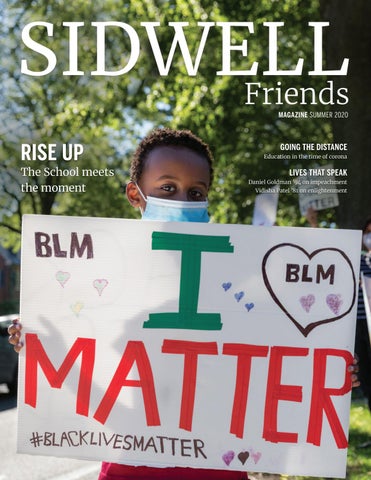
24 RISE UP The Sidwell Friends community stands up to racism and police brutality in 2020.
LIVES THAT SPEAK 28 HONEST BROKER Daniel Goldman ’94 on surviving COVID-19, prosecuting the Genovese crime family, defending the truth, and impeaching the president.
32 TOGETHER / APART
28
As the coronavirus continues to alter the fabric of our daily lives, Vidisha Patel ’81 reminds us to practice self-care, appreciate the pause, and listen to the virtues of silence. SUMMER 2020 | SIDWELL FRIENDS MAGAZINE 1
REFLECTIONS FROM THE HEAD OF SCHOOL
Falling into Grace In troubling times, we learn to heal, to grieve, to change. BY BRYAN GARMAN
D
uring a recent meeting with the Parents Association Quaker Life Committee, I was moved by the depth and sincerity of the conversation. Friends and non-Friends alike spoke earnestly about how they might learn more about the Quaker tradition, how it might help address the world’s current crises, and how we could explore its connection to other religions. One parent, a Zen Buddhist, was especially interested in examining parallels, something I have been exploring for several years.
2 SIDWELL FRIENDS MAGAZINE | SUMMER 2020
Author and Buddhist Pema Chodron notes that Buddhism shares many tenets with Friends and is especially helpful in finding the Light in the darkest, most fragmented moments. “Things falling apart is a kind of testing and also a kind of healing,” she writes. “We think that the point is to pass the test or to overcome the problem, but the truth is that things don’t really get solved. They come together and they fall apart. Then they come together and fall apart again. It’s just like that. The healing comes from letting there be room for all of this to happen: room for grief, for relief, for misery, for joy.”
REFLECTIONS FROM THE HEAD OF SCHOOL
Much has fallen apart this year. We are enduring a remarkable public health and humanitarian crisis. Fundamental assumptions about education are being challenged. Our nation’s horrific history of murdering people of color reared itself again, reminding us that racism remains our most persistent and pernicious scourge, one that, if we are to make good on the promise of equality and the reality of shared humanity, we must unequivocally commit to eradicating. No one can be fully human as long as members of our society are dehumanized. Our country and School must do better. We must act, as our Diversity Statement charges us, to affirm “the centrality of diversity and inclusion in all aspects of academic and campus life.”
community and its expression through Meeting for Worship transcended space, revealing that our connection to tradition could continue to serve us in the digital world. Alumni of color stepped forward, challenging the School to diversify the curriculum, address persistent inequities, and consider equity issues that might be aggravated during the COVID-19 crisis. In a moment of unity and beauty, more than 1,100 students, parents, alumni, faculty, and staff lined Wisconsin and Massachusetts Avenues, stretching three miles down to R Street, all proclaiming, “Black Lives Matter.” We have been and will continue to be tested. And through it all, our community has demonstrated strength and resilience, an unyielding faith in the relevance of our mission, and a need to protect it. No one cares more about the mission of their School than members of this community, and I am grateful for your engagement. The fact that all of our constituencies care so deeply speaks directly to the lively intellectual and ethical conversations that animate our classrooms and furnish the critical and caring culture that ensure we remain in a perpetual state of renewal, that even as things fall apart, we are all imagining how we might put things back together. If together we give ourselves wide berth to experience the grief, relief, misery, and joy that define this moment; if together we listen to the lessons of this moment and use them to care about the School and one another; then together we can assure that Sidwell Friends will come together in exciting new ways that serve our students and deepen our mission.
“We have been and will continue to be tested. And through it all, our community has demonstrated strength and resilience, an unyielding faith in the relevance of our mission.”
We have indeed been tested, but our community has begun to imagine alternative futures. Faculty and staff implemented an emergency Distance Learning Plan, one that forced them to transfer and translate years of human experience into a digital format. Parents of young children had to redraw the home/school/work triad, exhausting themselves as they tried to cover all the angles. Students valiantly continued to learn but mourned the loss of vibrant social connections in a relatively lonely and anxiety-producing environment. Members of the Class of 2020 provided extraordinary examples of leadership, inspiring us at every turn, even as they experienced the disappointment of disruption. Trustees remained inspiring stewards of the School, making bold decisions about our future and how we must build enduring financial strength. Faculty and staff created opportunities for students, parents, and alumni to assemble, reflect, and write about the murders of George Floyd, Breonna Taylor, and Ahmaud Arberry.
Thank you for caring. Thank you for holding in the Light those who have been affected by COVID-19, the heroic essential workers who have served them, and all victims of racism and police brutality.
Even as much of what we took for granted came unwound, we united around the significance of the School and its traditions. Students and alumni embraced a tradition of service, making personal protective equipment for first responders and giving generously to support financial aid. The power of
SUMMER 2020 | SIDWELL FRIENDS MAGAZINE 3
OFF
ON CAMPUS 4 SIDWELL FRIENDS MAGAZINE | SUMMER 2020
The Class of 2020 sat for a photograph last fall—before COVID-19, before masks, and before social distancing. It’s what a group of Upper School seniors should look like: healthy, lighthearted, arm-in-arm, smiles unhidden. And though the second half of the year upended expected traditions, it did not break their spirits. Born between 9/11 and the Iraq War, resilence is in their DNA. And after graduating from Sidwell Friends, service, justice, and wisdom are in their hearts.
SUMMER 2020 | SIDWELL FRIENDS MAGAZINE 5
ON CAMPUS
The graduation ceremony was virtual, but there was still plenty of pomp. On June 7, after a digital version of the traditional Meeting for Worship, Head of School Bryan Garman and Principal Mamadou Guèye addressed over 500 viewers, some of whom were family from across the globe who otherwise would not have been able to see their loved ones graduate. Below is just a snapshot from Garman’s speech.
“I want to thank you for the extraordinary
the pain and suffering that systemic racism has
patience and resilience you have demonstrated
inflicted on generations, and act to heal its trauma
throughout the year. I can’t imagine any other
and eliminate its grip on our consciousness and
class navigating these challenges as well as you
politics. Reevaluate assumptions and daily habits
have. Maybe you were able to do so, as one of your
so that we might heal the planet. It’s not fair that
parents suggested, because you were born in the
you have inherited these problems. Nor is it fair
difficult days that followed September 11. You
that your senior year fell apart. It just isn’t. But
grew up learning how to respond to challenge.
you have been given tremendous talent. You have
You found ways to grow closer to one another
earned a remarkable education. And you have
and become one of the most impressive classes
developed a strong ethical framework. If you
that I have seen anywhere, under any conditions.
continue to listen with your head and your heart,
Your extraordinary leadership and kindness will
if you continue to lead with love and courage,
leave an enduring legacy. Living in upheaval is
you will arrive at the required outcomes. I can’t
uncomfortable, disorienting, even painful. But
wait to see what’s next, to see how you will let
turmoil opens opportunity. It can break down tired
your lives speak. I look forward to the time that
structures, enable us to form new relationships,
we can be together to celebrate in person. Until
and empower us to create new possibilities.
then, I congratulate all of you and wish you the
Together, we can embrace the discomfort and
very best.”
work to build a better society. Practice that deep listening to discern what you have learned from the pandemic and how you might use these lessons to heal our public health crisis. Reflect on
To see videos of 2020 closing celebrations, including a special choral performance, go to: sidwell.edu/2020-celebrations.
SUMMER 2020 | SIDWELL FRIENDS MAGAZINE 7
ON CAMPUS
CULTURE CLUB
Head Space It’s a pretty safe assumption that many, if not most, Sidwell Friends clubs have paused—unless that assumption is about the Meditation and Mindfulness club. “I wasn’t sure we could continue,” says Hunter Colson ’21, the founder and co-head of the club. “But I talked about it with Chilamo Taylor ’20, and we decided we’d just have the meetings via Google Meet.” Even though they’re being held online, the weekly meetings have mostly remained the same. After a greeting, either Taylor or Colson will play a guided meditation on one of their phones; sometimes Upper School psychologist Kasaan Holmes leads a live meditation. The group has also added biweekly yoga sessions, led by Upper School teacher Shaakira Raheem and Associate Director of Auxiliary Programs Whitney Ennis, to their offerings “Most people don’t feel like they’re in their normal state of mind,” Taylor, the co-head of the club, says. “All of us are in different headspaces now; the shift to mostly doing everything at home or on a screen has caused people to get a little more stressed out. Now is the perfect time to get into either practicing meditation or just taking a second to be more mindful about how you’re feeling.” It’s also a way to stay in touch with others. “It’s really helped me to stay
Courtesy Chilamo Taylor
Wellness goes digital.
Chilamo Taylor ’20
level-headed throughout the distance learning,” says Taylor. “It’s served almost as a binding agent for me so that I don’t go completely crazy not seeing people and not really getting out of the house.” Colson agrees: “It’s just helpful in all aspects of our new situation. I’d say it’s very important to my life now.”
AT YOUR SERVICE
Hungry to Help
Sandra Missmar
Why stop cutting vegetables now?
Camilla ’32 and Georgina ’30
STAY FRIENDS Stay in touch with all things Sidwell Friends! Follow us on social media to get the latest On Campus stories. @sidwellfriends
8 SIDWELL FRIENDS MAGAZINE | SUMMER 2020
“I’d rather be at school,” Georgina ’30 says. “I’d rather stay at home,” says Camilla ’32. Camilla and Georgina are sisters. It shows. One thing the girls do agree on is keeping up the spirit of service they’ve learned at Sidwell Friends. Their regular project is making sandwiches for the School’s longtime partner, Martha’s Table. “Every other Saturday, we make about 35 sandwiches,” Georgina says. “We also give crackers with cheese and chips, and Oreos that are in little bags.” The girls sometimes wonder about the people they are helping and clearly take pride in their work. “If I met a person who gets the sandwiches,” Georgina says, “I would say, ‘How are you feeling? Are the sandwiches good?’” Camilla adds that it “feels good when we’re helping: We want to make more, because it’s fun.” And for any adult who thinks that small hands can’t do big things, Georgina also has a response: “Well, if you come to my house and you see what I can do, you might believe in me.”
ON CAMPUS
IN MEMORIAM
Love Prevails: Remembering Kieran Shafritz de Zoysa ’26
Freed Photography
A special, virtual Meeting for Worship eliminates borders.
Elsa Newmyer ’72, Bryan Garman, and Virginia Newmyer P’72, ’74, ’76; GP’06, ’09 at last year’s Newmyer Awards Dinner.
AT YOUR SERVICE
The 2020 Newmyer Award Honorees Somtimes volunteer work begins at home.
It all started in 1975. Ten couples who were friends of Ginger and Jimmie Newmyer ’37 celebrated their 25th wedding anniversary with a very special gift to the School: a tribute recognizing the couple’s years of extraordinary volunteerism and a new award to honor those who have made the greatest contributions to the Sidwell Friends School. The School has honored more than 250 people for their spirit of volunteerism and service to the Sidwell Friends community. And more than 40 years later, in 2018, Ginger and Jimmie’s
daughter, Elsa Newmyer ’72, created the Newmyer Young Alumni Service Award to recognize a new generation for their exceptional volunteer service. Though the awards dinner has been postponed, the School is still excited to announce the recipients as we await the opportunity to celebrate in person.
2020 Newmyer Award Recipients Elida Bessalel GP’14,’17 May Liang P’17,’20 Ali Mohamadi ’94, P’23,’26 Margarita Prieto P’14,’16,’20 J. Lawrence Robinson ’60
2020 Newmyer Young Alumni Service Award Recipient Sanam Aghdaey ’10
Courtesy Dhulsini de Zoysa
April is National Volunteer Month, and as in many Aprils past, Sidwell Friends had been gearing up to honor some of the School’s most dedicated volunteers at the annual Newmyer Awards Dinner. While the event has been postponed, the School and the Newmyers could not wait to welcome the newest members of what Head of School Bryan Garman calls the “Sidwell Friends Hall of Fame.”
Over 200 people from across the globe gathered virtually on April 21 for a special all-community Meeting for Worship dedicated to remembering Kieran Shafritz de Zoysa ’26, who was killed at the age of 11 in the April 21, 2019, Easter Sunday bombings in Sri Lanka. Though separated by physical distance, members of the Sidwell Friends community sat together in silence, in remembrance, and in holding Kieran’s family in the Light. Many attendees spoke of how they still feel Kieran’s absence in their lives, but that absence has made clear that the love and affection they feel for him are still present: Kieran’s humor, intelligence, and caring spirit continue to have an impact. The overwhelming sense of the Meeting was that once the shock of loss has abated, what’s left is love—a love that continues to inspire, unite, and make our community realize just how lucky we are to still have Kieran as a member of the Sidwell Friends family. Gifts in memory of Kieran can be made at sidwell.edu/Kieran.
Kieran Shafritz de Zoysa ’26
SUMMER 2020 | SIDWELL FRIENDS MAGAZINE 9
ON CAMPUS
CULTURE CLUB
All the Masks Are Fit to Print
Bahman Rowhani
Bahman Rowhani
“It’s going to get a little bit noisy,” Luke Primis ’20 says. Noisy, yes, but for a good cause. The near-constant rumble is coming from Primis’s basement, where he has been running two 3D printers almost continuously for the past few weeks and will for the foreseeable future. The printers crank out face shields, vital components of the masks that Primis and his friends are making to protect health care workers during the COVID-19 outbreak. Primis, Kamran Rowhani ’21, and Ian Palk ’20 teamed up to print, construct, and distribute the masks to local hospitals.
Kamran Rowhani ’21
10 SIDWELL FRIENDS MAGAZINE | SUMMER 2020
Courtesy Luke Primis
When the robotics season ended prematurely, students found an even better hobby.
Luke Primis ’20
Originally, the students intended to use the printers for something else: producing parts for NASA’s international MATE ROV Competition. (MATE stands for “marine advanced technology education” and ROV is “remotely operated vehicle.”) But when Sidwell Friends closed, “we had to kind of evacuate the robotics lab,” Primis said. “At that point, we weren’t sure whether we were going to be able to go to the competition, so the plan was to bring everything back to my house and work on it there.” Indeed, the competition—originally slated for May and June—was canceled in the wake of the virus, leaving the team with a bunch of equipment they no longer had use for. Or so they thought. “This was all of us being bored and wondering what we could be doing in this empty time,” Palk said, “which is a scarce resource at Sidwell.” So, the students looked into government specifications, found resources for makers, and started up production. Then Rowhani began connecting with the health care community: “I reached out to a lot of doctors,” he said. He came away with contacts at area hospitals like Suburban, Sibley, and Adventist. “This is something I can do that helps the community, especially the community I want to have a career in.”
With another printer donated for the project, the trio now has four printers up and running. It takes about three hours to produce one face shield; other components print much more quickly. Once everything is ready to go, assembly only takes about 20 minutes. But Primis, Rowhani, and Palk are quick to emphasize that you don’t have to own a 3D printer to make a contribution to the cause: They still need the raw materials. “People who have no access to 3D printers but see the merit in this have reached out,” Primis said. The group particularly needs elastic to attach the mask to the wearer’s face and foam tape to make the mask more comfortable. “Having the robotics season canceled was heartbreaking because I’ve been the captain of the team for two years, and this year was going to be the culmination of my experience at Sidwell,” Primis said. “But this is even more fulfilling because placing high at a robotics competition—that’s only for us. It doesn’t really benefit anyone else if you go to a robotics competition and do well.” The group has so far given more than 200 masks to area hospitals. “This is such a gratifying feeling,” said Primis, “to use my skills and knowledge to give back to our community.”
ON CAMPUS
AT YOUR SERVICE
5
The Nurse Will See You Now
QUESTIONS
I ask: “Which of these things do you think you can reasonably do? It doesn’t work unless you buy in.”
JASMIN WHITFIELD is the School’s director of Health Services and the healthcare coordinator for the Upper School and Middle School. She has been a registered nurse for 20 years, has a master’s in public health, and has worked at Sidwell Friends for 13 years. In all that time, she has never had to confront a global pandemic— until now. 1. How do you keep students healthy during distance learning? First, we say: “How long are you spending on streams? That’s too long; you can’t sit for four hours. You need to take more frequent breaks.” It’s about what students can do. They’re going to be adults; they have to figure this out. We ask: “Are there things that you can print out, so you don’t have to stare at the screen the whole time? Are you eating? What time are you getting up?” Students are spending time on a small screen, too, looking at Instagram, Snapchat, or whatever. That’s additional screen time. I tell them: “Try to start the day as if you were going to School. Take a shower, brush your teeth, put on some clothes. It doesn’t have to be the best clothes.” At the end,
2. Why did you decide to create a newsletter? We had so much focus on student health. Then we realized there was a key piece missing: employee health. Of course we see employees for first aid or emergency matters, but we felt like under these circumstances they could also benefit from our information. That’s where In Tune Tuesdays came from. It’s a weekly newsletter with health tips and advice on how to keep safe and stay healthy during this time. Some staff found their days didn’t end at 4:00 pm anymore; the eight-hour day ended up being almost 12 hours or longer. When you’re at home, you don’t realize how much time you’re spending in front of the screen, and you don’t even have the ergonomic pieces you had in your office. 3. What have you learned about the rest of your health staff during COVID-19? I’m lucky to have two nurses and an athletic trainer. It’s the best of both worlds when it comes to physical and physiological health. They have been so resourceful in developing health and safety protocols. Everyone in the community has different outcomes and different environments. We pull from all those experiences to develop our end product. My team is absolutely brilliant. They’re honest, resilient, and thoughtful. 4. Have you learned anything valuable that you will take back to campus with you? Health has a symbiotic relationship with learning. Now, with everything being guided by health, I’m having conversations with the administrative team, I’m in operations meetings, I’m
JASMIN WHITFIELD for
collaborating with communications. I hope those through lines, those relationships, continue on a regular basis and not just when there’s an issue. You have impact on every area of the School when it comes to the health and well-being of community members. How can we continue collaborating from all those different parts of the School to create the best experience we possibly can? 5. Is there a favorite piece of advice you give to help people take care of themselves? Figure out whatever it is that protects your emotional and physical wellbeing. Find it, embrace it. Then commit: This hour is mine to do this, because it brings me joy, brings me peace, clears my mind. Whatever it is. Like the old phrase: “You have to put the oxygen mask on first, otherwise you’re no good to everybody else.” I never thought I could meditate. In Meeting for Worship, my mind is wandering. I’m quiet, my eyes are closed, but my brain is—I just can’t turn it off. Recently, I realized our meetings at School always start with a moment of self-reflection. And being at home, my brain was like, “You need that.” I’m noticing now I can close my eyes and take those few minutes. I actually feel my breath. And I don’t hear anything. I don’t see anything. Just for a sub-minute, two minutes, five minutes. Something switched on for me. So find whatever that is for you. SUMMER 2020 | SIDWELL FRIENDS MAGAZINE 11
ON CAMPUS
AT YOUR SERVICE
Empowerment and community through sewing. Sophia ’25 has been sewing facial masks. It all started with a piece of fabric stashed in a drawer. Actually, it started long before that. “I found this raspberry fabric that my mom and dad bought when my mom was pregnant,” Sophia says. You see, after viewing the ultrasound, Sophie’s dad had nicknamed her “Raspberry,” due to her size at the time. “I put the fabric in my sewing drawer after my dad passed away in 2012.” But when she saw an article about making homemade masks to help stop the spread of COVID-19, she thought, “Why not use this fabric now?” That led to a mask-making bonanza—not just for Sophia, but for a group of people that includes other Sidwell Friends students, family members, and neighbors. (Sophia is quick to confirm that everyone involved respects social distancing.) So far, they’ve donated masks to Central Union Mission, MedStar Hospitals, and Joseph’s House—Sophia can whip up a mask in 15 minutes.
Cheryl Ellis
In Stitches
The masks serve another purpose: For Sophia and her fellow stitchers, the masks fill a need for community. “I’m in daily contact with almost all of the people who are involved,” Sophia said. “It’s nice to have something to reach out to.” And that doesn’t mean just sewing—her team depends on people Sophia ’25 who can cut fabric, procure supplies, and deliver masks. Forming the team and keeping her sewing machine humming has given Sophia a sense of agency. “Normally going on a break from school is a time to relax, but when a disease like COVID-19 is spreading through the world, it’s hard to relax when you feel powerless,” she says. “An hour of sewing can produce three masks that protect three people from getting sick. It is empowering.”
Martha Salazar Banda
who cared for her father. “In March, my dad passed away in Georgetown Hospital,” Gabi says. “I had been spending a lot of time in the hospital with him, and I was really impressed with the health care workers. It was amazing how these people are so dedicated to their jobs—and that was before the coronavirus had gotten to the point where we’re in quarantine.” That’s when she realized, “now they’re probably working twice as hard.”
Gabi ’25
AT YOUR SERVICE
Soap and Hope Inspiration courtesy her favorite customer. Gabi ’25 has a goal. A big one. She wants her organization, Soaps For a Purpose, to deliver 5,000 bags of soap (that’s 15,000 individual soaps!) to essential workers and those in need. Each bag contains three handmade soaps and a handwritten note, which she calls “a daily dose of happiness,” for all those who need both clean hands and a pick-me-up. The idea was born by watching the health care providers 12 SIDWELL FRIENDS MAGAZINE | SUMMER 2020
Gabi, along with a team of friends, is providing the unscented, organic soaps and notes to any organization that can use them. She has already donated 30 bags to MedStar in Chevy Chase, 10 to Gerlein Orthodontics, and 20 bags to The Brooks, a short-term family-housing facility. Her next donation is slated for the Sasha Bruce House, a youth homeless shelter. Making soap has given Gabi some peace in what, for her, is an especially difficult time. “Before quarantine, my life was very complicated and very busy,” she says. “Now we’re getting a lot of family time, which is really nice, and we have a lot of time to think and process everything that’s going on.” Making soap, Gabi says, also reminds her of a special bond with her father. “I’ve always liked starting small businesses,” she says. “He would always be my first customer. When I do entrepreneurial things or things to help others, I feel especially connected to him.” Even the shape of the soaps is meaningful. “The soaps are heart-shaped,” she says. “People will be washing their hands with love.”
ON CAMPUS
Fond Farewells With nearly a century of service to Sidwell Friends among them, the School says goodbye to some of its longest-serving Friends. ONE FOR THE BOOKS
COUNT ON HER
Dan Entwisle
Mary Milroy
28 Years of Service
37 Years of Service
Whether confronting Kurtz in his jungle lair, chasing a white whale with Ahab, or witnessing the love between Janie and Tea Cake, students in Dan Entwisle’s English classes developed an abiding respect for the power of language and stories. His World Novella class “breathed new life into my love of reading for reading’s sake,” Madeleine Wonneberger ’18 says. It wasn’t always easy—Moby-Dick, after all, was on one syllabus—but as Carolyn Peyser ’11 notes, “Mr. Entwisle always encouraged us to think deeply and to be honest with the class and ourselves.”
“Who would have thought the funniest, most entertaining Back-to-School Night presentations would be from my son’s math teacher,” Eve Conant P’22 says about her first encounter with Mary Milroy. “I wanted to join the class.” In her 37 years at Sidwell Friends, Milroy cultivated an excitement for mathematics in countless Middle School students—and, apparently, their parents as well. Students entering her class with math anxieties found those dispelled, motivated by Milroy’s confidence that they were smart, capable STEM scholars. “She fostered a warm and caring environment and made math so much less intimidating,” Anne Pearson ’04 says.
During his 28-year tenure at Sidwell Friends, Entwisle fostered the sort of trusting relationships with young adults that empowered them to be honest, vulnerable, and courageous with their words. “I remember the special bond he had with the class,” David Newman ’14 says. “He understood his role in our lives as a mentor during an emotionally fragile time for many.” And just as Entwisle encouraged his students to cherish great works of literature, he also encouraged them discover their own potential as writers and thinkers. “He helped me believe that I had something to say that was worth refining and worth reading,” Hallie Trauger ’06 says. “He listened to my writing, met me where I was, and helped me accept myself and grow.” “He encouraged and enabled me to pursue my passions, reassured me when I’ve failed, and pushed me to do better,” Charlotte Rose LaMotte ’20 says. “I would not be where I am without Mr. Entwisle.”
GET THE GREEN LIGHT
Steve Sawyer 39 Years of Service
If you’ve attended an event at Sidwell Friends over the past 39 years—a school concert, Next-to-New Sale, graduation, or Reunion—you likely saw plant manager Steve Sawyer in action. Or rather, you enjoyed the fruits of his leadership without seeing all the crises averted and hours dedicated to the smallest details. “As former head of the Parents Association, I had numerous occasions to appreciate how complex, challenging, and diverse Steve’s job is,” says Sudi Press P’96, ’98, ’02. “There is so much that might not go according to plan that Steve has to adjust to or accommodate.” In addition to tackling flooded orchestra pits, fussy HVAC systems, and annual campus rejuvenations, Sawyer guided the School’s green transformation. His spirit of service and
Milroy’s quick, dry sense of humor, warmth, and kindness also made her an ideal advisor for students in their awkward pre-teen years. “We would hang around her room before and after school, and we could see how many students flocked to her classroom,” Milroy’s daughters, Bethany (Milroy) Titman ’04 and Alexa Milroy ’07 say. “She spent so much time creating a welcoming environment, with posters of M.C. Escher and the Beatles, digits of pi, and brain teasers.” In expressing gratitude to Mary for “instilling in me a love of math that burns strong to this day,” Alejandro Alderman ’11 echoes the sentiments that so many students shared upon learning of Milroy’s retirement: “I have to thank her for doing the same for hundreds upon hundreds of students who have grown up or will soon grow up to be mathematicians, scientists, and engineers, in no small part thanks to her teaching and devotion.”
environmental leadership have left their marks on both campuses. Yet most students, parents, and volunteers found his eagerness to share his time and expertise most remarkable. Known for his bright smile and patient, friendly approach, Sawyer was always ready to help—whether you were a 7th grade student writing a report on the LEED-certified Middle School building, an Upper School student rebuilding a car as a senior project, or one of the players on his girls’ soccer team. “Steve Sawyer found the time to meet with me, tell me more about the campus buildings, and discuss my designs with me,” Nikhil Chaudhuri ’15 says. Sawyer helped with Chaudhuri’s junioryear architectural project to reimagine Wannan Gym. But Kit Troyer ’90 perhaps says it best: “What a wonderful human being.” SUMMER 2020 | SIDWELL FRIENDS MAGAZINE 13
ON CAMPUS
GOOD SPORTS
ON TOP OF THEIR GAME Sidwell Friends honors its senior athletes at the
Arjun Thillairajah ’20
year-end Athletic Celebration. Nina McCormack ’20
In May, the Sidwell Friends Athletic Department held its annual Athletic Celebration. This year was a little different: It was held virtually as a YouTube Premiere. David P. Pearson ’52 Director of Athletics Keith Levinthal kicked off the event, and then special guest Chad Ricardo of NBC Sports hosted the celebration. Ricardo pens The Ricardo Report and is a DC metro area high school sports expert. “Hosting the Sidwell Athletic Celebration was truly an honor,” says Ricardo. “I’m a big fan of their studentathletes—they are a pleasure to cover and the Sidwell community is truly special.”
Colby College in the fall, was a rare three-sport starter in soccer, wrestling, and lacrosse. McClean was a leader in lacrosse in addition to playing rugby outside of Sidwell Friends; she also racked up numerous personal bests in the weight room and kept stats for the football team. McClean will continue her athletic career at Bowdoin College. Distinguished Award recipient Nina McCormack ’20 was All–Independent School League (ISL) in 2017, 2018, and 2019, and All-Metropolitan (MET) in 2018 and 2019. “She was a wonderful teammate who was consistently trying to help the underclassmen get better,” Coach Samantha Ziegler said. “Nina elevated our program as she helped lead the team to a 2018 ISL A regular-
season co-championship.” McCormack will continue her athletic career by playing lacrosse at Harvard University. This year, the Wannan Award went to Arjun Thillairajah ’20, a three-time All-State in cross-country, two-time individual Mid-Atlantic Conference (MAC) cross-country champion, fourtime All-MAC in cross-country, twotime All-MET honorable mention, twotime first-team All-DC Run Washington magazine, four-time team crosscountry MAC champion as a captain, and a 2019 District of Columbia State Athletics Association (DCSAA) boys’ track and field team champion. Thillairajah will continue his athletic career at Case Western Reserve. Elena Michael ’20, a captain in both soccer and lacrosse, took home the Fine Award. She is headed to Colby College. Michael was All-ISL in soccer
Chad Ricardo
Sidwell Friends Athletics celebrated 26 career award winners and the 15 student-athletes continuing their athletic careers in college next fall. Elliot Woodwell ’20 and Sadie McClean ’20 were this year’s Unsung Hero Award recipients. Woodwell, who is heading to 14 SIDWELL FRIENDS MAGAZINE | SUMMER 2020 Sadie McClean ’20
Elliot Woodwell ’20
ON CAMPUS
THE AWARDS Chilamo Taylor ’20
THE UNSUNG HERO AWARD recognizes
Elena Michael ’20
in 2018 and 2019 and an All-ISL pick in lacrosse in 2019. The girls’ soccer team won the ISL Championship in 2018 and 2019 and the DCSAA Championship in 2018. They were also DCSAA finalists in 2017 and 2019. In lacrosse, Michael finished with a career total of 152 points—123 goals and 29 assists—and she was a member of the 2018 AA ISL co-championship team. Before moving to the final award of the celebration, Levinthal took a moment to highlight and recognize studentathletes who exemplify the culture of leadership on and off the field. “It is important that we recognize the values that are most important to us—selflessness, teamwork, positivity, work ethic, and other qualities that build a healthy and successful culture,” Levinthal said. “I enjoy recognizing students who often go unnoticed but are a big reason why we are successful. Our culture is the key to our success, so we will honor those that maintain and build it.”
This year’s Tyler Christian Rusch ’04 Award recipients were Claire Wolstencroft ’20 and Chilamo Taylor ’20. Coach Logan West ’01 said Wolstencroft, who’s headed to Dartmouth College, was “a selfless team player who always goes above and beyond.” This year, she played through an injury to help the team win its first ISL AA Division Banner in 18 years. Head Coach John Simon spoke about Taylor: “Chilamo is an outstanding role model for the younger students in our community,” Simon said. “He leads by example and dedicates a lot of his personal time to volunteering to coach youth in our community.” Taylor was a member of the 2019 DCSAA champion boys’ track
and field team. Taylor will continue his athletic career at Franklin & Marshall College. “Being able to play a role in their big night,” says Ricardo, “especially given the circumstances of the times, is something I will remember forever.”
Claire Wolstencroft ’20
a senior male and female athlete for contributions that might otherwise go unrecognized. The recipients of the award—by virtue of their presence, participation, dedication, and enthusiasm—have significantly enriched the Sidwell Friends Athletic Department.
THE DISTINGUISHED ACHIEVEMENT AWARD honors senior studentathletes who have earned significant accolades at the league level and beyond and who have admirably represented their teams and Sidwell Friends in competition.
THE WANNAN AND FINE AWARDS acknowledge a senior male and female athlete who, by consensus of the Athletic Department, deserve recognition for their talent, leadership, dedication, sportsmanship, broad participation, and involvement in all aspects of School life.
THE TYLER CHRISTIAN RUSCH ’04 AWARD commends a senior male and female athlete who have significantly enriched Sidwell Friends Athletics through motivational leadership, steadfast participation, dedication to teamwork, enthusiasm, and all-out effort. This award is named in memory of former student Tyler Rusch ’04.
I f you missed the live ceremony, you can watch the Athletic Celebration video at: sidwell.edu/2020-athletic-awards.
Photos by Susie Shaffer ’69
SUMMER 2020 | SIDWELL FRIENDS MAGAZINE 15
THE ARCHIVIST
“A Trying Year” During the 1918 influenza epidemic, Sidwell Friends closed the School, students gave back to the community, and “patrons and pupils” overtaxed the School’s sole phone line. At least Thomas .” Sidwell knew that a “cheerful frame of mind is conducive to health BY LOREN HARDEN BERGH The current COVID-19 pandemic is undoubtedly the most significant public health crisis of our lifetimes. But a century ago, Thomas Sidwell also had to usher the School through an epidemic: the “Spanish flu.”
The 1918–1919 academic year was not a normal one at Sidwell Friends. Along with other schools across Washington, Sidwell Friends closed for a month. Playgrounds, libraries, movie theaters, and other businesses around the city were also ordered to shut down. As one student lamented in the December 1918 issue
of The Quarterly: “The first weeks of school have certainly been difficult ones for both faculty and students. The ‘flu’ succeeded in upsetting all plans and everyone has had to be ‘double quick’ to keep up in his work.” Without the benefit of Zoom, iPad apps, and all the other technologies that enabled the School to
implement a distance-learning plan in a matter of days, this earlier generation of students had no choice but to put in extra time to make
One legacy that does endure from the School’s earliest days is its commitment to the wider community. The students of a hundred years ago were eager to let their lives speak and
raised funds for the Washington Baby Camp Hospital, Red Cross, and Friendship House, a local social-service agency. Throughout 1918 and 1919, Sidwell Friends students held dances, athletic events, and bazaars to raise money for these local organizations. The students today, in turn, have responded to the
COVID-19 pandemic by employing 3D printers to create face shields for health care workers, sewing masks for local homeless shelters,
and holding virtual concerts to raise funds for community-outreach agencies. As administrators anticipate returning to campus under social-distancing restrictions, getting students to spend more time outdoors is one strategy under consideration. In the winter of 1919, outside activity also played a
role in the School’s health and wellness efforts.
up for the missing hours of instruction.
Stu den ts stretc hin
16 SIDWELL FRIENDS MAGAZINE | SUMMER 2020
g in the cou rty ard ,
192 0s.
C o u rt ya
rd , 19 10
s.
THE ARCHIVIST
As a student wrote in the February 1919 issue of The Quarterly, “‘Fresh Air and Efficiency’—This is our new school motto, and we are getting more of each by spending our recesses outdoors instead of in the stuffy school room. Promptly at 11:15 we assemble in the study hall and march out into the yard—girls as well as boys—to have fifteen minutes of exercise.”
Meanwhile, this note from Thomas Sidwell to parents from February 1, 1919, is a reminder of just how exhausting things had become for the administration that year:
Life has grown so complicated and so difficult that we must ask that the Friends school telephone have a more restricted use. … Our buildings are large and the mere walking back and forth to find persons or to carry messages consumes an incalculable amount of time. ... Our people are wearied with the war, the recent crowded condition of the city, and the great amount of illness there has been this winter. Will the patrons and pupils of the Friends School spare us further weariness by planning ahead and so not taxing the telephone to its limit?
The 1918–1919 academic year eventually came to an end, and the Sidwell Friends community managed to sustain no deaths from the influenza outbreak that took the lives of nearly 3,000 DC residents. Thomas Sidwell ended the year with a final note to parents:
“The Friends School at the conclusion of its thirty-sixth year, wishes to thank its patrons for their cooperation during a trying year and especially during the period of influenza. With
this cooperation, it has been possible to complete this year’s work in a creditable way.” Our founder’s message echoes today, as we thank our community and look ahead together to what promises to be a historic 138th year.
Thomas Sidwell writing at his desk.
SICK LEA
VE
1894
During a scarle t fever outbreak in 1894, Thomas Sidwel l closed the Sch oo l for a few days while he and fi ve colleagues w ashed student desks with bich loride of mercu ry and then burned 140 po unds of sulphu r throughout th buildings. For th e e unfortunate students who ha come down wit d h scarlet fever, Sidwell burned their books an d everything le ft in their desk s.
1 9 07
A brief closure due to two stud ents contractin diphtheria mad g e the news in 19 07, perhaps because one of the Sidwell Frie nds students w had been quar ho antined was Arc hie Roosevelt, third son of sitt th e ing President Te ddy Roosevelt. In an announce ment to parent s about closing the school for fumigation, Th om as Sidwell advised, “Meanw hile it will all be well to remember that a cheerful fram e of mind is conducive to he alth, and that th e greatest safeguard agai nst contagious di sease is a strong, vigorous body, kept so th rough regular exercise, abun dant sleep and proper food.”
SUMMER 2020 | SIDWELL FRIENDS MAGAZINE 17
  GOING THE DISTANCE
GOING THE
DISTANCE BY KRISTEN PAGE
GOING THE DISTANCE
The coronavirus closed the Sidwell Friends campus—but not its classrooms.
A
few months ago, masks were for surgeons, “Zoom” was a noise a toy car made, the unemployment rate was less than 4 percent, “social distancing” was strictly a teenage phenomenon, and schools were very much held in person. At first, the coronavirus came in like a whisper. With word of a Wuhan outbreak, the Sidwell Friends School canceled a minimester trip to China. But then news of the coronavirus got louder. The virus’s tendrils crept across the United States, and the School canceled all minimesters and travel in total. Finally, the coronavirus hit the East Coast, and suddenly travel precautions expanded to include journeys from home to campus, and new safety precautions restricted movement just about everywhere else because gathering in groups put the entire community at risk. In a matter of weeks, the whisper had turned into a siren. “There was enough time for me to meet with all the faculty and get them what they needed,” says Darby Thompson, the director of Upper School technology and the computer science program. “What’s cool is we started at a place of emergency, and we made some really good decisions early.” For example, the School studied plans in nations like Singapore and Japan, which had experience with previous pandemics, such as SARS and H1N1. Director of Health Services Jasmin Whitfield provided her expertise and guidance, playing a vital part in monitoring the public health crisis in the region (see “The Nurse Will See You Now” on page 11). As a result, the School was one of the first independent schools to close its campuses in the region. Naturally, moving to the Distance Learning Plan required teachers and students to be flexible, to get used to new means of instruction, and to learn to use new technologies. Together with Holly Kinnamont, the Middle School academic technology coordinator, and Jenni Voorhees, the Lower School technology director and academic dean, and a team of IT professionals led by Chief Information Officer Dan McCarriar, the technologists trained teachers, administrators, and staff in every division in the particular intricacies of taking their days, their careers, and their responsibilities 100 percent online. That meant dashing to recreate classrooms at home. All of the teachers, of course, made sure they had what they needed to implement the Distance Learning Plan. They grabbed computers, textbooks, and lesson plans. But a few teachers needed some specialty items: Lower School music teacher Matthew Stensrud, for one, made sure to get drums, maracas, a few posters, and anything else he could use to turn part of his home into an impromptu music classroom. For physics teacher Chris Ritacco, it was laboratory equipment. Just before the School switched to
SUMMER 2020 | SIDWELL FRIENDS MAGAZINE 19
GOING THE DISTANCE
the Distance Learning Plan, says Ritacco, “I remember scrambling, trying to figure out how we were going to approximate a classroom from home.” Ritacco, along with Julie Langenbrunner, another physics teacher, decided to take advantage of their labs while they still could. “Julie and I went in after the kids went home and just started recording ourselves doing a bunch of labs,” says Ritacco. “And we took a bunch of equipment home. It wasn’t panic; it was just, ‘Let’s do as much as we can while we can do it in the building, and we’ll figure out the rest later.’” Now, says Langenbrunner, “Chris has a whole physics lab in his basement.” The teachers weren’t the only ones taking home analog items. “We realized we wanted to send home a lot of physical materials—not only iPads,” says 1st grade teacher Jane Legg. “We remembered that the Fox Den had these great bags with the Sidwell logo on them, so they seemed ideal.” Ideal for packing up educational materials for the prekindergartners and 1st graders. They packed books—some chosen by students, others chosen by teachers for some shared reading time via Zoom—writing supplies, art and Spanish activities, handwriting and sketch books, and a new box of watercolors for each student. In the end, the bags were a way for teachers to send a little bit of Sidwell Friends home with the students. “It was great to focus on a positive side to Distance Learning—what might be fun about it, as opposed to what we would all be missing,” Legg said. “Filling a bag and thinking about what would be useful was a very tangible project at a time when everything seemed very uncertain.” “Letting teachers play to their strengths, that’s what we needed to get through,” says Thompson. “I’m really excited because we’ve gotten to a place where we’re getting the hang of it. Our teachers have got a system and things are working. The teachers are actually inspired at this point.”
Chris Ritacco
20 SIDWELL FRIENDS MAGAZINE | SUMMER 2020
M
any teachers were already ahead of the game. The Middle School language department, for instance, has been using a digital system for several years now that easily moves between the classrooms and students’ homes. “We used to have a free-standing language lab,” says Spanish teacher Nan Pickens. “There was a lot of thought about how to replace it, and the School was committed to finding us a replacement.” Ultimately, the School went with a product called the Digital Learning Lab, or “DiLL.” DiLL allows language teachers not only to provide instruction, but to chat live (either in a group, with partners, or with a teacher) and note students’ answers to prerecorded questions. The students and teachers were used to the software, and that continuity has provided some unexpected benefits. “It’s nice to be able to do something that the kids were already familiar with, because they’ve had to learn so much in such a short time,” Pickens says. “It’s refreshing to be able to go back to old habits and have it work for us.” Another old habit that’s thriving is using audio and video in nearly the same way they would in a classroom. “We’re doing all the Google Suite things but pumping ours up with a lot of video content,” Pickens says. “It’s critical to continue to hear what we call ‘authentic resources,’ which means real people speaking real language.” That means Pickens can play a conversation between two people in Spain and then ask the students to answer questions about it. The most important continuity, says Pickens, is speaking the language. “I create these chats for the whole section, and I can see them chatting in Spanish with one another,” Pickens says. “They’re craving that kind of informal communication. It’s just so nice to hear their voices.” Continuity has been vital to Stensrud, too. His students are among the youngest, for whom routine can be paramount. “When they told us about the Distance Learning Plan, the wheels in my brain started turning,” Stensrud says. “How can this best benefit the students and what kind of consistency I can bring to the students?” Stensrud created a template for his digital lessons. Each 10-minute video starts with a song, then kicks into a dance break, and ends with an activity the students complete at home. The song and the activity vary according to the grade level; he also introduced some synchronous learning, including meeting with the 70-member 4th grade chorus. “When I make video lessons, I try to teach them as if the kids were there,” he says. “That’s going to create that kind of consistency that students will appreciate. That’s probably what they’re yearning for right now, when everything is so upside down.”
GOING THE DISTANCE
There are other ways Stensrud is keeping things the same— even when it’s accidental. “There was one time I knocked the piano behind me, so all the books I had on top all came crashing down in the middle of the video,” he says. “And I was like, ‘Well, okay. Let’s just keep going.’ I think it gave the kids a little bit of a reminder of what the classroom is like—things like that happened in the classroom all the time. If we make these pristine videos that show everything is perfect, I’m not sure that’s what’s best for the kids’ learning and growth.” When real life intrudes on the videos, it adds a certain authenticity. The Distance Learning Plan has also given parents and others who are home with students a sneak peek into what goes on in the music classroom. “In music, parents are going to see the performance—the winter concert or something,” Stensrud says. “When you see the finished product in a concert, parents think perhaps that’s most of what happens in music, that we’re standing there tall and singing.” And while that’s a part of learning music, it’s only a small part. “It’s mostly exploring and creating in a more raw way,” he says. “I’m sure the parents see more of that now.” Parents can also help create a community of music at home. Family members can be an active participant in the kids’ learning, whether it’s by joining their child for a dance break or playing a music-based game with them. It gives cooped-up kids an opportunity to get their wiggles out. “We’re going to be singing, and we’re going to be making patterns on our body, and then we’re going to be moving around and dancing,” Stensrud says. “The kids are constantly engaging their bodies. And I’ve heard from some parents that the kids will watch the video three or four times because it’s a fun 10-minute thing. They’ll watch the lesson and then later in the day they say, ‘Ooh, I want to go back and do that again.’”
N
But a more basic obstacle the School had to overcome when it moved to the Distance Learning Plan was equity. “I think the number one thing that has been on my plate the last couple of years has been about student devices,” says Thompson. Right now, Upper School students have to have a device, but there are no restrictions on what that device is. “We’ve gotten everything from the fanciest top-of-the-line Mac, to the fanciest top-of-the-line gaming PC, to something that’s 10 years old and barely turns on, to things that don’t have much battery,” Thompson says. “We’ve got Chromebooks, we’ve got iPads. We have every device imaginable, and it’s a struggle for me to support them.” She knew the School ensured that every kid had access to internet—but not what were they connecting to it with. That’s why Thompson was so relieved when the administration decided to implement a School-purchased laptop program for Upper School students, supplying each with a MacBook Air to ensure an equal platform and support capability from IT staff. The program starts in September (see “What Happens in the Fall?” on page 23). When students don’t have the same devices, it is harder to troubleshoot, harder
“ They’ll watch the lesson and then later in the day they say, ‘Ooh, I want to go back and do that again.’” —MATTHEW STENSRUD
ot every subject translates so easily to digital platforms. Part of the joy and wonder of studying, say, science is experiential. Whether it’s a pungent smell, changes in color, an old-school volcanic reaction, or an outright explosion, science is meant to be hands-on. And teaching and learning science from a safe distance presents a new set of challenges. There’s room to be wrong in the classroom, says chemistry teacher Tom Donley. At home, well, not so much. “You’re not going to be asking students to take out certain types of chemicals,” he says. Let alone mix them up. All the teachers agree that there are still irreplaceable classroom experiences—like the team spirit they feel in their classrooms.
to streamline security protocols, and harder to ensure everyone has a similar experience. That’s why getting all teachers and staff fluent in the same software programs was so critical. Thompson was also particularly worried about younger students who do not typically rely on computers. “I was thinking about handwriting,” says Thompson. Whether it was writing out math problems or a paragraph, some students just aren’t fluid typists yet. “I was thinking, How can I get equipment into my teachers’ hands as fast as possible that will let them use document cameras, and iPads, and handwriting stuff at home?” says Thompson. “And how can I make sure that every single person has a way to get work back from the students and then give them feedback? I was really concerned about student equity.”
SUMMER 2020 | SIDWELL FRIENDS MAGAZINE 21
GOING THE DISTANCE
“ One of the coolest things about what has happened in the last couple months, is that teachers have discovered new techniques and tools they want to take back to the in-person classroom.” —DARBY THOMPSON Equity was top of mind for the teachers, too. Even when preparing bags for the Lower Schoolers to take home, “we wanted to make sure all children had the same access to all the same supplies,” Legg says. “We try not to set any assignments that use materials we’re not sure everyone has.” The teachers at every division had to remember that each student lives in a different environment and may not have access to the same materials. It’s a reminder that flexibility is vital for distance learning. “It’s about respecting what other people have.” Ritacco agrees. “One time, we said everyone had to have a spoon,” he says. “We were fairly confident that we could rely on the kids to find a spoon somewhere.” The physics teachers also created a new assignment that asked the students to build a musical instrument out of anything they could get their hands on in order to demonstrate how soundwaves work. “They got really creative with it,” says Langenbrunner. “One made an instrument out of a plastic ruler; they pushed it down on the edge of the table with the end hanging off and just thwacked it. They changed the frequency based on how much of it was hanging off.”
W
hile nothing can replace in-person teaching, perhaps the greatest upside of the Distance Learning Plan has been the innovations that have come out of asking teachers to reconceive their practices. Upheaval has led to new and better ways of doing things. Watching the students complete their assigned activities from afar, for example, has raised some possibilities in Stensrud’s mind for when he and his students are together again. “I recently did an activity where I found patterns in my house and in my yard,” he says. “I took some bowls from my kitchen and made them into music patterns; then I went outside and found pieces of bark and made patterns. Then I asked the kids to see what they could find.” The idea was to get the children to explore their own homes for makeshift instruments. “Some of them used little pebbles, and some of them used nail-polish containers, and some of them used different markers,” Stensrud says. “It was a fun way for the kids to realize that you can make music out of anything.” He says that when everyone returns to School, he plans on using some of the activities that went really well in distance learning and incorporate them into his curriculum. “It’s exciting if we, as teachers, can be teaching the content and curriculum,” he
22 SIDWELL FRIENDS MAGAZINE | SUMMER 2020
says, “but also giving kids these avenues to be explorative back at home and still using their imaginations.” Some of the tools and techniques the foreign-language department has developed will continue after students and teachers return to campus, too. “We’ll take with us some of the things we’ve learned,” says Pickens. “Sometimes it’s like, ‘Oh, my gosh! Why wasn’t I always doing this?’” Donley had a similar epiphany. Distance learning has shifted how he thinks about long-held processes. “I feel very fortunate that I work with some very creative and very energetic people, and getting different perspectives on what might work and what might not work is great,” he says. “This is a very creative time right now, not just for chemistry, but for all teaching and learning.” In fact, some teachers have found that the Distance Learning Plan has made some things easier—like special guests. At the beginning of the year in 2nd grade, students start with a passion project. “They begin to think about themselves and who they are as a person, and what is it they love to get up in the morning to do,” Joyce Bidi-Olagunju, a 2nd grade teacher, says. Once the students have identified that passion, the students tackle independent research projects. This is where the experts come in, like veterinarian Dr. Amy MacIsaac. Students
GOING THE DISTANCE
WHAT WILL THE FALL BRING? meeting with MacIsaac online this spring asked her about her favorite animal (dogs), how much training she had to have (lots), and if there were similarities between being an animal doctor and a people doctor (more than you’d think). As the discussion unfolded, Bidi-Olagunju noticed that the online conversations were moving more smoothly than they had in person during previous years. In person, the students often talk at the same time or over each other. But, Bidi-Olagunju says, the online platform means “they actually have to take turns and share their ideas one at a time.” What’s more, getting MacIsaac on board was easier, too. It can be a daunting task to find community experts willing to come to the School and meet with students—leaving work, scheduling convenient times, and transportation issues often made it difficult for an expert to show up. Now, it’s different. “We have more access to people,” Bidi-Olagunju says. “No one said they weren’t able to meet with us.” “One of the coolest things about what has happened in the last couple months,” says Thompson, “is that a number of teachers have discovered new techniques and tools that they want to take back to the in-person classroom.” A lot of the teachers now accept and return homework digitally. “Many used to accept homework digitally, but then they would write up, print it, write it, and hand it back,” Thompson says. “What they’ve discovered is they can annotate student work online and immediately send it back to the student and give them instant feedback. We can do quizzes where kids find out not only what their score is, but they get explanations of where they went wrong and why.” Thompson has even learned a few things herself. “Students need to have technology training even when this isn’t happening,” she says. “Student technology support is something I’ve learned that I will absolutely be embracing more in future years. The coolest parts are what we can do with kids asynchronously.” For example, Thompson says, using technology can make homework more interesting and even fun, it can create videos with quizzes embedded in them, and it can design discussion boards so students can collaborate more. “If we can get that down really well,” she says, “we’ll be set for anything.” Clearly the Distance Learning Plan presents new challenges for students, parents, and teachers alike, but as the endeavor continues—and as teachers look toward the beginning of the next academic year—many see a chance to improve not only online teaching techniques, but what happens in the real-life classroom. As Bidi-Olagunju puts it: “Sometimes out of the chaos, great ideas are born.”
Given the uncertainty of the pandemic, the School’s plans for the fall have become a puzzle to solve. The public health agencies and local governments of the District, Maryland, and Virginia each have their own sets of guidelines, the science of COVID-19 transmission is still a work in progress, and a vaccine is still outstanding. So how does the School plan for the fall? In June, faculty task forces from each division drafted plans that accounted for variables like age and developmental needs. (These plans are expected to be approved by the Board of Trustees in late July.) Each group relied on specific priorities: protecting the community’s health and well-being; allowing students to engage in meaningful learning; offering students authentic interactions with peers and teachers; and enabling flexibility to allow for possible disruptions. Led by the division principals and Assistant Head of School for Academic Affairs Min Kim, the task forces researched effective practices used by international and independent schools around the world, as well as guidance issued by the National Association of Independent Schools and other organizations. Final plans are still in the works, but here are a few considerations:
HEALTH • Physical distance among students and teachers at all times. • Requirements for protective gear, face coverings, gloves, etc. • Enhanced cleaning routines and rigorous disinfecting procedures. • D aily temperature checks and enhanced contact tracing.
EDUCATION • Hybrid approach that includes in-person and distance learning. • Weekly schedules with rotating days on campus. • Smaller classes and cohorts. • Adjusted classrooms, desks, and community spaces. • Redirected hallway traffic with one-way lanes. • Modified athletics program focused on building skill and strength.
TECHNOLOGY • New learning management system to improve access to materials. • L aptops for all Upper School students to streamline platforms, simplify IT support, and ensure equity. (Lower School and Middle School students already have School-provided devices.) • Switch to Zoom for Education for uniformity. • i Pads for teachers so they can annotate student work and offer handwritten notes. • Expanded Wi-Fi for more use of outdoor spaces.
To learn more, go to: sidwell.edu/fall2020. SUMMER 2020 | SIDWELL FRIENDS MAGAZINE 23
RISE UP
24 SIDWELL FRIENDS MAGAZINE | SUMMER 2020
RISE UP
RISE UP The Sidwell Friends community stands up to racism and police brutality in 2020.
Kelley Lynch
“I’m doing this because I’m the parent of two black children,” said Amanda Derryck Castel ’91 (parent of Olivia ’21 and Alexander ’24) at the Sidwell Friends peaceful protest on June 8. “I worry about them and their future and safety. Also it’s important for us to be out here as a community to show them that we have to put actions behind our words.” After the murder of George Floyd, Breonna Taylor, and Ahmaud Arberry at the hands of police in May, that’s exactly what the School aimed to do: put action to its words. Sidwell Friends strives to teach equality and to eliminate racism; this took expression in the in the form of a silent protest—or not so silent given the boisterous honking of support by passing cars—on a weather-perfect June evening. Sidwell Friends families and community members carried signs, kept six feet apart, and created a human chain to promote awareness of systemic racism and the work of the Black Lives Matter movement. It was supposed to extend from the Wisconsin Avenue campus to the Naval Observatory on Massachusetts Avenue. It ended up reaching all the way to R Street and Massachusetts. “Coming from Southeast Washington where this happens all the time, I’ve been a victim of police brutality myself,” said Eric Singletary ’93 (parent of Aaron ’23). “So to have my community, which is Sidwell,
my alma mater, show their longstanding commitment to justice, civil rights, and equality for all, is important. We’re out here showing solidarity.” The event was also a chance for young people to get involved safely, and many parents brought their Lower School students along. “Equality and justice are incredibly important to our family and always have been,” said Aman Sidhu (parent of Noor ’28 and Ajuni ’28). “As a South Asian family and Sikh by religion, we have faced hate crimes and discrimination in this country, and it’s only a fraction of the experience of the African American community. So, it’s incredibly important to stand with our black brothers and sisters and make it very clear that black lives matter. We’re here to fight for equality. For Sidwell to stand up and send that message loud and clear is a reflection of why we chose Sidwell for our children.” And of course, students themselves took to the streets. “I’m doing this because I think it’s very important to spread awareness of injustice and systematic oppression,” said Spencer Tyson ’21. Others said it was important to be there to amplify the voices of black people, or because it was simply the right thing to do, or because equal rights shouldn’t be preconditioned on race. All agreed that their presence signaled one vital concept for certain: Black lives matter.
SUMMER 2020 | SIDWELL FRIENDS MAGAZINE 25
RISE UP
Sarah Randall
Sarah Randall
BLACK LIVES MATTER.
Photos by Kelley Lynch
26 SIDWELL FRIENDS MAGAZINE | SUMMER 2020
“
RISE UP
HISTORY RHYMES
I AM I AM HEARTBROKEN because
I AM STRONG because to be a
black and indigenous people have been assimilated into a society that will shoot us dead for nothing. The rectification for theft is restitution; the rectification for slavery is liberation. Murder is not rectifiable.
black woman in America today is a tug of war. If the other side loses, they go home, alive, breathing. If I lose, I don’t get to go home. I die. I have no other choice than to be strong.
—KARABELO BOWSKY ’23
—LIAN CRAIG ’21
I AM ANGRY because nothing changes.
—ISAAC PICKRUM ’21
I AM STRONG (empowered) because I have a voice.
I AM ANGRY because I can’t count how many times I’ve watched blood spill from a lifeless body when their blackness was seen as a threat, and because a life of necessary activism isn’t the life I would have chosen.
I AM STRONG because I recognize
I AM HEARTBROKEN because
the privileges I have and can use them to fight for those who cannot.
I still see racism and white supremacy in my communities.
I AM HEARTBROKEN because
I AM MOTIVATED because I believe in our generation.
—ATSWEI LARYEA ’21
I can’t remember or don’t know the names of every man, woman, and child who has lost their life to America’s structurally racist system.
—KENNEDY FLEMING ’21
I AM HEARTBROKEN because
in adversity, the resilience of the oppressed inspires and offers hope.
justice isn’t being served. I was 8 when Trayvon Martin was killed. Now I am 16, and the only change is the media coverage. It should not take eight years for people to get that racism exists—I’ve known since I was a kid.
—MOLINA DEW-BRUNIS ’23
—ADEOLUWA FATUKASI ’21
“
I AM MOTIVATED because,
The first issue is an extension of the 2020 Black Student Union performance, And the Beat Goes On…, with a focus on exploring racial stereotypes in music and music’s influence within the Civil Rights movement. The magazine also takes a deep dive into the arts writ large, with interviews with alumni artists like Lory Ivey Alexander ’97, Ericka Blount Danois ’90, and Cheryl Derricotte ’83, all of whose work explores black life and American identity. 1969 editor-in-chief Adeoluwa Fatukasi ’21 took inspiration from the School’s archives. “In the past, students have proposed a Harlem Renaissance class, hosted DMV go-gos, and taken trips to Six Flags,” says Fatukasi. “The year of 1982 stood out to me the most, as students created The Earthquaker, a magazine made to uplift black students’ voices in the Upper School.” With 1969, she hopes to reignite that spirit and reach an even broader audience. How have black artists begun to break the hiphop and R&B mold?
Aretha Franklin, Stevie Wonder, Armstrong, and Tupac Shakur; Kanye West, Tina Turner, Louis these legendary black artists of American are just a few of the most culture on popular music. The influence music throughout of black be understated. American history Many of the can not most popular American history musical genres such as rock in and roll, funk have roots in black communities; jazz, hip-hop, R&B, and not understand however, many the history behind people do American music. black people’s The art of musical influence on ingrained in expression is black history deeply and culture, black people and it goes were ever brought back far before to America.
I AM HEARTBROKEN because so much of this country still does not understand that, at the very least, no human being should be denied their basic human rights.
In 1969, Neil Armstrong walked on the moon, Richard Nixon was sworn in as president, the national meeting of Students for a Democratic Society was overrun by fringe activists known as the Weathermen, the Stonewall riots in New York City sparked the gay-rights movement, Vietnam was in full swing, and a farm in upstate New York hosted the most famous rock concert in history. Also in 1969: the establishment of the Black Student Union at Sidwell Friends. A half a century later, in 2020, climate change is re-sculpting the face of the planet, a global pandemic is threatening humanity’s health and well-being, Americans are facing one of the most polarized political moments in modern history, and epic international protests demanding racial equality and an end to police brutality are hitting the streets. Also in 2020, the Sidwell Friends Black Student Union is publishing a new magazine: 1969.
some in with n! We check s to hear never forgotte BSU member m. and Gone, but the classroo SFS students beyond former journeys about their
We check in with some former SFS students and BSU members.
It would be a disservice to talk about music in America black and not talk The music was about its roots African cultures, largely based in that have always around scale which the power of recognized is a highly recognizable the blues music. While scale that has scientists are six-note mystified by spread to many still the study of different famous genres such how humans with music, as Rock n Roll, interact for centuries Jazz, Soul, Gospel, and even Pop all across the continent, music music. African has been used shows the influence The popularity of the scale communicatio as a tool for n and spirituality. American culture. that blues music had on In the early 1600s, Europeans Blues music began taking African people provided great from comfort to blacks America with ships and enslaving across the continent on its raw, in them. Many emotional sentiments;spiritual, religious, and those people’s aspects of cultures, including however, one socially impactful of the most were lost, but language, genres to affect music was fundamental community the black way of life and proved to be was nearly impossible to their Jazz music. colorful fusion This away from people. to take of the Blues Enslaved Africans with European West-African songs on the and would sing sensibilities ships to America originated in Orleans at the to express and cope with the New end of the 19th traumas they Century and quickly spread were experiencing, and many had to the rest of no intention the country. the success of ever letting spirits or their With of Jazz music their music die. After in both white black communities, their arrival colonies, it was and in the the music style common up and dissolved both stirred and their descendants for enslaved Africans racial tension. to sing and Americans rejected Many white while at work hum songs in the fields. the music, yet secretly play Enslaved people many would developed ways the music to use short, Over 60 communities to themselves in private. soulful tunes communicate to messages on laws that prohibited in the country enacted how to escape plantations that could not their forced jazz musiciansjazz. In 1920 Prohibition be understood slaveowners. by the These tunes into gangster-run became known nightclubs that negro spirituals as served alcohol. and have been The result of was mingling so long that passed down this between blacks many of these for and whites was possible songs are still known today that before. White widely in the African-Americ Americans engaging with community. an the black community were awe and respect. in a sort of Jazz became the obsession the American Spirituals were of people, in the most Armstrong became and musicians like Louis literal sense survival, but a tool for as decades the face of the ON passed and American community. REFLECTS Africanpeople were black HONED given more This SFS is not freedoms, a that the struggles HOW at all to say emerged- the new genre SKILLS blues. Blues of black people music has been HER ARTdisappeared. Artists would around since use their music as early as the to bring up discrimination 1870s, and it culmination the was a they faced, of spirituals and, for and work songs ever, the rest no strict doctrine with of America listened. the first time or structure. Musicians would use whatever instruments ER '97 were Hip-hop, making blues available, as well as RockIVEY ALEXAND'97 & accessible to Roll and ER everyone. prime examples T BY LORY & R&B, are IVEY ALEXAND of music STATEMEN LORY genres inspired The music created BRAYBOY created and byBY IMAGES African-Americ STEWART an escape from these realities of racism STANLEY genres are among an culture. All of the harsh They and oppression artists. the top popular music five most Americans faced that Africanwere working genres every day, or of music parents my own in the entire world. MyHip-hop gave them away to make art embrace out of their has just recently with many me to suffering and world’s taught opportunities. I dabbled become most popular denied Thoughgenre, into writing the fromcreativity. myselfand it was jazz with many birthed it. By I threw odes to good at its predecessor. very art forms, I became in ninth poetry, and at Sidwell at local I arrived g poetry the time a was performin published in grade, I been and had me the readings This gave or a few journals. call myself a writer I e to years before confidenc it took many poet, but as an “artist.” saw myself
r to Sidwell, I was a late-comeschedule was Because class offered and writing my arts d, but Sidwell the solidly establishe ties during skills in opportuni amazing my poetry my I honed expanded school day: poetry class, in Hunt Bo Lauder’s ding of ceramics and understan wheel class, pottery art by Prothro’s of textile my love ing as my explored wall-hang I a quilted the School, making While at for Senior Project. chorus and wrote in the show. The also sung in the BSU arts and performed of the Sidwell but I and quality valuable, content way in was certainly important program the most art believe that influenced my which Sidwell making arts and was by total practice part of the an practice creative rather than or package, weekends academic does on that one activity k. after homewor
To see the full issue of 1969, go to sidwell.edu/student-publications.
SUMMER 2020 | SIDWELL FRIENDS MAGAZINE 27
For the full interview, go to sidwell.edu/magazine .
HONEST BROKER Daniel Goldman ’94 on surviving COVID-19, prosecuting the Genovese crime family, defending the truth, and impeaching the president.
28 SIDWELL FRIENDS MAGAZINE | SUMMER 2020
LIVES THAT SPEAK
When Daniel Goldman ’94 sat down with Head of School Bryan Garman, they had almost too much to discuss. The MSNBC legal analyst, father of five, and Sidwell Friends lifer has been busy. After a decade as a prosecutor for the Southern District of New York, Goldman explained the intricacies of Robert Mueller’s investigation into Russian interference in the 2016 election to an audience hungry for details during a slew of television appearances— which led to a chance meeting, which led to an investigation, which culminated in the impeachment of President Donald Trump. Oh, and he successfully battled the coronavirus.
SUMMER 2020 | SIDWELL FRIENDS MAGAZINE 29
MSNBC
LIVES THAT SPEAK grade. The way the School, the teachers, the parents, the kids, the administration rallied around our family is something I’ll never forget. BG: So you leave Sidwell Friends, go to Yale, then onto Stanford Law School. DG: Through Sidwell Friends and the education I received, when I got to Yale, it was relatively easy for me. In many respects, Sidwell was more difficult academically than Yale. But I felt lucky to be at Yale, where the people were so smart and had so many varied interests. The experience of being at a university like that was incredibly valuable.
Daniel Goldman ’94 on The Rachel Maddow Show in 2018
BRYAN GARMAN: You shared on Morning Joe that you contracted COVID-19. I was struck by your experience with the health care system. How are you? DANIEL GOLDMAN: I’m back to normal now, thankfully. It’s a serious virus, but I was lucky it didn’t affect my lungs. That’s where the real danger kicks in. It affects people differently, and it never became much worse than a very extended, debilitating flu for me. Initially, I felt like, “I have these symptoms, I tested negative for the flu, I should get tested for coronavirus.” And we’d heard from our federal government and the president specifically that anyone who wants to get tested can get tested. Obviously, testing is critical to following and defeating this illness. However, it was incredibly difficult to get tested. I went public with my process of trying to get tested in real time on Twitter. I spent six hours in an overcrowded Weill Cornell emergency room, literally on a hospital bed in the ER hallway, trying to get a test. It seemed I’d be a natural candidate to get tested. But the doctors said, “We’d love to test you, but we don’t have enough tests to start testing people who aren’t hospitalized.” It was remarkable. The doctors were frustrated, too; they knew the proper way to deal with this was to test me, determine whether I had it, and isolate me. 30 SIDWELL FRIENDS MAGAZINE | SUMMER 2020
I’d heard that in Connecticut, they were doing drive-through testing. So the next morning I drove to Connecticut, which is a little over an hour away. I sat in a parking lot and got my nose swabbed. That’s really what I had to do to get a test; it was incredibly frustrating, particularly when there was so much misinformation coming from the federal government about the availability of testing. There are still insufficient tests, and we’re still not testing enough. It makes you wonder how we’re going to get out of this nationwide lockdown. It’s hard to envision where we go from here. BG: Let’s go back. When did you come to Sidwell Friends? DG: I’m a lifer—prekindergarten through high school. Sidwell is a seminal part of my life. It’s the friendships and bonds you build. What I always think back to— and I’ve looked for similar qualities in schools as I’ve done the process for my children—is the incredible foundation of friendship, camaraderie, equanimity that the Quaker values underpinning the education bring to Sidwell Friends. It’s not just Meeting for Worship, which is always a strong memory for me. (I first loved it in Lower School, then hated it in Middle School, and grew to really appreciate it in Upper School.) It’s the basic values that the School instills in the students that is unique and hard to emulate. When my father died, I was in 8th
At first, I pursued journalism. After college, I worked for NBC Olympics as a researcher. Although it was amazing, I couldn’t take the law out of me, which my family of lawyers had instilled. The big piece of advice I always give is: Do not go to law school because it’s a default. Do not go because you can’t figure out what to do after college. The most unhappy lawyers are those who didn’t make an affirmative decision to go to law school. I chose to go; I wanted to do publicinterest and civil-rights law. I clerked for District Court Judge Charles Breyer, the younger brother of Supreme Court Justice Stephen Breyer. He strongly advocated I become a prosecutor, which he’d done before he went into private practice. He thought it was a really valuable experience. It wasn’t something I’d really thought about. Then I did a clerkship on the Appeals Court and found myself really interested in criminal cases. So I decided to become a prosecutor. I didn’t go to law school thinking I’d ever be a prosecutor. But I felt the discretion in the criminal-justice system really lies with the prosecutors, and I’d rather have the discretion than to be fighting those who did. BG: Great advice: not just staying on the train and going to law school if you’re not certain, but also remaining open to other opportunities. You ended up as a prosecutor.
LIVES THAT SPEAK DG: I had an amazing 10 years there. One highlight is a case I did with another Sidwell alum, Mark Lanpher ’96, who’s a fabulous lawyer. We were at the U.S. attorney’s office together, and Mark had a mob case; he’d charged someone with the murder of the captain of the Springfield, Massachusetts, branch of the Genovese crime family. And this guy decided to cooperate, which was unusual for the mafia generally and in particular with the Genovese crime family. So Mark is debriefing this defendant, and he tells Mark, “There was another murder that we did.” Mark obviously follows up. The guy says, “Yeah, we murdered this guy; we buried him in the backyard of a house outside Springfield.” So the FBI goes to this backyard and finds the bones of the person the witness admitted to killing. It was crazy. Then Mark brought charges against a number of other people, and as the case went to trial, I joined it. So Mark and I tried the boss of New York’s Genovese crime family. He and two associates were charged with the murders. We ended up convicting them on all the charges, including both murders. They went to jail for life. The postscript is that one of the guys from Springfield we convicted ended up killing Whitey Bulger in jail. BG: Next, you become a legal analyst at a very interesting moment—and Adam Schiff calls you. DG: Robert Mueller’s investigation had taken over the news. My particular expertise was valuable because most of the public doesn’t understand how criminal prosecutions work. I started doing television appearances to analyze the latest information about Mueller. In June 2018, I ran into Adam Schiff in the green room at 30 Rockefeller Center because we both were on Brian Williams’s 11th Hour. We talked about Mueller, and I said, “If there’s ever an opportunity where you need some help, please let me know.” A few months later, the Democrats take over the House, and I get a call from the Intelligence Committee’s general counsel. I ultimately joined the committee as the senior advisor and director of investigations. I went down there without any intent of doing
impeachment. The Intelligence Committee, generally speaking, is not the impeachment committee; that’s the Judiciary Committee. But events intervened. BG: And you became the Democrats’ chief counsel in the impeachment process. It must have been remarkably eyeopening. DG: It was. Congress is a very different animal than the Department of Justice. When the Ukraine investigation began, I instinctively fell back on that prosecutorial muscle memory that I had developed and the lessons I learned at the Southern District of New York. That’s what I tried to bring to Congress when we got word of the whistleblower complaint. Everything happened quickly—but that was somewhat intentional. The faster you move as part of an investigation, the better off you are in getting to the truth. The witnesses have less time to react, to coordinate. The subjects of the investigation have less time and ability to interfere. The result was a frantic pace that led to multiple depositions day after day. Then we quickly moved into public hearings. We went from start to finish in three months. Now part of that speed was because the president refused to provide any documents, so we didn’t need extra time to review anything. But the end result was that we were still able to get the facts, we were able to identify a consistent narrative of the president’s shakedown of Ukraine, and we were able to put that together for Congress and the American public. BG: Is there a truth outside of partisanship? DG: There is. It’s disconcerting, but if we aren’t acknowledging what the truth is, then we’re not having an honest conversation, and we can’t get anywhere. The only way to have a proper policy or political debate is to debate the same set of facts. One of the very frustrating things for those of us involved in the investigation is that we didn’t put words into any of these witnesses’ mouths. We didn’t create the facts. All of these witnesses testified under oath. We were just trying to figure out what was
going on. But if you distort the facts, spin them, or deny the truth, then you can’t have an intellectually honest debate about what to do or whether it rises to the level of impeachment. That’s the biggest danger we face with this president. When you’re shooting the messenger, claiming everything is fake because it’s contrary to your own interests, or you’re undermining vital institutions so you can continue your very personal pursuits, then we really run into problems. We’re not having the same, honest debates we’ve had for centuries. BG: Your brother, Bill Goldman ’97, was an accomplished historian and professor before he tragically died in an airplane accident. I was moved by his words about the need for active citizenship at this moment. Was that on your mind during the impeachment hearings? DG: Every day. Before he passed away, my brother and I had many conversations about Trump and the risks our country faces with his ascension. When I got the opportunity to go to DC, I thought a lot about what my brother had written and talked about: The time is now to participate in democracy, to become active citizens, and to make sure this great country continues to be based on the institutions the Founders created.
The time is now to participate in democracy, to become active citizens, and to make sure this great country continues to be based on the institutions the Founders created.
SUMMER 2020 | SIDWELL FRIENDS MAGAZINE 31
TOGETHER / APART As the coronavirus continues to alter the fabric of our daily lives, Vidisha Patel ’81 reminds us to practice self-care, appreciate the pause, and listen to the virtues of silence.
32 SIDWELL FRIENDS MAGAZINE | SUMMER 2020
LIVES THAT SPEAK
We’re living in an unusual time. Around the world and across the country, society as we knew it came to a sharp halt in March. Businesses closed, schools shuttered, stay-at-home orders swept through communities, “social distancing” became 2020’s catchphrase, and masks are now de rigueur. It’s jarring, limiting, and often lonely. That’s why Head of School Bryan Garman wanted to speak with Vidisha Patel ’81 on the Lives That Speak podcast. Patel, a psychotherapist with expertise in children’s and family mental health, runs Peace of Heart, LLC, in Florida. She joined Garman to provide the Sidwell Friends School community with pointers on how to maintain mental wellness during the COVID-19 crisis.
SUMMER 2020 | SIDWELL FRIENDS MAGAZINE 33
LIVES THAT SPEAK I was pre-med—but quickly, I discovered that college isn’t something you go into with a singular purpose. I had the good fortune of having a friend say, “You cannot graduate from Williams College without taking an art history class.” She opened up a whole new world to me of what it meant to be educated. I fell in love with art history and decided to shift my major.
BRYAN GARMAN: You have a long association with the School. VIDISHA PATEL: Yes. We moved to the United States when I was 4 years old and my brother, Anindya Dehejia ’78, was about 6 or 7. My mother’s family is Jain, and she was concerned about schools with religious affiliations. She wanted a school that was going to raise us with the values she wanted us to have. They found Sidwell Friends, and my mother was very comfortable with the Quaker religion and thought it would be a good fit. But there were some challenges: My parents naively thought they could land in Washington, show up at the School, and say, “Please admit my children.” My father quickly discovered that’s not how it works. He called Peter Rice, the principal of the Lower School at the time, but he couldn’t get a meeting. So, my father actually drove out to the summer camp where Peter Rice spent the summers, just showed up and basically told him, “You must have my children.” So my brother started at Sidwell, and then I came. I was a lifer. Sidwell was family, our home away from home. It laid the foundation for our lives. BG: Your life has an interesting trajectory. Talk about your career and how you became a counselor. VP: When I was in 9th grade and my brother in 12th grade, our mother passed away. She was a physician. So I decided I was going to follow in her footsteps and become a doctor. I went to Williams College with that purpose in mind. It was wonderful there. I felt very prepared after my time at Sidwell. 34 SIDWELL FRIENDS MAGAZINE | SUMMER 2020
But then another twist. I enjoyed art history but didn’t want to make it a career. I went to Wall Street after college and worked in finance and international banking with multinational banks and corporations. And I went to business school at Columbia University and received an MBA. Still, something was missing. While I was good at my work, it wasn’t enough. About the time I graduated business school, I met the person I ended up marrying. I started thinking about life as a family person, as a wife and mother. I wanted a career where I could have it all—or thought I could have it all. I spent a year looking into what made me happy, what I enjoy doing, and how I could give back to others. What kept coming up was psychology, therapy, listening, and relationships. So when we moved to Florida 25 years ago, I decided to get a doctorate in psychology—which I did while I raised my two children. Now I am a licensed mental health therapist. I work with children, families, and a lot of women. BG: Working on a doctorate with young children uniquely qualifies you to offer advice to parents during a pandemic. What do you say to those experiencing the tension between work and parenting?
VP: We have to have patience with ourselves, our children, and our families. But we must start with patience for ourselves. When I was at home, raising kids and studying, that was a choice I made. I could adjust how I did things. But in this situation, we’re actually being told that we have to stay home, and there are things required of us that are very limiting. I ask parents to look at where they are, what they’re feeling, what shifted in their surroundings. What tools and limitations do you have? Because how you manage your emotions is going to impact how you parent your children. From an emotional space, it’s really important parents practice self-care. Children pick up on emotions. You can say what you like, but if it’s not what you’re feeling, your children will know. Communicate your struggles to your kids, and ask them what they might be struggling with. Kids have fears and anxieties of their own. This is an opportunity, when we’re all together, to have conversations we might not otherwise have. There’s this concept of family meetings where you get together at a specific time. Those are fine. But what I’m talking about are impromptu conversations. If you’re anxious and your child can see that, you can say, “I’m just feeling a little anxious right now, so I need to take five minutes and sit outside on the porch.” Be honest with where you are. That helps children to be honest with where they are. BG: What are you seeing as you treat children in this moment?
LIVES THAT SPEAK VP: A lot of grief. There’s grief around events that won’t happen now or people they can’t see. Grief is a big thing. There are also the transitions kids are missing— from elementary school to middle school, middle school to high school, graduations—those are very important. Missing graduation is a huge loss. I do a lot of counseling to help students recognize that loss. You need to go through it. You need to feel whatever you feel about it: sad, angry, whatever it is. Added to this is the anxiety over the question of what life is going to look like in the summer and fall. Maybe kids were supposed to go to camp. Maybe they had internships. The social isolation is big: When kids go to school, they’re not just learning academically; they’re learning socially. They have breaks, recess, sports. It’s very hard to replicate that at home. BG: Is there an opportunity to improve our psychic well-being during this time? VP: This is a fabulous opportunity. Life has become too hurried. People are so focused on the next goal, the next target, the next step. All of a sudden, we can’t do that anymore. We’ve been forced to stop. This is an opportunity to slow down, to be limited in what we can do, to reconsider what’s important. My hope, as life opens back up a little, is that people don’t just go running back to what their schedule was. My hope is that we can all become thoughtful about what we add back in. BG: This spring, you attended a Meeting for Worship to honor a student, Kieran Shafritz de Zoysa ’26, who was killed in a bombing in Sri Lanka last year. What was it like to come back to Meeting for Worship? VP: It was one of the most impactful things I’ve done in lockdown. Coming together as a community is really powerful. I wasn’t sure what it would be like in a digital format; I was pleasantly surprised. The sense of community was very much there, even though we were all in front of computers. The conversations, the values, the way people talked about Kieran, who he was, and what was important—I
My hope, as life opens back up a little, is that people don’t just go running back to what their schedule was. My hope is that we can all become thoughtful about what we add back in.
was transformed back to Sidwell Friends. Meeting for Worship really helps reinforce the feeling that we’re all in this together, and it offers some beautiful insights. The kids’ insights brought tears to my eyes and a smile to my face. They really understand what it is to be a good human being. And they understood Kieran. Their willingness to share, their comfort with the technology—it was really beautiful. BG: How important is the experience of community to helping children process grief? VP: I can speak personally in terms of being in Upper School and going through grief. When my mother passed away, Sidwell did a very kind thing: It had a Meeting for Worship to bring the community together for my family and my mother. When we know there’s a large group of people who are all there holding the space for us, it’s very comforting. The nice thing about Meeting for Worship is you don’t have to speak, but you can. And when others speak, you get their wisdom. Meeting for Worship and community in general are important so that kids know they’re not alone. Meeting for Worship also honed my ability to be thoughtful. I often talk to clients about listening and then responding but not reacting. That comes from allowing for a pause. Meeting for Worship
taught me how to take that pause. And the silence. I crave that silence. It’s a wonderful way to set goals, focus on what’s important. I use it in my personal life, with my kids, in my work. It’s part of who I am. BG: We now have the Anindya Dehejia ’78 fellowship program. Can you share a little bit about the program and how it honors your brother’s legacy? VP: Anindya was my only sibling, my older brother by two and a half years. He was very bright, studious, extremely curious. He studied molecular biology and biochemistry, and he did research for the National Institutes of Health. When he passed away very suddenly in 2001, my father and I wanted to do something to honor his memory. And Anindya got his values, who he was, from Sidwell. So now we have an internship program for rising seniors to get firsthand knowledge of being in the world and working. Anindya got his start through an internship; it was instrumental in his life. Anindya went back and worked with those same researchers for years. Other people may not find an internship so enjoyable, but that’s equally important. It’s good to know what you like and what you’re good at. It’s also important to know what you don’t like and what you’re not good at. Anindya used to say, “When you have a success, that’s great. But that’s it, it’s done. But when you fail at something, there’s so much to be learned. That’s how you grow.” BG: And this moment gives us an opportunity to do that every day. Doesn’t it? VP: It really does. It’s a time for reflection. This is a very important time to reflect on not only who we are individually, but who we are as a community and who we are globally.
For the full interview, go to sidwell.edu/magazine .
SUMMER 2020 | SIDWELL FRIENDS MAGAZINE 35
Meet the newest members of the alumni network. They couldn’t walk across a stage to receive their diplomas, so Upper School Principal Mamadou Guèye made surprise visits to students’ homes to deliver them.
ALUMNI ACTION 36 SIDWELL FRIENDS MAGAZINE | SUMMER 2020
ALUMNI ACTION
Hello, I hope this letter finds you all well during these unusual times. For those I do not know, my name is Marika Cutler Meyer ’94, and I am taking the hand-off from my classmate Ali Mohamadi ’94 as the new clerk of the Sidwell Friends Alumni Network Advisory Board (FAN-AB, formerly the Alumni Association Executive Board, or AAEB). In addition to being an alum, I am also the daughter of one (Marika Moore Cutler ’64) and the parent of Grayson ’28 and Colin ’31. I have previously served as the clerk of both the Young Alumni Committee and the DC Regional Alumni Club Committee, and I have also done multiple rotations on the AAEB over the last 20 years. I’m incredibly excited to step into this new leadership role at a time when we are all changing the way we live, work, educate, and communicate. Now more than ever, we are reaching out to Friends to connect and support one another. I share my sincere thanks to Ali for his outstanding leadership. His work in undertaking the 2018 survey of alumni provided the framework for creating an organization that meets alumni where they are in their careers, personal life, and connection to the School. In addition, Ali put tremendous work into rethinking the Alumni Association, resulting in the community’s new identity, the Friends Alumni Network. You can read more about FAN here: sidwell.edu/alumni. Over the next three years, the FAN-AB will focus on the various ways alumni connect with current students. There are so many opportunities for Sidwell Friends students to hear from alumni about all aspects of their careers and volunteer work. The Let Your Life Speak morning for Upper School students on Founder’s Day, which was held virtually this year, is just one example (see “Linked In” on page 38). These connections can only deepen our connections to each other and to the Friends Alumni Network. Since we have all started spending more time at home and connecting virtually, our community has held many online events, like class gatherings and Meetings for Worship on Zoom. I know there are even more casual connections happening all the time, and I hope the Sidwell Friends community will continue to be a source of comfort and inspiration for all of you. Please keep an eye on your email and on the alumni calendar to see more virtual engagement opportunities for alumni throughout the summer, and be sure to check out the new Alumni Digital Resources page (sidwell.edu/alumni/alumni-digital-resources) to learn more about staying connected. Finally, a warm and sincere welcome to our newest alumni, the Class of 2020. Your spring may not have turned out the way you anticipated, but we are still thrilled to welcome you to our ranks. The alumni community is here to help as you navigate your way through new adventures beyond Sidwell Friends. In friendship,
Marika Cutler Meyer ’94 Clerk, Friends Alumni Network Advisory Board SUMMER 2020 | SIDWELL FRIENDS MAGAZINE 37
ALUMNI ACTION
Mara Gordon ’04
Zeeshan Aleem ’04
Bill Strathmann ’85
Lesley Chen-Young ’14
Jody Avirgan ’98 Rachel Wilson Patterson ’02
Linked In The Founder’s Day Let Your Life Speak series goes digital. Founder’s Day is a celebration of community. Every year we gather to recognize Thomas Sidwell’s birthday and to delve into the values that unite the Sidwell Friends family. This year was no different; it just looked that way. This Founder’s Day may have been an online gathering, but that doesn’t mean it wasn’t profound. In the morning, Upper School students met for the traditional Let Your Life Speak sessions, in which alumni return to talk about their educational paths, their careers, and how the values they learned at Sidwell Friends have informed the choices they’ve made since graduation. Alumni representing the fields of law, entertainment, medicine, and government, among others, logged in from homes across the country to meet with students online. Many of the students’ questions revolved around how the speakers—each of whom spoke to different groups over three sessions—found their career path. Most alumni shared that their path from Sidwell Friends to their current offices wasn’t always a straight one.
38 SIDWELL FRIENDS MAGAZINE | SUMMER 2020
“I had a lot of worry that I didn’t know what I would be when I grew up,” said Madeline Holland ’10, who is the co-CEO of Talent Beyond Boundaries, which connects refugees with job opportunities worldwide. “I felt a lot of pressure to know what that route was. Eventually I realized that you can have valuable experiences without knowing what that value will be ahead of time. Letting your life speak is about listening to your life. Your actions will speak; go ahead and listen.” Tia Powell ’75 knows the feeling. “The plans that I made didn’t turn out to be good plans,” said Powell, the director of the Montefiore-Einstein Center for Bioethics and of the Einstein Cardozo master’s program in bioethics at the Albert Einstein College of Medicine. “So I kept following what I thought was most interesting, and it led me to work that I still find interesting.” Despite the wide variety of fields, another common theme was the Sidwell Friends experience. Students asked the speakers to reflect on how many of those experiences they still carry with them.
ALUMNI ACTION
Lives That Spoke
Sanam Aghdaey ’10
Alice Goldman Reiter ’00
“I went to Sidwell from kindergarten to 12th grade, so I had a lot of time to really think about Sidwell’s Quaker faith, in particular what it means to serve others and to overcome what you believe is unjust,” said Chris Sanders ’04, an assistant federal public defender in the Western District of Washington. “As I moved through my career, it’s not that I did so purposefully thinking about Quakerism and some of its ideals, but I think those things were probably simmering in my mind. You could probably draw a direct line from what Sidwell was all about to the work that I do now.” “There is a lot of injustice in what is supposed to be our justice system, and that gives me energy to fight,” said Deborah Colson ’87, the principal attorney and founder of Colson Law. “I know that I am just one person and there’s only so much I can do—but I feel compelled after witnessing injustice to fight it every way I can.” “One of the things I took away from Sidwell is that we all do better when we take care of each other, that we’re part of a whole collective, that the way a society is often judged is how it treats the most vulnerable in it,” said Karmah Elmusa ’02, the communications director at the Campaign for the Fair Sentencing of Youth. “If you see something unjust, you should do something about it. That was always a guiding principle in my life.” One thing was clear on this unusual Founder’s Day: The community that defines Sidwell Friends doesn’t depend on sharing physical space. “It’s not the day we thought we would have, but at least we’re together on video,” said Head of School Bryan Garman in a recorded message. “The alumni remind us that the relationships we form here at Sidwell are so deep and meaningful that they endure for a very long time.” For a very long time and through winding paths and Quaker values and even a pandemic. Social-distancing has nothing on the School’s alumni, who on this Founder’s Day reminded us that being physically apart is not the name as being alone.
This year’s alumni presenters covered everything from cutting-edge medicine to public policy to modern dance; we thank them all. Sanam Aghdaey ’10 Software Engineer, The Wing Zeeshan Aleem ’04 Political Columnist and Freelance Reporter, Vice
Sarah Kellogg ’02 Senior Technical Program Manager, Corus International Brandye Lee ’96 Choreographer and Educator
Jody Avirgan ’98 Podcast Host and Producer, ESPN’s 30for30, FiveThirtyEight, WNYC
Laura London ’86 Associate Director, Arlington Partnership for Affordable Housing
Ericka Blount-Danois ’90 Producer, Freelance writer
Emily Madavo ’03 Senior Counsel, Uber Health
Natasha Bonhomme ’01 Founder, Expecting Health
Jeffrey Mazique ’70 Doctor, Mazique Medical
Lesley Chen-Young ’14 LinkedIn Talent Insights Consultant, CWC Executive Director and Head Coach
David Nicholson ’68 Writer
Deborah Colson ’87 Principal, Colson Law PLLC Margot Dankner ’03 Immigration Policy Analyst Karmah Elmusa ’02 Communications Director, Campaign for the Fair Sentencing of Youth (CFSY) Charlotte Fouch Fox ’06 Director of Communications, International Women’s Media Foundation Elie Goldman ’12 12th Grade Teacher, Washington Leadership Academy Mara Gordon ’04 Assistant Professor of Family Medicine, Cooper Medical School, Rowan University Jessica Wertheim Green ’07 Ward 3 Liaison, Executive Office of Mayor Muriel Bowser, Washington DC Madeline Holland ’10 Co-CEO, Talent Beyond Borders Max Hollman ’09 Manager, Drama Programming, HBO
Rachel Wilson Patterson ’02 Diversity and Inclusion Manager, Duane Morris LLP Tia Powell ’75 Director, Center for Bioethics; Shoshanah Trachtenberg Professor of Biomedical Ethics, Albert Einstein College of Medicine Alice Goldman Reiter ’00 Attorney, Cuti Hecker Wang LLP Katie Rollins ’98 Senior Policy Analyst, Chapin Hall, University of Chicago Chris Sanders ’04 Assistant Federal Public Defender, Western District of Washington Marcus Shaw ’95 CEO, CO LAB Bill Strathmann ’85 CEO, Network for Good William Warshauer ’82 President and CEO, TechnoServe Betsy Zeidman ’76 Fellow-in-Residence, Beeck Center for Social Impact+Innovation, Georgetown University
Julie Silard Kantor ’87 Founder and CEO, Twomentor LLC
SUMMER 2020 | SIDWELL FRIENDS MAGAZINE 39
FRESH INK
Meghan Leavitt
FRESH INK
40 SIDWELL FRIENDS MAGAZINE | SUMMER 2020
FRESH INK
From connected streets to connected screens, this issue’s recently published alumni-penned books explore the history of the old and the new, introduce us to a real-life superhero, and offer magical herbs. American Daredevil: Comics, Communism, and the Battles of Lev Gleason
A History of Street Networks: From Grids to Sprawl and Beyond
By Brett Dakin ’94
By Laurence Aurbach ’81
Chapterhouse, 2020
Pedshed Press, 2020
Meet Lev Gleason, a real-life comics superhero! Gleason was a titan among Golden Age comics publishers who fought back against the censorship campaigns and paranoia of the Red Scare. After dropping out of Harvard to fight in France, Gleason moved to New York City and eventually made it big with groundbreaking titles like Daredevil and Crime Does Not Pay. Brett Dakin ’94, Gleason’s great-nephew, opens up the family archives—and the files of the FBI—to take the reader on a journey through Gleason’s life and career. American Daredevil reveals the truth about Gleason’s rapid rise to the top of comics, his unapologetic progressive activism, and his sudden fall from grace. Whether it was Dr. Frederic Wertham, who warned that comic books were a serious cause of juvenile delinquency in Seduction of the Innocent, or the House Un-American Activities Committee, Gleason was always ready to take on the enemy.
Roadway networks are the basic frameworks of cities. They endure for centuries, influencing the ways that cities operate and affecting their residents’ quality of life. A History of Street Networks explores the origins and institutionalization of modern roadway networks, particularly the networks of urban sprawl. The book surveys an international history of these powerful yet unheralded infrastructure systems. It is a story of far-reaching reform, as dreamers, designers, engineers, and business interests began to remold urban environments into new and radically different patterns. Laurence Aurbach ’81 examines more than 100 individuals, visions, built projects, and policies, representing the most important efforts to make and control roadway patterns. Comprehensive, detailed, and abundantly illustrated, A History of Street Networks is a valuable resource for anyone wanting to understand some of the major forces that have shaped, and continue to shape, urban environments.
Screened In: The Art of Living Free in the Digital Age By Anthony Silard ’85
The Sacred Herbs of Spring: Magical, Healing, and Edible Plants to Celebrate Beltaine
Inner Leadership Press, 2020
By Ellen Hopman ’70
Have you ever asked yourself why you are spending less time interacting with people in person and more time sitting alone behind a pixilated screen? As we furiously type into our keypads in search of the Holy Grail—an empty inbox—our happiness and well-being dissipate. Through eye-opening studies, interviews with some of the world’s most captivating thought leaders, and stories gleaned from his more than 25 years as a leadership trainer and professor, Anthony Silard ’85 will help you realize what many of us are losing in the digital age—ourselves and our most important relationships—and provide a roadmap to reclaim them.
Destiny Books, 2020 Presenting a practical guide to the celebration of Beltaine, Ellen Evert Hopman ’70 examines the plants, customs, foods, drinks, and rituals of May Day across many cultures. Discussing the gods and goddesses of spring, Hopman details the rituals honoring them as well as traditional poems, prayers, incantations, folk rhymes, and sayings related to this time of year. In the extensive section on the sacred plants of Beltaine, the author explores more than 90 herbs and trees, offering spells, rituals, and recipes alongside their medicinal healing uses. Woven throughout with mystical tales of folk, Faery, and sacred herbs, this guide offers practical and magical ways to connect with nature, the plant kingdom, and the spirits that surround us in the season of spring.
SUMMER 2020 | SIDWELL FRIENDS MAGAZINE 41
ALUMNI ACTION
Friends Alumni Network The Sidwell Friends Alumni Network is an inclusive community guided by Quaker values whose mission is to enhance and foster connections with fellow alumni, faculty, and current students. We let our lives speak through friendship, service, and learning opportunities, generating goodwill and support for each other and the School.
The Sidwell Friends Alumni Network is about connection and never has the value of our network been more apparent: for advice, centering, and comfort at a time when we are feeling isolated and challenged in ways we could not have imagined. Connect with us at sidwell.edu/alumni or email us at alumni@sidwell.edu.
CALL FOR CLASS REPS!
“ My
Become the primary liaison between your classmates and Sidwell Friends! Class representatives play a critical volunteer service to the School. They help collect Class Notes, share news, and promote the amazing work and life lessons of their classmates.
1969 1976 1979 1984 1988
1990 1992 1993 1995 1996
1998 1999 2000 2008 2009
part
about being a class representative is getting to know my classmates better. It has been very gratifying for me. My main focus as a class representative is to try to get my classmates to talk to each other. Sometimes, I try to energize my
THE FOLLOWING CLASSES NEED A REPRESENTATIVE:
1951 1952 1956 1957 1965
favorite
2012 2012 2013 2014 2016
2017 2018 2019
classmates by sending out an email with a theme—for example, name four Elvis Presley songs that were popular in each of our four years of high school. It’s important to keep trying to find something that will capture people’s attention.”
–PETER ENMARK ’62 Interested? Email us at alumni@sidwell.edu.
42 SIDWELL FRIENDS MAGAZINE | SUMMER 2020
CLASS NOTES
CLASS NOTES At a moment when social media often overwhelms, proseltyzes, or vanishes before your eyes, Class Notes humbly offers respite. Here, you have a lasting, curated, and quirky window into the lives of your fellow alumni. Whether you knew them then, follow them now, or never met, you are all Friends.
The Class of 1970 makes their way to Zartman House for Commencement.
SUMMER 2020 | SIDWELL FRIENDS MAGAZINE 43
CLASS NOTES
KEEP IN TOUCH! Go to sidwell.edu/classnotes and let us know what you’ve been up to. Don’t see your class year? Contact alumni@sidwell.edu to become a class representative.
1941 Want to be a class representative? Contact alumni@sidwell.edu.
KATHARINE BEJNAR MARBLE sent in a handwritten note: “Is anyone else from the Class of 1941 alive? We graduated 13! I am now 96 and a half. I live with one of my sons in Socorro, New Mexico. I graduated from Mt. Holyoke College in 1945 in geology. I started at Sidwell Friends School in 1931 in 3rd grade at the Wisconsin Avenue campus in the old elementary school building over the tennis courts and parking lot. Mr. and Mrs. Sidwell were still alive. I had four children, worked as a geologist for a while but mostly with youth groups, like Scouts and Civil Air Patrol. I had a pilot’s license for 20-plus years.” (See her note on the bottom right.)
1946
1951
Want to be a class representative? Contact alumni@sidwell.edu.
Want to be a class representative? Contact alumni@sidwell.edu.
In Memoriam
In Memoriam
Daniel Oppenheim ’46 February 13, 2020
Charles Booth Jr. ’51 April 19, 2020
Rosalie Barringer Wornham ’46 April 12, 2020
Miriam Rubin Anders ’51 January 18, 2020
1949
1952
Want to be a class representative? Contact alumni@sidwell.edu.
CAROL BLACK carblack@comcast.net
CHARLES “CHUCK” WILSON AND HELEN HOBBS WILSON: “Helen and I are still get-
FLETCH WALLER: “April was to have been
ting around, slowly, but not bad for a pair of 89-year-olds. We were delighted recently to hear from Nick Meyer, who now lives in Florida, and reportedly is in good health himself. We were also sorry to read in the Frederick, Maryland, newspaper of the passing of Ingolfur Thors. Bill Monroe, if you’re still tracking our classmates, please take note. We would love to hear from others.” chwils1@gmail.com
EDITOR’S NOTE Katharine Marble also mentioned her favorite teacher, Mrs. Hathaway, and noted that her son Thaddeus Bejnar ’67 graduated from Sidwell Friends, too. She says he graduated in 1966, but our records show 1967. But what’s a year between Friends? Also, a mid-century, female geologist with a pilot’s license… I defer to her.
1945
In Memoriam Ingolfur Thors ’49 April 23, 2020
spent in Sicily. Instead, here we are hunkered down (does anyone hunker up?) in our Mercer Island home. At least we have rhodies and glorious cherry, apple, and plum blossoms for companions. I have been kept busy at the Pratt Fine Arts Center, the largest and leading art school and art-makers’ community in the Pacific Northwest; co-managing our closing and suspending classes, wrestling with cash management, planning an online telethon art party, and preparing for our reopening whenever. I offer the following isolation haiku:” Isolation spurs temptation. What next to eat? that is the question.
1950 TOBY RILEY tobyrileyq@gmail.com
Want to be a class representative? Contact alumni@sidwell.edu.
In Memoriam
In Memoriam
Patricia Dowling Winterer ’50 August 28, 2019
Corinne Edwards Greenwald ’45 May 6, 2020
A note from Katharine Bejnar Marble ’41
44 SIDWELL FRIENDS MAGAZINE | SUMMER 2020
1941–1955
1953 GLORIA GIRTON ggat58b@orange.fr
GLORIA GIRTON: “My thirst for all things Italian began with my studying Latin in 8th grade at Sidwell Friends. In Upper School, Ms. Vandergrift and then Mr. Forsyth encouraged me in my enthusiasm for the language. Ms. Vandergrift was especially enthusiastic about ancient Rome and her master builders. I was discussing my education at Sidwell Friends with a professor of Latin and Greek, who, when I told her that I had studied Latin for six years, including one when I was at Bryn Mawr, said, ‘Oh you can study Latin in the United States?!’ Our academic references do not always count for much over here.”
GEORGE SATTERTHWAITE is surviving the pandemic: “I’m very much quarantined but can walk the dogs daily. On May 20, I became a grandfather for the 14th time and a great-grandfather for the fourth time. I celebrated my 85th birthday virtually. Welcome to the 21st century. Amazing. Great to stay in touch.”
In Memoriam Alice Kirkpatrick Kugelman ’53 March 27, 2020 Robert Asher ’53 December 6, 2019
1954 RICHARD NICKLAS rnicklas@mfa.gwu.edu
PEGGY ROBISON ESPINOLA: “This spring I’ve been pretty much confined to my house, in Sudbury, Massachusetts, where I’ve lived for over 50 years. I am recently retired from my psychotherapy practice and am exploring what else I can do to feel useful. This year, that has meant home-based political activities: postcard-writing and phone-banking. I am also still engaged in my avocation,
songwriting: a video of my newest song, ‘Coronavirus,’ is up on YouTube (bit.ly/3cPwrLU). I am working on my next CD; the last one is called The Truth About Eighty and can be sampled, downloaded, or purchased at CDBaby.com/ CD/pegespinola. I stay in touch with my children and grandkids—all in New York—by Skype; my greatest pleasure is Skype-teaching my younger grandson to play guitar. I have a new appreciation for the beauty of my backyard but miss actually seeing friends (closer than six feet) and family, or even just popping into Starbucks!”
1955 NANCY ABOLIN HARDIN nahardin@aol.com
PEGGY SMITH LUTHRINGER: “I am, like many of you, ‘imprisoned’ in my apartment on the 13th floor of 4000 Massachusetts Ave., very lonely without my wonderful husband who died three years ago. Thank god for great TV (like Ozark on Netflix!) and the urge to reach out to old friends, which it seems we are all doing! I still prefer to talk on the phone—land line, not cell! But not too many people share that preference. Let’s keep talking and maybe our postponed Reunion will really happen in October!”
ELEANOR JUDD QUINN: “Coronavirus has not peaked in the Hartford, Connecticut, area yet so Ruth Simpson Woodcock and I can no longer meet for lunch every few weeks. We are following the Connecticut stay-at-home rules, which are in effect until at least the end of May. We are behind other states but keeping in step with New York and New Jersey. I have been impressed with the magnitude of the work done by scientists, healthcare providers, and government workers. What an amazing time. My 23-year-old granddaughter hopes to become a school psychologist for non-hearing students. She is just finishing her first year of graduate school at Gallaudet University, and all her courses are in American Sign Language. I remember our high school girls’ and boys’ basketball games with Gallaudet.”
PETER LUYKX: “Much that seemed meaningful before this pandemic seems less so now. That’s as it should be. For me, the most penetrating comment came from Alain de Botton in The New York Times on March 19, writing about The Plague: ‘[Camus] isn’t trying to panic us, because panic suggests a response to a dangerous but short-term condition from which we can eventually find safety. But there can never be safety— and that is why, for Camus, we need to love our fellow damned humans and work without hope or despair for the amelioration of suffering. Life is a hospice, never a hospital.’”
WARREN OLNEY: “Since I don’t sound as old as I am, KCRW allows me to continue my podcast, To the Point. I can do it from home and sound like I’m in a studio thanks to current technology. My favorite recent guest was Laura Steele, a professor at the Queen’s University Belfast. We talked about the ethics of online shopping for nonessentials: It creates much-needed jobs but potentially exposes workers to the virus. How do you choose? It’s the same issue in Northern Ireland as in the United States—but with a lilting Irish brogue.”
ELAINE FOGEL PARKS: “Although I have never participated in these newsletters, current events make me want to reach out to old friends. Bob and I are still in Florida and have delayed our return to Annapolis until June (if then). We are staying home and safe and keeping busy around the house. I do get out to take my three-and-a-half-mile walk about five times a week. My hobby is oil painting, which keeps me occupied at home. It would be great if we were able to have a Reunion in October. I would finally be able to attend one. Everyone please stay safe and well, and we will get through this.”
JUDITH HELLER ZANGWILL: “I was so sorry that we won’t be having our Reunion in May. I hope we can reschedule it. I’m doing pretty well during the quarantine. Since my husband died four years ago, I have found three very compatible single women to share my five-bedroom house. They are busy working from home,
SUMMER 2020 | SIDWELL FRIENDS MAGAZINE 45
CLASS NOTES
ROBERT BRESLER: “I read Sidwell Friends magazine with interest and a degree of poignancy. The School is presented as lively and diverse, which is in welcome contrast to the segregated years before the Brown decision. I just hope the teachers today are as vivid and demanding as ours were. In retrospect, I think the decision in 1955 to sell the athletic fields across the street, build the Lower School in Bethesda, purchase the Grayson property, and then destroy those beautiful terraced gardens to make way for a football field was a mistake. It ruined the campus feel of the School. The old buildings from our time had a particular charm. I wonder if they couldn’t have been restored, rather than destroyed.”
TOM SIMONS: “After so much travel in 2019, this has been a year to stay at home. It’s true for everyone, but it’s been doubly true for us: We spent the first three months successfully fighting my wife’s lymphoma; as of April 6, Peggy has been cancer-free. On to the pandemic! A youth shops for us, so it’s the papers, cooking, webinars, walking (Boston’s great parks and cemeteries), trying to avoid Trump on the news, watching the shows and movies we’d missed, and family Zoom sessions on weekends. Like everyone else: pandemic democracy.”
DAN BERNSTEIN: “I am still practicing law more as a semi-retirement activity than as an occupation. I have several small-business clients that have been impacted by the coronavirus pandemic. During the past few weeks, we have mothballed one business, are considering bankruptcy or an assignment for the benefit of creditors for another, and filed for small-business loans for two others. This has been one of the most trying
46 SIDWELL FRIENDS MAGAZINE | SUMMER 2020
times of my legal career. I have watched my clients and their employees having to deal with issues that a few months ago were beyond their and my wildest dreams.”
NANCY ABOLIN HARDIN: “During this period of self-isolation, the days have seemed unexpectedly short, while the weeks tend to drag. But as an only child who has spent most of my life living on my own, I’ve adapted quite contentedly to the extended time spent at home. However, the news about what’s happening to others less fortunate than I am is so horrifying that I admit to simply avoiding it at times. What I can’t avoid is the sadness I feel when contemplating the next few years, since right now it’s hard to imagine being comfortable doing many of the things I most love doing, and instead having to adapt to a very restricted lifestyle long-term.”
MIKEL SARAH LAMBERT ROWE passed away on November 19, 2019, as the result of a brain hemorrhage. After graduation from Sidwell Friends, Rowe attended Radcliffe College at Harvard University, where she developed her lifelong love of the theater. She later enrolled at the Royal Academy of Dramatic Art in London, where she met her husband, Jeremy Rowe. The couple performed and taught in the United States and England, and had two sons, Patrick and Timothy. Rowe appeared in several productions with the Royal Shakespeare Company, including Hamlet with Ben Kingsley, and she starred in the BBC series The Mackinnons. She and her sons returned to Washington, DC, in 1977. Over the next two decades, she performed at the Folger Shakespeare Theatre, Arena Stage, and many other local and regional theaters. She was named Best Actress by Washingtonian magazine in 1983. She also taught drama for many years at Georgetown University and Catholic University. In the late 1990s, Rowe relocated to New York City, where she spent the rest of her life. She continued to teach and appeared in countless productions—in New York and other cities—and did a variety of commercials, television shows, and films. (See photo above.)
Courtesy Patrick Rowe
working in ‘essential’ jobs or babysitting grandkids whose parents have to work. So things are quiet since all my volunteer activities, theater/concert shows, and social gatherings are suspended. But I walk every day in our subdivision, which is an old development from the 1970s and looks more like Potomac, Maryland, than modern Mediterranean Revival Florida. It is peaceful and warm. Hope everyone keeps safe and well.”
Mikel Sarah Lambert Rowe ’55
In Memoriam W. Paul Hoffman Jr. ’55 October 26, 2019 Mikel Sarah Lambert Rowe ’55 November 19, 2019
1956 CHARLIE HOLLAND sshrink@cox.net
NANCY DESSOFF COLODNY: “My husband, Ed, and I contracted the virus when our son visited us in Naples, Florida, for what was to have been a wonderful weekend of fishing, spring-training games, and good food. Instead, he came down with the virus and we soon contracted it as well. We feel very fortunate to have survived with no lasting symptoms, but it was a difficult time. I feel these are ‘bonus’ days!”
MARY ELLEN SPECTOR DRUYAN: “I’m serving as the quality-assurance manager for Aurora Packing Company, Inc., an essential business, as are others in food production. I’m on-site, though I did work remotely for two weeks. I’m also active in a community theater (Theatre of Western Springs). We’re dark now of course, but our long-range planning committee is Zooming as is our playwrights’ group. Ten of us recently wrote monologues related to isolation. The monologues were acted and directed by TWS members and put on YouTube. Mine was called ‘Monica Alone.’ I’m happy to send it to anyone interested.” (See photo at right.)
1955–1958
CRAIG MORGAN craighmorgan@gmail.com
year, we made a trip to Italy with our church choir. We saw all the sights in Venice, Florence, Assisi, and Rome. The highlight of the trip was singing in the Vatican. Imagine that, an Episcopal church choir singing in the Vatican—in Latin! I was glad to see Venice before it drowns, if not from water then from the flood of tourists that regularly inundates it.” But then in April, we received sad news from John’s wife, Mary, that John has had a stroke: “No major damage,” she writes, “but his speech and movement are affected, and he’s probably in for several months, at least, of rehab.” We pray for a quick recovery.
PEGGY PABST BATTIN is working hard,
CINDY COLLINS FOSTER received an honor
together with Craig Morgan, to get the entire class to enjoy an occasional happy hour on Zoom, and in fact, they have hosted two successful meetings so far, at least among those with reasonably up-to-date computers and smartphones. This effort is not meant to supplant the long-standing class email conversation, just to supplement it once in awhile.
this past February at a gathering in Reston, Virginia, to celebrate her life. It included wonderful testimonials and a beautiful slide show. (See photo below.)
Want to be a class representative? Contact alumni@sidwell.edu.
In Memoriam Carla Donkin Jenkins ’57 March 9, 2020
1958
ANN MCINTIRE COCKRELL: “Not much
Courtesy Cheryl Doddy Howard
Craig Engel
to tell except I’m very sheltered at the farm. It is a North Carolina off-and-onagain spring. I do a lot of gardening on the good days and writing and reading on the rainy ones. My family next door is taking care of all shopping for me so I won’t get exposed to this virus. My family in Maryland is fine and so is the one in Virginia. The two granddaughters who applied to the University of North Carolina were both accepted. I can only hope that when it’s time to start the fall semester, they can attend live classes.”
BOB MYERS: On the class chain email, Bob posted comments on his reading of Lincoln’s Boys by Joshua Zeitz. “The book reminded me of our assignment in Mr. Abell’s 8th grade history class to research the causes of the Civil War. I remember three (of several). But Zeitz contends that there was really only one cause: slavery.” This prompted a long discussion by the class on the long struggle for racial equality and the sad chapter in which our own School was for awhile on the wrong side.
DAVE PRICE, the sole class MD, writes about COVID-19: “The US Public Health Service (PHS) Commissioned Corps and the Centers for Disease Control and Prevention (CDC) used to be independent,
but that changed in the late 1960s and intensified in the late 1980s. The surgeon general and his boss in the U.S. Department of Health and Human Services have been part of PHS for only two years. Likewise for the head of the CDC. All are beholden to the ‘Denier in Chief.’ My job with the U.S. Department of Veterans Affairs (VA) and the U.S. Department of Defense (DoD) exposes me to about 30 patients a day, face-to-face, two to three inches from their noses and mouths. The DoD actually has well laid-out protocols for dealing with a pandemic and is already implementing the plan. The VA is dealing with it on the fly, with each institution implementing plans based on locality.”
JOAN FRIEDMAN SEYMOUR, writing on the class chain email in response to memories of the 1960 Democratic Convention, notes: “These memories are making me very nostalgic—for a time when politics seemed to inspire honesty and sincerity as practiced by governing citizens, most of whom upheld normative principles and values. Where did we go wrong (or was I just naive)? And how are we going to get out of this mess?” This prompted a long debate, but no easy answers.
ANNETTE EISENBERG STIEFBOLD: “My husband, Ed Bell, and I had the good fortune to travel to Morocco in early March. We visited Casablanca, Marrakesh, Essaouira, Fes, and Rabat as well as many small towns and rural areas. Morocco has a history of good relations between Muslims and Jews, and although few Jews remain, we saw several synagogues undergoing restoration. A highlight of the trip was a camel ride in the desert.
Courtesy Annette Eisenberg Stiefbold
1957
JOHN COX: In January, John wrote: “Last
LEFT Mary Ellen Druyan ’56 CENTER Dolly Bowman Tucker ’58, Geoff Huguely ’58, Craig Morgan ’58, and Peggy Latimer ’58 celebrate the life of Cindy Collins Foster ’58 RIGHT Annette Eisenberg Stiefbold ’58 and her husband, Ed Bell, in Morocco
SUMMER 2020 | SIDWELL FRIENDS MAGAZINE 47
CLASS NOTES
STEVE STOVALL: During the lockdown, Steve has continued to keep the class entertained. He has let his myriad ranch animals tell their own drama-filled life stories. And he has been keeping the class up to date on his preparation for the 2021 Olympics, proposing slogans for his sponsors and supplying the class with photos of his Hesperus 2021 Olympic Training Center, where the swimming pool is a 10-by-6-foot stone-ringed depression in the ground, currently dry. Of his daily running routine, he advises, “If you keep moving, the Grim Reaper can’t find you.”
In Memoriam Lucinda Collins Foster ’58
1959 CLARK GRIFFITH ccgpa@ccgpa.com Class rep. CLARK GRIFFITH presents the following submissions and commentary:
JOAN ZWEBEN, a psychologist, reports: “I have been living happily in Berkeley since 1970 and am now mostly retired. My one remaining paid job is for the San Francisco VA Medical Center, where I teach as part of the University of California, San Francisco, clinical faculty. As an addiction psychologist, I continue to be engaged in a variety of professional activities. I am revising one of my books and tackling house projects I have put off for years. My son and his family (my grandchildren are 6 and 8) live in Hawke’s Bay, New Zealand. We talk weekly on Skype. My yearly trip got canceled due to COVID-19, and it is unclear when I will be able to visit again. I am lucky to be surrounded in the San Francisco Bay Area by other family members and friendships that go back many years.” Thanks, Joan, and I can’t think of a more needed or rewarding field of practice.
48 SIDWELL FRIENDS MAGAZINE | SUMMER 2020
KEEN BERGER reports: “My newest book, Grandmothering: Building Strong Ties with Every Generation, which launched in November 2019 just leapt forward in Amazon sales, I think because it now is on Kindle and Audible. Hardback and paperback are still cheaper from the publisher.” I’ll be buying that book soon, Keen—unless you want me to review it!
MARTIN MYERS is another of our authors. He writes: “One thing that has made our generation very different is that we actually experienced the vaccine-preventable diseases. So, one of the benefits of having been ‘hunkered down’ these last few months has meant that I have had lots of time to work on my next book for parents about vaccines. More about this soon.” Thanks, Martin, I’ve often wondered if there was a benefit to the mumps, measles, and chicken pox! I’m assuming from what you say that there is. Every time I brought a newborn home, I’ve placed them on the lawn to play in the dirt. They never get sick!
MARISE RIDDELL, a noted artist, is having a one-person show at the Taos Center for the Arts in August and September. She has some concerns about COVID-19 interfering. I’ve seen such a showing of Marise’s art and it’s very good. I’m sure it will be a success. Send photos to all of us.
My thanks to TOM KNOX for pointing out the academic achievements of our classmates. Of course, his accomplishments in history are well known, as well. Now with all of that academic activity, DAVID WOOLPERT continues to be the rugged outdoorsman. He reports: “By still working about 16 hours a week, I’m approaching the 24th anniversary of starting my own investment business. But also in the last two months, I’ve prepared eight holes for new blueberry bushes, installed a new attic floor and a new workshop, covered half of our 400-foot-long driveway with fresh gravel, and split the logs from the three trees that blew down last summer. I’m still taking lessons by Zoom on the cello, I’ve finished reading Sacajawea, and Penny and I learned a lot about Sweden that the United States could learn
KEEP IN TOUCH! Go to sidwell.edu/classnotes and let us know what you’ve been up to.
from. We’ve had virtual dinner dates with friends and family, we attend virtual Catholic Mass and Quaker Meeting each Sunday, and I’ve started co-hosting a virtual Story Hour every other Saturday night for people who attend Concord, New Hampshire, Quaker Meeting.” Thanks, David, but what are you doing for fun?
STEVE SCHREIBER and I are conducting an email debate that is very interesting. We’ve been doing this in different formats for 50 years. You’d think I would learn, but I harbor hope for him.
MILLY B. WELSH writes: “In February, I took my young Labrador, Razor, to my vet to have her teeth cleaned and bring her vaccinations up to date. I Milly B. Welsh’s ’59 want my dogs to love dog, Razor going to new and potentially frightening places. My vet always likes my dogs; they walk nicely on a leash, cooperate with the examinations, and are friendly. The problem is the waiting room at the vet’s office. It’s too small, too open, and generally full of dogs totally out of control. Earlier this month, upon entering the office, a large shaggy beast lunged at Razor. I’m quick, so I was able to get between The Beast and Razor. I snarled at The Beast’s owner; I snarl very efficiently. The Beast continued to lunge and snarl at all newcomers, but now it was on the other side of the room from us. Appointments were late, so I picked up a jar of cookies from the countertop. Razor was looking none too happy, but, being a Labrador, she was eager to get a cookie. One cookie turned into hundreds. Rather than simply stuffing her face (I subscribe to the “no free lunch” philosophy), I began to teach her tricks. By the time we went into an exam room, she was ready to show off: down, touch both hands, and twist and spin. Courtesy Milly B. Welsh
We greatly enjoyed our trip to Morocco and were lucky to return home (wearing masks and wiping down all surfaces) on the last flight before the airports were closed due to the coronavirus.” (See photo on previous page.)
I was pleased that a potentially scary experience had turned into a positive one for my dog.” Stay well, folks, Clark Griffith.
1960 JODY HUTCHINSON mjodyh@yahoo.com
JIM RAMEY: “I’m taking this opportunity to brag about my children, of whom I have six, including three stepchildren. My son Jim Ramey ’87 is a comparative-literature professor and documentary filmmaker in Mexico City. Sarah Ramey ’99 is a writer and singer whose first book has just been published: The Ladies Handbook for Her Mysterious Illness. It’s on Amazon. Buy it. Meg Ramey ’08 is an education-policy consultant. Caitlin is a lawyer. Adrienne has a PhD and is a psychologist. Michelle is a pediatrician. I have five grandchildren. My second wife died seven years ago, and I’ve been married for three years to Francine Weiss P’01, who is a widow, a Sidwell Friends parent, and a civil-rights lawyer. It’s wonderful to have a sweet romance in my 70s. I retired from practicing internal medicine and endocrinology three years ago. My main hobby has been Democratic Party politics. I spend a good deal of time on the Eastern Shore of Maryland where I love to sail, bicycle, fish, and drink wine. My most prized possession is a 2002 Jaguar XK8 convertible. At my age, I’m in danger of dying soon from coronavirus, so I am taking a Clorox tablet twice a day.”
FROM THE EDITOR The Ladies Handbook for her Mysterious Illness was featured in last issue’s “Fresh Ink”!
DIANA LADY DOUGAN: “It’s no secret: I’m a serial failure at retirement. In 2007, it got worse. Instead of sanely considering retirement from my foreign-policy and strategic-IT wonk worlds, I put a toe back into my long-ago third career in TV and film as a vanguard member of Impact Partners, which became a game-changing force in feature documentaries. So, a dozen years later, I’m
still ankle deep in my policy-wonk world and fleshing out my next doc project. For those who like docs, here are some I’ve produced in various capacities that are currently on Netflix or Amazon: The Cove; Girl Rising; Pandora’s Promise; The Square; Janis: Little Girl Blue; Meet the Patels; Alive Inside; and, one of my favorites, Won’t You Be My Neighbor? (I prefer the original title: The Radical Mr. Rogers.) The film I’m most proud of is a six-year labor of love for which I was senior executive producer and strategic advisor: The Judge is a captivating story about the Middle East’s first female sharia law judge and the chief judge who supported her despite terrible consequences. From standing ovations at the Toronto International Film Festival, Oscar-qualifying theatricals, PBS special screenings, and national screenings, The Judge invariably has engaged, surprised, and inspired men, women, Muslims, and non-Muslims. Beyond an Emmy nomination last fall, I’m most proud of winning another Peabody Award. My first was for a Bill Moyers special I conceived of and produced 40 years ago. So, yes: There is life after 40!” (See photo on right.)
In Memoriam William Cumming ’60
1962 PETER ENEMARK peter.and.meme@gmail.com
PETER ENEMARK: “For most of us in the Class of 1962, our primary concern during the COVID-19 pandemic is staying safe and staying well. And we also have that same concern for our children and our grandchildren—especially for our children who are frontline health workers or who provide other COVID19 essential services. We often have our families in our thoughts and in our prayers. Many people are experiencing great economic hardship due to the current pandemic; however, most of us in the Class of ’62 are not. Almost all of us are retired. Most of us are financially secure, and we feel extraordinarily fortunate to be in
TheJudgeFilm.com
1959–1962
A scene from The Judge, a documentary produced by Diana Lady Dougan ’60
that position. But, just as we are concerned about our children’s and grandchildren’s health and safety, we are also concerned about their financial well-being. Some of us of us have been transferring some of our wealth to our children and to our nieces and nephews. Many of the personal issues we are now facing seem very unimportant, and even silly—even though they are issues we need to deal with—for example, hair. Some of the men in our class have little or no hair, so getting to a barbershop isn’t an issue. Some men are letting their hair grow out (and may be looking for their old bell-bottom trousers and tie-dyed jeans). And, some of the men in our class are getting haircuts from their wives. Some of the women in our class have roots that are showing and cannot do anything about it. Some women are wearing hats. Very few of the women in our class have tried using do-it-yourself hair products. Many of the women in our class have hairdressers who have begged them not to touch their hair until hair salons reopen. And one or two women have been able to arrange private sessions with their hairdressers. Most of us started getting serious about sheltering in place in March, and we also started thinking about food—and how to get it. Almost all of us live near grocery stores that have “old people’s hours”— typically from 7:00 to 8:00 in the morning—which also are available to people with pre-existing medical conditions SUMMER 2020 | SIDWELL FRIENDS MAGAZINE 49
CLASS NOTES our doggies, so we’ve been quarantining in relative comfort. In fact, the air is now clean and beautiful thanks to the absence of traffic.” (See photos at left.)
Courtesy Sharon Hinckley
Courtesy Sharon Hinckley
ALISON FEISS KRIVISKEY: “Secure in stay-
LEFT Magnolia Blossom, an original watercolor by Sharon Hinckley RIGHT Sharon Hinckley ’63 at the Chidakash Meditation Hall in Tiruvannamalai, India
and to pregnant women. Additionally,
them chocolate chip cookies, and show
many of us have younger friends or family members who have offered to buy groceries for us and to deliver them to us as well.
them how to use Zoom to talk to their great-grandchildren. Most of us have some time, some treasure, and some talent, and many of us are sharing it with other people.”
We also get take-out food—especially from our favorite restaurants that we hope will stay in business. Sometimes we pick up our dinners from those restaurants—most of which have set up special pickup tables at the front door, or just inside the front door. And sometimes we have our dinners brought to us by a variety of different delivery services. This pandemic has prompted many of us to reexamine what money means to us. Perhaps we have been saving an expensive bottle of wine for a special occasion. And suddenly any night now seems special enough to open that bottle of cabernet sauvignon and watch a movie on Netflix. And we may be inclined to eat steak or veal scaloppini more often than macaroni and cheese. This pandemic has also made us start thinking about what we can do for others—for people and organizations that we would like to support during this difficult time. We might know a server at a restaurant who has been laid off—a server to whom $100 would mean a lot. It’s $100 many of us wouldn’t miss. We are donating money to churches, donating masks to EMTs, and donating our time, which we have a lot of. There are people even older than we are who are glad to have us pick up their mail, bring 50 SIDWELL FRIENDS MAGAZINE | SUMMER 2020
1963 MARGO LEE HOFELDT margo10022@aol.com
SHARON
SMULL HINCKLEY: “I spent another wonderful month in India at the beginning of the year. No car. No computer. No credit card (well, I had one but never used it). No TV. No radio. No newspaper. Visiting temples, walking in the forest, meditating at an ashram, eating incredibly fresh and delicious food, and, of course, Sacred Shopping. Heavenly. That now seems like years rather than months ago. Whoever thought I’d be teaching watercolor painting from a computer in my Home Zoom Room? The former dining room (which had become the exercise room) is now my Zoom Room. Some people apparently are bored during this stay-at-home period. I, on the other hand, am busier than ever as I attempt to master the fine art of Zooming and figuring out how to present what I do—live and in person—on a computer screen! Thankfully, I live with a hunter-gatherer (husband) who forages for fruits and vegetables and has been keeping us well fed. Our son, Bill, and a friend are here, and we still have one of
at-home mode, Bruce and I stay quite busy with our hobbies; (virtual) volunteer work; Zoom meetings with family, friends, and grandchildren; and lots of good books. Bruce loves to work with his hands and has just finished his sixth model ship, this one a 17th-century ship of the same type as the Mayflower. The ships are works of art, but we’re running out of places to put them—the next one will live in his lap! I’m finding the enforced time at home a good opportunity to dive deeply into the care and science of my orchid collection, a never-ending learning experience. A passionate gardener, I take great pleasure in seeing everyone’s gardens as we take long walks in uncrowded areas of our city. We live in Northampton, a college town in western Massachusetts, an ideal place to be during a pandemic. Local farms, independent stores with curbside pickup, and a progressive community that works together to support the most vulnerable makes a tough situation easier. We hope everyone is well and finding opportunities for joy and satisfaction every day.”
DAVID OGILVY: “After a trip to Los Angeles, San Luis Obispo, and Carmel in early March, we’ve been back in La Jolla and are following the lockdown protocol, perhaps to an extreme. Family members who visit frequently—particularly the 10- and 8-year-old grandsons who ride their bikes over every day, often two or three times a day—are confined to our front yard. No supermarket visits, unnecessary thanks to the family and delivery services. Daily walks around the neighborhood, social distancing, etc. I think we’re no different than everyone else in the class. Sort of feels like what I imagine retirement-home living is like!”
GEORGE GALLAND: “Ellen and I are doing what old people do best, namely, not much. She is 96 percent retired from her architecture practice. I’m still lawyering
1962–1963 and spending an hour a week on the phone with my longtime partners figuring out ways to keep our wonderful employees on the job during the Trumpvirus Depression. (This is not a political statement. In Mandarin, ‘Trumpvirus,’ pronounced ‘trim-VOY-reex’ with a tonal rise on the last syllable, means ‘very, very great invisible organism more widespread in U.S. than everywhere else possibly because of not very, very great rooster.’ The term has gone viral on Chinese social media.) We’re apparently healthy and have attractive masks, which we only wear in grocery stores and when our kids can see us, so they don’t clobber us for taking too many risks. Now more than ever, our chief challenge is to deal emotionally with the absurd gap between our own lucky lives and the disaster that so many others are facing. I know, I know, one should enjoy life, and we do, but still, it’s indecent and inhuman under present conditions to feel really good.”
JEANNE PERKINS HOFFERKAMP: “Hello everyone! Steve and I are doing well, as all of our family members are. Hopefully this finds you well also. We went to Kauai for 10 days the end of January. It’s certainly beautiful. If it were not so far, we’d go back again! It’s called the ‘green island’ for a good reason! Three years ago, we were in Oahu, which was very nice. Quite touching to see the USS Arizona Memorial and the museum next to it. Thankfully, we got our trip in before this worldwide pandemic hit. I talked to Pete Rice, and the pandemic is certainly going to affect his Echo Hill Outdoor School spring and summer activities. Looking forward to hearing from other classmates!”
JOHN BRALOVE: “This past Christmas, Anna and I took a 10-day cruise on Royal Caribbean out of Ft. Lauderdale. I loved it; Anna, not so much. Believe it or not, this was the first time we’ve taken a cruise on one of these big ships. I’m still playing tennis (doubles) despite COVID19. We keep our distance, wear masks, and sanitize afterward. The pandemic otherwise has curtailed our activity, as I’m sure it has for everyone else.”
PETER RICE: “For over four decades, classes of Sidwell Friends students have come to Echo Hill Outdoor School for outdoor education. They live with us for three days, spending time on our 42-foot, historic, wooden, lab boats studying the Chesapeake Bay, walking in a swamp, being challenged, learning about themselves and each other on our adventure course, going on night hikes, canoeing, swimming, and much more. Schools are closed, and this year they cannot come, so we are taking Echo Hill to them. We have produced a virtual video visit that their teachers will use to create an Echo Hill experience. We are optimistic that they will be back on our campus next year.” ehos.org/outdoor-insiders
DIANA WILLIS ROTHMAN: “What will I look back on with joy from this time? I’ve been able to follow the blooming of every flower from bud to seed pod. Now, as my native columbine goes to seed after more than two months of bloom, I’m awaiting the opening of my hollyhocks—a very non-California-native plant. I designed my back garden to be safe and accessible to seniors, but I didn’t think I’d be becoming an old lady quite so soon.”
JOHN LUYKX: “As of the middle of May in Northwest DC, all is pretty much locked up/down. As the classmate closest to the School, my wife, Linda, and I keep an eye on things and each other. A few of the bright new restaurants (Silver, Barcelona Wine Bar) and some of the old (Cactus Cantina) offer carry-out and delivery. Most of us are lucky enough to have enough of all we need. As a news junkie, I’m afraid it looks like defending against this virus will carry on for a year or more, if we’re lucky (and good!). We keep in touch with Jeanne Perkins Hofferman, Robert Zweben, Sharon Hinckley, and Kent Taylor, and more. You know who you are. Good to have our local cadre, too: Pat Bradley, Sylvia Fubini, Robert Goldman, and Daniel Beyer—all homies are we! Special greeting to teammate and best old friend Bud Davis ’62. The least we can do is outlive this thing and be together again, live and in person! More from the pandemic: I do the shopping for three families. Driving the neighborhood, I appreciate the families walking with kids, bicycles, masks, scooters,
etc. Especially the dogs; I stop and get their owners’ attention. They don’t seem to mind. One even invited me to get out and make friends with her terrier puppy. High-end pedigrees in this neighborhood. Endearingly, dogs have no clue re: current events. Keeping up with the real news on MSNBC and The Washington Post. Looking forward to Dems back in DC. Keep the faith!”
ROBERT ZWEBEN: “Sidwell Friends, along with Georgetown and Episcopal, got federal monies from the COVID-19 bills. Really?! Chutzpah to say the least. The feds have been funding charter schools and religious schools. Our public schools need the money being funneled to some wealthy folks cashing in on federal welfare. Public-school teachers are seriously underpaid. COVID-19 has taught us a lot about economic inequality. It has also taught us how this vile administration and its Republican enablers don’t care about much other than power, corruption, and themselves. Sidwell Friends would do well to use these times as a teaching moment to all its students and the citizens who live in and around Washington. I wish all my classmates well. Be safe. Be smart. I don’t like being scared and worried about COVID, but that’s our plight. May we all realize that major changes need to occur now, and not in 10 or 20 years. Too much is at stake for our children and grandchildren.”
MARGO LEE HOFELDT: “It’s hard to imagine I have nothing on my calendar! I only need to dress for a Zoom meeting or Zoom happy hour or to go to the grocery store. Masks are not fashionable! I had a lot to do every day until everything came to a complete halt. Christmas was a very fun weeklong Caribbean cruise with our daughter and my husband’s two children and their families (11 total). New Year’s Eve was out for dinner with a group of 12, celebrating with fireworks and bubbles. In January, I worked on the annual fundraiser for the Garden Club and Botanical Garden. Next was the South Beach Wine and Food Festival, which was parties, dinners, and events in tents on the beach. Then our Garden Club staged a judged Standard Flower Show. I came in third in my group, but I had some very stiff SUMMER 2020 | SIDWELL FRIENDS MAGAZINE 51
CLASS NOTES competition! Now we stay home. It was a beautiful spring, and we love our view of the sky, water, boats, and cruise ships docked just across the way. The days go by very quickly, but like everyone else, I miss seeing friends and going to restaurants, movies, theater, and the hairdresser, the basic necessities of life. I’m so grateful everyone I know is healthy, and we have shelter, food, water, and electricity, the real necessities. I look forward to better days and my next Class Note being about everything on my calendar.”
In Memoriam George Smith Jr. ’63 October 8, 2019
1964 LOUISE BERRY STRAIT lbstrait@gmail.com
NANCY BEITER: “Our generation has lived through so much: hiding under our desks, the Bay of Pigs (anybody remember sandbagging the School?), the civil-rights movement, the Vietnam War, the fall of the Berlin Wall, and then 9/11—to say nothing of catastrophic weather events and innumerable mass shootings. This, however, is the strangest and, for me, the most disruptive. I’m a people person, now living alone with a cat and a puppy. I’ve set a few projects around the house to complete but have only done one or two—with endless tomorrows, there’s no pressure to start today. I’m fortunate to live in a very beautiful part of New Hampshire, with Mt. Monadnock looming in my backyard. We have beautiful sunrises and sunsets; on a clear night, the stars are magnificent. It’s nice to be financially okay and not short of food. I have many trails close by so walks in nice weather are a good option. Like many of you, I’m horrified by how the president and the healthcare system have completely failed us. But let’s not forget the bright side of seeing wonderful improvements to our environment and also thank those people who work at places like the World Resources Institute who are trying hard
52 SIDWELL FRIENDS MAGAZINE | SUMMER 2020
not to lose all of the gains in making the Earth cleaner.”
GEORGE BERNSTEIN: “New Orleans had one of the first concentrations of coronavirus in the country. We’ve been self-isolating since March, when the state went into lockdown. Our lives have been affected by this less than might be expected. We’re doing what we always do: reading newspapers and books and watching TV. I greatly miss going to Tulane three times a week and the social life that gives us, and we both miss the ordinary going out that one does in one’s life—especially going out to dinner. We are very lucky, though: All our children are here, and we can see all but our oldest grandchildren. We’re also lucky that no one close to us, even among friends, has died of the virus. I worry about my oldest grandchildren: a first-year law student and a college junior. This is exactly the moment when they should be getting on with their lives, when summer internships and summer jobs build résumés and set them up to move forward in their careers. I suspect this summer will offer them nothing but boredom when they want to be doing.”
MARY BRALOVE: “Greetings from New York City, or, as the media call it, the coronavirus epicenter. I’m holed up in my Manhattan apartment and happy to be so. While many residents have fled to country houses or to the homes of relatives or friends in rural areas, the city is still packed. It is no exaggeration to report that everyone here knows of someone—a friend, a colleague, or a relative—who is extremely sick from the virus or has died from it. That I can be holed up here of course is due to the essential workers: the delivery people so I can get groceries, the doormen so I can get the groceries to my apartment, and the sanitation workers for carrying away what I couldn’t eat. All my information comes from Governor Andrew Cuomo’s daily press conferences. He has been magnificent in his clarity, humaneness, and leadership. (Just one caveat here: Rudy Giuliani was also terrific during 9/11.) I miss art galleries, museums, and, most of all, the theater. The current thinking is that Broadway won’t open
until 2021. I’m on FaceTime with my two daughters who live in the Bay Area— one of whom is struggling to transition her lectures to an online format for her Berkeley Law students while she and her working husband entertain a 4-year-old and a 1-and-a-half-year-old. Compared with that, life here is very tranquil.”
MARIKA MOORE CUTLER: “It sounds like we’re coping with this horrific pandemic reasonably well. I worry most about our children and grandchildren, nieces and nephews. To think of those on the brink of graduations that won’t happen is indeed sad. I join with others in not being able to be with family and friends. The brave work of our essential workers, nurses, doctors, caregivers, and others gives solace and comfort to many. For the families of patients who are gravely ill or dying, you have our deepest love. My days are filled with pastoral care for members of Bethesda Friends Meeting. My daughter, Mia Cutler Meyer ’94, is the clerk of the Sidwell Friends Alumni Network, so she makes sure I’m involved by serving on the grandparents’ steering committee. The School is doing its very best in its Quakerly way by reaching out to those in need in meaningful ways, with technology, computers, food, and financial assistance. The future is uncertain for the entire community. Love goes a long way, and you can find it at Sidwell Friends.”
NORM ELROD: “Everyone in my family has thus far been spared the coronavirus. This doesn’t mean I’m without concern or sadness regarding my daughter, who’s quarantined and cannot be visited due to her profound disabilities. It’s for her own protection, but I’m not even able to visit her through the window because she’s blind. I’m also concerned for my oldest son and his family, who live in Jackson Heights, Queens, about three blocks from Elmhurst Hospital, the bull’s-eye of the epicenter of the epicenter. Fortunately, I can Zoom with them, and both he and his wife telecommute. My other two sons are both feds and also telecommute. The children benefit from online schooling, but I feel badly for my oldest grandson, who’d just finished his first semester at Oxford College of Emory
1963–1964 University, outside of Atlanta, Georgia. Three years ago, Judy and I moved to Leisure World. It’s an active adult community of 8,500 set on 600 acres. Residences are situated around an 18-hole golf course, with walking paths, large open spaces, ponds, and fountains. I very much miss human contact with my children and grandchildren. I also miss not being able to watch my home teams, and there just isn’t any good substitute for this. I have indoor hobbies, mainly genealogy research and reading, to keep me occupied, but I admit I’m consumed with news shows. I look forward to the positive changes that can emerge from this.”
BONNIE EISENBERG: “I hope all of us stay
difficulty walking, it’s not very different from my daily routine. I don’t want to intrude on anyone’s political inclinations, but ‘insane’ seems a good word; I can’t decide whether to remain glued to the news or not. My daughter is a senior librarian with the District of Columbia public libraries; fortunately, they are remaining closed at the present.”
RICH FISHER: “Greetings from Seattle— home of Amazon, Boeing, Microsoft, Starbucks, and, now, ground zero for the coronavirus. It was first diagnosed in January at a nursing facility in Kirkland, across Lake Washington northeast of Seattle. Public officials acted promptly to initiate shelter-in-place policies that
healthy and avoid this horrible, alien virus invasion. I know there are more scientific ways of describing COVID-19, but it does feel ironic that our lives have been taken over by such a tiny microbe (is that the correct term?), one having such a huge impact. My therapy practice is entirely by video chat. I’m fortunate to work and maintain this contact at a time of uncertainty and fear. I can’t tell you how many times the words ‘existential anxiety’ have occurred to me, pointing to the stress of dealing with the uncertainty of what will happen and when it will happen, as well as the sense of fragility and fear for our very existence and that of our loved ones and friends. On a less somber note, I find wearing masks harder than one might think. I have some very well-made masks, sewn by an expert quilter and seamstress. The patterns are all of cute dogs. (I’m a dog lover, and currently have a shih tzu/ bichon mix.) I find it’s hard to walk, talk, and breathe when I wear a mask. I join others in gratitude for all the health care workers, grocery clerks, and others on the front line who are putting themselves at risk. I’m grateful that so far my husband, myself, our children, and two granddaughters are well.”
successfully bent the infection curve. Business and recreational activities are gradually opening up. Seattle is fortunate to have excellent medical centers and research facilities that are now national leaders in the study and treatment of COVID-19. Personally, I miss going to the gym, socializing with friends in person, and taking dance lessons in swing, lindy hop, and waltz. These are minor inconveniences compared with the many things I’m grateful for: my own health and the sacrifices of health care workers, first responders, grocery workers, and delivery drivers, who put their lives on the line to care for the sick and keep us fed. I’m fortunate, also, that my family members are all well, including my brother, Mark Fisher ’66, and his family in Coeur d’Alene, Idaho; my sister Kristine and her husband in Annisquam, Massachusetts; and my sister Mary Ann, in Bethesda, Maryland. Mary Ann is a former IBM exec who now provides massage and cranial-sacral therapy to horses, dogs, and people. We had a FaceTime call and reached Mary Ann at her barn. One of her horses wandered into the frame and joined the conversation. Memories of Mister Ed.”
DEBBIE JONES FARQUAR: “As children of
Wellesley, Massachusetts, and am happily retired after spending most of my career teaching biology to advanced and at-risk students. Like most of us, I’m now homebound but find it pretty easy to fill and sometimes overfill my time.”
the 1960s, I suppose we’re all used to turbulent times, but current conditions seem so surreal. As my father was a diplomat assigned to ‘hardship’ posts, I’m used to restrictions and haven’t found self-isolation a hardship. As I have
GINNY FANO GHATTAS: “I’m living in
KEEP IN TOUCH! Go to sidwell.edu/classnotes and let us know what you’ve been up to.
LISA FREEMAN: “Hello from beautiful Santa Fe, New Mexico. We’re incredibly blessed with great weather and serious hiking trails and mountains within a mile from my house. I’ve been hiking, doing my artwork, gardening, and I just got a bike (an e-bike, which does require serious pedaling even with the boost!). So I’m out a lot, and everyone I know is healthy, thankfully. I’m enrolled in an MFA (low-residency) program at Sierra Nevada University outside Reno on the shores of Lake Tahoe. I’ll graduate with a master’s degree in interdisciplinary arts in August—only a 50-year gap from my BFA from the University of Chicago! Finally, May 14 was my sister’s birthday: Carla Freeman ’61 was three years behind us at Sidwell Friends. Sadly, she passed January 2, 2019, from ovarian cancer. Thank you for staying in touch. All visitors to New Mexico are welcome to my house!”
JON GROVE: “I’ve been blessed with a divergent career. This spans service in the military, at the request of the government, in the 101st Airborne in Vietnam, where I was awarded the Bronze Star. Subsequently, I enjoyed a lively legal practice throughout the state of Texas and in the federal courts, including the Supreme Court. Last August, my wife, Martha, and I moved from our lakeside home in central Texas, with an extensive 26-mile frontage, to a retirement community in the foothills of the Hill Country west of San Antonio. Needless to say, this move was, in my opinion, to the only city in Texas that provides yearround entertainment while affording a quick exit to our preferred venues, South and Central America. The recent conditions created by COVID-19 have lowered these expectations. Our quarantine doesn’t appear as severe or restrictive as in other locations; we benefit from our children and grandchildren being within the state and available via direct contact and remote live communication. Once SUMMER 2020 | SIDWELL FRIENDS MAGAZINE 53
CLASS NOTES this period of uncertainty is over, we intend to visit our relatives throughout the country, particularly in Myrtle Beach and Mexico.”
HENRY MASUR, the chief of the Critical Care Medicine Department at the National Institutes of Health (NIH), writes: “HIV may not have occurred during our high school days, but it certainly had an impact on our lives. Like COVID, at the beginning there was panic and fear: We didn’t know how HIV was transmitted, how to prevent it, how to treat it—we have short memories of the fear of having Ryan White in school, sharing bathrooms, or having food servers with HIV. While none of the answers came soon enough for those who perished in the 1980s, including some Sidwell Friends graduates who we cared for at the NIH, many of the answers (although not a vaccine) came relatively quickly. Now in 2020, there’s a lot we don’t know about COVID, but science is much more sophisticated now. I’m confident we’ll have drugs, vaccines, and better diagnostic strategies—although not soon enough. As Brad Pitt said on Saturday Night Live, “soon” is relative: “soon” in the history of humankind? “Soon” as in the beginning of summer? Or “soon” in terms of when dinner is ready? These advances will happen, but not soon enough for those who are ill. I’m alternately gratified and distressed that physicians in our critical-care department have proclaimed me ‘too old’ to see COVID patients, given that age is such a striking risk factor for mortality. I listen remotely from my desk as they examine COVID patients—though we haven’t been overwhelmed compared with other area hospitals. We’re confident our staff can avoid COVID but fearful that one community-acquired case could decimate our capacity to provide care. We have enough personal protective equipment (PPE) for staff, but even the NIH is suddenly doing a daily inventory to determine our burn rate for masks and gowns. We compete for PPE on the open market. It’s a scandal there isn’t enough PPE for workers in hospitals, nursing homes, prisons, social-service agencies, meatpacking plants, etc. 54 SIDWELL FRIENDS MAGAZINE | SUMMER 2020
Maybe we’ll have better control in the fall, maybe COVID will come back only to a limited extent—maybe. Social distancing (not home confinement), masks, and testing will become the new normal. And I’m optimistic we’ll have effective drugs, though not a panacea. I’ve seen some of you at the NIH: Norm Elrod is one of our champion blood donors. I used to run into some of you in DC. Hopefully you’re all coping with isolation. I know I’ve cleaned every closet and drawer. We finally have one grandchild, whom my wife babysits during the week, but since I interact with other people, I’m told by my daughter, Julia Masur ’08, to keep at least 10 feet away (six is not good enough for her)!”
RICHARD MAY: “I’ve found that the gift of connection is helpful during times like these. Some of us are comfortable connecting via Zoom, some of us prefer email, some only check in by phone or in person. The important thing is connection. Most of us are people-persons to some degree. There has been a debate in The New Yorker about the difference between loneliness and solitude. Solitude doesn’t have to be lonely, and lonely can exist in an unhappy marriage. Human connection is important. Julie and I are hunkering down at home, still working remotely at our financial-services business. She works in our library, and I work in our carriage house, which doubles as a man cave. No hardship there. The horse was removed over a century ago. She’s still active in theater, and I’m busy with multiple nonprofits. In the middle of a pandemic, I’m starting a new nonprofit to bring theater to a declining but promising old steel town, Coatesville, Pennsylvania. Our daughter lives nearby, with her husband.”
MARILYN MELLOWES: “After 30 years at WGBH/Boston, I retired as a producer and writer on documentary films. My best-known work remains the Frontline series “From Jesus to Christ: The First Christians,” about the origins of Christianity. Today, I live in an assisted-living facility not far from my home in Cambridge, Massachusetts. There is plenty of time to read, and visitors are most
welcome, although we are under lockdown at the moment.”
GEORGE MCCLELLAND: “Jacquie and I are quarantined in Southborough, Massachusetts. Since 1995, I’ve worked with an organization that helps those identified as ‘most at risk’ at age 5. Being declared ‘most at risk’ by the state entails homelessness, teenage parents, lack of high school certification, incarceration, and drugs. The virus exacerbates this in the neighborhoods and families we serve. Our mission now includes providing food and home goods as well as education. Fortunately, we currently have no one experiencing homelessness, and the governor has issued a no-eviction notice. We take a holistic approach, encompassing entire families, and we have paid professionals to help the children develop self-worth. We stay with them until they graduate high school, which can take 12 to 16 years. Last May, 30 of our students graduated, and another class graduates soon. I’m current developing a way to help them identify what further education they may need: trade school or college. Looking back to Sidwell Friends in the 1960s, I remember how lucky we were. Yes, we had turmoil; some of us served in Vietnam even though we protested the war. But to have our class populated with divergent personalities and exceptional people was a gift. The teachers were so good, they compared well to those I had in college. Perhaps the most lasting lesson, which is central to my life, was the Quaker outreach to those less fortunate.”
DUSTY MURDOCK: “Everything is fine here in the hinterlands of northeast Ohio. We are fortunate to live in a pastoral, sylvan setting that affords us space and solitude, with many more four-legged neighbors than those walking on two. These days are bewildering. Fortunately, there is no sickness in our sphere of family, loved ones, and friends. Some of us have composed a list of ‘Good Stuff’ that will or may emerge from this pandemic. There aren’t enough inclusions on the list, but there are more than one may expect. Those who know me well are familiar with my credo that I’ve learned at least as much from my classmates as
1964–1964 I have from the Sidwell Friends teachers. This isn’t intended to underestimate the greats, such as Dater, LeSure, Barger, Katzenbach, Supervia, Rosebrook, Lobban, and more. It may in fact be simple proof that I was paying more attention to those around me than what was presented in front of me on the blackboard. However, I think not. You all taught me so very much, and the wit, humor, and humanity in which you wrapped those lessons was loved and appreciated. Since that warm June afternoon behind Zartman House over 55 years past, I’m certain that I’ve thought of one or more of you each and every day. I thank you all.”
RAY MURPHY: “Glad to hear that (so far) everyone is healthy and coping. We’re the same. My middle son, usually a jet-setting techie, is grounded. My youngest is practicing law by phone, her husband is teaching biomedical engineering by Zoom, all while stuck in the house with four children under 8. My oldest is home with her dentist husband. Thankfully, their middle child is married and lives in Arlington, so she’s doing our grocery shopping—a godsend. We do a lot of Zooming. We’ve had happy hours with classmates, which is fun. And we’re fortunate to have attended the Shaw Festival in Ontario for many years, and we have a Zoom group who shares a house there each August that has given us a stimulating group who all love wine. Besides Netflix, Jennifer is nearly finished with a jigsaw of a lovely Paris scene, and I’m plugging away at a model of Fallingwater that has just been waiting for this opportunity since my daughter gave it to me eight years ago. The pleasures of COVID-19.”
SUSAN GALLIHER PICARD: “As I read about everyone staying home and healthy, I consider all of us blessed. Greg and I are enjoying retirement in Myrtle Beach: he on the golf course and me at the beach. All of our “grands” are four-legged, as our kids opted not to have kids of their own. We do, however, have six grandchildren and two great-grandchildren by proxy; my friend of 30 years graciously shares her kids and grands with us, which is wonderful for everyone.”
DOUG ROGERS: “In these frightening times, family, faith, and health help to get me through, and being fortunate enough materially to not worry about food and so forth helps significantly. Being isolated from our family has been the main inconvenience so far. On the other hand, listening to the news is so outrageous now that I turned tonight to a Disney movie on elephants to relax. I agree with George McClelland that it must be very difficult for a senior in college now. Of course, being a senior in college in 1968 was also frightening, with the Vietnam War dragging on. I am grateful for our healthcare workers and many other private citizens in this country who are performing heroic acts, including our classmate Henry Masur at NIH, to resist or ameliorate the effects of COVID-19.”
LOUISE BERRY STRAIT: “The weekend of March 7 was always intended to be busy, but it was also destined to be a memorable end of Before. My husband, Glenn, turned 75, which we commemorated with a trip to Longwood Gardens in Pennsylvania and a dinner with our son Graeson and his girlfriend at a restaurant in Bethesda. Additionally, we met friends at The Music Center at Strathmore for a concert featuring Vivaldi. Such delights are now remembered as Last Excursion, Last Restaurant Meal, Last Event. Shortly thereafter, the cancelations started, including, especially regrettably, our Sidwell Friends ’64 lunch. Who could have predicted that getting groceries into the house would become a pursuit bordering on obsession? That simplification and solitude could be both a blessing and a burden? That formerly distant concerns about the future—like advance directives and the fate of our three children and five grandchildren—could take on such sudden immediacy? This was brought home for me when I learned my daughter-inlaw in London had contracted COVID19. She’s recovering, but the next blow for our serenity was the news that our son, who lives in DC, has symptoms of the virus and is waiting to be tested. But these worries have been interlaced with gratitude. Gratitude for me and Glenn’s ongoing health, gratitude for our safety and relative prosperity, gratitude for our
public servants and the medical profession, gratitude for the help offered by our friends and neighbors, and gratitude for signs of greater concern for the marginalized.”
BARBARA SEITZ TURNBULL: “Don and I are doing fine, staying home except for trips to the store or to pick up occasional takeout meals. We’re fortunate to be retired and financially secure. We went on a wonderful trip to New Zealand in February. We branched out from Auckland to tour the North Island and then boarded a cruise ship to circumnavigate the South Island. Fortunately, we got home on March 2, just ahead of the virus problems here. I’ve been doing a lot of reading, word puzzles, and needlepoint. There’s more than enough work to do around the house, but I’m finding it difficult to motivate to do it. The time just seems to go by. I’m getting my news from the newspaper and pretty much avoiding TV and online news, which can be overwhelming. I miss going out to lunch or dinner with friends, especially our local Sidwell Friends monthly Rock Bottom group. I keep in touch via telephone and email, but it’s not the same. I also miss visits with family: Don’s brother in Columbia, Maryland, and my cousins in Glen Rock, Pennsylvania. We too are most grateful for all those who risk their lives going to work to support the rest of us and to keep us safe and provide things we need. I hope all of you and your families stay healthy and safe. We’ll get through this, though who knows when.”
LEA JABLONSKY UHRE: “Curt and I moved to San Diego in the fall to be near our two girls and their families. Little did we realize by March we’d be in isolation, responding to a global crisis that has produced rules and guidelines that affect our everyday lives. Thank goodness for online groceries! Fortunately, our children and their families are healthy and safe. Their professions enable them to work from home, and they are learning to juggle schedules for children and work. The grandchildren refer to the virus as ‘The Germ’ and are eager to have it disappear. They miss excursions to the parks and beaches. We stay in touch by SUMMER 2020 | SIDWELL FRIENDS MAGAZINE 55
FaceTime and Zoom, but we do miss those hugs. In additional to reading, crossword puzzles, and TCM movies, I have started assembling a dollhouse for one of the grandchildren. Working on home and garden projects also keeps us busy. Spending time in the garden is a great solace for me. Some mornings a small bunny sits on the lawn nearby while I dig. Despite the chaos, I enjoy the solitude and have found time to write, stay in touch with friends, and work on some new archive projects. I’m grateful for those on the front lines. I worry about those struggling with everyday existence. Seeing long lines of cars in front of food banks is very distressing. I hope we’ll learn some lessons about leader-
VAN WOOD: “Molly and I are staying close
ship and preparedness.”
1980. She’s also a lawyer and is working as guardian ad litem in Durham, North Carolina, where her husband, Ken, is the chief of staff at the VA hospital. Their twin sons get their PhDs this year: Sam in geology from MIT and Nat in chemistry from CalTech. Their younger son, Jacob, graduates from Case Western Reserve Univerisity shortly. Our son, Hoyt, has been managing the family business for a few years with his wife, Jen. His daughter, Lydia, is a studio painter and works for the business. His son, Logan, is finishing up at Greenfield Community College. The business is closed due to the pandemic, and we’re not sure when we’ll open again.”
DAVID WILSON: “I’m in good health, and I’ve been retired for a while, so my income isn’t affected. All in all, I’m fine. Many of the people living around me aren’t. I’m in Flushing, about three miles east of the Queens epicenter—Corona, Elmhurst, and Jackson Heights. Those are relatively poor immigrant communities; people live packed together, lack healthcare coverage, and are largely the essential workers who interact with people and ride mass transit. Flushing is an immigrant community, too, but the demographic is much more middle-class Asian, so we have a comparatively low mortality rate. But there are a lot of nursing homes. One small place a few blocks away had something like 26 deaths in two weeks, and they may have been underreporting. The situation is better, but you can still walk down a nearly empty street and not see a full human face—just a masked figure or two. It’s strangely like being in one of those bad science-fiction movies from when we were young. I’ve experienced worse: I was in Haiti researching an article back in January 2010. That’s when the earthquake struck. You got used to walking past bodies in the street; at the Port-au-Prince hospital, I saw hundreds of bodies stacked up outside the morgue. Still, Haiti’s an impoverished country with a dysfunctional government, and after six days, I’d managed to get back home. Now home is where the catastrophe is.” 56 SIDWELL FRIENDS MAGAZINE | SUMMER 2020
to home, not much different from the status quo ante. The big difference is that I now do the grocery shopping. Molly has somewhat limited mobility due to arthritis and COPD. Molly had a mild stroke last month but is now home and recovering well. I spend a lot of time on my rowing machine watching old Britcoms and listening to or watching music. A recent episode of Mozart in the Jungle prompted to me to watch the video of Gustavo Dudamel conducting the Mahler 8th Symphony in Caracas, Venezuela. Spectacular! I was in tears as my pulse reached 140 bpm. Our daughter, Sarah, has a PhD in Spanish, thanks to a conversation with Sra. Supervia in or about
DOUG YRIART: “Life here in the Berkshires continues, with some obvious modifications to accommodate social distancing. Zoom has become a major factor in my life. I’m helping my grandchildren in Nashville, ages 9 and 6, with schoolwork every day. I have a much better appreciation of teachers. Who knew there was so much planning? Clarksburg is a tiny town next to Massachusetts’s smallest city, North Adams. I live on a mountain road with neighbors spaced several hundred yards apart. We wave as we pass in vehicles. I miss going to the gym and swimming, but I make up for it by hiking up and down my very steep mountain. I do a more than two-mile round trip in 45 minutes. I miss going out to dinner and brunch with my best friend. She and I also liked to go exploring in southern Berkshire County and north into
Vermont. I miss my buddies at the coffee shops I frequent. One is at the Massachusetts Museum of Contemporary Art, where there are lots of interesting artists and foreign visitors. Another is in the middle of the Williams College campus. The big activity I’m missing out on is the North Adams Fall Foliage Parade Committee. Each year, we plan and execute the parade, raise support, and market the event in the community. Usually, at this point, we’d be working with schools to come up with a theme for the parade.”
1966 CHRIS DEMATATIS cdematatis@aol.com
JEFFREY PARKER: “I tried retiring from my real estate development business but got bored. So, I started a new career and formed JC BioSciences with my son, Jameson. We are focused on extending the healthy lifespan of people and their pets. Slowing, stopping, and even reversing aging is no longer science fiction. It’s a rapidly approaching revolution. We are one of more than 100 startups in this field. About two months ago, we re-tasked our researchers to COVID19. Living to 120 requires surviving the next few months. Much to my surprise, we have found three promising treatments to prevent or cure the disease. We hope to start testing within a month.”
1967 STEVE BATZELL swb.abacus@gmail.com
MARY LEE PLUMB-MENTJES checks in from her newish digs in Austin, Texas: “In May, my husband Conrad and I celebrated our 40th wedding anniversary. We met while I was finishing my doctorate at the University of Wisconsin, Madison. Subsequently, I worked for the U.S. Army Corps of Engineers for 30 years (26 years of which were spent in Anchorage, Alaska) managing environmental-regulation projects. Right now, I’m really
1964–1968
TONY FARRELL reminisces:
“Reading about the new Upton Street campus takes me back to when my father spent his last days in the Washington Home hospice. I often visited dad with my mother. Art Buchwald, the renowned columnist, was there and overstayed his welcome long enough to write a book about the experience, Too Soon to Say Goodbye. My father delighted in that story. My last words to him were, “Hail to the Redskins,” a silly lyric that was my shorthand for more than 40 years of pure joy and so many sweet, happy memories that we shared. When Washington Home’s memorial bricks were removed, we retrieved dad’s and it’s now in my sister’s Georgetown garden. I’ll feel nostalgic when returning to the school’s new campus.”
BOB KRAMER, our ever-energetic classmate, takes on new responsibilities: “Just as Diane and I were settling into retirement here in Annapolis and eager to enjoy our grandkids, along came the coronavirus pandemic. National attention was suddenly focused on elder care and even on the implicit and, at times such as this, blatant ageism of our health system and broader society. All of this has caused me to launch a new venture, Nexus Insights, whose purpose is to help rethink aging from every angle— meaning how we view the role and value of older adults, the aging process, and aging services—including how we serve older adults and how they serve society. There is more at nexusinsights.net. I am writing, blogging, speaking, and enjoying this opportunity to help address the challenges and opportunities of the post-COVID-19 era.”
BOBBY MILLS sends greetings from the Delaware Shore: “My daughter, Blair, was quarantined with us for three weeks, so she and I ran four 5K races in my neighborhood to stay in shape. So fun to run with her and catch up. Lots of face time with our beautiful granddaughter, Bryce Kelly, in Houston—with the hope that we can finally go see her again for
Christmas. She’s working with a company that manufactures unique antimicrobial products and is deep into the fight against the coronavirus. Here’s hoping that my fellow classmates stay safe, healthy, and happy.”
JEFF COHEN and wife, Beth, are sheltering in place in Boca Raton, Florida: “As the weather is sunny and warm, we walk five miles a day, swim occasionally, and I bike over six miles a day. I also visit the refrigerator and/or freezer regularly so despite the unusual amount of exercise, I’ve only lost 10 pounds. We await the opportunity to safely return to Great Barrington for the summer. Thinking of Charley’s specials and four-square ball games in front of the gym. Best wishes to all!”
CHRIS KNOWLES continues to work on his latest novel. This one is titled Skipping Stones: The Oil War of Hypersonics. It deals with hypersonic technology and the oil-market crisis that exists between Russia and Saudi Arabia. How timely, Chris!
goats, Fred and Ginger, and our 4-yearold Arabian, Sonata. Thank goodness for FaceTime, which allows us to converse with our six grandchildren.”
KATE WAITS: “My daughter, Marcia Belsky, is a Brooklyn-based comedian. She has recently been featured in two separate short videos on the Comedy Central YouTube channel. Google ‘Marcia Belsky YouTube Comedy Central’ and you should see ‘The Dumbest Things NASA Has Ever Done’ (5:32 long) and ‘What the World Is Like When Your Phone Dies’ (8:20). Enjoy!”
FROM THE EDITOR I watched. She’s really, really funny!
ROLLIE FRYE: “Susan’s and my son, Jody Frye ’12, is teaching English to middle-school students in Odate, Japan, on a fellowship from the Japanese government. He received his master’s in education last year after teaching elementary school for three years in DC.”
MERLE
1968 ROLLIE FRYE rolliefrye@gmail.com
CATHERINE O’NEILL GRACE: “Greetings from my desk in Sherborn, Massachusetts, where I am working remotely on the writing and editing I do for Wellesley Magazine. We were sent home on March 13 and have been a virtual staff ever since, with twice-daily Zoom meetings. We’re very proud of the spring issue, which you can find at magazine.wellesley. edu. I have no plans to retire, although I will be furloughed this summer for about six weeks—a first in my career! I plan to spend the enforced downtime working on my memoir about my childhood in India. I miss you all and am so grateful that we were able to be together two years ago for our 50th. Stay well, stay safe, stay six feet apart!”
LADD SILVERMAN remembers fondly her years at Sidwell Friends, and she invites any of her classmates interested in reconnecting to email her at merlesilverman@gmail.com. STEVE MELTZER: “If you have to be locked down, this is a nice place to do it. As for social distancing, out here in rural Yonderville, it has been a way of life forever. Madding crowd? We don’t see one. We see 50 shades of green. Peace and courage, classmates. Stay safe.” (See photo below.)
LAURIE PRICE: “Bryan and I have been greatly enjoying retirement from teaching at Cal State. In 2019, we spent a
Courtesy Steve Meltzer
missing the volunteer work I was doing in Alaska with refugees in low-income schools. Now retired, we travel most of the summer.”
JANNE HEIFETZ: “We have retired from the music institute and are sequestered on our little farm in Virginia with our
Steve Meltzer’s ’68 “neighborhood” in rural France
SUMMER 2020 | SIDWELL FRIENDS MAGAZINE 57
on this city/regional planning project in 1996 while teaching at Northern Arizona University.) I’ve started to put together a website where I hope to post my articles (and who knows what else) sometime this year. Salud, Friends!”
1970 MARGARET WEAVER KRULL mwkrull@me.com
ELLEN HOPMAN: “Another year, another book. This April, The Sacred Herbs of Spring (Inner Traditions Bear & Co.) came out, and I am currently working on a children’s book about ancient European seasonal festivals. I still live in an oak forest in New England, where deer and moose are my neighbors.” (See “Fresh Ink,” on page 40.)
ANN FARNER MILLER: “Last Thanksgiving, while we were visiting DC, David Miller P’92 looked up Larry Turner, a former Upper School history teacher, and they had a good meeting over coffee. They overlapped at Sidwell Friends in the late 1960s and early 1970s, and both have a particular appreciation for the Class of 1970.” (See photo above.)
LAURENE SHERLOCK: “Well, in the forwhat-it’s-worth department, I was invited to Ottawa in January to attend a video presentation and gathering on the 70th anniversary of the death of my grandfather, Laurence Steinhardt, the 58 SIDWELL FRIENDS MAGAZINE | SUMMER 2020
Courtesy Ann Farner Miller
month traveling in Scandinavia, Germany, Austria, and Holland; it turns out to have been great timing. More recently, our yard shows signs of pruning progress (even though California biomass can be hard to tame). I’ve been cooking many new dishes, especially non-meat dishes as we make progress toward that goal. We are devoted pet-parents to our 15-year-old labradoodle and 15-yearold kitty. Even the garage cleaning has begun! Since early 2019, I’ve been on a (county-level) Sierra Club board, mostly working on conserving local green space and advancing clean-energy initiatives. I’m also helping with an archive/ museum exhibit devoted to the 2020 Flagstaff Visioning Project. (I worked
David Miller and Larry Turner
US ambassador to Canada from 1948 to 1950. He died in a U.S. Embassy plane crash on March 28, 1950, in the Ottawa suburb of Ramsayville. Little did I realize, I would be staring back at myself on the Ottawa 6 pm and 11 pm Canadian national news. And it’s true, the camera adds at least 10 pounds! New Year’s resolution: Stay away from the camera (unless you are our dear Chris Tufty). Also had a fab time over lunch last fall with Margaret Krull and Nancy Broomfield Aiken. What a soul balm that was! Three savvy, stronger women you’ll never meet. I drove home humming the old Girl Scout campfire rondo, ‘Make new friends, but keep the old, one is silver and the other gold.’ I’m still helming my little company, Greystone Appraisals LLC. Last year, I had the pinnacle client of my career. Bound by ethics/privacy, I cannot name the client, but I can say it was a direct descendant of Mr. Louis Comfort Tiffany. I had the privilege of holding Mr. Tiffany’s personal gold pocket watch in my hands. Never a dull moment in my world.”
JEFFREY MAZIQUE offer a quote from Albert Camus’s, The Plague: “But what does it mean, the plague? It’s life, that’s all.” He then shares: “I rented out my house in Maryland and took a locum tenens job on the Sault Ste. Marie Reservation at the very northern tip of Michigan, right across Lake Superior from Canada. I’m the designated COVID hunter—screening for the virus on the rez. The gown, the gloves, the mask, the face shield— again, and again, and again. Plus the constant shortage of PPE, shortage of testing material. Taking off your clothes before entering the house; if you dare go to the grocery store with scrubs, customers give you wide berth. Unemployment on almost any rez is high, and with
the casinos closed, the economic consequences have been crippling. With that comes the pressure to reopen. This is the sixth rez I’ve worked on. Especially in this COVID time, please keep posted on how this disease is ravaging America’s most overlooked citizens.”
CAROL SISCO reports the death of her wife and partner of 35 years, Marjorie A. Voith, in November 2019. Carol noted: “Though I miss Marge enormously, I look forward to getting together with all our classmates at our 50th Reunion in October.”
CHRIS FORMANT has been named the president and CEO of Avocado Systems, the Silicon Valley–based leader in application pico-segmentation and security technology. Chris and his fiancée, Cindy, spend their time in their home bases of Baltimore, Sedona, and Silicon Valley.
RICHARD MURRAY: “I’m ‘retired’ and living in Philadelphia. I have extended family staying with me so I can help with childcare while the working parents are busy Zooming around the internet. Our granddaughter is now 3 and staying with us. Our grandson (on my son’s side) just turned 5. He was born just as I was landing in DC for our last Reunion! I’m spending my time between Spire Health and the Asthma and Allergy Foundation of America. (AAFA). Both are now heavily focused on how we can help with the COVID-19 situation. Our AAFA members need reliable information about the intersection of allergies, asthma, and COVID, and we’re providing it. At Spire Health, we’re using Health Tag respiratory physiology sensors to see how we can use remote patient monitoring to keep uninfected patients away from places where they might become infected (like clinics and hospitals) and to help monitor and manage them in their own homes. I’m enjoying the opportunity to help out!”
PALMER FORET: “As I write, I’m on the Zoom for the annual awards dinner of DC Trial Lawyers (TLA-DC), which was to be tonight. So, coronavirus has postponed our Reunion and the awards dinner. I am a past president of TLA-DC and am privileged to be honored this year as TLA-DC Trial Lawyer of the Year. We will celebrate
1969–1971 that award and the others when the dinner actually occurs. Also, my son, Derek, will be starting in the fall a PhD program at the University of Texas, Austin. His PhD will be in ancient Greek political philosophy. He reads the Great Books in ancient Greek. My wonderful wife, Mari, continues her marketing and graphic-design work with local independent schools and other nonprofits.”
1971 MARY REYNER mary.reyner@gmail.com FROM THE CLASS REP. Mary Reyner and Brian Steinbach asked the Class of 1971 at the beginning of April how they were coping with the COVID-19 emergency. Over the next month, 27 classmates responded with thoughtful and caring comments, song, and poetry. Their own updates are also included.
TOM PLUMB: “I live in Honduras full time. The country has reacted extremely well, though it’s almost martial law. You can only venture to banks, grocery stores, or pharmacies once a week. You must wear masks and gloves. No one can enter or leave your community. If you violate the rules, you spend 24 hours in the soccer stadium or, if in a vehicle, lose your license and your car gets impounded. The municipality sprays the streets with disinfectant. Police and military guard the town lines. The government distributes food: rice, beans, tortilla flour, etc. I play a lot with my 9-year-old son (who is being educated via Zoom). Otherwise, I sit on my porch, listening to the birds, doing Facebook and social media, and occasionally watching Amazon Prime. I stare at a painting project in my house, but the brushes never seem to move. Maybe today. I’m still working to improve the basic needs of Hondurans. I recently completed a grant request to the Rotary Foundation for a clean-water system to serve 5,000 people. However, all of my projects are in limbo now. Fortunately, two water projects serving a total of 11,000 people were halted at a point where water was at least flowing. The wiring of a technical school only got as far as the delivery of materials. I was supposed to fly to DC for a 50th Reunion
of Earth Day staff in April and planned to visit friends beforehand. Sadly, it was a virtual reunion.”
for a roll of paper towels. This situation is bringing a lot of strangers closer together. A silver lining.”
HORACE BRADSHAW: “Guys, this is a dis-
KAREN KENNEDY SCHULTZ: “Living in Win-
turbing adventure. Rarely have Martha and I been more concerned about others, especially the young families. Clearly the confusion is somewhat contrived—why no testing? etc.—but we really are all in this together. My 9-year-old grandson has remained with us to be homeschooled because Martha is a teacher. This virus has hit close to home; his other grandad died from complications of COVID. He died in Dallas, alone, because no one was allowed to comfort him. That’s one of the very difficult
chester, Virginia, in the Shenandoah Valley is not far from DC but seemingly worlds away. Whenever this situation is over, the Class of 1971 has an open invitation to visit. The Apple Blossom Festival, canceled for this year, is a must-see the first weekend in May! The peace and reflection learned from 13 years of Quaker meetings at Sidwell Friends instill some peace and equal amounts of activism in me. January 1 of this year marked my retirement after 40 years of academia and professorship. But I got called back
aspects of this thing. ‘Social distancing’ means ‘no touching,’ and ‘quarantine’ means ‘alone.’ That’s depressing. I trust that it will be a wake-up call for many. This virus has killed thousands. Our hate and disrespect for the environment kill far more each hour. Maybe we will do a better job loving.”
for another two-month spring stint in our School of Pharmacy, which was very enjoyable and heartwarming even if it was online. Thank goodness for Zooming with students and our children and their family in Williamsburg and Atlanta. Stay safe and connected.”
PAT JONES WILL: “We sold our home of 28
day, since I’m designated as essential personnel, but over 90 percent of our entire project staff is now teleworking. (No more rush hour traffic! COVID-19 may end up being a partial solution to global warming.) My sister, Kit Emory ’74, and her husband are in forced unemployment, and my brother, Marc, is idle because every country in Europe has closed its borders. Despite the market crash, I’m still expecting to retire at the beginning of next year.”
years in Maryland and moved to Texas to be closer to our son and his family. Unfortunately, due to COVID-19, we aren’t seeing our granddaughter as much as we wanted. The stay-at-home rule has allowed us to finish many of the home projects we planned. One was scanning all the nondigital pictures I’d taken over the years—the trip to Natural Bridge, the Oklahoma performance, the Latin Banquet!—and putting them on a dedicated server. Prior to confinement, I was learning to play pickleball, doing yoga and Pilates, playing bridge, and walking on one of the many trails in the San Antonio and San Marcos area. The spring project is growing vegetables in containers—a novel idea for me, as I had three acres for this at our Maryland home, and the climate here is so different. I’m enjoying the enforced time at home. Nightly walks around our community allow us to interact with neighbors, many of whom are sitting on their porches or walk, like we do. It’s a very active neighborhood with lots of diverse people. Since a high density of age 60 or older people live here, everyone looks out for their neighbors, inquires about their needs, exchanges a bottle of wine
JOHN EMORY: “I still go to my office each
PETER RADUE: “Out here in Mount Airy, Maryland, horses still get sick and injured, so I’m working on a limited basis. I try for as little human contact as possible. The dyspeptic in my profession say it has turned into their dream job—interacting with animals and telling their owners to go away. Reality check: One of my associates had COVID19. He was miserable for a week and had an intractable cough. A client is a nurse at the local nursing home where 66 of 95 residents tested positive and 24 have died. Everybody be well and safe and wash your hands.”
CYNTHIA DODGE: “My family is spread out, so we’ve video-chatted on Hangouts and played board games. The past 12 months SUMMER 2020 | SIDWELL FRIENDS MAGAZINE 59
lack of volunteers, they need the help. So far, my immediate family remains asymptomatic. Fingers crossed and frequently washed. Please stay healthy.”
MICHELE BOND: “Cliff and I are staying obediently at home in DC with our youngest son, who fortunately can telework. Our other kids are also teleworking, in New York City, Berlin, and London. I hope we can continue to stay healthy. There’s a lot of WhatsApp in our daily routine, especially with our 9-month-old granddaughter in London. Just learned a second grandchild is due in September, in New York! I am grateful for DC’s gorgeous spring weather. I’ve been trying lots of new recipes and trying to remember what day it is. So grateful to the medical community who are having to face this scary threat head on. Looking forward to next year’s Reunion.”
JO ANN ROSENFELD: “Along with one of my daughters, I am in the wilds of northern California. Very little virus here, thank goodness, but we are all sheltering in place. Being a partly retired doctor, I work three and a half days per week, one day at a tribal health location and the other in a private office, wearing masks and other PPE. I am also one of the doctors at the hospice where we face the question of how we can let someone die alone. Will we get the virus in May, June, July, or August instead? Why is there a shortage of yeast? This is all very complicated. The dogs love it though, and I hope all of you stay well.” 60 SIDWELL FRIENDS MAGAZINE | SUMMER 2020
Florida Museum of Photographic Arts
have been a time of caregiving. My granddaughter has a heart problem (no left ventricle), so I spent seven months in Massachusetts helping my daughter and her wife care for Ida during her first two surgeries. She’ll have a third surgery in about a year, but she’s doing really well. Then my 95-year-old mother fell, broke a rib, and was hospitalized. I went to Nebraska to set up the care she needed so she could return to living in her house. I also helped clean up all those things (such as income taxes) that are part of daily living. I’m back home now hunkering down and planning to return to volunteering at the local women’s shelter. Given the increase in domestic violence because of stay-at-home orders and the
Dorothy Davis ’71 curated Griff Davis-Langston Hughes, Letters and Photographs, 1947-1967: A Global Friendship at the Florida Museum of Photographic Arts
DOROTHY DAVIS: “I’m on the outskirts of Tampa, Florida, self-isolating at a friend’s condo. Normally, I’d be home on Roosevelt Island in New York. However, I curated an exhibition of my father’s photographs and letters (griffdavis.com) with Langston Hughes, Griff DavisLangston Hughes, Letters and Photographs, 1947-1967: A Global Friendship, at the Florida Museum of Photographic Arts (fmopa.org), and my brother convinced me to stay. Then we were on lockdown. I walk every day or so, a bandana on my face, a six-foot distance from the few people I encounter. I’m clearing my administrative backlog. I’m close to starting to write, taking time to reflect on what I want to do going forward. I’m in touch with family, friends, and colleagues; talk to my daughter every day; catch up on movies and TV; and am trying to improve my cooking. Kofi Annan once told me privately that the world ‘was not going to return to normal’ after 9/11. I agreed. Publicly, he said the opposite. This is happening now. The world isn’t going to return to normal! This could have been avoided through proper preparation after the lessons of Ebola. Having been involved in that epidemic from New York as it unfolded in Liberia and having seen true U.S. global leadership, I know what should be happening at the federal level. It didn’t have to get this bad. The pandemic is showing the world our systemic failures. The White House’s inaction and lack of planning are unconscionable. We’re all Americans and dependent on each other to get through this.” (See photo above.)
ELIZABETH “BUFFY” RHODES REICH: “I’m typing in our kitchen enjoying the beautiful 80-degree Arizona weather and
smelling the lemon-tree blossoms. In this setting, it’s hard to believe the world is in chaos. I’m still the CEO of MakeA-Wish Arizona. I originally planned to retire last October, but here I am. Arizona is the founding chapter of Make-A-Wish and our 40th anniversary was in April. I decided to stay for all the fabulous anniversary celebrations, and I committed to October 2020. Now, instead of basking in the glory of our most successful event ever (she said confidently), I’m mired in the disappointment of telling critically ill children, whose suitcases were literally packed, that their wishes have been postponed. We budgeted for 420 wishes for this fiscal year and will probably grant 250. There will be 650 children who have qualified for wishes and are waiting, with more qualified each day. I’m so grateful the Payroll Protection Program allows us to keep our staff. I’m also involved in discussions about the immediate future for Wish kids. When will we feel comfortable putting immune-suppressed kids on airplanes? This is big: 77 percent of our wishes involve travel. While I’m a bit sad about no celebrations, I’m happy to be helping this organization get through a horrible time. Frank and I miss our families and are grateful for Zoom. Frank retired about four years ago and tolerates my presence in the house pretty well—I’m clearly invading his space. Looking forward to our 50th Reunion.”
GISELLE DONNELLY: “Even if there’s a new post-pandemic version of normal ahead, let’s hope it doesn’t put the kibosh on our 50th; there’s all the more reason to seize that coming day. Life hasn’t changed so terribly much for me as I mostly write for a living and have been working a lot from home now for several years. Coronavirus is one of the few bugs my computer hasn’t got, so far at least. What used to be antisocial behavior is now responsible social distancing. Like everyone, I’ve done a whole lot of Zooming these past weeks and even learned how to change the background. My health is good, and I have a garden to keep me busy. Age forced me to stop playing competitive soccer a few years ago, but biking is probably a more appropriate activity anyway. My wife is a biking maniac who rides several hundred miles a week,
1971–1971 so she’s happy to be off work and in the saddle. The lockdown has also put a crimp in musical endeavors—what would be prime winery-gig season has gone to hell. Good time to better learn my recording software and gig virtually. Speaking of which, perhaps this may be calming: bit.ly/3dMyK2g.”
DOUG COLE: “Greetings from the Bay Area. We’re many weeks into our shelter-in-place life, and a new normal has settled in. I’m teaching drama classes from home. I did a storytelling performance, and about 200 kids tuned in. It’s like my own little TV show! I’ll be doing these regularly if any young’uns you know want to tune in: dougsdrama.com. I recently completed a screenplay called A Thin Place about a successful lawyer who’s involved in a serious DUI, injuring a 15-year-old girl, and is sentenced to a two-year prison term. Prison opens his eyes to the inequities of the criminal-justice system. Upon release, he has to rebuild his life—professionally, psychologically, romantically, spiritually. He’s a talented but out-of-practice musician, and part of his journey is allowing music to become a more deeply felt aspect of his life. There’s a lot of live music and dance in the script, performed by Bay Area folks I play with. It takes place in Oakland and would be shot in Oakland venues where I perform. I’ve begun to shop the script. Some folks in Hollywood have expressed interest, so fingers crossed. If anybody has contacts in the world of film or TV, let me know. And if anyone wants to read it, I’m happy to get input from smart, cool folks like you! Check out our blues band’s Facebook page, ‘Margie Turner and the OutBack Blues Band.’ I miss playing live music.”
JAMES SLADE: “I’m still studying psychology at Syracuse University, and I’ve taken classes at the Central New York Golf Academy. At the end of February, I went to the North Carolina v. Syracuse basketball game at the Carrier Dome. It was funny that Tom Brady was a spectator at the game and he got booed. While in Syracuse, I took golf classes with Marty Nowicki. I am an avid member of the World Community Grid, which
enables volunteers to donate spare computing power to help scientists solve the world’s biggest problems in health and sustainability: worldcommunitygrid. org. It is beginning a project in which individuals can donate their computer resources to provide the computing power needed to help scientists find a vaccine or treatment for COVID-19. See: ibm.org/OpenPandemics.”
KENNY MCCAULEY: “It’s fascinating how everyone is adapting during this test of humanity. The Marx Brothers’ films depicted Hollywood learning to use the motion-picture camera to entertain us, and we’ve watched that learning curve improve ever since. Today, we produce television remotely. Colbert, Fallon, and Meyers are doing terrific shows from home. This January marked my 30th year living with HIV. I thank Sidwell Friends for giving me the tools I needed: Never stop looking for answers. Think for yourself. I talked to lots of people who took AZT, which was the only ‘remedy’ in 1990. They told me it helps for 90 days then kills you in six months to two years. So, when my doctor offered me AZT, I said no and lived to tell the tale. The government responses to HIV and the coronavirus are similar: Reagan ignored HIV for four years. The current president ignored COVID during the infection’s most critical months. Some random thoughts: Remember in 8th grade when Mr. LeSure taught us how to buy a car? Find an elderly person who’s no longer able to drive, and we’d also find a like-new, routinely serviced car with low mileage that we could purchase at a great price. I was once in a position to make such a purchase. Thanks, Mr. LeSure! Finally, I was sorry to hear of Mrs. Rudzki’s passing. I had hoped to see her at our 50th Reunion. We were so fortunate to have such excellent teachers.”
STEVE CRAIG: “Sharon and I live in Lafayette, Louisiana, with our two cats in a funky 1950s ranch house on a beautiful tree-covered lot. The vibrant live-music scene with its gumbo of zydeco, Cajun, blues, country, and swamp pop drew us here. Lafayette has a disproportionately large restaurant scene. The musicians, clubs, dance halls, and restaurants all depend on tourists, especially
in the spring, high season for festivals. I whine about canceled shows but worry more about the damage felt by gig and hospitality workers. Many musicians have turned to virtual shows. The ones I’ve checked out were spirited and laced with we’ll-get-through-this humor. We’ve donated money to support gigless musicians. At least our Democratic governor acted decisively, implementing shelter-in-place ahead of the virus’s spread. Unfortunately for New Orleans, it came after the supremely unsocial-distancing of Mardi Gras. There are still yahoos around who think COVID-19 is a liberal hoax. We’re in the middle of Trumplandia and the Fox News bubble. Lafayette is a small purple smudge on a very red map. Our congressman made national news for criticizing the mandate to close nonessential businesses. The administration’s handling of the pandemic is cruel and unusual, a poorly produced reality show gone amok. On a lighter note, we’re both healthy, putting on a few pounds with the gym closed and the liquor stores open. Hope everyone stays healthy, and we can make it to a 50th Reunion.”
JERRY CAVE: “Sheila and I left Maryland and my Washington Home & Garden magazine empire and moved to New Orleans two and a half years ago to chase our grandchildren. Everyone said it was a mistake. They were wrong. NOLA is hilarious. Total fun. Dead opposite of DC. Everyone talks to everyone—and I mean everyone. No one asks you what you do for a living. They don’t care. If you are fun and funny, you are in. Serious, not so much. Lots of fun all the time. Sadly, the mortality rate for the virus is so bad here because of the high rates of obesity, type-2 diabetes, and high blood pressure. My family is very lucky. We are healthy. My business is bad but not terrible, my grandchildren are here all the time, and—I can’t resist this one— Donald Trump is still our president.”
DAVID MARKUN: “I walk daily, mostly in local (Lexington, Massachusetts) woodlands, where I play dodge-the-humans. People are mostly masked and polite; many are also playing dodgethe-humans. Sometimes I walk with my SUMMER 2020 | SIDWELL FRIENDS MAGAZINE 61
CLASS NOTES longtime girlfriend, Ruth. She and I are socially distanced (for as long as we can stand that), which is easier than if we lived in the same house. As a retiree who almost never dines out and likes working out at home and meditating, I’m not overly impacted by the lockdown. I do have a big hole in my life where the transcontinental bicycle ride used to be. (See markun.com for last year’s ride from Boston to Seattle). This year, I won’t ride to San Francisco from July to October—unless I manage to catch COVID-19 and recover fully, so I can ride without fear of carrying the virus to the hinterlands. This is unlikely as I’m in favorable conditions for remaining COVIDfree. I attend dance events on Zoom,
pastors at our congregation in Pensacola, I’m coming up with new ways to keep people connected while our worship and other activities are suspended, and I’m checking in on folks who live alone or are dealing with loneliness. I’m concerned about the mental health impact of our society’s isolation, unemployment, and sense of loss. Those of us in pastoral care and the mental health professions will need to be alert to those struggling. Even though my husband and I are homebound like everyone else, it feels like my workload has tripled because I have to come up with new plans and communication procedures. I also teach an online course for the University of Dubuque Theological Semi-
choices. I’m helping my Jewish Community Center call seniors (like me? Yikes!) to make sure they’re okay. We know a fair number of people who’ve been ill with COVID-19. Although some have been quite sick, so far no one has been hospitalized. The doctors I know describe scenes of chaos, although it’s improving slightly. I was in New York City one evening and shared the 7 pm ritual of applauding all the frontline workers. It was quite moving.”
host my Sjogren’s syndrome support group on Zoom, and sit for a lot of video calls with a wide set of friends. I spent a weekend in Fairfield, Connecticut, in 2018 to visit Meredith Smith Indursky, whom I may have convinced to attend our 50th Reunion. Patricia Formant and Charlie O’Neill hosted me overnight in Northampton, Massachusetts, in 2019 and accompanied me for a segment of my ride to Seattle.”
nary. My husband, David, is a T-6 simulator instructor for Air Force students and has shifted a lot of his instruction to Zoom. We feel all Zoomed out! The hardest part has been keeping physical distance from our three grandchildren. On Easter, I went to their house and saw three solemn little faces as their parents instructed them, ‘Now, you can’t go hug Grammy—remember how we give virtual hugs?’ We stayed outside and played at a distance, but it was challenging. It’s frustrating how many people in this part of Florida (the northwest Panhandle) don’t appear to take the transmissibility of the coronavirus seriously. I marvel at how many people in grocery stores don’t wear masks.”
Cruz, California, next to a famous surf spot. Moving back has been a real culture shock for me. Piet grew up in southern California and loves the weather and casual lifestyle. It’s a bit of a trek for me to get to the airport—almost all my work is overseas—but lately, I’ve obviously been grounded. I can’t remember being home for such a long stretch in over 25 years. I’m now officially a conference-call hater. I’ve been doing a lot of writing because there’s a scramble to figure out guidelines for caring for kids with cancer in consideration of COVID19 and PPE shortages everywhere, which is ironic since we’ve been tackling PPE shortages for years in low- and middle-income countries. We’re doing a lot of cooking at home. I’m trying my hand at baking bread, but the yeast shortage is problematic. It’s a drag not to see friends and family, but we’re staying in touch, and everyone is healthy so far. Two of our kids and their families live in Oakland, California, and one outside Munich, Germany. Really looking forward to our 50th Reunion, even more so now that I know Mary Reyner gave out ceramic pots at the 45th.”
DAVID HARDY: “Last February, on leap day, I married poetess Alison Robinson, and we live in Quechee, Vermont, with her 13-year old daughter, Harper, and our (huge) black lab puppy, Blackjack. I am actively practicing business and entrepreneurial law at Hardy Venture Law (hardyventurelaw.com), and thanks to the internet, I get to live in the Vermont woods (“The woods are lovely, dark and deep…”—Robert Frost) and work with clients nationwide, the best of everything! I have six wonderful children and six even wonderfuller grandchildren, living in Utah and Arizona. Although now living in Vermont, I remain involved with the Utah-based Encircle LGBTQ Youth and Family Resource Center and have loved my renewed involvement with Sidwell Friends classmate Brad Clark, who has made so much possible for so many LGBTQ youth through his generous support and service on the Encircle Board. Another reason to be proud of being a Sidwell Friends alum.”
JOAN HEDRICH WOOTEN: “As one of the 62 SIDWELL FRIENDS MAGAZINE | SUMMER 2020
ELIZABETH SCHEUER: “Happily my family and I are safe and sound. My husband and I are sheltering in place in not-very-upstate New York. Our son and daughter-in-law are with us, working remotely; our son is an employment attorney, so he works crazy hours. Our three daughters are scattered along the Amtrak corridor, from Philly to Boston. Our oldest daughter had our first grandchild, a baby girl, on March 14 (pi day!), so we spent two weeks in Cambridge helping out before coming here. My husband, who started an anaerobic-digestion food-waste recycling business in retirement, keeps very busy. My activities have shut down: I’m a docent at the Cooper-Hewitt, Smithsonian Design Museum and a volunteer with a program that helps people choose healthcare proxies and think about end-of-life
JULIA CHALLINOR: “My husband, Piet, and I were forced to move back to the United States in 2018 due to taxes in the Netherlands (complicated story). We were very sorry to go, but we landed in Santa
INGRID BEACH: “Here in New Zealand, we are in isolation in our homes for one more week and then we may have a bit more freedom. I feel like bragging when I point out that today New Zealand reports only two new cases of COVID and no new deaths—a total of 1,485 confirmed cases with over 85 percent already recovered. Unfortunately, after three weeks of our top of the South Island region not having
1971–1971 any new cases, we had a new one just in the neighboring suburb down the road, and we have not heard about its origins (whether from a traveler or from a known COVID case). So, we worry slightly about community transmission. Yet the government says they have not found any significant community transmission, and New Zealanders have such admiration and trust in our prime minister that we tend to believe the declaration. I am finding it interesting to be homebound. While I usually have volunteer jobs or coffee/walk dates, fitness classes, and electric-bike group rides, now I’m home and rather relaxed and enjoying the freedom of not having to do anything except walk in the neighborhood, shop for food, and plan for dinner.”
PATRICIA FORMANT AND CHARLES O’NEIL: “Who knew we’d keep our friendships for 50 years? We’re proud to have classmates who care for others and are innovative, creative souls. Spring has been exceptionally lovely in Atlanta. After years in New England, where spring is nonexistent by DC standards, I feel lucky to live here. Every walk and bike ride mean a chance to watch flowers and trees blossom. The lack of traffic is surreal and thoroughly enjoyable. The small family units walking and biking in our neighborhoods are refreshing. We hope this will be a trend for slower lifestyles. Being restricted to home, our yard has never been so well-tended. Trying to keep Charlie in check is impossible! Does he really need to climb tall ladders to wash a window or trim bushes? Guess who bristles if I mention safety and age? Fingers crossed, Georgia is becoming a purple state, in spite of our terrible governor. Fortunately, John Lewis is still a voice for us! Charlie began his hospital rotation right as the crisis began, just after a back-country skiing trip in Colorado. He has cared for COVID patients and feels Emory was well prepared and is holding steady. It’s heartbreaking for patients and their families that visitors aren’t allowed. We’ve been social distancing and wearing masks; our neighborhood has social-distance music events in the cul-de-sac every week. There are very talented musicians here, and Charlie, of course, is there with his banjo. Hope to see you all soon!”
MIKE WILLIAMS: “Hello from the United Kingdom. My wife and I are both furloughed and under lockdown with our 21-year-old son. His final year of university has become distance learning. I was already in the process of succession planning in the run up to retirement, so being furloughed is a bit of a rehearsal. We’re enjoying the early morning birdsong, fresher air, and peculiar calm. We’re lucky enough to have a garden, one that needs attention. However, the projects are modest as my hip and knee replacements have been postponed. I actually toyed with building a geodesic-dome greenhouse! We’ve been looking out for vulnerable neighbors and my wife’s elderly parents. Our 3D printer has been on overtime producing visors for the frontline health workers. The United Kingdom doesn’t seem to be faring well in absolute numbers, so we’re reflecting on what went wrong, whose fault it was, and how we come out of it. I despair at the lack of international collaboration. Locally, I’m encouraged by the community projects that have sprung up as the pandemic exposes the inequalities in society and impact of austerity measures, and rightly highlights who the key workers are. I can’t see life getting back to normal, and I hope it doesn’t; that would suggest we’ve learned nothing. Hoping to come for the 50th Reunion. Stay safe.”
MARY REYNER: “Both of my pottery studios have been closed since mid-March, so have the two public gardens where I volunteer, and the plant nursery where I work twice a week. The days all run together; there’s no distinction between weekdays and weekends. I work in my community garden and home garden, try out new recipes for dinner, and am reading my way through the 29-book The Cat Who… mystery series. Outings include walks around the neighborhood and trips to the grocery store, where everyone is wearing masks and gloves. However, as I watch the trees leaf out and the perennials poking through the soil, it reminds me that this too shall pass!”
BRIAN STEINBACH: “So far, I have been mostly working from home, on somewhat reduced hours, trying to absorb all the new COVID-19-related legislation and provide advice to employers
on what it all means. At the same time, as of April 1, I formally changed to an ‘of counsel’ status as part of a transition to retirement that should largely be completed by the end of the year. That means I won’t be full time while I work through a couple of ongoing matters. With the courts suspending all deadlines for the moment, some of this is going to last longer than expected but with the usual pressure removed. I’m looking forward to continuing gardening, more reading, taking care of a lot of delayed household tasks, and converting old reel-to-reel tapes to CD.”
BARBARA JASPERSEN: “This COVID-19 thing is rather wild, surreal, but I think though challenging, there is a whiff of positive possibilities! And boy, is the air like diamonds here in San Francisco. I’ve been writing a little faux blog; here is an entry below. Tongue, somewhat in cheek. Take good care, everyone!” “OK, Today” Today my hairdo looks like a bunch of parsley. Parsley with gray roots. Encroachment. That seems to be everywhere, and it is not always a bad thing. Or good. Coyotes, for example. They look maybe friendly, imploring even sometimes, but watch out especially if a poodle is your companion. Bumblebees, now that’s good encroachment, even if you are a scaredy cat. Other encroachments that we don’t talk about. I mean, we can’t even see them.
SPENCE PORTER: “I recently dreamed we were at our 50th Reunion. It coincided with other Reunions and the Class of 2021’s graduation. Everyone looked the age they were at their graduation, but we could still see each other’s actual ages in a different way (something closer to a view of our hearts’ lifetimes of desire than to nametags). It was a carnival, clowning, and lampooning atmosphere—genuine merriment with belly laughs, as if SUMMER 2020 | SIDWELL FRIENDS MAGAZINE 63
CLASS NOTES veils lifted with apocalyptic reference points. The best and worst of times.”
1972 JOYCE JACOBSON joyce@brastedhouse.com
Courtesy Chris Nordlinger
In Memoriam
Chris Nordlinger ’74
the current Sidwell Friends climate as I have imagined it through fellow parents and students of my daughter’s and bonus daughter’s classes (’16 and ’17!) had been turned upside down. Playful, self-effacing, iconoclastic humor was the most respected and default form of connection in each Reunion venue. (It could happen!) On the opposite edge of today’s memories: I just drove roundtrip to Boston to transport my daughter’s stuff back to Maryland. As I passed Baltimore early in the morning, I was in thrall of the dream and thinking of our class— now almost 50 years since some of us have seen each other. It occurred to me to think of our current time as the shady side of the New Age highway coming into view. Through that darkening lens, three images I’ve seen several times before had a particularly visceral impact before the sun had fully risen. The first was the dominant building in the direction of the city—not a church of old, but a pyramid-topped CareFirst brick monolith. Minutes later, the second image showed up as Interstate 95 divided into two separate, parallel highways: one an E-ZPass billing expressway; the other the usual free I-95. After dividing, as we all careened along, many behind masks, there was a twin speed-limit sign: 65 for paying drivers on one side of the divide and 55 for non-paying drivers. A few moments later, a third encounter, this time a Francis Bacon–like meat slab of former deer with a suggestion of antlers in the middle lane. Three ubiquitous 64 SIDWELL FRIENDS MAGAZINE | SUMMER 2020
Peter Daiger ’72 December 30, 2019
1973 APRILLE KNIEP SHERMAN shermaner@msn.com REGINA DESSOFF KESSLER reginadkessler@gmail.com
ROBERT SHARPE: “I recently welcomed my second grandson into a world, which is tainted by the coronavirus. I keep myself quarantined, but I still commute to Milwaukee twice weekly as I cover a psychiatric emergency room. I don’t object as it gets me out of the house, and I feel I am making a difference (yes, we are exposed to COVID) and love my job, my coworkers, and working with a highly underserved patient population.”
1974 PAUL MARKUN pmarkun@gmail.com
CHRIS NORDLINGER teaches autistic children in East Palo Alto, California, and continues to write blogs for Silicon Valley executives. He sends blessings to the spirits of his teachers Anne Yondorf, Harvey LeSure, and Carla Gelband for being able to tutor the smarty-pants kids at Stanford University. (See photo above left.)
EDDIE E. CORNWELL: “Though on sabbatical until July, I still take calls in the hospital. Like DC overall, we’re determined to see our way through, realizing even
more emphatically the many blessings of fellowship that sustain us. There’s some basis for hope that we’re seeing the back side of the surge. Of many planned activities that had to be shut down, one was a greatly anticipated discussion on gun violence that Rob Nooter had asked me to lead at his church—one of many reasons to anticipate a return to some semblance of engagement. I attended several Sidwell Friends basketball games this past season, including the girls’ city championship in March (loss to St. John’s). Keep your eyes on the incredible career of Kiki Rice ’22. The Rices and the Cornwells have been friends and neighbors going back over 50 years, and Kiki (a sophomore) has already reached that rarified air achieved by Charlie Watkins and few others: all-conference honors in multiple sports. That puts it mildly: Last year, as a freshman, Rice was citywide soccer player of the year and led the Quakers to the city title! This year, she earned the same honor in basketball, leading us to the city championship game. Having already played on national Amateur Athletic Union teams the last two summers, she’s compiling one of the most accomplished athletic careers in School history!”
LESLIE WOLF-CREUTZFELDT: “Life in Manhattan has changed dramatically— empty streets and social distancing— and we are trying to imagine what urban life will look like once we resume a more social existence. I feel grateful to be connected to my Sidwell Friends classmates who provide an intelligent support network during challenging times. We’ve hosted a number of Zoom meetings on different topics to help make sense of our new reality: Professor Mary White spoke about ‘How to Best Deal with Uncertainty During the Pandemic,’ Dr. Tia Powell ’75 discussed ‘Coping with Stress and Anxiety,’ and Yvedt Matory’s husband, Professor Randall Kennedy, spoke about ‘Civil Liberties Versus Freedom in the Time of COVID-19.’ Fellow ’74 classmates Susan Mudd, Laurie Kahn, Liza Carter, Rae Nelson, Betsy Karask, Kit Emory, Karl Bostic, Andy Lazarus, and other Sidwell Friends alumni joined in. Great to see so many old friends!”
1971–1975
1975 ALAN DRUMMER alandrummer@hotmail.com FROM THE EDITOR Instead of a traditional Class Notes section, and in lieu of the ability—for now—to get together in person for a Meeting for Worship during Reunion Weekend, the Class of 1975 has opted to pen tributes to their Sidwell Friends ’75 classmates who have passed on. Also, instead of having a 45th Reunion party in DC on May 2, the Class of 1975 held a coast-to-coast Zoom call to see each other and share some laughs and stories. (See photos on right.)
ROW 1 (l to r) Sarah Farmer, Alan Drummer, Martha Whitman, Joy D’Amore ROW 2 Rebecca Westcott, Burr Gray, David Kleeman, Therese Rosenblatt ROW 3 Mark Wagner, |Ann Biester Deane , Bill Whitney, Marguerite Barber-Owens ROW 4 Jimmy Ritzenberg, Dwight Dickinson, Maggie Cornwell, Kathryn Bostic Some had to leave, some came later: Right, Row 4 in this shot adds David Ingram and Neville Waters. For classmates who couldn’t join on May 2, the Class of ’75 missed you and hopes to see all at the Reunion in October, either in DC or online, depending on developments. Also, classmates who haven’t already joined the class Facebook group, go to facebook.com/groups/Sidwell75 and join.
David Bladen
practices. I can picture Piggy sitting in a window, a bit off to himself (he was a
that we would be friends as soon as we met. We had so much fun over the years,
“Piggy Bladen, a true rebel!” —Kathryn Bostic
new guy at the time), quite absorbed in his paperback copy of The Count of Monte Cristo. Always some deep running waters with Piggy.” —Dwight Dickinson
making up goofy lyrics to Carpenters songs in 7th grade art class, finding inventive ways to belly-flop at the Doggett pool, cruising during high school in Len’s Chevy Super Sport ragtop with the sparkle-green paint job and flames on the hood (or the Jeep, or the Riviera), playing golf at DC’s fine Hains Point and Rock Creek golf courses… and we also went to a couple of parties. In the category of things I wish I had a picture of would be a shot of our ride from Glover Park to Hains Point, on Len’s ‘around town’ motorcycle, me hanging on with two golf bags strapped on my back. Yeow.” —Dwight Dickinson
“Piggy made an impression. I met him during a preseason football camp early in high school. I have a strangely clear image of him from that time. A group of us were upstairs in the library—I think we were just flaked out and soaking in some late August air conditioning between morning and afternoon
“I first met David (aka ‘Piggy’) in 2nd grade at Fillmore Elementary School in Georgetown. I was only there one year, but he made quite an impression. He was smart and a bit wild, and that never changed. He could be very charming with his sparkling blue eyes. Anyone know where his nickname came from?” —Janis Long “I used to compete against David (‘Piggy’) and his big brother, Andy Bladen ’74, on the playground in 12-and-under baseball and basketball; thus, I was delighted when they enrolled in Sidwell Friends because I knew they could ball out— when they were focused on sports. Alas, I’m left with a lingering sadness that ultimately, for multiple reasons, Piggy underachieved. Yet, I hold both brothers as prime examples of ‘cool white guys’ who were sneaky smart, could hang with diverse groups, and were true to themselves.” —Neville Waters
“I came to Sidwell Friends in 7th grade, and I remember playing Middle School soccer and football with Leonard. He always played full-out, and man, he was fast!” —Bill Whitney “My first 100-pound football practice had me on defense when Len ran a sweep my way; now I thought I was a pretty good athlete and certainly better than any of these private school kids. Well, he
David Bladen ’75
“I met Len in Mr. Barger’s 6th grade class when I started at Sidwell Friends. He was funny, a gifted athlete, musical (eventually a killer harmonica player), adventurous—he even raced motorcycles professionally in the 1980s. He has a spot in my heart for simply deciding
Courtesy Dwight Dickinson
Courtesy Class of 1975
Leonard B. Doggett III
Len Doggett ’75 on his beloved Yamaha at the Daytona 200 in 1983
SUMMER 2020 | SIDWELL FRIENDS MAGAZINE 65
CLASS NOTES
“I remember his great humor and intensity and, yes, his musical instincts!” —Kathryn Bostic “I met Len in either kindergarten or transition. He was much more aggressive on the trike than I was. What was easy for him was dangerous for us regular kids, but I followed anyway. Off the wall onto the boards we set up and skidded into the sandbox or some other kids. We got in trouble, but he was my idol after that. When he left for Prep, I totally lost touch, although I heard tales from Dwight and Art maybe. We reconnected after I returned from college, and I spent a lot of time at his apartment on Macomb Street doing nothing. At the time, he was having serious trouble with his hip. Shout out to Teddy Yates ’76, too, whose demise was linked with Len’s.” —Mark Wagner
Michael Edgecombe “Michael had a great sense of humor and always dressed to the max. He and Neville, the dynamic duo in our class! That car! BBall 4EVER!” —Kathryn Bostic
Courtesy Class of 1975
“My man! One of the closest people to me until his untimely death. He was certainly a sharp dresser, a fast driver,
Michael Edgecombe ’75
66 SIDWELL FRIENDS MAGAZINE | SUMMER 2020
and a kind and generous friend. I keep a picture of him with me along with my mom and dad on my mantle so I see him—suspended in time—every day, and it is comforting. I recall so many good times: playing ball at Candy Cane; Rook card games late into the night with Eddie Cornwell ’74, Ken Hyatt, and Eric Henry; teaching me to drive a stick shift so we could drive to Florida. I still miss him, but every so often his spirit will let me know that he still has that wonderful smile.” —Neville Waters “I was the new guy to our class. I remember in math class at the end of the year, Michael papered over the door, celebrating last day of class. Early in the year, we practiced in the gym for basketball season, diving for fumbled balls on the basketball floor with Michael, Neville, Eric, Marc, and many others after a couple losses. (Thanks, Phil.) I remember hearing Michael talk at the December tournament, how he hoped the Maryland basketball coach, Lefty Driesell, would notice him. I remember Neville and Michael together all the time. And Michael’s laugh—infectious.” —Jonathan Hays “One of the benefits of living in DC was reconnecting with folks after we returned from college. I started playing basketball with Mike, Ed, Bill, Charlie, and others on Sunday mornings. I had to prove I wasn’t a scrub to some, but not Mike. He was a kind soul. I then started a Tuesday and Thursday league at the Kenworthy Gym, and Mike was there every time. Neville, Clay, guys from ’86 and ’90, other years, parents, friends—all came into the mix. But like I said, Mike was there every time. We did it for 30-plus years, starting in 1981 through 2012 or so. November 30, 1995, was Mike’s last game. We had just won, and it was next up. No score. Mike is at the top of the key on the right. Down he goes. I run over, turn him over. Try to do CPR, but his heart has stopped. I am looking in his eyes, holding his hand. He is conscious but knows he is gone, a mix of fear and peace for both of us. Or so I believe. He died doing what he loved. And that I know. I am glad I was there.” —Mark Wagner
Courtesy Class of 1975
lowered his head and ran straight into my chest knocking us both down and knocking the wind out of me—and earning my instant respect.” —Neville Waters
Catherine English ’75
Catherine English “Cacky! A gifted pianist and beautiful smile!” —Kathryn Bostic “Sooo pretty and understated.” —Neville Waters “Cacky’s parents and my parents were friends: They played tennis together regularly. So I knew Cacky even before we both wound up at Sidwell Friends for high school. In elementary school, I remember she was always drawing the most amazing pictures of horses. These were waaay beyond the typical artistic talent of a 4th grader. Horses, horses, horses, all the time! In high school, we were not really in the same circles, but I always knew she was kind and super smart.” —Bill Whitney “I drove Cacky home after school one time. We talked during the drive and had a pleasant conversation. She wrote in my yearbook how that was a nice time and wished we had gotten to know one another better. While I agreed with her words, one year was not long enough at Sidwell Friends. I truly wish I had the opportunity to get to know Cacky but also all my other classmates. So many wonderful memories.” —Jonathan Hays
1975–1975
Charles Epps ’75
Charles Epps “Charlie Epps inspired me with the depth of his commitment to serve others. In two volunteer projects, I saw him go above and beyond in surprising ways, and it was just so natural and vital to him to do that. I remember his spirited and talented voice in his solo as Nicely-Nicely in Guys and Dolls senior year: ‘The people all said sit down, sit down, you’re rockin’ the boat. And the devil will drag you under, by the sharp lapel of your checkered coat. Sit down, sit down, sit down, sit down, sit down, you’re rockin’ the boat!’ In Charlie’s case, I believe he actually stabilized every boat he was ever in and made it faster and truer to its course.” —Alan Drummer “Charlie Epps—a brilliant mind and thoughtful human being.” —Kathryn Bostic “Charlie was a fun, strong personality throughout my high school years. We were in many of the same courses together, and he usually participated to the max. We were also on the ‘It’s Academic’ team together (with Mr. Brady, I think?). That was a ton of fun. I remember Charlie in Guys and Dolls, too, Alan. What a character he was!” —Bill Whitney “Double 800s! ‘Smart’ is not the right word. I remember in Mrs. Dater’s class, when we were doing Centigrade/Fahrenheit conversions, I had a solution to: What temperature is equal in both Centigrade and Fahrenheit? I knew the answer, but he knew how to solve for it. I remember he was a fighter in our judo
“I’ll say here what I said to his parents at his memorial service: Charlie was simply the best of us. Kindest, most upbeat, smartest. Such a loss to the world when he died so young. I often think of his big smile—well represented in this picture. We weren’t close, but the world lost something important when he died.” — Alexa “Sandy” Fraser “I came to Sidwell in 10th grade from public school and had a hard time adjusting. Charlie was always nice to me and talked to me. I think our lockers were next to each other or close enough, Epps
down his nose at me wryly, as he often did when he knew he was going to say something mischievous or funny. ‘My contraceptive method has the side effect that it shrinks the user’s testicles, and I’m worried that some men may see that as a drawback.’ Well, I wanted to be encouraging, but I confess I did see it as a potential drawback. I advised him (as I crossed my legs): ‘Do all the other male contraceptives do the same thing?’ ‘Yes,’ he said, ‘if they are effective.’
and Fall. We kept in touch over the years, and he came to one of my art shows. I miss him.” —Nicole Fall “Charlie was brilliant, friendly, fun, kind, and courageous. While most of my memories from high school have faded, I have a clear vision of Charlie dancing the ‘tap... tap... tapioca’ in one of our musicals. He always saw the best in people and life. At the time, we were all too young to appreciate what a remarkable person he truly was. I can barely write this as I think of his loss and the unfinished work of his life.” —Peter Karasik
Matthew Hardy “Matt was a real friend to me and to many others. He saw deeply, and he understood and sympathized with people’s troubles. But he also knew when to keep the conversation light, and I loved his sense of humor. He was a brilliant biologist, but mostly, I think of him as someone with a great capacity for love and understanding. We went camping for a week together in 1975 as our senior project, and it was one of the most funfilled and easy weeks of my life. Matt and I both ended up in New York by the 1990s. He was working on male contraceptives at Rockefeller University. One day Matt biked up to see me for lunch with a problem. ‘Charlie,’ he said, ‘given that you are a business school professor, I thought maybe you could help me.’ As he said this, he tilted his head down and looked
Courtesy Class of 1975
Courtesy Class of 1975
class with Mr. Watte and a great partner in AP Biology.” —Mark Wagner
Matthew Hardy ’75
‘Well, then, just add to your pitch something like: Of course, all effective male contraceptives tend to reduce testicle size and X is no exception to that. You are no worse than the competition on this dimension.’ Matt was very pleased with my response. Matt loved running. He ran the New York City Marathon every year. It was right after he ran that marathon that his heart gave out. Plaque had collected in his heart valve, but he never knew it. I miss him.” —Charles Calomiris “A Marathon of a Life” Excerpted from The New York Sun November 23, 2007 By Diana Furchtgott-Roth ’75 “The death of marathon runner Ryan Shay in Central Park during the Olympic time trials on November 3 disturbed many New Yorkers. But there was news of the death of another runner the next day. It was someone who actually SUMMER 2020 | SIDWELL FRIENDS MAGAZINE 67
CLASS NOTES
The details of the story are simple. Matt died of a heart attack after returning to his home on the Upper East Side. It was his 11th New York City marathon. He completed it in 4:48:21. He walked into his apartment, asked his beautiful wife, Dianne Hardy, also a biologist, for a glass of orange juice, and died while she was fetching it.” Read more: bit.ly/2TpStNv.
Kenneth Loos “Ken and I were cousins—second cousins, I think. Our families might get together once every few years, but I did not know him very well, growing up. I came to Sidwell Friends for 7th grade, and he came a year or two later, and then our paths coincided for a good long while. We were both on the football team. Ken was a real team leader, and a force on the o-line. The Sidwell Friends o-line was awesome, and Ken was one of the major reasons why. Our paths diverged again after high school, but I followed him through the years via our family connection. College at Dartmouth, and then a successful career as a geologist.
68 SIDWELL FRIENDS MAGAZINE | SUMMER 2020
He married Jennifer, who he met in geology grad school, and they had three kids. Ken and Jennifer both had strong spirits of adventure, and they pursued geology adventures all over the world, with extended stays in Norway and Egypt. Ken died unexpectedly in Egypt, while playing softball, in 2000. Gone too soon.” —Bill Whitney
William Richey “Billy didn’t graduate with us. I can’t remember why he left or when I met him, but he was a real character. Billy sent me a letter when he was living in Florida, and I talked to him on the phone. He was a wild and crazy guy.” —Janis Long
1970s frat-party scene. I also remember a fun summer night (1978?) with Billy going to a Beach Boys concert at the old Capital Centre. Like Janis, I heard from him years later, when he was living in Florida. The last time we talked, he was clean and sober. He was involved in some gambling or bookmaking business, but he was also volunteering his contracting skills through a church group (!) to help renovate rundown houses.” —Dwight Dickinson
Nicholas Vanocur “The photo of Nick below is with Mark Wagner and Tom Scambos, helping me to ‘fly’ toward the end of my wedding (yes, he gave us a very lovely inflatable penguin). We spent time together through high school (especially on Nick’s front porch on Highland Place) and then in Philly during and after college. Later, Nick spent many years in Nashville and was an active humor and politics blogger before he died in 2015. I was in contact with him in those years and was touched to make contact with quite a few members of his very devoted virtual community after his death.” —Dwight Dickinson
“Billy was irrepressible. The first time I ever ‘inhaled’ was during a car ride with Billy and Bobby Newmyer ’74 (both gone now). I think we were headed to a party at Susan Widener’s ’74 house on Arizona Avenue. He and Piggy made a surprise visit to UPenn during my sophomore year, and we explored the mid
Courtesy Dwight Dickinson ’75
Matt went on to Oberlin College, where he majored in biology and philosophy. Then, off to the University of Virginia to get a doctorate in biology and where he started the research that would make him famous in the world of science. An internationally-acclaimed biologist, he authored three books and almost 100 papers and articles.
Kenneth Loos ’75
Class of ‘75’s Nicholas Vanocur, Mark Wagner, and Tom Scambos at Dwight Dickinson’s wedding
“Nick reached out to me out of the blue a few years ago. We had a thoughtful conversation, and I recall his overall sensitivity and introspection.” —Kathryn Bostic
Courtesy David Kleeman
Matt and I attended Sidwell Friends School together in Washington, DC, where we both graduated in 1975. At that time Matt was interested in science, yet equally consumed by art, literature, philosophy, and music. Matt’s love of running blossomed during his teenage years as well: He ran on our high school’s cross-country team. For Matt, running was not just a physical experience, but also a moral and spiritual one.
Courtesy Class of 1975
finished the marathon—my high school classmate, Matthew Hardy. His story should matter to New Yorkers because he lived in New York since 1991, loved New York, and embodied the city’s quest for achievement.
William Richey ’75 (center)
“I remember many bridge games in the Common Room with Nicky, Jimmy, Tom, etc.” —Bill Whitney
Courtesy Robert Hyman
Courtesy Alison Gregg Corcoran
Courtesy Amanda Eastman Buschi
1975–1978
LEFT Amanda Eastman Buschi ’77 with her daughter, Sarah, in Florence CENTER Alison Gregg Corcoran ’77 and family; left to right: Alex, Gregg, Margaret, Alison, Tyquan, Ned RIGHT Robert Hyman ’77 and his wife, Deb Atwood
1977 ADAM STERN adamcstern@aol.com
AMANDA EASTMAN BUSCHI: “In January, my daughter, Sarah, and I traveled to Florence, Italy, to help my sister celebrate her 65th birthday, along with her son (my nephew) and his wife. We stayed mostly in Florence, but we made a day trip to Rome and spent one night in Milan. So glad we made the trip before the coronavirus outbreak! Hoping my classmates are all well and safe.” (See photo above.)
ALISON GREGG CORCORAN lives in Milton, Massachusetts. Her “QuaranTeam” includes her husband, several Millennials, and two dogs. They had to upgrade the WiFi to handle all the work-fromhome requirements. Her oldest son, Gregg, is a U.S. Army Ranger, currently based in Savannah, Georgia. Her second son, Alex, works in marketing for the Boston Bruins. Her daughter, Margaret, works for The Public Interest Network, and her youngest son, Tyquan, is taking a gap year. Her husband, Ned, is an attorney specializing in innovative solutions for the delivery of public- and private-development projects. Alison works as a senior advisor at DentaQuest, a disruptive oral-health company with a mission to improve the oral health of all. She is the past president of the DentaQuest Partnership, a nonprofit organization focused on transforming the broken health care system and
enabling better overall health through
company: Fig Leaf Patterns. I love work-
oral health. (See photo above.)
ing with museum collections and seeing how clothing construction has changed from the 18th century to the 21th century.”
ROBERT HYMAN and his wife, Deb Atwood, celebrated 26 years of marriage on May 7: “Over the past year, we have been busy building our summer residence on Clark’s Point in Bellingham, Washington, where Deb grew up and where we enjoy summers with family and friends. The rest of the year, we live in Glover Park, Washington, DC.” (See photo above.)
BRIAN MUYS: “After 10 years overseeing all external communications for the American Public University System, I decided to take at least a brief hiatus from the workforce and pull up our roots in Arlington, Virginia. We relocated to our onetime wedding destination of Asheville, North Carolina. Siobhan also recently left her job, and we subsequently sold our townhouse and quarantined in Rehoboth, Delaware, before loading up the U-Haul. While it’s always bittersweet to leave one’s lifelong home behind, we’re excited about this next chapter in our lives, even amid all the continuing uncertainty around the unexpected COVID crisis. It has been great to recently connect virtually with Alex Camacho, James Mead, John Ross, Fred Sternburg, and others, knowing that both they and our family are only a Zoom call or road trip away.” (See photo on next page.)
MACKENZIE MARY ANDERSON SHOLTZ: “I’m celebrating 20 years of owning and running my historic clothing-pattern
DAN BERLER shares a photo of himself, Tony Horwitz ’76, and Tony’s son, Bizu, when they caught a Martha’s Vineyard bluefish a few years ago: “Cap’t Dan never misses on the blues, and Bizu proved more than worthy. Nice fish but better company!” (See photo on next page.) In late April and early May, the Class of 1977 held two successful Zoom calls, each with more than 25 participants. Bill Hyun presented the latest research on COVID-19, drawing on his work at the University of California, San Francisco. Adam Stern gave a talk on “Earth Day, COVID -19, and Our Environmental Future.” The Class of 1977 also held a mini-BIG 60th birthday soiree. (See photo on next page.)
1978 PETER MACDONALD pmacdona@skidmore.edu
BILL PEYSER: “In May, I completed six years of volunteer work as a member of the Sidwell Friends Alumni Association Executive Board. I enjoyed working with alumni from many different classes, as we learned about alumni needs and worked toward aligning the School’s resources to meet those needs and SUMMER 2020 | SIDWELL FRIENDS MAGAZINE 69
Courtesy Kara Wilkinson
Courtesy Dan Berler
Courtesy Brian Muys
CLASS NOTES
LEFT Brian Muys ’77 and his wife, Siobhan CENTER Dan Berler ’77, Tony Horwitz ’76, and Tony’s son, Bizu RIGHT Front row: Rebecca Howard, Adam Kolker, Karin Wilkinson, Julie Wolf, Katie Davis Second row: Terri Mitchell, Tricia Crocker, Helen MacIsaac Back Row: Steve Abert, William Lenderking (attended St. Albans), John Scheuer, Roger Pollack
improve engagement. I’ve also served on the Sidwell Friends Audit Committee for over 10 years, and most recently,
of hospitals, it wasn’t the best place for stay-at-home lockdown. Waltham has offered a welcome retreat, with space
I’ve focused on expanding the Anindya Dehejia ’78 Capitalize Internship Program. We’ve placed several rising seniors as editorial interns at my employer, The Chronicle of Higher Education. Finally, my son Jeffrey Peyser ’08 married his college sweetheart, Qihua Fan, on November 16, 2019. Classmates Krishnan Rajagopalan ’78 and Peter Beveridge ’78 attended in addition to several other alumni. (See photo on page 81.)
for outdoor exercise. And, with weekly deliveries of fresh meat and vegetables from a local farm, food security isn’t an issue. While some of my consulting projects have been pushed out, my firm BTblock (btblock.io) is finding new opportunities to engage in deploying emerging technologies to address various issues. One specific initiative is RUOK (ruok.health), a nonprofit, opensource initiative developed to protect the health of communities by gathering anonymized health data from all around the world using crowdsourcing. As COVID is expected to linger with extended impacts on social wellness, we’re working to provide timely information in a way that protects individual privacy. In other news, feel free to check out my weekly podcast—views on the markets, the broader economy, and other developments gvaresearch.com. We all face a difficult road ahead where there’s much less room for error, but with planning and grace, we shall get through this.” (See photo on page 75.)
DAVID MCCANDLISH reports that he is sheltering in place and making masks for the Prince George’s Hospital Center. (See photo below.)
DAVID GARRITY: “From the COVID onset, I’ve been away from New York City, having relocated to Waltham, Massachusetts, for the duration. As my apartment was located right next to a cluster
Courtesy David McCandlish
PETER MACDONALD: “Since I began work-
David McCandlish ’78 making masks
70 SIDWELL FRIENDS MAGAZINE | SUMMER 2020
ing remotely to help bring in Skidmore College’s Class of 2024, my workload has doubled. Who knew? On the plus side, I’m grateful to have my son, Robb, home from Pitzer College in California because it means daily chess matches, Championship League soccer games on YouTube, and poker in the evenings. I’ve Zoomed with classmates Tom Akins, Eric Fredell, Carl Mueller, and Elliott Thurston, which was nice.”(See photo on next page.)
1979 Want to be a class representative? Contact alumni@sidwell.edu.
PAUL C. CANFIELD is a Distinguished Professor of Physics at Iowa State University and a senior physicist at Ames Laboratory. This year, the American Academy of Arts and Sciences elected Paul as a member in honor of his work in the discovery and mastery of novel electronic and magnetic materials. (See photo on next page.)
KATHY HUTT SCOTT: “After 20-some years in journalism, I switched 11 years ago to doing writing/editing/communications for the three major international organizations in Washington, DC. In July 2018, I started a small company providing editorial services for companies and organizations that operate globally. The company grew steadily until the COVID19 economic meltdown. Now, I am trying to find ways to continue making money in the new virtual era. In my personal life, my husband, Kevin, is furloughed from his restaurant job because of COVID-19. Our daughter, Lauren, will start college at Sarah Lawrence next fall—but it’s unclear whether the experience will be online or in person. Our twin sons, Alex and John, will start high school, with John heading to Sidwell Friends. I will be happy to reconnect with the School, eventually in person. (See photo on next page.)
ANA MARIA ALLEN: Louisa Hollman reports that Ana Maria is doing well, still living in DC, and sends her regards to everyone. She is the proud great-great-aunt to three nieces and nephews, ages 10, 5, and 2. Yes, that’s right! Her sister, who is 20 years older, has three great grandchildren who are Ana Maria’s greatgreat-nieces and -nephews! She looks forward to seeing everyone in October at the Reunion.
TINA BERLINER: “Brought out an Indian cookbook I have had for 35-plus years, and my 20-year-old son and I have been cooking.”
HELEN DAVIS: “I am the director of six
Courtesy David Garrity
online teacher-education programs at UCLA Extension, in California. About 3,000 of our teachers are actively working with children while completing credentials and permits. We have found ways to support teachers, who have had to pivot quickly, with two goals: (1) how to teach online, and (2) how to manage child trauma in the face of COVID-19. The older children are worried about family and the world; the youngest children are responding to the absence of attachment and physical touch with teachers and friends. All children are experiencing real or hidden trauma from worried adults.
CHARLES KUPFER: “This skips the usual professional/family update since nothing of note has happened there on my end. But I do want to send a message to the men of our class. File it under ‘health care advice.’ Guys, get your PSA levels checked. I’ve learned that it’s important and can have a major effect where longevity is concerned. Do it soon or I’ll pester you at the Reunion in October.”
WILLIAM RICE: “‘Welcome to my world!’ is my frequent refrain to colleagues and others unfamiliar with homebound life. As a writer and independent contractor, I’m used to my workspace being wherever I place my laptop, collaborating almost exclusively by electronic device, and having all-day access to my kitchen, for all that implies—good and ill. Even the restrictions imposed by the crisis rest more lightly on my family than on so many others: We’re healthy, materially secure, have no small children to educate and entertain, and there’s an open park across
Lauren Scott, Alex Scott, Katherine Scott ’79, and John Scott ’24, during a December 2019 visit to Mardi Gras World, where floats are made for Mardi Gras parades in New Orleans
the street for our dog. And yet, there’s no absolute immunity to the weirdness and tension, to the sense that no one knows what’s going to happen next—which is always true, of course, but now we’re more aware and can’t even look to anyone who at least pretends to know. So I deliver groceries to those in need through DC Mutual Aid, do my small part to keep millionaire tax cuts out of congressional relief bills, say hello to fellow masked pedestrians even as they look stonily ahead, and try to remember that it’s not every day you get to experience the world at a stop. This is a fascinating time.”
PATTI SPADY ROSS: “I am now and have been for 32 years ‘Patti Ross,’ a resident for the last 20 years of Howard County, Maryland, before that of Silver Spring and southern Virginia. I’m also known in the vast local poetry community (a 10-mile radius around my neighborhood) as ‘little pi’—a late-blooming spoken-word artist who, pre-pandemic, hosted a monthly
U.S. Department of Energy
WILLIAM RICE williamrice63@gmail.com
Courtesy Peter MacDonald
1980
Some children are facing increased abuse. In California, many public childcare centers are open to support essential workers, another challenge for keeping families safe. We have leveraged our strong early childhood and K–12 teacher-education systems in California. The last two months have included supporting teachers with program changes and supporting instructors, who tend to be dedicated and overwork themselves. For me, the journey has been interesting and uplifting, although exhausting.”
Courtesy Katherine Hutt Scott
1978–1980
LEFT David Garrity ’78 and his 13-year-old son, Will, at the Blue Hills Reservation CENTER Peter MacDonald ’78 and his son, Robb RIGHT Paul Canfield removes a sample from a flux-growth furnace.
SUMMER 2020 | SIDWELL FRIENDS MAGAZINE 71
CLASS NOTES open mic in a bar (well, really a restaurant that serves beer and wine, but ‘bar’ sounds oh so tawdry) for poets and other radicals from mostly outside the Beltway. We tried to have a Jeffersonian lunch once, and it ended in a bar brawl (well, really people just got mad and left, but again ‘brawl’ sounds so much better) and me telling a bigot off who sat at the end of the table. (I have a piece titled ‘For the Bigot Who Sat at the End of the Table.’) In May, I completed my last day as an official working girl and joined the ranks of the retired. As soon as we get back outside, I’ll be on the golf course regularly. I’ve missed my rounds at the 19th hole. I had some of my best shots there.”
TOBA SPITZER: “I was on sabbatical this winter, from mid-December until early March, and came back to my congregation just in time for the Jewish holiday of Purim, and then complete shut-down by the following Shabbat. I’ve now become oddly skilled at leading Zoom services and other programs, and I have sadly done a larger number than usual of memorial gatherings for parents of my members. (As of yet, no one in my congregation has directly suffered from COVID.) In my 23rd year as rabbi of my congregation, I feel blessed to be able to offer something that is so meaningful in a very challenging time. I feel like I’ve gone from marketing a somewhat obscure and misunderstood product to selling toilet paper. On the personal front, I marked the fourth anniversary of the death of my spouse, Gina, in March, and I’ve settled back into being single, the upside of which is I can be in any room of my house that I want whenever I want. And I know I’m not the only person sitting home on a Saturday night. If you ever want a little spiritual uplift on a Saturday morning, check out my services at dorsheitzedek.org.”
1981 VIDISHA DEHEJIA PATEL drv4kids@yahoo.com
VIDISHA DEHEJIA PATEL: “My husband and I are spending these challenging times at home, working remotely. Our two
72 SIDWELL FRIENDS MAGAZINE | SUMMER 2020
(mostly adult) children ended up coming home for a variety of reasons and are also working remotely. It has been an unexpected blessing to have them home. I continue my work as a psychotherapist supporting college students and other children and families. Recently, I was honored to be elected to the Board of Trustees of Williams College. I have also had the opportunity to stay in touch with classmates and connect with other Sidwell Friends alumni. Recently, I reconnected with our (then) Upper School principal, Clint Wilkins, who lives in California. While the lockdowns and fear around the spread of the virus are prominent, many silver linings have emerged, including the strength of our community and friends. I am thinking of all of our Sidwell Friends family and wishing everyone good health and safety.”
TANYA LUMPKINS: “We are surviving the COVID-19 change in our lives. My husband and I are both still seeing patients, he in the hospital and me in the office. There are two out of three of my adult children living at home currently. At the present time, they are not working and are at least making dinner for us all. The oldest, Jordan Marion ’12, is working from his home in Pittsburgh and has not been home since Christmas. We have had all our trips for April, May, and June canceled as I am sure many of us have. The family trip in July has not been formally canceled yet, and we are crossing our fingers it gets to happen. The middle child, who graduated from Brown University last May, is deciding which medical school to attend this fall. However, she is not as excited as she was at the beginning of the process due to the high likelihood she will have classes online at the beginning of her first year. I pray these days, as strange as they are for us all, will motivate everyone to vote this November.”
MOLLY MONTGOMERY: “Sending my best wishes to everyone during this strange and challenging time. My husband and I are hunkered down in Toronto, with one daughter in the city who we can see but can’t hug, and another in Hoboken who just today got out of isolation after her own bout with COVID-19. Thankfully,
her case was mild, and she managed at home with the help of her lovely husband, but it was hard to be far from her, and the anxiety and unpredictability of this illness weighed heavily. And still does. I am working from home. Our large design projects continue (one is a permanent exhibit at the Smithsonian’s National Museum of American History!), but it is challenging to work as a design team when we are all separate. Thankful to have the work, whatever the challenges. I echo Tanya Lumpkins’s message about the imperative to vote in November, with fervent hopes that the election will be conducted with the safety of voters in mind.”
ELINOR MODY: “We are still in Newton, Massachusetts, all healthy and not too stir crazy. I am still seeing patients in the office, mostly video visits, and working in the testing tent. From my vantage point, this crisis has shown me the best parts of my patients and my colleagues. There is tremendous camaraderie and a real can-do spirit. I wish my dad were here to discuss things with. Hope everyone is healthy and well, and not too far from loved ones.”
BARTON RUBINSTEIN: “Our family is home and safe in Chevy Chase, Maryland. A number of our family members in New Jersey had COVID-19 but are all now fine. My two sons, Ben (24) and Ari (18), and I like to bike to different monuments downtown in the evenings and recently did a tour of murals in DC (with masks on). As co-founders of the Mother Earth Project and Parachutes For The Planet (motherearthproject.org/parachutes), our family has distributed thousands of parachutes to over 70 countries; recently, we created a Bat Parachute, which was inspired by a Washington Post article (wapo.st/2ZdPqeW) that connected the present pandemic with the climate emergency. We also left a box of white 12-foot parachutes at the curb for pedestrians to take and decorate with art, their concerned comments about the environment, and their next sustainable actions. Over 60 have been distributed, and many homes in the town of Somerset, Maryland, now have parachutes
Barton Rubinstein ’81 and his family
hanging for others to see. Apparently, this is the happiest nature has been in decades: reduced pollution and clearer skies! I hope to hear from more classmates. I still play poker infrequently with the likes of Will Sollee, Larry Cafritz, Doug Gansler, Ned Rich, and others.” (See photo above.)
1982 TED MORROW-SPITZER tspitzer@marketventuresinc.com FROM THE CLASS REP. To change things up a bit, I reached out to Kim Bohen, Jenny Bryant, Jon Gould, and Susan Cahn and got their ideas about questions to pose to our classmates about things they are doing to get through these trying times. Here are the responses:
SUZANNE TAYLOR: “I’m in Vermont, where my elderly aunt lives, since her caregivers could no longer come and go. Entertainment? My husband and I are getting used to Turner Classic Movies (my aunt’s favorite; it’s that or CNN), and we were surprised she loved our idea to watch Star Wars on May 4. Support? So many great organizations deserve support (I work for one), including Will Warshauer’s, but right now we must support those who are jobless (so many in the restaurant industry). In my life, I’m anxious about what COVID-19 will do to the performance/theater/music world. Studies show singers are ‘super-spreaders.’ Plus, we’re accustomed to rehearsing backstage in very tight quarters. It’s easy to adjust for an audience— much harder backstage. As an event
professional, I’ve had to cancel or take events online, including canceling a fully staged charity production I worked my butt off on. Volunteer? I’ve not had time; caring for an elderly relative with some dementia and loss of executive function is like keeping track of an active toddler, one who can’t use an iPad, read, or remember where anything is. I have much greater respect for parents who work from home. Nostalgia? I was on a fun Zoom call with Tova Ferro, Maureen Kline, Birgit Ferran (from Barcelona!), Jeanne Harris, Monica Powell Dolan, Luisa Adelfio (and, briefly, Erik Neil), Hadley Boyd, and Rebekah Eden.” (See photo below.)
MANUEL
LERDAU wrote in from Charlottesville to say that his family is well but driving each other a little bananas. He recommends checking out these writers: Amy Siskind (theweeklylist.org), Heather Cox Richardson (heathercoxrichardson. substack.com), and Dahlia Lithwick (slate.com/author/dahlia-lithwick). For virtual outdoor visits, Manuel is also a fan of the nature photographers Tim Laman (timlaman.com) and Gerrit Vyn (gerritvynphoto.com). MAUREEN KLINE: “Greetings from Brooklyn. Sadly, there continue to be lots of sirens outside. This has been a time of introspection, slowing down (slightly!), and refocusing on essentials: health, love, and friendship (as the Little Prince said, ‘It is only with the heart that one can see rightly; what is essential is invisible to the eye’). I’ve significantly increased the time I spend communicating with family and friends in the United States and in Italy, where I lived for 25 years. Hurray for technology. My
sons—one in video-game design in Seattle, Washington, and the other in data analytics in Boulder, Colorado— and I have dinner together weekly over Zoom. I also had a great time Zooming with Sidwell friends. The pandemic has increased my passion for environmental and social sustainability and my desire to rethink capitalism. It’s a good time for Sidwellian critical thinking! Bob Thomason’s teaching comes to mind. I love that he assigned a research paper on totalitarianism in U.S. immigration law for high school English. Plus, we read books everyone should be reading today, like It Can’t Happen Here. Amid all the tragedy and challenges, this is an opportunity to build a better system for future generations. Going back to Quaker roots, here’s a quote from George Fox: ‘I saw also that there was an ocean of darkness and death, but an infinite ocean of light and love, which flowed over the ocean of darkness.’”
JON SOCOLOW notes that he is faring well while holed up in New York’s Washington Heights, a neighborhood seemingly stuck in the 1980s—just like our years together with many fellow classmates in Morningside Heights.
AMY THALER: “I’ve been a puppy raiser of guide dogs for the blind for over 20 years and am currently raising puppy No. 16 (Reed) for Guiding Eyes for the Blind (GEB), which is based in Yorktown Heights, New York. When the stayat-home order went into effect, there were 175 dogs in the kennels at GEB at various stages of training, not including the puppies at the breeding facility. The stay-at-home order meant that GEB had to clear the kennels of 150 dogs,
Courtesy Suzanne Taylor
Courtesy Barton Rubinstein
1980–1982
Members of the Class of 1982 on Zoom
SUMMER 2020 | SIDWELL FRIENDS MAGAZINE 73
CLASS NOTES
1983 LINDA GAUS gaushaus1965@verizon.net
Amy Thaler ’82 is raising Reed, a guide dog for the blind
distributing them to trainers, staff, and puppy raisers throughout the Eastern seaboard. The GEB head refers to the situation as ‘NY on Paws,’ but this pause will have lingering effects on the visually impaired community as the pipeline for guide dogs is seriously disrupted. The wait for a guide dog was already significant; now it’s unclear how much longer it will be. The disruption has provided additional training time with Reed, including obedience work, guide-dog bingo games, and daily long walks (rain or shine), often around the NIH. Reed stays alert for a Fauci sighting. Nothing yet except squirrels, deer, geese, ducks, dogs, and people who aren’t Fauci. Reed is less than impressed, but they’re all good distraction-training opportunities. There’s a fine line between tiring him out and building stamina, but I’ve managed to avoid the ‘quarantine 15’ and have actually lost weight!” (See photo above.)
CHARLIE KLEE wrote in from the Boston area, where he practices architecture but is currently homebound with his wife and two kids. Their newfound communal activity is puzzling out The New York Times crossword and catching Zoey’s Extraordinary Playlist and Better Off Ted on Hulu. Charlie and I both have daughters who were sent home early by the pandemic during their first year in college. Charlie still has a teenager at home, but I was starting to enjoy the empty nest!
thankful to be engaged in useful work, and I can report satisfaction in not commuting. The rigorous and thoughtful college-preparatory education at Sidwell Friends has provided me some measure of wisdom and most importantly training in how to reflect and take time to think, in general, and, at this moment, in an era of great change.”
1985 HILARY DAYTON BUSCH hcdayton@gmail.com
JENNIFER ZEIDMAN BLOCH was named director of corporate communications at Google, where she supports Google and Alphabet CFO Ruth Porat. “I am feeling grateful to be able to work from home during the COVID crisis. It was especially meaningful to virtually reconnect with so many classmates for our Reunion.”
SONYA CLARK: “In the whirlwind that is 2020, I’m two openings and one artist talk into this not-so-new New Year. My exhibit, Finding Freedom, opened at the Phillips Museum of Art in Lancaster, Pennsylvania, a site along the Underground Railroad. The 1,500-square-foot textile canopy is made of thousands of cloth cyanotypes stitched together. Many individuals, including incarcerated men studying horticulture, helped me create the work. In the patchwork are several
Thanks to everyone for sharing their thoughts. Stay safe. This too shall pass! From Monumental Cloth: The Flag We Should Know by Sonya Clark’ 85
74 SIDWELL FRIENDS MAGAZINE | SUMMER 2020
exhibit asks: What if this were the symbol of the war that persisted in our memory? I have another exhibit opening at the Wadsworth Atheneum Museum of Art in Hartford, Connecticut. It focuses on black hair, empowerment, and cultural ingenuity.”
Fabric Workshop and Museum
Courtesy Amy Thaler
PATRICK HEWES: “I can report that I am
embedded Big Dipper constellations. The immersive installation was inspired by enslaved black folks who navigated their way north along the Underground Railroad toward freedom, the legacy of the plantation-to-prison pipeline, and the oppressed migrant laborers who provide much of the food we eat. On the subject of large textiles, Monumental Cloth: The Flag We Should Know, opened at the H&R Block Artspace at the Kansas City Art Institute. I created the traveling exhibit with the Fabric Workshop and Museum to highlight the little-known dishcloth that became the Confederate truce flag and led to the Civil War’s end. One of the pieces in the exhibit is made at 10 times the size of the original surrender flag. The
ANTHONY SILARD: “When I’m not trying to keep our two small children entertained (some days better than others), I’ve been writing about the current situation, particularly its psychological effects and how to counter them. Here’s a recent article, ‘How to Survive the Quarantine without Becoming a “Zoombie,”’ from my website (anthonysilard.com) and another in Psychology Today, ‘Unfortunate Allies: The Coronavirus and Loneliness’ (bit.ly/2WIWe2C). Also, last month my new book, Screened In: The Art of Living Free in the Digital Age, was published. All proceeds go to nonprofit education program.” (See “Fresh Ink” on page 40.)
SANI ELDARWISH: “Quarantine makes me feel like the mother of us all, nature, has put the world into a big time out for not heeding her more gentle warnings. I carry great sorrow for those lost and dread for those still at risk, yet I am grateful to be spared, and I find unexplored depths in the bonds with my family, friends, and strangers in need. I have newfound appreciation for my personal sense of liberty, for nature, and for how fortunate I am. I hope we, our leaders, and those who influence us can learn from this in some enduring fashion for the sake of the world and. for those who come after us. Peace to all.”
1982–1991
became a concern to hospitals in the United States, I was in a position to help create policies to ensure that patients’ risk factors were properly recorded in the medical record and that providers were safeguarded when caring for immunocompromised patients. Policies and procedures put in place for Ebola put us in a good position to address patients who arrived in Houston from places where SARS and MERS outbreaks were prevalent. Now, during the COVID-19 pandemic, I’m advising and mentoring providers who are anxious about exposure and attending to trainees. Creating pathways to educate and engage residents remotely is necessary due to this mutable, contagious airborne virus. As I reflect on my time at Sidwell Friends, and how Quaker tradition helped prepare me for academic medicine, I think of the amazing, kind, erudite scholars who modeled the way.”
1987 TIP COFFIN tip@teamcoffin.com
JOHN DICKERSON: “My new book, The Hardest Job in the World: The Presidency, came out in June.”
EDITOR’S NOTE Look for The Presidency in next issue’s “Fresh Ink.”
1988 LOUISE ANDREWS louiseandrews@me.com
PETE ROBBINS: “My wife, Hanna, and I have led group fishing trips to Mexico and the Amazon for over a decade. We’ve also been to Zambia, Zimbabwe, Costa Rica, Guatemala, and all over the lower 48 chasing the next bite. Now we’re branching out, leading additional trips to Panama, Alaska, Guyana (Mrs. Dater would be proud), and other locations for both experts and novices alike. If you’d like to see evidence of some of our travels, check out halfpastfirstcast.com, and if you’d like more information about upcoming trips, feel free to email me at fishmore@halfpastfirstcast.com. We’d love to have some of the Sidwell Friends family join us.” (See photo at right.)
1989 ELIZABETH WYATT ebwyatt@aol.com
KATIE CRAIG BOCOCK: “After starting off on a team with a boutique brokerage, I have launched as a solo real estate agent, joining Compass in their Chevy Chase, Maryland, office, where I often run into Allison Marinoff Carle ’90. With realtors being deemed essential during the COVID crisis, business has been very busy despite the lockdown!”
MARY QUILLIAN HELMS: “I’m the owner of Mr. Henry’s. In short, working to keep my restaurant afloat by also helping three nonessential businesses stay open by letting their customers pick up purchases at my restaurant. NBC Washington had the story, ‘Capitol Hill Small Businesses Unit at 1 Location to Weather Pandemic’ (bit. ly/2WFoy62). So did The Hill: ‘Working Together to Stay in Business: “This is a win-win for all of us,” said Mr. Henry’s Owner’ (bit.ly/2WJ8OPC).
PIPO BUI: “Our family of four has been weathering the pandemic in Seattle, with one child ‘at’ the University of
Hanna Robbins
memories of the AIDS epidemic include caring for patients at George Washington University Hospital. The HIV-positive men with this yet-to-be-fully-elucidated disease had rare lymphoproliferative disorders that required lengthy hospitalizations. They were isolated and scared, and they welcomed the company of an inquisitive medical student. During my residency in pathology at the National Cancer Institute, I performed countless autopsies on pediatric patients with AIDS, meticulously studying their tissues for clues, trying to help the infectious-disease experts at the NIH prevent additional fatalities in this particularly vulnerable population. By the time Ebola
Pete Robbins ’88, protected from the sun and hoisting a big peacock bass caught on the Rio Negro in the Brazilian state of Amazonas
Washington and the other planning to ‘attend’ this fall. We’re almost empty nesters, except for the fact that classes are online. Other than that, we are roasting and shipping coffee all over the United States, since our four cafés are all closed. Get some at seattlecoffeeworks. com! We are also enjoying Beyond Meat by our classmate Ethan Brown. I’ve been grateful for our class Meetings for Worship to help get through this crisis. Connection matters.”
1991 TIM HANRAHAN tim.hanrahan@gmail.com
ASH CORSON: “I’ve just published my new book, The Caspian Virus, under a pen name, Vonn Eiger (an homage to my late father’s favorite Swiss peak), as I follow in the literary footsteps of my brother, Trevor Corson ’87, and take an evening break from my day job aiding Toyota’s sustainable-electrification efforts. My book is a global-espionage thriller, set in my somewhat glamorous industry/ work-world of international sports-car racing and development; it includes a fictional yet sobering viral-engineering undercurrent that eerily foreshadows our current pandemic reality. Interwoven The new book from Ash “Vonn Eiger” as well are tributes to Corson ’91 Vonn Eiger
LAVINIA MIDDLETON: “My most vivid
SUMMER 2020 | SIDWELL FRIENDS MAGAZINE 75
CLASS NOTES MOYO MYERS: “I am thrilled to be cele-
Washington DC, Sidwell Friends itself, and dear friends we’ve lost but lovingly celebrate, like Michael Byrne ’91 and his beloved native New Zealand.”
brating the graduation of my daughter, Mia Ellis ’20, from Sidwell Friends this June. Not only has she been an excellent pandemic buddy, she and her classmates have navigated the immense uncertainty surrounding the near future with determination and hope, supported by the incredible work and caring of the faculty, staff, and administration.”
1992 Want to be a class representative? Contact alumni@sidwell.edu.
1993
EMILY PASTER: “One bright side of this pandemic has been reconnecting with so many friends from different times in my life, but most especially my Sidwell Friends classmates through our funny and poignant virtual Meetings for Worship. I am grateful that, before the global shutdown hit, my family was able to celebrate two big milestones. First, we took a life-changing family trip to Israel and Jordan over the winter holidays. I will never forget walking through the Siq to the ancient city of Petra, the many layers of history in the Old City of Jerusalem, the amazing food in Tel Aviv or floating in the Dead Sea. Also, in February, we celebrated the bar mitzvah of my son, Jamie, with friends and family from all over, including classmate Tracy Pruzan-Roy and her family and my brother, Timother Paster ’96, and his family. It was truly an epic night!” (See photo below.)
wife have an architecture firm. He has been enjoying seeing classmates every weekend on the Zoom Meeting for Worship. (See photo below.)
1994 BETSY STOEL estoel@gmail.com
Want to be a class representative? Contact alumni@sidwell.edu.
BRETT DAKIN: “You’ve probably heard
DAVID VINE: “Since the onset of the pan-
story! Lev was a giant among comic-book publishers in 1940s New York; he made it big with titles like Daredevil and Crime Does Not Pay before falling victim to two of Cold War America’s defining crusades: (1) a nationwide campaign to censor comics, and (2) the paranoia of the Red Scare. In American Daredevil, I piece together the truth about his extraordinary life, uncovering his battles with the likes of Henry Ford, William Randolph Hearst, Dr. Fredric Wertham, and J. Edgar Hoover and the FBI. You can buy it now directly from the publisher: chapterhouse.ca/americandaredevil.” (See “Fresh Ink,” page 40.)
me talk about my great-uncle over the years—now you can finally read his
demic, I’ve been inspired by working with Mauricio Alexander Tscherny, Lindsay Davison, Mamadou Guèye, and a group of 60-plus people from over 20 countries to draft a COVID-19 Global Solidarity Manifesto. Little more than a week after a soft launch, more than 2,000 people from around the world have signed the declaration. In keeping with Quaker ethics, the manifesto states: ‘The COVID-19 crisis has revealed the urgency of changing global structures of inequity and violence. We, people around the world, will seize this historical moment.’ We invite you to add your name to this effort (covidglobalsolidarity.org) ‘to offer a vision of the world we are building, the world we are demanding, the world we will achieve.’ Also inspired by our Quaker education, I have a new book coming out in October that tells the story of America’s long
VW FOWLKES lives in DC, where he and his
relationship with war. The book, The United States of War: A Global History of America’s Endless Conflicts, from Columbus to the Islamic State (University of California Press), explains a major reason the U.S. government was so poorly prepared for the pandemic.”
1997 ELLEN CORNELIUS ERICSON eccornie@gmail.com The Class of 1997 had an epic Zoom call. Class rep. Ellen Cornelius Ericson took notes! (See photos on the next page.)
ERIC EDELSON lives in Mill Valley, Cali-
Matt Kosterman
Courtesy VW Fowlkes
fornia, near San Francisco, and is about to celebrate 10 years of marriage. He has two daughters, runs trails, takes family bike rides, and has been manufacturing tile in California at Fireclay Tile for 11 years.
LEFT VW Fowlkes, Porter Montgomery, Justin Gray, and Nathaniel Carroll, all Class of ’92, get in last runs before mountains closed due to the pandemic. RIGHT Emily Paster ’92 celebrated her son Jamie’s bar mitzvah in Oak Park, Illinois.
76 SIDWELL FRIENDS MAGAZINE | SUMMER 2020
BEN TRACHTENBERG lives in Columbia, Missouri, where he teaches law at the University of Missouri. His wife is a lawyer, and he has a daughter and a son.
1992–1999
college. He then went to law school and became an assistant district attorney in New York City. He has been married for nine years, has two kids, and still does karate as often as he can.
ALEX PETROVICH: “Since graduating Sidwell, I attended the University of Pennsylvania, then moved to Los Angeles to pursue a career in acting. After a decade of acting, I moved into the direction of filmmaking, where I discovered my love of editing film and television, which is what I do now. Along the way, I met my wife, Katherine St. John, and we have two daughters, Sierra (6) and Jade (4). My wife is a novelist whose debut book,
estate broker for seven years, and he has a 7-year-old son.
MIA FELDBAUM lives in East Bay/Berkeley, California, was married in 2009, has two kids, and has her California Naturalist License.
MAX MOYER married his wife, Sarah, 18 years ago. They have four kids and live in Reston, Virginia. He is a lawyer and recently started his own firm.
ALYSON CAMBRIDGE went to Oberlin College, then studied voice at Curtis Institute of Music. She moved to New York City in 2003, but she is on the road six to seven months a year touring for opera,
The Lion’s Den, will be released June 30, by Grand Central Publishing.”
jazz, and Broadway shows.
ANDREW EMMETT lives in Chevy Chase,
Charlotte, 5, joined us on the call.
Maryland, and is married to Blakey Burr. He enjoys biking, running, guitar, and piano. He completed a half–Ironman last summer.
ELLEN CORNELIUS ERICSON has been married for 10 years and is the mom of two boys who will be in 2nd grade and prekindergarten at Sidwell Friends next year. She is an adjunct law professor, was elected to the Chevy Chase Town Council in 2020, and she still enjoys running, biking, and book club.
DAVID SABEL lives in London with his partner of 10 years. He graduated from college with a drama degree, then became a chef in Paris. He got an MBA at Cambridge University, worked at the National Theatre for almost eight years, and recently he started his own production company.
CHRIS JEFFRIES lived in South Africa after college. He went to George Washington University for law school and has been a lawyer in Baltimore since 2005. He is married and enjoys biking, cooking, and being a dad.
COLIN MONTGOMERY transferred from Colgate to NYU. He has been married for 12 years; he met his wife after graduate school at Yale. He has worked at Sotheby’s Auction House, then was a real
CHELSEA CLINTON and her daughter,
Ellen Cornelius Ericson
JON CHANANIE was a police officer after
GAVIN PRATT: After 20 years of living across the country for grad school, management consulting, and tech work in Silicon Valley, Gavin moved back to the DC area in North Bethesda, where he lives in the same neighborhood as his brother and parents. He works at the family company and has been married for 10 years, with three young kids.
MOLLY LOVE lives in Silver Spring, Maryland and has two children. She ran a reproductive-health clinic for teenagers, and for the last four years she has been working at McLean School. Her husband is head of Lower School at St. Andrew’s.
ZACK SCHOLZ attended college at California College of Arts, then was briefly back in DC before moving back to California in 2004 with his wife of 13 years. He is a practicing artist and teacher, and he has two daughters.
BOBBY LUTZKE lives in Berkeley, California. He got married in 2003, works as a lawyer at Covington & Burling, and has two daughters.
The Class of ’97 gets their Zoom on.
library school and became a law librarian at Georgetown Law; now, she’s at Caplin & Drysdale, and she has a 2-year-old goldendoodle named Leo.
SERENA CAMPBELL lives in Abu Dhabi, United Arab Emirates, where she works in global education. She summited Kilimanjaro to raise money for schools. Her dog, Bandit, joined the call!
MATT WATKINS has two daughters, Lucia (2.5) and Simone (7 months), and recently relocated from Petworth in DC, to Silver Spring, Maryland. For those class members who are on the front lines of the crisis, we are thinking of you with love and gratitude.
1999 Want to be a class representative? Contact alumni@sidwell.edu.
ABBY DOS SANTOS lives in Cleveland Park, DC. At the five-year Reunion, she was doing international development; at the 10-year Reunion, she was in law school and became a lawyer; at the 15-year Reunion, she had been to
KATIE PLUMB: “Having moved from DC to California in 2012 to pursue my master’s in social work, I currently am a primary therapist at an Intensive Outpatient Program/Partial Hospitalization Program SUMMER 2020 | SIDWELL FRIENDS MAGAZINE 77
CLASS NOTES
CHRISTINE BRAUNOHLER HANSON: “My
Courtesy Sara Jean-Jacques
family and I have relocated to Nantucket Island, Massachusetts, where I am the head of a preK–5th grade private school called Nantucket Lighthouse School. We are all settling into island life well. My three sons are enjoying the start to another barefoot season. They are biking, fishing, and doing a little distance
2000 Want to be a class representative? Contact alumni@sidwell.edu.
SARA MADAVO JEAN-JACQUES and husband, Michael Jean-Jacques, welcomed Noah Ari Jean-Jacques on February 20, 2020. (See photo below.)
2001 ELIZA ORLINS eorlins@gmail.com
OLIVIA MA: “I live in Oakland, California, with my husband, Sean, and our three children, Aurora (6), Christina, (4), and Miles (6 months). We live five minutes away from my brother, Rohan Ma ’02, and have been regularly video-calling during shelter-in-place with other members of the Class of 2001, including Perrin Doniger, Jake Jeppson, Braden Kay, Jeremy Oldfield, Ethan Ris, Matt Pearson, and Juan Pieczanski. Despite being spread across the country, our Sidwell Friends bond remains strong! I just hit 12 years of working at Google, focused on elevating and supporting the creation of high-quality and trustworthy news. Sending best wishes from California.” (See photo below.)
LYDIA KRUPSKY TOPPSTON: “I am surviving quarantine life in Chicago with my husband, Aaron, and our adorable and busy 19-month-old, Cleo. Life right now involves a lot of long walks, playing with Play-Doh, and singing endless renditions of ‘The Wheels on the Bus.’ Daily chats with Rachel Pinson, Annie Weissman, and Michelle Katzow, mostly regarding food and cooking, are helping me get through this tough time!” (See photo below.)
QUINN MAHONEY-NAIR: Quinn Mahoney and Devika Nair were married on July 6, 2019, at the Meadowlark Botanical Gardens in Vienna, Virginia. Devika also grew up in Maryland and attended the Connelly School of the Holy Child. For the celebration, they combined elements of Indian and Quaker traditions, with guests singing and performing at a Sangeet the night before and a ceremony that included a period of silence guided by Quinn’s father and former Sidwell Friends faculty member John Mahoney. Maia Mahoney Donahue and Brenna Mahoney joined as bridesmaids, Devin Mahoney ’98 as a reader, and parents, John and Fabia, walked Quinn down the aisle. (See photo on next page.)
BRENNA MAHONEY: “I am pleased to announce the birth our second daughter! My husband and I live in San Francisco and have an older daughter, Georgina. She is thrilled to be a big sister! We are thrilled to live four blocks from the Pacific Ocean!” (See photo on next page.)
LEFT Noah Ari Jean-Jacques, the new son of Sara Jean-Jacques ’00 CENTER Olivia Ma ’01; her husband, Sean Kelly; their daughters, Aurora and Christina; and their son, Miles RIGHT Lydia Toppston ’01 with her husband, Aaron, and daughter, Cleo
78 SIDWELL FRIENDS MAGAZINE | SUMMER 2020
Courtesy Lydia Toppston
worker, I work primarily with trauma and grief, both of which are being experienced on a collective level these days. I am so grateful for my job and clients— not just for the income, but in showing up and forcing a positive attitude for them, I’ve found myself believing my words and showing up for myself better, too. I’m currently running a virtual coping-skills and processing group (‘Partnering Through a Pandemic’) for California residents on Thursdays as well.” (See photo below.)
learning. Once we are all traveling again, please reach out if you’re on the island.” christinebhanson@gmail.com
Samantha Brancato
Courtesy Katie Plumb
and treatment center, and I am building a private practice on the side. I’ve been counting my blessings lately. I have Contact for Katie Plumb ’99 in case any California residents are been so fortuinterested in her group. nate as a therapist, both to be in a profession that remains in demand during this pandemic and to have the technology to make the transitions to telehealth possible. It’s difficult to work all day with people struggling with the same thing you are, but I wouldn’t change my job for anything. As a licensed clinical social
LEFT Elizabeth Mahoney, Devin Mahoney ’98, Brenna Mahoney ’01, Bob Rudd, Fabia Mahoney, Quinn Mahoney-Nair ’01, Devika Mahoney-Nair, John Mahoney, David Donahue, and Maia Mahoney Donahue ’01 In front: Duncan Mahoney, Georgina Rudd, and Shaela Mahoney CENTER Brenna Mahoney ’01 and family: husband Bob Rudd, daughters Georgina (4.5 yrs) and June (6 months) RIGHT Jade Holmes Christian ’02 with her husband, Wil, and new son, Clay
2002 CAMILO ACOSTA cbacosta@gmail.com
CAMILO ACOSTA: “After nine years of building and running my company (Pay By Group), we were acquired by our largest competitor in May. Instead of going to work with my acquirer, however, I was lured away by one of my investors to work at Facebook. I’ve never worked at a big company before, but I’m finding many of the skills I developed as an entrepreneur apply well at this surprisingly startup-y company! I’m always recruiting so if you have any inclination to work on big problems—from policy work with global NGOs to Instagram to working in AR/ VR—drop me a line!”
NICK BLAEMIRE: “I’m writing a rom-com for Universal Pictures, writing a new musical that is supposed to go off-Broadway this winter (though who knows), writing a film with Sidwell Friends alum David Gerson ’04, and I shot a Netflix series called Dash and Lily that will premiere this winter. My wife, Ana, our dog, Leo, and I are hunkering down in a house we just bought outside of Hudson, New York.”
JADE HOLMES CHRISTIAN: “Hi, Friends! In 2017, I got married (Alex Bradshaw ’03 was a bridesmaid), and the next week we packed up and moved west to Los Angeles! My husband, Wil, was recruited to the University of Southern California
to develop an ed-tech platform. Check out prismnetwork.org! Last May, we welcomed our son, Clay, to the crew. I’ve enjoyed working on great shows like Shameless and Snowfall and am looking forward to directing my first feature film, scheduled to shoot this fall. We are loving the West Coast and have enjoyed being active in the LA alumni group (shout out to Marta Ferro ’89). Stay tuned!” (See photo above.)
ROBERT GOTTFRIED and Kim Kramer welcomed their second child, Owen Thomas Kramer Gottfried, on April 30. Mom and baby are both happy and healthy, and Calvin is already proving himself the wonderful big brother everyone knew he would be.
In Memoriam Elliot Quick ’03 February 19, 2020
RACHEL WILSON PATTERSON: “At the beginning of the year, I transitioned from the nonprofit world to the private sector. I currently serve as the diversity and inclusion manager for Duane Morris LLP. My husband and I recently celebrated our fourth wedding anniversary. We, along with our American bulldog, Ali, live in Maryland and are enjoying our second year in our house. While we are working from home during the COVID-19 crisis, we are keeping ourselves busy by reading, streaming movies, watching TV, exercising, and staying in touch with family and friends.”
2003 NAABIA OFOSU-AMAAH n.ofosuamaah@gmail.com KATIE MATHEWS katiecmathews@gmail.com
2004 CAT DAWSON catherine.v.dawson@gmail.com
JULIA ROWNY: “I was supposed to graduate from Harvard Graduate School of Education in person, but I guess graduating online in my bathrobe is kind of like graduating in a cap and gown, right? Also, I’ll be deciding within the next week whether my wedding is canceled. Fun times. This summer, I’ll be moving to New Jersey to become the Math Department chair at Blair Academy, which should be exciting!”
DAVID HENRY GERSON: “My wife, Liv Colliander; our dog, Groovy; and I are grateful to be healthy, safe, and sound in our house in Echo Park, Los Angeles. I’m staying inside, isolated from the world, finishing postproduction on a documentary I have been making over the past SUMMER 2020 | SIDWELL FRIENDS MAGAZINE 79
Courtesy Jade Holmes Christian
Dan Clegg
Documentary Associates
1999–2004
Courtesy Stephanie Van
Eve Rox Photography
Courtesy Dino Adelfio
CLASS NOTES
LEFT Dino Adelfio ’04 and his son, Teo, on an afternoon run in Redwood Regional Park CENTER Liz Paisner ’07, Rachel Tayler ’07, a non-Sidwellian friend, Emily Zickler ’07, and Liz Kleinrock ’05 at the Long Branch Saloon and Farms RIGHT Stephanie Van ’07 attended the 32nd Annual Gallifrey One Doctor Who Convention
JASMINE WAHI is the new Holly Block Social Justice Curator at the Bronx Museum. Jasmine’s organization, Project for Empty Space, one of the leading New Jersey arts nonprofits, just moved into a new and larger space, and she is excited to get back to work making a difference for Newark and the surrounding northern New Jersey area soon.
DINO ADELFIO: “I’m very glad that these parks in Oakland, California, have stayed open during stay-in-place, so Teo (5 months) and I can go for a jog in the redwoods.” (See photo on page above.)
2007 ALEX AKMAN akman.alex@gmail.com
80 SIDWELL FRIENDS MAGAZINE | SUMMER 2020
LIZ PAISNER: “To my parents’ relief, I finally got married last July (to Scott Fritz )! Rachel Tayler, Emily Zickler, and Liz Kleinrock ’05 helped. With any luck (and coronavirus-induced pass/fail grading), by the time this is published I’ll also have graduated from law school! I’m happily social distancing in the Bay Area; my email address hasn’t changed since sophomore year, so say hi if you’re in the area!” (See photo above.)
STEPHANIE VAN: “The last thing I did before the quarantine was go to a Doctor Who convention in Los Angeles and then to a pain conference at the National Harbor, where I presented some research. After my fellowship, I plan to start a pain practice at a rehab hospital just south of LA. I hope everyone is hanging in there and staying safe and sane as much as possible.” (See photo above.)
Friends community and hope everyone is staying safe and healthy!” (See photo below.)
JED BERGMAN: “My wife, Jill, and I live in Philadelphia, Pennsylvania, and welcomed our son, Hayden Jude Bergman, into our family on December 4, 2019. Hayden is almost 5 months old and is such a bundle of joy! His canine big sister, Nellie, can’t get enough of him, as well!” (See photo on next page.)
SARAELLEN STRONGMAN finished her twoyear collegiate postdoctoral fellowship and this fall will start as an assistant professor in the Department of Afroamerican and African Studies at the University of Michigan.
GEORGE MARSHALL: “Charlotte Grace Marshall was born on February 25, 2020, at 8:11 am, weighing an impressive 10 pounds, 3 ounces! She and her brother, George William Marshall III (aka ‘Trey’), are both in good health and are starting to really enjoy one another. While her brother prefers ‘bask-uh-ball,’ saying ‘no’ repeatedly, and sprinting around the house, Charlotte is fond of keeping it simple by just sleeping and eating. My wife and I are extremely blessed to have these two beautiful kiddos in our lives. We are praying for the rest of the Sidwell
Ella Bess Marshall
year called The Story Won’t Die about Syrian artists in exile. My father, who grew up a refugee, passed away in December, so it has been a difficult journey to say the least, but having this time of relative global quiet is somewhat comforting. Yet, surreal given how many have died of this disease, especially within the Sidwell Friends community. That said, I’ve grown increasingly grateful for our community, which has helped hold these losses in the Light and helped me to find my own Light. Thanks all.”
George Marshall ’07 has two children, Charlotte and Trey.
2004–2018
2008
that a global pandemic would be the perfect time to buy a house in Alexandria, Virginia, built in 1895. They are currently learning more about antique plumbing and Victorian brickwork than they ever imagined!
DELANEY KEMPNER dckempner@gmail.com
of Fysical, a venture-backed mobile intelligence business founded in 2014. He is happy to announce Fysical was acquired by Gimbal in August 2019! Justin has since relocated from San Francisco to Los Angeles to work for Gimbal as its VP of sales. If you’re in Los Angeles, send him a note.
EDWARD ERNST: “After spending two years in Kentucky working for the Breeders’ Cup, I will be returning to New York City this fall to begin law school at Fordham.”
2009 MARIELLE “ELLE” YOUNG xmalielex@gmail.com
COLIN HARRIS is practicing law at Mor-
Jill Bergman
gan, Lewis & Bockius LLP in the firm’s DC office, litigating environmental mass tort and financial-services cases. He and his wife, Calynn, inexplicably decided
2010 KAI ZHENG kaihuazheng@yahoo.com
CAMYLLE FLEMING: “Hello from Lagos, Nigeria! Life has been a swirl since graduation. I stuck around DC doing policy and communications freelance work for a bit, then miraculously landed in Lagos about a year ago with my fiancé. Here, I’m completing coursework on plant-based medicine, in line with African, Chinese, and Ayurvedic wellness traditions. I’ve been dreaming about really diving into this passion of mine for years, so I’m currently living a surreal reality. When I’m not obsessing over tropical flora, I’m taking in as much mango and sunlight as humanly possible.” (See photo below.)
2017 Want to be a class representative? Contact alumni@sidwell.edu.
Miles Zhang ’17 on the last day of School in 2017
CASEY DORFMAN: “I recently climbed a mountain with Miles Zhang; it was one of the most thrilling adventures I have had since Sidwell Friends. I recently also had to explain to my new friends in college what AAL was and how somehow it actually functioned.” (See photo above.)
2018 Want to be a class representative? Contact alumni@sidwell.edu.
ANA MUNDACA: “I recently got a Nintendo Switch and have logged over 100 hours in Animal Crossing during quarantine, so you could say I am really living it up. I often play with Bea Shakow, Zachary Wu, and Lia Johnson. They all have better islands than me despite getting the game after I did.”
LEFT Jed Bergman ’07 holds Hayden Bergman (future Class of 2038). CENTER Front row: Cindy Meyer Truitt ’73, Pam Meyer ’76, Carolyn Peyser ’11, Bill Peyser ’78, Jeffrey Peyser ’08, Qihua Fan, Trish Peyser Perlmutter ’81, Peter Beveridge ’78, Krishnan Rajagopalan ’78 Back Row: Kenneth Peterson ’08, Garrett Carswell ’08, Bruce Peyser ’75, Todd Deckelbaum ’75, Denny Minami ’74 RIGHT Camylle Fleming ’10 beams in front of a retired greenhouse at the Botanical Garden on the University of Lagos campus.
SUMMER 2020 | SIDWELL FRIENDS MAGAZINE 81
Sa’eed Husaini
JUSTIN MANN is the co-founder and COO
Courtesy Bill Peyser ’78
November 16, 2019, in Raleigh, North Carolina. (See photo below.)
Bixby
JEFFERY PEYSER married Qihua Fan on
ALUMNI ACTION
Alumni Digital Resources While much in the world has changed, many of the most important things about being a part of the Friends Alumni Network have not. You continue to celebrate and support each other and the School in profound and amazing ways. Whether it is staying connected to classmates, finding new books to read, or registering to attend your next virtual alumni event, we hope this new page will support your continued connection with fellow alumni and the life of the School. Visit the new Alumni Digital Resources webpage at: sidwell.edu/alumni/alumni-digital-resources.
Virtual Gatherings
Classes from 1950 and beyond have been getting together virtually. If you’d like to host a class gathering or Meeting for Worship email alumni@sidwell.edu.
82 SIDWELL FRIENDS MAGAZINE | SUMMER 2020
WORDS WITH FRIENDS
Words with Friends: A Social-Distancing Puzzle ACROSS 1 Some are chocolate 5 Center 10 Paris locale 14 Shrinking sea 15 Go ham? 16 Vibe 17 Skinner or Dumbledore 20 “Stitches” singer Mendes 21 Shakespearean McKellen 22 Turnover order 23 School orgs. 25 This blows! 27 Song with the lyric “Annie are you okay?” 33 Connection 34 Ate 35 Greek word for “I,” appropriately 36 Joan Cusack, relative to John 37 Susan of “L.A. Law” 38 Benjamin 40 Adam’s companion 41 Anthem contraction 42 Reacts to a pun 43 In a mostly determined manner 47 Prefix for “freeze” 48 Heads for a pub? 49 “Attack on Titan” genre 52 “Selma” director DuVernay 54 Totally lost 58 Absolutely necessary 61 “Into The Unknown” singer 62 Plot makeup 63 Area with moorings 64 Line of dresses? 65 Checkups 66 Dolly and Methuselina, for two
DOWN 1 Highlands girl 2 Eyebrow shape 3 Island band The Men 4 Lollygagger 5 One of two Spice Girls 6 Like one who’s asking for trouble 7 “ and the Lost City of Gold”
1
2
3
4
5
14
5
8
9
10
23 27
24
21 8
28
33
32
36
37
25
44
51
47 50
37
31
32
33
34
38
39
56
57
35
42
45
46 8
51
52
58
30
26
34
41
43
13
22
29
40
12
19 21
23
11
16
18
20
49
7
15
17
26
6
59
48
54
53
54
55
60
61
5
62
64
63
64
5
65
67
66
Puzzle by Aimee Lucido
8 9 10 11 12 13 18 19 24 26 27 28 29 30 31 32 33 37
Shark cousin Home base? Chiang Kai-shek’s capital Kentucky’s Arena Like some arguments Jodie Foster’s alma mater Travelling, like an author Meditation objective Court org. Assistance Fill in, as a crossword Internet presence? Dijon darling Himalayan land Torment They may be drawn Garden parties? Opposition
Outfoxed? Find the solution at sidwell.edu/wordswithfriends.
38 Fancy neckwear 39 One of two annual extremes 41 Commonly, uncommonly 42 Supermodel Carangi 44 Early Dakota Fanning film 45 “And here’s made earlier...” 46 Shade of red 49 Home to Iowa State 50 Disputed longest river in the world 51 “The Lovebirds” actress Rae 53 TiVo ancestors 55 Clumsy boat 56 Gutter locale 57 Stout and pale 59 Granola morsel 60 Magazine no.
SUMMER 2020 | SIDWELL FRIENDS MAGAZINE 83
LAST LOOK
Lose Yourself Danish-Icelandic artist Olafur Eliasson’s latest exhibition, Tunnel of Fog, at the Tate Modern in London provided inspiration for students’ artwork in one of Aaron Brophy’s art classes at the Middle School. Eliasson uses color theory and light to question people’s perceptions and experiences of the world around them. Like Eliasson, Elizabeth Hare ’24 used an almost monochromatic color scape to create something with depth and nuance. “I found it harder to create contrast with a limited color palette,” Hare says. “But it forced me to be more creative, as it let me focus on the shades of yellow and on creating a setting in my own style.” Hare also appreciates Eliasson’s use of light as a medium in and of itself; he will bathe a gallery in light, for example, to radically alter the museumgoers’ perspective. Hare achieved this effect— a cloaked light—with pastels, using light as a shroud rather than as illumination. “As an aspiring artist, looking at the creative process and works of others is very inspiring,” Hare says. “Eliasson makes art an immersive experience, and he thinks outside of the box.”
84 SIDWELL FRIENDS MAGAZINE | SUMMER 2020
Emi Marshall ’22 and Nia Brown ’22 at the School’s silent protest
Nonprofit Organization US Postage PAID Hagerstown, MD Permit No. 93
3825 Wisconsin Avenue NW Washington, DC 20016-2999
PERFORM Two days before campus closed, a virtual showing of Newsies was a smash, earning lots of digital applause.
CREATE The Parents Association curated an online student art show with work created during distance learning.
SUPPORT
LEARN
The first day of the Distance Learning Plan was cause for a show of solidarity.
A peek into distance learning in action with a very photogenic kindergartener, Frederick.
LOVE
ACT
Students across all three divisions came together for Teacher Appreciation Week with creativity.
STAY FRIENDS!
A Black Lives Matter banner hung on Zartman House. “We are standing together for equality.�
@sidwellfriends