SIDWELL FRIENDS MAGAZINE EDITORIAL Editor-in-Chief Sacha Zimmerman Art Director Meghan Leavitt Senior Writers Natalie Champ Kristen Page Alumni Editors Emma O’Leary Anna Wyeth Contributing Writers Loren Hardenbergh Caleb Morris
EVERY DAY. FOR EVERYONE. When you give to Sidwell Friends, you provide immediate and necessary funding for the experiences that our students value most. And through those experiences, you empower students to take risks, develop confidence, and overcome obstacles. Your generosity makes a difference. Every day. For everyone.
Contributing Photographers Kelley Lynch Tim Coburn Susie Shaffer ’69 Freed Photography Digital Producers Anthony La Fleur Sarah Randall
LEADERSHIP Head of School Bryan K. Garman Chief Communications Officer Hellen Hom-Diamond
CONNECT WITH SIDWELL FRIENDS @sidwellfriends @sidwellfriends @sidwellfriends Sidwell Friends Magazine 3825 Wisconsin Avenue NW Washington, DC 20016 sidwell.edu/magazine
sidwell.edu/give
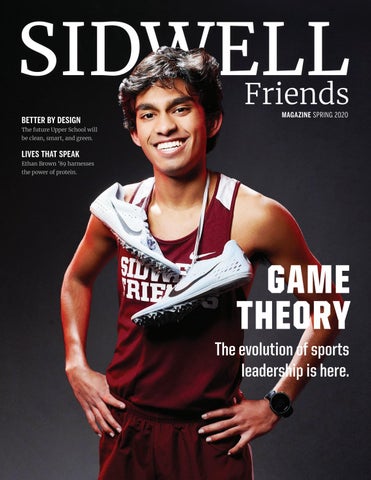
magazine@sidwell.edu 202-537-8444 On the Cover Arjun Thillairajah ’20 (Photo by Tim Coburn)
Contents Spring 2020 Volume 91 Number 2
DEPARTMENTS
06
2
REFLECTIONS FROM THE HEAD OF SCHOOL
6
ON CAMPUS
he Whiffenpoofs pay the School a visit; the Black T Student Union Production explores American music; we ask Tamika Dudley five questions; students unravel the science of justice; and much more.
20 THE ARCHIVIST
idwell Friends was all about reuse and renovation S before it was cool.
42 ALUMNI ACTION 44 FRESH INK 47 CLASS NOTES
he Class of 1962 reflects on presidential T impeachment—then and now.
67 WORDS WITH FRIENDS
22
“Feeling Sly?”
68 LAST LOOK
“Night Moves”
FEATURES 22 SCHOOL OF THOUGHT
he plans for a new Upper School are an object lesson T in environmental design, ethical leadership, and education of a “certain kind.”
28 GAME THEORY
28
idwell Friends’ Sports Leadership Academy is S redefining the School’s culture and transcending athletics.
LIVES THAT SPEAK 36 MEAT WITH APPROVAL
eyond Meat’s Ethan Brown ’89 talks about Charlotte’s B Web, food as an energy issue, organizing ingredients outside of animals, and his abiding passion for McDonald’s.
36 SPRING 2020 | SIDWELL FRIENDS MAGAZINE 1
Upper School Dance Ensemble
Community Guardians What it means to be stewards of the Sidwell Friends School. BY BRYAN GARMAN
O
ver the past months, I’ve spent a lot of time traveling across the country, visiting with alumni, and sharing plans for developing the Upton campus—which is also the focus of a feature I wrote (see “School of Thought,” on page 22). These visits connect our past and present, surfacing feelings that make the School special for our graduates. In February, I landed in the offices of Facebook, where David Fischer ’90, the chief revenue officer, and Jordan Nichols ’05, a client partner, shared news about a project they were launching: “Amplified: Leadership in Sales & Marketing.” Seeking to
2 SIDWELL FRIENDS MAGAZINE | SPRING 2020
address the underrepresentation of people of color in the tech industry, Nichols convinced the social-media giant to hold a diversity networking and recruiting event, which Fischer keynoted. Time and again, our alumni demonstrate an enduring appreciation for the values of the School and the quality of community relationships. And they pose thoughtful queries: What does it mean, Fischer asked, to be stewards of the Sidwell Friends community in a complicated moment marked by political discord and widespread discontent? Stewarding our community means nurturing intellectual, ethical, artistic, and spiritual growth. Fischer and Nichols are
REFLECTIONS FROM THE HEAD OF SCHOOL
letting their lives speak to these values. So are the distinguished alumni who will be honored on Reunion Weekend. Two have drawn on their intellect and creativity to reimagine their fields: Tommy Kail ’95, the Tony and Emmy Award–winning director of Hamilton and Fosse/Verdon, and Kathryn Bostic ’75, an award-winning composer whose credits include Clemency, Toni Morrison: The Pieces That I Am, and Dear White People. Through new structures, such as the Center for Teaching and Learning and the Center for Ethical Leadership, as well as in traditional classes and with innovative coursework, we will continue to create learning environments that inspire in current students the remarkable success alumni have enjoyed on so many fronts.
increasingly unpredictable world. We have also been thinking about health as it relates to the design of the new campus. Working in collaboration with our students and teachers, architects are developing a compelling vision that will transform the campus into an even more environmentally sound living and learning community. The children are watching the decisions we make; we need to listen to their pleas and care for them and the Earth in equal measure. Stewarding our community means building enduring financial strength. Because Sidwell Friends alumni embody the School’s values, they are ambassadors for our mission and, not surprisingly, have expressed deep support for the Center for Ethical Leadership, run by Equity, Justice, and Community Director Natalie Randolph ’98. In addition, alumni have donated the largest gifts—one at $7.25 million, a second at $5 million, and several at the $1 million level—toward the more than $53 million raised to date to purchase and renovate the Upton campus. Along with fellow board members, alumni trustees are especially focused on strengthening the School’s financial foundation. Trustees Jason Carroll ’96, Jamie Hechinger ’96, Kevin Johnson ’91, Jair Lynch ’89, and board clerk David Milner ’86 understand that we cannot take past successes for granted; if the School is to serve subsequent generations as well as it served them, alumni must continually invest in Sidwell Friends. They recognize the lasting effect that the faculty and financial aid had on their lives—whether they received that aid or not—and they fully appreciate the role the endowment plays in the School’s future. By underwriting faculty salaries and tuition grants, the endowment is critical to our mission. With the generosity of alumni and the entire community, we can implement a financial plan to quadruple the endowment and retire our debt by 2037.
“Sidwell Friends has always taken itself seriously, but the accomplishments of our students and alumni call for celebration.”
Stewarding our community means celebration. Sidwell Friends has always taken itself seriously, but the accomplishments of our students and alumni call for celebration. The annual Black Student Union Production provided an opportunity to appreciate cross-divisional collaboration as well as the voices and creativity of our students. The Quakers’ success during the winter athletic season sparked spontaneous outbreaks of joy at conference and state tournaments. I always look forward to Founder’s Day, which this year will feature an online Let Your Life Speak program. Author Anand Girhdidhardas ’99— an editor-at-large for Time, an MSNBC political analyst, and a visiting scholar at New York University—will serve as one of the keynotes. So too will Baratunde Thurston ’95, a self-described “Emmy-nominated writer, activist, and comedian who has worked for The Onion, produced for The Daily Show, advised the Obama White House, and cleaned bathrooms to pay for his Harvard education.” Both are engaging and inspiring public intellectuals who will have a deep impact on our students. Stewarding our community means tending to the health of our students and living our values. With the recent spread of COVID-19, we are working to ensure the immediate health and safety of the School now and in the future. We are fortunate to have a remarkable Health Services staff, an engaged Board of Trustees, and dedicated teachers to help us navigate this challenge. Complex environmental factors are likely at the root of this novel virus, underscoring the need to make certain our students have both a deep connection to nature and a firm scientific foundation to prepare them for an
Together, we have accomplished much and have more to do. That is the way of Sidwell Friends. Thank you, as always, for your partnership.
SPRING 2020 | SIDWELL FRIENDS MAGAZINE 3
ON CAMPUS
4 SIDWELL FRIENDS MAGAZINE | SPRING 2020
The Middle School orchestra performs. SPRING 2020 | SIDWELL FRIENDS MAGAZINE 5
ON CAMPUS
From the Editor SACHA ZIMMERMAN P’29
Take the cover story (see page 28). This fall, Sidwell Friends embarked on a new model of sports and leadership education. While many schools may exile sports to the extracurricular wilderness or else push for a win at any cost, Sidwell Friends’ dedicated coaches and student athletes are transcending what happens during games and races; they are using sports to teach ethics, teamwork, and confidence. (Which, as it happens, are also excellent ingredients for winning.) Creating community is a vital part of the School’s Quaker values, which is why Head of School Bryan Garman is so enthusiastic about unifying Sidwell Friends on one campus. It all starts with a new Upper School that is sustainable, promotes wellness, and creates spaces that are imaginative and technologically sophisticated (see page 22). The new building will also be home to the Center for Teaching and Learning and the Center for Ethical Leadership. Like the campus, this magazine should be an inspired space. In each issue, we will first explore what’s currently happening on the ground at Sidwell Friends; then we will move into feature stories that take a
6 SIDWELL FRIENDS MAGAZINE | SPRING 2020
deeper look at Quaker education in action; next we will graduate to alumni stories with features that offer insight into those leading lives of purpose and vision; finally, we will hand off the magazine directly to the alumni themselves— they write Class Notes that routinely amuse and touch us. My super-talented partner, art director Meghan Leavitt, and I hope you find Sidwell Friends easy to read, beautifully designed, and a lot of fun—to that end, each issue will now have a themed crossword by Aimee Lucido, a puzzle constructor for The New York Times, The Wall Street Journal, and many other outlets (see page 67). I’ll helm the ship. I’ve been a senior editor at The New Republic, Reader’s Digest, and, most recently, The Atlantic— but Sidwell Friends is the most fun I’ve had in journalism. Wrapping my arms around the whole project of a magazine is my passion. Unlike so many other publications, according to the Council for Advancement and Support of Education, “alumni and school magazines have stayed relevant and resonant with audiences by leveraging the strengths of print.” Narrative storytelling and artful design may have abandoned the news cycle, but they are alive and well here at Sidwell Friends. One last item: Sidwell Friends the magazine is rather easy to confuse with Sidwell Friends the School. We’d like you to help us come up with a new title for the magazine. Some early suggestions include Fox Tales, Fox Light, and Star Fox. Email magazine@sidwell.edu to vote for one of those or to suggest your own title. I know how meaningful this School is: I’m also the parent of a rising 4th grader. I just wanted to say hello and reintroduce you to your favorite magazine.
Whiffenpoofs Strike a Chord Take one Sidwell Friends alum, add a beloved a cappella group, stir in the Beatles, and serve.
Kelley Lynch
Regular readers may notice that this magazine looks a bit different than previous issues. For one, it is no longer subtitled “Alumni Magazine”—though it is still certainly that. But it is also so much more. Sidwell Friends is a community-wide publication: It is for current and prospective students, parents, and grandparents; it is for the incredible faculty and staff; and, yes, it is for alumni, some of the most creative and enterprising people on the planet—like Ethan Brown ’89, the subject of this issue’s “Lives That Speak” feature (see page 36). Sidwell Friends is also part of the School’s public face to the world, a way of sharing our stories in our voice and with our values.
STATE OF THE ARTS
In February, Upper School students enjoyed a talk and concert by the Yale Whiffenpoofs, led by music director (and alum!) Alex DiMeglio ’16. The popular a cappella group spoke about traveling internationally, coping with laryngitis, and taking time away from college. (The Whiffenpoofs spend one year on the road before returning to their studies.) They also sang many jazz standards and signature songs, along with a few new ones, like “House of the Rising Sun,” “Got to Get You Into My Life,” and “Rainbow Connection.” The Whiffenpoofs gave a performance for the public in the Robert L. Smith Meeting Room later that night.
DEPARTMENT OF CORRECTIONS In the Fall 2019 issue of Sidwell Friends, the piece “Memory Palace” asserted that Lower School teacher Eve Eaton was “the driving force” behind the Día de Muertos celebration and lessons. In fact, it was team effort to develop the curriculum. What’s more, teachers Luz Marina Cardozo Munoz, Angela Ballesteros Gomez, and Sabreena Jeru-Ahmed received a summer grant to make the school altar—which was nothing short of spectacular. We regret the error.
ON CAMPUS
CULTURE CLUB
The Lion in Winter Lunar New Year means dumplings, music, and a rat.
Kelley Lynch
Lions aren’t typically vegetarians. But the lion who helped kick off the Year of the Rat for the Sidwell Friends community during the Lunar New Year celebration? That lion enjoyed a hearty vegan meal. “I liked feeding the lion lettuce,” Erin ’29 said. After his repast, the lion scattered leaves to spread good luck. Sponsored by the Parents of Asian Students, the celebration included dumplings, a traditional New Year’s food (symbolizing longevity and wealth)—but not just Chinese versions. Parents prepared A lion visits the dining hall for Lunar New Year. dumplings from many regions, including lumpia, shumai, and samosas. “It draws people not only of Asian backgrounds but invites people from all backgrounds to come and take has studied Chinese for six years. “I already played guitar, part,” said Sohaer Rizvi, a co-clerk of the Parents of Asian so I wanted to see how my skills would translate to this Students at the Lower School. Niky Tignor ’20 played instrument.” The Lunar New Year event “makes Sidwell a sanxian, an instrument he studied during a School trip Friends special,” Rizvi added. “That’s what gives children to China’s Yunnan Province. While there, “everyone got the confidence to be themselves, to have their own identity to apprentice with a local craftsman,” said Tignor, who without any fear of not being accepted or having to conform.”
STATE OF THE ARTS
Poetry in Motion
Kristen Page
Literally.
Middle School students get expressive.
STAY FRIENDS Stay in touch with all things Sidwell Friends! Follow us on social media to get the latest On Campus stories.
When it came to finding a poem to perform for the 6th grade Poetry Alive festival in December, Ethan ’26, Isaac ’26, and Zach ’26 had just one goal: humor. “I just found the funniest one and chose it,” Ethan said. The funny one he landed on was Darren Sardelli’s “My Doggy Ate My Essay,” a riff on the old “the dog ate my homework” theme. The trio recited the poem and mimicked the pooch’s actions. The point of the exercise was to get students to dive into poetry, bringing words to life through movement and performance. “When you’re doing the acting, you have to sort of break down the poem,” said Luca ’26, whose group performed the decidedly more serious “Caged Bird” by Maya Angelou. “It helped us understand the poem a lot more because ‘Caged Bird’ is very figurative.” True, “My Doggy Ate My Essay” may not be as profound, but as Ethan put it: “We just wanted to do something fun.”
@sidwellfriends
SPRING 2020 | SIDWELL FRIENDS MAGAZINE 7
Kelley Lynch
ON CAMPUS
The Sidwell Friends community takes the day on. “Everyone can be great,” Dr. Martin Luther King Jr. famously said, “because everyone can serve.” That spirit was at the center of the fifth annual Sidwell Friends Day of Service and Learning on January 20. Organized by the Parents of Black Students and the Parents Association, the community united to celebrate King’s legacy and work. Sidwell Friends students, parents, alumni, and staff started with a workshop on overcoming bias. Albert E. Smith, a diversity and inclusion consultant, asked participants to examine their biases and explore where they came from. “Bias,” said Smith, “is the brain shortcutting to a decision.” When the service part of the day began, community members dispersed across
8 SIDWELL FRIENDS MAGAZINE | SPRING 2020
“We’re sorting books for kids in need,” said Henry ’27, who was surrounded by hundreds of books for donation to Reading Partners, which works with DC schools to support young readers. “We have to get the ones that aren’t that easy but aren’t that hard. It’s really important to help people in need.” Dozens of volunteers formed an assembly line to prepare casseroles for Martha’s Table, Central Union Mission, and Bethesda Cares. Others assembled hygiene kits for So Others Might Eat, created place mats for the Children’s Inn at the National Institutes of Health, and made greeting cards for the DC Veterans Affairs Medical Center. Many also joined a session by the Free Minds Book Club and Writing Workshop to discuss the power of writing for incarcerated youth.
Kelley Lynch
Help Mates
campus. Some sorted donated sporting goods for Leveling the Playing Field, a nonprofit that gives equipment to underprivileged kids. Others went to the dining hall, where multiple service projects were in full swing.
Kelley Lynch
AT YOUR SERVICE
The Sidwell Friends community pitches in on MLK Day.
At the end of the day, everyone met in the Robert L. Smith Meeting Room for a moment of silence and final reflections. “In silence, you provide the community with the opportunity to let the world fall away,” Head of School Bryan Garman said, “and to find another way, a better way, a more mindful way, to recognize that of God in everyone.”
ON CAMPUS
Brand New Day A new schedule means less stress. This year, the Upper School introduced a new schedule—one that includes days with no academics at all. “A 2017 community survey found there was a high level of stress with parents, faculty, and students,” Upper School principal Mamadou Guèye says. “And we thought, ‘We need to pay attention to the mental health of the students.’” Now Upper School students enjoy more time between classes, a 45-minute lunch, and a 20-minute break. All in all, students have “up to 70 free minutes a day,” says Guèye. “All of the classes that used to meet five times a week now meet four times a week, meaning no kid can go home now with two and a half to three hours of homework when they only have three or four classes.” The new schedule was partly inspired by the “Imagine the Future of Learning” section of the Sidwell Friends Strategic Plan to “reimagine how we allocate time by revising schedules to be more responsive to student needs and to provide programmatic flexibility.”
The revised schedule offers flexibility for workshops and assemblies that previously landed in the crowded academic day. The schedule also includes “Quaker Days,” which give students an academic break. The first Quaker Day featured a health and wellness assembly. Then, students played capture the flag, soccer, and netball before a pep rally. For the next Quaker Day, students held a cultural fashion show.
GOOD SPORTS
Slam Dunk
Introducing more time outside the classroom gave many pause—including Guèye. “I was the one who was so worried: How we can have a day from 10:30 to 3:00 with kids playing?” he said. “But it is serving them. It’s a day where there are no academics, so from Thursday to Sunday evenings, they have time for family and friends.” While Guèye says the response to the new schedule has been “massively positive,” there are still some issues to work out. AP teachers, for example, are on a tight schedule to prepare students for exams; missing a classroom day makes that harder. “It’s not perfect,” he says. “But going back would defeat the purpose of what we’re trying to accomplish: to slow down the crazy rhythm of the day and make it more humane.”
Washington Mystics
CULTURE CLUB
How two Sidwell Friends students wowed Nike and the Washington Mystics. In December, the 2019 WNBA champions, the Washington Mystics, announced the winners of the Nike Game Growers program: Sidwell Friends’ own Kendall D. ’24 and Gianna K. ’24, both basketball players. Nike worked with the WNBA and NBA to launch Game Growers, a program that gives 8th grade girls the tools and resources they need to increase girls’ participation in sports. Kendall and Gianna researched, brainstormed, and even made a trip to the State Department before pitching Nike the idea of developing an app, called “Game GrowHers,” that would help older girls connect with and encourage younger girls to play basketball.
Kristen Page
See the full video of the surprise at: sidwell.edu/magazine.
On the second Quaker Day, Upper School students put on a multicultural fashion show.
SPRING 2020 | SIDWELL FRIENDS MAGAZINE 9
ON CAMPUS
CULTURE CLUB
The Kids Are Alright This year’s Black Student Union Production explored the role of black music in American history. It only took a few notes of Lil Nas X’s rap-country fusion hit “Old Town Road” to get the Middle Schoolers in the Caplin Theater to begin singing along and dancing in their seats. They were waiting for the beginning of the 31st annual Black Student Union Production to begin. They didn’t know it already had. When the music stopped, members of the Black Student Union (BSU) told the audience that the song had hit the top of the Billboard Country Music chart on its release in March 2019—only to be removed for “not embracing enough elements of today’s country music to chart in its current vision,” according to Billboard. (“Old Town Road” simultaneously charted on the Hot 100 and Hot R&B/HipHop Songs.) The performers asked: What is country music, and why is “Old Town Road”—which name-checks cowboy hats, Wrangler jeans, and tractors, and even features country superstar Billy Ray Cyrus on one remix—not part of the genre?
10 SIDWELL FRIENDS MAGAZINE | SPRING 2020
Scenes from the Black Student Union Production, And the Beat Goes On...
ON CAMPUS
Photos by Freed Photography
Inspired by The New York Times’ 1619 Project, which included a podcast episode called “The Birth of American Music,” this year’s BSU Production, And the Beat Goes On…, examined black music’s effects not only on American music broadly, but on American culture as a whole. Moving from the spirituals of enslaved people to contemporary black music, the show traced the history of the black American experience through a songbook that represents oppression as well as joy. The student performers demonstrated how black music was both a part of and separate from the music of white America— as when white artists co-opted black music, sometimes for inspiration, but all too often for exploitation, as exemplified by the indignity of minstrel shows. But mainly, And the Beat Goes On… was a celebration of the black artists who sculpted the modern American landscape: a heart-wrenching piece from Alvin Ailey’s signature ballet Revelations, a flirtatious medley of Motown greats, a poignant verse from Langston Hughes, even an exuberant nod to the Sugar Hill Gang. A team of students began writing the show back in December. Then rehearsals began in January and continued nearly every weekend until the performances on February
12 and 14. Among the staff heading up the production and advising the students was Natalie Randolph ’98, the School’s director of Equity, Justice, and Community. It was a full-circle moment for the alum who was once a performer herself in the Black History Month Show, as it used to be known (see “Leadership Can Look Like Us,” on page 12). “Part of being a black student at Sidwell Friends during that time was participating in the Black History Month Show,” she said. “It was just a big part of our experience and a time where we got together and produced something for the community.” For the community and by the community. Students from every division of the School took part in And the Beat Goes On…, singing, dancing, and speaking about the importance of African American music. “The kids really wanted a certain vision, and it was up to us to help them make it happen,” Randolph said. “This is their experience, so I wanted to do everything in our power to make sure it was what they wanted.” That included ending on a high note. And the Beat Goes On… closed with an epic finale in which both the students onstage and those in the audience took up an exultant chant from Pulitzer Prize–winner Kendrick Lamar: “We gon’ be alright.”
SPRING 2020 | SIDWELL FRIENDS MAGAZINE 11
ON CAMPUS
IN MEMORIAM
“Leadership Can Look Like Us” The School’s director of Equity, Justice, and Community remembers the legacy of former Middle School Principal Bob Williams. BY NATALIE RANDOLPH ’98 When I think about equity and diversity at Sidwell Friends, including during my time as a student at the School, Bob Williams is never absent from my thoughts. He looms large in many people’s memories. When he died this past December, it was an enormous loss for the entire Sidwell Friends community. Bob Williams’s many accomplishments are well known. He was the first African American senior administrator at Sidwell Friends, an accomplished classroom teacher, and a champion for diversity and inclusion, among many other roles at the School. While it is important to remember these achievements as we contemplate his legacy, it is also important to acknowledge the impact he had on all students as an example of what leadership can look and feel like.
12 SIDWELL FRIENDS MAGAZINE | SPRING 2020
I knew Mr. Williams both as an administrator and as the father of one of my best friends, Maisha Williams ’98. As my principal from 1990 to 1994, I saw him as calm yet strong, measured yet a force you’d rather not test. However, his exacting nature did not make him less available for a caring consultation. He was all the things that leadership books laud—and he also happened to be an African American man. While this fact did not define him, it did allow him to serve an invaluable role for me and other students of color like me. At a time when Sidwell Friends was not as diverse as it is now and the experience for African American students was often as “the other”—or even “the only”—Mr. Williams represented possibility and normalcy and real inclusion. As many who knew him can attest, he was unapologetically black, which allowed students of color to also feel free not to apologize for or explain their identities. We may not have recognized it then, but being able to see him as both a leader and a black man was powerful. It showed all students and particularly students of color that leadership can look like us, that we were included in the School at the highest levels—especially when for so many years and in so many other spaces, leadership was not inclusive. The subtle
ON CAMPUS
confidence in knowing that there was a deep understanding between the School’s leadership and its students of color was empowering. Mr. Williams’s presence ensured that the Middle School was a place where students like me could be truly seen by an administrator and that those difficult-to-explain moments in the black experience would be understood. If we held up our end of the bargain as students, there was someone ready to fight for us if necessary. The stress put on people of color due to our country’s history with race is now well documented. Mr. Williams helped to alleviate some of that stress, even though it was not fully acknowledged at the time. Perhaps one of the more celebrated ways that Mr. Williams lifted us up was by paving the way for the creation of the Black Student Union Production. The production’s dual purpose was (1) to give black students a safe space and (2) to educate the rest of the community about issues that were not otherwise prioritized. In addition to providing an affinity group, the Black Student Union Production gave students of color the chance to be heard and celebrated for the parts of their identity that were often either overlooked or suppressed. The production still serves that purpose, and as a producer on the most recent show, it has been a privilege to ensure that the School continues that tradition for students.
“ Mr. Williams’s presence ensured that the Middle School was a place where students like me could be truly seen.” When I attended Sidwell Friends, Bob Williams provided a small piece of comfort for me in the often-uncomfortable experience of being a minority. Now that I have the honor of being the School’s director of Equity, Justice, and Community, I am perpetually aware that without his fierce advocacy for equity and inclusion at Sidwell Friends, my position would not exist. When I sit in administrative meetings today, I think of him when I notice how many students can now see themselves reflected in the School’s leadership. Without Mr. Williams’s excellence as an administrator and representation as a black man, that barrier may have taken longer to break. In other words, Mr. Williams’s legacy continues to guide us and continues to provide me comfort as I help the School move forward in this work—and I am honored to serve under his Light.
SPRING 2020 | SIDWELL FRIENDS MAGAZINE 13
ON CAMPUS
CLASS ACTS
Under the Microscope Students discover that forensics is not an exact science.
BY KRISTEN PAGE
“I used this product called ‘I Can’t Believe It’s Not Blood,’ which you can get on Amazon,” says science teacher and Assistant Academic Dean Laura Barrosse-Antle, who teaches the class. “Then I used a bunch of plastic sheeting from when I painted my home and hung it up, so I could get everything messy. And then I had a copier box with a Ziploc baggie of the fake blood in it and had a friend stab it—and that created blood spatter.” The rest was up to the students. See? Unusual. But then, the class started out in an unusual way. Two students proposed the course during the 2017/18 school year. After approaching then–Academic Dean Min Kim and Department Chair Tom Donley, the students completed a survey showing there was enough interest to get the class off the ground. Barrosse-Antle officially proposed the course in 2018, and the rest is history—well, science. The elective course even fulfilled a need in the School’s Science Department. “A lot of our upperlevel courses are traditional survey courses,” Donley says, “and so are our introductory classes.” That means there are some students who may have enjoyed an introductory class but who don’t want to take another survey course, and they may not be ready to tackle the class at the
14 SIDWELL FRIENDS MAGAZINE | SPRING 2020
Laura Barrosse-Antle
The semester exam in the new forensic science class was unusual.
Faux blood splatter and plastic tarp courtesy forensic science teacher Laura Barrosse-Antle
Advanced Placement level. “They want to see some options,” said Donley. And Donley and BarrosseAntle want to encourage the students to explore science. Forensics was great way to do that, says Donley: “It combines chemistry and physics and biology.” That’s what got Zion Williams ’20 interested. “I had taken biology, chemistry, and physics, and I wanted to see what forensic science had to offer,” says Williams. “It combined all three of those in different ways.” “I took physics last year, and there is physics in blood-spatter analysis,” says Jayla Matthews ’20. “You had to do the sine, cosine, and tangent to
figure out what angle the blood was coming from,” she adds, referring to the end-of-semester crime-scene exam. “You had to talk about gravity in relation to blood, about why it would land a certain type of way on the wall or on the floor. That’s part of the problem-solving aspect of school that I enjoy.” To create the curriculum, BarrosseAntle—who does not have a specific background in forensic science—had to do some studying of her own. She reached out to other schools and read books like The New Jim Crow by Michelle Alexander and Criminalistics: An Introduction to Forensic Science by Richard Saferstein. “I would argue that I’m still not up to speed,”
“ Forensic ramifications play out in society, and they do not impact all groups of people in society equally.”
ON CAMPUS
Barrosse-Antle says. “But one of the things I really like doing is making that clear to students and saying, ‘Nope, don’t know the answer to that. Let’s figure it out. Or maybe you should.’” One person she called on to talk about the study of forensics was her former chemistry student Kaylee Simon ’17. Though Simon never had the chance to take forensics at Sidwell Friends, she is majoring in medical toxicology at Penn State and agreed to speak to the forensics class on her winter break. “Patients can advocate for themselves—dead people can’t,” she told them. “You’re the one trying to figure out what happened to them; you’re advocating for that person.” In that way, toxicology, the science of studying poison, is more than science. Simon thinks it’s a mystery to solve: “You have to learn to piece [clues] together.” That tracks with an overarching theme of the class: Forensic science often isn’t scientific at all. “This is a great course from the standpoint that there is science,” Donley says, “but a lot of people view science as very cut and dried, when forensics is not.”
point where it’s not scientifically supported.” Matthews agrees. “Usually sciences are just like, ‘These are the facts,’ and you can’t really bend it,” she says. “With forensics, there are personal opinions. You’re going to have your own judgments about the way that forensic science is conducted. It inspires me to go out and spread awareness about how different ways of analyzing evidence aren’t as valid as people think.” Barrosse-Antle invites that kind of questioning and skepticism. “Do I care that students know how the fingerprint forms? Not really—but I do care that they interpret evidence with an appropriate degree of caution,” she says. “Everyone agrees that you have an individual fingerprint, but how many points do you need to compare and find identical for it to be a match? These ramifications are not just
classroom ramifications. They play out in society, and they do not impact all groups of people in society equally.” It’s lesson that connects to the School’s values. “There aren’t a lot of ways to talk about societal issues in chemistry, whereas in forensic science it’s a philosophical issue,” BarrosseAntle says. For instance, should scientists be 100 percent certain about their findings in order to put someone in jail? If so, some guilty people may never be punished. If not, there will be false positives, and some innocent people will be punished. That’s a lot of ethical ambiguity for a scientist. The department may or may not offer forensic science again, but the new elective is still emblematic of Sidwell Friends and the kinds of creative initiatives that are possible here. Physics, chemistry, biology, justice, and philosophy—the students lobbied for one class but got a whole lot more.
That kind of research led the class to focus on another subject: justice. “A lot of forensic science has to do with the courtroom and law and basically drawing conclusions from the data,” Williams says. “Often lawyers and courts draw the claims out to a
Laura Barrosse-Antle
“My expertise is specifically analytical chemistry, so I wanted to make sure that I was coming at it from the scientific side,” Barrosse-Antle said. “That led me to a large number of reports that have been done relatively recently about the state of forensic science.” For example, in 2015 the FBI reported that in over 95 percent of cases involving hair and fiber testimony, the expert witness had overestimated or overstated the utility of that evidence.
The Upper School’s forensic scientists are on the case.
SPRING 2020 | SIDWELL FRIENDS MAGAZINE 15
ON CAMPUS
KIDS ’N PLAY
Left to Their Own Devices
Kristen Page
The Lower School hosts its second Day of Play.
A Lower Schooler demonstrates how Day of Play is done.
Legos in one room. Putty-making in another. Twister next to Battleship and Apples to Apples. Dodgeball in the gym. Train tracks sprawled on the carpet. A cacophony of xylophones. The Lower School’s second Day of Play gave students free time and plenty of options. “Kids today don’t often have time where they have to figure out what they want to do, how to do it, and how to problem solve,” Eve Eaton, a 3rd grade teacher, said. “Research shows that kids who have unstructured time increase their brain capacity, because they have to figure things out.” Global Day of Play, a nonprofit dedicated to playtime in schools, encourages educators to host a Day of Play; now, the group says, more than 500,000 students have participated. “I get to play and go anywhere in the School,” said Alyssa ’28, who was making a sculpture from some “disc things” (a pile of discarded CDs). “Sometimes you need to just play around and let your mind relax.”
JUST CAUSES
“Be Good to Each Other” Students take time out to talk diversity and identity.
“No,” Randolph said. “I don’t wear makeup.” Randolph also didn’t change her khakis or sneakers after teaching five sections of science. So, in an effort to play up her gender, the producers borrowed lipstick and blush from a school staffer—the same staffer who lent the filmmakers a pair of ballet flats, which were filmed for b-roll to highlight the coach’s femininity. Randolph recounted this during her keynote address at the Upper School’s EJC Day in January. “My identity is at the center of this,” she said of the media attention. “And it was uncomfortable.” The keynote was part of a day designed to get Upper Schoolers thinking about how they interact with each other and get along as a community. The day also
16 SIDWELL FRIENDS MAGAZINE | SPRING 2020
Hellen Hom-Diamond
“Don’t you put makeup on before the game?” This was the question NFL Films Presents asked Natalie Randolph ’98, the School’s director of Equity, Justice, and Community (EJC), back in 2013 when they arrived at DC’s Calvin Coolidge High School to film her. Randolph first made national headlines in 2010, when she became the only female head high school football coach in the country. Despite her success on the field, the producers were more concerned about her shoes and appearance. The group of Upper School students who helped organize EJC Day.
featured wellness activities to promote mental health and student-led workshops to explore identity, such as “Women in Revolutions,” “Investigating Masculinity in Hip-Hop,” “Intersectionality Between Cross-Cultural Identities,” and “They/Them/Their: Our Non-Binary History.” “I tried to put the ‘C’ back in EJC,” Hayes Davis, the Upper School’s EJC coordinator, said. “This is work we can all share if we recognize that everyone in a community represents diversity in some way. We should try to be good to each other.”
ON CAMPUS
5
Susie Shaffer ’69
QUESTIONS
TAMIKA DUDLEY
Freed Photography
for
GOOD SPORTS
In the Zone TAMIKA DUDLEY is the head coach of the girls’ basketball team at Sidwell Friends as well as a current parent. (It’s kind of a two-for-one boon for the School: Dudley’s 8th grade daughter, Kendall ’24, is already a Sidwell Friends basketball player—she currently plays for the Middle School boys’ basketball team. See also “Slam Dunk,” on page 9.) For nearly a decade, Dudley coached at Virginia’s Woodbridge High School. In the 2018/19 season, she took its girls’ basketball team all the way to victory at the state championships—not unrelated, she was named Virginia’s coach of the year. Now, she has crossed the Potomac and in her first year at Sidwell Friends is already helming a nearly indomitable girls’ basketball team (runners-up in the 2020 state championships).
1. What’s the biggest difference between coaching at Woodbridge and coaching at Sidwell Friends? There’s not a lot of difference when it comes to the basketball side of things. It’s more the relationships. I spent eight years at Woodbridge, and it’s where I went to high school—so it’s home. When I came here, I had to make new relationships with the parents, the players, the administrators. It’s been really good, though. Everyone is great. Quakerism is one of the things that attracted me to Sidwell. It aligns with my beliefs and values, not just as a coach but in life. 2. Do you have a coaching philosophy? “Success never rests.” I’ve always prided myself on hard work and commitment. Nothing is above me or my staff as far as work ethic: It’s relentless. It’s that constant striving for success, for perfection. It’s the striving, not the winning, that’s important.
3. Who are your sports idols? Michael Jordan because he was so intense on the court and also had that serious work ethic. And Coach K [Duke’s Michael Krzyzewski]. He allows all of his players to play in games and not just in practice. That resonates with me. Every player gets game experience. 4. Do you have any former players in the WNBA? Lynetta Kizer. I coached her when I was at Potomac High School in Dumfries, Virginia. Then she went to the University of Maryland. She’s since played in the WNBA for Tulsa, Phoenix, Connecticut, Indiana, and abroad. 5. What was your proudest moment in basketball? Winning the state championship at Woodbridge. It took eight years to get there. We worked really hard. We failed several times, missed opportunities, and so, when we won, it was really meaningful.
SPRING 2020 | SIDWELL FRIENDS MAGAZINE 17
ON CAMPUS
GOOD SPORTS
STATE OF PLAY The 2019/20 winter sports season wrapped up by making history in two sports: a career high in girls’ basketball and the first all-girls tournament in wrestling. Here are some highlights from an incredible varsity season.
SHOOT Finishing as the DC State Athletic Association (DCSAA) AA champions for the first time in School history in 2019/20, boys’ varsity basketball came on strong this year. The 2019/20 season saw them finish in the quarterfinals of the DCSAA AA championship tournament, along with repeating as Quaker Classic and Governor’s Challenge champions along with winning the Bishop Walker Tournament. The Quakers finished as runners-up in the Mid-Atlantic Athletic Conference (MAC) tournament with Ryan Cornish ’21 named to the All-MAC team.
Cameron Gillus ’23 with Ryan Cornish ’21 close behind
SCORE
Kiki Rice ’22
18 SIDWELL FRIENDS MAGAZINE | SPRING 2020
Girls’ varsity basketball welcomed new head coach Tamika Dudley to a team that was already the 2018/19 Independent School League (ISL) co-champion. How do you beat that? Finish the ISL as outright regularseason champions. As if that weren’t enough, the Quakers were No. 1 heading into the DCSAA AA Championship and finished their season as DCSAA AA tournament runners-up. Sidwell Friends girls’ basketball also played a competitive non-conference schedule, traveling up to New York City for the Rose Super Jam and then back home for the She Got Game Classic. Oh yeah, and Kiki Rice ’22 scored her 1,000th career point—as a sophomore—and was named the Gatorade player of the year.
Jadyn Donovan ’23
ON CAMPUS
STROKE
Dylan Rosoff ’20
Colleen Zeugin ’20 Photos by Susie Shaffer ’69
HOLD This season varsity wrestling had a program first: Kate Borkowski ’22 and Julia McCormack ’22 competed in the first-ever Women’s National Prep Wrestling Tournament. Borkowski (105 pounds) finished in third place and earned All-American status. The Quakers competed, among other meets, at the Sidwell Friends School Invitational, MAC Superquad,MAC Championships, Melee on the Metro, DC Classic, and National Preps. Matthew Rosenstein ’23 (152 pounds), Lucas Donovan ’20 (160 pounds), and Ian Palk ’20 (182 pounds) were named MAC champions. Borkowski and Myles McPartland ’20 (170 pounds) finished as MAC runners-up.
Courtesy Debbie Borkowski
This year, six seniors from the girls’ varsity swim team will graduate, but the team is still rich in talent. Ayanna Wu ’21 and Cate Sheridan ’23 had individual successes, qualifying for the Washington Metropolitan Interscholastic Swimming and Diving Championships (Metros) in their events. Sheridan, just a freshman, placed 13th at Metros in the 100 backstroke. The 200 medley-relay team (with Sheridan, Wu, Alden Zhang ’22, and Isabel Apfel ’22) and the 200 freestyle-relay team (with Sheridan, Mikey Panner ’20, Apfel, and Wu) each qualified for Metros, too. “I have enjoyed seeing the improvement over time with the team,” says Coach Megan Miller. “Swimming is a unique sport where you get instant feedback on development—your time!”
SPRING 2020 | SIDWELL FRIENDS MAGAZINE 19
THE SECTION ARCHIVIST HEADER
What’s Old Is New Again—and Again Sidwell Friends: Building green for over a century. BY LOREN HARDEN BERGH
It should come as no surprise that the new Upper School renovation plans are making green building standards fundamental to
the design. After all, green standards were at the center of all of Sidwell Friends’ recent renovations: the Middle School building in 2006, the Lower School gym and Groome addition in 2007, the David P. Pearson ’52 Athletic Cen-
ter in 2010, and the Quaker Meeting House and Arts Center in 2011. And though many may consider sustainable architecture a recent trend, it turns out that using reclaimed building materials goes back to the School’s first decades. At the turn of the 20th century, Thomas Sidwell’s School was outgrowing its space in the Eye Street Friends Meeting House. Fortunately, the lot immediately to the east of the building came up for sale, and Sidwell purchased it with dreams of a campus expansion.
In 1904, Sidwell heard of an old Capitol Hill brick house that was being torn down to make room for the Cannon House Office Building. Not one to be wasteful, Sidwell had the bricks from the dismantled house trucked over to Eye Street. He did the same with bricks from an
old Riggs Bank building that was also getting demolished. And that’s how he constructed the School’s first dedicated classroom building—and also, but not quite by design, the School’s first green building.
20 SIDWELL FRIENDS MAGAZINE | SPRING 2020
1809 Eye Street, built from reclaimed bricks
The new building at 1809 Eye Street NW housed classrooms, a cafeteria, and a study hall. A porch off of the study hall faced Eye Street and was a great place for people-watching. Sidwell’s niece, Frances Sidwell Benson ’15, recalled that one of the most interesting reg-
ular sightings was President Woodrow Wilson taking his morning walk down Eye Street. Thomas Sidwell took note of the president, too. In 1919, Wilson had temporary wood bleachers constructed to watch the troops returning home from Europe after World War I. Thomas Sidwell—exhibiting Quaker thrift once again— purchased the wood and used it to build a
structure on land he had recently bought from the Washington School for Boys on Wisconsin Avenue. Over time, this building grew into the main classrooms for the primary grades. Sidwell cheekily named it the Woodrow Wilson Building. It lasted for decades before being torn
down in 1962. That’s also when the School purchased the Edgemoor Lane property.
SECTION THE ARCHIVIST HEADER
center. Two LEED Gold Lower projects—the gym/Groome School addition and the David
Woodrow Wilson Building, built from reclaimed lumber
These early forays into green construction continued after Sidwell’s death. At the end of World War II, the student population grew dramatically and space was in short supply. The School purchased a steel Quonset hut
that was military surplus. Beginning in 1946, this structure served as the main library for many years. Less than 10 years later, Sidwell Friends School continued its green streak with a transformative purchase: an old stone farmhouse
P. Pearson ’52 Athletic the Center—cemented School’s commitment to sustainable architecture.
AR CHIVIST
GymnaKenworthy sium and converting it into the Robert L. Smith Meeting Room and arts
THE
Building Green U.S. Council. Since then, the School has won another LEED Platinum rating for taking the old 1958
So the next time you’re gazing up at the exterior of the Bruce Stewart and Andra Jurist Middle School building covered in reclaimed wine casks or at the walls and floor of the Robert L. Smith Meeting Room constructed from derelict barns in Maryland, give a nod to our founder, Thomas Sidwell, who knew how to make the old new again.
that served as the family residence of an Army officer, the personal physician to Woodrow Wilson, and a CIA director. Today, we call it Zartman House.
In 2004, that old stone house became the first of several intentionally green buildings when the School retrofitted it with an energy-efficient geothermal heat pump. Two years later, when the old 1950 brick Middle School building needed attention, rather than raze it and generate construction waste, the School renovated and expanded it, turning it into the first K-12 school building in the world to achieve the highest LEED Platinum rating from the
Quonset Hut Library, built from military surplus
For more about how sustaina ble architec ture is having an impact on the new Upper School renovati on, see “School of Thought ,” on page 22.
SPRING 2020 | SIDWELL FRIENDS MAGAZINE 21
SCHOOL OF THOUGHT
The plans for a new Upper School are an object lesson in environmental design, ethical stewardship, and education of a “certain kind.” BY BRYAN GARMAN
uring a lunch with the architects from Perkins Eastman, Middle School students imagined the features they would like to see in the future Upper School. They scribbled notes, stuck them to the wall, and reflected on each other’s work. One insightful student reframed the conversation with an essential question: “Would the Earth be happy with the decisions we made?” This powerful query recalls David Orr, an emeritus professor of environmental studies and politics at Oberlin College who consulted on Sidwell Friends’ pathbreaking sustainability efforts more than 20 years ago. Orr observed that each day the planet becomes “a little hotter, its waters more acidic, and the fabric of life more threadbare.” The crisis, he suggested—in a 1991 essay, “What Is Education For?”—resulted from an educational deficiency that left residents of the planet ill-prepared to care for the natural world. “Education is no guarantee of decency, prudence, or wisdom,” he wrote. “More of the same kind of education will only compound our problems. The worth of education must now be measured against the standards of decency and human survival. … It is not education that will save us, but education of a certain kind.” Orr’s predictions have proved prophetic. The good news is that a new generation, exemplified by Sidwell Friends Middle Schoolers, feels empowered to ask questions and take action. Principal architect Sean O’Donnell says he often doesn’t see such authentic engagement. “Bringing together the youngest and the oldest children, alongside the faculty and staff, all to build a stronger community is a really powerful idea,” he says. But as impressive as the students are, young people cannot do it alone. Adults must support their imagination by rethinking past practices, adopting new habits, and setting the right example.
22 SIDWELL FRIENDS MAGAZINE | SPRING 2020
One way to do this is through the new Upton campus. The School’s Strategic Plan calls for a unified campus both to care for the Earth and the School’s students. Sidwell Friends has the chance to provide the community with a new home, one where wise and decent citizens pursue intellectual excellence,
SCHOOL OF THOUGHT
develop high ethical standards, and walk cheerfully—and lightly—across the world. This mission must be fostered in the hearts and minds of the School’s students and in the bones of its buildings. This is a moment to design a space that is an expression of all that the School values. Philanthropic partners have already committed more than $53 million toward a transformative effort—the most ambitious capital and endowment campaign in the School’s history. If fundraising goals are reached, the new Upper School will open for the 2026/27 academic year, completing the first step in a strategic effort to unify the campus.
The worth of education must now be measured against the standards of decency and human survival.”
First look at the Upper School entrance and greenway to connect Upton Street and the heart of the campus
Renderings from Perkins Eastman
SPRING 2020 | SIDWELL FRIENDS MAGAZINE 23
SCHOOL OF THOUGHT
Initial conceptual view of the library
“We value nothing more than illuminating the best in our students,” Upper School Principal Mamadou Guèye notes. “We have already begun to address student well-being with a revised weekly schedule to allow for much-needed time to reset, play, and recharge. A new Upper School will allow us to be the village we want to be.” Since 1964, the footprint of the Upper School has remained relatively untouched, expanding only with the 1997 renovation of the Harrison Building and the addition of the Goldman Library. In 1964, the Upper School enrolled 330 students; today, there are more than 500. The facility serves students well, but as enrollment has grown and programmatic needs have shifted, the Board of Trustees began to evaluate ways to consolidate
It’s a once-in-a-lifetime opportunity to realize a unified community on a campus that has a strong heart and sense of place.” 24 SIDWELL FRIENDS MAGAZINE | SPRING 2020
the community and to consider the relationships between the built environment, teaching, and learning. To that end, they embraced an unprecedented opportunity: the purchase of six contiguous acres on the Wisconsin Avenue campus. “It’s a once-in-a-lifetime opportunity to realize a unified community on a campus that has a strong heart and sense of place,” O’Donnell says. “It’s extraordinary.” The last such transformational moment came in 1955, when the School purchased eight acres, adding Zartman House and the athletic fields— which dramatically improved the student experience. After the Upton purchase, plans for a new village became more discernible—and more exciting. The School hired the globally recognized architectural firm Perkins Eastman, who then led more than 15 gatherings of faculty, staff, students, parents, and alumni to help everyone better understand the School’s mission and needs. Submitting and revising the School’s application to the Board of Zoning Adjustment precipitated 22 meetings with neighbors, traffic consultants, surveyors, engineers, and two different Advisory Neighborhood Commissions about a host of topics, ranging from construction schedules to perimeter-fencing design. These efforts earned approval from the Board of Zoning Adjustment on February 5 and informed a new master plan. Sidwell Friends is pleased to share these initial conceptual renderings—with the understanding, of course, that they will almost certainly be revised over time.
SCHOOL OF THOUGHT
When asked, Sidwell Friends students describe their ideal new school as one with havens for quiet study and reflection, spaces for collaboration and innovation, places to socialize with friends, and areas for individual research projects. They imagine a campus that enables a full range of academic and social experiences, because for most of the year, Sidwell Friends is a second home. The new building will emphasize a sense of community and wellness by honoring Quaker-inspired design principles: simplicity, integrity, and stewardship. Drawing on features that appear regularly on college campuses, where learning has become increasingly cooperative, the design relies heavily on glass walls that let in natural light, visually connect students to their peers, and provide acoustic balance. Gathering spaces will range in size and function: A dining hall will comfortably serve the full Upper School, allowing for flexible scheduling; “neighborhoods” will enable grade levels to congregate and plan activities; common areas will encourage casual student-teacher interactions and foster group conversations; Star’s new Fox Den will offer a collegiate social atmosphere; a Meeting Room will house gatherings and performances for up to 150 people. New academic spaces will spur programmatic development. A Science Commons will include a robotics lab, as well as space for individual student projects. Classrooms will be equipped for specific disciplines. Departmental offices will be configured to promote cross-disciplinary relationships. The third floor of the Upton property, which will open onto a green that unifies the three divisions and the Athletic Department, will host the all-school Center for Teaching and Learning and the Center for Ethical Leadership. Both will have a direct impact on the community: Faculty will share emerging practices with one another, the School will host visiting scholars, and students will find new opportunities for growth and leadership. Faculty and staff are already developing programs that will fall under the Center for Ethical Leadership, such as community engagement and affinity group initiatives. The honorable Ann Winkelman Brown ’55 has generously endowed a capstone project in which 4th graders will examine an ethical problem of their choosing, design solutions, and publicly present their work. The Athletic Department has already established the Sports Leadership Academy, which served nearly 40 students this year (see “Game Theory,” on page 28). The Dehejia Internship program currently coordinates college-level internship experiences for 11th graders. And the Middle School is creating a new health and wellness course that will focus on ethical decision making. In other words, the Center for Ethical Leadership will provide a much-needed home and new resources for next-level educational thinking.
Conceptual renderings (top to bottom): Center for Ethical Leadership; robotics lab; main Science Commons with a cascading stairway and seating area; new large-capacity dining hall
SPRING 2020 | SIDWELL FRIENDS MAGAZINE 25
SCHOOL OF THOUGHT
An outdoor seating area and terrace to connect the library with the new greenway
Much like the internationally recognized LEED-Platinum Middle School, the Upton campus will teach students about problems and solutions in sustainability. The School faced its first and most basic challenge when the board determined that 75 percent of the existing structure will be renovated rather than razed. This approach conserves the energy and materials that are already in the building, and based on construction estimates, it will be dramatically less expensive. Moreover, experts will realign HVAC and electrical systems to reduce energy consumption and the School’s carbon footprint. Between power purchase agreements for solar energy and geothermal wells and a number of other energy efficiency measures, the Wisconsin Avenue campus could become a net-zero facility, meaning it would produce as much energy as it uses. Both technologies have short payback periods. In fact, geothermal wells could save the School nearly $9 million over 30 years, a good reminder that campus unification has significant economic benefits. Perhaps the most valuable lesson for students will come from the land itself. The site’s topography offers opportunities for innovative design that bolsters native flora and fauna and that excels at stormwater management. The most recent campus master plan calls for strategic demolition of the eastern side of the building, where architects will connect the greenway from Upton Street to the central campus green and amphitheater, creating a campus “heart.” The hydrology management plan will use the gentle slope of the property to capture and recirculate stormwater, which is especially important to the School’s neighbors. Nestled into the hillside, the building will allow many more access points to the outdoors, use more natural light, and
26 SIDWELL FRIENDS MAGAZINE | SPRING 2020
improve air circulation. Neuroscience studies—including by the National Institutes of Health and Harvard University—demonstrate that these biophilic features can reduce stress, lower blood pressure, lead to improved creativity, and bolster academic performance. Additionally, according to the National Alliance on Mental Illness, 20 percent of American students between the ages of 13 and 18 suffer from a mental health disorder, meaning an emphasis on well-being is a necessity, not a luxury. Once the building is complete, students will have an opportunity to learn about the design and evaluate its systems. Heather Jauregui, a senior associate and sustainability expert at Perkins Eastman, assesses environmental performance through rigorous data analysis. She frequently works with students to measure and monitor carbon-dioxide levels, teaching them that lower CO2 levels lead to higher brain oxygenation and deeper levels of student engagement. “I’ve seen a lot of ‘aha’ moments with students when they’re doing lab measurements,” Jauregui says. “Taking CO2 readings in one location and then opening a window and taking them again, the students understand that there’s a direct connection between fresh air ventilation and CO2 levels.” Meanwhile, landscape designers will work with faculty and students to study the local flora and fauna of the Rock Creek watershed and to design a landscape that prioritizes ecological balance. The promise of more access to the outside already has environmental science and biology teachers eager to catalog native bee and bird populations, and to help them and other native species thrive. As one alum put it, hands-on practices enable students to not only learn science but to learn how to be scientists.
SCHOOL OF THOUGHT
Hands-on practices enable students to not only learn science but learn how to be scientists.”
The new campus will allow the School to forge connections among sustainability, student and employee wellness, and learning outcomes that no other institution has yet imagined. LEED, WELL, NetZero, and other green-design frameworks, as well as emerging neuroscience research, have improved environmental architecture, but as far as Perkins Eastman understands, no institution has integrated these standards into the comprehensive approach Sidwell Friends is taking. Architect Ann Neeriemer says the School will be “an oasis in an urban environment.” This urban oasis comes directly from students and faculty who, the architects at Perkins Eastman say, think about design in an “uncommonly dialectical manner.” Designers typically create comfort and inspire aesthetically. But Sidwell Friends students seek to sustain the natural world, to improve it, and to imagine new ways of being in a relationship with it. Their ethical imaginations, grounded in the “certain kind” of education that Orr wrote about and that Sidwell Friends offers, speak directly to a deeply human need to care for community, to live positively and peacefully, to act with integrity, and to lead through stewardship. If the School follows their inspiration, it will create a campus that places decency, human survival, and joy at its core; that makes the students proud; and that resonates well beyond Sidwell Friends. Let’s build a world our students can proudly inherit.
To learn more about the School’s Strategic Plan and uniting the campus, go to sidwell.edu/strategicplan.
The alum-architect who’s on the job. Harry Webb ’11 can’t decide if it is “a bonus or just weird” that he is a member of the Perkins Eastman team working on the Upper School project. The young architect and Sidwell Friends alum—a lifer—has a lot of memories of the School. Yet, he didn’t expect to see his colorful finger-painted handprint (circa age 5) hanging from a mural in Zartman House when he and his colleagues showed up to share their design ideas with School administrators. “It was surreal to see it up on the wall when professionally presenting,” Webb says. Luckily, he adds, “Sidwell set me up for success.” After earning his bachelor’s in architecture from the University of Maryland, Webb attended the University of Oregon for a master’s in the subject. He returned to DC to work at a six-person boutique firm on 14th Street, where doing a little bit of everything allowed him to learn a lot. And, when he wanted to stretch his wings at a larger firm, he was thrilled to land at Perkins Eastman. “We have all different kinds of projects, and we’re all over the world,” he says. Webb is quick to point out that it is “pure coincidence that I ended up at Perkins and they got the Sidwell project.” Maybe so, but the School does have a deep connection to Webb’s passion for architecture. It was, after all, as a student at Sidwell Friends that he realized what his future vocation would be. “I knew I wanted to be an architect since Middle School,” he says. “I was there when they did the Middle School building renovation, and I saw how that influenced life before and after.” Since being back at Sidwell Friends in this new role, Webb says he has “learned a lot more about the bones and the history of the campus.” He says his work on the building calls on this new information and combines it with his own memories of the School. “I use my memory to think about what exists already and what we can do to modify it,” he says. He understands, for example, the need for common spaces that aren’t hallways. He wants to expand on the parts of the School that are working—like by giving every grade a version of the well-liked senior center. And of course, Webb intends to stay true to Quaker values. “Simplicity of experiences, simple processes, simple design—if we don’t need it, we don’t put it in there,” he says. “The Quaker tenet of simplicity is something I apply to my personal life and the way I think about architecture.” SPRING 2020 | SIDWELL FRIENDS MAGAZINE 27
Elena Michael ’20
28 SIDWELL FRIENDS MAGAZINE | SPRING 2020
GAME THEORY Sidwell Friends’ Sports Leadership Academy is redefining the School’s culture and transcending athletics. BY SACHA ZIMMERMAN Photography by Tim Coburn
SPRING 2020 | SIDWELL FRIENDS MAGAZINE 29
GAME THEORY
W
alking into the David P. Pearson ’52 Athletic Center, you experience a stadium-like effect. From an imposing brick exterior, you descend a few flights of stairs, pass through a relatively narrow corridor, then suddenly emerge in a vibrant, open sphere of play. And that sense of humility one has in the face of noble sports spaces—be it Nats Park or a favorite neighborhood basketball court with no nets on the rims—grabs you. That humility is no accident. At Sidwell Friends, athletics is an essential component of a Quaker education and culture—a culture where winning takes a back seat to leading, where success is defined not by the best score but by the best effort. To be sure, the Pearson Athletic Center has beautiful facilities—a track that doubles as the mezzanine over glossy basketball courts, a cutting-edge gym that actually inspires workouts, exits that lead to some of the most expansive greens in the city—but the story of the building is not one of aesthetics. It is more akin to one of honor. “We are creating a culture of respect,” says Keith Levinthal, the director of athletics at Sidwell Friends. “We want student athletes to look their opponents in the eye when they shake hands, clean up the cups and trash at away games. When you get the little things right, the big things fall into place.” That’s why Levinthal asked sports leadership guru Jeff Janssen to come to the School to train some of the Sidwell Friends coaches. “I want our coaches to be thought leaders, to really make an impact on the educational experience,” Levinthal says. “That’s how we add value to the School.” In the world of sports, Janssen is a bit of a legend. The founder and president of the Janssen Sports Leadership Center, he has written more than a dozen books—including The Seven Secrets of Successful Coaches, Peak Performance Playbook, How to Build and Sustain a Championship Culture, and The Team Captain’s Leadership Manual— and created leadership academies across the United States, including at the University of Arizona, Notre Dame, Yale, Georgetown, Stanford, Baylor, Colby, and Boston University. “I saw how important leaders were for athletic success and the culture of the team—on and off the court,”
30 SIDWELL FRIENDS MAGAZINE | SPRING 2020
says Janssen. “But they weren’t trained to play that role. I saw that we needed to identify and train coaches and athletes.” In other words, leaders are not born; they are cultivated. Janssen’s detailed program first asks coaches and athletes to be accountable for their own behavior and actions. Then he asks them to help others by motivating teammates through encouragement and by example. It aligns neatly with Quaker thought: Look inward, not outward; and be of service to others. While this notion pleases Janssen, his true aim is to “provide a framework, so each school can take the general principles and then add their own values or unique spin.” To that end, Janssen worked with Sidwell Friends coaches Samantha Ziegler, Jon Mormino, and Megan Miller over the summer to create a Sports Leadership Academy tailored to Sidwell Friends. “We wanted to become facilitators so we could help our athletes become leaders,” says Miller, who coaches field hockey, girls’ lacrosse, and swimming and diving. Moving from coach mode to teacher mode was a distinct change for Miller, though. “It is definitely different from being on the court,” she says. “Standing in front of a classroom, I was nervous.” Nevertheless, Levinthal says he is blown away by the coaches’ level of enthusiasm for the project. The Sports Leadership Academy requires students to submit an application essay, commit to attending six evening sessions throughout the school year, and make a sincere attempt to practice what they learn. It’s also a two-year program. Each year focuses on Janssen’s two overarching themes: personal responsibility and emerging leadership. The academy launched last fall with 38 students from 10th through 12th grades. Levinthal hopes to add another 40 next year. At a School with 50 to 70 percent of the students participating in athletics at any given moment depending on the season, sports are a vital part of Sidwell Friends. But Levinthal is quick to point out that students do not have to be on a sports team to participate in the academy, saying, “As Jim Valvano put it, ‘Working hard doesn’t guarantee success, but you can’t have success unless you work hard’—and that goes far beyond athletics.”
GAME THEORY
T
he coach in the documentary is losing it. He is screaming, confronting the refs, and acting officially disgusted by his team, all while the 38 Sports Leadership Academy students at Sidwell Friends watch on a big screen and eat a pasta dinner. “Hey guys, what color is the coach on?” shouts Mormino, who coaches baseball and soccer. It’s an inside joke. The coach in the film is obviously on red. “I think he’s way past red,” a nearby student quips. It’s a stoplight metaphor: Green is positive and ready to play; yellow is a bit off or not fully present; and red is, well, a total loss of self-control. It’s amazing is how normalized red behavior can be in sports, as evidenced by the documentary the students are watching. It’s hard to imagine a literature teacher with veins bulging, screaming at a student for getting an A- when the student could have gotten an A with a bit more time in the library. But in sports, yelling has become routine, even romanticized (think John McEnroe). While some schools and colleges have dismissed coaches for verbal abuse, like UNC’s Sylvia Hatchell and Michigan’s Tom Izzo, dozens of other schools have stood by coaches who claim that students are too sensitive and that yelling is motivational.
But studies don’t bear that out. In a 2013 landmark study of Division I college athletes, for example, researchers at Clemson University found just the opposite. “Players who were exposed to a verbally aggressive coach reported significantly less motivation to perform,” The Chronicle of Higher Education reported, “and viewed such coaches as significantly less competent than did athletes who played for coaches with a more affirming style.” Athletes also were more likely to transfer out of schools with toxic programs. What’s interesting is that this logic applies to the student athletes as well. One angry, mopey, or arrogant player can infect an entire team. “Players sometimes accept that at times, they’ll disappoint their coach,” Levinthal says. “It’s a lot harder for them to let down their teammates.” Which is why student leadership itself is so important. To illustrate this point, Ziegler—the head coach for girls’ lacrosse— asked the students in one Sports Leadership Academy session to guess how many drops are in a bottle of water (it’s 20,000). Then she added a drop of food coloring, and the entire bottle instantly turned yellow. It was a simple exercise, but it started a conversation—and that’s the point. Arjun Thillairajah ’20
SPRING 2020 | SIDWELL FRIENDS MAGAZINE 31
GAME THEORY
Alden Zhang ’22
32 SIDWELL FRIENDS MAGAZINE | SPRING 2020
GAME THEORY
“Their honesty, that’s my favorite part,” Ziegler says, “how honest they are with themselves and each other.” They are learning, among other things, that character is more important than strategy, that doing what is right is different from doing what is tactical. And that has been reflected in their attitude toward the program. “The kids have been highly invested in each of the modules we’ve done so far,” Mormino says. “We’ve seen awesome commitment and follow-through. Even after an away game, they show up for a meeting.” Arjun Thillairajah ’20, a track and cross-country runner and team captain, became interested in the Sports Leadership Academy after his coach had him and others read The Team Captain’s Leadership Manual before the start of school. “I’ve always been dedicated,” he says, “but in terms of speaking up and being a leader, that didn’t come naturally.” Elena Michael ’20, a soccer and lacrosse player, shares that feeling. “I’m a more confident leader now,” she says. “Junior year, I led by example; but this year, I’m more of a vocal leader.” Alden Zhang ’22, who runs cross-country and does swimming and crew, says the Sports Leadership Academy has been a boon to her self-esteem. “I just had meeting with Coach Miller,” Zhang says, “and she said I had more confidence in my behavior on the team and that I lead people in activities now.”
W
hile waiting for class to start, the seniors in the Sports Leadership Academy are brainstorming ways to get more students out to their games. As upcoming graduates of Sidwell Friends, they won’t be around for the second year of the academy, which focuses on leading others, but that hasn’t stopped them from trying. “There’s no reason there shouldn’t be 300 kids at every game,” one student announces. Suggestions on how to accomplish that range from partnering up with underclassman to ensuring that an especially popular classmate is always present to lure others in. “I mean, I expect all freshmen to come,” one notes. It’s all part of the philosophy that when one wins, everyone wins. Or, as Levinthal puts it: “How do we get these kids psyched to watch other people succeed?” Before the seniors’ academy class starts in earnest, Ziegler gives them a pop quiz. They refresh themselves on the “commitment continuum,” discuss monitoring their own traffic-light color, and talk about their reading, which covered the story of Josh Pastner, an invaluable member of the University of Arizona’s 1997 NCAA tournament-winning basketball team— an invaluable member who never played a moment in the championship game. The walk-on freshman
kept telling his incredulous teammates they could become the NCAA champions until one day they did. Unsurprisingly, he is now a coach.
“ Junior year, I led by example; but this year, I’m more of a vocal leader.” It’s just like a story Miller had previously told her students—about when she tried out as a walk-on for the University of Maryland’s lacrosse team. “I decided my role was being on the sidelines, not putting the points on the board,” Miller said. “I was leading from the heart, pumping up the team, highfiving everyone. The record books don’t capture that. But it was the most fulfilling role and great practice for becoming a coach.” Mormino agrees. “Leadership comes in a variety of ways from a variety of people,” he says, “and the assumption that the team leader needs to be the highest performer doesn’t bear out.” Leadership also needs to be flexible. Different sports have different needs. As a senior, Thillairajah realizes how important leadership is to his sport, which can seem monotonous. “Running isn’t always as fun as a game,” he says. “A lot of the younger guys aren’t into running at first, so it’s important for seniors to make it fun.” Being a senior ramped up the stakes for Elena Michael as well. “It’s senior year, and both soccer and lacrosse teams mean a lot to me,” she says. “I wanted to have leadership skills going into them.” (Michael is not only the captain of the girls’ soccer team; she designed the team’s new uniforms, too.) Student athletes also see the School’s Sports Leadership Academy as transcending sports. “I definitely think there’s a lot about red-light/yellowlight/green-light that applies outside of sports,” says Elliot Woodwell ’20, who wrestles, plays soccer, and plays lacrosse. “How to control yourself and how to get back to a better mentality is something I’ve definitely thought about outside of sports.” Zhang agrees and says that the module about composure was especially relevant to her. “People can get frantic before meets or races,” she says. “It’s really important to think about composure. It also relates so much to me in a different
SPRING 2020 | SIDWELL FRIENDS MAGAZINE 33
GAME THEORY
“ These are skills that will transcend sports over a lifetime.” way: for tests. It’s important to keep your composure under pressure.” This is something Janssen hears all the time. “These skills we teach student athletes have a lot of practicality for sports teams,” he says. “But I get a lot of calls from former athletes saying, ‘I’m using this professionally.’ These are skills that will transcend sports over a lifetime.”
C
oach Mormino’s small office in the David P. Pearson ’52 Athletic Center is filled with books about coaching and life. A quick scan reveals titles like The Man Watching: Anson Dorrance and the University of North Carolina Women’s Soccer Dynasty by Tim Crothers, Second Mountain: The Quest for a Moral Life by David Brooks, and War Room: The Legacy of Bill Belichick and the Art of Building the Perfect Team by Michael Holley. “Since the very beginning of his time here, Keith Levinthal has been talking about his belief that a positive culture is central,” Mormino says. “Working with student athletes outside of a specific team on leadership is totally in line with that. And it is applicable across life. I hope the Sports Leadership Academy is not just an add-on but a key component of the athletics program going forward—and maybe it even has the side effect of helping teams win.” It just might. According to a peer-reviewed study published in the journal PLoS ONE, “Shared leadership across and within leadership roles was seen as the most effective leadership structure for male and female teams.” In fact, athlete leaders can have a potent effect on their team’s accomplishments and victories: “High-quality leaders fostered the intrinsic motivation of their teammates, strengthened their team confidence and their team identification, while also instigating cohesion within the team, and ultimately improving team performance. In short, leadership within the team is considered an important driver of sports success.” However much student leadership may affect the bottom line, high scores are ancillary to Levinthal’s strategy. “The Sports Leadership Academy is an educational experience,” he says. “We get people to stop thinking about wins and losses and more about: What are we teaching these kids?” The
34 SIDWELL FRIENDS MAGAZINE | SPRING 2020
phrase “working as a team” may seem cliché, but Levinthal wants student athletes to actually come away from Sidwell Friends with an understanding of what that really means and how difficult it can be. He gives the example of a top team member skipping a championship meet to retake his SATs. “I understand it,” Levinthal says. “It’s in his best interest individually. But that student has basically now taken the team out of winning a state championship when he’s one of the favorites to win. We look at the effect a decision like this has on others: very good for the individual, bad for the group.” Being on a team means respecting the work that the whole team has put in and respecting the value of commitment. Levinthal wants students to find test dates that don’t fall on championship weekends, trips to visit their aunt in Toledo that don’t happen on game days, senior skip days that don’t interfere with practice, and athletes who are willing to stand before their teammates and explain their decisions if they must miss a game. He draws a line where individual interests affect the whole team. “How do I explain skip day to the kid who’s never missed a practice? What am I teaching the kid who routinely sits on the bench?” Levinthal asks. “A healthy culture is one in which people are working together. They’re thinking about how their decisions affect others. They’re thinking about whether their decisions actually help or hurt a team.” Levinthal wants the spirit of the Sports Leadership Academy to infuse the whole culture of the School. “It’s very aligned with Quaker ethos,” he says. “The students have to do a lot of reflection in the Sports Leadership Academy about themselves, their teams, and how to be the best at what they can control.” It’s no different than how he sees the David P. Pearson ’52 Athletic Center itself. “From the people who are cleaning the gym floors, to the coaches, to the athletic director—all of our goals are different, but they’re all really important,” Levinthal says. “At the end of the day, if this facility doesn’t look good, we don’t look good. A lot of people contribute to what we are building here. I want the kids to see that and see where they can fit in to make a difference.” And so, the story of the building is not about aesthetics or winning or even competing. The athletic center is a microcosm of the School’s culture. Which is why the story of the building is one of honor and respect.
To learn more about the School’s Strategic Plan and ethical leadership, go to sidwell.edu/strategicplan.
GAME THEORY
Elliot Woodwell ’20
SPRING 2020 | SIDWELL FRIENDS MAGAZINE 35
MEAT WITH APPROVAL Beyond Meat’s Ethan Brown ’89 talks to Sidwell Friends about Charlotte’s Web, food as an energy issue, organizing ingredients outside of animals, and his abiding passion for McDonald’s. BY SACHA ZIMMERMAN
36 SIDWELL FRIENDS MAGAZINE | SPRING 2020
Getty Images
SPRING 2020 | SIDWELL FRIENDS MAGAZINE 37
SIDWELL FRIENDS: Tell me about your experience at Sidwell Friends School. ETHAN BROWN: I just can’t say enough about Sidwell. When I think of family, I definitely include Sidwell Friends because of the relationships and experiences I have from there. I have a group of people I grew up with who I’m still very close to. DC is a big city, but there is a small-town feeling to Sidwell, because you stay so close to the people and so involved in their lives. I’m a Quaker. Currently, I go to Santa Monica Friends Meeting out here in California.
38 SIDWELL FRIENDS MAGAZINE | SPRING 2020
Courtesy Beyond Meat
W
hen Ethan Brown ’89 founded Beyond Meat in 2009, it was the culmination of years of questions that started when Brown was a student at Sidwell Friends School. Why do some animals become pets and others food? Why do people treat nonhuman mammals so differently from themselves? How can I add value to the world through my career? His answers added up to a Los Angeles–based company that makes meat products exclusively from plants. In the process, Beyond Meat is creating a healthier population, a cleaner planet, and a happier cow, chicken, pig…
Beyond Meat is one of the fastest-growing food companies in the United States.
The theme of this feature, “Lives That Speak,” is really something that’s important to me. I’m 100 percent sure that Sidwell Friends had a big role in what I’m doing today—in terms of just helping me understand that education and material progress can be used to solve global issues and create social good. That’s a very clear message you get at Sidwell and throughout the Quaker church. That’s something that has always resonated with me. A Quaker education prepares you and gives you a perspective on the world that is really important. It is about using your gifts: What are you accomplishing with the education you’ve been given? That was forefront for me coming out of Sidwell Friends. There was always a practical perspective to whatever I was pursuing, including in my professional career. The idea that you could use technology to solve large global problems began to
fascinate me. I first applied that thinking in the energy sector. I worked for nearly a decade for Ballard Power Systems, a leading developer of proton-exchange fuel cells. It was terrific, and I was motivated by the greenhouse implications of using hydrogen as an energy carrier. But it dawned on me that a lot of people in my generation were entering the alternativeenergy space and using technology to solve for climate. But food was an area that was very much underdeveloped in terms of the application of technology. Specifically, it seemed fixed—immovable—that meat had to come from animals. SF: Have you always been interested in vegetarianism? Did you read Diet for a Small Planet at a young age? EB: It’s funny you mention Diet for a Small Planet. That book has banged around my house for decades—as a child and now as
LIVES THAT SPEAK an adult. So much of what we are talking about today was captured so well in that book, and it was written in 1971. The general observation there is that you can take much more protein directly from the field versus going through an animal. And that is what my business does. It’s interesting to me that this general premise—that running plants through an animal for protein is less efficient than getting protein directly from plants—is seen by the public as new, when it’s an old and established idea that has patiently waited on the fringe. Today, as with most disruptive trends, the fringe idea takes hold and progress occurs. I was not always vegetarian. Though I grew up going to Sidwell, we had a farm in western Maryland. It was a regular occurrence to pack up our car and drive out there. We spent many weekends there and longer periods during the summer as I grew up. My dad, a professor who himself has an entrepreneurial streak, also stood up a dairy farm of 100 Holstein cows there. As early as I can remember, I loved animals. My favorite books as a young child were written by James Harriett, the English veterinarian. I wanted to be a vet for a long time, and I would bring as many wild creatures into the house as I could get my hands on—something now I regret because I understand the terror they must have felt. But it was this experience—one foot in the city, one out—that I think shaped a lot of my thinking. You know in Charlotte’s Web where the father says to the daughter: Hey, this is the way the world is—Wilbur’s going to get slaughtered? I was around animals and agriculture, but nobody ever to said that to me. My dad, whose field is philosophy, refused to recite dogma. In the West, and others parts of the world, it is our practice to treat particular species, like a dog or cat, so nicely that they can sleep in our bed at night. But we treat others, say a pig, so poorly that they are confined their entire lives and then slaughtered. Yet the differences boil down to hoof versus paw, pigment, maybe level of interest in humans, and other features that aren’t relevant to moral standing. I didn’t understand why these differences
At Sidwell Friends, the context was around racial justice. I just broadened that thinking across species.
among species mattered. Plus, I went to Sidwell, where you are told that superficial differences shouldn’t influence how we apply our moral structure. At Sidwell, the context was around racial justice. I just broadened that thinking across species. SF: At what point did that become enough of a passion to start a business? EB: I wish I could say it was right away. I really admire the people who come out of school and just follow their hearts. I did not have the courage to do that. It was just something I thought about a lot in my 20s, and I didn’t really know how to do it. At one point, I called up the Morningstar Farms, which made early plant-based products. I had invested in them but was engaged in clean energy as a career. I said something to effect of: “I just want to help. This is a good thing for the world, what can I do?” And the woman on the phone was appropriately puzzled—I think she asked if I was seeking employment (I wasn’t), and the conversation ended fairly quickly. But I had that passion, knowing that this was something that could make an impact
on the world. The challenge was that a lot of the products were not good; they didn’t start with the idea that you could truly construct meat from plants. So, knowing something about technology, and a bit about science, I started to ask questions and learn. The animal is simply a conversion mechanism, right? What they are doing is taking large amounts of plants, consuming them, drinking a lot of water, and then using their digestive tracts. They are using their skeletal-muscular system to organize those ingredients into muscle. There’s a lot in that muscle that humans don’t necessarily even need or want in terms of meat. There are things like heme iron and a lot of cholesterol. There are other agents in animal muscle that are deleterious to human bodies. But because we evolved consuming meat, we were conditioned to think that killing an animal is the only way to produce a piece of meat. But if you actually look at what meat is, it is really these five things: amino acids, lipids, trace minerals, vitamins, and water. The ability to harvest those ingredients directly from plants and then use technology to organize them in the structure of meat was something that endlessly fascinated me. It was a thought that started to knock quietly, then every year it got a little louder, and it finally became so loud, I couldn’t afford not to listen. I got to that very late stage where I just had to do it. SF: Do you have a taste philosophy? Is it important that your products taste like traditional meat products, or should people start to reform their tastes and choose new flavors? EB: That’s an excellent question, and it’s one I get asked often: “Why are you trying so hard to have it taste just like meat? Why not just create a delicious new form of protein for the center of the plate?” My answer is: I know that people love meat and that we evolved eating meat. We have such a close relationship to meat. We would not be having this conversation as an intelligent species had we not become more carnivorous. It is ingrained in us. Also, meat plays a big role in our evolution,
SPRING 2020 | SIDWELL FRIENDS MAGAZINE 39
GREEN EATS In 2018, the University of Michigan conducted a peer-reviewed Life Cycle Assessment comparing a quarter-pound beef burger to a quarter-pound Beyond Burger. The study found that Beyond Burger uses:
99%
LESS WATER
93%
90% FEWER
LESS LAND
46%
GREENHOUSE GAS EMISSIONS
LESS ENERGY
GOOD EATS Beyond Meat matches or exceeds the nutritional profile of its animal protein equivalents, with:
EQUAL OR MORE PROTEIN
25%-44%
LESS TOTAL FAT NO CHOLESTEROL
LESS SATURATED FAT EASY EATS
And we are chasing a static target. When I was in fuel cells, one of the early applications was industrial power. And those systems, many of them diesel, kept getting more efficient. As we hit milestones, they would make a slight adjustment and go a little bit higher in efficiency. Here, though, the animals are not getting more efficient. And we are able to invest resources into research to close the gap between our plant-based meats and the animal equivalent. We do this work at the Manhattan Beach Project—and that’s a very purposeful name. I wanted to invoke that sense of urgency in response to a global set of threats. Let’s put together the best scientists in the world, the best engineers in the world, the best managers, give them that clear mandate, and get out of their way. And that’s what we do at Beyond Meat; we combine the best of science and engineering with all-natural ingredients to build meat directly from plants. SF: How do you convince fast-food joints to take a shot on you?
Beyond Meat has nearly 70,000 points of distribution worldwide, including at:
RESTAURANTS: MCDONALD’S, SUBWAY, DUNKIN’, CARL’S JR., DENNY’S, DEL TACO, TGI FRIDAYS
our history, our holidays, and our traditions. And it’s not a great idea to compete with those experiences. I’d rather celebrate them and create something through technology that allows people to continue to have those experiences in a way that’s healthy for them, better for the planet, and better for animals. That’s why I’m so focused on that perfect replication of animal protein.
MAJOR GROCERY CHAINS: KROGER, SAFEWAY, WHOLE FOODS, PUBLIX, TARGET, WEGMANS, WALMART
FAMOUS EATS Beyond Meat has more than 30 high-profile athlete and celebrity investors and ambassadors, including Snoop Dogg, Kyrie Irving, Victor Oladipo, Chris Paul, Lindsey Vonn, Jessica Chastain, Leonardo DiCaprio, and Kevin Hart. 40 SIDWELL FRIENDS MAGAZINE | SPRING 2020
EB: First, you’ve got to love your customer and meet them where they are in their lives. I love the process of seeing them change their lives and feel better about themselves as they awaken to the impact of food on their bodies, the Earth, and animals. I love when you are able to do that at scale. Also, it really helps when your brand and a broader movement become intertwined. We are very fortunate that such a fusion is occurring. Among our investors, for example, we’ve had both Tyson Foods and the Humane Society. That’s in part because we insist on, develop, and deliver the very best
LIVES THAT SPEAK
I’ve never been interested in high-end chefs and their clientele. Very wealthy people can eat really well with the model of local farms, fresh leafy greens, and the occasional organic hen. I’m not convinced this approach is scalable for the mainstream for a number of cultural and logistical reasons. And so, working with McDonald’s has always been my focus. And it’s a privilege. They can bring change. Working with KFC is the same, and the many other quick-serve restaurants that partner with us. Plus, these are the brands I experienced as a kid. Think about what’s down the street from Sidwell: a McDonald’s (back then it was a Roy Rogers). I had my first date (Hi, Elizabeth!) in 6th grade at McDonald’s at Mazza Gallerie—it was great. My kids eat more protein than most kids, because they are able to get high levels of amino acids and protein. They are able to get that with much less saturated fat, with no cholesterol, with no heme iron, and no carcinogens. Beyond Meat products enable us to have more of those fun McDonald’s experiences and feel good. If you take that attitude, if you don’t denigrate the customer, if you celebrate what they do, and if you try to improve it, those are quintessential American values. We’re trying to take something that’s good, which is meat, and make it better. And everybody can play a role in that. The farmers will make more money if they are growing crops that go directly into our products, rather than into the mouths of animals. If you look at feed costs on the commodities market—whether it’s corn, soy, or wheat—the farmer will make more money growing plant protein than feeding animals. SF: It’s like the cow is the middleman. EB: Yes! Why spend all this time and energy growing feed for the cow, when you can actually grow much higher-quality crops directly for human consumption and make more money. We use 93 percent
Courtesy Beyond Meat
products on the market—and do so with ingredients (non-GMO, nothing artificial) that our partners can be proud of.
less land for burgers than conventional animal proteins. We use 99 percent less water. We have 90 percent fewer emissions, and we use roughly half the energy. That’s efficiency. If you take any economics course, they’ll talk about getting the middleman out, getting the bottleneck out. That’s what we’ve done. SF: Athletes talk about reducing their meat consumption to feel more vital. Is that why Beyond Meat uses celebrity athletes to gain traction in popular culture? EB: It’s fun to talk to you about this because so many of these ideas came to me while I was a kid growing up at Sidwell Friends. I love athletes and I love sports, and this is a debate I had countless times very early on with marketers in and around the company. Many seasoned marketers could not understand why I was using male athletes to promote our products; the conventional wisdom is that consumer goods in the grocery store should be marketed to moms. But I wanted to attack the mental model that associates animal meat with masculinity (and its associated traits of strength and vitality). I wanted to use modern-day
gladiators who are thriving on our plantbased meats. If we are going to take on that entire bias, I want to show that the most vital people in the world are using Beyond Meat to flourish. That to me is the most compelling advertising possible. To that end, years ago I hired the original creator of the “Got Milk?” campaign and asked him to help me start what we now call the “Go Beyond” campaign. The directive was to build the “Got Milk?” of this generation. SF: What is next for you and for Beyond Meat? EB: We are constantly iterating to collapse the gaps between our plant-based meats and animal meats across three core platforms: beef, pork, and poultry. I’m focused on expanding internationally—we are active in the European Union now and are setting up production capacity there with a partner. And we are committed to doing the supply-chain and operations work necessary to underprice animal protein. If the product can be indistinguishable from animal meat, is good for you and the planet, and is cheaper, it becomes an unusual consumer who doesn’t buy in.
SPRING 2020 | SIDWELL FRIENDS MAGAZINE 41
ALUMNI ACTION Allison Crockett ’88 attends the Black Alumni Association Reception in February. The event was held after a performance of the Black Student Union Production.
42 SIDWELL FRIENDS MAGAZINE | SPRING 2020
ALUMNI ACTION
Dear Friends, As my term as Alumni Association Executive Board clerk draws to a close, I’ve been reflecting on my four-decade experience as a member of the Sidwell Friends community. In parallel, my fellow AAEB members have been asked to reflect upon their own experiences and what they have gained from it. We all agree the Sidwell Friends story is unique in how it endures. That story begins the first day we set foot on campus, but unlike many other experiences, it is a community for life. As AAEB members sought to characterize our shared experience, we realized that calling our community an Alumni Association fails to capture what it means to be a member. Instead, the interconnected nature of our lifelong relationships with one another and the School makes us a true network. To this end, we have reimagined the Alumni Association as the “Sidwell Friends Alumni Network”: an inclusive community guided by Quaker values whose mission is to enhance and foster connections with fellow alumni, faculty, and current students. Members of our network let our lives speak through friendship, service, and learning opportunities, generating goodwill and support for each other and the School. Above all, we share a common bond that is powerful and lasting. In the spirit of powerful and lasting relationships, and on behalf of outgoing Vice Clerk Marika Meyer ’94 and Recording Clerk Naabia Ofosu-Amaah ’98, I share my gratitude for our fellow AAEB members, who have made the past three years an absolute joy. The AAEB is fortunate that Marika will be taking the role of clerk for the next three years, joined by incoming Vice Clerk Nina Santiago ’98 and Recording Clerk Philip Rihm ’09. We are all in fantastic hands with these amazing volunteers at the helm, and I can’t wait to see what the entire AAEB has in store for the future. I hope to see you all on campus sometime very soon and for years to come.
Freed Photography
Ali Mohamadi ’94 Alumni Association Clerk
SPRING 2020 | SIDWELL FRIENDS MAGAZINE 43
FRESH INK
Meghan Leavitt
FRESH INK
44 SIDWELL FRIENDS MAGAZINE | SPRING 2020
FRESH INK In this issue’s batch of recently published alumni-penned books, radical women, matriarchal women, and mysteriously ill women
Grandmothering: Building Strong Ties with Every Generation
share a page with the mafiosos of Trumpland, the evils of the Ozarks,
By Keen Stassen Berger ’59
and the souls of Civil War soldiers. Below are excerpts from each.
Rowman & Littlefield, 2019
The Lady’s Handbook For Her Mysterious Illness: A Memoir By Sarah Ramey ’99
The Children of the Creek Trilogy: Wellspring of Evil, Stream of Life, and Life is a River By Todd Parnell ’65
Doubleday, 2020 “I have become a wellknown woman with a mysterious illness (WOMI). I am sure you know a WOMI already. A spouse, a little sister, a cousin. The signs are unmistakable. She is exhausted, gluten-free, and likely in possession of at least one autoimmune disease. She is allergic to (everything), aching from tip to toe, digestively impaired, and on uneasy terms with her reproductive system. She is addled, embarrassed, ashamed, and inflamed. She is one of us.”
Pen-L Publishing, 2020 “Few alive could remember the Big Pig Flood which had devastated both the village and the creek, or the brutal antics of the yellow-eyed Demon Lady and her followers directed toward the extermination of all Hardlyvillains. The children of the creek had only heard the stories and had written them off as dementia-induced meanderings among a select set of antique Hardlyvillains. The tales were simply too tall to be true.”
“Grandmothers make the gears of a family machine mesh and move, clicking together in harmony. They help babies sleep, toddlers eat, preschoolers read, school children study, adolescents find themselves, and young adults become happy and successful. Smooth clicks are not automatic: some grandmothers are uninvolved, others destructive. But most older women are wiser and happier than their younger selves, more sanguine, more patient, and more willing to sacrifice for the younger generation.” Sinking In The Swamp: How Trump’s Minions and Misfits Poisoned Washington
Daring To Be Bad: Radical Feminism in America 1967–1975, Thirtieth Anniversary Edition
Remembering the Civil War: The Conflict as Told by Those Who Lived It
By Asawin Suebsaeng ’07 and Lachlan Markay
By Alice Echols ’69
By Charles D. Kupfer ’80 and Michael L. Barton
“It was both an absurd spectacle and a perfect encapsulation of our escapades as journalists in the Trump era in Washington, D.C. We were surrounded by the gilded splendor that is the Trump hotel lobby, flanked by a crew of mobbed-up-in-Trumpworld luminaries with whom we’d been having farcically overpriced cocktails and very amiable conversation just a few minutes earlier. And suddenly the whole thing was degenerating into a screaming match, with each party looking increasingly likely to throw a punch to the teeth. … We were there mingling with people with whom we’d become friendly, even though they think we’re part of a borderline-treasonous disinformation apparatus and we think they’re part of an incompetent graft machine. And in true Trumpian fashion, though tempers flared, threats were made, and heated words were exchanged, in the end not much was accomplished.”
University of Minnesota Press, 2019 “In the fall of 1967 small groups of radical women began meeting in the United States to discuss the problem of male supremacy. At that time the majority were committed to organizing a women’s movement within the larger radical Movement. Indeed, most early women’s liberation groups were dominated by ‘politicos’ who attributed women’s oppression to capitalism, whose primary loyalty was to the left, and who longed for the imprimatur of the ‘invisible audience’ of male leftists. ‘Feminists,’ or radical feminists, who opposed the subordination of women’s liberation to the left and for whom male supremacy was not a mere epiphenomenon of capitalism, were an embattled minority in the movement’s infancy.”
Globe Pequot / Lyons Press, 2019 “Most Civil War soldiers wrote letters home, many kept diaries, and some wrote memoirs after the war was over. Civil War memoirs thence became an American literary genre. They are an account of the most momentous events in a man’s life, and a record of his part in his country’s history. They cover duty, boredom, fatigue, distance from home, and yearning for family. They detail the soldier’s ground-level view of tactics and strategy, his admiration for his superiors or else disdain, his fellowship with comrades or else rebuke. Memoirs tell about his encounters with the enemy and the enemy’s country. The reveal the shock of gore, the gasp of death, and the turns between bravery and fear.”
Viking, 2020
SPRING 2020 | SIDWELL FRIENDS MAGAZINE 45
ALUMNI ACTION
LEFT: Duke and UNC College Dinner with Nicky DeParle ’18, James Dohlman ’18, Amelia Paulsen ’19, Bruce Peyser ’75, Alexander Pierson ’16, Gillian Card ’16, and Samuel Rabinowitz ’17. CENTER: DC College Dinner with Chase Rollins ’18, Crag Nilson, Meredith Karam ’03, Kelly Anderson ’19, Magdalena Paz ’18, Danny O’Sullivan ’16, and Danny Theodros ’16. RIGHT: Barnard and Columbia Dinner with LinDon Harris ’16, Jordan Kalai ’18, Mira Tignor ’16, Emily Ringel ’18, and Alan Zhang ’17.
Community/College Sidwell Friends’ College Dinners connect alumni who are attending the same university or are attending universities in the same city. During these gatherings, local alumni hosts and young alumni get to know each other and connect over stories from their time at Sidwell Friends. Above are some snapshots of alumni at this winter’s dinners. Want to help host a college dinner? Contact Sarah Duda, assistant director of alumni engagement at dudas@sidwell.edu.
OCT 16-18, 2020
REUNION WEEKEND FOR CLASSES ENDING IN 0 AND 5 HAS BEEN POSTPONED TO OCTOBER 16-18, 2020. 46 SIDWELL FRIENDS MAGAZINE | SPRING 2020
MORE INFORMATION: SIDWELL.EDU/REUNION
CLASS NOTES
At a moment when social media often overwhelms, proseltyzes, or vanishes before your eyes, Class Notes humbly offers respite.
A teacher watches over her students in a primary school classroom on the Eye Street campus in 1935.
Here, you have a lasting, curated, and quirky window into the lives of your fellow alumni. Whether you knew them then, follow them now, or never met, you are all Friends. SPRING 2020 | SIDWELL FRIENDS MAGAZINE 47
CLASS NOTES TOBY RILEY: “Hey, can you believe it was
Go to sidwell.edu/classnotes and let us know what you’ve been up to. Don’t see your class year? Contact alumni@sidwell.edu to become a class representative.
1950 TOBY RILEY tobyrileyq@gmail.com
ANN TYLER FATHY: “70 years: Wow! I am sure they have been eventful for all of us. No way to condense them into a few paragraphs. I’ll just say that I am in good health, have been living in San Diego since 1969, had a 25-year career as a land-use planner, then a 14-year career as a landuse attorney advocating for the things that were important to me, then spent quite a few years taking cruises all over the world, and now I am doing my traveling through books. If any of you plan to visit San Diego, please contact me.”
FROM THE CLASS REP. Sadly, Humphrey Fisher died last May. He was a great friend to all of us, active in many class involvements, and a very caring person. We hiked the Appalachian Trail, performed in class plays, and participated in sports. He and I spent many afternoons listening in his room to all the Tom Lehrer LPs; we lived together in London, where he was a lecturer in Islamic studies at London University; and I visited him at his Rose Cottage in Wales, where he was an ordained Anglican priest. He fully engaged with his wife and four active sons. Ask me for his obituary and life history.
only 70 years ago that we were walking in pairs down the back stairway of Zartman House to our Sidwell Friends graduation? Do you remember who gave our graduation address? There are still about 40 of us classmates left, and wouldn’t it be great to reconvene for our 70th Class Reunion? We wouldn’t necessarily have to physically show up at 3825 Wisconsin Avenue to share the occasion, with all the new ways to view, listen, and converse at a distance. Please let me know whether you’re IN (at least to learn about it), or OUT. And then contact classmates you’re still in touch with to talk it up—today! It’s coming up.”
In Memoriam Humphrey Fisher ’50 May 20, 2019 Joan Crosby Tibbetts ’50 October 26, 2019
1951 Want to be a class representative? Contact alumni@sidwell.edu.
In Memoriam Miriam Rubin Anders ’51 January 18, 2020
1952
LALLA PEARSON HAYS: “We celebrated our
CAROL BLACK carblack@comcast.net
63rd wedding anniversary with our two sons, a daughter, and five grandkids. I don’t write much anymore, but I am always willing to send out pictures of our newest: a pug named Yoshi Hayes!”
1953
CATHERINE WINSLOW PRIEST: “I’m writ-
GLORIA GIRTON ggat58b@orange.fr
ing my memoirs, still painting, and get around a lot. I am active in a quilting group, making items to give away. Sadly, friends are dying off by the tons. Plan to get to our 70th Reunion!”
1954 RICHARD NICKLAS rnicklas@mfa.gwu.edu
1955 NANCY ABOLIN HARDIN nahardin@aol.com
LOCHI GUNARATNA: “Having prepared a technical proposal, I worked closely with the National Academy of Sciences in Sri Lanka to arrange for a Regional Workshop on Managing Urbanization in Asia, which eventually came to fruition on June 25 and 26, 2019. Funding was provided by the world apex scientific body known as the InterAcademy Partnership and channeled through the Association of Academies and Societies of Science in Asia based in Seoul, Korea. Although it was soon after the terrorist attack on Easter Sunday, the event was well-attended. The proceedings have since been published. After that event, Shanta and I flew to Los Angeles to spend a few weeks with our daughter, son-in-law, and our little grandson. We are now back home in Colombo. Since then, we have elected a new president here and are awaiting the general elections, which will hopefully happen in a few months. We are of course closely following as best we can the political developments in the United States and in the United Kingdom.”
TOM SIMONS: “I keep my office and do odd jobs around Harvard University, but the 2019 news was mainly travel. Our Foreign Service life, which glowed again
GLORIA GIRTON: “I have recently returned from my annual trip to Naples and Rome. Here’s a photo of me taken at the crater of Vesuvius, after a nice little hike up the volcano.” (See photo at right.)
Courtesy Gloria Girton
KEEP IN TOUCH!
Gloria Girton ’53 on Mt. Vesuvius
48 SIDWELL FRIENDS MAGAZINE | SPRING 2020
1950–1958
and in Hungary, Croatia, and sad postwar Serbia, where we made new friends. Lots of East Coast family visitation, too, but those were the highlights.”
1956 CHARLIE HOLLAND sshrink@cox.net
THOMAS CURTIS: “Last year, a new volume of my portrait art was published under the title Cloud of Witnesses: A collection of portraits by Thomas Pelham Curtis II. It includes both text and photographs of 77 portraits in full color, originals done in oils on canvas. This is a gathering of some of my finest work, done over the past 30 years and reflects my development in style during that time frame. Should a copy be desired, it is available by emailing me.” tpcurtis1938@gmail.com
1957 Want to be a class representative? Contact alumni@sidwell.edu.
JOSIE BACHMAN ROSKIN: “My dear husband, Sam, died in October, and a greatgrandson was born at the same time. I recently saw a copy of our 1957 Sidwell Friends yearbook: I wonder what each of our slogans would be in 2020?”
In Memoriam Karla Hennings Phillips ’57 December 18, 2019
1958
Courtesy Tom Simons
at year’s end in the House impeachment hearings, focused on Eastern Europe, and in May–June we went back to Poland to celebrate a century of diplomatic relations and the 30th anniversary of the 1989 elections that finished Communist rule. In a cheery reunion with Lech Wałęsa, I suddenly realized Wałęsa was still speaking to me as the Polish president to the American ambassador: cool. (See photo at right.) In September–October, we housesat in Vienna, Austria, for friends, and in mid-October we took a fine boat trip down the Danube, me lecturing to Harvard alumni, and stopped off to see old friends in Austria, where I studied; in Bulgaria and Romania, where we served;
CRAIG MORGAN craighmorgan@gmail.com
LARRY AARONSON: “I have nothing new or interesting to report to this venue. Save for the fact that I’m dealing with all kinds of chronic medical conditions concurrent with approaching 80. God willing, all goes reasonably well. Plowing along with the memoirs, still managing the Cinema Club of Boston—an original creation of my cousin David Levy ’55—and still hopeful about working another summer at Camp Shohola under the fabulous leadership of director Duncan Barger, grandson of Pop Barger and son of our classmate Frank “Kit” Barger. I’m still living in Somerville, Massachusetts. Looking forward to finding my Horton the elephant to sit on my nest. Ifunowhaimsayn!?”
JOHN COX: “Mary and I moved from the Miami, Florida, area to Charlotte, North Carolina, about six years ago, and we haven’t looked back. This is a great town to live in, as everyone will see later in the year when we host the Republican National Convention. We have mixed feelings about this: It will be great for Charlotte, but during the days the Republicans are in town, life will be difficult for those of us who live here, especially if you have to take the transit line to work, as I do; it goes right past the Convention Center where the Republicans will be meeting, so we might get detoured. Oh well, I’ll get to the hospital (where I work as a volunteer chaplain four days a week) somehow. Life goes on pretty well with no major health issues to report for either one of us. We are looking forward to our next Reunion, and especially future ones when we’ll have a unified campus!”
Former U.S. Ambassador to Poland Tom Simons ’55 with former President of Poland Lech Wałȩsa in 2019
FROM THE CLASS REP. The tragic news for us this time around was the death of Cindy Collins Foster, who succumbed after a long battle with cancer that was first removed a mere month after we saw her at our 60th Reunion. In addition to being such a soulful, loving classmate, she was a premier athlete, ahead of her time, excelling in field hockey, swimming, tennis, and basketball. Her only opportunity to play at Sidwell Friends in this era was intramural. She contributed to the boys’ sports as a cheerleader. At Tufts University, where she met her husband, Van, she had the opportunity to play intercollegiate sports and excelled. After graduation, she followed Van on State Department postings to the Philippines and Liberia, with adventurous side trips to neighboring countries. This she did while raising two daughters and teaching elementary school, taking her first teaching job at Clark Air Base in the Philippines. As she aged, she increasingly sought challenge in the natural world—hiking, kayaking, snorkeling, and skiing. Indeed, at the age of 64, she finished climbing all 47 of the 4,000-foot-plus peaks in New Hampshire’s White Mountains. For her classmates, her death was a complete surprise. She was so self-effacing as to never let us know of the struggle she faced.
STEVE STOVALL remembers Cindy Collins Foster well. Here is part of his remembrance: “Cindy was an accomplished athlete with a very competitive spirit in both field hockey and basketball. I can still see her playing hockey as I trudged to football practices in the fall, and I also can picture her in games as a very competitive basketball player in our old gym, face red with energy and grit. Her sense of humor was unique and very honest. Senior year, she attended a soccer game at Landon that ended in a tie. As I walked past her when it was over, I muttered the very overused and absurd sports analogy, ‘Well, a tie game is like kissing your sister.’ With her kind of sly smile, she
SPRING 2020 | SIDWELL FRIENDS MAGAZINE 49
CLASS NOTES replied: ‘What are you talking about? How would you know when you don’t even have a sister?’ Even though I haven’t seen her in close to 60 years, I miss the Cindy I knew very much. My only daughter, just days away from 49, is a great athlete, too, and her name is Cindy, and she is a cancer survivor. Same name and same athletic prowess. I just wish that the two could also be co-survivors and have something else in common.”
JOAN FRIEDMAN SEYMOUR: “After 20-plus years, I have moved back from Australia, and I am now living in Cary, North Carolina, in the same building as my older daughter, Lisa. This decision predates the horrible fires that are now tormenting much of Australia. After a very difficult year dealing with some ongoing medical problems, I felt I needed to be closer to my kids and grandkids. I have already enjoyed longer visits with all of them, which has convinced me this was a good decision. Tony and I are working to maintain our close relationship by email until March, when I’ll return to spend a month in Adelaide. I look forward to getting up to DC soon and would love to catch up with anyone who is available.”
THANOS SKOURAS, in response to an anxious query from Thatcher Morse, writes: “Thanks, Thatcher. Seems like October has become fire season in the Napa Valley. We seem to have lucked out this year so far with fires currently devastating Sonoma, about 50 miles northwest of us and heading west toward the ocean. Last night, we experienced 100-mileper-hour winds—truly scary. Hopefully, power will be restored by midweek, wind conditions will be back to normal, and some rain will come. The short answer is: We are okay for now in St. Helena. Please forward to the group, and I appreciate your concern. Best to all.”
BOB MYERS, in our class email, asked his classmates: “Does anyone remember this? In 9th grade, Rod Cox taught world history. I think it was a required course. I liked him but wasn’t sure I was going to like world history—until he offered up an anecdote about the Russo-Japanese war of 1904–1905. It seems Russia had a lot of somewhat aged battleships
50 SIDWELL FRIENDS MAGAZINE | SPRING 2020
that they retrofitted with more powerful cannons. This led Tsar Nicholas II to be certain of victory against the Japanese. He went to war. In a crucial battle for one of Japan’s harbors, the Russians lined up something like 40 gunboats, their broadsides to the land/harbor, and fired the now-more-powerful cannons on one side all at once. This caused the gunboats to roll over and sink. This and other stupidities caused the Russians to lose a war most thought they’d win. Three things are of note: (1) Teddy Roosevelt won a Nobel Peace Prize for brokering a status-quo-anti peace; (2) this humorous happening gave a great push toward fitting warships with recoilless cannons that don’t roll the ships over;
CAROLYN MULLIKEN DUBUQUE says, “I’m
and (3) I fell in love with history.”
for our 65th!”
ANN MCINTIRE COCKRELL: “I learned world
CLARK GRIFFITH:
history from Richard Etchison’s History of Art class. My most treasured memory of him was going on a trip to New York with Miss Etheridge. Listening to the dialogue between those two at the Frick Collection was an art education I’ll never forget. I loved Mr. E’s cultured Virginia accent. It was so pleasant to listen to him. I loved the way he would draw little horned animals in the margins of your blue books if you lapsed into bullsh*t. I visited him in Richmond years later when he became curator of an art museum there.”
In Memoriam Cindy Collins Foster ’58 January 6, 2020
1959 CLARK GRIFFITH ccgpa@ccgpa.com
DOUG WHITE and his wife are off to Vietnam, where he served in 1970. He says, “We hope to find it in better shape than when we left it.” A more complete report will be coming later.
KEEN STASSEN BERGER reports that her new book, Grandmothering, is doing very well. I’ve heard that it is really exceptional, but I’ve learned to expect that from Keen. (See “Fresh Ink,” on page 48.)
sorry, I have no news.” She also told me not to eat too much in Cabo. It was great advice that I hungrily ignored. Sorry, Carolyn.
SUE HUGUELY: “News from Geoff ’58 and me is that life is moving along rapidly! However, we are grateful for good health, which has allowed us to take wonderful trips and enjoy our growing family. We had our third granddaughter get married this past year, and we were blessed with our third great-granddaughter. With all the girls in the family, we are so happy to welcome the new grandsons-in-love! It was great to be together for our 60th Reunion and hoping we can gather again
“During the 60th Reunion, several women who knew I knew Amy Klobuchar, asked me to find out where Susan Cornell Wilkes is. She’s married to Amy’s father, Jim. It took me a while, but I found her and will send her email address and cell number to those who request it. The Class of 1959 (sounds like a long time ago!) dedicated its yearbook to Mr. Charlie Biggs, who died in January after spending 30 years teaching science at Sidwell Friends. He pushed us and supported our learning with his affable and gracious style. Lastly, your devoted correspondent is at this moment looking at Medano Bay in the Sea of Cortez near Cabo San Lucas. This happens to be a long way from Minneapolis, which is a good move in January.”
In Memoriam Ellen Flood Talbott ’59 December 2, 2019
1960 JODY HUTCHINSON mjodyh@yahoo.com
JOHN SAPIENZA JR.: “I have been a science fiction fan since grade school and have been a member of the local sci-fi club for decades. I am also the vice president of a nonprofit corporation that sponsors
1957–1962 major conventions from time to time, such as the 1998 World Science Fiction Convention and the 2014 World Fantasy Convention. I am happy to announce that we will host the 79th World Science Fiction Convention in DC in 2021. You can find information at discon3.org. Come join us!”
1961 LINDA DEMING RATCLIFF ldratcliffe@comcast.net
BUNNY ROSENFELD: “With a grace note of real sadness for the Class of 1961, Jay Rosenbaum died peacefully on October 28, 2019, at his home in Sante Fe, New Mexico. In hospice, Jay was so cared for and loved dearly by so many. He lived a good life among many friends, artists, book lovers, and gourmets. Jay was a bon vivant, a wonderful storyteller, very well-read, and continued expanding and growing on his own in his later years. As a lifer at Sidwell Friends School, Jay remained a very dear close friend who was fiercely loyal. He was also a confidante: Jay knew where all the bones were buried. During his last 10 months, intolerable pain from a severe spinal stenosis infection and a broken hip curtailedJay’s mobility, and he could no longer take care of his beloved schnauzer, Brenda Lee. Jay turned to hospice. He will be missed.
LINDA DEMING RATCLIFF reports fond memories of Jay Rosenbaum, and managed to find a submission he had shared in Class Notes many years ago, which reads as follows: “When I think of Sidwell Friends School, the first word that comes to mind is ‘HOME.’ The second word is ‘LOVE.’ ” It’s a wonderful sentiment. Linda also recently reconnected with classmate Henry Beale, as the two both share the experience of having lost a spouse in 2019. Linda writes: “Henry describes our 1st grade classroom and our daily naps with a perfect memory! He talks about Sally, Dick, and Jane as if they were books he read yesterday. Small world!”
1962 PETER ENEMARK peter.and.meme@gmail.com
STEVE WOOLPERT: “I taught an undergraduate course on impeachment at Saint Mary’s College in Moraga, California. When I proposed the course in March 2019, I couldn’t have foreseen how closely it would coincide with President Trump’s impeachment. My students held a community forum to examine three questions: (1) Under what conditions, if any, could a president’s racist speech or action be impeachable? (2) Did the Mueller report find sufficient evidence to impeach Trump, either for conspiring with Russia or obstructing investigations into Russian election interference? (3) Should the Senate convict Trump of the House’s impeachment charges—abuse of power and obstruction of Congress? The students found: (1) A majority agreed that if presidential acts have a racially discriminatory purpose and effect, and if those acts are sufficiently grave or frequent, that would be impeachable. Racist speech, however, would only be impeachable if it incited lawlessness. (2) Students recognized the Justice Department’s policy of not indicting a sitting president meant the report intentionally didn’t make criminal judgments. However, the students agreed impeachment doesn’t require criminality. A majority found there wasn’t convincing evidence of a conspiracy between Trump and Russia. However, a majority did find convincing evidence Trump obstructed investigations into Russian election interference, an impeachable offense. (3) Two-thirds favored convicting Trump of abuse of power for outsourcing opposition research on a political rival to a foreign government. A smaller majority also favored conviction on the obstruction charge—there was uncertainty about the reach of executive privilege. All agreed partisanship will exacerbate the political consequences of either conviction or acquittal.”
FROM THE CLASS REP. President Richard Nixon resigned the presidency of the United States in August 1974, in the face of almost certain impeachment and removal from office. The two Class Notes below are recollections of Nixon’s impeachment.
ART HILL: “From 1970 to 1975, I was a legislative assistant to Republican Senator Jim Pearson from Kansas. I had recently returned from Vietnam, and I became involved in many issues—wage and price controls, amendments to Title IX of the Higher Education Act, efforts to reform amateur athletics and the U.S. Olympic Committee, and measures to end the war in Vietnam. But the most important issue was the Nixon impeachment. In the days leading up to his resignation, all work in the Senate ceased, as senators and staff became preoccupied with the drama playing out at the White House. I recall hearing rumors of a military coup, a nightmare that didn’t help alleviate the tension. Fortunately, the rumors were false. Of course, Nixon’s resignation meant there would be no trial in the Senate. Pearson was no fan of Nixon, but he kept his views on impeachment to himself. Still, the idea that he could have been a deciding vote on any of the three articles of impeachment—Article I, obstruction of justice; Article II, abuse of power; Article III, contempt of Congress—was at once thrilling and terrifying.”
TRACY MULLIN MORONEY: “Steve Woolpert’s impeachment course has me reflecting on my time working for Senate Republican Leader Hugh Scott during the Watergate era. As a Republican leader, Scott’s job was to promote the president’s policies and positions. So, day after day, Scott went to the Senate floor to defend Nixon—to convince his colleagues to trust the president. As evidence against Nixon mounted, the staff struggled to understand. But Scott explained: ‘When the president of the United States puts his arm around you and says, I swear I am telling you the truth, you have to believe him. He’s the commander-in-chief.’ Back then, it was unfathomable that a president would lie. Ultimately, Scott recognized the depth of Nixon’s lies and, along with Sen. Barry Goldwater and House
SPRING 2020 | SIDWELL FRIENDS MAGAZINE 51
CLASS NOTES LEA JABLONSKY UHRE describes her recent
Minority Leader John Rhodes, went to the White House to persuade the president to resign. I remember thinking, even if the country recovers from Watergate, it will never be the same. Now I wonder where we’ll be in another 50 years.”
move: “We’re off on a new adventure. After 36 years in the DC area, we moved to San Diego, California, in 2019 to be closer to our children and grandchildren. Sold the house and stayed long enough to successfully recover from my second knee-replacement surgery. For a few months, we traveled to see family and friends and had dinner with Dusty Murdock and Dianna in Ohio. On Thanksgiving, we moved into our new house— our furniture arrived two weeks later. Then we were busy unpacking, shopping, holiday decorating, and preparing for houseguests on December 28. It was wild. Despite downsizing, we’re still in a sea of boxes. When I need a break, I
1963 MARGO LEE HOFELDT margo10022@aol.com
1964 NANCY BEITER brings us good and bad news: “I’m so sorry I missed the Reunion, but my husband’s health was rapidly deteriorating and my daughter’s wedding was looming, so getting to DC was not workable. But my daughter, Meg, had a glorious wedding in June accompanied by her father, Sid, and some spectacular fireworks—a Jaffrey, New Hampshire, wedding tradition. Sad to say, Sid passed away in August, but I’m staying on in Jaffrey where, in spite of the cold winters, the community is strong and makes me feel cherished.”
RICH FISHER writes in with an outstanding achievement: “In 2019, Netflix released Unbelievable, a series based on the true story of ‘Marie,’ a young woman I represented in a civil-rights case against the Lynnwood, Washington, police department. In 2008, Marie was sexually assaulted. The police didn’t believe her—despite corroborating physical evidence—and prosecuted Marie for filing a false report. Years later, two indefatigable female detectives in Colorado captured her assailant. Marie might understandably desire vengeance against the Lynnwood police; instead, she wanted her story to educate law enforcement about how to properly investigate sexual assault. Enter journalists Ken Armstrong of the Marshall Project and T. Christian Miller of ProPublica. They wrote a Pulitzer Prize–winning article about the case,
52 SIDWELL FRIENDS MAGAZINE | SPRING 2020
Netflix
LOUISE BERRY STRAIT lbstrait@gmail.com Rich Fisher ’64 brought the lawsuit that the Netflix series Unbelievable is based on.
‘An Unbelievable Story of Rape,’ that helped transform how police departments around the country handle sexual assault. In 2016, NPR aired “Anatomy of Doubt” about the case on This American Life. Armstrong and Miller later published a book, A False Report: A True Story of Rape in America. In 2017, at the Sidwell Friends Founder’s Day Let Your Life Speak event, Armstrong and I gave a talk: ‘One Person Can Make a Difference: How a Civil Rights Case Inspired Pulitzer Prize Award–Winning Investigative Journalism, Improvement of the Criminal Justice System, an NPR Program, a Book, and a Netflix Series.’ In 2020, Unbelievable earned four Golden Globe nominations, four Critics Choice nominations, and one Critics Choice Award.”
RICHARD MAY has a new venture in West Chester, Pennsylvania: “I’m starting a new business at age 73. Beginning in April, a small group of us are starting an Entertainment Technology and Crafts training operation in the local community center. It will train young adults, especially from underserved communities, in technical skills like set design and construction, lighting and sound, with the plan to expand the operation to other local communities over the next several years.”
explore our community. So far, the San Diego freeways aren’t much worse than the Beltway. The weather from November to February is the rainy season here and rather cool. I’m wearing knits and turtlenecks and am looking forward to warmer weather. On one side of the house, I discovered some lemon and orange trees. I’ll need to learn more about West Coast gardening—and I’ll need to get rid of the gophers tearing up the yard. Trading Maryland deer for California gophers!”
1965 Want to be a class representative? Contact alumni@sidwell.edu.
JOAN THOMPSON (SECREST) KOEHLER: “I was married to Ken Koehler on September 28, 2019, in Fort Myers, Florida, where I live. Our families were here, including all but one granddaughter, who was on a trip with her new husband in Hawaii. The wedding included my brother, Tony Thompson ’59, and my sister, Betsy Young, who went to the Lower and Middle School. All of my siblings’ children were in attendance also. A real family affair. My daughter Samantha Barnes and her husband, Drew, attended with their three children. Her son Bill sang for the wedding. My son, Lance Secrest, and his wife, Sarah, and their four children were there, along with my daughter, Muriel Croston, and her
1963–1967
LEFT Joan Thompson Koehler ’65 and family at her wedding
Courtesy Joan Koehler
Courtesy Cheryl Doddy Howard
RIGHT Cheryl Doddy Howard ’67 and her husband, Jeff, in Greece
husband, Sean, and son, Charlie. Ken’s
organization that helps seniors stay in
HANS CARTER trekked through New
two sons and their spouses and children, except the one in Hawaii, helped a ton also. Marie Kline Heffelfinger was there also and did yeoman duty to make sure that everything went off smoothly. In fact, everyone pitched in, helping with flowers and cleanup.” (See photo above.)
their homes if they wish to, rather moving into an assisted-care facility before they really need it. Sara continues as a proficient enamelist, producing her own work as well as organizing workshops for other aspiring artisans; you can find her work at the Enamelists Gallery at the Torpedo Factory in Old Town Alexandria, Virginia. Most important to them, though, is keeping in touch with their children. Charlotte and her husband, Sean, are Amazonians—i.e., they work for Amazon—and live in San Francisco. Kristoff now lives in Milton, Massachusetts, with his wife, Tara, and very cute baby, Otis. Arne and Sara still make time for other travel when they can and are planning trips to Mexico, Portugal, Germany, and Carmel, California, this year. We hope that other Sidwell Friends classmates are also enjoying enrichment at this stage of their lives, whether they are still working or have found new pursuits.
England this autumn, finding the beauty of the fall palette. Hans is enjoying retirement in San Francisco where he and his family live. In his spare time, Hans has become an expert-level pickleball player in the master’s category. Go Hans!
TODD PARNELL: “I’m releasing a new trilogy, The Children of the Creek, in March 2020! It is a sequel to my Ozarkian Folk Tales trilogy. Individual book titles include Wellspring of Evil, Stream of Life, and Life is a River. Details available at toddparnell.com. Got to do something to stay out of trouble as a retired banker and university president!” (See “Fresh Ink,” on page 48.)
1966 CHRIS DEMATATIS cdematatis@aol.com
CHRIS KNOWLES continues to write fulltime in his retirement. He moved to Martha’s Vineyard in 1991 in his career as a health-care executive and retired there in 2014. His most recent novel, The Polar Silk Road, came out in September 2019. His current project is Hiroshima Redux. (See covers below.)
JEFF COHEN notes: “I recently moved to Boca Raton but am still working in the Berkshires where I also chair the Great Barrington Conservation Commission and am involved with the Mahaiwe Performing Arts Center. Happily married to Beth as we share 12 grandchildren! Hope that all is well with my classmates.”
CHERYL DODDY HOWARD writes: “I retired
STEVE BATZELL swb.abacus@gmail.com
ARNE PAULSON and his wife of 46 years, Sara, continue to enjoy “retirement,” which sometimes seems to be a fulltime (but unpaid) occupation. Arne spends quite a bit of time as president of Palisades Village, a local voluntary
Courtesy Chris Knowles
1967
in June 2018, and I do not miss the demands at all! Jeff and I spent a truly glorious month in Naxos, Greece, checking off a big bucket-list item. Our grandson’s University of Virginia lacrosse team won the 2019 NCAA National Championship—his gold-and-diamonds championship ring is totally ridiculous. UVA won the NCAA Tournament Championship in basketball in 2019, as well. Family is all good. We are blessed, indeed.” (See photo above.) The latest novels from Chris Knowles ’67
SPRING 2020 | SIDWELL FRIENDS MAGAZINE 53
CLASS NOTES
1968
1969
ROLLIE FRYE rolliefrye@gmail.com
Want to be a class representative? Contact alumni@sidwell.edu.
PAUL BIRNBERG: “At the beginning of this
ALICE ECHOLS: “The 30th-year anniver-
year, I retired after about 25 years as an attorney at HOME Line, a Minneapolis nonprofit tenant-advocacy agency.” paulrainerbirnberg@gmail.com
sary edition of my very first book, Daring to Be Bad, which is a history of the women’s liberation movement, has just been published by the University of Minnesota Press. It includes a substantial new introduction.” (See “Fresh Ink,” on page 48.)
DEBORAH HORNER CRAYDON: “Glyn and I (married in Scotland 38 years ago) now reside in the little beach town of Capitola in Santa Cruz County, California. Glyn still teaches science part-time at Summerfield Waldorf School in Santa Rosa—the high school he founded. I run an online business teaching students vibrational medicine and floral acupuncture—a technique I co-developed. The vibrational medicine that I practice are flower essences—initially made by Dr. Edward Bach in the 1920s. I make mine in Hawaii using the flowers there. As people become aware of the body and the unconscious mind, I teach them how to use these elixirs topically. We were in the fire in Santa Rosa two years ago. Luckily, our house didn’t burn, although 5,000 or more other structures burned just several doors away. That’s why we relocated this summer. But we’re still close enough to our family—all engaged in botany, tech, and solar nearby—to have holidays together.”
DAVID THOMSON: “I continue in retirement with high school testing, working with the Career Exploration program, substitute teaching, and volunteering at Teresa House (hospice care) and the Livingston County Nursing Home and its glee club. The next generation moves ahead with careers and children. I am still trying my hand at writing short stories.”
1970 MARGARET WEAVER KRULL mwkrull@me.com
1971 MARY REYNER mary.reyner@gmail.com
JOHN EMORY: “I am still working (too much) at BAE Systems, but I switched my work site from Annapolis Junction, Maryland, to Sterling, Virginia. I still play tennis and won my second mixed-doubles tournament last fall. I wrote two songs (parodies called “Dumb Down” and “Stand With Your Man”) that are now on YouTube. We still live in McLean, Virginia, but we are now empty-nesters, since our youngest got a condo last year, one block from Sidwell Friends. And so, we got a second dog to compensate. I played guitar at my niece’s wedding last summer in Germany, proof that Uncle John’s Band (Sidwell Friends alumni all) still lives. A year from now, I hope to be retired and able to do some traveling.”
DAVID HARDY: “Some happy news. I’m
KEEP IN TOUCH! Go to sidwell.edu/classnotes and let us know what you’ve been up to. Don’t see your class year? Contact alumni@sidwell.edu to become a class representative.
54 SIDWELL FRIENDS MAGAZINE | SPRING 2020
packing up and moving back to Woodstock, Vermont, where I lived from 2013 to 2016 while creating an internet start-up. I’ll be keeping my business and my law practice for start-ups—now fully reestablished. As my work is mainly online, and most of my clients are on the coasts, this works perfectly. I’ll periodically head to Utah to meet with clients
and visit my children and grandchildren. Of greater import is the fact that the person I’ve always known existed finally appeared in my life. I found Alison Robinson. She’s the most extraordinary woman—person—I’ve ever known. I asked her to be my wife, and she accepted. Not only will we be starting a new life together, we’ve co-created a new adventure, which you’ll be hearing more about. Thank you to all my friends and colleagues in the West who’ve become a part of my life during my sojourn in Utah, and especially for those who worked, and let me work with them, to make Encircle the miracle it is. I’ll stay involved in Encircle, because of what it is, and because it’s destined to grow beyond Utah. Alison and I look forward to visiting Utah soon to celebrate with family and friends there.
GERRY PEEREBOOM: “Margie and I are now once again living in Austin, Texas, since I retired about a year ago. We moved back from Vancouver, Canada, where I spent a couple of years working for a small liquefied natural gas company, which culminated 40 years in the energy industry, 31 of them with BP (originally Amoco before its takeover). Today, I am staying busy and hopefully fit as a soccer referee. I’m trying hard to keep up with high school kids and having a blast doing it. Margie and I are also looking for a permanent retirement spot, which will undoubtedly be in the Eastern time zone, closer to the rest of our family. Austin has been great, but we will still make a move by the end of this year. We haven’t pinned down the destination (maybe North Carolina?), but I’ll update folks when we make a decision.”
ELIZABETH SCHEUER: “I’m looking forward to our 50th in 2021! Over the past 18 months, we organized a move to Manhattan after nearly 28 years in Riverdale in the Bronx. We offloaded as much as we could on our four children, other relatives, and friends; donated 75 boxes of books to Housing Works; stored another 70 boxes; and finally moved to our new apartment. For anyone who knows Manhattan: We share a party wall with Zabar’s. Unfortunately, all the schlepping resulted in a complete tear of my rotator
1968–1973 cuff, for which I’ll have surgery after a long-awaited trip to Antarctica (no way I’m missing that!). Our four children are thriving: By fall, three will be married, and we’re expecting our first grandchild in March. I gather from friends that this is a very exciting club to which to belong. During a recent trip to Atlanta, I visited the NAMES Project, which commemorates AIDS victims. I searched for Don Parker in the archives and found a quilt piece in his memory. I was very fond of Don and moved to see this. Age creeps up—the thought of a 50th Reunion is daunting—but as my father used to say, ‘It’s a lot better than the alternative!’”
JOYCE JACOBSON joyce@brastedhouse.com
1973 APRILLE KNIEP SHERMAN shermaner@msn.com REGINA DESSOFF KESSLER reginadkessler@gmail.com
STEVE BERNHEIM: “We continue to live in happy retirement on Orcas Island, Washington. My wife and I work on a co-op garden and tend to our chickens and elderly dogs.”
JERRY CAPLIN continues to live just outside of Charlottesville, Virginia. His company, Silk Purse Properties, LLC, recently hit a milestone by acquiring and putting online its 70th affordable rental house in the formerly exclusively African American neighborhood known as 10th and Page adjacent to the University of Virginia. His goals have centered around preserving the architecture and the culture of that neighborhood while attempting to limit the intrusion of student and faculty rentals that dominate the local market. On a personal note, this fall he officially became an empty-nester, when his fourth child went off to Duke University.
Courtesy: Liza Donnelly
1972 One of the pictures Liza Donnelly ’73 created while simultaneously running the NYC Marathon.
LIZA DONNELLY: Liza digitally drew while
JEFFREY MUMFORD received an Ohio Arts
she ran the NYC Marathon last November. She ran for the Leukemia & Lymphoma Society to raise money for cancer research; prints of her drawings done on the course were then raffled off to donors (which included a lot of Sidwell Friends alumni). Liza and her supporters raised $10,000, and she was profiled in Runner’s World. Liza plans to run the marathon again this November and hopes to raise even more for the Leukemia & Lymphoma Society. When not on the run, she continues to draw and write for The New Yorker, The New York Times, and various other publications. (See picture above.)
Council grant for individual excellence in 2016. Last June, he premiered a new string quartet co-commissioned by the LA Philharmonic and the Library of Congress as part of its Noon to Midnight festival at Disney Hall in Los Angeles. In August, he premiered a trio for tenor sax, harp, and cello at the Kennedy Center’s Millennium Stage. In October, he premiered a new work commissioned and performed by the BBC Philharmonic in Manchester, England. In February, Jeffrey was in mini-residency at Chapman College in California. This involved panel discussions about diversity and inclusion in classical music and a performance of a recent work for violin and piano featuring William Fitzpatrick, an African American violinist who heads Chapman’s string program. In summer 2020, Jeffrey will premiere a concerto featuring cellist Mariel Roberts and the String Orchestra of Brooklyn.
BARCLAY JONES KOPCHAK: “My 41st year in Alaska, and I finally filled the freezer. While directing last fall’s production of Mamma Mia! for our local community theater group, Stage of the Tide, I also worked—successfully—to fill my subsistence moose tag. It took a week for my husband and me to butcher and wrap all the meat. (See photo on next page.) Cordova, an off-the-road fishing town of just 2,200, is also home to Chantelle and Luca Adelfio ’01 (son of Guido Adelfio!) who welcomed little Callie into our little community last fall. Let’s hear it for grandchildren!
GEOFF REED continues to practice commercial photography and teaches photography in Phoenix, Arizona, as well as in Prague and Berlin for Maricopa County Community College’s International Study Abroad Program. Last fall, he traveled to Guatemala as part of an Arizona-Guatemala photographic exchange with Through Each Other’s Eyes, a nonprofit SPRING 2020 | SIDWELL FRIENDS MAGAZINE 55
Courtesy Matt Gamser
Courtesy Skip West
Courtesy Barclay Jones Kopchak
CLASS NOTES
LEFT Barclay Jones Kopchak ’73 and her subsistence-wildlife moose, part of the Alaskan way of life CENTER Skip West ’73 and his son, Robert, at the Grand Canyon RIGHT Matt Gamser ’74 and Craig Wilson ’74 in Bangkok
whose vision statement is: “making the world a better place through photography by coordinating photographic exchanges, educational programs and traveling exhibitions to help people around the world understand and embrace cultures different from their own.” He says he “thoroughly enjoyed hearing Bill Nye at the Arizona Speakers Series evening event. He’s a hoot!”
SKIP WEST: “I’m still working and teaching on the side at George Mason University and living in Fairfax Station. I had the good fortune to hike the Grand Canyon with my 18-year-old son, Robert, after attending the Consumer Electronics Show in January. Looking forward to our next Reunion.” (See photo above.)
1974 PAUL MARKUN pmarkun@gmail.com
MATT GAMSER was treated by “local” Craig Wilson to one of the best Thai meals he has ever eaten. Matt was visiting Bangkok in January 2020 as part of his preparations for a large international meeting— the SME Finance Forum—that he’s heading up in the city later this year. Craig is now retired in greater Bangkok, where he clearly is prospering in the local environment. (See photo above.)
56 SIDWELL FRIENDS MAGAZINE | SPRING 2020
RONNI LINOWITZ JOLLES: “Hello classmates! I recently had the pleasure of seeing Susan Mudd, and she filled me in on the festivities at the Reunion. It sounds like it was a wonderful event; I’m sorry I had to miss it. I’ve been busy as a paper artist, having shows and creating new work. We moved into Chevy Chase, Maryland, about three years ago, and I am still working on establishing myself as an artist in the DC-Maryland area. Rob is doing well as a speaker and author, and he has added auctioneering to his résumé. (He’s a talker—a perfect and fun gig for him.) Our three kids are happy, healthy, and out in the world— two of them in the comedy world. (I never thought our household was that funny, but apparently we did something!) Our youngest is studying to become a physical therapist. No one is married yet, and no one appears to be in much of a hurry. I try to live in the present, and I try even harder not to take for granted the many good things in my life. I look forward to hearing reports about how you are all doing!” (See photo at right.)
1975 ALAN DRUMMER alandrummer@hotmail.com
1977 ADAM STERN adamcstern@aol.com
1978 PETER MACDONALD pmacdona@skidmore.edu
BARBARA ANDREWS: “I have been working in the Montgomery County, Maryland, government for eight years leading Early Childhood Services in the Department of
ANDREW LAZARUS: “I retired in December 2019. I had a wonderful time at our Reunion, which unfortunately was the last time I saw my father in (fairly) good health. We even got in a bridge game. He died in July. Hopefully by the next issue, my retirement will have some focus; I’m especially interested in making November 2020 better than November 2016.”
FRONT ROW (left to right) Ronni Jolles ’74 with her daughter Jessie, husband Rob, and daughter Sandy BACK ROW son Danny and his girlfriend Jess
1974–1979 Health and Human Services. My kids are mostly grown, with our youngest a budding photographer and ready to graduate from the Corcoran School of the Arts & Design at George Washington University. I’m looking toward retirement but don’t know exactly when or where quite yet. I had fun seeing folks at Hello, Dolly! in New York City. A nice extra little reunion.”
JODI CAFRITZ: “Not sure how we became empty-nesters so quickly, but that time has arrived. Our son Jack is a junior at the Cornell School of Hotel Administration. He’s off to Florence for the semester. Our son Mick is a freshman, also at Cornell SHA, and enjoyed a first semester in Paris! Mark and I are celebrating 23 years of awesome marriage, and I’m still doing graphic and interior design for my studio, Signature Design. I’m thinking it is time for another Broadway show in New York City or some mini-DC reunions. Who’s in?”
VERNON COWELL: “Vernon here. All is well in Portland, Oregon. My wife, Rene, is a very busy allergist here. My daughter just graduated early from the University of Tampa and has been accepted into veterinary school. My son is a freshman at Colorado College and made the varsity lacrosse team. I am getting into shape to attend some of his games in Colorado Springs (6,035-foot elevation). My surgery practice is very rewarding in many ways. Wishing everyone the best 2020.”
BRANDEL FRANCE DE BRAVO: “I recently became a certified instructor in Compassion Cultivation Training, an eight-week meditation course created by a team of contemplative scholars, clinical psychologists, and researchers at Stanford University. The curriculum is designed to strengthen your innate capacity for compassion, empathy, and kindness—toward yourself and others. Props and gratitude to our classmate Larry Ottinger, who agreed to be a guinea pig (along with 11 others, including Sidwell Friends parent Portia Robertson Migas P’17, P’18) the first time I taught the course for my practicum. I’ll be teaching the course again in the spring. Anyone interested in learning more should feel free to email me.” bravofrance@gmail.com
NOEL “MISSY” HOLBROOK: “I spent winter break with my husband, Tony, and son, Tenzing, visiting my mother (92 and doing well), followed by a trip to Egypt. The idea of a culture so focused on the afterlife of their rulers is a bit hard to understand (suggest not mentioning this to our current prez). I was amazed by the beauty of Karnak Temple, the still-vibrant colors in the Valley of the Kings, and the narrow strip of green along the Nile that has sustained Egyptian civilization for thousands of years. Egypt is a great place to think about sustainability, especially now that the Aswan Dam keeps the water table high year-round (good for crops in the short term, bad for soil health—salinization—in the long term). It was a bit of a working holiday: I had to give a series of lectures focused on the Nile (climate change, hydrology, agriculture, history). Some of the preparation was pretty fun, in particular watching Agatha Christie’s Death on the Nile and Elizabeth Taylor in Cleopatra, plus reconnecting with lots of history: Alexander the Great, Napoleon, etc. Everyone was in Egypt at some point. Now it’s back to the academic salt mines. Would be happy to connect with anyone visiting Boston.”
JAY HOWARD, who now lives in Reno, Nevada, was in DC for Christmas and had coffee with Peter Beveridge and lunch with Bill Peyser and his wife, Ann. He also connected with Janet Pomeroy ’80 via LinkedIn and to his amazement, she lives in Reno, too.
JUDY INGRAM: “Outside of work, kids, and trying to keep this nearly 60-yearold body and mind humming, my current project is a grassroots campaign to change the name of my kids’ public high school, the one I would have attended had I not ridden my siblings’ coattails to Sidwell Friends. Our generation knows Woodrow Wilson as a great statesman and peacemaker, but one of his administration’s most lasting legacies is segregation. My partners and I are working to educate our neighbors about Wilson and the black community at Fort Reno—right across from the school and half a block from my family home— which was purged to make way for white
neighborhoods. And we are lobbying DC Public Schools and the DC Council to take Wilson’s name off the school. Read all about it at renamewilsonhs.org.”
PEGGY MASON: “I had a great visit from Jonathan Southard and his son, Shawn, who is thinking of the University of Chicago for college. Jon and I are making this an ever-so-pleasant habit, as it comes on the heels of Jon’s recent visit with his other son. I would love to see others whose children are considering University of Chicago.”
JON SOUTHARD: “Indeed, yes, Shawn and I enjoyed a lovely visit, and it was great to see Peggy Mason. We had the special privilege of attending her neuroscience class on the structure of the brain. I actually understood a tiny bit, proving that Peggy really is a great teacher!”
BING SHAW: “Jim Lehrer was our commencement speaker, and I still remember a lot of what he said. He was a superb journalist and a stellar human being. Also, on the eve of the Chinese New Year, I wanted to give a shout out to our classmates who were born on or after January 28, 1960. Turning 60 is the most significant birthday in Chinese culture. The calendar cycle consists of 12 animals and five elements (earth, fire, wood, water, and metal) so a full life cycle is reached on the 60th birthday. Happy 2020 to us rats!”
1979 Want to be a class representative? Contact alumni@sidwell.edu.
MARK AUSLANDER is currently the director of the Michigan State University Museum, the university’s museum of science and culture in East Lansing, Michigan, and is an MSU faculty member in anthropology and history. He and his team recently opened an award-winning exhibition, “Finding Our Voice: Sister Survivors Speak,” co-curated with the survivors of the vast, infamous sexual-abuse scandal centered at MSU. The museum has also opened an exciting gallery featuring the National Oceanic and
SPRING 2020 | SIDWELL FRIENDS MAGAZINE 57
CLASS NOTES write as much in this chapter of life, but I think of it as always just around the corner. Love to all!”
Antoine Olivier
NEPHELIE ANDONYADIS: “I am still here in
The demolition crew, including Andy Luthringer ’79 (third from left), stands in the courtyard of the 12th-century home that Matthew Frey ’79 (second from left) and his wife recently purchased in Lagrasse, France (Languedoc).
Atmospheric Administration’s “Science On a Sphere” system, through which faculty and students author multimedia projects on climate science and social justice. Mark continues his research in African American history, most recently tracing the lives of enslaved and free persons of color associated with the grounds now occupied by the Sidwell Friends campus and the National Cathedral (see: tinyurl.com/vogprjw). Mark’s wife, Ellen Schattschneider, still teaches anthropology at Brandeis University, where Mark previously taught. Mark and Ellen continue to delight in their energetic cat, Max, who recently has shown a surprising, if unnerving, talent for hiding himself in cabinet drawers.
MATTHEW FREY: “I continue to be profoundly grateful for my many good fortunes in life in my 59th year. Feeling vital, playful, and mostly joyous in my DC life two years after returning. Leading a program for a global-health organization that is strengthening health systems in the Global South to better support children in reaching their developmental potential. My wife, Laura, and I have two 20-something young men who mostly make us marvel and less frequently make us moan. Considerable travel to Geneva and Africa that affords me many opportunities to stop in Southern France, where we’ve owned a home for 20 years and just 58 SIDWELL FRIENDS MAGAZINE | SPRING 2020
bought a second within a fortified medieval Plus Beau Village. It’s the 12th ruin we are restoring, and we are converting it to an elder community for our next chapter in life. Merci Madame Astore et Madame Pavlovich! Vous avez profondement touchez ma vie au coeur.” (See photo above.)
1980 ARSHAD MOHAMMED arshad.a.mohammed@gmail.com
ELIZABETH ALEXANDER: “I now mark time from the unexpected passing of my husband almost eight years ago. I am grateful for life and things are well! In that time, I’ve moved to New York from New Haven after a long academic career, and I’ve been working in philanthropy, first at the Ford Foundation and now at the Andrew W. Mellon Foundation, where I am the president. My sons are 20 and 21, a junior and senior at Yale, loving being together and re-experiencing the town they left as boys. My parents left DC after almost 50 years and moved to New York when I did, to my building; my dad has had a lot of health challenges, but they are well. I feel fortunate to be able to support the arts and humanities in my work, especially when there is such renewed animus in the country. I don’t
DC, for the most part, working on projects and continuing to ‘flex’ life as I support my dad (who is doing great) and figure out where I really want to live and what I want to do next. I’ve been renovating a house I own in Tenleytown and will move in there soon, at least temporarily, so I’ll be in the neighborhood. I’ve designed a few plays here in the DMV—with Studio Theatre, Theater J, Mosaic Theater, Adventure Theatre, and UrbanArias, and I am currently working on a project at the Alliance Theater in Atlanta. Kerry Pelzman, Maryland Pao, and I met up at the annual Alumni Holiday Party and had a good time connecting with others from our class, including Ros Epps and Emily Klayman Jacobson. Also, I recently reconnected with Radhika Rajagopalan Hariharan and Sandra Bronfman—what a treat! Hoping we will all be able to get together at the Reunion in May.”
ALEJANDRA BRONFMAN: “After 15 years in Vancouver, Canada, we fled the real-estate madness and resettled in Delmar, New York, just outside of Albany, where my husband and I teach at the University at Albany. We have two daughters, Maia (17) and Nina (11). Happy to be back on the East Coast, but missing the sushi and getting to see the ocean every day.”
IAN BURNEY is spending the current academic year at the National Humanities Center, where he is beginning work on a new book focused on Erle Stanley Gardner’s Court of Last Resort, a (pretty strange) 1950s version of today’s Innocence Project. Burney was also awarded a Guggenheim Fellowship to work on the project. He says, “If anyone is in shouting distance from Durham, North Carolina, from now until the end of May, do get in touch.”
ALICE CLARK COOGAN: “I have been named interim chair of the Department of Pathology, Microbiology, and Immunology at Vanderbilt University. I look forward to seeing everyone at the Reunion!”
1979–1980 HELEN DAVIS: “I am delighted to be reconnected with Sidwell Friends and would love to hear from friends. I am in Los Angeles with my two young-adult children.”
LOUISA
SCHNEIBERG HOLLMAN: “We recently traveled to Torres del Paine in Patagonia, Chile. It quickly became apparent that me and Steve’s days of keeping up with our children are long gone. We took uphill hikes for hours over scree and boulders; rode horses across rivers, up narrow inclines, and down steeps slopes; went kayaking in frigid water in dry-suits and neoprene booties; and did technical mountain biking (actually I declined that one). It
sector in copyright law and publishing. Blessed to witness both children graduate from Sidwell Friends. Isabella ’15 is in the International Development Program at the University of Oxford, and Spenser ’17 is a musical prodigy at the University of Southern California.”
CHRIS HYUN: “I’ll be at the 40th Reunion
LISA IANNUCCI: “I am enjoying life on the
to compare hairlines, hair color, midriffs, spouses, children, careers, etc. I’m sad to report the loss of both my parents: Montgomery K. Hyun in 2016 and Ariel Hollinshead Hyun in 2019 (on my birthday, which I share with Lauren Tucker). My parents were very fond of so many of you. Sidwell Friends
Jersey Shore and doing lots of volunteering and activism. I am in the middle of my third year as an instructor librarian at Monmouth University. My husband, Craig, and I live four blocks from the beach, and we have a very spoiled tuxedo kitty named Faye. Life is good.”
CHARLES KUPFER: “I have a new book, co-edited with a friend, Michael Barton. It’s Remembering the Civil War: The Conflict as Told by Those Who Lived It. I’m gratified to have some nice endorsements, including one by James M. McPherson.” (See “Fresh Ink,” on page 48.)
ARSHAD MOHAMMED: “My wife, Lois, and I celebrated our fifth anniversary in December. These have been wonderful years for us, and our five children are thriving. Lois’s eldest, Ben (30), finishes business school at the University of Michigan this spring and gets married this summer; her twins, Steve and Will (28), are, respectively, in medical school in Pittsburgh and pursuing theater, photography, and architecture
Courtesy Louisa Schneiberg Hollman
alumni attended one or both memorials to support me and my brother, William Hyun ’77, including Arshad Mohammed, Steve O’Neil ’77, Steve Clark ’77, Adam Kolker ’77, and Jeff Pierson ’77. Some even attended Silent Meeting for Worship at our family’s Quaker burial grounds in New Jersey. I laughed during the massive class email discussion last year. I see Dan Kramer often. I’ve been happily attempting to make the world a better place, most recently with a biotech company, carrying on a family legacy in immunotherapy of cancer, which the cancer establishment has pivoted to over the last five years. Privileged to watch my spouse change the world, a living example public-service and policy ideals in government and the private
Courtesy Louisa Schneiberg Hollman
was a fabulous adventure. (See photo below.) I’m executive director of the Defiant Requiem Foundation, dedicated to sparking dialogue and action to combat anti-Semitism and hate. The same weekend as our 40th Reunion, we’re bringing our hallmark concert to Amsterdam. For those on the fence about the Reunion, I’m skipping Amsterdam to see you! So please come. Mark your calendars, start your diets, go to the gym, and get some Botox! Tom MacIsaac will host a Saturday night party, and Arshad Mohammed is planning a Sunday brunch. At the memorial service for Helen Stern (see photo below), mother of Eve Stern and David Stern ’78, I saw Patti Spady Ross, Cindy Howard, Izette Folger, Michael Williams, Christine
Cox-Hill, and Margaretha McGrail. I also recently saw Roshini Ponnamperuma at the viewing for her mother. I recently moved my parents out of their home of 55 years on Thornapple Street. In the basement, my mother found my Lower School gray-flannel blazer with the SFS emblem on the pocket.”
LEFT Members of the Class of 1980 attended the memorial service for Helen Stern, mother of Eve Stern ’80 and David Stern ’78, in the Sidwell Friends Robert L. Smith Meeting Room. Front Row: Cindy Howard ’80, Louisa Schneiberg Hollman ’80 Back Row: Patti Spady ’80, Christina Cox Hill ’80, Izette Maccoby Folger ’80, Michael Williams ’80 RIGHT The Hollman family visited Patagonia in January: Steve Hollman, Ali Hollman ’06, Louisa Schneiberg Hollman ’80, Max Hollman ’09
SPRING 2020 | SIDWELL FRIENDS MAGAZINE 59
CLASS NOTES writing in Chicago. (Check out Will’s website, brickofchicago.com, for some exceptionally beautiful photographs of otherwise prosaic objects.) My son, Aziz (19), is in his first year at Oberlin College and my daughter, Sophia (18), has just begun at Haverford College. I continue to write about foreign policy as Reuters’s diplomatic correspondent in Washington, and Lois leads Pathfinder International, which provides sexualand reproductive-health services in 20 countries. I also support an inclusive school in northern Pakistan for people with, and without, physical and mental disabilities. The school, which has about 700 students, is named for my younger sister, Mehnaz Fatima (‘Mini’)
a wonderful life! My own mother, Valli Ponnamperuma, passed away suddenly in December at age 91. She considered our Sidwell Friends years a golden age and had volunteered in both the Middle School and the Upper School libraries. Many thanks to local classmates for their sympathy and support.”
Mohammed, who has Down syndrome; it is the fruit of many years of dedicated work by my mother and late father, as well as my older sisters, Zeba and Afroze Mohammed ’77. I look forward to seeing as many of you as possible at our 40th.”
getic kids at low-riot levels. Cathy has received well-deserved media and professional attention—plus kids’ and parents’ heartfelt gratitude—for her program. My stepson, Walter, is thriving at an Atlanta independence-building program. He attends classes at a local college, is looking for volunteer activities, and his cooking continues to wow his roommates. My stepdaughter, Sophie, completed her transition to the University of Michigan, aided in part by the universal language of theater. She appeared in Metamorphoses, an award-winning adaption of Ovid. Coincidentally, Sophie’s mom was close to the playwright, Mary Zimmerman, when both worked at Northwestern University. I still pump out polemics on the virtue of higher taxes on the rich and occasionally have my name associated with my work. I’m trying to better train the voice that first found expression in June Cleaver’s Sidwell Friends chorus by taking lessons at the Levine Music School. I’m also a DC Public Schools volunteer tutor. I’m following in Cathy Brown’s footsteps, laid down 40 years ago when she crossed 37th Street to volunteer at Hearst.”
EVE POLLAK: “I’m doing well. I separated from and divorced my husband, Michael, after 33 years together. It has been heartbreaking and rewarding. I feel happier and more myself. I am building a house that is a little bit rural, outside of Boulder, Colorado. I’m continuing to do MovingVoice work, helping people to overcome physical and emotional blocks to the voice. And our 20-year-old, Cole, is studying industrial design at the Rhode Island School of Design. Don’t know yet whether I’ll make it for our 40th, but I’d love to see everyone.”
ROSHINI PONNAMPERUMA: “2019 has been a year of loss for many of us. Our parents are entering the autumn of their lives. In September, along with many fellow classmates and alumni, I attended the memorial service at Sidwell Friends for Robert Klayman, father of Emily ’80, Rachel ’78, and Ben ’84. His was truly
KEEP IN TOUCH! Go to sidwell.edu/classnotes and let us know what you’ve been up to.
60 SIDWELL FRIENDS MAGAZINE | SPRING 2020
WILLIAM RICE: “Last fall, I was honored to help my wife, Cathy Robertson (NCS ’81), with her nonprofit. DC Peers brings together neurotypical and neurodivergent kids to learn from each other and improve social interaction. I helped the middle school group, inventing games to illustrate social skills while attempting to keep the noise from ener-
TOBA SPITZER: “I am now in my 23rd year at my congregation in Newton, Massachusetts (!), and currently enjoying a three-month sabbatical. I am near to signing a contract with St. Martin’s Press for a book I have been working on for a number of years, which is both exciting and somewhat terrifying,
as I now have to actually finish it. It’s a tad hard to describe, but it is basically a book about God for people who don’t believe in God. During a recent trip to Washington, I enjoyed my first visit to the amazing National Museum of African American History and Culture, as well as dinner with Arshad Mohammed and his lovely wife, Lois (they serve very nice meals, if you need any further incentive to come for brunch over Reunion weekend). Three and a half years after the death of my spouse, Gina, I am readjusting to life as a single person and very much enjoying being a stepmom to two wonderful young adults, one of whom got married last April. So the demise of our democracy and the planet aside, life is good!”
EVE STERN is living in Tucson, Arizona, as of 2017, and thinks moving to a place where you don’t know even one other person is the “best decision I ever made.” She divides her time among tending to the fruit trees in her garden, painting, and teaching through the Alzheimer’s Poetry Project. “Anyone who’s nearby or looking for a reason to come to Southern Arizona, look me up: It’s gorgeous here!” She’ll be at the 40th Reunion.
SIGNE WILLIAMSON: “I’ve found a whole new way of living in the low-country of South Carolina, in beautiful Beaufort to be exact. Instead of talking about what they do for a living, people down here talk about how early the tomato crop might come in, if it’s too hot for the watermelons, all things barbeque, about the heat some more, and when on earth are we going to get a movie theater back in town so we don’t have to drive all the way to Bluffton. Seriously, I love it down here, and my two boys are doing well—my youngest graduates from the University of Michigan on our Reunion weekend, so I am sadly going to miss you all. I might have to phone in!”
1981 VIDISHA DEHEJIA PATEL drv4kids@yahoo.com
1980–1982
TED MORROW-SPITZER tspitzer@marketventuresinc.com
LUISA ADELPHIO and ERIK NEIL recently celebrated 30 years of marriage, which means 41 years since they first met in the hallways of the Upper School! Erik is the director of the Chrysler Museum of Art in Norfolk, Virginia. He recently curated an exhibition there called “Thomas Jefferson, Architect,” which drew positive attention from NPR, CBS, and The New York Times for its inclusion of the stories of enslaved craftsmen. Luisa is an artist exhibiting internationally. She recently installed a large work at Amos Science Center in Middletown, Delaware, called Onda di Memoria (see photo at right). Erik and Luisa have four daughters ranging in age from 18 to 28.
KIM BOHEN: “I decided to take on an entirely new role this year, abandoning my nonprofit-consulting life to dive into a full-time executive director role at one of the oldest childcare centers in the country, serving a diverse group of about 100 children in New Haven, Connecticut. I’m finding it exhausting and exhilarating in turns, testing every bit of my professional expertise (early childhood education and policy, fundraising, personnel management, board development…) and exposing me to whole new areas I am learning to figure out (antivax policy, facilities management, contracting, audits…). I am very grateful for the opportunity to reinvent myself at this stage of life and be part of a vibrant community of young families. I joke that I traded my empty nest for a nest full of 3- and 4-year-olds! My own three kids were all in college this fall (gulp!), but my oldest graduated in December (phew!). We are all eager to see what he ends up doing. Anyone hiring?”
SUSAN POPKIN CAHN notes that she spent a busy summer and fall with her sisters, Anne Popkin ’83 and Louisa Popkin ’84, and also enjoyed a pizza dinner in DC with Jenny Bryant and Bruce Friedland after presenting research on diabetes and telehealth in Medicare. She and Anne also had
BIRGIT FERRAN-BAQUE: “Three years after my husband’s death, which could conceivably have marked a turning point in my life, I am still working at the Catalan Department of Education (which has certainly been interesting in the light of the Catalan independence movement), living in the same house (which I have been painstakingly renovating while living in it—a real challenge, especially when they had to dig trenches throughout the ground floor to replace corroded sewage pipes), and spending time with my kids and grandkids. I am thrilled that the eldest, who is 14, loves art and sometimes comes and spends weekends with me in Barcelona, taking advantage of all the fantastic art exhibitions and events the city has to offer. Speaking of which, if anyone is planning to come to Barcelona, I have lots of space and would be happy to put them up. Just last year, the daughter of Cindy Coffin, Aidan, came with a couple of friends, and it was great seeing her again and reminiscing about the times she had come to Barcelona as a child with Cindy.”
JONATHAN FRANKLIN: “I am still living in Bethesda, Maryland, and working as the head of the appellate group at a large international law firm, where I litigate high-stakes appeals in the U.S. Supreme Court and other federal appellate courts throughout the country. In my spare time, I have become an avid cyclist, logging more than 5,000 miles a year, including my daily bike commute of more than 12 miles each way mostly along the beautiful Capital Crescent Trail and then the National Mall. Sharon and I just celebrated our 30th wedding anniversary, and the kids are now both out of college. Our daughter, Stephanie, has been a jet-setting management consultant for more than three years, flying around the country and the world and almost never staying in the same city for an entire week. Her younger brother, Noah, has just started the very difficult job of teaching 4th grade English in the Baltimore public schools through Teach for America. I don’t see any of our classmates
Courtesy Luisa Adelphio
1982
Thanksgiving on Cape Cod with Al Mottur ’85, a new Sidwell connection for her.
Onda di Memoria, 2019, by Luisa Adelphio ’82. Cast glass symbols on wooden panels, on view at St. Andrew’s School, Amos Science Center, Middletown, Delaware
in person but have been playing internet Scrabble with (and mostly losing to) Charlie Freeman on an almost daily basis. He is extremely good at that game.”
CHARLIE FREEMAN shared the exciting news that he and Cecilia Van Hollen ’83 were married last June. She lives and teaches most of the year in Singapore, while he lives in DC, but his job running the Asia team at the U.S. Chamber of Commerce takes him to that part of the world with some frequency, so that makes things a bit easier. Congrats Charlie!
JON GOULD: “My family (wife Tina, son Marcus, daughter Emma) and I had a good visit to see my mom on Upton Street for Christmas. I got to see Alex Rossides and his family, and played baseball with Marcus and Emma at Hearst Playground. There appeared to be renewed interest in the game of baseball in DC after the Nats fluke. More Sidwell Friends neighborhood news: Construction is underway at Hearst on a new outdoor swimming pool. Nice! Back in New England, Tina and I are enjoying a mild winter with our dog and cat. Marcus graduated from Trinity College in May, and Emma is a second-year student at Connecticut College. I’m enjoying work as a district staff member for State Senator Adam Hinds. All the best from Western Mass!”
ART LINDE: “I have returned to the beginning, and I am living across the street
SPRING 2020 | SIDWELL FRIENDS MAGAZINE 61
CLASS NOTES
TED MORROW-SPITZER: “Elena and I are enjoying a new chocolate-lab puppy named Juniper, a voracious shoe-eater who’s filling some of the empty-nest void created by our third child’s departure for college. Professionally, I’m helping develop a new food-market district here in Portland in some very cool 19th-century warehouses along the Casco Bay waterfront. It’s great to have a local project after so many years of farflung consulting gigs.”
LYNNE PETTIGREW: “Last year, I moved with my partner, Jay, to Longboat Key, Florida, on the Gulf Coast near Sarasota. I’m still working full-time as an administrative patent judge at the Patent Trial and Appeal Board in Alexandria, Virginia, but with the wonders of modern technology, I can hear and decide cases from my home office in sunny Florida. Meanwhile, I’m enjoying the winter outdoor activities here, like boating and bicycling. I think of it as practicing for retirement!”
ALEX ROSSIDES: “I’m married and living in New York City with twin girls, Zoe and Chloe. They just turned 8 with a favorite pastime of not listening to their father. Karmic justice playing out I’m sure. I’m running a small nonprofit working on systems change (I’d like to say ‘the rebellion lives on,’ but really the better analogy is ‘building new stuff’ as we did with 3rd grade Cuisenaire rods). I had a blast seeing folks at Ellis Turner’s retirement party. Hope all the ’82s are doing well, and if anyone’s heading to or through New York City, drop a line and we’ll rally a Class of ’82 gathering.”
ALICIA SAMS: “Things are always lively at the University of Chicago Institute of Politics, where I am director of the fellows program. It’s fun and inspiring working with students, and I’ve
62 SIDWELL FRIENDS MAGAZINE | SPRING 2020
particularly enjoyed meeting the Sidwell Friends alums, who are many. In my spare time, I grow a lot of vegetables and I’m still producing documentaries as well: Look for our film on Art Spiegelman and underground comics in the next year or two, or three. They take a while…”
1983 LINDA GAUS gaushaus1965@verizon.net
LINDA GAUS: “In November, I had the great pleasure of spending an evening with our classmate Katherine MacRae Dell, who was in town for a medical conference. It was wonderful to catch up and hear what everyone in her family is doing these days; it’s hard to believe that all of our kids are now officially almost all grown up. How time flies! I recently translated a German satirical novel, published by Franzius Verlag of Bremen (Germany). The English title is Up the Creek: A Quirky Comedy. I guarantee that if you read it, you’ll never look at a Porta Potty quite the same again!” (See photo above.)
RACHEL PASTAN: “In November, I made a sudden jump and took a job as the editor of my very small town’s (6,000 people) newspaper, The Swarthmorean. Instead of making up stories, I’m telling real ones. The weekly paper isn’t exactly a hotbed of investigative journalism, and it has just two employees, so ‘editor’ isn’t quite the right term. I do most of the writing and photography (heaven help me). I’m hoping to expand the kinds of people and stories the paper (founded in 1893!) covers, and to try and make local government more interesting. Because it’s very interesting. Not to mention important. Not to mention that national and international affairs are so overwhelming and upsetting that it’s nice to take refuge in the hyperlocal. Check us out at swarthmorean.com! Though we’re also very definitely still printed on paper. My daughters are out of college; the older one has lived in DC for a couple of years. My parents moved from Potomac to Somerset House in
Linda Gaus ’83 translated this humorous German tale into English
Franzius Publishing
from the fine Sidwell Friends School. I spend the bulk of my free time FaceTiming with friends at BigRabbitRanch. I am also enjoying Caps games with Ed Meigs ’80 and illegal walks around the ol’ campus in the evening with Kim Bohen (well, one walk). Love to all.”
Chevy Chase, Maryland. I come to town a lot and drive past the big building on Wisconsin Avenue. I don’t feel very much like the person I was when I spent time in there, but it’s impossible to know. I wonder how the rest of you feel.”
1984 SARAH WILLIAMS sarah@propelcapital.org ANN ESPUELAS aespuelas08@gmail.com LIZ NORTON lizbnorton@gmail.com
1985 HILARY DAYTON BUSCH hcdayton@gmail.com
PHOEBE STEIN: “After nearly 12 years as the executive director at Maryland Humanities in Baltimore, an educational nonprofit that serves the entire state with free humanities programming, I have decided to step down as of February 28, 2020. I don’t know yet what my next professional chapter will be, but I’m excited for it! I hope to spend more time with my grandson, Gus, and his parents (my stepdaughter and her husband) in Brooklyn and am very excited to welcome a baby granddaughter to our blended family in May. I look forward to catching up with you all at our May Reunion.”
1982–1995
1986 LAURA LONDON lauramlondon@yahoo.com
1987 TIP COFFIN tip@teamcoffin.com
1988 LOUISE ANDREWS louiseandrews@me.com
DOUG BRADSHAW: “2020 is the 100th anniversary of the ratification of the 19th Amendment, and I’m one of the creators of 19: The Musical (see: 19themusical.com). It’s the story of Alice Paul, Ida B. Wells, and the other suffragists who fought to get women the right to vote. The show completed its premiere minirun at the National Museum of Women in the Arts in November and earned recognition as a DC Metro Theater Arts “Staff Pick” for 2019. Now the focus is on doing an industry reading of 19 in New York City in front of Broadway investors in late spring.”
Louisa Hollman
wrapped up our 24th year in San Francisco. Shocking how time flies! All is well with some exciting changes underfoot. Our oldest, Henry, is now a freshman at UC Davis, and the house is little quieter in his absence. Our youngest, Annabel, is in 10th grade and remains a serious basketball player. We spend many hours in the bleachers screaming (quietly). Lizzie continues her work as a high school admissions officer, and I am pleased to report that I have finally launched my own investment management firm, Shepherd Street Advisors, named after the eponymous street in Chevy Chase near where I lived. Lizzie and I would love to see any fine Sidwell Friends folks passing through San Francisco.” (See photo at right.)
Courtesy Sara Siegel Poulios
ADAM SCHNEIBERG: “Lizzie and I just
LEFT Adam Schneiberg ’86, Lizzie Schneiberg (former Sidwell Friends faculty), Henry Schneiberg, and Annabel Schneiberg in Rehoboth Beach, Delaware RIGHT Sara Siegel Poulios ’95
1989
1995
ELIZABETH WYATT ebwyatt@aol.com
Want to be a class representative? Contact alumni@sidwell.edu.
1990 JUSTINE WRUBLE FAHEY justinewfahey@gmail.com
1991 TIM HANRAHAN tim.hanrahan@gmail.com
1994 BETSY STOEL estoel@gmail.com
LEILA “KATIE” BUCK: “Hope you are all starting the year and decade as well as can be given the givens! As we head into election year (@#$!), I’m sharing a shameless plug for a theatrical game show I wrote to create playful, interactive spaces for dialogue about what it means to be(come) a citizen of this country. Would love you to check out our trailer at americandreamsplay.com, and let us know if you’d like to connect us with your community or one you know and love! Wishing you all the best either way and hoping we all continue to contribute all the good that we can to this mad country and world.”
SARA SIEGEL POULIOS lives in London
KEEP IN TOUCH!
with her husband and two sons, who are 9 and 4. She has been there since 2003. She leads the health-care practice for Deloitte in the United Kingdom. She is coming to the Reunion and hopes you are, too. (See photo above.)
Go to sidwell.edu/classnotes and let us know what you’ve been up to. Don’t see your class year? Contact alumni@sidwell.edu to become a class representative.
1997 ELLEN CORNELIUS ERICSON eccornie@gmail.com
SPRING 2020 | SIDWELL FRIENDS MAGAZINE 63
Courtesy Lauren Johnson
CLASS NOTES
Lauren Johnson ’03 wed Szymon Rus in September. From left to right: Naabia Ofosu-Amaah ’03, John Dell’Osso, Victoria Chang ’03, Jason Oaks, Kate Chiappinelli ’03, Joe Gorodenker, Margot Dankner ’03, Szymon Rus and Lauren Johnson ’03, Brian Kessler with Morgan Kessler, Ayesha Johnson Kessler ’95, Crystal Quintanilla ’03, Carly Lehrer ’03, Matt Margelony, Katie Mathews ’03, and Matt Struhar
1999
2003
Want to be a class representative? Contact alumni@sidwell.edu.
NAABIA OFOSU-AMAAH n.ofosuamaah@gmail.com
NICK WILLIAMS: “I recently got tenure as
KATIE MATHEWS katiecmathews@gmail.com
associate professor of Chinese literature at the University of Hong Kong, so I’m still working with languages and poetry, just like in Sidwell Friends days, though not deploying my mathematical side as much. Would be happy to connect with Sidwell alumni in Asia!”
WILLA BROWN, while loudly claiming that she would be very normal and extremely chill about it, adopted a dog. He now has both a specialty diet and his own Instagram account.
LAUREN JOHNSON married Szymon Rus
2001 ELIZA ORLINS eorlins@gmail.com
(Ross School ’03) on September 15, 2018, in their current home of Cleveland, Ohio: “50 years since the Cuyahoga River caught on fire! Goals.” (See photo above.)
KABIR KHANNA: “The past year was a big
2002 CAMILO ACOSTA cbacosta@gmail.com
64 SIDWELL FRIENDS MAGAZINE | SPRING 2020
one for me. I completed a Ph.D. in political science at Princeton University; married the love of my life, Alexandra Geiger, in June; and moved with her to New York City in the fall. We currently live in Hudson Yards with our beagle, Morty, and I’ll be spending 2020 calling
races at the CBS News Decision Desk.” (See photo on next page.)
NAABIA OFOSU-AMAAH and John Dell’Osso welcomed their daughter, Dina Ahinay Arabla Dell’Osso, on October 29, 2019. Dina has enjoyed meeting many of her Sidwell Friends uncles and aunties. (See photo on next page.)
NICK VALENTE: “At the beginning of this year, three years after moving to Asheville, North Carolina, to work for Moog Music Inc., I was promoted to vice president. Moog is an industry leader in the synthesizer-manufacturing industry, and it has been amazing to be able to continue to work in music. This year, I will be overseeing the formation and launch of our first international subsidiary in Berlin, Germany, and I will be moving there with my new wife (but partner of nearly a decade), Jonna.”
DANIEL WINIK: “My wife, Sonja Ralston, and I just welcomed our second child, Eli Ralston Winik, on November 12, 2019.” (See photo on next page.)
1997–2007
JON GOLDMAN: “My husband, John, and I have moved to Baltimore where I have begun working as the chief curator of the B&O Railroad Museum. Get ready for the 200th Anniversary of American Railroading in 2027!”
2005 RANDA TAWIL randa.may.tawil@gmail.com NASSER MUHAMMAD nasser.muhammad.1@gmail.com
AVA DANVILLE: “Hi everyone! I’m cur-
BRIAN GOLDSTEIN recently launched the “KAYAK” of sports betting, abe, which people can visit at abebets.com.
ARIANA LIGHTFOOT: “I’m resettling in DC after a yearlong cross-country trip through Canada and the United States. I’d encourage everyone to visit more of North America, as the nature, sights, and people brought a new beauty and understanding to my world. I’m currently job hunting and sorting out a neurological visual defect called “visual snow” and migraines. I hope I will regain full vision again. I’ve also completed my first race, a 5k with my father on New Year’s Day, which brought a fresh start to 2020!”
VICTOR SOWERS: “Hey y’all, hope I can make it to the Reunion! My wife and I quit our jobs (partly as an excuse to get to Jake Travers’s wedding) and have been on the road since last July traveling in the United States then on to Bulgaria, England, Hong Kong, Japan, Laos, Vietnam, Indonesia, New Zealand, and Australia. So far, we’re at 30 national parks and hundreds of miles hiked. Wrapping up the trip soon and deciding where to live next. Adventures are all on packsandpeaks.com.”
Karli Cadel
rently living in Long Island, New York (just outside Manhattan), and working at New York University’s Stern School of Business. My first role at Stern was running the MS in business analytics program, but I was recently promoted to associate director of corporate relations. I’m really excited for the new opportunity. Over the past year, I have slowly become more involved with different New York City Sidwell Friends events, and I look forward to becoming even more engaged in the coming months. Hope to see more of you soon!”
I am set to finish my PhD in American studies, and I will be starting a position as an assistant professor of women and gender studies at Texas Christian University in Fort Worth, Texas. We can all thank Mr. Garman’s “History of Gender and Sexuality” class for that. I can’t believe I’m moving to Texas. If any of you happen to be in the Fort Worth/Dallas area, please reach out. Or come visit.”
WILL VAN HEUVELEN: “Zoe Abram ’06 and I had a baby! We have a daughter, her name is Phoebe, and mother and baby are in good health.”
2006 JOHN SANDERS jsanders36@gmail.com
2007 ALEX AKMAN Akman.alex@gmail.com
2008 DELANEY KEMPNER dckempner@gmail.com
LEFT Kabir Khanna ’03 married Alexandra Geiger in June CENTER Naabia Ofosu-Amaah ’03, John Dell’Osso, and their daughter, Dina Ahinay Arabla Dell’Osso RIGHT Daniel Winik ’03 with his wife, Sonja, and two children, baby Eli and big sister Zoe
SPRING 2020 | SIDWELL FRIENDS MAGAZINE 65
Courtesy Daniel Winik
CAT DAWSON catherine.v.dawson@gmail.com
RANDA TAWIL: “Hello! After six long years,
the Art of Fearless Self-Promotion comes out May 19, 2020, with Portfolio Penguin Random House.
Courtesy Naabia Ofosu-Amaah
2004
MEREDITH FINEMAN’s Brag Better: Master
CLASS NOTES SHAW MCKEAN: “After an incredible fouryear adventure with Allbirds, I recently joined Modern Animal, a next-generation veterinary company, to lead their strategy and operations functions. Accompanying this career evolution was a move down the California coast from San Francisco to Los Angeles. I am very much looking forward to spending time with the Sidwell Friends alumni in the area. Please shoot me a note if you ever find yourself out west!”
2010 KAI ZHENG kaihuazheng@yahoo.com
2011
NAME THIS MAGAZINE! Sidwell Friends the magazine is rather easy to confuse with Sidwell Friends the School. We’d like you to help us come up with a new title for the magazine. Some early suggestions include Fox Tales, Fox Light, and Star Fox. Email magazine@sidwell.edu to vote for one of those or to suggest your own title.
KIKI OCHIENG akinyi.ochieng@gmail.com
2009
2014
2012
AVIKAR GOVIL avikar.govil@gmail.com
MARIELLE “ELLE” YOUNG xmalielex@gmail.com
SALENA HESS salenahess@outlook.com
CAROLINE ULWICK recently was promoted
JOHN VERGHESE jjv2116@columbia.edu
to the position of segment producer at MSNBC. She currently writes and produces news segments for live daily news coverage on the network. As the 2020 election approaches, she is preparing for some late nights reporting out the results of early presidential primaries by hoarding snacks and getting a new glasses prescription.
2013 CECILIA LAGUARDA xenia.cecilia.laguarda@gmail.com
Summer in the City! There’s still time to register for summer camp—and every child from age 3 to grade 12 is invited. We’ve got camps for kids who want to design and build, camps for kids interested in STEM projects, camps for kids who love art and literature, and much more (like swimming!). Let’s make Sidwell Summer 2020 count! Register at sidwellsummer.org or call 202-537-8133.
66 SIDWELL FRIENDS MAGAZINE | SPRING 2020
2015 EMILY MILLER emillerusa@gmail.com
2016 TALHA JILANI jilani-talha@live.com
WORDS WITH FRIENDS
Words with Friends: “Feeling Sly” 1
2
3
4
5
6
14
1 Gush 6 A chip or two, usually 10 Creator of some mass media? 14 Compare 15 Greens and whites 16 Natural balm 17 Fast-moving Sidwell Friends students? 19 Water for Elephants novelist Gruen 20 Willing to let things slide 21 Author who coined the term “robotics” 23 Peter Pan’s rival 24 Pool tool 25 Eye locale 26 Hit high in the air 28 Fives and tens 29 Place to hibernate 30 Draftable 31 Group for 50+ 33 Some tournaments 35 Second place-winning Sidwell Friends student? 38 Mill meal 41 Home of most people 42 British bum 46 PC linkup 47 Hindu titles 49 Rue 51 As good as it gets 53 Duke’s conf. 54 Showy scarf 55 “ Universe” 56 Seconds 58 Daughter of Tom Cruise and Katie Holmes 59 Sidwell Friends student wearing foot warmers? 62 Waters by Buffalo 63 Tony winner Leslie Jr. 64 Sore spot? 65 Those feeling blue? 66 Painter Magritte 67 Tintinnabulations
1
8
9
10
15
17
ACROSS
7
21
26
27
30
24
1
2
3
38
39
40
35
8 7
5
31
4
51
52
47
13
14
15
42
43
44
45
12
54
22
25
28
12
32
10
36
33
41
11
48
9 8
55
7
49
29
34
37 6
46
13
19
20 4
12
16
18
23
11
50
53
56
57
58
5
59
60
62
5
63
10
64
65
5
66
10
67
15 61
Puzzle by Aimee Lucido
DOWN 1 North Pole denizen 2 Thousand thousand 3 Canyon With Crows artist 4 Many a quinceañera attendee 5 Pull in 6 Apologize, perhaps 7 At the top of the waitlist 8 Bo 9 Bacon products? 10 Pasta sauce flavoring 11 Pie order 12 Diadem 13 “Goodness!” 18 Like medieval Europe 22 Average fella 23 Half of a 2020 halftime duo, for short 25 Mid-calf pant style 27 Soviet news agency 28 Salad green
Outfoxed? Find the solution at sidwellfriends.edu/wordswithfriends.
32 Use 34 Class struggle? 36 Words spoken after a door opens 37 Millennium 38 Downplayed, with “over” 39 Blondie song with the lyric “And out comes a man from Mars” 40 Meantime 43 Sunnybrook Farm lass 44 Equipment used in fin-swimming 45 Greek vowel 48 Sought, in a way 50 Demands attention, perhaps 52 Brown and others 53 “Dragon Ball Z” style 56 Impulse transmitter 57 Mobius strip feature 60 Honorary poem 61 31-Across members: Abbr.
SPRING 2020 | SIDWELL FRIENDS MAGAZINE 67
LAST LOOK
Night Moves “The inspiration for this piece came from a class assignment to paint a nightscape. I created a night market, as I really enjoy all the tiny details, lanterns, and vibrant colors that I find in pictures of street markets. I was also able to visit China a couple of years ago and saw an actual street market, which really inspired me because of its intriguing atmosphere and abundance of culture. Asian culture is important to me because my mother’s side of the family is Chinese, and Chinese culture plays a big role in my everyday life. My favorite parts of this piece are the frogs scattered throughout the scene. (Fun fact: I personally enjoy painting frogs, and often place them throughout most of my art!)” —OLIVIA DIETRICH ’24 68 SIDWELL FRIENDS MAGAZINE | SPRING 2020
What legacy would you like to leave? The Thomas and Frances Sidwell Society The Thomas and Frances Sidwell Society recognizes the more than 150 individuals who have made the thoughtful decision of including Sidwell Friends in their estate plans. Modern-day bequests follow in the tradition of Thomas Sidwell, who survived Frances and left his estate in the care of the Board of Trustees in 1936. Bequests, charitable trusts, gift annuities, and other planned giving arrangements continue to bolster the School’s financial sustainability and have great bearing on every aspect of the work and future of Sidwell Friends.
“I believe strongly in philanthropy and giving back in many ways, including through planning giving. And I know that I can have a big impact through my bequest. I share the results of my life’s work with Sidwell Friends to ensure that its Quaker values, community, and culture will thrive.” —MARTA FERRO ’89
For additional information on how to create your legacy as part of the Thomas and Francis Sidwell Society, please visit us online at plannedgiving.sidwell.edu.
Nonprofit Organization US Postage PAID Hagerstown, MD Permit No. 93
3825 Wisconsin Avenue NW Washington, DC 20016-2999
MOST “LOVES”
MOST SHARES
The Yale Whiffenpoofs concert for students, led by musical director Alex DiMeglio ’16.
Marissa Michel ’22 is named the Prince George’s County Youth Poet Laureate.
MOST “LIKES” RUNNER-UP A virtual art gallery features digital still-life collages made by 5th grade students.
MOST “LIKES” A weekly wrap-up—with at least one especially cute photo of kindergarten morning drop-off,
MOST COMMENTED
MOST RETWEETS
The chess team took 1st place at the Ralph P. Zimmer K-12 Scholastic Memorial Tournament.
STAY FRIENDS!
Girls’ varsity basketball player Kiki Rice hits 1,000 career points!
@sidwellfriends