M AGA Z I NE / FA LL 201 9
PLUS! ON: FASHI Y X O de F s upgra aker The Qu k. their loo
21ST-CENTURY TEACHING
LIVES THAT SPEAK:
MYTH MAKER
Decolonizing classes, exploring religion, doing DC history—new grants take educators to the next level.
Kim R. Ford ʼ99 comes full circle. Mason Morfit ʼ93 tackles it all.
Percy Martin’s art is both real and imagined.
Sidwell Friends
MAGAZINE / VOL. 91/NO. 01 / FALL 2019
EDITORIAL EDITOR-IN-CHIEF Sacha Zimmerman ART DIRECTOR Meghan Leavitt
Holiday Party December 12, 2019 Boston DC New York LA San Francisco Seattle
SENIOR WRITERS Natalie Champ Kristen Page ALUMNI EDITORS Emma O’Leary Anna Wyeth CONTRIBUTING WRITERS Loren Hardenbergh Caleb Morris CONTRIBUTING PHOTOGRAPHERS Kelley Lynch Susie Shaffer ’69 Freed Photography DIGITAL PRODUCER Anthony La Fleur LEADERSHIP HEAD OF SCHOOL Bryan K. Garman CHIEF COMMUNICATIONS OFFICER Hellen Hom-Diamond CONNECT WITH SIDWELL FRIENDS @sidwellfriends @sidwellfriends @sidwellfriends Sidwell Friends School Magazine 202-537-8444 magazine@sidwell.edu sidwell.edu/magazine 3825 Wisconsin Avenue NW Washington, DC 20016
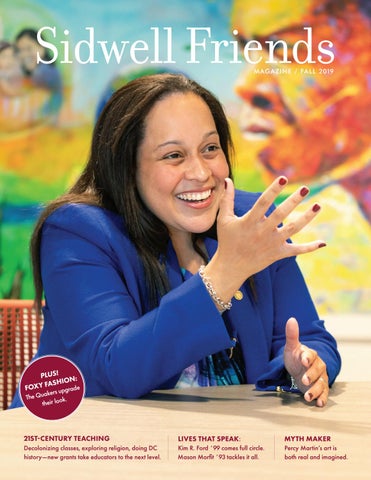
ON THE COVER
To RSVP and for more information please visit: sidwell.edu/alumniholiday
Kim R. Ford ’99 at Martha's Table (Photo by Kelley Lynch)
CONTENTS ‹
DEPARTMENTS 2
REFLECTIONS FROM THE HEAD OF SCHOOL
4 ON CAMPUS The Quakers celebrate homecoming; Michael Twitty talks cooking and heritage; the School names its new mascot; the plan to unify the campus ramps up; and much more.
24
22 THE ARCHIVIST Athletic fashion through the ages.
46
ALUMNI ACTION
56 CLASS NOTES The 1970s called, they need you to name your classmates.
75
FRESH INK
76 LAST LOOK
34
October Light
FEATURES 24 PRACTICE WHAT YOU TEACH The School’s educators are decolonizing the curriculum and bringing the streets of DC into a seminar. Sidwell Friends’ greatest strength? The people in front of the classroom.
34 DREAM WEAVER
38
Percy Martin, the School’s beloved former art teacher, makes prints that are both real and imagined.
LIVES THAT SPEAK 38 “LEARN IT. GO!” Mason Morfit ’93 explains why his junior year at Sidwell Friends makes running a $10 billion investment firm seem so manageable.
42 FOOD AND THOUGHT
42
At Sidwell Friends, Kim R. Ford ’99 used to chop vegetables for Martha’s Table—now she runs it.
SIDWELL FRIENDS MAGAZINE / FALL 2019
1
2
FALL 2019 / SIDWELL FRIENDS MAGAZINE
REFLECTIONS FROM THE HEAD OF SCHOOL ‹
Radical Silence
Why Meeting for Worship is “the centerpiece of the Sidwell community.” BY BRYAN GARMAN
D
uring a recent Meeting for Worship, Mark O’Shea ’20, a member of the Quaker Life Committee, welcomed his peers to “the centerpiece of the Sidwell community.” “Regardless of your faith,” he observed, “the ability to still your thoughts and focus inwards is a valuable skill.” Living an examined inner life is crucial in a cluttered, anxiety-riddled society if one seeks to find greater well-being. Whether Sidwell Friends students recognize it or not, the influence of Meeting ripples throughout their consciousness, engendering patterns of thought that distinguish them in the classroom and in the community. Meeting empowers students to develop voice and inspires them to inquire and reflect. It is the nexus that inextricably links the spiritual, ethical, and intellectual strands that define Quaker education.
these back-and-forth conversations,” she says. “And it wasn’t ‘I’m the teacher, therefore I don’t have to debate you.’ ” (See “Food and Thought,” page 42.) That respect encouraged Ford to live an examined life and become the leader she is today.
“Just as it was in the 1650s, silent worship remains a radical act that rejects orthodoxy, nurtures questions, and makes possible revolutionary approaches to persistent problems.”
The structure of Meeting is radically egalitarian. “Every seat in this room is on the same level,” O’Shea explained, “a design feature [that] is in accordance with the Quaker belief that no member of this community is worth more than another.” These unadorned spaces direct students to focus on what is most basic and essential, while also encouraging them “to stand up and share whatever the spirit moves [them] to say.” Over time, this practice imbues students with the confidence that their voices matter and inculcates a responsibility to use that voice to contribute to the greater good. This ethos shapes the dynamic of the School’s classrooms and creates the intellectual and ethical engagement for which Sidwell Friends is known. Teachers urge students to think independently and grow with integrity, to share knowledge and insights, to be confident but never arrogant about their opinions. Faculty do not indoctrinate. They search for truth with students and, after the manner of Friends, help them discover the teacher—the voice—within (see “Practice What You Teach,” page 24). Take Nancy McGregor Manne ’76, whose itinerant childhood afforded her only three years in the Upper School. In our initial meeting, she averred: “Sidwell Friends was the best school I ever attended. It was the first time I was treated like an adult.” Because faculty respected her, she matured into a self-possessed individual with authentic intellectual interests and the skills and motivation to pursue them. It is a theme echoed by Kim R. Ford ’99, the CEO of Martha’s Table, who agrees that the School’s teachers treated students as equals. “We would get into
“When someone breaks the silence [in Meeting], we remember to listen,” O’Shea said. “For in empathizing with another, we may learn something, even if we have not yet recognized what we have learned.” Although filled with wisdom, his message can land awkwardly in a society that prefers answers to questions, efficiency to patience, certainty to ambiguity.
Quakerism is countercultural when it comes to considering these polarities. Just as it was in the 1650s, silent worship remains a radical act that rejects orthodoxy, nurtures questions, and makes possible revolutionary approaches to persistent problems. Meeting encourages students to consider queries such as those posed by our 4th graders: “What kind of person do you want to be this year within and outside of the community?” Such questions are not easily explored on standardized tests but are essential to cultivating hearts and preparing minds to live meaningful and ethical lives. By interrogating commonly held beliefs and earnestly examining society and their role in it, by considering the good of the individual in relation to the whole, Sidwell Friends students calibrate their moral compasses, emerge with a sense of humility, develop intellectual flexibility, and discern nuance. As one Lower Schooler put it, “Meeting has helped make my light.” Perhaps Mason Morfit ’93, the president of ValueAct Capital, best explains how the Quaker ethos shaped his intellectual life: “Sidwell gave me the grounding and the confidence to say, ‘You name it, I can learn it, I can do it.’ ” (See “Learn it. Go!” page 38.) To those of you who are parents of current Sidwell Friends students, when you ask your children what happens in Meeting, do not be fooled if they say, “Nothing.” Do not be alarmed if they report that silence is boring (sometimes it is). Take the long view and remember O’Shea’s words and those of countless alumni who can attest: Meeting teaches “even if we have not yet recognized what we have learned.”
SIDWELL FRIENDS MAGAZINE / FALL 2019
3
› ON CAMPUS
ON C A MPUS
4
FALL 2019 / SIDWELL FRIENDS MAGAZINE
ON CAMPUS ‹
Left to right: Charlie Phillips ’21, Aaron Wheeler ’21, Rohan Gupta ’21
SIDWELL FRIENDS MAGAZINE / FALL 2019
5
› ON CAMPUS
Design the Future The entire Sidwell Friends faculty and staff have had meetings with architects and designers from Perkins Eastman, the firm that will oversee the Unify Our Campus portion of the School’s Strategic Plan. Faculty and staff voiced their ideas for renovations and new outdoor spaces. Participants described their ideal classrooms (more versatility), tossed out ideas about integrating nature with education, and discussed incorporating sustainable practices into the makeup of the School, all while the Perkins Eastman team facilitated discussions and took notes—lots of notes. The new longterm master plan (the Upper School renovation is the first major phase) will eventually
move into the Harrison Building, which now houses the Upper School; architects will extensively renovate Harrison, bringing in more natural light, adding new play areas, and creating innovative learning spaces for the School’s youngest students. All of this is possible due to the once-in-a-generation opportunity to purchase the adjacent Upton Street property in 2017. The Upton Street building will be heavily renovated and converted into the new Upper School—set to open in 2026. The Middle School will remain in its LEED Platinum-certified Stewart-Jurist Building, but new outdoor renovations will better connect it to the rest of campus.
WATCH THIS SPACE SIDWELL FRIENDS MAGAZINE will follow the progress of the new Upper School in every issue.
6
FALL 2019 / SIDWELL FRIENDS MAGAZINE
Sidwell Friends faculty and staff attend an architectural brainstorming session.
Kelley Lynch
ON CAMPUS ‹
Claudia Labson ’21, Eva Youel Page ’21, Star, Allison Barker ’21, Eleanor C. Walsh ’21
Introducing
Kelley Lynch
Star, the Fox!
After submitting nearly 500 suggested names—Sid, Frankie, Kit, Pax, Georgie—the Sidwell Friends community finally learned the name of their new (and beloved) fox mascot: Star. It’s a perfect fit for all of the School’s stellar teams.
Head of School Bryan Garman and Star
SIDWELL FRIENDS MAGAZINE / FALL 2019
7
› ON CAMPUS
Middle School students stand up for planet Earth.
On Climate, “Adults Need to Step Up Their Game” Thousands of DC-area students and millions more around the world participated in the student-led Global Climate Strike on September 20 to demand action on climate change. For some of the Sidwell Friends Middle Schoolers, however, making their
voices heard wasn’t as simple as leaving School and heading to the National Mall. For one thing, they can’t drive; for another, leaving campus with anyone other than their own parents posed logistical—and likely legal—difficulties for many of the students.
So, with encouragement from their teachers, instead of chatting with friends or catching up on homework during their 30-minute afternoon break, dozens of Sidwell Friends Middle Schoolers spent their time off in front of Zartman House holding their own call to action. Their chants—“Honk if you agree! There is no planet B!”—spurred drivers on Wisconsin Avenue to toot their horns. It was a fun moment but also a serious one. “I really want the government to stand up and try to help our environment,” Miya ’25 said. Gabi ’25 agreed: “Kids have to take a stand because the adults aren’t doing their jobs correctly. The adults need to step up their game.”
The Gift of Time This fall, the Upper School rolled out a new weekly schedule after a yearlong evaluation by faculty and staff. After listening to students and teachers, the committee designed a schedule with 45- and 70-minute class blocks and provided more free time for students to complete assignments or work with teachers directly. To help reduce stress, lunch now gets more time (45 minutes rather than 30), and there is more time between classes. “The primary impetus stems from the Strategic Plan goals surrounding the future of learning at Sidwell Friends,” Principal Mamadou Guèye writes, “including ‘how we use time to respond to students’ changing needs and provide more program f lexibility’ and how we ‘support the health and wellness of the School community.’ ” The schedule also allows time for special Friday programs focused on wellness and community-building, such as the first Quaker Community Day on October 18, which involved an afternoon of games and a rally.
8
FALL 2019 / SIDWELL FRIENDS MAGAZINE
ON CAMPUS ‹
“No Fingers in the Soup!”
Lower School students get hands on.
In September, a classroom full of prekindergartners fell silent for an important announcement. “Let’s not cut our fingers off!” a teacher said. “No fingers in the soup! That is the goal for today!” While that was certainly a goal for the Lower School’s Drop Everything and Serve day; it was not the only goal. The Lower School students spent the day planting flower seeds in egg cartons for a local seniors’ home and making place mats for the Martha’s Table Harvest Dinner. They also made and packed sandwiches and kicked off their weekly vegetable-cutting activity, both of which also benefit Martha’s Table. “We will give these sandwiches to hungry people, and then they will feel good,” one 1st grader said. A prekindergartner scoffed at the suggestion that she might
be nervous to use the (modified) knife to cut the broccoli in front of her. “I use a knife all the time,” she insisted to a skeptical visitor. Certainly for the rest of the school year she’ll get plenty of experience behind the cutting board, as she and her fellow Lower School students continue their service to those in need.
A Day for Doing Sidwell Friends 7th and 8th graders spent October 30 in service to their community. Among other projects, the students sorted clothes for A Wider Circle, helped the National Park Service clean up the Mall, packed donations for Rosemount Children’s Center, and cooked casseroles to donate to Martha’s Table.
SIDWELL FRIENDS MAGAZINE / FALL 2019
9
› ON CAMPUS
NEX
Justina Eke (GP ’28, ’32) helps the Sidwell Friends community go shopping—and selling.
Point of Sale Every year, one of the highlights of Homecoming at Sidwell Friends is the Next-to-New Sale. It takes a robust community of volunteers to host a pop-up shop that rivals Macy’s, but that’s exactly what Kathi Webb ’76, the Next-to-New volunteer liaison and the School’s director of parent relations, and her 240-strong army of aproned parents, alumni, grandparents, friends, and student volunteers do. They sell just about everything: art, instruments, toys, electronics, kitchen gear, antiques, and clothes, clothes, clothes. Webb, whose own children have already graduated (Thomas ’10, Harold ’11, and Maryann ’14), says the enthusiasm for the project is a reflection of the community’s commitment to financial aid—and that, of course, is the whole point.
10
FALL 2019 / SIDWELL FRIENDS MAGAZINE
T-TO -N
EW
ON CAMPUS ‹
VITAL STATISTICS
4 50+ 12+ 190
10
SHIPPING CONTAINERS USED TO STORE AND THEN SELL ITEMS
STUDENTS WHO PITCHED IN OVER THE SUMMER AND THE FALL
CHARITIES THAT BENEFIT FROM NEXTTO-NEW OVERFLOW
PEOPLE ON THE NEXT-TO-NEW LEADERSHIP TEAM
40
NAMED APRONS GIVEN TO THE MOST EXPERIENCED VOLUNTEERS SINCE 2009
DINNERS CACTUS CANTINA DONATED TO VOLUNTEERS ON FRIDAY NIGHT OF THE SALE
240 8,000 VOLUNTEERS WHO SIGNED IN THIS YEAR
5,405 VOLUNTEER HOURS SPENT GATHERING, SORTING, POLISHING, TESTING, REPAIRING, PRICING, AND WORKING THE SALE
BAGS OF GOODS SOLD
65,000 STEPS THE STAFF LIAISON PUT IN OVER THE THREE DAYS OF MOVE-IN WEEKEND
$121,000+ GROSS SALES THAT BENEFIT STUDENT FINANCIAL AID SIDWELL FRIENDS MAGAZINE / FALL 2019
11
› ON CAMPUS
Recipes for Life
Twitty
When chef, historian, and author Michael Twitty came to talk to the Sidwell Friends Middle School students in September, he wasn’t just there to talk about food. Like most of his work, Twitty examined the relationships among food, race, and America. “Food is acknowledging the contributions of people from the past,” Twitty said. “It’s really important to think about where your food comes from and where your family comes from.” Twitty spoke of his own heritage as a descendant of enslaved Africans, a topic he examined closely in his 2017 James Beard Aw a r d – w i n n i n g
book, The Cooking Gene. Twitty said he started cooking with his mother and grandmother at the age of 5. “My mother was the best cook in the world,” he said. “My grandmother, she was up there, but my mom was the best.” A lot of students felt the same way. “When he told us that he was cooking with his mom and his grandmother, I related to that,” said Amaia ’27. “My mom, she’s my favorite cook, and I think she’s the best cook in the world.” Tilly ’27 felt the same way: “My dad cooks a lot. I want to cook like him. He inspires me.” More than anything, Twitty wanted students to come away knowing how food can build bridges, both within and between families. “Going to a friend’s house to eat is like taking a little trip to where they’re from,” he said. “It’s about learning a little bit about what their history is, who their parents are.” His final word of advice? “Go to your family—and get those recipes down now.”
The Building Is Alive, The Students Are Your Guide 8th graders show off the Middle School.
Two 8th grade tour guides quizzed a visitor on what the back of a bench outside the Sidwell Friends Middle School looks like. The visitor’s guess is a whiskey barrel, but what would a whiskey barrel be doing on a middle school campus? So, she pleaded ignorance. “It’s a wine barrel,” revealed Richard ’24, one of the Sidwell Friends Middle Schoolers who takes prospective students, faculty, staff, and visitors on tours of the building. “It’s
12
FALL 2019 / SIDWELL FRIENDS MAGAZINE
good material for outside because it’s already been treated so that water won’t bother it, and it’s another way that the School uses reclaimed material, which is more sustainable.” Richard, like every Sidwell Friends 8th grader, has learned how to lead tours of the Middle School building, which became the first K–12 school in the world to earn LEED Platinum certification when it was completed in 2006. The source of the train-
ing? Science class. “The building really is the teacher,” says Margaret Pennock, one of the Middle School science teachers. “The building illustrates so many of the physical science concepts that they learn throughout the year, and then they get to see how those physical concepts live in a building setting.” Contact the Middle School to set up your own tour—and be sure to ask your guide about the “Tanks of Doom.”
ON CAMPUS ‹
Top left: Matthew Johnson ’20 Top right: Maddie Ray ’20, Matthew Johnson ’20, Samuel Mitchell ’20 Top center: Maddie Ray ’20, Laney Tarr ’21, Eleanor Walsh ’21, Samuel Mitchell ’20 Bottom left: Kamran Rowhani ’21, Bennett Cullison ’22
Points of View The Upper School One-Acts Festival opened with performances from The Land of Cockaigne and English Made Simple, both by David Ives, as well as School, by David Mamet. The works tackle perspective, the constraints of language, and the complexities of recycling.
SIDWELL FRIENDS MAGAZINE / FALL 2019
13
› ON CAMPUS
Summer Service Every summer, Sidwell Friends brings its service ideals to a new set of kids. The Sidwell Summer Community Service Camp—just one of the School’s many auxiliary programs—gives campers in grades 7 through 10 real-world experiences through service to others and the community at large. In 2019, the camp partnered with the Capital Area Food Bank, which aims to beat hunger, and GoBabyGo!, which retrofits Power Wheels cars to meet the needs of children ages 12 months to 6 years who need some sort of adaptive vehicle. That can include rewiring, adding seat belts or roll cages, and, in every case, custom decorations.
Birds’ Eye View “A year ago, a high school student, Patrick Newcombe, wrote to me to get involved in research,” Kyle Horton, an assistant professor of fish, wildlife, and conservation biology at Colorado State University, tweeted out in September. “Now he has a first author paper in #BiologyLetters. Advice to students, reach out.” Patrick Newcombe ’20 was interested in ornithology, among other scientific pursuits, and his biology teacher, Melanie Fields, encouraged him to aim, well, sky high. Biology Letters published “Migratory Flight on the Pacific Flyway: Strategies and Tendencies of Wind Drift Compensation” in September and Newcombe is the primary author, a spot usually reserved for PhDs. The paper sheds light on migratory birds’ f light strategies, which means studying birds at high altitudes and at night.
The Varied Thrush lives in the Pacific Northwest.
14
FALL 2019 / SIDWELL FRIENDS MAGAZINE
Campers work with GoBabyGo!
Talk About My Generation In November, Sidwell Friends’ Director of Equity, Justice, and Community (EJC) Natalie Randolph ’98 sat down for coffee with the School’s grandparents. The Grandparents Coffee was a chance for community members to delve more deeply into the topics their grandchildren explore every day—and to learn a little something new themselves. Randolph reflected on her own experiences at Sidwell Friends and how the School prepared her to think critically, engage in respectful discourse, and embrace diversity as she stepped into the wider world. The Sidwell Friends grandparents then reflected on the challenges they face in a world that seems to undergo social change at lightning speed. As one grandparent put it: How can we keep up with our grandchildren, who are “about a million steps ahead of us,” on issues like diversity? Another wondered: How can we ask questions about other people’s experiences and identities without offending them? Randolph encouraged the group to work three EJC principles into their conversations with young people: (1) make sure there are multiple voices and perspectives involved; (2) foster intellectual inquiry by asking questions and modeling curiosity; and (3) approach these exchanges with empathy and respect—and encourage grandchildren to do the same. After all, the next generation of ethical leaders needs all the support it can get.
ON CAMPUS ‹
Top left: Jacob Albert ’21, Spencer Tyson ’21, Maya Safavi ’22, Isabel Gurney ’23 Top right: Alex ’25 Center left: Charlotte Desmarais ’22, Emma Dower ’22 Center right: Chilamo Taylor ’20, Karabelo Bowsky ’23, Sophie Valbrune ’23 Bottom left: Alden Zhang ’22, Neal Gupta ’22, Star, Harold Fuson ’22, Simone Arrington ’22
Call of the Weekend Homecoming isn’t just for those who have to come home to be here. It’s also a chance for current student athletes to shine and for this year's student groups to introduce their passions and causes. Here are just a few highlights. (For more alumni Homecoming photos, see page 54.)
SIDWELL FRIENDS MAGAZINE / FALL 2019
15
› ON CAMPUS
Tackling the Problem “The future of football is bright,” says Keith Levinthal, the David P. Pearson ’52 Director of Athletics. “And we want to ensure that the safety of our players is first and foremost as we compete for MAC championships.” To do that, Sidwell Friends football fans will notice a change in the kickoffs when the Quakers take the field in future Mid-Atlantic Athletic Conference games. New rules will require the kickoffs to take place from the 45-yard line instead of the 40-yard line. In addition, any kicked ball caught in the air inside the 25-yard line is eligible to be “fair caught”—meaning the receiving player may catch the ball without interference from the opposing team. When a ball is fair caught, the ensuing drive will begin at the 25-yard line instead of at the spot of the catch. Any ball kicked into the end zone is an automatic touchback and will also go back to the 25-yard line.
16
FALL 2019 / SIDWELL FRIENDS MAGAZINE
Kickoffs account for 21 percent of concussions, even though they only make up 6 percent of overall plays. Encouraging players to call for fair catches reduces contact; shrinking the available space means players can’t build up as much speed before a tackle. When the Ivy League implemented similar new rules, concussions during kickoffs fell by 68 percent. The new rules incentivize the returner to call for a fair catch when inside the 25-yard line and stay in his or her end zone for a touchback. The idea is to reduce the chance for concussions and improve the overall safety of the game by limiting the number of kickoff returns—one of the most dangerous times in a football game. “Football is changing, and we need to change with it,” says Levinthal, who pushed for the rule change in the MAC games. “The well-being of our players is imperative, and these new rules allow for the game to continue to grow.”
Top of page (left to right): Jackson Fauvre ’23, Matt Eaton ’23, Chris Ward ’20 Above: Mason Brown ’22
ON CAMPUS ‹
Memory Palace Aidan ’29 never met his great-greatgrandmother. But he knows at least one thing about her. “She liked soup,” the 3rd grader declared, pointing to a picture of his great-great-grandparents on his classroom’s ofrenda, a traditional decoration for El Día de Muertos, or the Day of the Dead. In recognition of the traditional Mexican holiday, each 3rd grade class created an ofrenda, an altar dedicated to the memories of friends and family members who have passed away. On November 1, all of the classes gathered to celebrate, among others, members of the Sidwell Friends community who have passed away. “The biggest thing about this celebration of life and telling stories about people who have
passed is that they still live in our hearts,” said Eve Eaton, the 3rd grade teacher who was the driving force behind the activity. “They’re never really gone.” The Day of the Dead celebration was an interdisciplinary activity that touched on nearly every subject covered in 3rd grade at Sidwell Friends. In addition to all of the 3rd grade teachers, Spanish teachers Angela Ballesteros Gomez and Luz Marina Cardozo Munoz teamed with art teacher Sabreena JeruAhmed to ensure the celebration covered the cultural, linguistic, and artistic elements of the holiday. Each of the ofrendas was touching, with pictures of family members interspersed with photographs of dogs and cats.
SIDWELL FRIENDS MAGAZINE / FALL 2019
17
› ON CAMPUS
“I am especially happy to be here at Sidwell Friends School at a time when we are grasping for words that explain our philosophy, our values,” painter Carol Brown Goldberg (P ’83, ’85) told an audience in the Robert L. Smith Meeting Room in November. Goldberg is the Daryl Reich Rubenstein Guest Artist, and she was the featured guest at the School’s 2019 Daryl Reich Rubenstein Guest Artist Lecture. Curated by Aaron Brophy, the director of art exhibitions and the Middle School art teacher, Goldberg’s work also hangs throughout the Kogod Arts Center in an exhibit Brophy curated and aptly titled “Inner Light.” Indeed, in several of her “circles” paintings, Goldberg creates a radiant light that issues out from a central space-dark depth. Perhaps unsurprisingly, as she painted these massive works, she listened to an audio book about astrophysics, “the cosmos, and about the Hubble telescope’s window into deep space.” She often listens to audio books for inspiration as she works—“taking in these people, their experiences and wisdom, and it gets entangled in my lines.”
Kelley Lynch
Entangled and Entwined
Goldberg
As Goldberg spoke, Brophy showed a selection of photographs he took of dozens of her paintings—from wide angles to tightly focused shots. Some focused on just a fraction of a canvas, and yet they could have been entire pieces on their own for all the color and drama that unfolds in a tiny corner of her work. There were also images of Brophy’s Middle School students as they attempted to replicate Goldberg’s techniques. Some meticulously traced circles across the page, some paid homage to her lush pen-and-ink work, some dripped color across their pieces, and some saturated their pages in explosions of neon. All had themselves become entangled in Goldberg’s inner light.
In fact, Entanglements is the name of one of her latest bodies of work. This particular series teems with plant life, a kind of untamed garden that Goldberg portrays in vivid colors on some canvasses and in stark “Carol sees art as a counterpoint to the real blacks and whites on others. The works world,” Christopher Addison, the co-owner clearly reflect her interest in biological sys- of Addison/Ripley Fine Art Gallery in tems. The audio book she had on hand while Washington, told the room when he intropainting? It was about “DNA, molecules, and duced Goldberg. By the end of the evening, mitochondria. Entanglements is a poem about the assembled guests at the Rubenstein leclife, about who we are as organic beings, how ture all seemed to agree. After all, for at least we entwine together, how we grow.” an hour, they had been transported elsewhere.
18
FALL 2019 / SIDWELL FRIENDS MAGAZINE
ABOUT THE DARYL REICH RUBENSTEIN GUEST ARTIST PROGRAM Lee Rubenstein and his children, Beth Rubenstein ’77, Barton Rubenstein ’81, and Amy Rubenstein ’84, created the annual Daryl Reich Rubenstein Guest Artist program to honor Lee’s late wife, Daryl. Daryl was passionate about art and curated many exhibits at Sidwell Friends as well as at other galleries and museums, including Max Weber: Prints and Color Variations at the Smithsonian Institution. The University of Chicago Press published her catalogue raisonné of Weber’s prints and later reissued it digitally. The Rubenstein family launched the guest artist program in 1981. Since then, more than 30 esteemed artists have exhibited at Sidwell Friends.
ON CAMPUS ‹
Carol Brown Goldberg Maggie On My Mind (2015)
SIDWELL FRIENDS MAGAZINE / FALL 2019
19
› ON CAMPUS
Love of the Game The Quakers came to play this season. Some teams achieved huge victories, titles, and personal bests; others battled injuries, adjusted to rule changes, and competed in new divisions. But no matter the outcome, all were amazing athletes and—more important—good sports.
Elisabeth Dunac ’23 Wibb Marzilli ’21, Miach Lachman ’22, Jack Leonard ’22, Arjun Thillairajah ’20, Niky Tignor ’20, Henry Fant ’20, Earnest Williams ’20
›› SERVE
›› RACE
Girls’ tennis captured both the Independent School League (ISL) AA division and tournament titles for the first time since 2001. Signature wins include those against Holton-Arms, Bullis, St. John’s, and Potomac. The team finished an impressive 20-1.
Boys’ cross-country ran their best race of the season to win their fifth consecutive Mid-Atlantic Athletic Conference (MAC) Championship. Sidwell Friends runners pulled away from the competition to secure the victory by a margin of 19 points. Sidwell took the top two places, and four runners earned all-MAC honors. Three of the top five runners improved their previous best times by a whopping 27, 34, and 39 seconds. Girls’ cross-country showed sustained improvement, placing sixth out of 14 schools at the ISL championships. Four athletes were recognized as all-ISL in their respective races, with 14 out of 16 runners hitting season and personal bests at the ISL meet. Alison Barker ’21
20
FALL 2019 / SIDWELL FRIENDS MAGAZINE
ON CAMPUS ‹
Jordin Young ’20
›› SCOOP Field hockey ended the year at 10-7-1, the best record since the 2009–2010 school year. The team, with eight seniors, had ISL wins over Bullis, Madeira, Flint Hill, and Episcopal.
TACKLE ‹‹
Anika Panth ’20
Football started the season with a big win, but after key players sustained some injuries in the second game of the season, they ultimately finished at just 1-8. The good news? The younger players really stepped up, played a lot of football, and will be vital for the team next season. Amelia Warren ’22
›› KICK Girls’ soccer finished the season 16-2-1, winning the ISL tournament for the second consecutive season and reaching the final of the DC State Athletic Association (DCSAA) championship for the third straight season. The team garnered the top spot in The Washington Post’s area rankings, and five members of the team garnered all-league recognition. The team will be returning nine starters for next season.
Toby Wells-Zimmerman ’21
Boys’ soccer finished 17-3-2. The team won the MAC regular-season title, was the runner-up in the MAC tournament, and was a finalist in the DCSAA. Signature wins include those against Maret, Potomac, and St. John’s.
›› SWING The golf team—with only four members—competed hard all season, going 5-1 in regular-season league play and finishing third in the MAC tournament. One member of the Sidwell Friends team was named to the all-conference team this year. The team is already gearing up to take another run at the MAC title in 2020.
SPIKE ‹‹
Ishaan Kumar ’20
Volleyball finished the season 13-13 overall after showcasing their hustle and fight to play in the competitive ISL AA division. The team outperformed their opponents in key matches, especially against rival Maret, and upset the second-ranked Holton Arms in an exciting team play to advance in the ISL championship semi-finals.
SIDWELL FRIENDS MAGAZINE / FALL 2019
Isabel Gurney ’23
21
› THE ARCHIVIST
22
1
2
3
4
5
6
7
8
9
10
11
12
FALL 2019 / SIDWELL FRIENDS MAGAZINE
THE ARCHIVIST ‹
UNIFORMS THAT DON’T CONFORM This year, the Quakers are donning new uniforms and a new athletic identity. So, it seemed a fitting moment to take a trip through the Sidwell Friends School Archives to look back at how the School’s athletic uniforms have changed over the past century.
A brief history of Sidwell Friends’ athletic fashion—as diverse as the students who wear it. BY LOREN HARDENBERGH
10. In the 1990s, the girls’ soccer team returned to the school seal of the 1960s— though this time paired with shorts instead of pleated tunics. 11. Also in the 1990s, “Quakers” came into vogue and was emblazoned on the front of some jerseys.
1. In addition to bloomers, these girls’ basketball players from 1927 wore circular “F” and “S” patches to show they were from a Friends school.
12. Over the last two decades, some teams have continued the tradition of using “Quakers,” while other teams 2. The members of the 1940 junior varsity sport “Sidwell Friends” on the boys’ basketball team sported jerseys front, or simply “Sidwell.” that spelled out “Friends.” 13. Moving into the 2019 3. 4. 5. By the 1960s, both “S” and “F” season and beyond, the new appeared on the front of these baseball Star Fox mascot is making its and soccer uniforms. Female athletes in first appearance across all the 1960s often wore pleated tunics with sports along with the School’s the school seal affixed to them. latest uniforms. Sidwell Friends Athletics returns to 6. In the 1970s, a resurgence of “Friends” tradition for its new look: appeared on uniforms, as shown on “Quakers” on home-game these football jerseys, despite the fact uniforms and “Sidwell” on that this was also the decade when away-game uniforms. A key the School started to be known more design element across all colloquially as “Sidwell” instead of sports is the Quaker value “Friends.” of simplicity. 7. In the early 1980s, the girls’ volleyball and soccer teams tried a vertical “Friends.” 8. 9. “Friends” endured through the 1980s, as these action shots of the girls’ field hockey team and boys’ lacrosse team show.
“The Quakers,” “Friends,” “Sidwell,” “Sidwell Friends” (“the Star Foxes”?!)—who knows what fans will call the next generation of student athletes or what they will wear (hopefully not a return to bloomers). But it sure will be fun to watch.
13 Amelia Warren ’22, Charlotte Mcguire ’21
SIDWELL FRIENDS MAGAZINE / FALL 2019
23
› PRACTICE WHAT YOU TEACH
Kelley Lynch
Kim
BY SACHA ZIMMERMAN
24
FALL 2019 / SIDWELL FRIENDS MAGAZINE
PRACTICE WHAT YOU TEACH ‹
The School’s educators are taking the Strategic Plan and running with it. From decolonizing the curriculum to bringing the streets of DC into a seminar, Sidwell Friends shows why the people in front of the classroom are its greatest strength.
“I
t is exciting that we are intentionally setting aside a significant amount of time to really think deeply about our teaching practices,” Min Kim, the assistant head of school for academic affairs, says. Given that she has worked at Sidwell Friends for more than 15 years, it’s a pretty meaningful statement. Kim is eager to talk to me, or any staff member willing to come to the teacher resource room, about the opportunities available to faculty at Sidwell Friends. Right now, she is sitting on a sofa in her office upstairs in Zartman House plying me with materials in the manner of a host making sure I am completely comfortable. Do I have the professional development website? Do I need a description of all the Strategic Plan Grants? Despite her obvious passion, the main impression Kim gives is actually one of contemplative calm. “All of our teachers play a part in helping to shape who our students become,” she says in a clear, composed voice. “The more we can do to be reflective and to think about the role we have in nurturing our students so they really can be ethical leaders, the more we achieve that mission.” Kim is no stranger to Sidwell Friends’ commitment to ethical leadership; she has served as Upper School English teacher, all-school diversity coordinator, director of summer studies, Upper School assistant academic dean, and Upper School academic dean and assistant principal. She stepped into her latest position when Ellis Turner, the former associate head of School, retired last June after 39 years of service. But where Turner focused on everything from professional growth to media relations, Kim’s position zeros in on academic affairs. Kim also has an important new tool: the Strategic Plan. Every year, the School allocates an average of six to 12 venture grants to faculty looking to expand their knowledge base, further their education, or hone their craft. In general, the more training teachers receive, the more formed and innovative their teaching becomes. Now, as individual teachers submit grant requests, Kim and the Faculty Professional Development Committee will assess how well each individual grant helped to further the priorities of the Strategic Plan: unify the campus, imagine the future of learning, inspire ethical leadership, and welcome a wider community. “Great ideas shouldn’t happen in a vacuum—they need to be integrated into the School,” Kim says. Now, by working closely with
each division’s principals and academic deans, Kim can help teachers construct professional development proposals that align with both the teachers’ individual goals and the School’s strategic direction. In other words, Kim can see the professional development program from 30,000 feet. “I’ll know the divisional goals and the all-School goals,” she says. “The way I see my role is to interpret or translate the Strategic Plan.” To that end, Kim will ensure that the set of Strategic Plan Grants awarded last summer will have the potential to echo across the School and have impact across the three divisions. Kim has also been integral to setting up the School’s two new innovation hubs: the Center for Teaching and Learning, which asks teachers to think critically about their craft, and the Center for Ethical Leadership, which asks students and faculty alike to think critically about ethics in the Quaker tradition. Putting such a decisive focus on professional and student development as well as the future of education resonated with many in the Sidwell Friends community, particularly the Drezner and Karam families. “Sidwell is one of those special places in my family’s life,” Michael Karam, a former trial attorney and Sidwell Friends spouse and parent, says. When Karam wanted to honor his late wife, Linda Morgan Karam ’69, he and his daughter, Meredith Karam ’03 (now in her second year of a PhD program at the Catholic University of America), decided that endowing a fund to promote professional development was one of the best ways they could give back to the School. “I was drawn specifically to the topic,” he says. In fact, Karam introduced Head of School Bryan Garman to Georgetown University Vice Provost for Education Randy Bass, who runs Georgetown’s Designing the Future(s) program for educational innovation. Karam, Garman, Kim, and other Sidwell Friends leaders visited Georgetown and were inspired by what they saw. All kinds of ideas were on the table, Karam says: “getting away from 15-week semesters, one-credit courses, bridges to post-academic life.” And of course, opportunities for teachers to excel. “In the past, we had funded faculty research grants when teachers had special interests,” Karam says. “Now, we can continue that work—but under the Strategic Plan.”
SIDWELL FRIENDS MAGAZINE / FALL 2019
25
Kelley Lynch
› PRACTICE WHAT YOU TEACH
Coffin with a student
Quaker Values “Quaker identity is a mission to let our lives speak,” Denise Coffin, a Lower School kindergarten teacher, says. “Some of our students are Jewish, Quaker, Muslim, Baha’i, Episcopalian, but that inner light is there no matter what. It even extends to people with no faith.” A practicing Quaker, Coffin is a member of the Strategic Plan Grant team working to develop an interfaith dialogue program. She says that a “big piece of our duty as a school,” is to introduce children to the broader world and to ask, “What do they need to know before they graduate?” They were inspired by last spring’s Peace Speaker Eboo Patel. Patel, the former head of President Barack Obama’s Advisory Council on Faith-Based Neighborhood Partnerships, the founder of the Inter-
26
FALL 2019 / SIDWELL FRIENDS MAGAZINE
faith Youth Core, and the author of several books, including Acts of Faith, talked to the Sidwell Friends teachers about navigating delicate conversations and turning an intellectual religious literacy into a more profound religious appreciation and positive inclination toward faith traditions. “We begin with tolerance,” says Coffin, “and we end with enthusiasm.” This fall, the Lower School held a Diwali celebration to honor the Hindu festival of lights. In the lead-up to the festival, the team crafted queries to guide the celebration, conducting a Meeting for Worship with a special focus on Hinduism and identity—which asked the students to look for ways they might connect to the traditions even if the practices were not their own. The students also went to an Indian-
PRACTICE WHAT YOU TEACH ‹
QUESTION&ACTION authored play at Imagination Stage to look for moments of both familiarity and surprise. The team then connected these lessons to Quaker identity—pairing the light of Diwali with Quakerism’s inner light. The group will do similar programming around the Chinese Lunar New Year and other traditions that go beyond holiday high points and reveal deeper truths. Or as Coffin puts it: “Finding the appropriate faiths to tell the story of faith.” The team has plans underLower School Diwali celebrations way to collaborate with experts at the Howard University School of Divinity and to take their project across divisions. They have started to have conversations with Upper School students about new courses and interfaith workshops as well as field trips. “Our future hope is that there might be ways to make routine the habit of visiting different faiths’ spaces,” says Coffin, “and to reflect on what it means to go to another place of worship.” Another group of teachers worked on a project called Social Justice Through Literature, rethinking the 4th grade reading curriculum with an eye toward religion, ability, race, gender, socioeconomic status, and environmental stewardship. (All of which also complements the School’s commitment to equity, justice, and community, or “EJC.”) Kathryn Bauman-Hill, a 4th grade teacher, and other members of the Social Justice Through Literature group then reconceived the entire 4th grade reading list and added student evaluation forms at the end of each book to ensure students are thinking critically about what they have read.
INTERFAITH DIALOGUES PROGRAM Denise Coffin, Auysha Muhayya, Yolanda Rolle
QUESTION: How can teachers affirm the belief that religious diversity is a strength of the community? ACTION: The team developed a relationship with the Howard University Divinity School and with Eboo Patel to explore how to create an interfaith program. The group developed a library of resources for teachers about different faith traditions to use in classrooms or share in newsletters. They also identified worship spaces throughout the area for student field trips and are planning those trips now. Currently, the team is using new lesson plans about religious diversity and Quakerism.
PROFESSIONAL DEVELOPMENT FOR EQUITY, JUSTICE, AND COMMUNITY
Chanel Malik, Kathryn Bauman-Hill, Hayes Davis, Laura Barrosse-Antle, Zaneta Chambers, Emilia King, Nanyamkah Mars, Nan Pickens, Courtney Peterson, Georgia Warner QUESTION: Can teachers give the School’s community the tools to have more positive, mindful relationships with students and adults from a variety of backgrounds? ACTION: The team evaluated past and current equity, justice, and community (EJC) initiatives on campus to learn what worked and what didn’t. They also researched different approaches from other institutions around the world. Then the group developed new professional development tools and worked with EJC Director Natalie Randolph ‘98 to launch them at Sidwell Friends on October 22, the Center for Teaching and Learning’s allschool professional development day. The team will also work with division heads to schedule more EJC education.
SOCIAL JUSTICE THROUGH LITERATURE
Kathryn Bauman-Hill, Teresita Cuesta, Jamie Tomik, Edith Zhang
QUESTION: How can teachers infuse social justice into how they teach reading, writing, and social-emotional skills?
“We begin with tolerance, and we end with enthusiasm.” —DENISE COFFIN
ACTION: The team investigated the current 4th grade book collection, the 5th and 6th grade reading lists, and potential new titles. They also reviewed the School’s social-emotional curriculum and Quaker values. The team then developed six reading units with essential questions focused on religion, ability, race, gender, socioeconomic status, and environmental stewardship. They also created a book-evaluation tool for each book the 4th grade team reads.
SIDWELL FRIENDS MAGAZINE / FALL 2019
27
› PRACTICE WHAT YOU TEACH
Ethical Leadership Every December, Hayes Davis, an Upper School English teacher and the Upper School EJC coordinator, chaperones Sidwell Friends students attending the National Association for Independent School’s Student Diversity Leadership Conference. “And for years, students have been wanting to host an EJC-related conference of their own,” Davis says. “They wanted a space here to have conversations with other students about identity”—something that went beyond affinity groups, something that asked the entire Upper School student body to stop and pay attention. Of course, erecting such an event is no small task. “Honestly, I never felt like there was enough time to work on it,” Davis says. “But then the Center for Ethical Leadership started, and there was dedicated funding to develop the conference over the summer through the Strategic Plan Grants.” So, the seeds of what would become the Ethical Leadership Conference were planted. Still, in a city with no shortage of conferences, there was the issue of offering something that would not overlap or duplicate the efforts of already established events. “What can we do that is different?” Davis wondered. Still in the early phase of planning, the Strategic Plan Grant team working on the project came to the idea of a skills-building conference as a first step. “Students can come to our conference in March to get some of those hard leadership skills,” he says, “like running a meeting, listening, encouraging others.” The daylong student-led Ethical Leadership Conference will be held on March 4, 2020, and student leaders are hoping to include the participation of at least one area public school—part of the Strategic Plan goal of welcoming a wider community to Sidwell Friends. The event will feature a social hour to help forge bonds between students. Other likely activities include brainstorming sessions, young alumni panels, a focus on wellness, questions for leaders to bring up at the
28
FALL 2019 / SIDWELL FRIENDS MAGAZINE
Davis
beginning of the day and return to at the end of the day, and a Meeting for Worship. The team plans to pilot the conference this year before scaling it up to include the Middle School and more outside schools in subsequent years. “I’m looking forward to continuing to work with the students on the conference,” Davis says, “and then watching them lead it.” Encouraging students to be teachers is a rich part of the Sidwell Friends experience—from teachers treating students as equals in the classroom to students leading top-flight scientific tours of the Middle School. “Mentoring doesn’t always happen chronologically,” Coffin notes. “How can we make mentoring go up? How can young people teach older people? Often young people are bigger on the inside; they have valid and important ideas and opinions.” Most notably, teaching up is an excellent way to learn to lead, which is exactly what the Ethical Leadership Conference aims to do.
PRACTICE WHAT YOU TEACH ‹
QUESTION&ACTION ETHICAL LEADERSHIP CONFERENCE Hayes Davis, Auysha Muhayya, Sandra Falcon
QUESTION: How do students at Sidwell Friends and other schools develop leadership skills and practice listening to each other? ACTION: The team invited students to join them as they explored the idea of developing a Listening and Leadership Conference led and run by both adults and students. The group is now planning their first annual daylong conference in spring 2020 with at least one public school. They are developing an event schedule that includes time for social bonding as well as panel discussions with alumni in leadership positions.
ENVIRONMENTAL SUSTAINABILITY PROGRAMS FOR THE 50TH ANNIVERSARY OF EARTH DAY
Emily Boyer, Ann Fieldhouse, Margaret Pennock, and Monica Sorensen
Kelley Lynch
QUESTION: How do teachers and students use Earth Day to demonstrate leadership and a commitment to the environment? ACTION: The team created a student eco-club in the Middle School to collaborate with the Upper School’s eco-club. For Founder’s Day, the team is developing eco-activities for students, creating green servicelearning opportunities, and partnering with teachers to bring environmental themes into the classroom. The group is also partnering with the food-service staff at Meriwether-Godsey to make the Founder’s Day lunch more sustainable.
UNIFYING ATHLETIC AND ACADEMIC FACULTY
“Students can come to our conference in March to get some of those hard leadership skills, like running a meeting, listening, encouraging others.” —HAYES DAVIS
Josh Markey, Sam Ziegler, Jon Mormino, Yolanda Rolle, Becky Iseman, Georgia Warner, Eve Eaton QUESTION: How can teachers and coaches strengthen their relationships and use Quaker values to provide character education across divisions? ACTION: The group tested the strengths and weaknesses in the lines between athletics and academics, and they held meetings to create more harmony among the divisions. Now the team is reaching out to more and more faculty to continue the conversations, and they are making suggestions to divisions about enhancing communication and a shared sense of purpose.
SIDWELL ALUMNI FRIENDSMAGAZINE MAGAZINE / SUMMER / FALL 2019 2019
29
› PRACTICE WHAT YOU TEACH
Inspired Teaching “The good thing about the archives is you’re always adding to it,” Darren Speece, an Upper School history teacher and assistant dean of students, says, beaming. “You can work here forever!” Though the archives room, housed in the lower level of the Upper School Library, is perfectly bright and modern, Speece has a way of making me feel as though we should be carrying a candelabra through a dusty chamber filled with sepia-toned scrolls. In a way, it is this sense of romance that led to his Strategic Plan Grant. When Speece realized there was initially no plan for the archives in the new Upper School building, he sat down with Mamadou Guèye, the principal of the Upper School, as well as archivist Loren Hardenbergh, Kim, and Garman to talk about how “the new building gives us an opportunity to do more to use the archives intentionally and use them as a tool for building community and teaching students how to do history and tell stories about Sidwell—good, bad, and triumphant.”
Kelley Lynch
Speece is combing through various white boxes—each neatly marked—stuffed into towering shelving units that seem a tad precarious. The small room is bursting with Sidwell Friends history— old pennants, trophies, artwork, papers. “Here it is,” Speece says, victorious. He is holding a mid-1920s portrait of Setsuko Matsudaira, who attended Sidwell Friends while her father, a Japanese
Speece
30
FALL 2019 / SIDWELL FRIENDS MAGAZINE
“Use the archives intentionally and use them as a tool for building community and teaching students how to do history and tell stories about Sidwell—good, bad, and triumphant.” —DARREN SPEECE
aristocrat, was ambassador to the United States. Three years after attending the School, Matsudaira would marry and become fullf ledged royalty as Princess Chichibu. Speece admires the photograph of Princess Chichibu for a last moment before putting her back in a box and pushing it deep into the shelf. Speece applied his Strategic Plan Grant toward this passion: “Doing History” would be a way for students to study the archives, to execute research projects, and to discover new historical spaces. Last year, Georgetown University was getting a lot of attention for exploring the Jesuits’ legacy of profiting from enslaved people. It’s just the sort of project Speece wants to spearhead at Sidwell Friends. “The history of this property and land and neighborhood is that it all belonged to one family that owned slaves,” Speece says. “Presumably, this land was cleared and tilled by enslaved Africans. How should we as a community react, how should we understand that and think about that, and what obligations do we have?”
PRACTICE WHAT YOU TEACH ‹
QUESTION&ACTION DOING HISTORY Darren Speece
Kelley Lynch
QUESTION: What would a public-history program look like at Sidwell Friends?
Speece
Speece wants students to work with the DC Historical Society to learn more about the Tenleytown and Cleveland Park neighborhoods and add to the School’s archives. He then wants them to curate rotating exhibits on campus. And he wants them to explore the District of Columbia more broadly: There are projects to do on everything from the history of Earth Day at Sidwell Friends to the history of DC go-go music, from an aerial photography exhibit to the top movies shot in Washington. Basically, he wants to put the School’s resources to work: “How can we pull out the archives and tell these really cool stories?” Speece isn’t the only teacher to reexamine how to present the past in a more inclusive way. Nan Pickens, a 7th and 8th grade Spanish teacher and the Middle School Language Department chair, wanted to rethink the colonial bias threaded throughout traditional school curricula. Her Strategic Plan Grant team worked on Decolonizing the Classroom. “For a long time, I have been grappling as a Spanish teacher with how to teach through a decolonized lens,” Pickens says. “The language came with the colonization.” Now her classes explore Mesoamerican civilizations and indígena (indigenous) identity. “It’s so simple,” she says. “We just need to make it an intentional practice in the classroom.” Chanel Malik, a Middle School 5th grade teacher and the Middle School EJC coordinator, also worked on the project; she says she “started thinking about the connectedness of the Middle Ages and the modern world in a different way.” She was teaching Medieval times— the fall of the Roman Empire, the beginning of the Renaissance— when a 5th grader in her class said the lesson was Eurocentric. “So, they know,” Malik says. “The kids already pick up on it.” The challenge for the teachers then is to look at, say, Medieval culture and—as Malik puts it—ask, “So, what was going on in the rest of the world?”
ACTION: Speece studied the Sidwell Friends archival system to create a new course focused on public history and exhibition design. He also studied Gonzaga College High School’s and Georgetown University’s research projects on the historical ownership of enslaved peoples to see how the course might play out in practice. Speece examined the history of enslaved peoples on the Wisconsin Avenue campus and identified primary sources from the DC Historical Society archives. Currently, he is running pilot mini-courses on archival work in two elective classes.
DECOLONIZING THE CLASSROOM
Nan Pickens, Gail Krotky, Chanel Malik, Shaakira Raheem, Camilla Villanueva, Georgia Warner, Joyce Bidi-Olagunju QUESTION: Can a postcolonial curriculum empower all perspectives and give voice to those not traditionally heard? ACTION: The team started by reading scholarly articles on decolonization as they reflected on the current curriculum and classroom culture, looking at which student and faculty voices are heard or marginalized. They also worked with Kmt Shockley of Howard University to create a more expansive curriculum. The group developed and submitted a 2020 presentation proposal for the National Association of Independent Schools. They also created lesson plans for all three divisions of the School and conducted a one-hour workshop for faculty.
BUILDING COOPERATIVE LEARNING COMMUNITIES Georgia Warner, Leca Klam, Becky Iseman
QUESTION: How can Sidwell Friends create a culture of sharing and risk-taking to bring out the best in teachers? ACTION: The team attended the Wonder Woman Leadership+Design Conference for educational leaders and visited a unique teaching center at an independent school in Atlanta. They then developed a list of conferences and other professional development opportunities to share with their fellow teachers. They are currently developing new faculty seminars and workshops.
SIDWELL FRIENDS MAGAZINE / FALL 2019
31
› PRACTICE WHAT YOU TEACH
Lead in the Light
Today’s students face a world that changes at dizzying speeds. Technology is constantly evolving, climate change threatens the planet, old hatreds have reemerged, and global politics are complex and jeopardize peace. Sidwell Friends’ Strategic Plan outlines steps to address these challenges and to create opportunity, so that every student learns the value of a life lived in service and significance. Professional development is just one part of a larger initiative to empower the next generation. Above: Nan Pickens teaches Spanish with a focus on inclusion at the Middle School. Left: Chanel Malik works with a student in her 5th grade classroom.
Unify the Campus: The School will come together on one campus from preK to 12th grade.
Imagine the Future of Learning: The School will recruit and retain motivated faculty and empower them to explore new teaching practices.
Inspire Ethical Leadership: The School will examine leadership, Quaker principles, and the greater good.
Welcome a Wider Community: The School will welcome students from across the capital region and make a Sidwell Friends education more accessible.
TO LEARN MORE ABOUT THE STRATEGIC PLAN, PLEASE VISIT: SIDWELL.EDU/ABOUT/STRATEGIC-PLAN
32
FALL 2019 / SIDWELL FRIENDS MAGAZINE
“It’s amazing to think about the future—to bring the campuses together.” —MICHAEL KARAM
PRACTICE WHAT YOU TEACH ‹
“It has been an incredible experience to have my colleagues help to raise my children.” Kelley Lynch
—MIN KIM
Kim
Unite the School Almost every Sidwell Friends teacher I spoke to volunteered the same sentiment: Working across divisions was a high point of their Strategic Plan Grant. “It’s such a pleasure to go to the other campus and sit down with teachers from another division and think about the possibilities,” Coffin says. Malik agrees. “I hope to have more time to have conversations, as in the summer,” she says. “We don’t get enough time to have interdivisional talks and to truly focus on the Strategic Plan.” Davis is still impressed that faculty were willing to come in over the summer to pursue all of these projects: “Their level of thinking, processing, and mindfulness about the work that we were doing and what we want to offer was extraordinary.” Generating that kind of enthusiasm for collaboration is exactly what the School’s unification process is about. “It’s amazing to think about the future—to bring the campuses together,” Karam says. “We just have to hope all the supporters come through with the necessary funding.” Kim agrees. She says her deepest hope for the next five years is to raise the funds to renovate the Upton Street property and give the School’s two interdivisional innovation hubs—the Center for Teaching and Learning and the Center for Ethical Leadership—a real brickand-mortar home.
Back in Kim’s office, she reminds me that she has also been a Sidwell Friends parent. “It has been an incredible experience to have my colleagues help to raise my children,” she says. Now, in her new role, she talks about how much she enjoys working closely with the three division principals. “I’ve always enjoyed that insight into the Upper School,” Kim says, “but now it has expanded to include the students, teachers, and parents of the other divisions.” Once again, Kim has her eye on the School from 30,000 feet, making sure all the pieces are connecting and creating a whole. Perhaps it isn’t surprising then that her favorite spot on campus is behind Zartman House, where she can see “the football field, the soccer field, the cross-country track, and if you turn the right way, the tennis courts, and see what all the kids are up to” while also keeping an ear out for the “student theatrical productions and ensemble groups” happening in the Kogod Arts Center next door. “I’m truly part of a larger community,” Kim says. “It’s inspiring to see students and faculty who care so deeply about the quality of the academic experience. When they work together across divisions, it’s pretty awe-inspiring.”
SIDWELL FRIENDS MAGAZINE / FALL 2019
33
› DREAM WEAVER
Dream Weaver
Percy Martin, The Birth of Nova
34
FALL 2019 / SIDWELL FRIENDS MAGAZINE
DREAM WEAVER ‹
At Sidwell Friends, Percy Martin is a beloved former art teacher. To the rest of the world, he is an artistic icon. BY SACHA ZIMMERMAN
O
nly women are able to turn into birds. They fly to protect the high priestess. Miniature elephants also protect the high priestess—and they grow huge in an instant if they perceive a threat to her. In this society of women, men still play a role. They travel forward and backward through time by sitting down and projecting themselves elsewhere. They move as if in a dream. In this way, they are like ghosts. Are these tales from ancient India? Africa? A lost Zoroastrian narrative? “All the stories are from my imagination,” the artist and longtime Sidwell Friends art teacher Percy Martin said. “I invented them for myself.” Martin, a large man with a soft voice and trademark suspenders, was talking to Aaron Brophy’s 8th grade advanced art class at the American University Museum at the Katzen Arts Center. The center, along with the Alper Initiative for Washington Art, recently presented “Prints & Artists: WD Printmaking Workshop 1970-Present,” curated by Jack Rasmussen, the Katzen Gallery’s director of art and curator. Martin, now retired from Sidwell Friends, originally trained at the Corcoran Gallery of Art downtown; now he has pieces in the Smithsonian’s American Art Museum, has received a Ford Foundation Fellowship, and was the artist-in-residence at the National Endowment for the Arts. Brophy, the director of art exhibitions and the Middle School art teacher, calls him a “living legend.” The field trip was a chance for today’s Sidwell Friends students to understand the School’s intimate connection to an important national art movement. The American University exhibition explored the art and artists of the WD Printmaking Workshop, the studio that Percy Martin and his wife, Alice Martin, founded in their Adams Morgan home 50 years ago. “If you ever have the chance to name something new, take 10 or 20 minutes,” Martin told the kids, referring to the name WD Workshop. (The “WD” is a reference to a common lubricant used, among other things, in etching: WD-40.) “I always wished I had named it something more dynamic.”
SIDWELL FRIENDS MAGAZINE / FALL 2019
35
› DREAM WEAVER
“We spend so much time inculcating genius in our students that we often forget to appreciate the great minds of our colleagues across the hallway.” –AARON BROPHY
A lack of dynamism is not something one normally associates with Martin. Images of Nubian royalty, sacred water creatures, and Bushmen populate the walls of the Katzen Arts Center as though they were torn from the papyrus of some ancient scroll. That ancient feel is perhaps apropos given the 13th-century techniques Martin employed to make much of it. Printmaking involves copper or zinc plates, nitric acid and other chemical emulsions, a lot of wax, ink, a roll press, and the ability to draw—backwards. Computers and 3-D printers have provided artists like Martin with new ways to execute and add dimension and color to their concepts, but a lot about printmaking is unchanged, including the hold-your-breath quality that comes from never knowing exactly how the work is going to pan out until it hits the press. In addition to the WD Workshop, Martin started Sidwell Friends’ printmaking workshop, and for 30 years, he dared his students to look past what was in front of them and dip into the mythic. That’s because Martin is a world-builder. He has created a mythology to rival the Greeks, complete with imagined weddings and feuds, births and rites of passage; there’s even a Tongue Librarian (no need to read her Tongue Book; just hold it to your ear). Whether through wisps of color so subtle they seem to have dripped off a watery paintbrush or through hyper-saturated scenes where the color screams for attention, Martin’s is a fully realized world teeming with life, morality, and ritual.
36
FALL 2019 / SIDWELL FRIENDS MAGAZINE
DREAM WEAVER ‹
“Artwork is like kids. You love them all.” –PERCY MARTIN
Previous page: Percy Martin, Sky Dancer II Top left: Percy Martin, Untitled Top right: Percy Martin, Untitled
“Over time, it is possible for us—faculty and students—to take each other for granted,” Brophy said. “We spend so much time inculcating genius in our students that we often forget to appreciate the great minds of our colleagues across the hallway. Percy Martin was, and is, one such colleague.” In fact, Martin’s presence is still felt on campus: Several of his framed prints hang in Zartman House. Martin was also at Sidwell Friends at a time when other art luminaries like Ed Crow, Linda Swan, and Rick Honn also taught at the School. “Their collective creativity,” Brophy said, “ensured a lasting legacy of art education—one that has been imbued within thousands of Sidwell’s alumni.”
culture of priestesses.” Other students were also impressed with his inventiveness. “It’s really interesting how he came up with these whole worlds,” Iain ’24 said. None of the students could say that their own work reflects a storyline that exists only in their minds—not yet anyway. “For Percy to be willing to meet with us and talk to our students so candidly about his creative process was a golden opportunity that I could not pass up,” Brophy said. “It was one of those moments when you just feel like you are in the right place at the right time.”
American University will preserve and archive Martin’s artwork within its permanent art collection, a fitting tribute to the Corcorantrained artist, as much of the Corcoran’s former art collection also resides there. (The Corcoran Gallery of Art closed in 2014, but the Corcoran School of the Arts and Design lives on as part of the George Washington University.) When one 8th grader asked Martin what his favorite piece in the exhibit was, he replied: “Artwork is like kids. You love them all.” Alix ’24 asked Martin about a particularly intense red print, The Birth of Nova. The concentrated color was meaningful, he told her: It represented new life. “Birth was really important in his legend,” Alix reported back to me. “I love that it’s part of the power of a
Martin
SIDWELL FRIENDS MAGAZINE / FALL 2019
37
For the full interview, go to sidwell.edu/magazine.
“LEARN IT. GO!” 38
FALL FALL2019 2019/ /SIDWELL SIDWELL FRIENDS FRIENDS MAGAZINE MAGAZINE
Morfit
LIVES THAT SPEAK
Mason Morfit ’93 talks to Head of School Bryan Garman about applying Quaker values to his investment career, how Sidwell Friends made him an intellectual omnivore, and why being a learn-it-all is always better than being a know-it-all.
L
ong before Mason Morfit challenged Microsoft to rethink its priorities, Sidwell Friends School challenged him with AP Bio. The son of Quakers, one of whom was a diplomat for the US State Department, Morfit grew up in India and Indonesia before arriving at Sidwell Friends in 7th grade. He graduated in ’93, headed to Princeton University, and then moved to the West Coast, where he joined an investment firm called ValueAct Capital. He has been there ever since. Founded in 2000, Morfit says ValueAct has grown “from nothing to over $10 billion in assets” by managing money for endowments, foundations, and pension plans around the world—all with the idea that investors can have a positive voice in the governance and oversight of public companies. It’s called ethical investing, and it was the main topic of discussion when Morfit sat down with Head of School Bryan Garman at Bird Studios in San Francisco. This conversation has been edited for length and clarity. BG: How did your Sidwell Friends experience shape your work and ethical core? MM: Some of the benefits of being immersed in a place like Sidwell were not obvious to me until later in life. At the time, I was just trying to hang out with friends, get my work done, get into college. Now, in my career, we invest in companies where we’re arriving as an outsider to the party,
as a minority participant without a lot of power, and we have to gain trust about effecting cultural changes. It requires a personal touch that’s consensus-oriented and gentle but also firmly convicted. That’s a good description of Quaker values, too. BG: How does that play out in terms of what you did with Microsoft? MM: I still have to pinch myself. It was great being at an iconic company at a really particular point in time, when the leadership of the company passed from Steve Ballmer to Satya Nadella. The issues facing Microsoft were profound. Many felt underlying technology shifts had left the company in the dust, but those shifts were actually opportunities to change, including by abandoning some of the company’s longheld cultural beliefs. It required courage to change both the people involved and some of the company’s organizing principles, such as making everything subservient to Windows. To get an organization of almost 100,000 people to let go of those paradigms is difficult. Getting there is a journey. It’s not something you can mandate heavy-handedly. It is something you can be a part of if you come in willing to engage and willing to have your mind changed. Satya was very open-minded about embracing things. Satya says that the “learn-it-all” always outperforms the “knowit-all.” I replay that over and over in my mind. Nobody likes a know-it-all, and the know-
Microsoft inverted the paradigm from ‘We will win at all costs, we will dominate, we will crush, and we will destroy,’ into ‘We will work together.’
it-all usually doesn’t get very far because nobody wants to see the know-it-all win. But if you reorient yourself as a learn-it-all, you create win-win situations where you grow and the counterparty grows as well. That’s what we’ve tried to do at my firm, and how I’ve tried to live as a human being and as a professional.
SIDWELL FRIENDS MAGAZINE / FALL 2019
39
LIVES THAT SPEAK
Left: Garman Right: Morfit
BG: Moving from being a know-it-all to a learn-it-all is a pretty courageous transformation to make, especially if you’re in the leader seat. What were the key moments that led to that? MM: Usually when we come into a company and present some outsider views, those views are threatening to the company’s status quo. They are uncomfortable truths. We generally present these things quietly and respectfully, behind the scenes to the chairman or the CEO, and they either disappear or they get re-filtered and show up gradually. But when I arrived at Microsoft and presented a document of my thoughts from the outside, the first thing they did was put it on the internal intranet for the entire board of directors and senior leadership to see. That was remarkable. I had never seen a company just say: “Let’s put this on the table. Let’s talk about it.” Satya and Microsoft inverted the paradigm from “We will win at all costs, we will dominate, we will crush, and we will destroy,” into “We will work together.” He created a coalition of players in the software ecosystem that used to be at war, and together they thought about the industry as one of cooperation and coexistence rather than Hobbesian competition.
40
FALL 2019 / SIDWELL FRIENDS MAGAZINE
BG: When you bring these issues to companies as an investor, are they mostly operational issues, or are there also ethical and cultural issues? MM: Companies, countries, and organizations coalesce around certain paradigms, worldviews, and missions. Sometimes they are permanent and evergreen, but often they are helpful and constructive for a period of time, but then they actually become hindrances. Companies go through life cycles. It is often the case that when my firm engages with a company, what is holding them back are their old paradigms. Microsoft’s prioritization of Windows over all else would be one good example. Another paradigm is “if you’re not growing, you’re dying.” A lot of times I’ll come into companies that have had this ethos of aggressive growth at all costs that has led them to do a lot of diversifying, and they’re spread way too thin. It isn’t working, it’s distracting everybody, and it can come crashing down. Another example is “profit above all.” That paradigm is raising its ugly head everywhere
you look. I trace some of that back to an ideological legacy, coming out of the University of Chicago and Milton Friedman, that says the sole purpose of a corporation is shareholder value and profits. If you take that to the extreme, you neglect your employees, your environment, your communities, and your customers. That can also come crashing down. More often than not, these paradigms companies are beholden to are inhibiting their progress. They have to let go. We come from the outside and say: “It’s okay. It’s time to move on from this and reorganize yourself around something different.” Do schools go through life cycles? Do schools’ foundational myths or cultural premises—which serve them very well initially—need to change as society or culture changes? BG: Absolutely. We’re in one of those shifts now. People are examining the best way for students to learn. Is it this model where we instill knowledge in students, as in an AP model, where we’re teaching kids to learn as many facts as they can, or is it a more open model where we want kids to be judged by
LIVES THAT SPEAK the quality of their thinking rather than what exactly it is they know from a perspective of content knowledge? You can’t ignore content knowledge of course, because you need some context in which to think. But we are looking at ways to find more time and space for kids to think deeply about what they’re doing, rather than pushing them through a curriculum at light speed. That’s one of the reasons why we decided to lay down the AP curriculum. MM: When I was a student at Sidwell, it was a light-speed push. The paradigm was academic achievement, standardized test scores, AP scores, grades, Ivy League schools—at all costs. BG: You told me you spent a lot of time in the Georgetown library studying for AP Bio. MM: The hardest I’ve ever worked in my life was junior year at Sidwell Friends. I used to go to the Georgetown University library every week and work on my 30-page American Studies papers for Ellis Turner and then AP Bio for Mrs. Fields. It was an unbelievable workload, and it gave me an incredible amount of drive and work ethic. The intensity of the experience was great. But still, it’s interesting that you are reconsidering whether it’s the right direction, because I strongly support your efforts. I was set up well after Sidwell because I didn’t have to kill myself just to keep my head above water when I got to college. But I also didn’t deeply, deeply love learning until I got to college. At Princeton, I had the freedom to really dive into things that were super interesting to me and have viscerally intense intellectual experiences. BG: What was one of those moments? MM: My favorite courses were things like Analysis of Capitalism. The Berlin Wall and Soviet Union had crumbled, so a lot of economists were trying to help Yeltsin rebuild the Soviet economy. Economics is basically applying mathematics to psychol-
ogy. How do you mathematically model how a human being is going to behave? I wrote a paper in college on Mahatma Gandhi’s economic theories. Unlike traditional Western economics, where it’s supply-demand curves and everything is built on the idea that consuming more is better, Gandhi saw a point of diminishing returns. He said that community matters and your fellow man matters.
Sidwell gave me that grounding and the confidence to say, ‘You name it; I can do it.’
BG: How does that apply to your work? MM: In 2005, we were looking at investing in a company that made DNA sequencers. To make that investment, I had to really understand the science. I still had my AP Bio books from Mrs. Fields’s class, and I went back and ramped up really quickly. We funded a company called Solexa, which has since merged with Illumina, that has revolutionized the cost of DNA sequencing. We were a small part of that, but it was at a critical moment. When the company was running out of money, we put $8 million into it to keep it alive. Beyond the basic science requirement in college, which for me was like Psych 101, I didn’t have any postSidwell science or biology experience, but I had the grounding and the courage to think: “I can get into this. Then I can dive into higher-level expert text and have conversations with people at Cambridge University and at the Broad Institute to learn it.” For students and professionals of the future, the most important quality is the ability to learn and ramp up on any discipline on the fly. We tell our analysts all the time: “You know nothing about radio frequencies and how walkie-talkies work, but we’re looking to make an investment in a company that does those things for police officers and firefighters. Learn it. Go!” Sidwell gave me that grounding and the confidence to say, “You name it; I can do it.” BG: It’s also this move from the know-it-all to the learn-it-all.
It upends all of the equations and mathematics of economics. That’s an example of the light bulb going on in my head. I credit Sidwell with giving me the ability to think at that higher level. Sidwell also gave me an intense grounding in an ability to push through and learn, which gave me a lot of self-confidence to cover lots of different academic subjects omnivorously.
MM: Yes. The culture I’m trying to build at ValueAct is learn-it-all—with the courage to go anywhere and do anything. And with a mission that goes beyond making money. Obviously, we have to do that; otherwise we wouldn’t have any clients. But with a willingness to ask questions, we can leave each company better off than we found it, treat people respectfully, and have good intentions. If you do that, it’s remarkable where the world takes you.
SIDWELL FRIENDS MAGAZINE / FALL 2019
41
42
FALL FALL2019 2019/ /SIDWELL SIDWELL FRIENDS FRIENDS MAGAZINE MAGAZINE
Photography by Kelley Lynch
FOOD AND THOUGHT
LIVES THAT SPEAK
Martha’s Table head Kim R. Ford ’99 is dedicated to service, listening, and equality. Just look at her org chart.
K
im R. Ford ’99 can’t quite see Sidwell Friends School from the garden at the Anacostia location of Martha’s Table, where she has served as CEO since April 2019. But she can see the tower of the National Cathedral, marking just how close the Wisconsin Avenue campus is. It’s a full-circle moment: She started cutting vegetables for the nonprofit and volunteer group when she was in Middle School at Sidwell Friends. “The Quaker values of Sidwell teach you to listen and respect and understand, and that is really related to what we do here, because we believe that everything starts with listening,” she says. “If you have respect for folks, the first thing you’ll do is truly listen to them.” Martha’s Table has a longstanding relationship with Sidwell Friends. When Ford attended the School, Martha’s Table was more of a food bank, but now it is so much more. The newest of the nonprofit’s three locations, which was built in 2018, houses a lobby market that’s similar to a grocery store, complete with nonperishable items and fresh fruits and vegetables. Patrons can use a special debit card to shop at Martha’s Outfitters for clothing and supplies. The organization also runs pop-up monthly markets in Wards 7 and 8; a food truck that serves sandwiches and hot meals to people experiencing housing insecurity; a store that provides free clothing and baby supplies to people with young children; educational programs, including an accredited preschool for children from 6 weeks to 3
years old; as well as simply being a gathering place for the surrounding community. “This is a place that can help people achieve their dreams and not just [hand out] food,” Ford says. “It’s an intentional and systematic way of saying, ‘We believe in you, you believe in you, and how do we work together so that you can achieve your dream?’” Prior to leading Martha’s Table, Ford, who grew up in DC’s Shepherd Park neighborhood, was the dean of workforce development and lifelong learning at the University of the District of Columbia. Before that, she served in the Obama administration as the deputy assistant secretary and acting assistant secretary in the US Department of Education’s Office of Career, Technical, and Adult Education; she also helped run the White House’s Recovery Implementation Office, which produced the American Recovery and Reinvestment Act of 2009. This lifelong commitment to bringing quality education and assistance to others started at Sidwell Friends. “Sidwell taught us that everybody does have potential, everybody does have the ability to achieve their dream, and one of the things we should do is try to stand and support them in doing that,” she says. “I was at the White House. And there are so many people just two blocks away from there who are far more talented, far smarter than I am, but whatever happened—whether it was the expectations, the systems, whatever—they weren’t able to do what they wanted to do.”
Left: Ford Above: Ford with a colleague outside Martha's Table
Ford’s view of ethical leadership is one of egalitarianism, and you can see that in her relationships with both Martha’s Table patrons and employees. She greets community members by name, asks about their parents, and hugs children, some of whom she’s known since they were toddlers. When it comes to employees, the importance of equality hangs in the bright, sunny lobby for all to see. There are the expected names of donors, of course, but on another wall there’s also a brand-new sign listing all of the employees—just not in the order that one might expect. Instead of starting at the CEO and moving its way down, this sign is organized by tenure. The longest-serving employee, who has spent 21 years at Martha’s Table, is at the top; Ford is two-thirds of the way down the third of the four columns. “At Sidwell, there was no ranking,” she says. “We never had a valedictorian or a salutatorian. Everybody was equal there, regardless of your background or your circumstance. It wasn’t as if somebody’s voice was valued more than others. To me, if we’re going to rank anything here, it’s got to be by tenure.”
SIDWELL FRIENDS MAGAZINE / FALL 2019
43
LIVES THAT SPEAK It wasn’t just the students who seemed equal at Sidwell Friends. When Ford talks about her time at the School, some of the memories that stick with her the most are the discussions she had with her English teachers. “We would get into these back-and-forth conversations,” she says. “And it wasn’t ‘I’m the teacher, therefore I don’t have to debate you’—though they probably were actually right.” Of course, Ford also remembers service at Sidwell Friends. “There are some things that are unique to Sidwell and Martha’s Table, which is why the partnership is so strong and it makes so much sense,” she says. When young people at the School make a sandwich and then somebody gets that sandwich, the whole operation is imbued with meaning: “It means more for the person who gets the sandwich, and it means more for the young person who makes it.” In the end, it was never just about the food. Above: A Martha's Table employee Right: Ford
The LOP Box Even the best of kids can experience the dreaded “loss of privileges.” Ford remembers one particularly notable out-ofclass activity that she shouldn’t have been doing. “Sometime in high school, we started getting tired of our lunches,” she says. “So, we would actually go to the National Cathedral School and have lunch, and it took them a year to figure that out—and then we got LOP-ed.” She still thinks about those lunches, too. Who would have thought a Sidwell Friends alum would be nostalgic for an NCS meal?
44
FALL 2019 / SIDWELL FRIENDS MAGAZINE
Ford finds that same meaning now, even though she’s probably no longer making sandwiches (though it’s entirely possible you’d find her doing that, too). After all, given her career background, she could have easily landed in a corner office. “I could go sit somewhere, go to all the galas and dinners and everything,” she says. “But I would rather spend all day in the lobby market or walking around the community listening to people and figuring out how Martha’s Table can support them in their path to success.” So, yes, Ford can almost see the Sidwell Friends School in the distance—but she also sees the School every day at Martha’s Table. “There’s something there that just links these two organizations in a really special way,” she says. “Even if we can’t specifically pinpoint what it is, I think we all know it’s there.”
LIVES THAT SPEAK There are some things that are unique to Sidwell and Martha’s Table, which is why the partnership is so strong and it makes so much sense.
SIDWELL SIDWELL FRIENDS FRIENDS MAGAZINE MAGAZINE/ /FALL FALL2019 2019
45
› ALUMNI ACTION
Pope B. Ward ’85, P’16, ’20, ’23
46
FALL 2019 / SIDWELL FRIENDS MAGAZINE
ALUMNI ACTION ‹
ALUMNI ACTION
SIDWELL FRIENDS MAGAZINE / FALL 2019
47
› ALUMNI ACTION
Milner, Mohamadi
Never Has a Quaker Education Had More Impact Than It Does Now Dear Friends, As we enter this season of reflection, I am reminded of the bonds built during my years at Sidwell Friends, and in recent years, I’ve been fortunate to build new bonds with alumni I’ve only met since graduating, further deepening my connection to the School. These past few months I’ve been thankful to have met many of you while on the road in San Francisco, Washington, and New York with David Milner ’86, who this past summer began as clerk of the Board of Trustees. Milner served as the featured guest for three “Friends Connect” gatherings with fellow alumni, and being his interviewer allowed me a front seat as he shared his journey since graduating from Sidwell Friends. How Milner has let his life speak parallels the paths of so many Sidwell Friends graduates: in particular, how his Quaker education shaped the essence of who he became and how his appreciation for the School itself brought him back in a leadership capacity after all these years. Milner’s leadership comes at a pivotal time in the country, and in particular in Washington, as tensions from within the city permeate to wherever alumni reside. As he puts it, never has a Quaker education, rooted in active listening, inquiry, and reflection, provided more impact than it does now. As he also says, Sidwell Friends’ location in the heart of Washington makes its role in the discourse more impactful than ever. We are living in unique times and under unique circumstances; Milner’s leadership, and specifically how his student experience has shaped him, provides me great reassurance as the Board of Trustees works to fulfill the goals of Sidwell Friends’ Strategic Plan and help the School lead in the light. Happy holidays and here’s to a safe and prosperous new year ahead.
Ali Mohamadi ’94 Alumni Association Clerk 48 FALL 2019 / 48 FALL 2019
SIDWELL FRIENDS MAGAZINE / SIDWELL FRIENDS MAGAZINE
Top down: Peggy Luthringer ’55, Sandey Goodbody P ’99, ’04; Nina Santiago ’98; Adam Schneiberg ’86, David Milner ’86, Eugene Hahm ’86; Natalie Vicas ’12
ALUMNI ACTION ‹
PROVIDENCE • SAN FRANCISCO WASHINGTON, DC • NEW YORK CITY
Sidwell Friends Board of Trustees Clerk David Milner ’86 embarked on an engaging, national conversation series about the School and how alumni are helping to shape its future.
Top left: Adam Schneiberg ’86 Top center: Eugene Hahm ’86 Top right: Jane Hartquist P ’89, Lisa Jorgenson P ’01, ’04, ’11 Bottom left: Alumni connect in San Francisco. Bottom right: Alicia Sams ’82, Laura Slover ’86, David Milner ’86, Vicky Ames ’86, Greg Kaufmann ’86
SIDWELL FRIENDS MAGAZINE / FALL 2019
49
› ALUMNI ACTION
SUMMER with
friends
More than 150 alumni, parents of alumni, current and retired faculty, and friends connected over the summer months at spots across the country. In Seattle, they partnered with Earth Corps to clean up Discovery Park. In DC, they toured Abraham Lincoln’s cottage. In New York City, they hit Brooklyn’s Berg’n beer hall. In the Bay area, they took a guided tour of the San Francisco Museum of Modern Art. There were also special events at alumni homes in Ojai, California, and Martha’s Vineyard, Massachusetts, as well as young alumni happy hours, and more.
Top: Abigail Friedland ’12, Nate Pennebaker Center: Rotimi Oyewole ’07 Bottom left: Lori McFarling P ’17, ’19, Barbara Swoboda P ’17, ’19 Bottom right: Sisters Taylor Riley ’11 and Ashley Riley ’09 with friends
50
FALL 2019 / SIDWELL FRIENDS MAGAZINE
ALUMNI ACTION ‹
KIC K OFF Twenty-five alumni from the classes of 1975 through 2019 took the field in vintage jerseys ready to play hard. Every year, the Sidwell Friends boys' varsity soccer team challenges the alumni soccer team to a game during Homecoming weekend. And it seems like every year, the alumni team wins. Not this year. The boys' soccer team outplayed the alumni, earning the weekend's most coveted prize: bragging rights.
Top: The alumni soccer team Center: Zach Kirstein ’12 Bottom left: Michael Hinz ’12 Bottom right: Yoni Berhanu ’08
SIDWELL FRIENDS MAGAZINE / FALL 2019
51
› ALUMNI ACTION
Homecoming 2 0 1 9
52
FALL 2019 / SIDWELL FRIENDS MAGAZINE
The celebration weekend was completely full morning to night with events and activities. There were soccer, field hockey, tennis, volleyball, and football games. There were pre-game breakfasts, post-game lunches, and post-post-game happy hours. Alumni athletes, parents of alumni, and current students all found events just for them—from the Fan Zone to the fox-naming.
ALUMNI ACTION ‹
Previous page, top left: Karen Banks, Samantha Caruth, Cindy Sealls, Allyson Weaver Top right: Chris Degarmo P ’31 with son Devon ’31 Bottom left: Guillaume Castel P ’21, ’24, Mara Bralove ’89, P ’26, ’29 with son Elie ’26 Bottom right: Sonya Bessalel ’14, Peter Hutt-Sierra ’15, Ariana Lightfoot ’05, Madeleine Moran ’14, Kay Garlick-Ott ’14 This page, top: Maya Bermingham P ’21, ’26, Roni Grossman P ’23, ’26, ’28, Tiernan Sittenfeld P ’26, ’28, Jeannie Rhee P ’21, ’26 Center left: Doug Bradshaw ’88, Jeremy Weinberg ’88, Vivian Hamilton ’88 Center right: Fans enjoy the football game. Bottom left: Dylan Everett ’11 and friend Bottom center: Tiffani Sloan P ’32 with son Sterling ’32 Bottom right: Amelia Paulsen ’19, Anjali Krishna ’19
SIDWELL FRIENDS MAGAZINE / FALL 2019
53
› ALUMNI ACTION
Black Alumni Alliance Celebration The Black Alumni Alliance held a Homecoming reception at the Caplin Theater Lobby and Arts Center Courtyard. The evening was all about reconnecting with other Sidwell Friends alumni and celebrating members of the School’s African American community.
Top: Neville Waters ’75, Greg Jackson ’69 Center: Virgil Jones ’86, Traci Cohen Dennis ’86, Kevin Dennis, Jenny Smith-Boss ’86 Far left: Kristin Horneffer, Lauren Caldwell ’11, Leah Danville ’08 Left: Nasser Muhammad ’05, Eric Singletary ’93
54
FALL 2019 / SIDWELL FRIENDS MAGAZINE
ALUMNI ACTION ‹
Farewell, Poff!
After 39 years at Sidwell Friends, Anne “Poff” Renninger— coach, mentor, athletic director—retired in 2019, capping off a spectacular sports career that included the Patsy T. Mink Equity in Education Award and induction into the DC State Athletic Association’s Hall of Fame. Yet her most impressive feat is the positive impact she had on students, which is also why so many of them came out to honor her. Top: Tiara Wood ’13, Renninger, Director of Alumni Engagement Anna Wyeth Far left: Kristen Schaefer ’84, Renninger, Juliette Steadman ’83 Left: Bill Johnson ’72, P ’07, ’09
SIDWELL FRIENDS MAGAZINE / FALL 2019
55
› CLASS NOTES
class notes 1945
SUBMISSION GUIDELINES
Want to be a class representative? Contact alumni@sidwell.edu.
Please limit updates to a maximum of 200 words. Entries will be edited for length, clarity, and style.
In Memoriam:
Mary Sexton Brooks August 6, 2019
Photos are welcome but must be high resolution—ideally 1MB or larger. If sending from a smartphone, be sure to click on “original size.” Photos copied from social media will not be large enough to print.
1946 Want to be a class representative? Contact alumni@sidwell.edu.
In Memoriam: John Bennett June 16, 2019
1947
Courtesy of Robert Ashton
Want to be a class representative? Contact alumni@sidwell.edu.
Robert Ashton ’47 attempts to break out of assisted living.
56
FALL 2019 / SIDWELL FRIENDS MAGAZINE
Robert Ashton: “After spending 36 comparatively uneventful years pushing soap out of the doors of the Procter & Gamble Company, I retired, bought a 40-foot fiberglass sailboat, and with one or two in crew, spent 10 years sailing around the world. You can read about it in my book, This Old Man and the Sea, which is available on Amazon. I then spent 15 fabulous years in New York City as a docent at the American Museum of Natural History, major participant in a senior study group, and several years as the director of lectures for the Explorers Club. Then all hell broke loose medically, and I moved to Portland, Maine, where I have
superb family support. My new address is: Birchwood’s at Canco, 86 Holiday Drive, Portland, Maine, 04103. Good for gifts and visits.” Robert can be reached at: ashton_r@ hotmail.com. (See photo at left.)
1948 Want to be a class representative? Contact alumni@sidwell.edu.
1949 Want to be a class representative? Contact alumni@sidwell.edu.
Chuck Wilson has recently had contact with Bill Monroe, who is working with Sidwell Friends to update the class roster. He writes: “As far as I can tell, 23 of us are still around from the 44 who graduated. Helen Hobbs and I are still among the 23 and enjoying every slow-moving, painful minute of it. We would love to hear from classmates.” Chuck can be reached at: chwils1@gmail.com.
1950 Toby Riley toberyrileyq@gmail.com
Chuck Brown: “After Williams College, I worked in Rio de Janeiro for two to three years before Harvard Business School. Then to Wyoming as the CFO for a uranium-mining company. I worked on the financial side of mining, banking, medical technology, and IT. I married in Wyoming 59 years ago. We now live in Phoenix, Arizona.”
CLASS NOTES ‹
1951 Want to be a class representative? Contact alumni@sidwell.edu.
In Memoriam: Adrea Seligsohn August 21, 2019
1952 Courtesy Fletch Waller
Want to be a class representative? Contact alumni@sidwell.edu.
Fletch Waller ’52 in the North Cascades
Shirley Mersereau Williams: “Though I have wet age-related macular degeneration, I still drive. I enjoy watercoloring. I have five grandchildren and now a great-grandchild, age 3, and another on the way in Minnesota. My children, Skip and Lynda, work together in capital management in Chevy Chase in the firm that Jimmy Williams ’49, who died in 2012, founded in the 1970s. I now live in DC, not far from Sidwell.” Catherine Winslow Priest says she’s writing her memoirs, still painting, and joined a quilting club, where she makes quilts to give away. “Friends dying off by the tons,” she laments—but she still gets around a lot. David Petterson flew around Bermuda as a military officer after attending the College of Wooster. He then spent 28 years in DC as a loan officer for the US Export-Import Bank. He was married to Lynn for 23 years, with no kids. Later, he was married to Irene (Grant Uhl’s widow) for four years before her death. Now, he plays golf and assists in a senior center in Pinehurst, North Carolina. Also: He got his first computer four short years ago! Ann Fathy Tyler: “70 years—wow! I’m sure they have been eventful for all of us. I am in
good health. I had a 25-year career in San Diego as a land-use planner, then a 14-year career as a land-use attorney, advocating for things that were important to me. Prior to that I did a lot of traveling, including in Paris (two years, drafted after Swarthmore); London (two years, where my third child was born); and Geneva (four years, at the UN’s International Labour Organization and vice president of the Staff Union). After that: Riley Systems Corp, 1969 to today, and AVP (Alternatives to Violence Project) for 30 years. I also spent quite a few years taking cruises all over the world, but now I am doing my traveling through books. For the past 20 years, I’ve been at Medford Leas in New Jersey.” Toby Riley: “Classmates, if you’ve enjoyed reading the sharing above, then others will enjoy reading yours in the next issue—before our 70th Class Reunion in 2020!”
In Memoriam: Pauletta Putzki Evans November 12, 2018 Humphrey Fisher May 20, 2019 Sandra van Heerden May 17, 2019
Fletch Waller: “A summer of learning and family; a fall of renewal and rewind. We spent much of June exploring the countries of former Yugoslavia, now fraught with historic resentments and distrust—identity politics taken to its mad extreme. We followed that with visits to family in Los Angeles, a grandson’s wedding in Oakland, a sister’s memorial in Vermont, a quick visit to Quebec City, topped with a surprise birthday party here in Seattle. Then we unwound in the peaceful Methow Valley, hiking in the North Cascades and making it to the top of Maple Loop trail off Rainy Pass, our favorite trail worldwide. Now we’re re-winding for a busy fall and winter at Seattle’s Pratt Fine Arts Center, where I serve as president of the board.” (See photo above.)
1953 Gloria Girton ggat58b@orange.fr
Hank Holmes: “I have been doing lots of music in my East Bay, California, neighborhood. Six years ago, I found myself starting, as a volunteer, a piano program at our local Kaiser Hospital—now I’ve organized a dozen others. The nods, smiles, and thank-yous we get remind me (in fact, I had no idea) of how giving has a profound effect on our souls. After we play, each of us feels lighter, a bit better. My kids: Sukanya lives in Paris; and ‘Gumpy’ has moved from Berlin to London with his wife and daughter (my granddaughter), Umichan (befitting her multicultural forbears).” SIDWELL FRIENDS MAGAZINE / FALL 2019
57
› CLASS NOTES
1954 Richard Nicklas rnicklas@mfa.gwu.edu
Jane Hough writes in with highlights from the class’s 65th Reunion: “Our 65th Reunion was held May 3 and 4, 2019, with a luncheon in the new Pearson Athletic Center. Attending were Jim Boyer and his daughter Phoebe, John Eklund, Arleen Shapiro Tievsky, Billy and Mary Jane Parks, and Jane Hough with Peter Gregson. We were the oldest class at Reunion Weekend. The highlight for all of us was seeing Jim Boyer receive the Distinguished Alumni Award. The School gave awards to five alumni in different classes. Before they were handed out, a special video of each recipient was shown. Jim is still working, is still involved in the medical field, and he has his own laboratory.”
In Memoriam: John Gosnell October 1, 2019
John Eklund ’54 poses with the 2009 Sidwell Friends Tennis Tournament trophy.
58
FALL 2019 / SIDWELL FRIENDS MAGAZINE
Courtesy Lochi Gunaratna
John Eklund is still living in the DC area and still has the 2009 Sidwell Friends Tennis Tournament trophy that former Lower School Principal Rich Lodish awarded him. (See photo below.)
A hospital in Sri Lanka designed by Shanta and Lochi Gunaratna ’55
1955 Nancy Abolin Hardin nahardin@aol.com
George Anthonisen: “In the last class letter, I wrote that a documentary about me and my family would be shown in July 2019 during the 10th anniversary of the New Hope Film Festival. The festival presented our film, along with 89 other films from 17 countries. Producer/editor of the film, documentarian Tom Spain, was married to our classmate, the late Linda Starr Spain. You can find the film, which runs one hour and three minutes, on my website (ganthonisen.com) or on Tom’s Vimeo account (vimeo.com/user8401812). If any of you are planning a visit to Bucks County, Pennsylvania, you are welcome to visit our home and studio. I continue to produce new work although I spend fewer hours in the studio. I just completed a small nineinch-high sculpture titled ‘Not Quite Yoga.’” Dan Bernstein: “Ann and I visited South Africa in April with a law school classmate of mine and his wife. It’s a beautiful modern country with friendly people. However, our visits to townships (that is, the communities to which the nation assigned blacks under apartheid) outside of Johannesburg and Cape Town were very disturbing. If one views South Africa with open eyes, one sees de facto apartheid everywhere. The government has accomplished very little although
apartheid was abolished 25 years ago. That, coupled with corruption at the highest levels, causes me to be pessimistic about the country’s future. More important was our visit last March with Lin and Rob Bresler and Ellen and George Anthonisen at the Anthonisens’ house in Bucks County. We had great fun. George and Ellen were perfect hosts. Rob has an amazing memory recalling amusing incidents from our time at Sidwell Friends.” Rob Bresler: “Last spring, my wife, Lin, and I enjoyed a wonderful reunion at the Anthonisens’ with Ann and Dan Bernstein. We shared memories and stories and had a chance to see some of George’s extraordinary work. This September, Sandy and Chuck Gerber, Sally Anne and Mick Robbins, and Lin and I attended a memorial service for Corrina and Larry Posner. Larry passed away some years ago and Corrina just this year. It was a moving ceremony held at the Woodend Sanctuary in Chevy Chase, Maryland, and hosted by their children. I was asked to say a few words about Larry and was honored to do so. I continue to write the magazine column I have been writing now for 45 years. I also lecture to senior groups on film, politics, and history. We do some traveling abroad with friends when possible. I try to keep abreast of the political scene despite its dismal nature. I figure, if you are going watch things go to hell in a handcart, you might as well have a decent view.”
CLASS NOTES ‹
Lochi Gunaratna: “Shanta and I completed supervising the construction of an accident and emergency hospital project we designed—a facility located within a teaching hospital complex in a provincial capital in Sri Lanka. It started functioning a few months before the coordinated Easter bombings, which included three churches in very different locations. One of those locations was near the hospital we built. We received reports that the hospital performed well under those extreme circumstances. Last year, Springer published my new book, Towards Equitable Progress: Essays from a South Asian Perspective. Shanta and I have just arrived in Los Angeles to visit with our daughter, son-in-law, and little grandson.” (See photo on previous page.) Peter Luykx: “I’m continuing to teach adult-education classes, which have turned out to be quite popular. The most recent ones were Human Evolution, The Evolutionary Origin of Morality, and The Uses of DNA. I regularly attend my book clubs and the monthly meetings of the South Florida Writers Association. I also still make additions, from time to time, to my website on genetics/evolution as well as to my more ‘literary’ website. And tennis, of course.” Dale Rogers Marshall: “As a retired political science professor, I watch in horror at how unfit the current president is to hold that office. I enjoyed a visit from Warren Olney when he was in town for a family wedding recently. My three younger brothers—Tony ’64, Jeff ’62, and Doug ’58—and I have gotten together twice so far to share our memories of growing up as children of Bill and Adele Rogers in a very different era. We ended up being very proud of our parents and the leaders we had known. Still thriving in retirement!” Tom Simons: “In 2018, Peggy and I did all the travel predicted in the last class notes: Southeast India in February (with my in-laws and my sister, who was raised there, as guides); Poland and Russia in May and June, to visit our daughter’s childhood haunts (with both kids and their children), catching three World Cup games along the way; housesitting in Vienna, Austria, in September and October, punctuated by 10 days lecturing to
a Harvard alumni group on a boat down the Danube to the Black Sea; and Languedoc, France, in October (lecturing to Harvard alumni). In between: Harvard odd jobs and minor aches and pains.” Judith Zangwill: “Since Barry passed, almost four years ago, leaving me with a five-bedroom house on one and a half acres, I have acquired four housemates, all women. We all get along well, and it is a pleasure to have company with whom to share occasional meals, outings, and much lively conversation. With people to take care of the home front, I have been traveling a lot with other girlfriends. Recently, I enjoyed a very interesting cruise to the North Sea and learned a lot about Middle Ages history and economy. Future trips for 2020 are to the Caribbean on a Jazz Cruise and a land trip to Israel. This fall, and closer to home, I’ll be in Salt Lake City, Orlando, and then Bethesda for Thanksgiving. Peace, love, and good health to everyone.”
1956 Want to be a class representative? Contact alumni@sidwell.edu.
1957 Want to be a class representative? Contact alumni@sidwell.edu.
In Memoriam: Elisabeth Posner Schouten August 12, 2019 Peter Hoover October 11, 2019 W. Robert Perkins III December 5, 2018
1958 Craig Morgan craighmorgan@gmail.com
Larry Aaronson is working hard on his memoirs. In it, he recounts his days teaching at Whitman alongside Richard Abel,
Sidwell Friends’ beloved 8th grade history teacher. Larry remembers organizing demonstrations against the Vietnam War with Abel, and he describes the tremendous influence Abel had on his life. He further explains how and why over the course of his career, he continually drifted left. Larry has become eloquent in providing his classmates with a radical perspective on the current state of the country. Politics aside, in a discussion on the class email about D-Day, he revealed something the rest of the class never knew: Coach Charlie Wannan was at Normandy; in fact, he was among the first to hit the beach. Peggy Pabst Battin is curious. As part of a discussion about the era in which the Class of 1958 grew up, Battin asked: “What is it that we would want to recover from those days? I think this is a difficult question— certainly not the exclusivity of privilege and maybe not the rigidity of gender roles, but on the other hand there was a measure of civility, common interest, optimism, and a sense of growth toward the future that I’m not sure kids today share.” She also remembers “dissecting a calf ’s eye in 4th grade science (no way could a school let its helicoptered, micromanaged children do indelicate, potentially disturbing things like that today!), or sentence diagramming in 7th grade (a lost but very important art for clear writing), or Mr. Forsythe leading us all to do The New York Times crossword puzzle just by carrying it around under his arm all the time (in fact, if I recall correctly, the school provided copies of the Times for students— now that’s something that could certainly couldn’t happen in today’s world), or Service Day, or any of many other things the school invited us to do.” This summer, the Class of 1958 lost Joan Barbeau de Calvo, whom we were lucky to see at the 60th Reunion. She was such a delightful, brave, adventurous soul, who after keeping us entertained with quirky humor during our Sidwell Friends years, married into a Mexican family she had visited during a School language exchange. In doing so, she forged a wondrous bridge. Larry Aaronson says her influence on both Camp Shohola and Camp Netimus, for which she became a lifelong recruiter, is lastSIDWELL FRIENDS MAGAZINE / FALL 2019
59
› CLASS NOTES
ing. He writes: “Every time I hear or see one of the many Spanish speakers here cavorting with so much joy and having so much fun, I get a lump in my throat. Truth be told, they are all gorgeous in oh so many ways. I cannot begin to describe the multiple ways that the Spanish speakers from Mexico, Spain, and Columbia have enriched our camp culture over these past five or six decades. They have been transformative to our beloved camp culture, and they have all been transformed by our culture themselves. There are now campers who are third-generation legacies. We are all so blessed to have had Joan Barbeau Calvo in our lives.” Ann “Penny” McIntire Cockrell was a fan of Mr. Baker’s shop class. “There was shop at the public school I came from in Kensington, but it was only for boys,” she writes. “Girls took sewing and cooking. This was my introduction to the Quaker idea that girls and boys are equally capable.” For news, she says: “I’m still working on my memoir but am often sidetracked by activities involving my nine grandchildren. I joined the four from Maryland in Nags Head in August, and I made a trip to Virginia to see the three grandkids there—and loved how they love each other. With my granddaughter who lives next door to me here, I turned out for the Climate Walkout on September 20. It energized both of us to connect with an eye toward the future and the ways we can help. Next we’ll be going to the Orange-Chatham Interfaith Care for Creation meeting where I’ll get to hear William Barber speak.” John Coffman: “I have long felt that I was exceedingly blessed or fortunate in the life I lived through. I certainly did not feel that way while I was living it, but now I do. I was able to mostly meet the challenges as they came along, I had work that I enjoyed (mostly) and played in ways that fed my soul as well as my family. Here at the evening of that life, I feel pretty good and am reconnecting with old friends in new ways. I do not despair for the next generations—we survived McCarthy, Nixon, Bush II, and a host of other evildoers. I hope we can survive the Orange Menace; I will do all I can to help him to his just rewards.”
60
FALL 2019 / SIDWELL FRIENDS MAGAZINE
Mary Lib Wahrenbrock Hoinkes writes of Sidwell Friends: “Those years and the wonderful teachers and the whole Quaker experience had an enormous effect on my life. The effect of the Quaker reluctance to vote, but rather to find the ‘sense of the meeting’ had an enormous effect on the way I approached negotiations in all of my arms-control life. How I wish that those now in policymaking positions—be it trade negotiations, or for heaven’s sake the environment, or arms control—could have had a little of the insight into human nature and the understanding of what it means to be a part of a functioning group with which we were imbued without even knowing it.” Mary Lib also remembers shop, and what she made: a napkin holder, now being used as a coffee-filter holder. Indeed, it seems almost all of us remember what we made and are still using it. Mary Lib also remembers Mr. Barger’s Joe Pythagoras. Craig Morgan wishes to warn classmates not to hike down steep slopes. While doing so in Switzerland this past June, he completely ripped his right leg quadriceps tendon. The good news is he received excellent Swiss medical care and expects to be ready in late fall for a three-week trip to Hong Kong, Taiwan, and China. He hopes to report back on the Hong Kong protests. Bob Myers, as part of a discussion of wealth and privilege, writes: “The fact that I lived two houses away from John Hechinger was incredibly fortuitous. I tried to sell him a ‘lawn-care plan’ when I was 15 years old. He said, ‘No, but come work for me at Hechinger’s.’ That job and a large Washington Post paper route paid for college. Hechinger also graciously gave me a great reference to Grinnell and, four years later, arranged with Arthur Goldberg to get me a White House fellowship to the US Department of Labor. That fellowship, for three months just before grad school, probably established me as an economist. I have Sputnik to thank for grad school. Congress had just established the National Defense Education Act fellowships, and grad schools were giving them out like candy. Then in grad school, with an intention to study the economic development of Latin America, I got drunk one
night with a poli-sci professor who convinced me to focus on Africa instead. There followed a Ford Foundation fellowship and a secondment to the Tanzanian government. What a blast!” Dave Price sent the class an opinion piece by Anthony Kronman on diversity and inclusion at Yale, prompting a discussion of modern campus life, diversity, and inclusion. Joan Friedman Seymour: “Shop! I remember being so proud that I went to a school where girls were allowed to do real woodworking (not home economics). I loved using the lathe and recall I made a wooden tablelamp stand—and then learned how to actually wire it so it worked. Great pride!” And she adds her own memories of Joan Barbeau de Calvo: “It’s good to remember all the fun that Joan contributed, like the ‘Op’ language, which must have really baffled those who weren’t in the know. It sounded like gibberish but actually was very easy to speak and understand. The ‘op’ gets inserted before the vowel sound in every syllable, and to understand the sentence your brain quickly learns to filter out the ops. ‘Hello, I am Joan’ becomes: Hop-el-lop-o, opI opam Jop-oan.’” Steve Stovall continues to supply the rest of the class with perhaps the most detailed memories of our Sidwell Friends days— squeezed in between all his running triumphs, of course. Most important this time around, he sent a graduation picture of himself with Jane Thalmann. This one picture triggered a 40-email-long discussion about how well Sidwell Friends served us, about the era in general, and about what we have since gained and lost. Then it drifted into a 20-email-long discussion of inequality, racism, reparations, and tax reform. Thank you, Steve. We are a very political crew, and we like to debate.
In Memoriam: Joan Barbeau de Calvo July 7, 2019
CLASS NOTES ‹
1959 Clark Griffith ccgpa@ccgpa.com
Clark Griffith: “Richard Mills ’60 and his wife, Erin, joined Sima and me to watch a Nationals game recently from a suite. The team benefited from our support. I really liked that my daughter, Natalie, could actually meet someone I went to high school with!” Susie Fickle Kroeger: “Keith and I retired in July. He is turning his old office into an artist’s studio, and I am hoping to write a coffee-table book about his Maine projects. We continue to love spending summers at our house in Maine. Our four children and seven grands all seem to be busy, employed where necessary, and happy.” Sounds lovely, Susie. Elizabeth Fletcher Crook, AKA Jeannie, reports that “Fred and I had a lovely trip to Ireland and Scotland in April–May to check on the homelands of some of our forebears. We had quite an education about those two countries’ difficulties and traumas, which probably hastened our ancestors’ arrival in the New World. In November–December, we have a trip planned to Southeast Asia— no ancestors we know of, but lots of recent interesting history. We probably have only one more international trip left in us, and that will be to England next summer to hopefully find the rest of our ancestors.” Elizabeth claims no insider information on the political scene, by the way.
house that I would not be renting out. Taos is a mecca for artists and creatives of all kinds. I will be heading back there for the month of December and part of January for my winter break between teaching some classes for the McLean Project for the Arts. While in Taos, I had lunch with Jennifer Manchester Lindsley and Nancy Park. Jennifer lives in Taos, and Nancy comes to visit from California. It is great to see them and catch up. If any of you happen to be traveling to New Mexico, please get in touch.” Kathleen Stassen Berger: “My publicist told me to tell all my friends that I have not only finished ‘my grandmother book,’ but I have a publisher and it is available for pre-order. I don’t expect you to buy it, but I thought you might be happy with me that it is out.” Joan Zwebe writes with a sad note: “Toni Oliviero passed away in September at a clinic near her home in San Miguel de Allende, Mexico. She had serious health problems, including her heart, and had been going downhill for some time. Her partner of 33 years, Itala Rutter, was close by and devoted to her throughout her difficult times. Another reminder that life is precious.”
In Memoriam: Toni Oliviero September 2019
1960 Jody Hutchinson mjodyh@yahoo.com
John Sapienza: “I am mostly content with my life, and the children and grandchildren are going strong. I’m accumulating medical issues, which goes with old age. I guess I’m supporting the medical industry as strongly as the entertainment industry these days. But we’re in our mid-70s now, and it has the inevitable consequence of losing the people you love. I’ve buried five extended family members in the last five years. This reminds me to keep enjoying life while I can.” Larrine Salmon Abolt: “I have a coincidence to share with you. Russ and I are settling into our ‘new to us’ home in Santa Fe, New Mexico. When the people across the road from us heard my first name, they reached out to see if I had lived on Albemarle Street in DC. The person is Bill Donahue ’61, and we did indeed live across the street from each other. I even babysat for them! So once again we live across the street from each other, although he has owned his property here for many years. It truly is a small, small world. Always nice to be reacquainted with a fellow Sidwell graduate.”
Marise Riddell: “My summer home is now in Taos, New Mexico. I spent three and a half months there this summer in a home that I have owned for a little over a year. For the previous 17 years, I owned a tiny casita, which I also rented out to tourists. But last year, I made the commitment to purchase a
Courtesy Maria Malagon
Judy Knox: “Tom and I are doing well. My medications are working. Tom has recently published an award-winning book, Cheboygan Twin Lakes: Community in the Woods. It is an environmental history of the small Michigan kettle lake on which we have a cottage and of the human stewardship that has allowed it to remain a gem lake.”
1961–1962 boys’ football SIDWELL FRIENDS MAGAZINE / FALL 2019
61
Courtesy Maria Malagon
Courtesy Maria Malagon
› CLASS NOTES
Left: 1961–1962 boys’ soccer Right: 1961–1962 cheerleaders
1961 Linda Deming Ratcliff ldratcliffe@comcast.net
John “Jack” Gunion retired three years ago after 40 years at the University of California, Davis physics department. Since then, he writes, “I have been traveling, pursuing athletic activities (hiking, running, skiing, climbing), and paying more attention to financial affairs and investing. A few recent adventures included trekking to Everest Base Camp and climbing Mt. Kilimanjaro. My retirement came shortly after winning (with three collaborators) the 2017 J.J. Sakurai Prize for Theoretical Particle Physics awarded by the American Physical Society (see: ucdavis.edu/news/ laurels-jack-gunion-receive-sakurai-prizephysics). It was a very nice and timely culmination for my physics career in that it recognized my major contributions to the discovery of the elusive Higgs boson (sometimes referred to as the ‘God Particle’). My wife, Ann, and I oscillate between Davis and Santa Barbara in California and Aspen in Colorado, where our two sons and their wives live (Snowmass and Vail).”
62
FALL 2019 / SIDWELL FRIENDS MAGAZINE
Paul MacLean: “After living 40 years in the rural dairy farm country of western New York, Roberta and I have moved to the city of Beacon in the Hudson Highlands. We will be helping our younger son and daughter-in-law care for our recently born grandson. Our other grandson and granddaughter live in Tucson where we like to visit as often as possible.”
Joan Davidson: “Ron Goldman and I shared the same November 2, 1943, birthday, but he was upset that I got my driver’s license first—I had one in Oregon at 15. I think there might have been one classmate older than I was: Al Stevenson. At any rate, 75 is nothing if not the new 55—if you dismiss a few aches and pains. Best to all of you youngsters.”
1962
Hugh Langdon Elsbree Jr. died in July; he was 75 years old. Hugh graduated from Harvard in 1966, majoring in government. He earned a law degree from Harvard in 1969 and was a member of the New York State bar. Hugh spent his career at the Congressional Research Service at the Library of Congress, where he was presented with the library’s Distinguished Service Award when he retired in 2002. Hugh respected the members of Congress, but he also had the ability to maintain a sense of distance from them— and he also had a sense of irony about politics. Hugh was a very funny man who could make you laugh at almost any moment, with his quick wit and keen intelligence. Hugh had deep intellectual interest in the law, but perhaps more important, he was a good man—a man of integrity, and a man with a strong moral compass.
Peter Enemark peter.and.meme@gmail.com CLASS REP NOTE: Many members of the Class of 1962 were born in 1944 and turned 75 in 2019. Some of their reflections on being 75 years old are below. You will see some discussion about who is the youngest and who is the oldest, and who was the youngest to drive. Finally, some members of our class seem to believe that 75 is the new 55. Not all of us believe that, however. Photographs don’t lie.
Chett Breed: “I think I may be bringing up the caboose. I was 13 when I joined the class in 9th grade in fall of 1958. And I am scrambling to think of myself as 74 and a half, as the rest of the class leads the path toward 75 and beyond. My wife, Suanna, of 48 years turned 80 this summer, which is challenge enough. All’s well. Well with me, well with Suanna, and well with kids and grandkids.”
CLASS NOTES ‹
CLASS REP NOTE: Hugh was a bit of a rascal in his youth. He cleverly avoided doing wind sprints with the rest of his high school basketball teammates. And he fleeced many of his college classmates in midnight poker games at Harvard.
Meme Lund Enemark was attending a wedding in Spotorno, Italy, when she was approached by two police officers who wanted to arrest her. The policewomen thought that Meme was a notorious international jewel thief—based on her light purple hair—which matched the thief's description in the Interpol database. Fortunately, Meme was able to persuade the two officers that they had the wrong person—which was a bit difficult because Meme does not speak Italian. After resolving the issue, the three women were all smiles. To avoid future misunderstandings, Meme is now taking a course in conversational Italian. (See photo below.)
Courtesy Meme Enemark
Art Hill: “Since I don’t turn 75 until November 24, I must be one of the youngest in our class. Perhaps that’s because a lot of my classmates spent that extra year in Transition, which I gather no longer exists at Sidwell. Or perhaps I got mixed up about that formula—which I never understood— about the month of your birth determining when you start school. Or maybe I was just in the wrong class and no one noticed. I didn’t join the Class of 1962 until 4th grade. I spent 1st through 3rd grades at the Longfellow School for Boys, where I was forced to play a girl’s part—‘Sweet Betsy from Pike’—in a school play. I was glad to see on the first day at Sidwell Friends that it was co-ed
Meme Enemark ’62 avoids arrest in Spotorno, Italy.
and I would never again have to play a girl’s part in a school play. I quickly realized that most of my classmates were older—some by as much as a year. It was very intimidating for a skinny, 9-year-old kid. I’m glad for the friendships I made at Sidwell, and that no one noticed I was in the wrong class.” Maria Malagon: “At the end of September, I went to Spain to visit my family and stayed with my 104-year-old aunt who is in incredible mental and physical shape. While there, I participated in the filming of a documentary about the first women at the University of Barcelona. My aunt studied literature there. And my mother went to law school there—one of three women studying law in the early 1930s. The children of these pioneering women are interviewed in the documentary, and we were asked to bring old photographs of our mothers from the 1930s, 1940s, and 1950s. While rummaging around old picture albums and many boxes full of pictures, I ran across some Sidwell Friends 1961–1962 pictures. Go Quakers! Meme— stay out of trouble. Sii buona!” Judy Markley Wastler: “I was born in 1943, in December. I love being 75. (I am blessed since I am in great health, which helps.) I also love my job as a flight attendant. But it took me almost 30 years to get back to the job I love, and that’s why I appreciate it so much. I quit flying in 1978 when I had my son. In a 1985 surgery, the hearing nerve in my right ear was cut; I can’t hear out of my right ear, and I thought I’d never fly again. So, I did a lot of other jobs over the next 30 years: teaching high school Spanish, working for hospice, selling real estate, working at a travel agency, and working for Estée Lauder. But I always missed flying. In 2007, I decided to apply for a job as a flight attendant. It turned out that the airline didn’t care that I couldn’t hear out of one ear; they don’t even give applicants a hearing test anymore. Now I’m doing what I really love—flying. And I know more about what makes life tick than ever before. So, what’s not to like about being 75?” Glenn McClelland: “It seems funny in hindsight, but it recently occurred to me that, aside from the occasions when I turned
16 and got my driver’s license, and turned 21 and could legally drink, turning 75 was the first time I really became conscious of a birthday that made me reflect on getting older. I have been fortunate in staying in touch with young people. After retiring I was elected director and chairman of a notfor-profit organization at Yale. This was initially a full-time job but eased off a little as I found a successor and became relegated to the status of a gray-haired director, which still keeps me busy and in contact with Yale juniors and seniors.” Al Stevenson: “Joan Davidson is correct; my birthday is May 21, 1943, and I could drive even earlier than she could. I had a restricted farm driver’s license at the age of 12 in Maine. I could drive any vehicle—including trucks—within a few miles of the farm. Joan is also correct in saying that 75 is not so old today. Let’s hope we are all well in five years.” Steve Woolpert: “I got you beat by about a week, Art. I’ll be 75 on December 1. I have no plans for a big celebration, but I’m grateful for my health and the abundance that fills my life. I’m only teaching part-time this year, and next year may be my last before retirement. My wife, Ginny, and I returned to Amsterdam for seven weeks this past summer, living on our friend’s canal boat while they were away. While I was there, I decided to apply to serve on the California Citizens Redistricting Commission, which will redraw the state’s electoral districts after the 2020 census. It will be a while before I find out if I’m one of the 14 members. I’m sure other activities will be calling to me as I phase out of my academic career. My 19-year-old granddaughter from Tokyo has started community college in California. It will be fun to have her close by and to see how it goes for her living in the United States.”
In Memoriam: Hugh Langdon Elsbree Jr. July 24, 2019 Joseph “Jay” Rosenbaum Jr. October 29, 2019 SIDWELL FRIENDS MAGAZINE / FALL 2019
63
› CLASS NOTES
Margo Lee Hofeldt margo10022@aol.com
Margo Lee Hofeldt: “This summer was nonstop! We hit the road for Connecticut in early June, and on the way, we stopped in Annapolis for blue crabs at our favorite restaurant on the river. A few days after we settled back in Connecticut, we went to Portsmouth, New Hampshire, so my husband and one of his friends could attend a motorcycle rally. Yes, you read that correctly—a motorcycle rally. His friend’s wife and I went to Kennebunk, Maine—we definitely had a better time. Back in Connecticut, I started going into New York City a few times a week to catch up with friends and go to the theater. (I saw some wonderful shows.) Our next trip took us to Portland, Oregon, for my husband’s medical school reunion; while there, we spent three days in Oregon wine country and a few days in the Mt. Hood and Columbia River Gorge area. It’s a beautiful part of America. The summer was all about spending time with family and friends, enjoying great food and wine, and getting a change of scenery. We will be back in Miami for the winter, and we’ll pretty much stay put through the season.”
1964 Louise Berry Strait lbstrait@gmail.com
Susan Morse: “All is well here on the West Coast. We are holding our breath as we are halfway through fire season without major incident. We live in the ‘urban-rural interface,’ in the woods above Monterey looking across the bay to Santa Cruz. It’s beautiful, and we appreciate each day, but we are keenly aware that we are adjacent to miles of coastal forest and mountains. So, we hold our breath, clear brush, and water as much as is reasonable. We have a family of deer living just outside our kitchen door who munch on the remainder of the roses, getting water from an old horse trough. My brother, Thatcher Morse ’58, and sister, Annie, and I deeply miss our brother, Michael Morse ’62, but we have warm memories of the 64
FALL 2019 / SIDWELL FRIENDS MAGAZINE
support from the Class of ’62 during his illness. Thank you, friends. I am clerk of a small Quaker Meeting in Carmel, and my husband and I couldn’t resist volunteering to teach English to immigrants at the Peace Center nearby. It is a mutually beneficial activity. We are not too good at retirement. I’d love to hear from friends from afar or passing through the area.” Douglas Yriart: “Greetings from the Berkshires. My big time of year is upon me, the North Adams Fall Foliage Parade. It’s the big event we celebrate each fall. I was drafted into the Parade Committee shortly after I move to Clarksburg, Massachusetts, in 2016. We plan, promote, and execute the parade. My big roles are promoting the parade during the North Adams Downtown Celebration each summer and of course working on Parade Day itself. Along with another committee member, I organize the floats in a parking lot at the head of the parade route so that they can enter in the right order. Once the floats are organized, they get judged. While the judging happens. I move up the road a bit to get the bands in position and then launch them into the parade as their slots come up. The parade is October 6 this year. If you want to see gorgeous leaves, come visit in the fall! George Bernstein: “Rose and I just returned from a three-week trip to England, which included a one-week embedded Norwegian fjords cruise. All was wonderful, especially the English weather when New Orleans was scorching hot. We traveled with English friends whom we met 26 years ago at a Scottish castle. Our time in England included a week on the Dorset coast in a house in the picturesque village of Burton Bradstock and three days on the Isle of Wight.” David Wilson is focusing on immigration. He writes: “I’m living in Queens, retired but still writing articles ( Jacobin, Monthly Review, Salon, Truthout), mostly about immigration. A colleague and I also occasionally moderate informal dialogues on immigration, here in New York and in a number of other cities. For the past year, I’ve volunteered with New York’s New Sanctuary Coalition, which helps asylum seekers com-
plete and file their asylum applications. My most recent experience concerned a woman separated from her child last year under the administration’s zero-tolerance policy. I’d love to hear from other alumni who do similar volunteer work in New York or elsewhere in the country.” Correction: A version of this note, including David Wilson’s excellent immigration work, appeared in the last issue of the magazine under the wrong name. We regret the error.
In Memoriam: Virginia Somerville Sutton June 12, 2019
1965 Want to be a class representative? Contact alumni@sidwell.edu.
Mary Beth Waits: “This August I went on a West Coast trip with my son, Chris, and my grandson, Jordan. We flew to Seattle, Washington, then drove to Portland, Oregon, went to Crater Lake National Park, Redwood National Forest, and then San Francisco. Crater Lake was so much more beautiful than we had anticipated. I was ridiculously proud of myself for climbing the Watchtower Trail, 6.6 miles with an increase in elevation of 62 floors. Not bad for a soonto-be 72-year-old! I have wanted to see the redwoods my whole life and they did not disChris Whigham
1963
May Beth Waits ’65 in Redwood National Forest
CLASS NOTES ‹
Philip “Flip” Todd and his wife, Wiranda, of Roi Et, Thailand (aka the “Queen of Siam”), spent much of the summer fishing and processing fish. Wiranda caught more fish than Flip, but Flip cold-smoked more than 50 pounds of Russian River red salmon into lox. The pair both consumed large quantities of rainbow trout from nearby Long Lake in Alaska’s Matanuska Valley. Anchorage, Alaska, Flip’s home of 50 years (the second Sidwell Friends alum to settle in the 49th state), experienced unusually warm weather this summer, which meant the rapid recession of all nearby glaciers. Flip continues to stay in touch with fellow classmate Hunter Smiley who retired from Todd Communications and now lives in Tucson, Arizona, above a ravine where he observes lots of wildlife coming and going and translates Julius Caesar’s Commentarii de Bello Gallico (Commentaries on the Gallic War) for fun.
1966 Chris Dematatis cdematatis@aol.com
1967 Steve Batzell swb.abacus@gmail.com
Steve Batzell: “I am completing my 20th year as principal of a wealth-management firm in the Boston area. I feel fortunate to have time for retirement activities—gardening, tennis, painting classes, exploring New England, and projects with my grandchildren, who happily accepted me as worthy when Soon Young and I married three
Courtesy the Doddy family
appoint. The size of these trees were beyond my imagining. Walking in the forest was tranquil and humbling. My grandson had a lifelong desire to walk across the Golden Gate Bridge, which we did. On the way over to Sausalito, we walked in a fog so thick we couldn’t even see the bridge towers or cables. Luckily, the fog cleared for the walk back. We saw Alcatraz and the beauty of the Bay filled with sailboats and views of skyscrapers in the city and the surrounding hills. What a great trip!” (See photo on previous page.)
Cheryl Doddy Howard ’67, Hurley Doddy ’81, Eric Doddy ’19, Victor Doddy ’17, Joanne Doddy Huntley ’68 attend Eric's graduation in June.
years ago. Lilly, our 6-year-old, calls me the Lego Master. I’ll take that! Daughter Jessica, a lawyer in Denver, is busy renovating her 100-year-old home to proper Millennial standards: fancy kitchens, highly designed bathrooms, etc. Whatever happened to the functional powder room? Nick, my artist son, is a sculptor and also restores public bronze plaques and statuary. This fall, he matriculated into the master’s program at the School of the Museum of Fine Arts at Tufts in Boston.” Tom Cochran: “As you may recall, Rachel Beers Cochran and I married on her 20th birthday in 1969, as she didn’t want to be a teenage bride (and it was also a convenient Saturday). So we celebrated our 50th anniversary this August with a luncheon party that managed to attract our far-flung siblings and nieces, as well as our children and their spouses (Ben and daughter-in-law, Adeline, from Montclair, New Jersey; Blair and son-in-law, Chris, who now teach in Casablanca rather than Douala, Cameroon, thankfully; and Peter from Seattle) and both grandchildren (Astrid, 24, from upstate New York; and Nicholas, 2, from Morocco). Also attending were other wonderful friends, including Cheryl Doddy Howard, who ably represented the Class of ’67. I’m still taking
and mostly enjoying a (probably permanent) post-stroke hiatus from paid infrastructure financial-advisory work, but I’m staying occupied with various pro bono commitments and reading way too many British crime novels.” Rachel Beers Cochran continues her deep dive into fabric art and quilting. Tom Cochran writes: “She and her collaborators have successfully completed the Heritage Quilt Project of New Jersey and found archival homes at Rutgers University for the research materials produced in that and their Florence Peto illustrated biography project. Now she has more time for her own work. And thanks to a new chemo concoction, she’s feeling a good deal better than she has in years. Thanks, Medicare and fellow taxpayers!” Chris Knowles is coming up on having lived on Martha’s Vineyard for 30 years. He attended the Sidwell Friends School reception on the island in August. After a 30-year career as a healthcare executive, he now works full-time as a novelist. With 16 books published, he is now completing his 17th, The Polar Silk Road: China’s Arctic Ambush, which he started in May. The bulk of the action takes place in Greenland, but Chris SIDWELL FRIENDS MAGAZINE / FALL 2019
65
› CLASS NOTES
Peter Glassman continues to be active in his veterinary practice, Friendship Hospital for Animals (“active” being a relative term here, he notes). His son, Mat Glassman ’95, is a surgeon at the practice and lives next door with wife, Lenka. Peter writes: “Mat and Lenka are parents to our first granddaughter, Emma. Our sons Benjamin and Alexander are in New York and Chicago, respectively, doing IT jobs that never existed 10 years ago. Denise and I live in Chevy Chase, about five blocks from where I grew up on Melrose Street. I haven’t wandered far. I enjoy flying a small plane for Angel Flight, a nonprofit group that transports nonemergency patients to and from treatment centers. I enjoyed Ed Crow’s farewell evening at Sidwell Friends last year.” Tom Mears reappears: “After retiring from NATO, I returned to the United States in 2007. In 2011, we moved to an area of Virginia known as The Wilderness, the site of a very bloody Civil War battle. The Civil War often comes up in casual conversation, prompting me to read a number of books about battles in the area just to be conversant with my neighbors. For several years, my uncle and I identified hundreds of old family photos. I recorded dozens of anecdotes and bits of oral history to create a fairly complete account of the life of my Mears grandparents. Ursula and I have made a couple of trips back to Switzerland to visit her mother; otherwise I don’t travel much. I enjoy a very quiet lifestyle, especially watching the wildlife. I spend a lot of time walking my golden retriever or taking her swimming in the lake. I keep up with current events but must admit I find it a bit strange, sometimes even frustrating, being a bystander to events that would have directly affected my day-today life at NATO. I recently read and thoroughly enjoyed Kessel Run by our classmate Chris Knowles.
66
FALL 2019 / SIDWELL FRIENDS MAGAZINE
Philip Khoury just began his 38th year at MIT, where he is associate provost and Ford International Professor of History. Last year, he joined the Board of Underwriters Laboratories, and he continues to be chairman of the board of the American University of Beirut. In July, he stepped down after 19 years from the Trinity College Board of Trustees, where he was the vice chair, and from the National Humanities Center, where he is now a trustee emeritus. Thaddeus Bejnar enjoyed an August visit from Arne Paulson and his wife, Sara, at his family’s summer place in the Adirondacks. Cheryl Doddy Howard attended the 2019 graduate celebration for Eric Doddy ’19 along with several other Sidwell Friends alumni in the Doddy family (see photo on previous page). The June ceremony marked the end of Eric’s time at Sidwell Friends as he heads off to Yale. In addition to Cheryl, who is Eric’s aunt and the first African American woman to graduate from Sidwell Friends, Doddy attendees included Eric’s Aunt Joanne Doddy Huntley ’68, a former Sidwell Friends trustee; Eric’s father, Hurley Doddy ’81; and Eric’s brother, Victor Doddy ’17, who is now at the University of Chicago. Three other Doddy family Sidwell Friends alumni were unable to attend: Carol Doddy Brooks ’71, Jeanette Doddy Davis ’80, and Bryce Fort ’96.
In Memoriam: John Adams Jr. September 20, 2019
the widow of our recently deceased classmate Gordon Godbersen. In September, I traveled to Japan, where I spent time at the gallery hosting an art show by Stefan Saal, a friend from Haverford College. There’s a Sidwell Friends connection there, too: Stefan was for several years the Middle School woodworking teacher.” (See photo below.)
In Memoriam: Caroline Goldman Cassagnol October 2, 2019
1969 Want to be a class representative? Contact alumni@sidwell.edu.
1970 Margaret Weaver Krull mwkrull@me.com
Chris Tufty: “Not much to report this year. I’ve been keeping busy with travel up and down the West Coast—Portland, Seattle, Cambria, San Diego, and our cabin in Big Bear. Still managing all of our rentals, including my parents’ home in DC. The income from all of those proves to be sufficient to let me turn down work I’m not particularly interested in, which is a nice luxury! But I am still operating a camera on various random shoots. Regards to all our fellow classmates and looking forward to May Day 2020!”
Clifton Barber September 27, 2018 Dorothy Clift September 4, 2019
1968 Roland Frye rolliefrye@gmail.com
David Nicholson: “I caught up with classmates Alexander Gaguine, Jim Simpson, and Peter Walker in June during a trip to California. I also spent some time with Suzanne Lacke,
Courtesy David Nicholson
is quick to note that he started it more than three months before the first news stories on buying Greenland broke. Chris says he is sorry he was not at the 50th Reunion, but he would welcome meeting or corresponding with his fellow classmates, especially the “lifers.”
David Nicholson ’68, Stefan Saal in Japan
CLASS NOTES ‹
1971 Mary Reyner mary.reyner@gmail.com
OstWestIng Streetcasting
1972 Joyce Jacobson joyce@brastedhouse.com
1973
Left: Linda B. Sheffield ’77 Right: Eric Beatty ’77 on the Continental Divide Trail, Colorado
Aprille Kniep Sherman Shermaner@msn.com
59E59 Theaters in New York City. She writes, “Love and best wishes to fellow alums!”
1974
1977
Want to be a class representative? Contact alumni@sidwell.edu.
Adam Stern adamcstern@aol.com
1975
Linda B. Sheffield: “There are advantages to aging. I am now a Best Ager Model with OstWestIng Streetcasting in Berlin, Germany, where I have lived for the past 29 years. A great number of products now target ‘older consumers’ and need the proper trustworthy face to market them. Finally, after so many years, when someone asks me how tall I am (over 6 feet, one 1 inch) and if I model, I can say yes. Now I just need my first contract! My son, Noah, is thriving in New York City, working for BlackRock, playing on four soccer teams when there is time, and taking the city by storm. He loves home-cooked meals.” (See photo above.)
Alan Drummer alandrummer@hotmail.com
Neville Waters is looking forward to seeing many classmates at the 45th (!) Reunion this coming spring.
1976 Want to be a class representative? Contact alumni@sidwell.edu.
Cate Caplin continues to direct and choreograph in Los Angeles and in theaters regionally. Recently, the Playwrights’ Arena awarded her the Lee Melville Award for Outstanding Contribution to the Los Angeles Theater Community. Cate also directed her first off-Broadway play, I Carry Your Heart, at
Courtesy Eric Beatty
Elizabeth Scheuer: “I am about to become (a tad belatedly—so complicated!) a bat mitzvah! Our son is getting married in September, and we are shortly moving back to the bustle and urban grit of Manhattan after 27 and 43 years each in the sylvan delights of the north Bronx. Other than that, everything is calm and normal. Looking forward to seeing everyone in two years for our 50th!”
Eric Beatty: “I recently moved to Salida, Colorado. It’s a small town in the Arkansas River Valley with beautiful mountains nearby, a vibrant arts community, and lots of opportunities for hikes and outdoor adventures. I’m taking a yoga teacher training program and
plan to work and play in the area for at least the next few years. While I am adjusting to being farther away from my kids, who are working or in college back East, I’m glad to be nearer my parents and sister, who are in Denver. If you are visiting the area, let me know. I welcome the chance to get together!” (See photo above.) Amanda Eastman Buschi: “Our daughter Sarah started her sophomore year at Mount Holyoke College in Massachusetts, so Neil and I are now confirmed empty-nesters. We went to London in March (saw Hamilton there—really interesting to see with a British audience). In January, we’ll head to Florence for a couple of weeks. We are all applying for Italian citizenship—we’re eligible through Neil’s family of origin. It will be nice for Sarah to have papers allowing her to work in Europe, should she choose to. Hope all of my classmates are well.”
1978 Peter MacDonald pmacdona@skidmore.edu
Jay Howard: “My wife, Wendy, and I recently relocated to Reno, Nevada, as I have taken the position of head of advancement SIDWELL FRIENDS MAGAZINE / FALL 2019
67
› CLASS NOTES
NAME THE MUDDY FACES! Can you name everyone in this photo? Hint: It’s from the late 1970s. (Answers on page 76.)
at Sage Ridge School. Let me emphasize, Reno is not Las Vegas. We are in the high desert, 4,500 feet up, surrounded by mountains. Now, as empty nesters, we look forward to exploring the area: Lake Tahoe is 40 minutes away, it’s three hours to Yosemite, and it’s four hours to the Bay Area. Early on in my tenure, I had a nice catch-up telephone call with classmates Al Burke, Peter Beveridge, and Bill Peyser. If any Friends are in the area, we’d love to hear from you.”
1979
Want to be a class representative? Contact alumni@sidwell.edu.
1980 Arshad Mohammed arshad.a.mohammed@gmail.com
68
FALL 2019 / SIDWELL FRIENDS MAGAZINE
Jens Gorne: “After toiling away in the salt mines of Microsoft for 20 years, I had zero clue what to do. On an unexpected whim, I involved myself in the planning and construction of an eco-dive resort in Indonesia. It is with great pride that said resort has been not only completed but also listed in one of Lonely Planet’s ‘World’s Best Eco-Luxury Resorts’ postings (lonelyplanet.com/articles/ best-eco-luxury-resorts). If you’re in need of a life-changing experience, the MahaRaja Eco Dive Lodge in Raja Ampat just might do it for you (maharajaecodivelodge.com).” (See photo on opposite page.) Martha Hausman dropped her first daughter off at college; the second is still in high school. She is a self-employed lawyer and in leadership program at the University of Massachusetts, Boston. Martha is still married, still in Boston, and looking forward to the Reunion.
William Rice: “Stepdaughter and college -switcher Sophie is now safely ensconced at the University of Michigan and—despite her ambivalent feelings about a career in theater —has as if by osmosis already been drawn into a campus production. I have been regaling her with hoary Michigan gridiron tales of Woody Hayes, Bo Schembechler, and Archie Griffin, and she has in turn kindly invited me to fulfill a lifetime dream of viewing the Big Game among 100,000 screaming Wolverine fans. Stepson Walter is investigating a program in Georgia that may support his profound but obstructed skills, while continuing to crank out movie ideas that would floor Spielberg. I still toil in the suddenly and unexpectedly cool vineyards of tax policy—even helping draft a tax plan for former Democratic presidential candidate Bill de Blasio, whose departure from the race soon after should be viewed as merest coincidence.
CLASS NOTES ‹
Patti Spady concluded hosting the Ellicott City Poetry and Prose Series at Syriana’s Cafe in August with E. Ethelbert Miller as the featured poet. The winter series will begin in November. She adds: “Amanda Ross, my daughter and a 2018 Ravens ProBowl cheerleader, was honored by Living Classrooms Foundation as a Rising Star in Philanthropy. Proud Mama. Go see the WD Printmaking show at the Katzen Museum on American University’s campus. It showcases former teacher Percy Martin along with other wonderful DC artists.” Sidwell Friends Magazine agrees! See “Dream Weaver,” on page 36 to learn more about Percy Martin and the WD Printmaking Workshop.
1981 Vidisha Dehejia Patel drv4kids@yahoo.com
that I have been cancer-free ever since. The bad news is that I have had huge complications—including dozens of liver infections and surgeries—from that treatment process. Late in 2018, my liver began to fail, and I spent the first five months of 2019 in Johns Hopkins Hospital. I had a lifesaving liver transplant in April and have been recovering ever since. I got out of the hospital just in time to see my daughter, Lauren Adler ’19, graduate from Sidwell Friends in June, and I was able to spend the summer in Vermont and drop our daughter off for her freshman year at Dartmouth. I feel lucky to be alive! Our son, Cameron Adler ’21, is in the 11th grade at Sidwell. My wife is on a leave of absence from her work as an endocrinologist at the George Washington University Hospital, so we are enjoying a lot of time together as I gradually come back to life. It has been quite an experience!”
1983 Linda Gaus gaushaus1965@verizon.net
1982 Ted Morrow-Spitzer tspitzer@marketventuresinc.com
Eric Adler: “I have had a remarkable 2019. Most of you know that 16 years ago I had surgery, chemo, and radiation to treat a massive pancreatic cancer. The good news is
Courtesy Jens Gorne
Barton Rubenstein: “On September 20, the World Climate Strike saw over 4 million strikers worldwide joined Greta Thunberg’s
Fridays for Future. My son, Ari Rubenstein, a 16-year-old youth climate activist, helped organize the strike at the US Capitol, which brought over 5,000 people together. They listened to concerned congressmen and indigenous people from the Dakotas, who all expressed anger about climate change and the existential threat the world now faces. Ari spoke about our family’s Mother Earth Project, a nonprofit that inspires sustainability around the globe. In particular, we encourage communities to decorate play parachutes with artwork and individual comments about the climate crisis. Then they march with the parachutes, commit to collective sustainable action, and demand better climate laws. Parachutes for the Planet is now in 67 countries, with over 2,000 parachutes worldwide and growing rapidly (motherearthproject. org/free-parachutes). We have arrived at the moment where we must choose whether our generation will be remembered for ruining the planet or being the one that saved it.” (See photo below.)
Andrea Hyde: “I climbed Kilimanjaro with my 15-year-old son, Jack, this summer before he left for boarding school in September. It was bitter cold, appropriately challenging, and super fun! Not sure that is newsworthy, but it should be on everyone’s short list.” (See photo on next page.)
Courtesy Barton Rubenstein
Wife Cathy—and all of us, along with much of the Washington legal community—continue to mourn the death of her father, former federal judge James Robertson, whose impact on family, friends, and profession was equally profound and will be equally missed.”
Left: Jens Gorne ’80 in Indonesia Right: Barton Rubenstein ’81 (center, in hat) and his son, Ari (front right), at the World Climate Strike SIDWELL FRIENDS MAGAZINE / FALL 2019
69
› CLASS NOTES
Courtesy Andrea Hyde
Freed Photography
Courtesy Licity Collins
Licity Collins’s ’90 new album.
Left: The Class of 2019’s graduation became a reunion of sorts for the Class of 1983. Three ’83 alumni saw their daughters graduate: Alison Bernstein Shulman ’83, parent of Alexa ’19; Margaret Miniter Paulsen ’83, parent of Amelia ’19; and Sanjaya Krishna ’83, parent of Anjali ’19. Right: Andrea Hyde '83 and son Jack on Mt. Kilimanjaro
Liz Kellison: “All is well here in Seattle. Our twins, Nathan and Lila, just started 8th grade, bringing back (all good) Team 4 memories from Sidwell Friends. It’s a season of change, however; after 11 years, I just left the Bill & Melinda Gates Foundation, where I was most recently working on women’s economic empowerment through the digitization of cash transfers in government programs. I will be taking a sabbatical for about six months before diving back into something else in the spring, still likely connected to development, financial services, and low-income women. Hoping to spend some time hiking and skiing in the Pacific Northwest this fall, as well as doing a trip or two.”
1984 Want to be a class representative? Contact alumni@sidwell.edu.
Jonathan Martin: “After 25 years in schools and 10 as a writer and consultant in schools, I’m happy to share publication of my first book, Reinventing Crediting for CompetencyBased Education: The Mastery Transcript Consortium Model and Beyond (Routledge Press/Taylor & Francis). It makes the case for why and how we should redesign secondary-school systems away from high credits and transcripts in order to make learning 70
FALL 2019 / SIDWELL FRIENDS MAGAZINE
richer, more relevant, and more rigorous. By crediting students for what they have actually learned, the competencies they have developed and demonstrated, rather than for simply completing their courses, we can powerfully transform the student experience. Complete with case studies of this innovative model and guidance on how to make the change, this book is a helpful tool for educators, school board members, and parents who are planning for a next-generation model of high school.”
1985 Hilary Dayton Busch hcdayton@gmail.com
Todd Hoffman: “I produced a new show for Amazon called Modern Love. It’s an anthology series based on the popular New York Times column and stars Anne Hathaway, Tina Fey, Dev Patel, and many more. Watch it with someone you love. And enjoy free shipping! Meanwhile, season two of our crazy show Insatiable is now on Netflix. No free shipping but worth your while!”
1986 Laura London lauramlondon@yahoo.com
1987 Tip Coffin tip@teamcoffin.com
Jennifer Johnson: “This September, our older son, Brio ’23, entered the 9th grade at Sidwell Friends. At Back-to-School Night, Upper School Principal Mamadou Guèye emphasized the importance of appreciating the journey—not simply focusing on the outcomes—as our children pass through the school. It was an inspiring and important theme to keep in mind as we move into the school year and the increased pressures that may come with high school. Our younger son, Lucas ’26, is in the 6th grade this year, and he is enjoying the life and learning at the Sidwell Friends Middle School. Evangeline Lynn Calland: “I’m enjoying a new job as a palliative chaplain at Sentara Martha Jefferson Hospital in Charlottesville, Virginia, and renovating the little house I bought in December. We have a black bear that visits with some regularity, much to the delight of the dogs.”
In Memoriam: Caleb Belai June 18, 2019
CLASS NOTES ‹
1988 Want to be a class representative? Contact alumni@sidwell.edu.
Nica Strunk: “After 20 years of full-time residence in Southampton, New York, where I founded a law firm focused on litigation of land-use disputes, I am happy to report that I have moved back to Manhattan. I’m living with my 14-year-old son on the Upper West Side, not far from Columbia, where I went to college and law school. I continue to run my Southampton-based law firm, thanks to a terrific on-site staff and lots of hours on the LIRR. To my great joy, my son is on his way to becoming a serious musician, following in the footsteps of my late father, and our lives in Manhattan revolve around saxophone, oboe, and piano lessons, plus Saturdays in the precollege program at Manhattan School of Music—right across from Columbia and in the same building where Juilliard was located when my dad was a graduate student there. Life is strange and wonderful! I’d love to reconnect with New York City–based friends.”
1989 Elizabeth Wyatt ebwyatt@aol.com
1990 Want to be a class representative? Contact alumni@sidwell.edu.
Licity Collins: “I am excited to announce the release of my new live album, Love Courage Yes. The folk-meets-rock sound goes back to so many of my roots at Sidwell Friends—the folk songs we sang in Lower School and the classic rock I fell in love with in Upper School. And throw in a little spoken-word prose to round out the love I developed for creative writing when I was on the staff of The Quarterly. It has been a passionate endeavor at every step. NPR’s Here & Now did a really nice interview with me about the music, prose, and my particular style of engaging with an audience, which host Lisa Mullins (whom I got to fangirl gush over) described as “writing and singing, full frontal.” I would so love Sidwell folks
to jump over to licitycollins.com, take a listen, and watch the live videos from the show. You are all with me in such spirit. Feel free to reach out (contact@licitycollins.com).”
1991 Tim Hanrahan tim.hanrahan@gmail.com
1992 Want to be a class representative? Contact alumni@sidwell.edu.
Charlie Habanananda died unexpectedly after sustaining a cardiac arrest at his home in London last June. He leaves his partner, Georgia Habanananda, their young sons Remi and Axl; his parents, Catherine and Paijit Habanananda; and his sister, Maddie Grant, and her children, Charlie’s nephew and niece, Jackson and Bo Grant. A group of friends gathered to remember Charlie this summer, and there were memorials in London and Bangkok. Contact information for members of the Sidwell community who may wish to share their condolences is: Partner and sons: Georgia, Axl, and Remi Habanananda Flat 9, Collins Tower Blues Street E8 3BG London, United Kingdom georgiabanana@gmail.com Parents: Catherine and Paijit Habanananda 3432 P Street NW Washington, DC 20007 catherine.habanananda@gmail.com, paijit.habanananda@gmail.com Sister, nephew, and niece: Maddie, Jackson, and Bo Grant 3850 Tunlaw Road NW, No. 113 Washington, DC 20007 madsgrant@gmail.com Meghan Terry Broadstone writes that some of Charlie’s closest friends gathered this summer to remember him and visit some of his favorite DC spots: “I am personally treasuring memories from Percy’s art room, the
library, Bishop’s Garden, and my basement. I wish I still had my jean jacket that he drew on and really wish I had gone to that GWAR concert with him when I had the chance. If you have memories to share, please let me know and I can gather notes.” Meghan can be reached at meghan@broadstone.org.
In Memoriam: Charlie Habanananda June 30, 2019
1993 Want to be a class representative? Contact alumni@sidwell.edu.
1994 Betsy Stoel estoel@gmail.com
Katrina Abdussalaam: “Inspired by the Quaker twist to my Sidwell education, I’ve intentionally chosen Quaker schools ever since. I graduated from Haverford College in 1998, and I completed my second year as a middle-school math teacher at Friends Community School. I’m awed that the Quaker practice I admired in my teachers at Sidwell, such as John Mahoney, is now a deliberate and beautiful aspect of my teaching. Thank you.”
1995 Want to be a class representative? Contact alumni@sidwell.edu.
1996 Want to be a class representative? Contact alumni@sidwell.edu.
1997 Ellen Cornelius Ericson eccornie@gmail.com
Molly Whitehead Love went on an amazing girls’ trip with her daughter, Alicia, to visit friends in Europe. The trip started with SIDWELL FRIENDS MAGAZINE / FALL 2019
71
Natural Expressions NY
Courtesy Molly Whitehead
› CLASS NOTES
Left: Molly Whitehead Love ’97 and her daughter, Alicia, at the Women’s World Cup in France Right: Evan LeFlore ’02, Jared Wayne ’02, Peter Lafave ’02, Sasha LeFlore at Evan and Sasha’s wedding in Livingston, New Jersey
a visit with David Sabel and his partner, Dan Liston, at their home in London. Then the pair went on to Lyon, France, where they watched the US Women’s National Team beat England live in the semi-final game of the FIFA Women’s World Cup! (See photo above.)
1998 Want to be a class representative? Contact alumni@sidwell.edu.
1999 Want to be a class representative? Contact alumni@sidwell.edu.
Wei Ke and Jia Guo are excited to announce the arrival of baby boy Theo, born on June 27, 2019, at 7 pounds 3 ounces.
2000 Want to be a class representative? Contact alumni@sidwell.edu.
2001
Eliza Orlins eorlins@gmail.com
Brent Sanet: “After eight years working at Under Armour’s headquarters in Baltimore, 72
FALL 2019 / SIDWELL FRIENDS MAGAZINE
I accepted a role at Custom Ink that is based in Fairfax, Virginia. My work focuses on product marketing and Custom Ink’s go-to-market strategy. My wife and I are very excited to move back to the DC area.”
2002 Camilo Acosta cbacosta@gmail.com
Evan LeFlore married Sasha LeFlore on June 22, 2019, in Livingston, New Jersey. Sidwell Friends alumni in attendance included Peter Lafave ’02, Jonathan LeFlore ’04, and Jared Wayne ’02. (See photo above.)
2003 Naabia Ofosu-Amaah n.ofosuamaah@gmail.com
2004 Cat Dawson catherine.v.dawson@gmail.com
Phoebe Jones married Seth Tannenbaum on May 18, 2019, at the College of Physicians in Philadelphia, where they live. Guests included 16 Quaker school alums, including friends and family from Sidwell Friends. (See photo on opposite page.)
2005 Randa Tawil randa.may.tawil@gmail.com Nasser Muhammad nasser.muhammad.1@gmail.com
2006 John Sanders jsanders36@gmail.com
2007 Alex Akman akman.alex@gmail.com
Stephanie Van: “I recently got my first publication in a major medical journal. It’s about reducing opioid-related risks and helping rehab patients with their pain management. My pre-med dreams have finally come true! I graduated my residency in physical medicine and rehabilitation at Johns Hopkins in Baltimore, Maryland, and am now starting a pain-medicine fellowship at the University of Southern California in Los Angeles. I also heard Matt Repka got married this year. Congratulations, Matt!” Jessica Wertheim, now Jessica Green, married Ian Green on August 24, 2019, in Aspen, Colorado, with best friend and maid of honor Georgia Koch by her side. The
Courtesy Phoebe Jones
CLASS NOTES ‹
Phoebe Jones ‘04 married Seth Tannenbaum on May 18, 2019, in Philadelphia. The guest list included 16 Quaker school graduates, including Caroline Goodbody ‘04, Vivien Schweitzer ‘93, Ben Gray ‘04, Natalie Jones ‘00, Marissa Jones ‘93, and Serena Jones ‘96.
bridal party also included other Sidwell Friends alumni: Jessica’s cousin, Joni Miller ’06; her brother, Jerry Wertheim ’10; and her mother, Shauna Miller Wertheim ’77. (See photo on next page.) Ian and Jessica reside in Washington, DC, where Jessica serves the community by working in the Executive Office of the Mayor.
2008 Delaney Kempner dckempner@gmail.com
Casey Dickson Hirsch and her husband, Matthew Hirsch, welcomed daughter Danielle Linda Hirsch in October 2018. (See photo on next page.) Now a year old, Danielle was born healthy and happy at 8 pounds 4 ounces and 18.5 inches long. Casey experienced some complications with the birth but has fully recovered. Casey works for the Federal Aviation Association in the International Division of the Aircraft Certification Service. She writes: “Mr. Lodish, your irreverent wit and constant cheer will be sorely missed. I’ll never forget the Founder’s (not Flounder’s) Day that you accidentally hit a young student with a fish. Rest in peace, Mr. Lodish.” Will Rumford is now an organizer with Pete Buttigieg’s presidential campaign in
New Hampshire. Will spent the previous six years working in retail with Target in Minneapolis and Amazon in Seattle.
University (with Alexis Kirton ’11 and Musashi Liu ’10) while continuing to work for Ocean full time.
2009
2012
Marielle “Elle” Young xmalielex@gmail.com
Want to be a class representative? Contact alumni@sidwell.edu.
2010
2013
Kai Zheng kaihuazheng@yahoo.com
Want to be a class representative? Contact alumni@sidwell.edu.
2011
Chris Stevens is in his second year of an MFA program in acting at the American Conservatory Theater in San Francisco. He’s currently studying and memorizing a lot of Shakespeare. He gives a shout-out to Mr. Mann, Ms. Lazarus, Ms. Banker, Ed Crow, and Mr. Tonken for the head start.
Kiki Ochieng akinyi.ochieng@gmail.com
Kiki Ochieng: “I have recently returned to the United States after four years abroad in Ghana and the United Kingdom, where I obtained my master’s from the London School of Economics. I’ve relocated to New York City, where I am working for Nova Credit, a financial-technology company that provides access to finance for new immigrants to the United States.” Tony Lashley left Spotify in May to begin working for Frank Ocean on his management team in New York. In September, he started business school at Columbia
2014 Avikar Govil avikar.govil@gmail.com
2015 Emily Miller emillerusa@gmail.com
SIDWELL FRIENDS MAGAZINE / FALL 2019
73
Ariana S.
Courtesy Jessica Green
› CLASS NOTES
Left: Jessica Wertheim with her bridal party, including Georgia Koch ’07, Joni Miller ’06, and Jerry Wertheim ’10 Right: Danielle Hirsch, daughter of Casey Hirsch ’08
2016 Want to be a class representative? Contact alumni@sidwell.edu.
2017 Want to be a class representative? Contact alumni@sidwell.edu.
2018 2019 Want to be a class representative? Contact alumni@sidwell.edu.
Courtesy Karen Kalish
Want to be a class representative? Contact alumni@sidwell.edu.
Kalish
NAME THE FACES! ANSWER: Huge thanks to Alexandra “DeDe” Grigg Beitz ’78 for submitting this gem—and remembering all the names, which are: Ed Motsinger ’78, Bobby Wilder ’79, Neil Mitchell ’79, Susan Pohanka ’78, DeDe Grigg ’78, Pam Cohen (teacher), Steve Adams ’78, Kit Barger (Head of Middle School), Dan Rather ’78, Gary Nussbaum (teacher), Missy Holbrook ’78, Sarah Dougherty ’79. 74
FALL 2019 / SIDWELL FRIENDS MAGAZINE
Karen Kalish, a former Lower School teacher, writes: “Since my wonderful time at Sidwell Friends School (1969–1973), I was a TV reporter in DC and Chicago; started a business that taught clients how to talk to the media; started a nonprofit teen leadership program, Operation Understanding DC; got a master’s in public policy at the Harvard Kennedy School; moved to St. Louis and started a police department program, Books & Badges, to get new recruits to work with struggling students; started a teen leadership program in St. Louis, Cultural Leadership; and started another nonprofit, Home Works!, a teacher homevisit program that trains and pays teachers in low-performing schools to go to the homes of their struggling students and get parents engaged in their kids’ education. Anyone near St. Louis, get in touch!”
FRESH INK ‹
The latest crop of books by alumni authors tackles self-acceptance, public advocacy, education, writing, and a murder mystery. JONATHAN MARTIN ’84 Reinventing Crediting for Competency-Based Education: The Mastery Transcript Consortium Model and Beyond ROUTLEDGE PRESS/TAYLOR & FRANCIS, 2019
The conventional high school transcript has become irrelevant to today’s best practices in teaching, learning, and assessment. With more and more school leaders turning to competency-based approaches for learning, transcripts can follow suit by drawing on badging, micro-crediting, digital portfolios of student work, and other emerging tools. This book explores the need for transformation while detailing promising models. This book will help schools make a forwardthinking crediting and transcript system work for their students’ futures.
SUSAN RICHARDS SHREVE ’57 (P’88, 90, 92) More News Tomorrow: A Novel W.W. NORTON & COMPANY, 2019
On the morning of her 70th birthday, Georgianna Grove receives an unexpected letter that calls her back to Missing Lake, Wisconsin, where her mother was murdered 66 years earlier. Georgie’s father had confessed to the murder the next morning and was carted off to a state penitentiary. Haunted by the night that took both her parents away and determined to unearth the truth, Georgie takes her reluctant family on what will become a dangerous canoe trip up the swollen Bone River to return to Missing Lake.
KK OTTESEN ’89 ACTIVIST: Portraits of Courage
STEVEN D. STARK ’69 The American Way of Writing: How to Communicate Like a Native at School, at Work, and on the Road
CHRONICLE BOOKS, 2019
PRAEGER, 2019
A speech on the radio. A high school literature class. A promise made to a mother. Activism begins in small ways and in unexpected places. In this book, over 40 activists—including Billie Jean King, Senator Bernie Sanders, Grover Norquist, and Al Sharpton—recount the experiences that sparked their journeys and share the beliefs that keep them going. These are citizens who met challenge with action. Their visions for peace, equality, and justice have reshaped US society—from voting to reproductive rights, and from the environment to the economy.
Language is a window into the soul of a culture. The hardest part for newcomers who want to master American English is not learning the alphabet, grammar, or vocabulary; it’s understanding the distinctive way Americans approach the world. This book shows readers how to do just that—guiding them through the nuances of American English and providing a tool kit for non-native speakers and international business and legal professionals who have to work and communicate with Americans.
GIULIA SURO ’03 Learning to Thrive: An Acceptance and Commitment Therapy Workbook ROCKRIDGE PRESS, 2019
Acceptance and commitment therapy can be easy. This book simplifies this ordinarily complex self-acceptance therapy and helps readers apply its action-oriented principles directly to different aspects of their life. Filled with straightforward exercises, this workbook helps readers stop thinking of their thoughts, feelings, and emotions as negative and start learning to understand and relate to them in a new way, so they can make meaningful changes and improve their personal life, work, or health. SIDWELL FRIENDS MAGAZINE / FALL 2019
75
› LAST LOOK
OCTOBER LIGHT
“I was walking back to photography class when I stopped and saw a student working and noticed how beautiful the natural spotlight was.” Emi Marshall ’22 captured the image to the left this fall. “I edited the photo to make the spotlight look more dramatic,” she says. “One thing I like about photography is being able to capture a single moment in time and it lasting forever within that one photograph.” A setting sun, autumn leaves, a student with her head in the books—each element could be trite. And yet, there’s something evocative about Marshall’s picture. The intensity of the spotlight is a bit startling. What else is commonly in the spotlight? A diva, an angel, a hero, a keynote speaker. But here, the clouds have parted to reveal… a student. Maybe it’s a reminder to take all of these young people at Sidwell Friends very, very seriously.
76
FALL 2019 / SIDWELL FRIENDS MAGAZINE
Are you 70½ or older? Here’s a tax-wise way to support Sidwell Friends. Do you pay significant income tax on the annual distributions from your IRA? Do you know that you can transfer up to $100,000 to the School annually from your IRA and avoid an income tax on this amount? Here’s how it works:
You must be 70½ years old or older at the time of this transfer. You transfer funds directly from your IRA custodian to Sidwell Friends School. You receive the equivalent of an income tax deduction because this distribution goes directly to Sidwell Friends and is not included in your income. T his gift will reduce or perhaps fully satisfy your required minimum distribution. Y ou can contribute up to $100,000 per year in this manner. It is a tax-efficient way to support Sidwell Friends. For additional information, please visit plannedgiving.sidwell.edu, or contact Director of Major and Planned Giving Joe Painter at painterj@sidwell.edu or at (202) 537-8125.
(Note: Transfers from 401(k) ad 403(b) plans are not eligible. Only IRAs.)
Ayorkor Laryea ’23 and Mackenzie Tyson ’23 root for the Quakers at Homecoming.