Sidmouth College
Address: Primley Road, Sidmouth, Devon, EX10 9LG
Unique reference number (URN): 149602
Inspection report: 10 March 2026
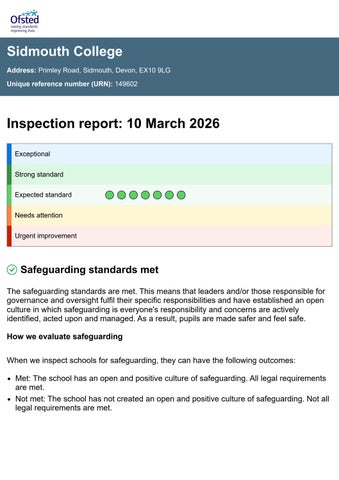
Exceptional
Strong standard
Expected standard
Needs attention
Urgent improvement
Safeguarding standards met
The safeguarding standards are met.This means that leaders and/or those responsible for governance and oversight fulfil their specific responsibilities and have established an open culture in which safeguarding is everyone's responsibility and concerns are actively identified, acted upon and managed As a result, pupils are made safer and feel safe
How we evaluate safeguarding
When we inspect schools for safeguarding, they can have the following outcomes:
Met:The school has an open and positive culture of safeguarding.All legal requirements are met.
Not met:The school has not created an open and positive culture of safeguarding. Not all legal requirements are met
Expected standard
Achievement Expected standard
Pupils, including post-16 students, progress well through the curriculum.At key stage 4, pupils build the strong foundations that they need in English and mathematics This is reflected in their examination performance in these subjects, which is significantly above the national average.
In most key stage 4 subjects, pupils achieve in line with national averages in examinations. This is also the case for disadvantaged pupils, who achieve in line with other disadvantaged pupils nationally However, some pupils who join the school with higher academic starting points do not achieve as well as they could.
As a result of improvements to the quality of teaching in the post-16 provision, students now achieve well. Students’responses and work demonstrate the depth and detail of knowledge and skills that they gain. Post-16 progress measures reflect students' performance, which are in line with national averages. In applied general qualifications, students achieve significantly above national averages.
Attendance and behaviour
Expected standard
Pupils’attendance is in line with the national average Leaders maintain a watchful eye on patterns in pupils’absence.They take appropriate steps to help pupils improve their attendance when necessary. Leaders analyse pupils’attendance to ensure that they know when to provide additional support for pupils who face barriers to learning and/or wellbeing As a result, the attendance of disadvantaged pupils and those with special educational needs and/or disabilities is in line with their peers nationally.
Pupils generally behave well in lessons and around the school site. Leaders ensure that there are clear routines, such as moving quickly between lessons. Staff understand and consistently uphold leaders’expectations of pupils’conduct Leaders put in place support to help pupils reflect on, and improve, their behaviour when necessary.This is reflected in the rate of suspension, which is in line with the national average and falling.
Pupils generally have positive attitudes to learning and to the wider opportunities on offer. They have positive, respectful relationships with staff, who provide appropriate support and care Leaders take effective action to deal with any discriminatory or disrespectful behaviour As a result, pupils are confident in reporting concerns about bullying or abuse.
Curriculum and teaching
Expected standard
Leaders have an accurate understanding of the quality of curriculum and teaching They take action to make improvements when they are required. For example, leaders have recently strengthened teaching in the post-16 provision.
Leaders ensure that pupils follow an ambitious curriculum This prepares pupils well for their next steps.Across all subjects, the curriculum builds on what they already know and can do.
Overall, teachers use assessment well to check for gaps in pupils’learning or for any misconceptions.
Leaders ensure that teachers receive effective professional learning opportunities This builds their expertise to teach different key stages.
Asmall number of pupils require support to secure their basic reading skills Leaders prioritise this support to ensure that pupils have strong foundations for learning across the curriculum. Staff who implement the phonics programme have the necessary expertise.
Leaders and staff know pupils’needs Typically, teaching is adapted effectively to meet these needs, such as for pupils with special educational needs and/or disabilities. On occasion, however, support is less effective, which prevents some pupils from learning the curriculum as deeply as their peers.
Inclusion Expected standard
Leaders assess pupils’needs accurately. For example, they have put in place effective approaches to check whether pupils have speech and language needs Leaders identify the support that pupils require if they have special educational needs and/or disabilities.They work effectively with parents to plan and review strategies to meet these pupils’needs.
Typically, leaders reduce barriers to pupils’learning and/or wellbeing. Generally, teachers make reasonable adjustments and adaptations that enable pupils to learn the curriculum well This is the result of effective training for staff on how to meet pupils’needs For disadvantaged pupils, leaders generally take effective steps to enable them to achieve and participate.
Leaders monitor pupils’progress and evaluate the impact of school strategies. For instance, leaders analyse the impact of additional funding on reducing the absence of disadvantaged pupils Staff work successfully with external partners to plan and implement support for pupils known (or previously known) to children's social care.
Leaders engage well with external agencies to shape pupils’support This strengthens how the school meets pupils’needs. Leaders use alternative provision appropriately and ensure that it has a positive impact on pupils.
Leadership and governance Expected standard
Leaders understand the school's context, strengths and areas for further development.As a result, they accurately identify the school’s priorities for improvement.They take effective action to drive the necessary changes
Leaders and staff, including those newest to teaching, have access to a high-quality and evidenced-informed professional learning programme This programme strengthens the school’s impact on pupils’achievement and wider development
Trustees and the local governing body understand and perform their roles effectively. For example, they ensure that statutory duties are fulfilled and they hold leaders to account for
the school’s effectiveness Through accurate insights into the school’s work, trustees gain assurances that leaders are making necessary improvements.
Leaders, trustees and the local governing body make decisions in the best interests of pupils. For instance, they work in partnership with external agencies and prioritise improvements to remove barriers to pupils’learning and participation. Leaders ensure that the school has constructive relationships with parents, carers and the wider community
Leaders take effective action to manage staff's workload and support staff's wellbeing. Trustees and the local governing body also make these areas a priority
Personal development and wellbeing Expected standard
Leaders plan and implement a suitable personal development programme. For example, pupils receive helpful advice and guidance with their next steps in education, employment or training They participate in work experience and receive unbiased advice when choosing post-16 and post-18 options.
Pupils benefit from a range of extra-curricular opportunities These experiences develop their talents and interests, such as sport, music or drama.They strengthen pupils’social and team-working skills and foster a feeling of belonging to the school. Pupils broaden their wider knowledge through trips For example, there are opportunities to visit London as part of the art curriculum and Cornwall during the school’s ‘activities week’. Leaders track participation in these activities.They take effective steps to remove barriers for disadvantaged pupils
Many pupils hold leadership positions, such as being part of the school council.They are proud to perform these roles and make a positive contribution to the school and wider community. For example, they lead the school’s 4 ‘houses’, organise charity events and represent their peers’views. Leaders ensure that pupils develop an understanding of democracy through voting opportunities, such as for ‘house leaders’.
Pupils follow an appropriate relationship and sex education programme.The programme develops pupils understanding of healthy relationships and how to keep safe. Pupils learn about how to keep themselves mentally healthy and about risks, such as from drugs and alcohol
The personal development curriculum is suitable and designed to build pupils’knowledge and skills over time For example, it covers different religions and fundamental British values, such as promoting equality and tackling discrimination. Leaders have recently strengthened this programme, but it is not yet fully integrated.As a result, some pupils do not develop their understanding of important topics as well as they could
Post 16 provision
Expected standard
Leaders have an accurate understanding of the quality and suitability of the post-16 study programme.They have recently made improvements to the quality of teaching in the post16 provision This has improved students’achievement Typically, students now achieve well.This is reflected in improved progress measures in examinations and strong
examination outcomes in some subjects Leaders typically ensure that students who face barriers to learning and/or wellbeing receive the support that they need to progress through the curriculum.
Students are well prepared for their next stage of education, employment or training. Leaders ensure that students are well informed about their options when they leave school. The post-16 careers programme helps them prepare for higher education or to go into the world of work. Students receive individual academic and pastoral support.This equips them for examinations and ensures that they benefit from wider experiences as they transition to adulthood
The post-16 programme includes leadership opportunities and a suitable relationships and health education programme For example, some students coach sports to younger pupils and lead initiatives in the community. Students learn about important issues, such as managing their wellbeing and keeping safe.
What it's like to be a pupil at this school
Pupils, including post-16 students, generally enjoy their learning at Sidmouth College They follow an ambitious curriculum and receive teaching that builds their knowledge and skills over time. For example, at key stage 4, pupils secure the qualifications they need in English and mathematics Students in the post-16 provision now receive improved teaching, which has strengthened their achievement.As a result, pupils and students generally achieve well and are prepared for their next steps. Pupils with barriers to learning or wellbeing typically receive the effective teaching and support that they need
Pupils have positive relationships with staff. Pupils value the teaching and support that they receive and the wider experiences that the school provides For example, they appreciate belonging to a ‘house’, such as ‘Drake’or ‘Raleigh’.They enjoy this opportunity to collaborate with their peers, for example gathering charity donations or competing in sports day Pupils benefit from a range of extra-curricular activities Opportunities such as the Duke of Edinburgh'sAward and theTenTors build pupils' confidence and resilience. Pupils value experiences to perform together as a sports team or in a theatrical show
Pupils attend school regularly.They generally behave well and have positive attitudes to learning. Pupils feel safe and have trusted members of staff with whom they can share concerns Leaders ensure that they deal effectively with any incidents of bullying This gives pupils confidence to report unkind behaviour. Pupils learn how to be positive members of the community through demonstrating kindness.They have opportunities to contribute to the wider community, such as meeting with residents in a local care home. On the whole, pupils are well prepared for life in modern Britain. Occasionally, however, they lack understanding of some important aspects of British values
Next steps
Leaders should ensure that they embed teaching approaches that consistently remove barriers to pupils’learning.
Leaders should strengthen achievement further so that more pupils and post-16 students achieve highly.
Leaders should strengthen the impact of the personal development programme so that pupils are very well prepared for life in modern Britain
About this inspection
The school is part of theTed Wragg MultiAcademyTrust, which means other people in the trust also have responsibility for running the school.The trust is run by the chief executive officer, Moira Marder, and overseen by a board of trustees, chaired byAndrew Mulcock
Inspectors carried out this full inspection under Section 5 of the EducationAct 2005.
Following our renewed inspection framework, all inspections are now led by His Majesty's Inspectors (HMIs) or by Ofsted inspectors (OIs) who have previously served as HMIs.
The school meets the requirements of the provider access legislation, which requires schools to provide pupils inYears 8 to 13 with information and engagement about approved technical education qualifications and apprenticeships.
Inspection activities:
Inspectors spoke with school leaders, teachers, trust leaders, trustees and local governors during the inspection.
The inspectors confirmed the following information about the school:
The school uses 6 alternative providers, including 4 that are unregistered.
Headteacher:Alex Evans
Lead inspector:
James Oldham, His Majesty's Inspector
Team inspectors:
Sophie Laing, Ofsted Inspector
Sarah Wilson, His Majesty's Inspector
Tanya Coleman, Ofsted Inspector
Nic Blunsum, Ofsted Inspector
Facts and figures used on inspection
The data was used by the inspector(s) during the inspection. More recent data may have been published since the inspection took place.
This data is from 10 March 2026
School and pupil context
Total pupils
853
Below average
What does this mean?
The total number of pupils currently at this school and how this compares to other schools of this phase in England.
National average: 1,067
School capacity
900
Below average
What does this mean?
The total number of pupils who can attend the school and how this compares to other schools of this phase in England.
National average: 1,153
Pupils eligible for free school meals (FSM)
23.82%
Close to average
What does this mean?
The proportion of pupils eligible for free school meals at any point in the last six years.
National average: 28 9%
Pupils with an education, health and care (EHC) plan
5.16%
Well above average
What does this mean?
The proportion of pupils with an education, health and care plan.This covers pupils with more support than is available through special educational needs support.
National average: 3.09%
Pupils with special educational needs (SEN) support
15.59%
Close to average
What does this mean?
The proportion of pupils with reported special educational support needs at the school.
National average: 13 4%
Location deprivation
Below average
What does this mean?
Based on the English Indices of Deprivation (2019) and the school's location, we have calculated whether the school is located in a more or less deprived area.
Resourced Provision or SEND Unit (if applicable)
No resourced provision
What does this mean?
Whether school has Resourced Provision or SEND unit (if applicable)
All pupils' performance
Attainment 8
Ameasure of pupils' point scores across 8 subjects including maths (double weighted), English (double weighted if both language and literature are taken), 3 EBacc measures and 3 GCSE or technical measures
Progress 8
How much progress pupils made between the end of primary school (key stage 2) and the end of secondary school (key stage 4), compared to pupils across England who got similar results at the end of key stage 2
Disadvantaged pupils' performance
Disadvantaged pupils are those who have been eligible for free school meals at any point in the last six years and children looked after.
Disadvantaged pupils' English and maths GCSE grade 5 or above
Percentage of disadvantaged pupils achieving grade 5 or above in English and maths GCSE.
Disadvantaged pupils'Attainment 8
Ameasure of disadvantaged pupils' point scores across 8 subjects including maths (double weighted), English (double weighted if both language and literature are taken), 3 EBacc measures and 3 GCSE or technical measures.
Disadvantaged pupils' Progress 8
How much progress disadvantaged pupils made between the end of primary school (key stage 2) and the end of secondary school (key stage 4), compared to pupils across England who got similar results at the end of key stage 2.
Disadvantaged pupils' performance gap
Disadvantaged pupils are those who have been eligible for free school meals at any point in the last six years and children looked after.The school disadvantage gap is the difference between the performance of the school's disadvantaged pupils compared to the performance of all non-disadvantaged pupils nationally.
Disadvantaged pupils' English and maths GCSE grade 5 or above
Percentage of disadvantaged pupils who achieved grade 5 or above in English and maths GCSE
Disadvantaged pupils'Attainment 8
Ameasure of disadvantaged pupils' point scores across 8 subjects including maths (double weighted), English (double weighted if both language and literature are taken), 3 EBacc measures and 3 GCSE or technical measures.
Disadvantaged pupils' Progress 8
How much progress disadvantaged pupils made between the end of primary school (key stage 2) and the end of secondary school (key stage 4), compared to pupils across England who got similar results at the end of key stage 2.
Percentage of pupils staying in education or employment for at least 2 terms after the end of secondary school (key stage 4)
16 to 18 performance
A-level average point score
The average points that students achieved perA-level entry
A-level value added
Ascore showing students’progress between the end of key stage 4 and the end of their academic qualification studies
Absence
Overall absence
The percentage of all possible mornings and afternoons missed due to absence from school (for whatever reason, whether authorised or unauthorised) across all pupils
Persistent absence
The percentage of pupils missing 10% or more of their possible mornings and afternoons.
Our grades explained
Exceptional
Practice is exceptional: of the highest standard nationally. Other schools can learn from it.
Strong standard
The school reaches a strong standard. Leaders are working above the standard expected of them
Expected standard
The school is fulfilling the expected standard of education and/or care.This means they are following the standard set out in statutory and non statutory legislation and the professional standards expected of them.
Needs attention
The expected standards are not met but leaders are likely able to make the necessary improvements.
Urgent improvement
The school needs to make urgent improvements to provide the expected standard of education and/or care.
The Office for Standards in Education, Children's Services and Skills (Ofsted) inspects services providing education and skills for children and learners of all ages, and inspects and regulates services that care for children and young people.
If you would like a copy of this document in a different format, such as large print or Braille, please telephone 0300 123 1231, or email enquiries@ofsted govuk
You may reuse this information (not including logos) free of charge in any format or medium, under the terms of the Open Government Licence.To view this licence, visit www.nationalarchives.gov.uk/doc/open-government-licence, write to the Information Policy Team,The NationalArchives, Kew, LondonTW9 4DU, or email: psi@nationalarchives.gsi.gov.uk.
This publication is available at https://reports.ofsted.gov.uk.
Interested in our work?You can subscribe to our monthly newsletter for more information and updates: http://eepurl.com/iTrDn.
Piccadilly Gate
Store Street
Manchester
M1 2WD
T: 0300 123 1231
Textphone: 0161 618 8524
E: enquiries@ofsted.gov.uk
W: wwwgovuk/ofsted
© Crown copyright 2026
© Crown copyright