

React Compiler-Driven Development
How the React Compiler Is Eliminating Manual
Optimization and Transforming React Architecture in 2026

The Problem: Manual React Performance Optimization
For most of React's history, performance required manual tuning:
useMemo
useCallback
React.memo
Custom memoization
Dependency management


Complex Mental Overhead
Developers had to reason about dependency arrays and render cycles on every component.

Over-Optimization
useMemo and useCallback were often used unnecessarily, making code harder to maintain.
Human Error
Incorrect dependency arrays introduced bugs, stale values, and inconsistent behavior.
Inconsistent Performance
Optimization quality depended entirely on individual developer expertise.
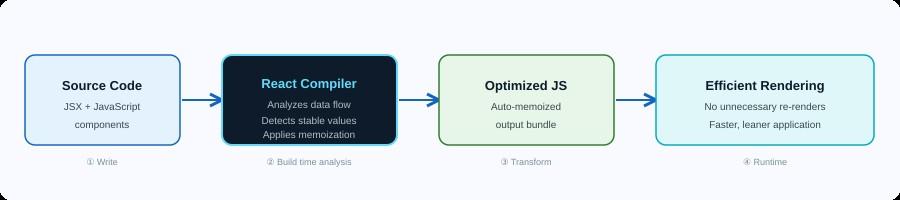
What Is the React Compiler?
A new compilation layer that automatically analyzes React components and applies optimal memoization strategies at build time — so developers don't have to.


Before & After: The React Compiler Difference
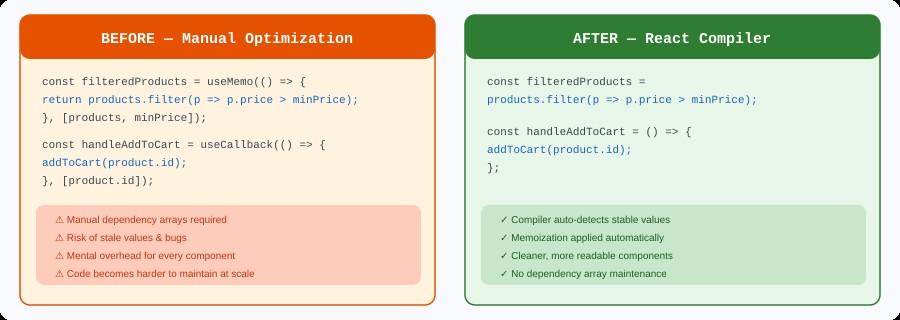
Result: Cleaner components with built-in performance guarantees — and zero dependency arrays to maintain.

Why the React Compiler Matters in 2026

01 Eliminates Manual Performance Hacks
Developers no longer need to sprinkle useMemo or useCallback across codebases. The compiler handles it automatically at build time.
02 Improves Code Readability


Components become simpler and easier to understand. Engineers focus on business logic, not optimization patterns.

03 Reduces Performance Bugs
Incorrect dependency arrays are no longer a common source of subtle bugs and stale value issues.

Large teams maintain consistent performance without requiring deep optimization expertise across every developer.
04 Scales for Enterprise Teams

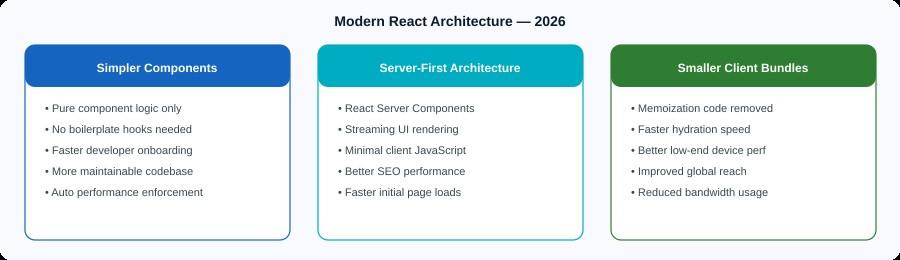
Architectural Shifts in Modern React Applications
The React Compiler isn't just a performance tool — it's reshaping how React applications are designed and built.

Benefits for Enterprise React Applications
Performance consistency
Code complexity
Code review focus
Depends on dev expertise
High (hooks + deps)
Memoization correctness
Team scalability Requires optimization experts
Long-term maintainability
Degrades with team growth
Development velocity
Slowed by optimization work
Enforced automatically
Low (pure components)
Business logic only
Any skilled React dev
Improves with compiler updates
Focused on feature delivery

Startups & Best Practices in the Compiler Era
Startup Advantages


Faster Product Development
Move quickly without deep optimization strategies slowing initial velocity.

Small Teams, Bigger Apps
Performance handled automatically — fewer specialists needed to ship high-quality React.


Lower Technical Debt
Clean codebases from day one mean fewer performance refactors as the product grows.
Practices
Focus on clarity and pure logic. Avoid premature optimization.
the Compiler
Manual memoization only when absolute necessary. Most cases auto-handled.
Modern Architecture
Combine with Server Components, streaming, and edgeoptimized deployments.
Still valuable for large datasets, animations, and heavy UI interactions.
React Ecosystem Trends in 2026

Server-Centric Architectures
Server Components becoming the default. Logic shifts from client to server, reducing JavaScript shipped to users.

AI-Assisted Development
AI tools generate optimized React code. Combined with the compiler, react developers move faster with fewer decisions.

Edge-Optimized Rendering
Applications run closer to users via edge networks for faster performance and lower latency globally.

Compiler-Driven Frameworks
Optimization increasingly happens at build time. React leads this shift, and other frameworks are following.

Actionable Insights for CTOs & Engineering Leaders
Step 1
Adopt Modern React Tooling

Ensure your stack supports the React Compiler. Upgrade to React 19+ and enable compiler analysis in your build pipeline. Step 2
Train Teams on New Patterns
Developers should understand when manual optimization is unnecessary. Run workshops on compiler-era component design.

Step 3
Refactor Legacy Codebases Gradually
Large apps can remove unnecessary useMemo and useCallback over time. No big-bang rewrite needed — migrate incrementally. Step 4
Prioritize Server-First Architectures
Combining Server Components with compiler optimization produces the best performance results. Plan your next project server-first.