Energy in transition
Arc flash study
Services
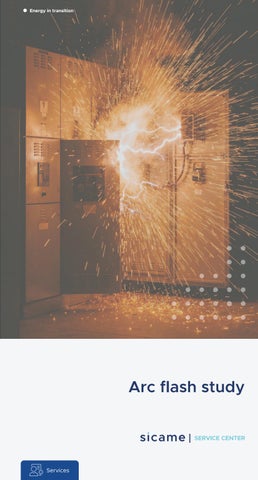
Why conduct an arc flash study? An arc flash study assesses the severity of an electric arc and determines the incident energy to which operators are exposed. It is essential for establishing an effective strategy to protect personnel, complying with general risk assessment requirements, and optimizing the selection of preventive measures.
Reference standards Standard
1. Protection of personnel. An arc flash simultaneously produces: • A shock wave (blast), • Molten metal splashes, • And intense ultraviolet and infrared radiation. Starting at an incident energy of 1.2 cal/cm², appropriate protective equipment is essential to prevent second-degree burns. The incident energy can sometimes reach, or even exceed, 80 cal/cm² in certain installations. Only a thorough assessment can properly evaluate this risk.
2. Regulatory compliance. In most countries, current regulations require a risk assessment to be conducted prior to any work on or near an electrical installation.
3. Risk reduction. Personal protective equipment is a last resort, never the first line of defense. The hierarchy of prevention prioritizes: • Elimination of live-line operations, • Engineering solutions (compartmentalization, reducing energy at the source), • Administrative measures: implementing procedures or changing work habits to reduce exposure • And only then, collective and personal protective equipment. Improper adjustment of protective devices-such as an excessively long trip timeincreases the duration of the arc and thus the incident energy, sometimes dramatically during a short circuit.
4. Equipment protection. The condition of equipment is a direct risk factor and can increase the likelihood of an electric arc: • Open compartments, • Missing covers, • Aging equipment, • Uncovered openings, • Missing or loose fasteners, • Lack of protective measures compliant with the IP2X standard Proper coordination of protective measures limits the effects of a short circuit and reduces downtime.
5. Business continuity. In critical environments (healthcare, IT, energy), an arc flash can take vital systems offline in an instant. Risks evolve over time: any modification to the installation, addition of equipment, or change in load alters the risk profile. The assessment must be reviewed every 5 years or after any significant modification.
Subject
IEEE 1584
Incident energy calculation
IEC 60909
Calculation of short-circuit currents
NF EN 50110
Operation of electrical Installations
IEC 61439
Low voltage switchgear
IEC 62271
High voltage equipment
Sectors served from 30 V DC to 400,000 V AC • Industrie • Energy • Pharmaceuticals • Agri-food • Public utilities • Healthcare
• Water and treatment • Chemical • Aerospace • Steel • Cement • Renewable energy
The risk of an electric arc is often higher when working on low voltage equipment than on high-voltage equipment. There are two main reasons for this: 1. Personnel are more likely to come into contact with a low voltage electric arc due to the nature of the work performed on this equipment, such as troubleshooting and manual switching operations. 2. In a typical industrial or commercial environment, the number of instances of high incident energy is likely to be greater in a given low voltage system than in a high voltage system.
Key figures
Our services • Electrical network modeling (e.g., single-line diagram), • Short-circuit current calculations (IEC 60909 / IEEE 1584 standards), • Protection coordination and setting study, • Calculation of incident energy and limit distances in the event of an electric arc, • Risk reduction recommendations, • Arc Flash labeling of switchboards and cabinets, • Training and awareness programs for on-site teams, • Comprehensive report with a prioritized action plan.
110+ Arc flash studies conducted each year
A proven holistic approach The 4P method
Apply the hierarchy of preventive measures: address the root cause, reduce energy levels, and implement lockout procedures.
Calculate the severity of a potential arc-incident energy, safety distances through short-circuit studies and protection coordination analyses.
Prevent Predict
Protect Publish
30+ Electrical safety management projects completed each year Recommend PPE suitable for the category Identify arc flash hazards and train operators on how to wear and maintenance.
220+
Label equipment, document the prevention plan, record and distribute the risk assessment to all stakeholders.
Study deliverables Complete study report Results, incident energy levels, protection coordination plan Prioritized action plan Recommendations ranked by criticality
Training sessions provided each year to 1,100 participants
A global presence Our services have been deployed in more than 25 countries across Europe, the Americas, the Middle East, and Asia. United Kingdom
Poland
Germany
Czech Republic
France
Romania
Training session Awareness training for on-site teams, based on identified risks
Spain
Turkey
Italy
Saudi Arabia
Arc flash labels For each electrical cabinet
Portugal
India
Belgium
Thailand
The Netherlands
USA
sicame-group.com
Sicame Group
Electrical safety UK www.elecsafety.co.uk
+44 800 652 1124 Genesis Business Park, 2, Sheffield Rd, Rotherham S60 1DX, Royaume-Uni
05/30 V1 - GBSMC2026-1531_SER_Sicame France_ARC Flash Brochure_ENG_A4
+33 (0)5 55 73 89 00 1 boulevard Marius Vivier Merle, 69003 Lyon, France