WEDNESDAY, NOVEMBER 11, 2026
BY TESS DONLAN
REPORTING CAMPUS NEWS SINCE 1983
VOLUME 57, ISSUE 8
Kennedy Center Controversy
Staff Writer
“The Kennedy Center was a place where people went to experience the arts, and sadly what is happening in the current climate, to move it to its temporary closing, is sad,” said Justin Zenchuk, director of the Theatre Arts Program at Sacred Heart University. “The people of D.C. saw this as a space of creativity, passion and the arts.” The Kennedy Center, a performing arts center located in Washington, D.C., serves as a living memorial to John. F. Kennedy. Congress named the Kennedy Center after the former president in 1964, the year after he was assassinated. The law explicitly prohibits the board of trustees from making the center a memorial for anyone else and from putting the name of any other person on the outside of the building. On Sept. 16, Kennedy Center CEO Matt Floca and the board of directors ordered a temporary closure of the center. President Trump said he ordered this temporary closure because the building needed safety repairs. In a social media post, Trump said Congress allocated $257 million to cover the repairs, but he wouldn’t continue to organize the construction unless his name was added to the building. “It seems renaming things consumes a disproportionate amount of Trump’s priorities,” said Prof. Davis Dunavin, a WSHU public radio reporter from the School of Communication, Media and the Arts. In response to the closing, Democratic Congresswoman Joyce Beatty sought an emergency court hearing to prevent what she believed to be an unlawful closing. U.S. District Judge Christopher Cooper ordered the Kennedy Center to provide 30 days’ notice before making any major physical changes to the building. He also did not allow Trump to add his name to the exterior. “The public is mostly against what Trump has done, though not by much,” said Dr. Steven Michels, the Political Science and Global Affairs Department chair. “It’s unclear how many people are actually paying attention.”
AP News, Mark Schiefelbein
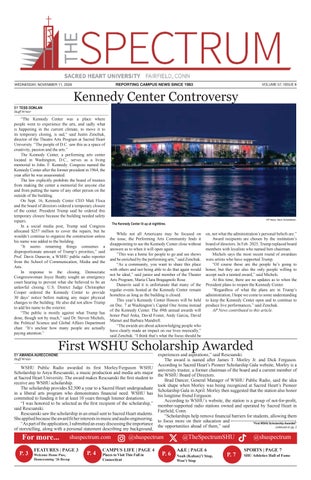
The Kennedy Center lit up at nighttime.
While not all Americans may be focused on the issue, the Performing Arts Community finds it disappointing to see the Kennedy Center close without answers as to when it will open again. “This was a home for people to go and see shows and be enriched by the performing arts,” said Zenchuk. “As a community, you want to share this place with others and not being able to do that again would not be ideal,” said junior and member of the Theater Arts Program, Maria Clara Bragagnolo Rose. Dunavin said it is unfortunate that many of the regular events hosted at the Kennedy Center remain homeless as long as the building is closed. This year’s Kennedy Center Honors will be held on Dec. 7 at Washington’s Capital One Arena instead of the Kennedy Center. The 49th annual awards will honor Paul Anka, David Foster, Andy Garcia, David Mamet and Barbara Mandrell. “The awards are about acknowledging people who have clearly made an impact on our lives musically,” said Zenchuk. “I think that’s what the focus should be
on, not what the administration’s personal beliefs are.” Award recipients are chosen by the institution’s board of directors. In Feb. 2025, Trump replaced board members with loyalists who named him chairman. Michels says the most recent round of awardees were artists who have supported Trump. “Of course those are the people he’s going to honor, but they are also the only people willing to accept such a tainted award,” said Michels. At this time, there are no updates as to when the President plans to reopen the Kennedy Center. “Regardless of what the plans are in Trump’s administration, I hope we come to some understanding to keep the Kennedy Center open and to continue to produce live performances,” said Zenchuk. AP News contributed to this article.
First WSHU Scholarship Awarded
BY AMANDA AURECCHIONE Staff Writer
WSHU Public Radio awarded its first Morley/Ferguson WSHU Scholarship to Anya Rescsanski, a music production and media arts major at Sacred Heart University. The award makes Rescsanski the first student to receive any WSHU scholarship. The scholarship provides $2,500 a year to a Sacred Heart undergraduate in a liberal arts program who demonstrates financial need. WSHU has committed to funding it for at least 10 years through listener donations. “I was honored to be selected as the first recipient of the scholarship,” said Rescsanski. Rescsanski saw the scholarship in an email sent to Sacred Heart students. She applied because the award fit her interests in music and audio engineering. “As part of the application, I submitted an essay discussing the importance of storytelling, along with a personal statement describing my background,
For more...
P. 3
shuspectrum.com
FEATURES | PAGE 3
Welcome Home Pios, Homecoming ‘26 Recap
P. 4
experiences and aspirations,” said Rescsanski. The award is named after James T. Morley Jr. and Dick Ferguson. According to Sacred Heart’s Pioneer Scholarship Gala website, Morley is a university trustee, a former chairman of the board and a current member of the WSHU Board of Directors. Brad Dancer, General Manager of WSHU Public Radio, said the idea took shape when Morley was being recognized at Sacred Heart’s Pioneer Scholarship Gala in April. Morley then suggested that the station also honor his longtime friend Ferguson. According to WSHU’s website, the station is a group of not-for-profit, member-supported radio stations owned and operated by Sacred Heart in Fairfield, Conn. “Scholarships help remove financial barriers for students, allowing them to focus more on their education and “First WSHU Scholarship Awarded” the opportunities ahead of them,” said continued on pg. 2
@shuspectrum
CAMPUS LIFE | PAGE 4 Places to Visit This Fall in Connecticut
P. 6
@TheSpectrumSHU A&E | PAGE 6 Noah (Kahan)’t Stop, Won’t Stop
P. 7
@shuspectrum SPORTS | PAGE 7
SHU Athletics Hall of Fame
2 | News
The Sacred Heart Spectrum
News
November 11, 2026
First WSHU Scholarship Awarded
BY AMANDA AURECCHIONE
in audio and motivates me to continue developing my skills and seeking new opportunities in the industry,” said Rescsanski.
Staff Writer
CONTINUED FROM PG 1
Dancer. The Spectrum reported in Sept. 2025 that WSHU received about $400,000 a year in direct federal funding, about 8 percent of its budget. Dancer said the station has since reached a strong financial position. “It’s also quite rare, very few university-owned public radio stations have scholarships that are generated from their donors,” said Dancer. The award is WSHU’s first direct undergraduate scholarship at Sacred Heart. Sacred Heart’s 2023-24 graduate catalog states that WSHU offers students internships, work-study and a News Fellows Program with broadcast journalism training. “I think in the two months I’ve learned a lot, and I think I’m frequently learning lessons about personal responsibility and work ethic,” said junior Will Morgan, an intern at WSHU. Morgan said he did work-study at the station before his internship. Interns start by writing short news briefs read on air, then move to longer pieces they record themselves, he said. The goal is a feature story. “A feature is really your own reporting, your own findings, your own audio, something that you assemble yourself,” said Morgan. While Rescsanski has not worked at WSHU before, the scholarship has connected her with its staff. She has played cello for 11 years and the electric bass for five years. Her interest in audio began about seven years ago. Rescsanski credits two of her music and media professors, Prof. Tim Walsh and Prof. Greg Golda, for encouraging her passion for audio. In June, Rescsanski began helping mix audio at local gigs, including monitor mixes for performers. She said the work strengthened her interest in live sound and monitor engineering. “Receiving this scholarship has reinforced my goal of pursuing a career
Award winner, Anya in front of the WSHU sign on campus.
Facebook, @wshupublicradio
Senate weighs sweeping energy legislation in first major action since midterm elections BY MATTHEW DALY AND JENNIFER MCDERMOTT AP Newsroom
The Senate on Monday is set to take up bipartisan legislation aimed at speeding up permitting reviews for data centers and other infrastructure projects, in the first major action since last week’s election that soundly repudiated President Donald Trump and congressional Republicans. The Senate is expected to hold a procedural vote on the bill, which senators and the president have pushed as a way to meet growing demand for electricity and other forms of energy that now faces yearslong delays in getting to the grid. The legislation’s sweeping changes would shorten the timeline to get big energy projects started — both for clean energy and fossil fuel projects — and make sure data centers pay for the energy they use. Anger over artificial intelligence data centers and rising electricity helped usher in a wave of Democrats pledging to clamp down on the massive, energy-hungry structures. Trump urged senators to vote for it, calling it a “BIG WIN for U.S. ENERGY INDEPENDENCE and DOMINANCE.” in a social media post on Sunday. The bill will “ensure that we can build Pipelines, Mines, and Power Plants faster than ever before, lowering Energy Costs for American Families,” Trump wrote. Major industry groups representing developers in clean energy and in the oil and gas sector also support the bill. However, many environmental organizations have panned the deal because they say it would lock in fossil fuel development, weaken environmental safeguards and make it harder for communities to challenge energy project approvals. While the bill has received bipartisan support, the Democrats’ sweeping midterm win could complicate its passage. Some Democrats say the party should use its stronger position in the next Congress to pass legislation that produces needed clean energy but limits expansion of oil, natural gas and mining. Some critics have said the permitting bill as proposed could lead to a vast increase in exports of liquefied natural gas
UPCOMING EVENTS ON CAMPUS
AP Photo/J. Scott Applewhite)
The Capitol is seen under a gray autumn sky in Washington, Thursday, Nov. 5, 2026.
and facilitate a “reckless” build-out of data centers powered by natural gas. House Minority Leader Hakeem Jeffries, a New York Democrat who is expected to become speaker in January, criticized the bill last week, with his office saying it “falls short” in a number of areas.
THURSDAY 11/12: AGAPE LATTE
SHU CHORAL CONCERT
MONDAY 11/16: TAIZÉ
8 P.M. LINDA E MCMAHON
3 P.M. CHAPEL OF THE HOLY
6 P.M. CHAPEL OF THE HOLY
COMMONS FIREPLACE
SPIRIT
SPIRIT
SEATING AREA
SUNDAY 11/15:
November 11, 2026
The Sacred Heart Spectrum
Features | 3
Features
Welcome Home Pios, Homecoming ‘26 Recap
BY MICHAEL CASTNER Staff Writer
Family Weekend gave students the opportunity to reconnect with their families while allowing families to experience campus life alongside them. The annual weekend has been a tradition for 35 years, according to Katie Morovich, director of Student Involvement and First Year Programs. “We center the events around crowd favorites and school spirit, bingo being one of them where we offer three sessions and the home football schedule,” said Morovich. “From there we collaborate with different areas to create a schedule.” Events throughout the weekend included but were not limited to bingo, a Parents and Family Council meeting, a dance showcase, a choir concert, and a football game. The weekend was scheduled to end with Mass at 9 a.m. and 11 a.m. Rain and strong winds forced organizers to adjust several planned activities throughout the weekend. “We made several adjustments to the weekend schedule to keep as many events running as possible while prioritizing safety, the only event truly canceled was the Tent Tailgate due to the excessive winds,” said Morovich. Several other events were moved indoors because of the weather. The Cider and Live Music event was moved to Red’s Pub, while the Martire Family Arena show featuring Hank Azaria and the EZ Street Michael Castner, Staff Writer Band opened early. Sacred Heart alumni outside of Dylan Scott Concert on “We opened the doors campus. to the Martire Family Arena
BY DANIELLA DILORENZO
show with Hank Azaria and the EZ Street Band early where we had a happy hour, snacks, games and raffles for ticket holders,” said Morovich. Despite the changes, students and their families were still able to take part in the weekend. “My family came to campus because they were excited to attend the EZ Street Band concert, and to see me play with the marching band for the football game,” said junior Luca Tedesco. “Despite the rain, and a lot of the on-campus activities being cancelled, there was still a lot to do. We had a really good time.” For first-year students, Family Weekend also provided an opportunity to show their families what their new college experience is like. “My family came to campus to see me and watch the dance showcase,” said freshman Gabriella Nicoletti. “It was nice to see all the dances in the program and my family got to see it.” With the weather being a large factor throughout the weekend, families were still able to come and visit their students and experience campus life. “The weather didn’t really affect our plans, but it was a little annoying with the rain,” said Nicoletti. “We had to go inside because of the rain. It was an upside because I got to show them my work-study and the BV.” “The football game was my favorite event of family weekend, because I got to see our team win, and it was the best option available with the rain,” said freshman Anthony Gerardi. Despite the weather changes, Family Weekend still allowed families to strengthen their connection with the university community. “The goal of Family Weekend is to strengthen the connection between families, their students and the SHU community, it gives families an opportunity to spend meaningful time with their students while experiencing the vibrant campus community, traditions, programs and activities that make up the SHU experience,” said Morovich. For Tedesco, Family Weekend gives families a chance to experience the college environment alongside their students. “A lot of SHU students can’t wait to go home to see family and friends, Family Weekend is an opportunity for the inverse to happen, parents and siblings come up to see what college life is like for a weekend,” said Tedesco. Despite the rain and schedule changes, Family Weekend gave students an opportunity to share their campus experience with the people closest to them.
Giving Back for Thanksgiving
Staff Writer
The Office of Community Engagement is currently collecting donations for its annual Thanksgiving Food Drive, encouraging students to give back to local communities during the holiday season. The food drive is accepting donations through Nov. 18 to help families in need. “Our mission is to educate students to be compassionate and serve the common good, and that’s exactly what this does,” said Annie Johnson, director of Community Engagement. “It goes beyond the charity motto where our community can stand in solidarity with our neighbors who might be facing challenges during the holiday season.” The office is asking for nonperishable canned food items, like cranberry sauce, gravy and stuffing, among others. “They all go to Saint Charles Borromeo Parish in Bridgeport,” said Johnson. “From there, they are distributed to the different families that attend the parish, but also a few of them get set aside for our partners with Southwest Health Community Center and Golden Hill Methodist Church.” Students are encouraged to place their donations in small, sturdy boxes decorated for the holidays. “Families will receive not just a brown paper bag but something that’s a little bit more festive for the holiday season,” said Johnson. “If folks have fun with it, we love to see it, and it serves as a really nice backdrop for the Interfaith Prayer Service on the 18th.” According to Johnson, the Office of Community Engagement hopes to distribute 450 frozen turkeys, matching last year’s total. The Student Government raises money to purchase the turkeys from the ShopRite of Milford. The grocery store provides the turkeys at a reduced cost in support of this initiative. With the Nov. 18 deadline approaching, the Office of Community Engagement hopes to encourage more students to participate and contribute to the annual tradition. “I think students should participate because even donating a few items can help someone in need,” said junior Ella Nocera. “It’s a simple way to give back, support our community and show kindness to others.” Students interested in donating can drop off nonperishable food items at their office in HC 109. Donations can also be brought to the Interfaith Prayer Service on Nov. 18 at 2 p.m. in the Chapel of the Holy Spirit. “It reminds us that the holidays are about more than just receiving gifts. It’s about helping others, spreading kindness and making sure everyone feels cared for,” said senior Annalisa D’Arienzo. “Even the smallest act of kindness can make
Office of Community Engagement, Sacred Heart University
The office of Community Engagement is accepting donations for the annual Thanksgiving Food Drive.
a big difference in someone’s life.” The Office of Community Engagement will continue its holiday giving efforts with its Adopt-a-Family program, which begins the week of Nov. 23. The program gives students and staff the opportunity to support local families by purchasing holiday gifts. Those interested in getting involved or learning more can contact the office via email at communityengagement@sacredheart.edu or by phone at 203-365-4710.
4 | Campus Life
The Sacred Heart Spectrum
CampusLife
November 11, 2026
Happy Birthday to our Senior Editors!
Interested in contributing to Spectrum? Register for CM211 Spectrum Pubilcation!
5 | Campus Life
The Sacred Heart Spectrum
CampusLife
November 11, 2026
6 | A&E
The Sacred Heart Spectrum
November 11, 2026
Arts & Entertainment
BY REESE PHILLIPS
Documentaries Through the Years
Staff Writer
“What happened changed the way documentaries and news were done,” said Richard Falco, an award-winning journalist, documentary filmmaker and professor at Sacred Heart University. In 1992, producers at ABC News received tips about unsanitary food-handling practices at Food Lion, a regional supermarket chain. Two undercover reporters, employed using false résumés and work histories, found workers were grossly mishandling food and serving expired meat. Food Lion was ultimately held accountable, but they also sued ABC. “The company sued them,” said Falco. “Not that they didn’t tell the truth, but that they AP News, Jae C Hong deceived the Netflix sign displayed on top of a building in Los Angeles. company in telling them they were meat
BY MOLLY RAZZINO
workers. And the company won the case.” Falco and other journalists assert that this set a precedent for news reporting. “I can’t tell you how many of my stories [media outlets] just cut because they didn’t want to have to defend themselves,” he said. “They’d rather just not do the story.” The internet has only further warped how we consume information. “Journalism has been vilified for the last twenty years,” said Falco. “And using media the way it can be used now, it’s like whoever shouts the loudest gets heard.” Elon Musk is the world’s first trillionaire and focus of director Alex Gibney’s new documentary “Musk,” an outspoken figure in the media. “I started out doing the film because it was about 21st century power,” said Gibney to AP News. “I didn’t have a sense at that time that he was literally going to accrete the power of a kind of shadow president. But that’s what he did, so we had to follow that story where it went.” Musk led President Trump’s short-lived DOGE (Department of Government Efficiency) in 2024 and spent a record $445 million on the 2026 United States midterm elections. In response to the documentary, Musk erupted into a series of verbal attacks against Gibney on X, the social media site Musk bought in 2022. “Gibney has zero integrity,” said Musk. “He’s a bitter old man.” Musk’s lawyer already threatened Gibney with a defamation suit, according to NPR. Additionally, the film’s distributor, Bleecker Street, has been unable to run paid advertisements on several major social media platforms including X, YouTube, TikTok and Meta. Falco is concerned about the distribution of documentaries in particular despite still enjoying them. “Whatever that streaming service is will determine who will even have access to it,” said Falco. “But most people aren’t interested in watching them. They want to be entertained. They don’t want to be informed.” Despite this, documentaries like “Musk” and the new “You Can See Everything” film on Elizabeth Holmes’ company, Theranos, while uncommon, have premiered in theaters. Over the span of three weekends, “You Can See Everything” grossed over $64 million at the box office. Owen Telesmanick, sophomore and president of the Short Filmmaker’s Club, believes conventional news media struggles to hold audiences’ attention. “You have to keep people engaged,” said Telesmanick. “Documentaries are like creative nonfiction,” said junior Elizabeth Teixeira, vicepresident of the Short Filmmaker’s Club. “But you definitely have to be careful with that line between entertainment and changing a truth.” Telesmanick mentioned Netflix’s “Untold” and ESPN’s “30 for 30” series as great examples of current documentaries. “Whenever these documentaries come out, it gets people thinking again and they’re like, oh, well maybe I’m on this side now,” said Telesmanick. “But usually [your reaction] is purely based on what you want to hear.” Falco sees this ability to discern truths from fabricated lies as essential. “This is where media literacy is more important now than ever before,” said Falco. “Never before has documentary work been more important.” The Associated Press Contributed to this Article
Noah (Kahan)‘t Stop, Won’t Stop
Staff Writer
“In a culture where there is such a focus on this kind of mass production and technology, songs all start to blend and sound the same, but with Noah Kahan’s music, if you close your eyes, it almost sounds like you’re in front of a live orchestra,” said freshman Cecilia Simoes. American folk-pop singer and songwriter Noah Kahan announced his 2027 stadium tour, “The Last Of The Bugs World Tour,” where he will be returning to Fenway Park in Boston, Mass. for four consecutive nights. Kahan previously performed at Fenway in July 2024 for two nights during his “We’ll All Be Here Forever Tour,” and then in July 2026 for a rare four-night run during his “The Great Divide Tour,” which earned him a place in the Fenway Music Hall of Fame. Kahan is from Strafford, Vermont, but spent the earlier parts of his career in Boston. Some of his popular songs, “Maine,” “Stick Season,” and “Homesick” reference his roots in New England. “He writes about Vermont, his experiences and time growing up in the small town,” said senior Paige Gutheil. Simoes feels that while the younger generation is used to these catchy songs created for short-form content, a lot of college students can appreciate the authenticity of it all. In 2017, “Hurt Somebody” featuring Julia Michaels was the first of Kahan’s songs to reach the top of the charts. His song “Maine” gained traction during the pandemic, but Kahan’s breakout song was “Stick Season,” released in 2022. Kahan teased the song with a single verse in 2020 on TikTok, and following the release of the full version in 2022, it topped international charts and earned him multiplatinum status. “It feels timeless; it’s the kind of music you put on in the car in front of your dad, and he would say, ‘this is a good song,’” said Simoes. “Stick Season” pivoted his music toward folk-centric narratives. The song is about Kahan’s time growing up in rural Vermont. It addresses a painful time in his life where he felt personal stagnation and a deep loneliness from growing up and being left behind in his small hometown. In 2023, Kahan opened a mental health nonprofit organization called The BusyHead Project, which raises awareness and funds to increase access to affordable mental health resources. Many of his concerts are connected with raising money for it, including at the MGM Music Hall. Gutheil said one of the reasons that so many people from New England and a lot of college students listen to his songs is because the lyrics are relatable. “Honest expression must also have the ability to relate to the listeners,” said Dr.
Noah Kahan portrain in New York on June 7, 2023.
AP News, Christopher Smith
Marguerite Mullee, a music conductor, voice teacher and Catholic Studies professor at Sacred Heart University. Mullee said it is important for a musician to be able to communicate their experiences to their audiences in both unique and universal ways. “He looked overly cheerful and appreciative to be there, and kind of in awe of everyone,” said Simoes on Kahan’s appearance at the 68th Grammy Awards. Simoes feels that, unlike other artists who are familiar with red carpets, when Kahan showed up to the Grammys it felt almost out of place. “It depends on the person, whether they are in it for the fame or wanting to share their story,” said Gutheil.
November 11, 2026
The Sacred Heart Spectrum
Sports
7 | Sports
SHU Athletics Hall of Fame BY MARLEY GURMENDI Staff Writer
“This is the beginning of tradition,” said athletic director Judy Ann Riccio. “The inaugural class will always hold a special place in Sacred Heart history, and we look forward to many more opportunities to celebrate the extraordinary people who have worn the Pioneer uniform.” The Sacred Heart Athletics Hall of Fame event was held on Nov. 6. Friends and family filled the Guest House Ballroom on West Campus. The inaugural class includes: Don Cook, athletic director from 1992 to 2013, Jim Barquinero, senior vice president for enrollment, student affairs and athletics from 1989 to 2023, Dave Bike, a 1969 graduate who coached men’s basketball from 1978 to 2013, Anthony “Tony” Judkins, class of 1989, Elizabeth “Bippy” Luckie, class of 1985, who has worked at the university for more than 40 years, Justin Danforth, class of 2017, Troy Scribner, class of 2013, Keshaudas Spence, class of 2015, Amanda Pape, class of 2007 and the 1986 men’s basketball national championship Instagram, @shualumni team. Sacred Heart Athletics Hall of Fame announces their inagural class.
“Establishing an Athletics Hall of Fame assures that the university’s history remains relevant, vibrant and alive,” said Cook, who led the department’s move to Division I. Barquinero launched the football program that began in 1991 and oversaw a period when the university more than doubled its varsity sports. Bike was the longest-tenured coach and brought the basketball program its most wins. His 1986 team beat Southeast Missouri State 93-87 to become the first New England program to win an NCAA Division II national championship. Part of that team was Judkins, a two-time National Basketball Coaches Association All-American who finished with 2,009 points and 909 rebounds. “The best thing about SHU, you’re a family member here, it’s tight-knit,” said Judkins. “The guys that I played with, we still have breakfast together on Saturdays.” Luckie, a two-time All-American shortstop, coached softball from 1989 to 2018 and retired with a program-record of 620 wins. “To be a part of such a wonderful experience with my colleagues, former teammates and players, it’ll be a night that I will never forget,” said Luckie. SHU women’s rugby head coach Michelle Reed was one of several current coaches in the crowd. “It shows the growth this university has had in the athletic department, and the success that is the foundation of why we are, what we are now,” said Reed. Danforth, the first Pioneer to play in the NHL, and Scribner, the first Pioneer to reach the MLB, joined the ceremony by video message. Scribner ranks second in program history with 26 wins and 261 strikeouts. “You need those types of people who believe in you and give you the opportunity to prove yourself,” said Danforth. “Sacred Heart gave me an opportunity, and I’ll always be grateful.” “I had such a special time at Sacred Heart University. Every time I look back on my time there, I’m filled with joy and happy memories,” said Scribner. Current baseball player PJ Rogan plays for the program Scribner helped lead to backto-back Northeast Conference championships. “It’s really cool to see Troy get inducted into the Sacred Heart Athletics Hall of Fame,” said Rogan. “It’s something for us as players to strive for and to look up to.” Spence is the football program’s all-time leading rusher with 3,745 yards, was named Northeast Conference Offensive Player of the Year and helped lead the Pioneers to consecutive conference championships in 2013 and 2014. His family accepted the honor on his behalf. Pape remains the women’s basketball program’s all-time leading scorer and the only player to pass 2,000 career points, finishing with 2,045. “To be welcomed back and recognized as part of the inaugural Hall of Fame class is something I will carry with me forever,” said Pape.
Beyond the Bleachers BY OLIVIA FIUMARA Staff Writer
“I think going to games is one of the best ways to get involved on campus,” said junior Alexa Barbera. “It’s fun to support the teams, especially when you know people playing, and it gives you something to do with your friends.” For some students, attending games is a regular part of their college experience. Others follow the teams from a distance, while some rarely attend games. Some students who don’t attend games may have several factors that impact their campus involvement, such as busy schedules and other commitments. “I don’t really follow the teams that closely, so I don’t always know when games are happening,” said junior Alison Dasco. “I might go if my friends were going or I knew more about the team.” Another aspect of student engagement is familiarity with Sacred Heart athletes. While some can identify players by team, others are less familiar with individual athletes and their achievements. For students who do not have personal connections to athletes, learning more about the teams and their seasons can give students another way to be familiar with Pioneer athletics. Knowing team scores, stats and individual players may influence how students follow sports throughout the year. “I know a few players, especially from the teams that get more attention around campus,” said junior Sara Giacchi. “I probably couldn’t name someone from every sport, though.” When asked about game-day experience, students shared different ideas about what they enjoy and what could make attending sports events more appealing. Suggestions included student giveaways, free merch, food promotions and theme nights for the student sections. “I think giveaways and theme nights are fun because they give students another reason to come out,” said junior Gabriella LaMarca. Other students focus on the importance of the facilities and the overall game-day atmosphere, including seating, student attendance and opportunities for students to be involved during the games. Having school spirit and representing Sacred Heart is an important part of the relationship between students and athletics. Wearing merch and participating in campus events are different ways that students can show their school pride. Student involvement can also vary depending on the sport and time of year. Basketball in the recently renovated William H. Pitt Center arena and hockey games in the new state-of-the-art Martire Family Arena may attract students to attend more indoor games. Football played at the recently renovated Sikorsky Credit Union field may also attract other students to attend games at the beginning of the school year in warm weather.
“Martire Family Arena is something that makes SHU hockey games stand out,” said junior Carly Pepi. “It’s a nice facility, and having a new arena on campus makes going to the hockey games a great experience. I think more students should take advantage of it.” As Pioneer teams continue their seasons, student perspectives offer insight into how athletics fit into campus life and the different ways that students choose to support their university.
Colin Mcpherson, Staff Writer and Photographer
Jaylen Robinson taking the tip off for the Pioneers in their game against the University of Maine
8 | Editorial
The Sacred Heart Spectrum
Analysis
November 11, 2026
EDITOR IN CHIEF MADELEINE MEDEIROS 2028
The Midterms Were a Verdict. Now Comes the Test.
MANAGING EDITORS TAYLOR MAGUIRE 2027
BY ALEJANDRO J. RAMOS
NICK MAISANO 2028 COPY EDITOR CASEY MCGRATH 2028 NEWS EDITORS JAMES SPOTO 2028 JAMIE VAN DER MERWE 2028 FEATURES EDITORS CASEY MCGRATH 2028 ASST. FEATURES EDITOR VICTORIA BRENNAN 2027 ARTS & ENTERTAINMENT EDITOR LAUREN BUSH 2028 ASST. ARTS & ENTERTAINMENT EDITOR AMELIA SALADINO 2029 SPORTS EDITOR COLLIN MACLEOD 2027 ASST. SPORTS EDITORS NICK DILAPI 2028 JAMES EL-HAGE 2028 CAMPUS LIFE EDITOR ARIANNA GIANNOPOULOS 2027 PHOTOGRAPHY EDITOR JAYDEN HUNTER 2027 ASST. PHOTOGRAPHY EDITORS JAMIE VAN DER MERWE 2028 LAUREN BUSH 2028 BUSINESS MANAGER ALEXA BORNER 2027 PUBLIC RELATIONS MANAGER BROOKE LUGO 2028 ASST. PUBLIC RELATIONS MANAGER ARIANNA GIANNOPOULOS 2027 ADVERTISING SALES MANAGER LAUREN RAUSO 2027 WEB MANAGER SOFIA FISHER 2028 CIRCULATION MANAGER JAMIE VAN DER MERWE 2028
Guest Contributor
Two years ago, voters handed Donald Trump the White House and Republicans control of Congress. On November 3, they delivered control of both chambers to Democrats. Politics has a way of humbling those who mistake an electoral victory for a permanent mandate. The 2026 midterms were more than the predictable setback presidents often suffer halfway through their terms. Democrats flipped at least seven Senate seats and won the House, breaking through in places few would have called competitive two years ago. In Texas, James Talarico won a Senate seat; in Kansas, Adam Hamilton did the same. These were longtime Republican strongholds, rather than simply the usual collection of swing districts. Why did the map change? In my view, voters sent three overlapping messages: everyday life remains too expensive, presidential power requires scrutiny, and how policies are carried out matters as much as the promises behind them. Start with the economy. Trump returned to office promising relief from high prices. Yet groceries, rent, utilities and gas continued to strain household budgets. CBS News exit polling showed that voters who said their finances had worsened favored Democrats. Tariffs and the war with Iran compounded anxieties about costs. Americans are considerably more interested in whether they can afford their lives than in whether Washington can claim another political victory. Then there is immigration. Republicans won support in 2024 from voters who wanted stronger border enforcement, including many Hispanic voters. That hardly amounted to blanket approval for every tactic that followed. Aggressive Immigration and Customs Enforcement (ICE) operations, deportation fears and highly visible raids carried consequences in communities that had supported Trump. Reuters reported that economic pressures and immigration enforcement both figured prominently in Latino voters’ shift toward Democrats. My interpretation is that the administration misjudged the difference between support for enforcing immigration laws and tolerance for how that enforcement unfolded. The third factor was a desire for checks and balances. The Associated Press Voter Poll found that roughly seven in ten voters wanted Congress to do more to check presidential power. Concerns about corruption and institutional accountability cut across ideological divisions. This election was, in substantial part, a referendum on how power was being exercised. The magnitude of the victory also requires some perspective. Electoral waves can reflect voters switching sides, motivated supporters turning out, or disappointed supporters staying home. Democratic enthusiasm and Republican disengagement both appear to have contributed to this year’s results. A decisive election sends a message, but
the electorate of one midterm cannot tell us everything about the country’s long-term political direction. The youth vote deserves special attention in a university newspaper. According to CIRCLE at Tufts University, 66% of voters ages 18 to 29 supported Democratic House candidates, compared with 31% who backed Republicans. Among college-enrolled young voters who said they were falling behind financially, 78% voted Democratic. Those figures complicate the suggestion that young voters have settled into a lasting partisan camp. In 2024, Trump made meaningful gains among younger Americans, particularly men. Two years later, many of those gains evaporated. Economic opportunity, housing costs and the futures young adults believe they can build offer more compelling explanations than claims that an entire generation has permanently moved left or right. There is also an uncomfortable fact: CIRCLE’s preliminary estimate suggests only 27% of eligible young Americans voted. Historically, that represents comparatively strong midterm participation. Yet nearly three out of four young people stayed home. Our generation helped reshape Congress, even as most of our peers remained on the sidelines. For college students, the stakes extend far beyond campaign signs. Congress makes decisions affecting financial aid, federal spending, public policy and the job market students will enter after graduation. Election results determine who holds power. What happens afterward determines how that power affects everyday life. Now comes the considerably harder part: governing. Democrats will control congressional committees, set legislative priorities and have new tools to investigate the administration. They can challenge spending decisions and demand answers. But Trump still holds the presidency and veto power, and much major Senate legislation will require bipartisan cooperation. Gridlock may be the easiest outcome. Governing will require more. Republicans should take these results as a warning about priorities and political judgment. Their coalition may be broader than it was a decade ago, but it is more fragile than their 2024 victory suggested. Democrats, meanwhile, should resist treating rejection of the administration as unconditional approval of every Democratic policy. Winning power is one thing. Showing voters what you intend to do with it is another. The next few weeks will reveal whether Washington understood the message. And while the midterms are now over, the 2028 presidential contest is only beginning. Pay attention to the names that emerge, but pay closer attention to whether their proposals address what voters were saying all along. Alejandro J. Ramos ’23 is the founding executive director of the Ramos Research Institute, a doctoral student at Vanderbilt University, and a member of the Sacred Heart University Alumni Association Board of Directors
The editorial page is an open forum. Editorials are the opinions of the individual editors and do not represent the opinions of the whole editorial board. Letters to the editor are encouraged and are due by Sunday at noon for consideration for each Wednesday’s issue. All submissions are subject to editing for spelling, punctuation, and length. Letters to the editor should not exceed 700 words and should be emailed to spectrum@sacredheart.edu. The Spectrum does not assume copyright for any published material. We are not responsible for the opinions of the writers voiced in this forum.
FACULTY ADVISOR PROF. JOANNE KABAK SPECTRUM IS PRINTED BY: VALLEY PUBLISHING Derby, Conn.
Interested in contributing to the Spectrum? Please consider registering for CM 211 Spectrum Publication or contact us at spectrum@sacredheart.edu