REPORTING CAMPUS NEWS SINCE 1983
WEDNESDAY, NOVEMBER 19, 2025
VOLUME 55, ISSUE 10
Higher Education Concerns Regarding Compact Proposal BY DANIELLE GRILLO Staff Writer
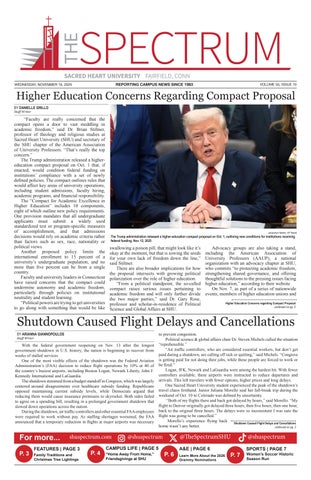
“Faculty are really concerned that the compact opens a door to vast meddling in academic freedom,” said Dr. Brian Stiltner, professor of theology and religious studies at Sacred Heart University (SHU) and secretary of the SHU chapter of the American Association of University Professors. “That’s really the top concern.” The Trump administration released a highereducation compact proposal on Oct. 1 that, if enacted, would condition federal funding on institutions’ compliance with a set of newly defined policies. The compact outlines rules that would affect key areas of university operations, including student admissions, faculty hiring, academic programs, and financial responsibility. The “Compact for Academic Excellence in Higher Education” includes 10 components, eight of which outline new policy requirements. One provision mandates that all undergraduate applicants must submit a widely used standardized test or program-specific measures of accomplishment, and that admissions decisions would rely on academic criteria rather than factors such as sex, race, nationality or political views. Another proposed policy limits the international enrollment to 15 percent of a university’s undergraduate population, and no more than five percent can be from a single country. Faculty and university leaders in Connecticut have raised concerns that the compact could undermine autonomy and academic freedom, particularly through policies on institutional neutrality and student learning. “Political powers are trying to get universities to go along with something that would be like
Jacquelyn Martin, AP News
The Trump administration released a higher-education compact proposal on Oct. 1, outlining new conditions for institutions receiving federal funding. Nov. 12, 2025
swallowing a poison pill, that might look like it’s okay at the moment, but that is sowing the seeds for your own lack of freedom down the line,” said Stiltner. There are also broader implications for how the proposal intersects with growing political polarization over the role of higher education. “From a political standpoint, the so-called compact raises serious issues pertaining to academic freedom and will only further divide the two major parties,” said Dr. Gary Rose, professor and scholar-in-residence of Political Science and Global Affairs at SHU.
Advocacy groups are also taking a stand, including the American Association of University Professors (AAUP), a national organization with an advocacy chapter at SHU, who commits “to protecting academic freedom, strengthening shared governance, and offering thoughtful solutions to the pressing issues facing higher education,” according to their website. On Nov. 7, as part of a series of nationwide events, members of higher education unions and Higher Education Concerns regarding Compact Proposal continued on pg. 2
Shutdown Caused Flight Delays and Cancellations BY ARIANNA GIANNOPOULOS Staff Writer
With the federal government reopening on Nov. 13 after the longest government shutdown in U.S. history, the nation is beginning to recover from weeks of stalled services. One of the most visible effects of the shutdown was the Federal Aviation Administration’s (FAA) decision to reduce flight operations by 10% at 40 of the country’s busiest airports, including Boston Logan, Newark Liberty, John F. Kennedy International and LaGuardia. The shutdown stemmed from a budget standoff in Congress, which was largely centered around disagreements over healthcare subsidy funding. Republicans opposed maintaining current subsidy levels, while Democrats argued that reducing them would cause insurance premiums to skyrocket. Both sides failed to agree on a spending bill, resulting in a prolonged government shutdown that slowed down operations across the nation. During the shutdown, air traffic controllers and other essential FAA employees were required to work without pay. As staffing shortages worsened, the FAA announced that a temporary reduction in flights at major airports was necessary
For more... P. 3
shuspectrum.com
FEATURES | PAGE 3 Family Traditions and Christmas Tree Lightings
P. 4
to prevent congestion. Political science & global affairs chair Dr. Steven Michels called the situation “reprehensible.” “Air traffic controllers, who are considered essential workers, but don’t get paid during a shutdown, are calling off sick or quitting,” said Michels. “Congress is getting paid for not doing their jobs, while these people are forced to work or be fired.” Logan, JFK, Newark and LaGuardia were among the hardest hit. With fewer controllers available, these airports were instructed to reduce departures and arrivals. This left travelers with fewer options, higher prices and long delays. One Sacred Heart University student experienced the peak of the shutdown’s travel chaos firsthand. Junior Juliana Morello said her fall-break trip during the weekend of Oct. 10 to Colorado was defined by uncertainty. “Both of my flights there and back got delayed by hours,” said Morello. “My flight to Denver originally got delayed three hours, then five hours, then one hour, back to the original three hours. The delays were so inconsistent I was sure the flight was going to be cancelled.” Morello’s experience flying back Shutdown Caused Flight Delays and Cancellations home wasn’t any better. continued on pg. 2
@shuspectrum
CAMPUS LIFE | PAGE 5 “Home Away From Home,” Friendsgivings at SHU
P. 6
@TheSpectrumSHU
@shuspectrum
A&E | PAGE 6
SPORTS | PAGE 7
Learn More About the 2026 Grammy Nominations
P. 7
Women’s Soccer Historic Season Run
2 | News
The Sacred Heart Spectrum
News
November 19, 2025
Shutdown Caused Flight Delays and Cancellations
BY ARIANNA GIANNOPOULOS Staff Writer
CONTINUED FROM PG 1
“I was supposed to get home around 7:00 p.m. but I didn’t get home until around 1:00 a.m. I had to be up early the next morning so that long delay affected my future plans,” said Morello. Even with the government reopened, the shutdown has impacted the way some students think about travel especially with the holiday season approaching. “I almost canceled my flight to Tampa because I was scared about getting stuck there and not making it back home,” said freshman Sophia Monteforte. “Luckily, I had no issues, but it’s such a shame that others are experiencing delays and cancellations so close to the holiday season.” As of Monday, Nov. 17, the FAA has lifted these emergency flight restrictions in response to a steady decline in staffing concerns, just in time for the holidays. While the FAA is in the process of returning to full capacity at all major airports, the hope is that travel over the next few weeks will be far smoother than how it was during the shutdown.
United Flights Preapre for Takeoff after Standstill at George Bush International Airport on Friday Nov. 7, 2025.
Ashley Landis, AP News
Higher Education Concerns Regarding Compact Proposal BY DANIELLE GRILLO Staff Writer
CONTINUED FROM PG 1
advocacy chapters from across Connecticut gathered to speak out against the proposal, which the Connecticut State University chapter of the AAUP called “an assault on higher education.” Speakers included representatives from Connecticut chapters at Quinnipiac University, Yale University, and Connecticut State University, as well as Stiltner from Sacred Heart.
“It’s very hard to compete with the federal government, so people are stronger by holding together,” said Stiltner. “The network of the American Association of University Professors was one natural way for us to stick together with other institutions.” According to the Associated Press, the White House contacted nine private universities, including Vanderbilt University and Dartmouth College, inviting them to become “initial signatories” of the proposal in exchange for “more favorable access to federal money.” The universities were asked to provide feedback by Nov. 21. As of the end of October, eight have formally rejected the proposal or noted reservations towards it, while the University of Texas has yet to officially decide. “This does not fit with the traditional relationship between the federal government and higher education,” said Rose. “It is an entirely new phenomenon that the Trump administration is attempting to introduce.” The proposal also includes a section called the “marketplace of ideas & civil discourse,” which requires signatories to “acknowledge that the freedom to debate requires conditions of civility” and to ensure “protections against institutional punishment or individual harassment for one’s views.” “This is a reaction, and unfortunately an over-reaction, to the political correctness that was imposed on college campuses prior to the election of Trump. That period was also an assault on academic freedom,” said Rose. “But that was not the function of a presidential compact, but rather the ideological orientation of faculty who attempted to impose their views on students and other faculty.” The proposal also states that governance structures could be revised, as necessary, to transform environments at institutions that “purposefully punish, belittle, and even spark violence against conservative ideas.” “A critique that has been made by those who support President Trump in this endeavor is that universities in the past have sometimes suppressed conservative speech or ideas, and I think that is a valid critique, but the solution to that problem is not to swing the other way,” said Dr. Christel Manning, professor of theology and religious studies at Sacred Heart and president of the SHU chapter of the AAUP. “I think that what we need to work on is preserving and protecting the freedom to express all ideas — that’s what makes for a good university,” said Manning. Opponents of the compact have continued public action, organizing events and advocacy efforts across universities to communicate concerns about the proposal’s impact on academic freedom and governance of higher education. “Our overall message is that we want to preserve the highest standards of excellence in both teaching and research that American universities have historically represented,” said Manning. “The way to do that is to maintain the kind of academic freedom that enables people to speak, write, and pursue the truth, rather than a particular ideology.”
November 19, 2025
The Sacred Heart Spectrum
Features | 3
Features
Christmas Tree Lighting Kicks off the Holiday Season BY MACKENZIE FLYNN Staff Writer
Since 2016, Sacred Heart University has celebrated the holiday season with a beloved tradition featuring carolers, ice skating and dazzling lights. This year, you can be a part of the festivities by joining the SHU community on Dec. 1 at West Campus for their annual tree lighting ceremony and open skate. The event is open to all SHU students and faculty for no extra cost. Shuttles will be running to transport students between campuses throughout the event. “It is such a fun way to kick off the holiday season,” said sophomore Hannah Lewis. “My friends and I are so excited to see the tree all lit. It is one of the events we have been looking forward to all year.” For some students, being away from home for the holiday season can be difficult, but at SHU, traditions like this aim to bring the campus community together. “I remember when I was younger, my family would go caroling around the holidays, so it is so nostalgic to hear the chorus perform Christmas carols,” said sophomore Hannah Rice. The tree lighting aims to spread holiday cheer throughout campus through community, cookies and even some carolers. “The SHU Choral Program is part of the kick-off each year, singing Christmas carols, to entertain a large gathering of students, faculty/staff, and neighbors,” said Christopher Grundy, director of Choral Programs. “The tree lighting is particularly special to the singers of the SHU Choral Program, because it is an opportunity to engage with the community outside the concert hall, and to share the joy of music in a beautiful setting.” Many students have already begun decorating for the holidays, bringing their own traditions to campus. Residence halls display Christmas-themed boards, dorms with bay windows act as festive displays, and even the on-campus Starbucks has embraced the holiday spirit with its limited-edition holiday menu. “My favorite Christmas tradition has always been decorating the tree. It is so cool that SHU decorates a community tree for everyone to see. It definitely heightens the Christmas spirit around campus,” said senior Chastity Monaghan. “This year will be my first year going to the tree lighting, but I have high hopes. Christmas is my favorite time of year, so you can say I’m pretty excited,” said sophomore Olivia Olabonte. With high attendance in previous years, you can expect to see lots of familiar faces from around campus and maybe even meet some new ones. “This event starts the season off right with all members of our community on a holiday that celebrates togetherness,” said Cynthia Conte, coordinator of Event Management. “It is important that we all get together and realize how much we have to celebrate at Sacred Heart.” The tree lighting will begin at 5:30 p.m. followed by community open skate at the Martire Family Arena. All are encouraged to come and celebrate the holiday season with the SHU community.
BY NICHOLAS MAISANO
SHU Students pose in front of the West Campus christmas tree.
Facebook, Sacred Heart University
A Taste of Family Traditions
Staff Writer
When you think of Thanksgiving, what comes to mind? Is it your grandmother’s homemade applesauce, your aunt’s pumpkin pie, or the turkey your uncle spent hours preparing? For many, Thanksgiving is all about the food served and the memories shared, both of which are driven by family traditions. Sophomore Alex de la Teja and his family celebrate Thanksgiving with an array of traditional dishes. “We always have turkey as the main dish, but my favorite parts of the meal are the sides,” said de la Teja. “Our family makes bread stuffing, and my aunt makes meat stuffing. I love the sweet potato casserole with marshmallows as well.” One of de la Teja’s favorite side dishes comes from his Colombian abuela: arroz con gandules, or rice and peas in English. “My abuela and I make rice with peppers, onions, garlic, and tomato paste,” said de la Teja. “Then she puts these gandules in and mixes it all together. It’s a very savory dish.” Sophomore Isabella DeSouza’s family comes from Brazil, and they have a mix of American and Brazilian foods during the holiday. “Some of the classic dishes that we have are turkey, mashed potatoes and gravy,” said DeSouza. “For Brazilian dishes, we have rice, Tropeiro, which is a traditional bean dish, and a pulled pork version of stuffing.” The pulled pork stuffing is a staple at DeSouza’s table during Thanksgiving dinner, and the recipe behind it goes back generations. “The stuffing recipe comes from my grandma, and it’s made with toasted cassava flour, carrots and pulled pork,” said DeSouza. “It’s something that we have every year, and we can’t go without it.” When it comes to Thanksgiving dinner, sophomore Gianmarco Pirri and his family enjoy some traditional dishes as well as some Italian favorites. “My family eats the usual Thanksgiving dinner, including turkey, ham, mashed potatoes, sweet potatoes, stuffing, and cornbread,” said Pirri. “We also have an Italian wedding soup that my aunt makes every Thanksgiving.” “My favorite food to have at Thanksgiving is my grandma’s Lebanese stuffing,” said sophomore Emma Goodreau.“I look forward to having this dish every year.” Aside from the main dinner courses, dessert is another aspect of Thanksgiving that offers delicious options. “The dessert I like the most is the tres leches,” said de la Teja. “We get the best tres leches
UPCOMING EVENTS ON CAMPUS
THURSDAY 11/20: THETA THRIFT AND SHOP 5 P.M. EDGERTON CENTER
Nicholas Maisano, Staff Writer and Photographer
An assortment of pies traditionally served during Thanksgiving on the shelves at Stop and Shop.
cake for dessert from a local bakery in my town.” “My favorite dessert is hands down Brazilian carrot cake with brigadeiro, which can be compared to fudge, but in my opinion, is a lot better,” said DeSouza. Brigadeiro is a Brazilian chocolate. When making the carrot cake, the brigadeiro is poured over it to create a delicious, chocolatey outer coating. Although Thanksgiving is a predominantly American holiday, dishes from other cultures make the table, with recipes rooted in family history. “My favorite part of Thanksgiving is being able to share a great meal with my family, while enjoying traditional recipes that have been passed down for many years,” said de la Teja.
FRIDAY 11/21: MEN’S BASKETBALL GAME VS HOLY CROSS 7 P.M. PITT CENTER
SATURDAY 11/22: WOMEN’S ICE HOCKEY GAME VS LIU 12 P.M. MARTIRE FAMILY ARENA
4 | Campus Life
The Sacred Heart Spectrum
CampusLife
November 19, 2025
Home Away From Home: Thanksgiving at SHU
BY CAROLINE DAVINO Staff Writer
As Thanksgiving break approaches, students are taking time to celebrate the season with gratitude here on campus. With cozy Friendsgivings and end-of-semester events, many are finding ways to slow down and connect before heading home for the holidays. Sophomore Lucia Cuffari said she loves how close everyone feels during the holidays. “I love how everyone at SHU really leans into the holidays,” Cuffari said. “Campus feels warm and connected, and even though we’re all stressed with work, people still make time to be together.” She said celebrating Thanksgiving at school feels like creating her own version of home. “This year at SHU, I’m celebrating Thanksgiving in the most college way possible— getting dressed up with my friends, going out to dinner, and making it feel special even though we’re not home,” said Cuffari. “We’re all decorating and trying to make our space cozy and festive, and honestly, that’s half the fun.” Cuffari said the best part of celebrating on campus is the students we surround ourselves with. “When you’re away from home, your friends basically become your family,” said Cuffari. “Having people who check up on you, cook with you, and make everything fun means a lot.” Freshman Leah Caliendo is experiencing her first college Thanksgiving and said this year already feels more meaningful. “This year it will be different since all of our lives have changed since being away at college for the first time, so I can imagine this upcoming Friendsgiving will be much more meaningful,” said Caliendo. Caliendo said she plans to attend the end-of-semester dinner and formal for her sorority, Zeta Tau Alpha, which happens just before the break. “They’re not directly tied to Thanksgiving, but they do fall right before Thanksgiving, so I can see it counting as a Thanksgiving gathering,” said Caliendo. “Events like Friendsgiving help people feel more connected before break because they create a sense of community and belonging outside of a family.” Senior Isabel O’Connell reflected on what Thanksgiving means now that she’s nearing the end of her college experience. “Thanksgiving to me is a designated time to spend with my loved
ones,” said O’Connell. “While I’m at school, it means even more because I don’t get to see my immediate family every day like I would at home.” She said Friendsgiving on campus takes on a special kind of meaning. “When you go off to college, it’s the first time you really get to pick who you want in your life, which helps make Friendsgiving on campus so special,” said O’Connell. Senior Kim McKenna said this is her first Friendsgiving at SHU, and it already feels just as meaningCaroline Davino, Staff Writer and Photographer ful as celebrating at Fall Farm Stand Located In Morris County, NJ. home. “While being at school, I am able to have Friendsgiving with some of my friends that became my family here,” said McKenna. “Celebrating with my friends versus family is just as meaningful to me.” Across campus, students said the spirit of Thanksgiving at SHU is all about connection and appreciation. It is finding time to celebrate the people who make college feel like home. “Everyone comes from different backgrounds,” said Caliendo. “But events and traditions bring everyone closer together, making the campus feel like a second home.”
5 | Campus Life
BY KATELYN TOTH
The Sacred Heart Spectrum
CampusLife
November 19, 2025
Sleepless Students
Staff Writer
Can a few lost hours of sleep really impact students that much? For college students, balancing classes, social lives, and sleep has become increasingly difficult. Sleep is the key to recharging your body. If you don’t get the rest you need, you won’t be able to properly function to complete the other daily tasks you’re required to do. Across campus, sleep deprivation is one of the most overlooked challenges that is affecting students’ moods, focus, and overall wellbeing. Impacting everything from mental health to academic success, ensuring your body gets the rest it needs is crucial. According to Neuro Launch, it’s estimated that 70-96% of college students are sleep deprived. The National Sleep Foundation recommends that young adults aged 18-25 get seven to nine hours of sleep per night. For most college students, their sleep hours fall extremely short of this recommendation. “My body reacts by making me feel very lazy and tired during the daytime, making it really difficult to get things like my homework done and make it to my classes,” said junior Madeline Gilhuly. “Something that really helps me fall asleep is watching a TV show or movie, just to have something on in the background.” Harvard Health Publishing says that when insomnia persists and starts to become a real problem, it can cause damage to nearly every system in your body. “When I don’t get enough sleep, I notice I get sick and have trouble staying awake during the day. I am only able to sleep for a good four to six hours,” said junior Olivia Yessis. Because sleep is so essential to the mind and body, when you lack it, your body starts to shut down more easily because it is not rejuvenated. “I notice that I get really tired throughout my day and become less and less productive as it goes on,” said sophomore Ashley Montague. It is common for students to use melatonin to help them fall asleep. “Taking melatonin and getting to bed earlier helps, but it’s sometimes not enough,” said Yessis. Some alternatives to improve sleep at night could include listening to white noise, playing a show or movie in the background until you fall asleep, or listening to low-volume music. In addition, making it a priority to actively try to go to bed earlier each night will also help you establish a routine of sleeping longer hours. Cornell Health Sleep Resources offers ideas such as avoiding
screen time 30 to 60 minutes before bed, creating a dark, comfortable, quiet space, and learning ways to meditate and relax your mind. Also, avoiding caffeine, alcohol and sugary drinks before bed will impact your energy levels. “Sometimes my roommates and I like to go for late-night Starbucks or Dunkin’ runs for fun, but I only notice that it gives me energy I don’t need to have that late at night,” said junior Christa Spilios. By avoiding these habits, your body will be less likely to want to stay up, resulting in less energy and making it easier to fall asleep at a reasonable time. Sleep routines vary widely among students, but creating habits that allow for more rest could play a key role in sustaining both physical and mental well-being.
Student sleeping at table while trying to do school work.
Katelyn Toth, Staff Writer and Photographer
6 | A&E
The Sacred Heart Spectrum
November 19, 2025
Arts & Entertainment
BY KATELYN TOTH
2026 Grammy Nominations Announced
Staff Writer
On Friday Nov. 7, the nominations for the 2026 Grammy Awards were announced. Nomination categories include Album of the Year, Record of the Year, Song of the Year, and Best New Artist. The Grammys will be held on Feb. 1 at the Crypto Arena in Los Angeles. According to the Grammy’s official website, social media saw a wave of celebration from fans and nominees right away as they shared their reactions online. The nominees were announced on a livestream with artists including Sabrina Carpenter, Chappell Roan, Sam Smith, KAROL G and more. The 2026 award show has a wide range of genres and artists including pop, country, rap, R&B, Latin and other categories. It is meaningful for any artist to be awarded a Grammy, but when it is awarded to a new artist, it helps establish them and gives them credibility in the field as it opens the doors to new opportunities and recognition. “The Grammys overall hold relevance in the field because they are voted on by their peers, it’s not critics or record sales – it’s by other artists,” said Professor Lori Bindig Yousman. The absence of Taylor Swift’s new album “The Life of a Showgirl” in the list of nominations is seeming to stir up some drama online. “I was surprised to see that Taylor hadn’t been nominated, but later realized that the album came out after the deadlines,” said junior Emily Nolan. “I was, however, excited to see that Billie Elish’s song “WILDFLOWER” was nominated for Song of the Year.” The deadline for submitting music for the 2026 Grammy nominations closed on Aug. 29, meaning that all music released afterwards could not be considered for an award. “I think that the general public isn’t always aware of what the timeline is, and so based on that timeline, I am happy with the artists who were nominated,” said Yousman. The song “Defying Gravity” from the movie “Wicked” has been nominated for Best Duo/Group Performance. Even though this song is from a movie, it has gained lots of popularity through radio plays. Music from films and musicals as nominees for the Grammys is a notable achievement as it shows the recognition
of musical influence. The song “Golden” by HUNTR/X has been nominated for Song of the Year. This song is made by the fictional K-Pop group HUNTR/X in the Netflix film “K-Pop Demon Hunters.” Even though the group is fictional, the song was written by EJAE and Mark Sonnenblick and was released by Republic Records. “What I think is really interesting from the media perspective is HUNTR/X being nominated,” said Yousman. “Although the song was originally written for the Netflix film, KPop Demon Hunters, it has become such a great hit Instagram, @variety outside of the film.” A graphic showing the chart of the leading top 2026 Grammy Winners will be nominees. determined by the Recording Academy’s Voting Members. Fans can find out more information and see the entire list of nominations on www.grammy.com.
A Cappella’s Journey In “Songs of the Open Road”
BY INGRID KLIER Staff Writer
Sacred Heart University will present its fall a cappella concert, “Songs of the Open Road,” at 3 p.m. Sunday, Nov. 23, in the Chapel of the Holy Spirit. The concert brings together a wide variety of voices and musical styles that reflect the strength of the university’s choral program. It highlights three ensembles: the SHUpermen, made up of tenor and bass voices, Sacred Harmonics, the student-led a cappella ensemble, and Blended Hearts, the advanced treble ensemble. The theme comes from Walt Whitman’s poem “Song of the Open Road.” The idea centers on movement and travel. John Morrow, assistant director of choral programs, said the program focuses on leaving, arriving, and the path between those points. “It’s a great metaphor for not only the joy of traveling, but for the journey of life itself,” said Morrow. The concept also connects to the emotional and personal journeys that students experience during their time at the university. The a cappella music was chosen to reflect those themes. The program includes songs about physical and metaphorical travels and journeys going from place to place. “There’s an adventurous song in which Blended Hearts imitates a train, whistle, steam engine, and all,” said Morrow. This effect adds variety to the program and allows the singers to experiment with new vocal techniques. The styles in the program cover a wide range. The concert includes classical music by Schubert and Vaughan Williams. It also includes spirituals, Finnish folk material, and contemporary selections by Elton John and Justin Bieber. The variety highlights how an a cappella performance can connect music from different eras and cultures. All pieces are performed without instruments except one traditional song about journeying home. The groups have approached the rehearsal process with steady work and focus. Blended Hearts faces challenges because of the variety of lengths and styles. Some pieces are short. Others run six minutes. The group has worked to stay in tune and maintain consistent sound throughout each style. “The focus and intonation work is challenging, but they are rising to the challenge, as always,” said Morrow. The SHUpermen learned music in German this semester. They also performed an a cappella version of the slow theme from Antonín Dvořák’s
Symphony No. 9. The work required careful attention to tone and phrasing. “They have shown with this process that they can really sing anything,” said Morrow. Students also described their experiences preparing for the concert. “One of my favorite experiences in choir is performing in concerts. It’s very rewarding to see all our work pay off,” said junior John Wassersug. Fellow junior Tamyra Lorthe described the ensemble’s close teamwork. “Singing in an acappella ensemble feels more intimate to me since we have to put a lot more trust in not only our peers, but also ourselves,” said Lorthe. She also spoke about performing material that carries personal meaning. “I feel like the most rewarding part of preparing for this concert is feeling like I’m able to tell a story and share it with the audience,” said Lorthe. Morrow said the message behind the program shows how music highlights shared human experiences. “In finding those connections that we all share, we can be travelers that honor and appreciate each other while we are on the ‘road’ together,” said Morrow. Tickets are available through the Edgerton Center website at https:// edgertoncenter.org/.
The SHU Choir takes the stage in a past performance.
Instagram, @shuchoirs
November 19, 2025
BY ANDREW RABER
The Sacred Heart Spectrum
Sports
7 | Sports
Pioneer’s Make History (Twice!)
Staff Writer
Contributed by Graduate Student Andy Trevino
Contributed by Graduate Student Andy Trevino
The Sacred Heart University women’s soccer team pose for a photo after winning the MAAC Championship game at Cansiuis Univeristy, Buffalo, NY on Sunday Nov. 9, 2025.
Junior forward Shea Kelleher dribbles during the MAAC Championship game at Cansiuis Univeristy, Buffalo, NY on Sunday Nov. 9, 2025.
A standoff in a snowstorm sent the Sacred Heart University women’s soccer team and Canisius University to a penalty shootout to win the Metro Atlantic Athletic Conference (MAAC) Championship on Nov. 9. Sacred Heart came away victorious in the shootout, sending them to the National Collegiate Athletic Association (NCAA) Tournament. The win was an upset as the #4 seed Pioneers took down the #3 seeded Golden Griffins to win the MAAC conference for the first time in the school’s history, in only their second season as a part of the conference. In the first round of the tournament on Nov. 2, the Pioneers defeated #5 Siena College 2-1 in dramatic fashion, with freshman Riley Pettigrew scoring the winner with less than five minutes to play. In game two on Nov. 6, the women upset #1 seeded Fairfield University, with senior Morgan Bovardi’s goal with six minutes left being the difference in a 1-0 win. “We hoped to make the playoffs and if we played well and received a few breaks, we could challenge for the league, but I’d be lying if I said we expected to win it,” said head coach Matt Micros. In the Championship Game, a tough matchup against Canisius was half the battle, as an unexpected weather condition arose at halftime. “It was hailing and then [the snow] started in the second half, and then it kept getting worse and worse,” said senior Theanna Burnett. After making it to the penalty shootout, Burnett stepped up to take the potential championship-clinching penalty shot, with the score of the shootout being 3-3, in the sixth round. “I knew which way I was going to go, and I was going to stick to it,” said Burnett.
“As much pressure as that is, I knew that at the end of the day what happened is what was meant to be.” Stepping up for the kick with growing tension, Burnett buried her shot with confidence to put the Pioneers up by one in the shootout. Then, it all came down to junior goalkeeper Kyran Thievon. The Canisius kicker prepared to tie the shootout, but it was Thievon’s diving save that cemented the Pioneers as MAAC Champions. Thievon won the award for Player of the Tournament, after allowing only one goal through three matches and coming up clutch in the penalty shootout in the final. “With anything I get awarded for, it’s mostly the team too because I’m just the last resort. They’re doing things the entire game, I’m just trying to do my job to help the team. So if I do something good, it’s just one person out of 11,” said Thievon. Taking their celebrating on the field to Red’s Pub with the NCAA bracket reveal watch party, the Pioneers were scheduled to play the #2 seed Georgetown University in the tournament’s opening round. On Nov. 14, the team traveled to the nation’s capital for their first appearance in the NCAA playoffs. After a tough matchup, the Pioneers fell 3-0, ending the women’s historic season. “As I told them before the NCAA game, they exceeded our expectations for them, and I don’t say that lightly because we always set high expectations,” said Micros. “There are so many things I am proud of them for; their resilience in bouncing back from tough losses, their work ethic, and their positivity with each other.” Athletic Communications contributed to this article.
Fencing’s Dominant Performance to Open November BY NICHOLAS DILAPI Staff Writer
The men’s and women’s fencing teams opened November with top individual results at the Big One on Nov. 1 in Northampton, Mass., before the men began dual meets with a 4-1 finish at the Vassar Invitational on Nov. 9 in Poughkeepsie, N.Y. The teams also participated in the Nikki Franke Classic in Philadelphia, Pa, which head coach Kristopher White believed was a tougher event than the Big One, but that means the players need to approach it the same as usual. “It takes more discipline to fence people on a ‘lower level’ than to fence people at the higher level,” said White. The men’s team excelled at the Big One. Freshman Tolga Aslan and sophomore Oliver Lindholm placed first and second, respectively, in Saber. Freshman Andrew Boulais followed with an eighth-place finish in Saber. In Foil, junior Chaissen Costello placed third and was followed by sophomore Alexander Ligos and senior David Belluomo, who placed seventh and eighth in the event, respectively. Sophomore Declan McAdoo came in fifth in the Epee category, giving the Pioneers seven top ten finishes combined across the three events. Having a group of fencers who finish high in the same categories is supportive for the whole team. “We push each other to work hard. It’s very beneficial to have such great fencers as your teammates,” said Costello. For the women’s group at the Big One, sophomore Jessica Murphy finished seventh overall in Saber. Sophomore Gabby Phelan finished eighth in Epee, with graduate student Nicole Dioh coming in 10th behind her. In Foil, sophomore Megan DePersis finished 18th, leading the Pioneers in the category. Murphy, being the only Saber competitor at the Big One, uses the independence to her advantage. “I was a little nervous to compete by myself, but honestly it just makes me focus more because even though there’s nobody there, you still have to work your hardest,” said Murphy. Murphy carried her momentum into the Vassar Invitational, where she had two 3-0 sweeps. Dioh also continued her hot streak with a 3-0 victory against Hunter College, and senior Grace Baranosky won two matches in Epee, also against Hunter. The women keep each other motivated and power through as a group to overcome difficult opponents, especially in the Vassar Invitational, where they faced both Hunter
Instagram, @sacredheartfencing
The Sacred Heart Fencing team pose for a photo at The Big One, hosted by Smith College in Northampton, MA on Saturday, Nov. 1, 2025.
College and Fairleigh Dickinson University. “We do our best to be there for each other through highs and lows. We support each other when we’re feeling down, we celebrate each other when it’s going well. Everyone does their best to be there for each other,” said Murphy. At the Vassar Invitational, the men’s team reached a 4-1 victory, defeating Drew College, Lafayette College, Hunter College and Vassar College. Costello finished with a perfect 13-0 record at the event in Foil, along with Ligos and freshman Trey Plastaras going 3-0 twice in Foil as well. Boulais and freshman Jonathan Morales both went 3-0 in one matchup each in Saber. In Epee, sophomore Declan McAdoo had five 3-0 matches. “Usually, I try to have a good balance of composure and intensity when approaching every bout,” said Costello about his mindset going into each tournament and how he uses it to succeed. Athletic Communications contributed to this article.
8 | Editorial
The Sacred Heart Spectrum
November 19, 2025
Editorial
Thanksgiving Crossword!
EDITOR IN CHIEF GEORGE TRIEBENBACHER 2026 MANAGING EDITORS SHANNON TUTTLE 2026 MOIRA STAPLES 2026 COPY EDITOR MADISON CONKLIN 2026 NEWS EDITOR DANIEL GREENE 2026 ASST. NEWS EDITOR MADELEINE MEDEIROS 2028 FEATURES EDITORS SARA HASENEY 2026 ALEXA BORNER 2027 ASST. FEATURES EDITOR FERNANDA GUEVARA 2026 ARTS & ENTERTAINMENT EDITOR EMMA RICOTTA 2026 ASST. ARTS & ENTERTAINMENT EDITOR ALEXIS BARADA 2026 MIA COPPOLA 2027 SPORTS EDITOR COLLIN MACLEOD 2027
AUDREY’S CORNER EDITOR WILL MORGAN 2028 SENIOR PHOTOGRAPHY EDITOR JACK CAVICCHI 2026 PHOTOGRAPHY EDITOR JORDAN DORSEY 2026 ASST. PHOTOGRAPHY EDITOR JAYDEN HUNTER 2027 PUBLIC RELATIONS MANAGERS SARA HASENEY 2026 ALEXA BORNER 2027
2. Feeling celebrated during Thanksgiving 3. Another vegetable associated with Thanksgiving 4. Thanksgiving main dish 5. Ship used by the Pilgrims 6. Sauce made from berries 8. Another word for gathering crops 9. Popular side dish with potatoes and gravy 11. Bread-based side dish served with turkey 13. Iconic department store known for its Thanksgiving parade 14. Native people who celebrated the first Thanksgiving with the Pilgrims 15. A symbol of abundance often seen in Thanksgiving decorations 16. Group often gathered for Thanksgiving 17. The holiday often associated with being grateful 21. Group that celebrated the first Thanksgiving
ANSWERS:
16a. football 16d. family 17. thanksgiving 18. macy’s parade 19. autumn 20. pumpkin pie 21. pilgrims 22. leftovers
CAMPUS LIFE EDITOR THEO WEISMANN 2026
1. Orange vegetable often served as a casserole 6. Vegetable often eaten during Thanksgiving 7. Another common Thanksgiving dessert 10. Large meal shared on Thanksgiving 12. Month when Thanksgiving is celebrated 16. Event often watched on Thanksgiving 18. Popular Thanksgiving event featuring floats and balloons 19. Season during which Thanksgiving occurs 20. Thanksgiving dessert made with a gourd 22. Food eaten the day after Thanksgiving
Down:
8. harvest 9. meat loaf 10. feast 11. stuffing 12. november 13. macy’s 14. wampanoag 15. cornucopia
JACK CAVICCHI 2026
Across:
1. sweet potato 2. thankfulness 3. greenbeans 4. turkey 5. mayflower 6a. corn 6d. cranberry sauce 7. apple pie
ASST. SPORTS EDITORS TAYLOR MAGUIRE 2027
WEB MANAGER JORDAN DORSEY 2026 CIRCULATION MANAGER FERNANDA GUEVARA 2026 FACULTY ADVISOR PROF. JOANNE KABAK SPECTRUM IS PRINTED BY: VALLEY PUBLISHING Derby, Conn.
Interested in contributing to the Spectrum? Please consider registering for CM 211 News Writing & Reporting or contact us at spectrum@sacredheart.edu