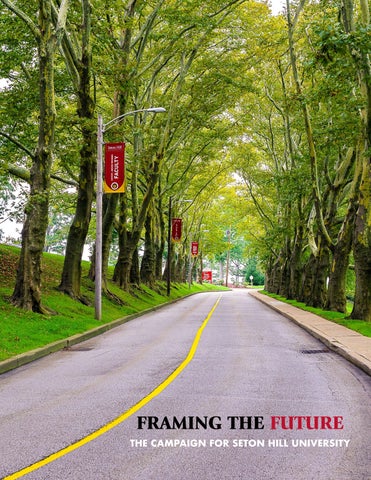
FRAMING THE FUTURE THE CAMPAIGN FOR SETON HILL UNIVERSITY
“If the management of Seton Hill find a way of doing things that is better than their present method they will replace all of that method or any part of it without scruple, for they are bound by no traditions and they fear nothing but God’s disfavor and the closed mind.” from the 1919 Seton Hill Bulletin
ABOUT THE FRAMING THE FUTURE CAMPAIGN Throughout our history, Seton Hill has embraced the ability to find opportunity in spite of obstacles and to evolve in response to the educational needs of our students and the region. We look to the resilience of the Sisters of Charity and embrace the long-standing tradition of the Seton family motto: Hazard yet Forward. The Framing the Future campaign will allow the University to remain viable and responsive to the emerging needs of our current and future students and guarantee the University’s dynamic presence in the world as we continue to build for our next century and beyond.
A Message from the President Dear Alumni and Friends, When Mother Aloysia Lowe laid her eyes upon the Jennings farm on top of a hill in Greensburg, she knew she had found the new home for her Sisters of Charity. Mother Aloysia and her Sisters emptied the small black handbag they used for their treasury to purchase the property and christened the land “Seton Hill” in honor of Elizabeth Ann Seton, the founder of the Sisters of Charity. And they began, in earnest, to build their mission in Greensburg. What the Sisters started is now a world-class institution of higher learning, steeped in Catholic, Setonian values, that has been fostered and grown by the faculty, staff and administrators who have come since, fusing a liberal arts curriculum with professional education that prepares students for the world in which they are destined to live. Seton Hill continues to look forward with our capital campaign, Framing the Future: The Campaign for Seton Hill University. This campaign will allow Seton Hill to remain viable and responsive to emerging needs, advance opportunities for current and future students and ensure our ability to continue to educate students to think and act critically, creatively, and ethically as productive members of society committed to transforming the world. Priorities include support for the University’s important mission as a Catholic, Setonian institution; funds for student scholarships and academic support; and strategic growth through innovation. This innovation can be seen through academic program development; new and renovated facilities; and with continued outreach for the development of the region and the Commonwealth of Pennsylvania. Framing the Future will allow Seton Hill to continue the important work that began with Mother Aloysia Lowe for generations to come. We are thankful for all who choose to lend their support to this mission. Hazard Yet Forward, Mary C. Finger President
Campaign priorities include support for the University’s important mission as a Catholic, Setonian institution; funds for student scholarships and academic support; and strategic growth through innovation.
MISSION & IDENTITY
T
he Catholic, Setonian identity of Seton Hill is a distinguishing mark
of the University, as it has been since its founding by the Sisters of Charity of Seton Hill in 1918. Our mission is built upon a commitment to a values-based education that prepares students to “transform the world” through knowledge, service, and truth. This legacy has guided Seton Hill’s development and provides a strong direction as the University creates its path forward. Seton Hill recognizes the importance of maintaining its Catholic identity as a faith-based institution of higher learning open to students, faculty, and staff with varied religious beliefs. Though the majority of faculty, staff and students serving the Mission of the University are not members of a religious congregation, they have the unique opportunity to lead efforts to keep the spirit of the Sisters of Charity of Seton Hill strongly present. The University continues to align curricular and co-curricular programs that support Mission. Increased support for Seton Hill’s Mission will ensure the four pillars of welcoming, learning, celebrating, and serving – aligned with the charism of the Sisters of Charity – are instilled in future Setonians. Seton Hill will continue to educate students in the spirit of St. Elizabeth Ann Seton, preparing them for the world in which they are destined to live and positioning them to be leaders of change.
At Seton Hill University, the four pillars Welcoming, Learning, Celebrating, and Serving embody the University’s deep-rooted commitment to fostering an inclusive, faith-centered environment. Through these pillars, Seton Hill integrates its Catholic heritage with a vibrant spirit of learning, spiritual celebration, and service.
SECURING STUDENT SUCCESS
S
eton Hill’s mission of educating students in a strong liberal arts framework results in students prepared for the world – as seekers of knowledge and truth; as critical thinkers and problem solvers; as graduates ready for and prepared to be part of the transformative change around them. The University’s liberal arts framework provides an exceptional foundation for students and the highest quality education in the professions prepares them to be the leaders of tomorrow – as educators, social workers, business and technology professionals; as artists, physicians, nurses, physical therapists and dietitians; as writers, historians, biologists, and chemists. The students of today are facing a world moving at a pace not previously seen. Being prepared to understand, discern, and act in changing environments is what a Seton Hill education has been since the Sisters of Charity first established Seton Hill College in 1918. The University continues to meet the challenges of fully preparing students for the future. Securing the resources necessary to ensure the University’s students excel in their personal, professional, and spiritual lives is at the center of the Framing the Future Campaign.
“Committing to Seton Hill felt like a leap of faith. I don’t come from a financially wealthy family, but the University selected me for the Elizabeth Ann Seton Scholarship and TRIO/SSS program that have helped me to push through my first years. Having the opportunity to get an education is a true blessing for me. I love to learn and want to build a life for myself.” - Oceana “Ocean” Felipe-Sirnic
25%
of Seton Hill undergraduate students demonstrate exceptional financial need
$37.4 MILLION
in scholarships and grants supported through endowments and institutional funds are awarded each academic year
S
STRATEGIC GROWTH THROUGH INNOVATION
eton Hill has a long history of entrepreneurship and innovation. What started as a small women’s college with two graduates in its first year has grown over more than a century to a co-educational University with nearly 2,000 students - studying in fields the founding Sisters of Charity could not have imagined. Through the Framing the Future Campaign, Seton Hill will continue its forward momentum by fostering strategic growth through three main areas: Academic Program Development, New and Updated Facilities and Outreach and Community Engagement.
Academic Program Development
O
ver the last decade, Seton Hill has substantially increased its academic programs through the Center for Academic Innovation and Planning. The Center provides resources for market research to determine the viability of new programs, support for faculty to develop the most current curriculum, and connection to industry leaders to understand what education and skills students need for the careers of today and tomorrow. Seton Hill has developed more than 40 new certificates, specializations, and undergrduate and graduate programs through the Center, including Nursing and Cybersecurity, as well as doctoral programs in Physical Therapy and Occupational Therapy. The Campaign will provide additional resources for new program development. Additionally, the Campaign will allow Seton Hill to create a Center for Scholarship that provides support for student and faculty research so that students from a variety of academic disciplines will have their education enhanced by participating in research, giving them additional real-world experience.
New & Updated Facilities
A
s Seton Hill continues to grow, the demand for new and updated facilities increases. Two building projects are part of the Framing the Future Campaign - the renovation of Sullivan Hall and the construction of a new Athletics Field House.
These two projects will convert an iconic campus building to a space far better suited to today’s academic needs and add a new indoor practice facility, moving coaches and teams from Sullivan Hall and other spaces into a new home for Griffin Athletics on campus.
Sullivan Hall Renovation Built as the original activities building on Seton Hill’s campus more than 100 years ago, Sullivan Hall is an iconic structure beloved by students, alumni and the community-at-large that has served various uses over the years. The future of this historic building will preserve the classic exterior while modernizing the interior to provide state-of-the-art facilities for the School of Business and Technology and the College of Health Professions and Natural Sciences, as well as a gathering space for students and a multi-purpose room for events.
→ School of Business and Technology The School of Business and Technology at Seton Hill has consistently drawn a high number of undergraduate and graduate students and has been effective in preparing them for graduate education and the workplace for more than 40 years. To expand on this success, the University must continue to integrate new ideas, academic programs, facilities, and technology to meet the needs of tomorrow’s business leaders. Currently, the School is primarily housed on the third floor of Maura Hall with some classes held throughout campus. The renovation of Sullivan Hall will provide a modern home on campus and give students access to contemporary, updated facilities and technology that are required to provide the type of business education envisioned by Seton Hill’s faculty. The renovation will include a Financial Learning Lab with access to state-of-the-art technology used by leading business, economics and financial professionals worldwide for data, news and analytics, as well as classroom spaces set up for both in-person and hybrid education. A Cybersecurity and Data Analytics Lab will provide students with access to the tools needed to learn the business aspects of information security and the technical resources to conduct collaborative projects and research. These improvements will afford the next generation of business and technology students at Seton Hill with the state-of-the-art educational programming representative of the University.
→ College of Health Professions and Natural Sciences Seton Hill has a long-standing commitment to preparing students for roles as scientists, healthcare professionals, and educators. Nearly 40% of our undergraduate students and almost a third of our graduate students are enrolled in natural and health science programs. With our region’s continually aging population and our country’s growing challenges in providing adequate health care, especially in rural areas, Seton Hill is helping to meet these needs through an expansion of our programs in the health sciences. In recent years, Seton Hill has added doctoral programs in Physical Therapy and Occupational Therapy and a Bachelor of Science in Nursing. An online Master of Science in Nursing Leadership and Education will launch in Fall 2026 to offer nurses the opportunity to advance their careers into management or nurse education. Students in the MSN program can also earn their MBA from Seton Hill in the dual MSN-MBA program. Other graduate nursing programs are currently being developed. Due to the University’s growth in health care education, the College of Health Professions and Natural Sciences was established in Fall 2025 to allow Seton Hill to continue to expand innovative programming. The construction of new and upgraded spaces in Sullivan Hall will enable faculty, through new classroom configurations and technology upgrades, to develop data-rich and immersive experiences that engage students in a case study format. The Sullivan renovation will provide dedicated spaces for Seton Hill’s programs in Nursing and Physical Therapy as well as general health science classrooms, labs, seminar rooms, a lecture hall, and study areas.
“With the planned expansion of our programs - including graduate nursing education in a variety of advanced practice provider and administrative roles we will be meeting the future needs of healthcare.” - Anthony Good, Associate Dean for Nursing and Health Sciences
950+
THE 2 LARGEST
20
students in undergraduate programs in the School of Business and Technology and College of Health Professions and Natural Sciences
areas of study at Seton Hill are the School of Business and Technology and the College of Health Professions and Natural Sciences
academic programs at the bachelor’s, master’s, and doctoral levels in the College of Health Professions and Natural Sciences
→ The Campus Center in Sullivan Hall Historic Sullivan Hall served as the original activities building on campus – offering students a gymnasium, swimming pool and other amenities for physical education, athletics and more. To meet the needs of today’s students, Sullivan Hall must include a dedicated Campus Center that will enhance students’ sense of belonging in the Seton Hill community by providing space that allows them to connect with their peers, faculty and staff while fostering intellectual conversations and the development of social networks. The Campus Center will provide versatile space that offers various seating options for individual and small group discussions; informal academic support space for tutoring and enrichment activities; programming space for Student Life initiatives; and dedicated lounge space for students seeking places to study or decompress in a casual environment. Lounge space will include flexible seating and integrated technology with easy access to power outlets to facilitate collaborative and project-based work. The lounge will connect seamlessly to an upgraded Griffin’s Cove, a dining space that provides both nutritious meals and grab-and-go options to the campus community. The Campus Center will include much-needed multi-purpose space that will be used for presentations, lectures and community events with ample seating for large crowds. A spirit store will also be located within the Campus Center. The creation of a Campus Center will help build belonging and community at Seton Hill through dynamic spaces that invite and encourage students to engage with one another academically and socially.
®
!
<
)!"9 !! '
)2"(#
,
! >#
=A,$B 0
,
(""" ',
/" :/
(7=!
!! @"
"
($"#
(""#9?1
*+
6;*5;
($"
,
,,'
> "
0*9+ *+
*5;
($$3"
*+
%
($:)!# ,
,, 1?":=!"
=!"# ' &
!
"
< ("
New Athletics Field House Athletics have been an integral part of life at Seton Hill from its beginnings. The Seton Hill Athletics Association was formed on campus in 1923 and drove the future of athletics including the need for an Activities Building, which would become Sullivan Hall. A century later, Seton Hill boasts 20 athletic teams in NCAA Division II for women and men. Generations of student-athletes have been shaped by the lessons they have learned about teamwork, perseverance and handling adversity through sports. But above all, student-athletes at Seton Hill are students first. In fact, Seton Hill University’s athletic teams regularly achieve the highest grade point average among all schools in the PSAC. More than 60% of Seton Hill student athletes earned a cumulative GPA of 3.25 and were honored as PSAC Scholar Athletes in 2025. Seton Hill’s athletic programs also have an impact on the community. Seton Hill’s student-athletes contribute over 1,200 hours to community service activities annually. Seton Hill also hosts youth camps in a variety of sports every year, and our athletic facilities are used for high school playoff events and other tournaments. The new Field House will allow Seton Hill to continue to provide facilities that not only benefit our own student-athletes and students but the community as well. This Field House will provide a large additional indoor practice space in the variable Southwestern Pennsylvania weather for a wide variety of sports. An indoor track will give Seton Hill’s nationally-competitive track team its first on-campus facility and wrestling will have a new dedicated practice space, bringing the team up the Hill from its current location at the bottom of Seton Hill Drive.
1,200 hours of community service performed by athletes annually
60% of Seton Hill student-athletes recognized as PSAC Scholar Athletes in 2025
1 IN 3 of Seton Hill undergraduates are varsity athletes
THE FACILITY WILL INCLUDE: → The first-ever indoor practice space for track and field on Seton Hill’s campus → Batting cages, a turf field, and a wrestling room for indoor practice needs → Locker room and office space for baseball, softball, lacrosse, track and field/ cross country, and wrestling → A recruiting and media room to allow teams to review game film or meet with future Griffins
Outreach and Community Engagement
S
eton Hill’s work in the community helps our cities, towns, county, and region remain vibrant. The University is a top employer in Westmoreland County and a key provider of programs that support the health and financial well being of our neighbors as well as cultural activities that enhance their lives. Seton Hill made an intentional decision to extend its reach off the hill and build in the heart of downtown Greensburg and serve as a leader in the City’s redevelopment. Indeed, a recent study showed that Seton Hill generates more than $194 million in economic development each year for Pennsylvania. The University and its partners recently launched a plan that will drive economic development and benefit area residents, particularly around housing for graduate students and support of entrepreneurs. Significant grant funding secured by Seton Hill from the Pennsylvania Department of Community and Economic Development will allow the University to provide guidance to those seeking to start or grow small businesses, particularly in rural areas, and offer these entrepreneurs the opportunity to apply for microgrants to help get their ideas off the ground. Continuing and expanding Seton Hill’s vital role as an intellectual resource to the broader community is an important aspect of the Framing the Future Campaign.
Seton Hill generates
$194 MILLION in economic impact for Pennsylvania
1,000+
98%
direct and indirect jobs tied to Seton Hill
of graduates are employed or in graduate school six months after graduation
FRAMING THE FUTURE CAMPAIGN COMMITTEE HONORARY CHAIRS Michele Moore Ridge ’69 and Thomas J. Ridge CAMPAIGN CO-CHAIRS Margaret DiVirgilio ’80 Linda Fiorelli ’74 Elizabeth Boyle McDonald and Sean McDonald Rebecca Cost Snyder Karen Farmer White CAMPAIGN COMMITTEE Fardan Allen ’20 Carmen Rivera Bauza ’83 Robin Heffernan Beck ’64 John Boyle Rosalie Carpenter Christian Carter ’16 Andrew DeMase ’09 Robert A. DeMichiei Sally Conroy Fullman ’64 Matthew J. Galando ’04 Kathy Garde ’88 Jonnie Guerra ’73 Brent Jackson Ellen Katter ’73 Ferne Labati Jennifer Makowski ’11 Marc Marizzaldi Sr. Maureen O’Brien, SC, ’67 E. Ronald Salvitti, II Kathleen (Rylander) Sarniak '80 Bridget Widdowson ’82 Sr. Susan Yochum, S.C., ‘77
We extend our deep gratitude for all those who have chosen to lend their support to furthering Seton Hill’s mission to educate students to think and act critically, creatively, and ethically as productive members of society committed to transforming the world.
Learn more about the Framing the Future Campaign by scanning the QR code.