Search Social Log in
MENU
(/) HOME (/) / SCIENTISTS DEVELOP A METHOD TO COMPUTE AUDIBLE NOISE FROM ULTRA HIGH VOLTAGE TRANSMISSION LINES
Scientists Develop a Method to Compute Audible Noise from Ultra High Voltage Transmission Lines by Rishabh Shukla (/pro le/rishabh-shukla) August 23, 2016 1 of 1
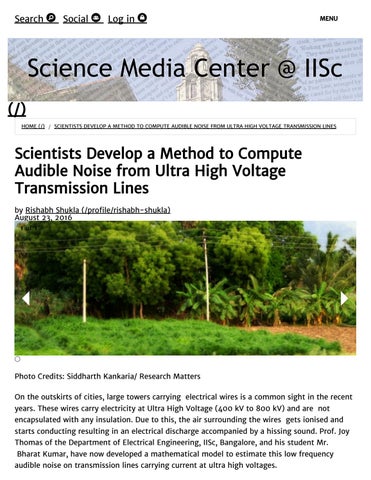
Photo Credits: Siddharth Kankaria/ Research Matters On the outskirts of cities, large towers carrying electrical wires is a common sight in the recent years. These wires carry electricity at Ultra High Voltage (400 kV to 800 kV) and are not encapsulated with any insulation. Due to this, the air surrounding the wires gets ionised and starts conducting resulting in an electrical discharge accompanied by a hissing sound. Prof. Joy Thomas of the Department of Electrical Engineering, IISc, Bangalore, and his student Mr. Bharat Kumar, have now developed a mathematical model to estimate this low frequency audible noise on transmission lines carrying current at ultra high voltages.
Transmission lines without insulation are exposed to rain and snow and the conductor surface is often damaged. When the voltage on the line is more than a critical value, the surrounding air gets ionised and starts conducting, creating occasional sparks similar to the lightning during a thunderstorm. This process of electrical discharge from a high voltage transmission is called “corona”. It creates two regions separated by a boundary, (ionization region and drift region) beyond which electric
eld is not su
cient to maintain e ective ionization. Corona is often
accompanied by a low frequency audible noise. This noise is also known to be hazardous to health, apart from being an annoyance. India has decided to build transmission lines rated 1200 kV and already an experimental transmission line rated 1200 kV is in operation near Bina in Madhya Pradesh. “No other country in the world has a 1200 kV high voltage power transmission line and hence none has the expertise in building such lines or has done studies to
nd out the e ects of lines which operate
at such large voltages. Remember it is 12 Lakhs voltage!”, says Prof. Thomas on the need for such studies. With the advent of ultra high voltage power transmission lines, audible noise due to corona has emerged as an important design consideration of power lines and hence methods to calculate this noise becomes signi cant. In order to calculate the noise, the team studied the electric
eld generated around the
transmission lines and its variations due to the presence of water droplets and other external factors. They then derived voltage and the electric current passing on the line. Using these, the total loss of power in transmission, the sound pressure levels and the audible noise was calculated. Noise is more intense during rainy season, as at the tip of the water droplets electric eld gets enhanced leading to worsening of corona discharge during rainy season. They also studied electric
eld variation in dry and wet conductors.
The study found that the corona noise reaches a level of 81 dB at a distance of 5.2 m in transmission lines carrying electric current at 1200 kV. Sometimes, due to the presence of high levels of moisture, the noise can be as intense as 92 dB, twice the acceptable limit of audible noise for human ears, at a distance of 50 m from the centre of the tower. The researchers plan to work on techniques to reduce this noise and make the transmission lines safer for people living around it. In a country where the demand for power is growing at a very fast pace and is expected to reach 500 GW by 2026, Extra high voltage (EHV) and ultra high voltage (UHV) power transmission lines become the need of the hour. Many 1200 kV transmission lines are being planned in India by Power Grid Corporation of India Limited and such studies become highly important in guiding the policies around planning and safety of such power lines.
“We will be continuing the work we have just started as it is important for India. Hence, we would like to experimentally measure the audible noise and
nd out techniques to reduce the
noise if it is found to be higher than the permissible limits. Another aspect we would like to explore is the e ect of electric and magnetic
elds from such large HV lines on nearby human
beings, animals and plants”, explains Prof. Thomas on the plans for future research in this area. Author Information Dr. M Joy Thomas is an Assistant Professor in Department of Electrical Engineering, Indian Institute of Science (IISc), Bengaluru. He received B.Tech degree in Electrical Engineering from IIT (BHU), Varanasi in 1983 and Ph.D. from IISc Bangalore in 1993. He can be contacted at jtm@ee.iisc.ernet.in (mailto:jtm@ee.iisc.ernet.in) K. Bharath Kumar is working as an Executive in the Department of Ultra High Voltage Technology Group, Crompton Greaves Global R & D. He received B.Tech degree in electrical engineering from Jawaharlal Nehru Technological University, Anantpur and M.E. in electrical engineering from IISc, Bengaluru in 2013. Research Information Computation of Audible Noise from a 1200 kV UHV Power Transmission Line was published in IEEE Transactions on Dielectrics and Electrical Insulation on April, 2016. Tag: Electrical Engineering (/tags/electrical-engineering) Like 15 435 reads
Subscribe to Weekly Digest * indicates required Email Address *
Subscribe
Have an upcoming event? If you have an upcoming event and want our services, please click here (http://iisc.researchmedia.center/media-rapporteur-events).