The
BOLT
Septmber 2026 Volume 25, Issue 1 lightningboltonline.com Sage Hill School 20402 Newport Coast Drive, Newport Coast, CA 92657
Sage Hill Welcomes Middle Schoolers, Opens New Building
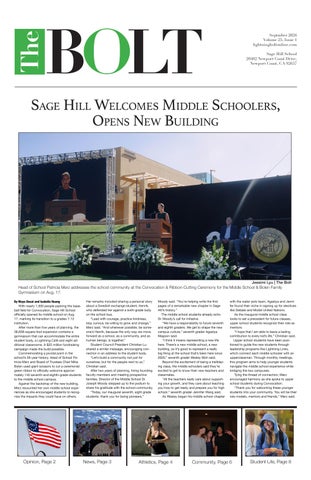
Jessimi Lyu | The Bolt
Head of School Patricia Merz addresses the school community at the Convocation & Ribbon-Cutting Ceremony for the Middle School & Bolen Family Gymnasium on Aug. 17. By Maya Desai and Isabella Huang With nearly 1,000 people packing the baseball field for Convocation, Sage Hill School officially opened its middle school on Aug. 17, marking its transition to a grades 7-12 institution. After more than five years of planning, the 38,658-square-foot expansion contains a gymnasium that can accommodate the entire student body, a Lightning Café and eight additional classrooms. A $25 million fundraising campaign made the build possible. Commemorating a pivotal point in the school’s 26-year history, Head of School Patricia Merz and Board of Trustees Chair Mike Bolen used giant scissors to cut a ceremonial green ribbon to officially welcome approximately 140 seventh-and eighth-grade students to the middle school campus. Against the backdrop of the new building, Merz recounted her own middle school experiences as she encouraged students to recognize the impacts they could have on others.
Opinion, Page 2
Her remarks included sharing a personal story about a Swedish exchange student, Henrik, who defended her against a sixth-grade bully on the school bus. “Lead with courage, practice kindness, stay curious, be willing to grow and change,” Merz said. “And whenever possible, be someone’s Henrik, because the only way we move forward as a school, as a community, and as human beings, is together.” Student Council President Christian Lu shared a similar message, encouraging connection in an address to the student body. “Let’s build a community not just for ourselves, but for the people next to us,” Christian said. After two years of planning, hiring founding faculty members and meeting prospective families, Director of the Middle School Dr. Joseph Moody stepped up to the podium to share his gratitude with the school community. “Today, our inaugural seventh, eight grade students: thank you for being pioneers,”
News, Page 3
Moody said. “You’re helping write the first pages of a remarkable new chapter in Sage Hill’s history.” The middle school students already echo Dr. Moody’s call for initiative. “We have a responsibility to future seventh and eighth graders. We get to shape the new campus culture,” seventh grader Agastya Magoon said. “I think it means representing a new life here. There’s a new middle school, a new building, so it’s good to represent a really big thing at the school that’s been here since 2000,” seventh grader Wesley Moh said. Beyond the excitement of being a trailblazing class, the middle schoolers said they’re excited to get to know their new teachers and classmates. “All the teachers really care about supporting your growth, and they care about teaching you how to get ready and prepare you for high school,” seventh grader Jennifer Wang said. As Wesley began his middle school chapter
Athletics, Page 4
with the water polo team, Agastya and Jennifer found their niche in signing up for electives like Debate and Model United Nations. As the inaugural middle school class looks to set a precedent for future classes, upper school students recognize their role as mentors. “I hope that I am able to leave a lasting contribution to every kid’s life,” Christian said. Upper school students have been positioned to guide the new students through leadership programs like Lightning Links, which connect each middle schooler with an upperclassman. Through monthly meetings, this program aims to help younger students navigate the middle school experience while bridging the two campuses. Tying the thread of connection, Merz encouraged harmony as she spoke to upper school students during Convocation. “Thank you for welcoming these younger students into your community. You will be their role models, mentors and friends,” Merz said.
Community, Page 6
Student Life, Page 8
2
The Bolt September 2026 Sage Hill School
Opinion Keep Politics in School
By Doyoung Lee and Elisa Xu
As the United States marks the 250th anniversary of the adoption of the Declaration of Independence, it does so amid increasingly polarized politics. Political affiliation has become a defining aspect of personal identity for Americans, shaping how they perceive those with opposing views. For students, many of whom cannot yet vote, schools should provide opportunities to understand and participate in political discussions before they enter the electorate. Teachers often feel pressure to remain neutral, while many students hesitate to express their political beliefs in learning environments. Political polarization fosters judgment and resentment, especially when political beliefs become central to judgments about a student’s character. As ideological divisions continue to grow, the nation faces a difficult question. Should political neutrality mean that students should avoid talking about politics altogether? Teachers have valid reasons to be cautious when politics enters the classroom. Because teachers hold positions of authority, openly endorsing a political belief can make students with opposing views less willing to express their own opinions and weaken political diversity in the student body. In Mayer v. Monroe County Community School Corp., a federal appeals court upheld a school’s right to restrict a teacher from promoting her personal political views after she expressed support for an antiwar demonstration opposing the Iraq War. But political neutrality does not necessitate silence. Teachers should discuss current elections or court rulings in their classes without interjecting their own opinions, creating environments
An America 250 commemorative flag flies in Fraser, Colorado, on May 25, 2026.
Courtesy of Creative Commons
where students are comfortable explaining their views. A Stanford-led experiment involving more than 32,000 Americans found that exposing people to relatable individuals with opposing political views significantly reduced partisan animosity. In an age when political views are increasingly moralized, schools have a responsibility to teach students to engage critically and objectively with views they reject. Moreover, keeping politics out of the classroom does not keep students away from politics. Students already encounter political arguments through social media, where algorithms reinforce existing views
as politicians heavily rely on these platforms to promote their campaigns. Zohran Mamdani built much of his 2025 mayoral campaign around videos aimed at younger voters, while Republican Rep. Brandon Gill has garnered attention through viral clips of his congressional hearings. Increasingly hostile political rhetoric has further weakened trust across party lines, increasing the need for schools to provide structured settings for face-to-face discussion. Asked about political discussions at school, Liam Sapan, a senior and Orange County Republican Party intern, said, “Now that we’re going to college, we’re
going to be the next generation of voters. That’s why talking to people can help expose you to opposing viewpoints and flesh out your own beliefs.” School administrators should not tell students which political beliefs to adopt, nor should teachers use their authority to promote their own. Instead, teachers should integrate discussion of relevant political events when they connect to the curriculum, giving students practice expressing and defending their views before joining an increasingly polarized electorate.
Hill s tu d e nt s c o ul d g et to s c ho ol b efo re the m o r nin g r u s h p i cke d up. N ow, l e avin g at 8 a .m. m e a n s c o mp etin g with eve r yo n e e l s e c o m mu tin g to wo r k . T he ex tr a 3 0 minu te s of s l e e p c a n qui ck l y di s a p p e a r wh e n s tu d e nt s s p e n d that tim e d r ivin g. T h e p ro b l e m d o e s n’t e n d with th e l a s t d ay’s l a s t b l o ck . En din g at 3:3 0 p.m. r athe r tha n 3 p.m. m ay s e e m like a s m a ll c ha n g e, b u t fo r s tu d e nt s who s e af te r n o o n s a re p a cke d wi th ex tr acu r r i cul a r s, tho s e 3 0 minu te s a re s i g nif i c a nt. T hi s c ha n g e i s p a r ti cul a rl y p ro b l e m ati c fo r s tu d e nt ath l ete s. Away g a m e s a l re ad y re qui re
s tu d e nt s to l e ave c a mp u s e a r l y, c au s in g the m to mi s s pa r t of the i r cl a s s e s in o r d e r to tr ave l with the ir te a m s. With the s c ho ol d ay now e n din g at 3:3 0 p.m., athl ete s of te n ne e d to b e di s mi s s e d eve n e a r li e r to a r r ive at c o mp etiti o n s o n tim e. A s a re sult, the l ate r s c ho ol d ay di re c tl y c o ntr ib u te s to s tu d e nt s mi s s in g m o re in s tr u c ti o na l tim e. T he new We dne s d ay s c he dul e ha s a l s o re c e ive d c r iti c i s m. T he re a re now s ho r te ne d p a s s in g p e r i o d s wi th a n unne c e s s a r il y l o n g lun c h a n d nu tr iti o n. It of te n fe e l s like tim e i s b e in g s tretc he d ju s t fo r the s a ke of f illin g the new s c he dul e. “ T he 8:3 0 s t a r t tim e s a re ni c e
b u t the s c he dul e l a s t ye a r wa s p e r fe c t a n d g et tin g o u t at 3 wa s o ptim a l fo r g oin g to ex tr acu r r i cu l a r s af te r s c ho ol,” ju ni o r R a if A b a hu s ay n s a i d. N o o ne a s ke d fo r thi s. Ju s t g et u s o u t e a r li e r.” Fo r s o m e s tu d e nt s, the l ate s t a r t i s a l e gitim ate b e nef it, a n d it ’s un de r s t a n da b l e fo r the m to t a ke adva nt ag e of it. H oweve r, if givin g s tu d e nt s a n ex tr a 3 0 min u te s in the m o r nin g c re ate s he avi e r tr af f i c, l ate r af te r no o n s, a n d m o re mi s s e d c l a s s tim e fo r athl ete s, the n the tr ad e - of f s imp l y i s n’t wo r th it.
Hit Snooze on New Late Start Schedule
By Nicole Bo
Wi th th e o p e nin g of S ag e Hill’s n ew mi d dl e s c h o ol, th e d a il y s c h e dul e wa s a lte re d fo r a ll s tu d e nt s. W h at wa s o n c e a n 8 a .m. to 3 p.m s c h o ol d ay i s n ow a n 8:3 0 a .m. to 3:3 0 p.m. s c h e dul e. W hil e th e l ate r s t a r t m ay h ave b e e n d e s i g n e d to a c c o mm o d ate th e n e e d s of th e mi d dl e s c h o ol, i t h a s c re ate d a nu mb e r of u nn e c e s s a r y p ro b l e m s fo r up p e r s c h o ol s tu d e nt s. O n p a p e r, i t s o u n d s i d e a l fo r a n ex tr a 3 0 minu te s of s l e e p in th e m o r nin g. H oweve r, it h a s re sul te d in m o re c o n g e s te d road s f ro m p e o p l e f i g htin g to g et to the i r 9 -to - 5 o n tim e. At 8 a .m., S ag e
THE BOLT
T
he Bolt is a student newspaper and serves the public forum at Sage Hill School. Its content - news, editorial, opinion, and feature - is protected by Education Code 48907, the state student rights law and the California Constitution which guarantees all citizens the right of freedom of speech and of the press. Opinions expressed do not represent the views or beliefs of Sage Hill School and its administration. The Bolt accepts signed letters to the editors from members of the Sage Hill community which may be posted as comments at lightningboltonline.com, or addressed to Editors-in-Chief Maya Desai, Isabella Huang, Kenzie Chang and put in their mailboxes on campus. These letters may not exceed 150 words or they will be edited for inclusion.
Editors-in-Chief Maya Desai (Bolt), Isabella Huang (Bolt) & Kenzie Chang (Online) Editorial Board Doyoung Lee, Ella Wang, Elisa Xu, Grace Ma, Jessimi Lyu, Linda Liu, Milan Desai, Maria Neemuchwala, Penelope Pan Writers Rishaan Marwaha, Zahra Hakimi, Addy Chen, Leo Lin, Nathan Tang, Meredith Carroll, Nicole Bo, Nikki Petrie, Summer Haque, Mandy Li, Melissa Yu, Shawn Huan, Sohum Shah, Sophia Lin, Elaine Chen and Chaaya Springer Photographers and Artists Nathan Tang, Leo Lin, Linda Liu, Rishaan Marwaha, Grace Ma, Jessimi Lyu Adviser Daniel Langhorne
Scan this QR code to check out our Instagram or find us at lightningboltonline.com for the latest news!
News
The Bolt September 2026 Sage Hill School
3
Grade Rounding Held Back Under New Policy
By Linda Liu and Rishaan Marwaha
For the 2026-2027 school year, Sage Hill has removed grade rounding across all academic departments. While administrators say that it will create more uniformity across classes, student reactions are mixed. Previously, individual departments had different approaches to rounding grades. While most departments chose not to round grades, science and English did. Physical Health was an exception, grading on a credit/no-credit basis. “Essentially, that led to a lot of confusion where kids felt like they were able to get grades rounded in one department, but not another,” said Dr. Matthew Balossi, assistant head of school for academics. Last year, department chairs and the Program Leadership Committee, a faculty group involved in coordinating academic programs across departments, began discussing whether the school should adopt a single unified grading system. The central question became whether all departments should round grades or whether none should. After discussion and departmental compromise, the department chairs ultimately decided to adopt a school-wide no-rounding policy. Though she was not directly involved with the decision-making process, Associate Director of 9th and 10th Grade College Counseling Alyssa Flynn said she
By Grace Ma
understood that the goal was to set consistent expectations. “My understanding was to find a common ground across departments,” Flynn said. “Each department had their own policy, and that can sometimes be confusing when there’s not consistency.” “I don’t think the new policy is necessarily positive or negative, but it will make the grading system more consistent and easier to understand,” sophomore Sartaaj Singh said. For other students, the change differs from their previous experiences with grading. Freshman Ronav Marwaha said that in middle school, teachers generally did not round grades but made occasional exceptions based on a student’s effort in class. “Middle school operated similarly where teachers didn’t round often, but in the select cases where they did, it was usually based on how hard the student worked and how much genuine effort they showed,” Ronav said. Other students believe that the policy may affect both students and teachers when grades fall close to cutoffs. “I think that it might give teachers a higher incentive to grade more leniently or students to really focus when they are on the cusp of a grade,” junior Troy Yeh said. The policy also raises questions about whether students will be hesitant to take more aca-
Photo Courtesy of Sage Hill School Handbook
Sage Hill’s new grading policy eliminates grade rounding across all academic departments for the 2026-27 school year. demically challenging classes for fear that their grades may end up being near the cutoff. Flynn emphasizes that students should not choose their classes solely for a GPA boost, but rather based on genuine intellectual curiosity. “If people are choosing their courses strictly based on GPA, they’re probably missing the point,” she said. “You should be choosing things that you’re really interested in or think you might be interested in, or opening up your mind in a different way.” Flynn also noted that a stu-
dent’s letter grades in assessments may not serve justice to the full academic picture. Classwork, participation and projects may also raise a student’s overall average. “If in the assessment category, you’re consistently getting B’s, but you’re almost to an A with all of the other things, quite honestly, you probably have earned a B,” Flynn said. Because the policy is new, administrators plan to evaluate its effectiveness throughout the year before considering it a permanent decision.
“It is something that we’re going to look at again in the spring and determine whether or not we want this to stay. It’s not set in stone, but we do hope that it will provide more consistency and less confusion for kids,” Dr. Balossi said. For now, the policy establishes the same approach to rounding across departments, while administrators assess how the change affects students and teachers throughout the year.
Women Take Center Stage at Daisy Chain Fields
More than 45,000 attendees gathered at Great Park on Aug. 29 for Daisy Chain Fields, a new music festival founded by Olivia Rodrigo celebrating women in music. The festival featured 14 female artists from different genres, including Rodrigo, Chappell Roan, Doechii, Mitski, Bikini Kill and Santigold. Stevie Nicks, Sarah McLachlan and Alanis Morissette also made special appearances during Rodrigo’s performance. Inspired by Lilith Fair, a women-centered music festival that began in 1997 in response to the underrepresentation of women in festival lineups and the music industry, Rodrigo created Daisy Chain Fields. Similar to Lilith Fair, Daisy Chain Fields aimed to celebrate women and provide female singers with a dedicated space to perform. The festival’s purpose remains relevant as women continue to face unequal representation in the music industry. Daisy Chain Fields also highlighted women’s broader influence and contributions to music. Performances alternated
between the Dandelion and Marigold stages throughout the day, with about 10 minutes between each set before the next artist began performing on the other stage. This gave attendees time to move between the two stages to see multiple acts. Great Park also featured art installations, photo opportunities and food vendors. All vendors at Daisy Chain were women-owned businesses, selling clothing, jewelry and artwork. The Etsy Creative Village featured independent sellers and gave attendees the opportunity to create their own keepsakes. “Creativity can bring people together and make meaningful moments feel entirely your own,” Etsy CEO Kruti Patel said. Daisy Chain Reaction, an exhibition hall at the festival, highlighted 10 nonprofit organizations working on issues ranging from health care access to gender-based violence and women’s rights. Organizations included Black Mamas Matter Alliance, which focuses on Black maternal health; FreeFrom, which supports survivors of gender-based violence; and the National Women’s Law Center,
Grace Ma | The Bolt
More than 45,000 festivalgoers gather at Great Park on Aug. 29 for Daisy Chain Fields, a music festival celebrating women artists. which advocates for women’s rights through law and policy. The festival raised $10 million for its nonprofit partners, which philanthropist Melinda French Gates matched. The festival raised a total of $20 million.
Daisy Chain Fields made supporting women a central part of the festival by bringing together female artists, women-owned businesses and nonprofit organizations. Like the Lilith Fair that inspired it, the festival showed
how music could bring attention to issues affecting women and support organizations working to address them.
4
The Bolt September 2026 Sage Hill School
Athletics
Girls’ Tennis Opens Season Strong, Overcomes Heat Wave By Nathan Tang and Leo Lin
After losing six seniors from last year, the Varsity Girls’ Tennis team entered their new season with a much younger lineup and several unfamiliar partnerships. Nevertheless, the team started off their preseason with a dominant 6-1 record, earning decisive victories and developing important chemistry on and off the court. The team started off extremely strong with consecutive 14–4 home victories over Capistrano Valley and Los Alamitos. After a narrow 8-10 loss at Newport Harbor, the team went back to winning ways with an 18-0 sweep against Pacifica Christian, a 13-5 victory over Irvine, a 16-2 masterclass against Whitney and an exhilarating 9-9 (79-72) nailbiter against Anaheim Canyon. Across the first seven matches, Sage Hill secured 92 sets while only conceding 34. Head Coach Whit Kenerson explained the loss of six seniors from last year and highlighted the importance of the addition of four freshmen in the team’s early success. The bond between the new and returning players has also been a decisive factor in the preseason. “There’s never a game where we don’t cheer for each other, bond over food or rally around the last player on the courts,” junior captain Amelie Lalvani said. “The returning girls always lift up and support the freshmen, and the freshmen are receptive and eager to learn.” Senior Katie Chang also emphasized the support surrounding the final match that the team played each day. “It really shows how much we support each other, and how despite being an individual sport, teamwork really makes a big difference in tennis,” Katie said. However, it was not all smooth sailing. In a closely contested match at Newport Harbor, sophomore Zhenzhen Zhong fell ill after defeating Newport Harbor’s top singles player. Freshman Iris Sheng stepped into the lineup and
played two close sets, but Newport Harbor ultimately secured the 10–8 victory. “It definitely reminded us all that we need to keep working hard and be ready to play from the first round,” junior captain Madeleine Lal said. “The fact that it was 8–10 showed us that every point matters and can be the difference between a win and a loss.” For many on the team, that game also turned out to be a memorable moment of growth. “I think it showed how much our team has grown even in that short time frame and the importance of fighting until the last point because you never know what the outcome is going to be,” freshman Maggie Mai said. The team proved that the loss brought down neither their morale nor momentum when they went on to win their next two matches against Pacifica Christian and Irvine in dominant fashion. The recent spike in heat also became a problem for the team. The excessive heat caused practices and matches to be canceled, which left the team with less time on the court than they hoped. “The heat has definitely made it harder to gain momentum and consistency,” Madeleine said. “It has been hard to drill what we need to improve and get us ready for some harder matches.” The players stayed determined to improve by practicing and preparing outside of school on their own time. However, Amelie acknowledged that the unexpected break was both a challenge and a relief. “It has been a relief that we don’t have to practice or play matches in the humidity, but it’ll take a lot of work to hit the stride we had at the start of the season,” Amelie said. As the team prepares for their league matches, Kenerson emphasizes the significance of keeping their confidence high and the chemistry strong, as well as specific tennis related skills.
Junior Alison Wang sets up a forehand during her match against Irvine High School on Aug. 31. “Solidify the partnerships in doubles and work on movement, volleying, poaching and being more aggressive,” Kenerson said. As the team enters the Lightning Invitational, Sage looks to carry the momentum from their first seven games and further expand their winning record. The Lightning Invitational will be the last chance to set the precedent for the season and give players a chance to get fired up again after the cancellations.
In pursuit of a CIF qualification, the team looks to compete against powerhouse schools like University, Portola and Woodbridge in the upcoming season. Despite the massive challenge, they remain determined. “Our goal is to perform well in the Upper League this year,” Kenerson said. “We want to qualify for CIF again.”
Lightning Football Looks to Set the Tone for a New Season By Zahra Hakimi and Rishaan Marwaha
As Sage Hill Football enters a new season, the team is stepping onto the field with a different approach. With a shift toward a faster, more athletic offense, the Lightning are hoping its experienced skill players can pave the way. With several new faces on the field, Head Coach BJ Crabtree said that he is most excited to see the team’s receivers and running backs put their talent into action. “We have a great group of skilled players, receivers, and running backs, and I want to see them cook; I want to see them score touchdowns, play fast and play together,” Crabtree said. While the team remains confident in its skill and technique, Crabtree said that much of the preparation leading into the season has been centered around improving both offensive and defensive lines. The offensive line adjustments come after the graduation of several members of the Class of 2026. Senior team captain Ashton Ataii said that
these shifts have led the team to rethink its strategy. “We changed everything this year since we were very senior-heavy last year,” Ashton said. “We’re running a more athletic, speed-based offense this year and less of a power offense.” For Ashton, his final season is more than just changes to the playbook. As a senior, he is looking forward to making the most of his last few games with the teammates he has grown and worked alongside. “It’s my last season playing with my brothers, and we’re hoping to win every game,” Ashton said. That blend of a new offense and an experienced squad of skilled players is what is going to shape Lightning football’s season this year. While the team still has more work to do, players and coaches remain confident in what the team can accomplish at the hands of their new system and technique. As Ashton put it, Lightning football is ready to “set the tone” for the season ahead.
Zahra Hakimi | The Bolt
The Sage Hill football team secured a 39-24 victory against Trinity Classical Academy on Aug. 21.
Community
The Bolt September 2026 Sage Hill School
5
Drivers Adjust to School’s New Parking, Traffic System
By Penelope Pan
Aside from new classes, new schedules and the middle school, Sage Hill students and parents faced another change for the 2026-27 school year—a redesigned traffic flow system. Before the first day of school, Head of School Patricia Merz sent detailed instructions for a new dropoff and pick-up system in an Aug. 17. community letter. The revised system included a new drop-off lane that connects the end of the parking lot to the curb in front of the school. “We preemptively created the new exit ramp in the student parking lot to provide us with additional options to route traffic,” Safety and Security Manager Adam Patterson said. Even with the new system in place, managing traffic has been a challenge. Approximately, 545 vehicles enter the driveway from 7:30 a.m. to 8:45 a.m. and 350 vehicles exit campus between 2:45 p.m. and 4 p.m., Patterson said. While morning drop-off runs
smoothly, afternoon pick-up was the primary obstacle in the first month of school. During the first week, the pick-up lane backed up beyond the school entrance to the U-turn on Newport Coast Drive. It took many parents 30 minutes or longer to enter campus for pick-up on the first day. On the second day of school, Sage Hill’s administration sent an email with updated pick-up procedures. The message urged parents in the pick-up lane to make sure their students were ready. In response to parent feedback, the school also reserved the parent portion of the parking lot as a waiting area. “We have begun to experiment with routing middle school traffic on the roadway in front of the gym as we again try to maximize the available space for waiting drivers while simultaneously allowing space for student drivers to exit the student parking lot,” Patterson said. As drivers adjust to the new parking procedures, conditions have noticeably improved, officials said.
Parents are now only allowed to park in the three back rows of the main lot. The traffic flow has improved, with dismissal now taking 30 to 40 minutes compared to the initial flow of nearly an hour, Patterson said. “We know we are moving persons as efficiently as possible when we are outpacing the capacity of the signal interval for traffic to exit onto Newport Coast Drive,” he said. While parents have been adapting to the new pick-up lane, student drivers have had their own experiences regarding the new system. Senior Joanna Chen, an athlete who regularly leaves school later in the day, shares how the new system has worked well for her. “Getting there is fine and I feel like the parking is not as bad,” Joanna said. Sophomore Leela Tripathi, a new driver, offers a different perspective on Sage’s traffic system. As Leela is a student driver, her father drives to Sage Hill and parks in the parent parking lot before Leela takes over on
the drive home. “It takes a long time to get out of the parent parking lot because they let all the students out first. It can be stressful backing out of the parent lot,” Leela said. “Once I can get my license and I’m driving myself, it’ll be better.” While conditions have improved, Patterson said the school is always looking for new ways to make traffic smoother. “As we experiment with new variables, we will evaluate the cost/ benefit of each as we find balance for our community,” Patterson said. There are also ways that Sage drivers can help make this new system even more efficient. With safety as his priority, Patterson suggested that students enter and exit cars quickly and that parents be attentive to their surroundings at the curb. “We can take some small steps ourselves as drivers to have a safer and more pleasant experience,” Patterson said.
New Faculty, Staff Join Sage Hill’s Upper School By Grace Ma
Sage Hill welcomed several new faculty and staff members to campus this school year. The new hires bring experience in education, athletics and counseling.
Michelle Feliciano – Girls’ Volleyball Program Director and Physical Health Teacher “I really like the community aspect of Sage Hill and how intentional and organized everything is.”
Simon Fellowes – Upper School History Teacher “I try to make my teaching dynamic and engaging, and I’m excited to bring that approach to Sage Hill.”
Kristina Simes – Upper School English Teacher “I love getting to know my students and being creative in the classroom. I try to be encouraging, supportive and open to new ideas.”
Bryan Orta – Girls’ Flag Football Program Director and Physical Health Teacher. “The culture at Sage is fantastic. Everyone has been so welcoming.”
Selina Langenwalter – Upper School English Teacher “I always remember that students are people too and try to create a classroom where they can actively learn.”
Amber Navarro – Personal Counselor “I love the energy here. I’m looking forward to learning from the students and my colleagues.”
Rafael Albelo – Spanish Teacher “I believe in a communicative approach to teaching languages and promoting cultural awareness.”
Dr. Emily Gonzalez – Dean of Academics and Innovation
“I’m very community-oriented, and I want people to feel seen, heard and know that their voice matters. I’m really excited for a year of growth.”
Not Photographed: Nikki Cheong, Athletic Trainer/Medical Assistant; Morgan Fields, Executive Assistant to the Head of School; Jet Julian, Program Director for Girls’ Basketball and Physical Health teacher and Juliah Kim, Administrative Assistant to the Sage Center.
6
The Bolt September 2026 Sage Hill School
Community
A New Link Connects the Sage Hill Community By Summer Haque and Mandy Li
Sage Hill launched its inaugural Lightning Links program to strengthen community ties through monthly meetings between middle school students and their upper school mentors. The program pairs every middle school student with an upper school student leader, who serves as a source of academic and social advice for their younger peers. The pairs will meet once a month during middle school advisory, before the start of class at the upper school. Middle School Counselor and Learning Specialist Anjali Sheth explains that the time is “meant to help students bond and build a genuine school-appropriate connection” with the monthly discussion prompts guided by her and Middle School Dean of School Life B.J. Crabtree. “With the growth of our school, Sage Hill is meant to be viewed as one united 7-12 community,” Sheth said. Pairing juniors and seniors with seventh and eighth graders “builds a bridge” between middle and upper school students, she added. The activities will focus largely on one-on-one connections between the two campuses, navigating Sage Hill and supporting a balanced lifestyle. Sheth described the idea as “thinking back to your middle school years and giving the advice or support you would have liked to hear from a mentor or older sibling.”
Junior Sarina Haque is looking forward to meeting her middle school partner and helping them feel more comfortable on campus. “I’m excited to get to know my Lightning Link and become someone they can come for advice or even just talk to,” Sarina said. “Starting at a new school can feel overwhelming, so I hope to make that transition a little easier.” Senior Aanya Pillai is also looking forward to sharing what she has learned from her own time at Sage Hill. “Since I’ve already experienced several years at Sage, I can give them advice about classes, activities, friendships and balancing everything,” Aanya said. “I think it will also be fun to hear about their experience and learn from them, too.” The program also intends to prepare middle schoolers for their Sage Hill journey. “I think the program is gonna help me visualize senior year and stuff. Or just high school in general,” eighth grader Bonnie Tao said. “I’m looking forward to meeting my link and have fun making memories with them.” With the middle schoolers looking ahead to their future years and high schoolers reflecting on their experiences, Lightning Links offers both sides of the community an opportunity to learn from one another.
Courtesy of Sage Hill School
Seniors met their eighth grade links for the first time on Sept. 11.
Courtesy of Sage Hill School
Senior Aanya Pillai sits with eighth grader Sophie Dorman during their first Lightning Links meeting.
Students Gather Under a Starry Night at Back to School Dance By Linda (Qianhao) Liu
“This dance is great for meeting new people, and we’re having a ton of fun with friends!” —Freshman Shreya Bhatt
“This is so fun!” —Senior Janet Huang
“I’m amazed at the incredible work that this school has put into fun things for the students.” —Freshman Cole Cooke
“We actually put a lot of effort into decorating for this Back to School Dance, and we had to do last-minute shopping for some of the decorations, but I think it turned out really well.” —Junior Ruby Wang
“Sage Hill is cool and more people need to pull up to the dances. I’m anticipating better themes for next time already!” —Sophomore Lauren Levine
Arts & Entertainment Ink and Inspiration
By Milan Desai
Welcome to the first edition of Poetry Corner for the 202627 school year. This column helps us explore unique forms of poetry and understand how we see these works and their meanings appear in our daily routines. I’d like to share about Golden Shovel poetry, a style of poetry where writers take a certain line from another poem and use each word from that line as the ending word for each line in their own work.
American poet Terrance Hayes created the first Golden Shovel poem in 2010. Paying homage to Gwendolyn Brooks, the first African American to win a Pulitzer prize, Hayes named his poem based on the pool hall “Golden Shovel” from Brooks’s poem “We Real Cool.” Hayes used words from Brooks’s poem as the ending words in his own poem, allowing her writing to remain present while giving it
a new meaning. Beyond its structure, Golden Shovel poems allow two poets to have a conversation, revealing similarities despite living in different environments or under varied conditions. Furthermore, Golden Shovel poems shift meaning by providing different perspectives on the same words. This form of poetry gives writers a shared piece of connection across generations. Similar to how
Brooks’s poem inspired Hayes, thousands of poets have used Golden Shovel poetry to ensure older writing works are not forgotten. This Golden Shovel poem uses the line, “I don’t stand still and look around,” from Robert Frost’s poem “A Time to Talk.”
The Bolt September 2026 Sage Hill School
7
don’t On my side taking a stand Through ups and downs still Never hurts me and Never judges by a look That’s the person I want around
Excerpt from “Connection” To have someone who sees me as I Always believing when I
Spot It: Polka Dot Trend At Sage Hill
By Chaaya Springer
Polka dots are everywhere. From spotted tops to dotted
phone cases, the pattern is having a burst of popularity at Sage Hill. Curious about what was behind its sudden popularity, I asked students around campus for their take. “I feel like [polka dots] definitely bring me back to my childhood,” Junior Lindsey Blades reflects. The pattern definitely evokes imagery of my childhood toys. For one, I remember Barbie having a selection of polka dot dresses.
Other than childhood nostalgia, polka dots also tend to bring comfort to those who wear them. Fashion psychologist Dr. Dawnn Karen explains this effect: “Choosing simple patterns allows autonomy and control…When the world feels chaotic, our clothing becomes a refuge.” The impact of this effect is evident in many Sage students, contributing to the popularity of polka dots on our campus. “I feel pretty happy in polka dots,” Sophomore Maya Shah said.
This statement seemed to be what everyone agreed upon. I interviewed four students, one from each grade, and everyone seemed to say in some way that these patterned spots made them happy. There’s a lot of chaos in our lives today. I don’t believe I’m the only one worried about school or the future. Sometimes, we just need something to bring us back to our simple childhood joys, or something to brighten up our day. Sometimes, we just need a few polka dots.
A polka dot dress. Photo courtesy of Creative Commons.
September Crossword: Back to School By Addy Chen, Leo Lin, and Nathan Tang Across
Down 1. Find x 2. The Back-to-School _____ 3. Book with knowledge created by the student
4. Most expensive on the back to school shopping list 5. A subject where meaning lies between the liens 7. What a student follows throughout the day 8. Dies with every mistake 10. Another word for first years 14. The elephant in the room for seniors 17. Close to graduation 18. A good time to get help from teachers 20. The f word in Economics 22. A way of expressing thought 24. A course’s academic roadmap 25. The past 26. the f word in Multivariable Calculus 6. A word for someone that runs the country 9. Subject that explains how the world works 11. Long for AP
12. Greek for “wise fool” 13. Wooden writing utensil 15. Set a plan that the student learns from
16. A student’s inventory 19. Another way of saying smart knoll 21. Usually known as the hardest year
23. STEM subject that studies what makes a ball move
8
The Bolt September 2026 Sage Hill School
Student Life
Students Walking A Fine Line with AI
By Milan Desai
The growing presence of artificial intelligence at Sage Hill has prompted the school to create a teacher committee and student AI task force to help set guidelines for classrooms. During the 2025-26 school year, the faculty committee, which selects a topical focus each year, chose AI, leading to the creation of a student-led task force. Since then, the cohort has presented on ethical AI usage, led discussions about AI policies in classrooms and provided student perspective on technology at Sage Hill. Junior Alina Schwetz, a leader of Sage Hill’s student AI Task Force, believes the AI Task Force offers diverse student perspectives about the use and
ethics of AI. “The AI Task Force made my own perspective change on how AI can be used in the classroom,” Alina said.
Sage Hill has also implemented specific changes intended to establish proper AI usage in everyday education. No matter the type of class, each course syllabus now includes a section on AI usage. One implemented tool is Respondus Lockdown Browser, which blocks all browsers in order to prevent students from using external tools on major assessments. “Drawing lines around when a student should use AI is deeply personal and contextual. Generally speaking, I would say before using AI students
should ask themselves: what is my goal? And is AI the best tool for meeting that goal?” Educational Technology Specialist Matthew Vadeboncoeur said. Acceptable AI usage at Sage Hill can vary depending on a teacher’s expectations or an assignment’s objective. While asking AI to create a study guide may serve as a learning support tool, other uses can replace a student’s thinking entirely. AI use such in brainstorming ideas or helping with assignments can blur the distinction between ethical and unethical. Students must determine when AI is strengthening their thinking and when it is thinking for them. “The line between helpfulness versus unethicalness on AI is using it as a way to do your work and complete tasks for you instead of guiding you through your
tasks,” freshman Ronav Marwaha said. Sage Hill is not the only community actively responding to AI usage. In the past few weeks, Anthropic CEO Dario Amodei and OpenAI CEO Sam Altman have urged the public to decrease their use of AI as it becomes more adept. California also remains one of most active states on regulating AI. The Los Angeles Unified School District adopted a policy banning AI usage on students’ school devices. Amid these current national headlines and Sage Hill’s response to AI, students must develop their own perspective on ethical AI use. The question is no longer whether students will use AI, but how students should draw the line with its usage in their everyday lives.
Photo Galley: The Rise of Squishies By Shawn Huan and Elisa Xu
“I take my squishies to school because it helps me with stress, and I can give them to my friends too.” —Junior Mia Buccola
“I’m addicted to my squishy because it gives me stress relief.” —Senior Alyson Kim
“I like my squishy because it calms me down in class.” —Senior Leo Ellersiek
“[My squishy] is cute, and when I’m down, I look at it and it cheers me up.” —Librarian Michalle Gould