

After School Hours: Hobbies of Students and Staff
Isadora Alvarado & Kennedy Zuniga staff writers
What do a teacher, a student, and a staff member all have in common? After the school day ends, they spend their time exploring hobbies far beyond the classroom. A hobby ultimately depends on the individual. Some people enjoy reading a book for fun, while others prefer playing a sport or expressing themselves through art. Sophomore Melania Bernal is one student who prefers sports as a hobby. “My favorite hobby is basketball because I enjoy playing the game and the people I meet while playing it” said Bernal. Basketball allows her to stay active while also building friendships and teamwork skills.
Bernal thinks that hobbies are an amazing way to connect with people around you, allowing individuals to bond over shared passions while also building a strong sense of community both in and outside of school. “Me and my close friends who also play basketball just can relate over stuff,” said Bernal. Overall, hobbies not only provide an outlet for personal enjoyment, but also help
strengthen connections that bring the school community closer together.
Teachers are often known for the subjects they teach, but beyond lesson plans and exams, they carry passions and hobbies that shape who they are outside the classroom. Many teachers even enjoy hobbies connected to the subjects they teach, allowing their personal interests to strengthen their work in the classroom.
English teacher Jess Horowitz, shared that reading is a hobby she hopes both teachers and students can enjoy. “I hope a hobby students and staff share is the love for reading because as an English teacher, I would hope my students would read, ” Horowitz said. For her, reading is more than a professional requirement, it is a personal passion that inspires her teaching and encourages students to explore literature beyond assigned texts. Hobbies like reading not only help teachers relax, but also allow them to connect with students on a deeper level, showing that learning can continue beyond the classroom.












Freshman Londyn Nash enjoys the art of coloring as a way to relax and unwind. “I really like coloring,” it’s very calming,” Nash said. She explained that coloring helps her take her mind off the stress that comes with schoolwork, tests, and daily responsibilities. When things feel overwhelming, coloring allows her to slow down and focus, helping her feel more peaceful. For Nash, coloring is not just a hobby, but a simple and effective way to manage stress and stay calm during busy school days. Though she enjoys coloring, Nash’s favorite hobby is playing volleyball. “My favorite hobby is playing volleyball with my friends,” Nash said. She likes volleyball because it allows her to stay active while spending time with people she cares about. Playing the sport helps her have fun, build teamwork skills, and take a break from the stress of school. Volleyball gives Nash a chance to challenge herself physically while also enjoying time with her friends.
The Success of High School Relationships
Andrew Brown staff writer
High school relationships can be a sensitive subject for high schoolers at Sheldon High School. Some people find joy in them, while others find heartbreak. According to Onlinedivorce.com, only about 2% of high school relationships turn into marriage. Why is the percentage so low? Is Arizona State University to blame? Are long distance relationships a contributing factor? Are high school relationships even worth it?




Micah White, a Sheldon graduate from the class of 2025 said, “I think that if you and your partner are on the right page about where your want to be, I think it’s a great experience.” White also went on to say, “I definitely think things can get tricky, when you stop communicating about what you want from your partner.” White is still in a committed relationship with his high school sweetheart, to this day.



Senior Lucas Hopkinson said, “I think [high school relationships] are important, because you learn what you are and aren’t gonna accept in a relationship.” Hopkinson credits the four relationships he’s been in during his time in high school as to why he is the person he is today. “When you have been around the block like I have, it helps with my perception of what a good relationship looks like,” said Hopkinson. Hopkinson’s current relationship status is not known.
A staff writers grandmother, Sheldon graduate of 1970 Cathy Brown said, “I found my husband in high school, so I would say that the commitment is worth it.” Brown also stated, “I also think that times are changing and what works for one person might not work for others.” Brown has been married to her high school sweetheart for 52 years.
High school relationships undoubtedly are a very prominent part of people’s lives, some more than others, but ultimately it is the person who can shape their own destiny and how they want to live their life.
graphics by Khaya Ainis-Michael
Kids These Days and Their Video Games
Ronan Sterling & Michael Renzi staff writer
Over the past 20 years First Person Shooter (FPS) games have become increasingly popular. From Call of Duty’s World at War, Black ops, and Modern Warfare to other famous titles like the Halo series, FPS games have always had an impact on sophomore Octavio Lopez who has seen purported examples of indoctrination in video games in which they only focus on one side of the story, and not the perspective of the other side. “In the O.G. Modern Warfare they don’t show one sides’ point of view and only show the ‘heroic’/winning part,” said Lopez. Another example of how games can influence people is seen in popular games like Fortnite, which is played by many young children. Even though the game is more colorful and cartoon-like, it still focuses on constant fighting and shooting, which can affect how kids act. Sophomore Mikah Valadez said “Fortnite makes little kids more violent, because they spend so much time fighting in the game they might just start thinking it’s normal.” When kids play games like this every day, it can change the way
they react to situations and how they treat other people. Some kids may become more aggressive and less patient, especially when they lose or don’t get their way. This shows that even games that don’t seem serious can still have an impact on behavior, especially for younger players who are still learning right from wrong.
A big part about FPS games is the voice chat that players are supposed to use to communicate with each other for information on where the enemy team is attacking or is coming from. However, that is usually not the case and turns more into a chaotic argument between players about nothing, it could be how an actor was or wasn’t in a movie or if the player did something bad in the game. An important part about voice chat is the restrictions that take away players’ rights to say what they want like bad words or sometimes pieces of mind towards their teammates or enemies. Sophomore Connor Banyard has his own opinion on these restrictions. “I think they should just take off voice chat restrictions for mature rated games completely,” said Banyard. Many players agree, believing that the mature games should be aimed more towards the mature audience who it’s meant for instead of paying attention to the younger kids.







COVID Shockwaves Still Felt After Five Years
Jessica Fitch editor-in-chief
COVID’s lockdown started five years ago. The lockdown changed the world forever—it accelerated the adoption of new technologies, shook up the economy, coincided with paradigm-shifting events in U.S. and global politics, and saw a sharp increase in political extremism and polarisation. That all didn’t just vanish once the quarantine was lifted, though—the world is still feeling the effects of the coronavirus years later.
Senior Lucien French, like many upperclassmen, missed a large portion of middle school due to the lockdown. But according to him, he doesn’t have it as bad as his younger peers: French said that people who missed part of elementary school due to COVID are “not okay. I’ve seen studies about how well they do in school. Seventh graders have the proficiency of fourth graders, and so on.” Missing this crucial part of their development has stunted their academic performance, and the education system is still reeling from the plummet in test scores in all areas.
some tough times. Many…went under because they relied on their community to support them, and when that fell through, the money ran out. Bigger businesses weren’t hit nearly as hard,” said French.
One demographic, however, seemed to thrive during quarantine: introverts. “I was great during COVID. I didn’t have to talk to anyone I didn’t want to; if I wanted to turn off my screen [during a Zoom meeting], I could,” French said. Many who have a particular need for alonetime found COVID to be a refreshing break from the daily stresses of socialising.
As aforementioned, younger students were hit especially hard by COVID’s detrimental effects on education. One such student is sophomore Lilyana Baker, who said, “I missed fourth and part of fifth grade. I’m [still] really bad at fractions, because that’s what we were learning at the time. Other than that, I don’t really know what we
were supposed to be learning.” Millions of elementary and middle school students fell prey to a complete lack of incentive to pay attention during Zoom classes, and continue to pay the price today.
The world has recovered in some respects, however. On an individual level, many people feel more connected to those around them with the new perspective lockdown gave them on the importance of community and socializing. “I definitely gained a lot of community when we came back from quarantine and I got to have four years of regular, non-pandemic high school,” said senior Aiden Easton. Though COVID has left an indelible mark on society, together humans have the strength and perseverance to pull ourselves back up.

Local business owners didn’t fare well either, owing to a drastic fall in patronage and new, stricter safety regulations. “Local businesses like Bellizzi’s went through




graphic by Jessica Fitch
graphic by Jessica Fitch
The Horrors of School Water Fountains
Andrew Cottle page editor
Water is an essential part of life as a whole; humans are around 60% water. Water is needed for every cell, organ, and tissue, yet, we often don’t even think about it. At Sheldon, water consumption varies, with some students drinking a lot of water, and some drinking not nearly enough. But why would they not be drinking enough water when the school has its own supply and means to get it? Back in the day, school water fountains were not filtered and the pipes were considered to have lead. Sheldon then introduced a new idea: new filtered water fountains. The old fear of unclean, lead-filled water was then outgrown, replaced. Yet some students still fear the school water
fountains, even with the updated filtered water. On the other hand, some students couldn’t care less about the water, even if the filter is on yellow level. The newness of the water filters are shown with colors. Green means the filter is good, yellow means it’s ok, and red means the filter isn’t filtering much. Sophomore Brennan Herbert said, “This water fountain has been yellow for the longest of times but I still drink from it every day. Water is water.” Herbert has never once felt sick from drinking from the fountain.
Some students worry about something completely different: the unsanitary habits of some of their fellow users. Students worry about the sanitation and spread of germs on the mouth piece and other places, fearing the germs from indirect mouth to mouth contact. “A couple of times I’ve seen people put their whole mouth on the spout,

and they act like they are eating it basically. It’s horrible,” said sophomore Jack Kendall.
The only other option is to bring your own water in a water bottle. Many students do, reporting that they would drink more water due to having it accessible. One of these people is sophomore Chase Hefner. Hefner said that another positive of bringing water is that his is safer than the fountain’s. Hefner finds the water in his bottle to be cleaner and healthier than the school’s water. “It’s colder; I don’t have to worry about stuff in the water. It’s just water I can trust,” said Hefner.
But at the end of the day, water is still water, which one you prefer depends on what you think or your experience. Do you think that water fountains are as bad as people think, or do you think that the unsanitary feelings of your fellow students are blown out of proportion?
Isabella Curtis staff writer
From daily lunch runs to quick snack stops, many high school students spend more money on food each week than they realize. Sophomore Addison Spriestersbach said she spends “at least $25 a week on food,” usually grabbing lunch off campus almost every day. Her go to spot is Bellizzi’s Pizza because, “It’s good and cheap.” Although McDonald’s is another popular and affordable option among students. Spriesterbach said she leaves campus once a day for lunch and never brings food from home, relying on allowance to cover her meals. She admitted the most she’s spent in a week is around $35 and is surprised
by how quickly her spending adds up, especially since she doesn’t track it closely. While her parents sometimes limit how much she can spend, some days, Spriestersbach stays on campus to save her money while catching up on work. For many students, leaving campus for food has become part of their everyday routine. Sophomore Scout Burrell shared how often she heads out for food and how quickly the cost can add up during the school week. Burrell leaves campus for food every day, sometimes even twice a day including during the break. Burrell goes most often to Market of Choice because it’s close and convenient. Dairy Queen is also a popular lunch spot for her, while Safeway is considered a cheaper option. By the end of the week, Burrell spends about $60 on food with the most being $65. During the school week, Burrell usually buys yogurt, donuts, and Dairy Queen. While she sometimes brings food from home, going out is still the number one choice.
$
Burrell receives an allowance from her parents to help pay for food. Although she sometimes tries to limit spending by skipping snacks during breaks, she isn’t surprised by how much she spends each week because “I like eating snacks a lot so I know it adds up quickly.”
Many students leave campus every day to buy food, and sophomore Emersyn Parrish is no exception. Even though she brings snacks from home, she still goes out once a day for food. Parrish usually spends around $20 a week, with a maximum of about $25. Bellizzi’s is her favorite spot because it tastes good and it’s on the cheaper side, while she says McDonald’s is a popular choice among students. She chooses where to eat based on what she feels like that day. She gets an allowance from her parents to pay for food and keeps track of her spending. Parrish isn’t surprised by how much she spends, showing that regular off campus lunches are a normal part of student life.
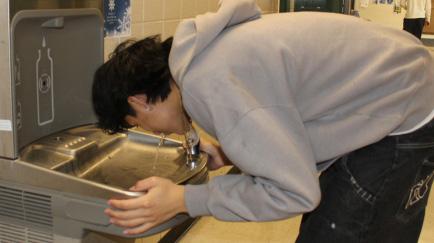
Ezra Fajardo (So.) drinking out of the ‘new’ water fountains.
photo by Andrew Cottle
The Edge of the Algorithm
Lizzy Cantwell page editor
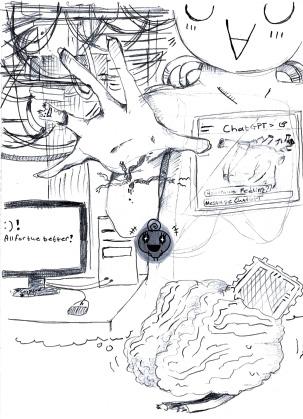
Artificial intelligence, the future and possibly the death of the society we know today. We’ve all heard about movies like “The Matrix,” where machines enslave humanity in a simulated reality, and originally no one thought it was possible, but how could it not be, with AI learning everything there is to know about humanity with the searches we put into it everyday? And at what point does the advancement of AI stop? With the rapidly increasing use of AI in recent years, according to AI tool Google Gemini, approximately 179 million Americans actively use AI tools. But the question remains, is artificial intelligence really more intelligent than humans and at what point will AI begin to take over the life we live everyday? Each person in the U.S. uses AI for different purposes. Some are influenced into using AI with basic searches on Google which often use Google Gemini, while others purposely use platforms like Sora AI and Chat GPT for anything they wish to create.
Civics and literature teacher Pylaar Solomon uses AI for mostly web searches on Google and creating writing prompts for students. Solomon has recently seen the use of AI increase among students. “I’ve seen a lot of students copy and pasting from AI, but something that I didn’t think was gonna happen…is [that] I’ve also seen a lot of students really hesitant to use AI, even with citations. That it is a proper use of AI,” Solomon said.
Technology teacher Mr. Bova expressed his concerns with the development of AI in our society: “I don’t know if there is any way for us to go back to the way it was because we’ve been introduced to this and we see the benefits of it.” Bova said that the use of AI can be both
beneficial and detrimental, especially to the younger generations. On one hand, it’s a great starting point to get students started. On the other hand, AI chatbots have become more popular in recent years. Mr. Bova expressed this as one of his primary concerns. AI chatbots like ChatGPT and Google Gemini are most commonly used for fast and simple responses for a challenging question, making it way easier to ask a question to a robot instead of talking to real people. But a new development has recently become popular; apps like Character AI have gained a greater platform of users. Unlike ChatGPT, Character AI functions as a website for automating conversations in a text style way, guiding users and even influencing decisions. Bova said, “People that are far too dependent, people that are building relationships with their AI, that concerns me.” According to demandsage.com, 20 million people worldwide actively use Character AI with the majority being young adults ages 18-24, who make up over half of the users.
Sophomore Liam Schmidt is a current student of Intro to Robotics. Schmidt referenced how not only is AI destructive for people’s ability to think for themselves, but it is also very destructive to the environment. AI involves a lot of energy consumption leading to high greenhouse gas emissions and significant water usage for cooling down the data centers, keeping them from overheating. Sora AI, a popular app for creating AI videos, with approximately 750,000 daily users, requires over four liters of water for a video as short as ten seconds (this is an estimate). This severely impacts ecosystems, with water constantly evaporating and being contaminated. Another concern of Schmidt is the advancement of how far AI has come. Schmidt said, “Someday, I believe it will even be able to write other AI codes.” Maybe someday AI won’t need humans at all.
Academic Showdown: AP vs. IHS
Sarah Palmer & Carmen Uria-Carrillo staff writers
Sheldon offers two amazing and wonderful programs, IHS and Honors, but one question still remains: which is better? IHS sophomore Sarah Sessions said, “Having so many perspectives mixed into IHS is a big advantage to our learning.” Sessions also added, “Students in IHS work together better, because they choose to join the program.”
IHS sophomore Melissa Roblero Gamboa and junior Annalisa Hisamotto agree that IHS offers students so many more opportunities, including learning about our world, and not just our country, as well as how IHS helps prepare you for college or your future careers.
Honors/AP senior Vieira Miller said, “The best benefits are taking the AP exam to earn college credits, which allows you to skip some classes in your first year of college and helps you get into your major college program faster.” Honors/AP sophomore Sunny Smith has recently switched from IHS to honors because of its more focused classwork, although the amount of homework and the lack of help
during it are struggles for them. Overall, IHS and Honors/AP are not that different, with everyone stating that they heavily appreciate their program for the challenge and for the college benefits. Non-IHS or Honors/AP sophomore Emma Hogue said, “IHS is great, and so is Honors, but I wanted to focus more on sports, so the regular high school curriculum is the best one for me.” Whether you choose Honors/AP, IHS, or neither, Sheldon is a great school that offers so many opportunities in academics.






graphics by Lizzy Cantwell
graphic by Basil Avila
Diving In: Swim Athletes and their Dedication
Callie Clark staff writer
At Sheldon High School, the swim team is made up of dedicated athletes who show up every day after school ready to work hard. Hallie Walker, a senior team captain, has been swimming since third grade. She specializes in the 100-meter butterfly and 100-meter backstroke, with a focus on improving her times this season. Even when training can be hard, Walker values the team environment the most. “We’re really close and have lots of inside jokes,” Walker said. Being a captain has allowed her to support her teammates and help keep practices positive.
Fellow senior and captain Christian Bonham joined the swim team in his freshman year after his friends convinced him to do it. He swims the 100-meter freestyle and 200-meter individual medley (IM) and hopes to earn more PRs and place high at districts this year. Bonham sees himself as someone teammates can rely on, “I like to think of myself as a friend to everyone on the team.”
Balancing swim with a full IB schedule has been stressful, but senior team captain Nina Ito-Gross believes if you enjoy a sport, you should do it: “If you enjoy it, you’ll do better.” Ito-Gross started swimming in third grade because she loved the water. She likes to swim the 100-meter butterfly and 200-meter IM, and she’s currently working towards breaking one minute in the 100-meter butterfly.
Senior Ethan Brock thinks people often underestimate the sport. “It’s harder than people think and takes a lot more time than people realize,” said Brock. Brock has been swimming since fifth grade, but began taking the sport
Working Hard for Basketball Season
Ezra Fajardo staff writer
As the buzzer goes off we understand more about this year’s boys’ basketball team; players are also learning more about themselves and their teammates with every game. From close wins to tough stretches, the team is starting to understand how important effort and teamwork really are.
Freshman Sam Cutler said he’s been working mostly on his shooting and also his post defense. He remembers a game last year against Woodburn in which the team went on a 10–2 run with a few threes and layups and won a game they thought they were going to lose. Cutler said, “Practice helps me stay ready for pressure moments.” He also said some teammates give him confidence when they tell him to keep shooting, and that the team is resilient and always believes.
Freshman Peeter Seilo said he’s been focusing on
more seriously during his freshman year. He specializes in the 100-meter backstroke, an event he enjoys because it is very technique-focused. This season, Brock’s main goal has been to be a good leader and help keep a positive team environment.
The Sheldon swim team is about more than just times and races. For these seniors, swimming has been a place to grow, connect, and finish high school while surrounding themselves with teammates who feel more like friends.
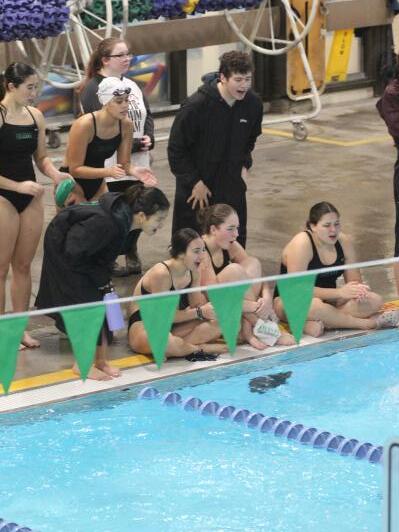
(L to R) Nina Ito-Gross (Sr.), Hallie Walker (Sr.), Cassandra Yeung (Sr.), Ethan Brock (Sr.), Carmen Uria (Jr.), Sarah Palmer (So.), Maya Norris (So.) cheer for their fellow teammate.

Maddox Walker (Sr.) pushes off the wall, starting his backstroke race.
improving his vision on the court, which he said “takes time and experience.” Seilo said, “Music and trusting my teammates helps me stay calm.” Seilo also said that Jameson Bevard has helped him because Bevard stays positive. He added that the team learned how to stick together during tough moments.
Junior Max Cooper said he’s been trying to get faster to help on defense and make plays for teammates. Cooper said, “Listening to music and focusing helps me in pressure situations” and that the team will improve as they continue to play more as a group.
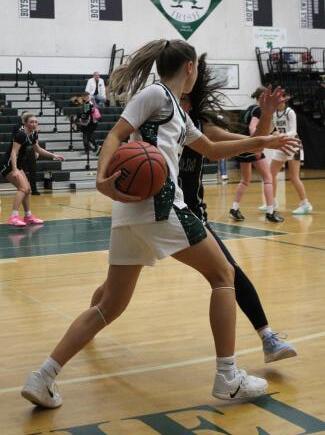
photos by Claire Craig
Scout Burrell (So.) about to make a move on the court.
Sheldon’s Cheer Team Prepares to Compete
the Talisman Claire Green staff writer
Senior cheer captain Lola Peterson, has her insights on the season and the team’s preparation for state. Peterson spoke about injuries that happen during practice for state, and how the team responds if they happen.“If somebody gets injured, we always have alternates… so, we’ll have someone come in who learns all the material, that will come in and know.” Not everyone who is on the competition team performs in the state tournament so it is important to have extra people in case of an emergency.
Peterson also voiced how her experience has helped get rid of nerves before the tournament. “I don’t really get nervous anymore, ‘cause I’ve been here for a long time… those nerves are kind of gone.”
Sophomore Lucy Zavin discussed her practice times
before state and how long the team spends each week together, “Our competition practices and season starts, like right after football season ends… from November until February, over prepping and cleaning it.” Cheerleading is a year-round sport, so the team has four months of practice strictly for the state tournament.
Zavin explained practice time and how that plays into working on the team’s routine. “Each practice is usually from 4:00 to 6:00 and we practice Tuesdays and Thursdays… so we spend about four hours a week on the routine.”
English teacher and head cheer coach, Shiloh Jackson said, “We actually hire a choreographer and I work alongside her. She choreographs like 95% of it and then

Putting In Extra Winter Work
Aiden Kennedy staff writer
Winter sports require dedication, especially when training continues through the colder months. At Sheldon, winter track athletes push themselves physically and mentally to stay prepared for upcoming seasons. Sophomore Sianna Lane said she chose winter track because it leads directly into spring track, helping her stay conditioned all year round. During her off season, she keeps herself active by going on regular runs and working out at the gym. Her runs range from three to five miles, which keeps her endurance up.
According to Lane, the most challenging part of winter track is mental. “Running hurts,” Lane said, explaining that staying motivated during long workouts can be
we kind of work with each other to make sure it’s working for the team.” When rehearsing, it is key to make sure the routine is functional for everyone and proceeds well. The state tournament this year is taking place at Oregon City High School. However, in past years it has been held at a large pavilion in downtown Portland. Jackson misses when it was held downtown: “I think State is a lot of fun because it’s our state championship, but I will also say that it doesn’t feel as special…because it’s held at a high school, where regular competitions are, Pre season competitions are all held at high schools except for one.” When held at the pavilion the tournament feels more significant versus when it is held at a high school because then it feels like every other competition.
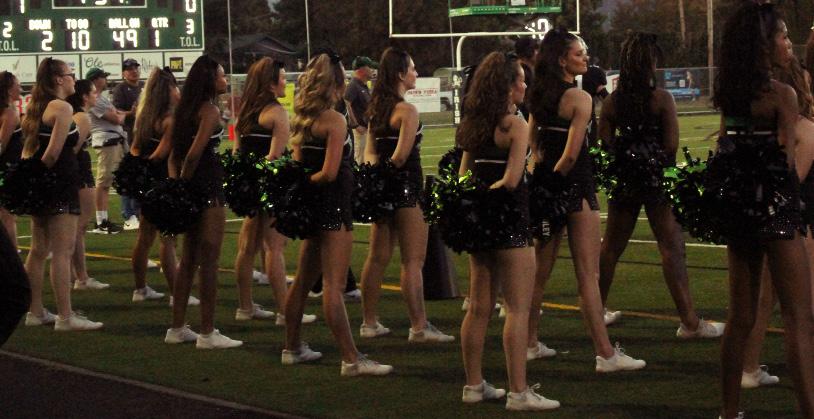
The cheer team stands at attention on the sidelines during FNL.
Gwen Seilo (Sr.) about to make a play.
difficult. To prepare for meets, Lane trusts the work she put in during practice.
Beyond training and competition, a major part of participating in sports is managing the cost of gear, travel, and other expenses. Lane shared that she is grateful for her parents’ support. “I’m very grateful that my parents are supporting me with everything,” Lane said, acknowledging how important that support is in allowing her to compete.
While winter track is filled with discipline and individual training, other winter sports have a similar training regiment. Sophomore Jazzy Washington, who participates in Sheldon dance during the winter season, described how being part of a team brings a different kind of challenge. Washington explained that joining dance helped keep her active throughout the colder months, largely because of the support from others around her. “Doing a team sport is a lot harder than doing an individual sport because you have to work together.” Washington said.
Although coordination with others can be difficult, Washington believes it also makes the experience more

rewarding. After practices and performances that don’t go as planned, Washington and her teammates focus on recovering by stretching, relaxing or taking time to rest. This balance of effort and recovery helps the team stay focused and prepared as the season continues.
Another winter athlete, junior Sophie Galindo, participates in club soccer during the winter months. She has been involved in soccer since kindergarten and continues to play because of family motivation. “My dad mostly keeps me locked in,” Galindo said, explaining that his encouragement pushes her to work hard. Although she does not train heavily in the off season, Galindo said she tries to stay active with occasional runs. For students starting a new sport, Galindo emphasizes the importance of connection. “Make sure to have friends,” noting that teamwork and friendship makes the experience more enjoyable.
Across all winter sports, students face different challenges but share a common commitment. Whether training alone, performing as a team, or balancing school and athletics, these athletes show that winter sports require resilience, support and dedication throughout the season.
photos by Claire Craig
AJ Stefely (Sr.) swimming breaststroke.
How Does One Define Art?
Claire Craig editor-in-chief
Art can be many things; the definition is so debated that there isn’t one simple way to define it. Encompassing created pieces, naturally occurring patterns, or whatever you may find beautiful, art is all around if you want it to be. “I think everyone makes art already in their own way,” senior CJ Jones said; “There’s an art in music and dancing… people are making art all the time.” Art can be change: the renewal you undergo after failure, the return of flowers after a particularly vicious winter, or inspirations that strike after a good laugh with a friend. Emphasizing sweet moments in times of monotony can help focus your mind towards becoming a better artist. Art teacher, Peter Saraceno commented, “Sometimes seeing something that’s beautiful will also keep you in the moment.”
Often an artist may hear, ‘I can barely draw a stick figure!’ but the truth is that you don’t need to be a master at sketching to say you’re an artist. There’s no qualifying test, interview, or box you need to check. Art and one’s inspiration for it can come from anywhere, making it a very accessible community to join. “I think people should make art; no matter if you’re a good artist or not, it doesn’t really matter,” junior Robbie Hittenberger added.
Find Community in Art Clubs
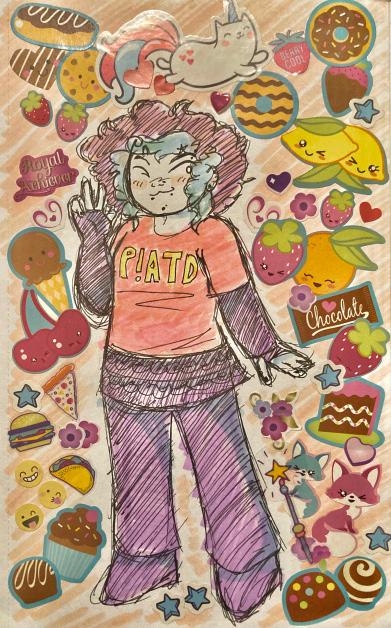
As an artist, Jones said he gets, “A sense of accomplishment,” out of art, “[it’s] a good way to get out your anxieties or emotions… It doesn’t have to be on purpose.” It can be a fulfilling endeavor as well as an outlet for personal expression. Jones has made illustrated advertisement posters for Sheldon’s Theater productions, digital art, 3D wood sculptures, and paintings. He’s currently continuing to work on a painting previous seniors left uncompleted, spending time on it with friends during their free period in the morning.
If you feel that your skills don’t reflect the effort you want to put into creating something, the best advice is just to practice. “Art could be for someone that doesn’t have much experience with it,” he said. Your work won’t be perfect right away, it probably will never be ‘perfect.’ It
January
by Emily King
may not even come out right in the first sketch or round of creating, but that doesn’t mean quit when your art is ugly or sub-par. Keep working towards your goal until you can make your vision tangible.
He believes, “[Art is] such a complex thing. It could be a discipline like learning a language, it could be a way for someone to communicate or express an idea, in ways that are sometimes more full than written words.”
Good art to one person might be complete trash to another. Don’t despair. Personal values impacting taste and values of what is beautiful vary from person to person. When you feel discouraged about making art, try to not focus on outward critique; most importantly you should be proud of what you make. “It’s a good day if I’m able to draw,” Hittenberger said. Whether you craft gifts for your friends, doodle on boring assignments, or create big murals, your art matters! Keep making things. Creativity is a virtue, so utilize it!
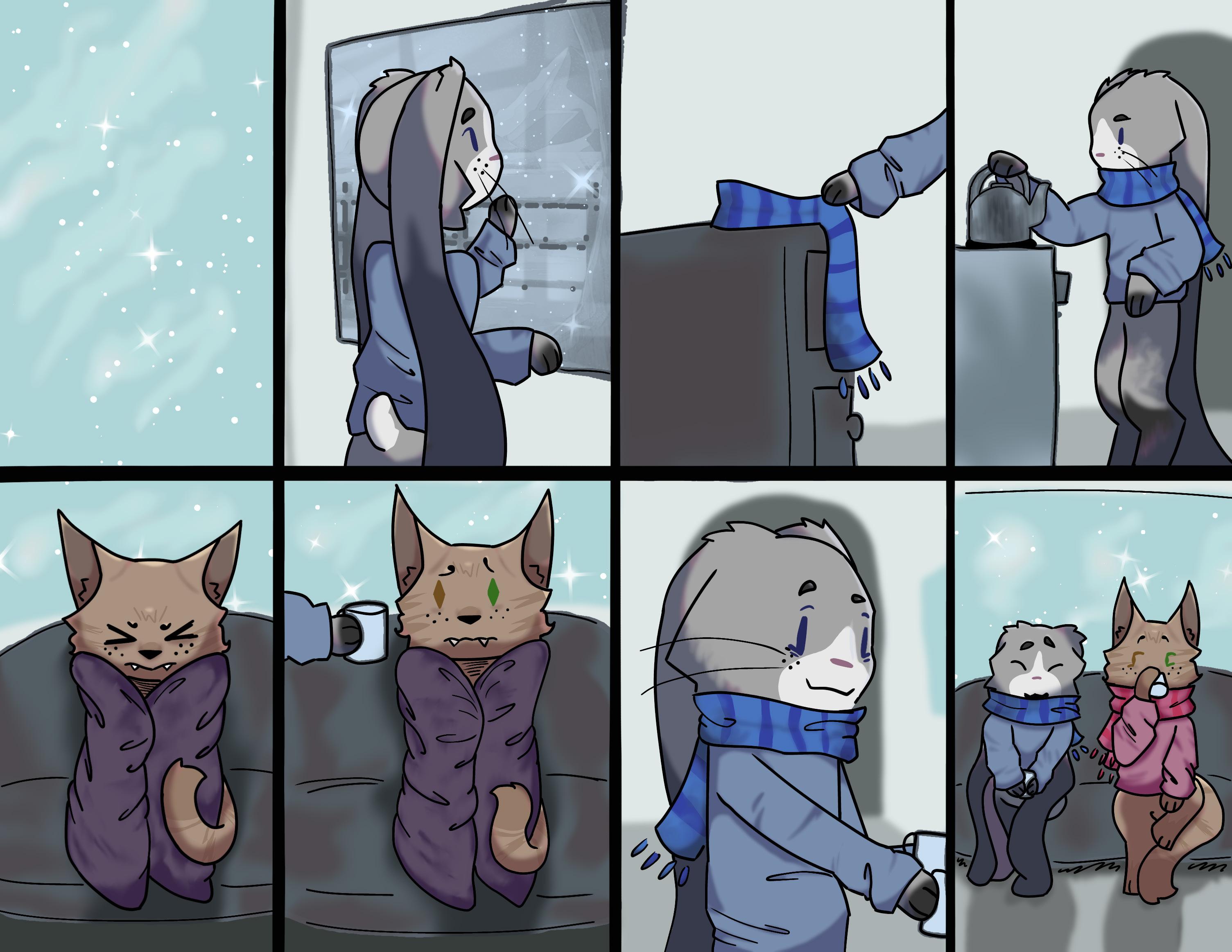
Art clubs provide students a break from school and a chance to express themselves. letting everyone explore their ideas in a supportive space. For example, Improv is a club that meets every wednesday during lunch. where students play improvisation games and act. Junior Emilo Florendo, president of the Improv Club, said, “The difference between regular theater and improv is that regular theater is scripted, so you don’t really have to think about what you’re doing too much as long as you know your lines and know where you’re supposed to stand. Improv has nothing scripted; it’s just from the heart.” Many students are drawn to the club because of the games. “People really like to just go up and mess around with their friends. You’re making stuff up, being funny, being yourself with people you enjoy,” Florendo said.
Art Club meets every Thursday for students to collaborate and share their work. Sophomore Sunny Smith, president of Art Club, said, “It boosts mood for a lot of people. It is a creative outlet, which I think a lot of people aspire for and enjoy.” Throughout
the year, the club dives into creative projects and games. The students in The club enjoy sharing their art and seeing others’ creative work.
Rock Band Club offers students a chance to collaborate musically and connect through a shared love of music. The club creates an environment where students can play instruments, experiment with sound and make music together without the pressure of a class. According to the club’s advisor, English teacher Mr. Lawton, “It affects people just because you can kind of meet some kids you wouldn’t normally meet. And so I think that’s just, that’s really valuable. I feel like being able to get with other people and do creative things and make something together.”
Overall, all these art-based clubs, Improv Club, Art Club, and Rock Band Club offer students creative ways in which one can unwind, connect with other students, and express themselves out of the classroom.
illustration by Robbie Hittenberger
Chloe Crook staff writer
Vaping And It’s Affects On The Developing Body
Maxwell Berry page editor
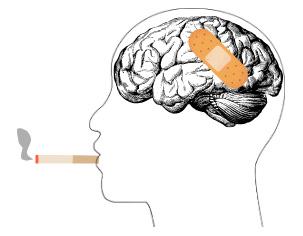
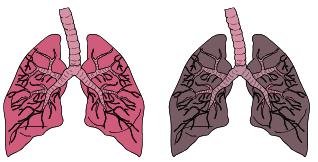
Vaping and smoking are extremely popular among young people from the ages of 13 and up. How is vaping affecting Sheldon students? Do students understand the physical implications of vaping or smoking? “I vape… I think that it’s really bad for your lungs.” So students know that smoking and vaping is bad for them and their lungs but what about students’ brains?

The World Health Organization and the National Institute of Health talk about how young people using nicotine can affect many parts of teens’ neurological systems. The hippocampus, which controls things like memory and things like contextual information and some types of learning, is deeply affected by early nicotine use. “You can get lung damage,” said a second anonymous source. According to the American Lung Association, smoking is the #1 preventable cause of death in the United States. Smoking is the cause of 90% of lung cancer. At least 69 chemicals in cigarettes (and many in vapes as well) are known to cause cancer.
For an example of the first time vaping occurred in one young person, a third anonymous source said “I was in the bathroom… an eighth grader walked up to me and was like, do you want to hit those? And so I said, sure. And then I kind of became like friendly with them, not really friends. And so I would kind of skip class a lot, be in the bathroom, hang out with them, vape through it.” This shows the communal aspect of vaping and how a person can be influenced by who they are with. The way that you surround yourself shapes you. This is a major factor in who you are and what you partake in.
Students, Politics, and Social Media At Sheldon
Khaya Ainis-Michael page editor
The news is a valuable resource. It can tell about the past and predict the future. Over centuries of human history, the news has been a constant way to learn about current events. With the relatively recent invention of social media and the increased availability of news outlets to the general public, one would think that society would be the most informed that it has ever been. But is that necessarily true?
AP History teacher Brian Brancato is concerned about people having too much exposure to the news. “[The news] is over-consumed, and it’s information that’s passing [by] that people just kind of breeze by because of its availability,” said Brancato. When something is too convenient, it becomes monotonous, and Brancato is worried that the news is turning into background noise. Increased availability of the news has also created way more avenues to get information. While this can be a useful way to learn more opinions, it can also be unreliable. Mary Ellen Youngblood, Government, Civics, and Law Studies teacher, has her concerns about this influx of opin-
ions. “We have become so ignorant and don’t care about actual facts that [we] are so easily swayed now, and every single time you click on something, you get more and more reinforcements of your same opinion instead of seeing other people’s opinions,” said Youngblood; “you have to actually seek out other information.” These additional steps to getting accurate information can seem like too much to some people, who will forgo any sort of research and will instead take the source at face value. However, many times, the source they are getting their information from can have a heavy bias.
This dominance of “news media” (news that takes bits and pieces of things that are factual and add in their own bias in attempts to persuade people to their point of view) has shifted the way that news is perceived. “In the olden days it was actual news and their job was to present the truth and facts, and now… it doesn’t do that anymore, and that’s why you need to go to real actual news sources and not news media,” said Youngblood. Some examples of news sources are AP News, the BBC, and Reuters, all of which aim to provide nonpartisan reporting.
But reading through articles is so much more work than watching a TikTok, so many facts become discounted or
inflamed by political opinions. “People receive their information through small clips, and they get so bombarded with it that it makes it easy for them to be misinformed or misled,” said Brancato; “if you don’t stop and take the time to research information, which is a burden… all [news outlets] are looking for is their bottom line, which is clicks and people checking their information.” He finds that the best ways to research a source is to check the author and consider its political leanings, as well as checking other sources to see if they’re reporting the same thing. While news consumption has in some ways never been easier, it has also gotten a lot less authentic. Research is now left to the consumer, and making it an option instead of a standard has turned many away from it altogether. “[All students] take government and civics, but I wish that they all paid attention to it,” said Youngblood. Classes like this provide the groundwork for understanding current events; context is the most important tool when examining history and politics. Without doing research and actually committing to learning about the things happening around them, people are lacking a significant amount of information regarding events. January 29, 2026

A portable vaporizer on display.
graphics and photo by Maxwell Berry
The Sheldon Civics club.
photo by Claire Craig
Can You Believe It?
Superstitions: What if luck listens?
Fateen Anto page editor
Many people believe in superstitions, even when there is no scientific proof behind them. These beliefs often help people feel calm, confident, or in control, especially during stressful moments. One interesting example comes from a longtime coach Charles Hoffman who has followed the same superstition for over forty years. He believes that washing his game socks during a winning streak brings bad luck. When his team is winning, he only wears the same pair of socks on game days and refuses to wash them until the streak ends. He started doing this after noticing that sticking to the same routine seemed to lead to success. Over the years, his teams have won multiple national championships, which has only strengthened his belief. At first, some people laugh when they hear about his superstition. However, when they see how successful his teams continue to be, they stop questioning it. This shows how superstitions, even small or unusual ones, can become very meaningful and powerful to the people who believe in them. Similarly, superstitions often guide people’s behavior in ordinary daily life. In an interview, one individual spoke about a person named Ayaan Rahman, who strongly believes that talking about plans too early brings bad luck. The interviewee, however, does not personally share this belief. According to the interviewee, Ayaan developed this superstition after several occasions when plans he openly shared unexpectedly fell apart. Since then, he avoids announcing goals or future events until they actually happen, believing that keeping plans private protects them from being “jinxed” by negative energy or outside interference. On one occasion, when Ayaan ignored this belief and discussed an upcoming opportunity, the plan was suddenly canceled, which further strengthened his superstition. Although he understands that these outcomes may be coincidences, the belief remains meaningful because it provides emotional security. Some people see this habit as pointless, yet others admit they follow similar practices
themselves—often without even realizing it. Like the coach who refuses to wash his lucky socks during a winning streak, this example shows how superstitions can give people a sense of control in uncertain situations. Another example of superstition comes from an interview with a woman named Tasfia Jahan Maisha, who works in healthcare. She believes that leaving her house without double-checking certain things—like the door lock or the stove—creates a sense of unease that follows her throughout the day. This belief formed after several mornings when she left home feeling unsure and found herself constantly distracted at work, replaying the moment in her head. Since then, she has developed a fixed routine before leaving the house, checking the same items in the same order. Tasfia knows this habit does not actually control what happens while she is


gone, but it helps her feel settled and focused. Some people might see this behavior as unnecessary or obsessive, yet for her, it provides reassurance and a sense of control in an unpredictable world.
Whether it’s a coach’s lucky socks, keeping plans private, or double-checking the stove and door locks, these superstitions reveal how people cope with uncertainty and find a sense of control in an unpredictable world. While such habits may seem unusual or even unnecessary to outsiders, they provide emotional comfort, reduce stress, and create a feeling of stability. In this way, superstitions are more than quirky routines—they are meaningful rituals that help people navigate challenges and bring confidence and reassurance to everyday life.


Think. Speak. Debate Team.
Josiah Peterson staff writer
Have you ever had a topic on your mind, one that you wish you could share with more than just your friends? Or perhaps, would like to make a case for a topic you’re passionate about? Don’t fret, for there is a club just for you, The Sheldon Debate Team! They meet in room B20 on Mondays after school. Go and hang out with fellow classmates and debate various topics. But, what are the specifics? What things should I think about before arriving at the Debate Team meeting? What are the guidelines to a successful debate? Don’t worry, here are some things you
should know before arriving.


Sheldon social studies and Debate Team advisor Timothy Neeno said “We encourage people to take a stand, back it up with evidence, be able to defend and argue with the debate. You don’t need to be a good speaker, but being able to bring up a controversial topic will help things run smoothly.”
The Debate team debates several controversial topics, but there are ways that topics can cause issues amongst classmates. Sheldon social studies teacher Kevin Summerfield said, “Do not talk about the person, debate the issue, because it’s not always about the person. It’s about the issue, it’s about proving your perspective.” Summerfield also said, “I would create a poster that has something controversial on it that grabs someone’s attention, and they can come there and debate about it. Then you can be able to teach them how to debate.”

graphic by Fateen Anzum Anto
graphic by Andrew Cottle
2 Sports 2 Furious: Redoing the Sports League
Addy Zauner staff writer
High school sports conferences in Oregon are beginning to shift once again for the first time in a decade, and schools in the Eugene area are at the center of these changes. According to Sheldon High School Athletic Director Mr. Mitchell, the proposal for a Metro-style Hybrid league was approved on December 15, and it would create a hybrid 5A/6A conference including Sheldon, South Eugene, Thurston, Springfield, Churchill, North Eugene, and Willamette. Willamette is also moving back down to 5A. It made the only hybrid league in the state, similar to the Midwestern League structure that existed around 2008–2010. Mr. Mitchell believes this change would help address a major issue with the current setup, explaining, “I think it is competitively balanced, but I think it is harmful to our athletes and parents,” mainly because “It is too big geographically to support.” Long travel distances have been a challenge for families, athletes, and school budgets, making it a priority for the Oregon School Activities Association (OSAA). After freshman Nia Tuioti’s first year on varsity for volleyball
she experienced how hard the travel and long nights are, “I’m really excited to travel less!” The geographic range of some conferences is not only a logistical problem but also an economic one, as students and families from lowerincome areas are often affected by the financial aspect of travel.
Teacher and football and track coach Les Philipo is concerned with the way that they determine a school’s count of students. With some students not being counted as a full person if they are a “free and reduced” student. OSAA and schools in the 4J district have acknowledged that they need to better support students by reducing travel distances to make sports more accessible to everyone, and that they need to reduce the amount of days of school missed with the long nights as well. Some people question the competitive balance of the proposed new league, but Mr. Mitchell does not believe it would allow any one school to dominate. He explained that football would remain in a separate conference, continuing to play the same opponents to help maintain fairness across programs. While larger schools may still have an advantage in certain sports, “Schools that are larger tend to have the advantage,” Mitchelle noted, would better serve student athletes as a whole.
Leading Us Toward Winter Formal
Wudi Auld page editor
Georgia Berry, a junior who’s a contributing figure in the Leadership committee, expressed how she felt about the Winter Formal. Seniors are in charge of planning this year and Berry believes leadership should’ve advertised the dance at the same standard as for homecoming and prom. Berry said “I think homecoming and prom at our school are kind of overlooked.” She has only gone to Winter formal her sophomore year, missing her freshmen year due to being sick, Berry’s thoughts on the venue were that the cafeteria was an awkward area and referenced how
her freshmen year the dance had been hosted it in the gym, which thinks was a good choice because of the weather conditions and overall space. “So I would say keeping it inside due to weather and keeping it in a smaller, more contained area makes it feel more full of people,” Berry said. However, converting back to working to better the advertisement, in hopes people might come and warrant using the gym.
Dani Mosley, a sophomore who loves school events, had gone to her freshmen year Winter Formal and only had two complaints. Out of the four dances she had been to, she only noted one DJ actually was good. “I remember the DJ had an issue with hyping up the crowd… He repeated multiple songs,” said Mosley. She raised the same
Financial pressure is another major factor pushing the change. The district has requested a 10% reduction in athletic budgets, which makes it all the more important to streamline travel costs and increase local attendance at games. It could lead to more local rivalries and better opportunities for Sheldon athletics to generate revenue. But beyond financial concerns, it’s also about ensuring that every student, regardless of economic standing, has the same opportunities to participate and succeed, without being held back by factors outside of their control.


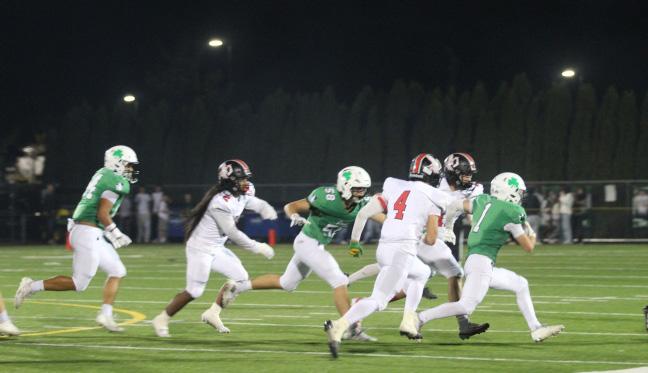
above: Cameron Thomas (Jr.) runs with the football.
left: Sheldon competes against North Salem during FNL.
climate problem as Berry: “Because it was cold outside, I kept getting cold sweats in the middle, and it was just uncomfortable.” However, she appreciated the warmth the cafeteria had compared to the courtyard.
Day’Naya Casey, a senior who is a very school-spirited student, raised the same problems as many others: the music selection could have been better. “They played a lot of one artist, and the requests were not working,” Casey said. She believes attending is more for the experience than the actual enjoyment, doing it simply to say she went. She won homecoming queen last year, but the thought of having Ice King and Queen concerned her. “I mean I won but it caused some conflict. People were mad about the way I went about getting the votes,” Casey said.
photos by Claire Craig
Run by students, for students.
Frontpage editor................................Claire
Interpersonal
What’s
Wallet’s
Academic
Staff Writers:
Isadora
Andrew
Callie
Chloe
Isabella
Ezra
Geeked
Take
Backpage
Josiah
Ronan
Carmen
Addy
Kennedy

Andrew Cottle
Maxwell Berry
Lizzy Cantwell