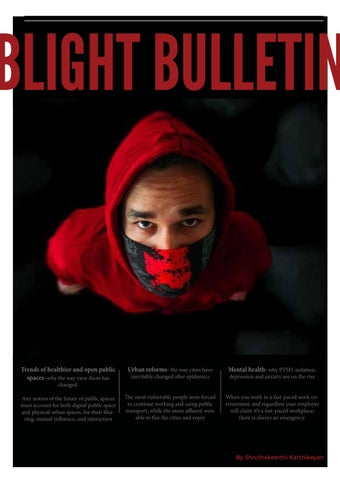
BLIGHT BULLETIN
Trends of healthier and open public spaces- why the way view them has
Urban reforms- the way cities have
Mental health- why PTSD, isolation,
Any notion of the future of public spaces must account for both digital public space and physical urban spaces, for their blurring, mutual influence, and interaction
The most vulnerable people were forced to continue working and using public transport, while the more affluent were able to flee the cities and enjoy
When you work in a fast-paced work environment, and regardless your employer will claim it’s a fast-paced workplace; there is always an emergency.
inevitably changed after epidemics
depression and anxiety are on the rise
changed.
By Shruthakeerthi Karthikeyan
By: Shruthakeerthi Karthikeyan
URBAN REFORMS
It may be cliché to say that diamonds only form under intense pressure. But the world around has proven that the most lasting changes have occurred after a time of crisis. The pressure doesn’t however create the diamond in this metaphor. It simply brings forth the major flaws in our existing system. Things we are used to excusing with the reason “if it isn’t broken-”. The pressure causes fissures that we were ignoring to become inexorable thus forcing us
to confront the changes we need to make. This has been proven time and again with major historical events (As shown in the timeline). The requirement of modern sewage and sanitation was realised through the malaria outbreak of the 18th century. The Spanish flu influenced better land use distribution and slum management. Likewise, the COVID-19 pandemic is going to be influencing some major urban reforms worldwide. It does take some time to get to the point of thinking about the bigger picture though since the immediate problem of any public health crisis is not to better the environment, but damage-control. Once the mortality rate goes down, the virus stops mutating and finding new ways to kill, the unemployment crisis is managed, then we can finally focus on systemic changes that needs to be enforced in the long run. However, a lot of the planning has already started for implementing these urban scale changes to be better equipped to handle future situations. UN Habitat, WHO and several other organisations have proposed urban reforms some of which are as follows. Water Sensitive Urban Planning The water-cycle in urban environments is artificially created to sustain a populace that is constantly growing. With urban sprawl and the ever-growing population, for the environment to be able to retain a water system, natural water-cycles need to be reintroduced into urban environments. The focus of this revival can be done with focus on public open spacesboth by creating water bodies in such places and introducing open recreational spaces around natural
water bodies. Additionally, surface runoffs and flooding need to be managed in Indian cities, as addressed by Suresh Kumar Rohilla, senior director at Centre for Science and Environment. Water sensitive areas need to be created at all scales, starting with the individual working up to institutional levels, neighbourhood, and city. 15 Minute Cities This is a concept that is gaining traction in planning communities though the definition of it changes depending on who you ask. The core of the idea though is the idea of creating an ideal geography with access to all essential amenities within 15 minutes of travel. The means of transportation then defines the scale being referred. The focus should however be placed on walking and biking. Most urban environments are designed for bigger automobiles, usually cars. The undoing of that planning requires effort the magnitude of which varies from place to place. However, this concept with also spread out the zoning of cities, as the density of housing required will need to be spread out. Given the current situation though, the three-shed plan of 15-minute cities is most ideal for when movement needs to be kept to a minimal. The three sheds refer to the time and distance travelledfirst being a 5-minute walk, then a 15-minute walk and finally the edges lying at 15 minutes of a bike ride. The quality of walk and transportation alternatives for travels further must also be planned to enrich the productivity of such a concept to ensure it functions as it is meant to.
Under trees, the urban dweller might restore his troubled soul and find the blessing of a creative pause. - Walter Gropius
Pedestrianization Pedestrianization refers to the process of making streets that are exclusively used for walking. Oftentimes the liveability of a city is judged through its pedestrianization and even to date, returning the streets to people instead of vehicles is considered the best way to restore the heart of a city.
mutually beneficial environment for everyone involved. The model is based on the idea of bringing the actors and decision-makers of a problem together to a positive baseline instead of a problem being the core of the decision making.
Focusing on the assets and advantages of an existing community Pedestrianization has cultural, so- and working towards enhancing those facets of their life or makcial, economic, and environment ing that the focus of the people benefits and addresses problems around is the easiest way to imlike congestion, pollution, suburbanization just to name a few. prove a community. It doesn’t This is especially helpful combined require as much capital investment with the efforts of a 15-minute or resources as an entirely new plan would. People, processes, city. The focus of pedestrianizing an area is to improve the overall and places are all assets that can quality of the experience, increase be used. But the identification sociability and provide an environ- needs to happen situationally, ment of safety for all age groups. and changes need to be made on smaller plates. Asset-Based Approach New Social Contracts An asset-based approach has its roots in community development Ultimately though, for any of these and often leads to a healthier and reforms to be implemented and
make significant change, cities need to make a decision. We are at a juncture, and it is futile to expect things to go back to normal without making changes lest we expect history to repeat itself no better prepared than we are now. New social contracts need to be signed with UN and other organisations with better sustainability goals and agenda. To enhance the social protection function of cities, actions are not sufficient at the level of the city alone. National governments will need to promote policies and institutional reforms that enable the fiscal capacity of cities to implement redistributive measures. This means not only rooting out social inequality at its foundation but also improving the overall living conditions of its citizens. Everyone has the right to a healthy and adequate living and policies can make the change wishful thinking cannot.
By: Shruthakeerthi Karthikeyan
MENTAL HEALTH
Isolation is an experience that we aren’t forced to have very often. That, unfortunately, is only one among several stress factors that we have been inevitably experiencing over the past year. Uncertainty for how the future is going to be, fear of what the next call from a loved one is going to hold, and just a sense of complete helplessness- all of this has culminated to form what is possibly the worst mental health period for a lot of us. Mental health is a very taboo topic, especially in India. Not only do we significantly lack awareness of the subject, but we are a community that actively believes that a positive attitude and hard work can change any situation. While that may be the case for some, as a species that is still evolving, we can’t see a human who isn’t at least slightly deranged by either anxiety or grief. Isolation only amplifies these emotions. Especially an isolation that is forced.
The attitude of institutions around the world however doesn’t seem to reflect on this feeling. A society driven by productivity and established systems of economy and survival however means that the humanity of the situation often takes a back seat. We care more about economic downfall and inflations and education than we do about the human condition. We can not change the order of things in a moments notice. It is jarring though how easily ignorable the crisis of emotions is. The biggest problem that accompanied isolation during this pandemic is the adaptation of hustle culture. We are a group that is used to always being on the go. Work harder than everyone, put in more hours, polish your work and be always prompt and alert. This is the benchmark for a successful person as we see it. It’s a benchmark a lot of us try to aim to achieve not just for the respect of others but to view ourselves as wor-
“It (hustle culture) creates the assumption that the only value we have as human beings is our productivity capability — our ability to work, rather than our humanity.” – Aidan Harper
thy as well. The toxicity of hustle culture is not very surprising. The most common impacts are that it lowers productivity, curbs creativity, and leads to a complete burnout at times. But what seems to skip attention that hustle culture is very harmful for our mental health even when you feel like you aren’t hustling at all. The expectation of productivity and output in a time where you aren’t in a position to be able to work in itself leads to a lot of stress which makes it difficult to start work, let alone complete it to a high standard that you are expected to reach. The pandemic has imparted this illusion of free time in our heads. The assumption is that we have more time in our days with the time taken to travel and settle and wait cut out. The chances of this making us feel like we need to ‘do more’ are very high. Hustle culture in itself can lead to a burnout that brings along anxiety, depression and many other uninvited guests into your mind space. The trauma of it being through a pandemic can feel like too much. The good thing though, is that working from home has given a
lot of people the permission, and more importantly the opportunity to break out of this hustle environment. However, it is institutions, not people that lack understanding. They are doing the best they can, which can’t be argued. But there is an intrinsic lack of communication and offer for aid unless specifically asked for, especially emotional ones. Dr. Shaili Jain, a psychiatrist and an author said in an interview that we are all approaching this pandemic and dealing with it with influence by what was experienced before, so definitely people who have trauma can be triggered by a lot of what they are experiencing and witnessing. Research on PTSD after disasters gives insight that there will be elevated rates of PTSD in the weeks, months, and years that follow the pandemic. A few years ago, a degree from an online university held little to no weight in career goals. But with online classes and exams now being the norm with no practical knowledge it makes you wonder how this is a system that is expected to produce the future doctors, engineers, and architects. This
lack of experience is also plaguing many students who are going to finish their education but with nothing more than a piece of paper to show for it. The distress we are suffering is through the roof and it is not easy to ask for help in a community that does not see mental health issues as valid or even real at times. It is exhausting to be isolated because it gives you the time to introspect. Introspection is the best way to grow and learn, but when all you see is a bleak future with loss and pain and the weight of expectations crushing your soul, introspection becomes a wormhole that can’t be escaped. The light at the end of the tunnel may seem to be flickering out. It is important that we acknowledge that what we are experiencing is devastation that will haunt this whole generation. In a time of crisis like this it important to take a step back and understand people. Despite how primitive our insight of psychology is, humanity and compassion need to be the drivers of the future, not productivity and results.
By: Shruthakeerthi Karthikeyan
PUBLIC SPACES
Over the course of these past two years, we as a society have gone through a paranoia that has been so deeply engrained in our brains that we don’t particularly view this fear as legitimate anymore. It is a shocking revelation to have that human bond is as important, if not more, than our need for survival. Though it could be argued that the only reason we are not as afraid of this new age plague is because it is a villain we can’t see. Even those of us who did fear it initially are now just sick of not being able to get back to our normal lives. Needless to say, the way we think, behave and breathe has drastically changed. Our idea of time and space has morphed into this intangible mobius strip- no start or end, just repeating it till we fall off the plane of sanity. The few brief moments of relief that we get from this routine of sitting in front of our screens is when we go out.
neighbourhood and what the lack of it can mean. Globally speaking, the requirement of a healthy and open public space has been brought to the forefront of the urban design faculty. Though we crave a sense of normalcy, which translates to a life before the pandemic for most of us, the ineffable truth is that the future normal is going to be entirely different than what we knew in 2019. A huge part of that is reliant on the psychology of public spaces- how a city works and plays and the combination of the two creating an autonomous microenvironment.
The mobility datasets of cities are largely changing especially in cities like Cali in Colombia, Auckland in New Zealand, and Lima in Peru. A database created by city planner Mike Lydon he calls “shifting cities” documents this information as a reference for future research Being stuck in our homes and hav- and practitioners for how our ing our travel limited to a radius of mobility changed during the times 5km has emphasised the necessity of social distancing. This table refor the improvement of local envi- cords spaces in terms of categories, ronments. It has highlighted what time of day, travel distance, scale, it means to be in a self-contained infrastructure just to name a few.
The aforementioned cities are just more active in their active involvement in expanding their network of non-motor vehicles with additions of cycle lanes and neighbourhood enrichment. Working from home has blurred a lot of boundaries that we created for ourselves. These weren’t boundaries that were actively set, but they existed none the less. When you get up, take a shower and put on your work clothes, you mind is preparing itself for the rest of the day of productivity. Contrast that with waking up in you pjs and being able to join a zoom meeting without having to be completely awake or actively participate, and the difference becomes obvious. Even if you manage to create a routine for maximising your productivity, the activities around you resonate of a different environment. The travel to work, the set-up of any institution is registered in your mind as different from your bed where you go to sleep. Separation of work and home is an oft discussed topic because you lose both your ability to be productive as well as your ability to relax which leads to an endless cycle of lack of output when they aren’t distinct. Thus, it makes sense that indoors gives us a mild sense of claustrophobia now. A lot of the more
developed counties have put their resources on enhancing their public spaces for the very same reason. They essentially provide a reset granted you can still follow the social distancing norms. It needs to be pointed out however, that this trend is largely seen in cities and countries with large landmass and lower population densities. In a country like India though, personal bubbles are a very alien concept. With a population density as high as ours, opening public spaces despite how many rules there are in place, is not going to be an effective social distancing measure. Hence, our strict lockdowns and curfews. Even with those, the window of open time we had only led to a higher concentration of crowds which seems almost worse. Psychology of highly populated countries and their public spaces is one of with large open spaces at their beck and call to be reformed. In May of 2020, Daval Desai wrote a paper discussing the relationship between the pandemic and urban densities where he addresses the sustainability myth of megacities. He argued that though the research shows that the size of the population does not determine the ability of the COVID-19 virus to spread, the data fails to take into account the economic status and
means of survival of this population. High density urban setups are profitable and sustainable due to their economy of scales. It is found that densely populated metropolitan areas have the best public transportation connection, more walking members and more energy efficient infrastructure. But in the pandemic these are the cities whose public health system has crippled the fastest. Additionally with a majority of the Indian workforce working in the informal sector, i.e., with a lack of a stable income the expectation of urban reform is far from our first concern. We do not think about public spaces the same way developed countries do. Public squares and places of worship are also the centre of economy. It didn’t take more than a few months for these places to be opened again. Even at the capacity that they are working with right now, the crowds still don’t seem to be manageable. It seems unlikely that a developing country like ours will be changing the way we view public spaces any time soon. The dreams of personal bubbles are not going to be realised any sooner due to the pandemic. But hopefully, it does lead to a significant change to the way we think about the well being of the population and empowering the economy of India.
By: Shruthakeerthi Karthikeyan
GLOBAL UNITY
Racism, casteism, sexism and civil unrest aren’t unfamiliar concepts. For as long as people have existed, divides have existed. The strongest bond a group of people share is their hatred for another faction, and if there is an ‘us’ and a ‘them’ there is going to exist social disparities. With the pandemic though, we found a common enemy which we could unite against, but instead we are left with a world that has never been more divided.
faced across the world with the then president of United States calling it the ‘Chinese virus’. Is it possible that more open societies are more prone to racism in the face of a virus outbreak? Leshui He and his associates conducted a survey to study the same. They worked with the information that media skewed information and hence aimed the survey at Chinese immigrants and found their hypothesis to be proven true.
Civil unrest has become an inevitability in all major countries of the world. Xenophobia is at an all time high. The statistics of hate crime is skyrocketing, and all of this is happening with a deadly virus that kills without discrimination. This is not a new phenomenon though. All situations that require global unity and universal cooperation paradoxically result in the exact opposite.
That being said though, the proof of us still being a global unit was never more prevalent than in these times. While we saw some of the most brutal social issues we’re facing as a generation, we also saw some of the kindest actions from absolute strangers. When India’s second wave hit, it was global support that earned us the resources that we desperately needed at the time.
It is especially bad with pandemics because though there is a scientific explanation to the mutation and spread of the virus, people look for someone they can blame the situation on. Having a visual enemy makes the war seems manageable. That is probably why xenophobia has become another epidemic of its own within this pandemic. The origins of the virus in Wuhan, China, has made it so much worse for all Asian presenting people which is an unfair burden to carry. The history of xenophobia with diseases isn’t new either. Several diseases were named after their geographical origin before, like Middle East Respiratory Syndrome and Zika virus, till the WHO intervened in 2015 to avoid stigmatization. Not that these efforts helped much with all the discrimination that so many people
There wasn’t a lack of people that were speaking out against racism and flawed systems either. Keeping in step with every protest against mask mandates and vaccines were protests that demanded justice and equality for a fairer world for everyone. Mark Twain once said, “Kindness is a language which the deaf can hear and the blind can see,” and I believe that is the most value we can provide to those around us. Kindness is not easy; it is a choice that requires action. We are used to acknowledging the global reach we all have access to, and its time we behave with the unity that we have worked so hard to achieve and gain. It is amazing to see that a lot of people are at a similar wavelength and made the choice to be a giving person.
Everyone has something that they use to escape from the harsh trials of reality- most common of them being art, media, music, nature. Basically, anything that can create an illusion where you don’t have to be you works. Architecture is a very weighty word for it connect as escapism in our brain though, which is funny considering all other mediums use world building to create a comforting illusion. Architecture may not be the first thing in anyone’s mind when they think about escapism. But architecture was a result of us wanting to take physical control over a world that was unpredictable and cruel. What is that if not ultimate escapism? It has become such an intrinsic part of our life to a point that we don’t view it for the level of control it provides us. Then it is simply up to us to manipulate the environment and create our fantasies once again. In fact, examples of it can be seen around us with sites we visit that we
Outside of theme parks, nature is being transported indoors too with artificial beaches, rainforests and waterfalls flourishing due to engineering feats. The Rosemont hotel and residences are part of a two-tower development being constructed by ZAS Group in Dubai which in addition to a rainforest also has a night club, retail spaces, a shisha café and other luxury spaces. That is not where it ends. With explorations in virtual reality and the use of VR technology becoming common place in architecture, sky is the limit for what you can imagine and experience. Architects are going beyond just allowing their clients to experience spaces though. Research is being conducted for VR to start predicting human behaviours within a given space as well. This could revolutionise the way we think about design. There is no real objection to escapism, except that a lot of escapism, especially that we consider fiction is just a deeper thought into branches of existence near or far. It is hope for a tomorrow that is more bearable. It is a longing for a past that we hope to be able to visit. It is an alternate reality where we get to disconnect from responsibilities for a while. Most of all, escapism is hope that maybe one day we won’t have anything we would need to escape from- and architecture will be a part of it even if you are not actively putting in the forefront of the fantasy.
By: Shruthakeerthi Karthikeyan
Escapism is not just a mere coping mechanism or a diversion though. Escapism is a way of us to think of an ideal world the snippets of which we can then use to make the world a little closer to the fantasy we dream of existing.
make an event or a weekend out of. The Wizarding World of Harry Potter is an escapist fantasy made into reality for all those who wanted to be witches and wizards realised through architecture. Similarly, Disney world is a constructed fiction which creates an immersive escapist experience.
ESCAPISM
William Styron authored a short story collection in 1995 called ‘A Tidewater Morning’ in which he wrote “We each devise our means of escape from the intolerable.” Though the character in the book was talking literally to gain an advantage on his captors, there is truth to that statement in mundanities of life as well. We all seek to run away from what we cannot stand to deal with anymore and we do it through means that suits us best.
“People talk about escapism as if it’s a bad thing... Once you’ve escaped, once you come back, the world is not the same as when you left it. You come back to it with skills, weapons, knowledge you didn’t have before. Then you are better equipped to deal with your current reality.” -Neil Gaiman