1.6.1
INSTITUTIONAL STRUCTURE The Judiciary interprets the Constitution as its final arbiter. It is its duty as mandated by the Constitution, to be its watchdog. (Bhanu,M.P. (2002) ) The Judiciary has a special place in the Constitution. It has a completely independent position, immune to pulls or pressures exerted by other branches of the state, citizens or interest groups. And crucially, independence of the judiciary has been held to be a basic feature of the Constitution. The Indian Judicial system is a federal judicial system. This is a mixed law based system, i.e. based on parliamentary legislature, court laws, customary & religious laws as well, i.e. based on parliamentary legislature, court laws, customary & religious laws as well. The Judicial structure in India is a unified structure.
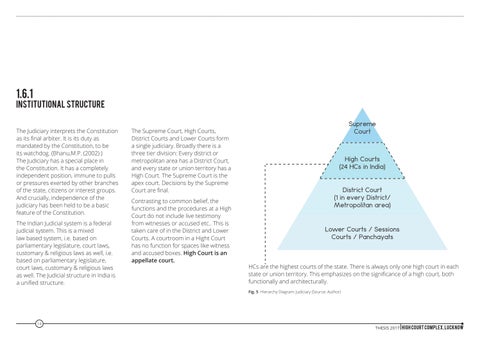
The Supreme Court, High Courts, District Courts and Lower Courts form a single judiciary. Broadly there is a three tier division: Every district or metropolitan area has a District Court, and every state or union territory has a High Court. The Supreme Court is the apex court. Decisions by the Supreme Court are final. Contrasting to common belief, the functions and the procedures at a High Court do not include live testimony from witnesses or accused etc.. This is taken care of in the District and Lower Courts. A courtroom in a Hight Court has no function for spaces like witness and accused boxes. High Court is an appellate court.
Supreme Court
High Courts (24 HCs in India) District Court (1 in every District/ Metropolitan area)
Lower Courts / Sessions Courts / Panchayats
HCs are the highest courts of the state. There is always only one high court in each state or union territory. This emphasizes on the significance of a high court, both functionally and architecturally. Fig. 5 Hierarchy Diagram: Judiciary (Source: Author)
14
THESIS 2017 | HIGH COURT COMPLEX, LUCKNOW