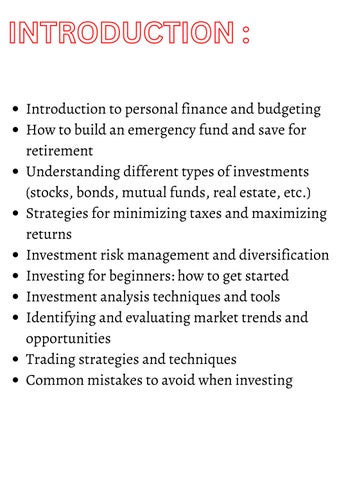
INTRODUCTION : Introduction to personal finance and budgeting How to build an emergency fund and save for retirement Understanding different types of investments (stocks, bonds, mutual funds, real estate, etc.) Strategies for minimizing taxes and maximizing returns Investment risk management and diversification Investing for beginners: how to get started Investment analysis techniques and tools Identifying and evaluating market trends and opportunities Trading strategies and techniques Common mistakes to avoid when investing
Introduction to Personal Finance and Budgeting : Personal finance and budgeting are essential skills for managing your money effectively and achieving your financial goals. In this ebook, we will provide you with an introduction to personal finance and budgeting, covering the following topics: What is personal finance: Personal finance refers to the management of an individual's financial resources, such as income, expenses, and investments. It involves making financial decisions that align with your goals and values. Creating a budget: Creating a budget is the foundation of personal finance. It allows you to track your income and expenses, identify areas where you can cut back, and prioritize your spending. To create a budget, you should first calculate your monthly income and list your fixed expenses (such as rent, utilities, and loan payments). Then, you can allocate the remaining funds to discretionary expenses, such as entertainment and dining out. Understanding your income: Understanding your income is crucial for making sound financial decisions. In addition to your primary source of income, you should also consider other sources, such as side hustles or investment income. You can use this information to identify areas where you can increase your income or reduce expenses.
Managing expenses : Managing your expenses involves identifying and prioritizing your spending. Fixed expenses, such as rent and utilities, are typically non-negotiable. However, discretionary expenses, such as dining out and shopping, can be reduced or eliminated to free up more funds for your financial goals. Debt management : Debt is a common issue for many people, and it can be challenging to manage. Debt management involves developing a plan to pay off debt, such as credit card balances or student loans. Strategies for debt management may include making more than the minimum payment, prioritizing high-interest debt, and consolidating debt. Savings : Saving money is an important part of personal finance. It helps you prepare for unexpected expenses and achieve your longterm financial goals. You can set savings goals, such as an emergency fund or a down payment for a house, and develop a plan to achieve them. Insurance : Insurance is an essential part of personal finance. It protects you from financial losses due to unexpected events, such as a car accident or a medical emergency. Types of insurance may include health insurance, auto insurance, and life insurance.
Retirement planning :
Retirement planning involves developing a plan to achieve your long-term financial goals, such as retiring comfortably. You can save for retirement through employer-sponsored plans, such as a 401(k), or individual retirement accounts (IRAs). Investing :
Investing is a way to grow your wealth over time. There are different types of investments, such as stocks, bonds, and real estate. You can develop an investment strategy that aligns with your goals and risk tolerance. Monitoring your finances :
Monitoring your finances involves regularly tracking your income and expenses and adjusting your budget as needed. You can use financial tools, such as apps or spreadsheets, to make the process easier.
Building an emergency fund and saving for retirement are two important financial goals.
Building an emergency fund
An emergency fund is a savings account that is set aside for unexpected expenses, such as medical bills, car repairs, or job loss. The general recommendation is to save 3 to 6 months of living expenses in an emergency fund. Here are some steps to build an emergency fund: Start by setting a savings goal. Calculate your monthly expenses and multiply that by 3 to 6 months. Create a separate savings account for your emergency fund. Set up automatic transfers from your checking account to your emergency fund savings account each month. Look for ways to reduce your expenses and increase your income to save more money.
Saving for retirement : Saving for retirement is important to ensure that you have enough money to support yourself in your golden years. Here are some steps to save for retirement: Start by setting a retirement savings goal. Estimate how much you will need to save based on your retirement goals and expected expenses. Take advantage of employer-sponsored retirement plans, such as a 401(k), if available. Contribute enough to receive the full employer match. Consider opening an individual retirement account (IRA) to save additional funds for retirement. Choose investments that align with your risk tolerance and investment goals. Increase your contributions over time as you can afford to save more. Remember, building an emergency fund and saving for retirement take time and dedication. By following these steps, you can work towards achieving your financial goals and secure your financial future.
Understanding different types of investments is an important part of personal finance and investing. Stocks : Stocks are shares of ownership in a company. When you buy a stock, you become a shareholder and have a claim on a portion of the company's assets and earnings. Stocks can be bought and sold on stock exchanges, and their prices can fluctuate based on various factors, such as the company's financial performance and overall market conditions. Investing in stocks can offer potential long-term growth, but it also comes with a higher level of risk and volatility. Bonds : Bonds are debt securities issued by companies, governments, or other organizations. When you buy a bond, you are essentially lending money to the issuer, who agrees to pay you back with interest over a specified period of time. Bonds are generally considered less risky than stocks, but they also offer lower potential returns. Mutual funds : A mutual fund is a type of investment vehicle that pools money from multiple investors to purchase a diversified portfolio of stocks, bonds, or other securities. Mutual funds are managed by investment professionals who make decisions on behalf of the investors. Investing in mutual funds can offer diversification, professional management, and access to a broad range of investment options.
Real estate : Real estate investments involve buying and owning physical property, such as a house, apartment, or commercial building, with the aim of generating income through rent or capital gains from appreciation in value. Real estate investments can offer potential income and long-term growth, but they require more active management than other types of investments. Commodities: Commodities are raw materials, such as gold, oil, or agricultural products, that are traded on commodity exchanges. Investing in commodities can offer diversification and a hedge against inflation, but it also comes with high volatility and risk. Cryptocurrencies: Cryptocurrencies are digital assets that use cryptography to secure their transactions and to control the creation of new units. Investing in cryptocurrencies can offer potential returns, but it also comes with high volatility, risk, and uncertainty. It's important to remember that each type of investment has its own unique risks and potential rewards. Before making any investment decisions, it's important to do your research, understand your risk tolerance, and consult with a financial professional.
Managing expenses: How to identify and manage different types of expenses 1. Fixed expenses Fixed expenses are recurring expenses that don't change much from month to month, such as rent, mortgage payments, or car payments. To manage fixed expenses, you can: Review your fixed expenses regularly to make sure you are not overpaying for services. Look for ways to reduce fixed expenses, such as negotiating a lower rent or refinancing your mortgage. 1. Variable expenses Variable expenses are expenses that can fluctuate from month to month, such as groceries, entertainment, or clothing. To manage variable expenses, you can: Create a budget to track your spending and set limits on variable expenses. Look for ways to reduce variable expenses, such as shopping sales, buying in bulk, or cutting back on discretionary spending. 1. Discretionary expenses Discretionary expenses are expenses that are not necessary for daily living, such as eating out, vacations, or hobbies. To manage discretionary expenses, you can: Set a budget for discretionary expenses to avoid overspending. Look for ways to cut back on discretionary expenses, such as choosing cheaper dining options or finding free or low-cost activities.
Unexpected expenses : Unexpected expenses are expenses that can arise unexpectedly, such as medical bills, car repairs, or home repairs. To manage unexpected expenses, you can: Build an emergency fund to cover unexpected expenses. Look for ways to reduce unexpected expenses, such as performing regular maintenance on your home and car or staying healthy through diet and exercise. By identifying and managing different types of expenses, you can take control of your finances and work towards achieving your financial goals. Remember, managing expenses is a continual process, and it requires discipline, planning, and flexibility.
Investment risk management and diversification : Investment Risk Management : Investment risk management involves identifying, assessing, and mitigating the potential risks associated with investing. Some common risks include market volatility, inflation, interest rate fluctuations, and geopolitical events. To manage investment risk, you can: Set clear investment goals and establish a risk tolerance. Diversify your portfolio to spread risk across different types of investments. Monitor your investments regularly and adjust your portfolio as needed to align with your investment goals and risk tolerance.
Diversification: Diversification is a strategy that involves spreading investments across a range of different assets to reduce overall risk. By diversifying your portfolio, you can reduce the impact of any single investment on your overall portfolio. Some ways to diversify your portfolio include: Investing in a mix of stocks, bonds, mutual funds, and other types of investments. Investing across different sectors, such as technology, healthcare, and consumer goods. Investing in different geographies, such as domestic and international markets. It's important to note that diversification does not eliminate the risk of loss, but it can help manage overall risk in your investment portfolio. Additionally, it's important to regularly review and adjust your portfolio to ensure that it continues to align with your investment goals and risk tolerance. Consulting with a financial professional can also be helpful in managing investment risk and diversification.
Investing for beginners: how to get started 1. Set investment goals: Determine your investment objectives, such as retirement, saving for a down payment, or building wealth. This will help guide your investment strategy. 2. Build an emergency fund: Before you start investing, it's important to have an emergency fund to cover unexpected expenses. Aim to save three to six months' worth of expenses. 3. Educate yourself: Learn the basics of investing, including the different types of investments, risk and return, diversification, and asset allocation. Online resources, books, and financial professionals can help. 4. Open an investment account: Choose a brokerage or investment firm to open an investment account. Research different options to find one that meets your needs and budget. 5. Choose your investments: Depending on your investment goals and risk tolerance, choose a mix of investments, such as stocks, bonds, and mutual funds. Consider diversifying across different sectors, geographies, and asset classes.
6. Start investing: Once you've chosen your investments, it's time to start investing. You can contribute regularly to your investment account, or invest a lump sum if you have it. 7. Monitor and adjust: Regularly review your portfolio and adjust your investments as needed to align with your investment goals and risk tolerance. Remember, investing is a long-term strategy, and it's important to stay disciplined and patient. By taking these steps and educating yourself about investing, you can take control of your financial future and work towards achieving your investment goals.
Trading strategies and techniques : 1. Technical Analysis: This involves analyzing market data, such as price charts and volume, to identify trends and patterns. Traders use this information to predict future price movements and make trading decisions. 2. Fundamental Analysis: This involves analyzing economic and financial data, such as earnings reports and economic indicators, to evaluate the health of a company or economy. Traders use this information to make trading decisions based on the underlying fundamentals of the investment. 3. Momentum Trading: This involves buying assets that are trending up and selling assets that are trending down. Traders use this strategy to profit from short-term price movements. 4. Contrarian Trading: This involves buying assets that are trending down and selling assets that are trending up. Traders use this strategy to profit from potential price reversals. 5. Position Trading: This involves taking longer-term positions in assets based on fundamental or technical analysis. Traders use this strategy to profit from longerterm price movements. 6. Swing Trading: This involves holding positions for several days to a few weeks, based on short-term market movements. Traders use this strategy to profit from shortterm price fluctuations. 7. Day Trading: This involves buying and selling assets within the same trading day. Traders use this strategy to profit from small price movements in a short period of time.
Common mistakes to avoid when investing : Not having a clear investment plan: It's important to have a clear investment plan with defined goals, a risk tolerance level, and a diversified portfolio. Not having a plan can lead to impulsive decisions and lack of focus. Not diversifying investments: Diversification is an important risk management tool that helps spread risk across different investments. Failing to diversify can leave a portfolio vulnerable to market fluctuations. Trying to time the market: Trying to predict market movements and time the market can be a risky strategy. Instead, focus on a long-term investment plan and avoid reacting to short-term market volatility. Overreacting to news or events: News and events can have an impact on the markets, but it's important to avoid making rash decisions based on headlines or rumors. Stick to a longterm investment plan and avoid overreacting to short-term news or events. Focusing too much on past performance: Past performance is not always an indicator of future results. It's important to focus on the underlying fundamentals of investments and avoid relying too much on historical performance. Not considering fees and expenses: Fees and expenses can eat into investment returns over time. Be sure to consider the fees and expenses associated with different investments, such as mutual funds or exchange-traded funds, before investing.
Common mistakes to avoid when investing : Investing can be a great way to build wealth and achieve financial goals, but there are several common mistakes that investors should avoid. Here are some of the most common mistakes: Not having a clear investment plan: It's important to have a clear investment plan with defined goals, a risk tolerance level, and a diversified portfolio. Not having a plan can lead to impulsive decisions and lack of focus. Not diversifying investments: Diversification is an important risk management tool that helps spread risk across different investments. Failing to diversify can leave a portfolio vulnerable to market fluctuations. Trying to time the market: Trying to predict market movements and time the market can be a risky strategy. Instead, focus on a long-term investment plan and avoid reacting to short-term market volatility. Overreacting to news or events: News and events can have an impact on the markets, but it's important to avoid making rash decisions based on headlines or rumors. Stick to a longterm investment plan and avoid overreacting to short-term news or events. Focusing too much on past performance: Past performance is not always an indicator of future results. It's important to focus on the underlying fundamentals of investments and avoid relying too much on historical performance. Not considering fees and expenses: Fees and expenses can eat into investment returns over time. Be sure to consider the fees and expenses associated with different investments, such as mutual funds or exchange-traded funds, before investing.
CONCLUSION : In conclusion, personal finance and investing are important topics that can help individuals achieve their financial goals and build wealth over time. Understanding the basics of personal finance, such as budgeting and managing expenses, can help individuals get their finances in order and create a strong foundation for investing. Investing can be complex, but by developing a clear investment plan, diversifying investments, and avoiding common mistakes, investors can work towards achieving their financial goals. Seeking professional advice can also be a valuable resource for those looking to navigate the world of personal finance and investing. By staying informed and taking a proactive approach to their finances, individuals can build a solid financial future for themselves and their families.