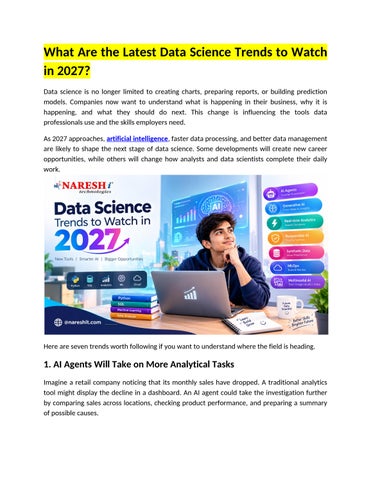
What Are the Latest Data Science Trends to Watch in 2027? Data science is no longer limited to creating charts, preparing reports, or building prediction models. Companies now want to understand what is happening in their business, why it is happening, and what they should do next. This change is influencing the tools data professionals use and the skills employers need. As 2027 approaches, artificial intelligence, faster data processing, and better data management are likely to shape the next stage of data science. Some developments will create new career opportunities, while others will change how analysts and data scientists complete their daily work.
Here are seven trends worth following if you want to understand where the field is heading.
1. AI Agents Will Take on More Analytical Tasks
Imagine a retail company noticing that its monthly sales have dropped. A traditional analytics tool might display the decline in a dashboard. An AI agent could take the investigation further by comparing sales across locations, checking product performance, and preparing a summary of possible causes.
This is the basic idea behind agentic AI. These systems can work through a sequence of tasks instead of simply answering one question. In 2027, more businesses may experiment with AI agents for routine analysis, data investigation, and report preparation. However, important findings still need human verification. An agent can overlook context or draw conclusions from incorrect information. For aspiring data scientists, learning Python, SQL, APIs, and AI evaluation will help build the skills needed to work with these systems.
2. Generative AI Will Become a Regular Work Assistant
Writing code, correcting queries, and explaining unfamiliar datasets can take up a considerable part of a data professional's day. Generative AI tools can help with these activities by suggesting Python code, drafting SQL queries, and explaining technical errors. Suppose an analyst receives a spreadsheet containing thousands of customer orders. An AI assistant might suggest ways to identify repeat customers or calculate average order values. The analyst can then test the suggestions and decide whether the results make business sense. The important distinction is that AI can assist with analysis, but it does not automatically guarantee accurate analysis. Incorrect assumptions, outdated information, and faulty code can produce misleading results. Rather than learning only how to use AI tools, future professionals should understand the concepts behind the answers those tools provide.
3. Businesses Will Need Faster Access to Data
Waiting until the end of the day to discover a problem is not always practical. An online payment company, for example, may need to identify unusual transactions within seconds rather than reviewing them the following morning. This is where real-time analytics becomes useful. It allows information to be processed as it arrives, helping organizations respond to changing conditions more quickly. Retailers can monitor product demand, logistics companies can track deliveries, and manufacturers can identify unexpected changes in machine performance. Data science professionals interested in this area can explore SQL, Python, data pipelines, Apache Kafka, and cloud-based data services. Understanding how information moves between systems is just as important as knowing how to analyze it.
4. Reliable Data Will Matter as Much as Advanced Models A complicated machine learning model cannot solve every problem, especially when the information used to train it is inaccurate. Consider a company trying to predict which customers might stop using its service. If customer records contain duplicates, missing values, or incorrect purchase histories, the model may produce unreliable predictions. This is why data cleaning, validation, documentation, and governance deserve serious attention. Governance means establishing clear rules for how information is collected, accessed, protected, and maintained. Responsible AI is closely connected to this work. Organizations need to examine whether their models produce unfair outcomes, expose sensitive information, or make decisions that are difficult to explain. These responsibilities may not sound as exciting as developing a new AI model, but they are essential when technology is used in real business situations.
5. Synthetic Data Will Help Address Data Shortages
Finding suitable data for a project can be difficult. Medical records may be restricted, financial information may be confidential, and some unusual events occur too rarely to provide enough examples for testing. Synthetic data offers another option. It consists of artificially generated records designed to reproduce useful patterns found in real data. To test how its software reacts to suspicious activities, a team creating a fraud detection system can, for example, replicate transactions. This could enable the team to investigate other possibilities without depending solely on real client data. Still, artificial data has limitations. If its patterns differ too much from real situations, a model trained on it may perform poorly after deployment. Careful testing remains necessary.
6. Machine Learning Projects Will Focus More on Deployment
Building a model that performs well in a notebook is only the beginning. Businesses also need to run it reliably, monitor its predictions, and respond when its performance changes.
MLOps helps teams manage this process. It brings together practices for testing, deploying, monitoring, and maintaining machine learning systems. Automated machine learning tools can also handle selected repetitive tasks, such as comparing algorithms or tuning model settings. This can save time during experimentation, although human judgment is still needed to choose appropriate methods and assess the results. By taking a short project from data collection to model building and evaluation to a simple deployment, students can obtain valuable experience. Compared to merely training a model and reporting its accuracy, that procedure offers a better practical grasp of data science.
7. Multimodal AI Will Combine Various Data Types Many business problems cannot be understood through numbers alone. A customer complaint might include written feedback, a product photograph, and a recording of a conversation with support staff. Text, pictures, audio, and video are among the various types of information that multimodal AI systems can process. Applications like document analysis, customer support, and visual quality check are made possible by this. This advancement gives data scientists access to fields like deep learning, computer vision, and natural language processing. You do not need to master every area immediately. Understanding the fundamentals of data analysis and machine learning first will make advanced topics easier to approach.
Which Skills Should You Learn for Data Science in 2027?
The growing number of tools can make it difficult for beginners to decide where to start. A sensible approach is to build skills in stages. Begin with Python and SQL, then learn statistics, data cleaning, and visualization. Once you are comfortable working with datasets, move into machine learning and model evaluation. After that, explore AI applications, cloud platforms, or MLOps according to your interests. Try to complete projects that answer genuine questions. You might analyze grocery prices, study public transport patterns, investigate customer churn, or build a simple sales forecasting model. Explain your decisions and acknowledge the limitations of your results.
Frequently Asked Questions (FAQs)
1. What are the major data science trends to watch in 2027? The major data science trends expected in 2027 include agentic AI, generative AI, real-time analytics, synthetic data, MLOps, responsible AI, and multimodal AI. These technologies are changing how businesses process information and make decisions. 2. Which skills should beginners learn for data science in 2027? Beginners should start with Python, SQL, statistics, data cleaning, and data visualization. After learning these fundamentals, they can explore machine learning, generative AI, cloud computing, and practical data science projects. 3. Will data science remain a good career option in 2027? Data science may continue to offer opportunities as businesses rely on data for forecasting, automation, and decision-making. Career prospects will depend on industry demand, practical skills, and experience. Building projects and learning to work with AI tools can help candidates prepare for relevant roles.
Final Thoughts
Data science in 2027 will likely involve more than choosing algorithms and producing predictions. Professionals will need to work with AI-powered tools, manage information responsibly, and make sure their solutions perform well outside experimental environments. For beginners, the best preparation is not to chase every new trend. Build a solid understanding of Python, SQL, statistics, and machine learning, then apply those skills to practical problems. New tools will continue to appear, but the ability to question data, test assumptions, and explain findings will remain valuable.