Do You Need a Statutory Audit in the UK? Here's the 2026 Answer Short answer: A UK private limited company is exempt from a statutory audit if it meets at least two of these three conditions, for two consecutive financial years: turnover of £15 million or less, a balance sheet total of £7.5 million or less, and an average of 50 or fewer employees. PLCs, FCA or PRA regulated firms, and companies whose shareholders formally request one are not exempt, regardless of size. That's the whole answer in one paragraph. Everything below explains the parts that catch people out: the two-year rule, the group company exception, and what to do if you land right on the border. If you're weighing up audit assurance services UK-wide for the first time, this covers exactly where the current rules stand.
Key Takeaways • • • • • •
Audit exemption thresholds increased on 6 April 2025, from £10.2m turnover to £15m, and from £5.1m assets to £7.5m The employee limit stayed at 50 You need to meet the criteria for two years running before you can stop being audited Group companies are judged on combined group figures (around £18m turnover, £9m assets), not just their own PLCs, regulated financial services firms, and companies with an audit written into their articles must be audited no matter their size Companies House estimates roughly 13,000 UK companies became newly exempt because of this change
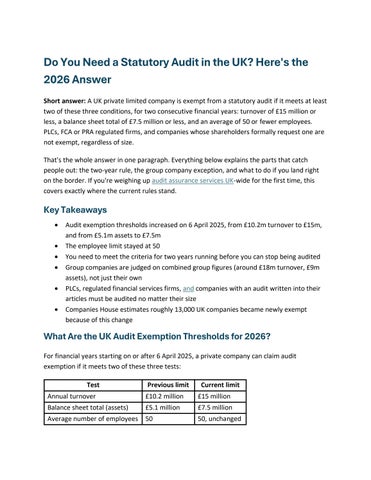
What Are the UK Audit Exemption Thresholds for 2026? For financial years starting on or after 6 April 2025, a private company can claim audit exemption if it meets two of these three tests: Test
Previous limit
Current limit
Annual turnover
£10.2 million
£15 million
Balance sheet total (assets)
£5.1 million
£7.5 million
Average number of employees
50
50, unchanged
If your company passes two of the three, you're generally in exemption territory. Miss two of the three, and a statutory audit is required for that financial year. This is the core of statutory audit exemption UK rules, and it's the same test whether you're a small trading company, a professional practice, or a group subsidiary. Preparing for this also means your annual accounts need to be in good shape well before year end, our statutory and management accounts service is often the first step for businesses getting ready for either an audit or a clean exemption filing.
Why Does the Financial Year Start Date Matter? The new thresholds apply to financial years that begin on or after 6 April 2025, not to any year filed during 2025 or 2026. This is the detail that trips people up most. Example: a company with a 31 March 2026 year end actually started that financial year on 1 April 2025, five days before the cutoff. That company is still assessed against the old, lower thresholds for that period, even though the filing itself happens well into 2026.
What Is the Two-Year Rule for Audit Exemption? A company generally has to meet the exemption criteria for two consecutive financial years before it can stop being audited, not just the most recent one. If you were over the limits last year and just dipped under them this year, you're likely still required to have an audit for the current period. The exemption only kicks in once you've stayed under the thresholds for two years in a row.
Do Group Companies Follow the Same Thresholds? No. If your company is part of a group, the exemption test uses the group's combined gross figures, not the individual company's numbers. From April 2025, those group thresholds sit at roughly £18 million turnover and £9 million balance sheet total, with the same 50-employee limit. This means a subsidiary can look small on paper and still require an audit once its parent company and sister companies are added into the calculation.
Who Needs a Statutory Audit Regardless of Size? These businesses must be audited no matter what their turnover, assets, or headcount look like: • • • •
Public limited companies (PLCs) Firms regulated by the FCA or PRA, including most financial services and insurance businesses Companies whose articles of association specifically require an audit Companies where shareholders holding at least 10% of shares formally request one
•
Charities above their own separate income thresholds, assessed independently of company size rules, this is a common trip point for care providers too, see our guide on CQC registration and audit for care providers if that applies to you
If any of these apply to you, the £15 million figure is not relevant to your situation.
What's the Difference Between Financial Audit Services and Internal Audit Services? Financial audit services are an independent, backward-looking check on a completed set of annual accounts, confirming the figures are accurate and comply with UK accounting standards. This is what most people mean by "statutory audit," and it's a legal requirement once a company falls outside the exemption thresholds.
Internal audit services look at the systems and controls running inside a business day to day, how payments are approved, how cash and data are handled, where fraud or error risk sits. It's not a legal requirement for most companies, but it's often used voluntarily to catch problems before they show up in year-end figures. Financial audit services answer "were last year's numbers right." Internal audit services answer "are today's processes sound." A lot of growing UK businesses end up using both, one for compliance, one for control.
What Happens If I Get My Exemption Status Wrong? Filing unaudited accounts when a statutory audit was actually required can result in Companies House rejecting the filing, along with potential penalties, since it's Companies House that sets and enforces the exemption thresholds under the Companies Act 2006. It also creates problems with lenders, investors, or shareholders who were expecting audited figures and later find out the exemption didn't apply. Separately, HMRC guidance on directors' record-keeping responsibilities makes clear that accurate accounting records underpin both your statutory accounts and your Corporation Tax return, so getting the audit position right also protects you if HMRC ever opens a compliance check. If there's any doubt, it's worth confirming your position with an audit specialist before you file, not after.
Does Audit Exemption Affect What I File With HMRC? No, not directly. Audit exemption is a Companies House matter under the Companies Act 2006, it decides whether your annual accounts need an auditor's report before filing. It's separate from your obligations to HMRC. Whether or not your company is exempt from audit, you still have to submit a Company Tax Return (CT600) to HMRC each year, along with the accounts and computations that support it. Audited or not, those accounts need to be accurate, since they form the basis of your Corporation Tax calculation. HMRC's own guidance on Corporation Tax filing sets out exactly what needs to accompany your return. This is one reason a lot of businesses keep audit or assurance checks in place even once they're no longer legally required to, it gives HMRC-facing figures an extra layer of scrutiny before they're submitted.
Who Is Allowed to Carry Out a Statutory Audit in the UK? Not every accountant can. Under the Companies Act 2006, only firms formally registered to carry out statutory audit work are permitted to act as statutory auditors. Before comparing audit companies in UK markets on price, it's worth confirming they hold this registration for audit work specifically, not just general accountancy. You can read more about our background and approach on our about us page.
How Brayan & Spencer Associates Can Help Brayan & Spencer Associates provides audit assurance and services including: • • • • •
Statutory audits for companies at or approaching the exemption thresholds Business valuation, for sales, investment rounds, or shareholder disputes Merger and acquisition support Clients' money audits and solicitors' accounts reports for regulated practices Charities audit and assurance, built around sector-specific reporting rules
We work from offices in Chertsey, Ashford in Kent, and Hemel Hempstead, with international offices in Dubai and Cyprus, supporting UK companies of all sizes and structures. If the 2025 threshold changes have shifted your position, or you're not sure where you stand, it's worth confirming before your next year end rather than after filing. Speak to our audit assurance team or call 0207 183 5956 for a direct answer on where your business stands under the current rules. If you're also working through Making Tax Digital requirements or need support with company secretarial obligations, our team handles both alongside audit work. And if you're weighing up your wider accounting setup in London, our guide to choosing an accountancy firm in London covers what to look for beyond audit alone.
Frequently Asked Questions Do all UK limited companies need a statutory audit? No. A private company is generally exempt if it meets two of three tests, turnover under £15 million, assets under £7.5 million, and 50 or fewer employees, for two consecutive financial years.
What are the current UK audit exemption thresholds? As of financial years beginning on or after 6 April 2025: turnover of £15 million or less, a balance sheet total of £7.5 million or less, and an average of 50 or fewer employees. A company needs to meet two of these three. When did the UK audit thresholds change? The thresholds increased on 6 April 2025, applying to financial years starting on or after that date. Years starting before 6 April 2025 are still assessed against the previous, lower limits. Does my subsidiary need an audit if the group is large? Possibly, yes. Group companies are assessed on combined group figures, currently around £18 million turnover and £9 million in assets, rather than the subsidiary's own numbers alone. Is an internal audit a legal requirement in the UK? No. Internal audit is voluntary for most companies. A statutory audit is the legal requirement, and it applies once a company falls outside the exemption thresholds or belongs to a category that must always be audited. Do small charities need a full statutory audit? Not always. Many smaller charities can use an independent examination instead of a full audit, depending on income level and sometimes their governing document. Charity thresholds are assessed separately from company thresholds. Who can legally carry out a statutory audit in the UK? Only firms formally registered to carry out statutory audit work under the Companies Act 2006. General accountancy registration alone is not sufficient to sign off a statutory audit. How do I check if my company needs an audit this year? Compare your turnover, balance sheet total, and average employee numbers for the last two financial years against the current thresholds, and check whether your company falls into a category requiring an audit regardless of size, such as being a PLC or FCA-regulated firm. Does HMRC set the UK audit exemption thresholds? No. The £15 million turnover, £7.5 million assets, and 50-employee thresholds are set by Companies House under the Companies Act 2006. HMRC's role is separate, it deals with your tax filings, such as Corporation Tax and VAT, and its guidance on record-keeping confirms that directors must keep accurate accounting records regardless of whether a statutory audit applies.
For a direct answer on your audit requirements, visit www.bsassociate.co.uk or call 0207 183 5956.