


Faculty Advisor:
Dr. Nicole Santalucia
Student Editors:
Cynthia Dodd, Main Editor
Kye'mani Davis, Assistant Editor
Committee Members:
Yusra Aden
Emily Brewer Kiara Kalmey
Katelyn Mader
Hannah Stoner
Special Thanks: Maria Baker Kylie Saar
Cover:
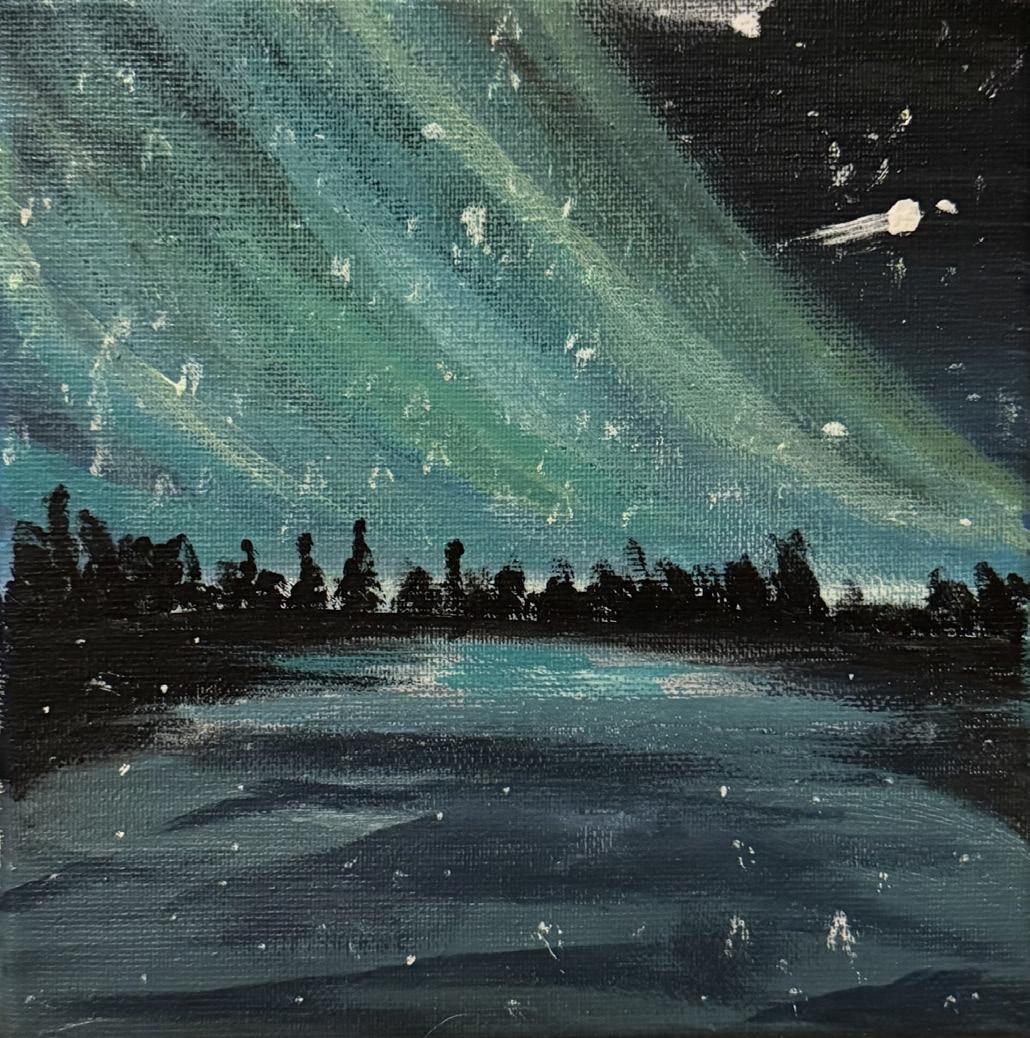
Titles (top to bottom): We are the Beginning,” “Caught in the Middle,” and “Dreaming of our End” by Abbygale Hockenberry
Acrylic on Canvas
Shippensburg University
2025-2026
Write the Ship is sponsored by the Department of English, the College of Arts and Sciences, and the Office of the Provost and Vice President for Academic Affairs
Dear reader,
The works included in this journal are among the strongest that Shippensburg University has to offer from the past two academic semesters. The essays contained come from a wide range of disciplines, picked by our lovely team of editors. Write the Ship is Shippensburg University’s undergraduate journal of student academic writing. The publication highlights student accomplishments within the previous academic year.
We would like to take a moment to thank our amazing editorial team and helpers: Yusra Aden, Maria Baker, Emily Brewer, Anna Crawford, Kiara Kalmey, Katelyn Mader, Kylie Saar, Hannah Stoner. The amazing work of our team was what truly allowed us to put this book together. Thank you for your tireless work of ranking, emailing, and organizing the works. We also offer thanks to our faculty advisor, Dr. Nicole Santalucia. She has been incredibly busy, balancing all the work she has done with students, her peers, and us. The commitment she has to all of her obligations is truly admirable, and for that we are grateful. Without her connection to other faculty members, we would have less works to publish. Of course we must also send a big ‘thank you’ to Jessica Kline, who is responsible for formatting our book! The version you see in your hands would not exist without the meticulous work of her and the Print Shop on campus. Next, the continuous support of the Shippensburg University faculty proves fruitful once again. Year after year, we have professors consistently submitting works for us to read, and we recognize just how much you care about your students.
Lastly, the true stars of the show are the students who submitted any of their work to us this year. As always, the competition was fierce, and we were not able to accept as many papers as we received. If you risked rejection and submitted any of your work, we commend your bravery and thank you for letting us read your work. You might not realize how much courage it takes to submit to a journal.
Thank you,
Cynthia Dodd and Kye’mani Davis Main and Assistant Editors
Yusra Aden: It’s been a pleasure to read through papers crafted with so much enthusiasm and passion written by talented students. I encourage all students who shared their work with us to continue writing and sharing their perspectives.
Maria Baker: This was my first semester working on WTS and I am so happy that I got the opportunity to help organize all of the amazing submissions! I loved being a part of a project that connects writers from all departments!
Emily Brewer: Getting the chance to experience works of all levels and all different backgrounds is such a huge highlight of this experience. As this is my first time ranking for Write the Ship, it wasn’t hard at all to really enjoy the range of student work presented. We appreciate how much time and attention is put into each of these pieces and cannot wait to see you on print!
Kiara Kalmey: I have really enjoyed working on Write The Ship! I had the opportunity to read so many interesting essays on a variety of topics. Thank you to everyone who shared their work with us, and congratulations to the students whose work is published in these pages. Keep on writing!
Katelyn Mader: I’ve loved this opportunity to review student writing across so many departments! It’s been a joy from the beginning and to help all these writers find a place to make themselves heard truly is amazing! Thank you to everyone who is a part of Write the Ship, from the rest of the Fellows to everyone who submitted something.
Kylie Saar: I am so thankful to have had the opportunity to work on Write the Ship for one last semester. It is incredibly fulfilling getting to read what other students are researching and writing about. Thank you to everyone who submitted and the wonderful team I had the privilege of working with!
Hannah Stoner: Reading and reviewing the work in this book was inspiring and I’m glad I had the opportunity. Everything I read also taught me a lot about new, interesting subjects. The strength and passion in the voice of each writer will not go unnoticed.
Enforced Perfection by Ava
European Asbestos Myths: How a Rock Became Salamander by D. Tom Gehman
Feminist Resistance, Sovereignty, and Survivance in Louise Erdrich’s Love Medicine, Four Souls, and The Round House by Kiersten Wade
From Basements to Arenas: The Cultural Impact of Dungeons & Dragons by Kiara Kalmey
Gender and the Role of the Punt Expedition in Hatshepsut’s Reign by Ellie Manyara
Gendered Ageism in Mass Media by Nancy Tobar Guzman ...............................................................................................................................................................126
How do Physiological Risk Factors Contribute to Premenstrual Dysphoric Disorder? by Nora Braun
How Social Media Impacts Mental Health by Abby Gehris
Incels and the Manosphere: A Rise of Misogynistic Violence by Paige Becker
Is Social Media Generally Good For Society? by Addison Carbaugh
It Ends With Us Film Adaptation and the Effects of Misrepresentation by Emily Brewer ............................................................................................................................................................................146
La lucha por la voz femenina en la literatura latinoamericana by Sydnee Lynch
The Loss of Formality in Young Adult Culture by Anna Grace Hornbuckle
Moral Mayhem: Fighting Physical and Psychological Wars by Amelia Emswiler
The Negative Effects Of Today’s Grading System by Ashleigh Funkhouser
Old Navy Brand Assessment by Sarah Snare
Physiological Effects of Human Recombinant Erythropoietin Injection on Cycling Performance by Jackson Burns
Rethinking Expertise in Moby-Dick: How Labor and Experience Produce Knowledge by Hannah Kristiniak .....................................................................................................................................................................176
The Sims 4: A Legacy on the Precipice of Unfortunate Fate by Mi’Angel McRae
Unrealistic Perfection by Autumn Stauffer
Waynesboro, PA: North and South Potomac Street by Grace Coffman
Weaponizing the Undead Through Vampire Burials and Social Control by Emma Sokolowski
by Alissa Gantt
114: Academic Writing
Dr. Laurie Cella
Assignment:
Students were told to write an argumentative essay, including both pros and cons of the chosen topic as well as differing opinions. Essays are to be written in MLA format and be at least four pages long.
When it comes to the topic of pop culture, most of us will readily agree that it plays a major role in shaping our day-to-day lives. Where this agreement usually ends, however, is on the question of whether or not popular culture is truly valuable, or the debate that it is being used as a glamorized distraction. While some are convinced that it pushes unrealistic standards and a superficial mindset, others, like myself, believe that it fosters empathy through exposure, builds community, and even inspires change. Critics argue that it is a waste of time that distracts us from serious problems. I believe that when consumed thoughtfully, it can be a powerful tool for connection, education, activism, and fostering a sense of belonging. Pop Culture is not just entertainment; it is a reflection of our values, fears, and aspirations. It influences how we communicate, how we dress, and even how we understand social issues. From blockbuster films to viral TikTok trends, it shapes the narratives we share and the identities we form. Rather than dismissing it as shallow, we should recognize its potential to spark dialogue, challenge societal norms, and bring people together across differences.
Growing up, pop culture was not just background noise in my home; it was an interest I have always
possessed and the way I found my people. Whether it was watching The Labyrinth with my sister or listening to Mitski with my best friend, these moments gave us a shared language; they made me feel like I belonged. Pop culture wasn’t just something we consumed; it was something we connected through. It gave us personal jokes, shared experiences, and a sense of identity that felt both personal and collective. Rachel Labell emphasizes this point in her article “Actually, Pop Culture Does Matter”, arguing that “stories playing out on print and screen can introduce a new perspective that just might completely change someone’s life.” This is not just a theory; it is something I have lived. Watching shows and movies featuring characters with diverse backgrounds and cultures helped me understand experiences I would never have encountered in my small PA town. It made me more curious, more empathetic, and above all, more willing to listen. Pop culture opened windows into worlds I hadn’t known existed and helped me develop a deeper appreciation for difference. It taught me that representation matters; not just for visibility, but for validation. These stories didn’t just entertain me; they shaped my values, challenged my assumptions, and helped me grow into someone who seeks connection.
In my opinion, the most overlooked value of pop culture is its ability to create community and foster

change. I can recall watching The Janes, a haunting look at the underground network of women who provided abortions in pre-Roe v. Wade America. The courage and defiance of these women made me incredibly sad for the risks they faced and angry at the system that forced them into secrecy. Then, Are You Proud?, which traces the history of LGBTQ+ activism in the UK, reminded me how the pride we know was born from struggle. Watching footage of protests and hearing voices from across generations made me reflect on how far we’ve come, but also how far we still have to go. As well as Separated, which follows families torn apart by U.S. immigration policies, left me devastated. These were not just stories; they were facts. They made me want to understand more and see how I could get involved in the change. Lubell’s point about pop culture introducing new perspectives is exactly what happened to me. These were real people, real stories, all being consumed by different people in a series of places at similar times. This kind of emotional engagement is so powerful; this is pop culture. It teaches us to care, to imagine what others are going through, and to reflect on our own values. When people feel emotionally connected to an issue, they are more inclined to act. This is why popular culture matters; it facilitates empathy in a way you don’t realize is happening.
The Power of Influence
Critics say that this cultural phenomenon, especially celebrity obsession, distracts people from realworld problems. In her article “The Cult of Celebrity Distracts People from Real World Problems,” Sophia Aguilar writes that “I get addicted to the very thing I want to turn off.” I know I can say this has happened to me, and I have wasted countless hours scrolling, but at what point do we take accountability? Aguilar’s concern that hyperactive consumption can be a form of escapism is a real one. However, the problem does not lie in pop culture; it rests on how we choose to interact with it. What celebrities are you excessively following?
There are well-known individuals like Jane Fonda, who uses her platform to speak out on women’s rights, racial injustice, and climate change. The Jane Fonda Climate

PAC was founded in 2022. The organization’s mission is to endorse “climate champions” who will stand up against the fossil fuel industry. Fonda also describes herself as a feminist and has used her platform to raise awareness of gender issues in film. She is known for producing women-centered films. I have followed those links, signed petitions found on their pages, and joined conversations. I have come to realize that pop culture did not distract me; it directed me. Aguilar herself even admits that “celebrity culture has the power to affect millions,” which means it can be used for good if we hold it accountable.
How is our everyday life affected by pop culture? How does this transcend into our identity? The clothes you wear are a reflection of your beliefs, mood, and the media you generally consume. Fashion compressed the ideals of pop culture into wearable narratives. When designers use activist slogans, colors with meaning, and traditional dress, they make otherwise unknown things readily available. Lubell points out that these planned stories and cultural moments can reach those who “live in an ideological bubble” and introduce life-changing perspectives. There have been a series of televised protests in recent years, in which people stand out. Those who are wearing clothes centered around their beliefs are more noticeable; it turns private conviction into public questioning. Clothing allows people to participate in the pop culture they believe in with visible solidarity. Fashion converts culture into signals and signals into networks. In this sense, what we wear becomes a bridge between personal identity and collective action.
There is an individual on campus who is greatly knowledgeable about how pop culture affects identity. I composed an interview with Dr. Karin J. Bohleke, the director of the Fashion Archives here on campus, to ask her opinion on pop culture. She remarked that its influence on fashion across decades reveals a deeper cultural shift in identity and gender norms. From the rebellious DIY aesthetic of the 70s to the commodification of celebrity style, fashion reflects collective groupthink. She notes she has seen a rise in nostalgia-driven designs, raising concerns about dwindling creativity. She remarked that “fashion is groupthink- nothing is original.” We talked a good bit about influential media and how designers make cheap imitations to push onto the public since they know we already like that image. She brought up Keanu Reeves and the $10,000 leather trenchcoat he wore for The Matrix. Designers then made cheap imitations of the coat; to Dr. Bohleke, these remakes are “pale echoes of something good.” She specialized in archiving pieces for the museum and noted the difference in the push for certain things. Noting that historical guides “encour-
aged individuals to look over trends,” unlike magazines now that push “outshowmanship and unconventional designs.” Archival practices derived from this cultural phenomenon highlight how fashion becomes a vehicle for obsession, identity, authenticity, and consumerism. She spoke to me about “sheeple,” which are people who blindly follow these trends and are unaware of the large-scale problems they are causing within the industry. Ultimately, pop culture-driven fashion trends are not just superficial; they are loaded with meaning, shaped by over-consumerism, and reflect the tensions between originality and mimicry.
Pop culture, including fashion, amplifies causes at scale; it can uplift trends or urgent campaigns. When brands partner ethically with movements, when known designers credit their artisan workers, and when influencers direct their attention toward organizations in need, fashion becomes a resource for activism. There are countless viral campaigns tied to fashion events. I am partial to runway moments that spotlight human-rights issues, like designer Willy Chavarria’s Huron 2026 show, which emphasized support toward the Human Rights Campaign. The show opened with models posed in a way that mirrored ICE detention scenes, showcasing the dehumanization of immigrants. These models were in vibrant colors, serving as a rebellious symbol against the darkness of these tactics. These

events show how style can reallocate attention to social goods when audiences treat it as a responsibility rather than a public display.
Some think displays like this and pop culture are performative; a way to garner attention rather than gain understanding. Critics argue that these moments are curated for perception, not impact, and that they often prioritize visibility over substance. Aguilar’s essay argues that celebrity fixation often replaces civic knowledge and sustained attention; she argues that it really doesn’t matter and was made to lead us on cycles of distraction and ignorance. This is an important reminder that media alone cannot spark change. A viral moment may generate interest, but without following through, it risks fading into the noise of the next trend. Tethering this media with effective activism is what makes a change. When storytelling is paired with organizing and policy work, it becomes a tool for transformation.
Pop Culture offers emotional resonance and storytelling tools that activists use to reach a broader audience. But this also has a darker side, especially in how it portrays women. Sophie Gilbert, in her article “How Pop Culture Turned Women Against Each Other,” argues that modern media thrives on female rivalry. She writes, “The spectacle of women pitted against each other, competing for fame, male attention, and mass approval is deeply rooted in media, and even in our own minds.” This manufactured competition, whether between celebrities like Britney and Christina or influencers in a hierarchy contest, reinforces the idea that women must tear each other down to succeed. I remember watching films like Wild Child and Mean Girls when I was young, which showed gorgeous women being mean to each other for validation. This was confusing for a kid. These portrayals do not just affect celebrities; they find their way into everyday life, shaping how women view themselves and each other. Instead of fostering solidarity, pop culture often encourages comparison, which in turn can lead to judgment and insecurity. Gilbert notes that feminism once “emphasized collective empowerment rather than competition.” This shift has real consequences; studies show that when women are encouraged to compete rather than collaborate, their careers and relationships suffer.
Constant exposure to over-glamorized media will distort the views of anyone; this is where pop culture can become hazardous if not interacted with properly. These hazards continue and generate significant risks, especially for youth. Karpagam’s study Negative Effects of Pop Culture on Youth reveals how constant exposure to glamorized media can distort the values and behaviors of young people. The research highlights
how pop culture often normalizes substance abuse, violence, and materialism, encouraging impressionable audiences to mimic harmful trends. It also reinforces unrealistic standards, which can lead to distorted self-worth, low self-esteem, and even mental disorders like anxiety. There is a series of graphs in the study that confirm a strong correlation between excessive pop culture consumption and negative psychological outcomes. For youth still forming their identities, this can be especially damaging, as they internalize these distorted ideals. This, in turn, corrodes their self-worth and creates a cycle of comparison. This darker side of pop culture highlights the importance of media literacy and intentional engagement. If left unrestrained, the platforms that inspire connection can also be the main contributors to emotional distress. Recognizing these risks allows us to consume more critically and advocate for content that is uplifting rather than something that undermines.
Pop Culture to catalyze change
Still, pop culture can be redirected. It holds the potential to redirect public opinion toward social justice. Reality shows, superhero movies, and glossy magazines may seem superficial, but they often revolve around themes of moral struggle, recognition, and heroism. For instance, in the recent Superman film, Clark Kent intervenes to protect a small, impoverished nation from one much more technologically advanced, reminiscent of the tragedies in Gaza. While fictional, this narrative invites viewers to think critically about power, justice, and global inequality. These traits can be redirected toward civic engagement. When audiences connect emotionally to a story, they are more likely to care, to research, and to act. Emotional storytelling is the bridge between awareness and action, especially when it’s grounded in real-world parallels. It is effective because it reaches people through familiar formats, builds emotional connections that motivate action, encourages participation, and makes complex issues accessible and relatable.
Pop culture is not perfect, but it cannot be denied that it is powerful. It reflects society’s values, challenges, and assumptions, and gives us tools to connect with others in a meaningful way. It shapes the way we speak, the way we dress, and even the way we think about ourselves and others. While critics argue it distracts us from serious real-world issues, the truth is that it often
introduces us to problems in ways that are accessible and resonate emotionally. Whether it is through songs about mental health struggles or a viral show that exposes injustice, pop culture can be the catalyst that leads to deeper awareness and action. It has the ability to reach people who may never read a news article or attend a protest, yet still feel moved to care. Instead of slandering it, we should embrace its potential and guide its huge influence toward empathy, education, and change. When pop culture is treated as a starting point for civic engagement rather than a distraction from it, we can see its true value. It is not merely entertainment; it is a force for good. It can be the spark that ignites curiosity, compassion, and courage. Instead of asking why pop culture matters, we should ask how we should make it matter.
Works Cited:
Alexei, Key. “Willy Chavarria Turns America Upside Down in Huron SS26 Show.” The Fashionography.com, 27 June 2025, thefashionography.com/fashion/fashioncollections/willy-chavarria-turns-america-upside-downin-huron-ss26-show/. Accessed 15, Oct. 2025.
Bohleke, Karin. Personal Interview. 11, November, 2025. Cassell, Ferere. “Page Reverie.” Reveriepage.com, 28, June, 2025
Willy Chavarria Spring/Summer 2026 Runway Show: A Cinematic Ode to Resistance & Identity — PAGE Magazine. Accessed 16, October, 2025.
Gilbert, Sophie. “How Pop Culture Turned Women against Each Other – and How We Can Break the Cycle.” Service95.com, 25, April, 2025, www.service95.com/ how-pop-culture-turned-women-against-each-other. Accessed 06, November 2025.
Karpagam, T. “Negative Affects of Pop Culture on Youth.” Ebsco.com, September. 2023, research.ebsco.com/c/ isdbik/viewer/pdf/nfbdw2jcyn. Accessed 05, November, 2025.
Rachel, Lubell. “Actually, Pop Culture Does Matter.” LinkedIn.com, Rachel Lubell, 18 Jan. 2023, www. linkedin.com/in/rachel-lubell/. Accessed 8 Oct. 2025.
Sofía Aguilar. “The ‘Cult of Celebrity’ Distracts People from Real-World Problems.” The Daily Orange.com, 17 Apr. 2024 dailyorange.com/2024/04/the-cult-of-celebritydistracts-people-from-real-world-problems/. Accessed 8, Oct. 2025.
Sullivan, Jim. “Jane Fonda Wants You to Think of Her as an Activist.” Www.wbur.org, 2 Dec. 2019, www.wbur.org/ news/2019/12/02/jane-fonda-actress-activist. Accessed 15, Oct. 2025.
Student Reflection:
Writing this argumentative essay helped me understand how deeply pop culture has shaped both my identity and the way I connect with others. It made me realize how these shared experiences became emotional touchpoints that formed my sense of belonging. Pop Culture isn’t just entertainment; it is a language we grow up speaking. Reading differing opinions and articles displayed how pop culture can pit people against each other as well, forcing me to acknowledge its harm. Overall, this process helped me view pop culture as both powerful and complicated. It cemented my belief that when we engage with media intentionally, it can encourage connection, inspire a change, and even challenge assumptions.
Assignment:
by Erin Lee
MTKG 205: Principles of Marketing
Dr. Mohammed Rahman
After carefully analyzing the brand’s current marketing strategies, evaluate how at least two major textbook themes, such as customer value creation, customer engagement in digital and social media, or building strong value-creating brands are reflected in the brand’s approach. Focus on explaining how these strategies influence or shape consumer decision-making using specific marketing concepts covered in the course modules. Support your analysis with clear evidence from scholarly journal articles and brand-related sources that explain, support, and critically assess the marketing practices you identify.
Crocs is a brand whose goal is to provide comfortable and durable shoes to a wide range of consumers. The company has become infamous for their unique hole-ridden shoe design, which has constant traction from people who either love the style or despise it. However, the unorthodox shoe was originally designed for one specific demographic. According to Droege & Dong (2009), “Crocs were originally intended to be sold to boaters, because of their slip proof, non-marking sole and the fact that they are waterproof and odor resistant” (p. 9). However, Crocs quickly exploded in the footwear market upon launch in 2002. New demographics interested in the shoe for its comfort and other benefits included “gardeners, healthcare workers, waiters, and other professionals who had to be on their feet all day” (Droege & Dong, 2009, p. 9). Once Crocs realized they could expand their footwear to wider demographics, they developed varying shoes for those in healthcare, food service, outdoorsmen, as well as lines of boots, sandals, sneakers, bags, and other related products. As the initial rage for the shoe died down, Crocs developed a marketing mix for their products to keep consumers engaged. Today, Crocs has valued customizability in addition to comfort, allowing customers to create their own custom Crocs, along with unique choose-your-own pop-in charms created in 2005, trademarked as Jibbitz. The shoe company heavily utilizes social media to promote and connect with younger consumers.
Presently, Croc’s largest market is Gen-Z, followed by Millennials, both of which heavily use social media (Larson, 2025). Shriber (2023) states, “Gen Z adults aged 18-24 have tried the shoe covered in holes (48%)…adults aged 25-34 are the second-most likely to be owners (42%) or intend to buy them (21%).”
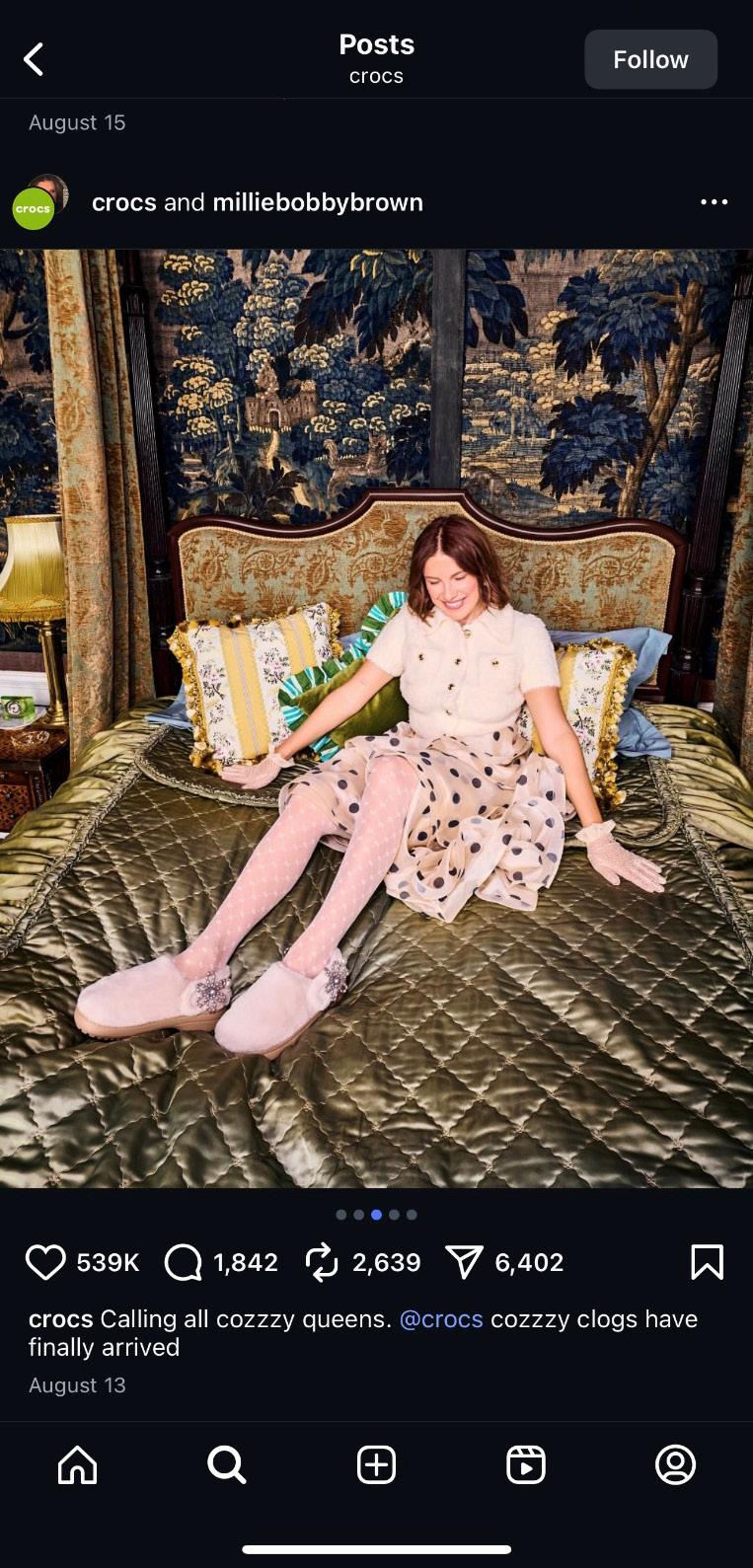
Heavy use of social media marketing and many collaborations with popular celebrities and brands has kept the brand’s demographic young (Figure 1
and 2). In China, there is even a hashtag “dongmen” on popular Chinese social media—a slang term for Croc wearers (Wall Street Journal, 2025). Croc has 349 retail stores globally, as well as partnerships with popular third-party retailers (Pan, 2025). This allows for easy access, selling both wholesale and directly to customers. Online sales combined with physical stores allow customers a variety of options between shoes and accompanying charms. Their large online presence helps account for their almost symmetrical split of selling methods. Most recent 2024 data shows that Crocs does 50.3% of their sales through wholesale methods, and 49.7% through direct-to customer methods (Tcholakova, 2024). Pricewise, Crocs come at a varying range of prices, depending what consumers are after. Basic Croc models retail for around $45-$60, while more advanced shoes (usually with customizations) retail higher, starting around $70 when customizations begin. (Crocs, 2025). These varieties of price points allow flexibility within a customer’s budget. A mix of these elements keeps Crocs’ popularity continually climbing, with expected forecasted company growth in the 2025-2030 range (Euromonitor, 2025). With the brand’s promotion-centered marketing mix, Crocs has homed in on strategies to keep their company flourishing.
Croc utilizes two stand-out marketing concepts that are key components to their marketing efforts. The first of these concepts is brand equity, which, according to Robertson (2023), “represents the value customers place on the brand and their willingness to pay a premium over competing brands” (p. 2). Brand equity is composed of various factors, but the most traditional ones include brand loyalty, brand awareness, perceived quality, and brand associations (Robertson, 2023, p. 42). Croc has built brand loyalty through
their use of personal connections. Customization is a large part of the brand; with build-your-own custom shoes and Jibbitz that allow for ultimate personalization, Crocs capitalizes on this to keep customers coming back. In recent proprietary surveys done by Crocs it was revealed that, “…about 75% of its consumers buy Jibbitz to accessorize their clogs” (Baker, 2025). A large part of brand loyalty is understanding what your customers want and giving them products they value, regardless of price (Cooper, 2010). To keep capturing and delivering value, Crocs constantly collaborates with other brands and celebrities to create new designs and Jibbitz that allow customers to grow their collection with limited designs and variations of their products (See Figure 1 and 2). Through these methods, Crocs delivers the value of customization without sacrificing comfort, two of their signature product attributes. Additionally, a large element of brand equity is brand awareness, also known as brand recognition. Brand awareness is “the ability to which customers can identify the brand under a variety of circumstances” (McGraw, 2025). Brand awareness usually stems from a myriad of advertising and promotions to make the brand easily recognizable (Man, 2016). Crocs as a brand are highly active on social media platforms like Instagram and TikTok, using said platforms to boost their new collaborations and products (See Figures 1 and 2). Crocs have always had a reputation for being an ugly shoe, with consumers either embracing the shoe’s odd design or hating it (IPConcerns, 2024). Since the birth of the brand, public division for the shoe has grown into a popular debate, despite revenue for the company climbing (IPConcerns, 2024). Currently, in 2025, Crocs is ranked number 7 in the U.S. for footwear market retail companies (Euromonitor, 2025).
Crocs has kept brand awareness strong using this debate; everyone recognizes the rubber-like shoe with holes in it and a heel strap in the back (Dussol, 2023).
“As stated by CEO, Andrew Rees, ‘our goal is not to make haters love the brand, it is to exploit that extrinsic tension because it creates opportunity, it creates PR (public relations), creates media, it creates interest. It creates a whole lot that would cost you a fortune to buy in other ways’” (Hakala, 2021, p. 31). The company has played into the debate by creating campaigns focused on embracing the “ugliness” and individuality of their shoes. In recent years, Crocs has collaborated with an odd variety of brands including KFC, Balenciaga and Disney, as well as hosting online campaigns like “Croctober”, the “Ugly Can Be Beautiful” campaign, and the “#ComeAsYouAre” campaign, which utilized celebrities like Drew Barrymore to share their journey about “being comfortable and confident in their own shoes” (Dussol, 2023).
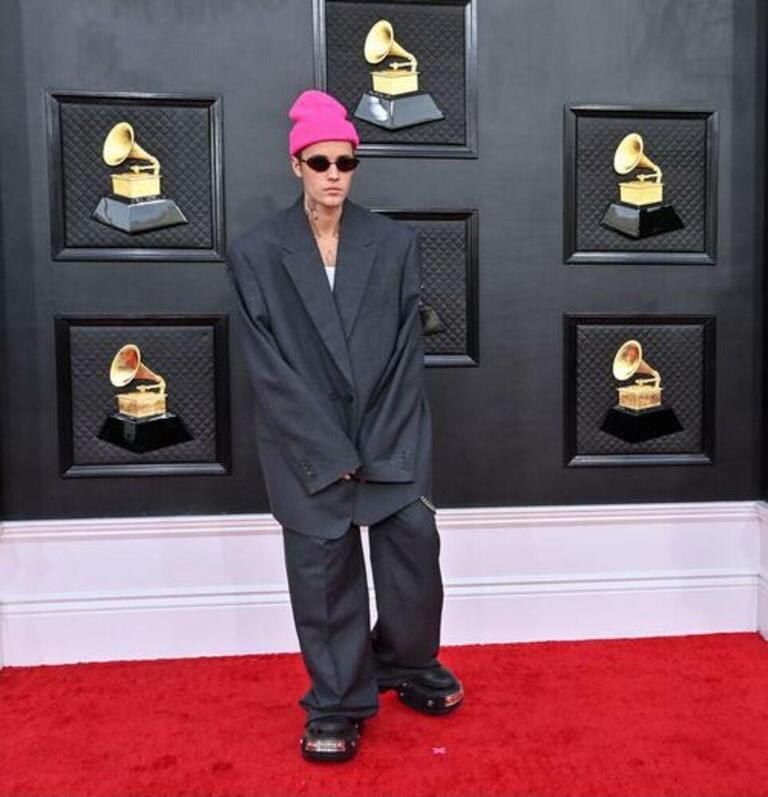
Brand awareness rolls into the next aspect of brand equity: perceived quality. As stated in (McGraw, 2025), the consumer considers brand performance based on their own personal parameters and expectations. Shoe prices have been on the rise since 2021, and are predicted to continue to increase (IBISWorld, 2025). Crocs must differentiate themselves in the shoe market with high quality attributes to continue capturing customer value. Besides customizability, Croc’s main selling point is their comfortability and practicality. Out of 110 internationally picked individuals for a questionnaire, 42 said they bought Crocs for practicality and convenience, with another 42 answering that they purchased for comfort. The next largest margin was appearance (uniqueness and customization), with 19 answers (Hakala, 2021). In that same questionnaire, the participants were asked what they valued the most out of their Crocs. The majority voted for comfort, with 44 answers. The second largest majority was “practicality, convenience, easy to wear and clean”, with 38 answers (Hakala, 2021). Consumers were searching for shoes that had comfort and practicality, and Crocs delivered that value to consumers. This elevates perceived quality, due to Crocs delivering what consumers valued out of the shoe. A snowball effect is created from this, allowing Crocs to gain the trust of its customers. A high perceived quality for a product allows a company to expand their products (McGraw, 2025), thus allowing Crocs to make other types of shoes, bags, and expand into custom-made territory. Brand association is a concept Crocs has excelled in. Brand associations are thoughts that the consumer has connected with their memory of the brand (McGraw, 2025). Common associations can be identifiable attributes, celebrity endorsements or a recognizable logo (Robertson, 2023). As mentioned previously, the innovative and distinct attributes of Crocs allow for easy recognition. Although there is not an exact number available for the number of celebrity collaborations, globally recognized celebrities are often collaborating with the brand or sporting the familiar shoes on red carpets. For example, popular pop singer Justin Bieber wore his custom collaboration Crocs at the 2020 Grammys (Figure 5). Bad Bunny, a Latin rap artist, also collaborated with Crocs to create custom shoes (Figure 6). Crocs collabs with a variety of celebrities and brands to reach a wide range of consumers with different interests. The comfortable shoe people know and love (or hate), along with the flair of another favorite celebrity or brand. These custom Crocs are then usually released for public sale, where they sell out in hours or even minutes. Much of the time, these shoes are a spin on the staple Croc design, allowing for easy brand recognition and association despite the alterations.
The second marketing concept Crocs uses to their advantage is differentiated targeting. Targeting by itself is the evaluation of different segments of the market, and the decision of where companies should be focusing resources to maximize their sales (McGraw, 2025). The result of the targeting process is defined target markets, which are customer groups that organizations use their resources to market towards (McGraw, 2025). Although the shoe company’s product is for all ages, Crocs’ target markets are Gen-Z and Millennials (Hakala, 2011). Crocs even won a Marketing 50 award in 2006 for “Advertising Age”. (Thompson, 2006). Crocs utilize heavy social media promotion to reach their target markets. As Bergemann and Bonatti (2011) state, “the Internet has allowed many advertisers to address a targeted audience beyond the reach of traditional media”. Using global statistics in 2024, it was compiled that an estimated 84% of those aged 1829 years old use social media, and 81% of 30-49 years old use social media (Larson, 2025). In a separate study of internationally chosen participants given questionnaires about Crocs, 92% of participants that owned Crocs were ages 18 or younger to 40 (Hakala, 2021). In that same study, 87% of participants answered yes to seeing Crocs on social media (Hakala, 2021). By focusing their promotions on social media through collaborations and frequent posting, Crocs has defined and claimed their target markets.
Crocs’ brand of unique, comfortable, and customizable shoes along a heavy social media presence allows them to reach a large portion of young consumers and capture value. Crocs also participate in differentiated marketing, which occurs when an organization pursues several different market segments with different strategies for each (McGraw, 2025). As mentioned in the introduction, Crocs was originally made for boaters but quickly became popular in other demographics. To appeal to different segments, they released different lines of shoes. On their website, Crocs has an entire section labeled “Crocs at Work”, consisting of vary-
ing Crocs for varying careers such as chefs, nurses, hospitality and business workers, and landscapers. For example, Crocs created a line of nursing shoes, altering them to contain a larger foot bed and easier-to-clean material (Crocs, 2025). They also have a line of more slip-resistant shoes for service workers, and styled shoes for those in the business field who still want the features Crocs offers. Croc also builds loyalty and value to these markets through acts of service to the varying target markets. In 2020, Crocs donated over 860,000 pairs of Crocs to healthcare workers during Covid-19, and did the same thing in 2021 (Zeigler, 2021). Not only is this good publicity for their line of work shoes, but it also further penetrates the market for healthcare workers. In addition to work shoes mentioned earlier, Croc uses their extensive online presence to collab with well-loved brands. “Gen Z and younger generations’ exposure to and familiarity with global media has primed them to enjoy a diverse range of aesthetics and narratives” (Takemasa, 2025). Disney, Hello Kitty, Nintendo, and other globally recognized brands frequently work with Crocs, allowing them to create shoes that cater to their targeted demographics while hitting a wide range of interests (Crocs, 2025).
Crocs has established their brand as one that values practicality and comfort without sacrificing fashion and personalization. Although it was once a company with the purpose of creating shoes for boaters, the well-loved and hated brand has thrown themselves successfully into a variety of market segments (Droege & Dong, 2009). Keeping their core values, the brand strategizes using brand equity and differentiated marketing to reach a variety of demographics, providing options for not only those seeking a convenient shoe, but those in the healthcare, service, landscaping industry, as well as consumers wanting a flare of personalization. Croc continues to rotate new designs and collaborations to keep delivering value to consumers through their iconic hole-filled shoes.

From https://www.instagram.com
From https://www.instagram.com
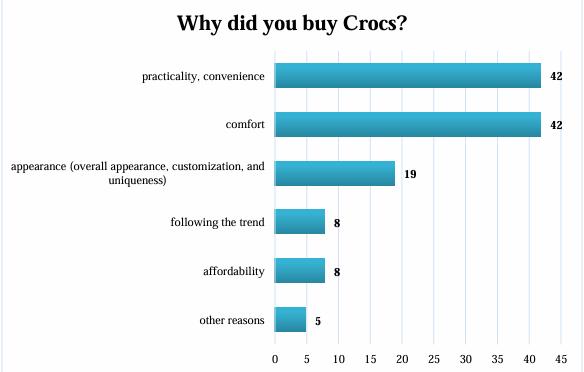
Figure 3: Chart Displaying Survey Responses (Reason for buying Crocs)
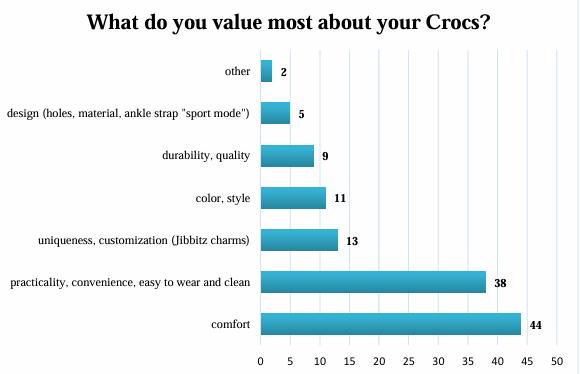
Figure 4: Chart Displaying Survey Reponses (What do you value most about your Crocs?)

Baker, R. (2025, April 5). Crocs’ big bet on personalization paid off. Here’s how it happened – and what investors are keeping an eye on now. NBC New York https:// www.nbcnewyork.com/news/business/money-report/ crocs-big-bet-on-personalization-paid-off-heres-how-ithappened-and-what-investors-are-keeping-an-eye-onnow/6213554/
Bergemann, D., & Bonatti, A. (2011). Targeting in advertising markets: implications for offline versus online media. The RAND Journal of Economics, 42(3), 417–443. Retrieved October 27, 2025, from https://www.jstor.org/stable/23046807?searchText= market+targeting&searchUri=%2Faction%2FdoBa sicSearch%3FQuery%3Dmarket%2Btargeting%2 6so%3Drel&ab_segments=0%2Fspellcheck_basic_ search%2Fcontrol&refreqid=fastly-default%3Aa1b1c69 d3a40348f1adf9a1ebdb2f29d&seq=3
Cooper, L. (2010). BRAND LOYALTY: How to retain customers and build brand loyalty. Marketing Week, , 22-23. https://go.openathens.net/redirector/ ship.edu?url=https://www.proquest.com/tradejournals/brand-loyalty-how-retain-customers-build/ docview/749970647/se-2 (ProQuest)
Crocs (2025). Crocs at Work. https://www.crocs.com/c/ shop-by/activity/work-shoes?irclickid=Rz1TvmTy7xycU sp0q42EJVFuUkpUqw02FW2Iyw0&irgwc=1&afsrc=1 &adid=aff_impact_US_674658_x_x_2003851_200385 1_x_x_2003851_x&clickid=Rz1TvmTy7xycUsp0q42EJ VFuUkpUqw02FW2Iyw0&ir_partnerid=2003851&ir_ adid=674658&ir_campaignid=8119&lc_media_ id=&lc_product_id=&lc_collection_id=&featured=
Droege, S., & Dong, L. (2009). The Evolution of Crocs Inc.: Will Crocs Face Extinction?
DreamCatchers Group. Retrieved October 27, 2025, from https://www.researchgate.net/profile/Kurt-Saunders/ publication/288210701_Yourproductsuckscom_ Internet_gripe_sites_at_the_crossroads_of_trademarks_ and_free_speech/links/597f7a63458515687b4ba80b/ Yourproductsuckscom-Internet-gripe-sites-atthe-crossroads-of-trademarks-and-free-speech. pdf?_sg%5B0%5D=started_experiment_milestone&ori gin=journalDetail#page=19
Dussol, A. (2023, October 13). How Crocs Turned an “Ugly” Shoe into a High Trendy One. Medium Retrieved October 27, 2025, from https://medium. com/@madamevision/how-crocs-turned-an-ugly-shoeinto-a-high-trendy-one-a9e6e196b5de Euromonitor. (n.d.). Euromonitor Crocs Company Dashboard. Retrieved October 30, 2025, from https://www.portal.euromonitor.com/dashboard/ dashboarddetails?id=dc286f09-a90a-493c-b1a81bd1e2730f1c&companyId=761923 (Euromonitor)
Hakala, F. (2021). Crocs Inc. – Marketing and Branding and their Effect on Sales and Consumer Buying Behavior. In International Business (p. 62 + 1 Appendix) [Thesis]. VAASAN AMMATTIKORKEAKOULU UNIVERSITY OF APPLIED SCIENCES. Retrieved October 27, 2025, from https://www.theseus.fi/ bitstream/handle/10024/508843/THESIS%20 final%20.pdf?sequence=2&isAllowed=y
IBISWorld. (2025, July). Producer Price Index: Shoes. Retrieved October 30, 2025, from https://my.ibisworld. com/business-environment/standard/united-states/ en/g139/5188/performance#performance_ performancesnapshot (IBISWorld)
IPConcerns. (2024, August 21). Ugly Can Be Beautiful: How Crocs took the world by storm Ipconcerns. Retrieved October 29, 2025, from https:// ipconcerns.wordpress.com/2024/08/21/ugly-can-bebeautiful-how-crocs-took-the-world-by-storm/ Larson, S. (2025, April 15). Social Media Users 2025 (Global Data & Statistics). Priori Data. Retrieved October 27, 2025, from https://prioridata.com/data/ social-media-usage/ Man, M. K. (2016). Value of a brand name: Application of Aaker’s Brand Equity Model. Problems in Economics, 178, 120–125. https://www.researchgate.net/ publication/303139086_Value_of_a_brand_name_ Application_of_Aaker’s_Brand_Equity_Model McGraw Hill. (2025). Connnect Master: Marketing Pan, D. (2025). Strategic Assessment of Crocs, Inc.: Navigating Market Challenges and Leveraging Growth Opportunities. S&P Global Market Intelligence. Retrieved October 27, 2025, from https://papers.ssrn.com/sol3/papers. cfm?abstract_id=5125201
Robertson, L. (2023). Updating Aaker’s model of brand equity to incorporate modern social media strategies and consumer interactions : A thesis submitted in partial fulfilment of the requirements for the Degree of Doctor of Philosophy at Lincoln University [Thesis, Lincoln University]. https://researcharchive.lincoln.ac.nz/entities/ publication/6c26e9bb-0486-4707-8f23-a150faa055b3 Sandalsly (2025, October 29). What celebrities have Crocs partnered with? Sandalsly. Retrieved October 29, 2025, from https://sandalsly.com/ what-celebrities-have-crocs-partnered-with Shriber, S. (2024, January 18). Crocs interest booms PostPandemic, Kardashian fans most favorable to the Clogs CivicScience. Retrieved October 27, 2025, from https:// civicscience.com/crocs-interest-booms-post-pandemickardashian-fans-most-favorable-to-the-clogs/
Takemasa, H. (2025, June 4). Marketing to Gen Z - US - 2025. Mintel. Retrieved October 30, 2025, from https://clients.mintel.com/report/marketing-togen-z-us-2025?fromSearch=%3Ffilters.consumersegment%3D9%252C15%26last_filter%3Dconsumersegment%26resultPosition%3D2 (Mintel)
Tcholakova, E. (2025, February 24). Global sales share of Crocs, Inc. in 2024, by business segment. Retrieved October 27, 2025, from https://www.statista.com/statistics/1040265/ global-sales-share-of-crocs-by-sales-channel/ Thompson, S. (2006, November 13). Crocs. Advertising Age. Retrieved October 30, 2025, from https://research. ebsco.com/c/uw4gg4/viewer/html/glakx6qglf (Business Source Complete)
Wall Street Journal. (2025, August 18). How crocs conquered China | World News. Hindustan Times. Retrieved October 27, 2025, from https://research.ebsco.com/c/ uw4gg4/search/details/xee3rjop5v?db=8gh%2Chxh% 2Chch%2Chsr%2Chus%2Cjar%2Clgh%2Cqth%2C lxh%2Ce865sww%2Culh%2Cmsn%2Cmdc%2Cm mt%2Cmih%2Ce866sww%2Ckah&limiters=None& q=crocs%20chinese&searchMode=boolean (Regional Business News)
Zeigler, M., & Team, F. T. D. (2021, May 11). Crocs once again offering thousands of free shoes to healthcare workers. FOX6 News Milwaukee. https://www.fox6now. com/news/crocs-once-again-offering-thousands-of-freeshoes-to-healthcare-workers
Student Reflection:
I began my college journey as a Software Engineering major, and at no point could I have predicted I’d be writing a research paper about Crocs. I’ve only written a few academic research papers in my life, and this is by far the most challenging and intimidating one I’ve done. It took a metric ton of research and time, tediously performing tasks I’ve only done for one-off projects in high school. This paper forced me to learn proper APA format, how to create cover pages, cite properly, and the importance of legitimate resources. It also taught me how to ask for help and graciously accept criticism; and that I could use my creativity to create a well-done paper. I’ve gained a strong foundation to complete future projects with confidence thanks to this class and paper.
Assignment:
by Katelyn Fogg
Dr. Laura Beckman
The paper guidelines required students to pick a problem in the criminal justice system and select a criminological theory that could address the problem. The paper had four sections that included a description of the problem, an overview of the theory, a literature review of two studies that applied the theory to the problem, and an application section that was to explain how the theory can be used to alleviate the problem through policy, practice, and interventions.
According to the United States Congress, the concept of mass shootings is difficult to broadly define (Congressional Research Service, 2025). Instead, US policies tend to refer to mass shooting incidents as “active shooter incidents” and “mass killings”. Active shooter incidents, per the FBI standards, require the killing of at least three individuals excluding the individual shooter. The difficulty to define the elements of active shootings versus mass shootings has reflected on policy implications, particularly given that gun safety is not a bipartisan issue. The Congressional report indicates several points to consider when defining mass shootings including the minimum number of fatalities, the motive for the shootings or the end goal, and whether varying circumstances, such as domestic violence, should be included in the statistical analysis. Many databases compile data on mass shootings to create a general definition. For example, The Rockefeller Institute of Government has developed a more concrete definition that indicates that a mass shooting is an incident of violence that is targeted and is carried out by either one, or multiple shooters at a public or populated location (Schildkraut & Elsass, 2025). Characteristics include multiple victims with fatalities and injuries related to the attack and randomly selected or intentionally chosen victims and locations that may be due to symbolic value. Further, the event needs to occur within a period of 24 hours and typically last a few minutes. Finally, data must include shootings that are not correlated with gang violence, militant, or terrorist activity.
The lack of a direct operational definition for mass shootings is a result of the inconsistencies in expert opinion regarding the fatality/injury threshold and conceptual broadness. For instance, the Federal Bureau
of Investigation’s definitions for mass shootings differs from non-governmental organizations when observing legal characteristics of an incident. When fatality/ injury thresholds are too broadly defined, policies must reflect the broadness when assessing a criminal act resulting in varied judicial interpretations. On the other hand, when injury/fatality thresholds are too narrowly defined, complications may arise when trying to group an incident also leading to challenges in policy and research (Congressional Research Service, 2025).
Theoretical Framework: General Strain Theory
Classical strain theory originated with a sociologist, Robert Merton. Robert Agnew further broadened and developed the theory into General Strain Theory (Agnew, 1992). As explained by Brezina (2017), the theory particularly focuses on the negative treatment of an individual by others. Further, the theory explains the role anger and negative emotions play in crime and delinquency. Specifically, anger and the negative emotions that develop from negative treatment create pressures to commit crime.
There are three separate components that make up general strain theory and lead an individual to experience strain: “(1) strain as the actual or anticipated failure to achieve positively valued goals, (2) strain as the actual or anticipated removal of positively valued stimuli, and (3) strain as the actual or anticipated presentation of negatively valued stimuli (Agnew, 1992)”. Strains that are considered to be high in magnitude are seen by individuals as being unjust, and the resolution to these strains is to commit crime. For example, situations involving negative social experiences with family, failing school, being bullied due to physical characteristics, and financial situations are all considered strains that may increase negative emotions such
as anger which in turn lead to the possible response of criminal behavior. Crime allows an individual to address the strain and rid themselves of the negative emotions. There have been many studies that have explored and tested the relevancy and accuracy of general strain theory. It should be noted that strains are subjective and can be defined differently, depending on the meaning that is attached to it by an individual. Brezina (2017) urges the continued testing of general strain theory in real world situations.
An increase in mass shooting awareness is directly affiliated with an increase in research on the topic, which has identified certain patterns, such as men being responsible for between 94% and 97% of total multi-victim shootings in the United States (Follman et al., 2019; Fox and Levin, 2017). Allison et al. (2022) analyzed the strain of masculinity in the context of hegemonic masculinity. While looking at the strains of masculinity, the researchers found indicative evidence for the need to integrate general strain theory and the theory of gender in exploring the cause of mass shootings. For example, according to Agnew’s General Strain Theory, the rejection of women is a failure to achieve positive goals, loss of a job is the removal of positively valued stimuli, and workplace harassment is a presentation of negative stimuli. To this end, Allison et al. (2022) utilized the Mother Jones database of public mass shootings between 1982 to 2019. A thematic qualitative analysis of 63 mass shooter storylines examined the emergence of mass shootings which were dissected for forms of masculine strain. Three types of strained masculinity were measured: the pursuit of hemogenic masculinity through sport, space, and responses to challenges in masculinity. Of the mass shootings, 61.90% of individuals included in the sample indicated that they felt strain due to masculinity challenges, and 33% of the men who responded yes to feelings of masculinity strains reported pursuing hegemonic masculinity through “sport” and controlling space. The response to the masculinity challenges and pursuit of hegemonic masculinity through sport/ controlling space were all significantly correlated with mass shootings. The study shows the implications of strain attached to masculinity and the consequential violence.
By contrast, Levin and Madfis (2009) worked to combine general strain theory in a five-stage sequential model: chronic strain, uncontrolled strain, acute strain, the planning stage, and the massacre. The authors emphasize that strains build on each other to create the outcome of a school massacre. Existing qualitative data and case studies were synthesized and then analyzed for patterns. The article found that chronic strains begin
with long-term frustrations and are followed with uncontrolled strains such as low levels of social support. Acute strains can be triggering negative events that lead to planning and then a massacre. General strain theory is very prevalent within this article given that anger is involved in the stages of the sequence leading to the massacre. In this article, strains included failure to achieve positive goals, such as through rejection of friends; removal of positively valued stimuli, such as the loss of classmate support; and presentation of negative stimuli, such as bullying at school. The article illuminates the significance of the addition of social support and addressing strains right away as preventative strategies. Navigating the patterns within mass shootings by connecting them to strains and emotions can allow researchers and future studies to find the best intervention methods.
To address the root causes of crime, navigating the implications of strain and negative emotions is essential in putting a stop to crime and decreasing delinquency at its core. Mass shootings are a very complicated crime that involve understanding the context behind the crime. In applying general strain theory, an understanding of strain in its various forms is necessary.
Mass shooters can experience strain as failure to achieve positively valued goals, strain as removal of positively valued stimuli, and strain as the presentation of negatively valued stimuli. When this type of strain occurs, anger and negative emotions can become highly prevalent which can lead to a higher likelihood of committing crime. Thus, the timing of intervention prior to feelings of negative emotions and committing mass shootings is important. As the literature suggests, one of the best ways to address mass shootings prior to them happening is by offering social resources to those who experience strains. Mass shootings do not just happen out of the blue. This type of violent crime is the result of an accumulation of stressors. Increasing the utilization of counselors, therapists, and social workers in areas with a higher prevalence and risk for strains (such as in areas of poverty) could help to prevent violence. Educating members of society on how to spot and report the signs of strains and anger could also help pinpoint the stage in the sequence in which intervention is needed.
General strain plays a major role in determining the outcome of mass shootings and intervention strategies. Many studies have integrated the theory of general strain in its application to violent situations, such as mass shootings. Through Agnew’s work, studies have analyzed the failure to achieve positively valued goals, actual or anticipated removal of stimuli that is
positively valued, and actual or anticipated presentation of stimuli that is considered negative. As stated by Allison et al. (2022), general strain theory can be applied to issues of male dominated violence. In applying each of Agnew’s propositions, researchers revealed a connection between mass shootings and strained masculinity. Masculinity challenges and the pursuit of hegemonic masculinity through sport/controlling space were found to have a significant correlation with mass shootings. Levin and Madfis (2009) also explored mass shootings in a school setting using an accumulation of research and found that a five-stage sequential model involving various forms of general strain could lead to mass shootings. Both studies emphasize the dire need for intervention methods before the weight of strains leads to violence. Further, both studies looked at sources of strain and violence.
Agnew, R. (1992). Foundation for a general strain theory of crime and delinquency. Criminology, 30(1), 47–87. https://doi.org/10.1111/j.1745-9125.1992.tb01093.x
Brezina, T. (2017). General strain theory. Oxford Research Encyclopedia of Criminology https://doi.org/10.1093/ acrefore/9780190264079.013.249
Congressional Research Service. (2025). How to define mass shootings: Potential policy implications https://www. congress.gov/crs-product/R48276
Fox, J. A., & Levin, J. (1992). Explaining mass shootings: Types, patterns, and theories. Criminology, 30(1), 47–84. https://doi.org/10.1111/j.1745-9125.1992. tb01093.x Levin, J., & Madfis, E. (2009). Mass murder at school and cumulative strain: A sequential model. American Behavioral Scientist, 52(9), 1227–1245. https://doi.org/10.1177/0002764209332543
Morgan, S., Allison, K., & Klein, B. R. (2022). Strained masculinity and mass shootings: Toward a theoretically integrated approach to assessing the gender gap in mass violence. Homicide Studies, 28(4), 441–467. https:// doi.org/10.1177/10887679221124848 Schildkraut, J., & Elsass, H. J. (2025). Mass shooting factsheet. Rockefeller Institute of Government. https://rockinst. org/gun-violence/mass-shooting-factsheet/
Silver, J., Horgan, J., & Gill, P. (2019). Shared struggles? Cumulative strain theory and public mass murderers from 1990 to 2014. Homicide Studies, 23(1). https://doi. org/10.1177/1088767918802881
Current legislation does not address the significance of mass shootings effectively. Understanding the context surrounding strain and its relationship with these shootings provides insight into the human mind and the impact of external and internal stimuli. As a psychology major who will be attending law school next semester, this issue is something I intend to build a career around. I have spent my time at Shippensburg University advocating for mental health through The National Alliance on Mental Illness (NAMI) and understand the necessity for early intervention. When writing this paper, I reflected upon objective statistics, while also understanding that mass shootings are personal. Many of the stressors correlated with mass shootings relate to social pressure and mental well being. If early intervention occurs, the risks and consequences may be eliminated. Understanding these risks has had an impact on the way I understand mass shootings as a multifaceted issue. I plan to positively contribute to law and policy by urging legislators to provide early intervention resources. This essay has motivated me to pursue a career in law with an understanding of the complexity behind mass shootings.
by Robbie Ansley
HIST 339: The Central Islamic Lands, 500-1700
Dr. Brian Ulrich
Assignment:
This essay compares two works concerning fashion in the Mamluk Empire, Mamluk Costume: A Survey by L. A. Meyer and Dress and Dress Code in Medieval Cairo: A Mamluk Obsession by Doris Behrens-Abouseif. As the two works are some of the only works on the subject in question, and not much research has been done in that area of history save for the two aforementioned monographs, the essay focuses more on how Behrens-Abouseif’s work develops on rather and refutes Meyer’s.
Fashion has always been one of the most pervasive means of self-expression in society. In the present, the self-expression aspect has come to be the most important in any discussion of fashion, what with all of the varying styles and trends that any individual might follow. However, historically, one of the more important aspects of fashion was how one fit in with whatever group they identified with. This is by no means untrue now, but is far from the focus of contemporary fashion discussions. Concerning the sensibilities of individuals in the past and their understanding of fashion, there is no particular period in which this group identityfocused fashion is most prevalent, but the Mamluk Sultanate of Egypt and their fashions have been studied in this way by the scholars L. A. Mayer and Doris Behrens-Abouseif. Mayer’s monograph, Mamluk Costume: A Survey predates the work of BehrensAbouseif, Dress and Dress Code in Medieval Cairo: A Mamluk Obsession, by thirty years short of a century, but the two works are the most recent works related solely to Mamluk fashion1. Mayer mentions two works predating his own by nearly the same amount of time, but they do not fall within the scope of this paper2. Both of the works by Mayer and Behrens-Abouseif are integral in the study of Mamluk fashion and provide a great deal of insight into an otherwise understudied area of fashion history.
Both of the works mentioned here will be taken in turn for a brief examination of their overall purpose. L. A. Mayer’s work, Mamluk Costume: A Survey, is just that, a survey. When examining the introduction of the book, one struggles to find a central thesis, but rather finds an examination of what types of sources will be used and how they will serve to illustrate the fashions of various groups of people in the Mamluk Sultanate. However, at the end of the first paragraph, Mayer does cite a central reason for the creation of his monograph, which goes as follows: “We have taken up, therefore, the trend of research where it was left off a century ago, trying to avail ourselves of such scanty archæological material as has come our way.”3 Here Mayer essentially points out that he does not necessarily have any point to prove, nor does he intend to refute the work of earlier scholars, but instead he wishes to resume the study of an area of history that had, at his time, gone unnoticed for nearly a century. In spite of Mayer’s effort to rejuvenate the study of Mamluk fashion, another similar period of time would pass before another seminal work on the subject of his study would be reexamined and expounded upon.
Doris Behrens-Abouseif wrote Dress and Dress Code in Medieval Cairo: A Mamluk Obsession seventy-two years after the publication of Mamluk Costume: A Survey. Her work strives to “[call up]on the testimony of the Mamluk historians to fill this gap, emphasizing
1 Doris Behrens-Abouseif, Dress and Dress Code in Medieval Cairo: A Mamluk Obsession. (Leiden: Brill, 2024), p. 3.
2 L. A. Meyer, Mamluk Costume: A Survey. (Geneva: Albert Kundig, 1952), p. 7.
3 Meyer, Mamluk Costume, p. 7.
the significance of clothing as a collective as well as individual symbol of identity and as a major artistic and esthetic expression of its time.”4 Similarly to L. A. Mayer’s work, she mainly wants to develop upon the pre-existing scholarship, but her goal is also to make the statement that costume in the Mamluk period was an obsession within the bounds of the city of Cairo. In an area so bereft of study, it can be difficult to refute the work of previous scholarship, especially when new evidence is not forthcoming, something we notice in Behrens-Abouseif’s introduction, so the point she makes is not in refutation of anyone else’s but is rather something she wishes to examine5. Both her work and that of L. A. Mayer strive to create a foundation of information from a variety of sources, something they are driven to do not only by a desire for a breadth of study but also due to a lack in the main type of evidence a fashion historian would seek, that being extant garments, which are certainly not nonexistent, but much less prevalent here than in other areas of fashion history.
Returning to the work of L. A. Mayer, it is important to examine the primary sources used in works such as these which examine the fashion trends of the past. At the end of his introduction in which he enumerates the various sources he uses for his survey of Mamluk costume, he finally mentions extant garments. One would expect those to be the very first and most important source any fashion historian ought to mention. However, as Mayer points out, “incredibly little has survived.”6 Where they can be, Mayer certainly uses original garments, but due to their scarcity, other sources must be consulted.
First, “Arab chronicles and manuals for Government officials,” were used to formulate hypotheses about Mamluk costume7. Many of these chronicles and manuals have descriptions of certain articles of clothing, but they are often offered as sidenotes and not part of the main purpose of the text, so they tend to be vague8. Illuminated manuscripts, a ubiquitous symbol of the Medieval period, can also provide insight into costume, but the illustrations are often very much simplified and can therefore only give the merest suggestion of certain fashions9. Other forms of art such as metalwork or glasswork suffer from a similar lack in detail.10 The accounts of pilgrims and other travel-
4 Behrens-Abouseif, Dress and Dress Code, p. 3.
5 Behrens-Abouseif, Dress and Dress Code, p. 5.
6 Mayer, Mamluk Costume, p. 11.
7 Mayer, Mamluk Costume, p. 7.
8 Mayer, Mamluk Costume, pp. 7-8.
9 Mayer, Mamluk Costume, p. 8.
10 Mayer, Mamluk Costume, pp. 8-9.
11 Mayer, Mamluk Costume, pp. 9-10.
12 Mayer, Mamluk Costume, p. 10.
13 Mayer, Mamluk Costume, p. 7.
14 Behrens-Abouseif, Dress and Dress Code, p. 5.
ers to the East are generally unreliable, but there are some drawings done by individuals like Bernhard von Breydenbach and Arnold von Harff that, since their being foreign made them better notice the differences in style between the West and the East, give us better insight into what Mamluk costume may have looked like, though the two gentlemen were often lacking in skill.11 The more skillful depictions of Italian painters of the time were also consulted in Mayer’s work, but were taken with a grain of salt. One image, that being “Reception of a Venetian Embassy”, seems to be reliable in its depiction of Mamluk clothing with the precision with which it treats the architecture in the painting as well as it matching the descriptions of costumes at the time that were previously mentioned.12
Aside from primary sources, Mayer mentions two nineteenth-century works on a similar subject that he consulted in the writing of his monograph. First he notes Quatremère’s translation of the Sulûk of Maqrîzî. In the translation, the author provided many notes on clothing and cited where they were mentioned. Additionally, Reinhart Dozy’s Dictionnaire détaillé des noms des vêtements chez les Arabes is mentioned, but its shortcoming in only being essentially a list of terms limits its usability. Reuben Levy’s “Notes on Costumes from Arab Sources” also provided some insight into Mamluk costume, but not a great deal.13
Behrens-Abouseif consults a similar lineup of primary sources. Material evidence, even some seventy years after the writing of Mamluk Costume, is still not forthcoming. The author notes that no complete outfit exists to this day, and the prevalence of textiles of many different uses make it difficult to classify any surviving materials as garments rather than any other thing textiles were commonly used for. There are various fragments of fabric that still exist, but as the scope of Behrens-Abouseif’s book is to analyze “dress code and the wider meaning of clothing,” not much information can be gleaned from them.14 One type of source that Behrens-Abouseif took into account that was not acknowledged in Mayer’s work is that of the archive. Italian mercantile archives and estate inventories in Jerusalem provide information on what articles of clothing were commonly involved in commercial transactions and what the common man owned and saw fit to pass to his progeny, but cannot ultimately be
relied upon too much for a book specifically examining Cairo. Documents from genizas are also mentioned but similarly do not offer much information on the Mamluk period.15
Narratives are also consulted in Dress and Dress Code in Medieval Cairo, including the works of Maqrîzî, mentioned by Mayer. Behrens-Abouseif points out that the description of dress is a common feature of “Mamluk historiography in general and not specific to individual historians.”16 Another notable inclusion in this type of source is the Mamluk 1001 Nights, which provides insight on the clothing of commoners, something that is always difficult to come by in examinations of historical fashion.17 Due to the scarcity and imprecision of visual depictions of people on artifacts from the Mamluk period and the lack of certainty in outside depictions, Behrens-Abouseif puts little stock in them, but does note that there are some examples from each of these that can indeed add to the understanding of Mamluk Costume.18 Secondary sources like those used by Mayer and later works that, though not focusing on fashion, do include some pertinent information, are also acknowledged by Behrens-Abouseif as being of some use.19
The relationship between the works of Mayer and Behrens-Abouseif has been alluded to at various times preceding this point. However, a more thorough examination of this relationship is due to them as being nearly the only two books to cover the topic they both examine. Mayer’s Mamluk Costume, predating Behrens-Abouseif’s Dress and Dress Code in Medieval Cairo by more than half a century, bears little relation in its own right to Behrens-Abouseif’s work, as is to be expected. However, Dress and Dress Code in Medieval Cairo owes much of its existence to Mamluk Costume, something Behrens-Abouseif herself says in the introduction to her work. Behrens-Abouseif points out in the same introduction the limits of Mayer’s work, and notes that she intends to take a more diachronic perspective as opposed to Mayer’s synchronic one.20 It is in this same vein that we notice the main difference between the two works. Mayer’s work is very broad in scope, taking a nearly three-hundred year period in
15 Behrens-Abouseif, Dress and Dress Code, pp. 5-6.
16 Behrens-Abouseif, Dress and Dress Code, p. 6.
17 Ibid.
18 Behrens-Abouseif, Dress and Dress Code, pp. 6-7.
19 Behrens-Abouseif, Dress and Dress Code, pp. 3-5, 7.
20 Behrens-Abouseif, Dress and Dress Code, p. 3.
21 Mayer, Mamluk Costume, p. 12.
22 Mayer, Mamluk Costume, pp. 12, 15.
23 Mayer, Mamluk Costume, pp. 21, 36.
24 Mayer, Mamluk Costume, p. 49.
25 Mayer, Mamluk Costume, p. 56.
26 Mayer, Mamluk Costume, p. 65.
27 Mayer, Mamluk Costume, p. 69.
28 Mayer, Mamluk Costume, p. 73.
29 Mayer, Mamluk Costume, p. 75.
an expansive region. Behrens-Abouseif takes the same period into account, noting developments as they came, but narrows the area of her examination down to the capital city of the Mamluk Sultanate, Cairo. As is to be expected, in spite of their differences in scope, these two books share a lot in common and it benefits the reader of either one to be familiar with the other.
Mamluk Costume: A Survey takes a very simple organizational structure, going through the various members of Mamluk society, analyzing and describing each of their costumes in turn. First mentioned are the caliphs, who “lived in the shadow of the Mamluk sultans.”21 Their costume is mentioned in brief compared to the description of the dress of the sultans, but both are noted for their fineness and luxury.22 The military aristocracy follows with a description of their dress overall, and the next chapter specifically discusses arms and armor.23 The garb of those in religious positions is expounded upon in the following chapter, noting the way that their clothing not only distinguished them from other social classes, but also distinguished them within their own ranks.24 Another chapter on a specific type of dress is the following one, covering robes of honor.25 Christians, Jews, and Samaritans are noted in the following chapter, highlighting the differences instilled upon them by Muslim rule.26 Women are the focus in the next chapter, highlighting specific restrictions on the fashion of women.27 Further in the chapter there is some information on various classes of women like singers, dancers, and prostitutes, as well as boys’ and girls’ fashion.28 An appendix is added to the end of the book detailing the versatility of the term qumash and the difficulties it presents for historians due to the fact that no definition appears in historical sources due to its ubiquity.29 There is no set conclusion to the work, but a section featuring images pertaining to what was discussed in the text closes out the book.
In contrast to Mayer’s work, Dress and Dress Code in Medieval Cairo: A Mamluk Obsession, has a much more complex structure. After introducing her subject and sources, she begins the second chapter by analyzing religion, tradition, and customs (as the chapter is aptly named). Religion is seemingly the only constant
in how dress was dictated in Muslim society, often emphasizing humility and reverence for God. Cultural norms varied widely across the empire, as is shown in this chapter, but Cairo is the focus of the book and so those are examined with more precision.30 The following chapter consults two different perspectives on fashion, that of the sultans and that of the historians. Sultans’ views on dress code lay mainly in the fact that it differentiated them from the populace.31 Historians saw fashion as a means of separating civilized, sedentary society from nomadic peoples “of base origin.”32
Returning to the sultans, chapter four is devoted to the examination of “Designer Sultans”, or the Sultans who were most widely perceived as fashionable trendsetters.33 The following chapter concerns sultans after 1380 when the Circassian period took hold and reflects the changes in fashion under their reign, primarily due to the different attitude they held towards fashion.34
Moving to a specific garment, chapters six and seven focus on the khil’a. Chapter six explains the traditions associated with it while chapter seven focuses on the khil’a as it was worn and by whom.35 Chapter eight delves into similar territory focusing on the Dār al-Tirāz and its connection with the khil’a and other Mamluk art forms.36 Chapters nine and ten focus on dress and dress code as it pertained to certain social classes. Chapter nine begins with the fashion of the sultan, followed by the Mamluk military establishment, and closes with discussion on headdresses, primarily turbans.37 Chapter ten analyzes the costume of the civilian elite, the sufis, and commoners in turn.38 Chapter twelve is the final chapter explaining dress code as it appeared, and it takes the dress of women into account. Dividing the chapter into sections on noble women and common women, Behrens-Abouseif then examines parts of women’s wardrobes that were common across all classes in both “Wardrobe Miscellania” and “Fashions”.39 The final two sections concern the regulation of women’s fashion as well as the ways in which women rebelled against that, and then the eyewitness reports of European travelers.40
Chapter twelve takes a step back from describing dress code and examines the similarities and differences between Mamluk fashion as it appears in text versus how it appears in images.41 Chapter thirteen concerns itself with how fashion separated social classes and upheld the social order and how social movement was reflected by it.42 The final chapter before the epilogue, chapter fourteen, acknowledges a point made in the introduction, that much of the Mamluk economy was deeply rooted in the textile trade, and it examines how that appears in the historical record.43 The book closes with a restatement of the overall goal of the work and review of the main points examined.44
After taking the works into account, it is important to be able to take a step back and evaluate their effectiveness at doing what they set out to do. Mayer and Behrens-Abouseif both fulfill their promises, Mayer providing a good survey, and Behrens-Abouseif proving that dress and dress code in medieval Cairo really was an obsession. Unfortunately, Mayer’s breadth of research ended up being a limit towards his work, something that is noted by the reviewer Florence E. Day, writing that “[i]n this book the text was greatly abbreviated and the number of illustrations greatly reduced.”45 Although the work is incredible within its scope, it tends to shed little light on certain things that Mayer could have provided more insight on. In spite of this shortcoming, it bears repeating that Mayer’s work is indispensable to anyone intending to study Mamluk costume.
On the other hand, Behrens-Abouseif, in limiting herself to a very specific area, does not fall into this same situation. Her work answers to her intentions and “fulfils the promise of its title and leaves no doubt that ‘obsession’ is the correct diagnosis.”46 While still being effective in answering its central question, it does open the reader to questions about the Mamluk sultanate at large, which the work of Mayer can indeed answer, but an approach towards that subject more similar to that of Behrens-Abouseif would certainly be enlightening.
30 Behrens-Abouseif, Dress and Dress Code, p. 9.
31 Behrens-Abouseif, Dress and Dress Code, p. 25.
32 Behrens-Abouseif, Dress and Dress Code, p. 26.
33 Behrens-Abouseif, Dress and Dress Code, p. 30.
34 Behrens-Abouseif, Dress and Dress Code, p. 38.
35 Behrens-Abouseif, Dress and Dress Code, pp. 52, 65.
36 Behrens-Abouseif, Dress and Dress Code, pp. 85, 92.
37 Behrens-Abouseif, Dress and Dress Code, pp. 102, 106, 109.
38 Behrens-Abouseif, Dress and Dress Code, pp. 132, 135, 136.
39 Behrens-Abouseif, Dress and Dress Code, pp. 158, 161.
40 Behrens-Abouseif, Dress and Dress Code, pp. 167, 169.
41 Behrens-Abouseif, Dress and Dress Code, p. 172.
42 Behrens-Abouseif, Dress and Dress Code, pp. 184, 186.
43 Behrens-Abouseif, Dress and Dress Code, p. 194.
44 Behrens-Abouseif, Dress and Dress Code, pp. 207-9.
45 Florence E. Day, “Review of Mamluk Costume: A Survey,” Ars Orientalis 1, (1954): 232.
46 Amanda Phillips, “Review of Dress and Dress Code in Medieval Cairo: A Mamluk Obsession,” Bulletin of the School of Oriental and African Studies 88, no. 1 (February 2025): 169.
The works of L. A. Mayer and Doris BehrensAbouseif, Mamluk Costume: A Survey and Dress and Dress Code in Medieval Cairo: A Mamluk Obsession, respectively, are both enlightening works that provide a great deal of information on the generally poorly understood area of Mamluk fashion. Unfortunately, the two works are the some of the only works focusing on the area in question, save for some nineteenthcentury monographs and chapters inserted into books about broader topics.47 Though they are nearly singular works of scholarship, this should by no means detract from their status as sophisticated and knowledgeable works examining Mamluk fashion. The examination of historical fashion and its reflections of the societies from which they hail is an area of study that deserves the same prestige as other more long-standing aspects of historical study, and both Mayer and BehrensAbouseif’s works do justice to this fact.
Behrens-Abouseif, Doris. Dress and Dress Code in Medieval Cairo: A Mamluk Obsession. Leiden: Brill, 2024.
Day, Florence E. “Review of Mamluk Costume: A Survey,” Ars Orientalis 1, (1954), pp. 229-32. Meyer, L. A. Mamluk Costume: A Survey. Geneva: Albert Kundig, 1952.
Phillips, Amanda. “Review of Dress and Dress Code in Medieval Cairo: A Mamluk Obsession,”
In writing this essay, I developed on my knowledge of how to read scholarly monographs. As a History Education major, I’ve had to read many different books about various topics in history, and I’ve needed to use them to formulate my own arguments. This paper took me in a different direction, taking the two works into account and seeing how they relate to one another. This assignment was an incredibly interesting way to look at the topic researched in the books, giving me the opportunity to learn about Mamluk fashion and how it reflected their views of society. Additionally, I looked at works separated by seventy years, and seeing the changes in how scholarship approached Islamic studies over the years was fascinating.
47 Behrens-Abouseif, Dress and Dress Code, p. 3.
Assignment:
by Kye'mani Davis
ENGL 466: Seminar in Literary Criticism
Dr. Erica Galioto
A Seminar Paper that reflects your comprehensive learning about literature, writing, theory, and research throughout the entirety of this course on Autotheory.
Liliana’s Invincible Summer as AutoTheory
Liliana’s Invincible Summer by Cristina Rivera Garza is an autobiographical memoir that recounts her journey from Texas to Mexico City, where she goes in search of an unresolved criminal file that chronicles her younger sister, Liliana Rivera Garza’s, death. Inspired by feminist movements, Garza walks towards a path of justice for her younger sister, who was murdered by her abusive ex-boyfriend. Through her novel, Garza recounts and retraces her sister’s history until the day of her death to confront the trauma of losing her sister while additionally examining how this loss has made her who she is today and will always push her to fight for women like her sister.
This novel’s genre is a blend of memoir, personal narrative, and archive. While Garza’s book is all three things together, the overarching genre of this work is auto theory as Garza ties together both a memoir and an auto-theoretical approach to mourning. Garza’s formal choices when writing this novel are reflected on the pages. Liliana’s Invincible Summer is a mix of prose, photographs, and letters, crafting a personal archive that recounts the life of her deceased sister. This choice of mixed genre paves the way for theoretical concepts to be applied directly to her work, and allows for personal artifacts of her sister, photos, letters, testimonies, etc., to become public archives instead. By including personal testimonies of people who once knew Liliana, and additionally, letters she wrote throughout her life, Garza brings her sister’s subjectivity into being on the pages of the book.
In doing this, Garza moves her work from being just a memoir to auto theory by creating a new personal archive that her sister continues to live through. Through her self-writing and incorporating the writings of Liliana, Garza’s novel serves as a working through of her trauma surrounding her sister’s death and allowing her to properly mourn her death by seeking justice for her. To do this, Garza evokes the concepts of self-writing, archives, and the personal
is political to frame her work. I will be dissecting her work through the lenses of auto theorists who concern themselves with the ideas of moving the personal to a universal to address the trauma that is currently in her psyche.
Section 2: Theoretical Intersections as In Liliana’s Invincible Summer, theory is not directly stated; it is referenced throughout the text through concepts of different theorists. Garza pulls from theoretical concepts such as gender, the patriarchy, and feminism, and is based on popular theorists, but she does not directly cite the works in her novel. This is shown explicitly when she recounts her experience in Mexico City, where “a squad of rightfully enraged feminists congregated in the front of the Attorney General’s Office” chanting “What do we want? Justice. When do we want it? Now” (Garza 8). While not directly citing anyone, Garza is working alongside feminist movements, which coincide with literary theory. This movement is centered around the ideology of the personal is political, which is a recurring focus point throughout the novel. Not directly citing sources is an intentional choice on Garza’s behalf, which is meant to represent the lived experiences of theory, not abstract concepts on paper. Theory is embodied through her work and the lived-in experiences of both Liliana and herself. Garza sections her novel into eleven parts, one of them being “There Goes a Free Woman”. This section includes testimonials from people who knew Liliana and how they currently remember her. One of the women, Laura Rosales, describes Liliana: “She clearly reveled in: freedom, an independence she was proud of, a sense of autonomy,” and that “Liliana was the name I gave to my freedom” (Garza 133-139). From this, it is very clear that Liliana was a free-spirited woman who went against societal norms for the period, but that is what made her so endearing to others. Through this, Liliana begins to represent female autonomy and freedom, something that a lot of women, including herself, did not have in a patriarchal society. Similarly, Gloria
Anzaldua in “How to Tame a Wild Tongue” discusses how she refuses to allow herself to be silenced and that she will “have my serpent voice- my women’s voice, my sexual voice, my poet’s voice. I will overcome the tradition of silence” (Anzaldua 2951). Like Anzaldua, Garza is refusing to allow Liliana’s story to fall into the tradition of silence by writing this memoir on her life and her eventual death. Garza moves personal grief into archival testimony, confronting the silencing of women who choose to live life on their terms.
Language is not just an expression but a means to resist erasure and perpetuates resistance and justice. Anzaldua writes, “In my culture they are all words that are derogatory if applied to women-I’ve never heard them applied to men” (Anzaldua 2947). Like Anzaldua, Garza confronts the patriarchal systems that seek to silence and control women. Language is commonly weaponized against women to shame and marginalize them, something that Liliana both experienced and rejected. Like Anzaldua’s “wild tongue,” Liliana lived a life that upheld freedom as the most important virtue to have: “Freedom, she reminded me all the time, is the most important possession in life” (Garza 166). Both writers challenge the notion that the systems that restrict women who live freely, speak how they wish, and revolt against societal expectations of them. While Anzaldua was able to express her subjectivity through her work, Liliana’s life ended and was silenced because “wild tongues cannot be tamed, they can only be cut out” (Anzaldua 2947).
By writing Liliana’s Invincible Summer, Garza tackles the ideology of making the personal public by recounting the grief of losing her sister. In Depression: A Public Feeling by Ann Cvetkovich argues that depression is a response to systemic and social marginalization and combines lived experiences with systemic systems. Similarly, Garza does not cite her sister’s murder as an isolated incident but femicide, which “in this context, a hate crime, one committed against women because they are women” (Garza 9). Liliana’s murder is overall a consequence of a system that perpetuates violence against women and tolerates femicide. The point in doing this is to serve the message that pain is not private but a product of the existing system that must be confronted directly. Cvetkovich writes that she is particularly interested in “forms of testimony that can mediate between the personal and the social,” which is what Garza attempts to do in writing her novel (Cvetkovich 15). Garza reconstructs an archive for Liliana, citing that “I have to bring into being not only memory, but the bearers of memory itself” (Garza 31). This constructs an archive of feelings that consists of letters, diary entries, and personal testimonies about Liliana to create a new archive preserving what the system erased.
Throughout the book, Garza is constantly working through the grief of losing her younger sister. Despite the years passing, Garza was never able to properly mourn her sister, and her grief persisted enough for her to write this book. According to Sigmund Freud in Mourning and Melancholia, Garza would be in a state of melancholia because she refuses to detach herself and mourn the death. This melancholia is a pathological unconscious state where the lost object is not mourned but instead “an identification of the ego with the abandoned object” (Freud 249). The main issue with melancholia is the state of stagnation that is inflicted on the ego, which Garza portrays as “It is a lie that time passes. Time is stuck…we have not grown. We will never grow” (Garza 34). The loss is so intertwined with Garza that her identity has become entwined with said absence, “Am I? Could I ever be?”, blurring the borders between the mourned and the one who mourns (Garza 24). This melancholic unity that Garza experiences is because she does not allow for mourning to take place, as she internalized the loss inside her ego to preserve Liliana. This allows for the finality of death to never reach Liliana as she persists within Garza’s psyche, and grief is unresolved.
Freud would interpret that Garza is experiencing melancholia, a refusal to detach from a lost object, but by allowing Liliana to persist in both her psyche and writing, Garza challenges this framework. Mourning is presented as a fixed process, and that detachment is the only way to allow true mourning, but Liliana’s Invincible Summer suggests that mourning does not equate to or require forgetting the lost object. Garza centers this novel around incompleteness because Liliana’s life itself is incomplete and unfinished, and argues that for someone taken by violence, mourning can never be completed. Garza writes, “You are never more defenseless than when you are rendered speechless,” highlighting the silencing and erasure that women, and more particularly Liliana, experience systemic violence. (Garza 35). Rather than viewing herself as stagnant, her memoir becomes a site for both mourning and a refusal, allowing for grief and identity to intertwine with one another. As she writes Liliana into the “language of justice,” Garza moves her melancholia into resistance by refusing closure and remembering Liliana (Garza 36). In doing this, mourning is redefined as a refusal to detach oneself from the lost object and allowing language to confront the systems that contribute to femicide.
A recurring idea within this work is the idea that because Liliana was a woman and a victim of femicide, it contributed to her unjust death. Marginalized bodies, feminine, poor, and radical, are often the victims of violence in patriarchal systems. Cynthia Cruz’s “All Bodies Are Classed” focuses on how the body is always
already classed and additionally embodies classism as “subjectivity had been doubly marked and determined by a place and time” (Cruz 98). The female body becomes a holder for violence, control, and class, which are all acted upon. This especially holds for women whose “chaos and poverty of one’s private life is seen by those in power” because power is the central cause of violence against women. Garza writes, “while violence against women may appear sexual, it is, above all, a matter of power,” which is encapsulated in the relationship between Liliana and Angel (Garza 8). The female body serves as a site and symbol of oppression where power is active, discipline is enforced, and violence against women is always excused. Similarly, in the victim statement from Chanel Miller, she writes, “You took away my worth, my privacy, my energy, my time, my safety, my intimacy, my confidence, my own voice” (Miller 8). Though she is speaking directly to her attacker, she is referencing a larger issue of violence that women are often confronted with. The violence Liliana experiences from Angel is an extension of a much larger system that seeks to control women who have autonomy and resist the patriarchy.
Liliana, who has been described endlessly as a free woman, defied societal expectations placed upon her and, in turn, made her a victim of femicide. It is seen through her letters and the testimonies of others that Liliana refused passiveness and, as a result, was murdered and unprotected by a society and a culture that refused to intervene. In death, she experienced a second silencing that reduced her to a statistic, a cold case file, and an object of blame as “if she had stayed home, if you hadn’t given her so much freedom, if you had taught her how to distinguish between a good man and a bad one” (Garza 35). Blame and fault are shifted onto women instead of men because “nothing happens to men accused of gender violence,” and such is proven with Liliana, whose life was taken from her prematurely simply for being Liliana (Garza 32). Instead of a personal movement of mourning, Garza opens the floor for universal witnessing of violence against women, and that these cases are not inevitable. In crafting a new archive that addresses the culture that allows such violence to happen, and restoring Liliana’s voice, Garza moves her memoir from the personal to the universal. She recounts, “It takes a village to create a language precise enough, powerful enough, widespread enough,” and while focusing on the death of the sister, highlights this is a part of a much larger issue of a lack of universal language to articulate the experience (Garza 47). Writing then serves as resistance against systematic structures that can be dismantled through language.
“The only difference between my sister and me is that I never came across a murderer? The only difference between you and her.”
- Cristina Rivera Garza, Liliana’s Invincible Summer
The relationship between sisters is one of complexity, a complexity that is difficult to articulate into language. I was drawn to Liliana’s Invincible Summer because I, too, have an older sister and, ergo, felt drawn to the concepts in this book. Unlike Garza, I am the younger sister, the Liliana of the story, so to speak, and because of this, I felt especially engrossed in the archive presented on the pages. Although Garza focuses on the tragedy of the death of her younger sister, I am focusing more on the bond between the two sisters and how that extended into my relationship with my older sister and my understanding of this work. I see myself in Liliana, in more ways than I would like, but particularly in her unwillingness to relinquish her freedom.
While Garza centers the novel around the loss of Liliana and her overarching search for justice, there is a deeper focus on what existed between them, the small, everyday, intimate moments between sisters. While this novel focuses primarily on the experience of loss, I meditated on sisterhood as a whole and the reckoning of what it means to love, be misunderstood, protected, and failed by people closest to us. As I read, I found myself mourning Liliana alongside Garza, but additionally, what it would mean for my sister to mourn me, and what writing our bond into language what articulate about sisterhood.
The distance between my sister and me is a physical one; her absence from my life is relational to the space between us, a gap shaped by years of silence and misunderstandings. Garza writes, “Did we have a chance to discuss our own loneliness as we briefly coexisted and then grew apart in Mexico City” (Garza 107). As Garza reflects on the moments in time when she and Liliana coexisted in the same space, the question remained ingrained in my mind. Such a conflict, one where words are left unsaid, and the space between two people expands due to moving through two different directions, leaving regret and unspoken language within the gap. Although no violence occurred between my sister and me, the emotional gaps that held the missed opportunities to see one another are something to be mourned. While reading this, I wonder how much of my sister I missed while growing up because I refused to understand her side and understand why she felt the way she did then. All the hurtful things we said to one another, and the things we didn’t
say, not out of malice, but because we always assumed deep down there would be time to mend our relationship. As much as sisterhood is about presence, it is also deeply about absence, and how relationships are shaped by the words we say and especially the words not said. Taking inspiration from Garza, I will be incorporating letters from my older sister responding to questions about our relationship. With each letter, I will offer my own autotheoretical response framing my engagement with my experience of sisterhood through the topic of Liliana’s Invincible Summer and Autotheory alike.
The two questions I asked my sister for this letter are taken from the ideas in Garza’s novel, which deals with writing someone’s story and what that looks like, and how we live on in the memories of others. How do we live on in other’s memories? Will they remember the way I looked, smiled, and laughed? Memories and perception tend to go hand and hand, and that is why Garza includes testimonies of people who knew Liliana, because different people recall her differently. In my testimony of my sister, I want to say she is anything but unforgettable, at least in my eyes. Our relationship has not always been the best, and we fought a lot growing up, but I will never just remember the bad. Before this, I never asked my sister the hard
questions of how she deals with memories and her notions of perceiving herself and our relationship. My older sister, my only sister, always seemed strong and sure of herself growing up. Never wavering in her confidence in herself and always the figure of strength, she and our mother never shared any physical similarities, but one thing they did share was strength.
My sister constantly worries throughout this letter about how her life would be short read if written down, that she would have nothing to show for it, and no substance. I, too, find this to be daunting; there is nothing scarier than being forgotten in death, and as Garza remembers her sister through writing, I do the same in this. The question of How do I know what ever I do won’t be forgettable to one and memorable to another? I don’t have an exact answer to that question, but as I write about you, it grows alarmingly clear that you, Kyeija, my sister, will always be memorable, and I am someone who will never forget you. I believed blindly, absolutely, and honestly in her capacity to love. The love I hold for you in my heart as your younger sister is immeasurable, and your existence in this world will always have meaning. The second letter I received from my sister consisted of what it means to be a sister, from both standpoints of younger and older.
Like my sister says, I had little desire to hear any of this growing up, which was the root of a lot of our conflict. We grew up attached at the hip for as long as I could remember, and that closeness served as a double-edged sword during my adolescence. I feel responsible for you in some ways and can come off as me trying to parent you, but I have also just walked the same paths, and I don’t want you to fail. Such endearment came off as suffocating during my adolescence. Love felt restricting to me back then. I didn’t care for what my sister was trying to teach me about life, but as I’ve aged and a substantial distance between us has grown, I see the point she was making. Growing up together, being close made me comfortable with the fact that I will always have my sister next to me, taking for granted our relationship because I believed she would always be around. Upon reading Garza’s work and this letter, I see that taking time for granted is a fool’s mistake. Remaining silent on our issues would never lead to true reconciliation, and I believe we both realized that as we matured in age. As Garza begins her journey of healing by writing the story of her sister, I find myself healing the misunderstandings of our youth by reading these letters and, in turn, responding to them.
In reading Liliana’s Invincible Summer, I have borne witness to the grief experienced by Garza and her love for her sister, but also able to reflect on my relationship as a younger sister, and the silence, tension, and absence that have currently shaped our bonds. Healing does not require complete resolution, but it offers a way to begin the process of healing through articulation and language. While my sister and I are farther apart than ever before in our lives, by cities and by time, the bond between us, once fragile, now feels preserved through the acknowledgment of our shared past. I want to swim, as I always did in my sister’s company. In the company of my sister, I know I am loved, and though I didn’t have the language to articulate it then, through memory and writing, we can mend the bond we let go. You’ll always have me whenever you need me. Our enduring connection, previously strained, serves to point out that relationships can be reconstructed, archived, and acknowledged through reflection and by choosing to move forward into healing.
Works Cited
Anzaldúa, Gloria. “How to Tame a Wild Tongue.” Coursepack, pp. 2947-2955. Cruz, Cynthia. “All Bodies Are Classed.” Disquieting. 2019, pp. 97-111.
Cvetkovich, Ann. Depression: A Public Feeling. Duke University Press, 2012. Freud, Sigmund. Mourning and Melancholia. 1917. The Standard Edition of the Complete Psychological Works of Sigmund Freud, translated by James Strachey, vol. 14, Hogarth Press, 1957, pp. 243-258.
Garza, Rivera Cristina. Liliana’s Invincible Summer. Hogarth Press. 2024. Miller, Chanel. “Victim Impact Statement.” 2016, Stanford University Letter.
Student Reflection:
Approaching how to write this paper was difficult, to say the least. I was torn between which books to focus on and how I would connect them to myself while additionally tying in Autotheory. Ultimately, it came to me, and I was able to write a paper that I felt best represented what I took from this class and my understanding of the concept of Autotheory. The process of writing the paper was more fun than I thought, and I enjoyed the freedom I got to have with it, allowing for fun experiments with form in academic papers. I took a lot from writing this paper, and I enjoyed the experience I got from it.
Assignment:
by Kylie Saar
ENGL 466: Seminar in Literary Criticism
Dr. Erica Galioto
The theoretical body essay is a written theorization of the physical body and the personal experience of embodiment. Choose a focus quote from the class’s reading materials to use as an epigraph and analyze its corresponding body essay. The essay should include 1 focus text and 1-2 class articles.
“To look at a human body and reduce it to its productivity is far too reductive a reading of that body’s meaning. Refusing to bind external appearance to internal function is paramount because when brought back to the study of philosophy, of life and of language, it is essential to examine where meaning resides”
-Cynthia Cruz, Anorexia and the Phenomenology of the Invisible
Modern neoliberal society associates an individual’s sense of worth with their level of productivity. This association of productivity with worth often begins in childhood, as explored in The Drama of the Gifted Child written by Alice Miller; however, it continues into adulthood and is perpetuated by varying societal structures. In Cynthia Cruz’s chapter “Anorexia and the Phenomenology of the Invisible,” she discusses the immense amount of pressure and value put on her body to be productive. In contrast, Anne Cvetkovich writes in her collection of essays and memoir, Depression: A Public Feeling, about the amount of pressure and value put on her mind to be productive. Because the pressure of productivity is rarely placed on both mind and body, individuals experience feelings of disconnection or displacement. Both Cruz and Cvetkovich write their experiences of displacement through the genre of autotheory—a genre that combines critical theory and self-writing. Through autotheory, Cvetkovich and Cruz demonstrate that both the mind and the body must be equally represented and written through to bridge the mind-body gap.
The pressure that stems from valuing an individual for their productivity begins before individuals enter society at large. In her book, The Drama of the Gifted Child, Alice Miller analyzes the impact of children who had pressure placed on them to produce specific emotional responses that were deemed acceptable by
their caretakers. She explains that these children “have all developed the art of not experiencing feelings, for a child can only experience his feelings when there is somebody there who accepts him fully” (Miller 10). In this scenario, value is placed on the production of an alternative-self, as well as the separation of emotions and the true-self. Neither the true mind nor body are valued. At first, this primarily shatters the child’s connection and identification with their mind. However, after the child’s identification with their mind is severed, their sense of embodiment begins to decay. The lack of connection between the mind and body creates a gap, or a denied mind-body duality.
The denial of one’s mind-body duality continues through adulthood as the pressure to be productive is shifted from the home to the broader scale of a neoliberal society. Which part of the binary that is denied varies depending on an individual’s class. For those in the lower or working class, societal pressures often land on the productivity of the body and its’ ability to work. Cruz discusses the nearly lifelong feeling of separation from her body because of societal pressures to reproduce. For those in the middle or upper class, or those in the realm of higher education, the societal pressures focus on the productivity of the mind. Anne Cvetkovich discusses a similar feeling of displacement to Cruz; however, the pressure put on Cvetkovich’s mind is a direct result of being deeply entrenched in academia and higher education. Not only is the denied half of the binary flipped for those in higher education versus the working class, but also the individual impact and attempted medicalized treatments of the disconnect.
Cruz, who is from a working class family, focuses on the productive pressures put on women’s bodies. She specifically stresses that “in this culture, [a woman’s] body does define who [she is]” (Cruz 130).
Cruz feels that society equats her to her body, effectively ignoring the mind-body connection. The specific pressure put on women’s bodies to reproduce further severs this connection. Cruz recounts how others “were claiming that [her] body had a primary use-procreating,” and points out “that this use had no relation to the human [she] was” (Cruz 130). Because Cruz feels that reproduction did not relate to who she is, but that is what she is being perceived for, she begins to view her body as “other.” Because of this, the feeling of disconnection and false-self created in childhood as explained by Miller is recreated. Rather than creating a false-self, Cruz begins to see her body as her false-self. Cruz describes how she felt that her “body was too big for [her], from the I that lived inside [her] body” (Cruz 131-132). To make her body, or her false-self, align with her true-self, Cruz develops anorexia, believing that shrinking the false self will allow her to move closer to her true-self.
Cvetkovich, an academic, focuses on the productive pressures put on minds. She explains how “academia breeds a particular form of panic…the fear that you have nothing to say, or that you can’t say what you want to say, or that you have something to say but it’s not important enough or smart enough” (Cvetkovich 18). For Cvetkovich, it is not her body, but her mind that defines who she is. While this is the exact opposite to the root of what causes Cruz’s mind-body connection to break, it has the same result. Instead of developing anorexia which can reduce the productivity of the body, Cvetkovich develops depression, which can reduce the productivity of the mind. Cruz and Cvetkovich demonstrate how the amount of pressure put on either part of the binary by society can lead to a disconnect that causes those identities to be less productive, as well as the fact that recognized mental illnesses or disordered eating can be manifestations of the mind-body gap.
In an attempt to treat the disordered manifestation of the mind-body gap, medical treatment often solely focuses on the already acknowledge half of the binary. When treating anorexia, the body is what is measured and tracked, just as the body is what society put productive pressure on. Cruz’s treatment was focused on her “successful return to society, where [she] was expected to work and be productive…[they] treated [her] bod[y] only through the lenses of science and research” (Cruz 130-132). Not only did the focus on the productivity of her body initially cause the displacement which manifested as disordered eating, but the goal of bodily productivity was how she was treated for it as well. In a medicalized treatment of anorexia, doctors want “the anorexic [to] lose touch with her body, which in their perspective is considered faulty or diseased” (Cruz 133). Some of these medical-
ized treatments fail directly because they encourage widening the mind-body gap that initially caused the disordered eating.
Similarly, Cvetkovich discusses the use of medication for treatment, focusing on the production of chemicals in the mind, just as the emphasis on intelligent thoughts and contributions is what initially caused the displacement. While still validating the use of antidepressants, Cvetkovich highlights how the explanation of depression as a biochemical disorder is not satisfying to her, and that “a drug that masks the symptoms of a response to a fucked-up world or a fucked-up life doesn’t tell [her] anything” (Cvetkovich 15). Not only do the drugs mask the symptoms, but allow the treatment of the body to continue to be ignored at times. The masking of symptoms from antidepressants mirrors the masking of emotions present in The Gifted Child, which once again causes even further displacement and widens and mind-body gap.
Because medicalized treatments of the manifestations of the gap created by the denied mind-body duality often do not address the ignored part of the binary, both Cruz and Cvetkovich attempted to find self-treatments—both looking to the ignored half of the binary for treatment. Cvetkovich looks to the body, as Cruz looks to the mind. Cvetkovich focuses on movement and tangible feelings to give “one moment of relief-doing exercise…getting a massage-it serves as a reminder that such a feeling is possible” (Cvetkovich 35-36). As seen with Cruz, though, focusing solely on the body can also lead to a sense of disconnection and displacement. Cruz’s form of self-treatment is interestingly anorexia itself. She viewed anorexia as an active choice to “resist against her culture’s insistence on productivity as the sole signifier of excellence” (Cruz 134). Nonetheless, by not placing any value on her own body and actively attempting to shut it down, Cruz is doing the inverse of what society did to her by placing all value on her own mind. As seen in Cvetkovich’s depression, placing all value on an individual’s mind also leads to shattering the mind-body connection. When looking solely to the disregarded half of the binary for treatment, temporary relief may come. Unfortunately, because the disregard of either the mind or the body leads to disconnection, treating disconnection by only looking at one identity leads to further disconnection.
Though much of Cvetkovich and Cruz’s experiences with disembodiment and detachment reverse and mirror each other, they align in how they eventually bridge the mind-body gap. Autotheory serves as a vehicle for both scholars to fully represent both the physical and mental distress that results from societal pressure to be productive. They each write their experiences and feelings of both their minds and their bodies, allowing both identities to exist on the page and in the
same space together. By writing the two identities into the same space, the connection between them can be catalogued and rewritten into existence. Specifically, autotheory gives them the space for creativity, which is seen as “a form of movement, movement that maneuvers the mind inside or around an impasse” (Cvetkovich 21). By allowing movement and creativity in the mind and writing through the invisibility of both anorexia and depression, Cvetkovich and Cruz are able to fully represent and acknowledge both their mind and body. As Alice Miller observed, “a child can only experience his feelings when there is somebody there who accepts him fully,” (Miller 10). By representing the lived experience of their bodies and minds in writing, they are able to fully represent and accept them, and effectively bridge the mind-body gap.
Both Cruz and Cvetkovich experience the denial of the mind-body duality and displacement due to the pressures surrounding productivity that neoliberal society creates. These feelings of displacement cause Cruz to focus on her mind, and Cvetkovich to focus on her body, while medicalized treatments were concerned with the productivity of the opposite half of the binary for each. What allowed the mind body gap to close for each scholar was writing in the form of autotheory. Autotheory’s room for creativity and movement allowed both Cruz and Cvetkovich to begin to fully represent and catalogue the reactions of both their mind and their body, as well as how the reactions in each are connected with one another. By writing the invisible connection of their mind-body dualities into existence, they were then able to accept this full representation and begin to move away from their feelings of displacement from themselves.
Cruz, Cynthia. “ Disquieting: Essays on Silence. 2021.
Cvetkovich, Ann. Depression: A Public Feeling. Duke University Press, 2014.
Miller, Alice. The Drama of The Gifted Child. Basic Books, 2008.
Student Reflection:
Some of the content in the pieces analyzed in this paper were uncomfortable to engage with, but that feeling of discomfort encouraged me to dive deeper into the content. This paper was one of the most difficult for me to write in ENGL 466 for that reason; however, after meeting and discussing my ideas with Dr. Galioto and learning more about the mind-body binary/dualism, my ideas started clicking into place. Rather than turn away from or demonize the content being discussed because that is what we as a society are taught to do with depression and anorexia, I pushed myself to complicate how these topics were being looked at. This paper was one of the first times I began analyzing binaries beyond the realm of gender, opening a new line of both thinking and critical analysis for me. I see myself returning to similar analyses in the future of mind-body dualism.
Assignment:
by Sarah Shines
Dr. Jordan Windholz
All students were assigned to create a research essay on a social issue that the students were passionate about or showed interest in. Each student was expected to explain what they viewed as the best and most realistic solution to their chosen topic, followed by evidence and detailed explanations to support it.
Food waste has become one of the most pressing environmental and ethical issues in the United States, especially within the restaurant industry. In the United States alone, more than 120 billion pounds of food go uneaten and are left to rot each year—representing 30% to 40% of America’s annual food supply (“Food Access, Food Waste”). This alarming amount exposes not only the inefficiency of America’s food system but also how common restaurant practices, such as overstocking and overproduction, worsen the issue. Because both corporate and independently run restaurants struggle to predict customer demand, manage inventory, and handle unsold or unused ingredients, they often generate immense quantities of preventable waste (Pilarski et al. 268). While addressing food waste requires collaboration among producers, distributors, and consumers, restaurants occupy a pivotal position in driving effective change. By improving food distribution practices through surplus food donation and discounted resale initiatives, combined with restructuring food management and menu design, chain restaurants can play a transformative role in reducing the nation’s food waste—helping lessen environmental harm and alleviate food insecurity.
Instead of thoughtlessly discarding edible leftovers or unsold prepared foods, chain restaurants can take the initiative to donate these items to local shelters, food banks, and community organizations. While some restaurants may hesitate to donate out of fear of liability, the Federal Good Samaritan Food Donation Act—passed by the U.S. Congress in 1996—protects businesses from civil and criminal charges when food is donated in good faith (“USDA Good Samaritan FAQs”). With these legal protections in place, there is little to no justification for chain restaurants, many of which already generate immense amounts of unnecessary food waste, not to contribute their surplus food to those in need. Donating surplus food is not only lowcost but it also financially benefits restaurants through
tax deductions at both the state and federal level. Additionally, restaurants that participate in food donation programs get to benefit from increased customer loyalty and brand reputation. For example, major companies like Starbucks and Panera Bread consistently donate to Feeding America—the biggest hunger-relief organization in the U.S. —setting a strong example for the rest of the food industry to follow.
While donation is a powerful tool on its own, it becomes even more effective when paired with resale options that prevent waste before donation is needed. Partnering with organizations like Too Good To Go or Groupon allows restaurants to sell their surplus products at a discounted price. This not only generates profit from products that would otherwise be thrown away, but also attracts new customers who may not have been able to afford, or even wanted to try the food if it weren’t for the discounted price. Through Too Good To Go, for instance, restaurants have the option to sell “surprise bags” of leftover items to customers at reduced prices. According to Luyi Yang, assistant professor at the University of California, these surprise clearances, composed of leftover inventory after regular sales, can eliminate store waste while increasing restaurant profits as well as social welfare (Yang and Yu 3). While these methods may risk minor increases in consumer waste, it remains far more effective than letting leftover food go unsold. Yang emphasizes that these programs provide a practical and mutually beneficial solution: one that supports producers, consumers and the environment all at once. Because large chain restaurants are already profit-driven, implementing surprise clearances, or discounted resale systems gives them yet another incentive to act responsibly, either by selling leftovers at reduced prices or, better yet, by donating them to those in need.
Another significant factor contributing to food waste in chain restaurants is their disregard for how menu design and portion sizes influence the amount of
waste generated. Many food chains serve large portions to appeal to customer expectations, but oversized servings often result in uneaten food that must be thrown away. Providing smaller portion options or “half-size” meals can help minimize food waste while also still continuing to meet customer satisfaction. For instance, Sarah Berkowitz and other researchers at Cambridge University studied the relationship between portion sizes and food waste at two food service establishments in Minneapolis, Minnesota. As one could imagine, the researchers found that when customers were offered half-sized portions at a reduced price, the amount of food waste was nearly cut in half compared to when only full-sized options were available (Berkowitz et al.). While pricing incentives may have influenced some customers’ choices, this does not take away from the fact that providing smaller-sized meals ultimately contributed to a major reduction in food waste. If chain restaurants were to redesign their menus to include smaller or half-sized portion options, they could likely achieve similar outcomes—reducing excess waste while maintaining customer satisfaction.
Building on portion control, restructuring menu design itself plays an equally important role in minimizing waste. Chain restaurants can simplify their menus by focusing on fewer, high quality dishes, which makes inventory easier to manage and reduces ingredient overlap. Although chain restaurants often try to satisfy customers by offering an extensive variety of options, this variety can lower food quality and increase waste. Large menus require purchasing a wide range of ingredients—many of which are used infrequently—prompting corporations to buy cheaper, lower quality items in bulk. By narrowing their menus to include their most popular dishes and other items that share similar ingredients, chain restaurants could significantly reduce food waste and potentially increase profits by avoiding the cost of rarely used ingredients that expire before being fully utilized. For instance, Andrew Andrea, chief executive of Marstons—operator of over 1,500 pubs and bars—explained that their overly diverse menu demanded too many ingredients, making costs unmanageable. As a solution, they consolidated multiple similar dishes, such as various pasta options into a single offering. This strategy not only saved money, but also eliminated unpopular menu items (“Pub Owner Marstons”). Chain restaurants could adopt similar methods, which have proven both effective and efficient. Additionally, a streamlined menu allows restaurants to invest in higher quality ingredients, boosting customer satisfaction and even business volume.
While optimizing menu design can significantly reduce waste at its source, restaurants must still address the surplus that remains. Although food donation
has already been recognized as a meaningful strategy for addressing this excess, critics argue that it is not a practical large-scale solution. They claim that donation systems are difficult to implement because transporting and storing restaurant food—often fresher and more perishable than packaged or frozen items—requires strict temperature control. For instance, Thomas Bierma and Guan Jin, writers for The Journal of Environmental Health highlight several logistical concerns. They mention that because many volunteers who transport donated food rely on their personal vehicles, which can lack proper refrigeration, this practice can pose safety risks. However, this issue is not insurmountable. Companies like Starbucks provide grants to some communities to secure refrigerated vehicles specifically for transporting TCS foods (perishable items that require temperature regulation), demonstrating that safe transportation practices are achievable (Bierma and Jin 17). Although refrigerated transportation requires financial investment, these costs are heavily offset by the tax deductions restaurants receive for food donations. Polly Hoxha, a finance and accounting tax specialist from Tulane University explains,
Under Section Sec. 170(e)(3)(C) of the Internal Revenue Code (IRC), restaurants can receive a tax deduction for charitable donations of food inventory. For prepared foods, this deduction allows restaurants to claim the lower of the fair market value (FMV) of the food or twice the food’s cost (the cost of the ingredients without labor or overhead). This enhanced deduction aims to incentivize businesses to donate food they might otherwise discard. For example, if a restaurant donates food that costs $100 to make and has a fair market value of $300, they can claim a deduction of up to $200 (cost basis of $100 × 2 = $200)”. (Hoxha)
With the amount of compensation restaurants receive for donating charitable products in mind, purchasing properly regulated vehicles to transport foods should not be a major concern, especially since the global company Starbucks has already been doing it for years. Furthermore, many restaurants in the U.S. are already donating food on a large-scale due to California’s SB 1383, a state law requiring food businesses to donate the maximum amount of food they would otherwise throw away. The results clearly demonstrate feasibility: in 2023 alone, California recovered 200,000 tons of unsold food, redirecting it to people in need and keeping it out of landfills (“California Association”). These statistics prove that safe, largescale food donation is not only possible but already functioning effectively within major food corporations and chain restaurants.
Although food transportation may initially appear complicated, real-world evidence shows that it is entirely manageable. Because these systems are already in place and operating successfully, more chain restaurants across the nation should take action, whether or not they are legally required to do so, as in California. Bringing these strategies together, combining food donations and resale incentives with the restructuring of food management and menu design offers a highly effective and realistic approach to reducing mass food waste in chain restaurants and corporations. Restructuring menus to feature smaller portions and fewer, higher-quality options already cuts waste by minimizing unused leftovers. However this strategy alone cannot eliminate waste— there will always be surplus food that cannot be avoided through menu changes. But when these operational changes work in tandem with donation or surprise clearances, the remaining food is redirected rather than discarded, which can virtually eliminate store and restaurant waste altogether (Yang and Yu 3). This integrated approach is not only feasible but also financially appealing for restaurants, offering tax exemptions for donations, reduced purchasing costs due to streamlined menus, and an enhanced reputation for environmental responsibility. Together, these solutions create a mutually beneficial system for customers, restaurants and the wider community.
In summary, the evidence shows that no single strategy can fully resolve the issue of restaurant food waste on its own. Meaningful reduction requires a combined approach that addresses both the creation of surplus food and its redistribution. Menu restructuring and portion control reduce the volume of waste at its source, while donation and resale programs ensure that unavoidable leftovers are put to productive use rather than sent to landfills. By embracing these complementary solutions, restaurants can substantially reduce their environmental impact, support their communities, save money, and set a new industry standard for responsible food management. With proven models already in place—from Too Good To Go partnerships to California’s SB 1383— restaurants across the country have both the tools and the incentive to act. Because these solutions are both achievable and effective, restaurants across the nation have a clear opportunity to help create a more sustainable food system for our future.
Berkowitz, Sarah A., et al. “Reduced-Portion Entrées in a Worksite and Restaurant Setting: Impact on Food Consumption and Waste.” Public Health Nutrition, vol. 19, no. 16, 2016, pp. 3048–3054. PubMed Central, https://pmc.ncbi.nlm.nih.gov/articles/PMC5080663/ doi:10.1017/S1368980016001348.
Bierma, Thomas J., Guang Jin, and Christy N. Bazan. “Food Donation and Food Safety: Challenges, Current Practices, and the Road Ahead.” Journal of Environmental Health, vol. 81, no. 10, June 2019, pp. 16–21. National Environmental Health Association, https://neha.org/ sites/default/files/jeh/JEH6.19-Special-Report-FoodDonation-Food-Safety.pdf
California Association of Food Banks. “How SB 1383 Has Impacted California Food Banks.” CA Food Banks, https://www.cafoodbanks.org/blog/sb1383-impact/ “Food Access, Food Waste.” U.S. Department of Agriculture, https://www.usda.gov/about-usda/general-information/ initiatives-and-highlighted-programs/peoples-garden/ food-access-food-waste Accessed 12 Oct. 2025.
Hoxha, Polly. “Restaurant & Retailer Tax Benefits for Donating Food.” Cherry Bekaert Advisory LLC, 2 Dec. 2024, https://www.cbh.com/insights/articles/ restaurant-and-retailer-tax-benefits-for-donating-food/
Pilarski, Sebastian, Aman Sidhu and Daniel Varro. Combining Simulation and Reinforcement Learning to Reduce Food Waste in Food Retail. Linköping University, 2025. DiVA Portal, https://liu.diva-portal.org/smash/ get/diva2:1928671/FULLTEXT01.pdf
“Pub Owner Marston’s Serves Smaller Menus as Costs Surge.” The Daily Telegraph, 19 May, 2022, pp. 21. ProQuest, https://go.openathens.net/redirector/ship. edu?url=https://www.proquest.com/newspapers/ pub-owner-marstons-serves-smaller-menus-as-costs/ docview/2666174328/se-2.
“USDA Good Samaritan FAQs.” U.S. Department of Agriculture, https://www.usda.gov/sites/default/files/ documents/usda-good-samaritan-faqs.pdf. Accessed 12 Oct. 2025.
Yang, Luyi, and Man Yu. “Too Good To Go: Combating Food Waste with Surprise Clearance.” Management Science, July 2025, p. 1. EBSCOhost, https://doi. org/10.1287/mnsc.2023.03001.
I personally chose to write about the excessive amounts of food waste produced by chain restaurants in the United States. Although I was aware that food waste is not necessarily a shocking or unheard-of social issue, I often felt as though the problem is overlooked, especially in America. Many corporations are aware of the amount of waste they generate, but ultimately fail to make meaningful changes in their businesses to address the problem. In my research essay, I kept in mind that major food companies and chains are primarily profit-driven, consistently prioritizing strategies that maximize revenue. Therefore, I provided solutions that work together to significantly reduce leftovers in chain restaurants while also financially and socially benefiting them, encouraging restaurants to implement plans that reduce waste within their systems. I am extremely proud of the outcome of my essay; I firmly believe that the solutions I proposed were not only realistic but also mutually beneficial for both consumers and producers in the American restaurant industry.
Assignment:
by Mya Trotty
HONR 100: Honors Introduction to Human Communication Gretchen Leitner
Students were asked to write a 5–7-minute speech on a significant topic. Topics included, but were not limited to, a significant person, thing, or place. Students wrote an outline and spoke for the class.
Approved Proposal: To Speak about Maya Angelou
Significant Topic: Maya Angelou’s impact
General Purpose: To inform
Specific Purpose (Topic): To inform my audience about how Maya Angelou used her voice through literature and activism to inspire and empower others.
Thesis: Maya Angelou transformed her experiences into an empowering public voice, utilizing storytelling through her poetry and literature, as well as activism, to inspire self-expression and resilience.
Audience Relevancy: Many of us are named after someone meaningful. I am no different. I am named after Maya Angelou (spelled differently), and that small detail sparked my interest in seeing how her literature and activism shaped her identity and the future generation.
Running time: 7:05
I. Introduction (1-2 minutes)
1. Attention Getter: By a show of hands, how many of you are named after a relative, celebrity, or influential figure, whether it be your first or middle name?
2. Introduce topic: Today, I will be telling you about Maya Angelou’s impact.
3. Credibility Statement: When naming my siblings and I, my parents picked names that reflected who my mother and father were as people, reflecting the legacies they want us to leave on the world.
4. Thesis statement: Maya Angelou transformed her experiences into an empowering public voice, utilizing storytelling through her poetry and literature, as well as activism, to inspire selfexpression and resilience.
5. Audience Relevance: Many of us are named after someone meaningful. I am no different. I am named after Maya Angelou (spelled differently), and that small detail sparked my interest in seeing how her literature and activism shaped her identity and the future generation.
6. Main points: Today, I will discuss who Maya Angelou is, her impact through literature, and how her influence persisted during her time and now.
Transition to Point 1: Firstly, I will introduce you to Maya Angelou’s upbringing and career.
I. Main Point 1: Maya Angelou’s impact started from a young age.
A. Supporting Point 1: Maya Angelou was born in St. Louis, Missouri, on April 4th, 1928, during the time of the Jim Crow laws.
1. Maya Angelou was born as Marguerite Ann Johnson.
a. Her older brother gave her the nickname “Maya” as he struggled to pronounce her first name.
b. Her parents had a difficult marriage and eventually divorced, so she lived with her grandmother in Stamps, Arkansas.
c. According to the Jim Crow Museum, the Jim Crow laws were a collection of state and local statutes, primarily in the South, that legalized racial segregation between black and whites between 1877 and the mid-1960s.
B. Supporting Point 2: Maya Angelou, from a young age, faced disparity, but it allowed her to discover the power of her “voice.”
1. Maya Angelou suffered from the trauma of being raped by her mother’s boyfriend. After speaking up about the abuse, the man was murdered, leaving Maya to assume her voice killed him, so she went mute for a few years.
2. Angelou credits Mrs. Flowers, an influential neighbor, for allowing her to speak again, as she read books and poetry to her. Mrs. Flowers told Angelou that she’d never enjoy poetry until she used her own voice, so she did.
C. Supporting Point 3: Maya Angelou had many different careers to support herself.
1. In high school, Maya Angelou became pregnant with her son, Guy Johnson. After having him, she worked many different jobs to support them both.
2. According to History,com, Maya Angelou made history by being San Fransico’s first Black streetcar conductor, after repeatedly visiting the office for a job offer, showing her determination. Beyond this, she was also a waitress, dancer, singer, and actor, with a minor appearance in Porgy and Bess in 1954.
Transition to point 2: Beyond those careers, Maya Angelou was also a writer and activist.
II. Main Point 2: According to the National Women’s History Museum, Maya Angelou published 7 bibliographies, along with a collection of poetry, leaving a lasting impact on millions through her words.
A. Supporting Point 1: “Caged Bird” is a wellknown poem by Maya Angelou, exploring the themes of racial inequality.
1. In summary, Angelou’s poem utilizes an extended metaphor of two birds, one “freed” and one “trapped”, as a comparison of freedom and oppression that African Americans faced. One bird enjoys the beautiful sky, while the other is confined to a cage.
2. The cage bars are a symbol of racism and oppression, as African Americans during this time were trapped. However, the caged bird “sings with a fearful trill…for the caged bird sings of freedom”, demonstrating how the desire for freedom cannot be silenced.
B. Supporting Point 2: Maya Angelou published her poem “Still I Rise” in her poetry collection in 1978.
1. Through the repeated refrain “Still I Rise”, Angelou reflects on using humility and struggles as a fuel for power and resilience.
2. Angelou concludes the poem with “Bringing the gifts that my ancestors gave, I am the dream and the hope of the slave. I rise, I rise, I rise”. This stanza characterizes the speaker as an embodiment of their ancestor’s spirit, as they will always rise against adversity.
C. Supporting Point 3: Maya Angelou’s poetry has a lasting impact.
1. According to the National Opinion Research Center, 90% of American readers value poetry and believe it is enriching.
2. Maya Angelou’s writing was important, as it established a voice for marginalized groups.
Transition to point 3: Beyond her literature, Maya Angelou’s work expanded into civil rights activism.
III. Main Point 3: Throughout her life, Maya Angelou worked closely with civil rights activists.
A. Supporting Point 1: Maya Angelou worked with Dr. Martin Luther King Jr.
1. According to Stanford University, after performing a play with a comedian and donating proceeds to Dr. King’s Southern Christian Leadership Conference (SCLC), Maya Angelou became the Northern Coordinator for the SCLC.
2. In her position, Angelou helped organize fundraisers and encouraged ministers to preach about civil rights.
a. She enjoyed working with Dr. King and commented on his sense of humor.
b. Additionally, Angelou noted that his voice reminded her of her older brother, Bailey.
B. Supporting Point 2: Maya Angelou’s acquaintance with Malcolm X helped change narratives.
1. Maya Angelou Spent time abroad in Ghana, where she met and became friends with human rights activist Malcolm X.
2. According to Penn State University, in 1964, Maya Angelou helped Malcolm X establish the Organization of Afro-American Unity, aiming to unify African Americans and fight for human rights.
C. Supporting Point 3: President Obama awarded Angelou with the Medal of Freedom.
1. According to Congress.gov, the Presidential Medal of Freedom is considered the government’s highest civilian honor, typically presented to someone who has shown a lifetime of achievements in public service or other fields.
2. In 2011, Obama presented her with the medal, noting that she found her voice, and “it’s a voice that has spoken to millions”.
Transition to Conclusion: Maya Angelou has used her voice through her literature and activism to inspire many and advocate for civil rights.
III. Conclusion
1. Summarize your main points: Maya Angelou experienced trauma from a young age, found her voice through her literature, and helped inspire others through her involvement.
2. Restate your thesis: Maya Angelou transformed her experiences into an empowering public voice, utilizing storytelling through her poetry and literature, as well as activism, to inspire self-expression and resilience.
3. Final Statement: My mother shared with me her favorite quote of Angelou’s, “I’ve learned that people will forget what you said, people forget what you did, but people will never forget how you made them feel.” I hope that sharing a name with Maya Angelou will guide me as I move into adulthood.
Work Cited:
Angelou, Maya. “Caged Bird.” Poetry Foundation, Caged Bird, Caged Bird | The Poetry Foundation
Angelou, Maya. “Still I Rise.” Poetry Foundation, Still I Rise, Still I Rise | The Poetry Foundation.
“Angelou, Maya.” The Martin Luther King, Jr. Research and Education Institute, Stanford University, Angelou, Maya | The Martin Luther King, Jr. Research and Education Institute
Hansan, John E. “Jim Crow Laws and Racial Segregation.” Social Welfare History Project, Virginia Commonwealth University Libraries, 2011, https://socialwelfare. library.vcu.edu/eras/civil-war-reconstruction/ jim-crow-laws-andracial-segregation/
King, Kerry M. “Angelou Receives Medal of Freedom.” Inside WFU, Wake Forest University, 2011, Angelou receives Medal of Freedom | Inside WFU
Leubsdorf, Ben. Presidential Medal of Freedom. Congressional Research Service, 2025, https://www.congress.gov/ crs-product/R47639.
“Maya Angelou.” Britannica, 2026, www.britannica.com/ biography/Maya-Angelou
“Maya Angelou and Martin Luther King, Jr.” Caged Bird Legacy, 2017, https://www.mayaangelou.com/ 2017/01/16/maya-angelou-and-martin-luther-king-jr/
Nittle, Nadra Kareem. “Maya Angelou Thrived in Multiple Careers Before Becoming a Writer.” HISTORY, 2023, Maya Angelou Thrived in Multiple Careers Before Becoming a Writer | HISTORY
Organization of Afro-American Unity. Organization of Afro-American Unity (OAAU) Collection, Schomburg Center for Research in Black Culture, archives.nypl. org -- Organization of Afro-American Unity (OAAU) collection
Poetry Foundation. “Who Cares About Poetry? 90 Percent of American Readers, New Study Shows.” Poetry Foundation, 2006, https://www.poetryfoundation.org/ articles/71608/who-cares-about-poetry-90-percent-ofamerican-readers-new-study-shows
Ramesh, N. “Maya Angelou’s Role as a Civil Rights Activist and Her Impact on Social Change.” IJAR, vol. 9, no. 1, 2022, www.ijrar.org/papers/IJRAR22A2847.pdf
“The Woman Who Demonstrated Transformational Leadership.” Psych 458: Leadership in Work Settings, Penn State, 2019, https://sites.psu.edu/ leadership/2019/11/09/the-woman-who-demonstratedtransformational-leadership/
In my first Intro to Communications class, I learned about an upcoming assignment to prepare a speech on a significant topic. I instantly knew I wanted to focus on Maya Angelou, an influential poet and civil rights activist. She fit the assignment perfectly, not only because of her historical significance, but also because I’ve felt personally connected to her. My parents named me after her (though spelled slightly differently), reflecting their hope that I, too, will leave a meaningful impact on the world. I believe that sharing a name with Maya Angelou will guide me throughout my life.
Assignment:
by Dylan Greene
ENGL 114: Academic Writing
Dr. Jordan Windholz
For this assignment, students had to choose a current social problem that was important to them, and then write a research essay that proposed and defended a direct solution to that problem. The assignment asked them to consider causes, effects, and likely counterclaims to their proposed solution.
Major League Baseball is facing a major problem in competition. Without any knowledge of the current state of the league, one might think it is due to a lack of talent in the league, but rather it is a result of front offices spending far too much money on their players, and the MLB actively has no way of stopping this. Currently, tracing all the way back to 1997, the MLB and MLBPA (Players Association) have an agreement through the Collective Bargaining Agreement that institutes the Competitive Balance Tax. Zachary Golden, who studied law under the Sports and Entertainment Association at Suffolk University in Boston, describes the CBT in a law journal as the following: a luxury tax among the league that regulates team spending by imposing a penalty on teams for exceeding a specified threshold, in which the penalty is distributed to less wealthy teams based on financial need (126). If a team exceeds the threshold, they are subject to pay a tax on however much they spend that season, starting at 20% for the first year, then 30% the second, and 50% for the third and all consecutive years that follow. In theory, this sounds like the perfect way to prevent teams from becoming permanent problems for decades. However, there is one problem: billionaire owners truly do not care about being taxed “pennies”, as they would describe it. Simply put, franchises are slowly turning themselves into dynasties with minimal repercussions, which in turn is making baseball uncompetitive as a whole, linearly affecting television views for the league, ultimately causing the MLB and smaller market teams to lose money. Having said that, replacing the current Competitive Balance Tax with a defined salary cap and floor is critical to preventing payroll abuse, ensuring fairness and equality among franchises, and maintaining the MLB’s competitiveness in viewership among the other major sports leagues. With the luxury tax currently in place, teams have no confined boundaries regarding their spending. In the 2025 season, there were six teams, representing
of the league, that broke the $241 million threshold placed by the league. Two of which played in the 2025 World Series, those being the Los Angeles Dodgers and Toronto Blue Jays, where LA evidently emerged victorious. For Toronto, this was their first season being over the threshold, and it had certainly paid off for them being able to reach the Fall Classic. However, the Dodgers on the other hand, are in their 5th consecutive year above the threshold, and from looking at the data, it appears that they are not going to be dropping under for at least another 5 seasons. In 2025, they spent $350 million on their payroll, which is significantly more than that of the Toronto Blue Jays who spent $255 million. As mentioned previously, the Competitive Balance Tax penalizes teams whose spending exceeds a specified threshold set by the league every year. Although, in theory, the CBT is an effective system, teams refuse to obey its restrictions. In 2024, there were a record 9 teams who were taxed by the CBT, clearly indicating that there is an issue with this system. When teams do this, even though there is nothing in the rules stopping franchises from doing it, they are taking away the competitive aspect of the game. Because large market teams are spending like they have in recent history, it is eliminating the competitive integrity the sport once had, which of course is becoming a problem for the MLB from a business perspective. The market has been inflated by teams in large markets like the Mets, Yankees, and Phillies allocating massive sums of their payroll to singular players whose money is being deferred to future seasons. Because of this, teams are able to buy loads of highly valued talent, which in turn creates a revolving door of teams appearing in the playoffs, causing a decrease in viewership for the league as a whole. In order to prevent this, the league needs to implement a salary cap that would halt teams from spending at their leisure.
On the opposite side of the spectrum, Rob Manfred needs to introduce a salary floor in order to prevent tanking, which works conversely with the salary cap. Of course, no team is going into a season intentionally trying to go 0-162. However, once the trade deadline hits and teams have a record that would make it borderline impossible to reach the playoffs and compete for a championship, front offices start to rid their highest valued players in hopes of depleting their record through the rest of the season to earn a better draft pick. Oftentimes as well, the teams that sell out at the deadline fail to be contenders for the years that follow. Why is that? More times than not, it is because they are not spending money on talent like they should be if they want a shot at the Commissioner’s Trophy. Take the Miami Marlins for example, who after making the Wild Card round in 2023, sold at the 2024 deadline, and then became the bottom spender in the MLB, according to an article from the USA Today (Nightengale). In 2025, the Miami Marlins allocated just south of $68 million to their players, about of that going to Sandy Alcantara, a mediocre starting pitcher who posted the highest earned-run average of his career at 5.36. The top talent that is shipped away from losing teams typically goes to the biggest competitors in the league, who realistically should not be able to afford those types of players, and it is being seen far more frequently than it should be. Only 2 World Series winners since the year 2000 did not acquire any sort of talent at the trade deadline, meanwhile 48% of winners since 1995 have been top 5 in payroll spending (“Team Payroll and Winning the World Series”). It is a problem the league faces, according to the data, every other season, yet commissioner Manfred still refuses to make any kind of change. If a change is not made shortly, the MLB will find itself as the lowest grossing team in television revenue, as right now it only stands above the NHL.
Each of the other four major professional sports leagues use salary caps and salary floors as their financial restrictions, so what is stopping the MLB from following their lead? For the sake of simplicity, the NFL’s financial restraints will be the topic of focus for this section. The National Football League has a salary cap set between $277.5 and $281.5 million, and a salary floor set at 89%, meaning teams must spend at least 89% of the cap over a four-year period. If a team fails to reach the threshold, they are mandated to pay the difference to players who were on the roster during that four-year period (Kennedy). Of course, there will be instances where dynasties arise in the league regardless of how much teams spend. In recent memory, the New England Patriots during the Tom Brady era, the Kansas City Chiefs with Patrick Mahomes, and some would say the Philadelphia Eagles may be the newest to enter the conversation. However, this is not due to
overspending. In 2007, the Patriots went undefeated (16-0) in the regular season for the first time since the 1972 Miami Dolphins under legendary head coach Don Shula. In that ’07 season, the Patriots top earners were Asante Samuel and Tom Brady, making narrowly more than $7 million respectively (“New England Patriots 2007”). The Patriots went on to be a dominant force all the way through 2019, until Tom Brady decided to move on from New England. All that to say, teams were still able to stay competitive in the league without buying all of the top talent available. The NFL’s system of a cap and floor would work the same way in the MLB. When teams are curated on young talent, it is far more enjoyable to watch them than watching teams made of solely superstars dominate smaller market franchises. However, this is the one major disparity between the two that commissioner Rob Manfred would have to sort out before moving to a similar scheme to that of the National Football League’s.
The NFL is able to broadcast all of their games on national television, which is a pool the MLB has yet to maximize, though if they are able to accomplish this, monopolization will falter. The NFL plays games on Thursdays, Sundays, and Mondays every week of the regular season, so it is easy for them to air each game on national television, whereas the MLB has games every day for seven months of the year. They have tried to make markets out of cable deals with networks like NBC Sports, Bally Sports, or local Fox Sports stations, but it is not sustainable for the league to continue in this way. Although it is nearly impossible for the MLB to broadcast all of its regular season games nationally, considering all 30 teams play 162 games, and most of them play at the same time, there is a potential solution to this problem that would be similar to what the NBA has recently completed over the Summer of 2024. After the 2024-2025 season, the league’s deal with Warner Bros. Discovery, who owns TNT (where games had been broadcasted since 1989, in addition to ESPN and TBS), was set to expire. After the Finals, the NBA finalized a deal through 2036, starting in 2025, with The Walt Disney Company, NBCUniversal, and Amazon to provide games to consumers on independent streaming services every day of the week, in addition to team’s local networks. These services include ABC/ESPN, NBC/Peacock, and Prime Video, making it easier and more affordable for avid viewers to find and watch games on a regular basis (“NBA Signs New 11-Year Media Agreements”). If the MLB would follow in this direction, it would increase internal revenue for the League as an entity to disperse across all franchises and be able to favor the smaller markets a little more heavily, rather than the larger ones using their money to build super teams, like they are currently. It would force the league to distribute
equal revenue from the national broadcasts to every team, in addition to whatever teams would reap from their local broadcasts when they are not nationally televised. Brian Tuohy, who has been acknowledged by the United States Supreme Court for his publishing, The Fix Is In, brings up a great point: the majority of sports fans watch significantly more sports games on TV than in person. Whether it be due to ticket prices being too expensive, distance, or cost of travelling, most fans opt to watch sports from home (141). With that in mind, it would be a no-brainer to offer a package for fans to tune into every game, which would in turn make it easier to pivot from the luxury tax to a salary cap and floor method.
From a player’s perspective, they do not believe that a salary cap should be in place, since it will put a limit on their yearly earnings. According to Mark Nagel, who teaches at the collegiate level in Sports Management at the University of South Carolina, in 1994, the MLB began pushing for the cap, and the season was cut short by the players going on strike in order to show their frustration with the potential change (1323). It is evident that the MLB is still pushing for this change, but they have yet to come up with a happy medium that suits both themselves and the players. However, on December 1st, 2026, the MLB Players’ Collective Bargaining Agreement is set to expire. “In making this Agreement the Association represents that it contracts for and on behalf of the Major League Baseball Players and individuals who may become Major League Baseball Players during the term of this Agreement, and the Clubs represent that they contract for and on behalf of themselves, any additional Clubs which may become members of the Major Leagues and the successors thereof” (“CBA”). Basically, in simplicity, the Agreement is a formal contract between the MLB and the MLBPA outlining the rules, rights, and obligations related to player employment and league operations. Once the agreement expires, there may be a potential holdout between both parties if they are unable to reach a new agreement. And in the new agreement, we very well could see a salary cap and floor implemented, which will hopefully solve the problem with competition in the league. No matter how the league and MLBPA decide to handle the situation, both sides understand the importance of getting a deal signed, stamped, and sealed, because there is a great possibility that high octane players opt out of the 2027 regular season until an agreement is met.
It is apparent that there is an issue with the Competitive Balance Tax, and without a change in the near future, large market franchises are going to turn the MLB into an internal monopoly. As we have already seen, teams like the Dodgers and Yankees have become two of the league’s top powerhouses in an extremely short period of time, simply because of their
abuse of the luxury tax. And in addition to that, they, along with every other large market team, are hoarding most of the revenue the league is bringing in from sales and views, due to the fact that those teams are as talented as they are. This creates a revolving door. Because they pull in such a large viewership and sell so many tickets, owners can reallocate that money back into their payroll, which is essentially paying to win. If the MLB keeps the Competitive Balance Tax, the league is going to run itself straight into the ground, resulting in a collapse that they may never be able to return from.
“CBA.” MLBPA Players, www.mlbplayers.com/cba. Accessed 15 Oct. 2025.
Golden, Zachary. “Is This Heaven - No, It’s I.O.U.: Why Major League Baseball Must Modify Its Current Revenue-Sharing and Luxury-Tax Procedures.” Suffolk University Law Review, vol. 45, no. 1, 2011, p. 126. HeinOnline, https://heinonline.org/HOL/P?h=hein. journals/sufflr45&i=128.
Kennedy, Alex, et al. “How Does the NFL Salary Cap Work? NFL Salary Cap Explained (Updated 2025).” PFSN, 19 Feb. 2025, www.profootballnetwork.com/ how-does-nfl-salary-cap-work/.
Nagel, Mark S. “Salary Caps.” Berkshire Encyclopedia of World Sport, edited by Karen Christensen and David Levinson, vol. 3, Berkshire Publishing, 2005, p. 1323. Gale eBooks, link.gale.com/apps/doc/CX3455200354/GVR L?u=pl2833&sid=ebsco&xid=5070d722. Accessed 15 Oct. 2025.
“NBA Signs New 11-Year Media Agreements with The Walt Disney Company, NBCUniversal and Amazon Prime Video through 2035-36 Season.” NBA, NBA.com, 5 Aug. 2024, www.nba.com/news/ nba-media-agreements-2024.
“New England Patriots 2007 Salary Cap Table.” Spotrac, www.spotrac.com/nfl/new-england-patriots/cap/_/ year/2007. Accessed 15 Oct. 2025.
Nightengale, Bob, and Scott Boeck. “MLB Payrolls 2025: Full List of Every Baseball Team from Highest to Lowest.” USA Today, Gannett Satellite Information Network, www.usatoday.com/story/sports/ mlb/2025/04/02/2025-mlb-team-payrolls-highestlowest/82751012007/. Accessed 12 Nov. 2025.
“Team Payroll and Winning the World Series.” Team Payroll and Winning the World Series, 20 Oct. 2024, brewerfanatic.com/blogs/ entry/136-team-payroll-and-winning-the-world-series/.
Tuohy, Brian. The Fix Is In: The Showbiz Manipulations of the NFL, MLB, NBA, NHL and NASCAR. Feral House, 2010, EBSCO, https://research.ebsco.com/c/ isdbik/ebook-viewer/pdf/axd7padw55/page/pp_14 1?location=https%25253A%25252F%25252Frese arch.ebsco.com%25252Fc%25252Fisdbik%25252 Fsearch%25252Fdetails%25252Faxd7padw55%2 5253Flimiters%25253DFT1%2525253AY%2525 252CFM30%2525253AY%252526q%25253Dm lb%252526searchMode%25253Dall, Accessed 15 Oct. 2025.
At the time of the deadline for this paper, the Los Angeles Dodgers had just won the MLB World Series. For me, it was a pretty significant moment in MLB history. For context, in the 2025 season, there were a record amount of teams violating the Competitive Balance Tax. This means that owners were paying their players more than the league specifically wanted them to, and in terms of competition, it started to have a negative impact. In this paper, I focused a lot on ways that the MLB could pivot away from this system and go to a more traditional system like the NFL uses. Little fun fact about this paper: in the latter half of my discussion, I talk about ways that the league could present their product to the fans, specifically creating a package that would allow fans to stream games on larger networks like Peacock, Prime Video, and so on. No more than two days after I submitted this, the MLB announced a collaboration with Netflix, NBC, and ESPN to broadcast games internationally, as opposed to on local networks.
by Annikka Stangil
ENG
Dr. Erica Galioto
Assignment:
The theoretical body essay is a written theorization of the physical body and the personal experience of embodiment. Choose a focus quote from the class’s reading materials to use as an epigraph and analyze its corresponding body essay. The essay should include 1 focus text and 1-2 class articles.
“As a culture, we call ourselves Spanish when referring to ourselves as a linguistic group and when copping out. It is then that we forget our predominant Indian genes. We are 70 to 80% Indian. We call ourselves Hispanic or Spanish-American or Latin American or Latin when linking ourselves to other Spanish-speaking peoples of the Western hemisphere and when copping out.We call ourselves MexicanAmerican to signify we are neither Mexican nor American, but more the noun ‘American’ than the adjective ‘Mexican’ (and when copping out).”
(“How to Tame a Wild Tongue,” Gloria Anzaldúa, 2954)
In her article “How to Tame a Wild Tongue,”
Gloria Anzaldúa draws on her own experience as a Chicana who grew up on the Texas-Mexico border in order to conceptualize the relationship between a person’s identity and their physical body. Importantly, she navigates the reality of assimilation in mixed ethnicity communities. In this way, Anzaldúa reveals the ways in which structures of power are able to maintain themselves through the social control and shaming of identity. Even more, “How to Tame a Wild Tongue” maintains the importance of an intersectional, inherently Chicana, identity. Thus, the identity which Anzaldúa constructs within her article is one that exists outside of a simple list of labels. It is one which is grown from person and circumstance, and even more, one that is solidified by the reactions of people around her. Identity then becomes something dictated by the body, not because identity is genetic, but rather because the body is what can be perceived by society. Perception of the body, is what ultimately creates the bordered identity which Anzaldúa maintains within “How to Tame a Wild Tongue,” and is ultimately what pushes groups to assimilate.
The body Anzaldúa outlines within “How to Tame a Wild Tongue” is one which is inherently bordered. That is to say, the body does not exist within a binary understanding of ethnicity, but rather, one that exists both between and beyond identity simultaneously. This is outlined most clearly in Anzaldúa’s conceptualization of language, and particularly Chicano Spanish. As she says, “for a people who are neither Spanish nor live in a country in which Spanish is the first language; for a people who live in a country in which English is the reigning tongue but are not Anglo… what recourse is left to them but to create their own language” (Anzaldúa 2948). In this way, the Mexican American identity is one that is built between the poles of American and Mexican, yet in its blending, it creates something wholly new. This creation of a space within the border does more than mix two identities, but rather, this mixing serves as a foundation for new creation. This border also does not have a clear delineation, as that would inhibit the ability to intermix. Rather, the Mexican American identity is “a synergy of two cultures with various degrees of Mexicanness or Angloness” (Anzaldúa 2954). The individual is as unique in their identity as their body is. The physical reality of the body influences the creation of the border that body inhabits. In her article, Anzaldúa draws clear contrasts between the Chicanas she meets in California and herself as a Texas Chicana. As Mexican American women who grew up in California, their identity was created from very different circumstances, and so their border was formed differently. Yes, the border holds universality, but the border also functions differently for each woman.
This difference in the construction of the border is one that is primarily influenced by the social reality of the body. In her essay “All Bodies are Classed,” Cynthia Cruz argues that her identity is less created through her
body, but rather, the shame that she had been made to internalize growing up as a member of the working class. As she explains, “It is as if our bodies are no longer part of who we are, dead weight…there remains within us the negation of ourselves that was for many years projected onto us and introjected into us” (Cruz 101). It is this understanding of the body as something caught between perception and being that propagates the issues that Anzaldúa describes in “How to Tame a Wild Tongue.” The bordered body is one that exists between two sides, the American and the Mexican. There exists a push and pull between what is seen as Mexican and what is seen as American. It’s a sense of simultaneous acceptance and rejection of the body. When the body is perceived to be either entirely Mexican or entirely American, it causes dissonance within the personal identity. That is to say, because the bordered body does not exist in this binary vision of ethnicity, when it is placed there, it loses its sense of self. As Anzaldúa says, “I have so internalized the borderland conflict that sometimes I feel like one cancels out the other and we are zero, no one” (Anzaldúa 2954). This borderland conflict is not one born from the individual body, but rather from how that body is perceived. Further, this borderland conflict is one that is often intentionally imbued within young people, precisely as a way to control them. In both their essays, Anzaldúa and Cruz relay their experiences in school as something fundamental in encouraging their personal shame. School becomes ground zero for this type of social control precisely because it is often one of the first social institutions that children are exposed to. When young children are first forming their identity, it is primarily based on their physical reality, and their family. However, once they move outside of this bubble, they are introduced to the systems that wish to control that body. As Cruz says, school was the first time she “saw what happens when the chaos and poverty of one’s private life is seen by those in power” (99). Thus, school becomes an institution which will either isolate the body perceived as different, like when Cruz was shamed socially and given fewer opportunities because of class, or seeks to scrub the individual of that cultural context, like Anzaldúa being forbidden from speaking Spanish in the classroom. In both cases, the individual is being persecuted based on the perceptions of others, and in effect, is splitting the body away from its identity.
Though school constitutes an important step in this process, in a more general sense, this social control is enacted through the push for assimilation. In some ways, assimilation is the ultimate separation of the body from the personal. It asks the individual to maintain the perception of the body instead of any personal sense of identity. In other words, assimila-
tion is a rejection of the bordered body. Assimilation happens when the individual refuses to live in a state of liminality, and instead, chooses to maintain a binary body. This is what Anzaldúa means when she refers to “copping out” (Anzaldúa 2954). To refer to oneself as Hispanic or as a Spanish-speaker is to deny the border. Anzaldúa takes special care to dissect the term Mexican American as one which privileges the American identity, and which makes the Mexican secondary. It separates the person from a social homogeneity, the “rightful Americans,” but also prohibits the body from living in the border from which its identity is formed. Alternatively, social control is maintained for those who chose not to assimilate by placing a cultural importance on this process of homogamy. As Cruz explains, to mark oneself as being of low class is “to annihilate all chances of passing as middle-class, which is, of course, necessary to have access to the culture” (Cruz, 106). She is, of course, talking primarily about the realities of living in a lower class, however, socioeconomic status is still tied very closely to a person’s ethnic and racial identity. Even more, her general point on the act of “passing,” that is to say, a person’s ability to assimilate into the wider American culture, is what gives people access to social capital. Thus, by rejecting this process of assimilation, though it saves the body from being split in two, it also locks a person out of the social graces afforded to those who assimilate. It makes upward momentum, both socially, and often economically, much less likely.
This leaves a bordered person in a bind, left to choose between their body and their social identity. The process is not one of passivity, but rather an active initiative taken by those who wish to shudder the identities of those they subjugate. As Cruz says, these people have been persecuted rather than excluded because, “to be persecuted is to be first seen and then targeted, and to be excluded means not being seen in the first place” (103). This process of assimilation, and thereby, social control, is not a byproduct of a wish for social homogeneity, but rather, a targeted attack on those who fall outside of an easily controlled binary. A body that is easily defined is one that is easy to control, and so it asks people to forget themselves, and their own nuances. It calls back to Anzaldúa’s final point, that is, the answer to the question of “How to Tame a Wild Tongue,” is to keep that tongue silent. By not allowing that tongue access to a language of its own, and even more, an identity of its own, the status quo is maintained. As Anzaldúa says, “repeated attacks on our native tongue diminish our sense of self” (2951). This ultimately brings us back to the issue of copping out, and the choice to distance oneself from the border. To reject the Mexican and the Indian in the hope that it will allow the body to be what it is perceived to be,
that is, white. It maintains the hope that the social power will one day trickle down into their own hands, regardless of what has been lost in the process.
The body is not a being which can stand on its own, but rather it is something inherently molded by its circumstances. The identity it forms is one that is created by the physical and social realities in which it resides. It creates a bordered self, which cannot be actively categorized into neat boxes. The Chicano body is not one which is wholly Mexican nor American, and further, it is not simply just a mixture of the two, but rather a unique reality created by that blend. However, this mixed identity is tested by social institutions that mean to maintain their own power within society. In a very real way, authority can only be held over those who do not have full access to their bodies. They are forced to live with the nothing, to carry with themselves the borderland conflict, in order to stay subjugated. At the end of the day, perception of the body is made reality, and those in power are able to keep their social momentum.
Anzaldúa, Gloria. “How to Tame a Wild Tongue.” 29472955, 1987.
Cruz, Cynthia. “All Bodies are Classed.” Disquieting: Essays on Silence, Book*hug Press, 99-111, 2019.
For this seminar, the class was centered around the use of autotheory, and particularly theorizing our personal lived experiences. To be honest, I had a lot of trouble fully buying into the course, especially as someone who tends avoid writing about myself. However, I did connect very strongly to the divide between the perception of the body and the lived reality of the individual embodied that both Gloria Anzaldúa and Cynthia Cruz write about in their essays. I knew early in the process of drafting this essay that I wanted to focus on Mexican American identity, the process of assimilation, and its effects on how the body is perceived by those around you. This inevitable gap between perception and reality serves as the focal point of my essay, and allowed me to explore systems of class, schooling, and social understanding.
Assignment:
by Shelby Zimmerman
HONR 122: Honors Historical Foundations of Global Cultures
Dr. Christine Senecal
This assignment was a research project discussing a non-U.S historical topic before the 1800’s. This paper focuses on paintings by Artemisia Gentileschi that depict Biblical heroines in empowering ways, where Gentileschi further utilizes devices like iconography and other artistic choices to productively demonstrate feminist, unorthodox values.
Artemisia Gentileschi’s artwork has been studied in terms of the frequent incorporation of female subject matter, specifically interpreting stories from the Bible and mythology. The surge of popularity from her works stems from Gentileschi’s female lens informed by sexual violence.1 Her past guided her portfolio to reflect the resilience of women, where traditional roles are reversed, and the woman becomes the dominating figure of the scene. Whilst many Baroque paintings portray the Biblical female in supplication or unwilling to succumb to violence, Gentileschi completely disregards the stereotypical damsel in distress, instead directing her work towards feminist values. Her work appears more violent, horrific, and suspenseful due to the symbolic nature of violence, and demanding attention from the viewer to witness the scene of subduing man. Gentileschi’s artistic depiction of Biblical heroines substantially goes beyond the traditional Baroque subject matter through a use of unconventional iconography, positioning of the female figure, and stylized physical features. These techniques utilized by Gentileschi show an intensified level of consciousness expressed by the artist, as she creates with an unparalleled intentionality.
Biblical imagery was a common theme within the Baroque style of painting, depicting well known stories from the Bible in an all-around similar perspective. In terms of Gentileschi’s work, however, she completely went against the artistic trends in order to intentionally convey her meaning. The first area that differentiates her work from others is through the use of uncon-
ventional iconography. A consistent theme utilized throughout some of her works is weaponry, violence, and gore. A prime example of this is through her retelling of Judith, a Biblical heroine who decapitates the Assyrian general Holofernes to prevent him from laying siege to her hometown Bethulia.2 As a way of providing context behind this story, the Apocrypha illustrates the moment where the homicide takes place, saying:
She went up to the bedpost near Holofernes’ head, and took down his sword that hung there. She came close to his bed, took hold of the hair of his head, and said,
‘Give me strength today, O Lord God of Israel!’
Then she struck his neck twice with all her might and cut off his head.3
According to the passage, the weapon used to commit the dauntless act was procured with a sword. In Judith And Her Maidservant, another rendition by Gentileschi of the Biblical story, Judith casually splays the sword across her shoulder with the hilt of it being displayed for the viewer to see.4 By carefully analyzing it, the pommel of the sword was painted with a design of the screaming head of Medusa.5 This mythological symbol of an angered monster is juxtaposed with the calm, surrendered expression of the head of Holofernes as he lays decapitated in Abra’s basket. These two heads are clashed together as inversions, where the head of Medusa almost mockingly resides over the defeated general, a hidden example of iconography that
1 Susanna Scarparo. “’Artemisia:’ The Invention of a ‘Real’ Woman.” (Italica 79, no. 3 2002) 9.
2 Bogdan Cornea. The Matter of Violence in Baroque Painting. (Amsterdam University Press, 2023), 121.
3 Judith 13:6-8 Michael D. Coogan, Mark Z. Brettler, and Carol Newsom. The New Oxford Annotated Bible with Apocrypha: New Revised Standard Version. (Oxford: Oxford University Press, Incorporated, 2010), 1405.
4 See Appendix A
5 Kevin R. Brine, Elena Ciletti, and Lähnemann Henrike. The Sword of Judith Judith studies across the disciplines. 1st ed. Cambridge [England]: (OpenBook Publishers, 2010), 341.
Gentileschi intentionally incorporates.6
In Judith Beheading Holofernes, the more notorious version made in 1614-1620 depicting the story of Judith, symbols are dispersed throughout the painting that convey multi-tiered meanings.7 Whilst there are common uses of iconography such as the profuse amount of blood spurting out in relation to surrender, there is a more niche symbol that made a cameo: the “delicate bracelet” which resides on Judith’s left arm. The significance of the bracelet potentially correlates to Judith’s masculine counterparts, such as David and the head of Goliath, and Perseus with the head of Medusa.8 This analysis can arguably be connected in multiple ways, through showing Judith as a competitor against male figures throughout the Bible and mythology, as well as connecting the head of Medusa to the pommel of the sword in Judith and Her Maidservant. Besides alluding to Judith’s male counterparts, the bracelet also acts as a cameo of Artemis, the virgin goddess of hunting and the moon.9 Because of Artemis being a virgin goddess, she is also a prototype of the Virgin Mary, who was a heavily significant Biblical heroine who was responsible for the birth of Jesus. Connecting Mary to Judith as both representing the epitome of femininity is just another instance of Gentileschi’s discrete meanings hidden within her pieces. Mary Garrard, an art historian with a concentration on feminist art theory, goes as far as to implement how Artemis is a verbal pun surrounding the name Artemisia, which can be another reasoning as to why Gentileschi incorporated the delicate bracelet on Judith’s arm.10 Ultimately, the spurt of blood from Holofernes’ head acts as a directional line, which guides the viewer to the bracelet on Gentileschi’s arm, further signifying the conscious choices made by the artist.11
As previously mentioned, the blood conveys not just a tool for directing the audience around the scenery, but also as a symbol of violence, assertion, and a technique in eliciting a specific emotion from the viewer. After the completion of the painting, many critiques discussed the juxtaposed ideas of
horror and delight being reflected from the painting, as the blood offers an initial sense of disgust, yet intrigues the viewer by having them continue to stare at it.12 Violence within the visual arts, when executed properly, was depicted as disgusting, yet simultaneously produced feelings of aesthetic pleasure.13 The blood stands as a iconographic depiction of the materiality of red being correlated with violence.14 Blood both spews from the neck in jets, as well as being stained quietly amongst the bedsheets, and covering Judith. The blood is applied through impasto, or thick brushstrokes, which acts as a device to insinuate terror and aesthetic pleasure when viewing it. Through Gentileschi causing this effect of abject horror leading into pleasure, she purposefully wants to hold the audience’s attention as a way of projecting her interpretation of empowering women through the brutal act of Judith.
Another major instance of discrete iconography is found within Gentileschi’s painting Jael and Sisera, which was created in 1620.14 Unlike Judith Beheading Holofernes, this painting is much more “quiet” in terms of the murder taking place, as Jael poises over Sisera’s body with no blood present. While it may not be as dramatic, there is still a major symbol that reflects feminist values by Gentileschi. Within the background of the painting, there is a pillar that contains an engraving, which reads “ARTEMITIA.LOMI/FACIBAT/ M.D.CXX.”15 This engraving has been concluded to be Gentileschi’s personal signature, which is intentionally framed by Jael and Sisera occupying one side of the painting, and the pillar demanding attention on the left side.16 According to an article focusing on the varying interpretations of this Biblical story, it mentions how that “the weapon [mallet], while wrongly angled to make effective contact with Sisera, is rightly angled to inscribe the stone pilaster.”17 With this in mind, Gentileschi painted knowing that Jael would be holding the weapon incorrectly when striking Sisera, due to Jael holding it with the intention of inscribing a signature that asserts female artistic identity.
Besides iconography, Gentileschi was also inten-
6 Kevin R. Brine, Elena Ciletti, and Lähnemann Henrike. The Sword of Judith Judith studies across the disciplines. 1st ed. Cambridge [England]: (OpenBook Publishers, 2010), 342.
7 See Appendix B.
8 Kevin R. Brine, Elena Ciletti, and Lähnemann Henrike. The Sword of Judith Judith studies across the disciplines. 1st ed. Cambridge [England]: (OpenBook Publishers, 2010), 340.
9 Kevin R. Brine, Elena Ciletti, and Lähnemann Henrike. The Sword of Judith Judith studies across the disciplines. 1st ed. Cambridge [England]: (OpenBook Publishers, 2010), 340.
10 Kevin R. Brine, Elena Ciletti, and Lähnemann Henrike. The Sword of Judith Judith studies across the disciplines. 1st ed. Cambridge [England]: (OpenBook Publishers, 2010), 340.
11 Kevin R. Brine, Elena Ciletti, and Lähnemann Henrike. The Sword of Judith Judith studies across the disciplines. 1st ed. Cambridge [England]: (OpenBook Publishers, 2010), 340.
12 Bogdan Cornea. The Matter of Violence in Baroque Painting. (Amsterdam University Press, 2023), 124.
13 Bogdan Cornea. The Matter of Violence in Baroque Painting. (Amsterdam University Press, 2023), 125. 14 Bogdan Cornea. The Matter of Violence in Baroque Painting. (Amsterdam University Press, 2023), 129.
14 See Appendix C.
15 Colleen M. Conway Sex and Slaughter in the Tent of Jael: A Cultural History of a Biblical Story. (Oxford Academic, 2016), 81.
16 Colleen M. Conway Sex and Slaughter in the Tent of Jael: A Cultural History of a Biblical Story. (Oxford Academic, 2016), 81.
17 Colleen M. Conway Sex and Slaughter in the Tent of Jael: A Cultural History of a Biblical Story. (Oxford Academic, 2016), 83. 19 See Appendix C
tional about the way she positioned her figures in her paintings. This is primarily seen in Jael and Sisera, as Sisera is portrayed in the fetal position, with Jael rising above him before making the fatal blow.19 The two character’s positions are juxtaposed with one another through forming a 90-degree angle, which showcases the physical and spiritual separation between them.18 Commonly within artworks, positioning of lines conveys certain meanings or emotions. For example, horizontal lines are typically associated with restfulness, whereas vertical lines are usually included as a symbol of strength. With this in mind, Gentileschi strategically manipulates the canvas, positioning Jael in a way that quietly insinuates dominance over Sisera, who is rested gently beneath her. The lack of blood is made up through Gentileschi powerfully asserting to the audience about her abilities of recreating stories through a female lens.19 The positioning of Sisera is also significant in other contexts, specifically with how it acts as birth imagery, where Jael becomes the “mother figure” and Sisera is the “child.” The story begins where Canaanite general Sisera flees after being defeated, and seeks refuge in the tent of Jael, where she kills him to fulfill a prophecy. Before the murderous act, Jael shows hospitality towards Sisera:
Jael came out to meet Sisera, and said to him, ‘Turn aside, my lord, turn aside to me; have no fear.’
So he turned aside to her into the tent, and she covered him with a rug.
‘ Then he said to her, ‘Please give me a little water to drink; for I am thirsty.’
So she opened a skin of milk and gave him a drink and covered him.20
According to critics, through Jael expressing maternal traits, Sisera becomes the “child” and is essentially “groomed” as Jael builds up a fake sense of trust with him, only to end up abusing that newfound trust.21 Through flattering Sisera by providing milk instead of water, and offering a place to stay, she is fixated on the grooming stage of coercion and sexual violence.22 These two ideas become very juxtaposed, as it revolves around both maternal and sexual imagery. Some
critics have gone as far as to suggest the penetration of Sisera from Jael’s mallet serves as an act of sexual violence.23 The “typical” roles have become reversed; man becomes woman, and the penetrator becomes the penetrated. Interpreter Gale Yee suggests that “the tent peg in Jael’s hands becomes synecdochically the ravaging phallus.”24 This analysis would especially make sense in Gentileschi’s case, due to her female lens being surrounded by past trauma of rape. Her artistic outlet of empowering Jael can be interpreted as a way of exacting revenge on her perpetrator, who is Sisera in terms of the painting. Overall, the positioning of Jael over Sisera becomes clear imagery of how Jael is condescending towards her victim right before his death.
Besides the literal positioning of the two figures, separation is also shown within the clothes they wear.25 In this case, Gentileschi depicts Jael wearing a yellow tunic and light hair as opposed to Sisera’s deep red tunic and dark hair. Because of this, the viewer’s eye may be initially drawn more to the figure of Jael when compared to the muted, less dramatic rendition of Sisera. This is done as a way to communicate Jael being the more distinctive figure, and picture her as a woman committing an act that will provide her the imminent victory. Following this, Jael subverts gender expectations by showcasing more masculine traits, as far as violence, coldbloodedness, and killing. These power dynamics are asserted even more as Jael makes Sisera dependent upon her, manipulating him based off his feelings of fear and distress after being defeated.26 By connecting this to Gentileschi’s piece, it makes sense as to why she inferred towards birth imagery of Sisera laying in the fetal position as Jael acts as a vertical wall of strength. Gentileschi wanted to make it known that Jael was a Biblical heroine, one that could easily overpower another man and get the necessary deed accomplished. Her female lens strengthens the piece by making a statement of feminist themes.
Positioning of the female figure is also established in Esther Before Ahasuerus, a painting created by Gentileschi between 1628-30.29As seen in the subject matter, Esther, the Jewish wife of the king Ahasuerus, is addressing Ahasuerus without being summoned to ask to spare her people. Throughout artistic time periods, Esther was commonly depicted as being docile, in obedient service, and clothed in luscious fabrics.27 As
18 Colleen M. Conway Sex and Slaughter in the Tent of Jael: A Cultural History of a Biblical Story. (Oxford Academic, 2016), 84.
19 Colleen M. Conway Sex and Slaughter in the Tent of Jael: A Cultural History of a Biblical Story. (Oxford Academic, 2016), 85.
20 Judges 4:19-20 Michael D. Coogan, Mark Z. Brettler, and Carol Newsom. The New Oxford Annotated Bible with Apocrypha: New Revised Standard Version. (Oxford: Oxford University Press, Incorporated, 2010), 363.
21 Chris Greenough. The Bible and Sexual Violence Against Men, (Taylor & Francis Group, 2020), 51.
22 Chris Greenough. The Bible and Sexual Violence Against Men, (Taylor & Francis Group, 2020), 51.
23 Chris Greenough. The Bible and Sexual Violence Against Men, (Taylor & Francis Group, 2020), 52.
24 Chris Greenough. The Bible and Sexual Violence Against Men, (Taylor & Francis Group, 2020), 52.
25 Colleen M. Conway Sex and Slaughter in the Tent of Jael: A Cultural History of a Biblical Story. (Oxford Academic, 2016), 51.
26 Chris Greenough. The Bible and Sexual Violence Against Men, (Taylor & Francis Group, 2020), 51. 29 See Appendix D.
27 Beth K Haber. Drawing on the Bible: Biblical Women in Art : Biblical Text, Commentary, and Critiques. (New York: Biblio Press, 1995), 116.
well as this, a common theme was revolving around sexual conquest of Esther being adorned in voluptuous clothing rather than focusing on her act of saving the Jewish people.28 Unlike the typical interpretations, Gentileschi heads more into the direction of Esther swooning before the king at the immeasurable weight of the task at hand. The passage based off this painting is once more not in the Hebrew Bible, but rather the Apocrypha as Additions to Esther. In connection to the painting, the scriptures include:
Lifting his face, flushed with splendor, he looked at her in fierce anger. The queen faltered, and turned pale and faint, and collapsed on the head of the maid who went in front of her. Then God changed the spirit of the king to gentleness, and in alarm he sprang from his throne and took her in his arms until she came to herself.29 While swooning may initially seem like a symbol of weakness and surrender, this instance is quite much the opposite. To provide context behind Gentileschi’s reasoning for this interpretation, Esther ordered all the Jews to fast for three days, so they would use that time to pray to God for guidance, and so they would not have to suffer under a decree of persecution.33 With Esther being weakened by her fast, she ended up fainting before the king. Gentileschi positions Esther so that she appears to be swooning to show how Esther is dedicated towards the protection of her people, and was willing to fast in order to get answers from God. Because of this, Esther was a clear leader of her time, prioritizing her needs on saving the Jews rather than dressing up in voluptuous dresses, like how other paintings of the Baroque time period represent Esther. Ultimately, Gentileschi positioned Esther in subtle instability not to debilitate her status, but rather uplift it in an almost contradictory way. It goes against conventional depictions of Esther within art, and indirectly represents her position as Queen, and how she uses that power stance to her advantage. Within the book of Esther, there is a common theme which revolves around how status changes, which is especially shown through how Esther climbs the ranks to the
point of being wed to Ahasuerus.30 All this to say, “the mighty fall and the weak are elevated.”31 This quote suggests how Esther, seemingly weak in the moment of the painting, is just a temporary disposition that will give way to elevation of strength.
The final technique utilized within Gentileschi’s paintings to convey her intentionality is through physical features, specifically those relating to masculinity, on Biblical females. The primary example is once more found in Esther Before Ahasuerus.36 Whilst studying Esther’s face within the painting, it can be argued that her facial features appear more “masculine,” especially when compared to the servants holding her up.32 To offer a comparison, Michelangelo’s Punishment of Haman in the Sistine Chapel provides a look-alike of how Esther was constructed.33 Despite Haman’s face being mostly covered, the overall structure of the face is masculine, as well as Haman being in a similar pose compared to Esther. As Esther being the only woman depicted in this way, critics argue that Gentileschi intentionally wanted to illustrate her as a strong presence, and not completely subservient to the king.34 Despite this, Gentileschi was not the only artist whose style consisted of defining women with masculine features. Many artists throughout the Renaissance and Baroque periods, when deciding to include women as subject matter, would paint them as being more “manly.” The difference between these artists and Gentileschi lies in the fact that she chose to paint Esther as a way of distinguishing her against the other figures, rather than simply following trends of art style. This ultimately supports the notion that Gentileschi is intentional in her decision-making.
This portrayal of masculinity within Biblical heroines continues in Judith Beheading Holofernes, where Judith’s her strength is easily identified in comparison to the beheaded Holofernes.35 On one level, her status has been compared to those of Perseus and Goliath, due to them also committing the act of beheading in order to save a group of people.36 With Judith being held to the same standard, her status as a figure is much more elevated, which is the idea that Gentileschi
28 Beth K Haber. Drawing on the Bible: Biblical Women in Art : Biblical Text, Commentary, and Critiques. (New York: Biblio Press, 1995), 119.
29 Additions to Esther 15:7-8 Michael D. Coogan, Mark Z. Brettler, and Carol Newsom. The New Oxford Annotated Bible with Apocrypha: New Revised Standard Version. (Oxford: Oxford University Press, Incorporated, 2010), 1419. 33 Keith Christiansen and Judith Mann. “Artemisia Gentileschi in Rome and Venice.” In Orazio and Artemisia Gentileschi, ed. Richard E. Spear (Yale University Press, 2001), 373.
30 Keith Christiansen and Judith Mann. “Artemisia Gentileschi in Rome and Venice.” In Orazio and Artemisia Gentileschi, ed. Richard E. Spear (Yale University Press, 2001), 376.
31 Keith Christiansen and Judith Mann. “Artemisia Gentileschi in Rome and Venice.” In Orazio and Artemisia Gentileschi, ed. Richard E. Spear (Yale University Press, 2001), 376. 36 See Appendix D.
32 Keith Christiansen and Judith Mann. “Artemisia Gentileschi in Rome and Venice.” In Orazio and Artemisia Gentileschi, ed. Richard E. Spear (Yale University Press, 2001), 376.
33 See Appendix E.
34 Keith Christiansen and Judith Mann. “Artemisia Gentileschi in Rome and Venice.” In Orazio and Artemisia Gentileschi, ed. Richard E. Spear (Yale University Press, 2001), 376.
35 See Appendix B
36 Kevin R. Brine, Elena Ciletti, and Lähnemann Henrike. The Sword of Judith Judith studies across the disciplines. 1st ed. Cambridge [England]: (OpenBook Publishers, 2010), 340.
manages to convey through her design of Judith. The painting contains strong diagonal lines from both Abra and Judith’s arms, as the sword is plunged into the neck. This form shows both the masculinity within Judith’s stance, as well as the fierce grip that she has on Holofernes, ensuring he will not get away. Because of Judith being depicted as an imposing figure, she contains an unparalleled strength that lines up with her victory detailed in the Apocrypha. Compared to other interpretations of this story, Gentileschi’s is much more tense in terms of the composition through having Judith be close and personal with her enemy. Other Baroque painters, like Caravaggio, still contain the gore of the scene, yet they have Judith almost shying away from the act that she is committing, almost as though she feels a sense of regret for what she has to do.37 Along with this, Caravaggio’s Judith contains an expression of borderline disgust, which arguably makes her seem uninvolved in the event taking place.38 Gentileschi’s Judith contains the strenuous struggle of pinning Holofernes down as they fight between the prospect of life and death. These juxtaposed interpretations signify how Gentileschi took into consideration about the physical way in which Judith was constructed, and how to compose her in a way that shows the fighting struggle she went through, and how her strength can be optimized.
Because of Gentileschi previously suffering under “violence of patriarchal oppression” and lack of credit from art historians, her artwork serves as a deserving jab at critics in order to uphold her legacy as a more than capable Baroque painter.44 After years of being
misunderstood by critics who viewed Gentileschi as a woman fueled by voyeuristic impulses, she managed to alter their perceptions of her through showcasing the capabilities of women, as well as utilizing her emotions to enact vengeance against being sexually assaulted.39 By looking through the female lens, viewers are able to grasp a better understanding of the intentions behind Gentileschi, and how her work can truly be distinguished from other Baroque and Renaissance painters. Gentileschi created with a purpose, and that purpose resides in the hope that viewers will understand the capabilities of women as shown in stories of heroines throughout the Bible.
Through analyzing the paintings of a specific artist, it can be understood how art is created at a much deeper level than what is seen at face value. Art has intention. Art has a focus. Art will leave people with thought-provoking questions and interpretations, and will advocate for themes revolving around the artist’s beliefs. Throughout this analysis of paintings, there has been a common theme displayed: individual or social beliefs being integrated into art in a near indistinctive way. Art has become a medium heavily relied on as a means of spreading a message, whether it be concerns in relation to gender, class, race, or social problems. Ultimately, art can be an exceptional tool in terms of challenging beliefs, advocating for change, and acting as a catharsis.
In being told that I would have to write a twelve-page research paper on historical themes during my freshman year, I was mortified, to put it lightly. I have a strong indifference towards most history, and my writing skills are rusty at best. However, after submitting the paper and reflecting on the project as a whole, I ultimately was proud of my personal writing journey. I went from a disgruntled college student needing to write a paper for their general education course, to a student who genuinely was intrigued by their topic and allowed themselves to use their passion of art to their advantage. Writing this paper was not just a learning opportunity in a practical manner, but also growth in the sense of enjoying the research and writing process itself.
37 Bogdan Cornea. The Matter of Violence in Baroque Painting. (Amsterdam University Press, 2023), 128.
38 Bogdan Cornea. The Matter of Violence in Baroque Painting. (Amsterdam University Press, 2023), 129. 44 Susanna Scarparo. “’Artemisia:’ The Invention of a ‘Real’ Woman.” (Italica 79, no. 3 2002) 1.
39 Susanna Scarparo. “’Artemisia:’ The Invention of a ‘Real’ Woman.” (Italica 79, no. 3 2002) 9.
Appendix A
Artemisia Gentileschi. Judith and Her Maidservant 1615-17, Galleria Palantina, Palazzo Pitti, Florence, oil on canvas (114 x 93.5 cm).
Abra holds a basket with the head of Holofernes after his beheading, as her and Judith look off into the distance, with Judith holding her sword.
Appendix B
Artemisia Gentileschi. Judith Beheading Holofernes. 1612, Museo di Capodimonte, Naples, oil on canvas (159 × 125 cm).
Judith slices a sword against the head of Holofernes, an Assyrian general, as Judith’s maidservant Abra holds him down.
Appendix C
Gentileschi. Jael and Sisera. 1620, Museum of Fine Arts Budapest, Hungary, oil on canvas (86 x 125 cm).
This painting by Gentileschi depicts Jael, an Kenite woman, poising a tent peg over a sleeping Canaanite general named Sisera.
Appendix D
Artemisia Gentileschi. Esther Before Ahasuerus. 1620s, The Metropolitan Museum of Art, oil on canvas (208.3 x 273.7 cm). 69.281.
Esther swoons before King Ahasuerus after confronting him without permission about the potential persecution of her Jewish people.
Appendix E
Michelangelo Buonarroti. Punishment of Haman. 1511, Capella Sistina, Vatican, fresco (585 x 985 cm). This artwork is part of the Sistine Chapel, and depicts Haman, a character from the Book of Esther being crucified. This depiction was unlike the Biblical account of him being hanged.
Assignment:
by Katelyn Mader
Dr. Erica Galioto
This assignment was to closely analyze a chosen novel and argue why that specific work would be considered autotheory. Further on, the student argues how the author makes the work autotheory by writing styles and utilized theorists in relation to their own lives. Students then create their own Autotheoretical responses to the work and place them at the end of the assignment.
Kathyn Savage converges the ideas of the human body and the environment and elevates their intertwined realities in her essay book Groundglass. Throughout her reflection she maintains a focus on the permanence of the body through the environment, and in conjunction the permanence of the environment through the body. She accomplishes this connection by creating small essays that follow along with the events of her life, such as her father’s death and her pregnancy, and how her surrounding environment has both impacted her and continues to impact her. By weaving through these different anecdotes, Savage examines the presence of the environment in the physical human body, in the psyche, in the culture, and in the generations. There is no boundary between the environment and the human body, and Kathryn Savage makes this idea both personal with her stories, and yet universal with her connection to her various sources and citations throughout her essays. What makes Kathryn Savage and her essay book Groundglass fall under the genre of autotheory is that she utilizes different theorists, professionals, and witnesses to provide context to her own story, and in a specific sense establishes the unavoidable entanglement between her body and the ecological permanence that lives in and with her.
When considering the genre of autotheory, the main factor to look for is the incorporation of outside sources such as philosophers, theorists, professionals, or even other witnesses and testimonies. While that factor may blur lines with other genres as well, it is the usage of these ideas and citations in order to establish a theoretical understanding of one’s own life that accomplishes the goal of autotheory. It is this theorizing of one’s own life that Savage achieves so well in the essay book Groundglass. There are many different ways to approach this citation process; the diverse possibilities that an author can utilize is one of the many reasons this genre is such an interesting
concept. Savage already plays with form as she sets up her book as a set of essays, ranging from ten or more pages to only one or two, and each having simple titles in relation to their contents. She continues to explore form with her citation process with her various types of references, such as both photos and quotes, as well as her limited internal citations. She does mention names and why those citations are relevant, but she goes incredibly further into detail about these citation in the Notes section of the book, which makes up for a little less than 1/3 of the pages total. All of these aspects of playing with writing form and citation form are what make Kathryn Savage an interesting and unique author in the field of autotheory.
It is important to establish the forms of the essays that Savage utilizes to share her stories and ideas. They are not like the typical academic essay that follows a stricter paragraph structure and retains consistent ideas, Savage’s works fall heavily into a narrative sense of storytelling despite the usage of scientific and specific language. For example, some paragraphs maintain entire pages, such as on page 37 at the beginning of the essay “Safe”, where she begins the anecdote on when she talked Louise of Canadian Pacific to discuss the worksites surrounding her home and the true safety of the towns occupants. Sometimes they may only be one line, such as Savage’s intense line on page 45 in relation to the environmental disaster in the town of Lac-Mégantic, “This wasn’t any grief; it was oil grief; it was capital grief”. These essay form changes breathe Savage’s life and emotions into the work itself, adding her own stories and her own connections to the environment to the pages. The long form of her paragraph of page 37 help convey the anxiety she feels over the state of her surrounding environment and how it may affect her and her family, but she faces a stonewall from the representative she is talking to. She is told that she is safe, but there is no true safety from the contamination. “I breathe the railroad; I eat it in the tomatoes I grow out back” (Savage 37). She is so
intrinsically entangled with the environment that there is this constant consumption of the surrounding area, so the fear that even more pollutants are entering her system is a very real one. The long paragraph establishes this continuation between both the body and the environment, making them one whole conglomeration of a being instead of two separate ones. The short lines that Savage writes, however, provides those points of realization on the ideas of connection. On Savage’s line on the grief present on page 45, she uses the one-line form to emphasize the idea that the scars inflicted onto the environment don’t just affect the personal body and psyche, but they also affect the communal one as the scars are applied to the bodies. Ther are the physical scars of the pollutants enter the environment and the bodies, establishing their permanent states in both, but there also comes the emotional scars of mourning both a history and the people lost in the disaster, where these scars will also maintain their permanence in both the environment and the human psyche.
One thing to observe from the prior paragraph is that two different references for citations were used by Savage: one was her conversation with a professional from one of the companies in charge of clean up and movement of hazardous materials in her local community, and the other is from a book regarding the environmental disaster and its effect on personal and communal grief. She draws from all levels of sources to encapsulate the full intertwinement of the environment and the body from all individuals and communities. She takes from conversations and explanations provided by company representatives and others who may wish to ignore the full effect on the environment, and in turn the bodies, she takes from books surrounding these events and ideas, such as Michel Huneault with The Long Night of Mégantic and Rachel Carson with Silent Spring, and from personal testimonies such as the letter from Keisha in from Birmingham, Alabama to Savage’s own retellings of her life and her interconnection with the environment. What adds to Savage’s uniqueness in her use of citations is how exactly she incorporates them into her own words. She takes only the specific information and language she feels is necessary for her specific essays, but then elaborates on them more in the Notes portion of the book. While some of the references back here are simply the MLA citations, there are many references where she elaborates even more on her thoughts and the relevance of them to her ideas. One of the best examples is from the story surrounding the environmental disaster of LacMégantic, where it is only found out that she received some of this information from Michel Huneault’s book, along with at least five other sources. None of them are mentioned in the physical essay, but they are all fully referenced within this section. What this style
of citation establishes for Savage is a maintained focus on her concept of interconnection between body and environment, so as the reader is not distracted by copious amounts of citations. Without full citations in her essay portions, she fully incorporates these theories and testimonies into her own life in order to theorize the relationship between the body and the environment, truly making her work autotheory by combining other references, even this book of essays, to convey her life in relation to the theory of blurred boundaries between the body and the environment.
Savage considers many theoretical intersections in her essays as she relates to the environment such as gender and race, but her main focus is the body in the natural world. It is how the environment and the female body interact, it is how the racial Other body and the environment interact, and it is how the classed body and the environment interact. When considering this, it seems logical to place this essay book in the Body Unit of ENG 466, as she not only ruminates on how other bodies experience their blurred boundaries with the environment, but also on how her own body becomes one and the same with the environment. “I might as well be soil. Then I am salt-sweat tears. Maybe I’m eroding” (Savage 65). No matter the body, the environmental world is connected to us in some state or form that leaves a permanent mark on our souls.
As Savage not only examines the permanent effects of the environment on her body, but on other bodies as well, her style of citation is incredibly effective to consider other bodies in the discussion. By saving the more specific citation format for the Notes section of her essay book, she is able to utilize multiple different sources and testimonies in her primary essays with little hindrance. She takes from all walks of life to truly understand the ecological permanence present in the bodies of all, and she is also able to consider the ecological histories that both build an individual, and influence future generations past said individual. Because she is talking about the environment and how the pollutants within hold a permanent physical and psychological effect on humans, it is necessary that she discusses the systemic hazardous effects inflicted on communities of racial minorities. Again, she draws from many sources to fully communicate the permanence of the environment in these bodies. From the beginning, Savage incorporates a letter from a woman named Keisha Brown, who is from a Black community near a Superfund site in Birmingham, to showcase what these communities have been subject to over the generations. Brown discusses the ongoing physical symptoms that her community has gone through, one
which her family has been a part of since her grandfather came to work at steel pipe plant in 1950, and how the subpar cleanup of the land and environment is not enough to help them. “The problem is inside my body, not in my yard” (Savage, Brown 22). A full cleanup is not possible because the officials are not paying attention to one of the most affected parts of the environment, the human community within it, because they have deemed these people as not a concern. The pollutants and the scars are going to remain in these bodies permanently and be passed on to their future generations because the linkage between the body and the environment is being ignored.
On a general standpoint, Savage contemplates on the relationship between the female body and the environment as a historical standpoint. There is this intrinsic connection because both the environment and the female body are capable of giving life, but on the other hand because of these intrinsic connection they have experienced similar levels on violence in the entirety of human history. In a similar sense to the racial body, the female body has faced constant violations from the systems of power, which explains why these bodies are so naturally connected to the violations of the environmental world. While some scars are communally inflicted by the systematic placement of the marginalized communities near areas of contaminated life, other scars are individually inflicted by making these places one of violation and ruin. As Savage considers her experiences with walking alone in some of Superfund sites, as well as the experiences of other women she references, she proposes, “My body, in polluted places, reflects back a terrain where there remains overlap between sexual and ecological forms of violence. These places were built for men, white working men, and seemingly no one else” (Savage 92). Neither the female body nor the environment were deemed of importance by the white patriarchal system of power, and so both face the permanent consequences of being deemed Other by the standards of our society. As the racial body falls into this category as well, it becomes apparent that the reason these bodies are so intertwined with the environment is because they all have been deemed to be not worthy of power by the structures in place in our world. The pollutants of the environment because physical scars on these bodies, and the violation and ruin of the environment mirror the fear and aggression now integrated into the daily lives of the body of Other.
Savage relies on the testimonies and theories of others to bring a focus onto this discussion of the intersectionality of environmental effects, but she still maintains a heavy focus on her own experiences and scars in relation to the environment. While she falls under the term of female body, she discusses her family
in the way that her father’s body was not exempt from environmental scars because he was a classed body. He found work in a community affected by the egregious amount of pollutants allowed into the surrounding environment, and in the end he fell victim to cancer most likely because of these pollutants. While Savage considers the relationship within the physical body, her own body, she best understands it from a generational standpoint from her experience with her father’s death and with her pregnancy of her boy, Henry.
While an exact cause could not be identified due the effects being so different depending on the individual, it is an educated guess that the reason Savage’s dad ended up with cancer was because of the factory that polluted the land and air near their home. As Savage was learning to deal with her father’s declining health and She came to the realization as she was reading this book on volcanoes, that the body of her father was reacting in a similar way to this powerful force of nature. When pressure increases on the inside, the figure will react in turn. “I begin to think about environments that don’t behave, flesh that won’t stay put, what spills, what leaks, what opens, what revolts” (Savage 70). Not only do the scars of one affect the other, but the human body becomes a reflection of the environment, as the environment is a reflection of the body in return. Savage sees this mirror between her father and the environment, and understands that eventually this mirror will become more prevalent in her as well. “I wonder what disease I will get and who will keen for me when I do” (Savage 76).
Not only does Savage consider the ecological effects on her father and herself, but she considers how these ecological effects have remained in her body and how they may have passed on to her son. “Body burden— the load of environmental pollutants bodies hold—can be transmitted genetically, so it is intergenerational, becoming a strange inheritance” (Savage 10). Through her pregnancy she fully understands the permanence of the pollutants, both physical and emotional, in her own body and how they continue into the next generation. The environment, both clean and polluted, intertwine with the body and stay, but the unnaturalness of the pollution continues to infect and contaminate as the pollutants get passed on from one body to the next. One may move to newer, safer areas, but there is no way to avoid or truly understand the full effects of one’s ecological histories on the outlooks of the future generation. Savage wrangles with this idea as she learns about and researches Superfund sites in the after effect of losing her father, and this is where she comes to her greatest conclusion of her essays. All of our bodies are intrinsically tied to the environment surrounding us, and both the body and the environment will continue to reflect each other. Kathryn Savage comes to the
conclusion that it is understanding this aspect of life, this permanence of the environment in the body, that gives us the best chance to improve our world, both natural and societal, for our future generations to give them a fighting chance.
Autotheoretical Response
When considering my autotheoretical response to Savage’s work, it felt appropriate to examine where nature has intersected with my own body in the same way that Savage discusses the interconnection between the body and the environment. In my Intro to Poetry class this semester, I noticed that a decent amount of the poems that I would workshop held some sort of natural elements, with many of them considering my own body and psyche in the process. I decided to pick two of the more recent poems to consider here. The first one is called “My Body is the Forest”, which is a golden shovel inspired by Joshua Jennifer Espinoza’s poem, “Every Morning I Walk Through A Field”. I will add that I did not follow the specific rules of the golden shovel in which the final word in each line is not from a line in Espinoza’s poem, but that the first word in each of my lines is from a specific line. The second poem that I chose for this endeavor is called “Worth the Effort”, and is one of the last poems I workshopped for the class.
My Body is the Forest
*a front Golden Shovel inspired by Joshua Jennifer Espinoza*
I am the nature that resonates within my soul
Pick the apples from my eyes
The sting only lasts a second
Weeds tug at my heart strings
Water flows through my veins
The rich blood now contaminated
Flowers follow the trail along my arms
Scatter the acorns falling from my fingers
Seeds cover the footprints left behind
Set the fox’s den in the backs of my knees
The cardinals perched on my thighs won’t mind
Trash litters and clutters my skull
Heap upon heap of plastic language
On my hesitant and damaged tongue
Fire is sometimes necessary for new beginnings
For this poem, I had incorporated the various aspects of nature into both my physical body and my psyche. I considered both the positive and negative aspects of nature in how it relates to the body, and how there is no true boundary between the two as Savage establishes in her essay book. I examined the permanence of nature on my body, considering both the biotic elements as well as the pollutants. I combine
beautiful aspects of nature with my own body, such as “apples” to “eyes” or “cardinals perched on my thighs”, but I can’t ignore the pollutants and their egregious impact on the natural world, and in extension, myself. I compared the “trash” and the “plastic language” to my emotional scars, and how the negative mental impacts, such as my anxiety and OCD, leech and infect the other parts of my body. Words such as “contaminated” and “litters” encourage this negative connotation, and the final line is meant to be a line of hope to achieve as I continue to learn, grow, and change. When considering the ideas of Savage though, as well as my own knowledge surrounding waste management and the effect of forever plastics and chemicals, there is no way to truly get rid of the effects on both the body and the environment. Even with cleanups and self-care, the scars are there to stay.
Peonies are scattered across the ground
Petals fluttering in the gentle breeze
Smiling faces among the old leaves
Never fully cleaned from last fall
Fighting the bright spring colors bursting
Drowning their melancholy
Withered life refuses the reprieve
Pieces of heart mingled in the piles
The crunch a warning signal
Bright flowers line the border
Standing guard but never crossing the line
Waiting patiently to be allowed in
When writing this poem, I was considering more of the mental aspect of my being, in this case my fear of vulnerability and emotional commitment. Something I came to realize over the course of the class was that when I had a hard time articulating my thoughts and feelings about a subject, I could fall back onto the environment to help me convey my emotions. Here I have a focus on both the past and the future, almost unintentionally playing into the idea of the permanence of ecological effects throughout generations of bodies. Just as Savage had more of a focus on the different chemicals, particulates, and events that stick through the generations, I encapsulated the emotional scars of previous generations and the potential outcome for future generations. Utilizing the seasonal juxtaposition of spring and autumn, I incorporate the permanence of my own emotional scars, and well as my family’s scars, into my own psyche and body and how they affect my present and future. I also consider this a poem ending with a hope for the future, and I feel that is the final message that Savage tries to communicate in her work. To ignore these pollutants would be naïve, but as bodies in conjunction with the environment, we find way to survive and keep going for future generations to build from the scars of our lives.
Works Cited
Savage, Kathryn. Groundglass. Minneapolis, Coffee House Press, Feb 2022.
Student Reflection:
I think above all else, this assignment was a culmination of all that I learned while at Shippensburg University, not just academically, but about my own identity and how I interact with the world. This class has been one of my most fulfilling as we delved into different novels and essays that incorporated theory into their own lives and used them to explain their thoughts and actions that were otherwise hard to put into words. Both this class and this specific essay I feel proved to myself that I gained the ability to articulate my thoughts in an academic manner, but also allowed me to gain insight on those emotions and identity markers that I had a hard time recognizing in myself. I felt a strong personal connection to the idea of nature and body intertwining that Savage promotes in her book, and I hope that others can experience the joy of having such a strong connection to an author and to how their words can create meaning where it was previously unclear or unwritten.
Assignment:
by Kaitlyn Kipe
MKTG 205: Principles of Marketing
Dr. Mohammad Rahman
After carefully analyzing the brand’s current marketing strategies, evaluate how at least two major textbook themes, such as customer value creation, customer engagement in digital and social media, or building strong value-creating brands are reflected in the brand’s approach. Focus on explaining how these strategies influence or shape consumer decisionmaking using specific marketing concepts covered in the course modules. Support your analysis with clear evidence from scholarly journal articles and brand-related sources that explain, support, and critically assess the marketing practices you identify.
Known for its world-famous cinnamon rolls, Cinnabon was founded by a father-son duo who opened the first Cinnabon® Bakery at the SeaTac Mall in Seattle, Washington, on December 4, 1985 (Cinnabon®, 2019). Today, the global brand is in over fifty countries and can even be seen on grocery store shelves (Cinnabon®, 2019). All Cinnabon’s products use Cinnabon® Makara® Cinnamon, from cassia trees in tropical forests in Indonesia (Cinnabon®, 2019). Cinnabon trademarked Makara® is only in their product line, making it exclusive and helping them stay ahead of possible competitors (Hodge, 2024). Fresh-baked dough made throughout the day, their signature rich cream cheese frosting, and premium Arabica beans in their coffees create a high-quality, consistent brand standard. Cinnabon offers a variety of products, such as Topped Bons, Mini Bons, Cinna Sweeties, and Center of the Roll, allowing customers to choose their preferred Cinnabon roll-inspired items (Cinnabon®, 2019). In addition, Cinnabon offers seasonal products, such as OREO® Spookies & Cream Chillatta for Halloween, and limited-edition items to keep the product line exciting for customers to indulge in (Cinnabon®, 2019). Cinnabon products create value for consumers by using high-quality ingredients and a variety of sweet desserts that customers cannot find at typical bakeries.
The Classic Cinnamon Roll costs $7.55; it is more expensive than a typical baked good from other brands. However, customers are receiving a premium product at a price that reflects its value. Customers are not expected to go to Cinnabon every day. Cinnabon products are marketed as a special treat. Along with curating a special experience when visiting a Cinnabon.
In consumer behavior, a new trend, coined “permissible indulgence,” is becoming noticeable. It is a small, occasional treat that consumers allow themselves but that is more thoughtfully chosen and less frequently purchased (Baked Goods in the US, 2024). With Cinnabon’s high-quality baked goods, consumers will see that quality reflected in the prices and products offered. Consumers will choose Cinnabon as a higherquality sweet treat to get the best value.
Cinnabon uses sales promotions in various ways. On Sundays, kids can eat for free with the purchase of a baked good, and kids age 12 & under can get a free 5-count of Cinna Sweeties (Cinnabon®, 2019). In addition, by joining Cinnabon Rewards, consumers get 4 count Bon Bites on us with purchase just for signing up (Cinnabon®, 2019), along with giveaways on Instagram of merch and free Cinnabon products for liking, commenting, and tagging. Consumers are persuaded to become more involved with a brand to earn free rewards, which starts to build loyalty. In addition, Cinnabon is promoted as the “World Famous Cinnamon Rolls”. In 1985, the store initially only sold one item: the cinnamon roll (Hodge, 2024). Since then, Cinnabon’s menu has expanded to include a variety of cinnamon treats. The brand has conveyed its confidence in its product through a specialized menu (Hodge, 2024). Consumers are driven to seek more specialized products that reflect freshness, natural ingredients, and quality (Baked Goods in the US, 2024). Overall, Cinnabon relies on sales promotion and the quality of its items to drive sales, leaving consumers confident and happy with their purchase.
Since their first location was in a mall, Cinnabons are found in high-traffic areas like airports, malls, and rest stops. One of the biggest signs Cinnabon is near is the sweet smell in the air, leading people to walk
around and find the source, especially in malls (Hodge, 2024). However, recently Cinnabon has launched products in grocery stores, such as coffee creamers and Frosted Cinna Sweet Swirls, and has been co-branding with other brands to introduce new products. Having locations and items in grocery stores helps attract new consumers by providing new ways to introduce them to the products in their households. Consumers can enjoy their cinnamon rolls in the comforts of their home. Overall, Cinnabon locations and products are placed in convenient spots so anyone out shopping can indulge in Cinnabon treats.
Targeting:
Brands use targeting to evaluate each market segment and determine which segments present the best opportunity to maximize sales (Connect Master, 2020). To implement targeted marketing effectively, it is important to understand audience segmentation by analyzing factors such as demographics, psychographics, and behavior (EMB, 2023). After identifying the segment, companies must decide whether to market their products and brands across the market or have a specialized marketing strategy (Connect Master, 2020). Targeting improves brand perception, attracts new customers, reinforces the loyalty of the customer base, and helps businesses reduce excess spending on uninterested demographics (EMB, 2023). Targeting has many benefits, though it’s important for businesses to understand that consumer preferences and behaviors are constantly changing and that the ethical handling of customer data is a significant concern (EMB, 2023). Overall, business marketers must decide which segments are most profitable, which involves selecting customers from segments that fit their brands best (Gould, 2021).
Cinnabon has implemented target marketing in a specialized manner. Cinnabon specializes in cinnamon rolls; it is a specific niche that concentrates on a large share of a small market segment (Connect Master, 2020). Having Cinnabon’s trademarked ingredients does not allow competitors to replicate their unique flavor. Cinnabon is a premium cinnamon roll brand, making it a frontrunner in the best cinnamon roll franchise. Cinnabon focuses on consumers who value quality over quantity.
Cinnabon targets younger generations by being specifically in malls, going out shopping with them, and offering a sweet dessert at the end as a little reward. Millennials and Gen Z continue to lead the charge in flavor discovery, particularly through desserts (Riebe, 2025). When looking at Millennials and Gen Z, most of them shop in malls or high-traffic areas, where many Cinnabon locations are, and Cinnabon has been using social media to target younger generations (see figure
1). An ongoing online trend is going out and getting a sweet treat and calling it a little reward. Cinnabon markets its products as a form of comfort or reward to convey its special uniqueness (see figure 1). Social media targets younger consumers, so Cinnabon posts nods to certain trends to draw their attention and increase engagement.
Location is a significant factor in Cinnabon’s targeting; being in high-traffic walking areas encourages spontaneous buying (Hodge, 2024). In malls and airports, the smell of fresh food lingers, which may convince travelers and shoppers to try one of their products (Hodge, 2024). Looking at seasonal menu items, 47% of consumers are interested in new flavors (Riebe, 2025). In addition, 22% of consumers consider trying new flavors a hobby; this increases to close to 30% among Gen Z and Millennial consumers (Riebe 2025). Cinnabon introduces seasonal items to attract customers. As of now, they have an Apple Crumble Topped Bon, along with a Halloween-themed Bon (Cinnabon®, 2019). Cinnabon has been targeting potential customers in busy areas by adding seasonal items to pique interest and capture on-the-whim purchases. Overall, Cinnabon focuses on a niche market by offering a specialized product line of cinnamon rollinspired treats. Cinnabon focuses on location, age, and lifestyle segments to target specific consumers with its marketing strategies. Cinnabon uses targeting because its market caters to a specific food, so it is important to identify its target market so Cinnabon can build a strong relationship with its consumers. Brands with niche markets have to understand customers’ wants and needs to keep their businesses trending.
Co-Branding:
Co-branding represents a long-term brand alliance where one product is branded and identified by two brands (Fakhravar & Tahami, 2022). A co-branding strategy helps a business leverage the brand value and equity (Fakhravar & Tahami, 2022). Though co-branding carries the risk of ruining brand equity through inconsistent brand associations and quality (Fakhravar & Tahami, 2022). Negative associations from partner brands with the co-branded product undermine any chance of market success (Fakhravar & Tahami, 2022). The idea behind co-branding is that several brands can create more power through customer awareness and traffic than a single brand (Young et al, 2000). Co-branding extends brands through new product development with other companies to build recognition and equity for both companies involved (Connect Master 2020). Overall, co-branding is beneficial in increasing awareness of both brands and appealing to different markets. Though it needs to be implemented correctly to have a positive impact on
each brand and have strong traction to reach a new market and succeed.
Cinnabon effectively uses co-branding strategies to expand its market reach, making its cinnamon treats more accessible to consumers across a range of products. The confectionery segment is the largest specialty retail segment, featuring an extensive array of candy, chocolate, and other snacks (Posada 2025). Recently, Cinnabon has decided to cobrand with Hershey, introducing a new drink and a new cinnamon roll (Posada 2025). Cinnabon has released Chocolate Peanut Butter Candy Bon made with Reese’s pieces, Chocolate Peanut Butter Cup Bon with Reese’s, and a Chocolate Peanut Butter Cup Chillata® with Reese’s (Cinnabon®, 2019). In addition, it has been co-branded with OREO® as OREO Bon and OREO Spookies & Cream Chillatta® (see figure 2). This allows brands to work together, catering primarily to different target audiences: Cinnabon caters to baked goods, while Hershey is a chocolate company (Young et al., 2000). Through these collaborations, Cinnabon creates shared value for both brands and consumers. One of the most successful co-branding products is Pillsbury Grands! Cinnamon Rolls (Cinnabon®, 2019). The product features original Cinnabon icing and cinnamon, allowing consumers to enjoy the sweet smell of Cinnabon in their own home. The co-branding strategy provides both convenience and brand familiarity for Cinnabon, now reaching the grocery market to attract Cinnabon products into consumers’ households.
Another way they increased their brand familiarity was through co-branding with Carvel ice cream. A new lineup of Carvel Original Soft Serve was introduced with flavors inspired by Cinnabon and its famous Makara® cinnamon (PR Newswire, 2023). This was marketed as “two classic treat brands to give fans new ways to enjoy their favorites, and we’re excited to help fans satisfy their cinnamon roll cravings on this delicious holiday” (PR Newswire, 2023). These co-branding products have all highlighted Cinnabon’s special cinnamon flavor. It strengthens the brand’s ability to extend its flavor identity into complementary sweet products like ice cream, new cinnamon rolls, and another example of spreading the flavor of its iconic cinnamon roll is Keurig® Cinnabon K-Cups Pods (Cinnabon®, 2019). Cinnabon has created an outlet to enjoy its flavors by co-branding with the food industry and well-known grocery store brands, allowing loyal customers to enjoy Cinnabon daily and expanding its brand through other brands. Choosing brands that work well together makes it easier for customers to be satisfied and have a positive interaction with both companies.
Overall, Cinnabon uses a marketing mix to create customer value. The brand’s focus is on creating a meaningful experience that satisfies the consumer. Cinnabon strongly connects with its target markets, Gen Z and millennials, who enjoy sweet treats and shopping, by using social media to generate attention around its products and attract customers. Cinnabon has locations in crowded areas, reaching many consumers, and in addition, uses co-branding with Pillsbury, Hershey, OREO®, Carvel, etc., to reach more customers in grocery stores and other areas, spreading Cinnabon’s iconic flavors so they are accessible at home and for other businesses. Overall, it builds a stronger, more loyal base by offering more ways to eat their sweet products. Factors of co-branding and targeting have allowed Cinnabon to grow, making it a memorable experience for every consumer by spreading a positive, comforting message through the brand and positioning it as the best cinnamon roll brand in the world.
“Baked Goods in the US.” (2024). Euromonitor, www.portal. euromonitor.com/Analysis/Tab. Accessed Nov. 2024. PR Newswire (2023). Cinnabon® Celebrates National Cinnamon Roll Day with Bogo Offer and LimitedTime Ice Cream Flavor with Carvel®. (2023). PR Newswire US Cinnabon®. (2019). Cinnabon. https://www.cinnabon.com/ Connect Master. (2020). Principles of Marketing (2.0). McGraw-Hill Education, New York.
EMB. (2023). “The Power of Targeted Marketing: Strategies, Benefits, and Examples.” Expand My Business, 28 Dec. 2023, blog.emb.global/power-of-targeted-marketing/. Fakhravar, H., & Tahami, H. (2022). International CoBranding and Firms Finance Performance Gould, M. (2021). Marketing Principles. Salem Press Encyclopedia Posada, Jacob. (2025). “Specialty Food Stores in the US.” IBISWorld, Oct. 2025, my.ibisworld.com/us/en/ industry/44529/about. Accessed 31 Oct. 2025. Riebe, Sydney. (2025) “Flavor Innovation on the Menu.” Mintel, 9 May 2025, clients.mintel.com/report/flavorinnovation-on-the-menu-us-2025?fromSearch=%3Ffr eetext%3Dcinnamon%2520rolls%26resultPosition% 3D1. Accessed 31 Oct. 2025.
Young, J. A., Green, R. D., & Paswan, A. K. (2000). CO-BRANDING APPROACHES IN THE FRANCHISED FOOD SERVICE INDUSTRY. Journal of Business and Entrepreneurship, 12(2), 19-0_10. https:// go.openathens.net/redirector/ship.edu?url=https:// www.proquest.com/scholarly-journals/cobranding-approaches-franchised-food-service/ docview/214229517/se-2
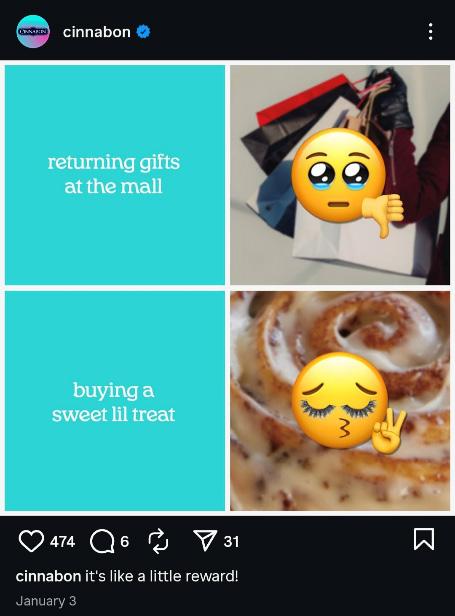
Figure 1
Cinnabon Instagram post
Cinnabon [Cinnabon]. (2025, January 3) Photo of a post about treats. Instragram. Retrieved October 31, 2025, from https://www.instagram.com/
Student Reflection:

Figure 2
Cinnabon Instagram post
Cinnabon [Cinnabon]. (2025, June 2) Photo of a cobranding with OREO. Instragram. Retrieved October 31, 2025, from https://www.instagram.com/.
By focusing deeply on a brand, I see how strategic marketing drives brand success. Completing this assignment really strengthened my interest in marketing. I can now connect these marketing strategy concepts to many businesses I see and use every day. I loved writing this paper because I chose a brand with many good memories for me. Many brands seem to be simple ideas, like Cinnabon, thinking it's just a cinnamon roll, but there is so much critical thinking behind niche-market businesses. For future marketing courses, I can have a better understanding of how companies influence consumer behavior. In addition, understanding which strategies are effective for different types of businesses. These concepts will further develop my skills needed to achieve my career goals in marketing. This assignment encouraged me to really push more than surface level material, and I hope to continue to these skills and critical thinking on other classes, coursework and jobs.
Assignment:
by Anna Crawford
ENGL 359: Studies in Indigenous Literature
Dr.
Erica Galioto
For this assignment, we were tasked with creating a biography of one of the characters from Louise Erdrich’s Love Medicine. In addition to writing an analysis paper, we were also required to have a creative element informed by our analysis.
In Louise Erdrich’s Love Medicine, Lyman Lamartine is characterized by both his notable good fortune and by his significant connections to family. Readers are immediately set up to think of Lyman differently than other members of the community beginning with the first line of his chapter, where he explains that “I was the first one to drive a convertible on my reservation” (Love Medicine 177). He then goes on to affirm this “difference” by explaining his unique “talent” (LM 177) for making money. Beginning in childhood, Lyman is remarkably lucky when it comes to monetary opportunities and even briefly owns a restaurant by age sixteen, which allows him to buy a red convertible with his older brother, Henry. Perhaps even more significantly, this “luck” spares him from being drafted to Vietnam alongside Henry and from potentially being exposed to the experiences that resulted in Henry’s eventual suicide (182).
However, though luck is what readers are immediately meant to associate with Lyman, his familial and kinship connections serve as an equally significant aspect of Lyman’s identity. Although he is described by his mother, Lulu, as being “carefree” and “a lover of nice things” (LM 285), it is within his narrative chapter, “The Red Convertible,” that Lyman’s observant and caring nature is revealed through his narration of his older brother Henry’s suicide. In general, Lyman’s caring personality and his love and deep connection with his family are revealed through his actions and observations. For example, he buys a color television for his mother while Henry is away. However, when he observes that Henry returns home “quiet,” “jumpy and mean,” and “never comfortable sitting still anywhere” (182), he deliberately fiddles with the TV “so that it was almost impossible now to get a clear picture” (185). Similarly, upon determining that it would not be possible for Henry to receive care in a hospital or from Native American doctors, Lyman decides to destroy the red convertible and leave it for Henry to find
in hopes that “the car might bring the old Henry back somehow” (184). Before Henry is sent to Vietnam, the brothers “had always been together before. Henry and Lyman” (185) and their shared car had represented the wholeness and strength of their bond, as illustrated by Lyman’s refusal to take Henry’s car keys, telling him “I’ll put it up in your drawer just in case I need it” (182). Although it pains Lyman to wreck the car that he had carefully maintained, he feigns apathy with the deliberate intention of giving Henry something to “fix,” even while he is unable to do so for himself. It is through Lyman’s careful observation and subsequent action that his characterization is best illustrated.
Born in the early 1950s, Lyman is the youngest of Lulu’s eight sons and is the child born of the affair between Lulu Lamartine and Nector Kashpaw, though neither Lulu nor Nector publicly confront this. Through a flashback told by Lulu, readers learn that as a young child, Lyman survived the housefire that Nector started but was saved by Lulu when she found him in his favorite spot in her closet (LM 283). Then, in “The Red Convertible,” we learn that Lyman starts working at a young age, being “the only kid they let in the American Legion Hall to shine shoes” (177). He then begins work for the Joliet Café at fifteen as a dishwasher and owns the entire restaurant within a year (178). Although he lists the jobs he worked there before becoming the owner, it is ambiguous as to how exactly he was able to become successful so quickly. It is also around this time that he and Henry purchase the red Olds convertible and spend the summer traveling to Alaska and back. However, after only owning the restaurant for a year, a tornado destroys the café and Lyman loses everything. Roughly three years after that is when Henry returns home and eventually commits suicide by drowning in the Red River (189). “The Red Convertible” concludes with Lyman driving the car into the river and letting the rushing current sink it as well.
In the most recent edition of Love Medicine, “The Red Convertible” is Lyman’s only narrative chapter and takes place when he is in his late teens or early twenties. Interestingly, there were two additional Lyman chapters that Erdrich added to the 1993 edition and then has since removed. As such, the limited information that Louise Erdrich does provide about Lyman’s adult life is gained through the narration of Lyman’s mother, Lulu. After Henry’s death, Lulu describes how the once “carefree” Lyman became “morose,” going “down lower, lower, to where nobody could drag him up” (LM 285). This phrasing is especially interesting given that it mirrors the way that Henry physically drowned in the river. Lulu also explains that Lyman moved out by himself to stay in the oldest shack on the Lamartine land, “where he could party all he liked” (285). Unlike the Lyman pre-Henry’s death who was caring and deeply connected to his family, the Lyman post-Henry’s death reflects disconnection, absence, and lack.
This statement is also significant because not only does it not make it clear how long Lyman isolated himself (much like his brother) and remained out in the shack alone, but it also suggests the potential that, like various members of the community, alcohol or drugs will become a more prominent issue for Lyman in future stories as he copes with loss. Our final view of Lyman in Love Medicine then appears when he is in his early thirties as he arrives to take Lulu back to the Senior Center after her eye surgery and he tells her that Nector has died (290). Despite having bandages that cover her eyes, Lulu notes that “Lyman must have noticed something,” which makes it clear that he remains just as observant and in tune with the emotions of others as he was when he was younger. However, Lulu’s version of an adult Lyman emphasizes tension. He confronts Nector’s presence head on, saying, “He was my dad, wasn’t he?” (290). Despite the fact that his “hesitating” voice reminds Lulu of a more vulnerable, ten-year-old Lyman, he is still actively facing this information. However, directly after Lulu notes that “He was never quite the same after Henry,” Lyman then retreats, saying, “I don’t really want to know” (291). Lyman then drives Lulu home in his “new, expensive car” that is “cool and tight as a cave inside” – the complete opposite of the “aliveness” of the red convertible. He avoids her suggestion that they go driving again (291) and then Lulu later notes that she was going to have to find someone else to help with her post-surgery care routine because Lyman “said he couldn’t” (292). In stark contrast to the Lyman who was acutely aware of his family’s needs (even unspoken), our final version of Lyman in the newest edition of Love Medicine is then one who feels out of character and defined by loss, silence, avoidance, and inaction and thus is strikingly similar to his father, Nector.
Based upon his early successes as a young adult, I predict that future stories will reveal that Lyman has continued to find it relatively easy to find work and make decent money. However, it remains to be seen what he will make of his inherited “luck.” From Love Medicine alone, his “luck” seems nuanced and ambiguous. For example, though he is extremely successful at an early age, “the worst tornado ever seen around here” results in “a total loss” (LM 178). Similarly, in his brother’s death, he loses a significant part that makes him whole (“Henry and Lyman”)(185). This is especially significant because we learn from Beverly Lamartine that Lulu’s boys “were of one soul” (114). As such, I predict that future stories that feature Lyman will begin to explore his connection to his father, including grappling with the question of the impact and meaning of Kashpaw “luck.” I also believe that the ambiguity established in relation to place, narrativity, and identity will once again shape the way that Louise Erdrich explores Lyman Lamartine’s story.
Place plays a significant role in a number of ways in “The Red Convertible,” with the most obvious being the fact that this chapter centers a car and the process of driving from one place to another. In the article “Where I Ought to Be,” Louise Erdrich argues that place is fundamentally a part of identity formation and thus an author’s specific connection to place inherently imbues their work (48-49). To make this case, Erdrich calls back to her childhood growing up in the parts of North Dakota where Love Medicine is set, explaining that she often sees the physicality of this setting while writing (“Where I Ought to Be,” 49).
This is immediately evident in “The Red Convertible” as Lyman and Henry visit real geographic locations from this area, such as the Red River. However, Lyman also notes a disconnect from exact place while he and Henry traveled, explaining that “Some people hang on to details when they travel, but we didn’t let them bother us and just lived our everyday lives here to there” (LM 179). Instead, Lyman describes the weightlessness of being comfortable in a place. He can’t recall the exact location, only the emotion it invoked, saying “I feel good” (LM 179). This moment introduces Erdrich’s final thought that we are “pull[ed] to landscapes that mirror our most intense feelings” (“Where I Ought to Be,” 49). Given her intimate knowledge of North Dakota, Erdrich is able to use the Red River as both a physical and a symbolic place for Henry and Lyman to confront their own intense feelings. Set in early spring, Erdrich describes the river as being “full of winter trash” with “little clumps of dirty snow here and there on the banks” and though the rushing water had not yet flooded the banks, “It was just at its limit, hard swollen, glossy like an old gray scar” (LM 187). Unlike their time in Alaska where they felt connected to the world “like an animal in nature”
(180), here place is distinctly oppressive and aggressive. Here Lyman shares the feeling of tension the Henry is experiencing – an uncomfortable “closing and opening” as they are confronted with trying to exist in this post-war reality (187). Much like the “hard swollen” water “at its limit,” the boundaries of this liminal space are pushed until Henry decides to drown himself and Lyman drowns the car.
The concept of liminality is also a key component to how Erdrich structures and tells Lyman’s story in the newest edition of Love Medicine. In the article “Reading between Worlds: Narrativity in the Fiction of Louise Erdrich,” Catherine Rainwater argues that Louise Erdrich consistently works within liminal spaces of “conflicting codes” that work to marginalize the reader (Rainwater 406). At the most basic level, readers of this novel become marginalized simply because there is a tension between the published versions of Lyman’s story. On one hand, the two additional chapters would potentially provide more context or reveal Lyman’s future through his own words. However, readers must also question the reasoning behind the removal of these stories. As such, the reader, as Rainwater argues, is lead “into a permanent state of irresolution” (409). It is this concept of irresolution and ambiguity that I believe is central to Lyman’s story.
Rainwater also argues that Erdrich tends to resist expectations of narrativity through the use of conflicting codes and the most prominent code conflict in Lyman’s story is between chronological and cyclic time. To begin, Lyman’s chapter appears to be structured chronologically with a specific setting in 1974. However, Erdrich immediately challenges the Western expectation that stories should unfold linearly by having Lyman talk about losing the car before immediately transitioning into speaking about his childhood. For the most part, the rest of the chapter does follow in chronological order. However, the true emphasis appears to be on the cyclic patterns of seasons and environmental impacts. For example, when Henry and Lyman leave Alaska and travel home, Lyman notes that “The season was changing” (LM 180). In making this distinction, the emphasis is placed more so on the aspect of change rather than the passage of time. Similarly, Lyman notes that it was spring when Henry suggested they drive out to see the Red River (LM 185). Again, this distinction emphasizes the symbolism of spring with its association of rebirth. Given that what actually occurs on this trip is Henry’s suicide, Erdrich can also be seen to marginalize readers through symbolic expectations. Finally, the most jarring instance of conflicting time codes appears when Erdrich changes from past to present tense at the very end of the chapter. As the brothers are confronted with this “closing and opening,” there is a sudden shift
where Henry actively addresses this moment: “’I know it,’ he says. ‘I know it. I can’t help it. It’s no use’” (187). This moment through to the end of the chapter is then written in present tense. This also adds to Erdrich’s manipulation of narrativity given that Lyman’s narrative ends completely ambiguously and in a state of irresolution as Rainwater describes it. Like the description of water “going and running and going and running and running” (189), Lyman’s story remains in a liminal state with no “true” start or end.
Overall, the ambiguity that is a consistent thread in Lyman’s story also relates to the larger concept of identity formation. In the article “The Stories We Tell: Louise Erdrich’s Identity Narrative,” E. Shelley Reid argues that Erdrich uses revised identity narrative to reflect the ways in which Native American identity has evolved. Erdrich specifically employs oral storytelling techniques such as fragmentation and the kinship and relational identity that clearly define Lyman’s narrative. However, Reid also argues that relying on the fragmentation of both text and characters is a method of revision that allows Erdrich to challenge the notion that “fragmentation and ambiguity connote chaos and the failure of self-actualization” (Reid 69). Within this novel, Lyman’s narrative is notably fragmented with his story being split among other storytelling characters and then appearing to end abruptly and without expected conclusion. Even more significantly, this concept of “the failure of self-actualization” (Reid 69) appears to be justifiably introduced given that two of his narrative chapters – which potentially would have revealed more of his individual adult identity – have been removed from the story. However, Reid suggests that in Erdrich’s attempt to the revise the multifaceted Native American construction of identity, readers are invited to “weave” themselves “into the narrative web of identity and to participate in the struggle for cultural survival and continuity” (Reid 81). In order to accomplish this, readers are invited into the narrative “gaps.”
With this in mind, readers are tasked with using the symbolism that Lyman is associated with in order to make sense of the ambiguity of his identity formation in its potential for continuity beyond Love Medicine. Although there are a number of symbols connected to Lyman, cars play the most significant role in relation to identity. To begin, the red convertible that Lyman and his brother Henry purchase together is personified from the moment that the brothers first see it: “There it was, parked, large as life. Really as if it was alive” Lyman explains (LM 178). This personification is important to note given that Lyman and Henry are already linked and understood as “Henry and Lyman” (185) who share “one soul” (114). Therefore, the car is then used as a symbol of the brothers themselves and
their relationship. For example, when Henry leaves for war, Lyman admits that although Henry is bad at staying in touch, Lyman keeps him informed about all of the work he is doing with the car (181). This can be directly seen as Lyman’s unspoken effort to maintain connection with Henry. Similarly, when Henry returns home a different person, Lyman’s decision to wreck the car in order to get Henry to fix it again can be understood as Lyman’s recognition that their relationship has been broken and needs to be repaired (184). Finally, after Henry commits suicide, Lyman chooses to drown the red convertible, and he watches as “The headlights reach in as they go down, searching, still lit even after the water swirls over the back end. I wait” (189). Although this is where Lyman’s narrative ends, the symbol of the personified car and his “drowned” relationship with his brother follows him into his mother’s account of his adult life after Henry’s death.
According to Lulu, “the drowned weren’t allowed into the next life but forced to wander forever” (LM 291). Although she says this in relation to both Henry (who drowns) and Nector (who wanders), it is a concept that best represents what we know about Lyman’s experience after Henry’s death. For example, the only car he buys after the convertible is “cool and tight as a cave inside” – lifeless in comparison to the red convertible that literally appeared “alive.” Although it is the red convertible that “drowns” rather than Lyman himself, the loss of the car still reflects the absence and lack that characterizes his experiences in life after losing his brother. As such, Lyman too is forced to wander in the liminal space between life and death. From this perspective, it makes sense that his concept of identity appears so fragmented and ambiguous.
Interestingly, Lipsha Morrissey’s (adopted Kashpaw) identity formation is also connected to a car. Similarly to both Nector and Lyman, Lipsha is also lucky in a way and is able to cheat at a game of cards
and win his mother, June’s, car from his half-brother (LM 324). Raised by his grandparents, Lipsha also feels a lack regarding an important kinship tie that influences identity. However, this lack is presented as something that has the potential to be filled as Lipsha drives June’s car over the bridge, concluding that “she was part of the great loneliness being carried up the driving current “ and that “there was nothing to do but cross the water and bring her home” (333). It is easy to note the similarities between Nector, Lyman, and Lipsha as members of an extended kinship with similar experiences that shape the symbolism that is used to suggest identity formation. It is especially significant to consider the mirrored experiences of Lyman and Lipsha, with both men being connected to Nector Kashpaw, water, and being shaped by a “lack.” Considering the characterization of Lyman as the “wanderer” and Lipsha as the “healer” in account of his love medicine, the ambiguity of their stories at the end of Love Medicine seem less like an example of “the failure of self-actualization” (Reid 69) and instead appear as a deliberately suggesting the continuity of Native American identity narratives beyond any apparent “conclusion.”
Erdrich, Louise. Love Medicine, newly revised ed. Harper Perennial, 2009.
Erdrich, Louise. “Where I Ought to Be: A Writer’s Sense of Place.”
Rainwater, Catherine. “Reading between Worlds: Narrativity in the Fiction of Louise Erdrich.”
Reid, E. Shelley. “The Stories We Tell: Louise Erdrich’s Identity Narratives.”
Student Reflection:
Despite Love Medicine being a novel built by the multiple and varying perspectives of a community of characters, Lyman Lamartine is only given a single short narrative vignette. Drawn to Erdrich’s emphasis on liminality in both the content and structure of his storytelling, I was inspired to focus my analysis of Lyman within these gaps.
by Brooke Miller
Writing
Dr. Sharon Harrow
Assignment:
The purpose of this assignment was to write an argumentative essay about something that applies to our community. This not only strengthened our writing skills, but introduced us to incorporating scholarly, encyclopedia, and general interest sources into our research. There was also a presentation that went with our papers to share our topics with our classmates, spreading awareness of the things we chose to write about.
Throughout the 2024-2025 school year, over 6,870 books were banned in 23 states and 87 public school districts (Baêta et al). As an English Secondary Education major at Shippensburg University, it highly concerns me that books are being taken away from students. Having read Animal Farm, Lord of the Flies, The Kite Runner, Brave New World, Of Mice and Men, and The Great Gatsby in school, I have been exposed to several different topics that made me significantly more socially and politically educated. In several schools, those books have been banned, limiting many students from being taught about what I learned. Books provide a way to learn about life lessons through telling a story, educating kids on self-expression, sexuality, religion, acceptance of others, politics, sociology, cultures, history, and more—these are the things that certain parents, organizations, and the government are trying to take away. Banned books are a crucial topic everyone should be aware of as there is an alarmingly increasing rate of censorship occurring in schools across America. Those in the Shippensburg community and university should be aware of how censorship devalues education, negatively impacting knowledge of the world that surrounds us. Organizations that ban books are actively restricting students from resources to learn about themselves, their peers, and the society they live in. Without bringing awareness to this issue, it will only continue to limit education throughout America. According to the Ezra Lehman Library, the first known banned book can be traced back to 1637 where the text, The New English Canaan, was banned by the Puritan government for going against their beliefs (Braet and Polyniak). Now, nearly 390 years later, book banning has only progressed to become a larger issue
of censorship. PEN America, a non-profit organization that fights for the worldwide freedom of expression through writing and literature, reports that the following novels banned in 2025 include (but are not limited to): The Perks of Being a Wallflower by Stephen Chbosky, The Handmaid’s Tale by Margaret Atwood, Wicked: The Life and Times of the Wicked Witch of the West by Gregory Maguire, All Boys Aren’t Blue by George M. Johnson, Nineteen Minutes by Jodi Picoult, Looking for Alaska by John Green, and Thirteen Reasons Why by Jay Asher (Tolin). These novels range in topics regarding societal and political awareness, covering suicide awareness, dangers of patriarchal, totalitarian governments, inclusivity, and school shootings. These topics have become extremely relevant and important subjects in today’s society, and people are willing to look past that these novels that are not only New York Times bestsellers, major motion pictures, and Goodreads Choice Award winners, but they are also a secure way for students to learn about pressing issues. People who support banning books are choosing to focus on their own personal beliefs over the greater good of humankind, which ultimately just harms the education system and world around them.
Despite the educational values that can come from reading, conservative views sometimes feel that books can convey inappropriate messages. On the first day of President Trump’s second presidency, he released an executive order arguing that schools “indoctrinate their children in radical, anti-American ideologies while deliberately blocking parental oversight” (The White House). PEN America clarifies that Trump’s idea of “un-American” topics includes “diversity, equity, inclusion, ‘gender ideology,’ and anything that
would suggest ‘that America’s founding documents are racist or sexist’” (Tolin). It’s important to remember that these founding documents include—but are not limited to—the “Three-Fifths Compromise,” “Slave Trade Clause,” and “Fugitive Slave Act.” These documents directly targeted Black citizens, preventing them from having rights. The Three-Fifths Compromise was a proposal by Roger Sherman in 1787 for all white citizens to be considered a whole person, but Black citizens would only be considered as three-fifths of a person. This raised Census populations for slave states, giving them more power in representation without giving black peoples equal rights (Tai). The Slave Trade Clause took over the course of 20 years, ending in 1808. This clause allowed for importation of enslaved people, giving more power to slave states in the south (Lloyd and Martinez). The Fugitive Slave Act occurred in 1850, requiring that slaves who were able to escape from their “owners” must be returned, despite if they made it to a free state (American Battlefield Trust). All three of these are pieces of American history, having large impacts on this country. Founding documents additionally say nothing regarding the advocation of women’s rights to vote. So, despite what Trump claims, these founding documents are indeed racist and sexist—erasing proof of this will make it easier for the government to revert back to how it was a long time ago, primarily supporting upper class white males. He also claims that getting an education encourages students to go against parental authority through individual self-expression, and that “young men and women are made to question whether they were born in the wrong body and whether to view their parents and their reality as enemies to be blamed” (The White House). These statements imply that there is only one way to exist—as a straight, heterosexual person who follows all the rules and believes all that the government says. By focusing on removing books that both support equality for people of all backgrounds and record historical events from bookshelves in attempt to manipulate people, Trump overlooks the importance of students being confident in becoming their own person—not because they were “indoctrinated,” but because they know who they are. Without having the opportunity to learn about who you want to become in the world, students can continue to struggle with identity. Allowing for more parent opinions may be a cover up for banning books, but it highly limits opportunities for students to grow independent through learning, and it lessens exposure to America’s past. PEN America makes the point that banning books threatens credibility of educators and authors, free expression, and rights from the First Amendment. They say that “… advocacy for ‘parental rights’ has been weaponized to
diminish students’ First Amendment rights in schools, sow distrust in librarians and educators, and diminish the ability of authors and illustrators to connect with their intended audiences” (Baêta et al). While banning books creates windows for parents with conservative morals, it ruins integrity of educators and authors, all while destroying opportunities for kids to become knowledgeable, independent, and find themselves.
Though the Federal Government has a large impact on the restriction of books, it does also rely on State-Level Governments. PEN America recorded that Florida was the state with the highest number of banned books in the 2024-2025 school year with 2,304 bans, followed by Texas with 1,781 bands and then Tennessee with 1,622 bans (Baêta et al). An article from NPR reports that in 2022, Florida governor, Ron DeSantis, signed a bill titled “Don’t Say Gay.” This bill says, “classroom instruction by school personnel or third parties on sexual orientation or gender identity may not occur in kindergarten through grade 3 or in a manner that is not age-appropriate or developmentally appropriate for students in accordance with state standards” (Diaz). These so-called “not age-appropriate” books for kindergarten through third grade students includes: And Tango Makes Three, a true story of two male penguins who adopted a baby penguin at the Central Park Zoo, The Family Book, which celebrates all types of families, and Julián Is a Mermaid, about a little boy who dresses as a mermaid (Tolin). All these books are picture books—written for children—that have been banned due to their celebration of LGBTQ+ pride. Elaine McArdle from the Harvard Graduate School of Education reports that Florida additionally rejected two AP courses because they “violate new state laws.” These law-violating classes being African American Studies, and a course focused on psychology and sexual orientation. It has been found that, “nearly half the challenged books were written by or about LGBTQ+ people, while most of the others deal with racial issues” (McArdle). Charlie English from The New York Times published an article reporting that federal funding agencies found the most commonly banned words include “women,” “diversity,” and “ethnicity.” Support towards the LGBTQ+ community and racial awareness being the most banned themes suggests a homophobic, white-supremacist mindset from politicians who pretend to care about students. While many of these issues go unheard of, there are authors who speak up to try and protect both their work and the people who are impacted.
There are unfortunately many instances where books are banned without argument, but there are also many times where the author will fight back—one of the most powerful examples being from American
Author, Kurt Vonnegut. When Vonnegut was 20, he entered the US army to fight in World War II. He left for Europe and was soon after captured by the Germans during the Battle of the Bulge, being sent to Dresden as a prisoner of war. In 1945, the city where Vonnegut was being held was bombed and destroyed. This killed about 60,000 civilians, but Vonnegut and the other prisoners of war survived by accident. They had been kept about 60 feet underground in what once was a meat locker and slaughterhouse, saving them from the bombing. His job became to gather and burn remains of the dead. About 25 years after the war ended, Vonnegut wrote a novel titled SlaughterhouseFive, inspired by his time in war. Not long after publishing several novels, Vonnegut became one of the most well-known living authors in America (Allen).
In 1973, an English teacher at Drake High School in North Dakota decided to teach Slaughterhouse-Five to his class. Despite the students enjoying this novel, the head of the school board, Charles McCarthy, demanded that all 32 copies of this book be burned in the school’s furnace. Hitting headlines, Vonnegut had no response to the public. Instead, he wrote a private letter to McCarthy expressing his stance on what happened. Opening the letter by introducing himself as being “among those American writers whose books have been destroyed in the now famous furnace of your school” (Vonnegut), Vonnegut quickly made his frustration known. He continues, explaining how his publisher and he had not done anything to take advantage of the “disgusting” news as a PR opportunity, as he is not an evil man. He then makes the point, “If you were to bother to read my books, to behave as educated persons would, you would learn that they are not sexy, and do not argue in favor of wildness of any kind. They beg that people be kinder and more responsible than they often are” (Vonnegut). He indicates that McCarthy is an uneducated man who only looks for the negative, rather than the message that Vonnegut is truly spreading: people should be more caring and kinder. This is then followed by an explanation of the coarseness in his writing, because it is how people accurately speak, and then he says, “After I have said all this, I am sure you are still ready to respond, in effect, ‘Yes, yes— but it still remains our right and our responsibility to decide what books our children are going to be made to read in our community.’ This is surely so. But it is also true that if you exercise that right and fulfill that responsibility in an ignorant, harsh, un-American manner, then people are entitled to call you bad citizens and fools. Even your own children are entitled to call you that” (Vonnegut). Through saying this, Vonnegut fires back at the claims of people who ban books. Books are not intended
to harm children, nor do they promote unpatriotic ideologies—matter of fact, banning books is what hurts kids and supports totalitarian governments. Extending this idea, he writes, “…Drake is a part of American civilization, and your fellow Americans can’t stand it that you have behaved in such an uncivilized way. Perhaps you will learn from this that books are sacred to free men for very good reasons, and that wars have been fought against nations which hate books and burn them. If you are an American, you must allow all ideas to circulate freely in your community, not merely your own” (Vonnegut). He re-emphasizes what America is meant to stand for: civilization, freedom, and acceptance of all. Banning and burning books expresses the opposite message, it’s “a rotten lesson [McCarthy] taught young people in a free society when [he] denounced and then burned books—books [he] hadn’t even read” (Vonnegut). Writing a private letter with such an intense message was an admirable and impactful move from Vonnegut. While he could have taken this as an opportunity for higher publicity, he directly addressed McCarthy to make a clear statement about the harm he had done through burning his books.
Although McCarthy did not respond to Vonnegut’s letter, it left a long-lasting impact on people around America regarding standing up for their rights. An academic journal from the Southeastern Librarian found several other instances where authors or the community fought back for books being banned. After the children’s book And Tango Makes Three was banned in Florida, the authors sued the Escambia County school district for violating the First Amendment. The case was ruled against the authors, but they have since appealed. In Illinois, a law was made that allows the Illinois Secretary of State’s office to take away grant funding from libraries if they do not follow the American Library Association Bill of Rights. In response to the law, several school districts opted out of state grant funding, so they had jurisdiction of what books were put on their shelves. In Louisiana, Citizens Against Censorship and the St. Tammany Library Alliance challenged censorship in libraries, backed librarians who were attacked by partisan pressure groups, and spoke up against state legislation. (Hooper et al). Authors, educators, and librarians standing up for both their rights and the public’s rights largely helps spread knowledge to this ever-growing problem. It’s important for these professionals to continue standing up for what’s right, as it also helps them promote advocacy for their jobs.
Banning books substantially harms authors, educators, librarians, and journalists. PEN America reports that during the 2024-2025 school year, 2,308 authors,
243 illustrators, 38 translators, and 2,589 “unique creatives” were impacted by books being banned. They also report that the author with the highest total instances of book bans was Stephen King, reaching 206 bans. Those who are impacted are hurt in several different ways—especially authors—as they are left at an “increased financial risk due to a reduction in school visits or events, and the potential subsequent impact on their future book sales. Some authors have reported the emotional impacts of these book bans on their creativity, citing concerns about potential blowback to future works, which cause them to feel the need to self-censor” (Baêta et al). It’s also been found that it “blocks access for independent journalists, intimidates news organizations and defunds outlets they perceive as hostile to the MAGA agenda, including NPR, Radio Free Europe/Radio Liberty, Radio Free Asia and Voice of America” (English). Banning books damages our country as a whole, and while that damage cannot be undone, it can be reduced. Blocking access for journalists who speak up against MAGA is an active form of censorship—going against the First Amendment—yet the government gets away with it. While not all action taken against censored books and professionals is immediately successful, it can inspire others to speak up. It’s important for people to fight for free speech within education, whether it be protesting, sending letters, starting movements, making clubs, or simply just informing others about the dangers of censorship. Even if it begins in a small community, it is crucial to bring awareness to this ever-growing issue.
Shippensburg University is well known for its educational programs. Offering 17 different educationbased majors, Ship encompasses many students who hope to teach one day. Whether it be early, middle, or secondary education, all teachers should be aware of how politicians and parents may try to infringe on their students’ education. In the 2024-2025 school year, Pennsylvania had 73 instances of banned books (Baêta et al). Pennsylvania is additionally “being anticipated on the horizon” for book censorship to become “a routine and expected part of school operations” (Baêta et al). Without advocacy for putting banned books back on the shelves, the number of bans will only expand. Ship students should be aware of educational censorship, as it could one day affect them and their children. 73 books may not seem like a big deal compared to Florida or Texas, but that number will only grow if there is not an end put to censorship. Millions of people are being hurt by this violation of rights, and without speaking out, America will continue to fall back in time.
It has recently become more important than ever to advocate for the basic human rights of all. Democracy is being challenged in many ways, and without
promoting education it will continue to get worse. Banning books restricts education from children, hurts public school systems, and censors authors, educators, and librarians. The “home of the free” is turning into a society that promotes xenophobic, homophobic, totalitarian beliefs, attacking the right to education for students of all backgrounds. Without knowledge of the world surrounding them, current children will not only grow to become unaccepting of others, but they’ll become more susceptible to falling for the government and politicians whose goal is to benefit themselves. Censorship will likely expand in the next couple of years, but in the meantime it’s crucial to support education, authors, freedom of speech, and all who are impacted by banned books. If the people in America don’t stop the government and organizations from their abuse of power, who will?
Allen, William Rodney. “A Brief Biography of Kurt Vonnegut.” Kurt Vonnegut Museum and Library, Kurt Vonnegut Museum and Library, 2017, www. vonnegutlibrary.org/biography/.
American Battlefield Trust. “Fugitive Slave Act.” American Battlefield Trust, 18 Sept. 1850, www.battlefields.org/ learn/primary-sources/fugitive-slave-act.
Baêta, Sabrina, et al. “The Normalization of Book Banning.” PEN America, Oct. 2025, pen.org/report/ the-normalization-of-book-banning/.
Diaz, Jaclyn. “Florida’s Governor Signs Controversial Law Opponents Dubbed ‘Don’t Say Gay.’”
National Public Radio, 28 Mar. 2022, www.npr.org/2022/03/28/1089221657/ dont-say-gay-florida-desantis.
English, Charlie. “Opinion | ‘1984’ Hasn’t Changed, but America Has.” The New York Times, 27 July 2025, www. nytimes.com/2025/07/27/opinion/1984-cia-book-ban. html.
Hooper, Rachel, et al. “Now More Important Than Ever: Understanding Censorship, Fighting Book Challenges, and Celebrating Banned Books Week.” Southeastern Librarian, vol. 73, no. 2, July 2025, pp. 20–28. EBSCOhost, https://doi.org/10.62915/0038-3686.2148.
Lloyd, Gordon, and Jenny Martinez. “Interpretation: The Slave Trade Clause | the National Constitution Center.” National Constitution Center – Constitutioncenter.org, 2024, constitutioncenter.org/the-constitution/articles/ article-i/clauses/761.
McArdle, Elaine. “Book Bans and the Librarians Who Won’t Be Hushed.” Www.gse.harvard.edu, Harvard, 6 Nov. 2023, www.gse.harvard.edu/ideas/ed-magazine/23/11/ book-bans-and-librarians-who-wont-be-hushed.
Polyniak, Veronica, and Kimberly Braet. “ShipLibrary Blog - Library at Shippensburg University.” Ship.edu, 2025, library.ship.edu/blog/Banned-Books-Week. Accessed 11 Nov. 2025.
Tai, Thomas. “The Three-Fifths Compromise and the Electoral College | League of Women Voters.” Lwv.org, 8 Apr. 2025, www.lwv.org/blog/ three-fifths-compromise-and-electoral-college.
The White House. “Ending Radical Indoctrination in K-12 Schooling.” The White House, 29 Jan. 2025, www.whitehouse.gov/presidential-actions/2025/01/ ending-radical-indoctrination-in-k-12-schooling/.
Tolin, Lisa. “Banned Books List 2025.” PEN America, 4 Feb. 2025, pen.org/banned-books-list-2025/.
---. “The 23 Most Banned Picture Books of the 2023-2024 School Year - PEN America.” PEN America, 27 Jan. 2025, pen.org/banned-picture-book-list-2024/.
Vonnegut, Kurt, and Shawn Usher. “Kurt Vonnegut’s Powerful 1973 Letter to the Man Burning His Books.” Farnam Street, 25 May 2014, fs.blog/ kurt-vonneguts-letter-book-burning/.
Writing this paper truly opened my eyes to how alarming censorship is growing to become in America. When Dr. Harrow first told us about this paper at the beginning of the semester, I began to think about something I really care about. Banned books popped into my head, and I briefly looked it up to see if it was something that is relevant enough to research. To no surprise it was, and I held onto that thought until it was time to start working on the papers. I went to Dr. Harrow’s office hours to tell her about my idea, and her enthusiasm really encouraged me to put my full effort into this paper. I fell into a rabbit hole of reading articles from PEN America, the American Library Association, and executive orders from the White House. I was appalled by what I found, which only made me more passionate about growing awareness towards this topic. Having the opportunity to educate both myself and others on something that is so concerning—or even dangerous—has meant a lot to me, and I will continue to advocate for the rights of students, educators, and writers of all sorts.
by Adelyn Hartlaub
HONR 122: Honors Historical Foundations of Global Cultures
Dr. Christine Senecal
Assignment:
We were able to write about any history topic of our choosing as long as it was from before the French Revolution and was not American history. It was to be a research paper that argued whatever point the student picked.
As a women trying to study science in the early 1700s, Gabrielle Émilie Le Tonnelier de Breteuil, Marquise du Châtelet (1706-1749), more commonly known as Émilie du Châtelet, faced a lot of hurdles while still becoming quite successful. Châtelet was not able to join the Paris Academy of Sciences or be a part of some very important conversations; however, she was able to figure out ways to get her voice heard through other means.1 There were multiple factors in Émilie du Châtelet’s life that helped her to succeed such as her wealthy upbringing and her father’s encouragement for her education.2 Additionally, she was able to translate other scholars’ works which she used as an opportunity to add her own commentary. Most famously, she translated and commentated on Sir Isaac Newton’s Philosophiae Naturalis Principia Mathematica. Voltaire, Émilie du Châtelet’s romantic partner, was the first to encourage Châtelet to begin translating.3 Émilie du Châtelet also had original works which showed her understanding of the setbacks she faced as a woman as she would disguise her gender in her writings, and even write in a way that suggested she was a father instead of a mother.4 It was impactful when she revealed her gender halfway through her work “Discourse on Happiness”. This paper argues that despite Châtelet’s enormous mathematical successes, the fact that she was
a woman greatly hindered her work. She herself recognized the fact that she had to rely on non-institutional avenues to conduct her studies.
Émilie du Châtelet was fortunate to receive the education that she did. Her family was very wealthy, and her father was adamant that she received a good education.5 He was actually the one to tutor her at home.6 Châtelet was able to use her parents library and even participate in the salons her dad hosted.7 Her cousin revealed that Châtelet’s parents were unorthodox when it came to their children’s education.8 Châtelet was allowed to argue with her parents and had complete access to their library by ten years old.9 Émilie du Châtelet showed quite the interest in mathematics and metaphysics pretty early on.10 In addition to these subjects, she also learned many languages including Latin, Italian and English.11 While Châtelet was lucky to have received these opportunities, it was extremely rare for women of her time to get this kind of education. Her education was still not great, and it in no way compared to the education her brothers received. Her brothers went to prestigious schools and had the option to go to university.12 On the contrary, most of Châtelet’s scholarship came from her readings, and the thought of her attending university was laughable.13 Being educated at all was a huge privilege
1 Vesna Crnjanski Petrovich, “Women and the Paris Academy of Sciences,” Eighteenth-Century Studies 32, no. 3 (1999): 383.
2 Vesna Crnjanski Petrovich, “Women and the Paris Academy of Sciences,” Eighteenth-Century Studies 32, no. 3 (1999): 383.
3 Judith P Zinsser, “Entrepreneur of the ‘Republic of Letters’: Emilie de Breteuil, Marquise Du Châtelet, and Bernard Mandeville’s Fable of the Bees,” French Historical Studies 25, no. 4 (2002): 600.
4 Émilie Du Châtelet, “From Foundations of Physics ,” (1740), In Selected Philosophical and Scientific Writings, edited by Judith P. Zinsser, Translated by Isabelle Bour and Judith P. Zinsser, University of Chicago Press, 2009, 116.
5 Vesna Crnjanski Petrovich, “Women and the Paris Academy of Sciences,” Eighteenth-Century Studies 32, no. 3 (1999): 383.
6 Vesna Crnjanski Petrovich, “Women and the Paris Academy of Sciences,” Eighteenth-Century Studies 32, no. 3 (1999): 383.
7 Vesna Crnjanski Petrovich, “Women and the Paris Academy of Sciences,” Eighteenth-Century Studies 32, no. 3 (1999): 383.
8 Robyn Arianrhod, Seduced by Logic: Émilie du Châtelet, Mary Somerville and the Newtonian Revolution, Oxford University Press, 2012, 7.
9 Robyn Arianrhod, Seduced by Logic: Émilie du Châtelet, Mary Somerville and the Newtonian Revolution, Oxford University Press, 2012, 8.
10 Robyn Arianrhod, Seduced by Logic: Émilie du Châtelet, Mary Somerville and the Newtonian Revolution, Oxford University Press, 2012, 7.
11 Vesna Crnjanski Petrovich, “Women and the Paris Academy of Sciences,” Eighteenth-Century Studies 32, no. 3 (1999): 383.
12 Robyn Arianrhod, Seduced by Logic: Émilie du Châtelet, Mary Somerville and the Newtonian Revolution, Oxford University Press, 2012, 7.
13 Robyn Arianrhod, Seduced by Logic: Émilie du Châtelet, Mary Somerville and the Newtonian Revolution, Oxford University Press, 2012, 7.
for Châtelet compared to other women, and yet she was still not equal to the men her age.
Émilie du Châtelet started her career by translating others work. This is a known way that women were able to publish. They would be able to publish some of their own ideas by adding commentary into their translation. Châtelet’s first writing was a translation of Bernard Mandeville’s The Fable of the Bees, and it is thought that Voltaire encouraged her to translate it.14 The Fable of the Bees is an “English work of satire” that Châtelet says “appears to be, of all books in the world, one of the most designed for humanity in general.”15 Châtelet’s personal beliefs and philosophies really shine through in her preface, commentary, and selection of this text. In the preface, Châtelet claims that women are unaware of their talents because of poor education, or they hide them because of prejudice.16 She says that through her close friendships with men she started to realize she was a “thinking creature.”17 This really speaks to the way society was at the time and shows that Châtelet was at a disadvantage as a woman. She needed the men around her to validate her in order to see her talents, and as she pointed out it was uncommon for women to have the same understanding and opportunities she had.
Voltaire was very supportive throughout most of Châtelet’s career. He encouraged her to begin writing and publishing with her translation of The Fable of the Bees published in 1735, and he continued to support her through her other projects. For example, he would “refer to her playfully as ‘Madame Newton du Châtelet’” showing his support for her translating Newton’s Principia. 18 While the above are two of her more prevalent works, Châtelet had an abundance of other projects she was working on that Voltaire supported and encouraged her to do. Furthermore, Voltaire and Châtelet started “an academy” to-
gether where they would host “young men of Europe’s ‘Republic of Letters’” to discuss and study all topics.19 Châtelet also helped Voltaire in some of his essays specifically an assay about the nature of fire showing that he truly respected her opinions as a fellow intellect.20 While Châtelet’s accomplishments were all her own, Voltaire played a key role in helping her to accomplish all that she did.
Émilie du Châtelet was said to be a brilliant teacher as she never told people what to think. The emphasis she put on her students forming their own opinions was different from the way others of her time were teaching.21 She would teach people how to read but never tell them what to think of what they were reading, encouraging them to not blindly follow others’ opinions.22 It was argued that because of this, Châtelet may have really encouraged women to think for themselves and fight for their educations.23 It is argued that men tried to prevent this by taking credit for Émilie du Châtelet’s work and making her name become unknown.24 Châtelet was a famous name in her time, but seemed to become unknown making historians wonder why her name would have fallen off. One place where it is very clearly seen that Châtelet does not receive credit for her work is in Encyclopédie. In the entirety of Encyclopédie, only two women are given credit, and both were for writings about fashion.25 It seems that authors in Encyclopédie that were writing about metaphysics were likely influence by Châtelet specifically Johann Heinrich Samuel Formey.26 Châtelet was not listed as an author in any part of Encyclopédie, but her Institutions de physique it mentioned in seven articles. 27 Modern historians hypothesized that more articles used Châtelet’s work, and they tested this with a “system [that] treats two texts as long potential sequences, and then looks for common subsequences with a high degree of flexibility between the two.”28
14 Judith P Zinsser, “Entrepreneur of the ‘Republic of Letters’: Emilie de Breteuil, Marquise Du Châtelet, and Bernard Mandeville’s Fable of the Bees,” French Historical Studies 25, no. 4 (2002): 600.
15 Judith P Zinsser, “Entrepreneur of the ‘Republic of Letters’: Emilie de Breteuil, Marquise Du Châtelet, and Bernard Mandeville’s Fable of the Bees,” French Historical Studies 25, no. 4 (2002): 600 and Émilie Du Châtelet, “Translator’s Preface for The Fable of the Bee,” (1735), In Selected Philosophical and Scientific Writings, edited by Judith P. Zinsser, Translated by Isabelle Bour and Judith P. Zinsser, University of Chicago Press, 2009, 49-50.
16 Émilie Du Châtelet, “Translator’s Preface for The Fable of the Bee,” (1735), In Selected Philosophical and Scientific Writings, edited by Judith P. Zinsser, Translated by Isabelle Bour and Judith P. Zinsser, University of Chicago Press, 2009, 49.
17 Émilie Du Châtelet, “Translator’s Preface for The Fable of the Bee,” (1735), In Selected Philosophical and Scientific Writings, edited by Judith P. Zinsser, Translated by Isabelle Bour and Judith P. Zinsser, University of Chicago Press, 2009, 49-50.
18 Robyn Arianrhod, Seduced by Logic: Émilie du Châtelet, Mary Somerville and the Newtonian Revolution, Oxford University Press, 2012, 6.
19 Judith P Zinsser, “Entrepreneur of the ‘Republic of Letters’: Emilie de Breteuil, Marquise Du Châtelet, and Bernard Mandeville’s Fable of the Bees,” French Historical Studies 25, no. 4 (2002): 604.
20 Vesna Crnjanski Petrovich, “Women and the Paris Academy of Sciences,” Eighteenth-Century Studies 32, no. 3 (1999): 384.
21 Andrew Janiak, The Enlightenment’s Most Dangerous Woman: Émilie du Châtelet and the Making of Modern Philosophy, Oxford University Press, 2024, 23.
22 Andrew Janiak, The Enlightenment’s Most Dangerous Woman: Émilie du Châtelet and the Making of Modern Philosophy, Oxford University Press, 2024, 23.
23 Andrew Janiak, The Enlightenment’s Most Dangerous Woman: Émilie du Châtelet and the Making of Modern Philosophy, Oxford University Press, 2024, 23.
24 Andrew Janiak, The Enlightenment’s Most Dangerous Woman: Émilie du Châtelet and the Making of Modern Philosophy, Oxford University Press, 2024, 23.
25 Glenn Roe, “A Sheep in Wolff’s Clothing: Émilie du Châtelet and the Encyclopédie,” Eighteenth-Century Studies 51, no. 2 (2018): 181.
26 Glenn Roe, “A Sheep in Wolff’s Clothing: Émilie du Châtelet and the Encyclopédie,” Eighteenth-Century Studies 51, no. 2 (2018): 182.
27 Glenn Roe, “A Sheep in Wolff’s Clothing: Émilie du Châtelet and the Encyclopédie,” Eighteenth-Century Studies 51, no. 2 (2018): 187.
28 Glenn Roe, “A Sheep in Wolff’s Clothing: Émilie du Châtelet and the Encyclopédie,” Eighteenth-Century Studies 51, no. 2 (2018): 188.
Using this program, they were able to trace six more articles back to Châtelet.29 All but one of these texts are “signed by Formey or Formey and d’Alembert.”30 They were then able to assign a percentage to each article for the amount that was Châtelet.31 The highest scoring article was “Contradiction” with a 95% while there were 5 others in the range of 63% - 87%. 32 This shows that while her contributions were extremely important, she was not recognized for them as she should have been, and men were taking credit for her work. It is extremely important for women to be given credit for their work as the amount of research that had to be done to discover what was truly her work takes time leaving women’s names out of the conversation for greater amounts of history.
As a female scientist in the 1700s, men taking credit for her work was not the only set back Émilie du Châtelet faced. Women were not allowed to join the Paris Academy of Sciences as full members and therefore were unable to “pursue serious scientific work.”33 They were unable to participate in discussions or attend gatherings that the Academy hosted.34 Women including Châtelet did find ways to work around this. For example, they could submit work to anonymous competitions that the Academy sponsored and associate themselves with members of the Academy.35 Châtelet entered an essay about the nature of fire to one of the competitions that she worked on at night because she disagreed with what Voltaire was writing on the topic.36 She did not win, but she did receive public praise once her name was revealed. The Academy ended up publishing both her and Voltaire’s essays because of the fame of the authors.37 Her association with others in the Academy allowed her to hear about new research being done and get feedback on her work.38 Her strongest connection to the Academy was through Alexis Claude Clairaut, and he helped to
review her translation of Newton’s Principia. 39 In addition to these strategies, Châtelet published her essays to become publicly recognized; however, it took as lot of compromise, persuasion, and connections to get her work published.40
Émilie du Châtelet herself also recognized the prejudices she faced as a woman. In her preface on her translation of The Fable of the Bees, it was previously stated how she thinks women are unaware of their talents, but she talks about what she faces as a woman. She says that translating is “mediocre work” and yet it “may be thought that it is audacious for a woman to aspire to do it.”41 Châtelet goes on to say that she fully feels the exclusion women face in science, and then clearly states her opinion on women’s treatment in the intellectual world:42
Let us reflect briefly on why for so many centuries, not one good tragedy, one good poem, one esteemed history, one beautiful painting, one good book of physics, has come from the hands of women. Why do these creatures whose understanding appears in all things equal to that of men, seem, for all that, to be stopped by an invincible force on this side of a barrier; let someone give me an explanation if there is one. I leave it to naturalists to find a physical explanation, but until that happens, women will be entitled to protest against their education.43
She goes on to say that if she were in charge, women would be put into schools and educated.44 She claims that in doing this all of society would benefit as women would be more valued and men would therefore have new conversationalists.45 Châtelet was very aware of the difficulties women faced in her time, and it is apparent that she did not agree with the inequality of opportunities men and women had.
29 Glenn Roe, “A Sheep in Wolff’s Clothing: Émilie du Châtelet and the Encyclopédie,” Eighteenth-Century Studies 51, no. 2 (2018): 187.
30 Glenn Roe, “A Sheep in Wolff’s Clothing: Émilie du Châtelet and the Encyclopédie,” Eighteenth-Century Studies 51, no. 2 (2018): 187.
31 Glenn Roe, “A Sheep in Wolff’s Clothing: Émilie du Châtelet and the Encyclopédie,” Eighteenth-Century Studies 51, no. 2 (2018): 189.
32 Glenn Roe, “A Sheep in Wolff’s Clothing: Émilie du Châtelet and the Encyclopédie,” Eighteenth-Century Studies 51, no. 2 (2018): 189.
33 Vesna Crnjanski Petrovich, “Women and the Paris Academy of Sciences,” Eighteenth-Century Studies 32, no. 3 (1999): 383.
34 Vesna Crnjanski Petrovich, “Women and the Paris Academy of Sciences,” Eighteenth-Century Studies 32, no. 3 (1999): 383.
35 Vesna Crnjanski Petrovich, “Women and the Paris Academy of Sciences,” Eighteenth-Century Studies 32, no. 3 (1999): 384.
36 Vesna Crnjanski Petrovich, “Women and the Paris Academy of Sciences,” Eighteenth-Century Studies 32, no. 3 (1999): 384.
37 Vesna Crnjanski Petrovich, “Women and the Paris Academy of Sciences,” Eighteenth-Century Studies 32, no. 3 (1999): 384.
38 Vesna Crnjanski Petrovich, “Women and the Paris Academy of Sciences,” Eighteenth-Century Studies 32, no. 3 (1999): 384.
39 Vesna Crnjanski Petrovich, “Women and the Paris Academy of Sciences,” Eighteenth-Century Studies 32, no. 3 (1999): 384.
40 Vesna Crnjanski Petrovich, “Women and the Paris Academy of Sciences,” Eighteenth-Century Studies 32, no. 3 (1999): 384.
41 Émilie Du Châtelet, “Translator’s Preface for The Fable of the Bee,” (1735), In Selected Philosophical and Scientific Writings, edited by Judith P. Zinsser, Translated by Isabelle Bour and Judith P. Zinsser, University of Chicago Press, 2009, 48.
42 Émilie Du Châtelet, “Translator’s Preface for The Fable of the Bee,” (1735), In Selected Philosophical and Scientific Writings, edited by Judith P. Zinsser, Translated by Isabelle Bour and Judith P. Zinsser, University of Chicago Press, 2009, 48.
43 Émilie Du Châtelet, “Translator’s Preface for The Fable of the Bee,” (1735), In Selected Philosophical and Scientific Writings, edited by Judith P. Zinsser, Translated by Isabelle Bour and Judith P. Zinsser, University of Chicago Press, 2009, 48.
44 Émilie Du Châtelet, “Translator’s Preface for The Fable of the Bee,” (1735), In Selected Philosophical and Scientific Writings, edited by Judith P. Zinsser, Translated by Isabelle Bour and Judith P. Zinsser, University of Chicago Press, 2009, 48.
45 Émilie Du Châtelet, “Translator’s Preface for The Fable of the Bee,” (1735), In Selected Philosophical and Scientific Writings, edited by Judith P. Zinsser, Translated by Isabelle Bour and Judith P. Zinsser, University of Chicago Press, 2009, 49.
Additionally, her essay, Discourse on Happiness published in 1746, shows the impact of being a woman at the time. She would often write without disclosing her gender, and Discourse of Happiness was no different until about halfway through. She begins to share her opinions and prospective as a woman making this essay extremely impactful and different from others at the time46. She talks about her personal experiences “as a woman past thirty” instead of making round about connections to classic authors.47 Châtelet also discussed the differences in happiness for men and women. She claims that “the love of study” is much more important to women’s happiness then men’s.48 One could assume that it feels this way as men have access to study and may take it for granted while women recognize the privilege it is to be able to study. While she disclosed her gender in this essay, that was not common for her to do. In fact, in her preface to Institutions de Physique some historians believe she writes to her son in a way that suggests she is his father instead of his mother.49 She believes that it is “the most sacred duty of men” to provide their children a strong education.50 She encourages her son to explore the scientific world and continue to study nature.51
Émilie du Châtelet is most known for her commentary and translation of Philosophiae Naturalis Principia Mathematica by Isaac Newton that was published after her death in 1749, and it is her French translation that is still used today. This was an extremely impressive feat as she had to fully understand the material in order to not only correctly translate it, but to also add commentary.52 This project really solidified how knowledgeable she truly was in mathematics as “she numbered among twenty or so eighteenth-century men and women” that understood Newton’s math.53 The information that she covered in her commentary spanned all the different relationships between the
planets and the Earth as well as the Sun.54 She even provided distances of each of the planets to the Sun and sizes of their orbits.55 The Moon, equinoxes, comets and the flow of the sea were also all discussed in her commentary.56 The work she did in translating and commentating on Newton’s Principia demonstrated how intelligent Émilie du Châtelet truly was, and it was crucial in spreading Newton’s ideas to a broader audience.
Châtelet is most famous for her work with Newton’s Principia, but before that she actually wrote her own book on physics and metaphysics, Institutions de Physique or Foundations of Physics, published in 1740, which some argue is her most important work. Through this text, Châtelet tried to answer questions such as how God and hypotheses played a part in science.57 When Châtelet was writing this text, there was “no complete and up-to-date textbook in physics available in French.”58 The main topics of this book are “how bodies act upon one another, and the central epistemological problem concerns the appropriate method by which to address this problem of bodily action.”59 Châtelet combined many philosophers ideas with her own while excluding the parts she did not agree with in order to create this book that covers such difficult concepts and questions.60 Émilie du Châtelet’s Institutions de Physique deserves much more recognition as she was writing at a time where there was not an encompassing physics textbook, and she was creating one source that would house many of her own ideas as well as the famous male scientists at the time.
While it is recognized that Châtelet was very intelligent, it will always be unknown how smart she truly was or could have been. Émilie du Châtelet was one of very few to fully understand Newton’s work, she wrote a physics textbook at a time where there was not one, and she inspired many people in their
46 Judith P. Zinsser, Selected Philosophical and Scientific Writings, trans. Isabelle Bour and Judith P. Zinsser (University of Chicago Press, 2009) 346.
47 Judith P. Zinsser, Selected Philosophical and Scientific Writings, trans. Isabelle Bour and Judith P. Zinsser (University of Chicago Press, 2009) 346.
48 Émilie Du Châtelet, “Discourse on Happiness,” (1746), In Selected Philosophical and Scientific Writings, edited by Judith P. Zinsser, Translated by Isabelle Bour and Judith P. Zinsser, University of Chicago Press, 2009, 357.
49 Judith P Zinsser, “Entrepreneur of the ‘Republic of Letters’: Emilie de Breteuil, Marquise Du Châtelet, and Bernard Mandeville’s Fable of the Bees,” French Historical Studies 25, no. 4 (2002): 599.
50 Émilie Du Châtelet, “From Foundations of Physics ,” (1740), In Selected Philosophical and Scientific Writings, edited by Judith P. Zinsser, Translated by Isabelle Bour and Judith P. Zinsser, University of Chicago Press, 2009, 116.
51 Émilie Du Châtelet, “From Foundations of Physics ,” (1740), In Selected Philosophical and Scientific Writings, edited by Judith P. Zinsser, Translated by Isabelle Bour and Judith P. Zinsser, University of Chicago Press, 2009, 117.
52 Judith P. Zinsser, Selected Philosophical and Scientific Writings, trans. Isabelle Bour and Judith P. Zinsser (University of Chicago Press, 2009) 253.
53 Judith P. Zinsser, Selected Philosophical and Scientific Writings, trans. Isabelle Bour and Judith P. Zinsser (University of Chicago Press, 2009) 251.
54 Émilie Du Châtelet, “From the Commentary on Newton’s Principia,” (1756), In Selected Philosophical and Scientific Writings, edited by Judith P. Zinsser, Translated by Isabelle Bour and Judith P. Zinsser, University of Chicago Press, 2009, 263.
55 Émilie Du Châtelet, “From the Commentary on Newton’s Principia,” (1756), In Selected Philosophical and Scientific Writings, edited by Judith P. Zinsser, Translated by Isabelle Bour and Judith P. Zinsser, University of Chicago Press, 2009, 280.
56 Émilie Du Châtelet, “From the Commentary on Newton’s Principia,” (1756), In Selected Philosophical and Scientific Writings, edited by Judith P. Zinsser, Translated by Isabelle Bour and Judith P. Zinsser, University of Chicago Press, 2009, 325.
57 Katherine Brading, Émilie du Châtelet and the Foundations of Physical Science, Taylor & Francis Group, 2018,1.
58 Katherine Brading, Émilie du Châtelet and the Foundations of Physical Science, Taylor & Francis Group, 2018,2.
59 Katherine Brading, Émilie du Châtelet and the Foundations of Physical Science, Taylor & Francis Group, 2018,2.
60 Katherine Brading, Émilie du Châtelet and the Foundations of Physical Science, Taylor & Francis Group, 2018,1.
scholarship all while being faced with discriminations because of her gender. She was able to find loopholes and work arounds in order to get her name and work out into the world making one wonder what she would have been capable of had she had the same opportunities as men, or the opportunities women have today. Furthermore, Émilie du Châtelet played a big role in expanding the fame of other scholars. Evidently, she helped to spread Newton’s ideas as she made his work available in French, and she was one of his first supporters. It can also be said that Formey built his fame with the help of Châtelet as he used a lot of her work in his writings for Encyclopédie. Émilie du Châtelet’s brilliance is quite clear as she accomplished many difficult academic achievements while having limited opportunities, and she helped to bring light on to other important scholars.
While Châtelet inspired many, she also had many scholars that influenced her thinking. Châtelet herself thought she agreed with and was inspired most by G.W. Leibniz, but it turns out a lot of her inspiration really came from Christian Wolff. 61 She got many of her ideas from Wolff, however they were credited to Leibniz, so she believed many of her ideas agreed with Leibniz and Wolff was just the messenger.62
What Châtelet did not realize was how many of these ideas were actually Wolff’s original opinions.63 Wolff and Châtelet have very similar opinions on the idea of “Being” as well as how everything is connected.64 Furthermore, they agree that bodies have three essentials: extension, resisting/passive force, and active force.65 When Wolff’s and Leibniz’s views of metaphysics are compared, they turn out to be extremely different proving that the concepts above are truly Wolff’s ideas and not Leibniz’s.66 While it is important to recognize the influence Châtelet had, it is also important to recognize where she pulled her influence from, and it is beneficial to see what scholars she agreed most with when trying to understand her work.
It is quite clear that Émilie du Châtelet did not have an easy time getting her voice to be heard even with her wealthy upbringing and strong support system. Further research could be done on how it was for women that had less support than Châtelet as their voices are likely much more muted. How many other women contributed to Encyclopédie and never received any credit or recognition? Additionally, one could compare the setbacks Châtelet faced with the setback’s other women from different geographical regions or time periods faced.
I picked the topic of this paper because of my interest in science as well as female empowerment. I had never heard of Émilie du Châtelet before researching her for this paper, but I am grateful to have been introduced to her accomplishments. I thoroughly enjoyed seeing how both her professional as well as personal life was affected by her gender. Additionally, it was interesting to see that even with as few opportunities as she had, she was still very privileged for her time and had many people working to help her accomplish all that she did. Through writing this paper, I became even more grateful for the opportunity to not only attend college as a woman but to major in biology.
61 Marius Stan, “Émilie du Châtelet’s Metaphysics of Substance,” Journal of the History of Philosophy 56, no. 3 (2018): 477.
62 Marius Stan, “Émilie du Châtelet’s Metaphysics of Substance,” Journal of the History of Philosophy 56, no. 3 (2018): 479.
63 Marius Stan, “Émilie du Châtelet’s Metaphysics of Substance,” Journal of the History of Philosophy 56, no. 3 (2018): 479.
64 Marius Stan, “Émilie du Châtelet’s Metaphysics of Substance,” Journal of the History of Philosophy 56, no. 3 (2018): 480.
65 Marius Stan, “Émilie du Châtelet’s Metaphysics of Substance,” Journal of the History of Philosophy 56, no. 3 (2018): 481.
66 Marius Stan, “Émilie du Châtelet’s Metaphysics of Substance,” Journal of the History of Philosophy 56, no. 3 (2018): 484.
Assignment:
by Kate Wallace
ENGL 130: Literary Studies
Dr.
Jordan Windholz
Focusing on close reading and textual evidence to support an original interpretive claim, this assignment required a formal literary analysis of a selected text that was read during the semester. The paper had to examine literary elements while engaging with the text in its broader context to make a specific interpretive claim about the work’s meaning.
One of the central themes within King Lear by William Shakespeare is how the mental state of the king himself—Lear—gradually erodes as a result of his unrelenting pride and stubbornness, particularly in relation to his three daughters. It is also entirely common to notice the abundant motif of nature present as well, both in the physical sense and as an individual’s inherent essence of identity. In Lear’s case, his own status as a king transforms during the start of a violent storm near the end of act two. As he is continually exposed to the storm, his madness only worsens; Lear becomes increasingly erratic, senile, and unpredictable as time passes. Through the relationship between Lear and nature in the text, King Lear suggests that the storm functions not as validation of “higher power” and dominance for Lear, but as a cruel exposure of his fragility and humanity. In doing so, Shakespeare subverts conventional portrayals of monarchs and depicts kingship as a status subject to shift under natural circumstances rather than something elevated above them.
As Lear talks with Regan about apologizing to Goneril so he can have a place to stay, Regan tells him: “O sir, you are old. / Nature in you stands on the very verge / Of his confine.” (2.4.164-166). While she may be saying that his own “nature”—simply put, his own life—is soon to be cut short, Regan’s words also support how nature is a direct influence on Lear. They can also be seen as an instance of foreshadowing against Lear’s change in character as the play progresses; not only is his age catching up to him, but his own daughters are now criticizing his ability to effectively rule as a king. He can no longer rely on their words as he did in the very first scene of the play. Even if Regan and Goneril’s professions of love were fake, Lear could still continue to live in his own fantasy with that. But now that Regan has switched her direct and verbal feelings toward him, Lear’s identity as a monarch is “on the verge [of its] confine”.
The main action of nature that so deeply affects Lear is the storm in act two, scene four. It occurs at a seemingly climactic point of the play: both Regan and Goneril have turned down taking him and his knights into their own homes. They tried to negotiate with him, but it did not result in a good outcome for any of them, especially Lear. He begins to have an outrage, saying:
I will have such revenges on you both
That all the world shall—I will do such things— What they are yet I know not, but they shall be The terrors of the Earth! You think I’ll weep.
No, I’ll not weep.
I have full cause of weeping, but this heart Storm and tempest.
Shall break into a hundred thousand flaws
Or ere I’ll weep.—O Fool, I shall go mad!
(2.4.320-327).
Lear fully believes his actions are connected to both nature and Earth itself in such a way that he has the ability to rival natural factors of disaster and calamity. His identity he holds as a king only bolsters the feelings of supremacy he has, along with nature reacting in it’s own way; that being the “Storm and tempest” which suddenly makes itself known inside of the stage directions. By using the stage directions in this manner, Shakespeare reveals how Lear’s identity and personality catalyze into something different due to the relationship he has with nature in the play. It is only when Lear’s madness reaches a boiling point that the outside storm becomes worse, as if it is reflecting his struggle. At the start of this monologue, how Lear speaks to his daughters should be noted as well. His lines of “That the world shall—I will do such things— / What they are yet I know not” are broken up with pauses as he
thinks of what to say, but Lear never creates explicit examples of his supposed plans for “revenge” against Regan and Goneril (2.4.321-322). As the storm begins to grow in the distance during this moment, the reasoning of his words deteriorate at the same time. Moreover, this writing choice from Shakespeare illuminates how Lear will only continue to mentally decay as the storm progresses in act three. When Lear, Kent, and the Fool first encounter Edgar disguised as Poor Tom, Lear can only conclude that Edgar must have been wronged by daughters of his own; hence why Poor Tom is also out of his mind and out in the storm with little clothing on. This moves Lear to have a monologue about the “unaccommodated man,” where he also tries to mimic Poor Tom by stripping his own clothing off:
[—Is] man no more than this? Consider him well—Thou
owst the worm no silk, the beast no hide, the sheep no wool, the cat no perfume…
Thou art the thing itself; unaccommodated man is no more but such a poor, bare,
forked animal as thou art. Off, off, you lendings! Come, unbutton here. (Tearing off his clothes.) (3.4.109-116).
The longer that Lear has been out in the storm, the more his lines become delirious and fragmented. Interestingly enough, Lear mentions multiple animals when relating them to the most simplified and naked version of man; or rather, how Poor Tom exhibits that version. By subjecting both his body and mind to the rough storm occurring, Lear connects his outward thoughts to “natural” aspects that could be observed while in an outdoor setting—those being the “worm”, “beast”, “sheep”, and “cat” (3.4.110-111). Having this connection between Poor Tom and wild animals expresses how Lear has changed from the beginning of the play as his mind is not focused on his status as a king at all anymore; he even makes the decision to become a “poor, bare, forked animal” as Tom is. Even though Lear is still technically a king—at least in title—he reduces himself to the same physical state as an unknown and impoverished beggar in the storm. This shift in Lear’s actions and language reveals how exposed and fragile his identity as a character who was once seen as a powerful king possessing a considerable amount of authority has transformed into. Moving to the end of act four, Lear has fully appeared to lose his former self from what he was at the start of the play. One of the Gentlemen characters
still treats Lear with his old sense of authority, but is very saddened to see how different he has turned out because of his daughters and being out in the storm for so long. After his king exits the scene, the Gentleman comments on Lear, saying: “A sight most pitiful in the meanest wretch, / Past speaking of in a king. Thou hast a daughter / Who redeems nature from the general curse / Which twain have brought her to.” (4.6.224227). His choice of wording is interesting, not only because it shows how other characters are perceiving Lear’s descent into insanity, but also because he says “[w]ho redeems nature”. This mainly refers to Cordelia and how she is the only one able to reconcile with Lear in any way (if she were to return) since Regan and Goneril have both forfeited their “nature” of being kind and loving daughters toward him. Though the word “nature” is used differently here, it still exhibits potential to explore the role that Cordelia plays into Lear’s identity along with the storm.
Further interpretation of Cordelia as a symbol of redemption may lead to a deeper understanding of how Lear’s sense of identity and authority affects other characters in the play as well; also including “lesser” characters like the Gentleman previously mentioned above. What are the consequences of Lear going mad, and how does it affect the other characters? Does it impact those also in positions of power differently than individuals in lower classes? How is Cordelia’s own identity changed as a direct result of Lear’s crisis?
In summary, the gradual change and rupture of Lear’s authoritative identity within King Lear is most clearly highlighted through the main natural disaster—the storm—he subjects himself to. Shakespeare explores a side of monarchy through Lear that subverts usual notions about the trope, ultimately supplying readers with a new perspective through a dynamic of dwindling power and the setting of the play itself; which conversely shows how that sense of power and identity is enhanced by nature itself. No man, not even a formidable king, can stand above deterioration and demise; and King Lear is an evident instance of this.
Works Cited
Shakespeare, William, et al. The Tragedy of King Lear. Simon & Schuster Paperbacks, 2016.
Student Reflection:
It would be a lie to say this paper was not a challenge for me. Despite that, I feel that it has taught me how to better dissect a piece of work for literary interpretation. It has helped me learn how to effectively compose a piece through significant revision, both in ways of interpretation and with picking suitable citations to use. I know that my work can only grow as a result of my process with this final: it’s no finely tuned scholarly article I painstakingly wrote for months, but I still feel a sense of accomplishment in it’s completion. I am grateful to have learned so much from my writing in such a way with this final paper.
Assignment:
by Fadekemi Adetunji
BIOL 524: Evolutionary Development
Dr. Sherri Bergsten
After seeing evolution through the lens of our understanding of developmental biology, you may be able to imagine more creative and convincing ways to portray evolution to non-biologists or to a younger audience. There are multiple options for the approach to this assignment, which you can work on individually or with a partner depending on the approach you choose. Some ideas include preparing a PowerPoint you could use to teach a class on Evolution to a younger audience, writing an Op Ed piece appropriate for a newspaper, preparing notes for a debate or even carrying out and recording a debate with a partner, a fictional transcript of a conversation with a friend, a comedy sketch that provides commentary on what we do and do not understand about evolution, etc. The key is that you must use some of the themes of Evo-Devo to make your points about evolution, and you should highlight how Evo-Devo provided a lightbulb moment for you.
Conversation between friends after class in the cub
TT, freshmen bio major is taking an intro bio course where they just learned about evolution and Darwin Kemi-me lol, senior who is taking evo devo
TT: I’m so tired I just left Bio 161, and we are studying evolution. I was trying to add to the conversation in class. But like… monkeys just turned into humans like that, I can’t wrap my head around it.
Kemi: TT, I see y’all haven’t gotten that far yet. Evolution doesn’t mean we magically came from monkeys, it just means that we share a common ancestor with them.
TT: So you are telling me we do come from monkeys, but like an old monkey? Like the great, great, great grandpa monkey? I’m just going off what we are learning. My professor was talking about some guy named Darwin and “survival of the fittest”, blah, blah, I zoned out, so we come from the strongest old monkey?
Kemi: Umm, so no, lol, survival of the fittest doesn’t mean the strongest, it just means best fit for the current environment.
TT: So Darwin basically is saying whatever trait works best for where you live helps you survive.
Kemi: Yes, you got it. Now, back to the monkeys and humans. Monkeys evolved from an early primate species, but they don’t exist anymore, like how you and your cousin share the same grandparent, but you didn’t directly come from each other.
TR: So you are saying a monkey is my cousin?
Kemi: lol I guess?
TT: OK, so if we share the same ancestor, why are we so different? For example, we can walk and talk, we don’t have fur, but monkeys are just monkeys?
Kemi: Well, I am actually taking Evo Devo right now, and that’s where it comes in. Tt: What Evo what??
Kemi: Evo Devo, short for evolutionary developmental biology. It looks at how small changes during development can lead to differences between different species. Darwin was on the right track, he explained what changes over time, but evo devo digs deeper and explains how big changes actually happen.
TT: Small changes? Big? How?
Kemi: Darwin thought evolution happened through tiny, low impact mutations. But evo devo states that major evolutionary changes usually occur when there are changes in regulatory switches and not the genes themselves.
TT: They use light bulb switches in biology now?
Kemi: No.. well, you can use that as an example, like an on and off switch, but in your DNA, called enhancers, they tell genes when and where to turn on. Changing a gene usually has a bad outcome because of the jobs that it has to do. However, if you change a switch, it affects only a part of the body.
TT: So, evolution basically just changes instructions, it does not invent new genes.
Kemi: Yes, Living things start with cells during devel-
opment. Think of the cells like LEGO pieces. During development, genes act as instructions for building the LEGO. Evo devo basically states that with evolution, you don’t add new cells ( LEGOs ), you just rearrange the instructions for the LEGOs we already have.
TT: So, the same LEGO kit can build a monkey and a human?
Kemi: Yes, humans, fish, jellyfish, even monkeys. We all have the same kind of toolkit genes, the difference is the instruction that determines when and how the pieces are used or if they are used at all.
TT: Ok, can you, like, give me an example, you know, that’s how I understand stuff.
Kemi: Umm, give me a minute, so for example, we can use the three spine stickleback fish. Marine sticklebacks have big pelvic spines, but freshwater sticklebacks the spines tend to be a problem, so they evolved to lose their spine.
TT: They lost a whole spine? Like a body part?
Kemi: Yes, and remember when I said deleting a gene is bad? And that taking a gene away could be harmful? The gene Pitx1, which is used to build the spine, was not deleted because that gene is still needed in the body. The enhancer PEL was just turned off, which is the switch responsible for activating the pitx1 gene in the pelvis.
TT: Oh, so the gene wasn’t taken away, just the switch was flipped off for the pelvis formation. Kemi: Yes, and there are more examples of genes that work like this.
TT: Omg, can you tell me more? This is so interesting.
Kemi: Ok, snakes, have you ever wondered why they don’t have legs and arms? TT: I mean no, but now I do.
Kemi: So snakes actually kept all the genes that are required for limbs, like Sonic hedgehog, but the enhancer, remember the switch, that turns on the SHH gene in the limb bud, which is the ZRS, doesn’t work.
TT: What does Sonic the Hedgehog have to do with evolution?
Kemi: Lol Sonic hedgehog (SHH) is just a gene, SHH is responsible for limb growth, and without SHH, limb buds may form, but they never grow. So snakes keep the genes, but the switch for it is off, so no limbs.
TT: So basically, evolution broke the switch for the limb genes since it’s off.
Kemi: I mean, basically. And it’s because genes get used for other things too, for example, SHH is used in body plan patterning. So that’s why during evolution, the genes are not deleted, they just get used for different functions or turned off.
TT: That’s actually wild to think about.
Kemi: And there’s more, for example, eyes, in all animals, they are controlled by the same genes, Pax 6, so like humans, monkeys, jellyfish, we have the same genes.
TT: Umm, not to say you are wrong, but I don’t have the same eyes as a jellyfish.
Kemi: No, not the same eyes. We use the same genes for eye development, but we have totally different types of eyes.
TT: Ok, I think I get it.
Kemi: Good, the difference is from when and where the gene is turned on. TT: So basically, evolution is just remixing stuff, like a song.
Kemi: Yes, and we evolved a DNA organizer protein called CTCF. It’s like what organizes hox genes so complex bodies can form, brain, limbs, and organs, like how your professor organizes and puts things into D2L by chapter and section, so everything goes where it belongs, and you can use it.
TT: Omg that makes sense.
Kemi: That’s good. Do you have any questions?
TT: So, enhancers act like switches, right? During evolution, can the wrong switch be flipped on or off?
Kemi: That’s where mutation comes in, it can be helpful, and sometimes it’s not. Most mutations that occur in coding regions are harmful because the coding genes have multiple functions, whereas mutations in enhancers are usually safer because they affect only one region.
TT: Ok, let me use an example. If I damage a LEGO piece and forget to add it, the entire LEGO structure collapses however, if I change an instruction, such as flipping the piece, only a minor change occurs.
Kemi: Exactly, you can teach a class at this point. That’s basically what evo devo is about in a quick summary.
TT: I wish we had learned more about this in class. They act like Darwin is the Beyoncé of biology. This is Destiny’s Child, not a solo career.
Kemi: I mean, evo devo would most likely be the producer that works behind the scenes.
TT: I’m curious, though, if we have the same genes as all these different animals, why do some animals have different body shapes, like in jellyfish, why just float around?
Kemi: Because of the enhancer, in jellyfish, it’s different, jellyfish and other animals turn on their genes at different times. So they use the same tool kit but like a different recipe.
TT: So we are all using the same ingredients, just cooking different meals. Kemi: Exactly.
TT: The more we talk about this, the more I understand it. It is like I have a lightbulb lighting up on top of my head, like in cartoons.
Kemi: Oo o ok.
TT: Ok, one more question, so if evolution is just turning switches on and off, can switches ever get reused for a new function?
Kemi: Evolution repurposed old genes for a new function, that’s how wings and jaws evolved. TT: So evolution is lazy and just recycles everything basically.
Kemi: I mean, you can say that.
TT: Honestly, same, you know what? I think I want to take Evo Devo.
Kemi: Talking bout class, I actually have to go to class. We can continue this conversation later if you want.
TT: Yes, I want to. This is so interesting. Now I can actually have a discussion in class without being confused.
When this assignment was first given, I was a bit stuck on where to start and I found it challenging at first. I was graduating the semester this assignment was due, and I remember that during one of our class discussions, we talked about when evolution should be introduced in a curriculum, whether it should begin in elementary school or later. That conversation made me reflect on how much I’ve learned since my freshmen year, starting with my first biology class Bio 161, and now being in this class. I wanted to capture that growth through this assignment by showing it in a conversation that a freshmen might have when learning evolution for the first time. Using my own perspective as someone who took Bio 161 helped me come up with questions or confusions that a freshmen might have.
This assignment was a good push to explain complex scientific ideas in a way that is easier to understand while still being accurate. It also reminded me how much I’ve grown in my understanding of biology and helped me practice communicating science clearly.
Assignment:
by Charlee Shaw
Dr. Laura Beckman
The assignment was a midterm research paper on a topic in corrections. The paper required two parts - a background and description of the chosen topic and an evaluation of strengths and weaknesses. The background section was to define and describe the issue, provide a history, discuss the current state of the issue and explain the significance of the topic for corrections and the criminal justice system while the evaluation of strengths and weaknesses needed to weigh the strengths and/or weaknesses surrounding the issue as well as future directions for policy and practice.
The death penalty, or capital punishment, has been a part of justice systems all around the world for centuries. It is used to punish the most heinous criminals who commit the most serious crimes such as terrorism and murder. The death penalty is an active punishment still used in parts of the United States and other nations, though it remains a controversial punishment. Many in favor of the death penalty argue it serves as a form of justice and a necessary precaution in protecting society from the most dangerous who pose a constant threat. The death penalty remains an essential tool in delivering justice for victims and to make sure criminals who commit the most heinous crimes are forever removed from society. This paper will address how death penalty protects the safety of the public through permanent incapacitation, retributive justice, and effects on the criminal justice system, revealing why the death penalty stays relevant in the modern justice system.
What is the Death Penalty?
The death penalty is the punishment of executing a person convicted of a serious crime. According to the Death Penalty Information Center (DPIC), there are numerous methods of punishment. The most common in the United States is lethal injection (DPIC, n.d.). Once the states turned to the use of drugs in executions, many believed it would be more humane compared to other methods, such as hanging, gas, firing squad, and electrocution (DPIC, n.d.). The primary purpose of capital punishment was to display power and serve as a reminder to criminals of what the state is capable of doing to those who break the law (Hood & Hoyle, 2008). Many parts of the world still have yet to abolish the death penalty. Israel is the only country in the Middle East to have abolished the death penalty but still retains it for crimes connected to the Holocaust (Hood & Hoyle, 2008). Israel has only had one execution in 1962, Adolf Eichmann (Hood & Hoyle, 2008). North African countries including
Morocco, Algeria, and Tunisia are considered abolition de facto, meaning that country has not carried out an execution in over ten years (Hood & Hoyle, 2008). Capital punishment has large support in Syria and Kuwait, along with Iran and Saudi Arabia being under the influence of Shari’ a law (Hood & Hoyle, 2008). One part of the world that has fluctuating patterns of support for the death penalty is North America. Canada’s process of abolition went through many stages with rape being removed as a capital offence in 1954 and juveniles being ruled ineligible for execution in 1956 (Hood & Hoyle, 2008). Subsequently, the death penalty was limited to its own class of “capital” murder, then restricted again to the offence of killing police officers and/or prison guards (Hood & Hoyle, 2008). Last, Canada abolished it for all crimes, and no one has been executed since 1962 (Hood & Hoyle, 2008). Also, in North America is the United States of America where 24 of the 50 states authorize capital punishment (Costanzo, 2025).
The history revolving around the death penalty dates to the Code of King Hammurabi of Babylon in 18th century B.C. (DPIC, n.d.). The methods of execution can also be found throughout the centuries (DPIC, n.d.). Specifically, in the 5th century, death sentences were carried out by drowning, crucifixion, beating, impalement, and burning alive (DPIC, n.d.). In the 10th century A.D., hanging was the most common method in Britain (DPIC, n.d.). The number of capital crimes in Britain continued to rise the next two centuries following the 16th century, where King Henry VIII executed around 72,000 people by burning, beheading, and other means of execution (DPIC, n.d.).
In the 1700s, 222 crimes were foreseen as “punishable by death”, including, cutting a tree down and stealing (DPIC, n.d.). Britain had a large influence on America’s use of the death penalty more than any other country around the world (DPIC, n.d.).
The first execution on American soil was in 1608, where Captain George Kendal was killed by firing squad in Virginia for espionage (Costanzo, 2025). At the turn of the 20th century, the abolitionist movement gained momentum, and the execution rate in the United States of America peaked in 1938 (Costanzo, 2025). After the 1930s, it declined steadily followed by a drop-in public support in the 1960s (Costanzo, 2025). In 1972, the Supreme Court heard a case Furman v. Georgia. In this case, Furman burglarized a private home and was found by a family member. He attempted to flee but tripped. When he tripped, the gun he was carrying fired and killed a resident of the home (Furman v. Georgia, 1972). Furman was then convicted of murder and sentenced to death, but the court ruled that the way the death penalty was being applied constituted cruel and unusual punishment in violation of both the Eighth and Fourteenth Amendments (Furman v. Georgia, 1972). This decision caused states to reevaluate whether their statutes for capital offenses were being decided in a capricious or discriminatory manner (Furman v. Georgia, 1972).
In Gregg v. Georgia (1976), a sister case to Furman v. Georgia, a jury found Gregg guilty of murder and armed robbery and sentenced him to death (Gregg v. Georgia, 1976). Gregg argued that his sentence violated his Eighth and Fourteenth Amendment rights. The Court voted against this based on the reasoning that the death penalty is appropriate in extreme cases (Gregg v. Georgia, 1976). Over the past two decades, researchers have been trying to estimate the end of the death penalty in the United States of America. From 2000 to 2023, fifteen states have abolished the punishment or placed it in moratorium (Costanzo, 2025). Also, from 2011 through 2020, 536 defendants were sentenced to death, but only 295 were executed (Costanzo, 2025).
Executions and death sentences have been on the decline, and in the past decade, there have been “forty new inmates to death row per year” (Costanzo, 2025, p. 144). The United States has only “executed about twenty-two prisoners each year” (Costanzo, 2025, p. 144). Around 2,300 people are living on death row (Costanzo, 2025). Of those 2,300 inmates, some will “die at the hands of the executioner, some will have their convictions overturned, many will have sentence changes to life without parole, and others will die of natural causes” (Costanzo, 2025, p. 144). With our current system of “infrequent executions”, it allows for us to conserve “the symbolism of capital punishment” without it becoming a killing spree (Costanzo, 2025). In the United States of America, each state is able to decide whether to keep or abandon the death penalty (Costanzo, 2025).
The death penalty impacts the United States’ criminal justice system by establishing public safety through permanent incapacitation and retributive justice. In regard to public safety, the permanent incapacitation of criminals guarantees they can never reoffend. Being on death row also prevents convicts from escaping by holding them in maximum security. Separating the death row inmates from the general prison population also protects the staff and other inmates in the prison. The amplification of pain and deprivation on death row makes the inmates uncomfortable enough that they feel death is their only escape (Costanzo, 2025).
Retributive justice is another critical aspect of the death penalty because society desires for punishment to fit the severity of the crime. According to media survey reports, about 54% of Americans support the death penalty (Costanzo, 2025). This form of justice allows for closure to the victim’s families and friends. Many victims’ families are widely in favor of execution. Some say it aids in the healing process or is even therapeutic (Costanzo, 2025). Nevertheless, others may want the murderer to suffer the torture of prison and feel execution is “the easy way out” (Costanzo, 2025).
Lastly, the death penalty has additional impacts on the criminal justice system. A “common criticism is that judges and juries are soft and let real criminals free,” while other criminals may be innocent yet still suffer the harsh consequences (Costanzo, 2025, p. 103). Since the formation of the death penalty in the United States, the public, politicians, and policymakers have argued the positives and negatives. Those who support the death penalty focus on permanent incapacitation that prevents convicts from killing others in prison, escaping, and committing further crimes. By contrast, those who argue against the death penalty highlight the costs, racial bias, and false conviction of the innocent.
The death penalty is a topic with ever changing thoughts and opinions. As already noted, the strengths of the death penalty include retribution, incapacitation, public support and safety, and closure for the victims. On the other hand, the death penalty also has weaknesses. A major concern is the risk of wrongful conviction, raising ethical issues about the system (Innocence and the death penalty, n.d.). Additionally, research shows that there is little to no evidence that the death penalty deters crime (Nagin & Pepper, 2012). Another weakness is the cost. One study revealed that the death penalty costs a million dollars more than life imprisonment (Costanzo, 2025). Finally, socioeconomic and racial biases are present in the death penalty (Radelet, 1981).
In regard to the future of the death penalty, there should be swiftness and fairness of justice. Delays between sentencing and execution undermine the criminal justice system’s effectiveness and do not give the victim’s families the closure they need. Also, the criteria for the death penalty should continue to be constrained to those criminals who commit the most heinous and cruel crimes such as child murder, multiple homicides, and terrorism. Finally, execution methods should be modernized with the goal of being uncontroversial, efficient, and humane. Researching into constitutional executions will aid in avoiding botched executions.
This paper has defined the death penalty and explored the history of it around the globe. Furthermore, it dived into the current statistics of the death penalty in America. The death penalty stays relevant in the criminal justice system today because it ensures permanent incapacitation, retributive justice, and has positive effects on the criminal justice system. The future of the death penalty remains one of the most controversial in the justice system. The death penalty successfully removes the most dangerous of criminals from society to protect citizens, making it an essential tool in delivering justice.
Costanzo, M. (2025). The death penalty from ancient to modern times: A brief history. In Dismantling the death penalty: Research-based answers to the essential questions (online edn). Oxford Academic. https://doi. org/10.1093/oso/9780197515556.003.0001
Death Penalty Information Center (DPIC). (n.d.). History of the death penalty: Recent developments in capital punishment. Retrieved October 13, 2025, from https://deathpenaltyinfo.org/facts%20andresearch/background/history-of-the-death-penalty/ recent-developments-in%20capital-punishment
Furman v. Georgia. (1972). Oyez. Retrieved October 11, 2025, from https://www.oyez.org/cases/1971/69-5030
Gregg v. Georgia. (1976). Oyez. Retrieved October 13, 2025, from https://www.oyez.org/cases/1975/74-6257
Hood, R., & Hoyle, C. (2008). Where capital punishment remains contested. In The death penalty: A worldwide perspective (4th ed.; online edn, 2012). Oxford Academic. https://doi.org/10.1093/acprof:o so/9780199228478.003.0004
Innocence and the death penalty. (n.d.). The innocence project. https://innocenceproject.org/ innocence-and-the-death-penalty/
Nagin, D.S. & Pepper, J.V., eds. (2012). Deterrence and the death penalty. Washington, DC: National Academies Press.
Radelet, M.L. (1981). Racial characteristics and the imposition of the death penalty. American Sociological Review, 46(6), 918-927.
Student Reflection:
This essay was interesting to research. The death penalty is a commonly debated topic in the criminal justice world. During my research, I was curious about learning the background of it and how it has evolved as a punishment into our current criminal justice system. This essay was just meant to be for a grade, but now I have the honor to share it along with many other exceptional writing pieces at Shippensburg University.
by Amelia Kemp
Assignment:
The assignment was to develop a question related to a topic in exercise physiology that could be examined using published research findings. The paper summarized and described the results found in articles to address the research question.
Recovery from exercise-induced muscle damage is a vital process that allows the body to adapt, improve performance, and get stronger over time. During this phase, muscle fibers undergo repair through tightly regulated inflammatory responses and molecular processes involved in muscle remodeling and regeneration (Peake et al., 2016). If anything interferes or disrupts these processes, it can cause a slower recovery and possibly reduce future training capacity (Peake et al., 2016). Alcohol consumption is a common social practice among both competitive athletes and recreational athletes, as group bonding or post-game celebrations. Alcohol affects several key physiological systems, including hydration status, hormone balance, and protein metabolism. It may also influence how efficiently muscle tissue repairs itself after exercise (Barnes et al. 2010; McLeay et al. 2017).
The purpose of this paper is to evaluate current research investigating the question: Does alcohol use negatively impact muscle damage and recovery from damage? To answer this, a review of five original research studies will be presented. These studies will help determine whether alcohol consumption following exercise inhibits muscle repair and, if so, what physiological mechanisms are responsible for the observed effects.
Barnes et al. (2012) investigated how post-exercise alcohol intake affects recovery following a simulated rugby match. The purpose of the study was to determine whether moderate alcohol intake after intense intermittent activity would alter later performance or markers of muscle damage. This study consisted of ten male senior club rugby players who volunteered to participate. The mean age of the group was 21.3 years,
the mean body mass was 90.2 kg, and the mean height was 178.2 cm. The participants completed their rugby season 3 weeks before the first trial, and therefore were in good “game-specific fitness” shape. Each player went through an 80-minute simulated rugby match that involved sprinting, tackling, and agility drills to mimic a real game. About four hours later, the players drank either an alcoholic drink equal to 1 gram of alcohol per kilogram of body weight or a non-alcoholic drink with the same amount of energy. The researchers measured things like jump height, sprint speed, muscle strength, blood markers for muscle damage (creatine kinase), and muscle soreness before exercise and again 24 and 48 hours later.
The main result was that alcohol made recovery of lower-body power worse. The players who drank alcohol showed about a 5–7% bigger drop in jump height compared to the control group (p < 0.05), which was significant at both 24 and 48 hours. While sprint time, agility drill performance, and scrummaging power all changed over time due to exercise (time effects), the differences between alcohol and control were small and not statistically significant. Creatine kinase (CK) levels rose in both groups after the simulation match, peaking at 24 hours and remaining elevated at 48 hours, but there was no clear difference between conditions. Alcohol likely interfered with glycogen resynthesis and muscle protein synthesis during the early recovery period which could explain they slower restoration of lower-body power seen in the alcohol trial.
Overall, Barnes et al. (2012) found that drinking alcohol equal to 1 g/kg of body weight after intense team-sport exercise impaired jump performance but didn’t have much of an effect on other recovery markers. Although CK and soreness increased, alcohol didn’t significantly amplify those effects beyond the normal post-exercise response. The authors suggested that even a moderate amount of alcohol after exercise
could slightly slow recovery because it may interfere with muscle energy restoration or tissue repair, but the overall impact appeared relatively small and short-term.
Barnes et al. (2014) wanted to find out how drinking alcohol after muscle-damaging exercise affects recovery of strength and muscle function. The authors hypothesized that if alcohol slows down the repair process, it might make muscle weakness last longer after something like heavy lifting or intense eccentric exercise. Ten healthy men (mean age 23) completed two separate testing sessions in a crossover design. In each session, they performed a muscle-damaging leg protocol made up of 300 eccentric contractions of the quadriceps. After finishing, participants either drank an alcoholic beverage equal to 1.0 g of alcohol per kilogram of body weight or a non-alcoholic control drink.
The researchers measured maximal voluntary contraction (MVC) strength, electrical stimulation responses, muscle soreness, and creatine kinase (CK) levels for up to 60 hours after exercise. The results showed that the alcohol trial caused a larger and longer-lasting drop in strength compared to the control. MVC was reduced by around 22% in the alcohol trial versus 12% in the control at 36 hours post-exercise (p > 0.01), and strength remained significantly lower at 60 hours as well. CK levels increased in both trials, peaking around 36 hours, but were significantly higher with alcohol (p < 0.05), suggesting more muscle membrane disruption. Muscle soreness ratings also rose in both conditions but were about 15-20% higher in alcohol trial, showing that alcohol worsened subjective recovery too.
The authors explained that alcohol may have impaired recovery by slowing protein synthesis and increasing inflammation, both of which are needed for muscle tissue repair. Alcohol can also interfere with nerve signaling to muscles, which could help explain the reduced voluntary activation seen with alcohol. Barnes et al. also reported significant reductions in voluntary activation only when alcohol consumption was combined with eccentric muscle damage, suggesting that alterations in neural output contributed to the greater force loss observed. They suggest that alcohol may worsen exercise-induced central fatigue, potentially prolonging impairments in neuromuscular function during recovery.
In conclusion, Barnes et al. (2014) found that drinking alcohol after eccentric exercise increased strength loss and slowed recovery. This study supports the idea that alcohol can negatively affect the muscle repair process, especially after workouts that cause real tissue damage. These findings suggest that alcohol
related delays in recovery are not solely due to muscle damage, but also involve neuromuscular factors, particularly reductions in voluntary activation and central neural output following damaging exercise.
Barnes et al. (2010) examined whether a smaller amount (0.5 g/kg bodyweight) of alcohol consumed after exercise would worsen muscle weakness caused by exercise-induced muscle damage (EIMD). Ten healthy, resistance-trained men (average age 20.8 years, body mass 83.9 kg) completed two experimental trials separated by at least two weeks. In each trial, participants performed 300 maximal eccentric contractions of the quadriceps on one leg using an isokinetic dynamometer. Thirty minutes after completing the testing, participants consumed either an alcoholic drink of vodka and orange juice (0.5 g/kg of bodyweight) or an isocaloric, isovolumetric non-alcoholic beverage.
The researchers measured isometric, concentric, and eccentric torque before exercise and again 36 and 60 hours later. As expected, all performance measures dropped significantly after the eccentric exercise bout, confirming that muscle damage occurred. For example, concentric peak torque decreased by 21% in the control trial and 16% in the alcohol trial at 36 hours post- exercise, before partially recovering by 60 hours. Eccentric torque fell by 4.2% in the control trial and 14.2% in the alcohol trial at 36 hours, with both returning close to baseline by 60 hours. However, none of the differences between alcohol and control trials were statistically significant (all p > 0.2). The researchers also found no differences in total work completed between trials, suggesting that exercise intensity was well-matched.
Overall, Barnes et al. (2010) concluded that consuming a low dose of alcohol (0.5 g/kg bodyweight) after strenuous eccentric exercise did not worsen muscle performance or delay recovery compared to a non-alcoholic control. In practical terms, this dose corresponds to approximately two to three standard alcoholic drinks for an average-sized adult, which is a low experimental dose compared to the higher intake used in later studies. This finding contrasts with their later work (2012) using a higher alcohol dose, suggesting that the negative effects of alcohol on muscle recovery may be dose dependent. This could be because a smaller amount of alcohol doesn’t significantly interfere with protein synthesis, inflammation control, or the signaling pathways involved in muscle repair. The authors tentatively recommended keeping alcohol intake below 0.5 g/kg bodyweight post intense exercise, may help minimize potential strength loss or recovery delays.
Vargas and Lang (2008) examined how alcohol consumption affects muscle loss and the ability to regain muscle after periods of disuse. The study used young male rats whose hind limbs were immobilized for 3 days to induce atrophy, followed by 5 days of normal activity for recovery. During both immobilization and recovery, rats were given either ethanol or saline as a control. The researchers measured changes in muscle mass, protein content, and molecular markers of protein synthesis and breakdown.
They found that immobilization alone reduced gastrocnemius muscle weight by about 13% and total muscle protein by 17%, but rats that received alcohol during immobilization experienced a 78% greater loss in muscle mass (−274 mg ± 17) compared to controls (−153 mg ± 12; p < 0.05). Alcohol did not affect the non-immobilized limb, suggesting that alcohol alone did not cause significant atrophy. At the molecular level, immobilization increased mRNA levels of atrogin-1 and MuRF1 by approximately 5.7 times and 3.7 times respectively. Atrogin-1 is a muscle-specific E3 ubiquitin ligase that is expressed specifically in striated muscles and increases in atrophying muscles (Gomes et al., 2001). MuRF1 is a muscle specific E3 ubiquitin ligase that marks proteins for degradation and plays key roles in muscle remodeling and maintaining muscle mass (Heras et al., 2019). Alcohol amplified these increases by an additional 2–4 times. During recovery, control rats regained muscle mass normally, but alcohol-treated rats showed almost no muscle regrowth despite normal food intake. Alcohol also reduced phosphorylation of protein synthesis markers like4E-BP1 and mTOR and increased AMP-activated kinase phosphorylation, indicating impaired protein synthesis and greater energy stress.
Overall, Vargas and Lang (2008) showed that alcohol significantly worsens muscle loss during inactivity and slows recovery, likely by increasing protein breakdown and suppressing protein synthesis. This suggests that alcohol can be particularly harmful to anyone experiencing muscle disuse, such as after injury or immobilization.
McLeay et al. (2017) investigated how post-exercise alcohol intake affects recovery from muscle damage in young females. The purpose of the study was to determine whether consuming alcohol immediately after eccentric exercise would alter recovery of muscle strength and function. Eight healthy women with the average age of 23 years, weight of 75 kg, and height of 1.64 m participated in this study. Participants completed two trials in a randomized crossover design. In each trial, participants performed 300 maximal eccentric contractions of the quadriceps on an isokinetic dyna-
mometer to induce muscle damage. After the exercise, they consumed either an alcoholic beverage containing 0.88 g of ethanol per kg of body weight (vodka mixed with orange juice) or an iso-caloric placebo drink. Measurements included maximal isometric, concentric, and eccentric torque across the knee joint, muscle soreness ratings, and blood levels of creatine kinase (CK), which were assessed before exercise and again 36 and 60 hours after.
In the McLeay et al. study, alcohol did not significantly affect recovery of muscle strength compared to the placebo. While torque and tension were all reduced in the exercised leg compared to the control leg (p < .05), showing clear signs of muscle damage, there were no significant treatment effects for any of the strength measures. A near significant interaction (p =.077) was found for isometric tension, suggesting a possible but weak trend toward slower recovery with alcohol. CK levels rose slightly after exercise, peaking around 36 hours, but the increase was not significant (p = .116). Perceived muscle soreness during both stepping and squatting increased significantly over time (p < .001) for both trials, but there was no difference between the alcohol and control conditions.
Overall, McLeay et al. (2017) concluded that consuming 0.88 g/kg of alcohol after eccentric exercise did not significantly impair recovery of muscle force in females, which differs from similar male-based studies showing slower recovery. The authors suggested that estrogen may have provided a protective effect against muscle damage and inflammation, as previous research has shown that estrogen can reduce oxidative stress and muscle membrane disruption following exercise. It was also proposed that females may metabolize alcohol faster per kilogram of body weight, which could further limit its negative effects. Despite these findings, the researchers acknowledged the small sample size (n = 8) and the near-significant interaction for isometric strength, meaning alcohol could still have minor effects not captured by the data. In conclusion, moderate alcohol intake after eccentric exercise did not appear to worsen recovery in females, but the authors emphasized caution and called for further research before recommending post-exercise alcohol consumption for women athletes.
Each of the studies reviewed in this paper had some limitations that affect how broadly the results can be applied. One major limitation across most studies was the small sample size. Several of the studies used approximately ten participants, making it difficult to generalize findings to larger or more diverse populations. In addition, four of the five studies used only male participants, which limits understanding of how alcohol affects muscle recovery in females. The only
study involving females (McLeay et al., 2017) had only eight participants, which may not fully represent differences in hormone levels, body composition, or alcohol metabolism between individuals.
Another limitation is that many of the studies used controlled laboratory protocols or simulated games. While these methods help standardize results, they may not perfectly reflect real-world sports or training conditions which are more unpredictable in nature. Self-reported measures such as muscle soreness also introduce subjectivity, and several studies relied on short observation periods (24–60 hours), which may not capture longer-term recovery effects. Finally, because most of the studies involved healthy, resistance-trained young adults, the results might not apply to older adults, untrained individuals, or those recovering from injury.
Based on the current literature, additional research would be valuable to understand how alcohol affects different populations and types of exercise. While the existing studies show that higher doses of alcohol can impair recovery, the evidence on moderate or low doses is less consistent. Larger studies including both males and females, different fitness levels, and longer recovery timelines would help clarify whether alcohol has lasting impacts on muscle repair. Since the female study by McLeay et al. (2017) hinted that estrogen might protect against muscle damage, more studies exploring hormonal influence would strengthen conclusions about sex differences in alcohol’s effects on recovery.
Overall, the research reviewed supports that alcohol consumption after intense exercise can interfere with muscle recovery, especially at higher doses. Studies by Barnes et al. (2012, 2014) and Vargas and Lang (2008) showed that alcohol can reduce strength recovery, increase markers of muscle damage and suppress protein synthesis. However, lower doses (Barnes et al., 2010) or alcohol consumption in females (McLeay et al., 2017) did not show strong negative effects, suggesting that dose and individual factors like sex hormones play a major role. The physiological mechanisms appear to involve reduced protein synthesis, increased inflammation, and possible interference with muscle signaling pathways. In conclusion, while a small amount of alcohol may not drastically delay recovery, consistent or high intake after intense exercise clearly hinders muscle repair and adaptation. Athletes seeking to maximize recovery and performance should limit post-exercise alcohol use, especially following muscle-damaging or high-intensity workouts.
Barnes, M. J., Mündel, T., & Stannard, S. R. (2012). The effects of acute alcohol consumptionon recovery from a simulated rugby match. Applied Physiology, Nutrition, andMetabolism, 37(4), 611–619. https://doi. org/10.1139/h2012-024
Barnes, M. J., Mündel, T., & Stannard, S. R. (2014). The effects of acute alcohol consumption and eccentric muscle damage on neuromuscular function. Applied Physiology, Nutrition, and Metabolism, 39(12), 1360 -1365. https://doi.org/10.1139/apnm-2014-0155
Barnes, M. J., Mündel, T., & Stannard, S. R. (2010). A low dose of alcohol does not impact skeletal muscle performance after exercise-induced muscle damage. European Journal of Applied Physiology, 108(6), 1063–1068. https://doi.org/10.1007/s00421-009-1300-2
Gomes, M. D., Lecker, S. H., Jagoe, R. T., Navon, A., & Goldberg, A. L. (2001). Atrogin-1, a muscle-specific F-box protein highly expressed during muscle atrophy. Proceedings of the National Academy of Sciences of the United States of America, 98(25), 14440–14445. https://doi.org/10.1073/pnas.251541198
Heras, G., Namuduri, A. V., Traini, L., Shevchenko, G., Falk, A., Bergström Lind, S., Jia, M., Tian, G., & Gastaldello, S. (2019). Muscle RING-finger protein-1 (MuRF1) functions and cellular localization are regulated by SUMO1 post-translational modification. Journal of molecular cell biology, 11(5), 356–370. https://doi. org/10.1093/jmcb/mjy036
McLeay, Y., Barnes, M. J., Mundel, T., Hurst, S. M., Hurst, R. D., & Stannard, S. R. (2017). Effect of alcohol consumption on recovery from eccentric exercise-induced muscle damage in females. International Journal of Sport Nutrition and Exercise Metabolism, 27(3), 263–270. https://doi.org/10.1123/ ijsnem.2016-0218
Peake, J. M., Neubauer, O., Della Gatta, P. A., & Nosaka, K. (2016). Muscle damage and inflammation during recovery from exercise. Journal of Applied Physiology, 122(3), 559–570. https://doi.org/10.1152/ japplphysiol.00971.2016
Vargas, R., & Lang, C. H. (2008). Alcohol accelerates loss of muscle and impairs recovery of muscle mass resulting from disuse atrophy. Alcohol: Clinical and Experimental Research, 32(1), 128–137. https://doi.org/10.1111 /j.1530-0277.2007.00548.
This paper was originally written as an assignment for a course, where the goal was to critically evaluate existing research on a topic related to exercise physiology. After reviewing the final submission, Dr. Braun suggested I should submit it to be considered for publication. This paper examines whether alcohol consumption negatively affects muscle damage and the recovery process following exercise. Specifically, it reviews current literature addressing physiological responses related to muscle damage and recovery.
Assignment:
by Ava Moore
Dr. Erica Galioto
In the Gender/Race Synthesis Paper, ENG 113 students concluded a unit where they read several articles about identity that raised various issues relating to race and gender. The essay needed to draw a synthesis between two of the articles in an effort to build dialogue across differences. Students were invited, though not required, to include a visual artifact to add a third text to the conversation.
Both Brent Staples and Katha Pollitt wrote an essay sharing their experience as an American citizen, and their worries about the system that’s forced upon other citizens. Staples discusses the blind fear that people are raised to connect to black men such as himself. He lives his life feared by others and is in a constant state of alertness due to violence that is associated with racism. Pollitt shares her fears of conformity and beauty standards that are being forced upon the world, mostly surrounding women. Society has a harmful habit of promoting a particular race and appearance as superior compared to other traits. In Pollitt’s “Why Boys Don’t Play with Dolls,” she discusses how typical gender roles are forced upon society, which could lead women to feeling the need to fit a typical idealized image in order to be accepted by society. Similarly, in Staples’ “Black Men and Public Space,” he shares how black men have to fit into an impossibly perfect image to seem non-threatening to the public. This standard of superiority in society is displayed in the controversial ad by American Eagle entitled, “Sydney Sweeney has Great Jeans,” that promotes white supremacy and lack of individuality. This issue has been so normalized that most people don’t know a world without being put under a microscope and having all of their imperfections pointed out.
Women now more than ever are expected to uphold an image of perfection and poise in order to be accepted by others. This idea is especially alarming to future or current mothers who have to raise their daughter in a world where just being pretty doesn’t cut it anymore. Pollitt describes an example of this while at a little girl’s birthday party. A woman gives the birthday girl a Barbie doll as a present, and as she hands it away, she mouths “I’m sorry” to the mother. This example is just the beginning of what that girl is going to compare herself to throughout the rest of her life. The woman feels remorse for being the one
to introduce these harsh standards to someone else’s daughter, but Pollitt makes the point that, “Women’s looks matter terribly in this society, and so Barbie, however ambivalently, must be passed along” (Pollitt 254). Being given a Barbie is almost considered a rite of passage for girls everywhere, and this sets women up for failure in the future. Although Barbie is just plastic, she’s a symbol of beauty and perfection to all. This parallels to the agenda that American Eagle was trying to push in their advertisement featuring Sydney Sweeney, who is also considered an image of beauty to everyone who knows her. This mindset is what continues pushing society back into their medieval way of objectifying women and reducing them to nothing more than their looks.
Not only are women expected to uphold this standard to be accepted by society, but they also need to keep this image up to be accepted by themselves. The promotion of beauty being a narrow road can lead to self-doubt in women. If asked, almost every woman at some point has experienced comparison that leads to lack of self-esteem and feeling inferior. Nobody is safe, and even though Sydney Sweeney is an icon for beauty, she has likely felt this way in her life as well. That’s what is so discouraging about the advertisement. She’s promoting an ideal that she has superior genetics because she has blonde hair, blue eyes, and an emphasized bust. Women should be building other women up, not tearing others down, and she’s completely submitted to being someone who contributes to other women feeling inferior compared to her. Pollitt also makes this point in her essay, when again talking about the little girl’s birthday party. She expresses her disappointment in this particular woman’s complete disregard to the struggles that she’s faced herself that she’s now inflicting it on the youth. This allows the cycle to continue. Pollitt backs this claim by saying, “Even the most attractive, I’m willing to bet, had
suffered over her body’s failure to fit the impossible American ideal” (Pollitt 254). This demonstrates the struggle that all women face throughout their life, and once again displays the conscious decision the mother made to implement this in a young woman’s life. Similar to the idealized image of beauty that women have to keep up for others, black men are forced to fit a perfect standard to be perceived as nonviolent to others. The lengths that Staples must go to ensure that he doesn’t scare anyone off are extreme and ridiculous. As he walks through a city at night, he whistles to himself, so people know that he’s there, and aren’t surprised by his presence. A surprise from him could lead to violence towards him that could potentially end his life. This is the harsh reality of the unfair stigma around black men in America. Simply walking on the streets could be the end of their life, and this is something that the white people of the world will never be able to relate to. A white man can walk at night and do as he pleases without any questioning, yet a black man peacefully walking at night comes across as threatening to those around. This deep-rooted racial bias has been passed down through generations, and although there are some violent black men, there are just as many violent white men. The horribly unfair reputation that black men are born into is nothing short of heartbreaking. Staples shares that his whistling tactic is successful due to the fact that, “Virtually everybody seems to sense that a mugger wouldn’t be warbling bright, sunny selections from Vivaldi’s Four Seasons” (Staples 294). He has to hide himself in yet another stereotype pushed by society that someone who listens to Vivaldi must not be threatening, and, as nonsensical as it sounds, this is Staples’ reality.
As a black man, being seen as a threat and having to consistently keep a perfect image in order to seem
nonviolent can get exhausting and dangerous to their mental health and self-worth. Staples always has to be on alert and assuming that every movement could be his last. Being blindly hated in society could become very harmful to a Black men’s self-esteem, as it would begin to weigh anyone down after a while. Staples mentions the first time he realized how much he was feared, referring to the girl that ran away from him as his “first victim,” even though he was simply taking a night stroll. As he watched the horrified girl look at him and run away, Staples says, “I first began to know the unwieldy inheritance I’d come into- the ability to alter public spaces in ugly ways” (Staples 294). This concept is absolutely humiliating for black men, allowing the idea that every black man is a threat and cannot be trusted. Living like such an outcast would be both embarrassing and lonely. Although he had graduated college and was going to grad school, he was still lumped in with the people who were muggers and stole from the community, all because of the color of his skin. This also allows for a harbored fear of being discriminated against in the field of work he will go into in the future, in the woman he chooses to marry, or in the way he takes care of his children in the future. This is something that no one should have to worry about, especially considering all of the other factors in the world that can cause insecurity. This also ties into the advertisement done by Sydney Sweeney implying that white people are superior by claiming that she has “great genes.” The black community, or any other race or ethnicity, isn’t represented at all in this advertisement, and it’s honestly frustrating that society as a whole isn’t being more inclusive. Black people need representation in order to feel included and have a sense of normalcy that could allow a higher self-worth in the future.

Both Brent Staples and Katha Pollitt share the same idea on both roles of gender and race causing a superior group of people in the world. In both articles, the perfect ideal that’s needed to be met in order to be seen as a human being is extremely strict and discriminatory to certain groups of people, especially women and black men. This also parallels to the advertisement by American Eagle where Sydney Sweeney, someone who fits into the ideal image that society looks for, having great genetics. This further proves that as progressive as society seems to be, it is still corrupt. The current standard in society prevents individuality, lowers self-esteem, and increases fear of rejection. Society as a whole needs to begin to accept change, let go of the harsh ideals that have been passed down from generation to generation, and break the cycle.
Staples, Brent. “Black Men and Public Spaces.” The Seagull Reader: Essays, edited by Joseph Kelly, 2nd ed., Norton, 2008, pp.294-297. Pollitt, Katha. “Why Boys Don’t Play with Dolls.” The Seagull Reader: Essays, edited by Joseph Kelly, 2nd ed., Norton, 2008, pp.253-256.
Student Reflection:
When given the opportunity to write about this paper, I was a little nervous about summing up such an important topic in an essay, and I had no idea where to start. After some consideration, I decided my advertisement should be the Sydney Sweeney American Eagle campaign. This topic seemed very current, and I felt strongly about it, as most people did when it first released. After finishing my assignment, I was happy to be done for the semester, but I feel very lucky that I received the opportunity to be an advocate through my writing.
Assignment:
by D. Tom Gehman
HONR 122: Honors Historical Foundations of Global Cultures
Dr. Christine Senecal
This assignment was the final paper for the course. We were required to write a history paper on a topic of our choice (from before 1500 C.E.) using primary and secondary sources.
While the nature of asbestos was properly understood by ancient Greeks, its peculiarity and scarcity led later Europeans to warp their understanding of the mineral, forming mystical beliefs about it and its origin that were upheld for centuries until they were disproven. This paper seeks to explain why and how people misunderstood asbestos in Europe. Greek authors from the first century BCE to the second century CE knew of a textile mineral (of a few different names) that was extracted from rock and spun into incombustible fabric. However, historically, asbestos has been unfamiliar to most people—many authors describe it as precious and reserved for royalty, and few mines were known to show its true source. Later authors also made mistakes when describing the properties of the mineral, leading to more confusion. Those who first learned of an incombustible fabric through trade did not fathom that it was a stone; instead, they explained it by animal or vegetable origins with added mythical elements. Asbestos, the fire-loving fabric, blended well with existing myths, such as of the European salamander, Arab phoenix, and even Chinese fire-rat or tree bark.1 Asbestos became known as wool of salamander in Europe, the plumage of a supposedly fireproof amphibian, and it was commonly featured in medieval poetry. Asbestos was woven into the existing
religious cultures as well—it was used in places of worship as well as in hoaxes claiming the fabric to be from religious figures. Several authors referenced salamander in Christian symbolism. The true nature of asbestos was not rediscovered (and communicated) until around 1300, and uncertainties still remained for centuries. Archaeological evidence shows that asbestos has been used for over 4,000 years, starting in Finland to reinforce clay pots.2 It didn’t enter writings until much later. The Greeks were the first to weave asbestos into fabric as well as the first of the West to write of it.3
According to Szmoniewski, the “very first and indisputable mention of asbestos” in Ancient Greece was made by Strabo, a geographer from the town Karystos (i.e., Carystus) on the island of Euboea, who lived between 64 BCE and 21 CE.4 A resident near the quarry, Strabo knew that asbestos was a fireproof textile stone, saying, as quoted by Szmoniewski, “In Carystus is produced also the stone which is combed and woven, so that the woven material is made into towels, and, when these are soiled, they are thrown into fire and cleansed, just as linens are cleansed by washing.”5 The location gave asbestos the early name of lithos karystos 6 The physician Dioscorides, of the first century CE, described asbestos by the name of lithos amiantos (i.e., amianthus) in his work, De materia medica.7 He
1 Judith Cameron, Agustijanto Indrajaya, Pierre-Yves Manguin, “Asbestos Textiles from Batujaya (West Java, Indonesia): Further Evidence for Early Long-distance Interaction between the Roman Orient, Southern Asia and Island Southeast Asia,” Bulletin de l’École française d’Extrême-Orient 101 (2015): 166
2 Judith Cameron, Agustijanto Indrajaya, Pierre-Yves Manguin, “Asbestos Textiles from Batujaya (West Java, Indonesia): Further Evidence for Early Long-distance Interaction between the Roman Orient, Southern Asia and Island Southeast Asia,” Bulletin de l’École française d’Extrême-Orient 101 (2015): 166
3 Judith Cameron, Agustijanto Indrajaya, Pierre-Yves Manguin, “Asbestos Textiles from Batujaya (West Java, Indonesia): Further Evidence for Early Long-distance Interaction between the Roman Orient, Southern Asia and Island Southeast Asia,” Bulletin de l’École française d’Extrême-Orient 101 (2015): 166
4 Bartlomiej Szymon Szmoniewski, “From Salamander to the Robe of the Fire Rat. An Outline History of the Asbestos from Prehistory to the Middle Age.” Pontica 55 (2022): 119-20.
5 Bartlomiej Szymon Szmoniewski, “From Salamander to the Robe of the Fire Rat. An Outline History of the Asbestos from Prehistory to the Middle Age.” Pontica 55 (2022): 119.
6 Bartlomiej Szymon Szmoniewski, “From Salamander to the Robe of the Fire Rat. An Outline History of the Asbestos from Prehistory to the Middle Age.” Pontica 55 (2022): 120.
7 Clare Browne, “Salamander’s Wool: The Historical Evidence for Textiles Woven with Asbestos Fibre.” Textile History 34, no. 1 (2003): 65.
explained that it was a powdery, fibrous mineral from Cyprus that could be woven into fireproof fabric.8 As Dioscorides used it, amiantos means “undefiled,” in reference to asbestos’s resistance to flame.9 Appolinius Dyscolus, from the second century CE, wrote about amianthus stone from Karystos and Cyprus, which was used by “inexhaustible” lamp wicks and napkins cleansed by fire.10 These three authors all understood that asbestos was fibrous, fireproof, and mineral, and they knew of specific locations of quarries. In addition, Plutarch, a Greek writer from 49-c.119 CE, mentioned Carystian stone in his De Defectu Oraculorum; he noted that while it was used in napkins, nets, and headdresses, it had become rare in his time.11
Outside of Greece, Pliny the Elder (ca. 77CE) mentions asbestos four times in his Natural History: in books I (the index), XIX.iv, XXXVI.xxxi, and XXXVII. liv.12 He used the words asbestinon, asbestos, and amianthus to describe the material in different entries, and he most likely didn’t realize that asbestos and amianthus were the same.13 Notably, his work is the first example of the use of the word asbestos, referring to the material itself, rather than asbestinon, a word used by Varro, referring to the fabric produced from it.14 The Greek word asbestos means “unquenchable” or “inextinguishable” (which might be traced back to Appolinius Dyscolus’s description of robust lamp wicks)15 Pliny’s most detailed account is in Book XIX, which is on the topic of flax and garden plants, and it has a whole chapter on asbestos.16 He said:
There has been invented also a kind of linen which is incombustible by flame. It is generally known as “live” linen, and I have seen, before now, napkins that were made of it thrown into a blazing fire, in the room where the guests were at table, and after the stains were burnt out, come forth from the flames whiter and cleaner than they could possibly have been rendered by
the aid of water. It is from this material that the corpse-cloths of monarchs are made, to ensure the separation of the ashes of the body from those of the pile. This substance grows in the deserts of India, scorched by the burning rays of the sun: here, where no rain is ever known to fall, and amid multitudes of deadly serpents, it becomes habituated to resist the action of fire. Rarely to be found, it presents considerable difficulties in weaving it into a tissue, in consequence of its shortness; its colour is naturally red, and it only becomes white through the agency of fire. By those who find it, it is sold at prices equal to those given for the finest pearls; by the Greeks it is called “asbestinon,” a name which indicates its peculiar properties. Anaxilaüs makes a statement to the effect that if a tree is surrounded with linen made of this substance, the noise of the blows given by the axe will be deadened thereby, and that the tree may be cut down without their being heard. For these qualities it is that this linen occupies the very highest rank among all the kinds that are known.17
Pliny undoubtedly was referring to the same asbestos that we know, and he included many valid details that agree with the Greek authors, including its incombustibility, use in fabrics, and rarity at the time. Szmoniewski notes that Pliny’s record about asbestos corpse-cloths are proven true by archaeological records; clean bones and asbestos cloths have been uncovered in Rome.18 However, we can tell that Pliny was unfamiliar with the mineral, as it was rare and a foreign import. According to Maines, Pliny believed and explained that asbestos was a plant, and according to Browne, this meant that Pliny must have been unfamiliar with the origins of the mineral.19 The ancient author included the asbestos in a book about plants and explains how it “grows in the deserts of
8 Clare Browne, “Salamander’s Wool: The Historical Evidence for Textiles Woven with Asbestos Fibre.” Textile History 34, no. 1 (2003): 65.
9 Malcolm Ross and Robert P. Nolan, “History of Asbestos Discovery and Use and Asbestos-related Disease in Context with the Occurrence of Asbestos within Ophiolite Complexes,” in Ophiolite Concept and the Evolution of Geological Thought, ed. Sally Newcomb and Yildirim Dilek (Geological Society of America, 2003), 448
10 Laufer, Berthold, “Asbestos and Salamander, an Essay in Chinese and Hellenistic Folk-Lore,” T’oung Pao 16, no. 3 (1915): 303-4.
11 Clare Browne, “Salamander’s Wool: The Historical Evidence for Textiles Woven with Asbestos Fibre.” Textile History 34, no. 1 (2003): 65.
12 Rachel Maines, “Asbestos before 1880: From Natural Wonder to Industrial Material,” in Asbestos and Fire: Technological Tradeoffs and the Body at Risk (Rutgers University Press, 2005), 26-7.
13 Clare Browne, “Salamander’s Wool: The Historical Evidence for Textiles Woven with Asbestos Fibre.” Textile History 34, no. 1 (2003): 65.
14 Rachel Maines, “Asbestos before 1880: From Natural Wonder to Industrial Material,” in Asbestos and Fire: Technological Tradeoffs and the Body at Risk (Rutgers University Press, 2005), 26.
15 Judith Cameron, Agustijanto Indrajaya, Pierre-Yves Manguin, “Asbestos Textiles from Batujaya (West Java, Indonesia): Further Evidence for Early Long-distance Interaction between the Roman Orient, Southern Asia and Island Southeast Asia,” Bulletin de l’École française d’Extrême-Orient 101 (2015): 166.
16 Pliny, the Elder, Natural History, trans. John Bostock and H.T. Riley (Taylor and Francis, 1855), XIX.iv, Perseus Digital Library.
17 Pliny, the Elder, Natural History, trans. John Bostock and H.T. Riley (Taylor and Francis, 1855), XIX.iv, Perseus Digital Library.
18 Bartlomiej Szymon Szmoniewski, “From Salamander to the Robe of the Fire Rat. An Outline History of the Asbestos from Prehistory to the Middle Age.” Pontica 55 (2022): 120.
19 Rachel Maines, “Asbestos before 1880: From Natural Wonder to Industrial Material,” in Asbestos and Fire: Technological Tradeoffs and the Body at Risk (Rutgers University Press, 2005), 26 and Clare Browne, “Salamander’s Wool: The Historical Evidence for Textiles Woven with Asbestos Fibre.” Textile History 34, no. 1 (2003): 65.
India” to be trained “to resist the action of fire.”20 To confuse matters, his other reference to asbestos (not amianthus) occurs in Book XXXVII, written about precious stones.21 He states briefly, “Asbestos is found in the mountains of Arcadia, and is of an iron colour”22 Laufer argues that Pliny did understand that asbestos was a mineral, and he simply put the longest account in Book XIX because it belonged with other textiles.23 Regardless of whether Pliny understood the source of asbestos or not, his work confused later generations. As Browne says, “[Natural History] was probably the source of many subsequent misunderstandings about incombustible linen, as the work was much copied and highly regarded in the Middle Ages.”24 In addition to the two entries on asbestos, Pliny’s reference to amianthus is in Book XXXVI, about stones, in chapter XXXI, about remedies.25 He stated, “Amianthus resembles alumen in appearance, and suffers no diminution from the action of fire. This substance effectually counteracts all noxious spells, those wrought by magicians in particular.”26 While highlighting its resistance to fire, Pliny added a mythical component to asbestos, which supposedly shielded one from the magi’s spells. Pliny didn’t attempt to unify the descriptions of asbestos in books XIX, XXXVI, and XXXVII; the index only points to one of the three, while books XIX and XXXVII describe separate locations (India and Arcadia), and book XXXVI uses a different name, amianthus 27
Before merging with writings on asbestos, legends about salamander and fire independently started to develop, even earlier than the first writings on asbestos. The earliest reference to salamander, according to Laufer, is from a work attributed to Aristotle (384-322 BCE), which talked about animals living in copperore refineries in Cyprus, saying, as quoted by Laufer, “The possibility, however, that the bodily substance of some animals is not destroyed by fire, is proved by the salamander; for this creature, as it is said, will extinguish the fire.”28 Laufer argues that the text is
likely inauthentic, but Aristotle’s disciple Theophrastus (372-287 BCE) also mentioned the animal a couple times.29 Calling the creature both lizard and salamander, he described it as “cold by nature,” secreting a sticky liquid and having the power to extinguish fire.30 Theophrastus also explained that the salamander’s power had limits, saying, as quoted by Laufer, “The animal’s slowness of motion is also of assistance; for the longer it tarries in the fire, the more it will contribute toward its extinction. However, it cannot extinguish a fire of any dimensions, but only one commensurate with its nature and physical ability; and a fire in which it did not dwell long enough will soon.”31 Laufer noted that Theophrastus used the words “it is said” to indicate that his writing was a common thought at the time.32 Similar to Theoprhastus’s account, Pliny wrote, in Book X of Natural History, “the salamander, an animal like a lizard in shape, and with a body starred all over, never comes out except during heavy showers, and disappears the moment it becomes fine. This animal is so intensely cold as to extinguish fire by its contact, in the same way as ice does.”33 A similar account was written by Aelian (c.175-c.235 CE), who said that while salamander is not born of fire, it does try to combat it, as witnessed by workmen whose fires were supposedly dimmed by the presence of salamander.34 While such beliefs about salamander were common, they were not universal. Another passage from Pliny (Book XXIX) contradicts his earlier description, stating that he and a man named Sextius doubted salamander’s ability to quench fire, for if the property were true, it would’ve been tested and known long ago.35
Nevertheless, the idea still spread. Importantly, the Physiologus, an Alexandrian text written in Greek, helped the “diffusion of the legend.”36 It was written in the second century CE (or possibly later) and discussed Christian symbolism and moral lessons from nature, including minerals, plants, and animals.37 In section XLVII, entitled “On the Lizard, that is the
20 Pliny, the Elder, Natural History, trans. John Bostock and H.T. Riley (Taylor and Francis, 1855), XIX.iv, Perseus Digital Library.
21 Pliny, the Elder, Natural History, trans. John Bostock and H.T. Riley (Taylor and Francis, 1855), XXXVII.liv, Perseus Digital Library.
22 Pliny, the Elder, Natural History, trans. John Bostock and H.T. Riley (Taylor and Francis, 1855), XXXVII.liv, Perseus Digital Library.
23 Laufer, Berthold, “Asbestos and Salamander, an Essay in Chinese and Hellenistic Folk-Lore,” T’oung Pao 16, no. 3 (1915): 307.
24 Clare Browne, “Salamander’s Wool: The Historical Evidence for Textiles Woven with Asbestos Fibre.” Textile History 34, no. 1 (2003): 65.
25 Pliny, the Elder, Natural History, trans. John Bostock and H.T. Riley (Taylor and Francis, 1855), XXXVI.xxxi, Perseus Digital Library.
26 Pliny, the Elder, Natural History, trans. John Bostock and H.T. Riley (Taylor and Francis, 1855), XXXVI.xxxi, Perseus Digital Library.
27 Rachel Maines, “Asbestos before 1880: From Natural Wonder to Industrial Material,” in Asbestos and Fire: Technological Tradeoffs and the Body at Risk (Rutgers University Press, 2005), 36.
28 Laufer, Berthold, “Asbestos and Salamander, an Essay in Chinese and Hellenistic Folk-Lore,” T’oung Pao 16, no. 3 (1915): 314.
29 Laufer, Berthold, “Asbestos and Salamander, an Essay in Chinese and Hellenistic Folk-Lore,” T’oung Pao 16, no. 3 (1915): 314.
30 Laufer, Berthold, “Asbestos and Salamander, an Essay in Chinese and Hellenistic Folk-Lore,” T’oung Pao 16, no. 3 (1915): 314-5.
31 Laufer, Berthold, “Asbestos and Salamander, an Essay in Chinese and Hellenistic Folk-Lore,” T’oung Pao 16, no. 3 (1915): 314-5.
32 Laufer, Berthold, “Asbestos and Salamander, an Essay in Chinese and Hellenistic Folk-Lore,” T’oung Pao 16, no. 3 (1915): 315.
33 Pliny, the Elder, Natural History, trans. John Bostock and H.T. Riley (Taylor and Francis, 1855), X.lxxxvi, Perseus Digital Library.
34 Laufer, Berthold, “Asbestos and Salamander, an Essay in Chinese and Hellenistic Folk-Lore,” T’oung Pao 16, no. 3 (1915): 315-6.
35 Pliny, the Elder, Natural History, trans. John Bostock and H.T. Riley (Taylor and Francis, 1855), XXIX.xxiii, Perseus Digital Library.
36 Claudio Bianchi and Tommaso Bianchi, “Asbestos between Science and Myth. A 6,000-year Story,” La Medicina del Lavaro 106, no. 2 (2015): 85.
37 Claudio Bianchi and Tommaso Bianchi, “Asbestos between Science and Myth. A 6,000-year Story,” La Medicina del Lavaro 106, no. 2 (2015): 85.
Salamander,” the Physiologus compares the salamander to the three brothers from the Book of Daniel, who were thrown into a furnace and yet survived.38 Of the salamander, the text explains, “if it is put into a fiery furnace or an oven for the baths, the fire will be quenched.”39 The moral lesson to be gained, it says, is that those who follow God will pass through hell unharmed.40 This gave the salamander a link to Christian teaching that would remain for centuries. As the Physiologus was translated and copied in the Middle Ages, the salamander, a pure king of fire, became a symbol for Christ himself.41
As salamander became associated with religion, so was asbestos, both in pagan and Christian tradition. Asbestos wicks, which were not consumed by fire, were used in temples. The Greek writer Pausanias (2nd Century CE) explained that the golden lamp in the temple of Athena was kept lit at all times with a wick of “Carpasian flax” (asbestos), which was not destroyed by the fire.42 Accounts like these—describing asbestos wicks that burned oil without burning themselves— helped start the misconception that asbestos was inextinguishable instead of incombustible.43 St. Augustine, an important church father, spread this belief as he wrote about wicks in a temple of Venus in his work, City of God (c. 390 CE).44 He described asbestos as a stone from Arcadia that was inextinguishable once lit on fire.45 Maines attests that Augustine must have read Pliny (who described asbestos, meaning “inextinguishable,” from Arcadia) to help found his belief.46 Augustine’s interpretation was responsible for confusing generations of other Christian writers, including St. Eugyppius, St. Bede, Rabanus Maurus, and Prudentius.47 Even St. Isodore of Seville (7th cent CE), a highly-regarded early mineralogist, was confused by Augustine and wrote that asbestos could
38 Physiologus, trans. Michael J. Curley, (University of Chicago Press, 1979), 61.
39 Physiologus, trans. Michael J. Curley, (University of Chicago Press, 1979), 61.
40 Physiologus, trans. Michael J. Curley, (University of Chicago Press, 1979), 61.
not be extinguished.48 Generally, authors from the 4th century onward failed to connect asbestos back to the ancient Greek accounts because of the confusion about this “inextinguishable” quality (which didn’t match the Greeks), and they failed to recognize the word amiantos 49 This enabled Europe to essentially forget where asbestos came from.
Further in Christian tradition, the Liber Pontificalis described asbestos used by worshipers in the Lateran Baptistry (5th century) to burn 299 pounds of incense on Easter.50 Not only was asbestos described with fire, the Protoevangelion of James (2nd cent.), an apocryphal Christian gospel, portrayed asbestos as one of the seven materials used to spin the curtain in the temple of Jerusalem.51 Perhaps most notably to Christianity, St. Basil the Great (4th cent.) incorporated asbestos into Christian symbolism as he wrote. In his De Laudibus Jeijunii, Basil compared asbestos’s fireproof property to the story of Shadrach, Mesach and Abednego, who survived being thrown into a furnace in the Book of Daniel.52 This comparison has a striking similarity to the description of salamander in the Physiologus, which used the same story from Daniel. Thus, St. Basil allowed asbestos and fire to take on a deeper meaning in Christianity before it was eventually unified with salamander.
Centuries later, asbestos continued to remain in Christianity through fraudulent relics. According to 11th-century records from the Abbey of Monte Casino, monks on return from a pilgrimage to Jerusalem presented a fabric that was supposedly used by Jesus to wash the disciples’ feet.53 When questioned, the monks threw the “relic” in fire, and it remained unharmed, proving its authenticity.54 Similarly, another case of fraud reported by Tilinguis involved asbestos fragments that were claimed to be part of the True Cross.55
41 Claudio Bianchi and Tommaso Bianchi, “Asbestos between Science and Myth. A 6,000-year Story,” La Medicina del Lavaro 106, no. 2 (2015): 85-6.
42 Laufer, Berthold, “Asbestos and Salamander, an Essay in Chinese and Hellenistic Folk-Lore,” T’oung Pao 16, no. 3 (1915): 304.
43 Clare Browne, “Salamander’s Wool: The Historical Evidence for Textiles Woven with Asbestos Fibre.” Textile History 34, no. 1 (2003): 65-6.
44 Clare Browne, “Salamander’s Wool: The Historical Evidence for Textiles Woven with Asbestos Fibre.” Textile History 34, no. 1 (2003): 66.
45 Clare Browne, “Salamander’s Wool: The Historical Evidence for Textiles Woven with Asbestos Fibre.” Textile History 34, no. 1 (2003): 66.
46 Rachel Maines, “Asbestos before 1880: From Natural Wonder to Industrial Material,” in Asbestos and Fire: Technological Tradeoffs and the Body at Risk (Rutgers University Press, 2005), 28.
47 Rachel Maines, “Asbestos before 1880: From Natural Wonder to Industrial Material,” in Asbestos and Fire: Technological Tradeoffs and the Body at Risk (Rutgers University Press, 2005), 28-9.
48 Rachel Maines, “Asbestos before 1880: From Natural Wonder to Industrial Material,” in Asbestos and Fire: Technological Tradeoffs and the Body at Risk (Rutgers University Press, 2005), 29.
49 Rachel Maines, “Asbestos before 1880: From Natural Wonder to Industrial Material,” in Asbestos and Fire: Technological Tradeoffs and the Body at Risk (Rutgers University Press, 2005), 29.
50 Bartlomiej Szymon Szmoniewski, “From Salamander to the Robe of the Fire Rat. An Outline History of the Asbestos from Prehistory to the Middle Age.” Pontica 55 (2022): 122.
51 Bartlomiej Szymon Szmoniewski, “From Salamander to the Robe of the Fire Rat. An Outline History of the Asbestos from Prehistory to the Middle Age.” Pontica 55 (2022): 122.
52 Clare Browne, “Salamander’s Wool: The Historical Evidence for Textiles Woven with Asbestos Fibre.” Textile History 34, no. 1 (2003): 66.
53 Clare Browne, “Salamander’s Wool: The Historical Evidence for Textiles Woven with Asbestos Fibre.” Textile History 34, no. 1 (2003): 67.
54 Clare Browne, “Salamander’s Wool: The Historical Evidence for Textiles Woven with Asbestos Fibre.” Textile History 34, no. 1 (2003): 67.
55 Clare Browne, “Salamander’s Wool: The Historical Evidence for Textiles Woven with Asbestos Fibre.” Textile History 34, no. 1 (2003): 67.
Yet another example was described by Friar Odoric of Pordenone (1286-1331 CE), who explained that another friar, sent to be executed in fire, was saved by his garment made from the “wool of Abraham land.”56 Even when the word asbestos was often no longer present, the idea of it permeated Christian beliefs. Despite all of the confusion about salamanders and asbestos up to this point, as well as their similar places in religious meaning, the legends surrounding these two were not unified in European writings until the High Medieval Ages (about 1050-1350). At this time, salamander was a common symbol in love poetry. For example, the Provencal poet Pierre de Cols d’Aorlac described the love inside him like a flame; the burning was pleasant and even desirable to him, much like a like a salamander’s fondness of fire.57 Italian poetry reflected the same idea; for example, Francesco Petrarca said “he lives in flames (of love) like a marvelous salamander.”58 German poetry mentions salamander and, for the first time in Europe, fireproof fabric spun from its plumage.59 Most notably, in the early 13th century, Wolfram von Eschenbach’s poem, Parzival, mentions salamander hair in a description of the knight Feirefiz, who Parzival (the main character) meets in the wilderness:
Whatever served King Arthur’s hand In Brittany and Engelland Could not for all the jewels pay
That on the hero’s surcoat lay, Richly sewed on hem and sleeve. ‘Twas costly, that you may believe!... The snakes called salamander Had wrought it for this commander All in the flaming fire.60
Although it doesn’t use a word for asbestos, this passage clearly refers to the fire-loving material, and it also illustrates the preciousness of asbestos at the time. Eschenbach referred to the salamanders as snakes, a reptilian image alluding to the Physiologus; however, not all European authors saw the salamander this way. Richard de Fournival (d. 1260CE) and the author of
Bauduin de Sebourc both wrote of a white bird called salamander whose down was made into fireproof tissues.61 Another example of the salamander myth can be found in the Book of Nature, where Konrad von Megenberg (1309-1374CE) wrote a chapter on salamander, describing Pope Alexander’s salamander-wool garment that was cleansed in fire.62 Laufer asserted that the salamander-asbestos wool legend was new to Europe in Medieval times; it must have spread from Arabic legends of the 10th and 11th centuries, which can be traced back to the Physiologus 63
Asbestos and salamander were known in the Middle East in the Middle Ages, and the two were connected earlier than they were connected in Europe. In Arabic, salamander was known as samandar, samandal, and other forms, and the word was used not only for a reptile or amphibian, but also for a marten and a bird, all of which had a fire-resistant or fire-loving quality.64 The samandar-bird became an especially common legend based off of the ancient phoenix.65 Laufer believed the first record of it was from the Adjaib al-Hind (“The Wonders of India”) of the 10th century, which described a bird that can remain in fire without burning (although it did not yet mention textiles from the creature).66 This was most likely influenced by the Physiologus, which had a description of the phoenix in addition to the salamander. The Physiologus account describes a phoenix bird which is renewed by fire: it dies in the fire, re-spawning as a worm, which transforms into a young bird and finally emerges as a fresh, eagle-like adult.67 As asbestos became more known in in the Middle East, the samandar-phoenix legend incorporated it before spreading back to Europe.
Many Arabic writers understood that asbestos was a stone, mined from Badakhshan, but as the geographer Yaqut (1179-1229CE) reported, as quoted by Laufer, “The people believe that it is the plumage of a bird.”68 Arabic scholars of this time didn’t believe in the legend and its many forms as much as the common people did, but once spread, the idea of salamander’s wool was readily and eagerly accepted in Europe.
Europe took centuries to fully understand the
56 Bartlomiej Szymon Szmoniewski, “From Salamander to the Robe of the Fire Rat. An Outline History of the Asbestos from Prehistory to the Middle Age.” Pontica 55 (2022): 124-5.
57 Laufer, Berthold, “Asbestos and Salamander, an Essay in Chinese and Hellenistic Folk-Lore,” T’oung Pao 16, no. 3 (1915): 323.
58 Bartlomiej Szymon Szmoniewski, “From Salamander to the Robe of the Fire Rat. An Outline History of the Asbestos from Prehistory to the Middle Age.” Pontica 55 (2022): 123.
59 Laufer, Berthold, “Asbestos and Salamander, an Essay in Chinese and Hellenistic Folk-Lore,” T’oung Pao 16, no. 3 (1915): 324.
60 Wolfram von Eschenbach, Parzival , trans. Edwin H. Zeydel and Bayard Quincy Morgan. (University of North Carolina Press, 1951), 300.
61 Laufer, Berthold, “Asbestos and Salamander, an Essay in Chinese and Hellenistic Folk-Lore,” T’oung Pao 16, no. 3 (1915): 324.
62 Laufer, Berthold, “Asbestos and Salamander, an Essay in Chinese and Hellenistic Folk-Lore,” T’oung Pao 16, no. 3 (1915): 324.
63 Laufer, Berthold, “Asbestos and Salamander, an Essay in Chinese and Hellenistic Folk-Lore,” T’oung Pao 16, no. 3 (1915): 325.
64 Laufer, Berthold, “Asbestos and Salamander, an Essay in Chinese and Hellenistic Folk-Lore,” T’oung Pao 16, no. 3 (1915): 318.
65 Laufer, Berthold, “Asbestos and Salamander, an Essay in Chinese and Hellenistic Folk-Lore,” T’oung Pao 16, no. 3 (1915): 319.
66 Laufer, Berthold, “Asbestos and Salamander, an Essay in Chinese and Hellenistic Folk-Lore,” T’oung Pao 16, no. 3 (1915): 319.
67 Physiologus, trans. Michael J. Curley, (University of Chicago Press, 1979), 13.
68 Laufer, Berthold, “Asbestos and Salamander, an Essay in Chinese and Hellenistic Folk-Lore,” T’oung Pao 16, no. 3 (1915): 327-8.
knowledge it once had about asbestos. Many authors of the High Middle Ages didn’t even know that salamander wool was called asbestos, referring to it only as a product of the animal.69 One exception was Albertus Magnus, who knew that asbestos was a stone commonly referred to as salamander plumage, but this realization was not spread.70 Famously, Marco Polo was the first person who tried to overturn the salamander myth. He explained the true nature of asbestos in The Travels of Marco Polo (late 13th or early 14th cent. CE), Chapter XLII, on the “Province of Chingintalas:”
...And you must know that in the same mountain there is a vein of the substance from which Salamander is made. For the real truth is that the Salamander is no beast, as they allege in our part of the world, but is a substance found in the earth; and I will tell you about it.
Everybody must be aware that it can be no animal’s nature to live in fire, seeing that every animal is composed of all the four elements. Now I, Marco Polo, had a Turkish acquaintance of the name of Zurficar, and he was a very clever fellow. And this Turk related to Messer Marco Polo how he had lived three years in that region on behalf of the Great Kaan, in order to procure those Salamanders for him. He said that the way they got them was by digging in that mountain till they found a certain vein. The substance of this vein was then taken and crushed, and when so treated it divides as it were into fibres of wool, which they set forth to dry. When dry, these fibres were pounded in a great copper mortar, and then washed, so as to remove all the earth and to leave only the fibres like fibres of wool. These were then spun, and made into napkins. When first made these napkins are not very white, but by putting them into the fire for a while they come out as white as snow. And so again whenever they become dirty they are bleached by being put in the fire.
Now this, and nought else, is the truth about the Salamander, and the people of the country all say the same. Any other account of the matter is fabulous nonsense. And I may add that they have at Rome a napkin of this stuff, which the
Grand Kaan sent to the Pope to make a wrapper for the Holy Sudarium of Jesus Christ.71
It’s interesting how Polo used the word salamander to refer to the mineral itself, insisting that the animal was entirely fake. Polo likely didn’t know any other word for asbestos; as aforementioned, most authors of the time referred to it as salamander plumage or a variant. Nonetheless, he accurately described its mineral nature and the fabric production process. Some of the literature after this account reflects a renewed understanding of asbestos, including the return of the name asbestos itself. For example, the Llyvyr Agkyr Llandewivrevi (1346) says, as quoted by Browne, “And this is what asbestos is — a precious brilliantly white stone which is found in farthest Spain, which can be spun and from the threads of which clothes can be made. And clothing made from it is cleansed in fire when dirty. It is indestructible.”72 Another Welsh poem from the 15th century, quoted by Browne, says “‘a stone we know is spun and has come from great India to Gwent.”73
George Bauer, an early mineralogist also known as Georgius Agricola, successfully identified asbestos as a mineral, unified its many names (including amiantos and others), and found locations of mines in Noricum, Arcadia, Euboea, Scythia, India, and Egypt, detailing his findings in his work, De Natura Fossilium (1546).74
However, the confusion about asbestos didn’t completely end with Marco Polo and George Bauer. For example, the legend of salamander can be found in the 17th century with texts like Atalanta Fugiens. 75
Later in the late 17th century, members of the British Royal Society doubted Marco Polo’s testimony and sought to test and conclusively prove the true nature of asbestos.76 In 1684, Nicholas Waite brought a specimen to the Royal Society to be tested in fire, proving against the idea of asbestos being a vegetable (as Pliny or some Chinese legends might suggest).77
In 1685, Robert Plot, also of the Royal Society, wrote that Marco Antonio Castagna learned to prepare asbestos cloth from scratch in Italy, verifying Marco Polo’s account.78 In 1701, the Royal Society received an account from Signor John Ciampini of Rome that described in further detail how the fibers were cleansed and woven.79 By this point, the last questions about asbestos were finally resolved.
69 Laufer, Berthold, “Asbestos and Salamander, an Essay in Chinese and Hellenistic Folk-Lore,” T’oung Pao 16, no. 3 (1915): 325.
70 Laufer, Berthold, “Asbestos and Salamander, an Essay in Chinese and Hellenistic Folk-Lore,” T’oung Pao 16, no. 3 (1915): 324.
71 Rustacello da Pisa, and Marco Polo, The Travels of Marco Polo, vol. 1, trans. by Sir Henry Yule, ed. Henri Cordier, (Project Gutenberg, 2004), XLII.
72 Clare Browne, “Salamander’s Wool: The Historical Evidence for Textiles Woven with Asbestos Fibre.” Textile History 34, no. 1 (2003): 68.
73 Clare Browne, “Salamander’s Wool: The Historical Evidence for Textiles Woven with Asbestos Fibre.” Textile History 34, no. 1 (2003): 68.
74 Claudio Bianchi and Tommaso Bianchi, “Asbestos between Science and Myth. A 6,000-year Story,” La Medicina del Lavaro 106, no. 2 (2015): 87.
75 Claudio Bianchi and Tommaso Bianchi, “Asbestos between Science and Myth. A 6,000-year Story,” La Medicina del Lavaro 106, no. 2 (2015): 87.
76 Clare Browne, “Salamander’s Wool: The Historical Evidence for Textiles Woven with Asbestos Fibre.” Textile History 34, no. 1 (2003): 69.
77 Clare Browne, “Salamander’s Wool: The Historical Evidence for Textiles Woven with Asbestos Fibre.” Textile History 34, no. 1 (2003): 69.
78 Clare Browne, “Salamander’s Wool: The Historical Evidence for Textiles Woven with Asbestos Fibre.” Textile History 34, no. 1 (2003): 69-70.
79 Clare Browne, “Salamander’s Wool: The Historical Evidence for Textiles Woven with Asbestos Fibre.” Textile History 34, no. 1 (2003): 70.
Clearly, asbestos has a long history in Europe. Understood by few and unfamiliar to most, ideas about the miracle material’s origin and properties faded for over a millennium. Asbestos took religious significance, especially in Christianity, where legends started to surround it. Meanwhile, the salamander gained fireproof properties in Europe, along with a similar religious significance, ready to be united with asbestos. Arabs allowed Europeans to make the connection, and salamander’s wool became a common element of literature in the Middle Ages. It took 400 years of arguments from scientific minds like Marco Polo, George Bauer, and the Royal Society members to destroy the myth.
It’s important to remember how reasonable these myths were to Europeans—even to those who were educated. As Maines explains, “[A]ll other textile
materials before the twentieth century were in fact the products of either animals or plants...[I]t was thus completely counterintuitive, to the inquiring premodern mind, that there should be a stone from which it was possible to make fabric and that there should be fabric that would not burn.”80 Confusingly, many different words arose to describe asbestos, some more fitting than others. Also, from the days of Plutarch to Eschenbach, asbestos was precious, and many authors never even saw the mineral, much less an asbestos quarry. Salamander, too, is seldom seen, sometimes found in burnt logs (if salamander is indeed referring to an amphibian). For the miracle mineral, salamander’s wool is a suitable description.
I mostly enjoyed writing this paper. When reading into the topic, which is unfamiliar to most people, I found an abundance of primary sources spread over more than 1500 years that tell a story of Europeans who once understood the nature of asbestos slowly getting confused and eventually unifying the mineral’s origin with a legendary amphibian. I think the most difficult parts of this assignment were collecting all of the sources I needed and organizing them as a flowing story. Once the story was clear in my mind, the paper was quick to write, and I had a lot of evidence to speak to. Surprisingly, the salamander-asbestos myth was relatively short lived; it only emerged in Europe after more than a millennium of otherwise misunderstanding asbestos, and it appeared first in the Middle East before spreading. There weren’t very many European sources that mentioned both salamander and asbestos. Nonetheless, the myth took centuries to debunk and fully understand, which I found interesting.
by Kiersten Wade
ENGL 359, Studies in Indigenous Literature
Dr. Erica Galioto
Assignment:
This paper is the final paper for ENGL 359, which was a semester-long study of American Indian writer Louise Erdrich. This assignment asked students to apply Erdrich’s themes and characters to larger theoretical practices such as feminism, deconstruction, psychoanalysis, etc. with support from course readings and outside sources. This assignment was the final paper for the course. We were required to write a history paper on a topic of our choice (from before 1500 C.E.) using primary and secondary sources.
Louise Erdrich’s fiction offers some of the most complex and powerful portrayals of Indigenous womanhood in contemporary American Indian literature. Spanning generations, tribal histories, and shifting political landscapes, Love Medicine, Four Souls, and The Round House present Indigenous women whose lives are intermixed with struggle, love, trauma, and survival. Yet what unites these diverse novels is Erdrich’s consistent attention to women’s agency under colonial violence and patriarchal systems. Across these texts, Erdrich’s women resist erasure by demonstrating maternal authority, spiritual endurance, sexual autonomy, land-based sovereignty, and communal responsibility. They challenge and transform the systems—Catholic patriarchal religion, capitalist dispossession, legal jurisdictional violence—that attempt to define them.
The feminist framework aligns closely with Paula Gunn Allen’s foundational theories on Indigenous womanhood. Allen argues that colonization “disrupted the balance of power between the sexes, suppressing the feminine principle that was central to tribal cultures” (Sacred Hoop 3). For Allen, reclaiming Indigenous female power requires restoring this suppressed feminine center: “Native women are the necessary core of tribal life, the force that binds people together” (“Word Warriors” 59). The women in Erdrich’s novels enact this reclamation through resilience and survivance, even when fragmented and interrupted by trauma. Love Medicine reveals how women sustain communities; Four Souls demonstrates how women resist colonial capitalism; The Round House exposes how women endure and challenge gendered violence and failures of legal the systems.
Intertwined with Allen’s Indigenous feminist lens is Simone de Beauvoir’s universal critique of patriarchy. Beauvoir famously writes, “Humanity is male, and man defines woman not in herself but relative to him” (Beauvoir 15). While Beauvoir writes from a Western, non- Indigenous standpoint, her analysis clarifies the patriarchal forces that Indigenous women face within and outside their communities. When framed together, Beauvoir and Allen reveal that Erdrich’s women confront dual oppressions: gendered subordination and colonial domination. Scholars such as Susan Castillo, Mary Paniccia Carden, and Meldan Tanrisal further illuminate these intersections by showing how Erdrich’s protagonists “age into power” (Castillo 14), endure as “unkillable mothers” (Carden 99), and forge identities through maternal relationships (Tanrisal 10). Erdrich’s novels construct a distinctly Indigenous feminism grounded not only in gender equality but also in tribal sovereignty, maternal authority, and survivance. Through close readings of Love Medicine, Four Souls, and The Round House, and by engaging the critical frameworks of Allen, Beauvoir, Castillo, Carden, and Tanrisal, this essay demonstrates that Erdrich depicts Indigenous women who resist—even transform—the oppressive structures they inhabit.
Paula Gunn Allen’s theories are essential for understanding Erdrich’s feminist approach. In The Sacred Hoop, Allen argues that prior to colonization, “many tribal traditions were gynocentric, with women exercising economic, familial, and spiritual authority” (Allen, Sacred Hoop 6). Colonial Christianity and Euro-American patriarchy imposed hierarchies that destabilized Indigenous gender systems. Allen asserts,
“The root of oppression is the loss of the feminine principle” (“Recovering the Feminine” 2). Erdrich’s fiction dramatizes the consequences of this loss and the possibilities for its restoration. Allen’s concept of the “feminine principle” includes spiritual, ecological, and communal dimensions—not just gender identity. She writes that Native women traditionally “maintained the balance between the human and natural worlds” (“Recovering the Feminine” 3). In Erdrich’s novels, women repeatedly fulfill this role: they mediate between generations, between the living and the dead, between land and community, between trauma and healing. Even when victims of violence, they remain cultural anchors.
Simone de Beauvoir’s work complements Allen’s by explaining patriarchal structures that influence Indigenous women’s experiences within and outside tribal communities. Beauvoir writes, “One is not born, but becomes, a woman… And she is simply what man decrees… He is the subject, he is absolute— she is the other” (The Other Sex 12,15) — meaning femininity is socially constructed through constraints that reduce women to the status of the other whereas the man is looked upon with a higher respect. In colonial contexts, Indigenous women face multiple layers of Othering including: as women, as colonized subjects, and as Native people in settler societies. Erdrich’s novels depict this layered oppression precisely.
Yet, Erdrich does more than illustrate oppression: she imagines Indigenous paths of resistance. Her female characters reclaim authority in ways that align with Allen’s claim that Native women “have always resisted erasure” (“Word Warriors” 68). Erdrich does not present feminism as imported or external; instead, she roots it in tribal traditions, communal knowledge, and survivance—a concept central to Native studies that encompasses both survival and resistance. In Erdrich’s world, Indigenous feminism is inherently tied to sovereignty: the sovereignty of the body, the land, the community, and the spirit.
This theoretical foundation frames the deeper analyses of Erdrich’s three novels that follow. Love Medicine, Erdrich’s debut novel, is a combination of Ojibwe families whose lives intersect across fifty years. The women in this novel—Marie Kashpaw, Lulu Lamartine, June Morrissey, and others—do not simply endure histories of violence and poverty; they shape and sustain their community. Susan Castillo writes that Erdrich’s older female characters “age into power,” becoming “repositories of cultural knowledge whose authority expands with experience” (“Women Aging into Power” 14, 19). Marie and Lulu exemplify this dynamic more profoundly than any of Erdrich’s male characters. Marie’s early life in the Catholic convent reveals the coercive forces of colonial religion.
Although she seeks a form of spiritual purpose, she quickly recognizes that the convent demands submission, not empowerment. Sister Leopolda, who violently abuses Marie under the disguise of spiritual discipline, embodies the destructive imposition of Christian patriarchal authority. Yet Marie refuses victimhood. In a moment of revelation, she understands: “I saw that I had her power. She was afraid of me” (Love Medicine 47). This reversal is not only personal; it symbolizes an Indigenous woman reclaiming agency within an institution built to suppress them.
Paula Gunn Allen’s insight that Native women hold “spiritual authority that patriarchal systems fear and seek to suppress” (“Recovering the Feminine” 5) resonates throughout this scene. Marie emerges with a spiritual strength independent of Catholicism. She later channels this authority into raising children, advising relatives, and influencing tribal politics. Even Nector, her husband and tribal chairman, cannot match the quiet force of her will.
If Marie represents spiritual and domestic power, Lulu represents sexual and political autonomy. Her unapologetic relationships with multiple men challenge patriarchal norms. Rather than internalizing community judgment, Lulu insists on defining herself on her own terms. Her confrontation with the tribal council—“I have my own business”—asserts bodily and personal sovereignty (Love Medicine 288). Beauvoir argues that liberation begins when a woman “refuses to internalize the masculine definition of herself” (18); to which Lulu embodies that refusal. Additionally, Lulu’s political advocacy demonstrates Indigenous feminist sovereignty. When the tribal council debates allotment restitution, Lulu defends equitable land distribution by invoking tribal history and personal experience. She refuses to let men rewrite the past or make decisions that erase women’s rights. Her authority aligns with Allen’s description of Indigenous women as “political, economic, and spiritual leaders” (“Word Warriors” 62).
June Morrissey appears in only the opening chapter, yet her presence haunts the entire narrative. Her death transforms her into a cultural symbol whose absence structures the emotional lives of the living. Meldan Tanrisal argues that Erdrich uses mother-child relationships as “sites of both trauma and healing,” even when the mother is absent (“Mother and Child Relationships” 7). June’s fragmented identity—caught between reservation and urban life, between family and abandonment—represents the wounds of colonial displacement. Her story, though tragic, provides the emotional catalyst for the community’s movement toward reconciliation.
Together, these women, Marie, Lulu, and June, enact what Mary Carden calls survivance—a rejection of victimhood in favor of active, communal survival.
Through rivalry, affection, memory, and storytelling, Marie, Lulu, and June create the social network of the reservation. Their agency exemplifies Castillo’s assertion that Erdrich’s women “exercise authority through relationships and responsibility rather than domination” (17). In Love Medicine, the feminine principle that Allen describes is alive—not romanticized, but tenacious and adaptive.
Four Souls centers on Fleur Pillager’s quest for justice after lumberman John James Mauser steals her land. This novel explores Indigenous women’s resistance to colonial capitalism, land theft, and patriarchal exploitation. Fleur’s journey—from the reservation to Mauser’s mansion and back—symbolizes a battle for sovereignty and survival. Fleur is one of Erdrich’s most iconic characters, a woman whose identity is inseparable from the land. She represents what Allen calls “the unified power of land, body, and spirit” (“Recovering the Feminine” 3). When Mauser steals her land, he attempts not only economic theft but spiritual violence. His theft threatens the very source of Fleur’s identity and tribal belonging.
Mary Paniccia Carden’s framework of the “unkillable mother” applies here: Fleur is not a biological mother to many characters in this novel, but she is a symbolic mother—a figure of generative, enduring power whose survival challenges colonial domination. Carden writes that Erdrich’s resilient women “embody sovereignty through endurance in the face of structures designed to annihilate them” (98). Fleur’s determination to reclaim her land enacts this sovereignty.
Fleur’s decision to work in Mauser’s household is strategic. Instead of direct confrontation, she infiltrates the space of colonial power. Margaret, one of the narrators, describes her unsettling presence: “She was like a storm in the house—quiet, but you knew she could strike” (Four Souls 120). Fleur’s silence is a form of resistance, a refusal to reveal her strategy or emotions to those who have wronged her. As she nurses Mauser back to health, Fleur gains control over his body and conscience. Her influence destabilizes his authority; he becomes fixated on her, weakened by guilt, desire, and dependence. Fleur uses the tools available to her— knowledge, patience, spiritual strength—to dismantle him from within.
When Fleur finally burns down Mauser’s mansion, the act is not merely revenge but a symbolic purging of colonial violence. She reclaims her power by destroying the structure that symbolizes her original disempowerment. Even then, she does not remain in white society; she returns to the reservation, reaffirming her connection to her people and land. Fleur’s return fulfills Allen’s claim that Indigenous women’s power lies in their “ability to maintain cultural continuity through story, land, and spiritual knowledge” (“Word Warriors”
73). Fleur survives not by assimilation but instead through the refusal of it.
The Round House is Erdrich’s most politically direct novel, confronting gendered violence, limits of the legal system, and the failures of federal Indian policy. The rape of Geraldine Coutts exposes the brutal realities Indigenous women face: high rates of sexual assault, often by non-Native men, combined with jurisdictional restrictions that prevent tribal justice. Geraldine survives a horrific assault but becomes withdrawn, struggling to speak or eat. Her trauma is both physical and jurisdictional—she cannot pursue justice because federal law prohibits her tribe from prosecuting her attacker. Joe, her son, narrates the novel and observes her suffering with increasing desperation.
Yet Geraldine’s endurance embodies what Carden calls the “unkillable mother”—a woman whose survival “challenges the legal and colonial systems that seek to silence her” (Carden 100). Even in silence, Geraldine exerts moral authority. When she finally reveals the details of her assault, she speaks with controlled precision, refusing to let the violence define her. Her mothering becomes an act of resistance: she shields Joe from despair, guiding him with subtle cues that express both vulnerability and strength. Erdrich exposes how colonial legal structures weaponize patriarchy against Native women. Joe’s father explains the jurisdictional nightmare: “If he’s white and she was on reservation land, we can’t touch him” (The Round House 88). This legal structure renders Native women legally invisible—much as Beauvoir explains that patriarchal societies reduce women to “objects whose rights exist only through male recognition” (The Other Sex 12).
Geraldine is legally unrecognized as a victim because the colonial state refuses to recognize Indigenous sovereignty. The novel demonstrates that gendered violence against Indigenous women is not simply personal but systemic. Ultimately it is built into federal law.
Joe’s quest for justice becomes a coming-of-age story shaped by his mother’s trauma. Though Geraldine rarely speaks, her presence guides Joe’s moral framework. Carden notes that “Geraldine’s motherhood is not passive; it actively shapes her son’s moral universe” (106). Joe ultimately commits an act of revenge that he believes the law will not allow—but his ethics are grounded in his mother’s resilience. Geraldine’s survival, not Joe’s action, is the true center of the novel’s feminist framework. Her resilience articulates what Allen calls “the spiritual strength of Native women, who hold their people together despite forces designed to break them” (“Recovering the Feminine” 4).
Across Love Medicine, Four Souls, and The Round House, several unifying feminist themes emerge. Erdrich consistently portrays older Indigenous women as central figures in community governance. Castillo’s
argument that Erdrich’s women “expand in authority as they age” (15) resonates across the novels: Marie, Lulu, and Geraldine are elder women who shape communal memory, ethics, and political decisions. Additionally, motherhood in Erdrich’s novels is not simply biological—it is cultural, political, and spiritual. Tanrisal emphasizes that mother-child relationships “carry the weight of cultural memory” (10). Carden’s “unkillable mother” framework highlights how maternal survival symbolizes tribal survival itself (Carden 98).
Fleur’s land reclamation, Lulu’s sexual autonomy, and Geraldine’s survival all assert the sovereignty of the Indigenous body—contrary to colonial efforts to define or control it. Allen stresses that women’s authority was historically “linked to land stewardship” (“Word Warriors” 62), a connection Erdrich mirrors in her plots. Each novel depicts survivance as an ongoing communal process. Women maintain continuity through humor, oral storytelling, and multigenerational memory. Their power is not limited to individual action; it is embedded in the relationships they sustain.
Louise Erdrich’s novels offer a powerful vision of Indigenous feminism—one that resists colonial erasure, patriarchal domination, and legal violence through the persistence of Native women. Through the characters of Marie Kashpaw, Lulu Lamartine, Fleur Pillager, and Geraldine Coutts, Erdrich portrays women who reclaim agency through maternal authority, spiritual endurance, land-based sovereignty, and communal responsibility. Their stories illustrate Paula Gunn Allen’s assertion that the survival of Native cultures requires “the endurance of the feminine principle” (“Word Warriors” 70). At the same time, they embody Simone de Beauvoir’s concept of resisting the patriarchal definitions imposed upon them.
When read alongside the works of Allen, Castillo, Carden, Tanrisal, and Beauvoir, Erdrich’s novels reveal a complex Indigenous feminist framework grounded in survivance, sovereignty, and the restoration of tribal balance. Her fiction demonstrates that Indigenous women’s stories are not merely narratives of trauma but powerful enactments of resistance and cultural continuity. In Erdrich’s world, Indigenous women do not simply survive—they lead, resist, heal, and transform their communities and the systems that attempt to contain them.
Allen, Paula Gunn. The Sacred Hoop: Recovering the Feminine in American Indian Traditions: with a New Preface. Beacon Press, 1992, pp. 1–7.
“The Word Warriors.” The Sacred Hoop: A Contemporary Perspective, 1992, pp. 54–75.
Beauvoir, Simone de. The Second Sex. Edited by H. M. Parshley, Jonathan Cape.
Carden, Mary Paniccia. “‘The Unkillable Mother’: Sovereignty and Survivance in Louise Erdrich’s The Round House.” Studies in American Indian Literatures, vol. 30, no. 1, 2018, pp. 94–116.
Castillo, Susan. “Women Aging Into Power: Fictional Representations of Power and Authority in Louise Erdrich’s Female Characters.” Studies in American Indian Literature, vol. 8, no. 4, 1996, pp. 13–20.
Erdrich, Louise. Four Souls. HarperCollins, 2004.
Erdrich, Louise. Love Medicine. Harper Perennial, 1993.
Erdrich, Louise. The Round House. Harper, 2012.
Tanrisal, Meldan. “Mother and Child Relationships in the Novels of Louise Erdrich.” American Studies International, vol. 35, no. 3, 1997.
Student Reflection:
This paper is a deep analysis of Louise Erdrich’s novels Love Medicine, Four Souls, and The Round House from the feminist theoretical lens. The characters Marie, Lulu, June, Fleur, and Geraldine demonstrate female resistance, sovereignty, and survivance throughout these novels as Indigenous characters through tribulations such as religious patriarchies, capitalism, colonization of Indian land and people, and the failures of the legal systems. Overall, I enjoyed reading Louise Erdrich this semester because of her use of strong female characters, and Indigenous Lit was something that I had not explored in the reading realm thus far. It was a great experienced to focus on reading something that is often overlooked by society, such as novels with Indian characters.
by Kiara Kalmey
Dr. Laurie Cella
Assignment:
Write a feature article about a piece of art (e.g. a movie, book, music album, game, etc.). Explore its current relevance and cultural impact.

On January 24, 2025, nearly 20,000 fans filed into the enormous Madison Square Garden arena in New York City. Many wore merch or elaborate costumes, and the energy was electric as people made new friends while waiting in line. They were lucky to have secured seats; tickets had sold out within hours of going on sale in April of the preceding year, and some ticket prices had ballooned to $2,000 before Ticketmaster’s dynamic pricing was turned off by the organizers. One would be forgiven for thinking this was a scene from a Taylor Swift or Harry Styles concert. In reality, 20,000 people gathered at the Garden to watch a group of improv comedians play Dungeons & Dragons. “Gauntlet at the Garden”, put on by the cast of the tabletop roleplaying show Dimension 20, quickly made headlines, and mainstream media outlets marveled at how a role-playing game played by a bunch of nerds could sell out one of the world’s most famous arenas. The success of “Gauntlet at the Garden” is a prime example of how Dungeons and Dragons, which was once seen as the exclusive domain of geeks and social outcasts, is rapidly infiltrating popular culture.
Dungeons & Dragons (D&D) was created by Gary Gygax and Dave Arneson in 1974. It drew inspiration from tabletop wargames, where players move figures across a miniature battlefield to simulate armed conflict. At the time, however, tabletop wargames largely consisted of reenacting historical battles, which limited players’ creativity. Gygax experimented with the genre with his wargame, Chainmail, released in 1971. As an afterthought, he included instructions on how players could add fantasy elements into the game. Arneson, who also enjoyed wargames and fantasy, took these rules and adapted them into a D&D prototype called Blackmoor, where players made their way through a castle dungeon instead of a battlefield. Gygax and Arneson then teamed up to create Dungeons & Dragons, which took the strategy and combat of wargames and combined them with roleplaying and an emphasis on imagination.
Thus, the tabletop roleplaying genre was born.
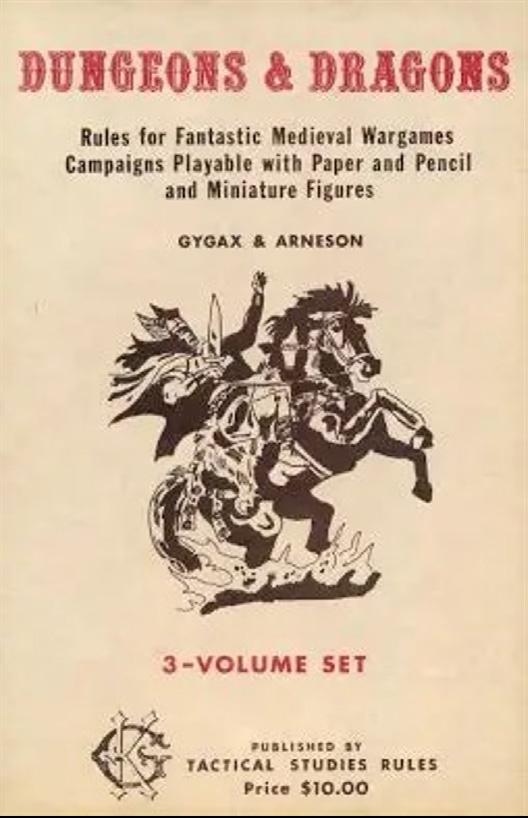
Dungeons & Dragons
Dungeons & Dragons is considered the first tabletop roleplaying game (TTRPG), though many other TTRPGS have followed suit. As such, gameplay mechanics differ from game to game, though many TTRPGS include elements pioneered by D&D.
A game of D&D consists of the players and the Dungeon Master (DM). The DM guides players through their adventures and controls all enemies and non-player characters (NPCs). Meanwhile, the players create characters and roleplay as them. Character stats and the success or failure of their actions are determined by rolling a twenty-sided die. The higher the number, the better the outcome for the player; rolling a 1 is an automatic failure, and rolling a 20 is a resounding success. These are the core elements of D&D, but games can be as structured or as loose as the DM desires. D&D is meant to foster creativity, so no two games will look the same.
D&D has grown since its release in 1974, too. There have been seven editions of the game since the ‘70s, with the most recent being 5e. With each new edition, rules and gameplay mechanics are added and changed, tweaking how the game is played. While 5e may be the newest edition, there are still players who prefer to play older versions of D&D.
There’s a popular stereotype that games of D&D are played in dark, musty basements, away from the light of the outside world. The insinuation is either that playing D&D is embarrassing and therefore something to hide, or that players of D&D are antisocial shut-ins who rarely venture into the “real world”. Regardless of the veracity of this claim (many a game of D&D has been played in a basement, though perhaps not for the reasons assumed), D&D has increasingly ventured past the boundaries of home games and into popular culture through a variety of mediums.
One of the most prevalent ways D&D has expanded is through the medium of actual play, in which games of D&D are filmed or played live for an audience. It’s impossible to pin down who first created the actual play genre and when, as the myriad small, local events that certainly preceded actual play’s current juggernauts have been largely lost to history. While its invention is murky, the rise of actual play in the 2010s is easier to track. The seventh and current edition of D&D, 5e, was released in 2014; that same year, the D&D actual play podcast “The Adventure Zone” premiered. This podcast features the McElroy brothers (who were already known for their comedy podcast titled “My Brother, My Brother and Me”) playing D&D with their father. The next year saw the release of Critical Role, a show where professional voice actors play D&D live through streaming platforms Twitch
and YouTube. Even though Critical Role didn’t invent the concept of actual play, it certainly helped legitimize and popularize it as a genre. In 2018, the independent streaming service Dropout released the first season of Dimension 20, an actual play show featuring improv actors and comedians as its players. Dimension 20 quickly grew in popularity, as the sold-out live show in Madison Square Garden can attest. As of 2025, the list of actual play shows is quite long and being added to all the time. Perhaps there was a time when one felt the need to hide their involvement in D&D for fear of being stereotyped and rejected, but now there are many who not only talk about their love of the game, but actually film themselves playing it!
While actual play shows are certainly instrumental in popularizing D&D and introducing it to a wider audience, they aren’t the only ways that D&D is permeating pop culture, nor are they the earliest. In 1998, game development company Bioware released Baldur’s Gate, a video game set in the world of Dungeons & Dragons that used gameplay mechanics and rules from the second edition of D&D. In 2023, Baldur’s Gate 3, which uses the rules of D&D 5e, released to critical and audience acclaim. It became the first video game in history to win “Game of the Year” at all five major game award ceremonies, and it took home a recordbreaking seven awards at the Golden Joystick Awards. Social media was flooded with players talking about the game, and the voice cast of Baldur’s Gate 3 even played a game of D&D for a live audience, the recording of which was later released on YouTube.

D&D’s start in Hollywood was much less auspicious. The 2000 film “Dungeons and Dragons” bombed at the box office, with both fans and critics lambasting it. Two sequels, made for TV and directto-DVD respectively, followed but have been largely forgotten. However, D&D returned to theaters in 2023 with “Dungeons & Dragons: Honor Among Thieves”, a rollicking fantasy comedy unrelated to the original trilogy. While “Honor Among Thieves” struggled at the box office, it received praise from critics and fans alike for its fun and faithful portrayal of the world of D&D.
The “Dungeons & Dragons” television cartoon ran from 1983-1985. More recently, the popular sci-fi horror series “Stranger Things” (2016-2025) has brought D&D to the forefront of the public consciousness; it takes place during the “Satanic Panic” of the ‘80s, when many believed that Dungeons & Dragons lured children into devil worship, and the game is woven throughout the story. Several of the main characters play D&D, and many of the monsters they fight (such as demogorgons, the Mindflayer, and even Vecna) have roots in Dungeons & Dragons.
D&D has made forays into pop culture since the ‘80s, but only in the last 10-15 years has it really started to become more mainstream, thanks in part to movies, TV shows, video games, and actual play introducing it to a wider audience.
In the 1980s and ‘90s, a moral panic swept through the United States. The “Satanic Panic”, largely propagated by fundamentalist religious groups, was born from claims that Dungeons & Dragons (along with alternative music such as heavy metal) was evil and that playing it made people susceptible to demonic influence. Several tragedies, particularly the suicides of teenagers James Dallas Egbert III and Irving Lee Pulling - both of whom displayed signs of depression - were used as proof of D&D’s corruption. Pulling’s mother, Patricia, even sued her son’s high school principal, claiming that the games of D&D he facilitated with students put a real curse on her son (Pulling’s D&D character had been cursed in-game). She went on to found the anti-D&D organization Bothered About Dungeons & Dragons (BADD) and continued to preach about the perceived evils of the game.
I had the opportunity to interview several individuals about their experiences playing D&D; Jennifer M., who has been playing D&D and other role-playing games for over 40 years, recalled playing D&D during the moral outcry: “...I did feel some insecurity that people would think I was a bad person if I played RPGs, or that I had to justify myself somehow to religious people.” In her opinion, though, D&D isn’t
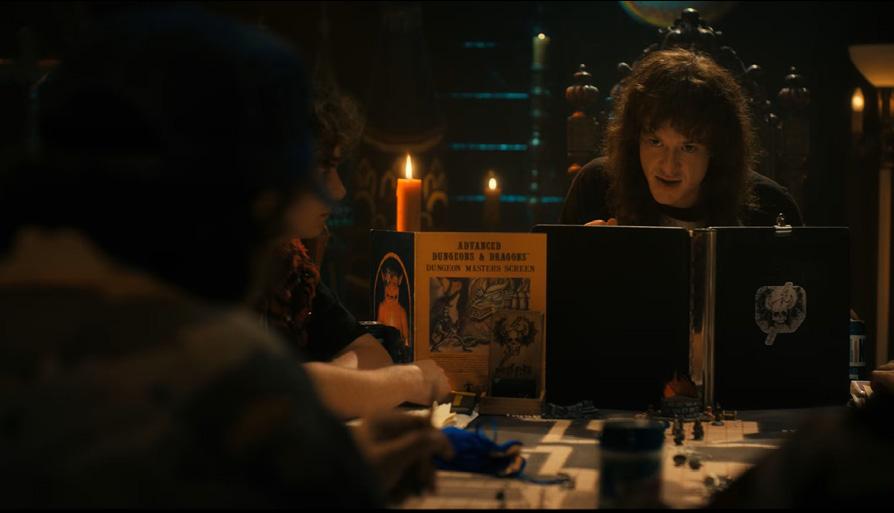
filled with evil witchcraft. “In my line of thinking,” she says, “RPG worlds were alternate realities that had no real connection to the world around me or religions that people worshipped. They were like their own forms of science, just the science of magic and extraplanar beings.” She adds that media like Rona Jaffe’s book “Mazes and Monsters” and the 1982 movie of the same name said “[that] RPGS could [cause people to] have breaks with reality, but I never found that to be true in the least.” Matt Kalmey, who also played D&D in the ‘80s, said the moral panic “seemed kind of silly”.
Studies have been conducted on the impacts of D&D since the ‘80s, and the results show that playing D&D can actually be quite beneficial. Far from introducing players to demonic entities or driving them to suicide, studies suggest that D&D can be used in conjunction with therapy to help treat mentally ill people. This is due in part to the psychological concept of “bleed”, which explains the ways in which characters and people influence each other. When playing D&D, aspects of the player (such as their personality and fears) may “bleed in” to the character, who takes on these traits. Conversely, some of the character’s traits and experiences (such as finding confidence or healing from trauma) can “bleed out” into the player. Because of this phenomenon, players of D&D can both connect with their characters and process difficult emotions from a safe distance.
For a group of men on death row in a Texas prison, Dungeons & Dragons does just that. The men of Allan B. Polunsky Unit are imprisoned under conditions that are so isolating and restrictive that it is considered torture by the United Nations. Yet against all odds, a D&D group persists, and the game provides an outlet for these men to work through trauma and regrets, practice emotional regulation, and forge meaningful relationships.
The results of one study suggest that having to make hard decisions in a game of D&D (such as whether to torture a prisoner for information if it means saving many lives in the future) can positively influence a person’s ability to apply ethics and morals
to real-life dilemmas. Being able to explore the potential consequences of a decision in a relatively low-stakes environment can essentially provide “moral training” for players and aid them in ethical decision-making outside of the game.
Playing D&D can also decrease social anxiety by teaching individuals communication skills and exposing them to social interactions through the safety of roleplaying. Several studies have found that D&D can help autistic people build confidence and feel more comfortable socializing. Two of my autistic interviewees echoed this sentiment. “It’s helped me know how to talk to people better, helped me learn how to be more confident” said Sophie Showers. “I have improved a lot, I think, partially from D&D.” Hykes explained that they like how D&D provides an opportunity for socialization without strict adherence to social expectations: “It’s nice because you don’t have to worry about, like, the social norms of the here and now. You can kind of vaguely appeal to these social norms from a fictitious world. …You can really just focus on the fun parts.”
Unlike many other multiplayer games, which pit players against each other, D&D is inherently collaborative. The DM and the players need to work with each other to tell a story that’s satisfying and fun for everyone involved. “You’ll find group[s] where everyone wants to be the main character,” said Lil Sellers, who usually DMs. “I think in D&D, moreso you want everyone to be a supporter character, to love each other… [you] need to work more to have a good experience than just [thinking] ‘Everyone’s here to serve my character’.” D&D encourages learning how to be cooperative, and the consequences of refusing to compromise can result in removal from the group. Nichols, who plays with Sellers, summed it up: “Wanna play the game? You need to work together. If you won’t work together, you’re not playing and I’m gonna ask you to leave.”
Additionally, the open-ended and creative nature of D&D gives players the freedom to express themselves. For Jennifer M., D&D gave her an outlet to explore her gender identity. “Before I transitioned, playing a female character was a way I could find some peace of mind for myself in a life where I felt very miserable, sad, and trapped,” she told me. “D&D and similar games really helped me survive the first half of my life.” Sellers, who uses any pronouns and is a motorized wheelchair user, talked about how important it is to feel seen and accepted in D&D:
I can come here and I can be a character who is female, who is male, who is completely androgynous, who’s even an animal, whatever you would want to play as, even just for fun. And [I can] truly be accepted…even just being in the world
and being accepted can be a huge thing. And also, I play characters who are disabled. I use a wheelchair and I’ve played with having characters that use the combat wheelchair or putting NPCs [non-player characters] in my world, too, [that] are of all different groups.
For many marginalized communities, both playing D&D and watching D&D actual play can provide representation that may be scarce elsewhere. “I think especially for people who are part of marginalized groups, a big appeal is you get to see characters like you,” says Max, another one of my interviewees. “Recently media representation has gotten a little better, but [media] still struggle[s] to represent intersectional identities.”
Actual play shows, which usually do not have a production company dictating their every move the same way movies and TV shows do, generally include more players and characters from underrepresented communities. For example, Dimension 20’s cast and the characters they play include women, people of color, and queer individuals. Jennifer M. agrees that the role-playing community is “far more diverse” than it used to be. “People who don’t feel accepted by mainstream [society] all have a place here,” she says.
At its best, D&D is a safe and accepting space to be yourself and make meaningful relationships. However, it is important not to make the mistake of believing that D&D and its community are infallible. The nerd community has a long and frustrating history of misogyny; racism; ableism; homophobia; and transphobia, and dangerous right-wing extremism has festered in these conditions. While there are many people in the D&D community who are kind and accepting, there are also many who will harass and exclude anyone who is different from them. When these people form

D&D groups with like-minded individuals, the group can become an echo chamber of harmful beliefs and gameplay can reinforce dangerous behaviors such as wanton violence towards women.
Dungeons & Dragons itself is not free from negative biases, either. The game has been criticized in the past for containing racially and culturally insensitive content and lacking diversity. Changes to the current edition, 5e, attempt to address these issues; for example, Drow (dark-skinned elves) are no longer inherently evil, and the term “race” has been swapped out for the more accurate “species” when referring to the many humanoid and non-humanoid beings that fill the world of D&D. Wizards of the Coast (WotC), who bought D&D in 1997, aroused fans’ ire when a 2023 leaked document showed their intention to make changes to the game’s Open Games License (OGL). The license allows players to publish written content (like guidebooks or adventures) using D&D gameplay mechanics and rules as long as they don’t include specific copyrighted characters and material; the proposed changes would take away that freedom and give all rights to Wizards of the Coast. WotC abandoned this plan after immense backlash from the community, but many fans still distrust the company. My interviewees expressed concerns about the ways that over-commercialization could affect D&D and make it less accessible to players; some also discussed fears of D&D being co-opted by political parties and extremist groups to spread harmful rhetoric. While D&D can have many positive effects, these worries should not be downplayed.
A through-line I encountered throughout my research is how D&D fosters community. In a world that is increasingly reliant on artificial intelligence (AI), D&D provides a place for people to talk, laugh, and imagine with each other. It encourages creativity, cooperation, problem-solving, and self-expression. When in the wrong hands, it can be used to reinforce harmful ideologies such as misogyny and racism. But as the D&D community grows, it becomes ever more diverse. “I think definitely the word to describe…the ‘boys in the basement’ kind of playing was a power fantasy,” said Sellers. “But I think now it’s more of an empowerment fantasy for people.” After all, that’s always been the thing about D&D: the players get to choose how the story unfolds.
In the end, humanity has been gathering around and telling stories for as long as we’ve been on this earth. Maybe that’s why D&D is so alluring; it taps into our deepest desires for connection and imagination. Playing Dungeons & Dragons reminds us what it is to be human, whether we’re in an arena performing for a crowd of thousands or in a basement laughing with our friends.
Atherton, G., et al. “A critical hit: Dungeons and Dragons as a buff for autistic people.” Autism, vol. 29, no. 2, 2025. Sage Journals, https://journals.sagepub.com/doi/full/10. 1177/13623613241275260.
Blakinger, Keri. “FOR A GROUP OF MEN IN A TEXAS PRISON, DUNGEONS & DRAGONS BECAME A LIFELINE - TO THEIR IMAGINATIONS, AND TO ONE ANOTHER.” New York Times Magazine, 03 Sept. 2023, pp. 32-37,42. ProQuest, https://www. proquest.com/docview/2859663878?accountid=28640 &sourcetype=Magazines
Breen, Lorna H., and Erica M. Woodin. “Open Worlds: An Examination of Digital Accounts of Gender and Sexual Identity Development through the Use of Tabletop Role-Playing Games among LGBTQ2S+ Youth and Young Adults.” Canadian Journal of Human Sexuality, vol. 33, no. 3, Dec. 2024, pp. 384–401. EBSCOhost, https://doi.org/10.3138/cjhs-2024-0023
Butt, Mahli-Ann, and Claudia Young. “How the Far Right Weaponised Gamers and Geek Masculinity .” Pursuit, The University of Melbourne, 7 Oct. 2025, pursuit. unimelb.edu.au/articles/how-the-far-right-weaponisedgamers-and-geek-masculinity
Fitzsimmons, Kristin L. Gender Rolls: A History of Gender, Identity, and Nostalgia in Tabletop Roleplaying Games, University of Minnesota, United States -- Minnesota, 2022. ProQuest, https://www.proquest.com/ docview/2696873239/CC48CD18E05B4A9BPQ/4?a ccountid=28640&sourcetype=Dissertations%20&%20 Theses#.
“The Great 1980s Dungeons & Dragons Panic.” BBC News, BBC, 11 Apr. 2014, www.bbc.com/news/ magazine-26328105.
Hykes. Personal interview. 14 Nov 2025.
Kalmey, Matt. Personal interview. 16 Nov 2025.
Lees, Oliver J. Tabletop Therapy: An Examination of Therapeutic Factors within Tabletop Role-Playing Game Groups, Indiana University, United States -- Indiana, 2022. ProQuest, https://www.proquest.com/docview/27 36856245/7ED6FAB240E24502PQ/1?accountid=286 40&sourcetype=Dissertations%20&%20Theses M., Jennifer. Personal interview. 22 Nov 2025. Max. Personal interview. 18 Nov 2025.
Miller-Idriss, Cynthia. “Misogyny incubators: how gaming helps channel everyday sexism into violent extremism.” Frontiers in Psychology, vol. 16, 15 Jul. 2025, https:// pubmed.ncbi.nlm.nih.gov/40735183/ Nichols. Personal interview. 10 Nov 2025.
Rosenblad, Sherry R., et al. “Mastering Your Dragons: Using Tabletop Role-Playing Games in Therapy.” Behavioral Sciences (Basel, Switzerland), vol. 15, no. 4, Mar. 2025. EBSCOhost, https://doi.org/10.3390/bs15040441
Sellers, Lil. Personal interview. 12 Nov 2025.
Showers, Sophie. Personal interview. 12 Nov 2025.
Taylor, Glen R. Tabletop Roleplaying Games as Emotional Resiliency Factor, Alliant International University, United States -- California, 2019. ProQuest, https:// www.proquest.com/docview/2150207575/CC48CD18 E05B4A9BPQ/1?accountid=28640&sourcetype=Disser tations%20&%20Theses
Wright, Jennifer Cole, et al. “Imaginative Role-Playing as a Medium for Moral Development: Dungeons & Dragons Provides Moral Training”, Journal of Humanistic Psychology, vol. 60, no. 1, 2020. Sage Journals, https://journals.sagepub.com/doi/ full/10.1177/0022167816686263
Student Reflection:
I love playing TTRPGS and watching actual play shows, so getting to write a paper all about Dungeons & Dragons was a lot of fun! I learned so much about the history of the game and I enjoyed looking through the academic papers that have been written on this subject. I’m immensely grateful to everyone who let me interview them about their experiences playing D&D; their insights and personal stories make the paper more interesting and dynamic, and I wish I could have included more from each of them. Lastly, to Cian, Oliver, and Gryff, whom I have roleplayed as thus far: here’s to many more adventures!
Assignment:
by Ellie Manyara
HONR 122: Honors Historical Foundations of Global Cultures
Dr. Christine Senecal
Students were asked to write a 12-15 page research paper on a historical topic of their choice. The topic has to be a topic in human history up to the year 1800 C.E. and students were asked to analyze both primary and secondary resources to assist with their papers creation.
Queen Hatshepsut ruled over Egypt in the 18th century BC making her one of few female pharaohs in history. She ruled alongside her nephew Thutmose III and her legacy is best known by her use of propaganda to portray herself as a male, which made her authority more readily accepted among Egyptian people. She utilized propaganda like other male pharaohs at the time, however, since Hatshepsut was a female, she had to consider her gender in almost all aspects of her kingship, and many of her strategies showcase this knowledge of gender’s effects on leadership. Central to this propaganda was Hatshepsut’s expedition to Punt in which she utilized to showcase her divinity, ability to lead expeditions, and legitimized her success as a ruler. Punt was the land of the Gods, and the trade route had been closed for many decades before Hatshepsut was able to reestablish a connection with it that lasted centuries after her death. This expedition became her alternative to military endeavors and allowed her to show a visual in her temples of her divine right to rule. In the divine reason she claimed the mission was started and how she portrayed this expedition in her art and inscriptions, it is evident that she was thinking about her role as a female throughout the entire process.
Though Hatshepsut’s later years as king are well documented, there is not much information on
her early life other than how she depicted herself in inscriptions in her Mortuary temple.1 What is known is that she was born to the male pharaoh Thutmose I along with two brothers, so she was never thought to be destined for the throne one day.2 After the death of her father, her brothers were expected to take over the throne, but they unexpectedly died leaving Hatshepsut’s half-brother, Thutmose II, as the next pharaoh. He was also Hatshepsut’s husband, which was common practice at the time, so his rule made her the next queen of Egypt.3 However after only a short reign, Thutmose II unexpectedly died leaving his son to another wife, Thutmose III, left to rule. Thutmose III was only thought to be 2-3 years old and too young to take over the throne which is what led Hatshepsut to step in as regent until he would come of age.4 She most likely had to do this to keep the throne from being taken.5 After seven years of ruling for Thutmose, Hatshepsut decided to step in as full-time co-ruler for unknown reasons, and she gained the title of king.6
Once in power, she “bolstered her legitimacy” by following the institution of kingship and one of the main ways she did this was by portraying herself as a male.7 Hatshepsut’s transition to male portrayal was not immediate and happened gradually over her reign.8 Some of the earliest aspects of kingship she added to her image were crowns, and she started depicting
1 Peter F. Dorman, “HATSHEPSUT: Princess to Queen to Co-Ruler,” in Hatshepsut from Queen to Pharoah, ed. Catherine H. Roehrig, Renee Dreyfus, and Cathleen A. Keller (New York: The Metropolitan Museum of Art, 2005), 87.
2 Peter F. Dorman, “HATSHEPSUT: Princess to Queen to Co-Ruler,” in Hatshepsut from Queen to Pharoah, ed. Catherine H. Roehrig, Renee Dreyfus, and Cathleen A. Keller (New York: The Metropolitan Museum of Art, 2005), 87.
3 Peter F. Dorman, “HATSHEPSUT: Princess to Queen to Co-Ruler,” in Hatshepsut from Queen to Pharoah, ed. Catherine H. Roehrig, Renee Dreyfus, and Cathleen A. Keller (New York: The Metropolitan Museum of Art, 2005), 87.
4 Peter F. Dorman, “HATSHEPSUT: Princess to Queen to Co-Ruler,” in Hatshepsut from Queen to Pharoah, ed. Catherine H. Roehrig, Renee Dreyfus, and Cathleen A. Keller (New York: The Metropolitan Museum of Art, 2005), 87.
5 Carolyn Brown Graves, Dancing for Hathor (Continuum, 2010), 149.
6 Filip Taterka, “Military Expeditions of King Hatshepsut,” in Current Research in Egyptology 2016: Proceedings of the Seventh Annual Symposium, ed Julia M. Chyla, Joanna Dêbowska-Ludwin, Karolina Rosinka-Balik, and Carl Walsh (Oxbow Books, 2017), 91.
7 Ann Macy Roth, “Models of Authority,” in Hatshepsut from Queen to Pharoah, ed. Catherine H. Roehrig, Renee Dreyfus, and Cathleen A. Keller (New York: The Metropolitan Museum of Art, 2005), 9.
8 Peter F. Dorman, “HATSHEPSUT: Princess to Queen to Co-Ruler,” in Hatshepsut from Queen to Pharoah, ed. Catherine H. Roehrig, Renee Dreyfus, and Cathleen A. Keller (New York: The Metropolitan Museum of Art, 2005), 88.
herself in artwork in masculine poses.9 For example, on the walls of the temple of Buhen in Nubia, Hatshepsut is pictured with a wide striding stance that is unique to males. However, she is still wearing a dress, maintaining her femininity.10 It is clear through many of her depictions that she had many experimental periods trying to merge her two genders together. At the Metropolitan Museum in New York, a statue titled “Hatshepsut Seated” showcases the female pharaoh in a masculine way with a bare chest and wearing a kilt, but it is still obvious that she has feminine aspects in her appearance shown by the long slender legs and triangular face of the statue.11 This statue demonstrates one the “experimental” periods of her depictions in art before she was portrayed completely as a male. Also housed in the Metropolitan Museum is a statue most likely made in her later years in power where she is portrayed as a sphinx. This statue was originally found outside her mortuary temple and was created to guard her temple and show her divinity. However, it is clear when looking at the statue that Hatshepsut is being shown primarily as a male with masculine facial features and the attire of a king.12
Hatshepsut’s reign was marked by much peace and prosperity compared to other pharaohs of the time.13 During her reign, she took on major building projects and had a focus on trade and expansion of Egypt.14 Her main goal was to expand further to the south during her early reign, although this became unsustainable due to numerous reasons.15 With limited options left for a new plan of action, this is what ultimately led her to coordinate the journey to Punt.
The idea that Hatshepsut was the first monarch in the New Kingdom to trade with Punt is widely accepted, however she was not the first ever to trade with them.16 Punt was believed to be the birthplace of the gods, making it highly sacred to the Egyptian
people.17 It had previously been a trading partner with Egypt for many years, but for unknown reasons the trade between the two areas stopped for several decades before Hatshepsut’s reign. It was thought that during the second intermediate period, since Egypt was split into Upper and Lower Egypt, there may have been focus on internal conflict or a lack of resources that left trade with Punt forgotten. 18 The exact location of Punt is not known, but it was believed to have occupied a region in the south and east of Egypt.19 However, it is clear that the kingdom’s location was far from Egypt, so a journey there would have been tedious and would have required a large amount of planning, which in turn made trade burdensome.20 However, the goods Punt had to offer made it highly valuable.
The main reason that Punt was desirable to Egyptians was because it had much to offer including aromatic resins that were used in temple rituals, exotic animals, and luxury and exotic goods.21 In the Cast of Punt Reliefs from the Temple of Hatshepsut, the inscriptions show the return of Hatshepsut’s workers who embarked on the journey to Punt. The fleet is seen unloading exotic goods like myrrh trees which were valuable at the time.22 Similarly, Nederhof’s translation of the Punt expedition includes many exerts of the god Amun-Re claiming that he would “open the roads of the Myrrh terraces” for Hatshepsut’s fleet so they they could bring back trees, which he claimed to want planted around his temple.23 Because of the importance of religion in Egypt at this time, myrrh found in Punt would have had religious value, making it all the more crucial.
In the 17th Dynasty, most leaders transformed themselves into glorified rulers by showcasing their ability to fight and lead successful battles. Because of this, there was a large emphasis in the new kingdom monarchy on military power and leadership and the
9 Kelly-Anne Diamond, “Hatshepsut: Transcending Gender in Ancient Egypt,” Gender & History 32, no. 1 (2020): 168.
10 Peter F. Dorman, “HATSHEPSUT: Princess to Queen to Co-Ruler,” in Hatshepsut from Queen to Pharoah, ed. Catherine H. Roehrig, Renee Dreyfus, and Cathleen A. Keller (New York: The Metropolitan Museum of Art, 2005), 88.
11 See appendix A.
12 See appendix B.
13 Filip Taterka, “Military Expeditions of King Hatshepsut,” in Current Research in Egyptology 2016: Proceedings of the Seventh Annual Symposium, ed Julia M. Chyla, Joanna Dêbowska-Ludwin, Karolina Rosinka-Balik, and Carl Walsh (Oxbow Books, 2017), 91.
14 Carolyn Brown-Graves, Dancing for Hathor (Continuum, 2010), 151-52
15 Pearce Paul Creasman, “Hatshepsut and the Politics of Punt,” in African Archeological Review, ed J. Cameron Monroe (Spring Science and Business Media, 2014), 398.
16 Pearce Paul Creasman, “Hatshepsut and the Politics of Punt,” in African Archeological Review, ed J. Cameron Monroe (Spring Science and Business Media, 2014), 400.
17 Carolyn Brown-Graves, Dancing for Hathor (Continuum, 2010), 151.
18 Pearce Paul Creasman, “Hatshepsut and the Politics of Punt,” in African Archeological Review, ed J. Cameron Monroe (Spring Science and Business Media, 2014), 398.
19 Pearce Paul Creasman, “Hatshepsut and the Politics of Punt,” in African Archeological Review, ed J. Cameron Monroe (Spring Science and Business Media, 2014), 396.
20 Pearce Paul Creasman, “Hatshepsut and the Politics of Punt,” in African Archeological Review, ed J. Cameron Monroe (Spring Science and Business Media, 2014), 401.
21 Pearce Paul Creasman, “Hatshepsut and the Politics of Punt,” in African Archeological Review, ed J. Cameron Monroe (Spring Science and Business Media, 2014), 396.
22 See appendix C.
23 Punt Expedition of Queen Hatshepsut” (ca 1480 B.C.) trans. Mark-Jan Nederhof (2006), University of Saint Andrews, 2,5.
pharaohs were expected to showcase their ability to lead military campaigns.24 However, women at this time were not usually pictured as military leaders, and it would have been unlikely for Hatshepsut to be able to lead many military affairs because of her gender.25 It is known that during her joint reign with Thutmose III that Hatshepsut took more control over internal affairs and foreign trade while her nephew took on military aspects of kingship.26 There is little evidence that Hatshepsut took part in many (if any) military aspects of kingship, however it should not be concluded that she had absolutely no military involvement.27 Regardless, she still had to showcase her ability to rule in some way and this is most likely why she made the decision to reestablish trade with Punt. By taking on a mission for trade, Hatshepsut could showcase the same abilities that other male pharaohs could showcase through war including divine favor, strength, and wealth.
It would have been simple for Hatshepsut to establish divinity since she had already portrayed herself in her temple being born divinely to the God Amun-Re. By claiming that the entire mission was motivated solely based on the divine request of the God, Hatshepsut established her divine favor in a way that no one could question.28 Since Punt was home to such high value goods, a trade expedition would have been seen as valuable to Egypt’s economy. Punt had many luxury goods like gold, exotic woods, and metals that would have been important for showcasing royal status.29 Some other goods obtained from Punt, like myrrh-incense and aromatics, would have also been seen as valuable in a religious sense since they were often used in religious practices.30 To be able to plan and execute a mission to this caliber would have been admirable of any leader due to the large amount of preparation and strategy that was involved to make the mission a success. It is thought by historians that this mission would have required at least a year of training
for soldiers, construction of ships, and formulating the mission altogether.31 Therefore, Hatshepsut’s ability to complete this and complete it so successfully would have been admirable by the Egyptian people and would have certainly established her as a strong leader. By reopening a trade route that was once closed for many years, and by opening a trade route that had such valuable items, Hatshepsut could showcase her ability to lead in ways other than war. However, because of her gender, she had to justify her reasoning for her decisions to a larger degree than other male pharaohs at the time, so she strategically took things a step further by claiming that her expedition to Punt was completely motivated by the god Amun-Re.32 In doing this, it would be less likely that her decisions would be questioned because religion was so important and a god divinely ordering an expedition was reason enough.33 However, she could not just claim that the god Amun-Re motivated this mission. She had to portray the idea that she was associated with Amun-Re so that it made sense that he would want her to complete this mission for him and he would entrust her with it. Therefore, Hatshepsut set up very strategic ways to make sure her relationship with Amun-Re was seen as legit by her followers.
Hatshepsut’s mortuary temple at Deir el-Bahri was built according to her own plans, so most imagery in the temple can be assumed to be directly inspired and informed by her, including many calculated expressions of her political agenda.34 She used this temple to her advantage and one of the earliest ways she associated herself with the god was by showcasing her divine birth and claiming to be the daughter of Amun-Re. In 35a translation by Mark-Jan Nederhof from an inscription at her temple, Amun-Re is explicitly mentioned to be her father when it says “…because of the greatness of the might of her father Amun…”36 This already portrays her as closely related to the God, so when it is inscribed that her temple that she was “whom he wants
24 Elizabeth D. Carney, “Women and Military Leadership in Pharaonic Egypt,” Greek, Roman, and Byzantine Studies 47, no. 1 (2001): 36.
25 Elizabeth D. Carney, “Women and Military Leadership in Pharaonic Egypt,” Greek, Roman, and Byzantine Studies 47, no. 1 (2001): 33.
26 Stephanie Roberts, “A Relief of Hatshepsut and Thutmose III in Bournemouth,” Ancient Egypt Magazine 10, no. 3 (2009): 20.
27 Elizabeth D. Carney, “Women and Military Leadership in Pharaonic Egypt,” Greek, Roman, and Byzantine Studies 47, no. 1 (2001): 32.
28 Pearce Paul Creasman, “Hatshepsut and the Politics of Punt,” in African Archeological Review, ed J. Cameron Monroe (Spring Science and Business Media, 2014), 401.
29 Pearce Paul Creasman, “Hatshepsut and the Politics of Punt,” in African Archeological Review, ed J. Cameron Monroe (Spring Science and Business Media, 2014), 396.
30 El-Sayad Mahfouz, “New Perspectives on the Expedition to the Land of Punt,” SHEDET 10, no. 10 (2023): 144.
31 Pearce Paul Creasman, “Hatshepsut and the Politics of Punt,” in African Archeological Review, ed J. Cameron Monroe (Spring Science and Business Media, 2014), 401.
32 Pearce Paul Creasman, “Hatshepsut and the Politics of Punt,” in African Archeological Review, ed J. Cameron Monroe (Spring Science and Business Media, 2014), 400.
33 Pearce Paul Creasman, “Hatshepsut and the Politics of Punt,” in African Archeological Review, ed J. Cameron Monroe (Spring Science and Business Media, 2014), 402.
34 Ann Macy Roth, “Hatshepsut’s Mortuary Temple at Deir El-Bahri,” in Hatshepsut from Queen to Pharoah, ed. Catherine H. Roehrig, Renee Dreyfus, and Cathleen A. Keller (The Metropolitan Museum of Art, New York, 2005), 147.
35 Carolyn Brown-Graves, Dancing for Hathor (Continuum, 2010), 149.
36 “Punt Expedition of Queen Hatshepsut” (ca 1480 B.C.) trans. Mark-Jan Nederhof (2006), University of Saint Andrews, 1.
to be on his throne” it becomes all the more believable that Amun-Re had a plan for her from very early on.37
By establishing a close-knit relationship with the god so early on in her life, it is easier for Hatshepsut to continue to use the Amun-Re later to justify her actions without questioning. That is why she used his divine request showcased in her temple where he ordered her to complete an expedition to Punt when he said: The majesty of the palace beseeched the stairs of the lord of the gods and instructions were heard from the Great Throne, an oracle from the god himself: Explore the routes to Punt, open the roads of the Myrrh terraces, and lead an expedition on water and on land to bring exotic goods from the God’s Land to this god who created her beauty.38
Using the god gave her a reason that could not be argued by others, as it was motivated solely by religious reasons which set her apart from the other rulers of the time who were mainly motivated by political reasons.39 One of her greatest accomplishments during her reign was the expansion of the cult of Amun.40 This cult was perfectly in line with her beliefs because they too were followers of the god Amun-Re who Hatshepsut promoted so much during her reign. There were many Egyptians who belonged to this cult, so she was in crucial need of their support at the time to have a successful reign. Therefore, this expedition would have doubled as a great way to reward these supporters since the items retrieved were dedicated to Amun-Re.41 Claiming to be a direct descendant of the god would also have gained her favor of many Egyptian people and claiming that he motivated the mission would have convinced many Egyptians that this mission was a divine and they needed to support it. However, the cult was mainly centralized in southern Egypt, so to ensure that Northern Egypt was still in favor of the mission, she appointed a commander from the North to lead the mission. This would ensure that the mission would be seen as beneficial to all of Egypt and would have portrayed Hatshepsut as an inclusive ruler.42
Hatshepsut further gained favor of the cult by building her mortuary temple which was a place for the cult that would ensure her perpetual life after death.43
Since Hatshepsut’s temple was directly built according to her plans, she used a lot of strategy in the construction of it. First, her placement of the temple itself was a work of propaganda because it was placed next to Mentuhotep II’s temple, and he was an eleventh Dynasty king who was best known as the “founder of the second golden age” in Egypt’s history. Her temple also resembled his to try and create a connection between herself and the king hoping to imply that she was the founder of a third golden age of Egypt.44 Once inside, her temple walls are filled with inscriptions of different aspects of her kingship. Specifically, she was able to aggrandize her expedition to Punt showcasing different aspects of it and its success. As discussed previously, she was unable to be involved in many military affairs due to her gender, therefore she was unable to depict military triumphs in the exaggerated ways that male pharaohs did in their temples at the time.45 This is most likely why she decided to put so much emphasis on the Punt expedition in her temple, because it was one of her greatest accomplishments as a pharaoh and showcased many strengths.
Many of the inscription from her temple were very detailed in specific in nature. For example, at the Egyptian Museum in Cairo, fragments from her temple are on display showcasing different scenes from the kingdom. On one of the fragments, the queen and king of Punt are shown. The king is thin and has a long slender beard while the queen, in contrast, is quite plump and curvy clearly indicating that she is female.46
Another one of the fragments show some Punties, who were the people of Punt, holding some sort of item which could have been an item valuable for trade.47 The Virginia Museum of Fine Arts houses a cast of a relief from the temple which shows many different scenes from the journey. Hatshepsut can be seen at the bottom right corner, portrayed larger than all other elements of the relief and predominantly as a male pharaoh. To the left of her, her fleet is seen returning in
37 “Punt Expedition of Queen Hatshepsut” (ca 1480 B.C.) trans. Mark-Jan Nederhof (2006), University of Saint Andrews, 1.
38 “Punt Expedition of Queen Hatshepsut” (ca 1480 B.C.) trans. Mark-Jan Nederhof (2006), University of Saint Andrews, 2.
39 Pearce Paul Creasman, “Hatshepsut and the Politics of Punt,” in African Archeological Review, ed J. Cameron Monroe (Spring Science and Business Media, 2014), 400.
40 Carolyn Brown-Graves, Dancing for Hathor (Continuum, 2010), 151.
41 Pearce Paul Creasman, “Hatshepsut and the Politics of Punt,” in African Archeological Review, ed J. Cameron Monroe (Spring Science and Business Media, 2014), 401.
42 Pearce Paul Creasman, “Hatshepsut and the Politics of Punt,” in African Archeological Review, ed J. Cameron Monroe (Spring Science and Business Media, 2014), 402.
43 Ann Macy Roth, “Hatshepsut’s Mortuary Temple at Deir El-Bahri,” in Hatshepsut from Queen to Pharoah, ed. Catherine H. Roehrig, Renee Dreyfus, and Cathleen A. Keller (The Metropolitan Museum of Art, New York, 2005), 147.
44 Ann Macy Roth, “Hatshepsut’s Mortuary Temple at Deir El-Bahri,” in Hatshepsut from Queen to Pharoah, ed. Catherine H. Roehrig, Renee Dreyfus, and Cathleen A. Keller (The Metropolitan Museum of Art, New York, 2005), 147.
45 Elizabeth D. Carney, “Women and Military Leadership in Pharaonic Egypt,” Greek, Roman, and Byzantine Studies 47, no. 1 (2001): 33.
46 See appendix D
47 See appendix D
boats from Punt with many valuable items.48 There are many walls dedicated to this journey making it clear just how much it was promoted throughout her temple and the extensive detail showcases how exaggerated she made it to showcase all the little successes and elements within the whole mission.
Many depictions of Hatshepsut in her mortuary temple are thought to have been mostly destroyed. It is speculated that there were some inscriptions of the queen on the expedition, but there are limited traces left. However, it is important to note that one of the main ways Hatshepsut genderized herself in her temple was by depicting herself as a male, or with aspects that were unique to kingship. Though there may not be many specific representations of this tied to Punt, there is no doubt that these depictions still played into her legitimization and gender roles of the expedition. By portraying herself as a male she was better able to legitimize her reign because male pharaohs were the norm of the time and were readily accepted.49
One of the most interesting parts of Hatshepsut’s story is the fact that her legacy could have been tragically erased from history. Her nephew and once co-regent, Thutmose III, tried to erase her from history around twenty years after her death.50 He ordered the erasure and destruction of many of the statues depicting Hatshepsut.51 In the Metropolitan Museum in New York there is a statue of a pharaoh who is thought to be Hatshepsut missing the upper part of their body thought to be showcasing this destruction.52 This statue demonstrated the defacing that would have been done to many statues of the female pharaoh at this time. He also destroyed or replaced her name with his father or grandfather’s name, seemingly wanting to erase her from history.53 However, it seems that he did a half-hearted job because much of her statues were not destroyed in full and there was still plenty of evidence left behind of the pharaoh’s life.54 It isn’t definite why Thutmose III would want to erase Hatshepsut and there is evidence that most of their reign together went smoothly as can be confirmed by the many depictions of the two in Hatshepsut’s mortuary.55 Many reasons for her erasure can be speculated including a reason that is most in line with the topic of this paper, which is that it may have been unacceptable for a woman to hold so
much power at this time. It is possible that by erasing Hatshepsut, Thutmose III hoped to also erase the idea that a woman could be a pharaoh during this time.56 However, this idea cannot be confirmed, and other reasons could have come into play like the fact that he may have simply not liked her stepping in to rule with him.57
Clearly Hatshepsut was aware of her gender role in many aspects of her rule, especially within her Punt expedition. However, it is interesting to try to imagine what would have happened had she not pursued this mission. Though it may be a bold statement to make, there is a good chance that had she not completed this mission, or done so successfully, that she may not have ever been able to make a name for herself as a pharaoh. As discussed, this expedition offered her a powerful alternative to a military endeavor that many pharaohs would have accomplished. Without a strong mission to be remembered by, would she have been able to prove to the Egyptian people that she was a fit pharaoh? She also showcased much of her divinity from this mission by associating the whole thing with Amun-Re. Not only did she claim the mission was ordered by him, but she also dedicated many of the items from the trade to the god. This mission ultimately got the Cult of Amun to believe and follow her, and this cult was one of the biggest in Egypt at the time. If she didn’t complete the mission, would her divine birth alone along with her expansion and restoration of old temples have been enough to win their devotion? Though it can never truly be known the effect of Hatshepsut not completing this mission, it is obvious that the mission strongly was able to influence her rule leaving a lasting impact on her legacy as one of few female pharaohs to rule Egypt in history.
48 See appendix C
49 Ann Macy Roth, “Models of Authority,” in Hatshepsut from Queen to Pharoah, ed. Catherine H. Roehrig, Renee Dreyfus, and Cathleen A. Keller (New York: The Metropolitan Museum of Art, 2005), 9.
50 Carolyn Brown-Graves, Dancing for Hathor (Continuum, 2010), 153.
51 Kelly-Anne Diamond, “Hatshepsut: Transcending Gender in Ancient Egypt,” Gender & History 32, no. 1 (2020): 171.
52 See appendix E
53 Carolyn Brown-Graves, Dancing for Hathor (Continuum, 2010), 153.
54 Carolyn Brown-Graves, Dancing for Hathor (Continuum, 2010), 153.
55 Marta Sankiewicz, “The Iconography of Co-rule at Deir el-Bahari: Hatshepsut and Thutmose III in the Statue Room of the Main Sanctuary of Amun,” Archaeology in the Mediterranean 24, no. 2 (2015): 164.
56 Kelly-Anne Diamond, “Hatshepsut: Transcending Gender in Ancient Egypt,” Gender & History 32, no. 1 (2020): 171.
57 Carolyn Brown-Graves, Dancing for Hathor (Continuum, 2010), 153

Appendix A
Seated Statue of Hatshepsut. Unknown artist, ca. 14731458 B.C., Object number 29.3.2, The Metropolitan Museum, New York, photo: Ellie Manyara.
This is a indurated limestone statue of Hatshepsut on display at the Metropolitan Museum showcasing Hatshepsut as a pharaoh sitting down and was originally found in the Deir el-Bahri temple in Egypt.

Appendix B
Sphinx of Hatshepsut, Unknown artist, ca. 1479-1458 B.C., object number 31.3.166, The Metropolitan Museum, New York, photo: Ellie Manyara. This is a granite statue of Hatshepsut as a sphinx on display at the Metropolitan Museum originally found in the Deir el-Bahri in Egypt.

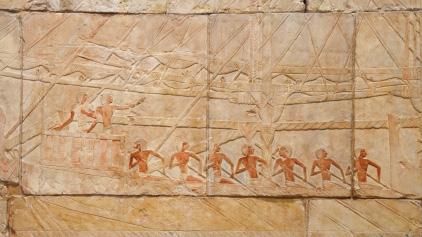

Appendix C
Cast of Punt Reliefs from Temple of Hatshepsut at Deir el-Bahri. Unknown artist, ca. 1550-1295 B.C., Object number L. 5. 52. 48, Virginia Museum of Fine Arts.
This is a cast of the Punt Reliefs in Hatshepsut’s temple at Deir el-Bahri. The cast is on display at the Virginia Museum of Fine arts.
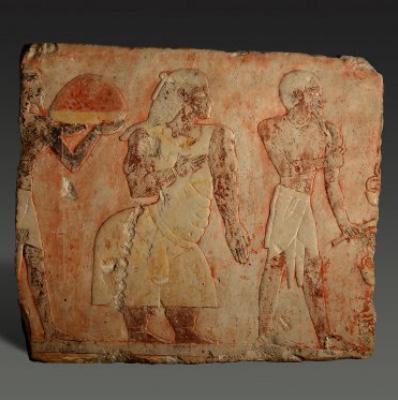
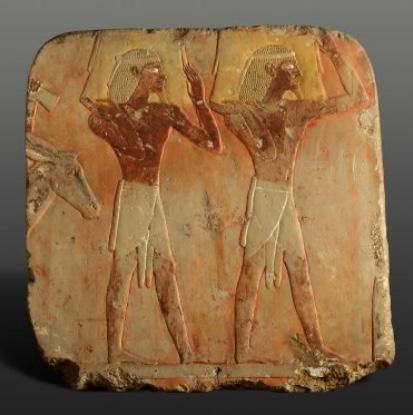
Appendix D
Fragments of Queen Hatshepsut’s Expedition to the Land of Punt on painted limestone. Unknown artist, ca 15501295 BC, Mortuary Temple of Hatshepsut Deir el-Bahri Thebes, The Egyptian Museum in Cairo.
In my paper I mentioned two of the four fragments from Hatshepsut’s temple that are housed in the Egyptian Museum in Cairo. These fragments are from an inscription of the Punt expedition.
Appendix E
Lower Part of a Statue, Unknown artist, ca. 1479-1458
B.C., object number 31.3.168, The Metropolitan Museum, New York, photo: Ellie Manyara. This is diorite statue found at the Deir elBahri that is thought to have possibly been Hatshepsut, but it cannot be confirmed.
As a student who is not usually very interested in historical topics, when I was told I was to write a history research paper I was not excited. However, it became evident to me when taking this course with Dr. Senecal that the history we were to be taught was very different from the American history I had learned before in previous schooling. Through this paper, I was able to explore Egyptian history which had always piqued my interest. Specially learning about an Egyptian female pharaoh whose rule was significantly shaped by her gender was an insightful experience. History often feels far away to me, so getting to explore the pharaoh Hatshepsut’s reign knowing she was alive thousands of years before us was a great experience for me.
Assignment:
by Nancy Tobar Guzman
Dr. Allison Carey
For this assignment in the Sociology of Aging course, students were asked to write a research paper on their topic of choice related to aging and/or the aging experience: Students will choose a topic related to aging and difference or inequality, demonstrate the difference/inequality, and explain it. Students must use at least 5 peer-reviewed sources, and these must be cited in-text and included in a bibliography in APA, MLA, ASA, or Chicago reference style. The explanation must be sociological, i.e., looking for sociological patterns and explanations that focus on social phenomenon and institutions.
Ageism is alive and well in the media that surrounds our daily lives, even if we cannot directly interpret it. Stereotypical portrayals of older adults in the media can be seen in almost every form of mass media - from children’ s movies - to Super Bowl commercials - to actual news coverage - and especially in social media. The integration of ageist representations in media have become normalized in society because viewers are exposed to them from a very young age and therefore grow up perceiving the older adulthood stage in a pessimistic/dreadful light. Ageism is the discrimination against someone based on chronological age due to the “seated uneasiness [from] the young and middle-aged, [and]... a personal revulsion to and distaste for growing old, disease, and disability” (Butler, 1969 as cited in Meisner, 2021).
Aging people of different genders experience ageism differently and are portrayed distinctively in mass media. Social identity theory suggests that the media representations of older adults have an influence on internalized ageism, and affect self-esteem, social identification, feelings of worth, and overall health (Markov & Yoon, 2021; World Health Organization, 2021). Therefore, portrayals of negative and positive stereotypes of aging, like of the golden ager or the shrew, have direct, societal impacts on how one views themselves as they age and on older viewers. This is especially true for women, for whom many studies have found that women are both underrepresented and when represented, are done so in a more pessimistic, stereotypical way (Rohlinger, et al., 2020; Signorielli, 2004; Hatch, 2005; Markov, 2021). The representations of aging/older adults in news/political media, televised media, and social media all contribute to the sensitization of ageist stigmas, stereotypes and a double standard for women in society.
One of the many forms of media that is not talked about enough in regards to ageism is the representation of older adults as news media professionals and
as the ones being covered by the news. Yet, ageism is especially prevalent when it comes to broadcast news and political media. Christine Craft, Brenda Williams, Demetria Kalodimos, Karen Fuller, and five women anchors at NY1 (2019) are all news anchors who have sued their employers based on gender and age discrimination (Ross, 2024). The preceding news anchors have either been pushed out, replaced, or forced off the air in order to bring in younger, less experienced hosts with the excuse of needing ‘‘fresh talent’ or staff who ‘pop’” (Ross, 2024). Women who are working in front-of-the-house positions, such as news anchors, are even more susceptible to facing gendered ageism due to societal pressures of beauty, capability and age. Once news broadcasters feel that a woman has “passed their ‘sell-by date’”, they begin to push these women out of the agency or to backroom jobs, to replace them with much younger anchors, such as in the case of Christine Craft (Ross, 2024). Craft, who worked with the Kansas City KMBC televised news stations, was relocated to a behind-the-scenes job because she was viewed as “‘too old, too unattractive, and not sufficiently deferential to men’” (Ross, 2024). Alternately, men continue to host televised news shows into their 70s-80s, yet there are barely women of similar age working as news anchors. The gender differences between the representation of older adults as anchors/journalists in the news highlights a salient moral concern in society - the superficial focus on appearance/beauty pushed on women and the constant yearning for youth.
Not only do older adults face underrepresentation as news-delivering individuals, but also as agents of change in the news. In a study conducted by Rohlinger, Redmond, and Stamm (2020), researchers found that broadcast news coverage underrepresents women, older activists, and activists of color and therefore diminishes their legitimacy as agents of change. Over the decades, women’ s political engagement has increased dramatically - yet, this change has not been
accurately reflected in news broadcasts, especially ones that cover social movements. Researchers in this study suggest two reasons why including aging women in social movement news coverage is salient: (1) to challenge long-held societal stereotypes of gender norms and the role of women in society, and (2) to help create new portrayals about women’s worth past their beauty, reproductive ability, and youth. When older women are portrayed, it is typical for the representation to focus on their stereotypical roles as caregivers or the pessimistic characteristics of aging, instead of women’s lives and goals (Rohlinger, et al., 2020). Due to portrayals like these, women’s cultural worth/societal value, which revolves around beauty and youth, decreases rather quickly compared to mens’, which increases with age (Rohlinger, et al., 2020; Hatch, 2005). Therefore Rohlinger, Redmond, and Stamm (2020) argue that including aging women in political and social news coverage helps recontrust aging women’s cultural worth. Media professionals also choose who and what to include in social/political movement coverage, which often means that younger activists are overrepresented contrary to older activists because media professionals associate activism with youth (Rohlinger, et al., 2020). Therefore, older adults are typically regarded as eager voters, meanwhile older women are seen as “frail and politically disengaged” (Rohlinger, et al., 2020). Rohlinger, Redmond, and Stamm’s (2020) study also found that men’s masculinity is barely diminished by age contrary to older women’s on media coverage, and that the difference in this gender and racial ageism reinforces White patriarchy in society.
The reinforcement of a young, White patriarchy can also be perceived on televised media such as primetime TV series, advertisements, and films. Throughout the years, a myriad of studies have taken a look at how ageism is portrayed in prime-time television shows and movies (Signorielli, 2004; De Sutter, 2024; Hatch, 2005; Markov & Yoon, 2021). For decades now, television has been an integral part of portraying societal values, norms, and culture. Televisions’ stories and films give viewers insight about cycles of socialization and re-socialization through which everyone passes, such as aging-role socialization (Signorelli, 2004). Most often, negative media portrayals contribute to viewers’ association of aging/older adults with characteristics such as fragile, forgetful, irritable, incompetent, intolerant, conservative, helpless, unadaptable, and/or less valued in society (Makita et al., 2021). However, positive associations/perceptions of aging that are linked to wisdom, respect, experience, and knowledge, also exist. In a study of 100 top films of 2015, researchers found that only 11% out of 4,066 speaking characters were 60 years of age or older, and that when represented, typically play minor roles or are portrayed through
negative stereotypes (Smith et al., 2015 as cited in Makita et al., 2021). The same study also found that the underrepresentation is even more eminent for older women, LGBTQ+ older adults, and people of color. Many other studies found similar results - that older adults are underrepresented, but older women and LGBTQ+ are even more likely to be underrepresented (Signorelli, 2004; Hatch, 2005; Markov & Yoon, 2021). A more recent study, which examined 112 episodes of popular American TV series between 2004-2018, found that 6.6% of characters were 65 and older - a slight increase than previous studies, but still significant a underrepresentation of older adults given the large proportion of older adults in reality (Markov & Yoon, 2021).
When older women are depicted in films, series and advertisements, they are typically depicted as less successful than older men, and the idea of beauty and loss of youth typically surrounds their characters. For example, studies surrounding the fan discussion about characters of Star Trek, a science fiction media franchise, highlights how different attractiveness and aging is perceived for men and women (De Sutter, 2024). Men are referred to as aging “‘like fine wine’” while women are more “objectified and sexualized, [and] pressured to fight the effects of aging” (De Sutter, 2024). In the study conducted by Markov & Yoon (2021), results found that older men accounted for 68.4% in the media, appearing twice as much as women, and that women faced the double jeopardy of being discriminated against based on age and gender on TV. Previous studies cited in Markov & Yoon (2021) outline eight negative age stereotypes that are persistent in American society: the despondent, the severely impaired, the mildly impaired, the shew/ curmudegeon, the vulnerable, the recluse, the bag lady/ vagrant, and the nosy neighbor. The four, prominent, positive stereotypes include: the John Wayne conservative, the perfect grandparent, the sage, and the liberal matriarch/patriarch. These different stereotypes can be distinguished in a plethora of televised shows, films, and advertisements in American society. Ageist stereotypes like those listed can especially be seen in recent American advertisements that have sparked controversy. For example, ACRONYM’s 2018: Dear Young People Don’t Vote, advertises older adults as selfish, out-of-touch, and uncaring in attempts to get young people to vote. Another salient, controversial example of ageism in the media, is the 2018 Super Bowl Commercial by E-Trade: This is Getting Old, which ridicules older adults, portrays them as incompetent, and mocks retired individuals financially struggling. Media representations like those present either negative or positive stereotypes about older adults that continue to reinforce ageism in society.
Aging is a complex process that is shaped by the self, body and society (Makita et al., 2021). Over the past few decades, society has seen a large shift from the way people understand the intricacies of society. In the past, television was the main outlet for depicting societal values and customs, but with the rise of social media, the source of socialization has somewhat shifted.
Social media, like Facebook, Instagram, Tiktok, and Twitter - the platform the study by Makita et al. (2021) focuses on - has become a source to reflect societal attitudes and perceptions. Yet, social media tends to be very youth-driven. In this study, scholars focus on researching the type of language used when users talked about aging, old age, and/or older adults. Results found that “‘personal concerns/ views’ and ‘health and social care’” are the principal overall topics when tweeting about old age, while for tweets about aging, “anti-ageing promotion’” was the most common. Though the results of the sentiment analysis suggest mainly neutral tweets, the fact that positive outlooks on older adults and old age are the least common in tweets indicates the pervasiveness of negative representations in the media (Makita et al., 2021). However, these results may have changed over the years due to historical events like the COVID-19 pandemic. Even before the pandemic, the catchphrase “OK, Boomer” went viral. This became a slogan/ meme for younger generations who felt Baby Boomers were out-dated, out-of-touch, conservative, unadaptable, and delaying societal progress in modern society (Meisner, 2021). On social media, the pandemic was also referred to as the “Boomer Doomer”, the “Elder Repeller”,“Senior Deleter”, and the “Boomer Remover” (Meisner, 2021; Lee & J.W.T, 2023). It was argued, as discussed in Meisner (2021), that the “purpose” of the pandemic was to target older adults due to the nation’s overpopulation, lower the number of right-wing conservative voters, and decrease the burden older people place on tax-, workforce-, and healthcare- systems. Therefore these discussions highlight how society places a lower value on older adults, and the ageist societal belief that older people are a burden in society. On social media, the discourses about the pandemic were working “against” older generations and placed them as the “undesirable” population in society, while heightening tensions between generations (Meisner, 2021). Another way social media contributes to and reflects negative/positive societal perceptions on aging and older adults is through memes. Memes on social media allow ageism to grow unchecked online because the offensiveness is masked with a silly, fun, and sarcastic nature. Therefore, it pushes viewers/users to normalize and become sensitized to ageist attitudes, and increases generational divides and tensions. In the
multimodal discourse analysis conducted by Lee and J.W.T (2021), results found that a large proportion of memes represent older people in degrading and discriminatory manner with common themes like infantilization, barbarization, and fetishization. These researchers also noted that infantilization in memes is often used to belittle women, and the fetishization of women in sexist memes highlights gendered ageism in social media. Results also found that older, Chinese women from lower socioeconomic classes were most regularly targeted by meme factories and portrayed as ill-mannered, technologically illiterate, fetishized, and sexualized (Lee & J.W.T, 2021). Therefore, as social media becomes a salient source of communication and socialization, it also becomes a salient contributor to ageist societal beliefs. Though portrayals of older people have become slightly more positive and representation has increased over the years, discrimination, underrepresentation, and negative portrayals continue to be a huge contributor to ageism.
Mass media is a huge indicator of societal attitudes and perceptions. A way humans learn is through observation. Cultivation theory argues that as a result of long-term exposure, heavy users/viewers of TV, social media, and/or news broadcasts, tend to align their values and beliefs with the worldwide views presented on mass media (Markov & Yoon, 2021). Cultivation theory also suggests that sexist ageism in the media contributes to the maintenance of women’s reduced capability in society, since they are viewed more negatively (Signorelli, 2004).
The negative and positive portrayals in all forms of media that go unchallenged allow viewers/users to normalize ageist stigmas, stereotypes, and double standards for women. The portrayals and representations of women versus men in media place an emphasis on maintaining youth and beauty, especially for women. Throughout the three kinds of media described (news broadcasts, prime-time televised media, and social media), scholars found that older women face a double standard since they are discriminated against based on age and gender, and when represented they are often sexualized, or the focus is placed on stereotypical roles, or how they no longer fit societal beauty standards. However, men still face significant challenges to their identity and masculinity due to ageism. Overall, the three kinds of media found a slight increase in representation of aging and older adults over the years, but emphasized a gap between the representation of young versus old people. A societal yearn for youth floods the media and in-turn influences the way news production teams, film producers/directors, and users of social media choose who and what to post, talk, or employ. Though some scholars argue that matching older adult representation in the media to actual population would
not solve all issues, having increased, non-agesit representations can help improve outgroup attitudes as supported by mediated contact theory (Markov & Yoon, 2021). By maintaining underrepresentation of this age group, it reflects a societal value placed on youth and a rejection and perceived status associated with old age. Therefore, in order to combat biased, gendered ageism in media representations it is necessary for an increase in representation, and awareness of media stereotyping on part of the viewers. Ageism is an invisible sword in mass media that viewers have become so sensitized to, but by increasing awareness and challenging current ageist representations it may make portrayals of older adults/aging in society more balanced with time.
Works Cited
ClickInsights. (2025, July 19). 5 commercials that reinforced ageism with the worst stereotypes. ClickInsights Asia. https://www.clickinsights.asia/post/5-commercials-thatreinforced-ageism-with-the-worst -stereotypes
De Sutter, F. (2024). Gender and Age/Aging in Popular Culture. Anthropology & Aging, 45(2), 107–109. https:// doi.org/10.5195/aa.2024.526
Eisenberg, R. (2023, September 20). Ageism in the media: An insider’s perspective. ASA Generations. https://generations.asaging.org/ ageism-media-insiders-perspective/ Hatch, L. R. (2005). Gender and Ageism. Generations, 29(3), 19–24.
Lee, S. Y., & Hoh, J. W. T. (2023). A critical examination of ageism in memes and the role of meme factories. New Media & Society, 25(12), 3477–3499. https://doi. org/10.1177/14614448211047845
Makita, M., Mas-Bleda, A., Stuart, E., & Thelwall, M. (2021). Ageing, old age and older adults: a social media analysis of dominant topics and discourses. Ageing & Society, 41(2), 247–272. https://doi.org/10.1017/ S0144686X19001016
Markov, Č., & Yoon, Y. (2021). Diversity and age stereotypes in portrayals of older adults in popular American primetime television series. Ageing & Society, 41(12), 2747–2767. https://doi.org/10.1017/ S0144686X20000549
Meisner, B. A. (2021). Are you OK, Boomer? Intensification of ageism and intergenerational tensions on social media amid COVID-19. Leisure Sciences, 43(1–2), 56–61. https://doi.org/10.1080/01490400.2020.1773983
Rohlinger, D. A., Redmond, R. A., & Stamm, T. (2020). Gender, age, and political legitimacy: Activist (in) visibility in broadcast news, 1970–2012. Journal of Women & Aging, 32(6), 611–635. https://doi.org/10.10 80/08952841.2019.1593774
Ross, K. (2024). Gendered agism in the media industry: Disavowal, discrimination and the pushback. Journal of Women & Aging, 36(1), 61–77. https://doi.org/10.1080 /08952841.2023.2238580
Signorielli, N. (2004). Aging on Television: Messages Relating to Gender, Race, and Occupation in Prime Time. Journal of Broadcasting & Electronic Media, 48(2), 279–301. https://doi.org/10.1207/ s15506878jobem4802_7
World Health Organization. (2021, March 18). Ageism is a global challenge: UN. World Health Organization. https://www.who.int/news/ item/18-03-2021-ageism-is-a-global-challenge-un
Student Reflection:
Media exists in a plethora of forms – from social media, to broadcasted, to printed, and to advertised media – it is something that many of us, especially newer generations, has or will grow up with surrounding our daily lives. It is one of our main forms of communication, and it portrays many societal values, principles, and traditions. Therefore, for this paper I chose to analyze the extent to which mass media plays a role in the reinforcement of gendered ageism in society. While conducting research, I realized the level of ageism, especially gendered ageism, that exists in media and is presented to us from a very young age. I also observed how much the negative, stereotypical, and sexist portrayals of older adults implicitly influences humans’ perceptions on aging, and in turn fuels internalized ableism. As I wrote, I reflected on the numerous media representations I see in daily life, and now I am more mindful when observing the various types of media I describe in my paper. Therefore, as I wrote in this paper, I reached many epiphanies about both the detrimental and beneficial effects mass media has on the aging perception in society.
by Nora Braun
Dr. William Braun
Assignment:
This assignment was to pick a topic of interest in exercise physiology and pose a research question. Then, I had to find original research publications based on the topic and compare, analyze, and critique the studies to help me answer the question.
Premenstrual dysphoric disorder, also known as PMDD, is commonly unheard of, yet it’s a chronic health condition that can have grave impacts on the lives and wellbeing of menstruating females. According to Johns Hopkins Medicine (n.d.), it is often described as a severe form of premenstrual syndrome (PMS), leaving women in acute psychological, and sometimes physical, distress. While the root cause of PMDD is still unknown, it has been found that for some women, the hormonal changes throughout the menstrual cycle cause an abnormal and severe reaction, which can lead to the diagnosis of PMDD. The difference between PMDD and other mood disorders or health issues is that PMDD symptoms follow the pattern of the menstrual cycle and start and stop depending on the phase of the cycle. To be diagnosed with PMDD, the severity of the symptoms must debilitate one’s life in some way (Johns Hopkins Medicine, n.d.,). Due to the uncertainty of the true cause of PMDD, many studies have been done to identify physiological risk factors that might contribute to PMDD as well as to determine potential treatment options. In this paper, we will take a look at various studies discussing some of these factors and the key physiological and psychological differences between women with and without PMDD.
Reed et al. (2008) compared various measures including mood, cognitive performance, and appetite between women with and without PMDD. The purpose of this study was to determine if there were differences between these two groups of women within each of the measures during the late luteal phase, which is the phase right before menstruation begins, and the follicular phase, which is right after
menstruation concludes. They had 29 women at a mean age of 30 and with a normal menstrual cycle, 14 of which had met the criteria for a PMDD diagnosis and 15 who had no symptoms (control group). All of these women were a healthy weight (BMI < 25) and were cleared as medically fit to complete the study. These women attended sessions during their luteal and follicular phases, with 4 sessions each phase, where they completed various questionnaires based on mood and appetite as well as a task to determine cognitive performance (immediate digit recall, delayed digit recall, 4 hour delayed word recall, and delayed word recognition tests). This study had many key findings that supported that there are vast differences between women with and without PMDD during the late luteal and follicular phase of the menstrual cycle. Based on the mood questionnaires, both groups had a significant increase in dysphoric mood ratings and a significant decrease in positive moods during the luteal phase compared to the follicular phase. However, the women with PMDD had markedly higher ratings of dysphoric mood and lower ratings of positive mood in both phases compared to the control group (p = .0001).
Specifically, during the luteal phase the women with PMDD had an average score on the dysphoric mood rating of 11 points, compared to the women without PMDD during the luteal phase who had an average score of only 1 point. Based on these results, women with PMDD had much greater increased negative moods and decreased positive moods compared to the control group. As for the appetite results, they found that women with PMDD had a greater desire for foods containing higher amounts of fat during their luteal phase compared to the follicular phase. The women with PMDD also had a greater desire for high fat foods compared to the control group (p ≤ 0.05). Specifically, the women with PMDD during their luteal phase had a rating of 1.2 for desire/appetite of food compared to the women without PMDD who had a rating of
0.6 for desire/appetite of food. Overall, women with PMDD not only had a desire for foods higher in fat, but also had more of an appetite in general, compared to the control group. As for the cognitive performance tasks, there were only notable differences between the luteal phase results of the two groups. The women with PMDD in their luteal phase showed a trend to have worse immediate digit recall compared to the control group (p = 0.08) as the women with PMDD achieved a score of 4 digits compared to the better score of 6 digits for the control group. For the delayed digit recall, 4-h delayed word recall, and delayed word recognition tests, the scores for women with PMDD in their luteal phase were significantly worse than the control group (p ≤ 0.05). The delayed digit recall score for women with PMDD was 50% whereas the control group scored 80%. The 4-hour delayed word recall score for women with PMDD was 9 words whereas the control group scored 11 words. The delayed word recognition score for women with PMDD was 85% whereas the control group scored 95%. These results show that women with PMDD in the luteal phase were worse off in the cognitive performance tasks than the control group women. Based on the results found in this study, the hypothesis that women with PMDD would have more impairments during the luteal phase compared to the control group seems to be accurate. This may be due to the increase in dysphoric mood, decrease in positive mood, increase in appetite (specifically foods with higher amounts of fat), and the increase in cognitive impairment for various performance tasks. Considering these results were specific to the women with PMDD and were not seen in the control group, this tells us that there are significant differences between women with and without PMDD.
While the psychological aspects of PMDD can be more easily diagnosed as risk factors, there is room for research in the potential for cortisol levels to be considered as a risk factor for PMDD as well. Nayman et al. (2024) researched the potential link between mood and cortisol levels for women with and without PMDD. They studied 120 participants, 60 with PMDD and 60 without (control group), and it consisted of four assessment days during the late luteal phase as well as four assessment days during the follicular phase. During these assessments, the participants took various questionnaires based on their mood levels and they also gave eight saliva samples per assessment day to test cortisol levels during both the late luteal phase and the follicular phase. The results for the mood portion of the study were very similar to the study done by Reed et al. (2008). They found that the mood levels for the women with PMDD and the control
group were lower during the luteal phase compared to the follicular phase. They also found that the women with PMDD had significantly lower moods compared to the control group. The women with PMDD had a negative mood score of 3.5 during the luteal phase compared to the control group score of 2. The women with PMDD had a positive mood score of 3 during the luteal phase compared to the control group score of 5. Based on this, the hypothesis that women with PMDD have significant impairments in mood levels during the luteal phase compared to women without PMDD. As for the cortisol levels, the control group samples showed a decrease in cortisol levels during the late luteal phase which was to be expected. However, the women with PMDD did not have the expected cyclical cortisol levels, but rather a trend for slightly higher levels. This shows that there may be a correlation between abnormal cortisol levels and women with PMDD, but it would need to be studied in more depth to truly determine its significance regarding PMDD.
While PMDD is considered a chronic health condition according to Johns Hopkins Medicine (n.d.), there have been various studies researching if there is room for improvement of symptoms for those severely impacted. Another study conducted by Nayman et al. (2023) researched if emotional regulation strategies would have a positive impact on mood and cortisol levels for women with PMDD. This study consisted of 122 total participants, 61 of which had PMDD and 61 who did not. The study focused on both groups of women’s usage of emotional regulation strategies in three categories: mindfulness (present awareness), reappraisal (attempting to change negative thoughts), and repetitive negative thinking (rumination on negatives). They also were monitoring cortisol levels alongside these strategies. The groups were assessed for these measures two days during each phase of the cycle (menstrual, follicular, ovulatory, and luteal) to determine any significant differences. They measured emotional regulation strategies from self-reports and measured cortisol levels from saliva swabs. Based on the women’s emotional regulation strategies, they found that the women with PMDD tended to have higher levels of mindfulness (score of -0.22), more reappraisal (score of -0.17), and lower repetitive negative thinking (score of 0.22) throughout the majority of the cycle phases (menstrual, follicular, and ovulatory), but during the luteal phase they experienced extreme changes. Their emotional regulation strategies went out the window and they experienced much lower levels of mindfulness (score of -0.04) and reappraisal (score of -0.05), while having an increase in repetitive negative thinking (score of 0.03). As for the control group,
their emotional regulation strategies stayed consistent throughout their cycle phases. As for the cortisol levels, the women who had higher levels of mindfulness had lower cortisol levels (mindfulness score of -0.22, cortisol level of 0.13µg/dL). However, there were not statistically significant changes during the luteal phase for either group. These results conclude that increased emotional regulation strategies can aid in decreasing mood swings during the majority of the cycle for both groups, but for women with PMDD, the luteal phase still brings severe mood deterioration. However, it appears that increasing mindfulness in both groups can help keep cortisol levels lower throughout the cycle. This study can be used as a starting point for women with PMDD to be encouraged to work on their emotional regulation strategies to help with mood swings and to manage cortisol levels during the majority of the cycle; but, this may not help during the luteal phase when moods tend to be at their worst.
Another study determining potential physiological risk factors that could be influenced to decrease the impact of PMDD studies how the amygdala may be at fault for PMDD symptoms due to the role of allopregnanolone decreasing emotional regulation. Allopregnanolone is a metabolite of progesterone and leads to a boost in GABA receptors which help regulate mood. Women with PMDD have been shown to have lower levels of allopregnanolone which may explain why they have a more difficult time regulating their moods. This means that fixing the imbalance of allopregnanolone for women with PMDD could potentially help with emotional regulation. Bixo et al. (2017) discuss how SSRIs and oral contraceptives are often the main mode of treatment for PMDD symptoms. They studied how women with PMDD react to the usage of isoallopregnanolone, an isomer of allopregnanolone, injections in reducing their symptoms. Bixo et al. (2017) used a group of 60 women who were diagnosed with PMDD. Part of the group was given the isoallopregnanolone injection while the others were given a placebo injection. It was a double-blind study. The women’s mood levels were also recorded over the 1 month of treatment to see if there were any changes. The women who were given the isoallopregnanolone injection reported significant improvements in PMDD symptoms compared to the placebo group. The women with the injection had much lower depression levels with the highest score being a 2 on the depression scale. However, the placebo group reached a far higher score of 7 on the depression scale. The injection group showed reduced negative mood scores (p < 0.005) as well as lower scores on the PMDD diagnostic assessment (p < .01). Based on these extremely positive results of the treatment, the usage of isoallopregnanolone injections should be further researched as a future PMDD treatment option.
While each of these studies dove into similar, yet slightly different topics of PMDD, they each had similar limitations, as any research will. First, considering PMDD symptoms are mostly psychological and there hasn’t been a proven root cause or a cure, researching it can be a very difficult task, and the research is mostly experimental. Also, the menstrual cycle is never perfect, while there are bloodwork tests that can be done to predict which phase of the cycle an individual is in based on hormone levels, there is no way to be 100% certain. I believe this could be considered a limitation of research because every woman that was a subject in these studies could have varied cycles and the likelihood of the assessments being done exactly when they entered the luteal or follicular phase is practically impossible. Also, specifically for the research studying emotional regulation strategies by Nayman et al, 2023, the assessment of the emotional regulation strategies was purely self-reported. Self-reported scores always have the ability to not be the most accurate, so I believe this study should have also used a questionnaire of some sort to better measure data. Overall, considering the lack of research and difficulty of the topic, I think these studies did well with their methodology. Any research on such an unknown topic such as PMDD could be considered beneficial.
I believe further investigation into PMDD symptoms and cortisol levels, similar to Nayman et al. (2023) and Nayman et al. (2024), should be investigated considering the slight trends. Testing cortisol levels on a larger group of people could be a good option to see if the trend becomes statistically significant as a potential physiological risk factor for PMDD. The study done by Reed et al. (2008) utilized cognitive performance tests between women with and without PMDD, which discovered that women with PMDD had a negative impact on cognitive performance during the luteal phase. I think this could be an interesting study to continue and perhaps even add in physical activities or an exercise protocol as well. This would be interesting to see if women with PMDD have increased physical limitations not only between the luteal phase and the rest of their cycle, but it would also be interesting to compare to women who do not have PMDD. As for the research done by Bixo et al. (2017), I think that they have created a great starting point for other treatment options besides SSRIs or oral contraceptives for PMDD. I am disappointed that this study was done in 2017, and I could not find any further studies done on it. If there was more research on the use of isoalloprogenanolone as a treatment for PMDD, we could potentially find a way to help so many women minimize their suffering by making it as easily accessible as SSRIs or oral contraceptives are.
While the answer to the initial question of how physiological risk factors contribute to PMDD cannot yet be fully answered due to lack of research, it is clear, based on the findings of these four studies, that women with PMDD deal with significant challenges. It is now known that cognitive performance, appetite, and mood may be severely impaired, based on the findings of Reed et al. (2008), and that emotional regulation strategies have the potential to improve some aspects of PMDD symptoms, based on the findings of Nayman et al. (2023). Further, elevated cortisol levels could adversely affect PMDD symptoms as reported by by Nayman et al. (2023) and Nayman et al. (2024). Finally, there is also the potential that women with PMDD may benefit from isoallopregnanolone injections to help regulate their mood due to the lower levels of allopregnanolone women with PMDD tend to have. Unfortunately, there is lack of research for the physiological characteristics that women with PMDD have compared to those who do not have it, but there are many good starting points to further lockdown the hypothesis that there is more than just the psychological side of this condition.
Bixo, M., Johansson, M., Timby, E., Michalski, L., & Bäckström, T. (2018). Effects of GABA active steroids in the female brain with a focus on the premenstrual dysphoric disorder. Journal of Neuroendocrinology, 30(2). https://pubmed.ncbi.nlm.nih.gov/29072794/ Johns Hopkins Medicine. (n.d.). Premenstrual dysphoric disorder (PMDD) https://www. hopkinsmedicine.org/health/conditions-and-diseases/ premenstrual-dysphoric-disorder-pmdd
Nayman, S., Beddig, T., Reinhard, I., & Kuehner, C. (2023). Effects of cognitive emotion regulation strategies on mood and cortisol in daily life in women with premenstrual dysphoric disorder. Psychological Medicine, 53(12), 5342–5352. https://www. cambridge.org/core/journals/psychological-medicine/ article/effects-of-cognitive-emotion-regulationstrategies-on-mood-and-cortisol-in-daily-life-inwomen-with-premenstrual-dysphoric-disorder/ FEE0AB2884E2B2ED34B4C1D21F7C3ADE
Nayman, S., Schricker, I. F., Reinhard, I., Dreer, J. K., Richter, A. S., & Kuehner, C. (2024). State and trait cognitions differentially affect cyclicity of mood and cortisol in individuals with and without premenstrual dysphoric disorder. Journal of Psychopathology and Clinical Science. https://psycnet.apa.org/ fulltext/2024-75476-001.html
Reed, S. C., Levin, F. R., & Evans, S. M. (2008). Changes in mood, cognitive performance and appetite in the late luteal and follicular phases of the menstrual cycle in women with and without PMDD (Premenstrual Dysphoric Disorder). Hormones and Behavior, 54(1), 185-193.https://pubmed.ncbi.nlm.nih.gov/18413151/
Student Reflection:
Getting the opportunity to research premenstrual dysphoric disorder (PMDD) for my Exercise Physiology I class was a very educational experience. When given the assignment, I knew I wanted to research a topic that correlated to my interests and life in some way. As someone who struggles with PMDD, I knew that there is a very large lack in research for the disorder. However, this inspired me to choose it for my paper to educate myself on the little research that is out there. Being able to learn that even though PMDD feels like a mental disorder, it has physiological aspects that may be the root cause of it. PMDD can feel like the end of the world for those who struggle with it but knowing that there is research being done to find better options for managing PMDD symptoms gives me a lot of hope for the future of PMDD research.
Assignment:
by Abby Gehris
Dr. Laurie Cella
Students were instructed to pick a research topic of their choosing. I chose to look into how social media impacts mental health, especially within the youth.
Last Sunday, I was sitting on my bed in my dorm scrolling on Instagram. I had been scrolling for about an hour now. Eventually I got bored and exited the app, just to reopen it again a few seconds later. I had been on my phone for so long, staring mindlessly at posts, that I completely forgot what I was doing. Has this ever happened to you? Is the internet your motivation, or does it inspire you? Some days I spend way too much time on the internet, and other days it’s easy to regulate my screen time.
In discussions of social media, one controversial issue has been mental health. On the one hand, people feel that we are becoming much too dependent on social media and the internet. On the other hand, people feel that we are growing into a new digital age, and increased usage of internet comes with that. My own view is that we should be reducing the usage of social media as much as possible. There are many complications shown within the increased usage of social media, such as negative effects on mental health, algorithms, large amounts of time spent of cellular devices, cyberbullying, issues with age limits, and harmful thought and feelings. In the case of the internet, the negatives are beginning to outweigh the positives.
As many of us have heard before, and will continue to hear, social media tends to have negative influences on mental health. But did you know that it is possible to file a lawsuit against certain social media platforms? There have been several cases where a teenager has experienced a large toll on their mental health, and sued the platforms for thousands of dollars to pay for the mental care that they now need. From Sokolove Law, “nearly 2,000 social media harm lawsuits have been filed against Meta, Tik Tok, Snapchat, and YouTube” (Ricky A. LeBlanc). These lawsuits aren’t being created for any mediocre situation. There is much more harmful content on the internet than you might realize. All it takes is one or two likes of posts with similar themes, and the algorithm begins to alter your feed. As reviewed by the managing attorney at Sokolove Law, Ricky A. Leblanc shows that “algorithms on apps like Instagram often promote harmful content such as
extreme diet posts, unrealistic fitness standards, or selfharm materials”. For easily impressionable adolescents, algorithms like this can warp what they know to be true. Suddenly their idea of body image is changed, and they may have conflicting thoughts on how they feel about their own body.
Once those algorithms and ads start becoming a part of our daily lives, they begin to target and impact us much more than we may think. In an article titled “My phone must be listening!”: Peoples’ surveillance beliefs around devices “listening” to offline conversations in the US, the Netherlands, and Poland, Claire M. Sigijn also speaks on this topic of “listening phones”, saying “Personalized communication relies on the processing of individual data to create and deliver individually targeted messages, such as tailored health messages, political microtargeting, and personalized advertising”. Every like, every follow, every click, every swipe is taken in as data on your phone. Whether the promotions that come from that data are harmful or not, it is still extreme that everything you touch on an app is being tracked by the algorithm.
Speaking of being tracked, have you ever been told, or said yourself, that your phone is listening to you? When you’re talking with your friends about a new game or movie coming out, and then you open Instagram and an ad is on your feed featuring that exact thing? The fact that our phones can listen to us, take in information, and then place it on our feed is something strange. The algorithms on our phones are not just built by what we like and follow, but also from what our phone hears from us. It is constantly taking in information and data to fill our feed with things that may be within our interest. If you have never felt like you’re being watched, now you might feel a little different. Our phones are like little pocket spies waiting for information on us.
In my University 101 course, we all compared our screen times on our phones. Our class ranged from five to ten hours per day. That’s about a third to two thirds of your day spent on your phone. Think about how much of that time could be spent doing something
else more beneficial to you. Something like doing homework, exercising, spending time outside or with friends, and so on. According to Fabio Duarte from Time Spent Using Smartphones, “On average, people spend 4 hours and 37 minutes on their phones each day.” That adds up to over one day per week, six days per month, and around seventy days per year looking at a phone (Duarte). Your time and how you spend it is valuable. Spending that much time on your phone, social media, and other devices takes away from being in touch with the real world around you.
Not only is the personal usage of social media harmfully affecting users, but cyberbullying is also. From a journal on cyberbullying, the definition of the act “is defined as an aggressive and intentional act carried out by an individual or group, using electronic forms of contact, repeatedly and over time, against a victim who cannot easily defend themselves” (Garaigordobil). There are minor and major forms of cyberbullying, but any level of it is not okay. Unfortunately, social media makes it too easy for cyberbullies to attack victims. Those who are impacted by this often have symptoms such as “mental health problems (Kwan et al., 2020), diverse psychopathological symptoms, such as somatization symptoms, obsession-compulsion, interpersonal sensitivity, depression, anxiety, hostility, phobic anxiety, paranoid ideation and psychoticism”(Garaigordobil). Symptoms like these are reasons why people need therapists and help with addiction. Cyberbullying often can get overlooked, or not talked about enough, because of the stigma around it. This form of bullying needs to be brought to more people’s attention to get victims the help they need, and to help prevent it from happening entirely.
About a year ago, Shippensburg University’s head football coach Mark Maciejewski’s son passed away. His name was Levi Maciejewski, and he was a victim of sextortion; a very explicit version of cyberbullying. According to the American Academy of Pediatrics’ article Information and Resources About Sextortion, sextortion is defined as this: “In a sextortion situation, however, the threats are often private, and the intent is to extort or force the victim to give something up (more images, money, etc).”(American Academy of Pediatrics). Usually with sextortion, police become involved to rid the victim of the perpetrator. For some victims, like Levi, they feel as though taking their life is the only way out. No one, no matter their age, deserves to feel like that. The internet needs to have better safe guards to prevent terrible things like this from happening. If sextortion can make it’s way to a thirteen year old young teenager, it can probably reach many other age groups as well.
There are many restrictions on the internet that are easy to surpass, such as age limits, making it possible for people with bad intentions to disrupt space. In Ban Kids From Social Media, Christine Rosen writes about her thoughts on the faults of social media; “For many parents, even those who place limits on their children’s use of platforms and devices, the problem of social media is no longer a private one. Social media drive political and cultural and educational conversations to such a degree that a collective solution to the problem they pose for children is long overdue. We have enough evidence of the harms and dangers of social-media use by children, as well as plenty of examples of the lack of concern demonstrated by the companies profiting from children’s use of the platforms, to acknowledge that the “best we could do” 20 years ago at the dawn of the social-media era is no longer good enough.”(Rosen). Rosen shows readers that social media is very harmful towards users, especially young ones. Even if you place limits on your child using the internet, it is still hard to completely protect them from the dangers that social media has. Sometimes all it takes is one wrong click and then you’re in a spot you don’t want to be in.
The internet isn’t just a bad place for young users; it can also affect the older ones too. In Rosen’s article, she states, “Internal research by Instagram (which is owned by Facebook’s parent corporation, Meta) found that even though one-third of teenage girls who use Instagram report that it “made them feel worse,” they found themselves “unable to stop” using it.”(Rosen). Research in that same article also states that the negative effects of social media affect those “particularly around puberty”, but it is not limited to that age group. The internet puts out a lot of standards for what people should look and act like. Besides those standards, there could be bullies that virtually abuse users. For people who are easily influenced, social media can be harmful for their mental health and wellbeing. That’s not something that anyone wants to happen to themselves or their loved ones.
Although our society has become increasingly dependent on the internet, it might not be a bad thing. The usage of the internet depends on you and how you handle it. You could be connecting with friends, reading a book, or playing a game. You could also be using it for bad things. In the LA Times, Kenneth Goldsmith states, “Looking over the shoulders of people absorbed in their devices on the subway, I see many people reading newspapers and books and many others playing Candy Crush. Sometimes someone will be glancing at a newspaper one moment and playing a game the next.”(Goldsmith). This proves just how versatile the internet is. You can access newspapers, books, games, and friends within seconds. As we’ll discuss shortly, this
can be a good and bad thing. The quick access might be effortless, but is it better than doing it the “old fashioned way”?
A lot of people that are anti-social media will say that social media is taking away our abilities to be present with one another and take our eyes off our phones. Goldsmith refutes this. He states, “when I see people with their devices, what I see is people communicating with one another: texting, chatting, IM’ing. And I have to wonder, in what way is this not social? A conversation broken up into short bursts and quick emoticons is still a conversation. Watch someone’s face while they’re in the midst of a rapid-fire text message exchange: it’s full of emotion — anticipation, laughter, affect.”(Goldsmith). Goldsmith is showing his readers that our social abilities are not gone. In fact, they are just as prevalent, if not more, than they were. The internet makes communicating easier and quicker than it was before. For people who do not have time to hangout with their friends, the internet gives them an easy way to still keep in touch.
Social media varies with how it affects everyone. The internet is clearly very versatile, giving users access to whatever they want and allowing them to say whatever they want behind a screen. From an interview with Mr. Ryan Cleary, the social media and content manager here at Shippensburg, the most important point is this: “With social media being your everyday job, you get all the types of feedback. There are many positives and negatives that can come from it. Sometimes the feedback on our posts are so harsh that they have to be removed. Some of that comes into my personal usage of social media. I catch myself wondering why I don’t have enough likes or comments on my own posts, because I am so focused on it with my work. It can give you imposter syndrome, and make you wonder what you’re not doing good enough.” (Cleary). Shippensburg’s social media manager described what a lot of us feel, just in a different scenario. Although not all of us work in socials, we use them a lot on a day to day basis. Even if you love working with social media and creating content, it can still have a negative effect on you. Looking at teenagers specifically (but not limited to), imposter syndrome occurs frequently. When you look at you look at your friends or influencer’s posts, it’s easy to compare yourself to how many likes they get versus your own. This can cause you to have thoughts of self doubt, feelings of unworthiness, or loss of hope.
Ultimately, social media is great for communication and accessibility, but when looking at the bigger picture the negatives outweigh the positives. For a few minutes or hours of entertainment, you are
exchanging the wealth of having a strong and stable mind. Especially for young and impressionable people, protecting mental health is very important. Limiting social media will save you time, money, and possible treatment for mental health disorders. Social media may be a break from what is going on around you, but you might end up trying to find a break from social media instead.
American Academy of Pediatrics. “Information and Resources on Sextortion.” Aap.org, 2020, www.aap. org/en/patient-care/media-and-children/center-ofexcellence-on-social-media-and-youth-mental-health/ qa-portal/qa-portal-library/qa-portal-library-questions/ information-and-resources-on-sextortion/.
Cleary, Ryan, Personal Interview. 10 November 2025. Cleveland Clinic. “How Social Media Can Negatively Affect Your Child.” Cleveland Clinic, Cleveland Clinic, 15 Jan. 2024, health.clevelandclinic.org/ dangers-of-social-media-for-youth.
Duarte, Fabio. “Time Spent Using Smartphones (2024 Statistics).” Exploding Topics, Exploding Topics, 4 June 2024, explodingtopics.com/blog/ smartphone-usage-stats.
Garaigordobil, Maite. “ Cyberbullying, Problematic Use of the Internet and Social Media: The Dark Side of the Technological Era / Ciberacoso, Uso Problemático de Internet Y Las Redes Sociales: El Lado Oscuro de La Era Tecnológica.” Journal for the Study of Education and Development: Infancia Y Aprendizaje, vol. 48, no. 3, 2025.
Goldsmith, Kenneth. “Go Ahead: Waste Time on the Internet.” Los Angeles Times, 12 Aug. 2016, www. latimes.com/opinion/op-ed/la-oe-goldsmith-wastingtime-internet-20160812-snap-story.html. Accessed 17 Nov. 2025.
LeBlanc, Ricky A. “Social Media Addiction Lawsuit.” Sokolove Law, 2025, socialaddiction.sokolovelaw. com/?src=bing_webppc_590370325_Social%20 Media%20Sexual%20Exploitation_state_b_o_social%20media%20and%20its%20 harmful%20effects_77378351029627_%28463db a3c0fcd1c0ed7add32f37bad69b%29&jpow=jpow &ppcp_platform=bing&utm_source=bing&utm_ medium=cpc&utm_campaign=590370325&utm_ term=Social%20Media%20Sexual%20Exploitation&m sclkid=463dba3c0fcd1c0ed7add32f37bad69b.
Rosen, Christine. “National Review Digital App Text View.” National Review. Nationalreview.com, 2022, www. nationalreview.com/wp-content/uploads/2022/06/ xml_20220627_C_Rosen.html. Accessed 17 Nov. 2025.
Segijn, Claire M, et al. ““My Phone Must Be Listening!”: Peoples’ Surveillance Beliefs around Devices “Listening” to Offline Conversations in the US, the Netherlands, and Poland.” Big Data & Society, vol. 12, no. 2, 7 May 2025, https://doi.org/10.1177/20539517251337102.
I’ve always known that I enjoy using social media, but I spend way too much time on it. When I was given the opportunity to research what social media truly does to us, I knew right away this was the topic for me. Through my research and writing, I learned that the internet in general gives too much leeway for negativity to occur. It can range from scrolling mindlessly for hours on our phones to more extreme ends such as sextortion. This essay takes readers through a statistical and personal analysis of these extremes. Most of us use social media daily, but how carefully have we thought about its effect on our minds? My goal for this essay is to either open reader’s eyes to something they may have prior been unaware of, or to encourage readers to continue to look more into the topic.
Assignment:
by Paige Becker
ENGL 114: Academic Writing
Dr. Carla Kungl
This assignment was a research paper I chose to do on the concerning internet culture that has arisen in an attempt to combat the feminist movement. This paper explores the beliefs behind these internet subcultures and how dangerously they bleed into real life.
The progression of women’s rights within the twenty-first century and the rise of the #MeToo movement has spurred a newfound social awareness for the everyday indifferences faced by women. These discussions have also spurred on something much more cynical. The rise of The Men’s Rights Movement, originally founded in the 1970s, believes that the patriarchy is a “feminist myth” and that women’s rights movements are a direct attack on men’s rights, values, and societal role. The growth of technology and social media in today’s world has given these men a new platform and an opportunity to spread their message, and cause more damage than anyone could have anticipated. Misogyny can be found in almost every aspect of society, even with the multitude of advances made for women within the past hundred years. It is an issue so deeply rooted in society that women have often internalized themselves and weaponized it against other women, as seen in Judith Ortiz Cofer’s short story, “Silent Dancing”, in which a high school girl is ridiculed and cast off to another country by her family after being raped and impregnated by her teacher. Her family punishes her for these actions despite being a child who was taken advantage of by an adult man. This young girl’s family’s inability to see her as a victim perpetuates the common misogynistic belief that women are “asking for it” in regards to sexual assault. Though society continues to make progress towards growth in terms of the women’s movement, it can often be overshadowed by opposition. The rise of misogynistic ideals being pushed on young men in today’s world has influenced the amount of violence committed against women based simply off of their gender.
The rise of technology and global interconnection has undoubtedly helped to build community, as well as give many a platform to share their thoughts and voice their opinions. Some of these communities, however, thrive more off of dangerous ideals and toxicity. Many
women have used newfound technology, such as social media, to share their experiences of sexism, harassment, and other negative experiences women encounter. On the other side, this has spurred a resurgence and given a platform to the idea of the men’s rights movement. These organizations are coined under an umbrella term called the manosphere, “otherwise known as a conglomerate of blogs, websites, and other forums comprising various communities such as incels, pick up artists, men’s rights activists, and men going their own way. While different in expression, these environments share hostile sexism, anti-feminism, and harmful gender stereotypes (Hoffman 32). The term “incel” is accredited to a project created by a woman named Alana in 1997. “Alana’s Involuntary Celibacy Project” began as an innocent, genuine project to offer solace to people struggling with love and relationships (Taylor 2018). Users took this term and turned it into something much darker, the “incel” as we know it today. Men who end up on these corners of the internet, particularly Reddit or 4chan, often start out with innocent curiosity. They are frustrated with their lack of dating or sexual success with women, and often are either looking for advice or seeking the comfort of those who are facing similar issues. Perhaps they have started to think that feminism has started to go a bit “too far” and that they “just can’t make jokes anymore”. Men who identify with these communities often feel that feminism is a direct attack upon their lifestyle and masculinity, as well as feel a “deep seated resentment for sexually and romantically active people” (Gheorghe, Clement) whether it be a man or woman.
To fully comprehend the type of personalities and belief systems these men run on, their ideas of social hierarchy must be examined. The article “Rituals of resentment: How dark emotional energy fuels incel identity and solidarity” states, “Incels see themselves as marginalized, victims of societal change–particu-
larly feminist advancement–which, in their view, has stripped them from their rightful place in the gender hierarchy” (Kallio, Törnberg 288). Their victim mentality is a crucial part of the incels being; their disdain for progressive and liberated women, as well as their anger for undeservingly being at the bottom of the food chain, brings them together and fuels them to try and fight back against the rest of society. The basis of incel’s main framework of beliefs is inspired by the 1999 film The Matrix. In the movie, the main character is offered a red pill that will let him “see reality”. To incels, taking the red pill means to realize the truth about gender dynamics. The blue pill, also taken from the film The Matrix, is, to incels, to “ignore reality”, or to believe the more mainstream idea of heterosexual relationships being based on respect. The so-called “blackpill” invented as an extension of these two ideas, is deemed to “explain what they perceive as the sexual oppression of men by women” (Britannica). These pills can be classified as the different levels of radicalization within this community. “Blackpilled” incels believe they have a sort of biological disadvantage that keeps them from being successful in the field of dating, and there is no self improvement or changes that they can make to themselves to ever make this untrue. Naturally, this believed disadvantage derives from the fault of women, as women will always choose to engage with men who fit a so-called “Chad” stereotype. Often considered an “alpha male” or someone who is “the top of the pack”, incels both praise and detest “Chads” who represent the opposite of incels; men who are sexually successful and conventionally attractive (Sugiura 21). The ideal “Chad” is typically tall, fit, and white (incels ideals can be tied closely to white supremacy and alt-right beliefs). While these men are the exact thing incels wish to be, they detest them for what they view is a genetic advantage over them, and find Chads to be undeserving of their sexual triumphs. As women only show interest in the select group of Chads, therefore depriving the rest of the male population from their rightful desires, violence is a justifiable response to the social alienation and feelings of inferiority incels feel because of this (Kallio, Törnberg 289).
Men who end up on manosphere internet threads often start out simply seeking dating advice or have turned to the internet due to loneliness. These often innocent intentions can spiral out of control rapidly due to the algorithm of the internet and can quickly lead people down a much different path than intended. The popular social media sites where these communities often form and gather, such as Reddit or 4chan, are shocking to view. While there are often examples of memes and trolling, similarly to other online sites, there is also an abundance of much darker material. Having delved into the world of Incel.is, the article,
“Rituals of resentment” states, For instance, in one thread, a member shared degrading pornographic GIFs of women, and this trend escalated over 28 pages to more extreme graphic content involving short clips of sexual assault and torture of women in submissive positions. Similarly, another thread proposed that all men would commit sexual assault in certain circumstances, leading to an exchange of rape pornography. (Kallio, Törnberg 296)
This content, though jarring, is plentiful and ordinary across Incel is and other similar sites. Laura Bates, who had spent a year posing undercover as a man on several of these forums, shares several posts she had read: “My concern for level of pain of rape would be greater if it weren’t for the fact that most American women deserve to be raped because they oppose prostitution as a sexual outlet for men. Since they deserve to be raped, I cannot concern myself with the pain rape causes them” (23). “I hate all women. They’re the scum of the earth. If you’re a woman and you happen to be reading this–I hate you fucking whore” (4). Bates describes how painfully numb she became after reading thousands of posts like these, as men described their desire to keep women as sex slaves (26), detailed descriptions of rape and violence, and a slew of equally horrific scenarios. While these threads can occasionally get taken down for violating the terms of social media guidelines, they just as quickly pop up somewhere else instead and continue to spread their narrative. The anonymity of the internet makes reading posts like these even more disturbing; the men fueling these websites could easily be your coworker, your brother, a man behind you at a coffee shop. The numbers of users on incel forums are higher than most people realize, with it being more than just an obscure dark corner of the internet. As of 2020, when discussing the number of users of incel groups, Bates says, “a conservative estimate would still put the size of the incel community into the tens of thousands of registered members” (30) though this does not include how many people view the content without officially signing up. The sheer number of men actively subscribing to such radically misogynistic content comes to show once again that men with these beliefs are not just the unemployed who spend sixteen hours a day online; they are everyday people, likely to cross paths with all of us, or in one case, a congressional candidate from Virginia (Bates 31). The manosphere has spread far and wide and is a growing issue that must be taken more seriously in order to keep women safe.
Unsurprisingly, the pent up rage these men hold for not only women, but society as whole for condemning them to live below their means, can turn to real life violence. The manosphere and incels are often written off as a select few groups of “lone wolf” men who are
slightly weird, but otherwise just lonely and harmless. The sheer amount of content and users on these sites and the crimes they connect to it are often overlooked and underestimated by society. The disregard that society holds towards this sort of deeply misogynistic behavior is deeply alarming, especially when compared to the violence manosphere forums have spurred on. In 2014, a twenty-two year old killed six people and injured fourteen in a killing spree that started at a sorority house at the University of California, Santa Barbara. Before executing the calculated attack, he uploaded both a YouTube video and a 107,000 word manifesto, which contained extensive discussion on the “injustice” of his life (still being a virgin), as girls had never been attracted to him, and how these murders would be his revenge to finally show the world that he was, “the superior one, the true alpha male” (Bates 35). It was discovered after this brutal massacre that he was an extremely active member on incel forums and was inspired by other men who shared his beliefs. Equally as disturbing as his manifesto, the incel community regarded this murderer as a hero. Countless copycat attacks followed, citing the twenty-two year old killer as their muse. Another man who killed nine people at a college campus and later himself quoted the twentytwo year old to be “stand[ing] with the gods” (Bates 38). It comes to question just how many attacks, just how many women will need to die for forums like this to be taken seriously, and for the topic of misogyny and sexism to be taken seriously in a time where it can be seen as being no longer necessary. The beliefs of the manosphere have spread extensively with the availability of the internet, and as a different copycat killer of the University of California, Santa Barbara massacre chillingly stated in his manifesto, “And just like me, there will be others…we are your sons, your brothers, we are everywhere” (Bates 39). It is easier than ever for the seed of misogyny to be planted in every day social media platforms that quickly spiral into extremism. The connections that so many male criminals have to incel content is seldom reported on, underplaying the sickening calculation behind the gender based violence they commit.
It can seem difficult to try and find an antidote to a hatred that runs this deep and seems so out of control. One avenue could be to open up the conversation about toxic masculinity to boys from a
young age, to try and prevent these ideas from taking root before they have a chance to. Boys who grow up seeing women as people, rather than foreign objects to be used, and have the ability to openly discuss their emotions without being ridiculed, have a chance to grow up to see feminism not as an attack on them, but rather as something they can help make a difference in. With a large number of young boys finding these communities through social media and other online outlets, parents need to be diligent about their children’s phone usage. Many innocent boys can be introduced to this content through YouTube videos, memes, and video games, where a few questionable jokes can snowball into the full blown effects of the manosphere. Narratives around masculinity can be pushed easily onto boys who are often insecure or looking for a sense of identity in the world when technology makes it even easier to dehumanize women.
The media also holds a key role in fighting not just the manosphere, but antifeminist rhetoric as a whole. From underplaying clearly misogynistic violence and repackaging it as something less threatening to giving platforms (and government roles) to men who have countless sexual assault and rape allegations against them, the media fails time and time again as it reframes feminist movements and narratives to be “over the top” and “crazy”. If the mainstream media were to recognize and reform the way it informs the audience about topics of sexism, violence and feminism it could reshape the way many people view what has now become an almost controversial topic. Women wanting to feel safe and respected does not need to be blown into an “attack” on men by the media, which only spurs on men to feel intimidated and threatened by women’s positions in society, thus fueling manosphereic ideas.
The rise of misogynistic and violent content shared across social media platforms, specifically within the manosphere, has pushed back the feminist movement across the globe. The hateful rhetorics being spread within the incel community have led to countless acts of extreme violence and the death of numerous women. Spreading awareness about the false narratives pushed by the internet can help reform the way so much of society still views women. The forums within the manosphere need to be recognized as being dangerous in order to help put an end to gender based violence.
Bates, Laura. Men Who Hate Women: From Incels to Pickup Artists: The Truth about Extreme Misogyny and How It Affects Us All. Sourcebooks, 2023.
Bendfeldt, Luise. “‘Alienated Young Man’ with Plans for ‘Murderous Vengeance’?: Examining Portrayals of Misogynistic Incel Violence within the US News Media.” Feminist Media Studies, Jan. 2025. EBSCOhost, https://doi.org/10.1080/14680777.2025.2473395
Brodsky, Isabel. “What does “black pill” refer to?”. Encyclopedia Britannica, 29 Sep. 2025, https://www. britannica.com/topic/What-does-black-pill-refer-to. Accessed 2 December 2025.
Gheorghe, Ruxandra Mihaela, and David Yuzva Clement. “‘It’s Time to Put the Copes down and Get to Work’: A Qualitative Study of Incel Exit Strategies on r/ IncelExit.” Behavioral Sciences of Terrorism & Political Aggression, vol. 17, no. 4, Nov. 2025, pp. 477–97. EBSCOhost, https://doi.org/10.1080/19434472.2023. 2276485.
Green, Robert, et al. “The Black Pill Pipeline: A ProcessTracing Analysis of the Incel’s Continuum of Violent Radicalization.” Sexualities, vol. 28, no. 5/6, Sept. 2025, pp. 1811–31. EBSCOhost, https://doi. org/10.1177/13634607231169509.
Hoffman, B., Ware, J., & Shapiro, E. (2020). Assessing the threat of incel violence. Studies in Conflict and Terrorism, 43 (7), 565 – 587. https://doi.org/10.1080/1 057610X.2020.1751459
Kallio, Patrik, and Anton Törnberg. “Rituals of Resentment: How Dark Emotional Energy Fuels Incel Identity and Solidarity.” Acta Sociologica (Sage Publications, Ltd.), vol. 68, no. 3, Aug. 2025, pp. 287–304. EBSCOhost, https://doi.org/10.1177/00016993251317963.
Ortiz Cofer, Judith. “Silent Dancing.” The Best American Essays, edited by Robert Atwan, 6th College Edition. Wadsworth Cengage, 2011, pp 57-66.
Sugiura, Lisa. The Incel Rebellion : The Rise of the Manosphere and the Virtual War Against Women / Lisa Sugiura. Emerald Publishing Limited, 2021. EBSCOhost, research.ebsco.com/linkprocessor/plink?id=24ae5f920e81-3c8a-a747-63359b9d7a0 Taylor, Jim. “The woman who founded the ‘incel’ movement”. BBC, 29 August 2018. https://www.bbc.com/news/world-uscanada-45284455 Accessed 2 December 2025.
Feminism is a topic that I have been passionate about since I was very young. It is hard not to be hyper aware of how your gender sets you apart while getting catcalled by grown men at age twelve, or having male peers in elementary school comment on your body. When I began this paper, I never expected my research to be as shocking as it was. Prior to this, I considered myself fairly well versed in the world of feminism and men's movements, but nothing could have prepared me for what I read when I dove deep into the manosphere. It was absolutely sickening. This was a very hard and uncomfortable topic to write about, but I believe that it is necessary. The internet has created a much vaster and even more harmful way for people to share their misogynistic ideologies that have resulted in mass violence against women. I hope that by raising awareness on topics like manosphere culture, which often does not get taken seriously, we can see it for what it is: dangerous.
by Addison Carbaugh
114: Academic Writing
Dr. Laurie Cella
Assignment:
My paper is an argument essay asking if social media is good for society. As you read, you will see two sides to an argument and my opinion on it. The essay is convincing the readers on why social media is bad for society.
At the start of July 2025, there were 5.41 billion social media users worldwide, which equals 65.7% of the total global population. Social media wasn’t always around; it was created in the early 2000s. Before that, there was no thought of social media, as people would often go outside to talk to each other. Many people say that social media is bad for society because of its impacts and how it affects society, but others disagree and say that social media encourages creativity and offers opportunities. I’m a big user of social media, and almost everyone has at least one form of social media on their phones, so is it really as bad as people think, or could this be a positive thing for society? Social media is the beginning of society’s downfall; it is too addictive and needs to be limited.
Some argue that social media is beneficial because it enables everyone to stay connected with people and things. Being able to stay connected to loved ones is something that social media gives everyone. It provides quick access to information, includes online learning, and engages in problems that are happening throughout the world. This highlights the importance of speaking to a trusted adult when a person using social media sees something that makes them uncomfortable.
This access to quick information leaves the door open for cyberbullying. Some people think that “Social media use is fertile ground for cyberbullying.” A study showed that among those aged from 13 to 17, 55% reported being cyberbullied. This happens because of the different ways to communicate through social media. One thing that comes to mind is the Netflix documentary “Unknown Number: The High School Catfish.” This is a real case that happened to a freshman girl who was cyberbullied throughout her high school year. The bully used fake numbers and different IP addresses to hide, but in the end, they were caught. That is an extreme example of cyberbullying, but it could happen. I love talking with my friends and texting them when I need to, but I think that the quick access to the internet needs to slow down. Cyberbullying is not good in any way, shape, or form. Cyberbullying needs to be stopped because it really does hurt people.
Another thing that people say about social media is that it affects mental health. Some would argue that social media is beneficial because teens and young adults use social media to feel less isolated. This is because they use social media in a way to find other people with the same mental illness and create groups to help each other. On the other hand, many people believe that social media is the cause of mental illnesses. With the majority of young people having access to social media, it takes a huge toll on their developing minds. Suicide rates among 10- to 14-year-olds have grown more than 50 percent over the last three decades. Since social media provides quick access to information, there is a lot of other quick-access information that should not be “quick” to discover. Social media is heavily relied on for school, communication, and entertainment. Social media does cause some form of harm to mental health, and because I use social media every day, part of me does have social anxiety because of how heavily I use my phone.
Just like drugs, social media also impacts the brain, especially the brains of those still learning (like kids and teens). Those who think that social media is good because it keeps children quiet aren’t wrong. Giving a child a screen to keep them from having a breakdown in public is something that is happening currently. Being burnt out as a parent is something that almost every family deals with. With technology now, one in five parents use social media to help with their children’s bedtime, assisting with meals, or even just emotional regulation. Those who think social media is bad would say that giving a kid a tablet at the age of 4 to regulate temper tantrums would be the start of an addiction. They would argue that kids mirror their parents, and with that, if a parent is constantly on their phone, the kid will want to consistently be on their iPad. I grew up always going outside and socializing, but that’s because I was growing up when phones were new. Kids now are handed a tablet just to keep them from crying. I do think that with younger kids being handed an iPad to keep them entertained does harm their brains and will cause them to be addicted to a screen when they grow up.
Over the last couple of years, social media has been popular for spreading information. Those who like social media would say that social media is a great place for getting information because of how quickly it spreads. Those who receive their information from a social media platform are usually between 18 to 24 With that, social media became popular with teaching people new things, connecting them to people that they never knew existed, and finding a creative recipe that they would have never thought of. On the other hand, those who disagree about social media being great also think that it’s a powerful place to spread misinformation. Social media uses algorithms to determine what a person sees. Misinformation and fake news are more likely to be dramatic and attention-grabbing in order to quiet the credible information. I always factcheck before I believe something, but I used to listen to what TikTok showed me because I was young. I do believe that social media is a really powerful place for misinformation to spread, especially when it’s a hoax and people just believe it.
Artificial Intelligence (AI) also has its effects of being introduced to social media. This could also fall under spreading information, but there are some positives to AI on social media. Those who believe social media is good might say it makes their social media use more enjoyable. Having content tailored to your personality keeps people on social media longer. Also, who doesn’t love to see a litter of cats and dogs staring at you with their puppy dog eyes? AI helps create this kind of content by recognizing what users like and suggesting similar posts, videos, or images that match their preferences. For many people, this can make their social media experience feel more personal and engaging. It can even help users discover new interests or connect with others who share similar hobbies.
But with the good, there is also the bad, and those who disagree would wonder, since the algorithm uses personalized content, there would be privacy concerns with that. The data collected includes location, search history, likes, shares, and comments. This means that almost everything a person does online can be tracked and used to predict what they will want to see next. Over time, this kind of tracking can feel invasive, especially when users are not fully aware of how much data is being gathered. Also, there have been some data breaches and misuse of user data over the last couple of years, which shows that personal information stored online is not always safe. With social media AI, people might think it’s real and believe it, and that’s heavily concerning because most people blindly believe others on social media. Deepfake videos, AI-generated images, and misleading posts can make it difficult to distinguish between real and fake content, and that’s why I believe that incorporating AI into social media can harm people.
In the article, “Harnessing the Power of New Media for Good: Using TikTok as a Tool for Social Justice and Social Work Education,” written by Shanna K. Kattari and Eli Hess, discusses how TikTok can be utilized to promote social justice and enhance social work education. Throughout the article, the authors share their experiences as creators who use the platform to teach about issues such as racism, gender, sexuality, and disability in engaging ways that are accessible to everyone. They highlight TikTok’s potential to bridge the gap between academia and community by fostering critical dialogue, creativity, and real-time learning. In a personal statement, Shanna says, “Research has shown time and time again that simply asking students to listen to lectures and write papers is not an effective way to teach critical thinking (Halton et al., 2007; Kaplan et al., 205; Trinidad et al., 2020), yet these assignments persist as the bread and butter of the academy.” (10). However, they also acknowledge challenges like online harassment, algorithmic bias, and the pressures of constant content creation.
Although Kattari and Hess’s viewpoint is that TikTok is an innovative tool for social justice and social work education. They don’t take into account the possibilities of the harmful effects of using social media to learn. Using social media to learn can cause eye strain for hours on end of looking at a screen. As well as, Using social media to learn can cause impatience, higher impulsivity, and less critical thinking skills. Being able to think for yourself and having that critical thinking skill is very important for growing up and doing things by yourself. Having a higher social media use can expose students to interactive, repetitive, and addictive stimuli that can permanently change the brain. This could cause the brain to degrade the capacity for concentration, reasoning, and reflection.
Social media is used mostly by Generation Z (also called Gen Z). In an interview with TODAY news, teenagers were asked to reflect on the effects of social media on people their age, and 45% of teenagers said that social media platforms didn’t have any positive or negative effects on their age group, 13-17, and 27% said that social media has been mostly positive in their lives. When the same teenagers were asked about their personal experiences with social media, 59% said that it didn’t have a positive or negative effect on their lives, but 32% said that their experience with social media had been positive, and only 9% said it had mostly negative effects. Those who have a positive impact said that they liked social media because they saw the benefits of socializing and the ability to maintain connections with others. An anonymous teen boy says, “I am kind of socially awkward, and making friends in person has often been difficult. Currently, I have a couple long long-time friendships online and talk with them practically daily.” Despite parents’ and research-
ers’ concerns about social media and its possible harmful effects, teenagers don’t see the effects that the adults are talking about.
Social media isn’t going away anytime soon, and with that, nearly all teens use social media. 95% of social media users aged 13-17 are actively online, and 86% of teens own a smartphone by the age of 18. Social media also harms teens’ mental health and body image. Many teens compare themselves to filtered or unrealistic images. Teens who spend more than 3 hours a day on social media face double the risk of having anxiety and or depression. Teens also use social media as a way to escape from reality, and they lose track of time when scrolling. Many admit that they use TikTok to fall asleep to or “avoid everything else” that is happening around them. While most teens use more than 3 hours a day on social media, excessive screen time often interferes with sleep and productivity. In an interview with TODAY news, one teenager, Megan, noted that whenever she hands over her phone at night, she finds herself improving in both sleep and productivity.
Sophy Chev, who had to be hospitalized because of social media, talks about her personal experience with TikTok shows how dangerous content that is being exposed, like extreme dieting posts, CAN lead to serious outcomes like eating disorders and being hospitalized. Sophy, and others who see the issue, have learned to set healthier boundaries when using social media and are more careful and self-aware of the dangers that they can be led back to. Companies like Meta, Snapchat, and TikTok claim to have added safety features for teens like parent controls and screentime limits, but their effectiveness is very questionable to many. Although I am a big user of social media, and I’m chronically online, it does cause issues that no one can understand unless they have lived through it. Back when COVID was big, and everyone ransacked toilet paper, my brother and I were living 2 different lives. He rode his bike all over our neighborhood and ate well, and I stayed inside being lazy. Although I try not to think about it too much now, social media did more harm than good to me and my mental health. With me staying inside because all my friends lived across town, I didn’t have anyone to hang out with, and so I turned to social media. Social media was normal at first; it showed me memes, trends, and even propaganda that everyone falls for. But as I was scrolling, it showed me workout videos and ways to lose weight. I saw people who worked out and had my dream body. I started wishing I looked like them; I wanted to have what they had overnight. So, I started obsessing over it, I looked up videos on 15-minute workouts, ways to lose weight within 2 weeks, and that led me down a rabbit hole that I'm unsure if I even got out of.
I developed body dysmorphia; it’s a psychological condition where a person becomes obsessed with perceived flaws in their appearance that are minor or not visible to others. I started having a bad relationship with food. I ate junk food to cope with how I looked, and it led to more issues. I had highs and lows that are indescribable to someone who doesn’t get it. I dealt with this on my own, and I didn’t talk to my parents because I knew it would break my mom’s heart, and I couldn’t do that to her. She had already lost her brother to suicide, so I couldn’t put that on my mom and my dad. I didn’t know it at the time, but he dealt with something similar when he was my age.
The crazy thing about all of this, though, it started because social media showed me the wrong thing at the right time. I didn’t know how powerful social media was at the time, and with that, each search I made, each scroll showed the algorithm that I “liked” this content and kept feeding it to me. Now, I manually put a screen time limit on my phone to where I can only be on TikTok, Snapchat, Instagram, and Reddit for only 5 hours combined, and so far, I think it’s helping. Body dysmorphia doesn’t just go away; it hides in the dark until it’s ready to strike again, and with that, social media will be there, waiting for you to make that one search so it can feed you content that is mindchanging in all the wrong ways.
Subsequently, social media is not just an app we open; it is a force that shapes us in all the wrong ways, like our thinking, behaviors, and sense of self. While it can connect people, spread information quickly, show creativity, and community, the harms cannot be ignored. From cyberbullying, mental health struggles, addiction, misinformation, privacy concerns, to the long-lasting impact on developing brains, social media has proven to be far more powerful than most people realize. My own experiences show just how easy it is for one moment, one search, and one video can shift a person’s mindset in a direction that is hard to recover from. Social media may continue to grow and evolve, but that only makes it more important for people, especially teens and young adults, to set boundaries and recognize the risks that come with constant access to the online world. If our society wants to avoid the downfall that social media is slowly creating, we have to start limiting our use, understanding its influence that it has, and take control before it takes control of us.
Anderson, Monica, et al. “Teens’ Views about Social Media.” Pew Research Center, 16 Nov. 2022, www.pewresearch.org/ internet/2022/11/16/2-teens-views-about-social-media/.
Ashar, Linda C. “Social Media Impact: How Social Media Sites Affect Society.” American Public University, 2 May 2024, www.apu.apus.edu/areaof-study/business-and-management/resources/ how-social-media-sites-affect-society/.
Boardman, Teresa. “Pros and Cons of IPads and IPhones for Children - Nanny Options.” Nanny Options by Teresa Boardman, 7 Feb. 2016, nannyoptions. ie/parenting-guide/toddlers/toddler-behaviour/ the-pros-and-cons-of-ipads-and-iphones-for-children/.
Connolly, Mark. “Benefits and Drawbacks of Social Media in Education.” Wisc.edu, 15 Oct. 2011, wcer.wisc.edu/news/detail/ benefits-and-drawbacks-of-social-media-in-education.
Dalomba, Frances. “Pros and Cons of Social Media.” Brown University Health, Brown University Health, 1 Mar. 2022, www.brownhealth.org/be-well/ social-media-good-bad-and-ugly.
---. “Pros and Cons of Social Media.” Brown University Health, Brown University Health, 1 Mar. 2022, www.brownhealth.org/be-well/ social-media-good-bad-and-ugly.
Datareportal. “Global Social Media Statistics.” DataReportal – Global Digital Insights, July 2025, datareportal.com/ social-media-users.
Foundation, Open Minds. “The Impact of Social Media on Critical Thinking | Open Minds Foundation.” Www.openmindsfoundation.org, 18 Oct. 2023, www.openmindsfoundation.org/blog/ the-impact-of-social-media-on-critical-thinking/.
Kappes, Wyndi. “40% of Children Have Their Own Tablet by 2 Years Old, Report Finds.” Thebump.com, The Bump, 27 Feb. 2025, www.thebump.com/news/ screen-time-kids-report.
Kattari, Shanna Katz, and Eli Hess. “Harnessing the Power of New Media for Good: Using TikTok as a Tool for Social Justice and Social Work Education.” Reflections: Narratives of Professional Helping, vol. 28, no. 3, 2022, pp. 81–95, reflectionsnarrativesofprofessionalhelping. org/index.php/Reflections/article/view/1932/1715.
M., Bhavya. “AI in Social Media: The Benefits and Risks.” Inspirit AI, 9 May 2023, www.inspiritai.com/blogs/ ai-student-blog/ai-in-social-media.
Naslund, John A., et al. “Social Media and Mental Health: Benefits, Risks, and Opportunities for Research and Practice.” Journal of Technology in Behavioral Science, vol. 5, no. 3, 20 Apr. 2020, pp. 245–257, pmc.ncbi. nlm.nih.gov/articles/PMC7785056/, https://doi. org/10.1007/s41347-020-00134-x.
Porter, Daniel. “Digital Devices and Your Eyes.” American Academy of Ophthalmology, 15 Nov. 2019, www.aao.org/ eye-health/tips-prevention/digital-devices-your-eyes.
“Social Media: Pros & Cons, Taking Breaks, & Finding Balance.” Getschooled.com, 2024, getschooled.com/ article/5823-5-signs-you-need-a-social-media-break/.
TODAY. “Teens Open up about the Impact of Social Media on Their Lives.” Www.youtube.com, 20 Oct. 2023, www.youtube.com/watch?v=najiOPaR37I.
This assignment helped me to understand the importance of writing argument essay, and how much research goes on when writing a long argumentative essay. This assignment helped me understand patience and not giving up when I didn't feel like writing anymore. I also learned that when I put my mind to something important like this I can write for a long time. Being a highschool student and taking college classes, I felt like I learned more from this assignment than what I have in regular English classes and I appreciate that. This wasn't a easy assignment, but it was so worth it when I finished it and turned it in. Something that I am taking away from this experience is that writing is so important, not only in school but in general life and learning new ways to express yourself in writing. Something I loved about this assignment was being able to choose my own topic. I loved how I could be creative with this and It helped me expand on my writing skills. Although there is still a lot more I need to learn when It comes to writing, I will always be appreciative on being able to have done this assignment.
Assignment:
by Emily Brewer
ENGL 323: Reviewing the Arts for Publication
Dr. Laurie Cella
One feature article, 10 pages long, on an artist or group of artworks of your choice. This article should draw on a piece of media produced within the last 3 years, and seemingly present a societal issue that makes the media relevant today.
It Ends With Us author, Colleen Hoover, was questioned in an interview with Carly Thomas from The Hollywood Reporter about controversies surrounding her novel and most recent film adaptation, It Ends With Us (2024). The Film adaptation, directed by Justin Baldoni, and the novel are popularly advertised as a romance drama with a love triangle between Bloom, Kincaid, and her childhood love, Atlas Corrigan. Thomas asked Hoover in this interview, “How do you navigate the criticism surrounding its depiction of domestic violence while also promoting the project, and do you have a response to those critics?” to which she responds, “I don’t really. I try to let readers feel how they want to feel about books that they read. I don’t wanna get too involved in that. It’s a tough subject and if you don’t like reading about those kinds of things, then it’s probably not the book and not the film for you.” Representing a topic as heavy as intimate partner violence is proven to come with its own set of difficulties, no doubt. When done correctly, though, taking this step into unrepresented territory can be extremely successful and speak to a large group of people. This kind of representation acknowledges survivors and current victims of all different forms of abuse, and exposes the extremely damaging cycles of loving someone who hurts you. Unfortunately, this was not the outcome with the film adaptation of the popular novel It Ends With Us, written by Colleen Hoover. The damage of incorrect representation in film and television today is much denser than most care to understand; with better understanding, there is hope for greater ability to spread positive awareness on such topics.
The contemporary romance-fiction novel follows florist Lily Bloom (played in the film by Blake Lively), who has just recently moved to Boston after the passing of her father, in hopes of opening her own flower shop. Although it’s laid out to us pretty early by Bloom, who narrates a majority of the novel, that she
is not necessarily grieving the passing of her alcoholic, abusive dad, who she refers to as “Mr. Bloom.” From a young age, Bloom is exposed to this unhealthy idea of what love looks like, and we as readers are exposed early to the subject of domestic violence that is present throughout the rest of the work. We are introduced very shortly after to the dreamboat, neurosurgeon Ryle Kincaid, who is played by Justin Baldoni. Of course, it wouldn’t be a romance novel unless there was a frontline relationship with some bumps along the way and an ultimately happy ending; and that is exactly how this story illustrates the struggles of domestic violence within Ryle and Lily’s relationship.
Following the release of the book, there were many mixed reviews from fans surrounding the way Hoover ended the novel, and chose to excuse the behavior of Kincaid when continuing the novel with a sequel, It Starts With Us. After the two fall in love, there is an unfortunate string of physical and emotional abuse that follows from Kincaid. It isn’t until after the couple has a child that Bloom decides to leave for good. This is done with a pretty short monologue at the end of the story that concludes with, “It Ends With Us,” referring to the cycle of abuse ending with her and her newborn daughter. The film chooses to end this way as well, and this is where a lot of the controversy lies. According to Kaytee Gillis, author of “What Popular Media Often Gets Wrong About Domestic Violence: Popular Media Falsely Assumes that Abuse Stops When the Victim Leaves,” in PsychologyToday, this idea of a “clean break” is a dangerous myth in mainstream media and in this title, specifically. The “clean break” is a phenomenon that suggests, as mentioned above, that intimate partner violence halts immediately when the victim decides to leave; this is, a majority of the time, not the case. The Domestic Violence Center of Chester County says, “On average, it takes a victim of abuse about 7 attempts before they finally leave their abuser – unfortunately, the violence often escalates
after each attempt.” The sad truth is that this representation is grossly incorrect, and unfortunately, the media is highly influential.
It is not spoken about enough the sheer amount of power film and television have on the public’s comprehension of said topics. Unfortunately, this author and team of actors abused this power, even if it wasn’t purposeful. Claire Giuliano writes on the Havenh. Org blog, “Another aspect of abusive relationships in media portrayals is the blurred lines between passionate romantic gestures and abusive behaviors. One example is the normalization of jealousy and manipulation within character relationships, and how abusers utilize control to dictate partnerships. It is common for viewers to romanticize these toxic behaviors and sympathize with abusers when they exemplify apologetic behaviors.” “It Ends With Us,” the film adaptation and the novel, do exactly this: romanticize violent behaviors. There seems to be a pretty careless attitude from the author, whom I’d mentioned earlier, when she proudly announces her choice to ignore comments surrounding this criticism in an interview with Hollywood Reporter. You simply have to cringe at the lack of understanding here – I mean, it isn’t exactly that fans aren’t responding because they don’t like what you’ve written about, they aren’t responding because of the way you chose to write about it, and then how you chose to bring it to the big screen for even more people to see. Giuliano continues, “This can be confusing for viewers and lead those affected by abuse to question whether their partners are acting out of love, or if their behavior is indeed unhealthy,” there is a lack of consideration when bringing this story to life, of the serious effects incorrect representation has on survivors, current people experiencing abuse, and the impression of those who don’t know much about intimate partner violence.
Kincaid is fleshed out to be this misunderstood character we should feel some pity for, even after all he has done to Bloom throughout the film. The film concludes with Bloom holding her baby in one hand and Kincaid’s face in the other, while she breaks things off, essentially, and they cry together, before ultimately separating and leaving the hospital. This representation is so unrealistic, and depicts the very small percentage of survivors who get to peacefully escape the prison that is domestic violence.
Thankfully, there is media and television out there, doing just the opposite – exposing the ugly cycles and realities of IPV, instead of glazing over them for plot purposes such as a love triangle. More specifically, though, I’d like to focus on the Netflix Mini-series Maid and how exactly these two forms of media do things differently. Julia Metraux, who wrote in the Everyday Health newsletter, suggests Maid as well in her
article, “5 Movies, TV Shows, and Books That Help Raise Awareness About Domestic Violence.” This is just one of five series that manage to represent struggles of domestic violence in a way that raises awareness, for the right reasons. In 2021, author Stephanie Land’s personal memoir, Maid: Hard Work, Low Pay, and a Mother’s Will to Survive, was brought to television; this powerful memoir tells the story of Alex Langley, who is a mother struggling with the many realities of domestic violence, and is played in the series by Margaret Qualley. Unlike It Ends With Us, the abuse comes in different forms – financial, mental, and emotional control.
Although it is very important to represent the physical abuse victims go through, we must acknowledge the weight of other forms of abuse as well. Langley’s partner, Sean Boyd, played by Nick Robinson, never actually hits Langley, but solely manages her money and accounts, takes away her vehicle so she can’t leave, and shuts down her phone privileges, leading to her lack of employment. Langley is unable to be independent and is ultimately under Boyd’s control mentally and physically. This ultimately results in her and her daughter needing to escape the situation by entering a domestic violence shelter, anonymously, which is followed by a court date due to her taking the child to the shelter without alerting the father, even though that is who they were running away from in the first place. This sequence of events results in her returning to her abuser, which is the most realistic aspect of the entire series. There is a sort of complex, ugly spiral of events represented in this series that is not even really glimpsed at in It Ends With Us. There are, of course, lighthearted, hopeful moments in her story; the memories of time spent with her daughter keep her moving forward and add a heartwarming glow to the series. This does not take away from the show’s ultimate goal of trying to spread awareness about all kinds of abuse that go severely unrecognized. The Program Director of this book to television series adaptation, Molly Smith Metzler, also carried out a plethora of research before beginning production. This includes using the memoir as a primary resource and researching testimonials of survivors of similar situations.
There are many ways in which this series did things differently and ultimately got better feedback from audiences in return. In the Everyday Health Newsletter, Metraux writes, “‘Maid does an excellent job of depicting the difficulties of leaving a domestic violence relationship, and accurately represents the power and control wheel.’” She continues, “An inability to support yourself financially can make it difficult to leave an abusive relationship, especially if you have children.” Poverty is a large contributor to domestic violence struggles and the inability to leave IPV situations. This
overlooked contributor is brought to the surface by this series, and this story, being brought to the screen, brings a voice to those who feel silent or alone in this issue.
This is why it is so immensely important that we bring awareness to such complex, hard-to-understand subjects in a way that respects victims and works to be as true to experience as possible. Amanda Kippert’s article, “10 DV Films That Accurately Portray The Problem,” on Domesticshelters.org’s selection of articles, suggests, “When we watch movies and see a depiction of something familiar from our own lives, it can be validating. Think about the first time you saw someone who looked like you in a movie or who was from a similar small town or had the same type of heartbreak you just endured.” She continues, “Instead of feeling isolated in your identity or experiences, you felt seen and not so alone.” This is exactly what Maid did for viewers all over the world, and the motive that should live behind films that intend to spread awareness about subjects such as this one. So how can we do better? Well, to begin, we must advocate for the victim and address the simple fact that it is never the victim’s fault – thankfully, both It Ends With Us and Maid do this. There is a need for research when representing something as heavy and complex as this, subject material that has layers upon layers, such as IPV.
The acknowledgment of multiple forms of abuse and opposing dangerous myths like the “clean break” is a powerful step toward a more accurate representation of domestic violence struggles in media, and more specifically, film and television. Kippert continues, “Films depicting domestic violence can validate that our gut instincts are right, that abusers are in the wrong, and that we’re not the only ones being targeted.” Advocating for survivors and those currently going through abuse is more important than we might think; when we represent stories like Alex Langley’s in Maid, those stories are brought to the light, and there is a great relief in simply knowing you aren’t alone. Figures in film, such as directors and even the cast, play a large role in preventing and/or influencing the spread of domestic violence. Especially if they are putting something out there that represents a layer of this subject, there must be extreme caution in how it is portrayed and how it is discussed. We must consider the idea that people who are ignorant of the struggles of domestic violence are consuming this media – this ultimately causes confusion, misconception, and the stigma around this topic in our society today.
In media today, specifically film and television, there is a growing lack of representation for Intimate Partner Violence; unfortunately, where there is representation for these marginalized experiences, there are fatal flaws that influence further violence, and establish
mainstream misconceptions surrounding the subject material. The film, It Ends With Us, is an exemplary model of the ways in which the media can go wrong when trying to cover topics like this. From the romanticization of abuse for greater viewership, all the way to the sympathetic “clean break” between Kincaid and Bloom at the end, this film is a wake-up call about the many ways domestic violence can be misrepresented in popular media. Moving forward, there needs to be an end to this vicious cycle of ignorance, and it’s been proven possible with series like Maid. Representation of domestic violence can not be rushed and smoothed over. With primary research and a simple attempt to understand, it is more than possible to reach those who may feel alone and like there is no way out.
This series exposes the immensely damaging cycles of abuse, and the realities of feeling unable to leave, finally getting out just to come back again because you love them, or you aren’t financially stable enough to be alone, or maybe you have problems at home you can’t go back to. Whatever it is, this series speaks to those who feel trapped and need that small ounce of hope that it’s possible to escape the situation they are in, even if it isn’t easy. Working with the intention of being a voice for those who feel voiceless, advocating for survivors who want to share their stories, and even just listening to testimonials for better understanding are very powerful steps toward fixing this issue. Linsey Maughan, a survivor of IPV herself, has spoken on the impact Maid has had on her. In her essay, “Netflix’s ‘Maid’ Helped Me Open Up About Domestic Violence,” Maughan writes about her own experience with domestic violence when she was in high school and the lasting effects it has on her even today. She’d only heard about the show after reading a Facebook post from an old classmate about how deeply the show resonated with her and made her feel able to speak up. After seeing this post and the magnitude of comments from women just like her friend, Jenna, Maughan decided to reach out. Maughan writes, “As I reflected on the impact of her Facebook post, I reached out to her to thank her and ask if I could share her story further.” Jenna then shared this with Maughan, “‘I can relate to [Maid] with what I went through with the verbal abuse and the belittling and the control that you allow somebody to have over you.” Although this show may not cover every layer of DV, it acknowledges the complexity of such situations. Maughan concludes, “The show has brought a much-needed conversation about domestic violence to a mainstream audience and has fostered a deeper understanding of the many different forms of abuse. Victims and survivors have found elements of their own relationships mirrored back to them through Maid. And for many of us, the show has served as a catalyst for speaking truth to power about
our experiences.” As disappointed as I am in the way this subject has been represented over the last couple of years, I am hopeful that film and television can be used as a source of positive representation and muchneeded awareness for overlooked realities and struggles. There needs to be a change in the way we attack such important issues.
Works Cited
Baldoni, Justin. “It Ends With Us,” produced by Colleen Hoover and Jamey Heath, Wayfarer Studios, 9 August 2024.
“Fast Facts & Statistics,” Domestic Violence Shelter of Chester County, DV Information, https://dvcccpa.org/fast-facts-statistics/.
Gillis, Kaytee. “What Popular Media Often Gets Wrong About Domestic Violence,”
PsychologyToday.com, reviewed by Monica Vilhauer, 31 January 2025. https://www.psychologytoday.com/us/ blog/invisible-bruises/202501/what-popular-mediaoften-gets-wrong-about-domestic-violence.
Guiliano, Claire. “Framing Harm: How Media Shapes Our Understanding of Domestic and Sexual Violence,” Haven: Ending Violence, Changing Lives, Blog, 06 October 2025, https://havennh.org/about-us/ posts/media.
Hoover, Colleen. “It Ends With Us,” Atria Books, 2 August 2016.
Kippert, Amanda. “10 DV Films That Accurately Portray the Problem,” Ending Domestic Violence Articles, 12 September 2022, https://www. domesticshelters.org/articles/ending-domesticviolence/10-dv-films-that-accurately-portray-theproblem.
Maughan, Linsey. “Netflix’s ‘Maid’ Helped Me Open Up About Domestic Violence,”
marieclaire.com, 17 November 2021, https://www.marieclaire.com/culture/ maid-netflix-domestic-violence-stories/.
Metraux, Julia. “5 Movies, TV Shows, and Books That Help Raise Awareness About Domestic Violence,” EverydayHealth, reviewed by Seth Gilihan, 9 February 2023, https://www.everydayhealth.com/ emotional-health/movies-tv-shows-and-books-thathelp-raise-awareness-about-domestic-violence/.
Metzler, Molly. “Maid,” LuckyChap Entertainment, Netflix, 1 October 2021, www.Netflix.com.
Thomas, Carly. “ Colleen Hoover Talks Seeing Key ‘It Ends With Us’ Scenes Come to Life,”
TheHollywoodReporter: Movie Features, 14 August 2024, https://www.hollywoodreporter.com/movies/ movie-features/colleen-hoover-it-ends-with-us-filminterview-1235973416/.
Student Reflection:
This feature article was as much a challenge for me as it was an achievement. As I reflect, this piece took on at least four edited drafts, which I worked on with Dr. Cella during our independent meetings and class workshops, before reaching this final product. This was such an eye-opening piece for me to write, though, when all was said and done. After completing a fair amount of research, it was liberating to write about such an overlooked issue that isn’t advocated for nearly enough; that issue being the misrepresentation of domestic violence situations in widespread media, specifically film/television. This article prioritizes the most recent 2024 film adaptation of Colleen Hoover’s 2016 novel, It Ends With Us. As a domestic violence survivor myself, the importance of this issue goes underrecognized more often than not; as we are entering a new year, I believe it’s more important than ever to bring this discussion back to the public eye.
Assignment:
by Sydnee Lynch
SPAN 361: Masterpieces of Latin American Literature
Dr. Ana Moraña
The students must write a research paper about one of the authors studied in the course with an addition of some other authors or topics that have not been directly discussed in the course. The writing is in the target language, and they are supervised by the faculty member.
Introducción
En la literatura hay tantos elementos importantes. Sin embargo, para distinguir todos los autores de literatura, es crucial que cada autor tenga su propia “voz.” La voz en literatura es una mezcla de vocabulario, tono, punto de vista, sintaxis, puntuación y ritmo. Todo junto, los personajes, los narradores, los autores crean la voz de una historia (Leddy 2024). La voz literaria tiene un efecto profundo en la obra e influye el tono y el mensaje de la obra. En la historia de literatura de Latinoamérica, las voces de Alfonsina Storni, Julia de Burgos y Nancy Morejón tienen un gran impacto en el mundo de la poesía y el feminismo. Ellas usaron simbolismo a través de sus poemas como una forma de resistencia contra del patriarcado y se enfoca en el valor de las mujeres. Además, sus formas de representación crean un énfasis de la unidad femenina como un grupo fuerte. Todas estas mujeres también eran y son feministas fuertes y sus obras se escriben para desafiar su sociedad patriarcal. A través del uso de simbolismo y la representación de la unidad de mujeres, estas escritoras feministas han hablado contra su sociedad patriarcal.
El fondo histórico y cultural
Estas tres poetas han vivido en tiempos diferentes y por lo tanto han experimentado climas políticos diferentes. Storni era una mujer argentina y vivió desde 1892 hasta 1938. En comparación, Julia de Burgos era una poeta afro-puertorriqueña y una activista para las mujeres y escritoras afrocaribeñas. Ella vivió de 1914 hasta 1953 (Pérez-Rosario 4). Finalmente, Morejón nació en 1944 y todavía está viva. Ella es afrocubana, poeta, traductora y ha escrito periodismo, crítica literaria, drama (Luis 1). Así que, cada una de estas mujeres han experimentado más progreso de los derechos femeninos en su tiempo. Storni nunca experimentó el derecho de votar en Argentina, que se estableció en 1947. En contraste con esto, Morejón estaba en viva
cuando se pasó la ley de la legalización de aborto en 1965 en Cuba (Lab 2025), un movimiento grande en los derechos de las mujeres. Sin embargo, todas estas mujeres tienen temas en común a pesar de sus líneas de tiempo diferentes. Todas estas mujeres lucharon contra el silencio que sus sociedades patriarcales les impusieron. Aunque los derechos de mujeres habían progresado por los años, Morejón, de Burgos y Storni han luchado para tener una presencia en el mundo de literatura y en su sociedad. Todas estas mujeres también usaron sus obras como una forma de hablar sobre género, raza, etnia, nacionalidad. Esos temas fueron escritos en relación con la identidad de la mujer de los escritores (Rivera Berruz 2023), como muchas de las obras de Burgos y Morejón. Todas estas mujeres también vivieron (en formas diferentes) durante “los años de silencio.” Estos años estaban caracterizados porque las voces y los derechos de las mujeres eran casi inexistentes. Sin embargo, estos años no eran silencios “en las páginas.” Durante estos años, las mujeres escribieron mucha literatura como una forma de alzar la voz y hablar contra su posición dócil en la sociedad (Rivera Berruz). Así que, estas mujeres lucharon por su rol en una sociedad dominada por los hombres. Esto fue posible a través de sus escritoras y obras literarias. Por su obra literaria, ellas tuvieron una voz femenina fuerte y orgullosa como mujeres y personas africanas (para Morejón y de Burgos).
Nancy Morejón
Para empezar, el poema “Madre” por Nancy Morejón cuenta la vida de su madre y más específicamente, las cosas que su madre no tenía. Además, ella escribe con orgullo sobre su madre, sobre su fortaleza y dignidad. Morejón usa simbolismo a través de su poema para explicar que, porque ella era mujer, su madre no tenía cosas como otras ni las mismas soportunidades. “Mi madre tuvo el canto y el pañuelo / para acunar la fe de mis entrañas, / para alzar su
cabeza de reina desoída / y dejarnos sus manos, como piedras preciosas, / frente a los restos fríos de enemigo” (Morejón 14-18). Morejón describe su madre como una “reina desoída” para representarla como una mujer fuerte y orgullosa, aunque ella no fue conocida por otros. Ella no tenía nada de valor físico, pero aun así ella levantó su cabeza para estar orgullosa y solemne en la cara de los enemigos alrededor de ella, que estaban orando en su caída.
Morejón vivió los eventos de la revolución cubana y a través eso, los problemas raciales. Su poesía se refleja estos eventos y los efectos en sus obras. Morejón era una mujer de raza negra en Cuba durante un tiempo de creciendo orgullo de raza en la isla. Su preocupación para el tema de ser la raza negra aparece a través sus obras. Esto es indicativo de un movimiento en crecimiento de orgullo entre los intelectuales de origen afro en Cuba (Luis 90). Por ejemplo, su poema “Mujer Negra” es un poema de identidad, orgullo, memoria, historia, cultura, religión, muerte y nacimiento. El poema cuenta la historia de un esclavo in África, durante el tiempo del comercio de esclavos (Middle Passage). La historia cuenta de la llegada de los esclavos en Cuba y sus historias de la violación y opresión que ellos enfrentaron (Luis 93). Al mismo tiempo como “Madre,” muchas de las obras de Morejón cuentan historias de lucha y dificultades de mujeres morenas en Cuba. Su voz literaria es una forma de hablar contra el racismo que ella enfrentó creciendo en el tiempo de la Revolución Cubana.
Julia de Burgos
De Burgos también usa simbolismo al enfocarse en su orgullo de ser una mujer afrocaribeña. Muchas veces a través de su poema “Ay, ay, ay de la grifa negra” ella usa la interjección “ay, ay, ay” para empezar los versos. Aunque estas palabras no tienen un significado exacto, ella usa estos sonidos para expresar un sentimiento que no se puede expresar con palabras. Es un grito de emoción. Un grito de dolor de la opresión de la sociedad que ella ha sentido a lo largo de su vida. Además, de Burgos termina su poema de un lugar resaltando el orgullo de ser una mujer afro-puertorriqueña. “Ay, ay, ay, que mi negra raza huye / y con la blanca corre a ser trigueña; / ¡a ser la del futuro, / fraternidad de América!” (de Burgos 29-32). Lo que de Burgos escribe es un grito para todas mujeres africanas de su tiempo. Ella expresa que todas las mujeres africanas deberían estar orgullosas de su etnia y color de piel. Su mensaje es una manera de luchar contra el crecimiento de su tiempo que le dijo que ella era “menos” porque era mujer y morena.
De Burgos creció en Puerto Rico, donde ella luchó contra al racismo y la discriminación debido a su color de piel. Un tema común en las obras y de la literatura puertorriqueña es el tema de la textura
de pelo. Muchos autores caribeños escriben sobre la textura de su pelo y el racismo que ellos han enfrentado por eso. Como resultado, muchas mujeres sienten que ellas necesitan cambiar su pelo. A menudo, las mujeres alisan su pelo. A pesar de esto, un estudio por Isar P. Godreau, “…concludes that hair straightening is not the result of low self-esteem among women of color, but rather, a result of historical patterns, employment needs, and the desire for a special, safe space where women can bond” (Edison 63). Así que, justo como de Burgos escribe en su poema “Ay, ay, ay, de la grifa negra,” otras mujeres también han luchado sobre la textura de su pelo. Es una forma de orgullo, de su etnia, pero también habían enseñado que es una forma de vergüenza y algo que les hace diferente que otros.
Alfonsina Storni
El poema de Storni “Hombre pequeñito” escribe casi completamente con metáforas y simbolismo a través de su poema. Ella se representa a sí misma como un pájaro atrapado que está bajo el control de su dueño, un hombre pequeñito. “Hombre pequeñito, hombre pequeñito, / Suelta a tu canario que quiere volar… / Yo soy el canario, hombre pequeñito,” (Storni 1-3). Su voz es débil y ella está completamente bajo el control de un hombre, su dueño. Su poema muestra los efectos en las mujeres de la sociedad patriarcal donde Storni vivió. Storni escribió de este tema de la opresión de los hombres a través sus obras. Por ejemplo, el poema “Buenos Aires” escribe Buenos Aires como una metáfora de un hombre. “Buenos Aires es un hombre / Que tiene grades las piernas / Grandes los pies y los manos / Y pequeña la cabeza” (“Buenos Aires 1-4). Según Moraña, su interpretación de esta parte del poema es que Storni “… sintetiza no solo la herencia cultural presente en el Río de la Plata y en Buenos Aires, sino en América Latina toda. Define la puja de ambas culturas en la identidad urbana de esta ciudad masculina, dudoso espacio para la mujer (Moraña 75). Este es en contraste con su poema “Hombre pequeñito,” cuando Storni escribe su mismo como un canario debajo del control de un hombre. En comparación con esto, en el poema “Buenos Aires,” Storni escribe sobre sí misma como una persona de poder y se burla de los hombres. Sin embargo, en los dos de estos poemas mencionadas vemos que Storni escribió sobre la sociedad patriarcal que ella vivió como una forma de hablar contra el poder del hombre.
Conclusión
Estas tres poetas feministas de Nancy Morejón, Alfonsina Storni, Julia de Burgos son mujeres de resistencia contra la sociedad dominada por los hombres y sus obras literarias han influido en el movimiento femenino aún hoy en día. Ellas usaban sus poemas como una forma de voz durante un tiempo cuando
no habría derechos para las mujeres. La literatura era una manera de que las mujeres pudieran expresar sus opiniones y luchar contra injusticias. Hoy, las mujeres podemos mirar a las obras de los poetas como inspiración y fortaleza para hacer lo mismo y usar sus voces.
Obras citadas
De Burgos, Julia. “Ay, ay, ay de la grifa negra.” Ciudad Seva, https://ciudadseva.com/texto/ay-ay-ay-de-la-grifa-negra/ Edison, Thomas Wayne. “Straightening out the Problem with Black Hair in Puerto Rican Literature.” Afro-Hispanic Review, vol. 39, no. 1, 2020, pp. 63–77. JSTOR, https://www.jstor.org/stable/27120306. Accessed 1 Dec. 2025.
Lab, Het L. “Women and the Conquests of Rights in Latin America: A Story of Pioneering Advances.” Latin American Spanish Online, 7 Mar. 2025, hetlatinlab.org/ women-and-the-conquest-of-rights-in-latin-america-astory-of-pioneering-advances/. Accessed 19 Nov. 2025.
Leddy, Maribel. “A Choir of Words: Understanding Voice in Storytelling.” F(r)Iction, 3 June 2024, frictionlit.org/achoir-of-words-understanding-voice-in-storytelling/.
Luis, William. “RACE, POETRY, AND REVOLUTION IN THE WORKS OF NANCY MOREJÓN.” Hispanic Journal, vol. 14, no. 2, 1993, pp. 83–103. JSTOR, http://www.jstor.org/stable/44284332.
Moraña, Ana. “Alfonsina Storni: la mujer y la ciudad.” Letras Femeninas, vol. 34, no. 2, winter 2008, pp. 67–86, https://www.jstor.org/stable/23021926.
Morejón, Nancy. “Madre.” Poemario, https://poemario.com/ madre/.
Rivera Berruz, Stephanie. “Latin American Feminism.” Stanford Encyclopedia of Philosophy, Stanford University, 21 Apr. 2023, plato.stanford.edu/entries/ feminism-latin-america/.
Storni, Alfonsina. “Buenos Aires.” Poeticous, www.poeticous. com/alfonsina-storni/buenos-aires-1?locale=es.
Storni, Alfonsina, “Hombre pequenito.” Ciudad Seva, https://ciudadseva.com/texto/hombre-pequenito/
Vanessa Perez-Rosario. Julia de Burgos : La Creación de Un Ícono Puertorriqueño. University of Illinois Press, 2022. EBSCOhost, research.ebsco.com/linkprocessor/ plink?id=1c12dbb5-8c8b-3ca3-aaba-348b5f35cac3.
Student Reflection:
This research paper explores the inequalities and prejudices that women have faced for centuries, specifically with a focus on their silenced voice in literary works. This paper explores how several feminist writers used their poetic abilities to speak out against patriarchy and fight for female empowerment. Through their works they have propelled women’s rights and strengthened the presence of feminist writers in their time and beyond.
by Anna Grace Hornbuckle
HIST 203: Theory and Practice
Dr. Brian Ulrich
Assignment:
This was the final assignment for the course, in which we were to use research and writing methods/guidelines covered in class. Students were free to choose their own topics, but it must have been guided by primary source research.
Young adulthood is a curious stage to be in. One is torn between having to be an adult with responsibilities, yet still being treated like a kid, often wanting to go back to being a kid. Often, college students are stuck in this tug of war. College students are a fairly new subject for research, with their inclusion beginning with Helen Lefkowitz Horowitz’s 1988 Campus Life, in which she discusses how students can be divided into the categories of college men and women, outsiders and rebels.1 She uses these categories to break down stereotypes of behaviors and interests. In a more recent publication, Ogren and Van Overbeke have expanded on Horowitz’s original study. They claim that Campus Life is exclusive towards certain marginalized groups. There is more of a focus on these groups and their experiences in her piece, such as Mexican American students or black students in the South. Today, historians consider the original synthesis made in 1988 as too broad.2 In another piece by Husén entitled, “Young Adults in Society: Changing Status and Values”, the social aspect of young adulthood is more focused upon. He discusses how the concept itself of young adulthood has formed, and has changed values and attitudes.3 This can be considered a starting point to look at young adult culture.
However, neither of these papers paint a picture of what social life was on college campuses. In my own experience, the social parts of college have been one of the most rewarding and important. This prompted a question, what did that look like for previous generations? What were their social norms? In order to answer this, one may need to look at a smaller picture
1 Helen Lefkowitz Horowitz, Campus Life (University of Chicago Press, 1988).
first, like a single college campus. Comparing the experiences of students at Shippensburg University in both the 50s and 70s, shows how the passage of time and relaxation of social culture creates a distinct campus culture, hard to find elsewhere or in groups outside of collegiate young adults. This can be demonstrated through looking at primary sources, such as photos and newspapers, in order to compare experiences of these students, as well as using formal dances as a marker of formality in society. This paper will explore the factors of change including the loss of formal dances, administration, as well as the relaxation of social norms. The Loss of Formal Dances
There seems to be a decline in mentions of dances when looking at campus resources in the 50s and 70s. The 50s were a time of many scheduled formal events, like what one thinks of when they picture proms. For the students of the 50s, Stewart Hall was the place to be. Here, there would be music and places for students to hang out, as well as dance during the evenings. Alumni Helena Ashwell (Class of 1959) says there was a live band or jukebox to dance to every night.4 One of the most popular bands was made up of Shippensburg students. Led by Andy Angelucci, they played there every Wednesday, until 8:30 at the latest.5 They also held “combos” on the weekends, which was one of the main factors that kept people on campus during the weekends. They get their name from a fan favorite group from Philadelphia called “The Combo Kings.”6 The term became colloquial in the campus’s vocabulary.
2 Christine A. Ogren & Marc A. VanOverbeke, Rethinking Campus Life: New Perspectives on the History of College Students in the United States (Cham, Switzerland: Palgrave Macmillan, 2018),12-13, EBSCOhost, https://search.ebscohost.com/login.aspx?direct=true&AuthType=sso&db=e000xna&AN=1855021&site=ed s-liv e&scope=site&custid=s3915936.
3 Torsten Husén, “Young Adults in Modern Society: Changing Status and Values (Oxford Review of Education,” Oxford Review of Education 13, no. 2 (1987): 166-172, https://www.jstor.org/stable/1050130.
4 Steven Burg et al, Meet Me at Stewart Hall!, 43.
5 Andrew Angelucci, interview by David Beecher, Harrisburg, PA, November 19, 2014, transcript, Stewart Hall Oral History Project, Shippensburg University Archives.
6 Carol Ann Henicle, interview by David Beecher, Waynesboro, PA, September 30, 2014, transcript, Stewart Hall Oral History Project, Shippensburg University Archives.
Of course, one cannot talk about Stewart Hall without mentioning the “Passion Pit”. Brought up in many oral histories from alumni, this was the lounge in the basement of Stewart Hall. It provided a place for couples to gather, especially since it was often out of sight from chaperones or dorm regulations. Stewart Hall activities were considered informal and everyday, while more formal events were held at Henderson Gymnasium. Especially in the spring, in which the annual prom was planned and held, dances were meticulously planned and looked forward to. Some of the prom themes students helped to create included Old Savannah7, French8 and the Hall of Mirrors.9 The recurring number of 400 attendees over numerous years suggests these dances were sold out, including the year 1952. The commencement pamphlet for the 1952 senior graduation lists 136 students. When considering that the Prom was for juniors and seniors, this gives about enough room for every student to bring a date and some chaperone tickets. Considering these numbers, it seems very likely this event was loved by students. Some even suggest having a formal date finding system especially for the event.10
When looking at the 70s, these types of events seem to fade away. The number of mentions or news articles about them dwindled to very few. It also should be noted that there is an awareness of this fact. In a 1971 Slate article titled, “Is the Prom Dead?”, an announcement about a questionnaire to upperclassmen is made.11 The questionnaire asks if students would like to have a “traditional prom”. It also discusses how the dance that year would be held at the Harrisburg East Mall, differing from the previous sentiment of having dances at Henderson Gymnasium on campus in the 50s. The language about dances also changed in the 70s. More “Semi-Formal” announcements are made, such as the “Spring Semi Formal” in 1972 held by the Sophomore class in the dining hall,12 or Sock Hops in the CUB13 and dances held by Greek Life organizations. There is a shift to more informal events when compared to the 50s. A specific event from 1972 suggests that formal dances were considered out of fashion for the time. The WSYC held a Record Hop Dance Contest for charity, “brings back the days of dancing and good times”.14 It seems that students still liked this
pastime. However, it took on a new look compared to the formality of it in earlier decades.
There could be multiple reasons for this shift. One of them being the opening of new social scenes. The rising presence of student led organizations on campus created greater opportunity for alternate events and ways to gather. An example of this could be All College Week, where student organizations rallied together across campus holding events like an Obstacle Course by Delta Zeta, Bake Sale by Alpha Sigma, Concerts by the Weekend Social Committee, and Donkey Ball by Phi Sigma Epsilon.15 Semi-Formals began to be hosted by other student organizations like the Afro-Am Organization and fraternities or sororities.16 Another could be a shift away from the importance of planned social events. Because of the lack of formal restrictions on students in the 70s, it was much easier for people to be more spontaneous in mixed company, or have places to go. There seems to be more a focus on protesting and bigger issues, like Women’s Liberation, at this time.17 Entertainment and dances may have been seen as trivial, while things like the Vietnam War were being exposed to students by the media. However, lack of restrictions/freedom of students and bigger social scene itself could have also been a factor. An alumnus, Stan Schreffler, was almost18 a part of a fraternity on campus during the 70s. He says that fraternity parties are “kind of the main social life on campus”. They were considered the place to connect with people for underclassmen. Because the Greek life organizations did not have houses to host these parties, they would rent out cabins in the woods or even airplane hangers.19
The administration does have an effect on the creation of student culture. This can be seen through the rules and regulations, as well as the individual administrators and their approaches. The comparison of two Shippensburg University Presidents can demonstrate this as a case study; President Heiges and President Seavers. The differences in attitude in these Presidents reflected the structure of the school during their leadership. The school, and what one could call an extension of Heiges, had its hands into the personal lives of students during the 50s through formal rules.
7 “Old Savannah’ is Theme of Successful Junior Promenade Saturday at SSTC,” The News Chronicle (Shippensburg), April 28, 1953.
8 “SSTC Prom Draws 400 Saturday Night,” The News Chronicle (Shippensburg), April 29, 1952.
9 “Hall of Mirrors is SSTC Prom Theme,” The News Chronicle (Shippensburg), April 27, 1954.
10 “Mystery Personality,” The Hilltop News, May 20, 1954.
11 “Is the Prom Dead?,” Slate, December 7, 1971.
12 “What’s Up,” Slate, April 25, 1972.
13 “What’s Up,” Slate, April 3, 1973.
14 “WSYC record hop,” Slate, May 2, 1972.
15 “All College Week Events,” Slate, May 1, 1973.
16 “What’s Up,” Slate, April 30, 1974.
17 The Slate ran a “Women’s Lib Weekly” Column during the 70s.
18 Schreffler went through the rush process, received a bid to join the fraternity and then declined it.
19 Stan Schreffler, interview by Steven Burg, Shippensburg PA, October 6, 2011.
This ultimately controlled their development of culture and sense of self. This changed in the 70s, where under Seavers, students had more space because of the lack of formal rules to create their own society.
President Heiges (1956-70) grew up on campus, following his father’s footsteps to be the University President.20 He led the school during a time of large growth, where student numbers grew by about 4,000 in the span of 10 years.21 As well as growth, there was a push for change. It was during the 1960s that students began to enact change on campus. One of the biggest forces of this was the Student Association, which Heiges was originally against. Only because of a large pressure from students and after the Middle States Association Accreditation Report supported the idea did he allow such an organization on campus. This suggests that Heiges was more in favor of an administration led institution, rather than a student led one, which opposes the upcoming years.22
However, Heiges was not completely against a changing tide. He welcomed the inclusion of African American students during his administration. A staff member in the Admissions Office was appointed to work in minority recruitment in 1969, and the hiring of the first African American professor also took place that year. It is unclear if this was Heiges’ intentions, as this was a result of a ruling that Pennsylvainia was in violation of the Civil rights Act by the US Department of Health, Education and Welfare.23 It is known that Heiges likes to be in control, as he thought even letting students choose their own courses was a bad idea and was too much control to give them. In his memoir, he also writes about how making two understandings known helped to put a stop to any problems on campus; that the President is in charge of and speaks for the University.24 He is quoted in a 1969 news article saying, “Without order, one man’s civil rights become another man’s civil wrongs” and “Without order, all is lost.”25
The following President after Heiges seemed to champion this growth and change, in a more outward way. President Gilmore Seavers, who took over in 1970 and held the position until 1980, was known for moves to improve the relationship between the school and surrounding community. The distinction in behavior between Heiges and Seavers brings up questions.
Seavers seemed to be much more open to a student-led culture on campus in the 70s. He pushed recruiting minority students to the forefront of his administration which leads to success. He helped to create programs, like PREP, for economically and socially disadvantaged potential students. This program raised the amount of minority students; 10 years after its founding it brought in 10 times more minority students than before.26 This connects to Ogren’s thesis, as mentioned earlier. The opening of college into diverse populations changes the way people experience college. This can be seen in the eventual effects of minority groups on campus, like days of discussion. These were experiences in which students could gather to discuss their concerns on campus, especially regarding racial tensions and differences.
Seavers also seemed to be in touch not only to administrative needs but to student needs as well. Under his administration, nonprofits to support scholarships for students and campus initiatives were created, like the Shippensburg State College Foundation (1978).27 The rules and regulations on students seem to relax further during this time. The girl’s dress code, that was previously changed, was completely gotten rid of in 1970, by Student senate vote.28 Overall the social scene on campus seemed to open up, with encouragement from Seavers himself, one example of this being the President’s reaction to Shippensburg students’ participation in streaking. During one event, an organized group of students, about 200, ran across campus naked. When passing Seavers’ home, with no foul sentiment he told them to “run along”.29 This suggests that Seavers was in tune with the students’ need for progression and a less strict lifestyle on campus, as most college students come to school and gain a sense of freedom for the first time. This behavior from a President is striking when compared to the previous administration, representing an acceptance from the faculty to hand over a small bit of control of campus culture to the students.
When looking at photos of the ‘50s and ‘70s, the culture for social events seems quite different. An example of this would be fashion. Comparing Figure A30 and Figure B31, there is a clear difference in the
20 “Dr. Ralph Eby Heiges,” Hall of Presidents, Ship 150th Anniversary, Accessed April 7, 2025,
21 Steven Burg et al, Cumberland Valley Normal School to Shippensburg University: A Brief History (1871-2021), (Shippensburg University, 2023), 33.
22 Burg et al, Cumberland Valley Normal School to Shippensburg University: A Brief History (1871-2021),34-35.
23 Burg et al, Cumberland Valley Normal School to Shippensburg University: A Brief History (1871-2021), 37-38.
24 Ralph Heiges, Born in “Old Main”: An Autobiography, (1980), 29-32.
25 Ralph Heiges, Born in “Old Main”: An Autobiography, Addenda, 54.
26 Burg et al, Cumberland Valley Normal School to Shippensburg University: A Brief History (1871-2021), 38.
27 Burg et al, Cumberland Valley Normal School to Shippensburg University: A Brief History (1871-2021) 46.
28 Burg et al, Cumberland Valley Normal School to Shippensburg University: A Brief History (1871-2021), 36.
29 Burg et al, Cumberland Valley Normal School to Shippensburg University: A Brief History (1871-2021), 46.
30 Photo of Don Bikel and Ann Grubb at Sweetheart Dance, 1955. Shippensburg University Archives.
31 Undated Photograph, estimated 70s by Dr Bohleke based on fashion. Shippensburg University Archives.
body language and dress of the two couples. The hand placement of Bikels, compared to the unidentified man in the 70s picture, seems to be more proper or hesitant. The couple in Figure B are physically close, through hand and body position. The picture also suggests a more light hearted tone, their expressions of laughter and joy. It is probable that Figure B was taken during a more upbeat dance, while Figure A was taken during a more traditional slow dance. Lydia Edwards, a fashion historian, writes that there was more youth in the fashion of the 70s. As there became more of a space for the transition between childhood and adulthood, the clothes changed.32 There is also the rise of trousers and more clothes that are considered “unisex” in the 70s33, when compared the 50s, a decade of dresses, blouses, skirts and suits.
Some of the changes the Student Association brought on in the 70s regarded student dress and behavior, especially for the women on campus. The Student Handbook had strict curfews for women as well as a dress code requirement.34 The Campus Reflector printed a “Fashion News” column regularly. In the September 1953 edition, the author writes to incoming students about the dressing expectations at Shippensburg. Although the school did not require haute couture, female students “make a good appearance when they go before the public”. She goes on to discuss important regulations from the Handbook including that shorts and jeans were only to be worn in the dorm, socks were not allowed in the dining hall during the evening, recommending that dresses, or skirts and blouses should be worn for sports events, hats should be worn for tea, and during hours that visitors were allowed in Horton Hall that jeans, shorts and pajamas were not acceptable attire. It is also mentioned that the Dean of Women would give more of this type of information in orientation classes.35 The Handbook states that every student needed to be dressed up for dinner, but the amount of rules for the girls far outnumber the boys. Students pushed and got the dress code to be relaxed in 1968.36
The 50s at Shippensburg also created distinct relationships and barriers between men and women. Women had curfews of nine pm during the week, possibly ten pm on Friday and eleven pm on Saturday, having to sign in and out of their dorm building.37
Girls were given exceptions however: two 1am sign ins, and four 12:30 ams for the entire year. They could be “campused” if late for curfew, meaning they would need to be back in their rooms for an earlier curfew at seven pm for three weeks. This was a factor that kept girls away from campus on the weekends. This also could extend to girls living outside of campus’, landlords were in contact with University and were not forgiving in their in loco parentis practices.38
The dormitories were not co-ed until the 70s, so there were fewer places for both genders to mix, the most popular being Stewart Hall. Men were only allowed into the first floor or “court” of Horton Hall.39 So, Stewart Hall and the Raider Room in Old Main became a place to socialize. However this changed with the “McCune Experiment” in 1974. Another change by the new Seavers’ administration, this experience allowed the students of opposite genders to become more friendly with each other, breaking a barrier from before. To some of the students it seemed like they could be friends without any further intentions.40
Race also determined how the lives of students were at Shippensburg. During the 50s, there were few minority, African American specifically, students attending. However, the school seemed to have had a progressive attitude towards them. Although initiatives focused on bringing more minority students to the campus only started in the ‘70s, black students held positions on campus teams as early as 1948. In fact, these players were held in high regard. For example, in 1948 the Shippensburg Basketball team canceled a game instead of playing without them when Hagerstown Junior College would not participate with black players.41 There are mixed stories of acceptance and prejudice campuswide against black students throughout the 50s and 70s. One oral history account from Mary Bryant Linton-Mitchel, part of the class of 1954 speaks about an encounter she had at Stewart Hall. She was dancing with a black man and Dean Wright came up to them, then said something which caused them to stop dancing.42 It seems that mixing race while dancing was normal to the students. Another alumni, Robert Reid from the class of 1957 says, “I never heard anything [negative] about [black
32 Lydia Edwards, How to Read a Dress, Rev ed. (Great Britain: Bloomsbury Visual Arts, 2021), 210.
33 Edwards, How to Read a Dress, 214.
34 Burg et al, Cumberland Valley Normal School to Shippensburg University: A Brief History (1871-2021), 34-35.
35 Fashion News For Fall,” Campus Reflector, September 1953.
36 Burg et al, Cumberland Valley Normal School to Shippensburg University: A Brief History (1871-2021), 36.
37 Lief Fearn, interview by David Beecher, October 16, 2014, transcript, Stewart Hall Oral History Project, Shippensburg University Archives.
38 Ralph and Barbara Deshong, interview by Taylor Mason, September 15, 2014, transcript, Stewart Hall Oral History Project, Shippensburg University Archives.
39 Nancy Stankus, interview by Taylor Mason, October 20, 2014, transcript, Stewart Hall Oral History Project, Shippensburg University Archives.
40 Burg et al, Cumberland Valley Normal School to Shippensburg University: A Brief History (1871-2021), 43-44.
41 Burg et al, Cumberland Valley Normal School to Shippensburg University: A Brief History (1871-2021), 29.
42 Richard Ocker, interview by Steven Burg, October 30, 2014, transcript, Stewart Hall Oral History Project, Shippensburg University Archives.
and white students dancing together]. If [someone] didn’t like it, well it happened anyway.”.43 However, this may have been reversed in the 70s, according to Selina (Norman) Keyes, alumni from the class of 1972. She says there wasn’t much interaction between black and white students, especially for dancing at Stewart Hall and dating.44 There is one instance from the 50s mentioned multiple times of a black football player dating a white girl who was attending the university. He was extremely looked down upon by some classmates and harassed for it, even to the point of going to his room to threaten him and only leaving when his roommate pulled out a gun.45 1955 alumnus Richard Ocker comments on this, saying that because people were “narrow-minded”, the young woman was asked to leave campus.46
Multiple sources recognize the impact of the background black students were in before coming to Shippensburg University, which correlated to how their experience was. Students who had previously lived in white dominated areas or been in mixed groups seemed to do and adjust better. It was in the 70s, under President Seavers, that the school as an institution seems to respond better to minority groups such as black students. This can be seen in the first African American Homecoming Queen in 1973, or the creation of the African American Organization (1970), and the presence of black fraternities and sororities starting in 1973 and 1976.47 This was not without pushback from students, including campaigns against black students vying for positions like Homecoming Queen, or dislike of literature published with the focus on black culture.48 One standout example is the case of the news article “The Black View.”49 Published in the Slate on April 23rd, 1974, it was a poetic way to
discuss racial tensions. However, it caused a mixed bag of reactions. Multiple people in the following editions - April 30th,50 May 7th51 and 14th, 197452- wrote letters to the editors to be published as responses to the original article. Some thought it was discriminatory towards whites, with comments about tanning being brought up by multiple responders. Others sought to defend the original authors and respond to previous letters to the editor published. Change towards minority groups are aspects of the expansion of college experience. Because of the new presence of these groups, life was changed on college campuses. Students now had their own stage in which human interaction was riddled with prejudices and effects of racial differences. This opened up the types of cultures able to be built on college campuses.
Therefore, a decrease in formality of administration, campus norms, and events, led to a shift to a more relaxed social culture, especially on college campuses. Changes in administration and structure of Shippensburg, combined with a push for a more student-led social life created greater freedoms for the students to change their social life norms. The effect of popular culture also permeated student’s lives and helped to create this shift. The defining characteristic of the comparison between the two decades can be described as a shift in entertainment. Because of the lack of formality and less strict cultural norms, planned formal events decreased, especially as other options became available or other priorities took over student lives. This is something to be looked at further, whether the increasingly political climate, especially as the populations of college students begins to diversify, has an affect, or the extent of, on student culture.
43 Robert Reid, interview by Steven Burg, April 5, 2016, transcript, Stewart Hall Oral History Project, Shippensburg University Archives.
44 Selinda Norman Keyes, interview by Steven Burg, April 1, 2016, transcript, Stewart Hall Oral History Project, Shippensburg University Archives.
45 Nick Cutro, For the Love of the Game, (Nick Cutro, 2014), 34.
46 Richard Ocker, interview by Steven Burg, October 30, 2014.
47 Burg et al, Cumberland Valley Normal School to Shippensburg University: A Brief History (1871-2021), 40.
48 Burg et al, Cumberland Valley Normal School to Shippensburg University: A Brief History (1871-2021), 43.
49 Cheryl Mobley and Stan Bowie, “The Black View,” Slate, April 23, 1974.
50 Frank Culpo, Steven Wolf, Ed Peiffer, Larry Berger and J.S. Lehman, letters to the editor, Slate, April 30, 1974.
51 Chester Murry and Uncle Tom, letters to the editor, Slate, May 7, 1974.
52 Frank Culpo, letters to the editor, Slate, May 14, 1974.
Primary Sources
“All College Week Events.” The Slate, May 1, 1973, Shippensburg University Newspaper Collections, Shippensburg University Archives.
Culpo, Frank. letters to the editor, Slate, May 14, 1974, Shippensburg University Newspaper Collections, Shippensburg University Archives & Special Collections, Ezra Lehman Memorial Library, Shippensburg University, Shippensburg, Pennsylvania.
Culpo, Frank, Steven Wolf, Ed Peiffer, Larry Berger and J.S. Lehman. letters to the editor, The Slate, April 30, 1974, Shippensburg University Newspaper Collections, Shippensburg University Archives & Special Collections, Ezra Lehman Memorial Library, Shippensburg University, Shippensburg, Pennsylvania.
Cutro, Nick. For the Love of the Game. 2014. Ezra Lehman Memorial Library, SU Authors Collection.
“Fashion News for Fall.” The Campus Reflector, September 1953, Shippensburg University Newspaper Collections, Shippensburg University Archives & Special Collections, Ezra Lehman Memorial Library, Shippensburg University, Shippensburg, Pennsylvania.
“Hall of Mirrors is SSTC Prom Theme.” The News-Chronicle (Shippensburg, PA), April 27, 1954, RG 15, Series 1, Box 12, Folder 18, Shippensburg University Archives. Heiges, Ralph Eby. Born in Old Main: An Autobiography. 1980. Shippensburg University Archives, Rare Book Collection.
“Is the Prom Dead?.” The Slate, December 7, 1971, Shippensburg University Newspaper Collections, Shippensburg University Archives.
Hornbuckle 15
Mobley, Cheryl and Stan Bowie. “The Black View.” The Slate, April 23, 1974, Shippensburg University Newspaper Collections, Shippensburg University Archives & Special Collections, Ezra Lehman Memorial Library, Shippensburg University, Shippensburg, Pennsylvania.
Murray, Chester and Uncle Tom. letters to the editor, Slate, May 7, 1974, Shippensburg University Newspaper Collections, Shippensburg University Archives & Special Collections, Ezra Lehman Memorial Library, Shippensburg University, Shippensburg, Pennsylvania.
“Mystery Personality.” The Hilltop News (Commencement and Alumni Issue), May 20, 1954, Shippensburg University Newspaper Collections, Shippensburg University Archives & Special Collections, Ezra Lehman Memorial Library, Shippensburg University, Shippensburg, Pennsylvania.
“Old Savannah’ Is Theme of Successful Junior Promenade Saturday at SSTC.” The News-Chronicle (Shippensburg, PA), April 28, 1953, RG 15, Series 1, Box 12, Folder 18, Shippensburg University Archives.
Photo of Couple Dancing, Undated (Estimated 1970s).
Shippensburg University Archives & Special Collections, Ezra Lehman Memorial Library, Shippensburg University, Shippensburg, Pennsylvania.
Photo of Don Bikel and Ann Grubb at Sweetheart Dance, 1955. Shippensburg University Archives & Special Collections, Ezra Lehman Memorial Library, Shippensburg University, Shippensburg, Pennsylvania.
“SSTC Prom Draws 400 Saturday Night.” The NewsChronicle (Shippensburg, PA), April 29, 1952, RG 15, Series 1, Box 12, Folder 18, Shippensburg University Archives.
“What’s Up.” The Slate, April 25, 1972, Shippensburg University Newspaper Collections, Shippensburg University Archives.
“What’s Up.” The Slate, April 3, 1973, Shippensburg University Newspaper Collections, Shippensburg University Archives.
“What’s Up.” The Slate, April 30, 1974, Shippensburg University Newspaper Collections, Shippensburg University Archives.
“WSYC record hop.” The Slate, May 2, 1972, Shippensburg University Newspaper Collections, Shippensburg University Archives.
Secondary Sources
Burg, Steven, Christy Fic and Nastassia Foose Gantz. Cumberland Valley State Normal School to Shippensburg University: A Brief History (1871-2021). Shippensburg University, 2023. Burg, Steven, David Beecher, Jennifer Ott, and Troy Ehrensberger. Meet Me at Stewart Hall! History and Memories of Shippensburg University’s Stewart Hall. Shippensburg University Foundation, 2016. Cutro, Nick. For the Love of the Game. 2014. Edwards, Lydia. How to Read a Dress: A Guide to Changing Fashion from the 16th to the 21st Century. Great Britain: Bloomsbury Visual Arts, 2021.
Student Reflection:
When given this assignment, I had originally struggled to develop a topic, so I decided to focus on my research process. We had visited the campus archives in class, and I wanted to be able to use this resource, especially since I had never used an archive to research before. As I looked at my current life as a student, I realized how informal it was compared to the lives of students on the campus in decades past. Through looking at newspapers, events and student memorabilia, and great help from Melanie Reed, I landed on using formal dances as a marker of formality in student, or young adult, culture. I decided to compare two different decades, the ‘50s and ‘70s, and use Shippensburg University as a case study to be able to look closely at what students experienced here during those times. My paper covers the loss of formality in the aspects of losing formal dances, structural changes for the university, and the relaxation of social norms, encompassed in a greater theme of a shift in young adult entertainment. This was an engaging and enjoyable way to complete my first large historical research project!
Assignment:
by Amelia Emswiler
Write an essay about the style within one of the Best American Essays read in this unit. Share how the style of this work contributes to its main idea or theme.
Imagine seeing a headline in an article calling people of a similar description to yourself to aid in a humanitarian issue. You’d like to think you’re well educated on the topic; that you know if you back the cause or not. Previously, you believed you’d do the morally correct thing if something so severe came up, but now that it’s here, you find yourself considering anything but answering the call. Tim O’Brien faces a similar struggle in his essay “On the Rainy River” as he battles the moral obligations of being drafted and the intense pressure that follows it. O’Brien uses imagery, parallel structure, and repetition to highlight the mental struggle he faces when presented with the draft as a healthy, educated, young man in the late 1960’s. Throughout his essay, Tim O’Brien narrates how he felt when he was drafted into the Vietnam War. One of the main ways he does this is through imagery. He highlights his surroundings or uses figurative language to enhance his description of his feelings, creating a clearer image for the reader. The summer of 1968 when O’Brien was drafted, he spent his time working at a meat packing plant. He describes the gruesome process of cleaning out a pig after slaughter: “[T]he hogs were decapitated, split down the length of the belly, pried open, eviscerated, and strung up by the hind hocks on a high conveyer belt” (O’Brien 214). By including this process O’Brien highlights the gory and bloody nature of his job which seems ironic for him to have since he tells the reader “[t]he sight of blood made [him] queasy” (O’Brien 213-214). While he doesn’t see himself fit for the war, the nature of his job is preparing him for it, whether he knows it or not. The pig factory imagery is important to his narrative because it also acts as a metaphor for the opposing side of the war. During evening drives, O’Brien would “[think] about the war and the pig factory and how [his] life seemed to be collapsing toward slaughter” (O’Brien 215). As much as he did not want to go to war or kill other people, both seemed to be taking control of his life, making his options appear inescapable. O’Brien relates
the people he will one day face in war to the pigs he cleans out, which reflects his opinions towards war. It manages to control his emotions in ways he’s unsure of. One day while working on the line, he “felt something break open in [his] chest. . . [I]t was a physical rupture — a cracking-leaking-popping feeling. [He remembers] dropping [his] water gun” (O’Brien 216). He describes how he was unsure of the cause, or what the feeling was other than a physical pain. The words used to describe the feeling highlights the importance of it to the narrative by intensifying this section and putting emphasis on the effects the pig line had on O’Brien.
O’Brien briefly uses parallelism to stress the effects of war. Early on in his essay, he discusses what it would take for him to find the courage to become a hero. He reflects on the ‘ifs’ of being a hero: “if the evil were evil enough, if the good were good enough” (O’Brien 212). By using this sentence structure, O’Brien emphasises what it would take for himself to be brave enough to do something. It would take something truly evil, or he would have to be the best of the best for him to drum up the courage to fight. This highlights his uncertainty in his ability to even go to war. O’Brien questions the purpose and validity of wars the US has previously fought. He sees no reason in many of them as well as the government’s inability to come to a common consensus to keep peace. As a conclusion to this questioning, O’Brien says, “[i]t was my view then, and still is, that you don’t make war without knowing why” (O’Brien 213). This shows the parallelism of his life; how his beliefs towards war did not change after he experienced it. He still believes that you should not start a war without knowing why. By highlighting his past and present beliefs O’Brien reveals how his education before the war shaped him and contributed to the influence the war had on him. One of the reasons O’Brien gives as to why you should not start a war without knowing why is because “[o]nce people are dead, you can’t make them undead’ (O’Brien 213). This final example of parallelism highlights the weight
that killing people in war has. Once you take someone’s life, you can’t undo it, even if the war ‘justifies’ it. Overall, parallelism is used to highlight O’Brien’s confusion towards war and the great lengths he felt he would have to go to willingly participate or support it.
One of the main ways O’Brien shows his moral battles with the draft is through repetition. Whenever it evokes intense feelings on his end he tends to repeat a certain feeling or thought multiple times to emphasize how it looms over his summer before he would be heading off to war. Shortly after he received the draft notice, O’Brien was in a state of denial, saying he was “too good for this war. Too smart, too compassionate, too everything” (O’Brien 213). He refused to believe that he could possibly be suitable for the role as a soldier. The repetition of him being ‘too good’ for the war shows his initial attitude towards it, that a young man as educated and modestly against the war as he could never shed blood in a war he did not support. He even goes as far to repeat how he hates the outdoors, making himself seem increasingly unfit for the role. O’Brien then begins to shift from first person point-of-view to second person, repeating his idea that there should be laws for those going off to war:
There should be a law, I thought. If you support a war, if you think it’s worth the price, that’s fine but you have to put your own precious fluids on the line. You have to head for the front and hook up with an infantry unit and help spill the blood. And you have to bring along your wife, or your kids, or your lover. A law, I thought (O’Brien 214).
This section of narration stands out from the rest in many ways. To start, the point-of-view shifts. It takes the focus off of him and puts the reader into his position. If you were going to war here is what you’ll experience. He repeats three different things in the section: him thinking there should be a law in place, ‘if you…’, and ‘you have to.’ His emphasis on a law being in place for the things he lists off is as if he’s saying if a law were in place, people wouldn’t fight themselves over if they were willing to partake in the sacrifices one might have to make for a life in war. O’Brien’s word choice teeters on the edge of contempt for the war, as if he still thinks he’s too good for it. As the war draws near O’Brien’s urge to flee to Canada increases. A final example of repetition showing his moral split is when he discusses his unwillingness to die for a war he doesn’t support, and the fear that surrounds his inescapable fate. There were many factors controlling his decision of should he stay or should he go:
It was a kind of schizophrenia. A moral split. I couldn’t make up my mind. I feared the war, yes, but I also feared exile. I was afraid of walking away from my own life, my friends and family, my whole history, everything that mattered to me. I feared losing the respect of my parents. I feared the law. I feared ridicule and censure. (O’Brien 215-216)
O’Brien repeats his fears to highlight the difficulties he endured when facing the draft. On one hand, if he went to war he’d be leaving behind everything he’s ever known for something he does not support or have confidence in doing. On the other hand, he felt as if fleeing would be taking the easy way out, forcing him to become a disappointment to his parents and hometown. This ‘moral split’ as O’Brien calls it emphasizes his feelings of obligation and pressure to join the war. Fear is O’Brien’s controlling factor. As he lodges along the Rainy River he comes to the conclusion that he “was afraid of [his] conscience, afraid to be doing the right thing” (O’Brien 220). Again, this repetition of his fears controls his decisions. It further perpetuates the split of his morals as he sees it. He sees going to war as the ‘wrong’ thing, but also as the thing that would save him from embarrassment.
Overall, Tim O’Brien deploys numerous types of style throughout his essay to display the idea of the struggles he faces being drafted: Imagery, to highlight the intensity of his feelings and the gory nature his life was hurdling towards. Parallelism, to show how high the stakes were, and how his view on war stayed the same afterwards. And repetition, to emphasize the moral battle of pride, embarrassment, fear, and desperation that controls his life leading up to the war.
O’Brien, Tim. “On the Rainy River.” The Well-Crafted Sentence: A Writer’s Guide to Style. Ed Nora Bacon. 2nd ed. Bedford/St Martins, 2009, pp. 212-226.
P1
Thesis
Imagery, parallel structure, repetition
Parallel structure
• “If evil were evil enough, if the good were good enough” (212).
• “Once people are dead, you can’t make them undead” (213).
P2
Imagery
• “Thinking about the war and the pig factory and how my life seemed to be collapsing toward slaughter” (215).
• “I sometimes felt the fear spreading inside me like weeds. I imagined myself dead” (215).
P3
Repetition
• “The very facts shrouded in uncertainty”
• Questions of war & their validity
• “There should be a law, I thought. If you support a war, if you think it’s worth the price, that’s fine but you have to put your own precious fluids on the line. You have to head for the front and hook up with an infantry unit
Student Reflection:
and help spill the blood. And you have to bring along your wife, or your kids, or your lover. A law, I thought” (214).
• Repetition of his thoughts and shift in pov. Puts emphasis on the pressure of war.
• “A moral split. I couldn’t make up my mind. I feared the war, yes, but I also feared exile. I was afraid of walking away from my own life, my friends
Complex feelings regarding war
Feeling like he’s too good for the war
• “I was too good for this war. Too smart, too compassionate, too everything. It couldn’t happen. I was above it” (213).
• “I was a coward. I went to the war” (226).
• Against typical idea of cowardice; choosing the more fatal option
• Believing the same things before and after going to war
“There should be a law, I thought. If you support a war, if you think it’s worth the price, that’s fine but you have to put your own precious fluids on the line. You have to head for the front and hook up with an infantry unit and help spill the blood. And you have to bring along your wife, or your kids, or your lover. A law, I thought” (214).
Writing this essay was such a process. There’s dozens of quotes that I wish I could’ve included but couldn’t without going over the page limit. I could continue this essay for probably three more pages, there were so many points I wanted to touch on but just didn’t have the space to. My copy of O’Brien’s essay “On the Rainy River,” that my scholarly essay focuses on, is almost illegible with the amount of annotations I added in. Tim O’Brien’s narration and style applies emphasis on mental health and moral choices that drew me in, as well as what the essay focuses on.
by Ashleigh Funkhouser
Laurie Cella
Assignment:
This assignment was a complex idea that was made to be informative. We were made to research a topic and give our argument on it while presenting our sides facts and the other sides facts.
Statistics show that 45% of kids today worry about their grades on a daily basis and 20% of kids spend more that 10 hours on homework weekly (Belyh). While it’s true that the school’s grading system can be effective and well structured for some students, it doesn’t mean it is for others. Many students don’t learn the same and can’t be judged academically off a set scale used for everyone. My view on this is that the grading system used in today’s schools is way too specific and doesn’t give students room to breathe; it can cause self-esteem issues and set unrealistic expectations especially at such a young age.
Many students in today’s school systems are constantly worrying about grades and whether they are going to succeed in school or not. Not many of them give themselves room to breathe and be a kid. In a recent article by The Shield Online, the Director for CETL (Center for Excellence in Teaching and Learning) at the University of Mississippi, Josh Eyler in his article “Josh Eyler Gives an F to Grades in Education” states, “We have really powerful studies now to show that the academic stress caused by grades is a major contributing factor to what is called a crisis among youth in their mental health. And there are lots of different ways that play out, depression, anxiety, stuff like that.” Students are so focused on trying to be perfect that they develop serious mental illnesses at a young age because of the stress that grades have on them. Eyler states earlier in the article that grade portals aren’t there to help students, instead they’re a way of surveillance so others can constantly watch how they are doing.
In my own experience, this has been something that was and still is an issue. When I was in middle school, I quite honestly didn’t care about my grade, but once I got into high school, they became everything. My student portal was monitored closely by my mother to make sure I wasn’t missing any assignments; she never used it for evil but it was still constantly watched. If there was ever a time I didn’t do good on a test, I would beat myself up over the grade for a week. Even now that I’m in college, I’m still obsessing over grades. I took my second Psychology exam on
Wednesday October 8th and I got my results back that Friday. I got a 29/37, which is only a 78%, but I was beating myself up over the grade and I ended up giving myself a panic attack. So many students are in similar situations, and they don’t allow themselves to just breathe and realize it’s okay to not be perfect. Our brains are wired differently because of the impossible standards set for us.
I haven’t been at college long but my Social Work professor has become a great influence and helps us realize nobody is perfect, we are all flawed. I chose to interview them on their views of the grading system and like many people they do not agree with them. Dr Jayleen Patterson is a Social Work Professor here at Shippensburg University. Before deciding on what they wanted to do they chose to pursue other things and explore options. Dr. Patterson has a Bachelors of Art in poetry at East Stroudsburg University. After that they went to get their masters in Social Work at Widener University, later their PhD in Human Sexuality Studies also at Widener University. They believe that grading is a mostly negative thing but there is a potential for positive, but knowledge and intelligence are the most important factors of school. While it’s true that students can take pride and motivation out of grades, they tend to personalize that letter grade too much and base themselves off of it. Dr. Patterson said in the interview that they too took grades personally and it had a big impact on their views of school.
In my interview with Dr. Patterson, we talked about how they feel about a student approaching them when they are struggling or failing. Dr. Patterson encourages all their students to ask for help and to not be afraid, but they will approach if they see it is necessary. In the interview, we talked about how many professors aren’t afraid to push due dates or give extensions when someone asks. Dr. Patterson says “I would rather get the student across the finish line then let them just give up and drop the class.” They realize many students just need someone to vent to and for their issues to be heard, it’s not always about finding a solution. Dr. Patterson realizes that life is unpredictable and
they believe as a teacher, it is their job to listen to the students and have that open line of communication. Dr. Patterson said, if it wasn’t for the fact that they had to keep up the standard of the University, they would have a grading scale that worked best for every kid.
Dr. Patterson is an incredible teacher who has a ton of compassion for their students and only wants to see them succeed. Grades or no grades, they are proud of every single student for speaking up and just doing what they are doing. Being a college student is hard and they don’t want students to get hung up on the grading scales and reflect badly on themselves.
As long as many of us can remember, teachers in high school always talked about how college was gonna be different and all the expectations for college. University of The People is a non-profit, 100% online university that focuses on Associates and Bachelors degrees. In their article “Effects of Grading System on Students: Pros and Cons” they say, “With the scale, teachers can see how a student is performing compared to the majority of the class. Not only does this help college admissions committees assess who is ready for college-level academics, it can also help teachers know who needs extra help.” While it’s true that it can help with college admissions and it is an easy scale to follow, they can also set unrealistic expectations. Setting a structure is important when it comes to school work, and it may even help with college level academics and getting into college. But college isn’t as bad as most people make it out to be. In reality, the stress that comes along with keeping near perfect grades starting Junior and Senior year, just so a student can try to get into college is usually more exhausting than college itself.
The University of The People also gives the cons of grades and in the heading Time Consuming they say, “Many teachers have to spend an immense amount of time to set up a grading rubric and scale that translates understanding into a comparable letter grade. This also leans towards a testing culture rather than a learning culture.” They talk about how students don’t actually absorb the material, they rather just memorize it for that specific test; I am guilty of this. Just studying so you get a good grade is one of the many flaws of today’s system, because it’s very easy to do.
Grading can be an important factor of the school system and in the Journal of the American Academy of Religion, Tina Pippin, an up and coming teacher, has experienced both the good and bad aspects of grading. Pippin believes that there are flaws in the grading system, but she still sees it as a good thing. Pippin states many valid arguments in her article “Roundtable on Pedagogy: Response: Renounce Grading?” like, “The traditional grading system is based on a banking model of teaching and learning from ‘the sage on the stage’ and ‘from the chin up.’ Changing the assumptions and
practices of grading opens possibilities for transforming the classroom space” (Pippin 353). Changing the practices may not cut it in the long run, and Pippin states many good reasons as to how the grading system has failed, but she still sees the good in it. It’s true that the structure of the traditional grading system can be good, but many students don’t work well with structure. Every student learns differently, and allowing for a flexible grading scale that fits a wide variety of students would be most beneficial.
There are many pros and cons to grades and how the school system uses them, but in my opinion there are more negatives than positives. School has a tendency to suck all the life out of children. We go into kindergarten with so much creativity and selfexpression but once we hit first grade, all of that goes away. As we get older and we are around little kids more, we realize how uncreative we actually are and how little of an imagination we have. Once school starts it’s all about one thing - conforming to norms. Nobody is allowed to express themselves, we are shoved into classrooms with other students we don’t know. Then we’re expected to be quiet and listen for 8 hours a day with maybe a half hour of recess. That takes a toll on a kid’s way of thinking, and how they go about school. While creativity and imagination aren’t common themes for grades it can have a major impact on them and their futures.
CLRN is a publishing site and in their one article, “Does School Kill Creativity?”, they argue that it does have a detrimental effect not just in school but later in life as well. Some of their main points are limited problem-solving, lack of critical thinking, decreased motivation, and stifled innovation. In the article they say, “The pressure to achieve high scores on standardized assessments compels educators to prioritize test preparation over cultivating creative thinking. This “teaching to the test” mentality effectively transforms education into a rote memorization exercise, actively discouraging experimentation and risk-taking.” By not allowing students to take risks and be able to experiment can cause issues later. Especially when it comes to students getting jobs, they may not be able to be a part of projects in the work place or do well in them.
Some students don’t lose their creativity, but almost all lose their imagination, I was one of them. Whenever I’m around my nephew and he wants to play I always end up acting like a deer in headlights, because I lost the ability a long time ago when I started school. Not being creative and having to do a project are a recipe for disaster. Whenever I had to do a project or poster or anything and there were no guidelines I would always end up spending most of my time coming up with ideas, none I usually went with, so I would end up copying someone else’s idea and changing small details so they weren’t so similar. That can have a nega-
tive impact on a kid’s self-esteem because they aren’t able to do things for themselves. They rely on others to take the lead or “cheating” takes place just to fill that creative void.
When it comes to self-esteem issues in the classroom, students having less imagination can make a huge impact. Think, when you get upset because you can’t think of how to do something it makes you less confident in your abilities. I know personally when I get frustrated I start doing bad on my school work and my grades will start to plummet. Low self-esteem is a huge factor when it comes to grades, and when your grades start slipping it can make you lose even more confidence in yourself. Grace Chen, an author at Public School Review wrote the article “Grading Public Schools: Accurate Assessment or Hype?” mainly agrees that the school grading system is unfair, she exposes light to ways that schools from different states are trying to improve. “Some states also create new, statewide standardized tests; current scores will not reflect the new standards. Amid the debate, the students will determine which schools in the state will get the highest rankings based on their performance.” By changing the standards and allowing more room for the students to breathe in their test scores it can positively affect their grades. Not only will it be more individualized for the child, but the better they do on a big test like that the better their self confidence is, and they will have lower expectations for themselves creating less stress.
We all know schools are essential for learning, but being told to sit in a classroom for hours on end, doing school work that is probably going to end up not being right can be unmotivating. Professors tend to stick to curriculums, and issues are addressed with facilities and professors but nothing is ever done. Andrew Bauld, who is an author for Harvard Graduate School of Education says in his article “Grades, What Are They Good For?” that, “Research has long shown that the traditional points system is riddled with problems, from unfairly factoring in non-academic considerations like turning in an assignment late, to lacking consistency based on the whims of some teachers, to actually diminishing student motivation.” While most professors make a curriculum and they stick to it, some don’t and it can create an inconsistency for students that makes it hard going from one class to the next. People, not just students thrive off of consistency and stability, but when one teacher has a different grading scale or assignment scale from the others, it may be hard for a student to remember that difference and they could suffer consequences from this.
Students are the only people affected by grades, teachers and professors are too. I know it’s a bizarre thing to think about but like Dr. Patterson says, it
can be an exhausting process to go through and grade everyone’s assignments. Yes, they are the ones that assign them but when you have a class of 75 like my Psychology class it’s tedious. According to an article from the Shippensburg Library website written by Caroline Schwab, professors aren’t commonly studied because they are forgotten about. In the Studies in Higher Education she writes an article “How Do University Faculty Feel about Grading? Insights from a Control-Value Theory Perspective”, she says that in the studies they have a range of six emotions shown by professors; enjoyment, pride, boredom, anxiety, anger, and frustration. It’s a wide range of emotions but it’s valid because students aren’t the only ones who have to deal with them. Schwab says, “This implies that the more instructors felt that their grading influenced their relationship with students, the more frequently they experienced emotions during grading, above and beyond the costs of grading” (1497). If a teacher feels that the student doesn’t like the grade that was given, they may feel anxiety because they wish to have a good relationship with that student. It’s a cause and effect relationship, and many professors don’t want to make students their enemies just because of grades. While some professors honestly don’t care about what their students think, some do and that can have a negative effect on professors’ emotional states.
Since being in college, my grade related anxiety is still pretty bad, but I’ve let myself relax a little. Grades really aren’t as serious as we all make them out to be. This is supposed to be a fun and exciting time of our lives, we get to meet new people, find ourselves, and just overall live life to the fullest. Over the course of my first semester I’ve gotten better about my grades, I will admit I still obsess over them at times but I’m not as anxiety ridden anymore. There are a lot of resources on campus that I can use if I’m struggling and that gives me relief and reassurance that I’m not alone in my struggles.
Schools around the world have different grading systems but all seem to have a majority negative impact on a student’s learning and emotional state. Despite it being brought to everyone’s attention, nobody wants to change the system and actually help students. Then when they have crippling anxiety, depression, and selfesteem issues, they tend to blame everything else but the system that caused it. The school’s grading system needs to be vastly changed to benefit many different students with all their different needs. Nobody learns the same as the person sitting next to them and by changing the system it just might help give students their confidence back and also prepare them for their futures.
Bauld, Andrew. “Grades, What Are They Good For?” Harvard Graduate School of Education,8 Oct. 2021, www.gse.harvard.edu/ideas/usable-knowledge/21/10/ grades-what-are-they-good.Accessed 28 Oct. 2025.
Beylh, Anastasia. “51 Student Stress Statistics for 2025.” Keevee, 10 Feb. 2025, www.keevee.com/student-stressstatistics. Accessed 28 Oct. 2025.
Carolin Schwab, et al. “How Do University Faculty Feel about Grading? Insights from a Control-Value Theory Perspective.” Studies in Higher Education, vol. 49, no. 8, Jan. 2024, pp. 1486–503. EBSCOhost, https://doi.org/1 0.1080/03075079.2023.2269190
Chen, Grace. “Grading Public Schools: Accurate Assessment or Hype?” Public School Review, 30 Apr. 2025, www. publicschoolreview.com/blog/grading-public-schoolsAccurate-assessment-or-hype. Accessed 28 Oct. 2025.
“Effects of Grading System on Students: Pros and Cons.” University of the People, 19 June 2024, www. uopeople.edu/blog/effects-of-grading-system-onstudents/. Accessed 28 Oct.2025.
Patterson, Jayleen, and Ashleigh Funkhouser. “View of Grades.” 10 Nov. 2025.
Pippin, Tina. “Roundtable on Pedagogy: Response: Renounce Grading?” Journal of the American Academy of Religion, vol. 82, 17 Feb. 2014, pp. 348–355, research. ebsco.com/c/uw4gg4/viewer/pdf/zk6gbn74pr?authcallid=429f4af5-5a41-42a5-8b04-a1442e8b0ee8
Team, CLRN. “Does School Kill Creativity?” California Learning Resource Network, 2 July 2025, www.clrn.org/ does-school-kill-creativity/.Accessed 20 Nov. 2025.
Wilhelm, Francie. “Josh Eyler Gives an F to Grades in Education.” The Shield Online, 27 Aug. 2024, macshieldonline.com/61966/features/josh-eyler-givesan-f-to-grades-in-education/.Accessed 28 Oct. 2025.
This essay put a lot of things into perspective for me. In my essay I talked about today’s grading system and the more I researched and talked to people about their experiences; I learned that grades can be very pressurizing and unnecessary. While there are good sides to grades, the bad sides weigh those goods by a long shot. While schools can’t make individual grading scales for everyone, they can make more accommodated ones.
It’s been 2 or so months since I submitted this assignment but I still find myself talking about it, researching it, and noticing it myself with my own grades.
Assignment:
by Sarah Snare
205: Principles of Marketing
Dr. Mohammad Rahman
A chosen brand was analyzed based on the four P’s of marketing to determine the strategies that the brand uses to connect with the target audience. Two main concepts that were discussed in the course were chosen and applied to the brand to understand how the brand utilizes the concepts in its marketing strategies.
Old Navy is a fashion retailer brand under the GAP Inc. corporation. The first Old Navy store was opened in 1994 and was the fastest-growing retailer to reach one billion dollars in sales within four years of opening (Old Navy History, 2025). The first store was in Colma, California, but several other stores were built across North America, with the launch into Canada in 2001 (Old Navy History, 2025). Currently, Old Navy has flagship stores located in Manhattan, New York, the Philippines, and Mexico City (Old Navy History, 2025).
The quality of a brand’s product and the price are essential for consumers to purchase. Old Navy offers an extensive product mix, organized by departments such as women, men, girls, boys, baby, and maternity (Shop the latest fashion for the whole family, 2025). Each department offers a wide product line organized into categories such as tops, bottoms, and sweaters (Shop the latest fashion for the whole family, 2025). The depth and breadth of the product lines provide consumers with value as they can purchase everything that they need for their family at one location. American Eagle, a competitor, offers only men’s and women’s product lines with a similar breadth and depth to Old Navy (American Eagle, 2025). Consumers are unable to purchase products for the whole family at American Eagle. The price of Old Navy products ranges between $1 - $100, with the price varying between the product and style (Shop the latest fashion for the whole family, 2025). American Eagle clothing ranges above $100 for similar clothing items (American Eagle, 2025). Old Navy provides value for customers through low prices for high-quality clothes.
Location and availability are important for consumer value. Within the United States, Old Navy has stores in all 50 states plus Puerto Rico (Shop the latest fashion for the whole family, 2025). The stores are in high-traffic areas and cities where it is convenient for
customers to shop in-store. The Old Navy website offers a store locator where customers can search by their current location, but they also offer a store locator by state (Shop the latest fashion for the whole family, 2025). The Old Navy website is organized to allow consumers to locate products and goods efficiently (Shop the latest fashion for the whole family, 2025). This creates customer convenience that saves the customer time and will encourage them to purchase more in the future. Old Navy implements promotions in its marketing mix through sales promotions, advertisements, and public relations. For sales promotions, Old Navy uses Super Cash, where the customer earns cash back based on spending a certain amount during a transaction. Super Cash acts like a coupon, and the customer can use it in a future transaction (Earn Super Cash in Stores & Online!, 2025). The company also utilizes weekly sales throughout the store. It consists of sales on all merchandise that rotates the products on sale (Shop the latest fashion for the whole family, 2025). Old Navy accomplishes promotions also through advertisements that they post on social media and television. The advertisements target family activities and inclusivity (figure 1). The figure is an advertisement for jeans that is represented by a diverse cast of models to represent the inclusivity within the size of their products. Another aspect of promotion that Old Navy utilizes is through public relations. They engage with communities through the This Way Onward program. This program is designed to provide opportunities to socioeconomically disadvantaged youth ages 16-24 across the United States and Canada (Imagine Mission, 2025). It creates a positive outlook on the company and the community where the program is implemented. Old Navy is a global brand that is working toward understanding the impact it has on the communities in which it operates and on the environment. Old Navy implements a sustainable marketing strategy and a unique positioning strategy, which creates a competitive advantage among its competitors.
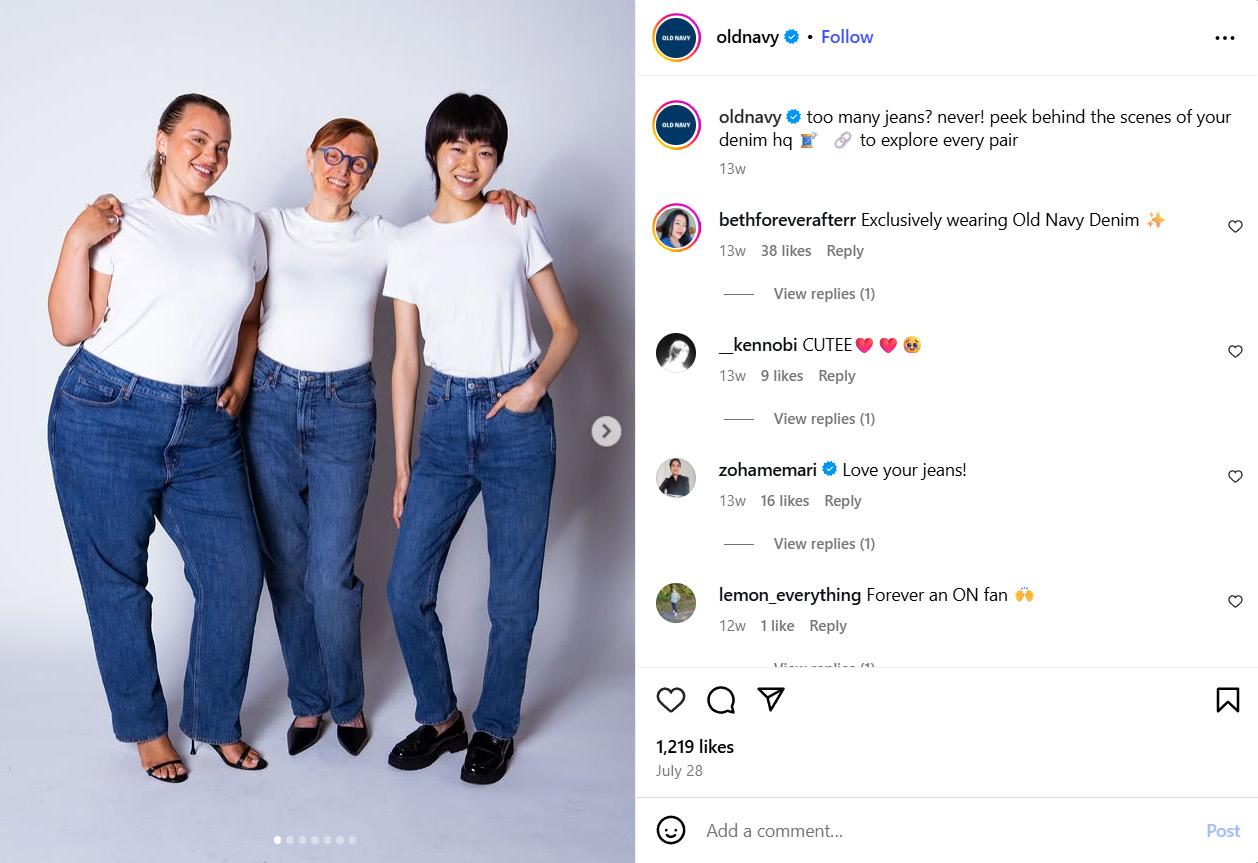
Sustainable marketing is the process a company undertakes to create, communicate, and deliver value to its customers by protecting and preserving the natural ecosystem (McGraw-Hill, 2025). According to researchers, sustainable marketing is unclearly defined because of various definitions offered for explanation (Kemper, 2019). The concept of sustainable marketing can be interpreted in various ways, but it is essentially about minimizing the consumption of resources while maximizing the utilization of available resources (Gordon, 2011). Gordon’s research aligns with Kemper’s research on the types of sustainable marketing. According to Kemper’s research, Old Navy is adopting a reformative sustainable marketing approach (2019). Reformative sustainable marketing is extending the aspirations to achieve sustainability in its marketing mix (Kemper, 2019). According to Gordon’s research, Old Navy is adopting a green marketing approach (2011). Green marketing is developing and marketing more sustainable products and introducing sustainability efforts (Gordon, 2011).
With the specific definitions of the types of sustainable marketing, Old Navy is engaging in a reformative sustainable marketing strategy and a green marketing strategy. According to Good On You, a company that analyzes the sustainability of brands, Old Navy has a moderate rating with the label of “It’s a start” (Old Navy - Sustainability Rating, n.d.). The analysis aligns with the definition of reformative sustainability and green marketing because Old Navy is making sustainable changes to improve its effect on the environment, but some practices do not promote sustainability (Old Navy - Sustainability Rating, n.d.). Sustainable marketing has aspects that focus on environmental, social, and economic factors (Kemper, 2019). Old Navy implements programs that meet each aspect.
The first aspect is environmental, which can be discovered under the sustainability tab on the sustainability page (Shop the latest fashion for the whole family, 2025). Old Navy lists all environmental endeavors and the timeframe they wish to accomplish them by. A few examples include no more plastic shopping bags, 100% Better Cotton, 60% recycled polyester, and less water waste (Imagine Mission, 2025). Old Navy is on track with sustainability and aspiring to
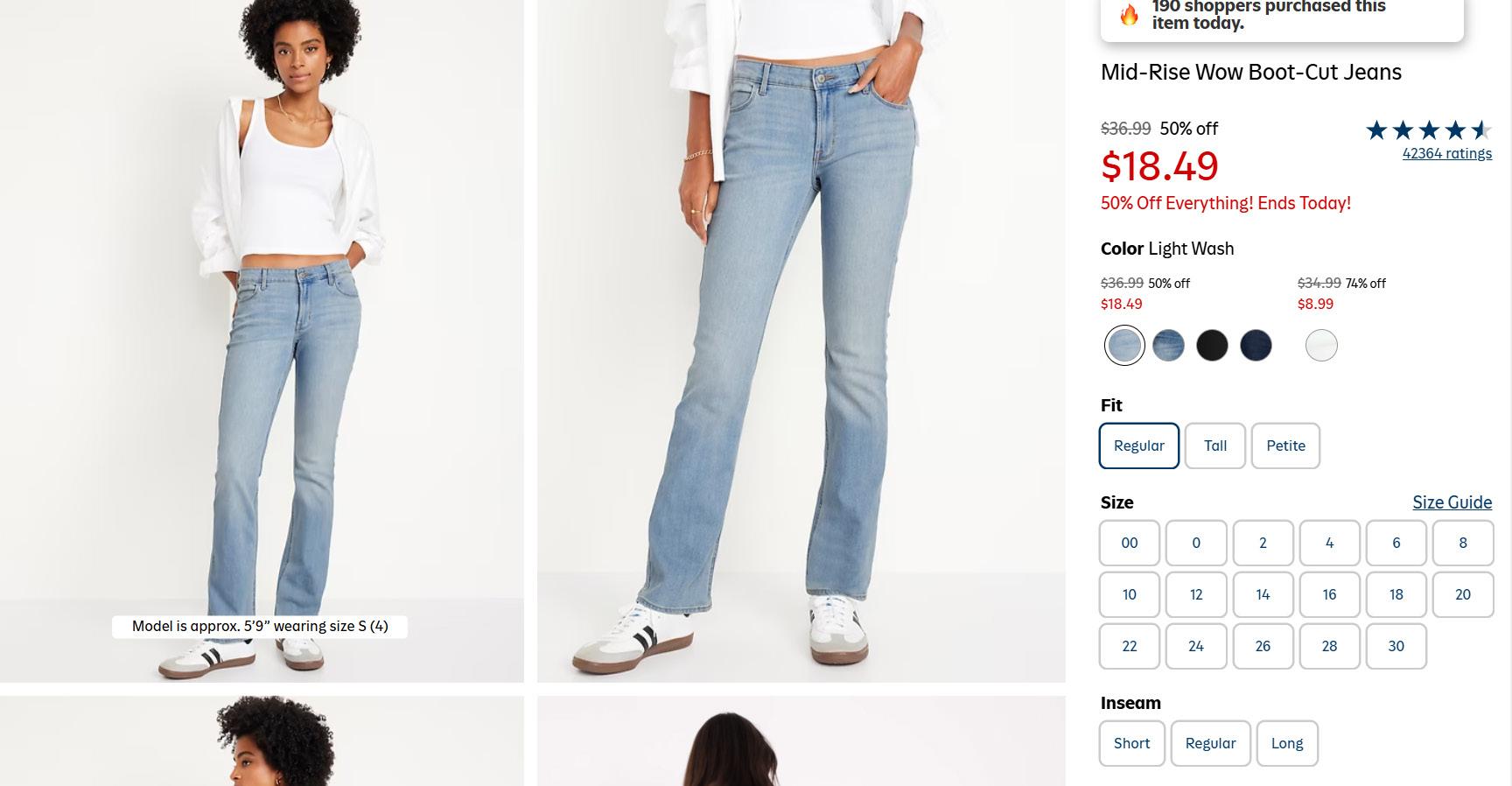
do more, which aligns with the reformative and green sustainable marketing strategies. It is important for brands to focus on a sustainable marketing approach due to their contribution to 2-8% of global greenhouse emissions (Steiger, 2024b). Sustainability is important in the fashion industry due to 67% of adults viewing it as essential, while even 22% view it as a top priority (Steiger, 2024b). Outside researchers argue that Old Navy could be doing more to achieve better sustainability. According to the Commons, Old Navy could participate in more transparent brand-level sustainability reporting (How Sustainable Is Old Navy?, 2025). Transparent information can be collected from the GAP company, but it does not report what level of emissions and materials are being specifically used by the Old Navy brand (How Sustainable Is Old Navy?, 2025).
The next aspect that Old Navy focuses on is social sustainability. Old Navy recently took on the endeavor to have size-inclusive offerings in every single woman’s style, including graphic tees designed by diverse artists (Imagine Mission, 2025). Inclusivity and diversity are important ideas that brands need to achieve due to six in ten adults believing that the fashion industry has set impossible standards, and they prompt brands to challenge outdated ideals (Steiger, 2024a). Consumers want brands that have diverse body representation, with 57% of adults wanting fashion brands that offer more size and length options (Steiger, 2024a). Old Navy launched BODEQUALITY in 2021 to revolu-
tionize its customer shopping experience by offering women’s styles with no price difference between sizes 0-30 (Old Navy History, 2025). Old Navy has implemented this throughout the website (figure 2) by offering petite, regular, and tall sizes and different inseam lengths for pants. Old Navy offers a wide range of sizes for all styles of clothing, catering to people of all shapes and sizes to foster tremendous inclusiveness. Old Navy also focuses on social sustainability through Project WE, which involves collaborating with diverse artists to create graphic tees (Imagine Mission, 2025). Project WE started in collaboration with the Fifteen Percent Pledge, which supports diverse artists as they break into the retail industry on a national level (Business Wire, 2022). The goal of the collaboration focused on the expansion of access and opportunity, and to build an equitable retail industry (Business Wire, 2022). Old Navy’s participation in this initiative allows for creative expansion of marginalized groups and more inclusiveness within the retail industry. Old Navy has implemented a reformative and green sustainable marketing strategy by implementing inclusivity and diversity into its marketing mix.
The last aspect of sustainable marketing is economic sustainability. Old Navy achieves economic sustainability through the This Way Onward project. This Way Onward provides access to jobs and careers for socioeconomically disadvantaged youth aged 16-24 throughout the United States and Canada (Imagine Mission, 2025). The programs are implemented in
stores and distribution centers, and they partner with community-based organizations to provide skills, supportive services, and leverage brand leadership (Bridging the Opportunity Gap, 2025). The goal of the project is to build confidence and develop transferable skills that reduce financial stress for their families because of better job prospects (Bridging the Opportunity Gap, 2025). Old Navy is providing better outcomes and financial advantages for those who participate in the program. The reformative and green sustainable marketing strategy is implemented by promoting economic sustainability and introducing effective sustainability measures into the community. Old Navy implements all aspects of sustainable marketing to position its products to its customers.
Positioning is a marketing concept defined as the efforts a company undertakes to influence the customer’s perception about its products, services, and ideas (McGraw-Hill, 2025). The company focuses on the idea that consumers compare the benefits of competing products and companies against each other (McGraw-Hill, 2025). Competitive positioning is the combination of the target market and the competitive advantage (Hooley, 2001). To defend the position of products, companies need to protect the individual resources and the competitive position (Hooley, 2001). Old Navy positions its brand and company as an inclusive, affordable, high-quality clothing store for the whole family, and they communicate this idea through their website and advertisements.
Old Navy offers a wide selection of product lines that include various categories such as men, women, baby, toddler, and maternity (Shop the latest fashion for the whole family, 2025). By offering a wide selection of products, Old Navy can position itself as a one-stop shop for families. Old Navy positions its product further by offering low prices for high-quality apparel. Old Navy has an advantage in positioning itself as a family clothing store. Family clothing stores are thriving due to an increase in consumer spending because of the growing economy (Perdomo, 2025). The increase is also due to more foot traffic in stores, which leads to more store profitability and expansion for the company (Perdomo, 2025). All Old Navy clothing is under $100, but additional sales and coupons can be applied for a greater discount on the products (Shop the latest fashion for the whole family, 2025). Consumers are becoming more value and budget focused on finding the best sales on clothing items, so it is important for stores to have competitive pricing to attract customers (Perdomo, 2025). Old Navy has a competitive advantage because it positions its products
towards families and offers competitive pricing. Old Navy’s largest competitors are companies that focus on selling clothing for an affordable price. Some examples include Ross, T.J. Maxx, and Marshalls, where all the stores focus on affordable clothing for the whole family (Perdomo, 2025).
Inclusivity is an important method to position products. In a study that examined how brands position their female plus-size clothing section, Old Navy is seen as a deviation from the cultural norm to promote more inclusive plus-size options (Shelton, 2023). The study found that Old Navy does not separate plus-size clothing from the straight-size, and the products are offered for the same price (Shelton, 2023). Consumers can locate products and their prices faster within the store. Many other retail competitors of Old Navy were analyzed and examined using the same method and found that the competitors separate the plus-size items from the straight sizes (Shelton, 2023). Consumers value inclusiveness within a brand, which creates a competitive advantage and a profitable position for Old Navy.
Technology and promotions are essential to position products to Gen Z. To provide the best connection with the consumers, businesses need to prioritize video-centric social media platforms (Rude, 2024). On Old Navy’s Instagram page, many promotions are video-centered reels. The reels connect with the consumers to provide them with the value of their product. However, Gen Z exhibits a behavioral polarization where they endorse social and environmental responsibility, but they refuse to pay a premium for their values (Rude, 2024). Old Navy successfully positions itself toward Gen Z by offering affordable, high-quality apparel that focuses on sustainability. They communicate the value of their product compared to competitors to appeal to Gen Z’s indulgences.
Old Navy offers wide and expansive product lines that create a competitive advantage revolving around sustainability and positioning. Old Navy focuses its marketing efforts on promoting sustainability through the environmental, social, and economic aspects. Through inclusive campaigns, Old Navy has attracted new customers who want to purchase from a brand that focuses on equality. They use this to their advantage by positioning their products inclusively and sustainably. Along with inclusiveness, Old Navy focuses on providing families with high-quality clothing at an affordable price. As Old Navy’s mission statement suggests, they are making fashion accessible to everyone (Old Navy History, 2025).
References
American Eagle. (2025, October 28). Official Website. Men’s & Women’s Jeans, Clothes & Accessories | American Eagle
Connect Master. (2025). Principles of Marketing (2.0). McGraw-Hill Education, New York.
Gap Inc. (2025, October 23). Old Navy History. https://www.gapinc.com/en-us/about/old-navy/ old-navy-history
Gap Inc. (2025, October 24). Bridging the Opportunity Gap https://www.gapinc.com/en-us/impact/ bridging-the-opportunity-gap
Gordon, R., Carrigan, M., & Hastings, G. (2011). A framework for sustainable marketing. Marketing theory, 11(2), 143-163. A framework for sustainable marketing
Hooley, G., Greenley, G., Fahy, J., & Cadogan, J. (2001). Market-focused Resources, Competitive Positioning and Firm Performance. Journal of Marketing Management, 17(5–6), 503–520. https://doi. org/10.1362/026725701323366908
How Sustainable is Old Navy? (2025, May). The Commons. https://brands.thecommons.earth/brand-rating/137/ old-navy
Kemper, J. A., & Ballantine, P. W. (2019). What do we mean by sustainability marketing? Journal of Marketing Management, 35(3/4), 277–309. https://doi.org/10.108 0/0267257X.2019.1573845
Old Navy. (2025, October 23). Earn super cash in stores & online! https://oldnavy.gap.com/browse/info.do?cid=565 26&msockid=3c6295dd63e469d22cc0846562ab688c
Old Navy (2025, October 23). Imagine Mission https://oldnavy.gap.com/browse/info. do?cid=1160383#sustainability
Old Navy. (2025, October 29). Mid-Rise Wow Boot-Cut Jeans. Mid-Rise Wow Boot-Cut Jeans | Old Navy
Old Navy. (2025, October 23). Shop the latest fashion for the whole family. https://oldnavy.gap.com/?tid=on ps024290&kwid=1&ap=7&ds_agid=2911481991275433510210190&gclid=526c8cfa2d6714d6eecd e4030f1811f0&gclsrc=3p.ds&msclkid=526c8cfa2d6 714d6eecde4030f1811f0&utm_source=bing&utm_ medium=cpc&utm_campaign=ODN%7CPFR%7CB %7CS%7CB%7CCO%7CCO%7CDCM%7CEXT% 7CBAU%7CPRS%7CUS%7CU&utm_term=old%20 navy&utm_content=ON_BR_US_X_Core_Core
Old Navy. [@oldnavy] (2025, July 28). Too many jeans? Peek behind the scenes of your denim hq to explore every pair. [Photograph]. Instagram. (1) Instagram
Old Navy Sustainability Rating (n.d.). Good On You. https:// directory.goodonyou.eco/brand/old-navy
Old Navy Expands Project WE Artist Tee Series in Partnership with the Fifteen Percent Pledge. (2022). Business Wire (English) Old Navy Expands Project WE Artist Tee Series in Partnership with the Fifteen Percent Pledge - EBSCO
Perdomo C. (2025, March). Family Clothing Stores in the US. IBISWorld https://my.ibisworld.com/us/en/ industry/44814/performance
Rude, J. (2024, March 27). Future of Consumption: Unlocking Gen Z Behavior for Crafting Powerful Strategies. Passport. Analysis - Euromonitor: Passport
Shelton, S. S., Bradshaw, A. S., Cretul, M., & Treise, D. (2023). You can’t shop with us: how US-based, valueand mid-market online clothing retailers position their plus-size female clothing sections. Journal of Fashion Marketing and Management, 27(6), 1009-1026. https:// doi.org/10.1108/JFMM-11-2021-0304
Steiger B. (2024, October 31). Fashion: Inclusivity & Diversity – US – 2024. Mintel. https://clients. mintel.com/report/fashion-inclusivity-diversity-us2024?fromSearch=%3Ffilters.category%3D161%252C 124%26filters.region%3D4%26last_filter%3Dregion% 26resultPosition%3D4%26resultPosition%3D6%26res ultPosition%3D7
Steiger B. (2024, November 30). Sustainability in Fashion – US – 2024. Mintel. https://clients. mintel.com/report/sustainability-in-fashion-us2024?fromSearch=%3Ffilters.category%3D161%252C 124%26filters.region%3D4%26last_filter%3Dregion% 26resultPosition%3D4%26resultPosition%3D6
This research project has enhanced my growth here as a student at Shippensburg University by challenging me to improve my research and writing skills. Before beginning this project, I had limited opportunities to conduct a detailed research project on a specific topic. I have learned many valuable skills that will transfer into my future profession and coursework. It is essential to have critical thinking and research skills when diagnosing individuals for any difficulties they may be experiencing. The project pushed me out of my comfort zone to improve my research and professional writing skills that can be applied to my future profession in the health field. After completing the project, I have analyzed brands more than I did previously, specifically focusing on aspects that I want a brand to stand for. This is a critical skill to acquire, not only for my personal life, but also for my professional life, as it allows me to represent my identity through certain brands that I align with.
by Jackson Burns
EXER 343 : Foundations of Exercise Physiology
Dr. William Braun
Assignment:
The assignment was to examine a selection of peer reviewed studies on a specific ergogenic aid, which is a substance that is designed to improve physical performance in areas like strength, endurance, or recovery. I chose human recombinant erythropoietin injection, also known as blood doping, as my subject matter. I had to review scientific, peer-reviewed, published studies and formulate my own thoughts on the efficacy of this aid based on my findings.
As sports have grown in popularity throughout the years, the pressure to perform at the highest level has also increased. Because of this, the measures taken to win, even cheating, have increased. In the world of professional cycling, one method of cheating involves injection of the hormone erythropoietin (EPO) or the synthetic version, recombinant human erythropoietin (rHuEPO). EPO is a hormone produced by the kidneys, that is released in response to low oxygen levels (1). Its main function is to stimulate the production of red blood cells (RBC) in the bone marrow (1). When EPO is stimulated by hypoxia, RBC and hematocrit rise in the blood, causing hemoglobin levels to rise, supporting better oxygen carrying capacity and delivery to the tissues. Increased oxygen carrying capacity of blood can be of great benefit to endurance-based athletes, such as cyclists.
Initially, rHuEPO was used to help patients with renal anemia, and was approved by the FDA for this use (1). Later, it became attractive to endurance athletes, specifically elite cyclists because of its hypothesized ergogenic benefit. Not much was known about the drug’s efficacy, but because of its supposed performance enhancement, as well as potential dangers with blood clotting, it was put on the list of banned substances in the Olympics and shunned by antidoping agencies (1). In the late 1980s and 1990s, the sudden deaths of several young, elite cyclists were linked to EPO use causing confusion and outrage about the safety of the drug (1). However, there is a lack of direct evidence to support the claim that EPO injection directly causes sudden death in healthy adult athletes (1).
The reason I chose EPO as the ergogenic aid for this paper is because one focus of this physiology class relates to mechanisms for improving aerobic capacity and endurance based on physiologic variables, such as VO2max (aerobic power), lactate threshold, and cardio-
vascular function. In a literature review by Heuberger et al. (1) the effects of EPO supplementation on VO2max, lactate threshold, energy economy, and other factors related to endurance performance were examined. In this review, VO2max served as the primary marker of endurance, and it was reported that, by increasing hemoglobin content, VO2max also increased (1). There was, however, a lack of research conducted to observe the effects on submaximal exercise performance (1). For most of a race, cyclists are not performing at their VO2max and are instead performing at submaximal VO2 percentages to pace themselves. The studies examined in this paper will look at the effects of EPO on multiple markers of aerobic capacity and endurance, as well as some potential dangers of EPO use, to determine the efficacy and safety of rHuEPO supplementation.
Thomsen et al. (2) conducted a study to determine whether rHuEPO increased overall anaerobic endurance. Sixteen healthy, non-elite, male cyclists, were split into 2 groups. One group received rHuEPO treatment of 5,000 IU every second day for 2 weeks, 3 injections for 3 consecutive days during the 3rd week, and once a week during week 4-13. The other group received a placebo saline injection on the same schedule. Two exercise protocols were conducted, prior to the injections, during week 4 of injections, and during week 11 of treatment. One test was a VO2max test increasing workload by 40W every 90 seconds until exhaustion, analyzing VO2 and VCO2. The second test was a time to exhaustion test at 80% of the VO2max. Blood samples were taken every 5 minutes and at the conclusion of exercise which were used to determine hematocrit, hemoglobin, and exercise lactate concentrations. The blood tests were also used to estimate arterial oxygen content. The results found that arterial oxygen content was increased by 11% and 9.4% in week 4 and 11, respectively, in the rHuEPO group with no change
in the placebo group. VO2max increased by 9.1% and 8.8% in the same weeks, again with no change in placebo. rHuEPO increased time to exhaustion by 54% in both week 4 and 11, and the treatment also decreased venous lactate during the warmup period and ten minutes into exercise. The key finding of this study was that EPO was sufficient to raise VO2max by a small percentage in the non-elite athletes and was able to significantly prolong their time to exhaustion during submaximal exercise. My takeaways from these results are that EPO helped much more during submaximal exercise because with more RBC and more oxygen the muscles could do the same work at 80% VO2max, with less effort. EPO did increase VO2max because of the improved oxygen delivery, but if this study had been done on elite cyclists who already have extremely high VO2max levels, the improvements may have been smaller, because after a certain point, the heart and muscles would be the limiting factor in oxygen transport. Overall EPO may have a significant benefit on submaximal aerobic exercise based on this study, which would be beneficial for cycling performance.
The next research study I looked at by Heuberger et al. (4) studied well-trained cyclists under different conditions. It was a double-blind study where the cyclists were split into two groups. One group received abdominal subcutaneous injections of 6,000 IU per week, and one group received a NaCl saline injection, for 8 weeks. Two tests were again performed in a lab, one being a maximal exercise test measuring maximum power output, VO2max, gross efficiency, lactate threshold, and ventilatory threshold. The other was a submaximal exercise test for 45 minutes at the highest sustainable mean power output, measuring VO2 and heart rate. Finally, they conducted a real life, street race to the summit of mount Vetoux in France, a 21km climb testing for time. Through blood tests they found that hemoglobin was in fact higher in the EPO group at 9.6mmol/L vs. 9.0mmol/L in the placebo group. The maximal exercise test found that the EPO group could push slightly harder and use oxygen more efficiently in the lab with power outputs of 352W vs 341W, and VO2max of 60.12 vs 57.42 ml kg-1.min-1
The submaximal test, however, differed in that during realistic steady state exercise, EPO did not make a meaningful difference in power output or VO2%.
Furthermore, during the real-world race, the placebo group was only 17 seconds slower on average, showing EPO provided almost no real performance benefit during an actual race in this well-trained population. In my opinion, this study had a better design by testing performance outside of a laboratory, and by using welltrained cyclists. EPO has shown to improve oxygen carrying capacity through VO2max, but endurance performance, especially during long cycling races, relies on much more than that, and VO2max capacity is
limited. Even though the body can carry more oxygen, it doesn’t mean it can use that oxygen better or sustain higher workloads for longer periods, because of limits in the muscle like mitochondria and capillary density adaptations. However, this doesn’t completely discount the efficacy of using EPO in my opinion, because while the subjects were well trained, they weren’t the most elite in the world. That type of athlete may have more efficiency in using oxygen, and even a small boost in oxygen delivery could delay fatigue.
Breenfeldt et al. (5) took a different approach, and instead of using large doses, they wanted to look at the effects of microdosing rHuEPO. The study looked at 48 fit trained (not elite) men. Another double-blind randomized placebo study, the rHuEPO group received 9 IU per kg of body weight, injected intravenously 3x per week for 4 weeks, and the placebo group received a saline solution. The test was a time trial protocol measuring mean power output, VO2max and peak aerobic power, as well as total hemoglobin mass. The results found significant improvements in the rHuEPO group with a time trial performance increase of 4.1%, VO2max increase of 4.2%, increases in peak anaerobic power of 4%, and 6.7% increase in hemoglobin mass. Finally, a peak increase of 2.6 percentage points above baseline values were found for hematocrit concentration at 3 days, and 10 days after the last injection. The authors concluded that microdosing rHuEPO over just 4 weeks was able to increase RBC mass, improve endurance, and maximal aerobic performance by 3-4%. Meanwhile, no significant gains were seen in the placebo group. This study showed that even very small frequent doses of rHuEPO trigger erythropoiesis. Increases in VO2max or power output by 4% may sound small, but in endurance sports like cycling, that could translate to minutes taken off of race completion times. Since this study was done in a lab, it does not provide the insight that the Mount Vetoux study found, in which the doses had no effect on real world performance. This study is also meaningful because microdoses are harder to detect by anti-doping tests, making it easier for athletes to cheat without getting caught.
The final study I looked at by Heuberger et al. (3) examined another factor that would indirectly influence performance and that is the effect of EPO on endothelial activation and hypercoagulability. The study looked at 48 male cyclists, 18-50 years old in a double-blind, randomized, placebo-controlled study. The rHuEPO group was measured for Hb and HCT concentrations before each dose. They received a weekly subcutaneous abdominal injection for 8 weeks, the first week receiving 5,000 IU, which was then increased on a week-by-week basis to stay in the range of a 10-15% increase in hemoglobin. If they were in the range they received only 2000 IU, and if they were
over, they were given the placebo for safety reasons. Participants performed a maximal graded exercise test 14 days before the first dose and during day 11, 25, 39, and 53 of dosing. The protocol used a standardized warmup, then increased load to 175W, then added 25W every 5 minutes, maintaining a cadence of 70-90rpm, and stopping when they could no longer maintain that cadence. Blood was drawn directly after testing to measure markers of coagulation. Twelve days after the last dose, participants also took part in a 110 km road stage race, with blood being drawn before, and at the top of a mountain. In the rHuEPO group, the average Hb increased 12%, and HCT increased 16%. EPO did not increase the platelet count, but it did increase levels of P selectin (7.8%) and E selectin (8.6%). P-selectin and E-selectin are produced by endothelial cells and platelets and are known to significantly enhance coagulation or blood clotting (3). In the placebo group, exercise alone changed the hemostatic profile. More significantly, EPO combined with exercise showed larger changes in markers of coagulation than exercise alone, with E selectin 15.3% higher, and Platelet Factor 4, which is released by platelets and promotes blood clotting, 32.1% higher.
This study is important because there have been many cases where exercise has induced thrombotic events, such as strokes, thromboembolism, and myocardial infarction, caused by changes in the blood profile and use of EPO may increase this risk (3). Exercise on its own was shown to increase markers of coagulation, but when paired with EPO, it increased to a more dramatic extent. This study showed that the rHuEPO treatment caused significant endothelial activation, based on the levels of P and E selectin as well as several other markers that would lead to exercise induced hypercoagulability. Based on the findings, exercise, especially in combination with EPO supplementation, potentially poses a significant thrombotic risk. Overall, my takeaway is that since rHuEPO causes higher hematocrit, and higher blood viscosity, it will be much more likely to form clots, leading to potential sudden death risk as seen in the 1980s and 1990s sudden death cyclists. So maybe it wasn’t just a coincidence?
The studies I looked at, and overall, most of the literature in general since the time EPO became a hot topic for performance enhancement has lots of contradicting evidence on whether rHuEPO benefits cyclists, particularly elite cyclists (1). On one side, Thomsen et al. (2) proved in a very small sample size of non-elite cyclists that not only did EPO improve VO2max as widely seen across the literature, but it improved submaximal exercise performance even more, which is directly relevant to endurance cycling performance, because these races take place at percentages of VO2max and not at VO2max. The higher the intensity a cyclist can sustain, the better off they are in the
race. Breenfeldt et. al (5) also showed that, in a much larger population of recreationally trained men, even microdosing rHuEPO for a short period of time can significantly increase endurance measures and maximal aerobic performance by values of 3-4%, which would equate to minutes taken off in a race, showing to be very beneficial for cyclists.
To contradict those studies, recent studies by Heuberger et al. (4), and Heuberger et al. (3) showed that while rHuEPO does enhance VO2max it may not be as efficacious as we think. The 2017 study pointed out the fact that much of the research up to that time had been made up of small uncontrolled studies, in unrepresentative populations, that often expressed their results in parameters only evaluating maximal exercise performance, which as stated before most cyclists do not compete at. This study also demonstrated an improvement in VO2max, but in contrast to the other studies found no significant enhancement benefit on submaximal performance, or real-world race performance in these well-trained athletes 4. While rHuEPO has been shown to improve VO2max in each study I have reviewed, endurance performance relies on many other factors such as muscle mitochondria, capillaries, lactate buffering capacity, glycogen stores, fatigue resistance, psychological effort, economy of movement, and nutrient utilization, all concepts studied in class. For this population of trained athletes, oxygen transport likely wasn’t the main thing inhibiting their performance as elite athletes are usually already near their physiological limit in VO2max (1). In my opinion, the culminating evidence from these studies should significantly prove that EPO may not really be that efficacious.
The Heuberger et al. (3) study further depleted my confidence in the efficacy of rHuEPO by showing that it may be dangerous to use in large doses. Increases in markers of hypercoagulability while used in combination with exercise were shown, which is known to lead to thrombotic events such as stroke, heart failure, seizures, pulmonary embolism, red cell aplasia, and even tumor growth (1). Because of this information combined with the fact that research has varied so much on whether EPO benefits cyclists during a real race, my primary conclusion is that EPO should not be used by cyclists to enhance performance, as it heightens the risk of death, for very little-known benefit at all. More research could be done specifically on the more elite cyclists to see how it impacts their performance instead of just well trained, or regular people; however, since blood doping is banned in the sport, that study likely will not happen. Higher or longer-term doses on more people could also provide more insight, but these studies are also hard to perform ethically due to the known risk of using rHuEPO.
References
Heuberger J, Tervaert J, Schepers F, et al. Erythropoietin doping in cycling: lack of evidence for efficacy and a negative risk-benefit. British Journal of Clinical Pharmacology. 2012;75(6):1406-1421.
Thomsen J.J, Rentsch R.L, Robach P, et al. Prolonged administration of recombinant human erythropoietin increases submaximal performance more than maximal aerobic capacity. European Journal of Applied Physiology. 2007;101:481-486
Heuberger J, Posthuma J, Ziagkos D, et al. Additive effect of erythropoietin use on exercise-induced endothelial activation and hypercoagulability in athletes. European Journal of Applied Physiology. 2020;120:1893-1904
Heuberger J, Rotmans J, Gal P, et al. Effects of erythropoietin on cycling performance of well trained cyclists: a double-blind, randomised, placebo controlled trial. The Lancet Haemotology. 2017;4(8):374-386
Breenfeldt A, Graae J, Bejder J, et al. Microdoses of Recombinant Human Erythropoietin Enhance Time Trial Performance in Trained Males and Females. Medicine & Science in Sports & Exercise. 2023;55(2):311-321
Student Reflection:
Going into this assignment I was interested in blood doping due to the known controversy surrounding the use of recombinant human erythropoietin injections, specifically the controversy surrounding Lance Armstrong in the early 2000s and the sudden death of cyclists in the 80s and 90s. I viewed it as a clearly effective but also potentially dangerous performance enhancing drug without much real background knowledge about it. Reviewing actual research studies that dove into how potent the effects of the drug actually are, and how dangerous it can potentially be, simplified my view of the ergogenic aid. I found that while the drug does consistently show increased hematocrit and hemoglobin levels as well as elevated VO2 max (aerobic power), the actual translation of these changes to real world cycling performance was much less clear, especially in well trained athletes. Reviewing different studies showed me the importance of study design, and how outcome measures can strongly influence conclusions that researchers make. Overall, this assignment strengthened my skills in evaluating conflicting evidence in literature to make my own opinion, which was that the drug may not be as efficacious as it seems.
by Hannah Kristiniak
ENGL 130: Literary Studies
Dr. Jordan Windholz
Assignment:
Focusing on close reading and textual evidence to support an original interpretive claim, this assignment required a formal literary analysis of a selected text that was read during the semester. The paper had to examine literary elements while engaging with the text in its broader context to make a specific interpretive claim about the work’s meaning.
For most of history, people believed that knowledge could only come from formal education, even though the definition of knowledge states that it is acquired through academic learning or experience. Only the wealthy could afford extensive schooling, so they became the people society considered the “most informed.” Meanwhile, those without money turned to trades such as farming, factory work, construction, and other hands-on labor. Even though these jobs require real training and skill, they were viewed as less respectable. What is strange is that formally educated experts still rely on the work of laborers. A good example is agriculture: researchers focus on food production, new technology, and genetic modifications, yet farmers are the ones who work with crops every day. Even today, society is beginning to recognize that mechanics, plumbers, farmers, and other laborers are just as essential as doctors, lawyers, and researchers. Schools now offer trade programs, and success is no longer defined only by earning a college degree. But how did society begin to acknowledge this additional perspective? And was there a deliberate effort to make people value experience-based knowledge? Melville’s Moby-Dick enters this conversation by questioning the belief that formal education is superior to the skill and understanding gained through labor. Beneath the surface of the novel’s whale hunt, Melville pushes readers to rethink where real knowledge comes from. Early in Moby-Dick, Ishmael explains, “I thought I would sail about a little and see the watery part of the world” (16). On the surface, this statement seems simple, but it reveals his curiosity and desire to learn through firsthand experience. By observing and participating in life aboard the Pequod, Ishmael gains insight that cannot be learned from books or formal education. His perspective allows him to notice the skill and effort required of whalemen, whose work is
often dismissed by society. Through these observations, Melville shows that practical experience can rival scholarly expertise. By displaying “never seen before” experiences, Melville proposes a better path for gaining real understanding. Melville builds Ishmael’s authority through a mix of firsthand experience and thoughtful analysis, revealing that laborers hold knowledge scholars often miss. In doing so, Moby-Dick questions traditional ideas about who produces knowledge and imagines a more cooperative relationship between scholars and workers.
Through Ishmael’s authoritative role, granted to him with vivid firsthand depictions of labor, experience is positioned as a form of knowledge that is underappreciated by scholars. Ishmael’s narrative position enables him to describe the daily exertion put forth by whalemen. Melville situates Ishmael on the outskirts of certain scenes, making him an observer, specifically when he reveals “there is no staying in any one place; for at one and the same time everything has to be done everywhere” (243). Not only does Ishmael provide a trustworthy primary account of the activity upon the ship, he leaves the description vague to imply that there is too much work to even begin to describe all that is required by whalemen. Their effort is not futile, contrary to popular belief, as their hard work contributes to the production of candles with spermaceti and an overall advanced understanding of whales as creatures. Ishmael gradually becomes more confident in his expertise of whales as he spends more time on the Pequod. With this confidence, Melville allows Ishmael to address whale scholars directly with a superior tone. Ishmael asserts,“there is no earthly way of finding out precisely what the whale really looks like,” but the closest way to find out is “by going a whaling yourself” (208). Upon closer examination, Ishmael is indirectly challenging these “professionals” of whales with a
subtle hint of insolent disposition, revealed through his daring language. Though the novel opens with Ishmael unbeknown to the profession of whaling, his curiosity and exposure on the Pequod proves that he is a trusted individual on the knowledge of not only life as a whaleman, but an all-encompassing overview of whales. Ultimately, Melville uses Ishmael’s role as the narrator to give him a specific voice that emphasizes the valuable insight of whalemen that would enhance the accuracy of cetology research.
By employing rhetorical appeals, the critical attitude on both competing perspectives is revealed, allowing Melville to lead the audience to sympathize with and trust Ishmael. Building this relationship effectively undermines traditional scholarly authority. Society generally disdains whalemen. Melville demonstrates this when Ishmael remarks with disappointment that “whaling has somehow come to be regarded among landsmen as a rather unpoetical and disreputable pursuit” (91-92). Considering that whalemen are upstanding citizens and make the sacrifice of sailing for years at a time, previously revealed through Ishmael’s storytelling, it seems unfair that these men would be judged so harshly. The audience is undoubtedly compelled to feel compassion for Ishmael and align their views with his for the rest of the novel; therefore, when Ishmael references other assessments of whalemen and disputes them, the audience is likely to endorse him. Here is one comment that Ishmael points to, “then whalemen themselves are poor devils; they have no good blood in their veins” (94). Melville has him respond with a question, “no good blood in their veins?” and answer with factually based evidence, “they have something better than royal blood there. The grandmother of Benjamin Franklin was Mary Morrel; … the ancestress to a long line of Folgers and harpooneers” (94). Not only does Ishmael have the audience favoring him, he is supporting himself with proof which only strengthens the audience’s trust in him. Readers become aware of the inadequacy of whale scholars when Ishmael announces “one and all of them declare it to be the largest animated thing in the ocean, yet very few of them have any but the most vague ideas concerning its true nature and form” (216). Considering the previously established relationship, the audience inevitably has confidence in his assessment. Through Ishmael’s emotional appeals and well-founded beliefs, Melville builds a trusting relationship between the audience and protagonist, exposing the limits of scholars and demoting them from the dominant avenue for accessing credible knowledge.
Melville shifts Ishmael into a more scholarly tone, allowing a laborer to speak and think with the precision and authority of an educated writer. Despite
Ishmael’s more occupational work on merchant and whale ships, he takes his work as an investigator and educator of whales very seriously. He assures, “since I have undertaken to manhandle this Leviathan, it behoves me to approve myself omnisciently exhaustive in the enterprise” (334). Ishmael vows, especially since scholars fall short on this promise, that he will be thorough and all-knowing in his approach to explain whales. Melville makes Ishmael take this proper position to replace traditional cetologists with whalemen, who are backed by valuable experience. Not only does Ishmael value validity, making him a better suited whale scholar anyway, but he is also advantaged with his firsthand account of whales. The logical advancement of Ishmael’s knowledge and therefore his lessons that Melville develops makes him more appropriate for the job of whale expert. This natural progression is explained when Ishmael states “having already described him in most of his present habitatory and anatomical peculiarities, it now remains to magnify him in an archaeological, fossiliferous, and antediluvian point of view.” (334). Melville shifts Ishmael’s tone to be more informative and academic, solidifying the idea that laborers can enter positions that are typically occupied by the educated. The author also makes him self-assured that his knowledge of whales is unerring. When Ishmael says, “Where, I should like to know, will you obtain a better chance to study practical cetology than here?” he displays confidence in himself, assuring the audience that his observations are likely more reliable than those of other whale scholars (250). His self-assured tone demonstrates both his competence and the value of practical experience in understanding whales. In this way, Melville uses Ishmael to put the idea into action: laborers, guided by observation and experience, can hold the same authority as formal scholars. Through Ishmael’s journey, Melville demonstrates that knowledge gained through observation and handson experience can be just as valid, and sometimes more insightful, than formally educated expertise. Ishmael’s growth from a curious outsider to a confident narrator shows how laborers possess understanding that scholars often overlook. This reading challenges society to reconsider how it values different forms of knowledge and authority, emphasizing that true understanding often comes from direct engagement with the work itself. Looking ahead, Melville’s ideas could apply to any field where practical experience competes with formal training, from trades to technology to scientific research, reminding readers that real understanding often lives outside the classroom. In the end, MobyDick argues that those who engage directly with the world may hold the clearest view of it.
Melville, Herman. Moby-Dick: A Norton Critical Edition. 3rd ed., edited by Hershel Parker, W. W. Norton & Company, 2017.
Student Reflection:
This assignment led me to understand literary analysis on a new level. It allowed me to read in a way that pays attention to the operations of a text and how it relates to its context. Focusing on literary technique changed the way that I understood what I was reading, which in this case was Herman Melville’s Moby-Dick. Instead of having a surface-level comprehension of the events in the novel, my analysis went deeper and looked at Melville’s achievements through literary techniques. I built my argument by recognizing a consistent theme in Moby-Dick, which was how the production of knowledge differs between labor-based and experiential processes. Then, I found textual examples of where these instances occurred, but instead of using the content of the text as my evidence, I analyzed what literary devices Melville employed and how his techniques supported the overarching theme. Herman Melville’s perspective on the acquisition of knowledge, expressed through the main character Ishmael and other literary techniques, contributes to the evolution of how society views different forms of knowledge. This way, his novel is not simply a tale about a white whale but a foundational text that contributed to the advancement of multiple social issues.
Assignment:
by Mi’Angel McRae
ENGL 323: Reviewing the Arts for Publication
Dr. Laurie Cella
Write an 8–10-page feature about a topic that captures and/or explains the zeitgeist of today. Must use sources that are relevant to the topic, whether academic or popular sources.
The Sims, a life simulator franchise that has survived decades of technological advancements, cultural changes, and revolutionized the gaming industry, is facing a major adversity that could cost it its legacy. The standout of the video game series, simply titled The Sims, was developed by Maxis, a game developer founded in 1987 by The Sims creator, Will Wright. Maxis was acquired by Electronic Arts (EA) ten years later, and The Sims was published by EA in 2000 (“The Sims”). This was the beginning of one of the most influential games in the industry thus far, and it’s unlikely that there will be another life simulator that impacted gaming culture such as The Sims franchise. Today, however, the legendary video game series and its publisher EA, are making waves that have less to do with impressive innovation and more to do with legacy-staining business decisions.
In September 2025, it was confirmed that Electronics Arts will be acquired by “an investor group composed of PIF, Silver Lake, and Affinity Partners in a transaction valued at approximately $55 billion (Yin-Poole). Jared Kushner’s Affinity Partners and Saudi Arabia’s Public Investment Fund (PIF) were immediately flagged by sims players to represent the opposite of what the game series, and more specifically The Sims 4, has stood for. The Sims 4 community prides themselves on being a safe space for various groups of players.
Since the game’s release 11 years ago, its players have fought for inclusion and diversity every step of the way. From hairstyles to wall decorations and disability aids to birthmarks. Players have helped shape The Sims 4 to be what it is today, so it’s difficult to watch the game they’ve come to love be placed in the palms of companies whose values have publicly contradicted the very soul of The Sims
Despite being the frontrunner in the life simulator race, The Sims video game series isn’t the only of its
kind. Games like Animal Crossing and Stardew Valley are also popular and have dedicated fandoms of their own. Games like these capture the simplicity of life and are often categorized as “cozy games.”
Cozy games tend to have daily tasks, usually mundane, that can advance the character or the story. In Animal Crossing, these tasks include talking to villagers and watering plants; in Stardew Valley a player can craft and go fishing. Games described as cozy are often low stakes, not graphic, and tend to be relaxing for the player. Customization is also a prominent and sought-out feature. A lot of these characteristics overlap in both games, including The Sims 4 and its preceding series companions.
The Sims 4 is unique in that said customization reaches farther than changing the features of one’s character. In The Sims a player can not only create a character, known as a “Sim,” from scratch, but they can build a Sim’s house from the ground up, choose their occupation, who they talk to, and what they eat…if they eat. The game does come with premade characters, also called “townies,” for players to latch onto set storylines, personalities, and appearances. Even with this, players are still able to manipulate the townie’s story any way they see fit. The Sims gives players the most control compared to other life simulators. And this amount of creativity and customization plays a large role in how The Sims 4 reels in new and old players.
Before The Sims 4’s quality of gameplay, features, and community floundered into a downward spiral, eleven years ago, players had unabashed hope. This giddiness and anticipation were wrapped in the reassuring blanket that is endless possibilities of the unknown. Players didn’t know what to expect outside of better graphics thanks to technological advancements between the last game and this new one. Most Simmers figured The Sims 4 would simply be all the previous games and their iconic features compiled into one.
On September 2, 2014, The Sims 4 was released. The Sims 4 community had a lot of input after the game’s release, however, what YouTuber Simsigga calls “the disastrous launch,” shocked many players and may have set the tone for their future gaming experience. Before that though, majority of gamers were in awe of the high-quality graphics, how Sims actually resembled people instead of clay, how building, known as Build/Buy Mode, maintained its status from previous games as one of the best features overall. Many couldn’t believe the extent of the customization of Create-A-Sim, or CAS, the place players make their Sim from scratch by editing their skin tone, facial features, and body type. Here, players can choose clothes and hairstyles and adjust them for different clothing categories like everyday wear, formal wear, and sleepwear. From wrinkles to tattoos, players can create many kinds of Sims, more than ever before.
Personally, I created my sister-in-law as one of my first Sims, and I can remember being in awe at how easy it was to manipulate facial features by simply clicking and dragging. It was completely foreign to me as a long-time Sims 3 player, wherein sliders are used for every aspect of CAS. The Sims 4 graphics were so mind-blowing at the time, I vividly remember getting excited about the animation for mopping up a puddle. The Sim was so fluid, the puddle wasn’t flat or oddly shiny, and the noise of the whole animation was realistic. My weird obsession with that specific feature aside, I knew The Sims 4 was gearing up to be the best game in the series.
And for many Simmers it was and still is the best, but objectively, The Sims 4 has a lot of flaws, some that were glaringly present even before release. Swimming pools were not a part of the base game at launch, and this seemingly small feature was met with utter disappointment. Imagine the shock players experienced when they learned that toddlers, an entire life stage present in all previous games, were missing. So, when playing with a family, a newborn would age up into a child fit for grade school.
In a now deleted blog post by producer Ryan Vaughan, he revealed that swimming pools and toddlers would be missing in the September launch of The Sims 4 (Pereira). Simmers were furious, so much so that the community rallied support, and in June 2014, they started a petition to get The Sims 4 team to release the game with pools and toddlers. According to Change.org, the petition had over 25,000 supporters. While swimming pools were added a month after release in the seventh patch of the game (Macy), toddlers weren’t added until over two years later in January 2017 (Pereira).
Unbeknownst to many Simmers, the beginning of The Sims 4 would foreshadow unfortunate patterns of ignorance and greed.
While comparing The Sims 4 to previous games in the series makes the visual improvements obvious, constant comparison brings the game’s weaker characteristics to the forefront. In The Sims 3, the expansion pack “Pets,” released October 2011, included dogs, cats, horses, and smaller pets like snakes, lizards, turtles, and birds. Conversely, The Sims 4’s “Cats & Dogs” expansion pack, released in November 2017, comes with just that, cats and dogs. While both packs have features that the other doesn’t, for example The Sims 4’s vet clinic and veterinarian career, a lot of players were laser-focused on what they weren’t getting (for the same price no less).
Simmers grew more frustrated when, as time went on, they saw game content being split up into different packs. Expansion packs, game packs, stuff packs, and the most recent edition, kits, are all downloadable content (DLC) that ideally enhances the game. Players noticed that, where a handful of pets came in one Sims 3 pack, they would have to purchase at least three Sims 4 packs, in addition to “Cats & Dogs” to acquire a similar number of animals. The “My First Pet” stuff pack for hamsters, which requires “Cats & Dogs” to function, “Cottage Living” for farm animals, and “Horse Ranch” specifically for horses. This pattern continues with The Sims 4 splitting occults like vampires, werewolves, and spellcasters into three different packs. In The Sims 3’s “Supernatural” expansion pack, Simmers received three new occults and additional features for previously introduced ones.
In a similar vein, The Sims 4 tends to keep simple gameplay, objects, and interactions locked behind DLC. This is a normal business practice, and it’s understood that video game developers must do this in order to maintain consumer excitement, relevancy, and revenue. Still, players struggle when told that, in order to have a changing table for their Sims’ infants, they must spend 39.99 USD on The Sims 4’s “Growing Together” expansion pack. Or if they want their Sims to vacuum, they need to spend 4.99 USD on the “Bust the Dust” kit. The issue isn’t that additional content costs money, the problem is that something as simple as a changing table could have been included in the free update in which the new life stage, infants, came. It’s a hard pill to swallow knowing that vacuuming, a common household chore, wasn’t included in a pack like “Laundry Day,” DLC that revolves around a universal household chore. The same sentiment is maintained when horses are left out of a farm animal pack and get their own instead. Outside of seeming
intentional, because it most likely is, it appears greedy and leaves a bitter taste in the mouth of avid players.
Even without the unfavorable, consistent decision to separate features between packs, the replay value is lacking in the gameplay itself. Many Dimmers believe that The Sims 4 base game, the game without any DLC, is bare bones and depends on a myriad of packs. Not to mention its need for mods and custom content (CC), that is, additional content created by players themselves, often for free and in their spare time. In recent years, modders and CC creators have begun charging for their content. This is a separate issue that a lot of Simmers have strong opinions about. Nevertheless, custom content and mods have a large impact on the game and how one plays it. Still, once a pack is played through, it becomes stale, and because many of them have specific themes, after a couple of playthroughs, it becomes redundant. It makes the gaming experience lackluster and forces the player to wonder if what they paid for was worth it.
Although inconsistent, there are pack releases that have been the complete opposite. One of my favorite Sims 4 packs, for example, “Cottage Living” has aspects that become stale, however, one that I use almost every time I play with a new household is the “simple living lot challenge” feature. It means that a sim cannot make a meal unless they have all the ingredients for it. Although small in comparison to the rest of what the pack has to offer like cows and llamas, running errands, and an entire new world, this lot challenge enhances realism and prompts a little challenge, characteristics that are important for certain players to get the most out of their gaming experience.
Despite The Sims 4 marketing efforts relying heavily on improved customization, thus increased diversity, after the initial excitement died down, players of color flagged how few options of quality there were concerning skin tone, hairstyles, and makeup. Although there were many more skin tone swatches than The Sims 2’s four, they were lacking in comparison to The Sims 3’s skin tone slider.
The Sims 4’s darker skin tones were often described as “ashy” and made Sims looks more like vampires than their human counterparts. Players couldn’t make Sims of color without being disappointed and mildly offended. Amira Virgil, widely known as Xmiramira in the gaming community, fundamentally changed Create-A-Sim when she released 18 new skin tones and compatible makeup in her 2016 “Melanin Pack.”
In 2022, Ineye Komonibo, writer for Refinery29, interviewed Xmiramira, and in her article titled “Xmiramira’s Melanin Pack Revolutionized The Sims 4 — But It Was Only The Beginning,” writes how
the release was “an immediate hit, instantly garnering thousands of downloads by Simmers who were tired of their dark-skinned Sims looking ashy and lifeless” (Komonibo). Today, Xmiramira has released a total of four melanin packs that continue to include darkskinfriendly makeup. She’s recognized for giving The Sims team a well-needed push in the right direction because, while PC players can download Xmiramira’s melanin packs, players on consoles like Xbox, cannot. Console players were still stuck with inadequate skin tones, and they would be for another four years.
In December 2020, The Sims team released a free update that addressed the lackluster skin tones and makeup. Even they acknowledged the inaccuracies in one of their updates, saying “we’ll be improving the blotchy artifacts and ashy appearance of darker skin tones on mid and high spec machines” (“A Note From Our Team: How We’re Addressing Skin Tone Improvements”). The game’s skin tones were officially refreshed with new swatches in neutral, cool, and warm tones, along with a slider that allows players to adjust the light and darkness. Additionally, makeup swatches acquired a slider as well, with similar abilities that include opacity and hue adjustments. In the same update post, The Sims team also noted that “there is a need to improve the representation of hairstyles in our base game…we will start by updating two of the base game hairstyles” (EA.com).
The Sims 4 and its team have not completely denied players the ability to create Sims and families that are meaningful to them, however, the improvements have often taken a long time. In the toddler life-stage case, it took two years after the game’s release, and for better skin tones it took six. Both of these very basic parts of the human experience, in a game that simulates life, lost priority to other aspects. And this reality forces players to step back and wonder how such pertinent features, ones that are vital to their gaming experience, could possibly fall to the wayside. If the basics of a life simulator are lost to the noise, what else could be?
Junie, known as Simsigga on YouTube, has nearly ten thousand subscribers on the platform. She slipped onto my radar with one of her YouTube videos detailing her “Soul Food Legacy Challenge” for The Sims 4. After that, I subscribed and tuned in for the videos where she played her challenge, showing how different it was from the hundreds out there. It wasn’t really about completing tasks and checking boxes but rather enjoying the game and its underused mechanics instead. I kept up with her consistent uploads and found myself rooting for her channel, excited for what she’d put out next.
In an email interview, I asked Junie about her history with The Sims, and she expressed how much it’s meant to her, especially in the last six years. She says the game became more than entertainment for her, that “It was an escape, a place of solace, and a creative outlet. These little pixel people were my family.” And because Junie enjoys expressing her ideas through sims, she confirms that The Sims 4 is her favorite game out of the franchise, saying “it is the best Sims game for telling your own stories,” though admits that if she wants to play an entertaining game, she’ll fire up The Sims 2 or 3. Despite her preference, Junie does understand the appeal of previous games and why, often times, Sims 4 players retreat back into them.
In previous games, Junie emphasizes how Sims and their actions have positive and negative consequences, how these ramifications meaningfully impact a Sim’s fate. Junie highlights The Sims 2 for its charming details like, “The memories, the storylines, the way the Sims respond to their environment…From shielding their eyes from the sun, to seeing the Sims pull the ingredients they need to cook out of the drawers, to children coming home and immediately wanting love from their parents.” There is intention and charm in the basic gameplay, characteristics that were neglected at the base level in The Sims 4.
And players noticed that this pattern wasn’t limited to older DLC or when the game was just getting its footing. The lack of care and cleverness slowly got worse with subsequent pack releases. So much so that the game and its team were defined by broken packs and promises, and The Sims 4 community began expecting low quality DLC.
Junie pinpoints the “Horse Ranch” expansion pack being the tipping point for players’ confidence in the game. She theorizes that this is when Electronic Arts tested how little content they could put in packs to still meet their sales goals. She explains that “’Businesses & Hobbies,’ ‘Lovestruck’, ‘Enchanted By Nature,’ and even ‘Adventure Awaits’ spawned as lackluster and empty packs that still did well.” There isn’t any numerical evidence that shows that these expansions packs were financial successes, however, Junie surmises that it’s possible since, if this new “watered-down formula” wasn’t working, EA wouldn’t keep pushing out DLC that followed it.
As a result of the depleting quality, half-fixes of previous packs, and buggy ones that simply don’t work (like the “Dine Out” expansion and “My Wedding Stories” game packs) most Simmers are disenchanted with the game they’ve been playing for over a decade. They see the potential, yet the execution has been lacking for so long that most players recommend only purchasing DLC if it’s on sale, and even then, other players shake their heads at that. As Junie notes,
diehard Simmers admit that the game needs fixing, but their love for The Sims 4 remains, and their passion drives them to continue playing despite it all. So, what does it mean for the game and its community when the unexpected occurs?
In September 2025, Simmers found out about Saudi Arabia’s PIF, Silver Lake, and Jared Kuscher’s Affinity Partner’s 100% acquisition of Electronics Arts. I found out via Junie’s YouTube video, “EA Was Bought Out. So I Quit,” where Junie expresses her utter disappointment and disgust. She emphasizes how this could negatively impact a game that, qualitywise, is already hanging on by a thread, and vows to remove her Sims 4 gameplay videos. Junie is firm in her belief that continuing to release content playing, thus promoting, the game directly fuels the companies that acquired EA. With promotion comes influence, and because there are many Sims-related content creators with large followings, their influence often results in their viewers purchasing the game and its DLC. In a political and social climate such as the one we’re in now, EA getting acquired by companies that don’t prioritize and rather shun diversity is the last thing needed in what many players believe to be their safe space.
In a 2023 Game Developers Conference, executive producer of The Sims 4, Phillip Ring, declares that Simmers are very diverse, “reflecting, and in some cases, exceeding the diversity of the broader population” (GDCVault, 01:58). Nearly half of the game’s players, at 43%, identify as part of the LGBTQIA+ community, 38% are people of color, and 64% are women. With a broad range of players, The Sims 4 surpasses “traditional gaming demographics.” Because of their efforts, no matter how shaky or late, the Sims community does look to The Sims 4 to reflect the team’s vow to deliberately maintain values that uphold diversity and security. As such, players are fearful that the acquisition will strip the game of the progress that it’s made and prevent further progress from happening.
This fear is not unfounded. According to The Wall Street Journal, Saudi Arabia’s PIF will own nearly 94% of Electronic Arts (Forbes-Calvin). Saudi Arabia, where it’s illegal to be LGBTQ+, has deep history with trying to rid people of their identity in unspeakable ways. In his article “Risking death to tell the truth: Saudi Arabia’s LGBT+ community,” Adam Croft, writer for The Athletic, a sports related journal of The New York Times, interviewed members of the LGBTQ+ living in or around Saudi Arabia. Bravely, they share the horrors they’ve experienced for being themselves. Some were subjected to “cure therapy” where torture was disguised as treatment, others were threatened with shock therapy, and at medical centers, trans women were forced to
take male hormones (Croft). Every interviewee risked their lives to share their stories about a country where “homosexuality in Saudi Arabia means ‘misery, isolation or, worse, death’ (Croft). As a result, many players are horrified at the thought of patronizing a company of a country that violates humans rights.
In response to the growing upset in The Sims 4 community, well-known Sims content creators released statements that made clear their stance. A few of them, like Plumbella, James Turner, and Lilsimsie, decided to leave the EA Creator Network (EACN) and deactivate their creator code. In the EACN, creators get free early access to new DLC and a creator code that gives anyone who uses it a discount on certain packs. The creator gets a percentage of the profit, and the customer saves money. It’s a win-win business model that benefits EA, the creator, and their viewers. Dropping out of the EACN means that creators will no longer be receiving revenue from it and cannot provide a discount, meaning viewers will be less inclined to purchase DLC. A decrease in sales is a decrease in profit for EA.
These creators will continue playing the game on their channel in addition to other life simulators. Plumbella specifies that she won’t be purchasing or playing any future DLC, hoping that “the sale falls through, and if it doesn’t, I hope that those that stay put pressure on EA to maintain the level of inclusiveness that The Sims has always been about” (@ Plumbella).
Despite their distaste for the direction EA is heading, other influential YouTubers, like Deligracy, are deactivating their creator codes, yet will stay in the EACN and purchase DLC themselves. Deligracy claims that she’d prefer to inspire change from the inside and wants to “provide player feedback to the developers and to be a positive voice encouraging The Sims to remain a safe and inclusive game for all players” (@Deligracy).
Players like Junie cannot fathom how some Sims creators are going on to publish content like nothing has happened. Even though she’s hesitant to believe that popular creators dropping out of the EACN will have lasting impact, she wonders “wouldn’t you sleep better at night knowing that even if you couldn’t stop it, you gave it everything you had? That you showed you weren’t willing to go down without a fight?”
On October 24, amidst all the backlash, The Sims team released a statement across their social media platforms claiming that their “mission, values, and commitment remain the same. The Sims will always be a space where you can express your authentic self” (@TheSims). Andrew Wilson, the CEO of Electronic Arts affirmed this sentiment the day the acquisition was announced in an update on the Electronic Arts
website, but even EA workers struggle to look forward to the future with the same vigor as Wilson.
Stephen Totilo, video game reporter and author of Game File article titled “One of the world’s biggest video game companies plans to sell to some of the world’s most powerful people” claims to have spoken to Electronic Arts employees. One anonymous employee tells Totilo that the acquisition “just shows how many people have been collateral this past year for executives to make out rich” and how “Andrew Wilson basically said ‘f you’ to all women and LGTBQ employees at EA with this deal” (Totilo).
When I asked Junie if she believes the acquisition, the companies, and the ripple effects created in The Sims community will be forgotten, she affirms that “it feels like it already has,” and points out that “Content creators are still playing and therefore advertising the game, their supporters are still buying the packs, and this feels like nothing more than rubbernecking at the car accident on the side of the road on the highway”.
As it stands, The Sims 4 community is in limbo. And because EA’s deal with Saudi Arabia, Affinity Partners, and Silver Lake isn’t set to close until 2026, there’s not yet a way for the acquisition’s impact to be seen in the game itself (Forbes-Calvin). Some players’ attitudes have remained unchanged, and others have set boundaries. No posts advertising the game, no new purchases, and even choosing to limit their personal time playing the game. And many have gone on to seek out older and newer life simulation games in protest.
Simmers hope that enough players, including those who don’t play The Sims but play other EA games affected by the acquisition, set similar boundaries and show their aversion. The idea is that if enough players do so in a way that impacts the success of the games, thus EA, then someone high up in the company, like CEO Andrew Wilson, will reevaluate the risks imposed by taking the deal.
To some it’s a stretch, but if no one reaches, there’s no chance for change at all. And there’s been many instances where boycotts have changed the course of or reversed things. The most recent example is the spike in Disney+ subscription cancellations when Jimmy Kimmel Live was indefinitely suspended by ABC. Consumers knew that ABC would be greatly impacted by their parent company, Disney, losing over 1.7 million paying customers, according to the New York Post Soon after, Kimmel was back on air (Zilber).
Whatever the likelihood of a reversal from EA, Simmers’ only hope that the game they’ve watched develop and the franchise that’s been a large part of their lives won’t succumb to the repressive and unfortunate fate that the acquisition threatens. The Sims com-
munity, their relationship with the team, and content creator’s dynamic between themselves and their viewers have been frayed. It’s too early to tell if the community and the Sims franchise will remain off kilter, or if this stain will get scrubbed out as time goes on. Until then, players can take the bit of control they do have and decide what stance they want to take before that too is stripped from them.
“A Note from Our Team: How We’re Addressing Skin Tone Improvements.” The Sims, EA, 2020, www.ea.com/ games/the-sims/news/october-skin-tones-update
Crafton, Adam. “Risking Death to Tell the Truth: Saudi Arabia’s LGBT+ Community.” The Athletic, The New York Times, 16 Oct. 2021, www.nytimes.com/ athletic/2891232/2021/10/16/risking-death-to-tell-thetruth-saudi-arabias-lgbt-community/ Forbes-Calvin, Alex. “Saudi Arabia’s PIF Will Own over 93.4% of EA If the Deal Completes.” GamesIndustry. Biz, 4 Dec. 2025, www.gamesindustry.biz/saudi-arabiaspif-will-own-over-934-of-ea-if-the-deal-completes Komonibo, Ineye. “Xmiramira’s Melanin Pack Revolutionized the Sims 4.” Refinery29, 2022, www.refinery29.com/en-us/2022/06/11020148/ amira-virgil-sims-melanin-pack-interview Macy, Seth G. “The Sims 4 Update Adds Free Pools.” IGN, 26 July 2017, www.ign.com/articles/2014/11/04/ the-sims-4-update-adds-free-pools.
Pereira, Chris. “To Fans’ Chagrin, the Sims 4 Doesn’t Include Pools or Toddlers in Base Game.” GameSpot, 26 June 2014, www.gamespot.com/articles/to-fans-chagrinthe-sims-4-doesn-t-include-pools-or-toddlers-in-basegame/1100-6420757/.
Simmer, Night. “Sign the Petition.” Change.Org, 25 June 2014, www.change.org/p/the-sims-team-includetoddlers-and-pools-in-the-sims-4-base-game#share
“‘The Sims’: Process and Learnings for Developing DEI Content.” GDC Vault, 2023, www.gdcvault.com/ play/1029364/-The-Sims-Process-and%20Stats
Totilo, Stephen. “One of the World’s Biggest Video Game Companies Plans to Sell to Some of the World’s Most Powerful People.” Game File, 29 Sept. 2025, www.gamefile.news/p/ ea-saudi-arabia-pif-silver-lake-affinity-partners-deal Wikipedia contributors. “The Sims.” Wikipedia, The Free Encyclopedia. Wikipedia, The Free Encyclopedia, 18 Nov. 2025. Web. https://en.wikipedia.org/wiki/ The_Sims#
Yin-Poole, Wesley. “EA Goes Private in $55 Billion Deal with PIF, Silver Lake, and Affinity Partners, Andrew Wilson to Remain as CEO.” IGN, 29 Sept. 2025, www. ign.com/articles/ea-goes-private-in-55-billion-deal-withpif-silver-lake-and-affinity-partners-andrew-wilson-toremain-as-ceo
Zilber, Ariel. “Over 1.7m Users Cancelled Disney+, Hulu and ESPN Subscriptions Following Jimmy Kimmel Suspension.” New York Post, 30 Sept. 2025, https:// nypost.com/2025/09/30/media/1-7-million-cancelleddisney-hulu-and-espn-following-jimmy-kimmelsuspension/
I chose to write about The Sims 4 and the acquisition of Electronic Arts (EA) by Saudi Arabia’s Public Investment Fund, Jared Kushner’s Affinity Partners, and Silver Lake. Not only are video games culture-shaping, having immense influence over those that indulge, but this acquisition had just been announced a few weeks prior and was disrupting the usual chatter of the gaming community.
As an avid Sims player, I was deeply interested in learning more about the acquisition, how it may or may not affect the game and its players. I learned a lot more about the history of the franchise, the attitudes, past and present, of its players, and the unfortunate impact that the acquisition could have. The writing process was informative and, at times, challenging. This feature forced me to put my bias as a loyal player aside and highlight the facts, get as close to the truth as possible. I finished my paper informed, uncomfortable with others’ complacency, and had a strong urge to change the way that I interact with games and companies (and media in general) that don’t maintain very basic, foundational human values.
Assignment:
by Autumn Stauffer
Dr. Erica Galioto
I was asked to write six paragraphs on how education relates to one of three authors. I wrote on William Zinsser Essay “College Pressures” and how it relates to my college career so far.
I experience self-induced pressure as unrealistic perfection within my education. I am currently a freshman in college, taking my next step in life to become an educator. Along the way I have slowly experienced a lot of self-induced pressure. As a junior in high school, I began taking classes within Shippensburg University which has led me to expect more from myself. This pressure has pushed me to the point where life can be a fight for peace of mind. My mind drags on in the night and throughout the day with lists of things I did not do and should have done. This leads me to feel uncomfortable in many and all new situations. Within my college career so for I have experienced a multitude of self-induced pressure with the expectations of many unrealistic perfections. Those expectations are often placed on my education and not my well-being. William Zinsser explains in “College Pressures,” that this form of pressure impacts many people’s lives, including mine, in a negative manner.
Pressure negativity impacts so many lives causing many ailments like eating disorders, anxiety, depression and many other mental illnesses. One negative I experienced is the anxiety and thought of others doing more or working harder on assignments or studying. I have been told by many of my friends that I’m an over achiever but gaining that title has caused me and many others to believe they have to, “do more than they are expected to” (Zinsser 401). The anxiety I have gained from a need or want to do more than the others around me has diminished my ability to relax and express myself in ways that are good for my mental state. Zinsser sets an example of how I should approach college when he writes, “students should journey through college with a certain relaxation” (399). Though I believe some can go through college with ease, the stressors of my education has caused growth in my unrealistic perfection and not my desire to learn.
Unrealistic perfection is a form of self-induced pressure that has caused me to feel anxious with the yearning to pass without failure. I studied my notes for hours they were given to us for the upcoming exam, but to me nothing stuck, and I flunked the test. I felt
down and very low in this moment it made it feel as though I was that failure I wished not to be. My grades were down and that’s when it started to set in, “Grade fever” (Zinsser 402). Wishing for my grades to go up, I worked harder, pushing till I am exhausted to the point I wish to give up, but failure is not an option. Push yourself harder to gain that perfection, I continue to tell myself, but that’s not good. It is a pressure I shouldn’t be applying to myself from day to day. William Zinsser in “College Pressures,” exclaims that it is all on me or us as the students to, “break the circle in which we are trapped” (402). This has become my new goal as I go through college. Breaking the circle of self-doubt I live in won’t be easy for so many aspects play a part in this prosses. First, I need to have faith in my work, and in myself and shut out negatives that impact my life.
Breaking the circle of doubt I live in has a lot of aspects to it and one of them is the thought of disappointing the only people in my life who have faith in me when I have none in myself. My parents constantly tell me that they know I can make it through college. They have faith that I can make it through but as I think to myself, there is one thing I have never told my parents before and that is of my struggles through high school. The refusal I had to let them down also stemmed some of my pressure just as Zinsser spoke of how, “one part of them feels obligated to fulfil their parents’ expectations” (400). I felt the same way; I had a desire to constantly work for approval but as my grades dropped, I felt hurt, a deep anxiety weighed me down. That hurt was a feeling I gained from thinking I would disappoint them even though they had faith in me. They had faith even if I failed one exam that I would work my hardest to make it till the grade was back up and I did. Not only did I bring my grade up but I had faith I was capable of it.
The fear of disappointing my parents still negatively impacts my learning path, but even with positive aspects to being close with my parents can often mean im left in their shadow. My mom has a large history of being an amazing and independent teacher, working
in a daycare and as a second-grade teacher. The same daycare she worked at for nine years as a lead teacher, I have now been working at for the past three years. Living in her shadow was something I have done all my life, having the want to help grow little minds was something we had in common. This was the goal I set in place for myself, and as Zinsser says he understands that having these goals my not be what we need in life. For example Zinsser explains, “A fearful generation so goal obsessed at an early-age” (404). His explanation helps me understand that maybe this goal may not be the best thing for me, that it is the source of the pressure and sense of perfection I feel. I had my eyes set on this goal, but Zinsser understands that someone who’s in college should try new paths and experience different options in or outside of said goal.
Being set on a goal, having parents who have high expectations and the expectation of perfection I put on myself are all negative. Just as William Zinsser
talks of in his essay “College Pressures,” he emphasizes that pressures such as self-induced pressure can have a strong negative impact on how a collage students living out their collage years. I agree that these pressures are negatively impacting my life and many others, but these negative impacts have helped me recognize that I have limits. Success is not measured by grades or achievements but the effort I place into those works. Sometime my effort may not be enough, but I need to understand that it may not be enough for the professors or my parents but it’s enough for me. Putting in the effort I am comfortable with is all I need, to make it through while setting small goals I know are achievable.
Zinsser, William. “College Pressures.” The Seagull Reader: Essays, edited by Joseph Kelly, 2nd ed., Norton, 2008, pp. 396-404.
I put a lot of thought into this paper, it is an expression of myself and my experiences so far as a new student in an unfamiliar environment. It talks of my past and present pressures and the unrealistic perfections I place upon myself. This paper received full marks, after being graded and is one of my best papers.
by Grace Coffman
GEOG 244: Community and Land Use Planning
Dr. George Pomeroy
Assignment:
Based on the framework laid out in Allan B. Jacobs’ seminal urban planning book, Looking at Cities, this project allowed geography students to examine the ever-changing landscape within the neighborhood of their choosing. Students made field observations, documented their findings, and drew conclusions about how urban areas evolve.
Waynesboro, Pennsylvania, is a small town two miles from the Mason-Dixon line in South Central PA with a total area of 3.41 square miles. It has a population of approximately 11,000 with a median household income of $58,000 in 2023 (U.S. Census Bureau). Founded in 1747 by a Scotsman, this town was not laid out until 1797 with a mere 90 lots. By 1846, Waynesboro had grown into a “flourishing” area with a population of approximately 800. Known by many as the ideal location for manufacturers in the county, Waynesboro soon grew into a manufacturing town, many of which still operate within borough limits in the present (Rupp 1846). Waynesboro’s rich manufacturing history and early creation set the stage for an interesting evolution in the growth and development of the town. This history is heavily reflected in the architectural styles of the areas reviewed.
The area for this project is a 0.40 mile stretch centered on North and South Potomac Street within Waynesboro, PA as depicted in Figure 1. It is intersected northwest and southeast by West Main Street, Schrier’s Way, West North Street, and West Gay Street.
• The selected study area contains 55 lots. Below are fast facts and characteristics for the general area.
• Lot sizes range from 0.05 to 0.60 acres.
• Lot build dates range from 1900 to 2004.
• Building setbacks are generally 0ft from the sidewalk for buildings without a front yard.
• For buildings with a front yard, setbacks are around 12ft on average.
• 12% of the lots observed have a front yard.
• 100% of lots observed have a second story.
• 27 lots are renter-occupied.
• Of the 27 lots, approximately 14 are classified as apartment complexes (more than two units), while 13 are classified as single-family homes converted to apartments.
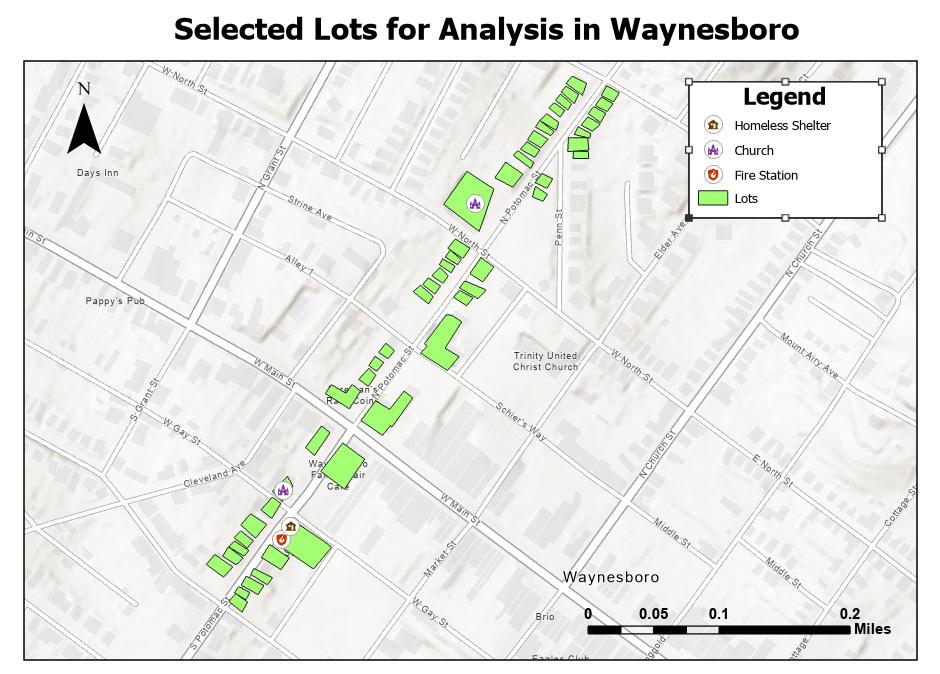
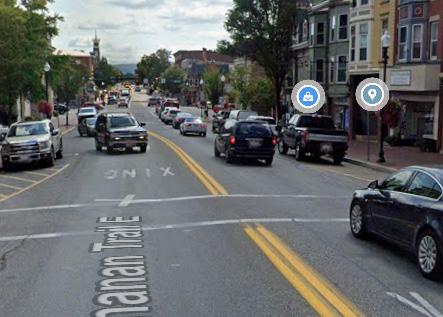
2: An alternative crosswalk point featuring flashing indicators on West Main Street. Upon testing, these lights are functioning properly as well. However, it is evident that the most imposing crossing point, West Main Street, requires some rework. In particular, the allowance of cars to park so close to the crossing point effectively hides pedestrians from oncoming traffic when crossing from the Northwest (Figure 3).
• 15 lots are owner-occupied and classified as single-family homes.
• The predominant housing type is single-family homes converted to apartments.
• The predominant housing material is brick and vinyl siding.
• Unique features to this area include two churches, a senior citizen home, a fire station, and a homeless shelter.
Walkability and Safety
In general, this area is considered walkable. There are adequate sidewalks on each side of the road with appropriate sidewalk crossings, tactile paving, and streetlights. However, these sidewalks lack a green space buffer zone forcing pedestrians to walk closer to the road and depriving the borough of nature aesthetics. Additionally, several crosswalk points are fitted with enhanced flashing lights to alert drivers of pedestrians (Figure 2).
However, there are two alternative points to cross, outside of the study area, which implement safer crosswalk methods. Particularly, the crosswalk platform extends out several feet to create a smaller swath for pedestrians to cross. It is also fitted with flashing lights on both sides to warn drivers. These factors, as well as the allowance of street-parked cars, force drivers to slow down and create safer points for pedestrians to cross. Such methods could be implemented at the West Main Street point to create a safer atmosphere. Beyond walkability and safety, this area severely lacks green space as mentioned before. There are no trees or open public spaces present. Sidewalks are overgrown in several areas but remain in adequate condition with few uneven edges from root overgrowth.

In terms of neighborhood drivability, speed limits are posted at a strict 25mph. Additionally, on North Potomac Street, cars are permitted to park on both sides of the road. This forces drivers to slow down, helping keep the North End relatively safe for pedestrians. On South Potomac Street, street parking is prohibited from the fire station to West Main Street. Within the more residential area, street parking is allowed. South Potomac Street is noticeably wider than North Potomac. Generally, the street is wide enough for on-street parking on South and North Potomac Street. However, larger vehicles coming from opposite paths have been observed to wait for others to pass on North Potomac Street (Figure 5). Regardless, no accidents have occurred due to the narrow street.
The large number of porches and the few front lawns both contribute to social capital. The small setbacks from the sidewalk force porch-sitters to interact with pedestrians. As an observer of this neighborhood, I have witnessed several instances in which porch-sitters have casual, short conversations with pedestrians. In this way, neighborhood residents quickly meet other residents. Furthermore, there have been several instances where neighbors across the street will walk to other residences to idly chat when they are spotted on their porches. Finally, the large number of apartments also forces dwellers of the same building to interact. These combined factors contribute to a higher social capital in this neighborhood.

Considering the wide age range of lots in this area, it is expected that there are numerous architectural styles. However, during analysis, it was evident that homes tended to have a similar style to their neighbors. This is most likely because these homes were built during a similar time period. As such, only certain lots were selected to represent their surrounding areas.
This lot is a prime example of the American Foursquare style. This architectural style was most popular from the 1900’s to the 1930’s. Originating with Frank Lloyd Wright in response to the grand


Victorian houses, this style was typically occupied by middle-class citizens with smaller lots (Dallas City Hall). This house, however, was built in 1928 on the cusp of this style’s reign. Foursquare houses typically feature a square shape, large double windows on the second story, a porch with prominent columns, and two stories with a hipped roof. Additionally, a tell-tale feature is the hipped dormer at the top with a brick layout (Dallas City Hall). Evidently, this property follows the aforementioned characteristics.
Truthfully, Federal and Georgian style homes are difficult to differentiate due to the fact that both styles were created around the same time. The Georgian style first began in England in the 18th century. It quickly made its way over to America and became extremely popular until the Revolutionary War. This style features two-story rectangular homes with single
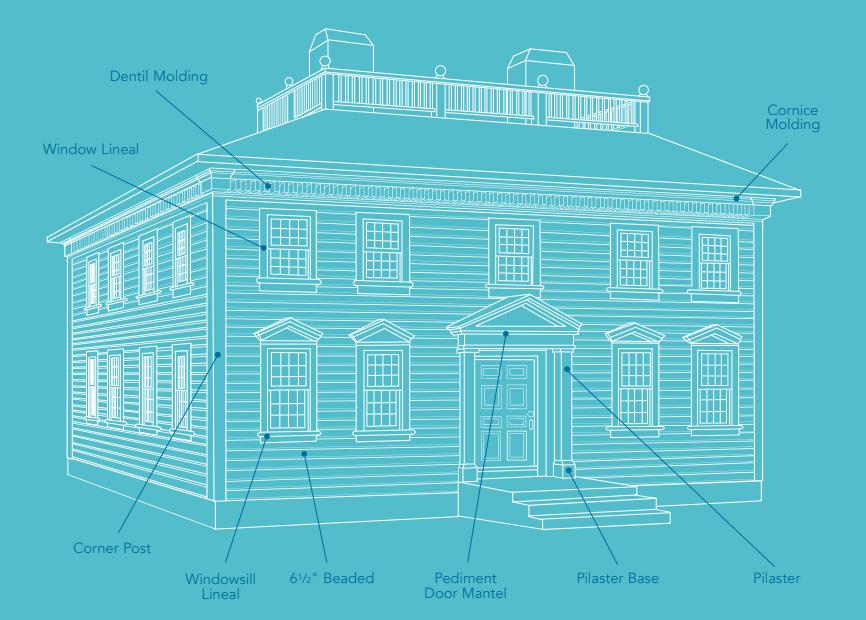

windows, typically five on the top and four on the bottom, traditionally lacking shutters (Vinyl Siding Institute). While this house does not exactly fit the Georgian model, this is likely because it was built far after the style was popular. This particular house was created in the 1900’s, a few two hundred years after its reign. This is also evident in the color of the house. Only more modern variations use shades of red (Vinyl Siding Institute).
In contrast, Federal style homes emerged after the Revolutionary War. It was generally popular from the 1780’s to the 1840’s. Georgian and Federal styles are quite similar, with differences only being found in the details. The Federal style features symmetrical window rows and rectangular buildings. However, embellishments tend to be semicircular. Additionally, there are typically more decorative moldings. This property features the semi-circle topped windows. Additionally, it features five windows on the top and four on the bottom with dedicated shutters. Finally, the decorations, triangular door mantle, and fanlight demonstrate a greater emphasis on details found in the Federal Style (Vinyl Siding Institute). It is evident that the A-shaped roof in the middle is not typical in the Federal Style. However, this could be the result of the house being created around a hundred years after the style was popular. Creating such house styles after their popularity dates offers greater flexibility in the building process.
Victorian Style
Victorian-style architecture is credited with being popular during Queen Victoria’s reign from 1837 to 1901. Victorian-style homes are typically categorized by decorated brackets, arched roofs, a jutting tower portion to give an asymmetrical profile (as seen on the left side of Figure 12), and porches with decorated columns (Vinyl Siding Institute). Additionally, fish scale tiles, as seen at the top of the tower, are a common building material. While it is evident that this house does not perfectly fit with Victorian architecture style due to its lack of grandness, it is evident that it hosts a myriad of Victorian features. Additionally, its lackluster condition can be the result of limited space and upkeep, as this property sits on a mere 0.10 acres. Furthermore, this home was built in 1892, at the end of the Victorian architectural influence.
Queen Anne Style
Queen Anne-style homes are defined by their asymmetricalness, fish-scale materials, two grand asymmetrical towers, and myriad decorations (Vinyl Siding Institute). It is evident that this house is not entirely as grand as other examples of Queen Anne-
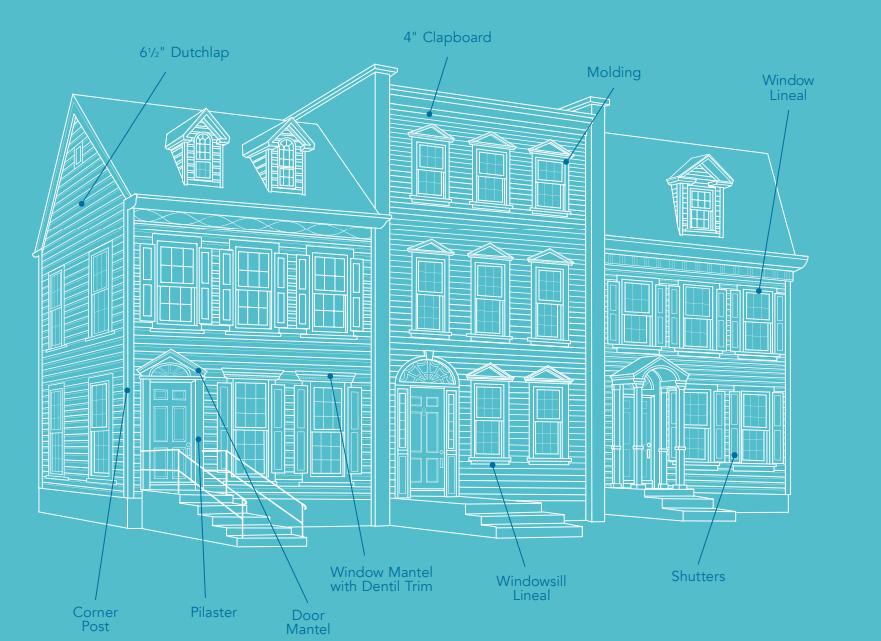



style homes. This is likely due to the lack of space on this lot. Regardless, the intricate brackets, highly decorated window trims, fish scale exterior, and two protruding towers place this building in a style more reminiscent of Queen Anne than solely Victorian. This rings even more true when considering the surrounding houses. This property is purposefully quite grand and outshines all surrounding buildings. The combination of a fish-scale exterior with brick, stone, and decorative brickwork points to a grander style than the typical Victorian home. Furthermore, the green palette with red brick and stonework is quite typical of Queen Anne-style houses, as they were meant to draw attention (Vinyl Siding Institute).
Conclusion
Given that many neighboring houses in this study area were built around the same time, there are several architectural types, but adjoining houses typically share the same style. This creates a generally cohesive street style. This neighborhood demonstrates adequate walkability and low safety concerns. However, the lack of green and public spaces leaves the neighborhood with a rather dreary concrete feel. Lot sizes trend on the smaller side since the study area lies within the heart of Waynesboro. As such, building creation dates trend towards the early and mid-1900’s. Improvements to this neighborhood include making the West Main Street crosswalk more visible to drivers and adding more green space through planted trees. Overall, this neighborhood is unique in its historic context, layout, and ideal proximity to the downtown area.
Dallas City Hall. (n.d.). Architectural Patterns. Residential Pattern Book. https://dallascityhall.com/departments/ pnv/PublishingImages/Pages/Guides/Foursquare.pdf Rupp, Daniel (1846). History of Franklin County. 530-535. U.S. Census Bureau, U.S. Department of Commerce. “Median Income in the Past 12 Months (in 2023 Inflation-Adjusted Dollars).” American Community Survey, ACS 5-Year Estimates Subject Tables, Table S1903, https://data.census.gov/table/ACSST5Y2023.1903?q =waynesboro+pa&t=Income+(Households,+Families, +Individuals)
Vinyl Siding Institute. (n.d.) Designing Style: A Guide to Designing with Today’s Vinyl Siding. https:// polymericexteriors.org/wpcontent/uploads/2021/02/ VSI_DigitalDesigningStyleGuide.pdf
This project served as a way to apply and visualize several classroom topics to the real world, specifically in my neighborhood. As an analytical person, I highly enjoy gathering data to present in a fast facts inventory summary. This project allowed me to combine my current GIS skills with classroom knowledge to analyze my neighborhood with a community and land use lens. In particular, it allowed me to think critically about the strengths and weaknesses of my neighborhood compared to the ideal pedestrian centered area. Beyond this, this project enabled me to delve into the historic architectural styles and the associated history visible in my neighborhood. In general, I became highly aware that my neighborhood was much older than I realized. This, in turn, accounted for the previously discussed strengths and weaknesses observed, as my neighborhood reflects a pattern of land use commonly seen in the downtown area of historic towns. Overall, this project allowed me to see my town and neighborhood through several different lens that I have been able to apply in numerous areas.
Assignment:
by Emma Sokolowski
HONR 122: Honors Historical Foundations of Global Cultures
Dr. Christine Senecal
In my Honors Historical Foundations of Global Cultures class, I was tasked with writing a 13–15-page essay on a topic of my choice, as long as it focused on a period or a topic that took place prior to the 18th century. Instead of selecting a topic my professor touched upon in class, I chose to write about how undead bodies were used as weapons to enforce social control.
Between the 15th and 17th centuries across the continent of Europe, those in power exploited widespread fears surrounding death and the undead to marginalize and control vulnerable groups, using death-related associations and rituals to reinforce social hierarchies and perpetuate existing power structures. Vampire legends in early modern Europe originally emerged as a cultural response to the unknown, with roots in folklore and heightened by the horrors of the extensive disease and death of the time. At the same time, non-normative burial practices were used across various cultures to contain and neutralize individuals perceived as dangerous, including vampires and revenants. Fear was transformed into a method of controlling the living through ritualized posthumous burial practices like staking, decapitation, and the uses of sickles and stones. Elites and religious authority figures manipulated these supernatural fears held by the masses to justify the marginalization of those they viewed to be socially or physically deviant. Ultimately, the gendered targeting of women, the marking of outsiders, and regional variations in apotropaic customs reveal how a cultural fear of the undead became a tool to reinforce social hierarchies, display power, and maintain cultural order.
The belief in revenants, or vampires, stemmed from a misinterpretation of natural decomposition, which was poorly understood at the time.1 Early medieval
Europeans often mistook signs of natural decomposition to be characteristics that marked a suspected vampire.2 Strange noises, fingernail growth, blood at the mouth, purple hands, and bloating of the corpse were signifiers of natural decay that were misread as indicators of life due to a lack of medical knowledge.3 The European vampire myth’s emergence began as a misunderstanding of the natural phenomena associated with death and decay.4 As a result, the vampire legend flourished during this period of widespread disease. Outbreaks of smallpox, leprosy, and tuberculosis could kill thousands very quickly, sometimes within a period of days, leaving communities overwhelmed.5 Traditional explanations, such as sin and religious deviance, felt insufficient in the face of the chaos and communities turned to superstition and folklore to make sense of things.6 By the standards of the time, the vampire myth seemed like a rational explanation for death that seemed to travel so mysteriously and quickly. The idea that the dead could harm the living made people feel like they had some control, because by preforming rituals they could essentially stop the spread themselves.
Furthermore, as fear of the undead grew, so did the rituals to contain them. Burials became strategies of control through ritualized containment methods.7 Apotropaic devices, or symbols and rituals intended to ward off evil, were believed to physically restrain
1 Paul Barber, Vampires, Burial, and Death: Folklore and Reality. (Yale University Press), 158.
2 Paul Barber, Vampires, Burial, and Death: Folklore and Reality. (Yale University Press), 158.
3 Paul Barber, Vampires, Burial, and Death: Folklore and Reality. (Yale University Press), 161.
4 Paul Barber, Vampires, Burial, and Death: Folklore and Reality. (Yale University Press), 158.
5 Anastasia Tsaliki, “Unusual Burials and Necrophobia: An Insight into the Burial Archaeology of Fear,” in Deviant Burial in the Archaeological Record, ed. Eileen M. Murphy (Oxford: Oxbow Books, 2008), 2.
6 Paul Barber, Vampires, Burial, and Death: Folklore and Reality. (Yale University Press), 162.
7 Anastasia Tsaliki, “Unusual Burials and Necrophobia: An Insight into the Burial Archaeology of Fear,” in Deviant Burial in the Archaeological Record, ed. Eileen M. Murphy (Oxford: Oxbow Books, 2008), 14.
the dead should they reanimate.8 These methods often included placing sharp objects like sickles across the neck or abdomen, inserting stones or bricks into the mouth, and even decapitating and dismembering the corpse.9 The above-mentioned actions may have begun as superstitious precautions, but they evolved to become symbolic gestures that reflected anxieties about death, disease, and spiritual contamination.
For instance, in at least six burials found at a site in Drawsko, Poland, sickles were placed either across the neck or the torso of the corpse.10 One image depicts the skeletal remains of a forty-five to forty-nine-yearold female buried with a sickle across its abdomen and a stone under its chin.11 The sickle placement suggests that it was meant to decapitate the corpse if it attempted to reanimate. The positioning of the stone and sickle, as well as the prone orientation of the skeleton itself, supports forensic interpretations of deviant burials as attempts to prevent revenants from returning. The use of everyday tools like sickles instead of specialized weapons shows how common people participated in supernatural containment rituals using what was readily available to them.
Additionally, a reconstructed drawing of Grave 146 from Cedynia, Poland, shows multiple restraints within one burial.12 The image depicts a decapitated man with his head placed between his feet, and three stone positioned above his neck.13 This illustration demonstrates a complex form of apotropaic burial because of the combination of anti-vampiric practices.14 The arrangement of three stones above the neck suggests an effort to weigh down the body, while the head’s placement between the feet shows a further attempt to incapacitate the deceased to prevent it from rising. It is uncommon for so many apotropaic measures to be used on a single burial because most communities typically employed just one or two methods they believed
would be sufficient. These practices were deeply rooted in local beliefs, and using multiple forms suggests that the individual was either particularly threatening in life or a deep-rooted fear of the undead was present.
Moreover, a Venetian plague pit on the island of Nuovo Lazzaretto contains a female skeleton interred with a brick forced into its mouth, dating somewhere between the 16th and 17th centuries.15 Taphonomic evidence, from fossilized remains extracted from the site, strongly suggests that the insertion occurred after death during the burial preparation.16 The mandible was still fixed in the glenoid cavity and had not had the chance to detach during decomposition.17 Additionally, the brick was holding the mouth open, meaning it had to be inserted while the jaw was still intact but not yet rigid from death.18 The brick-in-mouth ritual was a deliberate funerary practice, likely performed shortly after death, by gravediggers who believed it would seal the mouth and prevent the dead from “spreading evil or disease.”19 Mouths were considered gateways through which vampires could attack or contaminate the living.20
In times of crisis, societies often look for someone to place the blame onto. The perception of vampires as contagious revenants directed fear toward the dead, and by extension, onto groups of people. Some hypothesize that “vampire burials were often forms of social control, punishing those deemed deviant in life by treating their corpses as dangerous after death.”21 Social marginalization during both life and death can occur for a variety of reasons. Disease, congenital and mental conditions, the nature of one’s birth, family status, heresy, and violent death are factors that may have marked doom for individuals.22
For instance, archaeological studies have utilized isotopic testing to reveal that many individuals buried with apotropaic features sickles across their abdomen
8 Anastasia Tsaliki, “Unusual Burials and Necrophobia: An Insight into the Burial Archaeology of Fear,” in Deviant Burial in the Archaeological Record, ed. Eileen M. Murphy (Oxford: Oxbow Books, 2008), 3.
9 Paul Barber, Vampires, Burial, and Death: Folklore and Reality. (Yale University Press), 143.
10 See Appendix A.
11 See Appendix A.
12 See Appendix A.
13 See Appendix B.
14 See Appendix B.
15 Emilio Nuzzolese and Matteo Borrini, “Forensic Approach to an Archaeological Casework of ‘Vampire’ Skeletal Remains in Venice: Odontological and Anthropological Prospectus,” Journal of Forensic Sciences 55, no. 6 (2010), 1635.
16 Emilio Nuzzolese and Matteo Borrini, “Forensic Approach to an Archaeological Casework of ‘Vampire’ Skeletal Remains in Venice: Odontological and Anthropological Prospectus,” Journal of Forensic Sciences 55, no. 6 (2010), 1635.
17 Emilio Nuzzolese and Matteo Borrini, “Forensic Approach to an Archaeological Casework of ‘Vampire’ Skeletal Remains in Venice: Odontological and Anthropological Prospectus,” Journal of Forensic Sciences 55, no. 6 (2010), 1635.
18 Emilio Nuzzolese and Matteo Borrini, “Forensic Approach to an Archaeological Casework of ‘Vampire’ Skeletal Remains in Venice: Odontological and Anthropological Prospectus,” Journal of Forensic Sciences 55, no. 6 (2010), 1636.
19 Emilio Nuzzolese and Matteo Borrini, “Forensic Approach to an Archaeological Casework of ‘Vampire’ Skeletal Remains in Venice: Odontological and Anthropological Prospectus,” Journal of Forensic Sciences 55, no. 6 (2010), 1636.
20 Paul Barber, Vampires, Burial, and Death: Folklore and Reality. (Yale University Press), 36.
21 Tracy K. Betsinger and Amy B. Scott, “Governing from the Grave: Vampire Burials and Social Order in Post-Medieval Poland.” Cambridge Archaeology Journal 24, no. 3 (2014): 472.
22 Anastasia Tsaliki, “Unusual Burials and Necrophobia: An Insight into the Burial Archaeology of Fear,” 4.
or bricks forced into their mouths were not native to the regions where they were interred.23 The presence of stable isotopes in bone help archaeologists to infer aspects of social life in the past, as well as patterns of mobility and geographic origin.24 The dental enamel of the six corpses buried as possible vampires exhibit non-local strontium signatures in their dental enamel compared with those interred in standard graves, which suggests immigration to Drawsko later in life.25 The corpses likely belonged to immigrants or other non-locals, and this implies that their outsider status in life contributed to suspicions of vampirism, because “suspicion follow[s] difference”.26 Burial rights might have been weaponized against those who did not fit the social or cultural norms of the community, such as perceived outsiders. As a result, death would be used as a means of marking and containing threats to community cohesion and identity.
As previously mentioned, people with visible physical differences, disabilities, or non-conforming behavior were also disproportionately subjected to vampire burials.27 Socially deviant persons or those with external anomalies, whether because of disease or birth, were more likely to be treated with suspicion in both life and death.28 A skeleton recovered from a post-Byzantine grave on Lesbos Island of Greece displayed several deformities, which may explain its atypical postmortem treatment.29 Three bent spikes with round heads were found amongst the individual’s bones, and as there was no evidence that a coffin was used in the very narrow grave, they could not have been coffin fittings.30 The skull shows nasal, maxillary, and mandibular deformities, as well as a healed linear fracture over the left eye, believed to be the result of
sharp-force trauma.31 The nature of the skeleton’s frontal injury suggests that he might have been the victim of assault, and because of his visible deformities, it is possible that he was socially stigmatized as a result of his disfigurement. Atypical burials thus served as a continuation of societal exclusion and reinforcement of cultural ideas of normalcy even after death.
As noted before, accusations of vampirism frequently overlapped with already marginalized or criminalized groups.32 Vampire legends and accusations were often projected onto suicides, convicted criminals, and suspected witches.33 In many European communities, these groups would be considered spiritually impure and dangerous.34 For these reasons, they would be the prime candidates for deviant burial practices. In the region of Kuyavia in Central Poland, a grave belonging to a male skeleton was found with its head decapitated and placed between its legs.35 One of the physical workers at the site remarked that it was the grave of a “stzgya”, which is a term with various meanings and may refer to the undead or a witch.36 In the subsequent article published, the author connected it with a textual account from the 17th century about a Polish community threatened by a revenant that rose from its grave to drink human blood.37 A priest advised that the grave be dug up and the corpse’s head cut off, and according to other textual accounts recorded in Polish folklore from the same period, this event was not unique.38 Vampire accusations frequently aligned with the social exclusion of those considered deviant. The vampire myth was a powerful cultural tool used to further ostracize those who challenged, or were perceived to challenge, the social order.
Fear of the undead was not just a reflection of
23 Lesley A. Gregoricka, Tracy K. Betsinger, Amy B. Scott, and Marek Polcyn, ““Apotropaic Practices and the Undead: A Biogeochemical Assessment of Deviant Burials in Post-Medieval Poland,” PLoS ONE 9, no. 11 (2014): 4.
24 Lesley A. Gregoricka, Tracy K. Betsinger, Amy B. Scott, and Marek Polcyn, ““Apotropaic Practices and the Undead: A Biogeochemical Assessment of Deviant Burials in Post-Medieval Poland,” PLoS ONE 9, no. 11 (2014): 4.
25 Lesley A. Gregoricka, Tracy K. Betsinger, Amy B. Scott, and Marek Polcyn, ““Apotropaic Practices and the Undead: A Biogeochemical Assessment of Deviant Burials in Post-Medieval Poland,” PLoS ONE 9, no. 11 (2014): 5.
26 Lesley A. Gregoricka, Tracy K. Betsinger, Amy B. Scott, and Marek Polcyn, ““Apotropaic Practices and the Undead: A Biogeochemical Assessment of Deviant Burials in Post-Medieval Poland,” PLoS ONE 9, no. 11 (2014): 5.
27 Anastasia Tsaliki, “Unusual Burials and Necrophobia: An Insight into the Burial Archaeology of Fear,” in Deviant Burial in the Archaeological Record, ed. Eileen M. Murphy (Oxford: Oxbow Books, 2008), 2.
28 Anastasia Tsaliki, “Unusual Burials and Necrophobia: An Insight into the Burial Archaeology of Fear,” in Deviant Burial in the Archaeological Record, ed. Eileen M. Murphy (Oxford: Oxbow Books, 2008), 14.
29 Anastasia Tsaliki, “Unusual Burials and Necrophobia: An Insight into the Burial Archaeology of Fear,” in Deviant Burial in the Archaeological Record, ed. Eileen M. Murphy (Oxford: Oxbow Books, 2008), 14.
30 Anastasia Tsaliki, “Unusual Burials and Necrophobia: An Insight into the Burial Archaeology of Fear,” in Deviant Burial in the Archaeological Record, ed. Eileen M. Murphy (Oxford: Oxbow Books, 2008), 14.
31 Anastasia Tsaliki, “Unusual Burials and Necrophobia: An Insight into the Burial Archaeology of Fear,” in Deviant Burial in the Archaeological Record, ed. Eileen M. Murphy (Oxford: Oxbow Books, 2008), 14.
32 Anastasia Tsaliki, “Unusual Burials and Necrophobia: An Insight into the Burial Archaeology of Fear,” in Deviant Burial in the Archaeological Record, ed. Eileen M. Murphy (Oxford: Oxbow Books, 2008), 14.
33 Leszek Gardela, “Vampire Burials in Medieval Poland: An Overview of Past Controversies and Recent Reevaluations,” Lund Archaeological Review 21 (2015): 118.
34 Anastasia Tsaliki, “Unusual Burials and Necrophobia: An Insight into the Burial Archaeology of Fear,” in Deviant Burial in the Archaeological Record, ed. Eileen M. Murphy (Oxford: Oxbow Books, 2008), 3.
35 Leszek Gardela, “Vampire Burials in Medieval Poland: An Overview of Past Controversies and Recent Reevaluations,” Lund Archaeological Review 21 (2015): 112.
36 Leszek Gardela, “Vampire Burials in Medieval Poland: An Overview of Past Controversies and Recent Reevaluations,” Lund Archaeological Review 21 (2015): 112.
37 Leszek Gardela, “Vampire Burials in Medieval Poland: An Overview of Past Controversies and Recent Reevaluations,” Lund Archaeological Review 21 (2015): 112.
38 Leszek Gardela, “Vampire Burials in Medieval Poland: An Overview of Past Controversies and Recent Reevaluations,” Lund Archaeological Review 21 (2015): 112.
cultural superstition, and it became a deliberate tool for reinforcing the pre-existing social hierarchies.39 As communities attempted to understand and control death amidst the chaos of the widespread disease of the time, those in power manipulated supernatural dread to discipline the living.40 Apotropaic practices intended to contain and incapacitate the dead often doubled as performances of authority.41 Through gendered targeting, theatrical punishments, and the manipulation of folk belief, elites and religious authority figures used fear to maintain their dominance.42 Vampire burials may have begun simply as responses to death but also became instruments of control over the living by transforming the deviant into something useful. Moreover, vampire-related burial practices were not distributed equally across all members of society, seeing as gender appears to have played a significant role in who was targeted. Archaeological findings from Drawsko, Poland, revealed that five out of the six apotropaic burials discovered were of female skeletons.43 “Apotropaic violence disproportionately affected women,” suggesting a gendered pattern in how fear of the undead manifested.44 Archaeologists noted that older, single, or otherwise socially marginalized women were particularly vulnerable to posthumous suspicion of vampirism because they existed on the boundaries of patriarchal structures.45 Therefore, it was easier to label them as dangerous or unnatural, because their existences threatened the social structures of their communities. Fear is a tool that can be utilized as a social weapon to reinforce power and hierarchies. In fact, fear of the undead intersected with preexisting ideas, such as Anti-Semitism. While vampire burials themselves were not explicitly tied to antiJewish violence, the same instruments of fear, such as the unknown and social collapse seen with vampirism, were often used to target Jewish communities.46 Jewish people were included among the marginalized groups that fell victim to the vampire myth driven by fear and othering.47 Throughout history, there has been a
cultural tendency to associate outsiders with threats to community well-being, especially in times of fear, and those deemed ethnically or religiously different in Europe were often Jewish.48 When the plagues swept through Europe, Jewish rituals for cleanliness, including hygiene practices and interaction with bodily fluids kept them from dying in the same numbers as their neighbors.49 Jewish individuals were accused of corpse-related taboos, such as desecrating bodies or even spreading plagues.50 Jewish communities were seen as a threat to Christian patriarchal ideas of order. Situated within a period of suffocating anxiety about death and widespread disease, Jewish people were a readily available scapegoat for elites due to their lower infection rates and mystifying immunity.
Because the nature of vampire burials lies in public spectacles, they could easily double as performances to show control and reinforce order. In Sozopol, Bulgaria, a ploughshare, which is a large tool used in plowing land, was repurposed as a weapon in the grave of a suspected vampire.51 The ploughshare, which could weigh between twenty to forty pounds, was driven with enough force to break the scapula bone.52 Unlike a scythe, which could cut through flesh, a blunt piece of metal is less practical because it would not have been able to incapacitate the undead nearly as effectively. Therefore, the use of a ploughshare was excessive, and its use was most likely intentional. While it was not uncommon for farm tools to be used in anti-vampire rituals for convenience, the inclusion of such a tool would have shown the authority and power of those who could enforce and carry out such a punishment.
For example, in graves found in Cedynia, Poland, the severing of limbs, decapitations, staging of bodies, and the insertion of a stone into the mouths of skeletons staged dramatized posthumous executions.53 Grave 146 contained skeletons demonstrating a combination of anti-vampire practices, whereas most other European deviant burials only exhibited one apotropaic form of violence.54 These actions not only
39 Elizabeth O’Brien, Mapping Death: Burial in Late Iron Age and Early Medieval Ireland, (Four Courts Press, 2020): 132.
40 Elizabeth O’Brien, Mapping Death: Burial in Late Iron Age and Early Medieval Ireland, (Four Courts Press, 2020): 132.
41 Elizabeth O’Brien, Mapping Death: Burial in Late Iron Age and Early Medieval Ireland, (Four Courts Press, 2020): 132.
42 Elizabeth O’Brien, Mapping Death: Burial in Late Iron Age and Early Medieval Ireland, (Four Courts Press, 2020): 132.
43 Lesley A. Gregoricka, Tracy K. Betsinger, Amy B. Scott, and Marek Polcyn, ““Apotropaic Practices and the Undead: A Biogeochemical Assessment of Deviant Burials in Post-Medieval Poland,” 6.
44 Anastasia Tsaliki, “Unusual Burials and Necrophobia: An Insight into the Burial Archaeology of Fear,” 8.
45 Anastasia Tsaliki, “Unusual Burials and Necrophobia: An Insight into the Burial Archaeology of Fear,” 8.
46 Paul Barber, Vampires, Burial, and Death: Folklore and Reality. (Yale University Press), 149.
47 Paul Barber, Vampires, Burial, and Death: Folklore and Reality. (Yale University Press), 149.
48 Matthew Beresford, From Demons to Dracula: The Creation of the Modern Vampire Myth, (Reaktion Books, 2008): 12.
49 Lesley A. Gregoricka, Tracy K. Betsinger, Amy B. Scott, and Marek Polcyn, ““Apotropaic Practices and the Undead: A Biogeochemical Assessment of Deviant Burials in Post-Medieval Poland,” 5.
50 Lesley A. Gregoricka, Tracy K. Betsinger, Amy B. Scott, and Marek Polcyn, ““Apotropaic Practices and the Undead: A Biogeochemical Assessment of Deviant Burials in Post-Medieval Poland,” 5.
51 See Appendix C.
52 See Appendix C.
53 Leszek Gardela, “Vampire Burials in Medieval Poland: An Overview of Past Controversies and Recent Reevaluations,” Lund Archaeological Review 21 (2015): 119.
54 See Appendix D.
attempted to prevent the return of the dead but also reinforced the ability of elites and religious leaders to enforce order, because they were the only ones with the resources and authority to demand such exaggerated measures. Ordinary members of European society had to use what was available to them, such as scythes, bricks, and rocks. Additionally, it is unlikely that communities might not have had enough manpower to carry out more than one apotropaic burial practice, the way a wealthy individual or figurehead might be able to scrounge up at a moment’s notice.
Consequently, the fear of the undead derived from folklore did not stay within the imagination because those in power knew to weaponize this alarm to maintain control. “Folk belief legitimized elite control — the sacred and the social intertwined,” and this points to the way powerful individuals manipulated popular fears to justify interventions that would require their aid and solidify their authority in the minds of their communities.55 Under the pretense of community welfare and safety, elites could use “ritutals… [to] discipline deviance through fear and spectacle”.56 Through the ritualization of post-mortem punishment, the aristocracy could shape collective fears into tools to reinforce ideas of conformity and obedience, since those who deviated were deemed vampires.
Nevertheless, vampire-related burial practices varied widely across the regions that constitute Europe, as each culture adapted their own local symbols and rituals. Despite these regional differences in practices, communities shared the primary goal of containing and neutralizing perceived threats to social and cultural homogeneity. For example, Poland frequently utilized sickles, decapitations, and body disfigurement in burials, and these measures were not only intended to prevent the dead from returning, but also to mark them as deviant.57 In Venice, bricks were often forced into the mouths of those discovered in plague pits, likely believed to seal the corpse’s ability to spread evil via biting.58 Bulgarian practices involved placing heavy stones on the chests of suspected vampires, which
served as a physical barrier to reanimation.59 Finally, in Lesbos, there was an emphasis on staking the dead through their hearts or using spikes to prevent their return.60 Whether using ploughshares, bricks, stones, or stakes, each culture’s use of physical barriers symbolized the same underlying fear, and the diversity of methods used came second to that. Fears of uncontrollable death due to disease and a need to reassert social order through ritualized containment methods were present across the European continent.
In rural areas, supernatural fear was a communal response. Folkloric beliefs were often stronger in the countryside where oral traditions thrived and supernatural explanations for illness and death were more commonly believed.61 Many deviant burials have been found in rural cemeteries or village graveyards because local customs and superstitions were reflected in community-led burial practices.62 Vampire reports were more frequently documented and acted upon in rural or frontier areas.63 Apotropaic rituals such as staking or placing sickles over the neck were more common in these smaller, tightly knit communities.64 The fear of revenants spreads more easily in rural communities due to cultural transmission, where superstitions are often passed down through generations within villages through stories that serve as historical accounts. Rural areas frequently have stronger ties to traditional beliefs and practices due to less exposure to outside influences. Additionally, those in the countryside often lacked the viewpoint of modern science and the innovations and new beliefs that arise from it due to the sequestered nature of small towns and social units.
Alternatively, in cities, a hierarchy can be seen in methods of control, where elites used doctrine or law to reinforce their authority.65 Formal religious and medical institutions had more influence in cities than they did in rural communities.66 Death was frequently handled more systematically with churches, hospitals, and governments overseeing burial practices.67 Rather than expressing the fear of the undead through physical folk rituals the way village did, elites redirected it
55 Elizabeth O’Brien, Mapping Death: Burial in Late Iron Age and Early Medieval Ireland, (Four Courts Press, 2020): 143.
56 Matthew Beresford, From Demons to Dracula: The Creation of the Modern Vampire Myth, (Reaktion Books, 2008): 12.
57 Leszek Gardela, “Vampire Burials in Medieval Poland: An Overview of Past Controversies and Recent Reevaluations,” Lund Archaeological Review 21 (2015): 120.
58 Emilio Nuzzolese and Matteo Borrini, “Forensic Approach to an Archaeological Casework of ‘Vampire’ Skeletal Remains in Venice: Odontological and Anthropological Prospectus,” Journal of Forensic Sciences 55, no. 6 (2010), 1634.
59 See Appendix C.
60 Anastasia Tsaliki, “Unusual Burials and Necrophobia: An Insight into the Burial Archaeology of Fear,” in Deviant Burial in the Archaeological Record, ed. Eileen M. Murphy (Oxford: Oxbow Books, 2008), 4.
61 Paul Barber, Vampires, Burial, and Death: Folklore and Reality. (Yale University Press), 132.
62 Lesley A. Gregoricka, Tracy K. Betsinger, Amy B. Scott, and Marek Polcyn, ““Apotropaic Practices and the Undead: A Biogeochemical Assessment of Deviant Burials in Post-Medieval Poland,” 2.
63 Paul Barber, Vampires, Burial, and Death: Folklore and Reality. (Yale University Press), 132.
64 Anastasia Tsaliki, “Unusual Burials and Necrophobia: An Insight into the Burial Archaeology of Fear,” in Deviant Burial in the Archaeological Record, ed. Eileen M. Murphy (Oxford: Oxbow Books, 2008), 9.
65 Paul Barber, Vampires, Burial, and Death: Folklore and Reality. (Yale University Press), 132.
66 Paul Barber, Vampires, Burial, and Death: Folklore and Reality. (Yale University Press), 143.
67 Matthew Beresford, From Demons to Dracula: The Creation of the Modern Vampire Myth, (Reaktion Books, 2008): 140.
into policy and exclusion.68 In larger towns and cities, vampire beliefs were frequently dismissed as rural superstition, “yet officials still found it politically useful to reference such fears when addressing outbreaks or social unrest.”69 However, fear of the undead and the deviant was still present, as seen in segregated burial grounds and social exclusion in life70. Urban religious elites used fear strategically and invoked tales of the undead in their sermons and pamphlets to symbolically point fingers at nonconformity and social deviance as a spiritual threat during times of disease.71 In cities, fear of the dead was less physical but no less influential as it marginalized the same vulnerable groups in more systematic ways.
To conclude, the rituals used to contain the dead changed as fear of the undead grew in Europe between the 15th and 17th centuries and burials were shaped into ritualized methods of control to prevent the dead from rising. Apotropaic devices, or symbols and rituals believed to ward off evil, were thought to restrain the dead if they were reanimated. These methods included placing sharp objects like sickles across the neck or abdomen, inserting stones or bricks into the mouth, and decapitating and dismembering corpses. While these actions were initially superstitious precautions fueled by the fear of the extensive disease and death of the time, they evolved to become tools of exclusion
and punishment. Elites singled out individuals who were perceived to be dangerous, deviant, or outsiders for these violent burials practices to reinforce the social hierarchies in place. This transformation and weaponization of fear are nothing new, the tools have just changed from sickles to mediums like social media. Just like how vampire burials happened during plagues, communities, such as the Asian American community, were scapegoated and faced a dramatic increase hate crimes during the COVID-19 pandemic. Governments use fear to expand surveillance or justify their harsh policing of citizens, especially marginalized communities, such as the mass targeting of Muslim communities under the guise of national security following the events of September 11th. Media outlets and influential figures often frame certain groups as threats, such as immigrants of people with non-normative gender or sexual identities, by suggesting that they endanger traditional values, public safety, or national identity. From medieval burial rites to modern political rhetoric, the weaponization of fear has remained a powerful tool for maintain control, marginalizing communities, and reinforcing social hierarchies across history.
When my professor first introduced this paper, I felt as if I was unprepared to write such an extensive paper. However, Dr. Senecal broke down the writing and research process into several steps to make the essay seem less daunting. Eventually, I decided on the broad topic of vampires because I enjoy vampire media and I find the concept of manmade monsters fascinating. I considered writing about vampires and sexuality, but the topic of vampires and sexuality has already been written about and picked apart, and I could not find an angle that no other writer had already brought to the table. Fortunately, I had noticed a connection in some of the European vampire literature I had read, and upon taking a deeper look, I realized that I would be able to present something new. The one thing all my literature mentioned were marginalized communities, such as foreigners, unwed women, and non-conforming individuals who stood out from the rest. From there, my paper was written before I knew it. I was excited to write about social control and the manipulation of deviant individuals by authority figures as a means of social control, which resulted in the creation of the vampire.
68 Matthew Beresford, From Demons to Dracula: The Creation of the Modern Vampire Myth, (Reaktion Books, 2008): 140.
69 Paul Barber, Vampires, Burial, and Death: Folklore and Reality. (Yale University Press), 132.
70 Anastasia Tsaliki, “Unusual Burials and Necrophobia: An Insight into the Burial Archaeology of Fear,” in Deviant Burial in the Archaeological Record, ed. Eileen M. Murphy (Oxford: Oxbow Books, 2008), 11.
71 Anastasia Tsaliki, “Unusual Burials and Necrophobia: An Insight into the Burial Archaeology of Fear,” in Deviant Burial in the Archaeological Record, ed. Eileen M. Murphy (Oxford: Oxbow Books, 2008), 11.
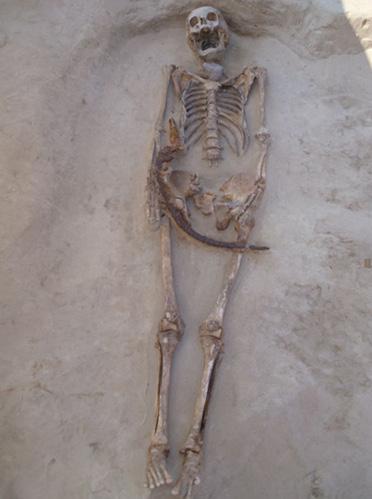
Appendix A
Figure 2. (Colour online) Vampire burial 60/2010 (45–49 year old female), 2010, photograph, As Cited in Betsinger, Tracy K., and Amy B. Scott, “Governing from the Grave: Vampire Burials and Social Order in Post-medieval Poland,” Cambridge Archaeological Journal 24, no. 3, 472, October 2014.
This image depicts the skeletal remains of a forty-five to forty-nine-year-old female buried with a sickle across its abdomen and a stone under its chin. The burial, located in Drawsko, Poland, is believed to be from the seventeenth-century and shows apotropaic measures intended to prevent the corpse from rising.
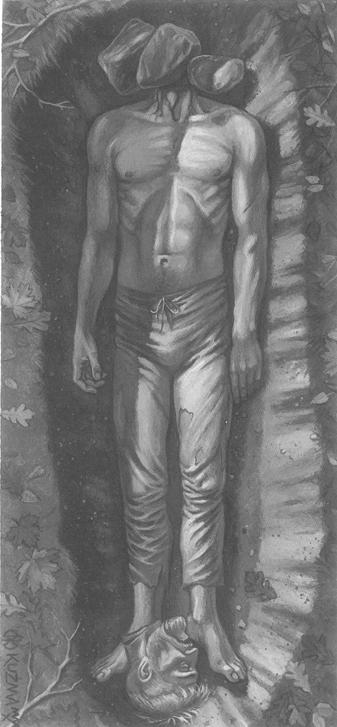
Appendix B
Kuzma, Mirosław. Figure 2. Artists’ reconstruction of grave 146 from Cedynia, 2013, drawing, As Cited in Gardeła, Leszek, and Kamil Kajkowski, “Vampires, Criminals or Slaves? Reinterpreting ‘Deviant Burials’ in Early Medieval Poland,” World Archaeology 45, no. 5, 790, December 2013.
This article contains an artist’s reconstruction of Grave 146 from Cedynia, Poland, drawn by Miroslaw Kuzma. The illustration shows a decapitated man with his head placed between his feet, and three stones positioned above the neck.
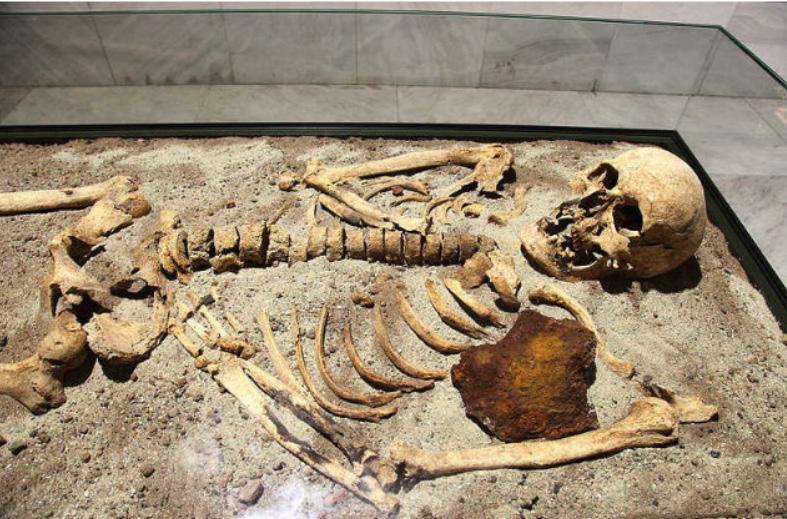
Appendix C
Figure 1. The burial from Sozopol, Bulgaria, with heavy ploughshare, 2014, photograph, As Cited in David Barrowclough, Time to Slay Vampire Burials? The Archaeological and Historical Evidence for Vampires in Europe, Cambridge: Red Dagger Press, 3, 2014.
The photo depicts a male skeleton between forty to fifty-years-old with a heavy piece of ploughshare hammered through its chest. The ploughshare weighed nearly two pounds and was driven with enough force to break the scapula bone.

Appendix D:
Individual 49/2012 (30–39 year old female) with a sickle placed across the neck, 2019, photograph, As Cited in John Buhler, “Disease and the Undead: Digging up the Truth About Vampires,” Canadian Journal of Medical Laboratory Science 81, no. 3, 15, Fall 2019.
This photo shows the skeletal remains of a thirty to thirty-nine-year-old female buried with a sickle across its neck in Drawsko, Poland. The photograph is part of a study published in PLoS ONE that examines apotropaic burial practices, specifically the use of sickles to prevent suspected vampires from rising from the grave.
Write the Ship is Shippensburg University’s Undergraduate Academic Journal.
The Write the Ship staff is seeking non-fiction, essays, feature writing, reports, and scholarly research of outstanding quality; there are no restrictions on genre, style or subject matter. The journal welcomes submissions from all departments and colleges across campus, from introductory level to upper level courses.
We are now seeking student work for the 2026-2027 issue!
Students who wish to have their work published must be sponsored by a professor and are encouraged to seek sponsorship for papers they feel are of excellent quality. The application for submissions must be completed and turned in with a copy of the work to be considered by the due date.
Visit ship.edu/Write-the-Ship for a submission form, or contact our editor at writetheship@ship.edu with any questions.