

ALBERTA FEDERATION OF POLICE ASSOCIATIONS 2026 BOARD OF DIRECTORS
GRAHAM ERNST
President of AFPA
Director of Calgary Police Association
NADIA DEN BOON
Vice President of AFPA
Director of Edmonton Police Association
JASON RICHMOND
Secretary/Treasurer of AFPA
Treasurer of Lethbridge Police Association
MARK FLYNN
Director/Editor of AFPA
Vice President of Medicine Hat Police Association
KEANE BLOCK
Director of AFPA
Director of Edmonton Police Association
BRENT HUTT
Director of AFPA
Director of Calgary Police Association
NICOLE MARTIN
Director of AFPA
Vice President of Lacombe Police Association
HOWARD BURNS
Executive Director
The opinions and comments expressed in Police Beat are those of the writers and are made without prejudice. They are not necessarily the position of the AFPA or its Executive. The inclusion of third party advertisements does not constitute an endorsement, or recommendation by the AFPA board or its membership. Reproduction of articles and artwork is strictly prohibited without the prior written consent of the AFPA. Publication Agreement #42846013
Designed & Published By:
FROM THE PRESIDENT
Graham Ernst
SUPPORT FOR BILL C-243
Graham Ernst
FROM THE SECRETARY/TREASURER
Jason Richmond
FROM THE DIRECTOR/EDITOR
Mark Flynn
FROM THE DIRECTOR
Nadia Den Boon
FROM THE DIRECTOR
Nicole Martin
FROM
Brent Hutt
FROM
Howard Burns
FROM
Keane Block


n September 2025, Conservative Member of Parliament Kerry Diotte, representing Edmonton Griesbach, tabled Bill C‑243 in the House of Commons. The bill was known informally as “Brian’s Bill,” named in memory of Brian Ilesic, an armoured‑car guard murdered during the 2012 University of Alberta HUB Mall shooting. After the Supreme Court of Canada ruled in 2022 that consecutive parole‑ineligibility periods were unconstitutional, the families of murder victims—including Brian’s parents—were faced with the renewed reality of frequent parole hearings for offenders they believed would never be released.
Bill C‑243 was introduced in direct response to that reality. Its purpose was narrow and humane: to prevent convicted murderers from repeatedly initiating annual parole applications after an initial denial, and instead require parole reviews to proceed on standard statutory timelines. It did not eliminate parole, extend sentences, or undermine rehabilitation. It sought only to reduce unnecessary harm to victims’ families caused by a process that forces them, again and again, to relive the worst moment of their lives.
From the perspective of frontline policing, that objective is not only reasonable—it is overdue.
Police officers do not walk away from homicide scenes when the investigation ends. We carry those cases with us—into courtrooms, into years of follow‑up, and into the lives of families forever changed by violence. That perspective is why the Alberta Federation of Police Associations was proud to support Bill C‑243, and why we are deeply disappointed by Parliament’s decision not to advance it.
Bill C‑243 was not radical. It did not abolish parole, extend sentences, or undermine the independence of the Parole
Board of Canada. It proposed something far more modest and far more humane: that after parole is denied for a person convicted of first‑ or second‑degree murder, subsequent reviews should follow statutory timelines, rather than being triggered annually at the offender’s discretion.
For the families of murder victims, this distinction matters— not in theory, but in lived experience.
From the frontline policing perspective, we see what the justice system often does not measure well: cumulative trauma. Families grieving the loss of a loved one to murder endure a lifelong sentence of grief. Yet our current parole process requires many of them to return again and again to hearings where the facts of the crime are re‑examined, statements are reread, and wounds are reopened—often with no realistic prospect of release.
This is not justice. It is retraumatization by procedure.
Supporters of Bill C‑243 understood this reality. So did victims’ families, police associations, and frontline professionals who deal daily with the aftermath of violent crime. Parliament itself acknowledged the legitimacy of these concerns during debate. Yet acknowledgment without action offers little comfort to families forced back into hearing rooms year after year.
What makes this outcome particularly difficult to accept is that Canada is not bound to this approach. Other democratic countries have confronted the same challenge and chosen differently.
In the United Kingdom, while parole exists for life sentences, repeat reviews are not routinely offender‑driven year after
Continued on page 6
year. Parole boards control the timing of reconsideration and may defer hearings for years when risk factors have not materially changed. In Australia and New Zealand, non‑parole periods for murder are long, and after denial, reviews are scheduled sparingly rather than automatically. Even in Germany—where constitutional law requires that a person serving life imprisonment retain a meaningful possibility of release—courts impose “blocking periods” following parole denial, preventing repetitive applications and shielding victims from constant re‑engagement.
In other words, protecting victims from repeated parole hearings is neither extreme nor incompatible with human rights. It is international best practice.
Canada, by contrast, remains an outlier. Our system places the timing of hearings largely in the hands of the offender, not the parole authority, and not based on meaningful change in risk or rehabilitation. The result is a process that serves procedural access but neglects human cost.
From a policing standpoint, there is also no demonstrable public‑safety benefit to annual parole reapplications for murder. Risk profiles for such offenders do not meaningfully change year to year. Annual hearings consume resources, strain victims, and burden Parole Board members with repetitive assessments that too often restate earlier conclusions. That does not advance rehabilitation. It dilutes it.
Critics of Bill C‑243 suggested that victims already have participation rights, and that support services—not legislative change—are the appropriate response. This misunderstands the problem. The issue is not whether victims are allowed to attend hearings; it is whether they are unnecessarily forced to attend them at all. No amount of
counselling offsets a system that repeatedly compels families to relive trauma without purpose.
Others raised caution about Charter implications. But international experience—and Canada’s own constitutional framework—makes clear that procedural fairness does not require unlimited or frequent reapplications. It requires meaningful opportunity, not perpetual process.
Bill C‑243 struck that balance. It preserved parole. It preserved review. It preserved independence. What it challenged was a system that prioritizes repetition over reason.
Police officers stand with victims long after the headlines fade. We see how trust in the justice system erodes when compassion is acknowledged rhetorically but absent in design. Trauma‑informed justice cannot stop at words; it must shape policy.
The defeat of Bill C‑243 leaves a real problem unresolved. Families will continue to be summoned back into hearings year after year—not because justice demands it, but because procedure allows it.
That should concern all of us.
The Alberta Federation of Police Associations remains committed to working constructively with lawmakers to revisit this issue. Canada can protect victims, respect rights, and maintain public safety at the same time. Other countries already do.
We should have the courage to do so as well.
Play safe.
March 11, 2026
Honourable Kerry Diotte, MP
House of Commons
Ottawa, Ontario
K1A 0A6
Dear Mr. Diotte,
On behalf of the Alberta Federation of Police Associations, representing more than 4,000 dedicated police officers serving communities across our province, I am writing to express our strong and unwavering support for your leadership on Bill C 243. Your work to enhance public safety, restore confidence in the justice system, and shield victims’ families from unnecessary pain aligns closely with the daily experiences of Alberta’s frontline officers who confront violent crime and its aftermath head on.
Our members are the first responders to unimaginable tragedy. They enter homes shattered by violence, support grieving families in their most vulnerable moments, and witness the profound, enduring impact of murder on those left behind. Far too often, they also see how the justice system—despite its good intentions—fails to adequately protect or respect the emotional well being of victims’ loved ones long after the crime has occurred.
When a family loses a loved one to murder, they are handed a permanent sentence of grief, trauma, and unresolved anguish. What compounds this injustice is a parole process that compels them to repeatedly relive their nightmare through frequent hearings initiated by the offender. This is not justice—it is retraumatization by procedure.
Bill C 243 offers critical relief by ensuring that, for those convicted of first or second degree murder, parole reviews revert to standard statutory intervals after an initial denial, rather than allowing annual applications that force families back into the pain of public recounting and confrontation.
Your determination to correct this imbalance is both courageous and deeply appreciated. By advancing Bill C 243, you stand firmly with victims, honour grieving families, and acknowledge the secondary trauma borne by communities and the officers who serve them.
Thank you for your steadfast commitment to this issue and for your ongoing collaboration with public safety stakeholders. Please know that the Alberta Federation of Police Associations stands ready to assist in any way we can to help advance this important legislation.
Sincerely,
Graham Ernst President, Alberta Federation of Police Associations

Bill C 243 is essential, overdue legislation grounded in compassion and common sense. It recognizes a truth that officers, victims’ advocates, and families have voiced for years: true justice must extend beyond the offender to include meaningful safeguards for those who suffer lifelong consequences.
14220 112 Avenue, 2nd Floor, Edmonton, Alberta T5M 2T8
Phone: 780 496 8600
Website: Alberta Federation of Police Associations


Policing in Alberta — and across Canada — stands at a crossroads. Public expectations are changing, political pressures are intensifying, and the operational demands on officers grow each year. In this shifting landscape, one factor remains constant: the health of the relationship between frontline members and the executive leadership of our police services. When that relationship functions well, morale is strong, community trust thrives, and our profession moves forward. When it breaks down, the effects ripple through every level of an organization — sometimes for years.
As a police officer and member of both the Lethbridge Police Association and the Alberta Federation of Police Associations (AFPA), I’ve seen this firsthand. The AFPA represents the collective interests of associations across the province, and our mission is to ensure that the men and women doing the job each day have a strong, unified voice. A large part of that advocacy touches on what happens inside our own organizations: how we communicate, resolve issues, and collaborate with our executives. Because ultimately, the future of policing depends not only on policy or technology, but on people — and the relationships between them.
Healthy relationships between frontline officers and the executive branch are built on trust. That trust must run both ways. Executives rely on members to carry out their vision, uphold the organization’s reputation, and serve the community with professionalism. Members depend on those executives for fair leadership, meaningful support, and consistent integrity in decision making. When either side feels that trust is eroding — when officers feel unheard, or leadership feels opposition rather than collaboration — the organization begins to fracture.
The nature of policing makes that trust especially fragile. We work in an environment where accountability is constant
and public scrutiny is high. So when communication fails internally, the stress compounds. Officers start to feel isolated from decision making, morale declines, and grievances inevitably follow. What starts as a lack of transparency can quickly evolve into resentment, attrition, and a culture that prioritizes self preservation over shared purpose.
Broken relationships between associations, members, and executives don’t just harm internal morale — they have tangible operational consequences. Poor communication leads to inconsistent messaging, confusion around policy implementation, and mistrust of management motives. Once that mindset takes hold, even well intentioned initiatives can be met with cynicism. That’s when the grievance process becomes the default form of communication.
Grievances are necessary tools — they protect our rights and hold organizations accountable — but when they replace genuine dialogue, they’re a symptom of a deeper problem. The same goes for rising absenteeism, burnout, and disciplinary issues. These are often not isolated behaviors; they are warning lights of a workforce that feels disconnected and unsupported.
The risk to public safety is very real. Policing is a profession built on teamwork. If communication breaks down internally, it directly affects our ability to serve the community effectively. When officers operate in an environment of low morale, response times, decision making, and even officer safety can suffer.
The responsibility to maintain a healthy relationship doesn’t sit solely with the executive — or with the association. It belongs to both. Executives must invite honest conversation, accept criticism with openness, and commit to transparency. In turn, associations must approach those discussions
Continued from page 9
constructively, advocating for members while also considering the operational and political realities that leadership faces.
Some of Alberta’s best examples of successful police organizations have one common trait: consistent collaboration. Where regular meetings between associations and chiefs occur, where issues are discussed before they escalate, and where members feel represented at the table, morale remains higher. When officers believe that their voices matter, they bring more energy, professionalism, and innovation to their work.
Leaders who make themselves visible — who spend time with members in the hallway, the training room, or on the street — send a message of accessibility that no memo can replace. They are part of the same nest and not operating outside of the frontline. Likewise, associations that seek engagement rather than confrontation contribute to organizational strength, not internal division.
The next decade will test policing in ways few of us could have imagined. Recruitment and retention pressures, rising mental health demands, and evolving community expectations will all challenge traditional models of leadership. Police services that will thrive are those that treat
their executive–member relationship as a living partnership rather than a hierarchical divide.
In practical terms, that means open communication channels, transparent decision making, mental health and wellness support, professional development and mentorship, and mutual respect and accountability.
This approach moves policing beyond “us versus them” thinking. It ensures that both associations and executives are working toward the same purpose: ensuring safe communities and healthy careers for those who protect them.
The future of policing in Alberta — and Canada as a whole — depends on strong relationships rooted in trust, respect, and open communication. When those relationships falter, morale wanes, grievances multiply, and the profession suffers. But when they strengthen, when leadership at every level commits to collaboration, the rewards are profound: resilient organizations, engaged members, and safer communities.
Building that future starts not with new policies or technology, but with conversation — between the people who lead and the people who serve. Because in policing, every successful team begins with trust. Stay safe.


We spend a career responding to grief. We knock on doors people never want opened, stand in living rooms where time has just stopped, and deliver news that changes everything in a sentence most of us could recite from memory. Somewhere along the way, whether we say it out loud or not, a quiet assumption sets in that grief belongs to other people. That we deal with it, but we don’t carry it.
That assumption is wrong.
On March 3, 2026, my sister Jess was killed in a motorcycle accident while on vacation in Indonesia. She was 35 years old. There is no training block for that call. No policy. No checklist. No emotional muscle memory to fall back on. Just silence.
The Illusion of Preparedness
In policing, we pride ourselves on preparedness. We plan, rehearse, and build contingencies for worst case scenarios. Even when we don’t know exactly what to do, we rely on instinct and experience to form a plan and move forward. It is part of what makes us effective.
Grief does not follow those rules.
What surprised me most was not just the loss itself, but how unfamiliar it felt. For someone who has stood beside so many
grieving families, I expected some level of understanding, some internal roadmap to fall back on, and, if I’m honest, some level of numbness I could use to my advantage. There wasn’t one.
Grief, when it is your own, is disorienting in a way that is difficult to explain. It is not linear, and it does not progress in clean stages. It comes in waves that are indifferent to time, place, or circumstance. You can be functional, focused, and moving through your day, and then something small breaks through, a memory, a song, a thought you did not see coming, and suddenly you are not fine. That unpredictability was something I had not truly understood before.
A few realities stood out in the weeks that followed, not as formal lessons, but as things I had not anticipated.
The first was the reach of a life. I knew my sister had travelled and built a life in Australia, but I did not fully grasp the scale of her impact until she was gone. Messages came in from across the world, from people I had never met, sharing stories about how Jess made them feel and how she showed up for them. That kind of impact is not measured in achievements, but in connection.
The second was the loss of future, not just past. You do not just lose who someone was. You lose everything they were
Continued on page 12
Continued from page 11 going to be. The plans, the conversations, and the time you assumed would be there. That realization does not hit in the immediate chaos. It settles in later, in quieter moments.
The third was the way perspective shifts. Things that felt urgent or important weeks earlier lose their weight. The day to day frustrations we attach significance to starts to feel misplaced. That shift is not something you consciously decide. It just happens.
My sister lived a life most people talk about but never fully pursue. She left home at seventeen to work overseas, travelled extensively, learned languages, and eventually built a life in Byron Bay, Australia.

I recognize that sharing personal details like this is not typical for this magazine, but I am grateful to be in a position where I can offer a glimpse into who she was. If there is any value in that, I hope it comes from what her life reflects back to all of us.
What stood out most was not where she went, but how she showed up.
Jess had a way of making people feel like they belonged. One of her friends described her as someone who could “grow flowers in the darkest parts of people,” which, in my experience, is an accurate description. Even as kids, she was the one making sure everyone else had enough before she worried about herself. That part of her never changed, it just expanded as her world got bigger.
There is a reality in policing that does not get talked about enough. We are very good at functioning through trauma, but not always good at processing it. From early in our careers, we learn how to keep moving. We attend the call, do what needs to be done, clear the scene, and go straight to the next file. Over time, that becomes the standard. We turn it off, compartmentalize, and rely on routine, dark humour, and the understanding that others on shift get it without having to say much.
In many ways, those coping mechanisms are what allow us to do the job. They are not inherently wrong. They create distance when distance is necessary, and they allow us to perform in moments where hesitation is not an option. But they are designed for function, not for resolution.
For many of us, that works. Until it doesn’t.
The problem is not that we use those strategies. The problem is that we often rely on them as a long term solution, when they were never meant to be. Over time, unprocessed experiences do not disappear. They stack. They sit in the background. And because we are still showing up to work, still performing, still getting through shifts, it is easy to convince ourselves that everything is under control.
When grief becomes personal, that illusion breaks down.
The same tools that help us manage someone else’s crisis can fall short when it is our own. Compartmentalization becomes harder to maintain. Distraction loses its effectiveness. The expectation that we can simply “push through” starts to feel forced, and in some cases, counterproductive. What worked on shift does not always translate off shift.
In my experience, and this is personal opinion – not doctrine, the healthiest approach was not trying to manage grief in the same way we manage everything else. It was allowing it. Letting it show up when it does, without immediately trying to shut it down, rationalize it, or push it aside in the interest of staying productive.
That does not mean letting it take over or define everything. It means recognizing that it has a place. It means accepting that there will be moments where you are not operating at the same level you expect from yourself, and that this is not a failure, it is a response.
For a profession that places such a high value on control, that shift in mindset can be uncomfortable. But in my view, it is necessary. Because ignoring it does not make it go away. It just delays it.
There is no universal formula, but a few things made a difference.
Spending time with people who understand on a personal level, not necessarily professionally, but those who do not require explanations. The kind of people you can sit with in silence, or talk to without having to filter or justify how you are feeling. In a profession where we are used to being the ones others rely on, there is value in allowing yourself to be on the receiving end of that support.
Talking about it when it feels right, without forcing it when it does not. There is often pressure, whether internal or external, to “deal with it” in a structured way. In reality, it does not always work like that. Some days you will want to talk. Other days you will not. Both are okay.
Allowing routine to return naturally rather than trying to force a sense of normalcy too quickly. Structure can be helpful, especially in policing where routine is familiar, but there is a difference between returning to routine and using it to avoid what is underneath. In my experience, easing back into it was more effective than trying to snap back to baseline.
And importantly, avoiding isolation. It is easy to withdraw, to keep things to yourself, and to convince yourself that it is easier that way. In the short term, it often is. But over time, isolation tends to amplify things rather than resolve them. This is a tough one for me to write about because, through many difficult moments in my life, withdrawing has always
been my default. If it were a sport, I would have gone pro.
There is also a practical side to this that we sometimes overlook. Use the supports that are available. Peer support, trusted supervisors, professional resources, or simply a colleague you respect. We spend a lot of time encouraging the public to access help when they need it, but we are not always as quick to do the same ourselves.
Isolation can feel easier in the short term, but it rarely helps in the long term. Staying connected, even in small ways, makes a difference.
We are not immune to grief. Not because of experience, training, or the uniform. At some point, every one of us will find ourselves on the other side of the call.
When that happens, the only things that will matter are the people in your life and the time you spent with them.
Jess had a bucket list when she was younger, and when we came across it recently, we realized she had crossed off almost all of it by the time she was 35. That is rare. Most of us operate under the assumption that we have more time. Maybe we do. Maybe we don’t.
If there is anything worth taking from this, it is simple. Make the time. Call the people. Take the trip. Be present when you are home. The job will always be there, and the calls will keep coming.
The people you care about will not.
And on that note, I would be remiss if I didn’t say this:
To my sister, I love you, and I miss you, Jess.
Take care of each other, Mark Flynn


Changes in senior leadership can have a significant impact on any police service. The appointment of a new Chief, Deputy Chiefs, and/or civilian Directors often signals a shift in priorities, expectations, and organizational culture. While change is a natural part of any police service, it can also create uncertainty for the sworn members who carry the organization every day.
This is why leadership transitions matter not only at the executive level, but across the entire service.
For those on the frontline, leadership change is never just symbolic. It affects morale, communication, operational priorities, workload, and the level of trust members place in the decisions coming from above. Members know that when a new leadership team arrives, it can be positive by bringing new ideas, new expectations, and sometimes a renewed push for change. But it can also create concern when changes are introduced without enough consultation, without enough understanding of operational realities, or without a clear sense of how those decisions will land on the people doing the work.
As police associations, our role during times of change is clear: to ensure that members remain informed, respected, supported, and heard. New leaders may bring fresh perspectives, and that can create opportunities. But meaningful progress only happens when the experience, insight, and realities of frontline members are treated as essential to the conversation, not just as an afterthought once decisions have already been made.
Too often, organizational change is discussed in terms of structure, strategy, and vision. Those things matter. But so do staffing pressures, workload creep, morale, wellness,
trust in leadership, and confidence in decision making. Our members are the ones who take on the real impacts of leadership decisions. They are the ones responding to calls, managing files, supporting operations, adapting to changing expectations, and continuing to serve their communities regardless of what is shifting around them. They are also the ones who feel it first when there is a disconnect between executive decisions and operational reality.
Periods of change naturally raise important questions. What will this new leadership team prioritize? How will decisions be communicated? Will members be consulted in a meaningful way? Will workplace culture improve, remain stable, or become more challenging? Will members once again be asked to do more with less? These are not signs or questions of negativity or defiance. They are fair questions from people who are expected to carry the organization forward every single day. Strong organizations do not avoid those questions. They welcome them, answer them honestly, and deal with them head on.
As an Association Director, I believe healthy leadership transitions are built on transparency, accountability, and engagement. Members should not be expected to simply absorb change and fall in line without dialogue. They deserve clear communication, thoughtful implementation, and leaders who understand that trust is not created by rank alone. It is built through consistency, respect, and action over time. Titles alone do not create confidence. Relationships do.
This is also a time to reaffirm the importance of advocacy. Associations exist to represent the interests of members, especially during periods when uncertainty can quickly affect morale and confidence. Change in management does not change your association’s purpose: to stand with members,
Continued on page 16
Continued from page 15
to amplify their concerns, and to ensure that organizational change does not come at the expense of professionalism, wellbeing, fairness, or trust.
As a new leadership chapter begins within the Edmonton Police Service, as it does at other services across the province, we remain hopeful and focused. We are hopeful that new perspectives will bring positive momentum. However, we are also focused on ensuring that members are not simply informed after decisions are made, but respected as key stakeholders throughout the process; focused on ensuring
that operational realities are not lost in executive messaging; and focused on reminding any new leadership team that members are not an obstacle to change. They are the people who make meaningful change possible.
Leadership transitions are not just about new faces at the top. They are about how an organization chooses to move forward, and whether it chooses to bring its people with it.
That matters to your associations. And it should matter to every leader.




When people talk about artificial intelligence in policing, it often sounds like it’s something coming down the road, but from the front line it’s already here and it’s changing the way we do the job.
We’re seeing more files where the crime didn’t happen in front of a witness or on a street corner; it happened behind a screen. AI enabled crime is showing up as sophisticated frauds, convincing phishing emails, cloned voices, fake social media profiles, and digital evidence that doesn’t always tell the truth. These aren’t futuristic cases. T/hese are the everyday realities of today’s calls for service.
AI enabled crime doesn’t look like traditional crime. The offender isn’t standing in front of you; they are often not even in the same jurisdiction. One person can run multiple scams at once, adjusting tactics in real time and targeting victims anywhere.
For police that means fewer physical leads, fewer witnesses, and investigations that live almost entirely online. It also means more time spent sorting through digital information and less certainty about what is real.
One of the biggest shifts for police is how we look at evidence. For years, video and audio were solid starting points and now that assumption doesn’t always hold true.
AI can manipulate or completely fabricate digital media that looks and sounds real; voices can be cloned, faces swapped, and events created that never happened; which changes how we approach every piece of digital evidence.
Instead of asking, “what does this show?” we are now asking “is this real?” That extra layer of verification takes time and adds additional pressure and resources when workloads are already heavy in the technology based analytical fields of policing.
Good police work hasn’t changed. Talking to people, documenting properly, maintaining continuity and using good judgement still matter, but AI enabled crime demands more. We are expected to recognize signs of manipulated media, understand the limits of automated tools, and know when something needs expert review. For police services that don’t have direct access to specialized units, that can feel overwhelming learning a new skill while already juggling everything else when most of us didn’t sign up to be tech experts but here we are adapting on the fly.
There’s a mental load that comes with all of this; police are processing more information, questioning what used to be reliable and knowing that a mistake could undermine an entire investigation. All this adds stress to the job. On top of that when training and support don’t keep pace with expectation, frustration builds which, over time, wears on officers. This isn’t just an operational issue; it’s a wellness issue and it’s only just starting.
AI isn’t all bad when used properly. It can help organize data from an analytical perspective, spotting trends and patterns, which support investigations.
It is slowly being introduced to the note taking and report writing aspects of the policing world which will create strength and consistency in the quality of data being provided and saving time. In a profession where time and accuracy matter, these tools don’t replace police work, they support it, giving officers more capacity to focus on investigations and the human side of the job.
AI enabled crime isn’t going away; it’s only going to become more common, more convincing, and more embedded in everyday policing. In a world where technology can fake reality, our role matters more than ever; a police officer, critical thinker, professional skeptic, and the last line between fact and fiction all with minimal training – that’s the job and it’s changing fast.

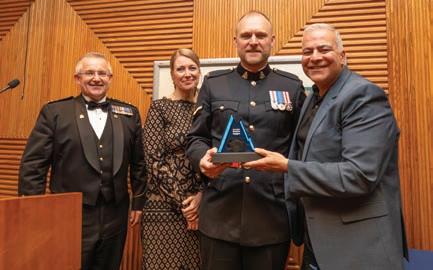
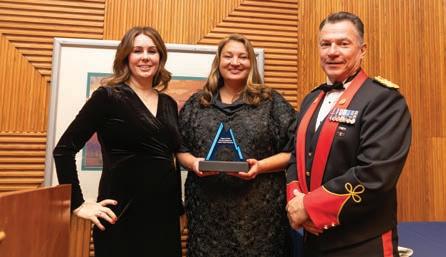
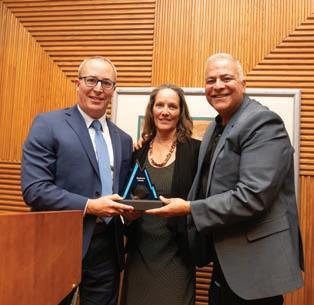
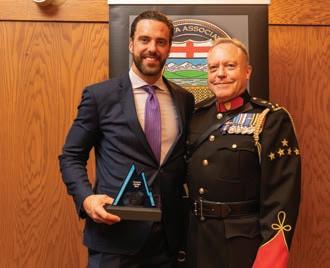
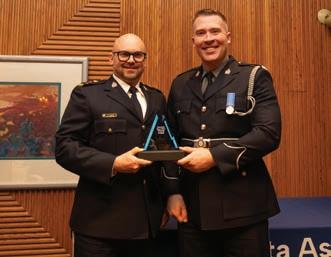
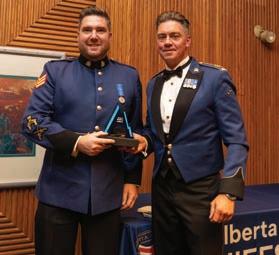
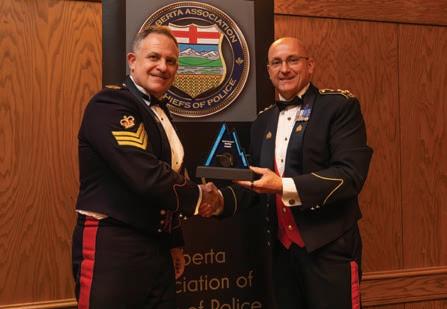
Each year, the Alberta Association of Chiefs of Police (AACP) recognizes the outstanding contributions of police personnel across the province through its Outstanding Achievement Awards. These awards highlight the dedication, innovation, and leadership demonstrated by both sworn and civilian members, as well as the meaningful impact they continue to have on their communities.
The 2025 awards saw 26 nominations submitted across four categories, reflecting the exceptional work being carried out in agencies of all sizes throughout Alberta. From these nominations, eight recipients were selected and honoured at the AACP Awards Banquet held in Banff on November 18, 2025, in front of a sold out audience of colleagues, families, and community members.
This year’s recipients represent the very best of policing in Alberta, demonstrating excellence in service, leadership, community engagement, and volunteerism.
In the large agency category, Cst. Michael Roszko of the Edmonton Police Service was recognized for his work within the ALERT Internet Child Exploitation Unit. His development of the Media Appraisal Program (MAP) has significantly improved the efficiency and consistency of identifying and categorizing child sexual abuse material, while also reducing examiner exposure to harmful content.
For small agencies, Stéphane Contre (Ret’d) of the Lethbridge Police Service was honoured for his innovative leadership in data analytics. His work modernizing intelligence systems contributed to a measurable reduction in crime severity and continues to influence policing practices across the province.
The large agency award was presented to the Calgary Police Service Indigenous Junior Police Academy team (Sherry Elliott, Jodi Jimenez, Lisa MacTavish, Deputy Chief Asif Rashid, A/S/Sgt. Ryan Huggan, Sgt. Gary Shaw, RSM Jason Hiscock, Det. Sean Chartrand, Sgt. Julian Klyne, Cst. Rae Greenwood, Cst. Derrick Campbell, Cst. James Frank, Cst. Jeremiah Stump, Cst. Nolan Blondeau, Cst. Wes Burnside, Cst. Gert Villani).
This initiative was developed in response to community feedback and focuses on strengthening relationships, promoting cultural understanding, and creating meaningful engagement with Indigenous youth.
In the small agency category, Cst. Jordan Bint of the Tsuut’ina Nation Police Service was recognized for leading Operation Buffalo, an impactful undercover initiative targeting the exploitation of Indigenous youth. The operation resulted in multiple charges and demonstrated a strong commitment to both enforcement and community protection.
Sgt. Matthew LeBlanc of the Edmonton Police Service received the Leadership Award for large agencies, recognized for his forward thinking approach to community safety and program development. His work in youth engagement, international deployment procedures, and national level collaboration has contributed to meaningful advancements in policing practices.
For small agencies, S/Sgt. Harley Kesler of the Medicine Hat Police Service was honoured for his longstanding leadership and commitment to mentorship. Over a 34 year career, he has helped shape a culture of accountability, growth, and innovation, leaving a lasting impact on both members and the organization.
Community Peace Officer Thomas O’Neill of the City of Edmonton was recognized in the large agency category for leading the “Stuff A Cruiser” campaign. Over seven years, his efforts have resulted in nearly 29,000 pounds of food being
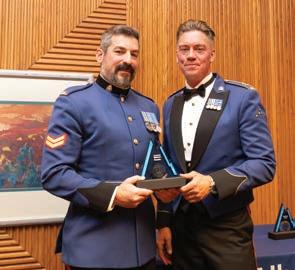
donated to the Edmonton Food Bank, demonstrating an exceptional commitment to community service.
In the small agency category, Cst. Braylon Hyggen of the Lethbridge Police Service was honoured for his extensive involvement with the Special Olympics Law Enforcement Torch Run. His leadership and dedication have helped raise significant funds and awareness, while strengthening relationships between police and the communities they serve.
The AACP Outstanding Achievement Awards serve as an important reminder of the work being done across Alberta every day. While much of policing happens outside the spotlight, these awards provide an opportunity to recognize those who go above and beyond in service to their communities and the profession.
On behalf of the Alberta Federation of Police Associations, we extend our congratulations to all recipients. Your work reflects the professionalism, commitment, and integrity that define policing in Alberta.


Recently, Graham Ernst provided a letter of support for Bill C 243. Although defeated in the legislature, it does give rise to thoughts regarding the challenges of policing we face not only in this province but across the entire country.
Policing in Canada is undergoing one of the most significant periods of transition in decades. Communities are asking new questions about public safety, governments are reshaping priorities, and frontline officers are navigating increasingly complex calls for service. In this environment, police associations have become more than collectivebargaining bodies — they are essential partners in shaping the future of policing.
Across the country, police associations are stepping into a broader leadership role, advocating not only for fair working conditions but also for the resources, policies, and supports that enable officers to serve effectively and safely. As the demands on policing evolve, so too does the responsibility of police associations to ensure that frontline realities are understood at every level of decisionmaking.
The nature of police work has shifted dramatically over the past decade. Officers are responding to more mentalhealthrelated calls, more complex investigations, and a growing number of situations involving vulnerable individuals. At the same time, public expectations around transparency, accountability, and community engagement have increased.
These pressures have created a dual challenge: officers must meet rising demands while working within systems that have not always kept pace with the realities of modern policing. Police associations have become a critical voice in highlighting these gaps and advocating for evidencebased solutions.
One of the most pressing issues facing police services nationwide is staffing. Many departments are experiencing
a combination of retirements, recruitment challenges, and increased workloads. The result is a strain on officers and a reduction in the capacity to deliver timely, proactive policing.
Police associations have been vocal in calling for staffing models that reflect actual demand. This includes advocating for:
• Realistic officertopopulation ratios that account for the complexity of modern calls
• Improved recruitment strategies to attract qualified candidates
• Retention initiatives that keep experienced officers on the job
• Investment in civilian specialists to support administrative and technical functions
Adequate staffing is not simply a labour issue — it is a publicsafety issue. When officers are stretched thin, response times increase, proactive policing decreases, and burnout becomes more common. Police associations are pushing for longterm solutions that ensure communities receive the level of service they expect and deserve.
The emotional and psychological toll of policing is welldocumented, yet many officers still struggle to access timely and appropriate mentalhealth supports. Police associations have been at the forefront of advocating for comprehensive wellness programs that recognize the cumulative impact of trauma, shift work, and highstress environments. Key priorities include:
• Confidential mentalhealth services tailored to the realities of policing
• Peersupport programs that allow officers to connect with colleagues who understand their experiences
• Criticalincident response protocols that provide immediate support after traumatic events
• Workplace policies that reduce stigma and encourage early intervention
Continued on page 22
By pushing for these supports, police associations are helping to build a culture where officer wellness is treated as a core component of operational readiness.
In an era of heightened scrutiny, officers need confidence that disciplinary and investigative processes are fair, consistent, and transparent. Police associations play a vital role in ensuring that accountability mechanisms protect both the public interest and the rights of officers.
This includes advocating for:
• Clear investigative timelines to prevent prolonged uncertainty
• Independent oversight structures that are balanced and evidencebased
• Procedural fairness in all disciplinary matters
• Training and education that help officers understand evolving standards
Police associations are not opposed to accountability — they are committed to ensuring it is applied in a way that is just, consistent, and grounded in due process.
As governments and police boards consider reforms, police associations bring a perspective that is often missing: the lived experience of the frontline. Officers understand the


practical implications of policy decisions better than anyone, and police associations ensure that this insight is included in discussions about legislation, training standards, and operational protocols.
Whether the issue is bodyworn cameras, useofforce guidelines, or community safety initiatives, police associations provide a critical link between policymakers and the realities of daytoday policing. Their involvement helps create policies that are not only wellintentioned but also workable and effective.
The challenges facing policing in Canada are complex, but they are not insurmountable. Police associations are uniquely positioned to help shape solutions that balance community expectations with operational realities. Their role extends far beyond contract negotiations — they are advocates for safe communities, strong police services, and the wellbeing of the officers who serve.
As the landscape continues to evolve, one thing remains clear: the future of policing will be stronger when police associations, police leaders, governments, and communities work together. By bringing frontline insight to the table and championing the supports officers need, police associations are helping to build a policing model that is sustainable, accountable, and responsive to the needs of all Canadians.



Istill remember the fall of 1984 like it was yesterday. I was in Grade 12, staring down graduation with absolutely no idea what I wanted to do with my life. My friends all seemed to have a plan — university applications, career paths, big ambitions. Meanwhile, I was in smalltown British Columbia feeling completely lost. The future felt like a pretty intimidating place.
Back then, natural resource jobs were everywhere, but I knew that wasn’t the right fit for me. So, I did what you did in the 80s when you were searching for academic direction: I flipped through stacks of postsecondary education calendars. Eventually, I stumbled across the Criminology – Law Enforcement program at Mount Royal College in Calgary. Something clicked. I applied, got accepted, and for the first time felt like I was moving toward something that made sense.
Mount Royal went well — better than I expected, honestly. I made the Dean’s Honour Roll and landed a job with Canada Customs (now CBSA). I probably would have stayed there too if not for one thing: the pension offered to Alberta municipal police officers through the Special Forces Pension Plan (SFPP). Even at the ripe old age of 20, I understood how rare and valuable a 25year retirement pension really was. That benefit changed the entire trajectory of my life.
I joined the Calgary Police Service (CPS) in 1988, and served a little over 28 years. I look back on my time with CPS with a lot of gratitude. It was a great organization and I was treated very well. But policing is tough — dangerous, emotionally heavy, and demanding in ways most people never see and may not completely understand. It takes a high level of personal commitment and sacrifice to succeed. Not everyone makes it through to retirement. In fact, about 40% of my recruit class left before reaching eligibility, many leaving policing altogether. I’d be lying if I said I never thought about leaving too. But the pension kept me anchored. It gave me a longterm reason to persevere through the hard years.
During my career, I had the privilege of serving as president of the Calgary Police Association (CPA). That role opened my eyes to something important: while association members valued their pension, many didn’t actually understand what they would receive at retirement. Some expected far more than the plan provided; others had no idea what to expect at all. So, I started writing — president’s messages, updates, articles — anything to help members make informed decisions about their future.
One of those messages, written in February 2013, ended up having a bigger impact than I expected. In it, I talked about the Saskatchewan Pension Plan (SPP), a plan many Albertans didn’t even know they could join. I explained why I personally signed up — low fees, strong longterm returns, and the ability to use it to supplement my SFPP pension when the bridge benefit ends at age 65. I wasn’t providing a recommendation; I was simply sharing something that worked for me.
Here is what I wrote:
Over the years, I have had dozens of members pick my brain in relation to our pension and other investment opportunities. My usual response is our 25-year pension should be sufficient to pay most of your bills during retirement, but it won’t be enough for those little extras, such as travelling. Members need to plan ahead to determine what their financial needs will be into retirement. Steps need to be taken early on to ensure sufficient funds are available.
I don’t usually offer specific investment advice, but I’m going to make an exception this one time. Most people are unaware of the Saskatchewan Pension Plan and even fewer know that it is open to any resident of Canada. That’s right – Albertans can join! The plan has been around since 1986 and is sponsored by the Saskatchewan Provincial Government. I have personally joined as I see it as an opportunity to enhance my own SFPP pension. My intention is to collect this pension when my SFPP bridge benefit is eliminated at age 65. It works for me and it might work for you too. As with most investments, there are no guarantees. Make sure you perform your own due diligence before deciding whether it meets your needs.
Continued on page 24
Comprehensive information on this plan is available online at http:// www.saskpension.com I like the plan because it is sponsored by the Province of Saskatchewan, its management fees are low, and it has a history of providing solid returns (available on website). The website allows for online joining and contributions can be made in a variety of ways, including by credit card. There is a yearly contribution limit of $2,500 and contributors must have available RRSP room in order to contribute. Have a look – it might be right for you.
Well, members noticed. The SPP noticed too. They reached out to tell me they’d seen a spike in CPA members joining and had become aware of my message. They asked if I’d write a testimonial. I subsequently agreed, and it’s still posted on their website today https://www.saskpension.com/business.php
Over the years, I’ve had several CPA members thank me for making them aware of the SPP. I thought it would be interesting to look back at how the SPP has performed over time. Back in 2013, the plan had an annual $2,500 contribution limit and a $10,000 transfer in limit (both since removed). Here’s what a $10,000 contribution / transfer made in January 2013 would have grown to by January 1, 2026, based on actual annual returns:

Now, no one can predict future performance. Markets change, economies shift, and past returns are never a guarantee on the future. But the SPP has a long track record — more than three decades of delivering solid, steady results. For some people, it might be a useful tool. For others, it may not be the right fit. The key is doing your homework and understanding what your own retirement needs are.
If you think the SPP might be right for you, please perform your own research and due diligence. I am by no means endorsing this plan, but I certainly believe that it is worth a look.
If there’s one message I hope my police readers take away, it’s this: a pension is incredibly valuable, but it’s only one part of the retirement picture. Planning early, supplementing wisely, and understanding your benefits can make the difference between getting by and truly enjoying the retirement you’ve earned after a demanding career.
2019 $15,361.47
4.07% $20,368.32
2023 $20,368.32 7.80% $21,957.05
2024 $21,957.05 10.57% $24,277.91
2025 $24,277.91 9.43% $26,567.31
That’s total growth of 165.67% over 13 years and a compounded average annual return of 7.85% (CAGR). Not too bad for a plan most people had never heard of. These are ‘Steady Eddie’ returns – exactly what one would expect from a conservative pension plan.
Take the time to educate yourself, plan wisely, and invest in your retirement security. Your future self will thank you!
Good luck — and happy investing.
About the author / disclaimer:
Howard Burns is a retired Calgary Police Service sergeant and past president of the Calgary Police Association. He is the current executive director of the Alberta Federation of Police Associations and a member of the Special Forces Pension Plan Sponsor Board. This article is written based on his own personal experiences and should not be construed as specific investment advice of any kind. The information contained within is believed to be accurate, but not warranted as such.

Being new on the board of AFPA, I am quickly learning the inner workings of AFPA and where we fit in this police association world. As a member of one of the larger police organizations involved in AFPA, it is my opinion that we do have the responsibility of assisting the smaller organizations where we can. I have been asked to provide an article on a topic of my choice. With only 3 months in, I cannot speak eloquently or even with some insight to the direction of AFPA as I am still learning. Instead, I thought I would take this opportunity to pass on what I have learned over the past 3 years of being a director for my own Police Association, The Edmonton Police Association.
As a brief history, I was first elected as director for a one year term in 2023, Reelected in 2024 for a two year term, followed by my most recent election for another two year term for 2026 2027. When I first ran for a director position, I had no association experience, or interest in association work. I was angry at both the service and the association. I felt I was tossed aside by my service, one that I had spent the previous 21 years of faithful dedication, giving up time with my family and sacrificing my own well being for the betterment of the organization. When I came to my Association with my issues, for lack of a better description, I felt placated, and no one, in my opinion, gave the effort or time to my concern that I thought it deserved. I knew I could do better.
Rather than getting into the weeds of my reason for association work, I thought it would be beneficial for those who are new to it to learn from my own individual experiences, so they have a clearer understanding of the issues you may face along the way.
First, most people come to the Association with their grievance or concern in a time of crisis or anger. I think we have all seen this in our regular job, we don’t get called to help when people are in love, only when they are angry. As we know, people, when angry, do not function on all levels of cognitive ability. (Firing on all cylinders is a term I like to use). Typically, they are emotional and looking for someone to pick up the pitchfork and help them with the stake burning. Problem being, although often wronged, there are multiple
reasons for the actions, multiple versions of the same story. (For every event, there are three sides to the story, yours, mine and the truth). As a director, when you first hear their story, it is very easy to pick up that pitchfork, put your head down and start the fire. Your members have often come to you when emotions are high, and the event has just happened. I have found the most effective way to deal with this is to slow things down. “That sounds terrible, I would like to help you out and have a better understanding of what is going on. Are you able to send me the information in an email, with as much supporting documentation you have, so I can sit down and assess exactly where I can help you?” For you as the director this does several things.
1. It slows the member down and forces them to write out their concerns. Often, they will take the time to vet and re vet their information into what they feel can be proved, often eliminating a lot of the static they first approached you with. It gives them time to calm down and focus on the facts.
2. It provides you with written documentation of the concern when you received it and starts your file for future documentation should they ever alleged the Association failed to represent them.
3. The documentation provides you with something you can mull over, compare it to your organization’s policies, your CBA and various labour laws to see what direction the concern can go, this is where you can start to formulate options for the member.
I could dig into this point and remind you to set timelines, ensure you communicate, close the loop, and don’t forget to follow up with the member, but you already know that.
Second, Policing should not be political, but Association work can be and usually is. I don’t mean woke; I am not telling you to put your pronouns or land acknowledgments in your signature, you do you. By political, I mean relationships are important. Those relationships between you and your membership, you and your HR department, you and your other board members can help or hinder your effectiveness as a director.
Continued on page 26
Continued from page 25
You have already developed good relationships with your general memberships; you were successful during your elections. It is not just the membership you need to win over. If you cannot win over the members of your HR department, every issue can quickly become an uphill battle. The same goes for your relationships with other board members. When introducing a new motion, you will need their support to pass it. Sometimes these motions can be controversial or divisive. When you introduce your motion, especially on the bigger issues facing your organization, it should not be the first time the other board members have heard of it. Prior to that meeting, it should be a topic that has already been touched on and explained to most of the board. Have those conversations, win them over before the board meeting, so they see why your motion is important, needs to pass and support you.
Remember, you were elected to represent your membership; they saw in you the ability to champion their concerns. To accomplish this, build positive relationships with all facets of your organization as it will help you get results for your members.
Finally, watch what you say and how you say it. In one of my first articles as an EPA director, I took aim at our organization, and their lack of communication and leadership. Part of that was using the chief’s “pet project” as an example, pointing out the flaws in the leadership and communication around the implementation of the unit. Unfortunately, the language I used caused the members who were in the unit to stop reading and assumed it was a personal attack on their work ethic and worth in the organization. Not my intent, however, not only did it cause me some grief, but the point of the article for that group of readers was lost. I have always been a duck is duck is kind of person; however, many people will insist you call a duck a “Anas platyrhynchos” (don’t bother googling it, it is the scientific name for a duck). Be mindful of your audience and how you say it can affect how your audience interprets it.
I hope the above helps. As the newest director with AFPA I look forward to learning a lot and helping where I can. Please don’t hesitate to reach out.
Cheers!