THE CHRONICLE
THE CHRONICLE
CONTENTS 1
A BRIEF HISTORY OF THE SALEM WITCH TRIALS
3
MACHIAVELLI: WHY DEMOCRACIES STILL CREATE PRINCES
5
IS MARXISM STILL A RELEVANT POLITICAL AND SOCIAL THEORY IN THE UK?
7
AN INTERVIEW WITH AUTHOR AND HISTORIAN RICHARD VAN EMDEN
9
THE HISTORY OF THE SPITFIRE
10
THE FASCIST REGIME IN ITALY
11
DID THE TERMS OF THE TREATY OF VERSAILLES MAKE WAR INEVITABLE?
13
SINGAPORE'S GOVERNANCE MODEL
14
ARE WE ENTERING A NEW ERA OF MULTI-PARTY POLITICS IN THE UK?
15
WHAT WOULD THE WORLD LOOK LIKE TODAY IF THE 14TH CENTURY PLAGUE NEVER HAPPENED?
17
VOTING INTENTIONS: A SURVEY
19
OPINION
20
HAS BRITAIN QUIETLY ENTERED AN ERA OF MANAGED DECLINE?
I
THE CHRONICLE 21
WHY DID FINLAND JOIN NATO AND WHAT WILL THAT BRING TO THE REST OF EUROPE?
23
THE POLITICAL LANDSCAPE OF ANCIENT CHINESE CONCUBINES
25
THE RISE OF MINOR PARTIES IN UK POLITICS
27
HAS SOCIAL MEDIA MADE IT IMPOSSIBLE TO DISTINGUISH BETWEEN POPULAR MOVEMENTS AND MANUFACTURED POLITICAL OUTRAGE
29
CONTROLLING THE NARRATIVE: HOW GOVERNMENTS HID THE TRUTH
31
BOOK REVIEWS
33
PUZZLES
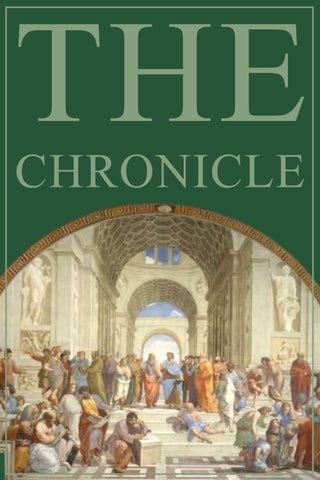
This year's edition of the Chronicle has introduced two new features to the magazine, pupils from both Sherborne Boys and Sherborne Girls Schools have collaborated to produce this edition, with the articles varying across both the subjects of History and Politics. It was for these reasons that the front cover was chosen. Raphael's fresco 'The School of Athens' feels particularity fitting as the group depicted range from Plato to Aristotle, Socrates and Hypatia, all of whom were talented polymaths. Perhaps what Raphael is trying to demonstrate through this painting is the idea of collaboration between people and across subjects, and how this can bring about new ideas. It could be said that this is the goal of the magazine. Both History and Politics are inextricably linked each influencing the course of the other, and hence it is fitting to study them side by side. I am hugely grateful to all those who contributed and helped to produce the magazine. What has been most exciting about this year's edition is the range of subjects, from Marxism's modern relevance to the 14th century plague the magazine is hugely varied, and has been a pleasure to read through and edit. Overall, it has been a fantastic success this year, especially with the new collaboration across both Sherborne schools bringing new perspectives and stories to the magazine Thais Contributions by: Arabella , Gilbert, Frank, Jane, Rhianna, Siena, Sophie, Oscar, Charlotte, Emily, Cordelia, Molly, Thais, Constance, Alastair, Mitchell, Kyryl, Jamie, Wilfred, Lucy, Pippa, Bella, Lizzie Edited by: Thais Assistant editors: Jane, Sophie, Rhianna
II
THE CHRONICLE A BRIEF HISTORY OF THE SALEM WITCH TRIALS
In 1689, English monarchs William III and Mary II began a conflict with the French fought in the American colonies (also known as King William’s war). The conflict raged throughout New York, Nova Scotia and Quebec. Many of the refugees created by this conflict moved to the County of Essex or Salem Village in the Massachusetts bay. Due to the sudden influx of people into Salem, there was a great strain on the area’s resources, it also increased existing rivalries between families who had ties to the wealth generated by Salem port with the families who relied on the agriculture. Additionally, Revered Samuel Parris, who had a reputation of being rigid and greedy, became Salems first ordained minister in 1689.
Examination of a Witch by Tompkins Harrison Matteson, 1853 The Salem witch trails occurred in colonial Massachusetts between early 1692 and mid 1693. Over 200 people were accused of practicing witchcraft and devil’s magic throughout the period. It was not until 1711 that colonial authorities pardoned some of the accused and compensated their families. That said, the last convicted Salem “witch” wasn’t officially exonerated until 2022. There were many factors that contributed to the events, including xenophobia, religious extremism and other brewing social tensions. Tensions in Salem In medieval and early modern eras, religions including Christianity taught that the devil could give people, known as witches, the power to harm others in return for their loyalty. This led to a "witchcraft craze" in Europe from 1300's to the 1600's, where tens of thousands of "witches" (most of whom were women) being burnt or hung. What is curious about the Salem Witch Trials is that they took place as the European craze of executing "witches" was winding down. The circumstances within Salem at the time explain what caused these events.
How did the trials begin? The puritan villagers believed the discourse and quarrelling was the work of the devil. In January of 1692 the daughter of Samuel Parris, Elizabeth and his niece Abigail Williams began having "fits" which consisted of the young girls screaming, contorting themselves and uttering peculiar sounds, suspicions were raised. A local doctor was brought in who blamed these episodes on the supernatural. Shortly after, another girl Ann Putnam Jr experienced similar fits.
1
THE CHRONICLE Faced with pressure from the magistrates, colonial officials ended up blaming three women for supposedly afflicting the girls. The women blamed were Tituba- a Caribbean woman who had been enslaved by the Parris family, Sarah Good- a homeless beggar woman and Sarah Osborne- an elderly and impoverished woman. These three women's trials began on the first of March 1692. Good and Osborne claimed they were innocent, but Tituba confessed to being a witch, quoting "The devil came to me and bid me to serve him" she went on to describe images of black dogs, red cats, yellow birds and a 'tall man with white hair" who wanted her to sign his book. She admitted to signing the book and claimed that there were several other witches who were looking to destroy the puritans. With a modern point of view, it is easy to tell that Tituba was likely suffering from a psychological disorder such as schizophrenia, in 1692 this was not diagnosed. The seeds of paranoia surrounding witchcraft had been sewn, and many accusations would follow in the next few months including against Martha Corey, a loyal member of the church in Salem Village, this was very concerning to the villagers as if she could be a witch then no one was free from suspicion. This was followed by Sarah Good’s four-year-old daughter being questioned, the timid nature of her answers were interpreted by the Magistrates as a confession. The accusations only grew more intense in April, as the colony's deputy governor Thomas Danforth began attending the hearings, dozens of people from Salem were bought in for questioning. A special court of Oyer and Terminer was established by William Phips to clear the backlog of individuals accused of witchcraft. The first accused witch tried in the court was Bridget Bishops, an older woman known for her promiscuity. She was found guilty and became the first person to be hanged on what would later be known as Gallows Hill.
1688 portrait of Increase Mather 'It were better that ten suspected witches should escape than one innocent person be condemned
September 1692 after refusing to submit to a trial and at least five of the accused witches died in jail. Two dogs were also killed as people believed they were linked to the devil.
Many women were tried, but controversy began to brew when a well-respected minister, Cotton Mather, wrote a letter trying to convince the court not to allow evidence such and dreams and visions to be used but the court ignored this request. Cottons father, Increase Mather, also denounced the use of such evidence, famously quoting "It were better that ten suspected witches should escape than one innocent person be condemned". William Phips eventually responded to these requests, however this was likely driven by the fact that his own wife was accused. He did however, prohibit any further arrests and released many accused witches whilst also dissolving the court of Oyer and Terminer, and replacing it with a Superior Court of Judicature which disallowed spectral evidence. By May of 1693 Phips had pardoned all those in jail on witchcraft charges, but the damage had already been done. A total of nineteen men and women were hanged on Gallows Hill, Giles Corey was pressed to death using heavy stones in
After the trials Many of the involved people publicly confessed to their errors and on the 14th of January 1697 the Massachusetts General court ordered a day of fasting over the tragedy of Salem. It was in 1702, that the trials were declared unlawful and later, in 1711, the colony passed a bill restoring rights to the accused, resorting their good names and granting a total of £600 in restitution to their descendants. However, it wasn’t until 1957 (Over 250 years after the trials) that Massachusetts formally apologized. The final "Witch" was pardoned in 2022. By Lucy
Photo name, date, wheres its from etc.
2
THE CHRONICLE
MACHIAVELLI: WHY DEMOCRACIES STILL CREATE PRINCES loyalty, and above all control. While the power of the Crown may have degraded, the political instincts of rulership have survived. If anything, democratic politics have simply obscured the underlying truth. This is what makes Niccolò Machiavelli’s ‘The Prince’ so unsettling yet fascinating as it feels less like an historical text, and more like an uncomfortable mirror which displays our current society Was Politics ever about Morality? Niccolò Machiavelli wrote his works during a fractious time in Italy’s history where states such as Florence, Milan and Venice were locked in constant rivalry and turmoil. Foreign invasions along with internal conspiracies and shifting alliances made political life unstable and often violent. As a diplomat serving the Florentine Republic, Machiavelli had the perfect vantage point to witness first hand that rulers were not rewarded for goodness but instead survived by adapting faster than their enemies to the circumstances around them. Machiavelli’s greatest provocation was not cruelty. It was honesty, he rejected the comforting idea that political power naturally rewards virtue. Instead, he described politics as it functioned: successful rulers lied, manipulated, betrayed and used force when necessary, and those who refused to adhere to the prescribed system often lost everything.
The Triumph of Death by Pieter Brugel
Portrait of Machiavelli by Santi di Tito c. 1575 What can ‘The Prince’ still teach us about modern power? We, citizens of democracies, pride ourselves on having outgrown the world that produced Niccolò Machiavelli's views. We build this belief upon our constitutions, elections, human rights policies and representative institutions. In short, systems designed to ensure that no single autocratic ruler can dominate our nations. In theory, the age when Princes dominated our society ended centuries ago (in the UK, 1689 to be exact!). Our modern leaders are not kings. They are elected servants of the public, accountable to law and removable through a cross on a ballot paper. But the deeper one looks, the less convincing that distinction becomes. While democracy may have replaced who governs, it has not fundamentally changed what governing requires. Modern political leaders still rely on the same tools Machiavelli recognised in Renaissance Italy: projected image, fear, spectacle,
3
The famous statement ‘it is better to be feared than loved’ is often quoted as proof of his infamous cynicism, but that misses the wider argument. Machiavelli was not praising cruelty for its own sake. Instead, he recognised that in moments of crisis, fear produces results more than affection ever could. In short, love is conditional, fear is is immediate and politically useful. Yet even here, in his infamous critical work, he warns that fear must be controlled. In his view, a ruler should be feared, not hated, because eventually hatred turns into revolt. This is why Machiavelli remains relevant in the modern day. His writing exposes how fragile political morality becomes when powerful positions are at stake.
THE CHRONICLE The Prince Wears a Suit and Tie
designed to inspire specific ideals and emotions associated with the political leader. Machiavelli was the one who outlined this process. He recognised that citizens rarely see power directly, instead see it as a performance. That remains true today. In modern politics, sincerity matters. But appearing sincere often matters more.
When we think of democracy there is no image conjured of an autocratic leader. Yet our institutions rarely inspire loyalty by themselves as people in general look for individual’s faces, voices and behaviour that inspires certainty. That is why, even in democratic institutions we still produce leaders who resemble princes even if they wear a suit instead of a crown.
A Warning or a Manual?
I challenge you to think of a recent election campaign (and we have had seven prime ministers in 10 years!), where you remember a single policy promised, a single slogan or a single gesture made by a party leader. Election campaigns do not simply present ideas, they cultivate authority. Voters may choose, but their choices are shaped by carefully managed perception.
There is another interpretation that complicates everything, some historians argue Machiavelli was not celebrating princes at all, he may simply have been exposing them. Having lived through the collapse of the Florentine Republic, his description of ruthless leadership can also be read as a warning about how rulers manipulate populations to benefit themselves and for their own personal gain. In light of that interpretation, ‘The Prince’ is less a handbook for tyrants than an anatomy of power, showing citizens exactly how leaders maintain control. That makes the book even more relevant today.
Someone who understood this concept better than most was World War II Prime Minister, Winston Churchill. He understood that during the conflict he could not simply make empty promises conjuring up images of a brighter future. He had to inspire loyalty and determination. Churchill managed his political image through the use of his powerful speeches to turn fear of defeat into defiance, a tactic geared toward maintaining the political will to fight. While Princes inherited their legitimacy, democratic leaders manufactured it.
Because if Machiavelli was exposing power rather than endorsing it, then his real lesson for democracies is not how leaders govern but how citizens are governed. The tools used to maintain power are still just as relevant today and recognising them is more important than ever. To see how we, the citizens of a democracies are governed: through fear, through spectacle, through carefully constructed narratives that make authority appear inevitable, is to see how to inform your own judgments and recognise manipulative patterns. Democracy removed hereditary rule, but it did not end the power of political performance. It simply placed that performance inside the political theatre that we call elections.
Fear Still Shapes Our Lives (whether we like it or not) The most uncomfortable part of Machiavelli’s relevance in the modern day is how clearly fear still structures political life. Our democracies celebrate free choice. However, this view is perverted by the fact that many of the most decisive elections are driven by public anxiety: war, recession, terrorism, migration, or social disorder. These fears (while sometimes real) are extremely politically powerful as they reshape political dialogue with the electorate. In times of uncertainty, voters often become less concerned with fairness and more concerned with their own welfare. That shift is profoundly Machiavellian.
By Arabella
Fear narrows political imagination and makes strong leadership seem necessary, while any opposition appears dangerous. It encourages people to trade freedoms for security. Political leaders know this, which is why political rhetoric often revolves around a crisis. The nation is under threat, the economy is at risk, society is unstable in these instances, the leader becomes the solution to the danger that politics itself has amplified. Democratic citizens may cast the vote themselves but the conditions under which they vote are often engineered by fear. This is not a failure of democracy; it is a reality and connects it to the work of Niccolò Machiavelli. The Performance of Virtue Machiavelli’s most startling insight may be the simplest: rulers do not need to be virtuous. They need to appear virtuous. This principle creates the foundations of 21st century politics as we see our modern leaders operate within an endless visual cycle. Every photograph, interview and social media post contributes to their public identity. The appearance of authenticity has become essential. Politicians must seem relatable, honest and ordinary, yet those qualities are often the result of a carefully constructed narrative produced by professional media teams and strategic staging. A rolled-up shirt sleeve suggests practicality while a kitchen-table interview suggests humility and a family photograph suggests trustworthiness. None of these are accidental. They are symbols
The title page of a 1550 edition of Machiavelli's 'The Prince'
4
THE CHRONICLE IS MARXISM ST POLITICAL AND SOCIAL This can still be seen in the UK today, where there are clear divisions in wealth and income. The gap between rich and poor has become increasingly visible, particularly following the 2008 financial crisis and the cost of living crisis. Marx’s idea of exploitation is also still relevant in modern working life. He argued that workers produce more value than they receive in wages, with employers keeping the profits. Although working conditions have changed since the nineteenth century, modern examples such as zero-hour contracts still suggest that workers often remain financially insecure while employers retain control over pay and conditions. Marxism also remains relevant through its focus on class and inequality of opportunity. Although Britain is often described as meritocratic, there are still major differences in life chances depending on background. People from wealthier families are more likely to attend top universities and gain access to high-paying careers. This suggests that class continues to shape opportunities, even if society is more complex than Marx’s original two-class model.
Karl Marx in 1875
Karl Marx and Friedrich Engels argued that capitalist societies are divided between two main classes: the bourgeoisie, who own the means of production, and the proletariat, who sell their labour in order to survive. Marx believed that capitalism would eventually lead to class conflict and revolutionary change. Britain is a particularly relevant case study for Marxism because it was during the industrialisation of nineteenth-century Britain, and later Marx’s time living in London, that many of his ideas were developed. This essay explores whether Marxism is still relevant in explaining modern British society, while also comparing it to alternative theories such as liberalism and pluralism. Overall, it argues that Marxism remains useful in understanding inequality and power, though it is less effective as a complete explanation of contemporary Britain. One of the strongest arguments for Marxism’s continued relevance is its ability to explain economic inequality. Marx argued that capitalism naturally concentrates wealth in the hands of a minority while the majority rely on wages to survive.
5
THE CHRONICLE ILL A RELEVANT THEORY IN THE UK? Similarly, Marx’s ideas about ideology and the influence of the ruling class can still be applied to the media and politics. Large sections of the British media are controlled by a small number of wealthy individuals, allowing certain viewpoints to dominate public discussion. Elite dominance can also be seen in politics, particularly in institutions such as the House of Lords, where privately educated individuals remain heavily overrepresented. This supports the Marxist argument that wealth and power are closely connected. However, Marxism also has important limitations when applied to modern Britain. Marx developed his theories in the context of nineteenth-century industrial capitalism, which was far more polarised than society today. Modern Britain has a far more diverse social structure, with a large middle class and a wider variety of occupations and identities. Marx’s simple division between bourgeoisie and proletariat no longer fully reflects the complexity of society. In addition, the development of the welfare state challenges Marx’s idea that the state only acts in the interests of the ruling class. Structures such as the NHS, welfare benefits and minimum wage laws demonstrate that governments can intervene to reduce inequality and improve living standards. Social mobility has also increased through education and professional opportunities, meaning that individuals are not completely restricted by class background.
A Polish publication of The Communist Manifesto, 1954
Alternative theories provide further challenges to Marxism. Liberalism argues that inequality can result from differences in talent and effort rather than purely class exploitation. It emphasises meritocracy and individual opportunity, suggesting that modern societies allow people to improve their position through education and hard work. Furthermore, pluralism challenges Marxism by arguing that power is dispersed across many competing groups rather than controlled by a single ruling class. Trade unions, pressure groups and political parties all influence decision-making in the UK, suggesting that society is more democratic and diverse than Marx predicted. However, Marxism still offers a strong criticism of these theories by highlighting the continuing influence of wealth and structural inequality. In conclusion, Marxism remains a significant but limited political and social theory in the UK. Its ideas about inequality, class and the relationship between wealth and power are still highly relevant in explaining many aspects of modern Britain. However, society has changed considerably since Marx’s time, and his theory cannot fully account for the complexity of modern social structures, welfare systems and social mobility. Liberalism and pluralism highlight areas that Marxism overlooks, particularly the importance of individual opportunity and competing groups. Therefore, Marxism is best understood as a valuable but incomplete framework for understanding contemporary British society. By Molly
6
THE CHRONICLE WW1- THE VETERANS An interview with Richard Van Emden, Author and Historian Unlike most Great War historians, Richard’s focus was never on military strategy, weaponry, or uniforms; what drew him to that period was the human experience of war. His “fascination in human beings” combined with an “admiration ... of the bravery of these men” drew him to the stories of individuals, who are so often treated as mere wartime statistics. Using his natural ability to connect with people he learnt to extract stories from veterans, some of whom had never shared their wartime memories before. For many this was traumatic and deeply personal. He claimed that after an interview many of the veterans would say something along the lines of “I won’t sleep well for the next few nights,” such was the manner in which these recollections haunted them. Richard recalled that one veteran, at 101 years old with very poor eyesight being transported back to the trenches whilst attempting to recount his experience, shouting “DUCK! DUCK!” and hurtling abuses at imagined Germans. “He was there... he had retreated back to the trenches”. Richard Van Emden- 'it was a hobby that went mad' After being gifted ‘Goodbye to all that’ by Robert Graves when he was nineteen, a young Richard van Emden found himself “immediately hooked” on the story of the Great War and fascinated by those who had served. His interest continued into his twenties and in 1985, a curious Richard decided to go to London to seek out some Veterans. Armed with his memorised knowledge of World War One medals, a smiley face and a gift of talking to anyone, he turned up to the Royal Hospital in Chelsea in the hope of talking to any resident Chelsea Pensioner who might share their experience. It was there that he first spoke to a World War One veteran, Ernie Martin. From then on, a passion was born. He would travel to care homes, equipped with a tape recorder and notebook seeking out anyone with a story. At this point it was a hobby born out of pure fascination; he had no real plan as to what he would do with these interviews. Eventually, it became a career as an author and historian. To date, Richard has published a total of twentythree books and interviewed more than two hundred and seventy of Britain’s last remaining Great War Veterans
It was for this reason that some veterans were very closed off, censoring themselves or refusing to speak. It is understandable that they wanted those memories to be left in the past, but it also prevented many stories from being shared. Richard uses the example of Harry Patch, who for a period of time was the only surviving First World War soldier. Richard’s best selling book ‘The Last Fighting Tommy’ was written about Harry. He claimed that if Richard had contacted him 20 years earlier, he would never have opened up to Richard.
Sat in his kitchen, Richard tells me how he is now in the final stages of writing his memoirs ‘A Land Fit for HeroesLife Affirming Conversations with Generation Gone.’ It is a book filled with incredible stories of the people he met, coincidences, friendships, as well as the development of his career from an amateur to a professional historian. You can imagine how intimidating it is trying to interview a man who has made his career in doing just that. But, his warm manner, and endless enthusiasm prevented me from comparing myself to the “woefully amateurish” interviews of his early career that he described. The youngest British soldier to die in the Great War Private James Thomas, 17th King's Liverpool Regiment
7
THE CHRONICLE He only did so because he felt that it was his last opportunity to get his story out there; time worked both for and against Richard. On one hand, many felt that it was their last opportunity to share their experiences and so had an ‘if not now, then when?’ attitude. On the other hand, the number of Veterans was rapidly diminishing and collecting as many stories and interviews as possible was essential. It was in 2009 that Harry Patch’s death marked the last of that generation of soldiers. Similarly, the friendships he formed with the Veterans were cut short. Having served at just 16 years old, Ben Clouting was present at the very first shot of the Great War and went back to the very location in 1990 with Richard. Not only did he have an incredible story, he and Richard “got on famously” and had a “personal connection that transcended age”. However, he knew that their friendship was limited by time- they knew each other for just two years, but it had “felt like a lifetime”. The genuine friendships Richard formed with some Veterans is reflected in that he named his son Bena promise made to Clouting the night before he died. According to Richard that shows you ‘everything you need to know about (his) friendship with these people’.
Ben Clouting revisiting the memorial to the first shot of the Great War.
Whilst describing his early career to me he painted a picture of clumsy exchanges: full of enthusiasm but asking all the wrong questions and struggling to know how to push an interviewee. The tape recordings still survive today, which he listens back to with “an old tape recorderwhich of course the sound isn’t great on”. Richard described his early collection as “abysmal”, paused, then added ‘but that’s just the way it was, it was a hobby that went mad”.
Interestingly, not all Veterans were particularly truthful. Amongst the memory loss and exaggeration that made many interviews unreliable, others purposefully fabricated stories. Richard recalled one veteran who lied about his unit, regiment and where he was stationed. Upon checking records, he discovered that “he had been prosecuted numerous times within his unit for a whole host of crimes” and “sentenced to periods of hard labour and suspension”. In this case, it’s understandable as to why this man invented a whole new narrative for himself: he wanted to be remembered amongst the brave heroes of the war, not as a criminal. It is a striking reminder that primary sources are so often misleading. Despite his suspicions, Richard had no way of disproving his story at the time, but the improved availability of wartime records has significantly helped with fact checking many of his early interviews.
His enthusiasm is catching. Upon asking how he has managed to remain so passionate his entire career, he replied simply with, “If it’s something that really appeals to your soul you never get tired of it”. Over the years he has focused on numerous angles of the Great War, from ‘Boy Soldiers of the Great War’ focusing on under aged soldiers, to ‘Tommy’s Ark’ looking at soldiers and their animals and ‘Meeting the Enemy’ written about interactions between opposing sides. “There are so many aspects and stories that are still untold” he claims, as he reveals he already knows the next eight books he has planned to write. Currently, he is working on a book focusing on the childhood experience post-war, including stories of war damaged fathers. He made sure to add “if you know anyone who’s grandparents or greatgrandparents were born prior to 1939 and have stories of the Great War (he’d) love to meet them”. Interacting with people who were an active part in such significant historical events ignited ‘such a thrill’ in Richard. He added ‘Only people who really love history truly understand the thrill of that sort of engagement’. There is no denying that Richard’s pure passion for History is boundless and it catches on to anyone he talks to. Twenty-three, books on, he still bubbles with enthusiasm whilst recounting the stories he has picked up along the way. That was what stuck with me the most, his pure excitement and interest for his subject matter. His focus on personal experiences, camaraderie, bravery and life on the front-line provide a whole new angle to the Great War, as well as a poignant reminder that wrapped up in the vast troop movements of war are personal experiences and fragments of history, that mustn’t be forgotten.
Harry Patch sitting under the Menin Gate, aged 109
By Thais
8
THE CHRONICLE
THE HISTORY OF THE SPITFIRE The year 2026 marks the 90th anniversary of the first flight of the Spitfire, one of the most famous aircraft ever built. On 5 March 1936, a sleek new fighter aircraft lifted off from an airfield in southern England, beginning the story of the Supermarine Spitfire. Ninety years later, the aircraft remains one of the most recognisable symbols of aviation history and British resilience.
Today, the Spitfire is still recognised as one of the most important and iconic aircraft of the 20th century. Many of them still appear at air shows, museums, and commemorative events, reminding new generations of the people who designed, built, and flew them. The distinctive sound of its Merlin engine remains instantly recognisable. This, the 90th anniversary, offers an opportunity to reflect on how a single aircraft design became an enduring legend. Beyond its technical achievements, the Spitfire represents perseverance, innovation, and determination. Combined efforts of engineers, pilots and factory workers helped shape the course of the war and left a lasting mark on aviation history.
Designed by engineer R. J. Mitchell, the Spitfire embodied the very best of British engineering of the modern era. Its sleek, distinct elliptical wings reduced drag and improved speed, helping pilots outmanoeuvre many rivals of its era. When the Second World War erupted in 1939, the aircraft quickly proved its value in combat.
As celebrations mark nine decades since its first flight, the Spitfire continues to attract respect and admiration among those who encounter its elegant design. Few machines have ever earned such affection as the Spitfire. As Winston Churchill famously said, ‘never has so much been owed by so many to so few,’ which very much rings true for the Spitfire, and it truly remains a testament to the might of Great Britain.
During the Battle of Britain in 1940, Spitfires flew alongside Hurricanes to defend the United Kingdom from large-scale air attacks. Pilots praised the aircraft for its agility and power, while civilians came to view it as a symbol of hope during one of the nation’s darkest hours. More than 20,000 Spitfires in numerous variants were built in many different versions, serving not only in Europe but also in North Africa, Asia, and the Pacific. Continuous improvements kept the aircraft competitive throughout the war, further demonstrating the strength of its original design.
By Jamie and Wilfred
9
THE CHRONICLE Despite Mussolini’s overconfidence and poor military leadership it’s important to still consider that fact any leader would have struggled during the period of WWII. Italy had a particularly weak economy, lacking military supplies and were therefore underprepared. Within the outbreak of the war, countries weren’t given time to allow them to prepare for warfare. Especially when taking into account the extreme scale of WWII and the pressure from allied countries. This pressure was demonstrated in the Sicily bombings in 1943 where this external pressure overwhelmed Italy and played a significant role in the collapse of the fascist regime. It was a massive loss for Italy and made the regime extremely unpopular.
THE FASCIST REGIME
IN ITALY: TO WHAT EXTENT DID MUSSOLINI’S LEADERSHIP
CONTRIBUTE TO THE COLLAPSE
OF FASCIST ITALY IN 1943? Throughout the duration of World War II, Italy was a country run by the fascist regime, with Benito Mussolini at it’s centre. He had rapidly risen to power and led Italy into the war, allied with Nazi Germany. Throughout this time frame, Italians faced extreme hardship, famine and economic failures.
However despite the ongoing war and circumstances, Mussolini had been in a position of major power for 17 years prior to the outbreak of WW2. After he became prime minister in 1922 he began immediately working to dismantle democracy within Italy. Moreover, since his rule and regime relied heavily on military victories, Mussolini would have already been paying special attention to Italy’s military power and resources. This means the fairly quick outbreak of war isn’t a valid excuse for Italy being under prepared due to the fact it had been preparing and involved in war for nearly 2 decades leading up to 1943.
In the early years of his leadership, Mussolini had been known a charismatic leader who aspired to be a modern Julius Ceaser. This resulted in his authority being dependent on military victories alone to sustain morale and power. It’s clear his leadership style relied on military victories, but as the imminent defeat became ever clearer from 1943 onwards, his health and authority meteorically diminished. However, he remained dedicated to his original goal and his stubbornness led to the eventual downfall of himself and his fascist regime. It can be argued that despite the difficult backdrop of the war, Italy’s military weaknesses and economic instability was primarily created by Mussolini’s own decisions and military failures which were catalytic in the downward spiral leading to the civil war. Therefore, to a large extent, the collapse of fascist Italy and outbreak of the civil war can be attributed to the failures of Mussolini.
Overall, Mussolini was arguably the root cause of the fascist regime’s collapse. Due to his poor decisions and overconfidence, the people of his country paid the ultimate price as millions suffered and consequently died. Despite a difficult time period, it’s clear there were opportunities for better decisions regarding the economic and well being of Italy instead of solely focusing on military strength and power. While this was important in a world war, and due to the nature of the regime being fascist, it’s highly likely Italy would have been dragged in with Nazi Germany and made a common enemy of the allies anyway. However, it’s clear the terrible leadership of Mussolini and lack of regard for the people he was leading, shone through towards the end and caused the eventual downfall of himself and the regime he led
One of Mussolini’s greatest weaknesses was his stubbornness. Upon entering the war in June 1940, Mussolini had an opportunistic arrogance and believed strongly that Germany would win the war quickly. Even early on, although he maintained a confident external persona he was still largely aware of the fact Italy was under prepared for a long, full scale war. Despite this, Mussolini chose to believe his own propaganda and drag Italy into the war regardless.
By Sophie
This confident attitude rapidly morphed into extreme arrogance and bad leadership as he frequently dismissed warnings from generals regarding lack of supplies for troops or Italy’s disadvantages. As a result, his failed military campaigns in Greece and North Africa demoted him and Italy into a weaker partner of Hitler, making his regime heavily reliant on Nazi support. Despite famous slogans such as ‘Mussolini is always right’ and ‘Il Duce’ (The Leader) which circulated the country, he refused to accept reality. His overconfidence and impulsiveness in reckless military gambles, when attempting to establish a new Roman Empire in the Mediterranean, North Africa and the Balkans; as well as his premature invasion of France led to humiliating defeats. This hugely damaged the regimes reputation and his control over Italy massively. Mussolini posing for propaganda and with Hitler.
The people of Italy began seeing through the propaganda and facing the reality as they were the ones who took the majority of the suffering as a cost of war. It’s evident that Mussolini’s leadership directly weakened Italy as it had so many avoidable military losses that Italy would never recover from without change, and it was the people who paid extreme prices. Therefore, he rapidly lost the support of his people and country, making the collapse of his regime almost inevitable.
10
THE CHRONICLE THE TREATY OF VERSAILLES DID THE TERMS OF THE TREATY MAKE WAR INEVITABLE?
The signing of the Treaty of Versailles by Joseph Finnemore The Treaty of Versailles, signed on 28 June 1919, remains one of the most debated documents in modern history. It punished Germany harshly after the First World War, taking away its territory, drastically reducing its military, and forcing it to pay enormous reparations. Twenty years later, the world was at war again. Many historians have asked whether the treaty made this outcome unavoidable. The evidence suggests that Versailles was a major cause of the Second World War, but to call it inevitable goes too far. The war happened because of decisions made by real people. The treaty made those decisions more likely, but it did not make them certain. The reparations imposed at Versailles placed an enormous burden on Germany and helped destroy its economy. Article 231, the so-called war guilt clause, forced Germany to accept full responsibility for the war. On this basis, the Allied powers set reparations at 132 billion gold marks, equivalent to roughly £6.6 billion, in 1921. The economist John Maynard Keynes warned at the time that these terms would ruin Germany and create deep resentment. Events proved him right. By 1923, hyperinflation had wiped out the savings of ordinary Germans almost overnight. At its worst, prices were doubling every three to four days. When the Great Depression struck in 1929, Germany was hit particularly hard. By 1932, unemployment stood at 30%, with over six million people out of work. It was in this environment of economic collapse and national humiliation that support for the Nazi Party surged from just 2.6% of the vote in 1928 to 37.4% in July 1932.
The connection between the financial consequence of Versailles and the rise of Hitler is difficult to ignore. It is reflected clearly in the statistics. Under the treaty, Germany lost around 13% of its land and 10% of its population. This included the Rhineland, Alsace-Lorraine, and the Polish Corridor, a strip of territory that cut East Prussia off from the rest of Germany. The Saar region was placed under League of Nations control for fifteen years. In total, roughly 3.5 million ethnic Germans found themselves living outside Germany's new borders, most notably in the Sudetenland in Czechoslovakia and in Poland. Hitler used every one of these losses as a justification for aggression. His annexation of Austria in 1938, his seizure of the Sudetenland later that year, and his demands over the Polish Corridor were all presented as the correction of wrongs done at Versailles. Each act of expansion was presented to the German public, and to a nervous international community, as a reasonable response to an unjust peace. Versailles did not simply humiliate Germany. It handed the Nazi movement a detailed list of grievances to exploit.
'The Big 4' at Versailles
11
THE CHRONICLE Despite these points, the argument that war was inevitable does not hold up under examination. If Versailles truly determined the outcome, it is difficult to explain why the Weimar Republic lasted thirteen years before collapsing. Between 1924 and 1929, Germany recovered significantly. Under the Dawes Plan, reparations were restructured and American investment flowed in. Germany joined the League of Nations in 1926 and signed the Locarno Pacts in 1925, suggesting it was possible to rebuild a stable European order. Historian Sally Marks has argued that Germany's reparations burden was never as severe as its government claimed. In practice, Germany paid only around 21 billion gold marks before payments were suspended altogether. A.J.P. Taylor went further, arguing that it was not Versailles itself but the Great Depression, the weakness of the Weimar constitution, and the deliberate choices of German conservatives who handed power to Hitler in January 1933 that caused the war. The treaty made things difficult. It did not make disaster inevitable.
The 'big 4' in a meeting
Even accepting the counter-argument's strongest points, one fact remains hard to dispute. The international system built at Versailles was not strong enough to prevent war even if Germany had wanted peace. The League of Nations was weakened from the start when the United States Senate refused to ratify the treaty, keeping America out entirely. The League had no army of its own, required unanimous agreement to act, and depended on member states being willing to enforce its decisions. They rarely were. When Japan invaded Manchuria in 1931 and Italy invaded Abyssinia in 1935, the League did nothing effective. Hitler drew the obvious conclusion. When he sent troops into the Rhineland in 1936, breaking the terms of Versailles, he later admitted he would have backed down if France and Britain had acted. They did not. The treaty was therefore responsible on two levels. It produced the grievances that made aggressive nationalism possible, and it created an enforcement mechanism too weak to stop it. War was never truly written in stone. But the combination of economic punishment, territorial injustice, and a toothless international order made it very hard to avoid.
A map showing Germany's invasion of the Rhineland
Germans protest against the Treaty of Versailles.
The Treaty of Versailles did not make the Second World War inevitable. The war was ultimately the result of choices made by Hitler, by the German elites who put him in power, and by the British and French leaders who failed to stop him early enough. But the treaty shaped the world in which all of those choices were made. It created the economic ruin that destroyed faith in democracy, the territorial grievances that made revanchism popular, and the weak international order that allowed aggression to go unpunished. To call the war inevitable is to take responsibility away from the people who caused it. But to say the treaty bears serious historical responsibility is simply accurate. The peacemakers of 1919 set out to punish Germany and secure a lasting peace. They achieved neither. By Oscar
A German Woman using her worthless cash as fuel for a fire During Germany's hyperinfaltion crisis
12
THE CHRONICLE SINGAPORE’S GOVERNANCE MODEL Since Singapore’s independence in 1965, a political model characterised by its long-term stability, consistent policy direction, and efficient governance has been developed. The People’s Action Party (PAP) has dominated the field for over five decades, governing continuously since 1959. While this has contributed to Singapore’s rapid economic development and global competitiveness, it also raises the question: Is there a lack of political diversity? The PAP’s sustained electoral success is due to its emphasis on technocratic governance alongside its meritocracy. Political leaders are often chosen based on characteristics such as their academic achievement, professional experience, and administrative capability, which creates a system that prioritises competence over other factors. Through this specific approach, Singapore has been able to implement ambitious policies across all areas with minimal political disruption. On the other hand, the supporters of the current system contend that Singapore’s model reflects a pragmatic balance between democratic principles and effective governance. As Singapore is a small yet highly globalised city-state with a limited pool of natural resources and space, political stability is seen by most as essential to its progress since its independence.
Another feature that defines Singapore’s governance model is its strong state capacity. In Singapore, public institutions are widely regarded as highly efficient and free from corruption. Agencies such as the Corrupt Practices Investigation Bureau (CPIB) have a critical role in maintaining public trust, ensuring that political leadership is held up to the highest ethical standard. As a result of this, Singapore consistently ranks among the least corrupt countries in the world, with a CPI* score of 84, 3rd highest in the world.
Recently, however, there have been signs of a gradual political evolution, as younger voters have become increasingly engaged in ideas of the opposition parties, such as the Workers’ Party in particular, which has begun to play a much more prominent role in Singapore’s parliamentary debates. These developments suggest that the core structure of Singapore’s governance model remains intact but is not static.
However, the same features that underpin stability have also been the subject of ongoing debate, with some critics arguing that the dominance of a single party limits competition and may constrain the diversity of viewpoints represented in policymaking. In addition, although opposition parties have gained a stronger foothold in recent elections, the political landscape remains largely the same, heavily tilted in favour of the PAP.
Ultimately, Singapore’s political system is unique in modern governance, through its demonstration of how a dominant-party system can deliver great economic success and administrative efficiency, though raising ongoing issues with the tension between stability and pluralism. As the country develops further, the largest challenge would be maintaining the qualities of what makes the incumbent government strong, while also adapting carefully to the newer needs and expectations of Singaporean citizens. By Mitchel
A graph to show the make up of the Singaporean Parliment The People's Action Party hold the majority of seats
Lawrence Wong - Prime Minister of Singapore
13
THE CHRONICLE ARE WE ENTERING A NEW ERA OF MULTI-PARTY POLITICS IN THE UK? The short answer is yes. Either the Conservatives or the Labour Party have been in government for over 100 years, but the next General Election in 2029 may see a new party in government. In 2024, we saw the Liberal Democrats and Green Party receive their highest seat share, and Reform UK gain a respectable five seats as a first-time party. TLDR News notes that the combined vote share of the two largest parties has fallen from 97% in 1951 to 57% in 2024 - a clear indication that the traditional Conservative vs Labour party system is over.
Breakdown of Westminster's seats by party
The main reason for this is unfulfilled promises and U-turns, which were heavy criticisms of the Tories' 14 years in power and have since passed over to Starmer's government. Not sticking to your manifesto is the simplest way to lose trust from your supporters, who then look to seek alternative parties.
We are also seeing an increasing number of smaller parties entering UK politics. Restore Britain, led by former Reform MP Rupert Lowe, frames itself as an alternative to Reform with further right-wing policies such as reintroducing the death penalty and repealing the Equality Act. Your Party, set up by Jeremy Corbyn and Zarah Sultana, shares similar left-wing views to the Greens on wealth distribution and Gaza. A coalition last year seemed very much possible, with Zack Polanski already welcoming the idea, and echoing the French left-wing alliance that won a third of seats after previously splitting the vote, but due to Your Party’s collapse and Green’s surge, this seems very unlikely. Finally, Plaid Cymru are tied with Reform in Wales at 29%, a huge shake-up given Labour has placed first there in every Westminster election since 1922.
The two main parties which have benefited are Reform and the Greens. As of April 2024, YouGov polls Reform at 27% with a 10-point lead, with Greens, Conservatives, and Labour clustered behind. Both Reform and the Greens have offered policies further from the centre than the traditional parties - Green being a viable option for those who feel Starmer has shifted Labour too far to the centre, and Reform capitalising on disillusioned right-wing voters abandoning the Tories. Reform have become so popular due to addressing the problems people have the most concern about. Their 2024 manifesto's five aims were: reducing immigration, stopping the small boats, cutting NHS waiting times, raising the income tax threshold, and scrapping net zero. Apart from the final point, arguably, these are all reasonable concerns. Having peaked in the polls around this time last year, they are back on the rise ahead of the May 7th local elections, which are predicted to increase pressure on Starmer's premiership while benefiting Reform and the Greens primarily.
Overall, multi-party politics has been truly established in the UK. By 2029, it's most certainly a possibility we see at least a Reform-led coalition with Nigel Farage as PM, if not a majority, and Zack Polanski leading the opposition. This is a time of change for British politics, and the upcoming local elections will help set the scene for what is to come. By Alasdair Below, from left to right, Kemi Badenoch, Sir Kier Starmer, Zack Polanski, Rhun ap lorwerth, Nigel Farage
14
THE CHRONICLE WHAT WOULD THE WORLD LOOK LIKE TODAY IF THE 14TH CENTURY
PLAGUE NEVER HAPPENED?
Economically, the most transformative consequence of the plague, the sudden scarcity of labour would not have occurred. In its historical context, this scarcity enabled peasants and labourers to demand higher wages and better conditions, undermining the rigid hierarchies of feudalism. Without such a shock, labour would have remained abundant and cheap, reinforcing the dominance of landholding elites. Wage growth would likely have stagnated, and the transition toward a market-based labour economy would have been delayed. The persistence of these conditions suggests that the emergence of a substantial middle class which was evidently so critical to later economic dynamism, would have been slower and more uneven. Economic growth might still occur, but it would be more heavily concentrated in the hands of traditional elites, limiting broader social mobility.
The Triumph of Death by Pieter Brugel The absence of the Black Death would not simply have preserved medieval Europe in a static state; rather, it would have redirected the trajectory of global development along more gradual, less disruptive lines. The pandemic’s true historical significance lies not only in its demographic devastation but in its catalytic role in dismantling entrenched institutions, redistributing economic power, and reshaping intellectual life. Without it, the modern world would likely be recognisably similar in its broad outlines, for instance industrialised, interconnected, and politically organised into states, but the pace, character, and distribution of that development would differ profoundly. At the most immediate level, demographic continuity would have altered the balance between population and resources. Europe in the early fourteenth century was already experiencing population pressure, with agricultural systems stretched to their limits. Without the sharp population collapse of up to 50% of Europe, these pressures would have intensified. Rather than abandoned villages and surplus land, Europe would have seen increasing competition for resources, potentially resulting in more frequent subsistence crises. Urbanisation might have proceeded earlier but under more strained conditions, producing overcrowded cities vulnerable to other diseases and social unrest. In this sense, the absence of the plague does not imply a more stable society, but one in which structural tensions accumulated rather than being abruptly released.
Closely tied to these economic dynamics is the endurance of feudal social structures. The weakening of feudalism in Western Europe was not inevitable; it was accelerated by the demographic and economic upheavals of the fourteenth century. In a world without the plague, obligations tying peasants to land and lords would likely have persisted longer, particularly in regions where such systems were already deeply embedded. The social hierarchy would remain more rigid, with fewer opportunities for individuals to renegotiate their status. Over time, pressures for change would still emerge, driven by population growth, trade expansion, and political consolidation, however these transformations would occur incrementally rather than through the abrupt dislocations that characterised the late medieval period. 15
THE CHRONICLE Political development would likewise reflect this continuity. The redistribution of wealth and land after the plague contributed to the gradual centralisation of authority in emerging nation-states. Without such redistribution, local nobles and regional powers might retain greater autonomy for longer periods, delaying the consolidation of centralised monarchies. The formation of modern states would still occur, but with a different balance between local and central authority, potentially resulting in more fragmented political landscapes well into the early modern period.
In a world with abundant labour, such incentives would be weaker. Innovation would still occur, driven by trade, curiosity, and competition, but perhaps at a slower rate in certain sectors. At the same time, sustained population pressure might stimulate advancements in food production or urban infrastructure, suggesting that progress would not cease but would be differently distributed across domains. Finally, the global implications of a plague-free Europe would extend beyond the continent. The economic and social transformations that followed the fourteenth century contributed to Europe’s outward expansion in subsequent centuries. Voyages such as Columbus’ first voyage were shaped by a complex interplay of economic ambition, political consolidation, and technological capability. Without the earlier disruptions, European expansion might occur later or under altered conditions, though a larger and more stable population base could ultimately support even more extensive colonisation once it began.
Culturally and intellectually, the absence of the plague would remove a powerful stimulus for introspection and change. The widespread mortality and social disruption of the fourteenth century deeply affected religious belief, artistic expression, and philosophical inquiry. Movements such as the Renaissance, while rooted in earlier developments, were shaped in part by this context of crisis and re-evaluation. Without it, the pace of cultural transformation might slow. Artistic and intellectual life would likely remain more closely aligned with established religious frameworks, and the questioning of institutional authority, particularly that of the Church, would be less urgent.
In sum, the absence of the Black Death would not produce a radically alien world, but one marked by continuity rather than rupture. The defining difference lies in the tempo of change: social hierarchies would erode more slowly, economic power would remain concentrated for longer, and intellectual transformations would unfold with less urgency. The modern world would still emerge, but it would do so along a more gradual and uneven path, shaped less by sudden crisis and more by the steady accumulation of pressures within enduring structures.
Consequently, events such as the Protestant Reformation might be delayed, diminished, or take on a different character altogether. Scientific and technological progress would also follow a different trajectory. Historically, labour shortages incentivised innovation, encouraging the adoption of labour-saving technologies and more efficient agricultural practices.
By Lizzie
Minature by Pierart dou Tielt depicting the people of Tournai burying victims of The Black Death, circa 1353
A 14th century gravestone from Kyrgyzstan, the victim 'Sanmaq' is said to have died of 'pestilence'
An unearthed 14th century mass grave in Toulouse
16
THE CHRONICLE
The Houses of Parliament
VOTING INTENTIONS: A SURVEY OF THE SHERBORNE SCHOOLS A survey was conducted across both Sherborne School and Sherborne Girls School, gathering responses from students ranging from year 9 all the way up to the year 13. In total, 214 students answered questions on everything from voting intention and news consumption to religious belief, reading habits, and participation in part-time work. It must be noted that the survey is limited, as it is only representative of the views of a small number of participants, who attend private school and are concentrated mainly in the southwest of England. It is also worth remembering that no participants have the right to vote yet, so these are the political opinions of people who have never had to act on them. That said, the results are genuinely interesting, shining a light on the political views of the younger generation and the divides that exist within the cohort.
The Conservatives accordingly dominate across all year groups. But trends are increasingly difficult to find, with Reform support being the largest proportionally in years 9,11 and 13 and Green support being largest in both year 10 and 12 suggesting other trends are at play. Labour support is disproportionately low across the whole sample, when comparing it to national averages (for under 18s), but is particularly noticeable amongst years 9 and 10, potentially due to large criticism in the media, and an everincreasingly low attention span in politics, where Leaders are disposed of at a record pace.
Voting intentions across the schools Voting Intentions When looking at voting intention, the Conservatives lead comfortably at 36%, with Reform UK taking a second-place finish at 23%, ahead of the Liberal Democrats and far outpacing Labour's meagre 6%. In a country where Labour won a landslide in 2024, their near absence here reflects both the respondents' socioeconomic profile and a broader disillusionment with the governing party that has set in rapidly since the general election. Support for the Green Party at 14% nearly matches the Liberal Democrats, suggesting a strong undercurrent of environmental concern, particularly amongst older students.
17
Voting intentions by year group
THE CHRONICLE Division between genders The gender gap is one of the most striking findings. Reform UK has almost entirely a male preference with only four female supporters recorded across the full sample. This mirrors national polling trends where Reform draws overwhelmingly from men, perhaps due to their regressive policies concerning equal rights, such as plans to repeal the 2010 equality act. Female participants lean markedly towards the Green Party and the Liberal Democrats. Green Party support among female respondents nearly matches Conservative support, which is a dramatic reversal of the male pattern.
News reading habits
News Consumption and Reading habits Respondents were asked to share their news consumption and reading habits. Only 6% of respondents claimed that they didn't read or consume the news and around 31% responded that they 'sometimes' read the news. The majority of the respondents use the BBC as their main news source and breadth is drawn for The Financial Times, The Economist, The New York Times and Bloomsburg. GB News, is viewed almost exclusively by Conservative and Reform voter, undoubtedly due to their large leaning toward the right and populist views.
News consumption and reading habits, answering the question 'do you follow the news?'
Key findings - Amongst male respondents, Reform UK received 45 supporters but only four votes from female respondents. - Reform UK voters are most likely to follow only one news outlet (which is mainly GB News) or follow no news at all. - Out of 22 Green votes, only 3 are from males - Labour received no support amongst year 9 and 10s - Reform UK have the highest concentration of voters in the '0-1 books per year' category - Green and Liberal Democrat supporters dominate the '12+ books per year' category - Part-time employment appears to shift students rightwards, amongst those employed, the Conservatives and Reform UK are leading, mirroring the national pattern where economic pressure leads to right-leaning views
By Frank and Siena
Voting intention by gender (Please note there was a higher number of responses from males than females)
18
THE CHRONICLE
OPINION The Jones Act The Jones Act of 1920 was created to protect US shipbuilding laws and merchant sailors. However, all that it did was complicate shipbuilding matters, causing high costs for new ships with delays and issues with ownership rights. As a result, customers are moving to more reliable producers such as China, South Korea, or Japan.
This is good for the industry in some ways as it creates hundreds of thousands of jobs, but with much cheaper options now available – as shown by the fact that 7 in 12 ships made worldwide are made in China – US shipbuilders are facing more and more competition in the market, which the Americans had dominated during WW2.
Furthermore, The Jones Act hasn’t just affected merchant ships being made, but also US Navy ships, which are now in short supply. With tight profit margins in the industry, many companies aren’t willing to make Navy ships, as there are more profitable contracts elsewhere. This is causing the US Navy fleet to become smaller every year.
These factors combined, have led to only 92 ships today being able to transport goods from one US port to another. This means it is becoming incredibly expensive for, say, Texas to supply North Carolina with oil, as there are few ships available who are permitted to do that job. Therefore, instead of maintaining American shipbuilding and protecting US sailors, it is slowly destroying the industry, as it leads to more expensive products and much higher competition.
Other parts of the Jones Act make shipping in America increasingly difficult. For example, the US requires ships moving from one US port to another to be made in America as well as owned and crewed by Americans.
Should South Korea keep the death penalty? South Korea has chosen to retain the death penalty despite a moratorium on executions since 1997. Currently South Korea has just 57 prisoners on death row compared to the US’s approximately 2,024 death row inmates. So why has South Korea not abolished the death penalty if it is abolitionist in practice? This is due to a number or reasons, mainly being a lack of public consensus. Public opinion is divided and politicians avoid pushing for full legislative abolition as many citizens still view the practice as necessary for justice, retribution and providing closure to victims of brutal crimes. Interestingly younger South Koreans (those in their 20s and 30s) are often more supportive of capital punishment than the older generation. Recent political events involving the former President Yoon Suk Yeol, raised questions over the need for capital punishment. After his attempted insurrection prosecutors sought the death penalty, sharply splitting public opinion with only 41% preferring life without parole over execution, (although this increase in support may be linked to the very unique case of Yoon Suk Yeol). There are also other factors that should be considered when looking at South Korea’s situation, including national
By Gilbert
security. South Korea's ongoing hostile relationship with North Korea creates unique security dynamics, with some lawmakers arguing that the death penalty remains as a necessary toll for handling extreme treason and espionage. Another factor is that moratorium acts as a middle ground for South Korea to satisfy ‘hard-on-crime’ views while also avoiding criticism from international human rights organisations. The final main factor is judicial reticence, the highest courts in South Korea deliberately defer the decision of abolition to the legislature rather than striking it down themselves. Judicial reticence is a philosophy where judges avoid overstepping their boundaries, choosing not to invalidate laws by elected officials, and therefore the death penalty has stayed despite the fact judges do not give any capital punishment sentences. So should South Korea rid themselves of the death penalty? This is a hard question to answer because of South Korea’s unique situation as well as the increasing public support for capital punishment. It is unlikely that the moratorium on capital punishment in South Korea will end in future years but it is also unlikely that lawmakers will agree to become fully abolitionist. Therefore the death penalty is likely to remain in South Korea for the foreseeable future. By Rhianna
19
THE CHRONICLE HAS BRITAIN QUIETLY ENTERED AN AGE OF MANAGED DECLINE? Whilst Britain’s efforts to stay wealthy and politically influential are clear, the declining strength of the pound and political turmoil in the Commons highlights some worrying signs. Westminster’s Instability The UK had 5 Prime Ministers between 2016 and 2024. That statistic alone proves the continued inability of governments to resolve the UK’s growing economic troubles with borrowing, cost of living, and more recently illegal immigration. Following the “mini budget” proposed by Liz Truss’ government, the pound fell to a record low of 1.03 against the US dollar. Whilst UK government costs surged, with 30-year gilt yields exceeding 5 percent, forcing emergency intervention by the Bank of England. The constant leadership turnovers recently seen in the commons prevents coherent long term economic planning and execution. Is Starmer to Blame? The declines in youth employment seen under Starmer’s Labour government are approaching the decline seen during COVID and 2008 financial crisis, as the younger generation feel betrayed by a party which promised them change and opportunity. Employment rates fell by 4.8 percentage points between 2022 and 2025, with a 7.3 percentage point decline seen among 16–17-year-olds. Nearly 1 in 9 (10.9% of 640,000) of 18–24-year-olds claimed an out of work benefit at the end of 2025. The forecast reduction in millionaires leaving the UK is also worrying, as UBS/Credit Suisse estimates there to be a 20% reduction in UK Millionaires from 2023 to 2028. Raising Concerns over future private investment in Britain’s economy, and it is undeniable that these doubts have been magnified by Labour’s tax hikes of 26 billion pounds, as estimated by the Conservative Party.
Inherited Weakness However, it would be overly simplistic to say that all of Britain’s current struggles are of Starmer and Labour’s doing. Many of the weaknesses have been inherited by previous conservative governments. The effects of Brexit occupying the political stage for 4 years, the COVID-19 pandemic and the questionable economic decisions made to address it cannot be ignored. As Johnson’s government committed to an 80% furlough scheme, whilst pumping 300 billion pounds of completely new cash into the economy, this money found itself back in the hands of the UK’s top 1-10% who own most of the assets, augmenting the issue of wealth inequality and falling living standards in the UK. Additionally, the energy crisis caused by the war in Ukraine, and the lasting consequences of the 2008 financial crash have all placed enormous pressure on Britain’s economy, well before Labour broke the 14 years of Conservative rule. According to numerous findings from the ONS and Institute for Fiscal Studies, debt rose to approximately 95% of the GDP before Labour, whilst stagnating productivity and weak wage growth have been persistent over the past decade and cannot simply be underlined as a failure of the newly elected Labour government. So, definitively, to point all the failures at one government would be incorrect. The real concern, therefore, may not simply be a single government’s policies, but whether Britain’s political system has become too reactionary, and designed for managing crises, with no evidence of a government formulating long term national and economic strategy, simply because of the high chances of leadership challenges or even entire government turnovers before the next scheduled general election. By Kyryl
Liz Truss David Cameron
Theresa May
Boris Johnson
Rishi Sunak
Kier Starmer
A timeline showing Prime Ministers May 2010-present
(Left) Debt as a percentage of GDP source ONS
20
THE CHRONICLE WHY DID FINL AND WHAT WILL THAT BRING On 4 April 2023, Finland formally joined NATO, ending decades of military non-alignment and redrawing the security map of Northern Europe. Finland’s relationship with neighbouring countries (especially Russia) has been shaped by historical conflict and institutionalised fear, which has culminated into NATO membership in 2023. The decision to join NATO was not a sudden pivot, but the result of the centuries-long relationship with its eastern neighbour, one defined by conflict Formerly a Grand Duchy of the Russian Empire, Finland’s journey to today's democratic nation began with the collapse of imperial Russia. On 6 December 1917, in the aftermath of the Russian Revolution, Finland declared independence, stepping out from over a century of rule under the Russian Empire, and before that Sweden. Yet independence did not bring security. The early years of statehood were marked by internal division, the Finish civil war began in 1918, the socialist factions (Reds) and the non-socialist factions (Whites) were bitterly fighting each other for national control. The civil war only lasted for a couple of months and the end of the war was marked by the fall of Red held city of Tampere in April 1918. The White's victory led to mass imprisonment of the Reds as well as political and social consequences that can still be felt today. The Finns began a finely balanced journey towards today's democratic and economic alignment with the West. For many years this independence could only be achieved through political and military neutrality as a buffer state between NATO and the Warsaw Pact.
Carl Gustaf Emil Mannerheim - Millitary leader of the Whites in the Finnish Civil War 1918
The fears of Soviet expansionism were steadily increasing through the 1920s and 1930s, until in November 1939 that fear became realized. The Soviets invaded Finland over a territorial dispute, launching the Winter War. The disparity in military size was stark. The Soviets had around 760,000 men compared to 340,000 Finns. Although heavily outnumbered the Finns managed to mount a fierce defence, and use the conditions of their homeland to their advantage. In March of 1940 a peace settlement was reached, the Finns did concede some territory to the Soviets but ultimately their main priority was to preserve their sovereignty (which they successfully did). The experience of almost losing independence to the Soviet Union left a lasting imprint, which was reflected in their policies during World War Two. When Nazi Germany invaded the Soviet Union in June 1941, Finland entered an alliance with Nazi Germany, not out of ideological alignment but out of what they felt was strategical necessity. Today it is still called "the Continuation War". The Finns viewed it as an attempt to regain land lost during the Winter War and prevent further Soviet encroachment. But by 1944, Finland was forced into concessions as the Soviet Union turned the tables on their German Allies. The post-war settlements reached in agreements such as the 1947 Paris Peace Treaty and the 1948 pact with the Soviet Union, left the country in a precarious position both economically and politically. During the Cold War, this evolved into what became known as “Finlandization”. This was a policy of neutrality that preserved independence while avoiding provocation. Over time, these experiences forged a national identity rooted around the concepts of marginality (and being a small country), Nordicity and the historical necessity to locate the country along an East-West continuum.
THE CHRONICLE AND JOIN NATO TO THE REST OF EUROPE? Finland’s accession to Nato on 4 April 2023 marked a strategic shift, both for the country and for NATO. NATO gained its longest direct border with Russia (approximately 1,340 kilometres), transforming Finland from a buffer state into a frontline member. Integration of NATO structures has been swift, joint military exercises and coordination have increased, particularly with fellow members such as Sweden and the UK. Military planning now places emphasis on Arctic defence, the ability for rapid mobilisation, as well as countering hybrid threats. Russa retaliated by increasing military presence along the border, and building new bases along the border as well as strengthening existing bases. At the same time, Finland closed their shared border with Russia in December 2023, after rising tensions and migration issues as Finland believed that Russia was encouraging migrants to cross the border in a form of "hybrid warfare". Following this the Finns begun reinforcing their eastern frontier, including new border fencing projects initiated in 2023 and expanded surveillance measures. The border now resembles the old inner German Border between East and West Germany; zones cleared of trees to prevent infiltration, technical surveillance. All that is missing are the minefields and automatic firing machine guns! Despite this, NATO membership brings not only reassurance but also new risks. After the border closure relations with Russia deteriorated sharply and now diplomatic ties are strained and cross-border co-operation is limited. This diplomatic deterioration is clearly demonstrated through the expulsion of several Russian diplomats in Finland. The Russian ambassador has stopped receiving invitations and is unable to host events. Moscow responded to this with hostile military posturing in attempts to underscore Finland’s new position at the edge of a geopolitical conflict. Since the 1900s, Finland has navigated the challenges of living beside a powerful and unpredictable neighbour. Finland's wars with Soviet Union as well as their Cold War neutrality have all contributed to and embedded the defensive cultural stance, and reflects the their belief in survival through adaptation. Membership of NATO is simply the logical continuation to this belief. In choosing collective defence over neutrality, Finland has not abandoned its past but acted after careful consideration and untimely in accordance with its past. This has created a country that is firmly anchored in the Western security order, while being more exposed on its frontier. Finland remained militarily neutral, even after the collapse of the Soviet Union in 1991, gave them the political and economic space to join the European Union in 1995. However, Finland never demilitarised its planning or preparation for the "Continuation War part 3". Conscription was and remains a central part of Finish adulthood; almost all Finnish men undertake 6 to 12 months of military service, feeding into a reserve force of hundreds of thousands. For many Finns it's a case of when Russia invades not If; this thinking has led to the building of vast underground shelters in Helsinki and other major cities that are capable of housing and sheltering the population. These bunkers are multipurpose as many of them function as sports facilities, shopping centres and amusement parks. Infrastructure reflects similar priorities: roads often favour north–south routes over East-West routes.
The aim of this is to slow down any invading Russian forces before they could reach Helsinki. Roads can be used as military airstrips and all bridges are built with cavities for explosives, so they be destroyed easily. Throughout the Cold War, and even after the collapse of the Soviet Union and Warsaw Pact, the Finns saw this neutral, but prepared to go it alone approach, as the best way to preserve their independence. It was the Russian invasion of Ukraine in February 2022 that triggered a rapid shift in Finnish public opinion (before 2022 support was 20 - 30% for joining NATO, then after the invasion support rose to 70-80%). This sudden shift prompted the Finish government to abandon "Finlandization" in favour of joining NATO. One reason why NATO support surged was due to Article 5; an attack on one member is an attack on all. Finland having seen what happened to Ukraine wanted stronger security guarantees than it could achieve alone. The Ukraine invasion also demonstrated that neutrality might not guarantee safety. The Finns formally applied to join NATO in 2022 (alongside Sweden), this decision was a clear break away from historical neutrality. The official membership formalized a relationship that was already closely intertwined and co-operative. Finland was a good fit for NATO as their military is ranked in the top 50 and is highly trained, on top of this they have a large reserve force thanks to conscription.
Finnish Foreign Affairs Minister Pekka Haavisto (left) shakes hands with US Secretary of State Antony Blinken (right), flanked by NATO Secretary Genera l Jens Stoltenberg (center), in Brussels
Overall, Finland’s membership in NATO is likely to shape its future security and role in Europe in significant and long term ways. The most likely scenario is, Finland will benefit from strong protection under NATO’s collective defence system, to deter any aggression in future from Russia. Stability in Northern Europe would increase, and tensions at the border may gradually ease over time. Finland would maintain its safety while continuing to develop economically and politically within a stable Europe centred environment. In a worst-case scenario, tensions between NATO and Russia would continue to build. This could lead to increased military presence as well as ongoing border closures, and a higher risk of conflict or incidents. While membership of NATO provides strong security guarantees, it also places Finland in a more exposed military position, meaning its future could range from greater stability all the way to heightened tension across Europe. By Cordelia
THE CHRONICLE THE POLITICAL LANDSCAPE OF Ancient China held many secrets, yet the Imperial Harem was a normalcy for many centuries. It was not just for the Emperor’s benefit but a complicated system filled with political intrigue and families vying for power. The system initially started during the Qin Dynasty, while the famous “Forbidden City” was established through the Ming and Qing Dynasty, a place where the harem resides. Role of the Empress:
The imperial harem in any dynasty consists of a hierarchy with the Empress on top. She oversaw the concubines and managed the order of women. The Empress was expected to give birth to the heir (but not always) and was in charge of ceremonial duties like silk-offering rituals to the ancestors. She would select and train young girls coming into the harem, ensuring harmony within the Forbidden City as well as raising the Emperor’s children (whether they are hers or not). The harem was much like a company today: the concubines get budgets depending on their rank, for example, the Empress of the Qing Dynasty received 1000 taels compared to a lower rank concubine’s 300 teals. However, concubines are not permitted private funds, their needs are accounted for by the palace, or support from their family.
Qing dynasty concubines Entering the Forbidden City: Young girls, usually from ages 14-16, were selected from a range of talents, family and looks. First considerations were offered to high-ranking families, ones willing to show their loyalty and some that were taken as political hostage; The women were the closest source to the Emperor, a power that was not found anywhere else in court. There were physical examinations, often eliminating those with scars, bad skin, those who were too tall or too short and too fat or too thin. It was a rigorous process that may have also shaped the beauty standards of China today. In the final screening, girls were tested on their character, etiquette and even sleeping positions, as they would ultimately have to share a bed with the Emperor. However, girls from noble families were considered more of their political standings rather than physical appearances.
23
THE CHRONICLE ANCIENT CHINESE CONCUBINES Life in the Harem: Once they became concubines, a certain image had to be upheld. Lower ranking concubines must treat their seniors with respect, as the system relied on hierarchy. Eunuchs guarded the concubines to ensure there were no accidental pregnancies, as the concubines were only to serve the Emperor. The Emperor’s mother and sister were also apart of the harem, holding their own political factions within the palace. Much like western noble ladies, concubines of the harem must wake early for ceremonial tasks, like offerings for the ancestors. They would train in needlework, music and dance. Furthermore, education was also a standard, as concubines had lessons on reading and writing; This made them well versed in language and arts, creating a strong imperial court within China. The women used these wits to charm the Emperor, mostly during nighttime visits to his room. Nonetheless, concubines could not visit the Emperor without procedure. They had to be called upon personally, depending on their position in the harem they may never get called at all. As such, many concubines struggled to rise the ranks. Ultimately, the Emperor dictated how much influence the concubines have in the Forbidden City. An imperial prince or princess was most of their goals, as that would guarantee the Emperor’s favour, protection as well as power. The Empress’s son would be the most legitimate heir; She was considered the “primary mother” of any sons that the Emperor bore, regardless of whether they are biologically hers, while the concubine would be considered the “secondary mother”. Empress Cixi of the Qing Dynasty adopted her nephew Guangxu so she could rule as the Empress regent. The Emperor’s mother, the Empress Dowager, held the most power of all, sometimes even over the Emperor. Under the system known as “filial piety”, The Emperor had to maintain a level of obedience and respect towards the Empress Dowager, while the Empress was required to observe her, including a formal greeting every morning and evening. The Empress Dowager assumed imperial authority equivalent to the Emperor’s if he died, and she could choose a successor even when the Emperor was still alive. The concubines would want the power of being the Emperor’s mother, so they would fight to give birth to the heir. A favoured concubine can pose as a threat to the Empress, leading to more loathing within the walls of the city. Although the concubines suffered many years to survive in the palace, the whole harem would be replaced once the Emperor dies, confining them all in a monastery as nuns so the new Emperor could welcome his new harem into the Forbidden City.
Wu Zetian
Famous concubine: Wu Zetian was the first and last Chinese Empress and she started as a low ranking concubine. She belonged to the harem of Emperor Taizong in the Tang Dynasty, but she was not favoured during his reign despite sharing his bed once. After his death, she was indeed confined in a monastery, but by chance met Gaozong who reinstated her with the title Lady of Bright Deportment. She held the title Zhaoyi, a title for the highest ranking concubine of the nine concubines in the second rank and with her education, controlled most major decisions made in China. Eventually, Gaozong rose as Emperor and made Wu Empress consort. After his death, she became Empress Dowager, gaining full imperial power. She controlled her court as well as her children, poisoning the crown prince and exiled all the princes, making her third son Li Zhe, her heir. She was the most successful concubine of China, ruling with an iron fist and unwavering will. The harem system was abolished in November 5, 1924. Despite it’s erasure, the impact of the Imperial Harem showed that women in Ancient China were not regarded as tools but political weapons that held their own in the tough competition within the walls of the Forbidden City. By Jane
THE CHRONICLE THE RISE OF MINOR PARTIES IN UK POLITICS For generations, British politics ran on a simple formula: Labour in red, the Conservatives in blue, and everyone else fighting for the seats. Westminster was built around two-party dominance, and for decades it seemed almost impossible to imagine anything else. But that old political order is beginning to flaw. An increase in partisan dealignment and frustration with the two main parties has created space for minor parties. In that changing landscape, two parties in particular have broken through: the Greens on the left and Reform UK on the right. Neither has many seats in Parliament, but both have become powerful symbols of a more fragmented and volatile British politics. A first glance, two parties could hardly appear more different. The Greens emerged from environmental activism, rooted in concerns about climate change, sustainability, and social justice. Reform UK, by contrast, grew out of the populist right, tracing its lineage through UKIP and the Brexit Party to Nigel Farage’s post Brexit political project. One advocates for climate action and progressive reform, the other of immigration control, anti-establishment anger, and national sovereignty. Yet despite their ideological differences, both parties represent the same political phenomenon: voters turning away from the traditional parties in search of something sharper, clearer, and less compromised. Green have spent decades trying to move from the fringes to the mainstream. For years, Britain’s First Past the Post electoral system kept them locked out of Westminster,
25
where scattered national support gave them almost no seats. Their breakthrough came in 2010, when Caroline Lucas won Brighton Pavilion and became the first Green MP. It was a small victory, but an important one. It gave the party legitimacy and proved that Green politics could win under even the most punishing electoral conditions. By 2026, the party has already won a seat in a recent byelection in Gorton and Denton which has historically been a Labour safe seat, until now. Reform’s rise has been faster, louder and more disruptive. The party is the latest birth of a political tradition that has repeatedly unsettled Westminster from the right: anti-EU, anti-immigration and deeply hostile to the political establishment. Reform UK inherited the insurgent energy of UKIP and the Brexit Party, but in the 2024 general election it achieved something its predecessors never fully managed: a meaningful parliamentary presence. Under Nigel Farage, Reform won five seats and 14.3% of the national vote, finishing third by vote share and ahead of the Liberal Democrats. Under Britain’s electoral system (FPTP), this translated into only five MPs but politically, the result was enormous. Reform had demonstrated that there was now a substantial electoral market for right-wing populism beyond the Conservative Party and that they pose a threat.
THE CHRONICLE Media strategy has played a major role too. Neither party has enjoyed the institutional advantages of Labour or the Conservatives, but both have proved adept at working around them. The Greens have built support through digital activism and local organisation, particularly among younger and university-educated voters even more so as the vote is being opened up to 16 year olds who are historically more left wing. Reform has relied on a more populist media strategy, using broadcast confrontation, online outrage and Farage’s personal TikTok profile to dominate attention. If the Greens have mastered networked activism, Reform has mastered political spectacle. Yet the real significance of both parties lies in what they reveal about British democracy. Their rise has exposed the deep instability beneath Westminster’s surface. That does not mean either party is on the verge of power. Both remain constrained by money, organisation and the brutal dynamics of the electoral system. Reform, for all its momentum, remains heavily dependent on protest energy and Nigel Farage’s personal appeal. Although the Greens manifesto may reach a large number of voters, they still struggle to turn vague support into gaining seats. Both also face the same strategic dilemma: whether to remain insurgent outsider movements or evolve into strong national parties.
What makes the rise of both parties so significant is not simply that they won seats, but that they have now exposed the growing weakness of Britain’s traditional party system. The Greens and Reform are ideological opposites, yet both have flourished for similar reasons: distrust in mainstream politics, dissatisfaction with the major parties, and a sense among many voters that Labour and the Conservatives no longer represent them. The Greens have benefited especially from younger and urban voters who see environmental policy as a huge issue. Reform, meanwhile, has capitalised on anger over migration, cost of living pressures and declining trust in institutions, particularly among older and more culturally conservative voters. Each has found support by speaking more clearly and often more bluntly than the political centre.
Still, their rise matters. The Greens and Reform may sit on opposite ends of the ideological spectrum, but together they show the same vulnerability of Westminster: Britain’s two-party system is no longer as stable as it once appeared. The old political order is weakening, and in the space left behind, new challengers are beginning to thrive. Whether either can sustain that momentum is uncertain. What is clear is that British politics is no longer just a contest between red and blue. By Charlotte and Emily
26
THE CHRONICLE HAS SOCIAL MEDIA MADE IT IMPOSSIBLE
POPULAR MOVEMENTS AND MANU Social media such as TikTok, Instagram, X and Facebook have changed the way movements emerge and has transformed them into becoming a global issue not just issues on local levels. It has allowed the rise of major movements such as MeToo and Black Lives Matter, typically these movements are protest based with ‘boots on the ground’ tactics trying to bring as much awareness as possible but social media has changed movements into becoming more accessible, more visible and widespread. The key difference is that genuine movements have goals, continuous support and real world impacts, manufactured outrage on the other hand, focuses on shorter, less organised anger with negligible impact. Although often just as visible and as widespread, these movements have no basis in goals or trying to find solutions to issues. Therefore, even though the lines between each type are blurry a distinction can be made through their identification markers, so although difficult it is not impossible. Social media’s algorithms amplify content that elicits strong emotional responses whether or not it is true. Brady et al. (2021) found that users on social media learn to express more outrage as it increases like and shares. This online outrage can be a force for good helping to promote punishment for moral transgressions, but it can have a dark side, helping to contribute to harassment, the spread of misinformation and disinformation and drastic political polarisation. The study found that users who received more likes and retweets on a twitter post where they expressed outrage are more likely to express outrage in future posts. They found that over time, users are rewarded for increases in their outrage on social media, through the increased responses. Algorithms reward engagement on a platform where it is negative or positive with the aim to keep users on the platform, algorithms are unable to discern truth. They create a feedback loop of outrage, engagement, increasing visibility and increasing outrage, this create a form of manufactured out rage that can appear to be large scale public outrage. This shows us that visibility does not necessarily discern whether something is authentic or not, although movements such as the BLM movements had a huge online presence this alone can no longer tell us if outrage is real or just backed by an algorithm. On the other hand, authentic movements translate to sustained action that goes further than social media pages. Outrage alone does not cause actions to be taken but instead collaborative efforts with a defined organisation have the impacts. Real movements mobilise protests, change and alter laws/legislation, build solid organisations with a set of ideas and beliefs. Manufactured outrage however is often only online and does not have a presence outside of media. The offline impact is a key factor in distinguishing the difference, so although a difference cannot be distinguished on social media, social media can be used to eliminate outrage movements when it is compared to the real world.
27
Disinformation and misinformation spreads faster when it triggers outrage in people. Misinformation runs rampant. A study by William Brady found through their research that ‘misinformation is highly likely to evoke morale outrage, more so than factually accurate information’. They also found that when someone feels outrage towards a post or news on social media, they are more likely to share, Brady commented that ‘outrage combined with the social-media context tends to put people in this kind of impulse-sharing mode’. They found this was true whether it contained misinformation or not. Finaly, they found that outrage increases the likelihood that people will share without checking if the information in the post is accurate or not. This enables the spread of fake scandals and twisted narratives. This means that manufactured outrage is overspread and can look remarkably similar to genuine outrage. By contrast, research into the increasing popularity of ‘woke’ brand activism by (Amed et al, 2021, Bakhtiari, 2021) found that many brands are moving towards including social and political issues within their marketing. According to Accenture (2019) global research, 62% of customers expect companies to take a stance on social issues with 53% likely to complain if they are unhappy with the brand’s words, 47% willing to switch brands and a further 17% willing to never come back if they disagree with a brand’s stance on an issue. Brand’s promotion of real social issues helps to differentiate between real and manufactured outrage. Companies are more likely to check sources and the truth behind articles due to the risks of losing consumers if fake social issues are promoted. This helps real movements persist and restricts the growth of manufactured outrage.
THE CHRONICLE TO DISTINGUISH BETWEEN GENUINE FACTURED POLITICAL OUTRAGE Fake social media accounts helped fuel backlash against Target’s rollback of DEI practices. The tech firm Cyabra (an Israeli tech firm) found that nearly a third of the social media accounts driving the outrage were fake. Cyabra also reviewed that thousands of posts on X (formerly Twitter) and discovered around 27% of the accounts were fake, many, which played a role in the pushing of boycotts. The data showed that the number of inauthentic posts skyrocketed over 764% after Target’s announcement. It was described as a ‘masterclass in manufactured outrage’. Fake accounts were used to weaponised online platforms and push for boycotts, which appeared to be ‘grassroots’ (a type of campaign that is designed to spark change from the bottom-up). Fake accounts and fake posts artificialy inflate hashtags and when real users join in, they believe it is genuine. This creates what is known as ‘astroturfing’ – fake grassroots activism. However, journalists and researchers are increasingly able to detect fake stories and misinformation. Studies by Cornell University found that there are patterns to outrage movements through studying data of fake stories. They found indicators including sudden spike in activity drawn toward the outrage, ‘bot-like’ behaviour and a lack of offline action. Researchers analysed twenty-one twitter outrage movements including controversies involving people companies and media. They found it is possible to detect early signals of a fake movement before the ‘firestorm’ develops. The paper developed a method to detect sudden waves of outrage by identifying the behavioural and linguistic patterns.
Finally, although many movements created by social media are manufactured outrage, social media can still be used to create grassroots movements. Social media has democratised activism. Issues and movements no longer need the backing of media outlets or a political party to support their cause and gain visibility. Movements such as Extinction Rebellion and Fridays for Future grew rapidly through social media. Other movements include the MeToo movement and Arab Springs movement. Social media provides a platform on which where are no requirements, and marginalised voices can be heard. Collective groups and identities form online, described as a shared sense of ‘we-ness’, a belonging among others coming from a shared focus/goal. It is clear that the distinction is not impossible, but it involves rigorous fact checking and often posts move faster than fact checking can. We must be careful in how we respond to media because if people believe that outrage is real it can have real world consequences. Social media has not made it impossible to distinguish but it has blurred the lines between them and increased manipulation and misinformation. Its prioritises emotional content over facts. The challenge is no longer about just identifying the truth but about not letting outrage content affect us and cause us outrage. By Rhianna
Alternatively, online communication often lacks nuance therefore leading to misperception and misinterpretations. Research by Brady and coauthors found that people perceive greater moral outrage from political posts than the authors felt when writing them, and this is particularly true for those who use social media to learn about politics. Users on social media are unable to see the whole picture of behind their screens, information might be missing causing stories to mislead readers, this could by accident or by people trying to cause outrage by cherry picking a story.
A 2025 Statista study showing the portion of people who would boycott a brand for taking a public stand on social and political issues which they disagree with 28
THE CHRONICLE BOOK REVIEWS
Politics on the Edge by Rory Stewart In my opinion, Rory Stewart’s book Politics on the Edge is a lot more like a personal account and honest story than your typical political book. Throughout the course of the book Rory talks about his time in government in a very real and simple way, sharing all of his doubts, frustrations and mistakes. Stewart does not at all present himself as perfect, instead he comes across as a normal person trying to deal with a rather complicated political system. I think that the book shows that politics is not as organised or clear as people often believe it to be, it is actually messy and often shaped largely by peoples' personalities and emotions. I also believe that in the book, Stewart portrays that political decisions are not always made based on what is best. Many are influenced by pressure, timing and the need and fight to stay in power. Stewart makes it very clear that even with good intentions, it is a big challenge to create proper change. In addition, I think it highlights a very significant point being, how isolating it can be to stick with one's personal beliefs when you are surrounded by others that disagree. Overall, Rory Stewart's book "Politics on the Edge" gives a clear and honest view of politics, showing the insight of what it is actually like to run a country and how it is much more complicated and less straight forward to what it may seem. By Constance
1066 And All That" by W.C. Sellar and R.J. Yeatman written in 1930 With its comical treatment of history and many jokes, this book is not officially considered a work of non-fiction, however, the essential facts contained within are accurate and its treatment of the past means that “1066 And All That” is often cited as a classic example of British humour, even being referenced by historical podcasts such as The Rest is History. The authors chose to portray a more satirised review of what the average person can remember about the British history they learnt at school, as outlined in the preface of the book, telling its readers: "history is not what you thought, it is what you can remember." Beginning in 55 B.C. with the invasion of Britain, led by the memorable Julius Caesar, this book takes a farcical journey through the centuries, concluding with the Treaty of Versailles following the Great War. Some of my most memorable moments from the book include the authors description of Henry the First dealing with the death of his heir: ‘Henry tried to console himself for his loss by eating a surfeit of palfreys. This was a Bad Thing since he died of it and never smiled again". (Chapter 13, page 19) Moving onto the ‘actual’ cause for the English Civil War, it explains: “Charles I was a cavalier king and therefore had a small pointed beard, long flowing curls, a large, flat, flowing hat and gay attire. The Roundheads, on the other hand, were clean shaven and wore tall, conical hats, white ties and somber garments. Under these circumstances, a civil was was inevitable.” (Chapter 35, page 63)Lastly, Sellar and Yeatman’s retelling of 19th century British political history includes this entertaining description of Gladstone, who “spent his declining years trying to guess the answer to the Irish Question; unfortunately, whenever he was getting warm, the Irish secretly changed the Question.” (Chapter 44, page 87) Whilst this book is more widely known for its comic take on British history, I would thoroughly recommend it to any student looking for a simple and entertaining way of enriching their general knowledge. Not only this, but “1066 and All That” serves as a terrific background text for students choosing to study history GCSE, or even A Level. With its lack of a storyline, this book is ideal for dipping in an out of when looking for a quick laugh, or wishing to read up about a certain period of time. By Bella
31
THE CHRONICLE
The six wives of Henry VIII by Alison Wier The Six Wives of Henry VIII contains six of biographies about each of Henry VIII’s wives It provides an insight into the role of women and the nature of power in the Tudor times. The book is structured around each of Henry VIII’s marriages and presents how relationships were based on politics within the Tudor period, whilst also showing where womens' influence was significant yet restrained. One of the main themes in this book is the role of women, which is important but restricted within a strongly patriarchal environment. Each of the queens are given expectations that go beyond their own identity especially when they are given the pressure to produce a male heir to continue the bloodline and secure political stability. For example, Catherine of Aragon’s marriage with Henry VIII is presented not as just a relationship but part of a diplomatic alliance between Ferdinand of Spain and Henry VII which emphasises how women were often central to politics. This supports the fact that marriage in the Tudor period functioned as a political tool with women at the heart of it. At the same time, Weir suggests that these women weren’t entirely passive. Anne Boleyn is portrayed as having a “degree of agency” and she was especially powerful in the way that she was influencing religious change in the country and also court dynamics. Her role in the events in the English reformation highlights how women could shape large historical developments. This very impressive considering the restrictions placed on women at the time. This is in contrast to, the stereotypical view that Tudor women were just victims of circumstance and this shows a more complex relationship between gender and power. This idea also continues with his later wives, where their experiences show the instability of the female status at court. For example, Jane Seymour’s position at court was mostly defined by her producing a male heir to the throne which is an example of how a woman’s value was directly liked to her fertility. In contrast, Anne of Cleves’ short marriage to Henry demonstrates how quickly status could be lost because despite her being politically useful in foreign alliances, Henry dismissed her solely on personal grounds reflecting the unpredictability of royal favour.
in relation to sexuality and obedience. Furthermore, Catherine Parr’s survival suggests that political awareness and following rules could offer a degree of security within an unpredictable system dominated by the authority of the monarch. Although the book is effective in showing these ideas, its focus remains quite narrative meaning its deeper analysis is rather implied instead of shown directly. As a result the reader is encouraged to come up with their own conclusions about the significance of power and gender in the Tudor period and although it makes the book more acceptable it can also feel less critically engaged. Overall, The Six Wives of Henry VIII provides an insight of the Tudor society through the experiences of Henry’s queens. The book also encourages readers to think about the roles women played in history, not just as passive figures, but as individuals living and influencing the power around them. By Pippa
Catherine Howard’s downfall also shows the strict and unforgiving moral expectations placed on women, especially
32
THE CHRONICLE PUZZLES
Down 1. The systematic murder of six million Jews by the Nazis 2. The conference where the allied leaders discussed post war Europe 3. The last major battle of Word War Two 4. The operation to evacuate over 330,000 allied troops from France 6. The US president for the majority of the Second World War 14. A turning point battle on the Eastern Front 15. The Battle of the 16. The region of France where the DDay landings took place 18. The name of the Nazi secret police 19. The mathematician who played a major role in cracking the enigma code
WORLD WAR II
CR OS SW OR D
1 2
3
4
5
6
7 8 9
10 11
13
15
Across 1. Leader of Nazi Germany 5. The Buckinghamshire estate where British code breakers worked 7. German submarines 8. The Second city to be hit by an atomic bomb 9. The alliance formed between Britain, the USA, and the Soviet Union 10. The French Government that collaborated with Nazi Germany 11. Japanese pilots who deliberately crashed into enemy ships 12. Germany’s Air Force 13. The name of the Pre-war policy of giving concessions to Hitler 17. The code name for Germany's invasion of the Soviet Union 20. The fascist dictator of Italy 21. The site of the largest tank battle in History 22. The German code machine cracked by British code breakers 23. Germany Italy and Japan's alliance 24. The process of limiting food and other supplies during wartime 25. The turning point in the Pacific theatre
12
16
14
17 18 19
20
21
22 23 24 25
WORD
G
R
O
V
Y
L
P
F
E
Y
L
L
O
P
SEARCH
M
C
L
R
C
A
R
N
C
C
V
E
A
A
S
O
S
S
A
C
I
C
O
N
M
I
E
A
O
A
J
N
R
O
M
N
N
A
E
S
O
S
V
L
O
Y
C
N
E
O
S
R
R
O
E
F
E
I
H
H
O
S
M
I
E
A
I
S
L
E
R
T
N
C
M
E
I
T
R
P
T
T
E
D
E
I
S
R
E
R
N
U
V
S
O
A
C
E
I
O
O
A
D
V
I
L
A
N
C
R
T
R
G
N
N
G
B
A
S
O
T
A
R
M
O
A
N
A
Y
I
L
T
T
V
I
R
A
E
R
L
T
Y
A
L
A
I
E
E
V
T
C
R
A
I
Y
R
I
O
I
S
R
D
E
R
Y
T
T
S
R
E
F
O
R
M
U
K
S
T
E
R
E
M
Oligarchy Transparency Democracy Prime Minister Electorate Conservatives Conservatism Starmer Sovereignty Meritocracy Federalism Coalition Devolution Reform UK Poll Blair
33
THE CHRONICLE Mission Briefing Berlin, 1962
ESCAPE ROOM
You are an undercover intelligence agent working in West Berlin. While gathering critical information on Soviet military movements, your cover was blown. Before escaping back to Britain you must retrieve the classified files in a hidden safe. Can you find the code and escape before you get caught?
Puzzle 1 To find your first digit you must order these historic events, ordering them starting with the oldest.
Puzzle 3 Four folders are on the desk, each containing several statements, identify which contains two true statements
- Building of the Berlin wall - The Warsaw pact formed - Formation of NATO - The start of the Korean war - The Cuban revolution
Folder 1 - NATO was created before the Berlin Airlift. - The Berlin wall fell before the Cuban Missile Crisis. Folder 2 - The Berlin Wall was built in 1961. - The Cuban Missile Crisis happened in 1962. Folder 3 - The Cold war ended in 1975. - The Berlin Airlift happened after the Berlin Wall was built. Folder 4 - The Berlin Wall divided Germany into East and West Germany. - NATO was founded in 1959.
1. 2. 3. 4. 5. Your first digit is the place in the time line that the formation of the Warsaw Pact occupies
The folder with the correct information is the third digit. Puzzle 2 You have just intercepted a message from London. You know that typically London uses a Caesar Cipher. Decode the following: JHUPDQB The number of letters in the encoded word capital is your second digit. Puzzle 4 To decode your final digit, you must work out where four agents were and who they where meeting with. Clues: - Agent Falcon wasn't in Vienna - The Diplomat is from Vienna - Neither Agent Lynx or the Professor where in Prague - The Courier and the Professor where in cities beginning with B - Agent Raven couldn't meet with the Professor or the Scientist - Agent Falcon met with the Professor - The Scientist likes to travel to the Czech Republic - Agent Raven met with a foreign representative - Agent Fox visited Charles Bridge before picking up his documents - The Courier's country is the longest to write. - Each Agent only went to one country and only met one informant Agents: Falcon, Raven, Fox and Lynx Places: Berlin, Prague, Vienna and Budapest Informants: Courier, Diplomat, Scientist and Professor To get the digit you will need the number of letters in certain words once you have worked them out. - The formula for the digit is (Who Agent Fox met - Where Agent Raven met)
THE CHRONICLE