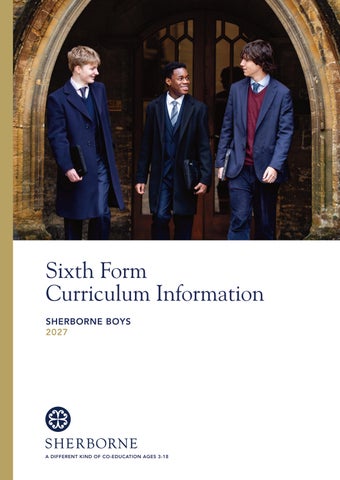
Sixth Form Curriculum Information SHERBORNE BOYS 2027
A DIFFERENT KIND OF CO-EDUCATION AGES 3-18
Contents Entry into the Sixth Form Guide to Making Good Choices
3 5
Subjects Art & Design Biology Business Chemistry Computer Science Design & Technology: Product Design Drama & Theatre Economics English Language and English Literature English Literature BTEC Enterprise & Entrepreneurship French Geography History History of Art Mathematics Further Mathematics CTEC Media TV & Film Pathway Music Music Technology Photography Physical Education Physics Politics Psychology Religious Studies Sociology Spanish BTEC Sport Textiles
7 8 9 10 11 12 13 14 15 16 17 18 19 20 21 22 23 24 25 26 27 28 29 30 31 32 33 34 35 36
S H E R B O R N E B OY S S I X T H F O R M
1
2
S H E R B O R N E B OY S S I X T H F O R M
Entry into the Sixth Form It is important that you choose Sixth Form options that you find interesting and inspiring, because this will help you to learn. However, it is also crucial that you choose subjects that match your strengths, talents and unique set of skills. You also need to base your options choices on a strong foundation of knowledge and understanding to perform well in the Sixth Form and beyond. Entry Criteria: In order to be eligible to study in the Sixth Form you need to:
continue with the subject at A Level unless you have a solid A grade in either the supporting (I)GCSE or in that specific subject component if you have completed the Dual Award Science (I)GCSE. A further exception is Mathematics, for which you must have an A* or A, or a 7, 8 or 9, in Mathematics (I)GCSE to progress onto the A Level course. Indeed, because you can achieve an A grade in Maths (I)GCSE with as little as 60%, boys who have a relatively weak A grade in (I)GCSE Maths are advised to seek specific advice about whether continuing onto A Level is a sensible option for them.
° Achieve an average of a 4 (a C grade) across all of your (I)GCSEs ° In order to transfer automatically to a subject at A Level you need to achieve at least a grade 7 (an
Notes:
A grade) in the subject at (I)GCSE
• Boys fluent in a second language may explore the possibility of taking an A Level in this language in addition to their three subject choices. If this is relevant to you, please discuss this possibility with Dr Filtness before making your options choices.
° No additional criteria are required to gain a place on a BTEC course. In the case of subjects which have not been taken at (I)GCSE, we will take into consideration your performance in other relevant supporting subjects. For example, if you wish to study Business at A Level and have 7s or above in supporting subjects like English or Maths, that would certainly serve as a ‘green light’ for you to take Business at A Level.
• It is perfectly fine to study Business and Economics together. Similarly, Business and E&E BTEC or Economics and E&E BTEC work well in combination.
Grades 1-4 (C grades or lower) are not a viable basis from which to start an A Level course. If you have a 4 or anything less you will need to reconsider your options and choose a different course. If you have a 5 or 6 at (I)GCSE (a B grade) and wish to study that subject at A Level, we will discuss this possibility with the relevant Head of Department to determine whether or not you have a strong enough foundation to be successful on that A Level course. In many cases (but not all) this will be deemed to be the case. However, for heavily factual subjects like the Sciences it is unlikely that you will be allowed to
At the time this booklet was edited (September 2026) we were mid-way through a review of subjects offered across the Sherborne Schools. We would ask for your understanding if the review therefore affects the nature of subjects offered or the School offering them.
3
4
S H E R B O R N E B OY S S I X T H F O R M
Guide to Making Good Choices For lots of reasons it is really important that you pick three subjects that are appropriate, sensible and realistic. Broadly, there are three main topics you should explore when you start to consider which A Levels and BTECs are right for you. These are: 1. The Future - This relates to transition to university Post-18 pathways and the world of employment beyond that. In particular, an awareness of informed choices, a guide to A Level subjects considered essential, or important for certain university courses, is crucial. 2. The Package - You should view your A Level/BTEC choices as parts of a meal. Individually, they’re OK, but when combined sensibly you produce something special. Additionally, not everything goes well with everything else! It is also important to realise that, by following the A Level/BTEC route into Higher Education, you are opting to become a specialist. Therefore, you should pick subjects that support each other. Don’t pick subjects that are varied simply to ‘keep your options open’ or to provide ‘balance’- much better to pick three things that are right for you, will reinforce each other and add weight to your UCAS application. 3. Yourself - everyone is unique. This means that there will be subjects that you are better at, subjects that you truly enjoy, and subjects that you would do well to leave behind at (I)GCSE. In order to pick subjects that fit well with your aptitude and character you need to reflect on your own strengths and limitations (be honest!) and also to know what the A Level/BTEC courses involve.
Other questions to ask include: ° How comfortable are you with Maths? There’s quite a lot of it in some subjects… ° What is your (I)GCSE target in that subject? ° Does coursework play to your strengths? ° Are you organised? Are you the kind of person who likes working in Art/DT/Music at weekends? ° Do you read? Some subjects have a lot of reading associated with them; not just English! ° How much work is expected outside of the lessons? ° What kinds of skills are assessed? Do you need to analyse, evaluate, explain, argue etc? ° Are there any marks for contemporary knowledge or things that have happened recently in the news? If yes, this means you’ll need to be regularly watching the news or reading a periodical like The Economist. ° How much practical work is there? ° How much theory do you need to learn? How difficult is this? ° What do people say is the hardest part of this subject? When picking options, do: ° Think about your strengths and aptitudes ° Pick subjects that go together ° Find out what each subject involves ° Find out what employers look for ° Pick things in-line with your (I)GCSE Target Grades ° Choose subjects that are assessed in a way you’re comfortable with and that play to your strengths ° Check that your A Level/BTEC choices meet university course requirements
5
A LEVEL AND BTEC COURSES
6
S H E R B O R N E B OY S S I X T H F O R M
ART & DESIGN
Are you someone who’s creative, imaginative, and full of ideas? Do you enjoy expressing yourself visually or finding new ways to look at the world? If so, A-level Art & Design could be the perfect subject for you. Art & Design is all about exploration, creativity, and communication. It’s your chance to develop your own artistic voice while learning new techniques and understanding how art shapes the world around us. You’ll be encouraged to think independently, experiment with materials, and bring your ideas to life in original and exciting ways. What will I study? This course gives you the freedom to explore your own creative interests. You’ll develop skills in observation, visual thinking, and problem-solving, while discovering how artists and designers communicate through their work. You’ll also have the opportunity to work across different areas of Art & Design, including: ° Drawing and Painting ° Mixed Media (collage, assemblage, etc.) ° Sculpture and Ceramics ° Printmaking (including screen printing and lithography) ° Photography and Moving Image ° Installation Art You can specialise in one area or mix several together — it’s about finding your own creative direction. How will I be assessed? Exam board: AQA Specification Code: 7202 Qualification: A-level Art & Design
Your work is assessed in two main components: Component 1 – Personal Investigation (60%) You’ll choose a theme, idea, or concept that inspires you and develop a body of work around it. This will include both practical pieces and a short piece of written reflection. Component 2 – Externally Set Assignment (40%) You’ll respond to one of eight exciting starting points provided by AQA. This culminates in a final piece created during a supervised session. Why it’s worth taking You’ll learn by doing: experimenting with materials, media, and creative processes. You’ll build independence and confidence, developing ideas that are personal and meaningful. You’ll gain transferable skills such as creativity, visual communication, and problem-solving, all valued by universities and employers. It complements a wide range of other subjects, from Sciences and Humanities to English and Technology. Art & Design can lead to a huge variety of creative careers; from architecture, animation, fashion, and graphic design, to film, photography, illustration, interior design, and beyond. Thinking of taking it? Before starting the course, it’s a great idea to: Practise observational sketching — look closely at the world around you and try to capture it. Experiment with different ways of recording your ideas, such as photography or short films. Visit galleries and museums whenever you can — they’re brilliant for inspiration and understanding how artists communicate their ideas.
7
BIOLOGY
Cambridge International Biology A Level offers a captivating and comprehensive study of the living world, making it an enticing subject. It delves into the intricate workings of organisms, exploring topics such as genetics, evolution, ecology, and human physiology.
What else should I consider? Entry Requirements The specific entry requirements for A Level Biology is generally a grade 7 or above in Biology GCSE, or Grades 7-7 in Double Award GCSE Science.
What is the course content? Year 1 – AS Level
It’s obviously useful to have a strong curiosity about the natural world, an interest in biological processes, and an enthusiasm for scientific inquiry.
° Cell structure ° Biological molecules ° Enzymes ° Cell membranes and transport ° The mitotic cell cycle ° Nucleic acids and protein synthesis ° Transport in plants ° Transport in mammals ° Gas exchange ° Infectious diseases ° Immunity Year 2 – A2 Level ° Energy and respiration ° Photosynthesis ° Homeostasis ° Coordination and control ° Inheritance ° Selection and Evolution ° Biodiversity, Classification and Conservation ° Genetic technology
Subject combinations There are several complementary subjects that can work well with A Level Biology. Chemistry is often considered a natural pairing as it provides a deeper understanding of biological processes at a molecular level. Additionally, subjects like Mathematics can be advantageous for dealing with statistical analysis and calculations involved in biological research. Other subjects such as Psychology, Physical Education and Geography (Environmental Science) can also offer valuable interdisciplinary perspectives. Pre-course material Platforms like Khan Academy and Seneca Learning offer online courses that cover Biology topics at the A Level. Websites like PhysicsAndMathsTutor and SaveMyExams provide concise explanations, diagrams, and interactive resources covering the biology topics. How will I be assessed? Assessment Examination board: CAIE Specification Code: 9700
How is the course assessed? Exams in Lower Sixth ° Paper 1 Multiple Choice (15.5% of A Level) ° Paper 2 Structured Questions (23% of A Level) ° Paper 3 Practical Skills Assessment (11.5% of A Level) Exams in Upper Sixth ° Paper 4 Structured Questions (38.5% of A Level) ° Paper 5 Planning, Analysis and Evaluation (11.5% of
8
A Level)
Please note - exams can be retaken in November and again in June if required with the best score being carried forward.
S H E R B O R N E B OY S S I X T H F O R M
BUSINESS
The A Level Business course introduces you to the theories of business management and factors that influence business operations and strategy. It does not teach you how to run a successful business but provides a framework to understand why some firms succeed and others fail.
Theme 4 - Global business 4.1 Globalisation 4.2 Global Markets and Business expansion 4.3 Global Marketing 4.4 Global Industries and Companies (multinational corporations)
It is a topical course - looking at how Businesses adapt to change: e-commerce, pandemics, inflation, artificial intelligence and a dynamic political landscape. The first year considers how the different functions of a business interact with each other - the second year focuses on business strategy and Globalisation. Inevitably, numerical skills form a significant part of the assessment, though the skills taught are practical analysing financial data to assess business performance. Essay writing is another skill you will need to develop - accounting for a third of the final assessment.
How is the course assessed? The Business A Level is a linear course - an assessment that includes three exams taken at the end of two years of study. There is no requirement to complete coursework. The exams feature a range of question styles: short answer questions, essay questions, data response questions and case studies.
£
What is the course content? The course is split into four themes: Theme 1 - Marketing and people 1.1 Meeting customer needs 1.2 The market 1.3 Marketing Mix and Strategy 1.4 Managing people 1.5 Entrepreneurs and leaders
Theme 2 - Managing business activities 2.1 Raising finance 2.2 Financial planning 2.3 Managing finance 2.4 Resource management 2.5 External influences
Theme 3 - Business Decisions and Strategy 3.1 Business Objectives and Strategy 3.2 Business Growth 3.3 Decision-making techniques 3.4 Influences on business decisions 3.5 Assessing Competitiveness 3.6 Managing change
What else should I consider? A Level Business provides an excellent foundation for those interested in studying Business, Finance, or Management at university. The skills are transferable across a broad range of subjects and careers.
€
Pre-course material There is a wide range of Business literature available; Shoe Dog’ by Phil Knight and ‘Bezonmoics’ by Brian Dumaine provide accessible texts based on Nike and Amazon.
$¥
How will I be assessed? Assessment Examination board: Edexcel Specification Code: Edexcel Level 3 Advanced GCE in Business (9BS0)
9
CHEMISTRY
Chemistry sits at the crossroads of many disciplines and is often called the Central Science. It is a stimulating subject in its own right, its aim being to explain, manipulate and mimic the material world around us. You will find the chemist peering into the nanoscopic world of individual atoms and predicting their behaviour using powerful computers; or developing new, non-polluting power sources; perhaps inventing novel polymers to be used in technology and medicine; and even synthesising new and complex molecules that imitate the natural substances found in biological systems. The A Level course will allow you to understand the world at a more fundamental level, giving you an insight into the practical applications of the subject, valuable training in the scientific method, and developing transferrable skills that are prized by universities and employers alike. Your suite of A Levels goes a long way to deciding your university and career pathways; Chemistry is welcomed by all subjects and employers. The chemist is trained to problem-solve and to analyse data, looking for patterns: these skills are often considered invaluable, and many Chemistry graduates end up working in law, the financial services and management as a result. What is the course content? The course builds on material studied at (I)GCSE, with the Upper Sixth, in turn, building on AS material. You will initially be familiar with the concepts being studied, but we will quickly expand on these as the course progresses. Lower Sixth Form topics include atomic structure and the periodic table, bonding and structure, redox chemistry, groups 1 and 7, moles, alkanes, alkenes, alcohols and halogenoalkanes, analytical techniques, energetics, kinetics and equilibria. Upper Sixth Form topics include equilibria II, kinetics II and energetics II, acids and bases, redox II, transition metals, further organic chemistry, analytical techniques II and synthetic pathways.
10
How is the course assessed? We follow the Pearson Edexcel Level 3 Advanced GCE in Chemistry specification (9CH0). All candidates must pass a practical competency component (this runs over the two years and involves carrying out 16 practical assignments – this is a pass/fail component, no one has ever failed!) and a series of terminal exams in June of the Upper Sixth comprising: ° Paper 1 – 1½ hrs – physical and inorganic Chemistry – 30% of final score. ° Paper 2 – 1½ hrs – physical and organic Chemistry – 30% of final score. ° Paper 3 – 2½ hrs – general and practical principles of Chemistry – 40% of final score. What else should I consider? The single most important Chemical proficiency is a capacity for hard work, by reviewing material you find difficult and being proactive when you need help. Hot on the heels of these, and shown to be very helpful, is a good (level 7) Chemistry (I)GCSE as well as a good (level 8) GCSE Maths qualification. Co-curricular opportunities include weekly academic support sessions, Oxbridge preparation groups and Chemistry symposiums. How will I be assessed? Assessment Examination board: Edexcel Specification Code: 9CH0
S H E R B O R N E B OY S S I X T H F O R M
COMPUTER SCIENCE
In the modern world, solutions that require inputs from Computer Science are increasingly ubiquitous. It is. now a fundamental input into the success of most industries, from medicine, the entertainment industry and security and finance. The recent advances in AI have the most profound change in the world that we’ve seen in our lifetimes, and it is the job of Computer Scientists to ensure that we have ethical, computational and mathematical frameworks in place that facilitate these technologies. In the A Level course, you will learn the fundamentals of all of these. What is the course content? The course comprises of the following key areas, designed to give a broad and academically challenging set of topics: 1 Fundamentals of programming 2 Fundamentals of data structures 3 Fundamentals of algorithms 4 Theory of computation 5 Fundamentals of data representation 6 Fundamentals of computer systems 7 Fundamentals of computer organisation and architecture 8 Consequences of uses of computing 9 Fundamentals of communication and networking 10 Fundamentals of databases 11 Big data 13 Fundamentals of functional programming 14 Systematic approach to problem solving 15 Non-exam assessment - the computing practical project (NEA)
° Paper 2 - 40% of the total mark for the course – This paper tests a pupil’s ability to answer questions from subject content 5-12. It is assessed by a written exam lasting three hours. Pupils answer a series of short and extended answer questions. ° Non-exam Assessment (Project) - 20% of the total mark for the course – Additionally, there is a nonexam assessment which assesses a pupil’s ability to use the knowledge and skills gained through the course to solve a practical problem. Pupils will be expected to follow a systematic approach to problem solving, as shown in section 13. What else should I consider? Although we can accept exceptional pupils who have not studied the subject at GCSE, it is a huge advantage to have studied it. Those that have not will need to invest considerable time in developing core GCSE programming skills over the summer. There is a large proportion of the course that is highly mathematical and would favour pupils who think mathematically and enjoy solving puzzles and write code as a hobby. Pre-course material Understanding the Python content on https://www.w3schools.com/python/ would be highly advantageous. How will I be assessed? Assessment Examination board: AQA Specification Code: 7517
How is the course assessed? ° Paper 1 - 40% of the total mark for the course – This paper tests a pupil’s ability to program, as well as their theoretical knowledge of computer science from subject content 1- 4. It is assessed by an onscreen exam lasting three hours. Pupils answer a series of short questions and write/adapt/extend programs in an Electronic Answer Document. One larger program is given to the boys to study as preliminary material. This is a practical examination and is completed entirely with a computer.
11
DESIGN & TECHNOLOGY: PRODUCT DESIGN
A Level Design & Technology: Product Design is a broad and engaging subject established to provide a vehicle to develop your creativity and innovation and to build an understanding of the built world around us. It is centred around identifying problems and creating solutions. It will help you develop confidence in analysing situations, thinking critically, and finding creative solutions to challenges. These problemsolving skills are highly transferable and applicable to a wide range of fields and industries. The subject involves practical, hands-on learning experiences that go beyond traditional classroom activities. You will get to work with various materials, tools, and technologies, enabling you to develop practical skills and gain a deeper understanding of the design and manufacturing processes. Product Design integrates elements of Science, Technology, Engineering, and Mathematics (STEM). It provides you with the opportunity to apply scientific and mathematical principles in practical contexts, fostering interdisciplinary learning. This can be particularly appealing to you if you are interested in STEM subjects and looking for a hands-on and creative approach. What is the course content? ° An understanding of materials and manufacturing technology – what makes carbon fibre composite suitable for the hull and the foils of yachts such as the AC40 and how is it formed? ° An appreciation of how technology is applied to enhance design – You will learn to use ComputerAided Design to enhance your design development and consider the benefits and concerns relating to the application of robotics and AI in the workplace. ° An appreciation of the foundations of design and where technology is going – You will look back at the 20th-century design movements to appreciate their influence and then consider the materials that NASA is developing to be delivered to the Martian surface where they could transform into structures in response to its surface environment.
12
The NEA – an extended, assessed project Over the two years, you will work with a client to develop a product to meet their needs, developing strong design communication skills in the process. You will take the design right through to production, developing a fully functional prototype to test with them. The staff in the Department will support you in doing so, and the NEA is a vehicle to practically reinforce the theory you have studied. How is the course assessed? The Department delivers the Edexcel Advanced GCE D&T – Product Design course [9DT0]. The theory represents 50% of the course, and this is assessed in a single, 2 ½ hr terminal exam [9DT0/01]. The remaining 50% of the marks come from an assessment and moderation of the NEA [9DT0/02]. What else should I consider? There is a significant benefit to having studied D&T GCSE prior to taking on this A Level, as the GCSE introduces excellent foundation skills and knowledge, but it is not a requirement. Naturally, a pupil choosing to take on the A Level without the GCSE foundation would benefit from additional studies across the summer and in the Lower Sixth Form year to catch up. Pre-course material Our pupils develop a deep interest in technology. The Internet is awash with creative blogs and online magazines that bring the latest thinking, innovation, and design right into your email inbox. You should subscribe online to the architecture, interiors, and design magazine: https://www.dezeen.com/ How will I be assessed? Assessment Examination board: Pearson Specification Code: 9DT0 – Product Design
S H E R B O R N E B OY S S I X T H F O R M
DRAMA & THEATRE
Why study Drama and Theatre? Drama and Theatre has become a highly respectable A Level over the last decade; it is valued by universities as a subject connected to both the arts and the humanities. The balance of practical skills and academic knowledge, as well as a growing understanding of, and empathy for, the world around us, allows pupils to develop a wide range of skills and disciplines. It is one of the few subjects that is not based 100% on a written paper at the end of U6. This gives pupils the chance to work practically and attain 60% of their marks before the examination season. It provides an opportunity to spend lessons doing something creative, on their feet, rather than being stuck behind a desk. Drama and Theatre is ideal for those who like to create work that questions assumptions, enjoy finding innovative ways of communicating with an audience, and, most importantly, enjoy performing. Course content Pupils study five different plays from various eras (performing sections of three of them), learn to evaluate live theatre as a critical audience member, create their own piece of theatre based on a topic that interests them and reimagine a classic text for a modern audience. They will learn about theatre history and key practitioners, and how to use these to inspire their own innovative style. They can be assessed as an actor, a director or a designer. Assessment is of written essay skills and practical acting and directing skills in equal measure.
Will I enjoy it? Drama is a subject with an almost infinite number of starting points, styles and influences. Whatever a pupil’s passion, they can explore it through the medium of drama. We aim to make the study of Drama an enjoyable and positive learning experience. What else should I consider? Drama and Theatre A Level does not only lead to degrees in the performing arts, though it is an obvious choice for those with an interest in acting, directing, technical theatre or anything based in TV, film or theatre. The collaborative and presentation skills acquired are highly valued by courses such as Business, Law, and Medicine. Subjects that complement Drama include English, Classics, History and Art. Drama students have the option of taking a performance-based EPQ or an Arts Award Gold. Drama GCSE is not obligatory, but in these circumstances some co-curricular involvement in Drama is required. Pupils have opportunities to take part in co-curricular Drama via one of the School productions and in the House Drama competition. These opportunities are well worth taking up, as well as those for pupils to stage their own work; the more performance experience a pupil has, the more successful they will be in examined work. Pre-course material The best way of preparing for Drama and Theatre A Level is to watch as much theatre as possible. As well as watching live performances in London or your local theatre, there is a wealth of online theatre on both the Online Drama Library or Digital Theatre+. How will I be assessed? Assessment Examination board: Eduqas Specification Code: A690QS
13
ECONOMICS
Economics can be defined as the science of scarcity - a study of how we allocate scarce resources in a world of infinite wants. Put simply, it aims to answer Who gets what, and why? The Economics A Level provides a framework to analyse the problem of scarcity in our society. The UK is currently experiencing record inflation, rising interest rates, labour shortages, and a cost-of-living crisis. In Economics we ask questions, we look at opposing arguments and, through informed discussion, we learn to agree and disagree. What is the course content? The subject is split into two branches and asks some of the following questions: Microeconomics – concerned with individual markets and small aspects of the economy. ° What determines the price of education in a boarding school? ° What strategies can be put in place to combat climate change? ° What happens when natural minerals and ores such as oil, zinc, copper, and aluminium start to run out? ° Why do famous footballers earn more money than doctors? Macroeconomics – concerned with the whole aggregate economy. Issues such as inflation, economic growth, and trade. ° What will be the consequences of high inflation? ° What will be the consequences of higher interest rates? ° Will the benefits of Brexit outweigh the costs? ° Should the government focus on economic growth or protecting the poorest?
14
How is the course assessed? The Economics A Level is a linear course - assessment includes three exams taken at the end of two years of study. There is no requirement to complete coursework. It is a topical subject - the questions asked in the final year of your course are likely to be based on the economic events that occur in the first year of your course - having an interest in current affairs is vital. What else should I consider? Economics A Level provides an excellent foundation for those interested in studying Economics, Finance or Management at university. The skills are transferable across a broad range of subjects and careers. Pre-course material There is a wide range of Economics Literature available: ‘Economics the User Guide’ by Ha JoonChang and ‘How Markets Work’ are both accessible texts. How will I be assessed? Assessment Examination board: Edexcel A Specification Code: Edexcel Level 3 Advanced GCE in Economics A (9EC0)
S H E R B O R N E B OY S S I X T H F O R M
ENGLISH LANGUAGE AND LITERATURE Why study English Language and Literature? If you love reading, writing, and understanding how language really works - but don’t necessarily want to follow the ‘traditional’ route of studying Shakespeare or poetry - the combined English Language & Literature A-Level is an ideal choice. This A-level gives you the pleasure of engaging with rich and exciting texts – novels, drama and nonfiction - without requiring the Shakespeare or poetry components found in many other specifications. Instead, you’ll explore a diverse range of voices and genres that speak directly to modern life and contemporary issues. At the same time, you’ll gain a practical, analytical toolkit through the study of linguistic frameworks. By learning how writers structure language, shape meaning, and influence audiences, you develop skills that are valuable not only for English but for any subject or career that relies on communication, persuasion, or clear thinking.
What else should I consider? Studying this A-level helps you become a confident and critical reader, an adaptable and skilled writer, and someone who understands how language shapes the world. It’s a course for curious, thoughtful students who want the best of both literature and language, and who are excited by the idea of understanding texts deeply while crafting their own. Subjects to combine with English: The combined English Language & Literature A-level combines especially well with Drama, History of Art, Psychology, Sociology, Classical Civilisation and MFL. Assessment Examination board: Pearson Edexcel Specification code: 9EL0
Will I enjoy it? An important feature of this course is its focus on original writing. You will produce your own creative and non-fiction texts, supported by reflective commentary and research. This becomes a portfolio which exhibits your voice, creativity, and technical control. This can support university applications, creative courses, or future work involving content creation, media, journalism, or communications.
15
ENGLISH LITERATURE
The English Literature A Level leads to you becoming a more effective reader and a better writer. It challenges you to look at the world around you in new ways and from new perspectives. Aside from being a fantastic course that will open your eyes to the wider world, English Literature works well in a combination with other humanities and languages, or as something different with which to balance your study of Maths or Science. It is a facilitator subject that can help you in your analytical writing, particularly if you are looking at a humanities-related degree. The Old Shirburnians who studied English Literature at A Level have gone on to pursue a range of careers, including Law, Journalism, Finance, Advertising, TV Production, Acting and Documentary Filmmaking. Studying literature also shows future employers that you can: ° Express yourself clearly and fluently both orally and in writing ° Put forward ideas and arguments in a concise manner ° Think independently ° Gather, investigate and assess material ° Analyse and problem solve ° Show empathy and insight How is the course assessed? The course is comprised of three components: ° Component 1: Drama and Poetry pre-1900 (exam - 40%) ° Component 2: Comparative and Contextual Study (exam - 40%) ° Component 3: Coursework portfolio (20%) The third component is made up of the coursework portfolio (20%). In this component you produce two pieces of assessed work. The first piece can either be an essay or a piece of creative writing, mimicking the style of a text/writer. The second task is a comparative essay which allows you the opportunity to explore your individual literary interests in a highly personal task.
16
What is the course content? ° Component 1: • Hamlet by William Shakespeare • One of the following text combinations: • Edward II by Christopher Marlowe and Paradise Lost, Books IX and X by John Milton • A Doll’s House by Henrik Ibsen and The Merchant’s Prologue and Tale by Geoffrey Chaucer ° Component 2: Gothic Literature • Dracula by Bram Stoker • Frankenstein by Mary Shelley What else should I consider? The Department runs a range of Co-curricular activities that we would encourage you to attend: ° Cecil Society ° Debating ° Creative Writing It is strongly advised that you have a grade seven or above in English Literature at GCSE. Pre-course material As a department, we encourage you to read widely and to pursue your own literary interests. However, if you are considering studying English Literature at A Level, it may help to read the following texts: ° The Art of Fiction by David Lodge ° Shakespeare’s Restless World by Dr Neil MacGregor. How will I be assessed? Assessment Examination board: OCR Specification Code: H472
S H E R B O R N E B OY S S I X T H F O R M
BTEC ENTERPRISE & ENTREPRENEURSHIP Entrepreneurs are essential to our society because they build the economic engines that help our economy grow. The qualification is equivalent to one A Level and carries the same UCAS points for university entry. The BTEC National Extended Certificate is an academic, practical, and vocational course where you will learn by completing projects and assignments based on realistic workplace situations and activities in addition to several externally set tasks and exams.
How is the course assessed? The course comprises four units (or subjects) that cover the broad range of the enterprise sector. Two Units are assessed internally through a portfolio of evidence: written assignments, presentations, or practical demonstrations. The third unit is project-based - pupils have three hours to design a marketing campaign in controlled conditions. The final unit is assessed externally via a traditional two-hour exam.
What is the course content? Unit One: Enterprise and Entrepreneurship Gain an overview of the importance of both Enterprises and Entrepreneurs to the local and national economy. You will also look at the risks, opportunities, and constraints in setting up a venture, assess the feasibility of a range of potential enterprise opportunities and develop and present one idea for a local enterprise.
What else should I consider? A difference between A Level and BTEC is the timing of assessment. Traditional A Levels have the bulk of their assessment at the end of a two-year course, while BTECs have assessments throughout. It is not uncommon for BTEC pupils to have completed the course by April of their second year - leaving them time to focus on A Level preparation. Some pupils enjoy a format in which their understanding is assessed at the end of the course - some do not. When choosing your Sixth Form options, it is important to consider your preference for assessment.
Unit Two: Developing a Marketing Campaign Marketing is a dynamic field central to the success of any business. You will gain an understanding of market research, explore different stages of developing a campaign and design one for a given product/service. Unit Three: Business and Personal Finance Personal finance involves understanding why money is important. The Business Finance introduces you to accounting terminology, the purpose and importance of business accounts, and the different sources of finance available to businesses. Unit Four: Social Enterprise Social enterprises are becoming increasingly significant in the business world. Learners will have the opportunity to produce a plan to run a social enterprise.
Pre-course material We recommend reading a range of Enterprise literature, including autobiographies and books focused on the rise of different companies: Amazon, Nike, and Tesco. There are also a range of business podcasts you can listen to over the holiday. We recommend listening to ‘How I Built This’ - available on all streaming platforms, in which, the world’s bestknown entrepreneurs discuss how they built their iconic brands. How will I be assessed? Assessment Examination board: Pearson BTEC National Specification Code: Pearson BTEC Level 3 National Extended Certificate in Enterprise and Entrepreneurship (360 GLH) 601/7414/6
17
FRENCH
Communicating in a foreign language is an essential skill for the 21st century. Over 80% of the world does not speak English as a first language. Whether for work or travel, languages are important for interacting. Linguists are increasingly attractive on the job market, where their knowledge and transferrable skills make them amongst the most sought-after graduates in the UK. Speaking more than one language improves skills such as multitasking, decision-making and communication. French is the second most sought-after language by employers in job postings in the UK. According to the Office for National Statistics, France is the UK’s third most important non-English-speaking export market. French is extremely important for both inward and outward tourism. France is the second most popular destination for people from the UK travelling abroad. What is the course content? Four key skills are taught and assessed: Speaking; Listening; Reading and Writing. Topic-based content includes aspects of contemporary French society. A book and a film are studied. Weekly conversation classes with native speaking assistants support pupils with their speaking skills. In the Upper Sixth pupils do an independent research project, where they choose a topic of personal interest connected to the Frenchspeaking world and present their findings in the speaking exam. Examples of topic areas: ° Politics in the French-speaking world ° Popular culture in the French-speaking world ° Film: La Haine ° Literary Text: No et Moi by Delphine de Vigan
How is the course assessed? AQA A Level French is examined in three exams at the end of course. The core skills of listening, reading, writing and speaking are almost evenly balanced. ° Paper 1 assesses skills in listening, reading and translation. ° Paper 2 assesses written skills through two essays on a film and a book studied during the course. ° Paper 3 is a speaking exam with two sections: spoken response to a stimulus card on one of the topics from the study of the target language society followed by a discussion of the candidate’s Independent Research Project. What else should I consider? Good A Level linguists are interested in developing communication skills and have an open mind towards learning about new cultures. Languages combine with any subject combination. Common subject combinations recently have been languages with economics/business, history or geography. Some scientists thinking of medicine or engineering also take a language as their third A Level. It is easy to add a new language to a lot of degree courses and many universities offer the opportunity to take a sandwich year abroad. An enrichment course leading up to a Diploma in Spanish is also available alongside three A Levels in other subjects. Pre-course material To gain a good understanding of both the culture of the French-speaking world and the French language, pupils are recommended to: 1) Watch films and series in French on a streaming service; 2) Keep up with the news in French using Euronews at https://fr.euronews.com; 3) Practise French through listening to songs and working with the lyrics on www.lyricstraining.com How will I be assessed? Assessment Examination board: AQA Specification Code: 7652
18
S H E R B O R N E B OY S S I X T H F O R M
GEOGRAPHY
Put simply, Geography is the study of the world around us. It is for those with an inquisitive mind that want to know more about what shapes the places we live in, how they have changed over time, how they will change in the future and, dare I say it, what we can do about it. We are global citizens not only occupying an increasingly interconnected world but also shaping it. Geography provides the toolkit to understand this world and to make sense of the changing landscapes – be they natural, cultural, geopolitical, or otherwise. It is a subject that is unique in bridging the gap between natural and social sciences. It encourages one to look out at the world with an inquisitive, analytical, evidence based and critical mind. In the words of Michael Palin (President of the Royal Geographical Society), “Geography is not only up-to-date and relevant, it is one of the most exciting, adventurous and valuable subjects to study today”. What is the course content? The course content at Sixth Form, comprise ‘core’ Physical and Human Geography for the AS, which is studied in Year 12 and ‘advanced’ Geography for the A2, which is studied in Year 13. The AS content includes more topics covered in less breadth whilst the A2 content has less topics with scope for more detailed analysis and evaluation of contemporary geographical issues. A summary of the topics studied is included in the following section. How is the course assessed? The syllabus studied at Sherborne is the Cambridge International A Level. We adopt a ‘modular’ approach, whereby the AS exam (comprising 50% of the overall A Level) is completed at the end of Year 12 and the A2 exam (comprising the remaining 50% of the overall A Level) is completed at the end of Year 13. There is no coursework element in the course. Each exam has a Physical and Human element which are completed as separate papers. A summary of the papers and the topics studied is shown:
° Paper 1 – Core Physical Geography (AS level) Topics: Hydrology river processes and hazards, Atmospheric processes and global climate change, Earth processes and mass movements. ° Paper 2 – Core Human Geography (AS level) Topics: Population and migration, Water resources and management, Urban areas and management. ° Paper 3 – Advanced Physical Geography Options (A2 level) Topics: Coastal Environments and Hazardous Environments. ° Paper 4 – Advanced Human Geography Options (A2 level) Topics: Environmental issues and management, Trade aid and tourism. What else should I consider? Geography is a subject for those that have an interest in the world around them; the reason for studying it need be no more complex than that. Good writing and reading skills are certainly beneficial. A willingness and interest in reading beyond the course will set pupils apart from their peers. There is a vibrant Geography Society which offers opportunities to engage with debate, external and internal competitions and upskilling on key geographical software such as Arcgis. Pre-course material Books such as Prisoners of Geography by Tim Marshall and Factfulness by Hans Rosling are wonderful texts and offer a good insight into studying Geography at Sherborne’s Sixth Form. The RGS also provide a wealth of resources specifically targeted at those considering studying Geography at A Level. How will I be assessed? Assessment Examination board: Cambridge Specification Code: 9696
19
HISTORY At Sherborne we are passionate about the past: the contrast of a modern, outward looking department surrounded by ancient buildings is reflected in our curriculum. History is a perfect facilitator for most future pathways and compliments any set of A Levels. Boys have taken History as part of a traditional arts, humanities or social science package but also studied it alongside mathematics and science, enhancing their analytical and writing skills. A large proportion of History pupils read History or a related subject such as International Relations, Law or Politics at Russell Group universities, but have also pursued options as diverse as medicine, a PWC degree apprenticeship and Sandhurst. The Department has traditionally had a strong Oxbridge performance and in recent years our best historians have had success at competitive universities.
explore how Britain fought, mobilised its armed forces and industry, and maintained morale at home. Students examine key wartime leaders like Churchill and Lloyd George, pivotal battles and military strategy, and how pressures of global warfare reshaped politics, society and the economy, strengthened the state’s role, and fuelled calls for change. or
What is the course content? We follow the Edexcel A Level syllabus – route C: Revolutions
Civil rights and race relations in the USA, 1850-2009 The topics trace the changing relationship between Black and white Americans, from slavery to the election of Barack Obama. They examine key civil rights developments and wider social and cultural shifts that shaped modern America, highlighting how race relations evolved yet remained central to the nation’s identity and challenges.
Component 1C (30%): Britain, 1625-1701: conflict, revolution and settlement Step into the turbulent 17th century with key figures like King Charles I, Oliver Cromwell, and James II. Discover the fierce power struggle between monarchy and Parliament, from the English Civil War to the Glorious Revolution of 1688. Experience how revolution, religion, and rebellion reshaped Britain and transformed its future forever. Assessment: One 2¼ hr paper. 60 marks. AO1 (knowledge) and AO3 (interpretations). Component 2C.2 (20%): Russia in revolution, 1894-1924 Explore the drama of the Russian Revolution with key figures like Tsar Nicholas II, Lenin, and the Bolsheviks. Uncover the unrest, rebellion, and radical change that shook Russia from 1894 to 1917. Follow the fall of the tsar, the rise of the revolutionaries, and the creation of a new communist state that transformed Russia and reshaped the modern world. Assessment: One 1½ hr paper. 40 marks. AO1 (knowledge) and AO2 (sources).
20
Component 3 (30%): The British experience of warfare, c1790-1918 The topics focus on Britain’s experience of major overseas wars and the intense demands of modern conflict. They
Germany, 1871-1990: united, divided and reunited The topics trace Germany’s transformation from Bismarck’s new empire to its collapse in World War I, followed by the Weimar Republic and then Hitler’s dictatorship. They explore dramatic political, social and economic shifts, from Nazi defeat to West German democracy under leaders like Adenauer, and finally reunification in 1990 under Helmut Kohl, highlighting Germany’s turbulent path to stability and unity. or
Assessment: One 2¼ hr paper. 60 marks. AO1 (knowledge) and AO2 (sources) Component 4 (20%): NEA Coursework Largely completed in the Upper Sixth this unit is an independent study, covering a topic of choice, or taken from a set of guided questions around the themes of war, revolution, ideology, and dictatorship. Assessment: One 3,000 - 4,000 word essay. What else should I consider? There are no specific entry requirements to study A Level History, but the course is more accessible to pupils who have achieved a Grade 7 or above in GCSE History. More important is an enthusiasm for the subject, a willingness to engage with the course and a love of debate. How will I be assessed? Assessment Examination board: Edexcel Specification Code: 9HI0
S H E R B O R N E B OY S S I X T H F O R M
HISTORY OF ART History of Art is an exciting, fascinating A Level that is unlike any other on offer. Uniquely, it combines looking at physical objects of art, and studying how they are made, and relating them to the widest kinds of ideas: from personal motives, to power, ideas about the afterlife, or philosophical and political context. Although writing is involved in this A Level, the visual quality and richness of the subject makes it easy to remember artworks and really allows pupils to make connections between them. History of Art is an ideal subject to develop crucial skills of forming arguments, critical thinking, logical reasoning, and persuasion. These are all key skills in job interviews and any potential career. It also fosters a really broad and detailed knowledge and appreciation of world culture, which is fundamental in being successful in a global market. Future pathways include museum work, art dealing, law, finance, civil service and diplomacy, marketing, PR, sports and theatre management, journalism and the armed forces. What is the course content? 1 Visual Analysis: a short crash course in teaching you to be able to effectively analyse and interpret an image of any painting, sculpture or building you might come across, without having to know anything about it beforehand. 2 War Theme: explores art across time and space that has been made as the result of human conflict. This of course includes propaganda and art made to glorify war, but also to memorialise the dead, or even criticise wars in a variety of ways. We look at a diverse range of artifacts, from Japanese medieval fortresses, depictions of WW1, marble memorials to Venetian admirals, or vast canvases depicting English and French battles.
3 Nature Theme: as an antidote to the human chaos and suffering of War, this theme looks at how nature is portrayed in paintings, sculptures as well as buildings. The stars of the show for many here are Gaudi’s extraordinary creations, but Monet’s and Constable’s landscapes, Baroque giants made by Giambologna, and Chinese ink paintings are just as intriguing. 4 Rebellion and Revival: unlike the themes above, this module takes a deep and detailed look at the revolutionary artworks of the 19th century in France and Britain. This century saw the rise of Impressionism, Gothic Revival architecture, and the whole idea of “modernity”. 5 Brave New World: this period focuses on the first half of the 20th century, with the iconic movements and artists that we are all somewhat familiar with, such as Picasso and Cubism, Matisse, and Salvador Dali and Surrealism. This is a feast for the eyes and minds! How is the course assessed? This is a linear A Level with no coursework. It is assessed at the end of the two-year course with two written exams. What else should I consider? You will need to gain a minimum of Grade 4 for GCSE English, in order to have the sufficient confidence for the written aspects of the course. There is no practical knowledge of art needed, e.g., drawing or painting. Pre-course material Watch this series to get an idea of how art history provides the backdrop to human experience: BBC iPlayer - Civilisations How will I be assessed? Assessment Examination board: Pearson Edexcel Specification Code: 9HT0
21
MATHEMATICS
Mathematics is an interesting and highly relevant subject in the modern world; it is about pattern and structure, and the logical analysis, deduction and calculation within these patterns and structures. More importantly, its application enables us to give a simple, yet accurate and elegant representation of the complex world around us. A Level Mathematics builds on topics you will have met before, but incorporates new ideas, concepts and techniques. It supports many other subjects and is a highly sought-after qualification both in the workplace and at university. What is the course content? A Level Mathematics is a two-year linear course incorporating both Pure and Applied components (Mechanics and Statistics). In brief the Pure course covers the following topics: proof, algebra and functions, co-ordinate geometry, sequences and series, trigonometry, exponentials and logarithms, differentiation, Integration, numerical methods and vectors. The Statistics course includes statistical sampling, data presentation and interpretation, probability, statistical distributions and hypothesis testing and the Mechanics course covers quantities in mechanics, forces and Newton’s laws, kinematics and moments. How is the course assessed? The course you will study is the Pearson Edexcel A Level in Mathematics. At the end of the Upper Sixth, you will sit three (2-hour) examination papers; two are Pure (two-thirds of your overall mark/grade) and one Applied (Statistics and Mechanics – one third of your overall mark/grade).
What else should I consider? If you are thinking about taking Mathematics then you should be aiming to achieve at least a grade 8 at GCSE/IGCSE, if you are unsure whether you will achieve this, talk it through with your present teacher who will be best placed to guide you. Many pupils find the step from GCSE to A Level quite difficult, but it is perfectly manageable if you are prepared to work hard, willing to take responsibility for your own progress and confident in asking for help as and when you need it. That being said a strong foundation in numbers and algebra is essential; you need to feel comfortable manipulating algebraic expressions. You will also need to have reasonable spatial awareness so that you can relate graphs and diagrams to abstract ideas and, you must be prepared to communicate your thoughts and mathematical working in a clear and structured way. Throughout the Sixth Form we seek out extra-curricular opportunities to reinforce, stretch and challenge those that have opted for Mathematics and provide support for those whose preferred University and course require them to complete admissions tests (STEP and MAT). Pre-course material GCSE Mathematics should provide you with the foundation knowledge required to complete an A Level in Mathematics. However, there are a number of resources online which are designed to make the transition from GCSE to A Level as smooth as possible. The AMSP have produced a really good, free downloadable resource called “Transition to A Level Mathematics: Essential Skills” which you may find useful. How will I be assessed? Assessment Examination board: Pearson Edexcel Specification Code: 9MA0
22
S H E R B O R N E B OY S S I X T H F O R M
FURTHER MATHEMATICS
This course builds upon the concepts covered in A Level Mathematics so must be studied in addition to, rather than in replacement of A Level Mathematics. Further Mathematics qualifications are highly regarded and are warmly welcomed by universities. If you are considering a degree in Mathematics, the Further Mathematics A Level would certainly be beneficial and in some cases will be a pre-requisite. The course is also considered useful if you intend to study Computer Science, Economics, Engineering or Physics at University. In addition, if you are intending to apply for a degree in Computer Science or Mathematics at Oxford or a Maths or Maths based subject at Cambridge, you will need to sit STEP 2 or MAT which will require you to have some knowledge of the Further Mathematics syllabus. What is the course content? A Level Mathematics and Further Mathematics are taught linearly across two-years. In the first year you will cover all aspects of the A Level Mathematics course and in the second year you will cover the Core Pure and Applied components from the Further Mathematics Course. The Applied component is made up of two out of these three options: Further Statistics, Further Mechanics and Decision Mathematics. During the course you will be prepared for all three of these options and the best two results in the final exams will contribute towards your overall grade.
How is the course assessed? The courses you will study are the Pearson Edexcel A Levels in Mathematics and Further Mathematics. At the end of the Upper Sixth you will complete the A Level Mathematics examinations alongside five (1½ hr) additional examination papers; two based on the Further Maths Core Pure content (50%) and three which cover the Applied content: Further Statistics, Further Mechanics and Decision Mathematics. The best two results from the three Applied papers will contribute to your overall grade (50%). What else should I consider? If you are thinking about taking Further Mathematics then you should be aiming to achieve a grade 9 in GCSE/IGCSE Maths and ideally also studying a Further Maths course. If you are unsure whether you will achieve this, talk it through with your present teacher who will be best placed to guide you. Throughout the Sixth Form we seek out extra-curricular opportunities to reinforce, further stretch and challenge those that have opted for Mathematics and provide support for those whose preferred University and course require them to complete admissions tests (STEP and MAT). Pre-course material GCSE Mathematics should provide you with the foundation knowledge required to complete an A Level in Further Mathematics. However, there are a number of resources online which are designed to make the transition from GCSE to A Level as smooth as possible. The AMSP have produced a really good, free downloadable resource called “Transition to A Level Mathematics: Essential Skills” which you may find useful or visit MEI.org.uk for more resources. How will I be assessed? Assessment Examination board: Pearson Edexcel Specification Code: 9FM0
23
CTEC MEDIA TV & FILM PATHWAY Ever watched a film or television show and thought, I wonder how they do that, or I could make something better than this! If that’s the case, the Television and Film course at Sherborne offers you the opportunity to explore your creativity through the medium of digital film making. Media (TV and Film) is offered as a Cambridge Technical Introductory Diploma Level 3, which is equivalent to an A Level course, both in terms of the time required to study for it (360+ hours of lessons over two years) and the weighting it receives by universities. As with the other BTECs on offer, Creative Media is a modular course, offering a range of different options in Digital Film and Video Production, and Digital Content Production. The whole class will follow a programme of options within that discipline and will finish with a specialist CTEC qualification in this field. The optional modules consist of a variety of coursework projects, each of which explores a diverse range of TV and Film production and digital production techniques. What is the course content? Depending on your creative interests, you have the option of completing units in Film and Video Editing, Music Video Production, Multi camera TV production Single Camera Production (narrative film making), Factual Film making (documentaries), Advertising Production or Social Action and Community Media Production (Campaign Film Making). Indeed, if you have a burning passion project waiting to be produced, this is your moment. How is the course assessed? This course is 100% coursework, with all the work internally assessed before being externally verified by the exam board in year 2. A Media CTEC offers a different style of approach to your Sixth Form: the flexible, unit-based structure provides you with much greater control and choice over what you learn.
24
What else should I consider? The CTEC course offers clear higher education pathways and employment opportunities. Pupils who complete the course can go on to specialist courses at Durham University, Ravensbourne University London, The Berlin Film School and New York Film School, Bournemouth Arts University, Falmouth University, Loughborough University and Oxford Brookes, amongst many others, and study diverse courses such as: script writing, filmmaking, media production, digital film production, journalism, television, photography, animation, computer game design, creative writing, editing and post-production and other specialist courses. Pre-course material The best thing anyone can do when embarking on a Media course is the chance to create original content from the off. If you are considering a career as a film maker, you need to make your own content. Everyone has a video camera to hand these days, so shooting interesting and original footage is no longer just in the hands of those with specialist equipment. No prior knowledge is required to embark on the course, just an interest in the moving image, and the desire to make film magic happen. How will I be assessed? Assessment Examination board: OCR Specification Code: 600/6176/5
S H E R B O R N E B OY S S I X T H F O R M
MUSIC Music is constantly evolving, inspiring creativity and expression in a way that no other subject can. A Level Music brings listening, performance and composition to life in new and engaging ways, and links to the world around us like never before. Studying music develops many transferable skills, including collaboration, communication, critical thinking, and performing under pressure. Music is looked upon favourably on a UCAS application since it is a highly analytical and challenging subject. Class sizes are often small so a lot of individual attention can be given.
In addition to the performance and composition
What is the course content? The OCR A Level course is split into two pathways (Option A or Option B):
° Developments in Instrumental Jazz 1910–1950,
Option A
° Innovations in Music 1900–Present Day.
° Performance (25%): A recital of at least six minutes, consisting of at least two contrasting pieces. Performances may include solo work (on one or more instruments or voice), ensemble performance (including accompanying), or a realisation using music technology. ° Composition (35%): Compositions with a combined duration of at least eight minutes, consisting of: ° one composition to a brief set by OCR, ° one composition to a brief written by the learner, and ° three short technical exercises (harmony and counterpoint). Option B ° Performance (35%): A recital of at least 10 minutes, consisting of at least three contrasting pieces. Performances may include solo, ensemble, accompanying, or music technology realisation. ° Composing (25%): Compositions with a combined duration of at least eight minutes, consisting of: ° one composition to a brief set by OCR, ° one composition to a brief written by the learner, and ° three short technical exercises (harmony and counterpoint).
components, all candidates complete a written examination, which contributes the remaining 40% of the A Level. This paper assesses listening, analysis, and contextual understanding of set works from six Areas of Study, including: ° Instrumental Music of Haydn, Mozart and Beethoven, ° Popular Song: Blues, Jazz, Swing and Big Band, ° Religious Music of the Baroque Period, ° Programme Music 1820–1910, and
The paper includes listening tests, analysis questions, and two essays based on the chosen Areas of Study. How is the course assessed? All components are externally assessed by OCR at the end of the two-year course. What else should I consider? Whilst GCSE Music is not essential, a good pass is recommended. By the end of the A Level course, pupils should be performing at approximately Grade 6 level or above to access the top two mark bands for technical control. Music combines well with subjects such as English, Mathematics, Physics, and Modern Languages. Pre-course material ° Music: A Very Short Introduction — Nicholas Cook (Oxford University Press). ° The Science of Music — BBC series presented by Robert Winston. How will I be assessed? Examination Board: OCR Specification Code: H543
25
MUSIC TECHNOLOGY
Modern music is at the heart of contemporary culture, from electronic dance and DJing to rock and hip hop. This course offers pupils the opportunity to explore how popular music is created, recorded and produced, while developing a critical understanding of its context and technological foundations. Using Ableton Live and professional studio equipment, pupils learn to record and produce music to industry standards, developing both creative and technical skills that prepare them for further study or work in the music industry. What is the course content? The A Level is divided into four components: ° Component 1: Recording (NEA, 20%): Pupils capture, edit, process and mix a multitrack recording from a set list of songs released annually by Edexcel. They produce a finished track of three to three-and-a-half minutes, using professional recording and mixing techniques, and submit a detailed logbook alongside the recording. ° Component 2: Technology-based Composition (NEA, 20%): Pupils create an original composition of at least three minutes in response to one of three Edexcel briefs. The piece must demonstrate use of synthesis, sampling/audio manipulation and creative effects. This component allows pupils to develop imaginative sound design and compositional techniques using Ableton Live. ° Component 3: Listening and Analysing (Exam, 25%): A written paper based on unfamiliar commercial recordings, assessing understanding of recording and production techniques, the principles of sound and audio technology, and the development of music technology since 1945. ° Component 4: Producing and Analysing (Exam, 35%): A practical and written examination in which pupils use provided audio and MIDI materials to correct, edit, combine and mix tracks in a controlled environment. The paper also includes written production questions and one extended analytical response.
26
Assessment ° Coursework (40%): Recording (20%) and Technology-based Composition (20%) ° Examinations (60%): Listening and Analysing (25%) and Producing and Analysing (35%) All components follow the Pearson Edexcel A Level Music Technology specification (9MT0). Beyond the Classroom Pupils benefit from access to Sherborne’s recording studio and Mac suite, equipped with Ableton Live, high-quality microphones, interfaces, and MIDI controllers. They gain valuable experience in studio practice, critical listening and creative production, forming an excellent foundation for university or professional pathways in music, sound design or media production. Pre-course Material ° Sound on Sound (magazine and website) ° Ableton Live software tutorials ° Big Studio Secrets for Home Recording and Production — Joe Dochtermann ° Perfecting Sound Forever — Greg Milner ° The History of Music Production — Richard James Burgess How will I be assessed? Assessment Examination board: Pearson Specification Code: 9MT0
S H E R B O R N E B OY S S I X T H F O R M
PHOTOGRAPHY Why study Photography? Photography falls within the same specification as A Level Art & Design and is structured in a similar way. The obvious difference is that, instead of producing work in the medium of pencil or paint, images are produced using some form of lens-based media: i.e. photographs using digital or traditional 35mm film.
• Digital Post Production: image organisation, editing, enhancement, manipulation and presentation using industry-standard software, Adobe CC including Bridge, Lightroom, Photoshop and Premier Pro • Engagement with the work of contemporary photographers and historical movements
Photography teaches pupils ‘how to see’ and adds significantly to their understanding of the visual, digital world we all inhabit. Developing such skills is an essential part of twenty-first century life and will enhance skills in other subjects by teaching pupils what it means to wrestle with ideas, experiment with a wide range of photographic processes and outcomes, and critically evaluate their own successes and areas for development.
Will I enjoy it? For pupils who enjoy taking photographs, being visually creative and are interested in exploring new ways to express ideas and meanings, Photography A Level is a great course. It is well suited to those who enjoy a project and coursework-based approach to learning, are inspired by other artists, and love visiting exhibitions and working with other pupils to bring projects and ideas to life.
What is the course content? The A Level Photography course provides the opportunity to explore a broad range of photographic techniques and processes. These include traditional black-and-white darkroom techniques, and digital photography, studio lighting and creative post-production software techniques with still and moving images. The course is designed to teach pupils the fundamental technical and experimental skills needed to produce successful photographs and lens-based media outcomes, and ultimately prepare them to make final resolved works using any technique or process they wish.
What else should I consider? There is no requirement for pupils to have studied Photography or Art before. It is a good choice for pupils who intend to study Photography with Art at art school. It is also a good creative subject to add to any A Level subject combination. It is accepted by most university courses and provides a foundation for a vast and growing range of careers in the creative industries.
Pupils are taught: • The SLR and DSLR cameras: technical investigation into how to use a single lens reflex camera • Composition: compositional skills needed in creating exciting images through the lens • Darkroom: the technical process of chemical film development, photograph printing and experimentation • Studio: technical investigation into how to use continuous, strobe and creative lighting setups
All assessment takes place at the end of the course and consists of: • Personal Investigation (60%) – Portfolio of practical work – 1,000-3,000 word written element • Externally set assignment: 15 hours (40%)
Assessment Examination board: AQA Specification Code: 7206
27
PHYSICAL EDUCATION This enriching course provides pupils with comprehensive knowledge about the principles and significance of physical activity and sport. By combining practical application with academic exploration, they can enhance their own performance or coaching abilities through theoretical understanding. This course serves as an excellent foundation for pursuing a university degree in fields such as sports science, sports management, healthcare, or exercise and health. Furthermore, it complements further study in disciplines such as biology, human biology, physics, psychology, nutrition, sociology, and more. Embarking on the study of A Level Physical Education opens doors to a wide range of career opportunities. You can explore paths in sports development, sports coaching, physiotherapy, and personal training. Moreover, the transferable skills acquired during your Physical Education journey, such as decision-making and independent thinking, will prove valuable in any career path you choose to pursue. What is the course content? The syllabus focuses on four areas of sport: Physiological factors affecting performance; Biomechanics; Skill acquisition and Sports psychology; Socio-cultural issues in physical activity and sport. How is the course assessed? A total of three examination papers (two 1 hr and one 2 hr) taken at the end of the two-year course. A wide range of question types including single mark, short answer, and extended response questions. Nonexamined practical performance in one sport, as either a coach or a performer in an activity and a nonexamined Performance Analysis task.
What else should I consider? To enrol in this course, it is recommended that pupils who have previously studied GCSE Physical Education have achieved a grade 7 or higher. However, prior completion of the GCSE syllabus is not mandatory, and individuals with a strong foundation in science will still be able to access the course material. A Level Physical Education often compliments pupils pursuing scientific disciplines or vocational courses such as BTEC Sport. The sporting opportunities available at Sherborne Boys complement the A Level curriculum, providing pupils with valuable experiential learning opportunities. One notable aspect of this course is that 15% of the overall grade is awarded based on practical performance. This means that talented sportsmen or coaches have the opportunity to secure a substantial portion of their final grade even before sitting for examinations. Pre-course material The Sports Gene: Inside the Science of Extraordinary Athletic Performance by David Epstein (Author) Bounce: The Myth of Talent and the Power of Practice by Matthew Syed The Science of Sport Podcast World-renowned sports scientist Professor Ross Tucker and veteran sports journalist Mike Finch break down the myths, practices and controversies from the world of sport. The two delve into the most recent research, unearth lessons from the pros and host exclusive interviews with some of the world’s leading sporting experts. How will I be assessed? Assessment Examination board: OCR Specification Code: H555
28
S H E R B O R N E B OY S S I X T H F O R M
PHYSICS
Physics takes in the study of the smallest building blocks of matter and extends to our understanding of the universe as a whole. You will develop analytical skills that you can apply to many aspects of life: the ability to break a problem into parts to understand the whole, is a very sought-after skill. This is one of the reasons why Physics is such a respected subject among employers, who will always be looking for talented problem-solvers. Physics is a vital component of a successful CV for any boy looking to study subjects such as Physics, Engineering, which includes many possible varieties, and Computer Science at university. What is the course content? We study the AQA A Level Physics course, which contains eight core topics and one option topic. Particles & Radiation, Waves, Mechanics & Materials, Electricity and Further Mechanics are all covered in the Lower Sixth. Thermal Physics, Fields, including Gravitational, Electric and Induction, and Nuclear Physics are studied in the Upper Sixth. In the Upper Sixth we also study the Option topic, which is determined by the teachers of the set, and is most likely to be either Astrophysics or Engineering, having previously been successful choices. Measurements & Errors is studied throughout the course and underpins all the practical work. How is the course assessed? You are assessed with three 2hr exams at the end of the two-year course. Each is worth approximately a third of the course and are comprised of short and long answer questions as well as multiple choice questions on two of the papers. You must also complete the twelve core practicals and demonstrate that you are competent in your practical skills. This is a pass or fail criteria, but it is not something that anyone is expected to fail. The skills are assessed on Paper 3.
What else should I consider? There is no requirement that you take Mathematics at A Level, but it is highly recommended. Anyone not taking A Level Mathematics is required to take an extra timetabled lesson every week: Mathematics for Physics. Taking Mathematics, and particularly Further Mathematics, will enhance the chance of obtaining a top grade. Those considering Physics or Engineering courses at elite universities are highly advised to check the univerisity websites as most will now require you to take Further Mathematics alongside Physics. A seven in GCSE Physics/Double Science is the minimum grade needed to take Physics at A Level. To do well on the course you should really be obtaining the top grades in your GCSE Sciences and Mathematics. Pre-course material A couple of good books that you could look at are Six Easy Pieces by Richard Feynman and What if? by Randall Munroe. If you have particular subjects of interest such as Astrophysics or Quantum Computing, do get in touch and we can recommend some appropriate reading. If you fancy a good movie, but also want to get thinking about Physics, check out Interstellar (2014) by Christopher Nolan or The Martian (2015) by Ridley Scott - we also highly recommend the source novel by Andy Weir. Any of the videos on the YouTube channel Veritasium are well worth a look. How will I be assessed? Assessment Examination board: AQA Specification Code: 7408
29
POLITICS
Few subjects are as contemporary or relevant as Politics. In a world of tension between populist nationalism and supra-national liberalism, we are seeing the creation of the United Kingdom’s post Brexit reality, in addition to the changing geopolitical power balance involving the United States, Russia and China. The vibrant political environment in the United Kingdom offers a perfect backdrop against which to study the governmental institutions and political processes of this country. What is the course content? As mentioned, the Edexcel course is divided into three components, each intensely relevant to our lives. They are as follows: 1 UK Politics and Core Political ideas: This section examines how people engage in UK politics and the development of its democratic system. Students explore direct and indirect democracy, the role of political parties, and how manifestos influence government mandates. It also covers how electoral systems function, what shapes voting behaviour, and the impact of the media on contemporary politics. 2 UK Government and Non-core Political ideas: This component focuses on how political decisions are made within the framework of the UK constitution. Students study the roles and powers of the legislature, executive, and judiciary, and how sovereignty and power are balanced among them. It also explores constitutional change, comparisons with other systems, and debates on where sovereignty lies today. 3 Comparative Politics: Students investigate US democracy, its Constitution, and how power is exercised through key institutions. They assess whether the US achieves “liberty and justice for all” and examine ongoing debates about its democratic nature. By comparing US and UK politics, students gain a broader understanding of global political systems and the principles of comparative politics.
30
How is the course assessed? Examination board: Edexcel The course is assessed at the completion of the Upper Sixth year, using three exam components (as above), each worth 33.3% of the final grade. What else should I consider? Of vital importance is a healthy interest in politics and contemporary current affairs. An interest in the political media, including social platforms, and a willingness to read beyond the textbooks will offer greater insight and success. Politics works well in combination with History, Geography, Sociology, Economics, Philosophy and English. Extra-curricular opportunities abound, including debating, parliamentary visits and lectures/workshops with MPs and Members of the House of Lords. Pre-course material A full reading list will be provided for this course, but pupils may find starting with the ‘A Very Short Introduction to...’ series an accessible introduction to several of the key concepts. General engagement with current affairs will also be beneficial as a starting point for this course. How will I be assessed? Assessment Examination board: Edexcel Specification Code: 9PL0
S H E R B O R N E B OY S S I X T H F O R M
PSYCHOLOGY
Exploring the science of mind and behaviour: Psychology is the study of how we think, feel and act a subject that invites you to explore the complexities of human and animal behaviour through scientific investigation and critical analysis. If you've ever wondered why people obey authority, how memory works, or what drives mental health, Psychology offers the tools to explore these questions and more. What will I study? Over the two-year course, you’ll delve into a wide range of psychological topics, including: ° Memory – How we remember, forget, and process information ° Social Influence – Why we conform, obey, and resist pressure ° Biopsychology – How the brain and nervous system shape behaviour ° Psychopathology – Understanding mental health conditions and their treatment ° Research Methods – Designing and evaluating psychological investigations ° Optional Topics – Such as Relationships, Schizophrenia, and Forensic Psychology You’ll learn to apply psychological theories to realworld scenarios, evaluate research critically, and develop your own reasoned arguments. Lessons often involve discussion, debate, and mini-experiments — encouraging curiosity and independent thinking.
How is the course structured? The AQA Psychology A Level is assessed through three written exams at the end of Upper Sixth. Each paper is 2 hours long and worth one-third of the final grade. There is no coursework. The exams are essaybased, so strong writing skills and the ability to analyse unseen material are essential. Where can Psychology take me? Psychology is a versatile and respected academic subject. It develops transferable skills such as: ° Analytical and critical thinking ° Clear and concise written communication ° Scientific reasoning and data interpretation These skills are valued in a wide range of university courses and careers. Psychology A Level provides a strong foundation for degrees in: Psychology (Clinical, Educational, Forensic, etc), Neuroscience, Law, Education and Business and Management. While not always a requirement for Psychology degrees, studying it at A Level is highly recommended. Pre-course material This course covers a range of introductory topics and themes from the AQA A Level Psychology course, including key approaches and research methods. https://ondemand.tutor2u.net/ students/transitionto-aqa-alevel-psychology-skills-booster How will I be assessed? Assessment Examination board: AQA Specification Code: 7181/7182
31
RELIGIOUS STUDIES
Step into a course that challenges your mind and sharpens your voice. This subject equips you with powerful tools—argumentation, evaluation, and critical thinking—that open doors to a wide range of university degrees and career paths. This subject trains you to construct clear, coherent arguments and spot flaws in others’ reasoning. You’ll learn how to evaluate evidence, identify assumptions, and follow complex chains of thought—skills that are essential not just in philosophy, but in law, politics, science, and beyond. Explore timeless questions like: ° Is there a God? ° What is reality, really? ° How do we define right and wrong? In a world increasingly shaped by AI and rapid change, those who can question deeply, reason clearly, and solve problems creatively will be the ones leading the way. This course doesn’t just prepare you for exams—it prepares you for life. This course offers lively debates on major topics like euthanasia, sexual ethics, and the problem of evil. You’ll learn to craft persuasive, well-structured essays— skills that open doors to a wide range of exciting careers. Those careers include politics (many of Britain’s Prime Ministers have studied Politics, Philosophy and Economics at university), Law (more lawyers in the UK studied Philosophy at university than Law) and the creative industries, such as comedy and film writing and performing. Lastly, but most importantly, it’s genuinely enjoyable. Many students say it’s their favourite A Level—thanks to inspiring teaching, lively debates, and the chance to explore big ideas about the world.
32
What is the course content? There are three parts to the course: Philosophy of Religion, Ethics and Developments in Christian Thought. They are all taught by different teachers and are examined in their own papers at the end of the course. Philosophy of Religion contains questions such as, ‘does God exist?’ and ‘why would a good God create evil?’; the Ethics part of the course looks at different ways philosophers have tried to work out what is right and wrong, and if those terms have any objective meaning; and the DCT part looks at questions such as the belief in original sin and whether the Bible is sexist. How is the course assessed? Candidates will sit three papers, one for each component. Each of the papers will provide four essay questions, and candidates will select three of these to answer. What else should I consider? Religious Studies is essay-based, so strong writing helps—but don’t worry, you’ll be supported to improve. It pairs well with almost any subject; past students have combined it with everything from Business to Physics. Plus, our joint Philosophy Society with Sherborne Girls offers a great mix of social and intellectual enrichment. Pre-course material You will engage with the work of influential philosophers like Plato, Descartes, and Hume and many original texts are available online. Accessible introductions—such as Peter Vardy’s Puzzle of Ethics and Puzzle of God—are great starting points. A full reading list will be provided before the course begins. How will I be assessed? Assessment Examination board: OCR Specification Code: H573 – Religious Studies
S H E R B O R N E B OY S S I X T H F O R M
SOCIOLOGY
Why study Sociology? Sociology is the study of human social relationships and institutions. Sociology’s subject matter is diverse, ranging from crime to education, from the family to the state, from the divisions of race and social class to the shared beliefs of a common culture. Unifying the study of these diverse subjects is Sociology’s purpose: understanding how human action and consciousness shape, and are shaped by, surrounding cultural and social structures. This A Level will help students to analyse critically sources of information and to base reasoned judgements and arguments on evidence. A Level Sociology helps students organise and communicate their knowledge and understanding in different and creative ways, and to appreciate the significance of theoretical and conceptual issues in sociological debate. Throughout the course they will evaluate sociological methodology and a range of research methods through active involvement in the research process. This will help develop skills that enable us as individuals to focus on personal identity, roles and responsibilities within society.
What is the role of institutions in society – do they perform positive functions, or simply work in the interests of the powerful and against the powerless? How and why has British society changed over the last 50 years? Course content (AQA Specification): Over the course of two years you will study: • Education • Crime and Deviance • Families and Households • Beliefs in Society • Theory and Methods Assessment Examination Board: AQA Specification Code: 7192
You will consider questions including: To what extent does our gender, ethnicity or class affect our life chances?
33
SPANISH
Spanish is the second most widely spoken first language in the world with almost 500 million native speakers and almost 140 million people who speak it as a second or foreign language. 18 million British tourists visit Spain every year while over 300,000 British nationals are residents in Spain. Spain is the UK’s 8th largest trading partner and according to the British Chamber of Commerce, 21% of foreign investment in the UK is from Spanish companies while British companies invest 14% of their entire foreign investment in Spain. Spanish is closely linked and provides a gateway to other romance languages such as French, Italian, Portuguese, Romanian and Catalan. What is the course content? Four key skills are taught and assessed: Speaking, Listening, Reading and Writing. Topic-based content includes aspects of contemporary Spanish and Latin American society. A book and a film are studied. Weekly conversation classes with native speaking assistants support pupils with their speaking skills. In the Upper Sixth pupils do an independent research project, where they choose a topic of personal interest connected to the Spanish-speaking world and present their findings in the speaking exam. Examples of topics areas: ° Politics in the Spanish-speaking world ° The Culture and Heritage of the regions of the Spanish-speaking world ° Popular culture in the Spanish-speaking world ° Migration in the Spanish-speaking world ° Gender equality in the Spanish-speaking world ° Racism in the Spanish-speaking world ° Film: Volver by Pedro Almodóvar ° Literary Text: Las bicicletas son para el verano by Fernando Fernán Gómez. How is the course assessed? AQA A Level Spanish is examined in three exams at the end of course. ° Paper 1 – assesses skills in listening, reading and translation. ° Paper 2 – assesses written skills through two essays on a film and a book studied during the course.
34
° Paper 3 – is a speaking exam with two sections: spoken response to a stimulus card on one of the topics from the study of the target language society followed by a discussion of the candidate’s Independent Research Project. What else should I consider? Good linguists are interested in developing communication skills and have an open mind towards learning about new cultures. Languages combine with any subject combination. Common subject combinations recently have been languages with Economics, Business, History or Geography. Some scientists thinking of medicine or engineering also take a language as their third A Level. It is easy to add a new language to a lot of degree courses and many universities offer the opportunity to take a sandwich year abroad. An enrichment course leading up to a Diploma in Spanish is also available alongside three A Levels in other subjects. Pre-course material To gain a good understanding of both the culture of the Spanish-speaking world and the Spanish language ahead of beginning the course, pupils are recommended to: ° Read The Ghosts of Spain by Giles Tremlett, a nonfiction exploration of contemporary Spain by a journalist who spent years living there. ° Keep up with the news in Spanish using Euronews at https://sp.euronews.com/ ° Read Forgotten Continent by Michael Reid, a nonfiction history of Latin America. ° Watch films and series in Spanish on a streaming service. ° Practise Spanish through listening to songs and working with the lyrics on www.lyricstraining.com How will I be assessed? Assessment Examination board: AQA Specification Code: 7692
S H E R B O R N E B OY S S I X T H F O R M
BTEC SPORT BTEC Sport enables pupils to experience the multifaceted subject as they apply their knowledge to personal development, elite performers, coaches, and practical scenarios. BTEC Sport serves as an excellent foundation for those interested in pursuing a university degree in fields such as sports science, sports management, healthcare, or exercise and health. Moreover, it seamlessly complements further studies in disciplines like biology, human biology, physics, psychology, nutrition, sociology, and more. The course provides a holistic educational experience that prepares you for a range of pathways within the sports industry and related fields. What is the course content? There are three mandatory units of study for BTEC Sport Nationals: Anatomy and Physiology; Fitness Training and Programming for Health; Professional Development in the Sports Industry. The final unit is chosen by the Physical Education staff and aims to suit the needs of the learners studying BTEC Sport each year. The choices include Sports Psychology, Practical Sports Performance and Coaching for Performance. How is the course assessed? It includes a range of assessment types and styles suited to vocational qualifications in the sector. There are two externally assessed units that equate to a third of the course each. Each assessment is taken under exam conditions, then marked by Pearson and a grade awarded. Learners are permitted to resit external assessments during their programme. Some external assessments include a period of preparation using set information. There are two internally assessed units that equate to a sixth of the course each. These assessments are coursework style projects. Assessments can be selected for the most appropriate styles according to the learning set out in the unit.
This ensures that learners are assessed using a variety of styles to help them develop a broad range of transferable skills. For example, learners may: ° Write up the findings of their own research ° Use case studies to explore complex or unfamiliar situations ° Carry out projects for which they have choice over the direction and outcomes ° Demonstrate practical and technical skills What else should I consider? To enrol in this course, it is recommended that pupils who have previously studied GCSE Physical Education have achieved a grade 6 or higher. However, prior completion of the GCSE syllabus is not mandatory, and individuals with a strong foundation in science will still be able to access the course material. BTEC Sport often compliments pupils pursuing scientific disciplines or other vocational courses. Pre-course material ° The Sports Gene: Inside the Science of Extraordinary Athletic Performance by David Epstein (Author) ° Bounce: The Myth of Talent and the Power of Practice by Matthew Syed ° The Science of Sport Podcast How will I be assessed? Assessment Examination board: Pearson Specification Code: 603/0458/3
35
TEXTILES Why study Textiles? Textiles is a vibrant, imaginative and exciting subject that invites students to explore ideas creatively and confidently. Our Textile Design course is for those who really enjoy Fashion or Textiles and who feel they are creative and motivated. Textiles is taught in the art department in well-equipped studios led by specialist staff who help students flourish. Course content We follow an art focused approach to Textiles, Fashion and Design. The scope of the course is broad and taught by enthusiastic and supportive staff. The aim is to develop your artistic and design skills by working with a wide range of textile processes and materials to create expressive and exploratory work. You will draw inspiration from the world around you, using photography and drawing to start your investigations. Researching influential artists, photographers and designers is fundamental, and you will explore influences from history and different cultures around the world. Stage 1 The first stage of the course will be a stimulating introduction to a wide variety of creative techniques. Working on your first component you will work on a set project encouraging you to experiment with a large variety of techniques including surface pattern, dyeing, free machine embroidery, using alternative materials, digital design, print and constructed textiles. Your second project will be more personal and encourage you to think about what areas of the subject you are most interested in. Your work will build into an indepth portfolio reflecting your own personal style and interests, supported by visits to galleries, museums and exhibitions that inspire and develop your ideas.
36
Stage 2 The second part of the course encourages you to develop your own interests and the areas of textiles that excite you most. This is through a project designed by you, called your Personal Investigation Project. The Personal Investigation, PI, is an independent project that builds on the skills you have learnt in the first year. It will commence in March of the L6th and gives you time to create ambitious final outcomes such as garments, installations or textile art pieces. There is a written element to this part of the course of 2000–2500 words. This is followed finally by an AQA externally-set assignment project. This is a project where the titles are set by the exam board, culminating in a 15 hour timed exam period. Your work will be displayed in our professional Wirth Gallery as well as during our annual fashion show. Your PI is worth 60% of your A level and the ESA is worth 40%. Both components are marked internally and moderated by an external examiner. Where can textiles take you after SG? This can lead to Textile/Art/Fashion-related degree courses such as Fashion Design, Printed and Constructed Textiles, Fine Art or Art Foundation courses. Our pupils have also gone on to study Fashion Journalism, Fashion Buying/Marketing/Promotion, Fashion Styling, Interior Design and Interior Architecture. Assessment Examination board: AQA Specification Code: 7204
S S
Sherborne Boys Abbey Road Sherborne Dorset DT9 3LF United Kingdom admissions@sherborneboys.group +44 (0)1935 810403
sherborneboys.group PA RT OF THE SHERBO RNE SCH O O LS G ROUP Sherborne Schools Group is a charitable company limited by guarantee, registered in England and Wales, No. 4002575 and registered with the Charity Commission for England and Wales, No. 1081228
38 July 2026