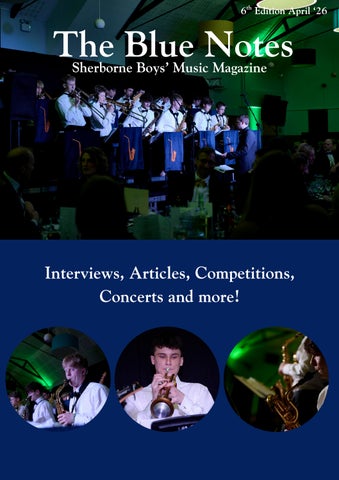
6th Edition April ‘26
The Blue Notes Sherborne Boys’ Music Magazine
Interviews, Articles, Competitions, Concerts and more!
CONT Table of Contents
Pg.2
The B u
Sherborne Boys’
INTERVIES, CONCERT ARTICLES
04 05 09
>> Welcome and Editor’s Notes
>> Interview with Teacher of History and Politics and Head of Charities and Outreach
>> Friday Lunchtime Recital:
Pianists, Organists, Woodwind, Brass and more...
TENT Table of Contents
Pg.3
ue Notes
Music Magazine
STORIES AND MORE...
>> Articles, Stories and more
23
>> Save the dates
38
>> Thanks…
41
Welcome The Blue Notes - Edition 5 - Feb ‘26
Pg.4
Welcome back to another edition of The Blue Notes. I am currently writing as we sit on the bus after a very exciting and successful concert at Cadogan Hall. With another rewarding half-term in the Music School, collectively all the staff and pupils have coped well with delivering some excellent music for you all to read about in this publication. Standout events include the Sherborne Schools’ Symphony Orchestra performing in Cadogan Hall, the annual Dinner and Jazz delivered by the renowned Swing Band, the continuous lunchtime concerts in Cheap Street Church, Choral Evensongs and much more. As always, I am excited to share with you some new articles and interviews, including one from Sherborne Girls’ Assistant Director of Music, marking the first jointschools article the magazine has seen. I hope you enjoy this edition as much as I have enjoyed producing it. I wish you all a happy break and happy reading! Sirtaaj G (4a) Editor-in-Chief
An interview with
Teacher of History and Head of Charities and Outreach
Mr Herod
Interview by Sirtaaj G (4a)
Pg. 5 What was the moment or piece that first drew you into classical music? Well, I don't remember one specific moment, but I do recall several meaningful episodes from my childhood. I remember playing a game on a computer – a ZX Spectrum, which older readers might remember – and you could choose whether to play this game called Frogger with or without the soundtrack. And the soundtrack was Beethoven. It would say, would you like Beethoven on or off? And I don't think I knew who Beethoven was. So it's funny how things come into your life. That, I think, was the first point at which I heard of Beethoven. I remember several other things. My father being given a set of Beethoven Symphonies on vinyl by a customer of his and me being very excited when he brought them home. I remember listening to some Johann Strauss II Waltzes on my parents' CD player and then playing them to my grandmother.
If you had to choose a favourite composer, who would it be? – and why? Well, that is an extremely difficult question from a very cruel interviewer. I will answer the question, but first let me just say the caveats. I listen to different periods of classical music at different times, sometimes within the same day. I quite like Baroque in the mornings, pure classical in the afternoons, romantic in the evenings. It depends on my mood. It depends on what else I'm doing. It depends on the season, the weather, the location. Then for each composer, it depends on which piece or genre you're talking about, but if I had to say one, it would be Mozart. No, Haydn. No, Beethoven. Probably today in late March. Beethoven. And why? Well, he's probably the one whose complete works I would take to a desert island, but my choice might depend on the location and weather of the island. He's possibly my favourite in at least two different genres, piano sonatas and string quartets.
He's close to my favourite in others, symphonies and piano concertos. He wrote almost nothing I find boring, apart from his sixth symphony, the Pastoral, and that bores me. It might be an example of what a dear friend of mine calls “cowpat music”. So sorry to fans of that symphony.
She wrote a letter to me shortly afterwards. That was back in the days when people wrote letters. To say how she had realised how important music was to me, and actually, that comment made me feel seen. I remember talking to my father one evening at home and between us, we ranked our top ten composers ever, and when I went to bed that night, I had a dream that I was the court composer in Liechtenstein. For some reason, I wanted to escape. I can't remember what was so awful about the position. I jumped out of the palace and then, quite bizarrely, landed in Millwall, the district in London. The sort of strange twist to that story is that years later, I ended up teaching history to the heir to the throne of Liechtenstein. But I suppose my real breakthrough moment was when I was 11 or 12. I was a clarinettist and I was given a copy of Mozart's Clarinet Concerto by my clarinet teacher for me to learn, and it was the first moment that felt like I was playing adult music. I thought it was absolutely gorgeous. I was so naive that I practised the tutti sections before being told they were the sections I was supposed to be silent in. That was a shame, actually, because I was much better at those than the solo sections.
If you could only listen to one era of classical music for the rest of your life, which would it be? You don't make this easy, Sirtaaj. I like Renaissance, Baroque and post-romantic. But in the end, I think it's a straight choice between classical and romantic, and I would say probably classical. If we're defining Beethoven as classical.
Mr Herod has been Teacher of History since joining Sherborne in 2024. Since 2025, he has also been Head of Charities and Outreach. Throughout his time at Sherborne, he has been a tutor in School House, and he runs the Classical Music Club which meets on Fridays at 17:15 throughout the Michaelmas and Lent terms and is open to all pupils at Sherborne Boys and Sherborne Girls. He also coaches cricket and is one of the leaders of the Duke of Edinburgh Gold expeditions. He is a fluent Spanish speaker and spends much of his holiday time in Spain. He particularly enjoys reading, listening to classical music, and walking.
An interview with
Teacher of History and Head of Charities and Outreach
Mr Herod
Interview by Sirtaaj G (4a)
Pg. 6
Are there any works you feel are misunderstood or unfairly overlooked by audiences today? I'm sure there are lots of things, but actually the fact that they are overlooked means I probably don't know them. I suspect a composer's publicity and success does not depend merely on their talent, but also the skills of their publicists, their own desire for self-promotion and simply whether a piece they wrote survived. It staggers me that J.S. Bach's music was neglected for about seventy-five years after his death, for example. And I'm sure there is much great music written by female composers about which we know nothing. Is it really true that six of the so-called greatest composers in history were born within five years of each other in Germany, Austria and Hungary? Mendelssohn, Chopin, Schumann, Liszt, Wagner and Verdi. Well, of course, they were some of the great composers, but it strikes me as a remarkable coincidence. Did the muse simply descend many times in a short period to the same bit of Europe? Also, I think we gain much more access to music from our own traditions than from others. I attended two concerts many years ago by a Ukrainian choir singing pieces I'd never heard before and haven't heard since, apart from on that particular choir’s CDs. And they were of spellbinding beauty, and I believe there must be a lot more like that. Actually, it happens more often that I don't understand what is great about something I have been told is great. I might listen to something lots of times and it just doesn't get under my skin. Haydn's late symphonies, Mozart's 41st Symphony, Beethoven's Violin
Concerto, Mahler's 8th Symphony.
None of that is to criticise those composers, by the way. I love them all. I'm referring to specific pieces. And I'm not even criticising the pieces. Who am I to do so? I understand that they're great. It's more that I just don't feel that they're great. And I realise what I've said would probably have me labelled as a philistine by thousands of music fans. It's difficult to pinpoint one.
Which composer would you most like to have dinner with, and what would you ask them? I'm not sure if I can narrow it down to one. I'll give you more than one. Beethoven, and I'd ask him who was the Immortal Beloved. Shostakovich, and I would say to him, how accurate was Volkov's testimony? Perhaps even John Cage. I think I might say to him, were you taking the mickey with Four minutes and thirty-three seconds? And how much money have you earned from it?
Is there a piece that you once disliked but grew to love over time? Shostakovich's String Quartet 8 is one which I referred to earlier.
How do you approach listening to a new piece for the first time – do you look for anything in particular? Well, I confess, I'm frequently doing something else while I listen. So I probably only listen with one ear or perhaps two half ears. I don't really listen for anything in particular within the music itself the first time, just whether I like it, how much I like it in comparison with other things by that composer or by other composers and whether it's as good or bad as other people's opinions have suggested. I suppose I'm basically both feeling an emotional response in my heart and ranking it in my head.
An interview with
Teacher of History and Head of Charities and Outreach
Mr Herod
Interview by Sirtaaj G (4a)
Pg. 7
If you could design a concert programme that reflects your personality, which pieces would you include? That reflects my personality? That's too difficult. It's probably not for me to judge my own personality. I think I just have to come up with something I like or whatever the intended audience liked. I've noticed that in general I incline towards the spiritual and the dark in music. There's only so much musical happiness I can take, especially triumphalism. Some huge generalisations coming, but I tend to prefer small scale to large, minor to major, strings to brass. Mozart only wrote two piano concertos out of 27 in a minor key, I think. And I'm drawn to them more than the other 25. Having said that, if I were creating a programme, I might include Palestrina's Missa Papae Marcelli, Haydn's Nelson Mass, Mozart's Clarinet Quintet, Beethoven's String Quartet 13, and I'd include the Grosse Fuge. Puccini's La Bohème, that's my guilty pleasure and also has some personal memories for me. Sibelius's Violin Concerto, probably something from the Eastern Orthodox tradition, maybe Rachmaninoff's All Night Vigil. Also, just to go back to Shostakovich, maybe his String Quartet 15. I read something the other day I didn't know, which was Shostakovich's instructions to the quartet who were premiering that String Quartet 15. And he said something amazing. He said, I want you to play it so slowly that the flies fall dead out of the air and the audience leaves the concert hall bored, and it's an extraordinary piece. It has six movements, and every single one is an adagio, and they are played at a glacial speed, which reflects his bleakness as he looked at the imminent end of his life.
What performance – live or recorded – has stuck with you the most? I remember going to see Daniel Barenboim play a Beethoven piano sonata at the Barbican years ago. I think it was the Hammerklavier, and I was in the office one day and a colleague suggested it. At the time I hadn't quite realised when I said ‘yes’ that our tickets were on the stage. So, at the Barbican, I sat just behind Daniel Barenboim's grand piano, in front of the whole audience. And every time he played a big chord, and as you know, there are many in that piece, he would raise his hands in the air, fix me with these penetrating eyes like those of a bird of prey, and then just come crashing down with his fingers. I was terrified and realised I couldn't move or flinch because of all those people watching me. The Ukrainian choir I've just mentioned; I looked them up a few years later and discovered there was no record of them online, at least that I found. And of course, that was particularly resonant because I wondered why they disappeared. But even at half term, this term, I went to see James Ehnes, the brilliant violinist who played the Mozart Violin Sonata KV 654 at Wigmore Hall. And at the same venue, also in half term, I heard the Beethoven String Quartet 15 by the Saccone Quartet, and they were both wonderful.
An interview with
Teacher of History and Head of Charities and Outreach
Mr Herod
Interview by Sirtaaj G (4a)
Pg. 8
How does the way in which you look and teach history tie in with classical music when you first listen to it? I'm very aware that all composers, despite their genius, reflect their times. I am aware when I listen to Beethoven of what was happening in terms of revolution and the influence of Napoleon, for example. Sometimes it's more obvious and probably more important than others. It enriches your experience of listening to Shostakovich, for example, immeasurably, to know something about the context in which he wrote, which for him was not just a national situation. That national situation impinged on his own life in a horrific and terrifying way. I don't know if you know this story, but he slept in the corridor outside his flat at night with a suitcase packed, so that when the Soviet secret police came for him during the night, they didn't wake his family. If you know much about Shostakovich, you discover that his Fifth Symphony, which he celebrates as one of his greatest, was what he called “an artist's response to just criticism.” He'd been heavily denounced in the Soviet publication Pravda fairly shortly before that. This symphony was a way of getting him off the hook with the authorities that may well have saved his life. His Seventh Symphony became the anthem of the war in the Soviet Union against Hitler. And the String Quartet No.8 was the suicide note that he wrote partly out of guilt at the fact he'd finally bowed to pressure and joined the Communist Party. So I think all of that is amazingly informative. I suppose that teaching history helps me to place composer in a particular set of circumstances. And being a date freak, my pupils would tell you that, helps me with that.
What role do you think classical music should play in modern education? I think young people should be given access and exposure to it. I would like young people to realise how fun, interesting and spiritual it is and how good it is for the mind. I don't mean just in terms of giving food for thought. I believe it plays a crucial role in actually shaping your mind and regulating your intellect and your emotions. I think it expands and heals. And it has played a crucial and positive role in my own mental health. The classical music expert and writer Stephen Johnson, whom I know but have lost touch with, wrote a fascinating book on this called How Shostakovich Changed My Mind. I also think teachers can use it to influence classrooms. I've been interested to see the effects it has on boys as they enter my classroom, if I have it playing. I've been quite surprised, actually, by the responses of boys, some of whom have special educational needs. And I think we can learn a lot more about its uses in this regard and as a form of therapy outside the classroom. I think actually playing and singing it has the benefits I've just referred to, but also others. I think it's useful, just as useful as things like sports, for example, in teaching qualities like planning and perseverance and in providing community and an environment in which relationships can flourish. It provides an arena in which people who might not shine in other areas can be brilliant or, much more important, happy. And I think that sometimes it helps to ask a question the other way around. What would modern education or even society be like without classical music? Awful, I think. Less interesting, less sensitive, and less human. I think we'd lose contact with an essential part of our shared heritage, our history, and we'd be more like some of the ghastly societies I teach boys about.
Friday Lunchtime Recitals Cheap Street Church, 1.45pm Pianists - 27 February The Blue Notes
Pg. 9
Before the Halliday Cup Competition for Pianists, we were delighted to hear a selection of boys who showed off their pieces to a full audience in Cheap Street Church. To kick off the concert, we first heard from Kotaro T (5e) as he performed Bill Withers’ Just the two of us. Kotaro showed that he had a great feel for this piece and executed a well learnt performance. We then heard from Nathaniel B (4e) as he played
Clementi’s Sonatina in C, Op. 36, No.3, 1st Mov. Nathaniel gave a
strong performance and showed great technical ability throughout. We then heard from James T (3e) as he played Schumann’s *** (No. 30 from
Album für die Jugend, Op. 68).
James’s performance provided a great sense of shape and structure, as well as including some great dynamics throughout. We then moved on to Patrick R (U6e) as he played Domenico
Scarlatti’s Sonata in C Kp.513. Patrick’s piece included some great dynamics as well as some beautiful melodic lines. Benji R (L6c) then took to the stage with Debussy’s Rêverie. Benji gave a well-executed and polished performance. Benji R (L6c)
We then heard from Perseus W (4c) as he played Mozart’s Sonata in A K.331 (iii). Perseus gave an exciting and upbeat performance, showing great enjoyment for his piece. Luke A-D (4b) then gave an exciting performance of Shostakovich’s Fantastic Dance No.1, showing off his technical ability and control. As we came to the end of our concert, we heard from Ian L (L6d) ATCL LTCL as he performed Szymanowski’s Metopy Op. 29 (i) Wyspa Syren. Ian performed with great control and provided the audience, as ever, with a spectacular performance. A wonderful way to end a short snippet into what would be seen at the Halliday Cup Competition.
Patrick R (U6e)
Perseus W (4c)
Friday Lunchtime Recitals Cheap Street Church, 1.45pm
Choral Scholars and Upper Sixth Formers - 06 March The Blue Notes In a quick change of events after the absence of Mr Marks, this Friday’s Jazz Concert was amended to a team of Choral Scholars and Upper Sixth Formers who stepped in and showed off their musicality to an audience that filled up the Church. To begin the concert we first heard from Archie S-B (U6f) as he performed Oliver “Jiggs” Wigham III’s (ii) Hills from Suite. Archie gave a well-shaped performance on the trombone which was then followed by singing from Mr Finlay Lyall (Sch. Cho). Mr Lyall was accompanied by Mr Eadon and sung Britten’s As it is plenty (On this Island) showing great vocal control as well as maintaining a great feel for the piece. My Lyall remained on the stage and performed Kurt Weill’s Lonely House (Street Scene). His performance provided the audience with a rich sound which showed great dynamic control. We then moved onto another one of our Choral Scholars, Mr Sebastian Young (Sch. Cho), who took to the stage to sing two pieces firstly Clara Schumann’s Lorelei. Mr Young sang beautifully, really showing great vocal and dynamic control throughout. He then sang Anthony Ritchie’s He Moemoea, again showing great vocal control over his high range which brought a wonderful performance to all. Archie G (U6f) then took to the stage and performed Abreu’s Tico-Tico. Expertly accompanied by Mr Davey, Archie showed a great sense of rhythm and understanding of his piece, making it an exciting and thrilling performance.
Pg. 10
Archie G (U6f)
Mr Young (Sch.Cho)
Our final performer, Organ Scholar Mr Joshua O’Niell (Sch. Org) began by singing Roger Quilter’s Go, lovely rose which was sung beautifully and showed great understanding and vocal expression throughout. The final performance of the concert now fell upon us all as we heard Mr O’Neill sing Bernstein’s Maria (from West Side Story). Accompanied by Mr Eadon, his performance was the perfect way to end such an enjoyable concert. Mr O’Neill (Sch.Org)
Friday Lunchtime Recitals Cheap Street Church, 1.45pm
Instrumental and Vocal Soloists III - 13 March The Blue Notes
Pg. 11 Before the exeat weekend, a small number of boys stayed on to play in one of our Friday Lunchtime Recitals. This time we heard from a collection of Instrumental and Vocal Soloists. We first heard from Perseus W (4c) as he delivered an excellent rendition of Heitor VillaLobos’ O polichinelo. Lucas C (5b) then took to the stage with Camille SaintSaens’ Concerto No.1 (I). Lucas provided a wellrounded performance overall. Henry B (5f) took to the stage as he made his Friday Lunchtime Recital Debut to sing Mozart’s O
Isis und Osiris (The Magic Flute), delivering a polished
and exciting performance. Zeeshan M (L6f) took to the stage on the ‘cello showing great understanding of Gabriel Fauré’s Sicilienne, Op. 78. Martha Mier’s Jackson Street Blues was delivered with great style and understanding by Nathaniel B (4e) on the piano. Henry B (5f)
Perseus W (4c)
Lucas C (5b)
We then heard from Oliver B (L6e) as he sang George Butterworth’s Is my team ploughing (A Shropshire Lad). Oliver performed with great confidence and with great control throughout his performance. Frazer F (5f) played us into the weekend with Andrew Adorian’s Spanish Dance, expertly accompanied by Mr Davey on the piano. Frazer showed great rhythmic control and understanding throughout his piece providing a wonderful way to play us all into a well-deserved break.
Friday Lunchtime Recitals Cheap Street Church, 1.45pm Brass - 20 March The Blue Notes
Pg. 12 As the final Friday Lunchtime Recital of the term crept up on us, we were delighted to hear some of Sherborne Boys’ finest Brass players. With a concert of trio, solo and ensemble performances all fifteen boys performed beautifully. The concert started off with our Brass Trio consisting of three Fourth Form pupils - Luke A-D (3b), Sirtaaj G (4a) and Ianto D (4f) as they performed Peter Younghusband’s Carry on Trumpets and Art Dedrick’s March of the Missilemen. Both performances were strong and were greatly supported by Mr Davey on the piano. Charlie S (L6f) then took to the stage as our first solo performer of the afternoon playing Bernstein’s Red, White and Blues on the trumpet. Charlie’s performance provided a smoky tone throughout as he was accompanied expertly by Mr Walker. Edward K (5g) was next on the programme and he delivered a beautiful rendition of Jerome Kern’s Smoke gets in your eyes with some beautifully smooth liquid lines throughout.
Sam O-B (3e)
Louis R (L6e)
We then heard Haydn’s Trumpet Concerto from two pupils, both accompanied by Mr Davey. We first heard James T (3e) on the trumpet as he played the first movement. James played some clear and strong cadenzas throughout his performance which led nicely into the second movement of the concerto played by Ben T (5f). Ben was able to capture the slow nature of this moment, delivering an allaround great performance. Louis R (L6e) then took to the stage with Madsen’s The Dream of the Rhinoceros. Louis’s performance was executed well and showed great technical control and ability. Sirtaaj G (4a) then performed William Boyce’s Trumpet Voluntary which was closely followed by Luke A-D’s (4b) rendition of Himes’ Concertino for Flugelhorn. Luke created a beautiful sound on the trumpet and was expertly accompanied by Mr Walker on the piano. Our last solo performance was delivered by Sam O-B (3e) on the trombone as he executed a lively rendition of Mark Nightingale’s The Turkey. The end of this term’s Brass Concert came all too soon as the Brass Band closed the show with Holst’s’ Second Suite for Military Band, (iv) Fantasia on the Dargason, which was arranged and conducted by Mr Costin. Collectively, the group performed well and supported each other in all areas ending another successful Lunchtime Recital. Brass Trio from left to right: Mr Davey, Ianto D (4f), Sirtaaj G (4a), Luke A-D (4b)
Halliday Cup Competition for Pianists The Blue Notes
Pg. 13
The Adjudicator - Alexander Aitken Alex is a West End Musical Director, with a national reputation as an outstanding conductor, pianist, organist, writer and educationalist.He maintains an extensive, slightly-too-busy, and hugely varied schedule working with the UK’s most eminent musicians, ensembles and organisations, as well as with choral groups and schools around the UK, and is in demand as a pianist for auditions and masterclasses. He is the Music Associate at Cameron Mackintosh Ltd, and works across Les Miserables, Oliver! and Mary Poppins, having also been Children’s Musical Director and Cover Conductor on the London production of Mary Poppins for three years. Alex also played on Jamie Lloyd and Nicole Scherzinger’s acclaimed production of Sunset Boulevard at the Savoy Theatre in London, and was Music Director and pianist for William Hanson’s 2025 Solitary Refinement tour. He is currently the Children’s Rehearsal Music Director for the UK and Ireland tour of Mary Poppins.
He has performed with, or accompanied, for the BBC Proms, the Lucerne Festival, Military Wives Choirs, Chichester Festival Theatre, Cambridge Music Festival, Eton Choral Courses, National Brass Player’s Championships and Cambridge Chorale, and also composed scores to numerous short films that have premiered at both BAFTA and the London Film Academy. Formerly Head of Academic Music and Choirmaster at Stowe School, as an undergraduate, Alex was the composer, Musical Director and orchestrator for the Cambridge Footlights, and the Assistant Director of Music at Little St Mary’s, whilst reading Music and holding the organ scholarship at St Catherine’s College, Cambridge. He graduated with the Martin Steele Memorial Prize, a first in musical analysis, diplomas in piano performance from the Royal Schools of Music and Trinity College of Music and the Associateship Diploma of the Royal College of Organists. As a pianist Alex has also repetiteured for a significant number of large choral works around the UK, including Elgar’s Dream of Gerontius, Vaughan Williams’ A Sea Symphony, the Duruflé, Mozart, Brahms and Fauré Requiems, Schoenberg’s Gurrelieder, Walton’s Belshazzar’s Feast, Britten’s War Requiem, Bernstein’s Chichester Psalms, Bach’s St John Passion and Monteverdi’s Vespers.
Halliday Cup Competition for Pianists The Blue Notes
Pg. 14
This year’s Halliday Cup Competition, judged by Alex Aitken, offered pianists and organists of all abilities the chance to perform in categorised classes and showcase their repertoire. The day of music began in the School’s Chapel, where three boys performed in the Organ category. Opening was Archie S‑B (U6f) with Buxtehude’s Praeludium in D, BuxWV 139. Archie was followed by Frazer F (5f), who delivered a thoughtful performance of Howells’ Psalm‑Prelude Set 1, No. 2. Concluding the class was Manu M (4g), who played Hurford’s Meditation (Suite: Laudate Dominium). After a difficult decision, the adjudicator awarded first place in the Organ Class to Frazer F (5f).
After a short break, we moved to the Music School for the first of the three Piano classes. The Junior Class featured three performers: Tommy P (4g) opened with Carroll’s Sunrise, followed by Tom H (4f) performing Einaudi’s Snow Prelude. The class concluded with Ian H (5g), who played Rollin’s Love Theme. After some constructive feedback from the adjudicator, the Junior Class prize was awarded to Ian H (5g).
Halliday Cup Competition for Pianists The Blue Notes
The Intermediate Class followed and featured eleven boys performing an impressive range of repertoire from Schumann to Miles Davis. Nathaniel B (4e) began with the first movement of Clementi’s Sonatina in C, Op. 36 No. 3. He was followed by James T (3e) performing Schumann’s *** (No. 30 from Album für die Jugend, Op. 68). Sebastian N‑M (4g) then played Einaudi’s Nuvole Bianche, before Kotaro T (5e) offered a stylish rendition of Bill Withers’ Just the two of us. Emerson P (5b) continued the Einaudi theme with Elegy for the Arctic. Sirtaaj G (4a) performed Miles Davis’ All Blues, followed by a lively interpretation of Villa‑Lobos’ O Polichinelo. Perseus W (4c) then delivered an exciting and technically demanding performance of the third movemnet of Mozart’s Sonata in A, K.331. Nearing the end of the class, Luke A‑D presented a vibrant and well‑articulated rendition of Yuyama’s Popcorn. Finally, Manu M (4g) closed with an energetic performance of Zoe Rahman’s The Bounce, rounding off the session with flair.
The afternoon concluded with the Advanced Class, featuring seven performers. Daniel G (L6b) opened with a lively performance of the third movement of Mozart’s Sonata in A, K.331. Archie S‑B (U6f) followed with a warm and well‑prepared rendition of Bartók’s Winter Solstice Song. Frazer F (5f) then performed Debussy’s La Cathédrale Engloutie, offering a polished and atmospheric interpretation. Louis R (L6e) delivered Brahms’ Rhapsody in G Minor, Op. 79, No. 2 with impressive depth and understanding. Benji R (L6c) continued with Debussy’s Rêverie, before Sam R (U6e) brought energy and character to Copland’s The Cat and the Mouse: Scherzo Humoristique. To close a rewarding afternoon of music‑making, Sebastian K (U6f) performed Ravel’s Pavane de la Belle au Bois Dormant from Ma Mère l’Oye, offering a poised and elegant conclusion to the day.
Pg. 15
Joint Schools’ Unplugged The Blue Notes
Pg. 16
Article written by Mr Lehnert
In March of the Lent term, the Joint Schools Unplugged concert returned for another evening of stripped-back, acoustic performances. Open to Upper and Lower Sixth students, with two Fifth Form performers also taking the stage, the event once again celebrated contemporary music in its most authentic form, prioritising raw musicianship over amplification. This year's concert was hosted by James W (U6b) and Lily N. The evening featured a varied programme, with highlights that demonstrated the depth of musical talent across the upper school. Forest P delivered a memorable set, performing Jim Croce's Time in a Bottle followed by Radiohead's Creep, two songs that demanded very different qualities and showed genuine range. Jonah W also impressed, taking on Unchained Melody by The Righteous Brothers and Wondering Why by the Red Clay Strays, both performed with real confidence and vocal control. One of the evening's most accomplished performances came from a five-piece band featuring Solomon M (L6a), Ibraheem S (L6e), Thomas M (L6b) on bass, and Seb Q (L6b), who delivered a powerful rendition of The Smiths' There Is a Light That Never Goes Out. The band's energy and cohesion on stage made for one of the most complete ensemble performances of the night, with the rhythm section providing a particularly strong foundation.
The undisputed highlight, however, came from Charlie S (L6f) and Esme A, who closed the evening with James Arthur's Say You Won't Let Go followed by Ed Sheeran's Castle on the Hill. Their musical talent on stage was immediately apparent, and the performance built to a rousing finish that left the audience on a genuine high, exactly the note on which an Unplugged concert should end. Gauge The Room, one of the more established bands of the school, also took to the stage, delivering a solid if understated set. With the longest history of playing together among the evening's acts, they remain a welcome fixture at Unplugged.
Sherborne Schools’ Orchestra at Cadogan Hall The Blue Notes
Pg. 17
Tuesday 10 March, 5.30 pm, Cadogan Hall Article input from Mr Eadon, Mr Costin, Mrs Jackson and Mr Davey On Tuesday 10 March, the Sherborne Schools’ Symphony Orchestra departed from the school at 8am, with twenty-eight boys, twenty girls and four Gryphon School pupils. A feat of Herculean strength allied with a removal man’s ability to squeeze things into improbable spaces ensured that all of the percussion (including the big bass drum, tam-tam, three timps and tubular bells), two double basses, seven cellos, packed lunches and all the rest of our instruments and equipment fitted into the coach. On arrival at Cadogan Hall in London’s glittering Sloane Square, we discovered that the last orchestra to perform in the hall had been the RPO two nights earlier – exalted company indeed. We enjoyed a rehearsal in the amazing space of the Cadogan with our four conductors (Mrs Jackson and Messrs Costin, Davey and Eadon) before popping to The Pheasantry (the King’s Road Pizza Express) for some supper. The concert consisted of four pieces – Mrs Jackson helming Otto Nicolai’s Overture to the Merry Wives of Windsor, Mr Costin leading a performance of Welsh composer William Mathias’ insouciant Serenade, Mr Davey conducting Modest Mussorgsky’s menacing, witchcraft-infused Night on a bare mountain before Mr Eadon took us on a guided tour of some nearby areas of London which we had driven through to get to the hall in Eric Coates’ London Suite, heading through Covent Garden, Westminster and finishing in Knightsbridge. Performances were universally spectacular, with every member of the orchestra raising their game, befitting the glorious surroundings to produce a stunning evening of music-making. It was a really wonderful event in every way, which finished off with a reception underneath the auditorium for the parents, OS, OG, Prep School Directors of Music and Heads as well as a few of our future Music Scholars who had been able to join us for a real show of Sherborne’s musical excellence.
Director of Music: Mr Eadon - London Suite, Eric Coates Eric Coates (1886-1957) wrote London Suite (London Every Day) in 1933 when he was forty-seven. The three movements take us on a brief tour of the West End. The first movement is Covent Garden and takes us into a Covent Garden from well before tourism was its principle raison d’être. It was a fruit and vegetable market and, as a result of this, through the chaos of the frenetic tempo and 6/8 time signature, the old Middlesex folk tune Cherry Ripe makes an appearance – initially as a sub-melody to the movement’s main tune, but eventually taking over as the dominant theme. The second movement, Westminster, takes us to 4am near the Houses of Parliament. The Westminster Chimes are heard amidst the mist of an early start – perhaps a tug boat chugs underneath the bridge as we walk over to the north of the River Thames. There is an eerie, mystical quality through various evocations that perhaps mimic Dvorak’s slow movement in his From the New World Symphony, as well as a gorgeously rich ‘cello solo at the start of the movement. The final movement takes us to Knightsbridge. The busy nature of buses and black cabs, perhaps avoiding Harrods’ customers, is evident through this march-like movement which was used as the title music for a radio magazine show called In Town Tonight between 1933-1960. Coates’ skill as an orchestrator (having started out as a violist in the middle of the orchestra) gives every instrument really satisfyingly idiomatic parts to play – strings often have the tune, woodwinds lend colour, the brass often play fanfares – which ensures all the players have their “moment” at some point.
Sherborne Schools’ Symphony Orchestra at Cadogan Hall The Blue Notes
Pg. 18
Tuesday 10 March, 5.30 pm, Cadogan Hall Article input from Mr Eadon, Mr Costin, Mrs Jackson and Mr Davey
Head of Instrumental Studies and Music School Timetables: Mrs Jackson - Merry Wives of Windsor, Otto Nicolai The Overture to The Merry Wives of Windsor by Otto Nicolai was first performed in the year of the composer’s death. The opera is based upon Shakespeare’s Falstaff and is light and Italian in style. The piece is a good concert opener with terrific interplay between the strings and some technically challenging scales passages for both strings and woodwind in the Allegro section, alongside some impressive writing for brass. In such an impressive concert hall, the Sherborne Schools’ Symphony Orchestra produced a performance that was rich and exciting to our obviously appreciative audience. Well done to all.
Head of Keyboard Studies and Accompaniments: Mr Davey - A Night on a Bare Mountain, Modest Mussorgsky The music of Modest Mussorgsky’s A Night on a Bare Mountain evolved through several incarnations, none of which were performed during his lifetime. The version performed is the well-known reworking of the composer’s ideas by Nicolai Rimsky-Korsakov published in 1886. It depicts a witches’ sabbath – it is Saint John’s Eve and evil spirits gather on the mountain for the demonic and debauched worship of Satan. Rimsky-Korsakov’s orchestration is a tour-deforce and each section of the orchestra met its considerable challenges with virtuosic gusto. All quietens in the closing minutes as the church bell heralds the dawn and the frightened spirits scurry back to the underworld.
Sherborne Schools’ Symphony Orchestra at Cadogan Hall The Blue Notes
Pg. 19
Tuesday 10 March, 5.30 pm, Cadogan Hall Article input from Mr Eadon, Mr Costin, Mrs Jackson and Mr Davey
Head of Academic Music and Brass Co-Ordinator: Mr Costin - Serenade, William Mathias The Sherborne Schools’ Symphony Orchestra gave a confident and engaging performance of William Mathias’ Serenade, with every section contributing strongly, the woodwind section particularly shining. This pastoral work, cast in three contrasting movements, was shaped with clarity and musical assurance throughout. The opening Allegretto had a light, sparkling character, with the playful oboe theme passing gracefully between woodwind and strings above a flowing piano accompaniment, warmly supported by the brass. The second movement captured beautifully the work’s wistful and reflective mood, evoking something of the English pastoral sound world associated with Vaughan Williams and Holst. The third movement provided a lively contrast, its rhythmic, dance-like character bringing a sense of energy and momentum. Bright trumpets and the festive colour of the tambourine helped propel the music towards a jubilant and uplifting conclusion.
Joint Schools’ Wind Band and Sinfonia Concert The Blue Notes
Pg. 20
Tuesday 17 March, 5.30 pm, Sherborne Girls, The Merit Centre
On Tuesday 17 March, the Joint Schools’ Wind Band and Sherborne Schools’ Sinfonia Concert took place at Sherborne Girls, where both ensembles were able to showcase what they have been working on so far this year. To begin the concert, the Sinfonia Orchestra took to the stage. Under the direction of Mrs Jackson and Mr Eadon, the orchestra performed a variety of pieces ranging from John Williams, Beethoven and Saint Saëns. To kick off the concert, the orchestra performed Beethoven’s Excerpt from Pastoral Symphony (i). We then heard an arrangement of the traditional melody Greensleeves under the great direction of Mr Eadon. Saint Saëns’ Danse Macabre brought great colour to concert before the orchestra closed with a loud bang with John Williams’ Main Title Theme
from Star Wars.
The Joint Schools’ Wind Band, comprising members from both Sherborne Boys and Girls, took to the stage under the batons of Mr Marks and Mrs Jackson. The band started off with Frank Panella’s On the Square - a march the band had been preparing for the upcoming CCF Biennial inspection. Mr Marks took to the stage with some jazz. The ensemble performed Nestico’s arrangement of A Tribute to Harry James. The group played with great style pouring some groove into the concert. As we neared the end of the concert, Mrs Jackson came back with a lively rendition of James Swearingen’s Celebration for Winds
and Percussion.
To end the concert, and a lifelong dream of Mrs Jackson's. The Joint Schools’ Wind Band joined with the Sherborne Prep Digby Big Band as they performed Adele’s Rolling in the Deep. As a whole, the ensemble played wonderfully and closed off another successful concert for all.
Joint Schools’ Choral Evensong at Wells Cathedral The Blue Notes
Pg. 21
Wednesday 18 March, 5.15pm, Wells Cathedral Article written by Mr Eadon
Wells Cathedral is one of those places that belies its beauty by being placed in England’s smallest city. In spite of this, the building is among one of the most architecturally significant Cathedrals in the country with its famed scissor arches, historic stained glass and the Chapter House’s particularly fine fan-vaulted ceiling (rivalling even our own beloved Abbey’s high vaults).
The Boys’ Chamber Choir and Girls’ Madrigal Society were privileged to lead the worship at Choral Evensong on Wednesday 18 March. The Choirs sang George Dyson’s Canticles set in D Major and Wesley’s anthem Wash me thoroughly. Wesley was a famous choir trainer and composer in his time (famously starting to write one of his greatest anthems Ascribe unto the Lord in the same year in which Wagner commenced work on The Ring cycle); whilst Dyson was best known in his lifetime for authoring the First World War infantryman’s manual on hand grenade usage. His affinity with the bombastic certainly makes its presence known in the grandiose phrasing and large-scale nature of this famed setting of the Magnificat and Nunc Dimittis. The Choirs combined, as ever, really well and were especially assured in their psalm-singing. Mr Costin accompanied on the temporary digital organ – sadly not Wells’ usual instrument as the cases are currently empty while undergoing a oncein-a-generation restoration (it makes for an eerie view as, between the front pipes which have been left in place, one can see straight through the instrument).
Dinner and Jazz 2026 The Blue Notes
Pg. 22 Friday 27 March, 7.30 pm, Sherborne Boys
Under the direction of the Deputy Director of Music, Mr Marks, the annual Dinner and Jazz event lit up the evening of Friday 27 March with style, swing, and an impressive display of musical talent. The night opened with a vibrant first set from the Sherborne Boys Swing Band. Their programme moved effortlessly through classics such as Cotton Tail, Killer Joe, Autumn Leaves, A Fine Romance,
Take the A Train, Salt Peanuts, Birdland, Spain, and Sir Duke.
With spirits high, guests enjoyed the first course of their four-course meal before the second set introduced a line‑up of vocal soloists. Sam B (U6f) opened with a rendition of Ain’t That a Kick in the Head, followed by Forest P (U6f), who delivered five classics, Fly Me to the Moon, The Lady is a Tramp, Just in Time, Beyond the Sea, and When You’re Smiling. Sam B then returned to the stage with Nice ’n’ Easy, Mr Success, and Mr Zoot Suit, rounding off the set with great character. The final set of the evening combined instrumental and vocal numbers, showcasing both singers and instrumentalists. The band kicked things off with an energetic Caravan before Forest P returned with a stylish performance of Cheek to Cheek. Sam B followed with Irving Berlin’s Let’s Face the Music and Dance, and both nicely led into two numbers from Hector S (5m): Have You Met Miss Jones? and Save the Last Dance for Me. Edward K (5g) charmed the audience with Sway, and Archie G (U6f) kept the night going with Straighten Up and Fly Right. As the evening drew to a close, Sam B offered two final numbers, I Like This One and Gigolo, before the Swing Band closed the night of with a classic of Pennsylvania 65000 and a newly polished rendition of Sing, Sing,
Sing.
Across all three sets, the event showcased the huge talent within the Swing Band and celebrated the hard work achieved over the past two terms. It was an evening full of energy, charm, and genuine musical joy.
The Blue Notes
Pg. 23
Articles
Harmonies, Stories and Tunes
Still Learning the Strings The Blue Notes
Pg. 24 Article written by Mr Willetts
“Music is enough for a lifetime, but a lifetime is not enough for music” Sergei Rachmaninov Those who know me well will be aware that I could not function without music in my life. I’ve sung in choirs since I was seven years old, but my first serious music studies began when I started secondary school at the age of eleven. Around that time, I was lent a guitar by a friend and within a week I was hooked, but strumming chords was not for me. I wanted to play real music, and I began having classical guitar lessons with the late Peter Oram, an extraordinary scholar of music and languages, who happened to live nearby, and who spotted the inner musical nerd in me, opening my eyes and ears to repertoire spanning over 400 years. I will be forever grateful to him. I have a strong memory of being introduced to the music of John Dowland, the legendary sixteenth century English lutenist and master of melancholy, particularly his famous Lachrimae Pavan, a piece now firmly embedded in muscle memory. Recognising my budding interest in such music, one day Peter recommended that I get hold of a volume entitled “Hispanæ Citharæ Ars Viva: Antologia de
música selecta para guitarra transcrita de la tablature antigua por Emilio Pujol”. For
those whose Latin and Spanish may be a little rusty, a rough translation is “The
Living Art of Spanish Guitars: an anthology of selected music for guitar transcribed from old tablature by Emilio Pujol”. With hindsight, this turned out to be a rather pivotal moment in my musical journey.
Contained within its rather beautiful cover was music by several mid-sixteenth century Spanish composers previously unknown to me, such as Luys Milán and Alonso Mudarra. These works were originally written for the vihuela, an early guitar-like instrument with five courses (or pairs) of strings. Playing this music involved tuning my guitar differently, but the result was a harmonic and rhythmic sound world that drew me in. Most intriguing of all, though, were the references in the preface to the mysterious original manuscripts, though there were no clues to what these might look like. I was aware, of course, of modern guitar TAB, but it was never something I used, since classical guitar repertoire is written standard musical notation.
Anthology Cover
Still Learning the Strings The Blue Notes
Pg. 25
Fast forward a few decades and the internet has now become my new trove of musical treasures. Many original manuscripts and tablatures are now freely available in facsimile for musicians to study. Having acquired a renaissance lute and a baroque guitar, I have been learning to decipher some of these ‘ancient tablatures’, and it is a rather complicated business. However, I have found it really interesting to see how modern guitar notations like TAB and chord charts can trace their origins back to systems in common use centuries ago. The basic principles of lute tablature are relatively easy to understand. Horizontal lines are used to represent the strings of the instrument. The positions for the fingers on the strings are then indicated by symbols placed on these lines, and the rhythm of the music is indicated with other symbols over the top. There is usually some kind of time signature and bar lines. Anyone familiar with modern guitar TAB will be familiar with all of this. However, two totally different systems developed from these principles during the Renaissance. In French tablature, the bottom horizontal line represents the lowest pitched (and thickest) string, and the symbols for figure placement are letters, with ‘a’ representing an open string, ‘b’ the first fret, ‘c’ the second, and so on. In Italian tablature the strings are reversed, so the highest pitched string is at the bottom. This sounds simple, but it can be very odd to see an ascending run of notes descending on the page. To add to the fun, the Italian system also uses numbers in place of letters to indicate finger placements. It is quite confusing, especially when looking at original publications.
Example of French Tablature - Prelude by Robert de Visée
Example of Italian Tablature – Jacaras by Francisco Guerau One of the amusing features in some of the manuscripts are the little ‘doodles’ that appear to indicate the end of one piece and the start of the next. Paper was expensive and the separate pieces are often crammed together, so these markings are useful. Often just a few squiggles or curls appear, but in some works the copywriters got carried away, and you might see a complete portrait or elaborate geometric pattern. As if the differences between the French and Italian systems were not sufficiently confusing, there is yet another to learn when you study the Baroque guitar, known as Alfabeto. This system assigns chords to the letters of the alphabet (and a few extra symbols thrown in for good measure), in an apparently random manner that varies by composer and era. To the modern player, it can be baffling, for example, to see the letters A, B, C, D, E, and F being used to indicate chords of G major, C major, D major, A minor, D minor, and E major respectively, but that is what composers like Francesco Corbetta used. Other composers opted for totally different assignments of chords. Thankfully, they would usually include a guide to their system at the start of their publications, so at least players had something to go on.
Still Learning the Strings The Blue Notes
Pg. 26
So, modern players of fretted instruments (guitar, bass, banjo, mandolin, etc.) who read chords or TAB, rather than stave, are using notation systems that have evolved over the last four centuries. Modern TAB has the horizontal lines for strings with the lowest pitch at the bottom (like the old French system) but with numbers for finger placements (like the old Italian system). This feels like a sensible compromise to me. Also, modern chord notation is, thankfully, much more intuitive than the Alfabeto system and it is widely used in many genres of music. Many other instrument families have tablature systems. Systems exist for various woodwind instruments, including NAF TAB for the Native American flute! Accordion and concertina players may use tablature, as will many percussionists and players of certain types of bagpipes. There is even a tablature system for the humble harmonica, with numbers representing the holes and a minus sign used to indicate when the player should draw rather than blow.
Chord chart, Gaspar Sanz (1674)
Baroque Guitar
Renaissance Lute The fundamental point of tablature is that it tells the player what physical actions to make on the instrument, rather than representing music primarily as abstract pitch relationships on a stave. Tablature systems can therefore make an instrument accessible to players who may not have studied the fundamentals of musical theory, and that broadens access. I have come to realise just how fortunate I am to have had such an excellent musical grounding in my youth, which set me on this lifelong journey. Sadly, music education is being marginalised at a national level, so if you are lucky enough to get the chance to learn, don’t squander it. You won’t regret it.
Don’t You Forget About Me The Blue Notes
Pg. 27
Article written by Mr Robinson
April 1985 was the beginning of my final term at school. It was also the month that Simple Minds released the single Don’t You Forget About Me. My group of eighteen-year-old friends who had been together pretty much 24:7 for five years was about to go separate ways. This song captured a zeitgeist moment for us. I was confident we would remain friends, but how? What would it feel or be like? Simple Minds had been introduced to me by my room-mate, Peter. I had discovered U2 and Prince for myself, Duran Duran, Spandau Ballet, Wham! and Madonna were ubiquitous on the radio, and Dire Straits was, seemingly, a staple requirement in any schoolboy’s record collection at the time. But Peter’s musical tastes were a bit more eclectic. Through him I had come across A Flock of Seagulls, Talk Talk, The Smiths and Julian Cope, and it was Peter who first played me Simple Minds’ Promised You a Miracle. I loved the keyboard heavy rhythm and Jim Kerr’s raw yet resonant vocals; he demanded your attention. Waterfront followed from the next album which began to cement their reputation, but we still felt we belonged to quite a selective, niche group. Not everyone listened to Simple Minds. Then came Don’t You Forget About Me. After a simple two chord guitar intro Kerr launches into an impassioned ‘Hey, hey, hey, hey’ – instinctively demanding a unison response. But almost immediately his voice becomes quieter, almost meditative and confessional.
Won't you come see about me I'll be alone, dancing, you know it, baby, Tell me your troubles and doubts Giving me everything inside and out
He seems to be talking to one person but we become listeners, and therefore participants, in this one-sided conversation. Gradually the intensity and a sense of anguish builds,
Slow change may pull us apart When the light gets into your heart.. Will you recognise me Call my name or walk on by? briefly abated by optimistic assertion
the
more
Don't you try to pretend It's my feeling, we'll win in the end before reaching highpoint,
the
agonised
As you walk on by Will you call my name? As you walk on by Will you call my name When you walk away? The closing chorus is the easiest thing in the world to join in to, nothing more than ‘La la la la la la la la la’ for about a minute. And sing along we did. Endlessly.
Simple Minds at Live Aid USA – Philadelphia, 13th July 1985
Don’t You Forget About Me The Blue Notes
Pg. 28
Don’t You Forget About Me became the song of our summer as we prepared for and then sat A levels. It reached No 7 in the UK (at a time when any Top 10 hit meant a significant number of record sales) and No 1 in US charts, largely down to its being part of the closing sequence of the iconic and hugely successful film The Breakfast Club which was released at the same time. The movie focuses on the hopes and fears of a group of disparate final year high school students who all find themselves in detention on the same Saturday morning, and this only confirmed the feelings of why this song spoke for my group of friends as well. I have a clear memory of us linked shoulder-to-shoulder on the dancefloor at our Leavers’ Ball, belting out the chorus. Of course we would remain friends, and we have, though, inevitably, things were never quite the same after we left. That self-same day Simple Minds played the USA Live Aid concert in front of 200,000 people in Philadelphia as well as to the global audience on television, and with it their ascent to super-group status was confirmed. Alongside Queen, The Rolling Stones and Tina Turner they pioneered huge stadium concerts which have since become the staple of Taylor Swift, Coldplay and others.
But the next best thing (well, nearly)? My friend Peter went straight to university at Imperial College (I was taking a GAP year) and managed to get tickets for Simple Minds. They had graciously agreed to honour gigs at smaller venues that had been booked the year before. I say it was nearly the next best thing because…. I ended up not going. To this day I still can’t really remember why; possibly accepting a double pay overtime shift at the car warehouse where I was working? Whatever the reason it was the wrong decision. Speaking to Peter a few days afterwards he said he’d managed to get right up to the front – within touching distance of Jim Kerr. I asked him if they had played Don’t You Forget About Me. He said, “They played everything”. To this day I have never seen Simple Minds play live. Though I still listen to their music regularly I always felt I missed my chance and that a stadium ticket would be a poor second-best experience. However, they are playing smaller venues again now so perhaps I should reconsider? But whether I do go or not, whenever I hear Don’t You Forget About Me I am transported back to April 1985, and to a group of expectant eighteen-year-olds holding the sense that a new, exciting, slightly scary world lay just around the corner.
As you walk on by Will you call my name?
Always, boys. Always.
Lux - a raucous multilingual palimpsest of an album from Rosalía The Blue Notes
Pg. 29
Article written by Mr Morrow
That Spanish‑language music is having a moment has become a cliché. That “moment” has lasted for at least five years. Puerto Rico’s Bad Bunny headlining the 2026 Super Bowl followed the 2020 show in which Shakira and Jennifer Lopez performed alongside J Balvin and Bad Bunny. Latin American artists have become mainstays of the Spotify Global 50, and Spanish has effectively become the second language of the 21st‑century global pop charts. It helps that half a billion people are native Spanish speakers and a lot of them now live in the key market of the USA, but many of the listeners propelling these hits into the most-listened-to lists don’t speak the language at all. The idea that audiences will only engage with music in their own language has been thoroughly disproved. Despite the predominance of Spanish on the charts, Spain lagged behind Latin America in its global musical influence until November 2025, when Rosalía released her new opus Lux. It became the most‑streamed album in a single day by a Spanish‑language female artist on Spotify. Opus is the right word here: this is a work which has more in common with multi-act classical masterpieces or prog rock concept albums than with the ultra‑processed output of modern pop. Its commercial success is all the more striking because of the challenges it poses to the listener whether they are conceptual, linguistic or philosophical. While global audiences may happily dance to reggaeton in Spanish, would they embrace a concept album sung in thirteen languages and accompanied by the London Symphony Orchestra? Whether Rosalía was confident of a positive answer, she made the music all the same. Through lyrics in Spanish, Catalan, English, Latin, Sicilian, Ukrainian, Arabic, German, Hebrew, French, Chinese, Japanese, and Portuguese, Lux explores themes of faith, spirituality, feminine mysticism, and the tension between the worldly and the divine. Inspired nominally by the lives of female saints, the album marks a sharp turn away from the reggaeton‑infused swagger of Motomami and moves closer to the conceptual ambition of her debut, El Mal Querer. It is also a joy for listeners who grew up in the pre‑Spotify era, when albums were designed to be listened to—from start to finish—as unified works. The opening track launches straight into one of the album’s recurring questions: how to live between the physical world and the divine?
Quién pudiera vivir entre los dos Primero amar el mundo y luego amar a Dios
Who could live between the two, First to love the world and then to love God. Later, in Mundo Nuevo, she wonders whether abandoning the world entirely might allow one to find a deeper truth: Por ver si en un mundo nuevo Yo encontraba más verdad
To see if in a new world, I would find more truth.
Lux - a raucous multilingual palimpsest of an album from Rosalía The Blue Notes This philosophical engagement is set alongside moments of grounded cosmopolitanism. On Reliquia, she lists the various cities she has known and what each has taken from her, noting wryly that she lost her smile in the UK: Yo que perdí mis manos en Jerez y mis ojos en Roma Crecí y el descaro lo aprendí por ahí por Barcelona Perdí mi lengua en París, mi tiempo en LA Los heels en Milán, la sonrisa en UK
I lost my hands in Jerez and my eyes in Rome, I grew and I learned my audacity in Barcelona. I lost my tongue in Paris, my time in LA My heels in Milan and my smile in the UK.
The linguistic and cultural range of the album is astonishing. In Divinize, she switches to Catalan to reference biblical forbidden fruit: Fruita roja i rodona… òbviament és la poma que està prohibida. Red and round fruit, obviously it is the apple which is forbidden. In Porcelona, she becomes—surely—one of the only pop artists to rap in Latin: Ego sum nihil, ego sum lux mundo I am nothing, I am the light of the world.
Pg. 30 On the same track she sings in Japanese, declaring herself the Queen of Chaos:
私はカオスの⼥王 だって神様が決めた こと Watashi wa kaosu no joō datte kamisama ga kimeta koto
With Berghain, she duets in German and Spanish with Björk and the London Symphony Orchestra: Seine Angst ist meine Angst… Sein Blut ist mein Blut
His fear is my fear, his blood is my blood.
In De Magrugá, a flamenco‑inspired song originally written for her first album, she turns to Ukrainian: Я не шукаю помсти, помста шукає мене
I don’t seek revenge; revenge seeks me. In La Yugular, she shifts to Arabic to express unconditional devotion: ﻣﻦ أﺟﻠﻚ أدﻣﱠ ﺮ اﻟﺴﻤﺎء… ﻓﻼ وﻋﻮد وﻻ وﻋﻴﺪ
For you I would destroy the heavens, for you I would demolish hell, no promises, no threats.
And in Memória, she sings in Portuguese alongside fado star Carminho: Ainda te lembras de mim? Ainda sabes quem sou?
Do you still remember me? Do you still know who I am?
Standing up against the homogenous monolingual levelling of global music by the all-knowing AI algorithm, Lux is a raucous palimpsest, what in Spanish you might call an algarabía, a vibrant jumble of voices, languages, and identities. In an age when many listeners rely on algorithm to feed them more of the same, Lux stands out as a thrilling reminder of what art can be, and what an album can be: ambitious, demanding, multilingual and borderless.
Excalibur The Blue Notes
Pg. 31
Article written by Mr Garland Anyone familiar with the cult classic film Wayne’s World will fondly recall the iconic scene where rock wannabe Wayne presses his nose to a music shop window and pines for the white ’64 Fender Stratocaster guitar, which he dubs “Excalibur”. Garth, his hilarious sidekick, calls from his car, “Stop torturing yourself, man, you’ll never afford it. Live in the now!” This devastatingly emotive material resonated with my peer group of youthful rock enthusiasts growing up on the mean streets of lively Plymouth. At the time, the closest we could get to a “proper” music store was Manson’s Guitar Shop in Exeter (latterly of Muse fame), which quickly took on the significance of a musical Mecca. Van Halen and Def Leppard often accompanied our awe-inspired, wide-eyed pilgrimages. And what about Excalibur? For me, it was the Marshall JCM 800 guitar amplifier head with matching 1960 cabinets. With more rock royalty adherents than exceptions, this was it. The real stuff; the Holy Grail. And when I say it, I mean everything from the most flamboyant, adrenaline-fuelled sonic and visual exuberance of the rock world, to the depths of the introspective, insecure, private sentiments upon which many artists dwell. Maybe that’s why I still have a life-sized depiction on a PVC banner attached to my living room wall. And a real one. Is it as good as the hype? As with practically everything rock ‘n’ roll, as far as I’m concerned, the reality far exceeds the hype. Instant, versatile, powerful, wholesome, heart-achingly wonderful. This is it. So, reader, what’s your Excalibur? And why not go for it? After all, Wayne did eventually buy the Stratocaster with two triumphant fists of memorably fanned-out banknotes. Judging from my experience, you won’t regret it!
A Musical Experience in My Life that has Inspired Me The Blue Notes
Pg. 32
Article written by Mrs Morgan (SG) Performing in the Royal Albert Hall at the BBC Proms is always an event charged with energy, but performing a whole programme from memory with the Aurora Orchestra felt like stepping into entirely new territory. At the heart of the concert was the world premiere of Meld by British composer Benedict Mason, a work that dissolved the traditional boundaries of orchestral performance and invited the audience directly into its centre.
Meld was conceived not just as music, but as an immersive experience composed for the Albert Hall, with the performance space taking on a role equal to that of the musicians. Instead of remaining seated in fixed positions, musicians moved throughout the hall, performing from different spaces, both static and while processing, along with some choreographed dance. Every movement of each musician was as intricately and accurately scored as the notation being played. Sound travelled physically as well as musically, surrounding the audience in constantly shifting textures. It transformed the concert hall into something fluid and alive, part performance, part installation, part exploration of space itself.
The most immediate and daunting challenge was that the piece had to be performed entirely from memory. Without music stands or the visual anchor of a score, everything depended on internalisation, not just of notes and rhythms, but of cues, timing, and spatial awareness. Meld required precise navigation of the hall at specific moments, travelling through unseen corridors and appearing in boxes to play, all while bringing together a complex web of notation. Remembering which flight of stairs, when to move, and how to arrive seamlessly while processing calmly through the corridors and continuing to perform felt at times like solving a live puzzle under pressure. Our conductor Nicholas Collon introduced an additional layer of daring. He had always performed without the score, and as we already had to memorise Meld due to the nature of the piece, he challenged us to join him to perform Mozart’s 40th Symphony in the first half of the programme from memory as well. The idea was both thrilling and terrifying in equal measure. Somehow, playing standard repertoire, stripped of the safety net of the score, felt more unfamiliar and exposed than Mason’s Meld. The psychological shift was immediate. Without stands, the physical layout of the orchestra changed. Without sheet music, self-awareness and listening intensified. We relied on each other in a more direct, human way with heightened collective breathing, and responding more instinctively. Though Meld was complex to learn, memorising a Mozart Symphony was a whole challenge further requiring a much deeper understanding of the score and structure of the music. It was the first time the orchestra had taken on this memory challenge, and though we all had a quiet self-belief that we could do it, we often joked in rehearsals ‘what if we do the wrong repeats or modulate to the wrong key!’
A Musical Experience in My Life that has Inspired Me The Blue Notes
Pg. 33
This challenge was part of what made the experience so exhilarating. There was no barrier between thought and action, no page to hide behind. Every gesture, every sound, every movement had to be owned completely. It created a shared vulnerability that was humbling. Within that vulnerability came an extraordinary sense of freedom. Freed from the page, the music felt less like something we were reproducing and more like something we were actively creating in the moment. There was a heightened sense of presence, of being fully immersed in the performance rather than slightly removed from it, hiding behind our stands. By the time we arrived at Meld, that collective trust had deepened into something remarkable. Moving through the hall, hearing fragments of the orchestra emerge from different directions, and knowing that every player was navigating both the music and space from memory created a powerful sense of unity. It felt less like a conventional concert and more like a shared journey, one that included the audience as participants rather than observers. This experience was as transformative as it was challenging. It demanded precision, courage, and adaptability, and rewarded us with a level of connection and immediacy that is rarely achieved in orchestral performance. Performing fully memorised in an orchestral setting, physically mobile, and emotionally exposed, offered the greatest sense of freedom I have felt on stage, along with a dose of stomachchurning nerves! It taught me that the ideas we are sometimes most fearful of are the ones we should always say yes to. We have capacity to be challenged far beyond what we may believe is possible.
Excerpt from Benedict Mason’s complex score for Meld
The Life and Works Series: Wolfgang Amadeus Mozart
The Blue Notes
Pg. 34
Article written by Nathaniel B (4e) Sch.Mus Wolfgang Amadeus Mozart, probably the most famous composer ever, and yet not many know much about his life or about his full name, Joannes Chrysostomus Wolfgangus Theophilus Mozart. Even big movies like Amadeus (and recent TV miniseries of the same name) make his life seem highly dramatised, but if it wasn’t that drama-riddled, it would not make for such compellingly good screen time. Mozart was born in Salzburg, modern-day Austria, being born to Leopold Mozart and Anna Maria. Mozart was born into a family of good standing, and his father wrote a famous manual on the violin. His musical talent was evident from a young age: at age three he was picking up chords on the harpsichord, at age four playing short pieces, and by the time he was five he started composing his first piece, KV1a. It brings a tear to my eye wondering what I was doing when I was five, though listening to these compositions he seemed quite fond of trills. There were anecdotes about scribbling a concerto when he was five and how he was scared of the trumpet as well. Just before he turned six, his father took him to Munich to play at the Bavarian court, and a few months later they went to Vienna. His father described him as “the miracle which God let be born in Salzburg”, and he saw it as a duty from God to make as many people know about “the miracle” (it is worth noting that he made a considerable amount of money doing so). So, concluding that his son was from God, he set out on a lengthy tour of western Europe which included Munich, Frankfurt, Brussels, Paris, London, The Hague, Amsterdam, Paris again, Lyon, and Switzerland — a trip that lasted from 1763– 1766 — and they met key musical figures. His second tour was to Italy to learn the style of Italian operas, beginning in 1769 (probably for Leopold to grab more cash). This time he went to Milan, where he wrote the first opera for the carnival season; Bologna, where he met the theorist Giovanni Martini; then to Florence and then Rome for Holy Week. While he was in Rome, he heard the Sistine Choir perform the famous Miserere by Allegri, and at the time only the Sistine Choir had the only copy of it, but Mozart being Mozart, he transcribed the entire thing out from memory. After Rome he went to Naples, then returning through Rome he had gained a papal audience and was made a Knight of the Order of the Golden Spur (remember he is only thirteen at this stage!). This time Salzburg decided to have him back, and Leopold gladly took the money, so in 1775 the Mozart family was back in their home town. But there was a problem: the Salzburg court did not care for the emotional and grand works that Mozart wrote at the time, but instead told him to write religious music, and Mozart saw this as a waste of his talent, and so did his father. So the family packed up their bags and now headed to Paris. In 1777 he demanded from the Salzburg court his release, and he set out for new jobs. Mozart, now 21, spent 16 months travelling and trying to find various roles, and it showed cracks in his relationship with his father. Mozart felt that Leopold was using him, and this grew ever more obsessive. They first went to Munich, where the Elector did not have a job for him, neither did Augsburg, then on to Mannheim, where the Elector Palatine was one of the most supportive courts for music, but again they had no jobs. But one of the things he did do while he was there was become friendly with the musicians. After this he got into an argument with his father, in which he sent Mozart to Paris on his own. In this time he took the opportunity to take from the styles of the French people. During one of the premieres of the symphony K297 his mother fell seriously ill and died shortly after, and his father summoned him home. Mozart reluctantly obeyed. During his time in Paris he gained knowledge of more dramatic music, and this is evident in the music after his time in Paris. He also composed singspiels, which were comedy operas for the city of Munich, and these were very popular. After his success in Munich he set off for Vienna. In Vienna he stayed with the Weber family, and rumours began to circulate that he was in love with one of the women of the family, Constanze, but he assured them that “I have never thought less of getting married… besides, I am not in love with her.” As a result he moved to escape the rumours. But Mozart grew ever fonder of Constanze, and soon enough he was asking for his father’s blessing to marry her, but the letters of which were destroyed by Constanze, and we can only imagine that Leopold did not approve of the romance.
The Life and Works Series: Wolfgang Amadeus Mozart
The Blue Notes
Pg. 35
Musically he was excelling; his reputation was especially high in German-speaking countries. For example, Die Entführung, which was a huge success. Although the myth about the emperor saying “very many notes, my dear Mozart” may not be true, being driven again by Hollywood. And this made him enter what is the most successful period of his life, or a hot streak as people like to call them. He once wrote to his father that Vienna was “the land of the piano”, alluding to the fact that his most successful work was as a “piano composer”. During one period of five weeks he appeared at 22 concerts. And at concerts he would play piano, both existing compositions and improvisations. In 1782–83 he wrote three piano concertos (K413–K415) and described them as “a happy medium between what is too easy and too difficult”, and six more followed in 1784, three in 1785 and 1786, and one each for 1788 and 1791. He didn’t only do piano concertos, as he composed the six string quartets finished in 1785, and in that same year Leopold visited Vienna, and on this trip Haydn told him, “Your son is the greatest composer known to me in person or by name.” But Mozart was struggling outside of the spotlight. Mozart had serious financial worries, and he saw success in the court opera house to be all-important. He turned his attention to opera, now writing famous pieces such as Le Mariage de Figaro and Don Giovanni. While these are more serious, his earlier attempts were comedies, and these did not do well with royalty. In 1787 he was invited to go to Prague, where his operas did very well, and he composed a new symphony there, but then his father fell ill in April of that year, and he wasn’t seen for nearly a year, and Leopold died in May of that year. He returned to Prague in mid-November 1787, and his financial matters got worse, though he was appointed to a court post at Prague. Despite this he was always seen with servants and rode in carriages. In 1788 he wrote a series of letters begging for loans from Michael Puchberg, and he complied, and Mozart did seem to pay him back promptly. But he was still deeply depressed, and he was writing of “black thoughts”, and this is thought to be linked to his father. During this hard time he was composing three symphonies, and these were more intense but keeping the summer season in mind. In early 1789 Mozart accepted an invitation to Berlin, and he composed even more, including Così fan tutte, and it had five performances but was stopped when Joseph II died. The following year proved difficult and unproductive. Though he did complete two quartets and arranged works by Handel, including The Messiah, and he performed as an individual at the coronation of Leopold II (not to be confused with his father). But his further concerts started to be poorly attended, which was unfortunate as he was facing financial failure, and these became a recurring theme in his letters home.
1791 promised to be a better year. Music was flowing: in March he completed a piano concerto he had begun many years before and wrote numerous dances. In this year he also composed Die Zauberflöte (The Magic Flute) by commission for a theatre. Then he received another commission, anonymously delivered, for a requiem to be done in secrecy. His premiere of The Magic Flute in Vienna was not well received at first, but soon after became one of the most loved of his works on the stage. Mozart fell ill during his weeks in Prague, but in his letters to Constanze in October he was in a good mood and was more optimistic. He directed a performance on November 18 and was working on the requiem that was commissioned of him, but later in November he was ill and confined to a bed. There was some improvement on December 3, but this was not sustained, and on December 5 he died. The first diagnosis was “severe miliary fever”, then a little while later “rheumatic inflammatory fever”, and then another from mental health, “Schönlein– Henoch syndrome”, but there is no evidence of him being poisoned by Salieri like Amadeus and pop culture like to believe (likewise Salieri was more of a friend than a rival like Amadeus suggests). He is widely regarded as the best of his time and probably the best in the history of music, some might say. A virtuosic child to his youth to a mature, complete composer in his prime, he has his place among the composing gods.
The Life of... Greg Howe
The Blue Notes
Pg. 36
Article written by John H (4e) For those who don’t know, Greg Howe is one of the most technically gifted guitarists of all time. Born December 8 1963, he was influenced greatly by Allan Holdsworth (British Virtuoso) during his youth, and this is quite evident in his technical ability and fast jazz-fusion playing. If you have any doubt of his musicality and technical prowess, he has played with many of the world’s largest artists such as: Rihanna, Michael Jackson, Christina Aguilera, Justin Timberlake, P-Diddy, and Salt-N-Pepa. His style is very distinct as he favours jazz fusion style songs with long legato runs and plenty of modal spice. This style, however, did not simply appear and it is evident throughout his discography that his technique and style changes drastically, going from raunchy rock driven songs to a more reserved, eloquent style. Over his lengthy career spanning over 4 decades he has released 10 solo studio albums, been in 5 full feature albums, and has featured in over a dozen other albums. His most recent album (Wheelhouse – a great listen) has placed in the top ten best shred albums of the decade. His bountiful technique has allowed him to stay active within the musical world. He has remained a session musician in Las Vegas and had a decade long tour throughout Europe, he completed his tour mostly as a solo musician but also with the accompaniment of Stu Hamm (bassist), and Marco Minnemann (Drummer). Apart from a phenomenal solo career Greg has also been a key member of many bands including Protocol, Maragold, and Howe II. With his band Maragold featuring drummer Gianluca Palmeiri, singer Meghan Krauss, and bassist Kevin Vecchoine (with whom he had collaborated before on his album ‘Five’); they produced one album together; outstanding songs from the album are: Evergreen is Golder and Lullaby which display a more rock-focused style whilst still letting his unique picking style and general sound be boldly visible throughout.
The Life of... Greg Howe
The Blue Notes
Pg. 37
Article written by John H (4e)
Greg’s 2003 album Extraction (my personal favourite), featuring Victor Wooten, and Dennis Chambers, is a perfect display of his incredible musicality wherein he is among some of the best musicians on earth and his style and confidence still seeps through, even in the title track he performs electrifying solo runs whilst allowing for the extreme rhythm section to take this entire album up a notch. Not only does this album display Greg’s guitar skills but also those as a composer and a keyboardist where he performs works of art, modulating through time and modes to create a rich, melodic tapestry of an album. Greg, although known for his electric playing also has several beautiful classical and acoustic guitar tracks in his discography. The more notable of them being Song for Rachelle, A Delicacy (my favourite), Key to Open, Bach mock, and Solitaire (recorded by Yes), just to name a few. His refined playing style truly comes alive with the raw influence of the classical guitar, most notably in Song for Rachelle where he creates a beautiful melodic run (showing his classical influences by using techniques such as counterpoint and long harmonic minor runs). Overall, throughout his phenomenal career, he has not only pioneered various guitar techniques, but his works embody jazz-funk fusion. His tasteful playing and delicate care to composition have created some of the best fusion works of the last few decades. His works will, I hope, continue to influence guitarists and musicians over the coming years. If you want to listen to his music I could recommend Wheelhouse or Extraction, 2 in 1 Tempest Pulse or Jumpstart sound the most like him.
Save the Dates: The Blue Notes
Pg. 38
Come and hear:
Sherborne Boys Chamber Music Ensembles Friday 1 May 2026, 1.30pm, Sherborne Abbey Musicians from Sherborne Boys will perform a variety of chamber ensembles and solos as part of the annual Sherborne Abbey Festival.
Come and hear:
Ian Liu in Concert Thursday 14 May 2026, 7.00pm, St Andrew’s Church, Trent, DT9 4SL Don’t miss this opportunity to hear the fantastic talent of Lower Sixth pianist and Music Scholar Ian Liu ATCL LTCL as he performs in his very own concert, rasing funds for St Andrew’s Church, Trent.
Come and enjoy some:
Early Evening Jazz Sunday 21 June, 5.45pm ,Sherborne Boys, Music School Amphitheatre Join us for an evening of music from the Swing Band and Jazz Ensemble in an open-air concert outside the Music School.
Save the Dates: The Blue Notes
Pg. 39
Come and enjoy the:
Battle of the Organs featuring the Sherborne Boys Chamber Choir Wednesday 24 June, 7.30 pm, Sherborne Boys Chapel The Chamber Choir is joined by pupil organists in a ‘Battle of the Organs’ featuring the School’s two instruments.
Come and enjoy the:
Leavers’ Concert Thursday 25 June 2026, 7.30 pm, Sherborne Boys, Music School The Sherborne Boys’ leavers of 2026 present a final evening of wonderful solo and ensemble performances.
Come to the annual:
Gala Concert Friday 26 June 2026, 7.30 pm, BSR, Sherborne Boys Come and listen to ensembles including the Concert Orchestra, Wind Band, Chamber Choir, Symphonic Strings, Close Harmony, Chamber Ensembles and more...
Closing Notes... I hope you have enjoyed reading another mighty tome of The Blue Notes. This volume has had such insight from colleagues and pupils alike in their thoroughly engaging essays – every one a real eye-opener! This, allied with the usual reviews and articles, has made this the best Blue Notes read yet! My thanks to all those who have contributed to this edition – but above all to Sirtaaj who masterfully brings it all together! Until next time…. Mr Eadon Mr Eadon, Director of Music
With thanks to... Mr Eadon Mr Marks Miss McCormick Mrs Jackson Mr Davey Mr Costin Mr Lehnert Miss Tucker Ms McKay
Mrs Jarrett Mr Heord Mr Robinson Mr Willetts Mr Morrow Mr Garland Mrs Morgan (SG) John H (4e) Nathaniel B (4e)
Photograph Credit: Miss McCormick, Mr O’Neill (Sch.Org) Katharine Davies, Len Copland and Josie Sturgess-Mills
The Blue Notes Sherborne Boys’ Music Magazine
@sherbornemusicschool
Edited and designed by Sirtaaj G (4a)