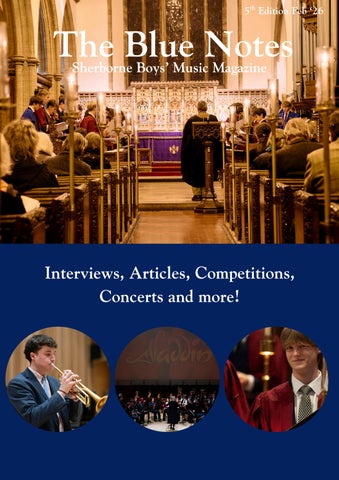
5th Edition Feb ‘26
The Blue Notes Sherborne Boys’ Music Magazine
Interviews, Articles, Competitions, Concerts and more!
CONT Table of Contents
Pg.2
The B u
Sherborne Boys’
INTERVIEWS, CONCERT ARTICLES
04 05 11
>> Welcome and Editors Notes
>> Mr Davey Mr Costin’s Desert Island Discs
>> Friday Lunchtime Recital: Woodwind, Strings, Singers and more...
TENT Table of Contents
Pg.3
ue Notes
Music Magazine
STORIES AND MORE...
>> Articles, Stories and more
24
>> Save the dates
30
>> Thanks…
33
Welcome The Blue Notes - Edition 5 - Feb ‘26
Pg.4
Welcome, this time, to the 5th Edition of The Blue Notes. Though a short term bodes us I have tried my best to make two quite short but hopefully enjoyable editions for you all. As always the Music School has been extremely busy with the usual concerts in Cheap Street Church along with many joint school musical events and band that take place weekly. Some highlights include the annual Choral Society Concert which took place in Sherborne Abbey and under the direction of Mr Cracknell delivered a wonderful event for all. Along with this, we have also had many other events including the Joint Schools’ Unplugged, our Joint Schools’ Musical showcase and more. While writing this it still amazes me that the magazine has come this far and we are already on the 5th edition. I would like to thank all the members of staff and pupils who spend their time writing articles and being interviewed for The Blue Notes and to all of the readers for their continued support. I do hope you enjoy reading as there is certainly something in here for everyone! Happy reading! Sirtaaj G (4a) Editor-in-Chief
An interview with
Head of Keyboard Studies and Accompaniments
Mr Davey
Interview by Sirtaaj G (4a) What do you most enjoy about teaching music at Sherborne, and what do you think is different about the department here than other schools you’ve worked at before? I love the variety; teaching the piano, accompanying the boys, teaching academic music, conducting the orchestra. I also enjoy being a tutor and doing duties in Lyon house, they're all part of a really satisfying job, even breakfast duty can have its moments! As to the second part of the question, there's the building itself - everything is in one place. In my previous school the department was in desperate need of a new music school. Is there a particular performance which has stuck with you during your time at Sherborne or that you distinctly remember and won't forget? I particularly remember sitting in the front row of the BSR at a summer gala concert some years ago and listening to the wind band. It was huge - I remember counting the trumpeters who were in front of me and there were at least twelve. And I thought, this is extraordinary that a school can produce a wind band with so many boys and produce such an amazing and exciting sound. I'm always struck by the singers the number of boys who get up and do something that, to me, is so scary, and they do it so beautifully, in all styles of music. The singing is amazing here, which I guess might be unusual for an all-boys school. And you get boys singing from ‘all walks of life’, not just the all-out musicians. A highlight has always been hearing the Chamber Choir in the Abbey Festival singing renaissance music.
Pg. 5 How do you think the department has evolved since teaching here? Well, when I started, The Music School was just a plan. Jamie Henderson had been here for a couple of years and it was his project. What I've witnessed has been a huge growth and development of the music here over a decade and a half. What is your favourite thing about the Music Department at Sherborne? It's the people I work with - it’s how well all the music staff get on it's a real team - a highly professional bunch of people to work with. Also, the physical building. But I would have to add to that the quality of the pianos, particularly the C6 that sits in the Tindall it's a beautiful instrument.
If you could meet or play with any composer of your choice, who would it be? – and why? That's an interesting question. It would have to be Beethoven. But then, when I think about it, how could l approach such a giant? But I would love to be a fly on the wall: to hear him play, watch him conduct and watch him compose. But how can a mere mortal go up and talk to a god?
Mr Davey joined Sherborne in 2007 and has since taken on several important roles within the Music Department, including Assistant Director of Music, Head of Academic Music, and Head of Keyboard. The latter of his roles now includes being Head of Keyboard Studies and Accompaniments. He has also been a tutor in Lyon House throughout his time at Sherborne. Alongside teaching piano and Academic Music, he is one of four current conductors of the Sherborne Schools’ Symphony Orchestra. Mr Davey is well known for accompanying pupils in Friday Lunchtime Recitals and in competitions across the school year.
An interview with
Head of Keyboard Studies and Accompaniments
Mr Davey
Interview by Sirtaaj G (4a) Is there any piece of advice which you would give to someone who has just started learning the piano? Practise as much as you can and get into the habit of working with lots of repetition of short sections, one bar to the next or just a short group of notes. I remember when I started to play the piano how the first year was really hard, particularly developing the coordination between the hands. But you've got to persevere and look ahead to how much pleasure you'll get out of the piano once you've got through those early stages. The other thing is, work hard at reading the music. Learn to read the notes and rhythms. I think that all those videos on YouTube that ‘show’ you how to play a piece should be banned. Having said that, though, they may have their use for some pupils, but I imagine somebody wanting to be an actor but never learning to read - it's a nonstarter.
What type of music do you enjoy listening to and watching? Beethoven, Bruckner, Sibelius, lots of piano music, though I mostly listen to music when it’s relevant to what I am learning or teaching. If, for example, I am accompanying a Schubert song I will listen to recordings - hopefully coming across Richter and Fischer-Dieskau along the way! Having said that, what I've learned over the last few years is that I particularly enjoy listening to live music. It's that somebody is bringing the music to life in the moment, with all the skill and preparation they've done coming to fruition, and that's amazing. You can listen to anything at any time these days, but a live performance is something special, even if it's listening to someone play the piano in an informal concert. I went to hear Yuliana Avdeyeva at Sherborne Girls playing Brahms' First Piano Concerto with the BSO before Christmas that was just so exciting – to be there in the moment!
Pg. 6 Have you always loved music since you were younger, and was there anyone who inspired you to pursue music of whom you looked up to when you were young? When I started the piano I had a really good teacher. As well as that, my parents were very supportive, but I wouldn't say that there was a single person. What inspired me was listening to records. My father would borrow records from the local library and my mother would pick up records at auctions. I remember being given Murray Pariah’s recording of the Chopin Preludes and listening to it endlessly, similarly with Emil Gilels playing Beethoven’s Waldstein and Appassionata sonatas and Géza Anda playing Mozart concertos. There were many records I listened to many, many times – Bruckner’s ninth symphony, Brahm’s first piano concerto, Richter playing Rachmaninoff and so on. You see, today, you can just listen to anything, anytime. Back then, you couldn't. You actually had to go and find a record. Now you can just swipe through endless stuff on YouTube, which is great, of course – and there’s something called Spotify, I believe. Later, I started listening to Radio 3. I also went through a phase of playing lots of Scott Joplin - it was very fashionable then, repopularised by the film The Sting’ It was a wonderful way of learning about harmony and tonality. But that's not really the question, is it?
Throughout your time at Sherborne, what have you most enjoyed about music here? I suppose teaching the piano and working with the boys accompanying them, that has to be it. But also watching them develop as composers. When I was at school, composition wasn't part of the national curriculum, whereas now, all pupils compose. The quality of some of the compositions you see boys come out with is just amazing. The notation software Sibelius and other midi sequencers have made it so more accessible – that has just transformed the teaching of composition.
Desert Island Discs
with Mr Costin, Head of Academic Music, School Organist & Brass Co-ordinator The Blue Notes
Pg.7
Disc No. 1 - Motet: Trahe me post te, for six voices – Tomás Luis de Victoria Why did you choose this piece? My first piece is the wonderful motet Trahe me post te by Tomás Luis de Victoria. He was a great Spanish Renaissance composer and this work is probably my favourite of his. I could easily have chosen several others. He also wrote a parody Mass based on this motet which I would strongly recommend. This particularly splendid recording is conducted by Jordi Savall. I think Victoria’s music has a wonderful sense of mysticism and devotion but also real passion and Spanish sunlight. He spent time in Rome and may even have studied with Palestrina before returning to Madrid. I had the privilege of writing and presenting a Composer of the Week programme on Victoria for Radio New Zealand about fifteen years ago so he is a composer I have felt close to for a long time.
What memories does this track bring back to you?
The first recording I came to know of the Mass based on this motet was by Westminster Cathedral Choir under James O’Donnell who was Director of Music there at the time. He recorded a great deal of Spanish polyphony and a lot of Victoria’s Masses. All these recordings were special for me. There are other Victoria masses that are perhaps more famous but this is the one I return to most. I could have chosen the complete Mass but in the end I decided to choose the motet itself.
Is this one for dancing around the fire, or sitting quietly at sunset? Probably sitting quietly at sunset although this performance has a real energy which I find very compelling. It uses countertenors tenors and basses and I particularly like the way each vocal line is given its own character.
Disc No.2 - Mass in B minor, BWV 232 – Sanctus – Johann Sebastian Bach Why did you choose this piece? I had to choose some Bach. He wrote the Kyrie and Gloria earlier in his career and then composed the rest of the Mass later in life bringing it together over more than twenty years. This is simply wonderful music and deeply life‑enhancing. This movement infuses you with joy and it is also a remarkable statement of Bach’s faith. Even if you do not share that belief there is still a profound sense of richness and spiritual centredness.
Was this important during a particular stage of your life?
I remember taking part in a performance in Cambridge playing the organ. It was probably the fastest performance on record but it was enormous fun. The alto arias were sung by the great countertenor James Bowman which made it especially memorable. Experiencing the piece from the performer’s side rather than only as a listener was special.
Disc No.3 - Piano Sonata No. 30 in E major, Op. 109: II. Andante molto cantabile ed espressivo – Gesangvoll, mit innigster Empfindung – Ludwig van Beethoven Why did you choose this piece?
I first encountered Beethoven’s late piano sonatas when I was a young teenager. My piano teacher lent me a set of recordings and that was my real introduction to them. I could have chosen any one of these sonatas but if pressed this would probably be it. I have chosen the final movement which is a set of glorious variations. It begins with a very slow lyrical theme and everything grows organically from that. The pianist here is Wilhelm Kempff whom I particularly admire in this repertoire.
Desert Island Discs
with Mr Costin, Head of Academic Music, School Organist & Brass Co-ordinator The Blue Notes
Pg.8
Does this piece say something about who you are? I think it was my entry point into a love of Beethoven. I find that I listen to more Beethoven than Mozart perhaps because of that sense of struggle followed by ultimate resolution. When Beethoven writes quiet meditative music he seems to get right to the centre of things. The opening of this movement is a perfect example. Kempff does not prettify the music. He lets it speak for itself. Beethoven of course was a supreme master of variation form, creating an extraordinary emotional landscape.
Disc No.4 - Barcarolle in F-sharp major, Op. 60 – Frédéric Chopin Why did you choose this piece? I could have chosen almost anything by Chopin. I first discovered his music when I was young. My classics teacher gave me a cassette tape which I played repeatedly. Later I wrote my university dissertation on Chopin and had already lived with this music for many years. I have played a great deal of it since often simply for myself. In my first teaching post I gave a lecture‑recital on Chopin with my students using extracts from his letters. It was a wonderful way of engaging with him both as a composer and as a person. The Barcarolle is one of his late works, though he died at just thirty‑nine. A barcarolle is traditionally a gondolier’s song with a gentle rocking motion. Chopin takes that idea and lifts it into an entirely different world of musical sophistication.
Was this part of a turning point in your career?
I already knew the piece well as a listener but learning it and playing it was quite different. I came to appreciate it much more deeply by learning it from the inside out.
Does this remind you of a particular performance or person?
This recording is by the great Polish pianist Artur Rubinstein, one of the most important Chopin interpreters of the twentieth century.
Disc No.5 - String Sextet No. 2 in G major, Op. 36: I. Allegro non troppo – Johannes Brahms Why did you choose this piece?
I could have chosen almost any chamber work by Brahms. He wrote masterpieces in nearly every genre apart from opera but I find myself increasingly drawn to his chamber music. The trios, quartets, sextets and sonatas are simply wonderful music. He was a technically formidable composer but also one of immense musical depth. Like many composers of his generation he lived in the shadow of Beethoven. His music can be joyous profound and sophisticated but it also has that wonderful sense of Hungarian dance and rhythm running through it.
If you could play this track to your younger self, what would you want them to hear?
I do not think I would have appreciated it in the same way then as I do now partly through age and partly through teaching experience. I have a very particular memory of this sextet. I used to listen to it while walking early in the morning when I was living and teaching in Thailand, before the heat became overwhelming. This performance by the Belcea Quartet and friends is magnificent. Listening to it sometimes makes me wish I had continued playing the violin.
Disc No.6 - Piano Quintet in B minor: I. Très modéré – Adolphe Biarent Why did you choose this piece? This piece is something of a recent discovery. I came across it almost by accident and it immediately made me want to see the score. I then discovered that it survives only in manuscript. After considerable effort I managed to obtain a photocopy and I am currently transcribing it as a project. Biarent was a Belgian composer working around the turn of the twentieth century. He did not write a large quantity of music and has been largely forgotten, which I find remarkable. I feel quite strongly that he deserves to be much better known and I suppose I am trying to do my small part. The work is turbulent and intense and was written just before the First World War. Perhaps one can hear those clouds of conflict already in the air.
Desert Island Discs
with Mr Costin, Head of Academic Music, School Organist & Brass Co-ordinator The Blue Notes
Pg.9
Would this piece help you feel less lonely on the island — or make you miss home more?
I do not really feel lonely, because I have all this music to keep me company — old friends, really. This one feels like a new friend, though in a sense they are all old musical friends.
Disc No.7 - Rhapsodic Quintet – Herbert Howells Why did you choose this piece? I wanted to include some Howells who has been an important composer for me. First as a chorister and later as an organist. As I have got older I have found myself increasingly drawn to chamber music. Much as I love symphonic music, chamber music feels more private and inward. This is an early work by Howells written in 1919 before much of his more famous choral music. He was apparently Charles Villiers Stanford’s favourite student and very much on a fast track at the time. This is one of his most intense and personal chamber works.
Disc No.8 - My Funny Valentine: Miles Davis in Concert 1964 Why did you choose this piece?
I had to include some Miles Davis. I admire him enormously as a trumpeter, a bandleader and a jazz icon. I could have chosen a great deal of jazz but this live album really stands out for me. It features his classic second great quintet with Herbie Hancock on piano. I believe the group had an arguement about fees just before they went on stage. Whether or not it is entirely true it certainly feels like a particularly charged performance. It begins moodily then gathers extraordinary momentum. There is a magnificent saxophone solo from George Coleman followed by a deeply meditative improvisation from Hancock. Almost Bill Evans‑like in its inwardness. It lasts around fifteen minutes and contains everything.
If you could take only one of your eight tracks with you, which would it be?
Bach’s Mass in B minor because for me it represents the highest point of musical expression. Bach at his most complete.
What book would you take to the island, and why?
War and Peace. I have never quite managed to finish it, and having just one book would finally force me to do so!
Did anyone inspire you to take up music when you were younger?
I was fortunate to have several excellent teachers who were not overly dogmatic and allowed me to find my own way. My junior school teacher, Mr Coles, sang in the Peterborough Cathedral Choir and encouraged me to apply to become a chorister. I would not be here today without that early encouragement.
What luxury item would you choose?
Perhaps an all‑purpose tool or something like a penknife, if that is allowed.
What skills would help you survive?
I am fairly self‑sufficient and enjoy new places. A desert island would suit me quite well. I seem to be drawn to islands. When I lived in Thailand I often returned to Ko Chang near the Cambodian border. I like being near the sea.
Friday Lunchtime Recitals Cheap Street Church, Friday, 1.45pm Woodwind - 16 January The Blue Notes
Manu M (4g)
We were then taken away by William L (U6d) as he played Bernstein’s Sonata, 1st Mov: Grazioso on the clarinet. William gave a strong performance providing a rich and vast tone on the clarinet. We then moved onto Manu M (4g) who performed Marcello’s Concerto in D Minor, 1st Mov.: Andante e Spiccato. Manu delivered a well-shaped performance and bright sound on the Oboe as he was wonderfully accompanied by Mr Davey on the piano. As the concert continued Sam R (U6e) now took to the stage filling the church with Finzi’s Five Bagatelles, 5th Mov: Fughetta on the clarinet. Sam delivered a lively performance showing great technicality on his instrument. We next heard from a flute duet including both Mrs Jackson and Ian L (U6d) ATCL LTCL as they performed a polished rendition of Clarke’s Maya both performed a breathtaking performance a filled the church up showing both their technical ability and control of breath. As the concert came to a close we now heard from Patrick R (U6e) on the Alto Saxophone as he delivered Quate’s Light of Sothis: 1st Mov.: Grace. Patrick created a wonderful tone and performed a wonderful performance which was later followed by The Clarinet Quartet as they finished of the first Lunchtime Recital of the year. Including Benji R (L6c), Ben H (L6b), Sam R (U6e) and Will L (U6d) the quartet performed a wonderfully synchronised performance of Paul Walton’s Chalumeau Rag. The quartet had a great feel for this piece and wonderfully closed of an amazing concert.
Pg. 10
To start of the new year, we were delighted to hear the fantastic talents of Sherborne’s Woodwind players. With a programme ranging from solos, duets and a quintet this lunchtime recital brought a wonderful atmosphere for all. To begin the concert, we first heard from Patrick H (3f) as he made his Lunchtime Recital Debut on the bassoon. Patrick played Jean Philippes’ ‘Le Tamborino’ delivering a wonderful performance with a wonderful smooth and rich tone on the bassoon. Following on we next heard from Eason T (3f) as he made his first Lunchtime Recital solo performance on the tenor saxophone. Eason delivered a wonderful rendition of Rae’s Sonatina, 1st Mov: Motive Power delivering a strong and well-rounded performance.
Eason T (3f)
Clarinet Quartet: from left to right: Sam R (U6e), Benjamin H (L6b), William L (U6d) and Beji R (L6c)
Friday Lunchtime Recitals Cheap Street Church, Friday, 1.45pm Instrumental & Vocal Soloists I - 23 January The Blue Notes
Pg. 11 The next Friday Lunchtime Recital came back again to Cheap Street Church before heading into the Exeat weekend, where we now heard from our Instrumental and Vocal Soloists. To begin the concert, we first heard Sam B (U6f) as he sang us Ivor Gurney’s Sleep. Sam delivered a wellrounded and refined performance as we then swiftly followed by our next performer. Nathaniel B (4e) now took to the stage as he performed Schubert’s
Waltz in B Minor, D. 145 No.6. Nathaniel
delivered a strong performance and created a wonderful atmosphere for the audience. Sam B (U6f)
Oliver B (L6e)
Nathaniel B (4e)
As we moved onto another vocal performance, we now heard from Cedric v-S (L6a). Cedric sang Purcell’s If Music be the food of love. Cedric delivered a well-versed performance before leading into our next performance. This time, on the Trombone, Archie S-B (U6f) brought to the stage as he delivered a strong performance of Axel Jorgensen’s Romance, delivering a well executed a polished performance for all. We next heard from Henry F (5e) as he took the stage singing Quilter’s Fear no more the heat o’ the sun. Henry delivered a strong performance with a wonderful tone and a great sense of overall shape. As we drew closer to the end of our recital, we now heard from Oliver B (L6e). Oliver sang Michael Head’s Money, O!. Oliver delivered a strong and powerful performance before leading on to our last performer of the afternoon. To play us into the exeat weekend, we heard from Henry C (3b). Henry performed a strong performance of Bock’s If I were a rich man. Henry’s performance was well executed and a wonderful way to end another great Lunchtime Recital. Archie S-B (U6f) on the trombone being accompanied by Mr Davey on the piano
Friday Lunchtime Recitals Cheap Street Church, Friday, 1.45pm Strings - 30 January The Blue Notes
Pg. 12 As the next of the Lunchtime Recitals appeared; we heard from Sherborne Boys’ talented string players. To begin the concert we heard from Marc F (U6a) ARSM. Mark played a well-executed rendition of Mozart’s
Concerto in G K.216, i. Allegro. Mark was accompanied by Mr Walker and set the bar high for a wonderful concert ahead. Next we heard from Sam O’B (3e). Sam was accompanied by Mr Davey and played Franz Schubert’s
Sonatina in G Minor, D.408, i. Allegro Guisto. Sam’s
performance maintained great control and dynamic really painting the overall shape of the piece. We then heard our first unaccompanied piece of the concert. Frazer F (5f) took to the stage with J S Bach’s
Cello Suite No.1 in G, BWV 1007, i. Prelude. Frazer
Marc F ARSM (U6a)
maintained strong dynamics throughout his piece and performed a well-executed rendition.
We then moved onto the violin trio consisting of three accomplished violinists in the third form. Eason T (3f), Sam O’B (3e) and Arthur G (3f) performed Brun Rossignol’s Les Cloches de Compostelle. The trio was accompanied by Mr Walker and provided the audience with a lively and fun performance, marking Arthur’s Friday Lunchtime Recital debut. Closely followed by this we were now delighted to hear another string group, this time we heard from the Scholars Trio, consisting of three music scholars. Including Nathaniel B (4e) on the violin, Sam O’B (3e) on the violin and Frazer F (5f) on the cello. Together, the group played Haydn’s London Trio No.1, i. Allegro moderato. The group delivered a well-learnt piece across the whole with changing themes between the violin and cello, and delivered a strong feel to the piece. As the concert came close to an end, we then heard from Lucas C (5b). Lucas played Saint-Saens xiii: The Swan from Le carnival des animaux on the double bass. Lucas was accompanied by Mr Walker and gave a strong performance creating a wonderful sound on his Bass. To close this terms Strings concert we heard from Nathaniel B (4e). Nathaniel performed Amy Beach’s Romance on the violin. Nathaniel was accompanied by Mr Davey and performed a well-executed and polished performance. A Freddie F (U6a) wonderful way to end a wonderful concert.
Scholars Trio: from left to right: Nathaniel B (4e), Sam O-B (3e) and Frazer F (5f)
Nathaniel B (4e)
Friday Lunchtime Recitals Cheap Street Church, Friday, 1.45pm Singers - 06 February The Blue Notes
Pg. 13 The next of our Friday Lunchtime Recitals was presented by Sherborne Boys’ marvellous singers. With quite a vast number of boys performing, the audience was delighted by the wonderful voices of fourteen boys. To begin the concert, we first heard from Arthur H (5b). Arthur was accompanied by Mr Walker and sang Peter Warlock’s Captain Stratton’s Fancy. Arthur’s performance included great character, charming the audience as a great way to start the concert. Closely followed by this, we heard Hector S (5m), who performed on Nat “King” Cole’s L-O-V-E. Hector accompanied himself on the guitar and really amazed the audience with his performance bring a smile to many faces. We next heard from James H (L6a). James sang Schubert’s An die Musik. James provided the audience with a smooth and rich tone as he was expertly accompanied by Mr Walker.
Charlie S (L6f)
Benji R (L6c)
As the concert continued, the audience was now treated to the voice of Edward K (5g). Edward sang Handel’s Thus when the Sun. Edward’s performance showed great vocal control and projection throughout. Next, Benji R (L6c) took to the stage with Debussy’s Beau Soir. Benji’s smooth tone was allied to his dynamics, providing a wonderful pallet of colour. Following on from this, we now heard from Henry C (4b). Henry sung Sondheim's There are giants in the sky, (from Into the Woods) providing a wonderfully lively and bright performance for all. Charlie S (L6f) took to the stage next with Quilters’ Fear no more the heat of the sun. Charlie gave a strong performance, demonstrating a great feel for the song. We next heard from Hugo T (U6d), who provided us with a lively and warm rendition of Arthur Sullivan’s My name is John Wellington Wells. As the concert continued, we now heard from our final few performers. Manu M (4g) sung Francesco Durante’s Danza, Danza fanciulla gentile. Manu showed great control and dynamics throughout the piece as he was expertly accompanied by Mr Davey. We next heard from Sam Bourke (U6f) as he sang Hugo Wolf’s Fubreise. Sam’s performance highlighted his vocal control and dynamics throughout as he was accompanied by Mr Walker. We then heard a breathtaking performance from Sebastian K (U6f) as he sang Schumans Dichteriebe: xii. Am Leuchtenden Sommernorgan & xvi. Die alten bosen Lieder. Sebastian’s performance included both strong and soft tones throughout, showcasing great dynamics and vocal control as he was marvellously accompanied by Mr Davey. As we came to a near close of this week’s Friday Lunchtime Recital we now heard from Oliver B (L6e) who performed Lerner & Lowe’s On the street where you live, (from My Fair Lady). Oliver provided the audience with a lively and flowing rendition before leading on to our final performance. Charlie M (U6d) took to the stage as he sung Mitch Leigh’s The Impossible Dream. Charlie was accompanied by Ian L (L6d) ATCL LTCL and both brought a heartfelt end to another successful concert.
Charlie M (U6d)
Joint Schools’ Musical Showcase The Blue Notes
Pg. 14
Wednesday 21 January, 7.30 pm, Sherborne Girls Article input from Mr Eadon, Mr Marks, Mrs Jackson and Mr Costin
This year, Sherborne Boys and Girls, along with The Gryphon, delivered the annual Joint Schools’ Musical Showcase. An evening of music consisting of various bands and ensembles from Sherborne Girls and Sherborne Boys, including ‘the best of the best’. Performances included the Sherborne Schools’ Symphony Orchestra, The Joint Schools’ Choir, the Brass Trio, Joint Schools’ Wind Quintet, Jazz Ensemble and Swing Band. The Sherborne Schools’ Symphony Orchestra – article contribution from Mr Eadon and Mr Costin Director of Music: Mr Eadon The SSSO performed the first movement of Eric Coates’ London Suite as the curtain-raiser at the Joint Schools’ Musical Showcase. The orchestra were on fine form and really seemed to relish in the colours and textures that make the piece so satisfying to play. Coates’ skill as a composer is seen in his ability to write idiomatically for every instrument of the orchestra. The section of the piece the orchestra played on this occasion depicts the hustle-bustle of London’s famed Covent Garden – but from a time when it was still an active market (and not the tourist mayhem of the present day). To this end, Coates makes use of the Middlesex folk song Cherry Ripe which pervades through the second half of the movement. It will be fantastic to hear the SSSO perform the whole Suite when we play it at The Cadogan Hall.
Head of Academic Music, School Organist and Brass Co-Ordinator: Mr Costin The Sherborne Schools’ Symphony Orchestra delivered a confident and characterful performance of William Mathias’ Serenade, with every department shining—particularly the woodwind. This intensely pastoral work, cast in three contrasting movements, was shaped with poise and clarity throughout. The opening Allegretto sparkled, as the cheeky oboe theme passed gracefully through woodwind and strings over a flowing piano accompaniment, warmly supported by brass. The second movement unfolded with calm beauty, its English pastoral voice gently recalling Vaughan Williams and Holst, forming the emotional heart of the work. Fiery trumpets launched the finale, with festive tambourine colour driving the music to an exhilarating close.
Joint Schools’ Musical Showcase The Blue Notes
Pg. 15
Wednesday 21 January, 7.30 pm, Sherborne Girls Article input from Mr Eadon, Mr Marks, Mrs Jackson and Mr Costin
This year, Sherborne Boys and Girls, along with The Gryphon, delivered the annual Joint Schools’ Musical Showcase. An evening of music consisting of various bands and ensembles from Sherborne Girls and Sherborne Boys, including ‘the best of the best’. Performances included the Sherborne Schools’ Symphony Orchestra, The Joint Schools’ Choir, the Brass Trio, Joint Schools’ Wind Quintet, Jazz Ensemble and Swing Band. Joint Schools’ Choir and Wind Quintet - article contribution from Mr Eadon and Mrs Jackson Director of Music: Mr Eadon - Joint Schools’ Choir The Joint Schools’ Choir previewed two movements from their forthcoming Choral Society concert programme singing the Kyrie from Karl Jenkins’ The Armed Man and the dramatic first movement of Bernstein’s Chichester Psalms. The Jenkins saw the choir creating a warm atmosphere through its melismatic, sweeping phrases and relatively soft dynamics. The Bernstein was rather different – it is boisterous and lively in the extreme and is one of the few pieces in Hebrew regularly performed by Anglican choirs. In spite of the challenge this brings, it is always a huge pleasure to sing a psalm-setting in its original language. The Joint Choir was on great form and were really able to convey the two pieces’ moods well
Head of Music School Timetables and Instrumental Studies: Mrs Jackson - Joint Schools’ Wind Quintet Our Joint Schools Quintet is made up of music scholars from Sherborne Girls and Boys. These talented musicians delighted us in last year’s Showcase with a Charleston by Norman Hallam and this year they tackled Reicha’s E flat Quintet. This work was published in 1818 and is perhaps the most famous of all his twenty-four Wind Quintets. All the performers in this ensemble delivered an exciting and polished performance of a technically demanding work. Well done! The Quintet it made up of: Coco: Flute Manu M (4g): Oboe Louis R (L6e): Horn Lizzie: Bassoon Benjamin H (L6b): Clarinet
Joint Schools’ Musical Showcase The Blue Notes
Pg. 16
Wednesday 21 January, 7.30 pm, Sherborne Girls Article input from Mr Eadon, Mr Marks, Mrs Jackson and Mr Costin
Brass Trio and Swing Band - article contribution from Mrs Jackson and Mr Marks Head of Music School Timetables and Instrumental Studies: Mrs Jackson - Brass Trio This trio was formed from the principal brass players in our Joint Schools Symphony orchestra in order to learn the Sonata for Horn, Trumpet and Trombone by Poulenc. The piece dates from 1922, but Poulenc later revised the Sonata in 1945. The ‘Rondeau’ is the third and final movement of the Sonata and the style of the piece is light-hearted, bright and dance like. The ensemble was expertly led by Archie (trumpet) and all three boys delivered an exciting and polished performance.
Deputy Director of Music: Mr Marks - Swing Band and Jazz Ensemble The Swing Band and Jazz Ensemble performed as part of the Joint Schools’ Musical Showcase on 21 January, in their first joint appearance at this event. I take enormous pride in the jazz musicians at Sherborne Boys. It is already a feat to perform on an instrument live in concert, but especially so given the levels of live improvisation involved. An explainer for any new readers: improvisation is the art form of making things up on the spot! Imagine a scenario where you have to stand up and perform, without an exact understanding of what you would play. Truly remarkable — and a skill we have been developing with the boys in detail over the last few years. This event kicks off a busy term ahead for our jazz musicians, including a Lunchtime Recital for the Jazz Ensemble, a Prep Schools’ Jazz Day for the Swing Band, before culminating in the highlight of the academic year — Dinner and Jazz.
Jazz Ensemble:
In Walked Bud - Thelonious Monk St. Thomas - Sonny Rollins Swing Band:
Sir Duke - Stevie Wonder Spain - Chick Corea Let’s face the music and dance - Irving Berlin
Choral Society Concert The Blue Notes
Pg. 17 Wednesday 11 February 7.30 pm, Sherborne Abbey Under the baton of Mr Cracknell Article written by Mr Eadon
This year’s Joint Schools’ Choral Society concert saw SG’s Mr Cracknell conduct the massed forces in music by Leonard Bernstein and Karl Jenkins. Following on from last year’s Britten St Nicolas, the ensemble were excited to learn the Chichester Psalms which asks the chorus to sing in Hebrew – although this gives a certain challenge to the performer, the music is so strong (and, indeed, infectiously fun) that those challenges quickly vanish. The first movement is a setting of the Jubilate and, although composed slightly precariously in 10/4 time, is striking, lively and loud. The second movement is scored for a treble solo, in addition to the chorus and orchestra. Henry C (3b) enthrallingly sang this solo of the text of Psalm 23 – Bernstein asks for a boy solo to emulate King David, the alleged author of the Book of Psalms and accompanies the soloist primarily on harps to perhaps give a parallel to an ancient lyre. This beautiful setting is interrupted by the tenors and basses singing text from Psalm 2 (“Why do the nations so furiously rage”) – the JSCS chaps did an admirable job portraying this menace. The final movement is a lovely uneven-metred set of sweeping melodies. It is telling that Bernstein wrote this piece using off-cuts from his early drafts to West Side Story – he had originally intended to set that piece using rather different quarrelling factions (including a Jewish community), which is why he had the material spare The second half of the programme was Karl Jenkins’ Mass of the Armed when Chichester Cathedral’s commission came through. Man. This is a striking piece, drawing together many texts to create a manifesto for peace. Many movements focus on the horrors of war, whilst others on reconciliation. Particularly moving is the second movement which is a Call to Prayer from the Orthodox tradition. Many other movements are based on the medieval song L’Homme Armé from which the name of the piece is derived. Even The Last Post makes an appearance. In addition to the Choral Society, this is accompanied by a large orchestra and four soloists. These four soloists were given to singers in the pupil body – two girls (Sophie S and Betsy C) as well as Frazer F on Tenor and Archie SB on Bass were able to command the Abbey with powerful performances. The performances were of really high quality – the choir sang magnificently, the soloists were super, the orchestra were a glorious bedrock for everything else to sit on. Especial thanks must go to Mr Cracknell and our rehearsal accompanist Mr Arkell. Although not fully confirmed, next year is likely to see a return to something a little older having had two years of twentieth century representation.
The Blue Notes
Pg. 18
Articles
Harmonies, Stories and Tunes
Eurovision Dreams and Wishful Thinking The Blue Notes
Pg. 19
Article written by Mr Byrne There was a time when the world was all in black and white. Not morally, not theoretically but, believe it or not, younger readers, colour simply had not been invented yet. Ask your grandparents. That’s why, when England won in the wonderful summer of ’66, the pictures are in black and white. That’s why, when the Queen was crowned in ’53, the film is in black and white. And some of us lived in this black and white world. During this glorious era, I played football every break-time in the school playground. Some of us were Bobby Charlton, some Emlyn Hughes, some Franny Lee – a couple were even that young upstart, Kevin Keegan. It was the world of the Three-Day Week, of electricity shortages and blackouts, an era long before Brexit when we hadn’t even “joined” Europe yet, when Manchester City’s power had waned, when Bruce Forsyth was a Saturday night institution, when we all moved to the Bay City Rollers’ rhythm and Donny Osmond was the pin-up boy. My sister and I both remember a girl at our school, slightly younger than us, called Ann Sheriden. Rumour had it that her brother was none other than Lee Sheriden of that amazing pop group Brotherhood of Man. We didn’t know then whether that was true, but it sounded great to us. I actually don’t know now if it is true for, despite the powers of the internet, it has proved impossible to verify. Lee’s birth name was different, but Ann came from what would today be called a patchwork family and Lee’s birthplace is exactly where the school still stands. Let’s just say for now that it is possibly true. In August 1974, Lee Sheriden wrote a song called Save your Kisses for Me. The song's lyrics describe the gently conflicted emotions of a man leaving his loved one in the morning as he goes to work. The song's final line provides a twist that this loved one is in fact his three-year-old daughter; or perhaps it is his little sister, as Ann would have been perhaps five by the time Lee wrote the lyrics. When he brought the song to the group, Brotherhood of Man rejected it. When they later needed one more song for their album, they retrieved it, re-worked it and issued the single.
Brotherhood of Man – all pop groups looked like this
Brotherhood of Man – all pop groups looked like this
This proved a masterstroke. Save your Kisses for Me was chosen as Britain’s entry for the Eurovision Song Contest, held in The Hague in April 1976. It saw off a powerful French hit, Catherine Ferry’s Un, deux, trois, which was to come second on 147 points and, with 164 points, became the winner of that year’s competition. On the back of this success, the song became number one in the British and American charts and catapulted the group to international fame. Lee Sheriden is now in his early eighties and has two grown-up daughters. He may or may not be the brother of Ann Sheriden and my sister and I may or may not have been mixing with celebrities fifty years ago. During the early- to mid-seventies, as it was a church school, my family and so many others would meet on Sunday at the local church; my sister, who was closer to her in age, is sure that Ann’s family were there too. By this stage, I had joined a kids’ band who accompanied the hymns, and I played an old wooden glockenspiel which perhaps still lurks at my parents’ house. I enjoyed playing it and was occasionally given a solo to play by the benevolent conductor, who happened to be the elderly lady who lived next door to us. At the start of Save your Kisses for Me, there is a distinctive twelve-bar glockenspiel solo, unusual at the time and still now. Was Lee Sheriden ever in the church and gained musical inspiration there?
Gary Clark Jr.’s When My Train Pulls In
The Blue Notes
Pg. 20
Article written by Mr Winter Clark’s Live in Austin recording of When My Train Pulls In doesn’t hurry, and it doesn’t flatter. He just lets it sit – heavy and unresolved – before it does anything dramatic. There is no opening flourish, no decorative lick. There is no studio polish to soften the edges, no production sheen. Just time, pressure, and a refusal to move on. The opening bars feel less like an introduction than a test of whether the room is prepared to wait. This is not blues as recollection. It is blues as something happening now, in real time, with no guarantee of arrival. What becomes immediately clear in the live setting is that time – not pitch – is the main instrument. Clark extends the opening far longer that the studio version allows, letting phrases arrive fractionally late, at times uncomfortably so. What governs the performance is not harmonic complexity, which is deliberately constricted, but the manipulation of the pocket. Early guitar figures are clipped and beatlike: short cells, abrupt stops, silence doing as much work as sound. The pentatonic language is familiar, even minimal, but the rhythmic placement is tight. You don’t really track melodic development; you track duration. How long can the idea stand before it needs to move? In this performance especially, tone ceases to be ornamental and becomes something of a structural principle. The fuzz-heavy sound feels volatile, always on the edge of feedback. Sustain is not smoothed out; it threatens. Notes boom, smear, and sometimes fight the room itself.
Microtonality is more salient onstage. Bends often sit below pitch, held there long enough to feel intentional rather than expressive. In the live version, pitch accuracy is never a given. It is negotiated moment by moment, earned through physical control and duration. What is unmistakeable in the Austin performance is Clark’s refusal to use virtuosity as reassurance. There is no sense that the exquisite solo is there to impress or tie things up. Instead, repetition becomes insistence. Single notes are struck again and again, but for pressure not emphasis. Linear runs are replaced by bend-and-release oscillations. Feedback creeps in, is courted, then pulled back just before collapse. The Length of the solo also matters. Clark stays inside it longer than seems polite. And this is where the performance most clearly departs from blues revival habits. There is no quotation, no nod to heritage tones, no sweat about proving authenticity. Control here is about endurance. The band holds. Clark holds. The audience is asked to hold too. When the performance ends (or, at least, stops) it does not feel concluded. It feels cut off, as if the music could have gone on, and maybe should have. The train never quite pulls in, but passes through the room at speed. This is what lends the Austin recording its peculiar authority. Clark does not modernise the blues by decorating it or turning it into something safer. He modernises it by insisting on its oldest discipline: time as weight, tone as pressure, patience as technique. In a live setting - where nothing is fixed and everything is exposed - that insistence becomes unmistakable. This is blues standing its ground, in public, and refusing to move.
The Life and Works Series: Josef Haydn
The Blue Notes
Pg. 21
Article written by Nathaniel B (4e, Sch.Mus)
Haydn is what many would consider one of the catalysts of the classical era bridging the gap between classical and baroque. He was born in 1732 in the humble village of Rohrau, Austria. Haydn was the second son of a wheelwright. His mother was working as a cook for the nobleman of the village but Haydn showed his musical gift from an early age. Luckily for him he had a cousin who was a school principal and a choirmaster in the city of Hainburg. He offered to take Haydn for training, so Haydn – aged not quite six – had to be separated from his parents never to return to his parents’ humble cottage and his mother’s (probably) wonderful cooking. The young Haydn sang in the church choir, learned how to play music and had a good knowledge of music theory; but around this time the Director of Music at St. Stephen’s Cathedral in Vienna had seen the boy in a concert he was giving and poached him for his own choir, and so in 1740 Haydn moved to Vienna and he stayed in the choir for 9 years and he gained lots of practical knowledge in musicmaking. When he was about seventeen years of age his voice started to change. He was given the opportunity to become a castrato but he pulled out at the last minute (for those who don’t know a castrato was a male singer who had a certain part of his anatomy removed so as to prevent testosterone affecting the changing of the voice). So at seventeen he stopped attending the choir and the school and, thanks to a few poor choices, was expelled because his voice broke. For a while he found refuge with a fellow musician. For a while he supported himself with a number of jobs but this paid off as he was able to get hold of lots of music to self-study on though the study of musical works most notably Carl Bach (not to be confused on Johannes Bach the one we all know and love, Bach must churning in his grave his less famous relative being a big part in a Blue Notes article before him now I’ve denied him two articles, sorry Johann!). By fortune, chance brought him an opportunity to meet with the Italian composer and singer Nicola Porpora, who thought took pity on Haydn, so he took him in and was his accompanist and teacher of composition. So with determination Haydn thrived and he was eventually introduced to the music-loving Austrian nobleman Karl Joseph Von Fürnberg. Haydn started writing chamber music for Karl and this is where he wrote his first String Quartets. And so with the recommendation of Karl, Haydn was appointed musical director for Bohemian Count Ferdinand Maximilian von Morzin. Haydn was put in charge of an orchestra of sixteen and for them he wrote his first Symphony and he also wrote many other compositions though they were reportedly conventional, but still progress.
The Life and Works Series: Josef Haydn
The Blue Notes
Pg. 22
Article written by Nathaniel B (4e, Sch.Mus) He did not stay long with von Morzin as again Financial problems came - in other words he was having a midlife crisis. Though this did not last long as Haydn as he found himself in a patronage of a powerful family in 1761, the Esterházys and this is carried out his duties well while being still relatively unknown at the time. But things were moving quickly for Haydn as in 1766 Haydn became the musical director at the Esterházy court where he again showed his quality and the head of the family Prince Miklós very much enjoyed listening to his compositions and created a good atmosphere for the composer to develop. This is where Haydn wrote lots for the court ranging from as big as operas to as small as string quartet and he wrote well over 150 compositions during his time at this court spanning a timeline of thirty years. During this thirty-year period, he became very good friends with Mozart who might be my next article. The two composers simply admired each other's work and Mozart declared that he had learned how to write chamber music from Haydn and dedicated six of his works to him for his ‘beloved friend’ Haydn’s music also shows the impact of Mozart. During the 1760’s fame began to spread and lots of churches and orchestras helped spread his fame though performing his music and libraries to preserved and spread his work and this is where he composed many famous works such Stabat Mater (1767) to Missa Sancti Nicolai (1772) to name but two. And the following decade was kind to him musically and his operatic output was strong. But in 1790 Prince Miklós died and was succeeded by the musically-disinterested Prince Antal – and was unemployed so he went to England for a break where in 1791 he heard a performance of Handel’s oratorios which ultimately lead to the writing of The Creation and was the first ever work to have text underlay in two languages: German and English and this was first performed in 1798 and was an instant hit and this inspired him to write another one. His last output included six masses written for Miklós II; they were among the most significant masses of the eighteenth century. And he wrote the national anthem for Austria Gott erhalte Franz den Kaise (God Save Emperor Francis) and it is still used as the national anthem of Germany today but as Deutschlandlied. But alas, the aging composer was fading, and he was reported to have said said ‘The Seasons broke my back’ and indeed it had, as he produced no big works other that his last two Masses. In 1809 Napoleon’s forces besieged Vienna and entered the city in May. Haydn refused to exit his house and take refuge in the walls of Vienna, so Napoleon placed a guard of honour outside Haydn’s house and the French Hussars sang an aria for him from the creation. On May 31 of 1809 Haydn died peacefully and was buried two days later. Haydn had been one of the most important figures of the classical era and he had an amazing life from going to London to Paris and Vienna. I would highly recommend you study hard like Haydn – the fact that he came from a family of peasants and ultimately resided with royalty is truly amazing.
The Life of Luigi Boccherini: A quiet genius of the Music World
The Blue Notes
Pg. 23
Article written by Sebastian N-M (4g, Exh. Mus) Luigi Boccherini was an Italian composer and Cellist born in Lucca, Italy, in 1743. He died in Madrid in 1805. While not as famous as Mozart or Haydn, he wrote hundreds of beautiful pieces, especially for chamber music. One of his most well known pieces the Minuet in A Major which is still played today. Boccherini came from a musical family. His father played the Double Bass and taught him music from a young age. At thirteen, Boccherini went to Rome to study cello, and later he continued his musical training in Vienna, his talent was clear early on in his life, and he soon became known across all of Europe as both a performer and composer.
In the 1760s, he moved to Spain, where he spent most of his career. He worked for many royal courts, including the Spanish Crown Prince. During this time, he composed many of his most important works. He is especially known for his String Quintets, which often included an extra ‘cello, something unusual at the time. This gave his music a rich, warmth sound that set it apart from the other composers at the time, so you can really say that he was in a league of his own. Boccherini’s music is elegant and calm. It often reflects the sunny, relaxed atmosphere of Spain. Although he was successful in his lifetime, his music was mostly forgotten after his death. For a long time, he was only remembered for the Minuet, and not much else. In recent years, musicians have started to rediscover his work, now, people are beginning to see him as an important figure in Classical Music, especially for the ‘cello. His gentle style, creativity, and love for melody make his music perfect for listeners who enjoy calm and beautiful sounds. If you are looking for a hidden composer from the classical era, Boccherini is a great place to start.
Save the Dates: The Blue Notes
Pg. 24
Come and enjoy the:
Halliday Cup Competition On Sunday 1 March 2026, Tindal Recital Hall, Sherborne Boys Come and enjoy a selection of Sherborne Boys’ pianists compete for the coveted award dedicated to the memory of Charles Graham Rivers Halliday (Lyon House 1911-1914) who loved music. Adjudicator: Alex Aitken West End Musical Director, pianist and organist.
Come and hear a:
Diploma Recital On Saturday 7 March 2026, Grandsen Hall, Sherborne Girls Come and enjoy one of Sherborne Boys’ top musicians as they get ready to sit their Diploma exam in their chosen instrument. This performance allows them to get a feel for their performance and helps them to learn what they need to improve on before the exam.
Come and hear the:
Sherborne Schools’ Symphony Orchestra On Tuesday 10 March 2026, 6.30 pm, Cadogan Hall, London Hear the SSSO as they perform music by Eric Coates, Edvard Grieg and more at one of the capital’s premier concert halls.
Save the Dates: The Blue Notes
Pg. 25
Come and hear the:
Joint Schools’ Wind Band and Sinfonia Orchestra On Tuesday 17 March 2026, Gransden Hall, Sherborne Girls Come and enjoy and evening listening to the Sherborne Schools’ Sinfonia Orchestra compromising pupils from Sherborne Boys, Sherborne Girls, Sherborne Prep and Hanford Prep and the Joint Schools’ Wind Band as they performed music by Bizet arr. Smith, Haydn arr. Glyn and Smith, Phillip Sparke and Harry James arr. Sammy Nestico
Come and hear an:
Evensong at Wells Cathedral On Wednesday 18 March 2026, Wells Cathedral Come and listen to the Sherborne Boys’ Chamber Choir and Sherborne Girls’ Madrigal Society as they join forces to sing Choral Evensong in the spectacular Wells Cathedral. Includes Music by Radcliffe, Dyson and Wesley.
Come and celebrate at the:
Sherborne Abbey Festival On Friday 1 May 2026, Sherborne Abbey Come and listen to various Chamber Groups and Ensembles at the Sherborne Abbey Festival as part of our Friday Lunchtime Recitals. Don’t miss out as the Sherborne Boys’ Swing Band perform later that day at 5.00 pm in the BSR under the director of Mr Marks.
Closing Notes... In spite of a short half-a-term of music to review, interviews conducted, and articles collated, Sirtaaj has, yet again, created a tome of importance and joy. If you have not yet made it to a musical event, such as those which are review here, please do join us sometime soon – you too will be able to hear what makes Music at Sherborne so special! If you are one of our “regulars”, I hope to see you soon – you may even like to write a review for this illustrious publication! Mr Eadon, Director of Music
With thanks to... Mr Eadon Mr Marks Miss McCormick Mr Davey Mrs Jackson Mr Costin Miss Tucker Ms McKay Mrs Jarrett Mr Winter Mr Byrne Nathaniel B (4e) (Sch.Mus)
Photograph Credit: Miss McCormick, Mr O’Neill (Sch.Org) Katharine Davies, Len Copland and Josie Sturgess Mills
The Blue Notes Sherborne Boys’ Music Magazine
@sherbornemusicschool
Edited and designed by Sirtaaj G (4a)