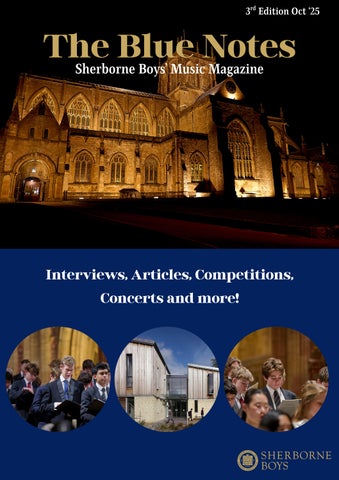
3rd Edition Oct ‘25
The Blue Notes Sherborne Boys’ Music Magazine
Interviews, Articles, Competitions, Concerts and more!
CONTENTS Table of Contents
Pg.2
03 >>
Welcome and Editors Notes
04 >>
Interview with Mr Costin, Head of Academic Music
>>
Interview with Miss McCormick, Music School Manager
08
>> > > > > > >
Friday Lunchtime Recitals Cheap Street Church, 1.45 pm
Meet the Music Staff Singers Instrumental and Vocal Soloists Brass Woodwind Joint Schools’ Prep Schools’ Orchestral Day
11 >> >
Singing Competition The Adjudicator: James Oldfield
14
>>
Articles: A range of different stories
Welcome The Blue Notes - Edition 3 - Oct ‘25
Pg.3
After a restful break, the Music School is back in full swing, and with the new year starting, that means auditions are beginning for the Choir, Swing Band, ensembles, and orchestras. Lunchtime Recitals start again, and a new series of Music Scholars have been welcomed into the Music School. Both the staff and pupils have been working hard on various performances, including competitions, orchestral days, music trips, and concerts, as well as one dedicated concert to the staff, who all make musicmaking possible here at Sherborne. In this, the third edition of The Blue Notes, you will find various articles, interviews, and interesting stories about people from both within and outside Sherborne. From music inside the practice rooms, to the life and work of artists, to Desert Island Discs and even Bell Ringing at the Abbey, this edition really is full of music, not just in the Music School but also outside.
Happy reading!!!
Sirtaaj G (4a) - Chief Editor
An interview with... Head of Academic Music and Brass Co-Ordinator
Mr Costin Interview by Sirtaaj G. (4a) What do you think is different about Academic Music here at Sherborne compared to other schools? I think that there are more students doing music which was why I was interested in the job. Music numbers in the country are going down so Academic Music here is in healthy position and something I was keen to tap into and am glad that I am still able to do it. What is the biggest surprise you think you discovered since taking on role as Brass Co-Ordinator at the school?
Pg.4 Is there a particular piece of music that you listen to a lot of the time? I like listening to a lot of J.S Bach, I have just been editing a recording I made of the Art of Fugue which I listen to quite a lot. When I was in university my dissertation was on Frederick Chopin and listened to a lot of that. I have a very catholic tastes and love Spanish Pali Theni, English Tudor music. I like jazz and listen to Miles Davis a lot.
I’ve taken Symphony Orchestra before and various groups but never a brass group before which was something out my comfort zone but in a good way. I’ve always liked the brass repertoire, and I’ve got recording at home of brass bands and was interested to learn more about brass instruments and their repertoire. I also enjoy arranging pieces for brass bands such as early music and wasn’t sure how long I was doing it but am happy to still be doing after 4 years.
Have you always been connected to music when you were younger and was there a certain point when you knew that you wanted to pursue music? I think I was lucky - both my parents’ appreciated music. My grandfather was a head chorister at Southwark Cathedral in London and his father was musical as well, so it has been in the family genes as it were. I was a chorister at Peterborough Cathedral for five years and enjoyed that so much and wanted to continue music from there. I then began the organ and piano and picked up music from there at around the age of twelve.
If you had to pick a brass instrument to learn, what would you pick? - and why? I think if I had the choice when I was younger, I would pick the horn because I’m quite found of Strauss and his father was a horn player. He was a romantic composer, and his music is very rich and majestic. Something like the alpine symphony
An interview with... Head of Academic Music and Brass Co-Ordinator
Mr Costin Interview by Sirtaaj G. (4a) If you were able to meet up with a classical musician who was dead or alive who would it be? – and why? I think I would want to meet with Mozart as he had a particularly good sense of humour and enjoyed himself. Mozart or Haydn would be my picks as they were alive in an interesting time in the Classical Era which was very different to Baroque music. So, I would enjoy have a drink with Mozart and playing billiards or something like that with him. Is there something specific about the organ and the abbey which has surprised you or which you enjoy compared to other organs you have performed on? They say the most important stop on the organ is the acoustic and the organ in the abbey is very fine but by far the acoustic is genuinely nice. The building it’s in is beautiful and it is a privilege to just sit down at the organ and each time I play I am always finding different sound which is really nice.
Are there any upcoming or exciting changes happening to the academic side of music here at Sherborne in the coming years? Last year, we introduced the new 3rd Form curriculum, which was quite exciting and is still an ongoing project and is a good springboard for GCSE and A-Level Music, and we are still staying with the same boards, Edexcel and OCR. We’ve just got a lot of new iMacs, which will give us a boost, and music tech now has Ableton 12, which gives them a lot more freedom. There are six areas of study for A-Level music, and we are changing one of them this year, so we’re moving to 20th-century topics, which is quite exciting because it means the staff can teach a new area of study and give us something new to teach.
Pg.5 What would you suggest to any pupils who are think about taking on music for GCSE’s or A-Levels and as to why they should consider taking it? I think that it’s proven that music does help your other subjects and it is proven. Music generally is quite an academic subject and there is a lot of coursework involved, and the higher-level writing and listening is quite long and incredibly detailed with essays and analysis. It is a fascinating subject because you are also studying history and not just music. You are studying sociological things as well and studying world music and involves geography and its really fascinating. That’s why I enjoy teaching it.
Is there any certain trait about the Music Department here in which you enjoy and makes you happy to be in your role? I thoroughly enjoy talking to the boys. It’s a busy school so to see boys maximising their practice time and loving music and what they do is great. I think that the staff are great too. Not just the fulltimers but the Visiting Music Teachers who are professionals which is quite a good thing to have a at a school and is not always found so we are really lucky to have that here as well as the other music staff who are all very clever and have a passion for what they’re doing.
Mr Costin, MA, FRCO, ARAM, ARCM, is a former chorister at Peterborough Cathedral, he studied at Oundle School and the Royal Academy of Music before becoming Organ Scholar at Pembroke College, Cambridge. By the age of 19, he had already achieved his Fellowship of the Royal College of Organists. Throughout his career, Mr Costin has held organist posts in several cathedrals in the UK and New Zealand, performed extensively across Europe, Australasia, and North America, and released acclaimed recordings of Bach and other classical repertoire.
An interview with... Music School Manager
Miss McCormick Interview by Sirtaaj G. (4a) What does a normal day see for you at the Music School? I’m not sure there’s such a thing as a typical day in the Music School! I will often be spinning several plates at once, with every intention that they will land in the right place… Regular tasks on my to-do list can be anything from submitting Evolve forms and Risk Assessments for each of our events, designing posters, managing budgets, supporting our fabulous team of VMTs and managing their payroll, creating the termly Music Diary, managing Choral Scholar rotas, organising instrumental exams, managing the SOCS calendar, communicating with parents over anything and everything Music-related, managing Music Scholarship auditions, maintaining the Music sections of the School website, managing the online booking system, creating programmes and Orders of Service, ordering music for pupils, liaising with Admissions to organise Prep School days, and generally helping to ensure the Music School runs as a smooth operation! Over the years that you have been here what have you seen change the most in the Music School? One thing that stands out for me is how, since the Covid-19 pandemic, we have managed to bring our audiences back to our events, particularly our Friday Lunchtime Recitals. During the Covid lockdowns, audiences weren’t allowed to attend concerts and to make sure that Music at Sherborne didn’t stop, musicians would record their performances at home, send them to the then Director of Music, Mr Henderson, and he would ‘knit’ them together to produce an online Lunchtime Recital which would be uploaded to the School’s YouTube account. These recordings often reached hundreds of views, which made all the work worthwhile! When the rules were relaxed by the Government and audiences were once again permitted to attend in person, it took a while for people to feel safe enough to return. But we persevered and now, five years on, we regularly welcome up to 120 members of staff, parents and the local community to our concerts, many coming back week on week to hear our remarkable musicians perform. How far in advance do you start planning for major events in the Music School? It depends very much on the scale of the event. For onsite events involving Sherborne Boys and Sherborne Girls musicians I work at least a term in advance, but for our Prep School Days, for example, I begin working on these around 2-3 terms in advance as we need to give Prep Schools as much notice as possible so that they can get the events in their very busy diaries. The earliest I have begun working on an event is for the Symphony Orchestra’s concert at Cadogan Hall in March 2026 – I began talking to Cadogan around Michaelmas 2024, as fantastic venues like this are very quickly booked up long in advance! We are very lucky to have been able to secure this date, and invitations are being distributed to current and prospective parents, OS, OG, Prep Schools and more!
Pg.6 Do you have a musical background? If so, did you ever play a music instrument? When I was 10 I took up clarinet lessons at school. Sadly these only lasted around a year as it was fairly quickly quite clear that it wasn’t really for me! I remain, however, very proud of my triangle playing in my school’s production of The Wizard of Oz when I was around 10 or 11…
What do you find most rewarding about being the Music School Manager? I feel very lucky to work with some of the most incredible people in the Music School. Their dedication and commitment to our musicians is infinite, and I am very proud to be a part of such a remarkable team. A large part of my role is to organise and host events held in the Music School and beyond, and it’s always so rewarding watching and hearing our phenomenal musicians hone their playing through hours of practice, followed by the performance itself! We are very lucky to welcome some fantastic audiences through our doors, and several times they will catch a performer after a concert to congratulate them, which is always lovely to see.
An interview with... Music School Manager
Miss McCormick Interview by Sirtaaj G. (4a) What is the most memorable concert that you have seen at the School? There have been so many! I think, though, the stand-out concert for me was ‘The Big Gala Concert’ held in June 2024 when Jamie Henderson stepped down after nearly twenty years as Director of Music. Old Shirburnian musicians were invited and returned in their droves to participate in the concert, which saw the largest Swing Band ensemble to date perform a rousing and extremely loud 10-minute long ‘Pennsylvania 6-5000’! The performance is on the Music School’s Instagram if you’d like to see it! Follow us @sherbornemusicschool. Coming a close second has to be ‘Dinner & Jazz’ in March 2024 with Music Scholar Hector’s lively performance of ‘Angelina’ with the incredible Swing Band. The dance floor was full and it was an utterly fabulous evening. Again, this is on Instagram!
Pg.7 What led you to Sherborne Boys’ and being the Music School Manager here? I joined the group in 2012 as the Head’s PA at Sherborne International, working with four different Heads in just over seven years (I don’t think this was because of me!). However, when I saw the Music School Manager position being advertised in early 2020, I read through the job description and decided to give it a shot! The role looked interesting and varied, and after nearly eight years in my current role I felt it was time to pursue a change. I was delighted to be offered an interview, and even more so when I was offered the position later that day! I was very nervous when I arrived here in March 2020, but received such a warm welcome from the team and I soon felt at home!
Do you have a particular band or genre of music that you enjoy listening to, and is there a specific album? I enjoy a wide range of music – which has grown even further since I began working in the Music School! However, when I’m out of the office I am partial to some sounds from the 80s and 90s, but I also love ‘big band’ music and really enjoy the Rat Pack, particularly Frank Sinatra. Don’t tell anyone this, but…my guilty pleasure is 90s band Take That! I have been to lots of their concerts, and my favourite has to be their ‘Circus’ tour which they’re bringing back in 2026!
What would you say is the most stressful part about organising events in the Music School?
What are the biggestchallenges you face when organising programmes and timetables for music? I have to be prepared to make the inevitable last-minute changes to a programme if a musician changes the piece they are performing, or the running order is changed. This happens fairly regularly, so it’s never a problem. I also have to check the spelling of every name, instrument, performance and composer – I spend as much time on this as I can, to make sure everyone performing is represented accurately.
My most challenging task is our annual black-tie Dinner & Jazz event – a fantastic evening of music with the Swing Band and a four-course dinner. It’s very popular and always sells out with around 200 people purchasing tickets, and it’s my job to make sure our guests have all the information they need leading up to the event, dietary requirements are catered for, the Dining Hall is set up with the correct number of tables and chairs, and that the seating plan reflects the many requests from our guests. It’s quite stressful…and I always breathe a sigh of relief when everyone is in and sat down!
Follow our Instagram page below:
@sherbornemusicschool
Friday Lunchtime Recitals Cheap Street Church, Friday, 1.45pm
The Blue Notes
Pg.8
Meet The Music Staff 12 September With Friday Lunchtime Concerts beginning again, we were treated to a concert from the staff which included performances from Mrs Jackson, Mr Davey, Mr Marks, Mr Eadon, Miss Allen, Mr Costin, and Mr Walker, all of whom played beautifully on their performed instruments. To start the concert, we were able to listen to Mrs Jackson perform Piazzolla’s Café 1930 from Historie du Tango, which was accompanied by Mr Davey, really setting the scene for the rest of the concert. Shortly after, we heard a performance from Mr Walker on the piano as he performed Haydn’s Sonata in D Major, Hob. XV1:24, 1st Movement.
Singers 16 September As the second Lunchtime Recital began, this time we were treated to a lovely group of Sherborne Boys’ 6 singers. The first performance was from one of two performances by Sebastian K (U6f). Sebastian first sang Go Lovely Rose by Roger Quilter, which really wowed the audience and really did show his love for this piece as he was joined by Mr Eadon, who accompanied Sebastian on the piano. Following on from his performance, we next heard from Charlie M (U6d). Charlie sang Bach’s ‘Mache Dich, mein Herze, rein’. Which was beautifully sung and really showed some of Charlie’s low notes in his voice, and was beautifully accompanied by Mr Davey on the Piano.
Next up, we heard from Benji R (L6c). Benji sang Faure’s ‘Prison’, which was sung very peacefully and softly, allowing the audience to relax and enjoy the music. The next performances consisted of Miss Allen on the Violin as she played Cooman’s Sonata for Violin and Organ Op. 573, 3rd Movement: Keep on Shining! This was accompanied by Mr Costin on the Organ, which was then followed by a solo performance from Mr Davey as he performed Schubert’s Impromptu in G flat, Op. 90, No.3. To finish the concert, we heard from two more members of staff, first consisting of Mr Eadon, who sang Ralph Vaughan Williams: Youth and Love and Flanders and Swann: A Word on My Ear, both of which were accompanied by Mr Davey on the Piano. To finish off the first Friday Lunchtime Concert of the year, guaranteed to get your feet tapping, we heard a performance from Mr Marks on the Piano in which he played Morton’s King Porter Stomp, a great way to finish off a very professional and wonderful concert with some Jazz.
As Sebastian took to the floor again, this time he sang Haydn’s ‘Recit’ from ‘Now heaven in the fullest glory shone’ (from the creation. Sebastian provided the audience with a beautiful performance. As we moved onto the final performances of the concert, the next singer was Forest P (U6b) and sang with a beautiful and rich tone as he performed ‘Auf dem Wasser zu singen’. Next, we heard another performance of Quilter’s ‘Go lovely Rose’, this time sung by Edward K (5g). Edward provided the audience with a breathtaking performance, including some beautiful high notes and rich tones. The Final performance of the concert quickly came, and Henry C (4b) sang a beautiful performance of Sondheim’s ‘No one is alone’ (from Into the Woods), sending everybody on a high for the weekend.
Friday Lunchtime Recitals Cheap Street Church, Friday, 1.45pm
The Blue Notes
Instrumental and Vocal Soloists I 26 September The next Lunchtime Recital saw Instrumental and Vocal Soloists who had offered to stay on a bit longer before their exeat weekend to play their chosen instrument. This concert consisted of five musicians and opened with a performance from Frazer F (5f). Frazer played the organ and played a beautiful performance of Derek Bourgeois ‘Serenade’.
Pg.9
Brass 03 October The latest Lunchtime Recital at Sherborne Boys’ showcased Sherborne Boys’ Brass Players, offering a mix of solo performances, small ensembles, and the full Brass Band. The concert began with Sirtaaj G (4a) on trumpet, who performed Andrew Wilson's ‘Blues Boulevard’, setting a lively, bluesy tone. This was followed by another trumpet solo from Luke A-D (4b), who played William Himes’ Concertino for Flugelhorn, 1st movement, which he played beautifully with a lovely, rich tone and some beautiful high notes.
Next, we heard from Patrick R (U6e). Patrick performed Debussy’s ‘La Fille aux cheveux de lin. Patrick played this piece beautifully and really showed his great skill for the piano as well as his technical skills.
Archie G (U6f) continued with another solo on the trumpet, this time with Georges Bizet’s ‘Habanera’, arranged by Mendez, accompanied skilfully by Mr Davey. The Junior Brass Trio—Sirtaaj G (4a), Luke A-D (4b), and Ianto D (4f) on baritone—performed Beethoven’s 7th Symphony, 2nd Movement (Allegretto). Jack M (5a) followed with a lively and fun solo of Jim Parker’s ‘Dances with Bears’, captivating the audience with its playful spirit. James T (3e) then performed Hummel’s Trumpet Concerto, 1st Movement, delivering a powerful performance with excellent high notes, again accompanied by Mr Davey.
Making his debut in his first Lunchtime Concert, Max L (4c) sang us a beautiful rendition of Bernstein's Tonight from ‘West Side Story’, which was wonderfully accompanied by Mr Davey. Max performed this piece wonderfully and really showed his high notes in his Bass voice. Moving on to the Alto-Saxophone, we heard Miachel P-M (5f) as he performed Richard Kershaw’s ‘Tango ‘til you drop’. Miachel played beautifully and had a great groove in his piece as he too was accompanied by Mr Davey. The final performance of the concert, before a well-deserved exeat weekend for everybody, Boys’ and Staff concluded with Oliver B (L6e). Oliver sang Schubert's ‘Ave Maria’ and left with an uplifting and calm tone on everybody before they headed off home for a great weekend, ready for a fresh start on Monday.
The final soloists were Ben T (5f) with Andrew Wilson's ‘Summer Samba’, a piece full of groove and resonant notes, and James H (L6a) playing Bozza’s ‘Badinage’, both supported by Mr Davey’s accompaniment. To conclude, the Sherborne Boys’ Brass Band, conducted by Brass CoOrdinator Mr Costin and including an impressive line-up of trumpets, French horn, trombones, tuba, and euphonium, performed Leroy Anderson’s ‘Buglers' Holiday’. This performance sure bran a beautiful end to a great concert for a good weekend ahead.
Recitals and Orchestral Day The Blue Notes
Joint Schools’ Prep Schools’ Orchestral Day 7 October Tuesday, 7 October saw our annual Prep Schools’ Orchestral Day. We welcomed fifty instrumentalists from Farleigh School, Hazlegrove Prep School and both our own Sherborne Prep School and Hanford. The day started with sectional rehearsals led expertly by Miss Allen, Mrs Morgan, Mr Costin and Mrs Jackson in music by Beethoven, Tchaikovsky and the traditional Mexican Hat Dance! Boys and girls (as well as their staff) were wonderfully enthusiastic participants throughout the day. The Music School, usually alive with the sound of our own boys’ practice, was instead serenaded by our guests. Rehearsals continued apace through the day, stopping briefly for lunch and a play in the warm early-October air.
Pg.10
Woodwind 10 October This week’s lunchtime recital featured Sherborne Boys’ talented woodwind players, delivering the audience with a contrasting programme. The concert opened with Henry F (5e) performing Johann Neruda’s ‘Concerto in C, 1st Movement: Allegro Spiritoso’. Henry impressed with a strong solo performance and a warm, rich tone throughout, beautifully accompanied by Mr Walker on piano.
Next came Benjamin H (L6b) with Quates’ ‘Grace (from Light of Sothis)’. Ben’s peaceful performance, accompanied by Mr Davey, resonated beautifully through the church. Michael P-M (5f) then performed Street’s ‘All Because of You’ on the alto saxophone, offering some really nice lyrical long notes and rhythmic warmth, again with Mr Davey accompanying. Manu M (4g) followed with Franck’s ‘Piece V’, Manu had some excellent breath control and expressive phrasing. Patrick R (U6e) then gave a skilful performance of Telemann’s ‘Sonata in C Minor, Siciliana and Spiritoso’, moving seamlessly between lyrical and lively passages, accompanied by Mr Walker.
The culmination of the event was a concert in the Gransden Hall, which also included the Sherborne Girls’ String Ensemble playing alongside prep school boys and girls (as well as their own solo spot). Mrs Jackson, Mrs Morgan and Mr Eadon directed a piece each – the Mexican Hat Dance, the first movement of Beethoven’s Pastoral Symphony and the 1812 Overture. In spite of the Sherborne Schools’ Group's lack of canon, the audience was still treated to dazzling pyrotechnics as Mr Marks and Mr Lyall ably deployed their skills with Party Poppers most admirably indeed. The day was a wonderful celebration of hard work, dedication and fun. None of the music had been seen by the participants before the day, so our young guests had to really be on their mettle to sight-read quickly. Many musical skills were tested through a superbly rewarding day!
A trio of Mrs Jackson and Forest P (U6b) on flutes, with Henry F (5e) on bassoon, performed Martini’s ‘Pastorale’ – a wonderful mixture floating flute lines and rich bassoon tones. Benji R (L6c) then played Malcolm Arnold’s Allegro con brio (from Sonatina), displaying impressive technical ability alongside Mr Davey. The concert concluded with Ben H’s second performance, James Rae’s ‘Watersmeet (from Tyne Sonata)’, showcasing his expressive tone and liquid phrasing – a fitting finale to a great Friday recital.
Singing Competition The Blue Notes
Pg.11
Sunday 12 October 2025 Tindall Recital Hall, The Music School 2.00pm
This year's singing competition was judged by James Oldfield and involved 17 boys and ranged from three categories. The categories: Juniors, Intermediate and Advanced, each having a variety of performers and with each performance being unique in its own way. As the afternoon started off, we began with the Junior Class. Throughout this class, we saw highlights from Henry C (4b), Arthur H (5b) and Fred M (3a), each of whom performed beautifully before we moved onto the Intermediate class. The intermediate class included seven participants. This included performance from Cedric v-S (L6a), Manu M (4g), Oliver B (5e), Jack M (5a), Henry F (5e), James H (L6a) and Hugo T (U6d). After the first two classes of the afternoon, a short tea break was taken before the longawaited Advanced Class took place. During this class, we saw marvellous performances ranging all the way from Grade 7 pieces up to Diploma standard pieces. First we heard from Benji R (L6c), followed by Sebastian K (U6f), Forest P (U6b), Charlie S (L6f) and to close the competition and a great afternoon, we heard from Edward K (5g). The day concluded with the following results: Junior Class - 2.00 pm- Winner: Henry C (4a) Intermediate Class - 2.30 pm- Winner: James H (L6a) 2nd Place: Henry F (5e) 3rd Place: Hugo T (U6d) Advanced Class - 3.50 pm- Winner: Edward K (5g) 2nd Place: Sebastian K (U6f) Overall Winner of the Singing Competition 2025: Edward K (5g)
Junior Class Participants:
Advanced Class Participants:
Harry S (4d) Henry C (4b) Arthur H (5b) Fred Maltby (3a)
Benji R (L6c) Sebastian K (U6f) Charlie S (L6f) Edward K (5g)
Intermediate Class Participants: Cedric v-S (L6a) Manu M (4g) Oliver B (L6e) Jack M (5a) Henry F (5e) James H (L6a) Hugo T (U6d)
Singing Competition The Blue Notes
Pg.12
The Adjudicator - James Oldfield James trained at Cambridge University, studying Economics, and the Royal College of Music. He sang as a consort singer with groups such as the Academy of Ancient Music, Polyphony and the Monteverdi Choir. James’ solo concert appearances include Mendelssohn Elijah with the London Symphony Orchestra and Kurt Masur, Orff Carmina Burana with the RTÉ Symphony Orchestra and Gerhard Markson, Rossini Stabat Mater and Puccini Messa di Gloria with the RTÉ Concert Orchestra, Handel Samson and Judas Maccabeus with the Irish Baroque Orchestra, Haydn Nelson Mass with the RPO, Purcell The Fairy-Queen in the Wigmore Hall, and Handel Messiah with the Huddersfield Choral Society (recorded live). He has performed as a concert soloist in Brussels, Helsinki, Milan, Gdansk, Berlin, Paris, Salzburg, and Yeovil. His operatic engagements include Achilla in Handel Giulio Cesare and Escamillo in Bizet Carmen for Opera North, Ludd in Ludd and Isis for Royal Opera House, Figaro in Mozart Le Nozze di Figaro for Garsington Opera, and Nick Shadow in Stravinsky The Rake’s Progress for Gothenburg Opera, Deutsche Oper am Rhein, and La Monnaie. James divides his time between performing, adjudicating and singing teaching (mostly at Cambridge University). He lives in Surrey and has three children, so rarely gets to sit down.
The Blue Notes
Pg.13
Articles Harmonies, Stories and Tunes
Desert Island Discs
with Mrs Jackson, Head of Instrumental Studies and Music School Timetables The Blue Notes
Pg.14
Johannes Brahms, Symphony No.3 in F Major, Op.90: III. Poco allegretto Disc No.1 – Why did you choose this piece? Well, Sirtaaj, thank you for inviting me to Desert Island Discs. I feel very lucky, I found this task extremely challenging and having a lifetime in Music finding eight tracks has been a real challenge, but a great one. My first track is by Brahms, and it is his 3rd movement from the Third Symphony. This piece takes me back to my Music College days where I was placed in the orchestra to learn all four Symphonies. It was a time of great connectivity with other players as well as learn these wonderful Symphonies. It is a piece that has resonated with me ever since. Do you think that this is a song for dancing around the fire or watching the sunset on your island? Definitely one for sitting and watching the sunset!
Sergei Rachmaninoff, Vespers, Op.37: VI. Bogorodiste Devo Disc No.2 – Why did you choose this piece? My second piece is by Rachmaninov. I adore Rachmaninov and it’s really hard to choose one piece by him. However, I chose this particular track because I was reunited with it this summer at The Proms. Even though it was a late night Prom starting at 10.15pm, it was full, and this amazing choir sang this piece. I’m not ashamed to say it was an emotional moment which we were all experiencing together. You could have heard a pin drop. It was really special and shows what the power of music can do. Does this track bring you back to a moment in your life that you distinctly remember? It absolutely brings me back to that moment this summer. As a musician who primarily plays a single line instrument, I believe it’s important to imagine the melodic line as you would sing it.
ABBA, Dancing Queen Disc No.3 – Why did you choose this piece? My third piece represents my childhood. Every Christmas Santa would deliver an album by ABBA. I am still a massive ABBA fan and as a child I would learn all the lyrics which would keep me busy for hours. Dancing Queen is a much-loved track at parties. It evokes joy and has to be the ultimate track that gets people on the dance floor. Who were you with when you first heard it, and why does the memory stick? Oh, I couldn’t tell you who I was with, but I was probably at home listening to Top of the Pops which isn’t something people tune into now, but it was something I loved as a child. Does this piece say something about who you are? Well...perhaps I like cheesy music, but also I’m about happiness and I try and bring that ethos to work.
Desert Island Discs
with Mrs Jackson, Head of Instrumental Studies and Music School Timetables The Blue Notes
Pg.15
Evocation: Sandrine Piau, Hebee, Op.2, No.6 Disc No.4 – Why did you choose this piece? My next piece is another song, and it’s really memorable. I must have told my husband a story from my Music College days where I used to listen to music at a shop called Tower Records on the corner of Piccadilly and Regent Street. In those days it was unusual for a shop like this to be open until 10.00pm. I must confess I was a little intimidated by all the loud and current pop music on the ground floor, but if you ran up the escalators, turn left, turn right, and through the glass doors you would find yourself in the quiet Classical Music section. Here there were booths where you could listen to the CDs of your choice. Perhaps as an impoverished student I spent too much money there, but it was where I learnt the music that I should be learning as well as some pieces I wanted to know more about. Roll on a few years, married with two small children, running around HMV in Yeovil with one child holding a Barbie DVD and another a Peppa Pig, I really wanted to go home but my husband veered to the very corner of the right-hand side of the shop where there was a tiny shelf dedicated to Classical Music. He picked up a CD and said “Shall we just buy this and give it a go?”. Roll on a few more hours, our children in bed, the CD was taken out of its case and I remember him saying “Here goes nothing”. What emerged was a beautiful track from the voice of Sandrine Piau. We have loved this track ever since. Does this choice reveal something about you that people might not expect? Possibly that some people may not realise that I enjoy the art form of song quite as much as I do.
Mozart’s ‘Così fan tutte, K.558, Act 1: Terzettino. “Sovrastia il vento” Disc No.5 – Why did you choose this piece? My next track is by Mozart from Così fan tutte, K.558, Act 1: Terzettino. “Sovrastia il vento”. This is a song I have loved probably since I was about 14. I went to a very average comprehensive school in North Kent, but it did have a purpose-built Music Department and a Music teacher who was determined to start choirs and run trips to London to listen to live music. For nominal amounts of money we went to a series of operas at the Royal Opera House which was incredible now I think of it. We also went to the Royal Festival Hall to listen to the London Symphony Orchestra perform every Beethoven Symphony over a series of weeks. I have played many operas and this particular track is one that I come back to listen to time and time again. Was this a turning point in your musical journey? It could well have been. I learnt to play the flute at the tail-end of the Labour Government’s free scheme for music lessons. All my parents had to do was hire a flute. I wasn’t particularly good at it to start with, and I think I was a little lazy about practicing, but I did get better and I think that experiences like this with this particular Music teacher must have had an impact.
Cecilia Bartoli, Sposa son disprezzata Disc No.6 – Why did you choose this piece? Yet more singing! This piece is sung by the singer Cecilia Bartoli. It was introduced to me nearly thirty years ago by my husband, who was not my husband at the time. It is such an unusual work by Vivaldi, who you would perhaps associate with more antiphonal writing. I’m afraid she is singing about grief and sorrow as so many operas are, but I love it. I just love these long, liquid lines. Would this song help you feel less lonely on the island — or would it make you miss home more? I think a bit of both! I would miss my family tremendously but in my busy working life I do crave a bit of solitude occasionally! I don’t consider anything I have chosen would make me feel miserable, but there would be tough times if I were to be on my own for any major length of time.
Desert Island Discs
with Mrs Jackson, Head of Instrumental Studies and Music School Timetables The Blue Notes
Pg.16
Joni Mitchell, Little Green Disc No.7 – Why did you choose this piece? My next piece is by Joni Mitchell. Again, another voice, but a different kind. In my opinion, Joni can teach you everything and she had such a phenomenal voice. She is a true artist and as she has got older, of course her voice has got a lot deeper. Perhaps more people know of her now as one of her songs was made famous by the film ‘Love Actually’ where Emma Thompson was sobbing in her bedroom thinking she had received a different gift. Anyway, this is the young Joni, and this is called ‘Little Green’. Is this a piece that shaped you creatively/professionally, or is it more personal? I think personal. But what I love about this the most is her voice feels free. It’s vocally so creative, it’s definitely a personal choice. How does this piece connect with who you are today? I think it connects to my general love of Music. I hope I’m not snobby about Music, as there’s something for everyone. Music can help you walk, run, dance, express, cry, laugh – in fact it can express all facets of life, and that’s such a powerful thing.
24 Preludes, Op. 11: No.15 in D-Flat Major Disc No.8 – Why did you choose this piece? Well…I have Mr Davey to thank for my last track, and an OS called Dougie M (c. 17) who is on the Diploma Board for his Saxophone ATCL, but as a great pianist he played this piece in a Lunchtime Concert. I had never heard the ‘Travel Preludes’ by Scriabin, but they can evoke many moods – there is something for everyone. When I heard it I loved it so much I went out and bought the CD, so thank you Mr Davey! So, these are my eight tracks, and I can’t actually believe there isn’t any Bach in this! I love Bach and many other composers. If you could only take one of your eight tracks with you, would this be the one — and why? This is where I would hope for the Mr Tickle arms from the Mr Men, where I could possibly scoop up all the tracks from the waves. However, if I had to choose one it would have to be Track 1, the Brahms, and the reason for this is I love to listen to music. I can’t read with music on, and I love reading, but this has to be in silence because I end up listening to the music! The thing I love about the Brahms is that there are so many melodic lines for me to listen to which would hopefully keep me happy until I was rescued! You already have the bible or any other religious text of your choice, plus the complete works of Shakespeare, waiting for you when you arrive. If you could take another book, what would it be, and why? I’ve thought about this a lot and the book I’m choosing is a book for all generations that I have bought for others many times. It is called ‘The Offing’ by Benjamin Myers. It’s a relatively short book which may encourage people to read it, and it’s about to be made into a film. It is a book about a young man at sixteen, post Second World War, from the North-East of England, and it is about his adventures as he sets out to walk to North Yorkshire. He meets a woman called Dulcie – an eccentric, worldly older woman who changes his life. She becomes his cultural patron in a way, and this enables him to go on a voyage of self-discovery. It is a book about kindness, gentleness, and hope.
Desert Island Discs
with Mrs Jackson, Head of Instrumental Studies and Music School Timetables The Blue Notes
Pg.17
What luxury item would you choose, and what does it mean to you? Well, I am not known for great practical skills, but I do know how to cook so hopefully I might manage to make a fire and keep myself alive. But short of asking for 25 more tracks, which I know I’m not allowed, I’m going to ask for my coffee pot and decent coffee, because everything feels better after a first cup. What skills would help you survive? Well, I can cook, and I’ve watched enough cooking programmes that I might be able to identify something to eat. I have no idea how to catch a fish, but possibly I might be able to do that as well. However, in terms of shelter and more practical skills, I could be writing SOS in the sand very quickly! What is your favourite thing about Music at Sherborne? My favourite thing about Music at Sherborne is seeing the boys’ reaction to discovering a talent they didn’t know they had. I love seeing the joy that music can bring to them, no matter what their standard is. Did you play any other instruments or have you always played the flute, and who inspired you to take up music? I started off playing the recorder and the piano. I sang in my Church Choir. Beyond that, I played other woodwind instruments, but the flute has always been my number one. I think James Galway, who is now well into his 80s, was my ultimate influence. He made a successful crossover from classical music to a more commercial route, with his ‘Annie’s Song’. Imagine a flute player at Number 3 on Top of the Pops! Neither of my parents were musicians, but they appreciated music and after Sunday lunch either Verdi’s Requiem or Rachmaninov’s 2nd Symphony tended to be put on the record player. These are probably my two major influences. Listen to Mrs Jacksons Desert Island Discs playlist here!
The Life and Works Series: Igor Stravinsky The Blue Notes
Pg.18
Article written by Nathaniel B (4e)
Stravinsky was born near St Petersburg in Russia on June 5th, 1882. He was born into a very musical household. His father, Fyodor Stravinsky, was an opera singer; unfortunately, not much is known about his mother. Although being from a musical background, he was apparently slow at learning theory and the piano his parents had described him as having no musical talent. So, he decided to learn law and philosophy at the university in St Petersburg, where he graduated in 1905, but luckily for him, one of his classmates was the son of a composer, Rimsky-Korsakov, and he showed some of his works to him. Rimsky was impressed by Igor’s works and decided to make him his private pupil. He mainly taught Stravinsky in orchestration, and Rimsky’s orchestra would perform Stravinsky’s pieces. But tragedy struck as in 1908 when RimskyKorsakov died, and Stravinsky, without a mentor, was deeply saddened. He composed a piece called Funeral Song in Honour of his late mentor. In 1906, however, he married someone called Yekaterina Nosenko. He always described her as a sister, as he wanted one of his own, and then from there, after they first met in 1890, their relationship only grew; she also happened to be his first cousin. In 1909, he composed two pieces, Scherzo fantastique and Feu d'artifice. The premiere was to be played in St. Petersburg, and impresario (a person who funds the arts) Serge Diaghilev was impressed by him; he then commissioned Stravinsky to orchestrate music by Chopin. Then, in 1910, he composed Firebird, and it was a success, and overnight, he became a very promising young composer. In 1913, he composed the rite of spring which is a ballet about sacrificing people to bring the spring, it was very controversial as it wasn’t to the style at the time and it nearly caused a riot at Théâtre des Champs-Élysées because the audience was arguing whether it was too radical but this piece was unique and it laid the groundwork for 20th century music. He lost his house in the Russian Revolution, so he had to move to France. But in around 1920, he experienced a religious conversion, and this can be noted in his music. He composed an oratorio, Oedipus Rex, in 1927, and he also implemented religious themes into his ballets like Apollon musagète (1928) and Persephone (1934). But Stravinsky couldn’t leave his Russian element in music behind, and he composed another ballet inspired by Tchaikovsky. But again, tragedy struck as in 1938 his eldest daughter died of tuberculosis, and this was followed by the deaths of his mother and wife the following year. Again, he was deeply saddened, but he moved to America at the beginning of the war. In America, he lectured at Harvard, and in between, he composed his symphony in C, and then he went on a tour of the country, where he met a woman, de Bosset, in New York, and they got married in 1940. He composed war-inspired music like the symphony in three movements (1942). But he was running out of ideas, and he started composing in a fresh style that rejected Neoclassicism, and he then started experimenting. He made chant like music such as Threni (1958) that resemble his earlier choral works such as the Wedding and the Symphony of Psalms though his health was declining in 1956 he suffered a stroke and his last major works included Movements for piano and orchestra (1959) and Variations (1964) his last where his Requiem Canticles (1966) a piece that looked to the future in style but also a glimpse of the past. He died in 1971 in New York City at the old age of 88. His last wish was to be buried in the city of Venice, as he loved the city, and in the ceremony, his body was taken in a flower-filled gondola to San Michele cemetery.
The Life of Jaco Pastorius The Blue Notes
Pg.19
Article written by John H (4e)
Jaco Pastorius, born December 1st, 1951, in Pennsylvania, USA, is one of the greatest electric bass players to have ever lived. He created albums with Weather Report and has created several big band projects over the years. He also collaborated with many notable artists like Herbie Hancock, Pat Metheny, and David Sanborn. On top of this, he also taught bass to Marcus Miller and other bass legends. In the 60s, he grew up in Florida. He started as a drummer; however, after a wrist injury, he switched to teaching himself bass. Moving on to the 70s, he started playing with local bands and musicians like Wayne Cochran and C. C. Riders. He easily picked up a virtuosic style of playing, which gained him a strong reputation in R&B and jazz circles. His first album, Jaco, was not a large commercial success; however, among the other writers on this album was Pat Metheny, who went on to become one of the greatest jazz guitarists of all time. Also, with Pat Metheny, he helped write Bright Size Life, which is an amazing album and my personal favourite. In 1976, he made a breakthrough after the release of his selftitled solo album, “Jaco Pastorius”. Within this album, there are many gems, such as songs like: Continuum, Come On Come Over, and Portrait of Tracy. Portrait of Tracy delves deeply into harmony and the depth of knowledge in harmonics and overtones. In the set list, there is also an amazing cover of Donna Lee by Miles Davis, which showcases Jaco’s arranging ability and his virtuosity on the bass. In this album, he collaborated with Herbie Hancock, Don Alias, and Miles Davis. 1976 was also the year that Jaco joined Weather Report, a jazz fusion band. 1977, only a year after joining Weather Report, he helped create the band's most commercially successful album, selling over 1,000,000 copies, “Heavy Weather”, which included brilliant tracks like Birdland, Teen Town, Palladium, and Havona, among others. From 1978 to 1980 was the peak of his fame, where he released 3 albums with Weather Report and created the word-of-mouth big band, which released an amazing self-titled album. This album contains a cover of Blackbird and is my favourite version of this song. After 1983, he started abusing substances and battled with mental health conditions like bipolar disorder and depression. This led to him losing several recording contracts. By 1986, he had become homeless and severely mentally unwell. In his final year in 1987, he was beaten by a bouncer at a nightclub, which caused brain damage and left Jaco in a coma. On the 21st of September 1987, he was announced dead. To this day, he is still considered one of the greatest jazz musicians ever and has inspired countless people to start playing bass. Posthumously, there have been many unreleased live albums released, holding footage from his last concerts, and in 2015, a documentary called Jaco was released, containing his life events.
Half-Term Harmony: The Life and Works of Sun Ra
The Blue Notes
Pg.20
Article written by Mr Lyall (Sch.Cho) Few jazz musicians are as dazzling, bewildering, or philosophically ambitious as Sun Ra. Born Herman Poole Blount in Birmingham, Alabama, in 1914, he renamed himself “Sun Ra”, after having a vision in which he came from Saturn and was sent to Earth with messages of peace and liberation through his sound. His music— including big band swing, free jazz, electronic gadgetry, and cosmic chant—was as radical as his mythology. But Sun Ra's art leaves us with the question: is it possible to enjoy the art of a visionary whose thoughts are otherworldly, contradictory, or even incomprehensible?
To understand Sun Ra's music, it is necessary to begin with his philosophy. He rejected his earthly identity, claiming to be "from Saturn”, and built a cosmic theology out of ancient Egyptian mysticism, esoteric Christianity, science fiction, and Black liberation. For Sun Ra, Earth was a place of limitation and suffering; outer space was literal and figurative freedom. His vision was in harmony with what subsequent scholars would call Afrofuturism—the use of science fiction and speculative imagination to reinvent Black identity and liberation. Through his music and his persona, Sun Ra aimed to redefine history, implying that Black people, taken out of the histories of power and innovation for all those centuries, were in fact heirs to the cosmic order itself. It was not only in what he said; it was central to the sound and composition of his music. His Arkestra (a self-aware blend of "orchestra" and "ark") was both band and communal temple. In compositions like Space is the Place and Atlantis, churning polyrhythms and atonal horn lines create both chaos and freedom. The use of early synthesisers provided textures that approximated the unearthly. His concerts, complete with gleaming robes and ritualised dances, blurred the line between concert and ceremony. The music was never just sound; it was a vehicle for a vision, an aural representation of his cosmology. And yet, in the ears of some listeners, Sun Ra's philosophy seems alien, even repellent. His claims of extraterrestrial birth, his mysterious aphorisms ("The possible has been tried and failed. Now it's time to try the impossible"), and his impenetrable esoteric writings are difficult to reconcile with rationality. Some have explained his mythology away as mere eccentricity or fantasy. Others view it as a great metaphor for the dislocation and aspiration of the African American condition. But whether one is a believer or not, the beauty of Sun Ra's music is that it can be sensed without belief. Listening to Sun Ra and His Arkestra does not require conversion to his cosmic creed. Rocket Number Nine's keening horn solos or Sleeping Beauty's hypnotic grooves are a sense of amazement and liberation that has nothing to do with ideology. The intense energy of his ensemble, the shared exhilaration of call-and-response vocals, and the sheer audacity of his solos propel the listener into a shared human experience—one of curiosity, boldness, and imagination. Here, then, the music accomplishes what philosophy alone cannot: it makes the cosmic personal. This separation of art and belief is needed when tackling such figures as Sun Ra. It is possible to admire his originality, his disrespect for musical and racial norms, without at all embracing his cosmology. To appreciate his music is not to believe his selfportrayal as a “Saturnian prophet”, but to appreciate how his vision, however strange, expanded the possibilities of what jazz could speak. His system of belief was the system through which he became a source of great creativity. As listeners, we can honour the product without embracing the mythos that impelled it. Sun Ra's legacy offers us the challenge to listen widely. Whether one regards him as mystic, genius, or madman, the enduring truth about his music is its sound: bold, innovative, and imaginative. To listen to Sun Ra is to be confronted with the size of possibility—the idea that music is a world of its own. And in that encounter, belief becomes optional, but wonder inevitable
Bell Ringing at Sherborne The Blue Notes
Pg.21
Article written by Dr Filtness
Change-ringing is an ancient and venerable pursuit, and, whilst the pastime’s precise origins are unknown, it has been (not so) quietly going on around the country since the early 1600s. The basic skill of ringing is not too difficult to learn; most can acquire it comfortably within just a few months. It’s a mistake to assume that ringing is physical, and even the smallest Third Former can learn to ring a bell weighing a ton or more by developing good technique. As Sherborne Abbey boasts the heaviest ring of eight bells in the world - with a tenor weighing just over 2.3 tonnes - good bell control is essential if you want to ring successfully there. In fact, many boys have rung the Abbey tenor, though it does take quite a bit of practice to get it to do what you want!
Boys (and some girls from SG) have been ringing at Sherborne since 2020, and we are proud to have a strong band of a dozen boys who range from complete beginners and those able to ring reliably in rounds. Practice sessions take place on Tuesday evenings, and our advanced ringers also support Sunday Abbey services by ringing beforehand. We are focusing on ringing in ‘rounds’ (staying in order 1 through to 8) with some ‘call-changes’, where the sequence of bells is deliberately altered by swapping over bells in pairs. This is not easy - it requires not only a good level of bell-handling but also the ability to remember where your bell is in sequence relative to everyone else. In 2023, pupils from Sherborne Boys and Girls commemorated the coronation by entering a pupil-only band to ‘ring for the king’ - the first time the Abbey bells have been rung competitively by pupils from Sherborne schools. If you would like to learn to ring, please contact Dr Filtness. All are welcome.
Music in the Family The Blue Notes
Pg.22
Article written by Mr Byrne Music in the Family Some people have a famous musician in their family; I don’t. What I do have is a great-great-grandfather whose musical ability is still known a century after his death and who was fortunate enough to have been playing music at an iconic moment in British history. But first, in June 1914, a gala concert was held at the Kingstown Pavilion, a major music venue in Dun Laoghaire, Ireland. This hall could seat 3,000 people, and it was an enormous shock when the pavilion burned down in November 1915. The programme for the concert shows, as the fourth item, a bassoon solo to be played by Richard Williams. Now, this man was my great-great-grandfather, Richard Henry Williams, who was born seven days before Christmas in 1859 in Bury St Edmunds and died on 18th May 1931 in London. He was the third of six sons, alongside a daughter, to Joseph Williams (1828-86) and Maria Sawyer (1837-1915), and he married Amelia Emily Suter (1865-1914) in Aldershot, where he was stationed on military service, having two sons, two daughters and six grandchildren, the oldest of whom was my grandmother. That evening in Ireland, Richard Williams played the song “Lucy Long”. It was his party piece, his signature tune, a well-known piece from that era, written by the well-known London-based music arranger Fred Godfrey (1837-82). One solitary copy remains, within the family, of a recording of Richard Williams playing “Lucy Long”. The recording is on a 78rpm record – the few of you familiar with vinyl will know of 33rpm and 45rpm records, but the 78 variety belongs to an even earlier generation, such as this performance. And yet, twenty years earlier, Richard and three of his brothers had been part of an even grander event.
Kingstown Pavilion, Dun Laoghaire
A copy of Richard Williams’ parents’ marriage certificate from 1855
The opening of Tower Bridge in 1894;
Richard Henry Williams (1859-1931) (photo at his daughter’s wedding, 1909)
William Wyllie’s painting of the occasion
On 30th June 1894, Londoners swarmed to the official opening of Tower Bridge. The weather was excellent, and the Royal family was expected at the opening of the new crossing over the Thames. Back in 1876, the City of London Corporation had held a public competition which drew over fifty designs for a proposed new crossing, ranging from a high-level suspension bridge to a subterranean tunnel, and Sir Horace Jones’ design for a drawbridge was approved in 1884 with John Wolfe Barry as the civil engineer. By 1886, the Prince of Wales (the future Edward VII) had placed the foundation stone and, with over 11,000 tons of steel being used and over 400 workers employed, a crossing covered in Cornish granite and Portland stone was ready to be opened to the public. At noon that day in 1894, drums and cheering signalled the approach of the Royal party. The Times reported that “the cheering and the music of the Coldstream Guards playing 'God Save the Queen' were drowned in the wild chaos of steam whistles and church bells”. The national anthem was again played as the first vessel, HMS Landrail, passed beneath the raised bridge. Several military bands lined the route, and it is known that Richard Williams and three of his brothers were in the band of the Black Watch that day, Richard playing his bassoon on the most public of occasions. It was a proud moment.
Save the Dates: The Blue Notes
Pg.23
Come and join the Joint Schools’ Wind Band for:
‘A Night at the Movies’ On, Friday 14 November, 7.30 pm, The Gransden Hall, Sherborne Girls
Join the Joint Schools’ Wind Band, including pupils from Sherborne Girls and Boys, as they are conducted by Mrs Jackson through ‘A Night at the Movies’. At this event, you will be able to enjoy films accompanied by the Wind Band live in front of your eyes.
Come and join top class musicians for a:
Diploma Recital On, Saturday, 15 November, 11.30 am, Sherborne Boys, Tindall Recital Hall Come and enjoy a morning of music from Sherborne Boys' first-class musicians as they perform their selected programme for their diploma, which they will take later during the term.
Come and join the Sherborne Boys’ Chamber Choir and Sherborne Girls’ Madrigal Society for a:
Joint Schools’ Choral Evensong On, Wednesday, 19 November, 5.30 pm, Exeter Cathedral
Join the Sherborne Boys’ Chamber Choir as they join forces with the Sherborne Girls’ Madrigal Society for a choral evensong, conducted by Mr Eadon and Mr Cracknell.
Save the Dates: The Blue Notes
Pg.24
Come and enjoy the:
JSSSO & Sinfonia Open Rehearsal On, Tuesday 2 December, 5.15 pm, Exeter Cathedral come and watch the Sherborne School Symphony and Sinfonia Orchestras for an open rehearsal. This is an afternoon for members of the public to come and listen to both orchestras as they learn repertoire for upcoming concerts later in the year.
Come and watch a Joint Schools’ Performance of:
Les Misérables On, Thursday 4, Friday 5, Saturday 6 December, 7.30 pm, BSR, Sherborne Boys Come and watch pupils from Sherborne Boys, Sherborne Girls and Sherborne Prep on the stage in the BSR as they perform under the direction of Mr Kirby and the Musical Direction of Mr Marks.
Get into the Christmas season and come along and listen to musicians for a:
Festive Shopping Day
On, Sunday 7 December, 2.00 pm, The Conduit, Cheap Street
Come and enjoy listening to some Christmas songs from various groups and ensembles, including The Sherborne Boys’ Close Harmony and Brass Groups.
Save the Dates: The Blue Notes
Pg.25
Come to Sherborne Boys’ Chapel for an evening of:
Music and Christmas Readings On, Monday 8 December, 7.30 pm, The Chapel, Sherborne Boys Come and enjoy a service from the Sherborne Boys’ Chamber Choir in the chapel for an evening of Christmas readings and music.
Come and enjoy an evening of music of:
Sherborne Schools’ Choral Society Wednesday 11 February 2026, 7.30 pm, Sherborne Abbey Join the Chamber Choir of Sherborne Boys along with the Sherborne Girls’ Madrigal Society as they perform in Sherborne Abbey, featuring Bernstein’s ‘Chichester Psalms’ and Jenkins ‘The Armed Man’ under the baton of Sherborne Girls’ Director of Music, Mr Cracknell.
Come and hear the...
Joint Sherborne Schools’ Symphony Orchestra On, Tuesday 10 March 2026, Cadogan Hall, London Hear the JSSSO as they perform music by Eric Coates, Edvard Grieg and more at one of the capital’s premier concert halls.
Closing Notes... I hope you have enjoyed the third edition of The Blue Notes. My thanks go to Sirtaaj for his incredible work bringing this tome together. I also extend that debt of gratitude to the other many and varied contributors who have given so willingly of their time and talents to create such a worthwhile read – there really is something here for everybody! Here at the Music School we look forward to welcoming you to a concert, service or competition soon and also that you will look out for the next edition of The Blue Notes!
Mr Eadon, Director of Music
With thanks to... Mr Eadon Mr Marks Mrs Jackson Mr Costin Miss McCormick Ms Tucker Dr Filtness Mr Lyall (Sch.Cho) Mr Byrne Nathaniel B (4e) (Sch.Mus) John H (4e) Photograph Credit: Miss McCormick, Katharine Davies and Len Copland and Josie Sturgess Mills
The Blue Notes Sherborne Boys’ Music Magazine
@sherbornemusicschool
Edited and designed by Sirtaaj G (4a)