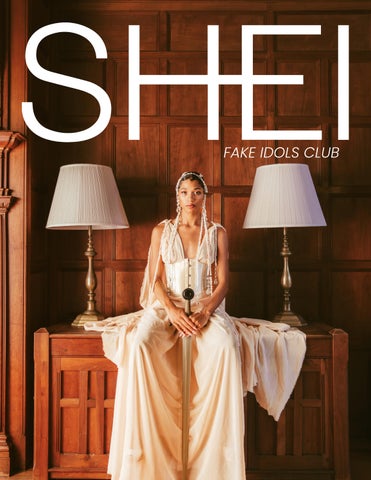
FAKE IDOLS CLUB
Standford Lipsey Student Publications Building 420 Maynard St, Ann Arbor, MI 48109
ERIN CASEY Editor-in-Chief GRACE DONNELLY
BOBBY CURRIE
Co-Publishers
Creative Director
ANISHA CHOPRA
Marketing Director
Operations Director
OLIVIA WIMPARI
TEMMIE YU
Print Features Editor
Print Photo Editors
CERIDWEN ROBERTS JULIANA RAMIREZ
MARXIE COLLIVER
KAELIN PARK MARGARET WHITTEN
Director of Photography
Fashion Film Editor
JOHANNES PARDI
AVA TUNG
JASMIN RHYMES
Design Editors
Print Fashion Editors
AVERY WHITE KATIE KELL
Managing Editor
JEFF WAGNER
Digital Content Editor
Digital Photo Editor
HANIYA FAROOQ
NIAH SEI
Digital Fashion Editor Communications Coordinators
ANA CANO CYNTHIA QIAN
Video Editor
ELENA SHAHEEN Events Coordinators
ALIA GAMEZ SAM TANDY Beauty Team
MILES HIONIS Digital Beauty Editor
MARGUERITE SMITH
Digital Features Editor
TESSA VALERA-CASTRO Finance Coordinator
KATIE BURGIN
Miles Hionis, Marguerite Smith, Ana Cano, Krystal Salgado, Ella Graeb, Margaret Mckinney, Gretchen Brookes, Adrienne Feige, Camille Naves, Yun-Hsi Chiang, Sravya Davuluri, Chelsea Ohaka, Eddy Holcomb, Jiyu Moon, Gabriele Shepheard, Ally Wang, Elizabeth Wolf
Print Beauty Editor
Social Media Coordinators
CHRISTIAN HERNANDEZ MACKENZIE RADLE
Digital Content Team Haniya Farooq, Katie Lee, Hannah Hoang-Pham, Nethra Vijayakumar, Felicia Wang, Ashley Xu, Jessica Yang, Sydney Emuakhagbon, Kiana Pandit, Irem Hatipoglu, Gigi Jones, Sydney Abam, Aalleyah Fysudeen
Video Team Design Team Katie Kell, Avery White, Story Triplett, Isabella Schneider, Cornelia Ovren, Ashley Turner, Caroline Kegg, Chloe Bratton, Jaycee Mitchell, Sasha French, Jasmine Barnes, Ava Anderson
Johannes Pardi, Jasmin Rhymes, Sydney Seifert, Olga Brazhnikova, Chloe Kiriluk, Felicia Wang, Samridhi Sharma, Naimah Perez, Elsa Pasquariello, Zoe Sage Tracey, Eesha Gummaraju, Alex Van Sweringen, Bryce Killburn, Mina Tobya, Justin Arment
Communications Team Fashion Team Ceridwen Roberts, Juliana Ramirez, Elena Shaheen, Sally Jang, Anika Lopes, Amelia Kocis, Ella Graeb, Hana Farooq, Kaavya Chavan, Christine Kim, Reagan Hakala, Emilio Rodriguez, Jessica Au, Emma Blair, Anjani Patel, Auburn Marriott, Hannah Ruffin, Rita Hajjar, Zachary Sebestyen, Madison Knowlton, Jillian Van Stee, Lucy Smith, Chelsea Ohaka, Mya Weiss
Photography Team Kaelin Park, Margaret Whitten, Niah Sei, Ava Muntner, Kamryn Washington, Chloe Kiriluk, Isabella Possin, Lane Liu, Zhixian Xiong, Jaden Moxlow, Esther Tirat-Gefen, Hannah Ruffin, Bridgette Bol, Shravya Ghantasala, Aria Zhou, Lilly Vydareny, Bee Whalen, Tania Rodarte-Escobedo
Cynthia Qian, Ana Cano
Events Team Alia Gamez, Sam Tandy, Alexis Bell, Colin Pfeifer, LeAnh Vong, Mallory Ensing, Megan Myrick, Renata Perez Rosillo, Sathvika Ravichandran
Social Media Team Christian Hernandez, Mackenzie Radle, Mackenzie Jackson, Renee Bourcier, Jaden Johnson, Carolyn Lira, Genevieve Jones
Finance Team Katie Burgin, Aubrey Heaton, Megan Dobie, Ryan Zimmel, Malini Fisher, Iliana Chevres
Features Team Marxie Colliver, Tessa Valera-Castro, Avery White, Isidora Purrier, Lane Liu, Avalon Ring, Makayla Whitsell, Raymond Zou, Ana Sharshar, Ashley Turner, Bianca Done, Emma Blair, Mimi Vu, Lola Post, Abby Weinberg, Sara Wong, Bee Whalen
IN THIS ISSUE Letter from the Editors 04 Protect the Dolls 06 Mani Balenciaga: Protector of the Dolls 16 Matryoshka 20 Mother Matryoshka 30 Captain Muscle! 32 Mattel’s Gayest Superhero 42 Trad 44 Red Shadows 54 Optics 56 Behind the Glass 62 Director’s Note 64 Behind the Scenes 65
3
A
s a kid nothing felt better than picking up a barbie doll or a transformer and
to toxic masculinity. We leave the living room, and walk into the spacious kitchen of
leaving behind the troubles of human reality. The cataclysmic, tormental
“Fake Idols Club,” and are pleasantly greeted by “Trad.” 1950s domestic and gothic style
combination of self-discovery, seeking perfection, and societal pressure disappeared
graphics clash on a set built by a theme park engineering group to further sell the
as I brushed Barbie’s sleek blonde hair and teleported to a world of plastic sublimity.
fantasy and tension between artificial versus reality. A silky, synthetic wig sits perched
The childlike wonder associated with a doll, a LEGO, a Lincoln Log or an action figure
upon America’s Double-Duty Woman; a trad wife of the 1950s who rips off her face and
disappears as we grow older, yet the message of chasing primp, plastic perfection never
hair to reveal her true identity; a trad goth. Blacked-out teeth and a noir ensemble stare
truly leaves. Looking back now, what felt to a young Bobby like an escape from life is now revealed to me as a corporate trap made to push forth impossibility as a standard. We will never truly be as tiny as Barbie, as jacked as Superman, or with every block in just the right spot like a well-constructed LEGO palace, yet that won’t stop us as consumers from trying for a capitalist America’s set price on how much perfection costs. SHEI Magazine’s fall print edition, “Fake Idols Club,” analyzes this delicate balance of artificial versus reality. Each shoot highlights a particular character, or doll, that further fictionalizes a world of perfection just beyond our human reach. Guarding the entrance to SHEI’s “Fake Idols Club,” is Mani Balenciaga, our “Protector of the Dolls,” warning us of the danger that lies ahead. She is our last glance at authenticity, at living with reality, as she stands tall, proud and fierce as a trans woman; a nod to the Protect the Dolls movement calling for trans rights. Mani’s sword slashes right into the next page where features writer, Emma Blair, crafts a captivating,
into the soul of the consumer as our trad doll tears apart the plastic world of perfection that “Fake Idols Club” promised you. Trad smiles all the way into the “Red Shadows,” a piece by Ana Sharshar that sheds light on a similar narrative. Our protagonist, Joan, breaks free from the burden of her life as a Kansas housewife to a world of reality and satisfaction, a world separate from the shackles of our “Fake Idols Club.” The creak of the stairs fills our ears as we take a seat upstairs in the TV room of our “Fake Idols Club,” and turn on the channel to “Optics.” There we see it; all of our dolls pictured together in a fabricated world of sheer perfection. SHEI debuts green screen work through a digitally created fake world. Once “Optics” is finished, we turn the TV off and get ready for bed “Behind the Glass;” a piece by Makayla Whitsell that shows us just how autonomous life can be without the confines of consumerism. “Fake Idols Club” is my debut as editor-in-chief of SHEI Magazine, and I could not be more proud of the entire print, features and design teams for their endless hours
powerful interview showcasing the journey and creation of Mani Balenciaga. As we
of work translating a creative vision into a 68-page print magazine. After hours of
walk into the foyer of SHEI’s “Fake Idols Club,” we run into “Matryoshka,” our cool-girl,
sleepless nights in the SHEI office filled with Domino’s and Cherry Coke, I present you
streetwear doll. We can never be as effortless as her, yet as consumers we can’t help but
“Fake Idols Club,” a satirical, lifestyle catalog designed to simultaneously achieve and
try. The design team sells us the essence of cool with Diesel-style ad graphics, and local
deconstruct the very impossibility of consumerism we aim to critique, with a classic
streetwear designer Creative Blueprint drapes our Matryoshka as she skates through
SHEI editorial twist. Available for purchase now for a limited price of only FREE.99.
the nighttime alongside her stack of wooden dolls, eerily similar to her own flesh and blood. Matryoshka skates right into “Mother Matryoshka,” where features writer Avery White twists each nesting doll open to reveal a multigenerational lineage examining divine femininity. We continue our voyage into the living room of our “Fake Idols Club,” where we are met with “Captain Muscle!,” our man of steel action figure. Captain Muscle works with SHEI’s design team to promise consumers the epitome of social masculinity, a muscletoned body sold for a measly 19.99. Yet, we can never truly look like an action figure, and our strive towards the perfect, muscle-toned, superhero body sacrifices the beauty and imperfections of our own reality. The sweat dripping off his body splashes into HeMan, a piece from Sara Wong which examines the homoeroticism intrinsically linked
Bobby Currie Editor-In-Chief
P
erfection is simultaneously the target we aim for and the dead weight preventing
characters, but in the presumption that there can be mere visitors. “Optics” positions
us from striking this target. Yet, our unwavering desire to be the best version of
our reader as a passerby who can freely extricate themselves from the system. In
ourselves is part of what makes us distinctly human. Our drive defines our selfhood,
fact, the majority of this issue functions as a mirage—including the spectator’s
and our selfhood dictates the direction of our drive. What happens, then, when
orientation as just a spectator. The “Optics” photoshoot suggests that readers consume
capitalist institutions craft the perfect method to prey on our dreams, insecurities,
this magazine from a bird’s eye view, but the spectator is still an active and powerless
secrets, and ultimately our identities? When they fabricate new flaws in order to sell
participant in the dollhouse. Here lies the danger of the dollhouse’s construction; it is
a false accessibility to this perfection, how could we help ourselves from chasing it?
a simulacrum that we observe and consume, all while convincing ourselves that the
“Fake Idols Club” critiques and comments on the fabrication of perfection to which we’re subjected. In order for businesses to appeal to our desires on a massive scale, these desires must be homogenized; ergo, we’re trained by algorithms, advertisements, and influencers to desire an archetype and its tandem aesthetic. Each character in this issue—Matryoshka, Captain Muscle, and Trad—hyperbolizes a falsely perfected version of an archetype we’re sold. Ascending beyond a state of “humanness,” the characters embody dolls—or false idols—which serve as a moving target for the quivering arrow of our desires. However, since what they’re selling is a homogenized representation—a flattened version—of our collective desires, we end up feeling emptier than we were
dollhouse is trapped within the pages’ confines. This is how we’re bought and sold; in our obliviousness and our overconfidence, we mistake a diorama of authenticity for the real thing. Ergo, this publication may even contradict itself. Through satire, it solidifies the authority of the personality-packages sold to us; the compulsion to satirize insinuates the archetype’s influence and staying power. Somehow, these unattainable aesthetics are reinforced in the same stride as we negate them. As you, our dear reader, consume these pages, I invite you to keep this question in the back of your mind: does your consumption of this issue free you from the confines that we criticize? Or are you still trapped inside another, hidden layer of the dollhouse?
before we emptied our pockets, since our fulfillment of the archetype only fulfills onedimension of our selfhood. The articles in this issue divulge the fragile framework upholding the dolls, as well as the dollhouse in which they’re trapped. In “Mother Matryoshka,” Avery White traces our jealousy for the “effortlessly cool girl” back to its root, and in this root she harvests an alternative to our jealousy. Furthermore, Ana Sharshar’s fictional piece “Red Shadows” narrativizes the slow dissolution of the tradwife character, until there are too many cracks in her mask to conceal her authentic self. Finally, “Behind the Glass” articulates that our subscription to an archetype and/or aesthetic comes at the expense of our autonomy and selfhood; the steepest price of them all. In this article, Whitsell questions the composition of the dollhouse: can we prevent it from
Marxie Colliver Print Features Editor
subsuming us entirely? The anomaly of our fake idols’ dollhouse lies not in its composition, nor its
5
7
9
11
13
15
WRITER: EMMA BLAIR GRAPHIC DESIGNER: CHLOE BRATTON
I
recently had the chance to sit down with Mani Balenciaga, the beautiful model and muse for ‘Protector of the Dolls.’ We discussed life, identity, fashion, family, and her experience working with SHEI. She discusses what else could be done for trans models in the industry and how representation is crucial for everyone to flourish. This conversation provides a glimpse into her world and her journey as she transitioned into the captivating woman she is today.
Emma: You recently were an amazing model for a SHEI shoot. What was your favorite part of the process? Mani: Honestly, the actual shoot. Just being in the dress and getting to frolic around, actually getting into character. I was already excited for the shoot, but then seeing the location we were at, it really made me get into character. Emma: Where was it? Do you know? Mani: I’m not sure what it’s called, but it was an all girls dorm. Emma: Ohh, I know what you’re talking about. Mani: It looked like a chapel when you first walked in. It was so beautiful. I was kind of gagged. Emma: What surprised you about this experience? Mani: I didn’t expect to get videotaped. I don’t know what I was expecting. When they said fitting, that’s when I got excited for real. I was like ‘Okay wait, it’s kind of giving professional vibes.’ Then I saw the cameras and equipment you were using and how many people were there helping, like the team was a team. It was really exciting to see. Emma: The shoot was ‘Protector of the Dolls.’ What does ‘Protect the Dolls’ mean to you? Mani: Protect the dolls, to me, means respect the dolls. We need to be seen as humans and who we are, rather than these depictions that people have…You literally cannot protect all women unless you protect the dolls… I tell people that I feel transphobia affects all women… The same way that someone is nitpicking a trans woman to say if she’s a woman or not, they can do that to a cis woman. They can look at her appearance and that can be their reasoning for why you are or aren’t a woman and you quite literally have a vagina. I just feel if you’re protecting the dolls, everyone’s going to be able to prosper.
17
Emma: Are there any changes you’d like to see in how the fashion industry approaches transgender representation or inclusivity in general? Mani: Honestly, the dolls have kind of been working it out. Victoria’s Secret…they called Alex Consani back and we were seeing a couple of the other girls too. I’m like ‘period, it’s kinda giving.’ The visibility is definitely starting to be there, BUT I feel like there could be more visibility when people talk about being different transgender variations. There was an era of my life where I identified as non-binary, and that was the journey I was on to accepting myself as trans. I feel like there definitely needs to be a lot more representation of different kinds of trans people…People are just considering the dolls as the super pretty, super hyper-feminine, but there’s a lot of different girls out there that are still dolls. If there were more people being represented, it wouldn’t be hard for people to understand transness or non-binaryness because it would be visible to them. Emma: I totally agree. You had mentioned before that you’ve been to New York Fashion Week. What was that like? Mani: Something cool from the New York experience was that was my first time wearing a dress…I hadn’t transitioned yet and the designer was like, “I can see you in that dress.” It was this green Greek goddess dress. I didn’t think I was going to be wearing gowns,
gowns, beautiful gowns. Then I ended up walking another show in a dress…The designer thought I was a girl. She already knew I was the girl before I even knew I was the girl. I just pulled her aside and said, ‘You said your brand was for women, I just don’t want to offend your brand,’ and she was like “You’re not a girl?” and then was like,“Oh, that’s fine. You still represent our brand.” I didn’t have any heels or anything. I had combat boots. I was wearing this blue, flowy spaghetti strap dress and these black combat boots, and she gave me a leather jacket, and it was really cute. Emma: Where do you look for fashion inspiration or ideas? Your favorite designer? Favorite fashion influencer? Dream fashion item? Mani: My dream fashion item. I don’t even know. I’m so bad when it comes to knowing specific looks. I usually find fashion inspo from Pinterest. I use Pinterest for everything. I love Pinterest. Emma: Pinterest is amazing. Mani: Yeah. Most of the influencers that I follow, I found on Pinterest. As for designers, I love old 90’s Thierry Mugler. I love it. I love it. I love it. If I could own anything it would be a gown from that era. I love a gown. I don’t really have that many, because I don’t really have chances to wear them. I’m trying to get into that era of wearing whatever, whenever. Emma: What’s a trendy thing you’re loving right now or think you’ll keep permanently? Mani: I love loafers. They will never go away for me. Anything with knee high socks and skirts. I just love girly girl stuff…I know a skirt will always eat for me; maxi, mini, it doesn’t matter. Emma: What’s your fashion hot-take? Mani: Wear whatever the fuck you want. Fashion is like art. It’s subjective. Somebody will get it, just wear it.
Emma: I don’t know if I have one. I don’t really love super trendy things, so maybe that. How has your style changed with your life and changes in identity? Mani: I used to sneak to wear a lot of things, because I wasn’t allowed to wear them. I would wear jackets so that I could zip up and take them off when I left the house. I really started liking trench coats because I used to be able to cover up stuff. They are just cute period so I started wearing them all the time, and my dad would be like “You look like Blade.” The whole time I’m dressed down boots with it, the wig is in the car. Once I started transitioning, I tried to stay away from extra hyper-feminine, sexy all the time, because that’s what I used to have to do to be accepted. I’ve been starting to fall back into the same stuff I would wear pre-transition, like jackets and layering things. I still do a lot of that, just with stuff I actually want to wear. Emma: How has your family impacted your identity? Mani: I grew up in church so I would always force masculinity at all costs…Makeup was the first thing I started with to express myself. I would wear mascara or concealer, little things like that…My sister started doing nails, so I started doing nails after she started practicing on me. I had makeup and long nails, but would really try to masc it up. I didn’t come out until after high school. I came out as gay so I would try to appear as, ‘just gay that’s it,’ I didn’t want to appear as trans in any way…I would just do the most to make it as masculine as I could. I never really got to come out to my mom. She passed on Christmas Eve of 2020. She kinda knew everything about me though because she went through my phone. We would talk all the time, like she already knew, but she never got to see me as Mani at all.
She never saw any of that. My sister knew because I would talk to her. My brother would catch on. He caught on that I was transitioning and starting hormones. One of his friends said “Your brother has boobs” and my brother said, “No, that’s my sister.” When I moved out, that was the first time I saw myself as fully fem and actually started my journey of exploring femininity for real in the way I wanted to. Emma: When you moved out did you have a support system or people that you talked to outside of your family? Mani: When I first moved out it wasn’t really planned… my coworkers started telling me about the Ruth Ellis Center. That’s where I found all my resources after not living with my dad anymore. From there, I met all the fem queens and people that were there. I found a support system through that and ballroom. They became my chosen family. In speaking with Mani, I am reminded that identity is not a performance but a claiming of something that can be quiet, loud, sacred, daily, and always transforming. “Protect the dolls,” while a prominent slogan, is so much more. It is a blueprint for community, care, and survival.
Protect the dolls, to me, means respect the dolls. We need to be seen as humans and who we are, rather than these depictions that people have. 19
21
23
25
LEATHER JACKET AND CAP - CREATIVE BLUEPRINT
27
PAINTED MATRYOSHKA DOLLS - ANISHA CHOPRA
CREDITS CREDITS CREDITS PHOTOGRAPHERS CREDITS CREDITS CREDITS MAGGIE WHITTEN CREDITS CREDITS KAELIN CREDITS PARK CREDITS CREDITS CREDITS STYLISTS CREDITS CREDITS CREDITS CERIDWEN ROBERTS CREDITS CREDITS CREDITS JULIANA RAMIREZ CREDITS CREDITS CREDITS BEAUTY CREDITS CREDITS CREDITS MILES HIONIS CREDITS CREDITS CREDITS DIRECTOR OF PHOTOGRAPHY JOHANNES PARDI 1ST AC ALEX VAN SWERINGEN GAFFER BRYCE KILLBURN GRAPHIC DESIGNER CAROLINE KEGG MODEL CASEY ZHANG
29
WRITER AVERY WHITE GRAPHIC DESIGNER AVERY WHITE
ll that remains inside her fleshy heaven are the shells of what made us divinely feminine. Women’s bodies are the living proof of that, carrying forth a legacy in our wombs that spans generations. Within the walls of our grandmother—a home—laid the egg inside the woman who birthed our souls into existence, the egg we originated from. We were all once there, as matryoshka dolls, residing in our grandmother’s wooden womb, snuggled tightly within the grooves of the toy mold that kept our hatching selves safe from any harm. Our mother then carried forth our egg and after we emerged from her life-granting portal, we were swaddled in not only newborn blankets, but a womanly trauma that stained each fiber of our DNA: the patriarchy. Perhaps out of fears of inferiority or even biological jealousy, he conditions us women to envy each other. We are manipulated by the patriarchy to stack ourselves up against other women, in continuous and contradictory competition. Although we have inherited an intrinsic connection through the cyclical stacking of both my grandmother and mother on top of me and my future daughter, toxic masculinity works to disassemble our foundations. The reality here is that there is enough room for every feminine to flourish; the space has been carefully carved out in the shape of the women, or dolls, who formerly contained us. Matryoshka, I am you and you are me. Thus, what if we opened ourselves up to the idea that admiration is at the center of the jealousy we hold towards one another? Remove those fragile layers of insecurity and internalized misogyny—encapsulated by its outermost nesting doll of the patriarchy, and feel the weight of our admiration. After all, it is no coincidence that among this sequence of uncovering the hollow layers of our emotions, we find that the innermost piece is solid wood. We hold a duty to care for insecurity as if it were our child, in order to nurture a collective femininity that can combat rivalry and mother us all, including masculine and fluid identities. Lineages extend across an ocean of covens—where daughters swam in mothers in grandmothers. In honor of the nine months braving my mom’s waters as well as the nine months before my egg was released from its shell within my grandma, I vow to release the patriarchal entrapment that pits our womanhood against itself and hereby claim jealousy as my very own daughter. I am Mother Matryoshka and jealousy, you are my dochka.
Beyond metaphor, ovarian intergenerational continuity is the scientific phenomenon of having existed as an egg inside of your grandmother while she was pregnant with your mother. 1 It demonstrates an extraordinary relationship between daughters and the lineage of women whose wombs generated the egg that ultimately created them later on in their fetal development. Here, the interconnectivity of womanhood is clear, directly linking the process of procreation to an ancestry of the women who lived before you in biological and symbolic nature. This concept is reminiscent of the matryoshka doll, a children’s toy culturallyderivative from Russia that features a set of hand-painted, wooden women of increasingly smaller sizes, that perfectly stack into one, identical bundle. These toy novelties signify themes of fertility and motherhood while symbolizing feminine bloodlines in a heart-warming manner as they are typically passed down from generation to generation. This exchange of dolls connects members of a family tree for eternity—similar to the notions of reproduction. When looking back to the herstory of nesting dolls, an interesting mirror appears that highlights an ironic relevance between these toys and ovarian intergenerational continuity. Essentially, over the course of matryoshka dolls’ existence, they have been mistakenly called “babushka dolls” by those unfamiliar with both the cultural origins that inform this tradition and, additionally, its matriarchal roots. 2 On the basis of linguistics, the “mat” in “matryoshka” hails the Latin word “mater,” meaning “mother,” while “babushka” is a Russian word meaning “grandmother.” While the correct term for matryoshka dolls is important, emphasizing the intended motherly recognition, maybe “babushka dolls” was not too far off considering how intertwined women are to their grandmothers, as revealed through the biological genesis of femininity. In a charming way, this misinterpretation of names further amplifies the universality of how interconnected three generations of women are: from babushka to matryoshka to dochka. Now, when it comes to the history side, less familial celebration exists and instead, genetic competition commences. Numerous theories attempt to explain the rise of the patriarchy, this ruling of the “father,” yet anthropologists cannot necessarily agree on a specific exposition. Some common, unconfirmed hypotheses involve early agriculture and the materialization of land ownership, biological differences between sexes shaping domestic labor roles, and of course, an inherent violence attributed to men seeking power over marginalized groups historically. 3 To further complicate the debate, widespread myths cloud this atmosphere of discourse, such as the popular and unproven belief that prehistoric matriarchal rule was established (and thriving) before patriarchal rule asserted its dominance and demolished those peaceful societies previously cultivated by maternal energy. 4
Nonetheless, whether grounded in truth or falsehood, we can still envision a more harmonious future by imagining one
supported through matriarchy and letting it guide us in our pursuits going forward. We could look up to certain locations around the world like China, Costa Rica, India, Indonesia, or Ghana, as matriarchies prevail there in this modern age of which is currently permeated by an abundance of patriarchies. 5 Given this crucial context, we can peel away the layers that have wrongfully stacked my femininity against yours. Through this reclamation, the jealousy that used to condense us suddenly reveals itself as admiration. Look at you, Matryoshka! A face delicately painted in vibrance, with your curvy structure housing generations of divine femininity—I do not envy you anymore because I know that we are one in the same. Our differences and similarities survive amidst feminine heritage and a shared womanhood, deemed strong enough to embrace patriarchal forces with a mother’s love that softens the rigidness of masculine competition for generations to come. Whether you are at the stage of dochka, matryoshka, or babushka, we are all one in the same and divine femininity holds us together in a doll of her own. 1. L uo, Lingfeng, Jingwen Li, Yi Sun, Yake Lv, Jin Liu, Yuchen Li, Chenyun Zhang, and Wenchang Zhang. 2023. “Maternal Genetic Intergenerational and Transgenerational Effects on Hormone Synthesis in Ovarian Granulosa Cells of Offspring Exposed to Cadmium during Pregnancy.” Ecotoxicology and Environmental Safety 263 (September): 115278. https://doi. org/10.1016/j.ecoenv.2023.115278. 2. Nesting Dolls. 2019. “The Meaning and Symbolism of the Matryoshka Nesting Dolls.” Nesting Dolls. May 8, 2019. https://nestingdolls.co/blogs/posts/meaning-symbolism-nesting-
3. Omvedt, Gail. 1987. Review of Review: The Origin of Patriarchy. Economic and Political Weekly 22 (44): WS70–72. https://www.jstor.org/stable/4377665?seq=1. 4. Eller, Cynthia. 2018. “The Myth of Matriarchal Prehistory.” Nytimes.com. 2018. https:// archive.nytimes.com/www.nytimes.com/books/first/e/eller-myth.html. 5. The Unearth Women Team. 2023. “Matriarchal Societies Where Women Run Things.” Unearth Women. March 22, 2023. https://www.unearthwomen.com/5-matriarchal-societieswhere-women-are-in-charge/.
dolls.
31
33
35
37
39
41
HOW MATTEL Accidentally Created the gayest superhero
T
here are two pieces of media that inadvertently helped me accept my own queerness as a young teen, both of questionable writing quality but still beloved regardless—Netflix’s 2018 animated series She-Ra and the Princesses of Power and the 2019 novel Red, White & Royal Blue by Casey McQuiston. The cartoon follows Adora mastering her abilities to transform into the titular hero She-Ra in order to defeat an evil space empire her childhood friend (to enemy, to potential lover) pledges her allegiance to. And, in a complete 180, McQuiston’s novel follows a love affair between a fictional first son of the United States and a prince of England. Imagine my surprise upon discovering these two pieces of media would have an unlikely connection through the upcoming 2026 film Masters of the Universe. Nicholas Galitzine, best known for roles like Prince Henry in Amazon’s Red, White & Royal Blue film adaption and Jeff in the 2023 black comedy Bottoms, has been cast as Prince Adam. He, like his twin sister Adora (She-Ra), has an alter ego: He-Man. Since early promotional materials have been released, some critics turned to online forums to bash this new reboot of Mattel’s He-Man, claiming that this new He-Man is too feminine, too “gay.” But as any fan of He-Man or Mattel’s Masters of the Universe franchise could tell you, He-Man never loses. He has always been the strongest, the most tough-willed, and well, the gayest. What we now know as the megacorporation Mattel started with humble beginnings as a small, family-owned toy company, until the release of the first Barbie doll in 1959 put them on the global stage for success. After Barbie, Mattel quickly followed up with her boyfriend Ken, her dream house, an army of friends, pets, swappable clothes, and accessories. Mattel’s largest rival toy company
Hasbro, responded by attempting to fill an untapped market—dolls “for boys.” Hasbro launched G.I. Joe in 19641 and marketed the army soldier toy as an “action figure,” officially coining the term. Because of course, if Barbie cracked the code to America’s wallets by creating the perfect image of femininity—consumerism, a slim figure, fashion, more consumerism—Hasbro needed to enter the scene guns blazing. Literally. What could be more masculine and appealing to little boys than the U.S. military? Than the aestheticization of war? Following G.I. Joe, various companies raced throughout the 70’s to produce action figure tieins for Marvel and DC comic heroes, TV shows like Star Trek, and most notably, the Star Wars franchise. Mattel scrambled to develop an intellectual property that could compete with the emerging Star Wars action figures. They landed on something simple: a towering, blond man with a legendary sword and even more legendary abdominal muscles. They wanted this hero to fit into any story, context, or scene, so they gave him a laughably generic name to match. From there, the world was introduced to He-Man, the defender of the universe. A tie-in animated television series helped solidify He-Man’s place as one of the leading action figures of the 80’s. He-Man made his onscreen debut in the 1983 cartoon He-Man and the Masters of the Universe, which follows Prince Adam on a quest to defend his home planet Eternia from evil through the power imbued to him by Castle Grayskull, a mysterious castle and purchasable playset (dolls sold separately). The castle grants him the ability to transform into He-Man by raising his Power Sword and proclaiming “By the power of Grayskull,” which enhances his strength, speed, agility, and wisdom to superhuman levels. The He-Man transformation also provided the iconic look—a blond bob, a red Speedo, red, furry boots, and a harness wrapped around his bare chest. Now, what could have possibly attracted such a large LGBT fanbase to the franchise?
1. “How G.I. Joe Jump-Started the Action Figure Craze,” History.com, May 27, 2025, https://www.history.com/ articles/action-figures-g-i-joe-star-wars.
2. Butler, Judith. “Performative Acts and Gender Constitution: An Essay in Phenomenology and Feminist Theory.” Theatre Journal 40, no. 4 (December 1988): 519. https://doi. org/10.2307/3207893.
In all seriousness, it was inevitable that people decided that there’s something undoubtedly queer about the way He-Man and other characters perform their masculinity. By “perform,” I’m referring to the feminist philosopher Judith Butler, who argues that gender is not prescribed by language, nor is it determined by nature, or anatomy; instead, gender is constantly performed.2 Under Butler’s theory, gender is not a given, but something constructed out of the clothes we wear, the manner in which we carry ourselves, the behaviors and actions we commit to, and so on. He-Man’s expression of masculinity—with his muscles, physical power, and mission to protect others—is so hyperbolic and idealized that viewers naturally code his presentation as something outside of the norm. This exaggeration of manliness seemed to resonate with queer audiences. Performance has always been a part of queer culture. From drag, to theatre, to performance art, transformation helps us understand and play with traditional boundaries between gender and sexuality. Many fans of the Masters of the Universe franchise read Adam’s transformation into He-Man as a sort of coming out—he grows more confident and assured in his alternate identity. Alternatively, Adam and He-Man coexist as two true selves. He-Man’s hypermasculine performance of gender is also an accessible example of the nuance of gender—how hypermasculinity is not bound to male heterosexuality, nor is femininity inherently tied to male homosexuality. In Masters of the Universe, He-Man has the freedom to transform into his overwhelmingly “manly,” persona without the other societal expectations that normally come along with hypermasculinity in our own world, like dominance, emotional repression, or viewing women as a conquest. He-Man can simply focus on bettering himself, traveling with his friends, and protecting what he cares about. It’s liberating. Future reboots and continuations of the original 80’s cartoon, such as Netflix’s 2021 Masters of the Universe: Revelation animated series, would take on openly gay writers and artists. In an interview3 with Tom Sheridan and Rob Davis for the online magazine Queerty, Sheridan said “I think it’s so easy and reductive to look at it as the silly image of guys in loincloths. I didn’t know anything about muscle guys when I played with He-Man as a kid. What I understood was being fabulous on the inside. The thing about the classic era—we didn’t see ‘out’ boyfriends holding hands. It was a different time. And yet, Masters of the Universe managed to develop, maintain and still has a huge following within the LGBTQ community. What I think that tells us is that it’s not just about characters that share similar traits. It’s about the themes, the stories we tell, and how we hook into that.”
As I grow older, I’ve begun to realize that exploring my own identity, in any capacity, is not unlike playing with dolls or action figures. We think you have all the freedom in the world to reinvent yourself—to see and make the world however we wish. But then, someone might only hand us toys they think are “appropriate” to play with, or swap out our Bratz Doll for Bob the Builder, or tell us we’re playing the “wrong way” if you want to make He-Man and Skeletor kiss. Is imagination really the limit if someone’s always over your shoulder, policing new ideas? Thankfully, I have a disposable income now. I can buy, sell, or save for whatever trinkets I want, and thanks to brain development, I know that consumerism isn’t the answer to my happiness or selfacceptance—community is. Most fans don’t remember the Masters of Universe franchise for its toys, but rather, the earnest storylines and character dynamics, the excited Saturday mornings spent watching the cartoon with siblings, and the continued stream of online fanworks that will continue to inspire new generations to make their own art. Playtime doesn’t need to end, and there’s no reason to stop chasing joy once we’re too old for the toybox. There are so many aspects of ourselves to experiment with, and so many new stories to craft at our fingertips. All we really need to do is find the strength to fight for them. WRITER SARA WONG GRAPHIC DESIGNER KATIE KELL JAYCEE MITCHELL
3. Reddish, David. “He-Man” writers on character’s enduring homoeroticism in “Masters of the Universe: Revelation” - Queerty. Accessed October 28, 2025.https://www.queerty.com/man-writers-characters-enduringhomoeroticism-masters-universe-revelation-20210723/.
43
TRAD AMERICA’S
DOUBLE
DUTY WOMAN
45
47
49
51
Set - TPED Doll - Ceridwen Roberts
PHOTOGRAPHERS MAGGIE WHITTEN ANISHA CHOPRA STYLISTS CERIDWEN ROBERTS JULIANA RAMIREZ BEAUTY MILES HIONIS DIRECTOR CERIDWEN ROBERTS DIRECTOR OF PHOTOGRAPHY JOHANNES PARDI 1ST AC ALEX VAN SWERINGEN GAFFER JUSTIN ARMENT KEY GRIP MINA TOBYA GRAPHIC DESIGNER SASHA FRENCH MODEL SALEM ZHAO
RED Shadows
WRITER ANA SHARSHAR GRAPHIC DESIGNER CORNELIA OVREN
T
he sun set over the cornfield, and the Kansas wind began to wind down as it had every night that summer. It was the hour of suppertime, when the smell of whipped mashed potatoes, creamy gravy, and roasted chicken stained the windows of the ranch, steam sticking to the pale wallpaper. Joan stood in front of the stove, pouring food into designated bowls. She smoothed out her apron and the frizz from her blonde bob, coating her lips with a pink stain. On the wall, the clock kept ticking; everything was anticipating her husband’s return. Joan stood near the door, catching a glimpse of herself in a mirror that reflected a face of conformity back at her, a face that was once so defiant. “Hi, honey!” Joan leaned in, kissing him on the cheek. “Dinner’s on the table. I made your favorite!” The evening’s blue hue surrounded his figure in the doorway as he shook his boots off and rested his hat on a deer mound. He nodded, returning no affection, and made his way to the neatly set table. Joan’s fingers wrapped around the doorknob, ready to shut it. She lingered for an extra moment, eyeing every stalk swaying freely in unison with its counterparts. “How’s the chicken?” Joan asked, readjusting her posture. Their spoons clashed against the ceramics, knives sliding into chicken. A candle burned in the centerpiece, forming a stark boundary between the two and casting a red shadow over their cheeks. She wasn’t sure what she should ask him. About the fields? But the mention of work might disrupt his composure. Should she talk about the new television set in the paper? Maybe he wanted to converse about the summer drought?
He spoke up. “Dry.” Then he shoved another forkful into his mouth. Joan didn’t ask another question. The fork in her hand cut the chicken into pieces, and she chewed slowly. They sat like this for the remainder of supper, with nothing but the crackling of a candle and the grinding of food between the two. When he finally retreated into their bedroom without a word, his place empty, she let out a soft sigh, gathering the dishes and placing them gently in the sink. As the plates shined with suds, Joan thought of her husband’s body as he got ready for bed. She considered herself completely unbearable and useless in entertaining him and took his lack of affection toward her as a sign of disdain. She couldn’t understand it. Her modifications had been severe. With cheap bleach from the grocery store and clothes found at a local boutique, her appearance was strikingly traditional–everything a man, she was told, could wish for, and everything she had once detested. Joan had done it all just to be desired by him. She made her way into the bathroom to prepare for another long night beside her husband. Though his gaze remained distant, Joan put extra effort every night into perfecting her appearance. She drowned cotton pads in makeup remover, smeared thick white globs of face cream, and primed her lips with tinted chapstick. She placed the products in their designated drawers, next to an eyeliner stick that transported her back to the memory of high school. It was a time when sneaking out of her bedroom window during late nights was the height of Joan’s worries. She could still feel the fear that her mother would catch her crawling out of the window, drawing her eyebrows with black pencil, or trimming her bangs with kitchen scissors. Joan had once thought she would remember those as the constricted days; now she felt pity for herself, wondering how she could have been more free at sixteen than twenty eight.
Joan removed the cap of the eyeliner now, its dull end still the bold black she remembered. She swiped a thin line on her waterline, feeling the slight sting and boldness of her youth, but then aggressively wiped it off, her cheeks red from embarrassment. She set the eyeliner back in the drawer, unable to throw it out after all this time. She brushed her bob again, on the off chance that he would reach over and tuck a piece of hair behind her ear. Joan’s satin nightgown grazed the top of her knees as she found her way into the cool linen sheets. She fixed her gaze on the ceiling. The curtains were drawback, letting the dark night reflect shadows around the room like characters she had once read about. The corn swayed along her ceiling, and an oak tree overpowered the smaller shadows, its branches rocking in the July heat. Her eyes grew heavy, and she drifted off to sleep.
The following night, Joan’s ritual began again. The aroma of steak and potatoes suffocated the dining table as she stood by the front door, awaiting her husband’s arrival. Minutes went by with no sign of life. After nearly an hour of waiting, she still didn’t hear his heavy boots pounding up the walkway. Her fears heightened as silence prevailed. Outside, cicadas hummed, and a cool breeze combated the summer heat. Joan stood face to face with the cornfield and, unsure whether to enter it, shouted for her husband. Only the bugs spoke. “Shit!” she muttered under her breath, lifting her dress and tackling the cornfield. She separated the corn stalks from her body, pushing them to the side, fighting against their resilient roots. Her voice continued to echo as her eyes frantically searched through the soil and stalks when suddenly, a branch latched onto the skirt of her dress. Joan tugged at her dress, trying to set it free, but the bottom ripped. The hunt for her husband continued as her hair escaped from its updo, falling onto her shoulders, the sweaty strands clinging to her rosy cheeks. Maneuvering through, she tripped, colliding with the soil. A few feet from Joan’s face was her husband’s body, face down, unmoving. Joan scrambled to get up as a shriek escaped her mouth. All of the anger, resentment, and indifference that once fueled his being had disappeared. Death left him cold and still. Suddenly, his existence felt trivial to Joan; death had erased his power. She stepped back; a tear stained the foundation she had caked on that morning, fertilizing the soil as it hit the ground. Joan’s hands lunged towards her mouth, catching a laugh. She turned, and took off into the corn toward the ranch. He had conformed her, twisted her into an image, like a painter does to his subject, incapable of capturing the beauty held by the human eye. He had let nothing slide, nor anything in, and she tried to recall, as she ran through the field, the hem of her dress stained green, a time in which he had made her feel beautiful. Nothing came to mind. The wind pulled her back, and Joan ripped the apron from her body, freeing herself from the claustrophobia, undressing her pain to reveal a quiet liberation. The fabrication of life loosened its grip on her as she approached the house. She barged through the front door, escaping the night, and headed for the bathroom. She opened her makeup drawer, secured her high school eyeliner, and caught a glimpse of herself in the mirror before turning away. Her eyes lit up for a quick second, capturing the newfound freedom lingering in her pupils. His truck was parked out front. Rusted from its wear and tear, she had never had the chance to sit in it, to feel the leather seats on her thighs during a hot July night or stick her head out the window to let the wind catch her hair. The keys sat in the ignition, waiting, begging to be turned. Without thinking, Joan hopped in, turned the key, and broke into a toothy grin as the engine rumbled. The Kansas night was ordinary. The moon hung high, lighting up the street as Joan drove down the winding road. Corn lined the sides of the road, its tall stems covering the possibility of anything beyond itself, slowly leaning to the left and then to the right. Joan looked out the window, her husband’s cigarette burning from her lips, and for once didn’t feel suffocated by the never-ending sight of fields. Instead, their abundance felt serene, felt full, felt weightless. Her hand switched the radio on to a low static before a familiar voice tuned in. Guitar shimmered through the car, and the deep voice of melancholy escaped through the car windows. Buildings sparkled in the distance, and she was reminded of the world she knew before her entanglement: a world suspended in time.
OPtiCS
57
SPECIAL THANKS TO HOLLYWOOD FARMSTEAD
59
PHOTOGRAPHERS MAGGIE WHITTEN KAELIN PARK ARIA ZHOU PHOTO EDITOR ANISHA CHOPRA STYLISTS CERIDWEN ROBERTS JULIANA RAMIREZ BEAUTY MILES HIONIS DIRECTOR OF PHOTOGRAPHY JOHANNES PARDI 1ST AC HEIDI EBY GAFFER JOE HARVEY GRAPHIC DESIGNER JASMINE BARNES MODELS BRISTON ARMSTRONG CASEY ZHANG SALEM ZHAO
61
BEHIND THE GLASS
WRITER MAKAYLA WHITSELL GRAPHIC DESIGNER AVA ANDERSON
O
The industry demands our commitment to trends and requires consumers to find self-renewal through transactions. Ultimately, the industry’s exploitation of our manufactured
ften feeling like a permanent exhibition, the
desires compels us to surrender to the comfort found in a
performance seemingly encapsulates the modern identity.
pre-packaged, fleeting expression, thus accelerating the swift
Self begins to inhabit the dollhouse, a structure defined by its
cogs of the trend cycle
perfect intricacies, enclosed by pristine glass panes. We fiter,
Despite the pressure to fit into a niche, such
curate, and optimize every moment to cycle identity into
standardization offers a deceptive comfort and familiarity.
consumable content as we transform our lives into a public
From the ready-to-wear nature of “clean girl” minimalists
optic. Collection of personal data in algorithmic prediction
to “old money’s” quiet luxury, trends set the stage for the
encourages optimization of a“self-brand,”converting perfetion
systematic
into a currency concealed by the illusion of convenience. This
Aesthetics rarely exist in isolation; they are tethered
exhausting cycle of transactional self-commodification forces
to a blueprint that dictates diet, decor, and demeanor.
us to confront a critical internal question: when external
Consequently, what appears to be a lifestyle becomes an
pressures engineer us to be profitable displays, does the
architecture with a foundation of control; meanwhile, the
pursuit of ideality inevitably cost our personal autonomy?
illusion of choice overshadows our ability to see the script of
Through the exploration of critical theory, it is clear that the
conformity. In subscribing to an aesthetic, we must surrender
systematic standardization of modern identity and aesthetics
fragments of autonomy until our way of being becomes a
is not about the soul’s complexity, but fostering a mechanism
role to maintain, rather than a self to inhabit.
that predicts how we desire to be perceived behind the dollhouse’s seamless glass pane.
fragmentation
that
dissolves
individuality.
The transformation of identity into performance marks the shift from the individual to Gilles Deleuze’s
The foundation of these systemic forces lies within
theorization of the “dividual.” Fragmented into data, the
the “Culture Industry,” a machine that commodifies cultural
“dividual” is valued not for individuality, but for their role
artifacts to emulate scarcity and exclusivity. Coined by
as a collection of data that can be tracked, categorized,
thorists Theodor Adorno and Max Horkheimer, the “Culture
and monetized Amidst the process, identity translates
Industry” refers to the mass production of culture under
into quantifiable metrics that become less about who we
capitalism, in which art, entertainment, and self-expression
are, and more about how we register in the system. The
are standardized and packaged into predictable forms to
Culture Industry feeds on these conditions, consuming the
serve economic and ideological control interests. Today,
participation that maintains the “dividual’s” circulation
micro-trends and algorithms fuel the industry by assembling
through both self-performance and the consumption of
identity into consumable niches. Within this context,
others’. Sustaining a surplus of demand requires continual
creativity is suppressed by micro-trends and algorithmic
engagement, urging individuals to maintain a desirable self-
design, positioning the individual within an assembly line
brand to simply remain seen.
of aesthetic manufacturing. The industry particularly excels
Maintaining a marketable self within this visual
at this, imposing the mirage of choice while simultaneously
economy calls for an internal severance; a persona
reinforcing its expectations. These expectations encourage
manipulatable for social and commercial imperatives.
consumers to adhere to existing styles, which, of course,
Constantly, we are exposed to media that lack diversity due
warrants purchasing new wardrobes, skincare products,
to algorithmic bias, producing a homogenized image that
makeup, etc.
prioritizes appearance as the paramount measure of worth.
Since effortless perfection has become synonymous with success, expressions of struggle are often suppressed in favor of social or monetary gain. This homogenization breeds stigmas and microinsecurities that disproportionately impact women, particularly women of color.For example,the“balletcore”aesthetic is accompanied by its emphasis on delicacy, which fosters the expectation of flawless skin, thin body proportions, muscle tone, and even movement that subtly pressures participants to mimic these ideals through cloth ing, exercise, diets, and social presentation. Emphasizing eurocentric features, a prominent number of images that have popularized “balletcore” align with ballet’s historical and systemic exclusion of women of color. Not only do style trend cycles influence our expression, they alter our ideals and self-expectations. Further reinforcing participation, the phenomenon renews the need for products, updates, and self-reinvention, as each aspect of appearance is woven into the trend cycle. By encouraging comparison and fabricated ideals, the industry effectively limits opportunities for its dismantlement as personal expression is commodified into consumable performance. Authenticity itself is further absorbed by the system, as raw discussions, statements, or personal moments are reframed into opportunities for content and brand narrative to serve the algorithm’s favorability. Considering the Culture Industry and the phenomenon of the “dividual,” the cost of modern assurance is paid in self-autonomy. Free expression is diminished as every aspect of ourselves is reduced to a commodity, a site for measurable profitability. The external pressures that we perceive as social demands stem from the construction of the “dividual,” in which we have no other choice but to be sorted into a box. Society doesn’t lack self-expression; rather, it abandons facets of self in exchange for convenience, allowing the façade of ease to mask the labor of conformity. Yet, like a meticulously manufactured dollhouse, its perfection is fragile. The glass that encloses it can shatter, the walls torn down, revealing its systemic foundation beneath the spectacle that sits above. However, algorithmic enclosures complicate this potential: the glass may offer a space for reflection, or function as a mirror, endlessly encouraging self-optimization. Behind it, every motion is quantified and repurposed to sell back to you. In this light, autonomy has become the most elusive commodity as visibility and engagement come to dictate not only how we are perceived, but how we inhabit our own selves. The optics of this enclosure through which we view the world poses a questionable oddity; does the glass resist the script through its two-way transparency, or offer itself as a polished, crystal clear reflection of endless self-observation? The dollhouse, with its pristine structure, both confines and illuminates. In deciphering its architecture, we glimpse whether we can write our own personal identity or be at the mercy of a world engineered for perpetual observation.
DIRECTOR’S NOTE W
e are taught to see performance as fake, but maybe it’s the most honest part of us; the part that allows us to pull back the curtain and shape, refine, and display
ourselves till it feels like a home. Performance is a universal language, a means of becoming, surviving, and dreaming. This fall ‘25 print issue of SHEI Magazine examines our world that sells identity as a product and promise. It invites you back into a childhood impulse of playing pretend, but with the shattered illusions and lived experiences of someone who has been forced to consume capitalist media. Fake Idols Club reimagines the magazine as a dollhouse catalog gone completely off the rails. Each spread and character reveals a new persona that comments on archetypes we may have consumed, inherited, or even broken and rebuilt. What makes this issue so special is that we offer a Protector in this curated world who refuses to perform for the means of purchase. Instead of selling a dream, she anchors one and acts as a pillar of humanity in a club built on illusion. Through her, SHEI offers readers a glimpse at identity without price tags or propaganda. In the midst of fittings, moodboards, and late-night editing, I was hit with a strange familiarity that I’d felt before in the world of performance. I was reminded of being a young dancer looking through costume catalogs and imagining what version of myself I would portray on stage. Back then, the gems, glitter, lace, and jewels felt like portals into a new world. While now the stakes are higher and not translated to the stage, the feelings and instincts are the same. Working with the print team, ironically full of performing artists, to craft these individual yet cohesive stories was such a unique experience. It mirrors the way we perform every day and costume ourselves to be idols in this crazy world. Maybe that’s why the fantasy of Fake Idols Club stays intact, glittering, unreal, and a little weird, just like SHEI.
Anisha Chopra Creative Director
65
67